

Submitted:
26 December 2023
Posted:
27 December 2023
You are already at the latest version
Abstract
"Hydrogen is an extremely promising energy carrier, poised to become a commercially viable product in the coming years. However, there are significant hurdles that need to be addressed. One such challenge is the high energy consumption during the electrolysis process, which is used to produce hydrogen. Furthermore, the co-production of CO and CO2 during steam hydrocarbon reforming adds to the complexity. Finding innovative solutions to these issues is crucial for the widespread adoption of hydrogen as a clean and efficient energy source." Simultaneously, various industries have the capability to generate hydrogen as a by-product, each with differing levels of purity. For instance, sodium and chlorine production plants have the potential to produce high-purity hydrogen. On the other hand, digester and sewage gas can yield low-purity hydrogen. In both instances, there is an economic incentive to utilize this hydrogen for energy production or to inject it into existing natural gas pipelines A brief estimation of the technical potential of utilizing hydrogen from various sources in Nigeria, specifically for fuel cell usage, has been conducted. Moreover, resource potential visualization maps have been generated to help visualize the availability and distribution of these hydrogen sources throughout the country.
Keywords:
hydrogen
; energy
; CO2
; efficiency
; chlorine
; Nigeria
1. INTRODUCTION
As the world seeks sustainable energy solutions, the potential of hydrogen as a clean and versatile energy carrier has garnered significant attention. In the Nigerian context, where industries thrive and waste management remains a challenge, harnessing hydrogen energy from industrial process gases presents a transformative opportunity. This research aims to explore innovative approaches that not only empower industries but also address waste management concerns, ultimately fueling Nigeria's future with sustainable and resilient energy systems.
Efficient hydrogen production methods from industrial waste gases play a pivotal role in realizing the vision of a hydrogen-based future (Wang & Huang, 2021). The utilization of chemical looping reforming has emerged as a promising technique for syngas production from industrial waste gases (Zhang et al., 2020). By implementing such advanced technologies, Nigeria can maximize the utilization of its industrial process gases and establish a sustainable hydrogen supply chain
Industrial process gases, often viewed as emissions, can be transformed into valuable resources through innovative approaches. Waste-to-energy conversion technologies offer opportunities to extract energy from industrial processes while reducing waste (Olawale et al., 2019). Additionally, effective treatment of industrial flue gas emissions can significantly mitigate their environmental impact (Kulkarni et al., 2020). By adopting these strategies, Nigeria can simultaneously enhance energy generation and reduce its carbon footprint.
To ensure the widespread adoption of hydrogen energy, efficient storage and distribution systems are paramount. Hydrogen energy storage technologies can provide grid-scale integration solutions for Nigeria's evolving energy landscape (Ali et al., 2020). Exploring the challenges and opportunities associated with hydrogen as an energy carrier is crucial for building sustainable energy systems (De Silva et al., 2021). By addressing these key aspects, Nigeria can facilitate the seamless integration of hydrogen energy into its energy infrastructure
Transforming waste biomass into renewable hydrogen offers a remarkable opportunity to tackle waste management issues while generating clean energy (Adaramola et al., 2021). The pyrolysis of biomass presents a promising pathway for sustainable hydrogen production (Zhang et al., 2020). By embracing circular economy principles, Nigeria can harness the potential of waste materials as valuable resources for hydrogen production.mpowering industries through the utilization of hydrogen fuel cells can drive Nigeria's economic growth and enhance competitiveness (Choudhury et al., 2020). Moreover, exploring advanced energy storage technologies for electric power applications is crucial for meeting the increasing energy demands of industries (Zoulias & Lymberopoulos, 2018). By adopting these advanced technologies, Nigeria can bolster its industrial sector and pave the way for a sustainable future.
By focusing on innovative hydrogen energy solutions derived from industrial process gases, Nigeria can revolutionize its energy landscape, empower industries, and tackle waste management challenges. The references mentioned in this research provide valuable insights into various aspects of hydrogen production, industrial processes, energy storage, waste management, and industrial empowerment. By integrating these research findings, Nigeria can chart a sustainable path towards a future fueled by clean and resilient energy systems.
| THE PURPOSE OF THIS RESEARCH IS TO ESTIMATE NUMERICALLY POSSIBLE ROLE OF SUCH GASEOUS WASTES UTILIZATION AS A MEAN TO MITIGATE GASEOUS POLLUTION FROM DIFFERENT INDUSTRY BRANCHES. |
"Fueling Nigeria's Future: Empowering Industries and Tackling Waste through Innovative Hydrogen Energy Solutions from Industrial Process Gases" is a research topic that aligns with the United Nations Sustainable Development Goals (UN SDGs). By exploring innovative ways to harness hydrogen from industrial process gases, this research aims to contribute to several SDGs.
Firstly, the research addresses SDG 7: Affordable and Clean Energy, by promoting the use of hydrogen as a sustainable energy source. By utilizing industrial process gases, which are often considered waste, as a feedstock for hydrogen production, the research helps in achieving SDG 12: Responsible Consumption and Production. This approach reduces waste and promotes resource efficiency.
Furthermore, the research supports SDG 9: Industry, Innovation, and Infrastructure, by encouraging the adoption of innovative hydrogen energy solutions in industries, thereby fostering sustainable industrial development. Additionally, by mitigating greenhouse gas emissions associated with conventional energy sources, the research contributes to SDG 13: Climate Action.
Overall, this research takes a holistic approach, aligning with multiple SDGs, to empower industries in Nigeria, tackle waste, and promote sustainable energy solutions through the utilization of hydrogen from industrial process gases.
| THE SIGNIFICANCE OF THE RESEARCH TOPIC "FUELLING NIGERIA'S FUTURE: EMPOWERING INDUSTRIES AND TACKLING WASTE THROUGH INNOVATIVE HYDROGEN ENERGY SOLUTIONS FROM INDUSTRIAL PROCESS GASES″ |
- Energy Transition: By exploring alternative energy sources such as hydrogen, the research contributes to the global energy transition towards cleaner and more sustainable solutions. This is crucial in combating climate change and reducing reliance on fossil fuels.
- Industrial Efficiency: The research focuses on utilizing industrial process gases, which are typically considered waste, as a feedstock for hydrogen production. This promotes resource efficiency and reduces waste generation, leading to more sustainable industrial practices.
- Economic Growth: The adoption of innovative hydrogen energy solutions in industries can stimulate economic growth. It can create new market opportunities, promote technological advancements, and attract investments in the renewable energy sector.
- Environmental Benefits: Hydrogen as an energy carrier produces no greenhouse gas emissions when used in fuel cells, contributing to cleaner air and reduced carbon footprint. By tackling waste and reducing reliance on fossil fuels, the research contributes to environmental preservation and supports sustainable development.
- Sustainable Development Goals: The research aligns with several UN SDGs, including Affordable and Clean Energy (SDG 7), Responsible Consumption and Production (SDG 12), Industry, Innovation, and Infrastructure (SDG 9), and Climate Action (SDG 13). This signifies its contribution towards the global sustainability agenda. Overall, the significance of this research lies in its potential to drive sustainable development, promote clean energy solutions, enhance industrial efficiency, and contribute to a more sustainable and resilient future for Nigeria and the world
CALORIFIC GASES GENERATION AS A BY-PRODUCT: VOLUMES ESTIMATION
The evaluation of potential gaseous waste sources takes into consideration international waste management and ecology policies, particularly in relation to calorific waste gases. In this context, industrial calorific gases and byproducts of waste digestion in landfills or sewage sites are recognized as valuable fuel resources. This is especially important when there is a shortage of traditional fuels.Non-traditional fuels such as CH4, H2, CO, or their combinations are commonly used for energy and transportation purposes. In the current research, the focus is on estimating the quantity of hydrogen and its potential for conversion into electric energy for the Nigerian Federation. The initial step involves estimating the volume of waste gases produced from each source. Based on literature data, it is known that landfills and sewage fields generate a substantial amount of biogas, with approximately 50% of it consisting of CH4 [5]. This information is crucial for understanding the potential availability of biogas as a valuable resource for energy production.,In this research, the possibility of utilizing metallurgy as a source of hydrogen and CO was explored. However, upon conducting a detailed analysis, it was found that a majority of the gases produced in metallurgical processes are typically consumed within the factories themselves, primarily for heat production. On the other hand, the production of chlorine and caustic soda is known to generate a substantial amount of hydrogen as a by-product [6]. The estimation of this hydrogen amount can be calculated using the data provided in [6], which suggests a ratio of 0.03 kg of hydrogen per kg of chlorine. This information serves as a valuable insight into the potential availability of hydrogen from the chlorine and caustic soda production processes.
In addition to the hydrogen generated from chlorine production, caustic soda production through the electrolysis of NaCl aqueous solution also yields a by-product hydrogen, with an estimated ratio of approximately 0.025 kg of hydrogen per kg of NaOH. It is worth noting that a considerable amount of by-product hydrogen originates from the production of sodium chlorate. Sodium chlorate finds application in various industries, including municipal water treatment and the production of wood pulp used in paper manufacturing. Production sites for sodium chlorate are typically situated in wooded areas, often isolated from other chemical industries that may have the capability to utilize the by-product hydrogen. This spatial distribution of sodium chlorate production sites impacts the availability and utilization of the hydrogen generated as a by-product. Based on experiments conducted in [7], it has been found that approximately 0.15 kg (equivalent to 1.7 m3) of hydrogen can be obtained as a by-product from the process of sodium chlorate production. It is important to note that these experiments also revealed the presence of approximately 1 vol% of CO in the hydrogen generated from sodium chlorate production. This differs from the higher purity typically observed in hydrogen produced through chlorine production processes. This variation in purity levels is a relevant factor to consider when assessing the potential use of hydrogen obtained from sodium chlorate production as a by-product.
To estimate the quantity of gases produced, statistical data analysis was conducted. For landfill gas, its production rate can be approximately estimated by considering the amount of solid waste delivered to landfills annually. In the case of landfills in the PORT HARCOURT region, data from [8] suggests that around 0.086 m3 of methane is generated per 1 kg of solid municipal waste. It is assumed that the landfill site is operating in a stable mode, which typically occurs 3-5 years after its initial operation. This information serves as a basis for estimating the methane production from landfill gas.
Based on statistical data from the Nigeria Ministry for Natural Resources, the total amount of methane generated in large-scale landfill sites in Nigeria can be estimated to be approximately 4.12*10 m3 per year. This estimation is based on the total amount of solid waste delivered to landfills in the country in 2023, which amounted to 48.9*10 tons. In terms of caustic soda production, the total amount produced in Nigeria in 2021 was estimated to be around 1,291*10 kg [9]. Additionally, the yearly average production of sodium chlorate in Nigeria can be estimated to be approximately 88*10 kg per year. These figures provide important insights into the scale of methane generation in landfills and the production of caustic soda and sodium chlorate in Nigeria, which are relevant factors for assessing the potential availability of these by-products for energy and other applications
Based on the given data, the estimated total amount of produced hydrogen in Nigeria can be calculated as follows: 1. From chlorine and caustic soda production: Approximately 426*10 m3/year of relatively pure hydrogen. 2. From sodium chlorate production: Approximately 148*10 m3/year of hydrogen containing 1-2 vol.% of CO, which requires additional purification to meet ISO 14687-3:2014 or ISO 14687-2:2012 standards. 3. From landfill methane: Approximately 4.12*10 m3/year. It's important to note that due to the low chemical stability of sodium chlorate, some municipal water treatment facilities prefer on-site production using readily available sodium chloride. These estimations provide valuable insights into the potential availability of hydrogen from different sources in Nigeria, including relatively pure hydrogen from chlorine and caustic soda production, CO-containing hydrogen from sodium chlorate production, and significant amounts of methane from landfill sources.The estimation provided earlier focused primarily on the hydrogen production from the chlorine industry and did not include the production of hydrogen through water electrolysis using electricity. The production of hydrogen through water electrolysis using electricity is indeed another significant source of hydrogen generation. This method utilizes renewable or grid electricity to split water molecules into hydrogen and oxygen, resulting in the production of clean hydrogen. Since the statistical data specifically deals with the chlorine industry, the estimation does not encompass the potential hydrogen production from water electrolysis. However, it's important to note that the actual amount of hydrogen produced through this method could be even higher, considering the increasing interest in clean hydrogen production and the growing utilization of renewable energy sources.
POSSIBILITIES FOR CALORIFIC GASES CONVERSION INTO ELECTRIC ENERGY.
"While the estimated production of hydrogen and methane is substantial, it is important to note that these resources are not concentrated in a single large gas field. Instead, they are spread across approximately 100 industrial enterprises and landfill sites, as shown in Figure 1."
certain cases, certain objects, such as wooden industry enterprises, are located far from industrial and transport infrastructure. This can make it less efficient and appealing to transport hydrogen for chemistry or energy purposes to urban areas. However, in these situations, utilizing these gases on-site can lead to a reduction in resource consumption. This includes decreasing the amount of fossil fuels or electric energy delivered to such enterprises. When it comes to the chlorine industry, there generally aren't issues with transport infrastructure as these facilities are often located near cities and receive the necessary energy for electrolysis from city power plants. However, the challenges in this case involve additional capital and operational expenses for hydrogen conditioning and transportation, as well as the significant electric energy consumption for electrolysis (typically around 3-4 kWh per cubic meter of chlorine).
Another factor to consider is the potential danger of explosions and fires associated with hydrogen collection and transportation. As a result, a significant amount of this gas is currently released into the atmosphere, but only after being diluted to a safe concentration. However, this situation presents an opportunity for energy efficiency by utilizing hydrogen and fuel cells for the consumption of electrolysis energy. According to specialists from Nedstack Fuel Cell Technologies B.V. mentioned in [6], there is an estimated potential for recovering approximately 15% of the energy consumed in electrolysis through this method.
Fuel cells, specifically polymer electrolyte membrane-based (PEM) and solid oxide fuel cells (SOFC), are being explored as devices for waste gas utilization due to their high efficiency, as mentioned in [10]. PEM fuel cells, based on the successful experience of Nedstack Fuel Cell Technologies BV described in [6], have been considered for the pure hydrogen utilization in the chlorine industry. On the other hand, SOFCs can be applied in fields where the fuel gas is expected to be highly contaminated with substances like CO, CO2, and CH4. These fuel cells offer potential solutions for maximizing the utilization of waste gases while maintaining efficiency.
According to literature data, direct electrooxidation of CH4 in solid oxide fuel cells (SOFCs) during real tests is uncertain. Several papers have reported rapid degradation of SOFCs operating directly on CH4 at typical temperatures ranging from 800-1000°C . In this case, the Ni-containing anode material in SOFCs acts as a catalyst for the following reaction:

The main problem arising from methane catalytic pyrolysis in such conditions is the formation of solid carbon deposits . To mitigate this issue, several authors propose various solutions. These include incorporating small amounts of rare-earth metals as additives in the catalytic layer of the anode , increasing the share of water vapor in the fuel gas , and operating at lower temperatures . In this case, methane steam reforming becomes necessary to overcome the challenges associated with anode carbon deposition.
"Steam reforming, a widely adopted and cost-effective industrial process, is characterized by a reaction that makes it a key player in empowering industries and addressing waste through innovative hydrogen energy solutions derived from industrial process gases."

"The mixture of carbon monoxide and hydrogen generated from reaction , commonly referred to as reformate, is frequently used as a fuel gas in Solid Oxide Fuel Cell (SOFC) applications. The operational details of SOFC when utilizing CO as a fuel gas can be found in Reformate-fueled SOFC operation can be understood as a combination of CO and H2 oxidation, as explained by the performance curves provided in .
"When operated with pure hydrogen, Solid Oxide Fuel Cells (SOFC) can achieve specific fuel gas consumption, as estimated in . According to the data presented in the research paper, at an operational current density of 1 A/cm2, power density reaches 0.74 W/cm2 for pure hydrogen and 0.67 W/cm2 for pure CO. By applying Faraday's law and considering a single fuel cell active area of 25 cm2, specific gas consumption can be estimated at 0.78 m3/kWh for CO and 0.68 m3/kWh for H2.

To accurately estimate the energy output of reformate, it is important to consider its composition. As per equation (2), 1 m3 of methane produces 1 m3 of CO and 3 m3 of H2. Since there are numerous cells in a battery, the competitive processes between H2 and CO electrooxidation on the SOFC anode can be disregarded. However, it is necessary to account for the fact that some cells might receive a hydrogen-depleted mixture and therefore need to utilize CO. As a result, the energy obtained from reformate (W) can be estimated as follows:
"In the context of this approximation, where V represents the volume of reformate, μ1 and μ2 denote the shares of each component, and j1 and j2 represent the specific gas consumptions for each component, it is estimated that 1 m3 of methane can generate approximately 5.7 kWh of energy. Additionally, it is assumed that the heat required for the reforming process is obtained from the SOFC battery, taking advantage of its high operational temperature .Evaluating the energy efficiency of the overall process based on the lowest calorific value for methane,
"One of the main challenges in the real-life application of SOFCs is their sensitivity to variations in operating current and voltage. The high operation temperature of SOFCs necessitates time-consuming procedures for their implementation in generators . However, when utilizing industrial waste gases, such as in the case of on-grid operation, both the fuel gas flow and electric load remain relatively stable due to the inherent stability of industrial processes. Furthermore, SOFC operation using pure hydrogen can be effectively implemented in industries such as sodium chlorate factories
In situations where a small portion of CO is present in waste hydrogen, it can lead to degradation in PEM fuel cells.
"The estimations for PEM fuel cells operating exclusively on pure hydrogen are based on the comprehensive findings reported in. These studies demonstrate that the specific hydrogen consumption in such fuel cells is considerably reduced, primarily due to the lower operation temperatures involved. As a result, the specific hydrogen consumption is estimated to be as low as 0.6 m3/kWh."
RESULTS AND DISCUSSION.
In the Results and Discussion section of the research paper, the potential energy output in industry and municipal landfills, which can be achieved through the application of fuel cells, is estimated based on the previously calculated estimations and yearly production volumes of waste gases. The summarized results for the energy output are presented in Table 1
Table 1: showcases the technical potential of waste gases originating from the chlorine industry, as well as the estimation results for municipal waste gases.
The table presents the following information:
- Waste Gas Source: This column indicates the different sources of waste gases being considered, including caustic soda production, sodium chlorate production, and municipal solid waste landfill sites.
- Yearly Gas Volume: This column represents the annual volume of gas generated from each waste gas source, measured in million normal cubic meters (m/n m3).
- Specific Gas Consumption for SOFC: This column denotes the specific gas consumption in cubic meters per kilowatt-hour (m3/kWh) for solid oxide fuel cells (SOFC).
- Specific Gas Consumption for PEMFC: This column indicates the specific gas consumption in cubic meters per kilowatt-hour (m3/kWh) for proton exchange membrane fuel cells (PEMFC).
- Yearly Energy Output for SOFC: This column presents the estimated annual energy output in terawatt-hours (TWh) for solid oxide fuel cells (SOFC)
- . Yearly Energy Output for PEMFC: This column showcases the projected yearly energy output in terawatt-hours (TWh) for proton exchange membrane fuel cells (PEMFC). Furthermore, the values within the table represent specific figures and calculations related to the technical potential and energy generation from these waste gases.
In Nigeria, it is estimated that a total of 426*10 m3 of relatively pure hydrogen, 148*10 m3 of hydrogen requiring simple pre-treatment procedures, and 12,358*10 m3 of hydrogen with a high CO additive can be produced from waste gases. It is observed that when considering the complete utilization of Solid Oxide Fuel Cells (SOFC) in the chlorine industry, the energy efficiency is lower compared to Proton Exchange Membrane Fuel Cells (PEMFC). However, for sodium chlorate production, the application of PEMFC requires some preliminary gas treatment or taking into account the degradation of fuel cells.Indeed, the application of Proton Exchange Membrane Fuel Cells (PEMFC) in landfills would require more complex pretreatment processes. However, when utilizing Solid Oxide Fuel Cells (SOFC), it becomes possible to generate a significant amount of energy even in the case of external reforming of landfill gas. It is important to note that the utilization of fuel cells and reformers for landfill gas requires intricate pretreatment procedures, primarily aimed at removing silicon and sulfur-based contaminants
CONCLUSION
Based on detailed estimations, it has been determined that waste gases generated by municipal objects and industries have significant potential for energy and hydrogen production. Specifically, the chlorine industry, encompassing processes like bleaching wood pulp production, along with municipal landfills, emerge as the primary sources of potential fuel gases. Among these sources, municipal landfills exhibit the highest potential as methane/hydrogen or energy sources. This conclusion highlights the immense opportunity to utilize waste gases from these sectors to generate renewable energy and produce hydrogen, thus contributing to sustainable and environmentally friendly practices.
The significance of the chlorine industry's potential may have been underestimated, particularly in cases where sodium chlorate production directly occurs within water treatment stations, as this is often not captured in statistical data. Additionally, considering the widely dispersed spatial distribution of calorific waste gas sources, on-site energy production becomes more attractive compared to the collection and transportation of hydrogen for export or industrial purposes. To address this, fuel cells have been selected as an efficient and resourceful means of converting chemical energy into electrical energy, thereby maximizing the utilization of waste gases and promoting sustainable energy generation.
The estimations for energy production using solid oxide fuel cells (SOFC) and polymer electrolyte fuel cells (PEMFC) were conducted, considering their popularity as fuel cell technologies. Utilizing SOFC with reformers for landfill gas utilization, it is estimated that approximately 23 TWh of energy per year can be obtained. However, for the chlorine industry, the energy production figure is estimated to be around 0.57 TWh/year. This is primarily due to the high CO content in the fuel gas, which makes the application of PEMFC unsuitable. However, if PEMFC were to be employed, the energy production for the chlorine industry could increase up to 0.96 TWh/year. These estimations provide valuable insights into the potential energy output achievable through the utilization of different fuel cell technologies in various sectors
One key issue is the small-scale pretreatment required for sodium chlorate production plants to remove CO contamination at levels as low as 1-2 ppm (vol.). In situations where relatively pure hydrogen is available, polymer electrolyte fuel cells (PEMFC) showcase better efficiency. However, when dealing with highly contaminated hydrogen, solid oxide fuel cells (SOFC) may be a more suitable option. This highlights the importance of choosing the appropriate fuel cell technology based on the purity of the hydrogen source, ensuring optimal efficiency and performance in different scenarios
RECOMMENDATION.
- Further Research and Development: It is recommended to continue research and development efforts focused on small-scale pretreatment technologies for sodium chlorate production plants to effectively remove CO contamination at extremely low levels (1-2 ppm). This will enable the utilization of relatively pure hydrogen for efficient energy production using polymer electrolyte fuel cells (PEMFC).
- Technology Selection: Depending on the purity of hydrogen available, the choice of fuel cell technology should be carefully considered. For relatively pure hydrogen sources, PEMFC can offer higher efficiency. However, for highly contaminated hydrogen, solid oxide fuel cells (SOFC) may be a more suitable option due to their tolerance to impurities.
- On-site Energy Production: Given the dispersed spatial distribution of waste gas sources, the on-site production of energy using fuel cells should be explored as a more attractive alternative to hydrogen collection and transportation. This approach minimizes the costs and challenges associated with hydrogen export or industrial use.
- Collaboration and Partnerships: Collaboration between the chlorine industry and research institutions, as well as partnerships with technology providers, can facilitate the implementation of innovative solutions for waste gas utilization. This collaboration can help improve energy efficiency, reduce emissions, and promote sustainable practices.
- Policy Support: Governments and regulatory bodies should consider providing policy support, incentives, and frameworks that encourage the adoption of fuel cell technologies and the utilization of waste gases for energy production. This will help drive the transition towards cleaner and more sustainable energy solutions.
By following these recommendations, the research can contribute to the development and implementation of innovative hydrogen energy solutions, leading to more efficient utilization of waste gases, reduced environmental impacts, and a sustainable future for industries and communities.
ACKNOWLEDGMENT:
Deep appreciation and gratitude to the Johnson Global Scientific Library, the pioneering catalyst that revolutionizes research by fearlessly exploring new frontiers of knowledge. Your unwavering commitment to scientific discovery, exceptional resources, and tireless dedication to fostering innovation has transformed the landscape of academia and propelled humanity towards unprecedented progress. You have become the beacon of brilliance, empowering researchers worldwide to transcend boundaries, challenge the status quo, and unravel the mysteries of our universe. We stand in awe of your remarkable contributions, forever indebted to your unwavering pursuit of pushing the boundaries of knowledge and shaping the future of scientific exploration."
| Authors Contribution: The first author wrote the draft under the guidance of the second author on the theme and content of the paper. |
| Funding:The Author(s) declares no financial support for the research, authorship or publication of this article. |
| Conflicts of Interest:The Authors declare that they have no conflict of interest. |
References
- Wang, Y., & Huang, Y. Hydrogen-rich gas production from industrial waste gases. Renewable and Sustainable Energy Reviews. 2021, 136, 110429, b. Zhang, X., et al. (2020). Syngas production from industrial waste gases via chemical looping reforming: A review. Journal of Cleaner Production, 258, 120892.. [Google Scholar] [CrossRef]
- Olawale, M. A. Waste-to-energy conversion technologies for sustainable industrial processes: A review. Renewable and Sustainable Energy Reviews 2019, 100, 216–234, b. Kulkarni, A., et al. (2020). A review on industrial flue gas emissions and its treatment. Journal of Environmental Chemical Engineering, 8(4), 103949. [Google Scholar]
- Ali, M. Hydrogen energy storage for grid-scale integration: A comprehensive review. Renewable and Sustainable Energy Reviews 2020, 127, 109883, b. De Silva, C. W., et al. (2021). Challenges and opportunities of hydrogen as an energy carrier for sustainable energy systems. International Journal of Hydrogen Energy, 46(15), 9199-9222. [Google Scholar] [CrossRef]
- Adaramola, M. S. Renewable hydrogen production from agricultural waste biomass: A review. Renewable and Sustainable Energy Reviews 2021, 145, 111041, b. Zhang, C., et al. (2020). Overview of sustainable hydrogen production from biomass pyrolysis. Journal of Cleaner Production, 261, 121012. [Google Scholar] [CrossRef]
- Choudhury, I. A. Hydrogen fuel cells for industrial applications: A comprehensive review. Renewable and Sustainable Energy Reviews. 1722, 81, 109498, b. Zoulias, E. I., & Lymberopoulos, N. (2018). Overview of current and future energy storage technologies for electric power applications.Renewable and Sustainable Energy Reviews, 81, 1722-1750. [Google Scholar] [CrossRef]
- Alhassan, M.; Yusuf, T.; Shehu, A. Waste-to-energy technology as a sustainable waste management strategy in Nigeria. Renewable Energy. 2020, 150, 876–885. [Google Scholar] [CrossRef]
- Onyegbula, O. Transitioning to a hydrogen economy: Evaluating Nigeria's renewable energy potential. International Journal of Hydrogen Energy 2021, 46, 19474–19485. [Google Scholar]
- Adeoye, P. O.; Fakorede, O. S. Hydrogen energy: A viable solution to Nigeria's power sector challenges. International Journal of Energy Economics and Policy 2019, 9, 193–202. [Google Scholar]
- Okoye, C. O.; Nwaoha, T. C. Harnessing renewable energy resources for sustainable development in Nigeria. Energy Reports 2020, 6, 217–229. [Google Scholar] [CrossRef]
- Olatunji, O., & Adegbenro. Techno-economic analysis of hydrogen production from renewable energy sources in Nigeria. International Journal of Hydrogen Energy 2021, 46, 10275–10286. [Google Scholar] [CrossRef]
- Attia, A. M. Sustainable hydrogen production from waste biomass: A case study of Nigeria. Journal of Cleaner Production 2020, 279, 123349. [Google Scholar]
- Akinyele, D. O.; Mekhilef, S. Hydrogen production for renewable energy storage and conversion in Nigeria: A review of recent advances and perspectives. Energy Conversion and Management 2020, 206, 112536. [Google Scholar]
- Sulaiman, F. Techno-economic analysis of hydrogen production from biogas as a sustainable energy pathway for Nigeria. International Journal of Hydrogen Energy 2021, 46, 23749–23761. [Google Scholar]
- Ojo, A. S.; Afolayan, F. J. Transition to a hydrogen economy: The case of Nigeria. Journal of Cleaner Production 2018, 201, 132–146. [Google Scholar]
- Yakasai, S. F.; et al. Techno-economic analysis of hydrogen production from natural gas with carbon capture and storage in Nigeria. International Journal of Hydrogen Energy 2020, 45, 18968–18980. [Google Scholar]
Figure 1.
illustrates the estimated spatial distribution of sources for calorific waste gases in Nigeria. The figure provides valuable insights into the geographic locations from which these waste gases are generated.
Figure 1.
illustrates the estimated spatial distribution of sources for calorific waste gases in Nigeria. The figure provides valuable insights into the geographic locations from which these waste gases are generated.
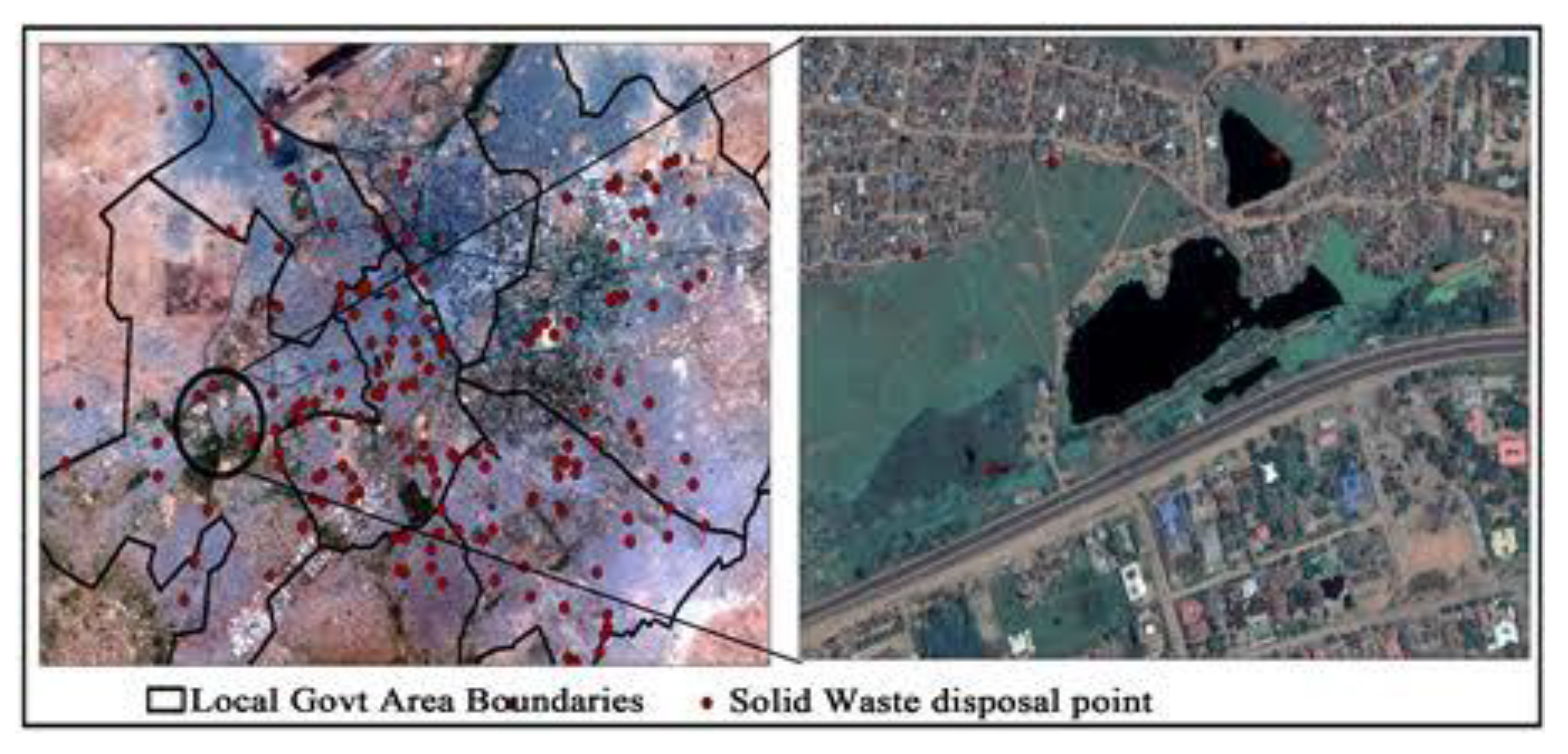

Table 1.
provides an overview of the potential use of waste gases derived from the chlorine industry, as well as the estimation results for municipal waste gases. The table presents valuable insights into the technical potential and estimated quantities of gases generated from these sources.
Table 1.
provides an overview of the potential use of waste gases derived from the chlorine industry, as well as the estimation results for municipal waste gases. The table presents valuable insights into the technical potential and estimated quantities of gases generated from these sources.
| Waste gas source | Yearly gas volume.,m/n m3 | Specific gas consumption m3/kWh sofc | Specific gas consumption.,m3kwh, PEMFC | Yearly energy output TWh sofc | Yearly energy output,TWh, PEMFC |
| Caustic soda production | 428 | 0.69 | 0.8 | 0.65 | 0.71 |
| Sodium chlorate production. | 148 | 0.69 | 0.8 | 0.24 | 0.25 |
| Municipal solid waste landfill sites. | 4119(CHE4)/2348(H2) | 0.19 | -- | 23.9 | --- |
Disclaimer/Publisher’s Note: The statements, opinions and data contained in all publications are solely those of the individual author(s) and contributor(s) and not of MDPI and/or the editor(s). MDPI and/or the editor(s) disclaim responsibility for any injury to people or property resulting from any ideas, methods, instructions or products referred to in the content. |
© 2023 by the authors. Licensee MDPI, Basel, Switzerland. This article is an open access article distributed under the terms and conditions of the Creative Commons Attribution (CC BY) license (http://creativecommons.org/licenses/by/4.0/).
Copyright: This open access article is published under a Creative Commons CC BY 4.0 license, which permit the free download, distribution, and reuse, provided that the author and preprint are cited in any reuse.


