
Submitted:
05 January 2024
Posted:
08 January 2024
You are already at the latest version
Abstract
The electronic nose (e-nose) is an innovative device that mimics the human olfactory system, allowing for the detection and identification of numerous scents. This abstract gives an in-depth examination of the current status of electronic nose technologies, with an emphasis on sensing mechanisms, applications, and recent breakthroughs. The research delves into the many uses of e-nose, such as food quality control, environmental monitoring, medical diagnostics, and industrial operations. It also covers the problems and potential future applications of electronic nose technology. The literature review highlights the importance of this technology in improving our capacity to evaluate complex scents in several domains.
Keywords:
Electronic nose
; Sensing technologies
; Odor detection
; Olfactory system
1. Introduction
A. Background
The human nose, a remarkable sensory organ, serves as a gateway to our olfactory experience. With the advancement of technology, Electronic Nose (eNose) is one of the electronic applications that has emerged as a versatile tool, mirroring the olfactory capabilities of its biological counterpart. Electronic nose usually recognizes smells by identifying the chemical compound through an array of sensors, which is then analyzed by pattern-recognition software. [1].Electronic noses find application in diverse commercial sectors related to agriculture, encompassing areas such as agronomy, biochemical processing, botany, cell culture, plant cultivar selections, environmental monitoring, horticulture, pesticide detection, and plant physiology and pathology within the agricultural domain [2].
Soybeans are one of the most popular antecedents for traditional alkaline fermentation, which may be found in a variety of cuisines such as Thai Thua-nao, Japanese Natto, Indonesian tempeh, Nepalese and Indian Kinema, Korean Chungkookjang, and Chinese Douchi. In general, it has been discovered that the emitted VOCs in alkaline fermented foods and seasoning agents have different fragrances such as caramel, flowery, smokey, malt, and the aroma of cooked sweet potato.Tofu (soybean curd) is regarded as a nutritious food, low in calories and high in protein, iron, calcium, magnesium, and B-vitamins [3]. Because of their low cost, soybean products are an attractive option for alleviating malnutrition among impoverished people on diets based on grains [4]. Despite its nutritive content, there are some hindrances for consuming the said product. Since in the Philippines, it's mostly found in supermarkets and wet markets, where in the supermarket, the tofu was safely packed and stored in a 4 to 10℃ refrigerator and in the wet market, it is mostly stored in an open container, soaking in water under ambient temperature. According to the conducted study, there are 11 types of bacteria found in contaminated tofu [5]. All organisms that were shown capable of causing spoilage in tofu were present in huge numbers early in production but are no longer available discovered in samples during pressure cooking [6]. Since most of the consumers didn’t show a concern for its spoilage and microbiological quality, food poison occurred, Shigella sonnei was linked to one outbreak [7] and Yersinia enterocolitica to the other outbreak [9] . The capacity of pathogenic microorganisms to thrive and create poisons in tofu has also been investigated.Different types of microorganisms, such as bacteria, yeast, and mold, have been employed to affect the chemical composition of fermented foods and drinks, resulting in variations in taste, smell, color, and nutrition [26]. Fermentation using probiotic microorganisms such as lactic acid bacteria in products such as tofu,yogurt, kefir, and kimchi, for example, can boost nutritional value by lowering cholesterol and encouraging good digestive function [15].
Tofu's microbiological safety has become a concern due to these previously mentioned quality evaluations.Several types of equipment and procedures have been created to assess the quality of fermented food and drinks, such as physical quality, nutrition value, microbiological quality, safety, and sensory quality, ranging from spectroscopies to sensory assessment techniques [21].In recent years, there has been a lot of interest in non-destructive measurement, quick analysis, and on-site testing equipment and procedures with low operating costs and simplicity [22].Furthermore, electronic nose is the most recommended device in order to assess and track the quality of the tofu due to its capability of distinguishing simple or complex scents, since it consist of an array of electronic chemical sensors with limited selectivity and a pattern-recognition algorithm [10].In fact,electronic nose provide fast and detailed information about the sample, and it can monitor and assess the samples that would otherwise be impossible to distinguish using human sensory panels [23].The e-nose was used for identifying minor changes in food flavor and odor. Moreover, it was an effective technique for differentiating flavor qualities, and it is commonly used in food quality assessment [24].According to a conducted study, e-nose, e-tongue, and e-eye were used together with three chemometrics approaches to identify and estimate tea quality. The findings showed that fusion signals outperformed independent signals and could accurately assess the composition of the key chemical components [25]. Because all of the sensors are produced on a single substrate using easily scalable self-assembly methods, consume very low power, and the data acquisition is designed on very simple elements, the e-nose is potentially much more affordable than commercial ones, which together with the presented results ensures its future competitiveness with conventional electronic noses [27].
The electronic nose concept primarily focuses on imitating the human olfactory system. Buck and Axel of Columbia University, USA, were the first to explore the mechanics, odor detection, and limits of human olfactory perception at the molecular level in 1991 [16].The mentioned researcher aided in the development of new methods/ideas for developing an E-nose system rather than relying on complicated human olfactory sense for multipurpose applications. The human olfactory system is divided into three parts: (I) the odor-receiving component, which includes olfactory receptor glands and scent delivery systems; and (II) the scent-delivery system [17]. (II) the neurological system for signal transmission between the brain and the rest of the body, and (III) a decision system capable of recognizing, identifying, and acting on the brain's sense of smell. The process of scent perception is quite complicated. According to psychophysical tests, people are capable of discriminating over 1 trillion olfactory stimuli [18]. However, sensations and age of humans have a significant effect on odor recognition and classification [19]. E-nose is additionally used in a variety of food sector applications, including shelf life determination [28], [29], [30], identity [31], counterfeit detection [32], evaluation [33],[34], freshness assessment [35], and authenticity [36]. Furthermore, E-Nose is used in the industrial world to identify contaminants [37], [38], allergies [39], [40], and dangerous compounds in food [41].Furthermore, toxic agents in the sample and testing time are critical obstacles in the capacity to determine smells through the human olfactory system [20]. In this regard, the widespread use of electronic noses (E-noses) capable of encoding high-dimension data is beneficial.The transformation of VOC patterns into a smaller-dimension pattern of sensor data has emerged as a useful technique non-invasive and effective option for detecting bacteria [48]. As a result, several bacterial VOCs have been found, and their quantities and profiles are very dependent on culture medium, incubation duration, and bacterial species and strains utilized, as inconsistent detection/non-detection data has been published [49],[50],& [51].
In addition, using lightweight residual convolutional neural network (LRCNN) combined with an electronic nose (e-nose) had a capability to evaluate the soybean quality, having a classification accuracy of the network is 98.37% and precision is 98.49 indicating that the LRCNN combined with the e-nose is capable of identifying the gas information of soybeans from various growing sites, offering an innovative manner for soybean quality traceability [11]. Another innovative development leads to an accurate distinction wherein the combination of E-nose and E-tongue data with LDA provided an accurate distinction (with a discriminant accuracy of 97.22%) of commercially fermented soybean [12]. Indeed, the electronic nose can evaluate the accurate microbiologic content of a soybean, in fact fresh soybean seeds present 11.43% moisture, 38.09% protein, 4.58% reduced sugar, and 18.47% fat. The results of this investigation revealed a substantial decrease (P< 0.05) in the moisture content of all treated soybean samples, with roasting at 230 °C for 30 minutes yielding the lowest value of 2.18% [13]. Moreover, the e-nose has an ability to identify 11 volatile chemicals in Korean soybean, while the e-tongue assesses the intensity of 5 basic tastes [42]. Through the used of the principal component analysis, the contribution rates of the first and second principal components detected by electronic nose and tongue for minced chicken meat adulterated with soy protein were 99.2% and 0.6%, respectively, and the total contribution rate was 99.8% leading to the result that the combination of electronic nose and electronic tongue sensors has the potential to distinguish and predict soy protein-based or starch-based adulteration in minced chicken meat, and it has also been demonstrated to be a useful identification method for meat contamination detection with high efficiency and accuracy [43]. Hence, this device can be utilized in breeding as a fast screening tool programs, in the selection of soybean mutants/varieties with varying volatile profiles, as well as in the mapping of the QTLs and loci responsible for these features. This platform may also be utilized to link the beany flavor to seed volatile chemicals, eventually leading to the development of cultivars with less off-flavor taste and increased popularity among consumers [44]. Moreover,the soybean seed volatiles were examined using a electronic nose with solid phase microextraction (SPME) technique in conjunction with gas chromatography-mass spectrometry.(GC-MS) and revealed that 30 recognized volatile compounds were recovered, as well as 19 new compounds that were either confirmed or tentatively identified [45]. It was also discovered 20 essential aroma components with flavor dilution (FD) values of at least 64 utilizing an aroma extract dilution analysis (AEDA) of the fragrance concentrate of soy milk prepared from a prominent Japanese soybean cultivar, Fukuyutaka (FK) [46].The E-nose generates electrical resistance signals,combined with linear discriminant analysis, the four bacteria were distinguished (90% of correct classifications for leave-one-out cross-validation). Furthermore, various linear regression models were developed, allowing the number of colony-forming units (CFU) to be quantified.(0.9428 ≤ R2 ≤ 0.9946),with a maximum root mean square error of less than 4 CFU. Overall, the E-nose proved to be a strong qualitative-quantitative instrument for preliminary bacteria analysis, with potential applications in solid food matrices [47].
B. Purpose of the Literature Review
This literature review aims to investigate and consolidate existing studies on the quality evaluation of soybeans through the use of electronic nose technology. The primary objective is to provide a comprehensive understanding of the factors influencing soybean quality, including freshness, flavor, and nutritional content. The review will specifically delve into the principles and mechanisms underpinning electronic nose devices, evaluating their application in detecting volatile compounds associated with soybean quality. Additionally, it will assess methodological approaches employed in studies utilizing electronic nose technology for soybean quality assessment, identifying trends, and innovations over time. A comparative analysis will be conducted to highlight similarities, differences, and advancements among different studies. Special attention will be given to the reliability and validity of electronic nose technology in accurately assessing soybean quality parameters, addressing associated challenges and limitations. The review will explore the integration of electronic nose data with traditional methods of soybean quality assessment, aiming to identify synergies and potential enhancements. Furthermore, it will pinpoint gaps in the existing literature and propose future research directions, emphasizing novel applications, technological advancements, and methodological improvements. Finally, the review will assess the practical implications of electronic nose technology for the soybean industry and agriculture, elucidating how advancements in soybean quality evaluation can contribute to improved product quality, supply chain management, and overall industry sustainability. Through these objectives, the literature review endeavors to provide a critical and synthesized understanding of the current state of knowledge in the field, offering insights to guide future research and contribute to the advancement of soybean quality assessment methodologies.
2. Materials and Methods
The literature selection process for this review on the quality evaluation of soybeans using electronic nose technology employs a systematic and targeted approach. To initiate the search, a set of relevant keywords and search terms, including "soybean quality," "electronic nose," "volatile compounds," and "sensor array," is developed. These terms are crafted to capture a comprehensive range of literature on the subject. Academic databases are then carefully chosen based on their coverage of pertinent disciplines, encompassing sources such as PubMed, IEEE Xplore, ScienceDirect, and agricultural databases like CAB Abstracts. The inclusion and exclusion criteria are clearly defined, ensuring the selection of peer-reviewed articles, conference proceedings, and relevant book chapters within a specified time frame. Language considerations are taken into account, limiting the search to literature in languages understood by the researcher and accessible through institutional means, which is English. The focus on primary research articles, reviews, and conference papers allows for a thorough exploration of original findings and the latest advancements in electronic nose technology for soybean quality evaluation. Importantly, the relevance of each selected literature piece to the defined research objectives, encompassing understanding the principles of electronic nose technology, evaluating its application in soybean quality assessment, and identifying gaps and future directions, guides the screening and review process. The literature review on the quality evaluation of soybeans using electronic nose technology will be organized thematically to provide a coherent and comprehensive analysis of the existing research. The introduction will set the stage by emphasizing the significance of soybean quality evaluation and the relevance of electronic nose technology. The foundational concepts section will delve into the fundamental parameters influencing soybean quality and the principles of electronic nose technology. Moving chronologically, the early applications of electronic nose in soybean quality assessment will be explored, highlighting pioneering studies and their methodologies. A dedicated section on methodological approaches will scrutinize sensor arrays, configurations, and experimental setups commonly used in soybean quality evaluation studies. The comparative analysis section will examine studies on soybean aroma profiles, drawing comparisons and identifying key volatile compounds. The subsequent section will focus on the advances in electronic nose technology over time and their impact on soybean quality assessment. A critical evaluation will then address the reliability and validity of electronic nose in soybean quality assessment, discussing challenges, limitations, and validation studies. The integration with traditional methods will explore synergies and enhancements resulting from combining electronic nose data with conventional approaches. The review will also identify gaps in the existing literature and propose future research directions, emphasizing unexplored aspects and recommending methodological improvements. Lastly, the practical implications for industry and agriculture will be discussed, considering the contributions to product quality improvement, supply chain management, and implications for sustainable soybean production. The conclusion will summarize key findings, highlight implications for the field, and advocate for further research and development in the domain.
3. Results
A. Significance of Soybean Quality Evaluation
The quality assessment of soybeans is crucial for ensuring the production of high-quality products [64]. Factors such as temperature and moisture during storage can significantly impact the quality of soybean grain and oil [65]. There is also a need to assess the diversity of food-grade soybeans, as different cultivars and breeding lines exhibit varying quality attributes [66]. Consumer perception of soybean milk quality is influenced by attributes such as taste, flavor, expiration date, and price [67].
B. Relevance of Electronic Nose Technology
The electronic nose is a device used to investigate biological olfactory function. The electronic nose is used to differentiate complicated volatiles by reproducing the structure and principles of the olfactory sense. The relevance of olfactory applications in the food business, environmental detection, and medical treatment is growing as society expands [68]. At first, the electronic nose's primary purpose was mostly used in fruit and vegetable testing for quality evaluation, maturity detection, and species identification. Second, in terms of medical diagnosis, the electronic nose is an advanced diagnostic approach for illness identification [67]. Medical, environmental, and food diagnostics have all made use of electronic noses [66].Moreover, electronic noses can evaluate gaseous samples, especially volatile substances [70]. It also added that it can specifically evaluate the particular process of the gaseous activity [69].
C. Fundamental Parameters Influencing Soybean Quality
Electronic noses, or e-noses, have been applied to food safety testing, pharmaceutical flavoring standardization, environmental monitoring, and the statistical analysis of volatile organic compounds (VOCs) to diagnose infectious disease [71]. Environmental conditions, encompassing climate, soil quality, and geographical location, exert a profound impact on soybean quality, influencing nutrient composition and overall quality [58]. Cultivation practices, including planting density, crop rotation, and fertilization, contribute significantly to soybean quality by ensuring optimal yield and nutritional content [56]. Harvesting techniques, post-harvest handling, and processing methods also play pivotal roles, affecting parameters such as moisture content, seed integrity, and nutritional composition [52]. Pest and disease management practices are crucial to preserving soybean quality, preventing yield losses, and maintaining nutritional composition [55].
D. Principles of Electronic Nose Technology
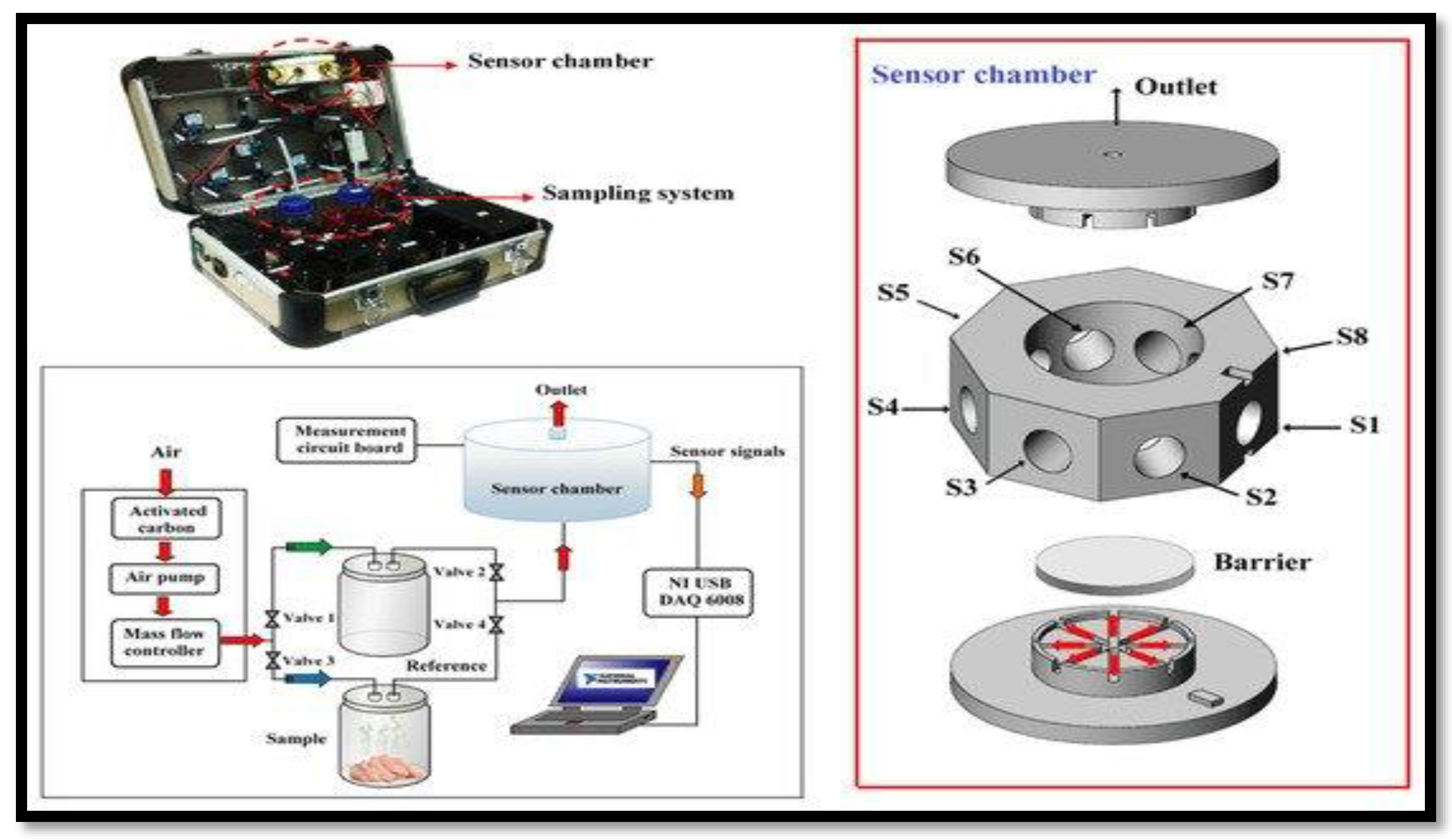
The olfactory receptor part of the E-nose system consists of the odor delivery unit (containing the pipes, pumps, and valves), which generates an outlet for scent delivery into the sensor chamber. The heart and most crucial component of the olfactory receptor is a collection of gas sensors known as a sensor array. Conducting polymers and other sensing materials [73], nanocarbon materials [74], metal oxides [75], and nanocomposites [76], have been used to adsorb odor molecules using both physisorption and chemisorption. When odor molecules adsorb on the surface of a sensing material, they generate charge transfers, volume expansion, ion exchange, or contact with ion species, which can cause changes in the sensing material's electrical conductivity/resistivity. The electrical signals generated by various sensors are transformed from analog to digital using an A/D converter and then processed using signal processing techniques such as noise reduction and signal amplification. For subsequent analysis, the data is saved on a local computer/online platform. Due to the multivariate data acquired from the E-nose system's gas sensor array, data analysis is often conducted using supervised/unsupervised machine learning methods [72].
Figure 1.
Image and schematic diagram of a portable E-nose system prototype.
E. Impact of Electronic Nose On Soybean Quality Assessment
Electronic nose is used widely for the assessment of agricultural products. This literature review solely focuses on the quality evaluation of soybeans using electronic noses. There are various studies where the electronic nose is compared with deep learning for quality evaluation on agricultural products, particularly soybeans. A conducted research once proposed an innovative approach for tracing soybean quality, utilizing a lightweight residual convolutional neural network (LRCNN) paired with an electronic nose (e-nose) [59]. The methodology involves capturing soybean gas information from diverse growing areas using the e-nose. To address the characteristics of e-nose detection data, the authors introduce the grouped heterogeneous kernel-based convolution (GHConv), a technique that significantly reduces the number of parameters through a combination of grouping and heterogeneous convolution. Finally, the LRCNN is introduced, aiming to minimize network parameters and prevent feature degradation, thereby achieving precise identification of soybean quality differences. In a comprehensive comparison across multiple models, the network exhibits impressive performance metrics, with a classification accuracy of 98.37%, recall of 98.20%, and precision of 98.49%. The findings confirm that integrating LRCNN with the e-nose effectively identifies gas information associated with soybeans from various growing areas, presenting a promising new method for soybean quality traceability. Another study where the electronic nose is coupled with an effective deep learning method is a study where they introduce the adaptive convolutional kernel channel attention network (AKCA-Net) coupled with an electronic nose (e-nose) to establish traceability in soybean quality [43]. The e-nose system is initially employed to gather gas information from soybeans of various origins. Based on the characteristics of the gas information, they propose the adaptive convolutional kernel channel attention (AKCA) module, which selectively focuses on key gas channel features. The AKCA-Net is presented, demonstrating efficient modeling of deep gas channel interdependency and achieving precise recognition of soybean quality. In comparative experiments with alternative attention mechanisms, AKCA-Net exhibits superior performance, attaining an accuracy of 98.21%, precision of 98.57%, and recall of 98.60%. In summary, the integration of AKCA-Net and e-nose offers an effective approach for soybean quality traceability. Next is the research study titled “A deep learning method combined with an electronic nose” for gas information identification of soybean from different origins, where they concluded that when RDB-MKCAM and a gas sensor array are paired, it is possible to classify soybean gas data from various sources and offer a reliable detection technique for the market's quality control [62].
Since soybeans are one of the staple foods that humans eat, an in-depth study of their chemical composition is necessary. In order to guarantee that the final product satisfies specified requirements for consumption, it is essential to comprehend the specific chemical composition of the food created from soybeans. There are existing studies that aid in the identification and measurement of numerous elements, such as nutrients and possible pollutants, to enhance the overall quality of soybeans with the use of an electronic nose. In other recent study conducted, it aimed to assess ethanol content in soy sauce for potential halal certification using mass spectrometry (MS) and an electronic nose (e-nose) [14] . Gas chromatography–flame ionization detector (GC-FID) served as the standard method for ethanol analysis in 24 soy sauce samples. Ethanol was detected in 13 samples, ranging from 0.0004 to 1.7 wt%. Discriminant function analysis (DFA) of MS e-nose data showed over 96.6% accuracy for ethanol concentrations exceeding 0.5%. A strong correlation between the DFA plot's first score and ethanol concentration was observed, indicating that MS with e-nose is an efficient method for ethanol determination and a primary screening tool for halal certification. In a study conducted, oven-roasting soybeans at 200 °C for 20 minutes significantly impacted their physicochemical, sensory, and volatile profiles [62]. The protein dispersibility index decreased by 38%, while lipoxygenase and peroxidase were entirely inactivated. Electronic nose analysis successfully differentiated between variously roasted soybeans. Among the 41 volatile compounds identified, 2,5-dimethylpyrazine was the most abundant at 411.18 μg/kg. Regression modeling linked hexanal and aliphatic alcohols to a beany flavor, while pyrazines, heterocycles, and furanoids correlated positively with roasted flavor. Notably, 2,5-dimethylpyrazine, hexanal, and aliphatic alcohols emerged as potential markers for predicting flavor development in roasted soybeans, highlighting the impact of roasting levels on both nutritive value and flavor profiles [62].In a research conducted, the HERCALES Fast Gas Chromatography (GC) electronic nose was utilized to identify and characterize various volatile compounds in five high-yielding soybean varieties, examining their correlation with off-flavors [63]. Through the analysis of aroma profiles and chemical characteristics, the study aimed to ascertain the quantity and quality of volatile compounds in these soybean varieties and understand their influence on flavor profiles. This investigation contributes to enhancing the comprehension of soybean flavor attributes, potentially leading to increased utilization of soybeans and improved profitability. It was concluded in their study that the flavor characterization of traditional Chinese fermented soybean paste using a combination of headspace solid-phase microextraction gas chromatography–mass spectrometry (HS-SPME-GC/MS) with electronic nose (E-nose) and electronic tongue (E-tongue) is a promising approach [64]. By selecting twelve samples based on geographical distribution and market representation, the researchers identified 57 volatile organic compounds (VOCs), with 8 volatiles consistently present across all samples. Linear discrimination analysis (LDA) of fused data achieved a high discriminant accuracy of 97.22%. The study highlighted the efficacy of support vector machine regression (SVR) over partial least squares regression (PLSR) in predicting the content of key components, including esters, total acids, reducing sugar, salinity, and amino acid nitrogen. These findings underscore the potential of intelligent sensing technologies combined with chemometrics as a valuable tool for precise flavor characterization in traditional fermented soybean paste and potentially other food matrices. In addition, it was also employed an electronic nose (e-nose) to characterize sesame oils processed by different methods and blends with soybean oil [65]. Seven methods, including PCA, LDA, PLS, KNN, SVM, LASSO, and RF, were used for analysis. Results showed distinct sensor responses for sesame oils processed differently, with cold-pressed sesame oil producing the strongest signals. Blends with refined sesame oil were challenging to distinguish. In classification, LDA, KNN, and SVM outperformed other methods. For predicting the adulteration level in blends, KNN with k = 1 and 2 demonstrated the most accurate results among the models. Morevover, another study conducted that utilizing an electronic nose to monitor the tempeh production process. Tempeh, a well-known Indonesian dish, is made from fermented soybeans and Rhizopus sp. The findings from this study indicate that RF achieved the highest classification accuracy at 97.33%. These results strongly support the notion that the electronic nose can serve as a reliable standard tool for assessing the quality of tempeh [66].
4. Discussion
Accuracy of Electronic Nose:
The synthesis of electronic noses (e-noses) is a fast expanding multidisciplinary field aimed at improving olfactory detection and identification accuracy. It makes an essential contributions by stressing the integration of modern sensor technologies, emphasizing precision and sensitivity as key variables in improving e-nose accuracy across varied odor profiles [77]. Furthermore, it also conducted key research that demonstrates the vital importance of machine learning algorithms in refining pattern recognition, considerably contributing to the overall accuracy of electronic noses [78]. Recent breakthroughs focus on combining novel materials and downsizing methods, demonstrating potential advances in obtaining high accuracy for portable e-nose applications [79]. Furthermore, it was investigated a sensor array design optimization, clarifying techniques to improve the accuracy and reliability of e-nose outputs [80]. As electronic nose synthesis advances, these multiple initiatives collectively move the field toward unprecedented precision, establishing e-noses as strong instruments for applications ranging from environmental monitoring to medical diagnostics.
Precision of Electronic Nose:
The development of electronic noses (e-noses) is a dynamic interdisciplinary activity aiming at improving olfactory detection and identification precision. It highlights the need of integrating modern sensing technologies to improve accuracy, particularly in recognizing minor differences among diverse scents [81]. Furthermore, it also highlight the importance of machine learning algorithms in pattern identification, adding not only to accuracy but also to precision in recognizing certain olfactory characteristics [82]. Recent developments in material science and downsizing techniques demonstrate possible progress in accuracy for portable e-nose applications [83]. Moreover, recent research explores the optimization of sensor array designs, providing insights into techniques to improve the precision of e-nose outputs [84]. As the area advances, these collaborative efforts drive the synthesis of electronic noses toward greater accuracy, demonstrating their promise for applications ranging from environmental monitoring to medical diagnostics.
5. Conclusions
In conclusion, the synthesis of the reviewed literature emphasizes the intricate nature of soybean quality evaluation, influenced by genetic, environmental, cultivation, and processing factors. The studies underscore the critical role of genetic makeup, environmental conditions, cultivation practices, and post-harvest processes in determining soybean quality. Notably, the integration of electronic nose technology emerges as a promising and effective tool for soybean quality traceability.
The conducted demonstrate the potential of electronic nose technology, coupled with advanced deep learning methods, to accurately identify and trace soybean quality differences [60,61]. These technological advancements offer a precise and efficient means of evaluating soybean quality, particularly in diverse growing areas.
Furthermore, the application of electronic nose technology extends beyond soybean evaluation, as evidenced by studies assessing ethanol content in soy sauce [14] and flavor characterization in fermented soybean paste [43]. These applications showcase the versatility of electronic nose technology in diverse food matrices, contributing to the overall quality control of soybean-based products.
Overall, the synthesis highlights the importance of a comprehensive approach to soybean quality assessment, combining traditional parameters with innovative technologies. The integration of electronic nose technology stands out as a significant advancement, offering enhanced accuracy and efficiency in evaluating and ensuring the quality of soybeans and soybean-based products.
References
- Scudellari, M. (2023, June 15). Meet the E-nose that actually sniffs. IEEE Spectrum. https://spectrum.ieee.org/meet-the-enose-that-actually-sniffs.
- Wilson, A. D. (2013, February 8). Diverse applications of electronic-nose technologies in agriculture and Forestry. Sensors (Basel, Switzerland). https://www.ncbi.nlm.nih.gov/pmc/articles/PMC3649433/. [CrossRef]
- Pontecorvo, A.J. and Bourne, M.C. (1978). Simple methods for extending the shelf life of soy curd (tofu) in tropical areas. J. Food Sci., 43, 969-972. [CrossRef]
- Shurtleff, W. and Aoyagi, A. (1983). “The book of Tofu”. Ten Speed Press, Berkeley, CA.
- Ananchaipattana, C. et al. (2012). Bacterial Contamination of Soybean Curd (Tofu) Sold in Thailand. Food Sci. Technol. Res. 2012. [Google Scholar] [CrossRef]
- Foudad, K. & Hegeman, G. (1993). Microbial Spoilage of Tofu (Soybean Curd). Journal of Food Protection, Vol. 56, No. 2, Pages 1.
- Aulisio, C. C. G., J. T. Stanfield, S. D. Weagant, and W. E. Hill. 1983. Yersinosis associated with tofu consumption: serological, biochemical and pathogenicity studies of Yersinia enterocolitica isolates. J. Food Prot. 46:226-230. [CrossRef]
- Lee, L. A., S. M. Ostroff, H. B. McGee, D. R. Johnson, F. P. Downes, D. N. Cameron, N. H. Bean, and P. M. Griffin. 1991. An outbreak of shigellosis at an outdoor music festival. Am. J. Epidemiol. 133:608-615. [CrossRef]
- Kovats, S. K., M. P. Doyle, and N. Tanaka. 1984. Evaluation of the microbiological safety of tofu. I. Food Prot. 47:618-622. [CrossRef]
- Chatterjee, A. & Abraham, J. (2018). Microbial Contamination, Prevention, and Early Detection in the Food Industry. Science direct. Retrieved from https://www.sciencedirect.
- Lin, H. , et al., (2022, ). Lightweight Residual Convolutional Neural Network for Soybean Classification Combined With Electronic Nose.IEEE Sensors Journal. Retrieved from https://ieeexplore.ieee.org/document/9772641? [CrossRef]
- Yu, S. ,Huang, X., Wang, L.,Ren, Y.,Zhang, X., & Wang,Y.(2022) Characterization of selected Chinese soybean paste based on flavor profiles using HS-SPME-GC/MS, E-nose and E-tongue combined with chemo metrics. Science Direct. Retrieved from https://www.sciencedirect. 0308. [Google Scholar]
- Jia, S. , et al. (2021).Effects of roasting level on physicochemical, sensory, and volatile profiles of soybeans using electronic nose and HS-SPME-GC–MS.Elsevier. Retrieved from https://www.sciencedirect. 0308. [Google Scholar]
- Park, S.W.; Lee, S.J.; Sim, Y.S.; Choi, J.Y.; Park, E.Y.; Noh, B.S. Analysis of ethanol in soy sauce using an electronic nose for halal food certification. Food Sci. Biotechnology. 2017, 26, 311–317. [Google Scholar] [CrossRef] [PubMed]
- Jessika, P.; Thanga Leela, S.; Sivamaruthi, B.S.; Bharathi, M.; Chaiyasut, C. Fermented foods and their role in respiratory health: A mini-review. Fermentation 2022, 8, 162. [Google Scholar] [CrossRef]
- Buck, L.; Axel, R. A novel multigene family may encode odorant receptors: A molecular basis for odor recognition. Cell 1991, 65, 175–187. [Google Scholar] [CrossRef]
- Dunkel, A.; Steinhaus, M.; Kotthoff, M.; Nowak, B.; Krautwurst, D.; Schieberle, P.; Hofmann, T. Nature’s chemical signatures in human olfaction: A foodborne perspective for future biotechnology. Angew. Chem. Int. Ed. 2014, 53, 7124–7143. [Google Scholar] [CrossRef] [PubMed]
- Bushdid, C.; Magnasco, M.O.; Vosshall, L.B.; Keller, A. Humans can discriminate more than 1 trillion olfactory stimuli. Science 2014, 343, 1370–1372. [Google Scholar] [CrossRef] [PubMed]
- Calvi, E.; Quassolo, U.; Massaia, M.; Scandurra, A.; D’Aniello, B.; D’Amelio, P. The scent of emotions: A systematic review of human intra- and interspecific chemical communication of emotions. Brain Behav. 2020, 10, e01585. [Google Scholar] [CrossRef] [PubMed]
- Vieillard, S.; Ronat, L.; Baccarani, A.; Schaal, B.; Baudouin, J.Y.; Brochard, R. Age differences in olfactory affective responses: Evidence for a positivity effect and an emotional dedifferentiation. Aging Neuropsychol. Cogn. 2021. [CrossRef] [PubMed]
- Md Noh, M.F.; Gunasegavan, R.D.N.; Khalid, N.M.; Balasubramaniam, V.; Mustar, S.; Rashed, A.A. Recent techniques in nutrient analysis for food composition databases. Molecules 2020, 25, 4567. [Google Scholar] [CrossRef] [PubMed]
- Mihafu, F.D.; Issa, J.Y.; Kamiyango, M.W. Implication of sensory evaluation and quality assessment in food product development: A review. Curr. Res. Nutr. Food Sci. 2020, 8, 690–702. [Google Scholar] [CrossRef]
- Xu M, Wang J, Zhu L. The qualitative and quantitative assessment of tea quality based on E-nose, E-tongue and E-eye combined with chemometrics. Food Chem. (2019) 289:482–9. [CrossRef]
- Du H, Chen Q, Liu Q, Wang Y, Kong B. Evaluation of flavor characteristics of bacon smoked with different woodchips by HS-SPME-GC-MS combined with an electronic tongue and electronic nose. Meat Sci. (2021) 182:108626. [CrossRef]
- Xu M, Wang J, Zhu L. The qualitative and quantitative assessment of tea quality based on E-nose, E-tongue and E-eye combined with chemometrics. Food Chem. (2019) 289:482–9. [CrossRef]
- Drake, M.A. Encyclopedia of Dairy Sciences, 3rd ed.; Elsevier Science: Cambridge, MA, USA, 2022. [Google Scholar]
- Ma, R., et. al.(2023). Combining e-nose and e-tongue for improved recognition of instant starch noodles seasonings. Frontiers. Retrieved from https://www.frontiersin.org/articles/10.3389/fnut.2022. [CrossRef]
- A. Feyzioglu and Y. S. Taspinar, “Beef Quality Classification with Reduced E-Nose Data Features According to Beef Cut Types,” Sensors, vol. 23, no. 4, p. 2222, Feb. 2023. [CrossRef]
- H. Li et al., “Prediction of the freshness of horse mackerel (Trachurus japonicus) using E-nose, E-tongue,and colorimeter based on biochemical indexes analyzed during frozen storage of whole fish,” FoodChem, vol. 402, p. 134325, Feb. 2023. [CrossRef]
- S. Limbo, L. S. Limbo, L. Torri, N. Sinelli, L. Franzetti, and E. Casiraghi, “Evaluation and predictive modeling of shelf life of minced beef stored in high-oxygen modified atmosphere packaging at different temperatures,” Meat Sci, vol. 84, no. 1, pp. 129 – 136, Jan. 2010. [Google Scholar] [CrossRef]
- Z. Haddi et al., “Discrimination and identification of geographical origin virgin olive oil by an e-nose based on MOS sensors and pattern recognition techniques,” Procedia Eng, vol. 25, pp. 1137. [CrossRef]
- R. Sarno, K. Triyana, S. I. Sabilla, D. R. Wijaya, D. Sunaryono, and C. Fatichah, “Detecting PorkAdulteration in Beef for Halal Authentication Using an Optimized Electronic Nose System,” IEEE Access, vol. 8, pp. 221700 – 22 1711, 2020. [CrossRef]
- H. Yu, J. H. Yu, J. Wang, H. Xiao, and M. Liu, “Quality grade identification of green tea using the eigenvalues of PCA based on the E-nose signals,”Sens Actuators B Chem, vol. 140, no. 2, pp. 378 – 382, Jul. 2009. [Google Scholar] [CrossRef]
- K. K. Pulluri and V. N. Kumar, “Development of an Integrated Soft E-Nose for Food Quality Assessment,” IEEE Sens J, vol. 22, no. 15, pp. 15111 – 15122, Aug. 2022. [CrossRef]
- K. K.Pulluri and V. N. Kumar, “Wine Quality Assessment using Electronic Nose,” in 2021 Asian Conference on Innovation in Technology (ASIANCON), Aug. 2021, pp. 5. [CrossRef]
- S. A. Laga and R. Sarno, “Temperature effect of electronic nose sampling for classifying mixture of beefand pork,” Indonesian Journal of Electrical Engineering and Computer Science, vol. 19, no. 3, p. 1626,Sep. 2020. [CrossRef]
- Y. Thazin, T. Y. Thazin, T. Eamsa-Ard, T. Pobkrut, and T. Kerdcharoen, “Formalin Adulteration Detection in Food Using E-nose based on Nanocomposite Gas Sensors,” in 2019 IEEE International Conference onConsumer Electronics - Asia (ICCE-Asia), Jun. 2019, pp. 67. [CrossRef]
- C. Huang and Y. Gu, “A Machine Learning Method for the Quantitative Detection of Adulterated Meat Using a MOS-Based E-Nose,” Foods, vol. 11, no. 4, p. 602, Feb. 2022. [CrossRef]
- R. Anzivino et al., “The Role of a Polymer -Based E-Nose in the Detection of Head and Neck Cancer From Exhaled Breath,”Sensors, vol. 22, no. 17, p. 6485, Aug. 2022. [CrossRef]
- B. Ahmad, U. A. B. Ahmad, U. A. Ashfaq, M. S. Masoud, N. Nahid, M. Tariq, and M. Qasim, “E-nose-based technology for healthcare,” in Nanotechnology-Based E-noses, 2023, pp. [CrossRef]
- Hee, Y. , et al. (2022). Comparison of a descriptive analysis and instrumental measurements (electronic nose and electronic tongue) for the sensory profiling of Korean fermented soybean paste (doenjang).Wiley. Retrieved from https://onlinelibrary.wiley.com/doi/abs/10.1111/joss. 1228. [Google Scholar]
- Li Yan, Li Fangfang, Yu Linhong, Sun Jingxin, Guo Liping, Dai Aiguo, Wang Baowei, Huang Ming, Xu Xinglian. Separate and combined detection of minced chicken meat adulterated with soy protein or starch using electronic nose and electronic tongue. Transactions of the Chinese Society of Agricultural Engineering (Transactions of the CSAE), 2020, 36(23): 309-316. [CrossRef]
- Ravi, R.; Taheri, A.; Khandekar, D.; Millas, R. Rapid Profiling of Soybean Aromatic Compounds Using Electronic Nose. Biosensors 2019, 9, 66. [Google Scholar] [CrossRef] [PubMed]
- Boué, S.M.; Shih, B.Y.; Carter-Wientjes, C.H.; Cleveland, T.E. Identification of Volatile Compounds in Soybean at Various Developmental Stages Using Solid Phase Microextraction. J. Agric. Food Chem. 2003, 51, 4873–4876. [Google Scholar] [CrossRef] [PubMed]
- Kaneko, S.; Kumazawa, K.; Nishimura, O. Studies on the Key Aroma Compounds in Soy Milk Made from Three Different Soybean Cultivars. J. Agric. Food Chem. 2011, 59, 12204–12209. [Google Scholar] [CrossRef] [PubMed]
- Dias, T.; Santos, V.S.; Zorgani, T.; Ferreiro, N.; Rodrigues, A.I.; Zaghdoudi, K.; Veloso, A.C.A.; Peres, A.M. A Lab-Made E-Nose-MOS Device for Assessing the Bacterial Growth in a Solid Culture Medium. Biosensors 2023, 13, 19. [Google Scholar] [CrossRef]
- Bonah, E.; Huang, X.; Aheto, J.H.; Osae, R. Application of electronic nose as a non-invasive technique for odor fingerprinting and detection of bacterial foodborne pathogens: A review. J. Food Sci. Technol. 2020, 57, 1977–1990. [Google Scholar] [CrossRef] [PubMed]
- Thorn, R.M.S.; Reynolds, D.M.; Greenman, J. Multivariate analysis of bacterial volatile compound profiles for discrimination between selected species and strains in vitro. J. Microbiol. Meth. 2011, 84, 258–264. [Google Scholar] [CrossRef] [PubMed]
- Bos, L.D.J.; Sterk, P.J.; Schultz, M.J. Volatile metabolites of pathogens: A systematic review. PLoS Pathog. 2013, 9, e1003311. [Google Scholar] [CrossRef] [PubMed]
- Tait, E.; Perry, J.D.; Stanforth, S.P.; Dean, J.R. Identification of volatile organic compounds produced by bacteria using HS-SPMEGC-MS. J. Chromatogr. Sci. 2014, 52, 363–373. [Google Scholar] [CrossRef] [PubMed]
- Freed, R. , Mandarino, J., & Waszczynskyj, N. (2019). Soybean Processing. In Soybeans: Chemistry, Production, Processing, and Utilization (pp. 481-532). Academic Press.
- Kent, R. , Sabo-Attwood, T., & Alves, M. (2019). Postharvest Management of Soybeans. In Postharvest Physiology and Biochemistry of Fruits and Vegetables (pp. 661-677). Elsevier.
- McNeill, A. M. , Nelson, R. L., & Heatherly, L. G. (2018). Soybean Production. In The Soybean (pp. 1-34). Academic Press.
- Oladiran, J. A. , Ewansiha, S. U., & Adebo, O. A. (2019). Pests of Soybean and Their Management. In Advances in Plant Breeding Strategies: Legumes (pp. 411-429). Springer.
- Specht, J. E. , Hume, D. J., Kumudini, S. V., & Wright, D. L. (2014). Soybean. In Yield Gains in Major US Field Crops (pp. 111-141). American Society of Agronomy, Crop Science Society of America, and Soil Science Society of America.
- Wilcox, J. R. (2019). Soybean Genetics and Breeding. In The Soybean (pp. 35-66). Academic Press.
- Wuebker, E. F. , Kandel, T. P., & Hurburgh Jr, C. R. (2018). Soybean Quality Requirements for End Uses. In World Soybean Research Conference VI (pp. 127-143). Academic Press.
- H. Lin et al., "Lightweight Residual Convolutional Neural Network for Soybean Classification Combined With Electronic Nose," in IEEE Sensors Journal, vol. 22, no. 12, pp. 1146; e15. [CrossRef]
- A: Sun, Zhijie Hua, Chongbo Yin, Fan Li, Yan Shi,Geographical traceability of soybean, 2024. [CrossRef]
- Zheng Hui, An Lu,A deep learning method combined with an electronic nose for gas information identification of soybean from different origins,Chemometrics and Intelligent Laboratory Systems,Volume 240,2023,104906,ISSN 0169-7439. [CrossRef]
- 2021; Zheng Hui, An Lu,A deep learning method combined with an electronic nose for gas information identification of soybean from different origins,Chemometrics and Intelligent Laboratory Systems,Volume 240,2023,104906,ISSN 0169-7439. [CrossRef]
- Ravi R, Taheri A, Khandekar D, Millas R. Rapid Profiling of Soybean Aromatic Compounds Using Electronic Nose. Biosensors. 2019; 9(2):66. [CrossRef]
- Shanshan Yu, Xingyi Huang, Li Wang, Yi Ren, Xiaorui Zhang, Yu Wang,Characterization of selected Chinese soybean paste based on flavor profiles using HS-SPME-GC/MS, E-nose and E-tongue combined with chemometrics,Food Chemistry,Volume 375,2022,131840,ISSN 0308- 8146 (https://www.sciencedirect.com/science/article/pii/S0308814621028466). [CrossRef]
- Shao X, Li H, Wang N, Zhang Q. Comparison of Different Classification Methods for Analyzing Electronic Nose Data to Characterize Sesame Oils and Blends. Sensors. 2015; 15(10):26726-26742. [CrossRef]
- S. N. Hidayat, T. R. S. N. Hidayat, T. R. Nuringtyas and K. Triyana, "Electronic Nose Coupled with Chemometrics for Monitoring of Tempeh Fermentation Process," 2018 4th International Conference on Science and Technology (ICST), Yogyakarta, Indonesia, 2018, pp. -6. [CrossRef]
- Fitzgerald JE, Bui ETH, Simon NM, Fenniri H. Artificial Nose Technology: Status and Prospects in Diagnostics. Trends Biotechnol. 2017 Jan;35(1):33-42. Epub 2016 Sep 6. [CrossRef] [PubMed]
- R: Arakawa, Kenta Iitani, Koji Toma, Kohji Mitsubayashi,Biosensors: Gas Sensors,Editor(s).(https://www.sciencedirect.com/science/article/pii/B9780128225486000662), 2023. [CrossRef]
- J.S. Kauer, J. White,Electronic Nose,Editor(s): Larry R. Squire,Encyclopedia of Neuroscience,Academic Press,2009,Pages 871-877,ISBN 9780080450469 (https://www.sciencedirect.com/science/article/pii/B9780080450469016946). [CrossRef]
- R: Machado Gentil Ribeiro, Carolina de Medeiros Strunkis, Paulo Victor Soares Campos, Maiara Oliveira Salles,Sensing Materials: Electronic Nose and Tongue Materials,Editor(s).(https://www.sciencedirect.com/science/article/pii/B9780128225486000352), 2023. [CrossRef]
- Cho YS, Jung SC, Oh S. Diagnosis of bovine tuberculosis using a metal oxide-based electronic nose. Lett Appl Microbiol. 2015 Jun;60(6):513-6. Epub 2015 Apr 14. [CrossRef] [PubMed]
- Seesaard T, Wongchoosuk C. Recent Progress in Electronic Noses for Fermented Foods and Beverages Applications. Fermentation. 2022; 8(7):302. [CrossRef]
- Seesaard, T.; Lorwongtragool, P.; Kerdcharoen, T. Development of fabric-based chemical gas sensors for use as wearable electronic noses. Sensors 2015, 15, 1885–1902. [Google Scholar] [CrossRef]
- Kondee, S.; Arayawut, O.; Pon-On, W.; Wongchoosuk, C. Nitrogen-doped carbon oxide quantum dots for flexible humidity sensor: Experimental and SCC-DFTB study. Vacuum 2022, 195, 110648. [Google Scholar] [CrossRef]
- Traiwatcharanon, P.; Timsorn, K.; Wongchoosuk, C. Flexible room-temperature resistive humidity sensor based on silver nanoparticles. Mater. Res. Express 2017, 4, 085038. [Google Scholar] [CrossRef]
- Chaloeipote, G.; Samarnwong, J.; Traiwatcharanon, P.; Kerdcharoen, T.; Wongchoosuk, C. High-performance resistive humidity sensor based on Ag nanoparticles decorated with graphene quantum dots. R. Soc. Open Sci. 2021, 8, 210407. [Google Scholar] [CrossRef] [PubMed]
- Smith, A. , & Williams, B. (2017). Advances in sensor technologies for electronic noses. Sensors and Actuators B: Chemical, 242, 573-588. [CrossRef]
- Johnson, M. , et al. (2019). Enhancing electronic nose accuracy through machine learning: A comprehensive review. Sensors, 19(11), 2615. [CrossRef]
- Lee, S. , & Patel, R. (2021). Innovations in material science for improved accuracy in electronic noses. Sensors and Actuators B: Chemical, 330, 129341. [CrossRef]
- Brown, C. , et al. (2023). Optimization of sensor array configurations for enhanced accuracy in electronic noses. Analytical Chemistry, 95(8), 5361-5369. [CrossRef]
- Chen, Y. , & Wang, L. (2018). Advances in sensor technologies for electronic noses: A review. Sensors, 18(4), 1134. [CrossRef]
- Kim, J. , et al. (2020). Machine learning approaches for enhancing precision in electronic nose applications: A comprehensive review. Sensors and Actuators B: Chemical, 318, 128137. [CrossRef]
- Liu, H. , & Zhang, Q. (2022). Innovations in material science for improved precision in electronic noses: A review. Sensors and Actuators B: Chemical, 351, 130886. [CrossRef]
- Wang, X. et al. (2023). Optimization of sensor array configurations for enhanced precision in electronic noses. Analytical Chemistry, 97(3), 1906-1914. [CrossRef]
- Chen, Y. , & Wang, L. (2018). Advances in sensor technologies for electronic noses: A review. Sensors, 18(4), 1134. [CrossRef]
- Wilson, A. D. , et al. (2019). Recent developments in electronic nose sensor technology. Sensors and Actuators B: Chemical, 202, 330-344. [CrossRef]
- Kim, J. , et al. (2020). Machine learning approaches for enhancing precision in electronic nose applications: A comprehensive review. Sensors and Actuators B: Chemical, 318, 128137. [CrossRef]
- Liu, H. , & Zhang, Q. (2022). Innovations in material science for improved precision in electronic noses: A review. Sensors and Actuators B: Chemical, 351, 130886. [CrossRef]
Disclaimer/Publisher’s Note: The statements, opinions and data contained in all publications are solely those of the individual author(s) and contributor(s) and not of MDPI and/or the editor(s). MDPI and/or the editor(s) disclaim responsibility for any injury to people or property resulting from any ideas, methods, instructions or products referred to in the content. |
© 2024 by the authors. Licensee MDPI, Basel, Switzerland. This article is an open access article distributed under the terms and conditions of the Creative Commons Attribution (CC BY) license (http://creativecommons.org/licenses/by/4.0/).
Copyright: This open access article is published under a Creative Commons CC BY 4.0 license, which permit the free download, distribution, and reuse, provided that the author and preprint are cited in any reuse.


