
Submitted:
09 January 2024
Posted:
10 January 2024
You are already at the latest version
Abstract
The construction sector is considered as a major consumer of virgin materials and contributor to waste generation. Therefore, it is essential to rethink current waste management practices, for example, by applying circular economy principles to building demolition, such as deconstruction. Deconstruction involves dismantling a building with the aim of maintaining the highest possible value for its materials and maximize their recovery potential. This study aims to guide the construction sector towards deconstruction to support its efforts to transform itself toward a more sustainable industry. It focuses on a regional case study in the province of Québec (Canada) presenting five buildings to be deconstructed. First, the study presents the outcomes of our analysis of the current situation. Second, it identifies the issues and obstacles encountered and proposes avenues to improve the current process based on solutions identified in the literature and the recommendations of the manager, the contractor involved in the deconstruction process, as well as experts in the construction industry. Finally, it proposes an improved deconstruction process. Our research approach is inspired from Lean thinking and follows Action Research methodology.
Keywords:
Circular Economy
; Sustainable construction
; Deconstruction
; Waste management
; Material reuse
; Process
; Lean
1. Introduction
The construction sector is considered not only as a major consumer of virgin materials [1], but also a major contributor to waste generation [2]. In the European Union (EU), it constitutes more than a third of all waste generated [3]. In the province of Québec (Canada), where this study is conducted, the construction industry (the province’s fourth-largest economic sector) generates, through construction, renovation, and demolition (CRD), over 3.5M tonnes of highly heterogeneous residual materials for which there are few options for recovery [4]. This leads to huge amounts of landfilled materials and an increase in the use of virgin resources. Therefore, it is essential to rethink current waste management practices, for example by applying circular economy (CE) principles to building demolition such as deconstruction concept, also referred to as disassembly or selective demolition [5]. In regards to the United Nations’ sustainable development goals (SDGs), reducing waste generation through prevention, reduction, recycling, and reuse, and using more efficiently natural resources are among the key targets of SDG 12; “Ensure sustainable consumption and production patterns” [6]. Considered as a more-resource-friendly alternative compared to standard demolition [5], deconstruction involves dismantling a building with the aim of maintaining the highest possible value for its materials and maximize their recovery potential [7,8] (Chini and Bruening, 2003; Marzouk and Elmaraghy, 2021). This results in reducing the use of raw materials, diverting as much of the materials as possible from landfill and reducing site impacts (dust, soil compaction and loss of vegetation), air pollution and energy consumption [9] (Guy and Gibeau, 2003). Deconstruction also stimulates innovation and the local economy while preserving local heritage such as valuable and historic materials [10]. However, shifting from demolition to deconstruction practice requires thorough changes [11].
This study aims to guide the CRD sector towards deconstruction to maximize the reuse of materials in CE and sustainability perspectives. It focuses on a case study in the Gaspésie region (central eastern Québec) in Canada; it presents five buildings on two different sites (in the towns of Grande-Rivière and Chandler) to be completely deconstructed and a site to which the deconstructed materials can be sent for reuse (École de permaculture in the town of Percé). A first in the region, this project is led by the general manager (GM) of the Régie intermunicipale de traitement des matières résiduelles de la Gaspésie (the waste management agency of the Gaspésie region, referred to as RITMRG) as the client (and project Promotor-Leader). The RITMRG specializes in waste management and owns and operates a sorting centre, technical landfill site and composting site. It also operates waste drop-off centres and is responsible for processing recyclable materials and awarding waste collection and transportation contracts. The project got underway in May 2022 and was completed in October 2023. This collaboration project is one the 19 projects launched by the Circular Economy (CE) Acceleration Lab for the construction sector led by the Centre for Intersectoral Studies and Research on the Circular Economy (CERIEC)1 of the École de technologie supérieure (ÉTS). CERIEC’s mission is to shape and contribute to the deployment of the CE through interdisciplinary scientific research and development and liaison initiatives with economic agents, governments and civil society. The CE Acceleration Lab aims to demonstrate ways to integrate and generalize CE strategies in the construction sector through innovative experimentation projects co-created with stakeholders.
The problem described by the GM of the RITMRG is that current practices in the CRD sector are not adapted to CE and sustainability principles: materials are consumed as single-use resources, leading to an increase in the consumption of new resources, the limited capacity of raw resources to meet demand, high costs to acquire (new) resources and manage residual materials throughout their life cycle (extraction, transportation, processing, distribution and end-of-life management), an increase in the ecological footprint of materials and a lack of availability of end-of-life materials for reuse, especially locally. The goal is therefore to extend the service lives of resources through reuse. The objectives are to: 1) design an efficient deconstruction process that promotes reuse and 2) develop decision-support tools for deconstruction projects (planning, development and oversight). This study focuses on the first objective and, more specifically, three main questions:
1) What are the issues and obstacles of deconstruction and, by extension, of CE in the CRD sector?
2) What solutions and best practices promote deconstruction and CE in the sector?
3) What deconstruction process should be designed to maximize the reuse of materials?
Our approach is inspired from Lean thinking and follows Action Research (AR) methodology. It specifically adopts the phases “Define”, “Measure”, “Analyze” and “Innovate” of DMAIC (a Six Sigma tool largely used in Lean projects, which refers to Define, Measure, Analyze, Innovate, and Control), and uses different Lean tools such as SIPOC (Suppliers, Inputs, Processes, Outputs, Customers), risk and stakeholder analyses, process mapping, A3 sheet, a think-tank workshop, and effort-benefit matrix, within each phase. The “Control” phase of DMAIC is excluded from our study, it could be carried out when implementing the proposed deconstruction process as part of future deconstruction projects.
Lean thinking appeared in the automotive industry (Toyota Production System). Now, it is well known and applied in various sectors including CRD [6,12,13,14]. In the construction sector, Lean application is known as “Lean construction” [12]. In [12] and other studies it is stated that the adoption of Lean principles in construction is challenging. It is reported in [15] that despite the great interest to Lean thinking, Lean application to construction is sporadic and many contradictions regarding Lean “values” are observed such as excessive consumption of materials, disconnected activities, establishment of obstructed flows, focus on costs rather than value, inefficient measurement systems, high modification levels, and employee safety issues. Du et al. (2023) [16] add that there is a lack of a systematic framework for the promotion of Lean application in construction. Regarding Lean application to deconstruction projects, there are only a few works published in the literature. On the other hand, despite increasing efforts to introduce and promote deconstruction practices, there is a lack of studies exploring this concept, involving real case studies in particular, and proposing a comprehensive deconstruction process that may be implemented in the real-world. This research helps fill these gaps. It contributes to the body of knowledge in Lean construction and deconstruction in both practice and the theory. It presents in detail all phases of the project and provides a description of the Lean tools used as well as the results obtained at each phase. This study provides a framework for researchers and practitioners in the CRD sector, interested in implementing Lean thinking to address important problems such as waste management and material reuse in deconstruction projects.
The remainder of this paper is organized as follows: Section 2 presents a literature review to identify the major issues and obstacles in deconstruction and CE in construction as well as solutions and recommendations to move towards effective deconstruction. It also presents recent works reporting on Lean construction and “Lean deconstruction”. Section 3 presents our methodology, Lean implementation phases (following DMAIC), and the results at each phase. Finally, Section 4 discusses the results and presents our conclusions and research perspectives.
2. Literature review
Allam and Nik-Bakht (2023) [5] distinguish three main periods regarding the evolution of deconstruction practice in the literature; the demolition age (1974-1999) characterized by building demolition practice and the management of resulting hazardous materials and solid waste, the nascence of deconstruction (2000-2014), during which the term “deconstruction” for salvaging buildings was introduced and the feasibility of CRD waste management and recycling was investigated, and finally, the circular construction era (2015-2021), as a result of the adoption of CE in the construction sector and various international initiatives. Merzen (2002) [17] divides deconstruction, as a process, into three main phases: pre-deconstruction, deconstruction and post-deconstruction. Pre-deconstruction is the planning and management phase prior to the execution of the work and includes inspection, building assessment, project eligibility, training and financing. In this phase, the client may enter into a contract with a contractor or deconstruction organization to carry out the work. Deconstruction is the dismantling of the building (execution of the work). Post-deconstruction involves the sale, storage and transportation of materials resulting from deconstruction [17].
2.1. Obstacles and solutions in deconstruction and CE
It is reported in the literature that time and labour are constraints that have a major impact on the feasibility of a deconstruction project [18]. For example, materials dismantling and collection through deconstruction can take weeks while, in a demolition context, it is carried out in much less time [8]. The fact remains that existing buildings are not designed to be deconstructed [7]. Therefore, in many cases, only demolition may be considered. To address this issue, Chen et al. (2022), who conducted a literature review of 61 papers on circular construction, propose Design for Deconstruction (DfD) as a strategy upstream of CE implementation. The lack of clear documentation on the building conditions (e.g., modifications occurred during the operation and maintenance phase of the building) and precise evaluation of the status of its elements are other challenges [8,19]. According to Marzouk and Elmaraghy (2021) [8], it is crucial to have a clear understanding of the building conditions, detailed information about the building’s components and recovery options, as well as the market needs for those components. The lack of legal guarantees for recycled and reused materials and their low market demand are also obstacles. The lack of certifications and legislation on reused materials and the absence of a specific insurance system mean that very few companies insure these materials [7,20,21]. Akinade et al. (2020) [22] support more stringent waste management legislation and fiscal policies, while Nakajima (2014) [23] propose the development of financial incentives for the use of secondary materials. Even so, the lack of widespread awareness limits the number of people who are informed and may show an interest in deconstruction [24]. With that in mind, Merzen (2002) [17] and Chen et al., (2022) [21] recommend educational programs and professional training for the workforce to disseminate knowledge about circular construction, promote its implementation and expand the market for reused materials. Boyle et al. (1999) [25] affirm that carelessness on site during deconstruction can easily lead to the destruction (or diminished value) and contamination of materials. Lynch (2022) [26] recommends dedicated on-site training to address this issue. Lund (1997) [18] and Balodis (2017) [27] endorse hiring a contractor with a good understanding of deconstruction and material flows and an adequate, well-organized workforce. Chini and Bruening (2003) [7] add that a good understanding of how components work and of their connection to the building and the adoption of appropriate methods and tools are required.
Several studies [7,9,28] identified health and safety concerns (e.g., falls, presence of asbestos and lead, mishandling of equipment). Balodis (2017) [27] and Guy and Gibeau (2003) [9] recommend the appointment of an Occupational Health & Safety manager, the development of a health and safety plan that ensures dust and fume containment objectives are clear with contractors and workers before the work begins and the removal of debris from all work surfaces after each deconstruction stage. Finally, the deconstruction may go well, but there may not be a sale when the operations come to an end (post-deconstruction phase). The logistics related to selling the salvaged materials (time, quantity, and location of the materials to collect and to send to the clients) is a major source of uncertainty [8,29]. For example, a manager may not be able to negotiate a sale price for the materials that are removed [25]. In addition, items with undefined destination would require an on or off-site storage location, leading to more costs [8]. On-site storage could even affect the project schedule [30]. Marzouk and Elmaraghy (2021 [8] recommend to prepare the building deconstruction plan with sufficient time before the execution of operations starts. Materials transportation is another key issue. For example, materials may suffer excessive damage when transported [31], haulers may be unfamiliar with recycling and reuse options or, worse, they may illegally dump materials. Guy and Gibeau (2003) [9] suggest organizing transportation and creating a materials management plan very early on in the planning phases (pre-deconstruction) and only working with authorized and licensed transportation companies.
The main issues and obstacles emerging from the literature review are summarized in Table 1. Solutions proposed to address issues related to pre-deconstruction phase are presented in Table 4 (Section 3.2).
2.2. Lean in CRD
Lean was developed in Japan by Toyota company in the 1950s; it was known then as the Toyota Production System (TPS) [37]. It became popular through “The Machine That Changed the World”, a book written by Womack et al. (1990) [38,39]. It was referred to as “Lean thinking” by Womack et al. [39]. Now, Lean is largely implemented in both manufacturing and service sectors. It focusses on eliminating activities that do not add value to the client (waste or non-value-added activities) and providing high quality products or services to satisfy the final customers [40,41]. Lean uses a set of principles, techniques, and tools including stakeholder analysis, SIPOC (Suppliers, Inputs, Processes, Outputs, Customers), value stream mapping (VSM), 5S, Kanban system, value-added analysis, fishbone diagram, and 5 “why”. According to Peiris et al. (2023) [6], the literature refers to Lean construction as “a production management approach, with the perception that a construction project can be viewed as a temporary production system”. For Eriksson (2010) [12], waste reduction, approaching production management through a focus on processes and flow of processes, end customer focus, continuous improvement, cooperative relationships among the supply chain partners, and systems perspective are all important elements of Lean construction. It is important to mention that the term waste from the Lean construction perspective is not limited to “construction and demolition waste”, but is rather a broader concept that includes not only physical waste but also waste related to any inefficiency in the construction or demolition process, also referred to as non-value-added activities (e.g., unnecessary waiting, movements or transportation, errors and rework, excess inventory, etc.) [13]. Moradi and Sormunen (2023) [42] identified the lack of Lean construction understanding, resistance to change, and the lack of top management support and commitment as the top three barriers of Lean implementation in construction. These barriers can be overcome through the development of Lean culture, the application of its principles, tools, and techniques, and the support and commitment of top management, among others [42].
Du et al. (2023) [16] mention that Lean principles integrated in prefabricated construction (known as LPC) has shown a high potential for effectively addressing inefficiency and excess consumption of resources. The authors investigated Lean in prefabricated construction in the literature and found that while implementing lean construction helps in improving economic benefits and enhancing sustainability aspects, further research on Lean methods is required to achieve sustainable construction. Peiris et al. (2022) [6] stated that Lean principles indirectly improve organisations’ sustainability approaches, but do not all have the same level of effect. For example, standardization and just-in-time (JIT) (applied to production scheduling) can have a better effect. They concluded that “Lean and Green” construction is highly achievable in the context of industry 4.0/5.0, and synergies from combining Lean and green principles could help achieving sustainable development goals such as “Responsible consumption and production”, “Industry, innovation, and infrastructure”, and “Sustainable cities and communities”. Nikakhtar et al. (2015) [13] developed a discrete-event-simulation model to examine the potential of Lean principles in reducing construction process waste (i.e., non-value-added activities). They mapped a real-world construction process (a six-floor building construction case study), and after simulating the “as is” process, Lean concepts were applied to the model, resulting in different types of non-value-added activity reductions (e.g., rework, waiting time, and unnecessary inventory). Jain et al. (2023) [14] investigated the contribution of Lean tools to construction waste management in terms of time, effort, and sustainability, through an Indian case study. The results indicated a waste reduction by 25 to 50%. The authors mention that in case Lean tools are implemented jointly with automation tools and CE concepts, more than 50% of waste reduction could be achieved. Applying Lean principles to deconstruction is much less studied in the literature. Peiris et al. (2022) [6] investigated how Lean principles can facilitate achieving sustainable construction objectives, but do not discuss Lean practice in deconstruction projects. Elmaraghy et al. (2018) [43], Marzouk et al. (2019) [44] and Marzouk and Elmaraghy (2021) [8] studied the interactions between Lean principles and Building Information Modelling (BIM) in deconstruction processes. They concluded that there is compatibility between Lean principles and BIM functionalities. In particular, Marzouk et al. (2019) [44] mentioned that “Verify and Validate”, “Reduce Cycle Time” and “Standardizing the process through finding simplicity even within complex projects” were among Lean principles with the highest interaction level with BIM functionalities.
3. Methods and results
Our study follows the Action Research (AR) methodology; an empirical-based research belonging to design science [44]. The researchers with members of the system being studied are engaged in a collaborative and participative process in order to solve a collective problem [46,47]. AR follows a cyclical process encompassing, planning, taking action, evaluating the action and further planning. The outcomes are both an action and contribution to the theory [47]. The phases “Define”, “Measure”, “Analyze” and “Innovate” of DMAIC as well as a set of Lean tools are used along with this AR process, to well structure the study and progress step by step with the collaborators. First, we describe and analyze the case study’s initial situation; problem definition, project team, risks and stakeholders involved, deconstruction process implemented (“as is” process) as well as challenges and difficulties encountered during the project (Define, Measure, and Analyze of DMAIC). Second, we present the solutions identified in the literature, the solutions proposed by our collaborators directly involved in the project (GM of the RITMRG and the contractor) as well as the recommendations made by experts in the CRD sector (members of the CE Acceleration Lab) through a think-tank workshop. Based on these solutions and recommendations, we propose an improved deconstruction process (DMAIC’s Innovate phase).
3.1. Description and analysis of the initial situation
3.1.1. Define
The aim of this phase is to define the problem, the objectives of the project, the project team as well as the project scope and boundaries [48]. Stakeholders and risks are also identified and analyzed. Finally, the macroprocess of deconstruction implemented in the Gaspésie region is described (by using SIPOC tool). An A3 sheet, a well-known Lean tool, was used to document the project, starting from the define phase up to the innovate phase (we recall that Control phase is excluded from the project). The problem definition and the objectives are presented in the introduction.
3.1.1.1. Defining the project team
The project team consists of the GM of the RITMRG (Promotor-Leader of the project), two researchers and an industrial development expert from RECYC-QUÉBEC2 (the Québec society for recovery and recycling). The study was conducted in close collaboration with the GM of the RITMRG. The industrial development expert provided regular feedback on our results. In addition, for conducting the analyze and innovate phases, the contractor at the Grande-Rivière and Chandler sites (where the deconstruction projects were conducted) provided a list of issues and obstacles encountered along with solutions and recommendations to address them. Other contractors, managers, researchers and experts (members of the CE Acceleration Lab) were involved in a think-tank workshop to identify more avenues to improve the proposed deconstruction process during the innovate phase. Data was collected through meetings and workshops (mostly online via the Teams platform), emails and surveys (with the contractor and his teams). In addition, one of the researchers travelled to Gaspésie during the deconstruction period (August 2022) to visit the site and take stock with the contractor and the teams.
3.1.1.2. Identifying and analyzing the stakeholders
According to Marzouk and Elmaraghy (2021) [8], the early involvement of key participants in integrated project delivery methods is necessary; this would be beneficial for building long-term relationships and an extended network of partners, but such approaches have rarely been considered in deconstruction planning. From a Lean thinking perspective, identifying the stakeholders of the project in its early phases favors their adhesion and collaboration while reducing their resistance to change. In addition, evaluating their attitudes and influence levels helps in identifying and putting in place early, preventive actions to maintain their support and interest, overcome potential obstacles, and prevent undesired outcomes [48]. Therefore, early in the project (define phase), with the help of the GM of the RITMRG, we identified all the stakeholders that could have an impact on (or be impacted by) the deconstruction project in the Gaspésie region. These are as follows: the project’s three clients (municipalities of Chandler and Grand-Rivière and the École de Permaculture in Percé town), RECYC-QUÉBEC, the CERIEC and the CE Acceleration Lab, the contractor (and teams), local residents and users of the deconstruction materials, the funding agency (Federation of Canadian Municipalities referred to as FCM)3, the government, the sites to which the deconstruction materials would be sent, the media and the public.
The analysis of the stakeholders involved an assessment of their level of influence and support for the project and the identification of the potential challenges and concerns for each one in an effort to implement actions to maintain or obtain their support for the project, as necessary. It was determined that all stakeholders saw positively the project. Some concerns related to the contractor, users and sites to which the deconstruction materials would be transported emerged (e.g., skills and availability of the workforce, quality and quantity of materials generated and capacity and scheduling of material transportation). To mitigate them, the GM of the RITMRG implemented measures, including regular project updates, clear instructions and explanations for the materials removed from the site, advance notice of the transportation of materials and a kick-off meeting with a focus on training.
3.1.1.3. Macroscopic mapping of the deconstruction process – SIPOC
SIPOC is a widely used Lean tool. It makes it possible to specify the start and end of the process and the most significant processes of the deconstruction process at a macro level to focus on. The process begins with the formulation of a deconstruction need for reuse (by the clients, i.e., municipalities of Chandler and Grand-Rivière and the École de Permaculture) and ends with the dissemination of the results to the media and the public. The suppliers, inputs, outputs and customers in each macroprocess are also identified in the SIPOC. With the GM of the RITMRG, it was determined that the three pre-deconstruction, deconstruction and post-deconstruction phases proposed in [17] would be used to map the deconstruction process selected for the Gaspésie project (SIPOC as well as the detailed mapping of the process). The pre-deconstruction involves three main macroprocesses: 1) planning all the phases prior to the site work; 2) organizing the administrative processes and 3) structuring the operations. The deconstruction phase involves one macroprocess: 4) carrying out operations, and finally, the post-destruction phase encompasses one macroprocess: 5) disseminating the results. A simplified version of the SIPOC is depicted in Figure 1.
3.1.1.4. Risks identification and analysis
Five risks in total were identified and categorized according to a matrix of probability of occurrence vs. impact on the achievement of the objectives. Table 2 lists these risks, their category, the potential consequences and the actions to mitigate or eliminate them.
The colour yellow is associated with risks requiring surveillance, orange with those requiring close monitoring and red with those requiring the implementation of an action plan. Actions to reduce these risks are identified for all categories. A labour shortage (red colour in Table 2) would lead to several negative consequences such as missed deadlines, cost overrun and work quality issues. Therefore, based on this analysis, the GM of the RITMRG decided to rigorously validate the contractor’s regulatory competence and skills, relax the tendering rules and offer deconstruction support to the contractor and team.
3.1.2. Measure and analyze
The aim of these two phases is to gain a deeper understanding of the initial situation in order to identify areas for improvement (issues and obstacles). In this study, these two phases essentially involved the detailed mapping of the deconstruction process implemented at the Chandler and Grande-Rivière sites, known as the process voice in Lean projects [48], and collecting, through interviews and surveys, the challenges and obstacles encountered by the GM of the RITMRG and the contractor (and teams), known as the client and the employee voices, respectively, in Lean projects [48].
3.1.1.5. Detailed mapping of the deconstruction process
A process can be viewed as the sequence of all steps involving “transformation, inspection, waiting, transfer of information, and movement of materials and equipment” [13]. According to Nikakhtar et al. (2015) [13], any construction process can be mapped. Al-Sudairi (2007) [49] to move towards a “leaner” process, it is essential to first understand the existing one, its requirements and methods. Figure 2, Figure 3 and Figure 4 show simplified process maps for the pre-deconstruction, deconstruction and post-deconstruction phases, respectively (following the three phases and five macroprocess identified with the SIPOC mapping). Note that due to visualisation issues, the detailed process maps of the three phases are not presented in this article.
•Pre-deconstruction phase description
The process begins with the formulation of a deconstruction need (focused on the reuse of the materials) by the clients (the three municipalities of Chandler and Grand-Rivière and the École de Permaculture) and ends with providing training for the contractor and teams. Once the deconstruction need is communicated, the GM of the RITMRG (project Promotor-Leader) carries out a feasibility study and draws up a project implementation request. The document is submitted to the clients for approval. The Promotor-Leader then submits an application for funding (i.e., Federation of Canadian Municipalities - FCM). In the next step, the Promotor-Leader draws up the specifications and clauses and issues a call for tenders to select the contractor that will carry out the work. Once the contractor is selected and confirmed by the clients, the contract is awarded and the contractor applies for the necessary authorizations and permits (telephone service provider, electricity supplier, government departments, etc.). The Promotor-Leader then prepares monitoring tools (for work and material flows) and training for the contractor and teams (e.g., related to the types of materials, their destinations, elements that favour reuse, etc.).
•Deconstruction phase description
The process begins with the mobilization of the site and ends with the demobilization of the workforce, tools and equipment. Following site preparation by the contractor, dismantling begins with the removal, sorting and storage of non-structural building materials. Experienced employees then remove the contaminants and store them in a dedicated container. Once all the contaminants are removed, structural dismantling takes place (e.g., sectioning or stripping structural part of the building, removing the roof covering, windows and doors, sectioning the roof, walls, floors, etc.). For the project described here, a reuse area, a conditioning area (for materials aimed for reuse) and three containers were used to store materials based on their destination (reuse, recycling, and landfill). Materials are sorted as they are removed. At the same time, a conditioning team prepares the materials for reuse (nail removal, separation of wood components according to size, etc.). The foundation is the last element to be dismantled. When full, the containers are sent to their different destinations (reuse, recycling, and landfill). This step is the responsibility of the Promotor-Leader, who oversees the materials’ transport and traceability.
•Post-deconstruction phase description
The process begins with the finalization of the inventory of the materials meant for reuse and ends with the adaptation of new practices and the dissemination of results to all stakeholders. The Promotor-Leader prepares the price schedule and announces the start and duration of the sale (social media, radio, posters, partner websites, etc.). The materials are then sold, and the Promotor-Leader completes the buyers’ registry. When the sale ends, the Promotor-Leader proceeds with the accounting and presents various reports to the project clients and funding agency (FCM). The findings and recommendations arising from the project are documented with a view to potentially adopt new practices. Finally, the project results are shared with all stakeholders (including the media and the public).
3.1.1.6. Identification of the issues and obstacles of the deconstruction process
To identify the issues and obstacles of the deconstruction process, the phases pre-deconstruction and post-deconstruction were reviewed, step by step, with the GM of the RITMRG, while the contractor and team members filled a survey to pinpoint the issues and obstacles encountered during the deconstruction phase (and part of the post-deconstruction phase). To illustrate, Table 3 presents the issues and obstacles encountered during pre-deconstruction. The issues and obstacles are identified at each step of the detailed process (not presented in this article) where an issue or an obstacle was encountered. Note that, steps where no issue was reported are not listed in Table 3. To ensure consistency, macroprocesses represented in the simplified pre-deconstruction process map (see Figure 2) are also shown in Table 3. A macroprocess may encompass one to multiple steps of the detailed process. Note that the Analyse phase in a Lean project usually aims to identify the causes and root causes of the problem [48]. In this study, after reviewing carefully the issues and obstacles identified with the GM of the RITMRG, the project team concluded that most of them were already expressed as root causes. Therefore, il was decided to keep the list of issues and obstacles as is for the subsequent phase; Innovate.
3.2. Proposition of solutions for improving the deconstruction process and practice - Innovate
The Innovate phase explores potential solutions and most promising ones to implement to address the problem. We used three strategies to identify relevant solutions: 1) use the solutions and best practices identified in the literature (see Section 2). 2) Identify solutions and recommendations based on the expertise, experiences, and perspectives of the GM of the RITMG (pre-deconstruction and post-deconstruction phases) and the contractor (and team) (deconstruction and post-deconstruction phases) to address the issues and obstacles encountered on site (i.e., experts directly involved in the project); and 3) gather solutions and recommendations from experts in the CRD sector not directly involved in the project (members of the CE Acceleration Lab) (pre-deconstruction and deconstruction phases). Note that all these solutions and recommendations are intended for future deconstruction projects, not for those already conducted in the Gaspésie region.
3.2.1. Solutions identified in the literature
To illustrate, Table 4 shows the solutions identified in the literature for the pre-deconstruction phase. Table 4 shows how important the inspection stage is in the literature. Indeed, it is a significant—even critical—step in the deconstruction process. There are also steps that must be taken before the project is drafted such as assessing the building, carrying out an environmental assessment and mandating an expert to conduct a reuse market study. After selecting the contractor, the next important step is drafting the work plans (that should be conducted by the contractor). These plans provide the contractor with an overall view of the site and prevent any unforeseen events.
3.2.2. Solutions and recommendations of the promotor and contractor
The second category of solutions was obtained from the GM of the RITMRG, and through a questionnaire (distributed by the GM of the RITMRG to the contractor and teams). For illustration, Table 5 shows the solutions and recommendations proposed by the GM of the RITMRG for the pre-deconstruction phase. From the table, we can see that simplifying the process, standardizing the documents and tools required by the customers and funding agencies, improving communication, and aligning the stakeholders’ timelines (e.g., funding and deconstruction schedules) are important to put in place for the GM of the RITMRG. She also recommends, as mentioned previously in the literature (see Table 4), having more comprehensive and accurate information on the materials of the building and their inventory as well as creating guides and tools supporting drafting the specifications and clauses and on-site monitoring. Finally, she recommends validating the knowledge and expectations of the contractor and identifying a dedicated person for tracking the materials’ mouvements before the work begins.
3.2.3. Solutions and recommendations of experts in the CRD sector
The third category of solutions was obtained through a think-tank activity conducted on March 2022. Prior to this activity, a virtual meeting was held in January 2023 (organized by the project manager of the CE Acceleration Lab) to present the preliminary results and the progress made by the project team. This meeting brought together 18 participants including the project team members, five provincial and municipal organizations, five companies, one professional association, four institutions and research centres and three non-profit organizations (all members of the CE Acceleration Lab). During the meeting, the project team presented the problem, the project team, the objectives, the scope of the project, the results of the risk and stakeholder analyses, the “as is” deconstruction process maps (the SIPOC process and the simplified processes, i.e., Figure 2, Figure 3 and Figure 4) as well as an overview of the issues and obstacles related to each phase of the deconstruction process put in place (results of the Define, Measure and Analyse phases of DMAIC). The two researchers of the project team also presented the preliminary results of the literature review (main issues reported and solutions), while the GM of the RITMRG provided an overview of the deconstruction project progress and the preliminary results observed in the field. This meeting raised a great interest from the participants who formulated preliminary suggestions for improving the deconstruction process in particular and the deconstruction practice in general.
The think-tank activity was organized and co-animated by two project managers of the CE Acceleration Lab, the GM of the RITMRG and the two researchers. It gathered 12 participants (all members of the CE Acceleration Lab), including the GM of the RITMRG, the two researchers, the two project managers, one researcher, and six experts. The participants met in person in a collaboration meeting room called ColLabInnov” (Innovative collaboration Laboratory) at the École de technologie supérieure (ÉTS), which is equipped, among other things, with large mobile screens (for content visualization) and mobile boards (for ideas reporting and screening). The activity started by recalling the context and the problem, followed by the presentation of the “as is” deconstruction process maps (SIPOC and simplified processes) and the issues and obstacles identified by the GM of the RITMRG for the pre-deconstruction phase (Table 3) and the contractor (and teams) for the deconstruction and post-deconstruction phases. The participants (excluding the two researchers of the project team and the two project managers) were then invited to form two sub-groups to brainstorm about potential solutions to address the issues and obstacles. The solutions identified by the GM of the RITMRG (Table 5) and the contractor (and teams) were provided to support the experts to initiate the brain-storming process. Due to time constraints, the project team decided to exclude the post-deconstruction phase (considered less critical than the two other phases) and the steps of the pre-deconstruction phase specific to municipalities (mainly administrative aspects that do not apply to the private sector); macroprocesses “Feasibility study and draft project” and “Preparation and submission of applications for funding” of the simplified process of pre-deconstruction (Figure 2).
Solutions and recommendations for the pre-deconstruction phase were formulated first, followed by solutions and recommendations for the deconstruction phase. All the generated ideas were written on post-its (brain-writing technique), which were reported on a large mobile board; and similar ideas were grouped together (affinity analysis). Finally, the participants were asked to categorize the solutions based on the efforts required and the benefits expected (time, budget, complexity, expertise, etc.). To this end, the project team presented the effort/benefit matrix (a well-known tool in Lean projects) to guide the experts and provided stickers with four different colors for each category of solutions (to be placed on the post-it presenting the solutions on the board); blue for quick-win solutions (low levels of efforts and benefits), green for indispensable solutions (low level of efforts and high level of benefits), orange for high-impact solutions (high levels of efforts and benefits) and purple for solutions to avoid (high level of effort et low level of benefits). Quick-win solutions must be implemented if the resources are available, indispensable solutions must be imperatively implemented, high-potential solutions should be planned over time, and solutions to avoid must not be implemented at all. Table 6 and Table 7 present the solutions and recommendations obtained for the pre-deconstruction and the deconstruction phases, respectively, through the think-tank activity, as well as the category to which they belong (i.e., quick-win, indispensable, high-potential or to avoid). Note that among the solutions identified by the experts, a few do not apply directly to the deconstruction process, but can be useful to improve the deconstruction practice in general.
Regarding solutions proposed for the pre-deconstruction phase (Table 6), we can see that the experts focused mainly on drafting the specifications and clause, awarding of the contract, and preparing the materials and work tracking tools. Having specific objectives, targets, performance indicators, technical documents, and management plans (e.g., the deconstruction schedule) are recommended. Some of the objectives are related to measuring and documenting economic (profitability, budget, etc.) and social aspects. Improving communication appears important too. Solutions related to the deconstruction phase (Table 7) focus mainly on the logistics of the materials (e.g., transportation on and off site, conditioning, storage, etc.). Among the solutions proposed, some are technology-use oriented such as vocal command-based registration of the information, digitalizing the materials, and having a mobile application for tracking the materials. Documenting the economic, social, and environmental benefits and improved communication is also recommended in this phase.
3.2.4. Improved deconstruction process mapping
Based on previous solutions and recommendations, an improved detailed deconstruction process is proposed (pre-deconstruction, deconstruction, and post-deconstruction phases) in collaboration with the GM of the RITMRG and the industrial development expert from RECYC-QUÉBEC. The simplified process maps of the pre-deconstruction, deconstruction, and post-deconstruction phases are shown in Figure 5, Figure 6 and Figure 7, respectively. Macroprocesses with main changes are highlighted in green in the figures. More precise changes are presented in the detailed process maps (not presented in this manuscript).
As an example of changes in the improved process of the pre-deconstruction phase, it is proposed, after the formulation of a deconstruction need by the clients, to mandate experts for conducting studies on the project feasibility, the market of reused materials, and environmental aspects to collect all the data needed to better estimate the project cost and profitability, potential markets and destinations for materials meant for reuse, labour skills required, etc. Regarding the improved process of the deconstruction phase, once the preparation of the site is complete, it is recommended that, first, experimented workers retrieve contaminated materials and store them in dedicated containers. After that, the site should be developed in order to facilitate the effective storage of materials and their smooth mouvement on site. In the post-deconstruction process, it is recommended to start with the visual inspection of the materials, and to continue sorting and storing the materials according to their destinations (reuse, recycling, landfill).
4. Discussion and conclusions
Deconstruction is considered a more viable alternative to traditional demolition from the technical, financial, social, and environmental perspectives. This study aims to guide the CRD (Construction, Renovation, and Demolition) sector in improving deconstruction practices by using Lean principles and AR (Action Research) methodology. The AR methodology proved very efficient in this project. Indeed, the study was conducted in close collaborated with the General Manager (GM) of the waste management agency of the Gaspésie region – RITMRG (Québec, Canada), where two deconstruction projects focusing on maximizing the reuse of materials were carried out for the first time. This collaboration project is one the 19 projects launched by the Circular Economy (CE) Acceleration Lab for the construction sector led by the Centre for Intersectoral Studies and Research on the Circular Economy (CERIEC) of the École de technologie supérieure (ÉTS), which greatly facilitated bringing together the research and practice worlds, and provided effective mechanisms for co-creating innovative solutions based on the scientific and field knowledge to address the important problem of deconstruction and contribute to accelerate a necessary change towards circularity. The knowledge transfer strategy of the CE Acceleration lab will cover the results of this study and help disseminate them – thus fostering a change in practices through the replication and improvement of deconstruction practices.
By using Lean principles, it was possible to clearly identify and communicate to the stakeholders (i.e., members of the CE Acceleration Lab) the important phases of the study, define precisely the problem, the scope, and the project team’s progress. Mapping the deconstruction process implemented in the Gaspésie region clarified the main steps, the responsibilities of the stakeholders involved and their interrelations, and showed the complexity of the process. Furthermore, the process mapping helped identifying the issues and obstacles encountered at every step of the phases of the process (pre-deconstruction, deconstruction, pos-deconstruction) and facilitated sharing them with the stakeholders. The different meetings and workshops held during the project helped keeping the stakeholders interested and willing to contribute to address the issues identified in order to improve the deconstruction process and practices. The feedback of the different stakeholders involved was positive and the results conclusive.
In the field, it was reported by the GM of the RITMRG that the contractor and team proved their ability to adapt and to fulfill the contract, and local spin-offs were observed. According to the GM of the RITMRG, since the cost of landfilling is high, the costs associated with deconstructing of the two sites in Gaspésie region are equivalent to or lower than those generated by traditional demolition. The GM also noted a substantial reduction in the quantities of materials sent to landfill. This is very encouraging for future deconstruction projects in (and outside) the region. Still, a number of issues and obstacles arose during the planning and execution phases. The project team used three different and complementary strategies to identify relevant solutions to address those issues and improve the deconstruction process for future projects. The firs strategy was to use the solutions and best practices identified in the literature. The second consisted in collecting the recommendations of the GM of the RITMG and the contractor (and team) based on their observations and experience on site. Finally, the third strategy was based on gathering solutions and recommendations from the members of the CE Acceleration Lab, having relevant experiences and expertise in the CRD sector, but not directly involved in the Gaspésie deconstruction projects. It was interesting to observe how the diversity of the experts’ backgrounds and perspectives resulted in different, yet complementary recommendations, that ultimately helped the project team to propose an improved deconstruction process. The issues identified in the literature also merit close attention, since they may arise in other projects (e.g., long delays to complete the work, the need for a specialized workforce, insurance and warranty problems associated with the use of end-of-life materials, health and safety risks and risks associated with the transportation of materials meant for reuse). Good practices recommended in the literature include raising awareness of the CE among government agencies and the public, and educating and continuously training workers and stakeholders in the CRD sector.
This study contributes to the body of knowledge in Lean construction and deconstruction in both practice and the theory. Deconstruction practices are not sufficiently studied in the literature and Lean construction still has limitations as reported in recent studies; such as the lack of Lean understanding and the lack of a systematic framework for the promotion of Lean application in construction. This study contributes to address these gaps by providing a roadmap for implementing Lean in real-world problems in the CRD sector as well as a comprehensive deconstruction process and recommendations promoting deconstruction practices that could be implemented in the real-world. The next stage of this research work will focus on optimizing the planning of the deconstruction, storage and transportation of materials to their destination sites (recycling, landfill, reuse, etc.) by using mathematical modeling. This future research work will build on the issues and solutions related to the logistics of the materials (on and off site) identified in practice and in the literature through this study.
Acknowledgments
This research was funded by the Circular Economy Acceleration Lab for the construction sector of the Center for Intersectoral Studies and Research on the Circular Economy (CERIEC) of the École de technologie supérieure (ÉTS) – the lab is supported by Desjardins Group and the government of Québec. The authors would like to thank the RITMRG, Hélène Gervais (RECYC-QUÉBEC), Hortense Montoux (CERIEC) and each individual who contributed to this study.
Conflicts of Interest
The authors declare no conflict of interest.
| 1 | https://www.etsmtl.ca/recherche/laboratoires-et-chaires-ets/ceriec |
| 2 | https://www.recyc-quebec.gouv.qc.ca/ |
| 3 | https://fcm.ca/en |
References
- Ajayebi, A., Hopkinson, P., Zhou, K., Lam, D., Chen, H.M., Wang, Y. (2020). Spatiotemporal model to quantify stocks of building structural products for a prospective circular economy. Resources Conservation and Recycling, 162 (2020), 105026. [CrossRef]
- Wang, J.; Yuan, H.; Kang, X.; Lu, W. (2010). Critical success factors for on-site sorting of construction waste: A China study. Resources Conservation and Recycling, 54, 931–936. [CrossRef]
- EU (European Union), 2023. Construction and demolition waste. https://environment.ec.europa.eu/topics/waste-and-recycling/construction-and-demolition-waste_en. Last accessed in October 2023.
- RECYC-QUÉBEC (2021). Bilan 2021 de la gestion des matières résiduelles au Québec. https://www.recyc-quebec.gouv.qc.ca/.
- Allam, A. S., & Nik-Bakht, M. (2023). From demolition to deconstruction of the built environment: A synthesis of the literature. Journal of Building Engineering, 105679. [CrossRef]
- Peiris, P. A. N., Herath, N., Ngo, T., Duffield, C., & Hui, F. K. P. (2022, November). Lean and Green: How the Synergy Can Promote Sustainable Construction. In International Conference on Sustainable Built Environment (pp. 219-228). Singapore: Springer Nature Singapore.
- Chini, A. & Bruening S. (2003). Deconstruction and materials reuse in the United States. https://www.researchgate.net/profile/Abdol-Chini/publication/228759250_Deconstruction_and_materials_reuse_in_the_United_States/links/5411a6530cf2b4da1bec60c4/Deconstruction-and-materials-reuse-in-the-United-States.pdf.
- Marzouk, M., & Elmaraghy, A. (2021). Design for Deconstruction Using Integrated Lean Principles and BIM Approach. Sustainability, 13(14), 7856. [CrossRef]
- Guy, B., & Gibeau, E.M., (2003). A guide to deconstruction. Florida: Deconstruction Institute. https://www.fairmontwv.gov/DocumentCenter/View/1394/A-Guide-to-Deconstruction?bidId=.
- C40 Knowledge Hub (2021). How to start deconstructing and stop demolishing your city’s buildings. https://www.c40knowledgehub.org/s/article/How-to-start-deconstructing-and-stop-demolishing-your-citys-buildings?language=en_US.
- Wouterszoon Jansen, B., van Stijn, A., Gruis, V., van Bortel, G. (2020). A circular economy life cycle costing model (CE-LCC) for building components. Resources Conservation and Recycling. 161, 104857. [CrossRef]
- Eriksson, E.P. (2010). Improving construction supply chain collaboration and performance: a lean construction pilot project. Supply Chain Management: An International Journal, 15(5), 394-403.
- Nikakhtar, A., Hosseini, A. S., Wong, K. Y., & Zavichi, A. (2015). Application of lean construction principles to reduce construction process waste using computer simulation: a case study. International Journal of Services and Operations Management, 20(4), 461. [CrossRef]
- Jain, M. S., Sudarsan, J. S., & Parija, P. P. (2023). Managing construction and demolition waste using lean tools to achieve environmental sustainability: an Indian perspective. Environmental Science and Pollution Research, 30(19), 57188-57200. [CrossRef]
- Khoudja, A. (2023). Positionnement des PME de la préfabrication dans le marché de la construction : Une approche multi-perspective pour améliorer l’avantage compétitif. Ph.D. dissertation. Université Laval, Québec (QC), Canada.
- Du, J., Zhang, J., Castro-Lacouture, D., & Hu, Y. (2023). Lean manufacturing applications in prefabricated construction projects. Automation in Construction, 150, 104790. [CrossRef]
- Merzen, A. A. (2002). Building Deconstruction Guidelines: Tools for Recovering Building Materials. Master’s Theses. Western Michigan University, Michigan, U.S.A. https://scholarworks.wmich.edu/cgi/viewcontent.cgi?article=5035&context=masters_theses.
- Lund, E.M., Center, N.R., & Yost, P. (1997). Deconstruction, Building Disassembly and Material Salvage: The Riverdale Case Study. NAHB Research Center. https://p2infohouse.org/ref/50/49858.pdf.
- Hübner, F.; Volk, R.; Kühlen, A.; Schultmann, F. Review of project planning methods for deconstruction projects of buildings. Built environment project and asset management, 7(2), 212-226. [CrossRef]
- Adams, K. P., Osmani, M., Thorpe, T., & Thornback, J. (2017). Circular economy in construction: current awareness, challenges and enablers. In Proceedings of the Institution of Civil Engineers, 170(1), 15-24.
- Chen, Q., Feng, H., & De Soto, B.G. (2021). Revamping construction supply chain processes with circular economy strategies: A systematic literature review. Journal of Cleaner Production, 335, 130240. [CrossRef]
- Akinade, O., Oyedele, L., Oyedele, A., Davila Delgado, J. M., Bilal, M., Akanbi, L., Ajayi, A., et Owolabi, H. (2020). Design for deconstruction using a circular economy approach: Barriers and strategies for improvement. Production Planning & Control, 31(10), 829 840. [CrossRef]
- Nakajima, S. (2014). Barriers for deconstruction and reuse/recycling of construction materials in Japan. Barriers for deconstruction and reuse/recycling of construction materials, 53.
- Guerra, B., & Leite, F. (2021). Circular economy in the construction industry: An overview of United States stakeholders’ awareness, major challenges, and enablers. Resources Conservation and Recycling, 170, 105617.
- Boyle, C., Kyle, B. R., & Nesje, A. (1999). Analysis of dismantling vs. Demolition—Vision or reality. In M. A. Lacasse & D. J. Vainer (Éds.), Durability of Building Materials and Components 8, Institute for Research in Construction, Ottawa, Canada, pp. 1961-1972.
- Lynch, N.J. (2022). Unbuilding the city: Deconstruction and the circular economy in Vancouver. Environment and Planning A, 54(8), 1586-1603. [CrossRef]
- Balodis, T. M. H. (2017). Deconstruction and Design for Disassembly: Analyzing Building Material Salvage and Reuse. CURVE. https://curve.carleton.ca/75676d84-d07f-41e0-951e-cb93c90a7d5d.
- Coelho, A. L. V., & De Brito, J. (2011). Economic analysis of conventional versus selective demolition - A case study. Resources Conservation and Recycling, 55(3), 382-392.
- Schultmann, F.; Sunke, N. Organisation of reverse logistics tasks in the construction industry. In Challenges for the New Millennium, Proceedings of the Portugal SB07: Sustainable Construction, Materials and Practices, Amsterdam, The Netherlands; Braganca, L., Pinheiro, M., Jalali, S., Eds.; IOS Press: Amsterdam, The Netherlands, 2007; pp. 577–584. [Google Scholar]
- Hosseini, M.; Chileshe, N.; Rameezdeen, R.; Lehmann, S. Sensitizing the Concept of Reverse Logistics (RL) for Construction Context. Proceedings of the International Conference on Civil Engineering Architecture & Urban Sustainable Development, Tabriz, Iran, 18–19 December 2013.
- Koc, K., & Okudan, O. (2021). Assessment of Life Cycle Risks of Deconstruction in Urban Regeneration Projects. Journal of the Construction Division and Management, 147(10). [CrossRef]
- Falk, B. (2002). Wood-framed building deconstruction: A source of lumber for construction? https://www.fpl.fs.usda.gov/documnts/pdf2002/falk02a.pdf.
- Frisman, P. (2004, décembre 13). Déconstruction de bâtiments (Building deconstruction). https://www.cga.ct.gov/2004/rpt/2004-r-0911.htm.
- Fořt, J., & Černý, R. (2020). Transition to circular economy in the construction industry: Environmental aspects of waste brick recycling scenarios. Waste Management, 118, 510-520. [CrossRef]
- Deweerdt, M. & Mertens M. (2020). Guide pour l’identification du potentiel de réemploi des produits de construction. Ecobuild. https://www.nweurope.eu/media/10130/fr-fcrbe_wpt2_d12_un_guide_pour_lidentification_du_potentiel_de_r%C3%A9emploi_des_produits_de_construction.pdf.
- Andreia, S. M.M., Daniel, C. R. et Márcio, M.F. (2019). Guidelines for planning a selective demolition on buildings. Interações (Campo Grande), 20(2), 487–507.
- Leite, H., Bateman, N. and Radnor, Z. (2020). Beyond the ostensible: an exploration of barriers to lean implementation and sustainability in healthcare. Production Planning and Control, Vol. 31 No. 1, pp. 1-1838. [CrossRef]
- Womack, J.P., Jones, D.T. and Roos, D. (1990), The Machine That Changed the World, Macmillan Publishers, New York, NY.
- Pinto, J.L., Matias, J.C.O., Pimentel, C., Azevedo, S.G. and Govindan, K. (2018), Just in Time Factory: Implementation through Lean Manufacturing Tools, Springer Science.
- Ohno, T. (1988). Toyota Production System: Beyond Large Scale Production. Productivity Press, New York, NY.
- Shingo, S. (1989). A Study of the Toyota Production System from an Industrial Engineering Viewpoint, Productivity Press, Portland, OR.
- Moradi, S., & Sormunen, P. (2023). Implementing Lean Construction: A Literature Study of Barriers, Enablers, and Implications. Buildings, 13(2), 556. [CrossRef]
- Elmaraghy, A., Voordijk, H., Marzouk, M. (2018). An exploration of BIM and lean interaction in optimizing demolition projects, in: IGLC 2018 - In Proceedings of the 26th Annual Conference of the International Group for Lean Construction: Evolving Lean Construction Towards Mature Production Management Across Cultures and Frontiers, International Group for Lean Construction, Chennai, India (pp. 16-22).
- Marzouk, M., Elmaraghy, A., & Voordijk, H. (2019). Lean Deconstruction Approach for Buildings Demolition. Processes using BIM. Lean Construction Journal, pp 147-173. https://www.leanconstructionjournal.org.
- Van Aken, J.E. (2004). Management research based on the paradigm of the design sciences: the quest for field-tested and grounded technological rules. Journal of Management Studies, Vol. 41 No. 2, pp. 219-246.
- Thiollent, M. (1998), The Action Research Methodology [Metodologia da Pesquisa-Ação], Cortez São Paulo.
- Coughlan, P. and Coghlan, D. (2002). Action research for operations management. International Journal of Operations and Production Management, Vol. 22 No. 2, pp. 220-240.
- Boukherroub, T., Ouellet, L., Lemay, G., Bibeau, N., Thiffault, D., & McNeil, N. (2021). Improving access to frontline psychosocial services for youths in difficulty by using LSS: an action research case study. International Journal of Lean Six Sigma, 13(4), 937-958. [CrossRef]
- Al-Sudairi, A.A. (2007) ‘Evaluating the effect of construction process characteristics to the applicability of lean principles’, Construction Innovation: Information, Process, Management, Vol. 7, No. 1, pp.99–121. [CrossRef]
Figure 1.
Deconstruction process mapping at the macroscopic level (simplified SIPOC).
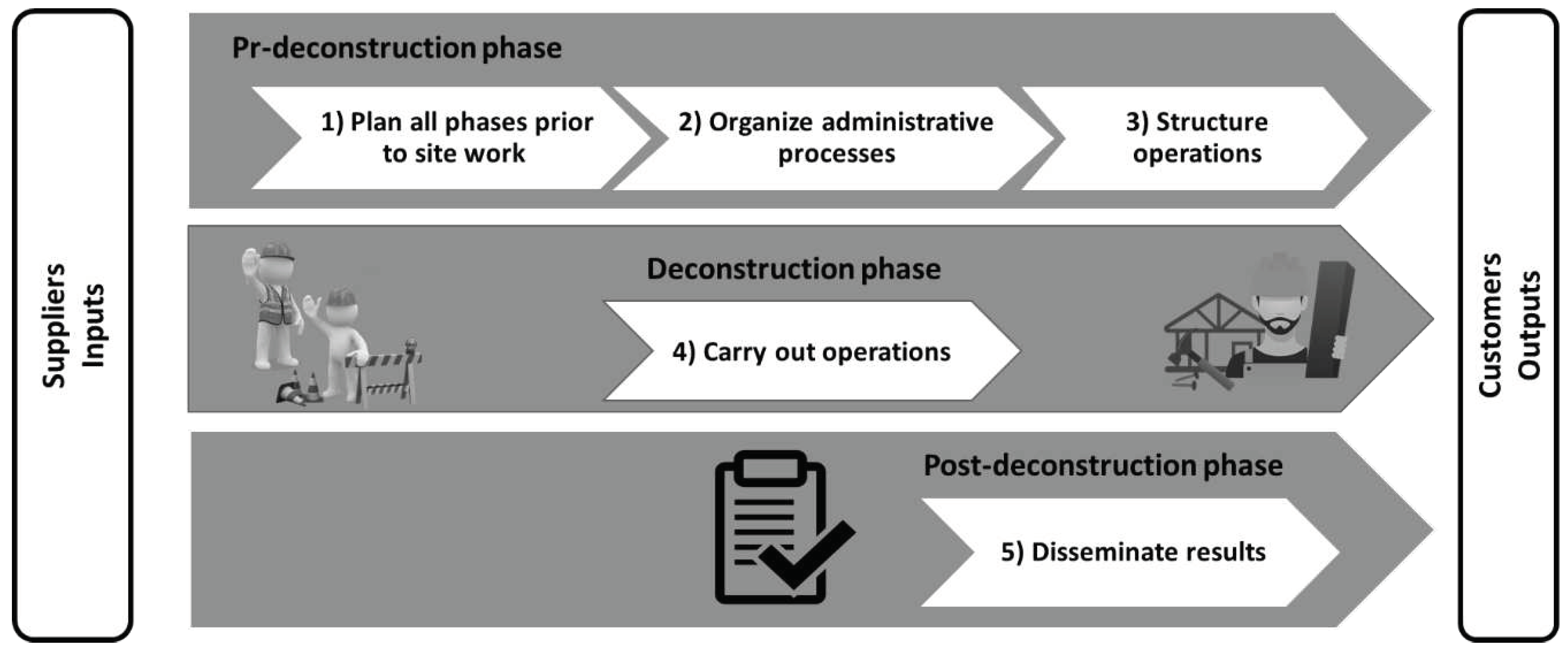
Figure 2.
Simplified process mapping of the pre-deconstruction phase.

Figure 3.
Simplified process mapping of the deconstruction phase.
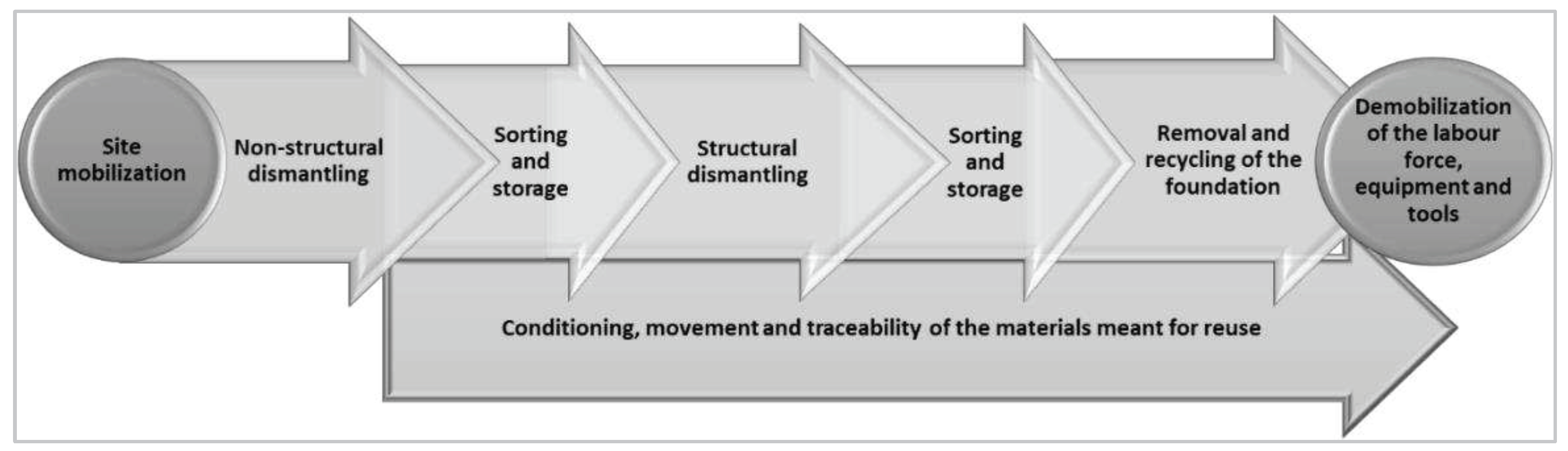
Figure 4.
Simplified process mapping of the post-deconstruction phase.

Figure 5.
Simplified mapping of the improved process - Pre-deconstruction phase.

Figure 6.
Simplified mapping of the improved process - Deconstruction phase.
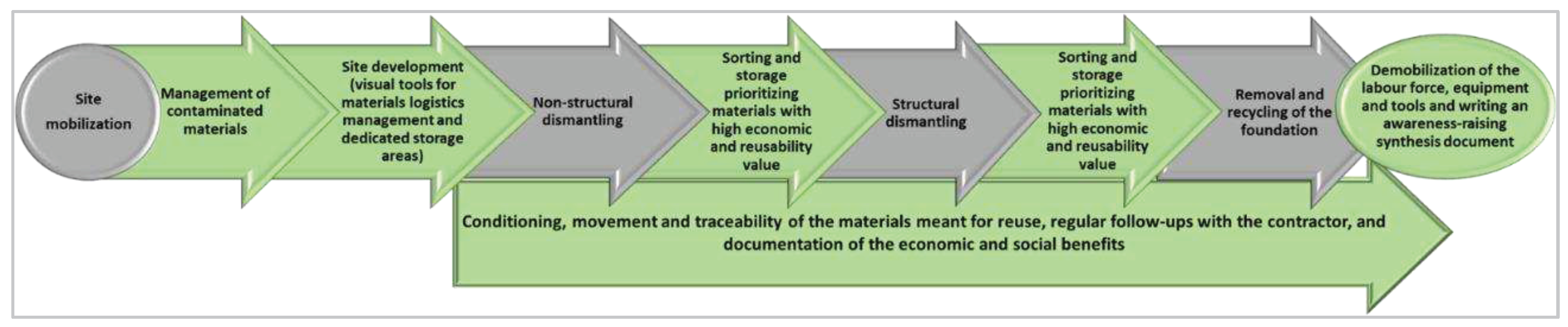
Figure 7.
Simplified mapping of the improved process - Post-deconstruction phase.


Table 1.
Issues and obstacles in deconstruction and CE.
| Issues and obstacles | References |
|---|---|
|
[20,21] |
|
[22,32] |
|
[8,18,33,34] |
|
[7] |
|
[8,19] |
|
[9,27] |
|
[8,17,25,29,30,31,35] |
|
[34,35,36] |
|
[24] |
Table 2.
Risks identification and analysis.
| Risk | Consequences | Actions | Responsibility | |
|---|---|---|---|---|
| 1 | Missed deadlines |
|
|
GM of the RITMRG |
| 2 | Labour shortage |
|
|
GM of the RITMRG and contractor GM of the RITMRG |
| 3 | Worksite accidents |
|
|
GM of the RITMRG and contractor |
| 4 | Weather conditions |
|
|
GM of the RITMRG and Contractor |
| 5 | Limited management resources |
|
|
GM of the RITMRG |
Table 3.
Issues and obstacles encountered in the pre-deconstruction phase.
| Macroprocess in the simplified process | Steps in the detailed process | Issues and obstacles |
|---|---|---|
| Feasibility study and draft project | Draft the final project sheet |
|
| Present the project sheet to decision-makers |
|
|
| Preparation and submission of applications for funding | Draft the application for funding |
|
| Submit the application for funding |
|
|
| Specifications and posting of the call for tenders |
Draft the specifications and clauses |
|
| Awarding of contract | Award the contract |
|
| Authorizations, permits and tool preparation | Prepare the materials tracking tools |
|
| Prepare tools to follow up on the work |
|
|
| Approvals and team training | Organize the kick-off meeting |
|
Table 4.
Solutions identified in the literature (pre-deconstruction phase.
| Macroprocess in the simplified process | Steps in the detailed process | Solutions and best practices |
|---|---|---|
| Feasibility study and draft project | Assess the building* |
|
| Carry out an environmental assessment* |
|
|
| Mandate an expert to carry out a study of the reuse market * |
|
|
| Draft the project |
|
|
| Specifications and posting of the call for tenders |
Draft the specifications and clauses |
|
| Authorizations, permits and tool preparation | Apply for authorizations and permits |
|
| Draft work plans (contractor)* |
|
|
| Approvals and team training | Create ongoing training |
|
* New added steps in the improved process.
Table 5.
Solutions and recommendations in the field – GM of the RITMRG (pre-deconstruction phase).
| Macroprocess in the simplified process | Steps in the detailed process | Solutions and recommendations |
|---|---|---|
| Feasibility study and draft project | Draft the project |
|
| Present the project sheet to decision-makers |
|
|
| Preparation and submission of applications for funding | Draft the application for funding |
|
| Submit the application for funding |
|
|
| Specifications and posting of the call for tenders | Draft the specifications and clauses |
|
| Awarding of contract | Award the contract |
|
| Authorizations, permits and tool preparation | Prepare the materials tracking tools |
|
| Prepare tools to follow up on the work |
|
|
| Approvals and team training | Organize the kick-off meeting |
|
Table 6.
Solutions and recommendations proposed by the experts (pre-deconstruction phase) - Think-tank activity.
Table 6.
Solutions and recommendations proposed by the experts (pre-deconstruction phase) - Think-tank activity.
| Macroprocesses in the simplified process | Steps in the detailed process | Solutions and recommandations | Solution category |
|---|---|---|---|
| Specifications and posting of the call for tenders | Draft the specifications and clauses |
|
|
| Awarding of contract | Award the contract |
|
|
| Authorizations, permits and tool preparation | Prepare the materials and work tracking tools |
|
Table 7.
Solutions and recommendations proposed by the experts (deconstruction phase) – Think-Tank activity.
Table 7.
Solutions and recommendations proposed by the experts (deconstruction phase) – Think-Tank activity.
| Macroprocesses in the simplified process | Steps in the detailed process | Solutions and recommandations | Solution category |
|---|---|---|---|
| Site mobilization | Mobilize and prepare the site |
|
|
| Conditioning, movement and traceability of the materials meant for reuse | Supplement the register on daily basis |
|
|
|
|||
| Manage the mouvement of materials |
|
||
|
|||
|
|||
| Sorting and storage | Sort and store |
|
|
|
|||
| Demobilization of the labour force, equipment and tools | Demobilize the labor force, equipment, and tools |
|
Disclaimer/Publisher’s Note: The statements, opinions and data contained in all publications are solely those of the individual author(s) and contributor(s) and not of MDPI and/or the editor(s). MDPI and/or the editor(s) disclaim responsibility for any injury to people or property resulting from any ideas, methods, instructions or products referred to in the content. |
© 2024 by the authors. Licensee MDPI, Basel, Switzerland. This article is an open access article distributed under the terms and conditions of the Creative Commons Attribution (CC BY) license (http://creativecommons.org/licenses/by/4.0/).
Copyright: This open access article is published under a Creative Commons CC BY 4.0 license, which permit the free download, distribution, and reuse, provided that the author and preprint are cited in any reuse.


