
Submitted:
07 February 2024
Posted:
07 February 2024
You are already at the latest version
Abstract
Microalgae have emerged as potential feed stock for third generation biofuel and other bioactive compounds. In the present investigation we have evaluated the two native strains of Oscillatoria (O. subbrevis MTC-20702 and O. sancta MTC-20703) isolated from two different fresh water biotopes of Meerut, U.P., India and were subjected for the characterization of generation time, biomass, bio-molecules including Chlorophyll-a, carotenoids, carbohydrate, lipids, phycobilins and proteins. Both strains of Oscillatoria were grown in batch culture till the initiation of declining phase and were harvested on every 10th day of incubation till the starting of declining phase. Result of the present investigation revealed that O. subbrevis MTC-20702 can be potentially exploited for the production of high algal biomass, feed stock for biofuel, Chl-a, carotenoids, c-Allophycocyanin and maximum yield of these bioactive compounds can be achieved on 20th day. However, O. santa could be very good source for c-Phyocyanin, c-Phycoerythrin, carbohydrate and protein and these also can be achieved highest on 20th day of incubation. In addition, as these two strains were isolated from water reservoirs and they can be cultivated in large scale for the production of desired bio-molecules.
Keywords:
Biofuel
; biomolecules
; culture
; cyanobacteria
; habitat
1. Introduction
Currently researches are ongoing to find out suitable and economically viable substitute of fossil fuel and algal biofuel has emerged as third generation biofuel. The biofuel is still in its infancy stage and could not reach economically viable phase due to many constraints. The production of biofuel is too much costly in comparison to other fuels due to various constraint and some of them include availability of suitable good strains of microalgae with less doubling time and less expensive technology for the conversion of biomass to biofuel. Still scientists are trying very hard to find out suitable fast growing microalgae including Blue-green Algae (Cyanophytes / Cyanoprokaryotes / Cyanobacteria) and actively involved to explore different biotopes and their characterization for various value products including Lipid.
The Cyanophytes are oxygenic photosynthetic prokaryotes with the most diverse forms of life found in almost all types of known biotopes on earth. They are ubiquitous in occurrence and play very important role in functional processes of ecosystems, biomining and recycling of nutrient elements as primary colonizers. They exhibit a wide range of morphology ranging from unicellular to filamentous branched heterocystous forms. Beside ecological indicator they are storehouse of various biologically active bio-molecules including carbohydrates, carotenoids, lipids, phycobilins, polysaccharides, vitamins and poly-hydroxyalkanoates. In addition, Cyanophytes possess a wide range of biologically active high value compounds viz. chlorophyll-a, carotenoids, lipids, carbohydrates, proteins and phycobilins and they can be used as antiviral, antibacterial and anti-cancerous compounds. Phycobilins are water soluble natural pigments and are also known as Phycobiliproteins (PBPs). They are accessory pigments found in few groups of algae and play a significant role in light harvesting in the cells of Cyanophytes [1]. They contain namely phycocyanin (PC), phycoerythrin (PE) and allophycocyanin (APC). Phycobilins are being used extensively as natural colouring agents and fluorescent proteins for diverse applications. They are known to have antioxidant, anti-inflammatory and hepatoprotective properties. Carotenoids are a group of various lipophilic pigments and play very important role in light harvesting and photoprotection in plants including microalgae. The genus Oscillatoria Vaucher ex Gomont is a non-heterocystous blue-green alga with straight and unbranched trichomes. It belongs to the family Oscillatoriaceae, order Oscillatoriales under Cyanoprokaryota. The main target of the present study was to find out fast growing strains of microalgae (Cyanobacteria) and their characterization for growth rate, generation time, biomass yield, synthesis of chlorophyll-a, carotenoids, phycobilins, carbohydrate, protein and lipids to use them for the large scale production, and their exploitation at commercial level by characterization of the two blue-green algal strains Oscillatoria sancta and O. subbrevis under controlled condition. They are two different coloured microalgae O. sancta is light brown and O. subbrevis is bright blue green appearance in colour [2,3,4].
2. Materials and Methods
2.1 Isolation and purification and biochemical charaterization of Experimental organisms
The experimental organisms were used in the present investigation are two strains of Oscillatoria Vaucher ex Gomont (cyanoprokaryota) include O. subbrevis (MTC-20702) and O. sancta (MTC-20703). The cultures of Oscillatoria strains were isolated and purified following the method described by Sarma et al. [4] from the samples collected from two different biotopes located at Meerut, Uttar Pradesh, India and their unialgal cultures were developed by repeated culturing and sub-culturing techniques [26]. The cultures of these two algae are deposited as O. subbrevis (MTC-20702) and O. sancta (MTC-20703) and available at Algal Germplasm Collection Centre, Department of Botany, Chaudhary Charan Singh University, Meerut, Uttar Pradesh, Bharat. The present study was conducted using 150ml conical flasks (Borosil) containing 100ml of BG-11 nutrient medium autoclaved at 121ºC at 15lbs (Biogen scientific BGS-98) for raising of exponential culture of O. subbrevis and O. sancta under 28 º±C temperature, 14:10 light: dark regime and 4-6 K lux light intensity. The culture flasks were shaken daily on multi-position magnetic stirrer (MHPS15P) for uniform growth of O. sancta and O. subbrevis in the culture flask.
2.2 Experimental design
The experiments of present study were conducted in a complete randomized design. For the study, 2ml of homogenized exponentially growing culture of O. sancta and O. subbrevis was inoculated and batch cultured in conical flasks containing 100ml of BG-11 medium and kept under light saturated condition. The uniformly growing cyanobacterial cultures in triplicates were harvested on every 10th day till the starting of declining phase under controlled condition. All the experiments were performed in triplicate.
2.3 Biochemical charaterization of Experimental organisms
The growth rate, estimation biomass, extraction of chlorophyll-a, total Carotenoids, total proteins, total lipid and Phycobilins were done method described by Sarma et al. [4]. The data obtained were subjected to statistical analysis of variance (ANOVA) by using completely randomized design [26]. The statistical analysis was carried out in Microsoft Office excel 2007. Standard deviation and error was calculated against the obtained mean values.
3. Results
The experimental organisms used in the present study were different coloured two species of the genus Oscillatoria namely O. sancta and O. subbrevis. The natural colour of O. sancta was light brown and O. subbrevis was bright blue green in appearance. Both species were isolated from same biotopes and were subjected to analysis of various following parameters.
Chlorophyll-a is an important primary photosynthetic pigment in the cyanobacterial cells and considered very important for the determination of specific growth rate and generation time. The specific growth rate of O. sancta and O. subbrevis was found to be 0.107μd-1 and 0.140μd-1 with generation time 9.32h and 7.12h respectively.
Growth of the both species of Oscillatoria was measured by the dry biomass content of the cyanobacterial cells under controlled condition. An increasing trend in the growth of both the species was observed till 20 days while a decline in the dry biomass content was observed after 30 days of batch culturing. Maximum biomass content in O. sancta and O. subbrevis was observed 0.002mgml-1 and 0.004mg ml-1 respectively after batch culturing for 20 days while after 30 days of batch culturing, biomass production decreased in both the strains. Detailed result on biomass production is given in Figure (1E).
Chlorophyll-a in cyanobacteria is the major growth indicator measured to evaluate the activity and biomass production by both the cyanobacterial species. A comparative study on chlorophyll-a content by both the cyanobacterial species viz. O. sancta and O. subbrevis was done under the investigation. An increasing trend in the production of Chlorophyll-a was observed in all the culture flasks till 20 days. Maximum chlorophyll-a produced by O. sancta and O. subbrevis was observed 0.84µgml-1 and 1.53µgml-1 respectively after 20 days after that a decline in chlorophyll-a was observed in both the species after 30 days of batch culturing producing 0.56µgml-1 and 1.3µgml-1 respectively under controlled condition where light, nutrient availability and other environmental conditions are not limiting factors. Detailed result on synthesis of chlorophyll-a by both the species is given in Figure (1F).
Determination of carotenoids content in cyanobacteria emphasizes the same observation as chlorophyll a where species differed in its total carotenoid content. In the production of total carotenoid pigment by both the cyanobacterial species, an increasing trend was observed till 20 days. The maximum production of total carotenoid by O. subbrevis was 0.006µgml-1 and by O. sancta was 0.003µgml-1 after 20 days. Decline in the production of total carotenoid was observed after batch culturing for 30 days producing 0.002µgml-1 and 0.005µgml-1 by O. sancta and O. subbrevis respectively under controlled condition. Detailed result on production of photo-protective pigment carotenoid by both the species is given in Figure (1G).
In addition to photoprotective pigment like carotenoids, other accessory pigments viz. phycobilins, a group of three pigments viz. c-phycocyanin, allo-phycocyanin and c-phycoerythrin were measured. Study on the production of c-phycocyanin, c-allophycocyanin and c-phycoerythrin was done for both the species. Gradual increase in the production of c-phycocyanin, c-allo-phycocyanin and c-phycoerythrin was observed after 20 days. Maximum c-phycocyanin produced by O. subbrevis and O. sancta is 0.007µgml-1 and 0.011µgml-1 respectively after 20 days of batch culturing (Figure 1H). Maximum c-allophycocyanin was produced by O. subbrevis and O. sancta were 0.002µgml-1 and 0.001µgml-1 respectively after 20 days (Figure 1I). Maximum c-phycoerythrin production by O. subbrevis and O. sancta is 0.04µgml-1 and 006µgml-1 respectively after 20 days (Figure 1J). Decline in the production of c-phycocyanin, c-allophycocyanin and c-phycoerythrin by both the cyanobacterial species was observed when batch cultured for 30 days under controlled condition. Detailed result on production of c-phycocyanin is given in Figure (1H), allo-phycocyanin in Figure (1I) and c-phycoerythrin in Figure (1J).
Quantitative determination of other value added compounds like total carbohydrates and lipids from both the species viz. O. sancta and O. subbrevis was done under light saturated condition. A gradual increasing trend was observed in the production of carbohydrate and lipid by both the cyanobacterial species was observed after 20 days while a decline in the production of both the compounds. Maximum production of carbohydrate by O. sancta and O. subbrevis is 0.18µgml-1 and 0.17µgml-1 respectively after 20 days while decline in the production of carbohydrate was observed after 30 days (Figure 1K). Study on the total lipid production by both the species was done and it was revealed that, maximum lipid production by O. sancta and O. subbrevis was 0.002mgml-1 and 0.004mgml-1 dry weight respectively after 20 days while decline in the production of total lipid was observed after 30 days of batch culturing under light saturated condition (Figure 1L).
Study was also done on the synthesis of total protein production by O. sancta and O. subbrevis. The total protein content by both the strains was determined by harvesting the cells after every 10 days till 3rd harvesting. Gradual increase in the production of total protein was observed till 20 days of batch culturing. Maximum total protein content in O. sancta and O. subbrevis was observed 1.64 µg ml-1 and 1.4µg ml-1 respectively after 20 days while a decline in the production of total protein was observed in both the species after 30 days producing 1.33µg ml-1 and 0.95µg ml-1 respectively under light saturated condition. Detailed result on production of total protein by both the cyanobacterial species is given in Figure (1M).
4. Discussion
Carotenoids were used for many years as important tools in taxonomy as chemotaxonomy [5] for the identification of the presence of definite groups of micro-algae in various aquatic ecosystems all over the globe [6]. The pigment’s ingredient of different groups of microalgae is considered as commendable chemotaxonomic biomarkers due to their specific characteristics. Paliwal et al. [7] performed carotenoid profiling and hierarchical cluster analysis of fifty seven strains of different groups of microalgae and revealed that myxoxanthophyll and echinenone can be used as chemotaxonomic biomarkers for cyanoprokaryotes. Carotenoids are considered as precursor for Vitamin-A, beside that they also have antioxidant, anti-inflammatory, antitumor and antimicrobial properties. The increasing uses of carotenoids in food processing, animal feed, pharmaceutical and cosmetics industries [8,9,10,11,12,13] have increased the demand of natural carotenoids in the market and it is expected that the world market value of natural carotenoids will reach to USD 2 billion by 2022 [14].
Phycobilins are an important group of natural accessory pigments and by complementary chromatic adaptation they optimize the light harvesting process in the cells of cyanoprokaryotes and have great potential as species biomarkers. The determination of extracted phycobilins pigments and their application as additional biomarkers is a promising approach for the regular monitoring of the population of blue-green algae in coastal, densely inhabited and less-populated aquatic environments [15].
Tabassum et al. [16] made a comparative study on four strains of four different blue-green algal genera including Oscillatoria, Lyngbya, Anabaena and Microchaete and reported 506µgg-1, 58µg g-1, 1420µgg-1, 1058µgg-1, 422µgg-1of dry weight, Chlorophyll-a, carotenoids, c-phycocyanin, c-allophycocyanin and c-phycoerythrin respectively in Oscillatoria under controlled conditions. Basheva et al. [17] studied comparative profiling of 18 strains of ten blue-green algal genera and revealed that c-phycocyanin, c-allophycocyanin and c-phycoerythrin ratio may differ according to their taxonomic position and culture conditions. They included in their study six strains of Microcoleus autumnalis and characterized for phycobilins pigments production, both quantitatively and qualitatively, observed significant variation in the quantitative distribution in c-phycocyanin, c-allophycocyanin and c-phycoerythrin not only among strains of different genera, but also within six strains of single species M. autumnalis. In their study they demonstrated that out of six selected strains of M. autumnalis, four strains have high potential to produce phycoerythrin between 0.106-0.201 mgml-1 and two were among the best producers of phycoerythrocyanin from 0.0286 -0.0333 mgml-1. The findings of present investigations are in agreement with the production of phycobilins pigments is firmly species specific.
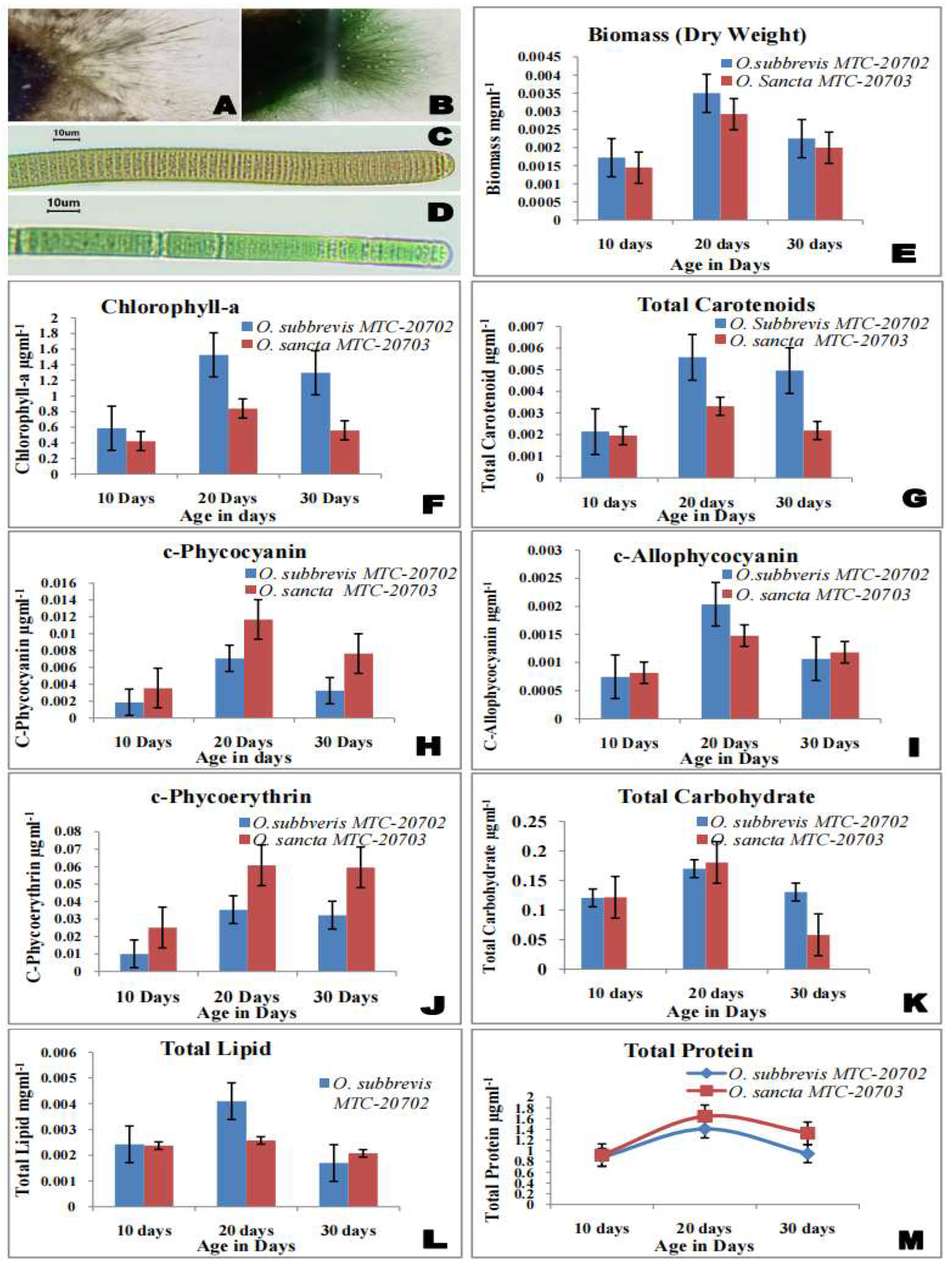
Figure 1.
A-M: 1A: Growth of O. sancta in nature; 1B: Growth of O. subbrevis in nature; 1C: Single trichome of O. sancta ; 1D: Single trichome of O. subbrevis; 1E-IM: Showing comparative synthesis of different bioactive compounds in O. subbrevis and O. sancta: 1E: Dry weight production, 1F:Chlorophyll-a synthesis; 1G: Carotenoids synthesis, 1H: C-phycocyanin production; 1I: C-Allophycocyanin production; 1J: C-phycoerythrin production; 1K: Carbohydrate production; 1L: Lipid production; 1M: Total protein synthesis.
Figure 1.
A-M: 1A: Growth of O. sancta in nature; 1B: Growth of O. subbrevis in nature; 1C: Single trichome of O. sancta ; 1D: Single trichome of O. subbrevis; 1E-IM: Showing comparative synthesis of different bioactive compounds in O. subbrevis and O. sancta: 1E: Dry weight production, 1F:Chlorophyll-a synthesis; 1G: Carotenoids synthesis, 1H: C-phycocyanin production; 1I: C-Allophycocyanin production; 1J: C-phycoerythrin production; 1K: Carbohydrate production; 1L: Lipid production; 1M: Total protein synthesis.
Sarmah and Rout made comparative study on profiling of carbohydrate, protein, lipid, Vitamin-C, Chlorophyll-a, carotenoids and phycobilins content of five species of cyanoprokaryotes i.e. Phormidium lucidum, Oscillatoria subbrevis, Lyngbya diguetii, Nostoccarneum, Cylindrospermum muscicola and reported maximum amount of total protein, carbohydrate, phycobiliproteins and lipid content in O. subbrevis in comparison to other four strains [18]. In addition, in another investigation Sarmah and Rout evaluated growth attributes and phytochemical profiling of O. limosa of exponential growth phaseand reported 0.158μd-1, 178.25h, 6.7mg g-1, growth rate, generation time and Chlorophyll-a respectively; carbohydrate (240 μg ml-1), protein (378 μgml-1), lipid (14.3μg ml-1), phycocyanin (60.7mg g-1), allophycocyanin (20.35mg g-1) and phycoerythrin (21.5mg g-1) content of dry weight [19]. However, the results present investigation indicated that both strains O. subbrevis and O. santa are fast growing as their generation times are 7.12h and 9.32h respectively in comparison to O. limosa. This may be because O. limosa is one of the thick form but our both strains viz. O. subbrevis and O. santa are thin form as the width their cells are between 8-12 µm in comparison to O. limosa (with of cells 20-22 µm). This also corroborates that O. subbrevis and O. santa could be very good and potential source for various bioactive compounds for their exploitation at commercial level.
Two strains of Pseudanabaena were isolated from two different biotopes by Khan et al. [20] and they compared the production of chlorophyll-a, carotenoids and phycobilliprotein and revealed that both the strains synthesized different amount of desired compounds. Results of the present study are also in agreement with the finding of Khan et al. [20]. Our study also corroborate that studied bioactive phytochemicals can be used as efficient tool in chemotaxonomy to determine the proper taxonomic position of different species of Oscillatoria.
5. Conclusions
On the basis of present investigation it could be concluded that O. subbrevis can be exploited potentially for the production of high amount of algal biomass feed stock for biofuel, chlorophyll-a, carotenoids, c-allophycocyanin. However, O. santa could be an excellent candidate for production of c-phycocyanin, c-phycoerythrin, carbohydrate and protein.
Author Contributions
Conceptualization, J.S. and R.K.; methodology, J.S.; software, A.S. and D.; validation, J.S., K.S. and R.K.; formal analysis, J.S.; investigation, J.S.; resources, R.K.; data curation, D.; writing—original draft preparation, J.S.; writing—review and editing, K.S.; visualization, D.; supervision, R.K.; project administration, R.K.; funding acquisition, R.K.. All authors have read and agreed to the published version of the manuscript.
Funding
This research was funded by Uttar Pradesh Government, grant number 70/2022/ 1543/Sattar-4-2022/001-70-4099-7-2022 Dated: 07-07-2022 and Chaudhary Charan Singh University, Meerut, Uttar Pradesh, grant number DEV/URGS/2022-2023/24, Dated: 22/7/2022.
Data Availability Statement
Not applicable.
Acknowledgments
Authors are thankful to the Head, Department of Botany, Chaudhary Charan Singh University, Meerut, India for providing necessary facilities. The authors are also thankful to G.L. Tiwari, Retd. Prof. & Head, Department of Botany, University of Allahabad, Prayagraj, India for kind help in identification of the experimental organisms.
Conflicts of Interest
The authors declare no conflicts of interest.
References
- Kant, R.; Tandon, R.; Tiwari, O.N.; Tiwari, G.L. Cyanobacteria-wonder microbes: hope for 21st Century. National Academy Science letters, 2006, 29(11-12), 399–409. [Google Scholar]
- Chang, Y.K.; Show, P.L.; Lan, J.C.W.; Tsai, J.C.; Huang, C.R. Isolation of C-phycocyanin from Spirulina platensis microalga using Ionic liquid based aqueous two-phase system. Bioresource Technology, 2018, 270, 320–327. [Google Scholar] [CrossRef] [PubMed]
- Sarma, K.; Kumar, S.; Singh, J.; Saini, A.; Ziyaul, N.; Kant, R. Exploring biofuel potential of dominant microalgae of North-East Region of India. Biotech Today, 2020, 10, 24–28. [Google Scholar] [CrossRef]
- Venugopal, V.C.; Thakur, A.; Chennabasappa, L.K.; Mishra, G.; Singh, K.; Rathee, P.; Ranjan, A. Phycocyanin extracted from Oscillatoria minima shows antimicrobial, algicidal, and antiradical activities: In silico and in vitro analysis. Anti-Inflammatory & Anti-Allergy Agents in Medicinal Chemistry (Formerly Current Medicinal Chemistry-Anti-Inflammatory and Anti-Allergy Agents), 2020, 19(3), 240–253. [Google Scholar]
- Sarma, K.; Tyagi, A.; Doli; Gupta, D. ; Gauri; Kumar, N.; Sharma, M.; Kant, R. Optimization of nutrient media for enhanced production of bioactive compounds in Spirulina fusiformis Voronichin. J. Indian bot. Soc. 2023, 103 (4), 290–293. [Google Scholar]
- Borah, D.; Vimala, N.; Thajuddin, N. Biochemical composition and chemotaxonomy of cyanobacteria isolated from Assam, North-East India. Phykos. 2016, 46 (2), 33–45. [Google Scholar]
- Barlow, R.; Kyewalyanga, M.; Sessions, H.; Berg van Den, M.; Morris, T. Phytoplankton pigments, functional types, and absorption properties in the Delagoa and Natal Bights of the Agulhas ecosystem, Estuar. Coast. Shelf Sci. 2008, 80, 201–211. [Google Scholar] [CrossRef]
- Paliwal, C.; Ghosh, T.; George, B.; Pancha, I.; Maurya, R.; Chokshi, K.; Ghosh, A.; Mishra, S. Microalgal carotenoids: Potential nutraceutical compounds with chemotaxonomic importance. Algal Research, 2016, 15, 24–31. [Google Scholar] [CrossRef]
- Cardoso, L.A.; Karp, S.G.; Vendruscolo, F.; Kanno, K.Y.; Zoz, L.I.; Carvalho, J.C. Biotechnological production of carotenoids and their applications in food and pharmaceutical products. Carotenoids, 2017; 125–141. [Google Scholar]
- Basheer, S.; Huo, S.; Zhu, F.; Qian, J.; Xu, L.; Cui, F.; Zou, B. Microalgae in human health and medicine. Microalgae Biotechnology for Food, Health and High Value Products, 2020; 149–174. [Google Scholar]
- Zanella, L.; Alam, M.A. Extracts and bioactives from microalgae (sensu stricto): Opportunities and challenges for a new generation of cosmetics. Microalgae Biotechnology for Food, Health and High Value Products, 2020; 295–349. [Google Scholar]
- Nowruzi, B.; Sarvari, G.; Blanco, S. The cosmetic application of cyanobacterial secondary metabolites. Algal Research. 2020, 49, 101959. [Google Scholar] [CrossRef]
- Tamm, M.; Freiberg, R.; Tõnno, I.; Nõges, P.; Nõges, T. Pigment-based chemotaxonomy-a quick alternative to determine algal assemblages in large shallow eutrophic lake? Plos one, 2015, 10(3), p.e0122526. [Google Scholar] [CrossRef] [PubMed]
- Novoveská, L.; Ross, M.E.; Stanley, M.S.; Pradelles, R.; Wasiolek, V.; Sassi, J.F. Microalgal carotenoids: A review of production, current markets, regulations, and future direction. Marine Drugs, 2019, 17(11), 640. [Google Scholar] [CrossRef] [PubMed]
- Sobiechowska-Sasim, M.; Stoń-Egiert, J.; Kosakowska, A. Quantitative analysis of extracted phycobilin pigments in cyanobacteria—an assessment of spectrophotometric and spectrofluorometric methods. Journal of Applied Phycology, 2014, 26, 2065–2074. [Google Scholar] [CrossRef] [PubMed]
- Tabassum, R.; Bhatnagar, S.K.; Dhar, D.W. Enhanced Pigment Production in Selected Cyanobacteria through Cultural Manipulations. The Journal of Indian Botanical Society, 2012, 91(1-3), 236–244. [Google Scholar]
- Basheva, D.; Moten, D.; Stoyanov, P.; Belkinova, D.; Mladenov, R.; Teneva, I. Content of phycoerythrin, phycocyanin, alophycocyanin and phycoerythrocyanin in some cyanobacterial strains: Applications. Engineering in Life Sciences, 2018, 18(11), 861–866. [Google Scholar] [CrossRef] [PubMed]
- Sarmah, P.; Rout, J. Biochemical profile of five species of cyanobacteria isolated from polythene surface in domestic sewage water of Silchar town, Assam (India). Current Trends in Biotechnology and Pharmacy, 2018, 12(1), 7–15. [Google Scholar]
- Sarmah, P.; Rout, J. Phytochemical screening and antioxidant activity of a cyanobacterium, Oscillatoria limosa isolated from polythene surface in domestic sewage water. Journal of Algal Biomass Utilization, 2018, 9(2), 48–54. [Google Scholar]
- Khan, Z.; Maznah, W.W.; Merican, M.F.; Convey, P.; Najimudin, N.; Alias, S.A. A comparative study of phycobilliprotein production in two strains of Pseudanabaena isolated from Arctic and tropical regions in relation to different light wavelengths and photoperiods. Polar Science, 2019, 20, 3–8. [Google Scholar] [CrossRef]
Disclaimer/Publisher’s Note: The statements, opinions and data contained in all publications are solely those of the individual author(s) and contributor(s) and not of MDPI and/or the editor(s). MDPI and/or the editor(s) disclaim responsibility for any injury to people or property resulting from any ideas, methods, instructions or products referred to in the content. |
© 2024 by the authors. Licensee MDPI, Basel, Switzerland. This article is an open access article distributed under the terms and conditions of the Creative Commons Attribution (CC BY) license (http://creativecommons.org/licenses/by/4.0/).
Copyright: This open access article is published under a Creative Commons CC BY 4.0 license, which permit the free download, distribution, and reuse, provided that the author and preprint are cited in any reuse.


