
Submitted:
06 March 2024
Posted:
06 March 2024
You are already at the latest version
Abstract
In recent years, marine natural products have become one of the most important resources of novel lead compounds for critical diseases associated with age. Spirulina, a dietary supplement made from blue-green algae (cyanobacteria: scientific name Arthrospira platensis), is particularly rich in phycocyanin, a phycobiliprotein, which accounts for up to 20% of this cyanobacterium’s dry weight and is considered responsible for its anti-cancer, anti-inflammatory and antioxidant activities. Although the anti-aging activity of phycocyanin has been investigated, how exactly this compound works against aging remains elusive. Aim of our research is to use the yeast Saccharomyces cerevisiae as a model organism to investigate the anti-aging properties of phycocyanin from A. platensis. Our results show that phycocyanin has a powerful anti-aging effect, greatly extending the chronological life span of yeast cells in a dose-dependent way, being the effect pronounced also when cells were grown in SD medium under calorie restriction conditions (0.2% glucose). Both ROS and accumulation of dead cells were followed by staining chronologically aged cells with dihydrorhodamine 123 (DHR123) and propidium iodide (PI). Interestingly, we found that most of the aged phycocyanin treated cells, which were unable to form colonies, were actually ROS+/PI–. Finally, we show that the moment in which phycocyanin is added to the culture does not substantially influence its effectiveness in counteracting chronological aging.
Keywords:
ROS
; Aging
; chronological life span
; Yeast
; S. cerevisiae
1. Introduction
The major health problems observed all over the world are often associated to age since people are living longer [1]. In recent years, marine natural products have become one of the most important sources of new compounds potentially useful in the treatment of age-related diseases, such as cancer, neurodegenerative and cardiovascular diseases, metabolic syndrome and many others [2,3,4]. Spirulina (cyanobacteria: Arthrospira platensis) is a photosynthetic Gram-negative filamentous bacterium that grows naturally in alkaline, brackish, marine and fresh waters [5], but it is also commercially produced in large outdoor or greenhouse ponds under controlled conditions [6]. In recent years, A. platensis has attracted more and more attention as a potential source of pharmaceutical compounds. Indeed, this cyanobacterium is a source of many, but only partially identified and purified compounds with potential health benefits and activities. It is particularly rich in proteins (65% to 70%) as well as phycocyanin (PC), vitamins, beta-carotene, polyunsaturated fatty acids, minerals, especially iron, polysaccharides and others [7]. Phycocyanin, which accounts for up to 20% of this cyanobacterium’s dry weight, is the association of proteins of the phycobiliprotein family and water-soluble pigments of photosynthesis, the phycocyanobilins. Phycocyanin consists of α and β subunits whose ratio is usually 1:1; the molecular weight of the α and β subunits is 16.3kD and 18.9kD, respectively [8]. The determination of the purity of phycocyanin is based on the absorbance ratio A620/A280; the absorbance at 620nm corresponds to the phycocyanin present in the preparation (it is proportional to the quantity of pigment), while the absorbance at 280nm corresponds to the total proteins (it is proportional to the proteins in solution). When A620/A280 is > 0.7 phycocyanin is considered edible, when 0.7≤A620/A280≤3.9 the phycocyanin is considered reagent grade and finally, when A620/A280 is ≥4.0 the phycocyanin is considered analysis level [9]. Phycocyanin is considered responsible for A. platensis anti-cancer, anti-inflammatory and antioxidant activities [10,11]. In particular, phycocyanin has been shown to reduce oxidative stress in both yeast and mammals [12,13]. Moreover, data in literature showed that the antioxidant properties of phycocyanin might arise from both radical-scavenging and metal chelation [14]. Since, ROS are considered important factors causing aging, the anti-aging activity of phycocyanin has been investigated. However, the question how exactly phycocyanin works against aging remains elusive. In particular, the intracellular mechanism of action of PC has been poorly studied and most of its possible targets are still unclear [8,15].
Aging is a multifactorial process, which include both genetic and environmental factors and intricate pathways and networks. In this context, the yeast Saccharomyces cerevisiae is a model organism for eukaryotic cell and can provide significant insights into the human biology of aging, since the principal pathways are conserved between yeasts and higher eukaryotes during evolution [16,17,18].
In this paper, we used the yeast S. cerevisiae as a model organism to study the anti-aging properties of PC purified from the cyanobacterium A. platensis. We show that phycocyanin has a powerful anti-aging effect, greatly extending the chronological life span of yeast cells grown in SD medium, under both calorie restriction (CR) conditions (0.2% glucose) or non-CR conditions (2% glucose), Interestingly, we show an increase in ROS level, which does not correlate with cell death measured counting the colony forming units over time, when cells are grown in the presence of phycocyanin. This result might suggest that phycocyanin promotes longevity by inducing hormesis [19,20,21], an adaptive response to a variety of stresses according to which low doses of ROS act as essential signaling molecules to promote metabolic health and longevity.
2. Results and Discussion
2.1. Phycocyanin Delays the Chronological Aging of Yeast Cells
Saccharomyces cerevisiae is a model organism for eukaryotic cells that can provide important insights into the biology of human aging [16,17,18]. In this study, we used this microorganism to investigate the ability of phycocyanin to extend the chronological life span (CLS). In particular, we used phycocyanin kindly provided by Algavista, which was also used by Macedo et al. to demonstrate that this compound protects against α-synuclein toxicity in yeast [22]. We first compared the molecular weight and purity of the phycocyanin extract used in this study with that of a standard available reagent (Sigma-Aldrich, St. Louis, MO, USA). For this purpose, we performed a polyacrylamide gel electrophoresis in the presence of sodium dodecyl sulfate (SDS-PAGE) and absorbance spectra. Identical patterns were observed for both samples, confirming the quality of the phycocyanin extract used (Supplementary Figure S1A,B). We also determined the stability of the phycocyanin used in this study, by analysing the absorbance spectrum both in water and in SD medium containing 2% glucose, after preparation (0 h) and after about 10 days at 30 °C. The similar spectra confirmed the stability of the phycocyanin especially in SD medium, which is the medium we used during chronological aging experiments (Supplementary Figure S1C).
Initially, we inoculated wild type W303-1A cells (day -3 of experiment) in SD medium containing 0.2% glucose (condition of calorie restriction, which is known to increase longevity), in the absence and presence of 4 mg/ml (+/- 0.2 mg/ml) phycocyanin. As mentioned in the Materials and Methods Section, given the difficulty in filtering the culture containing phycocyanin, 4 mg/ml (+/- 0.2 mg/ml) turned out to be the highest testable concentration. When the glucose present in the culture medium is totally consumed, cells enter the stationary phase, do not carry out any cell division, reaching the maximum cell concentration (day 0 CLS) [23], and acquire greater resistance to stress [24]. We monitored the progressive loss of viability of these stationary phase cells kept in their culture medium from day 0 until day 45 and used as an index of chronological aging [23] (Figure 1). Strikingly, phycocyanin showed a potent anti-aging activity. Indeed, it strongly prolonged the chronological life span of yeast cells with a long-lasting effect over time. In fact, on day 7 of CLS, almost the entire cell population treated with phycocyanin was viable, while the viability of the untreated cell population (control) was approximately 50%. On day 14 of CLS, a viability of 75% and 26% was observed for the population treated with phycocyanin and for the control, respectively. Moreover, on day 25 of CLS, when less than 20% of viable cells were detectable within the control cell population, the population treated with phycocyanin showed a viability of almost 60%. To investigate whether the potent anti-aging activity of phycocyanin was still detectable at lower doses of this compound, W303-1A cells were inoculated (day -3 of experiments) in SD medium containing 0.2% glucose with variable concentrations of phycocyanin (0–4.8 mg/mL). Indeed, phycocyanin strongly prolonged CLS, acting in a concentration dependent manner until an apparent saturation effect at dosages higher than 2.3 mg/mL (Figure 2A). Finally, we performed a preliminary experiment to investigate whether the potent anti-aging activity of phycocyanin was still detectable when cells were grown in SD medium containing 2% glucose, a condition where cells aged very fast [25]. Our results showed that also under this unfavourable condition (i.e in non-calorie restriction condition) phycocyanin prolonged the chronological life span of yeast cells (Figure 2B).
In order to investigate the effect of phycocyanin on the growth rate, we evaluated the cell growth in the absence and in the presence of phycocyanin, using a cell counter (Coulter counter Z2); in parallel, using the same instrument, we evaluated the average cell volume. In particular, cells of wild type W303-1A were inoculated in SD medium containing either 0.2% glucose or 2% glucose in the absence and presence of 4 mg/mL phycocyanin and grown at 30 °C overnight. The following morning, for each treatment, we determined the cell density and the mean cell volume over time. Our results (Figure 2C) showed that both under calorie restriction (CR) conditions (0.2% glucose) or non-CR conditions (2% glucose), the presence of phycocyanin in the medium did not influence the growth rate, which was on average a doubling time of 1.5 hours. A 10% decrease in the mean cell volume of exponentially growing cells was observed in the presence of phycocyanin, under both tested conditions (0.2% and 2% glucose). In particular, in 0.2% glucose the mean size of the cells was about 54 and 49 femtoliters in the absence and in the presence of phycocyanin respectively, while in 2% glucose the mean size of the cells was about 57 and 52 femtoliters in the absence and presence of phycocyanin respectively. Interestingly, under both tested conditions (0.2% and 2% glucose), the presence of phycocyanin in the culture medium determined an early entry of cells into the exponential phase of growth, which was more pronounced when the glucose concentration in the culture medium was low.
2.2. Effect of Phycocyanin on S. cerevisiae Reactive Oxygen Species Accumulation
Oxidative stress and the accumulation of reactive oxygen species (ROS) are known to play a key role in aging [26]; moreover, data in literature attribute an antioxidant role to phycocyanin [10,11]. Therefore, we decided to determine the accumulation of ROS in the context of CLS experiments. As described previously (Figure 1A), we inoculated W303-1A cells in the absence and in the presence of 4 mg/ml (+/- 0.2 mg/ml) phycocyanin in SD medium containing 0.2% glucose and determined its ability to form colonies over time and showed that the presence of phycocyanin in the medium significantly decreased the chronological aging of yeast cells. In parallel, using a cytofluorimeter, we determined both the accumulation of ROS and the accumulation of dead cells, by staining the chronologically aged cells with dihydrorhodamine123 (DHR 123) and propidium iodide (PI) (Supplementary Figure S2). The results obtained from the cytofluorimetric analysis conducted on the control cells (untreated) are congruent with those obtained in the CLS experiment. The cells, over time, accumulate ROS (Figure 1B,D), lose membrane integrity and die (Figure 1C,D); in particular, a fraction of cells dies accumulating ROS (Figure 1D), while a numerically similar fraction dies without accumulating reactive oxygen species (Figure 1C; in Supplementary Figure S3, a flow cytometry analysis representative of the DHR123/PI staining is shown). Congruently, the percentage of viable cells, measured counting the colony forming units, decreases over time.
On the other end, cells treated with phycocyanin, while being longer-lived than untreated cells (Figure 1A), show a higher level of ROS than the untreated cells themselves (Figure 1B), suggesting that phycocyanin might favour survival by enhancing the level of ROS. Congruently, the percentage of dead (or PI positive) cells, measured by staining chronologically aged cells with propidium iodide (PI) is very low (Figure 1C,D). This result suggests that a large fraction of the cells treated with phycocyanin still maintain membrane integrity, even when they become unable to form colonies on Petri dishes containing rich medium, and that actually an increase in ROS level favours survival. This apparent contrast might be explained by an adaptive response to a variety of oxidative and other stresses called hormesis, which makes cells resistant to higher and normally harmful doses of the same stressing agent. According to this hypothesis, which is supported by a number of experimental data, low doses of ROS act as essential signalling molecules to promote metabolic health and longevity [19,20,21].
2.3. Effect of Phycocyanin Added on Day 0 of CLS, when Maximum Cell Density Is Reached
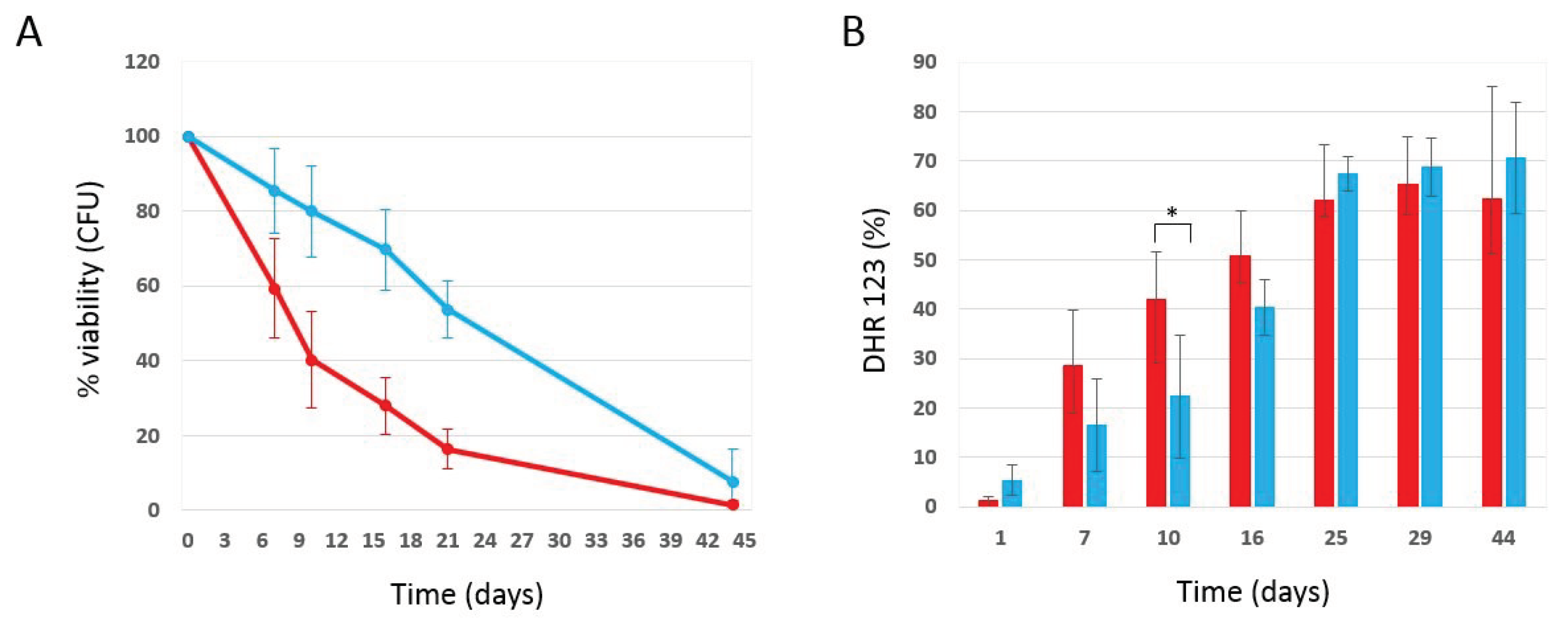
Data in literature [27] show that the anti-aging effect of drugs can be more or less pronounced depending on the growth phase of the organism at the time the drug is added. In order to investigate this aspect, the chronological aging experiment was repeated by adding phycocyanin to cells of the W303-1A strain on day 0 of the chronological aging experiment, i.e., three days after inoculation, when the maximum cell density was reached, to study whether the moment in which phycocyanin is added influences its effectiveness in counteracting chronological aging. In particular, we inoculated wild type W303-1A in SD medium containing 0.2% glucose and on day 3 after inoculation the culture was divided into two sterile tubes, which were centrifuged in order to separate cell pellets from the culture media (supernatants). Subsequently, phycocyanin was dissolved in one of the two supernatants at a concentration of 5mg/mL. Both supernatants were then filtered using PES filters (0.22µm) and the corresponding cell pellet resuspended in them. Both cultures were incubated at 30 °C and the viability monitored through the quantification of the CFU and used as an index of chronological aging. As mentioned in the Materials and Methods Section, the concentration of phycocyanin after filtration was approximately 20% of the phycocyanin initially dissolved in the exhausted medium. Consequently, the actual concentration was 0.9 mg/ml (+/- 0.32 mg/ml). Strikingly, phycocyanin added at the end of the growth phase (3 days after inoculation) showed again a potent anti-aging activity (Figure 3A), comparable with that obtained previously (Figure 1A) by adding 4 mg/ml (+/- 0.2 mg/ml) of phycocyanin at the time of inoculation. In particular, our results (Figure 3A) show that on day 16 of CLS, 70% of the cell population treated with phycocyanin was viable, while the viability of the untreated cell population (control) was less than 30%. On day 21 of CLS, a viability of 54% and 16% was observed for the population treated with phycocyanin and for the control, respectively. In conclusion, considering that the concentration of phycocyanin added 3 days after inoculation was approximately 4 times less than the concentration of phycocyanin added at the time of inoculation, our results indicate that phycocyanin added at the end of the growth phase has a more marked anti-aging effect when compared to that obtained by adding phycocyanin at the time of inoculation. In parallel, using the cytofluorimeter, we determined the accumulation of reactive oxygen species by staining the chronologically aged cells with dihydrorhodamine123 (DHR 123) (Figure 3B). Our results showed that the production of ROS was lower or comparable for phycocyanin treated cells compared to untreated cells. This data suggests that the addition of phycocyanin at the end of the growth phase might favour survival through a mechanism other than hormesis, previously proposed to explain how an increase in ROS might, in the case of phycocyanin added at the time of inoculation, favour survival. It might be that phycocyanin added on day 0 of CLS (when maximum cell density is reached) act on signalling mechanisms, as observed for hydroxycitric acid, a caloric restriction mimetic we previously investigated [28]. A genetic analysis on yeast CLS mutants, indicated that part of the powerful anti-aging effects of hydroxycitrate can be sensed by Sch9 and Ras2, two conserved key regulators of nutritional and stress signal pathways of primary importance in S. cerevisiae [28]. However, it could not be excluded that the reduced ROS level observed when PC was added at the end of the growth phase could be simply explained by the lower concentration of PC present in the medium.
3. Materials and Methods
3.1. Yeast Strains and Media
Strain used in this study: W303-1A (MATa ade2-1 can1-100 his3-11,15 leu2-3112 trp1-1 ura3-1) [29]. Synthetic defined media (SD) contained either 0.2% glucose or 2% glucose, 6.7 g/l YNB w/o amino acids (supplied by ForMedium™, United Kingdom) and the proper selective drop-out CSM (Complete Synthetic Medium, supplied by ForMedium™, United Kingdom); in addition, 100 mg/L adenine was added. Culture density was measured with a Coulter Counter (Coulter mod. Z2) on mildly sonicated, diluted samples. The growth rate was calculated by the increase of cell number/ml at discrete time intervals and plotting the log of cell concentration as a function of time. The mean cell size was calculated by the cell size distributions acquired during the exponential phase of growth [30]. YEPDA plates contained 2% w v-1 glucose, 2% w v-1 peptone, 1% w v-1 yeast extract, 100 mg/L adenine and 2% w v-1 agar.
Phycocyanin (Organic Spirulina Extract, kindly provided by Algavista, Chennai, India) was dissolved in SD medium (the concentration varies among experiments) and sterilized by filtration through 0.22 μm PES filters. Given the difficulty in filtering the culture containing phycocyanin (difficulty which was more pronounced when phycocyanin was dissolved in exhausted medium compared to fresh medium), and since a deposit of material on the filter was observed during the filtration step, a calibration curve was set up in order to determine whether phycocyanin loss occurred during this step and to determine the quantity of phycocyanin actually present in the medium (Supplementary Figure S4). On average, the concentration of phycocyanin after filtration was approximately 80% of the phycocyanin dissolved in the fresh medium and about 20% of the phycocyanin dissolved in the exhausted medium. The pH of the fresh medium was 5.7 regardless of the presence of phycocyanin.
3.2. Aging Experiments and Cell Viability
We used one of the established procedures to measure chronological life span (CLS), as described by Fabrizio and Longo [23], growing cells in SD medium (containing either 0.2% glucose or 2% glucose) at 30 °C on a shaker at 160 rpm and prolonging incubation in their original medium. Chronological aging was monitored after arrest into stationary phase (day 0 of CLS) as progressive loss of cell viability. In particular, cells were plated on YEPDA agar plates in triplicate and colony forming units (CFUs) were used to monitor viable cells after 3 days of growth at 30 °C.
3.3. Dihydrorhodamine 123 (DHR123) and Propidium Iodide (PI) Staining
ROS were detected with DHR123 (Sigma Aldrich) essentially as described by Madeo et al. [31]. DHR123 was added directly to the culture medium at the final concentration of 5 µg/mL (from a 2.5 mg/mL stock solution in ethanol). After 2 hours incubation at 30 °C with shaking, PI (Fluka) was added at the final concentration of 3 µg/mL (from a 50 µg/mL in 10 mM TrisHCl pH 7.0 stock solution) and incubation was prolonged for additional 15 min in the dark at room temperature. At the end of this period, cells were diluted in 50 mM TrisHCl pH 7.5 to 107 cell/mL and analysed using a cytofluorimeter (CytoFLEX©, Beckman Coulter, Inc). A total of 20.000 events were acquired for each sample and data were processed using CytExpert software.
3.4. Phycocyanin Extract Characterization
Sodium dodecyl sulphate (SDS)-PAGE (Polyacrylamide gel electrophoresis) was employed to analyse the purity of phycocyanin used in this work. A phycocyanin standard (Sigma- Aldrich, St. Louis, MO, USA) was used as a reference. The polypeptide analysis was performed in a 12% SDS-PAGE in pH 8.8 Tris-HCl buffer and a stacking gel of 4% in pH 6.8 Tris-HCl. Tris-Gly buffer (pH 8.6) containing 0.1% (w/v) SDS was used as electrode buffer. The gel was stained with EZBlue Staining Reagent (Sigma Aldrich). The absorbance spectrum of phycocyanin was determined by measuring the absorbance between 200 nm and 800 nm (Jasco V-770 spectrophotometer), in order to compare the extract with the standard and to determine its stability. The purity of the phycocyanin extract and of the standard was determined by the ratio between the absorbance at 620 nm (A620), proportional to the amount of pigment, and the absorbance at 280 nm (A280), proportional to the proteins in the solution [9]. The phycocyanin extract and standard presented a purity ratio of 3.99 and 3.69, respectively (Supplementary Figure S2B).
3.5. Statistical Analysis
All the experiments were done at least in triplicate unless otherwise indicated and the Mean and Standard Deviation were shown. The Student’s t test was used for assessing the significance of the experimental data. The experimental data were elaborated with Excel TM.
Supplementary Materials
The following supporting information can be downloaded at the website of this paper posted on Preprints.org.
Author Contributions
Conceptualization, S.C. and E.M.; Investigation and data acquisition, M.C.N. and St.C.; Data Curation, S.C. and E.M.; Writing—Original Draft Preparation, S.C.; Writing—Review & Editing, S.C. and E.M.; Supervision, S.C and E.M.; Project Administration, S.C.; Funding Acquisition, S.C. and E.M. All authors have read and agreed to the published version of the manuscript.
Funding
This work was supported by FA—University of Milano Bicocca grants to S.C. and E.M.
Acknowledgments
We thank Algavista, Chennai, India for providing Phycocyanin Powder and T. Elita Bertolin and Tiago Fleming Outeiro, University of Passo Fundo, Brazil and University of Göttingen, Germany, respectively, for their help and suggestions.
Conflicts of Interest
The authors declare that there is no conflict of interests regarding the publication of this manuscript.
References
- Chandrasekaran, A.; Sosa Idelchik, M.; Melendez, J.A. Redox control of senescence and age-related disease. Redox Biology 2017, 11, 91–102. [Google Scholar] [CrossRef] [PubMed]
- Shaden, A.M.; Khalifa, N.E.; Mohamed, A.F.; et al. Marine Natural Products: A Source of Novel Anticancer Drugs. Mar. Drugs 2019, 17, 491. [Google Scholar] [CrossRef]
- Hu, D.; Jin, Y.; Hou, X.; et al. Application of Marine Natural Products against Alzheimer’s Disease: Past, Present and Future. Mar. Drugs 2023, 21, 43. [Google Scholar] [CrossRef] [PubMed]
- Gómez-Zorita, S.; Trepiana, J.; González-Arceo, M.; Aguirre, L.; Milton-Laskibar, I.; et al. Anti-Obesity Effects of Microalgae. Int. J. Mol. Sci. 2020, 21, 41. [Google Scholar] [CrossRef] [PubMed]
- Narasimha, D.L.; Venkataraman, G.S.; Duggal, S.K.; Eggum, B.O. Nutritional quality of the blue-green alga Spirulina platensis Geitler. J. Sci. Food Agric. 1982, 33, 456–460. [Google Scholar] [CrossRef]
- Sotiroudis, T.G.; Sotiroudis, G.T. Health aspects of Spirulina (Arthrospira) microalga food supplement. J. Serb. Chem. Soc. 2013, 78, 395–405. [Google Scholar] [CrossRef]
- Finamore, A.; Palmery, M.; Bensehaila, S.; Peluso, I. Antioxidant, Immunomodulating, and Microbial-Modulating Activities of the Sustainable and Ecofriendly Spirulina. Oxidative Medicine and Cellular Longevity 2017, Article ID 3247528, 14 pages. [CrossRef]
- Bannu, S.A.; Lomada, D.; Gulla, S.; Chandrasekhar, T.; Reddanna, P.; Reddy, M.C. Potential Therapeutic Applications of C-Phycocyanin. Current Drug Metabolism 2019, 20, 967–976. [Google Scholar] [CrossRef]
- Kuddus, M.; Singh, P.; Thomas, G.; Al Hazimi, A. Recent developments in production and biotechnological applications of C-phycocyanin. BioMed Res. Int. 2013, 2013, 742859. [Google Scholar] [CrossRef]
- Romay, C.; Armesto, J.; Remirez, D.; Gonzalez, R.; Ledon, N.; Garcıa, I. Antioxidant and anti-inflammatory properties of C-phycocyanin from blue-green algae. Inflamm. Res. 1998, 47, 36–41. [Google Scholar] [CrossRef]
- Wu, Q.; Liu, L.; Miron, A.; Klímová, B.; Wan, D.; Kuĉa, K. The antioxidant, immunomodulatory, and anti-inflammatory activities of Spirulina: An overview. Arch Toxicol 2016, 90, 1817–1840. [Google Scholar] [CrossRef]
- Rogova, A.G.; Sergeeva, Y.E.; Sukhinov, D.V.; Ivaschenko, M.V.; Kuvyrchenkova, A.P.; Vasilov, R.G. The Effect of Phycocyanin Isolated from Arthrospira platensis on the Oxidative Stress in Yeasts. Nanobiotechnology Reports 2023, 18, 126–131. [Google Scholar] [CrossRef]
- Pleonsila, P.; Soogarunb, S.; Suwanwong, Y. Anti-oxidant activity of holo- and apo-c-phycocyanin and their protective effects on human erythrocytes. International Journal of Biological Macromolecules 2013, 60, 393–398. [Google Scholar] [CrossRef]
- Bermejo, P.; Pinero, E.; Villar, A.M. Iron-chelating ability and antioxidant properties of phycocyanin isolated from a protean extract of Spirulina platensis. Food Chemistry 2008, 110, 436–445. [Google Scholar] [CrossRef] [PubMed]
- Liu, R.; Qin, S.; Li, W. Phycocyanin: Anti-inflammatory effect and mechanism. Biomedicine & Pharmacotherapy 2022, 153, 113362. [Google Scholar] [CrossRef]
- Longo, V.D.; Fabrizio, P. Chronological aging in Saccharomyces cerevisiae. Subcell. Biochem. 2012, 57, 101–121. [Google Scholar] [CrossRef] [PubMed]
- Sampaio-Marques, B.; Burhans, W.C.; Ludovico, P. Yeast at the forefront of research on ageing and age-related diseases. Prog. Mol. Subcell. Biol. 2019, 58, 217–242. [Google Scholar] [CrossRef]
- López-Otín, C.; Blasco, M.A.; Partridge, L.; Serrano, M.; Kroemer, G. The hallmarks of aging. Cell 2013, 153, 1194–1217. [Google Scholar] [CrossRef] [PubMed]
- Ristow, M.; Schmeisser, S. Extending life span by increasing oxidative stress. Free Radical Biology & Medicine 2011, 51, 327–336. [Google Scholar] [CrossRef]
- Ludovico, P.; Burhans, W.C. Reactive oxygen species, ageing and the hormesis police. FEMS Yeast Res 2014, 14, 33–39. [Google Scholar] [CrossRef]
- Calabrese, E.J.; Nascarella, M.; Pressman, P.; et al. Hormesis determines lifespan. Ageing Research Reviews 2024, 94, 102181. [Google Scholar] [CrossRef]
- Macedo, D.; Bertolin, T.E.; Oro, T.; Taís Hartmann Backes, L.; Caldeira Brás, I.; Nunes Santos, C.; Tenreiro, S.; Fleming Outeiro, T. Phycocyanin protects against Alpha-Synuclein toxicity in yeast. Journal of Functional Foods 2017, 38, 553–560. [Google Scholar] [CrossRef]
- Fabrizio, P.; Longo, V.D. The chronological life span of Saccharomyces cerevisiae. Methods Mol. Biol. 2007, 371, 89–95. [Google Scholar] [CrossRef]
- Longo, V.D.; Butler Gralla, E.; Selverstone Valentine, J. Superoxide Dismutase Activity Is Essential for Stationary Phase Survival in Saccharomyces cerevisiae. J. Biol. Chem. 1996, 271, 12275–12280. [Google Scholar] [CrossRef] [PubMed]
- Wei, M.; Fabrizio, P.; Hu, J.; Ge, H.; Cheng, C.; Li, L.; Longo, V.D. Life Span Extension by Calorie Restriction Depends on Rim15 and Transcription Factors Downstream of Ras/PKA, Tor, and Sch9. PLoS Genet. 2008, 4, e13. [Google Scholar] [CrossRef]
- de la Torre-Ruiz, M.A.; Pujol, N.; Sundaran, V. Coping with oxidative stress. The yeast model. Curr. Drug Targets 2015, 16(1), 2–12. [Google Scholar] [CrossRef]
- Burstein, M.T.; Kyryakov, P.; Beach, A.; et al. Lithocholic acid extends longevity of chronologically aging yeast only if added at certain critical periods of their lifespan. Cell Cycle 2012, 11:18, 3443-3462. [CrossRef]
- Baroni, M.D.; Colombo, S.; Libens, O.; Pallavi, R.; Giorgio, M.; Martegani, E.; In, S. cerevisiae hydroxycitric acid antagonizes chronological aging and apoptosis regardless of citrate lyase. Apoptosis 2020, 25, 686–696. [Google Scholar] [CrossRef]
- Thomas, B.J.; Rothstein, R. Elevated recombination rates in transcriptionally active DNA. Cell 1989, 56, 619e630. [Google Scholar] [CrossRef] [PubMed]
- Amigoni, L.; Colombo, S.; Belotti, F.; Alberghina, L.; Martegani, E. The transcription factor Swi4 is target for PKA regulation of cell size at the G1 to S transition in Saccharomyces cerevisiae. Cell Cycle 2015, 14, 2429–2438. [Google Scholar] [CrossRef]
- Madeo, F.; Fr€ohlich, E.; Ligr, M.; Grey, M.; Sigrist, S.J.; Wolf, D.H.; et al. Oxygen stress: A regulator of apoptosis in yeast. J. Cell Biol. 1999, 145, 757–767. [Google Scholar] [CrossRef] [PubMed]
Figure 1.
Cell survival and oxidative stress in wild-type W303-1A cells grown in SD medium containing 0.2% glucose in the presence and absence of phycocyanin (given at the moment of inoculation). (A) Cell viability of W303-1A cells either untreated (red) or treated (blue) with 4 mg/ml (+/-0.2 mg/ml) phycocyanin was analyzed by measuring colony-forming units (CFU) after 3 days of growth at 30 °C. Cell survival is expressed as % to the CFU at time zero. (B) ROS accumulation in W303-1A cells either untreated (red bars) or treated (blue bars) with 4 mg/ml (+/-0.2 mg/ml) phycocyanin. (B-D) Flow cytometry analysis of double stained (DHR 123 and PI) W303-1A cells, either untreated (red bars) or treated (blue bars) with 4 mg/ml (+/-0.2 mg/ml) phycocyanin. Dihydrorhodamine 123 (DHR 123) was used to assay ROS accumulation, while propidium iodide (PI) was used to stain dead cells (for more details, see Supplementary Figures S2 and S3). The means of 3 independent experiments with standard deviations are reported. Student’s t-test ∗P < 0.05 and ∗∗P < 0.01.
Figure 1.
Cell survival and oxidative stress in wild-type W303-1A cells grown in SD medium containing 0.2% glucose in the presence and absence of phycocyanin (given at the moment of inoculation). (A) Cell viability of W303-1A cells either untreated (red) or treated (blue) with 4 mg/ml (+/-0.2 mg/ml) phycocyanin was analyzed by measuring colony-forming units (CFU) after 3 days of growth at 30 °C. Cell survival is expressed as % to the CFU at time zero. (B) ROS accumulation in W303-1A cells either untreated (red bars) or treated (blue bars) with 4 mg/ml (+/-0.2 mg/ml) phycocyanin. (B-D) Flow cytometry analysis of double stained (DHR 123 and PI) W303-1A cells, either untreated (red bars) or treated (blue bars) with 4 mg/ml (+/-0.2 mg/ml) phycocyanin. Dihydrorhodamine 123 (DHR 123) was used to assay ROS accumulation, while propidium iodide (PI) was used to stain dead cells (for more details, see Supplementary Figures S2 and S3). The means of 3 independent experiments with standard deviations are reported. Student’s t-test ∗P < 0.05 and ∗∗P < 0.01.
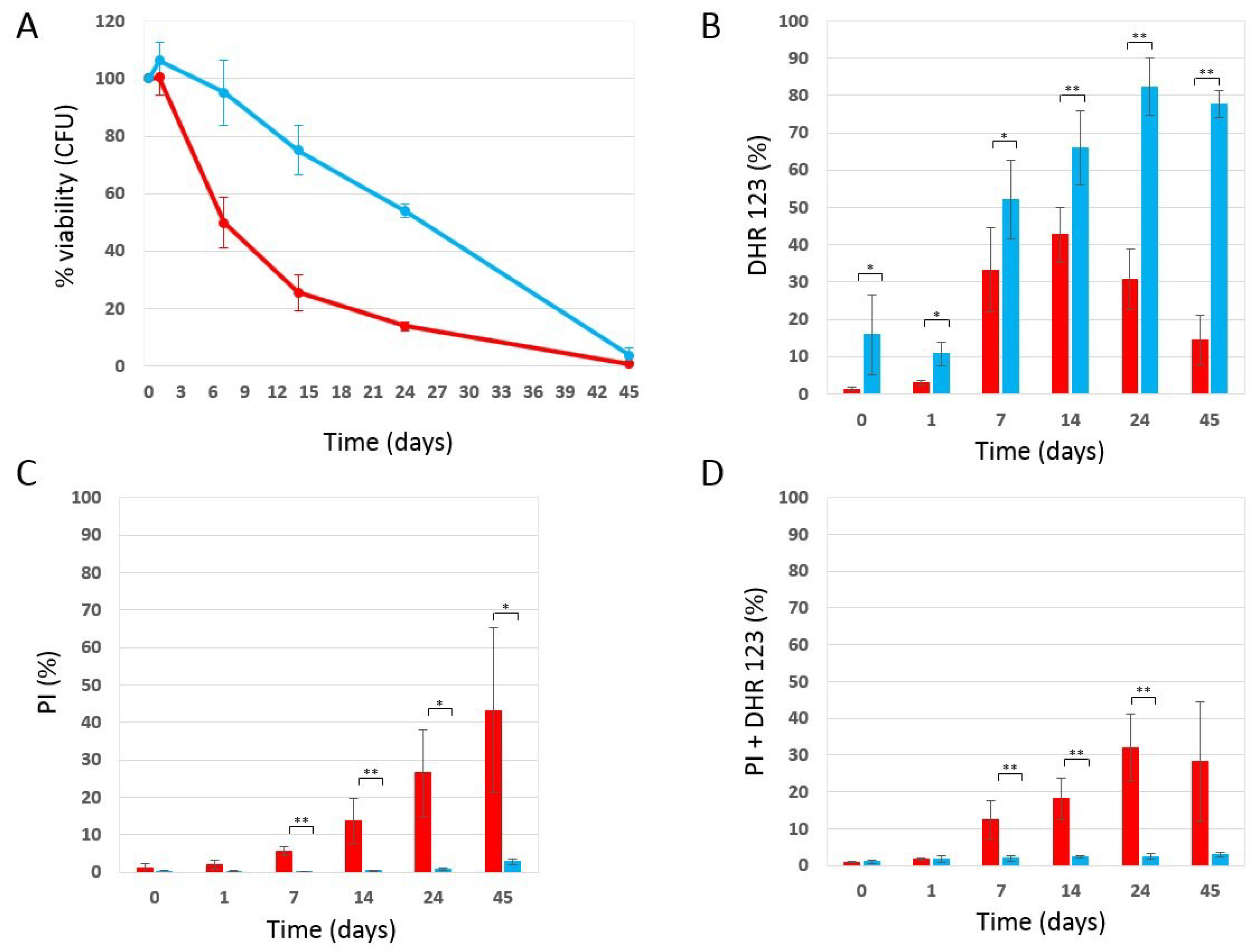
Figure 2.
Phycocyanin antagonizes cell chronological aging in a dose-dependent way and is effective even in the presence of 2% glucose. (A) Cell survival of wild type W303-1A cells was monitored with colony forming units (CFU) during 21 days CLS, in SD medium containing 0.2% glucose in the presence of the following concentrations of phycocyanin (given at the moment of inoculation): 0 mg/ml (red line), 1 mg/ml (blue line), 2.3 mg/ml (yellow line), 4.8 mg/ml (light blue line). The means of 3 independent experiments with standard deviations are reported. Student’s t-test ∗P < 0.05 and ∗∗P < 0.01. (B) Cell survival of wild type W303-1A cells was monitored with colony forming units during 14 days CLS, in SD medium containing 2% glucose in the presence of 4 mg/ml phycocyanin (given at the moment of inoculation). (C) Growth kinetic of W303-1A cells in the absence and presence of 4 mg/mL phycocyanin. Cells were inoculated in SD medium containing either 0.2% glucose (a) or 2% glucose (b) at 30 °C and grown to early exponential phase. Cell density (log scale; cells/mL of colture) was plotted against time. A representative result of two independent experiment is shown.
Figure 2.
Phycocyanin antagonizes cell chronological aging in a dose-dependent way and is effective even in the presence of 2% glucose. (A) Cell survival of wild type W303-1A cells was monitored with colony forming units (CFU) during 21 days CLS, in SD medium containing 0.2% glucose in the presence of the following concentrations of phycocyanin (given at the moment of inoculation): 0 mg/ml (red line), 1 mg/ml (blue line), 2.3 mg/ml (yellow line), 4.8 mg/ml (light blue line). The means of 3 independent experiments with standard deviations are reported. Student’s t-test ∗P < 0.05 and ∗∗P < 0.01. (B) Cell survival of wild type W303-1A cells was monitored with colony forming units during 14 days CLS, in SD medium containing 2% glucose in the presence of 4 mg/ml phycocyanin (given at the moment of inoculation). (C) Growth kinetic of W303-1A cells in the absence and presence of 4 mg/mL phycocyanin. Cells were inoculated in SD medium containing either 0.2% glucose (a) or 2% glucose (b) at 30 °C and grown to early exponential phase. Cell density (log scale; cells/mL of colture) was plotted against time. A representative result of two independent experiment is shown.
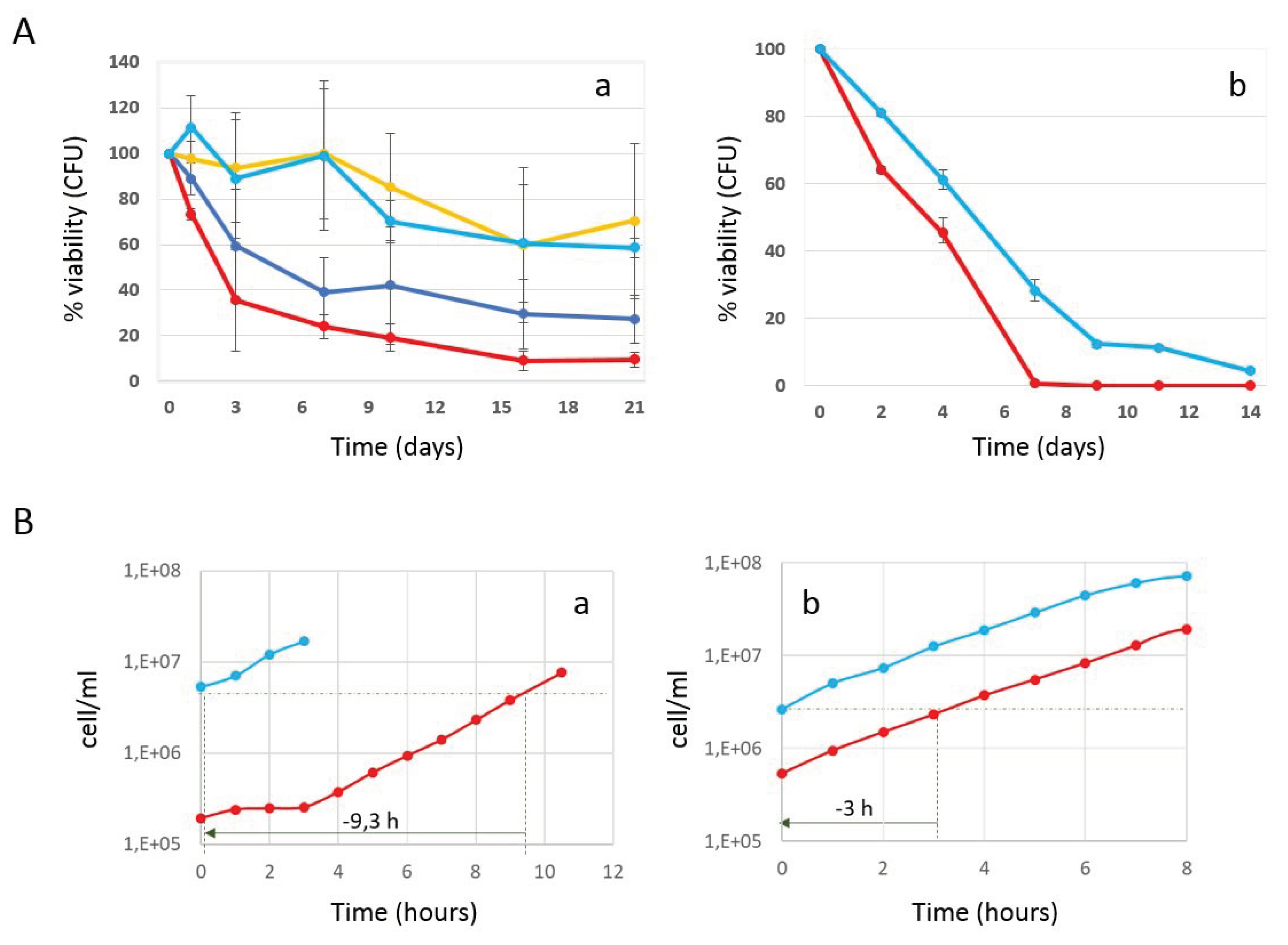
Figure 3.
Cell survival and oxidative stress in wild-type W303-1A cells grown in SD medium containing 0.2% glucose in the presence and absence of phycocyanin (given 3 days after inoculation). (A) Cell viability of W303-1A cells either untreated (red) or treated (blue) with 0.9 mg/ml (+/- 0.32 mg/ml) phycocyanin was analyzed by measuring colony-forming units (CFU) after 3 days of growth at 30 °C. Cell survival is expressed as % to the CFU at time zero. (B) ROS accumulation in W303-1A cells either untreated (red bars) or treated (blue bars) with 0.9 mg/ml (+/- 0.32 mg/ml) phycocyanin. Dihydrorhodamine 123 (DHR123) was used to assay ROS accumulation. The means of 3 independent experiments with standard deviations are reported. Student’s t-test ∗P < 0.05 and ∗∗P < 0.01.
Figure 3.
Cell survival and oxidative stress in wild-type W303-1A cells grown in SD medium containing 0.2% glucose in the presence and absence of phycocyanin (given 3 days after inoculation). (A) Cell viability of W303-1A cells either untreated (red) or treated (blue) with 0.9 mg/ml (+/- 0.32 mg/ml) phycocyanin was analyzed by measuring colony-forming units (CFU) after 3 days of growth at 30 °C. Cell survival is expressed as % to the CFU at time zero. (B) ROS accumulation in W303-1A cells either untreated (red bars) or treated (blue bars) with 0.9 mg/ml (+/- 0.32 mg/ml) phycocyanin. Dihydrorhodamine 123 (DHR123) was used to assay ROS accumulation. The means of 3 independent experiments with standard deviations are reported. Student’s t-test ∗P < 0.05 and ∗∗P < 0.01.
Disclaimer/Publisher’s Note: The statements, opinions and data contained in all publications are solely those of the individual author(s) and contributor(s) and not of MDPI and/or the editor(s). MDPI and/or the editor(s) disclaim responsibility for any injury to people or property resulting from any ideas, methods, instructions or products referred to in the content. |
© 2024 by the authors. Licensee MDPI, Basel, Switzerland. This article is an open access article distributed under the terms and conditions of the Creative Commons Attribution (CC BY) license (http://creativecommons.org/licenses/by/4.0/).
Copyright: This open access article is published under a Creative Commons CC BY 4.0 license, which permit the free download, distribution, and reuse, provided that the author and preprint are cited in any reuse.


