
Submitted:
29 March 2024
Posted:
01 April 2024
You are already at the latest version
Abstract
Osteoporosis (OP), a prevalent skeletal disorder characterized by compromised bone strength and increased susceptibility to fractures, poses a significant public health concern. This review aims to provide a comprehensive analysis of the current state of research in the field, focusing on the application of proteomic techniques to elucidate diagnostic markers and therapeutic targets for OP. The integration of cutting-edge proteomic technologies has enabled the identification and quantification of proteins associated with bone metabolism, leading to a deeper understanding of the molecular mechanisms underlying OP. In this review, we systematically examine recent advancements in proteomic studies related to OP, emphasizing the identification of potential biomarkers for OP diagnosis and the discovery of novel therapeutic targets. Additionally, we discuss the challenges and future directions in the field, highlighting the potential impact of proteomic research in transforming the landscape of OP diagnosis and treatment.
Keywords:
osteoporosis
; bone metabolism
; proteomics
; diagnostic biomarkers
; therapeutic targets
1. Introduction
Osteoporosis (OP), a prevalent and debilitating skeletal disorder, poses a significant public health concern globally, particularly among aging populations [1,2,3]. Characterized by compromised bone strength and increased fracture risk, OP not only diminishes individuals’ quality of life but also imposes substantial economic burdens on healthcare systems. The traditional diagnostic methods and treatment strategies for OP have long served as the cornerstone of clinical management. Conventional diagnostic approaches primarily rely on bone mineral density (BMD) measurements obtained through dual-energy X-ray absorptiometry (DXA), supplemented by clinical risk assessment tools such as FRAX [4,5,6,7]. While DXA remains the gold standard for OP diagnosis, its limitations in assessing bone quality and fracture risk highlight the need for complementary approaches. Likewise, current treatment modalities predominantly focus on anti-resorptive agents such as bisphosphonates and anabolic agents like teriparatide, aimed at mitigating bone loss and enhancing bone formation. However, despite their efficacy in reducing fracture risk, these treatments are not devoid of limitations, including potential adverse effects and suboptimal response rates. Thus, there exists a pressing demand for novel diagnostic methodologies and therapeutic interventions that can provide more accurate risk stratification, personalized treatment strategies, and improved patient outcomes.
The application of proteomic approaches in OP research presents a compelling rationale rooted in the complex and dynamic nature of bone biology [8,9]. Traditional methods often fail to capture the intricate molecular mechanisms underlying bone metabolism and homeostasis, limiting our understanding of disease pathogenesis and hindering the development of effective diagnostic markers and therapeutic targets. Proteomics, with its ability to comprehensively analyze the entire repertoire of proteins expressed in a biological system, offers unprecedented insights into the intricate protein networks governing bone health [10]. By elucidating the proteomic landscape of OP, researchers can identify potential biomarkers for early disease detection, unravel novel pathways implicated in bone remodeling, and pinpoint therapeutic targets for precision medicine interventions. Furthermore, proteomic technologies enable the exploration of post-translational modifications (PTMs) and protein-protein interactions, providing a deeper understanding of the molecular events driving disease [11,12,13,14]. This review will delineate the rationale for leveraging proteomic approaches in OP research, highlighting their potential to revolutionize diagnosis, prognosis, and treatment strategies for this debilitating disease.
2. Proteomic Technologies in Osteoporosis Research
2.1. Mass Spectrometry-Based Proteomics
Mass spectrometry (MS) has emerged as a powerful tool in OP research, enabling comprehensive analysis of the bone proteome. MS-based proteomics facilitates the identification and quantification of proteins involved in bone metabolism, providing valuable insights into disease mechanisms and potential therapeutic targets. For instance, liquid chromatography-tandem mass spectrometry (LC-MS/MS) allows for the identification of hundreds of proteins in bone tissues and biofluids, uncovering novel biomarkers associated with OP pathogenesis [15,16,17]. Moreover, targeted MS techniques, such as selected reaction monitoring (SRM) and parallel reaction monitoring (PRM), enable precise quantification of specific proteins of interest, offering opportunities for biomarker validation and personalized medicine approaches in OP researches [18,19,20]. MS-based proteomics also facilitates the characterization of post-translational modifications (PTMs) in bone proteins, providing insights into their functional roles and regulatory mechanisms in OP [21,22,23]. Overall, MS-based proteomics holds great promise for advancing our understanding of osteoporosis and identifying diagnostic markers and therapeutic targets for the disease.
2.2. Gel-Based and Gel-Free Proteomic Techniques
Gel-based and gel-free proteomic techniques complement MS-based approaches by enabling protein separation, enrichment, and analysis [24,25,26,27]. Bone metabolism is balanced by bone-forming osteoblasts and bone-resorbing osteoclasts. Gel-based and gel-free proteomic approaches help enhance our comprehension of post-genomic mechanisms underlying bone metabolic dysfunctions in OP [28,29,30,31]. Researchers using two-dimensional gel electrophoresis (2-DE) and isotope-coded affinity tags (ICAT) analysis, and identified 23 spots in 2-DE and 19 proteins in ICAT which were expressed differently during osteoclast differentiation. These two methods gave us closely related but different information about proteins, suggesting they are complementary or at least supplementary methods [32]. Additionally, gel-free techniques such as shotgun proteomics and label-free quantification methods offer high-throughput analysis of complex protein mixtures, expanding the coverage of the bone proteome [33,34,35]. These techniques enable the discovery of novel biomarkers and signaling pathways associated with OP pathogenesis, enhancing our understanding of disease mechanisms. Furthermore, gel-based and gel-free proteomic approaches provide complementary information on protein abundance, PTMs, and protein-protein interactions, contributing to a comprehensive characterization of the bone proteome in health and disease.
2.3. Bioinformatics Tools for Proteomic Data Analysis and Interpretation
The vast amount of data generated from proteomic experiments requires sophisticated bioinformatics tools for data processing, analysis, and interpretation. Bioinformatics platforms offer solutions for protein identification, quantification, functional annotation, and pathway analysis, facilitating the extraction of meaningful insights from complex proteomic datasets. Database search algorithms, including Mascot [36,37] SEQUEST [38,39], and MaxQuant [40,41], are commonly used for peptide identification, while label-free or stable isotope labeling-based quantification methods rely on bioinformatics tools for accurate protein quantification. Moreover, bioinformatics tools enable the functional annotation and pathway analysis of identified proteins, shedding light on the biological processes perturbed in OP. Gene Ontology (GO) [42,43] analysis categorizes proteins based on their biological process (BP), molecular function (MF), and cellular component (CC), while pathway analysis tools such as Kyoto Encyclopedia of Genes and Genomes (KEGG) [44,45] and Reactome [46,47] elucidate the interconnected signaling pathways dysregulated in OP. Ingenuity Pathway Analysis (IPA) [48,49], STRING [50,51], and Database for Annotation, Visualization and Integrated Discovery (DAVID) [52] provide functional annotation and enrichment analysis, revealing biological pathways and protein-protein interaction (PPI) networks associated with OP pathogenesis. Integrating bioinformatics tools with proteomic technologies enhances the discovery of diagnostic markers and therapeutic targets for osteoporosis, facilitating translational research efforts aimed at improving patient care.
3. Proteomic Insights into Bone Metabolism
3.1. Identification of Key Proteins Involved in Bone Formation and Resorption
Proteomic approaches have greatly facilitated the identification and characterization of key proteins involved in bone formation and resorption, which are critical processes in maintaining bone homeostasis. Various studies have utilized MS-based proteomic techniques to analyze bone tissues, cell cultures, and biofluids to identify proteins associated with osteoblastogenesis, osteoclastogenesis, and bone remodeling pathways. For instance, in a study exploring the proteins bound to the osteocalcin OSE2 sequence of the mouse osteocalcin promoter, TRPS1 was identified as a crucial regulator of osteocalcin transcription [53]. Human mesenchymal stem cells from bone marrow (BM-hMSCs) are widely recognized as ideal candidates for bone tissue engineering. Proteomic analysis revealed that extracellular calcium ions (Ca(2+)) notably enhanced the proliferation of BM-hMSCs. Furthermore, it suggested that the MAPKs signaling pathway might be involved in Ca(2+)-induced osteogenic differentiation of BM-hMSCs [54]. Estrogen is known to play a significant role in inhibiting osteoclast differentiation and protecting against osteoporosis-related bone loss, particularly in postmenopausal women. A proteomic analysis elucidated estrogen’s inhibitory effect on osteoclasts, highlighting its role in promoting apoptosis, suppressing differentiation, and preventing polarization of osteoclasts [55]. The proteomic profile of osteoclast membrane proteins identified Nhedc2 as a key player in proton transport within osteoclasts, thereby regulating their function [56]. Similarly, a proteomic analysis of serum-derived exosomes from individuals with neurofibromatosis type 1 congenital tibial pseudarthrosis demonstrated their detrimental impact on bone by promoting osteoclastogenesis and inhibiting osteoblastogenesis [57]. Additionally, a proteomic investigation identified LBP and CD14 as pivotal proteins involved in interactions between blood and biphasic calcium phosphate microparticles [58]. These proteomic insights provide valuable knowledge of the molecular mechanisms underlying bone metabolism, offering potential targets for therapeutic interventions in OP [59,60,61,62].
3.2. Quantitative Proteomics in Assessing Dynamic Changes in Bone Proteome
Quantitative proteomic techniques have emerged as powerful tools for assessing dynamic changes in the bone proteome under physiological and pathological conditions. Stable isotope labeling-based methods such as tandem mass tag (TMT) [63,64] and isobaric tags for the relative and absolute quantitation (iTRAQ) [65] allow for the simultaneous quantification of thousands of proteins across multiple samples, enabling comprehensive analysis of bone proteome alterations [66,67,68]. Several quantitative proteomic studies have investigated changes in protein expression profiles during bone development, aging, and osteoporosis progression [18,59,69]. Recently, a novel mass spectrometric workflow is introduced to explore the bone proteome, offering deep coverage and quantification strategies. This approach unveils key components like extracellular matrix proteins, bone-specific proteins, and signaling molecules, while also identifying post-translational modifications and senescence factors relevant to age-related bone diseases [70]. Moreover, quantitative proteomic analyses have been instrumental in elucidating the effects of therapeutic interventions, such as bisphosphonate treatment, on the bone proteome, providing insights into their mechanisms of action and potential side effects [71].
3.3. Proteomic Studies on the Bone Extracellular Matrix
Extracellular matrix (ECM) dynamics represent an emerging yet understudied hallmark of aging and longevity [72]. The bone ECM encompasses mineral deposits on extensively crosslinked collagen fibrils alongside numerous non-collagenous proteins. Many of these proteins are pivotal in governing bone formation and regeneration through signaling pathways, contributing crucial regulatory and structural functions [73]. Proteomic studies focusing on the bone ECM have shed light on the composition, organization, and remodeling dynamics of this essential structural component. The bone ECM provides a dynamic scaffold for bone cells and plays crucial roles in regulating bone architecture, mineralization, and mechanical properties. Proteomic analyses of the bone ECM have identified numerous ECM-associated proteins, including collagens [74,75], proteoglycans [76,77], glycoproteins [76,78], and matricellular proteins [79], which contribute to ECM integrity and function. For instance, studies have identified collagen isoforms and post-translational modifications that influence bone matrix assembly and mineralization [80,81]. Additionally, proteomic analyses have revealed ECM proteins involved in cell-ECM interactions and signaling pathways, such as integrins and focal adhesion kinases, which play pivotal roles in regulating osteoblast and osteoclast behavior [82,83,84,85,86]. Understanding the composition and regulation of the bone ECM through proteomic approaches provides valuable insights into the pathogenesis of osteoporosis and offers potential targets for ECM-targeted therapies to enhance bone strength and integrity.
4. Diagnostic Markers in Osteoporosis
4.1. Blood and Urinary Biomarkers
Blood and urinary biomarkers are pivotal in diagnosing osteoporosis, offering valuable insights into bone turnover and fracture risk prediction. These biomarkers encompass molecules associated with both bone formation, such as osteocalcin (OC) and bone alkaline phosphatase (BALP), and bone resorption, including C-terminal telopeptide of type I collagen (CTx) and N-terminal telopeptide of type I collagen (NTx). Elevated levels of these biomarkers in serum and urine have been consistently correlated with heightened fracture risk and bone loss in individuals with osteoporosis [87,88,89]. Additionally, assessing the ratio of bone resorption to formation markers, such as the osteoprotegerin/receptor activator of nuclear factor kappa-B ligand (OPG/RANKL) ratio, provides further valuable information regarding bone metabolism status and fracture risk [90,91]. This comprehensive analysis of blood and urinary biomarkers serves as a critical component in the multifaceted approach to diagnosing and managing OP, enabling clinicians to better understand disease progression and tailor treatment strategies effectively. Furthermore, this compilation holds significant importance as it consolidates the advancements in proteomic technology applied to OP biomarker research. Proteomic approaches offer the potential to identify novel diagnostic markers and proteomic signatures for early detection of OP. By analyzing the protein expression profiles in serum, urine, and bone tissues, proteomic studies have identified candidate biomarkers associated with OP pathogenesis and fracture risk. Integrating proteomic signatures with traditional diagnostic markers may improve the accuracy and sensitivity of OP diagnosis, enabling early intervention and prevention strategies. By summarizing recent findings in Table 1, researchers and clinicians gain valuable insights into the evolving landscape of diagnostic and prognostic markers for OP. This synthesis facilitates a deeper understanding of the molecular mechanisms underlying bone turnover and fracture risk, paving the way for more precise diagnostic approaches and targeted therapeutic interventions. Additionally, it underscores the potential for proteomic technology to unravel novel biomarkers that may enhance early detection, risk stratification, and personalized management strategies for individuals at risk of OP-related complications.
4.2. Potential Integration with Imaging Techniques for Comprehensive Diagnosis
The integration of proteomic biomarkers with imaging techniques holds promise for comprehensive diagnosis and risk assessment of OP. DXA remains the gold standard for assessing BMD and diagnosing OP; however, it has limitations in predicting fracture risk and assessing bone quality. Complementary imaging techniques such as quantitative computed tomography (QCT) [117,118,119,120], high-resolution peripheral quantitative computed tomography (HR-pQCT) [121,122,123], and magnetic resonance imaging (MRI) [124,125,126] provide additional information on bone microarchitecture, volumetric BMD, and bone strength. By integrating proteomic biomarkers with advanced imaging modalities, clinicians can obtain a comprehensive evaluation of bone health status, including both structural and molecular aspects. For instance, the multicentre, prospective cohort study developed a comprehensive fracture risk assessment tool incorporating proteomic, genomic, and clinical factors, with the objective of enhancing fracture prediction accuracy across diverse populations. By integrating proteomic data from blood samples with imaging techniques, such as HR-pQCT, the study seeks to improve the diagnosis and management of OP and OF, ultimately advancing personalized medicine approaches for fracture prevention [127]. This multidimensional approach may enhance the accuracy of OP diagnosis, risk stratification, and treatment monitoring, ultimately improving patient outcomes.
5. Therapeutic Targets and Drug Discovery
5.1. Proteomic Identification of Novel Therapeutic Targets
Proteomic approaches play a pivotal role in identifying novel therapeutic targets for OP by unraveling the intricate molecular mechanisms underlying bone metabolism [15,128,129]. By analyzing the proteomic landscape of bone tissues, cell cultures, and biofluids, researchers can identify dysregulated proteins and pathways associated with OP pathogenesis. For instance, a study has identified seven circulating proteins, including ANTXR2, cadherin-13 (CDH-13), CD163, COMP, DKK3, periostin, and secretogranin-1, which decrease with age in mice. Among these, CDH-13 was found to inhibit osteoclast differentiation and delay age-related bone loss in aged mice, suggesting its potential therapeutic role in preventing osteopenia [115]. Another study illustrated through proteomic analysis that estrogen promotes autophagy in human osteoblasts during differentiation to promote survival and mineralization by upregulating RAB3 GTPase-activating protein [130,131]. Furthermore, through proteomic techniques and functional validation, ubiquitin C-terminal hydrolase 1 (UCHL1) was shown to stabilize the transcriptional coactivator with PDZ-binding motif (TAZ) by deubiquitination, inhibiting osteoclast formation. These findings collectively highlight UCHL1 as a potential therapeutic target for osteoporosis by modulating bone remodeling processes [132].
Traditional Chinese medicine (TCM) has demonstrated efficacy in treating human diseases over more than two millennia, underscoring its enduring value in healthcare. Proteomic studies serve as powerful tools in elucidating the mechanistic basis of TCM therapies, offering valuable insights into the molecular pathways underlying their therapeutic effects. In an osteoporosis study, researchers employed proteomic analysis, specifically iTRAQ technology, to identify potential therapeutic targets associated with deer antler extract. Through comprehensive serum protein profiling and bioinformatics analysis, they revealed a complex interaction network involving various proteins and signaling pathways related to bone formation and remodeling [133]. Another investigation utilized proteomic analysis to explore the effects of Er-Xian Decoction (EXD) on osteoblastic and osteoclastic cells. Their findings demonstrated significant modulation of protein expression associated with osteoblastic proliferation, differentiation, and apoptosis, as well as osteoclastic protein folding and aggregation [134]. Metabolomics combined with proteomics analysis of femur provided a comprehensive interpretation of the changes in PMOP under salidroside treatment [135]. Furthermore, a study investigating the mechanism of action of Bugu Shengsui Decoction in treating osteoporosis revealed that the decoction promotes osteogenesis via the PI3K-AKT pathway, highlighting its potential as a therapeutic target for osteoporosis [136]. By targeting these dysregulated proteins and pathways, novel therapeutic interventions can be developed to restore bone homeostasis and prevent fractures in osteoporotic patients.
5.2. Evaluation of Proteomic Profiles in Drug Development and Personalized Medicine
Proteomic data serve as valuable resources for evaluating the efficacy and safety of potential drug candidates in drug development [137,138]. Proteomic data are uniquely valuable for predicting drug responses and discovering biomarkers, since drugs primarily interact with proteins in target cells rather than with DNA or RNA [139]. By integrating proteomic analyses with preclinical and clinical studies, researchers can assess the effects of candidate drugs on the bone proteome and identify molecular mechanisms underlying their therapeutic actions. For example, studies have identified serum proteome markers associated with the response to antiosteoporosis drugs, teriparatide and denosumab, in osteoporosis patients. Proteomic analysis revealed significant changes in protein levels post-treatment, particularly in pathways related to the insulin like growth factor 1 (IGF-I) and innate immune system, suggesting their involvement in drug response [140]. Another study comprehensively investigated the anti-osteoporotic mechanism of icariin through integrating proteomics and NMR metabolomics, and results revealed significant alterations in proteins and metabolites related to various pathways including bone remodeling, energy metabolism, and signaling pathways [141]. Moreover, proteomic analyses can identify biomarkers of drug response and adverse effects, enabling personalized treatment strategies and improving patient outcomes [142,143,144]. Integrating proteomic data into the drug development process enhances the understanding of drug mechanisms, accelerates the identification of promising candidates, and minimizes the risk of treatment-related complications. Furthermore, genomics or proteomic profiling can identify patients at high risk of treatment failure or adverse drug reactions, facilitating early intervention and personalized monitoring strategies [128,145,146]. Overall, personalized medicine approaches based on proteomic insights have the potential to revolutionize osteoporosis management by improving treatment efficacy, minimizing side effects, and reducing fracture risk in vulnerable patient populations.
6. Challenges and Future Directions
6.1. Limitations and Challenges in Proteomic Studies of Osteoporosis
Despite the promise of proteomic technologies in unraveling the complexities of osteoporosis, several limitations and challenges hinder their application and interpretation. One significant challenge is the heterogeneity of bone tissues and the dynamic nature of bone metabolism, which can introduce variability in proteomic analyses. Sample collection and processing methods, including sample storage conditions and protein extraction protocols, may also impact the reproducibility and reliability of proteomic data [147,148]. Moreover, the complexity of the bone proteome, including the presence of low-abundance proteins and PTMs, poses analytical challenges for protein identification and quantification [149,150]. Additionally, standardization of proteomic workflows, data analysis pipelines, and quality control (QC) measures is essential to ensure the robustness and reproducibility of proteomic studies in osteoporosis research [151,152].
6.2. Integration of Multi-Omics Data for a Holistic Understanding
To overcome the limitations of proteomic studies and achieve a comprehensive understanding of osteoporosis, integration of multi-omics data is imperative. Combining proteomic data with genomics, transcriptomics, metabolomics, and epigenomics datasets can provide a holistic view of the molecular mechanisms underlying osteoporosis pathogenesis and treatment response. Integration of multi-omics data enables the identification of key regulatory pathways, biomolecular networks, and potential therapeutic targets that may not be evident from individual omics analyses alone [153,154,155]. For example, integrating proteomic and transcriptomic data can elucidate the relationship between gene expression and protein abundance, revealing post-transcriptional regulatory mechanisms in osteoporosis [128,156,157]. Similarly, integration of proteomic and metabolomic data can uncover metabolic pathways dysregulated in osteoporosis and identify metabolic biomarkers associated with disease progression and fracture risk [141]. Overall, the integration of multi-omics data holds promise for advancing our understanding of osteoporosis pathophysiology and facilitating the development of personalized therapeutic strategies [158,159].
6.3. Future Directions and Potential Impact on Clinical Practice
Looking ahead, several future directions in proteomic research have the potential to transform clinical practice in osteoporosis management. Firstly, advancements in proteomic technologies, such as improved instrumentation, sample preparation methods, and data analysis algorithms, will enhance the sensitivity, specificity, and throughput of proteomic studies in osteoporosis. Secondly, the development of targeted proteomic assays, including MRM and PRM, will enable the accurate quantification of specific protein biomarkers in clinical samples, facilitating their translation into diagnostic tests and therapeutic monitoring tools [160,161,162]. Additionally, the integration of proteomic biomarkers into clinical decision-making algorithms and risk assessment models may improve the accuracy of osteoporosis diagnosis, fracture prediction, and treatment selection. Finally, the implementation of personalized medicine approaches based on proteomic profiling may enable tailored interventions targeting individual patient needs and disease characteristics, ultimately improving patient outcomes and reducing the burden of osteoporosis-related fractures [163,164].
7. Conclusion
In summary, proteomic research has emerged as a powerful tool for unraveling the complex molecular mechanisms underlying osteoporosis, offering valuable insights into disease pathogenesis and potential therapeutic targets (Figure 1). Through proteomic analyses of bone tissues, biofluids, and circulating cells, researchers have identified novel diagnostic markers, therapeutic targets, and molecular pathways implicated in osteoporosis development and progression. The identification of key proteins involved in bone metabolism, such as regulators of osteoblast and osteoclast activity, has provided a deeper understanding of bone homeostasis and remodeling processes. Moreover, proteomic studies have facilitated the discovery of potential biomarkers for early detection of osteoporosis and prediction of fracture risk, enabling timely intervention and personalized treatment strategies. Despite the challenges and limitations inherent in proteomic studies, including sample heterogeneity and analytical complexity, ongoing advancements in proteomic technologies and data integration approaches hold promise for furthering our understanding of osteoporosis and translating proteomic insights into clinical practice.
The transformative potential of proteomic research in osteoporosis extends beyond diagnosis to encompass therapeutic discovery and personalized medicine approaches. By identifying dysregulated proteins and pathways associated with osteoporosis pathogenesis, proteomic studies have unveiled promising therapeutic targets for drug development and intervention. Integration of multi-omics data, including genomics, transcriptomics, and metabolomics, offers a holistic understanding of osteoporosis at the molecular level, facilitating the development of targeted therapies and personalized treatment regimens. The translation of proteomic biomarkers into clinical practice has the potential to revolutionize osteoporosis management by improving diagnostic accuracy, guiding treatment selection, and monitoring treatment response. Ultimately, proteomic insights into osteoporosis promise to advance patient care, reduce the burden of osteoporotic fractures, and enhance quality of life for individuals affected by this debilitating disease.
Author Contributions
Conceptualization, J.W. and Y.W.; methodology, Y.W., M.X. and J.L.; software, Y.H.; validation, Z.L. and J.W.; writing—original draft preparation, J.W. and M.X.; writing—review and editing, Y.W. and Z.L.; funding acquisition, J.W. and Z.L. All authors have read and agreed to the published version of the manuscript.
Funding
This research was funded by the Open Funds for Shaanxi Provincial Key Laboratory of Infection and Immune Diseases (No. 2023-KFMS-1); Shenzhen Science and Technology Program (No. JCYJ20230807145259025).
Institutional Review Board Statement
Not applicable.
Informed Consent Statement
Not applicable.
Data Availability Statement
Not applicable.
Conflicts of Interest
The authors declare no conflicts of interest.
References
- Xiao, P.L.; Cui, A.Y.; Hsu, C.J.; Peng, R.; Jiang, N.; Xu, X.H.; Ma, Y.G.; Liu, D.; Lu, H.D. Global, regional prevalence, and risk factors of osteoporosis according to the World Health Organization diagnostic criteria: A systematic review and meta-analysis. Osteoporos Int 2022, 33, 2137–2153. [Google Scholar] [CrossRef]
- Salari, N.; Darvishi, N.; Bartina, Y.; Larti, M.; Kiaei, A.; Hemmati, M.; Shohaimi, S.; Mohammadi, M. Global prevalence of osteoporosis among the world older adults: A comprehensive systematic review and meta-analysis. J Orthop Surg Res 2021, 16, 669. [Google Scholar] [CrossRef]
- Sozen, T.; Ozisik, L.; Basaran, N.C. An overview and management of osteoporosis. Eur J Rheumatol 2017, 4, 46–56. [Google Scholar] [CrossRef]
- Gates, M.; Pillay, J.; Nuspl, M.; Wingert, A.; Vandermeer, B.; Hartling, L. Screening for the primary prevention of fragility fractures among adults aged 40 years and older in primary care: Systematic reviews of the effects and acceptability of screening and treatment, and the accuracy of risk prediction tools. Syst Rev 2023, 12, 51. [Google Scholar] [CrossRef]
- Dimai, H.P. Use of dual-energy X-ray absorptiometry (DXA) for diagnosis and fracture risk assessment; WHO-criteria, T- and Z-score, and reference databases. Bone 2017, 104, 39–43. [Google Scholar] [CrossRef]
- Watts, N.B. The Fracture Risk Assessment Tool (FRAX(R)): Applications in clinical practice. J Womens Health (Larchmt) 2011, 20, 525–531. [Google Scholar] [CrossRef]
- Schini, M.; Johansson, H.; Harvey, N.C.; Lorentzon, M.; Kanis, J.A.; McCloskey, E.V. An overview of the use of the fracture risk assessment tool (FRAX) in osteoporosis. Journal of Endocrinological Investigation 2024, 47, 501–511. [Google Scholar] [CrossRef]
- Zhang, H.; Recker, R.; Lee, W.N.; Xiao, G.G. Proteomics in bone research. Expert Rev Proteomics 2010, 7, 103–111. [Google Scholar] [CrossRef]
- Gallagher, J.C.; Sai, A.J. Molecular biology of bone remodeling: Implications for new therapeutic targets for osteoporosis. Maturitas 2010, 65, 301–307. [Google Scholar] [CrossRef]
- Al-Amrani, S.; Al-Jabri, Z.; Al-Zaabi, A.; Alshekaili, J.; Al-Khabori, M. Proteomics: Concepts and applications in human medicine. World J Biol Chem 2021, 12, 57–69. [Google Scholar] [CrossRef]
- Karpov, O.A.; Stotland, A.; Raedschelders, K.; Chazarin, B.; Ai, L.; Murray, C.I.; Van Eyk, J.E. Proteomics of the Heart. Physiol Rev 2024. [Google Scholar] [CrossRef]
- Kwon, Y.W.; Jo, H.S.; Bae, S.; Seo, Y.; Song, P.; Song, M.; Yoon, J.H. Application of Proteomics in Cancer: Recent Trends and Approaches for Biomarkers Discovery. Front Med (Lausanne) 2021, 8, 747333. [Google Scholar] [CrossRef]
- Bludau, I.; Aebersold, R. Proteomic and interactomic insights into the molecular basis of cell functional diversity. Nat Rev Mol Cell Biol 2020, 21, 327–340. [Google Scholar] [CrossRef]
- Archer, T.C.; Ehrenberger, T.; Mundt, F.; Gold, M.P.; Krug, K.; Mah, C.K.; Mahoney, E.L.; Daniel, C.J.; LeNail, A.; Ramamoorthy, D.; Mertins, P.; Mani, D.R.; Zhang, H.; Gillette, M.A.; Clauser, K.; Noble, M.; Tang, L.C.; Pierre-Francois, J.; Silterra, J.; Jensen, J.; Tamayo, P.; Korshunov, A.; Pfister, S.M.; Kool, M.; Northcott, P.A.; Sears, R.C.; Lipton, J.O.; Carr, S.A.; Mesirov, J.P.; Pomeroy, S.L.; Fraenkel, E. Proteomics, Post-translational Modifications, and Integrative Analyses Reveal Molecular Heterogeneity within Medulloblastoma Subgroups. Cancer Cell 2018, 34, 396–410 e8. [Google Scholar] [CrossRef]
- Xu, J.; Cai, X.; Miao, Z.; Yan, Y.; Chen, D.; Yang, Z.X.; Yue, L.; Hu, W.; Zhuo, L.; Wang, J.T.; Xue, Z.; Fu, Y.; Xu, Y.; Zheng, J.S.; Guo, T.; Chen, Y.M. Proteome-wide profiling reveals dysregulated molecular features and accelerated aging in osteoporosis: A 9.8-year prospective study. Aging Cell 2024, 23, e14035. [Google Scholar] [CrossRef]
- Liang, X.; He, M.; Zhu, B.; Zhu, Y.; He, X.; Liu, D.; Wei, Q. TMT-Based Proteomic Explores the Influence of DHEA on the Osteogenic Differentiation of hBMSCs. Front Cell Dev Biol 2021, 9, 726549. [Google Scholar] [CrossRef]
- Liang, B.C.; Shi, X.L.; Li, C.W.; Shi, Z.Y.; He, W.T.; Yao, J.L.; Kong, L.C.; Li, X.Y. Identification of human serum protein targets of Qianggu Decoction () in primary type I osteoporosis based on tandem mass tag labeling and liquid chromatography-tandem mass spectrometry technology. Chin J Integr Med 2017, 23, 747–754. [Google Scholar] [CrossRef]
- Chen, M.; Li, Y.; Lv, H.; Yin, P.; Zhang, L.; Tang, P. Quantitative proteomics and reverse engineer analysis identified plasma exosome derived protein markers related to osteoporosis. J Proteomics 2020, 228, 103940. [Google Scholar] [CrossRef]
- Huang, D.; Wang, Y.; Lv, J.; Yan, Y.; Hu, Y.; Liu, C.; Zhang, F.; Wang, J.; Hao, D. Proteomic profiling analysis of postmenopausal osteoporosis and osteopenia identifies potential proteins associated with low bone mineral density. PeerJ 2020, 8, e9009. [Google Scholar] [CrossRef]
- Sasaki, K.; Ozasa, Y.; Iba, K.; Wada, T.; Imai, S.; Matsumoto, K.; Sohma, H.; Aoshima, M.; Yamashita, T.; Kokai, Y. Significant increase of plasma tetranectin in ovx mice as defined by proteomics analysis. J Orthop Sci 2014, 19, 809–819. [Google Scholar] [CrossRef]
- Rai, M.F.; Collins, K.H.; Lang, A.; Maerz, T.; Geurts, J.; Ruiz-Romero, C.; June, R.K.; Ramos, Y.; Rice, S.J.; Ali, S.A.; Pastrello, C.; Jurisica, I.; Thomas Appleton, C.; Rockel, J.S.; Kapoor, M. Three decades of advancements in osteoarthritis research: Insights from transcriptomic, proteomic, and metabolomic studies. Osteoarthritis Cartilage 2023. [Google Scholar] [CrossRef] [PubMed]
- Thygesen, C.; Boll, I.; Finsen, B.; Modzel, M.; Larsen, M.R. Characterizing disease-associated changes in post-translational modifications by mass spectrometry. Expert Rev Proteomics 2018, 15, 245–258. [Google Scholar] [CrossRef] [PubMed]
- Daswani, B.; Gupta, M.K.; Gavali, S.; Desai, M.; Sathe, G.J.; Patil, A.; Parte, P.; Sirdeshmukh, R.; Khatkhatay, M.I. Monocyte Proteomics Reveals Involvement of Phosphorylated HSP27 in the Pathogenesis of Osteoporosis. Dis Markers 2015, 2015, 196589. [Google Scholar] [CrossRef]
- Ercan, H.; Resch, U.; Hsu, F.; Mitulovic, G.; Bileck, A.; Gerner, C.; Yang, J.W.; Geiger, M.; Miller, I.; Zellner, M. A Practical and Analytical Comparative Study of Gel-Based Top-Down and Gel-Free Bottom-Up Proteomics Including Unbiased Proteoform Detection. Cells 2023, 12, 747. [Google Scholar] [CrossRef] [PubMed]
- Nickerson, J.L.; Baghalabadi, V.; Rajendran, S.; Jakubec, P.J.; Said, H.; McMillen, T.S.; Dang, Z.; Doucette, A.A. Recent advances in top-down proteome sample processing ahead of MS analysis. Mass Spectrom Rev 2023, 42, 457–495. [Google Scholar] [CrossRef]
- Kim, Y.I.; Cho, J.Y. Gel-based proteomics in disease research: Is it still valuable? Biochim Biophys Acta Proteins Proteom 2019, 1867, 9–16. [Google Scholar] [CrossRef] [PubMed]
- Abdallah, C.; Dumas-Gaudot, E.; Renaut, J.; Sergeant, K. Gel-based and gel-free quantitative proteomics approaches at a glance. Int J Plant Genomics 2012, 2012, 494572. [Google Scholar] [CrossRef] [PubMed]
- Nielson, C.M.; Jacobs, J.M.; Orwoll, E.S. Proteomic studies of bone and skeletal health outcomes. Bone 2019, 126, 18–26. [Google Scholar] [CrossRef]
- Bernardini, G.; Braconi, D.; Spreafico, A.; Santucci, A. Post-genomics of bone metabolic dysfunctions and neoplasias. Proteomics 2012, 12, 708–721. [Google Scholar] [CrossRef]
- Shao, C.; Chen, L.; Lu, C.; Shen, C.L.; Gao, W. A gel-based proteomic analysis of the effects of green tea polyphenols on ovariectomized rats. Nutrition 2011, 27, 681–686. [Google Scholar] [CrossRef]
- Camafeita, E.; Lamas, J.R.; Calvo, E.; Lopez, J.A.; Fernandez-Gutierrez, B. Proteomics: New insights into rheumatic diseases. Proteomics Clin Appl 2009, 3, 226–241. [Google Scholar] [CrossRef] [PubMed]
- Kubota, K.; Wakabayashi, K.; Matsuoka, T. Proteome analysis of secreted proteins during osteoclast differentiation using two different methods: Two-dimensional electrophoresis and isotope-coded affinity tags analysis with two-dimensional chromatography. Proteomics 2003, 3, 616–626. [Google Scholar] [CrossRef]
- Salkin, H.; Acar, M.B.; Korkmaz, S.; Gunaydin, Z.; Gonen, Z.B.; Basaran, K.E.; Ozcan, S. Transforming growth factor beta1-enriched secretome up-regulate osteogenic differentiation of dental pulp stem cells, and a potential therapeutic for gingival wound healing: A comparative proteomics study. J Dent 2022, 124, 104224. [Google Scholar] [CrossRef]
- Huo, C.; Li, Y.; Qiao, Z.; Shang, Z.; Cao, C.; Hong, Y.; Xiao, H. [Proteomics analysis of serum exosomes and its application in osteoporosis]. Se Pu 2019, 37, 863–871. [Google Scholar] [CrossRef]
- Bivi, N.; Picotti, P.; Muller, L.N.; Romanello, M.; Moro, L.; Quadrifoglio, F.; Tell, G. Shotgun proteomics analysis reveals new unsuspected molecular effectors of nitrogen-containing bisphosphonates in osteocytes. J Proteomics 2011, 74, 1113–1122. [Google Scholar] [CrossRef] [PubMed]
- Matthiesen, R. LC-MS Spectra Processing. Methods Mol Biol 2020, 2051, 59–77. [Google Scholar] [CrossRef]
- Perkins, D.N.; Pappin, D.J.; Creasy, D.M.; Cottrell, J.S. Probability-based protein identification by searching sequence databases using mass spectrometry data. Electrophoresis 1999, 20, 3551–3567. [Google Scholar] [CrossRef]
- Romero-Rodriguez, M.C.; Pascual, J.; Valledor, L.; Jorrin-Novo, J. Improving the quality of protein identification in non-model species. Characterization of Quercus ilex seed and Pinus radiata needle proteomes by using SEQUEST and custom databases. J Proteomics 2014, 105, 85–91. [Google Scholar] [CrossRef] [PubMed]
- MacCoss, M.J.; Wu, C.C.; Yates, J.R., 3rd. Probability-based validation of protein identifications using a modified SEQUEST algorithm. Anal Chem 2002, 74, 5593–5599. [Google Scholar] [CrossRef]
- Prianichnikov, N.; Koch, H.; Koch, S.; Lubeck, M.; Heilig, R.; Brehmer, S.; Fischer, R.; Cox, J. MaxQuant Software for Ion Mobility Enhanced Shotgun Proteomics. Mol Cell Proteomics 2020, 19, 1058–1069. [Google Scholar] [CrossRef]
- Tyanova, S.; Temu, T.; Cox, J. The MaxQuant computational platform for mass spectrometry-based shotgun proteomics. Nat Protoc 2016, 11, 2301–2319. [Google Scholar] [CrossRef] [PubMed]
- Gaudet, P.; Skunca, N.; Hu, J.C.; Dessimoz, C. Primer on the Gene Ontology. Methods Mol Biol 2017, 1446, 25–37. [Google Scholar] [PubMed]
- Gene Ontology Consortium. Gene Ontology Consortium: Going forward. Nucleic Acids Res 2015, 43, D1049–D1056. [Google Scholar] [CrossRef] [PubMed]
- Kanehisa, M.; Furumichi, M.; Tanabe, M.; Sato, Y.; Morishima, K. KEGG: New perspectives on genomes, pathways, diseases and drugs. Nucleic Acids Res 2017, 45, D353–D361. [Google Scholar] [CrossRef] [PubMed]
- Kanehisa, M.; Goto, S. KEGG: Kyoto encyclopedia of genes and genomes. Nucleic Acids Res 2000, 28, 27–30. [Google Scholar] [CrossRef] [PubMed]
- Rothfels, K.; Milacic, M.; Matthews, L.; Haw, R.; Sevilla, C.; Gillespie, M.; Stephan, R.; Gong, C.; Ragueneau, E.; May, B.; Shamovsky, V.; Wright, A.; Weiser, J.; Beavers, D.; Conley, P.; Tiwari, K.; Jassal, B.; Griss, J.; Senff-Ribeiro, A.; Brunson, T.; Petryszak, R.; Hermjakob, H.; D’Eustachio, P.; Wu, G.; Stein, L. Using the Reactome Database. Curr Protoc 2023, 3, e722. [Google Scholar] [CrossRef] [PubMed]
- Gillespie, M.; Jassal, B.; Stephan, R.; Milacic, M.; Rothfels, K.; Senff-Ribeiro, A.; Griss, J.; Sevilla, C.; Matthews, L.; Gong, C.; Deng, C.; Varusai, T.; Ragueneau, E.; Haider, Y.; May, B.; Shamovsky, V.; Weiser, J.; Brunson, T.; Sanati, N.; Beckman, L.; Shao, X.; Fabregat, A.; Sidiropoulos, K.; Murillo, J.; Viteri, G.; Cook, J.; Shorser, S.; Bader, G.; Demir, E.; Sander, C.; Haw, R.; Wu, G.; Stein, L.; Hermjakob, H.; D’Eustachio, P. The reactome pathway knowledgebase 2022. Nucleic Acids Res 2022, 50, D687–D692. [Google Scholar] [CrossRef]
- Zhang, Z.; Chen, Y.; Xiang, L.; Wang, Z.; Xiao, G.G.; Ju, D. Diosgenin protects against alveolar bone loss in ovariectomized rats via regulating long non-coding RNAs. Exp Ther Med 2018, 16, 3939–3950. [Google Scholar] [CrossRef]
- Kramer, A.; Green, J.; Pollard, J., Jr.; Tugendreich, S. Causal analysis approaches in Ingenuity Pathway Analysis. Bioinformatics 2014, 30, 523–530. [Google Scholar] [CrossRef]
- Szklarczyk, D.; Kirsch, R.; Koutrouli, M.; Nastou, K.; Mehryary, F.; Hachilif, R.; Gable, A.L.; Fang, T.; Doncheva, N.T.; Pyysalo, S.; Bork, P.; Jensen, L.J.; von Mering, C. The STRING database in 2023: Protein-protein association networks and functional enrichment analyses for any sequenced genome of interest. Nucleic Acids Res 2023, 51, D638–D646. [Google Scholar] [CrossRef]
- Doncheva, N.T.; Morris, J.H.; Gorodkin, J.; Jensen, L.J. Cytoscape StringApp: Network Analysis and Visualization of Proteomics Data. J Proteome Res 2019, 18, 623–632. [Google Scholar] [CrossRef]
- Dennis, G., Jr.; Sherman, B.T.; Hosack, D.A.; Yang, J.; Gao, W.; Lane, H.C.; Lempicki, R.A. DAVID: Database for Annotation, Visualization, and Integrated Discovery. Genome Biol 2003, 4, P3. [Google Scholar] [CrossRef]
- Piscopo, D.M.; Johansen, E.B.; Derynck, R. Identification of the GATA factor TRPS1 as a repressor of the osteocalcin promoter. J Biol Chem 2009, 284, 31690–31703. [Google Scholar] [CrossRef]
- Lei, Q.; Chen, J.; Huang, W.; Wu, D.; Lin, H.; Lai, Y. Proteomic analysis of the effect of extracellular calcium ions on human mesenchymal stem cells: Implications for bone tissue engineering. Chem Biol Interact 2015, 233, 139–146. [Google Scholar] [CrossRef]
- Xiong, Q.; Tang, P.; Gao, Y.; Zhang, L.; Ge, W. Proteomic Analysis of Estrogen-Mediated Signal Transduction in Osteoclasts Formation. Biomed Res Int 2015, 2015, 596789. [Google Scholar] [CrossRef]
- Ha, B.G.; Hong, J.M.; Park, J.Y.; Ha, M.H.; Kim, T.H.; Cho, J.Y.; Ryoo, H.M.; Choi, J.Y.; Shin, H.I.; Chun, S.Y.; Kim, S.Y.; Park, E.K. Proteomic profile of osteoclast membrane proteins: Identification of Na+/H+ exchanger domain containing 2 and its role in osteoclast fusion. Proteomics 2008, 8, 2625–2639. [Google Scholar] [CrossRef] [PubMed]
- Yang, G.; Yu, H.; Liu, Y.; Ye, W.; Zhu, G.; Yan, A.; Tan, Q.; Mei, H. Serum-derived exosomes from neurofibromatosis type 1 congenital tibial pseudarthrosis impaired bone by promoting osteoclastogenesis and inhibiting osteogenesis. Exp Biol Med (Maywood) 2021, 246, 130–141. [Google Scholar] [CrossRef] [PubMed]
- Jing, L.; Rota, S.; Olivier, F.; Momier, D.; Guigonis, J.M.; Schaub, S.; Samson, M.; Bouler, J.M.; Scimeca, J.C.; Rochet, N.; Lagadec, P. Proteomic analysis identified LBP and CD14 as key proteins in blood/biphasic calcium phosphate microparticle interactions. Acta Biomater 2021, 127, 298–312. [Google Scholar] [CrossRef]
- Liu, J.; He, S.; Ma, B.; Li, X.; Wang, Y.; Xiong, J. TMT-based quantitative proteomic analysis revealed that FBLN2 and NPR3 are involved in the early osteogenic differentiation of mesenchymal stem cells (MSCs). Aging (Albany NY) 2023, 15, 7637–7654. [Google Scholar] [CrossRef] [PubMed]
- Chen, Y.; Huang, C.; Chen, X.; Cai, Y.; Li, W.; Fang, X.; Zhang, W. Bone protein analysis via label-free quantitative proteomics in patients with periprosthetic joint infection. J Proteomics 2022, 252, 104448. [Google Scholar] [CrossRef]
- Zeng, Y.; Zhang, L.; Zhu, W.; Xu, C.; He, H.; Zhou, Y.; Liu, Y.Z.; Tian, Q.; Zhang, J.G.; Deng, F.Y.; Hu, H.G.; Zhang, L.S.; Deng, H.W. Quantitative proteomics and integrative network analysis identified novel genes and pathways related to osteoporosis. J Proteomics 2016, 142, 45–52. [Google Scholar] [CrossRef] [PubMed]
- Alves, R.D.; Eijken, M.; Swagemakers, S.; Chiba, H.; Titulaer, M.K.; Burgers, P.C.; Luider, T.M.; van Leeuwen, J.P. Proteomic analysis of human osteoblastic cells: Relevant proteins and functional categories for differentiation. J Proteome Res 2010, 9, 4688–4700. [Google Scholar] [CrossRef]
- Zecha, J.; Satpathy, S.; Kanashova, T.; Avanessian, S.C.; Kane, M.H.; Clauser, K.R.; Mertins, P.; Carr, S.A.; Kuster, B. TMT Labeling for the Masses: A Robust and Cost-efficient, In-solution Labeling Approach. Mol Cell Proteomics 2019, 18, 1468–1478. [Google Scholar] [CrossRef] [PubMed]
- Rauniyar, N.; Yates, J.R., 3rd. Isobaric labeling-based relative quantification in shotgun proteomics. J Proteome Res 2014, 13, 5293–5309. [Google Scholar] [CrossRef]
- Velez-Bermudez, I.C.; Wen, T.N.; Lan, P.; Schmidt, W. Isobaric Tag for Relative and Absolute Quantitation (iTRAQ)-Based Protein Profiling in Plants. Methods Mol Biol 2016, 1450, 213–221. [Google Scholar] [CrossRef] [PubMed]
- Ding, H.; Li, A.; Sun, C.; Zhang, J.; Shang, J.; Tang, H.; Li, J.; Wang, M.; Kong, X.; Wei, Z.; Feng, S. Quantitative iTRAQ proteomics reveal the proteome profiles of bone marrow mesenchymal stem cells after cocultures with Schwann cells in vitro. Ann Transl Med 2022, 10, 962. [Google Scholar] [CrossRef] [PubMed]
- Zhang, R.; Yan, K.; Wu, Y.; Yao, X.; Li, G.; Ge, L.; Chen, Z. Quantitative proteomics reveals the effect of Yigu decoction (YGD) on protein expression in bone tissue. Clin Proteomics 2021, 18, 24. [Google Scholar] [CrossRef]
- Gatenholm, B.; Gobom, J.; Skillback, T.; Blennow, K.; Zetterberg, H.; Brittberg, M. Peptidomic analysis of cartilage and subchondral bone in OA patients. Eur J Clin Invest 2019, 49, e13082. [Google Scholar] [CrossRef] [PubMed]
- Wang, A.; Zhang, H.; Li, G.; Chen, B.; Li, J.; Zhang, T.; Liu, B.; Cao, Z.; Liu, G.; Jia, P.; Xu, Y. Deciphering core proteins of osteoporosis with iron accumulation by proteomics in human bone. Front Endocrinol (Lausanne) 2022, 13, 961903. [Google Scholar] [CrossRef]
- Rose, J.P.; Schurman, C.A.; King, C.D.; Bons, J.; Patel, S.K.; Burton, J.B.; O’Broin, A.; Alliston, T.; Schilling, B. Deep coverage and quantification of the bone proteome provides enhanced opportunities for new discoveries in skeletal biology and disease. PLoS ONE 2023, 18, e0292268. [Google Scholar] [CrossRef]
- Kim, J.; Yeon, A.; Parker, S.J.; Shahid, M.; Thiombane, A.; Cho, E.; You, S.; Emam, H.; Kim, D.G.; Kim, M. Alendronate-induced Perturbation of the Bone Proteome and Microenvironmental Pathophysiology. Int J Med Sci 2021, 18, 3261–3270. [Google Scholar] [CrossRef] [PubMed]
- Statzer, C.; Park, J.Y.C.; Ewald, C.Y. Extracellular Matrix Dynamics as an Emerging yet Understudied Hallmark of Aging and Longevity. Aging Dis 2023, 14, 670–693. [Google Scholar] [CrossRef] [PubMed]
- Fontcuberta-Rigo, M.; Nakamura, M.; Puigbo, P. Phylobone: A comprehensive database of bone extracellular matrix proteins in human and model organisms. Bone Res 2023, 11, 44. [Google Scholar] [CrossRef] [PubMed]
- Licini, C.; Montalbano, G.; Ciapetti, G.; Cerqueni, G.; Vitale-Brovarone, C.; Mattioli-Belmonte, M. Analysis of multiple protein detection methods in human osteoporotic bone extracellular matrix: From literature to practice. Bone 2020, 137, 115363. [Google Scholar] [CrossRef] [PubMed]
- Alves, R.D.; Demmers, J.A.; Bezstarosti, K.; van der Eerden, B.C.; Verhaar, J.A.; Eijken, M.; van Leeuwen, J.P. Unraveling the human bone microenvironment beyond the classical extracellular matrix proteins: A human bone protein library. J Proteome Res 2011, 10, 4725–4733. [Google Scholar] [CrossRef] [PubMed]
- Chen, J.; Sun, T.; You, Y.; Wu, B.; Wang, X.; Wu, J. Proteoglycans and Glycosaminoglycans in Stem Cell Homeostasis and Bone Tissue Regeneration. Front Cell Dev Biol 2021, 9, 760532. [Google Scholar] [CrossRef] [PubMed]
- Wilson, R. The extracellular matrix: An underexplored but important proteome. Expert Rev Proteomics 2010, 7, 803–806. [Google Scholar] [CrossRef] [PubMed]
- Carvalho, M.S.; Cabral, J.M.S.; da Silva, C.L.; Vashishth, D. Bone Matrix Non-Collagenous Proteins in Tissue Engineering: Creating New Bone by Mimicking the Extracellular Matrix. Polymers 2021, 13, 1095. [Google Scholar] [CrossRef] [PubMed]
- Duarte-Andrade, F.F.; Pereira, T.; Vitorio, J.G.; Diniz, M.G.; Amorim, L.S.D.; Nawrocki, A.; Felicori, L.F.; De Marco, L.; Gomes, C.C.; Larsen, M.R.; Melo-Braga, M.N.; Gomez, R.S. Quantitative proteomic study reveals differential expression of matricellular proteins between fibrous dysplasia and cemento-ossifying fibroma pathogenesis. J Oral Pathol Med 2022, 51, 405–412. [Google Scholar] [CrossRef]
- Eyre, D.R.; Weis, M.A. Bone collagen: New clues to its mineralization mechanism from recessive osteogenesis imperfecta. Calcif Tissue Int 2013, 93, 338–347. [Google Scholar] [CrossRef]
- Sroga, G.E.; Vashishth, D. Effects of bone matrix proteins on fracture and fragility in osteoporosis. Curr Osteoporos Rep 2012, 10, 141–150. [Google Scholar] [CrossRef] [PubMed]
- Choi, J.U.A.; Kijas, A.W.; Lauko, J.; Rowan, A.E. The Mechanosensory Role of Osteocytes and Implications for Bone Health and Disease States. Front Cell Dev Biol 2021, 9, 770143. [Google Scholar] [CrossRef] [PubMed]
- Manninen, A.; Varjosalo, M. A proteomics view on integrin-mediated adhesions. Proteomics 2017, 17. [Google Scholar] [CrossRef] [PubMed]
- Ajeian, J.N.; Horton, E.R.; Astudillo, P.; Byron, A.; Askari, J.A.; Millon-Fremillon, A.; Knight, D.; Kimber, S.J.; Humphries, M.J.; Humphries, J.D. Proteomic analysis of integrin-associated complexes from mesenchymal stem cells. Proteomics Clin Appl 2016, 10, 51–57. [Google Scholar] [CrossRef] [PubMed]
- Docheva, D.; Popov, C.; Alberton, P.; Aszodi, A. Integrin signaling in skeletal development and function. Birth Defects Res C Embryo Today 2014, 102, 13–36. [Google Scholar] [CrossRef] [PubMed]
- Nakayamada, S.; Okada, Y.; Saito, K.; Tamura, M.; Tanaka, Y. Beta1 integrin/focal adhesion kinase-mediated signaling induces intercellular adhesion molecule 1 and receptor activator of nuclear factor kappaB ligand on osteoblasts and osteoclast maturation. J Biol Chem 2003, 278, 45368–45374. [Google Scholar] [CrossRef] [PubMed]
- Ivaska, K.K.; McGuigan, F.E.; Malmgren, L.; Gerdhem, P.; Johansson, H.; Kanis, J.A.; Akesson, K.E. Bone Turnover Marker Profiling and Fracture Risk in Older Women: Fracture Risk from Age 75 to 90. Calcif Tissue Int 2022, 111, 288–299. [Google Scholar] [CrossRef]
- Kuo, T.R.; Chen, C.H. Bone biomarker for the clinical assessment of osteoporosis: Recent developments and future perspectives. Biomark Res 2017, 5, 18. [Google Scholar] [CrossRef]
- Shetty, S.; Kapoor, N.; Bondu, J.D.; Thomas, N.; Paul, T.V. Bone turnover markers: Emerging tool in the management of osteoporosis. Indian J Endocrinol Metab 2016, 20, 846–852. [Google Scholar] [CrossRef]
- Liu, W.; Zhang, X. Receptor activator of nuclear factor-kappaB ligand (RANKL)/RANK/osteoprotegerin system in bone and other tissues (review). Mol Med Rep 2015, 11, 3212–3218. [Google Scholar] [CrossRef]
- Kurban, S.; Akpinar, Z.; Mehmetoglu, I. Receptor activator of nuclear factor kappaB ligand (RANKL) and osteoprotegerin levels in multiple sclerosis. Mult Scler 2008, 14, 431–432. [Google Scholar] [CrossRef] [PubMed]
- Al-Ansari, M.M.; Aleidi, S.M.; Masood, A.; Alnehmi, E.A.; Abdel Jabar, M.; Almogren, M.; Alshaker, M.; Benabdelkamel, H.; Abdel Rahman, A.M. Proteomics Profiling of Osteoporosis and Osteopenia Patients and Associated Network Analysis. Int J Mol Sci 2022, 23, 10200. [Google Scholar] [CrossRef] [PubMed]
- Gambacurta, A.; Merlini, G.; Ruggiero, C.; Diedenhofen, G.; Battista, N.; Bari, M.; Balsamo, M.; Piccirillo, S.; Valentini, G.; Mascetti, G.; Maccarrone, M. Human osteogenic differentiation in Space: Proteomic and epigenetic clues to better understand osteoporosis. Sci Rep 2019, 9, 8343. [Google Scholar] [CrossRef] [PubMed]
- Zhou, X.; Li, C.H.; He, P.; Wu, L.F.; Lu, X.; Lei, S.F.; Deng, F.Y. Abl interactor 1: A novel biomarker for osteoporosis in Chinese elderly men. J Proteomics 2019, 207, 103440. [Google Scholar] [CrossRef] [PubMed]
- Li, C.; Pan, H.; Liu, W.; Jin, G.; Liu, W.; Liang, C.; Jiang, X. Discovery of novel serum biomarkers for diagnosing and predicting postmenopausal osteoporosis patients by 4D-label free protein omics. J Orthop Res 2023, 41, 2713–2720. [Google Scholar] [CrossRef] [PubMed]
- Yang, Y.R.; Li, C.W.; Wang, J.H.; Huang, X.S.; Yuan, Y.F.; Hu, J.; Liu, K.; Liang, B.C.; Liu, Z.; Shi, X.L. Ubiquitylomes Analysis of the Whole blood in Postmenopausal Osteoporosis Patients and healthy Postmenopausal Women. Orthop Surg 2019, 11, 1187–1200. [Google Scholar] [CrossRef] [PubMed]
- Yu, Y.L.; Huang, Q.F.; An, D.W.; Raad, J.; Martens, D.S.; Latosinska, A.; Stolarz-Skrzypek, K.; Van Cleemput, J.; Feng, Y.Q.; Mischak, H.; Allegaert, K.; Verhamme, P.; Janssens, S.; Nawrot, T.S.; Staessen, J.A. OSTEO18, a novel urinary proteomic signature, associated with osteoporosis in heart transplant recipients. Heliyon 2024, 10, e24867. [Google Scholar] [CrossRef] [PubMed]
- Martinez-Aguilar, M.M.; Aparicio-Bautista, D.I.; Ramirez-Salazar, E.G.; Reyes-Grajeda, J.P.; De la Cruz-Montoya, A.H.; Antuna-Puente, B.; Hidalgo-Bravo, A.; Rivera-Paredez, B.; Ramirez-Palacios, P.; Quiterio, M.; Valdes-Flores, M.; Salmeron, J.; Velazquez-Cruz, R. Serum Proteomic Analysis Reveals Vitamin D-Binding Protein (VDBP) as a Potential Biomarker for Low Bone Mineral Density in Mexican Postmenopausal Women. Nutrients 2019, 11, 2853. [Google Scholar] [CrossRef] [PubMed]
- Pepe, J.; Rossi, M.; Battafarano, G.; Vernocchi, P.; Conte, F.; Marzano, V.; Mariani, E.; Mortera, S.L.; Cipriani, C.; Rana, I.; Buonuomo, P.S.; Bartuli, A.; De Martino, V.; Pelle, S.; Pascucci, L.; Toniolo, R.M.; Putignani, L.; Minisola, S.; Del Fattore, A. Characterization of Extracellular Vesicles in Osteoporotic Patients Compared to Osteopenic and Healthy Controls. J Bone Miner Res 2022, 37, 2186–2200. [Google Scholar] [CrossRef]
- Cedeno-Veloz, B.A.; Lozano-Vicario, L.; Zambom-Ferraresi, F.; Fernandez-Irigoyen, J.; Santamaria, E.; Rodriguez-Garcia, A.; Romero-Ortuno, R.; Mondragon-Rubio, J.; Ruiz-Ruiz, J.; Ramirez-Velez, R.; Izquierdo, M.; Martinez-Velilla, N. Effect of immunology biomarkers associated with hip fracture and fracture risk in older adults. Immun Ageing 2023, 20, 55. [Google Scholar] [CrossRef]
- Xu, Q.; Li, C.H.; Tang, C.H.; Huang, X.L.; Wu, L.F.; Zhou, X.; Lei, S.F.; Deng, F.Y. PKM2 is a Novel Osteoporosis-Associated Protein in Chinese. Endocr Res 2024, 1–14. [Google Scholar] [CrossRef] [PubMed]
- Bhattacharyya, S.; Siegel, E.R.; Achenbach, S.J.; Khosla, S.; Suva, L.J. Serum biomarker profile associated with high bone turnover and BMD in postmenopausal women. J Bone Miner Res 2008, 23, 1106–1117. [Google Scholar] [CrossRef] [PubMed]
- Qundos, U.; Drobin, K.; Mattsson, C.; Hong, M.G.; Sjoberg, R.; Forsstrom, B.; Solomon, D.; Uhlen, M.; Nilsson, P.; Michaelsson, K.; Schwenk, J.M. Affinity proteomics discovers decreased levels of AMFR in plasma from Osteoporosis patients. Proteomics Clin Appl 2016, 10, 681–690. [Google Scholar] [CrossRef] [PubMed]
- Lim, J.; Hwang, S. Identification of Osteoporosis-Associated Protein Biomarkers from Ovariectomized Rat Urine. Curr Proteomics 2017, 14, 130–137. [Google Scholar] [CrossRef]
- Nielson, C.M.; Wiedrick, J.; Shen, J.; Jacobs, J.; Baker, E.S.; Baraff, A.; Piehowski, P.; Lee, C.G.; Baratt, A.; Petyuk, V.; McWeeney, S.; Lim, J.Y.; Bauer, D.C.; Lane, N.E.; Cawthon, P.M.; Smith, R.D.; Lapidus, J.; Orwoll, E.S.; Osteoporotic Fractures in Men Study Research, G. Identification of Hip BMD Loss and Fracture Risk Markers Through Population-Based Serum Proteomics. J Bone Miner Res 2017, 32, 1559–1567. [Google Scholar] [CrossRef] [PubMed]
- Li, W.; Liu, C.; Wang, H. Screening for specific biomarkers in the serum of postmenopausal osteoporosis patients using proteomic fingerprint techniques. Biomed Rep 2013, 1, 129–133. [Google Scholar] [CrossRef] [PubMed]
- Zhang, F.Q.; Li, Q.Y.; Shi, Y.; Wang, J.X.; Wu, J.S.; Ruan, H.N.; Xue, H.T. [Pathogenesis of glucocorticoid-induced osteoporosis based on label-free mass proteomics]. Zhongguo Gu Shang 2023, 36, 336–344. [Google Scholar] [CrossRef] [PubMed]
- Montagna, G.; Pani, G.; Flinkman, D.; Cristofaro, F.; Pascucci, B.; Massimino, L.; Lamparelli, L.A.; Fassina, L.; James, P.; Coffey, E.; Rea, G.; Visai, L.; Rizzo, A.M. Long-term osteogenic differentiation of human bone marrow stromal cells in simulated microgravity: Novel proteins sighted. Cell Mol Life Sci 2022, 79, 536. [Google Scholar] [CrossRef] [PubMed]
- Aparicio-Bautista, D.I.; Becerra-Cervera, A.; Rivera-Paredez, B.; Aguilar-Ordonez, I.; Rios-Castro, E.; Reyes-Grajeda, J.P.; Salmeron, J.; Hidalgo-Bravo, A.; Velazquez-Cruz, R. Label-free quantitative proteomics in serum reveals candidate biomarkers associated with low bone mineral density in Mexican postmenopausal women. Geroscience 2024, 46, 2177–2195. [Google Scholar] [CrossRef]
- Cedeno-Veloz, B.; Lozano-Vicario, L.; Rodriguez-Garcia, A.; Zambom-Ferraresi, F.; Galbete, A.; Fernandez-Irigoyen, J.; Santamaria, E.; Garcia-Hermoso, A.; Calvani, R.; Ramirez-Velez, R.; Izquierdo, M.; Martinez-Velilla, N. Serum biomarkers related to frailty predict negative outcomes in older adults with hip fracture. J Endocrinol Invest 2024, 47, 729–738. [Google Scholar] [CrossRef]
- He, W.T.; Liang, B.C.; Shi, Z.Y.; Li, X.Y.; Li, C.W.; Shi, X.L. Weak cation exchange magnetic beads coupled with matrix-assisted laser desorption ionization-time of flight-mass spectrometry in screening serum protein markers in osteopenia. Springerplus 2016, 5, 679. [Google Scholar] [CrossRef]
- Terracciano, R.; Migliaccio, V.; Savino, R.; Pujia, A.; Montalcini, T. Association between low bone mineral density and increased alpha-defensin in salivary fluid among postmenopausal women. Menopause 2013, 20, 1275–1279. [Google Scholar] [CrossRef] [PubMed]
- Austin, T.R.; Fink, H.A.; Jalal, D.I.; Tornqvist, A.E.; Buzkova, P.; Barzilay, J.I.; Lu, T.; Carbone, L.; Gabrielsen, M.E.; Grahnemo, L.; Hveem, K.; Jonasson, C.; Kizer, J.R.; Langhammer, A.; Mukamal, K.J.; Gerszten, R.E.; Nethander, M.; Psaty, B.M.; Robbins, J.A.; Sun, Y.V.; Skogholt, A.H.; Asvold, B.O.; Valderrabano, R.J.; Zheng, J.; Richards, J.B.; Coward, E.; Ohlsson, C. Large-scale circulating proteome association study (CPAS) meta-analysis identifies circulating proteins and pathways predicting incident hip fractures. J Bone Miner Res 2024. [Google Scholar] [CrossRef] [PubMed]
- Han, B.; Copeland, M.; Geiser, A.G.; Hale, L.V.; Harvey, A.; Ma, Y.L.; Powers, C.S.; Sato, M.; You, J.; Hale, J.E. Development of a highly sensitive, high-throughput, mass spectrometry-based assay for rat procollagen type-I N-terminal propeptide (PINP) to measure bone formation activity. J Proteome Res 2007, 6, 4218–4229. [Google Scholar] [CrossRef] [PubMed]
- Yang, Y.R.; Kabir, M.H.; Park, J.H.; Park, J.I.; Kang, J.S.; Ju, S.; Shin, Y.J.; Lee, S.M.; Lee, J.; Kim, S.; Lee, K.P.; Lee, S.Y.; Lee, C.; Kwon, K.S. Plasma proteomic profiling of young and old mice reveals cadherin-13 prevents age-related bone loss. Aging (Albany NY) 2020, 12, 8652–8668. [Google Scholar] [CrossRef]
- Fretwurst, T.; Tritschler, I.; Rothweiler, R.; Nahles, S.; Altmann, B.; Schilling, O.; Nelson, K. Proteomic profiling of human bone from different anatomical sites—A pilot study. Proteomics Clin Appl 2022, 16, e2100049. [Google Scholar] [CrossRef]
- Guenoun, D.; Champsaur, P. Opportunistic Computed Tomography Screening for Osteoporosis and Fracture. Semin Musculoskelet Radiol 2023, 27, 451–456. [Google Scholar] [CrossRef]
- Xie, Q.; Chen, Y.; Hu, Y.; Zeng, F.; Wang, P.; Xu, L.; Wu, J.; Li, J.; Zhu, J.; Xiang, M.; Zeng, F. Development and validation of a machine learning-derived radiomics model for diagnosis of osteoporosis and osteopenia using quantitative computed tomography. BMC Med Imaging 2022, 22, 140. [Google Scholar] [CrossRef]
- Engelke, K. Quantitative Computed Tomography-Current Status and New Developments. J Clin Densitom 2017, 20, 309–321. [Google Scholar] [CrossRef]
- Oei, L.; Koromani, F.; Rivadeneira, F.; Zillikens, M.C.; Oei, E.H. Quantitative imaging methods in osteoporosis. Quant Imaging Med Surg 2016, 6, 680–698. [Google Scholar] [CrossRef]
- Sangondimath, G.; Sen, R.K. DEXA and Imaging in Osteoporosis. Indian J Orthop 2023, 57 (Suppl. 1), 82–93. [Google Scholar] [CrossRef] [PubMed]
- Agarwal, S.; Shiau, S.; Kamanda-Kosseh, M.; Bucovsky, M.; Kil, N.; Lappe, J.M.; Stubby, J.; Recker, R.R.; Guo, X.E.; Shane, E.; Cohen, A. Teriparatide Followed by Denosumab in Premenopausal Idiopathic Osteoporosis: Bone Microstructure and Strength by HR-pQCT. J Bone Miner Res 2023, 38, 35–47. [Google Scholar] [CrossRef] [PubMed]
- Cheung, W.H.; Hung, V.W.; Cheuk, K.Y.; Chau, W.W.; Tsoi, K.K.; Wong, R.M.; Chow, S.K.; Lam, T.P.; Yung, P.S.; Law, S.W.; Qin, L. Best Performance Parameters of HR-pQCT to Predict Fragility Fracture: Systematic Review and Meta-Analysis. J Bone Miner Res 2021, 36, 2381–2398. [Google Scholar] [CrossRef] [PubMed]
- Kadri, A.; Binkley, N.; Hernando, D.; Anderson, P.A. Opportunistic Use of Lumbar Magnetic Resonance Imaging for Osteoporosis Screening. Osteoporos Int 2022, 33, 861–869. [Google Scholar] [CrossRef] [PubMed]
- He, L.; Liu, Z.; Liu, C.; Gao, Z.; Ren, Q.; Lei, L.; Ren, J. Radiomics Based on Lumbar Spine Magnetic Resonance Imaging to Detect Osteoporosis. Acad Radiol 2021, 28, e165–e171. [Google Scholar] [CrossRef] [PubMed]
- Guglielmi, G.; Muscarella, S.; Bazzocchi, A. Integrated imaging approach to osteoporosis: State-of-the-art review and update. Radiographics 2011, 31, 1343–1364. [Google Scholar] [CrossRef] [PubMed]
- Khashayar, P.; Dimai, H.P.; Moradi, N.; Fahimfar, N.; Gharibzadeh, S.; Ostovar, A.; Nabipour, I.; Larijani, B. Protocol for a multicentre, prospective cohort study of clinical, proteomic and genomic patterns associated with osteoporosis to develop a multidimensional fracture assessment tool: The PoCOsteo Study. BMJ Open 2020, 10, e035363. [Google Scholar] [CrossRef]
- Calciolari, E.; Donos, N. Proteomic and Transcriptomic Approaches for Studying Bone Regeneration in Health and Systemically Compromised Conditions. Proteomics Clin Appl 2020, 14, e1900084. [Google Scholar] [CrossRef] [PubMed]
- Cho, C.H.; Nuttall, M.E. Emerging techniques for the discovery and validation of therapeutic targets for skeletal diseases. Expert Opin Ther Targets 2002, 6, 679–689. [Google Scholar] [CrossRef]
- Zhang, Y.Y.; Xie, N.; Sun, X.D.; Nice, E.C.; Liou, Y.C.; Huang, C.; Zhu, H.; Shen, Z. Insights and implications of sexual dimorphism in osteoporosis. Bone Res 2024, 12, 8. [Google Scholar] [CrossRef]
- Gavali, S.; Gupta, M.K.; Daswani, B.; Wani, M.R.; Sirdeshmukh, R.; Khatkhatay, M.I. Estrogen enhances human osteoblast survival and function via promotion of autophagy. Biochim Biophys Acta Mol Cell Res 2019, 1866, 1498–1507. [Google Scholar] [CrossRef] [PubMed]
- Feng, Z.; Tao, S.; Huang, Z.; Zheng, B.; Kong, X.; Xiang, Y.; Zhang, Q.; Song, H.; Xu, Z.; Wei, X.; Zhao, F.; Chen, J. The deubiquitinase UCHL1 negatively controls osteoclastogenesis by regulating TAZ/NFATC1 signalling. Int J Biol Sci 2023, 19, 2319–2332. [Google Scholar] [CrossRef] [PubMed]
- Yao, B.; Gao, H.; Liu, J.; Zhang, M.; Leng, X.; Zhao, D. Identification of potential therapeutic targets of deer antler extract on bone regulation based on serum proteomic analysis. Mol Biol Rep 2019, 46, 4861–4872. [Google Scholar] [CrossRef] [PubMed]
- Zhu, Z.; Xue, L.M.; Han, T.; Jiao, L.; Qin, L.P.; Li, Y.S.; Zheng, H.C.; Zhang, Q.Y. Antiosteoporotic effects and proteomic characterization of the target and mechanism of an Er-Xian Decoction on osteoblastic UMR-106 and osteoclasts induced from RAW264.7. Molecules 2010, 15, 4695–4710. [Google Scholar] [CrossRef]
- Zhai, Y.; Li, X.; Wang, Y.; Gao, M.; Feng, L.; Shan, J.; Xie, T.; Cao, Y.; Cheng, F.; Bao, B. Metabolomics combined with proteomics analysis of femur provides a comprehensive interpretation of the changes in postmenopausal osteoporosis under salidroside treatment. Pharmacological Research-Modern Chinese Medicine 2022, 3, 100079. [Google Scholar] [CrossRef]
- Wei, X.; Qi, B.; Ma, R.; Zhang, Y.; Liu, N.; Fang, S.; Zhu, Y.; Xie, Y.; Dai, J.; Zhu, L. Quantitative Proteomics Revealed the Pharmacodynamic Network of Bugu Shengsui Decoction Promoting Osteoblast Proliferation. Front Endocrinol (Lausanne) 2021, 12, 833474. [Google Scholar] [CrossRef]
- Agostini, M.; Traldi, P.; Hamdan, M. Mass Spectrometry-Based Proteomics: Analyses Related to Drug-Resistance and Disease Biomarkers. Medicina (Kaunas) 2023, 59, 1722. [Google Scholar] [CrossRef]
- Qian, T.; Zhu, S.; Hoshida, Y. Use of big data in drug development for precision medicine: An update. Expert Rev Precis Med Drug Dev 2019, 4, 189–200. [Google Scholar] [CrossRef]
- Poulos, R.C.; Cai, Z.; Robinson, P.J.; Reddel, R.R.; Zhong, Q. Opportunities for pharmacoproteomics in biomarker discovery. Proteomics 2023, 23, e2200031. [Google Scholar] [CrossRef]
- Del Real, A.; Ciordia, S.; Sanudo, C.; Garcia-Ibarbia, C.; Roa-Bautista, A.; Ocejo-Vinals, J.G.; Corrales, F.; Riancho, J.A. Analysis of Serum Proteome after Treatment of Osteoporosis with Anabolic or Antiresorptive Drugs. Metabolites 2022, 12, 399. [Google Scholar] [CrossRef]
- Xue, L.; Jiang, Y.; Han, T.; Zhang, N.; Qin, L.; Xin, H.; Zhang, Q. Comparative proteomic and metabolomic analysis reveal the antiosteoporotic molecular mechanism of icariin from Epimedium brevicornu maxim. J Ethnopharmacol 2016, 192, 370–381. [Google Scholar] [CrossRef] [PubMed]
- KhalKhal, E.; Rezaei-Tavirani, M.; Rostamii-Nejad, M. Pharmaceutical Advances and Proteomics Researches. Iran J Pharm Res 2019, 18 (Suppl. 1), 51–67. [Google Scholar] [CrossRef] [PubMed]
- Amiri-Dashatan, N.; Koushki, M.; Abbaszadeh, H.A.; Rostami-Nejad, M.; Rezaei-Tavirani, M. Proteomics Applications in Health: Biomarker and Drug Discovery and Food Industry. Iran J Pharm Res 2018, 17, 1523–1536. [Google Scholar] [PubMed]
- Duarte, T.T.; Spencer, C.T. Personalized Proteomics: The Future of Precision Medicine. Proteomes 2016, 4, 29. [Google Scholar] [CrossRef] [PubMed]
- Li, W.F.; Hou, S.X.; Yu, B.; Jin, D.; Ferec, C.; Chen, J.M. Genetics of osteoporosis: Perspectives for personalized medicine. Per Med 2010, 7, 655–668. [Google Scholar] [CrossRef] [PubMed]
- Enitan, S.; Adejumo, E.; Imaralu, J.; Adelakun, A.; Ladipo, O.; Enitan, C. Personalized medicine approach to osteoporosis management in women: Integrating genetics, pharmacogenomics, and precision treatments. Clin Res Commun 2023, 6, 18. [Google Scholar] [CrossRef]
- Varnavides, G.; Madern, M.; Anrather, D.; Hartl, N.; Reiter, W.; Hartl, M. In Search of a Universal Method: A Comparative Survey of Bottom-Up Proteomics Sample Preparation Methods. J Proteome Res 2022, 21, 2397–2411. [Google Scholar] [CrossRef]
- Chandramouli, K.; Qian, P.Y. Proteomics: Challenges, techniques and possibilities to overcome biological sample complexity. Hum Genomics Proteomics 2009, 2009. [Google Scholar] [CrossRef] [PubMed]
- Knecht, S.; Eberl, H.C.; Kreisz, N.; Ugwu, U.J.; Starikova, T.; Kuster, B.; Wilhelm, S. An Introduction to Analytical Challenges, Approaches, and Applications in Mass Spectrometry-Based Secretomics. Mol Cell Proteomics 2023, 22, 100636. [Google Scholar] [CrossRef]
- Boschetti, E.; Righetti, P.G. Low-Abundance Protein Enrichment for Medical Applications: The Involvement of Combinatorial Peptide Library Technique. Int J Mol Sci 2023, 24, 10329. [Google Scholar] [CrossRef]
- Chiva, C.; Mendes Maia, T.; Panse, C.; Stejskal, K.; Douche, T.; Matondo, M.; Loew, D.; Helm, D.; Rettel, M.; Mechtler, K.; Impens, F.; Nanni, P.; Shevchenko, A.; Sabido, E. Quality standards in proteomics research facilities: Common standards and quality procedures are essential for proteomics facilities and their users. EMBO Rep 2021, 22, e52626. [Google Scholar] [CrossRef] [PubMed]
- Albar, J.P.; Canals, F. Standardization and quality control in proteomics. J Proteomics 2013, 95, 1–2. [Google Scholar] [CrossRef] [PubMed]
- Sidhaye, J.; Trepte, P.; Sepke, N.; Novatchkova, M.; Schutzbier, M.; Durnberger, G.; Mechtler, K.; Knoblich, J.A. Integrated transcriptome and proteome analysis reveals posttranscriptional regulation of ribosomal genes in human brain organoids. Elife 2023, 12. [Google Scholar] [CrossRef] [PubMed]
- Misra, B.B.; Langefeld, C.D.; Olivier, M.; Cox, L.A. Integrated Omics: Tools, Advances, and Future Approaches. J Mol Endocrinol 2018. [Google Scholar] [CrossRef] [PubMed]
- Haider, S.; Pal, R. Integrated analysis of transcriptomic and proteomic data. Curr Genomics 2013, 14, 91–110. [Google Scholar] [CrossRef]
- Li, C.; Lin, X.; Lin, Q.; Lin, Y.; Lin, H. Jiangu granules ameliorate postmenopausal osteoporosis via rectifying bone homeostasis imbalance: A network pharmacology analysis based on multi-omics validation. Phytomedicine 2024, 122, 155137. [Google Scholar] [CrossRef]
- Yang, T.L.; Shen, H.; Liu, A.; Dong, S.S.; Zhang, L.; Deng, F.Y.; Zhao, Q.; Deng, H.W. A road map for understanding molecular and genetic determinants of osteoporosis. Nat Rev Endocrinol 2020, 16, 91–103. [Google Scholar] [CrossRef] [PubMed]
- Mullin, B.H.; Ribet, A.B.P.; Pavlos, N.J. Bone Trans-omics: Integrating Omics to Unveil Mechanistic Molecular Networks Regulating Bone Biology and Disease. Curr Osteoporos Rep 2023, 21, 493–502. [Google Scholar] [CrossRef] [PubMed]
- Reppe, S.; Datta, H.K.; Gautvik, K.M. Omics analysis of human bone to identify genes and molecular networks regulating skeletal remodeling in health and disease. Bone 2017, 101, 88–95. [Google Scholar] [CrossRef] [PubMed]
- Birhanu, A.G. Mass spectrometry-based proteomics as an emerging tool in clinical laboratories. Clin Proteomics 2023, 20, 32. [Google Scholar] [CrossRef]
- Shi, T.; Song, E.; Nie, S.; Rodland, K.D.; Liu, T.; Qian, W.J.; Smith, R.D. Advances in targeted proteomics and applications to biomedical research. Proteomics 2016, 16, 2160–2182. [Google Scholar] [CrossRef] [PubMed]
- Mermelekas, G.; Vlahou, A.; Zoidakis, J. SRM/MRM targeted proteomics as a tool for biomarker validation and absolute quantification in human urine. Expert Rev Mol Diagn 2015, 15, 1441–1454. [Google Scholar] [CrossRef] [PubMed]
- Vlahou, A. Implementation of Clinical Proteomics: A Step Closer to Personalized Medicine? Proteomics Clin Appl 2019, 13, e1800088. [Google Scholar] [CrossRef] [PubMed]
- Alyass, A.; Turcotte, M.; Meyre, D. From big data analysis to personalized medicine for all: Challenges and opportunities. BMC Med Genomics 2015, 8, 33. [Google Scholar] [CrossRef] [PubMed]
Figure 1.
Summary view of proteomic analysis and application in osteoporosis. Proteomic analysis involves the comprehensive study of proteins expressed by cells, tissues, or biofluids, providing insights into their structure, function, and interactions. In the context of osteoporosis, proteomic techniques like mass spectrometry and protein microarrays systematically identify and characterize proteins associated with bone metabolism and homeostasis. By comparing protein expression patterns between healthy and osteoporosis patients, researchers can pinpoint biomarkers indicative of disease progression or treatment response.
Figure 1.
Summary view of proteomic analysis and application in osteoporosis. Proteomic analysis involves the comprehensive study of proteins expressed by cells, tissues, or biofluids, providing insights into their structure, function, and interactions. In the context of osteoporosis, proteomic techniques like mass spectrometry and protein microarrays systematically identify and characterize proteins associated with bone metabolism and homeostasis. By comparing protein expression patterns between healthy and osteoporosis patients, researchers can pinpoint biomarkers indicative of disease progression or treatment response.
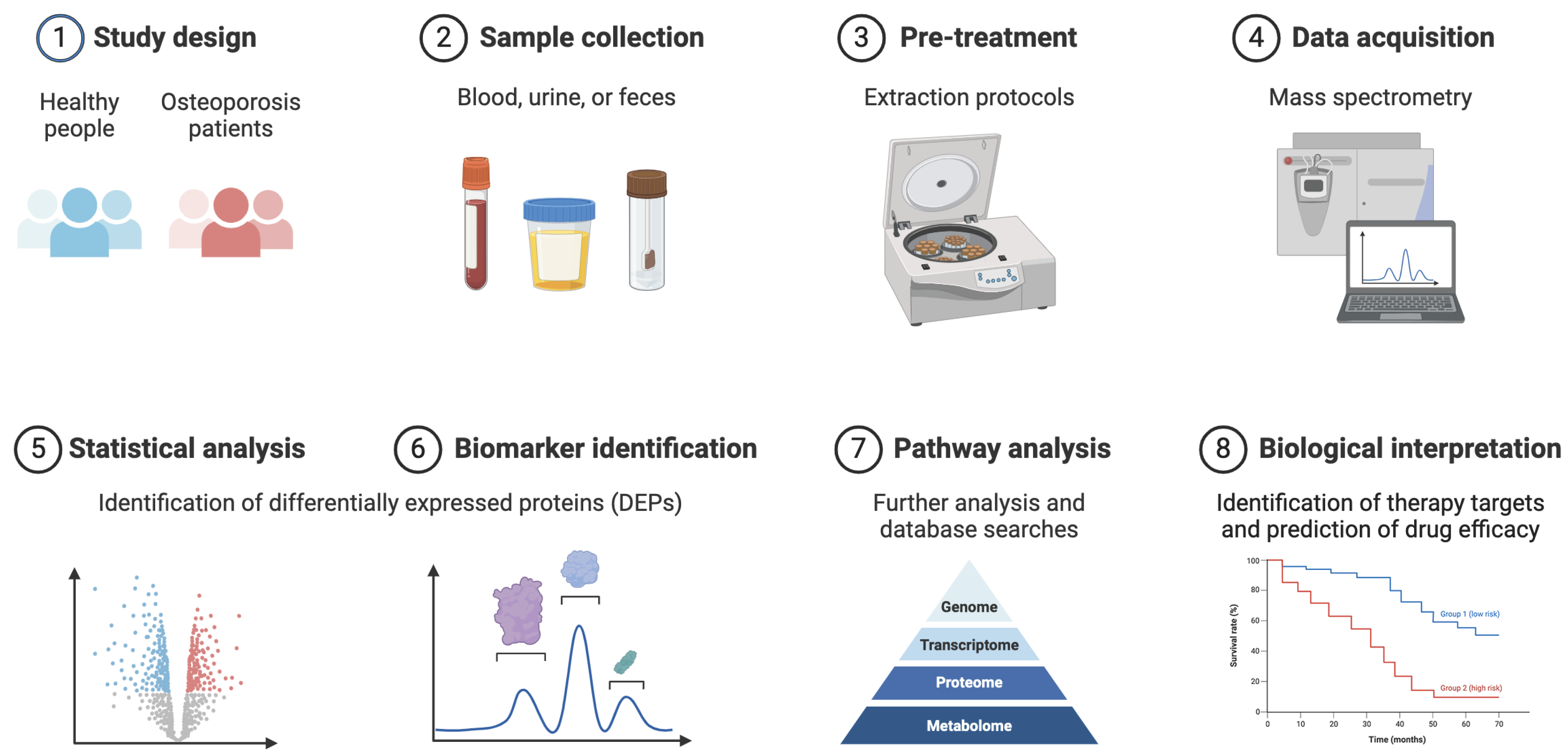

Table 1.
Summary of proteomic studies identifying biomarkers for osteoporosis.
| Biomarkers | Sample Type | Proteomic Technology | Summary | Refs |
|---|---|---|---|---|
| MYH14, IGLC1, MEX3B, and FBLN1 | Serum | LC-MS | This cohort study identified potential protein biomarkers associated with osteopenia (ON) and OP using LC-MS proteomics. Notably, MYH14, IGLC1, MEX3B, and FBLN1 were highlighted as key markers showing dysregulation in low BMD progression, with a focus on inflammatory pathways such as TNF, TLR4, and IFNG. | [92] |
| Lysozyme C, Glucosidase, Disulfide Isomerase A5 | Plasma | LC–MS/MS, PRM | The expression of protein Lysozyme C was negatively related to BMD, while the expression of Glucosidase and Disulfide Isomerase A5 was positively related to BMD values. | [19] |
| Sox2, Oct3/4, Nanog, and E-cadherin | Blood-derived stem cells (BDSCs) | Proteome Profiler Array | Embryonic markers: Sox2, Oct3/4, Nanog, and E-cadherin, which showed decreased expression during osteoblastic differentiation induced by rapamycin under microgravity conditions. | [93] |
| ABI1 | Peripheral blood monocytes (PBMs), Plasma | LC-MS/MS, Western Blotting (WB), ELISA | ABI1 was significantly down-regulated in PBM in Chinese elderly men with extremely low vs. high BMD, as well as in osteoporotic fracture (OF) patients vs. non-fractured (NF) subjects; the plasma ABI1 protein has superior performance in discriminating osteopenia and healthy subjects. | [94] |
| 17 proteins | Serum exosomes | LC–MS | A total of 188, 224, and 185 proteins were identified in the normal, ON, and OP groups, respectively. There were 17 proteins significantly dysregulated in the ON and OP groups. | [34] |
| CHD1, PNP | Serum | 4-D label-free proteomics, ELISA | Serum-level CHD1 and PNP have the potential power as effective indicators for the diagnosis of postmenopausal osteoporosis (PMOP). | [95] |
| Ubiquitylomes | Whole blood | high-performance liquid chromatography (HPLC), LC-MS/MS | This study identified differential ubiquitination patterns in whole blood between healthy postmenopausal women and PMOP patients, revealing potential biomarkers associated with PMOP. Key findings include dysregulation in ubiquitin conjugating enzyme activity, enrichment in pathways such as ubiquitin-mediated proteolysis, and identification of potential diagnostic targets in whole blood. | [96] |
| An 18-peptide multidimensional OP urinary proteomic profile biomarker | Urine | capillary electrophoresis coupled with MS (CE-MS) | This study developed and validated an 18-peptide multidimensional urinary proteomic profile (OSTEO18) biomarker for osteoporosis in heart transplant recipients, showing promising diagnostic performance with improved accuracy compared to known risk factors. | [97] |
| VDBP | Serum | 2-D gel electrophoresis, ELISA | This study identified 27 spots of interest when comparing low BMD versus normal BMD postmenopausal women; and low serum vitamin D-binding protein (VDBP) levels correlate with low BMD. | [98] |
| PSMB9, AARS, PCBP2, and VSIR | Plasma exosome | LC-nano-MS/MS, PRM | This study identified 45 differentially expressed proteins and 4 of them (PSMB9, AARS, PCBP2, and VSIR) associated with osteoporosis were further verified. | [18] |
| Fibrinogen, vitronectin, clusterin, coagulation factors, and apolipoprotein | Extracellular vesicles (EVs) | nano-HPLC-ESI-MS/MS | The proteomic comparison between osteopenic and healthy controls EVs evidenced a decrease in fibrinogen, vitronectin, and clusterin and an increase in coagulation factors and apolipoprotein, which was also upregulated in OP EVs. | [99] |
| IL-6, LT-α, FLT3LG, CSF1, and CCL7 | Serum | Target 48 Cytokine Panel | This observational study identified several serum cytokines, including Interleukin 6 (IL-6), Lymphotoxin-alpha (LT-α), Fms-related tyrosine kinase 3 ligand (FLT3LG), Colony stimulating factor 1 (CSF1), and Chemokine (C-C motif) ligand 7 (CCL7), as potential markers associated with hip fracture status in older adults. | [100] |
| PKM2 | PBMs | LC-MS/MS | This study discovered 59 DEPs, and validated the significant up-regulation of pyruvate kinase isozyme 2 (PKM2) with OP. | [101] |
| ITIH4 | Serum | Protein chip SELDI TOF-MS | This study identified specific serum protein peaks, notably fragments of interalpha-trypsin-inhibitor heavy chain H4 precursor (ITIH4), as potential biomarkers for discriminating between postmenopausal women with high or low/normal bone turnover. | [102] |
| AMFR | Plasma | Protein microarray, WB | Decreased levels of autocrine motility factor receptor (AMFR) was identified and validated in the blood plasma of female osteoporosis patients. | [103] |
| SOD, A1AT | Urine (Rats) | 2-D gel, MS spectrometry | This study identified superoxide dismutase (SOD) as a down-regulated protein and alpha-1-antitrypsin (A1AT) as an up-regulated protein in the urine of ovariectomized rats. | [104] |
| 20 proteins | Serum | LC-IMS-MS | This study identified 20 proteins associated with accelerated BMD loss in older men, with five proteins also linked to incident hip fracture. Notable proteins included CD14, SHBG, B2MG, TIMP1, CO7, CO9, and CFAD, suggesting their potential as biomarkers for future research in bone biology and fracture prediction. | [105] |
| Four proteins | Serum | MALDI-TOF MS combined with WCX magnetic beads | This study identified four potential serum protein biomarkers for PMOP, including m/z peaks at 3167.4, 4071.1, 7771.7, and 8140.5, using MALDI-TOF MS combined with weak cationic exchange (WCX) magnetic beads. | [106] |
| NPM1, APMAP, COX6A1 and ACP5 | Femur (Rats) | LC-MS/MS | A total of 47 differentially expressed proteins (DEPs) were identified in glucocortocoid-induced osteoporosis (GIOP) rats. Protein NPM1, APMAP, COX6A1 and ACP5 showed a close relationship with pathogenesis of GIOP, which could serve as potential biomarkers of GIOP. | [107] |
| CSC1-like protein, PTPN11, SLC44A1, and MME | Human bone marrow stromal cells(BMSCs) | LFQ nLC-MS/MS | This study identified dysregulated proteins, including CSC1-like protein, PTPN11, SLC44A1, and MME, in human bone marrow stromal cells exposed to simulated microgravity. | [108] |
| 12 candidate biomarkers | Serum | Label-free LC-MS/MS | A panel of 12 candidate biomarkers was selected, of which 1 DEP (RYR1) was found upregulated in the osteopenia and OP groups, 8 DEPs (APOA1, SHBG, FETB, MASP1, PTK2B, KNG1, GSN, and B2M) were upregulated in OP and 3 DEPs (APOA2, RYR3, and HBD) were downregulated in osteopenia or OP. | [109] |
| IL-7, CXCL-12, CXCL-8 | Serum | Olink® Target 48 Cytokine Panel | This study identified IL-7 and CXCL-12 as biomarkers associated with better functional recovery at three months after discharge, while CXCL-8 was associated with an increased risk of readmission in older adults with hip fracture. | [110] |
| HSP27 | PBMs | 4-plex iTRAQ coupled with LC-MS/MS | Levels of heat shock protein 27 (HSP27) was elevated in low BMD conditions in both premenopausal and postmenopausal women. | [23] |
| Two proteins | Serum | MALDI-TOF-MS | This study identified two potential serum protein markers, with mass-to-charge ratios of 1699 Da and 3038 Da, for screening osteopenia in postmenopausal women. | [111] |
| HNP-1 | Salivary fluid | MALDI TOF MS | Higher concentrations of α-defensin human neutrophil peptide-1 (HNP-1, a peptide released by neutrophils) were associated with lower BMD in postmenopausal women. | [112] |
| Four proteins | Plasma (Rats) | ESI-Q-TOF-MS, ESI-QqLIT-MS | This study identified four plasma proteins, including mannose-binding lectin-C, major urinary protein 2, type I collagen alpha 2 chain, and tetranectin, as significantly elevated in ovariectomized mice (ovx) compared to sham mice. Among these proteins, tetranectin showed a marked upregulation of almost 50 times in the ovx mice. | [20] |
| GHR, IGFBP2, GDF15, EGFR, CD14, CXCL12, MMP12, and ITIH3 | Plasma | 5 K SomaScan version 4.0 aptamer-based assay | This study identified several circulating proteins associated with incident hip fractures, including proteins related to the growth hormone/insulin growth factor system (GHR and IGFBP2), as well as GDF15, EGFR, CD14, CXCL12, MMP12, and ITIH3. | [113] |
| PINP | Plasma or serum (Rats) | LC-MS/MS | Circulating PINP levels in rats showed age-dependent changes, decreased with prednisolone treatment, and increased with parathyroid hormone (PTH) treatment, suggesting its potential as a biomarker for bone physiology in rat models of osteoporosis. | [114] |
| 22 proteins | Serum | LC–MS/MS | 22 proteins including PHLD, SAMP, PEDF, HPTR, APOA1, SHBG, CO6, A2MG, CBPN, RAIN APOD, and THBG were found to significantly correlate with BMD in OP. | [15] |
| CDH-13 | Plasma (Mice) | MS | This study identified seven circulating proteins, including ANTXR2, CDH-13, CD163, COMP, DKK3, periostin, and secretogranin-1, which decrease with age in mice. Among these, CDH-13 was found to inhibit osteoclast differentiation and delay age-related bone loss in aged mice. | [115] |
| Proteomic profiling of human bone from different anatomical sites | Bone | LC-MS/MS | Results from this study revealed distinct protein profiles between alveolar bone (AB), iliac cortical (IC) bone, and iliac spongiosa (IS). AB exhibited an ECM protein-related fingerprint, while IS and IC displayed an immune-related proteome fingerprint. | [116] |
Note: in Table 1, those not labeled “Rats” or “Mice” for the sample type are all human specimens.
Disclaimer/Publisher’s Note: The statements, opinions and data contained in all publications are solely those of the individual author(s) and contributor(s) and not of MDPI and/or the editor(s). MDPI and/or the editor(s) disclaim responsibility for any injury to people or property resulting from any ideas, methods, instructions or products referred to in the content. |
© 2024 by the authors. Licensee MDPI, Basel, Switzerland. This article is an open access article distributed under the terms and conditions of the Creative Commons Attribution (CC BY) license (http://creativecommons.org/licenses/by/4.0/).
Copyright: This open access article is published under a Creative Commons CC BY 4.0 license, which permit the free download, distribution, and reuse, provided that the author and preprint are cited in any reuse.


