

Submitted:
14 April 2024
Posted:
15 April 2024
You are already at the latest version
Abstract
AFM nanoindentation showed variation in stiffness (Elastic modulus) due to heterogenous nature of the collagen fibres. The S values varied from 5 N/m to 11.11 n/m corresponding to an E change of 2.25 to 1.38 GPa. The variation in effective modulus (Eff) with respect to displacement indicated crossing the parabolic limit. A softening index n was proposed due to the heterogenous behaviour of the biomaterials
Keywords:
AFM nanoindentation
; biomaterials collagen fibril
; softening
; stiffness
1. Introduction
The AFM-nanoindentation technique is a promising tool for characterising the nanomechanical behaviour of thin films and nanostructures, demonstrating its utility in researching substrate and lateral confinement effects. Arrays of Ag nanodisks with varying thicknesses (20-150 nm) and radii (125-900 nm) were successfully produced on Si (100) substrates using interference laser lithography and thermal evaporation processes. The influence of substrate and thickness on the mechanical resistance of the [1] Using the Finite-Difference Time-Domain (FDTD) approach, we investigated Electric-Near Field Enhancement (ENFE) in Au and Ag nanodisk-based photonic crystals. Photonic crystals with squared-lattice parameters were studied to determine the best design parameters for maximising ENFE in the visible and near-infrared spectra.[2], The AFM-assisted DSNI technique was effectively used to study the effects of annealing on the mechanical resistance of photoresist layers. The results reveal that as the annealing temperature increases, the films' plastic strain susceptibility reduces, meaning that thermal-induced polymerization improves mechanical resistance. Strain energy dissipation coefficients dropped as the annealing temperature increased, indicating an annealing-induced hardening effect.[3]. The stress-induced pseudoelasticity effects in freestanding Cu-Al-Ni thin films were successfully measured and analysed using the AFM (cantilever bending)-assisted DSNI technique. This allows us to establish fresh views on the application of this technology as an efficient methodology for future research and quantification of pseudo elastic behaviour (or shape memory effect) in micro/nanostructured SMAs. [4]. The size-dependent nonlinear behaviour of atomic force microscopy (AFM) with an assembled cantilever probe (ACP) in different liquid conditions. showed the system's softening behaviour [5].AFM nanoindentation has been applied to a range of biomaterials. This communication focuses on collagen fibrils which provide mechanical support to the living cells in mani animals
2. Materials and Methods
The mechanical input on sputtered coatings on Si (100) substrates using nanoindentation (Berkovich) was observed and its effect on electrical conduction was studied. The mechano-magnetic and ion-beam influence on Si-based films for memory and switching devices were also taken into consideration. The nano mechanical principles were applied in multicomponent hard coatings for MEMS cantilevers used in AFM nanoindentation [6,7,8]
3. Results & Discussions
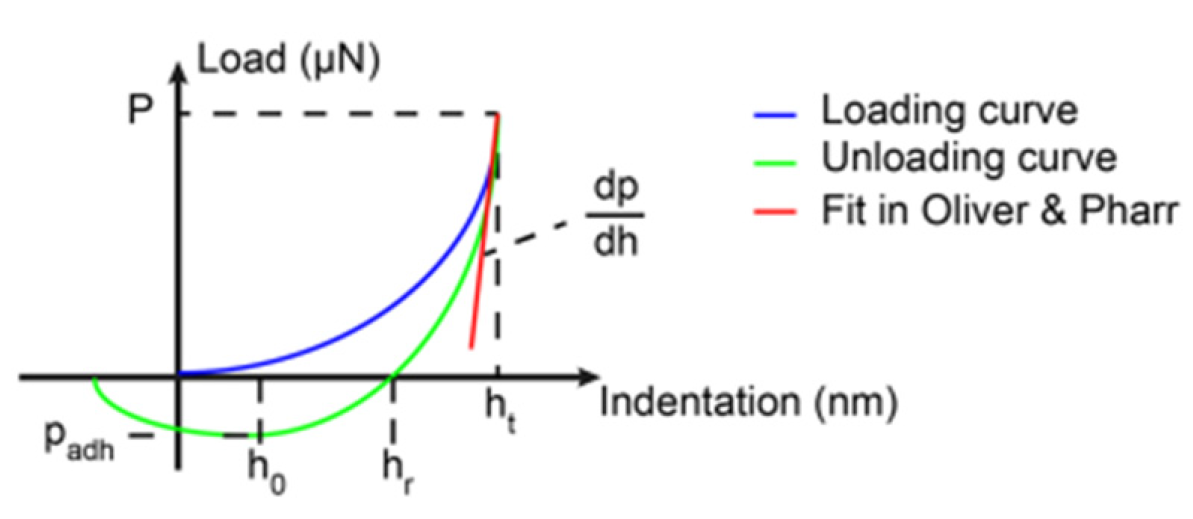
Collagen fibrils are not linear elastic materials and have extended Young's modulus values due to their heterogeneity, anisotropy, and water content. The three force-indentation curves for a collagen fibril with a radius were displayed Figure 1 The Young's modulus values vary greatly [9]. It resembles a softening behaviour as found in the ACPs [5]. It is in fact the stiffness(S) of the indented region varies which brings differences in the E values. For the samples having E =2.25 GPa, the S was 5 N/m which raised to 11.11N/m for 1.38 GPa. The stiffness determination was carried out in biomaterials which has been reported beneficial for detecting diseases like organ fibrosis. An effective Youngs modulus (Eff) given in eq 1 was proposed based upon different models. The symbols P, R and h represent the load applied radius of the indenter tip the depth. The change in Eff with respect to depth was again found to be a crossing the parabolic nature (1. e 1/hn with n varying from 1.5 to 2.5 (eq 2)This n can be considered as the softening index in biomaterials and can be related to adhesion force as observed through Figure 2 and is left as a future scope of work [10]
4. Conclusions
The following conclusions can be made from the discussions above
- The stiffness fluctuations during AFM nanoindentation can qualitatively assess the heterogeneous behaviour of the biomaterial and can also be used for relative quantification.
- The softening parameter influences the pace at which the effective elastic modulus varies with depth.
Funding
This research did not receive any specific grant from funding agencies.
Data Availability Statement
Data shall be made available on request.
Acknowledgements
The author hereby shows sincere gratitude towards Prof N.R. Bandyopadhyay, Prof. S. M. Hossain (IIEST, Howrah), Dr S.K. Mishra (CSIR-NML, Jamshedpur), Prof B. N. Dev, Prof G.P, Das (IACS, Kolkata), Prof S. Bhowmik (Amrita University), Prof. S. K. Samdarshi (CUJ-Ranchi), Dean (School of Engineering & Technology, CUJ-Ranchi) and hon’ble Vice-Chancellor (CUJ-Ranchi) for their support, encouragement, and guidance.
Conflict of Interest
The author(s) declare no conflict of interests. Compliance with ethical standards: The submitted work has not been published anywhere else, in any format or language, except for a few preprints and properly attributed open access content.
References
- S. Roa et al The J. Phy & Chem Solids (2022)163,110605. [CrossRef]
- S. Roa et al Surf & Interf (2023) 39, 102948. [CrossRef]
- M. Avellaneda et al Surf & Interf (2023)41, 103181. [CrossRef]
- S. Roa et al Sol St Comm (2023)361, 115071. [CrossRef]
- B. Saeedi et al Mech Adv Mater & Str (2023) 1–18. [CrossRef]
- A.S. Bhattacharyya et al Fracture analysis of Si-C-N coatings using different methods and its effect on electrical conduction. [CrossRef]
- A.S. Bhattacharyya, Mechano-magnetic and ion-beam influence on Si-based films for memory and switching devices. [CrossRef]
- A.S. Bhattacharyya Nano mechanics in multicomponent hard coatings for MEMS cantilevers. [CrossRef]
- S; V, Kontomaris et al . Materials. (2022)15(7).2477. [CrossRef]
- G. Wu, et al Sci Rep (2020)10, 18784. [CrossRef]
Figure 1.
Force-displacement data in AFM nanoindentation on collagen fibrils with varying elastic modulus (Open access [10]).
Figure 1.
Force-displacement data in AFM nanoindentation on collagen fibrils with varying elastic modulus (Open access [10]).
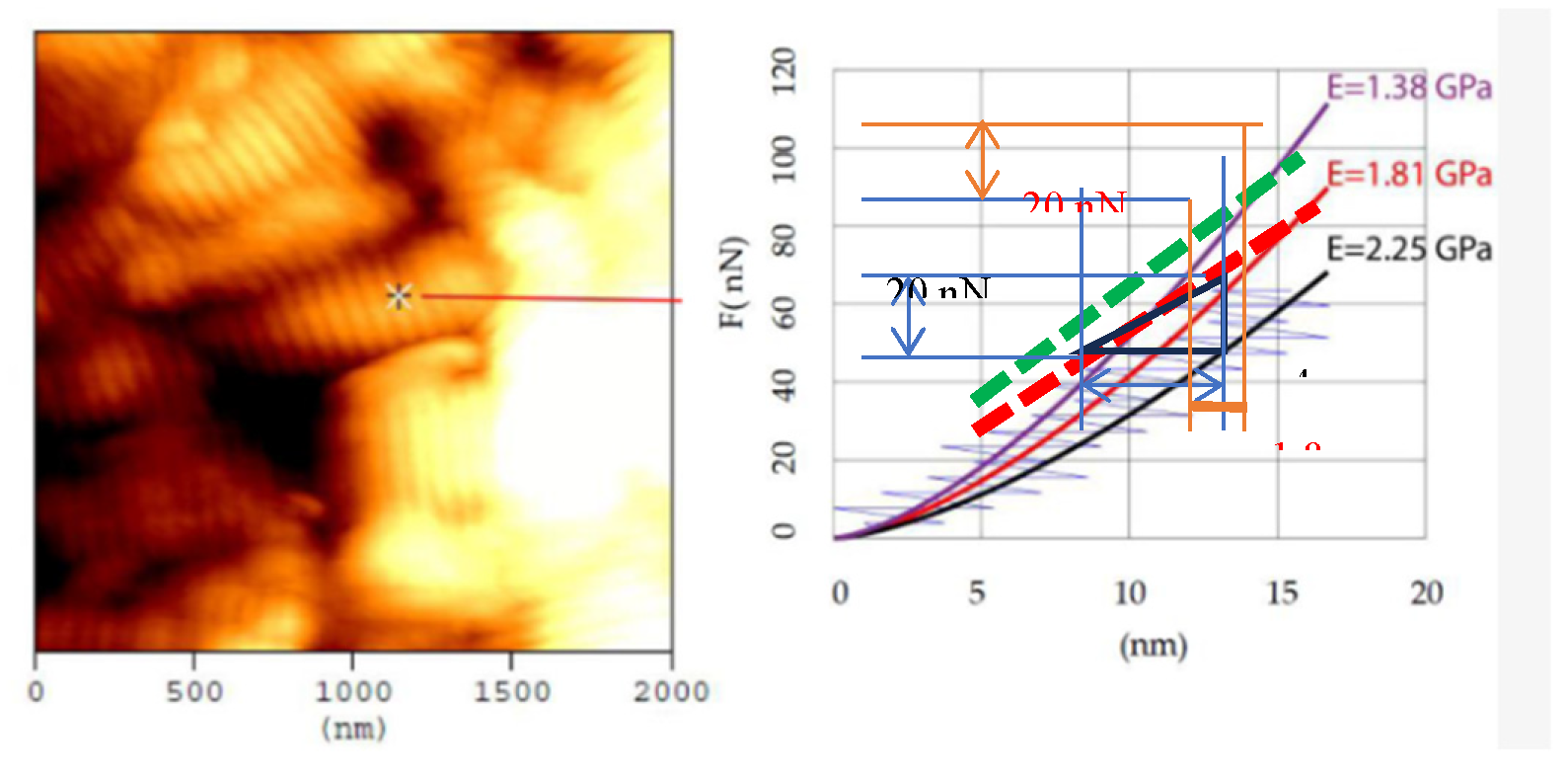
Figure 2.
Load-indentation schematic diagram representing the force of adhesion (Padh) and variation over parabolic nature (Open access [11]).
Figure 2.
Load-indentation schematic diagram representing the force of adhesion (Padh) and variation over parabolic nature (Open access [11]).
Disclaimer/Publisher’s Note: The statements, opinions and data contained in all publications are solely those of the individual author(s) and contributor(s) and not of MDPI and/or the editor(s). MDPI and/or the editor(s) disclaim responsibility for any injury to people or property resulting from any ideas, methods, instructions or products referred to in the content. |
© 2024 by the authors. Licensee MDPI, Basel, Switzerland. This article is an open access article distributed under the terms and conditions of the Creative Commons Attribution (CC BY) license (http://creativecommons.org/licenses/by/4.0/).
Copyright: This open access article is published under a Creative Commons CC BY 4.0 license, which permit the free download, distribution, and reuse, provided that the author and preprint are cited in any reuse.


