

Submitted:
09 September 2024
Posted:
10 September 2024
You are already at the latest version
Abstract
Background: States adopt different tax bases on smokeless tobacco (SLT), making tax incidence on SLT not directly comparable across states. In addition, how taxes are passed through to SLT prices among states that impose specific taxes, and whether the pass-through rates for SLT are affected by the uptake and evolution of e-cigarettes is unknown. Objective: This study will calculate the tax incidence on SLT and investigate how SLT taxes are passed to prices at the 25th, 50th, and 75th percentile levels, as well as whether these pass-through rates vary by e-cigarette uptake and evolution. Methods: We regressed SLT prices on specific taxes using Ordinary Least Square regressions while controlling for state-, year-, and quarter-fixed effects. We then tested the difference in tax pass-through rates by different periods. Findings: The average tax incidence on chewing tobacco, moist snuff, dry snuff, and snus is 22%, 22%, 23%, and 20%, respectively. For moist snuff, taxes were fully passed to prices at the 25th and 50th percentiles and overly passed to prices at the 75th percentile. The e-cigarette uptake and evolution significantly raised taxes by 13 cents and 14 cents per ounce, respectively, for moist snuff at the 75th percentile prices. Conclusions: There is room to additionally raise SLT taxes. Given lower tax pass-through rates for lower-priced SLT, price promotion restrictions and minimum pricing laws may be needed to increase the cost of low-priced products. Tobacco companies increase tax pass-through to premium SLT as e-cigarettes grow popular, like the pricing strategy adopted for cigarettes.
Keywords:
smokeless tobacco
; tax incidence
; tax pass-through
Introduction
Smokeless tobacco (SLT) encompasses various non-combustible tobacco forms, including chewing tobacco, moist snuff, dry snuff, snus, and dissolvable products. In 2021, 2.1% of adults in the United States (US) used SLT every day or some days.[1] SLT use among high school students is comparable to cigarette smoking, with 1.5% and 1.9% reporting the past 30-day use of SLT and cigarettes in 2023.[2] SLT use leads to a series of adverse health consequences, such as cancer of the mouth, esophagus, and pancreas.[3,4] There are also well-documented disparities in SLT use - rural populations are more likely to use SLT than urban populations, especially those living in Appalachian areas.[1,2,5,6,7] In 2022, moist snuff accounted for 90.7% of total SLT sales, underscoring its position as the most favored product within the SLT category.[8]
Tobacco excise taxes are powerful public health tools to regulate smokeless tobacco use, further reducing adverse health consequences resulting from SLT use.[9,10] Leveraging taxes on SLT may also serve as a source of revenue that can be further spent on promoting health outcomes, making them a popular policy widely adopted by federal, state, and sometimes local authorities.[11]
Despite the implementation of SLT taxes at the federal level and by all US states, their approaches to SLT taxation significantly vary, with some states using specific taxes based on product weight, while others employing ad valorem taxes as a percentage of retail, wholesale, or manufacturer prices. The federal taxes for SLT are based on weight, with the present tax rate set at 50.3 cents per pound for chewing tobacco and $1.51 per pound for other forms of SLT. This divergence in tax bases makes direct comparisons challenging. Moreover, some states impose differential tax bases or rates for different SLT forms, further complicating the evaluation and measurement of SLT taxes.
Given the complexity, tax incidence or burden for SLT is needed to measure and compare the magnitude of taxes across different bases and products. Such incidence measures have been developed for e-cigarettes in the US for comparison and adopted by the World Health Organization (WHO) to guide the implementation of cigarette taxes in many countries with different tax bases (e.g., WHO suggests that the tax incidence among retail prices should be at least 75%).[12,13] However, tax incidence for SLT products in different US states has not been developed, which is a significant knowledge gap for policymakers when they design SLT taxes. In addition, the emergence of tobacco or nicotine options such as oral nicotine pouches and e-cigarettes prompt policymakers to consider taxing different products relative to their harms, making tax incidence particularly valuable because they allow for a direct comparison of taxation across products with a wide range of attributes and prices.
Another gap in the existing literature is the tax pass-through rate for SLT, which has not been studied in prior research. To increase prices by the amount of taxes, taxes need to be fully passed to prices. As a result, the tax pass-through rate determines whether the tax policy will be effective in changing behaviors. A number of studies have explored the tax pass-through rates for cigarettes and e-cigarettes.[14,15,16,17] However, a similar analysis has not been done for SLT.
Moreover, since the introduction of e-cigarettes (ECs) in the US in 2007, the US nicotine and tobacco marketplace has undergone significant changes. The EC use prevalence started to skyrocket after 2012. By 2014, ECs have replaced cigarettes as the most used tobacco product among youth.[18] Notably, nicotine salt-based ECs entered the market in 2015, with sales of JUUL pods experiencing an unprecedented 641% surge from 2.2 million in 2016 to 16.2 million in 2017.[19] The increasing competition between different nicotine or tobacco products has changed the industry’s behaviors, including how they shift cigarette excise taxes to prices as the EC market evolves and merges with the cigarette market.[14,20] However, it is unknown how the tax pass-through rates for SLT have changed in response to EC uptake and evolution, especially when many SLT brands are owned by tobacco companies that also sell cigarettes and e-cigarettes.[21]
To address the identified gaps in research, we first calculated tax incidence (the percentage of excise taxes among retail prices) for all states. Then, we examined the tax pass-through rate for states that impose specific taxes on SLT at different price levels (25th, 50th, and 75th percentile prices). We also tested how the tax pass-through rate to prices varied by different periods, including the pre-EC uptake era (2006-2011), the EC uptake era (2012-2016), and the evolution of the nicotine salt-based ECs era (2017 and later). The implications of our findings extend to informing the design and refinement of the SLT taxation system, offering policymakers a nuanced understanding of existing SLT tax policies through comparisons across states.
Data and Methods
Data Sources for SLT Excise Taxes and SLT Prices
We sourced the quarterly state excise taxes on SLT from the Centers for Disease Control and Prevention (CDC) State Tobacco Activities Tracking and Evaluation (STATE) System.[22] The federal SLT excise taxes were obtained from the Alcohol and Tobacco Tax and Trade Bureau.[23] The federal taxes on SLT are based solely on the weight of the product, which isa specific dollar amount per pound. We re-scaled the federal taxes to a dollar per ounce so that we could calculate the total amount of taxes.
We obtained the historical price data for each type of SLT from the Nielsen Retail Scanner Data (NRSD) provided by the Kilts Center for Marketing at the University of Chicago Booth School of Business. This comprehensive dataset captures relevant information such as prices, sales volume, product name/type, store environment, and more. It covers 90 participating retail chains across all US markets and collects sales information every week since 2006. The total number of retail stores ranged from 30,000 to 50,000 from 2006 to 2020. Since there are very few sales records for dissolvable products, we exclude them from our analysis. We calculated the average price and prices at the 25th, 50th, and 75th percentiles for chewing tobacco, moist snuff, dry snuff, and snus, and aggregated them to a quarterly level for each state.
The SLT excise taxes and prices were adjusted for inflation before entering the regression equation that examines the tax pass-through rates. We used the regional Consumer Price Index published by the US Bureau of Labor Statistics in constant 2010 dollars.[24]
Data Sources for State-Level Tobacco CONTROL Policies
State-level tobacco control policies, including regulations such as smoke-free indoor air laws for both cigarettes and e-cigarettes, as well as minimum legal sales age (MLSA) laws for cigarettes and e-cigarettes, were obtained from the CDC STATE System.[22] We assigned a binary indicator variable to determine the presence or absence of smoking or vaping bans in private worksites, restaurants, and bars within each state. A value of 1 was given if the state had implemented a ban, and 0 if no such ban was in place. Similarly, for MLSA laws, we assessed whether the state had set the minimum legal sales age at 21 for both cigarettes and e-cigarettes. If this requirement was met, the corresponding indicator variables were assigned a value of 1; otherwise, they were assigned a value of 0.
Methods
Calculating the Tax Incidence
Tax incidence is defined as the taxes paid as a percentage of final retail prices. For states that impose specific taxes, we used the following formula to calculate the tax incidence.
The specific taxes are expressed as the dollar amount per ounce of SLT. denotes the average retail prices of SLT per ounce in the first year that the state imposed specific taxes. For states that impose ad valorem taxes based on retail prices, we used the following formula to calculate the tax incidence.
For states that impose ad valorem taxes based on wholesale prices, we used the following formula to calculate the tax incidence.
For states that impose ad valorem taxes based on manufacturing prices, we used the following formula to calculate the tax incidence.
We followed previous literature and used 20% markup rate in each distribution level.[25]
Examining the tax pass-through rate
For states that imposed specific taxes on SLT, we implemented Ordinary Least Square (OLS) with a fixed effect (FE) framework in the benchmark model to examine how these taxes are passed through prices. The specification of the model can be described as follows:
where denotes SLT prices at the 25th, 50th, or 75th percentile. denotes total taxes that include the federal and state specific taxes in state s, year i, and quarter j, respectively. denotes state-level tobacco control policy variables, such as smoking and vaping bans in private worksites, restaurants, and bars, and MLSA laws for cigarettes and e-cigarettes. , , and denote year-, quarter-, and state-fixed effects, respectively. is the error term. The fixed effects model can account for time-invariant state-specific unobservable factors and common trends across states. Thereby, the association between taxes and prices could have a causal interpretation. Standard errors were clustered at the state level to account for inter-temporal correlations within each state.
Given that EC use prevalence started to soar in 2012 and that nicotine salt ECs started to grow significantly in 2017, we then test the difference in tax pass-through rates by different periods: the pre-EC uptake era (2006-2011), the EC uptake era (2012-2016), and the evolution of nicotine salt-based ECs era (2017-2020), to ascertain whether the tax pass-through rate was impacted by the uptake and evolution of ECs in the tobacco market. Specifically, we added two interaction terms between taxes and the EC uptake indicator (coded as 1 from 2012 onward and 0 before 2012) and the EC evolution indicator (coded as 1 from 2017 onward and 0 before 2017) to the estimating equation. The specification of the more comprehensive model can be described as follows:
Throughout the analysis, we also conducted seemingly unrelated regressions (SUR) to simultaneously estimate equations for SLT prices at different price levels. SUR allows the error terms of different estimating equations to be correlated, further allowing for a direct test of whether the estimated coefficients from different equations are statistically significant from each other. To be in line with existing literature, we classify tax pass-through rates into under-shifting (rate<0.9), fully shifting (rate=0.9-1.1), and over-shifting (rate>1.1).[26,27] Under-shifting implies that less than 90% of the tax burden is passed on to consumers through increased prices. Fully shifting implies that between 90% and 110% of the tax is transferred to consumers via higher prices. Finally, over-shifting indicates that more than 110% of the tax is shifted onto consumers through increased prices.
Results
Table 1 shows the tax schemas of SLT in the US as of December 2020. Among all the states, seven impose specific taxes and 44 impose ad valorem taxes on chewing tobacco. For moist snuff, the numbers are 23 for specific taxes and 28 for ad valorem taxes. As for dry snuff, fourteen states apply specific taxes, while 37 apply ad valorem taxes. Regarding snus, six states have specific taxes, and 41 have ad valorem taxes. Notably, four states do not impose any taxes on snus. Among states that impose ad valorem taxes, the tax base varied (see Figure 1).
Figure 2 exhibits the trend for real prices and tax incidence for each type of SLT from 2006 to 2020. The price trend for chewing tobacco was relatively flat from 2006 to 2017, followed by a notable surge between 2017 and 2020 (p<0.05). In contrast, the tax incidence exhibited a steadily increasing trend, ranging from 16.3% in 2006 to 24.4% in 2020 (p<0.001). For moist snuff, the price trajectory decreased from 2006 to 2009, subsequently transitioning into a gradual uptrend, which persisted through 2020 (p<0.01). Meanwhile, the tax incidence for moist snuff showed an initial ascent from 2006 to 2010 and remained relatively stable for the remainder of the study period (p<0.001). The prices of dry snuff demonstrated an upward trajectory throughout the entire study period (p<0.001). However, the tax incidence of dry snuff exhibited a steadily increasing pattern over the same period (p<0.001). The lowest tax incidence occurred in 2006 at 13.4%, while the highest occurred in 2020 at 25.9%. The price dynamics of snus were marked by a significant increase from 2006 to 2008, followed by a substantial decrease from 2008 to 2010. Beyond 2011, the prices for snus resumed an upward trajectory until 2020 (p<0.01). In contrast, the tax incidence on snus steadily increased throughout the study period, ranging from 14.5% in 2006 to 19.7% in 2020 (p<0.001).
Table 2 presents the summary statistics of tax incidence for all samples and by tax category. The average tax incidence of chewing tobacco, moist snuff, dry snuff, and snus for all samples during the study period is 22.2%, 21.5%, 22.8%, and 19.9%, respectively. The tax incidence for chewing tobacco, moist snuff, and dry snuff is higher in states that impose specific taxes compared to states that impose ad valorem taxes. Conversely, the tax incidence for snus is higher in states that impose ad valorem taxes compared to states that impose specific taxes. The two-sample T-test shows that the difference in tax incidence by tax form for all types of SLT is statistically significant.
In examining how specific taxes on SLT impact prices across states, we conducted three separate regressions for each type of SLT by price levels (the 25th, 50th, and 75th percentile prices). Table 3 provides summary statistics for the analytical sample. Among states with specific taxes, the average specific tax per ounce for chewing tobacco, moist snuff, dry snuff, and snus during the study period is $0.56, $0.95, $0.60, and $1.13, respectively.
Table 4 presents tax pass-through results using regressions with and without interaction terms between taxes and time period indicators for EC uptake and revolution. We found that for chewing tobacco, tax pass-through rates to prices were not significant across all price levels, regardless of the presence of the interaction terms. However, for moist snuff, taxes were fully passed to prices at the 25th and 50th percentiles and overly passed to prices at the 75th percentile. The EC uptake and evolution did not significantly impact the tax pass-through rate for moist snuff at the 25th and 50th percentile prices. In contrast, at the 75th percentile prices, the EC uptake and evolution significantly raised taxes by 13 cents and 14 cents per ounce, respectively, for moist snuff. The SUR test showed that the tax pass-through rates to prices for moist snuff at the 25- and 50-percentile were not statistically different. However, the tax pass-through rate to the 75th percentile price was significantly higher than that to the 25th and 50th percentile prices (p<0.01).
For dry snuff, tax pass-through rates to prices were positive but not significant before controlling for interaction terms. However, after accounting for interaction terms, taxes were overly shifted to prices for dry snuff at all price levels. The EC uptake and evolution did not significantly affect tax pass-through rates to prices. The SUR test shows that tax pass-through rates to prices for dry snuff at different price levels were not statistically different.
For snus, taxes were overly passed to prices at all levels. However, the tax pass-through rate for snus at the 25th percentile prices almost doubled that at the 75th percentile prices. The EC uptake increased taxes by 80 cents per ounce of snus at the 50th percentile prices. The SUR test shows the tax pass-through rates for snus at the 25th and 50th percentile prices were not statistically different. However, the tax pass-through rate to the 75th percentile price was significantly lower than that to the 25th and 50th percentile prices (p<0.05).
Discussion
Though states in the US have been taxing SLT to curb its use for several decades, the tax incidence of each type of SLT has not been thoroughly studied due to the complexity of tax schemas. This study marks the first attempt to calculate the tax incidence for each type of SLT in the US, offering valuable evidence for policymakers to refine the taxation framework for SLT. In addition, the nicotine and tobacco marketplace has evolved significantly in the past two decades, with ECs and other emerging products entering the market and the merging and acquisition of nicotine and tobacco manufacturers. Policymakers have increasingly focused on how to tax nicotine and tobacco products relative to their harms.[28,29] Therefore, it is essential to assess the existing tax incidence and pass-through rates for SLT, which may be less harmful than cigarettes but still lead to adverse health consequences and attract consumers, especially among those who live in rural places or have low socioeconomic status (SES).
Our analysis shows that, between 2006 and 2020, the national average tax incidence on SLT ranged from 20% to 23%. To compare with the tax incidence on other tobacco products previously published by Shang et al.,[13] we further calculated the tax incidence in 2020. Our results show that the national average tax incidence on chewing tobacco, moist snuff, dry snuff, and suns in 2020 is 24.7%, 25.6%, 26.7%, and 19.9%, respectively, which is comparable to the 22% and 27% tax incidence on closed-system electronic nicotine delivery systems (ENDS) and open system ENDS, but notably lower than the 42% tax incidence on cigarettes.[13] In addition, the tax incidence is very similar across various SLT types despite the different tax schemes of these types. In other words, the cigarette tax incidence is almost twice as high as the SLT tax incidence. Considering the harms of SLT, the tax incidence on SLT may need to be further increased, especially when ENDS – another alternative tobacco products to cigarettes bear a higher tax incidence than SLT.[29]
Our investigation also revealed that the state-level tax incidence on chewing tobacco, moist snuff, and dry snuff tends to be higher in states employing specific taxes compared to those utilizing ad valorem taxes. This suggests that specific taxes may have a more significant impact on increasing prices, aligning with findings in prior research.[30] However, a contrasting pattern emerged for snus, where the tax incidence is higher in states employing ad valorem taxes. Nonetheless, given that moist snuff accounts for the majority of the SLT market with a market share of nearly 91%,[8] it is therefore safe to conclude that, on average, specific taxes on SLT are associated with higher tax incidence than ad valorem taxes. Consequently, if there is a future consideration to further elevate the overall SLT excise tax rate, specific taxes based on weights are preferred to value- or price-based ad valorem taxes.
We further examined tax pass-through rates in states imposing specific taxes for each SLT type. Caution is advised in interpreting the results for chewing tobacco, dry snuff, and snus due to the relatively small sample size and market shares. Nevertheless, the tax pass-through rates for all SLT types except chewing tobacco suggest full- or over-shifting of taxes to prices. These results align with established evidence in previous literature on tax pass-through rates for cigarettes and e-cigarettes.[14,15,17,31,32,33]
In the case of moist snuff - the dominant SLT type, our findings indicate a full pass-through of taxes to prices at the 25th and 50th percentile levels, with an excessive pass-through observed at the 75th percentile level. This suggests that the tax pass-through rate is higher for higher-priced moist snuff. It implies that manufacturers strategically aim to derive profits from premium SLT while maintaining lower prices for budget or discount SLT. Given that individuals with lower SES are more likely to engage in price-minimizing behaviors, increasing tax pass-through rates for lower-priced SLT could effectively eliminate inexpensive products and encourage cessation.[34] This finding closely parallels He et al. (2023), which found that cigarette excise taxes were fully shifted to the 25th and 50th percentile prices and overly shifted to the 75th percentile prices at a 1 to 1.1 rate.[14] This suggests that the tobacco industry is adopting similar pricing strategies. This is not surprising given that US cigarette companies not only purchase SLT companies but also manufacture their own SLT brands.[20]
Moreover, the uptake and evolution of ECs did not significantly impact moist snuff at the 25th and 50th percentile prices. However, at the 75th percentile prices, they elevated tax pass-through rates by 13 and 14 cents for moist snuff, respectively. This underscores potential financial incentives for users of higher-priced moist snuff to consider transitioning to ECs. Conversely, it also highlights the need for additional tobacco control policies or incentive programs to motivate individuals with lower socioeconomic status to shift towards less harmful EC alternatives.
Determining tax pass-through rates is critical in assessing the effectiveness of tax policies in influencing behaviors. Through comparisons with tax pass-through rates for other tobacco products, it becomes evident that increasing taxes on moist snuff, particularly higher-priced variants, can have a meaningful impact on reducing use. Given the lower tax pass-through rates for lower-priced moist snuff, it is imperative to sustain efforts to raise taxes, complemented by additional pricing policies such as restrictions on price promotions. These measures are essential to raise retail prices and curtail opportunities for price minimization.
Though our study is the first to examine the tax incidence and tax pass-through rates of SLT, it is not exempt from certain limitations. First, we used arbitrary cutoffs to classify under-, fully-, and over-shifting of taxes to prices, a method derived from existing literature. However, our findings and the classification of tax pass-through rates remain largely consistent when utilizing a single cutoff (e.g., considering rates >1 as over-shifting and <1 as under-shifting). Second, the EC uptake and evolution timeline may differ by state, potentially introducing variability that could impact the interpretation of our results. Nevertheless, this timeline aligns with the broader development of the EC market and has been utilized in previously published articles.[14] In recognizing these limitations, our study sets the foundation for further investigations that can refine methodologies and deepen our understanding of the complexities of SLT taxation and evolving market landscapes.
Conclusions
If harm is considered a criterion for taxing tobacco products, the tax incidence on SLT could be further increased. Given that lower-priced SLT have lower tax pass-through rates, price promotion restrictions and minimum pricing laws may be needed to increase the cost of lower-priced products. Tobacco companies increase tax pass-through to premium SLT as ECs grow popular.
Author Contributions
YH cleaned part of the data, conducted the analysis, and drafted the paper. QY cleaned part of the data and reviewed the paper. CS conceived of the idea and reviewed the paper.
Funding
Dr. Shang is funded by the National Cancer Institute (R21CA249757; PI: Ce Shang; 9/16/2021-8/30/2023).
Data Availability Statement
The data sets generated and/or analyzed during this study are available from the corresponding author on reasonable request.
Conflicts of Interest
The authors have no conflicts of interest to declare.
Citations/Disclaimers
Researcher(s)’ own analyses calculated (or derived) based in part on data from marketing databases provided through the NielsenIQ Datasets at the Kilts Center for Marketing Data Center at The University of Chicago Booth School of Business. The conclusions drawn from the NielsenIQ data are those of the researcher(s) and do not reflect the views of NielsenIQ. NielsenIQ is not responsible for, had no role in, and was not involved in analyzing and preparing the results reported herein.
References
- M. E. Cornelius et al., "Tobacco Product Use Among Adults–United States, 2021," Morbidity and Mortality Weekly Report, vol. 72, no. 18, p. 475, 2023.
- J. Birdsey, "Tobacco product use among US middle and high school students—National Youth Tobacco Survey, 2023," MMWR. Morbidity and Mortality Weekly Report, vol. 72, 2023.
- Centers for Disease Control and Prevention, "Smokeless Tobacco: Health Effects," 2020. Accessed: 04/08/2024. [Online]. Available: https://www.cdc.gov/tobacco/data_statistics/fact_sheets/smokeless/health_effects/index.htm.
- American Cancer Society, "Health Risks of Smokeless Tobacco," 2020. Accessed: 04/08/2024. [Online]. Available: https://www.cancer.org/cancer/risk-prevention/tobacco/health-risks-of-tobacco/smokeless-tobacco.html.
- L. Zavala-Arciniega, R. Meza, J. L. Hirschtick, and N. L. Fleischer, "Disparities in Cigarette, E-cigarette, Cigar, and Smokeless Tobacco Use at the Intersection of Multiple Social Identities in the US Adult Population. Results From the Tobacco Use Supplement to the Current Population Survey 2018–2019 Survey," Nicotine and Tobacco Research, vol. 25, no. 5, pp. 908-917, 2023. [CrossRef]
- Centers for Disease Control and Prevention, "Smokeless Tobacco Product Use in the United States," 2023. Accessed: 04/08/2023. [Online]. Available: https://www.cdc.gov/tobacco/data_statistics/fact_sheets/smokeless/use_us/index.htm#five.
- J. M. Nemeth, S. T. Liu, E. G. Klein, A. K. Ferketich, M.-P. Kwan, and M. E. Wewers, "Factors influencing smokeless tobacco use in rural Ohio Appalachia," Journal of community health, vol. 37, pp. 1208-1217, 2012. [CrossRef]
- Federal Trade Commission, " Smokeless Tobacco Report for 2022," 2023. Accessed: 04/08/2024. [Online]. Available: https://www.ftc.gov/system/files/ftc_gov/pdf/2022-Smokeless-Tobacco-Report.pdf.
- J. Tauras, L. Powell, F. Chaloupka, and H. Ross, "The demand for smokeless tobacco among male high school students in the United States: the impact of taxes, prices and policies," Applied Economics, vol. 39, no. 1, pp. 31-41, 2007. [CrossRef]
- D. Dave and H. Saffer, "Demand for smokeless tobacco: role of advertising," Journal of Health Economics, vol. 32, no. 4, pp. 682-697, 2013.
- C. Marr and C.-C. Huang, "Higher Tobacco Taxes Can Improve Health And Raise Revenue," Center on Budget and Policy Priorities, 2014. Accessed: 04/08/2024. [Online]. Available: https://www.cbpp.org/sites/default/files/atoms/files/6-19-13tax.pdf.
- World Health Organization. "Promoting taxation on tobacco products." https://www.who.int/europe/activities/promoting-taxation-on-tobacco-products (accessed 04/08/2024).
- C. Shang, S. Ma, and E. N. Lindblom, "Tax incidence of electronic nicotine delivery systems (ENDS) in the USA," Tobacco Control, 2021. [CrossRef]
- Y. He, S. Ma, Q. Yang, and C. Shang, "How cigarette excise tax pass-through to prices responds to the uptake and evolution of e-cigarettes (ECs)," Tobacco Control, 2023. [CrossRef]
- B. Brock, K. Choi, R. G. Boyle, M. Moilanen, and B. A. Schillo, "Tobacco product prices before and after a statewide tobacco tax increase," Tobacco control, vol. 25, no. 2, pp. 166-173, 2016. [CrossRef]
- F. J. Chaloupka and K. E. Warner, "The economics of smoking," Handbook of health economics, vol. 1, pp. 1539-1627, 2000.
- Hanson and R. Sullivan, "The incidence of tobacco taxation: evidence from geographic micro-level data," National Tax Journal, vol. 62, no. 4, pp. 677-698, 2009. [CrossRef]
- Centers for Disease Control and Prevention. "Surgeon General’s Advisory on E-cigarette Use Among Youth." https://www.cdc.gov/tobacco/basic_information/e-cigarettes/surgeon-general-advisory/index.html (accessed 04/08/2023).
- B. A. King, D. G. Gammon, K. L. Marynak, and T. Rogers, "Electronic cigarette sales in the United States, 2013-2017," Jama, vol. 320, no. 13, pp. 1379-1380, 2018.
- R. O'Connor, L. M. Schneller, N. J. Felicione, R. Talhout, M. L. Goniewicz, and D. L. Ashley, "Evolution of tobacco products: recent history and future directions," Tobacco control, vol. 31, no. 2, pp. 175-182, 2022. [CrossRef]
- S. L. Emery, S. Binns, C. C. Carter, S. W. Rose, and G. Kostygina, "Characterising advertising strategies and expenditures for conventional and newer smokeless tobacco products," Tobacco control, vol. 32, no. 6, pp. 795-798, 2023. [CrossRef]
- Centers for Disease Control and Prevention. State Tobacco Activities Tracking and Evaluation (STATE) System [Online] Available: https://www.cdc.gov/statesystem/index.html.
- Alcohol and Tobacco Tax and Trade Bureau. "Tax Rates." U.S. Department of the Treasury. https://www.ttb.gov/tax-audit/tax-and-fee-rates#tobacco (accessed 04/08/2024).
- U.S. Bureau of Labor Statistics. Consumer Price Index [Online] Available: https://www.bls.gov/cpi/.
- F. J. Chaloupka and J. A. Tauras, "Taxation of emerging tobacco products," Journal of Medicine, vol. 373, pp. 594-597, 2020.
- C. Shang, A. Ngo, and F. J. Chaloupka, "The pass-through of alcohol excise taxes to prices in OECD countries," The European Journal of Health Economics, vol. 21, pp. 855-867, 2020. [CrossRef]
- U. M. Bergman and N. L. Hansen, "Are Excise Taxes on Beverages Fully Passed through to Prices?: The Danish Evidence," FinanzArchiv, vol. 75, no. 4, pp. 323-356, 2019. [CrossRef]
- F. J. Chaloupka, D. Sweanor, and K. E. Warner, "Differential Taxes for Differential Risks--Toward Reduced Harm from Nicotine-Yielding Products," 2015. [CrossRef]
- Hoffer, "How Should Alternative Tobacco Products Be Taxed?," 2023. Accessed: 04/08/2024. [Online]. Available: https://taxfoundation.org/research/all/federal/taxing-alternative-tobacco-products/.
- S. Delipalla and O. O’Donnell, "Estimating tax incidence, market power and market conduct: The European cigarette industry," International Journal of Industrial Organization, vol. 19, no. 6, pp. 885-908, 2001. [CrossRef]
- L. B. Wilson, R. Pryce, R. Hiscock, C. Angus, A. Brennan, and D. Gillespie, "Quantile regression of tobacco tax pass-through in the UK 2013–2019. How have manufacturers passed through tax changes for different tobacco products?," Tobacco control, 2020. [CrossRef]
- R. S. Sullivan and D. H. Dutkowsky, "The effect of cigarette taxation on prices: an empirical analysis using local-level data," Public Finance Review, vol. 40, no. 6, pp. 687-711, 2012.
- J. Espinosa and W. N. Evans, "Excise taxes, tax incidence, and the flight to quality: Evidence from scanner data," Public Finance Review, vol. 41, no. 2, pp. 147-176, 2013.
- L. Kalousova et al., "Cigarette taxes, prices, and disparities in current smoking in the United States," SSM-population health, vol. 12, p. 100686, 2020. [CrossRef]
Figure 1.
Tax Schemas of SLT as of December 2020.
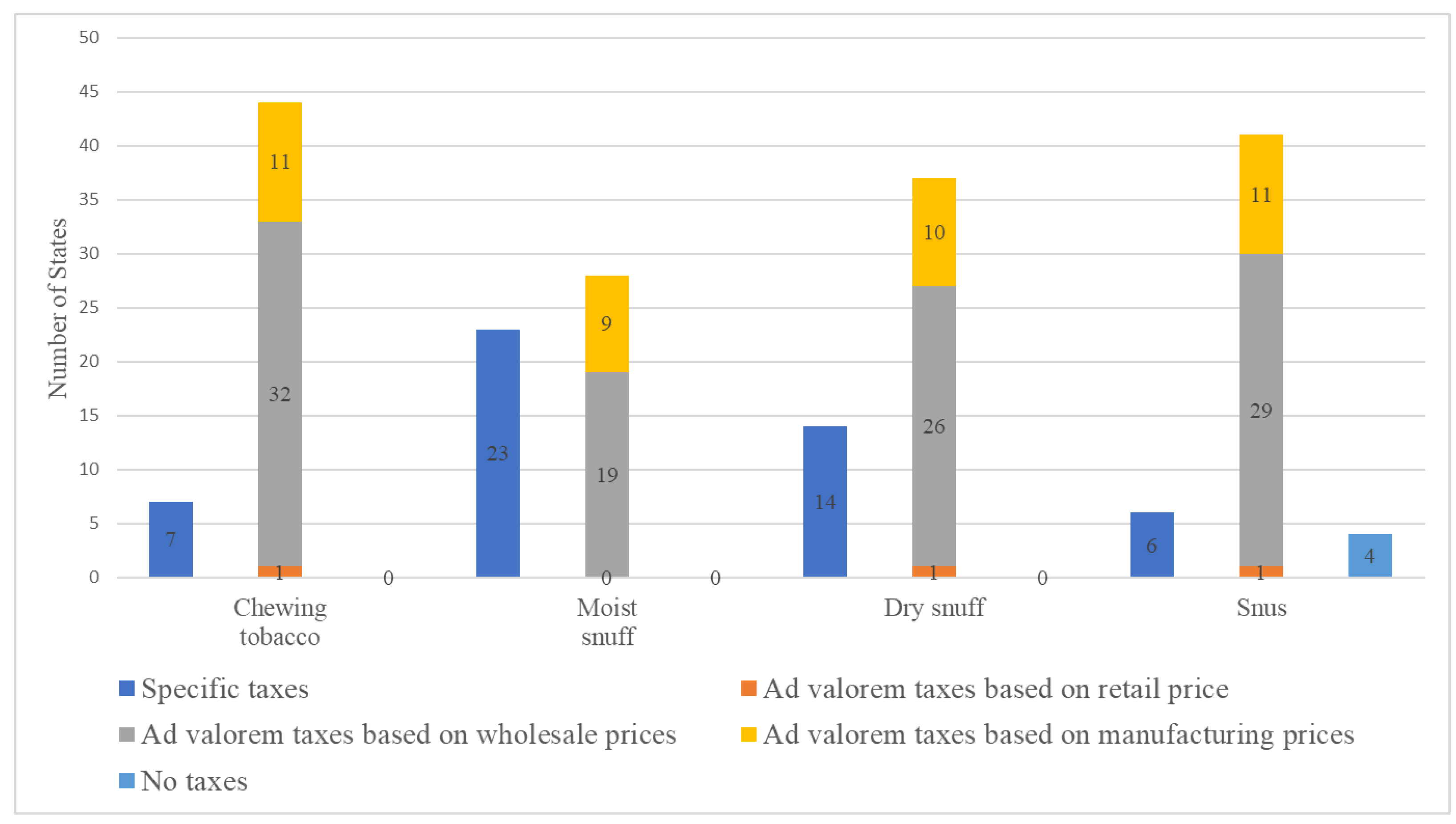
Figure 2.
Trend for SLT prices and state-level tax incidence, 2006-2020.
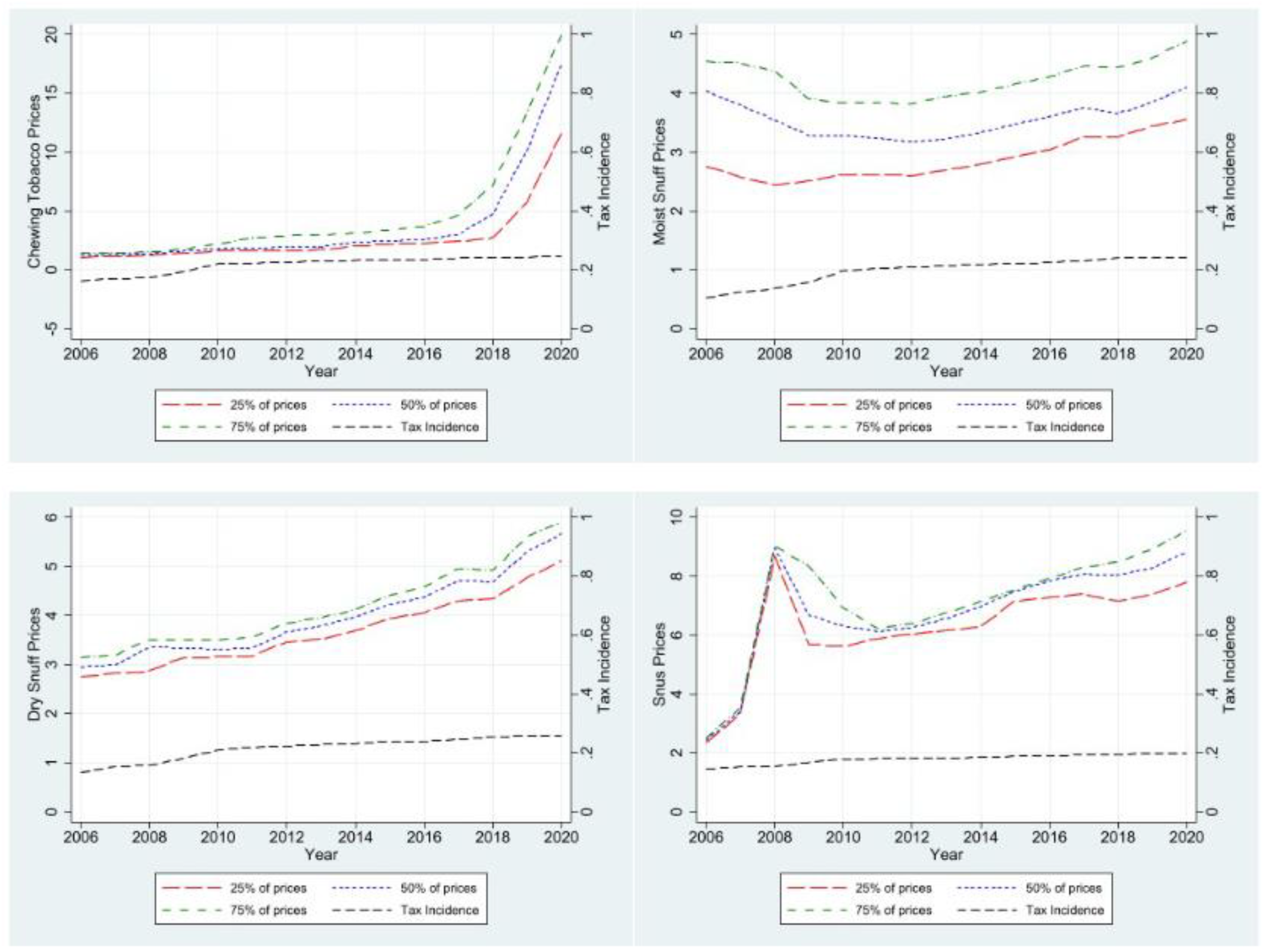

Table 1.
Tax schemas of SLT as of December 2020.
| Type of SLT | Tax schema | Number | States |
|---|---|---|---|
| Chewing tobacco | Specific taxes | 7 | AL, AZ, KY, ME, ND, PA, TX |
| Ad valorem taxes | 44 |
1 based on retail prices: WA 32 based on wholesale prices: AK, CA, CT, DC, DE, FL, GA, HI, IA, ID, IL, IN, KS, MA, MD, MI, MN, MT, NC, NE, NH, NJ, NV, NY, OH, OR, RI, SD, TN, VT, WV, WY 11 based on manufacturing prices: AR, CO, LA, MO, MS, NM, OK, SC, UT, VA, WI |
|
| No taxes | 0 | ||
| Moist snuff | Specific taxes | 23 | AL, AZ, CT, DE, IA, IL, IN, KY, ME, MT, ND, NE, NJ, NY, OR, PA, RI, TX, UT, VA, VT, WA, WY |
| Ad valorem taxes | 28 |
19 based on wholesale prices: AK, CA, DC, FL, GA, HI, ID, KS, MA, MD, MI, MN, NC, NH, NV, OH, SD, TN, WV 9 based on manufacturing prices: AR, CO, LA, MO, MS, NM, OK, SC, WI |
|
| No taxes | 0 | ||
| Dry snuff | Specific taxes | 14 | AL, AZ, CT, IA, KY, ME, ND, NE, NY, PA, RI, TX, VA, VT |
| Ad valorem taxes | 37 |
1 based on retail prices: WA 26 based on wholesale prices: AK, CA, DC, DE, FL, GA, HI, ID, IL, IN, KS, MA, MD, MI, MN, MT, NC, NH, NJ, NV, OH, OR, SD, TN, WV, WY 10 based on manufacturing prices: AR, CO, LA, MO, MS, NM, OK, SC, UT, WI |
|
| No taxes | 0 | ||
| Snus | Specific taxes | 6 | AZ, KY, ME, PA, TX, VT |
| Ad valorem taxes | 41 |
1 based on retail prices: WA 29 based on wholesale prices: AK, CA, DC, DE, FL, GA, HI, IA, ID, IL, IN, KS, MA, MD, MI, MN, MT, NC, NE, NJ, NV, NY, OH, OR, RI, SD, TN, WV, WY 11 based on manufacturing prices: AR, CO, LA, MO, MS, NM, OK, SC, UT, VA, WI |
|
| No taxes | 4 | AL, CT, ND, NH |
Table 2.
Summary statistics of the state-level tax incidence, 2006-2020.
| SLT Type | All sample | States that impose specific taxes | States that impose ad valorem taxes | P-value | ||
|---|---|---|---|---|---|---|
| Mean (SD) | # of obs | Mean (SD) | # of obs | Mean (SD) | ||
| Chewing tobacco | 0.222 (0.149) | 339 | 0.292 (0.285) | 2,663 | 0.213 (0.119) | <0.001 |
| Moist snuff | 0.215 (0.144) | 1,164 | 0.238 (0.168) | 1,658 | 0.199 (0.123) | <0.001 |
| Dry snuff | 0.228 (0.159) | 710 | 0.293 (0.230) | 2,172 | 0.207 (0.121) | <0.001 |
| Snus | 0.199 (0.111) | 267 | 0.170 (0.113) | 2,483 | 0.202 (0.110) | <0.001 |
Table 3.
Summary statistics of the analytical sample, 2006-2020.
| Chewing tobacco Mean (SD) |
Moist snuff Mean (SD) |
Dry snuff Mean (SD) |
Snus Mean (SD) |
|
|---|---|---|---|---|
| Outcome variables | ||||
| SLT prices at 25-percentile | 3.035 (3.980) |
3.315 (1.005) |
3.911 (1.142) |
7.616 (2.494) |
| SLT prices at 50-percentile | 4.184 (5.482) |
3.855 (.976) |
4.239 (1.257) |
7.994 (2.412) |
| SLT prices at 75-percentile | 5.269 (5.978) |
4.380 (.939) |
4.426 (1.280) |
8.360 (2.436) |
| Explanatory variables | ||||
| Specific tax | .562 (.634) |
.948 (.650) |
.600 (.466) |
1.129 (.771) |
| State-level tobacco control policy variables | ||||
| Smoking bans in private worksites | .584 (.494) |
.708 (.455) |
.357 (.480) |
.693 (.462) |
| Smoking bans in private restaurants | .451 (.498) |
.625 (.484) |
.289 (.454) |
.622 (.486) |
| Smoking bans in private bars | .451 (.498) |
.669 (.471) |
.289 (.454) |
.622 (.486) |
| Vaping bans in private worksites | .097 (.297) |
.165 (.371) |
.003 (.057) |
.072 (.259) |
| Vaping bans in private restaurants | .159 (.366) |
.183 (.387) |
.003 (.057) |
.155 (.363) |
| Vaping bans in private bars | .159 (.366) |
.183 (.387) |
.003 (.057) |
.155 (.363) |
| Minimum legal sales age (MLSA) laws for cigarettes | .018 (.132) |
.069 (.253) |
.049 (.217) |
.048 (.214) |
| Minimum legal sales age (MLSA) laws for e-cigarettes | .018 (.132) |
.069 (.253) |
.049 (.217) |
.048 (.214) |
| # of obs | 339 | 1,164 | 305 | 251 |
Table 4.
SLT tax pass-through rates, 2006-2020.
| Control Variables | SLT prices at 25% | SLT prices at 50% | SLT prices at 75% | ||||||
|---|---|---|---|---|---|---|---|---|---|
| Chewing Tobacco (n=339) | |||||||||
| Standardized SLT excise tax | -2.519 (0.880) |
-15.981 (0.318) |
-.555 (0.924) |
-6.043 (0.336) |
-10.535 (0.250) |
-11.210 (0.280) |
|||
| SLT tax × EC uptake | -.795 (0.365) |
-.381 (0.296) |
-.585 (0.140) |
||||||
| SLT tax × EC evolution | -1.828 (0.182) |
-.680 (0.323) |
.533 (0.452) |
||||||
| Pass-through rates | |||||||||
| 2006-2011 | -- |
-15.981 (0.318) |
-- |
-6.043 (0.336) |
-- |
-11.210 (0.280) |
|||
| 2012-2016 | -- |
-16.776 (0.282) |
-- |
-6.424 (0.289) |
-- |
-11.794 (0.230) |
|||
| 2017 and later | -- |
-18.604 (0.205) |
-- |
-7.103 (0.242) |
-- |
-11.262 (0.270) |
|||
| Moist Snuff (n=1,164) | |||||||||
| Standardized SLT excise tax | 1.014*** (<0.001) |
.882*** (<0.001) |
1.011*** (<0.001) |
.920*** (<0.001) |
1.247*** (<0.001) |
1.041*** (<0.001) |
|||
| SLT tax × EC uptake | .155 (0.236) |
.071 (0.528) |
.131* (0.017) |
||||||
| SLT tax × EC evolution | -.005 (0.952) |
.044 (0.466) |
.138* (0.043) |
||||||
| Pass-through rates | |||||||||
| 2006-2011 | -- |
.882*** (<0.001) |
-- |
.920*** (<0.001) |
-- |
1.041*** (<0.001) |
|||
| 2012-2016 | -- |
1.037*** (<0.001) |
-- |
.991*** (<0.001) |
-- |
1.172*** (<0.001) |
|||
| 2017 and later | -- |
1.032*** (<0.001) |
-- |
1.035*** (<0.001) |
-- |
1.310*** (<0.001) |
|||
| Dry Snuff (n=305) | |||||||||
| Standardized SLT excise tax | .829 (0.240) |
1.314* (0.029) |
2.664 (0.113) |
1.762* (0.049) |
2.818 (0.075) |
1.844* (0.018) |
|||
| SLT tax × EC uptake | -.037 (0.946) |
-.160 (0.807) |
-.011 (.484) |
||||||
| SLT tax × EC evolution | .303 (0.538) |
-.393 (0.605) |
-.545 (.619) |
||||||
| Pass-through rates | |||||||||
| 2006-2011 | -- |
1.314* (0.029) |
-- |
1.762* (0.049) |
-- |
1.844* (0.018) |
|||
| 2012-2016 | -- |
1.276 (0.091) |
-- |
1.603 (0.159) |
-- |
1.833* (0.030) |
|||
| 2017 and later | -- |
1.580** (0.002) |
-- |
1.210 (0.114) |
-- |
1.287* (0.034) |
|||
| Snus (n=251) | |||||||||
| Standardized SLT excise tax | 4.341*** (<0.001) |
4.131*** (<0.001) |
4.478** (0.001) |
3.495*** (<0.001) |
2.130*** (<0.001) |
2.301*** (<0.001) |
|||
| SLT tax × EC uptake | .186 (0.200) |
.795* (0.044) |
-.140 (0.370) |
||||||
| SLT tax × EC evolution | .135 (0.390) |
.152 (0.404) |
-.034 (0.610) |
||||||
| Pass-through rates | |||||||||
| 2006-2011 | -- |
4.131*** (<0.001) |
-- |
3.495*** (<0.001) |
-- |
2.301*** (<0.001) |
|||
| 2012-2016 | -- |
4.318*** (<0.001) |
-- |
4.289*** (<0.001) |
-- |
2.161*** (<0.001) |
|||
| 2017 and later | -- |
4.453*** (<0.001) |
-- |
4.441*** (<0.001) |
-- |
2.127*** (<0.001) |
|||
Note: *p<0.05, **p<0.01, ***p<0.001. State-level tobacco control policies include smoking and vaping bans in private worksites, restaurants, and bars for both cigarettes and e-cigarettes, as well as minimum legal sales age (MLSA) laws for cigarettes and e-cigarettes.
Disclaimer/Publisher’s Note: The statements, opinions and data contained in all publications are solely those of the individual author(s) and contributor(s) and not of MDPI and/or the editor(s). MDPI and/or the editor(s) disclaim responsibility for any injury to people or property resulting from any ideas, methods, instructions or products referred to in the content. |
© 2024 by the authors. Licensee MDPI, Basel, Switzerland. This article is an open access article distributed under the terms and conditions of the Creative Commons Attribution (CC BY) license (http://creativecommons.org/licenses/by/4.0/).
Copyright: This open access article is published under a Creative Commons CC BY 4.0 license, which permit the free download, distribution, and reuse, provided that the author and preprint are cited in any reuse.


