
Submitted:
22 October 2024
Posted:
24 October 2024
You are already at the latest version
Abstract
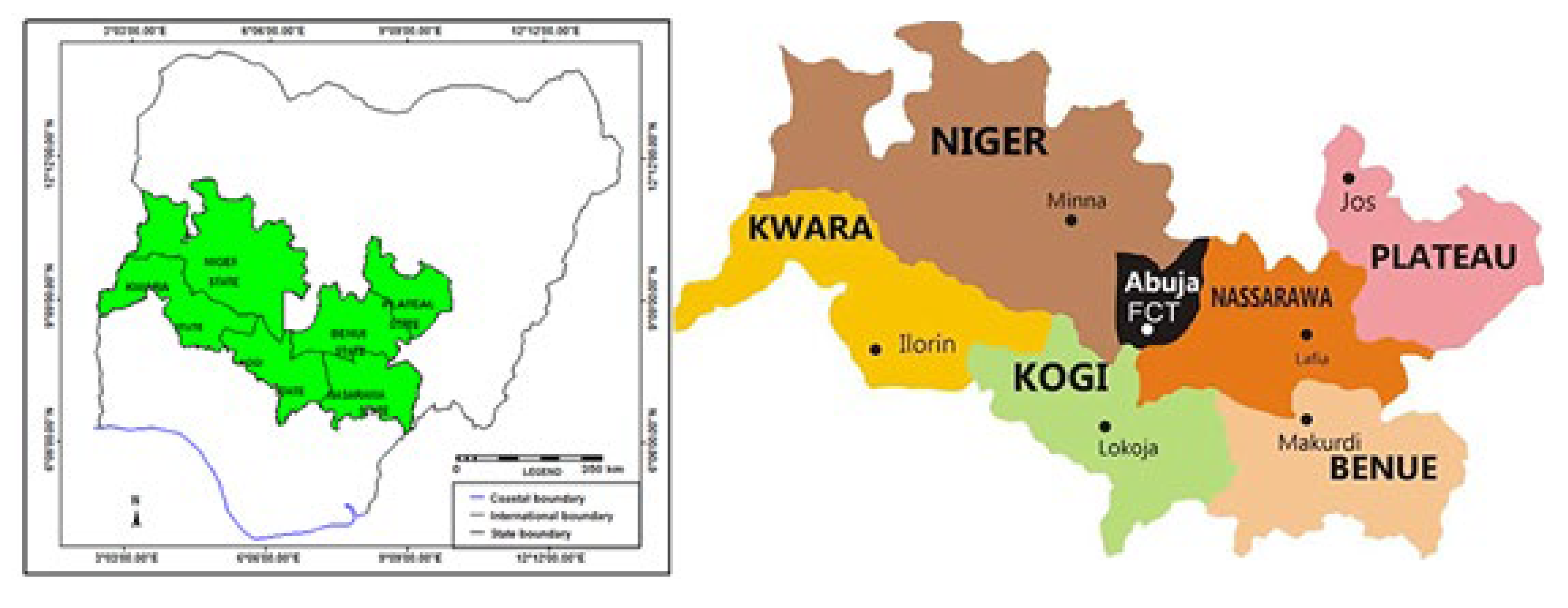
Objectives: In Nigeria, modern contraceptive use remains relatively low despite numerous efforts to increase awareness and accessibility. This study examined the geopolitical factors influencing modern contraceptive use in North-central Nigeria Design: Using data from the 2021 Nigeria Multiple Indicator Cluster Survey, this study quantitatively investigated the factors influencing modern contraceptive use among women of reproductive age. The data were analyzed using R studio. Respondents' characteristics were described using frequency and percentage. A logistic regression model was employed to identify factors associated with modern contraceptive usage in the north-central region of Nigeria. Bivariate logistic regression was carried out between the explanatory and response variables. Settings: This study focused specifically on the north-central zone of Nigeria comprising 6 states, namely, Benue, Kogi, Kwara, Nasarawa, Niger, and Plateau states with the Federal Capital Territory (FCT). Results: Nearly one-third (30.1%) of the respondents are above 35 years of age. 3 out of every 5 (61.2%) respondents are currently married. This study found that the average modern contraceptive usage among women of reproductive age in north Central Nigeria is less than 15%. Age, education, childbirth delivery method, number of children, access to media, and state of residence are key drivers of modern contraceptive adoption and utilization among women of reproductive age in north-central Nigeria. Conclusion: This study finds it plausible to increase the awareness and sensitization of modern contraceptives and contraceptive usage in this region. There is a need for health education on the benefits and relevance of modern contraceptive usage.
Keywords:
Introduction
Methods
Study Area
Study Variables
Outcome (Response) Variable
Explanatory Variables
Data Analysis
Result
Weighted descriptive statistics, Women modern Contraceptive usage NC.
| Variable |
Overall N = 5859 (100.0%)1 |
Not N = 4898 (83.6%)1 |
Yes N = 961 (16.4%)1 |
p-value2 |
| Respondents age | <0.001 | |||
| 15-19 | 1,249 (21.3%) | 1,199 (24.5%) | 50 (5.2%) | |
| 20-24 | 1,033 (17.6%) | 900 (18.4%) | 134 (13.9%) | |
| 25-29 | 1,029 (17.6%) | 847 (17.3%) | 182 (18.9%) | |
| 30-34 | 785 (13.4%) | 616 (12.6%) | 168 (17.5%) | |
| 35+ | 1,762 (30.1%) | 1,335 (27.3%) | 427 (44.4%) | |
| Marital status | <0.001 | |||
| Currently married | 3,580 (61.2%) | 2,850 (58.3%) | 730 (76.0%) | |
| Formerly married | 284 (4.9%) | 227 (4.6%) | 58 (6.0%) | |
| Never married | 1,988 (34.0%) | 1,816 (37.1%) | 172 (17.9%) | |
| Education | 0.015 | |||
| None | 1,481 (25.3%) | 1,282 (26.2%) | 199 (20.7%) | |
| Primary/Junior | 1,619 (27.6%) | 1,344 (27.4%) | 274 (28.6%) | |
| Secondary+ | 2,759 (47.1%) | 2,271 (46.4%) | 487 (50.7%) | |
| Ethnicity | 0.009 | |||
| Hausa | 713 (12.2%) | 618 (12.6%) | 96 (9.9%) | |
| Igbo | 116 (2.0%) | 95 (1.9%) | 21 (2.2%) | |
| Yoruba | 598 (10.2%) | 443 (9.0%) | 155 (16.2%) | |
| Fulani | 122 (2.1%) | 110 (2.2%) | 12 (1.3%) | |
| Kanuri | 23 (0.4%) | 18 (0.4%) | 4 (0.5%) | |
| Ijaw | 7 (0.1%) | 5 (0.1%) | 2 (0.2%) | |
| Tiv | 827 (14.1%) | 685 (14.0%) | 142 (14.8%) | |
| Ibibio | 8 (0.1%) | 7 (0.2%) | 1 (0.1%) | |
| Edo | 19 (0.3%) | 13 (0.3%) | 6 (0.6%) | |
| Other | 3,426 (58.5%) | 2,903 (59.3%) | 522 (54.4%) | |
| Wealth index | <0.001 | |||
| Poor | 2,489 (42.5%) | 2,166 (44.2%) | 324 (33.7%) | |
| Middle | 1,360 (23.2%) | 1,119 (22.8%) | 242 (25.1%) | |
| Rich | 2,009 (34.3%) | 1,613 (32.9%) | 396 (41.2%) | |
| Method of last delivery | <0.001 | |||
| CS | 748 (12.8%) | 582 (11.9%) | 166 (17.3%) | |
| No CS | 5,110 (87.2%) | 4,315 (88.1%) | 795 (82.7%) | |
| Number of births in last two years | <0.001 | |||
| No | 2,387 (63.7%) | 1,811 (61.4%) | 576 (72.1%) | |
| Yes | 1,360 (36.3%) | 1,138 (38.6%) | 222 (27.9%) | |
| Total number of children alive | <0.001 | |||
| 0 | 2,111 (36.0%) | 1,948 (39.8%) | 163 (16.9%) | |
| 1-2 | 1,243 (21.2%) | 1,061 (21.7%) | 182 (18.9%) | |
| 3-4 | 1,350 (23.0%) | 1,021 (20.9%) | 329 (34.2%) | |
| 4+ | 1,154 (19.7%) | 867 (17.7%) | 288 (29.9%) | |
| Want another child? | <0.001 | |||
| No | 1,149 (22.2%) | 764 (18.0%) | 386 (41.0%) | |
| Undecided | 673 (13.0%) | 593 (14.0%) | 80 (8.5%) | |
| Yes | 3,358 (64.8%) | 2,884 (68.0%) | 474 (50.5%) | |
| Access to media | <0.001 | |||
| No | 2,294 (39.2%) | 2,004 (40.9%) | 290 (30.2%) | |
| Yes | 3,564 (60.8%) | 2,893 (59.1%) | 671 (69.8%) | |
| Residence type | 0.053 | |||
| Urban | 2,038 (34.8%) | 1,663 (34.0%) | 375 (39.0%) | |
| Rural | 3,821 (65.2%) | 3,234 (66.0%) | 586 (61.0%) | |
| State | <0.001 | |||
| Benue | 1,149 (19.6%) | 963 (19.7%) | 185 (19.3%) | |
| Kogi | 841 (14.3%) | 703 (14.4%) | 137 (14.3%) | |
| Kwara | 620 (10.6%) | 463 (9.4%) | 158 (16.4%) | |
| Nasarawa | 546 (9.3%) | 468 (9.5%) | 78 (8.2%) | |
| Niger | 1,217 (20.8%) | 1,091 (22.3%) | 126 (13.1%) | |
| Plateau | 850 (14.5%) | 718 (14.7%) | 132 (13.7%) | |
| FCT | 636 (10.9%) | 492 (10.0%) | 145 (15.0%) | |
| 1n (%) | ||||
| 2Chi-square: adjusted Wald test of independence for complex survey samples | ||||
Factors Associated with Modern Contraceptive Usage
Bivariate and Multivariable Weighted Logistic Regression for Women Modern Contraceptive Rate (NC)
| Variable | Total N (%) | Crude OR | Adjusted OR | ||||
| N = 5,8591 | OR2 | 95% CI2 | p-value | OR2 | 95% CI2 | p-value | |
| Respondents age | <0.001 | <0.001 | |||||
| 15-19 | 1,249 (21.3%) | — | — | — | — | ||
| 20-24 | 1,033 (17.6%) | 3.54 | 2.42, 5.19 | <0.001 | 0.69 | 0.34, 1.40 | 0.304 |
| 25-29 | 1,029 (17.6%) | 5.12 | 3.47, 7.57 | <0.001 | 0.62 | 0.31, 1.25 | 0.179 |
| 30-34 | 785 (13.4%) | 6.52 | 4.42, 9.64 | <0.001 | 0.57 | 0.27, 1.21 | 0.142 |
| 35+ | 1,762 (30.1%) | 7.63 | 5.25, 11.1 | <0.001 | 0.35 | 0.17, 0.71 | 0.004 |
| Marital status | <0.001 | 0.026 | |||||
| Currently married | 3,580 (61.2%) | — | — | — | — | ||
| Formerly married | 284 (4.9%) | 1.00 | 0.73, 1.37 | 0.994 | 0.63 | 0.45, 0.88 | 0.007 |
| Never married | 1,988 (34.0%) | 0.37 | 0.28, 0.49 | <0.001 | 0.88 | 0.47, 1.66 | 0.700 |
| Education | 0.017 | <0.001 | |||||
| None | 1,481 (25.3%) | — | — | — | — | ||
| Primary/Junior | 1,619 (27.6%) | 1.32 | 1.04, 1.66 | 0.021 | 1.57 | 1.22, 2.03 | <0.001 |
| Secondary+ | 2,759 (47.1%) | 1.38 | 1.10, 1.74 | 0.005 | 1.82 | 1.41, 2.34 | <0.001 |
| Wealth index | <0.001 | 0.169 | |||||
| Poor | 2,489 (42.5%) | — | — | — | — | ||
| Middle | 1,360 (23.2%) | 1.45 | 1.11, 1.88 | 0.006 | 1.23 | 0.93, 1.63 | 0.153 |
| Rich | 2,009 (34.3%) | 1.64 | 1.31, 2.05 | <0.001 | 1.36 | 0.98, 1.88 | 0.066 |
| Method of last delivery | <0.001 | <0.001 | |||||
| Yes | 748 (12.8%) | — | — | — | — | ||
| No | 5,110 (87.2%) | 0.64 | 0.52, 0.80 | <0.001 | 0.44 | 0.30, 0.64 | <0.001 |
| Number of birth in last two years | <0.001 | <0.001 | |||||
| No | 2,387 (63.7%) | — | — | — | — | ||
| Yes | 1,360 (36.3%) | 0.61 | 0.51, 0.74 | <0.001 | 0.30 | 0.21, 0.42 | <0.001 |
| Total number of child alive | <0.001 | <0.001 | |||||
| 1-2 | 1,243 (21.2%) | 2.05 | 1.49, 2.82 | <0.001 | — | — | |
| 3-4 | 1,350 (23.0%) | 3.85 | 2.94, 5.06 | <0.001 | 1.58 | 1.27, 1.97 | <0.001 |
| 4+ | 1,154 (19.7%) | 3.97 | 2.91, 5.43 | <0.001 | 1.49 | 1.14, 1.94 | 0.003 |
| Want another child? | <0.001 | <0.001 | |||||
| No | 1,149 (22.2%) | — | — | — | — | ||
| Undecided | 673 (13.0%) | 0.27 | 0.19, 0.37 | <0.001 | 0.57 | 0.42, 0.79 | <0.001 |
| Yes | 3,358 (64.8%) | 0.33 | 0.28, 0.38 | <0.001 | 0.37 | 0.30, 0.45 | <0.001 |
| Access to media | <0.001 | <0.001 | |||||
| No | 2,294 (39.2%) | — | — | — | — | ||
| Yes | 3,564 (60.8%) | 1.60 | 1.34, 1.93 | <0.001 | 1.53 | 1.21, 1.93 | <0.001 |
| Residence type | 0.047 | 0.007 | |||||
| Urban | 2,038 (34.8%) | — | — | — | — | ||
| Rural | 3,821 (65.2%) | 0.80 | 0.65, 1.00 | 0.048 | 1.48 | 1.11, 1.97 | 0.007 |
| State | <0.001 | <0.001 | |||||
| Benue | 1,149 (19.6%) | — | — | — | — | ||
| Kogi | 841 (14.3%) | 1.01 | 0.76, 1.35 | 0.920 | 0.68 | 0.45, 1.01 | 0.056 |
| Kwara | 620 (10.6%) | 1.77 | 1.26, 2.50 | 0.001 | 2.19 | 1.37, 3.52 | 0.001 |
| Nasarawa | 546 (9.3%) | 0.87 | 0.63, 1.20 | 0.395 | 1.23 | 0.85, 1.79 | 0.271 |
| Niger | 1,217 (20.8%) | 0.60 | 0.42, 0.86 | 0.005 | 0.87 | 0.59, 1.29 | 0.488 |
| Plateau | 850 (14.5%) | 0.96 | 0.70, 1.31 | 0.776 | 1.33 | 0.94, 1.88 | 0.109 |
| FCT | 636 (10.9%) | 1.53 | 1.22, 1.92 | <0.001 | 1.96 | 1.42, 2.71 | <0.001 |
| 1n (%) | |||||||
| 2OR = Odds Ratio, CI = Confidence Interval | |||||||
Discussion
Conclusions and Recommendations
Declarations
Declaration of conflicting interests
Ethical approval
Author Contributions
Funding
Availability of data and materials
References
- Abdullateef IB, Abdulganiyu AO, Fanu OO, Atta JA. Knowledge and Perceptions of the Billing’s Ovulation Method of Natural Family Planning among Married Women in Lagos, Nigeria. International Journal of Research and Innovation in Social Science 2024, VIII, 2548–2557. [CrossRef]
- Cahill N, Sonneveldt E, Stover J, Weinberger M, Williamson J, Wei C, et al. Modern contraceptive use, unmet need, and demand satisfied among women of reproductive age who are married or in a union in the focus countries of the Family Planning 2020 initiative: a systematic analysis using the Family Planning Estimation Tool. The Lancet 2018, 391, 870–882.
- Haakenstad A, Angelino O, Irvine CMS, Bhutta ZA, Bienhoff K, Bintz C, et al. Measuring contraceptive method mix, prevalence, and demand satisfied by age and marital status in 204 countries and territories, 1970–2019: a systematic analysis for the Global Burden of Disease Study 2019. The Lancet 2022, 400, 295–327.
- Adegboyega, LO. Attitude of married women towards contraceptive use in Ilorin Metropolis, Kwara State, Nigeria. Afr Health Sci. 2019, 19, 1875–1880. [Google Scholar] [CrossRef]
- The Federal Republic of Nigeria Nigeria Demographic and Health Survey 2018 National Population Commission Abuja, Nigeria [Internet]. 2019. Available from: www.DHSprogram.com.
- Bolarinwa OA, Tessema ZT, Frimpong JB, Seidu AA, Ahinkorah BO. Spatial distribution and factors associated with modern contraceptive use among women of reproductive age in Nigeria: A multilevel analysis. PLoS One 2021, 16, e0258844.
- Fadeyibi O, Alade M, Adebayo S, Erinfolami T, Mustapha F, Yaradua S. Household Structure and Contraceptive Use in Nigeria. Front Glob Womens Health 2022, 3.
- Alo OD, Daini BO, Omisile OK, Ubah EJ, Adelusi OE, Idoko-Asuelimhen O. Factors influencing the use of modern contraceptive in Nigeria: a multilevel logistic analysis using linked data from performance monitoring and accountability 2020. BMC Womens Health 2020, 20, 191. [CrossRef]
- Ekholuenetale M, Olorunju S, Fowobaje KR, Onikan A, Tudeme G, Barrow A. When Do Nigerian Women of Reproductive Age Initiate and What Factors Influence Their Contraceptive Use? A Contextual Analysis. Open Access J Contracept 2021, 12, 133–147. [CrossRef]
- Fadeyibi O, Alade M, Adebayo S, Erinfolami T, Mustapha F, Yaradua S. Household Structure and Contraceptive Use in Nigeria. Front Glob Womens Health 2022, 3.
- Ononokpono DN, Odimegwu CO, Usoro NA. Contraceptive Use in Nigeria: Does Social Context Matter? Afr J Reprod Health 2020, 24, 133–142.
- Anate B, Balogun M, Olubodun T, Adejimi A. Knowledge and utilization of family planning among rural postpartum women in Southwest Nigeria. J Family Med Prim Care 2021, 10, 730. [CrossRef] [PubMed]
- Solanke, BL. Factors influencing contraceptive use and non-use among women of advanced reproductive age in Nigeria. J Health Popul Nutr. 2017, 36, 1. [Google Scholar] [CrossRef] [PubMed]
- Survey Findings Report. 2022.
- Adeniji OI, Adeniji AO. Factors affecting the use of modern contraception among women of reproductive age in Odigbo local government area, Ondo state, Nigeria. Int J Reprod Contracept Obstet Gynecol. 2024, 13, 1404–1408. [CrossRef]
- Durowade KA, Omokanye LO, Elegbede OE, Adetokunbo S, Olomofe CO, Ajiboye AD, et al. Barriers to Contraceptive Uptake among Women of Reproductive Age in a Semi-Urban Community of Ekiti State, Southwest Nigeria. Ethiop J Health Sci. 2017, 27, 121–128. [CrossRef] [PubMed]
- Solanke, BL. Factors influencing contraceptive use and non-use among women of advanced reproductive age in Nigeria. J Health Popul Nutr. 2017, 36, 1. [Google Scholar] [CrossRef]
- Oluwasanu MM, John-Akinola YO, Desmennu AT, Oladunni O, Adebowale AS. Access to Information on Family Planning and Use of Modern Contraceptives Among Married Igbo Women in Southeast, Nigeria. Int Q Community Health Educ. 2019, 39, 233–243. [CrossRef]
- Shagaro SS, Gebabo TF, Mulugeta BT. Four out of ten married women utilized modern contraceptive method in Ethiopia: A Multilevel analysis of the 2019 Ethiopia mini demographic and health survey. PLoS One 2022, 17, e0262431.
- Woldeamanuel BT, Gessese GT, Demie TG, Handebo S, Biratu TD. Women’s education, contraception use, and high-risk fertility behavior: A cross-sectional analysis of the demographic and health survey in Ethiopia. Front Glob Womens Health 2023, 4, 1071461. [CrossRef]
- Workneh BS, Zegeye AF, Tamir TT, Ali MS, Ayenew T, Mekonen EG. Individual and community level factors associated with discriminatory attitudes against people living with HIV/AIDS among women of reproductive age in three sub-Saharan African countries: evidence from the most recent demographic and health survey (2021/22). BMC Public Health 2024, 24, 1503.
- Johnson, OE. Determinants of Modern Contraceptive Uptake among Nigerian Women: Evidence from the National Demographic and Health Survey. Afr J Reprod Health 2017, 21, 89–95. [Google Scholar] [CrossRef]
- Kistiana S, Gayatri M, Sari DP. Determinants of Modern Contraceptive Use among Young Married Women (Age 15-24) in Indonesia. Glob J Health Sci. 2020, 12, 37. [CrossRef]
- Nyarko, SH. Spatial variations and socioeconomic determinants of modern contraceptive use in Ghana: A Bayesian multilevel analysis. PLoS One 2020, 15, e0230139. [Google Scholar] [CrossRef] [PubMed]
- Coomson JI, Manu A. Determinants of modern contraceptive use among postpartum women in two health facilities in urban Ghana: a cross-sectional study. Contracept Reprod Med. 2019, 4, 17. [CrossRef] [PubMed]
- Kidie AA, Aychiluhm SB, Ayal BG, Kodo TK, Fentie EA, Masresha SA, et al. Women’s desire to limit child-bearing and its associated factors in rural Ethiopia: A multilevel analysis. Heliyon 2024, 10, e25372. [CrossRef]
- Boah M, Adokiya MN, Hyzam D. Prevalence and factors associated with the utilisation of modern contraceptive methods among married women of childbearing age in Yemen: a secondary analysis of national survey data. BMJ Open 2023, 13, e071936. [CrossRef]
- Negash WD, Eshetu HB, Asmamaw DB. Predictors of modern contraceptive use among reproductive age women in high fertility countries in sub-Saharan Africa: evidence from demographic and health surveys. BMC Womens Health 2022, 22, 520. [CrossRef]
- Sserwanja Q, Musaba MW, Mutisya LM, Mukunya D. Rural-urban correlates of modern contraceptives utilization among adolescents in Zambia: a national cross-sectional survey. BMC Womens Health 2022, 22, 324. [CrossRef]
- Atama CS, Okoye UO, Odo AN, Odii A, Okonkwo UT. Belief System: A Barrier to the Use of Modern Contraceptives among the Idoma of Benue State, North Central Nigeria. J Asian Afr Stud. 2020, 55, 600–616. [CrossRef]
- Akpoti OO, Kareem AJ, Kareem AO, Ogunromo AY, Owoeye-Lawal OT, Ahmed LA, et al. Demand for modern contraceptives and use among women of reproductive age in north central Nigeria. Int J Community Med Public Health 2023, 10, 958–967. [CrossRef]
Disclaimer/Publisher’s Note: The statements, opinions and data contained in all publications are solely those of the individual author(s) and contributor(s) and not of MDPI and/or the editor(s). MDPI and/or the editor(s) disclaim responsibility for any injury to people or property resulting from any ideas, methods, instructions or products referred to in the content. |
© 2024 by the authors. Licensee MDPI, Basel, Switzerland. This article is an open access article distributed under the terms and conditions of the Creative Commons Attribution (CC BY) license (http://creativecommons.org/licenses/by/4.0/).


