

Submitted:
05 November 2024
Posted:
06 November 2024
You are already at the latest version
Abstract
Previously helium atom scattering (HAS) has been shown to probe the electron-phonon interac-tion at conducting crystal surfaces via the temperature dependence of the specular peak intensity. This method is now extended to non-stoichiometric superconductors. The electron-phonon in-teraction, as expressed by the mass-enhancement factor λ is derived from the temperature de-pendence of the diffuse elastic scattering intensity, which specifically depends on the non-stoichiometric component responsible for superconductivity. The measured value of the mass-enhancement factor for Bi2Sr2CaCu2O8+ξ at the optimal doping ξ = 0.16 is λ=0.55±0.08 in good agreement with values of λ recently estimated with other methods. This confirms the relevant role of electron-phonon interaction also in high-temperature non-stoichiometric cuprate superconductors.
Keywords:
superconductivity
; electron-phonon coupling
; cuprates
1. Introduction
The layered compound Bi2Sr2CaCu2O8+δ (Bi-2212) owes its hole-doping and high-temperature superconductivity to a deviation from stoichiometry, spontaneously produced in the growth process [1] and consisting in an excess δ of oxygen ions, essentially concentrated in the Bi-O layers. Superconductivity is observed for roughly 0.09 < δ < 0.29, with a maximum Tc = 95 K at about δ = 0.17 [2]. The doping with additional oxygen atoms, besides injecting free holes and producing static deformations of the stoichiometric lattice, also affects the electronic and phonon structure by introducing localized and resonance states, which may eventually play a role in the superconducting properties activated by the doping itself [3]. A natural question is whether also the electron-phonon interaction is significantly affected by doping. High-Tc superconductors, notably Bi-2212, do not explicitly rely on the electron-phonon interaction like traditional BCS superconductors, although the electron-phonon interaction has been shown to largely contribute, with a mass-enhancement factor λ ≈ 0.6 at the optimal doping [4,5]. Recently, O’Mahony et al. [6] have provided experimental evidence in favour of Anderson superexchange [7] as the dominant pairing mechanism in high-Tc superconductivity in Bi-2212.
In the last decade it has been demonstrated that He atom scattering (HAS) from conducting crystal surfaces permits a direct determination of the electron-phonon interaction, as represented by the mass-enhancement factor λ, from measurements of the temperature dependence of the Debye-Waller (DW) exponent, as derived from the elastic specular or diffraction peak intensities [8,9]. In inelastic HAS time-of-flight (TOF) spectra, currently used to measure the dispersion curves of surface phonons [10], there is always an additional peak at zero-energy transfer, called the diffuse elastic (DE) peak. This peak originates from the elastic scattering from surface defects, or, in general, from any feature which perturbs the surface periodicity. Thus, the contribution from static and dynamic effects of doping to the electron-phonon interaction in doped superconductors such as Bi-2212, can be extracted from the temperature dependence of the HAS DE peak intensities.
Here we report on HAS TOF measurements from Bi-2212 at optimal doping. These provide, besides a set of surface phonon dispersion curves in the range of energy below 10 meV [13], the DE peak intensities at two different temperatures 100 and 310 K. The electron-phonon interaction λ = 0.55 ± 0.08 derived for Bi-2212 from two different temperatures at about the optimal doping is in good agreement with what is currently known from other methods. This supports the present conjecture that also the DE peak can be used to extract information on the electron-phonon interaction at conductive surfaces where the conductivity is essentially induced by doping.
It is important to note that in the specific case of high-Tc cuprates, where the unit cell includes several atomic layers and superconductivity is essentially associated with copper oxide layers, the critical temperature does not decrease in ultrathin films, down to a single cell thickness corresponding to one formula [11]. In this regard, bulk Bi2Sr2CaCu2O8+δ behaves as a genuine 2D superconductor, which is equivalent to saying that HAS-DE data are providing in this case information on the actual λ of the bulk material.
2. He-Atom Scattering Time-of-Flight Data
In previous HAS diffraction experiments [12,13] the structure of the Bi-O(001) surface of Bi2Sr2CaCu2O8+δ, with δ = 0.16 at about the optimal doping and corresponding to Tc ~ 91 K, revealed, at temperatures well above Tc , an incommensurate striped superstructure in the direction with a rectangular supercell approximated to , as compared to the ideal square unit cell of edges (a,a), where a = 3.814 Å is the Bi-O distance [13]. This superstructure, detected by HAS diffraction in the reciprocal space, has been later clearly imaged by Zeljkovic et al [14] with scanning tunnelling microscopy (STM) at increasing critical temperatures up to the maximum Tc ~ 91K. The analysis by Zeljkovic et al at the optimal oxygen doping of ~4% per CuO2 reveals random interstitials in the Bi-O plane, and similarly other interstitials at ~2.5% per CuO2 in the Sr-O plane (type-B and type-A oxygen, respectively [15]). The association of superconducting properties to the inhomogeneities produced by non-stoichiometric oxygen also supports the present derivation of the electron-phonon interaction from the measured temperature dependence of the HAS DE peak.
Figure 1 displays the TOF spectra in the planar 90º scattering-angle configuration at four different incident angles (θi = 40º to 43º) for the same incident He-atom momentum ki = 5.8 Å-1 (incident energy Ei = 18 meV) and for surface temperatures of 100 K (panel (a)) and 310 K (panel (b)) [12,13]. Note that the two sets of measurements have been performed along different directions, <110> and <100>, i.e., and , respectively. Because of the intrinsic isotropy of the surface, both directions can be used for determining the temperature dependence of the DE peak. In both TOF spectra the largest off-scale peak is the diffuse elastic scattering from defects, labelled DE. The inelastic peaks, labelled RW (Rayleigh wave), or O1, O2, O3, O4 are, in this order, much less intense. Recently inelastic neutron scattering (INS) has been used by Merritt et al [18] to measure the low-energy longitudinal acoustic (LA) and two longitudinal optical (LO) bulk modes of optimally doped Bi2Sr2CaCu2O8+δ .
Figure 2 displays the HAS dispersion curves of the surface phonons (open squares), derived from TOF spectra like those of Figure 1 and the INS data (red symbols) along the two main symmetry directions and . The dispersion curves of the lowest acoustic branch corresponding to the RW and the other low-energy surface phonon branches, O1, O2, O3 and O4, are clearly delineated. The branches O2, O3 and O4 are almost dispersionless. At the zone center the surface modes O1, and O2 with O3 appear to be a somewhat softened version of the two bulk LO modes, as a possible effect of surface localization. Moreover, the branches O2, O3 and O4 look rather similar along the two symmetry directions, also suggesting some sort of isotropy.
The present experimental nearly dispersionless curves for the optimally doped material are in contrast to the theoretical large frequencies and strong dispersion of the surface phonons calculated with the shell model for the stoichiometric (δ = 0) compound [16,17]. This suggests that the localized vibrations of random non-stoichiometric weakly-interacting oxygen atoms (as neutral acceptors) have a sufficiently high concentration and large vibrational amplitudes to exhibit flat and soft dispersion curves. This interpretation appears to be preferable to the one suggested in previous works [13,18] in which parts of the observed branches have been associated with folding effects from the stripe superstructure, despite the apparent isotropy.
3. Electron-Phonon Interaction from the Temperature Dependence of the Diffuse Elastic Peak
Figure 3 reproduces the TOF spectra of Figure 1 on a reduced ordinate scale (different in panels (a) and (b)), so as to show the decrease of the DE peak intensity with increasing temperature from 100 K (a) to 310 K (b) for the four different incident angles. As seen from the values reported in Table 1, the intensity decrease at 43º is less pronounced than for the other three incident angles. This is attributed to the close proximity to the elastic specular peak at 45° and its intensity tail due to the finite experimental energy resolution. The fair consistency of the decrease rates for the other three incident angles suggests to consider λ and its standard deviation derived from the 40º, 41° and 42º data as more reliable, than those derived from averaging over all four incidence angles.
The electron-phonon coupling constant (mass-enhancement factor) can be expressed as in Ref. [9], Eq. (7), by adapting it to the case of the DE elastic peak:
Here φ = 4.85 eV is the work function of Bi-2212 at 85 K [19], ns = 4 is the number of layers hosting non-stoichiometric oxygen in the first half unit cell (corresponding to one formula), ac = a2 = 14.55 Å2 the surface unit cell, and the incident and final components of the He wavevector normal to the surface, and is the DE peak intensity, as given in Table 1 at the two temperatures.
With these input values and by averaging over θ i = 42º to 40º, it is found λ = 0.55 ± 0.08, with the error expressed by the standard deviation. Note that by averaging over all four θ i values, one would obtain λ = 0.47 ± 0.16. Both these values compare well with those reported by Chia et al (0.46 ± 0.03 at the optimal doping) [20], by Lanzara et al (0.59 ± 0.35 at the optimal doping) [6,7],
4. Conclusions
The method of measuring the electron-phonon interaction constant (mass-enhancement factor) at crystalline conducting surfaces by means of specular He atom scattering [8,9], has been extended to non-stoichiometric materials, where the specific contribution of doping to the electron-phonon interaction is contained in, and extracted from, the temperature dependence of the diffuse elastic (DE) peak. This new concept has been applied to HAS spectroscopy data for the non-stoichiometric high-temperature superconductor Bi2Sr2CaCu2O8+δ with δ = 0.16, which is about the optimal doping and corresponds to the critical temperature Tc ~91K. The value of λ obtained in this way is in good agreement with the values recently estimated with other methods. This confirms that electron-phonon interaction, although not alone responsible for high-Tc superconductivity, plays nevertheless a relevant role in this class of layered superconductors. Considering the comparatively expedient way of obtaining with He atom scattering the total electron-phonon interaction constant λ, it is hoped that the present experimental method will be soon applied to quasi-two-dimensional doped superconductors and other low-dimensional non-crystalline nanostructured materials.
Acknowledgments
One of (G.B.) thanks Prof. Antonio Bianconi, University of Rome La Sapienza, for useful discussions.
References
- D F. Jean, G. Collin, M. Andrieux, N. Blanchard, and J.-F. Marucco, Oxygen nonstoichiometry, point defects and critical temperature in superconducting oxide Bi2Sr2CaCu2O8+, Physica C 2000, 339, 269.
- K. Drozdov, I. Pletikosić, C.-K. Kim, K. Fujita, G. D. Gu, J. C. Séamus Davis, P. D. Johnson, I. Božović, and T. Valla, Phase diagram of Bi2Sr2CaCu2O8+ revisited, Nature comm. 2018, 9, 5210. [CrossRef]
- Y He , T S Nunner, P J Hirschfeld, H-P Cheng, Local electronic structure of near oxygen dopants: a window on the high-Tc pairing mechanism, Phys Rev Lett. 2006, 9,197002.
- Lanzara, P.V. Bogdanov, X.J. Zhou, S.A. Kellar, D.L. Feng, E.D. Lu, T. Yoshida, H. Eisaki, A. Fujimori, K. Kishio, J.-I. Shimoyama, T. Nodak, S. Uchidak, Z. Hussain, and Z.-X. Shen, Evidence for ubiquitous strong electron–phonon coupling in high-temperature superconductors, Nature 2001, 412, 510. [CrossRef]
- Z. X. Shen, A. Lanzara, S. Ishihara, and N. Nagaosa, Role of the electron-phonon interaction in the strongly correlated cuprate superconductors, Phil. Mag. B 2002, 82, 1349.
- S. M. O'Mahony, W. Ren, W. Chen, Y. X. Chong, X. Liu, H. Eisaki, S. Uchida, M.H. Hamidian, J.C. Séamus Davis, On the electron pairing mechanism of copper-oxide high temperature superconductivity, PNAS 2022, 119:37 e2207449119.
- P. W. Anderson, Antiferromagnetism. Theory of superexchange interaction, Phys. Rev. 1950, 79, 350. [CrossRef]
- J. R. Manson, G. Benedek, S. Miret-Artés, Atom scattering as a probe of the surface electron-phonon interaction at conducting surfaces, Surface Science Reports 2022, 77,100552. [CrossRef]
- G. Benedek, J. R. Manson, S. Miret-Artés, A. Ruckhofer, W. E. Ernst, A. Tamtögl, and J. P. Toennies, Measuring the Electron-Phonon Interaction in Two-Dimensional Superconductors with He Atom Scattering, Condens. Matter 2020, 5,79 ; corr: Condens. Matter 2021, 6, 54. [CrossRef]
- G. Benedek and J.P. Toennies, Atomic-Scale Dynamics at Surfaces - Theory and Experimental Studies with Helium Atom Scattering, (Springer-Nature, 2018).
- Y. Yu, L. Ma, P. Cai, R. Zhong, C. Ye, J. Shen, G. D. Gu, X. H. Chen, and Y. Zhang, High-temperature superconductivity in monolayer Bi2Sr2CaCu2O8+, Nature 575, 156-163 (2019). [CrossRef]
- D. Schmicker, Zur Untersuchung der Oberflaechen unterschiedlicher Supraleiter mit der Helium-Atom-Streuung (Study of the surfaces of various superconductors by helium-atom scattering), Dissertation, University of Göttingen, 1993; Max-Planck-Institut für Strömungsforschung, Bericht 6/1993; ISSN 0436-1199.
- U. Paltzer, D. Schmicker, F. W. de Wette, U. Schröder, and J. P. Toennies, Effects of an anisotropic superstructure on surface phonons: The Bi-O surface of Bi2Sr2CaCu2O8 Phys. Rev. B 1996, 54, 11989.
- Zeljkovic, Z. Xu, J. Wen, G. Gu, R. S. Markievicz, and J. E. Hoffmann, Imaging the Impact of Single Oxygen Atoms on Superconducting Bi2Sr2CaCu2O8+x, Science 2021, 337, 320.
- S. Zhou, H. Ding, and Z. Wang, Correlating Off-Stoichiometric Doping and Nanoscale Electronic Inhomogeneity in the High-Tc Superconductor Bi2Sr2CaCu2O8+Phys. Rev. Lett. 2007, 98, 076401.
- U. Paltzer, F. W. de Wette, U. Schröder, E. Rampf, Surface dynamics of Bi2Sr2CaCu2O8, Physica C 1998, 301, 55.
- D. Shimadam N. Tsuda, U. Paltzer, F. W. de Wette, Tunneling phonon structures and the calculated phonon density of states for Bi2Sr2CaCu2O8, Physica C 1998, 298, 195. [CrossRef]
- M. Merritt, J.-P. Castellan, T. Keller, S. R. Park, J. A. Fernandez-Baca, G. D. Gu, and D. Reznik, Low-energy phonons in Bi2Sr2CaCu2O8+ and their possible interaction with electrons measured by inelastic neutron scattering, Phys. Rev. B 2019, 100, 144502.
- S. Saito, T. Sutou, Y. Norimitsu, N. Yajima, Y. Uhara, T. Uenosono, T. Soumura, T. Tani, Temperature dependence of the work function of Bi2Sr2CaCu2O8 single crystal cleaved at low temperature, Appl. Surf. Sci. 2005, 252, 379. [CrossRef]
- E. E. M. Chia, D. Springer, S. K. Nair, X. Q. Zou, S. A. Cheong. C. Panagopoulos, T. Tamegai, H. Eisaki. S. Ishida, S. Uchida, A. J. Taylor. and J-X Zhu, Doping dependence of the electron–phonon and electron–spin fluctuation interactions in the high-Tc superconductor Bi2Sr2CaCu2O8+ , New J. Phys. 2013, 15, 1030.
Figure 1.
HAS time-of-flight spectra from the Bi-O(001) surface of Bi2Sr2CaCu2O8+δ, at about the optimal doping. The measurements have been performed at different incident angles (indicated on the right side of the spectra) with a 90º planar scattering geometry and incident He atom momentum of 5.8 Å-1: (a) in the symmetry direction at a surface temperature T = 100 K, and (b) in the symmetry direction and T = 310 K. Besides the diffuse elastic (DE) and Rayleigh wave (RW) peaks, various inelastic peaks, labelled O1 to O4 and assigned to phonon creation (right side) and annihilation (left side) are observed (adapted from [12]).
Figure 1.
HAS time-of-flight spectra from the Bi-O(001) surface of Bi2Sr2CaCu2O8+δ, at about the optimal doping. The measurements have been performed at different incident angles (indicated on the right side of the spectra) with a 90º planar scattering geometry and incident He atom momentum of 5.8 Å-1: (a) in the symmetry direction at a surface temperature T = 100 K, and (b) in the symmetry direction and T = 310 K. Besides the diffuse elastic (DE) and Rayleigh wave (RW) peaks, various inelastic peaks, labelled O1 to O4 and assigned to phonon creation (right side) and annihilation (left side) are observed (adapted from [12]).
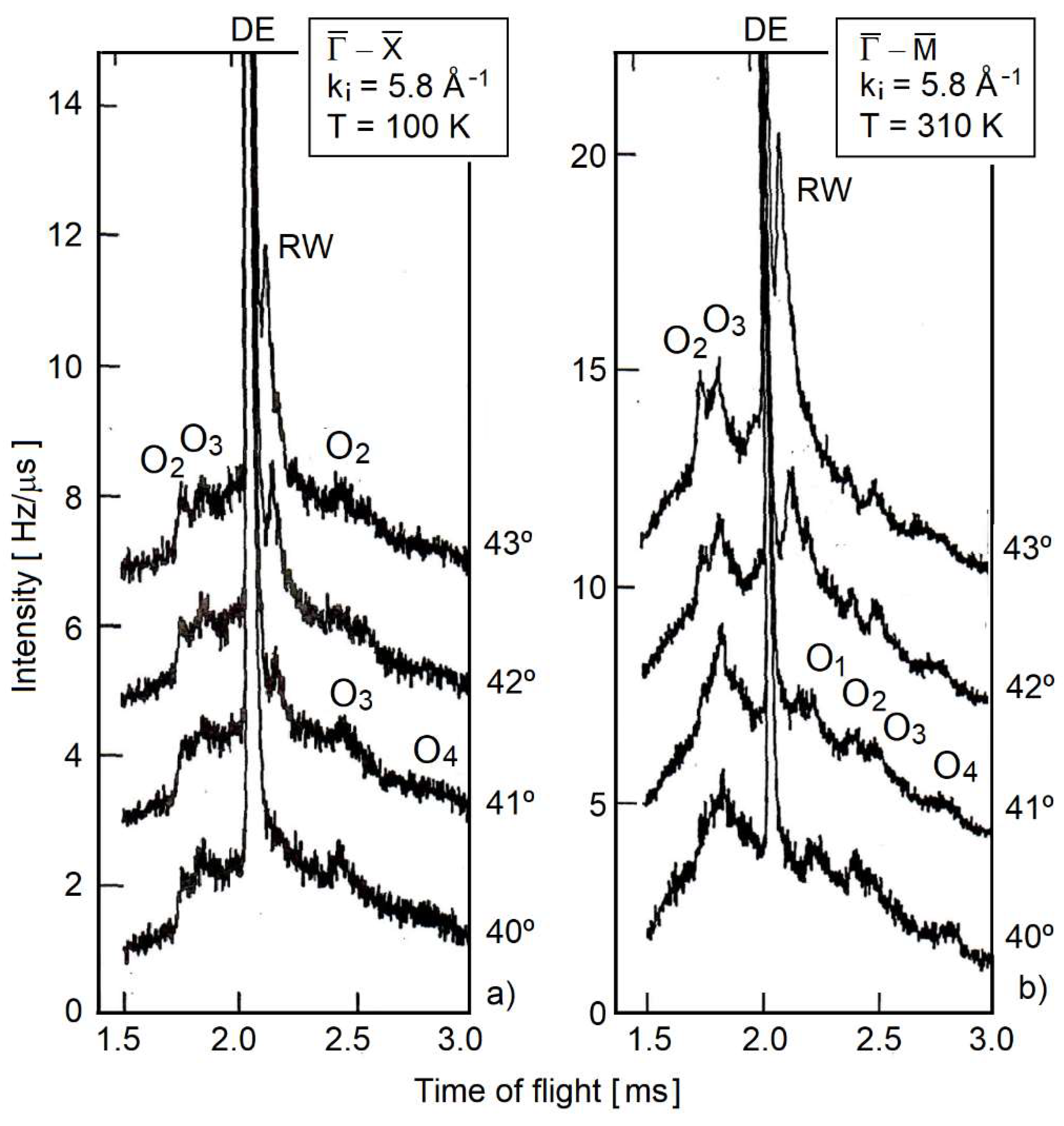
Figure 2.
Low-energy phonon dispersion curves at the Bi-O(001) surface of Bi2Sr2CaCu2O8+δ (Bi2212) with δ = 0.16 at about the optimal doping, measured with HAS by Schmicker [12] and Paltzer et al [13,16] (open squares) along two different symmetry directions and surface temperatures (cfr. Figure 1), compared to INS data by Merrit et al (red open circles) [18]. The apparent isotropy of the O2, O3 and O4 phonon branches suggests their association to the non-stoichiometric oxygen randomly distributed in the Bi-O and Sr-O planes.
Figure 2.
Low-energy phonon dispersion curves at the Bi-O(001) surface of Bi2Sr2CaCu2O8+δ (Bi2212) with δ = 0.16 at about the optimal doping, measured with HAS by Schmicker [12] and Paltzer et al [13,16] (open squares) along two different symmetry directions and surface temperatures (cfr. Figure 1), compared to INS data by Merrit et al (red open circles) [18]. The apparent isotropy of the O2, O3 and O4 phonon branches suggests their association to the non-stoichiometric oxygen randomly distributed in the Bi-O and Sr-O planes.
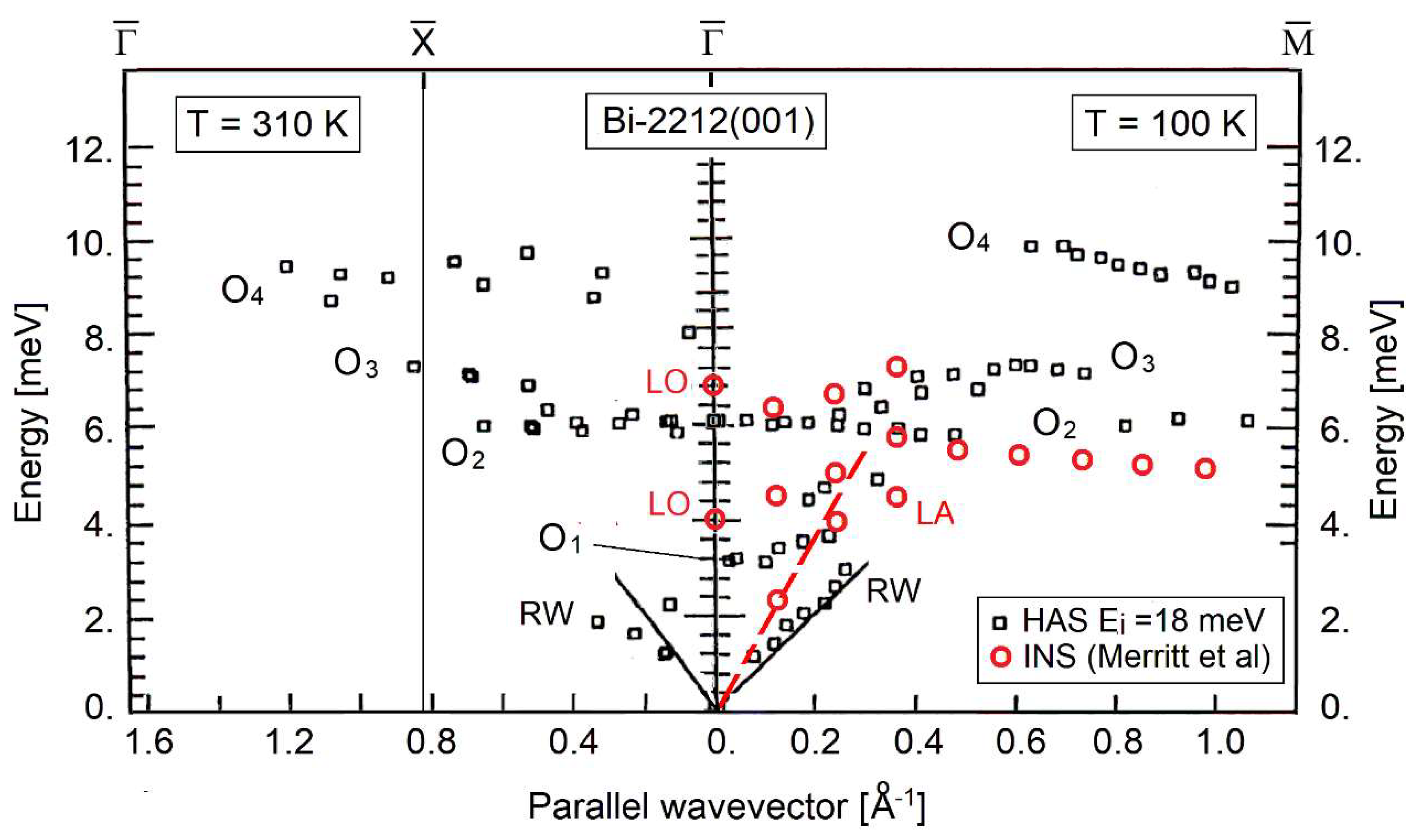
Figure 3.
Comparison of the diffuse elastic (DE) peak intensities shown in Figure 1 in a larger ordinate scale measured at two different surface temperatures of 100 K and 310 K for the four incident angles. Note the reduced ordinate scale compared to Figure 1 and the differences in ordinate scale for T = 100 K (a) and 310 K (b).
Figure 3.
Comparison of the diffuse elastic (DE) peak intensities shown in Figure 1 in a larger ordinate scale measured at two different surface temperatures of 100 K and 310 K for the four incident angles. Note the reduced ordinate scale compared to Figure 1 and the differences in ordinate scale for T = 100 K (a) and 310 K (b).


Table 1.
HAS diffuse elastic peak intensities at different incidence angles θ i and corresponding logarithmic variations with temperature.
Table 1.
HAS diffuse elastic peak intensities at different incidence angles θ i and corresponding logarithmic variations with temperature.
| i [degrees] |
IDE(100 K) [Hz/ s] |
IDE(310 K) [Hz/ s] |
ln[IDE(T)] |
| 43º | 83.3 | 49.5 | 0.52 |
| 42º | 68.8 | 15.0 | 1.52 |
| 41º | 58.3 | 20.0 | 1.07 |
| 40º | 54.5 | 15.5 | 1.25 |
Disclaimer/Publisher’s Note: The statements, opinions and data contained in all publications are solely those of the individual author(s) and contributor(s) and not of MDPI and/or the editor(s). MDPI and/or the editor(s) disclaim responsibility for any injury to people or property resulting from any ideas, methods, instructions or products referred to in the content. |
© 2024 by the authors. Licensee MDPI, Basel, Switzerland. This article is an open access article distributed under the terms and conditions of the Creative Commons Attribution (CC BY) license (http://creativecommons.org/licenses/by/4.0/).
Copyright: This open access article is published under a Creative Commons CC BY 4.0 license, which permit the free download, distribution, and reuse, provided that the author and preprint are cited in any reuse.


