1. Introduction
Since 2015, artificial intelligence has quickly been ingrained in our everyday lives, thanks to the ever-increasing processing power and capabilities of computers. Businesses, hospitals, and schools are just a few of the numerous areas that have felt its effects. Job automation and its effects on employment have become more pressing issues as AI has progressed. There is rising concern about how AI and automation could affect the automation of jobs, given the recent fast advancements in these areas. Automating certain types of jobs is only one area where this technology might have far-reaching consequences for society. Interactions between robots, knowledge of open surroundings, planning, and purposeful action are just a few of the many exciting applications of AI and automation. Some industries and occupations have already begun to undergo a transformation due to AI technology, especially automation. Across the world, people are talking about how AI and automation could affect the unemployment rate. One school of thought is that artificial intelligence (AI) is only another kind of automation, and that the economic and historical context of automation provides the best lens through which to examine its impact on employment. In light of the possible dangers and difficulties posed by AI-driven automation, governments and international
development organisations are rushing to react to the anticipated future of employment. A widespread misconception exists in developing nations about the potential detrimental impact of AI and other forms of sophisticated automation on employment rates, hence exacerbating the issues of overproduction and underemployment. On the other hand, many people are worried about the effects of AI and automation on jobs even in industrialized nations. Many people have different opinions on how AI will affect the automation of jobs. The degree to which automation replaces humans in the workforce will depend on factors such as the practicality of AI technology, the state of the labour market, the cost of implementation, the level of societal acceptability, and the economic rewards.
Artificial intelligence (AI) and automation are changing the way companies operate, which in turn will boost productivity and the economy. In addition, they will be essential in tackling the "moonshot" social problems related to health and climate change. Simultaneously, these technological advancements will alter the character of employment and the office setting. More and more human jobs will be automated, and machines will be able to supplement human labour and even surpass human capabilities in certain areas. Consequently, there will be changes to a great number of jobs, as well as growth to some and contraction to others. Despite our optimism about the labour market, society will face substantial labour shifts and displacement until catastrophic events occur. As robots in the workplace become more sophisticated, humans will have to learn new things and adjust to work with them. They may have to switch from jobs that are shrinking to ones that are expanding or perhaps creating whole new jobs.
1.1. Businesses, the Economy, and Society Are Benefiting from the Possibilities Presented by the Rapid Advancements in AI and Automation
The use of AI and automation is not new, but the limits of what these technologies are capable of doing have been expanded by recent technical developments. Based on our findings, these upgrades are necessary for society to address some of its most pressing problems, boost economic development, and benefit enterprises.
Rapid technological progress: Emerging in settings as diverse as grocery store automated checkout lanes and autonomous cars on public roadways are new generations of highly competent autonomous systems, going beyond conventional industrial automation and sophisticated robotics. Mechanics, sensors, and software have all seen significant advancements because to system and component upgrades. Due to the exponential expansion in both processing power and the amount of data accessible to train machine-learning algorithms, AI has achieved remarkable progress in the last few years. Many of the recent sensational discoveries have to do with superhuman powers in areas like computer vision, natural language processing, and very difficult games like Go.
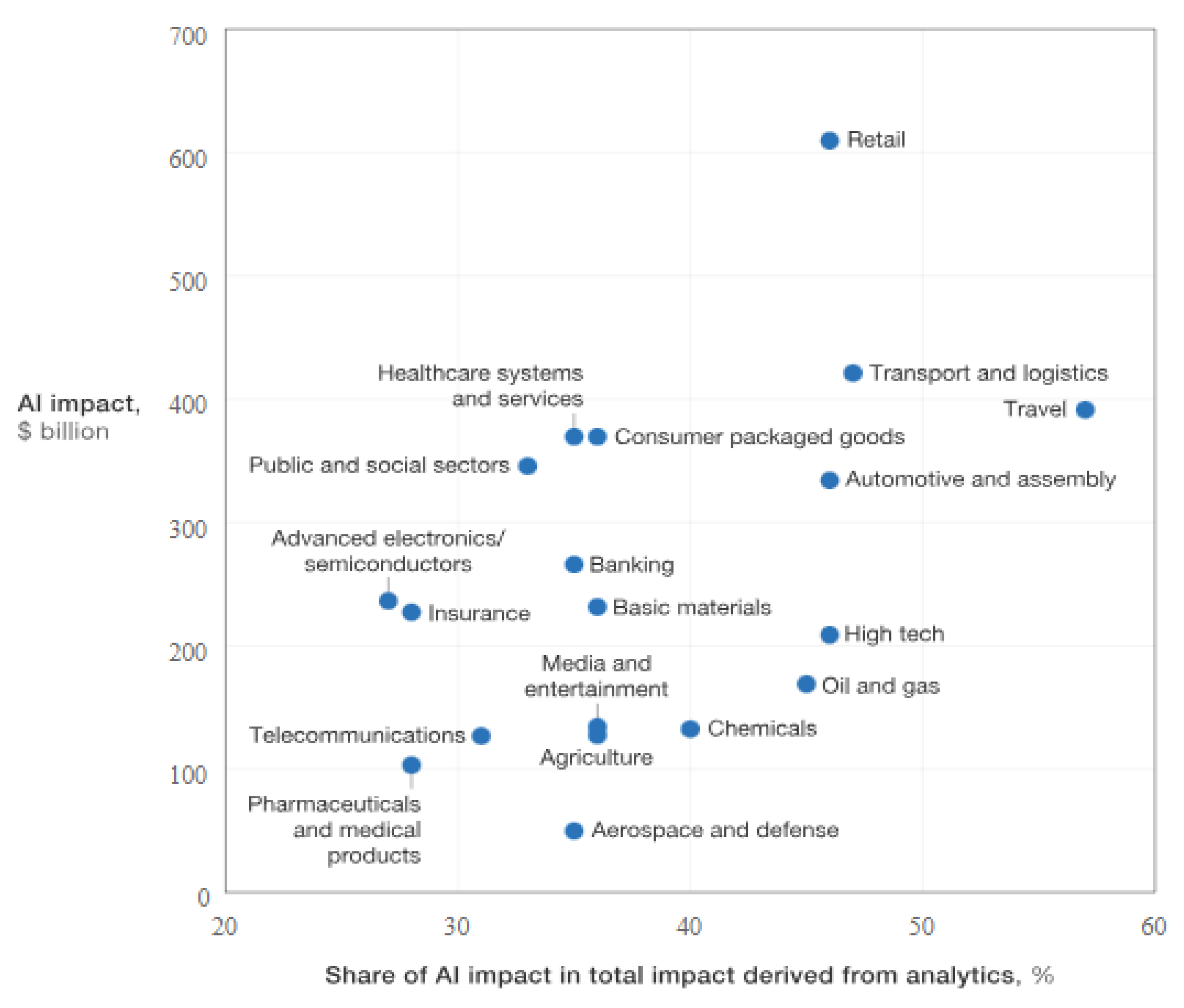
Possibility of influencing company practices and adding to GDP growth: Businesses across sectors use these technologies in a variety of processes to personalize product recommendations, find anomalies in production, identify fraudulent transactions, and more. They are already adding value to various products and services, and they have the potential to transform businesses and contribute to economic growth. The most recent developments in artificial intelligence hold even more promise, with methods that tackle categorization, estimation, and clustering issues offering even more use. Based on our study of hundreds of AI use cases, the most sophisticated deep learning methods using artificial neural networks have the potential to generate an annual value between
$3.5 trillion and
$5.8 trillion, or 40% of the total value provided by analytics approaches (
Figure 1).
At a time when declining birth rates and an ageing population are slowing economic development, the world may benefit greatly from the deployment of artificial intelligence and automation technology. One of the main factors influencing economic growth is labour productivity. However, since the financial crisis of 2008, when productivity was at its peak, many economies have seen a slowdown in this indicator, with the United States and major European economies seeing an average decline from 2.4% to 0.5% between 2010 and 2014. With the help of AI and automation, this trend may turn around: productivity growth might hit 2% a year in the next decade, with 60% of the boost coming from digital prospects.
2. Literature Review
Masriadi, & Dasmadi, & Ekaningrum, Nurul & Hidayat, Muhammad & Yuliati, Farida (2023) A paradigm shift has occurred in the workplace as a result of the advent of AI and the automation of formerly manual tasks. On the other hand, this has the potential to hinder people's professional advancement. The purpose of this study was to investigate how artificial intelligence and robotics are affecting human job opportunities. A descriptive qualitative methodology will be used to conduct this study. This study's data is based on a number of studies that have looked at the impact of AI and automation on the workplace in the past. The results of this research show that many occupations are being replaced by AI and automation right now. Still, AI has a long way to go before it can replicate some human cognitive traits like intuition and empathy. Despite concerns that AI and automation pose a threat to human jobs, human resource skills are on the rise, which means that adaptable humans will not be supplanted by machines. Instead, we will see the integration of human-machine work, in which AI and automation are complementary rather than substitutes.
Panigrahi, Ashok & Ahirrao, Shrinivas & Patel, Arav (2024) The impact of artificial intelligence (AI) on India's managerial and economic environment is the focus of this research. This study takes a look at the Indian economy from a business and economic perspective, analysing how AI affects GDP growth, job prospects, employment, and productivity. Also covered is the way AI is influencing managerial practises, namely how new business models, better decision-making, and extensive work automation are shaping the industry. Methods include reviewing relevant literature, conducting case studies of major Indian companies, and analysing relevant statistical data. While acknowledging the need to simultaneously address skill shortfalls and ethical concerns, the findings show how AI may significantly increase India's economic growth. The report concludes by shedding light on the future of AI in India, including the importance of developing talent and strategically using AI.
Solos, Wein & Leonard, Joel (2022) New developments in AI are going to shake up economies all across the world. This study offers a comprehensive analysis of AI's potential monetary effects, including its potential to boost productivity and GDP growth, its effect on the labour force, and the issue of whether or not AI would exacerbate income disparity. Based on this, we provide a concise overview of public policy options for mitigating the possible negative effects of AI on the labour market and wealth disparity. In the end, we provide a brief overview and some suggestions for further study.
Govindharaj, Yoganandham & Elanchezhian, G. & Khan, Mr. (2023) Pattern recognition, prediction, and control are the main cognitive processes that ML and AI systems attempt to replicate. A wide variety of other fields may also make use of their skills, including those dealing with agriculture, medicine, energy, and monetary policy. Robots enabled by artificial intelligence enhance safety, output, and effectiveness. When examining how advancements in AI have affected economic growth and welfare, the essay takes self-accumulation capacity and non-rival quality into account. Economic uses of AI are evaluated using qualitative and bibliometric approaches. Topics covered in the study include the global economy and its ability to exacerbate inequalities among workers, organisations, and nations; automation technology; human capital development; economic growth and wellbeing; and the importance of big data, the internet of things (IoT), and forecast research in the field for informed judgement. Regardless, this study's principal objective is to theoretically assess the macroeconomic effects of AI on India's population and economic development. This is accomplished by consulting relevant secondary sources for statistics and data relevant to the study subject. The impact of AI on economies worldwide, how it may widen the gap between individuals, companies, and countries, automation, human capital development, economic prosperity, and overall well-being were the main points of discussion. From this vantage point, the matter at hand is not only necessary but also socially and historically significant.
Gries, Thomas & Naudé, Wim (2018) Many fear that the exponential expansion of AI will bring about widespread joblessness, widening income gaps, and a halt to human labour’s ability to provide goods and services. To reevaluate these assumptions, this work does two things: (i) reviews the current literature on the topic and (ii) applies AI-enabled automation to a product variety-model that is often used in endogenous growth theory but adjusted to account for demand-side restrictions. This is a fresh take on the problem, as supply-side assumptions underpin most endogenous growth models, including the most current research on the role of AI in GDP growth. We are driven to make this gift for two main reasons. One issue is that artificial intelligence (AI) is still under-represented in economic growth models, and even fewer models that account for growth restrictions caused by inadequate aggregate demand. The second is that, so far, the forecasts that AI would lead to a dramatic decline in employment and an acceleration in productivity and GDP growth have not materialized.65 In fact, several developed countries are seeing record low rates of unemployment. Despite this, growth in productivity and wages has stalled, and inequality is on the rise. Within the framework of recent advances in artificial intelligence, our research offers a theoretical justification for this.
3. AI, Robots, and Automation
The current technology revolution is both ubiquitous and very fast, as said in the introduction. The rapid decline in the cost of emerging technology has also made automation accessible to a wide range of businesses, industries, and nations. Boston Consulting Group (2015) predicts that, over the next decade, robot prices will fall by 20% while their performance will increase by around 5% yearly. But at each level of disaggregation, there isn't a plethora of data or variables to work with. According to De Backer et al. (2018), the most important source of global robotics statistics is the data provided by the International Federation of Robotics (IFR), which focuses on sectoral and country-level data and is used as a proxy for automation. Industrial robots are defined according to ISO 8373:2012, which is adopted by IFR. "a device that exhibits the following features: can be programmed, serves multiple purposes, can be physically modified, and is positioned on an axis." IFR compiles sales data for industrial robots from almost every global provider in order to create this dataset. Accordingly, the dataset (beginning with an early version in 1993) includes statistics on yearly exports (sales) and a quantification of robot inventory across about 100 regions and sectors. The most recent numbers show that, on average, sales of robots increased by 12% annually from 2011 to 2016.
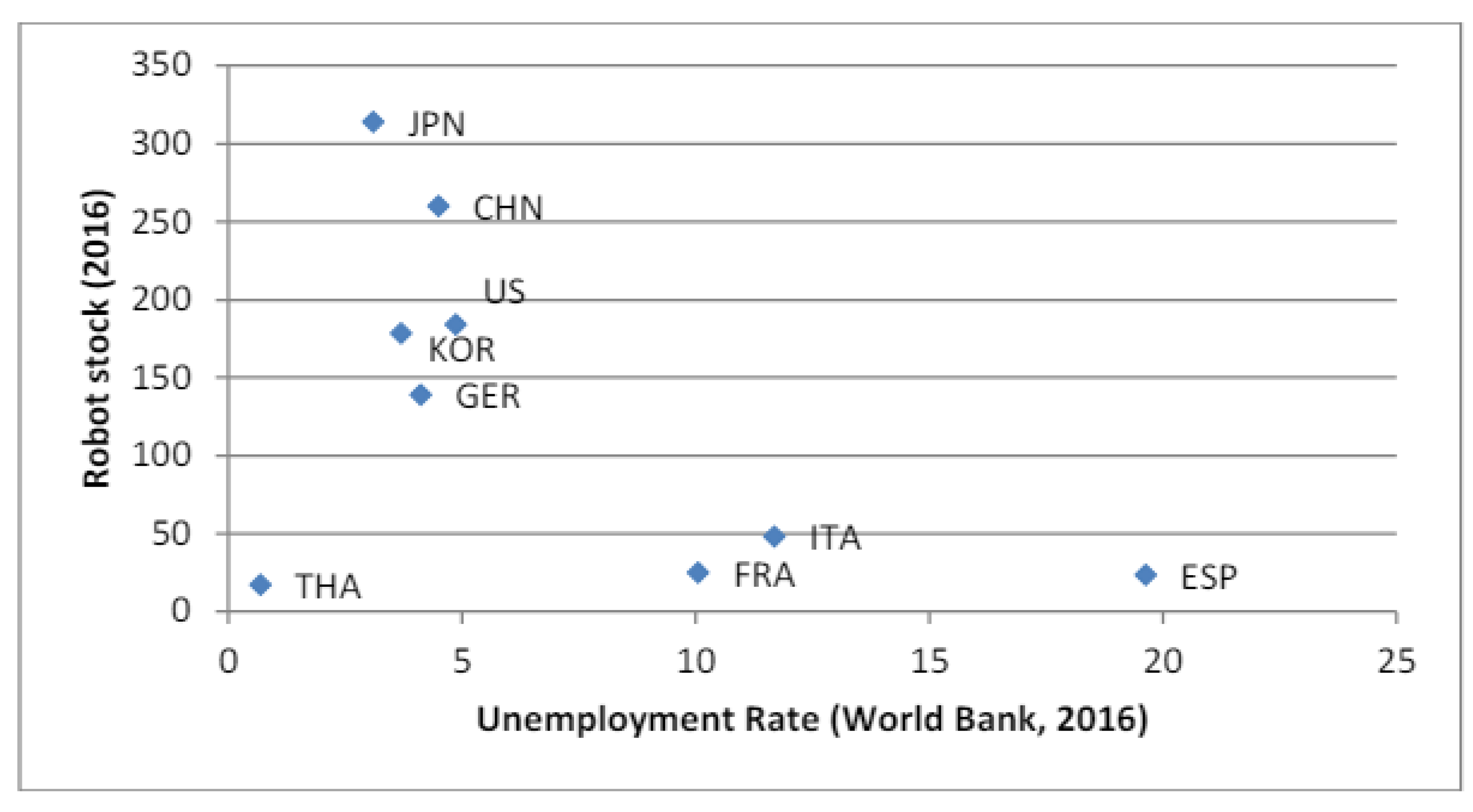
The percentages for the predictions up to 2020 are same. From a sectoral specialization perspective, the transportation industry, the computer and electronics industries, the chemical and mineral production, and the food and beverage production all account for the bulk of robot usage, at over 70%. After electrical/electronic, which has done very well in recent years, the automotive industry is at the top. Moving on to geographical specialization, five nations account for about three quarters of the world's robot sales: China, Korea, Japan, the US, and Germany in Europe (for further information and commentary on European countries, see European Commission, 2016). Based on the premise that robots typically have a 12-year lifespan, IFR offers a robot stock measurement. On the other hand, De Backer et al. (2018) estimates a robot stock depreciation rate of 10% per year using a slightly different method based on the Perpetual Inventory Method. Among the countries with the most rapidly expanding robot inventories between 1993 and 2016, the authors highlight the United States, Germany, Korea, and Italy. Despite this, OECD economies aren't the only ones investing in robots; major European nations aren't far behind China, Chinese Taipei, and Thailand when it comes to robot investment. Rising economies are investing heavily in robotics for a number of reasons, one of which is the requirement to meet greater quality standards. Using the robot stock data from De Backer et al. (2018) as a starting point, we can visually examine the potential relationship between robot stock and unemployment rate in 9 out of the top 10 automated machine users (Taipei was excluded due to data limitation) (
Figure 2).
There seems to be no proof of a positive correlation between robot use and unemployment, while the exact values of the two variables may be determined by a variety of factors, including cyclical trends and country-specific impacts. Detailed econometric research, maybe at the micro level, should obviously supplement this drawing evidence at the national level. The lack of company-level data on robot penetration makes it impossible to conduct research at the firm level, in contrast to data accessible at the national and sectoral levels.
4. How Does AI in Automation Increase Productivity?
A potent technology that is changing the face of automation, artificial intelligence (AI) is more than just a term. Visualise robots that are intelligent in every way imaginable, including thinking, learning, adapting, and acting. Machine learning (ML) and natural language processing (NLP) are two examples of the technologies that artificial intelligence (AI) is centred on. The goal is to create these machines that can transform the way jobs are done. Efficiency and productivity are greatly improved across several sectors with the use of automation programmes that utilise AI to carry out activities autonomously.
Artificial intelligence (AI) solutions are becoming more popular among small and medium-sized businesses (SMBs) as a means to improve efficiency and increase production. Integrating AI into business processes allows you to automate mundane procedures, analyse data faster, and make better choices with less effort. Some companies have reported efficiency gains of up to 40% and cost reductions of 30% in operating expenses after successfully using AI technology, according to a recent study. You can keep ahead of the competition, concentrate on the most important activities, and drive development for small company with the proper artificial intelligence technologies.
Artificial intelligence (AI) has progressed much beyond its original intent, ushering in a new age of simplified processes and increased efficiency for enterprises. These days, businesses of all stripes are embracing AI-driven innovation to streamline processes, save expenses, and wow customers. Artificial intelligence productivity technologies aid small businesses in several ways, including:
Communication and collaboration: Use platforms driven by AI to streamline team communication, automate processes, and boost output.
Minutes, audio recordings, and synopses of meetings: Artificial intelligence meeting transcription services can take audio recordings of meetings and turn them into searchable, shareable summaries.
Creating a presentation: Using AI to advantage, create presentations with captivating slides, layouts, and topic suggestions.
Cleaning up and organising email inbox: Use artificial intelligence to sort email messages into folders, set priorities, and delete unnecessary ones.
Making plans and schedules: Use artificial intelligence (AI) technologies to automate appointment scheduling, analyse calendars, and propose meeting times.
5. Artificial Intelligence (AI) and Automation Reform the Growth of the Global Economy
We can't escape the pervasiveness of automation; it's here to stay. However, there are pros and cons of using robots in the workplace. Several ways in which automation impacts the economy are listed below. Tools for farming and modern assembly-line automation in industries are both examples of how technology has contributed to increasing productivity over thousands of years. There are more and more corporate contexts where automation is prevalent. Either they supplement human labour or perhaps replace it entirely. Even children's treatment sessions are using automations. Although automation poses a serious danger to low-skilled individuals and a moderate threat to middle-skilled people due to job displacement, the technology does have several beneficial benefits on the economy.
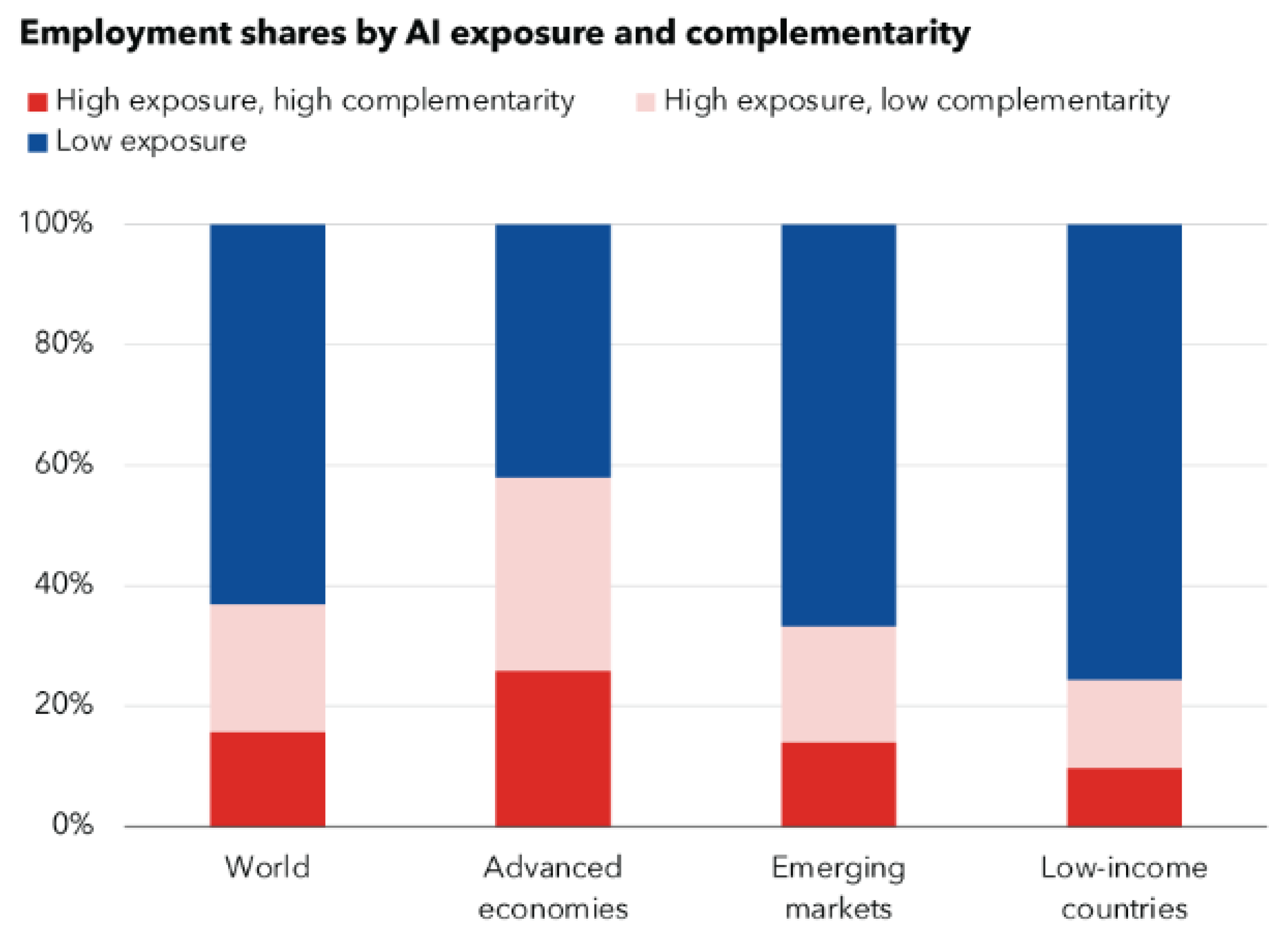
Nearly 40% of the world's workforce is involved with AI, according to the results. While IT and automation have mostly affected low-skilled occupations in the past, AI stands out due to its potential to effect high-skilled occupations as well. So, although underdeveloped and emerging market economies have less to fear from AI, established economies have more to gain from it.
Figure 3.
AI's effect on employment. (Source: ILO and IMF staff calculations).
Figure 3.
AI's effect on employment. (Source: ILO and IMF staff calculations).
About 60% of occupations in developed economies may be affected by AI. The incorporation of AI has the potential to increase productivity in around half of the exposed occupations. Half of the time, AI apps may do important jobs that people do now, which would diminish the need for workers, which in turn might cause salaries to fall and the number of people employed to shrink. Some of these positions could go away entirely in the worst-case scenario.
The projected AI exposure in low-income nations is 26% and in developing economies it is 40%. Based on these results, it seems that developing and emerging market economies will be less affected by AI in the near future. However, there is a concern that AI may exacerbate global inequality in the long run as many of these countries lack the necessary infrastructure and trained workforces to fully utilise the technology.
AI has the potential to impact national income and wealth disparities. others in a position to take advantage of AI may experience a rise in their productivity and salary, while others in lower-income groups may see a decline. Artificial intelligence (AI) has the potential to greatly improve the efficiency of less experienced workers, according to research. Opportunities may be more easily capitalised on by younger workers, whereas older workers may find it more difficult to adjust.
The degree to which AI will supplement high-earning workers will determine the impact on labour income. There could be an imbalance in the distribution of labour income gains caused by AI if it greatly augments the earnings of higher-income workers. Additionally, affluent earners may benefit from increased capital returns due to productivity increases from AI-using businesses. Inequality may worsen as a result of both of these events.
Without immediate action from lawmakers, artificial intelligence (AI) has the potential to exacerbate existing inequalities and societal conflicts. Nations must provide extensive social safety nets and retraining opportunities for disadvantaged employees. Doing so would help ensure that everyone has a fair chance to benefit from the AI transition, which will safeguard jobs and reduce inequality.
6. The Effects of AI and Automation on Workforce and Productivity
Much discussion and debate has centred on the complicated and multi-faceted issue of how automation and artificial intelligence (AI) will affect sectors and employment. Increased efficiency, productivity, and creativity are just a few of the possible positive outcomes of automation, AI, and automation. However, these technologies also present problems and disruptions to workers and other parts of the economy. Several important considerations are as follows:
-
i.
Job Displacement and Transformation:
Some occupations, especially those involving mundane or repetitive activities, may become obsolete as a result of automation and AI. Examples of potentially susceptible occupations include those in manufacturing, data entry, and customer service.
The flip side is that new occupations will pop up, and those people will need to be proficient in things like data analysis, programming, artificial intelligence, and more. These positions might be in areas like human-AI interface, robotics maintenance, or artificial intelligence ethics.
-
ii.
Skill Shift and Training:
To keep up with the ever-evolving employment market, the workforce will have to change and learn new things. To maintain a competitive edge, people will need to commit to lifelong learning and continuously improve their skills.
In order for people to thrive in the era of AI and automation, training and educational programmes that are jointly provided by governments, educational institutions, and businesses will be essential.
-
iii.
Industry Disruption:
Automation and AI will most certainly cause major shifts in the way certain sectors do business. Examples of industries that could see changes in work practices and human responsibilities include transportation, manufacturing, retail, and agriculture.
As AI and automation revolutionise production and delivery of goods and services, conventional business models may need a re-evaluation.
Productivity and GDP development might be enhanced by using automation and AI. On the other hand, if particular groups of workers are hit worse than others by job loss, they might make income disparity worse.
Organisations and governments must devise plans to mitigate the economic effects of automation. This may include exploring ideas like alternate employment arrangements or a universal basic income.
7. Conclusions
In conclusion, Artificial intelligence (AI) has mixed effects on automation of jobs, employment, productivity, and GDP growth. The advent of AI might lead to the creation of new employment as well as their elimination. There are chances for development and innovation, despite worries about inequality and job loss. Consequently, people, groups, and governments must take measures to mitigate the effects of artificial intelligence (AI) on job automation, such as providing workers with resources, encouraging the acquisition of new skills, and shifting attention to sectors that are less susceptible to automation. There are worries about job loss and division in the workforce due to the potential for artificial intelligence technology to alter the character of labour and automate a large number of employments. There is a complicated interaction of possibilities and threats that automation and AI pose to businesses and occupations. Although these technologies have the potential to revolutionise the way we work, it is crucial to have well-thought-out rules and plans in place to make sure everything goes smoothly, limit any bad effects, and make sure everyone feels welcome in this new workplace. Lessons for the next technological wave may also be gleaned from economists' more modern models of automation. If artificial intelligence is to bring forth a period of abundant wealth for everybody, when compared to manual operations, automated ones are more efficient and take less time to finish. When combined with a manual labour, automation will greatly enhance productivity, resulting in a meteoric rise in output rate.
All parts of the workforce will eventually use AI and automation. We still have a long way to go before AI and automation completely replace human workers, so don't worry about job security just yet. Nevertheless, when AI and automation are shown to be effective and integrated with industry-related tasks, the prospect of combining human and AI labour becomes more attractive. Even if there is little job loss anticipated at this time, concerns about the future of work are prompted by the ever-changing nature of AI. Industry leaders, academic institutions, and government officials are working together to plan the careful introduction of AI and automation into the workforce.
References
- Masriadi, & Dasmadi, & Ekaningrum, Nurul & Hidayat, Muhammad & Yuliati, Farida. (2023). Exploring the Future of Work: Impact of Automation and Artificial Intelligence on Employment. ENDLESS: INTERNATIONAL JOURNAL OF FUTURE STUDIES. 6. 125-136.
- Panigrahi, Ashok & Ahirrao, Shrinivas & Patel, Arav. (2024). Impact of Artificial Intelligence on Indian Economy. Journal of Management Research and Analysis. 11. 33-40.
- Solos, Wein & Leonard, Joel. (2022). On the Impact of Artificial Intelligence on Economy. Science Insights. 41. 501-560.
- Govindharaj, Yoganandham & Elanchezhian, G. & Khan, Mr. (2023). Impact of Artificial Intelligence (Ai) on India's Economic Growth and Population -An Assessment. 11. 2455-6211.
- Gries, Thomas & Naudé, Wim. (2018). Artificial Intelligence, Jobs, Inequality and Productivity: Does Aggregate Demand Matter?. SSRN Electronic Journal.
- De Backer K, Destefano T, Menon C, Ran Suh J (2018) Industrial robotics and the global organization of production. OECD Science, Technology and Industry Working Papers No. 2018/03. 1787.
- Vivarelli M (2014) Innovation, employment, and skills in advanced and developing countries: A survey of the economic literature. J Econ Issues 48(1): 123–154. [CrossRef]
- Van Roy V, Vertesy D, Vivarelli M (2018) Technology and employment: Mass unemployment or job creation? Empirical evidence from European patenting firms. Res Pol 47(9): 1762-1776. [CrossRef]
- T. Gries and W. Naudé, ‘Artificial Intelligence, Income Distribution and Economic Growth’, SSRN Electronic Journal, 2020. [CrossRef]
- S. Jha, ‘Automation and Radiology—Part 1’, Acad Radiol, vol. 27, no. 1, pp. 147–149, Jan. 2020. [CrossRef]
- J. Lobera, C. J. Fernández Rodríguez, and C. Torres-Albero, ‘Privacy, Values and Machines: Predicting Opposition to Artificial Intelligence’, Commun Stud, vol. 71, no. 3, pp. 448–465, May 2020,. [CrossRef]
- L. Abrardi, C. Cambini, and L. Rondi, ‘The Economics of Artificial Intelligence: A Survey’, SSRN Electronic Journal, 2019. [CrossRef]
|
Disclaimer/Publisher’s Note: The statements, opinions and data contained in all publications are solely those of the individual author(s) and contributor(s) and not of MDPI and/or the editor(s). MDPI and/or the editor(s) disclaim responsibility for any injury to people or property resulting from any ideas, methods, instructions or products referred to in the content. |
© 2024 by the authors. Licensee MDPI, Basel, Switzerland. This article is an open access article distributed under the terms and conditions of the Creative Commons Attribution (CC BY) license (https://creativecommons.org/licenses/by/4.0/).