

Submitted:
14 November 2024
Posted:
15 November 2024
You are already at the latest version
Abstract
Social and environmental influences are important for learning. However, the influence of reward and competition during social learning is less understood. In this study, we used functional magnetic resonance imaging (fMRI) to determine the role of hot and cool executive functioning (EF) in reward processing and its relationship to performance under social competition. A review of the literature found the ventromedial prefrontal cortex (VMPFC) is implicated in hot EF, while dorsolateral prefrontal cortex (DLPFC) is related to cool EF. In addition, reward processing deficits are associated with atypical connectivity between nucleus accumbens and dorsofrontal regions. Thus, we adapted a reward-based n-back task in a social competition game to examine the neural correlates of hot and cool EF and the reward influence on performance during social competition. 29 healthy adults showed cortical activation to be related to individual differences in EF abilities during fMRI scans. Hot and cool EF activated distinct networks (in addition to DLPFC and VMPFC) differentially during no-competition and competition conditions. Further analysis revealed correlations between the Hot-Cool network and working memory, reward sensitivity and risk-taking behaviour. The findings provided further insights on the neural basis of hot and cool EF engagement in socio-emotional regulation for learning.
Keywords:
Hot and Cool Executive Functions
; fMRI
; Social Competition
; Reward Sensitivity
1. Introduction
Increasing evidence highlights the importance of social and environmental influence on individual differences in learning (Ansari, 2012; Scarmeas & Stern, 2003). Learning is a process by which a social group transmits knowledge and skills to the members, involving social competence and social reward brought about by the social group (Bobo & Licari, 1989; Pekrun et al., 2002; Tang et al., 2006). Under social interaction, executive functions perform dynamic changes and development influenced depending on environmental changes and external stimuli. Executive functions such as affective evaluation and cognitive control could be modulated by socio-emotional regulation related to reward under inter-group competition (Brandl et al., 2019; Cubillo et al., 2019; Duverne & Koechlin, 2017; Gossen et al., 2013). Exploring the neural basis of synergistic engagement of executive functions is significant for teaching strategies and learning intervention from the perspective of social interaction.
Emerging evidence in executive function or cognitive control suggests that this top-down neural cognitive construct can be divided into two distinct but interacting components, cool executive function (Cool EF) and hot executive function (Hot EF). Cool EF is thought to be accessed by abstract problems, such as number processing, sorting, and rule use, whereas Hot EF is related to stimuli and outcomes that are emotionally salient (Diamond, 2013; Zelazo & Carlson, 2012). Hot and cool executive networks help individuals regulate and balance the processing of social rewards, leading to different internalizing and externalizing behaviors (Kryza-Lacombe et al., 2020; Wang & Ji, 2024; Wang & Liu, 2021). Both Hot and cool EF deficits are strongly associated with abnormal behavioral response patterns (Carver et al., 2008; Colonna et al., 2022; Friedman & Robbins, 2022; Yang et al., 2022). However, previous studies mostly examined cool and hot EF in isolated conditions. This limits our understanding of how hot and cool EF related cortical activity interact to modulate behavioral responses during the “hot” context of emotional involvement and reward feedback. For example, previous studies engaging executive function, such as response inhibition (Locke & Braver, 2008; Padmala & Pessoa, 2010), cognitive flexibility (Cubillo et al., 2019), attention (Engelmann et al., 2009), or working memory (Beck et al., 2010; Pochon et al., 2002) have shown performance to differ under different reward conditions (i.e. with vs. without reward incentives).
Hot EF modulates negative emotional arousal and enhances motivation in an emotionally salient context, while cool EF regulates goal-oriented and flexible switching behavior (Carver et al., 2008; Friedman & Robbins, 2022). It is thought that both aspects of executive functioning have been related to distinct regions of the prefrontal cortex (PFC) (Friedman & Robbins, 2022; Miller & Cohen, 2001; Nejati et al., 2018; Xin & Lei, 2015). Cool EF is generally linked to the dorsolateral prefrontal cortex (DLPFC) while ventromedial prefrontal cortex (VMPFC) is thought to be responsible for the top-down process in hot EF (Miller & Cohen, 2001; Moreno-López et al., 2012; Salehinejad et al., 2021). The n-back task has consistently been reported to activate brain regions associated with cool EF network, such as the dorsal anterior cingulate cortex (dACC), DLPFC, superior parietal lobule (SPL, BA 7) and the cerebellum (Moriguchi, 2022; Pochon et al., 2002). As for reward processing, it is found that sensitivity to the hot EF is related to activation of the mesocorticolimbic reward circuitry including the amygdala, nucleus accumbens (NAcc), perigenial anterior cingulate cortex (pACC) and orbitofrontal cortex (OFC) during viewing or anticipation of reward stimuli (Aharon et al., 2001; Rademacher et al., 2010; Spreckelmeyer et al., 2009; Strathearn et al., 2009).
Cognitive control has also been studied with reward processing. The key cortico-basal ganglia reward circuitry mediates cortical signals to affect the cognitive control network regulating different cognitive tasks (Cubillo et al., 2019; Hikosaka & Isoda, 2010; Yin et al., 2008). Studies have shown that individuals with reward processing deficits exhibit atypical resting-state functional connectivity between the nucleus accumbens and dorsofrontal regions involved in cognitive control (Motzkin et al., 2014). It is also found that individual differences in resting-state functional connectivity between NAcc and the DLPFC were related to individual differences in behavioral measures of Cool executive control (Bigliassi & Filho, 2022; Motzkin et al., 2014). Furthermore, data in structural imaging have shown that increased striatal connection strength with DLPFC is associated with being patient, whereas increased striatal connection strength with VMPFC is associated with more impulsive behavior in a delay-discounting reward task (van den Bos et al., 2014, 2015). This finding may imply that both striatal tracts are associated with executive functioning abilities in reward processing.
Reward usually operates in social competition contexts. Previous studies have shown that brain regions associated with cognitive networks, such as the medial prefrontal cortex (mPFC), produce more activation in social competition, potentially depriving the attentional resources associated with the completion of working memory and thus impairing task performance(DiMenichi & Tricomi, 2017; Tsoi et al., 2016). Meanwhile, better working memory performance under social competition is associated with greater bilateral striatal inhibition (Zhang et al., 2022). In addition, recent studies with autism spectrum disorder (ASD) population found individuals with social reward processing deficits may show dysfunction in this circuitry (Dichter et al., 2012; Kohls et al., 2013; Scott-Van Zeeland et al., 2010). In reward processing, risk-taking was also thought to be an important element. Previous studies have demonstrated how decision-making is influenced by the interplay between potential rewards and the perceived level of risk involved (Aharon et al., 2001; Kahneman & Tversky, 1979). Furthermore, research has highlighted the cognitive processes underlying risk preferences and their implications for behaviour (Camerer & Weber, 1992) and are associated with neural responses in the brain (Engelmann et al., 2009; Hsu et al., 2005; Kuhnen & Knutson, 2005).
To the best of our knowledge, no study has yet determined how the hot and cool networks are associated with the influence of reward on executive control and its relationship with cognitive performance. The present study will examine functional activation patterns on social reward processing on healthy adults using task-fMRI with behavioral measures of hot and cool Executive function and sensitivity to reward. Specifically, we will be using Behaviour Rating Inventory of Executive Function – Adult Version (BRIEF-A) to measure hot and cool EF, Go/No-Go task for cool EF and sensitivity to reward, as well as risk-taking as measured by Balloon Analogue Risk Task (BART) for Hot-Cool EF. We hypothesized that: (1) Healthy adults will show different activations between hot and cool EF and the neural mechanism may be further affected by the competition factor, (2) Hot EF areas will be correlated with Emotional Control and Self-Monitor domains of BRIEF-A, (3) Cool EF areas will be associated with Working Memory, Inhibit and Shift domains of BRIEF-A (Roth et al., 2013) and Go/No-Go task, and (4) Hot-Cool EF areas will be correlated with risk-taking (BART) and Sensitivity to Reward to further understand the reward effect.
2. Materials and Methods
2.1. Participants
A total of 32 right-handed healthy adults were recruited through poster advertisements at Nanyang Technological University and National University of Singapore. The study was approved by the respective institutional review boards (NHG DSRB Ref 2017/01125; IRB-2016-01-003) in these two universities. All participants provided written informed consent before participation and were screened to rule out neurological or psychiatric disorders, irremovable metallic objects or implants (e.g. pacemaker), and other factors that increase the risk of having an adverse event during an MRI scan. Three subjects were excluded from the analyses due to incidental findings (e.g. arachnoid cysts), and 29 healthy participants (Male/Female: 14/15, Age range:21-40, Mean/Std=25.55/4.54) were included in the analyses. The demographic information for the subjects is listed in Table 1.
2.2. Behavioural Tasks
Participants were administered the following behavioural questionnaires and cognitive tasks outside of the scanner.
2.2.1. Behaviour Rating Inventory of Executive Function—Adult Version (BRIEF-A)
The BRIEF-A is a standardized rating scale developed to provide a window into everyday behaviours associated with specific domains of the executive functions in adults ages 18 to 90 years (Roth et al., 2005). It consists of a self-report form and an informant report form, each having 75 items in nine non-overlapping scales (Inhibit, Shift, Emotional Control, Self-Monitor, Working Memory, Initiate, Plan/Organize, Task Monitor, and Organization of Materials) as well as two summary index scales: Behavioral Regulation Index (consists of Inhibit, Shift, Emotional Control and Self-Monitor scales), Metacognition Index (consists of Initiate, Working Memory, Plan/Organize, Task Monitor, Organization of Materials scales) and an overall functioning scale of Global Executive Composite (Roth et al., 2013). All participants were administered the self-report form. In current study, we focused on looking at Emotional Control and Self-Monitor scales that were related to emotion regulation under the hot EF (Dawson et al., 2012); and Shift, Inhibit and Working Memory scales under the cool EF (Miyake et al., 2000).
2.2.2. The Sensitivity to Punishment and Sensitivity to Reward Questionnaire (SPSRQ)
The SPSRQ was used to quantify participants’ sensitivity to rewards and punishments. There were 48 yes or no questions and half of them indicated the participants’ sensitivity to reward while the other half indicated their sensitivity to punishment. Each “Yes” response represents one point. The higher the points, the more sensitive they are to reward or punishment. In this study, our analysis focused exclusively on the reward score of the SPSRQ, aligning with the reward model integrated into our fMRI task design.
2.2.3. Go/No-Go Task
This computerized task was used to examine participants’ cool executive functioning, particularly their inhibition ability. Participants were instructed to press the spacebar whenever they see the letter “X” and not press any key if they see other letters. There were 200 trials in total with 20 non-X letters.
2.2.4. Balloon Analogue Risk Task (BART)
The BART was used to examine the participants’ Hot-Cool EF, in particular their risk-taking tendency and impulsivity. In this task, participants were presented with a balloon and offered the chance to earn points by pumping 30 balloons. Each pump caused the balloon to incrementally inflate and 50 points each pump to be added to a counter until a certain threshold, at which point the balloon would be over-inflated and explode. Thus, each pump conferred a greater risk, but also greater potential reward. If the participant chose to cash out prior to the explosion, they could collect the points earned for that trial, but if the balloon exploded, earning for that trial would be lost. Participants were not informed about the balloons’ breakpoints and the absence of this information allows for testing both participants’ initial responses to the task and changes in responding as they gain experience with the task contingencies.
2.3. fMRI Task Design
Participants took part in a competition- and reward-based letter-variant 2-back game. The game was designed to allow the examination of how the 1) magnitude of monetary reward and 2) participation in a social competition, might affect the participants’ performance on a working memory (Cool EF) task and their corresponding brain activation. In the game, participants were shown a series of letters, one at a time, on the screen. They were asked to indicate, starting from the third letter, whether the letter on screen is the same as the one presented two letters back. Both uppercase and lowercase letters were shown to engage the participants’ attention. However, the correct response was case-insensitive, where the letter “p” was the same as the letter “P” (Figure 1c). The participants performed 2-back task under 2 conditions of playing alone or with a competitor. Each condition consisted of 3 types of trials (no-, low- and high- reward), administered in a blocked design (Figure 1b). Participants received 2 runs of each condition (approximately 6.5 minutes per run) for a total of four runs.
Each run started with a 6-second dummy scan and ended with a 4-second feedback screen on their winnings for the run. There were 9 blocks of 3 reward trial types (no-, low-, high- reward) that alternated with 6-second rest blocks where a fixation cross was shown per run. There were 3 blocks of each trial types within a run (Figure 1a). The amount of money associated with the reward types were SGD0.00, SGD0.20, and SGD1.00, respectively. The maximum amount a participant could win was SGD14.40. Each block lasted for 36 seconds, that consisted of a 4-second screen at the beginning indicating the trial type and reminding whether they are playing alone or with a competitor, followed by a 30-second 2-back task, and ended with a 2-second feedback screen of the amount of money earned for the block. Participants always received 2 runs of each condition, consecutively. The sequence of these conditions was counter-balanced across the participants.
The participant was told a cover story that they will be playing with a competitor sometimes and at other times playing alone. During the competitor condition, they were shown a picture of their “competitor” (photos were from gender-matched study team members) and told that they were competing against that previous participant and needed to achieve higher accuracy than him or her to win. In the alone condition, the participant was shown a blank gray-head profile picture and was told that they need to achieve 70% accuracy to win the block. However, in reality, there were no competitor and the participants’ performance was evaluated the exact same way in the two conditions where they need to achieve higher than 70% accuracy to win.
2.4. Experimental Procedure
All participants received a 2.5-hour experimental session which comprised of a 45-minute behavioural testing session, a 1.5-hour MRI scanning session, and a 15-minute debriefing session. All participants were told a cover story where they would be competing with another participant in the fMRI task and when in fact, there were no competitor. They had a practice session of the fMRI tasks prior to entering the scanner. During the scanning session, multimodal MRI data, including anatomical and functional MRI data, were collected. During the debriefing session, participants were told that the competitor was actually a cover story and was administered a questionnaire to determine how much they believed in the existence of a real competitor and what strategies they used in the tasks.
2.5. MRI Data Acquisition
All MRI scans were performed on a 3T Siemens Prisma MR scanner with a 32-channel head coil at Centre for Translational MR Research, National University of Singapore (NUS-TMR). High-resolution T1w images were acquired with a magnetization-prepared 2 rapid acquisition gradient echo (MP2RAGE) sequence (repetition/echo/inversion time = 5000/2.98/700 ms, field of view = 256 mm, flip angle =4°, matrix size = 256 × 256, 176 sagittal slices, isotropic voxel size= 1 mm3, and no gap). Functional images were acquired in four sessions using multi-band T2*-weighted echoplanar with blood oxygen level-dependent (BOLD) contrast. Each session is comprising 386 volumes (repetition time = 1000 ms, slices = 64, voxel size = 3*3*3 mm3). Each participant's head was immobilized with cushions inside the coil to minimize the generation of motion artifacts during image acquisition.
2.6. Data Analysis
In-scanner behavioural data of the 2-back task accuracy were analysed using a 2 x 3 ANOVA in IBM SPSS Statistics (Version 29.0). MRI Data preprocessing and whole brain univariate analysis was conducted as follows using SPM 12 (Statistical Parametric Mapping software, SPM; Wellcome Department of Imaging Neuroscience, London, U.K. www.fil.ion.ucl.ac.uk/spm) running on MATLAB R2020a (The Mathworks, Inc., Natick, MA, USA). All functional images underwent these preprocessing steps: slice-timing correction, realignment, coregistered to structural images, DARTEL normalization (Ashburner, 2007), smoothing. Before normalization, the structural images were segmented into different tissue types, the DARTEL imported grey matter images and white matter images were then used to create a DARTEL template for more accurate inter-subject alignment.
The preprocessed functional images were fed into the first-level (subject level) setup in SPM. Each volume was mapped to one of the following possible events, task (6 conditions), and rest. A total of 16 contrasts involving different combination of events were set up to examine the results (appendix A). The beta from these contrasts were then brought forward to a second level (group level) analysis where we examined the contrasts results as a group. Whole-brain univariate analysis with a cluster defining threshold of p < 0.001 (uncorrected), cluster size >100, and family-wise error (FWE) cluster level correction (cluster-sized threshold p = 0.01) was conducted. The significant clusters’ location were defined by AAL3 atlas (Rolls et al., 2020). Percent signal change of the significant clusters was then retrieved using MarsBar toolbox in SPM and Pearson’s correlations were performed between the percent signal change and behavioral measures. We tested the correlations between (a) Significant clusters in Hot EF areas with BRIEF-Emotional control and Self-Monitor scales; (b) Significant clusters in Cool EF areas with BRIEF-Inhibit, Shift, Working Memory scales and Go/No-Go task; (c) Significant clusters in Hot-Cool areas with BART and sensitivity to reward scores.
3. Results
3.1. Behavioural Measures
Table 1 showed the demographic information and behavioural measures for the 29 subjects. BRIEF-A raw scores were converted to T scores (Roth et al., 2005) according to the conversion table in BRIEF-A professional manual. All participants’ scores were within normal range except for two participant’s T score in Emotional Control was considered clinically significant (90 % CI = 67-77, percentile = 98%). We excluded these two participants when testing the correlation between Hot areas and BRIEF-Emotional control. There was a ceiling effect observed in the Go/No-Go task. Consequently, we have excluded this measure from the subsequent analysis.
3.2. fMRI Task
A 2(No-Competition, Competition) x 3(No-, Low-, High-Reward) ANOVA on the accuracy data of fMRI task revealed that the effect of reward on accuracy was significant [F(2, 56) = 7.5, p < 0.01]. We applied the Bonferroni correction for multiple post-hoc comparisons. There were significant differences between No-Reward and High-Reward conditions (p = .013), and between Low-Reward and High-Reward conditions (p = 0.025) (Figure 2). However, there was no statistical difference between Competition and No-Competition [F(1, 28) = 3.023, p = 0.997]. There were also no significant differences between No-Reward and Low-Reward conditions. In order to increase the contrast, we thereby discarded Low-Reward blocks and only looked at the fMRI data between No-Reward and High-Reward in Competition and No-Competition situations.
3.3. Debriefing
The results of the debriefing indicated that approximately half of the participants (48.28%) had thought differently during the reward trials. In the competition trials, 62.07% of the participants thought differently, while 42.86% acted differently. A majority of the participants (68.97%) confirmed that they believed the cover story. When the participants were asked to rate the importance of "winning the money" and "the amount of reward" on a scale of 1 to 5, participants reported an average score of 3.276 for "winning the money" and 2.793 for "amount of reward" (See Supplementary Table S2).
3.4. Neuroimaging Results
We found similar activation patterns for hot and cool EF networks, as shown in Figure 3. The whole brain activated regions of hot and cool EF were listed in Table 2. When comparing the competition and no competition sessions, we found that the activation patterns of both hot and cool EF during competition were statistically identical to those in the no competition condition. No significant clusters were found in either No competition – Competition or Competition – No competition contrasts (Figure 3, Table 2).
When monetary reward was presented (Hot-Cool EF), a cluster involving the right insula, right hippocampus, left caudate nucleus, left ventral lateral nucleus, left superior parietal gyrus, and right superior frontal gyrus-dorsolateral was activated in the no competition task. On the other hand, in the competition task, Hot-Cool EF activated the right precuneus and caudate nucleus. Further analysis revealed that, in the Hot-Cool EF contrast, greater activations were observed in the occipital gyrus, lingual gyrus, fusiform gyrus, left lobule VI of the cerebellar hemisphere, and left cuneus areas under the no competition condition compared to the competition condition (Figure 3, Table 2).
3.5. Correlation Analysis
When testing the correlation between Hot EF with Emotional Control and Self-Monitor, our findings revealed a positive association between a cerebellum cluster under the Hot EF condition and the Self-Monitor scale (p = 0.016, corrected for multiple comparison Figure 4a). When examining Cool EF regions to be related with Working Memory, Shift or Inhibit, we observed a significant positive correlation between a cluster in the right parietal gyrus and the Working Memory scale (p = 0.008, corrected for multiple comparison). Additionally, a negative trend was found between a cerebellum cluster and the BRIEF shift scale (Figure 4b). For the Hot-Cool EF condition, we identified two trends in cluster 1 (including the right insula, hippocampus, and superior frontal gyrus) which demonstrated a positive correlation with the BART score and a negative correlation with sensitivity to reward (Figure 4c).
4. Discussion
The study aims to provide a systematic framework for the neural basis of hot and cool EF engagement in relation to socio-emotional regulation. We utilized a reward-version of n-back task in the social competition game under fMRI to examine the neural correlates of cool and hot executive functioning. The whole-brain analysis of cool EF revealed 6 significant clusters with the largest cluster located in the left supplementary motor area, insula, middle frontal gyrus, parietal gyrus, pre-/post-central gyrus and bilateral superior frontal gyrus-dorsolateral. The finding was consistent with previous meta-analyses which identified the cluster of cool EF in the bilateral insula, inferior and middle frontal gyrus, parietal lobule, and the right supplementary motor area (Lee et al., 2017). Similarly, our analysis of hot EF showed activations in four significant clusters with the largest cluster (7270 mm3) located in left supplementary motor area, insula, parietal gyrus, bilateral precentral gyrus and superior frontal gyrus-dorsolateral.
When examining the difference between hot EF and cool EF, the whole-brain analysis of Hot-Cool EF contrast highlighted an overall functioning brain areas of reward effect in right insula, right hippocampus, superior frontal gyrus – dorsolateral, left caudate nucleus, ventral lateral nucleus, and superior parietal gyrus. Although we did not see an obvious disassociation between dorsal and ventral networks for cool and hot EF respectively, the activation in superior frontal gyrus was consistent with Lee and colleagues (Lee et al., 2017) in hot and cool EF, and was found to be associated with higher cognitive functions (du Boisgueheneuc et al., 2006; Friederici et al., 2006; Niendam et al., 2012). More specifically, regions in prefrontal cortex are functionally coupled in cognitive control for processing expected rewards and strategy selection while choosing between tasks (Duverne & Koechlin, 2017; Lin et al., 2020; Tang et al., 2021).
Additionally, our results revealed activation in areas associated with reward processing. A recent study highlighted that rewards influence the flexible allocation of resources but not capacity in visual working memory (Brissenden et al., 2023). The reward circuit related areas, such as the right insula, hippocampus, caudate nucleus and ventral lateral nucleus were also activated in our analysis (Berridge & Kringelbach, 2015; Richard et al., 2013). The insular cortex has been reported to be involved in functional integration (Catani et al., 2013) and may play a key role in associating visceral sensation and autonomic responses with cognitive appraisal of social or emotional information (Craig, 2004; Insel & Fernald, 2004). Nonetheless, our Hot-Cool EF map did not show the subcortical regions of the olfactory cortex (extending to Amygdala, Caudate, Putamen) as reported by Lee et al. (Lee et al., 2017). One possible reason for not detecting more of the emotion (e.g. empathy) related areas could be the amount of reward in our game. From the results of the debriefing form, most of the participants reported that winning money was not very important to them (Supplementary Table S2). Therefore, the participants may not have shown a difference in their emotional responses between the hot and cool trials.
Additionally, a cluster of right insula, hippocampus, caudate nucleus, and superior frontal gyrus was found correlated with Sensitivity to Reward. This finding validates the reward effect that we targeted in our fMRI task. The involvement of the hippocampus and prefrontal regions in the reward system is well-documented in previous literature (Adrián-Ventura et al., 2019; Davidow et al., 2016; Kim et al., 2015). Basal ganglia activities were modulated by motivation and caudate nucleus played an important role in affective processing (Delgado et al., 2004).
Under competitive condition, Hot-Cool EF was also found associated with greater right precuneus and caudate nucleus activation. The precuneus is associated with risk-taking behavior, whereas the caudate nucleus is associated with sensitivity to reward (Zhang et al., 2020). The precuneus and caudate nucleus are both the key nodes of the theory of mind and the important subcortical motivational regions (Wang et al., 2020). Functional connectivity between the caudate nucleus and the superior temporal gyrus, precuneus, is highly correlated with social intelligence (Votinov et al., 2021). Abnormal functional connectivity between the precuneus and hippocampus is also an important marker of cognitive impairment (Wang et al., 2022). Thus, higher right precuneus and caudate nucleus activation may lead to enhanced impulsive motivation to pursue rewards thereby promoting cool EF.
The correlation analysis supported our hypotheses and showed that Cool EF activated areas were associating with BRIEF-A Working Memory and Shift domain. We found that a cluster in the right parietal gyrus was significantly and positively correlated with working memory, while the ability to shift between tasks was found to be related to a cluster in the cerebellum. These findings are consistent with previous literature on working memory and task switching (Chen et al., 2022; Klingberg et al., 2002; Todd & Marois, 2004). The parietal lobe is an important region for cognitive control and flexible transformation (Salehinejad et al., 2021; Vallesi et al., 2022). Enhanced switching cost was observed after resection of cerebellar lesions (Berger et al., 2005). Moreover, the results had a positive trend between a cerebellum cluster and BRIEF-A Self-Monitor under hot EF. It has been shown that the cerebellum plays an important role in emotional and social behaviors such as the ability to recognize the emotions and perspectives of others (Baumann & Mattingley, 2022; Leggio & Olivito, 2018; Van Overwalle et al., 2014). Activation of the right cerebellum was observed during social recognition in specific contexts (Ciapponi et al., 2023), indicating lateralization in this brain region. In addition, the cerebellum is participating in performance monitoring processes such as feedback learning and cognitive inhibition (Greening et al., 2011; Peterburs & Desmond, 2016; Remijnse et al., 2005). These results support the involvement of the cerebellum in strategy adjustment and behavioural monitoring in the processing of hot and cool EF. Noteworthy, no cluster was found associating with BRIEF-A Emotional Control domain. The Emotional Control items in the BRIEF-A primarily assessed anger management but given the participants' overall good performance on the task, our design may not have provoked angry emotions and therefore may not have activated the relevant brain regions.
Next, Hot-Cool EF activated clusters showed a positive correlation trend with the total score of BART, indicating a link between risk-taking behaviour and the brain regions involved in reward processing. Risk-taking behaviour has been associating with some brain regions including the insula (Xue et al., 2010), prefrontal gyrus (Kuhnen & Knutson, 2005; Qu et al., 2015) and cerebellum (Quan et al., 2022) overlapping with the reward-activated regions we detected in our Hot-Cool EF map. Our result was consistent with previous research which suggested that decision-making is influenced by the balance between the amount of rewards and the level of risk (Aharon et al., 2001).
Nevertheless, our study is not without any limitations. We did not find any differences between trials with and without competition in either hot or cool conditions. This could be explained by the analysis of the participants' debriefing responses. Where we found that while 68.97% of them believed they were playing with a real competitor, only 42.86% reported using different strategies during competition blocks. The participants generally expressed neutral feelings for the competitor (Supplementary Table S2). Moreover, our current task was designed to connect the task reward to real monetary compensation and to accurately activate a more robust reward related brain regions (Ivanov et al., 2012; Xu et al., 2016). Nonetheless, it is possible that the amount of reward in the current study was not enough to motivate all the participants. Future studies may increase the amount of incentive and make the competition more realistic to trigger emotions.
Interestingly, although there were no differences found between competition and no-competition under hot or cool EF, we discovered significant clusters in no-competition versus competition condition in Hot-Cool EF after incorporating the reward condition. These clusters were located in the bilateral occipital gyrus, fusiform gyrus and lingual gyrus. When examining the pure reward effect of the brain, we found greater activations in the "no competition" trials compared to the competition trials in both the right and left occipital gyrus, fusiform gyrus, and lingual gyrus. These regions are associated with higher visual processing and reading (Cohen & Dehaene, 2004; Grill-Spector & Malach, 2004; Seghier, 2012), which would be expected due to the letter stimuli used in our 2-back task. The absence of a competitor in the "no competition" trials may have allowed participants to focus more in processing stimuli during the task, consistent with previous study (DiMenichi & Tricomi, 2017).
In conclusion, we have verified the brain regions activated by hot and cool EF and examined their differences. To understand the neural mechanisms underlying executive function and their relationship to behaviour, we further investigated the correlations between these activated areas and behavioural measures. Using a real monetary compensation fMRI task design, we identified some reward and executive function-related brain regions. The current results verified the neuro-correlates of hot and cool EF with a more robust task design.
We also found that the two circuits of hot and cool EF both involved the cerebellum when associated with different domains of executive functions. The distinct networks may work together to regulate our social interactions (as in the competition condition) which were associated with cerebellar activations. We suggested that education and learning settings should consider the emotions of learners and environmental influences. The findings provided insights into the underlying mechanism of learning under hot and cool situations and could suggest the consideration of emotions and the influence of the environment to enhance learning. The implications of this research may also help understand the development and treatment of EF-related disorders.
Supplementary Materials
The following supporting information can be downloaded at the website of this paper posted on Preprints.org.
References
- Adrián-Ventura, J., Costumero, V., Parcet, M. A., & Ávila, C. (2019). Linking personality and brain anatomy: a structural MRI approach to Reinforcement Sensitivity Theory. Soc Cogn Affect Neurosci, 14(3), 329-338. [CrossRef]
- Aharon, I., Etcoff, N., Ariely, D., Chabris, C. F., O'Connor, E., & Breiter, H. C. (2001). Beautiful faces have variable reward value: fMRI and behavioral evidence. Neuron, 32(3), 537-551. [CrossRef]
- Ansari, D. (2012). Culture and education: new frontiers in brain plasticity. Trends Cogn Sci, 16(2), 93-95. [CrossRef]
- Ashburner, J. (2007). A fast diffeomorphic image registration algorithm. NeuroImage, 38(1), 95-113. [CrossRef]
- Baumann, O., & Mattingley, J. B. (2022). Cerebellum and Emotion Processing. Adv Exp Med Biol, 1378, 25-39. [CrossRef]
- Beck, S. M., Locke, H. S., Savine, A. C., Jimura, K., & Braver, T. S. (2010). Primary and secondary rewards differentially modulate neural activity dynamics during working memory. PLoS One, 5(2), e9251. [CrossRef]
- Berger, A., Sadeh, M., Tzur, G., Shuper, A., Kornreich, L., Inbar, D., Cohen, I. J., Michowiz, S., Yaniv, I., Constantini, S., Kessler, Y., & Merian, N. (2005). Task switching after cerebellar damage. Neuropsychology, 19(3), 362-370. [CrossRef]
- Berridge, K. C., & Kringelbach, M. L. (2015). Pleasure systems in the brain. Neuron, 86(3), 646-664. [CrossRef]
- Bigliassi, M., & Filho, E. (2022). Functional significance of the dorsolateral prefrontal cortex during exhaustive exercise. Biol Psychol, 175, 108442. [CrossRef]
- Bobo, L., & Licari, F. C. (1989). EDUCATION AND POLITICAL TOLERANCE: TESTING THE EFFECTS OF COGNITIVE SOPHISTICATION AND TARGET GROUP AFFECT. Public Opinion Quarterly, 53(3), 285-308. [CrossRef]
- Brandl, F., Le Houcq Corbi, Z., Mulej Bratec, S., & Sorg, C. (2019). Cognitive reward control recruits medial and lateral frontal cortices, which are also involved in cognitive emotion regulation: A coordinate-based meta-analysis of fMRI studies. NeuroImage, 200, 659-673. [CrossRef]
- Brissenden, J. A., Adkins, T. J., Hsu, Y. T., & Lee, T. G. (2023). Reward influences the allocation but not the availability of resources in visual working memory. J Exp Psychol Gen, 152(7), 1825-1839. [CrossRef]
- Camerer, C., & Weber, M. (1992). Recent developments in modeling preferences: Uncertainty and ambiguity. Journal of Risk and Uncertainty, 5(4), 325-370. [CrossRef]
- Carver, C. S., Johnson, S. L., & Joormann, J. (2008). Serotonergic function, two-mode models of self-regulation, and vulnerability to depression: what depression has in common with impulsive aggression. Psychol Bull, 134(6), 912-943. [CrossRef]
- Catani, M., Dell’Acqua, F., & Thiebaut de Schotten, M. (2013). A revised limbic system model for memory, emotion and behaviour. Neuroscience & Biobehavioral Reviews, 37(8), 1724-1737. [CrossRef]
- Chen, J., Wu, S., & Li, F. (2022). Cognitive Neural Mechanism of Backward Inhibition and Deinhibition: A Review [Review]. Frontiers in Behavioral Neuroscience, 16. [CrossRef]
- Ciapponi, C., Li, Y., Osorio Becerra, D. A., Rodarie, D., Casellato, C., Mapelli, L., & D'Angelo, E. (2023). Variations on the theme: focus on cerebellum and emotional processing. Front Syst Neurosci, 17, 1185752. [CrossRef]
- Cohen, L., & Dehaene, S. (2004). Specialization within the ventral stream: the case for the visual word form area. NeuroImage, 22(1), 466-476. [CrossRef]
- Colonna, S., Eyre, O., Agha, S. S., Thapar, A., van Goozen, S., & Langley, K. (2022). Investigating the associations between irritability and hot and cool executive functioning in those with ADHD. BMC Psychiatry, 22(1), 166. [CrossRef]
- Craig, A. D. (2004). Human feelings: why are some more aware than others? Trends in Cognitive Sciences, 8(6), 239-241. [CrossRef]
- Cubillo, A., Makwana, A. B., & Hare, T. A. (2019). Differential modulation of cognitive control networks by monetary reward and punishment. Soc Cogn Affect Neurosci, 14(3), 305-317. [CrossRef]
- Davidow, Juliet Y., Foerde, K., Galván, A., & Shohamy, D. (2016). An Upside to Reward Sensitivity: The Hippocampus Supports Enhanced Reinforcement Learning in Adolescence. Neuron, 92(1), 93-99. [CrossRef]
- Dawson, E. L., Shear, P. K., & Strakowski, S. M. (2012). Behavior regulation and mood predict social functioning among healthy young adults. Journal of Clinical and Experimental Neuropsychology, 34(3), 297-305. [CrossRef]
- Delgado, M. R., Stenger, V. A., & Fiez, J. A. (2004). Motivation-dependent Responses in the Human Caudate Nucleus. Cerebral Cortex, 14(9), 1022-1030. [CrossRef]
- Diamond, A. (2013). Executive Functions. Annual Review of Psychology, 64(1), 135-168. [CrossRef]
- Dichter, G. S., Felder, J. N., Green, S. R., Rittenberg, A. M., Sasson, N. J., & Bodfish, J. W. (2012). Reward circuitry function in autism spectrum disorders. Soc Cogn Affect Neurosci, 7(2), 160-172. [CrossRef]
- DiMenichi, B. C., & Tricomi, E. (2017). Increases in brain activity during social competition predict decreases in working memory performance and later recall. Hum Brain Mapp, 38(1), 457-471. [CrossRef]
- du Boisgueheneuc, F., Levy, R., Volle, E., Seassau, M., Duffau, H., Kinkingnehun, S., Samson, Y., Zhang, S., & Dubois, B. (2006). Functions of the left superior frontal gyrus in humans: a lesion study. Brain, 129(Pt 12), 3315-3328. [CrossRef]
- Duverne, S., & Koechlin, E. (2017). Rewards and Cognitive Control in the Human Prefrontal Cortex. Cerebral Cortex, 27(10), 5024-5039. [CrossRef]
- Engelmann, J., Damaraju, E., Padmala, S., & Pessoa, L. (2009). Combined effects of attention and motivation on visual task performance: transient and sustained motivational effects [Original Research]. Frontiers in Human Neuroscience, 3. [CrossRef]
- Friederici, A. D., Fiebach, C. J., Schlesewsky, M., Bornkessel, I. D., & von Cramon, D. Y. (2006). Processing Linguistic Complexity and Grammaticality in the Left Frontal Cortex. Cerebral Cortex, 16(12), 1709-1717. [CrossRef]
- Friedman, N. P., & Robbins, T. W. (2022). The role of prefrontal cortex in cognitive control and executive function. Neuropsychopharmacology, 47(1), 72-89. [CrossRef]
- Gossen, A., Groppe, S. E., Winkler, L., Kohls, G., Herrington, J., Schultz, R. T., Gründer, G., & Spreckelmeyer, K. N. (2013). Neural evidence for an association between social proficiency and sensitivity to social reward. Social Cognitive and Affective Neuroscience, 9(5), 661-670. [CrossRef]
- Greening, S. G., Finger, E. C., & Mitchell, D. G. (2011). Parsing decision making processes in prefrontal cortex: response inhibition, overcoming learned avoidance, and reversal learning. NeuroImage, 54(2), 1432-1441. [CrossRef]
- Grill-Spector, K., & Malach, R. (2004). The human visual cortex. Annu Rev Neurosci, 27, 649-677. [CrossRef]
- Hikosaka, O., & Isoda, M. (2010). Switching from automatic to controlled behavior: cortico-basal ganglia mechanisms. Trends Cogn Sci, 14(4), 154-161. [CrossRef]
- Hsu, M., Bhatt, M., Adolphs, R., Tranel, D., & Camerer, C. F. (2005). Neural systems responding to degrees of uncertainty in human decision-making. Science, 310(5754), 1680-1683. [CrossRef]
- Insel, T. R., & Fernald, R. D. (2004). How the brain processes social information: searching for the social brain. Annu Rev Neurosci, 27, 697-722. [CrossRef]
- Ivanov, I., Liu, X., Clerkin, S., Schulz, K., Friston, K., Newcorn, J. H., & Fan, J. (2012). Effects of motivation on reward and attentional networks: an fMRI study. Brain and Behavior, 2(6), 741-753. [CrossRef]
- Kahneman, D., & Tversky, A. (1979). Prospect Theory: An Analysis of Decision under Risk. Econometrica, 47(2), 263-291. [CrossRef]
- Kim, S. H., Yoon, H., Kim, H., & Hamann, S. (2015). Individual differences in sensitivity to reward and punishment and neural activity during reward and avoidance learning. Soc Cogn Affect Neurosci, 10(9), 1219-1227. [CrossRef]
- Klingberg, T., Forssberg, H., & Westerberg, H. (2002). Increased brain activity in frontal and parietal cortex underlies the development of visuospatial working memory capacity during childhood. J Cogn Neurosci, 14(1), 1-10. [CrossRef]
- Kohls, G., Schulte-Rüther, M., Nehrkorn, B., Müller, K., Fink, G. R., Kamp-Becker, I., Herpertz-Dahlmann, B., Schultz, R. T., & Konrad, K. (2013). Reward system dysfunction in autism spectrum disorders. Soc Cogn Affect Neurosci, 8(5), 565-572. [CrossRef]
- Kryza-Lacombe, M., Christian, I., Liuzzi, M., Owen, C., Hernandez, B., Dougherty, L., & Wiggins, J. (2020). Executive functioning moderates neural reward processing in youth. Cognitive, Affective, & Behavioral Neuroscience, 21. [CrossRef]
- Kuhnen, C. M., & Knutson, B. (2005). The neural basis of financial risk taking. Neuron, 47(5), 763-770. [CrossRef]
- Lee, S.-H., Walker, Z. M., Hale, J. B., & Chen, S. H. A. (2017). Frontal-subcortical circuitry in social attachment and relationships: A cross-sectional fMRI ALE meta-analysis. Behavioural Brain Research, 325, 117-130. [CrossRef]
- Leggio, M., & Olivito, G. (2018). Topography of the cerebellum in relation to social brain regions and emotions. Handb Clin Neurol, 154, 71-84. [CrossRef]
- Lin, Z., Nie, C., Zhang, Y., Chen, Y., & Yang, T. (2020). Evidence accumulation for value computation in the prefrontal cortex during decision making. Proceedings of the National Academy of Sciences, 117(48), 30728-30737. [CrossRef]
- Locke, H. S., & Braver, T. S. (2008). Motivational influences on cognitive control: Behavior, brain activation, and individual differences. Cognitive, Affective, & Behavioral Neuroscience, 8(1), 99-112. [CrossRef]
- Miller, E. K., & Cohen, J. D. (2001). An Integrative Theory of Prefrontal Cortex Function. Annual Review of Neuroscience, 24(1), 167-202. [CrossRef]
- Miyake, A., Friedman, N. P., Emerson, M. J., Witzki, A. H., Howerter, A., & Wager, T. D. (2000). The unity and diversity of executive functions and their contributions to complex "Frontal Lobe" tasks: a latent variable analysis. Cogn Psychol, 41(1), 49-100. [CrossRef]
- Moreno-López, L., Stamatakis, E. A., Fernández-Serrano, M. J., Gómez-Río, M., Rodríguez-Fernández, A., Pérez-García, M., & Verdejo-García, A. (2012). Neural correlates of hot and cold executive functions in polysubstance addiction: association between neuropsychological performance and resting brain metabolism as measured by positron emission tomography. Psychiatry Res, 203(2-3), 214-221. [CrossRef]
- Moriguchi, Y. (2022). Relationship between cool and hot executive function in young children: A near-infrared spectroscopy study. Dev Sci, 25(2), e13165. [CrossRef]
- Motzkin, J. C., Baskin-Sommers, A., Newman, J. P., Kiehl, K. A., & Koenigs, M. (2014). Neural correlates of substance abuse: reduced functional connectivity between areas underlying reward and cognitive control. Hum Brain Mapp, 35(9), 4282-4292. [CrossRef]
- Nejati, V., Salehinejad, M. A., & Nitsche, M. A. (2018). Interaction of the Left Dorsolateral Prefrontal Cortex (l-DLPFC) and Right Orbitofrontal Cortex (OFC) in Hot and Cold Executive Functions: Evidence from Transcranial Direct Current Stimulation (tDCS). Neuroscience, 369, 109-123. [CrossRef]
- Niendam, T. A., Laird, A. R., Ray, K. L., Dean, Y. M., Glahn, D. C., & Carter, C. S. (2012). Meta-analytic evidence for a superordinate cognitive control network subserving diverse executive functions. Cognitive, Affective, & Behavioral Neuroscience, 12(2), 241-268. [CrossRef]
- Padmala, S., & Pessoa, L. (2010). Interactions between cognition and motivation during response inhibition. Neuropsychologia, 48(2), 558-565. [CrossRef]
- Pekrun, R., Goetz, T., Titz, W., & Perry, R. P. (2002). Academic Emotions in Students' Self-Regulated Learning and Achievement: A Program of Qualitative and Quantitative Research. Educational Psychologist, 37(2), 91-105. [CrossRef]
- Peterburs, J., & Desmond, J. E. (2016). The role of the human cerebellum in performance monitoring. Curr Opin Neurobiol, 40, 38-44. [CrossRef]
- Pochon, J. B., Levy, R., Fossati, P., Lehericy, S., Poline, J. B., Pillon, B., Le Bihan, D., & Dubois, B. (2002). The neural system that bridges reward and cognition in humans: an fMRI study. Proc Natl Acad Sci U S A, 99(8), 5669-5674. [CrossRef]
- Qu, Y., Galvan, A., Fuligni, A. J., Lieberman, M. D., & Telzer, E. H. (2015). Longitudinal Changes in Prefrontal Cortex Activation Underlie Declines in Adolescent Risk Taking. The Journal of Neuroscience, 35(32), 11308. [CrossRef]
- Quan, P., He, L., Mao, T., Fang, Z., Deng, Y., Pan, Y., Zhang, X., Zhao, K., Lei, H., Detre, J. A., Kable, J. W., & Rao, H. (2022). Cerebellum anatomy predicts individual risk-taking behavior and risk tolerance. NeuroImage, 254, 119148. [CrossRef]
- Rademacher, L., Krach, S., Kohls, G., Irmak, A., Gründer, G., & Spreckelmeyer, K. N. (2010). Dissociation of neural networks for anticipation and consumption of monetary and social rewards. NeuroImage, 49(4), 3276-3285. [CrossRef]
- Remijnse, P. L., Nielen, M. M., Uylings, H. B., & Veltman, D. J. (2005). Neural correlates of a reversal learning task with an affectively neutral baseline: an event-related fMRI study. NeuroImage, 26(2), 609-618. [CrossRef]
- Richard, J. M., Castro, D. C., Difeliceantonio, A. G., Robinson, M. J., & Berridge, K. C. (2013). Mapping brain circuits of reward and motivation: in the footsteps of Ann Kelley. Neurosci Biobehav Rev, 37(9 Pt A), 1919-1931. [CrossRef]
- Rolls, E. T., Huang, C.-C., Lin, C.-P., Feng, J., & Joliot, M. (2020). Automated anatomical labelling atlas 3. NeuroImage, 206, 116189. [CrossRef]
- Roth, R. M., Isquith, P. K., & Gioia, G. A. (2005). Behavior Rating Inventory of Executive Function® - Adult Version (BRIEF-A).
- Roth, R. M., Lance, C. E., Isquith, P. K., Fischer, A. S., & Giancola, P. R. (2013). Confirmatory factor analysis of the Behavior Rating Inventory of Executive Function-Adult version in healthy adults and application to attention-deficit/hyperactivity disorder. Arch Clin Neuropsychol, 28(5), 425-434. [CrossRef]
- Salehinejad, M. A., Ghanavati, E., Rashid, M. H. A., & Nitsche, M. A. (2021). Hot and cold executive functions in the brain: A prefrontal-cingular network. Brain Neurosci Adv, 5, 23982128211007769. [CrossRef]
- Scarmeas, N., & Stern, Y. (2003). Cognitive reserve and lifestyle. J Clin Exp Neuropsychol, 25(5), 625-633. [CrossRef]
- Scott-Van Zeeland, A. A., Dapretto, M., Ghahremani, D. G., Poldrack, R. A., & Bookheimer, S. Y. (2010). Reward processing in autism. Autism Res, 3(2), 53-67. [CrossRef]
- Seghier, M. L. (2012). The Angular Gyrus: Multiple Functions and Multiple Subdivisions. The Neuroscientist, 19(1), 43-61. [CrossRef]
- Spreckelmeyer, K. N., Krach, S., Kohls, G., Rademacher, L., Irmak, A., Konrad, K., Kircher, T., & Gründer, G. (2009). Anticipation of monetary and social reward differently activates mesolimbic brain structures in men and women. Soc Cogn Affect Neurosci, 4(2), 158-165. [CrossRef]
- Strathearn, L., Fonagy, P., Amico, J., & Montague, P. R. (2009). Adult attachment predicts maternal brain and oxytocin response to infant cues. Neuropsychopharmacology, 34(13), 2655-2666. [CrossRef]
- Tang, H., Bartolo, R., & Averbeck, B. B. (2021). Reward-related choices determine information timing and flow across macaque lateral prefrontal cortex. Nature Communications, 12(1), 894. [CrossRef]
- Tang, Y., Zhang, W., Chen, K., Feng, S., Ji, Y., Shen, J., Reiman, E. M., & Liu, Y. (2006). Arithmetic processing in the brain shaped by cultures. Proceedings of the National Academy of Sciences, 103(28), 10775-10780. [CrossRef]
- Todd, J. J., & Marois, R. (2004). Capacity limit of visual short-term memory in human posterior parietal cortex. Nature, 428(6984), 751-754. [CrossRef]
- Tsoi, L., Dungan, J., Waytz, A., & Young, L. (2016). Distinct neural patterns of social cognition for cooperation versus competition. NeuroImage, 137, 86-96. [CrossRef]
- Vallesi, A., Visalli, A., Gracia-Tabuenca, Z., Tarantino, V., Capizzi, M., Alcauter, S., Mantini, D., & Pini, L. (2022). Fronto-parietal homotopy in resting-state functional connectivity predicts task-switching performance. Brain Struct Funct, 227(2), 655-672. [CrossRef]
- van den Bos, W., Rodriguez, C. A., Schweitzer, J. B., & McClure, S. M. (2014). Connectivity strength of dissociable striatal tracts predict individual differences in temporal discounting. J Neurosci, 34(31), 10298-10310. [CrossRef]
- van den Bos, W., Rodriguez, C. A., Schweitzer, J. B., & McClure, S. M. (2015). Adolescent impatience decreases with increased frontostriatal connectivity. Proc Natl Acad Sci U S A, 112(29), E3765-3774. [CrossRef]
- Van Overwalle, F., Baetens, K., Mariën, P., & Vandekerckhove, M. (2014). Social cognition and the cerebellum: a meta-analysis of over 350 fMRI studies. NeuroImage, 86, 554-572. [CrossRef]
- Votinov, M., Myznikov, A., Zheltyakova, M., Masharipov, R., Korotkov, A., Cherednichenko, D., Habel, U., & Kireev, M. (2021). The Interaction Between Caudate Nucleus and Regions Within the Theory of Mind Network as a Neural Basis for Social Intelligence. Front Neural Circuits, 15, 727960. [CrossRef]
- Wang, Q., Chen, B., Zhong, X., Hou, L., Zhang, M., Yang, M., Wu, Z., Chen, X., Mai, N., Zhou, H., Lin, G., Zhang, S., & Ning, Y. (2022). Static and dynamic functional connectivity variability of the anterior-posterior hippocampus with subjective cognitive decline. Alzheimers Res Ther, 14(1), 122. [CrossRef]
- Wang, Q., Lv, C., He, Q., & Xue, G. (2020). Dissociable fronto-striatal functional networks predict choice impulsivity. Brain Struct Funct, 225(8), 2377-2386. [CrossRef]
- Wang, Y., & Ji, H. (2024). Hot and cool executive function in the development of behavioral problems in grade school. Dev Psychopathol, 1-11. [CrossRef]
- Wang, Y., & Liu, Y. (2021). The Development of Internalizing and Externalizing Problems in Primary School: Contributions of Executive Function and Social Competence. Child Development, 92(3), 889-903. [CrossRef]
- Xin, F., & Lei, X. (2015). Competition between frontoparietal control and default networks supports social working memory and empathy. Soc Cogn Affect Neurosci, 10(8), 1144-1152. [CrossRef]
- Xu, S., Pan, Y., Wang, Y., Spaeth, A. M., Qu, Z., & Rao, H. (2016). Real and hypothetical monetary rewards modulate risk taking in the brain. Scientific Reports, 6(1), 29520. [CrossRef]
- Xue, G., Lu, Z., Levin, I. P., & Bechara, A. (2010). The impact of prior risk experiences on subsequent risky decision-making: the role of the insula. NeuroImage, 50(2), 709-716. [CrossRef]
- Yang, Y., Shields, G. S., Zhang, Y., Wu, H., Chen, H., & Romer, A. L. (2022). Child executive function and future externalizing and internalizing problems: A meta-analysis of prospective longitudinal studies. Clin Psychol Rev, 97, 102194. [CrossRef]
- Yin, H. H., Ostlund, S. B., & Balleine, B. W. (2008). Reward-guided learning beyond dopamine in the nucleus accumbens: the integrative functions of cortico-basal ganglia networks. Eur J Neurosci, 28(8), 1437-1448. [CrossRef]
- Zelazo, P. D., & Carlson, S. M. (2012). Hot and cool executive function in childhood and adolescence: Development and plasticity. Child Development Perspectives, 6, 354-360.
- Zhang, J., Hu, Y., Wang, Z., Wang, M., & Dong, G. H. (2020). Males are more sensitive to reward and less sensitive to loss than females among people with internet gaming disorder: fMRI evidence from a card-guessing task. BMC Psychiatry, 20(1), 357. [CrossRef]
- Zhang, Y., Li, M., Zhang, X., Zhang, D., Tan, H. Y., Yue, W., & Yan, H. (2022). Unsuppressed Striatal Activity and Genetic Risk for Schizophrenia Associated With Individual Cognitive Performance Under Social Competition. Schizophr Bull, 48(3), 599-608. [CrossRef]
Figure 1.
fMRI task design. (a) Illustration of one run of the blocked design fMRI task. (b) Task types used in each block. (c) Illustration of the 2-back task used in a block.
Figure 1.
fMRI task design. (a) Illustration of one run of the blocked design fMRI task. (b) Task types used in each block. (c) Illustration of the 2-back task used in a block.
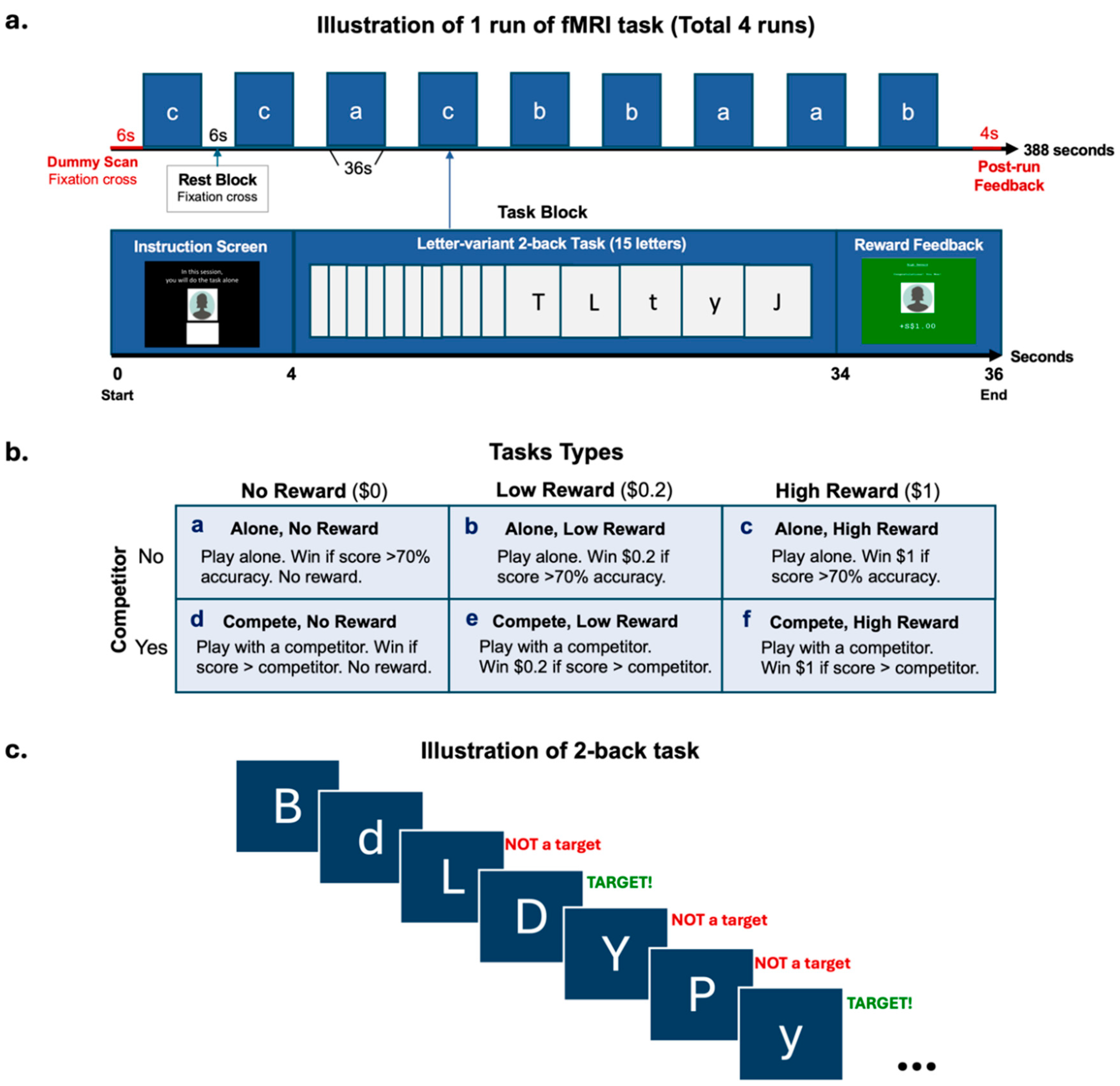
Figure 2.
Line chart of means of accuracy in No-, Low-, High-Reward and No-Competition, Competition conditions. *The mean difference is significant at p < 0.05 (Bonferroni corrected for multiple comparisons).
Figure 2.
Line chart of means of accuracy in No-, Low-, High-Reward and No-Competition, Competition conditions. *The mean difference is significant at p < 0.05 (Bonferroni corrected for multiple comparisons).
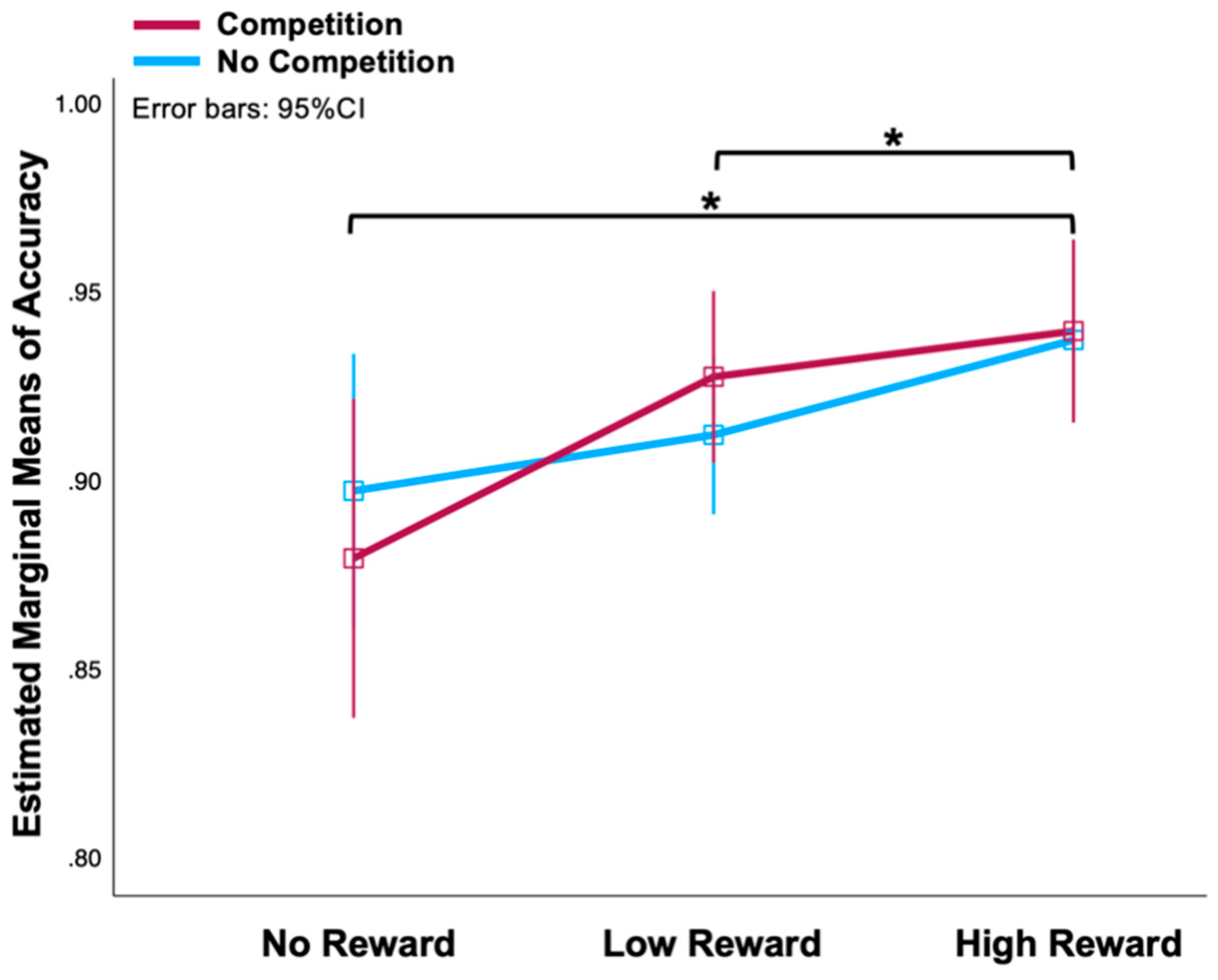
Figure 3.
Whole-brain analysis activation maps for Hot and Cool EF in healthy adults. Significant clusters of the whole brain analysis were shown in color (p < 0.001 uncorrected; k > 100 cluster-level corrected; FWE p < 0.01 cluster-sized threshold). The contrasts details were listed in the Supplementary materials (Table S1, Figure S1).
Figure 3.
Whole-brain analysis activation maps for Hot and Cool EF in healthy adults. Significant clusters of the whole brain analysis were shown in color (p < 0.001 uncorrected; k > 100 cluster-level corrected; FWE p < 0.01 cluster-sized threshold). The contrasts details were listed in the Supplementary materials (Table S1, Figure S1).
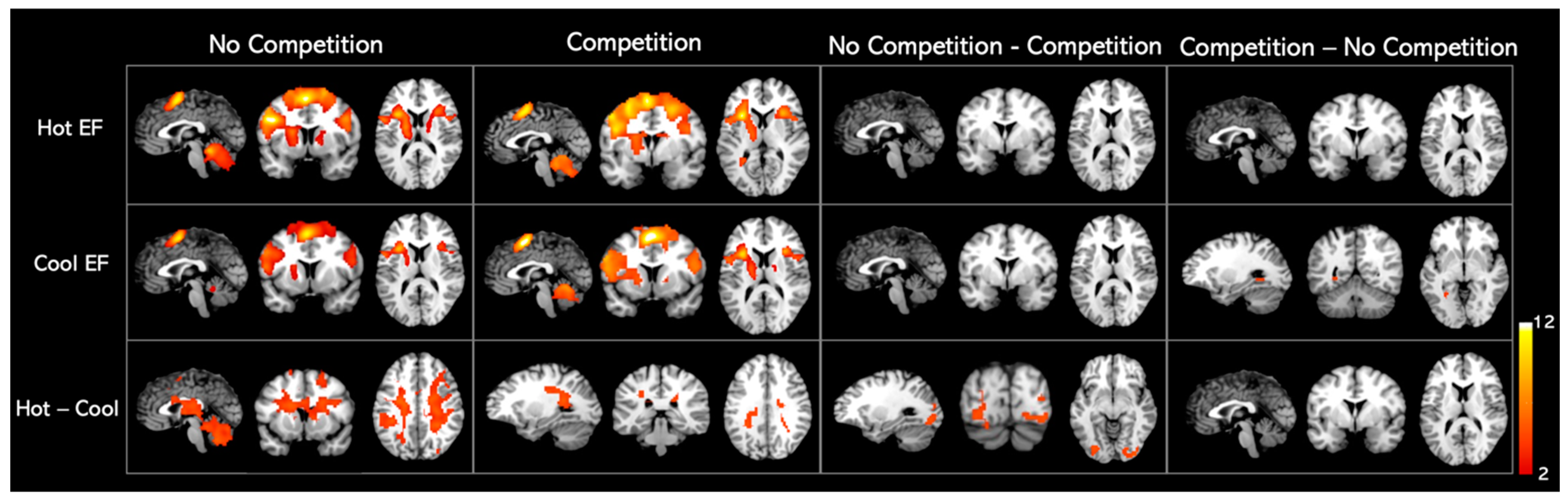
Figure 4.
Pearson’s correlations between Hot and Cool EF fMRI clusters and behavioural measures (*p < 0.05, **p < 0.01). (a) Positive association between Self-Monitor and Cluster 3 in the Hot EF condition. (b) Positive correlation between Working Memory and Cluster 3 in the Cool EF condition; negative association between Shift and Cluster 4 in the Cool EF condition. (c) Positive association between BART and Cluster 1 in the Hot-Cool EF condition; Negative association between Sensitivity to Reward and Cluster 1 in the Hot-Cool EF condition.
Figure 4.
Pearson’s correlations between Hot and Cool EF fMRI clusters and behavioural measures (*p < 0.05, **p < 0.01). (a) Positive association between Self-Monitor and Cluster 3 in the Hot EF condition. (b) Positive correlation between Working Memory and Cluster 3 in the Cool EF condition; negative association between Shift and Cluster 4 in the Cool EF condition. (c) Positive association between BART and Cluster 1 in the Hot-Cool EF condition; Negative association between Sensitivity to Reward and Cluster 1 in the Hot-Cool EF condition.
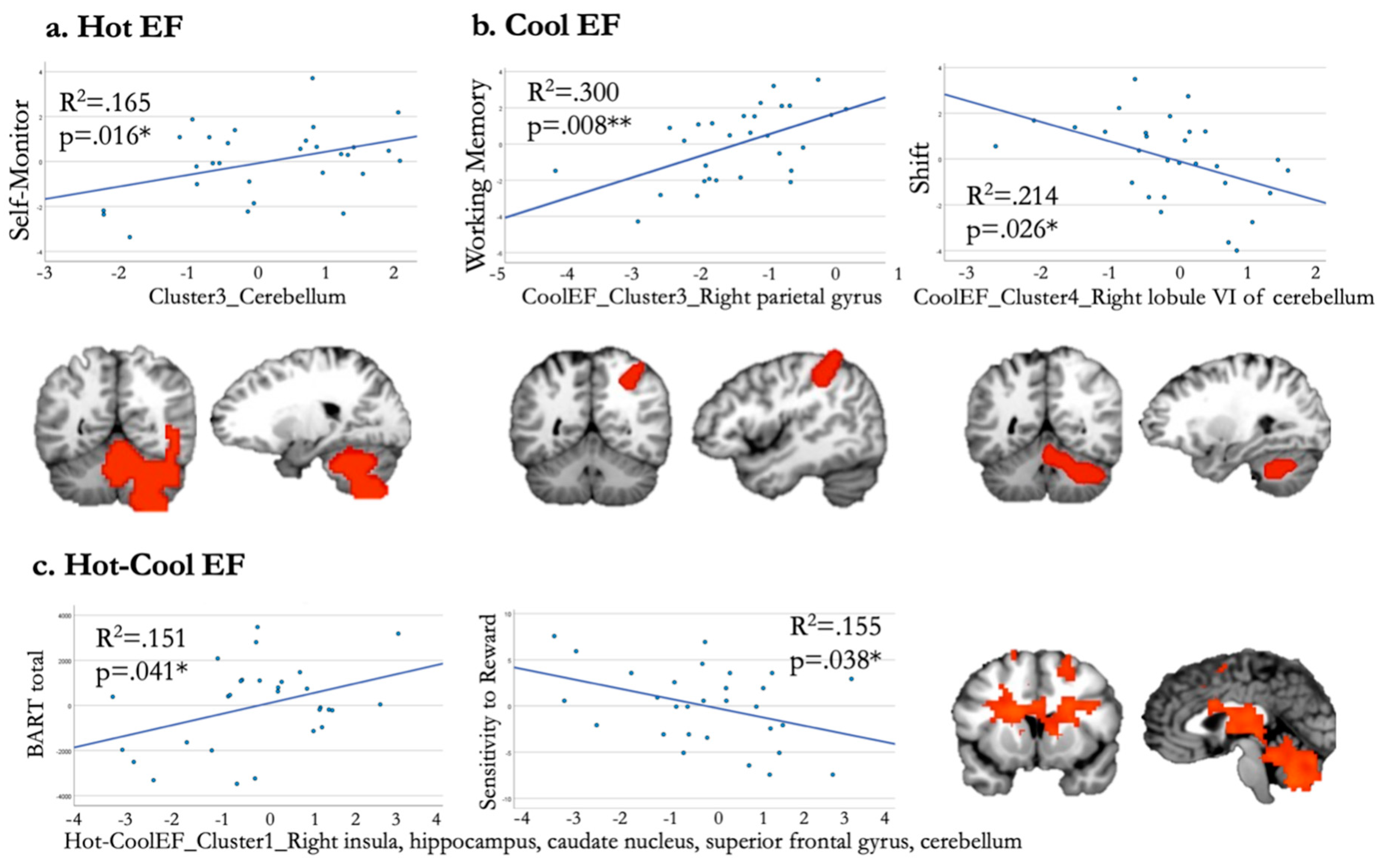

Table 1.
Demographic and behavioural variables of participants (n = 29, male/female = 14/15).
| Measures | Mean (Standard deviation) |
|---|---|
| Age (years) | 25.55 (4.54) |
| BART_total (points) | 7777.59 (1937.21) |
| BRIEF_Inhibit* | 51.45 (9.04) |
| BRIEF_Shift* | 55 (8.73) |
| BRIEF_EmotionalControl* | 50.33 (9.31) |
| BRIEF_SelfMonitor* | 47.3 (8.65) |
| BRIEF_WorkingMemory* | 53.94 (9.21) |
| SPSRQ_Reward | 10.72 (4.17) |
| Go/No-Go_Overall Accuracy | 96.7% (2.6%) |
The variables are demonstrated as mean (standard deviation). BART, Balloon Analogue Risk Task; BRIEF, Behaviour Rating Inventory of Executive Function – Adult Version (*All scores were converted to T-score); SPSRQ, The Sensitivity to Punishment and Sensitivity to Reward Questionnaire.
Table 2.
Significant clusters from the whole brain analysis (uncorrected p < 0.001; cluster size k > 100; FWE-corrected p < 0.01 (cluster-sized threshold)).
Table 2.
Significant clusters from the whole brain analysis (uncorrected p < 0.001; cluster size k > 100; FWE-corrected p < 0.01 (cluster-sized threshold)).
| Condition | Cluster | Volume | Cluster p(FWE) | T | x | y | z | label |
|---|---|---|---|---|---|---|---|---|
| Hot EF (High reward - Rest) | ||||||||
| No Compete | 1 | 7270 | 4.16*10-11 | 15.87 | -39 | -42 | 45 | Left parietal gyrus excluding supramarginal and angular gyrus |
| 14.98 | -27 | -3 | 57 | Left Superior frontal gyrus-dorsolateral | ||||
| 14.28 | -30 | 18 | 9 | Left insula | ||||
| 13.95 | -42 | 3 | 30 | Left Precentral gyrus | ||||
| 13.82 | -6 | 0 | 57 | Left supplementary motor area | ||||
| 12.13 | -54 | -24 | 45 | Left postcentral gyrus | ||||
| 12.12 | -45 | -36 | 42 | Left parietal gyrus excluding supramarginal and angular gyrus | ||||
| 12.10 | -27 | -57 | 48 | Left Superior parietal gyrus | ||||
| 11.91 | 30 | 18 | 6 | Right insula | ||||
| 11.41 | -45 | 0 | 42 | Left precentral gyrus | ||||
| 10.46 | 18 | 0 | 63 | Right superior frontal gyrus-dorsolateral | ||||
| 10.27 | 24 | -6 | 51 | Right precentral gyrus | ||||
| 8.91 | 45 | 3 | 33 | Right precentral gyrus | ||||
| 8.55 | 9 | 15 | 45 | Right supplementary motor area | ||||
| 2 | 608 | 0.000001 | 10.97 | -45 | -69 | -3 | Left middle occipital gyrus | |
| 8.38 | -42 | -51 | -30 | Left crus I of cerebellar hemisphere | ||||
| 7.65 | -27 | -54 | -30 | Left crus VI of cerebellar hemisphere | ||||
| 6.48 | -42 | -84 | -6 | Left inferior occipital gyrus | ||||
| 6.14 | -33 | -90 | -9 | Left inferior occipital gyrus | ||||
| 3 | 2416 | 2.22*10-16 | 6.62 | 0 | -45 | -15 | Lobule III of vermis | |
| 9.05 | 42 | -54 | -33 | Right Crus I of cerebellar hemisphere | ||||
| 9.03 | 30 | -48 | -33 | Right Lobule VI of cerebellar hemisphere | ||||
| 9.02 | 18 | -66 | -48 | Right Lobule VIII of cerebellar hemisphere | ||||
| 8.74 | 39 | -60 | -30 | Right Crus I of cerebellar hemisphere | ||||
| 8.71 | 24 | -57 | -27 | Right Lobule VI of cerebellar hemisphere | ||||
| 8.70 | 12 | -72 | -45 | Right Lobule VII of cerebellar hemisphere | ||||
| 7.96 | 15 | -48 | -21 | Right Lobule IV-V of cerebellar hemisphere | ||||
| 7.39 | 9 | -69 | -24 | Right Lobule VI of cerebellar hemisphere | ||||
| 7.17 | 6 | -66 | -27 | Lobule VII of vermis | ||||
| 7.05 | 51 | -69 | -6 | Right inferior temporal gyrus | ||||
| 6.58 | -24 | -66 | -51 | Left Lobule VIII of cerebellar hemisphere | ||||
| 4 | 647 | 7.67*10-7 | 9.59 | 39 | -42 | 48 | Right parietal gyrus excluding supramarginal and angular gyrus | |
| 5.38 | 27 | -60 | 54 | Right superior parietal gyrus | ||||
| 5.16 | 15 | -63 | 54 | Right precuneus | ||||
| 4.45 | 30 | -66 | 27 | Right superior occipital gyrus | ||||
| Compete | 1 | 6621 | 1.72*10-10 | 15.01 | -39 | -42 | 45 | Left parietal gyrus excluding supramarginal and angular gyrus |
| 12.82 | -6 | 0 | 60 | Left supplementary motor area | ||||
| 12.79 | -27 | -57 | 48 | Left superior parietal gyrus | ||||
| 12.5 | -27 | -3 | 57 | Left superior frontal gyrus-dorsolateral | ||||
| 12.46 | -45 | 0 | 30 | Left precentral gyrus | ||||
| 12.39 | -30 | 15 | 9 | Left insula | ||||
| 12.32 | -3 | 3 | 57 | Left supplementary motor area | ||||
| 12.06 | -24 | -6 | 60 | Left superior frontal gyrus-dorsolateral | ||||
| 11.66 | -48 | -3 | 45 | Left Precentral gyrus | ||||
| 11.43 | -6 | 9 | 51 | Left supplementary motor area | ||||
| 9.9 | 24 | -3 | 54 | Right Precentral gyrus | ||||
| 9.26 | 15 | 3 | 57 | Right supplementary motor area | ||||
| 7.92 | -39 | -54 | -30 | Left crus I of cerebellar hemisphere | ||||
| 2 | 1719 | 8.22*10-14 | 9.19 | 18 | -51 | -24 | Right Lobule IV-V of cerebellar hemisphere | |
| 9.16 | 30 | -48 | -30 | Right Lobule VI of cerebellar hemisphere | ||||
| 9.08 | 3 | -57 | -12 | Lobule IV-V of vermis | ||||
| 8.75 | 27 | -57 | -27 | Right Lobule VI of cerebellar hemisphere | ||||
| 8.43 | 12 | -72 | -45 | Right Lobule VIII of cerebellar hemisphere | ||||
| 8.1 | 0 | -45 | -21 | Lobule III of vermis | ||||
| 8.02 | 18 | -63 | -48 | Right Lobule VIII of cerebellar hemisphere | ||||
| 7.74 | 0 | -45 | -15 | Lobule III of vermis | ||||
| 7.42 | 3 | -66 | -33 | Lobule III of vermis | ||||
| 6.37 | -21 | -69 | -51 | Right Lobule VIII of cerebellar hemisphere | ||||
| 3 | 591 | 8.56*10-7 | 8.93 | 36 | -45 | 48 | Right parietal gyrus excluding supramarginal and angular gyrus | |
| 7.75 | 45 | -36 | 48 | Right parietal gyrus excluding supramarginal and angular gyrus | ||||
| 4 | 187 | 0.004 | 8.05 | 45 | -66 | -6 | Right inferior temporal gyrus | |
| 6.10 | 45 | -81 | -6 | Right inferior occipital gyrus | ||||
| Cool EF (No reward - Rest) | ||||||||
| No compete | 1 | 4056 | 3.38*10-10 | 14.61 | -6 | 0 | 57 | Left supplementary motor area |
| 11.35 | -27 | -3 | 57 | Left superior frontal gyrus-dorsolateral | ||||
| 9.99 | -30 | 18 | 9 | Left insula | ||||
| 9.85 | -45 | -33 | 45 | Left parietal gyrus excluding supramarginal and angular gyrus | ||||
| 9.57 | -54 | -21 | 48 | Left postcentral gyrus | ||||
| 9.48 | -42 | 0 | 30 | Left precentral gyrus | ||||
| 9.31 | -48 | 0 | 42 | Left precentral gyrus | ||||
| 9.06 | -39 | -42 | 45 | Left parietal gyrus excluding supramarginal and angular gyrus | ||||
| 7.87 | -27 | -54 | 45 | Left parietal gyrus excluding supramarginal and angular gyrus | ||||
| 7.03 | -54 | -18 | 24 | Left postcentral gyrus | ||||
| 7.01 | -48 | -30 | 60 | Left postcentral gyrus | ||||
| 6.81 | 18 | 0 | 63 | Right superior frontal gyrus-dorsolateral | ||||
| 5.76 | -39 | 27 | 33 | Left middle frontal gyrus | ||||
| 2 | 473 | 0.00003 | 7.07 | 30 | -48 | -30 | Right lobule VI of cerebellar hemisphere | |
| 7.00 | 42 | -54 | -33 | Right crus I of cerebellar hemisphere | ||||
| 6.76 | 39 | -60 | -30 | Right crus I of cerebellar hemisphere | ||||
| 5.87 | 15 | -51 | -21 | Right lobule IV-V of cerebellar hemisphere | ||||
| 4.90 | 6 | -54 | -15 | Lobule IV-V of vermis | ||||
| 4.58 | 0 | -45 | -15 | Lobule III of vermis | ||||
| 3 | 297 | 0.001 | 7.02 | 21 | -66 | -51 | Right lobule VIII of cerebellar hemisphere | |
| 6.97 | 24 | -69 | -54 | Right lobule VIII of cerebellar hemisphere | ||||
| 4.97 | 6 | -78 | -45 | Right lobule VIIB of cerebellar hemisphere | ||||
| 4 | 176 | 0.009 | 7.00 | -42 | -69 | -3 | Left middle occipital gyrus | |
| 5.64 | -42 | -84 | -6 | Left inferior occipital gyrus | ||||
| 5 | 376 | 0.0002 | 6.80 | 30 | 18 | 9 | Right insula | |
| 6.12 | 48 | 3 | 30 | Right precentral gyrus | ||||
| 6.02 | 51 | 6 | 21 | Right precentral gyrus | ||||
| 6 | 280 | 0.001 | 6.40 | 48 | -33 | 48 | Right parietal gyrus excluding supramarginal and angular gyrus | |
| 5.92 | 39 | -42 | 48 | Right parietal gyrus excluding supramarginal and angular gyrus | ||||
| 4.78 | 45 | -45 | 60 | Right superior parietal gyrus | ||||
| 4.61 | 30 | -54 | 45 | Right parietal gyrus excluding supramarginal and angular gyrus | ||||
| Compete | 1 | 5661 | 3.39*10-10 | 14.6 | -3 | 3 | 57 | Left supplementary motor area |
| 14.38 | -3 | 9 | 54 | Left supplementary motor area | ||||
| 14.28 | -6 | 0 | 60 | Left supplementary motor area | ||||
| 13.83 | -9 | -3 | 63 | Left supplementary motor area | ||||
| 12.67 | -27 | -3 | 54 | Left superior frontal gyrus-dorsolateral | ||||
| 11.32 | -33 | 15 | 9 | Left insula | ||||
| 10.71 | -45 | -3 | 42 | Left precentral gyrus | ||||
| 10.51 | -48 | -33 | 48 | Left postcentral gyrus | ||||
| 10.34 | -45 | 0 | 30 | Left precentral gyrus | ||||
| 9.9 | 27 | 0 | 51 | Right precentral gyrus | ||||
| 9.78 | -54 | 6 | 30 | Left precentral gyrus | ||||
| 9.64 | -36 | -42 | 48 | Left parietal gyrus excluding supramarginal and angular gyrus | ||||
| 9.32 | -51 | 3 | 21 | Left precentral gyrus | ||||
| 9.06 | -27 | -57 | 48 | Left superior parietal gyrus | ||||
| 2 | 1229 | 1.3*10-11 | 9.20 | 30 | -51 | -30 | Right lobule VI of cerebellar hemisphere | |
| 8.13 | 3 | -57 | -12 | Lobule IV-V of vermis | ||||
| 8.01 | 39 | -60 | -30 | Right Crus I of cerebellar hemisphere | ||||
| 7.76 | 18 | -60 | -45 | Right lobule VIII of cerebellar hemisphere | ||||
| 7.64 | 21 | -66 | -48 | Right lobule VIII of cerebellar hemisphere | ||||
| 6.11 | 12 | -45 | -24 | Right lobule III of cerebellar hemisphere | ||||
| 4.11 | 3 | -75 | -30 | Lobule VII of vermis | ||||
| 3 | 190 | 0.002 | 9.17 | -39 | -54 | -30 | Left Crus I of cerebellar hemisphere | |
| 4 | 450 | 0.000006 | 7.66 | 51 | -33 | 48 | Right parietal gyrus excluding supramarginal and angular gyrus | |
| 7.49 | 48 | -36 | 51 | Right parietal gyrus excluding supramarginal and angular gyrus | ||||
| 7.37 | 36 | -42 | 45 | Right parietal gyrus excluding supramarginal and angular gyrus | ||||
| 5.89 | 30 | -54 | 45 | Right parietal gyrus excluding supramarginal and angular gyrus | ||||
| 4.06 | 15 | -63 | 54 | Right Precuneus | ||||
| 5 | 228 | 0.001 | 7.62 | -42 | -69 | 0 | Left middle occipital gyrus | |
| 4.61 | -42 | -84 | -6 | Left inferior occipital gyrus | ||||
| 6 | 170 | 0.004 | 6.97 | 45 | -66 | -6 | Right inferior temporal gyrus | |
| 5.71 | 42 | -84 | -6 | Right inferior occipital gyrus | ||||
| 5.54 | 48 | -78 | -3 | Right inferior occipital gyrus | ||||
| Hot - Cool EF | ||||||||
| No Compete | 1 | 12249 | 0.0003 | 7.87 | 5.67 | 33 | 3 | Right insula |
| 7.06 | 30 | -36 | 3 | Right Hippocampus | ||||
| 6.66 | -15 | 15 | 12 | Left caudate nucleus | ||||
| 6.6 | -12 | -15 | 18 | Left ventral lateral nucleus | ||||
| 6.48 | -30 | -51 | 60 | Left superior parietal gyrus | ||||
| 6.42 | 24 | -9 | 60 | Right superior frontal gyrus-dorsolateral | ||||
| 6.19 | -21 | -57 | 63 | Left superior parietal gyrus | ||||
| Compete | 1 | 392 | 0.001 | 4.78 | 18 | -54 | 45 | Right precuneus |
| 3.59 | 15 | 12 | 21 | Right caudate nucleus | ||||
| No Compete - Compete | 1 | 387 | 0.0004 | 5.27 | 33 | -87 | -6 | Right inferior occipital gyrus |
| 5.23 | 27 | -90 | 9 | Right middle occipital gyrus | ||||
| 4.53 | 21 | -81 | -6 | Right lingual gyrus | ||||
| 4.35 | 36 | -57 | -18 | Right fusiform gyrus | ||||
| 3.97 | 30 | -69 | -18 | Right fusiform gyrus | ||||
| 2 | 216 | 0.007 | 4.86 | -30 | -78 | -6 | Left fusiform gyrus | |
| 4.41 | -24 | -87 | 15 | Left middle occipital gyrus | ||||
| 4.25 | -21 | -90 | 12 | Left superior occipital gyrus | ||||
| 3.84 | -21 | -78 | -18 | Left Lobule VI of cerebellar hemisphere | ||||
| 3.77 | -12 | -90 | 15 | Left cuneus | ||||
Disclaimer/Publisher’s Note: The statements, opinions and data contained in all publications are solely those of the individual author(s) and contributor(s) and not of MDPI and/or the editor(s). MDPI and/or the editor(s) disclaim responsibility for any injury to people or property resulting from any ideas, methods, instructions or products referred to in the content. |
© 2024 by the authors. Licensee MDPI, Basel, Switzerland. This article is an open access article distributed under the terms and conditions of the Creative Commons Attribution (CC BY) license (http://creativecommons.org/licenses/by/4.0/).
Copyright: This open access article is published under a Creative Commons CC BY 4.0 license, which permit the free download, distribution, and reuse, provided that the author and preprint are cited in any reuse.


