1. Introduction
In recent decades, rural areas have been experiencing a progressive decline in population due to the lack of employment opportunities and prospects, which have forced their inhabitants to relocate to urban areas [
1]. This phenomenon can be attributed to a complex interplay of economic, social, and environmental factors that collectively render life in these areas increasingly challenging [
2].
This issue is particularly pertinent in natural protected natural areas [
3], where the objective is to prevent biodiversity degradation and to facilitate the provision of ecosystem services (provisioning, regulating, cultural and supporting) [
4]. Nevertheless, this may influence the economic development of rural areas situated within the protected area [
5]. The conservation of natural spaces can impede socio-economic advancement in rural regions, resulting in diminished income for local producers, a loss of competitiveness for traditional activities, and a scarcity of employment opportunities outside the primary sector [
3,
5,
6,
7]. In the context of a globalised market that favours large-scale production and low production costs, farms and livestock farms in these areas are unable to compete [
8]. Consequently, a considerable number of individuals are compelled to pursue enhanced living standards in urban environments, where labour supply is more diverse, and prospects are more promising [
9]. Furthermore, the depopulation of rural areas within protected natural spaces can also have a detrimental impact on the environment [
10]. The abandonment of agricultural land in these regions can result in a reduction and deterioration in the provision of ecosystem services, such as increased erosion processes, loss of biodiversity and alterations in hydrological cycles [
11,
12].
To address the decline experienced by rural areas, strategies are being implemented that focus on the comprehensive development of the territory, with the participation of local communities as a fundamental pillar. [
13]. The objective of these initiatives is to augment the value of economic activities that are particular to these regions, such as agriculture and livestock farming, and thus to encourage the development of small-scale agricultural and artisan production [
14]. One such strategy is the promotion of territorial-branded products, which have become a pivotal instrument in the context of protected natural spaces, facilitating sustainable development that not only bolsters the rural economy but also advances environmental conservation [
15,
16]. These products are characterised by a robust connection to the cultural and geographical identity of a particular region, reflecting traditional practices and local natural resources [
17,
18].
Despite the growing interest in promoting rural development strategies, such as territorial brands, there is a paucity of studies that analyse the existing social demand for products bearing this labelling [
18]. Although studies employing economic valuation techniques, such as contingent valuation, have been conducted to assess the social demand for organic products [
19] and sustainable food [
20], there is few studies that have analysed the social demand for territorial-branded products. Moreover, there is a dearth of studies that concentrate on the social demand for territorial brands in rural areas situated within protected natural spaces. An understanding of the social demand and the factors that can influence it is crucial in the planning of actions that integrate and promote production and marketing strategies under the distinctive territorial brand.
The objective of this paper is to examine the social demand for territorial-branded products as a means of fostering rural development in natural protected areas. To this end, the natural protected area of Sierra Espuña (SE-Spain) is employed as a case study, representing a paradigmatic instance in which the implementation of rural development strategies is essential to make the conservation of the area compatible with the progress of local economies [
21].
We examine the extent to how can analyses the social demand for territorial-branded products in natural protected areas, to answer the following research questions: (1) What are the most important ecosystem services of natural protected areas for the population? (2) Is there a clear social preference for territorial-branded products? (3) What factors influence the social demand for territorial-branded products?
The application as a central methodology of a contingent valuation analysis addresses a significant gap in the existing literature by providing insight into the existing social demand for territorial-branded products in rural areas of protected natural spaces. This is achieved through two key contributions: (I) the estimation of the economic value of a territorial-branded product; and (II) the provision of evidence regarding the influence of ecosystem service perceptions of natural protected areas on social demand for territorial-branded products. Furthermore, the case study’s characteristics are analogous to those of other natural protected areas in the European Mediterranean facing rural depopulation and socio-economic challenges, such as Sierra de Aracena and Picos de Aroche, Sierra Norte de Sevilla, and Sierra de Hornachuelos in Spain [
22], Apennine Mountains of Tuscany in Italy [
23], and Serra da Estrela in Portugal [
24] underscoring its relevance and generalizability.
2. Materials and Methods
This section presents the methodology employed in the social demand analysis for territorial brands of rural territories in natural protected areas. First, the background on rural development strategies through the application of territorial brands is presented. Then, the case study, the contingent valuation methodology used in this work and the description of the sample are presented.
2.1. Background on Territorial Brands
Several strategies have been employed with the objective of enhancing the developmental levels observed in rural areas. Sánchez-Sánchez et al. [
25] examine rural tourism as a means of fostering the development of rural areas, driven by the growing demand from tourists for sustainability. The diversification of economic activities in rural areas has also been examined as a potential means of mitigating price fluctuations in agricultural products [
26]. Additionally, other initiatives aimed at bolstering social capital have been explored, with this aspect regarded as a pivotal foundation for the effective implementation of other strategies designed to enhance the developmental outcomes in rural regions [
27].
One of the strategies that some rural enterprises and partnerships have recently adopted is the creation of brand names to identify products and associate them with certain attributes. When this strategy aims to identify products from a specific place, it is called ‘territorial branding’ [
28]. There are several areas in which such branding can be applied, one of the best known being in rural areas, with the aim of increasing their level of socioeconomic development. By maintaining economic activity, social cohesion and environmental protection, products are marketed under a local identity, differentiating themselves from large production chains through local added value [
29]. In this way, the product is rooted in a geographical area and is associated with a level of quality and commitment to the territory.
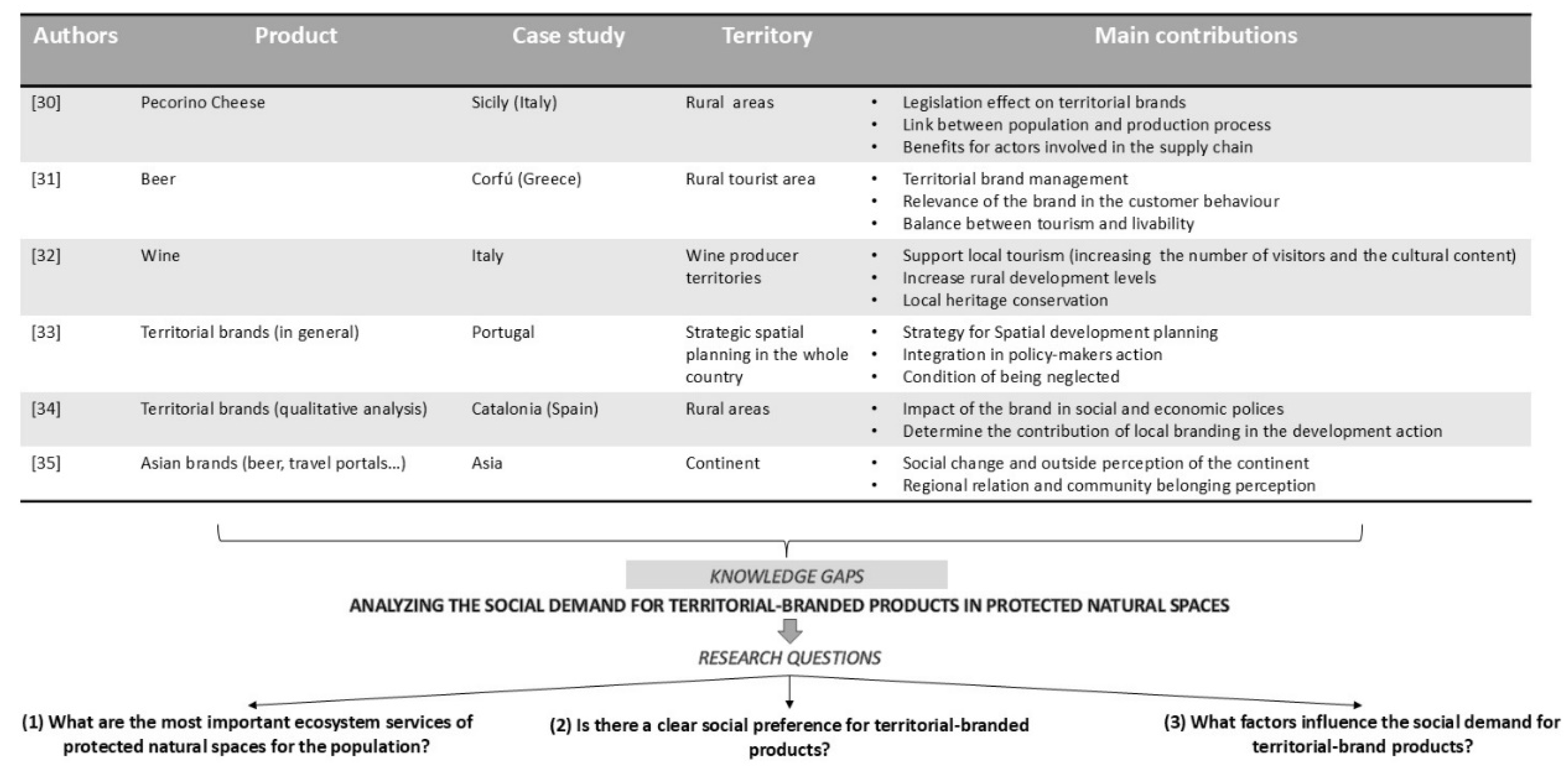
Several studies have been conducted to identify the products of a given territory, such as territorial brands, which are particularly useful to promote the provision of ecosystem services and sustainable development. Research carried out by Sgroi & Modica [
30] in Sicily (Italy), shows that the legislation of local origin labels such as territorial-branded cheeses, among others, create a comparative advantage for such products. This research highlights how this product is an example of the link between the population and the territory, due to its traditional production process and local ingredients. The aim of these labels is to benefit influential economic actors in the production chain (public and private), the preservation of traditional activities and the promotion of tourism. A similar strategy with a more commercial component is studied by Melewar & Skinner [
31] on the island of Corfu (Greece), where the territorial brand is applied to beer. The main objective of the research is to evaluate the consumer’s perception of the local consumption experience and its relevance to the purchase decision. To this end, the brand management will be evaluated to achieve these objectives. Asero & Patti [
32] discuss, in the Italian case, how the use of a territorial brand for wine, rooted in the cultural values and identity of the production area, promotes tourism through the experience of collaborating in the preservation of local heritage with the consumption and visit of the place of origin, strengthening the local identity and economy. For this reason, it is necessary to consider the impact of local labelling on the relationship between tourism and wine and its impact on local development.
Furthermore, the case of De San Eugenio-Vela & Barniol-Carcasona [
33] study in Spain the project ‘Territoris Serens’ in El Lluçanes (Catalonia), a joint rural development initiative with the creation of a territorial brand. This evaluation is conducted by forming a focus group with the local population involved. The aim is to go beyond the achievement of a comparative commercial advantage by having an impact on social and economic development policies. This initiative focuses on two fields of action: territory/environment and employment/economy.
Territorial brands have also been used as a tool for the spatial development of specific territories, a concept linked to sustainable development from a spatial planning perspective. The work of Oliveira [
34] is an example of this, with a study of the relationship between territorial brands and twenty spatial development plans conducted in Portugal. It concludes that there are multiple inconsistencies due to a lack of coherence, order and institutional coordination in the application of territorial brands, which reduces the impact of these brands on territorial development.
In addition, territorial brands have been used in social change processes, breaking down prejudices and stigmas, fostering inter-regional connections and a sense of belonging to the community. The example of Cayla & Eckhardt [
35] expands on the role of territorial brands in this direction, observing their influence on the sense of integration in a region as heterogeneous as Asia, as well as the creation of a new urban and developed image for the outside world.
Despite the many studies on territorial brands, there is still a lack of knowledge about the existing social demand in rural areas of protected natural spaces. This paper aims to fill this gap by answering three research questions arising from the main objective (
Figure 1).
2.2. Case Study
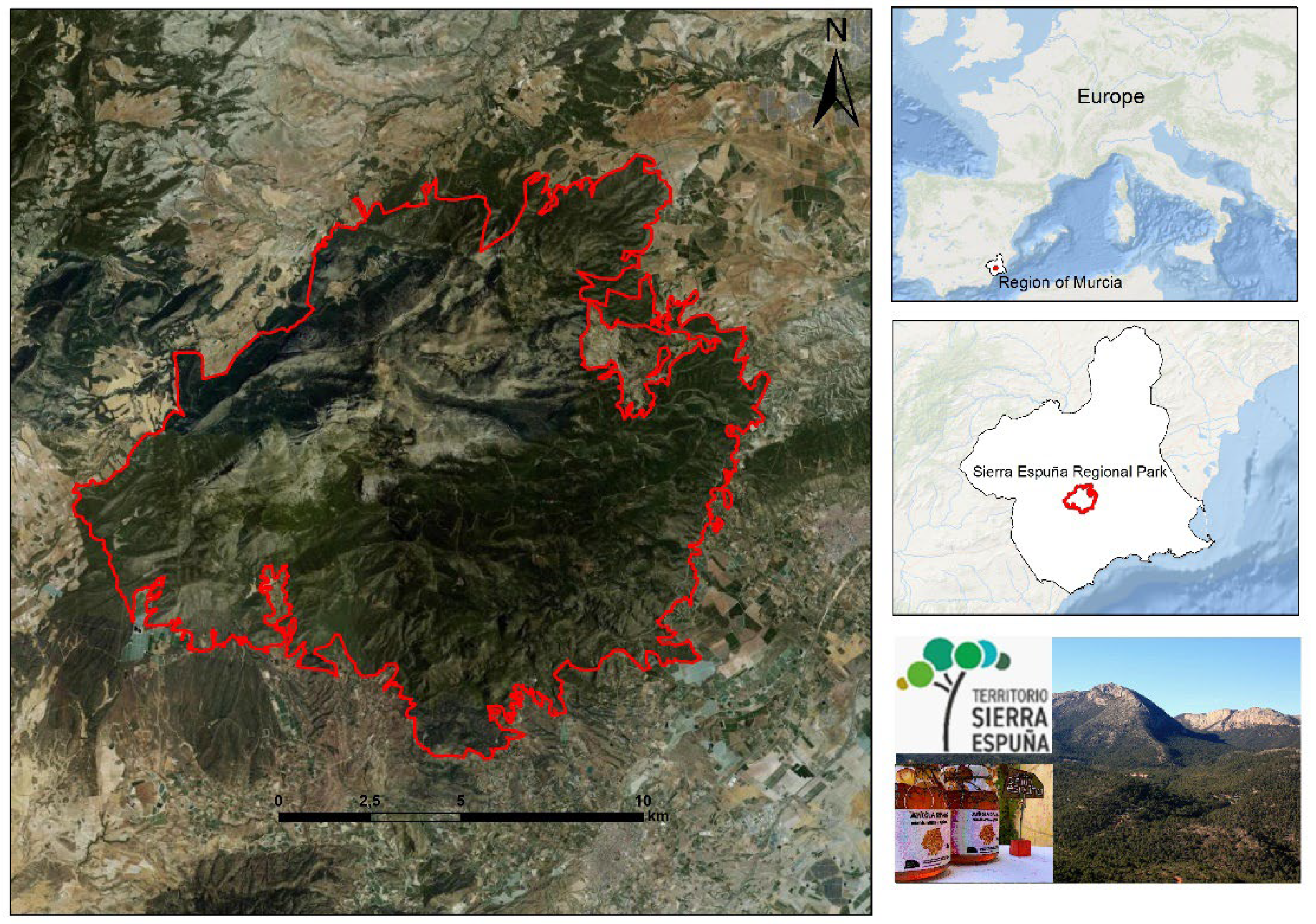
To exemplify the social valuation of territorial brands in protected natural spaces, the Sierra Espuña Regional Park in the Region of Murcia (SE-Spain) was selected for analysis (
Figure 2). The area protected, located in the territory of three municipalities, covering approximately 18,000 hectares and allows for public use in a way that is compatible with the protection strategies in place, making it one of the largest representatives of the Mediterranean forest of the Iberian southeast [
36].
Agriculture and livestock farming have been important activities for the social and economic development of this territory. Recently, the Sierra Espuña Regional Park was included in the European Charter for Sustainable Tourism in Protected Areas [
37], which has facilitated the implementation of rural development strategies, including the promotion of local products under the quality brand ‘Sierra Espuña Territorial Brand’.
The objective of this territorial brand is to encourage the consumption of local products, to demonstrate its commitment to sustainable development and to highlight the quality of the products marketed with this label. Among these products, honey and oil stand out as particularly noteworthy. In addition to products bearing the Sierra Espuña Territorial Brand, services and activities that have this label are also available, including tourist accommodation and cycling routes through the protected natural space. These activities and services are guaranteed to be carried out in an environmentally friendly manner. The production and commercialization of these goods and services serve to stimulate the local economy, creating employment opportunities and supporting small-scale producers. Furthermore, they facilitate economic development in rural areas that are sensitive to the distinctive characteristics and constraints of the natural environment [
36].
For the following analysis on the social demand of territorial brands of protected natural spaces, the honey will be used as the representative product. Honey is an important food in many diets, including the Mediterranean diet, and it is a well-known, widely consumed and continuously available good.
2.3. Methods
The primary methodology employed in this study was the contingent valuation method [
38]. This is a stated preference approach wherein respondents are directly asked to express their willingness to pay (WTP) for the improvement or conservation of goods or services that lack a real market.
In addition to the contingent valuation method, social participation techniques were applied to obtain information on the socio-economic importance of ecosystem service provision in protected natural spaces.
Furthermore, bivariate analyses (Pearson correlations and t-student) were conducted to examine the relationships between respondents’ perceptions of ecosystem services and their socio-demographic characteristics. Multivariate analyses were also carried out by developing models with logit and tobit specifications, to identify the factors that determine WTP of the population.
2.4. Data Collection
The primary data were obtained through a structured questionnaire consisting of 25 questions divided into three blocks:
(I) Ecosystem services provision assessment.
(II) Economic valuation of Sierra Espuña Territorial Brand.
(III) Evaluation of environmental commitment and socio-demographic variables.
The first block allows us to obtain information on the provision of the most important ecosystem services in the opinion of the population. To this end, the four ecosystem services (provision, regulation, support and cultural) that the protected natural space can provide are ranked.
The second block focuses on the quantification of the WTP for the Sierra Espuña Territorial Brand based on the honey product. The WTPB question was formulated as follows: Would you be willing to pay a higher price for the Sierra Espuña Territorial Brand honey?
Following the question in dichotomous format (WTPB), in case of an affirmative answer from the respondents, they had to state their maximum willingness to pay more for one kg of honey for the Sierra Espuña Territorial Brand (WTPM). For this purpose, the average reference price of 6 €/kg was proposed for conventional honey, asking respondents for their maximum WTPM considering this starting point . The respondents had to state whether they would be willing to pay a surcharge. Whether the answer was yes or no, the respondents had to state the maximum amount they would be willing to pay for the Sierra Espuña Territorial Brand honey by using an open-ended question. In the case of refuse a surcharge in the WTPB question, the motivations expressed by the respondents were identified.
The last section of the questionnaire included a series of questions to construct variables related to environmental commitment and socio-demographic information. Three environmental commitment indices were created that represent, respectively, each respondent’s affective, verbal and real commitment to the environment [
39]. These indices were quantified using a Likert scale from 1 to 5, rating the answers given to a series of statements in the questionnaire.
Following a pilot survey of 15 respondents carried out in February 2023, the final survey was conducted in person during April 2023, for a random sample of the Region of Murcia’s 546.000 households. Differences between sample and population characteristics were tested and no differences were found. Thus, 448 surveys were obtained, which, at a 95% confidence level for a dichotomous variable, resulted in a sampling error of 5.1% for intermediate proportions and 3.1 % for extreme proportions. Considering the existence of a real market for conventional honey, one of the key questions asked in the questionnaire is how often respondents consume this product. This allows us to differentiate between consumers who participate in the market and those who do not. In examining the social demand for the Sierra Espuña Territorial Brand honey, only those respondents who regularly consume this product are considered. Consequently, 365 of the 448 surveys were included in the subsequent analysis. In contrast to other contingent valuation studies [
40], where it is necessary to discern real zeros and protest zeros among the respondents [
41], this study, given the private good nature of honey, exhibits no evidence of protest behavior (protest zeros) among the population.
2.5. Sample Description
The descriptive data from the survey identifies the profile of the average respondent as an individual aged 36, with a university education (completed or in progress) and who is an active worker in 47% of cases. The most common household size is four, with an average monthly family income of 1,970 € (
Supplementary Table S1). The characteristics of the surveys are found to be largely consistent with the census values for the target population [
42], thereby confirming the representativeness of the sample and its suitability for population analysis and inference. It was also noted that 54.52% of the respondents were users of the natural protected area of Sierra Espuña, due they having visited it in the last two years. The distance (in km) of the respondents to Sierra Espuña was calculated from the distance from the centroid of the postcode of their usual residence to the study area considered [
40]. The mean distance between respondents’ residences and the natural area under study was 35 km (
Supplementary Table S1).
Respondents report a high affective ecological commitment (4.13 out of 5), a medium verbal commitment of willingness to act (3.53) and a low real commitment (2.49) (
Supplementary Table S1).
3. Results
In this section, the perception that the population has about the ecosystem services provision in protected natural spaces is presented. This is followed by an analysis of the social demand for the Sierra Espuña Territorial Brand honey, determining the factors influencing the WTP.
3.1. Ecosystem Services Provision Assessment
Table 1 presents the results of the valuation of the socio-economic importance of the ecosystem services that should be provided by the natural protected area of Sierra Espuña, as determined by the respondents.
The results demonstrate that supporting services are of greater relative importance (36.5%), followed by regulating services (25%), cultural services (19.6%) and provisioning services (18.8%). A bivariate analysis was conducted to ascertain the relationship between the preference for ecosystem services and the socio-economic characteristics of the population. The results are presented in
Table 2.
Notable associations were observed between respondents with a lower affective ecological commitment and higher socio-economic importance attributed to provisioning services. Further notable associations were identified between users of the study area and their verbal ecological commitment, who reported a greater importance placed on regulating services. Cultural services were identified as being of greater importance to older people who are resident in the study area. Additionally, supporting services were found to be of greater importance to younger respondents, with lower income, higher affective and verbal ecological commitment and active workers. Conversely, users and residents of the study area reported lower importance of this ecosystem service.
3.2. Social Demand Analysis
For the analysis of the demand for Sierra Espuña Territorial Brand, the 365 honey consumers surveyed were asked about their willingness to pay (WTP) a higher price for honey with this territorial brand. The payment vehicle, selected in the pilot survey, is an extra payment by households for honey with the Sierra Espuña Territorial Brand.
In the contingent valuation exercise, 64.11% of the sample (234 individuals) showed a WTP a surcharge (WTP > 6 €), while the remaining 35.89% (131 individuals) would not be willing to pay more. Those respondents who expressed their refusal to pay a surcharge for Sierra Espuña Territorial Brand honey were also asked why they would not do so.
44% of respondents who would not pay more for Sierra Espuña Territorial Brand honey said they would not do so because ‘I don’t know the product’, followed by 34% of respondents who stated, ‘I am satisfied with the conventional product’, and 28% who said, ‘I don’t pay attention to the brand of the products, only to the price’.
Table 3 shows the descriptive statistics of the total willingness to pay more (WTPM) for the Sierra Espuña Territorial Brand honey. The mean surcharge is 1.91 €/kg , i.e., respondents would be willing to pay on average 7.91 €/kg for this territorial-branded product compared to €6/kg for conventional honey. The table also shows the differences in WTP with respect to users of the Sierra Espuña Regional Park, being significantly higher (2.13 €/kg) in the case of users than non-users (1.64 €/kg).
The associations found between WTP, on the one hand, and the perception of ecosystem services, on the other hand, with the socio-economic characteristics of the respondents led to the multivariate analyses in the following section.
3.3. Multivariate Analysis
Factors explaining the WTP a surcharge for Sierra Espuña Territorial Brand honey, identified through multivariate analysis, were measured using variables grouped into socio-economic characteristics and environmental commitment index (
Supplementary Table S1) and ecosystem services perception (
Table 1). The interactions of this variables were also included as possible explanatory factors.
Willingness to pay binary (WTPB) factors were identified with a
logit model (
Table 4), where WTPB takes a value of 1 if the individual’s response is WTP a surcharge (64.11%) and 0 if it is a WTP=0 surcharge (35.89%). The
logit model presents a good fit (66.8 % of Correct Classification - CPC) and show no collinearity problems (Variance Inflation Factor - VIF < 10).
In terms of the factors influencing the WTPB for Sierra Espuña Territorial Brand honey, five variables were found to be significant (
Table 4). Given their marginal effects, the probability of WTP a surcharge increases by 55.4 % for consider more important the supporting services in the protected natural space comparing with the other ecosystem services. Being an active worker and user of the study area increases the probability of WTP by 12.5% and 10.8%, respectively. Each additional point of verbal environmental commitment increases the probability by 4.5%, while the distance to Sierra Espuña increases it by 0.7 % per km.
Finally, the total willingness to pay more (WTPM) for the Sierra Espuña Territorial Brand honey was modelled using a
tobit specification censored at 0 (
Table 5).
The explanatory variables of this model were the same as the logit model estimated above. There will be a higher surcharge from respondents if they have a higher preference for supporting services provided by the natural protected area of Sierra Espuña, if they are active workers, if they have a higher verbal ecological commitment, and if they live far from the study area. Thus, given the marginal effects, evaluated for the sample mean, for each additional unit point of importance to supporting services compared with other ecosystem services, WTPM increases by 3.2 €/kg. Being an active worker and user increases WTPM by 0.76 and 0.54 €/kg, respectively. Each additional point of verbal ecological index increases WTPM by 0.16 €/kg, while each km that respondents live outside the study area increases WTPM by 0.1 €/kg.
4. Discussion
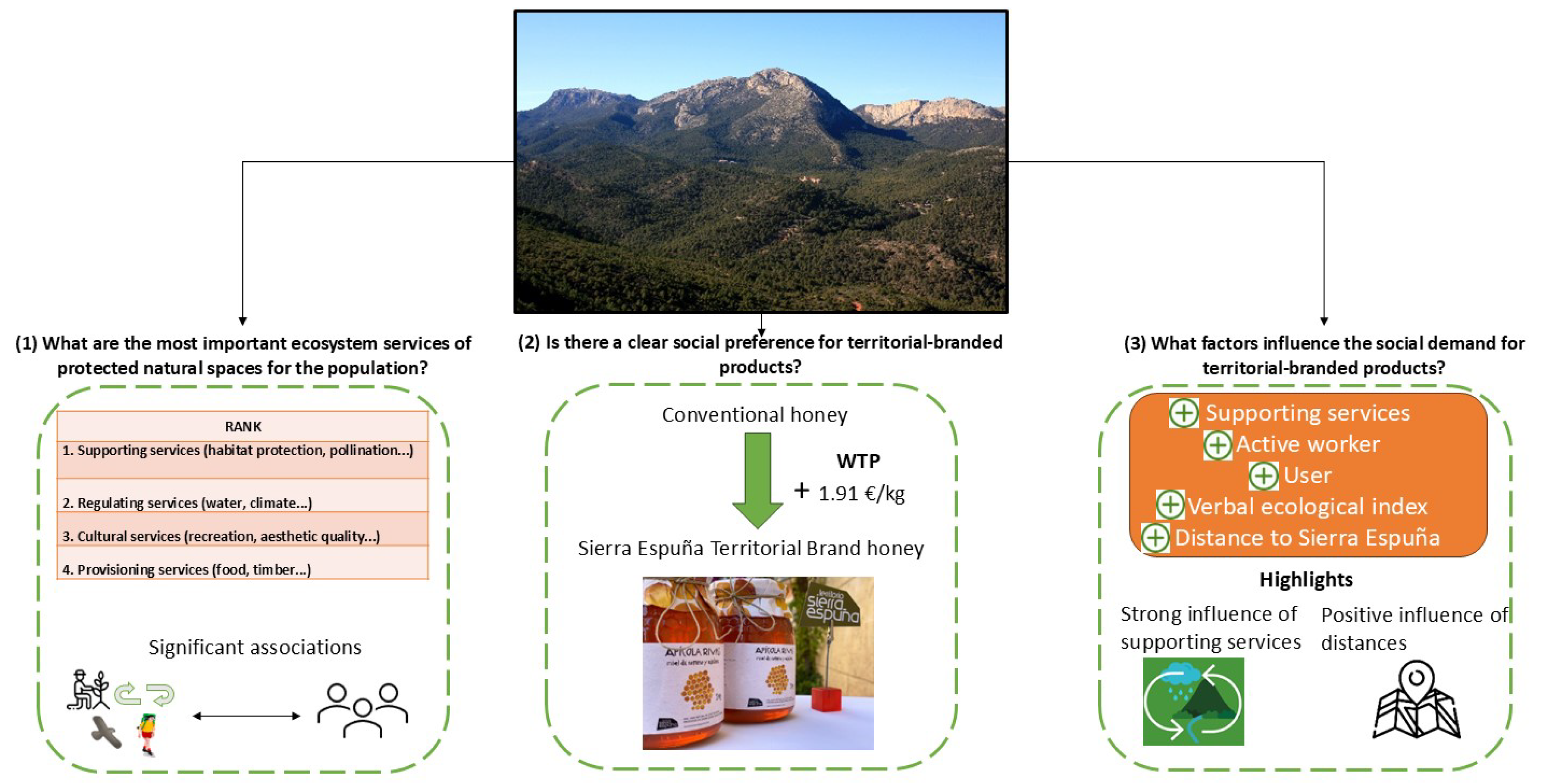
This study addresses the social demand for one of the rural development strategies in protected natural spaces that has been studied little in literature from a socio-economic perspective: territorial-branded products. To address the gap in the literature, this study employs the example of the honey product as a territorial brand within the context of one of the most well-known protected natural areas in south-eastern Spain, namely the Sierra Espuña Regional Park. By utilizing a combination of surveys incorporating social participation techniques and a contingent valuation method, this study has been able to respond to the three research questions that were initially formulated (
Figure 3):
(1) What are the most important ecosystem services of protected natural spaces for the population?
The findings of the survey have illustrated the socio-economic significance of the provision of ecosystem services by protected natural spaces for the population. The population has demonstrated a clear preference for the provision of supporting ecosystem services, which include services such as pollination, habitat or soil retention. These services make possible a range of activities, including beekeeping in the Sierra Espuña Regional Park. This result is consistent with those of previous studies [
43,
44,
45], confirming the level of awareness of the population about the importance of these ecosystem services in providing the basis for the functioning of ecosystems and, indirectly, providing the basis for ecosystem services that will benefit society.
It is evident that the perception of ecosystem service provision is shaped by the socio-economic characteristics of the population. Consequently, a high level of ecological commitment is indicative of a higher valuation of the regulating and supporting ecosystem services provided by the Sierra Espuña Regional Park. In contrast, factors such as advanced age or residence in the study area are associated with a greater emphasis on cultural services. Thus, age, ecological commitment and spatial aspects of location/distance were found to be significant factors influencing the importance of ecosystem services. These results are consistent with some recent studies [
40,
44,
46], according to which these factors are significant for people’s attitudes towards ecosystem services.
(2) Is there a clear social preference for territorial-branded products?
The surcharge of 1.91 €/kg that the population is willing to pay (WTP) for Territorial Sierra Espuña Brand honey serves to confirm the role of this territorial brand as a socio-economic asset for the rural areas that are in the protected natural space. In addition to the more intangible positive effects of a more sustainable product on the health of the population, the territorial-branded of a product can contribute to the socio-economic development of the territory [
33].
The greater social preference for paying a higher price for a product with a territorial brand lends support to the attitudes displayed by the population in other studies towards the consumption of local products to contribute to the local economy [
18], to the protection of the natural environment [
15], and because they are healthier products [
30]. This demonstrates that there is a social imperative to advance sustainable development, which can be accomplished by fostering environmental stewardship and promoting responsible consumption through the utilization of territorial brands on local products.
The findings pertaining to the existing social demand for territorial-branded products offer a valuable instrument for decision-makers in rural areas of protected natural spaces to enhance the production and marketing of their local products. This study thus serves to reinforce the idea of supporting strategies in which local communities assume a leading role in the management of rural development, given that it is precisely these actors who have the capacity to regenerate their own local economy. In this sense, the role of public administration must evolve from that of a provider of local development aid to that of a facilitator of rural regeneration. This will entail the modernization of rural economies that were previously based exclusively on production, and which are now also focused on consumption [
33]. In this context, exchange value is given greater prominence than use value. Therefore, the existing social demand for territorial-branded products in protected natural spaces allows for the projection of an attractive rural imaginary, whereby rural areas will increasingly become attractive consumer destinations [
28].
(3) What factors influence the social demand for territorial-branded products?
The findings of the study demonstrate the crucial role of the perception of ecosystem services in the social demand for territorial-branded products in protected natural spaces. Therefore, the sporting services provided by the Sierra Espuña Regional Park represent a pivotal element in elucidating the behavioral patterns of social demand, a phenomenon that is similarly observed in the social demand for other natural areas [
45]. This evidence is consistent with the product under analysis, as the provision of pollination and habitat services that give rise to beekeeping activity in the study area is necessary to promote honey consumption. The influence of the support services leads us to posit that the value placed by the population on the territorial brand of honey extends beyond its private consumption [
47], which is the result of the pollinating function of the protected natural space, representing an important value for biodiversity and beekeeping and agricultural production in the area [
48,
49].
The impact of the provision of these environmental services is reinforced by the significance of the respondents’ verbal ecological commitment, their role as active workers, their prior visits to the study area and their distance from natural space. It is noteworthy that this last factor influencing demand is not consistent with most works analyzing distance decay and the negative influence of spatial factors on social demand [
40,
50]. The higher willingness to pay for Terrritorio Sierra Espuña honey by respondents residing at greater distances from the study area suggests that these individuals place a greater value on the local provenance of products. This reflects a tendency to have a sense of place even in more remote areas, where there is a greater perception of wanting to consume responsibly and to purchase products that bolster the local economy [
51]. This may be a response to globalization and the perceived negative effects it can have on smaller communities [
52].
The findings of this study indicate that this territorial-branded product has the potential to appeal to a specific consumer that is concerned about environmental sustainability and local economic development. The results have furnished a basis for action, based on empirical evidence, which integrates and promotes production and marketing strategies with the Territorial Sierra Espuña Brand. This is done in the interests of rural development, while satisfying social demands for quality products. It is imperative that this territorial brand enhances its visibility and persists in apprising consumers of the distinctive advantages it offers, with the objective of optimizing its competitive edge in the market.
5. Conclusions
This study has demonstrated the existence of a high social demand for territorial-brand products using the Territorial Sierra Espuña Brand honey as a representative case study. A significant proportion of the population is willing to pay a higher price for products bearing this territorial brand. This should be considered by decision-makers, given the direct impact that the territorial brand has on the socio-economic and environmental development policies of rural areas in protected natural spaces. It thus follows that the transition to an economy based on sustainable consumption necessitates the involvement of public participatory processes, including surveys such as those carried out in this study, providing support and foster competitive territorial identity through rural territorial branding strategies. The analyses of social demand constitute a significant element in the design and restructuring of local economies.
This study has a broader implication, by highlighting not only the social demand that exists to consume territorial-branded products, but also the influence that the perception of ecosystem services that support protected natural areas has on this demand. It can be seen, therefore, that the social demand for a territorial-branded product extends beyond the sphere of private consumption. There is a clear interest among the population in maintaining the functions that are the basis of protected natural space.
Supplementary Materials
The following supporting information can be downloaded at the website of this paper posted on Preprints.org.
Author Contributions
Conceptualization, JAAG. and JMMP.; methodology, JAAG. and JMMP.; software, JAAG. GMG. and JMMP; validation, JAAG. GMG. and JMMP.; formal analysis, JAAG. GMG. and JMMP.; investigation, JAAG. GMG. and JMMP.; resources, JAAG. GMG. and JMMP.; data curation, JAAG. and GMG.; writing—original draft preparation, JAAG; writing—review and editing, JAAG. GMG and JMMP.; visualization, JAAG. GMG. and JMMP.; supervision, JMMP.; project administration, JMMP.; funding acquisition, JMMP. All authors have read and agreed to the published version of the manuscript.
Funding
This research was partially funded by the Regional Ministry of Environment, Universities, Research and Mar Menor. Region of Murcia.
Acknowledgments
The authors thank the Environmental Authorities of the Government of the Region of Murcia for their support, especially the technicians of the Regional Park “Sierra Espuña” and the people interviewed.
Conflicts of Interest
The authors declare no conflicts of interest.
References
- Li, Y.; Westlund, H.; Liu, Y. Why some rural areas decline while some others not: An overview of rural evolution in the world. Journal of Rural Studies 2019, 68, 135–143. [Google Scholar] [CrossRef]
- Aschenbrand, E. How can we promote sustainable regional development and biodiversity conservation in regions with demographic decline? The case of UNESCO biosphere reserve elbe river landscape brandenburg, Germany. Land 2022, 11. [Google Scholar] [CrossRef]
- Rodríguez-Rodríguez, D.; Larrubia, R.; Sinoga, J.D. Are protected areas good for the human species? Effects of protected areas on rural depopulation in Spain. Science of the Total Environment, 2021, 763, 144399. [Google Scholar] [CrossRef] [PubMed]
- Haines-Young, R.; Potschin, M.B. Common International Classification of Ecosystem Services (CICES) V 5.1 and Guidance on the Application of the Revised Structure. Nottingham, UK, 2018. http://www.cices.eu/.
- Jones, N.; Graziano, M.; Dimitrakopoulos, P.G. Social impacts of European Protected Areas and policy recommendations. Environmental Science & Policy, 2020, 112, 134–140. [Google Scholar]
- Paniagua, A. Local people unprotected by protected (depopulated) natural areas: the case of Sierra Norte Guadalajara, Spain. GeoJournal, 2018, 83, 993–1004. [Google Scholar] [CrossRef]
- Vidal-Gonzalez, P.; Valverde, A.C. Stemming the Tide. Opposition and conflict in the creation of natural protected areas. A case study of the Natural Park of Puebla de San Miguel (Valencia), Spain. Journal of Mediterranean Studies, 2014, 23, 225–237. [Google Scholar]
- Navarro Valverde, F. Depopulation and aging in rural areas in the European Union: practices starting from the LEADER approach. Perspectives on rural development, 2019, 2019, 223–252. [Google Scholar]
- Merino, F.; Prats, M.A. Why do some areas depopulate? The role of economic factors and local governments. Cities, 2020, 97, 102506. [Google Scholar] [CrossRef]
- van der Zanden, E.H.; Verburg, P.H.; Schulp, C.J.; Verkerk, P.J. Trade-offs of European agricultural abandonment. Land Use Policy, 2017, 62, 290–301. [Google Scholar] [CrossRef]
- Albaladejo-García, J.A.; Alcon, F.; Martínez-Carrasco, F.; Martínez-Paz, J.M. Understanding socio-spatial perceptions and Badlands ecosystem services valuation. Is there any welfare in soil erosion? Land Use Policy, 2023, 128, 106607. [Google Scholar] [CrossRef]
- Subedi, Y.R.; Kristiansen, P.; Cacho, O. Drivers and consequences of agricultural land abandonment and its reutilisation pathways: A systematic review. Environmental Development, 2022, 42, 100681. [Google Scholar] [CrossRef]
- Zang, Y.; Liu, Y.; Yang, Y.; Woods, M.; Fois, F. Rural decline or restructuring? Implications for sustainability transitions in rural China. Land Use Policy, 2020, 94, 104531. [Google Scholar] [CrossRef]
- Jensen, L.; Monnat, S.M.; Green, J.J.; Hunter, L.M.; Sliwinski, M.J. Rural population health and aging: toward a multilevel and multidimensional research agenda for the 2020s. American Journal of Public Health, 2020, 110, 1328–1331. [Google Scholar] [CrossRef] [PubMed]
- Ferrari, S. National Parks, Territorial Brands and Co-Branding Initiatives: An Exploratory Study. In Global Opportunities and Challenges for Rural and Mountain Tourism; IGI Global. New York, USA. 2020, pp. 91-111.
- Stotten, R.; Froning, P. Territorial rural development strategies based on organic agriculture: the example of Valposchiavo, Switzerland. Frontiers in Sustainable Food Systems, 2023, 7, 1182993. [Google Scholar] [CrossRef]
- FJCristòfol FJ, C.; Zamarreño-Aramendia, G.; Cruz-Ruiz, E.; de San Egenio-Vela, J. Building and communicating territorial brand values: The case of Destination British Columbia. GeoJournal, 2024, 89. [Google Scholar]
- de Almeida, G.G.F. Territorial Brand in Regional Development: Interdisciplinary Discussions. Encyclopedia, 2023, 3, 870–886. [Google Scholar] [CrossRef]
- Mesías Díaz, F.J.; Martínez-Carrasco Pleite, F.; Miguel Martínez Paz, J.; Gaspar García, P. Consumer knowledge, consumption, and willingness to pay for organic tomatoes. British Food Journal, 2012, 114, 318–334. [Google Scholar] [CrossRef]
- da Costa, C.A.; Santos, J.L. Estimating the demand curve for sustainable use of pesticides from contingent-valuation data. Ecological Economics, 2016, 127, 121–128. [Google Scholar] [CrossRef]
- Velamazan, M.; Lopez, C. Master Plans in Sierra Espuña Natural Park and Gebas Protected Landscape (Murcia, Spain). Participative planning for socio-economical development and ecological conservation. Forêt Méditerranéenne, 2011, 32, 500–504. [Google Scholar]
- Bahamonde-Rodríguez, M.; Šadeikaitė, G.; García-Delgado, F.J. The effects of tourism on local development in protected nature areas: The case of three nature parks of the Sierra Morena (Andalusia, Spain). Land, 2023, 12. [Google Scholar] [CrossRef]
- Casini, L.; Boncinelli, F.; Gerini, F.; Romano, C.; Scozzafava, G.; Contini, C. Evaluating rural viability and well-being: Evidence from marginal areas in Tuscany. Journal of Rural Studies, 2021, 82, 64–75. [Google Scholar] [CrossRef]
- Rodrigues, C.; Salgado, M.; Pires, P.; da Silva, R.G. Gastronomy and the contribution to the sustainable development of tourism in the Serra da Estrela Region: the case of the Museu do Pão. PASOS Revista de Turismo y Patrimonio Cultural, 2022, 20, 1191–1202. [Google Scholar] [CrossRef]
- Sánchez FJ, S.; Sánchez AM, S. Factores determinantes del turismo rural en espacios protegidos como impulso para el desarrollo rural en España. Ager: Revista de estudios sobre despoblación y desarrollo rural. Journal of depopulation and rural development studies, 2021, 31, 139–176. [Google Scholar]
- . Román-Montes de Oca, E.; Licea-Resendiz, J.E.; Romero-Torres, F. Diversificación de ingresos de los productores como estrategias de desarrollo rural. Entramado, 2020, 16(2), 126-141.
- Ramírez Hernández, O.I.; Cruz Jiménez, G.; Serrano Barquín RD, C. Turismo y capital social: vacíos y oportunidades de investigación (Tourism and Social Capital: Research Opportunities and Gaps). Turismo y sociedad, 2019, 24, 25–49. [Google Scholar] [CrossRef]
- Rovira, M.; Garay, L.; Górriz-Mifsud, E.; Bonet, J.A. Territorial marketing based on non-wood Forest products (NWFPs) to enhance sustainable tourism in rural areas: a literature review. Forests 2022, 13, 1231. [Google Scholar] [CrossRef]
- Golija, M.G. Radically local supply chains through territorial brands: Insights from the 100% Local project. Acta Geographica Slovenica, 2023, 63(1), 23-34.
- Sgroi, F.; Modica, F. Localized agri-food systems: the case of Pecorino Siciliano PDO a food product of the tradition of Mediterranean gastronomy. International Journal of Gastronomy and Food Science, 2022, 27, 100471. [Google Scholar] [CrossRef]
- Melewar, T.C.; Skinner, H. Territorial brand management: Beer, authenticity, and sense of place. Journal of Business Research, 2020, 116, 680–689. [Google Scholar] [CrossRef]
- Asero, V.; Patti, S. From Wine Production to Wine Tourism Experience: The Case of Italy. American Association of Wine Economists, 2009, 52, 1–18. [Google Scholar]
- de San Eugenio-Vela, J. , & Barniol-Carcasona, M. The relationship between rural branding and local development. A case study in the Catalonia’s countryside: Territoris Serens (El Lluçanès). Journal of Rural Studies, 2015, 37, 108–119. [Google Scholar]
- Oliveira, E. Place branding as a strategic spatial planning instrument. Place Branding and Public Diplomacy, 2015, 11, 18–33. [Google Scholar] [CrossRef]
- Cayla, J.; Eckhardt, G.M. Asian brands and the shaping of a transnational imagined community. Journal of Consumer Research, 2008, 35(2), 216-230.
- López, F. Naturaleza, medio ambiente y repoblación forestal en la Región de Murcia. Ingenieros de montes en Sierra Espuña (1879-1936). Fundación Centro de Estudios Históricos e Investigaciones Locales Región de Murcia. Murcia, España, 2021; 544 pp.
- EUROPARC (2010). European Charter for Sustainable Tourism in Protected Areas. Europarc Federation. Available online: https://www.europarc.org (accessed on 10/09/2024).
- Perni, Á.; Barreiro-Hurlé; J; Martínez-Paz, J. M. Contingent valuation estimates for environmental goods: Validity and reliability. Ecological Economics, 2021, 189, 107144. [Google Scholar] [CrossRef]
- Zabala, J.A.; Albaladejo-García, J.A.; Navarro, N.; Martínez-Paz, J.M.; Alcon, F. Integration of preference heterogeneity into sustainable nature conservation: From practice to policy. Journal for Nature Conservation, 2022, 65, 126095. [Google Scholar] [CrossRef]
- Martínez-Paz, J.M.; Albaladejo-García, J.A.; Barreiro-Hurle, J.; Pleite FM, C.; Perni, Á. Spatial effects in the socioeconomic valuation of peri-urban ecosystems restoration. Land Use Policy, 2021, 105, 105426. [Google Scholar] [CrossRef]
- Barreiro-Hurle, J.; Espinosa-Goded, M.; Martinez-Paz, J.M.; Perni, A. Choosing not to choose: A meta-analysis of status quo effects in environmental valuations using choice experiments. Economía Agraria y Recursos Naturales, 2018, 18(1), 79-109.
- CREM Centro Regional de Estadística de Murcia. Datos regionales. Available online: https://econet.carm.es/web/crem/inicio/-/crem/sicrem/PU_datosBasicos/Indice1.html (accessed on 11/09/2024).
- Hartel, T.; Fischer, J.; Câmpeanu, C.; Milcu, A.I.; Hanspach, J.; Fazey, I. The importance of ecosystem services for rural inhabitants in a changing cultural landscape in Romania. Ecology and society, 2014, 19(2): 42.
- Mensah, S.; Veldtman, R.; Assogbadjo, A.E.; Ham, C.; Kakaï; RG; Seifert, T. Ecosystem service importance and use vary with socio-environmental factors: A study from household-surveys in local communities of South Africa. Ecosystem Services, 2017, 23, 1–8. [Google Scholar] [CrossRef]
- Alcon, F.; Albaladejo-Garcia, J.A.; Zabala, J.A.; Marín-Miñano, C.; Martinez-Paz, J.M. Understanding social demand for sustainable nature conservation. The case of a protected natural space in South-Eastern Spain. Journal for Nature Conservation, 2019, 51, 125722. [Google Scholar] [CrossRef]
- Albaladejo-García, J.A.; Alcon, F.; Martinez-Paz, J.M. Economic valuation of allotment gardens in peri-urban degraded agroecosystems: The role of citizens’ preferences in spatial planning. Sustainable Cities and Society, 2021, 68, 102771. [Google Scholar] [CrossRef]
- Uldemolins, P.; Maza, M.T.; De-Magistris, T. Actitudes y percepción de los consumidores hacia miel de origen local. Informacion Tecnica Economica Agraria, 2024, 120(3), 288-302.
- Porto, R.G.; De Almeida, R.F.; Cruz-Neto, O.; Tabarelli, M.; Viana, B.F.; Peres, C.A.; Lopes, A.V. Pollination ecosystem services: A comprehensive review of economic values, research funding and policy actions. Food Security, 2020, 12(6), 1425-1442.
- Ballco, P.; Jaafer, F.; de Magistris, T. Investigating the Price Effects of Honey Quality Attributes in a European Country: Evidence from a Hedonic Price Approach. Agribusiness, 2022, 38, 885–904.
- Albaladejo-García, J.A.; Zabala, J.A.; Alcon, F.; Dallimer, M.; Martínez-Paz, J.M. Integrating socio-spatial preference heterogeneity into the assessment of the aesthetic quality of a Mediterranean agricultural landscape. Landscape and Urban Planning, 2023, 239, 104846. [Google Scholar] [CrossRef]
- Albaladejo-García, J.A.; Zabala, J.A.; Rodríguez-Valero, M.; Alcon, F.; Martínez-Paz, J.M. Social perception of the aesthetic quality of the Mediterranean agricultural landscape: the fruit trees in bloom in the Region of Murcia. ITEA Informacion Tecnica Economica Agraria, 2023, 119, 288–308. [Google Scholar]
- Glavič, P. Evolution and current challenges of sustainable consumption and production. Sustainability, 2021, 13. [Google Scholar] [CrossRef]
|
Disclaimer/Publisher’s Note: The statements, opinions and data contained in all publications are solely those of the individual author(s) and contributor(s) and not of MDPI and/or the editor(s). MDPI and/or the editor(s) disclaim responsibility for any injury to people or property resulting from any ideas, methods, instructions or products referred to in the content. |
© 2024 by the authors. Licensee MDPI, Basel, Switzerland. This article is an open access article distributed under the terms and conditions of the Creative Commons Attribution (CC BY) license (http://creativecommons.org/licenses/by/4.0/).