Preprint
Article

This version is not peer-reviewed.

Phytochemical Profile Screening and Selected Bioactivity of Myrtus communis Berries Extracts, Obtained from Ultrasound-Assisted, and Supercritical CO2 Extraction

A peer-reviewed article of this preprint also exists.

Submitted:

02 December 2024

Posted:

03 December 2024

You are already at the latest version

Abstract

This research paper investigates the phytochemical profile, antioxidant activity, antidiabetic potential, and antibacterial activity of Myrtus communis berries. Two extraction methods were employed to obtain the extracts: solid-liquid ultrasound-assisted extraction (UAE) and supercritical CO2 extraction (SCCO2). The extracts were characterized using spectrophotometric methods and Reversed-Phase High-Performance Liquid Chromatography (RT-HPLC). The UAE extract exhibited higher total flavonoid and anthocyanin content, while the SCCO2 extract prevailed in total phenolic content and antioxidant activity in the DPPH radical screening assay. RT-HPLC characterization identified and quantified several polyphenolic compounds. In the UAE extract, epigallocatechin was found in a concentration of 2656.24 ± 28.15 µg/g dry weight (DW). While in the SCCO2 extract, cafestol was the identified compound with the highest content at a level of 29.65 ± 0.03 µg/g DW. Both extracts contained several anthocyanin compounds, including cyanidin 3-O-glucoside chloride, cyanidin-3-O-rutinoside chloride, malvidin-3-O-glucoside chloride, pelargonidin 3-O-glucoside chloride, peonidin 3-O-glucoside chloride, and peonidin-3-O-rutinoside chloride. The antidiabetic potential was evaluated in vitro by measuring the inhibition of α-amylase from porcine pancreas (type I-A). The results highlighted the ability of myrtle berry extracts to inhibit α-amylase enzymatic activity, suggesting its potential as an alternative for controlling postprandial hyperglycemia. The UAE extract showed the lowest IC50 value among the two extracts, with an average of 8.37 ± 0.52 µg/mL DW. The antibacterial activity of the extracts was assessed in vitro against Bacillus spp., Escherichia coli, and Staphylococcus aureus using the Disk Diffusion Method. Both myrtle berry extracts exhibited similar antibacterial activity against the tested bacterial strains. The results support further investigation of myrtle berries extracts as a potential ingredient in functional food formulation, particularly due to its antioxidant, antidiabetic, and antibacterial properties.

Keywords: 
;  ;  ;  ;  
Subject: 
Engineering  -   Other

1. Introduction

Myrtle (Myrtus communis L.; Myrtaceae family) is a medicinal and aromatic plant (MAP) primarily found in the Mediterranean region, but it also grows in West Asia, the Northwestern Himalaya, South America, and Australia [1]. This evergreen shrub can reach a height of up to 3 meters and features ovate or lanceolate leaves that are 3-5 cm long. It produces white or pink flowers and spherical berries that can be blue-black or white-yellow, containing seeds that mature between October and February [2,3]. Myrtle can adapt to challenging environmental conditions but is sensitive to cold winds [4]. Myrtle has various applications, including traditional medicine, perfumery, cosmetics, and as a spice in food preparation in specific regions [3]. One notable product is Myrto, a sweet liquor with digestive properties produced in Sardinia, Italy, through the alcoholic maceration of myrtle berries [5]. Researchers have shown increasing interest in the berries and leaves of myrtle to explore their potential uses for packaging films for food application [6,7], pharmaceutical products [8,9,10,11], and as dietary supplement in veterinary sector [12]. The health-promoting effects of myrtle berries and leaves can be attributed to diverse compounds such as phenolic compounds, flavonoids, anthocyanins (found in the berries), tannins, coumarins, essential oils (terpenoids in particular, α-pinene, 1,8-cineole, geranyl acetate, linalool), and fatty acids (linoleic, palmitic, oleic, stearic acids) [1,3,13].
Distillation, maceration, and Soxhlet extraction are traditional methods used to extract active compounds from plant materials, often involving solvents. These methods typically require a significant amount of energy and solvents, are time-consuming, can degrade sensitive compounds, and tend to have a higher environmental impact. In contrast, more advance extraction methods such as ultrasound, microwave, enzymatic, pulsed electric field, supercritical or subcritical fluid are employed to achieve higher extraction yield in shorter extraction period. These methods are more suitable for thermo-sensitive compounds and are considered “green” extraction techniques due to their reduced energy and solvent consumption, as well as their lower environmental impact [14,15].
Ultrasound-assisted extraction method use waves above 20 kHz to create a series of compression and rarefaction cycles transmitted through the media. This process leads to the formation and subsequent destructive collapse of bubbles, generating extreme mechanical forces that enhance the diffusion of phytochemical compounds from the plant matrix into the solvent. This extraction method is cost-effective, can be adapted for both small- and large-scale production, requires less solvent volume to extract a higher volume of sample, reduces extraction time, and yields higher extraction efficiency. However, a long treatment period could affect negatively the extraction by decreasing the diffusion rate and degrading sensitive compounds [16,17,18,19].
Supercritical fluid extraction method involves the use of fluids above their specific critical point. Carbon dioxide (CO2) is the primary fluid used in this technique due to its low critical temperature (31.1 °C) and pressure (7.38 MPa), along with its non-toxicity, non-flammability, and affordability [20]. Temperature and pressure influence directly the solubility properties of CO2. Supercritical CO2 (SCCO2) has low viscosity, and high diffusivity, which allows it to penetrate plant matrices effectively. This makes it particularly efficient for extracting lipid compounds, although it is not effective for polar compounds. However, the addition of co-solvent can modify the affinity of CO2 towards the extraction of polar compounds. The advantages of the SCCO2 extraction method are the environment-friendly process, non-oxidative for sensitive compounds, solventless extracts, high selectivity, recycling operations resulting in reduced costs, and easy control of the extraction parameters. Disadvantages of SCCO2 technologies include low extraction yield, not suitable for polar compound extraction, and high capital investment [16,21,22].
In order to explore the potential of wild myrtle berries in developing functional food products, eco-friendly extraction methods were employed, ensuring the extracts are safe for consumption. Therefore, UAE and SCCO2 methods were applied to obtain extracts from the myrtle berries collected in Albania. The obtained extracts were analyzed for the phytochemical profile, antioxidant potential, antidiabetic properties, and antimicrobial activity. The phytochemical profile of the extracts was evaluated using spectrophotometric methods and RT-HPLC. The antimicrobial potential was tested against bacterial strains that present significant challenges in the food sector. In vitro assessments were conducted using standard laboratory control strains as well as isolated bacterial strains from Industrial Microorganisms of University of Galați “Dunărea de Jos” Collection (MIUG).

2. Materials and Methods

2.1. Plant Materials

The wild myrtle berries were collected in Seman; Fier; Albania (40°46’01.9”N 19°22’43.5”E), in December 2022. A specimen of the sample was identified by Prof. Dr. Lulëzim Shuka from the Department of Biology at the Faculty of Natural Science, University of Tirana, Albania. The berries were cleaned from impurities, and dried in room conditions. At the end of the drying process, the myrtle berries exhibited a moisture content of 15.64 ± 0.00 %, measured using a Moisture analyzer (KERN; DAB 100-3; Balingen, Germany), and a water activity of 0.52 ± 0.00 aw, measured by a Water Activity Meter (Fast-lab; GBX Scientific Ltd.; Romans sur Isére Cédex, France). The results for moisture content, and water activity of the dried berries are expressed as average values for duplicate measurements ± standard deviation.

2.2. Reagents

The following reagents were purchased from Sigma-Aldrich (Steinheim, Germany), DPPH radical screening reagent (2,2-diphenyl-1-picrylhydrazyl), aluminum chloride (AlCl3), sodium carbonate (Na2CO3), potassium chloride (KCl), sodium acetate (CH3COONa), α-amylase from porcine pancreas (type I-A, 700–1400 U/mg protein), starch, dinitrosalicylic acid (DNS), reagents for phosphate buffer solution (PBS), dimethyl sulfoxide (DMSO), Brain Heart Infusion Borth, Nutrient Agar Media, standard compounds for spectrophotometric, and RT-HPLC characterization. Ciprofloxacin hydrochloride from AppliChem (Darmstadt, Germany). Methanol, formic acid, acetonitrile, and ethyl acetate of HPLC grade were purchased from Honeywell (Seelze, Germany). Methanol, ethanol, acetone, and glacial acetic acid of analytical grade were secured from S.C. Chimreactiv, S.R.L. (Bucharest, Romania), while Folin-Ciocâlteu reagent from Remed Prodimpex S.R.L. (Bucharest, Romania). Tanks with 99.99 % pure CO2 were supplied by Messer S.A. (Bucharest, Romania). Ultrapure water (0.058 µS/cm) was secured from a Water Purification System (Mod. SMART N-II; Heal Force; Shanghai, China).

2.3. Ultrasound-Assisted Extraction

The dried wild myrtle berries were ground in an electric grinder (Heinner HCG-150SS; Bucharest, Romania), and extracted using a Digital Ultrasonic Bath (Mod. DU-32; ARGOLAB; Capri, Italy). Medda et al. [23], applied acidified ethanol with HCl to extract and characterize the bioactive compounds from the myrtle berries. However, since the focus of this work is to obtain extracts to be utilized in the food industry, a mixture of ethanol, ultrapure water, and acetic acid (63:27:10, v/v/v), was used to extract the bioactive compounds from the myrtle berries. The extraction process consists of a solid-liquid (1:10 plant:solvent ratio w/v), triple-stage, batch extraction at 25 °C, 40 kHz ultrasound frequency, for 15 min. The extracts were centrifuged at 6500 rpm, for 10 min at 4 °C (Universal 320R Centrifuge; Hettich; Germany), and the supernatant was concentrated in a Rotary Vacuum Concentrator (RVC 2-18 CDplus; Martin Christ; Osterode am Harz, Germany) equipped with a vacuum pump and cooling trap (CT02-50; Martin Christ; Osterode am Harz, Germany). The concentrated extract was stored at 4 °C until further investigation. The UAE method yield was calculated based on the weight of the raw sample used for extraction and the weight of the extract obtained after the concentration process, expressed in percentage (%).

2.4. Supercritical CO2 Extraction

The supercritical CO2 extraction was performed in a pilot-plant extractor (Natex, Prozesstechnologie GesmbH; Fabr. no. 10-023/2011; Ternitz, Austria), equipped with a 2.0 L stainless steel extractor and two separators (S40 and S45) with a volume of 1.5 L each, described elsewhere [24]. In our experiment, 240 g of dry sample was grinded in an electric grinder (Heinner HCG-150SS; Bucharest, Romania). In order to modify the polarity of the SFE of bioactive compounds from wild myrtle berries, a 20 % wt. [25] of the mixture of ethanol-water (7:3 v/v) was incorporating into material, and Raschig rings (1:1 ratio w/w) were added before loading into the extractor. The extraction conditions were adapted from literature [26,27], and consists of the extraction temperature of 45 °C, pressure of 23 MPa, and extraction time of 2 h. The solvent was constantly cooled down at – 3.5oC by means of a cooler to remain liquid and then compressed up to the desired operation working pressure. The pressurized solvent was heated up to the desired temperature and during extraction experiment was recirculated. In order to obtain fractions with different composition, the pressure and the temperature for the separation were modified. In our experiments, for first separator S40, the parameters were 45 °C/15 MPa and for second separator S45, 21 °C/5 MPa, respectively. The supercritical CO2 flow rate was 20 kg·h-1 and all the extraction parameters were automatically controlled and indicated by ABB software (ABB; Mannheim, Germany). After depressurization of the separators, the extracts were collected and ethanol was removed by evaporation in a Rotary Vacuum Concentrator (RVC 2-18 CDplus; Martin Christ; Osterode am Harz, Germany) equipped with a vacuum pump and cooling trap (CT02-50; Martin Christ; Osterode am Harz, Germany) until dryness. The concentrated extract was stored and kept in dark containers at 4 °C until further investigation. The extraction yield was determined gravimetrically based on the weight of the raw sample loaded in the extraction cylinder and the weight of the both fractions extract, expressed in percentage (% g/g) [28].

2.5. Determination of Total Phenolic Content (TPC), Total Flavonoid Content (TFC), and Total Anthocyanins Content (TAC)

The phytochemical characterization and antioxidant activity were estimated by colorimetric spectrophotometric means (Biochrom; Libra 22 UV/Visible Spectrophotometer; Holliston, MA, US). The concentrated extracts from UAE and SCCO2 were redissolved in ethanol 70 % (v/v), and the results are expressed as average values for triplicate measurements ± standard deviation.
The TPC was measured using the Folin-Ciocâlteu reagent and Na2CO3 20% (w/v) protocol [29], and the absorbance was read at 765 nm. The results are calculated based on a calibration equation, and expressed in milligrams of gallic acid equivalents per gram of dry weight (mg GAE/g DW).
The protocol for the determination of TFC consist of mixing a volume of 250 µL of sample with 250 µL of AlCl3 2% methanolic solution (w/v), and 1500 µL of methanol. After 15 min in darkness the absorbance was read at 440 nm [30]. The results are calculated based on a calibration equation, expressed in milligrams of quercetin equivalents per gram of dry weight (mg QE/g DW).
TAC was determinate based on the pH differential protocol [29], which consist in utilizing KCl buffer (0.025 M; pH = 1.0), and CH3COONa buffer (0.4 M; pH = 4.5), with the absorbances measured at 520 and 700 nm. The results are calculated based on Equation (1), reported as milligrams of cyanidin 3-O-glucoside per gram of dry weight (mg C3G/g DW).
T A C ( m g C 3 G / g D W ) = p H 1.0 A b s 520 A b s 700 ) p H 4.5 ( A b s 520 A b s 700 × M W × V ε × m
Where: Abs- the measured absorbance; MW - molecular weight of cyanidin 3-O-glucoside (484.8 g/mol [31]); V- the volume of the analyzed extract (mL); ε- molar absorptivity of cyanidin 3-O-glucoside (26,900 L mol-1 cm-1); m- the weight of the concentrated extract (g).

2.6. Antioxidant Activity

The antioxidant activity of the concentrated UAE and SCCO2 extracts, redissolved in ethanol 70 % (v/v), was assessed using the DPPH radical scavenging assay [32]. A volume of 100 µL of the sample was added to 3900 µL of DPPH methanolic solution (0.004 %, w/v) and incubated in the dark for 30 minutes. The reading of absorbance was performed at 515 nm. The results are calculated based on a calibration equation, and expressed as average values for triplicate measurements ± standard deviation, in milligrams of Trolox equivalent per gram of dry weight (mg TE/g DW).

2.7. Reversed-Phase High-Performance Liquid Chromatography (RT-HPLC) Characterization

The polyphenolic and lipophilic profile of the extracts were analyzed using an Agilent 1200 HPLC system equipped with an autosampler, degasser, quaternary pump system, multi-wavelength detector, and column thermostat (Agilent Technologies; Santa Clara, CA, USA). The separation conditions for the polyphenolic compounds involved a binary elution system consisting of 99.9 % methanol (v/v) (solvent A) and 10 % formic acid in ultrapure water (v/v) (solvent B), read at 280 nm, 320 nm, and 520 nm for anthocyanins using BDS Hypersil C18 column (150 x 4.6 mm, 5 μm). The operating parameters were: flow rate 1 mL/min., temperature of 30 °C, and 10 μL injection volume after the samples were filtered using a Nylon Syringe Filters (0.20 µm). The separation of the lipophilic compounds was conducted using 99.5 % ethyl acetate (v/v) (solvent A), and 90 % acetonitrile in ultrapure water (v/v) (solvent B), equipped with a Lichrosorb RP-18 (5 μm) Hibar RT 125-4 column, read at 450 nm. The flow rate was 0.800 mL/min, temperature of 30 °C, and 10 μL injection volume of filtered samples. The results for the identified compounds are calculated based on calibration curbs with standard references, expressed as average values for duplicate measurements ± standard deviation, in micrograms per gram of dry weight (µg/g DW).

2.8. In Vitro Antidiabetic Activity

The in vitro antidiabetic activity of the extracts was evaluated by measuring the inhibition of α-amylase enzymatic activity, following the methodology described in the study by Serea et al. [33]. The concentrated extracts were resuspended in DMSO to achieve final concentrations of 3.33, 6.66, 10.00, 13.33, and 16.66 µg/mL DW for the assay. To eliminate the influence of the extract color, sample absorbance was measured against a calibration sample that did not contain the enzyme. The inhibitory activity of the extracts was assessed using a UV/Visible Spectrophotometer (Biochrom; Libra 22; Holliston, MA, USA). The percentage of inhibition was calculated based on Equation (2) and expressed as average values from duplicate measurements ± standard deviation. The IC50 value, which indicates the concentration required to inhibit 50 % of the enzymatic activity, was determined from the linear regression equation derived from the inhibition activity of the extracts and is expressed as average values ± standard deviation in micrograms of milliliters of dry weight (µg/mL DW).
I n h i b i t i o n   a c t i v i t y % = ( A b s c A b s s ) A b s c × 100
Where: Absc – the absorbance value obtained from the control sample containing only enzyme; Abss – the absorbance value obtained from the tested sample.

2.9. In Vitro Antibacterial Activity

The in vitro antimicrobial activity of the extracts was performed on Escherichia coli (ATCC 25922), Staphylococcus aureus (ATCC 25923), and Bacillus spp. (spore-forming bacterial strain), part of MIUG. The bacterial strains were reactivated in sterile Brain Heart Infusion broth and incubated overnight at 37 °C. The overnight culture was diluted and the number of Colony Forming Units (CFU) was measured by optical density at 600 nm (JENWAY Spectrophotometer; Model 6505 UV-Vis; Great Dunmow, UK).
The concentrated extracts from UAE and SCCO2 were dissolved in 25 % acetone (v/v), with a final concentration of 50 mg/mL, and filtered in sterile conditions using Nylon Syringe Filters (0.20 µm). The extract concentration and the solubilization solution were chosen to improve the solubility of the extracts, as proposed in the literature [34,35].
For the Disk Diffusion Method, a sterile swab stick was used to spread 100 µL of 107 CFU/mL of inoculum on a Petri dish with solidified nutrient agar media. A volume of 10 µL of extract was pipetted to a sterile 6.00 mm paper disk placed on the solidified nutrient agar media [36]. Ciprofloxacin (1 mg/mL) was used as a positive control, and the solubilization solvent as a negative control. The Petri dishes were incubated at 37 °C for 24 h, the inhibition diameters were measured, and the results are expressed as mean ± standard deviation for duplicate tests, in millimeters for Diameter of Inhibition Zone (mm DIZ).

2.10. Statistical Evaluation

The differences between the extracts from different extraction methods were analyzed by performing the One-Way ANOVA method. The data were checked for the normality distribution (Ryan-Joiner Test) and the equality of the variances (Bartlett’s Test), followed by Tukey test (p > 0.01) or Games-Howell test (p < 0.01), and 99 % confidence. The statistical evaluation was performed in Minitab Software Version 19.1 for Windows.

3. Results

3.1. Extraction Yield and Global Characterization of the Myrtle Berries Extracts

Two emerging extraction methods were used to obtain extract from wild myrtle berries. Table 1 presents the extraction yield, and the phytochemical characterization of the extracts. From the UAE, the combination of ethanol and acetic acid as solvents resulted in an extraction yield of 62.84 %. In contrast, the SCCO2 yielded obtained was 0.54 % for both fractions obtained from separator S40 and S45. The smaller extract quantity (approximately 8.13% of the total concentrated extract) was obtained from separator S40, as this fraction separates volatile compounds with low molecular weight.
Spectrophotometric characterization revealed that the SCCO2 extract exhibited a higher TPC compared with the UAE extract with values of 11.59 ± 0.12 mg GAE/g DW and 5.57 ± 0.13 mg GAE/g DW, respectively. The results suggest that TPC influences the antioxidant properties of the samples. The SCCO2 extract demonstrated greater antioxidant activity against the DPPH radical screening assay, with an average of 21.81 ± 0.31 mg TE/g DW, while the UAE showed an antioxidant activity of 13.64 ± 1.91 mg TE/g DW. However, the UAE extract had a higher TFC of 4.13 ± 0.67 mg QE/g DW. Additionally, the anthocyanins were only detected in the UAE, with a content of 2.17 ± 0.05 mg C3G/g DW.

3.2. RT-HPLC Characterization of the Myrtle Berries Extracts

Table 2 presents the polyphenolic and lipophilic phytochemical compounds identified through RT-HPLC characterization. The myrtle berry extract obtained from UAE exhibited a higher number of identified polyphenolic compounds, with epigallocatechin showing the highest concentration in the extract at an average of 2656.24 ± 28.15 µg/g DW, followed by cafestol at 256.92 ± 5.33 µg/g DW. Among the identified and quantified anthocyanins, cyanidin-3-O-rutinoside chloride was most prevalent in the UAE extract, with a concentration of 36.09 ± 0.07 µg/g DW. In contrast, cafestol was the most concentrated compound in the SCCO2 extract, with a content of 29.65 ± 0.03 µg/g DW. Additionally, malvidin-3-O-glucoside chloride was the anthocyanin with the highest concentration in the SCCO2 extract, at content of 0.66 ± 0.04 µg/g DW.
The results indicate that the UAE method yields a greater variety and concentration of bioactive compounds. Notably, compounds such as 4-hydroxybenzoic acid, caffeic acid, protocatechuic acid, apigenin, epicatechin, epicatechin gallate, epigallocatechin, and naringin were detected exclusively in the UAE extract. Furthermore, compounds found in both extracts such as ferulic acid, gallic acid, sinapic acid, cafestol, quercetin, and various anthocyanins exhibited higher concentrations in the UAE extract.
The chromatograms presented in Figure 1 (a, b, c, d, and e) indicate a diverse polyphenolic profile of myrtle berries extract, and lipophilic compounds in the case of SCCO2 extract, with different peaks detected at the specific wavelengths. However, several peaks could not be identified due to the absence of corresponding references with the standard compounds in our research center’s RT-HPLC system database.

3.3. Antidiabetic Activity of the Myrtle Berries Extracts

Table 3 presents the percentage of inhibitory activity of myrtle berries extracts against α-amylase, as well as the concentration required to inhibit 50 % of the enzymatic activity. The results indicate that both UAE and SCCO2 extracts demonstrate increased α-amylase inhibition with higher extract concentrations, demonstrating a dose-dependent effect. At a lower extract concentration (3.33 µg/mL DW), the difference in enzymatic inhibition rates between the two extracts is not significant. However, as the concentration increases, the inhibitory effect of the UAE extract becomes more pronounced. The sharp rise in the inhibition rate suggests that the phytochemical composition of the UAE extract has a significant biological impact on α-amylase activity, resulting in a lower IC50 of 8.37 ± 0.52 µg/mL DW. In contrast, a higher concentration of the SCCO2 extract (IC50 = 27.27 ± 1.31 µg/mL DW) is necessary to achieve a similar inhibitory effect. The common drug used in treatment of diabetes is acarbose. Serea et al. [30] reported an IC50 value for acarbose of 3.91 ± 0.44 µg/mL, which is lower than both values reported in this study for myrtle berries extracts.

3.4. Antibacterial Activity

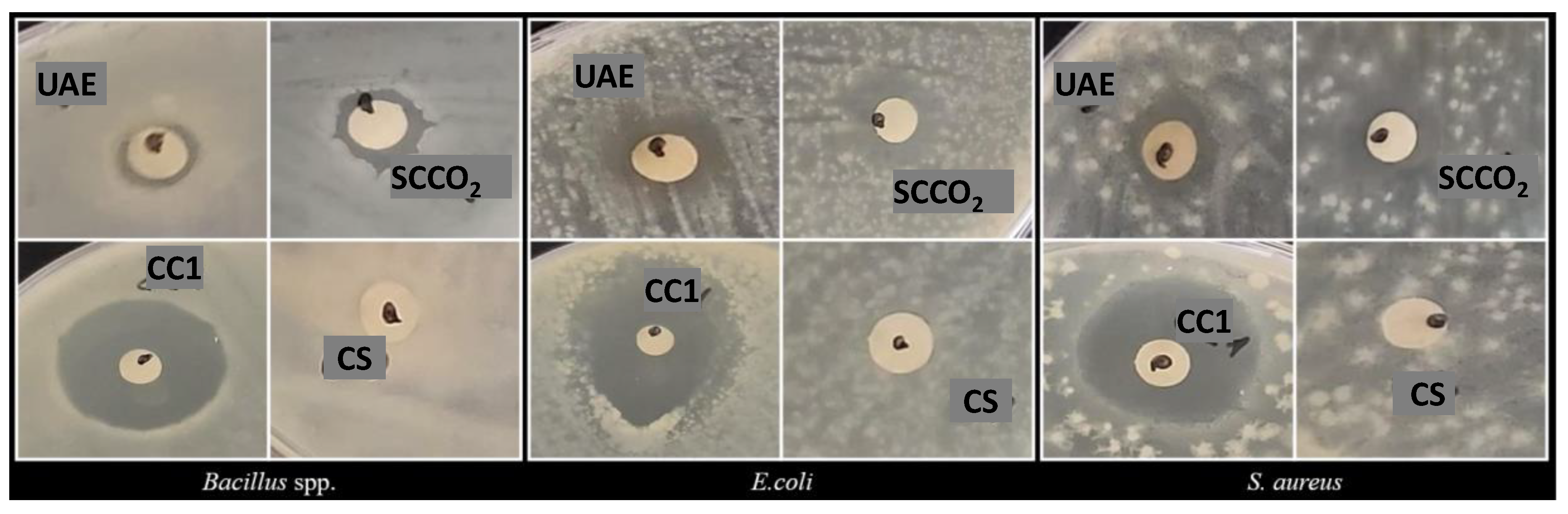
Table 4 and Figure 2 show the results of the antibacterial activity of myrtle berries extracts performed in Disk Diffusion Method. The statistical evaluation didn’t show significant differences in the diameter of inhibition zone between the UAE and SCCO2 extracts for the same bacterial strain. However, S. aureus was observed being the most sensitive bacterial strains against UAE extract antibacterial activity with an average of 12.00 ± 2.82 mm DIZ. Meanwhile, for SCCO2 extract the most sensitive out of the three bacterial strains was E. coli with 13.00 ± 0.03 mm DIZ. In both cases Bacillus spp. was the least sensitive bacterial strain showing a lower diameter of inhibition zone against UAE and SCCO2 extracts (9.00 ± 0.02 mm and 11.50 ± 0.71 mm, respectively).

4. Discussion

The yield obtained from solid-liquid ultrasound-assisted extraction of myrtle berries in this study was higher than those reported in the literature, where most extractions were performed using the maceration method. For instance, Pereira et al. [37], reported a yield of 8.52 ± 0.01% from ethanolic ultrasound-assisted maceration of myrtle berries. In another study, Babou et al. [38], obtained a yield of 15.71 %, and 36.86 % from the methanolic extraction of September and December, respectively from myrtle berries (M. communis var. italica), collected in Algeria. While the aqueous extract showed a yield of 21.74 %, and 35.38 % for September and December berries, respectively.
In their study, Pereira et al. [26], reported that using supercritical CO2 extraction for myrtle berries resulted in extraction yields ranging from 8.8 ± 0.5 % to 14.1 ± 0.9 %, higher compared to the extraction yield obtained in our supercritical CO2 pilot-plant extractor. In another study [39], using hydro distillation with a Clevenger apparatus on myrtle berries collected in Croatia, the authors reported an extraction yield for the essential oils varying from 0.03 – 0.13 % (w/w). The authors noted that the essential oil yield reached its peak in October and decreased rapidly thereafter. The literature indicates that the yield of extracts and essential oils can be significantly influenced by factors such as, extraction conditions, solvent used, and the season of collection. These elements also play a crucial role in determining the final phytochemical composition of the extracts and essential oils.
In the study conducted by Medda et al. [23], myrtle berry extracts obtained through maceration with acidified ethanol (0.1 % HCl) were collected from various varieties and altitudes in Sardinia. The TPC ranged from 33.46 to 35.43 mg GAE/g DW. The highest TAC in the berries was observed in the second week of December, with values ranging from 14.02 to 34.20 mg C3G/g DW, depending on the berry’s cultivar and geographical location. It was noted that while the TPC decreased, the TAC increased during the maturation of the berries. Amensour et al. [40], reported a TPC of 14.7 ± 0.4 mg GAE/g of extract for methanol, 9.0 ± 0.2 mg GAE/g for ethanol, and 15.7 ± 0.7 mg GAE/g for aqueous extract from myrtle berries collected in Morocco. The authors noted that the extraction yield of phenolic compounds increased with the polarity of the solvents, with the aqueous extract exhibiting the highest TPC and the ethanol extract showing the lowest. Curiel et al. [41], reported a TPC of 135.49 ± 2.35 mg GAE/g of DW from the acidified aqueous homogenate of myrtle berries. Polat et al. [42], explored different extraction solvents to isolate bioactive compounds from myrtle berries collected from various locations in Mersin, Turkey. Their findings indicated that the TPC for the acetone extract ranged from 114.00 ± 3.43 to 205.33 ± 1.78 mg GAE/g DW, while for ethanol it varied from 39.93 ± 4.61 to 148.87 ± 3.76 mg GAE/g DW, and for methanol from 52.33 ± 1.61 to 207.44 ± 2.07 mg GAE/g DW. The aqueous extract TPC ranged from 52.24 ± 0.89 to 169.80 ± 1.94 mg GAE/g DW. The authors noted that the ethanol extract exhibited the highest antioxidant activities and antibacterial effects against B. cereus, E. coli, S. aureus, and Y. enterocolitica. In contrast, Listeria monocytogenes and Salmonella showed greater sensitivity to the acetone extract of myrtle berries. In term of antioxidant activity Pereira et al. [37], reported that the UAE extract exhibited higher antioxidant activity compared to the SCCO2 extract. The authors attributed these results to the greater quantity of extracted phytochemicals with antioxidant properties, such as flavonoids, in the UAE extract, as opposed to the compound selectivity observed in supercritical extraction.
When comparing the findings reported in the literature, one possible explanation for the differences in TPC in our UAE may be due to the higher extraction yield achieved by adding acetic acid to modify the solvent’s polarity. Additionally, the extraction time plays a significant role; most studies in the literature utilize an extraction method that involves at least 8 hours of solid-liquid maceration. Phytochemical composition of plants extracts can vary due to several factors, including the extraction method, protocols used for the characterization, environmental conditions, and the geographical location where the plants grow.
Several published works have reported identified and quantified phytochemical compounds from the myrtle berries extracts. For instance, Babou et al. [38], reported from the HPLC-DAD analyses of the mature myrtle berries aqueous and hydro methanolic extract compounds like phenols acids (gallic acid, and ellagic acid), flavonoids( isomers of myricetin, isomers of quercetin, and kaempferol), anthocyanins (delphinidin-3-O-glucoside, and malvidin-3-O-glucoside). Compounds like gallic acid (4.54 ± 0.07 – 1.21 ± 0.02 mg/g DW), malvidin-3-O-glucoside (0.30 ± 0.03 – 0.32 ± 0.01 mg/g DW), quercetin and its isomers (ranging between 1.05 to 1.32 mg/g DW), detected also in our extract’s characterization were found in a higher content in UAE and/or SCCO2 extracts. Similar in the case of Curiel et al. [41], the content of gallic acid (0.17 ± 0.03 mg/g DW), and quercetin (0.20 ± 0.01 mg/g DW) reported from the HPLC analyses of the acidified myrtle berries aqueous homogenate was lower compared to the gallic acid content quantified in our UAE and SCCO2 extracts. Other compounds identified and quantified by the authors consists of vanillic acid (0.10 ± 0.02 mg/g DW), syringic acid (0.14 ± 0.04 mg/g DW), ellagic acid (1.44 ± 0.03 mg/g DW), myricetin (1.11 ± 0.02 mg/g DW), and catechin (1.12 ± 0.02 mg/g DW). The research conducted by D’Urso et al. [40], provide a diverse range of phytochemical compounds present in Myrtus communis berries using HPLC-ESI-Orbitrap-MS/MS analysis in both negative and positive ion modes. The research team reported the presence of hydrolyzable tannins including HHDP-hexose, monogalloylhexose, strictinin (galloyl-HHDP hexose), galloylquinic acid, tellimagrandin I, punicalin, pedunculagin (Bis HHDP hexose). Additional compounds include casuarictin, castalagin, tellimagrandin II (Trigalloyl HHDP hexose), ellagic acid hexoside, and ellagic acid. The team also identified gallomyrtucommulones, specifically gallomyrtucommulone C, as well as hydroxycinnamic acids like caffeoylhexose. Flavanols such as epigallocatechin, catechin/epicatechin, myricetin (in forms of galloylhexoside, hexoside, pentoside, deoxyhexoside, galloyl deoxyhexose, hexose deoxyhexose), alongside quercetin (in galloylhexoside, and hexoside forms). In addition, from the anthocyanins included petunidin pentoside, and in both hexoside, and pentoside of delphinidin, cyanidin, peonidin, malvidin. Some of the mention compounds are also identified and quantified in our extracts of myrtle berries from UAE and SCCO2.
The spectrophotometric characterization in our study indicates a higher TPC compared to the identification and quantification of polyphenolic compounds using RT-HPLC. Previous literature has noted that spectrophotometric assays, particularly those using the Folin-Ciocâlteu reagent, can overestimate the total phenolic content. This discrepancy may occur due to the interference of non-phenolic compounds, such as sugars, aromatic amines, ascorbic acid, sulfur dioxide, and certain inorganic substances [42,44]. Regarding the TAC measured by spectrophotometric means based on the pH differential protocol, it appears not to be a sensitive assay for the SCCO2 extract. The RT-HPLC characterization of the SCCO2 extract successfully identified and quantified four anthocyanin compounds, although in low concentration. Anthocyanins are polar compounds, generally extracted utilizing acidified solvents by adding organic or mineral acids. In lower pH conditions anthocyanins are in their stable flavylium form [45]. In supercritical extraction conditions, CO2 acts as a lipophilic solvent, and the addition of ethanol as cosolvent in the supercritical extraction has contributed in extracting low content of anthocyanin compounds. However, anthocyanins have been reported to be successfully extracted by supercritical CO2 extraction from different vegetal matrices such as roselle calyces [46], haskap berry [47], blueberry [48].
α-Amylase is an enzyme that hydrolyzes α-1,4 glycosidic bonds in carbohydrate polymers, such as starch, breaking them down into shorter oligomers like maltose, dextrins, and maltotriose. In humans, this enzyme is present in saliva and pancreatic juice. The products of α-amylase hydrolysis serve as substrates for α-glucosidase, which then produces glucose. Inhibiting the activities of these enzymes can effectively slow down the rate of starch hydrolysis, helping to control postprandial hyperglycemia. Many diabetes medications aim to restrict carbohydrate digestion and absorption. Some commonly used enzyme inhibitors in clinical treatment are acarbose, miglitol, and voglibose. However, the effectiveness of these medications is often accompanied by undesirable side effects, including abdominal distention, flatulence, meteorism, and diarrhea. Due to these significant side effects, researchers are exploring alternative therapies that have minimal or no harmful effects. Herbal therapies, in particular, appear to be effective while exhibiting fewer side effects, making them a cost-effective alternative to conventional hypoglycemic medications [49,50]. The IC50 of 3.91 ± 0.44 µg/mL for acarbose against α-amylase, reported by Serea et al. [33], using the same protocol applied to assess the antidiabetic activity of the myrtle extracts used in this study. Among the two extracts, the UAE extract exhibited the lowest IC50 at 8.37 ± 0.52 µg/mL DW, indicating potent inhibition of α-amylase activity. By inhibiting the enzymatic activity of α-amylase, the substrate availability for α-glucosidase hydrolysis would be significantly reduced, making the myrtle berry extract a promising alternative for controlling postprandial hyperglycemia.
Several published works have been conducted regarding the antibacterial properties of myrtle leaves and berries. For the antibacterial activity of the myrtle berries essential oil, performed on Disk Diffusion Method was reported a diameter of inhibition zone of 14.00 ± 0.65 mm for B. subtilis (ATCC 11778), 20.00 ± 0.20 mm for E. coli (ATCC 25922), and 19.50 ± 1.13 mm for S. aureus (ATCC 25923) [51]. While another study utilizing an aqueous extract from myrtle berries seeds, for the antibacterial activity against B. cereus (ATCC 1247), E. coli (ATCC 8739), and S. aureus (ATCC 29213), showed a diameter of inhibition zone of 17 ± 0.8 mm, 18 ± 0.8 mm, and 14 ± 0.9 mm, respectively [52]. When comparing the antibacterial activity reported in the literature, the results fall within a similar range of inhibition. The differences observed are attributed to factors such as the extraction method, the solubilization solution used for antibacterial assessment, the inoculum size, and the specific bacterial sub-species tested.
The SCCO2 method offers the advantage of producing solventless extracts that require minimal concentration processing, resulting in a dry by-product that can be used for further applications and minimizing environmental impact. Pure CO2 is inexpensive, and its recirculation in the system provides cost benefits. However, optimization tests are necessary to achieve higher extraction yields and selectivity for specific desired compounds. Similarly, optimization for UAE is needed to maximize the yield of the target compounds while minimizing extraction time. The recovery of the solvent used in solid-liquid extraction can also reduce process costs. Considering the implementation at an industrial scale, both extraction methods present benefits and challenges.

5. Conclusions

This study investigates the polyphenolic content, phytochemical characterization through RT-HPLC, and the antioxidant, antidiabetic, and antibacterial potential of wild myrtle berries collected in Albania, using two extraction methods.
The solid-liquid ultrasound-assisted extraction (UAE) with acidified ethanol demonstrated a high extraction yield, along with elevated content of total flavonoids and anthocyanins, and exhibited notable antidiabetic activity. On the other hand, the supercritical CO2 extraction (SCCO2) resulted in a higher total phenolic content and antioxidant activity as measured by the DPPH radical screening assay. RT-HPLC characterization successfully identified and quantified several phytochemical compounds, including phenolic acids, terpenoids, flavonoids, and anthocyanins from both UAE and SCCO2 extracts, as well as lipophilic compound from the SCCO2 extract. Both extraction methods displayed similar antimicrobial activity against the tested strains. The results obtained in this work support the potential of Myrtus communis berries extracts as an ingredient in functional food mainly for its antioxidant, antidiabetic, and antibacterial properties.
The findings of this study highlight the impact of the extraction method on the profile of bioactive compounds, which is crucial when selecting a technique for specific applications, such as antioxidant, antidiabetic, or antibacterial purposes. The UAE method appears to be more effective in extracting a wide range of phytochemical compounds, while SCCO2 captures a more limited but distinct profile of bioactive compounds that may be of particular interest.

Author Contributions

Conceptualization, L.M., N.S. and I.M.; methodology, N.S., L.M., M.C., M.T., G.C., and I.M.; software, I.M., G.C., M.C., and M.T.; validation, N.S.; formal analysis, I.M., M.C., M.T. and N.B.; investigation, I.M., M.C., M.T. and N.B.; resources, N.S., G.R., and L.M.; writing–original draft preparation, I.M.; writing—review and editing, N.S., and L.M.; visualization, N.S. and I.M.; supervision, L.M..; funding acquisition, N.S., L.M., and G.R. All authors have read and agreed to the published version of the manuscript.

Funding

The corresponding author is grateful for the financial support offered by the European Regional Development Fund 2014–2020, through Competitiveness Operational Programme (COP/163/1/3), Action 1.2.1: Innovative Technological Project, SINOVEG project, SMIS cod 119659, contract no. 326/390002/31.10.2020.

Data Availability Statement

Data will be available on request.

Acknowledgments

The Integrated Center for Research, Expertise and Technological Transfer in Food Industry is acknowledged for providing technical support. Also, the first author wants to thank Dhimitër Mërtiri, and Hatixhe Mërtiri for contributing to the sample collection process.

Conflicts of Interest

The authors declare no conflicts of interest.

References

  1. Sumbul, S.; Ahmad, M.; Asif, M.; Akhtar, M. Myrtus Communis Linn. ─ A Review.; 2011. 1 December.
  2. Al-Snafi, A.E.; Teibo, J.O.; Shaheen, H.M.; Akinfe, O.A.; Teibo, T.K.A.; Emieseimokumo, N.; Elfiky, M.M.; Al-kuraishy, H.M.; Al-Garbeeb, A.I.; Alexiou, A.; et al. The Therapeutic Value of Myrtus Communis L.: An Updated Review. Naunyn-Schmiedeberg’s Arch Pharmacol. [CrossRef]
  3. Hennia, A.; Nemmiche, S.; Dandlen, S.; Miguel, M.G. Myrtus Communis Essential Oils: Insecticidal, Antioxidant and Antimicrobial Activities: A Review. Journal of Essential Oil Research 2019, 31, 487–545. [Google Scholar] [CrossRef]
  4. Medda, S.; Mulas, M. Fruit Quality Characters of Myrtle (Myrtus Communis L.) Selections: Review of a Domestication Process. Sustainability 2021, 13, 8785. [Google Scholar] [CrossRef]
  5. Tuberoso, C.I.G.; Melis, M.; Angioni, A.; Pala, M.; Cabras, P. Myrtle Hydroalcoholic Extracts Obtained from Different Selections of Myrtus Communis L. Food Chemistry 2007, 101, 806–811. [Google Scholar] [CrossRef]
  6. Mashhadi, H.; Nourabi, A.; Mohammadi, M.; Tabibiazar, M.; Varvani Farahani, A. Incorporation of Myrtle Essential Oil into Hydrolyzed Ethyl Cellulose Films for Enhanced Antimicrobial Packaging Applications 2023.
  7. Zam, W.; Ali, A. Evaluation of Mechanical, Antioxidant and Antimicrobial Properties of Edible Film Containing Myrtle Berries Extract. The Natural Products Journal 2018, 8, 323–330. [Google Scholar] [CrossRef]
  8. Ali, A.; Zam, W.; Ibrahim, W. Formulation and Evaluation of Chewable Lozenges Containing Myrtle Berries, Cinnamon and Cloves for Oral Disinfection. 2022, 1. 1.
  9. De Luca, M.; Lucchesi, D.; Tuberoso, C.I.G.; Fernàndez-Busquets, X.; Vassallo, A.; Martelli, G.; Fadda, A.M.; Pucci, L.; Caddeo, C. Liposomal Formulations to Improve Antioxidant Power of Myrtle Berry Extract for Potential Skin Application. Pharmaceutics 2022, 14, 910. [Google Scholar] [CrossRef]
  10. Haririan, Y.; Asefnejad, A.; Hamishehkar, H.; Farahpour, M.R. Carboxymethyl Chitosan-Gelatin-Mesoporous Silica Nanoparticles Containing Myrtus Communis L. Extract as a Novel Transparent Film Wound Dressing. International Journal of Biological Macromolecules 2023, 253, 127081. [Google Scholar] [CrossRef]
  11. Wissam, Z. WOUND DRESSINGS UPLOADED WITH MYRTLE BERRIES EXTRACT AND NIGELLA SATIVA HONEY. In Proceedings of the Universal Journal of Pharmaceutical Research; May 15 2018; Vol. 3; p. 12. [Google Scholar]
  12. Correddu, F.; Fancello, F.; Chessa, L.; Atzori, A.S.; Pulina, G.; Nudda, A. Effects of Supplementation with Exhausted Myrtle Berries on Rumen Function of Dairy Sheep. Small Ruminant Research 2019, 170, 51–61. [Google Scholar] [CrossRef]
  13. Dabbaghi, M.M.; Fadaei, M.S.; Soleimani Roudi, H.; Baradaran Rahimi, V.; Askari, V.R. A Review of the Biological Effects of Myrtus Communis. Physiological Reports 2023, 11, e15770. [Google Scholar] [CrossRef]
  14. Awad, A.M.; Kumar, P.; Ismail-Fitry, M.R.; Jusoh, S.; Ab Aziz, M.F.; Sazili, A.Q. Green Extraction of Bioactive Compounds from Plant Biomass and Their Application in Meat as Natural Antioxidant. Antioxidants 2021, 10, 1465. [Google Scholar] [CrossRef]
  15. Jha, A.K.; Sit, N. Extraction of Bioactive Compounds from Plant Materials Using Combination of Various Novel Methods: A Review. Trends in Food Science & Technology 2022, 119, 579–591. [Google Scholar] [CrossRef]
  16. Alara, O.R.; Abdurahman, N.H.; Ukaegbu, C.I. Extraction of Phenolic Compounds: A Review. Current Research in Food Science 2021, 4, 200–214. [Google Scholar] [CrossRef] [PubMed]
  17. Bitwell, C.; Indra, S.S.; Luke, C.; Kakoma, M.K. A Review of Modern and Conventional Extraction Techniques and Their Applications for Extracting Phytochemicals from Plants. Scientific African 2023, 19, e01585. [Google Scholar] [CrossRef]
  18. Martins, R.; Barbosa, A.; Advinha, B.; Sales, H.; Pontes, R.; Nunes, J. Green Extraction Techniques of Bioactive Compounds: A State-of-the-Art Review. Processes 2023, 11, 2255. [Google Scholar] [CrossRef]
  19. Ojha, K.S.; Aznar, R.; O’Donnell, C.; Tiwari, B.K. Ultrasound Technology for the Extraction of Biologically Active Molecules from Plant, Animal and Marine Sources. TrAC Trends in Analytical Chemistry 2020, 122, 115663. [Google Scholar] [CrossRef]
  20. Majid, I.; Khan, S.; Aladel, A.; Dar, A.H.; Adnan, M.; Khan, M.I.; Mahgoub Awadelkareem, A.; Ashraf, S.A. Recent Insights into Green Extraction Techniques as Efficient Methods for the Extraction of Bioactive Components and Essential Oils from Foods. CyTA - Journal of Food 2023, 21, 101–114. [Google Scholar] [CrossRef]
  21. Chuo, S.C.; Nasir, H.M.; Mohd-Setapar, S.H.; Mohamed, S.F.; Ahmad, A.; Wani, W.A.; Muddassir, Mohd. ; Alarifi, A. A Glimpse into the Extraction Methods of Active Compounds from Plants. Critical Reviews in Analytical Chemistry 2022, 52, 667–696. [Google Scholar] [CrossRef]
  22. Essien, S.O.; Young, B.; Baroutian, S. Recent Advances in Subcritical Water and Supercritical Carbon Dioxide Extraction of Bioactive Compounds from Plant Materials. Trends in Food Science & Technology 2020, 97, 156–169. [Google Scholar] [CrossRef]
  23. Medda, S.; Fadda, A.; Dessena, L.; Mulas, M. Quantification of Total Phenols, Tannins, Anthocyanins Content in Myrtus Communis L. and Antioxidant Activity Evaluation in Function of Plant Development Stages and Altitude of Origin Site. Agronomy 2021, 11, 1059. [Google Scholar] [CrossRef]
  24. Mihalcea, L.; Turturică, M.; Cucolea, E.I.; Dănilă, G.-M.; Dumitrașcu, L.; Coman, G.; Constantin, O.E.; Grigore-Gurgu, L.; Stănciuc, N. CO2 Supercritical Fluid Extraction of Oleoresins from Sea Buckthorn Pomace: Evidence of Advanced Bioactive Profile and Selected Functionality. Antioxidants 2021, 10, 1681. [Google Scholar] [CrossRef]
  25. Ghasemi, E.; Raofie, F.; Najafi Mashkouri, N. Application of response surface methodology and central composite design for the optimisation of supercritical fluid extraction of essential oils from Myrtus communis L. leaves. Food Chemistry, 1453. [Google Scholar] [CrossRef]
  26. Pereira, P.; Cebola, M.-J.; Oliveira, M.C.; Bernardo-Gil, M.G. Supercritical Fluid Extraction vs Conventional Extraction of Myrtle Leaves and Berries: Comparison of Antioxidant Activity and Identification of Bioactive Compounds. The Journal of Supercritical Fluids 2016, 113, 1–9. [Google Scholar] [CrossRef]
  27. Pereira, P; Mauricio Muchagato E.; Duarte M.P.; Lima K.; Fernandes A.; Bernardo-Gil G.; Cebola M.J. Potential of supercritical fluid myrtle extracts as an active ingredient and co-preservative for cosmetic and topical pharmaceutical applications. Sustainable Chemistry and Pharmacy, 1007; 39. [CrossRef]
  28. Radzali Azfar, S.; Markom, M.; Md Saleh, N. Co-Solvent Selection for Supercritical Fluid Extraction (SFE) of Phenolic Compounds from Labisia pumila. Molecules 2020, 25, 5859. [Google Scholar] [CrossRef] [PubMed]
  29. Stoica, F.; Condurache, N.N.; Horincar, G.; Constantin, O.E.; Turturică, M.; Stănciuc, N.; Aprodu, I.; Croitoru, C.; Râpeanu, G. Value-Added Crackers Enriched with Red Onion Skin Anthocyanins Entrapped in Different Combinations of Wall Materials. Antioxidants 2022, 11, 1048. [Google Scholar] [CrossRef] [PubMed]
  30. Yangui, I.; Younsi, F.; Ghali, W.; Boussaid, M.; Messaoud, C. Phytochemicals, Antioxidant and Anti-Proliferative Activities of Myrtus Communis L. Genotypes from Tunisia. South African Journal of Botany 2021, 137, 35–45. [Google Scholar] [CrossRef]
  31. PubChem Cyanidin 3-Glucoside Available online:. Available online: https://pubchem.ncbi.nlm.nih.gov/compound/12303220 (accessed on 12 February 2024).
  32. Mërtiri, I.; Păcularu-Burada, B.; Stănciuc, N. Phytochemical Characterization and Antibacterial Activity of Albanian Juniperus Communis and Juniperus Oxycedrus Berries and Needle Leaves Extracts. Antioxidants 2024, 13, 345. [Google Scholar] [CrossRef]
  33. Serea, D.; Condurache, N.N.; Aprodu, I.; Constantin, O.E.; Bahrim, G.-E.; Stănciuc, N.; Stanciu, S.; Rapeanu, G. Thermal Stability and Inhibitory Action of Red Grape Skin Phytochemicals against Enzymes Associated with Metabolic Syndrome. Antioxidants 2022, 11, 118. [Google Scholar] [CrossRef]
  34. Hannan, A.; Asghar, S.; Tahir, N.; Ikram Ullah, M.; Ahmed, I.; Aneela, S.; Hussain, S. Antibacterial Effect of Mango (Mangifera Indica Linn.) Leaf Extract against Antibiotic Sensitive and Multi-Drug Resistant Salmonella Typhi. Pakistan journal of pharmaceutical sciences 2013, 26, 715–719. [Google Scholar]
  35. Masota, N.E.; Vogg, G.; Ohlsen, K.; Holzgrabe, U. Reproducibility Challenges in the Search for Antibacterial Compounds from Nature. PLoS ONE 2021, 16, e0255437. [Google Scholar] [CrossRef]
  36. Bhavya, M.L.; Chandu, A.G.S.; Devi, S.S.; Quirin, K.-W.; Pasha, A.; Vijayendra, S.V.N. In-Vitro Evaluation of Antimicrobial and Insect Repellent Potential of Supercritical-Carbon Dioxide (SCF-CO2) Extracts of Selected Botanicals against Stored Product Pests and Foodborne Pathogens. J Food Sci Technol 2020, 57, 1071–1079. [Google Scholar] [CrossRef]
  37. Pereira, P.; Cebola, M.-J.; Oliveira, M.C.; Bernardo Gil, M.G. Antioxidant Capacity and Identification of Bioactive Compounds of Myrtus Communis L. Extract Obtained by Ultrasound-Assisted Extraction. J Food Sci Technol 2017, 54, 4362–4369. [Google Scholar] [CrossRef]
  38. Babou, L.; Hadidi, L.; Grosso, C.; Zaidi, F.; Valentão, P.; Andrade, P.B. Study of Phenolic Composition and Antioxidant Activity of Myrtle Leaves and Fruits as a Function of Maturation. Eur Food Res Technol 2016, 242, 1447–1457. [Google Scholar] [CrossRef]
  39. Jerkovic, I.; Radonic, A.; Borcic, I. Comparative Study of Leaf, Fruit and Flower Essential Oils of Croatian Myrtus Communis (L.) During a One-Year Vegetative Cycle. Journal of Essential Oil Research 2002, 14, 266–270. [Google Scholar] [CrossRef]
  40. Amensour, M.; Sendra, E.; Abrini, J.; Bouhdid, S.; Pérez-Alvarez, J.A.; Fernández-López, J. Total Phenolic Content and Antioxidant Activity of Myrtle ( Myrtus Communis ) Extracts. Natural Product Communications 2009, 4, 1934578X0900400. [Google Scholar] [CrossRef]
  41. Curiel, J.A.; Pinto, D.; Marzani, B.; Filannino, P.; Farris, G.A.; Gobbetti, M.; Rizzello, C.G. Lactic Acid Fermentation as a Tool to Enhance the Antioxidant Properties of Myrtus Communis Berries. Microbial Cell Factories 2015, 14, 67. [Google Scholar] [CrossRef]
  42. Polat, B.; Oba, S.; Karaman, K.; Arici, M.; Sagdic, O. Comparison of Different Solvent Types for Determination Biological Activities of Myrtle Berries Collected from Turkey. Quality Assurance and Safety of Crops & Foods 2014, 6, 221–227. [Google Scholar] [CrossRef]
  43. D’Urso, G.; Sarais, G.; Lai, C.; Pizza, C.; Montoro, P. LC-MS Based Metabolomics Study of Different Parts of Myrtle Berry from Sardinia (Italy). JBR 2017, 7, 217–229. [Google Scholar] [CrossRef]
  44. Antony, A.; Farid, M. Effect of Temperatures on Polyphenols during Extraction. Applied Sciences 2022, 12, 2107. [Google Scholar] [CrossRef]
  45. Alappat, B.; Alappat, J. Anthocyanin Pigments: Beyond Aesthetics. Molecules 2020, 25, 5500. [Google Scholar] [CrossRef]
  46. Idham, Z.; Putra, N.R.; Aziz, A.H.A.; Zaini, A.S.; Rasidek, N.A.M.; Mili, N.; Yunus, M.A.C. Improvement of Extraction and Stability of Anthocyanins, the Natural Red Pigment from Roselle Calyces Using Supercritical Carbon Dioxide Extraction. Journal of CO2 Utilization 2022, 56, 101839. [Google Scholar] [CrossRef]
  47. Jiao, G.; Kermanshahi Pour, A. Extraction of Anthocyanins from Haskap Berry Pulp Using Supercritical Carbon Dioxide: Influence of Co-Solvent Composition and Pretreatment. LWT 2018, 98, 237–244. [Google Scholar] [CrossRef]
  48. Paes, J.; Dotta, R.; Barbero, G.F.; Martínez, J. Extraction of Phenolic Compounds and Anthocyanins from Blueberry (Vaccinium Myrtillus L.) Residues Using Supercritical CO2 and Pressurized Liquids. The Journal of Supercritical Fluids 2014, 95, 8–16. [Google Scholar] [CrossRef]
  49. Li, X.; Bai, Y.; Jin, Z.; Svensson, B. Food-Derived Non-Phenolic α-Amylase and α-Glucosidase Inhibitors for Controlling Starch Digestion Rate and Guiding Diabetes-Friendly Recipes. LWT 2022, 153, 112455. [Google Scholar] [CrossRef]
  50. Kashtoh, H.; Baek, K.-H. New Insights into the Latest Advancement in α-Amylase Inhibitors of Plant Origin with Anti-Diabetic Effects. Plants 2023, 12, 2944. [Google Scholar] [CrossRef] [PubMed]
  51. Toauibia, M. Antimicrobial Activity of the Essential Oil of Myrtus Communis L Berries Growing Wild in Algeria. J. Fundam and Appl Sci. 2015, 7, 150. [Google Scholar] [CrossRef]
  52. Jabri, M.-A.; Rtibi, K.; Ben-Said, A.; Aouadhi, C.; Hosni, K.; Sakly, M.; Sebai, H. Antidiarrhoeal, Antimicrobial and Antioxidant Effects of Myrtle Berries (Myrtus Communis L.) Seeds Extract. Journal of Pharmacy and Pharmacology 2016, 68, 264–274. [Google Scholar] [CrossRef]
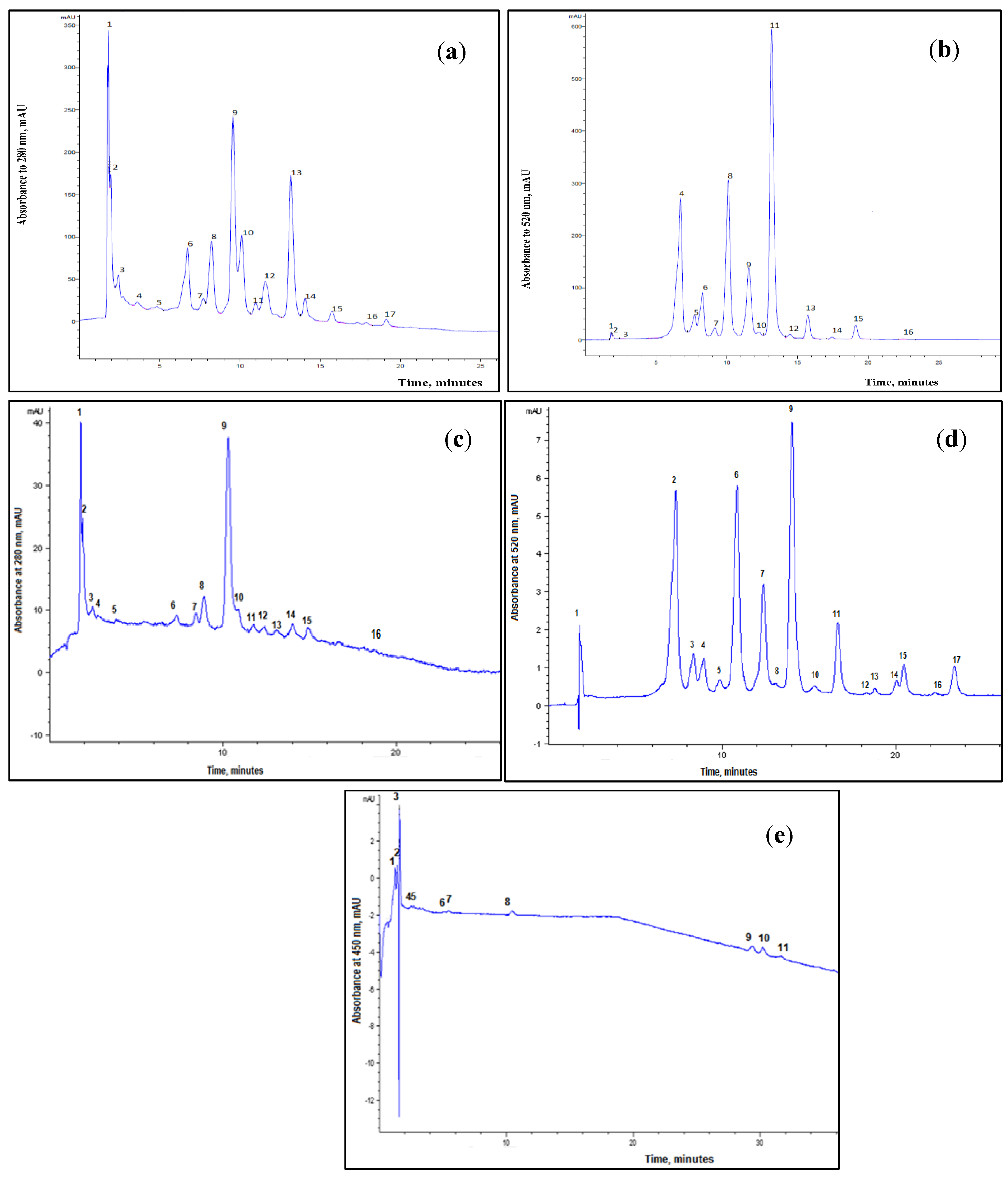
Figure 1. Chromatograms of wild myrtle berries extracts. UAE extract (a) 280 nm, 2 – gallic acid, 5 – epicatechin, 8 – ferulic acid, 10 – synapic acid, 1, 3, 4, 6–7, 9, 11-17- unidentified compounds. (b) 520 nm, 2 – gallic acid, 7 – kuromanin chloride, 8 – synapic acid, 10 – naringin, 11 – rutin trihydrate, 12 – peonidin-3-O-rutinoside chloride, 15 – quercetin, 1, 3–6, 9, 13–14, 16 – unidentified compound. SCCO2 extract (c) 280 nm, 1 – cafestol, 2 – gallic acid, 7 – ferulic acid, 16 – quercetin, 3–6, 8–15 – unidentified compounds. (d) 520 nm, 4 – kuromanin chloride, 5 – callistephin chloride, 9 – oenin chloride, 1–3, 6–8, 10–17 – unidentified compounds; (e) 450 nm: 8 – zeaxanthin, 1–7, 9–11 – unidentified compounds.
Preprints 141563 g001
Figure 2. Antibacterial results of Disk Diffusion Method against the tested bacterial strains. The samples codes represent: CC1- Ciprofloxacin (positive control); CS- solubilization solvent (negative control).
Preprints 141563 g002
Table 1. Extraction yield and global characterization of the myrtle berries extracts.
UAE SCCO2
Extraction Yield (%) 62.84 0.54
TPC (mg GAE/g DW) 5.57 ± 0.13 B 11.59 ± 0.12 A
TFC (mg QE/g DW) 4.13 ± 0.67 A 1.09 ± 0.18 B
TAC (mg C3G/g DW) 2.17 ± 0.05 n.d.
DPPH (mg TE/g DW) 13.64 ± 1.91 B 21.81 ± 0.31 A
The results for the global characterization are expressed as average values for triplicate measurements ± standard deviation. Uppercase letters, in the same row, are used for statistical comparisons between the extraction methods. Means that do not share a letter are significantly different based on Tukey test (p > 0.01).
Table 2. RT-HPLC characterization of the myrtle berries extracts.
Identified Compounds UAE SCCO2
Phenolic acids
4-Hydroxybenzoic acid 24.00 ± 0.03 G n.d.
Caffeic acid 0.63 ± 0.03 R n.d.
Ferulic acid 3.69 ± 0.31 M 0.30 ± 0.03 I
Gallic acid 11.64 ± 0.03 I 1.70 ± 0.73 B
Protocatechuic acid 24.45 ± 0.01 F n.d.
Sinapic acid 2.17 ± 0.10 P 1.29 ± 0.14 C
Terpenoid
Cafestol 256.92 ± 5.33 B 29.65 ± 0.03 A
Flavonoid
Apigenin 3.73 ± 0.03 L n.d.
Epicatechin 14.39 ± 0.01 H n.d.
Epicatechin gallate 79.73 ± 0.04 C n.d.
Epigallocatechin 2656.24 ± 28.15 A n.d.
Naringin 7.00 ± 0.04 J n.d.
Quercetin 0.66 ± 0.16 Q 0.60 ± 0.03 F
Rutin trihydrate
(Quercetin-3-rutinoside trihydrate)
25.55 ± 0.49 E n.d.
Anthocyanins
Cyanidin 3-O-glucoside chloride
(Kuromanin chloride)
3.94 ± 0.01 K 0.41 ± 0.01 H
Cyanidin-3-O-rutinoside chloride
(Keracyanin chloride)
36.09 ± 0.07 D 0.62 ± 0.01 E
Malvidin-3-O-glucoside chloride
(Oenin chloride)
n.d. 0.66 ± 0.04 D
Pelargonidin 3-O-glucoside chloride
(Callistephin chloride)
n.d. 0.55 ± 0.11 G
Peonidin 3-O-glucoside chloride 3.44 ± 1.36 N n.d.
Peonidin-3-O-rutinoside chloride 3.05 ± 0.01 O n.d.
Carotenoids
Zeaxanthin n.d. 0.28 ± 0.02 J
The results are expressed in µg/g DW, as average values for duplicate measurements ± standard deviation; n.d. — not detected. Uppercase letters in the same column, are used for statistical comparisons between the different compounds in one extraction method. Means that do not share a letter are significantly different based on the Games–Howell test (p < 0.01).
Table 3. Inhibitory activity of the extracts against α-amylase.
µg/mL DW UAE SCCO2
3.33 21.32 ± 4.63 A 16.69 ± 2.00 A
6.66 36.74 ± 0.92 A 19.86 ± 4.14 A
10.00 64.59 ± 2.19 A 22.25 ± 0.97 B
13.33 91.98 ± 1.47 A 26.80 ± 2.30 B
16.66 96.30 ± 5.64 A 31.17 ± 1.63 B
IC50 8.37 ± 0.52 27.27 ± 1.31
The results for the enzymatic activity inhibition are expressed in percentage (%), and the IC50 value expressed in µg/m DW, as average values for duplicate measurements ± standard deviation. Uppercase letters in the same row, are used for statistical comparisons between the different extraction method. Means that do not share a letter are significantly different based on the Games–Howell test (p < 0.01).
Table 4. Results of antibacterial activity on Disk Diffusion Method.
Diameter of Inhibition Zone (DIZ mm)
Bacillus spp. E. coli S. aureus
UAE 9.00 ± 0.02 C, a 10.50 ± 0.71 B, a 12.00 ± 2.82 A, a
SCCO2 11.50 ± 0.71 C, a 13.00 ± 0.03 A, a 12.00 ± 1.41 B, a
Ciprofloxacin 25.00 ± 0.01 35.00 ± 0.01 20.00 ± 0.03
Solvent n.d. n.d. n.d.
The results are expressed as average values for duplicate measurements ± standard deviation; n.d. — not detected; disk diameter — 6.00 mm. Uppercase letters, in the same row, are used for statistical comparisons between the different bacterial strains in one sample. Lowercase letters, in the same column, are used for statistical comparisons between the extraction methods. The controls were not included in the statistical evaluation. Means that do not share a letter are significantly different based on Game-Howell method (p < 0.01).
Disclaimer/Publisher’s Note: The statements, opinions and data contained in all publications are solely those of the individual author(s) and contributor(s) and not of MDPI and/or the editor(s). MDPI and/or the editor(s) disclaim responsibility for any injury to people or property resulting from any ideas, methods, instructions or products referred to in the content.
Copyright: This open access article is published under a Creative Commons CC BY 4.0 license, which permit the free download, distribution, and reuse, provided that the author and preprint are cited in any reuse.
Prerpints.org logo

Preprints.org is a free preprint server supported by MDPI in Basel, Switzerland.

Subscribe

Disclaimer

Terms of Use

Privacy Policy

Privacy Settings

© 2025 MDPI (Basel, Switzerland) unless otherwise stated