

Submitted:
03 December 2024
Posted:
03 December 2024
Read the latest preprint version here
Abstract
Physical activity is an essential part of a healthy lifestyle. Regular exercise and physical activity have many benefits for the body and mind. This study examined the possible mediating effects of self-control and forms of emotion regulation on life satisfaction. 186 adults participated in the online survey, answering questions about regular participation in physical activity and completing questionnaires assessing self-control, emotional regulation, and life satisfaction. The Satisfaction with Life Scale and the Brief Self-Control Scale were used to assess life satisfaction and dispositional self-control. The Emotion Regulation Questionnaire was used to measure two different forms of emotion regulation, including cognitive reappraisal and expressive suppression. Based on self-reported average minutes spent exercising per week, subjects were classified into four levels of physical activity according to World Health Organization guidelines. The mediation analysis results showed that dispositional self-control and cognitive reappraisal fully mediated the relationship between the level of physical activity and life satisfaction. This suggests that regular physical activity may increase levels of self-control and cognitive reappraisal, which in turn leads to greater life satisfaction. These findings highlight the importance of regular exercise in promoting well-being and increasing life satisfaction through its beneficial effects on self-control and emotional regulation.
Keywords:
physical activity
; life satisfaction
; self-control
; emotion regulation
; expressive suppression
; cognitive reappraisal
1. Introduction
Researchers have focused on satisfaction with life for many years, but despite numerous studies, it remains a vague concept and a subject of ongoing investigation. Life satisfaction involves the assessment of an individual’s life quality based on their personal criteria. It plays a crucial role in psychological and subjective well–being, being linked with a positive attitude toward life and the absence of negative feelings [1,2]. The evaluation of personal life satisfaction can involve different aspects, including health, relationships, and financial circumstances, and it can be measured regarding the past, present, and future. Individuals merge assessments of various areas of their lives and synthesize them to form an overall perception of life satisfaction. This broad sense of satisfaction can be quantitatively measured using a single–scale self–report tool [3].
One of the factors that may be important in achieving a high level of life satisfaction is leisure-time physical activity at an appropriate intensity. Current research shows that regular exercise benefits both physical and mental health. Participation in sports training reduces stress and positively impacts satisfaction with life [4,5]. Physical activity has important implications for well-being regardless of age, and on days when people were more physically active than typical, they reported greater life satisfaction [6]. During emerging adulthood (18-25 years), people’s global assessments of their well-being appear to deteriorate more than at any other time, but daily physical activity has a positive impact on emerging adults’ life satisfaction [7]. Additional research findings, also including longitudinal studies indicate that engaging in long–term and regular physical activity is linked to higher subjective well–being and more effective coping with negative emotions [8,9,10,11].
The link between physical activity and life satisfaction seems to be well established, so it is now worth focusing on finding factors that might further explain this relationship. Accordingly, the authors looked for mediators between physical activity and life satisfaction by analyzing different determinants. Deng et al. (2023) explored how physical activity influences life satisfaction through self-efficacy and resilience. Using validated scales and statistical analyses, the study found that physical activity positively impacts life satisfaction, both directly and indirectly. Self-efficacy and resilience were identified as mediators in this relationship, with a significant effect of these factors amplifying the impact of physical activity on life satisfaction [12]. Other results indicated that physical activity positively impacts self-esteem and life satisfaction while reducing social-physique anxiety. Social-physique anxiety was found to mediate the relationship between physical activity and life satisfaction, while self-esteem mediated the link between social-physique anxiety and life satisfaction. These findings highlight the dual pathways through which physical activity promotes psychological well-being. By mitigating social-physique anxiety and fostering self-esteem, physical activity directly and indirectly improves life satisfaction [13].
The researchers recommend that the causal relationship between sports participation and psychosocial health should be further investigated and that the conceptual model of health through sport should be tested [5]. Therefore, in this article, we will try to clarify the mechanism by which physical activity may influence life satisfaction and look for psychological variables that may mediate this relationship.
The increase in life satisfaction resulting from physical activity can be explained firstly by the fact that regular participation in sports is associated with enhancing an individual’s overall health status, which has a considerable influence on their life satisfaction [14]. Individuals afflicted with severe or chronic illnesses have significantly worse subjective well–being and lower satisfaction with life [14,15,16]. In addition, people often train in sports clubs where they experience social integration, which may enhance well–being by reducing feelings of loneliness and fulfilling the need to belong [4,17,18,19].
One of the most important psychological variables related to life satisfaction is self–control which can be defined as the ability to change one’s behaviors or reactions and suppress undesirable impulses to adjust to a given situation effectively. Self–control plays a crucial role in motivational conflicts where individuals need to resist a pleasurable temptation in order to satisfy a long–term goal [20,21]. Individuals who control their reactions less frequently are considered to have lower dispositional self–control [21,22]. Self–control positively contributes to well–being through dealing with motivational conflicts and its level is a significant predictor of satisfaction with life [20].
In addition to self-control, emotion regulation is an important factor that contributes to life satisfaction. Emotion regulation refers to the set of processes involved in monitoring, evaluating, and modifying emotional reactions by initiating, suppressing, or modulating them [23,24]. The emotion regulation model developed by James Gross is one of the most widely accepted approaches to understanding how people regulate their emotions. The author suggests that emotions develop over time and can be influenced at different stages. Within this model, Gross focuses on two common forms of emotion regulation. The first strategy is cognitive modification, or reinterpreting a situation to change its emotional meaning, which also plays a key role. For example, a stressful situation such as giving a public speech can be seen not as a potential failure but as an opportunity to demonstrate one’s abilities. A second strategy is response modulation, which involves controlling the expression of emotions and the body’s physiological responses. This may involve, for example, inhibiting anger or hiding sadness [25]. Different emotion regulation strategies have different consequences for well-being, interpersonal relationships, and mental health. Strategies such as reappraisal (cognitive change) tend to be more adaptive than strategies such as expressive suppression (response modulation) [26,27,28].
Studies show that engaging in physical activity can have positive effects not only in terms of well-being but also in terms of self-regulation [29]. The level of self-control is positively associated with physical activity. People exercise more on days when their self-control is high than on days when their self-control is low [30]. In addition, people with low self-control can benefit from physical activity. Research indicates that regular physical activity could improve self–control. Three months of martial arts training can directly improve self–control in elementary school students [31], and five weeks of aerobic exercise may be a potentially effective intervention for enhancing self–control in college students [32]. Other studies indicate that light to moderate exercise may be beneficial for executive control functions, that may be linked with higher dispositional self–control [33,34]. Regular physical activity can be beneficial for emotional regulation, by promoting its adaptive forms [35]. Making progress in training requires a high level of self–regulation and self–motivation [36,37,38]. Therefore, self–control and emotional regulation may play an important role in the relationship between physical activity and life satisfaction.
The main objective of this study was to examine the possible intermediate impact of self–control and two common forms of emotion regulation: cognitive reappraisal and expressive suppression on the relationship between involvement in regular physical activity and satisfaction with life. For this purpose, we examined individuals classified into three groups based on their average training time, as well as a control group of individuals who did not regularly participate in any training. We then aimed to determine whether self–control and emotion regulation mediate the effect of involvement in physical activity on life satisfaction.
2. Materials and Methods
2.1. Participants
The research was conducted on a group of 186 adults (91% women) who completed the survey. The mean age of respondents was 20.7 (SD = 2.92). 56 subjects (mean age 20.5, with standard deviation 2.40) attended regular training (32% under coach supervision) for at least 1 year (mean 6.21). The control group consisted of 130 people (mean age 20.8, with a standard deviation of 3.12) who did not engage in regular physical activity.
2.2. Data Collection
The data was collected via online social networking mainly among university students, using an online survey platform: Lime Survey. Participants completed the survey anonymously, providing background information about age and gender. No personal information was collected to identify respondents. The first page of the web-based survey form informed participants that their participation in the study is voluntary and confidential and that they may withdraw from the study at any time. Before the survey, participants confirmed having read the study information and participation rules and agreed to participate voluntarily. Considering research ethics, ethical approval was provided by the University of the National Education Commission, Krakow.
2.3. Measurements
First, we asked questions related to the background information including participants’ age, gender, place of living, and participation in regular physical activities for at least 1 year. Then respondents answered self–report questionnaires concerning the variables studied.
2.3.1. The Level of Involvement in Physical Activity
Physical activity level (PA level) was assessed by the number of minutes spent training per week. The level of physical activity was determined on four grades concerning WHO guidelines on physical activity and sedentary behavior [39]: 0 – non-active individuals (not engaging in regular physical activity); 1 – less-active individuals (engaging in regular physical activity below WHO guidelines); 2 – active individuals (engaging in regular physical activity by WHO guidelines); 3 – more-active individuals (engaging in regular physical activity beyond WHO guidelines).
2.3.2. Satisfaction with Life Scale
To measure the cognitive–judgmental aspect of subjective well–being we used The Satisfaction With Life Scale (SWLS) developed by Diener et al. (1985). and adapted into Polish by Jankowski [40]. This questionnaire contains five positively worded statements rated on a seven–point Likert–type scale. The summed score ranges from 5 to 35, with higher values indicating greater satisfaction with life. The Polish version of SWLS has good internal consistency (Cronbach alpha: 0.86) and temporal stability. Test–retest reliability in 3–week intervals was 0.85–0.93; in 6–week intervals it was 0.87–0.88; in the 9–week interval, it was 0.86 [40].
2.3.3. Brief Self–Control Scale
To measure dispositional self–control, we used the Brief Self–Control Scale (BSCS) developed by Tangney et al. [21] and adapted into Polish by Pilarska and Baumeister [41]. This questionnaire contains thirteen statements (nine negatively worded) rated on a five–point Likert–type scale. After reverse coding of negatively worded statements and summed all answers, we obtain a total score (high values reflect greater self–control). The Polish version of BSCS has good internal consistency (Cronbach alpha: 0.84) and satisfactory temporal stability in a 2–week test–retest (Pearson correlation for test–retest: 0.87).
2.3.4. Emotion Regulation Questionnaire
To assess aspects of emotion regulation, we used the Emotion Regulation Questionnaire (ERQ) developed by Gross and John [26] and translated into Polish by Kobylińska using a back translation procedure [42]. This questionnaire contains ten statements rated on a seven–point Likert–type scale and assesses two aspects of emotion regulation: “Suppression” (four questionnaire items) and “Reappraisal” (six questionnaire items). Higher scores indicate a stronger tendency to use expressive suppression and cognitive reappraisal. The internal consistency of the ERQ scales, as assessed by Cronbach’s α was 0.77 for Reappraisal and 0.74 for Suppression [43].
2.4. Statistical Analysis
First, descriptive statistics of the scores on the scales of the questionnaire tool were analyzed. Means with 95% confidence intervals and medians were used as measures of central tendency. Standard deviations and interquartile ranges were used to describe the dispersion of scores. Skewness and kurtosis were used to examine the shape of the distribution of the scores and their possible deviations from normality. Correlation analysis was then performed with a two–tailed significance test and 95% confidence intervals between the scores on the scales of the questionnaire tool and the amount of time spent in regular physical activity and life satisfaction. Pearson’s or Spearman’s correlation coefficients were used, depending on the level of measurement of the variables studied. A p–value of < 0.05 was used as the threshold for statistical significance.
Mediation analysis in the structural equation modeling approach was then used to test whether self–control, suppression, and reappraisal mediated the impact of the amount of time spent in regular physical activity on satisfaction with life. Therefore, in our analytical approach, the categorized amount of time spent in regular physical activity was the explanatory variable, the SWLS scores were the response variable, while the BSCS scores and the two ERQ subscales were the mediating variables. As the level of measurement of the categorized amount of time spent in regular physical activity was ordinal, the diagonally weighted least squares (DWLS) estimation method was chosen. Standardized parameter estimates for indirect, direct, and total effects were calculated and then tested for significance using bootstrapped 95% confidence intervals. The accelerated bias–corrected percentile bootstrap method with 5000 resamples was used. Parameter estimates were considered significant at the 0.05 threshold if the bootstrapped 95% confidence intervals around them did not include zero. Mediation analyses were performed using SEMLj: jamovi SEM analysis module [44]. Jamovi [45] is free and open–source statistical software that is based on the R programming language for statistical computing [46]. The path diagram was drawn using draw.io desktop, a free and open–source graph drawing software.
3. Results
Descriptive statistics for the scores on the BSCS, ERQ, and SWLS are shown in Table 1. Skewness and kurtosis values are all less than one, indicating that their distribution does not substantially deviate from normality.
Correlations between self–control, suppression, reappraisal, satisfaction with life, and amount of time spent in regular physical activity are shown in Table 2. Scores on the suppression scale of the ERQ were not significantly correlated with scores on the reappraisal scale of the ERQ and with scores on the BSCS. The correlation coefficient between reappraisal and self–control is 0.25, indicating a positive but modest relationship between these two variables. The correlation coefficients between the SWLS scores with self–control and reappraisal are 0.43 and 0.41, indicating that life satisfaction is positively and moderately related to these two variables. The correlation coefficient between satisfaction with life and suppression is –0.27, indicating a modestly negative relationship. Time spent in regular physical activity was positively correlated with self–control (0.34), reappraisal (0.15), and life satisfaction (0.25), but was not significantly associated with suppression.
The mediation analysis results showed that self–control and cognitive reappraisal mediated the relationship between the level of participation in regular physical activity and satisfaction with life. Higher levels of participation in regular physical activity were associated with greater self–control and reappraisal, which in turn led to greater satisfaction with life. The indirect effect of emotional suppression was close to zero and not statistically significant. Level of participation in regular physical activity had no direct relationship with life satisfaction. The detailed results of the mediation analysis are presented in Table 3 and Figure 1.
4. Discussion
Current research is one of the first to explore the intermediate impact of self–control and distinct aspects of emotion regulation on the relationship between involvement in regular physical activity and satisfaction with life. We found that the level of involvement in physical activity, as expressed by average weekly training time, is indirectly related to satisfaction with life through the indirect pathways that lead through self–control and cognitive reappraisal. This means that regular training is related to high self–control and high cognitive reappraisal, which consequently increases life satisfaction. The obtained results are consistent with previous studies, which indicate that physical activity increases psychological well–being [5,10,47]. Training intensity is also associated with well–being, with more positive affect and negatively associated with depression [48,49,50]. Regular physical activity may enhance self–control, and sports practitioners often use more flexible and effective strategies of emotion regulation, adapting them to the demands of situations [35]. Previous findings have also shown that cognitive regulatory strategies, such as reappraisal, can improve mood and promote emotional well–being [27]. People who prefer reappraisal can cope more effectively with negative emotions, and the use of expressive suppression is associated with reduced well–being [26,51].
On the other hand, some analyses indicate that more physical activity does not lead to better outcomes and the minutes spent on vigorous–intensity activity may reduce the level of subjective well–being [52,53]. However, these studies only focused on the physical activity of the previous week and did not consider the overall training time throughout life. Our study examined people who had been engaged in regular training for at least a year. Regular participation in training leads to increased endurance and strength of participants, which can level out the negative effects of high–intensity training. Additionally, regular training may improve self–control [29,32], which is a significant predictor of satisfaction with life [20]. Therefore, our results show that regular physical activity improves practitioners’ life satisfaction regardless of the level of involvement in training.
In our previous study, we examined the mediating effects of self–control and emotion regulation on the relationship between regular karate training and life satisfaction [54]. Eastern martial arts, as a specific form of physical activity, can improve the discipline and self–control of the practitioners [29,31,55]. This study shows that other regular physical activities may also increase life satisfaction by improving self–control and using more adaptive emotion regulation strategies such as cognitive reappraisal. In further studies it should be tested whether such a relationship also exists in people who exercise for less than a year or who exercise irregularly.
5. Conclusions
The study findings reveal that self–control and emotion regulation play intermediate roles in the relationship between involvement in regular physical activity and satisfaction with life. The level of involvement in physical activity is positively related to satisfaction with life through the indirect pathways that lead through self–control and cognitive reappraisal. The results indicate that regular physical activity and time spent on training supports such forms of regulating one’s own emotions and actions, which consequently may lead to greater life satisfaction.
Author Contributions
W.P., L.K., and R.H-K. developed the study concept and drafted the first manuscript. W.P. organized and conducted the survey. R.H-K. supervised the research. L.K. performed the statistical analysis and prepared the figure. All authors contributed equally to the revision of the manuscript and approved the submitted version.
Funding
The APC was funded by University of The National Education Commission, Krakow, grant number WPBU/2023/04/00068.
Informed Consent Statement
Informed consent was obtained from all subjects involved in the study. Participants completed the survey anonymously, providing background information about age and gender. No personal information was collected to identify respondents. The first page of the web-based survey form informed participants that their participation in the study is voluntary and that they may withdraw from the study at any time during the survey.
Data Availability Statement
The data that support the findings of this study are available from the corresponding author, W.P., upon reasonable request.
Conflicts of Interest
The authors declare no conflicts of interest.
References
- Diener, E. Subjective Well-Being. Psychological Bulletin 1984, 95, 542–575. [Google Scholar] [CrossRef] [PubMed]
- Pavot, W.; Diener, E. Review of the Satisfaction With Life Scale. Psychological Assessment 1993, 5, 164–172. [Google Scholar] [CrossRef]
- Diener, E.; Suh, E.M.; Lucas, R.E.; Smith, H.L. Subjective Well-Being: Three Decades of Progress. Psychological Bulletin 1999, 125, 276–302. [Google Scholar] [CrossRef]
- Eime, R.M.; Harvey, J.T.; Brown, W.J.; Payne, W.R. Does Sports Club Participation Contribute to Health-Related Quality of Life? Med Sci Sports Exerc 2010, 42, 1022–1028. [Google Scholar] [CrossRef]
- Eime, R.M.; Young, J.A.; Harvey, J.T.; Charity, M.J.; Payne, W.R. A Systematic Review of the Psychological and Social Benefits of Participation in Sport for Adults: Informing Development of a Conceptual Model of Health through Sport. International Journal of Behavioral Nutrition and Physical Activity 2013, 10, 135. [Google Scholar] [CrossRef]
- Maher, J.P.; Pincus, A.L.; Ram, N.; Conroy, D.E. Daily Physical Activity and Life Satisfaction across Adulthood. Developmental Psychology 2015, 51, 1407–1419. [Google Scholar] [CrossRef]
- Maher, J.P.; Doerksen, S.E.; Elavsky, S.; Hyde, A.L.; Pincus, A.L.; Ram, N.; Conroy, D.E. A Daily Analysis of Physical Activity and Satisfaction with Life in Emerging Adults. Health Psychology 2013, 32, 647–656. [Google Scholar] [CrossRef]
- Asztalos, M.; Wijndaele, K.; De Bourdeaudhuij, I.; Philippaerts, R.; Matton, L.; Duvigneaud, N.; Thomis, M.; Duquet, W.; Lefevre, J.; Cardon, G. Specific Associations between Types of Physical Activity and Components of Mental Health. J Sci Med Sport 2009, 12, 468–474. [Google Scholar] [CrossRef]
- Downward, P.; Rasciute, S. Does Sport Make You Happy? An Analysis of the Well-being Derived from Sports Participation. International Review of Applied Economics 2011, 25, 331–348. [Google Scholar] [CrossRef]
- Ku, P.-W.; Fox, K.R.; Chen, L.-J. Leisure-Time Physical Activity, Sedentary Behaviors and Subjective Well-Being in Older Adults: An Eight-Year Longitudinal Research. Soc Indic Res 2016, 127, 1349–1361. [Google Scholar] [CrossRef]
- Lechner, M. Long-Run Labour Market and Health Effects of Individual Sports Activities. Journal of Health Economics 2009, 28, 839–854. [Google Scholar] [CrossRef] [PubMed]
- Deng, J.; Liu, Y.; Chen, R.; Wang, Y. The Relationship between Physical Activity and Life Satisfaction among University Students in China: The Mediating Role of Self-Efficacy and Resilience. Behavioral Sciences 2023, 13, 889. [Google Scholar] [CrossRef] [PubMed]
- Yildirim, S.; Özgökçe, G. The Relationship Between Physical Activity and Life Satisfaction: The Mediating Role of Social-Physique Anxiety and Self-Esteem. 2023. [CrossRef]
- Abe, M.; Abe, H. Lifestyle Medicine – An Evidence Based Approach to Nutrition, Sleep, Physical Activity, and Stress Management on Health and Chronic Illness. Personalized Medicine Universe 2019, 8, 3–9. [Google Scholar] [CrossRef]
- Hutchinson, G.; Simeon, D.T.; Bain, B.C.; Wyatt, G.E.; Tucker, M.B.; LeFranc, E. Social and Health Determinants of Well Being and Life Satisfaction in Jamaica. Int J Soc Psychiatry 2004, 50, 43–53. [Google Scholar] [CrossRef]
- Strine, T.W.; Chapman, D.P.; Balluz, L.S.; Moriarty, D.G.; Mokdad, A.H. The Associations Between Life Satisfaction and Health-Related Quality of Life, Chronic Illness, and Health Behaviors among U.S. Community-Dwelling Adults. J Community Health 2008, 33, 40–50. [Google Scholar] [CrossRef]
- Mellor, D.; Stokes, M.; Firth, L.; Hayashi, Y.; Cummins, R. Need for Belonging, Relationship Satisfaction, Loneliness, and Life Satisfaction. Personality and Individual Differences 2008, 45, 213–218. [Google Scholar] [CrossRef]
- Schumaker, J.F.; Shea, J.D.; Monfries, M.M.; Groth-Marnat, G. Loneliness and Life Satisfaction in Japan and Australia. The Journal of Psychology 1993, 127, 65–71. [Google Scholar] [CrossRef]
- Vilhjalmsson, R.; Thorlindsson, T. The Integrative and Physiological Effects of Sport Participation: A Study of Adolescents. The Sociological Quarterly 1992, 33, 637–647. [Google Scholar] [CrossRef]
- Hofmann, W.; Luhmann, M.; Fisher, R.R.; Vohs, K.D.; Baumeister, R.F. Yes, But Are They Happy? Effects of Trait Self-Control on Affective Well-Being and Life Satisfaction. Journal of Personality 2014, 82, 265–277. [Google Scholar] [CrossRef]
- Tangney, J.P.; Baumeister, R.F.; Boone, A.L. High Self-Control Predicts Good Adjustment, Less Pathology, Better Grades, and Interpersonal Success. J Pers 2004, 72, 271–324. [Google Scholar] [CrossRef]
- Duckworth, A.; Steinberg, L. Unpacking Self-Control. Child Dev Perspect 2015, 9, 32–37. [Google Scholar] [CrossRef] [PubMed]
- Niven, K.; Totterdell, P.; Holman, D. A Classification of Controlled Interpersonal Affect Regulation Strategies. Emotion 2009, 9, 498–509. [Google Scholar] [CrossRef] [PubMed]
- Thompson, R.A. Emotion Regulation: A Theme in Search of Definition. Monographs of the Society for Research in Child Development 1994, 59, 25–52. [Google Scholar] [CrossRef] [PubMed]
- Gross, J.J. Antecedent and Response-Focused Emotion Regulation: Divergent Consequences for Experience, Expression, and Physiology. Journal of Personality and Social Psychology 1998, 74, 224–237. [Google Scholar] [CrossRef]
- Gross, J.J.; John, O.P. Individual Differences in Two Emotion Regulation Processes: Implications for Affect, Relationships, and Well-Being. Journal of Personality and Social Psychology 2003, 85, 348–362. [Google Scholar] [CrossRef]
- Balzarotti, S.; Biassoni, F.; Villani, D.; Prunas, A.; Velotti, P. Individual Differences in Cognitive Emotion Regulation: Implications for Subjective and Psychological Well-Being. J Happiness Stud 2016, 17, 125–143. [Google Scholar] [CrossRef]
- Hu, T.; Zhang, D.; Wang, J.; Mistry, R.; Ran, G.; Wang, X. Relation between Emotion Regulation and Mental Health: A Meta-Analysis Review. Psychol Rep 2014, 114, 341–362. [Google Scholar] [CrossRef]
- Vertonghen, J.; Theeboom, M. The Social-Psychological Outcomes of Martial Arts Practise Among Youth: A Review. J Sports Sci Med 2010, 9, 528–537. [Google Scholar]
- Schöndube, A.; Bertrams, A.; Sudeck, G.; Fuchs, R. Self-Control Strength and Physical Exercise: An Ecological Momentary Assessment Study. Psychology of Sport and Exercise 2017, 29, 19–26. [Google Scholar] [CrossRef]
- Lakes, K.D.; Hoyt, W.T. Promoting Self-Regulation through School-Based Martial Arts Training. Journal of Applied Developmental Psychology 2004, 25, 283–302. [Google Scholar] [CrossRef]
- Zou, Z.; Liu, Y.; Xie, J.; Huang, X. Aerobic Exercise As a Potential Way to Improve Self-Control after Ego-Depletion in Healthy Female College Students. Frontiers in Psychology 2016, 7. [Google Scholar] [CrossRef] [PubMed]
- Duckworth, A.; Kern, M. A Meta-Analysis of the Convergent Validity of Self-Control Measures. Journal of Research in Personality 2011, 45, 259–268. [Google Scholar] [CrossRef] [PubMed]
- Kamijo, K.; Nishihira, Y.; Higashiura, T.; Kuroiwa, K. The Interactive Effect of Exercise Intensity and Task Difficulty on Human Cognitive Processing. International Journal of Psychophysiology 2007, 65, 114–121. [Google Scholar] [CrossRef]
- Kucharski, B.; Strating, M.A.; Ahluwalia Cameron, A.; Pascual-Leone, A. Complexity of Emotion Regulation Strategies in Changing Contexts: A Study of Varsity Athletes. Journal of Contextual Behavioral Science 2018, 10, 85–91. [Google Scholar] [CrossRef]
- Kavussanu, M.; Kitsantas, A. Acquisition of Sport Knowledge and Skill: The Role of Self-Regulatory Processes. In Handbook of Self-Regulation of Learning and Performance; 2011.
- Kitsantas, A.; Kavussanu, M.; Corbatto, D.; Van de Pol, P. Self-Regulation in Athletes: A Social Cognitive Perspective. In; 2017.
- Kitsantas, A.; Kavussanu, M.; Corbatto, D.; Pol, P. van de Self-Regulation in Sports Learning and Performance. Handbook of self-regulation of learning and performance 2018, 194–207.
- WHO Guidelines on Physical Activity and Sedentary Behaviour; World Health Organization: Geneva, 2020.
- Jankowski, K.S. Is the Shift in Chronotype Associated with an Alteration in Well-Being? Biological Rhythm Research 2015, 46, 237–248. [Google Scholar] [CrossRef]
- Pilarska, A.; Baumeister, R.F. Psychometric Properties and Correlates of the Polish Version of the Self-Control Scale (SCS). Polish Psychological Bulletin 2018, 49, 95–106. [Google Scholar] [CrossRef]
- Kobylińska, D. Kwestionariusz Regulacji Emocji [Emotion Regulation Questionnaire]. Stanford Psychophysiology Laboratory 2011.
- Śmieja, M.; Kobylińska, D. Emotional Intelligence and Emotion Regulation Strategies. Studia Psychologiczne (Psychological Studies) 2011, 49, 55–64. [Google Scholar] [CrossRef]
- Gallucci, M. jAMM: Jamovi Advanced Mediation Models. [Jamovi Module]. The jamovi project 2021. [Google Scholar]
- Jamovi. (Version 2.3.28) 2023.
- R: A Language and Environment for Statistical Computing. (Version 4.3) 2023.
- Delextrat, A.A.; Warner, S.; Graham, S.; Neupert, E. An 8-Week Exercise Intervention Based on Zumba Improves Aerobic Fitness and Psychological Well-Being in Healthy Women. Journal of Physical Activity and Health 2016, 13, 131–139. [Google Scholar] [CrossRef]
- Costigan, S.A.; Lubans, D.R.; Lonsdale, C.; Sanders, T.; del Pozo Cruz, B. Associations between Physical Activity Intensity and Well-Being in Adolescents. Preventive Medicine 2019, 125, 55–61. [Google Scholar] [CrossRef] [PubMed]
- Panza, G.A.; Taylor, B.A.; Thompson, P.D.; White, C.M.; Pescatello, L.S. Physical Activity Intensity and Subjective Well-Being in Healthy Adults. J Health Psychol 2019, 24, 1257–1267. [Google Scholar] [CrossRef] [PubMed]
- Zhang, Z.; He, Z.; Chen, W. The Relationship between Physical Activity Intensity and Subjective Well-Being in College Students. Journal of American College Health 2022, 70, 1241–1246. [Google Scholar] [CrossRef]
- Haga, S.M.; Kraft, P.; Corby, E.-K. Emotion Regulation: Antecedents and Well-Being Outcomes of Cognitive Reappraisal and Expressive Suppression in Cross-Cultural Samples. J Happiness Stud 2009, 10, 271–291. [Google Scholar] [CrossRef]
- Wicker, P.; Frick, B. The Relationship between Intensity and Duration of Physical Activity and Subjective Well-Being. European Journal of Public Health 2015, 25, 868–872. [Google Scholar] [CrossRef]
- Wicker, P.; Frick, B. Intensity of Physical Activity and Subjective Well-Being: An Empirical Analysis of the WHO Recommendations. Journal of Public Health 2017, 39, e19–e26. [Google Scholar] [CrossRef]
- Potoczny, W.; Herzog-Krzywoszanska, R.; Krzywoszanski, L. Self-Control and Emotion Regulation Mediate the Impact of Karate Training on Satisfaction With Life. Frontiers in Behavioral Neuroscience 2022, 15. [Google Scholar] [CrossRef]
- Messaoud, W.B. Social Representations of Karate among Young People. Ido Movement For Culture - Journal of Martial Arts Anthropology 2015, 15, 39–48. [Google Scholar] [CrossRef]
Figure 1.
Path diagram presenting mediation model with standardized estimates and bootstrapped 95% confidence intervals. Green color: positive effects, red color: negative effects; solid line: significant effect, dashed line: insignificant effects.
Figure 1.
Path diagram presenting mediation model with standardized estimates and bootstrapped 95% confidence intervals. Green color: positive effects, red color: negative effects; solid line: significant effect, dashed line: insignificant effects.
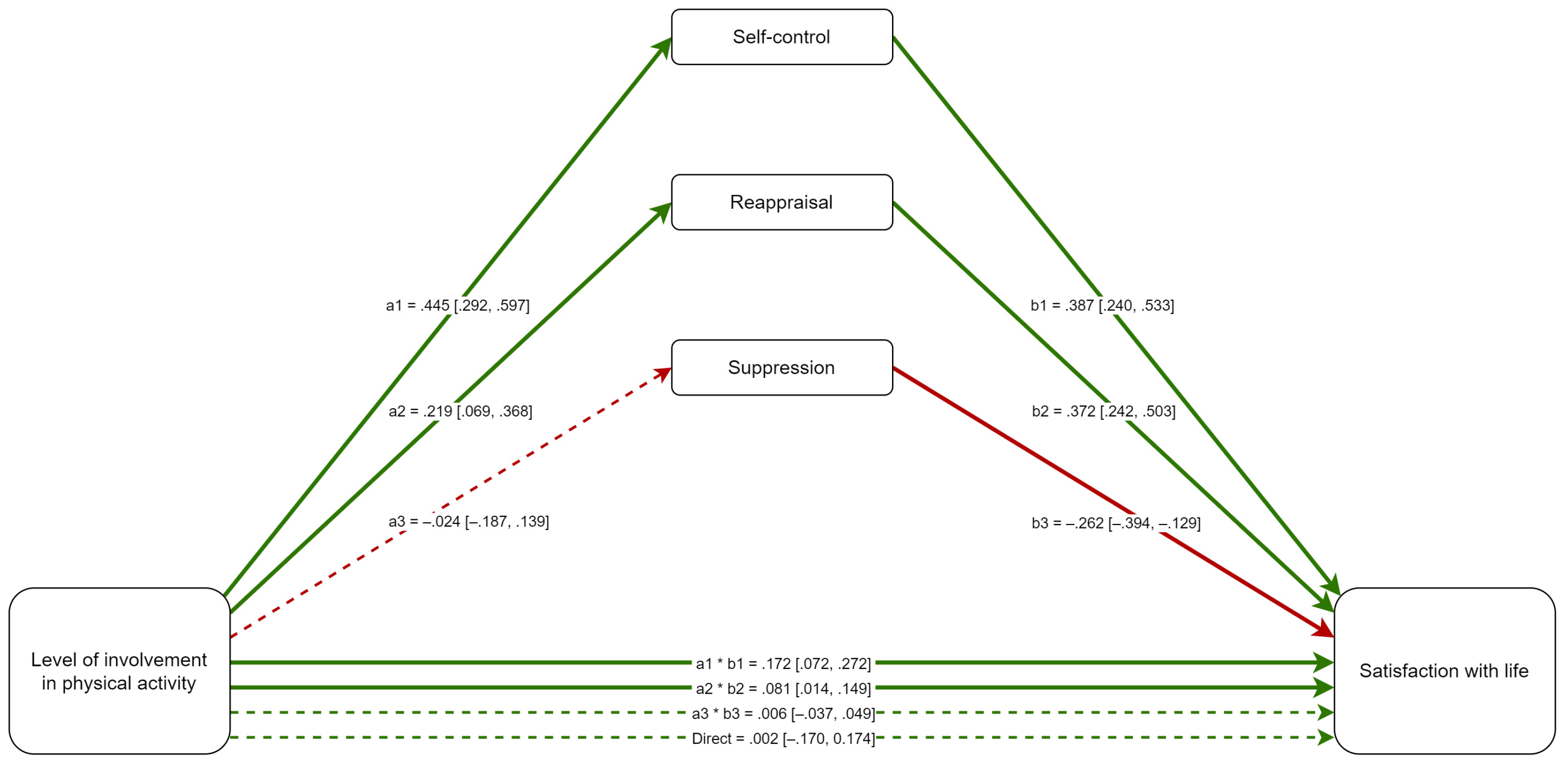

Table 1.
Descriptive Statistics for the Scores on the Scales of the Questionnaire Tool.
| Mean | 95% CI | Median | SD | IQR | Skewness | Kurtosis | ||
| Lower | Upper | |||||||
| Self–control | 36.5 | 35.2 | 37.8 | 36 | 8.90 | 10.75 | 0.314 | –0.127 |
| ERQ Reappraisal | 26.6 | 25.5 | 27.6 | 28 | 7.19 | 9.00 | –0.164 | –0.105 |
| ERQ Suppression | 14.3 | 13.5 | 15.2 | 15 | 5.80 | 9.00 | 0.032 | –0.814 |
| Satisfaction with life | 18.7 | 17.8 | 19.6 | 19 | 6.29 | 9.75 | 0.015 | –0.352 |
Table 2.
Correlations between the scores on the scales of the questionnaire tool and the level of involvement in physical activity.
Table 2.
Correlations between the scores on the scales of the questionnaire tool and the level of involvement in physical activity.
| Statistics | Variables | ||||
| Self–control | Reappraisal | Suppression | Satisfaction with life | ||
| Reappraisal | Pearson’s r | .250 | |||
| p–value | .001 | ||||
| 95% CI Lower | .110 | ||||
| 95% CI Upper | .380 | ||||
| Suppression | Pearson’s r | –.022 | –.140 | ||
| p–value | .765 | .057 | |||
| 95% CI Lower | –.165 | –.278 | |||
| 95% CI Upper | .122 | .004 | |||
| Satisfaction with life | Pearson’s r | .427 | .412 | –.268 | |
| p–value | < .001 | < .001 | < .001 | ||
| 95% CI Lower | .301 | .285 | –.396 | ||
| 95% CI Upper | .537 | .524 | –.129 | ||
| The Level of Involvement in Physical Activity | Spearman’s rho | .341 | .148 | .028 | .248 |
| p–value | < .001 | .044 | .707 | < .001 | |
| 95% CI Lower | .204 | .003 | –.116 | .105 | |
| 95% CI Upper | .465 | .287 | .171 | .380 | |
Table 3.
Raw and standardized estimates with bootstrapped 95% confidence intervals for indirect effects and their components, direct and total effects in mediation analysis.
Table 3.
Raw and standardized estimates with bootstrapped 95% confidence intervals for indirect effects and their components, direct and total effects in mediation analysis.
| Effect type | Effect | Estimate | SE | 95% C.I. | β | β 95% C.I. | ||
|---|---|---|---|---|---|---|---|---|
| Lower | Upper | Lower | Upper | |||||
| Indirect | PA level ⇒ Self–control ⇒ SwL | 0.813 | 0.234 | 0.431 | 1.365 | 0.127 | 0.059 | 0.195 |
| PA level ⇒ Reappraisal ⇒ SwL | 0.309 | 0.151 | 0.073 | 0.687 | 0.048 | 0.004 | 0.093 | |
| PA level ⇒ Suppression ⇒ SwL | –0.003 | 0.105 | –0.230 | 0.195 | –0.001 | –0.031 | 0.030 | |
| Component | PA level ⇒ Self–control | 3.632 | 0.640 | 2.361 | 4.872 | 0.402 | 0.274 | 0.530 |
| Self–control ⇒ SwL | 0.224 | 0.051 | 0.128 | 0.329 | 0.317 | 0.189 | 0.444 | |
| PA level ⇒ Reappraisal | 1.229 | 0.473 | 0.307 | 2.193 | 0.168 | 0.042 | 0.294 | |
| Reappraisal ⇒ SwL | 0.252 | 0.059 | 0.139 | 0.367 | 0.288 | 0.157 | 0.418 | |
| PA level ⇒ Suppression | 0.014 | 0.419 | –0.780 | 0.840 | 0.002 | –0.137 | 0.142 | |
| Suppression ⇒ SwL | –0.240 | 0.072 | –0.379 | –0.101 | –0.221 | –0.351 | –0.091 | |
| Direct | PA level ⇒ SwL | 0.528 | 0.401 | –0.253 | 1.322 | 0.083 | –0.041 | 0.206 |
| Total | PA level ⇒ SwL | 1.646 | 0.418 | 0.810 | 2.440 | 0.258 | 0.133 | 0.383 |
PA level – The Level of Involvement in Physical Activity; SwL – Satisfaction with Life.
Disclaimer/Publisher’s Note: The statements, opinions and data contained in all publications are solely those of the individual author(s) and contributor(s) and not of MDPI and/or the editor(s). MDPI and/or the editor(s) disclaim responsibility for any injury to people or property resulting from any ideas, methods, instructions or products referred to in the content. |
© 2024 by the authors. Licensee MDPI, Basel, Switzerland. This article is an open access article distributed under the terms and conditions of the Creative Commons Attribution (CC BY) license (https://creativecommons.org/licenses/by/4.0/).
Copyright: This open access article is published under a Creative Commons CC BY 4.0 license, which permit the free download, distribution, and reuse, provided that the author and preprint are cited in any reuse.


