

Submitted:
26 December 2024
Posted:
27 December 2024
You are already at the latest version
Abstract
This study investigates the sustainable use of seabed dredged sludge and water treatment sludges as construction materials using combined dewatering and cement stabilization techniques. Dredged sediments and water treatment sludges, typically considered waste, were evaluated for their suitability in construction through a series of dewatering and stabilization processes. Dewatering significantly reduced initial moisture content, while cement stabilization improved mechanical properties, including strength and stiffness. Unconfined compressive strength (UCS), shear modulus, and microstructural changes were evaluated using various analytical techniques, including unconfined compression testing, X-ray diffraction (XRD), scanning electron microscopy (SEM), and energy dispersive X-ray spectroscopy (EDX). The results show a direct correlation between reduced water-cement ratios and increased UCS, confirming the potential of treated sludge as a sub-base layer for roads and landfill liners. Chemical analysis revealed the formation of calcium silicate hydrate (CSH) and ettringite, which are critical for strength enhancement. This approach not only mitigates environmental issues associated with sludge disposal, but also supports sustainable construction practices by reusing waste materials. The study concludes that cement-stabilized dredged sediments and water treatment sludges provide an environmentally friendly and effective alternative for use in civil engineering projects.
Keywords:
cement stabilization
; dewatering techniques
; dredged sediments
; sustainable construction materials
; water treatment sludge
1. Introduction
Thailand is currently experiencing rapid population and economic growth, resulting in a growing demand for clean water production. Unfortunately, the primary sources of raw water used for tap water production in Bangkok and surrounding areas often contain pollutants and suspended solids. These materials typically remain in the sludge that is a byproduct of the water production treatment process. To maintain the navigability of the waterways near the seaports along the coastal area in central Thailand, considerable dredging activities have been carried out by the Marine Department since 2005. This has resulted in the generation of substantial amounts of dredged materials, which are typically disposed of in offshore sludge disposal sites, causing environmental damage.
A promising solution to these challenges is the utilization of sediment materials, which can simultaneously mitigate adverse environmental impacts and serve as valuable construction materials. However, sedimentary materials are characterized by low strength and high water content, as highlighted in previous studies [1,2]. Therefore, stabilization techniques need to be applied to improve their physical and engineering properties.
The use of soil cement as a construction material in civil and geotechnical engineering works has been a well-established method since 1950 [3,4]. However, despite its widespread use, little attention has been paid to the subtle influence of moisture and suction conditions during the curing process on the mechanical properties of cement-treated materials. The initial moisture content has a significant effect on the degree of stabilization [5,6]. Variations in moisture during curing can have a potentially detrimental effect on the strength development of cement-treated soils, introducing uncertainties in the predicted strength and modulus based on laboratory specimens under sealed conditions. This behavior has also been found to correlate with the increase in large capillary pores induced by bentonite shrinkage and C-S-H carbonation during drying [7]. The progressive development of microstructural and chemical properties during the curing process has been shown to be a critical factor in strength development.
In order to better understand the strength-enhancing mechanism of cement-treated soil, many previous studies have demonstrated that Free-free resonance (FFR) and suction measurement tests are useful techniques for clarifying the physical properties of cement-enhanced soil, while X-ray diffraction (XRD) analysis, scanning electron microscopy (SEM), and energy dispersive X-ray spectroscopy (EDX) are techniques that have been successfully used to elucidate the chemical reactions and products of cement-enhanced soils [8,9]. However, previous studies have mainly focused on the improvement of natural soils with water contents of less than 100%. In contrast, the soils in this study were classified as natural materials and industrial wastes with very high initial water contents. Studies on the improvement of these materials are still insufficient [10-12]. Therefore, a comprehensive investigation of the curing suction, strength and stiffness development in high water content soils treated with cement will certainly contribute to a better understanding of the behavior of these materials.
The objectives of this study are twofold. First, it seeks to improve the properties of sediment materials by providing a sustainable solution for clean water production and responsible disposal of sediment materials. Secondly, in line with previous studies by Thongdetsri et al. [2], Jamsawong [8], Horpibulsuk et al. [13], Yoobanpot et al. [14], and Chompoorat et al. [15], the focus is on exploring alternative construction materials derived from recycled waste. These materials will not only contribute to a reduced environmental footprint compared to traditional resources, but also have the potential to improve the long-term strength and durability of constructed structures. By incorporating recycled waste materials into construction practices, this study addresses sustainability concerns while improving the overall performance and resilience of the built environment. This study proposes the use of a combination of mechanical and chemical stabilization methods to improve the properties of sedimentary materials and evaluate their suitability as construction materials. The study includes a series of experimental tests to evaluate the effect of these techniques on the hardening and engineering properties of sedimentary materials, including unconfined compressive strength and shear modulus using unconfined compression and FFR tests, respectively. Additional analyses, including XRD, SEM, and EDX, will be conducted to examine the internal structure of cement-treated soils and reaction products. The effects of the moisture content and suction properties of the materials are also investigated by soil water retention curves (SWRCs) using a tensiometer and the isopiestic moisture control method.
2. Materials and Methods
2.1. Materials
This study deals with the utilization of two different water-derived materials, namely water treatment sludge (WS) and seabed dredging sludge (SS), which were obtained from water treatment and waterway maintenance activities, respectively. The WS was obtained from the dewatering yard of a water treatment plant located in Bang Khen, Bangkok, while the SS was obtained from dredging activities in the second waterway of the Bangkok Seaport, located in the province of Samut Prakan, Thailand. The excavation process was facilitated by a vessel equipped with a self-propelled hopper.
Prior to dewatering and cement mixing, WS had a natural moisture content of 120% to 150% and SS had a natural moisture content of 200% to 300%. These natural moisture contents are consistent with those found in previous study by Thongdetsri et al. [1] and Nontananandh et al. [16]. The physical properties of SS and WS are shown in Table 1(a) and were classified as CH (highly plastic clayey soil) and MH (highly plastic sandy soil), respectively, according to the Unified Soil Classification System. Both soil types were classified as A-7-5(20) soils according to the AASHTO classification system, and are considered unsuitable for use as paving materials unless improvements are made.
In addition, X-ray fluorescence (XRF) analysis was performed in this study to determine the chemical composition of the sludges. The test results are shown in Table 1(b) and indicate that both sludges were composed mainly of SiO2 and Al2O3. These results are comparable to previous studies by Yimsiri [17] and Karawek et al. [18]. Oxide compounds play a fundamental role in facilitating chemical reactions when subjected to quality improvement processes. They serve as central binding agents in the reaction products. In addition, WS typically contain various components such as substances used in the water treatment process such as aluminum and iron salts to aid in coagulation. As a result, water treatment sludges typically show the presence of aluminum and iron salts throughout the sludge [19].
In addition, both types of sediments, namely water treatment sludge (WS) and seabed dredged sludge (SS), had compositions well within the permissible limits for heavy metals and hazardous substances as defined by the Department of Pollution Control [20]. In addition, these two sediment materials contain a significant amount of organic matter, but are not considered hazardous wastes that could adversely affect the environment if not properly managed. This adherence to environmental safety principles is consistent with the principles of sustainable soil and waste management proposed by Katsumi et al. [21]. These principles emphasize the importance of considering factors such as environmental sustainability, geotechnical robustness, cost-effectiveness, and social acceptability in management processes.
The above principles are closely related to the NICE criteria, an acronym for Nonhazardous, Improvable, Compatible/Consistent, and Economically viable, originally proposed by Kamon et al. [22]. The materials selected for this study have been shown to be either non-toxic or to have minimal toxicity. They show potential for quality improvement, compatibility with other materials, consistent properties, and economic viability.
2.2. Methodology
After the selection of appropriate materials based on their physical and chemical properties that met the NICE criteria, the process of designing and selecting methods to improve their quality was initiated. Given the extremely high water content and very low strength of the soils, a combination of mechanical (dewatering) and chemical techniques were used for improvement.
The first step in mechanical improvement was to reduce the initial moisture content of the soils in situ using two dewatering techniques, the air drying method for WS and the filter press method for SS [16]. Subsequently, for WS, a further reduction in moisture content was achieved in the laboratory by oven drying at a temperature of 60°C until a target water content was reached. In contrast, for SS, only the filter press method was continued in the laboratory for several weeks to reach the desired water content. The purpose of this process was to explore the appropriate range of water content prior to cement application. The final water content of WS, which was classified as silt, varied from 33% to 128.5% in order to study the influence of the initial water content of the sludge on the subsequent properties. In contrast, for SS, which is a clay material, the water content prior to cement mixing varied from 109% to 138%. A lower range of water content for SS could not be used to prepare the mix due to its poor workability at low water contents.
The next step was to stabilize the soil with cement to increase its strength. Soil-cement samples were prepared by mixing WS with cement at 150, 200, and 250 kg/m3 and SS at 100, 125, 150, 200, and 250 kg/m3 (cement mass per volume of wet soil). This mixing process was performed using a Hobart mixer for 5 minutes. The resulting mixture was compacted then placed in steel moulds, 50 mm in diameter and 100 mm in height, allowing up to three samples to be produced simultaneously. These samples were then wrapped in plastic to preserve their moisture content and cured for 3, 7, 14, 28 and 90 days at 25±2°C room temperature and 80% relative humidity.
The FFR test, a simple non-destructive laboratory test, has been used for many years to determine the small-strain stiffness and shear wave velocity () of cement-treated soils [23-25]. In this study, the specimens were tested in transverse motion only after curing, with waves generated by a small hammer at one end and recorded by an accelerometer attached to the other end. The measured peak amplitude was taken as the resonant frequency of the sample. Therefore, can be calculated using the following Equation (1):
where, is the specimen length and is the shear wave resonant frequency [26].
After the FFR test, unconfined compression tests were performed on the specimens according to ASTM D 2166 [27] to evaluate the effect of different amounts of ordinary Portland cement on the strength of the stabilized sediment materials. The specimens were cured for the specified times and tested in an automated universal testing machine (UTM) to failure at a strain rate of 2.0 mm/min. Unconfined compressive strength (UCS) was evaluated as the compressive stress at peak or at 15% axial strain, whichever was less.
To establish the soil water retention curve (SWRC) for a comprehensive understanding of the properties of the water treatment sludge, a suction test was conducted using a KU Tensiometer. This test focused on matric suction in the range of 0 to 90 kPa to determine both wetting and drying pathways. In addition, another soil sample was prepared by mixing the water treatment sludge with cement, followed by compaction and trimming. A salt solution isotropic moisture control technique was then used to conduct a suction test in the range of 4,000 to 400,000 kPa.
Experiments were conducted with numerous mixes to achieve the appropriate strength for use in subbase layers of highway structures, as recommended by the Department of Highways, Thailand [28]. The treated materials were tested to evaluate their physical and engineering properties, including unconfined compressive strength tests. In addition, the microstructural and chemical properties were investigated using SEM and XRD tests to gain insight into the mechanism underlying their improvement. The study methodology of this study emphasizes the importance of reducing the moisture content in the sludges to improve their water-cement ratio and subsequently increase the strength of the stabilized materials. The objective was to gain a deeper understanding of the role of the initial moisture content in the mechanism of strength development.
The XRD and SEM specimens were prepared from the fracture plane of the UCS specimen after the compression tests. The reaction products, such as calcium silicate hydrate (CSH) and ettringite, including C3S, C2S, and C3A compounds, were studied using a Philips X'Pert PRO MPD X-ray diffractometer with a Cu target with an Ni filter and an input energy of 30 kV and 30 mA. This study identified the CSH, ettringite, C3S, C2S, and C3A at d-spacings of 3.02, 3.88, 2.62, 7.30, and 2.70 Å, respectively. In addition, the microstructure and reaction product formation of the improved sludges were observed using a Hitachi SU3500 scanning electron microscope with an input energy of 20 kV and 20 mA.
In addition, EDX was coupled to the SEM, allowing precise elemental analysis by energy dispersive X-ray spectrometry. In soil-cement study, it is essential to evaluate the elemental distribution. Cross-sectional SEM analysis provides the Peak Element Ratio () and Surface Area Ratio (), which specify reaction products and guide strength evaluation. The , calculated by Equation (2), evaluates the peak intensities of the major elements, while the , determined by Equation (3), measures the elemental intensity on the cross-sectional SEM image. This method confirms the formation of reaction products and helps to understand the development of soil strength through microstructural changes. The correspondence between Si/Ca ratios and CSH crystal ratios in the and analyses indicates the strength and substantial CSH gel formation. The approach provides insight into the occurrence of reaction products and strength development in soil cement [29].
where, is the peak intensity of the major elements (Si, Al or S) and is the intensity of the major element (Ca) along any specified cross-sections.
where, is the total intensity of Si, Al or S and is the total intensity of Ca on the cross-sectional area detected by SEM-EDX.
3. Results and Discussion
3.1. Changes in Behavior After Soil Improvement
As shown in Figure 1(a), the strength comparison of the two cement-stabilized sediment sludges shows that the seabed dredged sludge mixed with cement (SSC) had a higher unconfined compressive strength (UCS) than the water treatment sludge mixed with cement (WSC) at all curing times. The early stage of the reaction showed a rapid increase in UCS from 3 to 28 days, but the rate of increase gradually slowed down from 28 to 90 days. The increase in UCS was influenced by the water-cement ratio, with lower ratios resulting in higher strength due to the reduced initial water content during mixing. Increasing the amount of cement without reducing the initial water content did not contribute significantly to the strength development. The relationship between increase in UCS and setting time was non-linear, with a higher rate of increase in the early stages and a decreasing rate over time. This trend was observed for both sludge types. These results are consistent with previous investigations by Nontananandh et al. [30] and emphasize the importance of controlling the moisture content and using an appropriate water-to-cement ratio to achieve significant strength improvement. It was also observed that the water treatment sludge mixed with cement (WSC) showed a trend in compressive strength development comparable to that of the natural dredged sludge studied by Chompoorat et al. [31]. The soils in both cases were of similar types. In Figure 1(b), it is observed that there is a clear upward trend in unconfined compressive strength (UCS) as the amount of cement in the mix increases. In addition, it is noted that the SSC has a higher rate of strength increase than the WSC. This difference may be due to variations in the initial moisture content of the soil masses and the water-cement ratio. For a closely matched cement mix with a high water to cement (w/c) ratio, the SSC exhibits a higher UCS than the WSC. However, when compared with the WSC at a lower W/C ratio, the UCS values become similar. These results are attributed to the higher water demand in the reaction of SSC compared to WSC. However, it is important to emphasize that the choice of a lower water-cement ratio had a significant effect on the increase in unconfined compressive strength, and this effect was consistent across all curing times.
The nature of the relationship can be characterized as a regressive reduction, as illustrated in Figure 2(a). It is also observed that the UCS of the cement-stabilized sediment slurry after 7 days of curing, which is consistent with standard material selection criteria, shows potential as a construction material. In particular, the soil-cement mixture shows promise for applications as a bottom landfill liner, where the required strength criterion is greater than 196.13 kPa, and as a sub-base layer for road construction, where the strength criterion is greater than 787.46 kPa, as specified by the Department of Highways [32]. Moreover, a comparative analysis was performed to confirm the relationship between the water-cement ratio and the strength of the cement-stabilized sediment sludges after a long curing period of 90 days, the results of which are given in Figure 2(b). This observation is in agreement with the results presented by Chompoorat et al. [31]. However, caution should be exercised in reducing the water content to excessively low levels, as this may result in a decrease in strength. This phenomenon can be attributed to the workability of the quality improvement process. In this investigation, a relationship was proposed between the unconfined compressive strength normalized by the strength after 7 and 28 days of curing (referred to as UCS7 and UCS28) and the logarithm of the curing time (referred to as in days). This method was inspired by the work of Chompoorat et al. [31]. An advantageous aspect of this approach lies in its applicability as a quality control criterion for soil-cement improvement, using the strength at 7 days of curing. A study was conducted by Chompoorat et al. [31]. in which lakebed sediments, characterized by high water content silt, were subjected to cement enhancement. Their results, illustrated in Figure 2(c) as a small dashed line, were compared with those of the two materials studied here, namely SSC and WSC. The semi-log plot showed a similar linear relationship for both the improved lakebed sediment material and WSC. However, the SSC material had a lower slope compared to the other two improved soils, indicating a slower strength development over time. This difference can be attributed to the higher initial water content of the SSC material compared to the WSC material. Mathematical expressions for the UCSD/UCS7 ratio and curing time are presented in Equations (4) and (5) for SSC and WSC, respectively. These formulations encapsulate the observed relationships and provide a quantitative representation of the strength development over curing time for the respective soil-cement materials studied here.
An alternative method was employed to normalize the unconfined compressive strength; it is graphically represented in Figure 2(d). In this approach, the strength at 28 days of setting, denoted as UCS28, was used for the normalization process and consequently UCSD/UCS28 was plotted as the ordinate. The rationale for selecting the 28-day strength is that it corresponds to the period when a significant portion of the cementation reaction has been completed. The comparison included various improved soils from different sources as documented by Horpibulsuk et al. [13], Jamsawang et al. [8], Yoobanpot et al. [14], and Chompoorat et al. [34], with a specific focus on the SSC and WSC in our study. While a comparable trend was observed between SSC and the materials reported by Chompoorat et al. [34], it is evident that the strength development of WSC lagged behind that of the other materials. This discrepancy can be attributed to the higher water-cement ratio of WSC. The relationship between the UCSD/UCS28 ratio and the setting times for SSC and WSC is expressed by Equations (6) and (7), respectively. These equations encapsulate the observed trends and provide a quantitative representation of the normalized unconfined compressive strength over the curing times for the soil-cement materials.
From the tests conducted using the Free-Free-Resonance (FFR) vibratory apparatus, non-destructive engineering tests, the performance of improved clayey soils was investigated. A single-axis unconfined compressive strength (UCS) test was used to investigate the linear relationship between the unconfined compressive strength of the improved clayey soil and the shear wave velocity () obtained from the FFR tests. The results indicate a linear relationship, showing that as the unconfined compressive strength increased, the shear wave velocity also increased, indicating the stiffness of the cement-treated soil. These results are consistent with previous studies by Barus et al. [9] as illustrated in Figure 3(a). The correlation between shear wave velocity and unconfined compressive strength can be expressed by Equation (8).
Figure 3(b) illustrates the relationship between matric suction and gravimetric water content of naturally compacted soil indicate an increase in matric suction resulted in a decrease in volumetric water content. The air entry point of the compacted soil was observed at a matric suction of 15 kPa, corresponding to a volumetric water content of 35% along the drying path. The isopiestic humidity control technique was used to analyze the relationship between suction and moisture content of the cement-improved soil, as shown in Figure 3(c). The results indicate that the moisture content of WSC-8 (200 kg/m3 in cement content, 33% in initial moisture content) was lower than that of WSC-11 (200 kg/m3 in cement content, 40% in initial moisture content) at the same curing age. This discrepancy is attributed to the initial moisture content of the soil prior to improvement, suggesting a denser structure in the WSC-8 soil mass, which correlates with the higher unconfined compressive strength obtained in previous tests.
3.2. Reaction Product by X-Ray Diffraction Technique
X-ray diffraction analysis revealed that the major mineral compositions of the WS and SS samples were similar. As illustrated in Figure 4(a) and (b), both samples contained common minerals such as quartz and various clay minerals including illite, kaolinite and montmorillonite. After the stabilization process, both WSC and SSC samples showed the presence of reaction products such as calcium silicate hydrate (CSH) and ettringite, and their amounts increased during the 3 to 7 day curing period. These observations are consistent with the results of previous study by Yoobanpot et al. [14], provided in Figure 4(a) and (b). In addition, the XRD pattern in Figure 4(c) indicates the presence of the primary components of ordinary Portland cement, including C3S, C2S, and C3A.
Figure 5(a) illustrates the relationship between C3S and unconfined compressive strength. It becomes clear that as curing time increased, the initial cementitious compounds decreased. In addition, during the short-term curing period (0 to 7 days), compressive strength increased rapidly, and then it stabilized during the intermediate to long-term curing period (7 to 28 days). Furthermore, C2S and C3A exhibit patterns which correlate with strength development similar to C3S but in smaller quantities, as illustrated in Figure 5(b) and (c).
Additionally, following the initiation of chemical reactions, increased quantities of various reaction products, including CSH and ettringite, were observed, closely linked to the rapid reduction of the initial cementitious components. This phenomenon played a crucial role in strength development by binding and solidifying the sediment particles. The formation of denser and stronger structures, particularly during the initial post-reaction phase and the subsequent stabilization observed during long-term curing, was evident. A semi-quantitative analysis was performed to elucidate that the growth and intensity of CSH and ettringite were consistent with compressive strength as illustrated in Figure 5(d) and (e). These findings are consistent with previous studies by Thongdetsri et al. [1] and Yoobanpot et al. [33].
It can be observed that the quantities of the reaction products, CSH and ettringite, are directly related to the strength development of WSC, particularly with respect to CSH. An increase in CSH intensities is associated with a tendency for enhanced strength, especially in mixtures with low water-cement ratios. Conversely, increasing the amount of ettringite does not significantly affect the strength development of WSC in low water-to-cement ratio mixtures. In contrast, ettringite presence significantly impacts strength development in mixtures with high water-cement ratios. The reduction in moisture content due to ettringite formation leads to a decrease in the w/c ratio, resulting in the development of stronger structures. These results are in agreement with those of previous studies conducted by Nontananandh et al. [30].
3.3. Internal Structure of Cement Treated Sludges by SEM
When the sediment sludges were treated with cement, chemical reaction products, including breadcrumb-shaped CSH gel and rod-shaped ettringite, were observed after 3 and 7 days of curing as illustrated in Figure 6(a) to (d). The formation of these reaction products resulted in an increase in soil density, consistent with the XRD results, and an increase in soil strength, as previously discussed by Yoobanpot et al. [14], Chompoorat et al. [34], and Julphunthong et al. [36].
3.4. EDX Confirmation of Reaction Products in Improved Sludges
The distribution of Peak Energy Ratios () on the cross-sectional profiles and the Surface Area Ratios () were evaluated to determine the ratio of elemental compositions at within the SEM images. For example, the ratios of elements such as silicon to calcium (Si/Ca), which are constituents of the reaction product CSH, and the ratios of sulfur to calcium (S/Ca) and aluminum to calcium (Al/Ca), which are constituents of ettringite, can be analyzed to identify the formation of reaction products [29].
Based on the above definition, WSC-1 (150 kg/m3 in cement content, 128.5% in initial moisture content) after 14 days of curing serves as an example for analysis to identify the presence of CSH formation, as illustrated in Figure 6(e) and (f). Specifically, a relatively low range of with Si/Ca ratios ranging from 0.58 to 4.60 and 0.89 to 6.40, as observed at point numbers 3 to 5 and 9 to 13, respectively, indicates the presence of CSH matrix binding soil particles.
Furthermore, the S/Ca ratios were found to range from 0.40 to 0.77 for points 3 to 5 and from 0.33 to 0.67 for points 9 to 13. The Al/Ca ratios ranged from 1.00 to 3.60 and from 1.14 to 6.20, respectively, confirming the presence of CAH or ettringite products (needle-like structures). However, in the range of point numbers 7, 8 to 9, the of Si/Ca is notably high, with values ranging from 1.36 to 35.00. The S/Ca ratio falls within the range of 0.33 to 1.25, while the Al/Ca ratio ranges from 1.36 to 4.50. This observation aligns with the SEM images, which illustrate that the specified area consists of unreacted soil paricles with only a small amount of ettringite present, as illustrated in Figure 6(e).
The analysis within the range of appropriate element ratios also confirm the amounts of major reaction products such as CSH and Ettringite formed over the crossectional area. In addition, it was found that the values for the primary element ratios, as summarized in Table 2, depicted a trend of increasing with the curing time. This finding is consistent with research conducted by Yang et al. [29]. Furthermore, the also correlated with the decrease of the initial cementitious compounds and the increase of the reaction products, as analyzed by XRD. This is consistent with the results of the unconfined compressive strength.
The values within the appropriate ratio also confirm the presence of major reaction products, such as CSH and ettringite, formed over the cross-sectional area. Additionally, the values for the primary element ratios tended to increase with curing time, correlating with the decrease in initial cementitious compounds and the increase in reaction products, as analyzed by XRD. This finding aligns with the observed evolution of unconfined compressive strength.
4. Conclusions
This research investigated the engineering and physico-chemical properties of the seabed dredged sediments (SS) and water treatment sludges (WS) treated with Ordinary Portland Cement (OPC) for potential use as construction materials. The laboratory testing included Unconfined Compressive Strength (UCS), Free-Free Resonance (FFR), and soil suction measurement. Proposed correlations were established to estimate Shear Wave Velocity () based on FFR and unconfined compressive strength. Changes in microstructures due to hydration and pozzolanic cement reactions were examined through X-Ray Diffraction (XRD), Scanning Electron Microscopy (SEM), and Energy Dispersive X-ray Spectroscopy (EDX). Based on the findings of this research, the following conclusions can be made:
- (1)
- Both SS and WS have high moisture content and require moisture reduction using dewatering process and appropriate cement mixing to achieve a suitable w/c ratio, thus improving quality. As the w/c ratio decreased, the UCS increased, meeting the Department of Rural Roads of Thailand's standards for subbase materials. For SSC, a w/c ratio of less than 3.5 is recommended for highway subbases, while a ratio below 6 is suitable for landfill liners. WSC requires an even lower ratio, below 3.5, for both applications.
- (2)
- The UCS after 7 days and 28 days of curing (UCS7 and UCS28) serve as effective normalization benchmarks for predicting strength. The ratios of UCSD/UCS7 and UCSD/UCS28 were proposed and consistently found to increase with longer curing times.
- (3)
- XRD and SEM-EDX analysis confirmed that calcium silicate hydrate (CSH) and ettringite were key contributors to strength development. Elemental composition was assessed using Peak Element Ratios () and Surface Area Ratios (), with Si/Ca ratios ranging from 0.58 to 6.40, indicating CSH. S/Ca ratios ranged from 0.33 to 0.77, and Al/Ca ratios from 1.00 to 6.20, suggesting the presence of calcium aluminate hydrate (CAH) or needle-like ettringite.
- (4)
- Suction tests revealed that moisture content of cement-treated sludges decreases compared to the original condition, confirming the occurrence of the hydration reaction. This corresponds with the increase in UCS and enhanced hardness of the cement-treated sludges. As a result, the shear wave velocity () also increased with curing time. In addition, the correlation between UCS and was proposed.
Furthermore, conducting additional tests, such as permeability, shrinkage and durability, are essential to ensure compliance with established standards. These supplementary studies will refine the evaluation of material performance and confirm its suitability for specific engineering applications, providing an environmentally sustainable and effective alternative for civil engineering projects.
Author Contributions
For research articles with several authors, a short paragraph specifying their individual contributions must be provided. The following statements should be used “Conceptualization, S.N., A.J., S.C. and S.I.; methodology, S.N.; software, T.T. and N.K.; validation, A.J., S.C. and S.I.; formal analysis, T.T. and N.K.; investigation, S.N.; resources, S.N. and S.I.; data curation, A.J. and S.C.; writing—original draft preparation, S.N.,T.T. and N.K.; writing—review and editing, S.I.; visualization, S.N.,T.T. and N.K.; supervision, S.N., A.J., S.C. and S.I.; project administration, S.N. and S.I.; funding acquisition, S.N., A.J., S.C. and S.I. All authors have read and agreed to the published version of the manuscript.
Funding
This research received no external funding.
Data Availability Statement
The data that support the findings of this study are available from the corresponding author, Shinya Inazumi, upon reasonable request.
Acknowledgments
The authors express their gratitude to the Faculty of Engineering at Kasetsart University, Phayao University, and Shibaura Institute of Technology for their generous support in funding this study. We also wish to acknowledge the Government Scholarship Program for Science Students, administered by the National Science and Technology Development Agency, for providing essential financial assistance. Special appreciation is extended to the Department of Materials Engineering at Kasetsart University for granting access to the scanning electron microscope, and to the Department of Materials and Metallurgical Engineering at Rajamangala University of Technology Thanyaburi for their invaluable assistance in analyzing test results with the X-ray diffractometer. The collaborative efforts of these institutions have significantly contributed to the study's success.
Conflicts of Interest
The authors declare no conflicts of interest.
References
- Jagaba, A.H.; Shuaibu, A.; Umaru, I.; Musa, S.; Lawal, I.M.; Abubakar, S. Stabilization of soft soil by incinerated sewage sludge ash from municipal wastewater treatment plant for engineering construction. Sustain. Struct. Mater. 2019, 2, 32–44. [Google Scholar]
- Thongdetsri, T.; Khumsuprom, N.; Noipasee, S.; Pongpayuha, P.; Jotisankasa, A.; Inazumi, S.; Nontananandh, S. Improvement of High-Water Content Sludges Using Ordinary Portland Cement as Construction Materials. In Proceedings of the 21st Southeast Asian Geotechnical Conference and 4th AGSSEA Conference (SEAGC-AGSSEA 2023), Bangkok, Thailand; 2023. [Google Scholar]
- Yekeen, N.; Padmanabhan, E.; Idris, A.K.; Chauhan, P.S. Nanoparticles applications for hydraulic fracturing of unconventional reservoirs: A comprehensive review of recent advances and prospects. J. Pet. Sci. Eng. 2019, 178, 41–73. [Google Scholar] [CrossRef]
- Inazumi, S.; Shiina, M.; Nakao, K. Aeration Curing for Recycling Construction-Generated Sludge, and Its Effect of Immobilizing Carbon Dioxide. Case Stud. Constr. Mater. 2024, 20, e02704. [Google Scholar] [CrossRef]
- Chien, P.T.; Satomi, T.; Takahashi, H. Study on sludge recycling with compaction type and placing type by rice husk-cement-stabilized soil method. Adv. Exp. Mech. 2017, 2, 159–167. [Google Scholar] [CrossRef]
- Xi, L.; Zhou, F.; Ma, Q.; Li, W.; Xiao, H.; Zhang, D. Investigation on strength properties of phosphogypsum-dredged soil stabilized by carbide slag activated ground granulated blast-furnace slag. Constr. Build. Mater. 2024, 457, 139427. [Google Scholar] [CrossRef]
- Ho, L.S.; Nakarai, K.; Duc, M.; Kouby, A.L.; Maachi, A.; Sasaki, T. Analysis of Strength Development in Cement-Treated Soils under Different Curing Conditions through Microstructural and Chemical Investigations. Constr. Build. Mater. 2018, 166, 634–646. [Google Scholar] [CrossRef]
- Jamsawang, P.; Charoensil, S.; Namjan, T.; Jongpradist, P.; Likitlersuang, S. Mechanical and Microstructural Properties of Dredged Sediments Treated with Cement and Fly Ash for Use as Road Materials. Road Mater. Pavement Des. 2020, 21, 2498–2522. [Google Scholar] [CrossRef]
- Barus, R.M.N.; Jotisankasa, A.; Chaiprakaikeow, S.; Nontananandh, S.; Inazumi, S.; Sawangsuriya, A. Effects of Relative Humidity During Curing on Small-Strain Modulus of Cement-Treated Silty Sand. Geotech. Geol. Eng. 2021, 39, 2131–2146. [Google Scholar] [CrossRef]
- Horpibulsuk, S.; Miura, N.; Nagaraj, T.S. Assessment of Strength Development in Cement-Admixed High Water Content Clays with Abrams’ Law as a Basis. Geotechnique 2003, 53, 439–444. [Google Scholar] [CrossRef]
- Antunes, V.; Simão, N.; Freire, A.C. A Soil-Cement Formulation for Road Pavement Base and Sub Base Layers: A Case Study. Transp. Infrastruct. Geotech. 2017, 4, 126–141. [Google Scholar] [CrossRef]
- Zhang, Z.; Li, C.; Omine, K.; Li, J.; Flemmy, S.O. Feasibility Study of Low-Environmental-Load Methods for Treating High-Water-Content Waste Dredged Clay (WDC)—A Case Study of WDC Treatment at Kumamoto Prefecture Ohkirihata Reservoir in Japan. Sustainability 2023, 15, 8243. [Google Scholar] [CrossRef]
- Horpibulsuk, S.; Rachan, R.; Suddeepong, A. Assessment of Strength Development in Blended Cement Admixed Bangkok Clay. Constr. Build. Mater. 2011, 25, 1521–1531. [Google Scholar] [CrossRef]
- Yoobanpot, N.; Jamsawang, P.; Poorahong, H.; Jongpradist, P.; Likitlersuang, S. Multiscale Laboratory Investigation of the Mechanical and Microstructural Properties of Dredged Sediments Stabilized with Cement and Fly Ash. Eng. Geol. 2020, 267, 105491. [Google Scholar] [CrossRef]
- Chompoorat, T.; Likitlersuang, S.; Sitthiawiruth, S.; Komolvilas, V.; Jamsawang, P.; Jongpradist, P. Mechanical Properties and Microstructures of Stabilised Dredged Expansive Soil from Coal Mine. Geomech. Eng. 2021, 25, 143–157. [Google Scholar]
- Rakshith, S.; Singh, D.N. Utilization of dredged sediments: contemporary issues. J. Waterw. Port Coast. Ocean Eng. 2017, 143, 04016025. [Google Scholar] [CrossRef]
- Yimsiri, S. Feasibility Study of Improvement of Dredge Soil Properties by Geopolymer for Use as Highway Material. Res. Rep. 2018, Burapha University, Chonburi, Thailand.
- Karawek, S.; Khonthon, S.; Intarapadung, A.; Thiamtham, T. Development of Mixed Bodies from Water Treatment Sludge for Pottery. Phranakhon Rajabhat Res. J. Sci. Technol. 2019, 14, 117–136. (In Thai) [Google Scholar]
- Wu, Y.; Du, H.; Li, F.; Su, H.; Bhat, S.A.; Hudori, H.; Rosadi, M.Y. Effect of Adding Drinking Water Treatment Sludge on Excess Activated Sludge Digestion Process. Sustainability 2020, 12, 17. [Google Scholar] [CrossRef]
- Department of Pollution Control. Announcement of the Department of Pollution Control, Criteria for the Quality of Seabed Sediments. Dated October 9, 2015.
- Katsumi, T.; Inui, T.; Yasutaka, T.T. Towards Sustainable Soil Management—Reuse of Excavated Soils with Natural Contamination. In Proceedings of the 8th International Congress on Environmental Geotechnics (ICEG 2018); Environmental Science and Engineering, 2019; Volume 1, pp. 35–42. [CrossRef]
- Sharma, H.D.; Reddy, K.R. Geoenvironmental Engineering: Site Remediation, Waste Containment, and Emerging Waste Management Technologies; John Wiley & Sons: Hoboken, NJ, USA, 2004. [Google Scholar]
- Åhnberg, H.; Holmén, M. Assessment of Stabilised Soil Strength with Geophysical Methods. Proc. Inst. Civ. Eng.-Ground Improv. 2011, 164, 109–116. [Google Scholar] [CrossRef]
- Guimond-Barret, A.; Nauleau, E.; Le Kouby, A.; Pantet, A.; Reiffsteck, P.; Martineau, F. Free–Free Resonance Testing of In Situ Deep Mixed Soils. Geotech. Test. J. 2012, 36, 283–291. [Google Scholar] [CrossRef]
- Chaiprakaikeow, A.; Soponpong, C.; Sukolrat, J. Development of a Quality Control Index of Cement Stabilized Road Structures Using Shear Wave Velocity. In Proceedings of the 2nd World Congress on Civil, Structural, and Environmental Engineering (CSEE’17), Barcelona, Spain, 2017.
- Ryden, N.; Ekdahl, U.; Lindh, P. Quality Control of Cement Stabilized Soil Using Non-Destructive Seismic Tests. In Conference Proceedings: Advanced Testing of Fresh Cementitious Materials; 2006; pp. 3–4.
- American Society for Testing and Materials. ASTM D 2166, D 2166M: Standard Test Method for Unconfined Compressive Strength of Cohesive Soil; ASTM International: West Conshohocken, PA, USA, 2016. [Google Scholar] [CrossRef]
- Department of Highway. Road Construction Supervision, Manual for Construction Supervision of Highways, Vol. 2; Bangkok, Thailand, 2007. (In Thai).
- Yang, K.H.; Cho, A.R.; Song, J.K.; Nam, S.H. Hydration Products and Strength Development of Calcium Hydroxide-Based Alkali-Activated Slag Mortars. Constr. Build. Mater. 2012, 29, 410–419. [Google Scholar] [CrossRef]
- Nontananandh, S.; Boonyong, S.; Yoobanpot, T.; Chantawarangul, K. Strength Development of Soft Marine Clay Stabilized with Cement and Fly Ash. Agric. Nat. Resour. 2004, 38, 539–552. [Google Scholar]
- Chompoorat, T.; Maikhun, T.; Likitlersuang, S. Cement Improved Lake Bed Sedimentary Soil for Road Construction. Proc. Inst. Civ. Eng.-Ground Improv. 2019, 172, 192–201. [Google Scholar] [CrossRef]
- Department of Highways. Standard No. DH-S 206/2564: Soil Cement Subbase; Bureau of Highway Standard and Evaluation: Bangkok, Thailand, 2021. (In Thai) [Google Scholar]
- Yoobanpot, N.; Jamsawang, P.; Simarat, P.; Jongpradist, P.; Likitlersuang, S. Sustainable Reuse of Dredged Sediments as Pavement Materials by Cement and Fly Ash Stabilization. J. Soils Sediments 2020, 20, 3807–3823. [Google Scholar] [CrossRef]
- Chompoorat, T.; Thepumong, T.; Taesinlapachai, S.; Likitlersuang, S. Repurposing of Stabilised Dredged Lakebed Sediment in Road Base Construction. J. Soils Sediments 2021, 21, 2719–2730. [Google Scholar] [CrossRef]
- Zhou, Y.; Cai, G.; Cheeseman, C.; Li, J.; Poon, C.S. Sewage sludge ash-incorporated stabilisation/solidification for recycling and remediation of marine sediments. J. Environ. Manag. 2022, 301, 113877. [Google Scholar] [CrossRef] [PubMed]
- Kazmi, D.; Serati, M.; Williams, D.J.; Qasim, S.; Cheng, Y.P. The potential use of crushed waste glass as a sustainable alternative to natural and manufactured sand in geotechnical applications. J. Clean. Prod. 2021, 284, 124762. [Google Scholar] [CrossRef]
Figure 1.
USC with curing time and cement content (Strength properties).
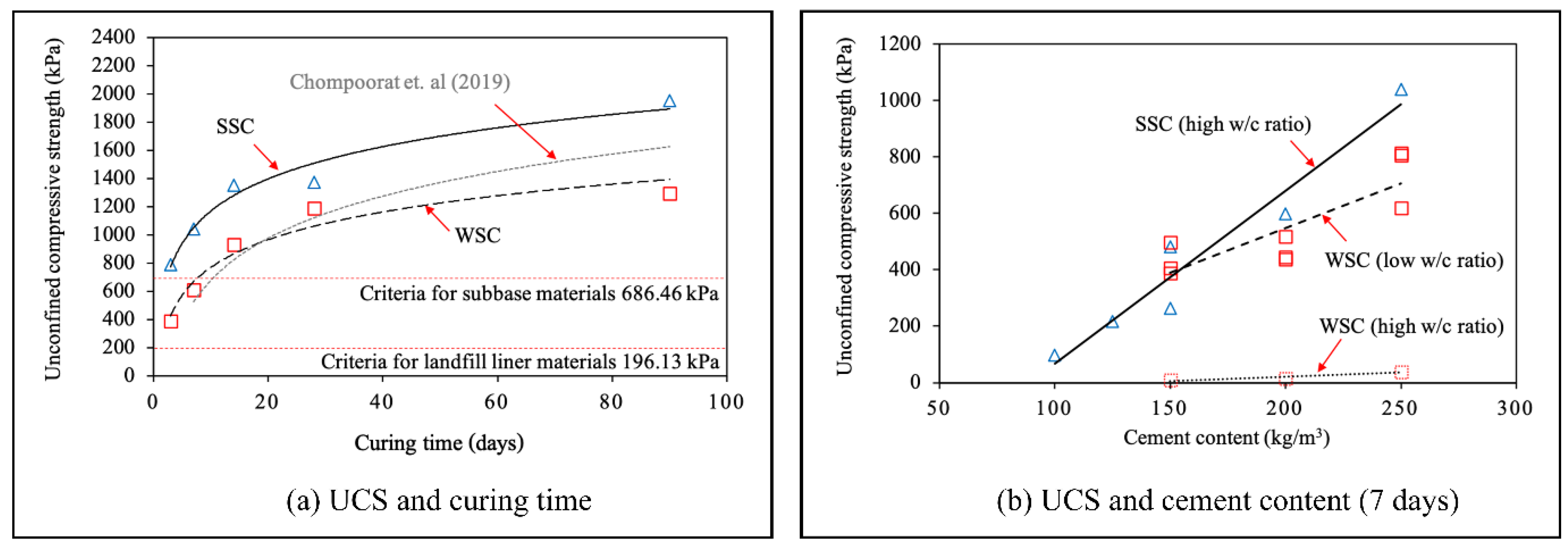
Figure 2.
UCS with w/c ratio (UCS predictions).
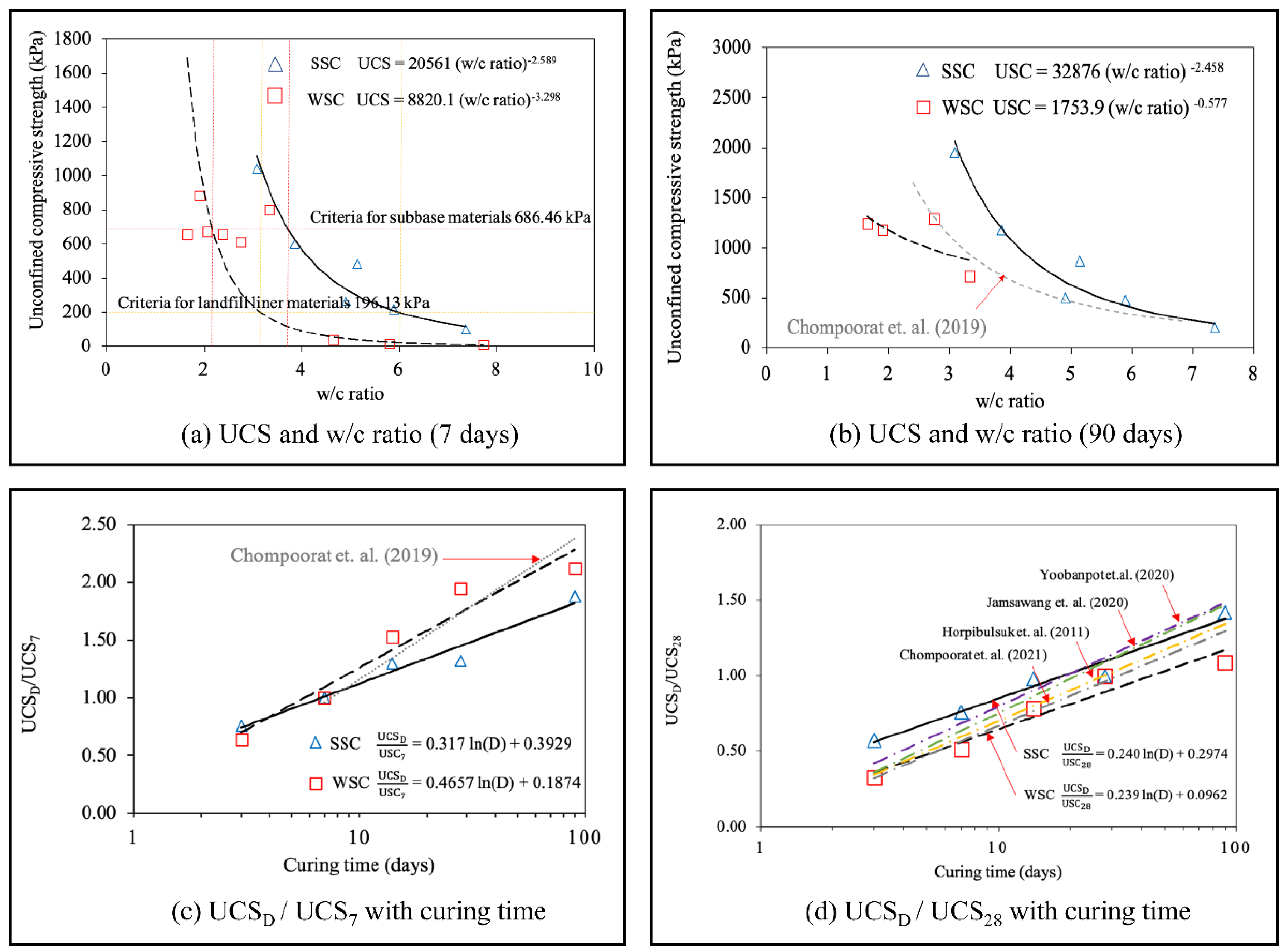
Figure 3.
FFR and suction results (Physical and engineering results - strength characteristics).
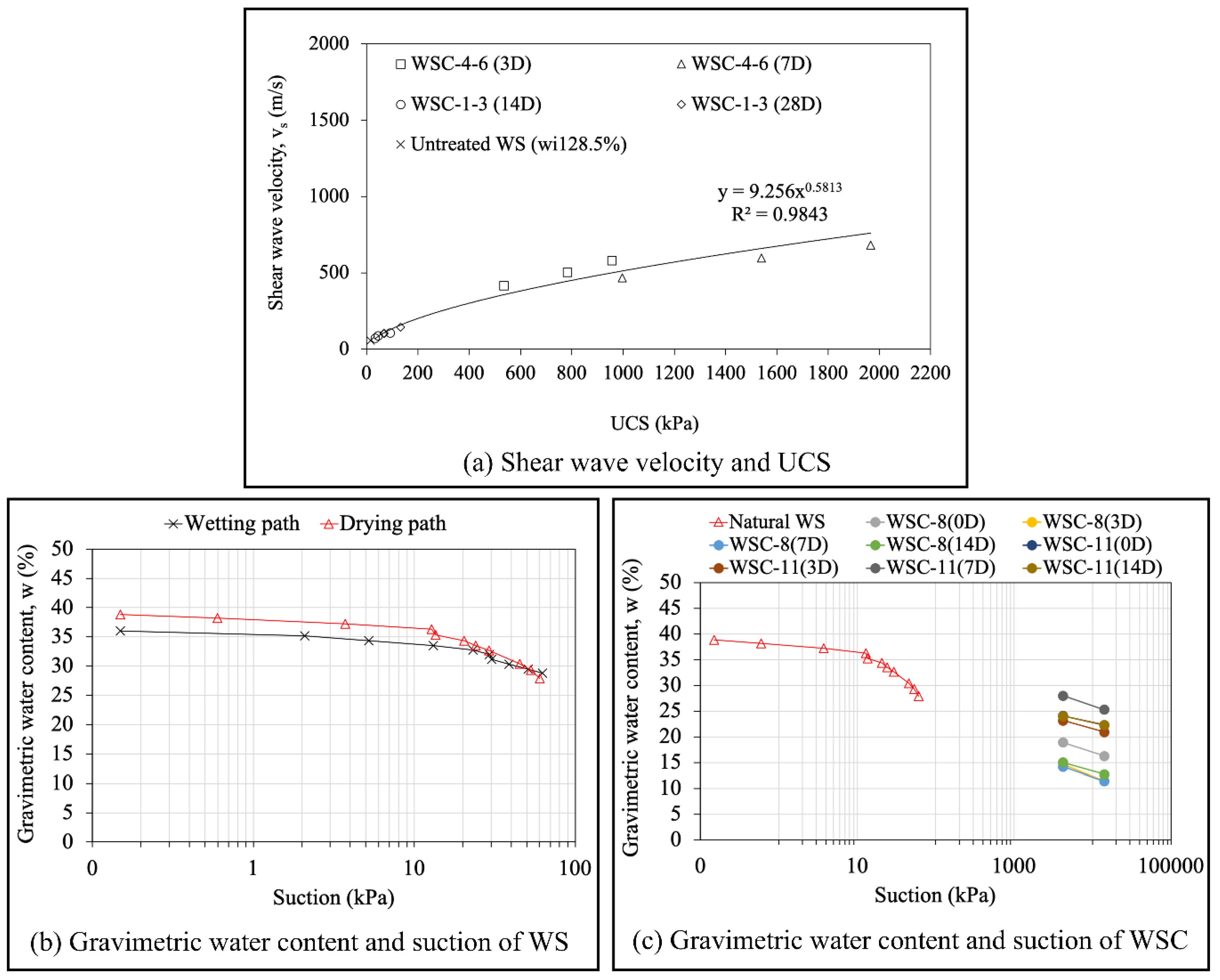
Figure 4.
Chemical Compounds by XRD analysis.
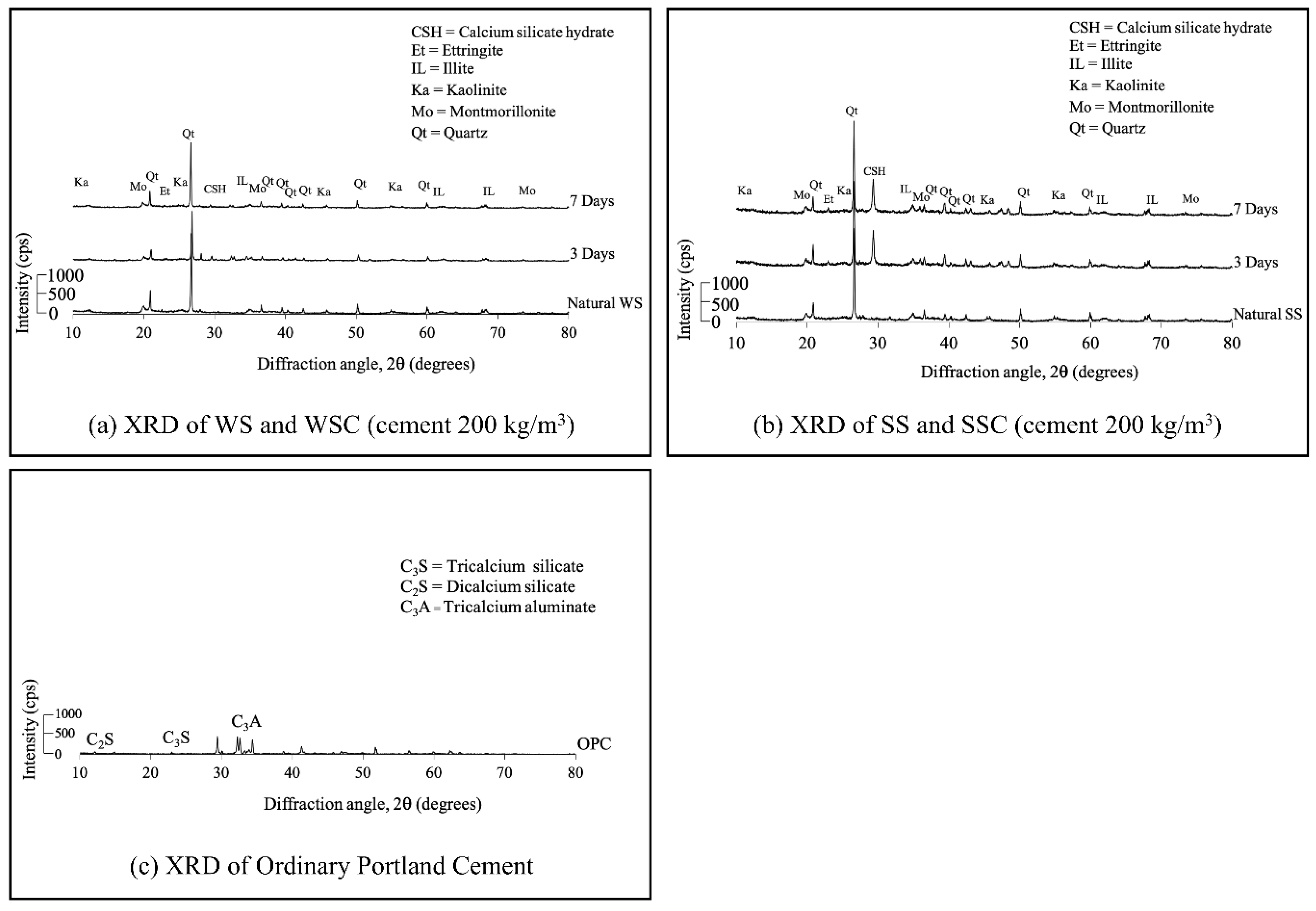
Figure 5.
Strength characteristics, cement compounds and reaction products.
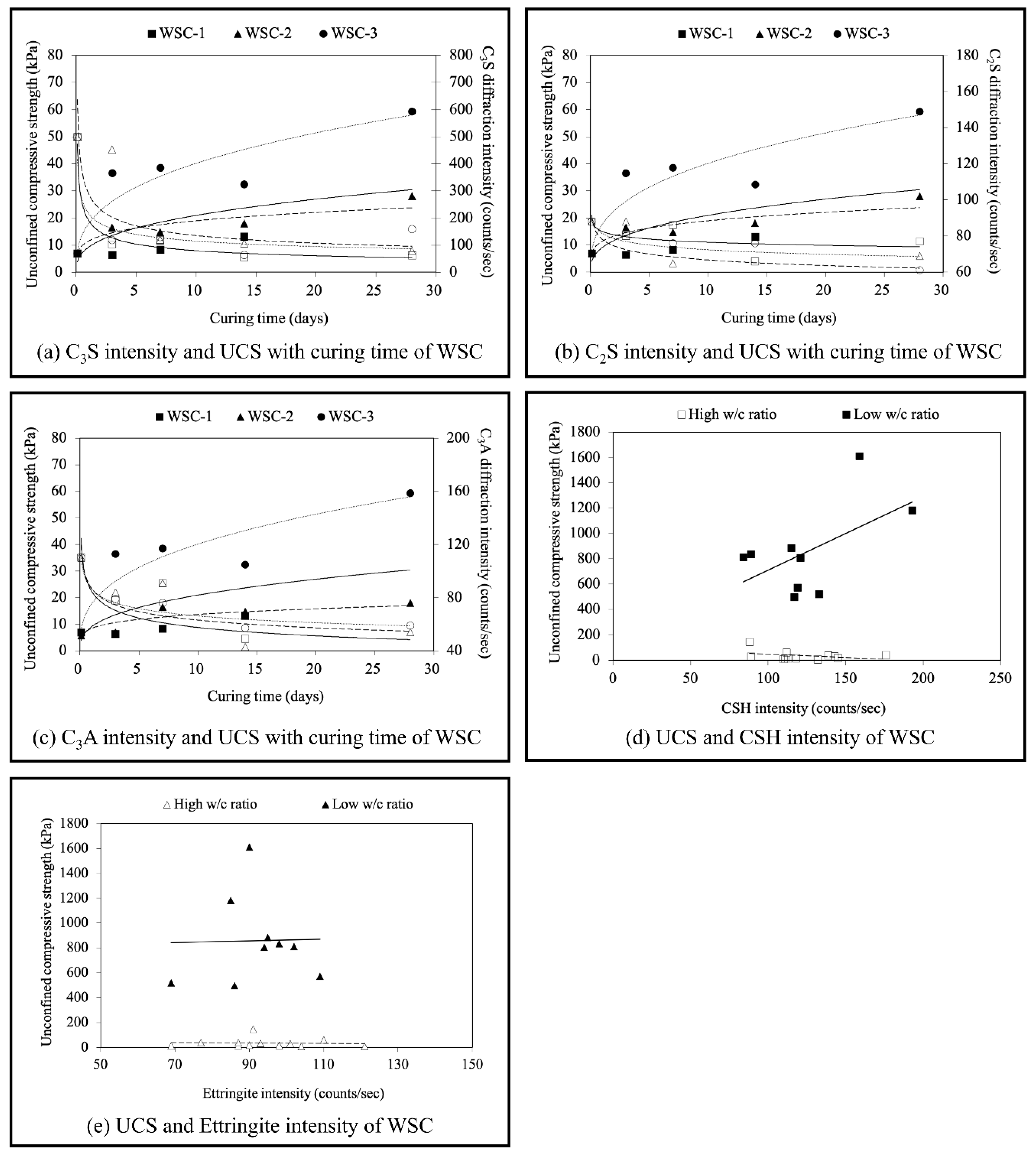
Figure 6.
SEM Microstructures with EDX and element composition analysis ( and ).
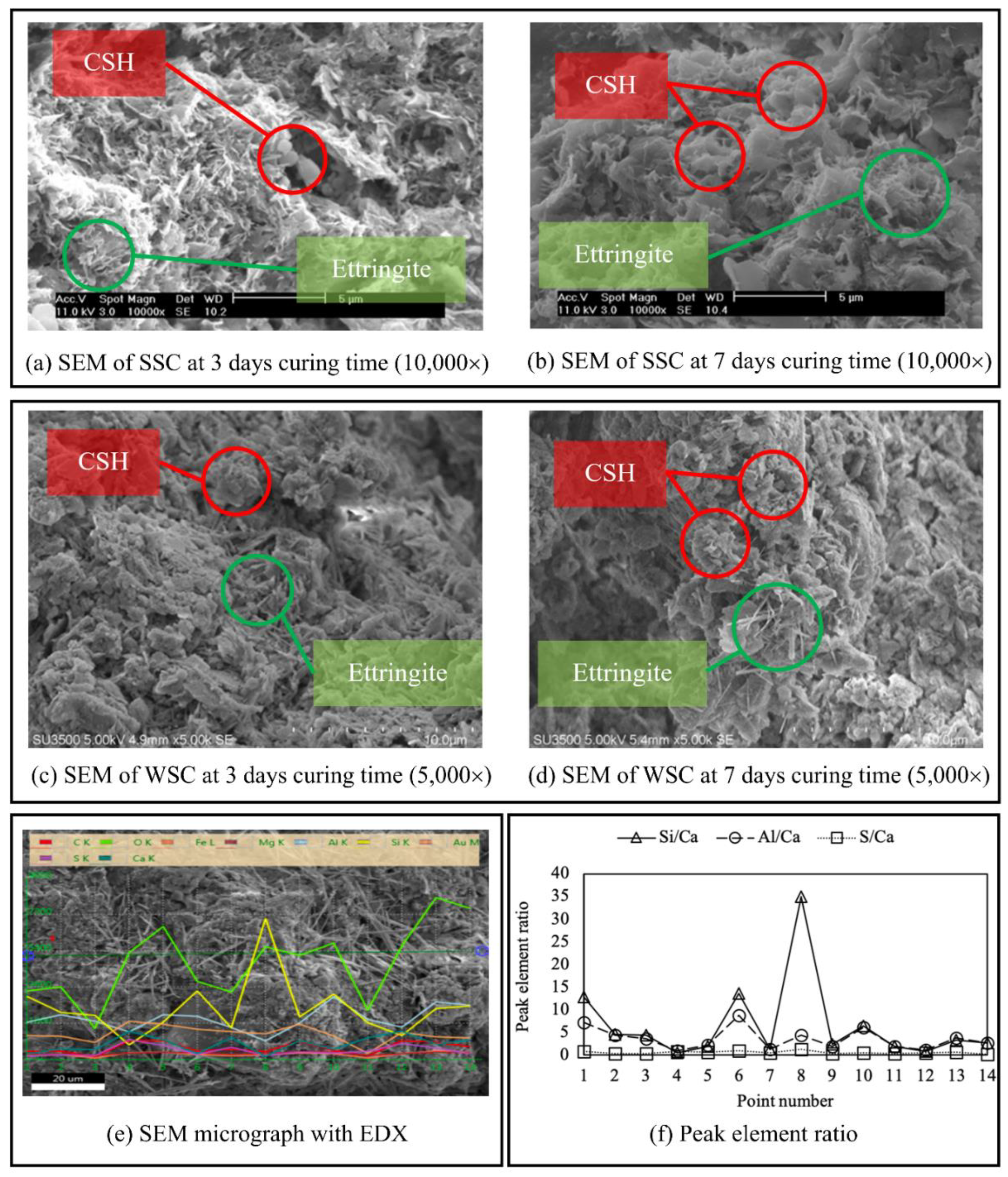

Table 1.
Basic characteristics of WS and SS. (a) Physical properties. (b) Chemical compositions.
| (a) Physical properties | |||||
| Properties | Seabed dredged sludge (SS) | Water treatment sludge (WS) | |||
| Specific gravity | 2.67 - 2.72 | 2.58 | |||
| Natural water content (%) | 200 - 300 | 120 - 150 | |||
| Liquid limit (%) | 99.64 - 101.69 | 58.7 | |||
| Plastic limit (%) | 35.81 - 37.95 | 53.8 | |||
| Plastic index | 63.79 | 4.9 | |||
| Soil classification (AASHTO) | A-7-5 (20) | A-7-5 (20) | |||
| Soil classification (USCS) | CH | MH | |||
| (b) Chemical compositions | |||||
| Oxide component | SS [17] | WS [18] | WS [2] | ||
| SiO2 | 63.56 | 56.30 | 57.30 | ||
| Al2O3 | 22.19 | 28.60 | 26.74 | ||
| Fe2O3 | 3.67 | 7.78 | 8.58 | ||
| K2O | 3.04 | 2.15 | 1.95 | ||
| CaO | 1.02 | 1.18 | 1.25 | ||
| MgO | 1.34 | 1.24 | 1.34 | ||
| P2O5 | - | 0.91 | 0.36 | ||
| TiO2 | - | 0.89 | 0.91 | ||
| SO3 | 0.25 | 0.22 | 1.16 | ||
| MnO | - | 0.19 | 0.23 | ||
| Na2O | 2.07 | 0.36 | - | ||
| LOI | - | 0.17 | - | ||
| Cl | 1.68 | - | 0.07 | ||
Table 2.
of WSC at various curing time.
| Sample | Element ratio | Remarks: Mixing condition | |||||
|---|---|---|---|---|---|---|---|
| 3 days | 7 days | 14 days | Cement content (kg/m3) | Initial water content (%) | w/c ratio | ||
| WSC-1 | Si/Ca | 2.84 | 1.71 | 3.38 | 150 | 128.5 | 7.73 |
| S/Ca | 0.00 | 0.00 | 0.32 | ||||
| Al/Ca | 2.32 | 1.70 | 2.77 | ||||
| WSC-2 | Si/Ca | 1.99 | 1.95 | 7.44 | 200 | 128.5 | 5.80 |
| S/Ca | 0.00 | 0.00 | 0.00 | ||||
| Al/Ca | 1.15 | 1.56 | 7.20 | ||||
| WSC-3 | Si/Ca | 3.30 | 3.94 | 6.67 | 250 | 128.5 | 4.64 |
| S/Ca | 0.00 | 0.00 | 0.00 | ||||
| Al/Ca | 2.19 | 1.96 | 5.70 | ||||
| WSC-4 | Si/Ca | 3.75 | 7.12 | - | 150 | 46.0 | 3.07 |
| S/Ca | 0.00 | 0.00 | - | ||||
| Al/Ca | 2.38 | 5.02 | - | ||||
| WSC-5 | Si/Ca | 3.69 | 5.19 | - | 200 | 46.0 | 2.30 |
| S/Ca | 0.00 | 0.16 | - | ||||
| Al/Ca | 3.29 | 3.84 | - | ||||
| WSC-6 | Si/Ca | 4.42 | 12.05 | - | 250 | 46.0 | 1.84 |
| S/Ca | 0.00 | 0.00 | - | ||||
| Al/Ca | 3.32 | 9.61 | - | ||||
Disclaimer/Publisher’s Note: The statements, opinions and data contained in all publications are solely those of the individual author(s) and contributor(s) and not of MDPI and/or the editor(s). MDPI and/or the editor(s) disclaim responsibility for any injury to people or property resulting from any ideas, methods, instructions or products referred to in the content. |
© 2024 by the authors. Licensee MDPI, Basel, Switzerland. This article is an open access article distributed under the terms and conditions of the Creative Commons Attribution (CC BY) license (http://creativecommons.org/licenses/by/4.0/).
Copyright: This open access article is published under a Creative Commons CC BY 4.0 license, which permit the free download, distribution, and reuse, provided that the author and preprint are cited in any reuse.


