
Submitted:
27 December 2024
Posted:
30 December 2024
You are already at the latest version
Abstract
Kaon condensation in hyperon-mixed matter [(Y+K) phase], which may be realized in neutron stars, is discussed on the basis of chiral symmetry. With use of the effective chiral Lagrangian for kaon (K)-baryon (B) and K-K interactions, coupled with the relativistic mean-field theory and universal three-baryon repulsive interaction, we clarify the effects of the s-wave K-B scalar interaction simulated by the K-B sigma terms and vector interaction (Tomozawa-Weinberg term) on kaon properties in hyperon-mixed matter, onset density of kaon condensation, and the EOS with the (Y+K) phase. In particular, the quark condensates in the (Y+K) phase are obtained, and their relevance to chiral symmetry restoration is discussed.
Keywords:
meson condensation
; chiral symmetry
; quark condensates
; hyperon-mixing
; universal three-baryon repulsion
1. Introduction
Possible existence of meson condensation (MC) in dense and hot hadronic matter has been extensively considered from viewpoints of particle physics, nuclear physics, astrophysics, and condensed matter physics. Much attention has been paid mainly to pion condensation [1,2,3,4] and kaon condensation [5,6,7,8,9,10,11,12,13,14,15,16]. Meson condensation is characterized as macroscopic realization of the Nambu-Goldstone (NG) bosons (specifically pions and kaons) in strongly interacting system of bosons and baryonic matter. Therefore, meson-baryon dynamics associated with underlying chiral symmetry and its spontaneous or explicit symmetry breaking play an important role on revealing properties of meson-condensed state. In this respect, meson-condensed system offers a remarkable contrast to usual condensed matter systems like dilute Bose gases, where formation of the Bose-Einstein condensation (BEC) occurs as a result of competition between thermal fluctuation and quantum statistics.
Along with the development of strangeness nuclear physics involving kaons, mesons, and hyperons, a possible existence of kaon condensation (KC) has been suggested as a novel hadronic phase with multi-strangeness [5]. It has been shown that the s-wave KC is formulated model-independently with a framework of current algebra and partially conservation of axial current (PCAC) [6]. Subsequently a coexistent phase of KC and hyperon (Y)-mixed matter [(Y+K) phase] has been considered in the relativistic mean-field (RMF) theory [17,18,19], in the effective chiral Lagrangian for kaon (K)-baryon (B) interaction [20,21,22], density-dependent RMF theory [23,24,25], and effective chiral Lagrangian coupled to the RMF and three-baryon repulsion [26,27,28]. The driving force of kaon condensation is brought about by both the s-wave K-nucleon (N) scalar interaction simulated by the sigma term and the s-wave K-N vector interaction corresponding to the Tomozawa-Weinberg term. The not only specifies the scale of explicit breaking of chiral symmetry, but also is related with the quark condensates in the nucleon. The onset density of KC, , has been estimated to be = (3−4) with the nuclear saturation density (= 0.16 fm−3), depending on the value of . Beyond the onset density, the kaon-condensed phase in hadronic matter develops accompanying softening of the equation of state (EOS) at high densities, and it is eventually considered to move to chiral-restored phase. Thus the KC may be regarded as a pathway from hadronic matter to strange quark matter and may affect properties of the condensate in dense matter, which is an order parameter of chiral restoration.
In a series of our works, we have considered the (Y+K) phase by the use of the interaction model where K-B and K-K interactions are described by the effective chiral Lagrangian (abbreviated to ChL) and the B-B interactions are given by exchange of mesons [, () for scalar mesons, , , for vector mesons] in the RMF theory [26,27,28]. We adopt the RMF model for two-body B-B interaction mediated by meson-exchange, without the nonlinear self-interacting (NLSI) meson potentials. [We call this model a “minimal RMF” (abbreviated to MRMF) throughout this paper.] Instead of the NLSI terms, we introduce the density-dependent effective two-body potentials for the universal three-baryon repusion (UTBR), which has been derived from the string-junction model by Tamagaki [29] (SJM2) and originally applied to hyperon-mixed matter by Tamagaki, Takatsuka and Nishizaki [30]. Together with the UTBR, phenomenological three-nucleon attraction (TNA) has been taken into account, and we have obtained the baryon interaction model that reproduces saturation properties of symmetric nuclear matter (SNM) together with empirical values of incompressibility and symmetry energy at . In addition, by specifying the slope L of the symmetry energy within an acceptable range, we set stiffness of the EOS coming from two-baryon repulsion (Two-BR) through the vector meson exchange. Then we have investigated the (Y+K) phase based on the ChL coupled with this baryon interaction model (MRMF+UTBR+TNA) [26,28]. It has been shown that the EOS and the resulting gravitational mass and radius of compact stars with the (Y+K) phase are consistent with recent observations of massive neutron stars (see Section 8).
In this paper, by the use of this interaction model (ChL+MRMF+UTBR+TNA), we overview the results on the onset density of KC in hyperon-mixed matter, the EOS and the characteristic features of the (Y+K) phase [28]. Before presentation of the results for the (Y+K) phase, the allowable range of the sigma term for baryon b is reanalyzed in terms of recent constraints of the -N sigma term, , and strangeness condensate inside the nucleon, , which have been obtained from phenomenological analyses and lattice QCD. Based on the results on the EOS within our interaction model, the condensate in the (Y+K) phase is obtained with the help of the Feynman-Hellmann theorem in the mean-field approximation. We discuss the relevance of the s-wave KC to chirally restored quark matter through the behavior of the quark condensate as a mediating order parameter between the (Y+K) phase and quark phase.
The paper is organized as follows. In Section 2, chiral symmetry approach for kaon condensation based on the effective chiral Lagrangian is introduced. In Section 3, the MRMF is explained in meson-exchange picture for B-B interaction. In addition, the UTBR (SJM2 as a specific model) and TNA are introduced phenomenologically. Formulation obtaining the ground state energy for the (Y+K) phase is described in Section 4. In Section 5, the results on the properties of the SNM with our interaction model is given. In Section 6, the “KB sigma terms” are estimated by the inclusion of the nonlinear effect with respect to the strange quark mass beyond chiral perturbation in the next to leading order. In Section 7, onset of the s-wave KC in hyperon-mixed matter and composition of matter in the (Y+K) are figured out. In Section 8, static properties of neutron stars with the (Y+K) phase such as gravitational mass and radius are summarized. Quark condensates in the (Y+K) phase and relevance to chiral restoration are discussed in Section 9. Summary and outlook are given in Section 10.
2. Chiral Symmetry Approach for Kaon Condensation
The (Y+K) phase is composed of kaon condensates and hyperon-mixed baryonic matter together with leptons, being kept in beta equilibrium, charge neutrality, and baryon number conservation. In the following, we simply take into account protons, neutrons, , , and hyperons for baryons and electrons and muons for leptons.
2.1. Kaon-Baryon and Multi-Kaon Interactions
We base our model for K-B and K-K interactions upon the effective chiral SU(3)L×SU(3)R Lagrangian [5] in the next to leading order with typical energy scale p in chiral perturbation. The relevant Lagrangian density is given by
where the first and second terms are kinetic and mass terms of the nonlinear meson fields, with () being the octet mesons, the flavor SU(3) generator, f (=93 MeV) the meson decay constant, 1 GeV the chiral-symmetry breaking scale, and M (=) the quark mass matrix. The third term in Equation (1) is kinetic and mass terms of the octet baryons with being the spontaneously broken baryon mass. The fourth term represents the s-wave K-B vector interaction with being the vector current for meson field (= ). This term corresponding to the Tomozawa-Weinberg term plays a role of one of the main driving force for KC. The fifth and sixth terms (F and D terms), with being the axial-vector current for meson, lead to the p-wave K-B interactions, which we simply neglect here since only the s-wave condensation is considered. The last three terms with the coefficients ∼ in Equation (1) are in through the -dependence in M and break chiral symmetry explicitly. They serve as another driving force for KC as the “K-baryon sigma terms”, . Throughout this paper, we consider only the [=(] for , and nucleons (p, n) and hyperons (, , ) for .
In order to reproduce the s-wave on-shell scattering amplitudes, we should take into account conventionally the range terms of order [= ] with the lowest kaon energy and a pole contribution from the (1405), which lies ∼ 30 MeV below the threshold. Indeed, they have sizable contributions to the s-wave on-shell scattering amplitudes. Nevertheless these contributions become negligible at higher density since as density increases, and the solely remains to work as the s-wave K-B attractive interaction. The same conclusion, which we call the second-order effect, has been obtained in the second-order perturbation with respect to the axial-vector current in the framework of current algebra and PCAC [16]. Therefore, throughout this paper, these range terms and the (1405) pole contribution are neglected from the outset.
The classical kaon field is assumed to be spatially uniform with spatial momentum and represented classically as
where the chiral angle, and is the chemical potential.
By the use of Equation (2), the Lagrangian density (1) is separated into the kaon part and the baryon part in the mean-field approximation: . For one reads [26,28]
where the second term in the bracket on the r. h. s. is the kaon mass term with
being identified with the kaon rest mass, which is set to the empirical value (493.677 MeV). The last term in the bracket on the r. h. s. of Equation (3) stands for the s-wave K-B vector interaction with being given by
where and are the number density and V-spin charge, respectively for baryon species b. The form of Equation (5) for is specified model-independently within chiral symmetry. From Eqs. (3) and (5), one can see that the s-wave K-B vector interaction works attractively for protons and neutrons, while repulsively for and hyperons, as far as , and there is no s-wave K- vector interaction.
For one reads
where is the baryon field b and is the effective baryon mass:
where (b = ) is the baryon rest mass, which is read off from the last three terms in (1) as
with . The quark masses are set to be () = (2.2, 4.7, 95) MeV with reference to recent results of the lattice QCD simulation [31]. The parameters and are then fixed to be = −0.697, = 1.37 so as to reproduce the mass splittings between the octet baryons. The second term on the r. h. s. in Equation (7) represents modification of the free baryon masses through the s-wave K-B scalar interaction simulated by (), which are denoted in terms of the coefficients , , in Equation (1) as
These quantities are identified with the “kaon-baryon sigma terms” which are defined by
by the use of the Feynman-Hellmann theorem, = for , with the help of the expressions of the baryon rest masses [Equation (8)] up to next to leading order in chiral perturbation.
3. Baryon Interactions
The baryon interactions are composed of two-body B-B interaction through the meson ()-exchange in the MRMF model and density-dependent effective two-body potential constructed from universal three-body forces.
3.1. Minimal RMF for Baryon-Baryon Interaction
Together with the free meson part of the Lagrangian density, one obtains the B-M Lagrangian density as
where the first term on the r. h. s. in Equation (11) is taken over from Equation (6). The effective baryon mass is further modified from the [Equation (7)] due to scalar meson (, )-B couplings:
where , are the scalar-meson-baryon coupling constants. Further the derivative in (6) is replaced by the covariant derivative as , where the vector meson (, , )-B couplings are introduced; The vector meson fields for the , , mesons are denoted as , with the isospin component a, and , respectively, is the vector meson-B coupling constant. The kinetic terms of the vector mesons are given in terms of , , and . Throughout this paper, only the time-components of the vector mean fields, , (), , are considered for description of the ground state, and they are taken to be uniform. The meson masses are set to be = 400 MeV, = 975 MeV, = 783 MeV, = 769 MeV, and = 1020 MeV.
The meson-hyperon coupling constants are determined to obtain the hyperon-nucleon and hyperon-hyperon interactions. The vector meson couplings for hyperons are related to the vector meson-nucleon couplings , , through the SU(6) symmetry relations [32]:
The scalar (, ) meson-hyperon couplings are determined with the help of information from the phenomenological analyses of recent hypernuclear experiments. The obtained values of the -Y coupling constants, , are listed for the case of L = (60, 65, 70) MeV in Table 1 in Section 5.1. The details of obtaining the and the -Y coupling constants, , are addressed in Ref. [27].
In Equation (11), there is no extra term with nonlinear self-interacting meson potentials, which would bring about three-body or many-body baryon interactions. Instead, in the present framework, many-body baryon interactions, which should be relevant to the stiffness of the EOS in high densities, are represented by phenomenological three-body forces.
3.2. Universal Three-Baryon Repulsive Force and Three Nucleon Attractive Force
The three-baryon repulsion is relevant to the short-range region of baryon interactions, where quark structure of baryon may reveal itself, and the origin of short-range repulsion is connected with the quark confinement mechanism which is spin-flavor independent. Therefore it is natural that the three-body repulsion is qualitatively independent on spin-flavor of baryons, reflecting the confinement mechanisms of quarks at high-density region. Thus it is assumed to work universally between any baryon species. Along with this viewpoint, we adopt a specific model for the universal three-body repusion (UTBR) proposed by Tamagaki based on the string-junction model (SJM2) [29,30]. We utilize the density-dependent effective two-body potential between baryons 1 and 2, by integrating out variables of the third baryon participating the UTBR, after assigning the short-range correlation function squared for each baryon pair [29]. In the following, the approximate form of is used as
where = 95 MeV·fm3, = 0.024, and = 0.86 fm corresponding to = 0.50 fm for SJM2 [30]. The grows almost linearly with . Finally one obtains the effective two-body potential, .
To simulate the attractive contribution from the TNA to the binding energy for , we adopt the density-dependent effective two-body potential by Nishizaki, Takatsuka and Hiura [33], which was phenomenologically introduced and the direct term of which agrees with the expression by Lagaris and Pandharipande (LP1981) [34]:
where the range parameter is fixed to be 2.0 fm. The depends upon not only density but also isospin with Pauli matrices . The parameters and are determined together with other parameters to reproduce the saturation properties of the SNM for the allowable values of L (see Section 5).
4. Description of the Ground State for the (Y+K) Phase
4.1. Energy Density Expression for the (Y+K) Phase
The energy density for the (Y+K) phase is separated into the KC part, , the baryon kinetic part and meson part for two-body baryon interactions, , three-body interaction parts, (UTBR)+ (TNA), and free lepton parts, for the ultra-relativistic electrons and for muons. From (3) and (11) one obtains
where baryons (b) are occupied within each Fermi sphere with Fermi momentum .
The contribution from the UTBR is written in the Hartree approximation as
where (=0.589496 ⋯) for SJM2. With the use of the spatial average for the s. r. c. function being denoted as , one can write . Thus is interpreted as the range of the effective two-body potential .
Likewise the energy-density contribution from the direct term of the TNA is represented as
with and the proton-mixing ratio. With Eqs. (16)–(19) and the relativistic forms of the lepton energy densities, the total energy density is given by
4.2. Classical Field Equations for Kaon Condensates and Meson Mean Fields
Throughout this paper, the classical field () and meson mean-fields () are set to be uniform and only depends on total baryon density . The equations of motion for these fields are derived from the Lagrangian density in the mean-field approximation.
The classical kaon field equation follows from
One obtains
and the effective kaon mass squared is defined by
with being a scalar density for baryon b:
For the equations of motion for meson fields, one obtains
4.3. Ground-State Conditions
The ground state energy for the () phase is obtained under the charge neutrality, baryon number and -equilibrium conditions. The charge neutrality condition is written as
where denotes the total negative charge density, is the number density of KC and is given from kaon part of the Lagrangian density (3) as
In Equation (25), is the electron number density and is related to the electron chemical potential as in the ultra-relativistic limit. is the muon number density and is given by .
The baryon number conservation is given by
In addition, the following chemical equilibrium conditions for weak processes are imposed: , , , , , and those involved in muons in place of if muons are present. These conditions are followed by the relations between the chemical potentials
where and (=) (i = p, n, , , , , , ) are the charge chemical potential and the chemical potential for each particle species (i), respectively, at a given baryon number density .
5. Properties of Symmetric Nuclear Matter
Here we address the ground state properties of SNM in the (MRMF+UTBR+TNA) model and discuss the effects of the three-nucleon forces, UTBR and TNA, on the stiffness of the EOS of SNM at densities around and beyond .
5.1. Meson-Nucleon Coupling Constants Determined From Saturation Properties in SNM
In order to determine the meson-nucleon coupling constants, , , , and the , mean fields, , , and parameters in TNA, , , we impose the saturation properties of the symmetric nuclear matter (SNM), i.e., the saturation density = 0.16 fm−3, binding energy = 16.3 MeV, the incompressibility K = 240 MeV, symmetry energy = 31.5 MeV, and the slope L [] = (60−70) MeV, taking into account the ambiguity of the empirical value of the L [35]. Also the equations of motion for the meson mean-fields are imposed:
where (=) is the nuclear scalar density. In Table 1, the relevant quantities associated with the (MRMF+UTBR+TNA) model are listed for three cases of L = (60, 65, 70) MeV.

Table 1.
The parameters , for TNA, the coupling constants, , , , the meson mean-fields, , , and the effective mass ratio for the nucleon, , in SNM at = , obtained in the (MRMF+UTBR+TNA) model in case of L = 60, 65, and 70 MeV. The -Y coupling constants (Y = , , ) determined from the potential depths for Y in SNM are also listed.
Table 1.
The parameters , for TNA, the coupling constants, , , , the meson mean-fields, , , and the effective mass ratio for the nucleon, , in SNM at = , obtained in the (MRMF+UTBR+TNA) model in case of L = 60, 65, and 70 MeV. The -Y coupling constants (Y = , , ) determined from the potential depths for Y in SNM are also listed.
| (MeV·fm6) | (fm3) | (MeV) | (MeV) | ||||||||
| SJM2+TNA-L60 | −1662.63 | 17.18 | 5.27 | 8.16 | 3.29 | 39.06 | 16.37 | 0.78 | 3.29 | 2.00 | 1.82 |
| SJM2+TNA-L65 | −1597.67 | 18.25 | 5.71 | 9.07 | 3.35 | 42.16 | 18.18 | 0.74 | 3.54 | 2.34 | 1.93 |
| SJM2+TNA-L70 | −1585.48 | 19.82 | 6.07 | 9.77 | 3.41 | 44.62 | 19.59 | 0.71 | 3.74 | 2.61 | 2.02 |
5.2. Necessity of Three-Body Repulsion and Attraction for Empirical Saturation of SNM
In Figure 1, the total energy per nucleon, E (total) ), in SNM is shown as a function of baryon number density by the solid line for the slope L = 65 MeV. The energy contributions from the three-nucleon-repulsion [E (TNR)], the three-nucleon attraction [E (TNA)], and the sum of kinetic and two-body interaction energies [E (two-body)] in SNM are also shown by the solid lines. For comparison, those obtained by the standard variational method with the use of the two-body potential and the phenomenological TNR and TNA by LP (1981), are depicted by the dotted lines [34]. In the case of LP (1981), the numerical value of E (two-body) are read off from Figure 2, Tables 4 and 5 in [34].
As seen from Figure 1, both the TNR and TNA play important roles to locate the total energy minimum at the empirical saturation point. Indeed, it is necessary to include both the TNR and TNA in the total energy E (total) in addition to the nuclear two-body interaction within the MRMF, in order to reproduce the empirical saturation property and incompressibility (= 240 MeV) for the SNM. The TNR (the TNA) pushes up (pulls down) the E (two-body) curve for (). The energy contributions from the TNR and TNA around are quantitatively close to those in LP (1981): E (TNR) = 4.1 MeV and E (TNA) = −6.6 MeV at , while E (TNR) (LP) = 3.5 MeV and E (TNA) (LP) = −6.1 MeV.
6. Estimation of the Kaon-Baryon Sigma Terms-Quark Condensates in the Baryon -
6.1. Nonlinear Effect on the Quark Condensates
In this section, we estimate the allowable value of the K-nucleon sigma term, (). is generally denoted as
with . In Equation (30a), is the sigma term,
and () is the the strangeness condensate in the nucleon. In Equation (30b), and are defined by
The former stands for the isospin asymmetry for the quark condensates in the nucleon, and the latter implies breaking scale of the Okubo-Zweig-Iizuka (OZI) rule. The sigma terms are related to the following flavor nonsinglet condensates as well:
In chiral perturbation theory, these condensates are related to mass difference between the octet baryons:
with the use of Equation (8). Recent lattice QCD results suggest small condensate in the nucleon, i.e., = 0.03–0.2 [36,37,38]. In particular, for , one can see from Eqs. (34a) and (35a) that 25 MeV. This value of is too small as compared with the phenomenological values (40–60) MeV [39,40] which are deduced from the analyses of -N scattering and pionic atoms, or lattice QCD results ∼ 40 MeV [40]. Thus as far as the estimation of the quark condensates in the nucleon is based on chiral perturbation, small condensate in the nucleon is incompatible with the standard value of the sigma term.
It has been shown that nonlinear effects beyond chiral perturbation can make both the value of and the octet baryon mass splittings consistent with experiments with a small strangeness content of the proton [40,41,42]. Here we take into account the nonlinear effect on the strangeness quark condensates which originate from the additional universal rest mass contribution of baryons, in higher order with respect to .
The contents in the baryon b after correction from the nonlinear effect are obtained from =, with the baryon rest masses given by . The result is
with , and
Then the sigma terms (9) are modified by the replacement: . The nonlinear effect is absorbed into .
The “K-baryon sigma terms” are given in terms of , , and , , by
with .
The parameters and are rewritten specifically as
Once is given, and () are determined from Eqs. (31) and (39), respectively. Then is obtained from Equation (30b) together with , which is given as a function of through Equation (40). With the nonlinear effect , is represented as . In Figure 2, the K-neutron sigma term as a function of is shown at a fixed value of considering uncertainty ranging from 35 MeV to 60 MeV. The vertical dotted line shows boundaries of the allowable region for , taken from [36,37,38].
The standard value for has been taken to be ∼ 45 MeV phenomenologically [39]. Recently the higher values (50–60) MeV are suggested from the phenomenological analyses of -N scatterings [40]. In view of this, reading off from Figure 2, we take two cases of = 300 MeV with = 0 and 400 MeV with = 0.2 as typical values for throughout this paper. The corresponding quantities, , , and () together with , are also determined for fixed values of (, , ) and (, ). The result is listed in Table 2.
A scale of the s-wave K-N attraction is characterized by the optical potential in the SNM, which is defined in terms of the self-energy [Equation (43) in Section 7.1] as . In Table 2, the is listed for each case of . The value of has sensitive dependence on , while it depends little on the slope L. Our deduced value of the depth (110 MeV–130 MeV) is larger than the theoretical values in the chiral unitary approach [43], while it is similar to that of Refs. [44,45] ( 120 MeV) with inclusion of short-range correlations. It can also be compared with the recent optimal value of the real part of the optical potential depth = 80 MeV with the imaginary part = −40 MeV in the J-PARC E05 experiment [46].
Figure 2.
The K-neutron sigma term as a function of () for a given value of = (35–60) MeV. The current quark masses are set to () = (2.2, 4.7, 95) MeV. The vertical dotted line denotes the upper value of = 0.2 suggested by the lattice QCD results, taken from [36,37,38]. The right endpoint of each line corresponds to = 0 (the case of chiral perturbation). See the text for details.
Figure 2.
The K-neutron sigma term as a function of () for a given value of = (35–60) MeV. The current quark masses are set to () = (2.2, 4.7, 95) MeV. The vertical dotted line denotes the upper value of = 0.2 suggested by the lattice QCD results, taken from [36,37,38]. The right endpoint of each line corresponds to = 0 (the case of chiral perturbation). See the text for details.
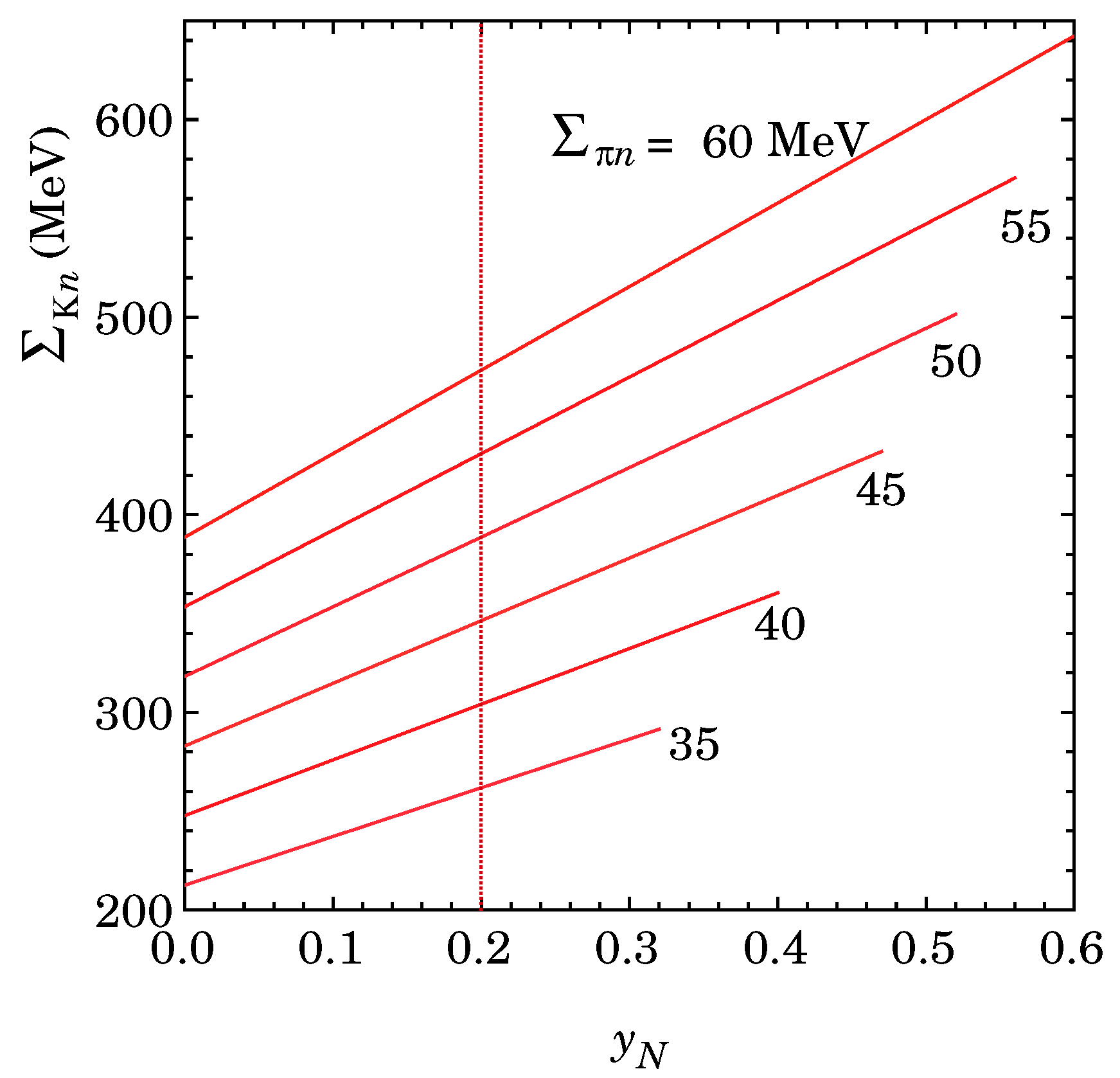
Table 2.
The parameters , , , in the chiral-symmetry breaking terms in the effective chiral Lagrangian (1), and the quantities in terms of them for the current quark masses (, , ) = (2.2, 4.7, 95) MeV [31]: , being a shift of the strangeness content in the nucleon from the value in the leading order chiral perturbation, the sigma term, and the “K-baryon sigma terms” () adopted in this work. The K-neutron sigma term, , is set to be two typical values 300 MeV and 400 MeV. The optical potential in the SNM is listed for each value of .
Table 2.
The parameters , , , in the chiral-symmetry breaking terms in the effective chiral Lagrangian (1), and the quantities in terms of them for the current quark masses (, , ) = (2.2, 4.7, 95) MeV [31]: , being a shift of the strangeness content in the nucleon from the value in the leading order chiral perturbation, the sigma term, and the “K-baryon sigma terms” () adopted in this work. The K-neutron sigma term, , is set to be two typical values 300 MeV and 400 MeV. The optical potential in the SNM is listed for each value of .
| () | (= ) | (= ) | |||||||
| (MeV) | (MeV) | (MeV) | (MeV) | (MeV) | |||||
| (−0.697, 1.37) | −3.09 | 47.4 | 0 | −3.43 | −2.23 | 300 | 368 | 379 | −111 |
| −3.37 | 51.3 | 0.20 | −2.51 | −2.74 | 400 | 468 | 479 | −131 |
It is to be noted that the pion-baryon sigma terms [] and strangeness sigma terms [] in the octet baryons (b) have been derived from analyses of the lattice QCD simulations for the octet baryon masses [47,48]. For comparison, we estimate and with being the empirical baryon mass. For = 45 MeV and , which are referred to from [47], one obtains = −2.82 ( = −2.91), = (0.024, 0.017, 0.015, 0.012), and = (0.026, 0.179, 0.238, 0.316) for b = (N, Y (=, , )). The relative ordering of , for estimated in our model agrees well with those in [47], while there is a little difference in absolute values for , between our results and those in Figure 2 in [47].
7. Onset of KC and Composition of Matter in the ( + ) Phase
Here we consider kaon properties in hyperon-mixed matter and obtain onset density of KC with our interaction model (ChL+MRMF+UTBR+TNA).
7.1. Onset Density of Kaon Condensation in Hyperon-Mixed Matter
In-medium modification of kaon dynamics in dense matter is revealed by density-dependence of the lowest kaon energy . The is given as a pole of the kaon propagator at , i.e., . The kaon inverse propagator, , is obtained through expansion of the effective energy density with respect to the classical kaon field,
where with the baryon chemical potential . With the use of Equations (16), (17), (25), (26), and by setting , , one obtains
where is the kaon self-energy:
The decreases with increase in due to the K-B scalar and vector attraction, while the kaon chemical potential , which is equal to the charge chemical potential in -equilibrated matter [Equation (28)], increases with density. At certain density, the intersects with the , where the condensed kaons spontaneously appear in the ground state through the weak reaction processes, , (), and strong reaction processes, , , ⋯, in the presence of hyperons. Thus the onset density for the s-wave kaon condensation is given by [7]
as a continuous phase transition. The relaxation processes toward the equilibrated matter with KC are governed by the weak processes [49].
In Figure 3, the lowest energy as a function of is shown for (a) = 300 MeV and (b) = 400 MeV in the case of L = 65 MeV. The charge chemical potential is also shown as a function of by the red dashed line. The filled triangle denotes the onset density of hyperon-mixing, , at which hyperon ()-mixing starts in the normal neutron-star matter (nucleon matter). The filled circle denotes the , at which KC is realized from hyperon ( and/or )-mixed matter.
The onset density of KC is read as = (0.60–0.73) fm−3 [(3.7–4.6) ] for = 300 MeV and = (0.49–0.52) fm−3 [(3.0–3.3) ] for = 400 MeV, within the range of the slope L = (60–70) MeV. For = 400 MeV, the is smaller at a given density than the case of = 300 MeV due to the stronger s-wave K-B scalar attraction, so that the for = 400 MeV is lower than the case of = 300 MeV. In Table 3, the onset densities and in the (ChL+MRMF+UTBR+TNA) model for = 300 MeV and 400 MeV in case of L = (60, 65, 70) MeV are listed. For all the cases of L and , the onset of -mixing always precedes the onset of KC.
Figure 3.
(a) The lowest energy , the effective mass of meson defined by Equation (22), and the [Equation (5)] as functions of baryon number density for = 300 MeV in the case of L = 65 MeV. The -dependence of the charge chemical potential (= if muons are present) is also shown by the red dashed line. The filled triangle (filled circle) denotes the onset density of hyperon-mixing, , (onset density of KC, ). The is equal to the charge chemical potential in the (Y+K) phase for . For comparison, the density-dependence of and in pure hyperon-mixed matter, where is set to be zero, is also shown by the green lines. (b) The same as (a), but for = 400 MeV. The filled triangle corresponds to the same onset density of as in (a), See the text for details.
Figure 3.
(a) The lowest energy , the effective mass of meson defined by Equation (22), and the [Equation (5)] as functions of baryon number density for = 300 MeV in the case of L = 65 MeV. The -dependence of the charge chemical potential (= if muons are present) is also shown by the red dashed line. The filled triangle (filled circle) denotes the onset density of hyperon-mixing, , (onset density of KC, ). The is equal to the charge chemical potential in the (Y+K) phase for . For comparison, the density-dependence of and in pure hyperon-mixed matter, where is set to be zero, is also shown by the green lines. (b) The same as (a), but for = 400 MeV. The filled triangle corresponds to the same onset density of as in (a), See the text for details.
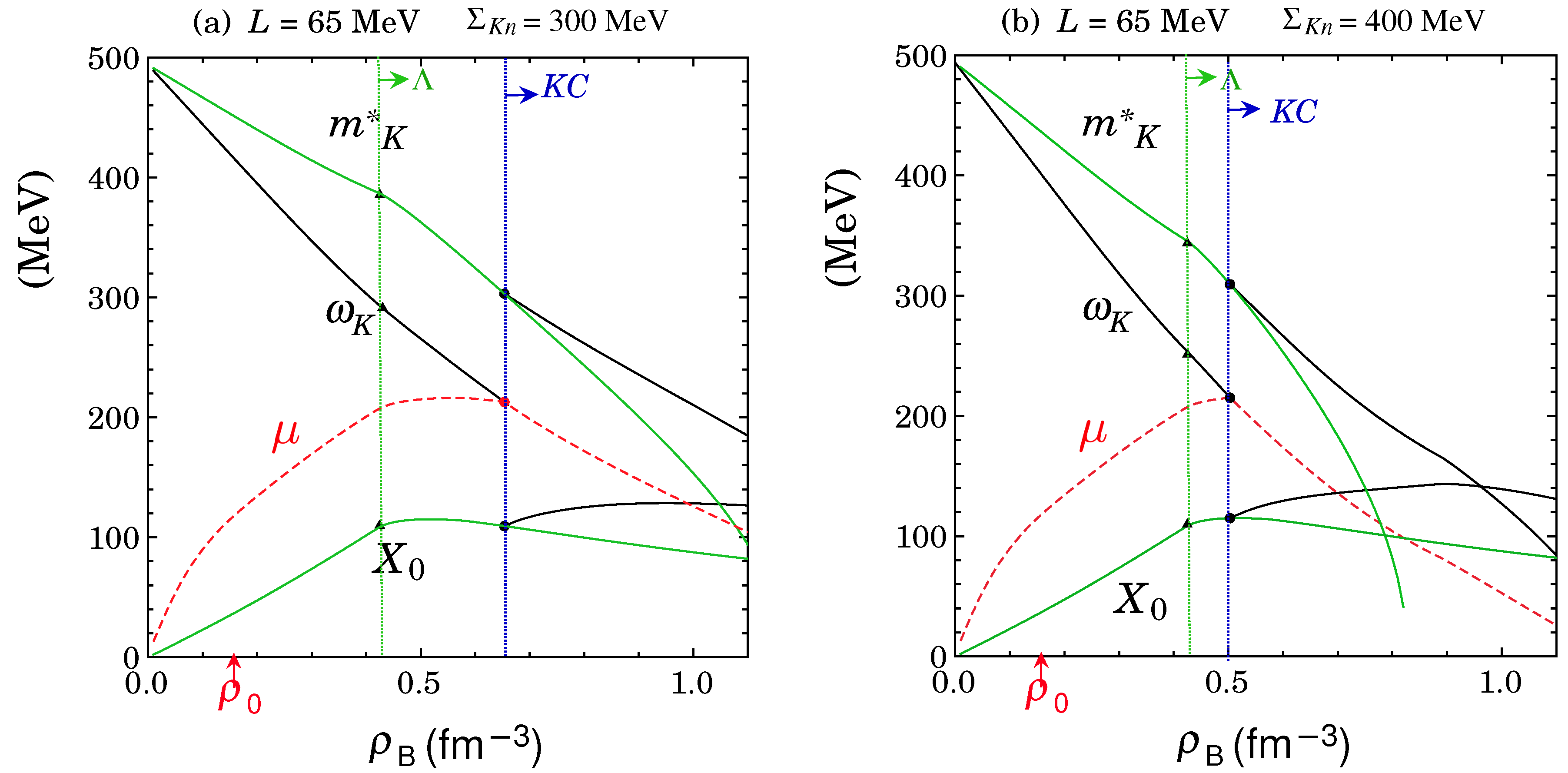
Table 3.
The onset densities at which hyperon-mixing starts and those of KC in the (ChL+MRMF+UTBR+TNA) model for = 300 MeV and 400 MeV in case of L = 60, 65, and 70 MeV. The is the onset density of hyperons in the normal neutron-star matter, the one of hyperons in the -mixed matter, the one of KC in the hyperon ( and/or )-mixed matter, and the one of the hyperons in the KC phase in the -mixed matter.
Table 3.
The onset densities at which hyperon-mixing starts and those of KC in the (ChL+MRMF+UTBR+TNA) model for = 300 MeV and 400 MeV in case of L = 60, 65, and 70 MeV. The is the onset density of hyperons in the normal neutron-star matter, the one of hyperons in the -mixed matter, the one of KC in the hyperon ( and/or )-mixed matter, and the one of the hyperons in the KC phase in the -mixed matter.
| L | |||||
| (MeV) | (MeV) | (fm−3) | (fm−3) | (fm−3) | (fm−3) |
| 60 | 300 | 0.466 | − | 0.598 | 1.04 |
| 400 | 0.466 | − | 0.486 | 0.994 | |
| 65 | 300 | 0.425 | 0.568 | 0.653 | − |
| 400 | 0.425 | − | 0.503 | 0.900 | |
| 70 | 300 | 0.397 | 0.516 | 0.733 | − |
| 400 | 0.397 | (0.516) | 0.523 | 0.790 |
7.2. Interplay Between Kaons and Baryons Before and After the Onset of KC
Together with the , the density-dependence of the [Equation (5)] and that of the “effective mass” of the meson [Equation (22)] are shown in Figure 3. For reference, the particle fractions before and after the onset of KC are shown as functions of in Figure 4.
As seen in Figure 4 and Table 3, the -mixing starts at a lower density than that of KC or hyperons. Subsequently, the fraction of hyperons monotonically increases with density even after KC or hyperons appear. Due to the appearance of hyperons, the nucleon (neutron and proton) fractions (and thus nucleon scalar densities) are suppressed as a result of baryon number conservation. In pure hyperon-mixed matter, the decrease in the nucleon fractions leads to suppression of the increase in K-N attractive vector interaction simulated by [ in Equation (5)]. Appearance of the hyperons also tends to work repulsively for the K- vector interaction, but the effect is negligible since is tiny, even if the hyperons are mixed in the range . On the other hand, reduces rapidly with density beyond the onset of -mixing, due to the fact that the increase in scalar density overcomes the decrease in nucleon scalar densities and that the sigma term is larger than the ones.
Once KC appears, the KC and hyperons compete against each other through the repulsive K- vector interaction term in , and the fraction becomes small. This competitive relation can also be seen from the interaction part of the number density [Equation (26)]. As a result, the is slightly enhanced in comparison with the case of pure hyperon-mixed matter. On the other hand, the reduction of gets moderate as compared with the case of pure hyperon-mixed matter, as seen in Figure 3. Indeed, the s-wave K-B scalar attraction is diminished according to the reduction of total baryon scalar density in the presence of KC since a part of strangeness is taken over by KC.
It is to be noted that the hyperons are not mixed over the relevant densities due to the strong repulsion of the in our model.
The development of KC with increase in baryon density leads to enhancement of the proton fraction so that the positive charge carried by protons compensates for the negative charge by KC, keeping charge neutrality. On the other hand, the lepton (, ) fractions are suppressed after the appearance of KC as well as hyperons, since the negative charge carried by leptons is replaced by that of KC, avoiding a cost of degenerate energy of leptons. The (Y+K) phase becomes almost lepton-less at high densities (see Figure 4). As a consequence, the charge chemical potential [= ] decreases steadily as density increases after the onset of KC and has the value with (see Figure 3). These features concerning proton and lepton fractions and the charge chemical potential are characteristic of the hadron phase in the presence of KC. The total strangeness is carried mainly by hyperons and KC in the (Y+K) phase with a minor fraction of hyperons at high densities.
8. EOS and Structure of Neutron Stars with the ( + ) phase
8.1. Energy Per Unit of Baryon
In Figure 5, the total energy per unit of baryon E (total) [], measured from the nucleon rest mass, and each energy contribution are shown as functions of for (a) = 300 MeV and (b) = 400 MeV in the case of L= 65 MeV. For reference, the energy difference per unit of baryon between the (Y+K) phase and pure hyperon-mixed matter, (), is also shown as functions of .
The E (UTBR) [], which is roughly proportional to , has a sizable contribution to the total energy and results in stiffening of the EOS at high densities. The E (two-body) [] also brings about repulsive energy as large as E (UTBR) until the onset of KC. Beyond the onset density of KC, the E (two-body) turns to decrease with density due to the attraction from the s-wave K-B interaction for both cases of , until it increases again at higher density. On the other hand, the E (KC) [], composed of kinetic and mass terms of KC, increases with baryon density. The sum of E (two-body) and E (KC) results in positive energy which increases with baryon density and works to stiffen the EOS as much as E (UTBR).
There is a clear energy difference, , between the (Y+K) phase and pure Y-mixed matter for = 400 MeV, while the difference is tiny for = 300 MeV.
The attraction from E (TNA) [] is responsible only in the vicinity of the saturation density , and the contribution from E (TNA) gets negligible beyond . The energy by leptons ( and ), E (lepton), has a minor contribution to the total energy, in particular, in the (Y+K) phase, reflecting the lepton-less nature of kaon-condensed phase.
8.2. Gravitational Mass to Radius Relations
Here we discuss the effects of KC on the static properties of compact stars such as the gravitational mass M - radius R relations. They are obtained by solving the Tolman-Oppenheimer-Volkoff equation with the EOS including the (Y+K) phase. For low density region 0.10 fm−3 below the density of uniform matter, we utilize the EOS of Ref. [50] and combine with the EOS obtained in our model for 0.10 fm−3.
In Table 4, some critical gravitational masses and their radii are summarized for = 300 MeV and 400 MeV in the case of L = (60, 65, 70) MeV. and [ and ] is the mass and radius of the neutron star where the central density attains the onset density of the -hyperons, [the onset density of KC, ]. and are the maximum mass of the neutron star and its radius.
The mass of the neutron star where the central density reaches the onset density is (1.74−2.14) for L = (60−70) MeV in the case of = 300 MeV, and (1.45−1.92) for L = (60−70) MeV in the case of = 400 MeV.
Observationally, neutron stars as large as 2 ( being the solar mass) have been detected [51,52,53]. Both mass and radius have been detected from X-ray observation by Neutron star Interior Composition ExploreR (NICER): for the pulsar PSR J0740+6620 with = 2.08 , = (12.35 ± 0.75) km [54] and = () , = () km [55], and for PSR J0030+0451 with = () , = () km [56], and = () , = () km [57]. The curves of M-R relations based on our EOS in the case of L =(65, 70) MeV pass through the above constrained regions. In particular, the maximum masses with the (Y+K) phase in the core are consistent with recent observations of massive neutron stars in both cases of = 300 MeV and 400 MeV for L =(65, 70) MeV. However, the masses within the causal limit for = 400 MeV and L = 60 MeV do not reach the range allowable from the observations of most massive neutron stars. In our model, the larger values of the slope 60 MeV are preferred in order to obtain observed massive neutron stars [28].
KC does not directly suffer from the repulsive effects of the UTBR, so that softening of the EOS with the (Y+K) phase proceeds steadily as density increases due to the energy decrease coming from the s-wave K-B attraction [26] in addition to avoiding effect of N-N repulsion by hyperon-mixing [58]. As a result, the M-R branch with the (Y+K) phase becomes flat in the vicinity of maximum mass as compared with the case for normal neutron stars without including phase transition. Such feature about the M-R branch is unique for multi-strangeness phase, and may be detectable by accumulated information on M and R for various massive neutron stars.
9. Quark Condensates in the (Y+K) Phase and Relevance to Chiral Restoration
Following the preceding results on the properties of the (Y+K) phase, we discuss effects of the (Y+K) phase on chiral restoration in dense matter by obtaining the quark condensates in the (Y+K) phase within the mean-field approximation. The quark condensate in KC (for ) is denoted as
where is the kaon-condensed eigenstate of the total Hamiltonian () with the eigenvalue of the ground state energy density , i.e. , and . With the Feynman-Hellmann theorem [59], one obtains
Throughout this paper, is approximated to , where is the vacuum energy, the energy shift due to vacuum polarization in the presence of baryonic matter, and [Equation (20)] is the energy density of the (Y+K) phase in the mean-field approximation. In the following, we further neglect the . Then the quark condensate associated with charged kaon condensation reads
where the first term in the second line on the r. h. s. is the quark condensate in the vacuum, the second term comes from the kaon mass term [Equation (16)] with the kaon rest mass [Equation (4)], and the last term from the baryonic energy Equation (17) through the effective baryon mass [Equation (12)] with the sigma term [Equation (9)]. The vacuum condensate is related to the Gell-Mann-Oakes-Renner (GOR) relation and is given by
From Eqs. (47) and (48) one obtains
with the use of Equation (22) for . Thus the density-dependence of the quark condensate is determined by the s-wave K-B scalar interaction simulated by the sigma terms within the mean-field approximation. In Figure 6, the ratio of the quark condensate in the (Y+K) phase to the vacuum quark condensate, , is shown as a function of baryon number density for L = 65 MeV with = 300 MeV for (a) and = 400 MeV for (b).
One can see that the appearance of hyperons leads to decrease in the condensate more as density increases in comparison with the case of non-strangeness matter (nucleon matter). In the presence of KC, the decrease in the quark condensate is also enhanced in comparison with the case of nucleon matter by the reduction factor in Equation (49), while the decrease is moderated in comparison with the case of pure hyperon-mixed matter, since the s-wave K-B scalar attractive interaction is weakened as a result of competing effect between hyperons and KC. The decrease in the quark condensate is more remarkable for = 400 MeV than for = 300 MeV. Thus it may be concluded that appearance of strangeness in the form of hyperon-mixing and KC in dense matter assists restoration of chiral symmetry.
It is to be noted that a contribution from particle-hole correlations by baryons and mesons beyond the mean-field approximation are not taken into account in the present form of the condensates, Equation (47), nor the vacuum polarization effect on the condensates, , through the modification of the Dirac sea in the presence of the Fermi sea. These effects should be taken into account for future study.
10. Summary and Outlook
We have overviewed the properties of the coexistent phase of kaon condensates and hyperons [(Y+K) phase] by the use of the interaction model based on the effective chiral Lagrangian (ChL) for K-B and K-K interactions combined with the minimal relativistic mean-field theory (MRMF) for two-body baryon interaction, taking into account the universal three-baryon repulsion (UTBR) and the phenomenological three-nucleon attraction (TNA), referring to the results in Ref. [26,28]. Interplay between KC and hyperons and resulting onset mechanisms of KC in hyperon-mixed matter and the EOS with the (Y+K) phase have been clarified within the (ChL+MRMF+UTBR+TNA) model. The EOS and the resulting mass and radius of compact stars within hadronic picture accompanying the (Y+K) phase are consistent with recent observations of massive neutron stars.
We have figured out the close relations between the s-wave KC in the (Y+K) phase and the quark () condensates in the context of chiral symmetry and its spontaneous and explicit breaking. One is estimation of the quark condensates inside the baryon, which is connected to the sigma term as one of the driving forces for the s-wave KC. By taking into account the nonlinear effect with respect to the strangeness quark mass beyond the chiral perturbation, we have obtained the allowable range of the sigma term, for a given sigma term, which is suggested from phenomenological analyses of the -N scattering experiments, and the small strangeness condensate in the nucleon, which is suggested from the recent lattice QCD results. As a result, the values of the = (300−400) MeV have been adopted as reasonable values in the paper.
Second, we have obtained the condensates in the (Y+K) phase in the mean-field approximation. It has been shown that the both appearance of strangeness in the form of hyperon-mixing and KC in dense matter assists restoration of chiral symmetry.
As an outlook with regard to the realistic EOS including various aspects of MC over the whole densities, it is suggested from heavy-ion collision experiments that the EOS in SNM or in pure neutron matter may be softer for (2−4.5) [60]. Pion condensation (PC), which may be realized at rather low densities , may have a role as softening mechanisms of the EOS at the relevant densities [9]. A possible coexistence of PC and KC (-K condensation) may be a realistic form of hadronic phase for keeping from the assumption of the UTBR; In the ground state of the -K condensed phase in neutron-star matter, the energy eigenstates for baryons are given by quasi-baryonic states with superposition of neutron and proton states under the p-wave condensates. In such a case, the ground state is occupied solely by the lower energy eigenstates of the quasi-baryons as a result of the level repulsion, forming the one-Fermi sea, which may help resolve the assumption of the universal strengths between different species of baryons for the UTBR.
On the other hand, there have been extensive studies on MC in quark matter [61]: PC in the Nambu-Jona-Lasinio (NJL) model [62], PC in the NJL model with chiral imbalance [63], PC and KC in chiral perturbation theory [64], KC in Ginzburg-Landau model with axial anomaly [65], etc. Recently, hadron-quark crossover has been proposed to obtain massive compact stars compatible with observations [66,67,68,69]. In this context, connection of hadronic matter including the (Y+K) phase to quark matter at high densities may be possible. Specifically, there may be similarity and difference between the alternating layer spin (ALS) structure accompanying condensation in hadronic matter [4] and dual chiral density wave (DCDW) in quark matter [70]. It is also an open problem how the (Y+K) phase is connected to KC in the color-flavor-locked (CFL) phase [71,72,73]. Toward unified understanding of meson condensation in both hadronic phase and quark phase, correspondence between chiral dynamics in both phases should be clarified on the assumption that there remain various hadronic excitation modes even in quark matter. For example, the following issues may be left as future elucidation whether there are relevant meson-quark interactions for MC in quark matter, corresponding to the s-wave K-B scalar and vector interactions as the driving force of the s-wave KC, and those corresponding to the p-wave interaction as the driving force of the p-wave PC in hadronic matter. Multi-quark interaction may be responsible for stiffening the EOS of MC in quark matter. Such repulsion might correspond to the UTBR which is introduced phenomenologically in order to solve the significant softening problem stemming from the appearance of KC and hyperon-mixing in hadronic matter.
Acknowledgments
The authors thank H. Sotani, N. Yasutake, and A. Dohi for their useful comments and interest in this work. The work is financially supported by Chiba Institute of Technology.
References
- R. F. Sawyer, Phys. Rev. Lett. 29,382 (1972). D. J. Scalapino, Phys. Rev. Lett. 29, 392 (1972).
- A. B. Migdal, Rev. Mod. Phys. 50, 107 (1978).A. B. Migdal, E. E. Saperstein, M. A. Troitsky, and D. N. Voskresensky, Phys. Rep. 192, 179 (1990).
- G. Baym and D. K. Campbell, Mesons and Nuclei, ed. M. Rho and D. H. Wilkinson (North Holland, Amsterdam, 1979),Vol. III, p.1031.
- T. Kunihiro, T. Muto, T. Takatsuka, R. Tamagaki, and T. Tatsumi, Prog. Theor. Phys. Suppl. 112,1 (1993).
- D. B. Kaplan and A. E. Nelson, Phys. Lett. B 175, 57 (1986).
- T. Tatsumi, Prog. Theor. Phys. 80, 22 (1988).
- T. Muto and T. Tatsumi, Phys. Lett. B 283, 165 (1992).
- T. Muto, Prog. Theor. Phys. 89 (1993) 415.
- T. Muto, R. Tamagaki, and T. Tatsumi, Prog. Theor. Phys. Suppl. 112, 159 (1993).T. Muto, T. Takatsuka, R. Tamagaki, and T. Tatsumi, Prog. Theor. Phys. Suppl. 112, 221 (1993).
- V. Thorsson, M. Prakash, and J. M. Lattimer, Nucl. Phys. A 572, 693 (1994); Nucl. Phys. A 574, 851 (1994) (E).
- E. E. Kolomeitsev, D. N. Voskresensky, B. Kämpfer, Nucl. Phys. A 588 (1995) 889.
- C. -H. Lee, G. E. Brown, D. -P. Min, and M. Rho, Nucl. Phys. A 585, 401 (1995).
- C. -H. Lee, Phys. Rep. 275,197 (1996).
- M. Prakash, I. Bombaci, M. Prakash, P. J. Ellis, J. M. Lattimer, and Knorren, Phys. Rep. 280, 1 (1997).
- K. Tsushima, K. Saito, A. W. Thomas, and S. V. Wright, Phys. Lett. B 429, 239 (1998); ibid. 436, 453 (1998) (E).
- H. Fujii, T. Maruyama, T. Muto, and T. Tatsumi, Nucl. Phys. A 597, 645 (1996).
- P. J. Ellis, R. Knorren, and M. Prakash, Phys. Lett. B349, 11 (1995).
- R. Knorren, M. Prakash, and P. J. Ellis, Phys. Rev. C52, 3470 (1995).
- J. Schaffner and I. N. Mishustin, Phys. Rev. C53, 1416 (1996).
- S. Pal, D. Bandyopadhyay, and W. Greiner, Nucl. Phys. A 674, 553 (2000).
- T. Muto, Phys. Rev. C 77, 015810 (2008), and references cited therein.
- A. Mishra, A. Kumar, S. Sanyal, V. Dexheimer, and S. Schramm, Eur. Phys. J. A 45, 169 (2010).
- P. Char and S. Banik, Phys. Rev. C 90, 015801 (2014).
- T. Malik, S. Banik, and D. Bandyopadhyay, Astrophys. J. 910, No. 2, 96 (2021).
- Fu Ma, C. Wu, and W. Guo, Phys. Rev. C 107, 045804 (2023).
- T. Muto, T. Maruyama, and T. Tatsumi, Phys. Lett. B 820, 136587 (2021).
- T. Muto, T. Maruyama, and T. Tatsumi, Prog. Theor. Exp. Phys. 2022 093D03 (2022).
- T. Muto, arXiv: 2411.09967v1 [nucl-th].
- R. Tamagaki, Prog. Theor. Phys. 119, 965 (2008).
- T. Takatsuka, S. Nishizaki, and R. Tamagaki, AIP Conf. Proc. 1011, 209 (2008).
- P. A. Zyla et al. (Particle Data Group), Prog. Theor. Exp. Phys. 2020, 083C01 (2020).
- J. Schaffner, C. B. Dover, A. Gal, C. Greiner, D. J. Millener, and H. Stöcker, Ann. Phys. 235, 35 (1994).
- S. Nishizaki, T. Takatsuka and J. Hiura, Prog. Theor. Phys. 92, 93 (1994).
- I. E. Lagaris and V. R. Pandharipande, Nucl. Phys. A 359 (1981),349.
- M. Oertel, M. Hempel, T. Kähn, and S. Typel, Rev. Mod. Phys. 89, 015007 (2017).
- H. Ohki et al.(JLQCD Collaboration), Phys. Rev. D 78, 054502 (2008).
- S. Durr, Z. Fodor, C. Hoelbling et al., Phys. Rev. Lett. 116, 172001 (2016).
- C. Alexandrou, S. Bacchio, M. Constantinou et al., Phys. Rev. D 102, 054517 (2020).
- J. Gasser, H. Leutwyler, and M. E. Sainio, Phys. Lett. B 253, 260 (1991).
- For a review, J. M. Alarcón,Eur. Phys. J. Spec. Top. 230, 1609 (2021).
- R. L. Jaffe and C. L. Korpa, Comm. Nucl. Part. Phys. 17, 163 (1987).
- T. Hatsuda and T. Kunihiro, Z. Phys. C 51, 49 (1991).
- A. Ramos and E. Oset, Nucl. Phys. A 671, 481 (2000).
- T. Waas, M. Rho, and W. Weise, Nucl. Phys. A 617, 449 (1997).
- T. Waas and W. Weise, Nucl. Phys. A 625, 287 (1997).
- Y. Ichikawa et al., Prog. Theor. Exp. Phys.2020,123D01 (2020).
- P. E. Shanahan, A. W. Thomas, and R. D. Young, Phys. Rev. D 87, 074503 (2013).
- M. F. M. Lutz, R. Bavontaweepanya, C. Kobadaj, and K. Schwarz, Phys. Rev. D 90, 054505 (2014).
- T. Muto, T. Tatsumi, and N. Iwamoto, Phys. Rev. D 61, 063001 (2000); Phys. Rev. D 61, 083002 (2000).
- G. Baym, C. Pethick, and P. Sutherland, Astrophys. J. 170, 299 (1971).
- P. B. Demorest, T. Pennucci, S. M. Ransom, M. S. E. Roberts, and J. W. T. Hessels, Nature 467, 1081 (2010);E. Fonseca, T. T. Pennucci et al., Astrophys. J 832, 167 (2016).
- J. Antoniadis et al., Science 340, 6131 (2013).
- H. T. Cromartie et al., Nat. Astron. 4, 72 (2020);E. Fonseca, H. T. Cromartie, T. T. Pennucci, et al.,Astrophys. J. L. 915, L12 (2021), arXiv:2104.00880 [astro-ph.HE].
- M. C. Miller et al., Astrophys. J. L. 918 L28 (2021), arXiv : 2105.06979 v1 [astro-ph. HE].
- T. E. Riley et al., Astrophys. J. L. 918 L27 (2021), arXiv : 2105.06980 [astro-ph. HE].
- T. E. Riley et al., Astrophys. J. L. 887, L21 (2019).
- M. C. Miller et al., Astrophys. J. L. 887, L24 (2019).
- S. Nishizaki, Y. Yamamoto, and T. Takatsuka, Prog. Theor. Phys. 108, 703 (2002).
- T. D. Cohen, R. J. Furnstahl, and D. K. Griegel, Phys. Rev. C 45, 1881 (1992).
- P. Danielewicz, R. Lacey, and W. G. Lynch, Science 298, 1592 (2002).
- As a review, M. Mannarelli, Particles 2019, 2, 411 (2019).
- H. Abuki, R. Anglani, R. Gatto, M. Pellicoro, and M. Ruggieri, Phys. Rev. D 79, 034032 (2009).
- T. G. Khunjua, K. G. Klimenko, and R. N. Zhokhov, Symmetry 2019, 11, 778 (2019) ; Eur. Phys. J. C (2020) 80:995.
- P. Adhikari and J. .O. Andersen, Eur. Phys. J. C (2020)80:1028; JHEP 2020, 170 (2020).
- A. Schmitt, S. Stetina, and M. Tachibana, Phys. Rev. D 83, 045008 (2011).
- K. Masuda, T. Hatsuda, and T. Takatsuka, Astrophys. J. 764, 12 (2013); PTEP 2016. No. 2, 021D01 (2016).
- G. Baym, S. Furusawa, T. Hatsuda, T. Kojo, and H. Togashi, Astrophys. J. 885, 42 (2019).
- T. Kojo, Phys. Rev. D 104, 074005 (2021).
- Y. Fujimoto, K. Fukushima, L. D. McLerran, and M. Praszalowicz, Phys. Rev. Lett. 129, 252702 (2022).
- T. Tatsumi and E. Nakano, arXiv: hep-ph/0408294v1;E. Nakano and T. Tatsumi, Phys. Rev. D 71, 114006 (2005).
- D. T. Son and M. Stephanov, Phys. Rev. D 61, 07402 (2000).
- P. Bedaque and T. Schafer, Nucl. Phys. A 697, 802 (2002).
- D. B. Kaplan and S. Reddy, Phys. Rev. D 65, 054042 (2002).
Figure 1.
The total energy per nucleon, E (total) ), and energy contributions as functions of in SNM (solid lines), obtained by the (MRMF+UTBR+TNA) model in the case of the slope L = 65 MeV. E (TNR) (= (UTBR)/) is the contribution from the three-nucleon-repulsion, E (TNA) (=(TNA)/) from the three-nucleon attraction, and E(two-body) (=) the sum of kinetic and two-body interaction energies. For comparison, those obtained from LP (1981) [34] are shown by the dotted lines.
Figure 1.
The total energy per nucleon, E (total) ), and energy contributions as functions of in SNM (solid lines), obtained by the (MRMF+UTBR+TNA) model in the case of the slope L = 65 MeV. E (TNR) (= (UTBR)/) is the contribution from the three-nucleon-repulsion, E (TNA) (=(TNA)/) from the three-nucleon attraction, and E(two-body) (=) the sum of kinetic and two-body interaction energies. For comparison, those obtained from LP (1981) [34] are shown by the dotted lines.
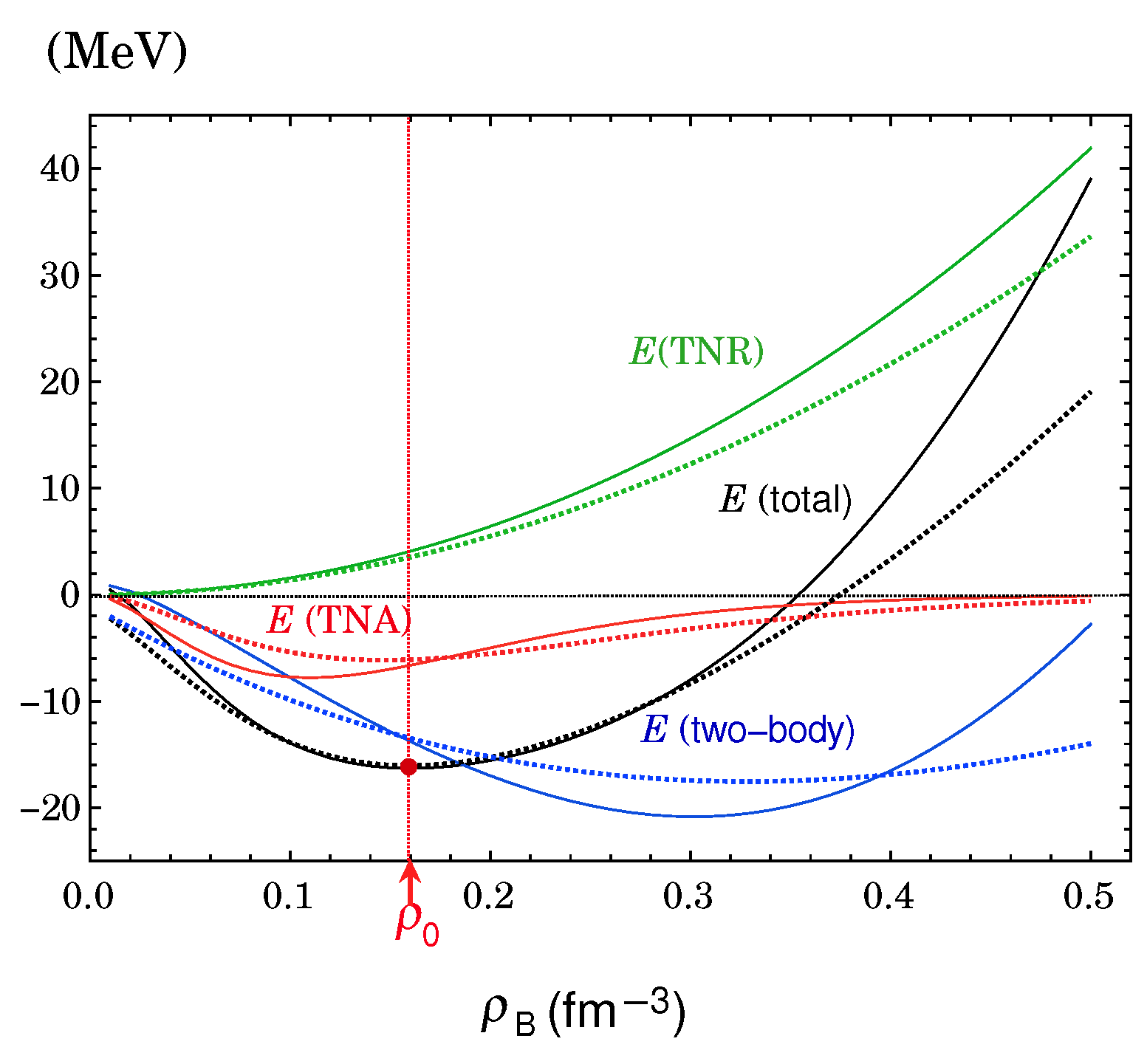
Figure 4.
(a) The particle fractions in the (Y+K) phase as functions of the baryon number density for = 300 MeV in the case of L = 65 MeV. The total strangeness fraction is given by . (b) The same as (a) but for = 400 MeV.
Figure 4.
(a) The particle fractions in the (Y+K) phase as functions of the baryon number density for = 300 MeV in the case of L = 65 MeV. The total strangeness fraction is given by . (b) The same as (a) but for = 400 MeV.
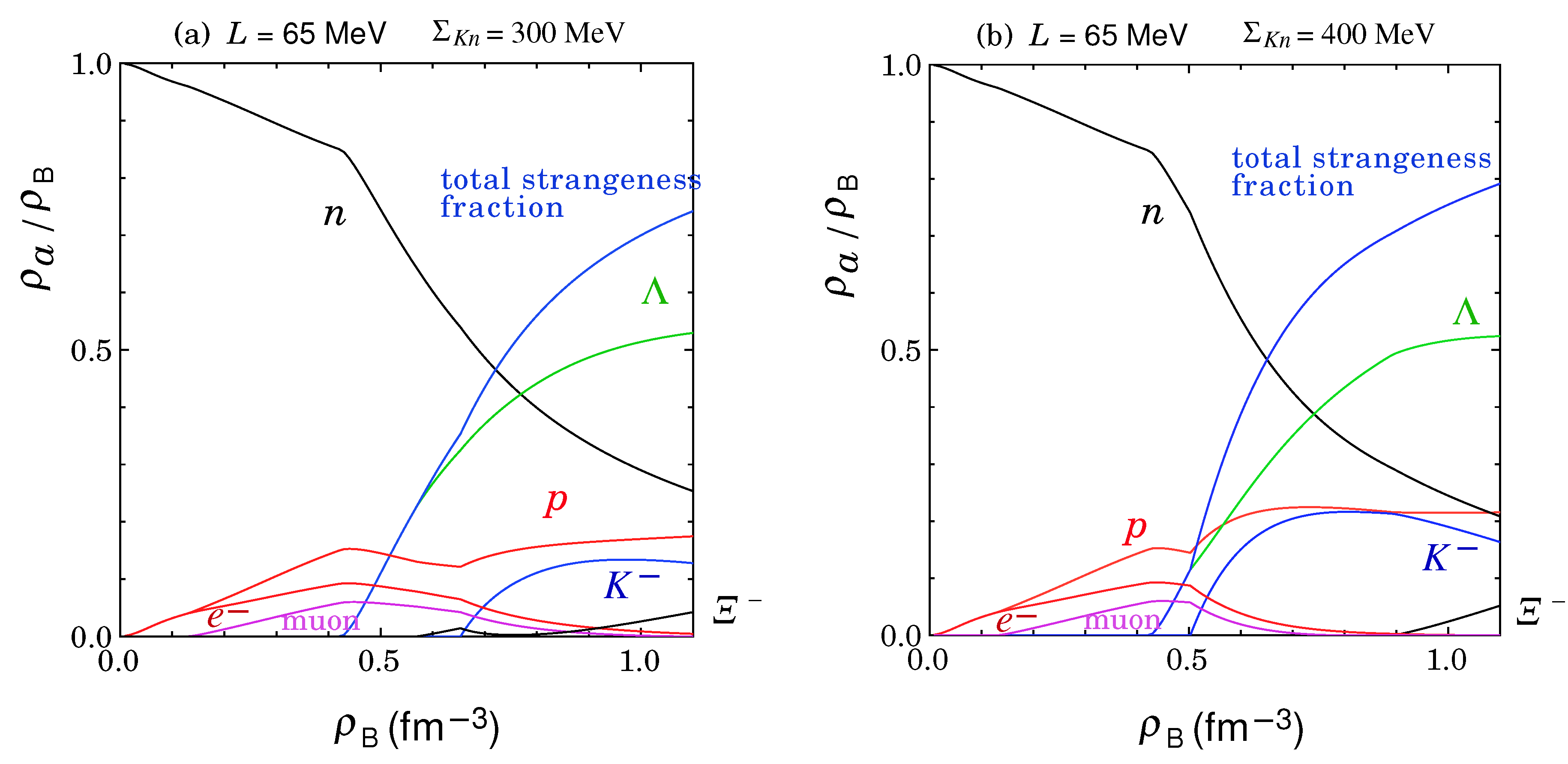
Figure 5.
(a) The total energy per unit of baryon E (total) [], measured from the nucleon rest mass, and each energy contribution, E (KC) [], E (two-body) [], E (UTBR) [], E (TNA) [], E (lepton) [], as functions of baryon number density for = 300 MeV and L = 65 MeV. (b) The same as (a) but for = 400 MeV. For reference, the energy difference per baryon between the (Y+K) phase and pure hyperon-mixed matter, (), is also shown as functions of .
Figure 5.
(a) The total energy per unit of baryon E (total) [], measured from the nucleon rest mass, and each energy contribution, E (KC) [], E (two-body) [], E (UTBR) [], E (TNA) [], E (lepton) [], as functions of baryon number density for = 300 MeV and L = 65 MeV. (b) The same as (a) but for = 400 MeV. For reference, the energy difference per baryon between the (Y+K) phase and pure hyperon-mixed matter, (), is also shown as functions of .
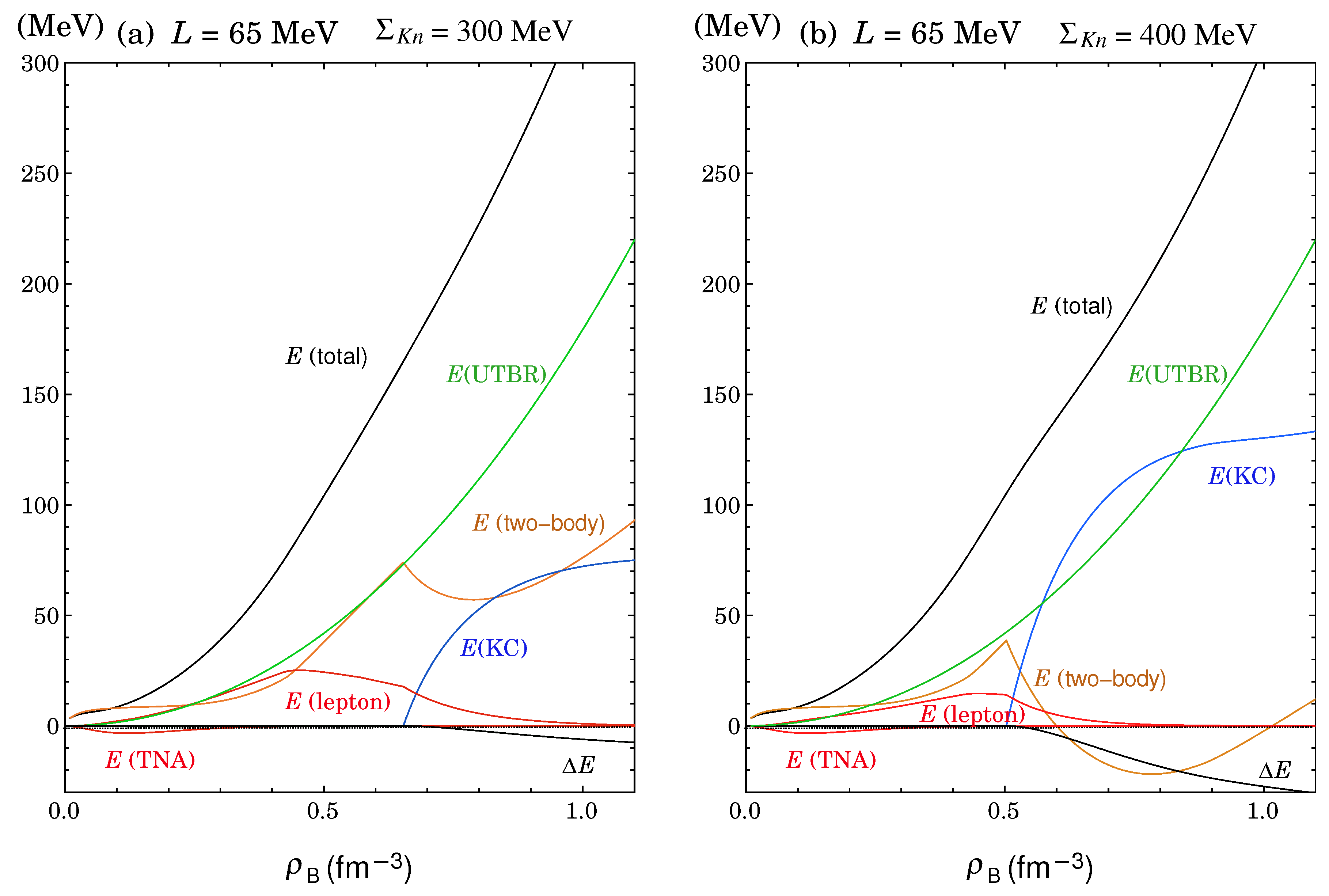
Figure 6.
(a) The ratio of the quark condensate in the (Y+K) phase to the vacuum quark condensate, , as a function of for L = 65 MeV and = 300 MeV by the black line. For comparison, the one in pure hyperon-mixed matter without KC by setting is shown by the green line and the one for nucleon matter, i.e. pure neutron-star matter without hyperon-mixing and KC, is shown by the red line. (b) The same as (a) but for = 400 MeV.
Figure 6.
(a) The ratio of the quark condensate in the (Y+K) phase to the vacuum quark condensate, , as a function of for L = 65 MeV and = 300 MeV by the black line. For comparison, the one in pure hyperon-mixed matter without KC by setting is shown by the green line and the one for nucleon matter, i.e. pure neutron-star matter without hyperon-mixing and KC, is shown by the red line. (b) The same as (a) but for = 400 MeV.

Table 4.
Some critical gravitational masses in the unit of the solar mass and their radii of neutron stars for = 300 MeV and 400 MeV in the case of L = (60, 65, 70) MeV, obtained with the (ChL+MRMF+UTBR+TNA) model. The and [ and ] are the mass and radius of the neutron star where the central density reaches the onset density of the -hyperons, [the onset density of KC, ]. and are the maximum mass of the neutron star and its radius.
Table 4.
Some critical gravitational masses in the unit of the solar mass and their radii of neutron stars for = 300 MeV and 400 MeV in the case of L = (60, 65, 70) MeV, obtained with the (ChL+MRMF+UTBR+TNA) model. The and [ and ] are the mass and radius of the neutron star where the central density reaches the onset density of the -hyperons, [the onset density of KC, ]. and are the maximum mass of the neutron star and its radius.
| L | |||||||
| (MeV) | (MeV) | (km) | (km) | (km) | |||
| 60 | 300 400 |
1.448 | 12.33 | 1.742 1.452 |
12.11 12.33 |
2.035 1.993 |
10.02 9.48 |
| 65 | 300 400 |
1.508 | 12.78 | 1.961 1.737 |
12.29 12.68 |
2.124 2.076 |
10.76 10.29 |
| 70 | 300 400 |
1.582 | 13.15 | 2.139 1.915 |
12.24 12.97 |
2.200 2.155 |
11.31 11.06 |
Disclaimer/Publisher’s Note: The statements, opinions and data contained in all publications are solely those of the individual author(s) and contributor(s) and not of MDPI and/or the editor(s). MDPI and/or the editor(s) disclaim responsibility for any injury to people or property resulting from any ideas, methods, instructions or products referred to in the content. |
© 2024 by the authors. Licensee MDPI, Basel, Switzerland. This article is an open access article distributed under the terms and conditions of the Creative Commons Attribution (CC BY) license (http://creativecommons.org/licenses/by/4.0/).
Copyright: This open access article is published under a Creative Commons CC BY 4.0 license, which permit the free download, distribution, and reuse, provided that the author and preprint are cited in any reuse.


