Preprint
Hypothesis

This version is not peer-reviewed.

Impact of Emotional Intelligence Training on Safety Behavior Enhancement in Construction Settings

Submitted:

08 January 2025

Posted:

09 January 2025

You are already at the latest version

Abstract

In high-risk environments such as construction sites, the integration of emotional intelligence (EI) training into safety management systems offers a promising strategy for enhancing safety performance. While existing research has predominantly focused on the leadership aspects of EI, there is a notable paucity of studies that empirically examine the subcomponents of EI, their specific effects on safety performance, or changes before and after an EI training program. This study addresses these gaps by investigating how the sub-factors of emotional intelligence—self-awareness, self-regulation, and social awareness—impact safety behavior, with motivation serving as a mediating variable. A theoretical framework was developed to model the pathway linking emotional intelligence sub-factors to safety behavior through motivation. This pathway, “emotional intelligence sub-factors → motivation → safety behavior,” was tested using path analysis to evaluate both direct and indirect effects on safety performance. The results revealed that self-awareness does not exert a direct influence on motivation; however, it has a significant indirect effect mediated by self-regulation and social awareness. Furthermore, the implementation of an emotional intelligence-based training program resulted in significant improvements across key dimensions, including emotion regulation (36.75%), impulse control (37.53%), and cause analysis (38.32%). These findings provide robust evidence that EI training fosters behavioral changes, as demonstrated by measurable differences in pre- and post-training outcomes, thereby contributing meaningfully to the enhancement of safety management systems. This study underscores the strategic value of emotional intelligence as a psychological intervention that complements conventional, technology-driven safety measures. By cultivating EI competencies, construction organizations can not only address unsafe behaviors but also create a proactive and safer working environment, ultimately elevating safety performance.

Keywords: 
;  ;  ;  ;  ;  ;  

1. Introduction

1.1. Research Background and Objectives

Construction sites are inherently high-risk work environments where promoting safe behaviors and mitigating unsafe practices among workers are critical priorities. While traditional safety training primarily emphasizes technical and physical aspects, the growing emphasis on emotional intelligence (EI) has recently highlighted the importance of emotional safety training. Research indicates that risk factors in industrial environments have escalated due to increasingly complex work conditions and the integration of advanced technologies [1,2]. The construction industry, in particular, is marked by a high incidence of accidents, including falls, which necessitate the implementation of advanced preventive measures.
Traditional safety approaches, including hardware-centric solutions and worker training, have shown limited long-term success in reducing industrial accidents, largely due to inadequate worker engagement. Studies have identified safety training as a key mediator of safety behaviors [3], while knowledge sharing and effective communication among workers significantly strengthen safety culture [4]. Furthermore, the demonstrated positive impact of emotional intelligence on safety performance underscores the need for a participatory, human-centered approach [5].
Evidence suggests that human error accounts for a majority of workplace accidents [6]; furthermore, studies underscore that industrial accidents are primarily caused by human errors such as organizational management deficiencies alongside mechanical failures [7]. In this context, psychological factors—particularly emotional intelligence—are increasingly recognized for their influence on workers’ safety behaviors. While previous research has established that emotional intelligence mediates the relationship between resilience and achievement motivation [8], the literature has largely focused on its role in leadership and conflict resolution within organizations [9]. Nevertheless, empirical investigations into how subcomponents of emotional intelligence impact workers’ safe and unsafe behaviors remain scarce.
Empirical research linking emotional intelligence to safety performance has also shed light on the roles of situational awareness and safety training, providing valuable insights into the specific mechanisms driving safety behaviors [10]. Additionally, some studies exploring emotional intelligence’s effects on operational effectiveness and organizational citizenship behavior have emphasized leadership’s mediating role [11]. While these findings advance understanding of the broader organizational impacts of emotional intelligence, limited attention has been given to its application in construction sites—one of the most hazardous work environments.
Most studies on the relationship between emotional intelligence and safety behaviors rely on qualitative methods or anecdotal evidence from specific scenarios. While emotional intelligence has been shown to enhance teamwork and organizational performance [12], there is a critical lack of empirical research examining its specific role in construction sites. Furthermore, the effect of emotional intelligence-based training programs has rarely been assessed through pre- and post-test methodologies, leaving gaps in understanding the mechanisms through which such training fosters safe behaviors and curtails unsafe practices.
This study aims to address these limitations through a systematic and empirical analysis of the effects of emotional intelligence subcomponents—self-awareness, self-regulation, and social awareness—on safe and unsafe behaviors, mediated by motivation, within the context of a construction site. The primary objective is to elucidate these effects and determine whether emotional intelligence-based training programs can meaningfully promote safe behaviors and suppress unsafe behaviors among workers. To achieve this, we employ path model analysis to conduct a comprehensive empirical assessment of the relationships between emotional intelligence, motivation, and behavioral changes. This integrated analysis highlights the potential of emotional intelligence-based strategies as an innovative approach to enhancing safety management in construction sites. This empirical analysis demonstrates that emotional intelligence-based strategies represent a novel paradigm for safety management in construction sites. The findings of this study highlight the effectiveness of emotional intelligence-based training programs in fostering a safety culture and enhancing organizational performance in construction environments. Theoretical contributions are presented alongside practical recommendations, underscoring the critical role of emotional intelligence in advancing safety management practices in the construction industry.

2. Literature Review

2.1. Review of Previous Studies on Emotional Factors

To analyze the impact of emotional intelligence (EI) on worker safety behavior and organizational performance in construction sites, prior studies provide valuable insights into its role and significance. Emotional intelligence is fundamentally linked to critical psychological constructs such as emotion regulation, self-efficacy, psychological resilience, and motivation, all of which directly influence workplace performance [13,14,15].
Research demonstrates that emotional intelligence significantly enhances workers’ self-efficacy, equips them with better stress management skills, and promotes behaviors aligned with safety objectives [13,16]. Workers with high emotional intelligence are more likely to adhere to safety guidelines, exercise sound judgment, and take appropriate actions in hazardous conditions, ultimately improving organizational safety outcomes [14,17].
Moreover, various studies confirm that managers with high emotional intelligence are more likely to adopt collaborative, solution-oriented strategies during conflicts, thereby enhancing teamwork and organizational cohesion [16,18]. This conflict resolution approach fosters cooperation among employees, reducing workplace tension and enhancing overall organizational performance. In addition, emotional intelligence has been shown to reduce occupational stress, correlate positively with safety-oriented behaviors, and contribute to cultivating a positive organizational climate [15,17].
In conclusion, emotional intelligence not only reinforces workers’ psychological stability and safety compliance but also enhances organizational effectiveness within construction settings. These findings highlight the need for integrating emotional intelligence training into workplace practices to improve both safety performance and operational efficiency in the construction industry.

2.2. Components of Emotional Intelligence and Their Application to Construction Sites

Emotional intelligence comprises five key components—Self-Awareness, Self-Regulation, Motivation, Social Awareness, and Social Skills—each playing a distinct role in shaping safety behaviors on construction sites. These components influence both safe and unsafe practices, as detailed below:
Self-awareness refers to the ability to recognize and understand one’s emotions, enabling individuals to regulate their behavior accordingly. According to Bratton et al. (2011), workers with high self-awareness are better equipped to manage stress and respond appropriately in hazardous situations. By accurately assessing their psychological state, workers can prevent unsafe behaviors, thus contributing to a safer work environment [22].
Self-regulation is the capacity to control negative emotions and impulses while responding flexibly to dynamic workplace challenges. This skill is critical in mitigating emotional overreactions and maintaining compliance with safety regulations under stressful conditions. Alsulami et al. (2021) emphasize that workers with strong self-regulation skills are instrumental in reducing unsafe practices and enhancing safety culture [19].
Motivation encompasses an individual’s intrinsic drive to achieve goals and fulfill responsibilities, which directly influences adherence to safety behaviors. Lubis et al. (2023) found that highly motivated workers exhibit greater responsibility and diligence in achieving safety objectives, contributing positively to team performance even in high-pressure leadership contexts [20].
Social awareness refers to the ability to empathize with and understand the emotions and needs of others. This competency plays a vital role in resolving workplace conflicts and fostering a culture of safety. A study by Huang et al. (2024) highlights the importance of social awareness in promoting teamwork, enhancing interpersonal relationships, and establishing a safe work environment [21].
Social skills involve interpersonal problem-solving, and collaboration, all of which are essential for enhancing teamwork and organizational effectiveness. Boyatzis (2008) argues that emotional and social intelligence significantly enhance leadership capabilities, directly facilitating better communication and compliance with safety protocols on construction sites [21].
Each of these components contributes uniquely to fostering safe behaviors and mitigating unsafe actions in high-risk environments. Building on the foundational model of emotional intelligence proposed by Salovey and Mayer (1990) [23], the introduction of EI-focused training programs can significantly improve workers’ safety behaviors while simultaneously strengthening the safety culture in construction settings.

3. Methodology

This study employed a systematic methodology to evaluate the impact of an emotional intelligence-based training program on behavioral changes among construction site workers. The research process involved the following steps:
First, survey items were developed to capture the subcomponents of emotional intelligence—self-awareness, self-regulation, social awareness, and motivation—drawing on insights from prior studies and an extensive literature review. These items were adapted to construct a survey instrument tailored to the specific characteristics of construction site environments, aiming to measure both safe and unsafe behaviors effectively.
Data were collected using a 5-point Likert scale questionnaire administered to 231 construction workers and managers across various sites. The collected data were subjected to exploratory factor analysis (EFA) and confirmatory factor analysis (CFA) to ensure the structural validity of the measurement constructs. EFA results verified that the survey items aligned with the intended constructs, while CFA evaluated the model's goodness-of-fit and clarified the relationships between the identified factors. Reliability was assessed through Cronbach's α values, demonstrating strong internal consistency for both the safe behavior construct (α = 0.931) and the unsafe behavior construct (α = 0.929). These high reliability scores indicate that the survey instrument was robust and suitable for the research context.
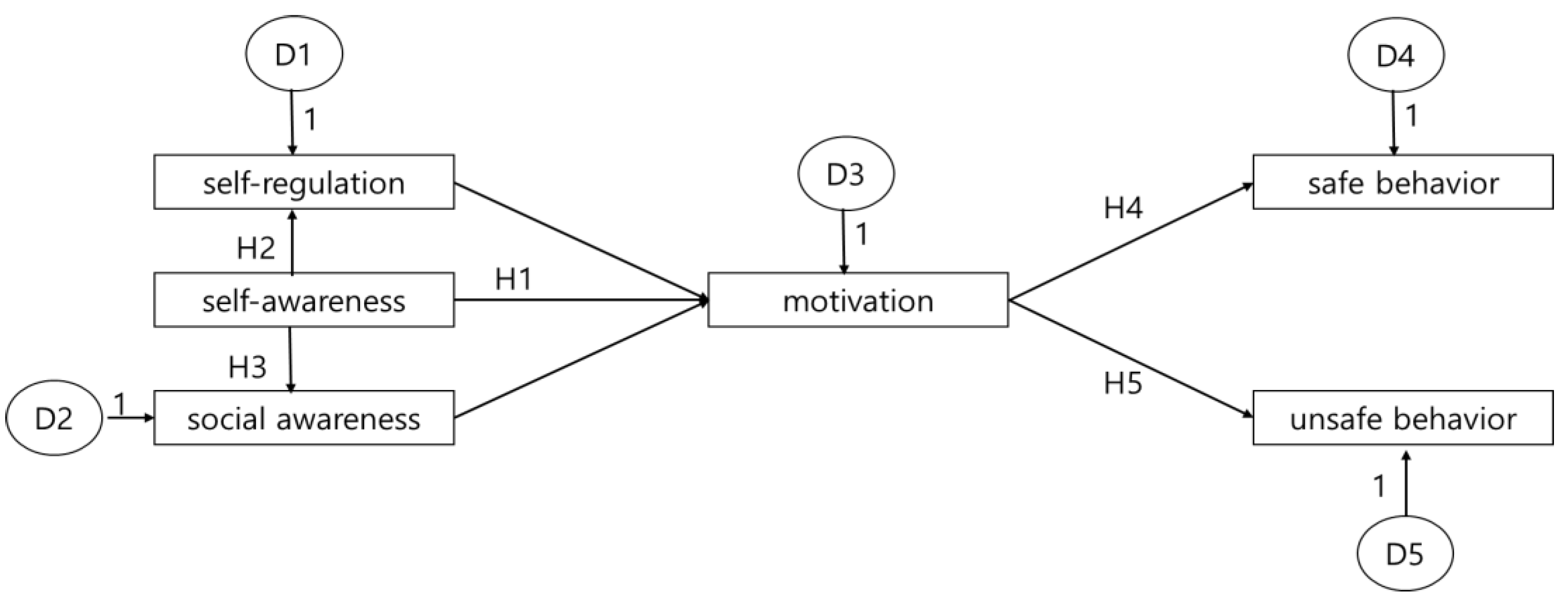
Subsequently, a path analysis model was employed to examine the influence of emotional intelligence on safe and unsafe behaviors, mediated by motivation.
The overall research procedure, as summarized in Figure 1, illustrates the systematic approach taken to investigate the role of emotional intelligence in fostering a safer work environment on construction sites. This study offers compelling evidence that integrating emotional intelligence training into safety management practices can contribute substantially to improving behavioral outcomes in high-risk work settings.
The objective of this study is to investigate the influence of emotional intelligence on safe and unsafe behaviors among construction site workers and to evaluate the following research hypotheses. The study posits that the subcomponents of emotional intelligence—self-awareness, self-regulation, social awareness, and motivation—affect workers’ safe and unsafe behaviors and that motivation serves as a crucial mediating factor in these relationships.
Research Hypotheses
H1. 
Self-awareness directly influences motivation.
H2. 
Self-awareness indirectly influences motivation through the mediation of self-regulation.
H3. 
Self-awareness indirectly influences motivation through the mediation of social awareness.
H4. 
Self-awareness positively affects safety behavior through the sequential mediation of self-regulation and motivation.
H5. 
Self-awareness negatively affects unsafe behavior through the sequential mediation of social awareness and motivation.
Using these hypotheses as a foundation, this study analyzes the impact of emotional intelligence on the behaviors of construction site workers through a path model. As depicted in Figure 2, the findings of the research model assess the effectiveness of incorporating emotional intelligence into safety training programs, specifically for safety managers.

3.1. Survey Design and Instrument Reliability

The primary components of emotional intelligence in this study were measured following Daniel Goleman’s model of emotional intelligence. Specifically, the five major components—self-awareness, self-regulation, motivation, social awareness, and social skills—were analyzed for their effects on safety behaviors (e.g., safety compliance and safety habits) and unsafe behaviors (e.g., violations and mistake behaviors). Data were collected from a total of 231 participants through a structured questionnaire. The reliability and validity of the measurement constructs were assessed using SPSS 19.0 software. The results provide a robust foundation for understanding the relationship between emotional intelligence and behavioral outcomes in construction site environments.
As indicated in Table 1, the details of the analyses conducted are as follows. Exploratory factor analysis (EFA) demonstrated that the Kaiser-Meyer-Olkin (KMO) value was 0.911, indicating excellent suitability for factor analysis. Bartlett's test of sphericity was statistically significant at p < 0.001, confirming the appropriateness of the data for factor extraction. The fit of the theoretical model was subsequently evaluated through confirmatory factor analysis (CFA), using fit indices such as the Normed Fit Index (NFI), Incremental Fit Index (IFI), Comparative Fit Index (CFI), and Root Mean Square Error of Approximation (RMSEA). All indices met the required thresholds, confirming a good overall fit of the model.
The emotional intelligence components were measured using Cronbach's α to assess internal consistency, with the following reliability values: self-awareness (α = 0.680), self-regulation (α = 0.862), motivation (α = 0.907), social awareness (α = 0.882), and social skills (α = 0.934). Behavioral factors were similarly evaluated, with safe behavior (α = 0.931) and unsafe behavior (α = 0.929) demonstrating high reliability. Cronbach's α coefficients for all constructs exceeded the recommended threshold of 0.7, establishing the reliability of the survey instrument.
A 5-point Likert scale was used to measure emotional intelligence components. The exploratory factor analysis yielded a KMO value of 0.941, and Bartlett's test of sphericity returned χ² = 3834.407 (df = 231, p < 0.001), further confirming the data's suitability for factor analysis. Building on these results, CFA was conducted to verify the reliability and validity of the survey tool, confirming its robustness.
The main purpose of confirmatory factor analysis (CFA) is to validate that the subfactors of emotional intelligence—self-awareness, self-regulation, motivation, social awareness, and social skills—fit the established theoretical model. This involved determining whether each factor functioned as an independent latent variable and assessing the validity of the measurement instruments used in the study. Ultimately, the goal was to confirm the alignment between the empirical data and the theoretical model underpinning the research hypotheses. The specific details of these analyses are presented in Table 2.
For each factor in Table 2, the measurement model is deemed to have good convergent validity if the Average Variance Extracted (AVE) exceeds 0.5 and the Composite Reliability (CR) exceeds 0.7. For the first factor (C1) of Self-Regulation (SR), the AVE is 0.6109, satisfying the threshold of 0.5, and the CR is 0.8866, exceeding the criterion of 0.7. These values suggest that the self-regulation factor demonstrates a high level of convergent validity.
Similarly, for the Motivation (MO) factor, the AVE for JD1 is 0.7478, and the CR is 0.9222, both of which surpass their respective thresholds, indicating strong convergent validity. The Social Awareness (SO) and Social Skills (SS) factors also have AVE and CR values exceeding the required criteria, confirming that convergent validity has been achieved for these constructs as well. Overall, the confirmatory factor analysis confirms that the measurement model for each factor meets the convergent validity criteria, and the questionnaire items used in this study are reliably measured.
The model fit was evaluated using several key indices derived from the CFA results: Normed Fit Index (NFI), Incremental Fit Index (IFI), Tucker-Lewis Index (TLI), Comparative Fit Index (CFI), Root Mean Square Residual (RMR), and Root Mean Square Error of Approximation (RMSEA). The interpretations of these indicators are summarized below:
NFI (0.910), IFI (0.953), TLI (0.945), and CFI (0.953) exceeds the benchmark of 0.9, indicating a good fit between the model and the data. RMR (0.033) is close to zero, suggesting minimal error between the observed data and the model, indicative of an excellent fit. RMSEA (0.065) falls within the acceptable range of 0.05 to 0.08, confirming that the model adequately describes the data structure.
The analysis confirms that the model achieves a good fit across all critical indices, with no significant deviations or discrepancies. As the values meet or exceed the established thresholds, the overall fit of the model is considered robust, and no further modifications are necessary. These results validate that the measurement model reliably captures the data structure and supports the theoretical framework of the study.
As indicated in Table 3, discriminant validity was assessed by comparing the squared values of the correlation coefficients between each variable with the Average Variance Extracted (AVE) values for those variables. The criterion for establishing discriminant validity is that the squared correlation coefficient between any two variables should be less than the AVE of each variable. The comparison results of squared correlation coefficients and AVE values for each variable are as below.
For instance, the correlation coefficient between Self-Regulation (SR) and Motivation (MO) is 0.787. Squaring 0.787 yields 0.6199. This value is smaller than the AVE values for MO (0.7478), confirming discriminant validity between these variables is achieved. Similarly, the correlation coefficient between Social Awareness (SO) and Social Skills (SS) is 0.55. Squaring 0.55 yields 0.302, which is less than the AVE values for SO (0.7289) and SS (0.7194). Thus, discriminant validity between these variables is also confirmed.
As shown in the analysis, the squared correlation coefficients for all pairs of variables are smaller than their corresponding AVE values. This finding suggests that the variables utilized in this study represent unique constructs and maintain adequate discriminant validity. The results further indicate that the theoretical concepts proposed in this study are structurally distinct and well-defined, providing a robust foundation for reliable research conclusions.

4. Results of the Study

4.1. Demographic Characteristics

This study conducted a path model analysis to examine the influence of emotional intelligence on safe and unsafe behaviors among 231 construction workers in Seoul and Gyeonggi provinces from November 2022 to March 2023. The results indicate that the gender distribution was heavily skewed toward men (98.3%), with women comprising only 1.7% of the participants.
In terms of age, the largest group was workers aged over 50 and under 60 (31.0%), followed by those aged between 40 and 50 (24.7%). Regarding job type, civil engineering was the most common category (48.7%), followed closely by general construction work (43.7%).
In terms of field experience, 42.9% of the participants had over 15 years of experience, while 17.3% had between 5 and 10 years of experience. These demographic results provide a clear overview of the distribution of construction workers by gender, age, field experience, workplace size, and job type, as well as the variations in construction roles based on these characteristics.

4.2. Emotional Subfactors and Safety. Results of Path Analysis between Unsafe Behaviors
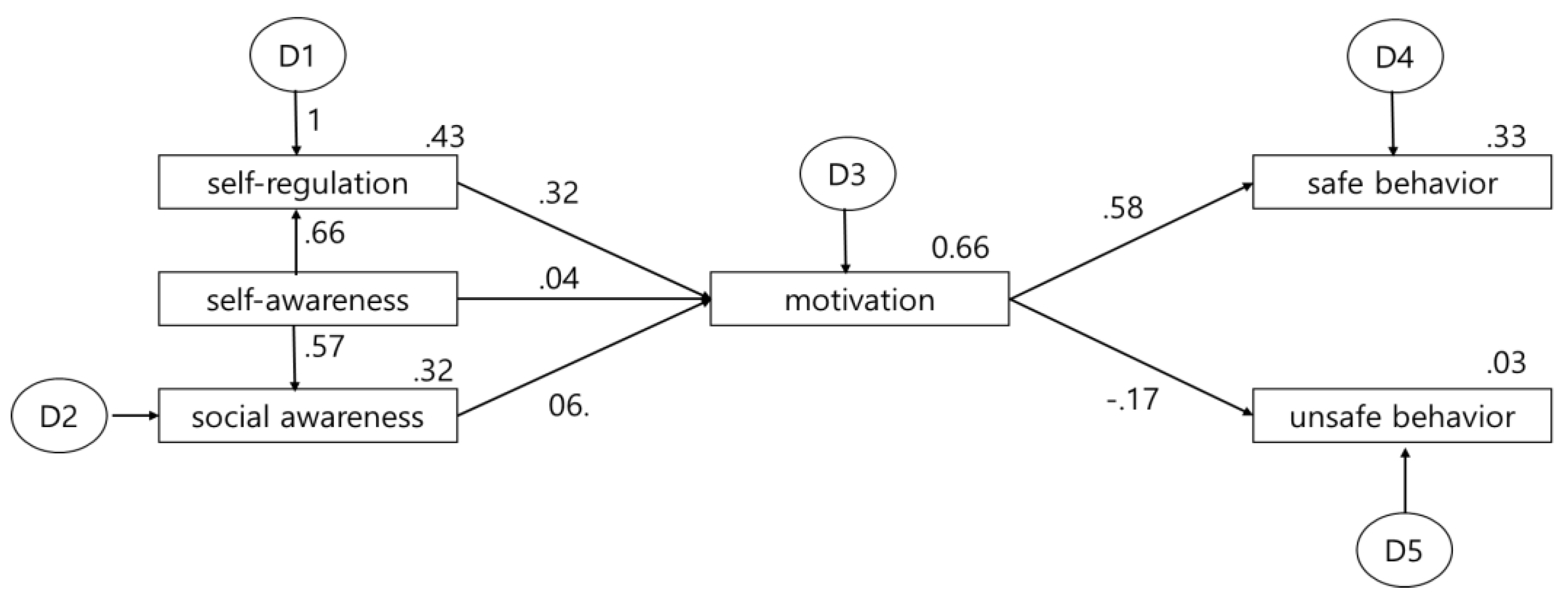
This study analyzed the pathways through which the emotional intelligence subfactors—self-awareness, social awareness, and self-regulation—influence motivation. The findings revealed that self-awareness does not have a direct effect on motivation; however, it exerts a significant indirect effect through the mediating roles of social awareness and self-regulation. This result is consistent with the hypothesis tested by Kyungsoo Kim (2018) [24], which posited that emotional factors and self-esteem serve as moderators of safe and unsafe behaviors. Specifically, self-awareness was found to positively influence motivation through the sequential mediation of social awareness and self-regulation, while no direct relationship was identified between self-awareness and motivation.
These full mediation effects underscore the critical role of motivation as a mediator in the relationship between emotional intelligence subfactors and safety behaviors. This finding aligns with prior research, which highlights motivation as a key mediating factor in the association between safety climate and safety behavior [25,26]. Additionally, studies examining the combined impact of emotional intelligence and motivation on safety behaviors have reported similar conclusions. For example, both emotional intelligence and motivation have been shown to have a positive impact on safety behaviors, confirming the importance of motivation as a determinant of safety performance [27,29].
This study, therefore, identifies a significant mediating pathway, wherein emotional intelligence subfactors promote safe behaviors and mitigate unsafe behaviors through motivation. The practical implications of these findings are substantial, as they suggest that motivation is a critical component in translating emotional intelligence into effective safety behaviors. Furthermore, these results are consistent with existing literature emphasizing the mediating role of motivation in the relationship between safety climate and safety behavior [26,28]. The findings also highlight the importance of incorporating education and training programs that enhance emotional intelligence to improve motivation and foster a culture of safety in high-risk environments.
Figure 3. Path Analysis of Safety and Unsafe Behaviors in Relation to Emotional Safety Factors.
Preprints 145616 g003
Table 4. Path analysis of emotional factors: Total Effects (Direct, Indirect).
Division Self-awareness Self-regulation Social awareness Motivation
Self-awareness .657***
(.657***,000)
Social-awareness .569***
(.569***,000)
Motivation .597***
(.043,555***)
.322***
(.322***,000)
.603**
(.603***,000)
Unsafe behavior -.099
(.000, -.099)
-.053
(.000, -.053)
-.100
(.000, -.100)
-.166
(-.166, .000)
Safe behavior .345***
(000,345***)
.186**
(000,186***)
.348***
(000,348***)
.578***
(578***, 000)
By analyzing the hypothesis testing results and situating them within the context of related literature, this study examines the influence of emotional factors on the safe and unsafe behaviors of construction site workers.
First, the rejection of the hypothesis that “self-awareness will have a direct effect on motivation” indicates that self-awareness does not directly influence motivation, suggesting a full mediation process. This finding contradicts the conclusions of Fang et al. [30], who reported that managerial behavior has a significant direct impact on workers’ safety behavior. The result implies that self-awareness influences safety behavior only indirectly through the motivation process, underscoring the mediated nature of this relationship.
Second, the hypothesis that “self-regulation will play a mediating role in the relationship between self-awareness and motivation” was supported at a statistically significant level. This aligns with the findings of Leung et al. [31], who highlighted that supervisory support plays a critical role in moderating the relationship between job stressors and safety behaviors. The result confirms that self-regulation is a vital component in the motivation process, acting as a bridge between self-awareness and motivation.
Third, the hypothesis that “social awareness will play a mediating role in the relationship between self-awareness and motivation” was also confirmed at a significant level.
Fourth, the significant results of the hypothesis testing on “the effect of motivation on safety behavior” align with Saleem et al. [32], who demonstrated that psychological capital (Psy Cap) and task involvement positively influence safety engagement. This underscores the critical role of motivation in fostering safety behaviors and its importance as a mechanism for promoting safety compliance and reducing risks.
Fifth, the non-significant “effect of motivation on unsafe behavior” is consistent with the findings of Panuwatwanich et al. [33], who reported that while safety motivation positively impacts safety behavior, it does not directly influence unsafe behavior.
The results of this study elucidate the complex interplay between self-awareness, self-regulation, social awareness, and motivation in shaping safety behaviors at construction sites. These findings underscore the mediated pathways through which emotional factors influence safety outcomes and contribute to the development of more nuanced and effective intervention strategies to promote safety and reduce unsafe behaviors.
Hypothesis testing results from the path analysis, as presented in Table 5, indicate partial support for the proposed hypotheses, particularly the significant effects of self-regulation and social awareness on safety behavior mediated through motivation. However, the direct relationship between self-awareness and motivation was not statistically significant, suggesting a full mediation effect.
The goodness-of-fit of the model was assessed using several key indices, including Chi-square (χ²), RMSEA, CFI, TLI, and SRMR. Ideally, a small χ² value with a p-value greater than 0.05 indicates a good fit between the model and the data. However, in this study, the χ² statistic was sensitive to the sample size, which is a common limitation in larger datasets. The RMSEA value was below 0.05, indicating excellent model fit. The Comparative Fit Index (CFI) value was 0.923, surpassing the threshold of 0.90 and confirming the adequacy of the model. Similarly, the Tucker-Lewis Index (TLI) was above 0.90, further supporting the model’s fit.
The fit indices used in this study were critical for evaluating the appropriateness of the model, and a comprehensive analysis of these metrics indicates that the path model is suitable for explaining the relationships among the constructs. These findings validate the model's robustness in capturing the influence of emotional intelligence subfactors and motivation on safety behavior.

4.3. Pre- and Post-Analysis of the Effectiveness of the Emotional Safety Education Program

This study developed an emotional intelligence training program incorporating the concept of “perspective-taking,” which involves training participants to think from another person's perspective, to enhance emotional intelligence. The program was applied to six field managers. The emotional safety perspective-taking training program aimed to improve emotional intelligence by suppressing complaints and fostering an understanding of others' positions. The program was conducted over three weeks. In week 1, participants were trained in strategies for recognizing and suppressing complaints. In week 2, they were tasked with reinterpreting situations from another person's perspective and documenting the emotional changes they experienced. In week 3, participants focused on fostering positive interactions and evaluating their success in suppressing complaints and the internal changes they observed.
The study participants included six field managers working in Gyumdan, Incheon, Gyeonggi Province, who underwent a three-week training program focused on suppressing complaints and reframing situations from others' perspectives. To assess the effectiveness of the program, the “Recording the events I experienced” training program, developed by Yonglin Moon (1999), was utilized for the experimental group at the construction site. Post-training evaluations were conducted for each emotional intelligence subfactor. The effectiveness analysis did not employ a t-test; instead, the improvement in emotional intelligence was confirmed by comparing the mean score of the experimental group (63.5) with the adult average score (63.5) based on the emotional regulation subfactors outlined by Kim (2011): Emotional Regulation (Items 1–6), Impulse Control (Items 7–12), and Cause Analysis (Items 13–18). These results suggest that the emotional intelligence training program centered on the “perspective-taking” activity effectively enhanced the participants' emotional regulation capabilities. The details are presented in Table 5.
Table 5. Pre-post difference test results of emotional safety perspective-taking training program.
Subject Emotional Regulation Average in Korea: 63.5
ER I C CA Total
1 Pre 16 19 20 55
Post 21 24 24 69
2 Pre 22 21 24 67
Post 22 25 24 71
3 Pre 22 26 22 70
Post 27 26 27 80
4 Pre 21 19 28 68
Post 24 23 24 71
5 Pre 17 19 21 57
Post 23 22 22 67
6 Pre 19 21 21 61
Post 23 23 25 71
The results of the pre- and post-test for the emotional safety perspective-taking training program, as presented in Table 5 indicate that the participants' emotional intelligence subfactors—emotional regulation, impulse control, and cause analysis—showed overall improvement after the training. The post-training average score was determined by dividing the total post-training scores of the six participants by 6. The post-training average score for emotional regulation was 23.33, representing 36.75% of the Korean national average score of 63.5. Notably, Experimenters 1 and 3 demonstrated significant improvements in emotional regulation, with increases of 14 points and 10 points, respectively. Similarly, the post-training average score for impulse control was 23.83 (37.53% of the Korean national average), and for cause analysis, the post-training average score was 24.33 (38.32% of the Korean national average). Significant improvements were observed across all subfactors through the training program. The results demonstrate that the emotional safety perspective-taking training program effectively contributed to the improvement of participants' emotional intelligence. Specifically, the activities designed to suppress complaints and reinterpret situations from others' perspectives were instrumental in enhancing emotional regulation, impulse control, and cause analysis. These improvements are critical, as they can significantly influence behavioral change among workers and reinforce safety awareness.

5. Conclusions

This study confirmed that an emotional intelligence-based training program effectively promotes safe behaviors and suppresses unsafe behaviors among construction site workers and managers. Specifically, the findings revealed that the subcomponents of emotional intelligence—self-awareness, self-regulation, and social awareness—positively influence safety behaviors through motivation, while also indirectly contributing to the reduction of unsafe behaviors. These results underscore the significant potential of emotional intelligence training to drive behavioral changes and enhance safety awareness among construction site personnel.
First, the analysis showed that the relationship between self-awareness and motivation was not direct but mediated by self-regulation and social awareness. This highlights the pivotal role of emotional regulation and social awareness as mediators in the motivation process.
Second, self-regulation and social awareness emerged as critical components in promoting workers’ safety behaviors. The findings empirically demonstrate that emotional intelligence subcomponents interact synergistically to provide a robust mechanism for enhancing safety behaviors, thereby advancing the understanding of how emotional intelligence operates in high-risk environments.
Third, the study focused on the short-term effects of the training program and documented substantial improvements in participants’ emotional regulation (36.75%), impulse control (37.53%), and cause analysis (38.32%). These findings validate the effectiveness of emotional intelligence-based training in driving immediate behavioral changes and increasing safety awareness, while also suggesting considerable potential for further refinement and application of such programs.
Fourth, motivation was not found to directly influence unsafe behaviors. However, emotional intelligence factors (self-regulation, self-awareness, and social awareness) mediated motivation, promoting safe behaviors and indirectly contributing to the reduction of unsafe behaviors. This finding emphasizes the indirect pathways through which emotional intelligence impacts safety outcomes. In other words, motivation serves as a mechanism for naturally controlling unsafe actions.
In conclusion, this study establishes emotional intelligence-based training programs as a valid psychological approach that complements traditional skill-based safety training. By enhancing safety behaviors and reducing unsafe behaviors, expected to play a key role in significantly improving safety management and preventing accidents in construction environments. Future research should build on these findings by examining the long-term effectiveness of emotional intelligence-based training programs. Additionally, expanding the scope of such research to explore its applicability across diverse settings and audiences will be crucial for maximizing its potential impact.

References

  1. Shappell, S.A.; Wiegmann, D.A. Human error and general aviation accidents: A comprehensive, fine-grained analysis using HFACS. FAA/Civil Aerospace Medical Institute & University of Illinois at Urbana-Champaign. 2014. Retrieved from https://www.researchgate.net/publication/252109608.
  2. Reason, J. Human Error. New York: Cambridge University Press: 1990.
  3. Bayram, M.; Arpat, B.; Ozkan, Y. Safety priority, safety rules, safety participation and safety behaviour: the mediating role of safety training. Int. J. Occup. Saf. Ergon. 2021, 28, 2138–2148. [Google Scholar] [CrossRef] [PubMed]
  4. Ishdorj, S.; Ahn, C.R.; Park, M. Major Factors Influencing Safety Knowledge–Sharing Behaviors of Construction Field Workers: Worker-to-Worker Level Safety Communication. J. Constr. Eng. Manag. 2024. [CrossRef]
  5. Huang, W.; Zhong, D.; Chen, Y. The relationship between construction workers’ emotional intelligence and safety performance. Eng. Constr. Archit. Manag. 2024. [CrossRef]
  6. Kletz, T.A. Accident investigation: Keep asking “why?”. J. Hazard. Mater. 2006, 130, 69–75. [Google Scholar] [CrossRef] [PubMed]
  7. Rasmussen, J. Human errors: A taxonomy for describing human malfunction in industrial installations. J. Occup. Accid. 1982, 4, 311–333. [Google Scholar] [CrossRef]
  8. Craparo, G.; Magnano, P.; Paolillo, A.; Costantino, V. The Subjective Risk Intelligence Scale: The development of a new scale to measure a new construct. Curr. Psychol. 2017. [CrossRef]
  9. Clarke, N. Emotional intelligence and its relationship to transformational leadership and key project manager competences. Proj. Manag. J. 2010, 41, 5–20. [Google Scholar] [CrossRef]
  10. Wang, Z.; Jiang, Z.; Blackman, A. Linking emotional intelligence to safety performance: The roles of situational awareness and safety training. J. Saf. Res. 2021, 78, 210–220. [Google Scholar] [CrossRef]
  11. Santa, R.; Moros, A.; Morante, D.; Rodríguez, D.; Scavarda, A. The impact of emotional intelligence on operational effectiveness: The mediating role of organizational citizenship behavior and leadership. PLOS ONE, 2023; 18. [Google Scholar]
  12. Love, P.; Edwards, D.; Wood, E. Loosening the Gordian knot: The role of emotional intelligence in construction. Eng. Constr. Archit. Manag. 2010, 17, 176–187, Retrieved from www.emeraldinsight.com/0969-9988.htm. [Google Scholar] [CrossRef]
  13. Rezvani, A.; Ashkanasy, N.; Khosravi, P. Key Attitudes: Unlocking the Relationships between Emotional Intelligence and Performance in Construction Projects. J. Constr. Eng. Manag. 2020, 146, 04020025. [Google Scholar] [CrossRef]
  14. Alsulami, H.; Serbaya, S.H.; Rizwan, A.; Saleem, M.; Maleh, Y.; Alamgir, Z. Impact of emotional intelligence on the stress and safety of construction workers' in Saudi Arabia. Eng. Constr. Archit. Manag. 2021. [CrossRef]
  15. Huang, W.; Zhong, D.; Chen, Y. The relationship between construction workers’ emotional intelligence and safety performance. Eng. Constr. Archit. Manag. 2024. [CrossRef]
  16. Lubis, Y.; Lubis, F.R.A.; Syaifuddin, S.; Nasib, N. The Role of Motivation in Moderating the Impact of Emotional Intelligence, Work-Life Balance, Leadership, and Work Ethic on Employee Performance. Society 2023. [CrossRef]
  17. Huang, H.; Gao, L.; Deng, X.; Fu, H. The Relationship Between Emotional Intelligence and Expatriate Performance in International Construction Projects. Psychol. Res. Behav. Manag. 2022, 15, 3825–3843. [Google Scholar] [CrossRef]
  18. Kukah, A.S.; Akomea-Frimpong, I.; Jin, X.; Osei-Kyei, R. Emotional intelligence (EI) research in the construction industry: a review and future directions. Eng. Constr. Archit. Manag. 2021.
  19. Alsulami, H.; Serbaya, S.H.; Rizwan, A.; Saleem, M.; Maleh, Y.; Alamgir, Z. (2021). Impact of emotional intelligence on the stress and safety of construction workers' in Saudi Arabia. Eng. Constr. Archit. Management.
  20. Lubis, Y.; Lubis, F.R.A.; Syaifuddin, S.; Nasib, N. The Role of Motivation in Moderating the Impact of Emotional Intelligence, Work-Life Balance, Leadership, and Work Ethic on Employee Performance. Society 2023. [CrossRef]
  21. Huang, W.; Zhong, D.; Chen, Y. The relationship between construction workers’ emotional intelligence and safety performance. Eng. Constr. Archit. Manag. 2024. [CrossRef]
  22. Bratton, V.K.; Dodd, N.G.; Brown, W. The impact of emotional intelligence on accuracy of self-awareness and leadership performance. Leadersh. Organ. Dev. J. 2011, 32, 127–149. [Google Scholar] [CrossRef]
  23. Salovey, P.; Mayer, J.D. Emotional intelligence. Imagin. Cogn. Personal. 1990, 9, 185–211. [Google Scholar] [CrossRef]
  24. Kim, Kyung-Soo. The Impact of Emotional Factors and Self-Esteem on Safe and Unsafe Behaviors(Master's thesis). Graduate School of Engineering, Kyonggi University, South Korea, 2017.
  25. Ghoddousi, P.; Zamani, A. The effect of emotional intelligence, motivation and job burnout on safety behaviors of construction workers: a case study. Eng. Constr. Archit. Manag. 2023. [CrossRef]
  26. Wang, M.; Sun, J.; Du, H.; Wang, C. Relations between Safety Climate, Awareness, and Behavior in the Chinese Construction Industry: A Hierarchical Linear Investigation. Adv. Civ. Eng. 2018. [CrossRef]
  27. Septian, F.; Haryanto, B. The Effect of Safety Climate on Safety Behaviour: the Mediating Role of Safety Motivation and Safety Knowledge. Int. J. Econ. Bus. Manag. Research. 2023. [CrossRef]
  28. Al-Bayati, A. Impact of Construction Safety Culture and Construction Safety Climate on Safety Behavior and Safety Motivation. Safety 2021, 7, 41. [Google Scholar] [CrossRef]
  29. Korkmaz, S.; Park, D. The effect of safety communication network characteristics on safety awareness and behavior in a liquefied natural gas terminal. Int. J. Occup. Saf. Ergon. 2019, 27, 144–159, [https://www.tandfonline.com/doi/abs/10.1080/10803548.2019.1568071]. [Google Scholar] [CrossRef]
  30. Fang, D.; Wu, C.; Wu, H. Impact of the Supervisor on Worker Safety Behavior in Construction Projects. J. Manag. Eng. 2015, 31, 04015001. [Google Scholar] [CrossRef]
  31. Leung, M.; Liang, Q.; Olomolaiye, P. Impact of Job Stressors and Stress on the Safety Behavior and Accidents of Construction Workers. J. Manag. Eng. 2016, 32, 04015019. [Google Scholar] [CrossRef]
  32. Saleem, M.; Isha, A.; Yusop, Y. b. M.; Awan, M.I.; Naji, G. The Role of Psychological Capital and Work Engagement in Enhancing Construction Workers' Safety Behavior. Front. Public Health 2022, 10. [Google Scholar] [CrossRef]
  33. Panuwatwanich, K.; Al-Haadir, S.; Stewart, R. Influence of safety motivation and climate on safety behaviour and outcomes: evidence from the Saudi Arabian construction industry. Int. J. Occup. Saf. Ergon. 2017, 23, 60–75. [Google Scholar] [CrossRef]
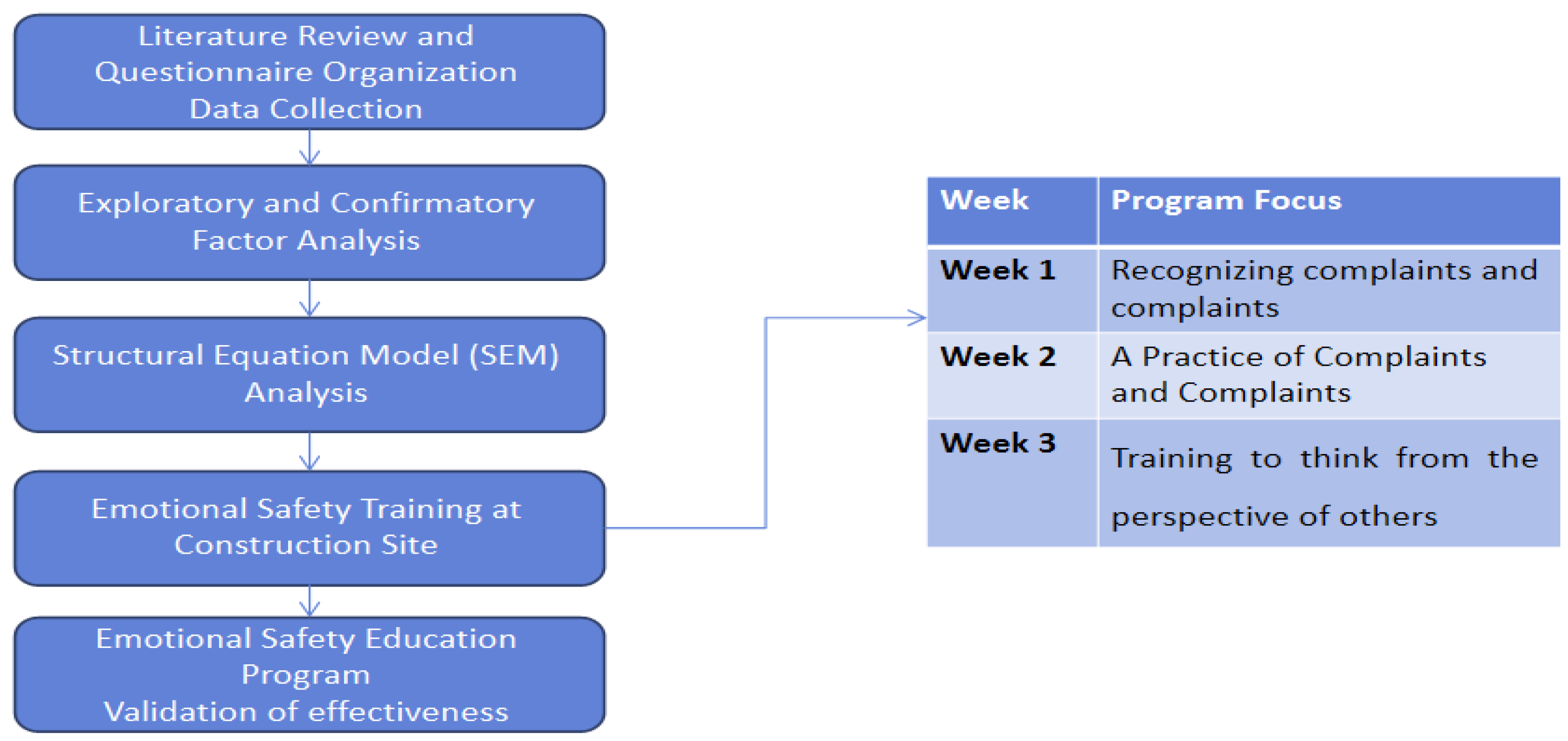
Figure 1. Study Procedures.
Preprints 145616 g001
Figure 2. Mediated path analysis model.
Preprints 145616 g002
Table 1. Survey Structure and Reliability.
Survey Composition Mean α KMO
Emotional Intelligence (Self-Awareness)-SA (4items) 3.62 0.680 0.941
(Self-Regulation)-SR (5items) 3.79 0.862
(Motivation)-MO (4items) 3.80 0.907
(Social Awareness)-SO (3items) 3.83 0.882
(Social Skills)-SS(6items) 3.48 0.934
Safe Behavior Safety Compliance Behavior (6 items)
/ Safety Habitual Behavior (6 items)
3.97/3.50 0.931 0.911
Safety Habit Behavior Integration 3.74
Unsafe Behavior Violation Behavior (5 items)
/ Error Behavior (8 items)
2.49/2.19 0.929
Unsafe Behavior Integration 2.30
Table 2. Confirmatory Factor Analysis of Variables.
Above 1.965 Above 0.5 Above 0.5 Above 0.7
Estimate S.E. C.R. Estimate AVE CR
C1 <--- SR 1 0.708 0.61094086 0.88662324
C2 <--- SR 1.112 0.096 11.535 0.807
C3 <--- SR 1.05 0.094 11.2 0.782
C4 <--- SR 1.077 0.092 11.692 0.818
C5 <--- SR 0.991 0.098 10.128 0.705
JD1 <--- Mo 1 0.844 0.74784591 0.92221834
JD2 <--- Mo 1.022 0.061 16.76 0.87
JD3 <--- Mo 0.949 0.063 15.022 0.813
JD4 <--- Mo 1.015 0.063 15.995 0.845
H2 <--- SO 1 0.811 0.7289474 0.88961581
H3 <--- SO 1.046 0.069 15.248 0.879
H4 <--- SO 1.021 0.07 14.554 0.846
F6 <--- SS 1 0.825 0.71943426 0.93895039
F5 <--- SS 0.976 0.065 14.956 0.823
F4 <--- SS 1.067 0.066 16.158 0.865
F3 <--- SS 1.04 0.067 15.574 0.845
F2 <--- SS 0.991 0.065 15.148 0.83
F1 <--- SS 1.004 0.065 15.405 0.839
B6 <--- SA 1 0.801 0.993385058 0.997784868
B5 <--- SA 0.997 0.08 12.539 0.771
B2 <--- SA 0.941 0.075 12.606 0.774
B1 <--- SA 0.875 0.072 12.229 0.755
Table 3. Discriminant validation.
Correlation coefficients
SR MO SO SS AVE
SR: Self-Regulation(r2) 1 0.61094086
MO: Motivation(r2) 0.787(0.620)*** 1 0.74784591
SO: SocialAwareness(r2) 0.656(0.430)*** 0.85(0.722)*** 1 0.7289474
SS: Social Skills(r2) 0.704(0.500)*** 0.668(0.445)*** 0.55(0.302)*** 1 0.71943426
SA: Self-Awareness(r2) 0.838(0.702)*** 0.662(0.438)*** 0.566((0.302)** 0.804(0.650)*** 0.99338505
Note: All For Variables P<0.01***.
Table 5. Path analysis of emotional factors: Total Effects (Direct, Indirect).
UnEstimate Estimate Hypothesis
Self-regulation Self-awareness 0.804 0.657*** Adopted
Social-awareness Self-awareness 0.679 0.569*** Rejected
Motivation Self-awareness 0.052 0.043 Rejected
Motivation Social-awareness 0.614 0.603*** Adopted
Motivation Self-regulation 0.319 0.322*** Adopted
Safe behavior Motivation 0.594 0.578*** Adopted
Unsafe behavior Motivation -0.188 -0.166 Rejected
Absolute Fit Index: RMR=.049, GFI.925, AGFI.802
Incremental Fit Index: NFI=.913, TLI=.855, CFI=.923
Chi-square = 59.123 ,Degrees of freedom = 8
Probability level= .000
Disclaimer/Publisher’s Note: The statements, opinions and data contained in all publications are solely those of the individual author(s) and contributor(s) and not of MDPI and/or the editor(s). MDPI and/or the editor(s) disclaim responsibility for any injury to people or property resulting from any ideas, methods, instructions or products referred to in the content.
Copyright: This open access article is published under a Creative Commons CC BY 4.0 license, which permit the free download, distribution, and reuse, provided that the author and preprint are cited in any reuse.
Prerpints.org logo

Preprints.org is a free preprint server supported by MDPI in Basel, Switzerland.

Subscribe

Disclaimer

Terms of Use

Privacy Policy

Privacy Settings

© 2025 MDPI (Basel, Switzerland) unless otherwise stated