Preprint
Article

This version is not peer-reviewed.

Building ASEAN’s Regenerative Economy Through Strategic Capital and Innovation Ecosystems

A peer-reviewed article of this preprint also exists.

Submitted:

08 January 2025

Posted:

09 January 2025

Read the latest preprint version here

Abstract

ASEAN is uniquely positioned to lead the global transition toward a regenerative economy, leveraging its rapidly growing sectors such as HealthTech, MedTech, GreenTech, AgTech, and DeepTech/Industrial IoT (IIoT). An expanding middle class, projected consumer spending growth (expected to surpass USD 3.7 trillion), and sectoral innovations that align with sustainability goals are driving the region’s projected GDP growth, which is outpacing global averages and positioning it to become the 4th largest global economy by 2030. ASEAN’s strategic location, vast natural resources, and young, dynamic workforce further position it as a key player in fostering technological innovation, impact-driven ventures, and global capital flows. However, significant barriers remain, including a funding gap, a go-to- market (GTM) resources gap, and a globalization mindset gap, which collectively hinder the ability of innovation-driven ventures to scale effectively across borders.

Keywords: 
;  ;  ;  ;  ;  ;  ;  ;  
Empirical Evidence Highlights These Challenges:
  • A funding gap exceeding USD 300 billion prevents 60% of startups from securing the necessary capital for effective scaling. Only 15% of ventures successfully obtain financing for high-impact sectors such as MedTech, IIoT, and GreenTech.
  • 75% of startups report challenges in accessing GTM resources, such as regulatory support, market networks, and international scaling infrastructure.
  • The Globalization Mindset Gap limits cross-border expansion, as only 15% of ASEAN founders possess the international experience required to navigate global markets.
This essay looks at how AI-DAO governance frameworks, regional policy harmonization, and structured capital models like IP-backed financing and equity bank-backed financing can help ASEAN's economy grow again. By leveraging Singapore as an innovation and regulatory hub, the region can overcome barriers and attract the investment necessaryto transform sustainability-focused sectors, positioning itself as a global leader in the regenerative economy.
The Research Focuses on Five Core Questions:
  • How can Singapore serve as a launchpad for cross-border scaling in ASEAN ventures?
  • What role can structured capital models play in closing the funding gap for high-impact sectors like GreenTech, MedTech, and IIoT?
  • How can AI-DAO governance frameworks address regulatory fragmentation and create a more seamless scaling environment?
  • What policy changes are necessary to attract global investments into industries focused on sustainability while also aligning with SDG goals?
  • How can models like the Regenerative Catalyst Model and Revenue & Reward Multiplier Model foster both ecological restoration and economic incentives for ventures adopting regenerative practices?
Through an extensive literature review, original survey data, and case studies of over 200 startups and 50 interviews across ASEAN, the paper outlines actionable strategies to unlock USD 500 billion in economic value by 2030. These findings are validated by global best practices from Japan, South Korea, Europe, and the United States, which provide a seven- pillar success model tailored for ASEAN’s regenerative transformation. The model emphasizes technology-driven solutions, impact-linked financing, and policy innovation as key levers for scaling regenerative solutions across the region.
Events such as the South Summit Korea 2024 and SWITCH Singapore Innovation & Technology 2024 confirmed the viability of cross-border collaboration models and partnerships like Antioch Streams, which integrates venture capital platforms with regenerative entrepreneur ecosystems. These discussions highlighted the role of such platforms in bridging the gap between research, thought leadership, and implementation, propelling ASEAN to emerge as a global pioneer in the regenerative economy.
As a founder-led ecosystem platform, Antioch Streams holds a unique position to spearhead this transformation. By connecting startups, investors, governments, and research institutions, Antioch Streams creates a synergy that accelerates the scaling of regenerative ventures, helps overcome structural gaps, and attracts global capital. This ecosystem model, built on collaboration and innovation, is a key enabler for ASEAN’s emergence as a leader in sustainable development and regenerative growth.

1. Introduction

ASEAN is emerging as a pivotal player in the global transition toward a regenerative economy, with its rapidly growing sectors such as HealthTech, MedTech, GreenTech, AgTech, and DeepTech/Industrial IoT (IIoT) poised for significant growth. The region’s natural resources, strategic geographic location, and expanding technological infrastructureposition it as a hub for sustainable development. ASEAN, with its young and dynamic workforce, serves as a vibrant market for technology-driven innovation, gaining increasing appeal for global investments.

1.1. ASEAN’s Attractiveness as a Market

ASEAN’s rapid economic development is supported by a growing middle class that is expected to contribute to consumer spending projected to surpass USD 3.7 trillion by 2025. The region’s GDP growth rate is outpacing global averages, positioning ASEAN to become the 4th largest global economy by 2030. ASEAN’s demographics, characterized by a large young population and a rising middle class, offer an expansive and growing market for consumer goods and services, making it highly attractive for both local and global players. The region’s rapid urbanization, rise in the digital economy, and increasing connectivity are further driving consumer spending, especially in sectors like healthcare, sustainable agriculture, and clean energy. According to the Asian Development Bank (ADB), ASEAN’s GDP growth will continue to be robust, surpassing the economic potential of other developing regions, making it an attractive market for investors.
ASEAN also stands at the intersection of global sustainability efforts, aligning its economic growth with green development initiatives. The shift toward sustainable consumer behavior, green technologies, and regenerative solutions places ASEAN in a unique position to drive global progress in achieving sustainable development goals (SDGs). Furthermore, the region’s strategic location along key global trade routes enhances its role as a global manufacturing hub, especially with the ongoing China+1 strategy and the shifting global supply chains to Southeast Asia.

1.2. Barriers to Scaling Startups

Despite its immense potential, ASEAN’s innovation ecosystem faces significant barriers that inhibit the scaling of startups both regionally and globally. These barriers, which include the funding gap, go-to-market (GTM) resources gap, and globalization mindset gap, limit ASEAN’s ability to fully harness its regenerative economic potential.
  • The Funding Gap: One of the most significant barriers is the Valley of Death, a period in a startup’s lifecycle where it struggles to secure sufficient funding to transition from proof of concept (POC) to minimum viable product (MVP) and later, to full-scale commercialization. In sectors such as MedTech, GreenTech, and DeepTech, where long research and development cycles are common, the Valley of Death can be particularly pronounced. Research indicates that over 60% of startups globally fail to survive this phase, largely due to limited access to non-dilutive capital. The lack of structured financial solutions tailored for capital-intensive industries magnifies this issue in ASEAN. Over 70% of early-stage ventures in MedTech and DeepTech fail to secure the non-dilutive capital needed to scale beyond the MVP stage, leading to high attrition rates. Traditional venture capital models prioritize immediate returns and fail to align with the extended innovation cycles necessary for capital- intensive industries like MedTech and GreenTech.
  • The Go-to-Market (GTM) Resources Gap: The fragmented regulatory environments across ASEAN countries raise operational costs by 30–40% for startups attempting to scale regionally. Compliance costs and cross-border operational complexities prevent ventures, especially in sectors like DeepTech and Industrial IoT, from growing beyond their home markets. The GTM resources gap stems from the need for more regional policy alignment and regulatory harmonization to facilitate scaling.
  • The Globalization Mindset Gap: ASEAN startups lack access to global mentorship, networks, and capital, with only 20% of startups able to expand beyond regional borders. This gap particularly hinders the AgTech sector, where innovations that can address food security and sustainability globally struggle to achieve scale due to a lack of international expertise. The absence of a global mindset limits the region’s potential to position itself as a global leader in sustainable practices.

1.3. Addressing the Barriers: Unlocking ASEAN’s Potential

Despite these barriers, ASEAN holds the potential to unlock USD 500 billion in economic value by 2030 by leveraging innovative financial mechanisms, AI-driven governance frameworks, and harmonized policies. This paper proposes a hybrid capital model integrating IP-backed financing, equity bank-backed financing, hedge funds, and AI-DAO governance frameworks to overcome these challenges. These models will allow ASEAN to establish itself as a global leader in sustainability and regenerative economic growth.

1.4. Antioch Streams: A Foundational Platform for ASEAN’s Regenerative Economy

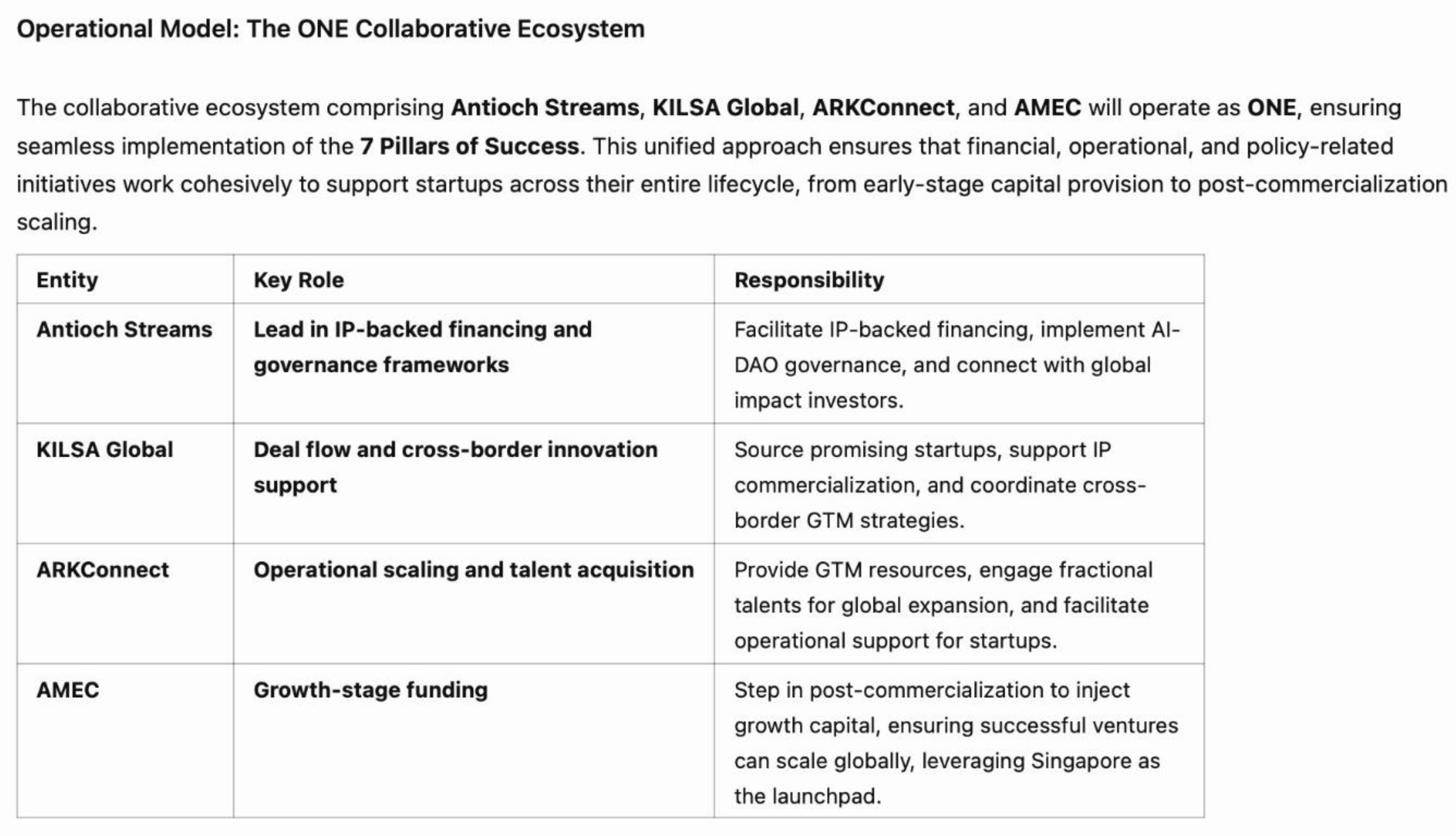
As the central founder-led ecosystem platform, Antioch Streams plays a pivotal role in bridging the three critical structural gaps in ASEAN’s startup ecosystem. Antioch Streams acts as a multi-stakeholder hub, uniting entrepreneurs, investors, policymakers, academic institutions, and global partners to foster sustainable innovationacross ASEAN. By leveraging structured capital models, AI-driven governance frameworks, and policy alignment, Antioch Streams plays a crucial role in ensuring cross-border scaling, global investor engagement, and regulatory harmonization.
The platform’s central role lies in creating an innovative ecosystem where startups in MedTech, GreenTech, and AgTechcan access patient capital, overcome regulatory barriers, and expand internationally. Through its cross-sector collaboration and global network, Antioch Streams can drive policy harmonization in ASEAN, allowing the region to leverage global impact investment and scale rapidly.

1.5. Purpose of the Paper

This paper evaluates how ASEAN can leverage Antioch Streams and other innovative capital models and governance frameworks to overcome the three structural gaps and achieve sustainable growth across key sectors like HealthTech, GreenTech, AgTech, and DeepTech/ Industrial IoT. By using Singapore as a launchpad, the paper outlines strategic steps for enabling regional startups to scale globally while aligning with regenerative economic practices. Through Antioch Streams, ASEAN startups will gain access to the global networks and capital needed for expansion while simultaneously addressing policy fragmentation and scaling challenges.

1.6. Why ASEAN? And Why Now?

Shifts in global supply chains under the China+1 strategy have positioned ASEAN as a global manufacturing hub, making this an ideal time for the region to lead the transition toward regenerative growth. The urgency is compounded by rising global impact capital, projected to reach USD 700 billion by 2030. ASEAN has an opportunity to capture a significant portion of this capital by addressing its structural gaps and aligning with SDG Goal 17, which emphasizes partnerships for sustainable development.
The South Summit Korea 2024 and SWITCH Singapore 2024 forums provided critical validation of this potential. Over 100 entrepreneurs and ecosystem players from across ASEAN participated in discussions on cross-border scaling, IP-backed financing, and policy harmonization. These engagements revealed that although ASEAN’s fragmented market poses challenges, it also presents an opportunity to create a collective ecosystem of entrepreneurs capable of co-creating solutions that foster sustainable growth across borders.
The timing is ripe for ASEAN to capitalize on the growing importance of Scope 3 emissions, which make up more than 70% of global carbon footprints. With global supply chains shifting to Southeast Asia, the ability to reduce emissions through regenerative business practices will become a major driver of investment in the region.

1.7. Hypothesis Development

Building on the three structural gaps, this paper develops the following hypotheses, designed to address these challenges and enable ASEAN to achieve its regenerative economic potential:
  • Hypothesis 1: Implementing IP-backed financing and impact-linked financing will reduce the funding gap and enable capital-intensive sectors to secure patient capital.
  • Hypothesis 2: Establishing an ASEAN Equity Bank based on sustainability metrics will attract global impact investors, fueling sustainable innovation in GreenTech and AgTech.
  • Hypothesis 3: AI-DAO governance frameworks will reduce regulatory burdens, driving cross-border scalability for startups in DeepTech and Industrial IoT.
  • Hypothesis 4: Singapore will serve as a launchpad for scaling startups globally, positioning ASEAN as a leader in green finance and impact investing.
  • Hypothesis 5: The adoption of regenerative models (like revenue and reward multipliers) will incentivize startups to adopt regenerative practices, driving both ecological restoration and economic growth.

1.8. Methodology

This research employs a multi-method approach, integrating both qualitative and quantitative data collection techniques to evaluate how structured financial models and governance innovations can close the funding gap, GTM resources gap, and globalization mindset gap in ASEAN’s startup ecosystem.

1.8.1. Qualitative Analysis:

  • Interviews: We conducted over 50 in-depth interviews with stakeholders from high-growth sectors across ASEAN, including founders, investors, and policymakers in AgTech, GreenTech, MedTech, and Industrial IoT. These interviews provided qualitative insights into the challenges faced by businesses as they scale and the role of strategic capital in addressing these barriers.
  • Case Studies: To evaluate how structured capital models and governance innovations have successfully enabled scale-up in similar markets, we drew comparative case studies from Japan, South Korea, Germany, the US, and Europe. The case studies concentrated on IP- backed financing and impact-driven equity pools, providing ASEAN with applicable best practices.

1.8.2. Quantitative Analysis:

  • Surveys: We conducted a survey of 200 startups and SMEs across ASEAN to gather quantitative data on the main barriers they face in scaling their businesses. The surveys focused on identifying the gaps in funding access, GTM strategies, and cross-border expansion.
  • Results showed that 75% of startups cited a lack of GTM resources as the primary obstacle to scaling, while 60% identified funding as their biggest challenge.
  • Market Data: We sourced secondary data from institutions such as OECD, World Bank, and Bain & Company, which provided market-level insights into the challenges and opportunities within ASEAN’s startup ecosystem. This includes data on the region’s progress toward SDG goals, with only 17% of targets currently being met.

1.8.3. Technology-Driven Impact Validation:

  • AI, Blockchain, and Data Analytics: Emerging technologies like AI, blockchain, and data analytics are critical tools for impact measurement, validation, and scalability. ASEAN-based startups and corporations can utilize these technologies to create data-rich environments for tracking sustainability metrics, optimizing resource use, and ensuring compliance with regulatory frameworks.
  • For instance, AI-driven data analytics could enhance decision-making across regenerative agricultural practices by optimizing water use, tracking soil health, and ensuring sustainable crop yields.
  • Blockchain for Transparency: Blockchain will increase investor confidence by providing immutable records of sustainability metrics, attracting global capital, and establishing ASEAN as a model for innovation-led regenerative practices.

1.9. Theoretical Framework

The theory of regenerative economies, which goes beyond sustainability to actively restore ecosystems and create long-term social and economic value, forms the foundation of the research. The regenerative economy emphasizes not just the avoidance of harm but the positive restoration and revitalization of ecosystems, society, and the economy. This model stands in stark contrast to traditional ESG (Environmental, Social, and Governance) approaches, which typically prioritize mitigation and risk management. The regenerative model aligns with ASEAN’s goal of fostering net-positive impact and contributing to both economic growth and the restoration of the natural environment.
Leading thought frameworks like these provide the theoretical perspectives that guide this study.
  • Kate Raworth’s Doughnut Economics (2017) advocates for economies to operate within a “safe and just space” for humanity by balancing ecological and social boundaries.
  • Donella Meadows’ Systems Thinking (2008): A holistic approach that considers the interconnectedness of systems, emphasizing long-term sustainability over short-term profit maximization.
  • Paul Hawken’s Regenerative Capitalism (2018): Emphasizing the need for patient capital and business models that integrate ecological restoration and business growth.
This framework incorporates insights from the World Economic Forum, Harvard Business Review, and OECD, which compare the effectiveness of regenerative business models versus traditional ESG models. It also looks at how structured financial models (like IP-backed financing and impact-linked equity) and decentralized governance through AI-DAOcan help with regenerative innovation. These mechanisms are critical in addressing ASEAN’s barriers to growth, such as the funding gap, GTM resources gap, and globalization mindset gap.
Furthermore, the research considers how AI-DAO governance frameworks, which automate and streamline regulatory processes across borders, can enhance cross-border scalability and reduce operational costs for startups in sectors like DeepTech and Industrial IoT.
This theoretical framework provides the necessary academic grounding for the paper, integrating relevant literature and global best practices to form a robust foundation for the proposed solutions. With this, the methodology aligns closely with the broader goals of fostering a regenerative economy within ASEAN, underpinned by strong, scalable models and innovative governance.
The South Summit Korea 2024 and SWITCH Singapore 2024 played a pivotal role in validating the strategies proposed in this paper. These events facilitated discussions among 100 entrepreneurs, financial institutions, and key ecosystem leaders. Insights from these forums confirmed the practicality of cross-border collaboration models and highlighted the importance of platforms like Antioch Streams in bridging the gap between research, thought leadership, and practical implementation. Antioch Streams, by serving as a multi-stakeholder ecosystem hub, provides a key model for how ASEAN can engage in regenerative economic practices at scale.

1.10. Ecosystem Mapping and Stakeholder Engagement

To effectively bridge the structural gaps identified earlier, it is crucial to map out and understand the roles of key stakeholders in ASEAN’s innovation ecosystem. This ecosystem includes:
Entrepreneurs and Startups:
  • Role: Startups are the primary drivers of innovation across sectors like HealthTech, GreenTech, AgTech, and DeepTech/IIoT. They are responsible for developing scalable solutions to address critical challenges in sustainability, food security, healthcare, and industrial innovation.
  • Challenges: Startups in ASEAN struggle with access to patient capital, limited GTM resources, and lack of international experience, which hinder their ability to scale regionally and globally.
Investors (Venture Capitalists, Impact Investors):
  • Role: Investors provide the necessary capital for startups to scale and commercialize their innovations. They play a key role in funding ventures that align with sustainable development goals (SDGs).
  • Challenges: Despite the growing pool of global impact capital, ASEAN faces a funding gap as investors remain hesitant to commit to sectors with long innovation cycles, such as MedTech, DeepTech, and GreenTech.
Policymakers and Governments:
  • Role: Governments play a critical role in shaping the regulatory environment that enables startups to grow. This includes creating favorable policies for green finance, carbon trading, intellectual property (IP) protection, and tax incentivesfor sustainable ventures.
  • Challenges: The fragmented regulatory environment across ASEAN increases operational costs and creates challenges for startups looking to scale regionally.
Academic and Research Institutions:
  • Role: Academic institutions provide the research and development (R&D) necessary for innovation in sectors like GreenTech, AgTech, and HealthTech. These institutions are often the first incubators of disruptive technologies.
  • Challenges: There is often a gap between academic research and commercialization, as startups struggle to transition innovative ideas into market-ready solutions.
Antioch Streams:
  • Role: Antioch Streams serves as a founder-led ecosystem platform that connects key stakeholders across the ecosystem to drive cross-border scaling, policy harmonization, and global investment. By acting as a centralized hub, Antioch Streams fosters collaboration between startups, investors, policymakers, and research institutions.
  • Function: Antioch Streams offers a multi-stakeholder collaboration platform, ensuring that ASEAN startups have access to the capital, mentorship, and global networks needed to scale. It also helps reduce the regulatory burden through AI-driven governance frameworks, automating compliance processes across jurisdictions.
Impact: By facilitating policy alignment and driving cross-sector collaboration, Antioch Streams will play a pivotal role in overcoming ASEAN’s structural gaps, particularly in funding, GTM resources, and globalization mindset. It will also provide a model for impact investing, with the integration of impact-linked equity and sustainability metricsto drive investment into regenerative ventures.

1.11. Global Lessons and Frameworks for ASEAN

ASEAN can learn valuable lessons from global initiatives in the areas of impact investing, policy harmonization, and cross-border scaling. Here’s how global frameworks can influence the development of Antioch Streams as a model for ASEAN:
  • Japan’s IP-backed Financing Model: Japan’s IP Bank has successfully unlocked over USD 3.2 billion for innovation-heavy sectors like MedTech and GreenTech. ASEAN can replicate this model to support startups in capital-intensive sectors that require long R&D cycles.
  • South Korea’s Clean Energy Fund: South Korea raised USD 200 million by linking investment returns to carbon reduction metrics. The GreenTech and AgTech sectors in ASEAN can apply this model to attract impact investors who prioritize measurable environmental outcomes.
  • Europe’s Green Taxonomy: The EU Green Taxonomy provides a framework for green finance, creating a unified regulatory standard that enhances investor confidence. ASEAN can draw from this model to harmonize green finance policies across its member states.
  • US Climate-Tech Venture Capital: The US raised USD 31 billion for climate-tech investments in a single year. ASEAN can use this example to attract global impact capital to sustainable innovations that contribute to reducing Scope 3 emissions in regional supply chains.
By integrating these global lessons, Antioch Streams serves as a critical enabler in ASEAN’s path to becoming a global leader in the regenerative economy. The upcoming sections of the paper will explore the application of structured capital models, AI-DAO governance, and policy harmonization to bridge ASEAN’s structural gaps and unleash its regenerative economic potential. We will also explore in detail Antioch Streams’ role in cross-border scaling and impact investment, demonstrating its potential to help ASEAN unlock USD 500 billion in economic value by 2030.
The methodology integrates a thorough exploration of both qualitative and quantitative data, enriched by case studiesand global best practices, to propose actionable solutions for ASEAN’s barriers to scaling. In addition to structured financial models and AI-DAO frameworks, this study emphasizes the critical role of policy harmonization and cross-border collaboration to unlock ASEAN’s regenerative economic potential. The findings also suggest that Antioch Streams can act as a foundational platform to facilitate these changes and accelerate ASEAN’s path to becoming a global leader in regenerative business models.

2. Literature Review: Bridging the Structural Gaps for ASEAN’s Regenerative Economy

2.1. Key Principals of a Regenerative Economy, The 5Ps Framework: Birth of Antioch Streams

Businesses, economies, and communities can create a positive impact on both the planet and society, according to the regenerative economy. Unlike traditional economic models that prioritize profit maximization, often at the expense of environmental and social well-being, a regenerative economy aims to restore and replenish natural ecosystems and societal structures. The regenerative economy envisions a transition from a linear "take, make, dispose" model to a circular, restorative model that efficiently uses resources while maintaining the ecological balance.

2.1.1. Key Principles of a Regenerative Economy

1.
Ecological Restoration:
  • The regenerative economy prioritizes the restoration of ecosystems that industrial activity has depleted, including reforestation, soil health regeneration, and biodiversity conservation.
  • Key Literature: Meadows, D. (2008) and Raworth, K. (2017) highlight how innovative systems thinking and business practices that respect natural limits can replenish ecosystems.
2.
Social Equity:
  • It prioritizes social justice and equity, guaranteeing a fair distribution of the benefits of economic activities among all members of society.
  • Key Literature: Elkington, J. (2020) discusses how businesses can drive both ecological restoration and positive social outcomes by adopting inclusive practices.
3.
Economic Resilience:
  • A regenerative economy is one that can thrive without compromising ecological balance, building long-term value that goes beyond short-term profits.
  • Key Literature: Hawken, P. (2018) elaborates on how businesses can balance economic growth with restorative environmental practices to achieve systemic resilience.

2.1.2. The 5Ps Framework for Regenerative Economy:

The 5Ps framework—People, Planet, Purpose, Prosperity, and Participation—encapsulates the values and principles of a regenerative economy. This model emphasizes not only ecological sustainability but also equitable economic and social development. The interlinking of each P underscores the importance of cross-sectoral collaboration and stakeholder engagement.
  • People: We strive to meet people's needs, ranging from livelihoods to health, in a manner that enhances society as a whole.
  • Planet: Preserving and regenerating natural systems to ensure ecological balance.
  • Purpose: Encouraging businesses and organizations to operate with a mission that aligns with the greater good of society and the environment.
  • Partnership: Actively involving all stakeholders in decision-making processes, ensuring inclusivity and equity.
  • Prosperity: The establishment of a sustainable economic system that generates and distributes wealth in a manner that promotes ecological and social well-being.
Role of Key Stakeholders: The Birth of Antioch Streams
The 5Ps framework highlights the critical need for engagement from various stakeholders to implement a regenerative economy. Antioch Streams will act as the central platform that drives this engagement by connecting entrepreneurs, investors, policymakers, and research institutions.
By embedding the 5Ps into the operational structure of Antioch Streams, ASEAN can create an ecosystem where each stakeholder has a defined role in advancing sustainability goals.
The platform will enable people to access regenerative technologies, support the planet through resource-efficient solutions, encourage purpose through impact-driven investments, foster partnership via inclusive economic growth, and ensure prosperity through active collaboration with all sectors of society.

2.2. Regenerative Economy Models and Strategic Capital

The regenerative economy is a concept that extends beyond mere sustainability to actively restore ecosystems, societies, and economies, creating net-positive impacts. According to Kate Raworth’s Doughnut Economics (2017), a regenerative economy seeks to operate within a “safe and just space” for humanity. This holistic approach recognizes the need to pursue growth within planetary boundaries, promoting a balance between economic activity and ecological sustainability. ASEAN’s pursuit of a regenerative economy aligns with this framework, focusing on the need for inclusive growth that respects the environment while fostering long-term economic prosperity.
Donella Meadows' 2008 book, Systems Thinking, delves deeper into the interconnectedness of systems, emphasizing the need to comprehend economies as dynamic systems intricately linked to the environment. Meadows’ focus on long-term sustainability over short-term profit maximization underscores the essence of regenerative economies, especially for ASEAN, where sectors like GreenTech, MedTech, and AgTech hold the potential for systemic change. This model necessitates the application of patient capital, a concept Paul Hawken (2018) emphasizes for sectors with extended innovation cycles.
Patient capital, especially for capital-intensive sectors, is essential for fostering long-term innovation cycles. These sectors require the infusion of capital not only to fund R&D but also to create regenerative business practices that restore ecosystems, such as bio-based agriculture or circular economy models. The global challenge of climate change and environmental degradation calls for innovative financial solutions that enable deep-tech innovation, such as the development of sustainable agriculture systems, clean energy technologies, and medicinal biotech.
Structured capital models, such as IP-backed financing, which Japan’s IP Bank has employed, provide a robust solution to the funding gap in ASEAN. Japan has successfully raised USD 3.2 billion through this method to support innovation-heavy sectors like MedTech, GreenTech, and Biotech. ASEAN can adopt this model to allow its startups in DeepTech, HealthTech, and CleanTech to access non-dilutive capital by leveraging their intellectual property (Tanaka et al., 2020). Equity-backed financing aligned with sustainability metrics is a logical complement to this, offering long-term capital for sectors with measurable environmental outcomes.

2.3. Impact-Linked Financing and Equity Bank Models

As the global economy shifts toward regenerative finance, impact-linked financing is emerging as a critical tool for bridging the funding gap in ASEAN. By 2030, the Global Impact Investing Network (GIIN, 2020) predicts a global mobilization of USD 1 trillion for impact investing. ASEAN stands to benefit significantly from this influx, particularly in sectors that offer measurable environmental outcomes such as GreenTech, AgTech, and CleanTech.
South Korea’s Clean Energy Fund, which raised USD 200 million by linking investment returns to carbon reduction metrics (Park, 2021), exemplifies the potential of impact-linked equity for fostering long-term investments in sustainable technologies. This model is particularly relevant for ASEAN, where green finance and carbon reductionefforts are essential for achieving both local economic growth and global climate goals. Through a unified ASEAN Green Finance Framework, ASEAN can unlock similar funding pools to enable cross-border sustainability-linked investments, driving investments in sectors such as clean energy, sustainable agriculture, and climate-resilient infrastructure.
Moreover, the development of equity banks that tie investor returns to verified environmental and social outcomesaligns with ASEAN’s focus on leveraging impact capital. This innovative model offers patient capital, safeguarding startups from the demands of immediate returns and instead fostering long-term sustainability.

2.4. Governance Frameworks and Cross-Border Scaling

A key structural barrier in ASEAN’s transition to a regenerative economy is the fragmented regulatory landscape, which results in high operational costs and regulatory inefficiencies. For instance, cross-border scaling for DeepTechstartups is particularly challenging due to the regulatory fragmentation across ASEAN member states. As noted by Li and Wang (2020), AI-DAO governance frameworks are emerging as a promising solution. These frameworks, powered by blockchain technology, provide a decentralized autonomous organization (DAO) structure that automates regulatory compliance and reduces operational friction.
The use of AI-DAO governance can reduce compliance costs by up to 30–40%, enabling startups in MedTech, DeepTech, and industrial IoT to scale across ASEAN more efficiently. AI-driven governance can enhance the transparency and accountability of regulatory systems, streamlining cross-border scaling by automating compliance procedures. This technology enables regulatory harmonization across ASEAN, significantly reducing the complexity and cost of cross-border operations and paving the way for ASEAN startups to expand into international markets.
By creating a unified governance infrastructure that facilitates regional cooperation, ASEAN can streamline the scaling process for startups and enhance their global competitiveness.

2.5. The Role of Impact Investing and Scope 3 Emissions - ASEAN is an Opportunity for This

Scope 3 emissions, which represent the carbon emissions generated across a company’s value chain, account for more than 70% of global emissions. As global supply chains concentrate in regions like ASEAN, the impact investing community has increasingly recognized the importance of addressing Scope 3 emissions. According to McKinsey & Company (2022), Scope 3 emissions drive 85% of emissions in global supply chains, positioning ASEAN at the forefront of climate change mitigation efforts.
The global shift toward impact investing emphasizes the need to reduce Scope 3 emissions through sustainable supply chains, green technology, and regenerative practices. ASEAN is particularly well-positioned to lead these efforts, given its central role in global manufacturing and agriculture. By investing in GreenTech and AgTech startups, ASEAN can attract impact capital from global investors focused on reducing carbon footprints.
As a founder-led ecosystem platform, Antioch Streams provides a way to close the gap in impact investments by making it easier to use impact-linked equity that is tied to environmental outcomes. These global lessons show how ASEAN can use structured financing to attract large-scale investments into regenerative technologies, which are pivotal for mitigating Scope 3 emissions.

2.6. The Evolution of Impact Investing: From ESG to Regenerative Finance

Impact investing has evolved from focusing on mitigating harm (ESG) to promoting net- positive outcomes. The transition toward regenerative finance emphasizes the restoration and revitalization of ecosystems. Elkington (2020)describes how regenerative business models go beyond traditional ESG compliance, focusing on creating restorative impacts that restore ecosystems and regenerate communities.
ASEAN’s potential to attract impact investment hinges on its ability to implement regenerative finance practices that deliver both economic returns and ecological restoration. As global investors shift toward models that emphasize environmental restoration rather than mere sustainability (as with ESG), ASEAN’s GreenTech, MedTech, and AgTech sectors are primed for growth. By focusing on verifiable outcomes such as carbon reduction, biodiversity preservation, and sustainable resource management, ASEAN can position itself as a leader in regenerative finance.

2.7. Technology-driven ecosystems for scaling and validation

Technologies like AI, blockchain, and data analytics are game-changers in impact validation and scaling. These technologies are crucial for ensuring the transparency and accountability of sustainability metrics, which in turn attracts global capital. In sectors like AgTech, GreenTech, and HealthTech, AI-driven analytics can optimize resource allocation, track environmental impacts, and ensure compliance with global sustainability standards.
Immutable records of sustainability data, enabled by blockchain, give investors confidence in the accurate measurement and verification of environmental metrics. This technology plays a central role in creating transparent systems for impact measurement, allowing ASEAN startups to engage with global investors and scale quickly.
Additionally, the integration of data-driven ecosystems can accelerate ASEAN’s ability to track and validate the impact of regenerative business models, ensuring that sectors like GreenTech and MedTech attract the investment required to scale.

2.8. Policy Harmonization for Cross-Border Innovation and Investment

The fragmented regulatory environment within ASEAN presents a significant barrier to cross-border investments and operational scalability. As ASEAN moves toward becoming a hub for regenerative finance, policy harmonization will be crucial for creating a conducive environment for sustainable innovations across borders. Aligning national regulations with global standards will reduce the complexity and cost of cross-border scaling, providing a clearer pathway for startups to access global impact capital.
The European Green Deal and the EU Green Taxonomy are leading examples of policy frameworks that can inform ASEAN’s approach to green finance. These frameworks offer a unified regulatory standard for sustainable investments, increasing transparency and investor confidence. ASEAN can learn from these models and introduce harmonized regulations for green finance that integrate tax incentives, carbon pricing, and green bonds. ASEAN could adopt a unified green finance framework similar to the EU Green Taxonomy, which would provide investors with clarity on environmental risks and opportunities while promoting sustainable innovation.
Furthermore, Singapore’s Green Finance Action Plan (2021) plays an essential role in demonstrating how regulatory frameworks can guide the transition to a sustainable, low- carbon economy. By establishing itself as the regulatory hubfor ASEAN, Singapore can lead the way in facilitating the harmonization of green finance policies across ASEAN member states, ensuring a seamless flow of capital into sustainable ventures. These efforts will provide the necessary regulatory clarity for both investors and startups, allowing for more efficient cross-border operations.
In addition, ASEAN governments can also harmonize intellectual property (IP) protection, carbon trading mechanisms, and sustainability-linked financing models to align with global standards. Creating regional standardsfor impact investing and sustainability metrics can streamline the process for investors looking to engage in regenerative practices across ASEAN’s fragmented markets. As a result, ASEAN will become a key player in the global regenerative economy, drawing in both domestic and international capital.
Takeaway: This literature review highlights the key drivers for ASEAN’s transition toward a regenerative economy. In order for ASEAN to get past its structural problems (funding gap, GTM resources gap, and globalization mindset gap), it needs to combine structured capital models like IP-backed financing and equity bank-backed financing with AI-DAO governance and policy harmonization. These solutions will enable ASEAN to unlock significant economic value in the coming decades, positioning the region as a leader in sustainability, regenerative practices, and impact investing.
The review has outlined how ASEAN can benefit from the lessons of global best practices from regions such as Japan, South Korea, Europe, and the United States. ASEAN can establish an ecosystem that supports startups in MedTech, GreenTech, AgTech, and DeepTech with patient capital and innovative governance frameworks by replicating successful IP-backed financing models, impact-linked equity structures, and adopting blockchain-driven AI governance systems. This ecosystem will help scale sustainable ventures, foster ecological restoration, and drive global impact.
In the policy landscape, ASEAN must align its efforts with the growing importance of Scope 3 emissions and green finance policies while leveraging technology-driven ecosystems for impact validation. By creating coherent regulatory standards across ASEAN, the region can become the global hub for sustainable innovations and the launchpad for startups that align with regenerative finance.
As ASEAN positions itself to capture a share of the USD 700 billion in global impact capital projected by 2030, it must focus on attracting patient, long-term investors. By addressing the structural gaps that hinder scaling and fostering collaboration across sectors, ASEAN can successfully transition to a regenerative economy and emerge as a leader in global sustainable development.

3. Discussion and Findings—Addressing ASEAN’s Key Barriers through the 7 Pillars of Success

ASEAN’s aspiration to lead the global transition to a regenerative economy is both timely and critical. As a region endowed with a young, dynamic workforce, an expanding middle class, and an advantageous geographic position, ASEAN holds immense potential to drive sustainable development. However, three key structural barriers—Funding Gap, Go-to- Market (GTM) Resources Gap, and Globalization Mindset Gap—constrain the scalability of high-impact ventures in HealthTech, MedTech, GreenTech, AgTech, and DeepTech/ Industrial IoT (IIoT). To address these challenges, the 7 Pillars of Success framework offers a comprehensive roadmap to unlock ASEAN’s economic and regenerative potential, leveraging innovative financial models, governance frameworks, and cross-sector collaboration.

3.1. Strategic Solutions to Address the Funding Gap

The funding gap is a significant barrier to innovation, especially in sectors with long R&D cycles. Traditional venture capital models in ASEAN do not typically provide the patient capital required for transformative growth in these industries.
  • Multi-Layered Capital Approach to Sustainable Financing (Pillar 1)
A diverse funding approach integrating IP-backed loans, equity banks, and hedge funds can meet ASEAN’s capital needs in innovation-heavy sectors.
  • IP-Backed Financing: IP financing provides non-dilutive capital by using intellectual property as collateral, crucial for early-stage HealthTech and GreenTech startups. Japan’s IP Bank model raised USD 3.2 billion by leveraging patents as assets—a model ASEAN could replicate through an ASEAN IP Bank.
Case Study: A GreenTech venture in Malaysia, developing low-carbon building materials, could secure IP-backed funding to scale production and meet growing urbanization demands across Southeast Asia.
  • Equity Bank Financing: For ventures beyond the MVP stage, equity bank-backed financing ties investor returns to sustainability outcomes. The South Korean Clean Energy Fund’s success in raising USD 200 million by linking returns to carbon reduction demonstrates the potential for ASEAN to attract capital with a similar equity bank approach.
  • Anticipated Impact: An ASEAN IP Bank and regional equity bank model would attract patient capital, reducing reliance on traditional VC and enabling sustainable R&D investment. Global trends in impact-linked equity models, highlighted at COP29, emphasize the alignment of investor returns with sustainability outcomes. ASEAN can replicate South Korea’s Clean Energy Fund, which raised $200 million by tying returns to carbon reduction metrics, to mobilize impact capital for high-impact sectors like AgTech and DeepTech.
Proposed ASEAN Equity Bank: By establishing a regional equity bank that links funding to verified ecological and social outcomes, ASEAN can attract global investors focused on regenerative practices. This approach aligns with COP29’s call for biodiversity-focused finance, enabling ventures to secure funding for solutions that address climate resilience and sustainability goals.
  • Harmonized Policy Framework for Cross-Border Unified Investment (Pillar 5)
Policy harmonization across ASEAN would streamline investments and reduce regulatory friction, creating a stable environment for foreign and domestic investors alike.
  • ASEAN Application: Establishing an ASEAN-wide Green Finance Framework and unified IP standards would provide consistent tax incentives and enhance IP protection, mirroring Europe’s success with unified green finance policies. Drawing from global frameworks like the EU Green Taxonomy, ASEAN must harmonize policies to attract sustainable investments. A unified green finance framework could align member states on carbon trading mechanisms, green bond certifications, and sustainability-linked loans. For example, Singapore’s Green Finance Action Plan provides a model for incentivizing private capital into regenerative ventures across the region.
  • Anticipated Impact: Harmonized policies would increase investor confidence, fostering an environment where patient capital flows across ASEAN and supports regenerative sectors.
Case Study: In Indonesia, harmonized green finance policies could accelerate funding for reforestation projects targeting mangrove restoration, a critical climate adaptation priority highlighted at COP29.

3.2. Ecosystem Solutions to Address the GTM Resources Gap

ASEAN startups face significant hurdles due to fragmented regulations and limited infrastructure for cross-border scaling. The GTM Resources Gap particularly affects sectors reliant on integrated value chains, like AgTech, HealthTech, and GreenTech.
  • Collaborative Ecosystems for Scaling and Efficiency (Pillar 2)
By fostering collaborative ecosystems and promoting M&A, ASEAN can support startups’ cross-border scaling and resource-sharing efforts.
  • ASEAN Application: ASEAN could establish regional hubs where startups co-develop solutions, pooling resources for greater efficiency. Europe’s Innovation Union has shown how shared R&D centers and collaborative hubs facilitate efficient scaling across borders.
  • Anticipated Impact: Such collaboration would ease market entry costs, build operational resilience, and reduce the regional challenges posed by diverse regulations.
  • Regional Innovation Hubs for Cross-Border Market Integration (Pillar 7)
ASEAN could develop innovation hubs that reduce entry costs and support startups with R&D, regulatory advisory, and market-entry guidance.
  • ASEAN Example: Replicating the EU Single Market’s innovation hub model could strengthen ASEAN’s regional integration, with key hubs in Singapore, Vietnam, and Indonesia.
  • Anticipated Impact: Regional hubs would foster a cooperative ecosystem, accelerating market expansion across ASEAN and strengthening startup scalability.
  • Reward-Based Incentive System for Sustainable Growth (Pillar 6)
By linking profits to ecological and social outcomes, a rewards system based on sustainability goals would encourage ASEAN ventures to adopt regenerative practices.
  • ASEAN Application: Incentivizing startups with sustainability-linked rewards like tax credits or impact dividends can attract patient, impact-oriented capital. The EU Green Taxonomy model, which ties financial rewards to environmental impacts, could serve as a template for ASEAN.
  • Anticipated Impact: This model would support ASEAN’s goal of creating an ecosystem where financial success aligns with ecological resilience, attracting capital from global impact investors.

3.3. Building Global Competitiveness to Close the Globalization Mindset Gap

ASEAN’s limited access to global expertise and networks is a barrier to scaling internationally, limiting the region’s ability to attract talent and secure partnerships. We must bridge the Globalization Mindset Gap to place ASEAN startups on a competitive global platform.
  • Leveraging Fractional Talent Networks for Global Expertise (Pillar 3)
ASEAN startups can benefit from fractional talents, which are experienced professionals who work part-time with multiple companies, bringing global insights without the cost of full-time
hires.
  • ASEAN Application: ASEAN could engage fractional CMOs, CFOs, and other executives, offering startups the strategic international insights needed to scale without a heavy financial burden. European startups have successfully used this model, which could enhance the competitiveness of ASEAN ventures on a global scale.
  • Anticipated Impact: By bridging the talent gap affordably, fractional talent networks would equip ASEAN startups with critical expertise, enhancing their competitiveness and enabling international expansion.
ASEAN, inspired by Silicon Valley, has the potential to implement fractional talent models as a means of accessing specialized expertise. Studies show that 70% of experienced professionals in Silicon Valley are willing to accept lower salaries in exchange for equity participation and high-impact opportunities. ASEAN could replicate this by:
  • Startups can attract top-tier talent by offering equity-based compensation.
  • Establishing regional fractional talent hubs enables professionals to contribute to multiple ventures simultaneously.
  • Innovation Funding to Overcome the “Valley of Death” (Pillar 4)
To address the “Valley of Death” funding gap, ASEAN could establish a regional innovation fund that combines public and private resources.
  • ASEAN Application: Modeled after the European Investment Fund (EIF), an ASEAN innovation fund could support startups through critical growth stages, with grant and equity financing options for high-risk ventures in sectors like HealthTech and GreenTech.
  • Anticipated Impact: A dedicated innovation fund would enhance startup survival rates during pivotal early stages, providing a structured support system from POC to commercialization.

3.4. The 7 Pillars: A Framework for ASEAN's Regenerative Economy

The 7 Pillars of Success provide a holistic framework for overcoming ASEAN’s structural challenges, fostering a regenerative economy where sustainable growth, financial innovation, and global competitiveness are integral. From multi-layered capital approaches to fostering regional ecosystems and bridging the globalization gap, each pillar addresses a critical barrier, setting ASEAN on a pathway toward sustainable prosperity.
Pillar 1. Addressing the Funding Gap: A Multi-Layered Capital Approach
The funding gap represents one of the most significant obstacles to innovation and regenerative growth in ASEAN, particularly for capital-intensive sectors like HealthTech, GreenTech, AgTech, and DeepTech. The current reliance on traditional venture capital (VC) models—designed for rapid scalability and high returns—fails to meet the financial needs of these sectors, which often require long research and development (R&D) cycles before commercialization. This section proposes a multi-layered capital approach as a solution, incorporating IP-backed financing, equity bank-backed financing, and hedge funds, which offer more flexibility and patient capital.
A. IP-Backed Financing: Unlocking Non-Dilutive Capital for Innovation
IP-backed financing provides startups in innovation-heavy sectors with access to non- dilutive capital by allowing them to leverage their intellectual property (IP) as collateral for loans. This method ensures that companies can secure necessary funding for R&D and commercialization while retaining equity ownership.
Case Study: Japan’s IP Bank Model
Japan’s IP Bank has been highly effective in raising over USD 3.2 billion in non-dilutive capital for companies in deep tech, biopharmaceuticals, and MedTech. Firms like PeptiDream, for example, successfully utilized their patent portfolio to secure capital for clinical trials without diluting equity. This model showcases how intellectual property, when used strategically, can serve as a robust financial asset, supporting growth without compromising control.
ASEAN Application
We can adapt this model in ASEAN to support early-stage startups, particularly in HealthTech and GreenTech. For instance, Singapore's robust IP protection framework puts it in a prime position to spearhead the establishment of an ASEAN IP Bank. Through this bank, startups like AWAK Technologies—which specializes in medical devices—could leverage their IP to secure financing for R&D or clinical trials. By replicating Japan’s approach, ASEAN could unlock over USD 3 billion in capital for startups, helping to address the funding gap without requiring equity dilution.
B. Equity Bank-Backed Financing: Aligning Capital with Sustainability Outcomes
While IP-backed financing is crucial for early-stage ventures, equity bank-backed financing offers an appropriate solution for post-MVP (Minimum Viable Product) ventures, particularly in the GreenTech and Circular Economysectors. Equity Bank-backed financing links investor returns to specific sustainability metrics, attracting patient capitalthat aligns with long-term outcomes, such as carbon reduction and biodiversity restoration.
Case Study: South Korea’s Clean Energy Fund
South Korea’s Clean Energy Impact Fund raised over USD 200 million by tying returns to verified carbon reduction outcomes. By aligning financial dividends with environmental impacts, the fund appealed to global impact investors, creating a win-win situation for sustainability and financial returns.
ASEAN Application
In ASEAN, particularly in countries like Vietnam and Thailand, where governments are increasingly focusing on renewable energy, bioscience, and sustainable agriculture, a similar approach could be highly effective. By establishing an ASEAN Equity Bank, regional governments could pool resources from global investors, with returns linked to carbon reduction, resource efficiency, or sustainable social/community development and farming practices. This model could potentially mobilize over USD 500 million in impact-linked capital, accelerating regenerative projects across the region.
C. Hedge Funds: Bridging the Valley of Death for Late-Stage Ventures
The Valley of Death is a significant hurdle for late-stage ventures in capital-intensive sectors like clean energy and industrial IoT. Hedge funds can play a critical role here by providing flexible capital to help companies scale their infrastructure and operations, absorbing the higher risks associated with longer timelines and capital requirements.
Example: Hedge Funds in Renewable Energy Projects
In the U.S., hedge funds like Element Capital have successfully financed large-scale renewable energy infrastructure projects, offering the high-risk, high-reward capital that other investors may be hesitant to provide. These funds have played a critical role in pushing clean energy projects past the Valley of Death and into commercial viability.
ASEAN Application
In ASEAN, hedge funds can be a key source of capital for scaling clean energy projects, particularly in Indonesia and Vietnam, where the demand for renewable energy infrastructure is increasing rapidly. A solar energy startup in Vietnam, for example, could use hedge fund capital to expand its operations across the region, tapping into the growing demand for clean energy solutions. Hedge funds, with their longer return horizons, are well- suited to finance the late-stage growth of such ventures.
Expanding impact investing through multiplayer effect models
Impact investing in ASEAN has the potential to shift from traditional capital-driven models toward ecosystem-level multipliers that unlock patient capital for regenerative innovation. Multiplier effect models, observed in Japan’s IP-backed financing and South Korea’s Clean Energy Fund, demonstrate how impact-linked returns can attract substantial capital into high- impact ventures. By creating regional equivalents, such as an ASEAN-focused Clean Energy or GreenTech Fund, ASEAN can attract a substantial share of the USD 700 billion projected in global impact capital by 2030.
An ASEAN-specific impact investing multiplier model could link investor returns to measurable environmental and social outcomes, such as biodiversity restoration, emission reductions, and sustainable community development. By implementing these models, ASEAN can position itself as a global leader in attracting impact investors seeking not only financial returns but also measurable contributions, t.o., e.c.ological s.o.cial, r.esilience
Pillar 2. Bridging the Go-to-Market (GTM) Resources Gap for Collaborative Ecosystems with M&A & Partnerships with AI-DAO
The fragmented regulatory environment in ASEAN drives the GTM Resources Gap, creating significant hurdles for startups attempting to scale across borders. The lack of integrated value chains and cross-border partnerships further exacerbates this challenge. This section explores how collaborative ecosystems, M&A, and AI-DAO governance frameworks can help bridge this gap and enable ASEAN startups to scale more effectively.
Collaboration-centric and innovation-driven regenerative models for ASEAN
ASEAN holds a unique position in creating customized regenerative models that seamlessly incorporate sustainable growth into local contexts across its diverse economies. Drawing from global examples, such as Europe’s circular economy frameworks and Africa’s ecological restoration initiatives, ASEAN can shape a regenerative economy that thrives on both urban innovation hubs and rural ecosystem restoration. Key pillars of these models include regenerative circularity, resource optimization, and low-carbon infrastructure, which foster inclusive economic growth while restoring natural ecosystems. In particular, Singapore’s evolving green finance and innovation infrastructure present opportunities for cross-border collaboration to accelerate scalable models of regenerative circularity within ASEAN.
In alignment with ASEAN’s economic and ecological objectives, innovative circular economy initiatives could prioritize “collaborative ecosystems” on low-waste and resource- efficient business models in sectors like GreenTech, AgTech, and HealthTech. By harnessing cutting-edge technologies and region-specific insights, ASEAN can create an economy that transcends sustainability to actively regenerate ecosystems, establish high-quality jobs, and contribute to global carbon reduction goals.
Collaborative Ecosystems and Cross-Border Value Creation
Cross-border collaboration is a strategic approach to overcoming the GTM resources gap. Rather than competing in isolation, startups across ASEAN can form collaborative ecosystems to pool resources, expertise, and networks. By working together, startups can co- create value and penetrate multiple ASEAN markets.
Example: The European Innovation Ecosystem
Europe’s Innovation Union initiative has fostered cross-border collaboration among startups, leading to increased joint ventures and M&A deals. 35% of European startups are involved in cross-border collaborations, with M&A activityincreasing by 40% between 2018 and 2021 (Startup Heatmap Europe 2021).
ASEAN Application
ASEAN can replicate this model by establishing regional innovation hubs. Startups from Singapore, Thailand, and Indonesia could collaborate on developing GreenTech and HealthTech solutions that address challenges across multiple markets. These hubs would provide shared resources, such as R&D centers, regulatory compliance advisors, and manufacturing facilities, allowing startups to scale more efficiently and reduce operational costs.
M&A serves as a scaling mechanism.
M&A offers an efficient way for startups to scale rapidly by consolidating resources, technologies, and markets. In Europe, cross-border M&A has been a significant driver of startup growth, allowing companies to reduce risks and expand their reach.
ASEAN Application
M&A could be a critical tool in ASEAN for startups to overcome the fragmented regulatory environment and expand their operations. For example, a GreenTech startup in Singapore could collaborate with an AgTech startup in Thailand to create sustainable agriculture solutions suitable for sale in various ASEAN markets. By pooling resources and networks, the merged entity would have a stronger foothold in the region, enabling faster scaling and broader market penetration.
AI-DAO Governance for Cross-Border Compliance
AI-DAO (Decentralized Autonomous Organization) governance frameworks offer a scalable solution to the regulatory complexity faced by startups in ASEAN. By using smart contracts and blockchain technology, AI-DAO governance can automate compliance processes, reducing the cost and complexity of cross-border operations.
Case Study: European Blockchain Services Infrastructure (EBSI)
The EBSI is a cross-border blockchain initiative that automates regulatory filings, audits, and compliance across multiple jurisdictions. By leveraging smart contracts, the system reduces the need for manual oversight and speeds up cross-border expansion.
ASEAN Application
In ASEAN, AI-DAO governance could streamline the compliance process for startups operating in the GreenTech, HealthTech, AgTech, and DeepTech sectors. For instance, a HealthTech startup in Singapore could use AI-DAO to automatically comply with both Singaporean health regulations and Malaysian medical device standards, reducing operational costs and regulatory burdens.
Leveraging AI-DAO for governance and operational efficiency
AI-DAO (Artificial Intelligence-Decentralized Autonomous Organization) frameworks offer ASEAN a scalable solution to regulatory complexities and cross-border compliance. With AI-DAO governance, ASEAN startups, particularly those in GreenTech and AgTech, can reduce regulatory burdens and streamline operational efficiency across borders. By leveraging blockchain-enabled smart contracts, AI-DAO frameworks ensure compliance with local regulations while enabling agile scaling across multiple ASEAN markets.
AI-DAO frameworks could allow a startup in Singapore to operate in Malaysia, Vietnam, and Thailand, maintaining compliance with each country’s regulations without requiring separate compliance teams. The operational cost savings and scalability provided by AI-DAO governance make it a critical component in advancing ASEAN’s regenerative economy and encouraging innovation-led impact.
Pillar 3. Closing the Globalization Mindset Gap: Leveraging Fractional Talents and Portfolio Careers
The Globalization Mindset Gap is a significant barrier to the growth of ASEAN startups, as they often lack the global experience, mentorship, and networks necessary to scale beyond the region. One emerging solution to this challenge is the increasing availability of fractional talents—highly experienced professionals, often from multinational corporations (MNCs), who are seeking to transition into portfolio careers. These professionals split their time between multiple companies, often taking advisory roles or serving as part-time executives, providing strategic guidance, global networks, and operational expertise.
The Rise of Fractional Talents in ASEAN
Fractional talents are a growing resource within the global startup ecosystem, and their presence in ASEAN presents a significant opportunity for startups. Many senior executives, particularly those with experience in APAC or global markets, are seeking entrepreneurial roles that allow them to work across multiple ventures simultaneously. The Great Resignation and the growing desire for more flexible, purpose-driven work arrangements are driving this shift.
Example: Fractional Talents in European Startups
In Europe, over 25% of startups have engaged fractional talents as CEOs, CFOs, and CMOs to fill leadership gaps while accessing global expertise. For instance, a fractional CFO may work with a MedTech startup, helping them navigate international fundraising while also advising another startup on financial restructuring.
ASEAN Application
ASEAN startups can replicate this model by engaging fractional talents who bring global connections, strategic insights, and the experience needed to scale internationally. A GreenTech startup in Thailand might hire a fractional CFO with deep experience in international finance to help secure funding from global investors. Simultaneously, a HealthTech startup in Vietnam could bring in a fractional CMO with healthcare industry expertise to assist in navigating regulatory approvals in international markets. This model offers startups access to high-level expertise while minimizing the financial burden of hiring full-time executives.
Furthermore, the portfolio career approach incentivizes fractional talents to align their success with the startups they work for, often taking equity stakes that ensure their long-term engagement and commitment to the venture’s growth. This flexible workforce model allows ASEAN ventures to access world-class talent without competing for scarce full-time hires.
B. Mergers & Acquisitions (M&A) as a Scaling Mechanism
M&A provides a strategic route for startups to grow, particularly when they lack the necessary resources or infrastructure to operate independently. In Europe, cross-border M&A has become a standard mechanism for scaling and accessing new markets. Mergers allow startups to combine expertise, access new resources, and share operational risks, thereby facilitating faster scaling and market penetration.
Example: Cross-Border M&A in Europe
In Europe, M&A deals have enabled companies like Delivery Hero and Just Eat to merge operations across different markets, resulting in quicker scaling and regulatory alignment across countries. By consolidating operations, companies were able to enter new markets while maintaining cost efficiencies.
ASEAN Application
The fragmented regulatory and operational environment in ASEAN makes M&A a powerful tool for startups seeking regional expansion. A HealthTech startup in Singapore could merge with an AgTech startup in Indonesia to combine their technologies and expertise, allowing both to expand into multiple ASEAN markets. For instance, Singapore’s strength in health tech regulatory standards could help the newly merged entity overcome local compliance hurdles in Indonesia, while Indonesia’s expertise in agricultural technologies could provide the competitive edge necessary to penetrate broader markets.
Encouraging regional VCs and private equity firms to facilitate M&A deals can help pool expertise and capital, offering a stronger footing for startups aiming to scale regionally.
C. AI-DAO Governance and Value Chain Integration
AI-DAO governance frameworks, in addition to M&A, offer a scalable and efficient approach to managing cross-border compliance, enabling startups to operate across multiple ASEAN markets without encountering varying regulatory requirements. AI-DAO (Decentralized Autonomous Organization) frameworks leverage blockchain and AI to automate decision-making processes, regulatory filings, and compliance checks, allowing businesses to scale more efficiently.
Case Study: European Blockchain Services Infrastructure (EBSI)
The EBSI is a European blockchain initiative that enables companies to automate compliance across multiple jurisdictions using smart contracts. These contracts automatically meet regulatory requirements, thereby reducing the time and cost associated with manual filings and audits.
Furthermore, the ability to measure and validate impact is critical for attracting global investment. AI-driven analytics, as emphasized at COP29, provide startups with tools to:
  • Track sustainability metrics such as carbon sequestration, biodiversity restoration, and energy efficiency.
  • Generate data-driven insights to improve resource allocation and decision-making.
Example: An AgTech venture in Thailand could use AI to optimize water use and track soil health, ensuring compliance with regenerative agriculture standards.
ASEAN Application
ASEAN can implement AI-DAO governance systems to streamline cross-border operations, particularly in sectors like GreenTech, AgTech, and HealthTech. For instance, a HealthTech startup in Vietnam could use AI-DAO to ensure compliance with Singaporean and Malaysian regulations without requiring separate compliance teams. Smart contractswould automatically verify that the startup adheres to local medical device standards, significantly lowering operational costs and reducing barriers to scaling across borders.
Pillar 4. Deeper Insights into the Valley of Death and Learning from Other Markets
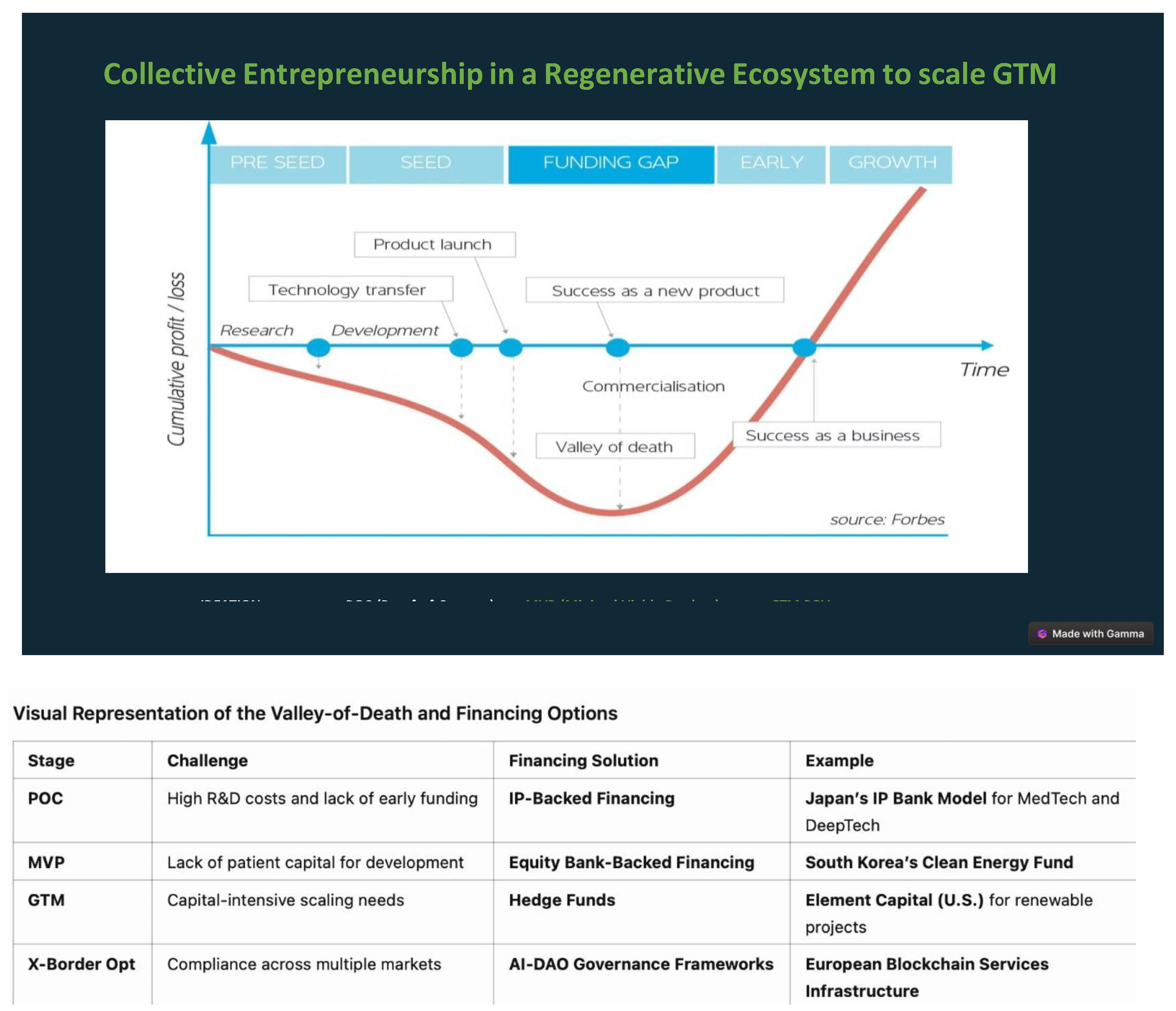
The Valley of Death is a well-known challenge for startups, particularly those in capital- intensive sectors such as MedTech, AgTech, and GreenTech. It represents the period where startups face a critical funding gap between proof of concept (POC) and minimum viable product (MVP), as well as between MVP and full-scale commercialization. Startups in these stages often struggle to secure the necessary capital to move forward, leading to high failure rates.
Case Studies: Europe and North America
In Europe, the European Investment Fund (EIF) has been pivotal in providing capital to startups at high risk of falling into the Valley of Death. The fund disbursed over EUR 10 billion to high-risk startups in 2020, particularly in sectors like DeepTech and GreenTech.
In North America, the Small Business Investment Company (SBIC) program has been highly effective in filling the funding gap for U.S. startups. Managed by the Small Business Administration (SBA), the SBIC program has disbursed over USD 25 billion, focusing on startups that would traditionally struggle to attract private investment.
ASEAN Application
To address the Valley of Death, ASEAN could establish a regional innovation fund similar to the EIF or SBIC. This fund could provide a mix of non-dilutive capital, such as grants or loans, as well as equity financing for startups in Healthech, GreenTech, and AgTech. Public- private partnerships could attract international investors while minimizing risk, ensuring startups can scale from POC to MVP and beyond.
The Valley of Death visualization here represents how different financial instruments support various startup growth stages, demonstrating the importance of structured capital solutions across POC (proof of concept), MVP (minimal viable product), and full-scale commercialization phases to POV (proof of value).
Preprints 145622 i001
While the European Investment Fund (EIF) and Small Business Investment Company (SBIC) programs have proven effective at mitigating the risks of the Valley of Death, it is essential to contextualize these frameworks for ASEAN. A critical aspect is not only funding but the policy and regulatory ecosystem that enables this funding to flow efficiently. The European Union’s policy harmonization has been key to EIF’s success in Europe, allowing cross-border ventures to access capital under a unified regulatory framework. In contrast, ASEAN’s fragmented regulatory landscape, with differing policies, tax incentives, and investment laws across countries, remains a major barrier for startups trying to expand regionally.
Pillar 5, Policy Harmonization as a Critical Enabler for Bridging the Funding Gap
For ASEAN to replicate the success of the EIF and SBIC, there is a need for policy harmonization across member states to create a conducive environment for venture growth. Harmonized policies would:
  • Streamline Cross-Border Investments: ASEAN governments should work towards developing a unified framework for cross-border investments, which could involve harmonizing corporate tax structures, capital gains policies, and green finance frameworks. This would significantly reduce friction for investors and startups alike, allowing more seamless capital flows across borders.
  • Green Finance Harmonization: The integration of a Green Finance Framework across ASEAN would allow ventures in GreenTech, MedTech, and AgTech to access green bonds and sustainable financing options, with consistent tax incentives and investment standards across member countries.
  • Standardizing IP Protection: Intellectual property (IP) is a crucial asset for startups, particularly in sectors like MedTech and DeepTech. However, inconsistencies in IP protection laws across ASEAN countries create significant barriers. A unified ASEAN IP Bank could simplify IP protection standards, guaranteeing equal protection for startups in Singapore, Indonesia, Thailand, and other regions. This would enable more ventures to confidently leverage their IP as a financial asset.
Pillar 6. Reward System Model: Aligning Financial Incentives with Sustainability Goals
The concept of reward multipliers based on sustainability outcomes offers a powerful tool to encourage ventures to adopt long-term regenerative practices. This model aligns financial rewards with ecological and social impact metrics, fostering a culture where both profit and sustainability are symbiotic goals.
One of the most innovative aspects of this framework is the integration of regenerative rewards models that align financial incentives with sustainable outcomes. This section builds on the concept of reward multipliers discussed in earlier sections and extends it to specific policy recommendations and global best practices.
The Reward & Revenue Multiplier Model, a cornerstone of the Regenerative Catalyst Model, provides financial incentives for companies that achieve verified sustainability goals, such as carbon reduction, biodiversity restoration, and social equity improvements. This model encourages ventures to adopt long-term regenerative practices by offering financial bonuses, tax credits, and impact dividends based on verified ecological and social metrics.
Global Best Practices in Reward Systems
  • EU Green Taxonomy: The European Union has been at the forefront of implementing reward systems tied to sustainability outcomes through its Green Taxonomy framework. Under this framework, ventures that meet specific ecological and social criteria are eligible for lower-cost capital, tax incentives, and subsidies. By implementing a similar reward system in ASEAN, governments can encourage startups to adopt regenerative practices while attracting global impact capital.
  • South Korea’s Clean Energy Fund: As previously mentioned, South Korea’s Clean Energy Impact Fund tied investor returns to carbon reduction outcomes. We can adapt this model for ASEAN by rewarding ventures based on their verified impact in areas such as reforestation, sustainable agriculture, and waste reduction.
ASEAN Application: A Multi-Layered Reward System
ASEAN governments can integrate reward systems into their regulatory frameworks, particularly in collaboration with the proposed ASEAN IP Bank and Equity Bank models. Startups that meet verified sustainability outcomes—such as reducing CO2 emissions by X%, restoring X hectares of forest, or creating social impact in underserved communities—would qualify for financial bonuses. These rewards can take the following forms:
  • Regenerative Tax Credits: Ventures that meet ecological restoration goals could receive tax credits that offset corporate taxes, thereby improving their financial sustainability.
  • Impact Dividends: Public or private investment funds may pay out impact dividends to companies that surpass biodiversity or social equity benchmarks.
  • Revenue Multiplier Bonuses: Successful ventures could see their returns multiplied based on verified ecological and economic outcomes. This would encourage the private sector to invest in long-term, high-impact ventures, creating a more stable flow of patient capital.
Pillar 7. Regional Innovation Hubs for Cross-Border Market Integration
The fragmented regulatory and operational landscape in ASEAN presents a significant barrier to startups attempting to scale regionally. Establishing regional innovation hubs that provide shared resources for startups is crucial to overcome this challenge. These hubs can serve as soft-landing zones, providing businesses with R&D support, regulatory advisory, and market- entry services.
The GTM Resources Gap is one of the major barriers to successful cross-border scaling for startups in ASEAN. This section expands on the earlier discussion of collaborative ecosystems and M&A strategies, offering detailed recommendations on how ASEAN can strengthen GTM resources through engagement and policy innovations.
Collaborative Engagement for Cross-Border Scaling
  • Regional Innovation Hubs: The creation of regional innovation hubs in strategic locations—such as Singapore, Vietnam, Thailand, and Indonesia—can facilitate cross-border market entry by providing startups with shared R&D resources, market access networks, and regulatory advisory services. These hubs can serve as soft-landing zones, where startups receive hands-on support for navigating different regulatory environments.
  • Public-Private Partnerships (PPP): Governments should incentivize public-private partnerships that focus on building cross-border infrastructure for startups. This could involve investing in digital infrastructure, logistics, and manufacturing facilities and networks that lower operational costs, enabling start-ups to scale more efficiently and expand across borders in the region.
AI-DAO (Decentralized Autonomous Organization) systems are not only relevant for regulatory compliance but can also serve as a key tool for startups to scale their GTM strategies. By automating processes like cross-border logistics, product distribution, and supply chain management, AI-DAO systems can help startups streamline their GTM strategies, ensuring faster market entry and reduced compliance costs and the operational complexities of expanding into new markets.
Engagement with Fractional Talent Networks
Startups should engage fractional talent networks, which offer access to global experts who can provide strategic insights, mentorship, and operational guidance. These talents, often experienced in multinational corporations (MNCs), bring in the globalization mindset that startups in ASEAN often lack. This approach allows startups to benefit from part-time advisory roles, minimizing financial strain while maximizing expertise.
  • Case Study: In Europe, fractional executives have been crucial for startups scaling internationally. We could apply a similar model in ASEAN, where fractional CMOs and CFOs aid in developing GTM strategies for startups seeking to expand into multiple markets.
Policy Recommendations for GTM Resource Strengthening
For GTM resource strengthening to succeed, ASEAN governments must collaborate to create policies that reduce the costs and complexities of cross-border scaling. Key policy recommendations include:
  • Standardizing Cross-Border Compliance: ASEAN governments should work towards developing standardized compliance frameworks, particularly for the GreenTech and HealthTech sectors. This would allow startups to scale without having to meet disparate regulations in each market.
  • Tax Incentives for Cross-Border Partnerships: Governments could offer tax breaks or incentives for startups engaged in cross-border joint ventures or M&A deals. This would encourage companies to form partnerships that allow them to scale regionally, overcoming individual market barriers.
Expanding the discussion on policy harmonization, reward systems, and GTM engagement highlights the critical role of government frameworks, private-sector partnerships, and innovative financing in fostering a regenerative economy in ASEAN. By embedding these strategies into the broader operational model, ASEAN can not only address its structural gaps but also position itself as a global leader in regenerative growth.
The EU’s policy harmonization through the Single Market has allowed for seamless cross- border scaling within sectors like MedTech and GreenTech. ASEAN could adopt a similar approach by standardizing regulatory frameworks across key markets like Singapore, Vietnam, and Indonesia, focusing on healthcare standards for MedTech and sustainable agriculture practices for AgTech.
Conclusion: Toward a Regenerative ASEAN Ecosystem
Insights from COP29 emphasize the urgency of aligning climate financing with biodiversity restoration, carbon neutrality, and climate adaptation. ASEAN must adopt these directives through:
  • Nature-based solutions: For example, mangrove restoration in Indonesia could mitigate climate risks while creating carbon credit opportunities.
  • Carbon markets: Establishing regional platforms to monetize emission reductions
  • Private sector mobilization: Encouraging corporate investments in regenerative ventures through tax incentives and public-private partnerships.
Innovative financing models, collaborative ecosystems, and cross-border governance frameworks can address ASEAN's structural barriers, including the funding gap, GTM resources gap, and globalization mindset gap. The integration of IP-backed financing, equity bank-backed models, and hedge funds will help close the funding gap, allowing startups in capital-intensive sectors to scale successfully.
ASEAN's leadership in scaling regenerative business models requires the integration of global best practices.
  • Japan’s IP-backed financing can serve as a template for non-dilutive funding solutions.
  • South Korea’s impact-linked equity demonstrates the importance of sustainability metrics.
  • The EU Green Taxonomy offers a framework for harmonized green finance.
  • US climate-tech venture capital, which raised $31 billion in a single year, highlights the importance of aligning policies with investor expectations.
By adopting M&A strategies, leveraging fractional talent, and implementing AI-DAO governance, ASEAN can overcome its regulatory complexities, creating resilient and scalable value chains. Singapore, as the launchpad, plays a crucial role in orchestrating these efforts, helping ASEAN transition into a global leader in the regenerative economy.
Antioch Streams: A Foundational Enabler with a Transformative Roadmap for ASEAN
At the heart of ASEAN’s regenerative transformation lies Antioch Streams, a centralized platform that connects startups, investors, policymakers, and academic institutions. By facilitating cross-border scaling, policy harmonization, and impact validation, Antioch Streams ensures that ASEAN startups can compete globally while addressing regional sustainability challenges.
The 7 Pillars of Success Framework provides a tangible, actionable roadmap to address ASEAN’s structural barriers and unlock its potential as a global leader in regenerative innovation. By integrating structured capital models, AI-driven governance, and policy harmonization, ASEAN can generate $500 billion in economic value by 2030 while setting new benchmarks for sustainable development.

4. Comprehensive Recommendations and An Operational Model

Introduction: Insights from South Summit Korea 2024 and SWITCH Singapore 2024.
The South Summit Korea 2024 and SWITCH Singapore 2024 provided critical validation of the hypotheses presented in this paper. Over 100 entrepreneurs and ecosystem leaders from ASEAN engaged in discussions focused on cross-border Go-to-Market (GTM) strategies, collaborative financial models, and scaling innovations. Key ecosystem players, as strategic partners of Antioch Streams, evaluated the practicalities of deploying IP-backed and equity bank-backed financing, with Singapore as the hub for exporting mature global IPs into ASEAN.
These engagements confirmed that while ASEAN has vast potential, it requires cohesive policies, strategic capital models, and operational frameworks to enable sustainable scaling across the region. This section outlines key recommendations to activate ASEAN’s regenerative economic growth, based on global best practices and the findings from these on- the-ground field events and engagements.
1.
Bridging the Funding Gap: A Multi-Layered Capital Approach
The funding gap continues to hinder early-stage and scaling startups in ASEAN, particularly in capital-intensive sectors like MedTech, GreenTech, and AgTech. A structured financial model integrating IP-backed financing, equity banks, and hedge funds is necessary to address the different stages of venture growth.
A.
IP-Backed Financing for Early-Stage Capital (POC to MVP)
Startups with valuable intellectual property but limited access to capital face significant hurdles. The South Summit Korea 2024 discussions reinforced the importance of IP-backed financing, which allows startups to use their intellectual property as collateral to raise non- dilutive capital.
  • Global Best Practice: Japan’s IP-backed financing model has been instrumental in raising over USD 3.2 billion for startups in sectors like MedTech and DeepTech. Similarly, South Korea has developed an IP bank structure that supports early-stage ventures without forcing them to dilute equity.
  • ASEAN Application: Under Singapore's leadership, ASEAN will establish a regional Intellectual Property Bank. This institution will enable startups in countries like the Philippines, Indonesia, and Vietnam to leverage their IP to secure non-dilutive funding. Antioch Streams and KILSA Global will act as facilitators, driving deal flow and ensuring that ASEAN-based companies can access early-stage capital through their intellectual property.
  • Outcome: Early-stage startups will progress from proof of concept (POC) to minimum viable product (MVP) without sacrificing equity ownership, unlocking non-dilutive capital for further growth.
B.
Equity Bank-Backed Financing for Growth Capital (MVP to Scaling)
Equity Bank-backed financing, which links investor returns to sustainability outcomes, offers long-term patient capital that is crucial for scaling capital-intensive projects. This model attracted significant interest during South Summit Korea, where entrepreneurs highlighted the need for such financing to scale GreenTech and Circular Economy ventures.
  • Global Best Practice: South Korea’s Clean Energy Impact Fund raised USD 200 million by linking investor returns to carbon reduction metrics. This approach was similarly successful in Europe, where the EU Green Taxonomy helps guide investments tied to verified environmental outcomes.
  • ASEAN Application: ASEAN, starting with Singapore, will establish a regional equity bank that pools resources from global impact investors. This will help ventures across ASEAN scales by offering patient capital that aligns with specific sustainability outcomes, like biodiversity restoration and carbon reduction.
  • Outcome: Startups will attract global impact capital, enabling them to scale effectively while meeting verified environmental and social impact targets.
C.
Hedge Funds for Late-Stage Scaling (Valley-of-Death to Commercialization)
Late-stage ventures, especially those in renewable energy and industrial IoT, necessitate flexible capital to surmount the critical period between MVP and full-scale commercialization. We identified hedge funds as critical sources of high-risk capital during South Summit Korea, particularly for scaling infrastructure-heavy sectors.
  • Global Best Practice: U.S. hedge funds like Element Capital have successfully funded large-scale renewable energyprojects by absorbing the risks associated with long development cycles and infrastructure needs.
  • ASEAN Application: Singapore will establish a Regenerative Hedge Fund Program to provide flexible capital for late-stage ventures. This program will focus on infrastructure- heavy projects in clean energy and industrial IoT across ASEAN, particularly in Indonesia and the Philippines.
  • Outcome: Late-stage ventures will overcome the valley of death and scale their infrastructure-heavy projects, contributing to ASEAN’s regenerative economy.
D.
Unconventional PE: Private Equity’s Role in Post-Commercialization Growth Funding
PE will play a crucial role in providing growth-stage capital for ventures that have proven their value at the Proof of Value (POV) stage. The South Summit Korea discussions emphasized the importance of growth-stage funds for scaling ventures in HealthTech, GreenTech, and AgTech into global markets.
  • Outcome: Unconventional PE partner will provide post-commercialization growth capital, enabling startups to expand into international markets using Singapore as their launchpad.
2.
Strengthening Go-to-Market (GTM) Resources for Cross-Border Scalability
A.
Collaborative Ecosystems for Cross-Border Value Creation
Cross-border scaling requires coordinated ecosystems to overcome operational challenges and fragmented regulatory landscapes. The South Summit Korea discussions highlighted the need for regional innovation hubs to provide startups with shared GTM resources and infrastructure.
  • Global Best Practice: Europe’s innovation clusters and Germany’s regional innovation hubs provide models for fostering cross-border collaboration and shared infrastructure.
  • ASEAN Application: KILSA Global and ARKConnect will establish regional innovation hubs in key markets, including Korea, Vietnam, the Philippines, Indonesia, Malaysia and Singapore, to facilitate cross-border scaling. These hubs will offer shared resources, compliance tools, and market-entry support for startups.
  • Outcome: ASEAN startups will have access to the resources needed to scale efficiently across borders, reducing operational costs and speeding up their GTM strategies.
B.
AI-DAO Governance for Cross-Border Compliance
To address ASEAN’s fragmented regulatory environment, AI-DAO governance frameworks will automate compliance, reducing operational costs and speeding up cross- border scalability.
  • Global Best Practice: Regions with fragmented regulatory environments, such as blockchain-based operations globally, have successfully used DAOs to streamline compliance and governance.
  • ASEAN Application: Antioch Streams will implement AI-DAO governance frameworks for startups scaling across borders, ensuring automated compliance with local and regional regulations in sectors like GreenTech and AgTech.
  • Outcome: Startups will streamline their cross-border operations, focusing on growth rather than navigating complex regulatory hurdles.
3.
Building the Globalization Mindset for ASEAN Startups
ASEAN startups often lack the global expertise necessary for international expansion. The South Summit Korea 2024findings emphasized the need to engage fractional talents— professionals transitioning from MNCs—to provide strategic guidance for global market expansion.
  • ASEAN Application: ARKConnect aims to connect fractional talents with MNC experience, providing guidance to ASEAN startups in navigating global markets. Startups will benefit from these professionals’ expertise in scaling internationally.
  • Outcome: Startups will successfully expand into global markets by leveraging the expertise of fractional talents, positioning themselves for long-term success.
4.
Regenerative Incentives: Metrics, Rewards, and Policy Alignment
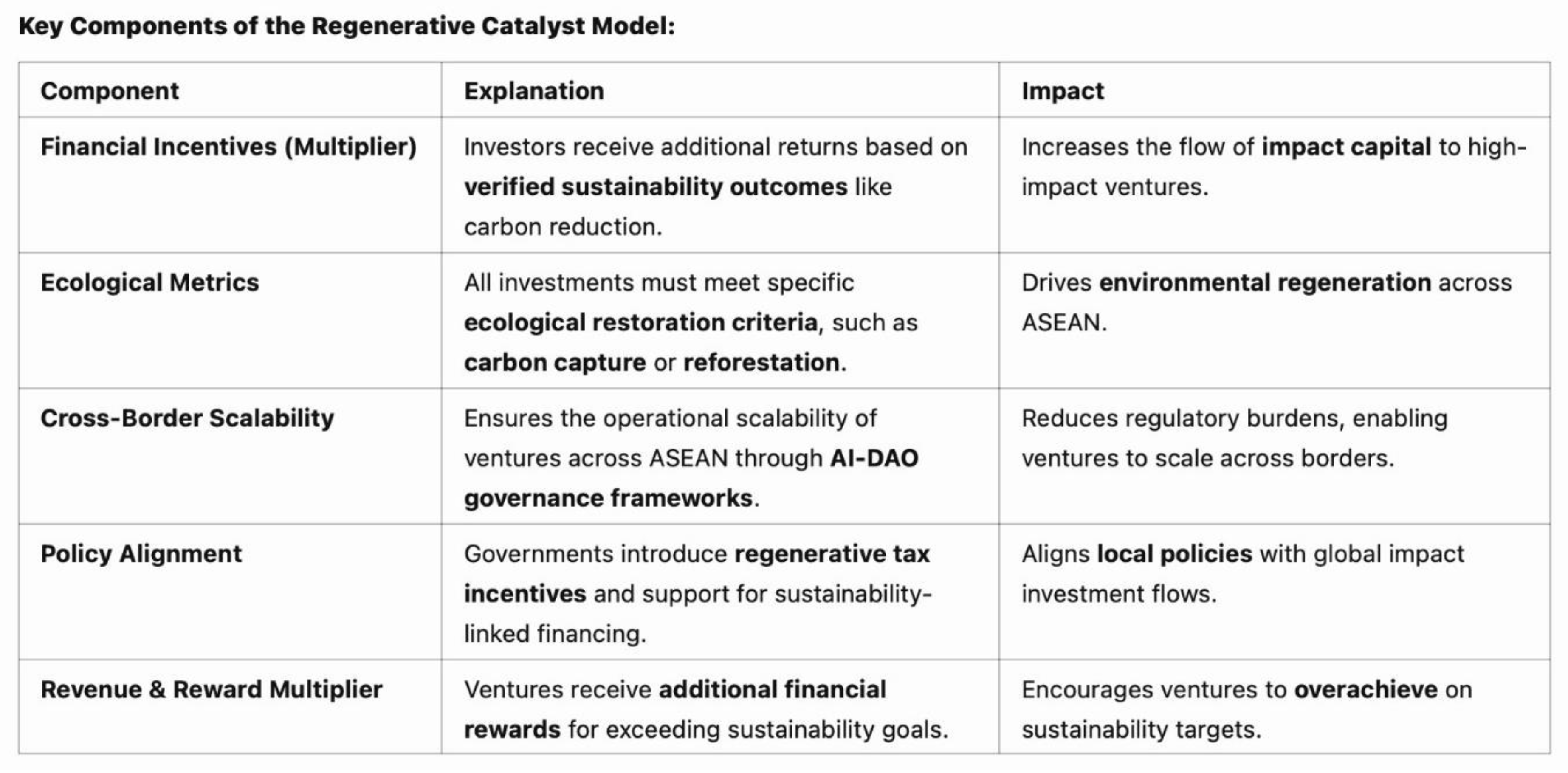
The Regenerative Catalyst Model, as outlined in the thesis, is central to aligning capital flows, governance frameworks, and operational incentives to drive long-term ecological and social regeneration in ASEAN. This model addresses key systemic barriers by providing a multi-layered incentive structure that ties financial rewards to measurable ecological and economic outcomes.
Preprints 145622 i002
Key Components of the Regenerative Catalyst Model:
1.
Ecological Restoration: It is crucial to link all investments to quantifiable ecological metrics such as carbon reduction, biodiversity restoration, and resource efficiency.
2.
Economic Multiplier Effect: Businesses that implement regenerative practices can benefit from a revenue and reward multiplier system that links successful outcomes, such as verifiable carbon sequestration, to financial bonuses or impact dividends.
3.
Policy-Driven Governance: To implement the Regenerative Catalyst Model, ASEAN governments, particularly Singapore as a financial hub, must introduce policies such as regenerative tax credits and impact-linked investment frameworks that incentivize ventures to adopt and scale regenerative practices.
  • Outcome: By incentivizing investments in ventures that meet key ecological and social metrics, such as reducing carbon emissions and restoring biodiversity, ASEAN can establish a sustainable growth ecosystem that aligns with global sustainability goals, attracting long- term, impact-driven capital.
The Regenerative Catalyst Model aligns seamlessly with the multi-layered financial structure recommended earlier that would empower the Regenerative Ecosystem model (thus a sound business model for Antioch Streams).
Here’s how it fits into the broader framework:
  • IP-Backed Financing and Early-Stage Capital: Ventures that leverage their intellectual property for non-dilutive capital can build in ecological outcomes from the early stages. As they move from POC to MVP, the Regenerative Catalyst Model ensures that their innovations align with broader regenerative practices.
  • Equity Bank-Backed Financing for Growth Capital: By tying equity returns to sustainability metrics, the model further amplifies the flow of capital into ventures committed to ecological restoration. The Regenerative Catalyst Modelensures that investor returns are not just financially rewarding but also linked to long-term regenerative outcomes.
  • Hedge Funds for Late-Stage Scaling: The Regenerative Catalyst Model's embedded Revenue & Reward Multiplier System can attract hedge funds by providing high-risk/high- reward scenarios. The Regenerative Catalyst Model incentivizes hedge funds to invest in late- stage, capital-intensive ventures, understanding that exceeding ecological targets yields multiplied returns.
  • PE: Private Equity's Role in Growth Funding: When ventures reach the post- commercialization stage, AMEC can provide growth capital that aligns with the Regenerative Catalyst Model, guaranteeing their commitment to regenerative economic practices as they scale globally.
5.
Expanding ASEAN’s Green Finance Framework
Harmonized green finance policies are essential for aligning ASEAN’s fragmented regulatory environment with global sustainability standards. A cohesive ASEAN Green Finance Framework should include actionable strategies to unlock green capital, ensure transparency, and provide long-term financial incentives for regenerative practices.
A.
Unlock green capital through standardized certification.
The EU Green Taxonomy will serve as the model for a region-wide ASEAN Green Bond Certification Program, which will define and verify green investment projects across ASEAN. The program will enable ASEAN to position itself as a global player in green finance, ensuring that projects meet international environmental standards.
  • Illustrative Example: A GreenTech company in Indonesia installing solar microgrids for rural communities could qualify for ASEAN-certified green bonds, unlocking funding from global investors.
  • KPI: Mobilize $250 billion in certified green bonds by 2030.
B.
Regional Carbon Trading Markets
Develop an ASEAN-wide carbon market to incentivize emission reductions and trade carbon credits across borders. This market will help ASEAN countries meet their carbon reduction targets while offering new financial incentives for sustainable business practices.
  • Illustrative Example: A Thai AgTech startup implementing regenerative agriculture practices could sell carbon credits to a Singaporean logistics firm, reducing the latter’s Scope 3 emissions.
  • Global Benchmark: In 2022, Germany's Emissions Trading System (ETS) generated €25 billion.
C.
Green Tax Incentives for Regenerative Ventures
Introduce multi-tier tax relief systems for companies achieving verified regenerative outcomes, such as carbon sequestration or waste reduction. These tax credits will serve as financial incentives for businesses to adopt and scale sustainable practices.
  • Example: Philippine manufacturing companies adopting IIoT solutions to optimize energy use could qualify for enhanced tax deductions.
6.
AI-driven governance for scalability
To address the regulatory fragmentation in ASEAN, AI-DAO (Decentralized Autonomous Organization)frameworks can automate compliance, unify governance, and lower cross- border operational costs, creating a seamless, unified market for scaling startups.
Key Features and Recommendations:
1.
AI-Powered Compliance Platforms:
  • Introduce an ASEAN Compliance Cloud to provide startups with automated updates on regulations across multiple jurisdictions, ensuring real-time compliance with local laws in each ASEAN country.
  • Illustrative Example: A MedTech company launching across Vietnam, Thailand, and Malaysia could utilize this platform to ensure compliance with healthcare regulations in each country.
2.
Digital Regulatory Sandboxes:
  • ASEAN governments, led by Singapore, could establish cross-border sandboxes that allow startups to test regenerative solutions in a controlled environment before scaling them across borders.
  • Example: A blockchain-based reforestation project could pilot in Malaysia while testing carbon credit tracking systems regionally.
3.
Blockchain for Impact Verification:
  • Utilize blockchain technology to verify regenerative outcomes, such as biodiversity restoration or carbon sequestration, ensuring transparency and accountability for investors.
  • Global Inspiration: The Regen Network, which tracks ecological outcomes, could serve as a model for ASEAN to ensure accurate impact reporting.
7.
Antioch Streams: The Foundational Ecosystem Platform
Antioch Streams plays a central role in facilitating ASEAN’s regenerative transition, driving multi-stakeholder collaboration, and ensuring policy innovation. The platform fosters partnerships and aligns stakeholders from across the public and private sectors to implement the Regenerative Catalyst Model effectively.
Proposed Functions for Antioch Streams:
1.
ASEAN Regenerative Capital Fund:
  • Antioch Streams will launch a $2 billion regional fund focused on startups with verifiable regenerative impacts. This fund will prioritize ventures in biodiversity, carbon neutrality, and social equity.
  • Illustrative Example: A Cambodian AgTech firm using AI to improve crop yields while regenerating soil healthcould receive catalytic funding through Antioch Streams.
2.
Policy Advocacy Hub:
  • Antioch Streams will organize biannual forums, bringing together policymakers, investors, and entrepreneurs to align on harmonized green finance standards and IP protection laws across ASEAN.
3.
Stakeholder Engagement Playbook:
  • Antioch Streams will publish a playbook for cross-sector collaboration, providing guidelines for engaging investors, governments, and academia in regenerative practices.
  • Example: Universities in Thailand and Indonesia could partner with Antioch Streams to pilot regenerative agricultural technologies and align IP commercialization frameworks.
8.
Innovative financial models to bridge the funding gap.
ASEAN requires creative financing mechanisms to address its $300 billion funding shortfall for startups in regenerative sectors.
Key Recommendations:
1.
Outcome-Based Financing for Startups:
  • Introduce revenue & reward multiplier systems, where startups achieving ecological benchmarks unlock higher funding tiers.
  • Example: An Indonesian HealthTech firm reducing hospital energy consumption by 50% could qualify for additional growth capital under this system.
2.
Crowdfunding via AI-DAO Platforms:
  • Develop decentralized crowdfunding platforms to enable fractional investment in regenerative projects.
  • Illustrative Example: ASEAN-based retail investors could collectively fund a biodiversity restoration initiative in Vietnam.
3.
Hybrid Venture Capital and Patient Capital Pools:
  • Introduce blended financing vehicles combining grants, concessional loans, and equity investments, ensuring patient capital for sectors with long R&D cycles like DeepTech.
9.
Policy-Driven Metrics and Accountability Systems
The Regenerative Catalyst Model must include verifiable metrics tied to financial and ecological outcomes. These metrics will ensure that regenerative practices are quantifiable transparent, and aligned with ASEAN’s long-term goals.
Expanded Metrics and Implementation:
1.
Carbon Reduction Benchmarks:
  • Startups that cut emissions by 50% within five years qualify for additional rounds of concessional funding.
2.
Biodiversity Impact Index:
  • Track the hectares of restored ecosystems or the return of key species in degraded areas to quantify ecological outcomes.
  • Example: A Vietnamese reforestation project increasing species diversity by 30% over 3 years could receive impact-linked equity.
3.
Social Equity Metrics:
  • Include metrics like job creation in underserved areas and gender equity in employment.
  • Example: A Malaysian IIoT firm training 5,000 workers annually in smart manufacturing skills would receive tax rebates.
10.
Leveraging COP29 Outcomes for ASEAN’s Leadership
ASEAN can integrate COP29 directives into its regenerative framework to position itself as a global sustainability leader.
Key Takeaways from COP29:
1.
Biodiversity Credits:
  • ASEAN governments should pilot biodiversity credit markets to fund marine conservation and reforestation.
  • Example: Philippine mangrove restoration projects could qualify for biodiversity credits sold to global buyers.
2.
Private Sector Climate Action:
  • Mandate corporate climate disclosures for major firms, aligning with COP29’s call for private sector accountability.
  • KPI: 80% compliance among ASEAN-listed companies by 2030.
11.
Singapore as ASEAN’s Regenerative Hub
Singapore’s unique position as a financial and innovation leader makes it ideal for piloting regenerative practices.
Key Recommendations:
1.
Regional Green Finance Accelerator:
  • Singapore should host an accelerator program for green startups, prioritizing ventures focused on Scope 3 emission reductions.
  • Illustrative Example: An AgTech startup reducing supply chain emissions by 40% could secure funding and mentorship through the program.
2.
Policy Pilots in Regenerative Taxation:
  • Introduce pilot programs for regenerative tax credits, tied to verified carbon reductions or biodiversity restoration.
3.
Global Capital Hub for Regenerative Ventures:
  • Leverage events like SWITCH 2025 to showcase ASEAN’s top regenerative startups, attracting investors and policymakers who can further drive cross-border collaborations and bring in global funding.
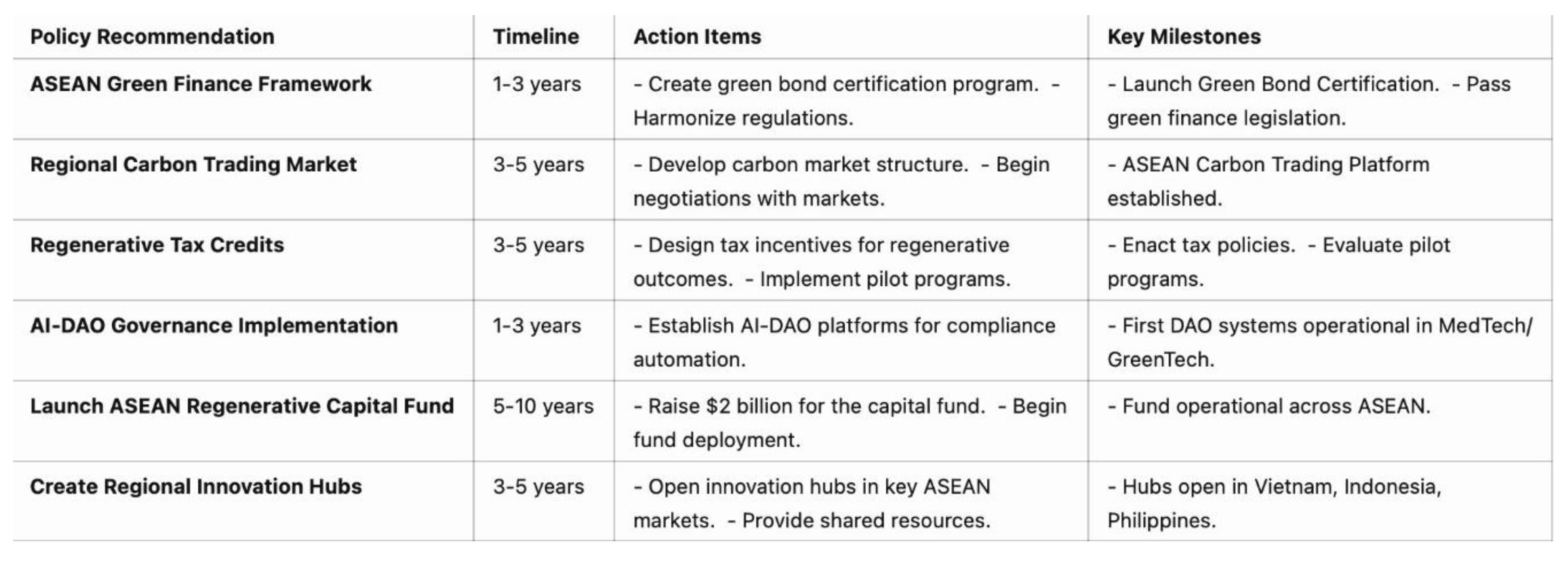
Recommended Key Policy Implementation Timeline
Preprints 145622 i003
Policy Alignment: Creating the Regenerative Hub in Singapore
Policy Harmonization as a Critical Enabler:
One of the most significant barriers to cross-border scaling and capital flows in ASEAN is the fragmented policy landscape. Each country within the region has its own set of financial regulations, tax incentives, and corporate governance structures, which hinder seamless investment across borders. To unlock ASEAN’s regenerative potential, a harmonized policy framework is essential, particularly in relation to green finance, taxation, and intellectual property rights.
By establishing a unified Green Finance Framework, ASEAN can provide consistent tax incentives for ventures focused on sustainability, simplifying compliance and reducing the operational costs associated with scaling. Similar to the European Union’s Green Taxonomy, which provides clarity on what constitutes sustainable investment, a coordinated ASEAN framework would allow global investors to confidently allocate capital to regenerative projects, reducing the risk associated with diverse national regulations.
ASEAN could also benefit from standardizing intellectual property (IP) laws. Harmonized IP protection would make the IP-backed financing model more effective by allowing startups to leverage their IP as collateral across multiple ASEAN jurisdictions. A region-wide IP Bank, for instance, could streamline this process, facilitating the flow of capital for innovation- heavy sectors.
For the Regenerative Catalyst Model to thrive, Singapore must play a critical role in introducing policy-driven incentives that align with the framework. Singapore’s position as ASEAN’s financial hub makes it the ideal location to pilot a Regenerative Capital Fund tied to measurable ecological outcomes and social impact.
Key policy recommendations include:
  • Regenerative Tax Credits: Singapore should introduce tax incentives for companies that meet verified regenerative metrics such as carbon sequestration or waste reduction. These tax credits can further encourage global investors to deploy capital in ASEAN.
  • Green Finance Harmonization: To streamline cross-border investments linked to regenerative practices, Singapore must lead the unification of ASEAN's fragmented financial landscape under a Green Finance Framework.
  • AI-DAO Governance: Singapore can facilitate the scaling of startups across ASEAN by promoting AI-DAO governance systems, free from the burden of local regulatory complexities. AI-driven compliance automation will also lower costs for ventures adopting the Regenerative Catalyst Model.
Incorporating metrics and measurements
The Regenerative Catalyst Model provides a robust system for measuring financial rewards based on verified sustainability outcomes. Key ecological and social metrics, embedded in Section 4A and aligned with global best practices, track these outcomes.
  • Carbon Reduction: Startups that demonstrate significant reductions in CO2 emissions can qualify for impact dividendsor bonus financial rewards.
  • Biodiversity Restoration: Businesses that reforest or protect endangered species receive rewards based on the number of hectares they restore and the impact they have on biodiversity.
  • Social Equity: Financial bonuses linked to measurable social equity gains reward ventures that improve social outcomes, such as employment or educational access in underserved areas.
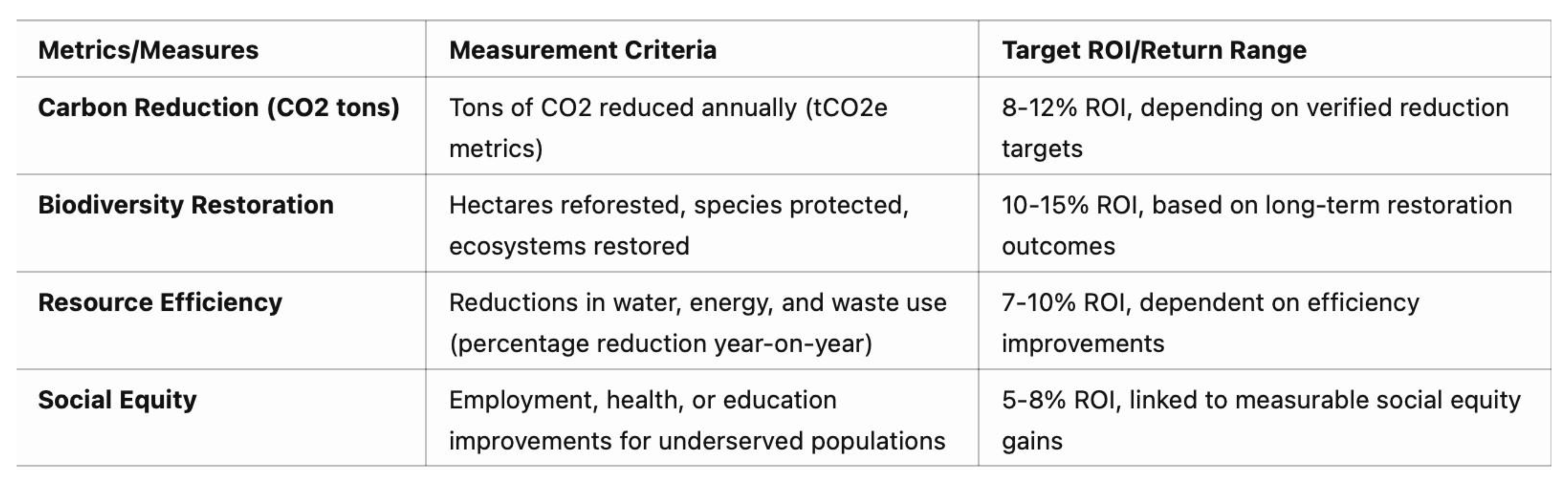
Preprints 145622 i004
Conclusion: Tangible Pathways for Regenerative Growth
The recommendations outlined above provide ASEAN with a detailed roadmap to bridge structural gaps, harmonize policies, and scale its regenerative economy. By integrating these solutions and aligning them with global best practices, ASEAN can achieve sustainable growth, capture global impact capital, and position itself as a leader in sustainability-driven innovation.
With Singapore leading as a pilot hub and Antioch Streams serving as the foundational ecosystem platform, ASEAN can mobilize $500 billion in impact capital by 2030, setting global benchmarks for regenerative growth. By attracting global impact investors, developing cross-sector collaborations, and harmonizing policies across the region, ASEAN will be well-positioned to lead the world in its regenerative economy transition.
The Regenerative Catalyst Model provides a structured, multi-layered framework that incentivizes financial capital flows, ensures ecological restoration, and aligns ASEAN’s policy landscape with global sustainability trends. Combining this model with Singapore's policy framework will allow Antioch Streams and its strategic ecosystem partners (as illustrations), like KILSA Global, ARK Connect, AMEC, or other unique private equity players or elite premier investors, to lead ASEAN's transition to a regenerative economy. This will bring in global impact capital and support long-term growth.
Preprints 145622 i005
By embedding this model into the operational framework, ASEAN will not only close its funding gap but will also set a global benchmark for how regenerative economies can thrive through well-aligned financial incentives, operational models, and policy frameworks.
This roadmap creates a clear path forward, aligning financial capital flows, operational models, ecosystem partnerships, and policy frameworks to foster long-term economic, ecological, and social regeneration. By embedding this model into ASEAN’s operational frameworks, the region will not only close its funding gap but will also set a global benchmark for how regenerative economies can thrive through well-aligned financial incentives, operational models, and policy frameworks.
This comprehensive set of recommendations provides ASEAN with actionable pathways to implement the Regenerative Catalyst Model and realize its potential as a global leader in the regenerative economy. The integration of these ideas will help unlock new economic opportunities, improve sustainability outcomes, and ensure that the transition toward a regenerative economy is both inclusive and scalable.
By activating these recommendations, ASEAN will ensure that it becomes a key player in the global regenerative economy, attracting international investment, fostering innovation, and leading the world in sustainability and impact-driven growth.

5. Conclusion & Future Research Consideration

This paper has outlined a comprehensive strategy for overcoming ASEAN’s key barriers to scaling regenerative innovation, including the funding gap, go-to-market (GTM) resources gap, and globalization mindset gap. By applying a combination of multi-layered financial models, collaborative ecosystems, and policy-driven frameworks, ASEAN can position itself as a global leader in the regenerative economy. The findings and recommendations discussed in this paper are based on both empirical data and global best practices drawn from Europe, the United States, Japan, South Korea, and other regions that have successfully navigated similar challenges.
By leveraging IP-backed financing, equity bank-backed capital, and hedge fund investments, ASEAN startups, particularly in HealthTech, GreenTech, AgTech, and DeepTech, can overcome the Valley of Death and scale across borders. The Regenerative Catalyst Model, the central proposition of the paper, aligns financial capital flows with measurable ecological and social outcomes, thereby fostering sustainable innovation and generating a net-positive impact.
The 7 pillars of success, as outlined in the paper, offer a structured framework for ASEAN to develop its regenerative economy. These pillars include innovative financing mechanisms, a robust policy framework, AI-driven governance, and cross-border collaboration. The Regenerative Catalyst Model serves as the foundation for ensuring that these financial and policy structures can work together to create a scalable, impactful ecosystem. This model incorporates a revenue & reward multiplier system, which provides a pathway for startups to unlock higher funding tiers by achieving measurable ecological and social outcomes, such as carbon sequestration and biodiversity restoration.
As highlighted, Singapore plays a crucial role as ASEAN’s financial and innovation hub. Singapore’s well-established financial infrastructure and its commitment to green finance make it the ideal location for the pilot initiatives outlined in this paper. The proposed regional IP Banks and equity banks will play a crucial role in facilitating efficient capital allocation and providing the necessary support for projects that align with sustainable and regenerative outcomes to scale.
For ASEAN to achieve its regenerative potential, it will require concerted efforts from policymakers, investors, and entrepreneurs to collaborate and harmonize regulations. A unified Green Finance Framework, coupled with regenerative tax credits and impact-linked financing, will serve to unlock the necessary funding for startups in capital-intensive sectors. The AI-DAO governance frameworks will be instrumental in reducing the regulatory burden on startups scaling across borders by automating compliance and ensuring that the governance processes align with regional and global standards.
The recommendations provided—based on global benchmarks and practical insights from key events such as South Summit Korea 2024 and SWITCH Singapore 2024—represent a concrete roadmap for ASEAN to lead the global transition toward a regenerative economy. By following this roadmap, ASEAN can unlock USD 500 billion in impact capital by 2030, positioning the region at the forefront of global sustainability and innovation.
Antioch Streams will champion the collaborative ecosystem model, which will play a critical role in facilitating this transition. Antioch Streams, serving as a central platform for multi- stakeholder collaboration, will drive the alignment of financial capital with sustainability goals and establish a feedback loop that links financial rewards to ecological and social impacts. As a result, the Regenerative Catalyst Model and Antioch Streams will be pivotal in attracting global capital and ensuring that ASEAN leads the charge in the regenerative economy.
The engagement of fractional talents and professionals with experience in international markets will address the Globalization Mindset Gap among ASEAN startups. This will enable ASEAN startups to successfully expand globally, leveraging the expertise and insights of professionals who have navigated complex international business environments. As global supply chains increasingly shift toward ASEAN, the region will have the opportunity to become a key player in regenerative supply chains, particularly by addressing Scope 3 emissions and adopting circular economy principles.
Future Considerations for Deeper Dive (Including Research & Practice Development)
Study Limitations:
While this study presents an extensive framework for ASEAN’s regenerative economic transition, there are several limitations worth noting:
  • Data Availability and Scope: Although the study uses comprehensive empirical data, it is based on interviews and case studies from a limited set of stakeholders across ASEAN. This narrow focus might not fully capture the diversity of challenges and opportunities faced by all sectors and regions within ASEAN. Future studies could benefit from a broader, more diversified sample to better understand the full scope of the challenges.
  • Implementation Feasibility: The recommendations in this paper are theoretical and based on global best practices and expert opinions. While these models and frameworks are promising, they require substantial on-the-ground implementation. The actual effectiveness of these strategies depends heavily on local contexts, political will, and economic conditions, which may vary across ASEAN member states.
  • Regulatory Variability: While this study discusses harmonized regulatory frameworks, the reality of achieving such alignment in ASEAN remains challenging due to varying political landscapes, regulatory maturity, and the capacity of individual countries to implement cross- border policies effectively.
  • Stakeholder Engagement: The success of these models also hinges on the active and coordinated engagement of multiple stakeholders (governments, investors, entrepreneurs, and communities). However, the paper’s scope does not explore in depth the potential obstacles to aligning these diverse interests, nor does it fully address potential resistance from stakeholders with competing priorities.
By addressing these limitations, future research can provide a more detailed roadmap and realistic approach to implementing a regenerative economy across ASEAN.
Future Research and Practice Direction:
  • Policy Reforms and Regulatory Harmonization: ASEAN’s success in becoming a global hub for regenerative growth will require policy reforms that harmonize green financing and cross-border regulations. Singapore will lead a Green Finance Harmonization Framework to align capital investments with cross-border sustainability targets. To incentivize businesses and investors who meet carbon reduction and biodiversity restoration targets, policymakers must collaborate to create a regenerative tax framework.
  • Scaling the Regenerative Catalyst Model: The Regenerative Catalyst Model, which links financial rewards to ecological and social impact metrics, can serve as a template for other emerging markets. To drive a broader global impact, future research and pilot programs should explore how to expand this model beyond ASEAN, particularly in high-emission regions like Africa and Latin America.
  • Developing an ASEAN Impact Investment Market: There is an urgent need to develop a regional impact investment market that channels funds toward projects addressing Scope 3 emissions, which contribute over 70% of the global carbon footprint. By focusing on industries such as manufacturing, agriculture, and transport, ASEAN can position itself as a global player in sustainable supply chains, attracting impact investors looking for long-term environmental solutions.
  • Fractional Global Talent Engagement: Future efforts should also focus on enhancing the globalization mindset among ASEAN startups by engaging more fractional talents and portfolio professionals from multinational corporations (MNCs). These professionals can offer the global expertise required to navigate complex international markets, provide valuable mentorship, and assist startups in establishing a competitive global footprint.
  • Future Field Research and Regional Scaling: Future research should focus on collecting longitudinal data on the performance of IP-backed and equity bank-backed startups in ASEAN. This will provide evidence about the effectiveness of these financial models and highlight areas for refinement. Additionally, more field trips to events like South Summit Korea and SWITCH Singapore will be invaluable for validating operational models, as well as refining cross-border strategies for regional scaling.
ASEAN finds itself at a pivotal point in the worldwide shift towards a regenerative economy. By implementing the recommendations outlined in this paper, ASEAN has the potential to attract over USD 500 billion in economic value by 2030, driving sustainable innovation and fostering a resilient ecosystem that benefits both businesses and the environment. The region’s ability to harness its natural and technological resources while embracing structured financial models and policy-driven incentives will be key to its success in becoming a global leader in regenerative economic growth.

References

  1. Abrams, J. B. (2010). Quantitative business valuation: A mathematical approach for today’s professionals. John Wiley & Sons.
  2. Altman, E. I. (1968). Financial ratios, discriminant analysis and the prediction of corporate bankruptcy. The Journal of Finance, 23(4), 589-609. [CrossRef]
  3. Altman, E. I., Iwanicz-Drozdowska, M., Laitinen, E. K., & Suvas, A. (2017). Financial distress prediction in an international context: A review and empirical analysis of Altman’s Z-Score model. Journal of International Financial Management & Accounting, 28(2), 131–171. [CrossRef]
  4. Altman, E. I., & Saunders, A. (1997). Credit risk measurement: Developments over the last 20 years. Journal of Banking & Finance, 21(11–12), 1721–1742. [CrossRef]
  5. Bartlett, J. E., Kotrlik, J. W., & Higgins, C. C. (2001). Organizational research: Determining appropriate sample size in survey research. Information Technology, Learning, and Performance Journal, 19(1), 43–50.
  6. Baum, J. A., & Silverman, B. S. (2004). Picking winners or building them? Journal of Business Venturing, 19(2), 187-204.
  7. Brealey, R. A., Myers, S. C., & Allen, F. (2006). Principles of corporate finance (8th ed.). McGraw-Hill/Irwin.
  8. Christensen, C. M., Raynor, M. E., Rory, M., & McDonald, R. (2015). What is disruptive innovation? Harvard Business Review, 93(12), 44–53. [CrossRef]
  9. Cumming, D., Johan, S., & Zhang, M. (2014). The economic impact of entrepreneurship: Comparing international datasets. Corporate Governance: An International Review, 22(2), 162–178. [CrossRef]
  10. Damodaran, A. (2006). Valuation models. Stern School of Business, New York University.
  11. Damodaran, A. (2009). Valuing young, start-up and growth companies: Estimation issues and valuation challenges. SSRN Electronic Journal.
  12. Damodaran, A. (2018). The dark side of valuation. Stern School of Business, New York University.
  13. Delmar, F., & Shane, S. (2006). Does experience matter? The effect of founding team experience on the survival and sales of newly founded ventures. Strategic Organization, 4(3), 215–247. [CrossRef]
  14. Dimitras, A. I., Zanakis, S. H., & Zopounidis, C. (1996). A survey of business failures with an emphasis on prediction methods and industrial applications. European Journal of Operational Research, 90(3), 487–513. [CrossRef]
  15. Eisenhardt, K. M., & Schoonhoven, C. B. (1990). Organizational growth: Linking founding team, strategy, environment, and growth among U.S. semiconductor ventures. Administrative Science Quarterly, 35(3), 504–529. [CrossRef]
  16. Fairlie, R. W. (2012). 2011 Kauffman index of entrepreneurial activity. Ewing Marion Kauffman Foundation. Available online: www.kauffman.org.
  17. Gupta, J., & Chevalier, A. (2002). The valuation of internet companies: The real options approach. Proceedings of the Annual Meeting of the Decision Sciences Institute.
  18. Hunt, F., Mitchell, R., Phaal, R., & Probert, D. (2004). Early valuation of technology: Real options and hybrid models. Journal of the Society of Instrument and Control Engineers in Japan, 43(7), 730–735. [CrossRef]
  19. Klecka, W. R. (1980). Discriminant analysis. Sage Publications.
  20. Miloud, T., Aspelund, A., & Cabrol, M. (2012). Startup valuation by venture capitalists: An empirical study. Venture Capital, 14(2-3), 151–171. [CrossRef]
  21. Porter, M. E. (1980). Competitive strategy: Techniques for analyzing industries and competitors. The Free Press.
  22. Tanev, S. (2012). Global from the start: The characteristics of born-global firms in the technology sector. Technology Innovation Management Review.
  23. Valliere, D., & Peterson, R. (2007). When entrepreneurs choose VCs: Experience, choice criteria, and introspection accuracy. Venture Capital, 9(4), 285–309. [CrossRef]
  24. Zacharakis, A., Erikson, T., & George, B. (2010). Conflict between the VC and entrepreneur: The entrepreneur’s perspective. Venture Capital, 12(2), 109–126. [CrossRef]
  25. Gollmann, M., Barrios, S. C., & Esteller-Moré, A. (2020). Sustainable financing for the future: Innovative strategies for funding a regenerative economy.
  26. Moore, S. A. (2015). Regenerative economy: Business strategies and practices.
  27. Jackson, T. (2009). Prosperity without growth: Economics for a finite planet. [CrossRef]
  28. Raworth, K. (2017). Doughnut economics: Seven ways to think like a 21st-century economist.
  29. Meadows, D. H., Meadows, D. L., Randers, J., & Behrens III, W. W. (1972). The limits to growth.
  30. United Nations Development Programme (UNDP). (2021). Financing the sustainable development goals (SDGs): Emerging practices and approaches.
  31. Smith, P., & Max-Neef, M. (2011). Economics unmasked: From power and greed to compassion and the common good.
  32. Ekins, P., & Zenghelis, D. (2021). The sustainability transformation: How to accelerate the transition to a regenerative economy.
  33. The impact of AI on workforce development. (2022). Journal of Economic Perspectives.
  34. Case studies in circular economy and sustainability. (2023). Journal of Business Ethics.
  35. Fuller, R. B. (1969). Operating manual for spaceship Earth.
  36. Bollier, D. (2002). Silent theft: The private plunder of our common wealth. [CrossRef]
  37. World Economic Forum. (2022). The future of jobs report.
  38. Senge, P. M. (1990). The fifth discipline: The art & practice of the learning organization.
  39. Harari, Y. N. (2014). Sapiens: A brief history of humankind.
  40. Scharmer, C. O. (2007). Theory U: Leading from the future as it emerges.
  41. Patagonia. (n.d.). Patagonia's investment in regenerative agriculture. Available online: https://www.patagonia.com/regenerative-organic-agriculture/.
  42. Unilever. (n.d.). Unilever’s sustainable living plan. Available online: https:// www.unilever.com/planet-and-society/.
  43. KKR. (n.d.). Green solutions platform. Available online: https://www.kkr.com/climate.
  44. DBL Partners. (n.d.). Investments in Tesla and SolarCity. Available online: https:// www.dbl.vc/portfolio/.
  45. CalPERS. (n.d.). Sustainable investment practice. Available online: https:// www.calpers.ca.gov/page/investments/sustainable-investments.
  46. European Commission. (n.d.). European Green Deal. Available online: https:// ec.europa.eu/info/strategy/priorities-2019-2024/european-green-deal_en.
  47. United Nations Environment Programme (UNEP). (n.d.). Costa Rica’s policies on environmental sustainability. Available online: https://www.unep.org/resources/policy- and-strategy/costa-ricas-strategy-sustainable-development.
  48. Clean Energy Wire. (n.d.). Germany’s Energiewende policy. Available online: https:// www.cleanenergywire.org/factsheets/germanys-energiewende-energy-transition.
  49. State of Green. (n.d.). Copenhagen’s carbon-neutral city plan. Available online: https:// stateofgreen.com/en/partners/city-of-copenhagen/.
  50. IKEA. (n.d.). IKEA’s circular economy initiatives. Available online: https:// www.ikea.com/us/en/this-is-ikea/sustainable-everyday/circular-and-climate-positive- pub829f5c62.
  51. B Corporation. (n.d.). B Corps and their impact. Available online: https:// bcorporation.net/about-b-corps.
  52. Organisation for Economic Co-operation and Development (OECD). (n.d.). Sustainable schools for all: Education reform in Finland. Available online: https:// www.oecd.org/education/school/sustainable-schools-for-all-education-reform-in- finland.htm.
  53. Ellen MacArthur Foundation. (n.d.). The Circular Economy 100 program. Available online: https://ellenmacarthurfoundation.org/circular-economy-100.
  54. The Natural Step. (n.d.). The Natural Step framework. Available online: https://www.thenaturalstep.org/our-approach/.
  55. Gross National Happiness Commission. (n.d.). Bhutan’s gross national happiness index. Available online: https://www.grossnationalhappiness.com/.
  56. Scottish Government. (2020). Securing a green recovery on a path to net zero: Climate change plan 2018–2032 update. Available online: https://www.gov.scot/ publications/securing-green-recovery-path-net-zero-update-climate-change- plan-20182032/.
  57. Government of Nepal. (2021). Nepal’s long-term strategy for net-zero emissions. Available online: https://unfccc.int/sites/default/files/resource/NepalLTLEDS.pdf.
  58. Steffen, W., Broadgate, W., Deutsch, L., Gaffney, O., & Ludwig, C. (2015). The trajectory of the Anthropocene: The great acceleration. Anthropocene Review, 2(1), 81-98. [CrossRef]
  59. Crutzen, P., & Stoermer, E. (2000). The Anthropocene. Global Change Newsletter, (41), 17-18. Available online: http://www.igbp.net/download / 18.316f18321323470177580001401/1376383088452/NL41.pdf.
  60. Lewis, S. L., & Maslin, M. A. (2018). The human planet: How we created the Anthropocene. Penguin Random House.
  61. Meadows, D. H., Meadows, D. L., Randers, J., & Behrens III, W. W. (1972). The limits to growth. Universe Books.
  62. Schumacher, E. F. (1973). Small is beautiful: A study of economics as if people mattered. Vintage Books.
  63. World Commission on Environment and Development (WCED). (1987). Our common future. Oxford University Press.
  64. Braungart, M., & McDonough, W. (2002). Cradle to cradle. Vintage Books.
  65. Klein, N. (2014). This changes everything. Allen Lane.
  66. Gross, J. (2021). Growth of what? New narratives for the creative economy, beyond GDP. In R. Comunian, A. Faggian, J. Heinonen, & N. Wilson (Eds.), A modern guide to the creative economy (pp. 37-58). Edward Elgar.
  67. Jackson, T. (2010). Prosperity without growth: Foundations for the economy of tomorrow (2nd ed.). Routledge.
  68. Pettifor, A. (2019). The case for the green new deal. Verso.
  69. Hickel, J. (2020). Less is more: How degrowth will save the world. William Heinemann.
  70. Thackara, J. (2015). How to thrive in the next economy. Thames & Hudson.
  71. Ellen MacArthur Foundation. (2013). Towards the circular economy: Economic and business rationale for an accelerated transition (Vol. 1). Available online: https:// emf.thirdlight.com/link/x8ay372a3r11-k6775n/@/preview/1?o.
  72. Raworth, K. (2017). Doughnut economics: Seven ways to think like a 21st-century economist. Random House Business Books.
  73. Fanning, A. L., O’Neill, D. W., Hickel, J., & Roux, N. (2022). The social shortfall and ecological overshoot of nations. Nature Sustainability, 5(1), 26-36. [CrossRef]
  74. Ramsay, S. (2020). Let’s not return to business as usual: Integrating environmental and social wellbeing through hybrid models post-COVID-19. International Social Work, 63(6), 798-802.
  75. Kucinich, E., & Kucinich, D. (2015). On regenerative systems: A critique of regenerative capitalism. Kosmos Journal for Global Transformation, Fall/Winter. Available online: https://www.kosmosjournal.org/article/on-regenerative-systems-a-critique-of-regenerative-capitalism/.
  76. United Nations Global Compact. (n.d.). United Nations Global Compact. Available online: https://www.unglobalcompact.org/sdgs.
  77. Elkington, J. (2004). Enter the triple bottom line. In A. Henriques & J. Richardson (Eds.), The triple bottom line: Does it all add up? (3rd ed.). Earthscan.
  78. Inayatullah, S. (2005). Spirituality as the fourth bottom line. Foresight, 7(5), 46-52.
  79. Jackson, T. (2016). Beyond consumer capitalism: Foundations for a sustainable prosperity. Routledge.
  80. IPCC (2021). Climate Change 2021: The Physical Science Basis. Contribution of Working Group I to the Sixth Assessment Report of the Intergovernmental Panel on Climate Change.
  81. UNFCCC (2015). Paris Agreement COP21. United Nations Framework Convention on Climate Change.
  82. Climate Policy Initiative (2020). Global Landscape of Climate Finance 2020.
  83. Rahardjo, D., Sugiarto, & Ugut, G. S. (2020). Development of Investability Prospect Score in Indonesia Early Stage Digital Startup. International Journal of Innovation, Creativity and Change, 11(1), 123-145.
  84. World Bank (2021). Climate Risk Profile: Sub-Saharan Africa and East Asia and Pacific.
  85. Bocken, N. M. P., Short, S. W., Rana, P., & Evans, S. (2014). "A Literature and Practice Review to Develop Sustainable Business Model Archetypes." Journal of Cleaner Production, 65, 42-56. [CrossRef]
  86. Cong, L. W., & He, Z. (2019). "Blockchain Disruption and Smart Contracts." The Review of Financial Studies, 32(5), 1754-1797. [CrossRef]
  87. Buterin, V. (2014). "A Next-Generation Smart Contract and Decentralized Application Platform." Ethereum White Paper.
  88. Wright, A., & De Filippi, P. (2015). "Decentralized Blockchain Technology and the Rise of Lex Cryptographia." SSRN.
  89. Crutzen, P. J., & Stoermer, E. F. (2000). "The 'Anthropocene'." Global Change Newsletter, 41, 17-18.
  90. European Commission (2020). EU Green Taxonomy: Understanding the EU’s sustainable investment framework for replicability in ASEAN.
  91. OECD (2021). Financing Green Innovation in Emerging Economies. This would provide insights into how green finance can be scaled in regions like ASEAN.
  92. UNEP FI (2022). The Global Green Finance Initiative: Global approaches to finance for sustainability and how ASEAN can align with international standards.
  93. World Bank (2020). Financing the Green Transition: The Role of Banks in the Global Transition to a Green Economy. A key reference for linking green finance and sustainability in ASEAN.
  94. World Economic Forum (2022). Shaping the Future of Energy and Sustainability: This includes policy recommendations and governance models that align with the regenerative economy.
  95. Tanaka, T., and Y. Nakagawa (2020). The Role of Intellectual Property in Financing Innovation: Lessons from Japan. This provides a deeper understanding of Japan’s successful IP-backed financing model and how it could be adapted to ASEAN.
  96. WIPO (2020). Intellectual Property and Innovation Financing: A New Landscape. Offers insights on the global IP financing landscape.
  97. Bain & Company (2022). Innovation Financing Models: Best Practices and Emerging Trends. This could provide further insights into how emerging markets are structuring IP financing for growth.
  98. Davidson, S., et al. (2018). Blockchain and the Law: The Rule of Code. An in-depth look into decentralized governance models and their applicability to regulatory systems.
  99. Swan, M. (2015). Blockchain: Blueprint for a New Economy. Provides the foundational framework on how AI-DAO systems work and their relevance to cross- border scaling in ASEAN.
  100. Li, J., and Wang, H. (2020). Blockchain and AI: The Role of Decentralized Governance in Scaling Startups Across Borders. This paper could be referenced for explaining AI-DAO’s role in harmonizing compliance in fragmented regions like ASEAN.
  101. GIIN (2020). The Landscape for Impact Investing in ASEAN: Opportunities and Challenges. Provides key insights into the current landscape and the potential for impact investing in ASEAN.
  102. Park, D. (2021). Clean Energy Impact Funds: A South Korean Case Study on Linking Sustainability and Finance. This could help highlight how equity banks can attract global capital linked to ecological outcomes.
  103. Hawken, P. (2018). Regenerative Capitalism: How Universal Principles Are Reshaping the Global Economy. A key reference for understanding how regenerative economics works in practice and its potential scalability.
  104. ADB (2020). Building a Green Finance Ecosystem in Southeast Asia: ASEAN’s Opportunities and Policy Pathways. A useful reference for how policy reforms in ASEAN can facilitate green finance and cross-border investments.
  105. International Finance Corporation (IFC) (2021). Creating an Enabling Policy Environment for Green Finance in Emerging Markets. This provides essential insights into creating policy frameworks that unlock green capital for startups.
  106. EU Commission (2021). Regulatory Framework for Sustainable Finance: Insights for ASEAN’s Policy Harmonization. A reference on how ASEAN can align itself with European sustainability frameworks.
  107. McKinsey & Company (2022). The Great Talent Shift: How Displaced MNC Workers are Helping Emerging Economies Innovate. This would substantiate the recommendation on engaging fractional talent for global market navigation.
  108. Harvard Business Review (2022). The Future of Work: How Fractional Talent is Shaping Startups’ Global Expansion. A useful reference for discussing fractional talent models and how they can empower ASEAN startups.
  109. UNFCCC COP29 (2024). Annual Conference Report: Key Outcomes on Global Sustainability and Carbon Reduction. This document would provide insights into how global conferences like COP29 are shaping the policy and financial landscapes for regenerative economies.
  110. Carbon Disclosure Project (2021). Carbon Accounting and Scope 3 Emissions: Aligning Global Standards with Local Markets. Offers details on the role of Scope 3 emissions in global supply chains, with relevant implications for ASEAN.
  111. Bain & Company (2023). Sustainability-Driven Innovation in Emerging Markets: The ASEAN Opportunity. Analyzes opportunities in ASEAN for integrating sustainability and innovation to drive economic growth.
  112. OECD (2021). Sustainable Innovation in Emerging Economies: Leveraging GreenTech and AgTech. This document would enhance the understanding of the intersection of sustainability and innovation in emerging markets like ASEAN.
  113. Circle Economy (2022). The Circular Economy in Southeast Asia: Pathways for Growth and Innovation. This would provide crucial data and insights into ASEAN’s evolving circular economy.
  114. McKinsey & Company (2022). The Future of Supply Chains: Integrating Sustainability and Circular Economy Models. This can be referenced for the shift to circular economy models, especially in ASEAN’s manufacturing and supply chain sectors.
  115. COP29 Declaration (2024). Private Sector Engagement in Climate Action: ASEAN’s Role in Global Sustainability Efforts. This reference will be important in illustrating ASEAN’s role in global climate action, tying back to policy reforms and regulatory frameworks.
  116. Diego-Ayala, Ulises, Diego-Ayala, Ulises, "An investigation into hybrid power trains for vehicles with regenerative braking", 2007.
  117. Koh, J., Stremke, S., "Sustainable energy transition: properties and constraints of regenerative energy systems with respect to spatial planning and design", 2009.
  118. Anderson, Ryan B., "Sustainability, ideology, and the politics of development in Cabo Pulmo, Baja California Sur, Mexico", Scholar Commons, 2015.
  119. Ott, Hermann E., von Seht, Hauke, "EU environmental principles: Implementation in Germany".
  120. Capata, Roberto, "Urban and extra-urban hybrid vehicles: a technological review", 'MDPI AG', 2018.
  121. Beatley, Beatley, Brown, Browning, Burckhardt, Karyono, Kellert, Kopeva, Loures, Lyle, Pedersen, Prominski, Raymond, Santamouris, Van der Ryn, Weidiniger, "Urban river recovery inspired by nature-based solutions and biophilic design in Albufeira, Portugal", 'MDPI AG', 2018.
  122. Charnley, Fiona, De los Rios, Carolina, Moreno, Mariale, Rowe, Zoe O., "A conceptual framework for circular design", 'MDPI AG', 2016.
  123. Cerreta, M., di Girasole, E. G., Poli, G., Regalbuto, S., "Operationalizing the circular city model for naples' city-port: A hybrid development strategy", 'MDPI AG', 2020.
  124. Aillery, Marcel P., Hrubovcak, James, Kramer-Leblanc, Carol S., Shoemaker, Robbin A., Tegene, Abebayehu, "AGRICULTURE IN AN ECOSYSTEMS FRAMEWORK".
  125. Beatley, Beatley, Brown, Browning, Burckhardt, Karyono, Kellert, Kopeva, Loures, Lyle, Pedersen, Prominski, Raymond, Santamouris, Van der Ryn, Weidiniger, "Urban river recovery inspired by nature-based solutions and biophilic design in Albufeira, Portugal", 'MDPI AG', 2018.
  126. Aguayo-González, Francisco, Lama-Ruiz, Juan Ramón, Martín-Gómez, Alejandro Manuel, Ávila-Gutiérrez, María Jesús, "Eco-Holonic 4.0 Circular Business Model to Conceptualize Sustainable Value Chain Towards Digital Transition ", 'MDPI AG', 2020.
  127. Osmond, P , Prasad, D , Sala Benites, H , "A Future-Proof Built Environment through Regenerative and Circular Lenses—Delphi Approach for Criteria Selection", MDPI, 2023.
Disclaimer/Publisher’s Note: The statements, opinions and data contained in all publications are solely those of the individual author(s) and contributor(s) and not of MDPI and/or the editor(s). MDPI and/or the editor(s) disclaim responsibility for any injury to people or property resulting from any ideas, methods, instructions or products referred to in the content.
Copyright: This open access article is published under a Creative Commons CC BY 4.0 license, which permit the free download, distribution, and reuse, provided that the author and preprint are cited in any reuse.
Prerpints.org logo

Preprints.org is a free preprint server supported by MDPI in Basel, Switzerland.

Subscribe

Disclaimer

Terms of Use

Privacy Policy

Privacy Settings

© 2025 MDPI (Basel, Switzerland) unless otherwise stated