

Submitted:
13 January 2025
Posted:
14 January 2025
You are already at the latest version
Abstract
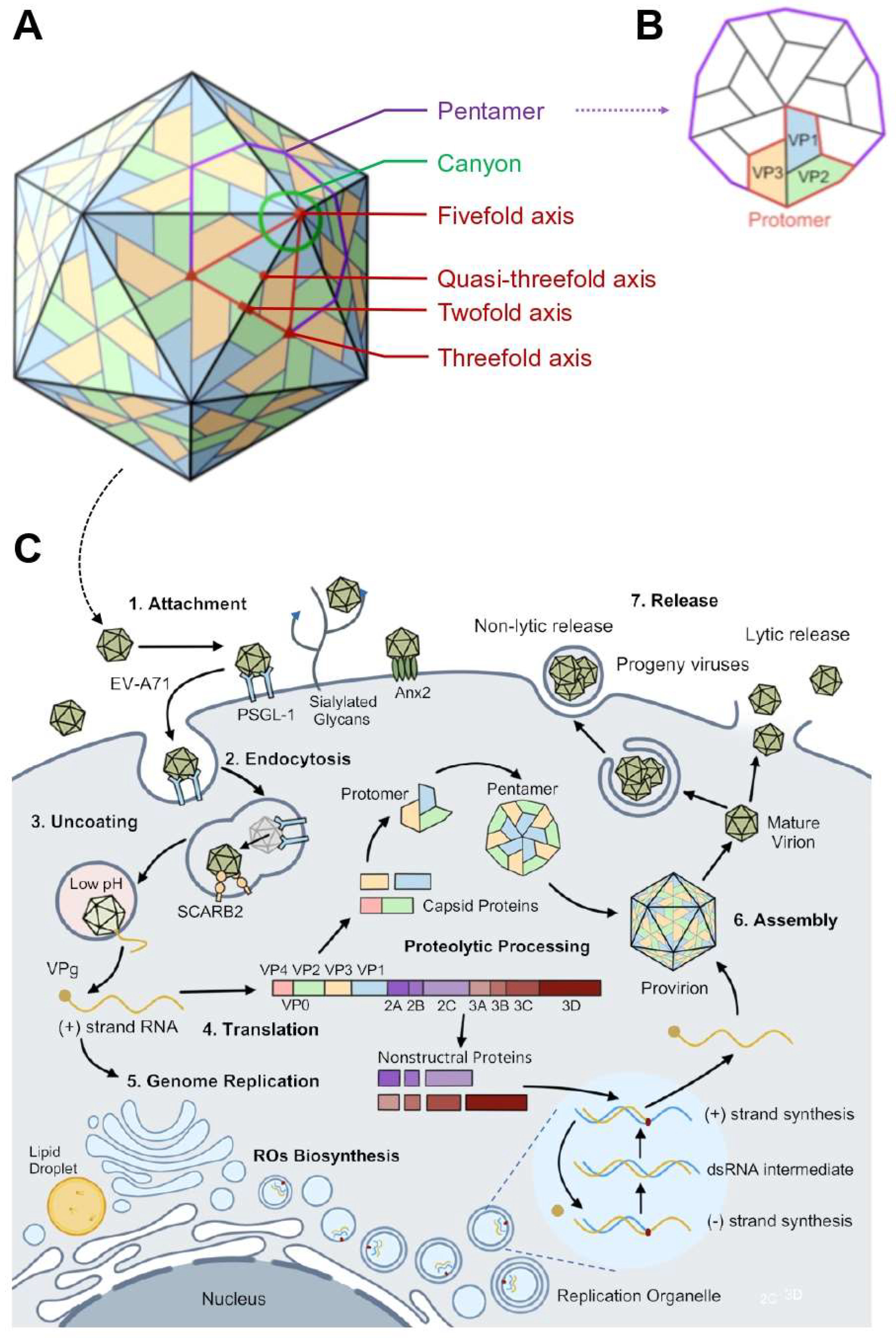
Human enterovirus 71 (EV-A71), a member of the Picornaviridae family, is predominantly associated with hand, foot, and mouth disease in infants and young children. Additionally, EV-A71 can cause severe neurological complications, including aseptic meningitis, brainstem encephalitis, and fatalities. The molecular mechanisms underlying these symptoms are complex and involve the viral tissue tropism, evasion from the host immune responses, induction of the programmed cell death and cytokine storms. This review article delves into the EV-A71 life cycle, with a particular emphasis on recent advancements in understanding the virion structure, tissue tropism, and the interplay between the virus and host regulatory networks during replication. The comprehensive review is expected to contribute to our understanding of EV-A71 pathogenesis and inform the development of antiviral therapies and vaccines.
Keywords:
1. Introduction
2. EV-A71 Entry into the Cells
2.1. Viral Attachment
2.1.1. EV-A71-Uncoating Receptor
2.1.2. EV-A71 Adhesion Receptor
2.2. Virus Internalization
2.2.1. Clathrin-Mediated Endocytosis
2.2.2. Caveolin-Mediated Endocytosis
3. EV-A71 Uncoating and Genome Release
3.1. SCARB2-Mediated EV-A71 Uncoating
3.2. Genome Release
4. Viral Protein Translation and Polyprotein Processing
4.1. Translation Initiation
4.1.1. IRES-Mediated the Viral Polyproteins Translation
4.1.2. IRES Trans-Acting Factor
4.2. Elongation and Termination of the Viral Polypeptide Chains
4.3. Processing of Viral Polyprotein
4.3.1. Processing of Polyprotein
4.3.2. Viral Structural Proteins
4.3.3. Viral Non-Structural Proteins
4.4. Transition from the Viral Translation to Genomic Replication
5. Viral Genome Replications
5.1. Preparation for Genome Replication
5.1.1. Replicative Organelle Biogenesis and Phospholipid Biosynthesis
5.1.2. Creating the Optimal Lipid Microenvironment for the Viral RNA Replication
5.2. Initiation of EV-A71 Genome Replication
5.2.1. Formation of the Replication Complex
5.2.2. The Specific Primers and Initiation of the Viral RNA Replication
6. Virion Assembly and Release
6.1. Assembly of the Viral Capsids into Virion
6.2. Release of Progeny Virus
7. Perspectives
Acknowledgments
Disclosures
References
- Messacar, K.; Spence-Davizon, E.; Osborne, C.; Press, C.; Schreiner, T.L.; Martin, J.; Messer, R.; Maloney, J.; Burakoff, A.; Barnes, M.; Rogers, S.; Lopez, A.S.; Routh, J.; Gerber, S.I.; Oberste, M.S.; Nix, W.A.; Abzug, M.J.; Tyler, K.L.; Herlihy, R.; Dominguez, S.R. Clinical characteristics of enterovirus A71 neurological disease during an outbreak in children in Colorado, USA, in 2018, an observational cohort study. Lancet Infectious Diseases 2020, 20, 230–239. [Google Scholar] [CrossRef]
- Ooi, M.H.; Wong, S.C.; Lewthwaite, P.; Cardosa, M.J.; Solomon, T. Clinical features, diagnosis, and management of enterovirus 71. Lancet Neurol 2010, 9, 1097–1105. [Google Scholar] [CrossRef] [PubMed]
- Hamaguchi, T.; Fujisawa, H.; Sakai, K.; Okino, S.; Kurosaki, N.; Nishimura, Y.; Shimizu, H.; Yamada, M. Acute encephalitis caused by intrafamilial transmission of enterovirus 71 in adult. Emerg Infect Dis 2008, 14, 828–30. [Google Scholar] [CrossRef] [PubMed]
- Chen, Y.F.; Hu, L.; Xu, F.; Liu, C.J.; Li, J. A case report of a teenager with severe hand, foot, and mouth disease with brainstem encephalitis caused by enterovirus 71. BMC Pediatr 2019, 19, 59. [Google Scholar] [CrossRef] [PubMed]
- van der Sanden, S.; Koopmans, M.; Uslu, G.; van der Avoort, H.; Dutch Working Group for Clinical, V. Epidemiology of enterovirus 71 in the Netherlands, 1963 to 2008. J Clin Microbiol 2009, 47, 2826–33. [Google Scholar] [CrossRef] [PubMed]
- Xing, W.; Liao, Q.; Viboud, C.; Zhang, J.; Sun, J.; Wu, J.T.; Chang, Z.; Liu, F.; Fang, V.J.; Zheng, Y.; Cowling, B.J.; Varma, J.K.; Farrar, J.J.; Leung, G.M.; Yu, H. Hand, foot, and mouth disease in China, 2008–12: an epidemiological study. Lancet Infect Dis 2014, 14, 308–318. [Google Scholar] [CrossRef] [PubMed]
- Solomon, T.; Lewthwaite, P.; Perera, D.; Cardosa, M.J.; McMinn, P.; Ooi, M.H. Virology, epidemiology, pathogenesis, and control of enterovirus 71. Lancet Infect Dis 2010, 10, 778–790. [Google Scholar] [CrossRef] [PubMed]
- Chang, H.L.; Chio, C.P.; Su, H.J.; Liao, C.M.; Lin, C.Y.; Shau, W.Y.; Chi, Y.C.; Cheng, Y.T.; Chou, Y.L.; Li, C.Y.; Chen, K.L.; Chen, K.T. The association between enterovirus 71 infections and meteorological parameters in Taiwan. PLoS One 2012, 7, e46845. [Google Scholar] [CrossRef] [PubMed]
- Jiang, L.; Jiang, H.; Tian, X.; Xia, X.; Huang, T. Epidemiological characteristics of hand, foot, and mouth disease in Yunnan Province, China, 2008-2019. BMC Infect Dis 2021, 21, 751. [Google Scholar] [CrossRef]
- Baker, R.E.; Yang, W.; Vecchi, G.A.; Takahashi, S. Increasing intensity of enterovirus outbreaks projected with climate change. Nat Commun 2024, 15, 6466. [Google Scholar] [CrossRef] [PubMed]
- Hong, J.; Liu, F.; Qi, H.; Tu, W.; Ward, M.P.; Ren, M.; Zhao, Z.; Su, Q.; Huang, J.; Chen, X.; Le, J.; Ren, X.; Hu, Y.; Cowling, B.; Li, Z.; Chang, Z.; Zhang, Z. Changing epidemiology of hand, foot, and mouth disease in China, 2013-2019: a population-based study. Lancet Reg Health West Pac 2022, 20, 100370. [Google Scholar] [CrossRef] [PubMed]
- He, Y.; Ong, K.C.; Gao, Z.; Zhao, X.; Anderson, V.M.; McNutt, M.A.; Wong, K.T.; Lu, M. Tonsillar crypt epithelium is an important extra-central nervous system site for viral replication in EV71 encephalomyelitis. Am J Pathol 2014, 184, 714–20. [Google Scholar] [CrossRef] [PubMed]
- Huang, H.I.; Weng, K.F.; Shih, S.R. Viral and host factors that contribute to pathogenicity of enterovirus 71. Future Microbiol 2012, 7, 467–79. [Google Scholar] [CrossRef]
- Wang, S.M.; Lei, H.Y.; Huang, K.J.; Wu, J.M.; Wang, J.R.; Yu, C.K.; Su, I.J.; Liu, C.C. Pathogenesis of enterovirus 71 brainstem encephalitis in pediatric patients: roles of cytokines and cellular immune activation in patients with pulmonary edema. J Infect Dis 2003, 188, 564–70. [Google Scholar] [CrossRef]
- Hsia, S.H.; Wu, C.T.; Chang, J.J.; Lin, T.Y.; Chung, H.T.; Lin, K.L.; Hwang, M.S.; Chou, M.L.; Chang, L.Y. Predictors of unfavorable outcomes in enterovirus 71-related cardiopulmonary failure in children. Pediatr Infect Dis J 2005, 24, 331–4. [Google Scholar] [CrossRef]
- Chen, C.S.; Yao, Y.C.; Lin, S.C.; Lee, Y.P.; Wang, Y.F.; Wang, J.R.; Liu, C.C.; Lei, H.Y.; Yu, C.K. Retrograde axonal transport: a major transmission route of enterovirus 71 in mice. J Virol 2007, 81, 8996–9003. [Google Scholar] [CrossRef] [PubMed]
- Tee, H.K.; Zainol, M.I.; Sam, I.C.; Chan, Y.F. Recent advances in the understanding of enterovirus A71 infection: a focus on neuropathogenesis. Expert Rev Anti Infect Ther 2021, 19, 733–747. [Google Scholar] [CrossRef] [PubMed]
- Gaume, L.; Chabrolles, H.; Bisseux, M.; Lopez-Coqueiro, I.; Dehouck, L.; Mirand, A.; Henquell, C.; Gosselet, F.; Archimbaud, C.; Bailly, J.L. Enterovirus A71 crosses a human blood-brain barrier model through infected immune cells. Microbiol Spectr 2024, 12, e0069024. [Google Scholar] [CrossRef] [PubMed]
- Wong, K.T.; Munisamy, B.; Ong, K.C.; Kojima, H.; Noriyo, N.; Chua, K.B.; Ong, B.B.; Nagashima, K. The distribution of inflammation and virus in human enterovirus 71 encephalomyelitis suggests possible viral spread by neural pathways. J Neuropathol Exp Neurol 2008, 67, 162–9. [Google Scholar] [CrossRef] [PubMed]
- Catching, A.; Te Yeh, M.; Bianco, S.; Capponi, S.; Andino, R. A tradeoff between enterovirus A71 particle stability and cell entry. Nat Commun 2023, 14, 7450. [Google Scholar] [CrossRef] [PubMed]
- Zhou, D.; Zhao, Y.; Kotecha, A.; Fry, E.E.; Kelly, J.T.; Wang, X.; Rao, Z.; Rowlands, D.J.; Ren, J.; Stuart, D.I. Unexpected mode of engagement between enterovirus 71 and its receptor SCARB2. Nat Microbiol 2019, 4, 414–419. [Google Scholar] [CrossRef] [PubMed]
- Santiana, M.; Ghosh, S.; Ho, B.A.; Rajasekaran, V.; Du, W.L.; Mutsafi, Y.; De Jesus-Diaz, D.A.; Sosnovtsev, S.V.; Levenson, E.A.; Parra, G.I.; Takvorian, P.M.; Cali, A.; Bleck, C.; Vlasova, A.N.; Saif, L.J.; Patton, J.T.; Lopalco, P.; Corcelli, A.; Green, K.Y.; Altan-Bonnet, N. Vesicle-Cloaked Virus Clusters Are Optimal Units for Inter-organismal Viral Transmission. Cell Host Microbe 2018, 24, 208–220 e8. [Google Scholar] [CrossRef]
- Yang, J.E.; Rossignol, E.D.; Chang, D.; Zaia, J.; Forrester, I.; Raja, K.; Winbigler, H.; Nicastro, D.; Jackson, W.T.; Bullitt, E. Complexity and ultrastructure of infectious extracellular vesicles from cells infected by non-enveloped virus. Sci Rep 2020, 10, 7939. [Google Scholar] [CrossRef]
- Patel, K.P.; Bergelson, J.M. Receptors identified for hand, foot and mouth virus. Nat Med 2009, 15, 728–9. [Google Scholar] [CrossRef] [PubMed]
- Yamayoshi, S.; Yamashita, Y.; Li, J.; Hanagata, N.; Minowa, T.; Takemura, T.; Koike, S. Scavenger receptor B2 is a cellular receptor for enterovirus 71. Nat Med 2009, 15, 798–801. [Google Scholar] [CrossRef] [PubMed]
- Liu, Y.; Rossmann, M.G. The cellular receptor for enterovirus 71. Protein Cell 2014, 5, 655–7. [Google Scholar] [CrossRef]
- Su, P.Y.; Liu, Y.T.; Chang, H.Y.; Huang, S.W.; Wang, Y.F.; Yu, C.K.; Wang, J.R.; Chang, C.F. Cell surface sialylation affects binding of enterovirus 71 to rhabdomyosarcoma and neuroblastoma cells. BMC Microbiol 2012, 12, 162. [Google Scholar] [CrossRef] [PubMed]
- Jiao, X.Y.; Guo, L.; Huang, D.Y.; Chang, X.L.; Qiu, Q.C. Distribution of EV71 receptors SCARB2 and PSGL-1 in human tissues. Virus Res 2014, 190, 40–52. [Google Scholar] [CrossRef]
- Fujii, K.; Nagata, N.; Sato, Y.; Ong, K.C.; Wong, K.T.; Yamayoshi, S.; Shimanuki, M.; Shitara, H.; Taya, C.; Koike, S. Transgenic mouse model for the study of enterovirus 71 neuropathogenesis. Proceedings of the National Academy of Sciences 2013, 110, 14753–14758. [Google Scholar] [CrossRef] [PubMed]
- Lin, Y.W.; Yu, S.L.; Shao, H.Y.; Lin, H.Y.; Liu, C.C.; Hsiao, K.N.; Chitra, E.; Tsou, Y.L.; Chang, H.W.; Sia, C.; Chong, P.; Chow, Y.H. Human SCARB2 transgenic mice as an infectious animal model for enterovirus 71. PLoS One 2013, 8, e57591. [Google Scholar] [CrossRef]
- Hussain, K.M.; Leong, K.L.; Ng, M.M.; Chu, J.J. The essential role of clathrin-mediated endocytosis in the infectious entry of human enterovirus 71. J Biol Chem 2011, 286, 309–21. [Google Scholar] [CrossRef] [PubMed]
- Lin, Y.W.; Lin, H.Y.; Tsou, Y.L.; Chitra, E.; Hsiao, K.N.; Shao, H.Y.; Liu, C.C.; Sia, C.; Chong, P.; Chow, Y.H. Human SCARB2-mediated entry and endocytosis of EV71. PLoS One 2012, 7, e30507. [Google Scholar] [CrossRef] [PubMed]
- Siebert, M.; Westbroek, W.; Chen, Y.C.; Moaven, N.; Li, Y.; Velayati, A.; Saraiva-Pereira, M.L.; Martin, S.E.; Sidransky, E. Identification of miRNAs that modulate glucocerebrosidase activity in Gaucher disease cells. RNA Biol 2014, 11, 1291–300. [Google Scholar] [CrossRef] [PubMed]
- Feng, C.; Fu, Y.; Chen, D.; Wang, H.; Su, A.; Zhang, L.; Chang, L.; Zheng, N.; Wu, Z. miR-127-5p negatively regulates enterovirus 71 replication by directly targeting SCARB2. FEBS Open Bio 2017, 7, 747–758. [Google Scholar] [CrossRef] [PubMed]
- Jin, J.; Li, R.; Jiang, C.; Zhang, R.; Ge, X.; Liang, F.; Sheng, X.; Dai, W.; Chen, M.; Wu, J.; Xiao, J.; Su, W. Transcriptome analysis reveals dynamic changes in coxsackievirus A16 infected HEK 293T cells. BMC Genomics 2017, 18, 933. [Google Scholar] [CrossRef]
- Nishimura, Y.; Sato, K.; Koyanagi, Y.; Wakita, T.; Muramatsu, M.; Shimizu, H.; Bergelson, J.M.; Arita, M. Enterovirus A71 does not meet the uncoating receptor SCARB2 at the cell surface. PLoS Pathog 2024, 20, e1012022. [Google Scholar] [CrossRef]
- Sako, D.; Chang, X.J.; Barone, K.M.; Vachino, G.; White, H.M.; Shaw, G.; Veldman, G.M.; Bean, K.M.; Ahern, T.J.; Furie, B.; Cumming, D.A.; Larsen, G.R. EXPRESSION CLONING OF A FUNCTIONAL GLYCOPROTEIN LIGAND FOR P-SELECTIN. Cell 1993, 75, 1179–1186. [Google Scholar] [CrossRef]
- Laszik, Z.; Jansen, P.J.; Cummings, R.D.; Tedder, T.F.; McEver, R.P.; Moore, K.L. P-selectin glycoprotein ligand-1 is broadly expressed in cells of myeloid, lymphoid, and dendritic lineage and in some nonhematopoietic cells. Blood 1996, 88, 3010–3021. [Google Scholar] [CrossRef]
- Nishimura, Y.; Shimojima, M.; Tano, Y.; Miyamura, T.; Wakita, T.; Shimizu, H. Human P-selectin glycoprotein ligand-1 is a functional receptor for enterovirus 71. Nat Med 2009, 15, 794–7. [Google Scholar] [CrossRef]
- Nishimura, Y.; Lee, H.; Hafenstein, S.; Kataoka, C.; Wakita, T.; Bergelson, J.M.; Shimizu, H. Enterovirus 71 binding to PSGL-1 on leukocytes: VP1-145 acts as a molecular switch to control receptor interaction. PLoS Pathog 2013, 9, e1003511. [Google Scholar] [CrossRef]
- Zhang, X.; Yin, Z.; Zhang, J.; Guo, H.; Li, J.; Nie, X.; Wang, S.; Zhang, L. Enterovirus 71 Activates Plasmacytoid Dendritic Cell-Dependent PSGL-1 Binding Independent of Productive Infection. J Immunol 2024, 212, 1782–1790. [Google Scholar] [CrossRef] [PubMed]
- Liu, J.; Dong, W.; Quan, X.; Ma, C.; Qin, C.; Zhang, L. Transgenic expression of human P-selectin glycoprotein ligand-1 is not sufficient for enterovirus 71 infection in mice. Arch Virol 2012, 157, 539–43. [Google Scholar] [CrossRef] [PubMed]
- Miyamura, K.; Nishimura, Y.; Abo, M.; Wakita, T.; Shimizu, H. Adaptive mutations in the genomes of enterovirus 71 strains following infection of mouse cells expressing human P-selectin glycoprotein ligand-1. Journal of General Virology 2010, 92, 287–291. [Google Scholar] [CrossRef] [PubMed]
- Yamayoshi, S.; Ohka, S.; Fujii, K.; Koike, S. Functional comparison of SCARB2 and PSGL1 as receptors for enterovirus 71. J Virol 2013, 87, 3335–47. [Google Scholar] [CrossRef] [PubMed]
- Lin, H.Y.; Yang, Y.T.; Yu, S.L.; Hsiao, K.N.; Liu, C.C.; Sia, C.; Chow, Y.H. Caveolar endocytosis is required for human PSGL-1-mediated enterovirus 71 infection. J Virol 2013, 87, 9064–76. [Google Scholar] [CrossRef]
- Yang, B.; Chuang, H.; Yang, K.D. Sialylated glycans as receptor and inhibitor of enterovirus 71 infection to DLD-1 intestinal cells. Virol J 2009, 6, 141. [Google Scholar] [CrossRef] [PubMed]
- Su, P.Y.; Wang, Y.F.; Huang, S.W.; Lo, Y.C.; Wang, Y.H.; Wu, S.R.; Shieh, D.B.; Chen, S.H.; Wang, J.R.; Lai, M.D.; Chang, C.F. Cell surface nucleolin facilitates enterovirus 71 binding and infection. J Virol 2015, 89, 4527–38. [Google Scholar] [CrossRef]
- Kobayashi, K.; Koike, S. Cellular receptors for enterovirus A71. J Biomed Sci 2020, 27, 23. [Google Scholar] [CrossRef]
- Du, N.; Cong, H.; Tian, H.; Zhang, H.; Zhang, W.; Song, L.; Tien, P. Cell surface vimentin is an attachment receptor for enterovirus 71. J Virol 2014, 88, 5816–33. [Google Scholar] [CrossRef]
- Yamayoshi, S.; Fujii, K.; Koike, S. Receptors for enterovirus 71. Emerg Microbes Infect 2014, 3, e53. [Google Scholar] [CrossRef] [PubMed]
- Yang, S.L.; Chou, Y.T.; Wu, C.N.; Ho, M.S. Annexin II binds to capsid protein VP1 of enterovirus 71 and enhances viral infectivity. J Virol 2011, 85, 11809–20. [Google Scholar] [CrossRef] [PubMed]
- Tan, C.W.; Poh, C.L.; Sam, I.C.; Chan, Y.F. Enterovirus 71 uses cell surface heparan sulfate glycosaminoglycan as an attachment receptor. J Virol 2013, 87, 611–20. [Google Scholar] [CrossRef]
- Too IHK, Bonne, I. ; Tan, E.L.; Chu JJH, Alonso, S. Prohibitin plays a critical role in Enterovirus 71 neuropathogenesis. PLoS Pathog 2018, 14, e1006778.
- Schmid, S.L. Clathrin-coated vesicle formation and protein sorting: An integrated process. Annual Review of Biochemistry 1997, 66, 511–548. [Google Scholar] [CrossRef]
- Ku, Z.; Ye, X.; Shi, J.; Wang, X.; Liu, Q.; Huang, Z. Single Neutralizing Monoclonal Antibodies Targeting the VP1 GH Loop of Enterovirus 71 Inhibit both Virus Attachment and Internalization during Viral Entry. J Virol 2015, 89, 12084–95. [Google Scholar] [CrossRef] [PubMed]
- Xu, L.; He, D.; Yang, L.; Li, Z.; Ye, X.; Yu, H.; Zhao, H.; Li, S.; Yuan, L.; Qian, H.; Que, Y.; Kuo Shih, J.W.; Zhu, H.; Li, Y.; Cheng, T.; Xia, N. A Broadly Cross-protective Vaccine Presenting the Neighboring Epitopes within the VP1 GH Loop and VP2 EF Loop of Enterovirus 71. Sci Rep 2015, 5, 12973. [Google Scholar] [CrossRef]
- Plevka, P.; Perera, R.; Cardosa, J.; Kuhn, R.J.; Rossmann, M.G. Crystal structure of human enterovirus 71. Science 2012, 336, 1274. [Google Scholar] [CrossRef]
- Chen, P.; Song, Z.; Qi, Y.; Feng, X.; Xu, N.; Sun, Y.; Wu, X.; Yao, X.; Mao, Q.; Li, X.; Dong, W.; Wan, X.; Huang, N.; Shen, X.; Liang, Z.; Li, W. Molecular determinants of enterovirus 71 viral entry: cleft around GLN-172 on VP1 protein interacts with variable region on scavenge receptor B 2. J Biol Chem 2012, 287, 6406–20. [Google Scholar] [CrossRef]
- Wang, X.; Peng, W.; Ren, J.; Hu, Z.; Xu, J.; Lou, Z.; Li, X.; Yin, W.; Shen, X.; Porta, C.; Walter, T.S.; Evans, G.; Axford, D.; Owen, R.; Rowlands, D.J.; Wang, J.; Stuart, D.I.; Fry, E.E.; Rao, Z. A sensor-adaptor mechanism for enterovirus uncoating from structures of EV71. Nat Struct Mol Biol 2012, 19, 424–9. [Google Scholar] [CrossRef] [PubMed]
- Baggen, J.; Thibaut, H.J. ; Strating JRPM, van Kuppeveld FJM. The life cycle of non-polio enteroviruses and how to target it. Nature Reviews Microbiology 2018, 16, 368–381. [Google Scholar]
- Reczek, D.; Schwake, M.; Schroder, J.; Hughes, H.; Blanz, J.; Jin, X.; Brondyk, W.; Van Patten, S.; Edmunds, T.; Saftig, P. LIMP-2 is a receptor for lysosomal mannose-6-phosphate-independent targeting of beta-glucocerebrosidase. Cell 2007, 131, 770–83. [Google Scholar] [CrossRef]
- Dang, M.; Wang, X.; Wang, Q.; Wang, Y.; Lin, J.; Sun, Y.; Li, X.; Zhang, L.; Lou, Z.; Wang, J.; Rao, Z. Molecular mechanism of SCARB2-mediated attachment and uncoating of EV71. Protein Cell 2014, 5, 692–703. [Google Scholar] [CrossRef] [PubMed]
- Shingler, K.L.; Yoder, J.L.; Carnegie, M.S.; Ashley, R.E.; Makhov, A.M.; Conway, J.F.; Hafenstein, S. The enterovirus 71 A-particle forms a gateway to allow genome release: a cryoEM study of picornavirus uncoating. PLoS Pathog 2013, 9, e1003240. [Google Scholar] [CrossRef]
- Levy, H.C.; Bostina, M.; Filman, D.J.; Hogle, J.M. Catching a virus in the act of RNA release: a novel poliovirus uncoating intermediate characterized by cryo-electron microscopy. J Virol 2010, 84, 4426–41. [Google Scholar] [CrossRef] [PubMed]
- Staring, J.; von Castelmur, E.; Blomen, V.A.; van den Hengel, L.G.; Brockmann, M.; Baggen, J.; Thibaut, H.J.; Nieuwenhuis, J.; Janssen, H. ; van Kuppeveld FJM, Perrakis, A. ; Carette, J.E.; Brummelkamp, T.R. PLA2G16 represents a switch between entry and clearance of Picornaviridae. Nature 2017, 541, 412–416. [Google Scholar]
- Lulla, V.; Dinan, A.M.; Hosmillo, M.; Chaudhry, Y.; Sherry, L.; Irigoyen, N.; Nayak, K.M.; Stonehouse, N.J.; Zilbauer, M.; Goodfellow, I.; Firth, A.E. An upstream protein-coding region in enteroviruses modulates virus infection in gut epithelial cells. Nature Microbiology 2019, 4, 280–292. [Google Scholar] [CrossRef] [PubMed]
- Guo, H.; Li, Y.; Liu, G.; Jiang, Y.; Shen, S.; Bi, R.; Huang, H.; Cheng, T.; Wang, C.; Wei, W. A second open reading frame in human enterovirus determines viral replication in intestinal epithelial cells. Nat Commun 2019, 10, 4066. [Google Scholar] [CrossRef] [PubMed]
- Abdullah, S.W.; Wu, J.; Wang, X.; Guo, H.; Sun, S. Advances and Breakthroughs in IRES-Directed Translation and Replication of Picornaviruses. mBio 2023, 14, e0035823. [Google Scholar] [CrossRef] [PubMed]
- Lai, M.C.; Chen, H.H.; Xu, P. ; Wang RYL. Translation control of Enterovirus A71 gene expression. J Biomed Sci 2020, 27, 22. [Google Scholar]
- Lozano, G.; Martinez-Salas, E. Structural insights into viral IRES-dependent translation mechanisms. Curr Opin Virol 2015, 12, 113–20. [Google Scholar] [CrossRef] [PubMed]
- Kok, C.C.; Phuektes, P.; Bek, E.; McMinn, P.C. Modification of the untranslated regions of human enterovirus 71 impairs growth in a cell-specific manner. J Virol 2012, 86, 542–52. [Google Scholar] [CrossRef] [PubMed]
- Wang, J.; Bakkers, J.M.; Galama, J.M.; Bruins Slot, H.J.; Pilipenko, E.V.; Agol, V.I.; Melchers, W.J. Structural requirements of the higher order RNA kissing element in the enteroviral 3’UTR. Nucleic Acids Res 1999, 27, 485–90. [Google Scholar] [CrossRef] [PubMed]
- Walsh, D.; Mohr, I. Viral subversion of the host protein synthesis machinery. Nat Rev Microbiol 2011, 9, 860–75. [Google Scholar] [CrossRef]
- Pisarev, A.V.; Chard, L.S.; Kaku, Y.; Johns, H.L.; Shatsky, I.N.; Belsham, G.J. Functional and Structural Similarities between the Internal Ribosome Entry Sites of Hepatitis C Virus and Porcine Teschovirus, a Picornavirus. Journal of Virology 2004, 78, 4487–4497. [Google Scholar] [CrossRef] [PubMed]
- Sweeney, T.R.; Dhote, V.; Yu, Y.; Hellen, C.U. A distinct class of internal ribosomal entry site in members of the Kobuvirus and proposed Salivirus and Paraturdivirus genera of the Picornaviridae. J Virol 2012, 86, 1468–86. [Google Scholar] [CrossRef]
- Lamphear, B.J.; Kirchweger, R.; Skern, T.; Rhoads, R.E. Mapping of functional domains in eukaryotic protein synthesis initiation factor 4G (eIF4G) with picornaviral proteases. Implications for cap-dependent and cap-independent translational initiation. J Biol Chem 1995, 270, 21975–83. [Google Scholar] [CrossRef]
- Gradi, A.; Svitkin, Y.V.; Imataka, H.; Sonenberg, N. Proteolysis of human eukaryotic translation initiation factor eIF4GII, but not eIF4GI, coincides with the shutoff of host protein synthesis after poliovirus infection. Proc Natl Acad Sci U S A 1998, 95, 11089–94. [Google Scholar] [CrossRef] [PubMed]
- Liberman, N.; Gandin, V.; Svitkin, Y.V.; David, M.; Virgili, G.; Jaramillo, M.; Holcik, M.; Nagar, B.; Kimchi, A.; Sonenberg, N. DAP5 associates with eIF2beta and eIF4AI to promote Internal Ribosome Entry Site driven translation. Nucleic Acids Res 2015, 43, 3764–75. [Google Scholar] [CrossRef] [PubMed]
- Weisser, M.; Schafer, T.; Leibundgut, M.; Bohringer, D. ; Aylett CHS, Ban, N. Structural and Functional Insights into Human Re-initiation Complexes. Mol Cell 2017, 67, 447–456 e7. [Google Scholar]
- Mehle, A.; Kim, H.; Aponte-Diaz, D.; Sotoudegan, M.S.; Shengjuler, D.; Arnold, J.J.; Cameron, C.E. The enterovirus genome can be translated in an IRES-independent manner that requires the initiation factors eIF2A/eIF2D. PLOS Biology 2023, 21. [Google Scholar]
- Lee, K.M.; Chen, C.J.; Shih, S.R. Regulation Mechanisms of Viral IRES-Driven Translation. Trends Microbiol 2017, 25, 546–561. [Google Scholar] [CrossRef]
- Sarnow, P.; Hung, C.-T.; Kung, Y.-A.; Li, M.-L.; Brewer, G.; Lee, K.-M.; Liu, S.-T. ; Shih S-R. Additive Promotion of Viral Internal Ribosome Entry Site-Mediated Translation by Far Upstream Element-Binding Protein 1 and an Enterovirus 71-Induced Cleavage Product. PLOS Pathogens 2016, 12.
- Lin, J.Y.; Li, M.L.; Shih, S.R. Far upstream element binding protein 2 interacts with enterovirus 71 internal ribosomal entry site and negatively regulates viral translation. Nucleic Acids Res 2009, 37, 47–59. [Google Scholar] [CrossRef] [PubMed]
- Dan, X.; Wan, Q.; Yi, L.; Lu, J.; Jiao, Y.; Li, H.; Song, D.; Chen, Y.; Xu, H.; He, M.L. Hsp27 Responds to and Facilitates Enterovirus A71 Replication by Enhancing Viral Internal Ribosome Entry Site-Mediated Translation. J Virol 2019, 93. [Google Scholar] [CrossRef] [PubMed]
- Dong, Q.; Men, R.T.; Dan, X.L.; Chen, Y.; Li, H.C.; Chen, G.; Zee, B. ; Wang MHT, He, M. L. Hsc70 regulates the IRES activity and serves as an antiviral target of enterovirus A71 infection. Antiviral Research 2018, 150, 39–46. [Google Scholar]
- Su, Y.S.; Tsai, A.H.; Ho, Y.F.; Huang, S.Y.; Liu, Y.C.; Hwang, L.H. Stimulation of the Internal Ribosome Entry Site (IRES)-Dependent Translation of Enterovirus 71 by DDX3X RNA Helicase and Viral 2A and 3C Proteases. Front Microbiol 2018, 9, 1324. [Google Scholar] [CrossRef]
- Pisareva, V.P.; Pisarev, A.V. DHX29 reduces leaky scanning through an upstream AUG codon regardless of its nucleotide context. Nucleic Acids Res 2016, 44, 4252–65. [Google Scholar] [CrossRef]
- des Georges, A.; Dhote, V.; Kuhn, L.; Hellen, C.U.; Pestova, T.V.; Frank, J.; Hashem, Y. Structure of mammalian eIF3 in the context of the 43S preinitiation complex. Nature 2015, 525, 491–5. [Google Scholar] [CrossRef] [PubMed]
- Yuan, J.; Shen, L.; Wu, J.; Zou, X.; Gu, J.; Chen, J.; Mao, L. Enterovirus A71 Proteins: Structure and Function. Front Microbiol 2018, 9, 286. [Google Scholar] [CrossRef] [PubMed]
- Zhang, H.; Song, L.; Cong, H.; Tien, P. Nuclear Protein Sam68 Interacts with the Enterovirus 71 Internal Ribosome Entry Site and Positively Regulates Viral Protein Translation. J Virol 2015, 89, 10031–43. [Google Scholar] [CrossRef] [PubMed]
- Song, Y.; Cheng, X.; Yang, X.X.; Zhao, R.; Wang, P.L.; Han, Y.; Luo, Z.; Cao, Y.H.; Zhu, C.L.; Xiong, Y.; Liu, Y.L.; Wu, K.L.; Wu, J.G. Early growth response-1 facilitates enterovirus 71 replication by direct binding to the viral genome RNA. International Journal of Biochemistry & Cell Biology 2015, 62, 36–46. [Google Scholar]
- Skalsky, R.L.; Cullen, B.R. Viruses, microRNAs, and host interactions. Annu Rev Microbiol 2010, 64, 123–41. [Google Scholar] [CrossRef]
- Zheng, Z.; Ke, X.; Wang, M.; He, S.; Li, Q.; Zheng, C.; Zhang, Z.; Liu, Y.; Wang, H. Human microRNA hsa-miR-296-5p suppresses enterovirus 71 replication by targeting the viral genome. J Virol 2013, 87, 5645–56. [Google Scholar] [CrossRef] [PubMed]
- Yang, Z.; Zhuo, Q.; Qin, W.; Wang, J.; Wang, L.; Tien, P. MicroRNAs miR-18a and miR-452 regulate the replication of enterovirus 71 by targeting the gene encoding VP3. Virus Genes 2021, 57, 318–326. [Google Scholar] [CrossRef]
- Ho, B.C.; Yu, S.L.; Chen, J.J.; Chang, S.Y.; Yan, B.S.; Hong, Q.S.; Singh, S.; Kao, C.L.; Chen, H.Y.; Su, K.Y.; Li, K.C.; Cheng, C.L.; Cheng, H.W.; Lee, J.Y.; Lee, C.N.; Yang, P.C. Enterovirus-induced miR-141 contributes to shutoff of host protein translation by targeting the translation initiation factor eIF4E. Cell Host Microbe 2011, 9, 58–69. [Google Scholar] [CrossRef]
- Lawson, M.A.; Semler, B.L. Alternate poliovirus nonstructural protein processing cascades generated by primary sites of 3C proteinase cleavage. Virology 1992, 191, 309–20. [Google Scholar] [CrossRef] [PubMed]
- Ryan, M.D.; Belsham, G.J.; King, A.M. Specificity of enzyme-substrate interactions in foot-and-mouth disease virus polyprotein processing. Virology 1989, 173, 35–45. [Google Scholar] [CrossRef]
- Ypma-Wong, M.F.; Filman, D.J.; Hogle, J.M.; Semler, B.L. Structural domains of the poliovirus polyprotein are major determinants for proteolytic cleavage at Gln-Gly pairs. Journal of Biological Chemistry 1988, 263, 17846–17856. [Google Scholar] [CrossRef]
- Jore, J.; De Geus, B.; Jackson, R.J.; Pouwels, P.H.; Enger-Valk, B.E. Poliovirus protein 3CD is the active protease for processing of the precursor protein P1 in vitro. J Gen Virol 1988, 69 Pt 7, 1627–36. [Google Scholar] [CrossRef]
- Hanecak, R.; Semler, B.L.; Anderson, C.W.; Wimmer, E. Proteolytic processing of poliovirus polypeptides: antibodies to polypeptide P3-7c inhibit cleavage at glutamine-glycine pairs. Proc Natl Acad Sci U S A 1982, 79, 3973–7. [Google Scholar] [CrossRef] [PubMed]
- Toyoda, H.; Nicklin, M.J.; Murray, M.G.; Anderson, C.W.; Dunn, J.J.; Studier, F.W.; Wimmer, E. A second virus-encoded proteinase involved in proteolytic processing of poliovirus polyprotein. Cell 1986, 45, 761–70. [Google Scholar] [CrossRef]
- Cao, J.; Liu, H.; Qu, M.; Hou, A.; Zhou, Y.; Sun, B.; Cai, L.; Gao, F.; Su, W.; Jiang, C. Determination of the cleavage site of enterovirus 71 VP0 and the effect of this cleavage on viral infectivity and assembly. Microb Pathog 2019, 134, 103568. [Google Scholar] [CrossRef]
- Kiener, T.K.; Jia, Q.; Lim, X.F.; He, F.; Meng, T.; Chow, V.T.; Kwang, J. Characterization and specificity of the linear epitope of the enterovirus 71 VP2 protein. Virol J 2012, 9, 55. [Google Scholar] [CrossRef]
- Duan, H.; Zhu, M.; Xiong, Q.; Wang, Y.; Xu, C.; Sun, J.; Wang, C.; Zhang, H.; Xu, P.; Peng, Y. Regulation of enterovirus 2A protease-associated viral IRES activities by the cell’s ERK signaling cascade: Implicating ERK as an efficiently antiviral target. Antiviral Research 2017, 143, 13–21. [Google Scholar] [CrossRef]
- Xie, S.; Wang, K.; Yu, W.; Lu, W.; Xu, K.; Wang, J.; Ye, B.; Schwarz, W.; Jin, Q.; Sun, B. DIDS blocks a chloride-dependent current that is mediated by the 2B protein of enterovirus 71. Cell Res 2011, 21, 1271–5. [Google Scholar] [CrossRef] [PubMed]
- Tang, W.F.; Yang, S.Y.; Wu, B.W.; Jheng, J.R.; Chen, Y.L.; Shih, C.H.; Lin, K.H.; Lai, H.C.; Tang, P.; Horng, J.T. Reticulon 3 binds the 2C protein of enterovirus 71 and is required for viral replication. J Biol Chem 2007, 282, 5888–98. [Google Scholar] [CrossRef] [PubMed]
- Lai JKF, Sam, I. Viruses 2017, 9.
- Xiao, X.; Lei, X.; Zhang, Z.; Ma, Y.; Qi, J.; Wu, C.; Xiao, Y.; Li, L.; He, B.; Wang, J. Enterovirus 3A Facilitates Viral Replication by Promoting Phosphatidylinositol 4-Kinase IIIbeta-ACBD3 Interaction. J Virol 2017, 91. [Google Scholar]
- Chen, C.; Wang, Y.; Shan, C.; Sun, Y.; Xu, P.; Zhou, H.; Yang, C.; Shi, P.-Y.; Rao, Z.; Zhang, B.; Lou, Z. Crystal Structure of Enterovirus 71 RNA-Dependent RNA Polymerase Complexed with Its Protein Primer VPg: Implication for a trans Mechanism of VPg Uridylylation. Journal of Virology 2013, 87, 5755–5768. [Google Scholar] [CrossRef] [PubMed]
- Tang, F.; Xia, H.; Wang, P.; Yang, J.; Zhao, T.; Zhang, Q.; Hu, Y.; Zhou, X. The identification and characterization of nucleic acid chaperone activity of human enterovirus 71 nonstructural protein 3AB. Virology 2014, 464-465, 353-364.
- Shih, S.R.; Chiang, C.Y.; Chen, T.C.; Wu, C.N. ; Hsu JTA, Lee, J. C.; Hwang, M.J.; Li, M.L.; Chen, G.W.; Hoc, M.S. Mutations at KFRDI and VGK domains of enterovirus 71 3C protease affect its RNA binding and proteolytic activities. Journal of Biomedical Science 2004, 11, 239–248. [Google Scholar]
- Sun, Y.; Wang, Y.; Shan, C.; Chen, C.; Xu, P.; Song, M.; Zhou, H.; Yang, C.; Xu, W.; Shi, P.Y.; Zhang, B.; Lou, Z. Enterovirus 71 VPg uridylation uses a two-molecular mechanism of 3D polymerase. J Virol 2012, 86, 13662–71. [Google Scholar] [CrossRef]
- Barton, D.J.; Morasco, B.J.; Flanegan, J.B. Translating ribosomes inhibit poliovirus negative-strand RNA synthesis. J Virol 1999, 73, 10104–12. [Google Scholar] [CrossRef] [PubMed]
- Gamarnik, A.V.; Andino, R. Switch from translation to RNA replication in a positive-stranded RNA virus. Genes Dev 1998, 12, 2293–304. [Google Scholar] [CrossRef] [PubMed]
- Gamarnik, A.V.; Andino, R. Interactions of viral protein 3CD and poly(rC) binding protein with the 5’ untranslated region of the poliovirus genome. J Virol 2000, 74, 2219–26. [Google Scholar] [CrossRef] [PubMed]
- Perera, R.; Daijogo, S.; Walter, B.L.; Nguyen, J.H.; Semler, B.L. Cellular protein modification by poliovirus: the two faces of poly(rC)-binding protein. J Virol 2007, 81, 8919–32. [Google Scholar] [CrossRef] [PubMed]
- Maciejewski, S.; Nguyen, J.H.; Gomez-Herreros, F.; Cortes-Ledesma, F.; Caldecott, K.W.; Semler, B.L. Divergent Requirement for a DNA Repair Enzyme during Enterovirus Infections. mBio 2015, 7, e01931–15. [Google Scholar] [CrossRef] [PubMed]
- Kriner, M.A.; Sevostyanova, A.; Groisman, E.A. Learning from the Leaders: Gene Regulation by the Transcription Termination Factor Rho. Trends Biochem Sci 2016, 41, 690–699. [Google Scholar] [CrossRef]
- Washburn, R.S.; Gottesman, M.E. Regulation of transcription elongation and termination. Biomolecules 2015, 5, 1063–78. [Google Scholar] [CrossRef]
- Laufman, O.; Perrino, J.; Andino, R. Viral Generated Inter-Organelle Contacts Redirect Lipid Flux for Genome Replication. Cell 2019, 178, 275–289 e16. [Google Scholar] [CrossRef]
- Suhy, D.A.; Giddings, T.H.; Kirkegaard, K. Remodeling the Endoplasmic Reticulum by Poliovirus Infection and by Individual Viral Proteins: an Autophagy-Like Origin for Virus-Induced Vesicles. Journal of Virology 2000, 74, 8953–8965. [Google Scholar] [CrossRef]
- Limpens, R.W.; van der Schaar, H.M.; Kumar, D.; Koster, A.J.; Snijder, E.J.; van Kuppeveld, F.J.; Barcena, M. The transformation of enterovirus replication structures: a three-dimensional study of single- and double-membrane compartments. mBio 2.
- Belov GA 2011, Nair, V. ; Hansen, B.T.; Hoyt, F.H.; Fischer, E.R.; Ehrenfeld, E. Complex dynamic development of poliovirus membranous replication complexes. J Virol 2012, 86, 302–12.
- Melia, C.E.; Peddie, C.J. ; de Jong AWM, Snijder, E.J.; Collinson, L.M.; Koster, A.J.; van der Schaar, H.M.; van Kuppeveld FJM, Barcena, M. Origins of Enterovirus Replication Organelles Established by Whole-Cell Electron Microscopy. mBio 2019, 10.
- Paul, D.; Bartenschlager, R. Architecture and biogenesis of plus-strand RNA virus replication factories. World J Virol 2013, 2, 32–48. [Google Scholar] [CrossRef] [PubMed]
- Viktorova, E.G.; Nchoutmboube, J.A.; Ford-Siltz, L.A.; Iverson, E.; Belov, G.A. Phospholipid synthesis fueled by lipid droplets drives the structural development of poliovirus replication organelles. PLoS Pathog 2018, 14, e1007280. [Google Scholar] [CrossRef] [PubMed]
- Nchoutmboube, J.A.; Viktorova, E.G.; Scott, A.J.; Ford, L.A.; Pei, Z.; Watkins, P.A.; Ernst, R.K.; Belov, G.A. Increased long chain acyl-Coa synthetase activity and fatty acid import is linked to membrane synthesis for development of picornavirus replication organelles. PLoS Pathog 2013, 9, e1003401. [Google Scholar] [CrossRef] [PubMed]
- Cong, H.; Du, N.; Yang, Y.; Song, L.; Zhang, W.; Tien, P. Enterovirus 71 2B Induces Cell Apoptosis by Directly Inducing the Conformational Activation of the Proapoptotic Protein Bax. J Virol 2016, 90, 9862–9877. [Google Scholar] [CrossRef] [PubMed]
- Cheng, M.L.; Weng, S.F.; Kuo, C.H.; Ho, H.Y. Enterovirus 71 induces mitochondrial reactive oxygen species generation that is required for efficient replication. PLoS One 2014, 9, e113234. [Google Scholar] [CrossRef]
- Yang, Y.; Cong, H.; Du, N.; Han, X.; Song, L.; Zhang, W.; Li, C.; Tien, P. Mitochondria Redistribution in Enterovirus A71 Infected Cells and Its Effect on Virus Replication. Virol Sin 2019, 34, 397–411. [Google Scholar] [CrossRef] [PubMed]
- van der Schaar, H.M.; Dorobantu, C.M.; Albulescu, L.; Strating, J. ; van Kuppeveld FJM. Fat(al) attraction: Picornaviruses Usurp Lipid Transfer at Membrane Contact Sites to Create Replication Organelles. Trends Microbiol 2016, 24, 535–546. [Google Scholar] [PubMed]
- Hsu, N.Y.; Ilnytska, O.; Belov, G.; Santiana, M.; Chen, Y.H.; Takvorian, P.M.; Pau, C.; van der Schaar, H.; Kaushik-Basu, N.; Balla, T.; Cameron, C.E.; Ehrenfeld, E.; van Kuppeveld, F.J.; Altan-Bonnet, N. Viral reorganization of the secretory pathway generates distinct organelles for RNA replication. Cell 2010, 141, 799–811. [Google Scholar] [CrossRef]
- Lanke, K.H.; van der Schaar, H.M.; Belov, G.A.; Feng, Q.; Duijsings, D.; Jackson, C.L.; Ehrenfeld, E.; van Kuppeveld, F.J. GBF1, a guanine nucleotide exchange factor for Arf, is crucial for coxsackievirus B3 RNA replication. J Virol 2009, 83, 11940–9. [Google Scholar] [CrossRef] [PubMed]
- Lyoo, H.; van der Schaar, H.M.; Dorobantu, C.M.; Rabouw, H.H.; Strating, J. ; van Kuppeveld FJM. ACBD3 Is an Essential Pan-enterovirus Host Factor That Mediates the Interaction between Viral 3A Protein and Cellular Protein PI4KB. mBio 2019, 10.
- Greninger, A.L.; Knudsen, G.M.; Betegon, M.; Burlingame, A.L.; DeRisi, J.L. ACBD3 interaction with TBC1 domain 22 protein is differentially affected by enteroviral and kobuviral 3A protein binding. mBio 2013, 4, e00098–13. [Google Scholar] [CrossRef]
- Blomen, V.A.; Majek, P.; Jae, L.T.; Bigenzahn, J.W.; Nieuwenhuis, J.; Staring, J.; Sacco, R.; van Diemen, F.R.; Olk, N.; Stukalov, A.; Marceau, C.; Janssen, H.; Carette, J.E.; Bennett, K.L.; Colinge, J.; Superti-Furga, G.; Brummelkamp, T.R. Gene essentiality and synthetic lethality in haploid human cells. Science 2015, 350, 1092–6. [Google Scholar] [CrossRef]
- McPhail, J.A.; Lyoo, H.; Pemberton, J.G.; Hoffmann, R.M.; van Elst, W.; Strating, J.; Jenkins, M.L. ; Stariha JTB, Powell, C. J.; Boulanger, M.J.; Balla, T.; van Kuppeveld FJM, Burke, J.E. Characterization of the c10orf76-PI4KB complex and its necessity for Golgi PI4P levels and enterovirus replication. EMBO Rep 2020, 21, e48441. [Google Scholar]
- Arita, M. Phosphatidylinositol-4 kinase III beta and oxysterol-binding protein accumulate unesterified cholesterol on poliovirus-induced membrane structure. Microbiol Immunol 2014, 58, 239–56. [Google Scholar] [CrossRef] [PubMed]
- Banerjee, S.; Aponte-Diaz, D.; Yeager, C.; Sharma, S.D.; Ning, G.; Oh, H.S.; Han, Q.; Umeda, M.; Hara, Y. ; Wang RYL, Cameron, C. E. Hijacking of multiple phospholipid biosynthetic pathways and induction of membrane biogenesis by a picornaviral 3CD protein. PLoS Pathog 2018, 14, e1007086. [Google Scholar]
- Melia, C.E.; van der Schaar, H.M.; Lyoo, H.; Limpens, R.; Feng, Q.; Wahedi, M.; Overheul, G.J.; van Rij, R.P.; Snijder, E.J.; Koster, A.J.; Barcena, M. ; van Kuppeveld FJM. Escaping Host Factor PI4KB Inhibition: Enterovirus Genomic RNA Replication in the Absence of Replication Organelles. Cell Rep 2017, 21, 587–599. [Google Scholar] [PubMed]
- Roulin, P.S.; Lotzerich, M.; Torta, F.; Tanner, L.B.; van Kuppeveld, F.J.; Wenk, M.R.; Greber, U.F. Rhinovirus uses a phosphatidylinositol 4-phosphate/cholesterol counter-current for the formation of replication compartments at the ER-Golgi interface. Cell Host Microbe 2014, 16, 677–90. [Google Scholar] [CrossRef]
- Albulescu, L.; Wubbolts, R.; van Kuppeveld, F.J.; Strating, J.R. Cholesterol shuttling is important for RNA replication of coxsackievirus B3 and encephalomyocarditis virus. Cell Microbiol 2015, 17, 1144–56. [Google Scholar] [CrossRef] [PubMed]
- Ilnytska, O.; Santiana, M.; Hsu, N.Y.; Du, W.L.; Chen, Y.H.; Viktorova, E.G.; Belov, G.; Brinker, A.; Storch, J.; Moore, C.; Dixon, J.L.; Altan-Bonnet, N. Enteroviruses harness the cellular endocytic machinery to remodel the host cell cholesterol landscape for effective viral replication. Cell Host Microbe 2013, 14, 281–93. [Google Scholar] [CrossRef] [PubMed]
- Strating, J.R.; van der Linden, L.; Albulescu, L.; Bigay, J.; Arita, M.; Delang, L.; Leyssen, P.; van der Schaar, H.M.; Lanke, K.H.; Thibaut, H.J.; Ulferts, R.; Drin, G.; Schlinck, N.; Wubbolts, R.W.; Sever, N.; Head, S.A.; Liu, J.O.; Beachy, P.A.; De Matteis, M.A.; Shair, M.D.; Olkkonen, V.M.; Neyts, J.; van Kuppeveld, F.J. Itraconazole inhibits enterovirus replication by targeting the oxysterol-binding protein. Cell Rep 2015, 10, 600–15. [Google Scholar] [CrossRef] [PubMed]
- Ishikawa-Sasaki, K.; Nagashima, S.; Taniguchi, K.; Sasaki, J. Model of OSBP-Mediated Cholesterol Supply to Aichi Virus RNA Replication Sites Involving Protein-Protein Interactions among Viral Proteins, ACBD3, OSBP, VAP-A/B, and SAC1. J Virol 2018, 92. [Google Scholar] [CrossRef] [PubMed]
- Ford Siltz, L.A.; Viktorova, E.G.; Zhang, B.; Kouiavskaia, D.; Dragunsky, E.; Chumakov, K.; Isaacs, L.; Belov, G.A. New small-molecule inhibitors effectively blocking picornavirus replication. J Virol 2014, 88, 11091–107. [Google Scholar] [CrossRef] [PubMed]
- Roberts, B.L.; Severance, Z.C.; Bensen, R.C.; Le-McClain, A.T.; Malinky, C.A.; Mettenbrink, E.M.; Nunez, J.I.; Reddig, W.J.; Blewett, E.L. ; Burgett AWG. Differing activities of oxysterol-binding protein (OSBP) targeting anti-viral compounds. Antiviral Res 2019, 170, 104548. [Google Scholar] [PubMed]
- Arita, M.; Bigay, J. Poliovirus Evolution toward Independence from the Phosphatidylinositol-4 Kinase III beta/Oxysterol-Binding Protein Family I Pathway. ACS Infect Dis 2019, 5, 962–973. [Google Scholar] [CrossRef] [PubMed]
- Sharma, N.; O’Donnell, B.J.; Flanegan, J.B. 3’-Terminal sequence in poliovirus negative-strand templates is the primary cis-acting element required for VPgpUpU-primed positive-strand initiation. J Virol 2005, 79, 3565–77. [Google Scholar] [CrossRef] [PubMed]
- Andino, R.; Rieckhof, G.E.; Achacoso, P.L.; Baltimore, D. Poliovirus RNA synthesis utilizes an RNP complex formed around the 5’-end of viral RNA. EMBO J 1993, 12, 3587–98. [Google Scholar] [CrossRef]
- Parsley, T.B.; Towner, J.S.; Blyn, L.B.; Ehrenfeld, E.; Semler, B.L. Poly (rC) binding protein 2 forms a ternary complex with the 5’-terminal sequences of poliovirus RNA and the viral 3CD proteinase. RNA 1997, 3, 1124–1134. [Google Scholar]
- Herold, J.; Andino, R. Poliovirus RNA replication requires genome circularization through a protein-protein bridge. Mol Cell 2001, 7, 581–91. [Google Scholar] [CrossRef] [PubMed]
- Harris, K.S.; Xiang, W.K.; Alexander, L.; Lane, W.S.; Paul, A.V.; Wimmer, E. Interaction of poliovirus polypeptide 3CD(pro) with the 5’-termini and 3’-termini of the poliovirus genome - identification of viral and cellular cofactors needed for efficient binding. Journal of Biological Chemistry 1994, 269, 27004–27014. [Google Scholar] [CrossRef] [PubMed]
- Nomoto, A.; Kitamura, N.; Golini, F.; Wimmer, E. The 5’-terminal structures of poliovirion RNA and poliovirus mRNA differ only in the genome-linked protein VPg. Proc Natl Acad Sci U S A 1977, 74, 5345–9. [Google Scholar] [CrossRef]
- McKnight, K.L.; Lemon, S.M. The rhinovirus type 14 genome contains an internally located RNA structure that is required for viral replication. RNA 1998, 4, 1569–84. [Google Scholar] [CrossRef] [PubMed]
- Steil, B.P.; Barton, D.J. Cis-active RNA elements (CREs) and picornavirus RNA replication. Virus Res 2009, 139, 240–52. [Google Scholar] [CrossRef]
- Steil, B.P.; Barton, D.J. Poliovirus cis-acting replication element-dependent VPg Uridylylation lowers the Km of the initiating nucleoside triphosphate for viral RNA replication. J Virol 2008, 82, 9400–8. [Google Scholar] [CrossRef] [PubMed]
- Agol, V.I.; Paul, A.V.; Wimmer, E. Paradoxes of the replication of picornaviral genomes. Virus Res 1999, 62, 129–47. [Google Scholar] [CrossRef] [PubMed]
- Thibaut, H.J.; van der Linden, L.; Jiang, P.; Thys, B.; Canela, M.D.; Aguado, L.; Rombaut, B.; Wimmer, E.; Paul, A.; Perez-Perez, M.J.; van Kuppeveld, F.J.; Neyts, J. Binding of glutathione to enterovirus capsids is essential for virion morphogenesis. PLoS Pathog 2014, 10, e1004039. [Google Scholar] [CrossRef] [PubMed]
- Chandler-Bostock, R.; Mata, C.P.; Bingham, R.J.; Dykeman, E.C.; Meng, B.; Tuthill, T.J.; Rowlands, D.J.; Ranson, N.A.; Twarock, R.; Stockley, P.G. Assembly of infectious enteroviruses depends on multiple, conserved genomic RNA-coat protein contacts. PLoS Pathog 2020, 16, e1009146. [Google Scholar] [CrossRef]
- Song, Y.; Gorbatsevych, O.; Liu, Y.; Mugavero, J.; Shen, S.H.; Ward, C.B.; Asare, E.; Jiang, P.; Paul, A.V.; Mueller, S.; Wimmer, E. Limits of variation, specific infectivity, and genome packaging of massively recoded poliovirus genomes. Proc Natl Acad Sci U S A 2017, 114, E8731–E8740. [Google Scholar] [CrossRef] [PubMed]
- Basavappa, R.; Syed, R.; Flore, O.; Icenogle, J.P.; Filman, D.J.; Hogle, J.M. Role and mechanism of the maturation cleavage of VP0 in poliovirus assembly: structure of the empty capsid assembly intermediate at 2. 9 A resolution. Protein Sci 1994, 3, 1651–69. [Google Scholar] [CrossRef] [PubMed]
- Liu, Y.; Wang, C.; Mueller, S.; Paul, A.V.; Wimmer, E.; Jiang, P. Direct interaction between two viral proteins, the nonstructural protein 2C and the capsid protein VP3, is required for enterovirus morphogenesis. PLoS Pathog 2010, 6, e1001066. [Google Scholar] [CrossRef]
- Tsou, Y.L.; Lin, Y.W.; Chang, H.W.; Lin, H.Y.; Shao, H.Y.; Yu, S.L.; Liu, C.C.; Chitra, E.; Sia, C.; Chow, Y.H. Heat shock protein, 90, role in enterovirus 71 entry and assembly and potential target for therapy. PLoS One 2013, 8, e77133. [Google Scholar] [CrossRef] [PubMed]
- Duyvesteyn HME, Ren, J. ; Walter, T.S.; Fry, E.E.; Stuart, D.I. Glutathione facilitates enterovirus assembly by binding at a druggable pocket. Commun Biol 2020, 3, 9.
- Hu, B.; Chik, K.K.; Chan, J.F.; Cai, J.P.; Cao, H.; Tsang, J.O.; Zou, Z.; Hung, Y.P.; Tang, K.; Jia, L.; Luo, C.; Yin, F.; Ye, Z.W.; Chu, H.; Yeung, M.L.; Yuan, S. Vemurafenib Inhibits Enterovirus A71 Genome Replication and Virus Assembly. Pharmaceuticals (Basel) 2022, 15. [Google Scholar] [CrossRef] [PubMed]
- Morley, S.J.; Curtis, P.S.; Pain, V.M. eIF4G: Translation’s mystery factor begins to yield its secrets. RNA 1997, 3, 1085–1104. [Google Scholar] [PubMed]
- Marissen, W.E.; Lloyd, R.E. Eukaryotic translation initiation factor 4G is targeted for proteolytic cleavage by caspase 3 during inhibition of translation in apoptotic cells. Mol Cell Biol 1998, 18, 7565–74. [Google Scholar] [CrossRef] [PubMed]
- Chen, Y.H.; Du, W.; Hagemeijer, M.C.; Takvorian, P.M.; Pau, C.; Cali, A.; Brantner, C.A.; Stempinski, E.S.; Connelly, P.S.; Ma, H.C.; Jiang, P.; Wimmer, E.; Altan-Bonnet, G.; Altan-Bonnet, N. Phosphatidylserine vesicles enable efficient en bloc transmission of enteroviruses. Cell 2015, 160, 619–630. [Google Scholar] [CrossRef]
- Feng, Z.; Hensley, L.; McKnight, K.L.; Hu, F.; Madden, V.; Ping, L.; Jeong, S.H.; Walker, C.; Lanford, R.E.; Lemon, S.M. A pathogenic picornavirus acquires an envelope by hijacking cellular membranes. Nature 2013, 496, 367–71. [Google Scholar] [CrossRef] [PubMed]
- Moshiri, J.; Craven, A.R.; Mixon, S.B.; Amieva, M.R.; Kirkegaard, K. Mechanosensitive extrusion of Enterovirus A71-infected cells from colonic organoids. Nat Microbiol 2023, 8, 629–639. [Google Scholar] [CrossRef]
- Lin, J.Y.; Li, M.L.; Brewer, G. mRNA decay factor AUF1 binds the internal ribosomal entry site of enterovirus 71 and inhibits virus replication. PLoS One 2014, 9, e103827. [Google Scholar] [CrossRef] [PubMed]
- Li, Z.L.; Yang, X.; Zhao, Z.L.; Liu, X.; Zhang, W.Y. Host Restriction Factor A3G Inhibits the Replication of Enterovirus D68 by Competitively Binding the 5′ Untranslated Region with PCBP1. Journal of Virology 2022, 96. [Google Scholar] [CrossRef] [PubMed]
- Weng, K.-F.; Hung, C.-T.; Hsieh, P.-T.; Li, M.-L.; Chen, G.-W.; Kung, Y.-A.; Huang, P.-N.; Kuo, R.-L.; Chen, L.-L.; Lin, J.-Y.; Wang, R.Y.-L.; Chen, S.-J.; Tang, P.; Horng, J.-T.; Huang, H.-I.; Wang, J.-R.; Ojcius, D.M.; Brewer, G.; Shih, S.-R. A cytoplasmic RNA virus generates functional viral small RNAs and regulates viral IRES activity in mammalian cells. Nucleic Acids Research 2014, 42, 12789–12805. [Google Scholar] [CrossRef]
- Han, Y.; Wang, L.; Cui, J.; Song, Y.; Luo, Z.; Chen, J.; Xiong, Y.; Zhang, Q.; Liu, F.; Ho, W.; Liu, Y.; Wu, K.; Wu, J. SIRT1 inhibits EV71 genome replication and RNA translation by interfering with the viral polymerase and 5’UTR RNA. J Cell Sci 2016, 129, 4534–4547. [Google Scholar] [CrossRef]
- Yang, W.; Li, D.; Ru, Y.; Bai, J.; Ren, J.; Zhang, J.; Li, L.; Liu, X.; Zheng, H. Foot-and-Mouth Disease Virus 3A Protein Causes Upregulation of Autophagy-Related Protein LRRC25 To Inhibit the G3BP1-Mediated RIG-Like Helicase-Signaling Pathway. J Virol 2020, 94. [Google Scholar] [CrossRef] [PubMed]
- Kung, Y.A.; Hung, C.T.; Chien, K.Y.; Shih, S.R. Control of the negative IRES trans-acting factor KHSRP by ubiquitination. Nucleic Acids Res 2017, 45, 271–287. [Google Scholar] [CrossRef]
- Shao, E.; Zhao, S.; Dong, Y.; Wang, Y.; Fei, Y.; Li, S.; Wang, L.; Bashir, T.; Luan, T.; Lin, L.; Wang, Y.; Zhao, W.; Zhong, Z. Anisomycin inhibits Coxsackievirus B replication by promoting the lysosomal degradation of eEF1A1. Antiviral Res 2023, 215, 105621. [Google Scholar] [CrossRef] [PubMed]
- Luo, Z.; Dong, X.; Li, Y.; Zhang, Q.; Kim, C.; Song, Y.; Kang, L.; Liu, Y.; Wu, K.; Wu, J. PolyC-binding protein 1 interacts with 5’-untranslated region of enterovirus 71 RNA in membrane-associated complex to facilitate viral replication. PLoS One 2014, 9, e87491. [Google Scholar] [CrossRef] [PubMed]
- Chen, L.L.; Kung, Y.A.; Weng, K.F.; Lin, J.Y.; Horng, J.T.; Shih, S.R. Enterovirus 71 infection cleaves a negative regulator for viral internal ribosomal entry site-driven translation. J Virol 2013, 87, 3828–38. [Google Scholar] [CrossRef] [PubMed]
- Lin, J.Y.; Brewer, G.; Li, M.L. HuR and Ago2 Bind the Internal Ribosome Entry Site of Enterovirus 71 and Promote Virus Translation and Replication. PLoS One 2015, 10, e0140291. [Google Scholar] [CrossRef] [PubMed]
- Fan, B. ; Sutandy FXR, Syu, G. -D.; Middleton, S.; Yi, G.; Lu, K.-Y.; Chen, C.-S.; Kao, C.C. Heterogeneous Ribonucleoprotein K (hnRNP K) Binds miR-122, a Mature Liver-Specific MicroRNA Required for Hepatitis C Virus Replication. Molecular & Cellular Proteomics 2015, 14, 2878–2886. [Google Scholar]
- Liu, W.; Yang, D.; Sun, C.; Wang, H.; Zhao, B.; Zhou, G.; Yu, L. hnRNP K Is a Novel Internal Ribosomal Entry Site-Transacting Factor That Negatively Regulates Foot-and-Mouth Disease Virus Translation and Replication and Is Antagonized by Viral 3C Protease. J Virol 2020, 94. [Google Scholar] [CrossRef]
- Lin, J.Y.; Li, M.L.; Huang, P.N.; Chien, K.Y.; Horng, J.T.; Shih, S.R. Heterogeneous nuclear ribonuclear protein K interacts with the enterovirus 71 5’ untranslated region and participates in virus replication. J Gen Virol 2008, 89, 2540–9. [Google Scholar] [CrossRef]
- Gao, G.; Dhar, S.; Bedford, M.T. PRMT5 regulates IRES-dependent translation via methylation of hnRNP A1. Nucleic Acids Research 2017. [CrossRef] [PubMed]
- Lin, J.-Y.; Shih, S.-R.; Pan, M.; Li, C.; Lue, C.-F.; Stollar, V. ; Li M-L. hnRNP A1 Interacts with the 5′ Untranslated Regions of Enterovirus 71 and Sindbis Virus RNA and Is Required for Viral Replication. Journal of Virology 2009, 83, 6106–6114. [Google Scholar]
- Hao, Z.; Yin, X.; Ding, R.; Chen, L.; Hao, C.; Duan, H. A novel oncolytic virus-based biomarker participates in prognosis and tumor immune infiltration of glioma. Front Microbiol 2023, 14, 1249289. [Google Scholar] [CrossRef]
- Wang, H.; Chang, L.; Wang, X.; Su, A.; Feng, C.; Fu, Y.; Chen, D.; Zheng, N.; Wu, Z. MOV10 interacts with Enterovirus 71 genomic 5’UTR and modulates viral replication. Biochem Biophys Res Commun 2016, 479, 571–577. [Google Scholar] [CrossRef] [PubMed]
- Li, H.; Li, W.; Zhang, S.; Qiu, M.; Li, Z.; Lin, Y.; Tan, J.; Qiao, W. Enterovirus 71 Activates GADD34 via Precursor 3CD to Promote IRES-Mediated Viral Translation. Microbiol Spectr 2022, 10, e0138821. [Google Scholar] [CrossRef] [PubMed]
- Abedeera, S.M.; Davila-Calderon, J.; Haddad, C.; Henry, B.; King, J.; Penumutchu, S.; Tolbert, B.S. The Repurposing of Cellular Proteins during Enterovirus A71 Infection. Viruses 2023, 16. [Google Scholar] [CrossRef] [PubMed]
- Li, H.; Song, J.; Deng, Z.; Yao, Y.; Qiao, W.; Tan, J. Cleavage of Stau2 by 3C protease promotes EV-A71 replication. Virol J 2024, 21, 216. [Google Scholar] [CrossRef] [PubMed]
- Song, Y.; Cheng, X.; Yang, X.; Zhao, R.; Wang, P.; Han, Y.; Luo, Z.; Cao, Y.; Zhu, C.; Xiong, Y.; Liu, Y.; Wu, K.; Wu, J. Early growth response-1 facilitates enterovirus 71 replication by direct binding to the viral genome RNA. Int J Biochem Cell Biol 2015, 62, 36–46. [Google Scholar] [CrossRef]
- Kataoka, C.; Suzuki, T.; Kotani, O.; Iwata-Yoshikawa, N.; Nagata, N.; Ami, Y.; Wakita, T.; Nishimura, Y.; Shimizu, H. The Role of VP1 Amino Acid Residue 145 of Enterovirus 71 in Viral Fitness and Pathogenesis in a Cynomolgus Monkey Model. PLoS Pathog 2015, 11, e1005033. [Google Scholar] [CrossRef]
- Zhang, Y.X.; Huang, Y.M.; Li, Q.J.; Li, X.Y.; Zhou, Y.D.; Guo, F.; Zhou, J.M.; Cen, S. A highly conserved amino acid in VP1 regulates maturation of enterovirus 71. PLoS Pathog 2017, 13, e1006625. [Google Scholar] [CrossRef]
- Liu, Z.W.; Zhuang, Z.C.; Chen, R.; Wang, X.R.; Zhang, H.L.; Li, S.H.; Wang, Z.Y.; Wen, H.L. Enterovirus 71 VP1 Protein Regulates Viral Replication in SH-SY5Y Cells via the mTOR Autophagy Signaling Pathway. Viruses 2019, 12. [Google Scholar] [CrossRef] [PubMed]
- Liu, C.C.; Chou, A.H.; Lien, S.P.; Lin, H.Y.; Liu, S.J.; Chang, J.Y.; Guo, M.S.; Chow, Y.H.; Yang, W.S.; Chang, K.H.; Sia, C.; Chong, P. Identification and characterization of a cross-neutralization epitope of Enterovirus 71. Vaccine 2011, 29, 4362–72. [Google Scholar] [CrossRef] [PubMed]
- Kiener, T.K.; Jia, Q.; Meng, T.; Chow, V.T.; Kwang, J. A novel universal neutralizing monoclonal antibody against enterovirus 71 that targets the highly conserved “knob” region of VP3 protein. PLoS Negl Trop Dis 2014, 8, e2895. [Google Scholar] [CrossRef]
- Jia, Q.; Ng, Q.; Chin, W.; Meng, T. ; Chow VTK, Wang, C. I.; Kwang, J.; He, F. Effective in vivo therapeutic IgG antibody against VP3 of enterovirus 71 with receptor-competing activity. Sci Rep 2017, 7, 46402. [Google Scholar]
- Phanthong, S.; Densumite, J.; Seesuay, W.; Thanongsaksrikul, J.; Teimoori, S.; Sookrung, N.; Poovorawan, Y.; Onvimala, N.; Guntapong, R.; Pattanapanyasat, K.; Chaicumpa, W. Human Antibodies to VP4 Inhibit Replication of Enteroviruses Across Subgenotypes and Serotypes, and Enhance Host Innate Immunity. Front Microbiol 2020, 11, 562768. [Google Scholar] [CrossRef]
- Cao, J.; Qu, M.; Liu, H.; Wan, X.; Li, F.; Hou, A.; Zhou, Y.; Sun, B.; Cai, L.; Su, W.; Jiang, C. Myristoylation of EV71 VP4 is Essential for Infectivity and Interaction with Membrane Structure. Virol Sin 2020, 35, 599–613. [Google Scholar] [CrossRef]
- Zhao, M.; Bai, Y.; Liu, W.; Xiao, X.; Huang, Y.; Cen, S.; Chan, P.K.; Sun, X.; Sheng, W.; Zeng, Y. Immunization of N terminus of enterovirus 71 VP4 elicits cross-protective antibody responses. BMC Microbiol 2013, 13, 287. [Google Scholar] [CrossRef] [PubMed]
- Fan, S.; Xu, Z.; Liu, P.; Qin, Y.; Chen, M. Enterovirus 71 2A Protease Inhibits P-Body Formation To Promote Viral RNA Synthesis. J Virol 2021, 95, e0092221. [Google Scholar] [CrossRef] [PubMed]
- Li, C.; Qiao, Q.; Hao, S.B.; Dong, Z.; Zhao, L.; Ji, J.; Wang, Z.Y.; Wen, H.L. Nonstructural protein 2A modulates replication and virulence of enterovirus 71. Virus Res 2018, 244, 262–269. [Google Scholar] [CrossRef]
- Kuo, R.L.; Kung, S.H.; Hsu, Y.Y.; Liu, W.T. Infection with enterovirus 71 or expression of its 2A protease induces apoptotic cell death. J Gen Virol 2002, 83, 1367–76. [Google Scholar] [CrossRef]
- Zhang, Y.-Z.; Gan, X.; Song, J.; Sun, P.; Song, Q.-Q.; Li, G.-Q.; Sheng, L.-J.; Wang, B.-D.; Lu, M.-Z.; Li, L.-M.; Han, J. The 2A protease of enterovirus 71 cleaves nup62 to inhibit nuclear transport. Bing du xue bao = Chinese journal of virology 2013, 29, 421–5. [Google Scholar]
- Wang, C.Y.; Huang, A.C.; Hour, M.J.; Huang, S.H.; Kung, S.H.; Chen, C.H.; Chen, I.C.; Chang, Y.S.; Lien, J.C.; Lin, C.W. Antiviral Potential of a Novel Compound CW-33 against Enterovirus A71 via Inhibition of Viral 2A Protease. Viruses 2015, 7, 3155–71. [Google Scholar] [CrossRef]
- Chen, B.; Wang, Y.; Pei, X.; Wang, S.; Zhang, H.; Peng, Y. Cellular Caspase-3 Contributes to EV-A71 2A(pro)-Mediated Down-Regulation of IFNAR1 at the Translation Level. Virol Sin 2020, 35, 64–72. [Google Scholar] [CrossRef] [PubMed]
- Visser, L.J.; Langereis, M.A.; Rabouw, H.H.; Wahedi, M.; Muntjewerff, E.M.; de Groot, R.J. ; van Kuppeveld FJM. Essential Role of Enterovirus 2A Protease in Counteracting Stress Granule Formation and the Induction of Type I Interferon. J Virol 2019, 93. [Google Scholar]
- Lu, J.; Yi, L.; Zhao, J.; Yu, J.; Chen, Y.; Lin, M.C.; Kung, H.F.; He, M.L. Enterovirus 71 disrupts interferon signaling by reducing the level of interferon receptor 1. J Virol 2012, 86, 3767–76. [Google Scholar] [CrossRef] [PubMed]
- Wang, L.-C.; Chen, S.-O.; Chang, S.-P.; Lee, Y.-P.; Yu, C.-K.; Chen, C.-L.; Tseng, P.-C.; Hsieh, C.-Y.; Chen, S.-H.; Lin, C.-F.; Ross, S.R. Enterovirus 71 Proteins 2A and 3D Antagonize the Antiviral Activity of Gamma Interferon via Signaling Attenuation. Journal of Virology 2015, 89, 7028–7037. [Google Scholar] [CrossRef] [PubMed]
- Cheng, M.L.; Wu, C.H.; Chien, K.Y.; Lai, C.H.; Li, G.J.; Liu, Y.Y.; Lin, G.; Ho, H.Y. Enteroviral 2B Interacts with VDAC3 to Regulate Reactive Oxygen Species Generation That Is Essential to Viral Replication. Viruses 2022, 14. [Google Scholar] [CrossRef]
- Supasorn, O.; Tongtawe, P.; Srimanote, P.; Rattanakomol, P.; Thanongsaksrikul, J. A nonstructural 2B protein of enterovirus A71 increases cytosolic Ca(2+) and induces apoptosis in human neuroblastoma SH-SY5Y cells. J Neurovirol 2020, 26, 201–213. [Google Scholar] [CrossRef] [PubMed]
- Sun, M.; Lin, Q.; Wang, C.; Xing, J.; Yan, K.; Liu, Z.; Jin, Y.; Cardona, C.J.; Xing, Z. Enterovirus A71 2B Inhibits Interferon-Activated JAK/STAT Signaling by Inducing Caspase-3-Dependent Karyopherin-alpha1 Degradation. Front Microbiol 2021, 12, 762869. [Google Scholar] [CrossRef] [PubMed]
- Du, H.; Yin, P.; Yang, X.; Zhang, L.; Jin, Q.; Zhu, G. Enterovirus 71 2C Protein Inhibits NF-kappaB Activation by Binding to RelA(p65). Sci Rep 2015, 5, 14302. [Google Scholar] [CrossRef]
- Li, J.P.; Baltimore, D. An intragenic revertant of a poliovirus 2C mutant has an uncoating defect. J Virol 1990, 64, 1102–7. [Google Scholar] [CrossRef]
- Cho, M.W.; Teterina, N.; Egger, D.; Bienz, K.; Ehrenfeld, E. MEMBRANE REARRANGEMENT AND VESICLE INDUCTION BY RECOMBINANT POLIOVIRUS 2C AND 2BC IN HUMAN-CELLS. Virology 1994, 202, 129–145. [Google Scholar] [CrossRef] [PubMed]
- Wang, C.; Jiang, P.; Sand, C.; Paul, A.V.; Wimmer, E. Alanine scanning of poliovirus 2CATPase reveals new genetic evidence that capsid protein/2CATPase interactions are essential for morphogenesis. J Virol 2012, 86, 9964–75. [Google Scholar] [CrossRef]
- Ji, L.; Yang, E.; He, S.; Jin, Y.; Chen, D. Enterovirus 2C Protein Suppresses IKKalpha Phosphorylation by Recruiting IKKbeta and IKKalpha into Viral Inclusion Bodies. Viral Immunol 2021, 34, 218–226. [Google Scholar] [CrossRef] [PubMed]
- Lu, J.Y.; Brewer, G.; Li, M.L.; Lin, K.Z.; Huang, C.C.; Yen, L.C.; Lin, J.Y. Secretory Carrier Membrane Protein 3 Interacts with 3A Viral Protein of Enterovirus and Participates in Viral Replication. Microbiol Spectr 2021, 9, e0047521. [Google Scholar] [CrossRef] [PubMed]
- Ruan, Z.; Liang, Y.; Chen, Z.; Yin, J.; Li, C.; Pan, P.; Zhang, Q.; Wu, J.; Luo, Z. Enterovirus 71 non-structural protein 3A hijacks vacuolar protein sorting 25 to boost exosome biogenesis to facilitate viral replication. Front Microbiol 2022, 13, 1024899. [Google Scholar] [CrossRef] [PubMed]
- Rattanakomol, P.; Srimanote, P.; Tongtawe, P.; Khantisitthiporn, O.; Supasorn, O.; Thanongsaksrikul, J. Host neuronal PRSS3 interacts with enterovirus A71 3A protein and its role in viral replication. Sci Rep 2022, 12, 12846. [Google Scholar] [CrossRef] [PubMed]
- Lu, Y.; Hou, H.; Wang, F.; Qiao, L.; Wang, X.; Yu, J.; Liu, W.; Sun, Z. ATP1B3: a virus-induced host factor against EV71 replication by up-regulating the production of type-I interferons. Virology 2016, 496, 28–34. [Google Scholar] [CrossRef] [PubMed]
- Weng, K.F.; Li, M.L.; Hung, C.T.; Shih, S.R. Enterovirus 71 3C protease cleaves a novel target CstF-64 and inhibits cellular polyadenylation. PLoS Pathog 2009, 5, e1000593. [Google Scholar] [CrossRef] [PubMed]
- Lei, X.; Han, N.; Xiao, X.; Jin, Q.; He, B.; Wang, J.; Diamond, M.S. Enterovirus 71 3C Inhibits Cytokine Expression through Cleavage of the TAK1/TAB1/TAB2/TAB3 Complex. Journal of Virology 2014, 88, 9830–9841. [Google Scholar] [CrossRef] [PubMed]
- Li, Z.; Wu, Y.; Li, H.; Li, W.; Tan, J.; Qiao, W. 3C protease of enterovirus 71 cleaves promyelocytic leukemia protein and impairs PML-NBs production. Virol J 2021, 18, 255. [Google Scholar] [CrossRef]
- Zhou, X.; Tian, L.; Wang, J.; Zheng, B.; Zhang, W. EV71 3C protease cleaves host anti-viral factor OAS3 and enhances virus replication. Virol Sin 2022, 37, 418–426. [Google Scholar] [CrossRef] [PubMed]
- Ma, H.-Y.; Lu, C.-Y.; Tsao, K.-C.; Shih, H.-M.; Cheng, A.-L.; Huang, L.-M.; Chang, L.-Y. Association of EV71 3C polymorphisms with clinical severity. Journal of Microbiology, Immunology and Infection 2018, 51, 608–613. [Google Scholar]
- Li, H.; Yao, Y.; Chen, Y.; Zhang, S.; Deng, Z.; Qiao, W.; Tan, J. TRAF3IP3 Is Cleaved by EV71 3C Protease and Exhibits Antiviral Activity. Front Microbiol 2022, 13, 914971. [Google Scholar] [CrossRef]
- Lei, X.; Zhang, Z.; Xiao, X.; Qi, J.; He, B.; Wang, J. Enterovirus 71 Inhibits Pyroptosis through Cleavage of Gasdermin, D. J Virol 2017, 91. [Google Scholar] [CrossRef]
- Li, M.L.; Lin, J.Y.; Chen, B.S.; Weng, K.F.; Shih, S.R.; Calderon, J.D.; Tolbert, B.S.; Brewer, G. EV71 3C protease induces apoptosis by cleavage of hnRNP A1 to promote apaf-1 translation. PLoS One 2019, 14, e0221048. [Google Scholar] [CrossRef] [PubMed]
- Wo, X.; Yuan, Y.; Xu, Y.; Chen, Y.; Wang, Y.; Zhao, S.; Lin, L.; Zhong, X.; Wang, Y.; Zhong, Z.; Zhao, W. TAR DNA-Binding Protein 43 is Cleaved by the Protease 3C of Enterovirus A71. Virol Sin 2021, 36, 95–103. [Google Scholar] [CrossRef]
- Liu, Y.; Zheng, Z.; Shu, B.; Meng, J.; Zhang, Y.; Zheng, C.; Ke, X.; Gong, P.; Hu, Q.; Wang, H. SUMO Modification Stabilizes Enterovirus 71 Polymerase 3D To Facilitate Viral Replication. J Virol 2016, 90, 10472–10485. [Google Scholar] [CrossRef]
- Xu, X.; Ma, S.; Liu, Z.; Yuan, H.; Wang, Y.; Chen, M.; Du, M.; Kan, H.; Wang, Z.; Chong, X.; Wen, H. EV71 5’UTR interacts with 3D protein affecting replication through the AKT-mTOR pathway. Virol J 2024, 21, 114. [Google Scholar] [CrossRef] [PubMed]
- Xiang, Q.; Wan, P.; Yang, G.; Huang, S.; Qin, M.; Yang, H.; Luo, Z.; Wu, K.; Wu, J. Beclin1 Binds to Enterovirus 71 3D Protein to Promote the Virus Replication. Viruses 2020, 12. [Google Scholar] [CrossRef] [PubMed]
- Yu, J.; Zhang, L.; Ren, P.; Zhong, T.; Li, Z.; Wang, Z.; Li, J.; Liu, X.; Zhao, K.; Zhang, W. ; Yu X-F. Enterovirus 71 mediates cell cycle arrest in S phase through non-structural protein 3D. Cell Cycle 2015, 14, 425–436. [Google Scholar]
- Wang, W.; Xiao, F.; Wan, P.; Pan, P.; Zhang, Y.; Liu, F.; Wu, K.; Liu, Y.; Wu, J. EV71 3D Protein Binds with NLRP3 and Enhances the Assembly of Inflammasome Complex. PLoS Pathog 2017, 13, e1006123. [Google Scholar] [CrossRef] [PubMed]
- Wang, H.; Lei, X.; Xiao, X.; Yang, C.; Lu, W.; Huang, Z.; Leng, Q.; Jin, Q.; He, B.; Meng, G.; Wang, J. Reciprocal Regulation between Enterovirus 71 and the NLRP3 Inflammasome. Cell Rep 2015, 12, 42–8. [Google Scholar] [CrossRef] [PubMed]
- Yang, Z.; Zheng, H.; Li, H.; Chen, Y.; Hou, D.; Fan, Q.; Song, J.; Guo, L.; Liu, L. The expression of IFN-beta is suppressed by the viral 3D polymerase via its impact on PGAM5 expression during enterovirus D68 infection. Virus Res 2021, 304, 198549. [Google Scholar] [CrossRef] [PubMed]

| Regulatory activity | Abbreviation | Full name | Target sites or potential mechanisms | References |
|---|---|---|---|---|
| Inhibitory | hnRNP D, AUF1 | Heterogeneous nuclear, AU-rich element binding factor 1 ribonucleoprotein D | SL II; compete with ribosome for IRES binding sites | [172] |
| APOBEC3G, A3G | Apolipoprotein B mRNA-editing enzyme catalytic Polypeptide 3 protein G | SL I, SL II; compete with PCBP1 for IRES binding sites | [173] | |
| vsRNA 1 | Virus-derived small RNA 1 | SL II; processed by Dicer | [174] | |
| SIRT1 | Silent mating type information regulation 2 homolog 1 | SLI, II, III and V | [175] | |
| G3BP1 | Ras-GAP SH3-binding protein 1 | Unknown | [176] | |
| FBP2, KHSRP | Far upstream element binding protein 2, KH-type splicing regulatory protein | SL I-II, SL II-III, SL V-VI, 5’-linker region; competes with FUBP1 for IRES | [83,177] | |
| Inhibitory | FBP2190-711 | Cleaved FBP2 (N-terminus) | 5’-UTR | |
| Stimulatory | FBP21-503 | Cleaved FBP2 (C-terminus) | 5’-UTR | |
| Stimulatory | Hsp27 | Heat shock protein 27 | Enhance 2Apro functions | [84] |
| Hsc70, HSPA8 | Heat shock cognate protein 70 | Non-IRES regions of genomic RNA; promote the cleave of eIF4G by 2Apro | [85,178] | |
| DDX3 | The DEAD-Box RNA Helicase | 5’-UTR; promote eIF4G cleavage by 2Apro and ribosome entry | [86] | |
| PCBP1 | Poly(C)-binding protein 1 | SLI and IV | [179] | |
| PCBP2 | Poly(C) binding protein 2 | SL IV | [68] | |
| FUBP1, FBP1 | Far upstream element binding protein 1 | 5’-linker region; cleaved by 2Apro and acts additively with full-length FBP1 | [82] | |
| FUBP3 | Far upstream element-binding protein 3 | 5’-UTR | [180] | |
| FBP11-371 | Cleaved FBP1 | 5’-linker region | ||
| HuR, ELAVL1 | Human antigen R, ELAV-like RNA-binding protein 1 | SL II; affect vsRNA1 | [181] | |
| AGO2 | Argonaute 2 | SL II; affect vsRNA1 | [181] | |
| KHDRBS1, Sam68 | KH RNA binding domain containing, signal transduction associated 1 | SL IV and V; interacts with PCBP2 and PABP | [90] | |
| hnRNP K | Heterogeneous nuclear ribonucleoprotein K | SL II, IV; interference with PTBP recognition, antagonistic to 3Cpro | [182,183,184] | |
| hnRNP A1 | Heterogeneous nuclear ribonucleoprotein A1 | SL II, VI; methylated by PRMTs, enhanced interaction with IRES | [185,186] | |
| PTBP1 | Polypyrimidine tract binding protein 1 | SL VI | [187] | |
| MOV10 | Moloney leukemia virus 10 (C-terminus domain) | SL I, IRES | [188] | |
| GADD34, PPP1R15A | Growth arrest and DNA damage-inducible protein 34 | 5’-UTR | [189] | |
| HNRNP F | Heterogeneous nuclear ribonucleoprotein F | 5’-UTR | [190] | |
| HNRNP H | Heterogeneous nuclear ribonucleoprotein H | 5’-UTR | [190] | |
| Staufen1 | Staufen homolog 1 | 5’-UTR | [191] | |
| EGR1 | Early growth response-1 | SLI and IV | [192] |
| Proteins | Sizes | Main Functions | Potentially involved pathways or mechanisms | Reference |
|---|---|---|---|---|
| VP1 | 297 aa | Receptor binding epitopes | Binds to SCARB2, PSGL-1 and other receptors | (39, 46, 51, 52) |
| Stabilizes virions; mediates uncoating, genome release | Contains the canyon, pocket factor and their discharge | [57] | ||
| Increases cell tropism and host adaptation | Non-conserved mutations alter viral immunogenicity | [193] | ||
| Assembly and maturation of progeny virions | Conserved Ala at 107 regulates VP0 precursor cleavage | [194] | ||
| Neurovirulence determinant | Regulating cell autophagy by mTOR | [195] | ||
| VP2 | 254 aa | Highly conserved antigenic determinants | Amino acids residues 28, 142-146 (EDSHP) | [103,196] |
| VP3 | 245 aa | Epitopes for neutralizing antibodies | Highly Conserved “Knob” region of VP3 protein | [197,198] |
| VP4 | 69 aa | Stabilizes the virion and involved in uncoating | Ligation with genomic RNA | [63,199] |
| Enhance viral infectivity | Myristoylation at the N-terminal of VP4 | [200] | ||
| Potential antibody target | VP4N20 (the first 20 amino acids at the N-terminal of VP4 in the EV71 genotype C4) | [201] |
| Proteins | Sizes | Main Functions | Potentially involved pathways or mechanisms | References |
|---|---|---|---|---|
| 2Apro | ∼150 aa | Translation initiation, polyprotein processing | Autohydrolysis and proteolytic activity, cleave eIF4G1 | [89] |
| Promote RNA replication | Inhibit synthesis of P-body | [202] | ||
| Facilitate virus replication | Positively mediate ERK signaling | [104] | ||
| Induce cell apoptosis | Cleave eIF4G1 | [203,204] | ||
| Inhibit nuclear transport | Cleave Nup62 | [205] | ||
| Immune evasion | Activation of NLRP3 inflammasome | [206] | ||
| Cleave IFNAR1 (JAK/STAT signaling) | [207] | |||
| Cleave MAVS, MDA5, lower IFN-α/β | [208] | |||
| Block IFN-mediated Jak/STAT signaling by decreasing IFNAR1 levels | [209] | |||
| Attenuated IFN-γ signaling by reducing the serine phosphorylation of STAT1 | [210] | |||
| 2B | ∼100 aa | Progeny virus release | Forming ion channels, mediate chloride-dependent current | [105] |
| Facilitate virus replication | Interact with VDAC3, enhance ROS production of mitochondria | [211] | ||
| Induce cell apoptosis | Activation of pro-apoptotic protein Bax, up regulate Ca2+ | [128,212] | ||
| Immune evasion | Inhibit JAK/STAT signaling | [213] | ||
| 2C | 329 aa | Promote RNA replication | NTPase, Format and directing replication complexes to cell membranes. | [106,214] |
| Virus uncoating | Revertant 2C-31R1 with secondary point mutation was defective in virion uncoating | [215] | ||
| Cellular membrane rearrangement | Formation of extensive tubular membrane structures | [216] | ||
| RNA encapsidation | Domain near to C-terminal with specific affinity to capsid protein(s), especially VP3 | [163,217] | ||
| Immune evasion | Bond to p65, inhibit p65/p50 aggregate | [214] | ||
| Inhibit IKKβ phosphorylation | [218] | |||
| 3A | 86 aa | Promote RNA replication | Interact with ACBD3, recruit PI4KB to replication complex with SCAMP3. | [108,219] |
| Facilitate virus replication | Promote exosome biogenesis, interact with PRSS3 | [220,221] | ||
| Immune evasion | Induce expression of G3BP1, inhibit RLH signaling | [176] | ||
| Interact with ATP1B3, up-regulate IFN-I | [222] | |||
| 3B | ∼22 aa | Promote RNA replication | Uridylation for the primer of RNA synthesis | [109] |
| 3Cpro | 184 aa | Polyprotein processing | Proteolytic activity | [111] |
| Translation initiation | Cleave CstF-64, block host mRNA polyadenylation, promote translation initiation | [223] | ||
| Cleave Stau2 into 508-570 aa that promotes EV-A71 replication | [191] | |||
| Promote RNA replication | RNA-binding activity | [111] | ||
| Immune evasion | Cleave TAK1/ TAB1 / TAB2/ TAB3, inhibit expression of cytokine | [224] | ||
| Cleave RIG-I, MAVS, IRF7, TRIF, and ZMYM2; downregulated miR-526a | [208] | |||
| Cleave PML IV, inhibit formation of PML nucleosomes | [225] | |||
| Cleave host antiviral factor OAS3 | [226] | |||
| Decrease interaction of mutant type 3Cpro with TRIM21, evade immune recognition | [227] | |||
| Cleave the immune-associated protein TRAF3IP3 | [228] | |||
| Inhibit pyroptosis | Cleave GSDMD | [229] | ||
| Induce cell apoptosis | Cleave hnRNP A1, activation of CAS apoptotic protease | [230] | ||
| Mediate neurological symptoms | Cleave TDP-43 and transfer to cytoplasm | [231] | ||
| 3Dpol | ∼462 aa | Promote RNA replication | Mn2+ dependent tRNA polymerase, mediate uridylation of VPgModified by SUMO1, assist in replicative organelle assembly | [112,232] |
| Interacts with 5’-UTR that associated RNA replication | [233] | |||
| Facilitate virus replication | Interact with BECN1 | [234] | ||
| Induce S-phase block | Promote Cyclin E1 transcription, regulate CDK2 expression | [235] | ||
| Trigger inflammatory response | Bind to NLRP3, promote inflammasome formation, facilitate IL-1β maturation | [236] | ||
| Immune evasion | Block STAT1 translocation, down-regulate IFN-γ | [237] | ||
| Suppress expression of PGAM5, IFN-β | [238] |
Disclaimer/Publisher’s Note: The statements, opinions and data contained in all publications are solely those of the individual author(s) and contributor(s) and not of MDPI and/or the editor(s). MDPI and/or the editor(s) disclaim responsibility for any injury to people or property resulting from any ideas, methods, instructions or products referred to in the content. |
© 2025 by the authors. Licensee MDPI, Basel, Switzerland. This article is an open access article distributed under the terms and conditions of the Creative Commons Attribution (CC BY) license (http://creativecommons.org/licenses/by/4.0/).


