Preprint
Article

This version is not peer-reviewed.

Semantic Communication on Digital Wireless Communication System

A peer-reviewed article of this preprint also exists.

Submitted:

19 February 2025

Posted:

19 February 2025

You are already at the latest version

Abstract

Semantic communication is an effective technological approach for the integration of intelligence and communication, enabling more efficient and context-aware data transmission. In this paper, we propose a bit-conversion-based semantic communication transmission framework to ensure the compatibility with existing wireless system. Specifically, a series of physical-layer processing modules in the end-to-end transmission are designed. Additionally, we develop a semantic communication simulator to implement and evaluate this framework. To optimize the performance of this framework, we introduce a novel physical-layer metric, termed Integer Error Rate (IER), which provides a more suitable evaluation criterion for semantic communication compared to the conventional Bit Error Rate (BER). On the basis of IER, a minimum Manhattan distance constellation mapping scheme is proposed, which can improve the transmission quality of semantic communication under the same BER condition. Furthermore, we propose a hybrid Joint Source-Channel Coding (JSCC) and Separate Source-Channel Coding (SSCC) transmission scheme. This scheme decouples the semantic quantization output from the modulation order by segmenting the bits to be transmitted. Simulation results demonstrate that the hybrid JSCC/SSCC transmission scheme can improve the semantic performance such as Peak Signal-to-Noise Ratio (PSNR) at the low Signal-to-Noise Ratio (SNR) environment while reducing bandwidth usage by up to 50% compared to the benchmark scheme.

Keywords: 
;  ;  ;  ;  

1. Introduction

In recent years, semantic communication, as one of the potential key technologies for 6G mobile communications, has garnered widespread attention from academia and industry. It is anticipated that semantic communication will become a novel paradigm in the development of end-to-end communication systems for 6G mobile communications [1,2,3,4].
In the research on semantic communication, many end-to-end transmission frameworks have been proposed [5,6,7,8,9,10]. The design of these end-to-end transmission frameworks all involve the same issue: the output of semantic encoding based on neural networks (NN) is a continuous signal, how can it be transmitted on existing wireless communication systems? To solve this issue, current raised frameworks can be divided into two main approaches. One approach is to change the existing system's modulation method to analog modulation [8,9,10,11,12,13]. The advantage of this approach is that, it can preserve the information after semantic encoding and reduce quantization error. However, the disadvantage is that it is extremely different from the existing systems, requiring significant changes to both hardware equipment and software protocols. The other approach still utilizes digital modulation, quantizing the output after semantic encoding before transmission [5,6,7,14,15,16]. We can call it quantized approach. The disadvantage of the quantized approach is that, from a conventional perspective, quantization tends to introduce certain performance losses. And the magnitude of the performance loss depends on different quantization methods [18,19]. While the advantage of quantized approach is that it is Convenient to be compatible with existing system protocols. Moreover, there are currently many studies on quantization methods for semantic communication to improve the performance of quantization [5,14,15,16,20]. Comprehensively considering, quantized approach is a more feasible path for the evolution of semantic communication systems on existing system.
Furthermore, there are many transmission schemes proposed within the quantized approach, which can be divided into two major categories based on whether traditional channel coding is utilized. One category of the schemes still adopts the source-channel separated coding (SSCC) scheme, called SSCC transmission scheme [1,6,7]. The transmission framework of this scheme as shown in Figure 1 (a). It is only necessary to transmit the content of semantic encoding as the payload data of the existing system, without modification to the existing wireless communication systems. However, the disadvantage of SSCC transmission scheme is the so-called “cliff effect”. This refers to a sharp decline in distortion or decoding accuracy when the channel quality drops below a certain quality threshold. This issue has been mentioned in many studies on semantic communication, and corresponding references have been provided [14,17,21,22]. The other category of the transmission schemes eliminate traditional channel coding replacing with the JSCC (joint source-channel coding) scheme,called JSCC transmission scheme. For example, the JSCC image transmission schemes were proposed by Bourtsoulatze, Yang and others [14,17]; The JSCC video transmission schemes were proposed by Wang, Jiang and others [23,24]; The speech transmission schemes were proposed by Han and others [25]. All these schemes have demonstrated that the JSCC transmission scheme for semantic communication can avoid the "Cliff Effect" and save transmission bandwidth, compared to SSCC transmission scheme.
However, since the JSCC transmission scheme removes traditional channel coding, there is modification to the existing wireless communication systems. The extent of impact depends on the specify function designs. Most of the current research with JSCC transmission scheme [5,14,15,16,23,24,25], proposed the transmission framework as shown in the Figure 1 (b), called non-bit-conversion JSCC transmission framework. In this framework, at the transmitter, the range of quantization output needs to be determined based on the modulation order (e.g. QPSK,16QAM,64QAM … …). Semantic encoding and quantization are jointly designed to map the encoded quantization output directly to the modulation constellation points. At the receiver, this framework does not require restoring the demodulated constellation points into bits, but instead sends the demodulated constellation points, represented by complex numbers for decoding in semantic decoder. The advantage of this framework is that it can avoid performance loss caused by bit decision at the receiver while retaining some of the channel state information. However, the disadvantage is that it makes significant changes to the existing wireless communication systems protocols and network architecture. For example, at the receiver, the input of semantic decoder in this scheme is complex number, which faces the problem of how to handle complex numbers above the physical layer if the semantic decoding algorithm is not feasible in the base station's physical layer. While if the semantic decoding server is deployed in the base station's physical layer, it will face the problem of how to handle the user data in base stations, which conflicts with the existing system specifications. At the transmitter, since this scheme has already been quantized, whether to convert semantic output to bits will not lead to difference in information loss. However, this framework also brings the compile issues, e.g. where to deploy the encoding algorithm and how to exchange information between nodes in network architecture perspective.
Based on the impact of non-bit-conversion transmission scheme on semantic communication system, we believe that bit conversion is indispensable. The reason for this is that existing wireless communication systems with all layers of the protocols and information exchange between nodes are designed for bit-oriented transmission. To minimize the impact on existing wireless communication systems, we propose a transmission framework as shown in the Figure 1 (c), called bit-conversion-based JSCC transmission framework. In this framework, at the transmitter, the quantization result is converted into bits, and the existing system’s bit constellation mapping module is retained. At the receiver, the demodulated constellation points are restored into bits, and then the bits are converted into integers before send into the semantic decoder. The advantage of this transmission framework is that it is convenient to integrate with the existing system and keep advantage of JSCC transmission scheme. We will introduce the specific physical layer procedure designed in this framework in the following part of this paper.
Based on the above work, the main contributions of this paper mainly include:
  • The specific physical layer procedure of bit-conversion JSCC transmission framework for semantic communication is designed. Furthermore, a semantic communication simulator is developed to implement and verify this transmission framework.
  • A novel physical layer metric, IER (Integer Error Rate), is proposed as a physical layer metric for semantic information transmission. And we prove that IER is more suitable than BER for semantic communication by simulation.
  • We present a minimum Manhattan distance constellation mapping scheme for m-QAM modulation to optimize the transmission quality in the bit-conversion JSCC transmission framework.
  • Lastly, based upon this minimum Manhattan distance constellation mapping scheme, we propose a hybrid transmission scheme to adapt different quantization levels, which can separate the semantic quantization output from the modulation order. Meanwhile, this hybrid transmission scheme can improve the transmission quality of semantic communication at the low SNR range while leveraging the bandwidth-saving advantage of semantic communication [14,17,23,24].
The rest of this paper is organized as follows. In Section 2, we propose the specific physical layer procedure design for bit-conversion-based JSCC transmission framework for semantic communication and introduce the corresponds simulator. In Section 3, we propose a novel physical layer indicator IER based on bit- conversion-based JSCC transmission framework, as well as its simulation verification. In Section 4, the optimization methods for the bit-conversion-based JSCC transmission framework and their simulation verification are presented, including minimum Manhattan distance constellation mapping and hybrid JSCC and SSCC transmission scheme. Finally, conclusions are drawn in Section 5.

2. Bit-Conversion-Based JSCC Transmission Framework and Simulator

2.1. Bit-Conversion-Based JSCC Transmission Framework

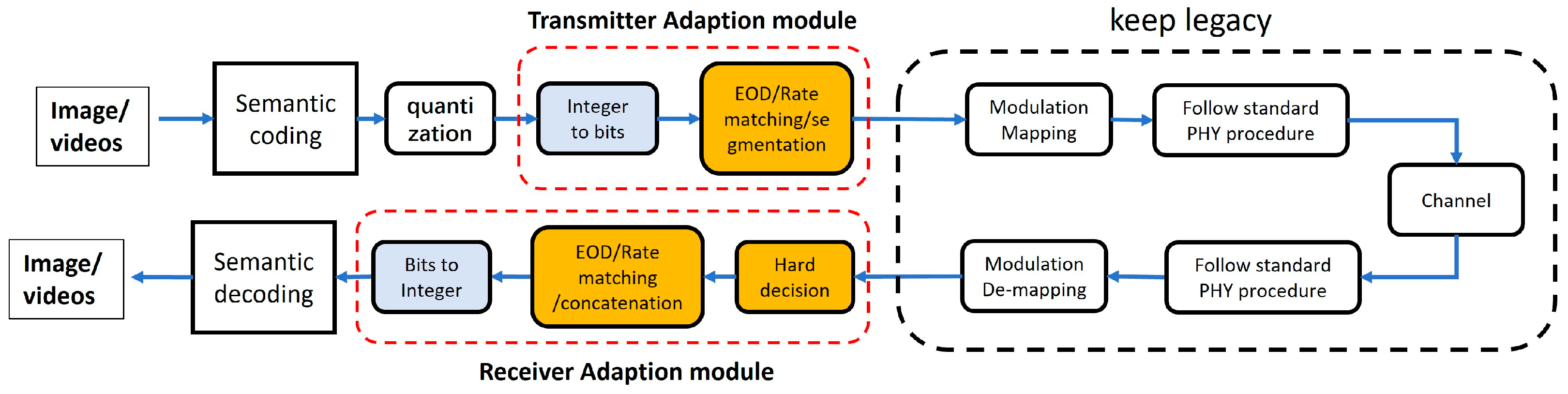
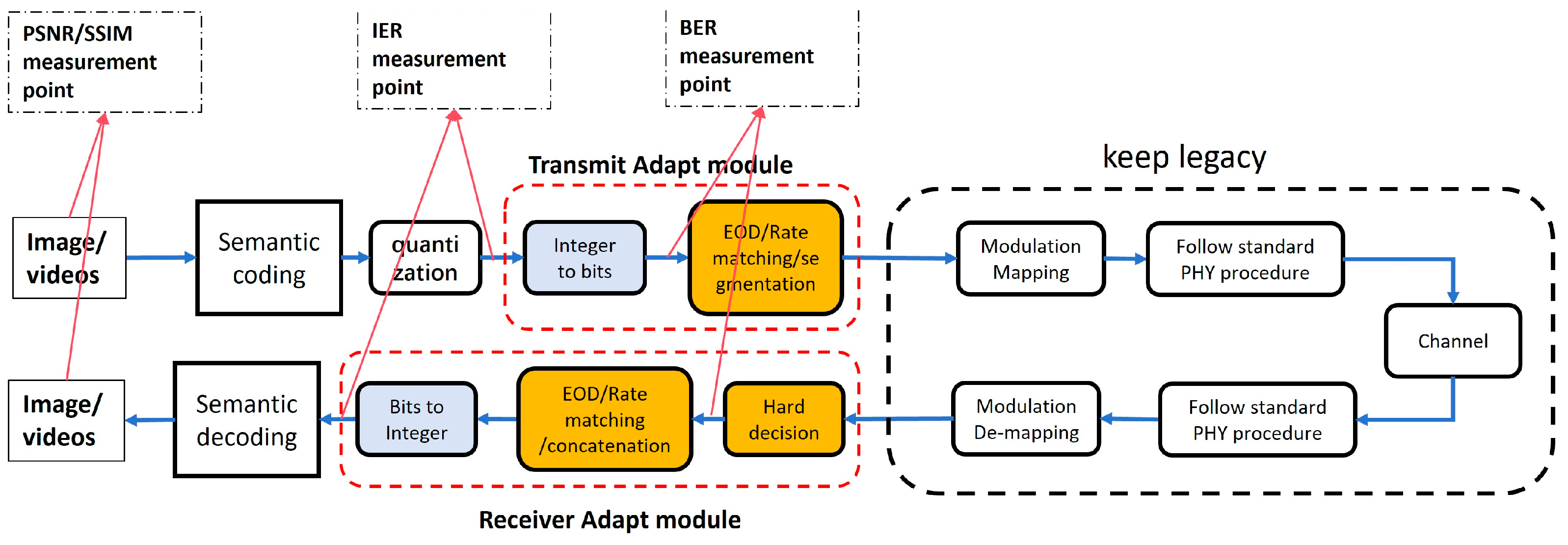
To better adapt to existing wireless communication systems, the specific physical layer procedure of bit-conversion JSCC transmission framework for semantic communication is designed. Since the JSCC approach eliminates traditional channel encoding and decoding, we need to add an adaptation module between the physical layer digital modulation interface of the existing system and the semantic encoder/decoder. This transmission framework does not require changes to the physical layer processing flow after bit mapping at the transmitter and before digital demodulation at the receiver, as the Figure 2. show below.
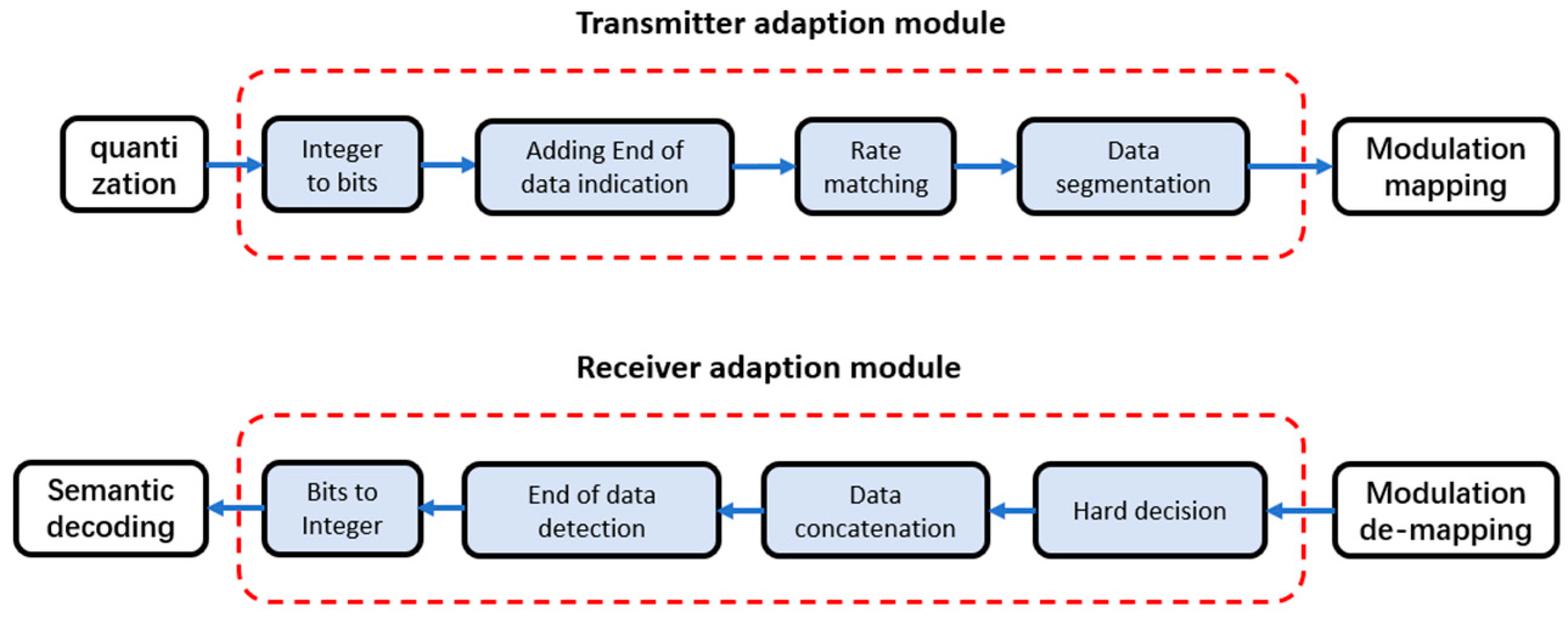
The specific process design of the adaptation module is shown in the Figure 3. The functions of the transmitter adaptation module include integer-to-bit conversion, end-of-data indication attachment, rate matching and data segmentation. The functions of the receiver adaptation module include demodulation hard decision, data concatenation, end-of-data indication detection, and bit-to-integer conversion.
Functions in transmitter adaption module:
1. Integer to bits conversion: Based on the output range of semantic encoding quantization, determine the minimum number of bits required to represent each integer. Select a specific encoding method, such as natural binary coding, binary complement coding, etc., to convert the integer to be transmitted into binary.
2. Adding end of data indication: for semantic transmission, bit error is allowed when physical layer sends the received data to semantic decoder, while the number of bits (or data) should not be change. For JSCC scheme, CRC is not required, thus a data end indication function makes the receiver identify the end of data flow. A special sequence was adopted as the end of data indication, and repeating multiple times to improve the robust.
3. Rate matching and data segmentation: rate matching and data segmentation is designed with the code rate of channel coding in the traditional system. while there is no channel coding/decoding in JSCC scheme, then the rate matching and data segmentation should be re-design to adapt the no channel coding physical layer. Here we adopt the zero-padding method to make the data fit scheduled resource.
Functions in receiver adaption module:
1. Hard decision de-mapper: since there is no channel coding/decoding, the output LLRs of de-modulation should be convert to bits with a simple algorithm. a hard decision de-mapper function is added here to convert the LLRs to bits.
2. Data concatenation: the reverse process of data segmentation in transmitter.
3. End of data detection: We employed a simple character comparison algorithm here to identify the special sequence adopted in transmitter.
4. Bits to integer conversion: convert the bits to integer with the same binary coding employed in transmitter.
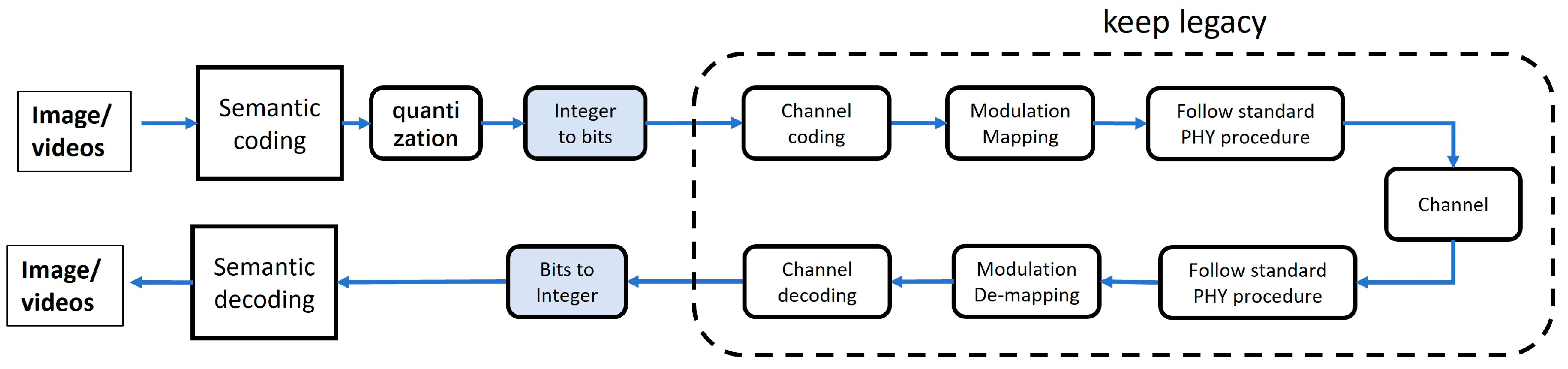
Comparing this framework with the SSCC transmission framework as shown in Figure 4. which has no impact to the existing system. It can be observed that this framework involves minimal modifications to the existing system. While, since the channel coding is removed in JSCC transmission framework, the computational complexity at the physical layer physical layer of this framework is significantly reduced. And the key consideration is whether the proposed transmission framework has an advantage in transmission performance compared with the SSCC transmission framework. The simulation tools and the evaluation will be introduced at the following sections.

2.2. Simulation Planform for E2E Semantic Communication

There is a common issue in the semantic communication simulation tools. It is that, traditional simulation tools implement a complete physical layer processing but do not transmit the real payload data, random bits are used as the payload for transmission. In contrast, numerical simulations mentioned in most semantic communication papers emphasize the encoding and decoding algorithms, while the physical layer processing is relatively simplified and cannot reflect the impact of complete physical layer algorithms on semantic transmission performance.
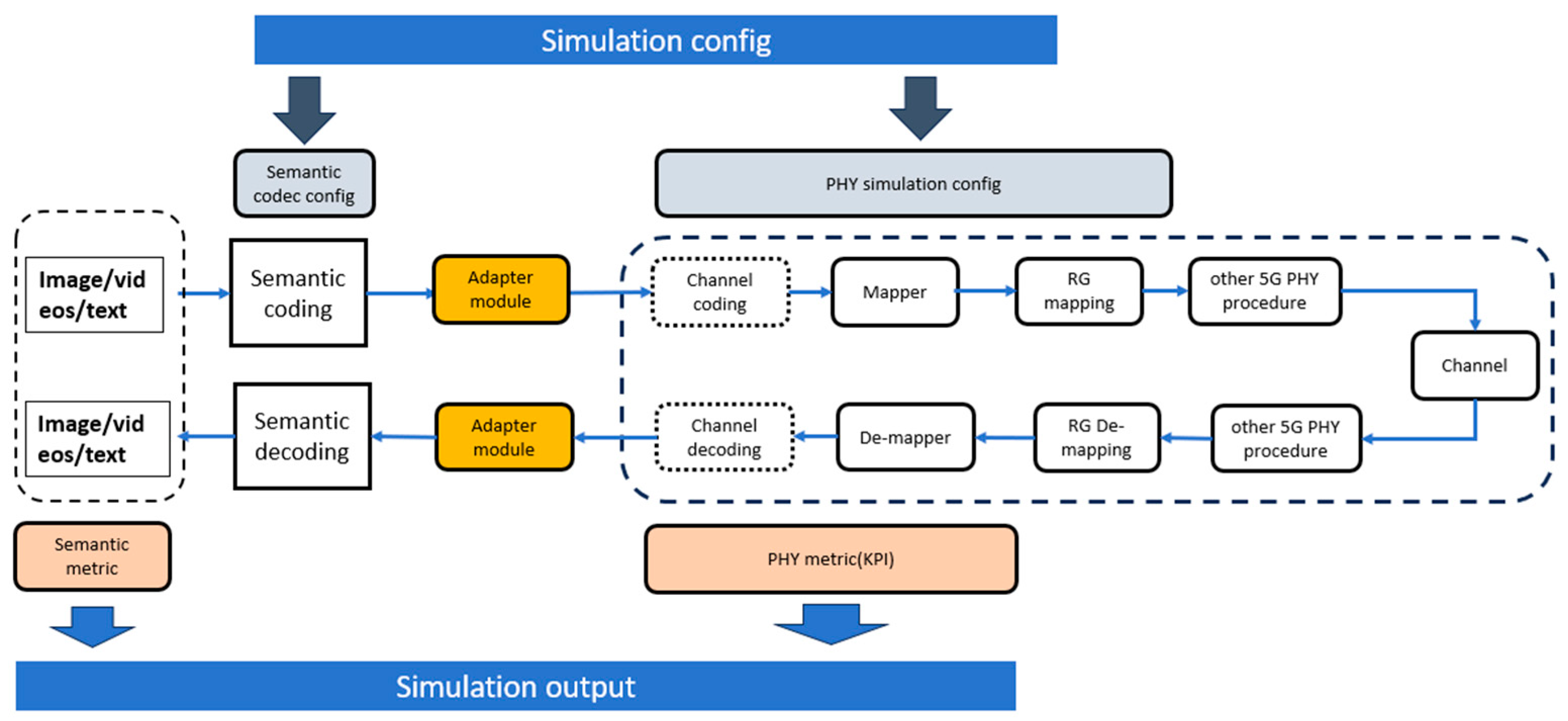
To solve this problem, based on the transmission frameworks we designed, we develop a semantic communication simulation planform. The software architecture of the simulation platform as illustrated in Figure 5. By configuration, this Simulation planform can support the semantic SSCC and JSCC transmission schemes, as well as the traditional bits transmission. And it is different from most of the traditional physical layer simulation systems or semantic communication simulation systems at present, with the adaption module, we can simulate the transmission of real payload on the physical layer, not only random bits.
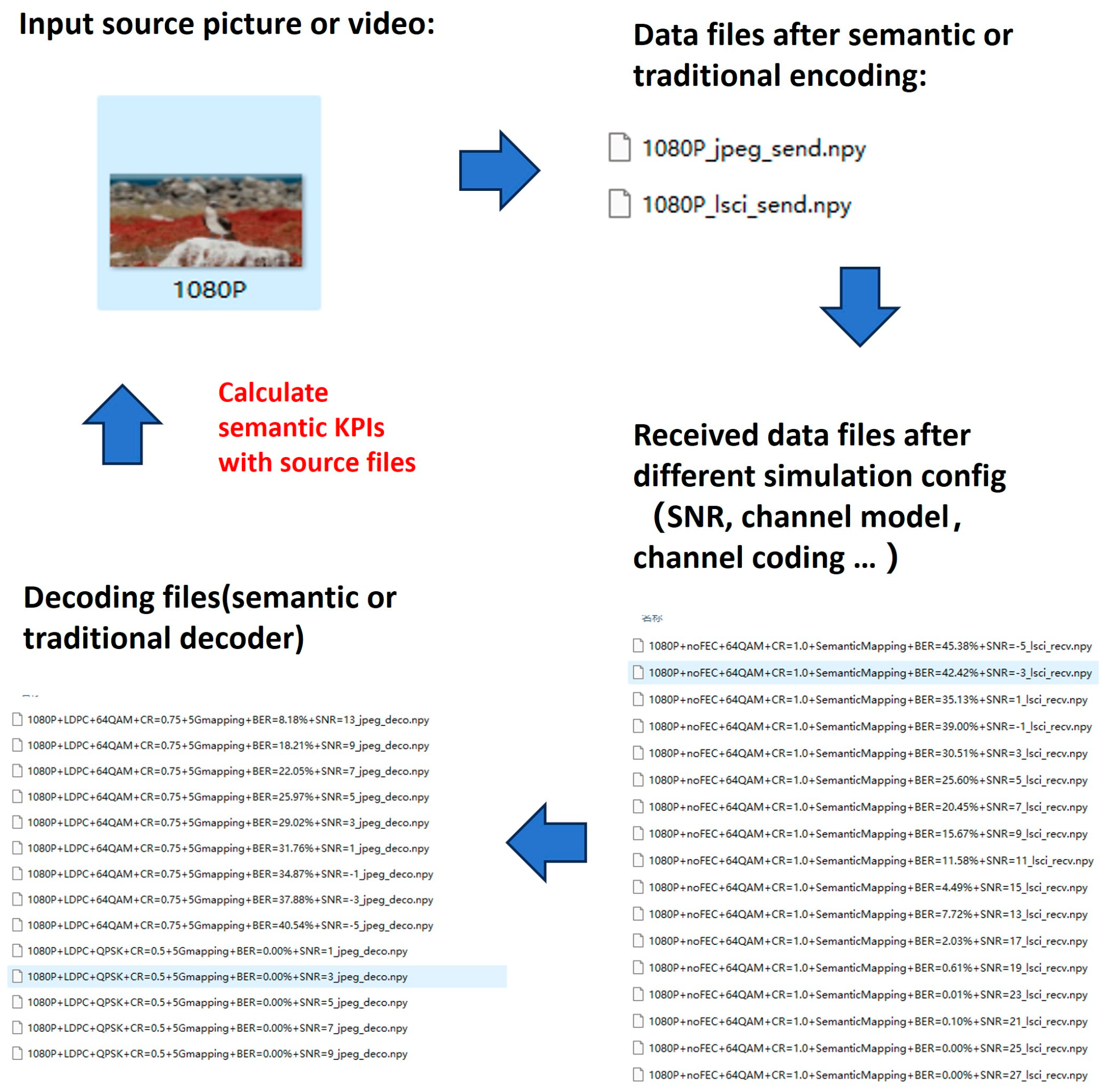
The simulation procedure is shown in Figure 6. To be specific, the input original data is processed by the semantic or source encoder firstly. After that, the encoded data proceeds to execute the remaining physical layer functions. Then differences data files can be received with customized configurations (e.g. JSCC, SSCC, modulation, … …) under changing channel conditions. Finally, the semantic decoder outputs the final result and compares with the source files to calculate the semantic key performance indicators (KPIs). Besides, the physical KPIs can also be obtained during the simulation procedure.
Take image transmission as an example, we simulate the semantic transmission with QPSK/16QAM/64QAM using both JSCC and SSCC transmission schemes in this simulation platform. For SSCC transmission scheme, 0.5 code rate LDPC is adopted. And for JSCC, there is no channel coding. Layer-based semantic communication system for images (LSCI) is chosen for the semantic coding algorithm [27].
It is observed from simulation results, as show in Figure 7 (a), (c), (d), for SSCC, when SNR is in the range that LDPC can work, there is no bit error and the PSNR and SSIM keep perfect performance as well. While below a certain SNR threshold, LDPC could not correct the bit error and there is a “cliff effect”. BER, PSNR and SSIM decrease sharply. For JSCC, since without channel coding, it exists few error bits even in good SNR range, but PSNR and SSIM perform well. BER, PSNR, and SSIM decrease smoothly when SNR decreasing, thus the PSNR of JSCC can keep acceptable in the SNR range lower than the “cliff effect” point of SSCC. At the same time, JSCC can achieve two times spectrum efficiency of SSCC with different modulation orders, as show in Figure 7(b), since there is no channel coding overhead.
Together with other papers [14,17], the results obtained from our semantic simulation platform show the same trend of semantic transmission of JSCC and SSCC. This demonstrates the accuracy of this simulation platform. Furthermore, we can leverage this simulation platform to study the impact of physical layer algorithms and semantic algorithms on the end-to-end semantic communication system.

3. IER—A Novel Physical-Layer Semantic Metric

For the traditional wireless system, BER (bits error rate) is a basic physical layer metric to measure the reliability of the E2E communication link. One of main principle for designing communication systems is to reduce BER metric as low as possible from 1G to 5G. However, BER is not suitable to measure the quality of the physical-layer semantic communication because semantic communication is not anticipated to recover information without error in bit level. Thus, a new semantic metric should be defined and focus on the preservation of the semantics in the regenerated content. In this chapter we will try to define a novel loss function to measure the semantic transmission quality and verify this novel loss function with our simulation planform.

3.1. Definition of IER (Integer Error Rate)

First of all, we should consider how to define the error distance between the sending/received message for the semantic codec. As illustrate in Figure 8, assume that sending message is the sequence S, and received message is sequence R. then the error distance between the sending/received message for the semantic codec can define as the distance between two sequences S and R. In mathematics, there are many ways to define the distance between two sequences, e.g. Euclidean Distance,Manhattan Distance,Hamming distance… etc. Hamming distance is the commonly adopted metric in the current communication system, while it is not the best one for semantic communication. We are going to analysis this following.
  • Hamming distance and BER (bit error rate)
In most of the digital wireless system, binary coding is used. And for binary coding, hamming distance is the commonly used metric to define the error distance between transmitted/received messages. Assume that the transmitted message S = [1,0,0, 1,1,0, 0,0,0, 0,1,1] and the received message R = [0,0,0, 1,0,0, 0,0,0, 1,1,1]. In this case, the Hamming distance is three which is the number of the different bits between S and R. And BER can be also define as the ratio of Hamming distance and the total length of the transmitted message as equation (1), where Len(S) is the total length of the transmitted message.
B E R = H a m m i n g   D i s t a n c e   ( S ,   R )   /   L e n ( S )
  • Manhattan distance and IER (Integer Error Rate)
While for non-binary coding, hamming distance is not suitable to define the error distance. Here we suggest adopt the Manhattan distance [28] to measure the error distance between the transmitted/received messages. The Manhattan distance is defined as below.
Let x = ( x 1 , x 2 , , x n ) and y = ( y 1 , y 2 , , y n ) be integer-valued vector at the transmitter and receiver, respectively, x i , y i ϵ 0 , 1 , , q 1 , i = 1,2 , n . Then the distance function is defined by
d M x , y = i = 1 n x i y i
Based on the Manhattan distance, we can define a new metric IER in physical layers to measure the semantic transmission quality. The IER define as equation (3). where x is the transmitted message; y is the received message. Let x = ( x 1   ,   x 2 ,     ,     x n     ) and y = ( y 1   ,   y 2 ,     ,     y n     ) be integer-valued vectors, x i ,   y i   ϵ   0 ,   1 ,   ,   q 1 ,   i = 1,2 ,   n .  
I E R = d M x , y l e n x × q = i = 1 n x i y i n q

3.2. Relation Between BER and IER

Two received message with the same BER may result in different IERs. For example, as table1 illustrated below. From the BER perspective, received message R1 and R2 with the same quality. While from the IER perspective, the received message R1 is better than R2. Even for some special case, e.g. R3 is better than R1 in BER, while it is worse than R1 in terms of IER.
Table 1. compare BER and IER.
Message
Vector
integer-
valued
Manhattan distance to vector S Nature binary coding Hamming distance to vector S BER IER
S [1, 2, 5, 7] 0 [001, 010, 101, 111] 0 0% 0%
R1 [0, 3, 5, 6] 3 [000, 011, 101, 110] 3 25% 9%
R2 [5, 2, 1, 3] 12 [101, 010, 001, 011] 3 25% 37%
R3 [5, 6, 5, 7] 8 [101, 110, 101, 111] 2 16% 13%
Since the final input and output data for the semantic codec is the integer-value, not bits. Intuitively, IER is the better error distance function than BER for semantic transmission, and we can verify this assume with the simulation platform.

3.3. Relation Between IER BER and Semantic Metric

In order to verify the relation between IER, BER and semantic communication metric, we design a test case as below. We choice the bit-conversion JSCC transmission scheme we proposed in chapter2. And the measurement points of BER, IER and PSNR at the simulation link as the Figure 9 illustrated below.
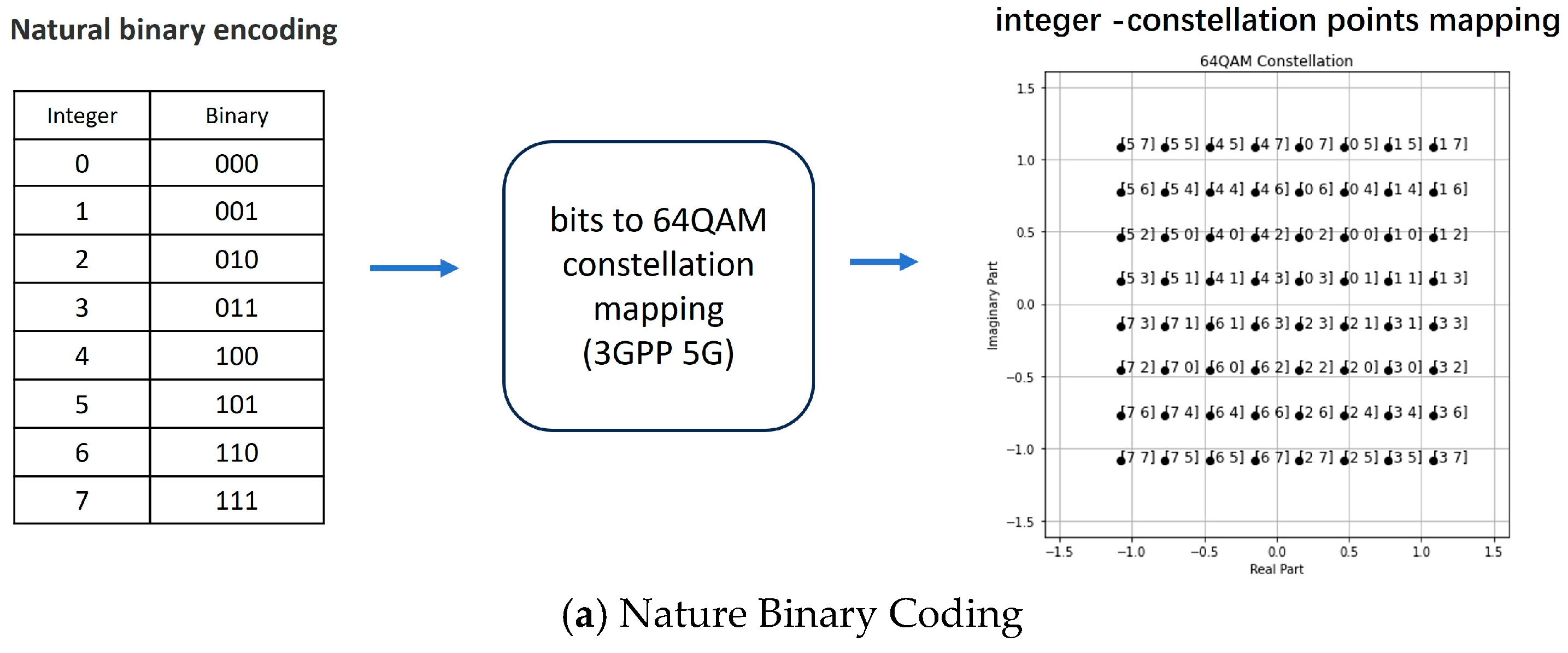
In this simulation link if we keep the bits to constellation point mapping unchanged (the Mapper and De-mapper module) and employ the 3GPP 5G bits-constellation points mapping scheme [29], Then different integers-to-bits conversion coding results in different integer-constellation points mapping. Obviously, different integers-to-bits conversion coding will impact the received data directly. We choose two different integer-to-bits conversion codecs, one is the natural binary coding as Figure 10 (a). Another is the Manhattan distance binary coding as Figure 10 (b), which is designed to make the Manhattan distance of neighbor constellation points is the smallest. We will introduce this constellation mapping scheme more detail in Section 4.
The simulation configuration as Table 2 below. In order to evaluate the relation between IER BER and semantic metric, two identical configurations are employed, except for the different integers-to-bits conversion coding. The transmission Framework are both Bit-conversion JSCC which is described in Section 2.1. The Quantization output range is [0-7], which is to adopt the 64QAM modulation for the Manhattan distance binary coding. And channel equalization is LMMSE for both cases, to eliminate the impact of different channel types. In a simple way, we choose image as the source file, then we can compare the simulation results of these two test cases to analyze the relation between BER, IER and PSNR, SSIM. And for the semantic codec, LSCI is chosen for the semantic coding algorithm, which can be used for image and video semantic communication.
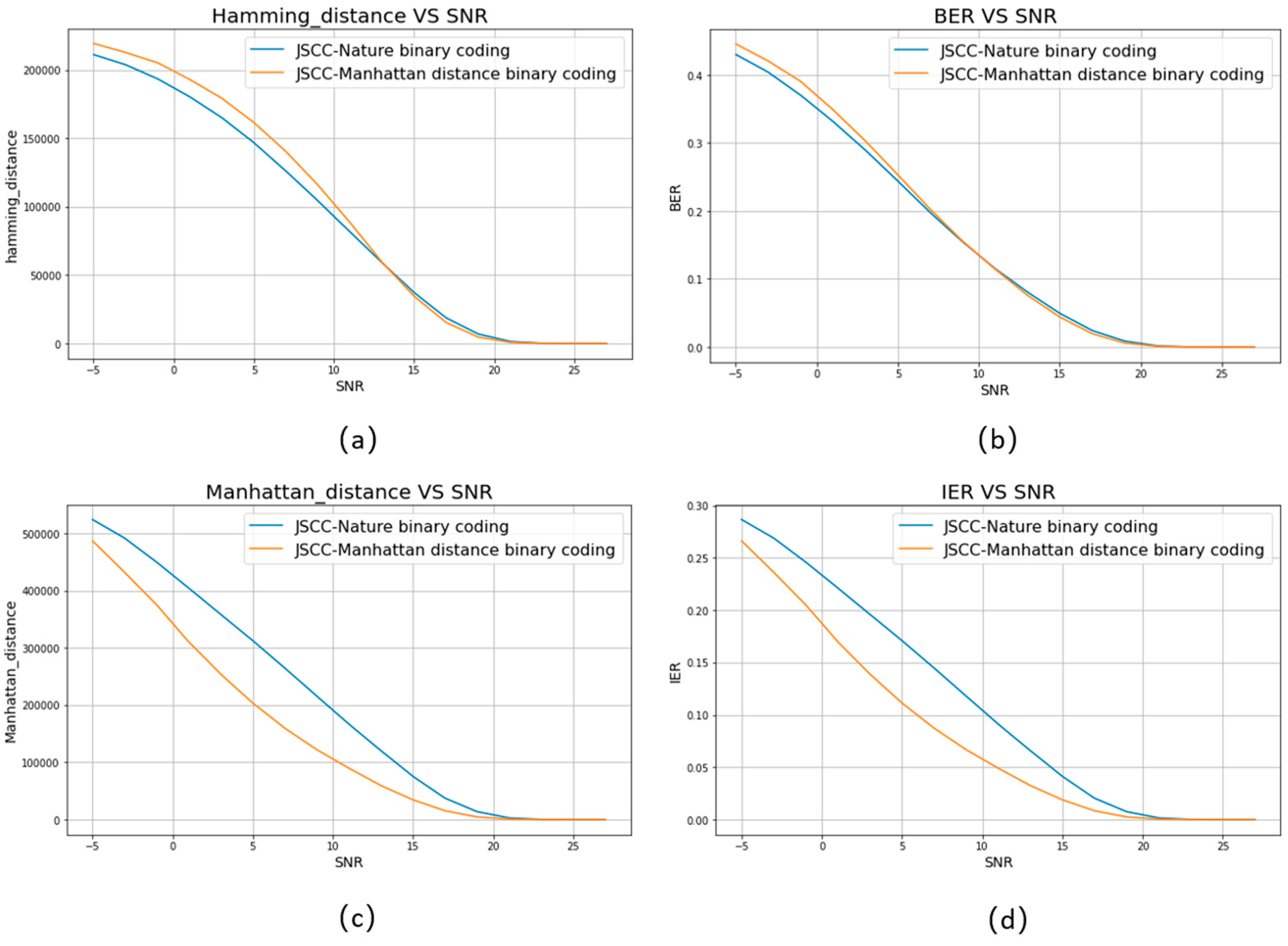
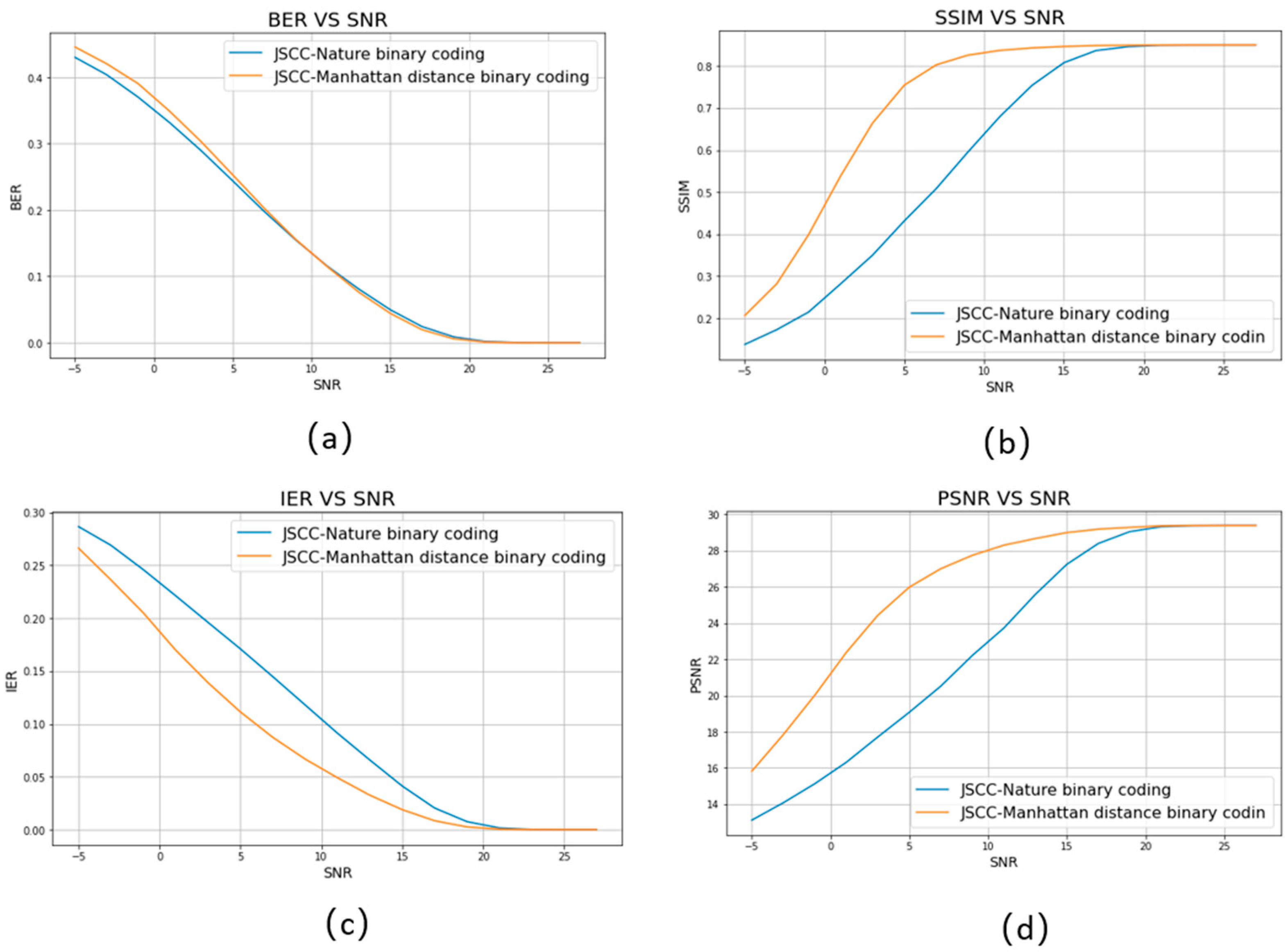
The physical layer metrics simulation results as shown in Figure 11 below. It is observed that, since the physical layer procedure is the same for two test cases, the hamming distance and BER is almost the same for two test cases. It can be observer that BER is start to increase when SNR lower than 20 for both cases, which is consistent with the traditional communication performance since both cases utilized 64QAM and without channel coding.
While measured with Manhattan distance and IER, the case utilizing Manhattan distance binary coding got a better IER when SNR lower than 20. In addition, comparing natural binary coding and Manhattan distance binary coding in the perspective of semantic metrics, Manhattan distance binary coding can achieve a better PSNR and SSIM at the same BER condition. According to the BER, IER and PSNR, SSIM curves shown in Figure 12, It is observed that, IER is more relative to the semantics metric than BER. It is validated that IER is a better evaluation metric than BER for E2E semantic communication, especially in image semantic transmission scenario.

4. Optimization for the Bit Conversion JSCC Scheme

4.1. Minimum Manhattan Distance Constellation Mapping Scheme

Based on the simulation in section 3.3, it can be observed that different integers-to-bits conversion coding will impact the received data directly. The key factor of this phenomenon is the numerical difference of the integers mapped onto adjacent constellation points. In existing wireless systems, error correction is based on bit-level and channel coding. Therefore, the bits mapped onto adjacent constellation points are based on Gray- code mapping, meaning that adjacent constellation points differ by only one bit. However, in JSCC, the channel coding is removed, and the received symbols will be directly converted to the mapped integers and then sent to the JSCC decoder. Thus, the principle of JSCC constellation mapping scheme design should be changed to the numerical difference of integers mapped onto adjacent constellation points instead of bits differ.
According to this JSCC constellation mapping scheme design principle, the minimum Manhattan distance constellation mapping scheme of m-QAM modulation is proposed. And the algorithm to generate the binary encoding table of this constellation mapping scheme for compatible with current system, called Manhattan distance binary coding, is described.
For regular m-QAM modulation, we design a minimum Manhattan distance constellation mapper. This mapper mapping the integer number pair to the constellation point according to the formula (4).
M p , q , K m o d , Q m = K m o d × { 2 p Q m + 1 + j 2 q Q m + 1 }      
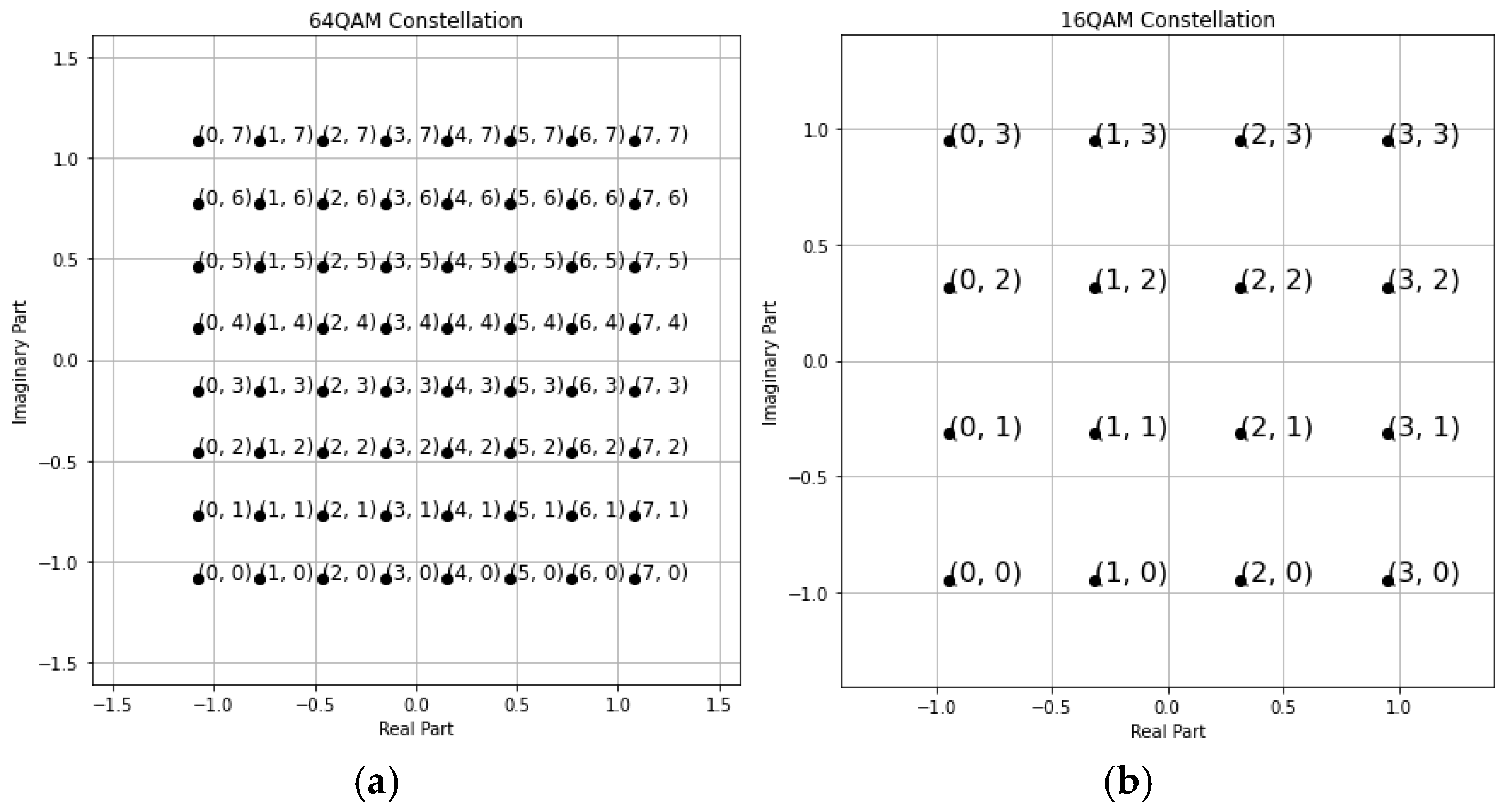
Here Q m is the modulation order, and K m o d is the normalization parameter of the adopt system for different m-QAM. Function M ( p , q , K m o d , Q m ) takes p , q ,the non-negative integer in range [ 0 , Q m + 1 ], as input and produces complex-valued modulation symbols as output. For example, in case of 5G-64QAM,5G-16QAM modulation, the integer constellation mapping scheme generate by this formula as the picture Figure 13 below.
Then for compatible with the adopt system, a binary coding should be introduced. We design an Algorithm for Manhattan distance binary coding generation as the Table 3 below.
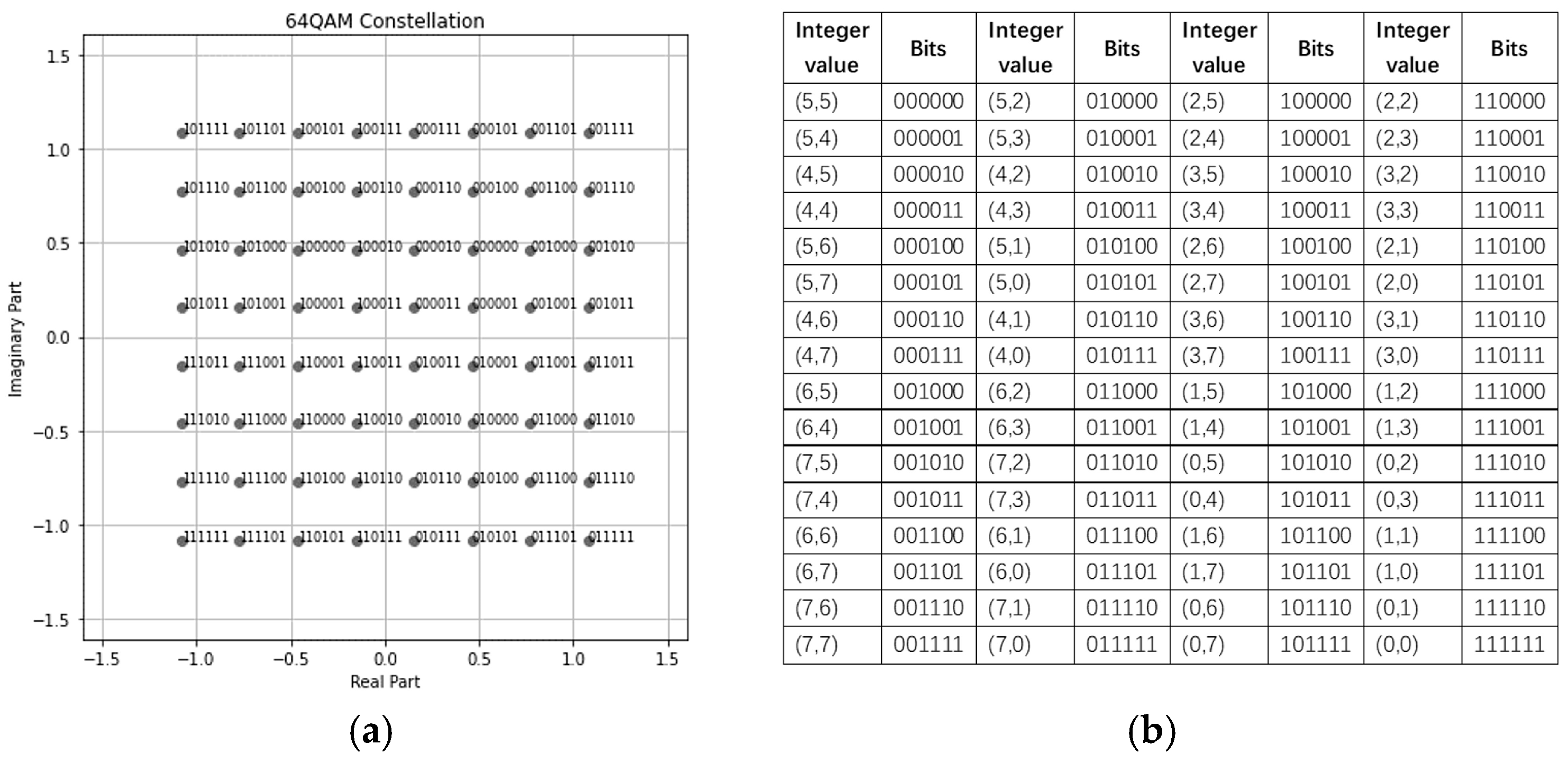
The input of this algorithm beside the m-QAM Integer constellation mapper, is the modulation order Q m   and the responded m-QAM bit constellation mapping scheme d ( i ) of the adopt system. The modulation mapper d ( i ) takes binary digits as input and produces complex-valued modulation symbols as output. For example, in case of 5G-64QAM modulation, hextuplets of bits, b ( 6 i ) , b ( 6 i + 1 ) , b ( 6 i + 2 ) , b ( 6 i + 3 ) , b ( 6 i + 4 ) , b ( 6 i + 5 ) , are mapped to complex-valued modulation symbols d ( i ) according to the formula (5) [29]. Here b(x) is the Gary Code, x is the non-negative integer in range [ 0 , Q m 2 1 ]. The constellation mapping scheme generate by formula (5) as the Figure 14 (a).
d i = 1 42 ( 1 2 b 6 i 4 ( 1 2 b 6 i + 2 2 2 b b i + 4 + j ( 1 2 b 6 i + 1 ) 4 ( 1 2 b 6 i + 3 2 2 b b i + 5
Then follow the data process in algorithm, determine the K m o d   according to Q m , mapping the integer number pairs ( p , q ) with the bits that at the same constellation points, the binary coding table can be generated. For example, in case of 5G-64QAM modulation, this algorithm can generate the Manhattan distance binary coding table as Figure 14 (b).
To evaluate the enhancement of this proposed scheme on the performance of semantic communication, the semantic metric and the physical-layer metric introduced in Section III are simulated with the following three schemes: SSCC-natural binary coding, JSCC-natural binary coding, and JSCC-Manhattan distance binary coding. These three schemes all transmit with 64QAM, and SSCC-natural binary coding scheme with 0.5 code rate LDPC channel coding. And all three schemes retain the channel estimation and equalization of 3GPP 5G physical layers to eliminate the impact of different channel types. Simulation configurations are listed below:
Table 4. simulation configurations for evaluation the proposed scheme.
Test case JSCC-Nature binary coding JSCC-Manhattan
distance binary coding
SSCC-Nature binary coding
Semantic transmission Framework: Bit-conversion JSCC Bit-conversion
JSCC
Bit-conversion SSCC
Source file image image image
Semantic codec: LSCI LSCI LSCI
Quantization range: [0-7] [0-7] [0-7]
Data to binary
Codec:
Nature binary coding Manhattan distance
binary coding
Nature binary coding
Channel coding NO NO LDPC CR=0.5
Bits constellation
Mapping:
3GPP 5G 3GPP 5G 3GPP 5G
Modulation: 64QAM 64QAM 64QAM
Simulation SNR range [-5 ~30] [-5 ~30] [-5 ~30]
Channel model AWGN AWGN AWGN
channel equalization LMMSE LMMSE LMMSE
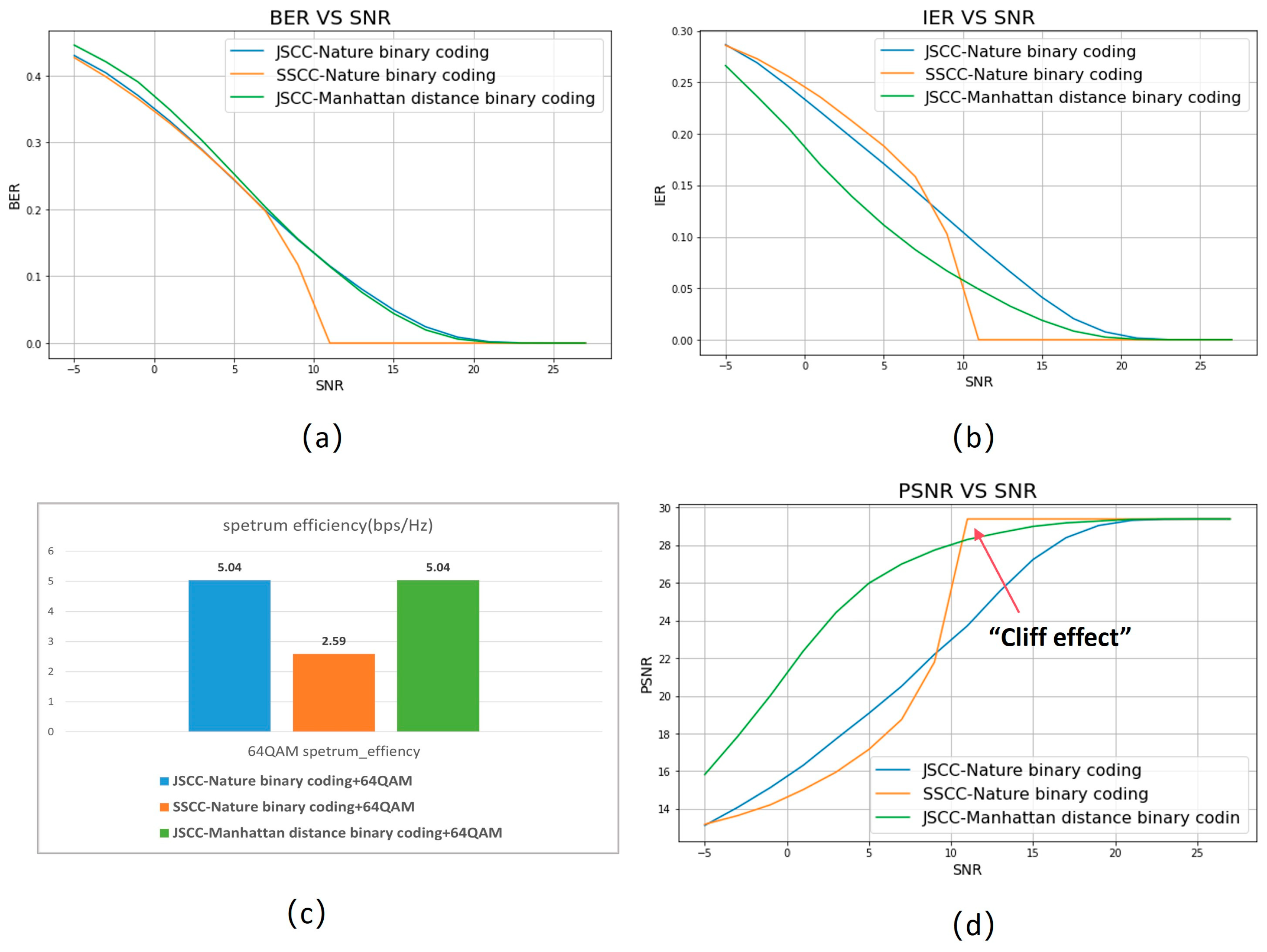
The simulation results are shown in Figure 15. At Figure 15(a), it can be observed that the SSCC-natural binary coding scheme has the best performance in terms of BER. The BER of both JSCC cases start to increase when SNR lower than 20, while the SSCC cases keep no bit error until SNR lower than 11, which is consistent with the traditional communication performance since the SSCC with a LDPC channel coding. Besides, the JSCC-natural binary coding and JSCC-Manhattan distance binary coding achieve the same BER. However, At Figure 15(b), the JSCC -Manhattan distance binary coding scheme is superior IER performance to the JSCC-natural binary coding scheme. Moreover, At Figure 15(c), The JSCC-Manhattan distance binary coding scheme also significantly outperforms the SSCC-natural binary coding scheme within the SNR range of [5,6,7,8,9,10]. In terms of semantic performance metrics, within the SNR range of [5,6,7,8,9,10], the JSCC -Manhattan distance binary coding scheme is also significantly better than the other two schemes by 4-6dB. At the same time, At Figure 15(d), since the SSCC scheme adopting LDPC code with code rate of 0.5, the JSCC-Manhattan distance binary coding scheme has twice spectral efficiency of this SSCC-natural binary coding scheme.
Through the above analysis, it can be further seen that a well-designed constellation mapping can be utilized to improve the performance of semantic information transmission, and JSCC is more suitable for leveraging the advantages of semantic communication compared to SSCC. However, this minimum Manhattan distance constellation mapping scheme has a limitation: the quantization output range of semantic encoding has to be bounded to the modulation order. In other words, a lower-order modulation is required when the SNR decreases. Meanwhile, the output range of semantic quantization must also be correspondingly reduced. To address this issue, based on the minimum Manhattan distance constellation mapping scheme, we further propose a hybrid transmission scheme of JSCC and SSCC.

4.2. Hybrid JSCC/SSCC Transmission Scheme

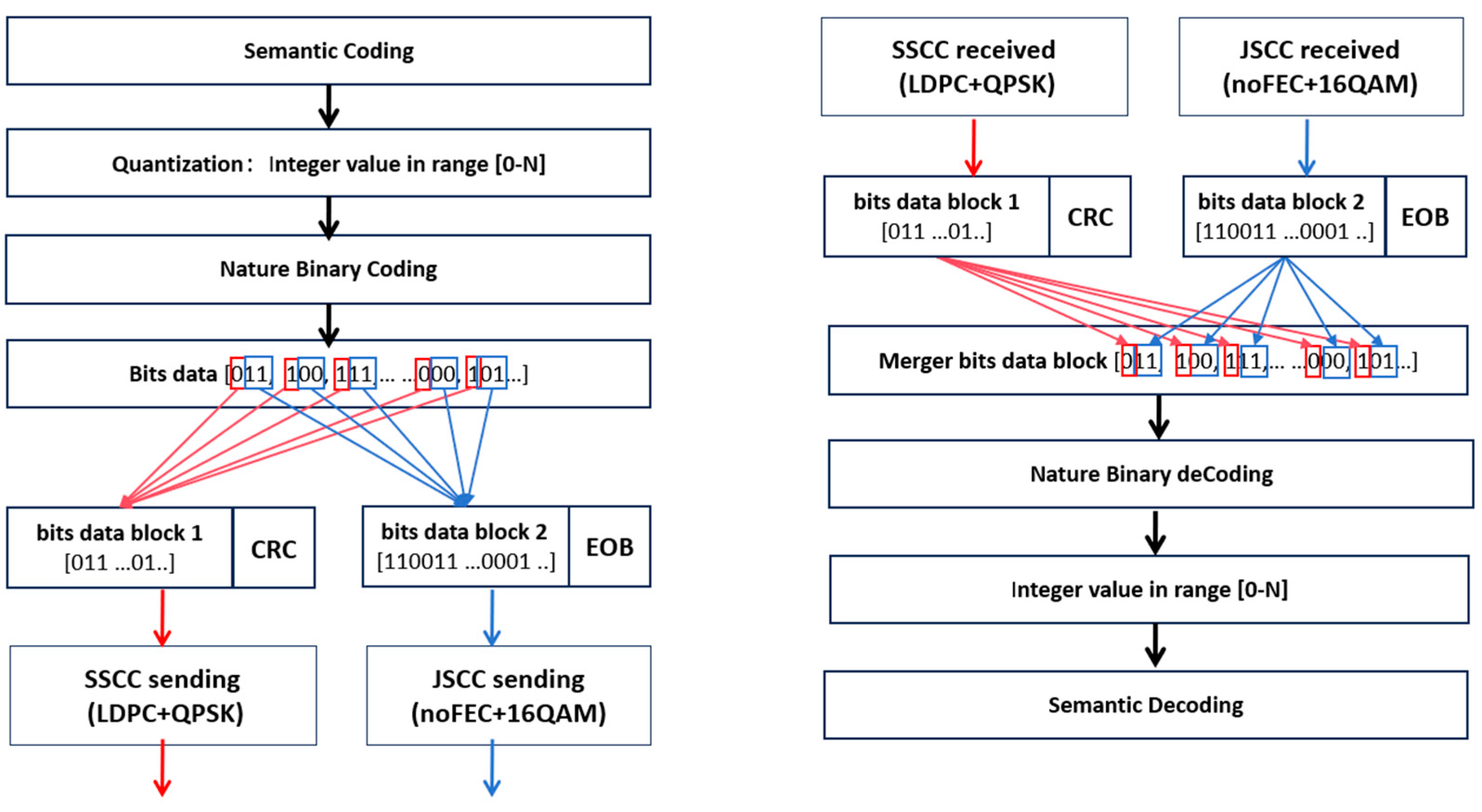
In this chapter, a hybrid JSCC/SSCC transmission scheme for semantic communication is proposal. The principle of the hybrid scheme is that, at the transmitter, the quantized data after semantic encoding is converted into bits, and each integer corresponded bit data is divided into two parts for transmission. The "high-order bits" part is transmitted with a lower-order modulation concatenated channel coding to ensure transmission reliability, for which the SSCC-natural binary coding scheme can be adopted. The "low-order bits" part can be transmitted using the JSCC-Manhattan distance binary coding scheme. The splitting position between the “high-order and lower-order” bits can be adjusted according to the value range of the quantized output and the modulation order, thus solving the limitation that the range of semantic quantization output must be bound to the modulation. At the receiver, the received bit data is combined and then converted back into integer data, which is sent to the upper layer of the receiver for semantic decoding. The specific data processing flow for transmission and reception is shown in Figure 16.
The data procedure step is described as below. It is assumed that the output integer data range of semantic coding and quantization is [0-7].
  • At transmitter:
Step1: convert the integer data into binary with nature binary coding
Step2: split the bit data blocks into two blocks. the first bit of each 3bits is put into “part one” block, and the last 2bits are put into “part two” block.
Step3: transmit “part one” block with SSCC scheme (QPSK and 0.5 code rate LDPC coding). transmit “part two” block with JSCC-Manhattan distance constellation mapping scheme (16QAM and no channel coding)
  • At receiver:
Step1: received the two bits data blocks and merge it back to a whole bit data block.
Step2: convert the received bit data into integer value with nature binary coding.
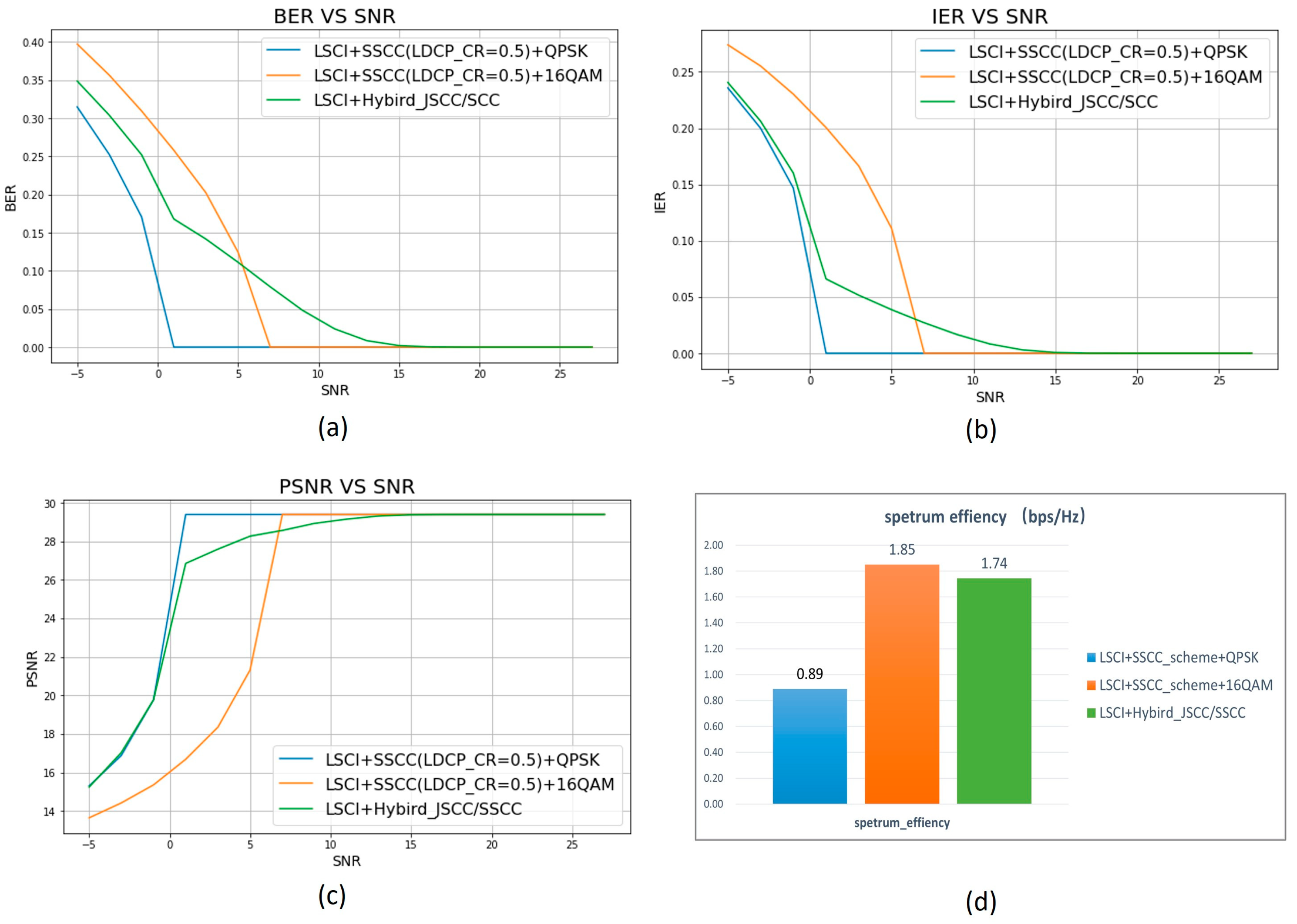
This hybrid JSCC/SSCC transmission scheme can fix the problem that, quantization output range of semantic encoding has to be bounded to the modulation order if we want to adopt the dedicated integer constellation mapping scheme. take an example, assume the quantized output of the semantic encoding is [0-7], if we adopt the JSCC Manhattan distance binary coding scheme for transmission, we could only use 64QAM modulation rather than QPSK or 16QAM. While adopt the hybrid JSCC/SSCC transmission scheme, then a lower-order modulation can be used. In order to evaluate the performance of this hybrid JSCC/SSCC transmission scheme, the bit-conversion SSCC and bit-conversion JSCC transmission schemes are simulated respectively as baseline. In this simulation, the previous LSCI semantic encoding is adopted for image transmission, quantized output of the semantic encoding is [0-7], Detail configuration of the simulation as below:
  • Simulation verification-1:
Hybrid JSCC-SSCC transmission scheme Comparing with bit-conversion SSCC scheme, the simulation configuration as Table 5.
The simulation result is show in Figure 17. It can be observed that, BER of the hybrid JSCC/SSCC transmission scheme is better than the SSCC 16qam, worse than the SSCC-QPSK. this is consistent with the traditional communication performance, since the hybrid JSCC/SCC transmission scheme employs a portion of QPSK. While in terms of IER, the hybrid JSCC/SSCC transmission scheme shows a significant improvement, approaching the performance of SSCC-QPSK scheme. Finally, the PSNR of the hybrid JSCC/SSCC transmission scheme is essentially close to that of SSCC-QPSK scheme. At the same time, the JSCC/SSCC hybrid transmission scheme is approximately twice spectrum efficiency that of the SSCC-QPSK scheme and comparable to the SSCC-16QAM scheme as show in Figure 17 (d).
  • Simulation verification-2:
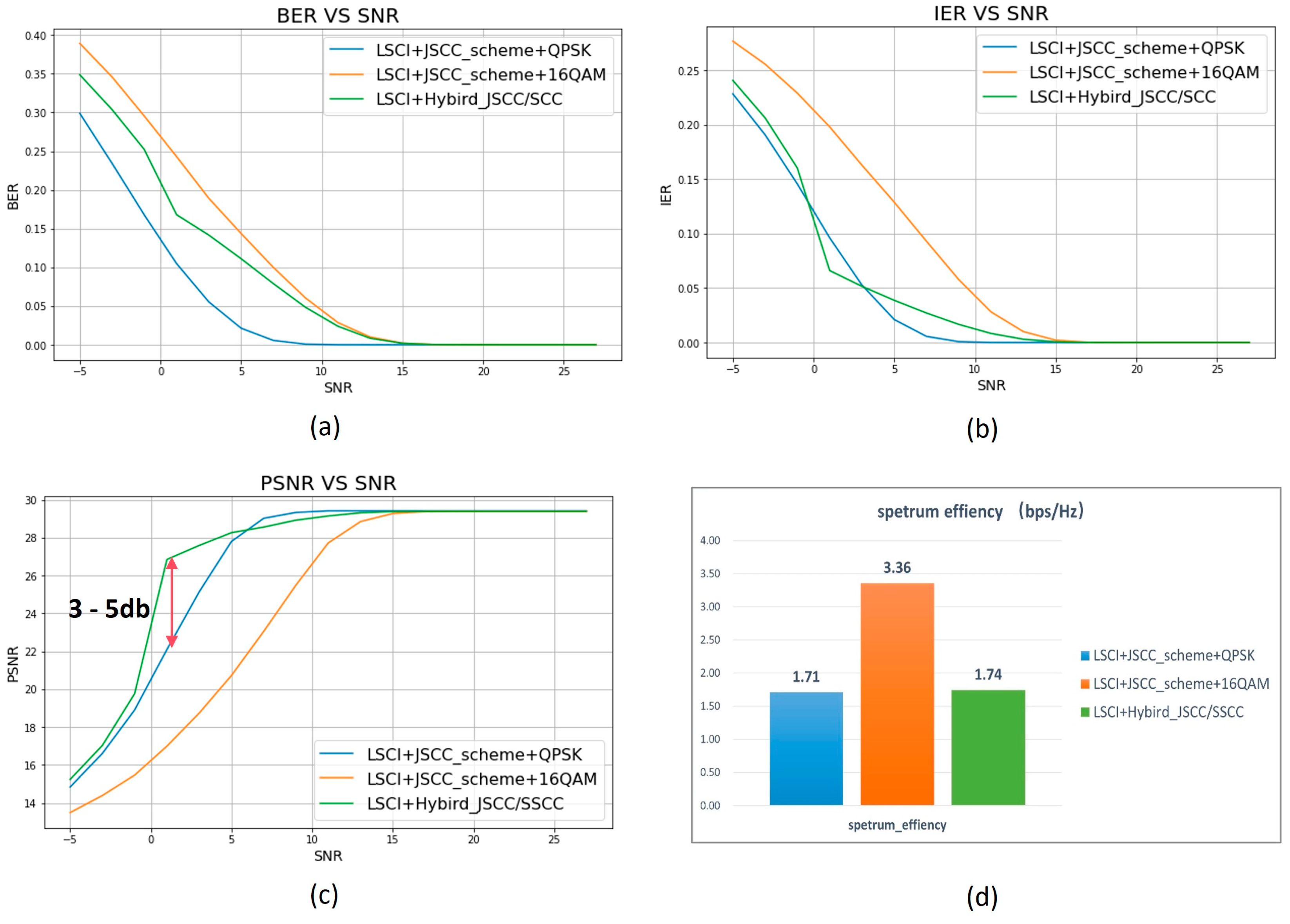
Hybrid JSCC-SSCC transmission scheme Comparing with bit-conversion JSCC scheme, the simulation configuration as Table 6.
The simulation result is show in Figure 18. It can be observed that, the BER of the hybrid JSCC/SSCC transmission scheme is better than the JSCC 16qam, worse than the JSCC-QPSK. While in terms of IER metrics, the hybrid JSCC/SSCC transmission scheme has a great improvement and performs better than the JSCC-QPSK scheme. Finally, the hybrid JSCC/SSCC transmission scheme outperforms the JSCC-QPSK scheme in terms of PSNR, with a performance gain of 3-5 dB in the SNR range of [0-5], as show in Figure 18 (c). At same time, the hybrid JSCC/SSCC transmission scheme has the same spectrum efficiency as the JSCC-QPSK scheme, as show in Figure 18 (d).
Based on the simulation above, it is evident that the hybrid JSCC/SSCC transmission scheme can resolve the issue that quantization output range of semantic encoding has to be bound to the modulation order. Additionally, within the SNR range of [0-5], the semantic transmission performance is comparable to the SSCC-QPSK scheme, the spectrum efficiency of this hybrid JSCC/SSCC scheme is twice that of the SSCC-QPSK scheme. It still maintains the advantage of the JSCC scheme in terms of bandwidth conservation. It indicates that this hybrid JSCC/SSCC scheme has specific application scenarios, especially for semantic imaging transmission in lower SNR scenario.

5. Conclusions

To address the issue how the semantic information can be compatible with existing wireless communication systems, we design a bit-conversion-based JSCC transmission framework and develop the specific physical-layer procedures. After that, we develop a semantic communication simulation platform. Based on the bit-conversion-based JSCC transmission framework, we propose a new physical layer semantic metric, IER. Simulations reveal that IER is more suitable than BER as a physical layer metric for evaluating the transmission quality of semantic communication, especially for semantic image transmission. Regarding IER, we optimize the bit-conversion-based JSCC transmission framework. we propose a minimum Manhattan distance constellation mapping scheme for semantic communication. Simulation results indicate that, this scheme could enhance IER without compromising BER, thereby improving the transmission quality of semantic communication. Furthermore, to address the issue about coupling requirement between the quantization output range of semantic encoding and modulation order in the minimum Manhattan distance constellation mapping scheme, we propose a hybrid JSCC/SSCC transmission scheme. This scheme further decouples semantic quantization output from modulation method by segmenting the bits for transmission, providing a framework for separate optimization of semantic quantization output and transmission modulation order. Simulations demonstrate that this scheme could enhance the transmission quality of semantic communication in low SNR scenarios while saving much bandwidth and illustrating the feasibility of the bit-conversion-based JSCC transmission framework for evolution within existing wireless communication systems.
For future research directions, it is expected to investigate whether the IER has a significant correlation with all semantic encoding algorithms. Additionally, performance enhancement of the bit-conversion-based JSCC transmission framework can be a subject of ongoing research efforts.

Author Contributions

Formal analysis, Cheng Guo; Investigation, Binhong Huang; Methodology, Binhong Huang and Hao Chen; Software, Binhong Huang; Supervision, Nan Ma and Ping Zhang; Writing – original draft, Binhong Huang; Writing – review & editing, Hao Chen, Cheng Guo and Xiaodong Xu.

Funding

This work was supported by National Science and Technology Major Project - Mobile Information Networks under Grant No.2024ZD1300700

Acknowledgments

We acknowledge the equal contribution of all the authors.

Conflicts of Interest

The authors declare no conflict of interest.

References

  1. Ping Zhang, Wenjun Xu, Hui Gao, Kai Niu, Xiaodong Xu, Xiaoqi Qin, Caixia Yuan, Zhijin Qin, Haitao Zhao, Jibo Wei, Fangwei Zhang; Toward Wisdom-Evolutionary and Primitive-Concise 6G: A New Paradigm of Semantic Communication Networks, Engineering 2021, 8, 60–73.
  2. Y. Wang, Z. Gao, D. Zheng, S. Chen, D. Gunduz, and H. V. Poor, ‘‘Transformer-empowered 6G intelligent networks: From massive MIMO processing to semantic communication,’’ IEEE Wireless Commun., early access, Nov. 23, 2022.
  3. E. Calvanese Strinati and S. Barbarossa, ‘‘6G networks: Beyond Shannon towards semantic and goal-oriented communications,’’ Comput. Netw., vol. 190, May 2021, Art. no. 107930. [CrossRef]
  4. Xuefei Zhang, Jing Gu, Xiaoxian Li, Qimei Cui, and Xiaofeng Tao, "Current Status and Prospects of Semantic Communication Research," China Basic Science: Policy and Review, April 2023.
  5. Yufei Bo, Yiheng Duan, Shuo Shao, Meixia Tao, “Joint Coding-Modulation for Digital Semantic Communications via Variational Autoencoder” IEEE Transactions on Communications.
  6. Qifan Fu, Huiqiang Xie, Zhijin Qin, Gregory Slabaugh, Xiaoming Tao, “Vector Quantized Semantic Communication System” IEEE Wireless Communications Letters, vol 12,2023.
  7. Xuewen Luo,Hsiao-Hwa Chen,Qing Guo,“Semantic Communications: Overview, Open Issues, and Future Research Directions” IEEE Wireless Communications,vol 29,2022.
  8. Z. Weng and Z. Qin, “Semantic communication systems for speech transmission,” IEEE Journal on Selected Areas in Communications, vol. 39, no. 8, pp. 2434–2444, 2021. [CrossRef]
  9. T. Han, Q. Yang, Z. Shi, S. He, and Z. Zhang, “Semantic-preserved communication system for highly efficient speech transmission,” IEEE Journal on Selected Areas in Communications, vol. 41, no. 1, pp. 245– 259, 2023. [CrossRef]
  10. H. Xie, Z. Qin, G. Y. Li, and B.-H. Juang, “Deep learning enabled semantic communication systems,” IEEE Transactions on Signal Processing, vol. 69, pp. 2663–2675, 2021. [CrossRef]
  11. Q. Zhou, R. Li, Z. Zhao, C. Peng, and H. Zhang, “Semantic communication with adaptive universal transformer,” IEEE Wireless Communications Letters, vol. 11, no. 3, pp. 453–457, 2022. [CrossRef]
  12. J. Shao, Y. Mao, and J. Zhang, “Learning task-oriented communication for edge inference: An information bottleneck approach,” IEEE Journal on Selected Areas in Communications, vol. 40, no. 1, pp. 197–211, 2022. [CrossRef]
  13. H. Xie, Z. Qin, and G. Y. Li, “Task-oriented multi-user semantic communications for VQA,” IEEE Wireless Communications Letters, vol. 11, no. 3, pp. 553–557, 2022. [CrossRef]
  14. E. Bourtsoulatze, D. B. Kurka, and D. Gündüz, “Deep joint source channel coding for wireless image transmission” IEEE Trans. Cogn. Commun. Netw., vol. 5, no. 3, pp. 567–579, Sep. 2019.
  15. D. B. Kurka and D. Gündüz, "DeepJSCC-f: Deep joint source-channel coding of images with feedback", IEEE J. Sel. Areas Inf. Theory, vol. 1, no. 1, pp. 178-193, Dec. 2020.
  16. T.-Y. Tung, D. B. Kurka, M. Jankowski, and D. Gunduz, “DeepJSCC-Q: Constellation constrained deep joint source-channel coding” IEEE Journal on Selected Areas in Information Theory, vol. 3, no. 4, pp. 720–731, 2022.
  17. Ke Yang,Sixian Wang,Jincheng Dai,Kailin Tan,Kai Niu,Ping Zhang, “WITT: A Wireless Image Transmission Transformer for Semantic Communications”, ICASSP 2023 - 2023 IEEE International Conference on Acoustics, Speech and Signal Processing (ICASSP).
  18. Keigo Matsumoto; Yoshiaki Inoue; Yuko Hara-Azumi; Kazuki Maruta; Yu Nakayama; Daisuke Hisano; “Impact of Quantization Noise on CNN-based Joint Source–Channel Coding and Modulation” 2023 IEEE 20th Consumer Communications & Networking Conference (CCNC).
  19. Amir Gholami; Sehoon Kim; Zhen Dong; Zhewei Yao; Michael W. Mahoney; Kurt Keutzer; “A Survey of Quantization Methods for Efficient Neural Network Inference”.
  20. Zhicheng Bao; Chen Dong; Xiaodong Xu; “sDAC—Semantic Digital Analog Converter for Semantic Communications”, arXiv:2405.02335v1 [cs.IT] 26 Apr 2024.
  21. Xiaoyi Liu; Haotai Liang; Zhicheng Bao; Chen Dong; Xiaodong Xu; “A Semantic Communication System for Point Cloud”, IEEE TRANSACTIONS ON VEHICULAR TECHNOLOGY, VOL. 74, NO. 1, JANUARY 2025.
  22. Gangtao Xin; Pingyi Fan; Khaled B. Letaief; Chenghui Peng; “Deep Conditional Generative Semantic Communication for Image Transmission”, WS06 IEEE ICC 2024 Workshop on Task-Oriented and Generative Communications for 6G.
  23. Sixian Wang, Jincheng Dai, Zijian Liang, Kai Niu, Zhongwei Si, Chao Dong, Xiaoqi Qin, Ping Zhang “Wireless Deep Video Semantic Transmission” IEEE Journal on Selected Areas in Communications, vol 41,2023.
  24. P. Jiang, C.-K. Wen, S. Jin, and G. Y. Li, “Wireless semantic communications for video conferencing” IEEE Journal on Selected Areas in Communications, vol. 41, no. 1, pp. 230–244, 2023.
  25. Z. Weng and Z. Qin, “Semantic communication systems for speech transmission” IEEE Journal on Selected Areas in Communications, vol. 39, no. 8, pp. 2434–2444, 2021.
  26. Keigo Matsumoto; Yoshiaki Inoue; Yuko Hara-Azumi; Kazuki Maruta; Yu Nakayama; Daisuke Hisano, “Impact of Quantization Noise on CNN-based Joint Source–Channel Coding and Modulation”, 2023 IEEE 20th Consumer Communications & Networking Conference (CCNC), 2023.
  27. Chen Dong, Haotai Liang, Xiaodong Xu, Shujun Han, Bizhu Wang, Ping Zhang, “Semantic Communication System Based on Semantic Slice Models Propagation”, IEEE Journal on Selected Areas in Communications, vol. 41, 2023. [CrossRef]
  28. Michel Deza, Michel Petitjean, Krassimir Markov (eds.) "Mathematics of Distances and Applications" held at Varna, Bulgaria, July 2-5, 2012.
  29. 3GPP TS 38.211 V16.10.0 Physical channels and modulation, chapter5.1 Modulation mapper.
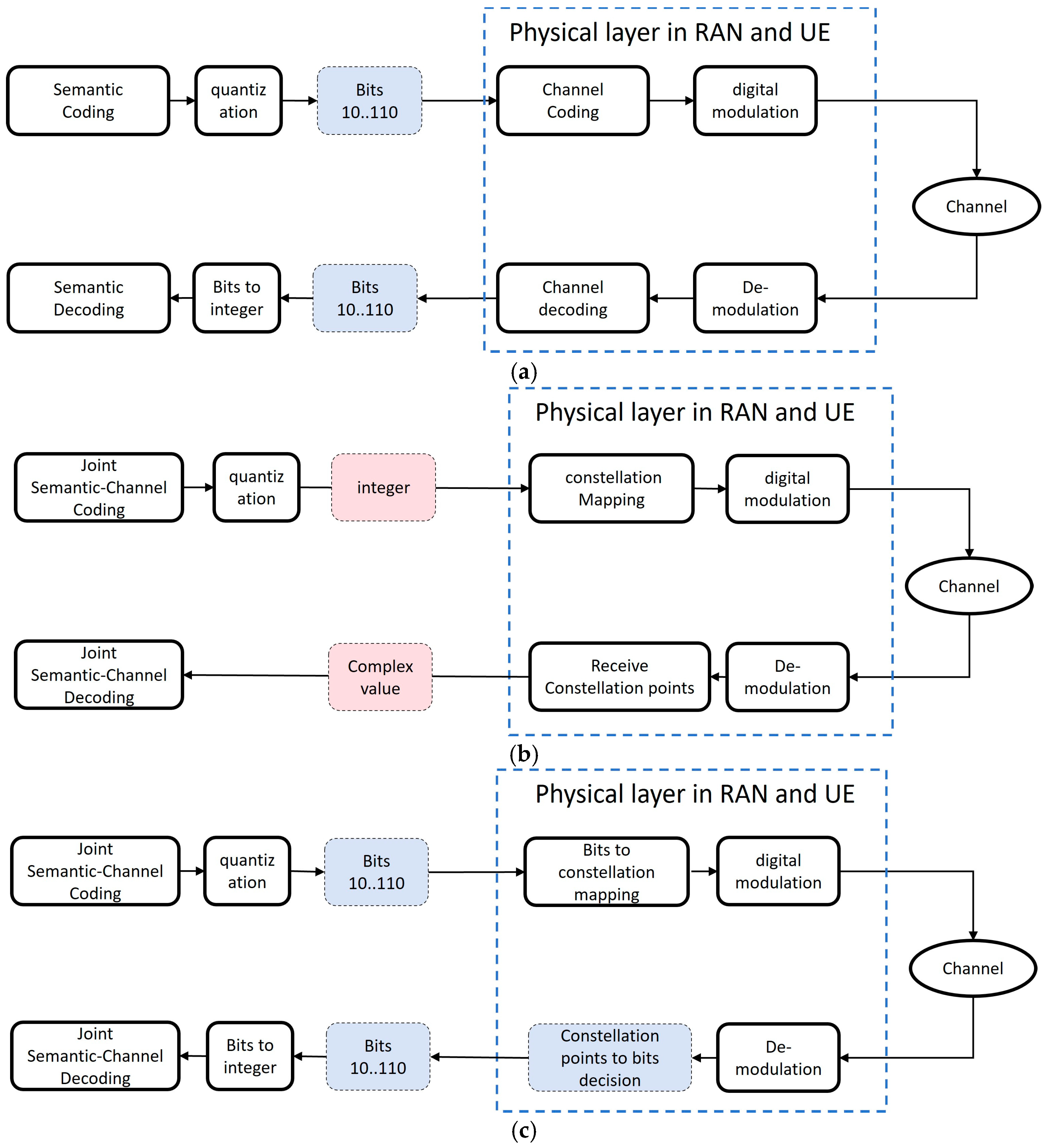
Figure 1. transmission framework of semantic communication. (a) SSCC transmission framework; (b) non-bit-conversion JSCC transmission framework; (c) bit-conversion-based JSCC transmission framework.
Preprints 149901 g001
Figure 2. E2E procedure for bit-conversion-based JSCC transmission framework.
Preprints 149901 g002
Figure 3. Adaption module detail design.
Preprints 149901 g003
Figure 4. E2E procedure for bit-conversion-based SSCC transmission framework.
Preprints 149901 g004
Figure 5. software architecture of the simulation platform.
Preprints 149901 g005
Figure 6. Semantic signal processing flow of simulation platform.
Preprints 149901 g006
Figure 7. semantic JSCC VS SSCC simulation result. (a) BER vs SNR; (b)spectrum efficiency (bps/Hz); (c) PSNR vs SNR; (d) SSIM vs SNR.
Preprints 149901 g007
Figure 8. Definition of the error between sending/received message.
Preprints 149901 g008
Figure 9. Measuring points of metrics in the simulator.
Preprints 149901 g009
Figure 10. Binary codecs for compare. (a) Nature Binary Coding; (b) Manhattan distance binary coding.
Preprints 149901 g010aPreprints 149901 g010b
Figure 11. simulation result --Physical layer metrics. (a) Hamming distance vs SNR; (b) BER vs SNR; (c) Manhattan distance vs SNR; (d) IER vs SNR.
Preprints 149901 g011
Figure 12. Physical layer metrics vs semantic metrics. (a) BER vs SNR; (b) SSIM vs SNR; (c) IER vs SNR; (d) PSNR vs SNR.
Preprints 149901 g012
Figure 13. Minimum Manhattan distance integer mapping schemes. (a) 64QAM integer mapping schemes; (b) 16QAM integer mapping schemes.
Preprints 149901 g013
Figure 14. (a) 5G 64QAM bit constellation mapping scheme; (b) the 64QAM. Manhattan distance binary coding table adapt to 5G.
Preprints 149901 g014
Figure 15. Simulation result. (a) BER vs SNR; (b) IER vs SNR; (c) spectrum efficiency; (d) PSNR vs SNR.
Preprints 149901 g015
Figure 16. Hybrid transmission scheme data processing flow.
Preprints 149901 g016
Figure 17. Simulation result of hybrid JSCC/SSCC vs SSCC. (a) BER vs SNR; (b) IER vs SNR; (c) PSNR vs SNR; (d) spectrum efficiency.
Preprints 149901 g017
Figure 18. Simulation result of hybrid JSCC/SSCC vs JSCC. (a) BER vs SNR; (b) IER vs SNR; (c) PSNR vs SNR; (d) spectrum efficiency.
Preprints 149901 g018
Table 2. simulation configuration for BER/IER comparing.
Test case binary coding Manhattan distance binary coding
transmission Framework: Bit-conversion JSCC Bit-conversion JSCC
Source file image image
Semantic codec: LSCI LSCI
Quantization output range: [0-7] [0-7]
integers-to-bits coding: Nature binary coding Manhattan distance binary coding
Channel coding NO NO
Bits constellation Mapping: 3GPP 5G 3GPP 5G
Modulation: 64QAM 64QAM
Simulation SNR range [-5 ~30] [-5 ~30]
Channel model AWGN AWGN
channel equalization LMMSE LMMSE
Table 3. Manhattan distance binary coding generation.
Algorithm Manhattan distance binary coding generation
1, Input:
2, m-QAM modulation order Q m
3, m-QAM standard bit constellation mapper d ( i )
4, Integer constellation mapper M ( p , q , K m o d , Q m   )
5, data process:
6, Q m -> K m o d
7, for i from 0 to Q m 2 1 :
8, for integer p , q in range [0, Q m   -1]:
9, find  p , q that M p , q , K m o d , Q m     == d ( i )
10, then mapping ( p , q ): ( b Q m * i , , b Q m * i + Q m 1 )
11, End for
12, End for
13, output:
14, Manhattan distance binary coding mapping table
Table 5. simulation configurations for hybrid scheme VS SSCC scheme.
test case modulation binary codec channel coding
Hybrid JSCC/SSCC transmission (QPSK+16QAM) QPSK
(1/3 data)
nature binary coding LDPC(CR=0.5)
16QAM
(2/3 data)
Manhattan distance binary coding NO
SSCC-QPSK QPSK nature binary coding LDPC(CR=0.5)
SSCC-16QAM 16QAM nature binary coding LDPC(CR=0.5)
Table 6. simulation configurations for hybrid scheme VS JSCC scheme.
test case modulation binary codec channel coding
Hybrid JSCC/SSCC transmission (QPSK+16QAM) QPSK
(1/3 data)
nature binary coding LDPC(CR=0.5)
16QAM
(2/3 data)
Manhattan distance binary coding NO
JSCC-QPSK QPSK nature binary coding NO
JSCC-16QAM 16QAM nature binary coding NO
Disclaimer/Publisher’s Note: The statements, opinions and data contained in all publications are solely those of the individual author(s) and contributor(s) and not of MDPI and/or the editor(s). MDPI and/or the editor(s) disclaim responsibility for any injury to people or property resulting from any ideas, methods, instructions or products referred to in the content.
Copyright: This open access article is published under a Creative Commons CC BY 4.0 license, which permit the free download, distribution, and reuse, provided that the author and preprint are cited in any reuse.
Prerpints.org logo

Preprints.org is a free preprint server supported by MDPI in Basel, Switzerland.

Subscribe

Disclaimer

Terms of Use

Privacy Policy

Privacy Settings

© 2025 MDPI (Basel, Switzerland) unless otherwise stated