

Submitted:
30 January 2025
Posted:
30 January 2025
You are already at the latest version
Abstract
Transportation infrastructure is crucial for the global development and economic prosperity of countries. To ensure the longevity and efficiency of road and railway systems, it is essential that the various layers of these infrastructures are maintained in high performance condition. Multifunctional cementitious composites have been widely recommended for constructing the pavement due to their versatile applications. These advanced pavement materials can perform numerous functions, such as structural health monitoring (SHM), traffic management, de-icing and snow-melting, cathodic protection, grounding, energy harvesting, and shielding against electromagnetic interference (EMI). This review paper begins with an overview of recent advancements in the characterization of multifunctional cementitious composites as pavement materials followed by a detailed examination of their practical applications and benefits in the construction of pavements. To this end, this review comprehensively presents the components of conductive pavements, including conductive fillers, matrix materials, electrode configurations, conductive mechanisms, factors influencing the electrical properties of conductive fillers, and practical applications. This paper offers an integrated review of all aspects of conductive pavements, serving as a valuable resource for researchers and practitioners.
Keywords:
multifunctional cementitious composites
; pavement
; piezoresistivity
; conductive fillers
; transportation infrastructures
1. Introduction
Transportation infrastructure, encompassing railways, roads, and highways, plays a pivotal role in the development of urbanization and economic growth. Maintaining this role at an optimal level necessitates a well-organized maintenance plan [1]. Traditional maintenance strategies for transportation infrastructure are typically reactive and scheduled at specific intervals [2]. However, this approach proves ineffective as it does not provide real-time monitoring of the infrastructure's health condition [3]. To address this shortcoming, contemporary maintenance strategies, based on SHM, have been proposed [4]. SHM enables real-time monitoring of the health condition of transportation infrastructures through the deployment of sensors in layers [5]. Various sensors have been utilized for implementing SHM [6]. Nevertheless, conventional instrumentation for SHM faces several challenges, including localized monitoring, maintenance difficulties, the excessive number of sensors required, challenges in sensor installation, detachment of external sensors from host materials, low sensor reliability and durability, the adverse effects of external sensors on host materials, and high costs [7]. In response to these challenges, the development of intrinsic self-sensing cementitious composites offers a promising solution, potentially overcoming the limitations of conventional instrumentation in SHM [8].
Cementitious materials have been extensively used in civil engineering infrastructures [9]. Traditional cementitious materials can be enhanced to become self-sensing cementitious composites by the addition of conductive fillers [10]. The integration of conductive fillers into cementitious composites offers not only self-sensing capabilities but also facilitates additional functionalities such as self-heating, energy harvesting (EH), cathodic protection (CP), and electromagnetic interference (EMI) shielding. These fillers are primarily categorized into metal-based and carbon derivatives [11]. In prior studies, various types of conductive fillers, including metallic and carbon-based, have been employed in the production of multifunctional cementitious composites [12]. However, carbonaceous conductive fillers are more compatible with cementitious composites and integrate better with the host materials [11]. Carbonaceous materials such as carbon fibers (CFs), carbon nanotubes (CNTs), graphene nanoplatelets (GNPs), among others, have been widely utilized in the production of multifunctional cementitious composites [13].
Multifunctional cementitious composites are categorized as cement paste, mortar, concrete, concrete, and geocomposite based on their components [14]. The development of multifunctional cementitious composites began in the 1990s [15]. Since then, multifunctional cementitious composites have been extensively researched. For example, a study on multifunctional cement-stabilized sand was conducted at the University of Minho, Portugal, with the aim of detecting stress/strain and damage [16]. The resulting multifunctional geocomposite is intended for application in a segment of the railway network, specifically within two transition zones of a Portuguese railway line [17].
Multifunctional cementitious composites have undergone extensive investigation for stress, strain, damage detection, and traffic monitoring (including parameters such as traffic flow, vehicle speed, travel time, traffic density, and weight in motion) within civil infrastructures [7]. However, to date, there has been no comprehensive and critical report that specifically focuses on the field application of multifunctional cementitious materials in transportation infrastructure. Therefore, the objective of this review paper is to outline the components of multifunctional cementitious composites, identify potential challenges in their field applications, and document their practical use within transportation infrastructure. While various materials can enhance the multifunctionality of cementitious composites, such as luminous materials for self-illumination, phase change materials (PCMs) for adaptive properties, photocatalysts for self-purification, and healing agents for self-repair, this study specifically focuses on the multifunctionality of electrically conductive cementitious composites. This multifunctionality is achieved through the integration of conductive or functional fillers.
2. Methodology
In this study, we review recent advances in multifunctional cementitious composites, with a particular emphasis on their application in constructing transportation infrastructure. This is based on previous research that highlights their practical use in this field and has been collated from scientific databases, including Web of Science and Scopus. The relationship between the keywords from the studies discussed is illustrated in a bibliometric map (Figure 1), which has been generated using VosViewer software [18].
3. Properties of Multifunctional Cementitious Composites
3.1. Conductive Fillers
To transform conventional cementitious composites into multifunctional cementitious composites, conductive fillers must be added, as schematically illustrated in Figure 2a [19]. These fillers are mainly categorized into two groups: metal-based and carbon-based conductive fillers [20]. Nayak and Das [21], for example, incorporated up to 40% metal-based conductive fillers into a cementitious composite to detect damage using electrical resistance tomography. In another study, a microstructure-based finite element (FE) model was developed for multifunctional cementitious composites containing metal-based conductive fillers [22]. However, carbon-based conductive fillers are more commonly used due to better harmonization with matrix materials, lower percolation thresholds, and higher piezoresistive performance [23]. For these reasons, carbonaceous materials including carbon fibers (CFs), carbon nanotubes (CNTs), graphene nanoplatelets (GNPs), graphene nanoribbons (GNRs), and other types have been widely utilized in previous studies [24]. For instance, CFs have been incorporated into cement to evaluate the piezoresistive properties of multi-functional cementitious composites under flexural loading [25]. The findings indicated the capability of CFs-based multifunctional cement paste to detect strain and cracks under such loading. Similarly, the effective performance of multifunctional cementitious composites containing CNTs has been reported in other studies [10]. However, the cost of CNTs presents a significant challenge for their use in cementitious composites [26]. To address this, GNPs have been used in self-sensing cementitious composites. It should be noted, however, that the performance of GNPs-containing composites is not as robust as that of CNT-based ones due to their differing bridging effects [27].
To balance the high cost of expensive conductive fillers and the weaker piezoresistive performance of others, evidence from previous studies suggests that hybrid conductive fillers are more effective in developing multifunctional cementitious composites [28]. Consequently, composites containing two or more types of conductive fillers have been widely explored [28]. For example, a hybrid of multi-walled carbon nanotubes (MWCNTs) and graphene nanoplatelets (GNPs) has been successfully incorporated into 10% cement stabilized sand to detect strain and damage, benefiting from the filling effects of GNPs and the bridging effects of MWCNTs[16].
3.2. Matrix Materials
Since the matrix materials significantly influence the performance of multifunctional cementitious composites, it is necessary to briefly discuss them [30]. Cement is the primary matrix material in these composites, providing adhesion between components [31]. The percentage of cement varies depending on the type of cementitious composite. From a geotechnical and soil stabilization perspective, the amount of cement used in cement-stabilized soils is lower than in other cement-based materials, such as cement paste, mortar, concrete, and reinforced concrete [32]. For example, various studies have utilized cement percentages ranging from 3% to 12% for soil stabilization [33]. It has been established that the water-to-cement (W/C) ratio influences the electrical resistance of self-sensing cementitious composites [34].
Sand and gravel are additional matrix materials that influence the performance of multifunctional cementitious composites [35]. Larger dimensions of these matrix materials necessitate a higher percentage of conductive fillers to bridge isolated paths and create continuous electrically conductive networks [30]. Consequently, the percolation of conductive fillers in concrete may surpass that in cement paste, mortar, and cement-stabilized sand due to the larger size of aggregates it incorporates [36].
3.3. Electrodes Configurations
To facilitate some functionalities of electrically conductive cementitious composites, it is essential to incorporate electrodes for recording electrical signals [37]. Generally, two types of electrode configurations are employed in these composites: two-probe and four-probe systems, as illustrated in Figure 3 [38]. The two-probe system is relatively straightforward for recording electrical signals. However, its major limitation is the significant polarization resulting from contact resistance between the electrodes and the multifunctional cementitious composites [39]. Therefore, the four-probe electrode configuration is often recommended to reduce polarization caused by contact resistance, thereby enhancing measurement reliability [40]. The electrical current used for piezoresistivity measurement can be either direct current (DC) or alternating current (AC), as shown in Figure 3. In the two-probe system, the same electrodes are used for both applying the current and collecting the voltage during electromechanical experiments, as seen in Figure 3a [41]. Conversely, in the four-probe method, the outer electrodes apply the current, while the inner electrodes record the voltage, as depicted in Figure 3b.
The choice of electrode material is another factor influencing the capability of multifunctional cementitious composites. Typically, metallic materials such as copper, characterized by low electrical resistance and considerable durability against corrosion, are widely recommended for electrode fabrication [11]. However, Jang et al. [42] reported the deterioration of copper electrodes after exposure to weathering processes. They discovered that silver paste can inhibit corrosion, enhancing the stability of electrical signals under various weathering conditions. In comparison to copper electrodes, the use of carbon-fiber-reinforced polymers (CFRP) electrodes in multifunctional cementitious composites resulted in stable electrical signals [42].
Moreover, the shape of the electrode also influences the capability of multifunctional cementitious composites. In this context, perforated copper electrodes demonstrated superior sensing performance compared to the copper wire mesh configuration [43], underscoring the significance of electrode shape in the performance of multifunctional cementitious composites. The installation of electrodes is another factor with considerable effects on the performance of multifunctional cementitious composites [44]. It has been reported that the electrical resistance of embedded electrodes is lower than that of superficial electrodes, indicating the greater effectiveness of embedded electrodes compared to superficial ones [8]. Figure 4 illustrates the embedded and superficial types of electrodes [11].
Multifunctional cementitious composites can be employed in various forms, including bulk, bonded, coating, sandwich, and embedded forms, as depicted in Figure 5 [45]. In the bulk form, the entire structural element is constructed using electrically conductive cementitious composite, making it particularly advantageous for building transportation layers [16]. However, the cost associated with the bulk form may be higher than that of other types, presenting a barrier to its widespread application. In the coating form, a thin layer or a small piece of electrically conductive cementitious composite is utilized to cover the construction material [46]. In the sandwich form, the conventional construction material is positioned between two layers of electrically conductive cementitious composite. In the bonded form, the electrically conductive cementitious composite in the shape of a sensor is affixed to structural elements using adhesive materials. In the embedded form, electrically conductive cementitious composite, functioning as sensors, is placed within the structural element during the casting process. It is important to note that the cost of other application forms is generally lower than that of the bulk form. However, a significant concern in other application forms, apart from bulk, is the possibility of detachment of electrically conductive cementitious composite from host construction materials during operation [47]. Consequently, the bulk form provides considerable reliability over the long term, making it highly suitable for applications in SHM, traffic detection, and other functionalization [48]. Moreover, construction and maintenance of the bulk form are simpler compared to other forms, further supporting its recommendation, especially for transportation infrastructure layers.
3.4. Contact and Non-Contact Electrical Measurement System
Electrical measurements for cementitious composites are conducted using contact (electrode-based) and non-contact (electrodeless) methods [50]. The electrode-based approaches, which involve directly attaching electrodes to the composite, frequently encounter challenges such as increased contact resistance and the potential for electrode detachment, thereby undermining their reliability. In contrast, the non-contact electric resistivity technique, developed by Li et al. [51] and patented in 2003, addresses these issues by circumventing problems associated with electrodes in the assessment of cement hydration. This method operates based on a transformer principle, where a primary coil generates a current in the specimen that functions as a secondary coil of transformer, as depicted in Figure 6 [52]. Figure 6 provides a schematic representation of the non-contact resistivity measurement setup.
He et al. [56] introduced an enhanced non-contact resistivity measurement system designed to assess porosity and pore connectivity in cured cementitious composites after 28 days, as depicted in Figure 7. Unlike the predecessor non-contact measurement system, this modified system features a ring pipe filled with 3% NaCl solution, serving as a secondary coil within the transformer system. Despite this alteration, the operational mechanism remains akin to other non-contact resistivity measurement systems: a constant-frequency voltage applied by the primary coil induces a toroidal current in the secondary coil, measured by the leakage current meter (Figure 7b). In contrast to the previous system using a ring specimen, the modified setup utilizes a slice specimen saturated with NaCl solution (Figure 7c). While innovative, this modified system is limited to measuring the electrical resistivity of saturated specimens, presenting a notable drawback in that it cannot be used for dried self-sensing cementitious composites.
Non-contact systems are classified into two types: resistivity and impedance measurements. A limitation of the non-contact resistivity measurement system is its inability to produce a Nyquist curve (i.e., correlation of imaginary and real impedance over frequency variation), attributable to the use of a constant frequency. Despite the widespread use of non-contact resistivity measurement systems in assessing hydration, porosity, and pore structure evolution, this system's low sensitivity hinders tracking late cement hydration [57]. Consequently, it has two drawbacks: an inability to simulate frequency-dependent pore structure evolution caused by hydration and a limitation in providing comprehensive information on pore structure evolution in cementitious composites [58].
To address the limitations of non-contact resistivity systems in evaluating pore structure, Li et al. [59] introduced the non-contact impedance measurement system in 2012. This system (Figure 8) effectively monitors pore structure changes during hydration stages across a broad frequency range, which is crucial for understanding the frequency-dependent characteristics of pore structure evolution [50]. Although the non-contact impedance system performs better than the resistivity system, it exhibits a lower sensitivity level than the contact impedance system. The contact system offers comprehensive information on cementitious composites' pore structure and hydration stages across various frequencies, unlike the non-contact impedance system, which is restricted by the magnetic material's limited frequency range and lower electromagnetic conversion efficiency. Therefore, while the non-contact impedance system can track early hydration and pore structure evolution, its effectiveness diminishes in later hydration stages [60].
3.5. Surface and Bulk Electrical Resistivity
The assessment of cementitious composites involves electrical measurements, which can be broadly classified into two categories: surface and bulk electrical resistivity [61,62]. The Wenner four-point probes method is commonly employed for evaluating surface resistivity, while diverse configurations of embedded electrodes and noncontact resistivity measurement systems are utilized for bulk resistivity assessment [63,64,65]. Electrical measurement systems typically gauge electrical resistance, and the obtained resistance values can be transformed into electrical resistivity through Equation 1 [66]. Notably, Equation 1 highlights the significance of a geometry factor in converting electrical resistance to electrical resistivity, with the specific value of this factor contingent upon the electrode configuration and type of measurement system employed [67,68,69]. Despite variations in electrical resistance due to differing electrode configurations in a cementitious composite specimen, the ultimate resistivity, as determined by Equation 1, should be consistent for that specific specimen, owing to the influence of the geometry factor that needs to be appropriately calculated [66,70]. The calculation of the k value, as a general parameter, can be executed using the equations provided in Table 1.
where ρ is electrical resistivity, R is electrical resistance, and k is the geometry factor.
3.6. Electrical Conductivity
Conventional cementitious composites exhibit semiconducting properties, rendering them weakly electrically conductive when wet due to ion conduction. However, once dried, they become electrically isolated, as they lack ionic conduction. Consequently, enhancing the electrical conductivity of conventional cementitious composites necessitates the incorporation of conductive fillers. By incorporating these fillers, conventional cementitious composites are enhanced to become multifunctional variants. These multifunctional composites, containing conductive or functional fillers, comprise three phases with distinct characteristics, including various levels of electrical conductivity, matrix materials, fillers, and pores. Thus, the electrical conductivity of multifunctional cementitious composites relies on the condition and properties of each of these phases. Electrical conductivity plays a crucial role in enabling functionalities such as self-sensing, self-heating, electromagnetic interference shielding, energy harvesting, grounding, and cathodic protection in cementitious composites. This conductivity is facilitated by electron hopping and conductive networks induced by the conductive fillers [73]. Enhancing these mechanisms necessitates increasing the percentage of conductive fillers in the range of percolation threshold.
Furthermore, the electrical conductivity of multifunctional cementitious composites can be enhanced by incorporating various types of conductive fillers. For example, the inclusion of long carbon fibers (LCF) stabilizes the electrical conductivity, which is vital for the functionality of electrically conductive cementitious composites [74]. Notably, the electrical conductivity of cementitious composites incorporating CFs demonstrates two distinct regions concerning the percentage of CFs: an ionic dominant region up to 0.5 vol. % content and an electronic dominant region beyond that [75]. Stability in the electrical conductivity of multifunctional cementitious composites increases with higher percentages of conductive fillers, resulting in reliable functionality features. However, it is crucial to ensure that the percentage of conductive fillers remains within the percolation threshold to achieve effective electrical conductivity in multifunctional cementitious composites [76]. Additionally, the characteristics of the conductive fillers also influence the electrical conductivity of multifunctional cementitious composites. Studies have shown that the electrical conductivity increases with the aspect ratio of CFs [77] and that MWCNTs are more effective than GNFs and graphite (G) in improving the electrical conductivity of cementitious composites [78]. Consequently, MWCNTs are widely used among various types of conductive fillers. For example, Choi et al. (2020) [79] reported improved electrical conductivity in multifunctional cementitious composites doped with MWCNTs by adjusting the percentages of dispersant and defoamer agents to decrease porosity effectively. In this context, Fan et al. (2023) [80] proposed a hybrid micromechanical model to accurately evaluate the influence of pores and their wet and dry conditions on the electrical conductivity of multifunctional cementitious composites doped with GNPs.
In addition to carbonaceous fillers, metal-based conductive fillers have also been utilized to enhance the electrical conductivity of cementitious composites [81]. Nevertheless, it is important to acknowledge that the electrical conductivity of multifunctional cementitious composites incorporating metal-based conductive fillers may diminish over time due to the formation of a passive film on the surface of these fillers. This issue highlights the superior performance of multifunctional cementitious composites with carbonaceous conductive fillers over those with metallic conductive fillers. To fully capitalize on the benefits of multifunctional cementitious composites, it is essential to accurately determine the percolation threshold.
3.7. Percolation Threshold
The primary factor influencing the performance of multifunctional cementitious composites is the concentration of electrically conductive fillers [82]. Achieving optimal performance in multifunctional cementitious composites requires careful consideration of the percolation threshold value during specimen fabrication [83]. The percolation threshold represents the range where electrical resistivity experiences a significant reduction with the inclusion of conductive fillers, as illustrated in Figure 9 [49]. From Figure 9, it is apparent that electrical resistivity variations with the inclusion of conductive fillers are not considerable within zone A (insulation phase) [84]. However, beyond zone A and within zone B, there is a drastic drop in electrical resistivity with the inclusion of conductive fillers [85]. Towards the end of zone B, the impact of conductive fillers on reducing electrical resistivity decreases due to congestion of direct contacts and conductive pathways [30]. Consequently, in zone C, further inclusion of conductive fillers does not significantly reduce electrical resistance, indicating that the optimal concentration of conductive fillers should be within the percolation zone (Zone B) [86].
In zone A, the direct contact between conductive fillers is not significant, resulting in poor conductive pathways. Due to the low concentration of conductive fillers, the conductive mechanism in region A is primarily based on tunnelling effects (electron hopping) in dry conditions and tunnelling effects (electron hopping) and ion conduction in wet conditions [87]. The tunnelling effect relies on the distance between conductive fillers and typically occurs when the distance is less than 10nm. Therefore, in dry conditions, the electrical resistivity of self-sensing cementitious composites containing electrically conductive fillers below the percolation threshold is very high due to weak tunnelling effects caused by the large distance between conductive fillers [88]. However, in wet conditions, the electrical resistivity of electrically conductive cementitious composites containing conductive fillers below the percolation threshold can considerably decrease due to ion conduction in the pore solution [89]. In other words, in wet conditions, the electrical mechanism of electrically conductive cementitious composite within zone A is based on ion conduction and tunnelling effects.In zone B (percolation threshold), in dry conditions, the conductive mechanism is based on tunnelling effects and direct conduction, resulting in considerably low electrical resistivity [90]. In zone B, the distance between conductive fillers is significantly small, leading to strong tunnelling effects (electron hopping). Towards the end of zone B, tunnelling effects considerably improve due to the very small distance between conductive fillers and the well-formed conductive pathways originating from direct contact between conductive fillers. In wet conditions, in region B, the conductive mechanism is based on ionic conduction, tunnelling effects, and direct contact of conductive fillers [91]. In region B, therefore, the effects of moisture content on electrical resistivity are not considerable due to strong tunnelling effects and direct contact of conductive fillers.
In zone C, the conductive mechanism is primarily based on the direct contact of conductive fillers due to the high concentration of these fillers [92]. Consequently, the effects of moisture content (ionic conduction) on the electrical resistivity of self-sensing cementitious composites, when the content of conductive fillers exceeds the percolation threshold, are not significant [93].
For a deeper understanding, the conductive mechanisms in each zone are schematically illustrated in Figure 10. Regarding Figure 10a, it is observed that the conductive pathway does not exist when the concentration of conductive fillers is low in Zone A, as indicated in Figure 9a. Subsequently, the conductive pathway emerges with an increasing concentration of conductive fillers within the percolation zone, as depicted in Figure 10b, resulting in conductive pathways shown in Figure 10c. With the continued increase in the concentration of conductive fillers within the zone depicted in Figure 9, the conductive pathways also further increase, as illustrated in Figure 10d,e. Considering this explanation regarding conductive mechanisms, it can be concluded that the performance of electrically conductive cementitious composites improves with an enhancement of conductive fillers concentration.
3.8. Piezoresistivite Performance
The phenomenon where electrical resistivity varies in response to mechanical strain under an applied load is known as piezoresistivity [96]. The piezoresistive performance under applied load can be utilized to assess the sensing properties of multifunctional cementitious composites. In this context, the fractional change in resistivity (Δρ/ρ) is commonly employed to evaluate the sensing performance of these composites [97]. The relationship between fractional change in resistivity and stress is used to determine stress sensing ((Δρ/ρ)/σ), while the correlation between fractional change in resistivity and strain is applied to investigate the strain sensing capability, also known as the gauge factor (((Δρ/ρ)/ε)) [46].
Depending on the type of loading, the trends in fractional changes in resistivity (FCR) vary [98]. Under monotonic loading, the FCR trend may decrease due to the compaction of voids and closing of gaps between conductive fillers, remain balanced due to no change in microstructure, increase due to small cracks, and drastically increase due to the widening of cracks and damages, as observed in Figure 11a [99]. Conversely, under cyclic loading, the FCR decreases during loading due to compaction and closing of gaps between conductive fillers and increases during unloading due to the reversal of the microstructure to its original state, as depicted in Figure 11b [100]. Figure 11b also indicates the superior sensitivity of multifunctional cementitious composites in dry conditions compared to wet conditions [100]. This may be attributed to polarization effects caused by ion movement in wet conditions [91]. It should also be noted that the sensitivity of multifunctional cementitious composites is higher in dry conditions than in wet conditions when the concentration of conductive fillers is within the threshold region [101]. However, there will be hysteresis behaviour in FCR curves under cyclic loading if the microstructure variation of self-sensing cementitious composites is significant, and the reversal of the initial state of the microstructure condition cannot be achieved after each unloading stage [16]. It has been revealed that there is no drift in the FCR of multifunctional cement-stabilized sand under cyclic loading before the initiation of cracks. Nonetheless, when cracks and degradation begin with increasing stress levels, the FCR trend under cyclic compressive loading exhibits a hysteresis pattern. Generally, the FCR under cyclic loading is repeatable without any drift when the stress level is within the elastic region. On the other hand, the FCR under loading is not repeatable when the stress level is within the plastic region due to the appearance of irreversible microstructural changes [102]. A similar trend was reported in another study as well [103].
The sensing capability of multifunctional cementitious composites depends on various factors, including the concentration of conductive fillers, the type of conductive fillers, aspect ratio of conductive fillers, loading conditions and levels, electrode material and configuration, and the measurement system [105]. The sensing performance of multifunctional cementitious composites increases with the increasing concentration of conductive fillers, as illustrated in Figure 12 [106]. In reference to Figure 12, it is evident that the noise-to-signal ratio decreases with increasing carbon black (CB) concentration, indicating the profound influence of conductive fillers concentration on sensing performance.
Similarly, the type of conductive fillers also has an impact on the performance of multifunctional cementitious composites [107]. As a result, hybrid conductive fillers are usually recommended for the fabrication of multifunctional cementitious composites [108]. Moreover, it has been reported that the sensing performance of multifunctional cementitious composites increases with an increasing aspect ratio of conductive fillers [105]. Additionally, other features of conductive fillers, such as physical properties, specific surface area, thickness, and size, influence the sensing capability of multifunctional cementitious composites [109]. In this context, Sevim et al. [27] reported the weak sensing performance of multifunctional cementitious composites fabricated using GNPs with a high specific surface area compared to those fabricated using GNPs with a small specific surface area. The authors attributed the decreasing sensing performance with increasing specific surface area of conductive fillers to weak and difficult dispersion [27]. For these reasons, the addition of carbon fiber further enhances the piezoresistive performance of multifunctional cementitious composites [82]. When considering the same amount of recycled milled carbon fibers (rMCF) in multifunctional cementitious composites, the FCR of self-sensing mortar under cyclic loading were noisier than that of self-sensing concrete [108]. The authors justified this behavior by the well-packing of aggregates in self-sensing concrete [108]. The stress level is another factor affecting the sensing capability of self-sensing cementitious composites. As seen in Figure 13, the FCR peak points under cyclic loading increase with increasing stress level, indicating that the sensing stimulation increases with an increasing stress level [12].
Although multifunctional cementitious composites can detect the level of loading, conventional multifunctional cementitious composites are unable to capture the direction of loading. For this reason, the use of aligned conductive fillers has been suggested for the fabrication of self-sensing cementitious composites to detect not only the level but also the direction of loading. For instance, Jang et al. [110] developed a multifunctional cementitious composite doped with horizontally and vertically aligned hybrid conductive fillers. They incorporated CNTs and carbonyl iron powder (CIP) into the cementitious composite, and the direction of conductive fillers was controlled using magnetization curing. The obtained results indicated different sensing patterns for horizontally and vertically aligned multifunctional cementitious composites, demonstrating the capability to differentiate between loading directions. Although this approach shows promise for advancing multifunctional cementitious composites for self-sensing purposes, its implementation in the field poses significant challenges.
3.9. Integrated Self-Sensing and Self-Healing
SHM encompasses various levels categorized according to functionality and complexity [111], as depicted in Figure 14. Establishing an SHM at the highest level necessitates the utilization of numerous sensors and related components to achieve optimal SHM efficacy. As discussed earlier, the primary limitation of conventional, sensor-based SHM lies in the deployment of congested sensors. In addressing this issue, multifunctional cementitious composites offer a potential solution, eliminating the need for densely placed spot sensors. Previous studies have classified SHM into five levels based on Rytter's suggestion [112], and this classification can be applicable to the SHM approach incorporating multifunctional cementitious composites, as illustrated in Figure 14. While self-sensing feature of multifunctional cementitious composites exhibit the potential to fulfil the requirements of the five SHM levels [113], a comprehensive guideline currently needs to be developed. Consequently, there is a need to explore SHM strategies based on self-sensing performance of multifunctional cementitious composites to establish a standardized framework. However, the standalone use of multifunctional cementitious composites cannot achieve the efficiency required for SHM at level 6. Therefore, the integration of intrinsic self-sensing feature and self-healing feature in multifunctional cementitious composites introduces a novel concept in SHM, as indicated in Figure 14. Analysing Figure 14 reveals that self-sensing feature of multifunctional cementitious composites can be considered within level 5. Nevertheless, a new level (level 6) may be added to the existing SHM concept after integrating the self-sensing feature with a self-healing capability in multifunctional cementitious composites.
The self-healing mechanisms in cementitious composites are broadly classified into two distinct types: autogenous and autonomous. Autogenous self-healing primarily involves healing minor cracks through the hydration of residual unhydrated cement particles. This category also benefits from the incorporation of various additives such as carbon fibre, carbon nanofibers, carbon nanotubes, fly ash, ground granulated blast furnace slag, and other nanomaterials into cementitious composites. These additives enhance the formation of cement hydration products and CaCO3, thereby bolstering the autogenous self-healing capabilities of multifunctional cementitious composites [114]. For example, Jin et al. [115] observed enhanced self-sensing and self-healing characteristics in multifunctional cementitious mortar with the inclusion of MWCNT and mineral-based admixtures. Similarly, Fan et al. [116] noted significant autogenous self-healing effects in a multifunctional cementitious composite that incorporated fly ash and polyvinyl alcohol (PVA) fibres, aiding in crack repair, as illustrated in Figure 15a. This figure demonstrates crack closure after a 14-day healing period, causing variations in electrical impedance spectroscopy (EIS) signals, as shown in Figure 15b. Referring to Figure 15b, the expansion of the Nyquist plot due to 2% strain from tensile strength is evident, followed by a reduction as a result of the healing process over time. The healing of cracks leads to increased electrical conductivity, thus contracting the Nyquist curves, as depicted in Figure 15b. While the autogenous self-healing method does not require the embedding of additional materials like shape memory alloys and capsules, its effectiveness is limited to the healing of very small cracks.
Conversely, autonomous self-healing in cementitious composites necessitates the integration of additional embedded materials, such as embedded shape memory alloys, electrodeposition technology, capsules, vascular networks, and bacteria, resulting in the healing of larger cracks [114]. For the activation of autonomous self-healing, the cementitious composites must be electrically conductive, transforming electrical energy into heat to activate the embedded self-healing materials. Consequently, the addition of conductive fillers not only imparts self-sensing properties to the composites but also facilitates the self-heating feature, which is useful for both self-healing and de-icing/snow-melting purposes. For example, the integration of shape memory alloys (SMA) in cementitious composites requires heating to facilitate crack healing, emphasizing the importance of electrical conductivity for heating. In electrically conductive cementitious composites, electrical energy is converted to heat in accordance with Joule’s law, providing the necessary heat for autonomous self-healing technology. A case in point of integrated self-sensing and autonomous self-healing in cementitious composites is demonstrated through the microencapsulation of nanocarbon black (NCB) and slaked lime, as seen in Figure 15c,d [117]. Figure 15c reveals that the autonomous self-healing, enabled by microencapsulation of NCB-enclosed slaked lime, effectively filled the cracks after a 14-day healing period. Figure 15d illustrates that, compared to conditions without healing, the piezoresistivity of the multifunctional cementitious composite possessing both self-sensing and self-healing features showed considerable and repeatable sensitivity, underscoring the significance of combined self-sensing and self-healing functionalities.
4. Challenges and Solutions
Multifunctional composites have been extensively explored in prior studies [7]. Nonetheless, they face various challenges, including dispersion difficulties, polarization effects during electromechanical testing, the inherently low ductility of cement-based materials, and environmental factors, all of which impact their performance [118]. A multitude of factors, such as curing duration, hydration time, temperature, water-to-cement (W/C) ratio, aggregate size, the ratio of cement to aggregate, and moisture content, significantly affect the electrical resistivity and its inverse, electrical conductivity, as depicted schematically in Figure 16a [69,119,120,121,122,123]. For example, the quantity of hydration products escalates with prolonged curing and hydration processes, leading to the occlusion of pores. This phenomenon is demonstrated in Figure 16b,c for non-conductive and electrically conductive cementitious composites, respectively. The resultant occlusion of pores during cement hydration subsequently causes increased electrical resistivity or reduced electrical conductivity [124]. In essence, changes in electrical resistance during the curing process are contingent on the extent of hydration and the conductivity alterations in the pore solution. Initially, in the early hydration phase (0-0.7h), the release of ions enhances the conductivity of the pore solution, accounting for the minimal changes and fluctuations in electrical resistivity observed during the initial dissolution stage [54]. Subsequently, as hydration progresses and hydration products accumulate, the increase in electrical resistivity occurs in distinct stages: competition, acceleration, and deceleration [125].
The impact and rate of influence of various factors on the electrical signals of nonconductive and electrically conductive cementitious composites can differ due to the variations in their conductivity mechanisms. In nonconductive cementitious composites, electrical conductivity relies solely on ionic conduction, as illustrated in Figure 16b. Consequently, the reduction in pore solution resulting from curing time, hydration, and other factors significantly affects the electrical signals of nonconductive cementitious composites. Conversely, as previously discussed, the conductivity mechanisms of electrically conductive cementitious composites involve both ionic conduction and electronic conduction (i.e., direct contact between conductive fillers and tunnelling effects), as depicted in Figure 16c. Hence, the impact of influencing factors on the electrical signals of electrically conductive cementitious composites may be less pronounced than that observed in nonconductive cementitious composites. For instance, the increase in hydration products due to prolonged curing time occludes conductive pathways, as shown in Figure 16. However, the effects of these formed hydration products on the electrical signals of electrically conductive cementitious composites might be less significant compared to those observed in nonconductive counterparts, as tunnelling effects and direct contact between conductive fillers exist, as depicted in Figure 16c [126]. Considering these considerations, electronic conduction experiences an upsurge with an increase in the concentration of conductive fillers, resulting in enhanced stability in the electrical signals of cementitious composites. For example, the rising electrical resistivity of a nonconductive cementitious composite diminished with the incorporation of CF [127]. Similarly, it was noted that the rate of change in electrical resistivity of the cementitious composite under various deterioration factors (such as freeze-thaw cycles, sulfate attack, and NaCl penetration) decreased with increasing concentration of CNMs. In this context, the impact of the synergistic effects of CNT+CF was particularly notable [127].
Moreover, the magnitude of influencing factors is a critical aspect that warrants consideration, as altering trends in electrical signals may occur under different levels and forms. For instance, elevated temperatures lead to a reduction in electrical resistance or an increase in electrical conductivity in electrically conductive cementitious composites due to the increased kinetic energy of electrons. However, at exceedingly high temperatures, thermal expansion and the occurrence of cracks disrupt the electrical conductive pathways, resulting in increased electrical resistance.
The susceptibility of the direct contact between conductive fillers to influencing factors is relatively low. However, these factors can readily alter the ionic conduction and tunnelling effects in electrically conductive cementitious composites. For example, the hydration products that develop over time due to cement hydration fill the pores and occlude the gaps between carbon nanomaterials (CNMs) [128], as depicted schematically in Figure 17. This obstruction of tunnelling effects, as shown in Figure 17, due to the presence of hydration products, leads to a reduction in the electrical conductivity of electrically conductive cementitious composites.
4.1. Agglomeration of Conductive Fillers
Achieving a well-responsive multifunctional cementitious composite largely depends on selecting an appropriate dispersion method [129]. Furthermore, poor dispersion of carbon nanomaterials can adversely affect the mechanical properties of multifunctional cementitious composites [130]. Therefore, choosing an effective dispersion technique is crucial for producing a multifunctional cementitious composite that is both responsive and mechanically strong [7]. Various dispersion techniques, such as surfactants, superplasticizers, and sonication, have been explored in previous studies [131]. The impact of different chemical surfactants and superplasticizers on the performance of multifunctional cementitious composites has been investigated [132]. Additionally, the effects of sonication methods, including bath and probe sonication, have been examined [133]. It has been discovered that the type of surfactant and sonication parameters, such as sonication time and frequency, significantly influence the performance of multifunctional cementitious composites [134]. For instance, the correct duration of sonication is critical; too short a period results in inadequate dispersion, while excessively long sonication can damage the carbon nanomaterials [135]. Therefore, careful selection of sonication power, duration, and frequency is essential to achieve optimal dispersion of carbon nanomaterials [136]. Recent findings suggest that a hybrid dispersion technique combining surfactants and sonication is highly recommended for fabricating multifunctional cementitious composites [137]. Moreover, the direct growth of conductive fillers on the matrix material presents a promising approach to enhance the self-sensitivity feature of multifunctional cementitious composites [138]. To this end, the chemical vapour deposition (CVD) technique is commonly employed for coating of matrix materials [139]. For instance, Figure 18 illustrates the CVD procedure for coating of the quartz sand and the microstructural condition of graphene coated quartz sand after CVD stage.
4.2. Polarization
Polarization of electrical signals is another factor that affects the reliability of piezoresistivity performance during electromechanical testing of multifunctional cementitious composites [11]. In cementitious materials, polarization occurs due to ion movement in the pore solution when using a DC measurement system [101]. To this end, it is imperative to consider a resting time before conducting electromechanical testing on self-sensing cementitious composites, as seen in Figure 19a,b. The testing should be started after reaching a stabilized condition, as seen in Figure 19c where an increase in electrical resistance with time (polarization) occurred at the beginning of electromechanical experiments [43]. This effect decreases with time, indicating that before initiating electromechanical experiments using the DC measurement system, it is necessary to wait until a constant electrical resistance curve is reached over time. To mitigate polarization effects, various measures, including using a four-probe electrode configuration, an AC measurement system, employing a high percentage of CNMs, and using embedded electrodes, have been explored [140]. For instance, Figure 19d illustrates that the rate of polarization effects decreases with an increasing concentration of CNTs ranging from 0% to 0.5%, suggesting that optimizing the percentage of conductive filler is an effective solution to diminish polarization effects [141].
4.3. Temperature and Moisture Effects
The influence of temperature and moisture on the electrical resistivity of multifunctional cementitious composites can present challenges when these materials are used for detecting strain, stress, and damage [142]. Consequently, it is essential to calibrate the electrical resistivity of self-sensing cementitious composites, incorporating compensation measures for environmental factors, during operational use [143]. For example, Dong et al. [98] observed that temperature variations ranging from -20°C to 100°C do not impact the repeatability and sensitivity of a multifunctional cementitious composite doped with CB, provided that compensation for temperature effects is implemented.
Furthermore, the impact of moisture variations on electrical resistivity can be negligible when the concentration of conductive fillers reaches an optimal percentage. This aspect is particularly crucial when self-sensing features of multifunctional cementitious composites are employed for SHM and traffic detection. For instance, Figure 20 displays the relationship between electrical resistivity and MWCNTs concentration [140]. The data in Figure 20 clearly show that the influence of curing age on electrical resistivity is significant when the MWCNTs concentration is below 0.5%. However, at MWCNTs contents exceeding 0.5%, changes in electrical resistivity due to curing become negligible. This indicates that internal moisture variations in multifunctional cementitious composites, attributable to curing age, do not significantly affect electrical resistivity when the concentration of conductive fillers surpasses the percolation threshold. Moreover, it is important to recognize that moisture variations impact electrical resistivity gradually, in contrast to the abrupt effects caused by cracks [100]. Given the minimal influence of moisture on the electrical resistivity of an optimally formulated multifunctional cementitious composite and the distinct resistivity trends in response to water and cracks, it can be asserted that such composites are suitable for SHM applications [7]. Although calibration of the recorded data against environmental factors is essential, it should also be noted that self-sensing cementitious composites, which are responsive to temperature and moisture variations, can be advantageous for fire and moisture detection applications. For example, Wu et al. [144] successfully developed a fire alarm sensor by integrating an optimal concentration of CF into a cementitious material.
Jang et al. [145] reported a reduction in the compressive strength and increased nonlinearity of the FCR of multifunctional cement paste with increasing water ingression. The variation in the electrical resistance of multifunctional cementitious composites due to water ingression depends on the concentration percentage of the conductive fillers [146]. The influence of water ingression on electrical resistance was negligible when the conductive concentration was greater than the percolation threshold. Considering the direct contact of conductive fillers at the joints within the percolation threshold, the electrical resistance decreased with decreasing moisture content due to decreased contact resistance [123]. On the other hand, water ingression decreased the electrical resistance of multifunctional cementitious composites when the conductive concentration was lower than the percolation threshold [145]. The electrical resistance of self-sensing mortar containing CNF increased with an increasing number of freeze-thaw cycles; its mechanical strength showed a decreasing trend with increased freeze-thaw cycles. NaCl ingression further intensified decay of the piezoresistivity and mechanical performance of multifunctional mortar containing carbon nanofibers (CNFs) [147].
4.4. Environmental and Cost Considerations
Evaluating their environmental repercussions and economic viability is imperative before deploying multifunctional cementitious composites in practical settings. Integrating waste-derived materials can help alleviate costs associated with these composites while concurrently aiding in the reduction of environmental pollution. This section is dedicated to examining the environmental implications and cost-related factors concerning the constituents of multifunctional cementitious composites.
4.4.1. Cement
Large-scale cement manufacturing, driven by the extensive utilization of cement-based materials, presents significant environmental challenges, affecting the suitability of these materials [9,148]. It is crucial to address the environmental impact of bulk cement production, which contributes approximately 8% of global CO2 emissions, thus playing a substantial role in air pollution, climate change, and global warming [149]. Exploring alternative binder agents as substitutes for traditional cement is essential in mitigating this issue [150]. Geopolymer-based and alkali-activated binders offer a dual advantage by reducing global CO2 emissions and diminishing the cost associated with multifunctional cementitious composites [151,152]. Comparative evaluations have shown that alkali-activated slag composites exhibit lower electrical resistance under dry conditions compared to cement-based composites, although their electrical resistance performance becomes comparable under saturated conditions [146].
Introducing sustainable binders like EVIzero, as proposed by Birgin et al. [153], presents an opportunity to replace cement and produce cost-effective, intrinsic carbon fiber-based self-sensing pavements. The study reported significant performance in the dispersed and fabricated samples achieved through practical and economically viable mechanical mixing, which is especially suitable for large-scale projects. Another innovative approach, as suggested by Haque et al. [154], involves incorporating a 15% super hydrophobic carbonaceous powder derived from biochar (a forest byproduct) into cementitious composites to reduce cement usage. The findings indicated a 45% reduction in carbon footprint by substituting 15% modified biochar for cement. Additionally, the inclusion of biochar in cementitious composites increased electrical conductivity by up to 22%, enhancing the linearity of FCR against stress. Meanwhile, geopolymer binders based on metakaolin, devoid of conductive fillers, exhibit remarkable sensing capabilities with a gauge factor ranging from 18.3 to 38.3 [155].
Table 2 provides an overview of previous studies in which researchers employed alkali-activated binders instead of cement in the fabrication of self-sensing cementitious composites. Due to their alkaline nature, geopolymers can offer sensing capabilities without the need for conductive fillers, but the conduction mechanism relies on ionic movement. Therefore, the sensing capability of geopolymer binders without conductive fillers diminishes under dry conditions, highlighting the necessity of incorporating conductive fillers.
4.4.2. Aggregates
Baeza et al. [162] integrated recycled slag aggregates, known for their electrical conductivity, into carbon fiber-based multifunctional cement mortar to induce self-sensing feature. The results demonstrated enhanced mechanical and electromechanical performance in self-sensing cement mortar when traditional nonconductive fine aggregate was substituted with conductive recycled slag aggregate. This suggests a viable strategy for reducing the high costs associated with multifunctional cementitious composites. Correspondingly, Hemalatha et al. [163] observed an increase in electrical conductivity in cement mortar upon replacing regular sand with recycled copper slag. Le et al. [81] identified that the content of steel slag aggregate (SSA) plays a pivotal role in governing the stress-sensing characteristics of a multifunctional cementitious composite incorporating MWCNTs and steel fiber. Furthermore, Dong et al. [164] conducted a study where waste glass coated with CNTs was used in part as a substitute for natural aggregate to produce self-sensitivity feature in multifunctional cementitious composites, yielding promising results. Similarly, research has shown that multifunctional cementitious composites containing conductive rubber crumbs exhibited a piezoresistive performance 44 times superior to that of conventional commercial strain gauges, highlighting their exceptional sensing capabilities [165]. Furthermore, it is noteworthy that integrating rubber into self-sensing cementitious composites and self-sensing asphalt concrete can improve the road pavement's ability to absorb sound, thereby enhancing its additional functionalities. Generally, to establish continuous electrical conductive pathways within the matrix material, conductive aggregates can be integrated into cementitious composites, leading to consistent electrical signals [166].
The cost of conductive fillers-coated matrix materials, a recently proposed technique for multifunctional cementitious composite fabrication, must be evaluated. In conductive fillers-coated matrix materials, the growing process of carbon nanomaterials on the surface of matrix materials using resin may increase the cost of multifunctional cementitious composite. Nonetheless, the advantages of this technique featuring the high potential applicability of this method in in-situ projects, the applicability of low-cost carbon derivatives, the required low percentage of carbon nanomaterials, and the reduced thickness of the multifunctional conductive layer could compensate for the additional cost caused by the growing process of carbon nanomaterials [167]. Lu et al. [168] reported a $61.4 increase in the cost of conventional concrete compared to the cost of electrically conductive concrete fabricated using the CNT-coated conductive aggregates. Gupta et al. [169] reported 3.57 times and 52 times more cost of the electrically conductive cementitious composite than non-conductive cementitious composite, respectively, for sand-coated and direct mixing techniques, indicating the cost-effectiveness of the coating technique. The cost reduction in coating techniques over direct mixing originates from low percentage of CNMs needed for fabrication.
4.4.3. Conductive Fillers
The high cost of carbon-based conductive fillers stands out as another primary drawback of multifunctional cementitious composites [82]. Nonetheless, when considering the life cycle cost analysis of these composites, the expense associated with carbon-based conductive fillers can be offset by the low maintenance costs and prolonged service life of infrastructures facilitated by timely and ongoing structural health monitoring. Additionally, carbon-based conductive fillers offer the potential for recycling waste materials [170]. For instance, various coal-based carbon materials can be synthesized using different techniques, as illustrated in Figure 21 [171].
Recycling waste as conductive fillers presents a viable solution to justify the cost of self-sensing cementitious composites and promotes environmental sustainability [172]. To address this, Taheri et al. [108] partially replaced CNFs with recycled milled carbon fibers (RMCFs). The study revealed a cost saving of approximately $1.99/g by incorporating RMCFs instead of CNFs, signifying notable budget savings and enhanced environmental sustainability. Optimal conductive filler content, resulting in high piezoresistivity performance of multifunctional cementitious composites, was achieved with 1.5% CF (33.3% RMCFs + 66.7% CNFs).
Dong et al. [173] demonstrated the effectiveness of conductive rubber fiber in fabricating multifunctional cementitious composites, with a percolation threshold of 0.96-1.6 vol% for achieving ideal piezoresistivity performance. In another study, Frac et al. [174] integrated shungite, a rock mining waste containing 34.3 wt% carbon, into cementitious composites as an alternative to carbon-based conductive fillers, aiming to reduce costs and address dispersion challenges. Incorporating 20 vol% shungite resulted in stable piezoresistivity performance of cementitious composites.
Additionally, the price of CNMs varies depending on their type, fabrication technique, purity, and number of layers [175]. For example, MWCNTs are 4-6 times cheaper than single walled carbon nanotubes (SWCNTs), making them widely utilized for enhancing the mechanical and piezoresistivity properties of self-sensing cementitious composites [8].
5. Application of Self-Sensing Materials for Transportation Infrastructures
Given the recent advancements and digitalization trends, future transportation infrastructures are envisioned to be multifunctional, serving not only to withstand traffic loading but also to offer additional functionalities such as SHM, traffic monitoring, and energy harvesting. In this regard, multifunctional materials play a pivotal role in meeting the demands of an increasingly digitalized world. Figure 22 illustrates the broad scope of application for multifunctional cementitious composites. This section delves into a detailed discussion on the diverse applications of multifunctional cementitious composites.
5.1. Traffic Monitoring
The maneuvering of overloaded vehicles is a major cause of premature pavement degradation. To this end, weigh in motion (WIM) should be utilized for controlling the weight of the vehicles in real time. To date various types of WIM types have been employed. However, the high cost of the current technologies of WIM is one of the big challenges for road management authorities. To tackle this, recently, the multifunctional cementitious composites containing conductive fillers have gained attention for the application in WIM to control the weight of the vehicles in real time and consequently enforce the weight regulation.
Inadequate traffic management systems contribute to traffic accidents, leading to fatalities and injuries. For example, in the first half of 2021, the United States reported 20,160 fatalities due to traffic accidents [176]. Consequently, WIM systems, along with real-time and continuous traffic monitoring (including axle load detection, speed calculation, and vehicle spacing), are crucial for an intelligent traffic management system [177]. Overloaded trucks, for instance, are a major concern for authorities as they can lead to premature road failure, reduced pavement service life, and increased traffic accidents [178]. Monitoring the weight of passing trucks and overloaded heavy vehicles is essential, making WIM systems highly important. To this end, various sensor types including in-road, on-road, and over-road sensors have been extensively employed for traffic monitoring [179]. Up to now, a range of detectors such as electronic, magnetic, video, optical, and acoustic sensors have been implemented [180]. However, conventional sensors face drawbacks such as incompatibility with road pavement and railway tracks, high costs, excessive maintenance needs, and vulnerability to harsh climatic conditions [153]. To address these challenges, the intrinsic self-sensing feature of multifunctional cementitious composites can be employed for traffic monitoring, as seen in Figure 23 [49]. Figure 23 illustrates the development of self-sensing cementitious composites from laboratory research to field application [181]. As shown in Figure 23e,d, these composites are capable of easily detecting human movement and passing vehicles. However, the self-sensing cementitious composites require optimization in the laboratory before being applied to real-world projects in the field.
In another study, Han et al. [182] explored the feasibility of using a self-sensing cementitious composite containing nickel particles for detecting traffic flow. The study's results demonstrated that embedded self-sensing cementitious sensors with nickel particles in road pavement are capable of detecting passing vehicle axles. While environmental factors such as moisture and temperature can alter the pattern of recorded electrical signals, the authors noted that the effects of moisture and temperature are continuous and gradual, and do not significantly impact the abrupt change in electrical signals caused by vehicle passage [183].
The effectiveness of self-sensing pavement, produced by incorporating CFs for Weight-in-Motion WIM applications, has been assessed in field conditions [184]. The signals recorded during the passage of unloaded and loaded five-axle trucks were analyzed. It was found that the CFs-based self-sensing pavement is capable of detecting axle loads. I was also found that the FCR under an unloaded truck is less pronounced than that under a loaded truck, indicating the self-sensing pavement’s ability to determine the level of axle load. This finding is corroborated by laboratory experiments showing an increase in FCR variations with escalating load levels [48]. In the case of an unloaded truck, the front axle load is heavier than the other axles, resulting in a larger FCR change under the first axle compared to the subsequent axles. Conversely, in loaded trucks, the FCR changes are higher under axles other than the first, since in the loaded condition, the first axle beneath the driving cabin is lighter than the other axles.
Similarly, the practical application of self-sensing cementitious composite, doped with 2.5% CB by weight of cement and 30% granulated blast furnace slag (GBFS) by weight of cement, for traffic detection has been investigated in the field under various types of vehicles [183]. In line with previous studies discussed earlier, the findings presented the detection of axle load based on the drastic changes in voltage over time. Considering the obtained results, it can be concluded that the sensing performance of self-sensing cementitious composite doped with CNMs can be further enhanced by incorporating GBFS content, primarily due to its high iron oxide (Fe2O3) content, typically around 11.9%. Therefore, it is evident that incorporating additional additives with higher electrical conductivity can significantly improve the sensitivity of multifunctional cementitious composites while addressing sustainability concerns in civil structures [154]. To achieve this, some conductive recycled waste materials can be considered for incorporation into multifunctional cementitious composites for production of self-sensing feature [185].
The self-sensing cementitious sensor developed with a 1% CNF content by weight of binder has been installed in a mortar slab to detect human motion and traffic flow [181]. The sensor, integrated into the mortar slab, successfully detected human motion in two scenarios: "up-down feet" and "jumped up-down feet". The FCR increased when feet are on the ground, which then approaches the baseline when feet are lifted. In contrast, in "jumped" condition, the FCR initially increased with the weight of the human body and then further increased during the jumping action. Similarly, the traffic flow was detected by the sensors installed in the mortar slab. The findings also demonstrated that the developed sensors are capable of detecting passing vehicular axles at various speeds. Given the demonstrated ability of the developed self-sensing cementitious sensor to detect both axle load and human motion, it can be inferred that this material could also be utilized for speed calculation purposes.
In another study, a self-sensing cementitious composite incorporating chopped carbon fiber (CCF) and macro end hook steel fiber (SF) was evaluated in a field setting for its ability to detect traffic flow [186]. The findings revealed that there are significant temporal fluctuations in the FCR during the passage of vehicles over the self-sensing pavement. Furthermore, it was found that larger FCR changes occur when the electrical signals are captured from electrodes positioned closer to the applied axle load. This finding underscores the importance of strategic electrode placement in such applications.
To incorporate sustainability measures, an environmentally friendly self-sensing cementitious pavement was developed by integrating an eco-friendly binder (EVIzero) and CNFs [187]. The performance of the developed self-sensing cementitious pavement was evaluated in the field under the passage of bicycle wheels. During the loading stages, a weight of 58 kg was applied, and in the unloading stages, the bicycle wheels were removed. The developed self-sensing pavement demonstrated significant sensitivity under the passage of bicycle wheels. The findings also revealed that the developed self-sensing cementitious pavement exhibited responsiveness under various loading conditions, including fast unloading, slow unloading, fast loading, and fast unloading. Analyzing the voltage changes over time under bicycle loading, it was also found that the developed self-sensing pavement can be employed for axle counting, determining the distance between axles, and assessing speed.
Recently, Barri et al. [188] developed a lightweight self-sensing cementitious metamaterial with energy harvesting and sensing capabilities. The prototype was created by integrating electrically conductive concrete with a nonconductive polymer lattice. The operation of this multifunctional cementitious metamaterial is based on the concept of triboelectrification (contact-electrification). This innovative multifunctional material holds potential for revolutionizing pavement and seismic isolator applications. Given the patterns of voltage change observed, it was evident that the developed multifunctional cementitious metamaterial represents a significant advancement for traffic monitoring and SHM in transportation infrastructures. Although the bulk fabrication of multifunctional cementitious composites in the field remains one of the main challenges, the fabrication procedure proposed in a previous study by D'Alessandro et al. [7] can be considered a promising step for the bulk fabrication of these multifunctional cementitious composites in the field. Considering recent advances in multifunctional cementitious composites, the fabrication of such composites for transportation infrastructures can be performed in pre-cast or cast-in-place forms [10].
5.2. Structural Health Monitoring (SHM)
SHM of transportation infrastructure is essential for enhancing safety, improving service lifespan, decreasing labor involvement by enabling an automatic inspection system, and reducing maintenance costs [189]. Instrumentation and sensor deployment are the initial steps in SHM. The conventional condition monitoring system relies on localized congested instrumentation for short-term and intermittent periods [190]. Moreover, managing, processing, analyzing, and interpreting the vast amount of data collected from deployed congested sensors pose significant challenges in SHM [191]. To address this, the application of self-sensing feature of multifunctional cementitious composites doped with electrically conductive fillers represents one of the recent advances in SHM [192].
Xu et al. [193] reported the feasibility of using self-sensing cementitious composites containing CFs to evaluate fatigue damage in bridge decks. Similarly, the potential of using self-sensing cementitious composites doped with graphene for SHM of bridges was assessed in a previous study [194]. Furthermore, the crack detection and localization capabilities of self-sensing cementitious composites have been evaluated using Electrical Impedance Tomography (EIT) [195]. Additionally, EIT has been shown to effectively detect the shape of damage in self-sensing composites, highlighting the technique's utility for SHM [196]. In this context, self-sensing cementitious composites have been utilized in airport pavements to detect cracks and degradation based on Electrical Resistance Tomography (ERT) [197]. The developed electrically conductive concrete pavement successfully detected the formed cracks over loading period based on ERT images. The electrically conductive concrete pavement that was developed effectively detected the formation of cracks during the loading period, as evidenced by the ERT images.
5.3. Deicing and Snow Melting
Harsh weather conditions during winter pose a significant challenge for the construction and maintenance of transportation infrastructures in cold regions. Neglecting specific measures can lead to numerous problems when constructing concrete pavements during the winter season. The freeze-thaw cycles are one of the primary deteriorating factors for cementitious composites in these cold regions. In winter, the water present in the pores of concrete freezes, leading to expansion and consequently causing cracks in the concrete [198].
The presence of ice and snow on pavement surfaces, especially at airports, reduces safety, leading to serious consequences and accidents. In response, anti-icing and deicing technologies are employed in cold regions to address harsh weather conditions. To melt ice and snow from pavement surfaces and create a suitable environment for constructing new pavement during winter, an anti-icing and deicing system must be established to provide a warm environmental condition [199].
Typically, the removal of ice and snow from pavement surfaces can be achieved through two methods: passive and active de-icing/snow melting techniques [200]. In the passive technique, ice and snow are removed from the pavement surface after formation using various methods, including chemical thawing, mechanical shoveling, and manual cleaning [201]. However, these methods are time-consuming, labor-intensive, costly, and, most importantly, ineffective, causing disruptions in traffic flows and, in some cases, deterioration of layers and groundwater pollution. For these reasons, active de-icing and snow melting techniques are widely used to prevent the accumulation of ice and snow on pavement surfaces.
Various conventional techniques, such as outer heat resources, thermal insulation materials, superhydrophobic materials, and providing warm sheds, have been widely used for active anti-icing systems [202]. However, conventional active anti-icing systems incur additional costs and environmental concerns due to the burning of fossil fuels. To address the disadvantages of conventional active anti-icing and de-icing techniques, a contemporary method named Electromagnetic Induction Heating Technology (EIHT) has been investigated to melt ice and snow from pavement surfaces [203]. To implement the EIHT technology, electrically conductive fillers are incorporated into conventional pavement [204].
Introducing electrically conductive fillers into cementitious composites can provide the essential heating feature required for active de-icing and snow melting techniques. Therefore, the heating performance of self-sensing pavement is directly related to its electrical conductivity, which is influenced by the conductive fillers [205]. To achieve this, various conductive fillers, as previously explained, can be employed in the fabrication of self-heating pavement. For instance, the electrically conductive concrete pavement (ECON) was produced by incorporating CFs into conventional concrete pavement, as seen in Figure 24a [206]. The thermal performance of the developed conductive pavement after 1 minute and 60 minutes of connection to an electrical power source is shown in Figure 24b. Figure 24b demonstrates an increasing temperature of ECON over time, indicating its capability to melt ice and snow. According to the thermal conductivity analysis, the optimal ECON pavement contained 0.75-1% wt. CF. The developed ECON concrete pavement was then utilized in the construction of an airport pavement [207].
In a separate study, Kim et al. [208] constructed a heating pavement by installing electrically conductive concrete blocks infused with CNTs at specific intervals. The findings presented that the heating pavement developed with CNT doping is effective in melting ice and snow. Similarly, incorporating stainless steel wires (SSWs) into the cementitious composite yielded promising de-icing and snow melting performance [209]. The 2cm compacted layer of snow was completely melted in 27.31 minutes, and the surface of the thermally conductive concrete was dried after 28.46 minutes. The study also revealed that the speed and rate of snow melting depend on the thickness and condition of the snow layer. In another study, heating concrete doped with steel fibers and graphite was successfully implemented in the ramp road of a parking area to address the accumulation of frozen ice and snow [210]. In a recent investigation conducted by Rahman et al. (2024) [211], it was demonstrated that for maximizing the heat efficiency of electrically conductive cementitious composites, it is advisable to minimize the thickness of the slab. This recommendation is based on the understanding that the primary heat generation occurs at the interface between the electrodes and the concrete.
As previously discussed, the configuration of electrodes can affect the performance of multifunctional cementitious composites [211]. Therefore, the installation of electrodes in the field must be executed with precision to ensure the high performance of electrically and thermally conductive pavements. Generally, factors such as electric voltage, electrical resistance, type and percentage of conductive fillers, distance between electrodes, depth of electrodes, and dimensions of pavement slabs should be considered during the design stage of heating pavements [212]. To further elucidate the factors affecting the heating rate of conductive pavements, discussing the theoretical mechanism of resistive heating is beneficial. The conversion of electrical energy (E) to thermal energy (Q) is fundamental in electrically conductive concrete (ECON) [213]. When ECON is subjected to electric power, heat is generated based on resistive heating (Joule heating) [214]. Electrical energy (E) and thermal energy (Q) can be calculated using Equations 1 and 2, respectively. By equating electrical energy to thermal energy, the mechanism of resistive heating can be understood through Equation 3. According to Equation 3, the rate of temperature increase is exponentially related to voltage, while it has a linear relationship with other parameters [213].
where E, is electrical energy, V is voltage, A is the conductive cross section area in the current direction, is electrical resistivity, L is the conductive length in direction current, m is the mass, C is specific heat capacity, temperature increase in the material, and is the temperature increase rate.
5.4. Electromagnetic Interference Shielding
With the ongoing digitalization of the world, electromagnetic wave propagation presents a significant challenge, posing various threats to the safety of digitalized systems equipped with electronics [215]. For instance, EMI can undermine the reliability of communication systems utilized in traffic management. Additionally, the health of individuals can be compromised due to exposure to surrounding electromagnetic waves in transportation infrastructures, particularly in stations where wireless communication systems are prevalent. Consequently, the implementation of EMI shielding becomes crucial for transportation infrastructures to enhance the reliability of communication systems, thereby ensuring the proper functionality of electronic devices, which in turn increases safety and mitigates risks to human health.
In this context, multifunctional cementitious composites incorporating conductive fillers, such as metal-based or carbon-based conductive fillers, can be utilized [216]. Metal-based conductive fillers predominantly reflect electromagnetic waves, whereas carbon-based conductive fillers mainly absorb them [217]. The effectiveness of EMI shielding increases with the electrical conductivity of the cementitious composite. Hence, the integration of conductive fillers into cementitious composites enhances electromagnetic shielding effectiveness by augmenting electromagnetic wave reflectivity and electromagnetic wave absorptivity.
For instance, the electromagnetic wave absorption capacity of cementitious composites is enhanced with an increased percentage of MWCNTs [218] and CFs content [219]. However, it is crucial to note that optimal electromagnetic wave absorption effectiveness is achieved by increasing the concentration of conductive fillers up to the percolation threshold [220]. Furthermore, the size and surface functionalization of conductive fillers influence the electromagnetic wave absorption of cementitious composites [221]. In another study, the addition of silica fume (SF) further improved the electrical conductivity of cementitious composites incorporating MWCNTs and fly ash, leading to enhanced electromagnetic wave absorption due to improved dispersion [222].
Moreover, incorporating other additives such as fly ash and polyvinyl alcohol (PVA) fibers into cementitious composites have been found effective in reducing microwave absorption by altering microstructures [223]. Generally, the attenuation of electromagnetic waves caused by the shielding material is depicted in Figure 25. Consequently, it can be inferred from Figure 25 that the thickness of electrically conductive cementitious composites also influences electromagnetic wave absorption performance, with thicker composites exhibiting higher electromagnetic wave absorption capacity.
5.5. Cathodic Protection System
Inherently, reinforced cementitious composites benefit from protection against corrosion due to the formation of protective oxide films around steel rebars, a result of the high alkalinity nature of cementitious composites. However, the ingress of chloride ions and carbonation formation, originating from harsh environmental conditions, can deteriorate the protective layer and lead to rebar corrosion within the cementitious composites [226]. Corrosion stands as a significant challenge in civil engineering projects, posing risks to infrastructure safety due to corrosion-induced cracks and degradation [227]. For instance, reinforced cementitious composites utilized in civil engineering structures such as bridges, tunnels, railways, and reinforced road pavements are susceptible to corrosion induced by the infiltration of sodium chloride ions [228]. It is noteworthy that reinforced cementitious composite elements used in transportation infrastructure are particularly vulnerable to corrosion due to the salt deicing technique employed in cold regions. Additionally, coastal transportation infrastructures are highly prone to premature degradation and damage.
In light of this, anticorrosion measures play a crucial role in enhancing the safety and service life of structural elements. Various corrosion protection systems based on electrochemical methods such as desalination, realkalization, cathodic protection, and surface treatment are widely employed [229]. CP systems are categorized into sacrificial anode cathodic protection (SACP) and impressed current cathodic protection (ICCP) [72]. However, materials utilized as anodes in CP systems, including activated titanium mesh, metalized zinc, coke breeze asphalt, and conductive organic paints, often suffer from high cost, low durability, and compatibility issues with concrete. To address these deficiencies, electrically conductive cementitious composites have been proposed [230]. Multifunctional cementitious composites incorporating conductive fillers can serve as auxiliary anodes in cathodic protection systems, safeguarding reinforced cementitious composites against corrosion phenomena [231]. For example, electrically conductive cementitious composites incorporating activated carbon were employed for SACP in a coastal bridge to protect piers against corrosion [232]. Results from this real-world project demonstrated promising outcomes, highlighting the potential application of electrically conductive cementitious composites for CP. Similarly, the use of electrically conductive cementitious composites for ICCP systems has been evaluated in previous studies [231].
5.6. Grounding System
The grounding system of transportation infrastructures plays a critical role in protecting them against lightning strikes, thereby enhancing safety. However, one of the primary challenges faced is the corrosion of grounding electrodes, which diminishes the efficiency of the grounding system over time during its service life, consequently posing risks to the infrastructures [233]. In addressing this challenge, multifunctional cementitious composites containing conductive fillers offer a potential solution as a grounding system due to their low electrical resistivity. These composites can effectively transfer electrical charges from lightning strikes into the ground owing to their high electrical conductivity, thereby enhancing safety measures [234].
5.7. Energy Harvesting
In everyday life, energy is often wasted in various forms, which contradicts global sustainability goals. To mitigate this energy wastage, it is crucial to harness it either by converting it into electricity or by storing it for future use. Consequently, energy harvesting from road pavement emerges as a critical endeavor aimed at reducing reliance on traditional energy sources such as oil and coal, while promoting sustainable energy practices through energy recycling. This approach leads to a reduction in carbon dioxide emissions and helps protect the environment by minimizing the footprint associated with cement usage. In this context, electricity harvested from road pavement through EH by converting other forms of energy, including thermal, mechanical, and solar energy, can serve as a power source for various applications such as traffic lights, signs, and charging devices like sensors installed along transportation infrastructures. This contributes significantly to addressing sustainability issues. Various energy harvester systems have been employed to generate electrical energy by harvesting and converting different types of energy available in the environment, as depicted in Figure 26.
Figure 26 illustrates the utilization of various systems for harvesting ambient energies and converting them into electrical energy. For example, piezoelectric ceramic can be integrated into pavement layers to transform the cyclic loading induced by vehicles into electrical energy through positive piezoelectric effects, or piezoelectricity [235]. In a separate study, a self-powered electromagnetic energy harvester was successfully developed to capture mechanical energy generated by human footsteps in railway environments, generating electrical energy suitable for powering small electronic devices and sensors [236]. However, implementing external energy harvester systems by embedding them into cementitious composites can compromise the integrity of pavement layers, leading to a reduced service life span. To address this challenge, intrinsic EH can be achieved by incorporating conductive fillers into cementitious composites to convert mechanical energy into electrical energy based on the concept of piezoelectricity. Piezoelectricity refers to the ability of multifunctional cementitious composites containing conductive fillers to convert mechanical energy into electrical energy. Birgin et al. [237] introduced an innovative smart pavement for WIM applications, combining vibration-based energy harvesting with self-sensing cementitious composites. This smart pavement operates in two modes: charging mode, utilizing traffic-induced vibrations for energy generation, and monitoring mode, activated during the passage of vehicles, as depicted in Figure 27.
Thermal energy holds potential for storage and conversion into electrical energy. To harness thermal energy, three types of thermoelectric harvesting systems are available: liquid heat dissipation system, solid heat dissipation system, and thermoelectric cementitious composites, as depicted in Figure 26. Among these systems, the thermoelectric cementitious composite, operating on the principle of thermoelectricity, emerges as the most feasible option due to its high thermoelectric properties, ease of preparation, low cost, and high strength and durability [238]. The conversion of thermal energy to electrical energy is achieved through the Seebeck effects or pyroelectric effects of thermoelectric and pyroelectric cementitious composites, respectively. Thermoelectric cement-based materials are employed to convert thermal energy into electrical energy based on temperature differences or gradients between the pavement surface and the underground. To develop an efficient thermal energy harvesting system, it is imperative to enhance the electrical conductivity and Seebeck coefficient of cementitious composites by incorporating conductive fillers, while keeping their thermal conductivity at a low level.
Solar energy can be directly converted into electrical energy through photovoltaic systems or indirectly through solar-thermal systems, wherein solar energy is first converted into thermal energy and then into electrical energy. Moreover, solar light can be stored using light-emitting concrete during the day and released to illuminate the environment during dark periods. To realize self-illuminating cementitious composites, luminous materials such as phosphors and luminous aggregates must be utilized in the fabrication process of multifunctional cementitious composites.
6. Concluding Remarks
Multifunctional cementitious composites play a crucial role in monitoring the health of transportation infrastructures, detecting traffic, de-icing, providing grounding systems, shielding against electromagnetic interference, and harvesting energy. These capabilities are enabled by incorporating electrically conductive fillers, which fall into two primary categories: metal-based and carbon-based fillers. This review presents detailed information on the components, performance metrics, influencing factors, and the challenges associated with the fabrication and application of these self-sensing materials. Additionally, it explores recent advancements in the practical deployment of self-sensing cementitious composites in transportation infrastructure. These multifunctional composites serve various purposes, including traffic monitoring, SHM, de-icing/snow melting, grounding systems, electromagnetic interference shielding, and energy harvesting. The studies reviewed in this paper highlight the diverse field applications of multifunctional cementitious composites. However, their implementation in real-world applications has so far been limited to small-scale pilot projects. Therefore, further research is necessary to address potential challenges and enhance the feasibility of deploying these self-sensing materials on a larger scale in the field.
Author Contributions
Mohammad Jawed Roshan: Conceptualization, methodology, writing original draft, preparation, validation, formal analysis, investigation, data curation, writing review and editing, visualization; António Gomes Correia: Conceptualization, methodology, preparation, validation, formal analysis, investigation, data curation, writing review and editing, visualization, supervision, project administration, funding acquisition.
Acknowledgements
This work was financed by FCT / MCTES through national funds (PIDDAC), under the R&D Unit Institute for Sustainability and Innovation in Structural Engineering (ISISE), under reference UIDB / 04029/2020, under project UID/QUI/00686/2020 of CQ, and also under the Associate Laboratory Advanced Production and Intelligent Systems ARISE under reference LA/P/0112/2020. Additionally, the fisrt author acknowledges the individual research fellowship provided by the FCT, Portugal, with reference number “2023.03777.BD”.
Conflicts of Interest
The authors declare no conflict of interest.
References
- Roshan, M.J.; A Rashid, A.S.; Abdul Wahab, N.; Tamassoki, S.; Jusoh, S.N.; Hezmi, M.A.; Nik Daud, N.N.; Mohd Apandi, N.; Azmi, M. Improved Methods to Prevent Railway Embankment Failure and Subgrade Degradation: A Review. Transp. Geotech. 2022, 37, 100834. [CrossRef]
- Vijayan, D.S.; Sivasuriyan, A.; Devarajan, P.; Krejsa, M.; Chalecki, M.; Żółtowski, M.; Kozarzewska, A.; Koda, E. Development of Intelligent Technologies in SHM on the Innovative Diagnosis in Civil Engineering—A Comprehensive Review. Buildings 2023, 13. [CrossRef]
- Tan, X.Y.; Chen, W.Z.; Gao, H.; Qin, C.K.; Zhao, W.S. Overall Sensing Method for the Three-Dimensional Stress of Roadway via Machine Learning on SHM Data. Struct. Heal. Monit. 2024, 23, 175–186. [CrossRef]
- Gordan, M.; Ghaedi, K.; Ismail, Z.; Benisi, H.; Hashim, H.; Ghayeb, H.H. From Conventional to Sustainable SHM: Implementation of Artificial Intelligence in the Department of Civil Engineering, University of Malaya. In Proceedings of the 3rd IEEE International Conference on Artificial Intelligence in Engineering and Technology, IICAIET 2021; IEEE, September 13 2021; pp. 1–6.
- Wang, J.; Han, Y.; Cao, Z.; Xu, X.; Zhang, J.; Xiao, F. Applications of Optical Fiber Sensor in Pavement Engineering: A Review. Constr. Build. Mater. 2023, 400, 132713. [CrossRef]
- Sharma, V.B.; Tewari, S.; Biswas, S.; Lohani, B.; Dwivedi, U.D.; Dwivedi, D.; Sharma, A.; Jung, J.P. Recent Advancements in Ai-Enabled Smart Electronics Packaging for Structural Health Monitoring. Metals (Basel). 2021, 11, 1537. [CrossRef]
- D’Alessandro, A.; Rallini, M.; Ubertini, F.; Materazzi, A.L.; Kenny, J.M. Investigations on Scalable Fabrication Procedures for Self-Sensing Carbon Nanotube Cement-Matrix Composites for SHM Applications. Cem. Concr. Compos. 2016, 65, 200–213. [CrossRef]
- Siahkouhi, M.; Razaqpur, G.; Hoult, N.A.; Hajmohammadian Baghban, M.; Jing, G. Utilization of Carbon Nanotubes (CNTs) in Concrete for Structural Health Monitoring (SHM) Purposes: A Review. Constr. Build. Mater. 2021, 309, 125137. [CrossRef]
- Roshan, M.J.; Rashid, A.S.B.A. Geotechnical Characteristics of Cement Stabilized Soils from Various Aspects: A Comprehensive Review. Arab. J. Geosci. 2024, 17, 1. [CrossRef]
- Han, B.; Zhang, K.; Burnham, T.; Kwon, E.; Yu, X. Integration and Road Tests of a Self-Sensing CNT Concrete Pavement System for Traffic Detection. Smart Mater. Struct. 2013, 22, 015020. [CrossRef]
- Han, J.; Pan, J.; Cai, J.; Li, X. A Review on Carbon-Based Self-Sensing Cementitious Composites. Constr. Build. Mater. 2020, 265, 120764. [CrossRef]
- Suo, Y.; Xia, H.; Guo, R.; Yang, Y. Study on Self-Sensing Capabilities of Smart Cements Filled with Graphene Oxide under Dynamic Cyclic Loading. J. Build. Eng. 2022, 58, 104775. [CrossRef]
- Ding, S.; Xiang, Y.; Ni, Y.-Q.; Thakur, V.K.; Wang, X.; Han, B.; Ou, J. In-Situ Synthesizing Carbon Nanotubes on Cement to Develop Self-Sensing Cementitious Composites for Smart High-Speed Rail Infrastructures. Nano Today 2022, 43, 101438. [CrossRef]
- Meng, X.; Feng, J.; Pai, N.; Zequan, H.; Kaiyuan, L.; Cheng, Z.; Yazhen, Z. Effects of Filler Type and Aging on Self-Sensing Capacity of Cement Paste Using Eddy Current-Based Nondestructive Detection. Meas. J. Int. Meas. Confed. 2021, 182, 109708. [CrossRef]
- Chen, P.W.; Chung, D.D.L. Carbon Fiber Reinforced Concrete for Smart Structures Capable of Non-Destructive Flaw Detection. Smart Mater. Struct. 1993, 2, 22–30. [CrossRef]
- Jawed Roshan, M.; Abedi, M.; Gomes Correia, A.; Fangueiro, R. Application of Self-Sensing Cement-Stabilized Sand for Damage Detection. Constr. Build. Mater. 2023, 403, 133080. [CrossRef]
- Roshan, M.J.; Abedi, M.; Gomes Correia, A.; Fangueiro, R.; Mendes, P.M. A Multifunctional Cementitious Composite for Pavement Subgrade. Materials (Basel). 2024, 17, 621. [CrossRef]
- van Eck, N.J.; Waltman, L. Software Survey: VOSviewer, a Computer Program for Bibliometric Mapping. Scientometrics 2010, 84, 523–538. [CrossRef]
- Dinesh, A.; Suji, D.; Pichumani, M. Real-Time Implication of Hybrid Carbonaceous Fibre and Powder Integrated Self-Sensing Cement Composite in Health Monitoring of Beams and Columns. Eur. J. Environ. Civ. Eng. 2023, 27, 4563–4580. [CrossRef]
- Le, H.V.; Dao, P.L.; Nguyen, S.D.; Ngo, T.T.; Tran, N.T.; Nguyen, D.L.; Kim, D.J. Improvement of the Stress Sensing Ability of Ultra-High-Performance Concrete Using Short Steel Fibers and Steel Slag Aggregates under High Compression. Sensors Actuators A Phys. 2023, 362, 114616. [CrossRef]
- Nayak, S.; Das, S. Spatial Damage Sensing Ability of Metallic Particulate-Reinforced Cementitious Composites: Insights from Electrical Resistance Tomography. Mater. Des. 2019, 175, 107817. [CrossRef]
- Yang, P.; Chowdhury, S.; Neithalath, N. Strain Sensing Ability of Metallic Particulate Reinforced Cementitious Composites: Experiments and Microstructure-Guided Finite Element Modeling. Cem. Concr. Compos. 2018, 90, 225–234. [CrossRef]
- Li, W.; Qu, F.; Dong, W.; Mishra, G.; Shah, S.P. A Comprehensive Review on Self-Sensing Graphene/Cementitious Composites: A Pathway toward next-Generation Smart Concrete. Constr. Build. Mater. 2022, 331, 127284. [CrossRef]
- Li, P.; Liu, J.; Im, S.; Cho, S.; Bae, S. Graphene Nanoribbons as a Novel Nanofiller for Enhancing the Mechanical and Electrical Properties of Cementitious Composites. Constr. Build. Mater. 2023, 406, 133273. [CrossRef]
- Wen, S.; Chung, D.D.L. Spatially Resolved Self-Sensing of Strain and Damage in Carbon Fiber Cement. J. Mater. Sci. 2006, 41, 4823–4831. [CrossRef]
- Esawi, A.M.K.; Farag, M.M. Carbon Nanotube Reinforced Composites: Potential and Current Challenges. Mater. Des. 2007, 28, 2394–2401. [CrossRef]
- Sevim, O.; Jiang, Z.; Ozbulut, O.E. Effects of Graphene Nanoplatelets Type on Self-Sensing Properties of Cement Mortar Composites. Constr. Build. Mater. 2022, 359, 129488. [CrossRef]
- Wang, Y.; Zhang, L. Development of Self-Sensing Cementitious Composite Incorporating Hybrid Graphene Nanoplates and Carbon Nanotubes for Structural Health Monitoring. Sensors Actuators A Phys. 2022, 336, 113367. [CrossRef]
- Wang, L.; Aslani, F.; Mukherjee, A. Development of 3D Printable Self-Sensing Cementitious Composites. Constr. Build. Mater. 2022, 337, 127601. [CrossRef]
- Wang, L.; Aslani, F. A Review on Material Design, Performance, and Practical Application of Electrically Conductive Cementitious Composites. Constr. Build. Mater. 2019, 229, 116892. [CrossRef]
- Wang, Y.; Sun, S.; Zhang, L. Self-Sensing Cementitious Composites Incorporating Hybrid NGPs/CNTs/NCBs for Structural Health Monitoring. Sensors Actuators A Phys. 2023, 357, 114365. [CrossRef]
- Wahab, N.A.; Roshan, M.J.; Rashid, A.S.A.; Hezmi, M.A.; Jusoh, S.N.; Nik Norsyahariati, N.D.; Tamassoki, S.; Norsyahariati, N.D.N.; Tamassoki, S. Strength and Durability of Cement-Treated Lateritic Soil. Sustain. 2021, 13, 6430. [CrossRef]
- Tamassoki, S.; Nik Daud, N.N.; Nejabi, M.N.; Roshan, M.J. Fibre-Reinforced Soil Mixed Lime/Cement Additives: A Review. Pertanika J. Sci. Technol. 2022, 31, 217–235. [CrossRef]
- Wang, H.; Du, T.; Zhang, A.; Cao, P.; Zhang, L.; Gao, X.; Liu, J.; Shi, F.; He, Z. Relationship between Electrical Resistance and Rheological Parameters of Fresh Cement Slurry. Constr. Build. Mater. 2020, 256, 119479. [CrossRef]
- Huang, Y.; Li, H.; Qian, S. Self-Sensing Properties of Engineered Cementitious Composites. Constr. Build. Mater. 2018, 174, 253–262. [CrossRef]
- Sun, J.; Lin, S.; Zhang, G.; Sun, Y.; Zhang, J.; Chen, C.; Morsy, A.M.; Wang, X. The Effect of Graphite and Slag on Electrical and Mechanical Properties of Electrically Conductive Cementitious Composites. Constr. Build. Mater. 2021, 281, 122606. [CrossRef]
- Wang, X.; Al-Tabbaa, A.; Haigh, S.K. Measurement Techniques for Self-Sensing Cementitious Composites under Flexure. Cem. Concr. Compos. 2023, 142, 105215. [CrossRef]
- Kim, M.K.; Kim, D.J. Electromechanical Response of Strain-Hardening Fiber-Reinforced Cementitious Composites (SH-FRCCs) under Direct Tension: A Review. Sensors Actuators A Phys. 2023, 349, 114096. [CrossRef]
- Chung, D.D.L. Self-Sensing Concrete: From Resistance-Based Sensing to Capacitance-Based Sensing. Int. J. Smart Nano Mater. 2021, 12, 1–19. [CrossRef]
- Chung, D.D.L. A Critical Review of Electrical-Resistance-Based Self-Sensing in Conductive Cement-Based Materials. Carbon N. Y. 2023, 203, 311–325. [CrossRef]
- A., D.; D., S.; Pichumani, M. Electro-Mechanical Investigations of Steel Fiber Reinforced Self-Sensing Cement Composite and Their Implications for Real-Time Structural Health Monitoring. J. Build. Eng. 2022, 51, 104343. [CrossRef]
- Jang, D.; Yang, B.; Cho, G. Effects of Electrodes Type and Design on Electrical Stability of Conductive Cement as Exposed to Various Weathering Conditions. Carbon Lett. 2023. [CrossRef]
- Rao, R.; Sindu, B.S.; Sasmal, S. Synthesis, Design and Piezo-Resistive Characteristics of Cementitious Smart Nanocomposites with Different Types of Functionalized MWCNTs under Long Cyclic Loading. Cem. Concr. Compos. 2020, 108, 103517. [CrossRef]
- Yıldırım, G.; Sarwary, M.H.; Al-Dahawi, A.; Öztürk, O.; Anıl, Ö.; Şahmaran, M. Piezoresistive Behavior of CF- and CNT-Based Reinforced Concrete Beams Subjected to Static Flexural Loading: Shear Failure Investigation. Constr. Build. Mater. 2018, 168, 266–279. [CrossRef]
- Henrique Nalon, G.; Carlos Lopes Ribeiro, J.; Nery Duarte de Araújo, E.; Marcio da Silva, R.; Gonçalves Pedroti, L.; Emilio Soares de Lima, G. Concrete Units for Strain-Monitoring in Civil Structures: Installation of Cement-Based Sensors Using Different Approaches. Constr. Build. Mater. 2023, 394, 132169. [CrossRef]
- Han, J.; Pan, J.; Ma, X.; Cai, J. Sensing Performance of Engineered Cementitious Composites in Different Application Forms. Constr. Build. Mater. 2022, 355, 129223. [CrossRef]
- Vlachakis, C.; Su, Y.-F.; Al-Tabbaa, A. Investigation of the Interfacial Bonding Effect on Self-Sensing Cementitious Coatings for Infrastructure Monitoring. MATEC Web Conf. 2023, 378, 05006. [CrossRef]
- Abedi, M.; Roshan, M.J.; Gulisano, F.; Shayanfar, J.; Adresi, M.; Fangueiro, R.; Correia, A.G. An Advanced Cement-Based Geocomposite with Autonomous Sensing and Heating Capabilities for Enhanced Intelligent Transportation Infrastructure. Constr. Build. Mater. 2024, 411, 134577. [CrossRef]
- Han, B.; Ding, S.; Yu, X. Intrinsic Self-Sensing Concrete and Structures: A Review. Meas. J. Int. Meas. Confed. 2015, 59, 110–128. [CrossRef]
- Wang, H.; Wu, T.; Tang, S.; She, J.; Wang, F.; Zhao, J. Non-Contact Multiple-Frequency AC Impedance Instrument for Cement Hydration Based on a High-Frequency Weak Current Sensor. Actuators 2023, 12, 26. [CrossRef]
- Li, Z.; Li, W. Contactless, Transformer-Based Measurement of the Resistivity of Materials 2003, 2, 0–5.
- Xiao, L.; Ren, Z.; Shi, W.; Wei, X. Experimental Study on Chloride Permeability in Concrete by Non-Contact Electrical Resistivity Measurement and RCM. Constr. Build. Mater. 2016, 123, 27–34. [CrossRef]
- Xiao, L.; Li, Z. Early-Age Hydration of Fresh Concrete Monitored by Non-Contact Electrical Resistivity Measurement. Cem. Concr. Res. 2008, 38, 312–319. [CrossRef]
- Yousuf, F.; Xiaosheng, W. Early Strength Development and Hydration of Cement Pastes at Different Temperatures or with Superplasticiser Characterised by Electrical Resistivity. Case Stud. Constr. Mater. 2022, 16, e00911. [CrossRef]
- Yousuf, F.; Wei, X.; Zhou, J. Monitoring the Setting and Hardening Behaviour of Cement Paste by Electrical Resistivity Measurement. Constr. Build. Mater. 2020, 252, 118941. [CrossRef]
- He, R.; Ma, H.; Hafiz, R.B.; Fu, C.; Jin, X.; He, J. Determining Porosity and Pore Network Connectivity of Cement-Based Materials by a Modified Non-Contact Electrical Resistivity Measurement: Experiment and Theory. Mater. Des. 2018, 156, 82–92. [CrossRef]
- Wu, T.; Li, C.; Wang, Y.; Li, Y.; Tang, S.; Borg, R.P. Improved Non-Contact Variable-Frequency AC Impedance Instrument for Cement Hydration and Pore Structure Based on SVM Calibration Method. Meas. J. Int. Meas. Confed. 2021, 179, 109402. [CrossRef]
- Lu, Y.; Zhang, J.; Li, Z. Study on Hydration Process of Early-Age Concrete Using Embedded Active Acoustic and Non-Contact Complex Resistivity Methods. Constr. Build. Mater. 2013, 46, 183–192. [CrossRef]
- Li, Z.; Tang, S.; Lu, Y. Pore Structure Analyzer Based on Non-Contact Impedance Measurement for Cement-Based Materials 2011, US Patent 20,120,158,333,.
- Tang, S.W.; Cai, X.H.; He, Z.; Zhou, W.; Shao, H.Y.; Li, Z.J.; Wu, T.; Chen, E. The Review of Pore Structure Evaluation in Cementitious Materials by Electrical Methods. Constr. Build. Mater. 2016, 117, 273–284. [CrossRef]
- Ghosh, P.; Tran, Q. Influence of Parameters on Surface Resistivity of Concrete. Cem. Concr. Compos. 2015, 62, 134–145. [CrossRef]
- Ghosh, P.; Tran, Q. Correlation Between Bulk and Surface Resistivity of Concrete. Int. J. Concr. Struct. Mater. 2015, 9, 119–132. [CrossRef]
- Yu, J.; Sasamoto, A.; Iwata, M. Wenner Method of Impedance Measurement for Health Evaluation of Reinforced Concrete Structures. Constr. Build. Mater. 2019, 197, 576–586. [CrossRef]
- Cheytani, M.; Chan, S.L.I. The Applicability of the Wenner Method for Resistivity Measurement of Concrete in Atmospheric Conditions. Case Stud. Constr. Mater. 2021, 15, e00663. [CrossRef]
- Ojala, T.; Ahmed, H.; Kuusela, P.; Seppänen, A.; Punkki, J. Monitoring of Concrete Segregation Using AC Impedance Spectroscopy. Constr. Build. Mater. 2023, 384, 131453. [CrossRef]
- Azarsa, P.; Gupta, R. Electrical Resistivity of Concrete for Durability Evaluation: A Review. Adv. Mater. Sci. Eng. 2017, 2017, 1–30. [CrossRef]
- Spragg, R.; Villani, C.; Snyder, K.; Bentz, D.; Bullard, J.; Weiss, J. Factors That Influence Electrical Resistivity Measurements in Cementitious Systems. Transp. Res. Rec. 2013, 2342, 90–98. [CrossRef]
- Cunha Araújo, E.; Macioski, G.; Henrique Farias de Medeiros, M. Concrete Surface Electrical Resistivity: Effects of Sample Size, Geometry, Probe Spacing and SCMs. Constr. Build. Mater. 2022, 324, 126659. [CrossRef]
- Piro, N.S.; Mohammed, A.S.; Hamad, S.M. Electrical Resistivity Measurement, Piezoresistivity Behavior and Compressive Strength of Concrete: A Comprehensive Review. Mater. Today Commun. 2023, 36, 106573. [CrossRef]
- Minagawa, H.; Miyamoto, S.; Kurashige, I.; Hisada, M. Appropriate Geometrical Factors for Four-Probe Method to Evaluate Electrical Resistivity of Concrete Specimens. Constr. Build. Mater. 2023, 374, 130784. [CrossRef]
- Sang, Y.; Yang, Y.; Zhao, Q. Electrical Resistivity of Plain Cement-Based Materials Based on Ionic Conductivity: A Review of Applications and Conductive Models. J. Build. Eng. 2022, 46, 103642. [CrossRef]
- Daniyal, M.; Akhtar, S. Corrosion Assessment and Control Techniques for Reinforced Concrete Structures: A Review. J. Build. Pathol. Rehabil. 2020, 5, 1. [CrossRef]
- García-Macías, E.; D’Alessandro, A.; Castro-Triguero, R.; Pérez-Mira, D.; Ubertini, F. Micromechanics Modeling of the Uniaxial Strain-Sensing Property of Carbon Nanotube Cement-Matrix Composites for SHM Applications. Compos. Struct. 2017, 163, 195–215. [CrossRef]
- Ran, H.; Elchalakani, M.; Boussaid, F.; Yehia, S.; Sadakkathulla, M.A.; Yang, B. Development and Evaluation of Conductive Ultra-Lightweight Cementitious Composites for Smart and Sustainable Infrastructure Applications. Constr. Build. Mater. 2023, 375, 131017. [CrossRef]
- Zhang, J.; Heath, A.; Abdalgadir, H.M.T.; Ball, R.J.; Paine, K. Electrical Impedance Behaviour of Carbon Fibre Reinforced Cement-Based Sensors at Different Moisture Contents. Constr. Build. Mater. 2022, 353, 129049. [CrossRef]
- Mesquita, E.; Sousa, I.; Vieira, M.; Matos, A.M.; Santos, L.P.M.; Silvestro, L.; Salvador, R.; D’Alessandro, A.; Ubertini, F. Investigation of the Electrical Sensing Properties of Cementitious Composites Produced with Multi-Wall Carbon Nanotubes Dispersed in NaOH. J. Build. Eng. 2023, 77, 107496. [CrossRef]
- Baeza, F.J.; Galao, O.; Zornoza, E.; Garcés, P. Effect of Aspect Ratio on Strain Sensing Capacity of Carbon Fiber Reinforced Cement Composites. Mater. Des. 2013, 51, 1085–1094. [CrossRef]
- Yoo, D.-Y.; You, I.; Lee, S.-J. Electrical and Piezoresistive Sensing Capacities of Cement Paste with Multi-Walled Carbon Nanotubes. Arch. Civ. Mech. Eng. 2018, 18, 371–384. [CrossRef]
- Choi, K.; Min, Y.K.; Chung, W.; Lee, S.-E.E.; Kang, S.-W.W. Effects of Dispersants and Defoamers on the Enhanced Electrical Performance by Carbon Nanotube Networks Embedded in Cement-Matrix Composites. Compos. Struct. 2020, 243, 112193. [CrossRef]
- Fan, Y.; Ni, Z.; Mu, S.; Hang, Z.; Wang, Y.; Feng, C.; Su, Y.; Weng, G.J. Hybrid Micromechanical Modelling and Experiments on Electrical Conductivity of Graphene Reinforced Porous and Saturated Cement Composites. Cem. Concr. Compos. 2023, 141. [CrossRef]
- Le, H.V.; Nguyen, V.M.; Pham, T.N.; Tang, V.L.; Pham, X.N.; Nguyen, D.L.; Kim, D.J. Self-Sensing Characteristics of Smart High-Performance Cementitious Composites Containing Multiwall Carbon Nanotubes, Steel Fibers, and Steel Slag Aggregates under Compression. Sensors Actuators A Phys. 2024, 365, 114920. [CrossRef]
- Reddy, P.N.; Kavyateja, B.V.; Jindal, B.B. Structural Health Monitoring Methods, Dispersion of Fibers, Micro and Macro Structural Properties, Sensing, and Mechanical Properties of Self-Sensing Concrete—A Review. Struct. Concr. 2021, 22, 793–805. [CrossRef]
- Al-Dahawi, A.; Sarwary, M.H.; Öztürk, O.; Yildirim, G.; Akin, A.; Şahmaran, M.; Lachemi, M. Electrical Percolation Threshold of Cementitious Composites Possessing Self-Sensing Functionality Incorporating Different Carbon-Based Materials. Smart Mater. Struct. 2016, 25, 105005. [CrossRef]
- Pichór, W.; Frąc, M.; Radecka, M. Determination of Percolation Threshold in Cement Composites with Expanded Graphite by Impedance Spectroscopy. Cem. Concr. Compos. 2022, 125, 104328. [CrossRef]
- Wang, H.; Shi, F.; Shen, J.; Zhang, A.; Zhang, L.; Huang, H.; Liu, J.; Jin, K.; Feng, L.; Tang, Z. Research on the Self-Sensing and Mechanical Properties of Aligned Stainless Steel Fiber-Reinforced Reactive Powder Concrete. Cem. Concr. Compos. 2021, 119, 104001. [CrossRef]
- Tian, Z.; Li, Y.; Zheng, J.; Wang, S. A State-of-the-Art on Self-Sensing Concrete: Materials, Fabrication and Properties. Compos. Part B Eng. 2019, 177, 107437. [CrossRef]
- Xu, J.; Zhong, W.; Yao, W. Modeling of Conductivity in Carbon Fiber-Reinforced Cement-Based Composite. J. Mater. Sci. 2010, 45, 3538–3546. [CrossRef]
- Ren, Z.; Sun, J.; Tang, W.; Zeng, X.; Zeng, H.; Wang, Y.; Wang, X. Mechanical and Electrical Properties Investigation for Electrically Conductive Cementitious Composite Containing Nano-Graphite Activated Magnetite. J. Build. Eng. 2022, 57, 104847. [CrossRef]
- Luo, T.; Wang, Q.; Fang, Z. Effect of Graphite on the Self-Sensing Properties of Cement and Alkali-Activated Fly Ash/Slag Based Composite Cementitious Materials. J. Build. Eng. 2023, 77, 107493. [CrossRef]
- Li, W.; Dong, W.; Guo, Y.; Wang, K.; Shah, S.P. Advances in Multifunctional Cementitious Composites with Conductive Carbon Nanomaterials for Smart Infrastructure. Cem. Concr. Compos. 2022, 128, 104454. [CrossRef]
- Wen, S.; Chung, D.D.L. The Role of Electronic and Ionic Conduction in the Electrical Conductivity of Carbon Fiber Reinforced Cement. Carbon N. Y. 2006, 44, 2130–2138. [CrossRef]
- Han, J.; Pan, J.; Cai, J. Self-Sensing Properties and Piezoresistive Effect of High Ductility Cementitious Composite. Constr. Build. Mater. 2022, 323, 126390. [CrossRef]
- Xin, X.; Liang, M.; Yao, Z.; Su, L.; Zhang, J.; Li, P.; Sun, C.; Jiang, H. Self-Sensing Behavior and Mechanical Properties of Carbon Nanotubes/Epoxy Resin Composite for Asphalt Pavement Strain Monitoring. Constr. Build. Mater. 2020, 257, 119404. [CrossRef]
- Lu, D.; Jiang, X.; Leng, Z.; Huo, Y.; Wang, D.; Zhong, J. Electrically Conductive Asphalt Concrete for Smart and Sustainable Pavement Construction: A Review. Constr. Build. Mater. 2023, 406, 133433. [CrossRef]
- Arabzadeh, A.; Notani, M.A.; Kazemiyan Zadeh, A.; Nahvi, A.; Sassani, A.; Ceylan, H. Electrically Conductive Asphalt Concrete: An Alternative for Automating the Winter Maintenance Operations of Transportation Infrastructure. Compos. Part B Eng. 2019, 173, 106985. [CrossRef]
- Tao, J.; Wang, J.; Zeng, Q. A Comparative Study on the Influences of CNT and GNP on the Piezoresistivity of Cement Composites. Mater. Lett. 2020, 259, 126858. [CrossRef]
- Dong, W.; Li, W.; Guo, Y.; He, X.; Sheng, D. Effects of Silica Fume on Physicochemical Properties and Piezoresistivity of Intelligent Carbon Black-Cementitious Composites. Constr. Build. Mater. 2020, 259, 120399. [CrossRef]
- Dong, W.; Li, W.; Lu, N.; Qu, F.; Vessalas, K.; Sheng, D. Piezoresistive Behaviours of Cement-Based Sensor with Carbon Black Subjected to Various Temperature and Water Content. Compos. Part B Eng. 2019, 178, 107488. [CrossRef]
- Dong, S.; Zhang, W.; Wang, D.; Wang, X.; Han, B. Modifying Self-Sensing Cement-Based Composites through Multiscale Composition. Meas. Sci. Technol. 2021, 32, 074002. [CrossRef]
- Guo, Y.; Li, W.; Dong, W.; Luo, Z.; Qu, F.; Yang, F.; Wang, K. Self-Sensing Performance of Cement-Based Sensor with Carbon Black and Polypropylene Fibre Subjected to Different Loading Conditions. J. Build. Eng. 2022, 59, 105003. [CrossRef]
- Zhou, Z.; Xie, N.; Cheng, X.; Feng, L.; Hou, P.; Huang, S.; Zhou, Z. Electrical Properties of Low Dosage Carbon Nanofiber/Cement Composite: Percolation Behavior and Polarization Effect. Cem. Concr. Compos. 2020, 109, 103539. [CrossRef]
- Al-Dahawi, A.; Yıldırım, G.; Öztürk, O.; Şahmaran, M. Assessment of Self-Sensing Capability of Engineered Cementitious Composites within the Elastic and Plastic Ranges of Cyclic Flexural Loading. Constr. Build. Mater. 2017, 145, 1–10. [CrossRef]
- Rao, R.K.; Sindu, B.S.; Sasmal, S. Real-Time Monitoring of Structures under Extreme Loading Using Smart Composite-Based Embeddable Sensors. J. Intell. Mater. Syst. Struct. 2022, 34, 1073–1096. [CrossRef]
- Wang, Y.; Zhang, L.; Han, B.; Sun, S.; Qin, Y.; Han, X.; Yang, G.; Li, M.; Fan, X.; Peng, W. Advances in Self-Sensing Cement-Based Composites Containing Nano Materials for Smart Civil Infrastructures. Meas. J. Int. Meas. Confed. 2024, 230, 114514. [CrossRef]
- Baeza, F.J.; Galao, O.; Zornoza, E.; Garcés, P. Effect of Aspect Ratio on Strain Sensing Capacity of Carbon Fiber Reinforced Cement Composites. Mater. Des. 2013, 51, 1085–1094. [CrossRef]
- Li, X.; Li, M. Multifunctional Self-Sensing and Ductile Cementitious Materials. Cem. Concr. Res. 2019, 123, 105714. [CrossRef]
- Lee, S.J.; You, I.; Kim, S.; Shin, H.O.; Yoo, D.Y. Self-Sensing Capacity of Ultra-High-Performance Fiber-Reinforced Concrete Containing Conductive Powders in Tension. Cem. Concr. Compos. 2022, 125, 104331. [CrossRef]
- Taheri, S.; Georgaklis, J.; Ams, M.; Patabendigedara, S.; Belford, A.; Wu, S. Smart Self-Sensing Concrete: The Use of Multiscale Carbon Fillers. J. Mater. Sci. 2022, 57, 2667–2682. [CrossRef]
- Wang, L.; Aslani, F. Self-Sensing Performance of Cementitious Composites with Functional Fillers at Macro, Micro and Nano Scales. Constr. Build. Mater. 2022, 314, 125679. [CrossRef]
- Jang, D.; Bang, J.; Yoon, H.N.; Kim, Y.K.; Lee, J.H.; Yoon, H.; Cheon, S.H.; Yang, B. Directionally Sensitive Cement-Based Sensor Using Carbon Nanotube and Carbonyl Iron Powder (CNT@CIP)-Based Nanohybrid Clusters. Constr. Build. Mater. 2023, 409, 134116. [CrossRef]
- Gharehbaghi, V.R.; Noroozinejad Farsangi, E.; Noori, M.; Yang, T.Y.; Li, S.; Nguyen, A.; Málaga-Chuquitaype, C.; Gardoni, P.; Mirjalili, S. A Critical Review on Structural Health Monitoring: Definitions, Methods, and Perspectives. Arch. Comput. Methods Eng. 2022, 29, 2209–2235. [CrossRef]
- Rytter, A. Vibrational Based Inspection of Civil Engineering Structures, Aalborg Universitet, 1993.
- Taheri, S. A Review on Five Key Sensors for Monitoring of Concrete Structures. Constr. Build. Mater. 2019, 204, 492–509. [CrossRef]
- Liu, M.; Hu, M.; Li, P.; Chang, Q.; Guo, J. An Alkali-Responsive Mineral Self-Healing Agent with Mechanical Property Enhancement for Cementitious Composites. Compos. Part B Eng. 2023, 266, 110986. [CrossRef]
- Jin, X.; Haider, M.Z.; Cui, Y.; Jang, J.G.; Kim, Y.J.; Fang, G.; Hu, J.W. Development of Nanomodified Self-Healing Mortar and a U-Net Model Based on Semantic Segmentation for Crack Detection and Evaluation. Constr. Build. Mater. 2023, 365, 129985. [CrossRef]
- Fan, S.; Li, X.; Li, M. The Effects of Damage and Self-Healing on Impedance Spectroscopy of Strain-Hardening Cementitious Materials. Cem. Concr. Res. 2018, 106, 77–90. [CrossRef]
- Dong, W.; Li, W.; Shen, L.; Zhang, S.; Vessalas, K. Integrated Self-Sensing and Self-Healing Cementitious Composite with Microencapsulation of Nano-Carbon Black and Slaked Lime. Mater. Lett. 2021, 282, 128834. [CrossRef]
- Li, W.; Dong, W.; Castel, A.; Sheng, D. Self-Sensing Cement-Based Sensors for Structural Health Monitoring toward Smart Infrastructure. J. Proc. R. Soc. New South Wales 2021, 154, 24–32. [CrossRef]
- Liang, S.; Du, H.; Zou, N.Y.; Chen, Y.; Liu, Y. Measurement and Simulation of Electrical Resistivity of Cement-Based Materials by Using Embedded Four-Probe Method. Constr. Build. Mater. 2022, 357. [CrossRef]
- Canbek, O.; Washburn, N.R.; Kurtis, K.E. Relating LC3 Microstructure, Surface Resistivity and Compressive Strength Development. Cem. Concr. Res. 2022, 160, 106920. [CrossRef]
- Shen, P.; Lu, L.; He, Y.; Wang, F.; Hu, S. Hydration Monitoring and Strength Prediction of Cement-Based Materials Based on the Dielectric Properties. Constr. Build. Mater. 2016, 126, 179–189. [CrossRef]
- Wang, H.; Zhang, A.; Zhang, L.; Wang, Q.; Yang, X.; Gao, X.; Shi, F. Electrical and Piezoresistive Properties of Carbon Nanofiber Cement Mortar under Different Temperatures and Water Contents. Constr. Build. Mater. 2020, 265, 120740. [CrossRef]
- Zhang, L.; Ding, S.; Han, B.; Yu, X.; Ni, Y.-Q. Effect of Water Content on the Piezoresistive Property of Smart Cement-Based Materials with Carbon Nanotube/Nanocarbon Black Composite Filler. Compos. Part A Appl. Sci. Manuf. 2019, 119, 8–20. [CrossRef]
- Liu, K.; Cheng, X.; Li, J.; Gao, X.; Cao, Y.; Guo, X.; Zhuang, J.; Zhang, C. Effects of Microstructure and Pore Water on Electrical Conductivity of Cement Slurry during Early Hydration. Compos. Part B Eng. 2019, 177, 107435. [CrossRef]
- Zhang, J.; Qin, L.; Li, Z. Hydration Monitoring of Cement-Based Materials with Resistivity and Ultrasonic Methods. Mater. Struct. Constr. 2009, 42, 15–24. [CrossRef]
- Le, H.V.; Kim, M.K.; Kim, D.J.; Park, J. Electrical Properties of Smart Ultra-High Performance Concrete under Various Temperatures, Humidities, and Age of Concrete. Cem. Concr. Compos. 2021, 118, 103979. [CrossRef]
- Yoon, H.N.; Jang, D.; Kil, T.; Lee, H.K. Influence of Various Deterioration Factors on the Electrical Properties of Conductive Cement Paste. Constr. Build. Mater. 2023, 367, 130289. [CrossRef]
- Lee, H.K.; Nam, I.W.; Tafesse, M.; Kim, H.K. Fluctuation of Electrical Properties of Carbon-Based Nanomaterials/Cement Composites: Case Studies and Parametric Modeling. Cem. Concr. Compos. 2019, 102, 55–70. [CrossRef]
- D’Alessandro, A.; Tiecco, M.; Meoni, A.; Ubertini, F. Improved Strain Sensing Properties of Cement-Based Sensors through Enhanced Carbon Nanotube Dispersion. Cem. Concr. Compos. 2021, 115, 103842. [CrossRef]
- Sobolkina, A.; Mechtcherine, V.; Khavrus, V.; Maier, D.; Mende, M.; Ritschel, M.; Leonhardt, A. Dispersion of Carbon Nanotubes and Its Influence on the Mechanical Properties of the Cement Matrix. Cem. Concr. Compos. 2012, 34, 1104–1113. [CrossRef]
- Thomoglou, A.K.; Falara, M.G.; Gkountakou, F.I.; Elenas, A.; Chalioris, C.E. Influence of Different Surfactants on Carbon Fiber Dispersion and the Mechanical Performance of Smart Piezoresistive Cementitious Composites. Fibers 2022, 10, 49. [CrossRef]
- Siahkouhi, M.; Wang, J.; Han, X.; Aela, P.; Ni, Y.Q.; Jing, G. Railway Ballast Track Hanging Sleeper Defect Detection Using a Smart CNT Self-Sensing Concrete Railway Sleeper. Constr. Build. Mater. 2023, 399, 132487. [CrossRef]
- Triana-Camacho, D.A.; Quintero-Orozco, J.H.; Mejía-Ospino, E.; Castillo-López, G.; García-Macías, E. Piezoelectric Composite Cements: Towards the Development of Self-Powered and Self-Diagnostic Materials. Cem. Concr. Compos. 2023, 139, 105063. [CrossRef]
- Hassan, N.M.; Fattah, K.P.; Tamimi, A.K. Modelling Mechanical Behavior of Cementitious Material Incorporating CNTs Using Design of Experiments. Constr. Build. Mater. 2017, 154, 763–770. [CrossRef]
- Jóźwiak, B.; Greer, H.F.; Dzido, G.; Kolanowska, A.; Jędrysiak, R.; Dziadosz, J.; Dzida, M.; Boncel, S. Effect of Ultrasonication Time on Microstructure, Thermal Conductivity, and Viscosity of Ionanofluids with Originally Ultra-Long Multi-Walled Carbon Nanotubes. Ultrason. Sonochem. 2021, 77, 105681. [CrossRef]
- Blanch, A.J.; Lenehan, C.E.; Quinton, J.S. Parametric Analysis of Sonication and Centrifugation Variables for Dispersion of Single Walled Carbon Nanotubes in Aqueous Solutions of Sodium Dodecylbenzene Sulfonate. Carbon N. Y. 2011, 49, 5213–5228. [CrossRef]
- Parveen, S.; Rana, S.; Fangueiro, R.; Paiva, M.C. Characterizing Dispersion and Long Term Stability of Concentrated Carbon Nanotube Aqueous Suspensions for Fabricating Ductile Cementitious Composites. Powder Technol. 2017, 307, 1–9. [CrossRef]
- Wang, Y.; Xu, J.; Liang, Y.; Yin, H.; Long, W.; Pu, P.; Liu, J. PDMS/CNB-Impregnation Treatment for Improving the Electrical and Piezoresistive Properties of Recycled Fine Aggregate Mortar. J. Build. Eng. 2023, 69, 106253. [CrossRef]
- Chen, M.; Yao, J.; Zhong, J.; Ruan, W.; Xiao, H.; Sun, Y. Electromagnetic Interference Shielding Performance and Piezoresistivity of Multifunctional Cement Composites by Adopting Conductive Aggregates. Cem. Concr. Compos. 2024, 153, 105697. [CrossRef]
- Hong, G.; Choi, S.; Yoo, D.Y.; Oh, T.; Song, Y.; Yeon, J.H. Moisture Dependence of Electrical Resistivity in Under-Percolated Cement-Based Composites with Multi-Walled Carbon Nanotubes. J. Mater. Res. Technol. 2022, 16, 47–58. [CrossRef]
- Rao, R.K.; Sasmal, S. Nanoengineered Smart Cement Composite for Electrical Impedance-Based Monitoring of Corrosion Progression in Structures. Cem. Concr. Compos. 2022, 126, 104348. [CrossRef]
- Siad, H.; Lachemi, M.; Sahmaran, M.; Mesbah, H.A.; Hossain, K.A. Advanced Engineered Cementitious Composites with Combined Self-Sensing and Self-Healing Functionalities. Constr. Build. Mater. 2018, 176, 313–322. [CrossRef]
- Chi, V.M.; Hai, N.M.; Lan, N.; Huong, N. Van An Empirical Model for Electrical Resistivity of Mortar Considering the Synergistic Effects of Carbon Fillers, Current Intensity, and Environmental Factors. Case Stud. Constr. Mater. 2023, 19, e02685. [CrossRef]
- Wu, H.; Li, D.; Zhao, Z.; Tan, S.; Wang, M.; Ma, Q.; Wu, J.; Cai, G. Smart Cement for Fire Alarms and Indoor Climate Control. Chem. Eng. J. 2023, 148298. [CrossRef]
- Jang, D.; Yoon, H.N.; Farooq, S.Z.; Lee, H.K.; Nam, I.W. Influence of Water Ingress on the Electrical Properties and Electromechanical Sensing Capabilities of CNT/Cement Composites. J. Build. Eng. 2021, 42, 103065. [CrossRef]
- Rovnaník, P.; Kusák, I.; Bayer, P. Effect of Water Saturation on the Electrical Properties of Cement and Alkali-Activated Slag Composites with Graphite Conductive Admixture. Constr. Build. Mater. 2022, 361, 129699. [CrossRef]
- Wang, H.; Gao, X.; Liu, J. Coupling Effect of Salt Freeze-Thaw Cycles and Cyclic Loading on Performance Degradation of Carbon Nanofiber Mortar. Cold Reg. Sci. Technol. 2018, 154, 95–102. [CrossRef]
- Jawed Roshan, M.; Safuan A. Rashid, A.; Abdul Wahab, N.; Azril Hezmi, M.; Norafida Jusoh, S.; Daud Nik Norsyahariati, N.; Tamasoki, S.; Zurairahetty Mohd Yunus, N.; Razali, R. Effects of Ordinary Portland Cement on the Soil-Water Characteristics Curve of Lateritic Soil. Suranaree J. Sci. Technol. 2023, 30, 010183(1-10). [CrossRef]
- Andrew, R.M. Global CO2 Emissions from Cement Production. Earth Syst. Sci. Data 2018, 10, 195–217. [CrossRef]
- Tamassoki, S.; Nik Daud, N.N.; Jakarni, F.M.; Mohd Kusin, F.; Rashid, A.S.A.; Roshan, M.J. Performance Evaluation of Lateritic Subgrade Soil Treated with Lime and Coir Fibre-Activated Carbon. Appl. Sci. 2022, 12, 8279. [CrossRef]
- Tamassoki, S.; Daud, N.N.N.; Jakarni, F.M.; Kusin, F.M.; Rashid, A.S.A.; Roshan, M.J. Compressive and Shear Strengths of Coir Fibre Reinforced Activated Carbon Stabilised Lateritic Soil. Sustainability 2022, 14, 9100. [CrossRef]
- Tamassoki, S.; Daud, N.N.N.; Wang, S.; Roshan, M.J. CBR of Stabilized and Reinforced Residual Soils Using Experimental, Numerical, and Machine-Learning Approaches. Transp. Geotech. 2023, 42, 101080. [CrossRef]
- Birgin, H.B.; D’Alessandro, A.; Corradini, A.; Laflamme, S.; Ubertini, F. Self-Sensing Asphalt Composite with Carbon Microfibers for Smart Weigh-in-Motion. Mater. Struct. Constr. 2022, 55, 138. [CrossRef]
- Haque, M.I.; Khan, R.I.; Ashraf, W.; Pendse, H. Production of Sustainable, Low-Permeable and Self-Sensing Cementitious Composites Using Biochar. Sustain. Mater. Technol. 2021, 28, e00279. [CrossRef]
- Vlachakis, C.; Wang, X.; Al-Tabbaa, A. Investigation of the Compressive Self-Sensing Response of Filler-Free Metakaolin Geopolymer Binders and Coatings. Constr. Build. Mater. 2023, 392, 131682. [CrossRef]
- Payakaniti, P.; Pinitsoontorn, S.; Thongbai, P.; Amornkitbamrung, V.; Chindaprasirt, P. Electrical Conductivity and Compressive Strength of Carbon Fiber Reinforced Fly Ash Geopolymeric Composites. Constr. Build. Mater. 2017, 135, 164–176. [CrossRef]
- MacKenzie, K.J.D.; Bolton, M.J. Electrical and Mechanical Properties of Aluminosilicate Inorganic Polymer Composites with Carbon Nanotubes. J. Mater. Sci. 2009, 44, 2851–2857. [CrossRef]
- Rovnaník, P.; Kusák, I.; Bayer, P.; Schmid, P.; Fiala, L. Electrical and Self-Sensing Properties of Alkali-Activated Slag Composite with Graphite Filler. Materials (Basel). 2019, 12, 1616. [CrossRef]
- Deng, L.; Ma, Y.; Hu, J.; Yin, S.; Ouyang, X.; Fu, J.; Liu, A.; Zhang, Z. Preparation and Piezoresistive Properties of Carbon Fiber-Reinforced Alkali-Activated Fly Ash/Slag Mortar. Constr. Build. Mater. 2019, 222, 738–749. [CrossRef]
- Saafi, M.; Andrew, K.; Tang, P.L.; McGhon, D.; Taylor, S.; Rahman, M.; Yang, S.; Zhou, X. Multifunctional Properties of Carbon Nanotube/Fly Ash Geopolymeric Nanocomposites. Constr. Build. Mater. 2013, 49, 46–55. [CrossRef]
- Saafi, M.; Tang, L.; Fung, J.; Rahman, M.; Sillars, F.; Liggat, J.; Zhou, X. Graphene/Fly Ash Geopolymeric Composites as Self-Sensing Structural Materials. Smart Mater. Struct. 2014, 23, 065006. [CrossRef]
- Baeza, F.J.; Galao, O.; Vegas, I.J.; Cano, M.; Garcés, P. Influence of Recycled Slag Aggregates on the Conductivity and Strain Sensing Capacity of Carbon Fiber Reinforced Cement Mortars. Constr. Build. Mater. 2018, 184, 311–319. [CrossRef]
- Hemalatha, T.; Sangoju, B.; Muthuramalingam, G. A Study on Copper Slag as Fine Aggregate in Improving the Electrical Conductivity of Cement Mortar. Sadhana - Acad. Proc. Eng. Sci. 2022, 47, 141. [CrossRef]
- Dong, W.; Guo, Y.; Sun, Z.; Tao, Z.; Li, W. Development of Piezoresistive Cement-Based Sensor Using Recycled Waste Glass Cullets Coated with Carbon Nanotubes. J. Clean. Prod. 2021, 314, 127968. [CrossRef]
- Dong, W.; Li, W.; Wang, K.; Vessalas, K.; Zhang, S. Mechanical Strength and Self-Sensing Capacity of Smart Cementitious Composite Containing Conductive Rubber Crumbs. J. Intell. Mater. Syst. Struct. 2020, 31, 1325–1340. [CrossRef]
- Chen, B.; Li, B.; Gao, Y.; Ling, T.-C.; Lu, Z.; Li, Z. Investigation on Electrically Conductive Aggregates Produced by Incorporating Carbon Fiber and Carbon Black. Constr. Build. Mater. 2017, 144, 106–114. [CrossRef]
- Lu, D.; Ma, L.P.; Zhong, J.; Tong, J.; Liu, Z.; Ren, W.; Cheng, H.M. Growing Nanocrystalline Graphene on Aggregates for Conductive and Strong Smart Cement Composites. ACS Nano 2023, 17, 3587–3597. [CrossRef]
- Lu, D.; Huo, Y.; Jiang, Z.; Zhong, J. Carbon Nanotube Polymer Nanocomposites Coated Aggregate Enabled Highly Conductive Concrete for Structural Health Monitoring. Carbon N. Y. 2023, 206, 340–350. [CrossRef]
- Gupta, S.; Gonzalez, J.G.; Loh, K.J. Self-Sensing Concrete Enabled by Nano-Engineered Cement-Aggregate Interfaces. Struct. Heal. Monit. 2017, 16, 309–323. [CrossRef]
- Irshidat, M.R.; Al-Nuaimi, N.; Ahmed, W.; Rabie, M. Feasibility of Recycling Waste Carbon Black in Cement Mortar Production: Environmental Life Cycle Assessment and Performance Evaluation. Constr. Build. Mater. 2021, 296, 123740. [CrossRef]
- Li, H.; He, X.; Wu, T.; Jin, B.; Yang, L.; Qiu, J. Synthesis, Modification Strategies and Applications of Coal-Based Carbon Materials. Fuel Process. Technol. 2022, 230, 107203. [CrossRef]
- Scott, D.B.; Chen, S.E. Assessment of an Axially Loaded Self-Sensing Concrete Element with Recycled Steel Residuals. CivilEng 2022, 3, 643–668. [CrossRef]
- Dong, W.; Li, W.; Wang, K.; Luo, Z.; Sheng, D. Self-Sensing Capabilities of Cement-Based Sensor with Layer-Distributed Conductive Rubber Fibres. Sensors Actuators A Phys. 2020, 301, 111763. [CrossRef]
- Frąc, M.; Szudek, W.; Szołdra, P.; Pichór, W. The Applicability of Shungite as an Electrically Conductive Additive in Cement Composites. J. Build. Eng. 2022, 45, 103469. [CrossRef]
- Yaghobian, M.; Whittleston, G. A Critical Review of Carbon Nanomaterials Applied in Cementitious Composites – A Focus on Mechanical Properties and Dispersion Techniques. Alexandria Eng. J. 2022, 61, 3417–3433. [CrossRef]
- Husain, S.F.; Tutumluer, E.; Mechitov, K.A.; Qamhia, I.I.A.; Spencer, B.; Riley Edwards, J. Towards a Wireless Sensing Infrastructure for Smart Mobility. Transp. Geotech. 2023, 40, 100985. [CrossRef]
- Birgin, H.B.; Laflamme, S.; D’alessandro, A.; Garcia-Macias, E.; Ubertini, F. A Weigh-in-Motion Characterization Algorithm for Smart Pavements Based on Conductive Cementitious Materials. Sensors (Switzerland) 2020, 20, 659. [CrossRef]
- Sujon, M.; Dai, F. Application of Weigh-in-Motion Technologies for Pavement and Bridge Response Monitoring: State-of-the-Art Review. Autom. Constr. 2021, 130, 103844. [CrossRef]
- Han, B.; Yu, X.; Kwon, E. A Self-Sensing Carbon Nanotube/Cement Composite for Traffic Monitoring. Nanotechnology 2009, 20, 445501. [CrossRef]
- Liu, X.F.; Zhu, H.H.; Wu, B.; Li, J.; Liu, T.X.; Shi, B. Artificial Intelligence-Based Fiber Optic Sensing for Soil Moisture Measurement with Different Cover Conditions. Meas. J. Int. Meas. Confed. 2023, 206, 112312. [CrossRef]
- Dong, W.; Li, W.; Guo, Y.; Sun, Z.; Qu, F.; Liang, R.; Shah, S.P. Application of Intrinsic Cement-Based Sensor for Traffic Detections of Human Motion and Vehicle Speed. Constr. Build. Mater. 2022, 355, 129130. [CrossRef]
- Han, B.; Zhang, K.; Yu, X.; Kwon, E.; Ou, J. Nickel Particle-Based Self-Sensing Pavement for Vehicle Detection. Meas. J. Int. Meas. Confed. 2011, 44, 1645–1650. [CrossRef]
- Bashir, M.T.; Daniyal, M.; Alzara, M.; Elkady, M.; Armghan, A. Self-Sensing Cement Composite for Traffic Monitoring in Intelligent Transport System. Mag. Civ. Eng. 2021, 105. [CrossRef]
- Borke Birgin, H.; D’Alessandro, A.; Favaro, M.; Sangiorgi, C.; Laflamme, S.; Ubertini, F. Field Investigation of Novel Self-Sensing Asphalt Pavement for Weigh-in-Motion Sensing. Smart Mater. Struct. 2022, 31, 085004. [CrossRef]
- Nalon, G.H.; Santos, R.F.; Lima, G.E.S. de; Andrade, I.K.R.; Pedroti, L.G.; Ribeiro, J.C.L.; Franco de Carvalho, J.M. Recycling Waste Materials to Produce Self-Sensing Concretes for Smart and Sustainable Structures: A Review. Constr. Build. Mater. 2022, 325, 126658. [CrossRef]
- Hameed, I.T.; Al-Dahawi, A. Electro-Mechanical Properties of Functional Fiber-Based Rigid Pavement under Various Loads Applied on a Large-Scale in-Situ Section. E3S Web Conf. 2023, 427, 22–26. [CrossRef]
- Birgin, H.B.; D’alessandro, A.; Laflamme, S.; Ubertini, F. Innovative Carbon-Doped Composite Pavements with Sensing Capability and Low Environmental Impact for Multifunctional Infrastructures. J. Compos. Sci. 2021, 5, 192. [CrossRef]
- Barri, K.; Zhang, Q.; Kline, J.; Lu, W.; Luo, J.; Sun, Z.; Taylor, B.E.; Sachs, S.G.; Khazanovich, L.; Wang, Z.L.; et al. Multifunctional Nanogenerator-Integrated Metamaterial Concrete Systems for Smart Civil Infrastructure. Adv. Mater. 2023, 35, 1–20. [CrossRef]
- Wang, H.; Liu, W.; He, J.; Xing, X.; Cao, D.; Gao, X.; Hao, X.; Cheng, H.; Zhou, Z. Functionality Enhancement of Industrialized Optical Fiber Sensors and System Developed for Full-Scale Pavement Monitoring. Sensors (Switzerland) 2014, 14, 8829–8850. [CrossRef]
- Lajnef, N.; Rhimi, M.; Chatti, K.; Mhamdi, L.; Faridazar, F. Toward an Integrated Smart Sensing System and Data Interpretation Techniques for Pavement Fatigue Monitoring. Comput. Civ. Infrastruct. Eng. 2011, 26, 513–523. [CrossRef]
- Lau, F.D.H.; Butler, L.J.; Adams, N.M.; Elshafie, M.Z.E.B.; Girolami, M.A. Real-Time Statistical Modelling of Data Generated from Self-Sensing Bridges. Proc. Inst. Civ. Eng. Smart Infrastruct. Constr. 2018, 171, 3–13. [CrossRef]
- Dinesh, A.; Suji, D.; Pichumani, M. Self-Sensing Cementitious Composite Sensor with Integrated Steel Fiber and Carbonaceous Powder for Real-Time Application in Large-Scale Infrastructures. Sensors Actuators A Phys. 2023, 353, 114209. [CrossRef]
- Xu, C.; Fu, J.; Sun, L.; Masuya, H.; Zhang, L. Fatigue Damage Self-Sensing of Bridge Deck Component with Built-in Giant Piezoresistive Cementitious Carbon Fiber Composites. Compos. Struct. 2021, 276, 114459. [CrossRef]
- Chen, R. Preparation, Property Determination and Bridge Health Monitoring Applications of Self-Sensing Cement Nanocomposites. Alexandria Eng. J. 2023, 66, 891–900. [CrossRef]
- Hou, T.C.; Lynch, J.P. Electrical Impedance Tomographic Methods for Sensing Strain Fields and Crack Damage in Cementitious Structures. J. Intell. Mater. Syst. Struct. 2009, 20, 1363–1379. [CrossRef]
- Hassan, H.; Tallman, T.N. Precise Damage Shaping in Self-Sensing Composites Using Electrical Impedance Tomography and Genetic Algorithms. Struct. Heal. Monit. 2023, 22, 372–387. [CrossRef]
- Gupta, S.; Lin, Y.-A.; Lee, H.-J.; Buscheck, J.; Wu, R.; Lynch, J.P.; Garg, N.; Loh, K.J. In Situ Crack Mapping of Large-Scale Self-Sensing Concrete Pavements Using Electrical Resistance Tomography. Cem. Concr. Compos. 2021, 122, 104154. [CrossRef]
- Chen, Z.; Liu, Y.; Zhang, B.; Wang, M.; Wang, W. Effect of Coarse Aggregate and Carbon Fiber Content on Ohmic Heating Curing of Concrete Slab in Realistic Severely Cold Weather. Cold Reg. Sci. Technol. 2023, 211, 103861. [CrossRef]
- Zhao, H.; Wu, Z.; Wang, S.; Zheng, J.; Che, G. Concrete Pavement Deicing with Carbon Fiber Heating Wires. Cold Reg. Sci. Technol. 2011, 65, 413–420. [CrossRef]
- Wu, Y.; Dong, L.; Shu, X.; Yang, Y.; Feng, P.; Ran, Q. Recent Advancements in Photothermal Anti-Icing/Deicing Materials. Chem. Eng. J. 2023, 469, 143924. [CrossRef]
- Li, H.; Zhang, Q.; Xiao, H. Self-Deicing Road System with a CNFP High-Efficiency Thermal Source and MWCNT/Cement-Based High-Thermal Conductive Composites. Cold Reg. Sci. Technol. 2013, 86, 22–35. [CrossRef]
- Chen, X.; Kong, G.; Liu, H.; Cheng, X.; Shen, Y. Field Tests on the Prediction of Heating Power Requirements for Deicing in Jiangyin, China. Geomech. Energy Environ. 2022, 32, 100293. [CrossRef]
- Gu, G.; Ma, T.; Chen, F.; Han, C.; Li, H.; Xu, F. Co-Modifying Geopolymer Composite by Nano Carbon Black and Carbon Fibers to Reduce CO2 Emissions in Airport Pavement Induction Heating. Compos. Part A Appl. Sci. Manuf. 2024, 177, 107951. [CrossRef]
- Mohammed, A.G.; Ozgur, G.; Sevkat, E. Electrical Resistance Heating for Deicing and Snow Melting Applications: Experimental Study. Cold Reg. Sci. Technol. 2019, 160, 128–138. [CrossRef]
- Wu, H.; Li, D.; Yang, W.; Wang, S.; Wang, W.; Zhu, Z.; Tan, S.; Wu, J.; Ding, Q. Construction of New Conductive Networks for Expandable Graphite-Based Cement Composites via a Facile Heat Treatment Process. Cem. Concr. Compos. 2023, 141, 105142. [CrossRef]
- Sassani, A.; Arabzadeh, A.; Ceylan, H.; Kim, S.; Sadati, S.M.S.; Gopalakrishnan, K.; Taylor, P.C.; Abdualla, H. Carbon Fiber-Based Electrically Conductive Concrete for Salt-Free Deicing of Pavements. J. Clean. Prod. 2018, 203, 799–809. [CrossRef]
- Sassani, A.; Ceylan, H.; Kim, S.; Arabzadeh, A.; Taylor, P.C.; Gopalakrishnan, K. Development of Carbon Fiber-Modified Electrically Conductive Concrete for Implementation in Des Moines International Airport. Case Stud. Constr. Mater. 2018, 8, 277–291. [CrossRef]
- Kim, H.S.; Ban, H.; Park, W.J. Deicing Concrete Pavements and Roads with Carbon Nanotubes (CNTs) as Heating Elements. Materials (Basel). 2020, 13, 2504. [CrossRef]
- Ding, S.; Dong, S.; Wang, X.; Ding, S.; Han, B.; Ou, J. Self-Heating Ultra-High Performance Concrete with Stainless Steel Wires for Active Deicing and Snow-Melting of Transportation Infrastructures. Cem. Concr. Compos. 2023, 138, 105005. [CrossRef]
- Rao, R.; Fu, J.; Chan, Y.; Tuan, C.Y.; Liu, C. Steel Fiber Confined Graphite Concrete for Pavement Deicing. Compos. Part B Eng. 2018, 155, 187–196. [CrossRef]
- Rahman, M.L.; Ceylan, H.; Kim, S.; Taylor, P.C. Influence of Electrode Placement Depth on Thermal Performance of Electrically Conductive Concrete: Significance of Threshold Voltage for Long-Term Stability. Constr. Build. Mater. 2024, 412, 134883. [CrossRef]
- Abdualla, H.; Ceylan, H.; Kim, S.; Gopalakrishnan, K.; Taylor, P.C.; Turkan, Y. System Requirements for Electrically Conductive Concrete Heated Pavements. Transp. Res. Rec. 2016, 2569, 70–79. [CrossRef]
- Rao, R.; Wang, H.; Wang, H.; Tuan, C.Y.; Ye, M. Models for Estimating the Thermal Properties of Electric Heating Concrete Containing Steel Fiber and Graphite. Compos. Part B Eng. 2019, 164, 116–120. [CrossRef]
- Malakooti, A.; Abdualla, H.; Sadati, S.; Ceylan, H.; Kim, S.; Cetin, K. Experimental and Theoretical Characterization of Electrodes on Electrical and Thermal Performance of Electrically Conductive Concrete. Compos. Part B Eng. 2021, 222, 109003. [CrossRef]
- Du, C.; Dutta, S.; Kurup, P.; Yu, T.; Wang, X. A Review of Railway Infrastructure Monitoring Using Fiber Optic Sensors. Sensors Actuators, A Phys. 2020, 303, 111728. [CrossRef]
- Yoon, H.N.; Jang, D.; Lee, H.K.; Nam, I.W. Influence of Carbon Fiber Additions on the Electromagnetic Wave Shielding Characteristics of CNT-Cement Composites. Constr. Build. Mater. 2021, 269, 121238. [CrossRef]
- Nam, I.W.; Kim, H.K.; Lee, H.K. Influence of Silica Fume Additions on Electromagnetic Interference Shielding Effectiveness of Multi-Walled Carbon Nanotube / Cement Composites. Constr. Build. Mater. 2012, 30, 480–487. [CrossRef]
- Zhang, W.; Zheng, Q.; Wang, D.; Yu, X.; Han, B. Electromagnetic Properties and Mechanisms of Multiwalled Carbon Nanotubes Modified Cementitious Composites. Constr. Build. Mater. 2019, 208, 427–443. [CrossRef]
- Park, G.; Kim, S.; Park, G.-K.; Lee, N. Influence of Carbon Fiber on the Electromagnetic Shielding Effectiveness of High-Performance Fiber-Reinforced Cementitious Composites. J. Build. Eng. 2021, 35, 101982. [CrossRef]
- Wanasinghe, D.; Aslani, F.; Ma, G. Electromagnetic Shielding Properties of Carbon Fibre Reinforced Cementitious Composites. Constr. Build. Mater. 2020, 260, 120439. [CrossRef]
- Lee, J.; Kang, H.; Shin, B.G.; Song, Y.J. Cement Composites with Carbon Fiber for Electromagnetic Interference Shielding Applications. Carbon N. Y. 2024, 220. [CrossRef]
- Nam, I.W.; Lee, H.K. Synergistic Effect of MWNT/Fly Ash Incorporation on the EMI Shielding/Absorbing Characteristics of Cementitious Materials. Constr. Build. Mater. 2016, 115, 651–661. [CrossRef]
- Shen, Y.; Li, Q.; Xu, S.; Liu, X. Electromagnetic Wave Absorption of Multifunctional Cementitious Composites Incorporating Polyvinyl Alcohol (PVA) Fibers and Fly Ash: Effects of Microstructure and Hydration. Cem. Concr. Res. 2021, 143. [CrossRef]
- Kumar, R.; Sahoo, S.; Joanni, E.; Singh, R.K.; Tan, W.K.; Kar, K.K.; Matsuda, A. Recent Progress on Carbon-Based Composite Materials for Microwave Electromagnetic Interference Shielding. Carbon N. Y. 2021, 177, 304–331. [CrossRef]
- Singh, A.P.; Gupta, B.K.; Mishra, M.; Govind; Chandra, A.; Mathur, R.B.; Dhawan, S.K. Multiwalled Carbon Nanotube/Cement Composites with Exceptional Electromagnetic Interference Shielding Properties. Carbon N. Y. 2013, 56, 86–96. [CrossRef]
- Fatemi, H.; Hadigheh, S.A.; Tao, Y.; Adam, G. Development of a Novel and Specialised Cementitious Matrix Overlay for Anode Embedment in Impressed Current Cathodic Protection ( ICCP ) Systems for Reinforced Concrete Bridges. Case Stud. Constr. Mater. 2024, 20, e02908. [CrossRef]
- Hu, J.Y.; Zhang, S.S.; Chen, E.; Li, W.G. A Review on Corrosion Detection and Protection of Existing Reinforced Concrete (RC) Structures. Constr. Build. Mater. 2022, 325. [CrossRef]
- Thanh Tran, D.; Lee, H.S.; Kumar Singh, J.; Lee, D.E. Corrosion Prevention of Steel Rebar Embedded in the Cement Mortar under Accelerated Conditions: Combined Effects of Phosphate and Chloride Ions. Constr. Build. Mater. 2023, 365, 130042. [CrossRef]
- Koleva, D.A.; de Wit, J.H.W.; van Breugel, K.; Veleva, L.P.; van Westing, E.; Copuroglu, O.; Fraaij, A.L.A. Correlation of Microstructure, Electrical Properties and Electrochemical Phenomena in Reinforced Mortar. Breakdown to Multi-Phase Interface Structures. Part II: Pore Network, Electrical Properties and Electrochemical Response. Mater. Charact. 2008, 59, 801–815. [CrossRef]
- Jing, X.; Wu, Y. Electrochemical Studies on the Performance of Conductive Overlay Material in Cathodic Protection of Reinforced Concrete. Constr. Build. Mater. 2011, 25, 2655–2662. [CrossRef]
- Jansson, H.; Zhang, X.; Ye, L.; Tang, L.; Mohammadi, A.S.; Babaahmadi, A. Carbon Enhanced Cementitious Coatings: Alternative Anode Materials for Impressed Current Cathodic Protection Systems Intended for Reinforced Concrete. Mater. Corros. 2024, 1–14. [CrossRef]
- Ha, J.; Jeong, J.; Jin, C. Development of Conductive Mortar for Efficient Sacrificial Anode Cathodic Protection of Reinforced Concrete Structures—Part 2: Four-Year Performance Evaluation in Bridges. Appl. Sci. 2024, 14, 1797. [CrossRef]
- Zhang, J.; Xu, L.; Zhao, Q. Investigation of Carbon Fillers Modified Electrically Conductive Concrete as Grounding Electrodes for Transmission Towers: Computational Model and Case Study. Constr. Build. Mater. 2017, 145, 347–353. [CrossRef]
- Lun, L.; Tian, X.; Pei, F.; Liu, X.; Jia, L.; Deng, C.; Wang, X.; Lan, F.; Cheng, H. Resistance Reduction Scheme for Tower Grounding with Conductive Cement. J. Electr. Eng. Technol. 2021, 16, 1731–1742. [CrossRef]
- Lin, X.; Gu, C.; Wang, J.; Cai, Y.; Zhang, G.; Zhang, T. Experimental Study on the Road Energy Harvesting of Piezoelectric Ceramic in Unbound Granular Materials Based on a Large-Scale Triaxial Apparatus. Acta Geotech. 2022, 17, 4599–4625. [CrossRef]
- Cao, H.; Kong, L.; Tang, M.; Zhang, Z.; Wu, X.; Lu, L.; Li, D. An Electromagnetic Energy Harvester for Applications in a High-Speed Rail Pavement System. Int. J. Mech. Sci. 2023, 243, 108018. [CrossRef]
- Birgin, H.B.; García-Macías, E.; D’Alessandro, A.; Ubertini, F. Self-Powered Weigh-in-Motion System Combining Vibration Energy Harvesting and Self-Sensing Composite Pavements. Constr. Build. Mater. 2023, 369, 130538. [CrossRef]
- Wei, J.; Zhou, Y.; Wang, Y.; Miao, Z.; Guo, Y.; Zhang, H.; Li, X.; Wang, Z.; Shi, Z. A Large-Sized Thermoelectric Module Composed of Cement-Based Composite Blocks for Pavement Energy Harvesting and Surface Temperature Reducing. Energy 2023, 265, 126398. [CrossRef]
Figure 1.
Keywords co-occurrence bibliometric map.
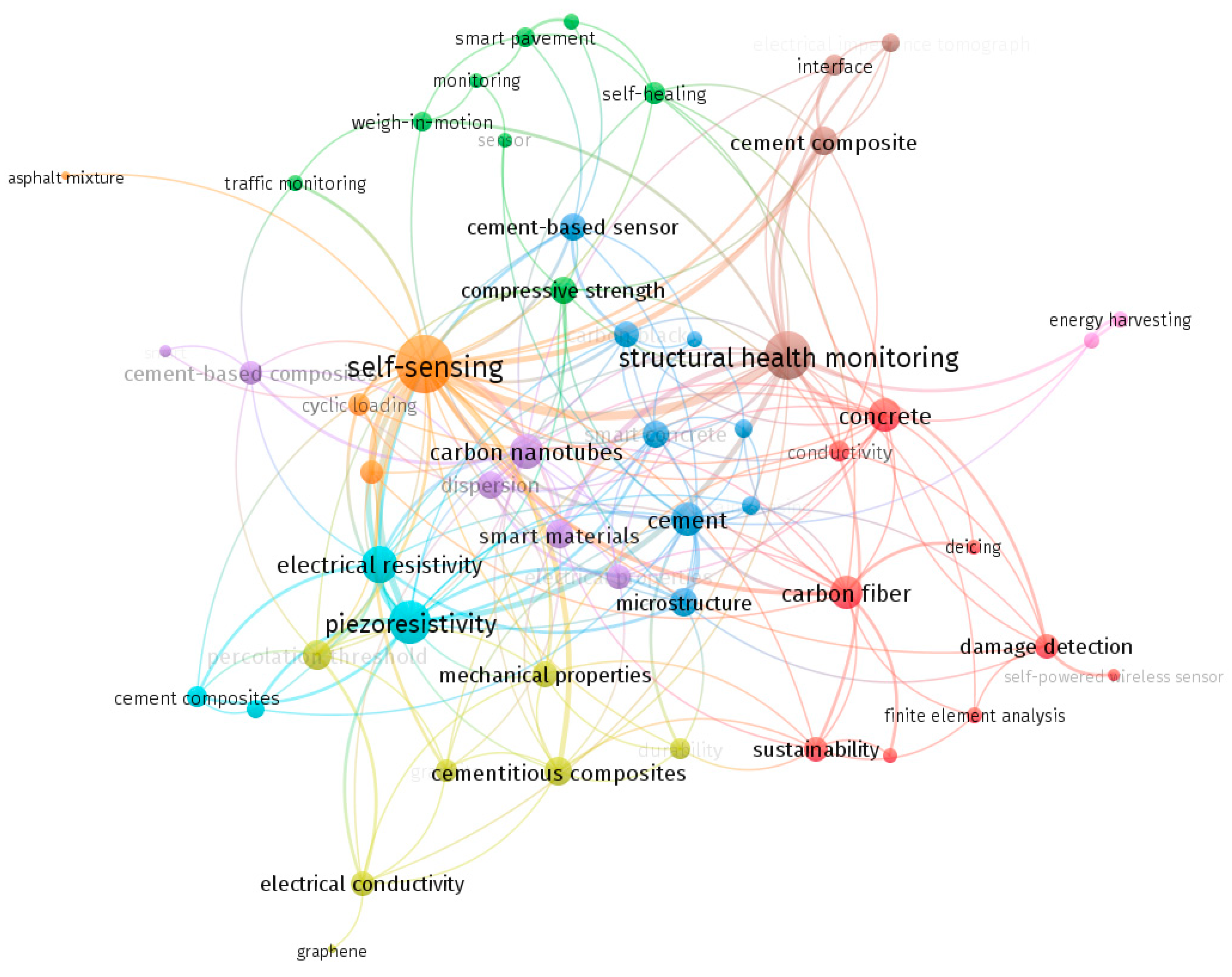
Figure 2.
a) Difference of conventional and multi-functional cementitious composites b) Microstructure of carbon fibre based self-sensing cementitious composite [29].
Figure 2.
a) Difference of conventional and multi-functional cementitious composites b) Microstructure of carbon fibre based self-sensing cementitious composite [29].
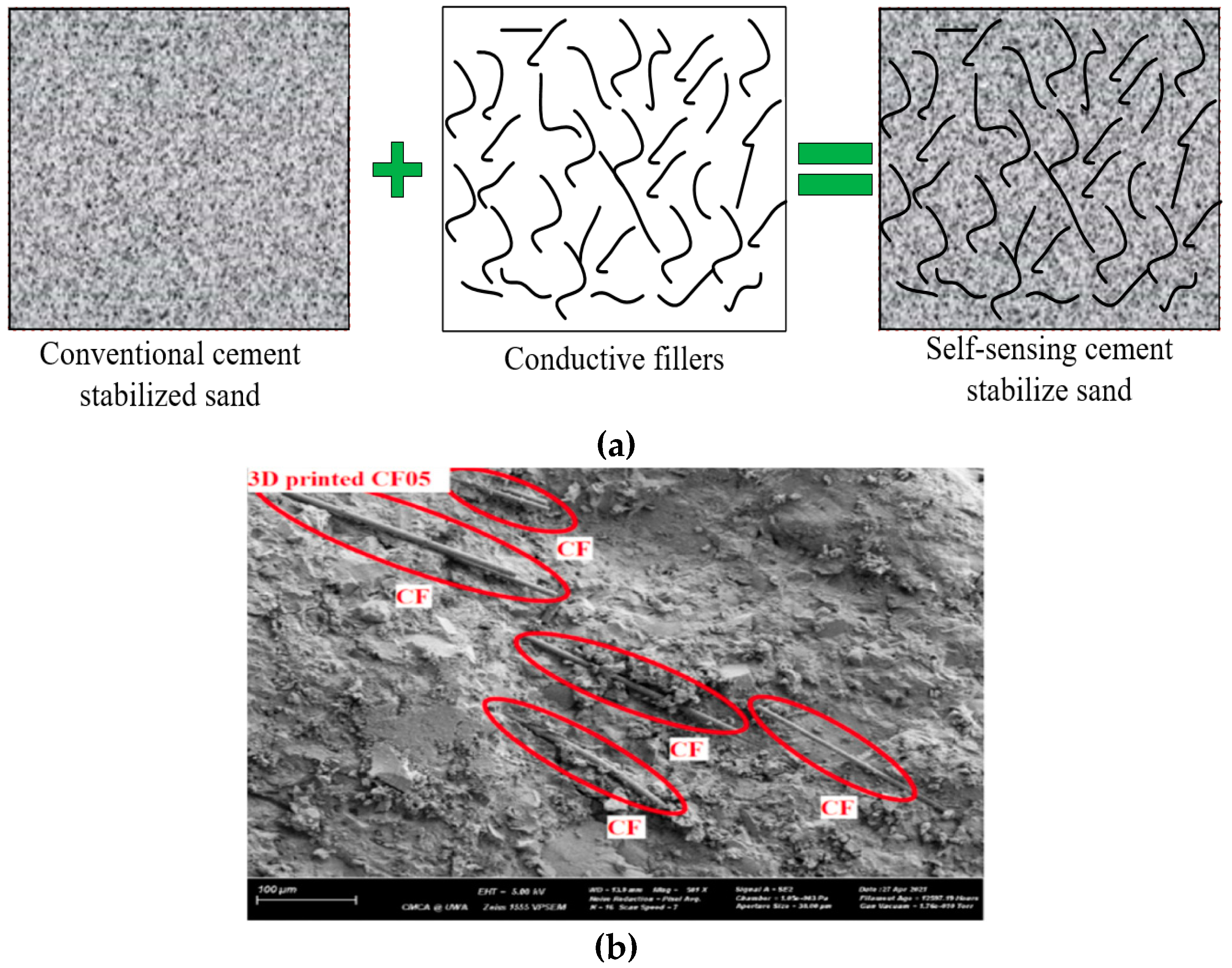
Figure 3.
Electrode configuration a) Two probe method b) Four probe method [38].
Figure 3.
Electrode configuration a) Two probe method b) Four probe method [38].
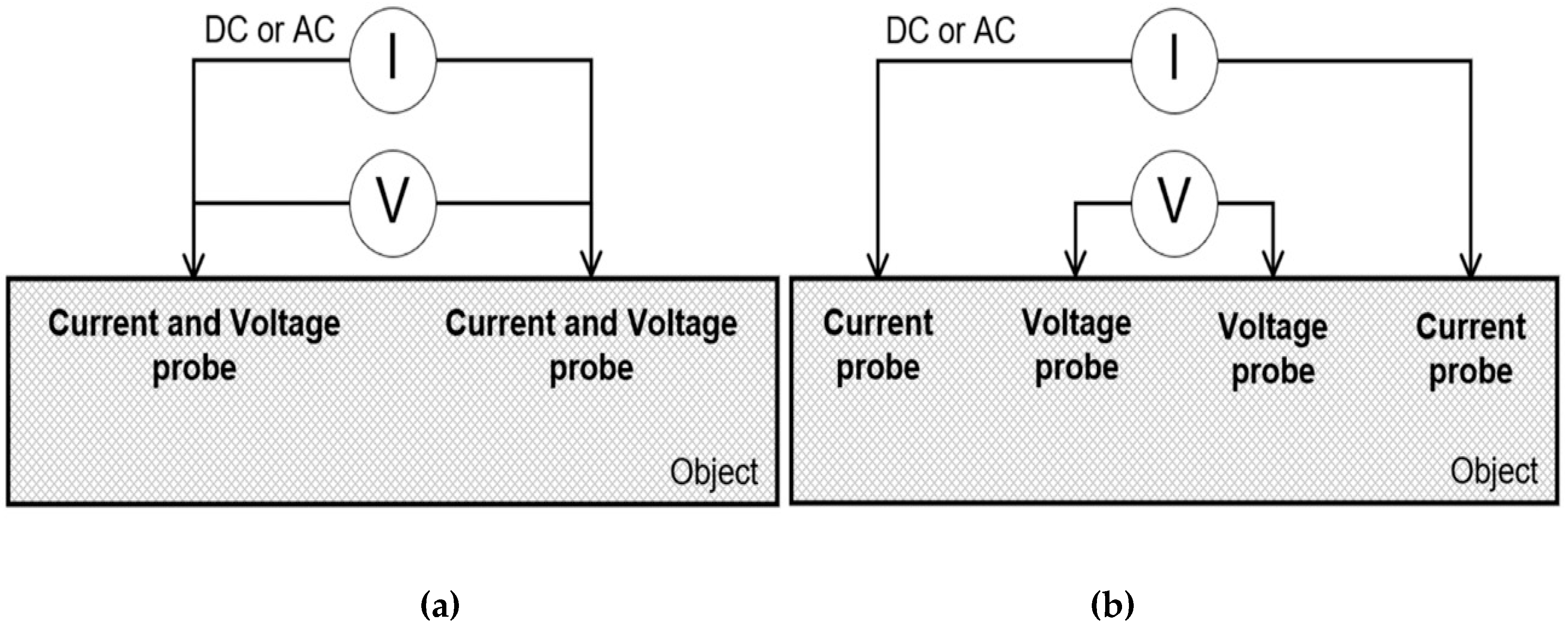
Figure 4.
Installation of electrodes a) Embedded form b) surficial form [11].
Figure 4.
Installation of electrodes a) Embedded form b) surficial form [11].
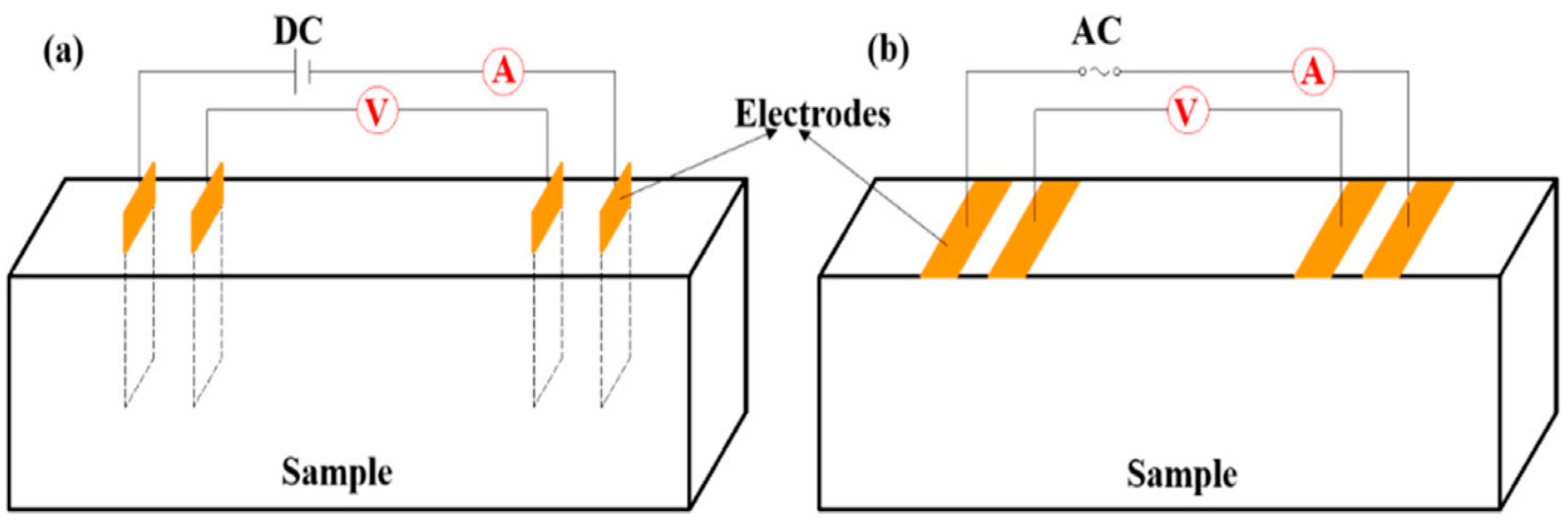
Figure 5.
Application forms of self-sensing cementitious composites [49].
Figure 5.
Application forms of self-sensing cementitious composites [49].
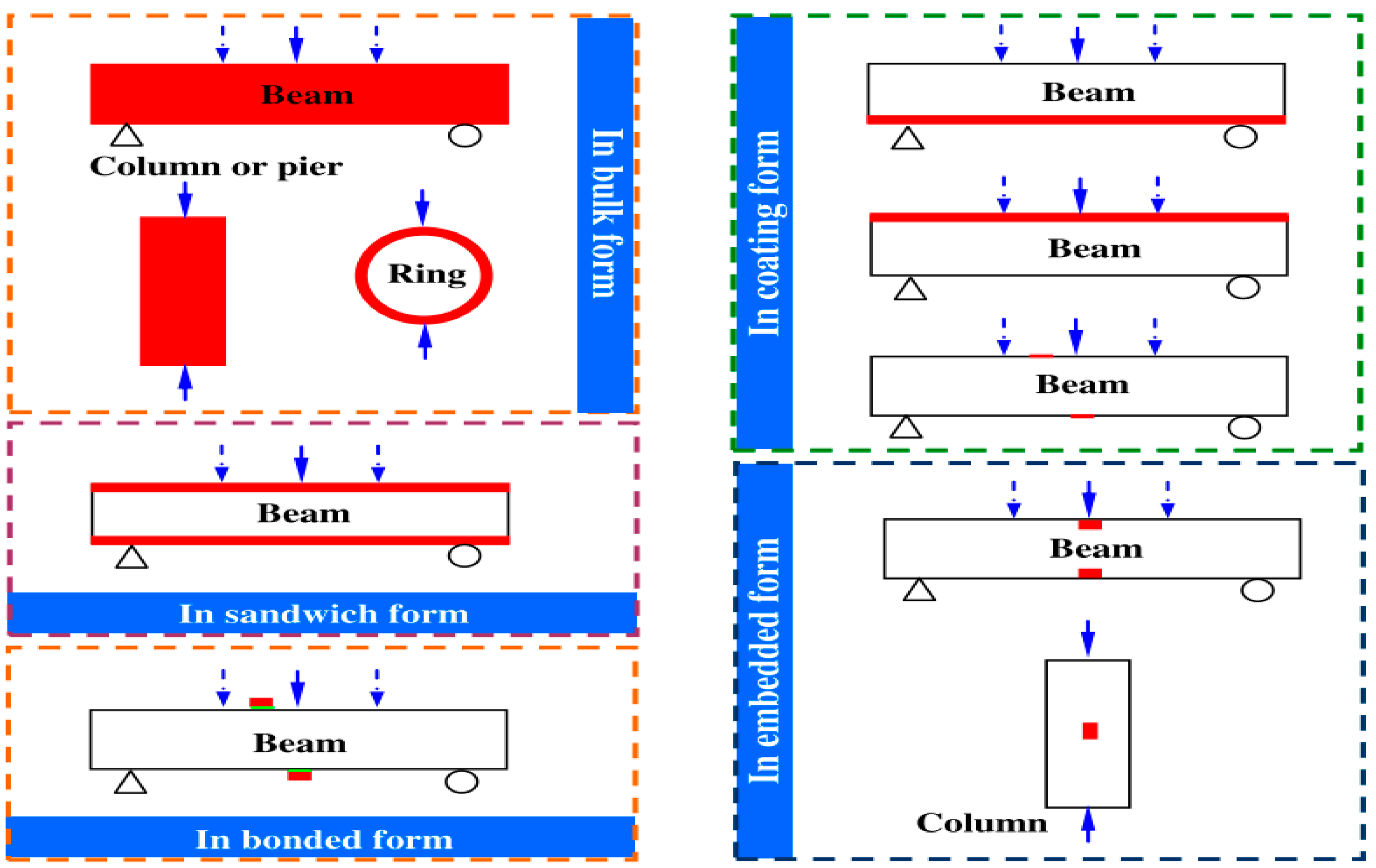
Figure 6.
Non-contact resistivity measurement system a) Photograph [53,54] b) Schematic illustration [55] c) Specimen cross section.
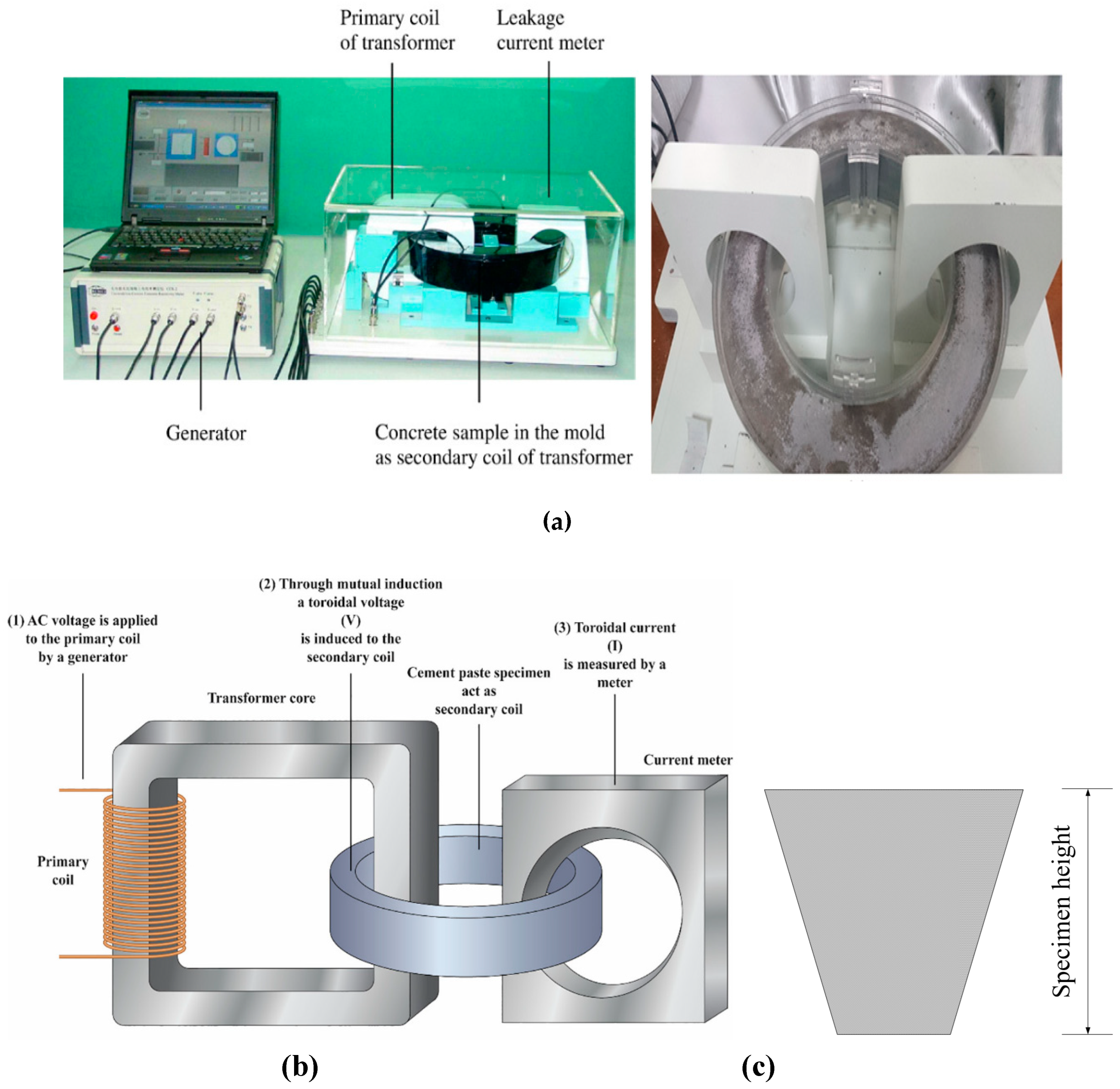
Figure 7.
Modified non-contact resistivity measurement system a) The picture of modified non-contact measurement system b) Details of modified non-contact measurement system c) Specimen used in modified non-contact measurement system [56].
Figure 7.
Modified non-contact resistivity measurement system a) The picture of modified non-contact measurement system b) Details of modified non-contact measurement system c) Specimen used in modified non-contact measurement system [56].
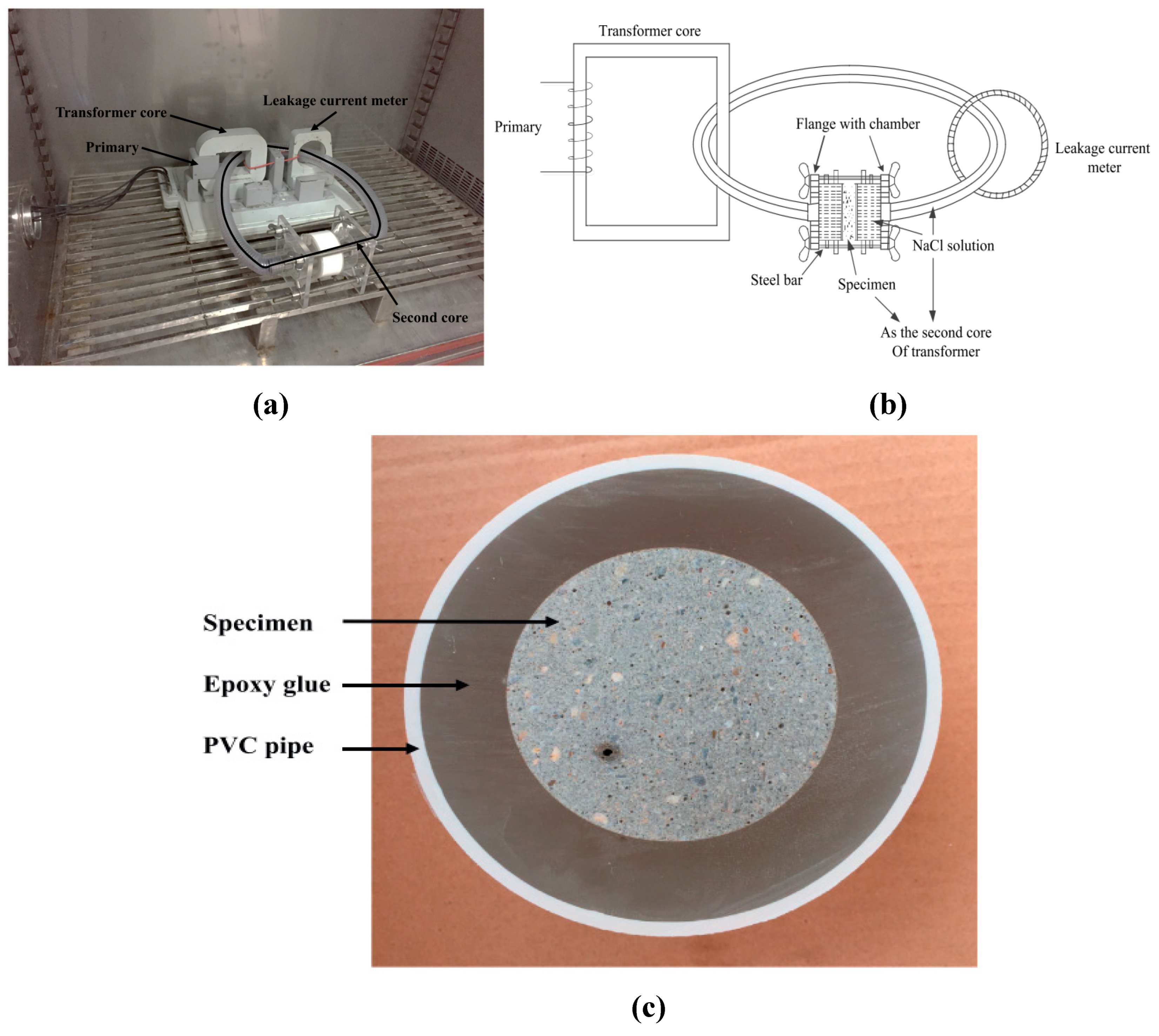
Figure 8.
Non-contact impedance measurement system [50]
Figure 8.
Non-contact impedance measurement system [50]
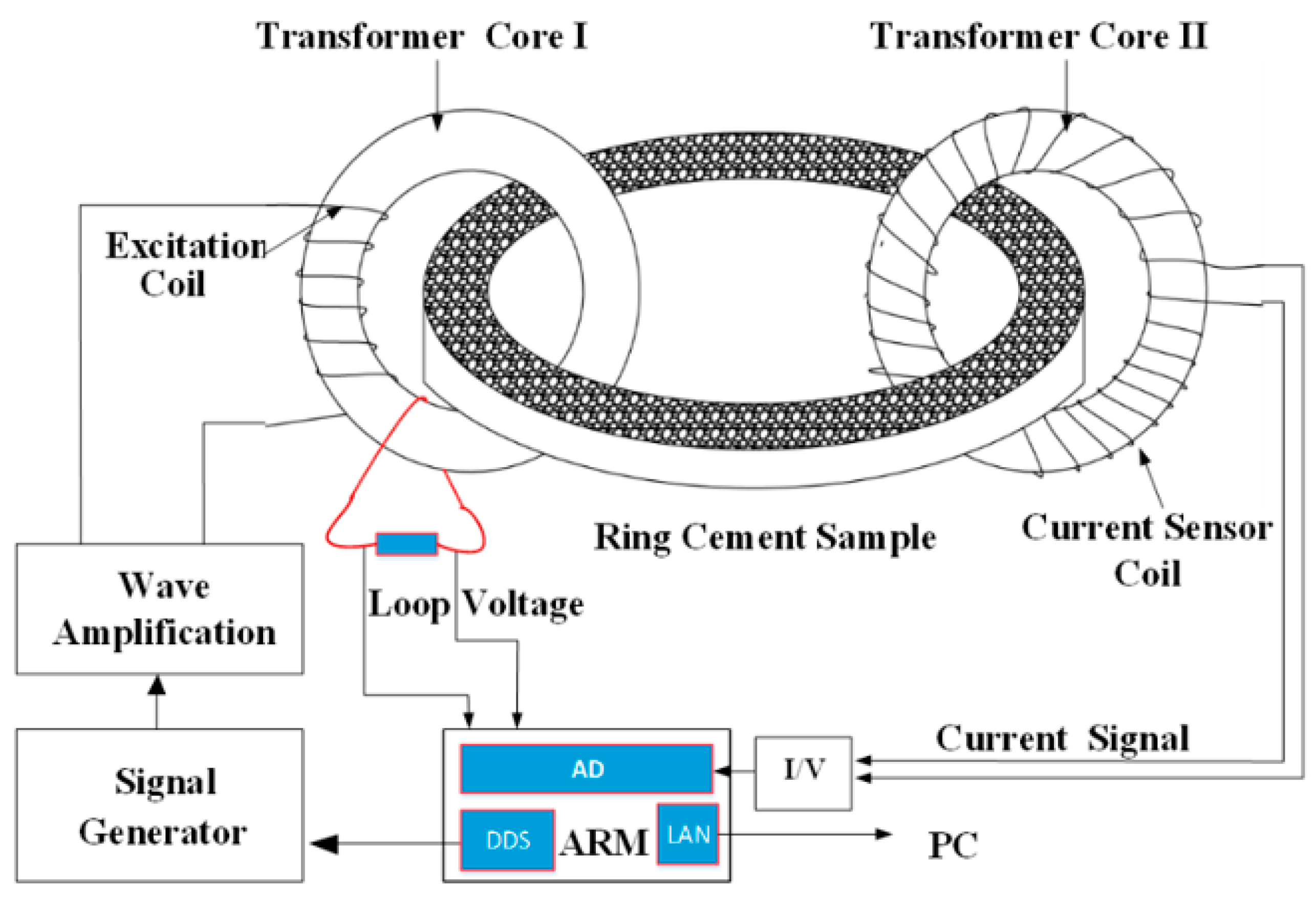
Figure 9.
Influence of conductive filler concentration on electrical resistivity [49].
Figure 9.
Influence of conductive filler concentration on electrical resistivity [49].
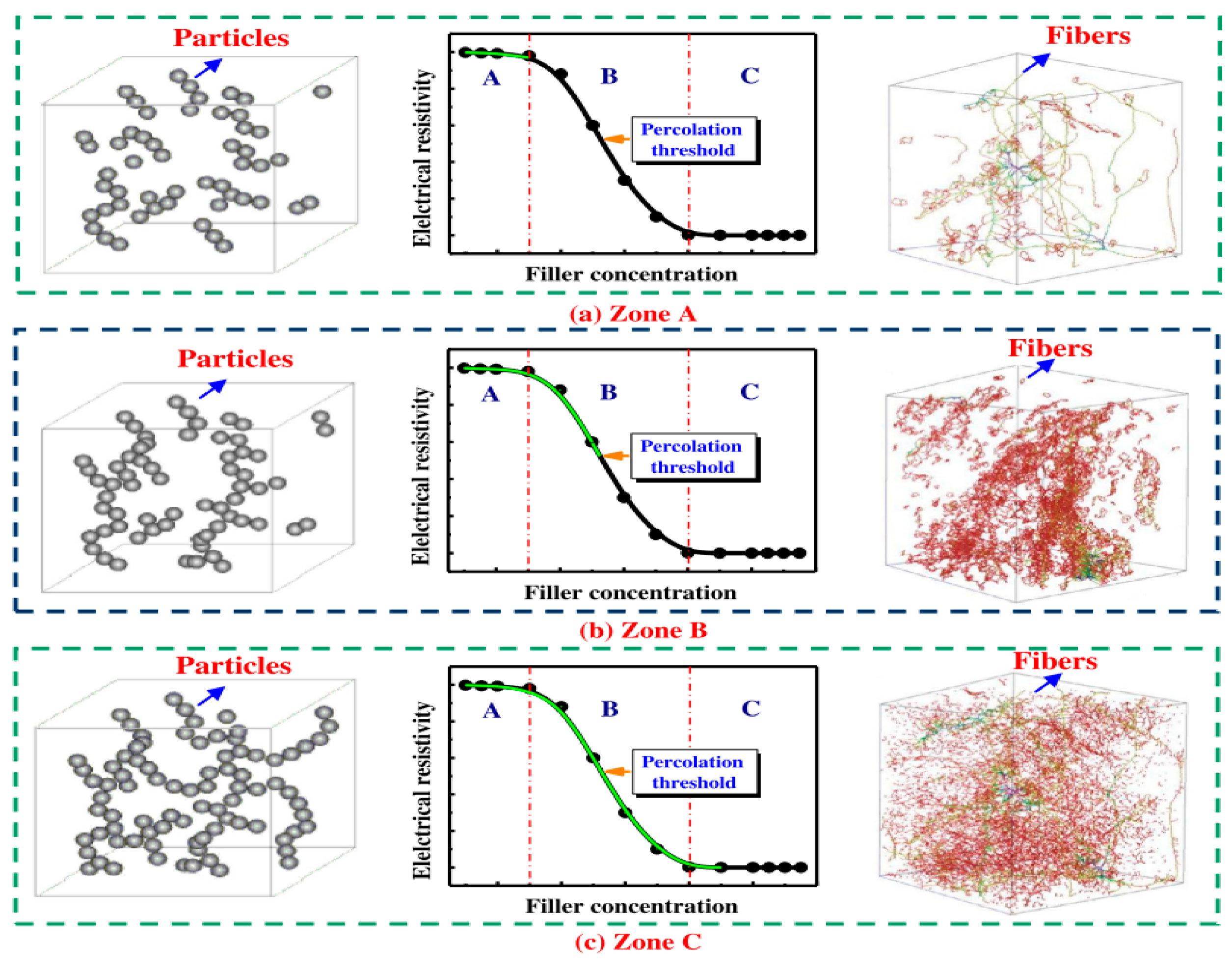
Figure 10.
Schematic illustration of conductive mechanisms a) Zone a b) Zone b c) conductive pathways in Zone b d) Zone c e) conductive pathways in zone c [94,95]
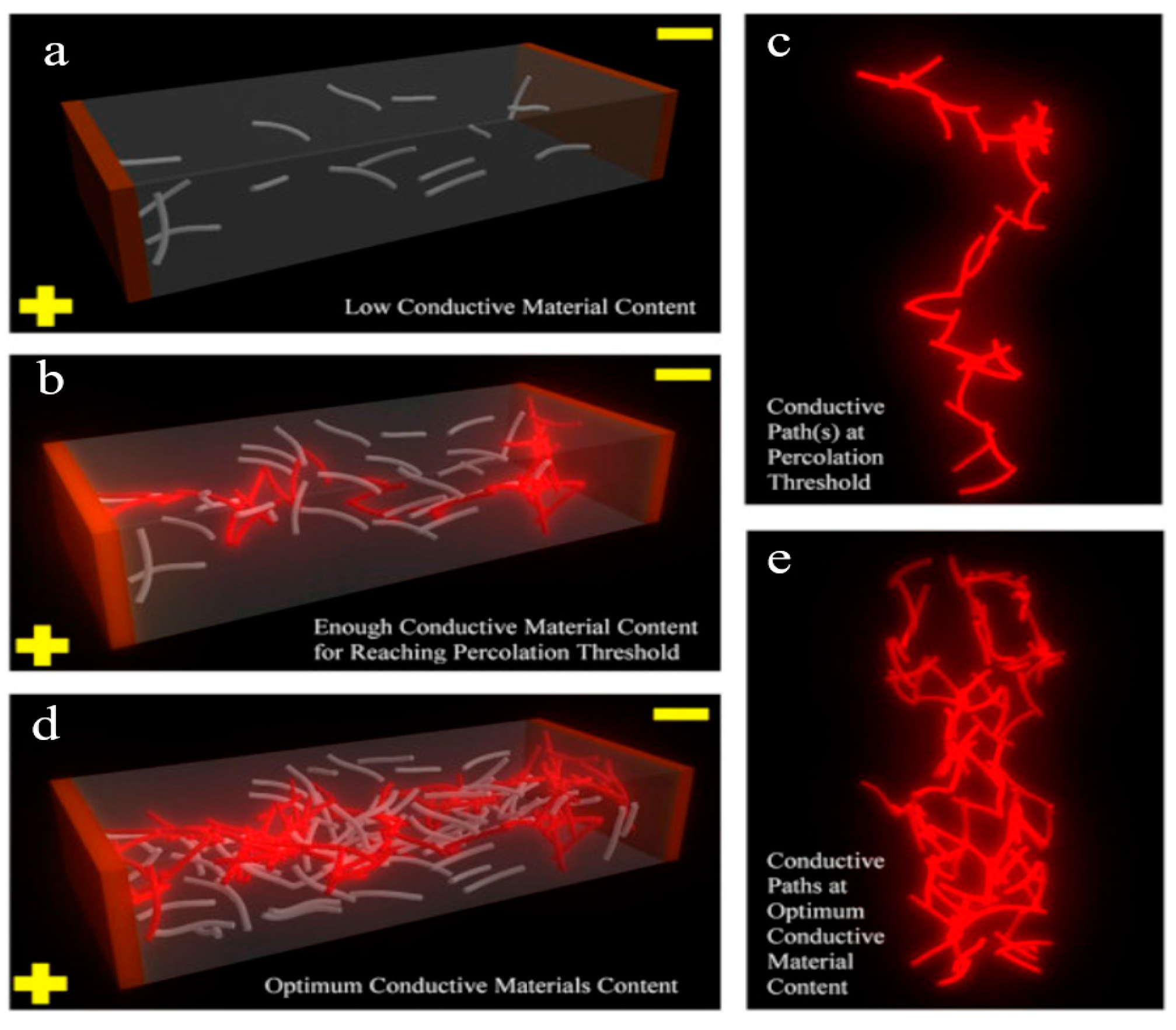
Figure 11.
a) Piezoresistivity of multifunctional cementitious composite containing 1% CNTs+GNP under monotonic loading [104] b) Piezoresistivity of multifunctional cementitious composite containing 1.5% carbon black (CB) under cyclic loading in dried and wet conditions [100].
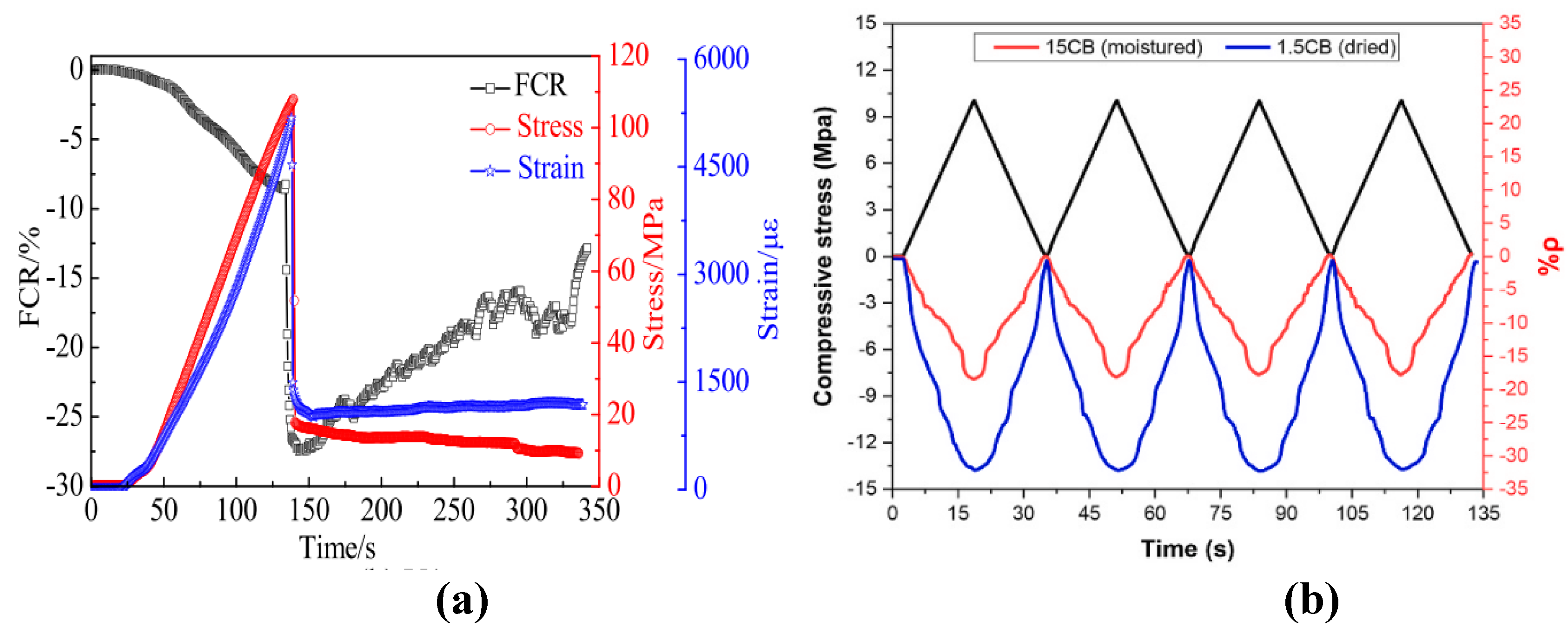
Figure 12.
Electromechanical performance of multifunctional cementitious composite containing various carbon black (CB) percentage [106]
Figure 12.
Electromechanical performance of multifunctional cementitious composite containing various carbon black (CB) percentage [106]
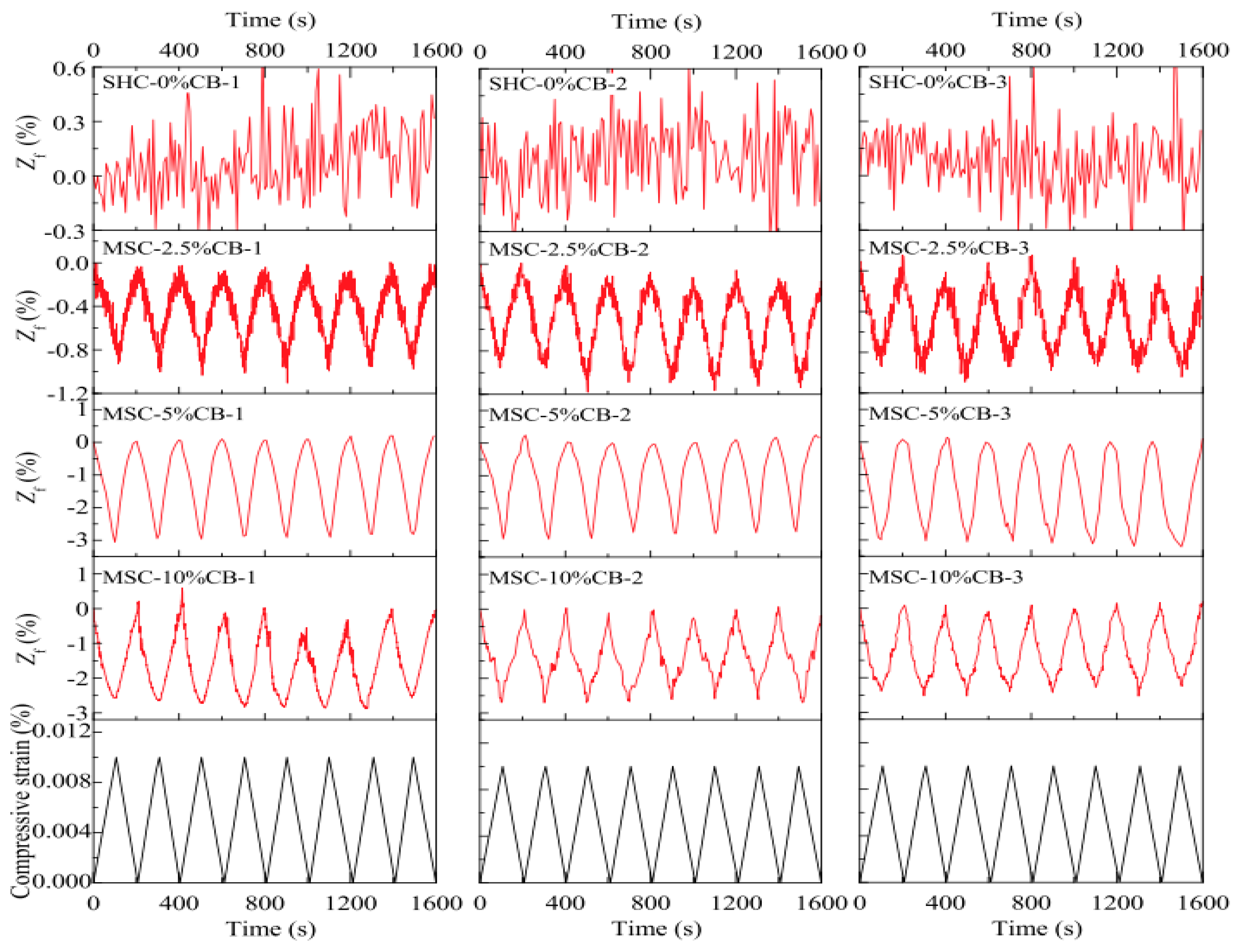
Figure 13.
Effects of stress level on the FCR changes of self-sensing cementitious composite (0.15% graphene oxide) [12]
Figure 13.
Effects of stress level on the FCR changes of self-sensing cementitious composite (0.15% graphene oxide) [12]
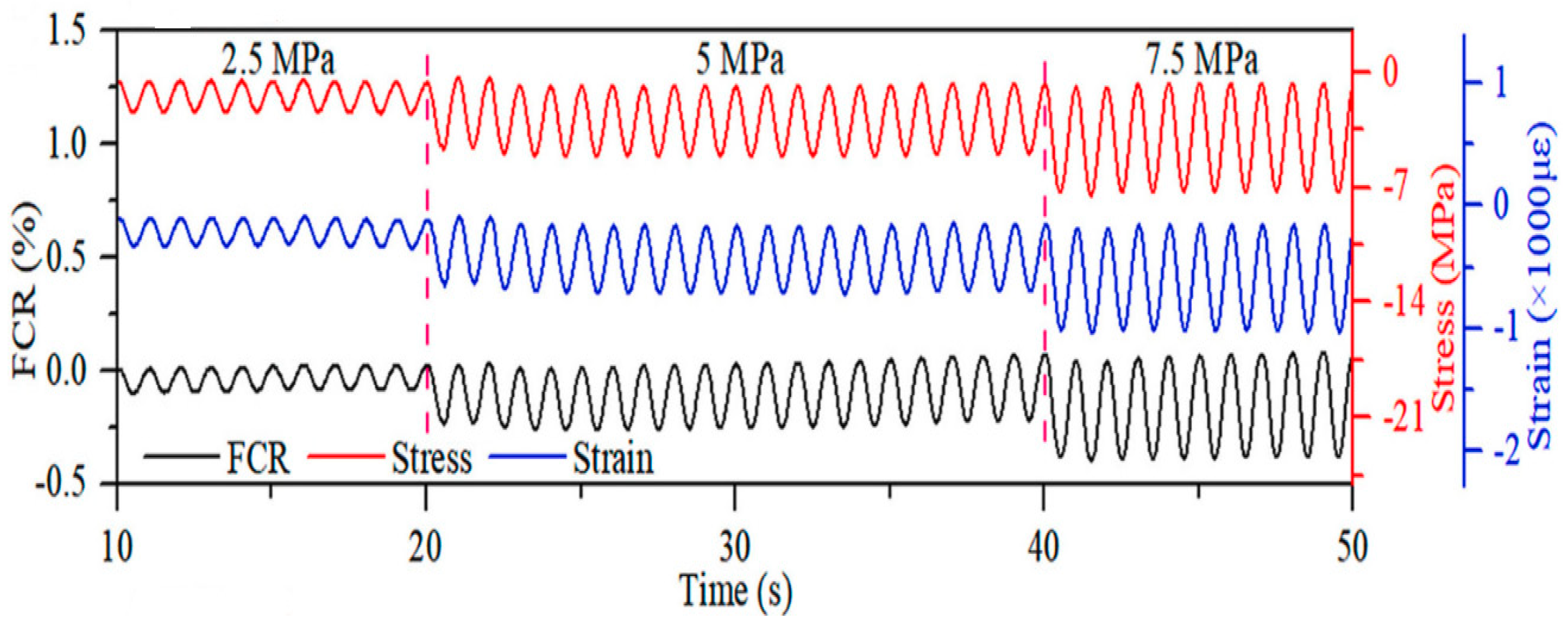
Figure 14.
Differentiation of SHM levels based on their respective efficiency ratings.
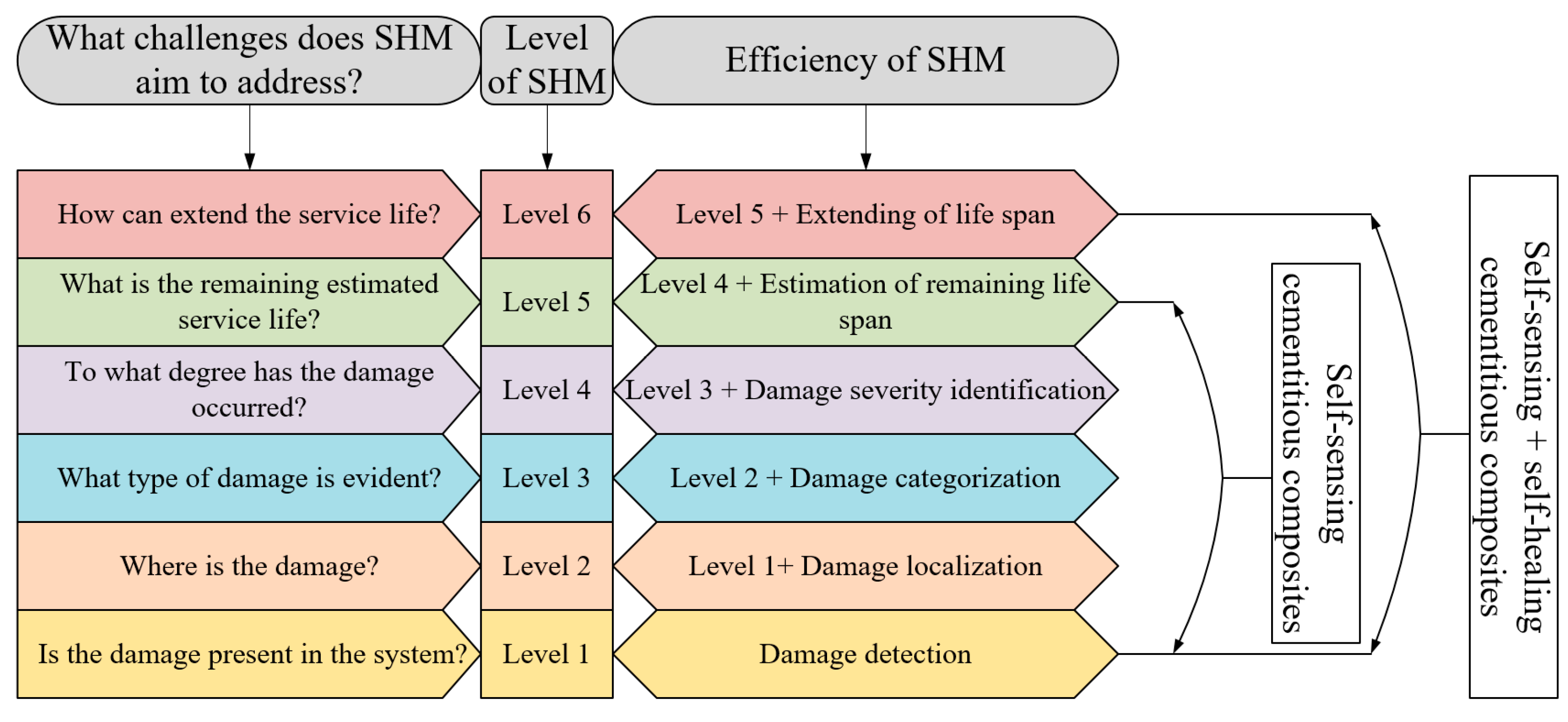
Figure 15.
Influence of self-healing process on electrical signals a, b) Autogenous self-healing of cementitious composite doped with fly ash [116] a) Healing of cracks, b) EIS changes by self-healing process; c, d) Autonomous self-healing of cementitious composite doped with CNB and slaked lime [117]
Figure 15.
Influence of self-healing process on electrical signals a, b) Autogenous self-healing of cementitious composite doped with fly ash [116] a) Healing of cracks, b) EIS changes by self-healing process; c, d) Autonomous self-healing of cementitious composite doped with CNB and slaked lime [117]
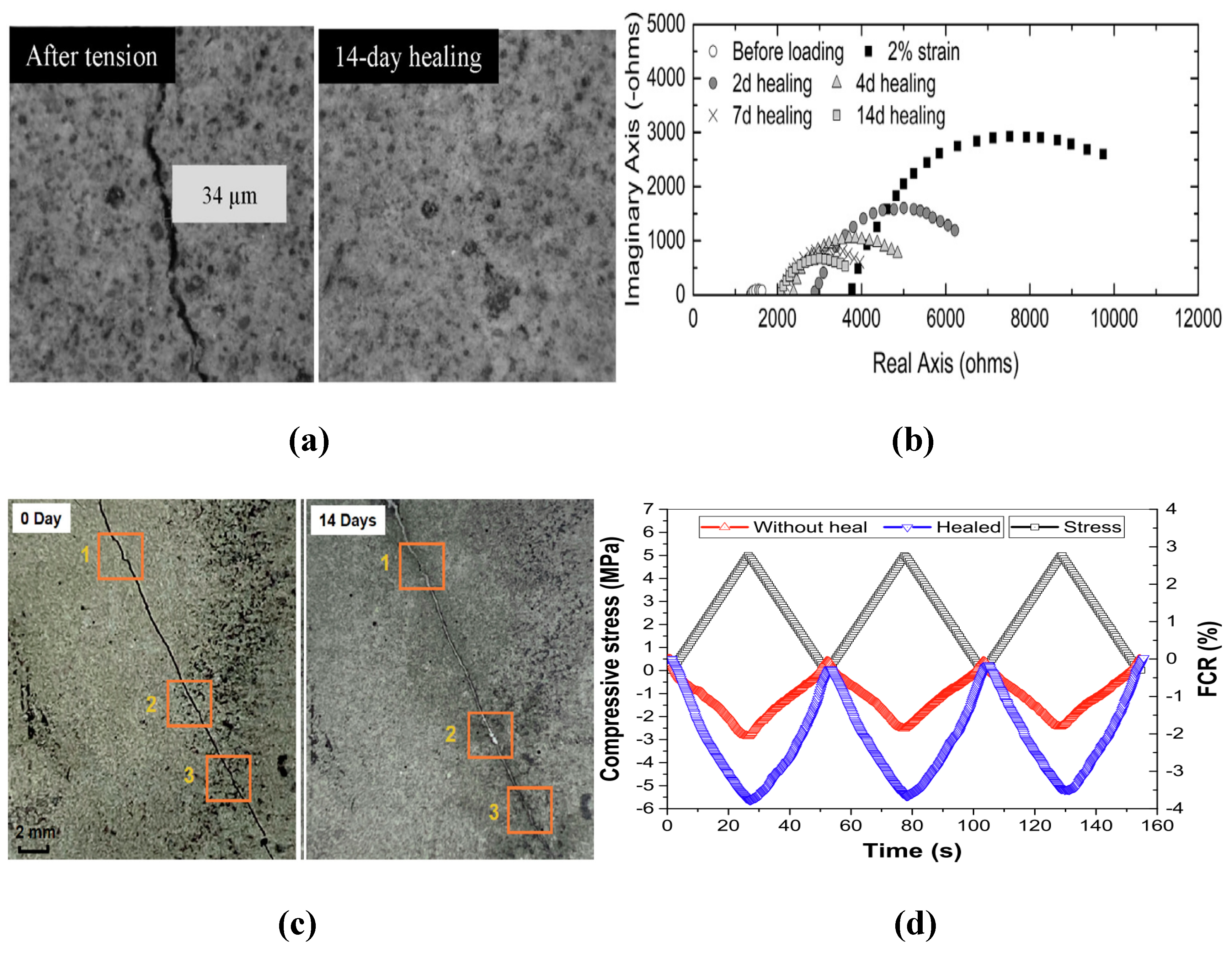
Figure 16.
Schematic illustrations a) Influencing factors on electrical resistivity/electrical conductivity and associated changing trends b) Influence of curing time/hydration time on microstructure variation of non-conductive cementitious composites c) Influence of curing time/hydration time on microstructure variation of electrically conductive cementitious composites
Figure 16.
Schematic illustrations a) Influencing factors on electrical resistivity/electrical conductivity and associated changing trends b) Influence of curing time/hydration time on microstructure variation of non-conductive cementitious composites c) Influence of curing time/hydration time on microstructure variation of electrically conductive cementitious composites
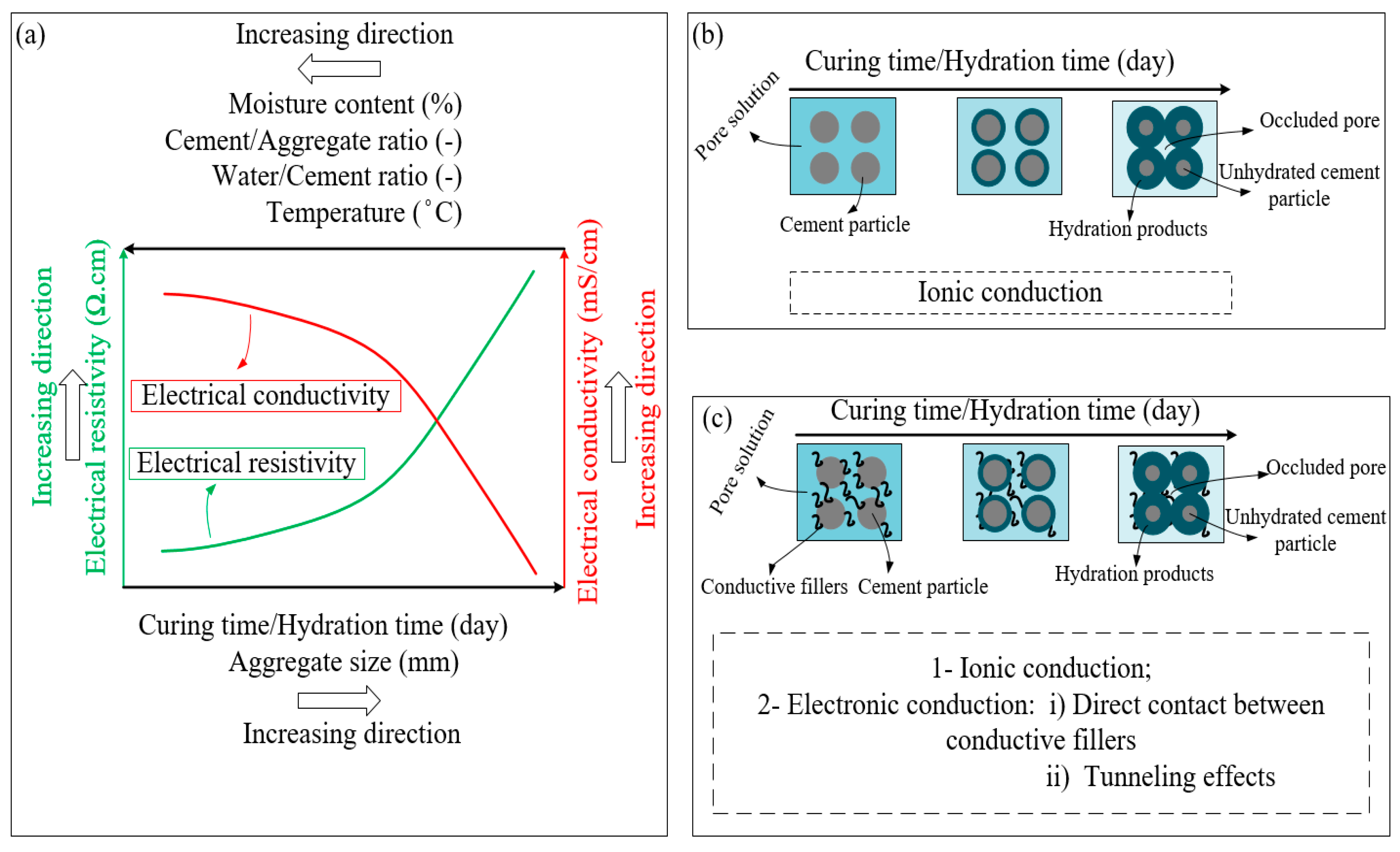
Figure 17.
Schematic illustration of tunneling blockage of electrically conductive cementitious composites upon formation of hydration products
Figure 17.
Schematic illustration of tunneling blockage of electrically conductive cementitious composites upon formation of hydration products
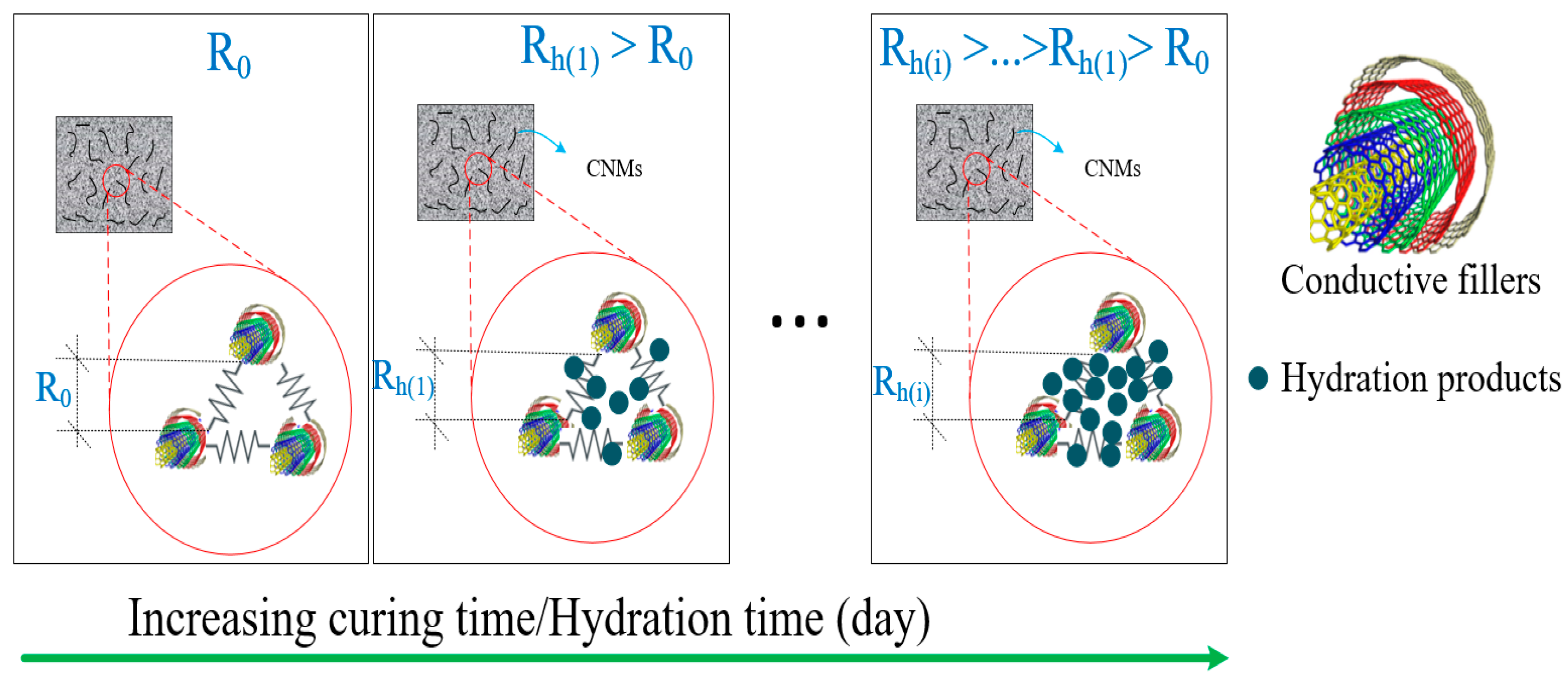
Figure 18.
Procedure of CVD technique and microstructure of graphene coated quartz sand [139].
Figure 18.
Procedure of CVD technique and microstructure of graphene coated quartz sand [139].
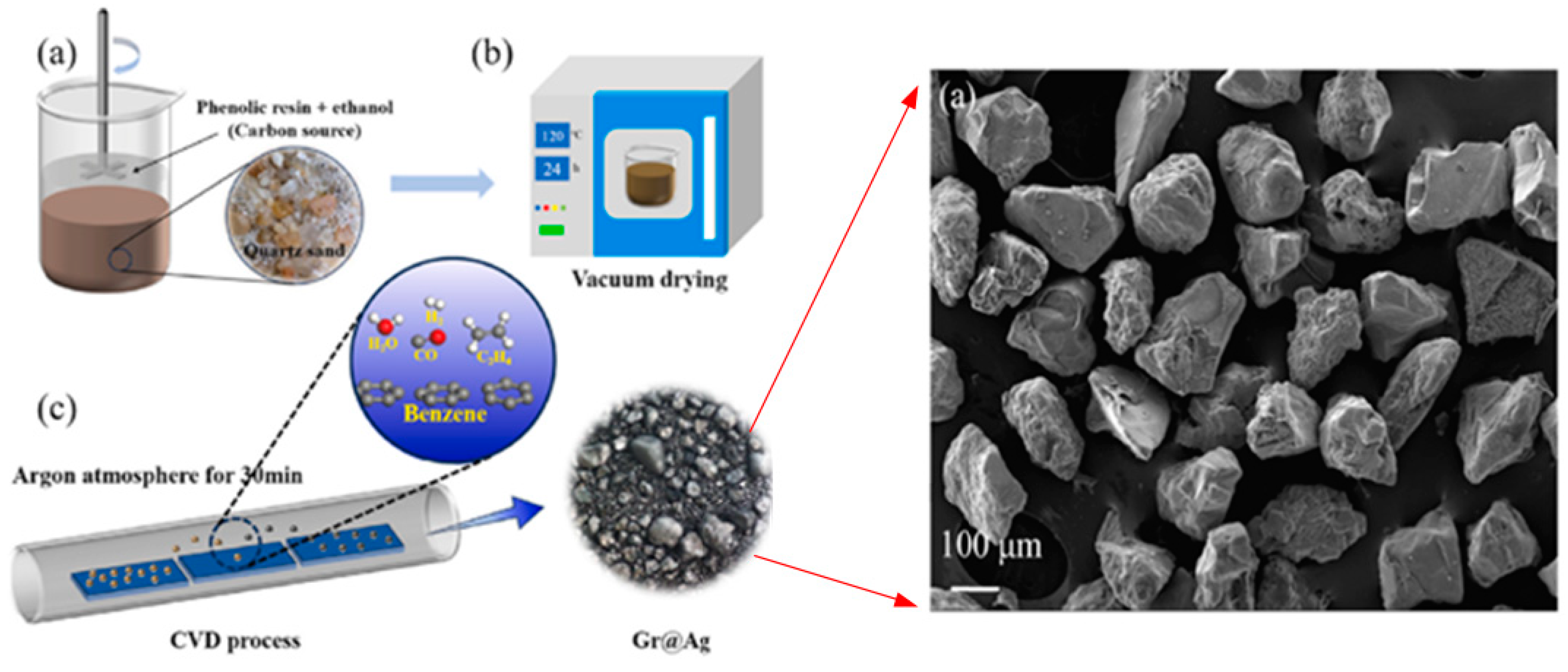
Figure 19.
Effects of polarization on electrical resistance of self-sensing cementitious composites containing MWCNT a) Stress vs time b)strain vs time c) resistance vs time [43] d) effects of CNTs concentration on the polarization [141].
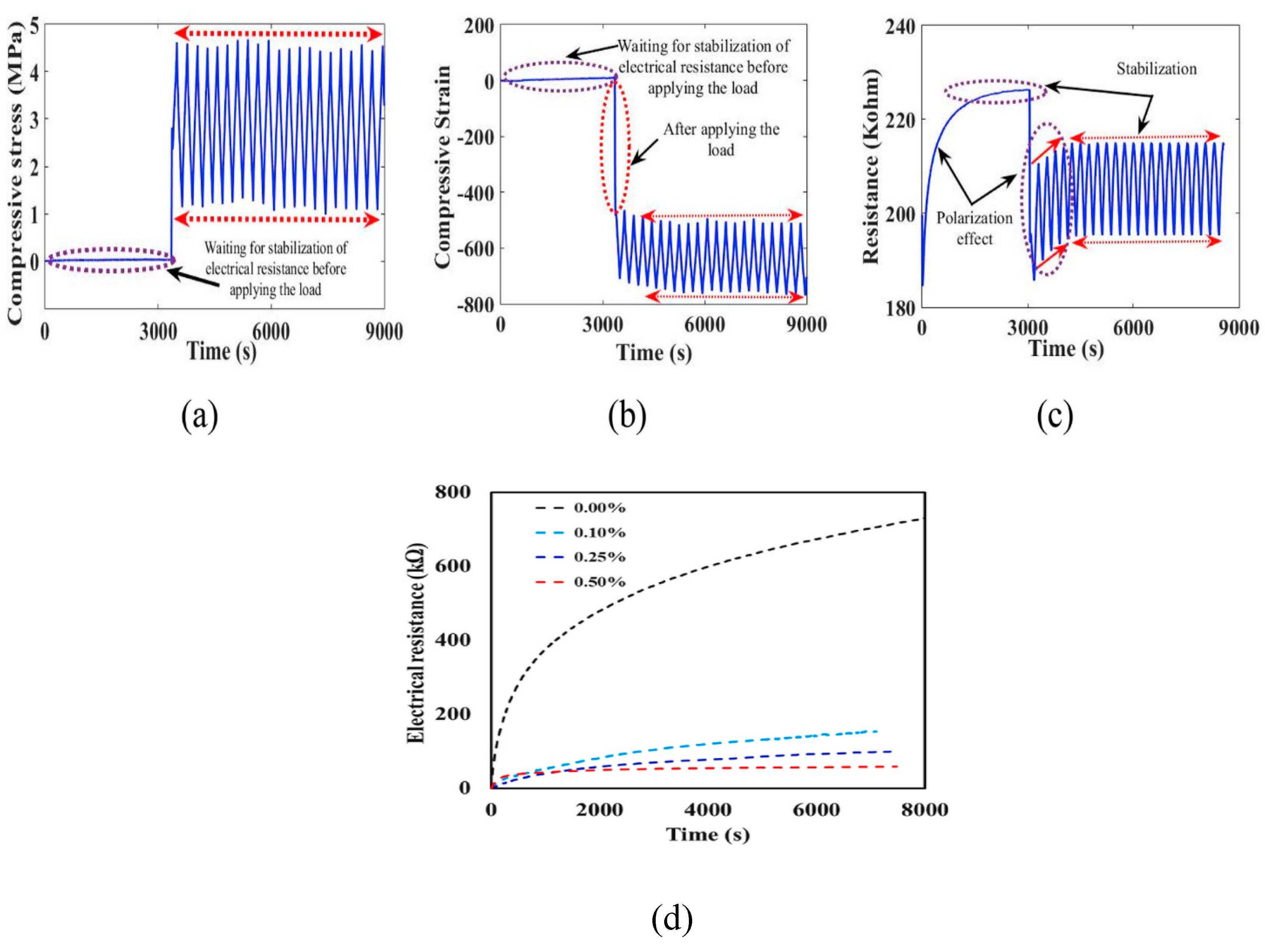
Figure 20.
Influence of moisture variation due to curing ages against MWCNT percentage [140]
Figure 20.
Influence of moisture variation due to curing ages against MWCNT percentage [140]
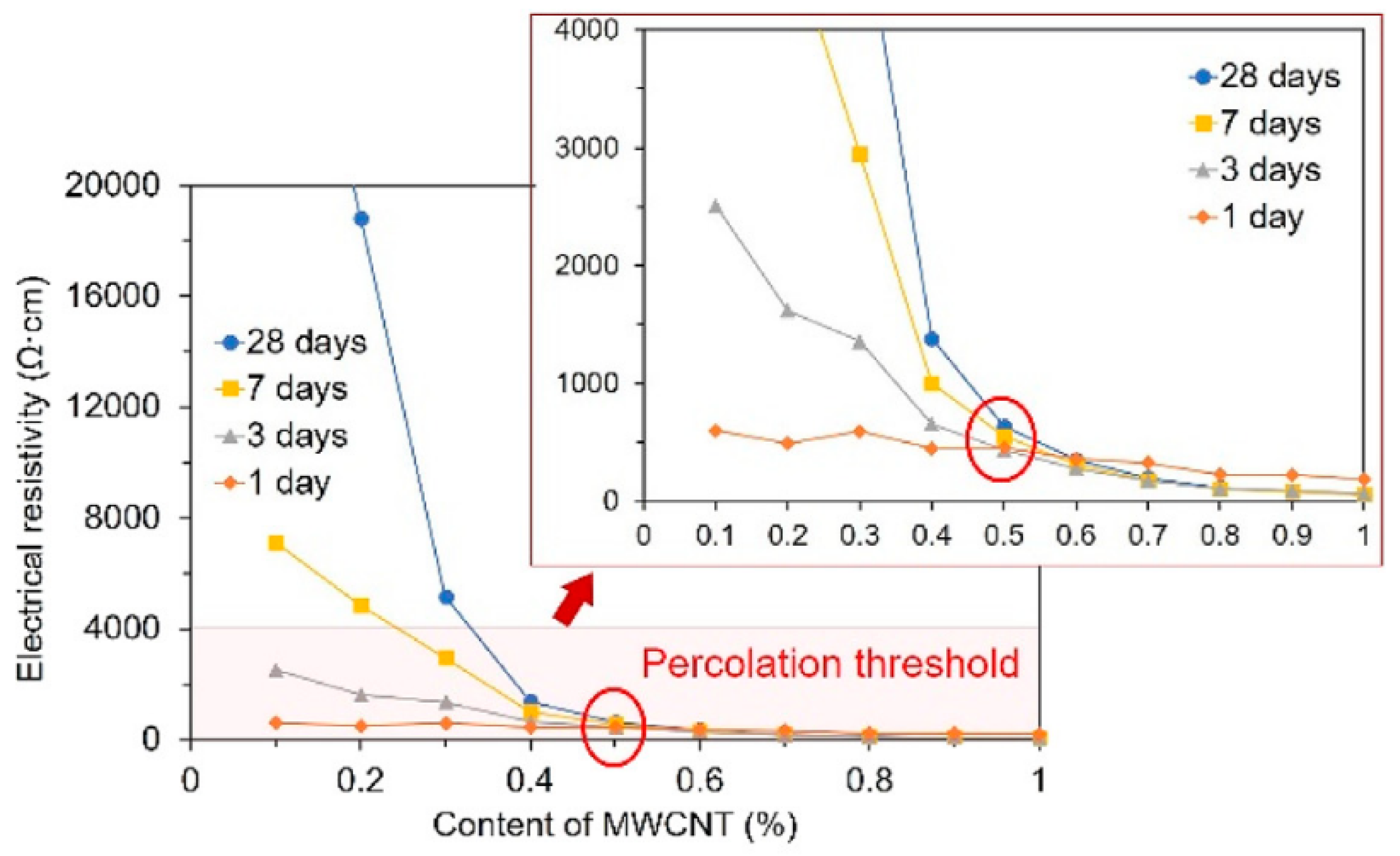
Figure 21.
Coal-based conductive materials and their production techniques [171].
Figure 21.
Coal-based conductive materials and their production techniques [171].
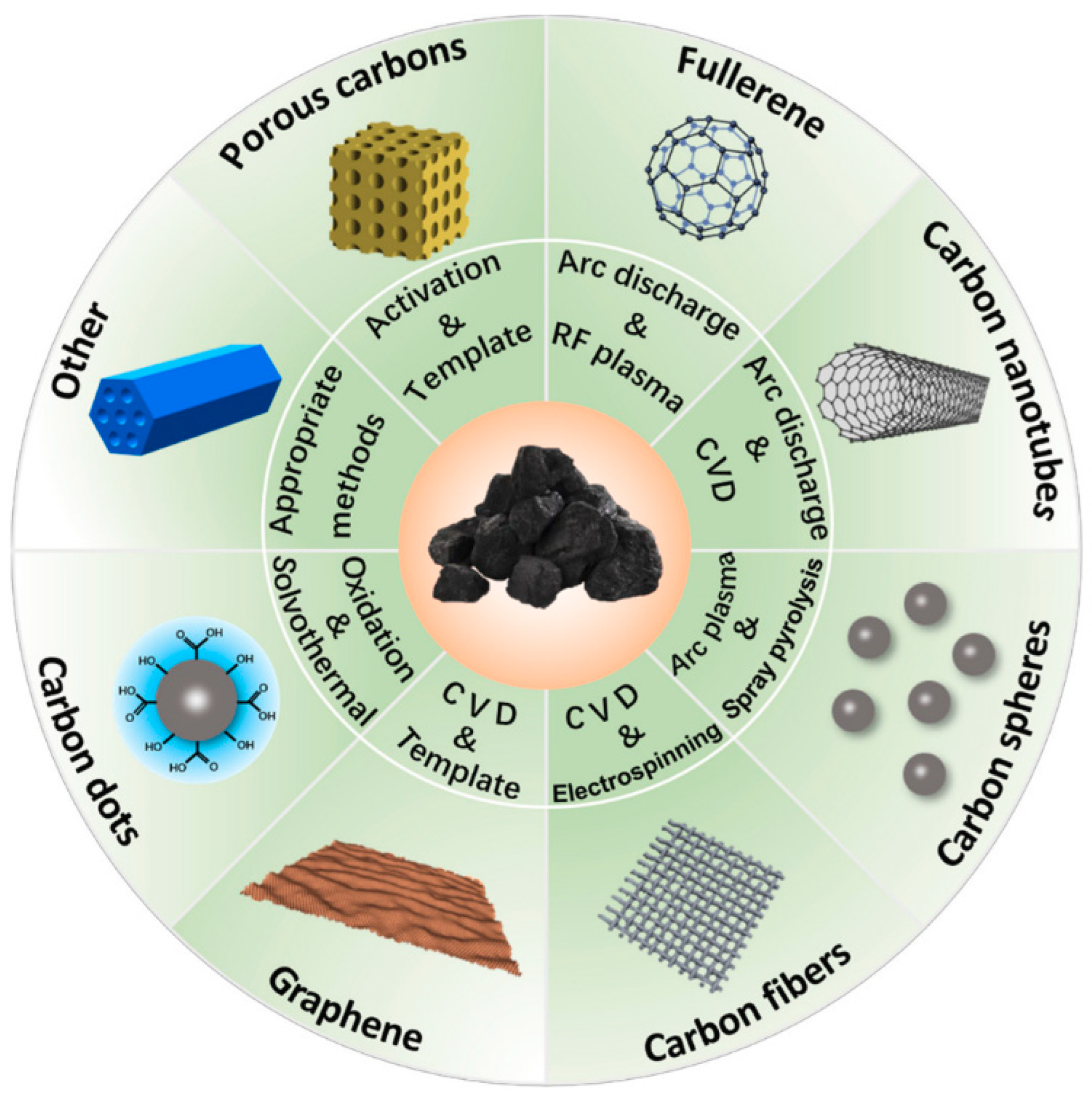
Figure 22.
Application of electrical conductive cementitious composites.
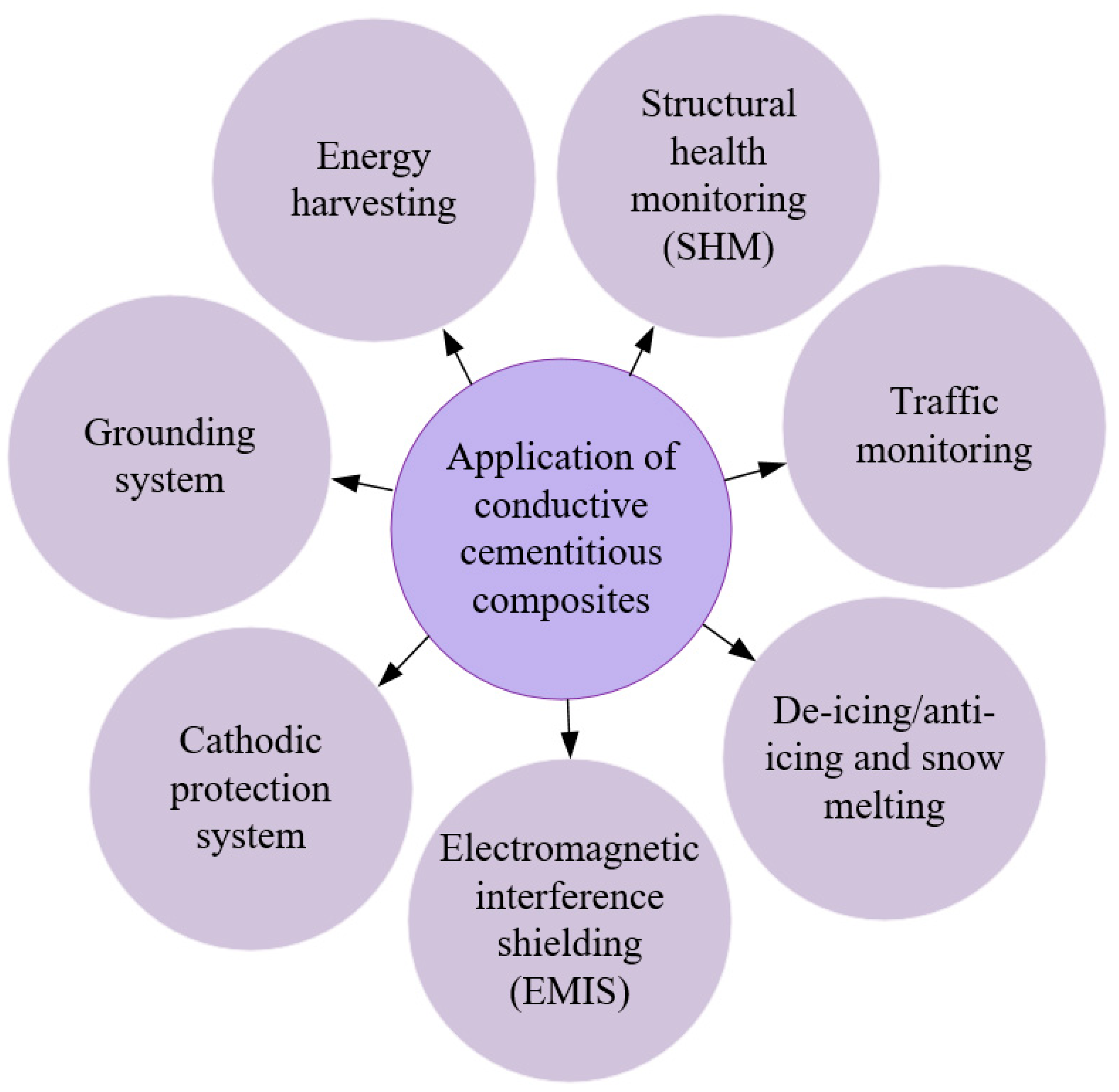
Figure 23.
Application of self-sensing cementitious composite for pedestrian and traffic detection a) Development stage in the lab b) human motion test c) traffic flow test e) detection of human motion d) traffic detection [181].
Figure 23.
Application of self-sensing cementitious composite for pedestrian and traffic detection a) Development stage in the lab b) human motion test c) traffic flow test e) detection of human motion d) traffic detection [181].
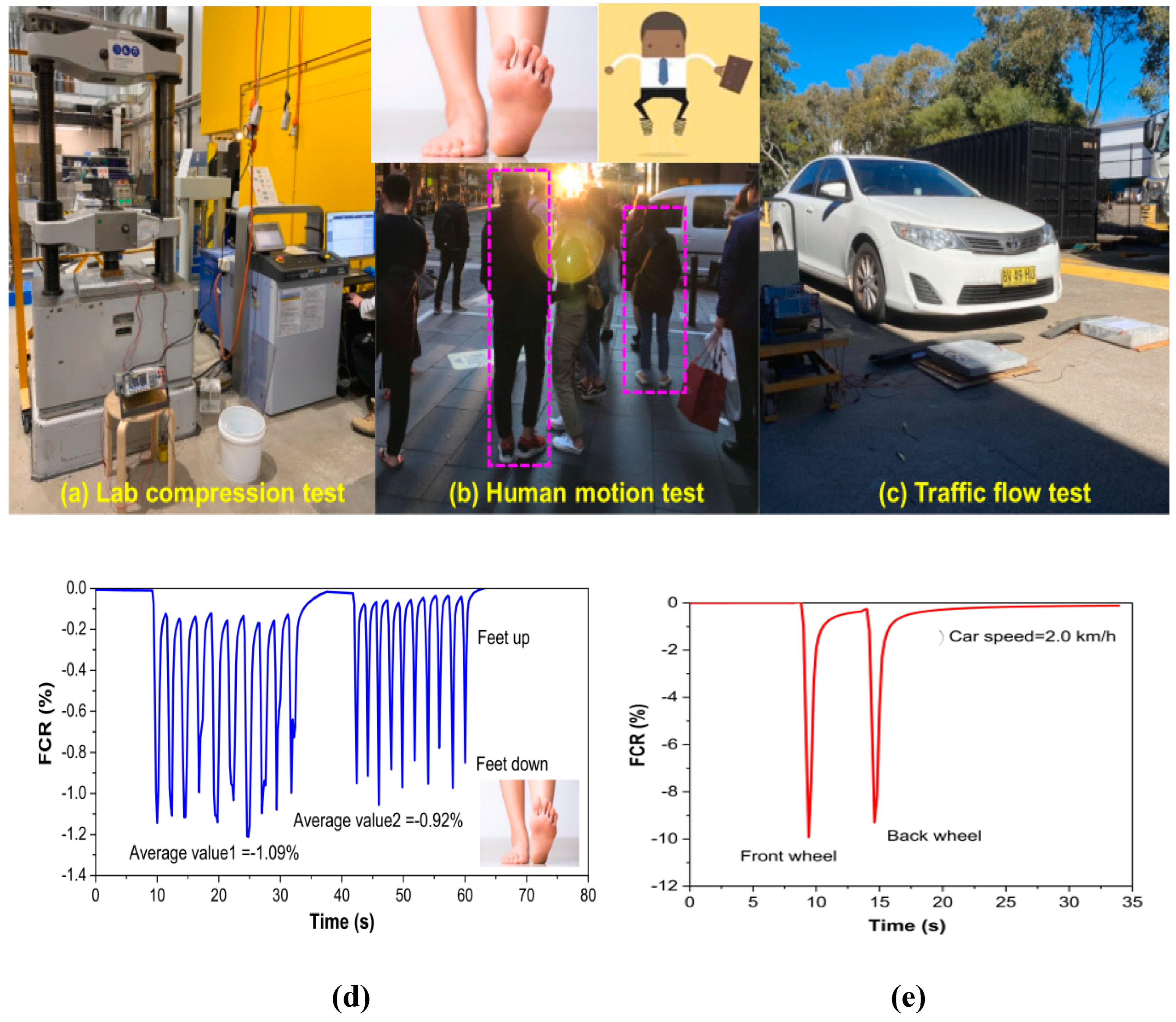
Figure 24.
Electrically conductive concrete (ECON) a) Schematic illustration of heating concrete pavement b) Thermal images after 1min and 60min [206]
Figure 24.
Electrically conductive concrete (ECON) a) Schematic illustration of heating concrete pavement b) Thermal images after 1min and 60min [206]
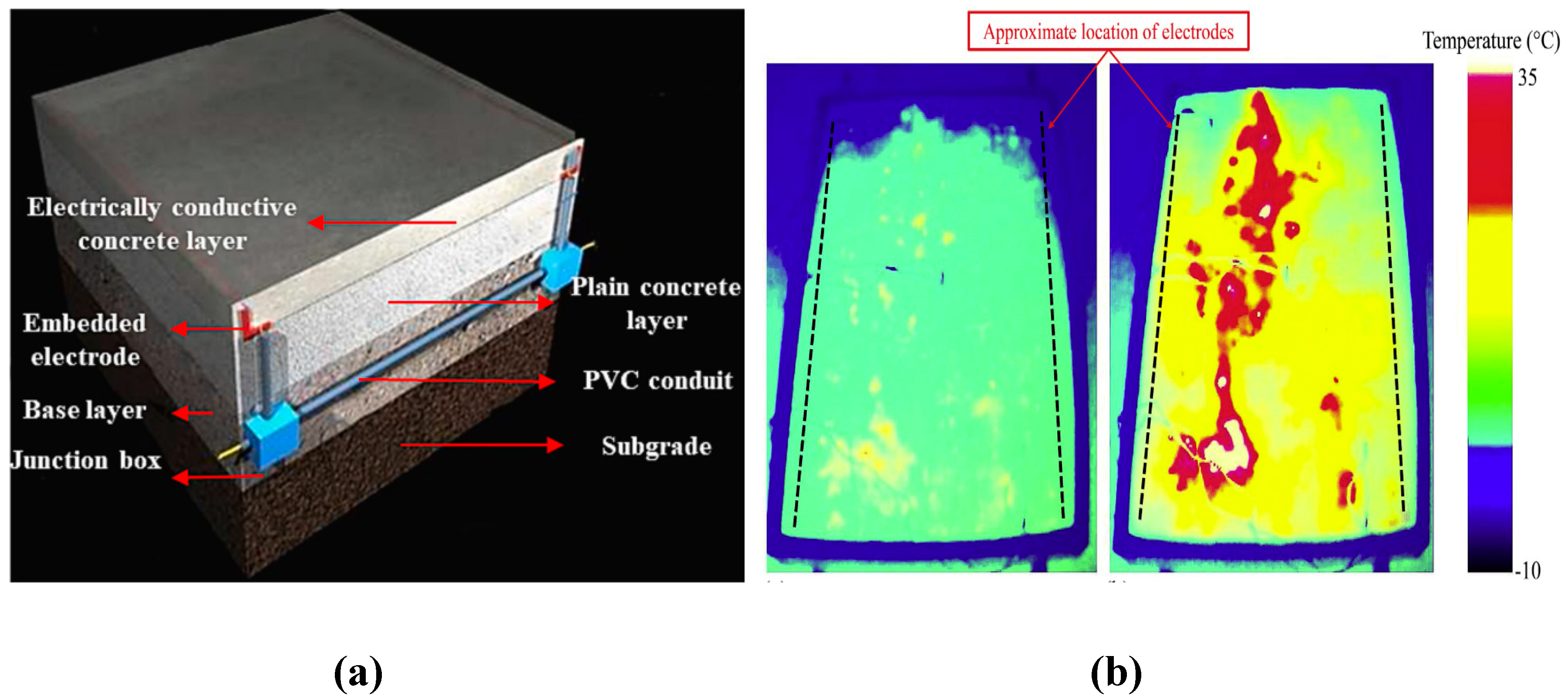
Figure 25.
a) Attenuation mechanism of electromagnetic waves by electrically conductive cementitious composites [224]; b) Schematic representation of electrically conductive cementitious composite employed as electromagnetic shielding material [225].
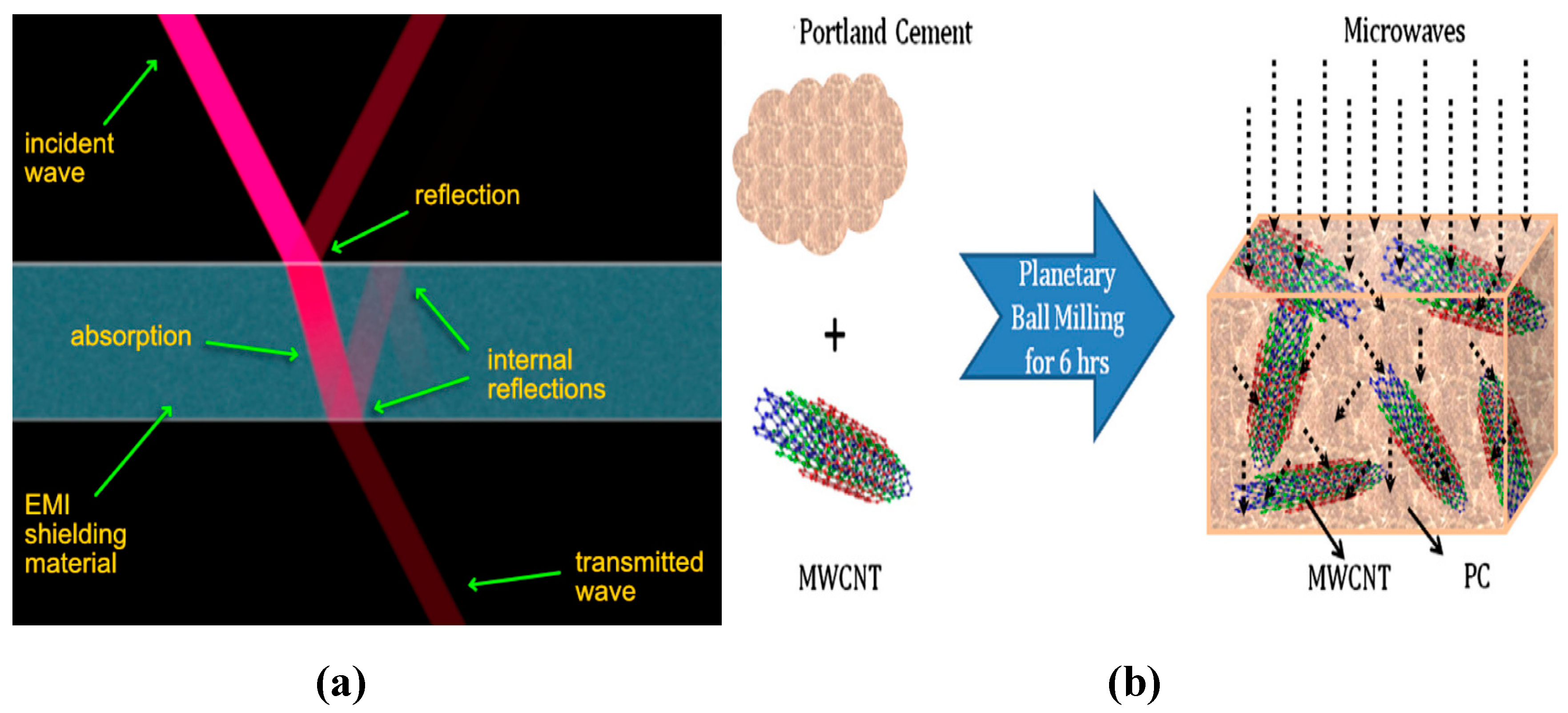
Figure 26.
Energy harvester systems used for producing of electrical energy from other types of energy.
Figure 26.
Energy harvester systems used for producing of electrical energy from other types of energy.
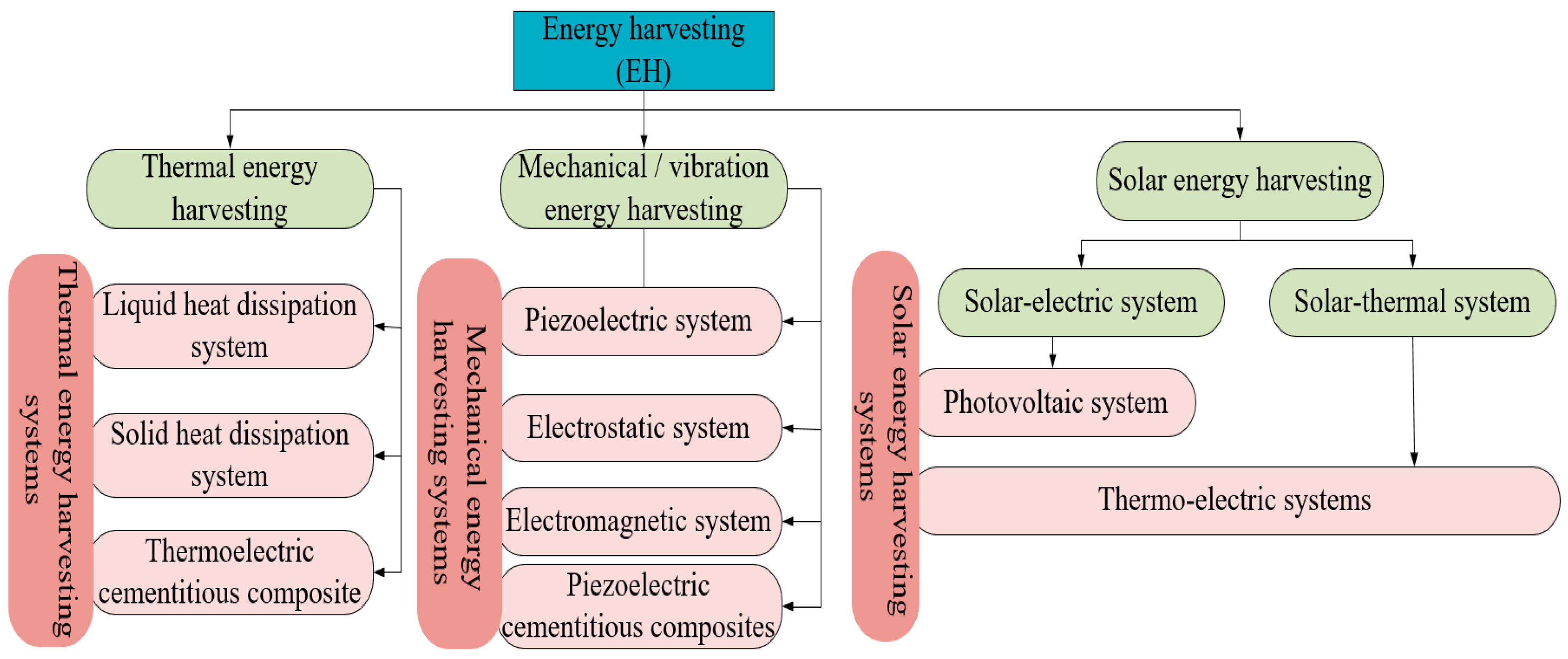
Figure 27.
a) Smart pavement setup b) Working modes [237].
Figure 27.
a) Smart pavement setup b) Working modes [237].
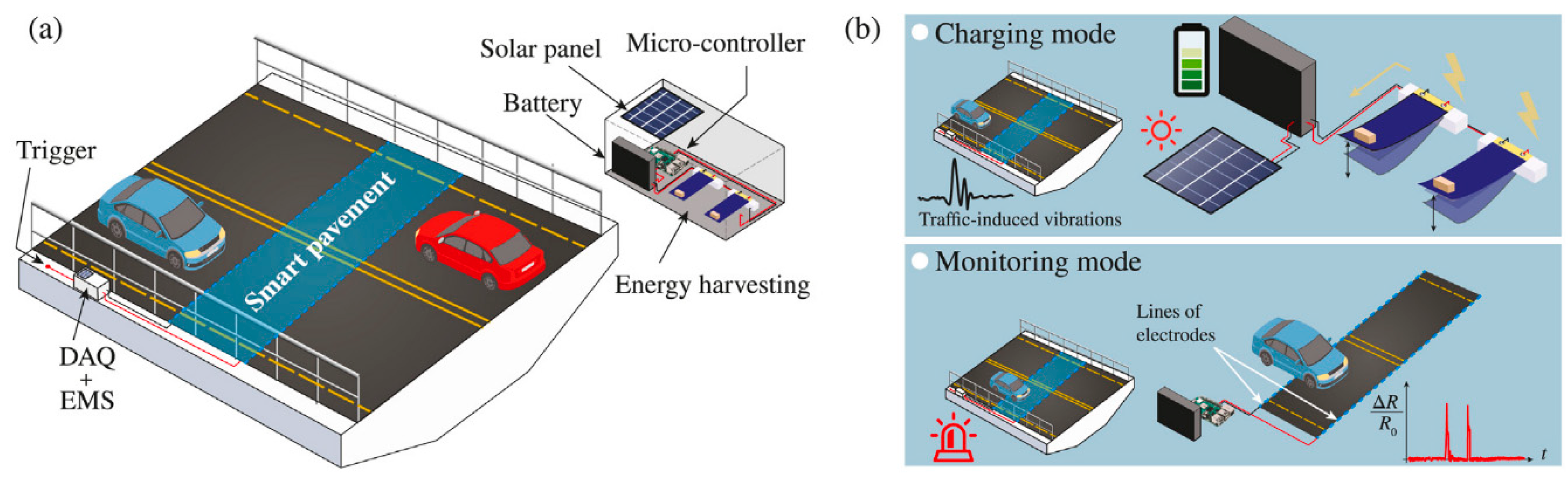

Table 1.
Geometry factor of different electrical measurement system
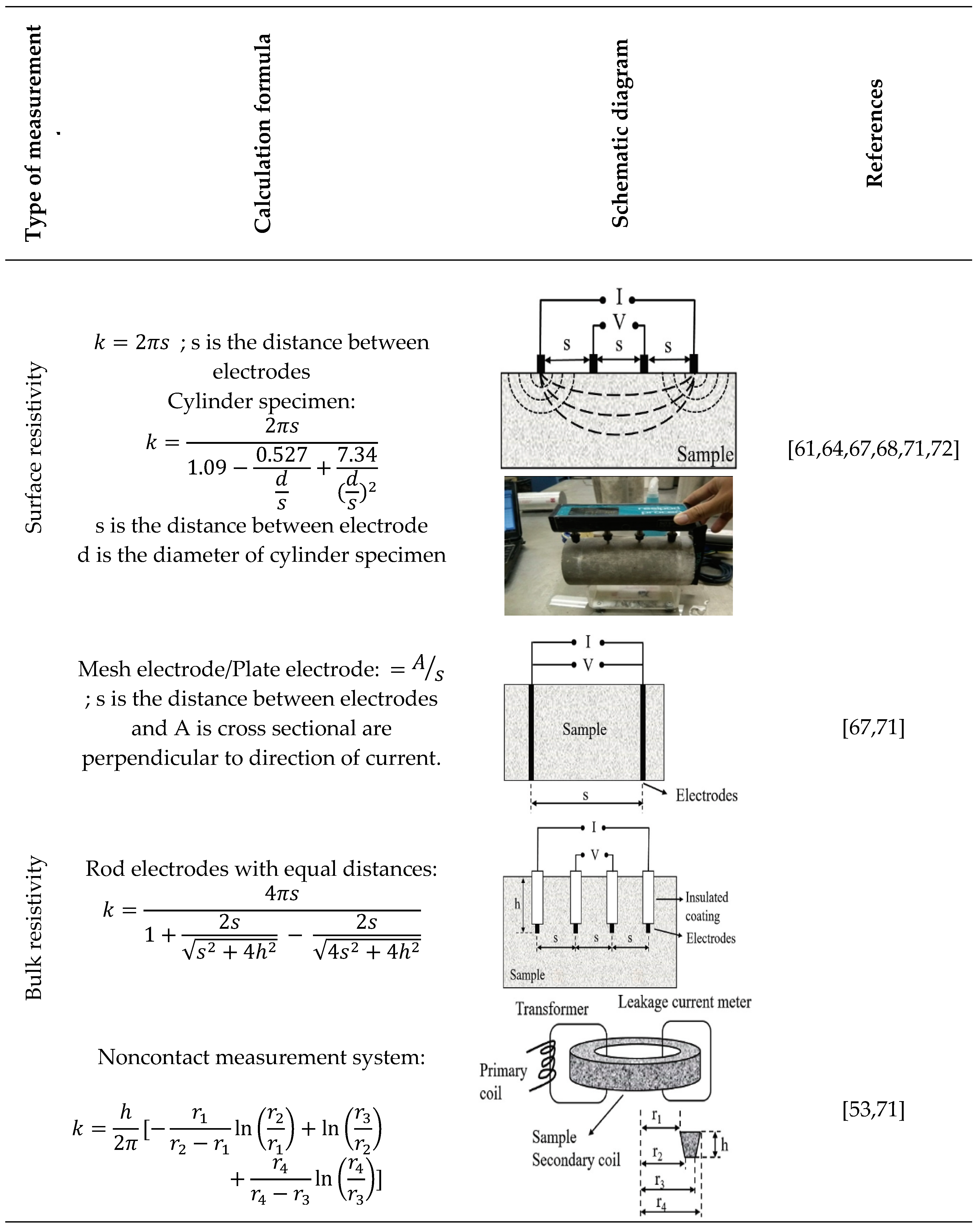
Table 2.
Self-sensing alkali activated composites.
| Reference | Material Type | Activator | Precursor | Conductive filler |
| [156] | Paste | Na2SiO3+NaOH | Fly ash class C | Carbon fiber (0.5wt%) |
| [157] | Paste | K2SiO3+KOH | GGBFS | SWCNTs (0.2wt%) |
| [158] | Mortar | Na2SiO3 | GGBFS | Graphite powder (30wt%) |
| [159] | Mortar | Na2SiO3+NaOH | Fly ash class C +GGBFS | Carbon fiber (0.5% volume) |
| [160] | Mortar | Na2SiO3+NaOH | Fly ash Class F | MWCNTs (1wt%) |
| [161] | Paste | Na2SiO3+NaOH | Fly ash Class F | Graphene oxide (0.35wt%) |
Disclaimer/Publisher’s Note: The statements, opinions and data contained in all publications are solely those of the individual author(s) and contributor(s) and not of MDPI and/or the editor(s). MDPI and/or the editor(s) disclaim responsibility for any injury to people or property resulting from any ideas, methods, instructions or products referred to in the content. |
© 2025 by the authors. Licensee MDPI, Basel, Switzerland. This article is an open access article distributed under the terms and conditions of the Creative Commons Attribution (CC BY) license (http://creativecommons.org/licenses/by/4.0/).
Copyright: This open access article is published under a Creative Commons CC BY 4.0 license, which permit the free download, distribution, and reuse, provided that the author and preprint are cited in any reuse.


