Preprint
Article

This version is not peer-reviewed.

Efficacy Study: Comparison of an Insomnia Therapy Developed for Shift Workers with the Standard Treatment (Cognitive Behavioral Therapy for Insomnia) in an Online Group Setting. RCT With an Active Control Group, Completer Analysis

A peer-reviewed article of this preprint also exists.

Submitted:

01 February 2025

Posted:

03 February 2025

Read the latest preprint version here

Abstract

Background. Shift workers are at increased risk for insomnia or shift work disorder. The standard treatment (cognitive behavioral therapy for insomnia) is challenging for this group. Although there are new promising approaches, they are still considered inadequate. Aims and objectives. For this study, a tailored treatment was developed that replaces regularity interventions with methods from other disorders such as anxiety or depression. This approach is also intended to shift the focus away from disturbed sleep. Methods. A randomized controlled trial (RCT, completer analysis) was conducted. Therefore, linear mixed models were utilized to compare two active conditions (treatment as usual vs. tailored therapy) at three measurement points (pre-, post-treatment, 3-month follow-up). Primary outcomes are sleep quality, insomnia severity, sleep onset latency, and total sleep time. Secondary outcomes are anxiety, depression, tension, concern, emotional instability. Non-inferiority or equivalence tests were also performed. Results. The newly developed treatment approach is equivalent to standard care. Both resulted in significant and stable improvements in all variables. Thus, only the main effect across measurement points is significant, not the group or the interaction. Outlook. Attrition rates and compliance should be considered in further studies and the treatment should be revised according to these results. The approach of improving sleep with implicit interventions should be pursued further, as it seems well suited to shift workers and their specific needs.

Keywords: 
;  ;  ;  ;  
Subject: 
Social Sciences  -   Psychology

1. Introduction

Shift work has been linked to a number of adverse effects, including an elevated risk of insomnia and shift work disorder (SWD; see overview in Grünberger et al., 2024a).
The most effective method for treating insomnia in the general population is cognitive behavioural therapy for insomnia (CBT-I, Espie, 2022), which includes sleep restriction, stimulus control, cognitive restructuring of dysfunctional beliefs about sleep, psychoeducation, sleep hygiene and relaxation (e.g., Espie, 2022). However, the implementation of CBT-I for shift workers is complex and challenging, as a significant proportion of these interventions are based on adherence to regularity, which is hardly feasible for individuals that constantly need to re-adapt their rhythmicity due to rotating shifts (Tout et al., 2024). Therefore, modified rules of sleep hygiene and tipps for shift workers have been provided (Järnefelt & Spiegelhalder, 2022; Kalkanis et al., 2023; Shriane et al., 2023). These consist of scheduled naps, exposure to natural light/light therapy in line with working hours, and the use of sunglasses after night shift.
However, these recommendations for shift workers have predominantly focussed on managing daytime sleepiness or enhancing adaption of circadian rhythms, as criticised by Ell at al. (2024). Nevertheless, these approaches do not address insomnia, despite the necessity of its treatment and the absence of a gold standard therefore (Ell et al., 2024). To resolve this issue, CBT-I has been adapted to meet the specific needs of shift workers somewhat better. Efficacy studies on this are only partially generalizable due to sample characteristics, have methodological weaknesses or show ambivalent results (cf. Ell et al., 2024; Reynolds et al., 2023), as follows.
Järnefelt et al. (2012) found rather modest effects, which already occurred between waiting period and start of the intervention. Since individuals with primary insomnia benefited to a greater extent than those with SWD, the authors assess CBT-I for this group insufficient and encourage a stronger focus on its cognitive components. A subsequent RCT (Järnefelt et al., 2020) found little difference between CBT-I (self-help or group setting) and a sleep hygiene intervention. Again, individuals with SWD showed less benefit than those with primary insomnia, which also applies to improvements in depression and anxiety.
A comparison of an adapted CBT-I with an active control intervention (low glycemic index diet, sample of nurses, Booker et al., 2022) found no significant differences between the conditions. Both interventions showed efficacy in reducing insomnia severity, improving sleep hygiene, and psychological well-being. Jang et al. (2020) also observed significant improvements, although they did not include a control group. In addition, the intervention was developed specifically for firefighters and included techniques to address specific complaints of this occupational group, such as nightmares.
Given these findings, it is not surprising that the efficacy of adapted CBT-I for shift workers is often ambivalent: CBT-I is effective for alleviating psychological and emotional problems caused by shift work, but not for sleep problems per se (Kalkanis et al., 2023); use of the standard or slightly adapted form is insufficient for shift workers (Reynolds et al., 2023); a meta-analysis failed to demonstrate a reduction in insomnia symptoms in shift workers with CBT-I (Takano et al., 2023).
Previously, insomnia in shift workers was mainly attributed to circadian misalignment (see Grünberger et al., 2024a). More recently, research has focused on cognitive factors that are also relevant to the development and maintenance of primary insomnia. These were investigated in a sample of shift workers (Bastille-Denis et al., 2020). Individuals with SWD showed increased negative cognitive activity before sleep (in line with the model proposed by Harvey, 2002), dysfunctional beliefs (particularly within the worry/helplessness subscale) and selective attention to sleep-threatening stimuli. However, they did not differ from good sleepers on catastrophising and difficulty falling asleep. It has been suggested that future interventions for shift workers should target these specific factors (Bastille-Denis et al., 2020).
A recent approach (Vallières et al., 2024) adapted CBT-I interventions for daytime and nighttime sleep separately. Insomnia severity and TST (total sleep time) for day and night sleep improved, cognitive arousal, anxiety, depression, and dysfunctional beliefs about sleep decreased. All participants achieved partial or complete remission. However, this intervention appears to be complex and lengthy (14–22 weeks), and also demanding: it requires adherence to a daytime and nighttime sleep window, and in case of awakening after sleep onset, individuals should get up but remain in darkness.
The high attrition rate in this study may be related to this, but other studies of adapted forms of CBT-I (see Reynolds et al., 2023) have also reported rates above 20%. This is usually attributed to lower compliance in this group (Kalkanis et al., 2023) or to scheduling difficulties in face-to-face settings. Nevertheless, it is recommended that the cognitive components of therapy, including dysfunctional beliefs, should be further investigated (Vallières et al., 2024).
A digital, guided form of CBT-I was developed in collaboration with experts and affected nurses (Ell et al., 2024; sample 80% female, nurses only). The treatment reduced the ISI value (Insomnia Severity Index, Gerber et al., 2016) by approximately five points, which is more than observed in many other studies (cf. Reynolds et al., 2023). This outcome is attributed to the comprehensive integration of all CBT-I components and the provision of personalized support. However, it is noteworthy that participants may have perceived the cognitive elements as the most beneficial aspect of the intervention, while the sleep restriction component was perceived as the most challenging. The personal support provided in this study consisted of individualized, written feedback. As is the case with numerous other studies referenced in this article, no improvements were observed in the actigraphy data. It is noteworthy that the remission rate was only 39%, which may be related to the fact that the MCID (minimal clinical important difference) of the ISI, which is +/-6, was not achieved on average. The authors report a low dropout rate of 17.4%, while other sources cite figures of 20% as high. It is notable that only 69.6% of participants completed all six sessions, which is described as high engagement in the intervention. This assessment is particularly noteworthy given that this is a digital, self-study intervention for which no appointments are required, suggesting that the effort is minimal.
In summary, CBT-I can be utilized in an adapted form for shift workers. The findings of recent studies are encouraging. However, behavioral interventions (e.g., sleep restriction) have been found to be less effective and more challenging to implement in this group, whereas cognitive interventions have been identified as a promising avenue of research. Nevertheless, the high rate of attrition in numerous studies indicates that the needs of the target population have not yet been fully addressed.
It is well established that an excessive focus on (disturbed) sleep is a significant contributor to the maintenance of sleep disorders per se (e.g., cognitive insomnia model by Harvey, 2002; attention-intention-pathway by Espie et al., 2006). These mechanisms, including the attempt to force oneself to fall asleep, should also develop in shift workers if the insomnia becomes chronic.
It can be concluded that the already low compliance (Kalkanis et al., 2023) may be further reduced, as many strict rules must be followed throughout the entire 24-hour period by using separate time windows for day and night sleep and sleep hygiene. This predicament could potentially exacerbate the emphasis on (disturbed) sleep. The extant guidelines encompass behaviors and factors that are partially beyond the control of shift workers, such as lighting in the workplace. Anchor sleep times, which are based on regularity, have been a subject of extensive prior discussion.
This has led to the formulation of a novel therapeutic rationale, which posits that sleep should be accorded a reduced priority, especially within the context of therapeutic interventions. Conversely, therapeutic interventions should be oriented towards factors that affect sleep and can be influenced by therapeutic intervention. A preliminary study (cf. Grünberger et al., 2024a) identified anxiety, depression, concern, emotional stability, tension, and attitudes towards shift work as factors that merit further investigation.
Present study. In addressing the known reduced compliance of shift workers, we endeavored to consider the applicability and their specific needs by adapting the wording and by taking different work schedules into account. The efficacy of the newly developed treatment manual was assessed in the present study by addressing the following research questions: First, does the treatment lead to significant improvements in sleep, even though sleep is only implicitly addressed? Second, do personality factors, psychological well-being, and attitudes toward sleep also show improvement over the course of therapy? Third, are these improvements stable over three months? Fourth, how does the efficacy of the treatment compare to standard CBT-I?

2. Methods

2.1. Method and Design

A randomized controlled trial was conducted with a cluster/ad hoc sample. Subjects suffering from sleep disorders and engaged in shift work were assigned to either of two conditions through a computer-generated random numbers in series. CBT-I-S was designated as the experimental condition, while CBT-I, the standard treatment, was implemented as active control group. The comparison of the efficacy of the two conditions over three measurement points followed the approach of a completer analysis.
Because of challenges related to participant recruitment, the initially planned passive control condition (sleep diary only) had to be discontinued. Consequently, the interval between screening and pre-measurement was extended to several months in some cases, thereby creating an opportunity to compare the ISI values between these two measurement points. This served as a control measure, indicating a pseudo control group (i.e., waiting list control, see also results and discussion).

2.2. Sampling and Participants

The inclusion criteria encompassed a primary insomnia or SWD (ISI ≥ 15), engagement in shift work (2-, 3-shift system or permanent night shift) for ≥ 30 hours per week, aged 18–65 years, and sufficient German language skills. Exclusion criteria included sleep-apnea syndrome, restless-legs syndrome, chronic pain, acute addiction, affective or anxiety disorder, psychotic, bipolar, schizo-affective disorder, each in severe form.
An a-priori power estimation was conducted using G*Power 3.1.9.7 (Faul et al., 2007). For the within-between interaction (two conditions, three measurement points), a small effect size (0.1), 1–β = 0.80, p = .01 (4 outcome variables) and a correlation among repeated measures of 0.7, a total sample size of N = 142 was required.

2.3. Sampling and Procedure

Participants were recruited throughout Austria and Germany between the 21st of June 2023 and the 1st of February 2024. The study was advertised with flyers, on which access to the consent form for participation was provided on the study website. Moreover, the study was disseminated to approximately 200 companies/institutions with shift work, and a total of 7,000 doctors were contacted via email and telephone to inform their patients about the study. The participating medical professionals included general practitioners, sleep physicians, occupational physicians, and psychiatrists. Finally, the appeal was disseminated via social media, regional newspapers and their online offerings, and radio interviews. To surmount potential obstacles, a supplementary incentive of €50 was offered as remuneration for exertion. Following a nine-month recruitment period, 142 individuals completed the screening questionnaire, thus concluding the recruitment phase.
Potential participants were provided with comprehensive information about the nature and scope of the study via the website. Following their acceptance of the conditions, participants were directed to the screening questionnaire. If inclusion criteria were met, the participants were contacted via telephone to arrange a virtual appointment via MS Teams for the selection diagnostics. Following the successful completion of this additional selection procedure, the participants were assigned to either the CBT-I-S or CBT-I condition and subsequently contacted once more for a briefing on scheduling and the general procedure.
Of the 142 subjects who completed the screening, 76 proceeded to the interview and briefing stage (see Figure 1). Due to a combination of attrition and inadequate attendance, the final sample size was reduced to Ntotal = 55. At the study’s commencement, an equal number of subjects were assigned to both conditions; however, subsequent attrition resulted in 31 participants remaining in the CBT-I condition and 24 participants in the CBT-I-S condition.

2.4. Setting and Conditions of Implementation

We decided to implement a group therapy setting that was administered as a webinar via MS Teams, given the documented efficacy of online CBT-I (Espie et al., 2012). Individuals engaged in shift work often experience a heightened sense of social isolation (Cheng & Drake, 2018), thereby underscoring the potential for constructive group interactions and dialogues. The therapeutic intervention was meticulously structured into seven sessions, each spanning 90 minutes. To ensure ethical principles were upheld, the sessions were overseen by a trainer who was prepared to intervene in the event of any adverse developments. Due to the potential scheduling difficulties, two groups per condition (CBT-I-S vs. CBT-I) commenced in the same week, thus offering an alternative date for each session.
Given that only four of the seven sessions were mandatory, the study website provided access to all content in video and text formats to account for any potential missed appointments. The trainers were instructed to verify whether absent participants had viewed and understood the content.
The trainers were experienced Master students in Psychology from the University of Salzburg, who specialized in Clinical Psychology and had already completed a clinical training. All trainers underwent extensive training in the subject matter and the respective manual. The program’s comprehensive nature was overseen by a team of supervisors, who, in addition to being psychologists, were also certified cognitive-behavioral therapists.
To ensure the comparability of both treatments, the procedures were meticulously designed to mirror each other as closely as possible. Each of the seven units was initiated with a brief discussion about the current mood and experiences or problems with the content of the previous session. Thereafter, the focus was shifted to the teaching of the methods, and the session concluded with a homework exercise.
Ten days prior to the first session, the link to the pre-survey was furnished. Following the completion of the survey, participants were provided with reading material pertaining to CBT-I-S or a sleep diary for CBT-I, as delineated in the respective treatment manuals. The seven weekly sessions commenced with the trainers and study management being available by telephone or email to respond to queries and address technical issues. Following the final session, the post-survey link was distributed, accompanied by a request for prompt completion. Three months later, a follow-up survey was distributed via email.

2.5. Data Collection

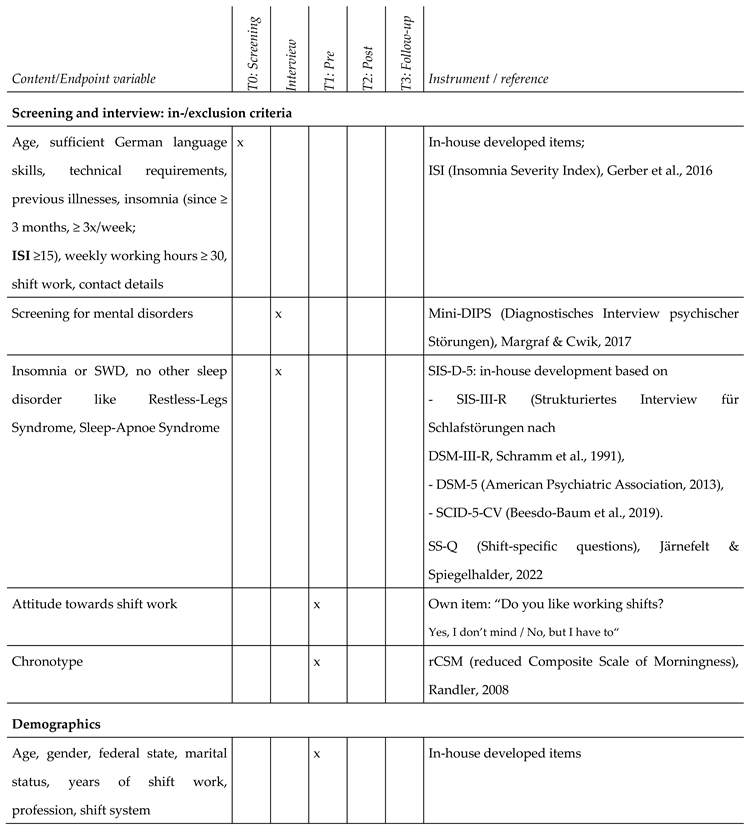
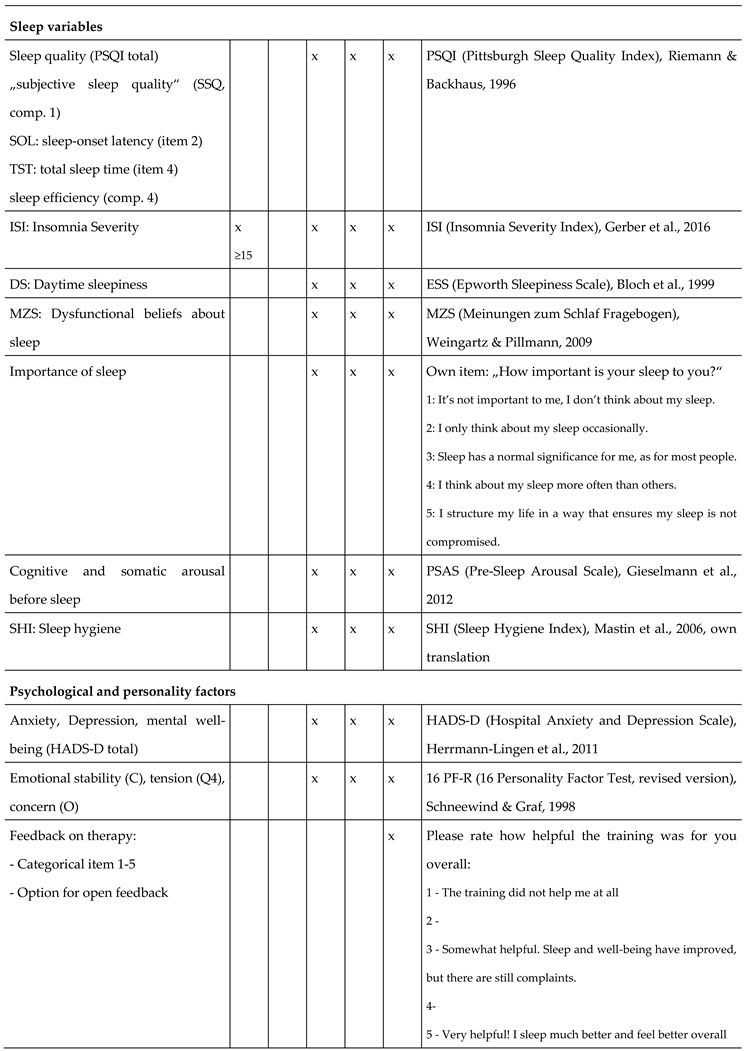
Self-report data was collected via online questionnaires (LimeSurvey) at three measurement points: (T1) pre-measurement ten days prior to the first session; (T2) post-measurement following the final session; (T3) follow-up measurement three months after the final session. An online screening (T0) and an interview were carried out in advance to verify the in- and exclusion criteria. The endpoint variables, questionnaires, and subscales utilized at each measurement point are presented in Table 1.

2.6. Treatment Manuals

CBT-I: standard manual (treatment-as-usual). To employ CBT-I as treatment as usual, it was necessary to adapt a manual to align with the specific requirements of this study, e.g., the online group setting. The interventions were meticulously curated in accordance with the contemporary recommendations outlined by Espie (2022) and were derived from a range of recognized standard manuals (see Table 2 for a detailed list). It is noteworthy to mention that certain interventions necessitated adaptation to ensure feasibility for shift workers. However, these adaptations were kept to a minimum. For instance, the sleep restriction intervention was presented in its original form but it was emphasized that shift workers should prioritize the length of the sleep window over its timing. In light of the potential challenges associated with the interventions, it is recommended that shift workers select those elements that they perceive as feasible.
CBT-I-S: shift-specific manual (experimental condition). To address the issue of reduced compliance (Kalkanis et al., 2023), all interventions based on regular rhythms have been eliminated. It is crucial to emphasize that this therapeutic modality was meticulously developed for the specific demographic of shift workers, with a comprehensive consideration of their unique requirements. To this end, it was deemed necessary to deviate from the standard wording, for example, by referring to the “main sleep phase” rather than to “night sleep”.
To ensure that the disturbed sleep within the therapy does not garner undue attention, while guaranteeing that no pertinent information is withheld, the sleep education was provided prior to the commencement of the therapy for self-study. In the preliminary session, the material was reviewed, and the therapy rationale was derived from it: The program’s primary focus was on indirect addressing of sleep issues, a deliberate strategy that is expected to ensure its efficacy.
In subsequent sessions, interventions were primarily derived from manuals that have proven efficacy for other disorders, such as anxiety and depression. The methods originate primarily from cognitive behavioral therapy, but also from positive psychotherapy (see Table 3). It is noteworthy that the explanation of these methods did not involve the use of sleep examples. The interventions were meticulously designed to address feelings of resignation and helplessness related to insomnia, with the aim of enhancing self-efficacy expectations through learning methods.

2.7. Statistical Analyses

The statistical evaluation is conducted as a completer analysis, as post- and follow-up data are unavailable for subjects who dropped out and, in some cases, for those with an insufficient number of attendances.
The employment of both the chi-squared (χ²) and the t-tests was undertaken to ascertain whether there were any statistically significant group differences prior to the administration of the respective interventions. To make a comparison between the two interventions throughout the three measurement points, linear mixed models were computed, and the correction of p-values followed Benjamini and Hochberg (1995; Hemmerich, 2016).
Non-inferiority and equivalence tests are necessary to determine whether the CBT-I-S treatment approach was equivalent, superior, or inferior to the established CBT-I treatment (Wellek & Blettner, 2012). The minimal clinically important difference (MCID) is the threshold value that was employed. For the PSQI, this is ±3 (Cao et al., 2023) and for the ISI, ±6 (Yang et al., 2009). The interpretation of the correlation coefficients and effect sizes aligns with the recommendations provided by Cohen (1988).
Finally, the participants’ feedback was analysed quantitatively and qualitatively.
All statistical calculations were executed using SPSS 29 (IBM, 2022) or Jamovi (The Jamovi Project, 2022).

3. Results

3.1. Sample

The final sample included 55 participants (67.74% male) with a mean age of 41.62 years (SD = 9.30). The participants had been employed in shifts for approximately 15 years (M = 15.26 years, SD = 10.53). The majority of the participants were Austrian (83.64%).
The ISI average score at the time of pre-measurement was 15.00 (SD = 3.87), which is precisely the lower limit of clinical relevance of insomnia and the inclusion criterion of ≥ 15. This classification is further validated by the PSQI, which yielded an M = 9.64 (SD = 2.92), demarcating the threshold between poor sleepers (6-10) and those diagnosed with chronic insomnia (>10). For an explanation of these low values, please refer to the comparison between screening (MISI = 23.78, SD = 3.67) and pre-measurement in the context of the waiting list control group and discussion.
The average SOL is M = 38.25 minutes (SD = 22.90), and the TST is M = 5.69 hours (SD = 1.21). A comprehensive account of all distinctive values, encompassing the entire sample and the two conditions individually, is presented in the Supplementary Materials.
The SS-Q identified 24 participants in the total sample with SWD (12 each), 31 with primary insomnia (12 in CBT-I-S, 19 in CBT-I condition). The diagnostic interview identified 34 individuals with SWD (17 each), 21 with primary insomnia (7 in CBT-I-S, 14 in CBT-I). The discrepancy between the classifications derived from these two methods is statistically significant, χ²(1) = 5.43, p = .02, Cramer’s V = 0.31. This discrepancy was observed exclusively in the total sample and not in the individual subgroups. Given these findings, it seems impractical to present the results separately for SWD and primary insomnia.

3.2. Power

Due to the fact that the sample size was smaller than originally intended, a post-hoc power analysis was conducted (G*Power 3.1.9.7; Faul et al., 2007) using the actual parameters and sample size. The analysis yielded an F-ratio of 2.28. When this was corrected for alpha (p = .001) and when the correlation among repeated measures (r = .7) was considered, the power (1–β) was determined to be at least .99, even for the smallest effect that was observed (16 PF-R, tension: η²partial = .10, converted into f for G*Power). Furthermore, even in the scenario where the correlation between repeated measures is reduced to 0.13, the power (1–β) remains at 0.80.
An a priori power analysis with the actual values would have resulted in a maximum sample size of N = 22. Therefore, the current results are highly power-supported.

3.3. A Priori Group Differences

The findings from the t-tests and the χ2-tests confirmed that there were no significant differences between the CBT-I-S and CBT-I groups prior to treatment (see supplementary material).

3.4. Waiting List Control Group

The mean interval between screening and pre-survey was M = 68.35 days (SD = 43.88) with no significant difference between the CBT-I-S and CBT-I groups, t(53) = 0.32, p = .747.
The ISI values (N = 55) are as follows: M = 23.78, SD = 3.67 in the screening and M = 15.00, SD = 3.87 in the pre-measurement. The mean difference is Mdiff = 8.78, SDdiff = 3.77, which is statistically significant, t(54) = 17.30, p < .001, dz = 2.33. However, the correlation between the length of the waiting period and the extent of the ISI reduction was not significant, r(53) = –.019, p = .889.
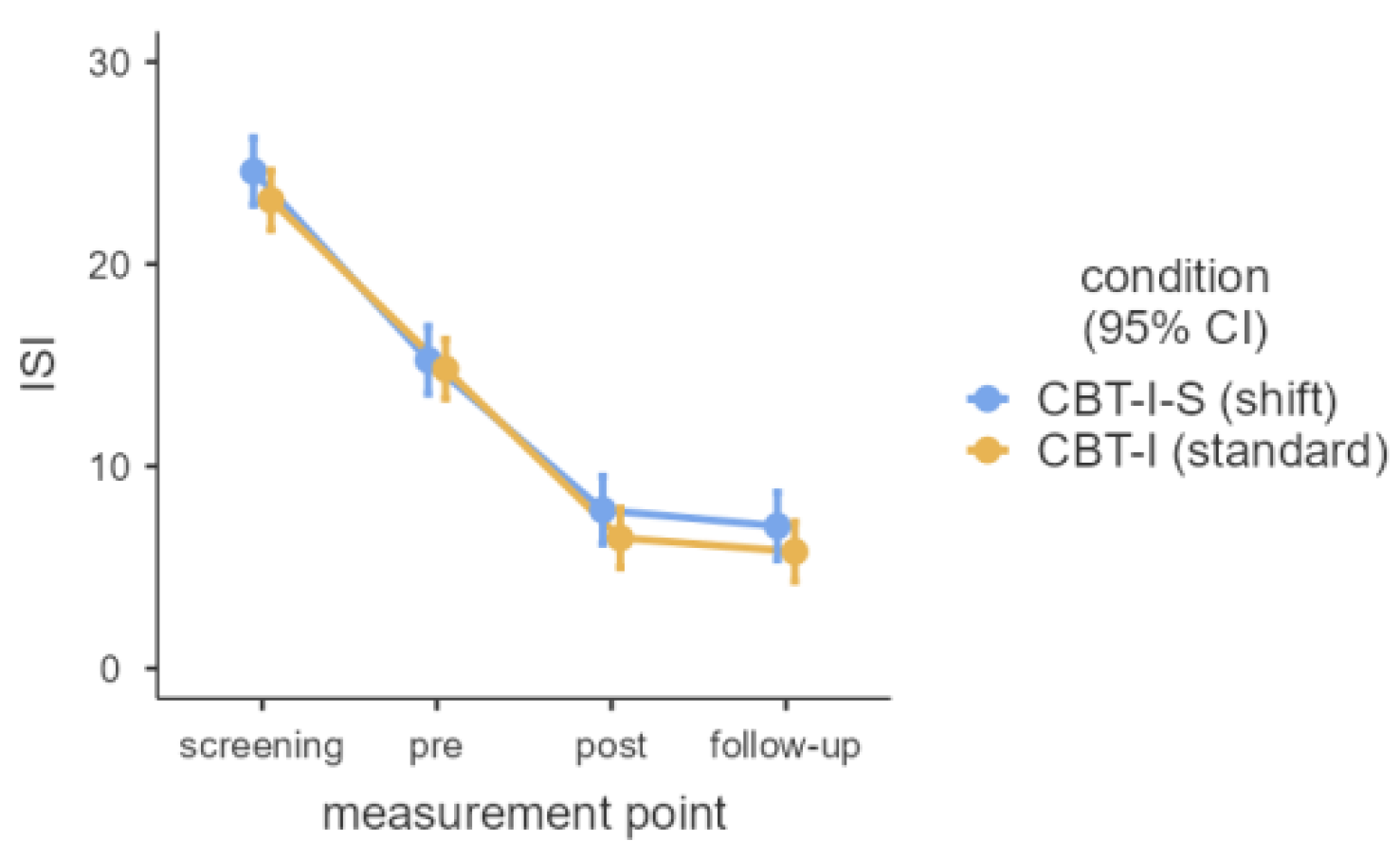
The linear mixed model, applied across the ISI values of all four measurement points, yielded a significant main effect of measurement point, F = 399.96, p = .001, η2partial = 0.88, indicating a significant decline in ISI scores over time. Subsequent post-hoc tests revealed that all measurement points differed from each other and exceeded the MCID (+/- 6), with the exception of the difference between post and follow-up (see Figure 2, discussion, and supplements).

3.5. Linear Mixed Models

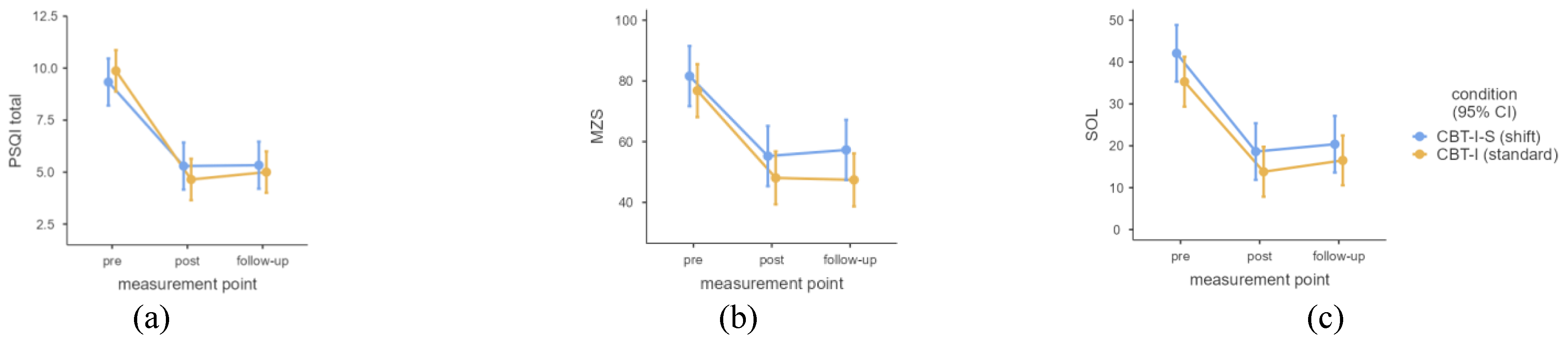
A substantial main effect for the three measurement points was identified in both conditions across a multitude of variables (see Table 4). The effects that exhibited the least significance were observed for the importance of sleep, the somatic PSAS, and the three personality traits (concern, tension, and emotional stability). In contrast, the most pronounced effects were identified in the sleep variables, particularly in the total scores of the PSQI (see Figure 3) and the ISI (see Figure 2), followed by the MZS (see Figure 4) and the SOL (see Figure 5).
No significant main effect of the group was observed, nor was there an interaction effect. The study revealed no statistically significant differences between the CBT-I-S and CBT-I groups (refer to Table 4 for comprehensive results and further figures in the supplementary materials).

3.6. Non-Inferiority/Equivalence Tests

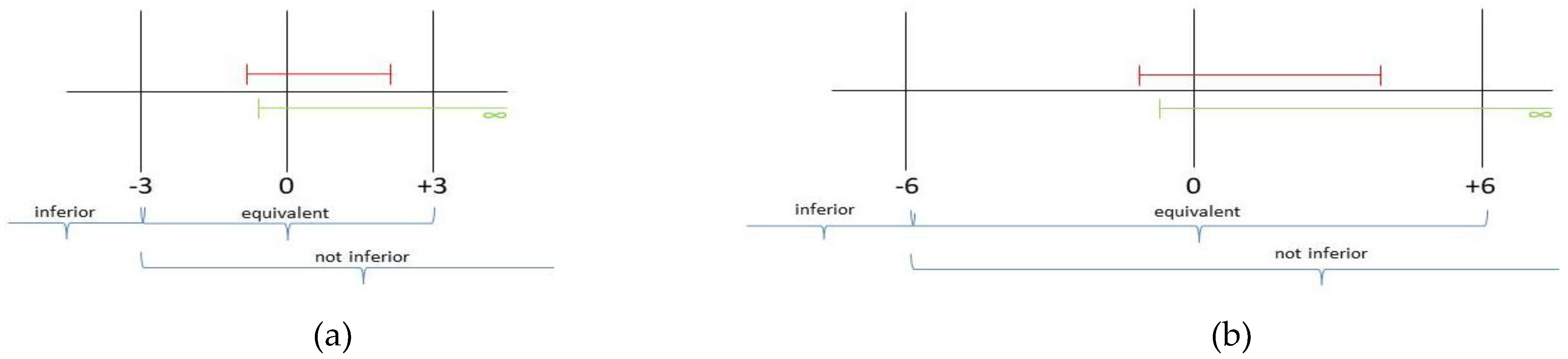
The distribution values in the PSQI total at post-survey are as follows: MCBT-I-S = 5.29, SDCBT-I-S = 2.56, s2CBT-I-S = 6.56; MCBT-I = 4.65, SDCBT-I = 2.80, s2CBT-I = 7.84. The confidence interval for the difference in the equivalence test (Figure 6, red line) is CI95% = [–0.83; 2.12], while that for the non-inferiority test (green line) is CI95% = [–0.58; ∞].
The distribution values in the ISI at post-survey are MCBT-I-S = 7.83, SDCBT-I-S = 4.51, s2CBT-I-S = 20.32; MCBT-I = 6.45, SDCBT-I-S = 4.68, s2CBT-I = 21.86. The confidence interval for the difference in the equivalence test (Figure 7, red line) is CI95% = [–1.13; 3.89]; for the non-inferiority test (green line) CI95% = [–0.71; ∞].

3.7. Remission Rates

Remission rates are also comparable between the two conditions, dependent on the precise definition of remission employed. (Table 5).

3.8. Feedbacks

With regard to the evaluation of the treatment’s overall effectiveness, as measured by the categorical question (rf. to Table 1), there was no significant difference between CBT-I-S (M = 3.96, SD = 0.91) and CBT-I (M = 3.97, SD = 1.14); t(52.94) = –0.03, p = .973.
The qualitative evaluation of the feedback also exhibited similarities between the two conditions, considering the group size and the number of feedback items. Statements classified as “helpful” were more prevalent in the CBT-I-S condition, though improvements in well-being were more often observed in the CBT-I condition. The proportion of feedback mentioning an improvement in sleep was similar in both groups.
The terms “well-prepared documents” and “pleasant group atmosphere” were mentioned exclusively by the participants in the CBT-I-S group. Negative feedback following CBT-I-S was observed to be associated, on one occasion, with the therapy rationale, and on two instances, with the unchangeability of the underlying causes, specifically the persistent shift work. Of course, this criticism cannot be attributed to the specific form of treatment. A comparable feedback item was identified in the CBT-I group, namely that a long-standing problem cannot be resolved within a three-month timeframe. It is noteworthy that the therapy was deemed “unsuitable for shift workers” exclusively by CBT-I participants (see full and categorized feedback in supplementary information).

3.9. Dropout Rates

Following the random allocation of participants to the respective conditions, CBT-I-S and CBT-I were of an equivalent size, comprising 42 individuals each. Four individuals each withdrew from the study prior to first session. Accordingly, the two conditions started with n = 38 each (cf. Figure 1).
In the standard condition (CBT-I), four individuals withdrew from the study (10.52%), three attended less than four sessions (7.89%). In the experimental condition, six participants discontinued the study (15.79%), and eight individuals attended the sessions with insufficient frequency (21.05%).
Potential explanations of the origin of these slightly higher values in the CBT-I-S condition are provided in the discussion section.

4. Discussion

The newly developed CBT-I-S manual and the standard CBT-I both resulted in significant enhancements in subjective sleep variables, including SOL, TST, SSQ, sleep efficiency, DS, as well as PSQI total and ISI. The observed changes in the total PSQI and ISI scores exceeded the MCID (±3 and ±6, respectively), suggesting that the observed improvements were clinically significant in both therapy conditions. This finding is particularly noteworthy and encouraging, especially in light of the fact that sleep was only implicitly addressed in the CBT-I-S condition. Additionally, improvements were observed in dysfunctional attitudes towards sleep, sleep importance, pre-sleep arousal, sleep hygiene, depression/anxiety, and various personality factors, along with emotional stability and tension, in both conditions, although to a lesser extent. Notably, these enhancements demonstrated stability over the three-month follow-up period, irrespective of the specific therapy condition.
No statistically significant between-group differences were observed at any measurement points. The efficacy of the novel therapeutic CBT-I-S approach was found to be statistically equivalent to the established CBT-I treatment, and the same applies to the remission rates observed in both conditions.
A notable benefit of the novel treatment is its potential to be more accessible for shift workers compared to conventional treatment methods. The interventions employed in this study, which only implicitly address sleep, are evidently suitable for replacing interventions on regularity, such as sleep restriction. Consequently, the higher attrition rate observed in the tailored therapy group is somewhat unexpected. A review of the therapists’ notes reveals that some of the observed absences were attributed to short-term assumption of duties, illness, or technical difficulties. However, given that this information was not systematically collected and some participants were absent without providing an excuse, it is not possible to assess the role of these causes and determine whether there is a difference between the groups. The scheduling of treatment sessions may also have been a contributing factor. Due to the protracted acquisition period, the commencement of treatment occurred subsequent to the initially anticipated schedule. Consequently, trainers, particularly CBT-I-S trainers, were constrained by competing commitments, impeding their ability to offer dates with the flexibility initially envisioned and agreed upon. This constraint may have led to missed appointments or withdrawals by participants.
A more substantial explanation for the elevated dropout rate in CBT-I-S can be derived from trainer feedback. Initially, some participants in the CBT-I-S group exhibited considerable skepticism regarding the rationale of indirectly addressing sleep and expressed doubts about its efficacy.
This feedback underscores the imperative for subsequent applications to deliberate on potential ramifications. For instance, the rationale underpinning this approach could be articulated with greater clarity and precision. Furthermore, a less rigid approach to the exclusion of sleep from therapy may be advantageous.
The significant decrease in the ISI score between the screening and pre-surveys is a notable finding. The mean ISI value at the screening stage fell within the range associated with severe clinical insomnia (ISI ≥ 22). However, at the pre-measurement stage, the mean value was already within the moderate insomnia clinical symptom range (15-21). While this finding clearly demonstrates a waiting-list effect, it would be a simplistic argument to claim that the subsequent therapy effects would have emerged simply by keeping the participants on a waiting list. In this case, there should have been a correlation between the magnitude of the improvement and the length of the waiting period; however, this correlation was not observed.
As illustrated in Figure 2, the treatment-induced improvement exceeds the minimal clinically important difference (MCID), attaining the threshold of the lowest category of the Insomnia Severity Index (ISI), defined as “no clinically significant insomnia” (Gerber et al., 2016). The significant discrepancies observed between screening and pre-measurement results can be attributed to expectation effects, as prior research has demonstrated a positive correlation between outcome expectations and treatment effects (Frank, 1961). However, a recent meta-analysis (Constantino et al., 2018) indicates that the effects between pre- and post-treatment are typically modest, which contradicts the magnitude of the observed effect in the present study. The substantial waiting effect in this study could be attributed to the observation that shift workers often perceive a lack of available assistance or the perception that poor sleep is an unavoidable consequence of their work schedule. This assumption is further substantiated by the fact that a significant proportion of participants expressed their gratitude in their feedback for having the opportunity to participate in this customized treatment program. This may have led to heightened expectations, resulting in an anticipatory improvement in sleep quality.
The evaluation results indicate that the CBT-I-S group exhibited a more favorable response compared to the classical CBT-I group. Notably, the claim that the treatment was not appropriate for shift workers was made exclusively by the standard CBT-I group. This finding serves to validate the hypothesis that CBT-I-S is perceived as more suitable for shift workers.

4.1. Limitations

All data is based on self-assessment and must be considered subjective. This is due to the online setting and financial constraints, which did not allow for laboratory assessments with polysomnography recordings. A potential limitation of the statistical analysis is that some of the factors and variables are not normally distributed. However, this observation is predominantly constrained to one of the two conditions. To ensure a standardized and clear evaluation, it was decided that parametric tests should be used for the entire evaluation. We cite Pagano (2010), Rasch & Guiard (2004), and Wilcox (2012) as evidence that t-tests are relatively resilient to deviations from a normal distribution. With regard to the linear mixed models and the tests for equivalence/non-inferiority, we have opted for parametric tests due to the absence of non-parametric methods.
A notable discrepancy exists between the two instruments utilized with respect to the classification of SWD or primary insomnia. This discrepancy is regrettable, as it precludes the calculation of a group difference between the two diagnoses, which would have been highly informative. The interview instrument was developed in-house but is grounded in extensively evaluated procedures and diagnostic systems. The SS-Q was published in this abridged form by Järnefelt and Spiegelhalder (2022) and is based on an evaluated procedure (Vanttola et al., 2020).
It is regrettable that no data is available for dropouts or participants who were present for a maximum of three sessions. An intention-to-treat analysis and the examination of possible differences between dropouts and completers must therefore be reserved for future studies.
It is unfortunate that the studies, which had been cited in the introduction and which showed great promise, were not available at the time this study was planned. Had we had the opportunity to take these studies into account, the study’s overall quality would have been enhanced.

4.2. Strengths

The present study is innovative and pioneering in its use of a completely new implicit approach to treat insomnia in shift workers. The findings of the study demonstrate that sleep can be improved without direct addressing of the condition. This is accomplished by adapting well-established therapy rationales to align with challenging schedules and routines. This suggests that most interventions that require regularity can be replaced, making the new therapy manual more applicable, especially for shift workers.
Conventional studies have frequently been constrained to individual occupational categories. In contrast, this study did not impose any restrictions, allowing for the generalization of its results to different occupational groups. Noteworthy strengths of the study include its high power and supra-regionality, achieved through the online setting. A significant strength of the study is its simultaneous exploration of numerous factors, including sleep in its various forms, thereby providing a more comprehensive overview of the effects.

5. Conclusions

A comparative analysis of the efficacy of the newly developed CBT-I-S and standard CBT-I reveals that they are comparable. The former appears to be more suitable for shift workers, as it contains hardly any interventions based on regularity. However, given the inconclusive data regarding compliance and the drop-out rate in conjunction with feedback, a definitive conclusion regarding the superiority of CBT-I-S over standard CBT-I therapy cannot be drawn.

5.1. Outlook

A revision of the manual is necessary to reflect the experiences and results of the study. For example, a more detailed explanation of the rationale behind the therapy is required. Additionally, the scheduling of appointments should be more flexible, for instance, by offering one appointment in the morning and one in the afternoon, as explicitly suggested by a participant. For subsequent research, it is recommended to record compliance, inquire about the reasons for dropouts, and integrate novel approaches as proposed by Vallieres et al. (2024) and Ell et al. (2024). Distinguishing between shift work disorder (SWD) and primary insomnia would be advantageous.
Furthermore, the strategy of indirectly addressing sleep in the treatment of insomnia in shift workers merits further investigation, as it has already shown efficacy in its current form and holds considerable promise.
The findings suggest that the novel therapy is comparable to treatment as usual, indicating its feasibility in clinical practice. The program is currently being introduced to companies and institutions in collaboration with a provider of prevention services. In the event of this implementation, scientific monitoring would be advantageous.

Supplementary Materials

The following supporting information can be downloaded at the website of this paper posted on Preprints.org

References

  1. Åkerstedt, T.; Sallinen, M.; Kecklund, G. Shiftworkers’ attitude to their work hours, positive or negative, and why? International Archives of Occupational and Environmental Health 2022, 95, 1267–1277. [Google Scholar] [CrossRef] [PubMed]
  2. American Academy of Sleep Medicine (AASM, 2014). International Classification of Sleep Disorders, third edition (ICSD-3). American Academy of Sleep Medicine.
  3. American Psychiatric Association (APA, 2013). Diagnostic and statistical manual of mental disorders, fifth edition, DSM-5. American Psychiatric Association.
  4. Axelsson, J.; Åkerstedt, T.; Kecklund, G.; Lowden, A. Tolerance to shift work—how does it relate to sleep and wakefulness? International Archives of Occupational and Environmental Health 2004, 77, 121–129. [Google Scholar] [CrossRef] [PubMed]
  5. Baglioni, C., Espie, C. A., & Riemann, D. (Eds.). (2022). Cognitive-behavioral therapy for insomnia (CBT-I) across the life span. Guidelines and clinical protocols for health professionals. John Wiley & Sons Ltd.
  6. Bastille-Denis, E.; Lemyre, A.; Pappathomas, A.; Roy, M.; Vallières, A. Are cognitive variables that maintain insomnia also involved in shift work disorder? Sleep Health 2020, 6, 399–406. [Google Scholar] [CrossRef] [PubMed]
  7. Becker, E., & Margraf, J. (2002). Generalisierte Angststörung. Ein Therapieprogramm. Beltz.
  8. Beesdo-Baum, K., Zaudig, M., & Wittchen, H.-U. (Eds.). (2019). SCID-5-CV. Strukturiertes Klinisches Interview für DSM-5R-Störungen – Klinische Version. Deutsche Bearbeitung des Stuctured Clinical Interview for CDM-5 R Disorders – Clinician Version von Michael B. First, Jane B. Williams, Rhonda S. Hogrefe.
  9. Benjamini, Y.; Hochberg, Y. Controlling the False Discovery Rate: A Practical and Powerful Approach to Multiple Testing. Journal of the Royal Statistical Society. Series B (Methodological) 1995, 57, 289–300. [Google Scholar] [CrossRef]
  10. Binder, R., Schöller, F., & Weeß, H.-G. (2020). Therapie-Tools Schlafstörungen. Beltz.
  11. Bloch, K.E.; Schoch, O.D.; Zhang, J.N.; Russi, E.W. German version of the Epworth Sleepiness Scale. Respiration; international review of thoracic diseases 1999, 66, 440–447. [Google Scholar] [CrossRef]
  12. Booker, L.A.; Sletten, T.L.; Barnes, M.; Alvaro, P.; Collins, A.; Chai-Coetzer, C.L.; McMahon, M.; Lockley, S.W.; Rajaratnam SM, W.; Howard, M.E. The effectiveness of an individualized sleep and shift work education and coaching program to manage shift work disorder in nurses: a randomized controlled trial. Journal of clinical sleep medicine 2022, 18, 1035–1045. [Google Scholar] [CrossRef]
  13. Cao, S. , Xin, B., Yu, Y., Peng, C., Zhu, C., Deng, M., Gao, X., Chu, J., & Liu, T Improvement of sleep quality in isolated metastatic patients with spinal cord compression after surgery. World Journal of Surgical Oncology 2023, 21, 1–9. [Google Scholar] [CrossRef]
  14. Cheng, P.; Drake, C.L. Psychological impact of shift work. Current Sleep Medicine Reports 2018, 4, 104–109. [Google Scholar] [CrossRef]
  15. Cohen, J. (1988). Statistical power analysis for the behavioral sciences (2nd ed.). L. Erlbaum Associates.
  16. Constantino, M. J. , Vîslă, A., Coyne, A. E., & Boswell, J. F. A meta-analysis of the association between patients’ early treatment outcome expectation and their posttreatment outcomes. Psychotherapy 2018, 55, 473–485. [Google Scholar] [CrossRef]
  17. Crönlein, T. (2013). Primäre Insomnie. Ein Gruppentherapieprogramm für den stationären Bereich. Hogrefe.
  18. Ell, J.; Brückner, H.A.; Johann, A.F.; Steinmetz, L.; Güth, L.J.; Feige, B.; Järnefelt, H.; Vallières, A.; Frase, L.; Domschke, K.; Riemann, D.; Lehr, D.; Spiegelhalder, K. Digital cognitive behavioural therapy for insomnia reduces insomnia in nurses suffering from shift work disorder: A randomised-controlled pilot trial. Journal of Sleep Research 2024, 33, e14193. [Google Scholar] [CrossRef]
  19. Espie CA (2022) Standard CBT-I protocol for the treatment of insomnia disorder In, C. Baglioni, C. A. Espie, D. Riemann (Eds.), Cognitive-behavioural therapy für insomnia (CBT-I) across the life span. Guidelines and clinical protocols for health professionals (pp. 19–41). John Wiley & Sons Ltd.
  20. Espie, C.A.; Kyle, S.D.; Williams, C.; Ong, J.C.; Douglas, N.J.; Hames, P.; Brown JS, L. A randomized, placebo-controlled trial of online cognitive behavioral therapy for chronic insomnia disorder delivered via an automated media-rich web application. Sleep 2012, 35, 769–781. [Google Scholar] [CrossRef] [PubMed]
  21. Espie, C.A.; Broomfield, N.M.; MacMahon, K.M.; Macphee, L.M.; Taylor, L.M. The attention-intention-effort pathway in the development of psychophysiologic insomnia: a theoretical review. Sleep medicine reviews 2006, 10, 215–245. [Google Scholar] [CrossRef] [PubMed]
  22. Faul, F. , Buchner, A., Erdfelder, E., Lang, A.-G., & Buchner, A. G*Power3: A flexible statistical power analysis program for the social, behavioral, and biomedical sciences. Behavior Research Methods 2007, 39, 175–91. [Google Scholar] [PubMed]
  23. Feld, A. & Rudy, J. M. (2017). Coaching der Positiven Psychologie. Manual für Coaches [Unpublished manual]. Paris-Lodron-Universität Salzburg.
  24. Frank, J. D. (1961). Persuasion and healing: A comparative study of psychotherapy. John Hopkins University Press.
  25. Gerber, M.; Lang, C.; Lemola, S.; Colledge, F.; Kalak, N.; Holsboer-Trachsler, E.; Pühse, U.; Brand, S. Validation of the German version of the insomnia severity index in adolescents, young adults and adult workers: results from three cross-sectional studies. BMC Psychiatry 2016, 16, 1–14. [Google Scholar] [CrossRef]
  26. Gieselmann, A.; de Jong-Mayer, R.; Pietrowsky, R. Kognitive und körperliche Erregung in der Phase vor dem Einschlafen. Die deutsche Version der Pre-Sleep Arousal Scale (PSAS). Zeitschrift für Klinische Psychologie und Psychotherapie 2012, 41, 73–80. [Google Scholar] [CrossRef]
  27. Grünberger, T.; Höhn, C.; Schabus, M.; Laireiter, A.-R. Insomnia in Shift Workers: Which trait and state characteristics could serve as foundation for developing an innovative therapeutic approach? Preprints 2024. [Google Scholar] [CrossRef]
  28. Grünberger, T.; Höhn, C.; Schabus, M.; Laireiter, A.-R. Efficacy study comparing a CBT-I developed for shift workers (CBT-I-S) to standard CBT-I (cognitive behavioural therapy for insomnia) on sleep onset latency, total sleep time, subjective sleep quality, and daytime sleepiness: study protocol for a parallel group randomized controlled trial with online therapy groups of seven sessions each. Trials 2024, 25, 1–10. [Google Scholar] [CrossRef]
  29. Harvey, A.G. A cognitive model of insomnia. Behaviour Research and Therapy 2002, 40, 869–893. [Google Scholar] [CrossRef]
  30. Hemmerich, W. (2016). StatistikGuru: Rechner zur Adjustierung des α-Niveaus. Retrieved from https://statistikguru.de/rechner/adjustierung-des-alphaniveaus.html.
  31. Herrmann-Lingen, C., Buss, U., & Snaith, R. P. (2011). Hospital Anxiety and Depression Scale, Deutsche Version (HADS-D) (Vol. 3). Huber.
  32. IBM Corp (2023). IBM SPSS Statistics for Windows, Version 29.0.2.0. IBM Corp.
  33. Järnefelt, H. ; Spiegelhalder K (2022) CBT-IProtocols for Shift Workers Health Operators In, C. Baglioni, C. A. Espie, & D. Riemann (Eds.), Cognitive-behavioural therapy for insomnia (CBT-I) across the life span. Guidelines and clinical protocols for health professionals (pp. 126–132). John Wiley & Sons Ltd.
  34. Järnefelt, H. , Härmä, M., Sallinen, M., Virkkala, J., Paajanen, T. Martimo, K.-P., & Hublin, C. Cognitive behavioural therapy interventions for insomnia among shift workers: RCT in an occupational health setting. International Archives of Occupational and Environmental Health 2020, 93, 535–550. [Google Scholar] [CrossRef]
  35. Järnefelt, H.; Lagerstedt, R.; Kajaste, S.; Sallinen, M.; Savolainen, A.; Hublin, C. Cognitive behavioral therapy for shift workers with chronic insomnia. Sleep medicine 2012, 13, 1238–1246. [Google Scholar] [CrossRef]
  36. Jang, E. H. , Hong, Y., Kim, Y., Lee, S., Ahn, Y., Jeong, K. S., Jang, T.-W., Lim, H., Jung, E., Shift Work Disorder Study Group, Chung, S., & Suh, S. The development of a sleep intervention for firefighters: The FIT-IN (Firefighter’s Therapy for Insomnia and Nightmares) Study. International Journal of Environmental Research and Public Health 2020, 17, 8738. [Google Scholar] [CrossRef]
  37. Kalkanis, A.; Demolder, S.; Papadopoulos, D.; Testelmans, D.; Buyse, B. Recovery from shift work. Frontiers in Neurology 2023, 14, 1270043. [Google Scholar] [CrossRef] [PubMed]
  38. Kerkhof, G.A. Shift work and sleep disorder comorbidity tend to go hand in hand. Chronobiology International 2018, 35, 219–228. [Google Scholar] [CrossRef] [PubMed]
  39. Margraf, J., & Cwik, J. C. (2017). Mini-DIPS Open Access: Diagnostisches Kurzinterview bei psychischen Störungen. Forschungs- und Behandlungszentrum für psychische Gesundheit, Ruhr-Universität Bochum. [CrossRef]
  40. Mastin, D.F.; Bryson, J.; Corwyn, R. Assessment of sleep hygiene using the Sleep Hygiene Index. Journal of behavioral medicine 2006, 29, 223–227. [Google Scholar] [CrossRef]
  41. Müller, T., & Paterok, B. (2010). Schlaftraining. Ein Therapiemanual zur Behandlung von Schlafstörungen (2., überarbeitete Auflage). Hogrefe.
  42. Pagano, R. R. (2010). Understanding statistics in the behavioral sciences (9th ed.). Thomson Wadsworth.
  43. Pitschel-Walz, G., Bäuml, J., & Kissling W. (2003). Psychoedukation bei Depressionen. Manual zur Leitung von Patienten- und Angehörigengruppen. Urban & Fischer Verlag.
  44. Pollmächer, T., Wetter, T. C., Bassetti, C. L. A., Högl, B., Randerath, W., Wiater, A. (Eds.). (2020). Handbuch Schlafmedizin. Elsevier.
  45. Randler, C. Psychometric properties of the German version of the Composite Scale of Morningness. Biological Rhythm Research 2008, 39, 151–161. [Google Scholar] [CrossRef]
  46. Rasch, D.; Guiard, V. The robustness of parametric statistical methods. Psychology Science 2004, 46, 175–208. [Google Scholar]
  47. Reinberg, A.; Ashkenazi, I. Internal desynchronization of circadian rhythms and tolerance to shift work. Chronobiology International 2008, 25, 625–643. [Google Scholar] [CrossRef]
  48. Reynolds, A.C.; Sweetman, A.; Crowther, M.E.; Paterson, J.L.; Scott, H.; Lechat, B.; Wanstall, S.E.; Brown, B.W.; Lovato, N.; Adams, R.J.; Eastwood, P.R. Is cognitive behavioral therapy for insomnia (CBTi) efficacious for treating insomnia symptoms in shift workers? A systematic review and meta-analysis. Sleep medicine reviews 2023, 67, 101716. [Google Scholar] [CrossRef]
  49. Riemann, D., & Backhaus, J. (1996). Behandlung von Schlafstörungen. Psychologie Verlags Union.
  50. Saksvik, I.B.; Bjorvatn, B.; Hetland, H.; Sandal, G.M.; Pallesen, S. Individual differences in tolerance to shift work – a systematic review. Sleep medicine reviews 2011, 15, 221–235. [Google Scholar] [CrossRef]
  51. Scharfenstein, A., & Basler, H.-D. (2004a). Schlafstörungen. Auf dem Weg zu einem besseren Schlaf. Schlaftagebuch. Vandenhoeck & Ruprecht.
  52. Scharfenstein, A., & Basler, H.-D. (2004b). Schlafstörungen. Auf dem Weg zu einem besseren Schlaf. Trainerhandbuch. Vandenhoeck & Ruprecht.
  53. Schaub, A., Roth, E., & Goldmann, U. (2013). Kognitiv-psychoedukative Therapie zur Bewältigung von Depression. Ein Therapiemanual (2. Aufl.). Hogrefe.
  54. Schneewind, K. A., & Graf, J. (1998). Der 16-Persönlichkeits-Faktoren-Test, revidierte Fassung. 16 PF-Rdeutsche Ausgabe des 16 PF Fifth EditionTestmanual. Hans Huber.
  55. Schramm, E., Hohagen, F., Graßhoff, U., & Berger, M. (1991). Strukturiertes Interview für Schlafstörungen nach DSM-III-R. Beltz Test GmbH.
  56. Shriane, A.E.; Rigney, G.; Ferguson, S.A.; Bin, Y.S.; Vincent, G.E. Healthy sleep practices for shift workers: consensus sleep hygiene guidelines using a Delphi methodology. Sleep 2023, 46, 1–14. [Google Scholar] [CrossRef]
  57. Spiegelhalder, K., Backhaus, J., & Riemann, D. (2011). Schlafstörungen (2. überarbeitete Auflage). Hogrefe.
  58. Takano, Y.; Ibata, R.; Machida, N.; Ubara, A.; Okajima, I. Effect of cognitive behavioral therapy for insomnia in workers: A systematic review and meta-analysis of randomized controlled trials. Sleep Medicine Reviews 2023, 71. [Google Scholar] [CrossRef] [PubMed]
  59. Teismann, T., Hanning, S., Brachel, R.v., & Willutzki, U. (2012). Kognitive Verhaltenstherapie depressiven Grübelns. Springer.
  60. The jamovi project (2022). jamovi. (Version 2.3). Retrieved from https://www.jamovi.org.
  61. Tout, A. F., Tang, N. K. Y., Sletten, T. L., Toro, C. T., Kershaw, C., Meyer. C., Rajaratnam, S. M. W., & Moukhtarian, T. R. (2024). Current sleep interventions for shift workers: a mini review to shape a new preventative, multicomponent sleep management programme. Frontiers in Sleep 3. [CrossRef]
  62. Vallières, A.; Pappathomas, A.; Garnier, S.B.; Mérette, C.; Carrier, J.; Paquette, T.; Bastien, C.H. Behavioural therapy for shift work disorder improves shift workers’ sleep, sleepiness and mental health: A pilot randomised control trial. Journal of Sleep Research 2024, 33, e14162. [Google Scholar] [CrossRef] [PubMed]
  63. Vanttola, P. , Puttonen, S., Karhula, K., Oksanen, T., & Härmä, M. Prevalence of shift work disorder among hospital personnel: A cross-sectional study using objective working hour data. Journal of sleep research 2020, 29, e12906. [Google Scholar] [CrossRef] [PubMed]
  64. Weingartz, S.; Pillmann, F. Meinungen-zum-Schlaf-Fragebogen. Deutsche Version der DBAS-16 zur Erfassung dysfunktionaler Überzeugungen und Einstellungen zum Schlaf. Somnologie 2009, 13, 29–36. [Google Scholar] [CrossRef]
  65. Wellek, S.; Blettner, M. Klinische Studien zum Nachweis von Äquivalenz oder Nichtunterlegenheit. Teil 20 der Serie zur Bewertung wissenschaftlicher Publikationen. [Establishing equivalence or non-inferiority in clinical trials—part 20 of a series on evaluation of scientific publications]. Deutsches Ärzteblatt International 2012, 109, 674–679. [Google Scholar] [CrossRef]
  66. Wilcox, R. R. (2012). Introduction to robust estimation and hypothesis testing (3rd ed.). Statistical modeling and decision science; Academic Press.
  67. Yang, M.; Morin, C.M.; Schaefer, K.; Wallenstein, G.V. Interpreting score differences in the Insomnia Severity Index: using health-related outcomes to define the minimally important difference. Current Medical Research and Opinion 2009, 25, 2487–2494. [Google Scholar] [CrossRef]
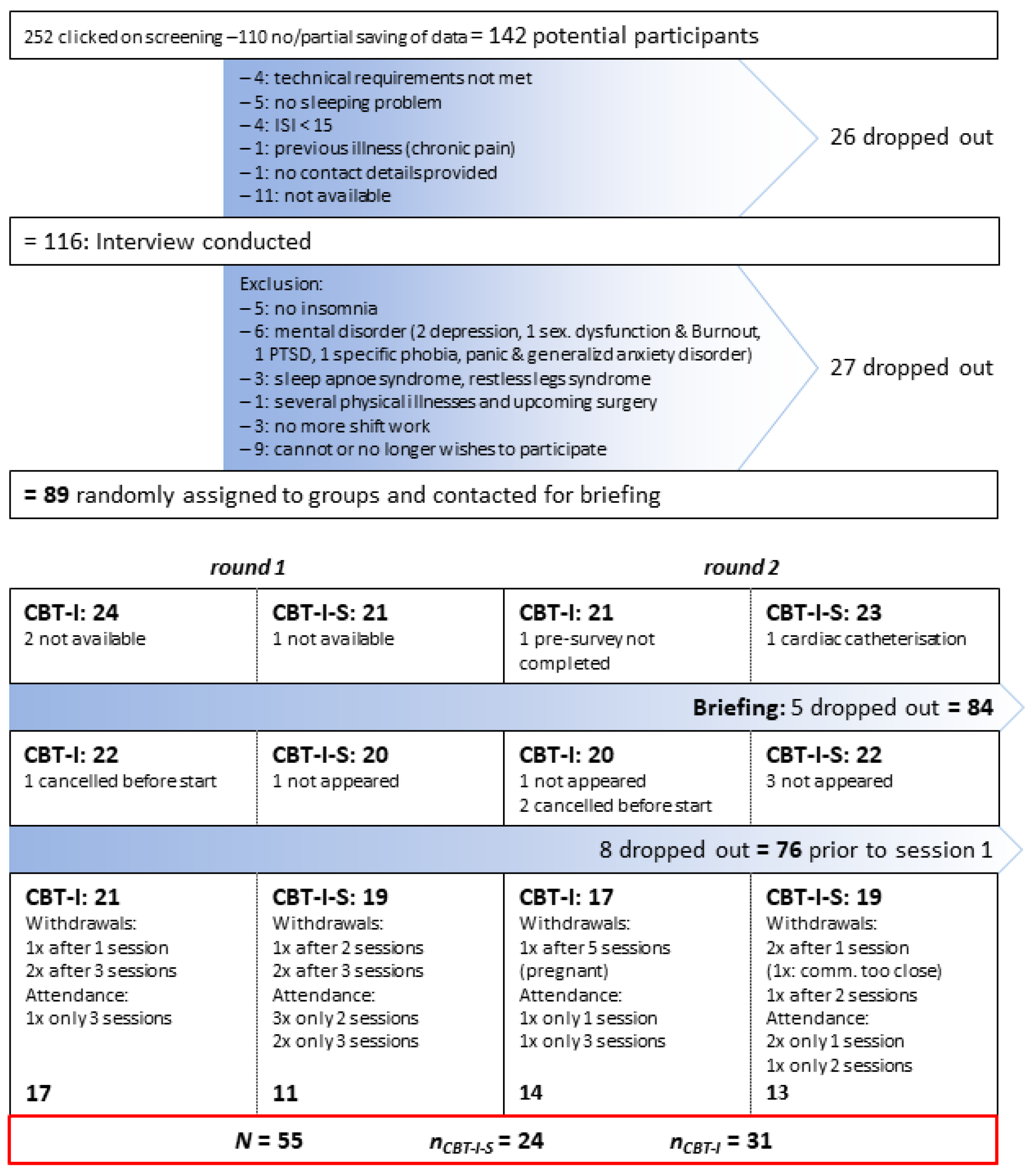
Figure 1. Flowchart.
Preprints 147972 g001
Figure 2. ISI, 4 measurement points.
Preprints 147972 g002
Figure 3. (a) PSQI total; (b) MZS; (c) SOL.
Preprints 147972 g003
Figure 4. Non-inferiority/equivalence tests: (a) PSQI; (b) ISI.
Preprints 147972 g004
Table 1. Endpoint variables, instruments, and measurement points.
Preprints 147972 i001
Preprints 147972 i002
See Grünberger et al. (2024b) for more details on the questionnaires. Mini-DIPS and SIS-D-5 were conducted as interviews via MS Teams, all other instruments were integrated into the online surveys via LimeSurvey.
Table 2. CBT-I. 
Table 2. CBT-I. 
Sessions Contents Quoted / based on / adapted from …:
After pre-survey Sleep diary (to keep until the last session) Scharfenstein & Basler, 2004a
1. Introduction to the programme, psycho education,
implementation of relaxation method
Binder et al., 2020, pp. 49–52, 75–78, 95–96;
Espie, 2022; Crönlein, 2013
2. Introduction to sleep restriction, calculation of the
first sleep window
Müller & Paterok, 2010, pp. 87–97
3. Deepen sleep restriction, repeat relaxation Müller & Paterok, 2010, pp. 101–103;
Espie, 2022
4. Stimulus control, adaptation of the sleep window,
repeat relaxation
Espie, 2022, pp. 22–25
5. Sleep hygiene, sleep hygiene check; adaptation of the
sleep window, repeat relaxation
Binder, et al., 2020, pp. 135–141; Espie, 2022
6. Cognitive restructuring of dysfunktional thoughts
about sleep
Binder et al., 2020, pp. 174–177
7. Sharing experiences, reviewing sleep diaries,
relapse prevention, goodbye
Scharfenstein & Basler, 2004b, pp. 189–190
Table 3. CBT-I-S. 
Table 3. CBT-I-S. 
Sessions contents Partly in-house development, partly quoted / based on / adapted from …:
After pre-survey Reading material: Psychoeducation on healthy sleep, insomnia, and treatment options AASM, 2014; Baglioni et al., 2022; Crönlein, 2013; Espie et al., 2006; Pollmächer et al., 2020; Müller & Paterok, 2010; Scharfenstein & Basler; 2004b; Kerkhof, 2018
1. Introduction to therapy
Discussion of the reading material
Derivation of the therapeutic rationale
Effects of attitudes towards shift work
Crönlein, 2013; Harvey, 2002;
Espie et al., 2006; Åkerstedt et al., 2022; Axelsson et al., 2004
2. Presentation and discussion of the concept of „shift work tolerance“;
Current recommendations for shift workers;
positive activities (e.g., social, family, etc.);
daily structure for each shift (early, late, night shift): recognize opportunities ‘despite shift work’; find an individual relaxation method
Reinberg & Ashkenazi, 2008; Saksvik et al., 2011; Shriane et al., 2023; Järnefelt & Spiegelhalder, 2022; Schaub et al., 2013; Espie, 2022
3. Central methodologies are employed:
Systematic problem solving, acceptance,
resource orientation.
Teismann et al., 2012
4. (Depressive) rumination:
Gratitude-/Happiness-Diary; grumbling/worrying stop; relaxation picture
Teismann et al., 2012; Feld & Rudy, 2017;
Spiegelhalder et al., 2011
5. Anxiety / concern:
decatastrophising, reality check
Becker & Margraf, 2002
6. Mood: positive activities, success spoilers,
ABC-scheme, cognitive restructuring of dysfunctional (depressive) thoughts
Pitschel-Walz et al., 2003; Schaub et al., 2013
7. Sharing experiences, emergency kit, relapse prevention, feedback and goodbye Scharfenstein & Basler, 2004b
Table 4. Linear mixed models, 3 measurement points (Benjamini & Hochberg, 1995).
Variable Measurement point Condition Measurement point * Condition
F(2, 106) p η2partial F(1, 53) p η2partial F(2, 106) p η2partial
SSQ 51.86 .003 0.49 0.30 .707 - 1.60 .336 -
SOL 56.16 .003 0.51 2.00 .298 0.21 .843
TST 39.04 .003 0.42 0.18 .742 1.33 .408
Sleep efficiency 40.86 .003 0.44 0.02 .904 1.79 .305
PSQI total 80.24 .003 0.60 0.06 .843 1.10 .470
Importance of sleep 7.36 .003 0.12 0.01 .923 0.71 .633
MZS 64.12 .003 0.55 1.57 .341 0.42 .742
ISI total (3t) 135.02 .003 0.72 1.18 .414 0.39 .742
ISI total (4t) (df = 3/159 rsp. 1/53) 399.96 .003 0.88 1.68 .336 0.32 .843
ESS 25.87 .003 0.33 0.25 .712 2.54 .174
PSAS soma 6.50 .006 0.11 2.49 .225 3.56 .080
PSAS cogn 29.69 .003 0.36 2.59 .219 1.61 .336
PSAS total 22.62 .003 0.30 2.98 .180 3.19 .108
SHI 21.23 .003 0.29 6.29 .041 0.11 0.60 .683
HADS-A 20.10 .003 0.28 0.27 .711 2.55 .174
HADS-D 15.91 .003 0.23 0.59 .592 3.00 .125
HADS total 26.25 .003 0.33 0.50 .633 4.03 .055
16-PF: C emo. Stab. 7.29 .003 0.12 1.11 .424 1.03 .492
16-PF: Q4 tension 5.91 .012 0.10 0.35 .683 5.42 .017 0.09
16-PF: O concern 8.81 .003 0.14 1.23 .408 2.58 .174
Table 5. Remission rates (ISI): Proportion of cases that showed a value below the specified threshold or above the MCID at the respective measuring point.
Screening (T0) Pre (T1) Post (T2) Follow-up (T3)
ISI <15: subthreshold clinical insomnia CBT-I-S (24) 0 (0%) 11 (45.83%) 22 (91.67%) 22 (91.67%)
CBT-I (31) 0 (0%) 15 (48.39%) 28 (90.32%) 30 (96.77%)
ISI < 8: no clinically significant insomnia CBT-I-S (24) 0 (0%) 1 (4.17%) 12 (50.00%) 17 (70.83%)
CBT-I (31) 0 (0%) 1 (3.23%) 22 (70.97%) 22 (70.97%)
Difference ≥ 6 T0-T1 CBT-I-S (24) 21 (87.50%)
CBT-I (31) 26 (83.87%)
Difference ≥ 6 T1-T2 CBT-I-S (24) 17 (70.83%)
CBT-I (31) 25 (80.65%)
Difference ≥ 6 T2-T3 CBT-I-S (24) 2 (8.33%)
CBT-I (31) 2 (6.45%)
Disclaimer/Publisher’s Note: The statements, opinions and data contained in all publications are solely those of the individual author(s) and contributor(s) and not of MDPI and/or the editor(s). MDPI and/or the editor(s) disclaim responsibility for any injury to people or property resulting from any ideas, methods, instructions or products referred to in the content.
Copyright: This open access article is published under a Creative Commons CC BY 4.0 license, which permit the free download, distribution, and reuse, provided that the author and preprint are cited in any reuse.
Prerpints.org logo

Preprints.org is a free preprint server supported by MDPI in Basel, Switzerland.

Subscribe

Disclaimer

Terms of Use

Privacy Policy

Privacy Settings

© 2025 MDPI (Basel, Switzerland) unless otherwise stated