

Submitted:
03 March 2025
Posted:
06 March 2025
You are already at the latest version
Abstract
The rapid advancement of technology has led to an increasing demand for enhanced communication systems, particularly in the realm of cellular networks. With diverse applications such as real-time video streaming, online gaming, critical operations, and Internet-of-Things (IoT) services relying more on cellular connectivity, optimizing the cellular networks to meet evolving requirements while mitigating the associated power consumption challenges is crucial. This paper provides a comprehensive overview of initiatives undertaken by industry, academia, and researchers to reduce the power consumption of cellular network systems. Special emphasis is placed on emerging technologies like Software-Defined Networking (SDN), Network Function Virtualization (NFV), and Cloud-Radio Access Network (C-RAN), which hold promise for reshaping cellular infrastructure. Additionally, the paper delves into the convergence challenges and solutions associated with SDN, NFV, and C-RAN. The paper proposes a novel cellular architecture grounded in SDN, NFV, and C-RAN paradigms. This proposed framework offers a blueprint for developing energy-efficient cellular networks capable of meeting the diverse demands of modern communication applications and able to reduce power consumption by approximately 40% to 50% with careful placement of virtual network functions.
Keywords:
Cellular Network
; C-RAN
; Green
; NFV
; Power efficiency
; SDN
1. Introduction
The advancement of Information and Communication Technology (ICT) has revolutionized and improved communication leading to an exponential increase in data traffic and data usage. According to Ericsson’s report, mobile data usage per month per device is projected to increase significantly across different regions [1]. Considering the Compound Annual Growth Rate (CAGR), the mobile data traffic per smartphone is expected to grow annually at an average rate of 17% in North America, 16% in Western Europe, and 15% in Central and Eastern Europe from 2022 to 2029 [1]. Figure 1 shows the mobile data traffic per smartphone in GB for the same period.
The growth in data consumption can be attributed to several factors. The increasing number of smart electronic devices such as smartphones, wearable electronics, and sensors significantly enhance data creation and use. The worldwide adoption of IoT devices, such as smart home appliances, and industrial sensors, generates considerable data. Nowadays cloud services are an integral part of crucial applications such as users can store data, run different applications, and access services in the cloud environment. These dependencies on cloud infrastructure enhance data consumption. The rollout of the 5G cellular networks promise enhanced throughput and low latency, that will support data-intensive activities like High-Definition (HD) video streaming, Virtual Reality (VR), and Augmented Reality (AR). The COVID-19 pandemic accelerated remote work and online learning which boosted data consumption. In summary, the convergence of technological enhancements, the growth of smart devices, and the changing behavior of users enhance the exponential growth of data consumption [2,3,4].
This tremendous growth in data traffic and data usage has compelled the development of more robust and efficient network infrastructures to support the increasing demand for data consumption. However, these advancements in telecommunication networks have also led to a significant increase in energy consumption, Carbon Dioxide (CO2) emission, and climate change posing a serious environmental threat. Telecom service provider Ericsson is proactively addressing climate change, a pressing global issue, by leveraging technology to reduce carbon emissions across their service portfolio including, telecommunication network infrastructure [5]. The ICT industry significantly contributes to global CO2 emissions, accounting for approximately 2% of total emissions [6]. This includes the energy consumption of data centers as well as the entire lifecycle of devices, networks, and infrastructure. The energy demand associated with ICT operations is substantial. The Radio Access Networks (RANs), which form the backbone of cellular communication, play a crucial role and consume over 60% of the energy used by the entire ICT industry [6]. Figure 2 depicts the power consumption breakdown of various sections within a cellular network. The RAN of the cellular network consumes 73% of the total power and the rest of the components (i.e. core, data centers, etc..) consume 27% of the total power [7]. Optimizing RANs for efficiency is essential to reduce their environmental impact [6]. Therefore, the need for sustainable and green telecommunication networks is more pressing than ever.
Wireless communication is growing rapidly and is widely used to fulfill ongoing demands, however, most network deployment designs have not focused on being energy-efficient to reduce CO2 emissions. That is where green communication comes in. Green Communication, in the context of cellular technology, focuses on establishing environmentally sustainable and energy-efficient practices within cellular networks [8]. It aims to reduce energy consumption by optimizing cellular network components such as base stations, antennas, and data centers. Techniques include low power modes during idle periods and enhancing hardware efficiency. Cellular networks are also adopting renewable energy sources such as solar and wind to power base stations. Along with these, attention is given to efficient resource allocation, load balancing, and intelligent network management based on traffic demand. In simple words, the goal of green communication is to find a balance in delivering data while using the least amount of energy possible [9,10,11,12,13].
This paper aims to explore the potential of SDN, NFV, and C-RAN in creating a sustainable and green cellular network. These technologies hold the promise of transforming the traditional telecom network infrastructure into a more flexible, scalable, and energy-efficient one, thereby paving the way toward a green network. Figure 3 shows the block diagram of cellular architecture based on SDN, NFV, and C-RAN. In cellular communication, NFV can be utilized in mobile core networks for deploying telecommunication functions as virtual functions [14]. C-RAN can be used in the Baseband Unit (BBU) pool and Remote Radio Unit (RRU) network to lower the total cost of ownership and improve network performance. SDN can enhance the data plane, control plane, and application plane for handling data traffic, controlling network topology, and defining requirements respectively [15].
SDN decouples the control plane from the data plane and provides a centralized control that enables efficient network management and reduces the network’s energy consumption [16]. On the other hand, NFV virtualizes network functions and runs them as software in data centers or clouds, leading to reduced network power consumption and deployment cost [17]. C-RAN, a cloud-based architecture for the radio access network, offers centralized processing, collaborative radio, and real-time cloud infrastructure, resulting in enhanced spectral efficiency and energy efficiency. Detailed information about SDN, NFV, and C-RAN is presented in Section 3, Section 4 and Section 5 respectively in this paper.
In this paper, we delve into the functionality and complexity of these technologies and discuss how they can be leveraged to create energy-efficient communication networks. The following key points are targeted:
- The collective contribution of SDN, NFV, and C-RAN to reducing energy consumption in cellular networks.
- Existing challenges and limitations in the convergence of these technologies for energy-efficient communication networks.
- A cellular architecture is proposed based on SDN, NFV, and C-RAN to make the cellular network power efficient.
This paper follows the following structure: Section 2 presents related work to make the cellular network energy-efficient. Section 3 gives information about SDN and how it will help cellular networks. Section 4 elaborates on the NFV. Section 5 provides the information about C-RAN. Section 6 presents the SDN, NFV and C-RAN convergence challenges and some possible solutions. Section 7 includes the proposed cellular architecture based on SDN, NFV, and C-RAN. Along with these, it provides information about supporting organizations. Section 8 concludes the paper with some future work.
2. Related Work and Motivation
This section provides an overview of prior research works related to energy-efficient cellular networks. It delves into the various methods, mechanisms, and tools harnessed to design and develop energy-efficient cellular communication systems.
Chia et al. [18] have focused on making off-grid cellular base stations more sustainable by utilizing renewable energy sources, like solar power, and energy storage. They examine the size of solar panels, converters, and batteries based on the macro Long-Term Evolution (LTE) base station’s daily energy consumption requirements. In this study, authors have considered an optimal solar design, energy output, and cost using the HOMER tool [19]. The results demonstrate that this approach guarantees 100% energy independence and long-term stability for LTE base stations. Tahsin et al. [20] have introduced an optimal energy-sharing framework as Multi-Objective Linear Programming (MOLP). This framework mainly targets two goals: firstly the energy collected at the base station and then load on the base station in future time slots. To predict the energy collected at the base station authors have used Deep Q-Learning and simulated the results in MATLAB. The obtained results show that the considered multi-operator energy cooperation surpasses the current methods in terms of deployment and management cost, performance, and energy efficiency. Tahsin et al. [21] have presented an overview of sustainable and energy-efficient cellular base stations. They investigated the cellular base station system models and the possibilities of using renewable energy solutions. Along with these, they proposed locations where renewable energy-based base stations can be deployed. A. Jahid et al. [22] have explored a hybrid energy-sharing system for LTE renewable energy-powered base stations using physical power lines. In this architecture, each LTE base station has its own renewable energy source and storage, and they share access to electricity/energy via power cables to curtail the load on traditional energy sources. The authors simulated the proposed architecture for the LTE cellular system. The output of this simulation work shows a significant reduction in the average energy consumption. Along with this, A. Jahid et al. [23] have also explored the practicality of using solar power and wind turbines attached to an energy storage system in an LTE base station in a remote location in Bangladesh. Similarly, M. S. Hossain et al. [24] have explored the combination of solar Photovoltaic (PV) and biomass resources to power off-grid LTE cellular base stations in Bangladesh. They used a hybrid energy-sharing system and concluded that this approach is cost-effective and energy-efficient.
J. An et al. [25] have introduced an Ultra-Dense Heterogeneous Network (UDHN) and simulated the considered architecture. They proposed a random access method to improve the network efficiency, reduce the signaling overhead, and enhance the energy efficiency. The simulated results confirm the effectiveness of the considered network architecture. The authors also highlighted the main challenges faced by the UDHN. Z. Hasan et al. [26] have presented a quick overview of some methods such as heterogeneous networks and cell-zooming to make cellular communication more energy-efficient. They have also discussed some research challenges and suggested some techniques for greener cellular communication. Malathy et al. [27] have considered energy-efficient resource allocation, network planning, uses of renewable energy resources, and C-RAN to make 5G and beyond 5G cellular networks more energy-efficient. Isfaq B. S. et al. [28] have presented a comprehensive review of approaches that can be considered to make 5G communication networks more energy-efficient. They have explored techniques such as energy harvesting, resource allocation, massive Multiple Input Multiple Output (mMIMO), Device-to-Device (D2D) networks, spectrum sharing, and ultra-dense networks for 5G Green cellular communication. The authors have also proposed a multi-tier network architecture for 5G to make it more energy-efficient. Fatima Salahdine et al. [29] have presented a detailed overview to save the energy of base stations by using sleep modes. They have given the mechanism to put the base station to sleep mode for the ultra-dense cellular network and wake them up when there is a need. Along with these, they have also presented the challenges and solutions related to energy-efficient cellular networks. S. Jamil et al. [30] have provided a brief overview of green cellular communication considering techniques like D2D communication, mMIMO systems, Heterogeneous Networks (HetNets), and Green-IoT (G-IoT). They also address challenges related to cost, bandwidth, and spectral efficiency. Similarly, S. Buzzi et al. [31] have presented a detailed overview of making cellular communication green. They have considered strategies such as mMIMO, D2D communication, Millimeter Wave (mmWave), HetNet network deployment, and C-RAN. Along with these, they have also considered the hardware solutions to develop an energy-efficient smart grid. B. Mao et al. [32] have explored the importance of green communication and presented a research overview on Artificial Intelligence (AI) based green cellular communication. they emphasized the use of AI-based systems to manage the cellular network and enhance energy efficiency. The authors have also investigated the use of Machine Learning (ML) especially Deep Learning to enhance the 6G cellular technology.
Sofana Reka et al. [33] have presented the smart grid deployment for 5G cellular systems to reduce power consumption. In the same way, F. O. Ehiagwinal et al. [34] have explored techniques such as smart grid, HetNet network architecture, and sleep modes of the base station to develop energy-efficient cellular communication. Moreover, the authors have mentioned that environmental activists, regulators, and the government can encourage eco-friendly base stations in Nigeria. Q. Wu et al. [35] and M. Feng et al. [36] have presented a survey on developing a green cellular communication utilizing the sleep modes base station technique. Along with this, authors have considered energy harvesting to power up the base stations. Y. Alsaba et al. [37] have provided information about the ongoing research on beamforming for energy harvesting in cellular communication networks. Additionally, authors have investigated the performance of the beamforming system in energy-harvesting cellular communication. Alsharif et al. [38] have simulated to investigate the base station sleep modes mechanism to enhance the energy efficiency for 5G and LTE communication systems. The authors have utilized the Particle Swarm Optimization (PSO) algorithm to maintain the coverage using the LTE base stations when 5G base stations are switched off. The outcome of this simulation work shows that 3.52 kW of energy per day can be conserved, maintaining high data rates while 5G base stations are switched off. Similarly, U. K. Dutta et al. [39] have focused on implementing Self-Adaptive-Scheduling (SAS) algorithms to switch ON and OFF the 5G base stations to enhance energy efficiency and reduce CO2 emissions.
Nicola Piovesan et al. [40] have carried out a survey on energy-efficient 5G networks and emphasized the use of energy-harvesting hardware. S. Guo et al. [41] have presented the challenges to minimize the power consumption in green energy-powered C-RAN. This challenge is represented by Mixed Integer Linear Programming (MILP) and to solve this problem two-phase heuristic polynomial-time algorithm is introduced. L. M. P. Larsen et al. [42] have carried out a simulation to investigate energy consumption in cellular crosshaul networks. This study explores the possible C-RAN configurations. The authors have concluded that carrying out more data processing before transmission is more energy-efficient while enhancing the network. The study’s findings emphasized the importance of choosing the right functional split since the scenarios differed in energy consumption by a factor of 40. Along with this, the authors have explored a study in [43] to select the right RAN architecture shared with other operators to enhance energy efficiency. In this study, the authors have investigated how these approaches can be applied in real networks, along with current trends in research.
K. N. R. S. V. Prasad et al. [44], and Miao Yao et al. [45] have provided insight into developing an energy-efficient mMIMO technology for the cellular system. The authors have also mentioned some limitations of mMIMO technology. Similarly, Shunging Zhang et al. [46] have considered the mMIMO and HetNet architecture along with orthogonal frequency division multiplexing, and non-orthogonal aggregation to enhance the energy efficiency in cellular communication systems. A. Bohli et al. [47] have presented a detailed overview of green cellular communication considering the mMIMO, mmWave, and HetNet mechanisms. To address the power consumption challenge in ultra-dense Small Cell Networks (SCNs) for 5G wireless communication M.M Mowla et al. [48] have suggested the use of mMIMO and Passive Optical Networks (PON). S. R. Danve et al. [49] have presented the different types of base stations and explored the various techniques to enhance the energy efficiency of cellular base stations. Along with these, the authors have given an algorithm to save the power. A. Jahid et al. [50] have performed a simulation and proposed an approach called Dynamic Point Selection Coordinated Multipoint (DPS CoMP) to balance cellular network loads for enhancing the throughput and energy efficiency. The simulation results show that the considered approach reduced on-grid power consumption by 22% and enhanced energy efficiency by 32%. Alimi et al. [51] have presented a detailed review of some potential techniques to improve the energy efficiency in 5G cellular communication while reducing Operating Expenses (OpEx) and CO2 emissions. The authors have mainly focused on developing mMIMO and C-RAN mechanisms to reduce the power consumption in cellular networks.
Bojkovic et al. [6] have presented a 5G green communication network based on energy harvesting, HetNet architecture, and SDN. Dawadi et al. [52] have presented the current ICT development in Nepal. Simultaneously, the authors have explored the evaluation of cellular network to make it green utilizing the SDN and Internet Protocol Version 6 (IPv6). Alsharif et al. [53] have examined the mMIMO, mmWave, HetNet, D2D, and SDN mechanisms to develop a green cellular communication. Usama et al. [54] have reviewed recent research to develop green cellular communication. The authors have considered the SDN, NFV, sleep modes of base stations, and ML techniques to reduce the power consumption in cellular networks. Zhang et al. [55] have provided an overview of recent research on the energy efficiency of 5G cellular communication. The authors have considered techniques such as green energy harvesting, smart grid, mMIMO, D2D, C-RAN, and NFV. In addition to these, they have explored the latest developments in the standard energy efficiency of the 3rd Generation Partnership Project (3GPP) within the context of key 5G green technologies. Dlamini T. et al. [56] have explored the advantages of SDN and NVF in cellular networks. The authors have proposed different network architectures based on Mobile Edge Computing (MEC) that utilize NFV to deploy the network functions. D. A. Temesgene et al. [57] have provided a detailed review of softwarization in densely deployed RANs. The authors have also explored the applicability of ML in future cellular networks along with SDN and NFV to curtail energy consumption in cellular network architecture. E. J. Kitindi et al. [58] have provided an overview of Wireless Network Virtualization (WNV), SDN, and C-RAN technologies to develop future cellular networks. The authors have proposed a general WVN cellular network architecture using SDN. The authors have also discussed the challenges and research issues related to WNV and SDN-based cellular networks. Similarly, Chih-Lin I. et al. [59] have explored China Mobile’s vision and potential solutions for future cellular communication. The authors have provided information about C-RAN, SDN, NFV, and ultra-dense networks.
2.1. Motivation
The motivation for our research paper stems from the observation that much of the existing research in the field has predominantly focused on two key areas: the utilization of renewable energy sources to power base stations and the development of smart grids through hardware solutions. Some authors have also explored technologies such as mMIMO, mmWave, HetNet, and dynamic base station management strategies based on traffic patterns. While these areas have seen significant attention, we noted that the potential of technologies like C-RAN, SDN, and NFV remains underexplored in the context of cellular network sustainability.
Although a few papers have introduced the fundamentals of C-RAN, SDN, and NFV, there is a notable gap in fully harnessing their capabilities within the broader cellular network architecture. This research gap serves as a source of inspiration for our work. Our objective is to make these networks more sustainable and energy-efficient, leveraging the full potential of these technologies to address the evolving needs of the telecommunications industry.
3. What is SDN?
Software-Defined Networking (SDN) is an architectural approach to computer networking that enhances flexibility, scalability, and programmability by decoupling the network’s control plane from the data plane, as illustrated in Figure 4b,c. In traditional networking, both the control and the the data planes are tightly integrated within networking devices such as switches and routers (Figure 4. Limiting the flexibility and programmability of the network. SDN manages networks through software applications [60,61]. It employs software controllers, guided by Application Programming Interfaces (APIs), to interact with the hardware infrastructure and direct the flow of network traffic [62]. This approach offers a more flexible and efficient method for managing and controlling network operations.
OpenFlow-based transformations (Figure 4b) are executed by the control plane (e.g., ONOS or Ryu), which operates under the OpenFlow protocol. These transformations are supported by OpenFlow-compatible vendors such as HP and Cisco. Additionally, P4 networking devices (Figure 4c) enable programmability in the data plane while maintaining a similar control plane architecture.
An SDN network is distinguished by its agility, effectively combining proactive and reactive capabilities to swiftly adapt to changing network conditions. Centrally managed through one or more controllers, SDN provides a unified view of the network, simplifying management tasks. By enabling programmatic configuration, SDN allows administrators to define network behavior through software-defined policies, thereby enhancing flexibility and automation. SDN embraces open standards and vendor neutrality that fosters interoperability and innovation, allowing organizations to seamlessly integrate diverse network components. These characteristics collectively make SDN networks highly adaptable, efficient, and suitable for addressing evolving networking challenges.
3.1. Working Principle
The communication between the SDN controller and the data planes is facilitated by the OpenFlow protocol. This protocol is a standard method for the SDN controller to interact with networking devices, such as routers and switches, whether they are OpenFlow-based or use P4Runtime. Through the OpenFlow or P4Runtime protocols, the SDN controller instructs these network devices on how to handle incoming data packets, make forwarding decisions, and modify packet headers if necessary. OpenFlow, a crucial component of SDN, provides centralized control, enabling SDN controllers to manage network devices and enforce policies efficiently. Its programmability allows administrators to dynamically define forwarding rules, ensuring that the network can be customized and adapted to meet evolving requirements. By decoupling the control and data planes, OpenFlow enhances the network’s flexibility and scalability. Operating on a flow-based forwarding model, OpenFlow classifies traffic into flows and directs devices on how to process packets. This contributes to the agility, efficiency, and adaptability of SDN networks [63,64].

Table 1.
State of the Art.
| Literature (Ref.) |
Hardware Solutions/ Smart Grid |
Renewable Energy Source/ Energy Harvesting |
mMIMO | mmWave | HetNet | Cell Zooming | Beamforming | D2D Communication |
AI/ML | Sleep Modes Basestation |
C-RAN | SDN | NFV |
|---|---|---|---|---|---|---|---|---|---|---|---|---|---|
| Chia et al. [18] | X | ||||||||||||
| Tahsin et al. [20] | X | ||||||||||||
| Alsharif et al. [21] | X | X | |||||||||||
| A. Jahid et al. [22] | X | X | |||||||||||
| A. Jahid et al. [23] | X | ||||||||||||
| M. S. Hossain et al. [24] | X | ||||||||||||
| J. An et al. [25] | X | X | X | ||||||||||
| Z. Hasan et al. [26] | X | X | X | ||||||||||
| Malathy et al. [27] | X | X | X | X | |||||||||
| Ishfaq Bashir Sofi et al. [28] | X | X | X | X | X | ||||||||
| Fatima Salahdine et al. [29] | X | X | X | X | |||||||||
| S. Jamil et al. [30] | X | X | X | ||||||||||
| S. Buzzi et al. [31] | X | X | X | X | X | X | X | ||||||
| B. Mao et al. [32] | X | ||||||||||||
| F. O. Ehiagwinal et al. [34] | X | X | X | ||||||||||
| Q. Wu et al. [35] | X | X | X | X | |||||||||
| M. Feng et al. [36] | X | X | X | X | |||||||||
| Y. Alsaba et al. [37] | X | X | |||||||||||
| Alsharif et al. [38] | X | ||||||||||||
| Nicola Piovesan et al. [40] | X | X | |||||||||||
| L. M. P. Larsen et al. [42] | X | ||||||||||||
| K. N. R. S. V. Prasad et al. [44] | X | X | X | ||||||||||
| S. R. Danve et al. [49] | X | X | X | ||||||||||
| A. Jahid et al. [50] | X | X | |||||||||||
| Shunging Zhang et al. [46] | X | X | |||||||||||
| Sofana Reka et al. [33] | X | ||||||||||||
| S. Guo et al. [41] | X | ||||||||||||
| A. Bohli et al. [47] | X | X | X | ||||||||||
| M. M. Mowla et al. [48] | X | X | |||||||||||
| Alimi et al. [51] | X | X | |||||||||||
| U. K. Dutta et al. [39] | X | ||||||||||||
| Miao Yao et al. [45] | X | ||||||||||||
| L. M. P. Larsen et al. [43] | X | X | X | ||||||||||
| Bojkovic et al. [6] | X | X | X | ||||||||||
| Dawadi et al. [52] | X | ||||||||||||
| Alsharif et al. [53] | X | X | X | X | X | ||||||||
| Usama M et al. [54] | X | X | X | X | |||||||||
| Zhang et al. [55] | X | X | X | X | X | X | |||||||
| Dlamini T. et al. [56] | X | X | X | ||||||||||
| D. A. Temesgene et al. [57] | X | X | X | X | |||||||||
| E. J. Kitindi et al. [58] | X | X | X | ||||||||||
| Chih-Lin I. et al. [59] | X | X | X | X | |||||||||
| This Paper | X | X | X | X | X | X | X | X | X | X | X | X | X |
3.1.1. OpenFlow
In 2008, the OpenFlow protocol was created by researchers from several universities, including Stanford, MIT, and Princeton. The goal was to allow researchers to try out new network protocols on their campus networks. Later, SDN and OpenFlow gained prevalent academic and industry adoption. Several commercial network switch vendors now integrated the OpenFlow API in their products. Major tech players like Microsoft, Facebook, Verizon, Google, Yahoo, and Deutsche Telekom have come together in funding the Open Networking Foundation (ONF) to promote SDN through open standards development [69]. In 2012, Google started using SDN to connect its data centers worldwide because it offered a lot of flexibility for managing traffic between data centers.
Figure 5 shows the specification of OpenFlow, from 2009 many specifications belonged to OpenFlow. From 2009 it was the very first one to be v1.0 using a single flow table and IPv4. If we look forward, v1.1 has a group table, v1.2 is the IPv6, v1.3 is a meter table (apart from other things), v1.4 is the synchronized table, and, finally, v1.5 is the egress table [63].
3.1.2. P4 Language
P4 was first introduced in a research paper presented at the 2014 Special Interest Group on Data Communication Computer Communication Review (SIGCOMM CCR) conference[70]. Subsequently, the inaugural P4 workshop was conducted in June 2015 at Stanford University. An updated version of P4, known as , was introduced between 2016 and 2017, supplanting the previous specification, . Figure 6 shows the different released versions of the P4 language.
P4Runtime and OpenFlow are used for network programming, but they serve different purposes and operate at different levels of abstraction. On the one hand, OpenFlow is a communications protocol that gives access to the forwarding plane of a network switch or router (or firewall) over the network. It enables network controllers to determine the path of network packets across a network of switches. While OpenFlow is a protocol that enables SDN by giving administrators software-based access to the flow control tasks provided by switches and routers, P4 is a high-level language for programming protocol-independent packet processors. P4 is a field-specific programming language developed for managing data packet forwarding planes in network devices in pretty much anything that P4 can build [72]. Unlike regular languages like C or Python, P4 is specifically made for handling network data efficiently. It does not support any specific protocols. On the contrary, it authorizes users to define the required protocols in the program [72]. P4 enables the flexibility to reconfigure the data plane. It has been gaining increasing attention due to its alignment with the next-generation SDN standards, characterized by Open Interfaces and complete data plane programmability. As a result, P4 has witnessed widespread adoption across academia and industry in recent years [73].
3.2. Architecture of SDN
The architecture of Software-Defined Networking (SDN) can be divided into three layers, as shown in Figure 7:
- Application Layer: This top layer contains all the applications that need to communicate with the network. These applications can include network topology builders, logging and monitoring tools, network Access Control Lists (ACLs), and other network services [64,74]. The applications are agnostic to the Southbound protocols, whether they use OpenFlow or P4Runtime.
- Control Layer: This central layer houses the SDN controller, which manages the flow of data traffic in the network devices based on the requirements of the application layer. The SDN controller uses Northbound APIs to communicate with the application layer and Southbound APIs to interact with the infrastructure layer [64,74].
The architecture of SDN consists of five key elements that collaborate to form a flexible, programmable, and efficient network. These elements are described below [61,64]:
- Applications and Services: These programs and systems use the network to communicate and interact with the SDN controller via the Northbound Interface to request network services.
- Northbound Interface: This communication link between the SDN controller and the applications allows applications to request network services and receive network information.
- Network Operating System (NOS): The software running on the SDN controller provides the necessary functionality for managing the network.
- SDN Controller: The heart of the SDN architecture, the SDN controller acts as the network’s "brain," making packet routing decisions. It interacts with network devices through the Southbound Interface and communicates with applications via the Northbound Interface. Examples of controllers include ONOS, OpenDaylight, Floodlight, IRIS, POX, and Ryu [75].
- Southbound Interface: This communication link between the SDN controller and network devices transmits instructions from the controller to the devices and provides the controller with network state information.
- Network Devices: The physical infrastructure, including switches, routers, and other networking hardware, receives instructions from the SDN controller and forwards or drops data packets accordingly.
These elements collectively contribute to a flexible, programmable, and centrally managed network infrastructure. Although there are similarities between SDN and the open systems interconnection (OSI) model, it is crucial to recognize that they represent different paradigms, and their mapping is not exact.
3.3. How SDN will Help Cellular Network 5G and Beyond?
SDN is anticipated to be a key player in the evolution and operation of 5G networks and beyond. SDN, in conjunction with 5G, will revolutionize network capabilities, offering significant opportunities for network operation, which allows for dynamic allocation of network resources, thereby improving network efficiency and flexibility [77]. Integrating SDN with 5G and beyond networks can enhance AI and automation capabilities, leading to more efficient network management and operation. Furthermore, SDN can reduce associated costs by minimizing the need for physical infrastructure and allowing for more efficient use of network resources [78]. SDN can also enhance the delivery of network-based services, IT systems, and applications, improving user experience and enabling new services. Despite the limitations related to performance and scalability of a centralized controller approach in SDN for extensive 5G and beyond networks, advancements in SDN technology are addressing these challenges, making it a promising solution for managing the complex and large-scale networks of 5G and beyond [79]. SDN can also be integrated with other technologies like NFV to enhance the capabilities of cellular networks further. In essence, SDN is seen as an enabling technology that can help realize the huge promises of a 5G network by providing a flexible, programmable, and centrally managed network infrastructure [80].
Padros-Garzon et al. [65] have presented an SDN network that controls the OpenFlow data plane. Moreover, logically centralized data center, the functions are running OF commodity switches. But, there is SDNC (SDN controller). Now, there is a virtualized Serving Gateway (vS-GW) running in top of the Northbound SDN, such as an app. However, the is a Serving Gateway User Plane (S-GW UP) carried by the Regional Router (RR). In fact, the UP refers to the data path, which obviously, is served by the data plane. It acts as the network function responsible for anchoring user sessions and managing mobility and gives access to the outside networks. The AC, to is very similar to the one proposed in Ameigeiras et al. [66].In fact, the proposal is very similar to Guerzoni et al. [67] having an SDN control plane managing the OpenFlow devices, which is more likely to be in the core network than access. In terms of Yao et al. they have proposed OpenFlow switches managed the SDN control plane, but now is in the core.
B. Allen et al. [81] have proposed a way to connect the train and the data center using SDN and cellular technology. It would be to have a general controller on the train (local) and then the outside controller (data center) maybe only just for additional use via REST API as shown in Figure 8. There is also Silva et al. [68], in which there is a seamless handover in vehicular networks. The Vehicular Ad-hoc NETwork (VANET) mobility is frequently in interruptions, so an SDN integration is expected to stop this problem. Two different SDN architectures are proposed, but the lower complexity allows for performance in terms of delays, packet losses and network overhead.
Also, for P4 (Figure 4c), it could be the local controller to do the reactive forwarding, and then let the rest (data center) deal with the functionality of the entities (maybe, telemetry).
3.4. Challenges and Solutions
SDN offers the advantage of easy network programmability and the ability to create dynamic traffic flow policies. However, this very advantage can also introduce potential security vulnerabilities. Kreutz et al. [82] have analyzed SDN’s overall security in their study. They concluded that the centralized controller’s nature and the network’s programmability introduce new threats related to network security that necessitate new responses. In SDN architecture, the centralized view of the network could pose a security drawback [83]. For instance, a Denial-of-Service (DoS) attack on a centralized controller that manages a large network of several network devices is more destructive than a targeted attack against a router. To address these challenges, several techniques are proposed, including replication, diversity, and secure components [84]. Ensuring high-quality services in advanced SDN-enabled cellular networks is challenging. SDN is used to create the network slicing to support different applications. It needs automated Quality-of-Service (QoS) provisioning per application/service. Automating QoS is crucial especially when multiple wired and wireless technologies share the same network slice [85]. S. Messaoudi et al. [86] have proposed a Software-Defined Low Latency (SDLL) framework based on SDN to provision the QoS and guarantee ultra-low latency in 5G and beyond networks.
SDN-enabled cellular networks, effective monitoring of performance metrics for both physical and virtual networks is essential. To address this challenge, Network Tomography (NT) offers a solution. NT estimates network performance by analyzing data from a selected subset of network elements, rather than requiring measurements from every part of the network. This targeted approach provides a cost-effective and efficient method to monitor network health and diagnose issues [87].
4. What is NFV?
NFV is a concept brought by network service providers. It is utilized in the core and C-RAN of the cellular network [14]. In the year 2012, a significant evolution occurred when the world’s seven leading telecom operators including AT&T, Orange, Deutsche Telekom, and China Mobile collaborated to release a white paper based on network function virtualization. The main objective of this document is to highlight the key advantages and associated challenges bound to NFV development and deployment. This white paper serves as the foundation of the NFV concept, underlining its potential to remodel the telecom industry by virtualizing network functions and abstracting them from dedicated hardware [17].
The European Telecommunications Standards Institute (ETSI) has taken responsibility for the standardization of NFV and established a group known as the ETSI Industry Specification Group (ISG) for NFV. Since 2012, ETSI has continued to enhance the development of NFV by releasing significant milestones known as "Releases". These Releases are issued approximately every two years. The ETSI Releases are essential for guiding the adoption of NFV within the telecom industry, promoting interoperability, and tackling the challenges and complexities of virtualization [88].
As we know, every mobile network operator has a lot of specialized equipment and hardware dedicated to performing different network functions. These functions have dedicated hardware to support their functionality. These specialized middle boxes are hard to manage and it is not a scalable solution to expand the network. When new mobile technologies like 5G and beyond came along, it used to mean a lot of work for operators. They had to change out hardware and redesign their entire network. Along with these, this dedicated hardware consumes a lot of power [17]. Utilizing the NFV, these network functionalities can be performed in software that is installed in Virtual Machines (VMs) as shown in Figure 9.
4.1. Working Principle of NFV
The NFV can be defined as a concept in the telecommunication field that aims to virtualize and abstract network functions, such as load balancing, firewalls, and routers, from dedicated hardware applications and run them as software on standardized hardware or in a virtual machine. By utilizing virtualization technology network operators can deliver more cost-effective, flexible, and scalable network services. The working principle of NFV is based on techniques such as virtualization, abstraction, orchestration, and SDN integration.
NFV uses virtualization technologies, such as hypervisors and containerization, to develop virtual instances of network functions. NFV also uses an approach defined as an abstraction to separate or decouple the network functions from the underlying dedicated hardware. It enables network functions to be implemented as software applications and makes them more flexible and adaptable. To manage the different Virtual Network Functions (VNFs), NFV requires a Management and Orchestration (MANO) system to install, configure, and manage the VNFs. NFV mainly works integrated with SDN. Where SDN provides the network control plane and allows the dynamic configuration and management of network resources, while NFV prioritizes the virtualization and deployment of network functions.
In summary, the working principle of NFV involves the virtualization of network functions, abstracting them from dedicated hardware, and orchestrating their deployment on standardized hardware platforms. Table 2 represents key differences between the NFV and SDN and Table 3 shows the differences between NFV and traditional devices.
4.2. Architecture of NFV
The NFV architecture encompasses several essential components that are employed together to enable the virtualization and management of network functions. Figure 10 represents the NFV reference architecture with essential components that are shown below:
- 1.
- Virtualized Network Functions (VNFs): VNFs are the virtual instances of network functions implemented as software-based functions that were traditionally implemented using dedicated hardware. The network functions such as routing, firewall, and network optimization can be implemented using software and deployed and managed on the data centers or in the cloud.
- 2.
-
NFV Infrastructure (NFVI): NFVI is responsible for providing the underlying physical and virtual infrastructure for hosting the VNFs. It includes the following elements:
- (a)
- Compute Resources: NFVI provides general-purpose servers or cloud-based compute instances where VNFs run.
- (b)
- Network and Storage Resources: NFVI uses virtualized network components like connectivity, switches, routers, VLANs, and storage (including cloud storage) to handle data and configurations. These resources form the backbone for managing information within NFVI.
- (c)
- Virtualization Layer: The virtualization layer is responsible for providing virtualization technologies, such as hypervisors and containerization, to run VNFs on available physical hardware.
- 3.
- Element Management System (EMS): It manages the physical network equipment including legacy hardware which is used for the deployment of NFV. It ensures coordination between virtualized and traditional network elements.
- 4.
- Operations Support System (OSS) and Business Support System (BSS): These systems provide end-to-end network service management, billing, and provisioning.
- 5.
-
MANO: Management and orchestration in network function virtualization, is divided into three key functional blocks:
- (a)
- NFV Orchestrator (NFVO): The NFVO is responsible for VNF lifecycle management, handling deployment, and scaling coordination. It integrates with NFVI to provide the required resources and communicate with the VNF Manager (VNFM) for VNF-specific tasks.
- (b)
- VNF Manager (VNFM): VNFM manages the lifecycle of VNFs which includes instantiation, configuration, and termination (on/off) of VNFs. VNF Manager communicates with NFVO and VNF itself to manage the functionality of VNFs.
- (c)
- Virtualized Infrastructure Manager (VIM): VIM manages virtual resources which are required for VNFs. It identifies, allocates, and handles faults in physical and virtual resources.
These blocks work together to efficiently control and organize NFV deployments to ensure reliability and agility in network services.
4.3. How NFV will Help Cellular Network?
The virtualization technique provides the capability to move the network functions onto virtualized environments, leading to numerous benefits for power consumption reductions in cellular communication systems. Hardware abstraction helps the operator to choose more energy-efficient hardware to consolidate network functions into fewer and more powerful servers. By running multiple virtual network functions on a single physical server, NFV makes server consolidation easier. Comparatively, this consolidation improves the utilization of hardware resources and reduces the power consumption of the network [17]. Based on the workload NFV dynamically allots resources such as memory and processing power. This mechanism reduced power consumption, especially during times of low network activity or changes in the network traffic. Along with these, NFV also enables the use of low-power processors and hardware optimized for specific network functions [91].
Figure 11 shows the power consumption in traditional network appliances used to deploy the different network functions and network functions deployed in a virtualized system. The virtualization techniques curtail power consumption up to 40% to 50% based on dynamic placement of VNF chains [92]. A. N. Al-Quzweeni et al. have proposed an architecture for 5G networks that supports NFV and found that virtualization can result in up to 38% energy saving [93]. R. Mijumbi et al. [94] have used Bell Lab’s GWATT tool to find out how much energy can be saved by utilizing the NFV technology in different parts of the cellular network. They concluded that virtualizing the core and RAN can reduce power usage by 22% and 17% respectively. NFV also plays an important role in deploying edge computing resources closer to end-users at the end of the network. This mechanism reduces the need for data transmission over a long distance and helps to reduce the power consumption associated with data transport.
NFV could also be used in RAN. With the introduction of C-RAN computing resources are being deployed near user equipment, making it easier to run important network functions and applications in a virtualized environment. Virtualized RAN, takes advantage of NFV principles by spreading out virtualized baseband functions across different servers, making the network more efficient and flexible [95].
4.4. Challenges and Solutions
NFV has the potential to provide multiple advantages to the cellular communications system, but it also has some challenges related to security, performance degradation, interoperability issues, and vendor lock-in [97].
4.4.1. Core: Challenges and Solutions
Incorporating NFV in the core of cellular networks introduces new attack surfaces and security vulnerabilities and these are because of the resource pool based on cloud computing and open network architecture. This can impact the functionality of NFVs [97]. These vulnerabilities can be handled by developing robust security measures such as encryption, authentication, access control, and Intrusion Detection Systems (IDS) to safeguard NFV infrastructure and VNFs. Regular security audits and updates are also crucial to avoid possible risks [98].
The virtualization overhead and resource-sharing in NFV infrastructure may cause performance degradation, affecting QoS and Quality-of-Experience (QoE) [97]. Leveraging performance optimization techniques such as selecting the specialized hardware components to upgrade the performance of specific computational tasks, and developing network function offloading mechanisms the virtualization overhead could be reduced. In addition, optimal performance for critical network functions could be maintained by fine-tuning resource allocation and scheduling algorithms [99].
NFV implies the integration of diverse hardware and software components from multiple vendors, leading to compatibility challenges and interoperability issues. Along with this dependency on specific NFV hardware vendors or proprietary solutions may result in vendor lock-in, limiting flexibility and hampering innovation. Set up standardized interfaces and protocols for deploying the NFV to enhance the interoperability between different hardware components from different vendors [97]. Vendor lock-in risks could be tackled by embracing open standards and interoperable solutions. Promote vendor neutrality and flexibility by collaborating with multiple vendors and leveraging open-source NFV initiatives such as OpenStack [100], and OPNFV [101]. Ensure NFV ecosystem compatibility by participating in industry forums and consortia.
Rapid network expansion or sudden traffic fluctuations may affect the scalability. The scalability could be managed by adapting resource allocation automatically based on workload demands and network conditions by implementing dynamic resource orchestration and scaling mechanisms [102]. Using cloud-native architectures and containerization technology, NFV deployments can be made more agile and scalable [103]. To ensure the successful deployment and operation of virtualized cellular networks, operators must address these challenges and implement appropriate solutions.
In an NFV network environment, it is crucial to have the same level of reliability and availability of network services as in a traditional network environment. Figure 12 shows the mechanism to support the reliability and availability of NFV-based network. This is achieved through fault prevention, which includes strategies to avoid errors and operational failures; fault detection, which involves identifying and diagnosing failures; and resiliency, which ensures service recovery after a failure through redundancy, migration, and protection of VNFs [104].
4.4.2. RAN: Challenges and Solutions
In a RAN, some critical tasks require swift execution. These include Layer 1 processing tasks like bit interleaving, modulation, and encoding. Additionally, the scheduling function, which organizes the order of data packet transmissions and Hybrid Automatic Repeat Request (HARQ) related baseband processing are also time-critical. There is a need to ensure that the total delay plus jitter of the fronthaul does not exceed 3 milliseconds for HARQ-baseband processing to avoid a loss in air interface throughput [105]. However, virtualizing functions like these could introduce delays impacting the QoS and user experience [105]. Two acceleration methods, in-line and look-aside, address these challenges. In-line acceleration handles Layer 1 tasks before data reaches the main CPU, freeing it for higher-layer processing. It’s efficient and reduces delays. Look-aside acceleration allows the CPU to handle Layer 1 processing while a separate card manages specific functions, giving flexibility to offload tasks [106]. Thus, the in-line accelerator will handle one process at a time whereas the look-aside accelerator can handle multiple dataflows. On the other hand, the look-aside accelerator will also use more time for transmission between accelerator and CPU whereas the the inline option is more scalable due to the separation of accelerator and CPU [107]. Benefits and caveats of the two processing options are examined in [108].
Both in-line and look-aside accelerations have their advantages and disadvantages, and the decision depends on the RAN’s requirements and the characteristics of time-sensitive tasks. Some RAN vendors, including Nokia, believe in in-line acceleration, whereas other vendors, including Ericsson, believe in look-aside acceleration [109].
5. What is C-RAN?
Cloud-RAN is a RAN architecture that centralizes and virtualizes the baseband processing. The RAN architecture widely adopted today is referred to as the distributed RAN, where the Radio Unit (RU) is located in the antenna tower, handling radio functions such as digital to analog conversion and up-conversion, the remaining processing is handled in the BBU. The BBU is located in a shelter close to the antenna tower and handles both time-critical and non-time-critical baseband processing. RANs represent a huge amount of under-utilized resources since the users tend to move around between different areas during the day. The users will usually be at home in the morning, then they go to work and come back home again in the evening. Leading to much un-utilised capacity, since the mobile network is critical infrastructure that can not be switched off when not in use. Hence, other ways must be found to increase resource utilization and add savings to the energy bill.
A proposed solution is to move the baseband processing into a centralized data center, a BBU pool, where virtualized baseband processing can share the same hardware and assign additional capacity to areas where it is needed when it is needed. Hence, as described in Table 4, the C-RAN architecture embeds both concepts of centralized and virtualized RAN. The concept was first proposed by IBM in 2010. Later it was evolved by the 3GPP for more agile deployment opportunities [110]. Here the BBU was divided into a Distributed Unit (DU) handling the more timecritical functions and a Centralized Unit (CU) handling more relaxed inter-site communication. Figure 13 illustrates the evolution of Cloud-RAN technology, highlighting the transition from distributed RAN to centralized RAN, and this progression has led to Cloud-RAN, where baseband processing is both centralized and virtualized. Figure 14 illustrates the future mobile network architecture, where radio processing is divided into three units: RU, DU, and CU [110].
5.1. Working Principle of C-RAN
Centralization is a concept that has been adopted in many sectors to achieve higher utilization of limited resources, healthcare for example. But centralization always comes with a prize; the transport. In the case of mobile networks, it is data that needs to be transported from the RU on the cell site to the DU in a centralized data center. The current distributed RAN installations use the Common Public Radio Interface (CPRI) protocol for transport between the RU and BBU, to encapsulate the very raw signal sent from the RU. The signal transmitted in the CPRI protocol has only been through a few operations inside the RU, namely frequency down conversion, sampling, and analog to digital conversion [111]. Hence, due to the very raw nature of the signal transmitted between the RU and DU, the load is very high and continuously occupies the transport medium, while the latency requirements are strict [111]. Thus, the distance between RU and DU is bound to the latency requirements as well as the availability of high-capacity infrastructure. Several solutions to overcome the huge transport capacity problem of C-RAN exist, for example, compression [112], high capacity infrastructure like fiber or mmWaves [113] or to add more functions to the RU [111]. The latter solution is referred to as functional splits and multiple approaches exist. The low layer split, separating the RU and DU functions has not yet been determined, and multiple approaches exist. On the other hand, the high layer functional split separating the DU and CU has already been settled, to include the Packet Data Convergence Protocol (PDCP) and Radio Resource Control (RRC/IP) in the CU [110].
When the data finally reaches the data center, it will meet a virtualized format of the baseband processing. Baseband processing functions can be virtualized either as virtual machines or containers, both enabling multiple virtual software instances to share the same hardware. The hardware used can be Commercial-Off-The-Shelf (COTS) servers either in a private enterprise data center or in a public cloud where capacity is rented on demand. In both cases, using COTS hardware for baseband processing will also make it possible for other applications to use the same hardware when the load in the mobile network is low.
5.2. Architecture of C-RAN
The C-RAN architecture divides the baseband processing into the DU and CU to meet more agile deployment opportunities. Hence, a number of functional placement scenarios exist, taking into account the time-criticalness of particularly the functions in the DU. The functional placement scenarios vary from having only the RU on the cell site to having all virtualized baseband processing on the cell site additionally for the benefit of extreme low latency scenarios. The Next Generation Mobile Networks Alliance (NGMN) has defined six functional placement scenarios, where the baseband processing is handled on either the cell site, aggregation site, or distributed site [114]. These functional placement scenarios are illustrated in Figure 15.
Due to the various functional placement scenarios, deployment of C-RAN becomes very agile and the specific deployment can adapt to solve a specific problem in a specific area. One thing that needs to be considered is the transport network in-between, the fronthaul connecting the RU to the DU and the midhaul connecting the DU to the CU [111]. Hence, when deploying C-RAN the use of the capacity-demanding fronthaul network must be determined by the availability or opportunity for deployment of a high-capacity link between the RU and DU. Hence, if such a link is not existing or possible to deploy, the DU and maybe also CU must be left on the cell site.
5.3. How can C-RAN improve the sustainability of Cellular Networks
The initial concept of C-RAN separated the very power-consuming amplifier from the baseband functions to be installed in the antenna mast. This was done to minimize the loss provided by the cable connecting the RU to the baseband, greatly reducing the size of the amplifier and also to be able to benefit from air cooling in the RU. This was the first step towards centralized processing and led to a huge reduction in energy consumption.
C-RAN will have many smaller contributions to the energy consumption budget. These will be related to the centralization and virtualization of the network. Hence, C-RAN will benefit from both. Centralizing the baseband processing will enable improved cell cooperation, leading to improved spectral efficiency, and thus; there might be small energy savings to catch due to reduced re-transmissions and lowered interference. Moving all processing to one location will reject the need for air conditioning locally on the cell sites, as it will only be necessary in the data centers. However, this is only for countries with very warm climates. Virtualizing the baseband processing will enable easier installation of new power-saving features as well as the opportunity to run network functions on any hardware, maximizing the utilization of hardware resources, and thus; saving energy from potentially less hardware when the load is consolidated. In C-RAN, the baseband processing is centralized and virtualized which will give the additional benefit of utilizing users’ movement patterns, hence; baseband processing from sites, which users move into at different times of the day can share the processing hardware because they utilize the resources at different times of the day. Furthermore, the agile capacity assignment of C-RAN will make sure no capacity is wasted because it is assigned to the area where it is needed. However, it must be noted, that according to the study from NGMN [118], baseband processing is only responsible for 6% of the RAN energy consumption.
5.4. Challenges and Solutions
The huge painpoint of C-RAN is the fronthaul network, connecting the RU to the DU. Originally RUs used the CPRI protocol [119] for transport over the fronthaul network. However, the CPRI protocol induces a constant and very high load on the fronthaul network, since it is synchronous and scales by the number of antennas. Hence, the solution has been to add more functions to the RU, known as functional splitting. Various approaches to functional splits exist, proposed by enhanced Common Public Radio Interface (eCPRI) [119], small cell forum [117], O-RAN Alliance [120] and 3GPP [110]. The more functions added to the RU, the more complex RU and less shared processing in the data center. Conversely, fewer functions added to the RU the higher requirements to the fronthaul network in terms of capacity and latency. This is illustrated in Figure 16 So far, the O-RAN alliance and small cell forum are the only organizations focusing on only one or two functional split options. Small cell forums propose a division of the physical layer and the MAC layer. Hence, all of the physical layer processing must be handled in the RU whereas the Media Access Control (MAC) and above Radio Link Control (RLC) are handled in the DU. For the sake of O-RAN, they propose a functional split 7-2x category A and B, where the difference is that category B radio unit includes beamforming and is more suitable for high-traffic areas [120].
In the case of hardware for virtualized RAN functions, there is currently a lot of attention to the CPUs handling physical layer processing [109]. This has already been described in the NFV Section 4.4.2 under Challenges and Solutions. This problem is also affected by the functional split since it is the physical layer functions that require heavy processing. Hence, using the PHY/MAC split proposed by the small cell forum will eliminate the discussion on inline and lookaside acceleration.
6. Pitfalls and Potentials
The convergence of SDN, NFV, and C-RAN portrays a significant change in the designing, deploying, and management of telecommunication networks. This convergence promises to enhance the scalability, flexibility, and efficiency of the network operations. Along with these, it intends to decrease the Capital Expenditures (CapEx) and OpEx of the entire telecommunication infrastructure.
However, the convergence of these technologies brings along some challenges that need to be considered for successful implementation. Following are some challenges and potential solutions:
- Interoperability and Standardization: Different vendors may implement the supporting hardware and software related to SDN, NFV, and C-RAN technologies using their proprietary protocols and interfaces, resulting in interoperability issues. To avoid the interoperability issue there should be a strong collaboration between the different stakeholders. The telecom industry should promote organizations like ONF [121] and ETSI [122] that support the standardization of these tools and technologies [123].
- Scalability: As telecom networks expand in size to support the increasing demand for connectivity raises the complexity of the network and leads to scalability issues related to SDN, NFV, and C-RAN. Dynamic scaling mechanisms can be implemented to solve the scalability issues. Technologies like orchestration can also be employed to handle the scalability issue [124].
- Network Performance and Latency: Introducing the virtualization and centralization control of network functions may increase the latency and affect real-time applications for instance voice and video streaming. To mitigate latency issues SDN and NFV-based edge computing capabilities can be deployed near the end-users. The use of efficient routing algorithms and optimization of network architecture can also minimize latency [125].
- Management and Orchestration: It can be challenging to manage and orchestrate virtualized network functions across distributed environments. Utilizing comprehensive management and orchestration platforms that can provide centralized control and automation capabilities to ease network operations. These platforms also support multi-vendor environments [126].
- Resource Utilization and Optimization: Amplifying resource utilization in virtualized environments, whether it is computing, storage, or networking is crucial for achieving cost-effectiveness. Utilizing intelligent resource allocation algorithms and analytics-driven optimization techniques can help optimize resource utilization. Furthermore, network-slicing technologies can facilitate efficient resource allocation for specific applications [127].
- Regulatory and Compliance Issues: Ensuring compliance with regulatory requirements and standards during the implementation of SDN, NFV, and C-RAN solutions introduces some challenges due to the dynamic nature of virtualized networks. It is crucial to be updated with the new rules and regulations set by the regulatory bodies. Utilize features such as network segmentation and encryption to protect your data and avoid compliance issues[128].
Addressing these challenges requires a concerted effort from industry stakeholders, including network operators, equipment vendors, standardization bodies, and regulatory authorities. By overcoming these hurdles, the convergence of SDN, NFV, and C-RAN has the potential to revolutionize telecommunications networks, enabling greater agility, efficiency, and innovation.
6.1. Reducing the Energy Consumption
SDN, NFV, and C-RAN can collectively reduce energy consumption and carbon footprint in the cellular communication network. Here are some features of these technologies that will enhance energy efficiency: SDN provides centralized control of network resources using a software-based controller. It can manage network resources based on real-time network traffic demands and optimize network routing, leading to a more efficient way of using network equipment and reducing the energy needed for data transfer. Using the SDN, energy-aware routing, and scheduling algorithms can be formulated that can reduce the power consumption of network devices by selecting the prudently the most energy-efficient paths to route the traffic. The SDN-based centralized controller also helps to power down unnecessary networks during periods of low demand such as unutilized base stations can be switched off.
NFV virtualizes multiple network functions and deploys them as software instances on standard server hardware or cloud instead of dedicated physical machines. As NFV consolidates multiple network functions onto a shared hardware infrastructure, it reduces energy consumption and carbon footprint by reducing the number of physical devices required. The 5G network functions such as Unified Data Management (UDM), Application Function (AF), Network Repository Function (NRF) and many others can be virtualized to enhance the energy efficiency of the communication network. NFV also helps for dynamic scaling of network functions to support varying demands by deploying or decommissioning virtual network functions based on the load on the network. This results in reductions in capital and operating expenditures, including energy consumption [95].
C-RAN centralized baseband processing functions of multiple RRUs in one data center/cloud/ centralized location and it connects to radio units via high-speed fiber optic cables. This mechanism allows for harmonized resource allocation and interference management, reduces the need for physical network infrastructure, and improves energy efficiency in data transmission and processing. For instance, an investigation has shown [129] using C-RAN architecture leads to approximately 83% energy reduction in the BBUs.
Collectively, SDN, NFV, and C-RAN provide an efficient way to reduce energy consumption in telecommunication networks by offering centralized control, optimizing resource allocation, reducing the need for physical network infrastructure, and enhancing energy efficiency in data transmission and processing. Nevertheless, the real impact may be different depending on practical implementation and usage scenario.
6.2. Virtualization Feasibility of Network Functions
The feasibility of virtualizing network functions is a critical consideration in networking architectures. While some functions seamlessly transition to virtualized environments, others pose significant challenges due to their complexity, real-time requirements, or resource-intensive nature. Evaluating the virtualization feasibility involves assessing factors such as latency requirements, resource utilization, and the ability to maintain desired levels of QoS and QoE. By carefully examining these factors, network architects can determine the viability of virtualizing specific functions and develop strategies to address challenges encountered during the virtualization process. In this subsection We tried to differentiate the network functions of Core and RAN based on complexity of virtualizing them.
6.2.1. Core Functions Easy for Virtualization
The UDM manages user data and subscription information such as credentials, user identification, and access authorization. The UDM works with Unified Data Repository (UDR) which is a centralized storage in a 5G network for storing user-related data, network information, and service-related parameters to provide access to various 5G Network Functions [130,131]. These network functions are basically deployed in cloud based infrastructure and they could be virtualized [132]. The Authentication Server Function (AUSF) handles user authentication, security key management, and ensuring secure communication between the network and the user equipment [130,131]. This network function could be easily virtualized [133].
The AF supports traffic routing and interacts with the policy framework [130,131]. AF is primarily software-based which makes it ideal for virtualization. The NRF is responsible for service discovery and maintaining network function profiles [130,131]. As it primarily deals with control plane information, it can be virtualized without impacting QoS and QoE [134]. Functions like the Network Slice Selection Function (NSSF) and Network Exposure Function (NEF), not directly engaged in data plane operations, are also suitable candidates for virtualization without compromising performance metrics [135].
6.2.2. Core Functions Complex for Virtualization
The User Plane Function (UPF) handles packet routing and forwarding, and it is crucial to ensure uninterrupted operation [130,131]. Even though UPF can be virtualized, doing so may impact QoS and QoE, especially in scenarios with high data rates or strict latency requirements [135]. Therefore, careful consideration and proper resource allocation are necessary to avoid degradation of QoS and QoE [135]. Similarly, the Access and Mobility Management Function (AMF) is responsible for managing connections and mobility [130,131]. Like UPF, AMF is time-sensitive as it must maintain seamless connectivity for mobile users [130,131]. Although AMF can be virtualized, achieving low latency and high QoS/QoE in a virtualized environment could be challenging [136]. Additionally, the Session Management Function (SMF) handles session establishment and maintenance. While SMF can also be virtualized, maintaining high QoS/QoE presents challenges due to its need for rapid response to session changes.
6.2.3. Virtualization of RAN Functions
In a 5G RAN architecture, the BBU functionality is split into the CU and the DU [137]. The BBU can be virtualized using the OpenAir-Interface (OAI) software platform. However, virtualizing the BBU can be challenging due to the high processing and timing requirements on certain functions [138].
In a RAN, multiple functions can be virtualized [139]. The CU oversees multiple base stations and manages network resources. Virtualizing the CU is easier than the DU because it has lower processing requirements [140]. The control plane and user plane within the CU can both be virtualized using Off-the-shelf hardware [141]. Conversely, the DU handles real-time Layer 1 and Layer 2 scheduling tasks [137]. Virtualizing the DU poses challenges due to strict latency requirements and the necessity for real-time operations. Nonetheless, technological advancements have facilitated the connection of the DU to the radio via eCPRI, which can indeed be virtualized [141].
As per our knowledge while documenting this article we did not find a specific list of network functions that could not be virtualized using NFV. It is important to note that the decision to virtualize a network function depends on various factors such as the nature of the function, performance requirements, and cost considerations. The feasibility of virtualizing a network function is a subject of ongoing research and development in the field of 5G and beyond cellular networks[142,143].
7. Proposed Architecture for Cellular System Based on SDN, NFV, and C-RAN
Figure 17 depicts a schematic of a cellular network architecture, integrating the concepts of SDN, NFV, and C-RAN. Here’s the functionality of each element:
- 5G Core Control Plane With Virtualized Core Functions: The core of the 5G and beyond cellular network can be fully virtualized since flexibility is more important for operators to support different use cases. Virtualization of core will help to develop quicker solutions/applications and the developed solutions can be deployed and tested faster. It could also pave the way for more innovative and flexible network services, as network operators would have more freedom to customize and optimize their networks based on a single, unified platform [97].
- SDN Controller: The SDN controller oversees the entire network element and manages the resource allocation based on the demands. This is a central point that manages the data flow in the network through SDN principles, making the network programmable and more adaptable to varying traffic patterns and demands [97].
- Backhaul and Fronthaul Link: Fiber optics cables and microwave links are two options for the backhaul connections that link the core network to the RAN architecture. Fiber optic cables are more energy-efficient under heavy load conditions, while microwave links are better under low load conditions [48]. Fronthaul connects the BBUs in the C-RAN architecture to RRUs on cell towers, typically using high-bandwidth, low-latency connections such as fiber cables.
-
Cloud vRAN: The elements of C-RAN could also be virtualized to curtail the use of energy. The C-RAN elements are given below:
- -
- BBU: Processes the baseband signal and is part of the C-RAN that can be centralized in a data center to serve multiple radio sites.
- -
- PHY (Physical Layer): The layer in the BBU that handles the physical connection to the network.
- -
- MAC/RLC: These layers manage multiple access protocols and data transfer reliability.
- -
- RRC/PDCP: These layers manage radio resources and the convergence of data from different sources.
- NFV in C-RAN: When NFV and C-RAN are combined, they offer more energy-efficient, flexible, and scalable cellular networks. In C-RAN, functions with stringent latency requirements such as Digital Signal Processing (DSP) are deployed on the dedicated hardware and co-located with RRHs. On the other hand, BBU’s functionalities such as packet scheduling and user management could be virtualized since these functions are not as latency-sensitive and could be decoupled from hardware and deployed as software instance [145].
- User Equipment and Applications: This represents the devices and applications that use the cellular network, such as smartphones, wearables, and vehicles.
This architecture shows how a cellular network could be built using SDN, NFV, and C-RAN.
7.1. Interaction Between SDN Controller, NFV MANO and C-RAN
The SDN Controller is responsible for managing the network resources effectively and data flow across the network infrastructure, while the network functions within the core control plane have their specific roles in managing different aspects of the network’s signaling and control logic as shown in Figure 17. Here is how the SDN Controller and network functions interact and manage the network functionality:
-
C-RAN Management:
- -
- Centralization: The SDN controller can centralize the control of the C-RAN infrastructure, allowing for the pooling of BBUs that can be dynamically assigned to RRUs based on the current network load and demand.
- -
- Network Optimization: Through the SDN controller, the network can optimize the routing of traffic between the RRUs and BBUs. It can also manage the split of control and user plane functions to improve performance and efficiency.
- -
- Dynamic Configuration: The SDN controller enables the dynamic reconfiguration of network resources in response to changing traffic patterns. This will help C-RAN to allocate and reallocate radio resources in real-time.
-
NFV Management:
- -
- Oversees the Underlying Network Infrastructure: In the proposed architecture the SDN Controller doesn’t directly handle the core network functions. Instead, it oversees the underlying network infrastructure. This infrastructure allows various network functions such as signaling, session management, and authentication to communicate with each other and with the radio access network. The SDN Controller ensures that the data plane where actual data flows aligns smoothly with the control plane where decisions are made, resulting in an efficient and agile network [104].
- -
- Interconnectivity: Figure 18 shows the layered architecture of integration of SDN and NFV systems. It is similar to SDN architecture and consists of infrastructure, control, and application layers. It utilizes the principle of NFV to facilitate the implementation and management of network functions. The SDN controller orchestrates network resources to ensure proper communication among VNFs. Under the management of the VIM, the controller can modify network behavior as required, responding to network user requests [97]. The SDN Controller and NFV MANO work together to improve network services. SDN enhances NFV by providing better traffic steering and service chaining. MANO is responsible for managing and orchestrating the virtual network resources and connections between VNFs for a complete network service. This requires the SDN controller and MANO to collaborate for efficient traffic routing [104].
- -
- Deployment and Orchestration: The SDN controller, in collaboration with NFV orchestration tools, can deploy and manage the lifecycle of VNFs, such as scaling out or in, based on the network’s requirements. As depicted in Figure 19 the network orchestration function is utilized to establish network service chaining policies. These policies are also shared with the SDN controller within the NFVI networking layer through the NFV MANO framework. This collaboration provides efficient traffic routing and enhances overall network services [104].
- -
- Policy Enforcement: The SDN controller can enforce network policies at a granular level, directing specific types of traffic to pass through certain VNFs for processing, such as firewalls and load balancers.
-
Integration of SDN with C-RAN and VNF:
- -
- Flexibility and Scalability: By integrating SDN with C-RAN and VNFs, the network gains flexibility and scalability, allowing it to support a wide range of services and adapt to changes in traffic patterns or network conditions.
- -
- Resource Utilization: The SDN controller enhances resource utilization by matching computing and radio resources with network demands in real-time, which is critical for the efficiency of both C-RAN and VNFs.
In summary, NFV and SDN both help make networks more flexible and adaptable, but they do different jobs that work well together. NFV focuses on making network functions virtual, which means they’re more flexible and efficient. SDN, on the other hand, provides the tools to manage and organize these virtual functions across the network. The SDN controller acts as the brain of the network. It makes decisions to make sure everything runs smoothly, including both the C-RAN and the VNFs. This teamwork between NFV and SDN is crucial for delivering fast, reliable, and adaptable service, especially with the demands of advanced cellular networks like 5G and beyond.
7.2. Supporting Organization
Several companies are leading the development and implementation of Virtualized core and vRAN technologies for cellular networks. Samsung, Huawei, Nokia, LG, Ericsson, Qualcomm, ZTE Corporation, NEC Corporation, Verizon, Orange, AT&T, and Cisco Systems are all key players in the field of Virtualized core [146]. Samsung, Ericsson, Dell, HPE, Intel, Red Hat, Wind River, Mavenir, and Deutsche Telekom are part of a collaborative ecosystem innovating in 5G vRAN [140]. Samsung is actively involved in innovations in Evolved Packet Core (EPC), 4G/5G common packet core, IP Multimedia Subsystem (IMS), Mission Critical Push to Talk (MCPTX), and Cloud Management Systems [147]. Huawei provides a range of solutions including virtualized core technologies. Mavenir and Deutsche Telekom have deployed Open vRAN in Neubrandenburg, Germany. These companies are shaping the future of 5G networks [147,148].
8. Conclusions
In conclusion, the escalating demand for wireless communication technology, particularly in cellular networks, necessitates substantial power consumption. To address this, various stakeholders including industries, researchers, and academia are actively seeking ways to reduce the energy consumption of cellular technology. A comprehensive survey of research endeavors reveals that attention is given to the utilization of renewable energy sources such as solar energy and wind energy to power up the base station of the cellular system.
In this paper, significant emphasis has been placed on exploring technologies such as SDN, NFV, and C-RAN to achieve power efficiency in cellular networks. Along these, a cellular communication architecture is presented. Where the core of the network could be fully/partially virtualized utilizing the capability of NFV based on the dynamic demands to optimize resource utilization. The virtualized baseband processing of the RAN is deployed in a data center instead of deploying on dedicated hardware. Different studies found that the reduction in energy consumption could be up to 40% to 50% with smart placement of virtual functions. For 5G networks, it’s around 38%. Specifically, virtualizing the core and RAN can reduce power use by about 22% and 17%, respectively [92,93,94]. SDN provides the necessary tools to efficiently manage and coordinate virtual functions across the network. The SDN Controller functions as the central intelligence of the network, enabling it to make informed decisions that optimize the performance of both C-RAN and VNFs.
Future research efforts should be focused on investigating the security and reliability of the cellular network based on SDN, NFV, and C-RAN. Efforts can be given to improve failover mechanisms. Along with these, practical or simulation work could be executed to determine the actual power consumption of LTE and 5G cellular technologies.
Author Contributions
Conceptualization, R.S., L.M.P.L., E.O.Z., M.S.B., C.K., and L.D.; methodology, R.S., L.M.P.L., E.O.Z., M.S.B., C.K., and L.D.; formal analysis, R.S., L.M.P.L., and E.O.Z.; investigation, R.S., L.M.P.L., E.O.Z., and C.K; resources, M.S.B., L.D., and C.K; data curation, R.S., M.S.B., L.M.P.L and C.K.; writing—original draft preparation, R.S., L.M.P.L, E.O.Z, M.S.B., and C.K; writing—review and editing, R.S., L.M.P.L, E.O.Z, M.S.B., and C.K; visualization, R.S.; supervision, M.S.B., C.K., and L.D; project administration, M.S.B., L.D., and C.K.; funding acquisition, M.S.B., L.D., and C.K.. All authors have read and agreed to the published version of the manuscript.
Funding
This research is conducted under the umbrella of the “Innovative solutions for next generation of Green COMmunications infrastructures (GreenCOM)” project, funded by Innovationsfonden. For further details, please visit the project website https://greencom.dtu.dk/.
Acknowledgments
The authors would also like to express their gratitude towards Digital & Sustainable Innovation team of FORCE Technology, Hørsholm, Denmark for their indispensable contributions to this work.
Conflicts of Interest
The authors declare no conflicts of interest.
References
- Mobile data traffic outlook. Available online: https://www.ericsson.com/en/reports-and-papers/mobility-report/dataforecasts/mobile-traffic-forecast Accessed on: February 12, 2025.
- What’s the real story behind the explosive growth of data? Available online: https://www.red-gate.com/blog/database-development/whats-the-real-story-behind-the-explosive-growth-of-data Accessed on: February 10, 2025.
- What’s causing the exponential growth of data? Available online: https://www.red-gate.com/blog/database-development/whats-the-real-story-behind-the-explosive-growth-of-data Accessed on: February 04, 2025.
- This is how much data we’re using on our phones. Available online: https://www.weforum.org/agenda/2021/08/how-the-pandemic-sparked-a-data-boom/ Accessed on: February 02, 2025.
- Ericsson and SDGs: Partnership for the future. Available online: https://www.ericsson.com/en/blog/2023/9/ericsson-sdgs-partnership-for-the-future Accessed on: February 15, 2025.
- Bojkovic, Z.S.; Milovanovic, D.A.; Fowdur, T.P., Eds. 5G Multimedia Communication: Technology, Multiservices, and Deployment, 1st ed.; CRC Press: 2020. Available online: . [CrossRef]
- Ensure efficient energy consumption of 5G core. Available online: https://www.nokia.com/networks/core/5g-core/ Accessed on: February 13, 2025.
- Ahmed, Z.E.; Saeed, R.A.; Mukherjee, A. Challenges and Opportunities in Vehicular Cloud Computing. In Cloud Security: Concepts, Methodologies, Tools, and Applications; Management Association, Information Resources, Eds.; IGI Global: Hershey, PA, USA, 2019; pp. 2168-2185. Available online: . [CrossRef]
- Dursch, A.; Yen, D.C.; Huang, S.M. Fourth generation wireless communications: an analysis of future potential and implementation. Comput. Stand. Interfaces 2005, 13–25.
- Bai, F.; Elbatt, T.; Hollan, G.; Krishnan, H.; Sadekar, V. Towards characterizing and classifying communication-based automotive applications from a wireless networking perspective. In Proceedings of the IEEE Workshop on Automotive Networking and Applications (AutoNet), San Francisco, CA, USA, 27 November–1 December 2006; pp. 1–25.
- Chuanmin, C.; Feng, W. Evolution of the telecommunications industry, a natural monopoly attributed from the U.S. telecommunications industry. Financ. Econ. 2012, 10, 70–72.
- Dagnaw, G.A. The Intelligent Six Generation Networks for Green Communication Environment, 2020.
- Saeed, M.; Saeed, R.A.; Saeid, E. Identity Division Multiplexing Based Location Preserve in 5G. In Proceedings of the 2021 IEEE International Conference of Technology, Science and Administration (ICTSA), 2021. Available online: . [CrossRef]
- Zhang, Y. SDN and NFV in 5G. In Network Function Virtualization: Concepts and Applicability in 5G Networks; IEEE, 2018; pp. 109–146. Available online: . [CrossRef]
- Fondo-Ferreiro, P.; Gil-Castiñeira, F. The Role of Software-Defined Networking in Cellular Networks. Proceedings 2019, 21, 23. Available online: . [CrossRef]
- Software-Defined Networking (SDN) Definition. Available online: https://opennetworking.org/sdn-definition/ Accessed on: February 19, 2025.
- Network Functions Virtualisation – Introductory White Paper. Available online: https://portal.etsi.org/nfv/nfv_white_paper.pdf Accessed on: February 14, 2025.
- Chia, Yeow-Khiang & Sun, Sumei & Zhang, Rui. (2013). Energy Cooperation in Cellular Networks with Renewable Powered Base Stations. Wireless Communications, IEEE Transactions on. 13. . [CrossRef]
- HOMER Microgrid and Hybrid Power Modeling Software, [Online] Available: https://www.ul.com/software/homer-microgrid-and-hybrid-power-modeling-software Accessed on: February 20, 2025.
- Tahsin, Anika & Roy, Palash & Razzaque, Md. Abdur & Rashid, Mamun & Siraj, Mohammad & Alqahtani, Salman & Hassan, Md & Hassan, Mohammad. (2023). Energy Cooperation Among Sustainable Base Stations in Multi-Operator Cellular Networks. IEEE Access. 11. 19405-19417. [CrossRef]
- Alsharif, M.H.; Kim, J.; Kim, J.H. Green and Sustainable Cellular Base Stations: An Overview and Future Research Directions. Energies 2017, 10, 587. [CrossRef]
- A. Jahid and S. Hossain, "Intelligent Energy Cooperation Framework for Green Cellular Base Stations," 2018 International Conference on Computer, Communication, Chemical, Material and Electronic Engineering (IC4ME2), Rajshahi, Bangladesh, 2018, pp. 1-6, . [CrossRef]
- A. Jahid, M. K. H. Monju, M. E. Hossain and M. F. Hossain, "Renewable Energy Assisted Cost Aware Sustainable Off-Grid Base Stations With Energy Cooperation," in IEEE Access, vol. 6, pp. 60900-60920, 2018, . [CrossRef]
- M. S. Hossain, A. Jahid, K. Z. Islam and M. F. Rahman, "Solar PV and Biomass Resources-Based Sustainable Energy Supply for Off-Grid Cellular Base Stations," in IEEE Access, vol. 8, pp. 53817-53840, 2020, . [CrossRef]
- J. An, K. Yang, J. Wu, N. Ye, S. Guo and Z. Liao, "Achieving Sustainable Ultra-Dense Heterogeneous Networks for 5G," in IEEE Communications Magazine, vol. 55, no. 12, pp. 84-90, Dec. 2017, . [CrossRef]
- Z. Hasan, H. Boostanimehr and V. K. Bhargava, "Green Cellular Networks: A Survey, Some Research Issues and Challenges," in IEEE Communications Surveys & Tutorials, vol. 13, no. 4, pp. 524-540, Fourth Quarter 2011, . [CrossRef]
- Malathy, S., Jayarajan, P., Ojukwu, H. et al. A review on energy management issues for future 5G and beyond network. Wireless Netw 27, 2691–2718 (2021).
- Ishfaq Bashir Sofi, Akhil Gupta, A survey on energy efficient 5G green network with a planned multi-tier architecture, Journal of Network and Computer Applications, Volume 118, 2018, Pages 1-28, ISSN 1084-8045.
- 2021; Fatima Salahdine, Johnson Opadere, Qiang Liu, Tao Han, Ning Zhang, Shaohua Wu, A survey on sleep mode techniques for ultra-dense networks in 5G and beyond, Computer Networks, Volume 201, 2021, 108567, ISSN 1389-1286,.
- S. Jamil, Fawad, M. S. Abbas, M. Umair and Y. Hussain, "A Review of Techniques and Challenges in Green Communication," 2020 International Conference on Information Science and Communication Technology (ICISCT), Karachi, Pakistan, 2020, pp. 1-6, . [CrossRef]
- S. Buzzi, C. -L. I, T. E. Klein, H. V. Poor, C. Yang and A. Zappone, "A Survey of Energy-Efficient Techniques for 5G Networks and Challenges Ahead," in IEEE Journal on Selected Areas in Communications, vol. 34, no. 4, pp. 697-709, April 2016, . [CrossRef]
- B. Mao, F. Tang, Y. Kawamoto and N. Kato, "AI Models for Green Communications Towards 6G," in IEEE Communications Surveys & Tutorials, vol. 24, no. 1, pp. 210-247, Firstquarter 2022, . [CrossRef]
- S, S.R.; Dragičević, T.; Siano, P.; Prabaharan, S.R.S. Future Generation 5G Wireless Networks for Smart Grid: A Comprehensive Review. Energies 2019, 12, 2140. [CrossRef]
- An Insight into Deployments of Green Base Stations (GBSs) for an Environmentally Sustainable World F. O. Ehiagwina1, O. O. Kehinde1, A. A. Adewale2, O. E. Seluwa1 and J. J. Anifowose3, Published under licence by IOP Publishing Ltd, IOP Conference Series: Materials Science and Engineering, Volume 1107, nternational Conference on Engineering for Sustainable World (ICESW 2020) 10th-14th August 2020, Ota, Nigeria.
- Q. Wu, G. Y. Li, W. Chen, D. W. K. Ng and R. Schober, "An Overview of Sustainable Green 5G Networks," in IEEE Wireless Communications, vol. 24, no. 4, pp. 72-80, Aug. 2017, . [CrossRef]
- M. Feng, S. Mao and T. Jiang, "Base Station ON-OFF Switching in 5G Wireless Networks: Approaches and Challenges," in IEEE Wireless Communications, vol. 24, no. 4, pp. 46-54, Aug. 2017, . [CrossRef]
- Y. Alsaba, S. K. A. Rahim and C. Y. Leow, "Beamforming in Wireless Energy Harvesting Communications Systems: A Survey," in IEEE Communications Surveys & Tutorials, vol. 20, no. 2, pp. 1329-1360, Secondquarter 2018, . [CrossRef]
- Alsharif, M.H.; Kelechi, A.H.; Kim, J.; Kim, J.H. Energy Efficiency and Coverage Trade-Off in 5G for Eco-Friendly and Sustainable Cellular Networks. Symmetry 2019, 11, 408. [CrossRef]
- U. K. Dutta, M. A. Razzaque, M. Abdullah Al-Wadud, M. S. Islam, M. S. Hossain and B. B. Gupta, "Self-Adaptive Scheduling of Base Transceiver Stations in Green 5G Networks," in IEEE Access, vol. 6, pp. 7958-7969, 2018, . [CrossRef]
- Nicola Piovesan, Angel Fernandez Gambin, Marco Miozzo, Michele Rossi, Paolo Dini, Energy sustainable paradigms and methods for future mobile networks: A survey, Computer Communications, Volume 119,2018, Pages 101-117, ISSN 0140-3664. [CrossRef]
- S. Guo, D. Zeng and L. Gu, "Green C-RAN: A Joint Approach to the Design and Energy Optimization," 2017 IEEE 86th Vehicular Technology Conference (VTC-Fall), Toronto, ON, Canada, 2017, pp. 1-5, . [CrossRef]
- L. M. P. Larsen, S. Ruepp, M. S. Berger and H. L. Christiansen, "Energy Consumption Modelling of Next Generation Mobile Crosshaul Networks," 2021 IEEE International Conferences on Internet of Things (iThings) and IEEE Green Computing & Communications (GreenCom) and IEEE Cyber, Physical & Social Computing (CPSCom) and IEEE Smart Data (SmartData) and IEEE Congress on Cybermatics (Cybermatics), Melbourne, Australia, 2021, pp. 153-160, . [CrossRef]
- L. M. P. Larsen, H. L. Christiansen, S. Ruepp and M. S. Berger, "Toward Greener 5G and Beyond Radio Access Networks—A Survey," in IEEE Open Journal of the Communications Society, vol. 4, pp. 768-797, 2023, . [CrossRef]
- K. N. R. S. V. Prasad, E. Hossain and V. K. Bhargava, "Energy Efficiency in Massive MIMO-Based 5G Networks: Opportunities and Challenges," in IEEE Wireless Communications, vol. 24, no. 3, pp. 86-94, June 2017, . [CrossRef]
- Miao Yao, Munawwar M. Sohul, Xiaofu Ma, Vuk Marojevic, and Jeffrey H. Reed. 2019. Sustainable green networking: exploiting degrees of freedom towards energy-efficient 5G systems. Wirel. Netw. 25, 3 (April 2019), 951–960. [CrossRef]
- Shunqing Zhang, Qingqing Wu, Shugong Xu, and Geoffrey Ye Li. 2017. Fundamental Green Tradeoffs: Progresses, Challenges, and Impacts on 5G Networks. Commun. Surveys Tuts. 19, 1 (Firstquarter 2017), 33–56. [CrossRef]
- A. Bohli and R. Bouallegue, "How to Meet Increased Capacities by Future Green 5G Networks: A Survey," in IEEE Access, vol. 7, pp. 42220-42237, 2019, . [CrossRef]
- M. M. Mowla, I. Ahmad, D. Habibi and Q. V. Phung, "Energy Efficient Backhauling for 5G Small Cell Networks," in IEEE Transactions on Sustainable Computing, vol. 4, no. 3, pp. 279-292, 1 July-Sept. 2019, . [CrossRef]
- S. R. Danve, M. S. Nagmode and S. B. Deosarkar, "Energy Efficient Cellular Network Base Station: A Survey," 2019 IEEE Pune Section International Conference (PuneCon), Pune, India, 2019, pp. 1-4, . [CrossRef]
- A. Jahid, M. H. Alsharif, P. Uthansakul, J. Nebhen and A. A. Aly, "Energy Efficient Throughput Aware Traffic Load Balancing in Green Cellular Networks," in IEEE Access, vol. 9, pp. 90587-90602, 2021, . [CrossRef]
- Alimi, I.A., Abdalla, A.M., Olapade Mufutau, A., Pereira Guiomar, F., Otung, I., Rodriguez, J., Pereira Monteiro, P. and Teixeira, A.L. (2019). Energy Efficiency in the Cloud Radio Access Network (C-RAN) for 5G Mobile Networks. In Optical and Wireless Convergence for 5G Networks (eds A.M. Abdalla, J. Rodriguez, I. Elfergani and A. Teixeira). [CrossRef]
- Dawadi, BR, Rawat, DB, Joshi, SR, Keitsch, MM. Towards energy efficiency and green network infrastructure deployment in Nepal using software defined IPv6 network paradigm. E J Info Sys Dev Countries. 2020; 86:e12114. doi: . [CrossRef]
- Alsharif, MH, Nordin, R, Abdullah, NF, Kelechi, AH. How to make key 5G wireless technologies environmental friendly: A review. Trans Emerging Tel Tech. 2018; 29:e3254. [CrossRef]
- Usama M, Erol-Kantarci M. A Survey on Recent Trends and Open Issues in Energy Efficiency of 5G. Sensors (Basel). 2019 Jul 15;19(14):3126. PMID: 31311203; PMCID: PMC6679251. [CrossRef]
- Zhang, Shunliang & Cai, Xuejun & Zhou, Weihua & Wang, Yongming. (2019). Green 5G enabling technologies: An overview. IET Communications. 13. 10.1049/iet-com.2018.5448.
- Dlamini Thembelihle, Michele Rossi, Daniele Munaretto, "Softwarization of Mobile Network Functions towards Agile and Energy Efficient 5G Architectures: A Survey", Wireless Communications and Mobile Computing, vol. 2017, Article ID 8618364, 21 pages, 2017. [CrossRef]
- D. A. Temesgene, J. Nuñez-Martinez and P. Dini, "Softwarization and Optimization for Sustainable Future Mobile Networks: A Survey," in IEEE Access, vol. 5, pp. 25421-25436, 2017, . [CrossRef]
- E. J. Kitindi, S. Fu, Y. Jia, A. Kabir and Y. Wang, "Wireless Network Virtualization With SDN and C-RAN for 5G Networks: Requirements, Opportunities, and Challenges," in IEEE Access, vol. 5, pp. 19099-19115, 2017, . [CrossRef]
- Chih-Lin I., Han Shuangfeng, Xu Zhikun, Sun Qi and Pan Zhengang 20165G: rethink mobile communications for 2020+Phil. Trans. R. Soc. A.3742014043220140432.
- Q. Waseem, W. Isni Sofiah Wan Din, A. Aminuddin, M. Hussain Mohammed and R. F. Alfa Aziza, "Software-Defined Networking (SDN): A Review," 2022 5th International Conference on Information and Communications Technology (ICOIACT), Yogyakarta, Indonesia, 2022, pp. 30-35, . [CrossRef]
- M. Mousa, A. M. Bahaa-Eldin and M. Sobh, "Software Defined Networking concepts and challenges," 2016 11th International Conference on Computer Engineering & Systems (ICCES), Cairo, Egypt, 2016, pp. 79-90, . [CrossRef]
- D. Kreutz, F. M. V. Ramos, P. E. Veríssimo, C. E. Rothenberg, S. Azodolmolky and S. Uhlig, "Software-Defined Networking: A Comprehensive Survey," in Proceedings of the IEEE, vol. 103, no. 1, pp. 14-76, Jan. 2015, . [CrossRef]
- Ahmad, Suhail & Mir, Ajaz. (2023). SECURING CENTRALIZED SDN CONTROL WITH DISTRIBUTED BLOCKCHAIN TECHNOLOGY. Computer Science. 24. 10.7494/csci.2023.24.1.4605.
- ONF, [Online] Available: https://opennetworking.org/, Accessed on: January 26, 2025.
- Prados-Garzon, J., Adamuz-Hinojosa, O., Ameigeiras, P., Ramos-Munoz, J., Andres-Maldonado, P. & Lopez-Soler, J. Handover implementation in a 5G SDN-based mobile network architecture. 2016 IEEE 27th Annual International Symposium On Personal, Indoor, And Mobile Radio Communications (PIMRC). pp. 1-6 (2016).
- Ameigeiras, P., Ramos-munoz, J., Schumacher, L., Prados-Garzon, J., Navarro-Ortiz, J. & Lopez-soler, J. Link-level access cloud architecture design based on SDN for 5G networks. IEEE Network. 29, 24-31 (2015).
- Guerzoni, R., Trivisonno, R. & Soldani, D. SDN-Based Architecture and Procedures for 5G Networks. Proceedings Of The 2014 1st International Conference On 5G For Ubiquitous Connectivity, 5GU 2014. (2014,11).
- Silva, M., Teixeira, P., Gomes, C., Dias, D., Luís, M. & Sargento, S. Exploring software defined networks for seamless handovers in vehicular networks. Vehicular Communications. 31 pp. 100372 (2021), https://www.sciencedirect.com/science/article/pii/S2214209621000413.
- P. Göransson, C. Black, and T. Culver, “The OpenFlow Specification,” in Software Defined Networks, pp. 89–136, Elsevier, 2017.
- Pat Bosshart, Dan Daly, Glen Gibb, Martin Izzard, Nick McKeown, Jennifer Rexford, Cole Schlesinger, Dan Talayco, Amin Vahdat, George Varghese, and David Walker. 2014. P4: programming protocol-independent packet processors. SIGCOMM Comput. Commun. Rev. 44, 3 (July 2014), 87–95. [CrossRef]
- P4 Specification [Online] Available: https://github.com/p4lang/p4-spec/releases, Accessed on: February 02, 2025.
- P416 Language Specification, [Online] Available: https://p4.org/p4-spec/docs/P4-16-v1.2.2.html, Accessed on: February 03, 2025.
- Athanasios Liatifis, Panagiotis Sarigiannidis, Vasileios Argyriou, and Thomas Lagkas. 2023. Advancing SDN from OpenFlow to P4: A Survey. ACM Comput. Surv. 55, 9, Article 186 (January 2023).
- Evangelos Haleplidis, Mojatatu Networks, "Overview of RFC7426: SDN Layers and Architecture", IEEE Softwarization, Canada, September 2017, [Online] Available: https://sdn.ieee.org/newsletter/september-2017/overview-of-rfc7426-sdn-layers-and-architecture-terminology, Accessed on: January 26, 2025.
- A. Shirvar and B. Goswami, "Performance Comparison of Software-Defined Network Controllers," 2021 International Conference on Advances in Electrical, Computing, Communication and Sustainable Technologies (ICAECT), Bhilai, India, 2021, pp. 1-13, . [CrossRef]
- Singh, R., Reliable and Secure M2M/IoT Communication Engineering: Control, Management, and Benchmarking, Department of Electrical and Photonics Engineering Networks Technology and Service Platforms, Technical University of Denmark.
- M. Gharbaoui et al., "Demonstration of Latency-Aware and Self-Adaptive Service Chaining in 5G/SDN/NFV infrastructures," 2018 IEEE Conference on Network Function Virtualization and Software Defined Networks (NFV-SDN), Verona, Italy, 2018, pp. 1-2, . [CrossRef]
- Overview, [Online] Available: https://www.infosys.com/services/engineering-services/service-offerings/sdn-5g-overview.html, Accessed on: January 26, 2025.
- S. K. Syed-Yusof, P. E. Numan, K. M. Yusof, J. B. Din, M. N. Bin Marsono and A. J. Onumanyi, "Software-Defined Networking (SDN) and 5G Network: The Role of Controller Placement for Scalable Control Plane," 2020 IEEE International RF and Microwave Conference (RFM), Kuala Lumpur, Malaysia, 2020, pp. 1-6, . [CrossRef]
- S. Khan Tayyaba and M. A. Shah, "5G cellular network integration with SDN: Challenges, issues and beyond," 2017 International Conference on Communication, Computing and Digital Systems (C-CODE), Islamabad, Pakistan, 2017, pp. 48-53, . [CrossRef]
- B. Allen et al., "Next-Generation Connectivity in A Heterogenous Railway World," in IEEE Communications Magazine, vol. 61, no. 4, pp. 34-40, April 2023. keywords: Rail transportation;Quality of service;GSM-R;5G mobile communication;3GPP;Europe . [CrossRef]
- Kreutz, D., Ramos, F. and Verissimo, P. (2013) Towards Secure and Dependable Software-Defined Networks. In Proceedings of the 2nd ACM SIGCOMM Workshop on Hot Topics in Software Defined Networking, ACM, New York, 55-60. [CrossRef]
- Maleh, Y., Qasmaoui, Y., El Gholami, K. et al. A comprehensive survey on SDN security: threats, mitigations, and future directions. J Reliable Intell Environ 9, 201–239 (2023). [CrossRef]
- S. Scott-Hayward, G. O’Callaghan and S. Sezer, "Sdn Security: A Survey," 2013 IEEE SDN for Future Networks and Services (SDN4FNS), Trento, Italy, 2013, pp. 1-7, . [CrossRef]
- Chen, M., Qian, Y., Mao, S., Tang, W., & Yang, X. (2016). Software-defined mobile networks security. Mobile Networks and Applications, 21(5), 729-743.
- S. MESSAOUDI, A. Ksentini and C. BONNET, "SDN Framework for QoS provisioning and latency guarantee in 5G and beyond," 2023 IEEE 20th Consumer Communications & Networking Conference (CCNC), Las Vegas, NV, USA, 2023, pp. 587-592, . [CrossRef]
- G. Kakkavas, A. Stamou, V. Karyotis and S. Papavassiliou, "Network Tomography for Efficient Monitoring in SDN-Enabled 5G Networks and Beyond: Challenges and Opportunities," in IEEE Communications Magazine, vol. 59, no. 3, pp. 70-76, March 2021, . [CrossRef]
- Network Functions Virtualisation (NFV) [Online] Available: https://www.etsi.org/technologies/nfv Accessed on: January 03, 2025.
- NFV Architectural Framework: The ETSI architectural framework explained [Online] Available: https://stlpartners.com/articles/network-innovation/nfv-architectural-framework/ Accessed on: January 03, 2025.
- What Is NFV. [Online] Available: https://info.support.huawei.com/info-finder/encyclopedia/en/NFV.html Accessed on: February 19, 2025.
- Liu Y, Ran J, Hu H, Tang B. Energy-Efficient Virtual Network Function Reconfiguration Strategy Based on Short-Term Resources Requirement Prediction. Electronics. 2021; 10(18):2287. [CrossRef]
- B. Kar, E. H. -K. Wu and Y. -D. Lin, "Energy Cost Optimization in Dynamic Placement of Virtualized Network Function Chains," in IEEE Transactions on Network and Service Management, vol. 15, no. 1, pp. 372-386, March 2018, . [CrossRef]
- A. N. Al-Quzweeni, A. Q. Lawey, T. E. H. Elgorashi and J. M. H. Elmirghani, "Optimized Energy Aware 5G Network Function Virtualization," in IEEE Access, vol. 7, pp. 44939-44958, 2019, . [CrossRef]
- R. Mijumbi, J. Serrat, J. L. Gorricho, N. Bouten, F. De Turck, and R. Boutaba, “Network Function Virtualization: State-of-the-art and Research Challenges,” 9 2015.
- NFV C-RAN for Efficient RAN Resource Allocation [Online] Available: https://uk.nec.com/en_GB/en/global/solutions/nsp/sc2/doc/wp_c-ran.pdf, Accessed on: February 16, 2025.
- Network Function Virtualization or NFV Explained, [Online] Available: http://wikibon.org/wiki/v/Network_Function_Virtualization_or_NFV_Explained, Accessed on: February 06, 2025.
- Evgenia Nikolouzou, Goran Milenkovic, Georgia Bafoutsou and Slawomir Bryska (ENISA), NFV Security in 5G - Challenges and Best Practices, [Online] Available: https://www.enisa.europa.eu/publications/nfv-security-in-5g-challenges-and-best-practices, Accessed on: January 07, 2025.
- Security in SDN/NFV and 5G Networks - Opportunities and Challenges. Ashutosh Dutta, Senior Wireless Communication Systems Research Scientist, Johns Hopkins University Applied Physics Labs (JHU/APL), [Online] Available: https://resourcecenter.fd.ieee.org/education/future-networks/fdfnweb0017?check_logged_in=1, Accessed on: January 23, 2025.
- Kamisiński, A. et al. (2020). Resilient NFV Technology and Solutions. In: Rak, J., Hutchison, D. (eds) Guide to Disaster-Resilient Communication Networks. Computer Communications and Networks. Springer, Cham. [CrossRef]
- The Most Widely Deployed Open Source Cloud Software in the World, [Online] Available: https://www.openstack.org/, Accessed on: January 07, 2025.
- OPNFV, [Online] Available: https://www.opnfv.org/, Accessed on: January 07, 2025.
- Y. Zhang and S. Banerjee, "Efficient and verifiable service function chaining in NFV: Current solutions and emerging challenges," 2017 Optical Fiber Communications Conference and Exhibition (OFC), Los Angeles, CA, USA, 2017, pp. 1-3.
- Evolving NFV towards the next decade, [Online] Available: https://www.etsi.org/images/files/ETSIWhitePapers/ETSI-WP-54-Evolving_NFV_towards_the_next_decade.pdf, Accessed on: January 17, 2025.
- White Paper - Huawei Observation to NFV, [Online] Available: https://www.huawei.com/mediafiles/CBG/PDF/Files/hw_399662.pdf Accessed on: February 20, 2025.
- Agrawal, R., Bedekar, A., Kolding, T. et al. Cloud RAN challenges and solutions. Ann. Telecommun. 72, 387–400 (2017). [CrossRef]
- Inline vs. lookaside: Which accelerator architecture is best for unlocking the benefits of Open vRAN? [Online] Available: https://networkblog.global.fujitsu.com/2024/01/11/inline-vs-lookaside-which-accelerator-architecture-is-best-for-unlocking-the-benefits-of-open-vran/, Accessed on: February 12, 2025.
- Fujitsu, "What is the difference between inline and lookaside accelerators in virtualized distributed units?", whitepaper, 2023.
- L. M. P. Larsen, H. L. Christiansen, S. Ruepp and M. S. Berger, "The Evolution of Mobile Network Operations: A Comprehensive Analysis of Open RAN Adoption" in Computer Networks, vol. 243, pp. 1389-1286, 2024, . [CrossRef]
- Iain Morris, "Chip choices kickstart open RAN war between lookaside and inline", https://www.lightreading.com/semiconductors/chip-choices-kickstart-open-ran-war-between-lookaside-and-inline, Accessed: January 20, 2025.
- 3GPP, "TR 38.801 V14.0.0: Study on new radio access technology: Radio access architecture and interfaces", Specification, 2017.
- L. M. P. Larsen, et al., “A Survey of the Functional Splits Proposed for 5G Mobile Crosshaul Networks.” IEEE Communications Surveys and Tutorials, vol. 21, no. 1, Institute of Electrical and Electronics Engineers Inc., 2018, pp. 146–72, . [CrossRef]
- X. Rao, V. K. N. Lau, "Distributed fronthaul compression and joint signal recovery in cloud-RAN", IEEE Transactions on Signal Processing, 63(4), 1056–1065. [CrossRef]
- L. M. P. Larsen, M. S. Berger, and H. L. Christiansen, “Energy-Aware Technology Comparisons for 5G Mobile Fronthaul Networks,” International Journal on Advances in Networks and Services, vol. 13, no. 1&2, pp. 21–32, 2020.
- NGMN Alliance, “NGMN Overview on 5G RAN Functional Decomposition,” whitepaper, 2018.
- O-RAN alliance, "O-RAN.WG9.XPSAAS.0-R003-v06.00: Xhaul Packet Switched Architectures and Solutions", Technical specification, 2023.
- IEEE Communications Society, “IEEE Std 1914.1-2019: IEEE Standard for Packet-based Fronthaul Transport Network,” specification, 2019.
- Small Cell Forum, “159.07.02: Small cell virtualization functional splits and use cases,” technical report, 2016.
- NGMN Alliance, “Green future networks: Network energy efficiency,” Whitepaper, 2021.
- Webpage - CPRI Specifications, [Online] Available: http://www.cpri.info/spec.html, Accessed on: February 09, 2025.
- O-RAN Alliance Work Group 4 (Open Fronthaul Interfaces Working Group), "O-RAN.WG4.CUS.0-R003-v13.00: Control, User and Synchronization Plane Specification", Specification, 2023.
- ONF, [Online] Available: https://opennetworking.org/, Accessed on: January 12, 2025.
- ETSI, [Online] Available: https://www.etsi.org/, Accessed on: January 12, 2025.
- G. C. Valastro, D. Panno & S. Riolo, "A SDN/NFV based C-RAN architecture for 5G Mobile Networks," International Conference on Selected Topics in Mobile and Wireless Networking (MoWNeT), Morocco, 2018, pp. 1-8, . [CrossRef]
- Tayyaba, S.K., Shah, M.A. Resource allocation in SDN based 5G cellular networks. Peer-to-Peer Netw. Appl. 12, 514–538 (2019). [CrossRef]
- I. Parvez, A. Rahmati, I. Guvenc, A. I. Sarwat and H. Dai, "A Survey on Low Latency Towards 5G: RAN, Core Network and Caching Solutions," in IEEE Communications Surveys & Tutorials, vol. 20, no. 4, pp. 3098-3130, Fourthquarter 2018, . [CrossRef]
- Rajkumar Buyya; Satish Narayana Srirama, "Management and Orchestration of Network Slices in 5G, Fog, Edge, and Clouds," in Fog and Edge Computing: Principles and Paradigms, Wiley, 2019, pp.79-101, . [CrossRef]
- Sehrish Khan Tayyaba, Resource Allocation and Bandwidth Optimization in SDN-Based Cellular Network, PhD Thesis in Computer Science, COMSATS University Islamabad, Pakistan, Spring, 2020.
- Murillo, Andrés & Rueda, Sandra & Morales, Laura & Cardenas, Alvaro. (2017). SDN and NFV Security: Challenges for Integrated Solutions. [CrossRef]
- W. H. Al-Zubaedi, S. R. Aldaeabool, M. F. Abbod and H. S. Al-Raweshidy, "Reducing Energy Consumption and Operating Costs in C-RAN Based on DWDM/SCM-PON-RoF," 2018 10th Computer Science and Electronic Engineering (CEEC), Colchester, UK, 2018, pp. 95-100, . [CrossRef]
- Nokia 5G Core (5GC) [Online] Available: https://www.nokia.com/networks/core/5g-core/, Accessed on: January 05, 2025.
- 5G Core Network – Architecture, Network Functions, and Interworking, [Online] Available: https://www.rfglobalnet.com/doc/g-core-network-architecture-network-functions-and-interworking-0001, Accessed on: January 15, 2025.
- Som D, 5G Core Network Architecture: Detailed Guide, [Online] Available: https://networkbuildz.com/5g-core-network-architecture/, Accessed on: February 16, 2025.
- Chen, WS., Leu, FY. (2020). The Study on AUSF Fault Tolerance. In: Barolli, L., Okada, Y., Amato, F. (eds) Advances in Internet, Data and Web Technologies. EIDWT 2020. Lecture Notes on Data Engineering and Communications Technologies, vol 47. Springer, Cham. [CrossRef]
- A. Orsino, G. Araniti, L. Wang, and A. Iera, “Enhanced C-RAN Architecture Supporting SDN and NFV Functionalities for D2D Communications,” pp. 3–12, 2016.
- Papidas AG, Polyzos GC. Self-Organizing Networks for 5G and Beyond: A View from the Top. Future Internet. 2022; 14(3):95. [CrossRef]
- Salman, Tara. “Cloud RAN: Basics, Advances and Challenges A Survey of CRAN Basics, Virtualization, Resource Allocation, and Challenges.” (2016).
- T. X. Tran, A. Younis and D. Pompili, "Understanding the Computational Requirements of Virtualized Baseband Units Using a Programmable Cloud Radio Access Network Testbed," 2017 IEEE International Conference on Autonomic Computing (ICAC), Columbus, OH, USA, 2017, pp. 221-226, . [CrossRef]
- Abdelhakam, Mostafa & Elmesalawy, Mahmoud & Elhattab, Mohamed & Esmat, Haitham. (2020). Energy-efficient BBU Pool Virtualisation for C-RAN with QoS Guarantees. IET Communications. 14. [CrossRef]
- I. Parvez, A. Rahmati, I. Guvenc, A. I. Sarwat and H. Dai, "A Survey on Low Latency Towards 5G: RAN, Core Network and Caching Solutions," in IEEE Communications Surveys & Tutorials, vol. 20, no. 4, pp. 3098-3130, Fourthquarter 2018, . [CrossRef]
- Virtualized 5G RAN: why, when and how? [Online] Available: https://www.ericsson.com/en/blog/2020/2/virtualized-5g-ran-why-when-and-how, Accessed on: January 13, 2025.
- The four key components of Cloud RAN, [Online] Available: https://www.ericsson.com/en/blog/2020/8/the-four-components-of-cloud-ran, Accessed on: February 17, 2025.
- 3GPP 5G System Overview, [Online] Available: https://www.3gpp.org/technologies/5g-system-overview, Accessed on: February 15, 2025.
- Sylla T, Mendiboure L, Maaloul S, Aniss H, Chalouf MA, Delbruel S. Multi-Connectivity for 5G Networks and Beyond: A Survey. Sensors. 2022; 22(19):7591. [CrossRef]
- Pliatsios, D., Sarigiannidis, P., Goudos, S. et al. Realizing 5G vision through Cloud RAN: technologies, challenges, and trends. J Wireless Com Network 2018, 136 (2018). [CrossRef]
- NEC White Paper, NFV CRAN for Efficient RAN Resource Allocation, [Online] Available: https://uk.nec.com/en_GB/en/global/solutions/nsp/sc2/doc/wp_c-ran.pdf, Accessed on: January 14, 2025.
- Samsung Joins Forces with Industry Leaders to Advance 5G vRAN Ecosystem, [Online] Available: https://www.samsung.com/global/business/networks/insights/press-release/0228-samsung-joins-forces-with-industry-leaders-to-advance-5g-vran-ecosystem/, Accessed on: January 13, 2025.
- What is vRAN (virtualized RAN)? [Online] Available: https://www.rcrwireless.com/20210916/5g/what-is-vran-virtualized-ran, Accessed on: January 13, 2025.
- 5G Companies: Which Players are Leading the Market? [Online] Available: https://www.greyb.com/blog/5g-companies/, Accessed on: January 13, 2025.
Figure 1.
Mobile data traffic per smartphone 2022 to 2029 [1].
Figure 1.
Mobile data traffic per smartphone 2022 to 2029 [1].
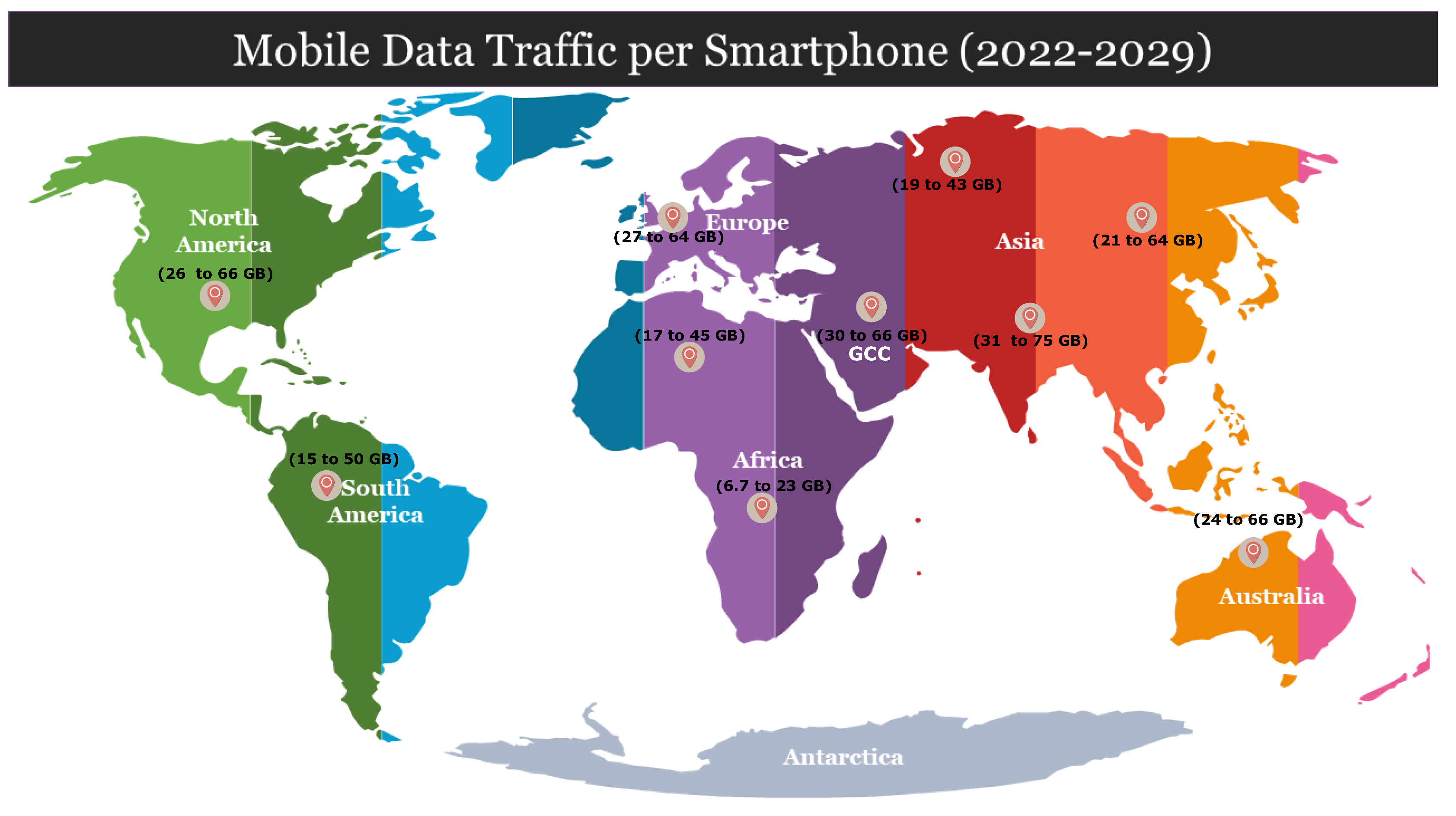
Figure 2.
Overview of power consumption in cellular network [7]. The cellular RAN consumes 73% of total power, and the remaining 23% is consumed by the core network, data centers, and other components.
Figure 2.
Overview of power consumption in cellular network [7]. The cellular RAN consumes 73% of total power, and the remaining 23% is consumed by the core network, data centers, and other components.
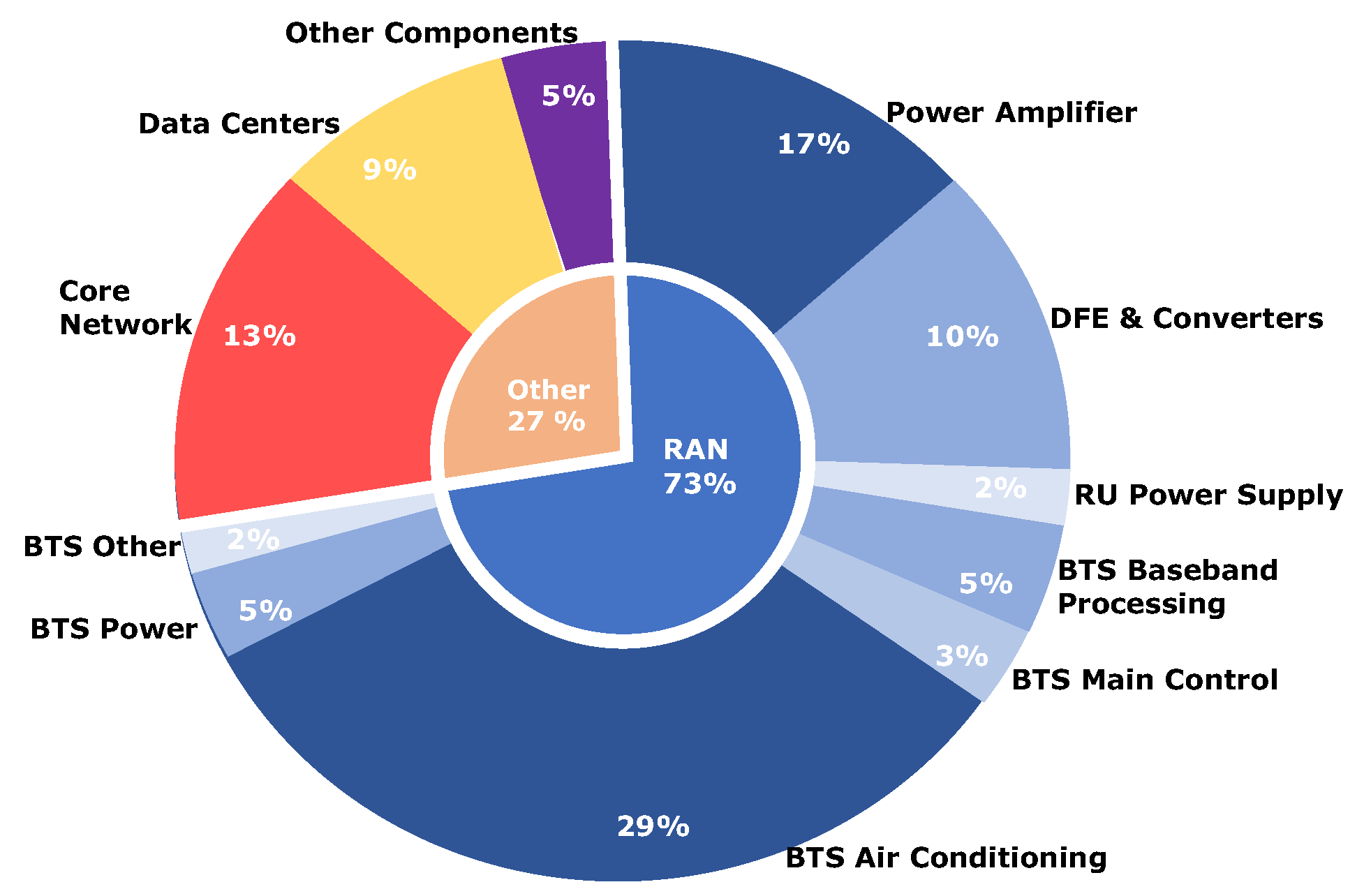
Figure 3.
Block Diagram of Cellular Architecture Based on SDN, NFV and C-RAN.
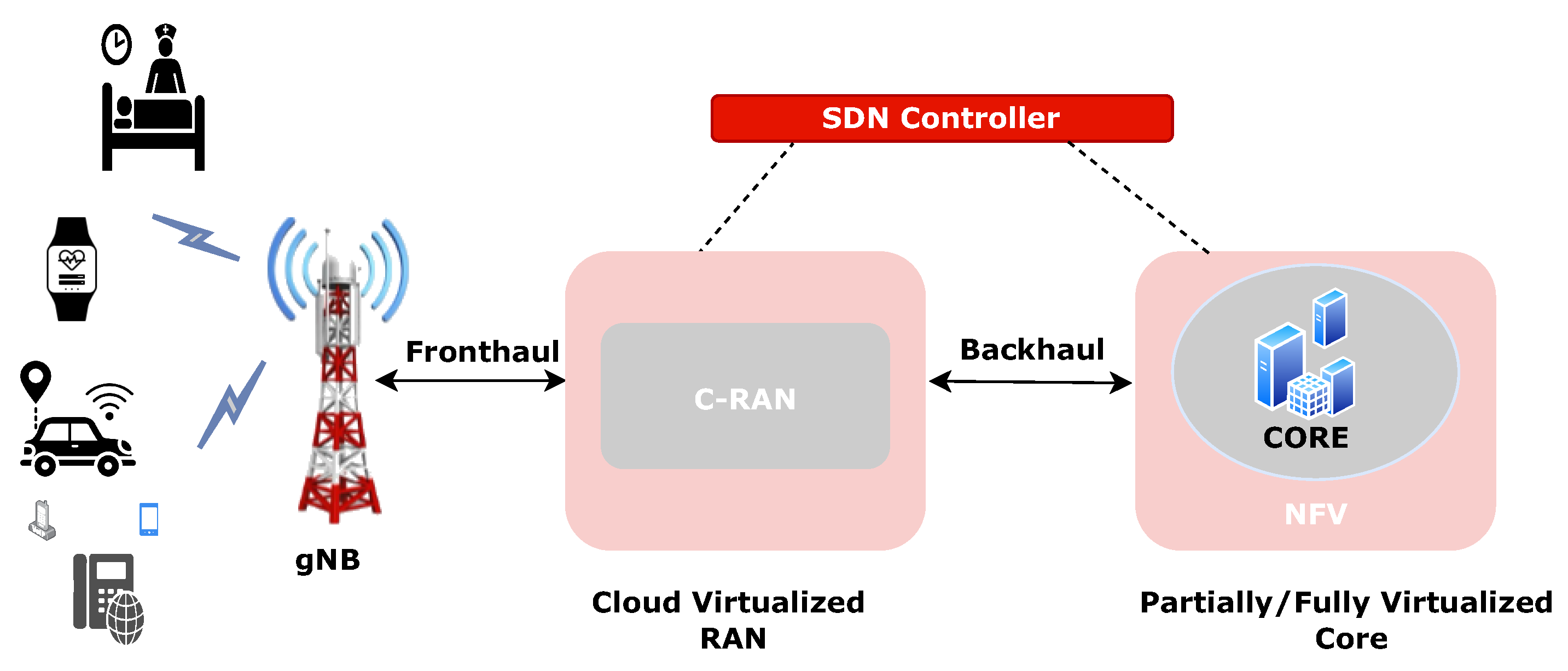
Figure 4.
OpenFlow to P4-based evolution, where (a) shows traditional networking, (b) represents the first generation of SDN where the data plane and control plane are separated and the control plane is programmable, and (c) shows the second generation of SDN with P4.
Figure 4.
OpenFlow to P4-based evolution, where (a) shows traditional networking, (b) represents the first generation of SDN where the data plane and control plane are separated and the control plane is programmable, and (c) shows the second generation of SDN with P4.

Figure 5.
Specification of OpenFlow from 2009 to 2015. Some possible enhancements were carried out during these periods to make it more efficient and scalable [63].
Figure 5.
Specification of OpenFlow from 2009 to 2015. Some possible enhancements were carried out during these periods to make it more efficient and scalable [63].
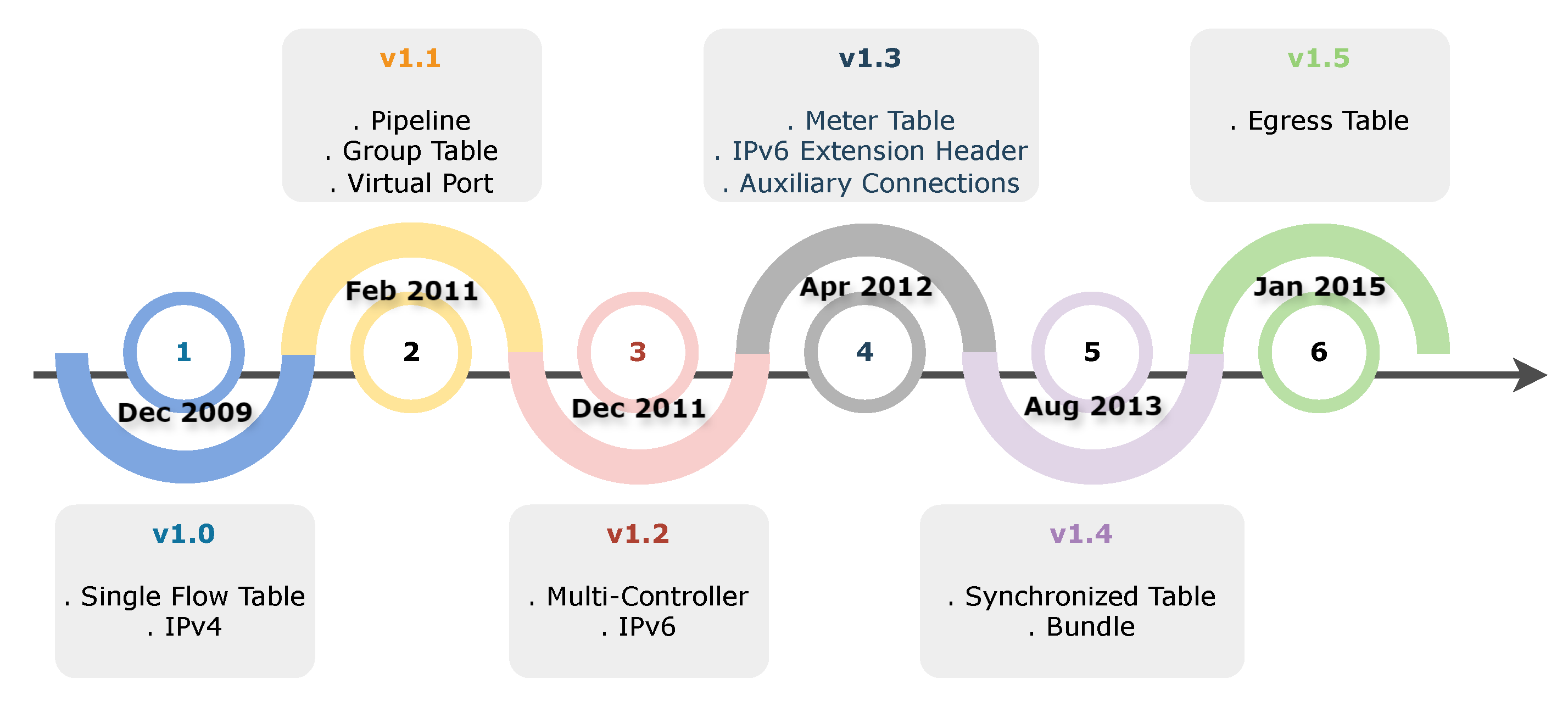
Figure 6.
P4 from 2018 to 2023 [69].
Figure 6.
P4 from 2018 to 2023 [69].
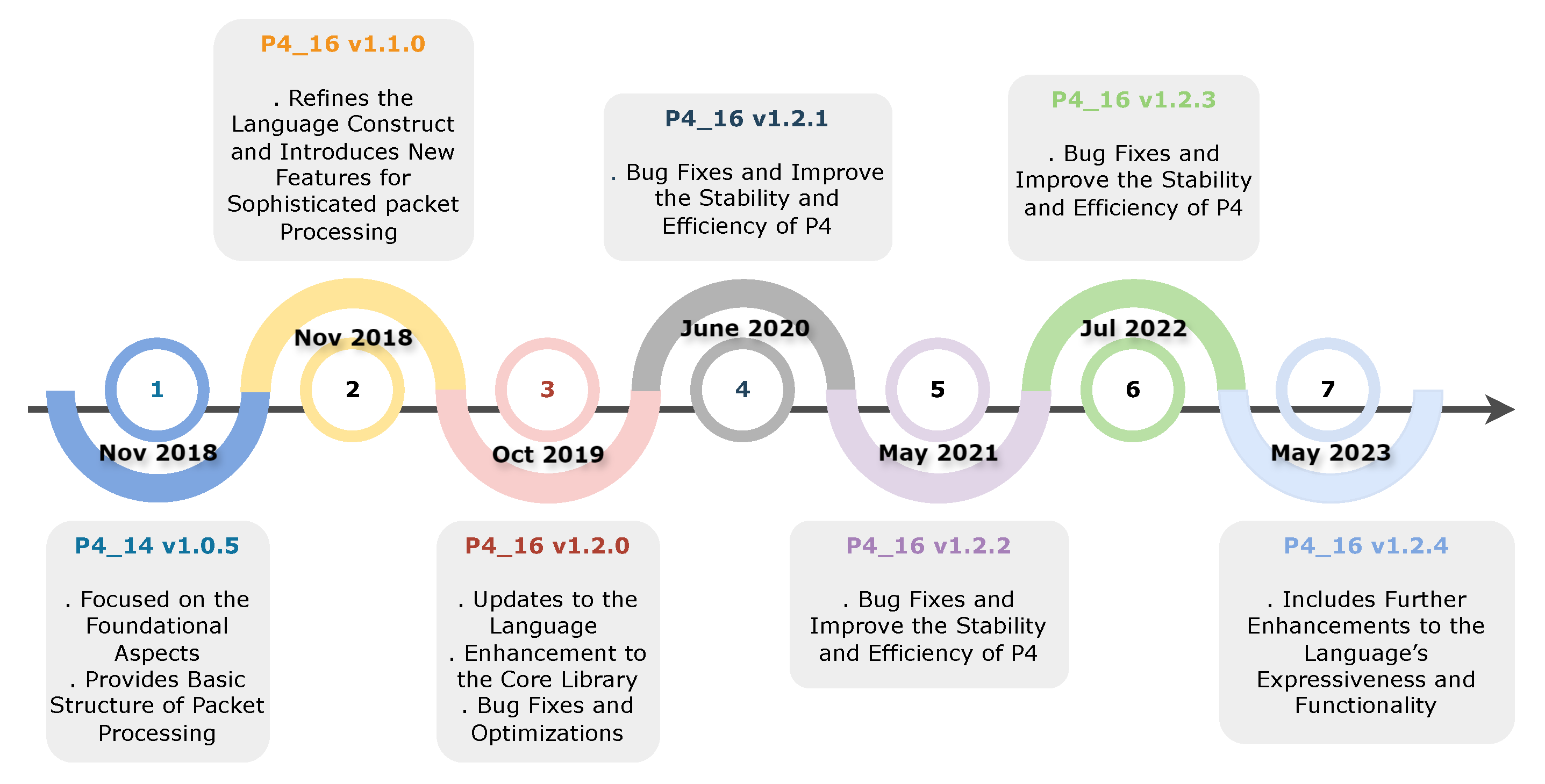
Figure 7.
Architecture of SDN [76].
Figure 7.
Architecture of SDN [76].
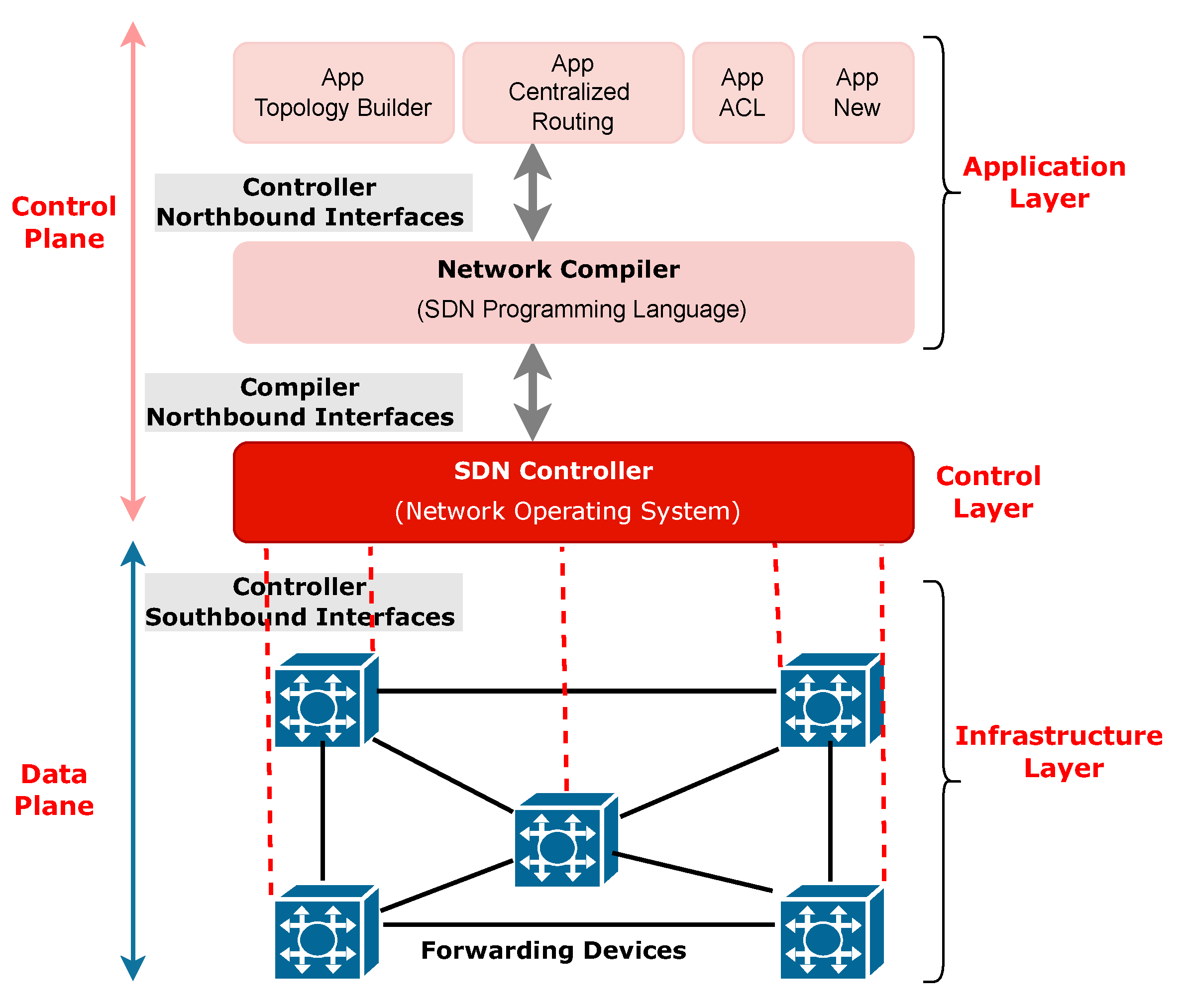
Figure 8.
The use case for OpenFlow.
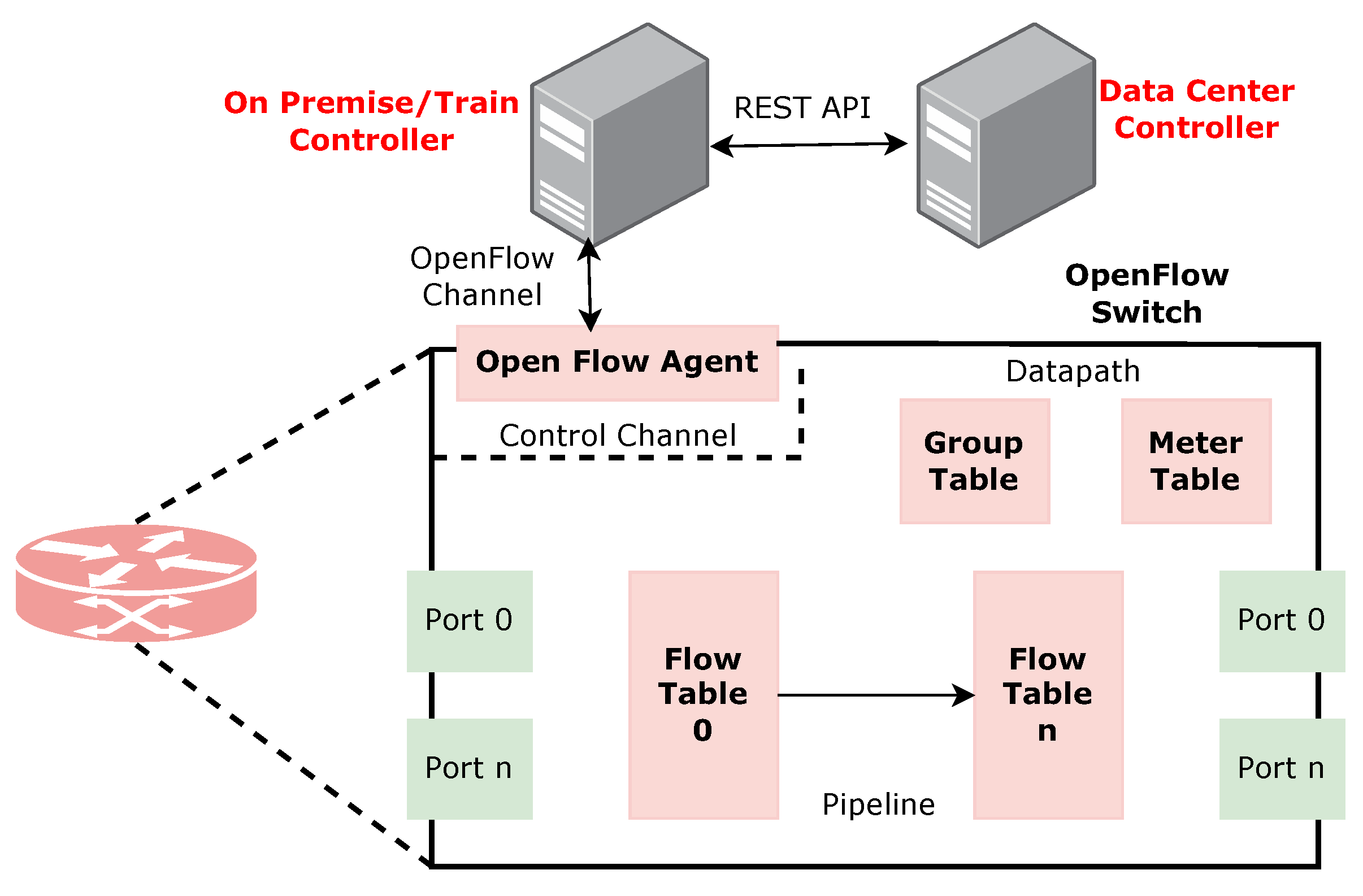
Figure 9.
5G: network functions in dedicated and virtualized deployment, where (a) represents 5G network deployed using traditional network functions and (b) shows 5G network based on virtualized network functions.
Figure 9.
5G: network functions in dedicated and virtualized deployment, where (a) represents 5G network deployed using traditional network functions and (b) shows 5G network based on virtualized network functions.
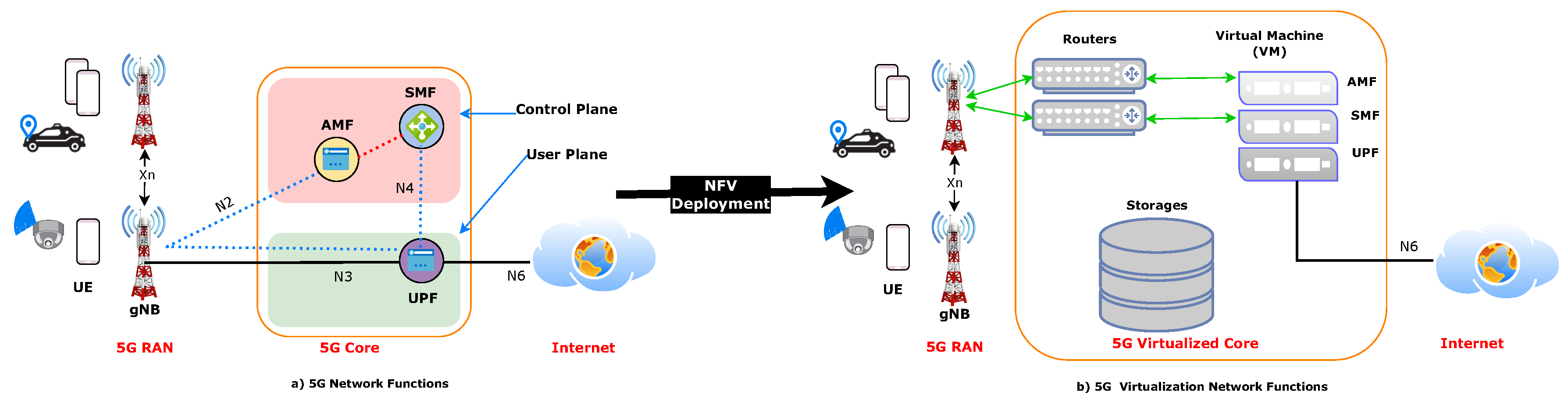
Figure 10.
ETSI: NFV Reference Architectural Framework [89].
Figure 10.
ETSI: NFV Reference Architectural Framework [89].
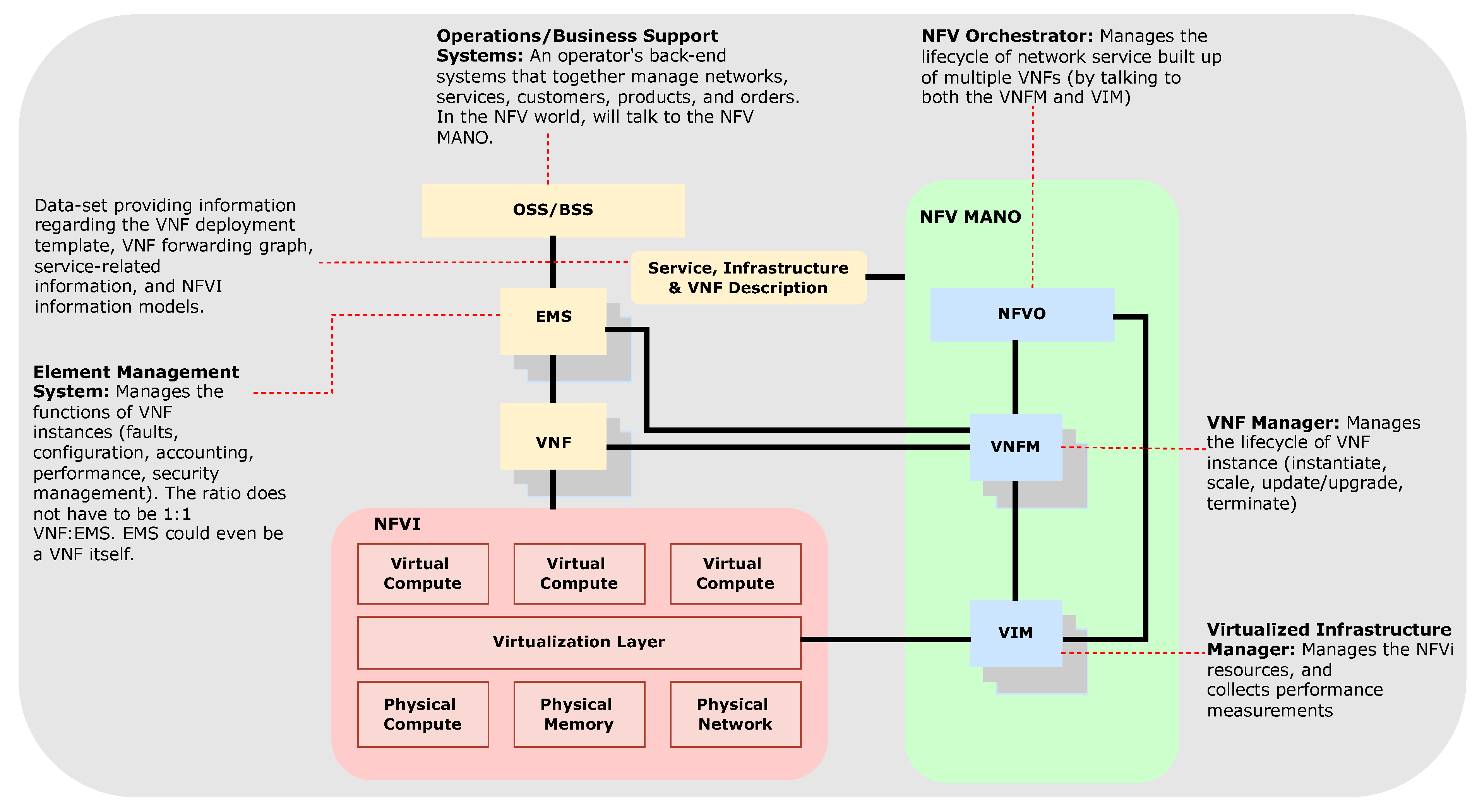
Figure 11.
Power consumption in traditional & virtualized functions. Virtualized functions consume approximately 50% less power compared to traditional network functions [96].
Figure 11.
Power consumption in traditional & virtualized functions. Virtualized functions consume approximately 50% less power compared to traditional network functions [96].
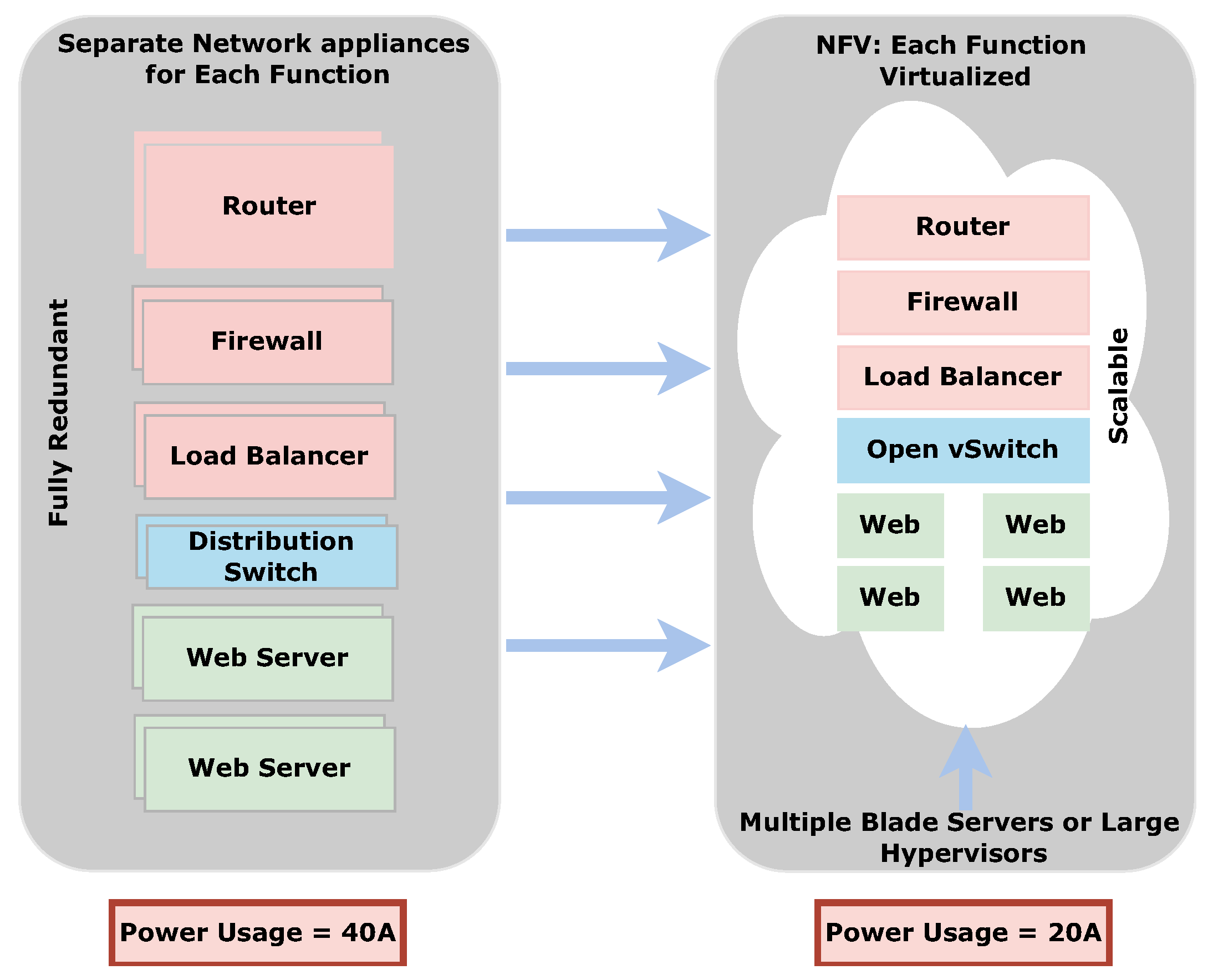
Figure 12.
NFV mechanisms such as prevention, correlation, recovery, resiliency, and detection for improved availability and reliability [104].
Figure 12.
NFV mechanisms such as prevention, correlation, recovery, resiliency, and detection for improved availability and reliability [104].
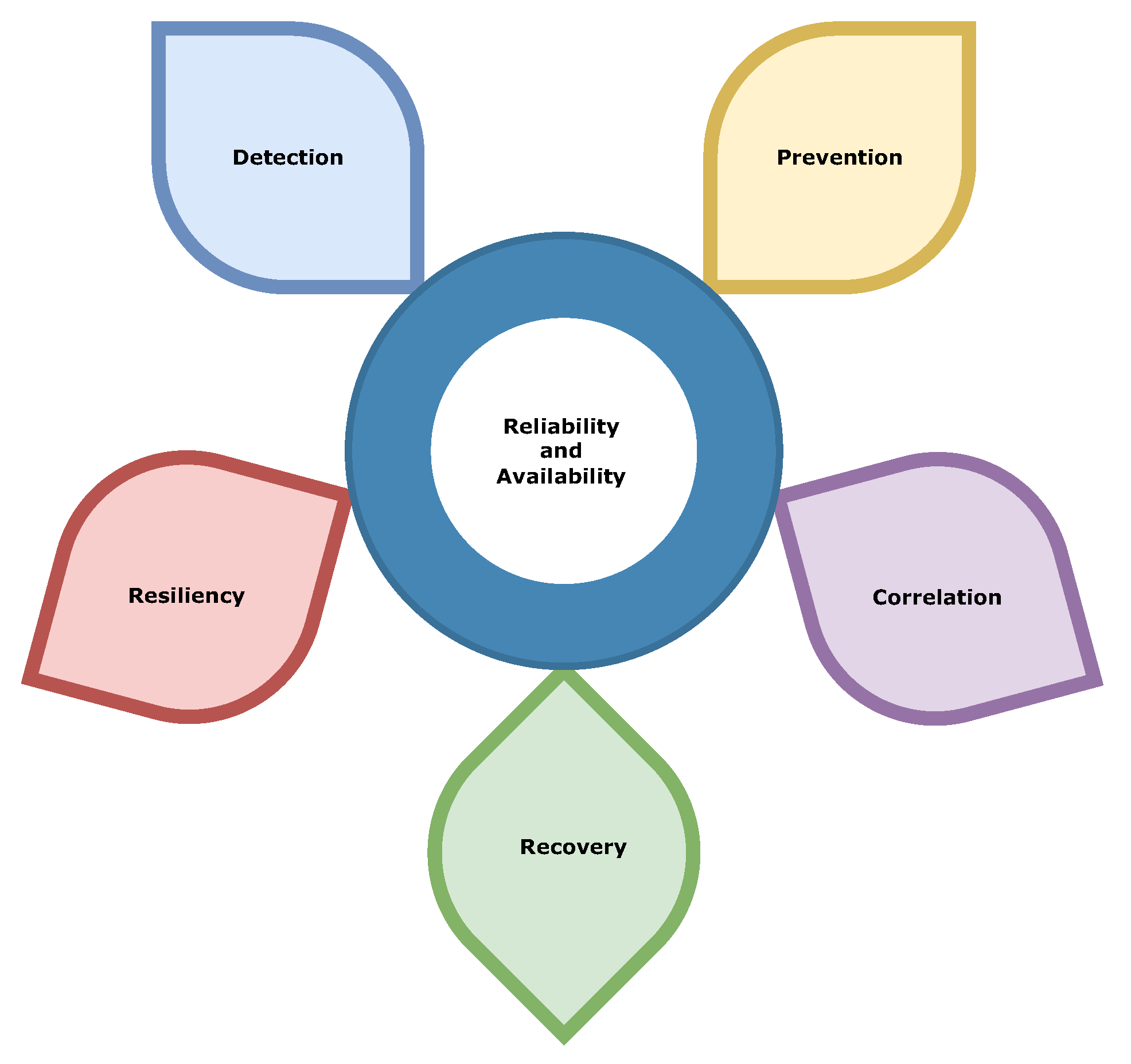
Figure 13.
The evolution of Cloud-RAN, going from distributed RAN with all functions located on the cell site , to centralized RAN, where baseband processing is centralized. Leading to Cloud-RAN where baseband processing is centralized and virtualized.
Figure 13.
The evolution of Cloud-RAN, going from distributed RAN with all functions located on the cell site , to centralized RAN, where baseband processing is centralized. Leading to Cloud-RAN where baseband processing is centralized and virtualized.
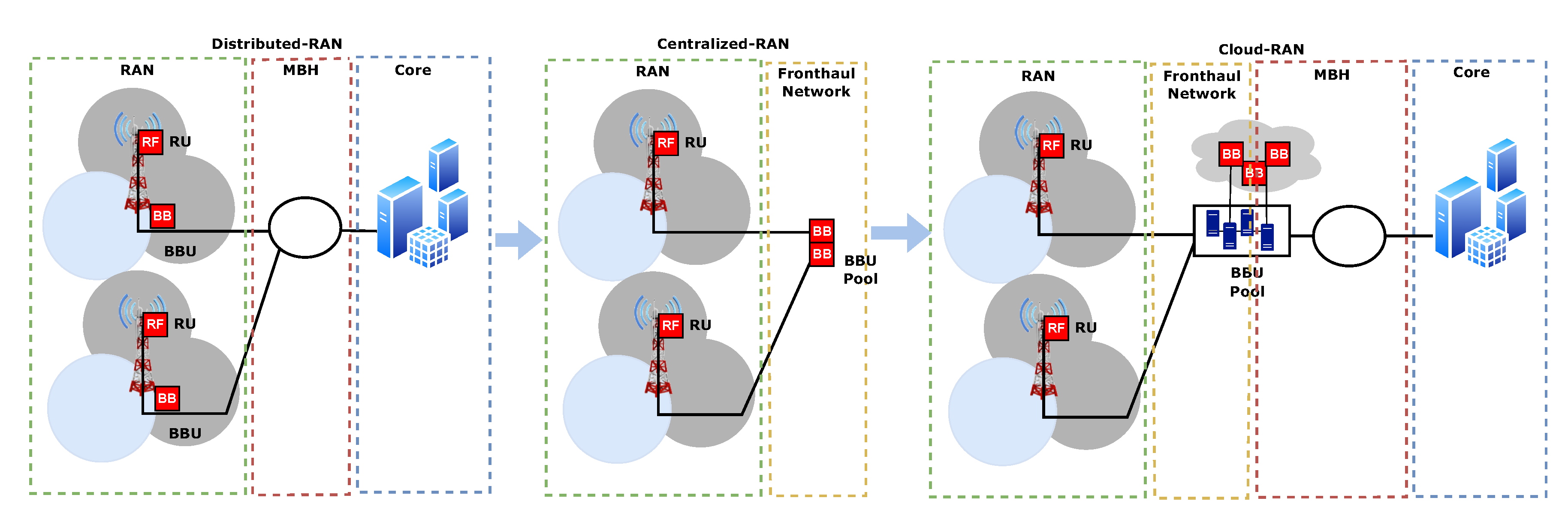
Figure 14.
The future mobile network architecture where all radio processing is divided into three units: Radio Unit (RU), Distributed Unit (DU) and Centralized Unit (CU) as specified by 3GPP [110].
Figure 14.
The future mobile network architecture where all radio processing is divided into three units: Radio Unit (RU), Distributed Unit (DU) and Centralized Unit (CU) as specified by 3GPP [110].
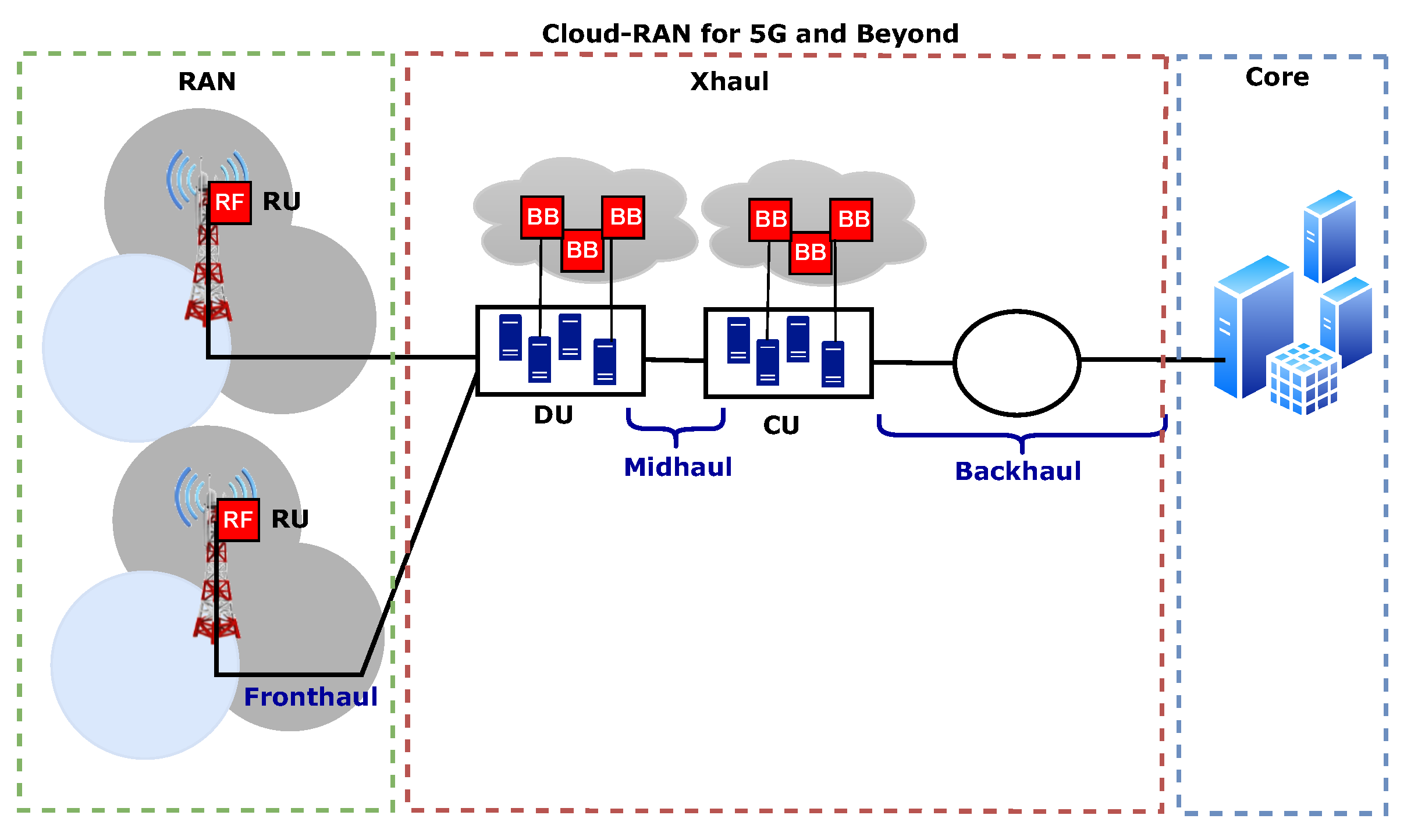
Figure 15.
The six functional Placement Scenarios proposed by Next Generation Mobile Network [114]. The figure shows the deployment agility of C-RAN where the deployment can adapt to the current scenario with more or less functions located on the cell site, for low latency and low fronthaul requirements, but at the cost of less shared processing.
Figure 15.
The six functional Placement Scenarios proposed by Next Generation Mobile Network [114]. The figure shows the deployment agility of C-RAN where the deployment can adapt to the current scenario with more or less functions located on the cell site, for low latency and low fronthaul requirements, but at the cost of less shared processing.
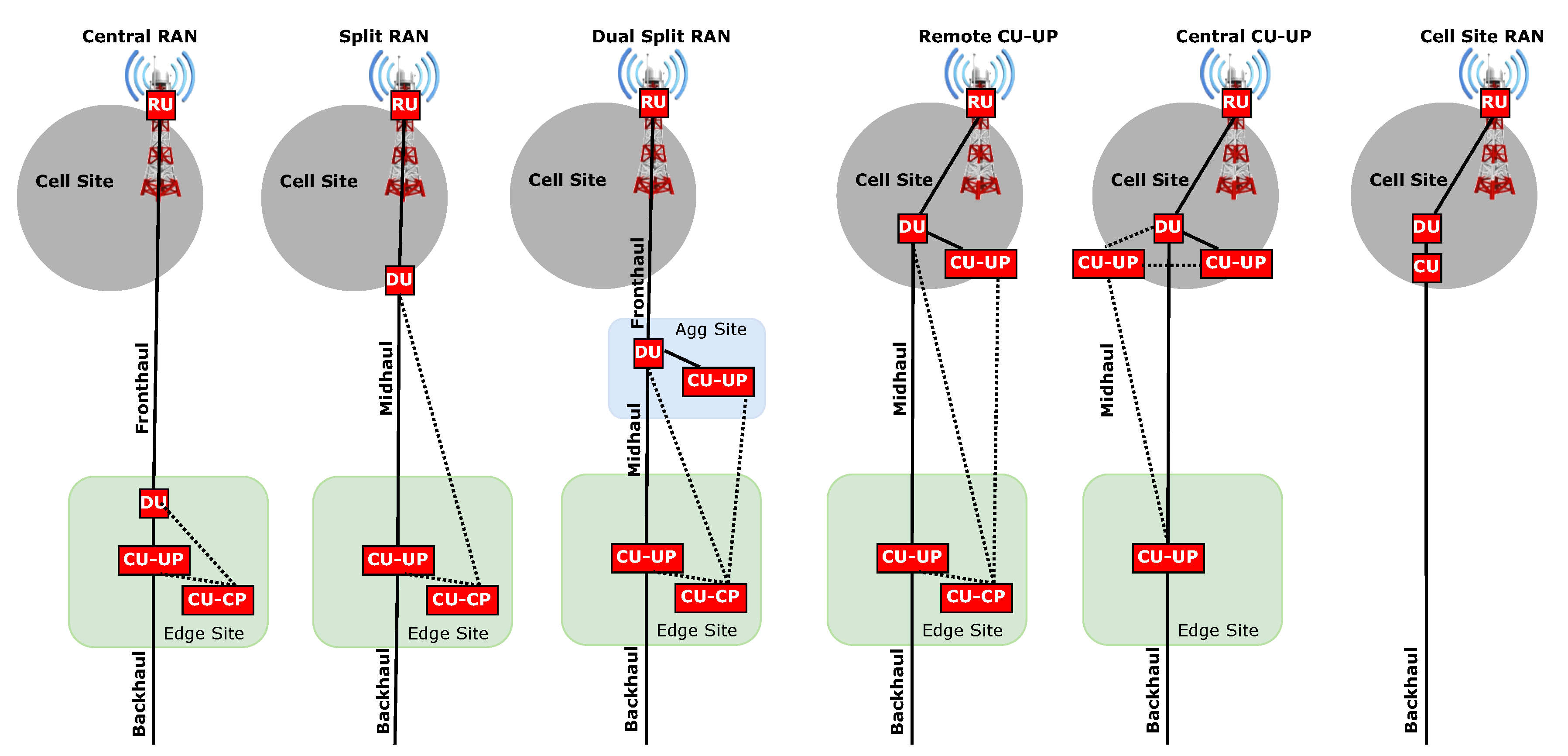
Figure 16.
The various opportunities for splitting radio processing functions into the three units Radio Unit (RU), Distributed Unit (DU) and Centralized Unit (CU), as proposed by CPRI [119], O-RAN Alliance [120], small cell forum [117] and 3GPP [110], illustrating which functions are assigned to which units.
Figure 16.
The various opportunities for splitting radio processing functions into the three units Radio Unit (RU), Distributed Unit (DU) and Centralized Unit (CU), as proposed by CPRI [119], O-RAN Alliance [120], small cell forum [117] and 3GPP [110], illustrating which functions are assigned to which units.
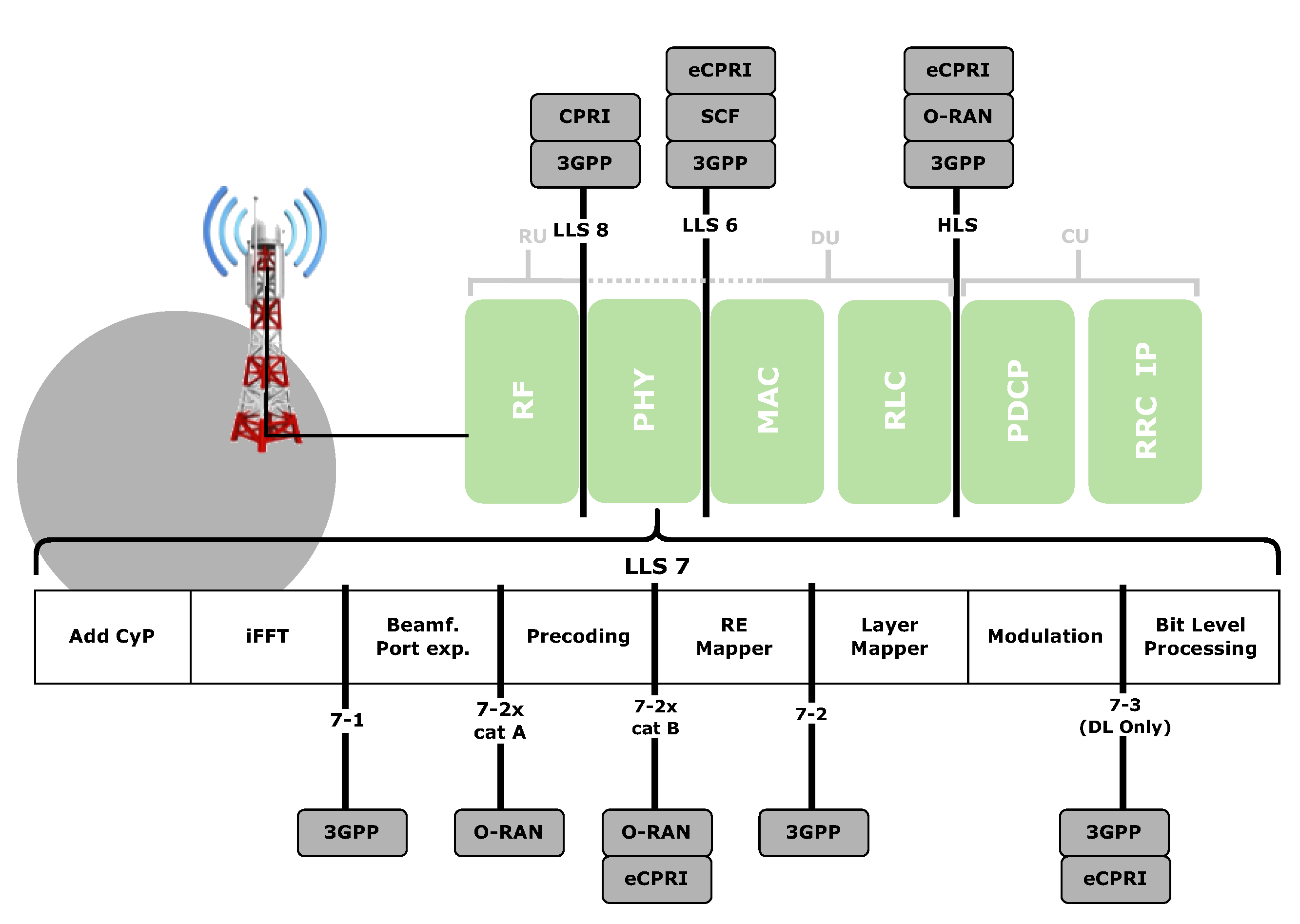
Figure 17.
5G proposed architecture based on SDN, NFV, and C-RAN. Core and RAN network functions can be partially or fully virtualized based on the requirement.
Figure 17.
5G proposed architecture based on SDN, NFV, and C-RAN. Core and RAN network functions can be partially or fully virtualized based on the requirement.
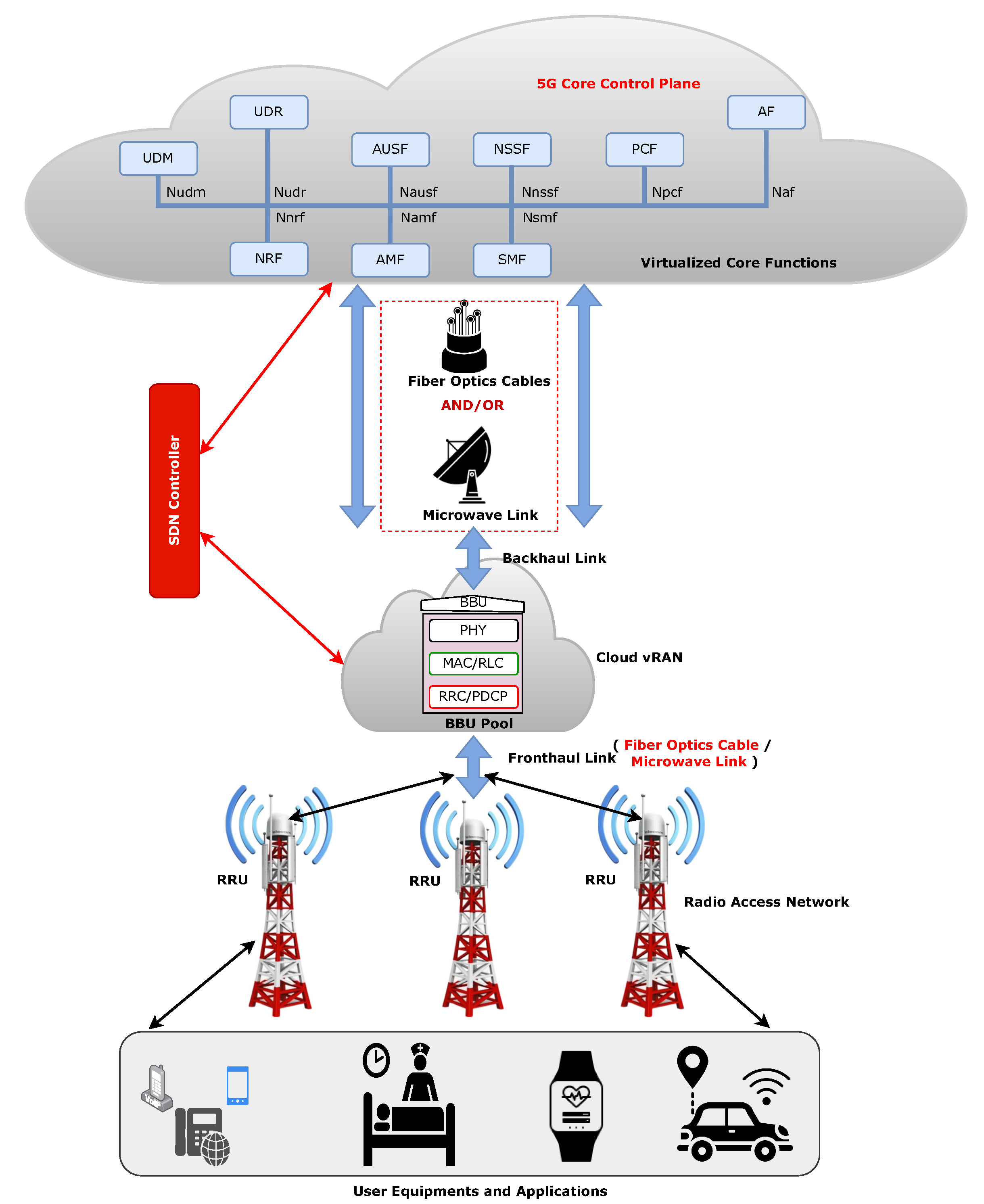
Figure 18.
Integration of SDN Controller into NFV Architecture [97]
Figure 18.
Integration of SDN Controller into NFV Architecture [97]
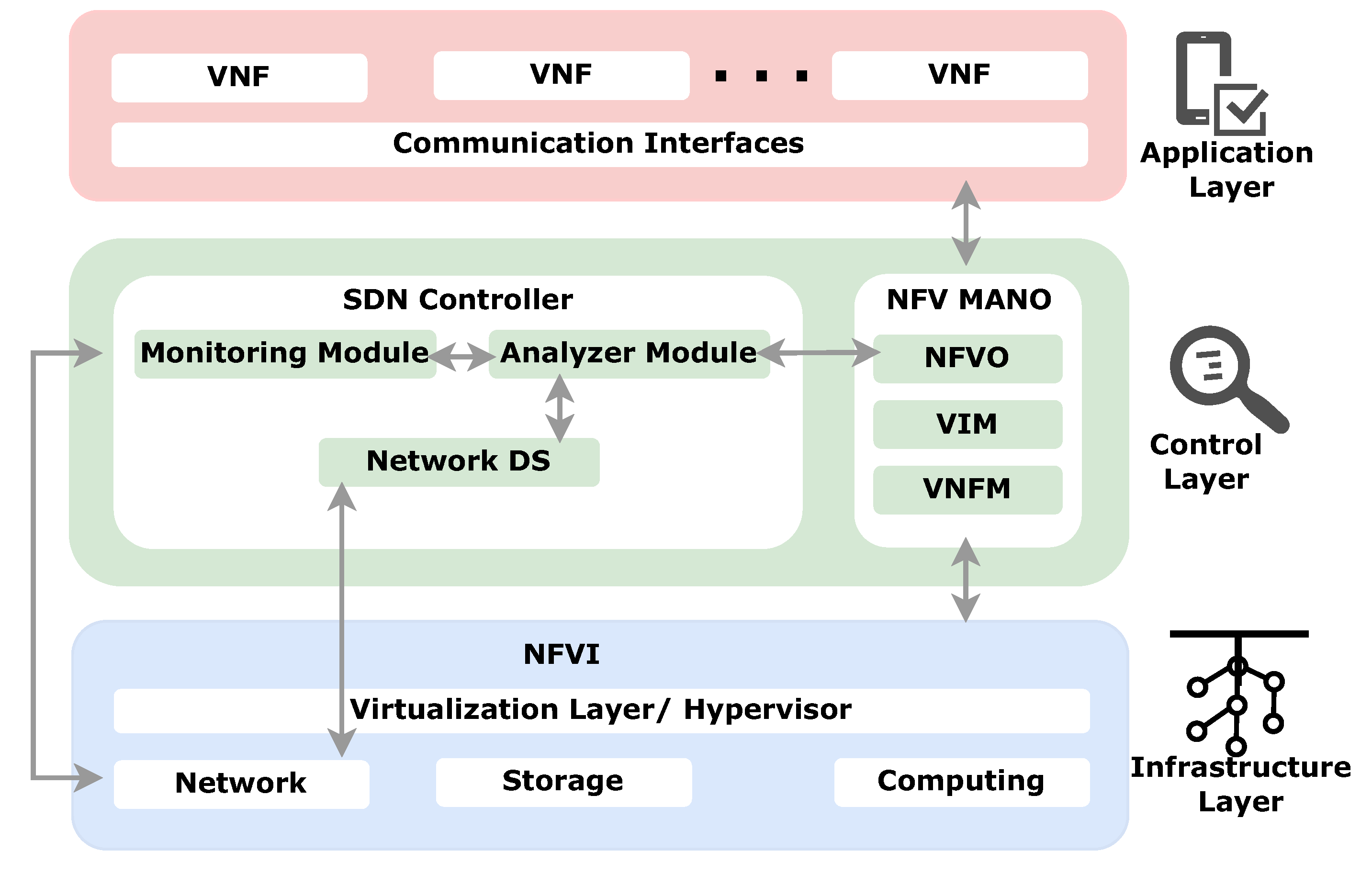
Figure 19.
Network Controller as part of the NFVI network management plane [104].
Figure 19.
Network Controller as part of the NFVI network management plane [104].
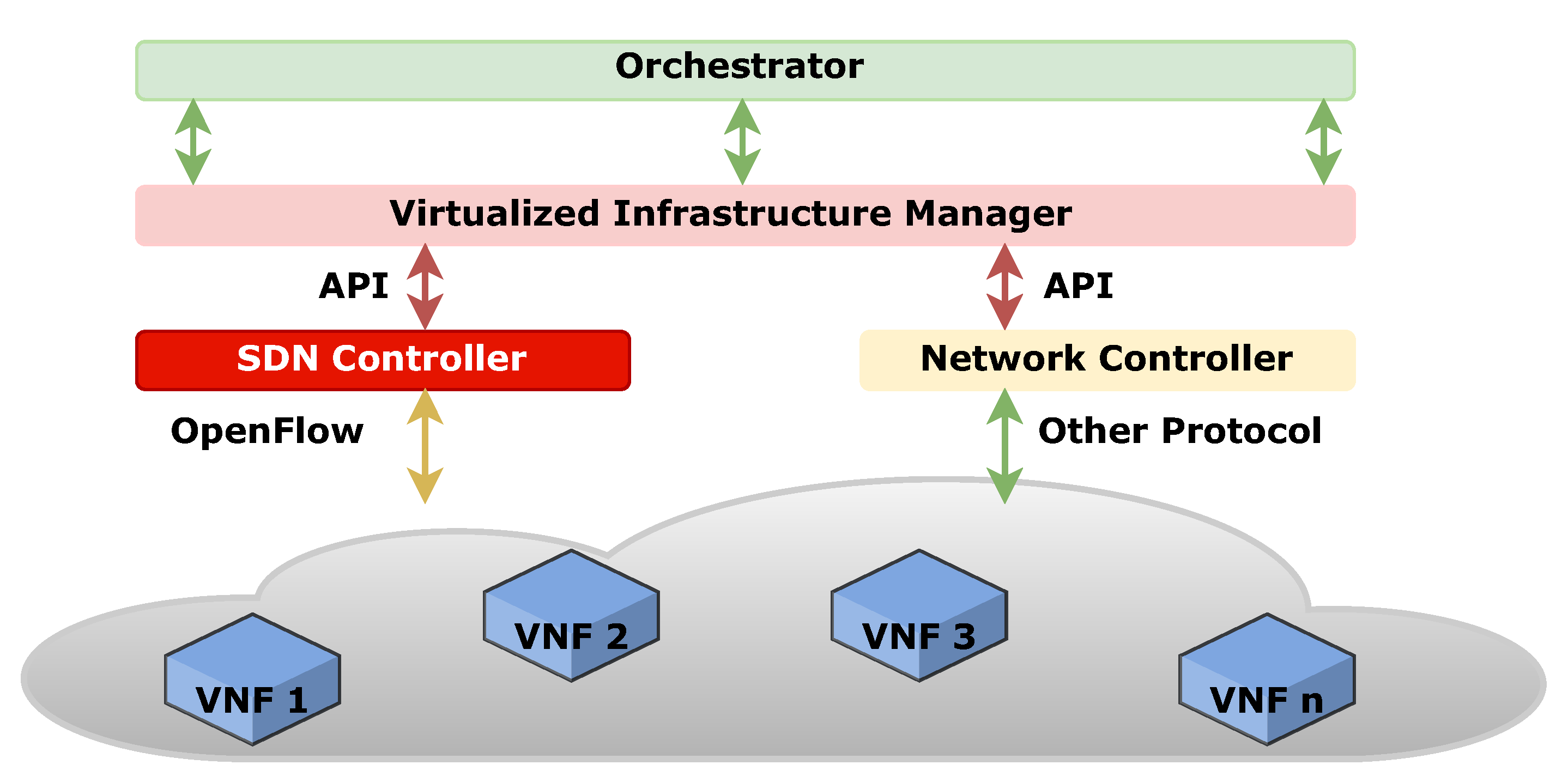
Table 2.
Difference Between NFV and SDN [90].
Table 2.
Difference Between NFV and SDN [90].
| Category | NFV | SDN |
|---|---|---|
| Concept | Abstracts network functions from conventional devices and encapsulates them as software. |
Separates the forwarding plane from the control plane to enable automated and programmable network control. |
| Goal | Service providers propose replacing distributed network devices with consolidated ones. |
To achieve network hardware devices’ programmability and centralized management and control. |
| Key Aspects | 1. Established procedure 2. Hardware-based forwarding functions are detached from dedicated hardware |
1. An open and programmable control plane, 2. Hardware-based traffic forwarding, and decision-making within the control plane. |
| Conflict or Not | The fusion of NFV and SDN introduces a novel network model. NFV enables adaptable service orchestration, while SDN realizes unified management and configuration of network functions. |
|
Table 3.
Difference Between NFV and Proprietary Network Equipment/Devices [90].
Table 3.
Difference Between NFV and Proprietary Network Equipment/Devices [90].
| Category | NFV | Proprietary Network Equipment/Devices |
|---|---|---|
| Hardware Used | Generic x86-based servers, versatile storage devices, and adaptable switching equipment are utilized. | Dedicated devices are used. |
| Hardware-Software Separation | Software is separated from hardware and provided as module components. | Hardware and software are closely integrated, with software functions relying on dedicated hardware. |
| Receptiveness | Universal hardware foundation and standardized interfaces enable an open ecosystem through collaboration among multiple parties. | Relying on dedicated services results in a closed system, making it challenging to onboard third-party partners. |
| Network Resilience | General-purpose hardware and resource virtualization technologies enable dynamic adjustments of both software and hardware resources to meet specific service demands. | Dedicated devices do not align with virtualization technologies, hindering resource-sharing and flexible scaling capabilities. |
| Upgradation | Device upgrades occur swiftly, primarily involving software enhancements. | Deployment of network devices is time-consuming, necessitating both software and hardware provisioning. |
| Operation and Management | Virtualizes hardware resources and automates operations and management intelligently. | Upgrading and replacing devices is a complex process, as maintenance involves manual or semi-manual preparations and configurations through the CLI or web-based systems. |
| Service Organizations | NFV networks are deployed according to service requirements and can be dynamically orchestrated with flexibility. | Traditional networks operate with relative independence. Converting service requirements into network specifications is not swift, resulting in a sluggish network response. |
Table 4.
Difference Between Centralized, Virtualized, and Cloud-RAN.
| Category | Centralized RAN | Virtualized RAN | Cloud RAN |
|---|---|---|---|
| Concept | Baseband processing is moved away from the cell sites to a central baseband pool. | Baseband processing is virtualized, running as software instances independently from the underlying hardware. | Virtualized baseband processing is centralized in a datacenter. Deployment options are agile. |
| Benefits | Reduced site footprint, improved cell cooperation, and shared cooling mechanisms. | Load balancing, agile service deployment, faster updates. | In addition to the benefits derived from centralized and virtualized RAN, Cloud-RAN also benefits from dynamic capacity assignment, improved scalability, and increased resource utilization. |
| Drawbacks | Large capacity and latency requirements for the transport network connecting radio functions to centralized baseband processing (fronthaul network). | Complexity of virtualized functions and challenges in running time-critical RAN functions on COTS hardware. | Cloud-RAN faces the same drawbacks as virtualized RAN, but its agile deployment options can reduce fronthaul complexity seen in centralized RAN. |
Disclaimer/Publisher’s Note: The statements, opinions and data contained in all publications are solely those of the individual author(s) and contributor(s) and not of MDPI and/or the editor(s). MDPI and/or the editor(s) disclaim responsibility for any injury to people or property resulting from any ideas, methods, instructions or products referred to in the content. |
© 2025 by the authors. Licensee MDPI, Basel, Switzerland. This article is an open access article distributed under the terms and conditions of the Creative Commons Attribution (CC BY) license (http://creativecommons.org/licenses/by/4.0/).
Copyright: This open access article is published under a Creative Commons CC BY 4.0 license, which permit the free download, distribution, and reuse, provided that the author and preprint are cited in any reuse.


