Preprint
Article

This version is not peer-reviewed.

Leaders’ Calling and Employees’ Innovation: Mediating Role of Work Meaning and Moderating Effect of Supervisor’s Embodiment

A peer-reviewed article of this preprint also exists.

Submitted:

09 March 2025

Posted:

10 March 2025

You are already at the latest version

Abstract

The objective of this research is to investigate whether and how leaders' sense of calling influences employees' innovative behavior, and to explore the conditions that may define the boundaries of this effect. This research, based on the theory of interpersonal sensemaking, conducted an empirical analysis using data from 186 pairs of supervisor-subordinate matching questionnaires and developed a moderated mediation model. We hypothesized and found that: firstly, leaders’ calling directly enhanced employees’ innovative behavior. Secondly, the relationship between the leaders’ calling and employees’ innovative behavior was mediated by employee’s sense of work meaning. Thirdly, the supervisor’s organizational embodiment positively regulated the relationship between the leaders’ calling and the employee’s sense of work meaning. Specifically, when the degree of supervisor’s organizational embodiment is higher, the relationship between the leaders’ calling and employee’s work meaning will be stronger. At the same time, the supervisor’s organizational embodiment positively regulates the mediating effect. Specifically, when the degree of supervisor’s organizational embodiment is higher, the mediating effect of employee’s work meaning is stronger.

Keywords: 
;  ;  ;  

1. Introduction

The continuous improvement of employees’ innovation performance has become a hot topic in many academic fields. Stimulating employees’ innovative behavior is an important factor for an organization to survive and maintain market competitiveness. Previous studies have shown that leadership plays a key role in fostering employee innovation [1,2,3]. The influence of leadership on employees’ innovative behavior is mainly reflected in three aspects: leader behavior, leaders’ relationships with followers, and leader personal characteristics [4]. Most research has focused on the first two aspects and has paid little attention to the personal characteristics of leaders [1,2,3]. However, there is a significant correlation between leaders’ personal characteristics and employees’ innovative behavior [5], which cannot be ignored when studying how leadership affects employees’ innovation. Tierney [4] proposed that a valuable extension of the innovation literature is to investigate the effect of leaders’ personal characteristics on employee innovation.
We discuss how leaders’ calling, an important personal characteristic, affects employees’ innovative behavior. Calling, an emerging field of Western occupational psychology, refers to a transcendent calling experienced from and beyond the self that attracts individuals to practice a specific occupational role in a way that reflects a sense of purpose or meaning [6]. A calling is a personal characteristic derived from the perspective of motivation [7]. Previous research has found that intrinsic motivation is a key driver of creativity and innovation in the workplace [8,9,10]. Intrinsic motivation results from an individual’s interest and involvement in, satisfaction with, or positive challenges associated with task engagement [11]. Calling—as a positive predictor of job engagement and job satisfaction [12,13]—is closely related to motivational mechanisms. Therefore, we believe that leaders’ calling, as a personal characteristic that implies motivation, may also be an important factor influencing employees’ innovative behavior. However, previous studies have not provided answers to this question. Our study examines the relationship between leaders’ calling and employees’ innovative behavior.
Most studies on leadership and employees’ innovation have focused on motivational mechanisms. The mediating variables include intrinsic motivation [14], creative self-efficacy [15], psychological empowerment [16], self-regulatory focus [17] and team effectiveness [18]. However, many of these mediators overlap conceptually and empirically [19]. Although there is a large amount of literature on the motivational mechanism of innovation, the scope of these studies is narrow, and other specific manifestations or types of motivation have not received sufficient attention. As an important motivational factor, the work meaning refers to the value of work goals as perceived by people at work [20] and has been found to influence employees’ innovative behavior [21]. Based on the theory of interpersonal sensemaking, employees actively construct their own work meaning by analyzing and interpreting the behaviors and performances of others at work [22]. Therefore, we believe that through the interpretation of leaders’ calling, employees will show a strong sense of meaning at work, thus promoting innovative behavior. Our study examines the mediating mechanism between employees’ work meaning, leaders’ calling, and employees’ innovative behavior.
In addition, we examine the moderating effects of supervisors’ organizational embodiment on these relationships. Leaders are often seen as agents of organizations. However, the extent to which they represent an organization varies. Scholars have also called for future research on the influence of leadership on the possible moderating effects of this difference [23]. A supervisor’s organizational embodiment describes employees’ beliefs about the leader’s shared identity with the organization [24]. This concept embodies an employee’s sense of the extent to which the leader represents the organization. When a leader is attractive, legitimate, and reliable [25], employees regard the leader as a role model and imitate their values, attitudes, and behaviors [26]. The higher the level of organizational embodiment of leaders, the stronger the leadership role model and the more likely it is to stimulate the learning and imitation of employees, which may further strengthen the positive impact of leaders’ calling on employees’ work meaning and the mediating mechanism of employees’ work meaning on the impact of leaders’ calling on employees’ innovative behavior.
The contribution of our study mainly includes the following three aspects: Firstly, we examine the direct relationship between leaders’ calling and employees’ innovative behavior. Existing research mostly focus on the relationship between leader behaviors, leaders’ relationships with followers and employees’ innovative behavior. There is not enough research on whether leaders’ personal characteristics can promote employees’ innovation. We examine the influence of leaders’ calling on employees’ innovative behavior from the perspective of motivation, which enriches the research on the influencing factors of individual characteristics on employees’ innovative behavior. Secondly, we examine the mediating effect of employees’ work meaning on leaders’ sense of mission and employees’ innovative behavior. Although motivation is an important mediating mechanism of external factors influencing employees’ innovative behavior, the scope of research variables is relatively narrow, and other specific manifestations or types of motivation are not paid enough attention. Unfortunately, few studies have focused on the role of work meaning as an important motivational mechanism in mediating the influence of leadership on employees’ innovative behavior. In this study, we used the interpersonal sensemaking theory to address this research gap by examining the mediating role of employees’ work meaning, which will further promote people’s understanding of motivation mechanism and refine the important intermediary mechanism of motivation. Thirdly, considering that leaders may have different influence in organizations, we examine the moderating effect of supervisors’ organizational embodiment on both the direct positive relationship between leaders’ calling and employees’ work meaning, as well as the indirect effect of leaders’ calling on employees’ innovative behavior through employees’ sense of work meaning. Our study further enriches the boundary conditions under which leaders’ calling influences employees’ innovative behavior.

2. Theory and Hypotheses

2.1. Leader’s Calling and Employees’ Innovative Behavior

Innovative behavior involves finding problems or solutions, generating new ideas, advocating new ideas, and implementing new ideas [27], all of which aim to improve processes, products, or procedures [28]. Employees’ innovation is recognized as a basic element of organizational success and efficiency. The existing literature mainly discusses the causes of employees’ innovative behavior at the individual and organizational levels. For example, at the individual level, employees’ individual characteristics, such as creative self-efficacy [29], psychological capital [30], psychological empowerment [31] and proactive personality [32] have a positive impact on their innovative behavior. At the organizational level, innovation climate [33] and psychological safety climate [34] positively promote employees’ innovative behavior. Leadership style also impacts employees’ innovative behavior. For example, transformational leadership [33], transactional leadership [31], empowering leadership [35] and ethical leadership [34] significantly promote employees’ innovative behavior.
Existing studies have found that leaders’ calling has a positive impact on employees’ team commitment, voice behavior, job performance, and job satisfaction [36,37,38], but these studies focus on conventional job outcome variables and lack the impact on innovation performance (i.e., employees’ innovative behavior). Leadership behavior is a key environmental factor that promotes or inhibits employees’ innovative behavior [39,40]. However, whether leaders’ calling affects employees’ innovative behavior has not yet been examined. However, based on previous studies, it is not difficult to find that leaders’ calling impacts employees’ innovation behavior. There are three main reasons for this finding.
First, when leaders have a strong sense of calling through their intrinsic drive, they tend to exhibit good attitudes, behaviors, and outcomes. Owing to the role models of leaders, their positive behaviors and attitudes provide social learning objects for employees. By mimicking leaders, employees’ positive behaviors acquired from leaders generate positive emotions and perceptions that stimulate creativity [41,42]. Second, leaders with a strong calling can foster employees’ innovative behavior by creating an innovative work environment. Leadership plays a key role in encouraging organizational innovation [43]; leaders with a sense of calling show creativity [44], share knowledge, promote new ideas, and support employees in thinking outside the box [45]. Leaders with a high calling guide or foster a creative organizational climate that responds to environmental changes, challenges, and opportunities and encourages employees to engage in innovative work. Third, through social interactions and exchanges with employees, leaders with a strong calling can cultivate employees’ innovative behavior. In an organization, employees perform their work through interactions with their leaders. The tension of engaging in creative work can put enormous pressure on employees, which can lead to negative emotional states such as depression. These emotions are often not conducive to creative behavior. Through the social exchange process with employees, leaders with a strong calling can convey the support of leaders and the organization to them, help them overcome the fear of risk, and manage negative emotions to achieve a high level of creativity. Based on the above analysis, our study suggests that leaders’ calling may positively influence employees’ innovative behavior. Thus, we expect a positive relationship between leaders’ calling and employees’ innovative behavior.
Hypothesis 1. Leaders’ calling is positively related to employees’ innovative behavior.

2.2. Leaders’ Calling, Employees’ Work Meaning, and Employees’ Innovative Behavior

Work meaning is an important predictor of a range of positive individual and organizational outcomes [21,46]. Moreover, it is the primary psychological state that people engage in during work [47]. Previous studies have shown that the meaning of work positively affects job satisfaction, organizational identity, organizational citizenship behavior [48], job engagement [13,49,50] and other positive work outcomes.
Interpersonal sensemaking theory proposes that employees actively construct work meaning by interpreting the behavior of others at work [22]. It is not difficult to find that, leaders’ calling may positively affect employees’ work meaning. This is because individuals with a calling have the desire and ability to express their own feelings and validate those of others. When leaders show a sense of calling at work, they will have a clear purpose and positive values and influence employees by working tirelessly and enthusiastically to convey company values. Conceptually, leaders’ calling should be seen as a precondition for meaningful work, because it provides employees with a sense of meaning and purpose in their work [21,51], thus enhancing employees’ perception that work is meaningful. When leaders show a strong calling, they show a positive and complete cognitive and emotional state at work, which affects employees’ understanding of work and makes them feel that the work is meaningful and valuable, thus forming a sense of meaning [52].
A work meaning may motivate employees to engage in innovative activities to benefit the organization. On the one hand, the work meaning helps employees achieve their work goals and engage in productive activities [53]. Specifically, as an intrinsic motivation [54,55], work meaning can drive employees to respond to challenges and problems in innovative ways, thereby stimulating innovative behaviors [56]. For example, employees with a sense of meaning find purpose, value, and meaning in their work. Because these employees are intrinsically motivated, they are more inclined to translate their motivations into innovation. On the other hand, the work meaning may include an individual’s perception of benefiting from the positive outcomes of the organization [46], which may increase employees’ willingness to utilize their abilities and energy to achieve innovative behaviors [57]; thus, they will achieve organizational goals (innovation).
Amabile and Pratt [54] pointed out that the generation of individual creative ideas depends mainly on intrinsic factors (such as intrinsic motivation). Extrinsic factors (such as working environment) affect intrinsic factors, thus affecting individual innovation processes. Therefore, extrinsic factors (leaders’ calling) have an impact on employees’ intrinsic motivation (work meaning), thus influencing their innovative behavior. Leaders awaken employees’ work meaning through the strategies they formulate, policies they establish, and values they communicate with, and then stimulate employees’ work meaning to promote innovative behavior [58]. This means that leaders with a calling may have a positive effect on employees’ innovative behavior by stimulating their sense of work. Based on this, we hypothesize the following:
Hypothesis 2. Leaders’ calling has a positive indirect effect on employees’ innovative behavior through employees’ work meaning.

2.3. The Moderating Effect of Supervisor’s Organizational Embodiment on the Relationship Between Leaders’ Calling and Employees’ Creative Behavior

A supervisor’s organizational embodiment refers to the extent to which employees identify their supervisor with the organization [59]. Depending on the degree of similarity between leaders and organizational characteristics, employees perceive their leaders as representatives of the organization or as empowered individuals. This also means that a supervisor’s organizational embodiment can influence employees’ reactions to the organization and the leader’s behavior. In recent years, scholars have begun to focus on how supervisors’ organizational embodiment enhances or weakens the influence of leadership on employees, namely, the moderating effect of supervisors’ organizational embodiment. For example, Shoss et al. [23] found that a supervisor’s organizational embodiment can moderate the relationship between abusive supervision and perceived organizational support. Hou et al. [60] found that supervisors’organizational embodiment could further moderate the influence of perceived supervisor support and organizational support on employees’ organizational citizenship behavior. Su et al. [61] verified that supervisors’ organizational embodiment can moderate the relationship between developmental feedback and innovative employee behavior via creative self-efficacy.
We suggest that supervisors’ organizational embodiment may also moderate the relationship between leaders’ sense of mission and employees’ work meaning. First, to some extent, a supervisor’s organizational embodiment implies the power, status, and influence of leaders in an organization. At the same time, subordinates perceive that leaders, who are regarded as the embodiment of the organization, often have more resources at the disposal of the organization [24,62]. When leaders have a high sense of calling, they tend to use these powers and resources to better guide employees to attach importance to the value and significance of work [63], thus enhancing their work meaning. In contrast, when the supervisor’s organizational embodiment is low, the leader has less organizational power and resources, which leads to the limited impact of his calling on employees’ work meaning. Second, the supervisor’s organizational embodiment conveys the message that the leader and organization exhibit consistent behavior. When a leader’s style or behavior is perceived as representing the organization to a large extent, it implies that the organization approves and encourages the leader. At this point, a supervisor’s organizational embodiment pushes employees to imitate and learn more from their leader [64]. Therefore, when employees perceive a higher level of organizational embodiment of the leader, they are more likely to interpret the leader’s behavior as advocated by the organization and accept the leader’s influence. In contrast, when the leader’s organizational embodiment is low, employees will think that the leader’s performance is not based on the expectations and requirements of the organization, resulting in a weak influence of the leader’s calling. Based on these two points, we hypothesize the following:
Hypothesis 3. Supervisors’ organizational embodiment positively moderates the relationship between leaders’ calling and employees’ work meaning, such that this relationship is stronger in the presence of higher supervisor organizational embodiment.

2.4. A Moderated Mediation Model

Thus far, we have proposed the mediating role of employees’ work meaning and the moderating effect of supervisors’ organizational embodiment. Furthermore, when employees perceive a higher level of supervisors’ organizational embodiment, leaders have more power and resources and are recognized by the organization. This will lead to a stronger impact of leaders’ calling on employees’ work meaning, and ultimately enhance employees’ innovative behavior. In contrast, when employees perceive a low level of organizational embodiment from the leader, the influence of leaders is limited, resulting in a low impact of leaders’ calling on employees’ work meaning. Thus, it is difficult to promote innovative behavior among employees. Therefore, we hypothesized the following:
Hypothesis 4. The positive indirect effect of leaders’ calling on employees’ innovative behavior through work meaning is moderated by supervisors’ organizational embodiment, such that this positive indirect effect is stronger in the presence of a higher supervisor’s organizational embodiment.

3. Methods

3.1. Sample and Procedures

This study adopted an empirical analysis method by conducting a questionnaire survey that lasted more than one month. The survey was conducted between April to June 2024. For practical reasons, we selected Chinese companies for our survey. Similar to businesses in other countries, Chinese companies are increasingly recognizing the importance of fostering employees’ innovative behavior. The sample consisted of Master of Business Administration (MBA) alumni from a university in Hubei Province, China, and their subordinates, representing a range of industries, including IT, Internet, biomedicine, machinery manufacturing, food and real estate. Based on the contact information in the school’s MBA alumni book, we contacted 350 MBA alumni over the past three years. Our study required a survey of leader and employee matching. Initially, we screened 248 alumni who currently hold management positions (i.e., have direct reports). By e-mail, we explained the significance and purpose of our study in detail, emphasizing that the survey was anonymous, and the results will be used for scientific research only. Two types of questionnaires–leader and employee versions–were attached to the email. To ensure that the leaders and subordinates were from the same organization and worked together, we invited MBA alumni (leaders) to complete a matching questionnaire and randomly selected one direct subordinate from their team to participate. These teams were drawn from medium to large state-owned enterprises, private companies, and other organizations. The initial questionnaires were coded to achieve one-to-one matching between superiors and subordinates. The initials of the questionnaires were coded to match superiors and subordinates. In particular, the leader version of the questionnaire, which included leaders’ calling, employees’ innovative behavior, and leaders’ demographic characteristics, was filled out by MBA alumni (leaders). The employee version of the questionnaire, which included the employee’s work meaning, supervisors’ organizational embodiment and the employees’ demographic characteristics, was filled by a subordinate randomly selected by the alumni. Using the above procedure, we obtained 190 sets of valid questionnaires from leaders and employees. In accordance with the exclusion criteria, invalid questionnaires, such as those with uniform responses or conflicting answers to positive and negative items, were filtered out. After deleting four sets of invalid questionnaires, we finally obtained 186 sets of valid questionnaires.
As shown in Table 1, the proportion of male and female employees in the sample was 33.3% and 66.7%, respectively. The proportion of employees aged 25-35 in the employee sample was 59.7%, which was the most concentrated range. The education level of the employees in the sample was generally high, with 54.8% being undergraduates. The maximum number of employees who had worked at the company was two to five years, accounting for 48.4%. Employees and leaders worked together for one to five years at most, accounting for 54.8%. In general, the basic characteristics of the employee sample in our study are consistent with the relevant situation and have high reliability.

3.2. Measures

In the preparation of the scale of the main variables, we used five-point Likert scales ranging from 1 = ‘‘strongly disagree” or ‘‘never” to 5 = ‘‘strongly agree” or ‘‘very frequently” to measure the study variables.
Calling. We used the Brief Calling Scale (BCS), a four-item scale developed by Dik et al. [65]. In this scale, the items are described as follows: “I have a calling to a particular kind of work” “I have a good understanding of my calling as it applies to my career” “I am trying to figure out my calling in my career” “I am searching for my calling as it applies to my career”. Part of the questionnaire was completed by the leaders. The higher the score, the stronger is the leader’s calling. The Cronbach’s alpha was .91.
Work meaning. We used the three-item scale developed by Spreitzer [20]. Among them, the descriptions of the items are: “The work I do is very important to me” “My job activities are personally meaningful to me” and “the work I do is meaningful to me”. Employees completed a part of the questionnaire. Higher scores indicated a stronger sense of work meaning. The Cronbach’s alpha was .85.
Innovative behavior. We used the six-item scale designed by Scott and Bruce [28]. Sample items were as follows: “Searches out new technologies, processes, techniques, and/or product ideas” “Promotes and champions ideas to others” and “Develops adequate plans and schedules for the implementation of new ideas” . Leaders filled out a part of the questionnaire, and the higher the score, the better the innovation behavior of employees. The Cronbach’s alpha was .93.
Supervisors’ organizational embodiment. Using the measures of Eisenberger et al. [62] and Shoss et al. [23], we used five items to assess how well employees identified with their leaders and the organizational embodiment of their work. The scale is based on the concept of a supervisor’s organizational embodiment, that is, employees’ perceptions of the common characteristics of leaders and organizations as well as leaders’ and organizations’ experiences of how employees are treated. The representative items are: “My supervisor is representative of [name of organization]” and “My supervisor and [name of organization] have a lot in common”. Employees completed a part of the questionnaire. Higher scores indicated higher levels of supervisors’ organizational embodiment. The Cronbach’s alpha was .85.
Control variables. According to previous literature [31,66], we consider some major demographic variables of employees as control variables, namely: (1) Gender: “1” for male, “2” for female; (2) Age: “1” represents under 25 years old, “2” represents 25 (inclusive)-35 years old, “3” represents 35 (inclusive)-45 years old, “4” represents 45 (inclusive)-55 years old, and “5” represents over 55 years old (inclusive); (3) Education level: “1” for junior college below, “2” for junior college, “3” for undergraduate, “4” for master degree, and “5” for doctoral degree or post-doctorate ; (4) organizational tenure: “1” represents less than 1 year, “2” represents 1 (inclusive) to 5 years, “3” represents 5 (inclusive) to 10 years, and “4” represents 10 (inclusive); (5) leader–follower dyad tenure: “1” represents less than 1 year, “2” represents 1 (inclusive) to 5 years, “3” represents 5 (inclusive) to 10 years, and “4” represents 10 (inclusive) years or more.

3.3. Analytic Strategy

First, we used Lisrel 8.70 to test the discriminant validity between the four main variables. Second, we used SPSS (version 20.0) to analyze the correlations between the variables. We then used the hierarchical regression method to examine the relationship between leaders’ calling and employees’ innovative behavior (Hypothesis 1) and the moderating effect of supervisors’ organizational embodiment on the relationship between leaders’ calling and employees’ work meaning (Hypothesis 3). Finally, the SPSS PEOCESS program developed by Hayes [67] was used to test the mediating effect of employees’ work meaning (Hypothesis 2) and the moderating effect of supervisors’ organizational embodiment on the mediating mechanism (Hypothesis 4). The SPSS PEOCESS program can better analyze complex mediating and moderating effects. Based on the bootstrap method, this procedure provided 95% confidence interval results for the hypothesized relationships. If a hypothesis did not include zero in its confidence interval, it was considered true with a 95% probability.

4. Results

4.1. Assessment of the Measurement Model

We conducted CFA on the primary study variables. As can be seen from the results in Table 2, compared with the other four models, this four-factor model fit the data adequately (χ2=296.35, df=129, RMSEA=0.08, CFI=0.95, NFI=0.92).

4.2. Correlation Analysis

Table 3 provides the descriptive statistics (mean and standard deviation) and correlation coefficients of the study variables. This correlation pattern is in line with our expectations. Results showed that leaders’ calling was positively correlated with employees’ work meaning (r = .18, p < .05), and was also positively correlated with employees’ innovative behavior (r = .24, p < .01). In addition, employees’ work meaning was positively correlated with their innovative behavior (r = .25, p < .01).

4.3. Tests of the Study Hypotheses

Table 4 reports the empirical results for all the hierarchical regressions in this study. The regression model M1 reports the regression results with only the control variables added. In column 2, regression model M2 adds the core explanatory variable, leaders’ calling, based on model M1. The results show that leaders’ calling significantly promotes employees’ innovative behavior (β = .27, p < .001, △R2 = .07), which yields support for Hypothesis 1. This addresses the research objective of whether leaders’ sense of calling influences employees’ innovative behavior, showing that leaders’ sense of calling has a positive effect on employees’ innovation.
For the mediation effect test, we used Hayes’s [67] PEOCESS macro program (Model 4, N = 1000). Relevant results show that leaders’ calling significantly and indirectly affects employees’ innovative behavior through their work meaning (B = .05, SE = .03, 95% CI [.004, .12]). Thus, Hypothesis 2 was supported. This addresses the research objective of how leaders’ sense of calling influences employees’ innovative behavior, showing that leaders’ calling positively impacts innovation by enhancing employees’ work meaning.
In the moderation effect test, models M3-M5 in Table 4 report correlation regression results. Specifically, regression model M3 reports the regression results of the control variables on employees’ work meaning. In regression model M4, the core explanatory variables (leaders’ calling) and moderator variable (supervisors’ organizational embodiment) are added. The results show that the effect of leaders’ calling on employees’ work meaning is positive and significant (β= .23, p < .001). When entering the product term of leaders’ calling and supervisor’s organizational embodiment into model M5, its impact on employees’ work meaning is positive and significant (β = .20, p < .01, △R2 = .04). This shows that supervisors’ organizational embodiment has a moderating effect.
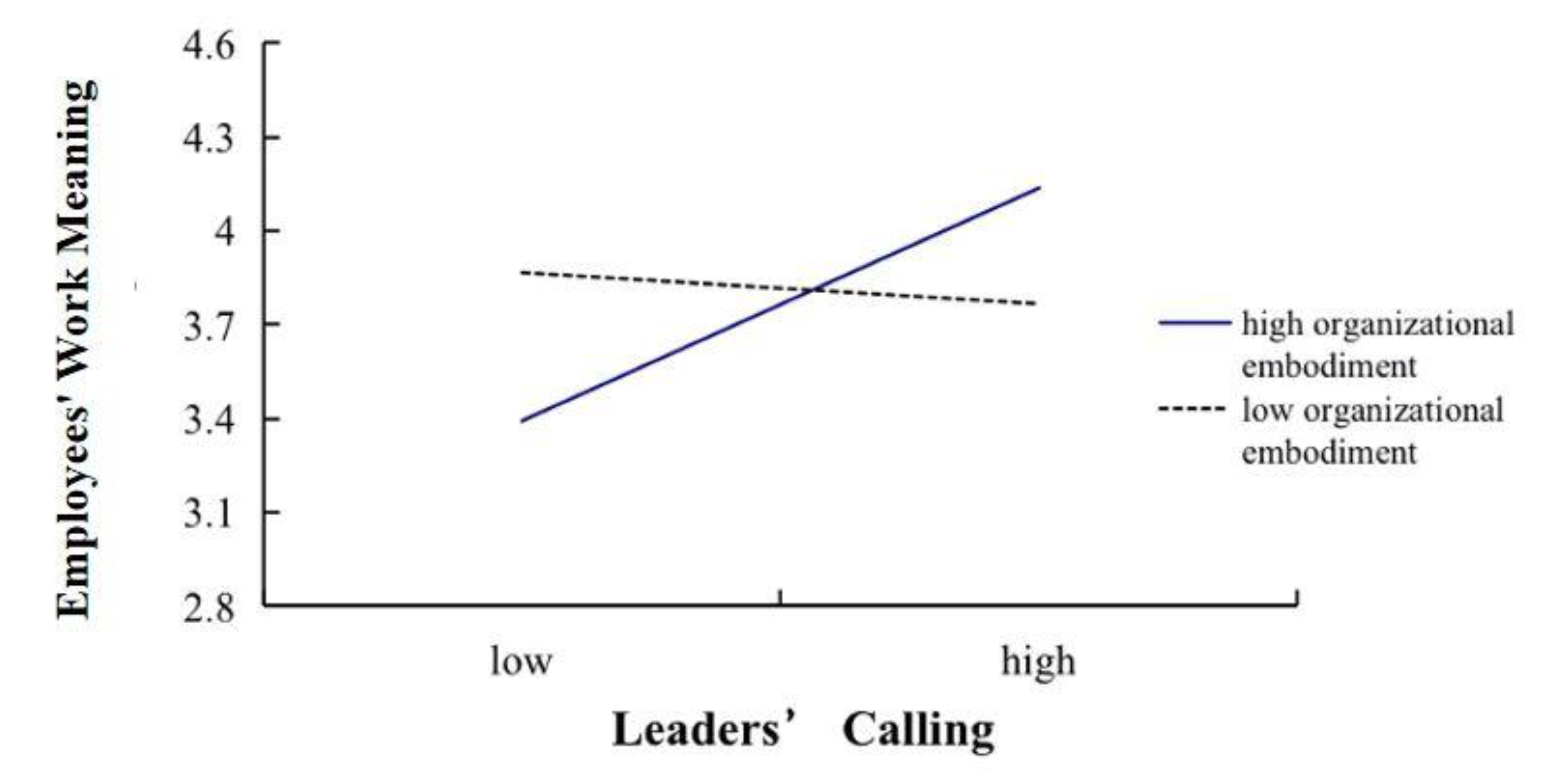
In order to further explore the moderating effect of supervisor’s organizational embodiment, we used a simple regression method [68] to examine the relationship between leaders’ calling and employees’ work meaning in high organizational embodiment (mean + 1 standard deviation) and low organizational embodiment (mean -1 standard deviation), respectively. When the level of supervisors’ organizational embodiment was higher, leaders’ calling significantly promoted employees’ work meaning (β = .51, p < .01). When the level of supervisors’ organizational embodiment was low, the correlation between leadership’s sense of professional mission and employees’ work meaning was not significant (β= -.07, s.n.). This procedure further illustrates that a supervisor’s organizational embodiment positively moderates the relationship between leaders’ calling and employees’ work meaning. By combining this information, we verify Hypothesis 3. This fulfills the research objective of exploring the boundary conditions, showing that supervisors’ organizational embodiment moderates the impact of leaders’ sense of calling on employees’ innovative behavior.
We used Hayes’ [67] PEOCESS macro program (Model 7, N = 1000) to test the moderated mediation model. The results showed that supervisors’ organizational embodiment significantly and positively moderated the mediating effect of employees’ work meaning (index = .03, SE = .02, 95% CI [.003, .08]). Specifically, when supervisors’ organizational embodiment was higher, the mediating effect of employees’ work meaning was significant (B = .07, SE = .04, 95% CI [.01, 15]). When supervisors’ organizational embodiment was low, the mediating effect of employees’ work meaning was not significant (B = .003, SE = .02, 95% CI [-.03, .05]). By combining this information, we verify Hypothesis 4. This fulfills the research objective of exploring boundary conditions, demonstrating that supervisors’ organizational embodiment moderates the mediating effect of leaders’ sense of calling on employees’ innovative behavior.

5. Discussion

The objective of this study is to investigate whether and how leaders’ sense of calling influences employees’ innovative behavior, and to explore the conditions that may define the boundaries of this effect. In the present study, we used paired questionnaire data from leaders and employees to examine the mechanism of leaders’ calling on employees’ innovative behavior. Our findings indicate that leaders’ calling significantly promotes employees’ innovative behavior. In addition, employees’ work meaning plays a mediating role in the relationship between leaders’ calling and employees’ innovative behavior. Further, supervisors’ organizational embodiment not only moderates the relationship between leaders’ calling and employees’ work meaning but also moderates the mediating effect of employees’ work meaning on leaders’ calling and employees’ innovative behavior. Specifically, when the level of supervisors’ organizational embodiment is higher, the relationship between leaders’ calling and employees’ work meaning is stronger, and the mediating effect of employees’ work meaning is stronger. These findings have meaningful theoretical and practical implications.

5.1. Theoretical Implications

Our study examines the direct relationship between leaders’ calling and employees’ innovative behavior and extends the effect of individual characteristics on employees’ innovative behavior from the perspective of leadership and motivation. Although existing research on innovative behavior has focused on the role of leadership factors, most of it is from the perspective of leaders’ behavioral styles and the relationship between leaders and employees [2,31]. Scholars have paid less attention to the personal characteristics of leaders. As a personal characteristic from a motivational perspective, leadership calling was found to have a significant positive impact on employees’ innovative behavior. Our findings enrich the research on the factors influencing individual leader characteristics on employees’ innovative behavior in leader and employee situations. In addition, our study also found that leaders’ calling can provide employees with a model from which to learn, create an innovative climate, and significantly improve their innovative behavior. These results provide a more comprehensive understanding of the role of leaders’ calling.
We explored the mediating effect of employees’ work meaning on the relationship between leaders’ calling and employees’ innovative behavior. Studies have shown that there are multiple mechanisms for the relationship between leader characteristics or behaviors and employees’ innovative behavior, such as motivational [69,70,71], affective, and cognitive mechanisms mechanism [72]. Although motivation is an important mediating mechanism of extrinsic factors that influence employees’ innovative behavior [54], many of these mediating variables overlap conceptually and practically. Therefore, research on the motivational mechanisms of innovation has not paid sufficient attention to other specific manifestations or types of motivation. Our study shows that work meaning as a motivational factor can mediate innovation. In addition, previous studies have shown that an individual’s work meaning has a positive impact on their work behavior [53]. Combined with the theory of interpersonal sensemaking, our study examines the mediating role of employees’ work meaning in the relationship between leaders’ calling and employees’ innovative behavior. This echoes the call to explore other potential mechanisms between situational factors and employees’ innovative outcomes [61].
Our findings extend the research on supervisors’ organizational embodiment in several ways and enrich the boundary conditions under which leaders’ calling affects employees’ innovative behaviors. From the perspective of the relevant research content of supervisors’ organizational embodiment, existing studies have mainly examined its moderating effect on leadership styles, including servant leadership [73], transformational leadership [74], abusive supervision [23], and leader-member exchange [24,62] and so on. Our study introduces supervisors’ organizational embodiment into the field of leaders’ calling and finds that it positively moderates the relationship between leaders’ calling and employees’ work meaning. In addition, it positively moderates the mediating effect of work meaning on the relationship between leaders’ calling and employees’ innovative behavior. The results extend the boundary conditions for the role of leaders’ calling and provide new evidence for understanding the role of leaders’ calling. Furthermore, the results of our study respond to the call to explore the important role of supervisors’ organizational embodiment in multiple organizational scenarios [23,24,74].

5.2. Practical Implications

First, this study found that leaders’ calling can promote employees’ innovative behavior. From a practical perspective, organizations must support leaders’ calling. Organizations can help leaders achieve their calling by providing work resources that enable them to perform more autonomous and meaningful tasks [75]. Therefore, to improve the innovation performance of employees and organizations, organizations should attach importance to leaders’ calling for selection, training, and assessment. When selecting or recruiting leaders, in addition to paying attention to the candidate’s ability and other indicators, special attention should be paid to the level of their calling, which can be investigated through professional experience backtracking, structured interviews of typical cases, and so on. Moreover, organizations should adopt a systematic way to train leaders so that they can maintain and continuously improve their calling. These methods include learning the history of organizational development, communicating with outstanding practitioners in the same industry, and analyzing case studies of career dilemmas. Finally, in the evaluation of leaders, a calling should be regarded as an evaluation indicator of leaders’ daily work and quantified and incorporated into the evaluation system of leaders by means of behavioral anchoring or key events.
Second, this study found that leaders’ calling promoted employees’ innovative behavior via employees’ work meaning, and employees’ work meaning had a mediating effect. Our findings show that, on the one hand, leaders should be aware of their role as role models and provide timely feedback on employee performance [76]. They can motivate employees’ work meaning through the influence of their own calling. On the other hand, enterprises can help employees develop work meaning and stimulate innovative behavior by implementing a variety of human resource management practices [77]. In addition, organizations need to select employees who are intrinsically motivated and have easy access to a sense of meaning in their work. Furthermore, organizations also need to continuously promote a positive view of work meaning to employees in multiple work situations so that they have a sense of meaning and value in the work they are engaged in, and then enhance their willingness to implement innovative behaviors.
Finally, this study shows that a supervisor’s organizational embodiment plays a moderating role in the relationship between leaders’ calling and employees’ work meaning, as well as has a mediating effect. This result suggests that to promote employees’ innovative behavior, leaders should try to continuously improve the level of their organizational embodiment to better exert the influence of leaders’ calling. Specific strategies include fully integrating leaders into the organization, enhancing their sense of identity with the organization, and playing the role of the organization’s agent. In addition, leaders also need to continuously improve their core skills and performance and enhance their voice and organizational status, as well as their teams in the organization. Leaders must maintain close communication with employees, convey the voice of the top of the organization to employees, and strengthen employees’ understanding of organizational decision making. All the above practices enhance employees’ perceptions of the extent to which the leader represents the organization.

5.3. Limits and Future Directions

The shortcomings of this study are mainly in the following three aspects. First, we collected data at the same time, so the results obtained only verify the correlation between variables, rather than causality. In the future, we plan to collect data at multiple time points or use experimental operations and other methods to test the causal relationships between the above variables. Second, based on the theory of interpersonal sensemaking, this study selects work meaning as the mediating mechanism for leaders’ calling in promoting employees’ innovative behavior. Additionally, our data is exclusively from China, and we do not have evidence to determine whether cultural differences play a role. Future research is needed to explore how a sense of calling may impact employees across different cultural contexts. As mentioned above, work meaning is only one of the motivations that affect employees’ innovative behavior. In the future, we can test other specific motivational forms, such as self-expression and passion [78]. In addition, in terms of moderating variables, a supervisor’s organizational embodiment is a key variable that affects the role of a leader’s calling. In the future, other leader characteristics, employee characteristics, and organizational strategies may play moderating role [79]. Third, this study adopts the method of subjective evaluation of leaders when measuring employees’ innovative behavior. Although this measurement method has been widely used in previous studies [31,66], it may result in measurement errors. Future research could use more objective methods to measure the actual innovation output of employees based on subjective evaluations (e.g., the number of patent applications and patents granted, and the number of rationalization proposals). Furthermore, considering that innovative behavior includes a series of stages (e.g., new idea generation and implementation), predictors may have different relationships with different stages of the innovation process [80]. Future research could explore whether leaders’ calling has different effects on the different stages of innovative behavior.

6. Conclusion

Current research supports the widely held assumption that a leader’s calling promotes employees’ innovative behavior. The survey results indicate that employees’ work meaning serves as a mediator in this relationship. Furthermore, the supervisor’s organizational embodiment moderates this connection; specifically, the higher the level of organizational embodiment, the stronger the mediating effect. While academic studies on calling have made notable progress, there is still significant room for further exploration. This paper addresses the impact of an individual’s calling on others, a motivational perspective that has not been previously explored.

Appendix A

1=Strongly disagree or never
2=Disagree
3=Neutral
4=Agree
5= Strongly agree or very frequently
Calling
I have a calling to a particular kind of work.
I have a good understanding of my calling as it applies to my career.
I am trying to figure out my calling in my career.
I am searching for my calling as it applies to my career.
Work meaning
The work I do is very important to me.
My job activities are personally meaningful to me.
The work I do is meaningful to me.
Innovative behavior
Searches out new technologies, processes, techniques, and/or product ideas.
Generates creative ideas.
Promotes and champions ideas to others.
Investigates and secures funds needed to implement new ideas.
Develops adequate plans and schedules for the implementation of new ideas.
Is innovative.
Supervisors’ organizational embodiment
My supervisor embodies the characteristics of [name of organization].
My supervisor and [name of organization] have a lot in common.
My supervisor evaluates me in a manner similar to [name of organization].
My supervisor is representative of [name of organization].
My supervisor and [name of organization] are very similar.

References

  1. Zhou, J.; George, J.M. Awakening employee creativity: The role of leader emotional intelligence. Leadersh. Q. 2003, 14, 545–568. [Google Scholar] [CrossRef]
  2. Hirst, G.; Van Dick, R.; Van Knippenberg, D. A social identity perspective on leadership and employee creativity. J. Organ. Behav. 2009, 30, 963–982. [Google Scholar] [CrossRef]
  3. Yang, Y.; Li, Z.; Liang, L.; Zhang, X. Why and when paradoxical leader behavior impacts employee creativity: Thriving at work and psychological safety. Curr. Psychol. 2021, 40, 1911–1922. [Google Scholar] [CrossRef]
  4. Tierney, P. Leadership and employee creativity. In Handbook of Organizational Creativity; Elsevier: New York, NY, USA, 2008. [Google Scholar]
  5. Huang, L.; Krasikova, D.V.; Liu, D. I can do it, so can you: The role of leader creative self-efficacy in facilitating follower creativity. Organ. Behav. Hum. Decis. Process. 2016, 132, 49–62. [Google Scholar] [CrossRef]
  6. Dik, B.J.; Duffy, R.D. Calling and vocation at work: Definitions and prospects for research and practice. Couns. Psychol. 2009, 37, 424–450. [Google Scholar] [CrossRef]
  7. Schabram, K.; Nielsen, J.; Thompson, J. The dynamics of work orientations: An updated typology and agenda for the study of jobs, careers, and callings. Acad. Manag. Ann. 2023, 17, 405–438. [Google Scholar] [CrossRef]
  8. Scott, S.G.; Bruce, R.A. Determinants of innovative behavior: A path model of individual innovation in the workplace. Acad. Manag. J. 1994, 37, 580–607. [Google Scholar] [CrossRef]
  9. Amabile, T.M.; Pratt, M.G. The dynamic componential model of creativity and innovation in organizations: Making progress, making meaning. Res. Organ. Behav. 2016, 36, 157–183. [Google Scholar] [CrossRef]
  10. Shimizu, A.B.; Dik, B.J.; Conner, B.T. Conceptualizing calling: Cluster and taxometric analyses. J. Vocat. Behav. 2019, 114, 7–18. [Google Scholar] [CrossRef]
  11. Deci, E.L.; Ryan, R.M. The “what” and “why” of goal pursuits: Human needs and the self-determination of behavior. Psychol. Inq. 2000, 11, 227–268. [Google Scholar] [CrossRef]
  12. Duffy, R.D.; Bott, E.M.; Allan, B.A.; Torrey, C.L.; Dik, B.J. Perceiving a calling, living a calling, and job satisfaction: Testing a moderated, multiple mediator model. J. Couns. Psychol. 2012, 59, 50–59. [Google Scholar] [CrossRef] [PubMed]
  13. Hirschi, A. Callings and work engagement: Moderated mediation model of work meaningfulness, occupational identity, and occupational self-efficacy. J. Couns. Psychol. 2012, 59, 479–485. [Google Scholar] [CrossRef]
  14. Shafi, M.; Lei, Z.; Song, X.; Sarker, M.N.I. The effects of transformational leadership on employee creativity: Moderating role of intrinsic motivation. Asia Pac. Manag. Rev. 2020, 25, 166–176. [Google Scholar] [CrossRef]
  15. Han, G.H.; Bai, Y. Leaders can facilitate creativity: The moderating roles of leader dialectical thinking and LMX on employee creative self-efficacy and creativity. J. Manag. Psychol. 2020, 35, 405–417. [Google Scholar] [CrossRef]
  16. Bin Saeed, B.; Afsar, B.; Shahjehan, A.; Imad Shah, S. Does transformational leadership foster innovative work behavior? The roles of psychological empowerment, intrinsic motivation, and creative process engagement. Econ. Res.-Ekon. Istraž. 2019, 32, 254–281. [CrossRef]
  17. Kark, R.; Van Dijk, D.; Vashdi, D.R. Motivated or demotivated to be creative: The role of self-regulatory focus in transformational and transactional leadership processes. Appl. Psychol. 2018, 67, 186–224. [Google Scholar] [CrossRef]
  18. Yang, J.; Liu, H.; Gu, J. A multi-level study of servant leadership on creativity: The roles of self-efficacy and power distance. Leadersh. Organ. Dev. J. 2017, 38, 610–629. [Google Scholar] [CrossRef]
  19. Hughes, D.J.; Lee, A.; Tian, A.W.; Newman, A.; Legood, A. Leadership, creativity, and innovation: A critical review and practical recommendations. Leadersh. Q. 2018, 29, 549–569. [Google Scholar] [CrossRef]
  20. Spreitzer, G.M. Psychological empowerment in the workplace: Dimensions, measurement, and validation. Acad. Manag. J. 1995, 38, 1442–1465. [Google Scholar] [CrossRef]
  21. Rosso, B.D.; Dekas, K.H.; Wrzesniewski, A. On the meaning of work: A theoretical integration and review. Res. Organ. Behav. 2010, 30, 91–127. [Google Scholar] [CrossRef]
  22. Wrzesniewski, A.; Dutton, J.E.; Debebe, G. Interpersonal sensemaking and the meaning of work. Res. Organ. Behav. 2003, 25, 93–135. [Google Scholar] [CrossRef]
  23. Shoss, M.K.; Eisenberger, R.; Restubog, S.L.D.; Zagenczyk, T.J. Blaming the organization for abusive supervision: The roles of perceived organizational support and supervisor’s organizational embodiment. J. Appl. Psychol. 2013, 98, 158–168. [Google Scholar] [CrossRef] [PubMed]
  24. Eisenberger, R.; Shoss, M.K.; Karagonlar, G.; Gonzalez-Morales, M.G.; Wickham, R.E.; Buffardi, L.C. The supervisor POS-LMX-subordinate POS chain: Moderation by reciprocation wariness and supervisor’s organizational embodiment. J. Organ. Behav. 2014, 35, 635–656. [Google Scholar] [CrossRef]
  25. Brown, M.E.; Treviño, L.K.; Harrison, D.A. Ethical leadership: A social learning perspective for construct development and testing. Organ. Behav. Hum. Decis. Process. 2005, 97, 117–134. [Google Scholar] [CrossRef]
  26. Bandura, A. Social Learning Theory; Prentice-Hall: Englewood Cliffs, NJ, USA, 1977. [Google Scholar]
  27. Pieterse, A.N.; Van Knippenberg, D.; Schippers, M.; Stam, D. Transformational and transactional leadership and innovative behavior: The moderating role of psychological empowerment. J. Organ. Behav. 2010, 31, 609–623. [Google Scholar] [CrossRef]
  28. Cingöz, A.; Akdoğan, A.A. An empirical examination of performance and image outcome expectation as determinants of innovative behavior in the workplace. Procedia Soc. Behav. Sci. 2011, 24, 847–853. [Google Scholar] [CrossRef]
  29. Gong, Y.; Huang, J.C.; Farh, J.L. Employee learning orientation, transformational leadership, and employee creativity: The mediating role of employee creative self-efficacy. Acad. Manag. J. 2009, 52, 765–778. [Google Scholar] [CrossRef]
  30. Sameer, Y.M. Innovative behavior and psychological capital: Does positivity make any difference? J. Econ. Manag. 2018, 32, 75–101. [Google Scholar] [CrossRef]
  31. Ma, X.; Jiang, W. Transformational leadership, transactional leadership, and employee creativity in entrepreneurial firms. J. Appl. Behav. Sci. 2018, 54, 302–324. [Google Scholar] [CrossRef]
  32. Kong, Y.; Li, M. Proactive personality and innovative behavior: The mediating roles of job-related affect and work engagement. Soc. Behav. Personal. 2018, 46, 431–446. [Google Scholar] [CrossRef]
  33. Jaiswal, N.K.; Dhar, R.L. Transformational leadership, innovation climate, creative self-efficacy and employee creativity: A multilevel study. Int. J. Hosp. Manag. 2015, 51, 30–41. [Google Scholar] [CrossRef]
  34. Yidong, T.; Xinxin, L. How ethical leadership influence employees’ innovative work behavior: A perspective of intrinsic motivation. J. Bus. Ethics. 2013, 116, 441–455. [Google Scholar] [CrossRef]
  35. Guo, Y.; Peng, Y.; Zhu, Y. How does empowering leadership motivate employee innovative behavior: A job characteristics perspective. Curr. Psychol. 2023, 42, 18280–18290. [Google Scholar] [CrossRef]
  36. Park, J.; Lee, K.; Lim, J.I.; Sohn, Y.W. Leading with callings: Effects of leader’s calling on followers’ team commitment, voice behavior, and job performance. Front. Psychol. 2018, 9, 1706. [Google Scholar] [CrossRef] [PubMed]
  37. Park, J.; Sohn, Y.W. Is it happy to work with leaders viewing their work as a calling? Investigating mediators and a moderator on the relationship between leader calling and follower job satisfaction. Korean J. Ind. Organ. Psychol. 2018, 31, 353–385. [Google Scholar] [CrossRef]
  38. Buis, B.C.; Kluemper, D.H.; Weisman, H.; Tao, S. Your employees are calling: How organizations help or hinder living a calling at work. J. Vocat. Behav. 2024, 149, 103958. [Google Scholar] [CrossRef]
  39. Oldham, G.R.; Cummings, A. Employee creativity: Personal and contextual factors at work. Acad. Manag. J. 1996, 39, 607–634. [Google Scholar] [CrossRef]
  40. Shin, S.J.; Zhou, J. Transformational leadership, conservation, and creativity: Evidence from Korea. Acad. Manag. J. 2003, 46, 703–714. [Google Scholar] [CrossRef]
  41. Avey, J.B.; Luthans, F.; Youssef, C.M. The additive value of positive psychological capital in predicting work attitudes and behaviors. J. Manag. 2010, 36, 430–452. [Google Scholar] [CrossRef]
  42. Cai, W.; Lysova, E.I.; Bossink, B.A.; Khapova, S.N.; Wang, W. Psychological capital and self-reported employee creativity: The moderating role of supervisor support and job characteristics. Creat. Innov. Manag. 2019, 28, 30–41. [Google Scholar] [CrossRef]
  43. Qiao, G.; Li, Y.; Hong, A. The strategic role of digital transformation: Leveraging digital leadership to enhance employee performance and organizational commitment in the digital era. Systems. 2024, 12, 457. [Google Scholar] [CrossRef]
  44. Duan, W.; Tang, X.; Li, Y.; Cheng, X.; Zhang, H. Perceived organizational support and employee creativity: The mediation role of calling. Creat. Res. J. 2020, 32, 403–411. [Google Scholar] [CrossRef]
  45. Shalley, C.E.; Gilson, L.L. What leaders need to know: A review of social and contextual factors that can foster or hinder creativity. Leadersh. Q. 2004, 15, 33–53. [Google Scholar] [CrossRef]
  46. Steger, M.F.; Dik, B.J.; Duffy, R.D. Measuring meaningful work: The work and meaning inventory (WAMI). J. Career Assess. 2012, 20, 322–337. [Google Scholar] [CrossRef]
  47. Christian, M.S.; Garza, A.S.; Slaughter, J.E. Work engagement: A quantitative review and test of its relations with task and contextual performance. Pers. Psychol. 2011, 64, 89–136. [Google Scholar] [CrossRef]
  48. Maharaj, I.; Schlechter, A.F. Meaning in life and meaning of work: Relationships with organizational citizenship behaviour, commitment and job satisfaction. Manag. Dyn. 2007, 16, 24–41 https://hdlhandlenet/10520/EJC69726. [Google Scholar]
  49. Gu, J.; Jiang, X.; Ding, S.; Xie, L.; Huang, B. Calling leveraged work engagement: Above and beyond the effects of job and personal resources. Nankai Bus. Rev. 2018, 21, 107–120 https://linkoverseacnkinet/doi/1016471/jcnki11. [Google Scholar]
  50. Sánchez-Cardona, I.; Vera, M.; Marrero-Centeno, J. Job resources and employees’ intention to stay: The mediating role of meaningful work and work engagement. J. Manag. Organ. 2023, 29, 930–946. [Google Scholar] [CrossRef]
  51. Bloom, M.; Colbert, A.E.; Nielsen, J.D. Stories of calling: How called professionals construct narrative identities. Adm. Sci. Q. Adm. Sci. Q. 2021, 66, 66–338. [Google Scholar] [CrossRef]
  52. Duffy, R.D.; Dik, B.J.; Douglass, R.P.; England, J.W.; Velez, B.L. Work as a calling: A theoretical model. J. Couns. Psychol. J. Couns. Psychol. 2018, 65, 65–439. [Google Scholar] [CrossRef]
  53. Martela, F.; Pessi, A.B. Significant work is about self-realization and broader purpose: Defining the key dimensions of meaningful work. Front. Psychol. Front. Psychol. 2018, 9, 9–363. [Google Scholar] [CrossRef]
  54. Fishbach, A.; Woolley, K. The structure of intrinsic motivation. Annu. Rev. Organ. Psychol. Organ. Behav. Annu. Rev. Organ. Psychol. Organ. Behav. 2022, 9, 9–363. [Google Scholar] [CrossRef]
  55. Xie, B.; Zhang, X.; Miao, J.; Zhang, X.; Xu, J. The conceptualization, antecedents and interventions of occupational calling in Chinese context. Adv. Psychol. Sci. Adv. Psychol. Sci. 2023, 31, 31–2234. [Google Scholar] [CrossRef]
  56. Afsar, B.; Umrani, W.A. Transformational leadership and innovative work behavior: The role of motivation to learn, task complexity and innovation climate. Eur. J. Innov. Manag. Eur. J. Innov. Manag. 2020, 23, 23–428. [Google Scholar] [CrossRef]
  57. Kashdan, T.B.; Rose, P.; Fincham, F.D. Curiosity and exploration: Facilitating positive subjective experiences and personal growth opportunities. J. Pers. Assess. 2004, 82, 291–305. [Google Scholar] [CrossRef]
  58. Koo, M.; Fishbach, A. The small-area hypothesis: Effects of progress monitoring on goal adherence. J. Consum. Res. J. Consum. Res. 2012, 39, 493–509. [Google Scholar] [CrossRef]
  59. Eisenberger, R.; Karagonlar, G.; Stinglhamber, F.; Neves, P.; Becker, T.E.; Gonzalez-Morales, M.G.; Steiger-Mueller, M. Leader–member exchange and affective organizational commitment: The contribution of supervisor’s organizational embodiment. J. Appl. Psychol. J. Appl. Psychol. 2010, 95, 95–1103. [Google Scholar] [CrossRef]
  60. Dai, Y.D.; Hou, Y.H.; Chen, K.Y.; Zhuang, W.L. To help or not to help: Antecedents of hotel employees’ organizational citizenship behavior. Int. J. Contemp. Hosp. Manag. Int. J. Contemp. Hosp. Manag. 2018, 30, 30–1313. [Google Scholar] [CrossRef]
  61. Su, W.; Lin, X.; Ding, H. The influence of supervisor developmental feedback on employee innovative behavior: A moderated mediation model. Front. Psychol. Front. Psychol. 2019, 10, 10–1581. [Google Scholar] [CrossRef]
  62. Eisenberger, R.; Shanock, L. Rewards, intrinsic motivation, and creativity: A case study of conceptual and methodological isolation. Creat. Res. J. Creat. Res. J. 2003, 15, 15–130. [Google Scholar] [CrossRef]
  63. Mackey, J.D.; McAllister, C.P.; Brees, J.R.; Huang, L.; Carson, J.E. Perceived organizational obstruction: A mediator that addresses source-target misalignment between abusive supervision and OCBs. J. Organ. Behav. J. Organ. Behav. 2018, 39, 39–1295. [Google Scholar] [CrossRef]
  64. Mayer, D.M.; Kuenzi, M.; Greenbaum, R.; Bardes, M.; Salvador, R.B. How low does ethical leadership flow? Test of a trickle-down model. Organ. Behav. Hum. Decis. Process. Organ. Behav. Hum. Decis. Process. 2009, 108, 108–13. [Google Scholar] [CrossRef]
  65. Dik, B.J.; Eldridge, B.M.; Steger, M.F.; Duffy, R.D. Development and validation of the calling and vocation questionnaire (CVQ) and brief calling scale (BCS). J. Career Assess. J. Career Assess. 2012, 20, 20–263. [Google Scholar] [CrossRef]
  66. Tu, Y.; Lu, X.; Choi, J.N.; Guo, W. Ethical leadership and team-level creativity: Mediation of psychological safety climate and moderation of supervisor support for creativity. J. Bus. Ethics. J. Bus. Ethics. 2019, 159, 159–565. [Google Scholar] [CrossRef]
  67. Hayes, A.F. Introduction to Mediation, Moderation, and Conditional Process Analysis: A Regression-Based Approach. Guilford Press: New York, NY, USA, 2017.
  68. Aiken, L.S.; West, S.G.; Reno, R.R. Multiple Regression: Testing and Interpreting Interactions. Sage: Thousand Oaks, CA, USA, 1991.
  69. Li, S.; Yu, W.; Lei, Y.; Hu, M. How does spiritual leadership inspire employees’ innovative behavior? The role of psychological capital and intrinsic motivation. Eur. Rev. Appl. Psychol. Eur. Rev. Appl. Psychol. 2023, 73, 73–100905. [Google Scholar] [CrossRef]
  70. Shalley, C.E.; Gilson, L.L.; Blum, T.C. Interactive effects of growth need strength, work context, and job complexity on self-reported creative performance. Acad. Manag. J. Acad. Manag. J. 2009, 52, 52–505. [Google Scholar] [CrossRef]
  71. Schuckert, M.; Kim, T.T.; Paek, S.; Lee, G. Motivate to innovate: How authentic and transformational leaders influence employees’ psychological capital and service innovation behavior. Int. J. Contemp. Hosp. Manag. Int. J. Contemp. Hosp. Manag. 2018, 30, 30–796. [Google Scholar] [CrossRef]
  72. Zhang, J.; Gong, Z.; Zhang, S.; Zhao, Y. Impact of the supervisor feedback environment on creative performance: A moderated mediation model. Front. Psychol. Front. Psychol. 2017, 8, 256. [Google Scholar] [CrossRef]
  73. Wang, Z.; Xu, H.; Liu, Y. Servant leadership as a driver of employee service performance: Test of a trickle-down model and its boundary conditions. Hum. Relat. Hum. Relat. 2018, 71, 71–1203. [Google Scholar] [CrossRef]
  74. Stinglhamber, F.; Marique, G.; Caesens, G.; Hanin, D.; De Zanet, F. The influence of transformational leadership on followers’ affective commitment: The role of perceived organizational support and supervisor’s organizational embodiment. Career Dev. Int. Career Dev. Int. 2015, 20, 20–603. [Google Scholar] [CrossRef]
  75. Hirschi, A.; Keller, A.C.; Spurk, D.M. Living one’s calling: Job resources as a link between having and living a calling. J. Vocat. Behav. J. Vocat. Behav. 2018, 106, 106–10. [Google Scholar] [CrossRef]
  76. Robbins, T.L.; Crino, M.D.; Fredendall, L.D. An integrative model of the empowerment process. Hum. Resour. Manag. Rev. Hum. Resour. Manag. Rev. 2002, 12, 12–443. [Google Scholar] [CrossRef]
  77. Grant, A.M. Leading with meaning: Beneficiary contact, prosocial impact, and the performance effects of transformational leadership. Acad. Manag. J. Acad. Manag. J. 2012, 55, 55–476. [Google Scholar] [CrossRef]
  78. Auger, P.; Woodman, R.W. Creativity and intrinsic motivation: Exploring a complex relationship. J. Appl. Behav. Sci. J. Appl. Behav. Sci. 2016, 52, 52–366. [Google Scholar] [CrossRef]
  79. Schaubroeck, J.; Peng, A.C.; Hannah, S.T.; Ma, J.; Cianci, A.M. Struggling to meet the bar: Occupational progress failure and informal leadership behavior. Acad. Manag. J. Acad. Manag. J. 2021, 64, 64–1762. [Google Scholar] [CrossRef]
  80. Birdi, K.; Leach, D.; Magadley, W. The relationship of individual capabilities and environmental support with different facets of designers’ innovative behavior. J. Prod. Innov. Manag. J. Prod. Innov. Manag. 2016, 33, 33–35. [Google Scholar] [CrossRef]
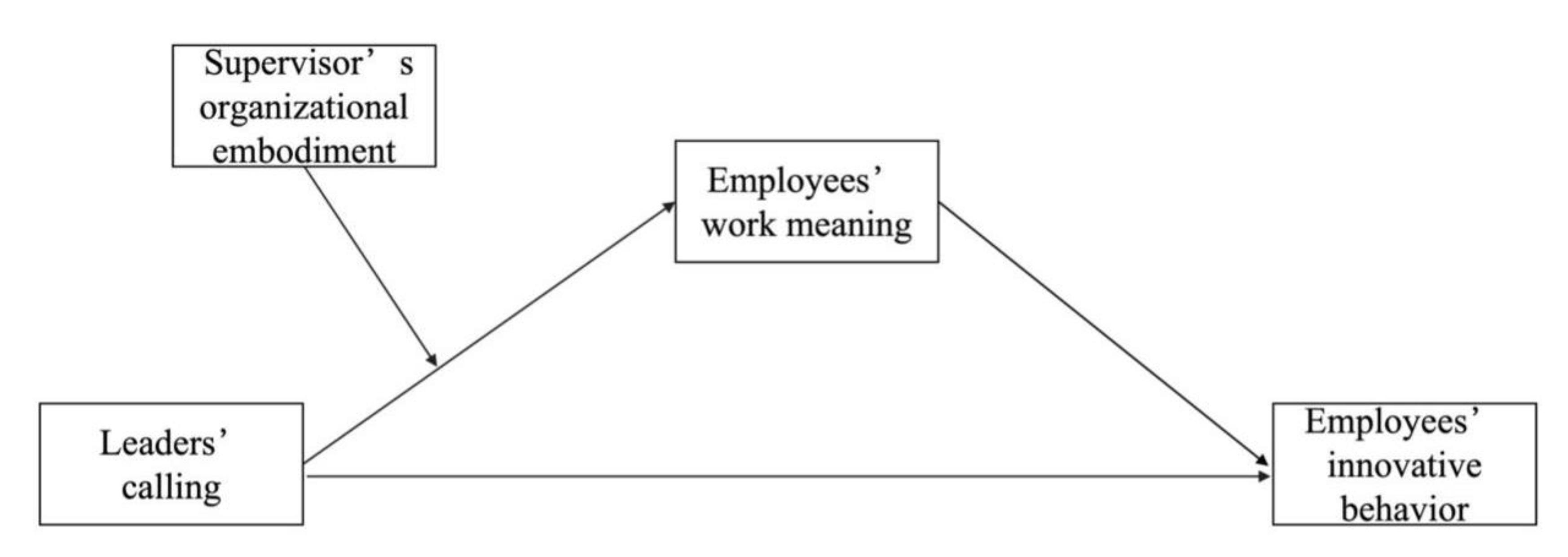
Figure 1. Research hypothetical model.
Preprints 151777 g001
Figure 2. The interactive effect of leaders’ calling and supervisor’s organizational embodiment on employees’ work meaning. Source: Derived from the analysis of questionnaire survey data.
Preprints 151777 g002
Table 1. Description of basic characteristics of samples (N=186).
Variable Item Number (person) Proportion
Gender Male 62 33.3%
Female 124 66.7%
Age Under 25 years old 30 16.1%
25 (inclusive)-35 years old 111 59.7%
35 (inclusive)-45 years old 32 17.2%
45 (inclusive)-55 years old 13 7.0%
Education Below junior college 17 9.1%
Junior college 46 24.7%
Undergraduate 102 54.8%
Masters’ degree 19 10.2%
Doctoral degree or post-doctorate 2 1.1%
Organizational tenure Less than 1 year 52 28.0%
1 (inclusive) to 5 years 90 48.4%
5 (inclusive) to 10 years 26 14.0%
More than 10 (inclusive) years 18 9.7%
Leader–follower dyad tenure Less than 1 year 72 38.7%
1 (inclusive) to 5 years 102 54.8%
5 (inclusive) to 10 years 10 5.4%
More than 10 (inclusive) years 2 1.1%
Table 2. Confirmatory factor analysis results.
Model χ2 df △χ2 RMSEA CFI NFI
Four-factor model (L; E; M; B) 296.35 129 .08 .95 .92
Three-factor model (L+E; M; B) 886.72 132 590.37 .18 .80 .77
Three-factor model (M+B; L; E) 531.51 132 235.16 .13 .88 .84
Two-factor model (L+E; M+B) 1115.09 134 818.74 .20 .72 .69
One-factor model (L+ E+M+B 1597.16 135 1300.81 .24 .61 .58
Notes: L = Leaders’ calling E = supervisor’s organizational embodiment. M = Employees’ work meaning. B = employees’ innovative behavior. Source: Derived from the analysis of questionnaire survey data.
Table 3. Means, standard deviations, and intercorrelations among the study variables.
Variable Mean SD 1 2 3 4 5 6 7 8
1.Leaders’ calling 3.92 .73
2.Employees’ work meaning 3.75 .87 .18*
3.Employees’ innovative behavior 3.47 .90 .24** .25**
4.Supervisor’s organizational embodiment 2.19 .82 -.20** -.09 -.13
5.Gender 1.67 .47 .21** -.17* -.06 -.09
6.Age 2.15 .77 -.09 .01 .09 .19* -.31***
7.Education 2.69 .82 .21** .07 .07 -.17* .41*** -.37***
8.Org. tenure 2.05 .90 -.19* .17* .17* .08 -.28*** .46*** -.26***
9.Dyad. tenure 1.69 .62 -.06 .10 .21** -.01 - .06 .20** .02 .60***
Notes: * p < .05, ** p < .01, *** p < .001. Source: Derived from the analysis of questionnaire survey data.
Table 4. Hierarchical regression results.
Variables Outcome: employees’ innovative behavior Outcome: employees’ work meaning
M1 M2 M3 M4 M5
Control variables
Gender -.06 -.10 -.22** -.24** -.22**
Age .06 .04 -.09 -.10 -.09
Education .13 .10 .18* .15 .13
Org. tenure .07 .11 .22* .26* .26*
Dyad. tenure .15 .14 -.04 -.04 -.02
Predictors
Leaders’ calling .27*** .23** .24**
Moderator
Supervisor’s organizational embodiment -.04 -.02
Interaction term
Leaders’ calling × supervisor’s organizational embodiment .20**
△R2 .07 . .05 .04
F 2.34* 4.44*** 3.27** 4.00*** 4.60***
Note: * p < .05, ** p < .01, *** p < .001. Source: Derived from the analysis of questionnaire survey data.
Disclaimer/Publisher’s Note: The statements, opinions and data contained in all publications are solely those of the individual author(s) and contributor(s) and not of MDPI and/or the editor(s). MDPI and/or the editor(s) disclaim responsibility for any injury to people or property resulting from any ideas, methods, instructions or products referred to in the content.
Copyright: This open access article is published under a Creative Commons CC BY 4.0 license, which permit the free download, distribution, and reuse, provided that the author and preprint are cited in any reuse.
Prerpints.org logo

Preprints.org is a free preprint server supported by MDPI in Basel, Switzerland.

Subscribe

Disclaimer

Terms of Use

Privacy Policy

Privacy Settings

© 2025 MDPI (Basel, Switzerland) unless otherwise stated