
Submitted:
15 March 2025
Posted:
18 March 2025
You are already at the latest version
Abstract
Here we investigated modified f(R, T) gravity for Bianchi type-V
metric in the presence of Lyra Geometry To acquire the deterministic
solution of the field equations with f(R, T), we have considered the
conditions:
(i) f(R, T)=Rm1+Tm2 , R is the Ricci scalar, T is the energy momentum tensor
And m1, m2 are constants
(ii) The equation of state ,where p is the pressure,
is the energy density and is the equation of state parameter that
depends on the type of matter. Some Physical and Geometrical features
of the model are also be discussed.
Keywords:
f(R
; T) gravity
; cosmological constant
; Lyra Geometry
,where p is the pressure, is the energy density and is the equation of state parameter that depends on the type of matter. Some Physical and Geometrical features of the model are also be discussed.
1. Introduction
Cosmology is the mathematical study of the universe (or Cosmos) as a whole. Cosmology is the study of structure, origin and development of the universe. The word “cosmology” derived from the combination of two greek words, Kosmos (meaning harmony or order) and logia (means words or disclosures) and cosmology deals with very large distances, objects that are very big and timescales that are very long. In addition, cosmology also deals with very small things.
A cosmological model describes the origin, structure and evolution of the universe. And by introducing or modifying the laws of gravity to get a phenomenon, which is observed as better fit in universe, that the standard cosmological model might not fully explained. In cosmology, f(R, T) gravity model is a modified theory of gravity which is an extension of general relativity by introducing action, which is a general term, depends on Ricci scalar R and the trace of stress energy tensor T. Modified theory explains certain issues, like accelerated expansion of the universe, dark energy and dark matter. f(R, T) gravity explains the late time accelerated expansion of the universe, effect of dark energy and also used to study inflationary scenarios and other early-universe phenomena.
Lyra geometry (which is a modified version of Riemannian geometry used in cosmology) is also an important theory in modified theories of gravity, in which displacement field can be deemed a building block of the total energy that can play the role of dark energy. Lyra geometry is introduced by Lyra [1] which is a function known as gauge function ϕi into the structure less geometry. Various researchers constructed cosmological models universe in the context of Lyra geometry [2,3,4,5,6,7,8,9]. The behavior of the cosmological model with variable deceleration parameter, the scenario of two-fluid dark energy models in the Bianchi type-III Universe, and FLRW Cosmological Models with Dynamic Cosmological Term in Modified Gravity are all discussed by Tiwari, Beesham, and Shukla [10,11,12,13]. Hyperbolic Scenario of Accelerating Universe with Modified Gravity was covered by Khan et al.[14].We have studied the various deceleration parameter forms proposed by various researchers [15,16,17,18]. By altering the geometrical component of Einstein's equation of motion, Starobinsky [19] and Kerner [20] proposed an alternative method known as modified gravity theory; f(R), where R is represented by scalar curvature [21,22]; f(T) theory, where T is represented by torsion scalar [23,24,25]; f(G) theory, where G is represented by Gauss Bonnet [26,27]; f(R,T) theory [28], where R is the Ricci scalar and T is the trace of the energy–momentum tensor and Different scalar-tensor theories [29,30] and modified theories of gravity include extra-dimensional theories [31]. In this paper, we have discussed Bianchi type-V cosmological model Modified f(R, T) Gravity Cosmological Model in the presence of Lyra geometry with certain forms of varying deceleration parameter.
2. Bianchi Type Metric and Field Equations
Bianchi type-V metric is
where M, N are functions of cosmic time t only.
The action S of f(R, T) gravity is
where R is the Ricci scalar, T is the Trace of stress energy tensor and Lm be the Lagrangian density of matter, where the value of stress-energy tensor of the matter is defined as
The effective energy-momentum tensor Tij in f(R, T) which is an arbitrary function of the trace of stress tensor, is
where is the energy density, p is the pressure of the matter and ui=(1, 0, 0, 0) is the four velocity vector in comoving coordinate system satisfy the condition
The field equations obtained by modifying the action S in Equation (2) in f(R, T) theory with respect to metric tensor gij is
where
And , and is the covariant derivative.
Here, we are using, since, there is not any unique definition of matter lagrangian. And using this definition of Lm in Equation (7), we get the value of Θij, on which the physical nature of the matter field depends.
Harko et al. [28] have considered three possible forms for the f(R, T), which are
In this discussion, we are going to consider the second condition of Equation (9) i.e.
where m1 and m2 are constants.
Now from Equation (6), we get
where is the cosmological constant, depends upon the trace of the energy-momentum tensor T, which is proposed by Poplawski [32] where the cosmological constant in the gravitational lagrangian is a function of the trace of energy-momentum tensor. And Ahmed and Pradhan [33] proposed Bianchi type-V cosmology in f(R, T) gravity with Λ(t). If the pressure of matter is neglected, Λ(t) gravity, which is more general than Palatini f(R), might be reduced to it.[34,35].For the sake of simplicity, here we will take m1=m2=1.
The field equations in Lyra manifold with 8πG=1 and c=1, given by Sen [36] is
where is the displacement vector field in Lyra manifold defined as
For the metric (1), Einstein field equations obtained by taking are
Here an overhead dot indicates the differentiation w.r.t. cosmic time t.
Equations (14)–(16) are three equations in five unknowns. Therefore, to found the solution, two more conditions are required
(i) We assume the solution of system of equations in the form
where a, n are constants.
Integrating Equation (18), we get
(ii) We assume the equation of state
For cosmological constant (Dark energy), , i.e.
Volume,
Deceleration Parameter,
i.e. dark energy dominated universe is there.
Shear Scalar,
i.e shear scalar does not exists.
Expansion Scalar,
Also
Therefore, our model describes a non-shearing, non-rotating, continuously expanding universe.
For the sake of simplicity, taking n=1, we get
Pressure of matter,
Energy density,
Cosmological constant,
Displacement vector,
Ricci scalar,
Trace of stress-energy tensor,
Figure 1.
Variation of Spatial volume V versus cosmic time t taking constant M1=1, a=1.
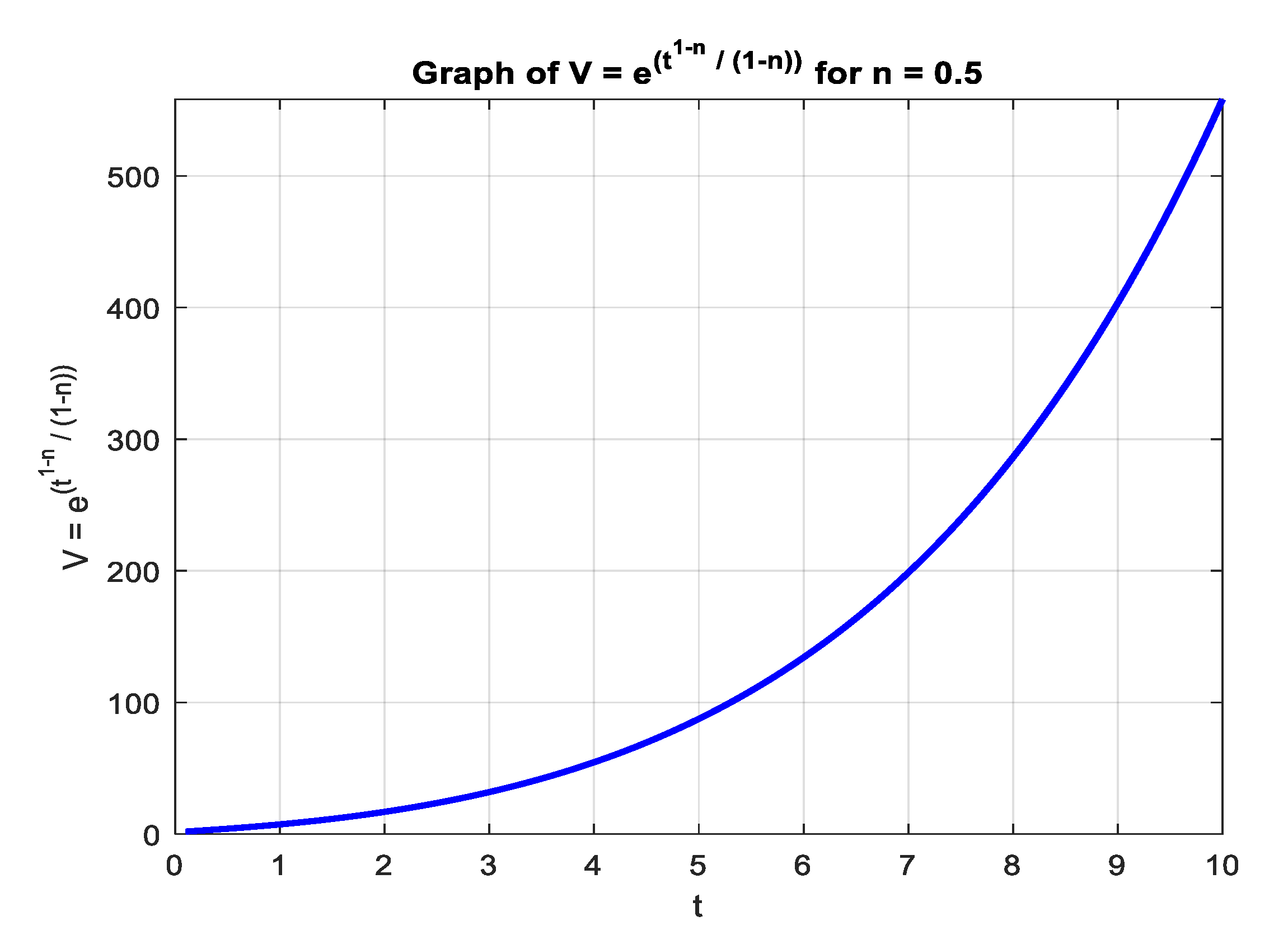
Figure 2.
Variation of Pressure of matter and energy density versus cosmic time t taking a=1.
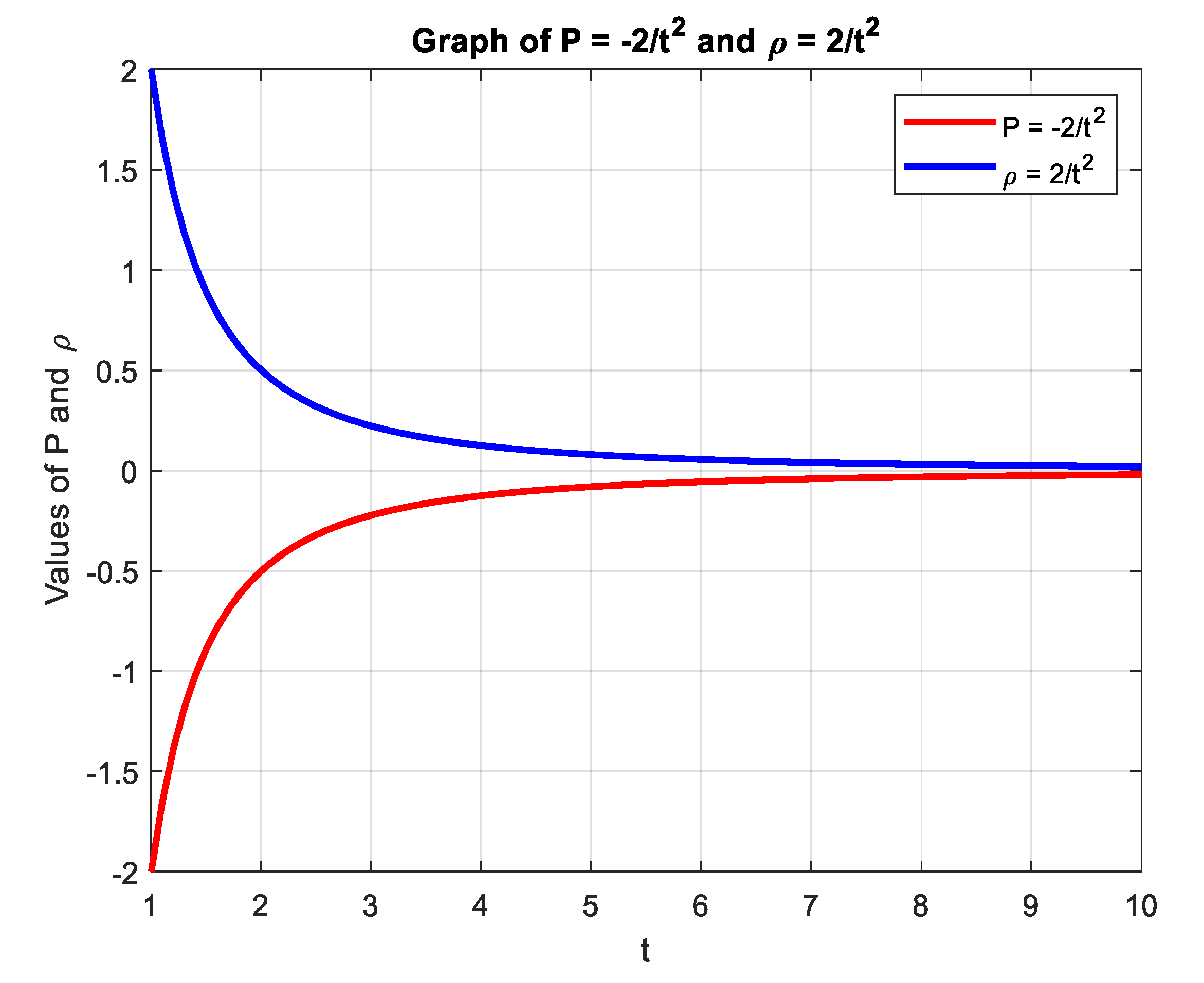
Figure 3.
Variation of expansion scalar θ versus cosmic time t taking n=1.
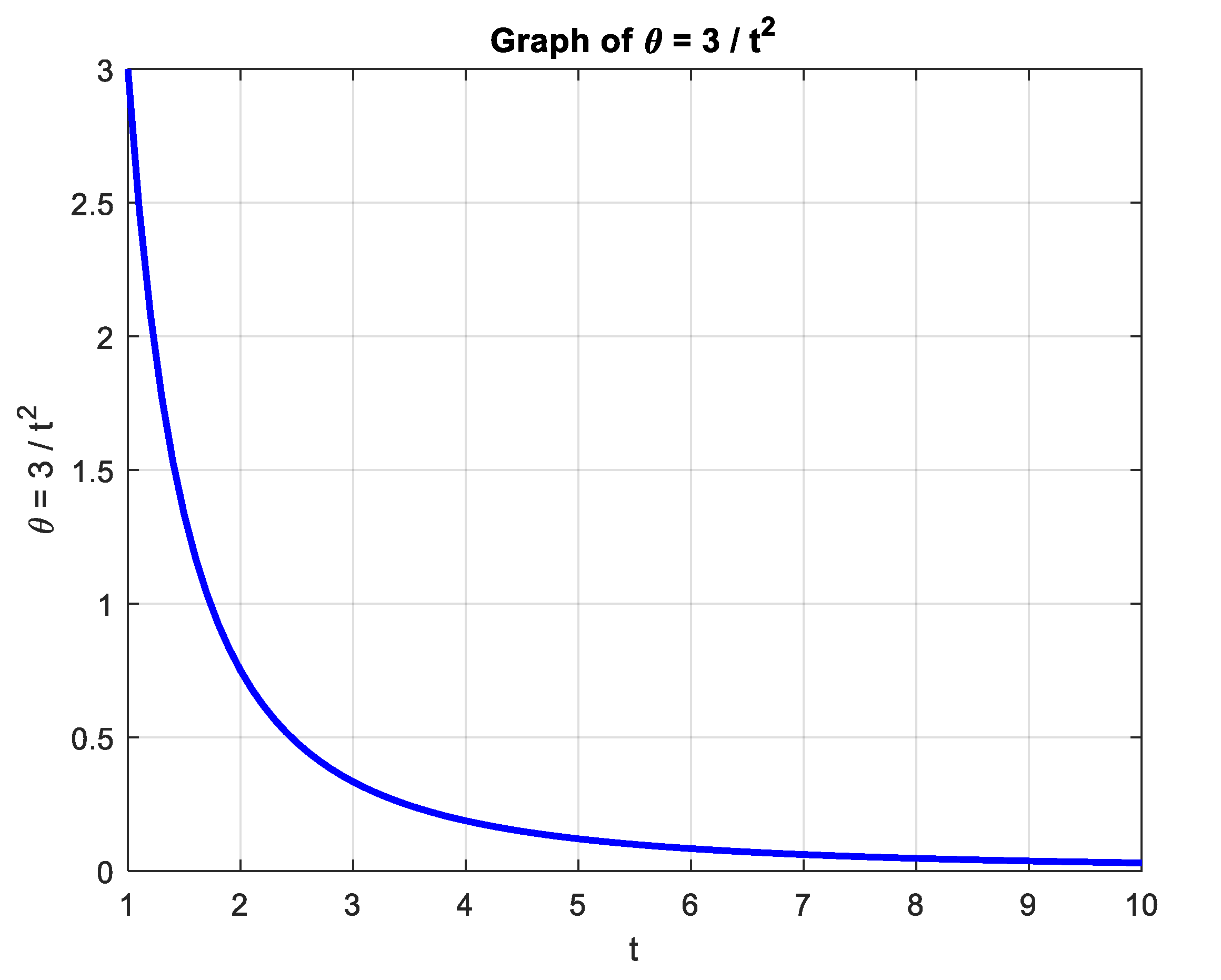
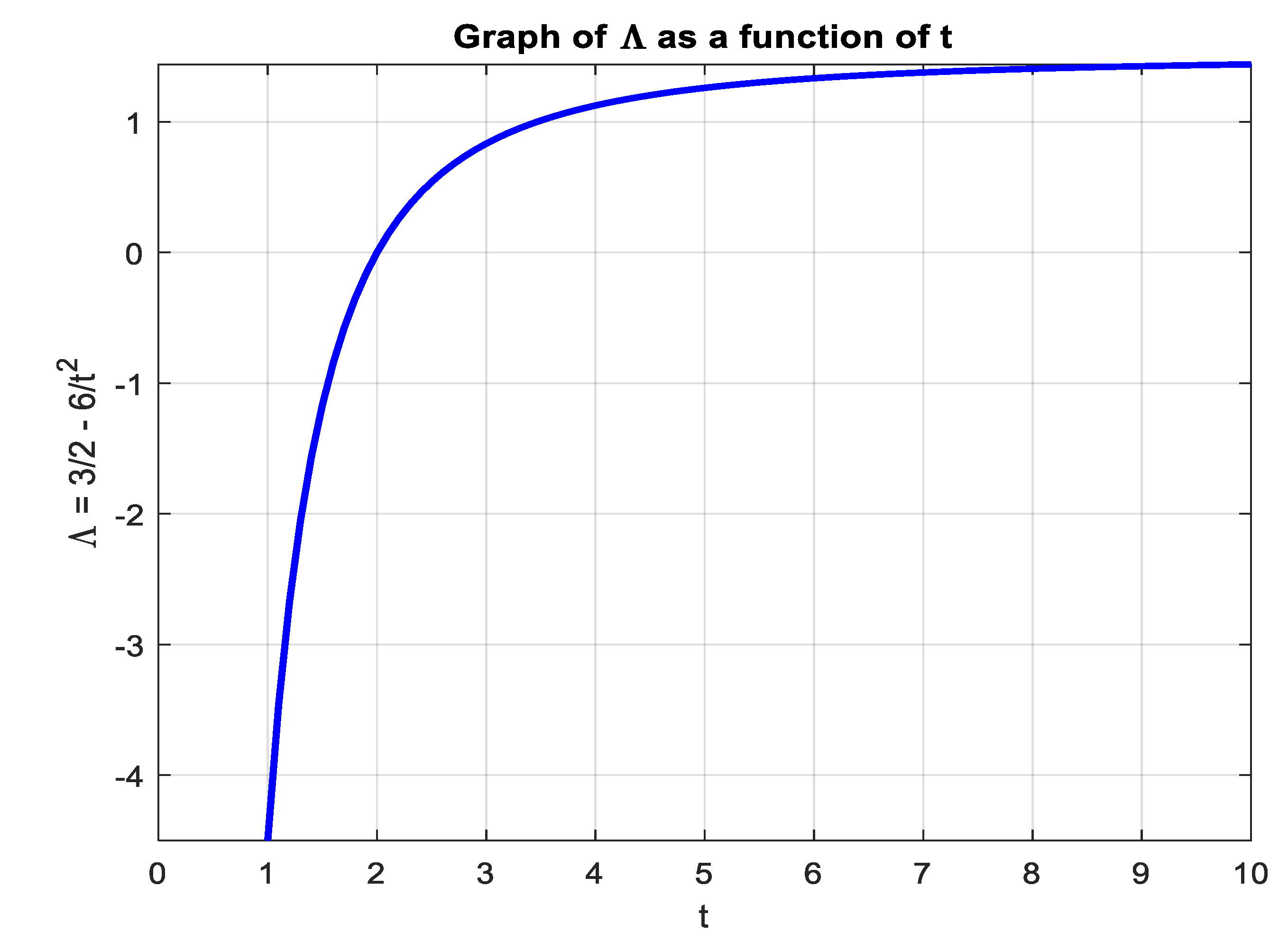
Figure 4.
Variation of Cosmological constant Λ versus cosmic time t taking a=1.
3. Results
Here we discussed Bianchi type-V cosmological model in f(R, T) theory of gravity with deceleration parameter. It is observed that the shear scalar σ is zero i.e. shear scalar does not exists. Due to shear no distortion is there. Hence , therefore model describes a non-shearing, non-rotating, continuously expanding universe. Also it is observed that, as the time t increases, expansion scalar θ decreases.
The energy density of the vacuum is linked to the cosmological constant Λ, which affects the universe's pace of expansion. When cosmic time t>2, cosmological constant Λ>0, then universe experience accelerated expansion similar to dark energy model, when t<2, Λ<0, our universe experience deceleration and a negative value of cosmological constant act as attractive force, which opposes the expansion and if t=2, we get Λ=0, i.e. there is no vacuum energy is contributed at that time, expansion rate is governed by matter and radiations only. This point is known as transition point where universe shifts from deceleration to acceleration.
References
- Lyra, G. über-eine Modifikation der Riemannschen Geometrie. Mathematische Zeitschrift 1951 54, 52–64.
- Rahaman, F; Bera, J. Higher dimensional cosmological model in Lyra geometry. Int. J. Mod. Phys. 2001, 10, 729. [Google Scholar] [CrossRef]
- Rahaman, F.; Chakraborty, S.; Bera,J. Inhomogeneous cosmological model in Lyra geometry. Int. J. Mod. Phys. 2002, 11, 1501. [Google Scholar]
- Baro,J. ; Singh,P. K. ; Singh,T. A. Higher Dimensional LRS Bianchi Type-I String Cosmological Model with Bulk Viscosity in Relativity. Indian J. Sci. Tech.
- Mohanty,G. ; Mahanta, K. L.;. Sahoo, R. R. Non-Existence of Five Dimensional Perfect Fluid Cosmological Model in Lyra Manifold. Astrophys. Space Sci. 2006 306, 269.
- Mohanty,G. ;. Mahanta, K. L,; Bishi,B. K. Five Dimensional Cosmological Models in Lyra Geometry with Time Dependent Displacement Field Astrophys. Space Sci. 2007, 310, 273.
- Mohanty,G.; Mahanta, K. L. Five-Dimensional Axially Symmetric String Cosmological Model in Lyra Manifold. Astrophys. Space Sci.
- Singh, P. K.; Mollah, M. R. R. Higher dimensional LRS Bianchi type-I Cosmological model universe Interacting with perfect fluid in Lyra Geometry The African Rev. Phys. 2016, 11, 33. [Google Scholar]
- B. P. Brahma and M. Dewri, Role of f(R,T) Gravity in Bianchi Type-V Dark Energy Model with Electromagnetic Field based on Lyra Geometry J. Sci. Res. 2022, 14, 721.
- Tiwari, R.K.; Beesham, A.; Shukla, B.K. Scenario of two-fluid dark energy models in Bianchi type-III Universe. Int. J. Geom. Methods Mod. Phys. 2018, 15, 1850189. [Google Scholar]
- Tiwari, R.; Beesham, A.; Shukla, B. Cosmological models with viscous fluid and variable deceleration parameter. Eur. Phys. J. Plus 2017, 132, 20. [Google Scholar]
- Tiwari, R.; Beesham, A.; Shukla, B. Behaviour of the cosmological model with variable deceleration parameter. Eur. Phys. J. Plus 2016, 131, 1–9. [Google Scholar]
- Tiwari, R.K.; Beesham, A.; Shukla, B.K. FLRW Cosmological Models with Dynamic Cosmological Term in Modified Gravity. Universe 2021, 7, 319. [Google Scholar] [CrossRef]
- Khan, R.A.A.; Tiwari, R.K.; Bharali, J.; Bouali, A.; Yildiz, G.D.A.; Güdekli, E. Hyperbolic Scenario of Accelerating Universe in Modified Gravity. Symmetry 2023, 15, 1238. [Google Scholar] [CrossRef]
- Berman, M.S.; de Mello Gomide, F. Cosmological models with constant deceleration parameter. Gen. Relativ. Gravit. 1988, 20, 191–198. [Google Scholar]
- Akarsu, Ö.; Dereli, T. Cosmological models with linearly varying deceleration parameter. Int. J. Theor. Phys. 2012, 51, 612–621. [Google Scholar]
- Bolotin, Y.L.; Cherkaskiy, V.; Lemets, O.; Yerokhin, D.; Zazunov, L. Cosmology in terms of the deceleration parameter. Part I. arXiv 2015, arXiv:1502.00811. [Google Scholar]
- Bouali, A.; Chaudhary, H.; Debnath, U.; Sardar, A.; Mustafa, G. Data Analysis of three parameter models of deceleration parameter in FRW Universe. arXiv 2023, arXiv:2304.13137. [Google Scholar]
- Starobinsky, A.A. A new type of isotropic cosmological models without singularity. Phys. Lett. B 1980, 91, 99–102. [Google Scholar] [CrossRef]
- Kerner, R. Cosmology without singularity and nonlinear gravitational Lagrangians. Gen. Relativ. Gravit. 1982, 14, 453–469. [Google Scholar]
- Nojiri, S.; Odintsov, S.D. Unified cosmic history in modified gravity: From F (R) theory to Lorentz non-invariant models. Phys. Rep. 2011, 505, 59–144. [Google Scholar]
- Nojiri, S.; Odintsov, S.; Oikonomou, V. Modified gravity theories on a nutshell: Inflation, bounce and late-time evolution. Phys. Rep. 2017, 692, 1–104. [Google Scholar]
- Bengochea, G.R.; Ferraro, R. Dark torsion as the cosmic speed-up. Phys. Rev. D 2009, 79, 124019. [Google Scholar] [CrossRef]
- Linder, E.V. Einstein’s Other Gravity and the Acceleration of the Universe. Phys. Rev. D 2010, 81, 127301. [Google Scholar] [CrossRef]
- Bamba, K.; Geng, C.Q. Thermodynamics of cosmological horizons in f (T) gravity. J. Cosmol. Astropart. Phys. 2011, 2011, 008. [Google Scholar] [CrossRef]
- Bamba, K.; Odintsov, S.D.; Sebastiani, L.; Zerbini, S. Finite-time future singularities in modified Gauss–Bonnet and (R, G) gravity and singularity avoidance. Eur. Phys. J. C 2010, 67, 295–310. [Google Scholar] [CrossRef]
- deS.Silva, M.V.; Rodrigues, M.E. deS.Silva, M.V.; Rodrigues, M.E. Regular black holes in f (G) gravity. Eur. Phys. J. C.
- Harko, T.; Lobo, F.S.; Nojiri, S.; Odintsov, S.D. f (R, T) gravity. Phys. Rev. D 2011, 84, 024020. [Google Scholar] [CrossRef]
- Brans, C.; Dicke, R.H. Mach’s principle and a relativistic theory of gravitation. Phys. Rev. 1961, 124, 925. [Google Scholar] [CrossRef]
- Saez, D.; Ballester, V. A simple coupling with cosmological implications. Phys. Lett. A 1986, 113, 467–470. [Google Scholar] [CrossRef]
- Duff, M.J. Kaluza-Klein theory in perspective. In Proceedings of the Symposium: The Oskar Klein Centenary; World Scientific: Singapore, 1994; pp. 22–35. [Google Scholar]
- Porlawski, N.J. Interacting dark energy in f(R) gravity. Arxiv 8031.
- Ahmed, N. ; Pradhan,A. Bianchi Type-V cosmology in f(R,T) gravity with Λ(T). arxiv, 3000. [Google Scholar]
- Magnano, G. Are there metric theories of gravity other than General Relativity? arxiv 1995, 9511027. [Google Scholar]
- Porlawski, N.J. A Lagrangian description of interacting dark energy Class Quantum Grav. 2006, 23, 2011.
- Sen, D.K. A static cosmological model. Z.Phys. 1957, 149, 311. [Google Scholar] [CrossRef]
Disclaimer/Publisher’s Note: The statements, opinions and data contained in all publications are solely those of the individual author(s) and contributor(s) and not of MDPI and/or the editor(s). MDPI and/or the editor(s) disclaim responsibility for any injury to people or property resulting from any ideas, methods, instructions or products referred to in the content. |
© 2025 by the authors. Licensee MDPI, Basel, Switzerland. This article is an open access article distributed under the terms and conditions of the Creative Commons Attribution (CC BY) license (http://creativecommons.org/licenses/by/4.0/).
Copyright: This open access article is published under a Creative Commons CC BY 4.0 license, which permit the free download, distribution, and reuse, provided that the author and preprint are cited in any reuse.


