

Submitted:
21 March 2025
Posted:
25 March 2025
You are already at the latest version
Abstract
More in particular, we’ll focus on, firstly, on the digital platform as a radical organisational innovation. Digital platform represents a structural novelty in the market economy and indices a new organization of production and labour. Secondly, we’ll analyse the role played by platform in directly creating value, through the introduction of the concept of “network value”. To this aim, we’ll describe the function of “business intelligence” (Davemport, 2014) as a new strategic and competitive business tool. Finally, we discuss the main problematic nodes that characterise platform capitalism, which could make it socially unsustainable and a source of further economic and financial instability: the increasing commodification of everyday acts, the devaluation of paid labour in favour of forms of free production thanks to the increasing involvement of platform users (the so-called prosumers), and the creation of proprietary and financial monopolies.
Keywords:
Digital platforms
; network value
; prosumer
; platform capitalism
; business intelligence
1. Introduction
In this essay, the aim is to discuss whether the new model of capitalist organisation based on digital platforms can be an instrument of social and environmental sustainability, capable of tackling the enormous challenges facing the survival of humanity.
Platform capitalism has now spread to all sectors of the economy and has become part of the daily life of the majority of human beings, or at least of those with a digital device.
According to the European Council, the platform economy was valued at around 3 billion revenues in Europe in 2016. In 2020, however, also due to the pandemic, values rose rapidly to 14 billion. The sectors that made this increase possible were taxi and food delivery, with a contribution of 75%. Home delivery of lunches and dinners saw its revenues grow by 125% during the lockdown of the first year of the pandemic, in 2020.
One would think that the end of the lockdown and the resumption of normal activities would have led to a drastic reduction in these services and thus a return to the old style models, but this is not the case. For the customer and for the companies, these applications are now so commonplace that it would be impossible to go back. In fact, in 2022, total revenues were $40.2 billion.
According to a study by Accenture , it is currently worth $492 billion and is set to grow even more, reaching $1.2 trillion in 2025. These are exorbitant figures that make it clear just how much one can no longer think of doing business without using these technologies.
These data are only partial. They detect transactions on platforms related to the trade of real goods and services. As we shall see later, the development of platform capitalism has increasingly affected technological, financial, business-to-business, and especially human-to-human relations. The real time collection of data, their manipulation and processing has become the most important business today. The value generated by such intangible activities is difficult to measure but today permeates every human act.
2. The Digital Platform as Radical Organisational Innovation
Contemporary capitalism has developed in the new millennium thanks to a powerful radical innovation: the digital platform, capable of modifying and standardising the organisation of the production and circulation of goods and services
According to Srnicek (2016) , digital platforms present four characteristics:
1. they are intermediary digital infrastructures that allow different groups of users - customers, advertisers, service providers, manufacturers, suppliers and even physical objects - to interact. Some platforms also allow users a set of tools that enable them to build their own products, services and markets: learning by doing, using, interacting (that is: dynamic learning economies) are the key factors of their implementation.
2. They rely and thrive on network effects (connectivity). The greater the number of users a platform is able to reach, the greater the potential to generate value from its users and their activities on the platform. This explains why platform companies enjoy rapid and exponential growth and unprecedented capital accumulation in a relatively short period of time. Thus, dynamic network economies are exploited.
3. They are able to utilise differentiated forms of support and revenue (cross-subsidisation). By offering free products and services, a particular platform can accumulate more users and thus more activity on its network (cumulativeness). Economic gains and losses offset each other as the platform's activity exploits its multiple lines of business.
4. They implement the strategy of constantly engaging users (clients) through attractive presentations of themselves and their offers. This is done with the ultimate goal of extracting (more) data from their users, the essential resource of their business.
The exchange activity takes place with the inclusion or intermediation of a third actor between supply and demand: the digital platform and its owner. The nature of exchange activity is structurally changed. While a negative correlation between demand and price at the aggregate level is still reasonable, the law of supply is called into question.
Market hierarchy and the degree of competitiveness no longer depend on the conditions of supply (e.g. barriers to entry) and market structure, but increasingly on the role and power played by the digital platform.
More specifically, the hybridisation of supply and demand is one of the novelties (among others) of the new valorisation process that characterises bio-cognitive capitalism. The figure of the prosumer (Toffler, 1987 ) is the most classic example and leads one to reconsider the dichotomy, of Marxian origin, between use value and exchange value. This is also referred to as the economics of demand.
This implies that more and more vital faculties are being valorised and that the basis of accumulation tends to expand to include activities that until recently were considered ‘unproductive’ (from the point of view of capitalist valorisation): social cooperation, social reproduction, consumption, leisure, education, welfare, ...
2.1. The Possible Hybridisation of the Human Element and the Mechanical Element
Platform capitalism is part of the possible new technological paradigm created by the development of biogenetics (creation of artificial living material), machine learning algorithms, artificial intelligence, nanotechnology, robotics, and the manipulation and storage of huge amounts of data (big data).
We are witnessing the ‘becoming machine of the human’ and, at the same time, the ‘becoming human of the machine’.
The separation, of Marxian memory, between ‘concrete labour’ and ‘abstract labour’ is thus being called into question.
Platform capitalism is a paradigmatic example of biocognitive capitalism.
The recent emergence of platform capitalism has aroused considerable interest among many researchers as far as the ‘profit paradox’ is concerned (see e.g. Eeckhout, 20211).
The paradox consists in the fact that the spread of new technologies related to big data, algorithms and cloud computing has favoured processes of market concentration despite the idea, present since the dawn of the ‘digital revolution’ in economic literature and the media, that the generalised use of ICT (Information Communication Technologies), coupled with the pervasiveness of the Internet, would have almost completely eliminated the old intermediaries in transactions and lowered the costs associated with the operation of the market mechanism (known as ‘transaction costs’).
This result derives precisely from the pervasive impact of digital platforms as a new organised form of value extraction based on the appropriation of data and content produced by users. Here lies the technological leap that is giving rise to the beginning of a new technological paradigm other than ICT.
It is now necessary to emphasise an aspect that is closely connected to the spread of digital platforms as a model of capitalist organisation.
2.2. The Role of Financial Market in Money Creation, Financing and as Valorisation Measure
While the ownership of an intangible asset such as data is an unquestionable strength of platforms, much of the recent growth in the profits and monetary power of platforms derives not only from the creation of monopolistic/oligopolistic value from information flows, but also from the growing gains deriving from the ownership and exchange of non-reproducible assets (such as securities, shares, real estate, etc.), often fuelled by the so-called buyback procedure .
The gains from the increase in the value of assets (capital gains) are often, in the case of large companies, affected by the share buyback procedure (see e.g. Lazonick, 2014 ), which helps to inflate the value of these assets and to attract further demand for them from investors operating in the financial markets.
In other words, we are in the presence of pure financial speculation governed by corporations, able (albeit within certain limits) to manipulate the dominant speculative conventions, with the risk of creating bubbles.
From this point of view, financial markets are a new source of financing for current investments. On the macroeconomic side, they affect income distribution through a financial multiplier that operates in a distorted way on demand also as a result of the dismantling of public welfare (pensions, health, education). They fuel the engine of accumulation and exploitation of information and data by platforms.
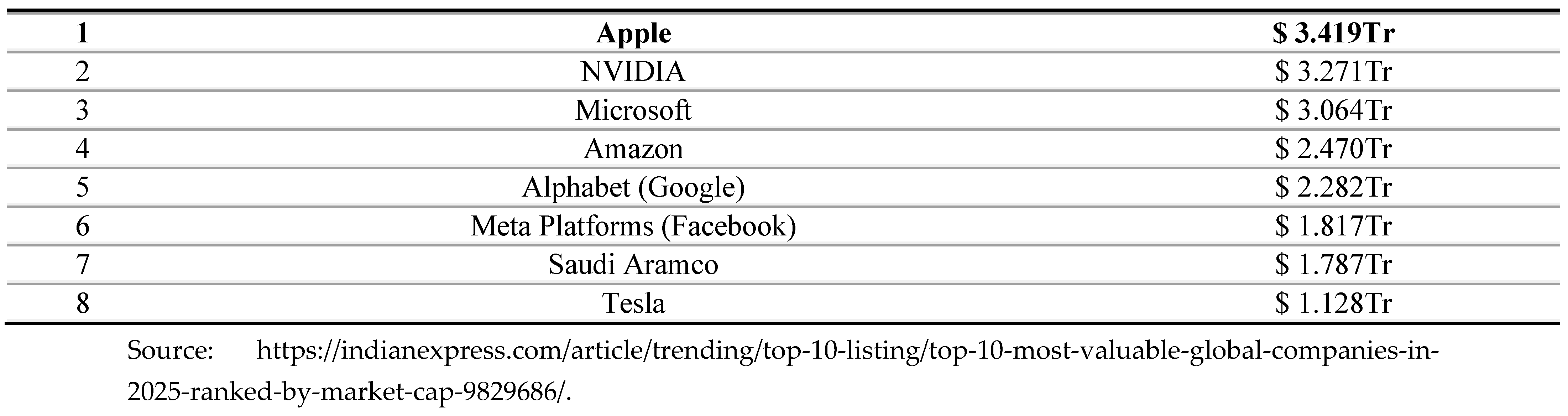
The first 6 company with highest Market Cap are platform company (see Figure 1). The capitalisation of Apple, alone, is in 2024 just a little lower than the GNP of Italy ($2.376 Tr.) and the Gnp of The Netherlang ($1,218 Tr.) together.
The capitalisation of the first 6 platform companies is similar to the Chinese Gnp ($18.273 Tr) in 2024.
Here are the average figures for share buybacks over the past five years through the use of accrued profits2.
Microsoft: 5.73 billion
Apple: 20.13 billion
Nvidia: 2.101 billion
Alphabet: 11.66 billion
Amazon: 3.334 billion in June 2022 alone
Dividends and buybacks are two sides of the same coin. Since share repurchases are made using the company's retained earnings, the net economic effect for shareholders would be the same even if the retained earnings were distributed as dividends (apart from tax considerations). We note that this practice is based on the neoclassically derived idea (agency theory, see e.g. Jensen and Meckling, 19763) that if a firm wants to maximise its total value, it must necessarily maximise the value of the shares held by the shareholders.
We are faced with the becoming rent of the profit, which opens towards a new articulation of income distribution between rent, profit and wages (Vercellone, 20134).
3. The Metamorphosis of the Capital-Labour Relationship: Life-Value as a Source of Surplus Value
After this introduction on the concept of platform capitalism as a declination of biocognitive capitalism, we can begin to address the issue of the meaning of labour in such a context, in order to analyse the social sustainability and then the environmental sustainability
Let us emphasise two points.
3.1. A New Concept of Productive Activity and the Subjectivation of Labour
In platform capitalism, the biocognitive and relational faculties of the human being are the basis of the valorisation process. Life itself is subject to a principle of increasing commodification.
Since life is individual, it is the individual himself that is ‘capitalistically’ valorised.
Since the individual lives in cooperation and social relations with other individuals, social cooperation and social reproduction, in its various forms, is the main factor of production: a complex, dynamic, heterogeneous input that is not subject to scarcity.
It follows that each time of human life enters the valorisation process through different mechanisms:
1. we call labour (labor) that time which is considered by common sense to be ‘productive’;
2. we call work (opus) that time aimed at realising one's desires, pleasures, aspirations;
3. we call idleness (otium) that time spent in activities of relationships, social reproduction, play, communication, friendship, contemplation, ...
4. we call rest (quĭes) that time necessary for ‘survival activities’ such as eating, relaxing, sleeping, ...
In the Fordist era, only labour time (labour) was considered ‘productive’ from a capitalist point of view and, therefore, remunerated.
With the advent of cognitive capitalism (1990s), based on learning and dynamic network processes, certain activities related to work and leisure began to become productive within a certain organisation of work, less top-down and more horizontal. Remuneration began to take various forms (e.g. withholding tax). The simple dichotomy between employed (subordinate) and self-employed (autonomous) work is no longer so sharp and clear: spurious and hybrid species of work (hetero-directed, collaborative and atypical work) are born. Similarly, working time and non-working time begin to intermingle. Life is put at the service of work and thus at value.
Today, the whole of daily life is embedded from its very being in a production mechanism, regardless of the activity on the producer or consumer side. In biocognitive capitalism, organised through platforms, life is directly placed at value.
3.2. A New Labour Market
In platform capitalism, the labour market (like any market) is also be influenced by platforms, which can redefine the boundaries of the market itself.
As a result, the relationship between labour and capital can be intermediated. This situation can be analysed from two different points of view: 1. capital and labour remain apparently separate due to the addition of a third agent, but, 2. likewise, they tend to hybridise and are no longer clearly separate elements.
The first case gives rise to spurious forms of employment that begin to be regulated by law with the spread of very different types of employment contracts. The phenomenon of precarious work is born and develops, which fosters new forms of subjugation and exploitation.
Regarding the second case, we are in the presence of the emergence of a new technological paradigm, subsequent to that of ICTs, based on genetic technologies that move in the horizon of the becoming machine of the human and, at the same time, on regenerative algorithmic technologies that move in the horizon of the becoming human of the machine (see para. 2.2).
In this context, the relationship between labour and capital is increasingly characterised by the use of vital faculties both as an essential element of labour and as the ability to modify an increasingly intangible capital factor of production.
We are in the presence of a new productive and organisational situation in which the traditional instruments of capitalism are undergoing profound transformations both in the sphere of market exchange and in the definition of the capital-labour relationship.
3.3. Is a New Technological Paradigm and Valorisation Process Emerging?
According to Kondratieff's long-wave theory5, the time is right. There are several signs in this direction.
Since 2003, the reading of the human genome has opened up huge spaces in the possibility of manipulating individual life and its procreation and opens up the possibility of artificially creating human tissue and combining it with elements of equally artificial machines. We are thus facing the emergence of a new biopolitical technology, or ‘biotechnology’.
The development of Generation II (regenerative) algorithms is enabling a process of automation unprecedented in human history. Applied, through information technology and nanotechnology, to machine tools, they are capable of transforming them into increasingly flexible and ductile tools, to the point of assimilating human potential in sensory capacity.
In addition to these radical product and process innovations, there is the aspect of organisational change.
Digital platforms mark a new organisational model just as the scientific organisation of labour marked the birth of Fordism.
The platformisation of contemporary capitalism represents the new hierarchical form of biocognitive capitalism, which was necessary to create a new economic order based on large corporations after a period, at the end of the last century, when the battle for a free use of ICT technology was still going on. The spread of platforms meant that this battle was lost and the capitalist order was consolidated: the expropriation of common wealth and the privatisation of life.
Platform capitalism is relatively plentiful, at least in terms of immaterial production that feeds on knowledge (not a scarce commodity) and virtual space (which tends to be infinite). However, there are stringent constraints as far as environmental sustainability is concerned6.
In both cases, a theory of value based on scarcity makes little sense. Knowledge and space, hence learning and networking, are made scarce in an artificial way, while goods that are actually scarce require public and/or common governance beyond private ownership.
The only theory of value that still makes sense is the one relating to human activity, which, however, is no longer unambiguously expressed in the concept of ‘productive labour’, as is now certified. It is necessary to move from the labour theory of value to a theory of life-value (Fumagalli-Morini, 20097).
A theory of life-value poses numerous problems, starting with that of measurement. As far as platforms are concerned, it is possible to refer to a specific value: network value, i.e. the transformation into exchange value of the set of information, knowledge, data, etc. that each of us provides to platforms as use value8.
The new algorithmic technologies of big data make it possible to develop ‘business intelligence’, which is a technique for exploiting the data collected by platforms:
The value network is made possible not only by the expropriation of data from ‘prosumers’, but also by the activity of click workers who ‘train’ the regenerative algorithms9.
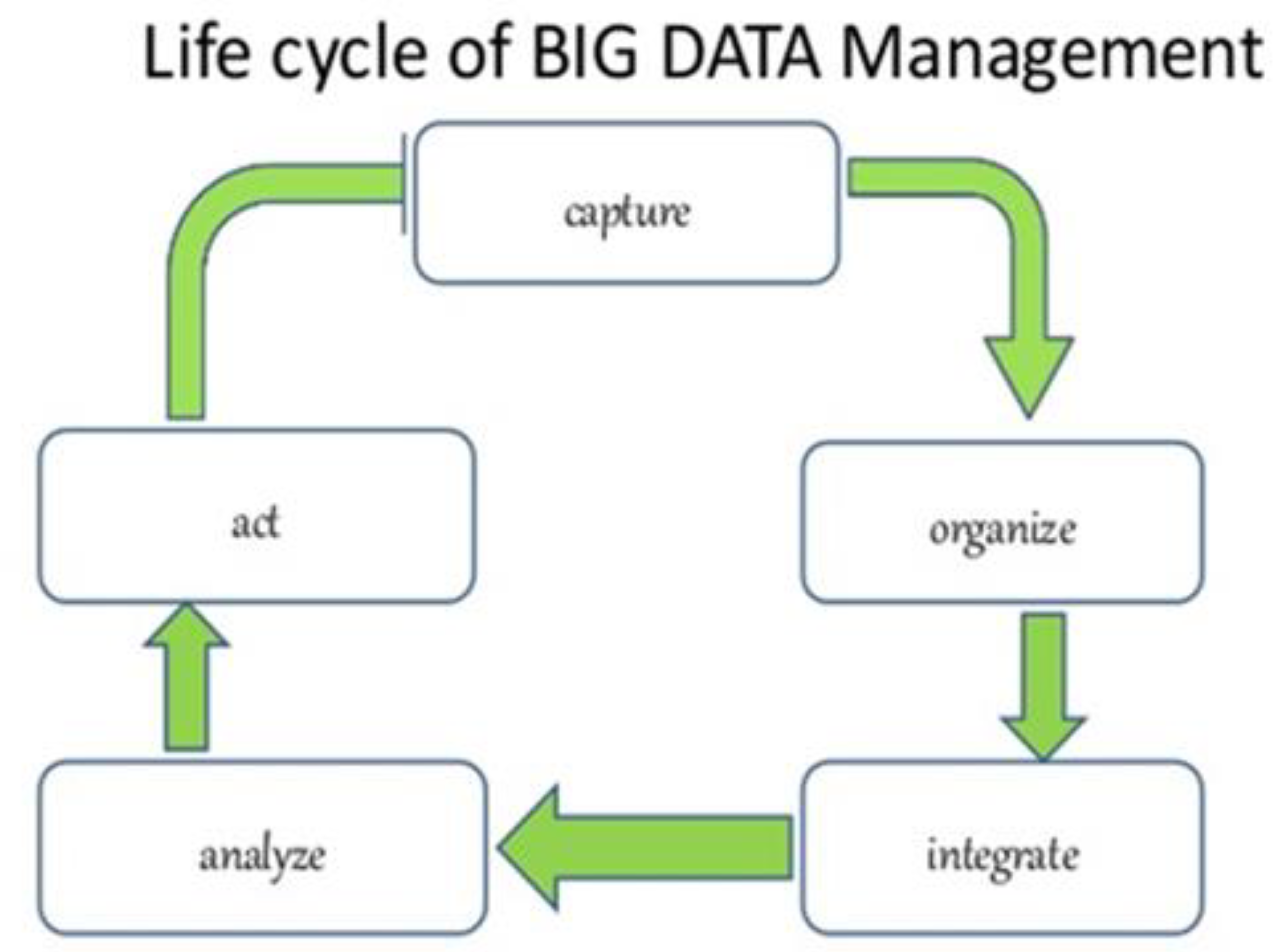
This life cycle describes, in a nutshell, the process of exploiting big data.
It is worth dwelling on the two operations of ‘organising’ and ‘integrating’. These are two operations that have only been able to reach a certain degree of sophistication in recent years, thanks to the technological evolution of 2nd generation algorithms. The organisation and integration of data is the basis for the production of network value. It is the production aspect of exchange value, while ‘analysis’ and ‘action’ represent its commercialisation, i.e. its monetary realisation on the output markets.
Thus, a new composition of capital is defined that is capable of managing in an increasingly automated way a process of data division according to the commercial use that can be derived from it. It is based on the more or less conscious participation of individual users, now transformed into prosumers. It is in fact the users of the various platforms, whether they are aimed at providing information to satisfy their desires or virtual spaces for communication, play and the development of relationships, who provide the raw material that is then subsumed into the productive capitalist organisation.
We can say that if today human relations, social cooperation, the production of collective intelligence, and social reproduction are expressions of the common as a mode of production10, they are currently at the basis of the communism of capital, that is, of capital's ability to subsume and capture the life instances of human beings11.
Platform capitalism creates value on the basis of a production process whose raw material is the lives of individuals. This ‘raw material’ is largely provided free of charge, as it is aimed at the production of use-value.
The ‘secret’12 of accumulation lies in the transformation of use-value into exchange-value. Or, put another way, the transformation of concrete labour, which underlies the everyday activities of life that generate data via social relations and information needs, into abstract labour.
According to Marx, concrete labour, qualitatively defined, is aimed at producing use-value; abstract labour, on the other hand, is pure extrinsicisation of human labour-power, which is independent of the qualitative aspects and specific determinations referring to the utility of individual jobs and whose quantity determines the value created. In the capitalist system of production, abstract labour is the socially necessary labour to produce a commodity that is realised on the final market, i.e. exchange value, on the basis of available technology.
In platform capitalism, abstract labour is the organisation and integration of data. This activity presupposes a wage relationship with the employees hired for this purpose. Raw material, on the other hand, is concrete work and not material in the strict sense: it is the raw data of everyday life, from which value is extracted. This is why we speak of ‘network-value’, a value that is added to the value-work necessary for this value-data, which initially appears as use-value, to be transformed into exchange-value.
In the valorisation of big data, the subsumption process thus breaks down into two parts and changes skin.
In the first phase, a process of original accumulation takes place as an extension of the production base to the point of encompassing life time, which is, however, not salaried or remunerated: in most cases, it is passive, non-subjectivised participation. In this respect, we cannot therefore speak of true formal subsumption.
In the second phase, the use of organised labour (salaried and precarious, often working at home) - the so-called clickworkers - takes over, who carry out processing activities, etc., according to the more traditional canons of real subsumption.
We are therefore in the presence of formal subsumption and real subsumption at the same time, which can feed off each other. We can call the process of subsumption that characterises platform capitalism, as an organised form of bio-cognitive capitalism, life subsumption13.
4. The Meaning of Labour Activity
The cognitive capitalism of the 1990s - the net economy - put a value on life through the labour process. Labour performance is organised in such a way as to exploit most of learning and network economies. The labour relationship tends to individualise and always utilise the cognitive and sensitive, as well as relational, faculties of the human being. It is not surprising that at this stage we are also witnessing the process of feminisation of labour14. Diversity broadens the heterogeneity of labour performance and is functional to the process of capital appreciation.
Labour becomes less routinized and more involving, and at the same time it differentiates itself, giving rise to the flexibility and fragmentation that will soon become the hegemonic condition: that is the precariousness of labour. It is an increasingly existential, structural and generalised precariousness, but, however, a precariousness that is declined within a labour place (which is no longer the factory or the office but spreads to more spaces), with an increasingly labile and undefined timetable, and in any case within a recognised organisational process and therefore remunerated, even increasingly in differentiated ways.
With the shift to bio-cognitive capitalism and its declination in platform capitalism, life is directly put to value without necessarily passing through the intermediation of a labour activity, acknowledged and recognised in a, more or less, regulated activity. The otium and the opus start to enter directly into the process of valorisation, but only labour is recognised as a productive activity.
Productive activity thus tends to evaporate, to become invisible, and only a part is formalised and thus remunerated.
Job insecurity thus leaves more and more room for the gratuitousness of productive activity.
Labour thus loses its meaning. Life, in its complexity, becomes the centre of the production of added value, independent of labour.
And more and more widespread, the more the capital-labour relationship becomes less and less separable. But it is not labour that becomes capital. The concept of human capital, so dear to mainstream economics and flaunted as capitalism's ability to recognise the individual in his or her essence, starting with the manipulation of culture and knowledge, becomes the ideological barrier that sediments and structuralises the precarity trap.
The precarity trap, which thanks to the devices of social control and individualistic self-referentiality, is induced by the platforms that most explicitly manage, convey, select and exploit social relations, and tends to turn into a trap of promise and gratuitousness15.
There are no more unoccupied, if we mean by unoccupied those who directly or indirectly cannot (truly unemployed) or do not want (inactive) to participate in the creation of (added) value and are therefore unproductive from the point of view of the accumulation process. Far from the end of labour, we are in presence of a labour with no end. Today's dramatic dichotomy is between those who are productive of value but this productivity is neither certified nor recognised in the traditional sphere of labour and thus are not remunerated, and those who instead perform an activity that is recognised as productive and thus, in some way, remunerated. Capital subsumes life activity to the point of invisibilising labour.
5. About Sustainability
5.1. Social Sustainability
Let us first address the issue of social sustainability. Platform capitalism negatively affects income distribution and favours a growth of stock market capitalisation at the expense of labour income. The share of productive life that is not certified as such tends to increase and to favour oligopoly and monopoly situations, also favoured by the ownership of intellectual property rights. Informal and precarious work increases. The worsening of income distribution has negative effects on national aggregate demand, especially where there is no offsetting effect from exports.
While in the short term a financial and technological multiplier may operate to keep the economic system's growth rate high, the risk is that in the medium term instability factors may develop on the financial markets, as a result of the creation of speculative bubbles, and on the real markets due to insufficient effective demand.
This situation is also complicated by the geopolitical instability that characterises this phase of transition from a unilateral global order, based on the US economy, to a multipolar order, the balance of which has yet to be defined.
Hence, there is a need for distribution policy interventions and correction of the distortions created by the economic hierarchy imposed by digital platforms.
On the income distribution side, it becomes necessary to resolve the paradox of a productive activity that encompasses the entire life of human beings in the face of an increasing invisibilisation of paid employment.
Acknowledging that we are all productive implies accepting the necessity of an unconditional basic income, as primary income, i.e. as an instrument of remuneration, which recognises the productivity of our life subsumed by capital. And the more certified labour evaporates, the more an unconditional basic income becomes necessary.
Instead, current welfare policies, when they recognise the need for a basic income, often do so as an instrument to foster labour insertion. Unconditional basic income, as primary income, should have nothing to do with active labour policies.
From supply side, we need to recognise that there are three different types of platform models: traditional profitable platforms, open commons, and platform cooperatives16. The first type is the most diffused and traditional aimed at generating profit, usually through extractive means, and without looking to avoid the negative externalities caused by their activities (Fuster Morell et al., 2020b). It’s no surprise why these platforms receive a lot of media and research attention, even though alternatives to unicorn platforms do exist, like alternatives linked to the tradition of digital commons (open commons) and cooperativism (platform coop-eratives) that are aligning the platform economy towards the SDGs (Fuster Morell et al., 2020b).
One possible alternative to platform capitalism is “platform cooperativism”, which adopts the principles of cooperativism and the values of the Social and Solidarity Economy (SSE) (Scholz, 2016). The SSE is a potential alternative to the capitalistic organization of traditional digital platforms that aims to take the best practices in our present system (e.g. knowledge, use of technology, and efficiency) and remodel them to serve the community’s welfare based on different goals and values (RIPESS, 2015). Platform cooperativism can be organized by foundations, associations, and cooperatives but also commercial companies with a social mission (Scholz, 2016). A third model is reptresented by open commons platforms, that go beyond platform cooperatives in the sense that they contribute to new developments opening data and knowledge through the use of open licences and Free Libre Open Source Software (FLOSS) (Bauwens & Kostakis, 2015; Benkler, 2006; Fuster Morell, 2010).
Co-operative and open commons platforms have far greater degrees of sustainability than traditional ones. As they are not always profit-oriented, they may present problems of economic sustainability and risks of failure if they fail to reach a certain level of business scale. Cooperative platforms in particular may run into the so-called marginality trap. As long as activities are marginal, survival may be ensured on a small scale, within specific market niches. If such activities become widespread and successful, it is easy for them to come under the pressure of market commodification. Economic sustainability is achieved at the expense of social sustainability.
A last point need to be analysed. We must also consider the phenomenon of ‘digital inequality’, which is becoming an important social factor. The digital divide brings with it a segment of the population that has no or limited access to information and to digital devices.. This means, for those in this category, limited social opportunities. The unavailability of modern digital technologies to the public are examples of digital inequality. Digital equality is a very important issue in today's society, but governments have not yet decided whether to institutionalise the right of access to the Internet. The risk, however, is to create a form of inequality that prevents many individuals from accessing information. The right to digital connectivity should become part of the basic rights of human beings.
5.2. Environmental Sustainability
Digital platforms can offer numerous advantages in terms of environmental sustainability. Digitisation reduces the consumption of physical resources by dematerialising processes and sharing information and documents electronically. Furthermore, they can promote the transition to a circular economy by facilitating the sharing, reuse and recycling of goods and services. For example, in offices, the use of printed paper has reduced and the use of ebooks and mobile devices such as e-readers has reduced the impact of book production and associated environmental pollution. Smart-working, especially during the covid-19 pandemic, has reduced the use of transport, contributing to a decrease in greenhouse gas emissions.
An example concerning the implementation of digital technology for sustainability purposes is Walmart17, a US multinational retailer with 11,847 shops in 27 countries. Walmart represents multiple implementations of digital transformations that work to eliminate waste and energy consumption. The numerous integrated IoT sensors and shelf-scanning robots prove to be sustainable in terms of energy savings. The ability to place orders directly from home reduces the use of transport and thus CO2 emissions.
But at the same time Walmart has a very bad reputation about social sustainaibility. FCWA (Food Chain Workers Association) states that Walmart engages in systematic abuse of migrant workers in the USA and across the globe18. This is a good example that shows that environmental sustainability does not always go hand in hand with social sustainability.
Digital platforms also provide quick access to sustainability information. Consumers can access data on product provenance, production practices, environmental impact and other relevant information. This enables consumers to make more informed choices, rewarding companies that adopt more sustainable practices and influencing the market towards a green economy. These platforms also foster collaboration and the sharing of resources and thus can foster the growth of cooperative or open commons platforms. Through car-sharing or bike-sharing services, for example, or the sharing of housing, they also enable the optimisation of the use of existing resources. This certainly leads to greater efficiency and thus to numerous opportunities to promote sustainability.
But all that glitters is not always gold. Although digital technologies are often seen as crucial to achieving sustainable development goals, a growing number of studies warn us of the significant climate and environmental impact of our digital activities. The enormous popularity of digital products and the benefits associated with them have also overshadowed the polluting impact of their production, use and disposal. Data show that the telecommunications sector has a large environmental footprint.
According to data from Boston Consulting Group (Bcg)19, the sector at the end of 2024 has a significant impact in terms of CO2 emissions, accounting for around 3% of global emissions. A considerable value if we consider that it generates almost twice as much CO2 as the aviation sector (which is responsible for less than 2% of global CO2), which is very often at the centre of discussions on environmental sustainability. Furthermore, given the growth in data consumption, it is estimated that the sector could become responsible for 14% of CO2 emissions by 2040.
At the same time, the spread of streaming has had a strong impact on the environment. The use of smartphones, tablet streaming services (e.g. Netflix or YouTube) has led to an increase in energy consumption. In all, the Covid-19 pandemic has certainly contributed to the increase in data consumption, internet traffic and video streaming.
In recent years, we have witnessed, thanks to digital platforms and business intelligence, the development of the big data and cloud computing industry. Enormous amounts of data have to be stored in increasingly large and energy-intensive servers. To the consumption of energy as a result of the daily flow of data produced by our activities, we must therefore add the consumption of energy for their manipulation and storage.
According to a UN report20, less than a quarter of the 62 million tonnes of e-waste generated was recycled in 2022. And the forecast for 2023 is no better. Electronic waste contains valuable materials and hazardous substances. Most of the scrapped devices end up in residual waste that is subsequently incinerated and taken to countries such as Africa and Asia. This leads to severe water and air pollution with negative effects on the health of workers of local populations.
Given the positive and negative effects of using digital technologies in terms of sustainability, we can reinforce the idea that digital transformation has immense potential to achieve environmental sustainability goals. However, it also brings with it a number of challenges that technology companies are called upon to address. With the right digital tools, it is possible to create a circular economy that will limit emissions and encourage the promotion of green and renewable technologies. In this perhaps global economies are called upon to review policies taking into account digital technologies and innovations in various sectors.
Funding
This research received no external funding
Institutional Review Board Statement
“Not applicable
Informed Consent Statement
Not applicable
Data Availability Statement
We encourage all authors of articles published in MDPI journals to share their research data. In this section, please provide details regarding where data supporting reported results can be found, including links to publicly archived datasets analyzed or generated during the study. Where no new data were created, or where data is unavailable due to privacy or ethical restrictions, a statement is still required. Suggested Data Availability Statements are available in section “MDPI Research Data Policies” at https://www.mdpi.com/ethics.
Acknowledgments
I’d like to thank the support of the psychedelic music by The Grateful Dead, The Fish and Jimi Hendrix
Conflicts of Interest
The authors declare no conflicts of interest.
| 1 | Cfr. J. Eeckhout, The Profit Paradox: How Thriving Firms Threaten the Future of Work, Princeton University Press, Usa, 2021 |
| 2 | |
| 3 | Cfr. M. C. Jensen, W. H. Meckling, “Theory of the Firm: Managerial Behavior, Agency Costs and Ownership Structure”, Journal of Financial Economics, October, 1976, V. 3, No. 4, pp. 305-360 |
| 4 | Cfr. C. Vercellone, “The Becoming Rent of Profit? The New Articulation of Wage, Rent and Profit”, in Knowledge Cultures, vol. 1, n. 2, pp. 25–32, January 2013. |
| 5 | |
| 6 | The subject of the environment is not taken into consideration in this paper not because it is marginal. Quite the contrary! It is precisely because of its importance that it requires a separate discussion, which cannot be done here but which is indispensable. |
| 7 | A.Fumagalli, C. Morini, “Life put to work: towards a theory of life-value”. Ephemera, vol. 10, p. 234-252, 2011. |
| 8 | Cfr. A. Fumagalli, “Per una teoria del valore-rete”, in D. Gambetta (a cura di), Datacrazia. Politica, cultura algoritmica e conflitti al tempo dei big data, D Editore, Ladispoli (RM), 2018, pp. 46-69. |
| 9 | Cfr. A. Casilli, Gli schiavi del click, Feltrinelli, Milano, 2023 |
| 10 | [1] C. Vercellone, A. Giuliani, F. Brancaccio, P, Vattimo, Il comune come modo di produzione, Ombre Corte, Verona, 2017; T. Negri, “Il comune come mezzo di produzione”, 10 giugno 2016, http://www.euronomade.info/?p=7331; A. Fumagalli, Economia politica del comune, Derive Approdi, Roma, 2017 |
| 11 | In this regard, the concept of Bio-hypermedia, coined by G. Griziotti, is very interesting: ‘Bio-hypermedia can be broadly defined as the sphere in which the body in its entirety connects to network devices in such an intimate way that it enters into a symbiosis in which reciprocal modifications and simulations take place.’ Cfr. G. Griziotti, Neurocapitalismo, Mimesis, Milano, 206, p. 120 |
| 12 | The reference is to K. Marx, Das Kapital - Bd. I, VII. Der Akkumulationsprozeß des Kapitals, 24. Die sogenannte ursprüngliche Akkumulation: http://www.textlog.de/kapital-geheimnis.html. “Geheimnis” means “segret” on English |
| 13 | Cfr. A. Fumagalli, Economia Politica del Comune, DeriveApprodi, Roma, 2017. A. Fumagalli, “Valorizzazione e sussunzione nel capitalismo delle piattaforme: il nodo della distribuzione del reddito”, in T. Casano, A. Minaldi (a cura di), Sfruttamento e dominio nel capitalismo del XXI secolo, Multimage, Firenze, 2023, pp. 153-166 |
| 14 | Cfr. C. Morini, Per amore e per forza. Femminilizzazione del lavoro e biopolitiche del corpo, Ombre Corte, Verona, 2010. |
| 15 | Cfr. Aa. Vv., L’economia politica della promessa, Manifesto Libri, Roma, 2015 con scritti di A. Colombo, C. Morini, G. Allegri, G. Bronzini, M. Bascetta, R. Ciccarelli, V. Graziano |
| 16 | See M. Renau Cano, R. Espelt, and M. Fuster, “Morel How to Build Alternatives to Platform Capitalism?” in S. Mezzadra, N. Cuppini, M. Frapporti, M. Pirone (eds.), Capitalism in the Platform Age. Emerging Assemblages of Labour and Welfare in Urban Space, Springer Verlasg, Berlin, pp. 249-272. |
| 17 | |
| 18 | |
| 19 | |
| 20 |
References
- https://www.accenture.com/it-it/insights/software-platforms/why-shopping-set-social-revolution.
- Cfr. Nick Srnicek, Platform Capitalism, Polity Press, London, 2016.
- Cfr. Alvin Toffler, The Third Wawe, Morrow Publisher, New York, 1980.
- Cfr. J. Eeckhout, The Profit Paradox: How Thriving Firms Threaten the Future of Work, Princeton University Press, Usa, 2021.
- A buyback is the financial transaction whereby a listed company buys back its own shares in order to fictitiously increase their value.
- Cfr. W. Lazonick, Profits Without Prosperity: How Stock Buybacks Manipulate the market, and Leave Most Americans Worse Off, Working Paper Inet (Institute of New Economic Thinking”, April 2014.
- Cfr. https://ycharts.com/companies/MSFT/stock_buyback.
- Cfr. M. C. Jensen, W. H. Meckling, Theory of the Firm: Managerial Behavior, Agency Costs and Ownership Structure. Journal of Financial Economics, 1976, 3, 305–360. [CrossRef]
- Cfr. C. Vercellone, The Becoming Rent of Profit? The New Articulation of Wage, Rent and Profit. Knowledge Cultures, 2013, 1, 25–32.
- https://www.sociostudies.org/almanac/k_waves/.
- The subject of the environment is not taken into consideration in this paper not because it is marginal. Quite the contrary! It is precisely because of its importance that it requires a separate discussion, which cannot be done here but which is indispensable.
- A.Fumagalli, C. Morini, “Life put to work: towards a theory of life-value”. Ephemera, vol. 10, p. 234-252, 2011.
- Cfr. A. Fumagalli, “Per una teoria del valore-rete”, in D. Gambetta (a cura di), Datacrazia. Politica, cultura algoritmica e conflitti al tempo dei big data, D Editore, Ladispoli (RM), 2018, pp. 46-69.
- Cfr. A. Casilli, Gli schiavi del click, Feltrinelli, Milano, 2023.
- C. Vercellone, A. Giuliani, F. Brancaccio, P, Vattimo, Il comune come modo di produzione, Ombre Corte, Verona, 2017; T. Negri, “Il comune come mezzo di produzione”, 10 giugno 2016, http://www.euronomade.info/?p=7331; A. Fumagalli, Economia politica del comune, Derive Approdi, Roma, 2017.
- In this regard, the concept of Bio-hypermedia, coined by G. Griziotti, is very interesting: ‘Bio-hypermedia can be broadly defined as the sphere in which the body in its entirety connects to network devices in such an intimate way that it enters into a symbiosis in which reciprocal modifications and simulations take place.’ Cfr. G. Griziotti, Neurocapitalismo, Mimesis, Milano, 206, p. 120.
- The reference is to K. Marx, Das Kapital - Bd. I, VII. Der Akkumulationsprozeß des Kapitals, 24. Die sogenannte ursprüngliche Akkumulation: http://www.textlog.de/kapital-geheimnis.html. “Geheimnis” means “segret” on English.
- Cfr. A. Fumagalli, Economia Politica del Comune, DeriveApprodi, Roma, 2017. A. Fumagalli, “Valorizzazione e sussunzione nel capitalismo delle piattaforme: il nodo della distribuzione del reddito”, in T. Casano, A. Minaldi (a cura di), Sfruttamento e dominio nel capitalismo del XXI secolo, Multimage, Firenze, 2023, pp. 153-166.
- Cfr. C. Morini, Per amore e per forza. Femminilizzazione del lavoro e biopolitiche del corpo, Ombre Corte, Verona, 2010.
- Cfr. Aa. Vv., L’economia politica della promessa, Manifesto Libri, Roma, 2015 con scritti di A. Colombo, C. Morini, G. Allegri, G. Bronzini, M. Bascetta, R. Ciccarelli, V.
- See, M. Renau Cano, R. Espelt, and M. Fuster, “Morel How to Build Alternatives to Platform Capitalism?” in S. Mezzadra, N. Cuppini, M. Frapporti, M. Pirone (eds.), Capitalism in the Platform Age. Emerging Assemblages of Labour and Welfare in Urban Space, Springer Verlasg, Berlin, pp. 249-272.
- https://karmawallet.io/blog/2023/07/walmarts-sustainability/.
- https://foodchainworkers.org/?s=Walmart.
- https://www.bcg.com/publications/2024/why-telcos-slow-sustainability-progress-is-risky.
- https://ewastemonitor.info/the-global-e-waste-monitor-2024/.
Figure 1.
First 8 company with highest Market Cap (feb. 2025).
Disclaimer/Publisher’s Note: The statements, opinions and data contained in all publications are solely those of the individual author(s) and contributor(s) and not of MDPI and/or the editor(s). MDPI and/or the editor(s) disclaim responsibility for any injury to people or property resulting from any ideas, methods, instructions or products referred to in the content. |
© 2025 by the authors. Licensee MDPI, Basel, Switzerland. This article is an open access article distributed under the terms and conditions of the Creative Commons Attribution (CC BY) license (http://creativecommons.org/licenses/by/4.0/).
Copyright: This open access article is published under a Creative Commons CC BY 4.0 license, which permit the free download, distribution, and reuse, provided that the author and preprint are cited in any reuse.


