

Submitted:
27 March 2025
Posted:
28 March 2025
You are already at the latest version
Abstract
(1) Background: Smart agriculture is developing a trend in the world. Modern technologies are the key factors for success (2) Methods: This article summarized the valuable knowledges that based on the research of top ranking, prestigious scientific journals about smart agricultural and modern technologies in the world (3) Results: This study has pointed out the key points in applying modern technologies including artificial intelligence (AI), internet of things (IoT), drone, smart irrigation, biotechnology technology, nano technology, genetic technology,sensor technology, greenhouse technology to smart agricultural production. It clarified the role and how to combine the leading modern technologies that create the overall development of smart agriculture (4) Conclusions: This research is an important document that contributes to the effective for the development of sustainable smart agriculture.
Keywords:
smart agriculture
; Artificial Intelligence (AI)
; Internet of Things (IoT)
; drone
; smart irrigation
; biotechnology technology
; nano technology
; genetic technology
; sensor technology
; greenhouse technology
1. Introduction
Smart agriculture can be understood as the use of information technology to carry out regular and quantitative management of agricultural production, and reasonable allocation of resources according to the growth laws of agricultural products to achieve highly efficient, low cost, high quality and environmentally friendly agriculture [1]. Smart agriculture is becoming increasingly important due to a combination of factors [2] such as: the impact of climate change on agriculture [3], the growing global population leading to increasing food demand [4], the issue of using natural resources effectively and thoroughly applying technology to agricultural production is an urgent requirement [5]. Smart agriculture is a solution that brings many benefits in increasing product value, limiting production costs and bringing high economic efficiency [6]. Smart agriculture helps enhance production control, leads to better cost management and reduced waste [7]. Smart agriculture is an ability to monitor abnormalities in crop growth or animal health eliminates the risk of lost productivity [8]. Smart agriculture can increase efficiency automatically by smart devices, multiple processes can be activated at the same time, and automated services improve product quality and volume by better controlling production processes [9].
Modern technology agriculture is an inevitable trend in world development [10]. Applying modern technology agriculture is an inevitable direction to create a breakthrough in productivity and quality of agricultural products [11]. Technological transformation and IoT solutions are required to develop agriculture on new heights [12]. The high technology must be applied in the short and long term to create a new turning point for agriculture [13]. Modern technologies combined with traditional values, will bring many sustainable values in agriculture [14]. Technologies will create a breakthrough in product quality and productivity in agricultural [15]. It not only meets the growing needs of society but also creates sustainable development in the future [16]. High-tech agriculture includes many fields such as drone technology [17], automation technology [18] information technology [19], biotechnology [20] high-quality plant and animal breeding technology [21], organic fertilizer also brings high economic efficiency [22]. The application of high technology is a mandatory requirement according to the development trend because of context narrowing agricultural land area [23], increasing construction projects, transportation, commercial areas, apartment buildings [24]. Especially, the demand for food is increasing, typically clean agricultural products [25], land conditions are increasingly degraded due to the use and abuse of pesticides and the impact of climate change [26]. This leads to serious damage to agriculture and a lot of production costs [27]. The applying high technology brings outstanding efficiency [28]. Modern technology of agriculture can optimize the use of land, water and air resources [29]. Agricultural farming using high technology is based on data collected from diverse sensors in the field, help farmers accurately allocate resources needed for crop growth and development [30]. On another hand, modern technologies can help protect the land and water environment because it contribute to reducing waste and pesticides to the lowest level [31]. The applying of modern technology can help reduce production costs in agricultural production [32] High-tech agriculture not only helps farmers save water and energy [33,34] but it also makes agriculture greener [35]. It saves costs of labor hire and significantly reduce the use of pesticides and fertilizers [36], the working efficiency is increased many times when compare to the previous manual method [37]. The harvested products are cleaner, better quality and more productive than with traditional agricultural methods [38]. This study is an important document that helps to summarize extremely practical and urgent values in the application of high technology science in agricultural production. It opens up new directions of development, is the theoretical basis for developing of agricultural sector by sustainable, modern, and effective direction in line general development on the world.
2. Materials and Methods
This article was the result of synthesizing knowledge from leading reputable sources in the world. The information and data systems were explored including SCI (Science Citation Index), SCIE (Science Citation Index Expanded). ISI (Institute for Scientific Information) is a collection of high-quality scientific research, among hundreds of thousands of journals around the world. This research was conducted based on a database collected and selected from 293 scientific articles from extremely famous publishers, ensuring accuracy from 1996-2025 including Springer, Elsevier, Wiley -Blackwell, Taylor Francis, Oxford University Press, Cambridge University Press, Chicago University Press, Inder science Publishing, Edward Elgar Publishing.
3. Results
3.1. Artificial Intelligence (AI) in Smart Agriculture
Artificial Intelligence (AI) is intelligence demonstrated by machines [39]. Typically, the term "artificial intelligence" is often used to describe master machines (or computers) capable of imitating "cognitive" functions that humans typically associate with the mind, like "learning" and "problem solving [40]. AI technology of agriculture is the application of information technology to solve problems in agricultural production [41]. Because of AI technology development , many new applications of AI technology have been introduced into agriculture, helping to improve productivity and production efficiency, while reducing risks and production costs [42]. The benefits of AI for agriculture are huge. So, this technology has been increasingly widely applied in agricultural production and cultivation [43]. Smart agriculture needs to apply a lot of AI devices for production. [44]. The using of AI is a trend of the future because this technology is creating a revolution in many fields. [45]. Smart agriculture requires the presence of AI to be able to operate in the general development direction of the world [46].

Table 1.
The application of artificial intelligence in smart agricultural.
| Older | Application | Reference |
|---|---|---|
| 1 | Weather forecast | [47] |
| 2 | Price forecast | [51] |
| 3 | Robot | [63] |
| 4 | Monitor, manage, care for crops | [65] |
| 5 | Control spraying and watering | [67] |
| 6 | Check crop quality | [69] |
| 7 | Control and eliminate weeds | [73] |
| 8 | Pest detection | [79] |
| 9 | Control water system | [86] |
| 10 | Control fertilize system | [87] |
Weather forecast analysis equipment is one of the applications of AI in agriculture [47]. This device is used to collect and analyze weather data, thereby providing forecasts of future weather conditions, helping farmers choose the right time to plant and grow crops, plant care [48]. Current weather forecast analysis devices are often equipped with sensors and measurement technologies such as spectrometers, atmospheric spectrometers, air humidity and temperature meters, radars, and air temperature systems, satellite systems, and weather modeling technologies based on AI algorithms [49]. When an AI device detects that there will be heavy rain in the next few days, farmers can decide to postpone spraying pesticides or harvesting fruits to ensure crop safety and minimize the risk of crop losses [50]. In price forecasting, AI can help farmers better understand the prices of food and food products in the next few weeks, which can help them maximize their profits [51].
AI-based algorithms help to identify nutrient deficiencies in the soil so that farmers can replenish them in time and warn of pests that harm crops [52]. Designed to monitor and provide information, the plant health monitoring system provides information on soil moisture [53], nutrients [54], CO2 concentration [55], temperature [56], air humidity [57] and other indicators related to plant health [58]. The system works by using sensors to collect data, then using artificial intelligence algorithms to analyze this data [59]. The analysis results are provided to farmers or agricultural experts so that they can make smart decisions about how to grow and care for crops [60]. Soil and plant health monitoring systems can help farmers optimize production, increase productivity and reduce costs [61]. It also helps agricultural researchers better understand how plants and their living environments work, thereby providing solutions to improve productivity and quality of agricultural products [62].
Nowadays, AI companies are developing robots for use in the agricultural sector [63]. These AI robots are developed in such a way that they can perform many tasks in agriculture [64]. These robots can be used to monitor, manage, care for crops, harvest, and use fertilizers and pesticides more effectively [65]. In addition, they can also help improve productivity, reduce costs and reduce the impact of agricultural activities on the environment [66]. Agricultural robot features include sensors to monitor crop health, soil analysis and weather forecasting, control systems to control spraying and watering, and automation capabilities activities such as harvesting [67]. Agricultural robots are often remotely controlled or fully automated, depending on the user's needs [68]. AI robots are also trained to check crop quality, detect and control weeds, and harvest crops at a faster rate than humans [69]. Several robots responsible for automatically harvesting fruit trees have been produced by companies around the world, such as orange picking robots [70], strawberry picking robots [71], and tomato harvesting robots [72]. In addition, some types of robots that help control and eliminate weeds are also being researched and designed by companies [73]. AI sensors will help farmers detect weeds as well as areas affected by weeds easily [74]. When such areas are detected, herbicides can be sprayed precisely to reduce herbicide use and save time [75]. Many AI companies around the world are building robots that integrate AI and computer vision technology to accurately spray weed killers [76]. The use of AI-based smart spraying systems can significantly reduce the number of chemicals used in fields, thereby improving crop quality and helping to save on production costs [77].
AI-enabled systems for pest detection in agriculture are an important tool in protecting crops from harmful diseases and insects [78]. This system uses techniques and data models to analyze data from sensors. The system then analyzes the data to determine whether a pest is present, evaluates the severity of the pest, and provides remedial solutions [79]. The AI system can also detect changes in crop development, such as how quickly or slowly the crop grows [80]. From there, health problems can be detected, and farmers can intervene early to solve the problem. Timely corrections help protect plant health and increase agricultural productivity [81]. Precision farming is an application of AI in agriculture [83]. It uses technologies such as machine learning, computer vision and sensor technology to help identify, collect and analyze data to make farming decisions [84]. Accurate operation and output prediction [85]. Additionally, precision farming systems use sensor technology to collect data about soil, crops, and the surrounding environment to make precise farming decisions such as watering, fertilizing, and pruning plants [86]. AI technology is involved in all categories and tasks in the agricultural production process[87]. It plays a central role in maintaining and operating everything stably and effectively[88].
3.2. Internet of Things (IoT) in Smart Agricultural
Internet of things (IoT) refers to the network of smart devices and technologies that facilitate communication between devices and the cloud, as well as between devices [89]. Because of the advent of cheap computer chips and high-bandwidth telecommunications technology, around billions of devices have been connected to the internet [90]. This means that devices can use sensors to collect data and respond intelligently to users [91]. IoT application is a set of services and software that integrates data received from various IoT devices [92]. This application uses machine learning or artificial intelligence (AI) technology to analyze the data and make informed decisions [93]. These decisions are transmitted back to the IoT device, which then responds intelligently to the input data [94]. IoT has been playing a major role in the agriculture industry, bringing about major changes in the way farmers carry out their daily work [95]. The modern world is witnessing an unprecedented level of technology adoption in agriculture. There are many emerging technologies in this field that promise to bring significant changes in the future [96]. IoT was once an emerging technology in agriculture and now, it has taken a mainstream position due to its wider application. IoT in agriculture can be understood in the simplest way: Internet of Things [97]. IoT smart farming equipment is designed to automatically monitor crop fields using sensors and irrigation systems. Therefore, farmers can easily monitor field conditions from anywhere, anytime [98]. IoT in digital agriculture is smart devices and sensors that connect and automatically control throughout the production process [99] to help respond to climate change [100], improve quality [101], ensure food hygiene and safety [102], and increase product value [103].
Table 2.
The application of artificial intelligence in smart agricultural.
| Older | Application | Reference |
|---|---|---|
| 1 | Communication between devices | [89] |
| 2 | Data analytics | [91] |
| 3 | Automatically monitor crop fields | [98] |
| 4 | Control production process | [99,100,101] |
| 5 | Access science information | [107] |
| 6 | Irrigation | [110] |
| 6 | Fertilization | [111] |
| 7 | Control Roboto | [112] |
| 8 | Spray pesticides | [113] |
| 9 | Optimizing valuable resources | [123,124,125,126] |
Applying IoT to agriculture is currently a common trend in the world [104]. IoT will transform agriculture from a qualitative production field into a precise production field based on collected, synthesized and statistically analyzed data [105]. Applying IoT to agriculture not only brings farmers high productivity and output [106]. IoT also helps farmers access the most advanced science and technology of humanity, along with bringing users countless unimaginable benefits [107]. IoT in agriculture plays an extremely important role, IoT will allow farmers to monitor their products and conditions in real time [108]. Farmer can receive detailed information faster, based on which they can predict problems before they occur so that they can come up with optimal solutions or prevent them [109]. In addition, IoT solutions in agriculture also allow farmers to carry out automated production processes, such as: Irrigation [110], fertilization [111], automatic harvesting robots [112], Spray pesticides promptly and effectively [113], limiting labor [114], saving time [115], increasing effective economy [116]. Using IoT-based greenhouses and hydroponics located within the city can be a suitable solution [117], in addition to providing short-term food sources such as fresh fruits and vegetables for people in the city, IoT also allows agricultural systems to become more intelligently closed [118]. Improving speed and adapting to complex weather conditions is one of the great benefits that IoT brings in using IoT for agricultural applications [119]. In today's erratic and harsh weather conditions, thanks to real-time monitoring and prediction systems, farmers can quickly respond to any changes in weather, humidity, air quality as well as the health of each different crop or soil in the field [120]. The application of IoT also improves the speed of processes in agricultural production, thereby bringing higher productivity and output [121]. By using IoT based on data collected from different sensors, farmers can accurately allocate and use just enough resources needed for the production process [122]. Thereby optimizing valuable resources such as: Water [123], energy [124], land [125]. Cleaner processes using IoT in the use of pesticides and fertilizers in agriculture is a very common thing [126]. For smart agriculture, digital agriculture based on IoT for precision farming helps farmers save energy and water, not only making agriculture greener, but it also significantly reduces the use of pesticides and fertilizers through the IoT system [127]. Smart systems with IoT applications help farmers recreate the best conditions and increase the nutritional value of their products [128].
3.3. Drone in Smart Agricultural
A drone is an unmanned aerial vehicle (UAV), controlled remotely or automatically using remote control technology and sensor systems [129]. Drones are often equipped with sensors, cameras or cameras to collect information and images from space [130]. Basically, drones are both UAVs, can refer to UAVs that have a variety of applications, including photography, video recording, transportation cargo, environmental monitoring, terrain surveying, and many other applications [131]. Drones typically have an external frame made of hard plastic or lightweight alloy, with some versions using materials such as carbon fiber to increase rigidity and reduce weight. The drone frame may have one or more propellers to create lift and movement [132]. Drones use electric motors or internal combustion engines to generate power, and this motor is connected to propellers to create lift. Most consumer drones use electric motors to achieve high performance and good control [133]. Drones often use lithium-ion batteries or other power sources such as lipo batteries to provide power to motors and other electronic control systems. The flight time of a drone depends on the capacity and performance of the battery [134]. Drones are controlled remotely through a remote controller or can be operated automatically through an automatic control system. The remote controller allows the operator to adjust parameters such as speed, direction, altitude and perform other functions of the drone [135]. Drones are often equipped with sensors such as acceleration sensors, pressure sensors, gyroscopes, and distance sensors to measure and maintain position and altitude in space. These sensors help the drone maintain stability, keep balance, and perform functions such as GPS positioning and obstacle avoidance [136]. Drones use a flight control system to adjust the drone's tilt and rotation through changing the rotation speed of the propellers. This system allows the drone to move in different directions and perform complex flight maneuvers [137]. Some drones are equipped with cameras or cameras to take photos and record videos from space. Industrial drones can be equipped with special sensors and technology such as infrared, lidar or GPS watches to perform tasks such as environmental monitoring, terrain surveys, or recording detailed data [138]. Modern agriculture is witnessing an explosion of drone technology, opening a new era for the farming industry [139].The use of drones in agriculture is increasingly popular and is an inevitable trend in the 4.0 technology era [140]. These drones provide innovative solutions, helping farmers optimize production efficiency, improve productivity and reduce costs [141]. Thus, the values that drones is bring to the development of smart agriculture, actively contribute to the development of sustainable agriculture.
The using drones for spraying is the most common application [142]. In the field of modern agriculture, pesticide spraying with drones is becoming the most popular drone application in agriculture, bringing many superior benefits compared to traditional methods [143]. Drones can fly flexibly, reach all areas, and spray pesticides regularly and accurately, helping to save time, effort and costs for farmers [144]. With a modern mist spraying system, drones ensure that pesticides are distributed evenly, limiting waste and minimizing negative impacts on the environment [145]. Using drones also helps protect workers' health and avoid direct contact with toxic chemicals [146]. Overall, pesticide spraying with drones is an advanced solution, contributing to improving efficiency and productivity in agricultural production, towards a smart and sustainable agriculture [147]. Fertilizing with agricultural drones helps bring higher yields [148]. Fertilizing crops by using drones in agriculture is gradually becoming a new trend in modern agriculture [149]. With outstanding advantages compared to traditional fertilization methods, drones bring high efficiency and cost savings to farmers [150]. Drones can fly and spread fertilizer accurately and evenly over large areas, helping plants absorb nutrients better [151]. Using drones to fertilize also helps protect the environment by minimizing excess fertilizer and limiting water and soil pollution [152]. Fertilizing using drones also helps reduce health risks for workers compared to manual fertilizing methods [153].
Table 3.
The application of drones in smart agricultural.
| Older | Application | Reference |
|---|---|---|
| 1 | Pesticide spraying | [142,143,144,145,146,147] |
| 2 | Fertilizing | [148,149,150,151,152,153] |
| 3 | Seed sowing | [154,155,156] |
| 4 | Monitoring crops, livestock | [161] |
| 5 | Grasp the growth status of crops | [162] |
| 6 | Collection data | [165,166,167,168] |
Using drones in seed sowing agriculture is a modern farming method that brings many benefits to farmers [154]. Drones can fly according to pre-programmed plans, ensuring sowing seeds at the right density and location, helping crops grow evenly [155]. Artificial pollination plays an important role in improving crop productivity and quality. The application of drones in agriculture, pollination is done more effectively, saving time and costs for farmers [156]. Drones are equipped with an advanced pollen spray system that can hover precisely over each row of trees, ensuring that pollen is evenly distributed [157]. Using drones helps increase pollination rates up to 90% [158], improving productivity by 15-20% compared to manual pollination methods [159]. In addition, drones also help reduce the risk of disease spread by limiting direct contact between people and plants. The use of drones for artificial pollination is gradually becoming a new trend in smart agriculture, contributing to improving production efficiency and developing sustainable agriculture [160].
Drone technology is increasingly being widely applied in the agricultural sector, providing advanced solutions for tracking and monitoring crops, livestock [161]. Drones can fly over fields, collect image and video data from above, helping farmers grasp the growth status of crops, detect early signs of pests and weeds, as well as monitor Monitor the health and location of livestock [162]. Drones are multifunctional products that help farmers do many working [163]. This is a multifunctional technology that helps farmers limit costs and labor[164]. The ability to collect data accurately and quickly, drone applications in agriculture help farmers save time and effort compared to traditional inspection methods [165]. The data collected, farmers can make scientific decisions about irrigation, fertilization, pesticide spraying, and livestock management more effectively, contributing to improving productivity and quality, number of agricultural products [166].
Agricultural maps provide farmers with accurate information about crop status, helping them make more effective management decisions. For example, maps can help identify areas that need fertilization, pesticide spraying or watering, helping to save costs and minimize environmental impact [167]. Drone applications can also be used for 3D mapping, helping farmers simulate farming activities such as planting, harvesting and pest management in agriculture. 3D mapping also helps evaluate the effectiveness of farming practices and predict crop yields [168].
3.4. Irrigation Technology in Smart Agricultal
The agricultural sector is facing many challenges in irrigation such as scarce water resources, labor shortages, and low crop yields due to inefficient irrigation [169]. Smart irrigation systems are solutions that integrate modern electronic devices to optimize and simplify the irrigation process [170]. Instead of using traditional mechanical switches, we can now turn on and off by setting automatic timers or using smartphones to control [171]. Smart irrigation systems in agriculture have emerged as a potential solution to solve these problems [172]. Smart irrigation systems in agriculture provide smart irrigation solutions to provide water to plants automatically, effectively and save time [173]. Smart irrigation systems operate based on a pre-set schedule and water volume, ensuring that plants are always provided with the necessary amount of water for each stage of development [174]. By connecting the water pump system to the control center, we can operate the system using a smart phone thanks to a pre-linked App [175]. Smart irrigation systems provide the exact amount of water needed by each type of plant, ensuring healthy plant growth in all stages of growth. Water is distributed evenly to each plant, avoiding under- or over-watering, which affects crop yields [176]. Smart irrigation systems allow adjusting the time and amount of irrigation water to suit weather conditions, soil type and each stage of plant growth. Thus, users can easily monitor and effectively manage irrigation activities, optimize water resources and improve crop productivity [177], help limit over-watering, causing soil erosion [178].
Table 4.
The application of types of irrigation models in smart agricultural.
| Older | Methodologies | Content | Reference |
|---|---|---|---|
| 1 | Drip irrigation | This system delivers water to the root zone and roots of plants through drip chips. Water penetrates deep into the soil, effectively nourishing the roots | [179] |
| 2 | Sprinkler irrigation systems | Widely used because of their ability to simulate natural rain, providing irrigation water for large areas | [180] |
| 3 | Mist irrigation system | using small nozzles to create tiny water droplets like mist | [181] |
Drip irrigation is the most efficient and water-saving irrigation method. This system delivers water to the root zone and roots of plants through drip chips. Water penetrates deep into the soil, effectively nourishing the roots [179]. Sprinkler irrigation systems are widely used because of their ability to simulate natural rain, providing irrigation water for large areas. So, their smart design, sprays fine water particles, evenly covering the entire ground surface and tree canopy, ensuring the best growth for plants [180]. Mist irrigation system is a method of watering plants by using small nozzles to create tiny water droplets like mist. Water is pumped at high pressure through the crops [181].
3.5. Biotechnology in Smart Agriculture
Biotechnology is an effective solution in developing smart agriculture [182]. This technology is used to improve plant varieties [183], create growth regulators [184], develop fertilizers [185], biological pesticides [186], editing genes to create new varieties with higher quality [187], resistance [188]. In addition, this technology also prioritizes the use of biological active substances to create growth regulators that stimulate plant growth [189]. Some other applications of biotechnology include the use of organic fertilizers [190], biological pesticides [191], biofilms [192], disease diagnostic kits [193], and environmental cleaning products [194].
Table 5.
The application of biotechnology in smart agricultural.
| Older | Application | Reference |
|---|---|---|
| 1 | Improve plant varieties | [183] |
| 2 | Create growth regulators | [184] |
| 3 | Biology fertilizers (Compost) | [185] |
| 4 | Biological pesticides | [186] |
| 5 | Editing genes to create new varieties | [187] |
| 6 | Resistance | [188] |
| 6 | Biofilms | [192] |
| 7 | Disease diagnostic kits | [193] |
3.6. Nano Technology in Smart Agriculture
Nano-biotechnology can replace the use of irradiation to reduce costs and increase economic efficiency [195]. Nanotechnology is the study and application of materials and devices with extremely small sizes, usually less than 100 Nanometers [196]. Their small size, nano particles can interact with plants at the molecular level, optimizing the process of nutrient absorption [197]. The ability to affect very small particles, nanotechnology brings great potential to the agricultural industry [198].
Table 6.
The application of nano technology in smart agricultural.
| Older | Application | Reference |
|---|---|---|
| 1 | Inhibition pathogenic | [208] |
| 2 | Sucking insects | [209] |
| 3 | Diagnosing viral diseases | [210] |
| 4 | Seed treatment | [211] |
| 5 | Making micronutrient fertilizers | [213] |
| 6 | Prevent and fight diseases | [221] |
| 7 | Production of animal feed | [222] |
In the world, nanotechnology has long been applied in many different fields, such as agriculture, medicine, industry [199]. Zinc, copper, and silver elements are elements with high antifungal and antibacterial properties [200]. When metal nanoparticles are a few nm in size, the antibacterial and antifungal effectiveness increases thousands of times compared to the element in ion form [201]. Low concentrations of nano silver showed effective resistance to brown spot disease, [202] passion fruit [203], yellow leaf disease [204,205,206], pepper [207]. When using nano silver in combination with nano copper, it will have a synergistic effect of inhibiting and effectively preventing many different species of pathogenic fungi [208]. Some preparations for controlling sucking insects (pheromone, methyl eugenol) produced in nano gel form have shown to be effective, have great potential and are highly biosafe for crops [209]. In diagnosing viral diseases in crops, nanotechnology has been applied to accurately determine the stage of DNA recombination and protein synthesis of viruses as a foundation for building solutions to prevent and control diseases caused by [210]. Applying nanotechnology in seed treatment helps animals germinate and grow faster [211]. Using nanotechnology in diagnosing and detecting diseases that cause [212]. Applying nanotechnology to make micronutrient fertilizers suitable for each stage of plant growth [213]. Nanotechnology has created many products for agricultural applications such as nano copper [214], nano zinc [215], nano iron [216], Slow-release micronutrient fertilizers based on biologically active metal nanoparticles [217], nano cream is used for dairy farming [218,219], The outstanding product of modern nanotechnology is nano foliar fertilizer [220]. Preparation to destroy, prevent and fight diseases caused by nano preparation [221], nanoparticles are also used in the livestock farming process as feed using nanoparticles instead of conventional additives can help the digestive system of livestock work better [222]. Nanotechnology in agriculture plays an increasingly important role in improving productivity, a great step forward to improve the efficiency of agricultural production [223].
3.7. Genetic Technology in Smart Agriculture
Genetic engineering is the application of genetics to modify DNA to enhance the qualities of plants and animals through selection and breeding [224].
Table 7.
Genetic technologies applied in agriculture.
| Older | Methodologies | Content | Reference |
|---|---|---|---|
| 1 | DNA sequencing | Determining the order of base pairs in the double helix of a DNA molecule using chemical reactions. | [225] |
| 2 | Cloning | Create growth regulators | [226] |
| 3 | Direct genetic modification | Direct genetic modification, using only genes from the same species. | [227] |
| 4 | Transgenesis | Direct genetic modification using genes from another species. | [228] |
| 5 | Marker genes | Editing genes to create new varieties | [229] |
| 6 | Gene silencing | Direct genetic modification to render a gene in an organism inactive. | [230] |
| 7 | Epigenetics | Studying the effects of reversible genetic changes on gene function that occur without changes in the DNA sequence in the nucleus. | [231] |
Genes technology make plants resistant to threats and hazards such as herbicides [232], insects [233], viruses [234], drought [235], salinity [236]and cold [237]. Increase desired yield per crop [238], improve food quality by enhancing nutritional [239], quality of taste [240], improve color and texture [241]. The DNA of most plant species has been mapped, allowing farmers to develop better disease resistance in their plants [242], By mapping more and more genomes, it will be possible to create custom populations of individual animals and plants that are suited to specific applications [243], cows that produce milk that is high in unsaturated fatty acids [244], potatoes that contain a specific type of potato starch or have a resistance to a particular disease. Genetic technology has completely changed the productivity and quality of livestock and crops according to the desired purposes of producers [245].
3.8. Sensor Technology in Smart Agriculture
A sensor is a device that can sense measured information and convert it into electrical signals or other necessary forms of output information according to a certain rule to meet the requirements of information transmission, processing, storage, display, recording and control [246]. Sensors are gradually being applied in more and more industries such as agriculture and industry with the development of internet of things technology [247]. In modern agriculture, sensors such as air temperature and humidity [248], soil temperature and humidity sensors [249], soil pH sensors [250], light intensity sensors [251] and carbon dioxide CO2 sensors [252] are often used to collect data on all aspects of crop development such as nursery, growth and harvest [253]. Sensors measuring electrical conductivity EC and pH of agricultural soil are used to monitor water and fertilizer [254]. Integrate and monitor into the monitoring system [255]. Temperature and humidity sensor Can monitor the changes in temperature and humidity in agricultural cultivation environment [256]. The default temperature and humidity monitoring range are (-40 ℃) to (+ 80 ℃) and (0%) RH to (100%) RH respectively [257]. Soil parameter monitoring sensor Soil moisture determines the water supply status of crops [258]. Soil moisture is too high or too low will affect the normal growth of crops on the ground. Only with appropriate soil moisture can the water absorption of roots and the transpiration of leaves reach a state of equilibrium, thus promoting the growth of plant roots [259]. The soil moisture temperature sensor measures the volume percentage of soil moisture by measuring the dielectric constant of the soil. The soil moisture meter method meets the current international standards, which can directly and stably reflect the actual moisture content of different soils [260].
Table 8.
Sensor technology applied in smart agriculture.
| Older | Application | Reference |
|---|---|---|
| 1 | Air temperature and humidity sensor | [248] |
| 2 | Soil temperature and humidity sensors | [249] |
| 4 | Soil PH sensor | [250] |
| 5 | Light sensor | [251] |
| 6 | CO2 Carbon Dioxide Sensor | [252] |
| 7 | Collect data on crops nursery, growth and harvest | [253] |
| 8 | Soil EC sensor | [254] |
| 9 | Monitoring system | [255] |
Soil EC conductivity sensor Agricultural conductivity and PH sensors are mainly used in agricultural monitoring with water and fertilizer integration systems [261]. They are mainly used to monitor the EC conductivity values of soil, pH and temperature of fertilizer liquid after mixing, and display and upload to the water and fertilizer control system through the LCD screen [262]. The built-in memory chips of the agricultural EC conductivity sensor and the agricultural PH sensor have a storage function, which can store historical data of 2 days and 3 days respectively[263]. Soil pH sensor maintaining the appropriate pH of the soil is a basic requirement for normal plant growth[264]. When the soil pH sensor detects that the electrode (sensor) is in direct contact with the soil, the current generated by the oxidation-reduction reaction in the chemical reaction will be used, and the current value will drive the data of different pH value units corresponding to the ammeter, which is converted by the host computer. The result is displayed as a digital value; the steel needle is a special anti-corrosion electrode made of a special alloy material, which is resistant to acid and alkali corrosion. The shell is completely sealed with black flame-retardant epoxy resin, and the protection level is IP68 [265]. Light sensor the light sensor consists of three parts: transmitter, receiver and detection circuit. All of them are composed of electronic components [266]. The application of light sensors in greenhouse agricultural cultivation can help growers accurately grasp the rules of sunshine time, light saturation point, light compensation points of plant growth, thereby adjusting the light preferences of plants through manual control technology to control and improve the scientific growth of crops to achieve high yields [267]. Carbon dioxide (CO2) sensor plants continuously absorb CO2 in the atmosphere for photosynthesis and use photosynthesis to produce nutrients to maintain the growth and development of crops [268]. Studies have found that as the concentration of carbon dioxide in the atmosphere increases, the photosynthesis of plants will be significantly enhanced [269]. The CO2 carbon dioxide sensor uses new infrared verification technology to measure the CO2 concentration in the environment. The response is fast and sensitive, avoiding the long life and drift of traditional electrochemical sensors; The default measurement range is 0 ~ 5000ppm, with temperature compensation, affected by the external temperature has a small impact [270]. Modern agriculture uses sensor technology to provide accurate and timely crop growth data to build scientific planting programs, save labor, optimize crop varieties, improve crop quality and yield [271].
3.9. Greenhouse’s Technology in Smart Agricultural
Smart greenhouses are gradually becoming popular are gradually becoming popular. This type is especially common in places where people mainly live on farming [272]. Climate change and erratic weather changes are always happening. Applying modern science and technology, modern greenhouses are not only places to help plants grow well. But also, greatly support human efforts in various tasks. Smart greenhouses bring many benefits to farmers. It is a new technical application [273].
Table 9.
The application of types of greenhouse models in smart agricultural.
| Older | Application | Reference |
|---|---|---|
| 1 | Butterfly-style smart greenhouse | [274] |
| 2 | Mini greenhouse | [275] |
| 3 | Mushroom greenhouse | [276] |
| 4 | One-sided open roof greenhouse | [277] |
| 5 | Two-sided open roof greenhouse | [278] |
| 6 | Dome greenhouse | [279] |
Butterfly-style smart greenhouse models This type of greenhouse model is suitable for highly specialized growers with many special requirements. Using the most advanced technology, software control system. With the use of butterfly wings, the owner can easily control the machine up and down, ventilating the planting area. Depending on different conditions, we can adjust appropriately [274]. Mini greenhouse model for growing family vegetables This model is suitable for small families, who need to grow vegetables to provide for daily meals. Installation method, electricity, low or small materials. That only needs to take advantage of a corner of the yard to build this extremely good modern greenhouse [275]. Mushroom greenhouse model Combining the advantages of modern greenhouses, for mushroom greenhouses, there will be more stringent requirements. Not only must the area be large enough to have certain equipment but also must ensure the requirements for good mushroom growth conditions [276]. One-sided open roof greenhouse model This is a new greenhouse model, being chosen by many growers. The roof is open and fixed on one side, in a sloping circular shape, with ventilation doors, reducing the length and width of the heat. Using this smart greenhouse model helps you adjust the amount of temperature and heat in the air inside when the weather changes [277]. Two-sided open roof greenhouse model Similar to the one-sided open roof, the two-sided open roof greenhouse model also has double ventilation doors. If you or your business are planning to grow crops with high productivity and large areas, then don't miss this type of greenhouse [278]. Dome greenhouse model Smart dome-shaped greenhouse, not made of I-shaped steel. The closed, wave-shaped design helps saving costs. If the terrain is steep, terraced fields which is suitable [279].
4. Discussion
Smart agriculture is an agricultural production activity that applies high technology including mechanization and automation [280,281]. Smart agriculture is also technology for producing and preserving safe products [282], technology for managing and identifying products according to the value chain [283], artificial intelligence systems [284], and combination with information technology to optimize the production process [285]. Developing smart agriculture based on technology systems will help reduce overall costs, improve product quality and yield, increase agricultural sustainability and improve consumer experience [286]. This makes production management more efficient and reduces waste. Monitoring abnormalities in crop growth or livestock health helps minimize the risk of yield loss [287]. With smart devices, multiple processes can be activated simultaneously, and automated services will improve product quality and volume by better controlling production processes [288]. Smart farming systems also help manage demand forecasting accurately and bring products to market at the right time, reducing waste [289]. Precision agriculture focuses on managing land supply and adjusting growing parameters based on soil conditions [290]. For example, moisture [291], fertilizer [292] or nutrients to meet the needs of each crop [293]. Agricultural production needs to increase by 60% by 2030 to feed the global population [294]. Therefore, farmers and food producers are required to apply digital technology to improve efficiency and protect the environment, thereby developing sustainable agriculture [295].
IOT application is one of the main contents in the application of science and technology in agricultural production [296]. These sensors are linked to smart machines and operate automatically in the agricultural production process, helping to cope with the challenges of climate change and improve environmental conditions in greenhouses [297]. Integrating dual barcode technology to track the entire production process when raw materials are imported, through the stages of plant and animal growth, until the final product is created [298]. IoT solutions mainly aim to help farmers connect more quickly and easily with the supply chain, thereby increasing productivity, profits and protecting the environment [299]. According to business reports, the number of IoT devices used in the agricultural sector globally has reached 70 million devices by 2020, with an annual growth rate of 20% [300]. Figure 1 show that IOT system will cover the entire farm and is a tool to connect and manage all farm activities through computer devices and smartphones (. This showed that IOT is really an extremely effective and urgent tool in agricultural production. It brings many benefits quickly and effectively.
The use of robots in many stages of production, harvesting and processing is becoming popular in places where there is a shortage of human resources or where labor costs are too high [301]. Robots are gradually replacing humans in caring for crops and livestock, helping to reduce the burden of work [302]. Robots in the agricultural sector are increasing labor productivity for farmers in many ways [303]. Although Robots only take on a part of the farming process, there are many jobs that require standards or in toxic or complex working environments that humans cannot perform. Robots are an effective solution to bring high efficiency [304]. The use of robots in agricultural production is considered an important breakthrough to liberate human labor.
Drones and satellites are used to collect data from farms and gardens [305]. The agricultural industry is currently applying drones to sow seeds [306], spray pesticides [307], fertilize [308], map fields [309]. The application of drones in agriculture is a great innovation that solves many problems in production, especially the application of these devices in large-scale production. Automated irrigation equipment is also used to spray mist when the temperature in the garden is too high and the humidity is low, helping to maintain an optimal environment for crops [310]. Water irrigation is an indispensable factor in agricultural production. The development of irrigation systems is considered a big challenge for farmers and farmers. The construction and development of many smart irrigation systems based on the development of science and technology is a great thing to help bring high efficiency in production and no longer depend on nature. Besides, the support of other fields has helped the calculation and installation of irrigation systems become much simpler and more convenient. Therefore, the problem of irrigation for agricultural production is now simpler.
The application of new plant and animal varieties developed through biotechnology such as tissue culture and gene editing are becoming more popular [311]. These varieties help overcome genetic defects and improve productivity and product quality by using growth regulators of natural origin and from microbial technology or bio-fermentation [312] such as GA3, NAA, amino acids, vitamins B1, B6, B12 [313]. Organic fertilizers and biological pesticides such as abamectin, BT and antagonistic fungi Beauveria, biofilms are being used for air purification and disinfection [314,315]. Diagnostic kits for plants, livestock, poultry, and aquatic diseases help detect and treat diseases early [316]. Biological products are also used to clean the environment of barns, ponds, fish tanks, and to preserve fresh fruits and vegetables for longer, ensuring quality during preliminary processing and processing [317]. Biological products combined with nanotechnology have increased efficiency [318]. New nano fertilizers can replace lighting for dragon fruit and chrysanthemum plants when they bloom, reducing production costs and significantly improving economic efficiency [319].
Using artificial intelligence (AI) technology is creating many software and machines to collect information as well as connect devices, processing big data [320]. This helps to provide production management solutions towards safe organic agriculture, from the production garden [321]. Advanced countries are thoroughly applying AI technology in managing crop and livestock production, harvesting, preservation and processing in smart agriculture that not only brings economic efficiency but also ensures the environment is in harmony with nature [322]. Artificial intelligence integrated into unmanned aerial vehicles has been tested and applied for a long time but has only recently been widely used in agriculture [323]. This has helped increase the speed of pesticide spraying by 5 times compared to other types of machinery and aerial planting also significantly reduces labor costs compared to traditional methods [324]. Smart farming technology provides businesses with new ways to boost agricultural efficiency, while reducing costs and increasing revenue [325]. In other words, smart farming technology is of utmost importance to the development of modern agriculture and will help the agricultural industry survive in the future [326]. Figure 1 showed that all technologies and devices will be implanted with AI as a central command to operate and manage activities in the smart agriculture system.
Sensor technology is one of the effective tools that helps agricultural production become more efficient and faster [327]. It allows farmers to quickly respond to changes in the production process, such as changes in weather, climate, and environment[328]. In addition, this technology contributes significantly to regulating nutrition, protecting or developing, and analyzing data, enabling farmers to make accurate and timely decisions[329].The sensitivity and convenience of this technology have helped the production process follow a consistent and stable system, saving a lot of costs and labor in the production process[330]. Sensor technology is seen as a connection to many modern technologies today, such as AI and IoT[331].
Greenhouse technology is seen as a breakthrough in the field of agriculture. It helps farmers avoid many risks related to weather and climate change [332]. This technology is increasingly being improved and plays an extremely important role in the development trend of the agricultural sector. Greenhouse models will make production management easier, and input and output factors will be managed effectively, avoiding waste and loss. [333]. It can be applied to households if the cultivation area is small, only serving the needs of the whole family or the entire large greenhouse area [334]. The use of smart greenhouse systems that are easy to apply automatic watering, ventilation, and fertilization technology [335]. Instead of having to do it manually and adjust inaccurately as before. Farmers can use automation for all certain tasks, pre-installed. Solar panel system, rainwater collection, temperature and humidity adjustment sensor. This method is both economical but important for plants to grow well and produce high yields [336].
This study shows that smart agricultural models need to be designed with greenhouse models suitable for such purposes, which will be easy to manage and apply technology. Taking AI technology as the center to operate such activities will bring high efficiency, accuracy and cost savings. IoT is the accompanying luggage covering the entire model to facilitate management, monitoring and operation. Sensor technology needs to be fully utilized based on AI and IoT platforms, thus promoting the full value of technology. Drones are another modern technological device that needs to be fully utilized for the purposes of spraying pesticides, pest control, management and monitoring. Robots are tools that help reduce labor, increase accuracy and create rhythmic consistency in production stages. Nanotechnology is a highlight that needs to be developed to create sophistication, compactness, efficiency and improve product quality, create depth and breakthrough in production. Genetic technology is something that needs to be promoted and researched vigorously because plant and animal varieties with good characteristics in terms of productivity, quality, and resistance to difficult environmental conditions are particularly important. Biotechnology is always an indispensable part of smart agricultural models because it always provides values that directly impact production including nutrition, development, disease treatment, helping to increase crop and animal productivity effectively, safely and sustainably.
In the topic of smart agricultural development, the synthesis of all factors is very important. They combine as a system that connects to create common results (Figure 1). Modern technologies are increasingly developing strongly, so the comprehensive combination and integration of new technological factors in production are extremely important in the chain of building and developing smart agriculture. Modern science and technology will bring many benefits and great values, but it requires investment and research to be effective. Identifying the key factors in the smart agricultural system to apply modern technology is vital. Based on applying modern science and technology, paying attention to core values for sustainable development will be efective. The human factor and the transfer of knowledge between researchers, farmers, businesses and the state also need special attention in the process of building and developing smart agricultural models.
5. Conclusions
Smart agriculture is an inevitable trend of the times. The application of technology plays an important role in the development process of smart agriculture. Artificial intelligence (AI), internet of things (IoT), drone, smart irrigation, biotechnology technology, nano technology, genetic technology are basic applications that need to be applied in smart agriculture models. They will bring great value and efficiency in the future. The application of modern technologies of agricultural production helps increase production efficiency quickly, this study will be extremely useful addition in building and developing of agricultural by modern economic trend. This study is an invaluable document to help develop smart agricultural models. A thorough study of the underlying values that this study will bring will bring great value to the sustainable development of the agricultural sector. This research helps policy makers and individuals who organize agricultural production can rely on to have appropriate policies and strategies for development in the distant future, bringing practical and sustainable values in the agricultural sector and the economy in general.
Author Contributions
Tran Duc Viet wrote the manuscript Tran Dang Xuan; La Hoang Anh, and Shimatani Keiji supervised and corrected the revised version.
Funding
This research received no external funding.
Acknowledgments
I would like to sincerely thank Doctor La Hoang Anh of Inrae, Université Cote d’Azur, CNRS, ISA, Sophia Antipolis, 06903, France and Director Shimatani Keiji of Kume Sangyou Group.
Conflicts of Interest
The authors declare no conflict of interest.
References
- Saiz-Rubio, V.; Rovira-Más, F. From smart farming towards agriculture 5.0: A review on crop data management. Agron. 2020, 10, 207. [Google Scholar] [CrossRef]
- Klerkx, L.; Jakku, E.; Labarthe, P. A review of social science on digital agriculture, smart farming and agriculture 4.0: New contributions and a future research agenda. NJAS Wageningen J. Life Sci. 2019, 90, 100315. [Google Scholar] [CrossRef]
- Skendžić, S.; Zovko, M.; Živković, I.P.; Lešić, V.; Lemić, D. The impact of climate change on agricultural insect pests. Insects. 2021, 12, 440. [Google Scholar] [CrossRef] [PubMed]
- Fróna, D.; Szenderák, J.; Harangi-Rákos, M. The challenge of feeding the world. Sustainability. 2019, 11, 5816. [Google Scholar] [CrossRef]
- Rehmani, M.H.; Reisslein, M.; Rachedi, A.; Erol-Kantarci, M.; Radenkovic, M. Integrating renewable energy resources into the smart grid: Recent developments in information and communication technologies. IEEE Trans. Industr. Inform. 2018, 14, 2814–2825. [Google Scholar] [CrossRef]
- Javaid, M.; Haleem, A.; Singh, R.P.; Suman, R. Enhancing smart farming through the applications of Agriculture 4.0 technologies. Int. J. Intell. Netw. 2022, 3, 150–164. [Google Scholar] [CrossRef]
- Rehman, A.; Saba, T.; Kashif, M.; Fati, S.M.; Bahaj, S.A.; Chaudhry, H. A revisit of internet of things technologies for monitoring and control strategies in smart agriculture. Agron. 2022, 12, 127. [Google Scholar] [CrossRef]
- Sinha, B.B.; Dhanalakshmi, R. Recent advancements and challenges of Internet of Things in smart agriculture: A survey. Future Gener. Comput. Syst. 2022, 126, 169–184. [Google Scholar] [CrossRef]
- Hassan, S.I.; Alam, M.M.; Illahi, U.; Al Ghamdi, M.A.; Almotiri, S.H.; Su’ud, M.M. A systematic review on monitoring and advanced control strategies in smart agriculture. Ieee Access. 2021, 9, 32517–32548. [Google Scholar] [CrossRef]
- Ra, S.; Ahmed, M.; Teng, P.S. Creating high-tech ‘agropreneurs’ through education and skills development. Int. J. Train. Res. 2019, 17, 41–53. [Google Scholar] [CrossRef]
- Nie, J.; Wang, Y.; Li, Y.; Chao, X. Sustainable computing in smart agriculture: survey and challenges. Turk. J. Agric. For. 2022, 46, 550–566. [Google Scholar] [CrossRef]
- Javaid, M.; Haleem, A.; Singh, R.P.; Suman, R. Enhancing smart farming through the applications of Agriculture 4.0 technologies. IJIN. 2022, 3, 150–164. [Google Scholar] [CrossRef]
- Khan, N.; Ray, R.L.; Sargani, G.R.; Ihtisham, M. , Khayyam, M., Ismail, S. Current progress and future prospects of agriculture technology: Gateway to sustainable agriculture. Sustainability. 2021, 13, 4883. [Google Scholar] [CrossRef]
- Ragaveena, S.; Shirly Edward, A.; Surendran, U. Smart controlled environment agriculture methods: A holistic review. Rev. Environ. Sci. Biotechnol. 2021, 20, 887–913. [Google Scholar] [CrossRef]
- Charania, I.; Li, X. Smart farming: Agriculture's shift from a labor intensive to technology native industry. IEEE Internet Things J. 2020, 9, 100142. [Google Scholar] [CrossRef]
- Saiz-Rubio, V.; Rovira-Más, F. From smart farming towards agriculture 5.0: A review on crop data management. Agronomy. 2020, 10, 207. [Google Scholar] [CrossRef]
- Frankelius, P.; Norrman, C.; Johansen, K. Agricultural innovation and the role of institutions: lessons from the game of drones. J. Agric. Environ. Ethics. 2019, 32, 681–707. [Google Scholar] [CrossRef]
- Yang, X.; Shu, L.; Chen, J.; Ferrag, M.A.; Wu, J.; Nurellari, E.; Huang, K. A survey on smart agriculture: Development modes, technologies, and security and privacy challenges. IEEE/CAA J. Autom. Sin. 2021, 8, 273–302. [Google Scholar] [CrossRef]
- Tru, N.A.; Cuong, T.H.; Huyen, V.N. Development of High-tech Agriculture in the Context of Industrialization and Urbanization: The Case of Vietnam: Development of High-tech agriculture in the context of Industrialization and urbanization: The case of Vietnam. VJAS. 2020, 3, 663–678. [Google Scholar] [CrossRef]
- Valiev, A.; Dmitriev, A.; Hafizov, K.; Galiev, I. , Nezhmetdinova, F. Agro-bio-techno park as an innovative factor of increasing competitiveness of agriculture under global challenges. Int. Sci. Conf. J. 2017; 1365–1368. [Google Scholar] [CrossRef]
- Chunli, B.A.I. Scientific and technological innovation leads to high-quality development of agriculture in the Yellow River Delta. BCAS. 2020, 35, 138–144. [Google Scholar] [CrossRef]
- Reddy, R.V.S.K.; Omprasad, J.; Janakiram, T. Technological innovations in commercial high-tech horticulture, vertical farming and landscaping. Int. J. Innov. Hortic. 2022, 11, 78–91. [Google Scholar] [CrossRef]
- Guneralp, B.; Reba, M.; Hales, B.U.; Wentz, E.A.; Seto, K.C. Trends in urban land expansion, density, and land transitions from 1970 to 2010: A global synthesis. Environ. Res. Lett. 2020, 15, 044015. [Google Scholar] [CrossRef]
- Wang, J.; Li, Y.; Wang, Q.; Cheong, K.C. Urban–rural construction land replacement for more sustainable land use and regional development in China: Policies and practices. Land. 2019, 8, 171. [Google Scholar] [CrossRef]
- Tian, X.; Engel, B.A.; Qian, H.; Hua, E.; Sun, S.; Wang, Y. Will reaching the maximum achievable yield potential meet future global food demand? J. Clean. Prod. 2021, 294, 126285. [Google Scholar] [CrossRef]
- Palikhe, B.R. Relationship between pesticide use and climate change for crops. J. Agric. Environ. 2007, 8, 83–91. [Google Scholar] [CrossRef]
- Hunter, M.C.; Smith, R.G.; Schipanski, M.E.; Atwood, L.W.; Mortensen, D.A. Agriculture in 2050: recalibrating targets for sustainable intensification. Bioscience. 2017, 67, 386–391. [Google Scholar] [CrossRef]
- Neme, K.; Nafady, A.; Uddin, S.; Tola, Y.B. Application of nanotechnology in agriculture, postharvest loss reduction and food processing: food security implication and challenges. Heliyon. 2021, 7. [Google Scholar] [CrossRef]
- Song, S.; Hou, Y.; Lim, R.B.; Gaw, L.Y.; Richards, D.R.; Tan, H.T. Comparison of vegetable production, resource-use efficiency and environmental performance of high-technology and conventional farming systems for urban agriculture in the tropical city of Singapore. Sci. Total Environ. 2022, 807, 150621. [Google Scholar] [CrossRef]
- Monteiro, A.; Santos, S.; Gonçalves, P. Precision agriculture for crop and livestock farming—Brief review. Animals. 2021, 11, 2345. [Google Scholar] [CrossRef]
- Sun, B.; Luo, Y.; Yang, D.; Yang, J.; Zhao, Y.; Zhang, J. Coordinative management of soil resources and agricultural farmland environment for food security and sustainable development in China. Int J Environ Res Public Health. 2023, 20, 3233. [Google Scholar] [CrossRef]
- Northrup, D.L.; Basso, B.; Wang, M.Q.; Morgan, C.L.; Benfey, P.N. Novel technologies for emission reduction complement conservation agriculture to achieve negative emissions from row-crop production. PNAS or Proc Natl Acad Sci U S A. 2021, 118, e2022666118. [Google Scholar] [CrossRef] [PubMed]
- Kapur, R. Usage of technology in the agricultural sector. ASAG. 2018, 2, 78–84. [Google Scholar]
- Balafoutis, A.; Beck, B.; Fountas, S.; Vangeyte, J.; Van der Wal, T.; Soto, I.; Eory, V. Precision agriculture technologies positively contributing to GHG emissions mitigation, farm productivity and economics. Sustainability. 2017, 9, 1339. [Google Scholar] [CrossRef]
- Javaid, M.; Haleem, A.; Singh, R.P.; Suman, R. Enhancing smart farming through the applications of Agriculture 4.0 technologies. IJIN. 2022, 3, 150–164. [Google Scholar] [CrossRef]
- Saiz-Rubio, V.; Rovira-Más, F. From smart farming towards agriculture 5.0: A review on crop data management. Agronomy. 2020, 10, 207. [Google Scholar] [CrossRef]
- Bilal, M.; Rubab, F.; Hussain, M.; Shah, S.A.R. Agriculture Revolutionized by Artificial Intelligence: Harvesting the Future. Sci. J. Biol. Sci. 2023, 30, 1–11. [Google Scholar] [CrossRef]
- Indurthi, S.; Sarma, I.; Vinod, D.V. Horticultural Innovations Elevating Crop Yields and Agricultural Sustainability for a Flourishing Future. PCBMB. 2024, 25, 22–44. [Google Scholar] [CrossRef]
- Chatterjee, R. Fundamental concepts of artificial intelligence and its applications. Math. Prob. Equations Stat. 2020, 1, 13–24. [Google Scholar]
- Perez, J.A.; Deligianni, F.; Ravi, D.; Yang, G.Z. Artificial intelligence and robotics. arXiv. 2018, 147, 2–44. [Google Scholar]
- Shaikh, T.A.; Rasool, T.; Lone, F.R. Towards leveraging the role of machine learning and artificial intelligence in precision agriculture and smart farming. Comput. Electron. Agric. 2022, 198, 107119. [Google Scholar] [CrossRef]
- Liakos, K.G.; Busato, P.; Moshou, D.; Pearson, S.; Bochtis, D. Machine learning in agriculture: A review. Sensors. 2018, 18, 2674. [Google Scholar] [CrossRef] [PubMed]
- Javaid, M.; Haleem, A.; Khan, I.H.; Suman, R. Understanding the potential applications of Artificial Intelligence in Agriculture Sector. Adv. Agrochem. 2023, 2, 15–30. [Google Scholar] [CrossRef]
- Eli-Chukwu, N.C. Applications of artificial intelligence in agriculture: A review. Eng. Technol. Appl. Sci. Res. 2019, 9. [Google Scholar] [CrossRef]
- Talaviya, T.; Shah, D.; Patel, N.; Yagnik, H.; Shah, M. Implementation of artificial intelligence in agriculture for optimisation of irrigation and application of pesticides and herbicides. Artif Intell Agric. 2020, 4, 58–73. [Google Scholar] [CrossRef]
- Saiz-Rubio, V.; Rovira-Más, F. From smart farming towards agriculture 5.0: A review on crop data management. Agronomy. 2020, 10, 207. [Google Scholar] [CrossRef]
- Javaid, M.; Haleem, A.; Khan, I.H.; Suman, R. Understanding the potential applications of Artificial Intelligence in Agriculture Sector. Adv. Agrochem. 2023, 2, 15–30. [Google Scholar] [CrossRef]
- Ben Ayed, R.; Hanana, M. Artificial intelligence to improve the food and agriculture sector. J. Food Qual. 2021, (1), 5584754. [Google Scholar] [CrossRef]
- Singh, A.; Mehrotra, R.; Rajput, V.D.; Dmitriev, P.; Singh, A.K.; Kumar, P.; Singh, A.K. Geoinformatics, artificial intelligence, sensor technology, big data: emerging modern tools for sustainable agriculture. Sustain. Agric. Syst. Technol. 2022, 295–313. [Google Scholar] [CrossRef]
- Akkem, Y.; Biswas, S.K.; Varanasi, A. Smart farming using artificial intelligence: A review. Eng. Appl. Artif. Intell. 2023, 120, 105899. [Google Scholar] [CrossRef]
- Pham, B.T.; Le, L.M.; Le, T.T.; Bui, K.T.T.; Le, V.M.; Ly, H.B.; Prakash, I. Development of advanced artificial intelligence models for daily rainfall prediction. Atmos. Res. 2020, 237, 104845. [Google Scholar] [CrossRef]
- Misra, N.N.; Dixit, Y.; Al-Mallahi, A.; Bhullar, M.S.; Upadhyay, R.; Martynenko, A. IoT, big data, and artificial intelligence in agriculture and food industry. IEEE Internet Things J. 2020, 9, 6305–6324. [Google Scholar] [CrossRef]
- Kanojia, V. Artificial intelligence and smart farming: An overview varsha kanojia, a. subeesh, and NL Kushwaha. Technol Appl. 2024, 1. [Google Scholar]
- Batz, P.; Will, T.; Thiel, S.; Ziesche, T.M.; Joachim, C. From identification to forecasting: the potential of image recognition and artificial intelligence for aphid pest monitoring. Front. Plant Sci. 2023, 14, 1150748. [Google Scholar] [CrossRef] [PubMed]
- Qazi, S.; Khawaja, B.A.; Farooq, Q.U. IoT-equipped and AI-enabled next generation smart agriculture: A critical review, current challenges and future trends. Ieee Access. 2022, 10, 21219–21235. [Google Scholar] [CrossRef]
- Jha, K.; Doshi, A.; Patel, P.; Shah, M. A comprehensive review on automation in agriculture using artificial intelligence. Artif Intell Agric. 2019, 2, 1–12. [Google Scholar] [CrossRef]
- Lakhiar, I.A.; Jianmin, G.; Syed, T.N.; Chandio, F.A.; Buttar, N.A.; Qureshi, W.A. Monitoring and control systems in agriculture using intelligent sensor techniques: A review of the aeroponic system. J. Sens. 2018, (1), 8672769. [Google Scholar] [CrossRef]
- Martínez, J.; Egea, G.; Agüera, J.; Pérez-Ruiz, M. A cost-effective canopy temperature measurement system for precision agriculture: A case study on sugar beet. Precis. Agric. 2017, 18, 95–110. [Google Scholar] [CrossRef]
- Qazi, S.; Khawaja, B.A.; Farooq, Q.U. IoT-equipped and AI-enabled next generation smart agriculture: A critical review, current challenges and future trends. Ieee Access. 2022, 10, 21219–21235. [Google Scholar] [CrossRef]
- Talaviya, T.; Shah, D.; Patel, N.; Yagnik, H. , & Shah, M. Implementation of artificial intelligence in agriculture for optimisation of irrigation and application of pesticides and herbicides. Artif Intell Agric. 2020, 4, 58–73. [Google Scholar] [CrossRef]
- Subeesh, A.; Mehta, C.R. Automation and digitization of agriculture using artificial intelligence and internet of things. Artif Intell Agric. 2021, 5, 278–291. [Google Scholar] [CrossRef]
- Saiz-Rubio, V.; Rovira-Más, F. From smart farming towards agriculture 5.0: A review on crop data management. Agronomy. 2020, 10, 207. [Google Scholar] [CrossRef]
- Mohamed, E.S.; Belal, A.A.; Abd-Elmabod, S.K.; El-Shirbeny, M.A.; Gad, A.; Zahran, M.B. Smart farming for improving agricultural management. Egypt. J. Remote Sens. Space Sci. 2021, 24, 971–981. [Google Scholar] [CrossRef]
- Javaid, M. , Haleem, A., Singh, R.P., & Suman, R. Enhancing smart farming through the applications of Agriculture 4.0 technologies. Int. J. Intell. Netw. Ecosyst. Manag. 2022, 3, 150–164. [Google Scholar] [CrossRef]
- Taneja, A.; Nair, G.; Joshi, M.; Sharma, S.; Sharma, S.; Jambrak, A.R.; Phimolsiripol, Y. Artificial intelligence: Implications for the agri-food sector. Agronomy. 2023, 13, 1397. [Google Scholar] [CrossRef]
- Gonzalez-de-Santos, P.; Fernández, R.; Sepúlveda, D.; Navas, E. , Emmi, L.; Armada, M. Field robots for intelligent farms—Inhering features from industry. Agronomy. 2020, 10, 1638. [Google Scholar] [CrossRef]
- Singh, S.; Jain, P. Applications of artificial intelligence for the development of sustainable agriculture. Agro-biodiv. Agri-ecosyst. Manage. 2022; 303–322. [Google Scholar] [CrossRef]
- Subeesh, A.; Mehta, C.R. Automation and digitization of agriculture using artificial intelligence and internet of things. Artif Intell Agric. 2021, 5, 278–291. [Google Scholar] [CrossRef]
- Vougioukas, S.G. Agricultural robotics. Annu. Rev. Control Robot. Auton. Syst. 2019, 2, 365–392. [Google Scholar] [CrossRef]
- Vasconez, J.P.; Kantor, G.A.; Cheein, F.A.A. Human–robot interaction in agriculture: A survey and current challenges. Biosyst. Eng. 2019, 179, 35–48. [Google Scholar] [CrossRef]
- Fountas, S.; Malounas, I.; Athanasakos, L.; Avgoustakis, I.; Espejo-Garcia, B. AI-assisted vision for agricultural robots. AgriEngineering. 2022, 4, 674–694. [Google Scholar] [CrossRef]
- Muscato, G.; Prestifilippo, M.; Abbate, N.; Rizzuto, I. A prototype of an orange picking robot: past history, the new robot and experimental results. IND ROBOT. 2005, 32, 128–138. [Google Scholar] [CrossRef]
- Xiong, Y.; Ge, Y.; Grimstad, L.; From, P.J. An autonomous strawberry-harvesting robot: Design, development, integration, and field evaluation. J FIELD ROBOT. 2020, 37, 202–224. [Google Scholar] [CrossRef]
- Jun, J.; Kim, J.; Seol, J.; Kim, J.; Son, H.I. Towards an efficient tomato harvesting robot: 3D perception, manipulation, and end-effector. IEEE access. 2021, 9, 17631–17640. [Google Scholar] [CrossRef]
- Fennimore, S.A.; Cutulle, M. Robotic weeders can improve weed control options for specialty crops. Pest Manag. Sci. 2019, 75, 1767–1774. [Google Scholar] [CrossRef] [PubMed]
- Dasgupta, I.; Saha, J.; Venkatasubbu, P.; Ramasubramanian, P. AI crop predictor and weed detector using wireless technologies: a smart application for farmers. Arab. J. Sci. Eng. 2020, 45, 11115–11127. [Google Scholar] [CrossRef]
- Malook, M.B.; Moeen, M.; Noureen, A.; Majid, A.; Barua, S.; Riaz, M.; Abubakar, M. Artificial Intelligence in Agriculture for Application of Pesticides and Herbicides. NeuroQuantology. 2023, 21, 1291. [Google Scholar]
- Talaviya, T.; Shah, D.; Patel, N.; Yagnik, H.; Shah, M. Implementation of artificial intelligence in agriculture for optimisation of irrigation and application of pesticides and herbicides. Artif Intell Agric. 2020, 4, 58–73. [Google Scholar] [CrossRef]
- Naresh, R.K.; Chandra, M.S.; Charankumar, G.R.; Chaitanya, J.; Alam, M.S.; Singh, P.K.; Ahlawat, P. The prospect of artificial intelligence (AI) in precision agriculture for farming systems productivity in sub-tropical India: A review. Curr. J. Appl. Sci. Technol. 2020, 39, 96–110. [Google Scholar] [CrossRef]
- Ali, M.A.; Dhanaraj, R.K.; Nayyar, A. A high performance-oriented AI-enabled IoT-based pest detection system using sound analytics in large agricultural fields. Microprocess. Microsyst. 2023, 103, 104946. [Google Scholar] [CrossRef]
- Lutz, É.; Coradi, P.C. Applications of new technologies for monitoring and predicting grains quality stored: Sensors, internet of things, and artificial intelligence. Measurement. 2022, 188, 110609. [Google Scholar] [CrossRef]
- Subeesh, A.; Mehta, C.R. Automation and digitization of agriculture using artificial intelligence and internet of things. Artif Intell Agric. 2021, 5, 278–291. [Google Scholar] [CrossRef]
- Naresh, R.K.; Chandra, M.S.; Charankumar, G.R.; Chaitanya, J.; Alam, M.S.; Singh, P.K.; Ahlawat, P. The prospect of artificial intelligence (AI) in precision agriculture for farming systems productivity in sub-tropical India: A review. Curr. J. Appl. Sci. Technol. 2020, 39, 96–110. [Google Scholar] [CrossRef]
- Sishodia, R.P.; Ray, R.L.; Singh, S.K. Applications of remote sensing in precision agriculture: A review. J. Remote Sens. 2020, 12, 3136. [Google Scholar] [CrossRef]
- Dhanya, V.G.; Subeesh, A.; Kushwaha, N.L.; Vishwakarma, D.K.; Kumar, T.N.; Ritika, G.; Singh, A.N. Deep learning based computer vision approaches for smart agricultural applications. Artif Intell Agric. 2022, 6, 211–229. [Google Scholar] [CrossRef]
- Chlingaryan, A.; Sukkarieh, S.; Whelan, B. Machine learning approaches for crop yield prediction and nitrogen status estimation in precision agriculture: A review. Comput. Electron. Agric. 2018, 151, 61–69. [Google Scholar] [CrossRef]
- Javaid, M.; Haleem, A.; Singh, R.P.; Suman, R. Enhancing smart farming through the applications of Agriculture 4.0 technologies. Int. J. Intell. Netw. 2022, 3, 150–164. [Google Scholar] [CrossRef]
- Elfiky, N. Application of artificial intelligence in the food industry: AI-based automatic pruning of dormant apple trees. Artif. Intell. 2022, 1–15. [Google Scholar] [CrossRef]
- Kopetz, H.; Steiner, W. Internet of things. In REAL-TIME SYST. 2022, 325-341.
- Capra, M.; Peloso, R.; Masera, G.; Ruo Roch, M.; Martina, M. Edge computing: A survey on the hardware requirements in the internet of things world. Future Internet. 2019, 11, 100. [Google Scholar] [CrossRef]
- Lee, H.J.; Kim, M. The Internet of Things in a smart connected world. IEEE Internet Things. 2018, 91. [Google Scholar] [CrossRef]
- Abid, M.A.; Afaqui, N.; Khan, M.A.; Akhtar, M.W.; Malik, A.W.; Munir, A.; Shabir, B. Evolution towards smart and software-defined internet of things. AI. 2022, 3, 100–123. [Google Scholar] [CrossRef]
- Bzai, J.; Alam, F.; Dhafer, A.; Bojović, M.; Altowaijri, S.M.; Niazi, I.K.; Mehmood, R. Machine learning-enabled internet of things (iot): Data, applications, and industry perspective. Electronics. 2022, 11, 2676. [Google Scholar] [CrossRef]
- Ghosh, A.; Chakraborty, D.; Law, A. Artificial intelligence in Internet of things. CAAI Trans. Intell. Technol. 2018, 3, 208–218. [Google Scholar] [CrossRef]
- Ayaz, M.; Ammad-Uddin, M.; Sharif, Z.; Mansour, A.; Aggoune, E.H.M. Internet-of-Things (IoT)-based smart agriculture: Toward making the fields talk. IEEE access. 2019, 7, 129551–129583. [Google Scholar] [CrossRef]
- Sharma, V.; Tripathi, A.K.; Mittal, H. Technological revolutions in smart farming: Current trends, challenges & future directions. Comput. Electron. Agric. 2022, 201, 107217. [Google Scholar] [CrossRef]
- Tzounis, A.; Katsoulas, N.; Bartzanas, T.; Kittas, C. Internet of Things in agriculture, recent advances and future challenges. Biosyst. Eng. 2017, 164, 31–48. [Google Scholar] [CrossRef]
- Dhanaraju, M.; Chenniappan, P.; Ramalingam, K.; Pazhanivelan, S.; Kaliaperumal, R. Smart farming: Internet of Things (IoT)-based sustainable agriculture. Agric. 2022, 12, 1745. [Google Scholar] [CrossRef]
- Sekaran, K.; Meqdad, M.N.; Kumar, P.; Rajan, S.; Kadry, S. Smart agriculture management system using internet of things. TELKOMNIKA. 2020, 18, 1275–1284. [Google Scholar] [CrossRef]
- Perumal, S.S.S.A. The Transformative Impact of Iot and Enabling Technologies for Precision Agriculture. Webology. 2021, 18, 1735–188X. [Google Scholar]
- Dayıoğlu, M.A.; Turker, U. Digital transformation for sustainable future-agriculture 4.0: A review. Agric. Sci. 2021, 27, 373–399. [Google Scholar] [CrossRef]
- Misra, N.N.; Dixit, Y.; Al-Mallahi, A.; Bhullar, M.S.; Upadhyay, R.; Martynenko, A. IoT, big data, and artificial intelligence in agriculture and food industry. IEEE Internet Things J. 2020, 9, 6305–6324. [Google Scholar] [CrossRef]
- Elijah, O.; Rahman, T.A.; Orikumhi, I.; Leow, C.Y.; Hindia, M.N. An overview of Internet of Things (IoT) and data analytics in agriculture: Benefits and challenges. IEEE Internet Things J. 2018, 5, 3758–3773. [Google Scholar] [CrossRef]
- Elijah, O.; Rahman, T.A.; Orikumhi, I.; Leow, C.Y.; Hindia, M.N. An overview of Internet of Things (IoT) and data analytics in agriculture: Benefits and challenges. IEEE Internet Things J. 2018, 5, 3758–3773. [Google Scholar] [CrossRef]
- Dhanaraju, M.; Chenniappan, P.; Ramalingam, K.; Pazhanivelan, S.; Kaliaperumal, R. Smart farming: Internet of Things (IoT)-based sustainable agriculture. Agriculture. 2022, 12, 1745. [Google Scholar] [CrossRef]
- Ayaz, M.; Ammad-Uddin, M.; Sharif, Z.; Mansour, A.; Aggoune, E.H.M. Internet-of-Things (IoT)-based smart agriculture: Toward making the fields talk. IEEE access. 2019, 7, 129551–129583. [Google Scholar] [CrossRef]
- Raj, M.; Gupta, S.; Chamola, V.; Elhence, A.; Garg, T.; Atiquzzaman, M.; Niyato, D. A survey on the role of Internet Things for adopting and promoting Agriculture 4.0. J. Netw. Comput. Appl. 2021, 187, 103107. [Google Scholar] [CrossRef]
- Parween, S.; Hameed, R.S.; Sinha, K. Iot and its real-time application in agriculture. KO. 2021, 103–123. [Google Scholar] [CrossRef]
- Lin, J.; Yu, W.; Zhang, N.; Yang, X.; Zhang, H.; Zhao, W. A survey on internet of things: Architecture, enabling technologies, security and privacy, and applications. IEEE Internet Things J. 2017, 4, 1125–1142. [Google Scholar] [CrossRef]
- Obaideen, K.; Yousef, B.A.; AlMallahi, M.N.; Tan, Y.C.; Mahmoud, M.; Jaber, H.; Ramadan, M. An overview of smart irrigation systems using IoT. Energy Nexus. 2022, 7, 100124. [Google Scholar] [CrossRef]
- Swaminathan, B.; Palani, S.; Vairavasundaram, S.; Kotecha, K.; Kumar, V. IoT-driven artificial intelligence technique for fertilizer recommendation model. IEEE Consum. Electron. Mag. 2022, 12, 109–117. [Google Scholar] [CrossRef]
- Kasera, R.K.; Gour, S.; Acharjee, T. A comprehensive survey on IoT and AI based applications in different pre-harvest, during-harvest and post-harvest activities of smart agriculture. Comput. Electron. Agric. 2024, 216, 108522. [Google Scholar] [CrossRef]
- Demirel, M.; Kumral, N.A. Artificial intelligence in integrated pest management. J. nAI-IoT-Agri. 2021; 289–313. [Google Scholar]
- Xing, H.; Xiaofeng, L. Agricultural labor market equilibrium based on FPGA platform and IoT communication. Microprocess. Microsyst. 2021, 80, 103332. [Google Scholar] [CrossRef]
- Madushanki, A.R.; Halgamuge, M.N.; Wirasagoda, W.S.; Syed, A. Adoption of the Internet of Things (IoT) in agriculture and smart farming towards urban greening: A review. IJACSA. 2019, 10, 11–28. [Google Scholar] [CrossRef]
- Elijah, O.; Rahman, T.A.; Orikumhi, I.; Leow, C.Y.; Hindia, M.N. An overview of Internet of Things (IoT) and data analytics in agriculture: Benefits and challenges. IEEE Internet Things J. 2018, 5, 3758–3773. [Google Scholar] [CrossRef]
- Mendez-Guzmán, H.A.; Padilla-Medina, J.A.; Martínez-Nolasco, C.; Martinez-Nolasco, J.J.; Barranco-Gutiérrez, A.I.; Contreras-Medina, L.M.; Leon-Rodriguez, M. Iot-based monitoring system applied to aeroponics greenhouse. Sensors. 2022, 22, 5646. [Google Scholar] [CrossRef] [PubMed]
- Ayaz, M.; Ammad-Uddin, M.; Sharif, Z.; Mansour, A.; Aggoune, E.H.M. Internet-of-Things (IoT)-based smart agriculture: Toward making the fields talk. IEEE access. 2019, 7, 129551–129583. [Google Scholar] [CrossRef]
- Mowla, M.N.; Mowla, N.; Shah, A.S.; Rabie, K.M.; Shongwe, T. Internet of Things and wireless sensor networks for smart agriculture applications: A survey. IEEe Access. 2023, 11, 145813–145852. [Google Scholar] [CrossRef]
- Dhanaraju, M.; Chenniappan, P.; Ramalingam, K.; Pazhanivelan, S.; Kaliaperumal, R. Smart farming: Internet of Things (IoT)-based sustainable agriculture. Agriculture. 2022, 12, 1745. [Google Scholar] [CrossRef]
- Alahmad, T.; Neményi, M.; Nyéki, A. Applying IoT sensors and big data to improve precision crop production: a review. Agronomy. 2023, 13, 2603. [Google Scholar] [CrossRef]
- Sanjeevi, P.; Prasanna, S.; Siva Kumar, B.; Gunasekaran, G.; Alagiri, I.; Vijay Anand, R. Precision agriculture and farming using Internet of Things based on wireless sensor network. T EMERG TELECOMMUN T. 2020, 31, e3978. [Google Scholar] [CrossRef]
- Pachiappan, K.; Anitha, K.; Pitchai, R.; Sangeetha, S.; Satyanarayana, T.V.V.; Boopathi, S. Intelligent Machines, IoT, and AI in Revolutionizing Agriculture for Water Processing. Int. J. Artif. Intell. & Mach. Learn. 2024; 374–399. [Google Scholar] [CrossRef]
- Ruiz, D.P.; Vasquez, R.A.D.; Jadan, B.V. Predictive Energy Management in Internet of Things: Optimization of Smart Buildings for Energy Efficiency. JISIoT. 2023, 10. [Google Scholar] [CrossRef]
- Ayaz, M.; Ammad-Uddin, M.; Sharif, Z.; Mansour, A.; Aggoune, E.H.M. Internet-of-Things (IoT)-based smart agriculture: Toward making the fields talk. IEEE access. 2019, 7, 129551–129583. [Google Scholar] [CrossRef]
- Maraveas, C.; Piromalis, D.; Arvanitis, K.G.; Bartzanas, T.; Loukatos, D. Applications of IoT for optimized greenhouse environment and resources management. Comput. Electron. Agric. 2022, 198, 106993. [Google Scholar] [CrossRef]
- Namana, M.S.K.; Rathnala, P.; Sura, S.R.; Patnaik, P.; Rao, G.N.; Naidu, P.V. Internet of things for smart agriculture–state of the art and challenges. Ecol. Eng. Environ. Tech. 2022, 23. [Google Scholar] [CrossRef]
- Ting, L.; Khan, M.; Sharma, A.; Ansari, M.D. A secure framework for IoT-based smart climate agriculture system: Toward blockchain and edge computing. J. Intell. Syst. 2022, 31, 221–236. [Google Scholar] [CrossRef]
- Chabot, D. Trends in drone research and applications as the Journal of Unmanned Vehicle Systems turns five. Journal of Unmanned Vehicle Systems 2018, 6, vi. [Google Scholar] [CrossRef]
- Akbari, Y.; Almaadeed, N.; Al-Maadeed, S.; Elharrouss, O. Applications, databases and open computer vision research from drone videos and images: a survey. Artif. Intell. Rev. 2021, 54, 3887–3938. [Google Scholar] [CrossRef]
- Otto, A.; Agatz, N.; Campbell, J.; Golden, B.; Pesch, E. Optimization approaches for civil applications of unmanned aerial vehicles (UAVs) or aerial drones: A survey. Networks. 2018, 72, 411–458. [Google Scholar] [CrossRef]
- Palomba, G.; Crupi, V.; Epasto, G. Additively manufactured lightweight monitoring drones: Design and experimental investigation. Polymer. 2022, 241, 124557. [Google Scholar] [CrossRef]
- Joshi, D.; Deb, D.; Muyeen, S.M. Comprehensive review on electric propulsion system of unmanned aerial vehicles. Front. Energy Res. 2022, 10, 752012. [Google Scholar] [CrossRef]
- Townsend, A.; Jiya, I.N.; Martinson, C.; Bessarabov, D.; Gouws, R. A comprehensive review of energy sources for unmanned aerial vehicles, their shortfalls and opportunities for improvements. Heliyon. 2020, 6. [Google Scholar] [CrossRef]
- Kangunde, V.; Jamisola Jr, R.S.; Theophilus, E.K. A review on drones controlled in real-time. Int. J. Dyn. Contr. 2021, 9, 1832–1846. [Google Scholar] [CrossRef]
- Ghazali, M.H.M.; Rahiman, W. An investigation of the reliability of different types of sensors in the real-time vibration-based anomaly inspection in drone. Sensors. 2022, 22, 6015. [Google Scholar] [CrossRef]
- Ebeid, E.; Skriver, M.; Terkildsen, K.H.; Jensen, K.; Schultz, U.P. A survey of open-source UAV flight controllers and flight simulators. Microprocess. Microsyst. 2018, 61, 11–20. [Google Scholar] [CrossRef]
- Unlu, E.; Zenou, E.; Riviere, N.; Dupouy, P.E. Deep learning-based strategies for the detection and tracking of drones using several cameras. IPSJ Trans. Comput. Vis. Appl. 2019, 11, 1–13. [Google Scholar] [CrossRef]
- Sarfraz, S.; Ali, F.; Hameed, A.; Ahmad, Z.; Riaz, K. Sustainable agriculture through technological innovations. J. Sustain. Agric. 2023, 223–239. [Google Scholar] [CrossRef]
- Javaid, M.; Khan, I.H.; Singh, R.P.; Rab, S.; Suman, R. Exploring contributions of drones towards Industry 4.0. IND ROBOT. 2022, 49, 476–490. [Google Scholar] [CrossRef]
- Karunathilake, E.M.B.M.; Le, A.T.; Heo, S.; Chung, Y.S.; Mansoor, S. The path to smart farming: Innovations and opportunities in precision agriculture. Agriculture. 2023, 13, 1593. [Google Scholar] [CrossRef]
- Hafeez, A.; Husain, M.A.; Singh, S.P.; Chauhan, A.; Khan, M.T.; Kumar, N.; Soni, S.K. Implementation of drone technology for farm monitoring & pesticide spraying: A review. Inf. Process. Agric. 2023, 10, 192–203. [Google Scholar] [CrossRef]
- Nahiyoon, S.A.; Ren, Z.; Wei, P.; Li, X.; Li, X.; Xu, J.; Yuan, H. Recent development trends in plant protection UAVs: A journey from conventional practices to cutting-edge technologies—A comprehensive Review. Drones 2024, 8, 457. [Google Scholar] [CrossRef]
- Biswas, S.; Pandey, R.; Barua, E.; Lawrence, I.D. Advancements in Precision Agriculture: Pesticide Spraying Drones. Int. Res. J. Mod. Eng. Technol. Sci. 2023, 5, 1–19. [Google Scholar]
- Pathak, H.; Kumar, G.; Mohapatra, S.D.; Gaikwad, B.B.; Rane, J. Use of drones in agriculture: Potentials, Problems and Policy Needs. Int. J. Stress Manag. 2020, 300, 4–15. [Google Scholar]
- Jeelani, I.; Gheisari, M. Safety challenges of human-drone interactions on construction jobsites. Autom. Constr. 2022, 143–164. [Google Scholar] [CrossRef]
- Javaid, M.; Haleem, A.; Singh, R.P.; Suman, R. Enhancing smart farming through the applications of Agriculture 4.0 technologies. IJIN. 2022, 3, 150–164. [Google Scholar] [CrossRef]
- Singh, A.K. Precision agriculture in india opportunities and challenges. Indian J. Fertilisers. 2022, 18, 308–331. [Google Scholar]
- Guebsi, R.; Mami, S.; Chokmani, K. Drones in precision agriculture: A comprehensive review of applications, technologies, and challenges. Drones. 2024, 8, 686. [Google Scholar] [CrossRef]
- Boursianis, A.D.; Papadopoulou, M.S.; Diamantoulakis, P.; Liopa-Tsakalidi, A.; Barouchas, P.; Salahas, G.; Goudos, S.K. Internet of things (IoT) and agricultural unmanned aerial vehicles (UAVs) in smart farming: A comprehensive review. IEEE Internet Things J. 2022, 18, 100187. [Google Scholar] [CrossRef]
- Raza, I.; Zubair, M.; Zaib, M.; Khalil, M.H.; Haidar, A.; Sikandar, A.; Ashfaq, M.A. Precision nutrient application techniques to improve soil fertility and crop yield: A review with future prospect. IRJET. 2023. [Google Scholar]
- Singh, A.K. Precision agriculture in india–opportunities and challenges. Indian J. Fertilisers. 2022, 18, 308–331. [Google Scholar]
- Hafeez, A.; Husain, M.A.; Singh, S.P.; Chauhan, A.; Khan, M.T.; Kumar, N.; Soni, S.K. Implementation of drone technology for farm monitoring & pesticide spraying: A review. Inf. Process. Agric. 2023, 10, 192–203. [Google Scholar] [CrossRef]
- Yawson, G.E.; Frimpong-Wiafe. The socio-economic benefits and impact of the study on the application of drones, sensor technology and intelligent systems in commercial-scale agricultural establishments in Africa. Int. J. Agric. Econ. 2018, 6, 18–36. [Google Scholar]
- Makam. ; Swetha.; Bharath Kumar Komatineni.; Sanwal Singh Meena.; Urmila Meena. Unmanned aerial vehicles (UAVs): an adoptable technology for precise and smart farming. IEEE Internet Things J. 2024, 4, 12. [Google Scholar] [CrossRef]
- Alyafei, M.A.; Al Dakheel, A.; Almoosa, M.; Ahmed, Z.F. Innovative and effective spray method for artificial pollination of date palm using drone. HortScience. 2022, 57, 1298–1305. [Google Scholar] [CrossRef]
- Padhiary, M.; Saha, D.; Kumar, R.; Sethi, L.N.; Kumar, A. Enhancing precision agriculture: A comprehensive review of machine learning and AI vision applications in all-terrain vehicles for farm automation. SMART AGR TECHNOL. 2024, 100483. [Google Scholar] [CrossRef]
- Broussard, M.A.; Coates, M.; Martinsen, P. Artificial Pollination technologies: A review. Agronomy. 2023, 13, 1351. [Google Scholar] [CrossRef]
- Alyafei, M.A.; Al Dakheel, A.; Almoosa, M.; Ahmed, Z.F. Innovative and effective spray method for artificial pollination of date palm using drone. HortScience. 2022, 57, 1298–1305. [Google Scholar] [CrossRef]
- Manthos, I.; Sotiropoulos, T.; Vagelas, I. Is the Artificial Pollination of Walnut Trees with Drones Able to Minimize the Presence of Xanthomonas arboricola pv. juglandis? Appl. Sci. 2024, 14, 2732. [Google Scholar] [CrossRef]
- Monteiro, A.; Santos, S.; Gonçalves, P. Precision agriculture for crop and livestock farming—Brief review. Animals. 2021, 11, 2345. [Google Scholar] [CrossRef]
- Ayaz, M.; Ammad-Uddin, M.; Sharif, Z.; Mansour, A.; Aggoune, E.H.M. Internet-of-Things (IoT)-based smart agriculture: Toward making the fields talk. IEEE access. 2019, 7, 129551–129583. [Google Scholar] [CrossRef]
- Panday, U.S.; Pratihast, A.K.; Aryal, J.; Kayastha, R.B. A review on drone-based data solutions for cereal crops. Drones. 2020, 4, 41. [Google Scholar] [CrossRef]
- Alanezi, M.A.; Shahriar, M.S.; Hasan, M.B.; Ahmed, S.; Yusuf, A.; Bouchekara, H.R. Livestock management with unmanned aerial vehicles: A review. IEEE Access. 2022, 10, 45001–45028. [Google Scholar] [CrossRef]
- Tsouros, D.C.; Bibi, S.; Sarigiannidis, P.G. A review on UAV-based applications for precision agriculture. Information. 2019, 10, 349. [Google Scholar] [CrossRef]
- Mohamed, E.S.; Belal, A.A.; Abd-Elmabod, S.K.; El-Shirbeny, M.A.; Gad, A.; Zahran, M.B. Smart farming for improving agricultural management. Egypt. J. Remote Sens. Space Sci. 2021, 24, 971–981. [Google Scholar] [CrossRef]
- Saiz-Rubio, V.; Rovira-Más, F. From smart farming towards agriculture 5.0: A review on crop data management. Agronomy. 2020, 10, 207. [Google Scholar] [CrossRef]
- Budiharto, W.; Irwansyah, E.; Suroso, J.S.; Chowanda, A.; Ngarianto, H.; Gunawan, A.A.S. Mapping and 3D modelling using quadrotor drone and GIS software. Egypt. J. Big Data. 2021, 8, 1–12. [Google Scholar] [CrossRef]
- Nasreen, S.; Ashraf, M.A. Inadequate supply of water in agriculture sector of Pakistan due to depleting water reservoirs and redundant irrigation system. WCM. 2020, 5, 13–19. [Google Scholar] [CrossRef]
- Qian, M.; Qian, C.; Xu, G.; Tian, P.; Yu, W. Smart Irrigation Systems from Cyber–Physical Perspective: State of Art and Future Directions. Future Internet. 2024, 16, 234. [Google Scholar] [CrossRef]
- Bhavsar, D.; Limbasia, B.; Mori, Y.; Aglodiya, M.I.; Shah, M. A comprehensive and systematic study in smart drip and sprinkler irrigation systems. SMART AGR TECHNOL. 2023, 5, 100303. [Google Scholar] [CrossRef]
- Obaideen, K.; Yousef, B.A.; AlMallahi, M.N.; Tan, Y.C.; Mahmoud, M.; Jaber, H.; Ramadan, M. An overview of smart irrigation systems using IoT. Energy Nexus. 2022, 7, 100124. [Google Scholar] [CrossRef]
- Nawandar, N.K.; Satpute, V.R. IoT based low cost and intelligent module for smart irrigation system. Comput. Electron. Agric. 2019, 162, 979–990. [Google Scholar] [CrossRef]
- Abioye, E.A.; Abidin, M.S.Z.; Mahmud, M.S.A.; Buyamin, S.; Ishak, M.H.I.; Abd Rahman, M.K.I.; Ramli, M.S.A. A review on monitoring and advanced control strategies for precision irrigation. Comput. Electron. Agric. 2020, 173, 105441. [Google Scholar] [CrossRef]
- Khoa, T.A.; Man, M.M.; Nguyen, T.Y.; Nguyen, V.; Nam, N.H. Smart agriculture using IoT multi-sensors: A novel watering management system. J. Sens. Actuator Netw. 2019, 8, 45. [Google Scholar] [CrossRef]
- Obaideen, K.; Yousef, B.A.; AlMallahi, M.N.; Tan, Y.C.; Mahmoud, M.; Jaber, H.; Ramadan, M. An overview of smart irrigation systems using IoT. Energy Nexus. 2022, 7, 100124. [Google Scholar] [CrossRef]
- Nawandar, N.K.; Satpute, V.R. IoT based low cost and intelligent module for smart irrigation system. Comput. Electron. Agric. 2019, 162, 979–990. [Google Scholar] [CrossRef]
- Muthuminal, R.; Priya, R.M. An Outlook Over Smart Irrigation System for Sustainable Rural Development. Sustain. Dev. 2023, 134–160. [Google Scholar]
- Sang, H.; Wambua, R.; Raude, J. Yield response, water use and water productivity of tomato under deficit sub-surface drip irrigation and mulching. Sustain. Res. Eng. 2020, 6, 47–55. [Google Scholar]
- Lin, M.; Sadeghi, S.M.M.; Van Stan, J.T. Partitioning of rainfall and sprinkler-irrigation by crop canopies: A global review and evaluation of available research. Hydrology. 2020, 7, 76. [Google Scholar] [CrossRef]
- Korlepara, N.P.; Raju, V.N.; Satyanarayana, P.V.V.; Kumar, V.S.; Priya, Y.J.; Vardan, D.H. Real-Time Precision Irrigation System for Optimal Crop Yield and Water Conservation. IOP Conf. Ser.: Earth Environ. Sci. 0120. [Google Scholar]
- Munawar, S.; Qamar, M.T.; Mustafa, G.; Khan, M.S.; Joyia, F.A. Role of biotechnology in climate resilient agriculture. J. Plant Veg. Growth. 2020, 339–365. [Google Scholar]
- Qaim, M. Role of new plant breeding technologies for food security and sustainable agricultural development. AEPP. 2020, 42, 129–150. [Google Scholar] [CrossRef]
- Mehta, A.; Niaz, M.; Adetoro, A.; Nwagwu, U. Advancements in Manufacturing Technology for the Biotechnology Industry: The Role of Artificial Intelligence and Emerging Trends. Int. j. chem. math. phys. or IJCMP. 2024, 8, 12–18. [Google Scholar] [CrossRef]
- Osorio-Reyes, J.G.; Valenzuela-Amaro, H.M.; Pizaña-Aranda, J.J.P.; Ramírez-Gamboa, D.; Meléndez-Sánchez, E.R.; López-Arellanes, M.E.; Martínez-Ruiz, M. Microalgae-based biotechnology as alternative biofertilizers for soil enhancement and carbon footprint reduction: Advantages and implications. Mar. Drugs. 2023, 21, 93. [Google Scholar] [CrossRef]
- Ayilara, M.S.; Adeleke, B.S.; Akinola, S.A.; Fayose, C.A.; Adeyemi, U.T.; Gbadegesin, L.A.; Babalola, O.O. Biopesticides as a promising alternative to synthetic pesticides: A case for microbial pesticides, phytopesticides, and nanobiopesticides. Front. Microbiol. 2023, 14, 1040901. [Google Scholar] [CrossRef]
- Andualem, B.; Seid, A. The role of green biotechnology through genetic engineering for climate change mitigation and adaptation, and for food security: current challenges and future perspectives. J. adv. biol. biotechnol. 2021, 24, 1–11. [Google Scholar]
- Chen, K.; Wang, Y.; Zhang, R.; Zhang, H.; Gao, C. CRISPR/Cas genome editing and precision plant breeding in agriculture. Annu. Rev. Plant Biol. 2019, 70, 667–697. [Google Scholar] [CrossRef]
- Das, S.; Ray, M.K.; Panday, D.; Mishra, P.K. Role of biotechnology in creating sustainable agriculture. PLOS sustain. transform. 2023, 2, e0000069. [Google Scholar] [CrossRef]
- Ye, L.; Zhao, X.; Bao, E. , Li, J.; Zou, Z.; Cao, K. Bio-organic fertilizer with reduced rates of chemical fertilization improves soil fertility and enhances tomato yield and quality. Sci. Rep. 2020, 10, 177. [Google Scholar]
- Ayilara, M.S.; Adeleke, B.S.; Akinola, S.A.; Fayose, C.A.; Adeyemi, U.T.; Gbadegesin, L.A.; Babalola, O.O. Biopesticides as a promising alternative to synthetic pesticides: A case for microbial pesticides, phytopesticides, and nanobiopesticides. Front. Microbiol. 2023, 14, 1040901. [Google Scholar] [CrossRef]
- Makhlouf, Z.; Ali, A.A.; Al-Sayah, M.H. Liposomes-Based Drug Delivery Systems of Anti-Biofilm Agents to Combat Bacterial Biofilm Formation. Antibiotics. 2023, 12, 875. [Google Scholar] [CrossRef]
- Pierzynowska, K.; Morcinek-Orłowska, J.; Gaffke, L.; Jaroszewicz, W.; Skowron, P.M.; Węgrzyn, G. Applications of the phage display technology in molecular biology, biotechnology and medicine. Crit. Rev. Microbiol. 2024, 50, 450–490. [Google Scholar] [CrossRef]
- Tan, C.; Kalhoro, M.T.; Faqir, Y.; Ma, J.; Osei, M.D.; Khaliq, G. Climate-resilient microbial biotechnology: A perspective on sustainable agriculture. Sustainability. 2022, 14, 5574. [Google Scholar] [CrossRef]
- Zhao, L.; Lu, L.; Wang, A.; Zhang, H.; Huang, M.; Wu, H.; Ji, R. Nano-biotechnology in agriculture: use of nanomaterials to promote plant growth and stress tolerance. Agric. Food Chem. 2020, 68, 1935–1947. [Google Scholar] [CrossRef]
- Nasrollahzadeh, M.; Sajadi, S.M.; Sajjadi, M.; Issaabadi, Z. An introduction to nanotechnology. Interface Sci. Technol. 2019, 28, 1–27. [Google Scholar]
- Francis, D.V.; Abdalla, A.K.; Mahakham, W.; Sarmah, A.K.; Ahmed, Z.F. Interaction of plants and metal nanoparticles: Exploring its molecular mechanisms for sustainable agriculture and crop improvement. Environ. Int. 2024, 108859. [Google Scholar] [CrossRef] [PubMed]
- Usman, M.; Farooq, M.; Wakeel, A.; Nawaz, A.; Cheema, S.A.; ur Rehman, H. .; Sanaullah, M. Nanotechnology in agriculture: Current status, challenges and future opportunities. Sci. Total Environ. 2020, 721, 137778. [Google Scholar] [CrossRef] [PubMed]
- Malik, S.; Muhammad, K.; Waheed, Y. Nanotechnology: A revolution in modern industry. Molecules. 2023, 28, 661. [Google Scholar] [CrossRef] [PubMed]
- Kaur, R.; Kaur, K.; Alyami, M.H.; Lang, D.K.; Saini, B.; Bayan, M.F.; Chandrasekaran, B. Combating microbial infections using metal-based nanoparticles as potential therapeutic alternatives. Antibiotics. 2023, 12, 909. [Google Scholar] [CrossRef]
- Mohanta, Y.K.; Hashem, A.; Abd Allah, E.F.; Jena, S.K.; Mohanta, T.K. Bacterial synthesized metal and metal salt nanoparticles in biomedical applications: an up and coming approach. Appl. Organomet. Chem. 2020, 34, e5810. [Google Scholar] [CrossRef]
- Almeida, L.C.; Araujo Sousa, F.; Leonardo Mendes, B.; Ferreira Duarte, D.; Ribeiro Santiago, T.; Rodrigues de Souza, E.; Rios, J.A. Silver nanoparticles as potential fungicide against rice brown spot: physiological and biochemical responses in plants. Trop. Plant Pathol. 2024, 49, 689–701. [Google Scholar] [CrossRef]
- Chaudhary, M.; Choudhary, P.; Tripathi, A.; Pandey, V.K.; Sharma, R.; Singh, S.; Pathak, A. Pharmaceutical orientation and applications of silver/zinc oxide nanoparticles developed from various fruit peel extracts: an emerging sustainable approach. Discov. Sustain. 2025, 6, 7. [Google Scholar] [CrossRef]
- Hoang, N.H.; Le Thanh, T.; Thepbandit, W.; Treekoon, J.; Saengchan, C.; Sangpueak, R.; Buensanteai, N. Efficacy of chitosan nanoparticle loaded-salicylic acid and-silver on management of cassava leaf spot disease. Polymers. 2022, 14, 660. [Google Scholar] [CrossRef]
- Sabir, S.; Arshad, M.; Ilyas, N.; Naz, F.; Amjad, M.S.; Malik, N.Z.; Chaudhari, S.K. Protective role of foliar application of green-synthesized silver nanoparticles against wheat stripe rust disease caused by Puccinia striiformis. GREEN PROCESS SYNTH. 2022, 11, 29–43. [Google Scholar] [CrossRef]
- Vinay, J.U.; Iliger, K.S. Green Nanotechnology in Agriculture: Plant Disease Diagnosis to Management. Plant Dis. Prot. 2021, 67–95. [Google Scholar]
- Abdelaziz, A.M.; Elshaer, M.A.; Abd-Elraheem, M.A.; Ali, O.M.O.M.; Haggag, M.I.; El-Sayyad, G.S.; Attia, M.S. Ziziphus spina-christi extract-stabilized novel silver nanoparticle synthesis for combating Fusarium oxysporum-causing pepper wilt disease: In vitro and in vivo studies. Arch. Microbiol. 2023, 205, 69. [Google Scholar] [CrossRef] [PubMed]
- Sardar, M.; Ahmed, W.; Al Ayoubi, S.; Nisa, S.; Bibi, Y.; Sabir, M.; Qayyum, A. Fungicidal synergistic effect of biogenically synthesized zinc oxide and copper oxide nanoparticles against Alternaria citri causing citrus black rot disease. Saudi J Biol Sci. 2022, 29, 88–95. [Google Scholar] [CrossRef] [PubMed]
- Kannan, M.; Mohan, M.; Elango, K.; Govindaraju, K.; Mani, M. Principles and application of nanotechnology in pest management. Hortic. Entomol. 2022, 49–79. [Google Scholar]
- Yuwen, L.; Zhang, S.; Chao, J. Recent advances in DNA nanotechnology-enabled biosensors for virus detection. Biosensors. 2023, 13, 822. [Google Scholar] [CrossRef]
- Do Espirito Santo Pereira, A.; Caixeta Oliveira, H.; Fernandes Fraceto, L.; Santaella, C. Nanotechnology potential in seed priming for sustainable agriculture. Nanomaterials. 2021, 11, 267. [Google Scholar] [CrossRef]
- Haleem, A.; Javaid, M.; Singh, R.P.; Rab, S.; Suman, R. Applications of nanotechnology in medical field: a brief review. GHJ. 2023, 7, 70–77. [Google Scholar] [CrossRef]
- Elemike, E.E.; Uzoh, I.M.; Onwudiwe, D.C.; Babalola, O.O. The role of nanotechnology in the fortification of plant nutrients and improvement of crop production. Appl. Sci. 2019, 9, 499. [Google Scholar] [CrossRef]
- Rai, M.; Ingle, A.P.; Pandit, R.; Paralikar, P.; Shende, S.; Gupta, I.; da Silva, S.S. Copper and copper nanoparticles: Role in management of insect-pests and pathogenic microbes. Nanotechnol. Rev. 2018, 7, 303–315. [Google Scholar] [CrossRef]
- Zhao, W.; Liu, Y.; Zhang, P.; Zhou, P.; Wu, Z.; Lou, B.; Tan, Z. Engineered Zn-based nano-pesticides as an opportunity for treatment of phytopathogens in agriculture. NanoImpact. 2022, 28, 100420. [Google Scholar] [CrossRef]
- Shilova, O.A.; Panova, G.; Nikolaev, A.; Kovalenko, A.; Sinelnikov, A.; Kopitsa, G.; Khamova, T. Aqueous chemical co-precipitation of iron oxide magnetic nanoparticles for use in agricultural technologies. Appl. NanoBioSci. 2021, 10, 2215–2239. [Google Scholar]
- Haydar, M.S.; Ghosh, D.; Roy, S. Slow and controlled release nanofertilizers as an efficient tool for sustainable agriculture: Recent understanding and concerns. Plant Nano Biol. 2024, 100058. [Google Scholar] [CrossRef]
- Yao, D.; Ranadheera, C.S.; Shen, C.; Wei, W.; Cheong, L.Z. Milk fat globule membrane: Composition, production and its potential as encapsulant for bioactives and probiotics. Crit Rev Food Sci Nutr. 2024, 64, 12336–12351. [Google Scholar] [CrossRef] [PubMed]
- Das, D.N.; Paul, D.; Mondal, S. Role of biotechnology on animal breeding and genetic improvement. Int. J. Livest. Prod.. 2022, 317–337. [Google Scholar]
- Nongbet, A.; Mishra, A.K.; Mohanta, Y.K.; Mahanta, S.; Ray, M.K.; Khan, M.; Chakrabartty, I. Nanofertilizers: A smart and sustainable attribute to modern agriculture. Plants. 2022, 11, 2587. [Google Scholar] [CrossRef]
- Leon-Buitimea, A.; Garza-Cervantes, J.A.; Gallegos-Alvarado, D.Y.; Osorio-Concepción, M.; Morones-Ramírez, J.R. Nanomaterial-based antifungal therapies to combat fungal diseases aspergillosis, Coccidioidomycosis, Mucormycosis, and candidiasis. Pathogens. 2021, 10, 1303. [Google Scholar] [CrossRef]
- Michalak, I.; Dziergowska, K.; Alagawany, M.; Farag, M.R.; El-Shall, N.A.; Tuli, H.S.; Dhama, K. The effect of metal-containing nanoparticles on the health, performance and production of livestock animals and poultry. Vet. Q. 2022, 42, 68–94. [Google Scholar] [CrossRef]
- Usman, M.; Farooq, M.; Wakeel, A.; Nawaz, A.; Cheema, S.A.; ur Rehman, H.; Sanaullah, M. Nanotechnology in agriculture: Current status, challenges and future opportunities. Sci. Total Environ. 2020, 721, 137778. [Google Scholar] [CrossRef]
- Bhavanee, K.D.; Krishnamoorthi, A.; Rathva, H.M.; Mareguddikar, S.C.; Singh, A.; Singh, B.P.; Chittibomma, K. Advancements in Genetic Engineering for Enhanced Traits in Horticulture Crops: A Comprehensive Review. J. adv. biol. biotechnol. 2024, 27, 90–110. [Google Scholar] [CrossRef]
- Baltes, N.J.; Gil-Humanes, J.; Voytas, D.F. Genome engineering and agriculture: opportunities and challenges. Prog Mol Biol Transl Sci. 2017, 149, 1–26. [Google Scholar]
- Ledesma, A.V.; Van Eenennaam, A.L. Global status of gene edited animals for agricultural applications. Vet. J. 2024, 305, 106142. [Google Scholar] [CrossRef]
- Ho, M.W. The new genetics and natural versus artificial genetic modification. Entropy. 2013, 15, 4748–4781. [Google Scholar] [CrossRef]
- Lallawmkimi, M.C.; Veda, D.S.; Yadav, A.; Kumar, M.; Rout, A. Innovative Approaches in Crop Genetic Engineering for Sustainable Agriculture. J.adv. biol. biotechnol. 2024, 27, 615–631. [Google Scholar] [CrossRef]
- Wolter, F.; Schindele, P.; Puchta, H. Plant breeding at the speed of light: the power of CRISPR/Cas to generate directed genetic diversity at multiple sites. BMC Plant Biol. 2019, 19, 176. [Google Scholar] [CrossRef] [PubMed]
- Werner, B.T.; Gaffar, F.Y.; Schuemann, J.; Biedenkopf, D.; Koch, A.M. RNA-spray-mediated silencing of Fusarium graminearum AGO and DCL genes improve barley disease resistance. Front. Plant Sci. 2020, 11, 476. [Google Scholar] [CrossRef]
- Povolotsky, T.L.; Barazany, H.L.; Shacham, Y.; Kolodkin-Gal, I. Bacterial epigenetics and its implication for agriculture, probiotics development, and biotechnology design. Biotechnol. Adv. 2024, 108414. [Google Scholar] [CrossRef]
- Dong, J.; Yu, X.H. , Dong, J.; Wang, G.H.; Wang, X.L.; Wang, D.W.; Yang, G.F. An artificially evolved gene for herbicide-resistant rice breeding. PNAS. 2024, 121, e2407285121. [Google Scholar] [CrossRef]
- Douglas, A.E. Strategies for enhanced crop resistance to insect pests. Annu. Rev. Plant Biol. 2018, 69, 637–660. [Google Scholar] [CrossRef]
- Olatunji, A.O.; Olaboye, J.A.; Maha, C.C.; Kolawole, T.O.; Abdul, S. Next-Generation strategies to combat antimicrobial resistance: Integrating genomics, CRISPR, and novel therapeutics for effective treatment. Eng. Sci. Technol. 2024, 5, 2284–2303. [Google Scholar] [CrossRef]
- Sun, W.; Xia, L.; Deng, J.; Sun, S.; Yue, D.; You, J.; Yang, X. Evolution and subfunctionalization of CIPK6 homologous genes in regulating cotton drought resistance. Nat. Commun. 2024, 15, 5733. [Google Scholar] [CrossRef]
- Ismail, A.M.; Horie, T. Genomics, physiology, and molecular breeding approaches for improving salt tolerance. Annu. Rev. Plant Biol. 2017, 68, 405–434. [Google Scholar] [CrossRef]
- Bhat, K.A.; Mahajan, R.; Pakhtoon, M.M.; Urwat, U.; Bashir, Z.; Shah, A.A.; Zargar, S.M. Low temperature stress tolerance: An insight into the omics approaches for legume crops. Front. Plant Sci. 2022, 13, 888710. [Google Scholar] [CrossRef] [PubMed]
- Qaim, M. Role of new plant breeding technologies for food security and sustainable agricultural development. AEPP. 2020, 42, 129–150. [Google Scholar] [CrossRef]
- Chamara, R.M.S.R.; Senevirathne, S.M.P.; Samarasinghe, S.A.I.L.N. , Premasiri, M.W.R.C.; Sandaruwani, K.H.C.; Dissanayake, D.M.N.N.; Marambe, B. Role of artificial intelligence in achieving global food security: a promising technology for future. SLJFA. 2020, 6. [Google Scholar]
- Diószegi, J.; Llanaj, E.; Ádány, R. Genetic background of taste perception, taste preferences, and its nutritional implications: a systematic review. Front. Genet. 2019, 10, 1272. [Google Scholar] [CrossRef]
- Verma, V.; Kumar, A.; Partap, M.; Thakur, M.; Bhargava, B. CRISPR-Cas: A robust technology for enhancing consumer-preferred commercial traits in crops. Front. Plant Sci. 2023, 14, 1122940. [Google Scholar] [CrossRef]
- Malook, M.B.; Aslam, S.; Ammar, A. Plant Pathology in Genome Era New Insight into Disease Resistance. Int. J. Res. Adv. Agric. Sci. 2023, 2, 27–38. [Google Scholar]
- Mc Cartney, A.M.; Formenti, G.; Mouton, A.; De Panis, D.; Marins, L.S.; Leitão, H.G.; Pellicer, J. The European Reference Genome Atlas: piloting a decentralised approach to equitable biodiversity genomics. npj Biodiversity. 2024, 3, 28. [Google Scholar] [CrossRef]
- Padhiary, M.; Hoque, A.; Prasad, G.; Kumar, K.; Sahu, B. Precision Agriculture and AI-Driven Resource Optimization for Sustainable Land and Resource Management. J. Sustain. Manag. 2025, 197–232. [Google Scholar]
- Bradshaw, J.E.; Bradshaw, J.E. Gene Editing and Genetic Transformation of Potatoes. Th. Pract. 2021, 505–551. [Google Scholar]
- M. J.; Scanaill, C.N.; McGrath, M.J.; Scanaill, C.N. Sensing and sensor fundamentals. Environ. Res. 2013, 15–50. [Google Scholar]
- Liu, Y.; Ma, X. , Shu, L.; Hancke, G.P.; Abu-Mahfouz, A.M. From industry 4.0 to agriculture 4.0: Current status, enabling technologies, and research challenges. IEEE Trans. Industr. Inform. 2020, 17, 4322–4334. [Google Scholar] [CrossRef]
- Yin, H.; Cao, Y.; Marelli, B.; Zeng, X.; Mason, A.J.; Cao, C. Soil sensors and plant wearables for smart and precision agriculture. Adv. Mater. 2021, 33, 2007764. [Google Scholar] [CrossRef] [PubMed]
- Yin, H.; Cao, Y.; Marelli, B.; Zeng, X.; Mason, A.J.; Cao, C. Soil sensors and plant wearables for smart and precision agriculture. Adv. Mater. 2021, 33, 2007764. [Google Scholar] [CrossRef] [PubMed]
- Najdenko, E.; Lorenz, F.; Dittert, K.; Olfs, H.W. Rapid in-field soil analysis of plant-available nutrients and pH for precision agriculture. Precis. Agric. 2024, 25, 3189–3218. [Google Scholar] [CrossRef]
- Beyaz, A.; Gül, V. Determination of low-cost arduino based light intensity sensors effectiveness for agricultural applications. Braz Arch Biol Technol. 2022, 65, e22220172. [Google Scholar] [CrossRef]
- Love, C.; Nazemi, H.; El-Masri, E.; Ambrose, K.; Freund, M.S.; Emadi, A. A review on advanced sensing materials for agricultural gas sensors. Sensors. 2021, 21, 3423. [Google Scholar] [CrossRef]
- Rathod, N.; Panigrahi, S.; Pinjarkar, V. Smart farming: IoT based smart sensor agriculture stick for live temperature and humidity monitoring. Int. J. Eng. Res. 2020, 9. [Google Scholar]
- Allan, J.T.; Rahman, M.R.; Easton, E.B. The influence of relative humidity on the performance of fuel cell catalyst layers in ethanol sensors. Sens. Actuators B: Chem. 2017, 239, 120–130. [Google Scholar] [CrossRef]
- Lloret, J.; Sendra, S.; Garcia, L.; Jimenez, J.M. A wireless sensor network deployment for soil moisture monitoring in precision agriculture. Sensors. 2021, 21, 7243. [Google Scholar] [CrossRef]
- Champagne, C.; White, J.; Berg, A.; Belair, S.; Carrera, M. Impact of soil moisture data characteristics on the sensitivity to crop yields under drought and excess moisture conditions. Remote Sens. 2019, 11, 372. [Google Scholar] [CrossRef]
- Bhadani, P.; Vashisht, V. Soil moisture, temperature and humidity measurement using arduino. Data Sci. Eng. 2019, 567–571. [Google Scholar]
- Dudala, S.; Dubey, S.K.; Goel, S. Microfluidic soil nutrient detection system: integrating nitrite, pH, and electrical conductivity detection. IEEE Sens. J. 2020, 20, 4504–4511. [Google Scholar] [CrossRef]
- Telaumbanua, M.; Triyono, S.; Haryanto, A.; Wisnu, F.K. Controlled electrical conductivity (EC) of tofu wastewater as a hydroponic nutrition. Procedia Environ. Sci. 2019, 6, 453–462. [Google Scholar]
- Gao, P.; Xie, J.; Yang, M.; Zhou, P.; Chen, W.; Liang, G.; Wang, W. Improved soil moisture and electrical conductivity prediction of citrus orchards based on IoT using deep bidirectional LSTM. Agric. 2021, 11, 635. [Google Scholar] [CrossRef]
- Shahab, H.; Naeem, M.; Iqbal, M.; Aqeel, M.; Ullah, S.S. IoT-Driven Smart Agricultural Technology for Real-Time Soil and Crop Optimization. Smart Agric Technol. 2025, 100847. [Google Scholar] [CrossRef]
- Ramya, R.; Sandhya, C.; Shwetha, R. Smart farming systems using sensors. IEEE Tech. Innov. 2017, 218–222. [Google Scholar]
- Yu, S.; Liu, X.; Tan, Q.; Wang, Z.; Zhang, B. Sensors, systems and algorithms of 3D reconstruction for smart agriculture and precision farming. Comput. Electron. Agric. 2024, 224, 109229. [Google Scholar] [CrossRef]
- Mohagheghi, A.; Moallem, M. An energy-efficient PAR-based horticultural lighting system for greenhouse cultivation of lettuce. IEEE Access. 2023, 11, 8834–8844. [Google Scholar] [CrossRef]
- Fan, X.; Cao, X.; Zhou, H.; Hao, L.; Dong, W.; He, C.; Zheng, Y. Carbon dioxide fertilization effect on plant growth under soil water stress associates with changes in stomatal traits, leaf photosynthesis, and foliar nitrogen of bell pepper (Capsicum annuum L.). Environ. Exp. Bot. 1042. [Google Scholar]
- Long, S.P.; Ainsworth, E.A.; Rogers, A.; Ort, D.R. Rising atmospheric carbon dioxide: plants FACE the future. Annu. Rev. Plant Biol. 2004, 55, 591–628. [Google Scholar] [CrossRef]
- Neethirajan, S.; Freund, M.S.; Jayas, D.S.; Shafai, C.; Thomson, D.J.; White, N.D.G. Development of carbon dioxide (CO2) sensor for grain quality monitoring. Biosyst. Eng. 2010, 106, 395–404. [Google Scholar] [CrossRef]
- Wang, J.; Niu, X.; Zheng, L.; Zheng, C.; Wang, Y. Wireless mid-infrared spectroscopy sensor network for automatic carbon dioxide fertilization in a greenhouse environment. Sensors. 2016, 16, 1941. [Google Scholar] [CrossRef] [PubMed]
- Getahun, S.; Kefale, H.; Gelaye, Y. Application of precision agriculture technologies for sustainable crop production and environmental sustainability: A systematic review. Sci. World J. 2024, 2024, 2126734. [Google Scholar] [CrossRef] [PubMed]
- Maraveas, C. Incorporating artificial intelligence technology in smart greenhouses: Current State of the Art. Appl. Sci. 2022, 13, 14. [Google Scholar] [CrossRef]
- Ahmed, N.; Zhang, B.; Deng, L.; Bozdar, B.; Li, J.; Chachar, S.; Tu, P. Advancing horizons in vegetable cultivation: a journey from ageold practices to high-tech greenhouse cultivation. Front. Plant Sci. 2024, 15, 1357153. [Google Scholar] [CrossRef]
- Villagran, E.; Toro-Tobón, G.; Velázquez, F.A.; Estrada-Bonilla, G.A. Integration of IoT Technologies and High-Performance Phenotyping for Climate Control in Greenhouses and Mitigation of Water Deficit: A Study of High-Andean Oat. AgriEngineering. 2024, 6, 4011–4040. [Google Scholar] [CrossRef]
- Teslyuk, V.; Tsmots, I.; Teslyuk, T.; Kazymyra, I. Methods for the Efficient Energy Management in a Smart Mini Greenhouse. CMC. 2022, 70. [Google Scholar] [CrossRef]
- Huang, S.; Liu, Q.; Wu, Y.; Chen, M.; Yin, H.; Zhao, J. Edible mushroom greenhouse environment prediction model based on attention cnn-lstm. Agronomy. 2024, 14, 473. [Google Scholar] [CrossRef]
- Ziapour, B.M.; Dehnavi, R. A numerical study of the arc-roof and the one-sided roof enclosures based on the entropy generation minimization. Math. Appl. 2012, 64, 1636–1648. [Google Scholar] [CrossRef]
- Ziapour, B.M.; Dehnavi, R. Heat transfer in a large triangular-roof enclosure based on the second law analysis. Int. J. Heat Mass Transf. 2015, 51, 931–940. [Google Scholar] [CrossRef]
- Soleimani, Z.; Calautit, J.K.; Hughes, B.R. Computational analysis of natural ventilation flows in geodesic dome building in hot climates. Computation. 2016, 4, 31. [Google Scholar] [CrossRef]
- Oruma, S.O.; Misra, S.; Fernandez-Sanz, L. Agriculture 4.0: an implementation framework for food security attainment in Nigeria’s post-Covid-19 era. Ieee Access. 2021, 9, 83592–83627. [Google Scholar] [CrossRef]
- Farooqui, N.A.; Haleem, M.; Khan, W.; Ishrat, M. Precision agriculture and predictive analytics: Enhancing agricultural efficiency and yield. Int. J. Intell. Technol. 2024, 171–188. [Google Scholar]
- Ray, P.P. Internet of things for smart agriculture: Technologies, practices and future direction. J. Ambient Intell. Smart Environ. 2017, 9, 395–420. [Google Scholar] [CrossRef]
- Lezoche, M.; Hernandez, J.E.; Díaz, M.D.M.E.A.; Panetto, H.; Kacprzyk, J. Agri-food 4.0: A survey of the supply chains and technologies for the future agriculture. Comput. Ind. 2020, 117, 103187. [Google Scholar] [CrossRef]
- Bhardwaj, H.; Tomar, P.; Sakalle, A.; Sharma, U. Artificial intelligence and its applications in agriculture with the future of smart agriculture techniques. J. Artif. Intell. 2021, 25–39. [Google Scholar]
- Saiz-Rubio, V.; Rovira-Más, F. From smart farming towards agriculture 5.0: A review on crop data management. Agronomy. 2020, 10, 207. [Google Scholar] [CrossRef]
- Javaid, M.; Haleem, A.; Singh, R.P.; Suman, R. Enhancing smart farming through the applications of Agriculture 4.0 technologies. Int J Intell Netw. 2022, 3, 150–164. [Google Scholar] [CrossRef]
- Rehman, A.; Saba, T.; Kashif, M.; Fati, S.M.; Bahaj, S.A.; Chaudhry, H. A revisit of internet of things technologies for monitoring and control strategies in smart agriculture. Agronomy. 2022, 12, 127. [Google Scholar] [CrossRef]
- Gyamfi, E.K.; ElSayed, Z.; Kropczynski, J.; Yakubu, M.A.; Elsayed, N. (2024). Agricultural 4.0 Leveraging on Technological Solutions: Study for Smart Farming Sector. arXiv. 2024, 2401, 00814. [Google Scholar]
- Dhanaraju, M.; Chenniappan, P.; Ramalingam, K.; Pazhanivelan, S.; Kaliaperumal, R. Smart farming: Internet of Things (IoT)-based sustainable agriculture. Agriculture. 2022, 12, 1745. [Google Scholar] [CrossRef]
- Kumar, P.; Udayakumar, A.; Anbarasa Kumar, A.; Senthamarai Kannan, K.; Krishnan, N. Multiparameter optimization system with DCNN in precision agriculture for advanced irrigation planning and scheduling based on soil moisture estimation. Environ. Monit. Assess. 2023, 195, 13. [Google Scholar] [CrossRef] [PubMed]
- Le, M.T.; Pham, C.D.; Nguyen, T.P.T.; Nguyen, T.L.; Nguyen, Q.C.; Hoang, N.B.; Nghiem, L.D. Wireless Powered Moisture Sensors for Smart Agriculture and Pollution Prevention: Opportunities, Challenges, and Future Outlook. Curr. Pollut. Rep. 2023, 9, 646–659. [Google Scholar] [CrossRef]
- Lavanya, G.; Rani, C.; GaneshKumar, P. An automated low cost IoT based Fertilizer Intimation System for smart agriculture. Sustain. Comput. Informatics Syst. 2020, 28, 100300. [Google Scholar]
- Hassan, S.I.; Alam, M.M.; Illahi, U.; Al Ghamdi, M.A.; Almotiri, S.H.; Su’ud, M.M. A systematic review on monitoring and advanced control strategies in smart agriculture. Ieee Access. 2021, 9, 32517–32548. [Google Scholar] [CrossRef]
- Frona, D.; Szenderák, J.; Harangi-Rákos, M. The challenge of feeding the world. Sustainability. 2019, 11, 5816. [Google Scholar] [CrossRef]
- Girsang, C.I. The Role of Information Technology in Improving Resource Management Efficiency in Sustainable Agriculture. Sustainability. 2023, 12, 1698–1712. [Google Scholar] [CrossRef]
- Misra, N.N.; Dixit, Y.; Al-Mallahi, A.; Bhullar, M.S.; Upadhyay, R.; Martynenko, A. IoT, big data, and artificial intelligence in agriculture and food industry. IEEE Internet Things J. 2020, 9, 6305–6324. [Google Scholar] [CrossRef]
- Javaid, M.; Haleem, A. , Singh, R.P.; Suman, R. Enhancing smart farming through the applications of Agriculture 4.0 technologies. Int J Intell Netw. 2022, 3, 150–164. [Google Scholar]
- Cordeiro, M.; Fernandes, V.; Curado, J.; Ferreira, J.C. Enhancing Agriculture Products Traceability towards Sustainability. JNIC. 2024, 12, 15–35. [Google Scholar]
- Singh, R.K.; Berkvens, R.; Weyn, M. AgriFusion: An architecture for IoT and emerging technologies based on a precision agriculture survey. IEEE Access. 2021, 9, 136253–136283. [Google Scholar] [CrossRef]
- Ayaz, M.; Ammad-Uddin, M.; Sharif, Z.; Mansour, A.; Aggoune, E.H.M. Internet-of-Things (IoT)-based smart agriculture: Toward making the fields talk. IEEE access. 2019, 7, 129551–129583. [Google Scholar] [CrossRef]
- Mason, A.; Haidegger, T.; Alvseike, O. Time for change: the case of robotic food processing [industry activities]. IEEE Robot. Automat. Mag. 2023, 30, 116–122. [Google Scholar] [CrossRef]
- Van der Burg, S.; Giesbers, E.; Bogaardt, M.J.; Ouweltjes, W.; Lokhorst, K. Ethical aspects of AI robots for agri-food; a relational approach based on four case studies. AI Soc. 2024, 39, 541–555. [Google Scholar] [CrossRef]
- Rai, A.K.; Kumar, N.; Katiyar, D.; Singh, O.; Sreekumar, G.; Verma, P. Unlocking productivity potential: the promising role of agricultural robots in enhancing farming efficiency. Int. J. Plant Soil Sci. 2023, 35, 624–633. [Google Scholar] [CrossRef]
- Petrović, B.; Bumbálek, R.; Zoubek, T.; Kuneš, R.; Smutný, L.; Bartoš, P. Application of precision agriculture technologies in Central Europe-review. J AGR FOOD RES. 2024, 101048. [Google Scholar] [CrossRef]
- Arabi Aliabad, F.; Ghafarian Malamiri, H.; Sarsangi, A.; Sekertekin, A.; Ghaderpour, E. Identifying and Monitoring Gardens in Urban Areas Using Aerial and Satellite Imagery. Remote Sens. 2023, 15, 4053. [Google Scholar] [CrossRef]
- Ahirwar, S. ; R. ; Swarnkar, S. Bhukya, and G. Namwade. Application of drone in agricultureInt. J. Curr. Microbiol. Appl. Sci. 2019, 8, 2500–2505. [Google Scholar]
- Hafeez, A.; Husain, M.A.; Singh, S.P.; Chauhan, A.; Khan, M.T.; Kumar, N.; Soni, S.K. Implementation of drone technology for farm monitoring & pesticide spraying. Inf. Process. Agric. 2023, 10, 192–203. [Google Scholar]
- Pathak, H.; Kumar, G.; Mohapatra, S.D.; Gaikwad, B.B.; Rane, J. Use of drones in agriculture: Potentials, Problems and Policy Needs. ICAR. 2020, 300, 4–15. [Google Scholar]
- Rejeb, A. , Abdollahi, A., Rejeb, K., & Treiblmaier, H. Drones in agriculture: A review and bibliometric analysis. Computers and electronics in agriculture 2022, 198, 107017. [Google Scholar]
- Talaviya, T.; Shah, D.; Patel, N.; Yagnik, H.; Shah, M. Implementation of artificial intelligence in agriculture for optimisation of irrigation and application of pesticides and herbicides. Artif Intell Agric. 2020, 4, 58–73. [Google Scholar] [CrossRef]
- Jabran, K.; Ul-Allah, S.; Chauhan, B.S.; Bakhsh, A. An introduction to global production trends and uses, history and evolution, and genetic and biotechnological improvements in cotton. J. Cotton Sci. 2019, 1–22. [Google Scholar]
- Farooq, U.; Shafi, A.; Shahbaz, M.; Khan, M.Z.; Hayat, K.; Baqir, M.; Iqbal, M. Food quality and food safety: An introduction. In Seq. Technol. 2021, 3–24. [Google Scholar]
- Chen, C.; Chen, H.; Chen, Y.; Yang, W.; Li, M.; Sun, B.; Gong, R. Joint metabolome and transcriptome analysis of the effects of exogenous GA3 on endogenous hormones in sweet cherry and mining of potential regulatory genes. Front. Plant Sci. 2022, 13, 1041068. [Google Scholar] [CrossRef]
- Reineke, W.; Schlömann, M. Biotechnology and environmental protection. Environ. Microbiol. 2023, 551–587. [Google Scholar]
- Oklander, M.; Yashkina, O.; Petryshchenko, N.; Karandin, O.; Yevdokimova, O. Economic aspects of Industry 4.0 marketing technologies implementation in the agricultural sector of Ukraine. Ekon. 2024, 31, 55–66. [Google Scholar] [CrossRef]
- Sharma, V.; Tripathi, A.K.; Mittal, H. Technological revolutions in smart farming: Current trends, challenges & future directions. Comput. Electron. Agric. 2022, 201, 107217. [Google Scholar]
- Collett, Stephen R.; John A.; Smith, Martine Boulianne, Robert L. Owen, Eric Gingerich, Randall S. Singer, Timothy J. Johnson, Charles L. Hofacre, Roy D. Berghaus, and Bruce Stewart-Brown. Principles of disease prevention, diagnosis, and control. Avian Dis.
- Lakhiar. ; Imran Ali.; Haofang Yan.; Jianyun Zhang.; Guoqing Wang.; Shuaishuai Deng.; Rongxuan Bao.; Chuan Zhang. Plastic pollution in agriculture as a threat to food security, the ecosystem, and the environment: an overview. Agronomy. 2024, 3, 548. [Google Scholar]
- Xin, X.; Judy, J.D.; Sumerlin, B.B.; He, Z. Nano-enabled agriculture: from nanoparticles to smart nanodelivery systems. . Environ. Chem. 2020, 17, 413–425. [Google Scholar] [CrossRef]
- Vahid Afagh. ; Haideh.; Sara Saadatmand.; Hossein Riahi.; Ramazan Ali Khavari-Nejad. Effects of leached spent mushroom compost (LSMC) on the yield, essential oil composition and antioxidant compounds of German Chamomile. J. Essent. Oil-Bear. Plants. 2018, 6, 1436–1449. [Google Scholar]
- Bhat, S.A.; Huang, N.F. Big data and ai revolution in precision agriculture: Survey and challenges. Ieee Access. 2021, 9, 110209–110222. [Google Scholar] [CrossRef]
- Dhanaraju. ; Muthumanickam.; Poongodi Chenniappan.; Kumaraperumal Ramalingam.; Sellaperumal Pazhanivelan.; Ragunath Kaliaperumal. Smart farming: Internet of Things (IoT)-based sustainable agriculture. Agriculture. 2022, 12, 1745. [Google Scholar] [CrossRef]
- Das. ; Subrata.; Manvir Kaur.; Vandna Chhabra.; Titli Nandi.; Purba Mishra.; Sriman Ghosh. A Systematic Review of Artificial Intelligence: A Future Guide to Sustainable Agriculture. Int. J. Environ. Clim. Chang. 2024, 14, 562–573. [Google Scholar] [CrossRef]
- Kurunathan.; Harrison.; Hailong Huang.; Kai Li.; Wei Ni.; Ekram Hossain. Machine learning-aided operations and communications of unmanned aerial vehicles: A contemporary survey. IEEE Commun. Surv. Tutor.
- Bonds, J.A.; Pai, N.; Hovinga, S.; Stump, K.; Haynie, R.; Flack, S.; Bui, T. Spray drift, operator exposure, crop residue and efficacy: early indications for equivalency of uncrewed aerial spray systems with conventional application techniques. J. ASABE. 2024, 67, 27–41. [Google Scholar] [CrossRef]
- Saiz-Rubio. ; Verónica.; Francisco Rovira-Más. From smart farming towards agriculture 5.0: A review on crop data management. Agronomy. 2020, 10, 207. [Google Scholar] [CrossRef]
- Sharma, V.; Tripathi, A.K.; Mittal, H. Technological revolutions in smart farming: Current trends, challenges & future directions. Comput. Electron. Agric. 2022, 201, 107217. [Google Scholar]
- Singh, A.; Mehrotra, R.; Rajput, V.D.; Dmitriev, P.; Singh, A.K.; Kumar, P.; Singh, A.K. Geoinformatics, artificial intelligence, sensor technology, big data: emerging modern tools for sustainable agriculture. Sustain. Agric. Syst. Technol. 2022, 295–313. [Google Scholar]
- Paul, K.; Chatterjee, S.S.; Pai, P.; Varshney, A.; Juikar, S.; Prasad, V.; Dasgupta, S. Viable smart sensors and their application in data driven agriculture. Comput. Electron. Agric. 2022, 198, 107096. [Google Scholar] [CrossRef]
- Mowla, M.N.; Mowla, N.; Shah, A.S.; Rabie, K.M.; Shongwe, T. Internet of Things and wireless sensor networks for smart agriculture applications: A survey. IEEe Access. 2023, 11, 145813–145852. [Google Scholar] [CrossRef]
- Wang, X.; Zhang, M.; Zhang, L.; Xu, J.; Xiao, X.; Zhang, X. Inkjet-printed flexible sensors: From function materials, manufacture process, and applications perspective. Mater. Today Commun. 2022, 31, 103263. [Google Scholar] [CrossRef]
- Mukhopadhyay, S.C.; Tyagi, S.K.S.; Suryadevara, N.K.; Piuri, V.; Scotti, F.; Zeadally, S. Artificial intelligence-based sensors for next generation IoT applications: A review. IEEE Sens. J. 2021, 21, 24920–24932. [Google Scholar] [CrossRef]
- Maraveas, C. (2022). Incorporating artificial intelligence technology in smart greenhouses: Current State of the Art. Appl. Sci. 2022, 13, 14. [Google Scholar] [CrossRef]
- Escamilla-García, A.; Soto-Zarazúa, G.M.; Toledano-Ayala, M.; Rivas-Araiza, E.; Gastélum-Barrios, A. (2020). Applications of artificial neural networks in greenhouse technology and overview for smart agriculture development. Appl. Sci. 2020, 10, 3835. [Google Scholar] [CrossRef]
- Yang, L.; Huang, B.; Mao, M.; Yao, L.; Niedermann, S.; Hu, W.; Chen, Y. Sustainability assessment of greenhouse vegetable farming practices from environmental, economic, and socio-institutional perspectives in China. Environ. Sci. Pollut. Res. 2016, 23, 17287–17297. [Google Scholar] [CrossRef]
- Ghiasi, M.; Wang, Z.; Mehrandezh, M.; Paranjape, R. A systematic review of optimal and practical methods in design, construction, control, energy management and operation of smart greenhouses. IEEE Access. 2023, 12, 2830–2853. [Google Scholar] [CrossRef]
- Olawepo, S.; Adebiyi, A.; Adebiyi, M.; Okesola, O. An overview of smart garden automation. ICMCECS. 2020, 1–6. [Google Scholar]
- Adesipo, A.; Fadeyi, O.; Kuca, K.; Krejcar, O.; Maresova, P.; Selamat, A.; Adenola, M. Smart and climate-smart agricultural trends as core aspects of smart village functions. Sensors. 2020, 20, 5977. [Google Scholar] [CrossRef]
Figure 1.
Modern technology network in smart agricultural.
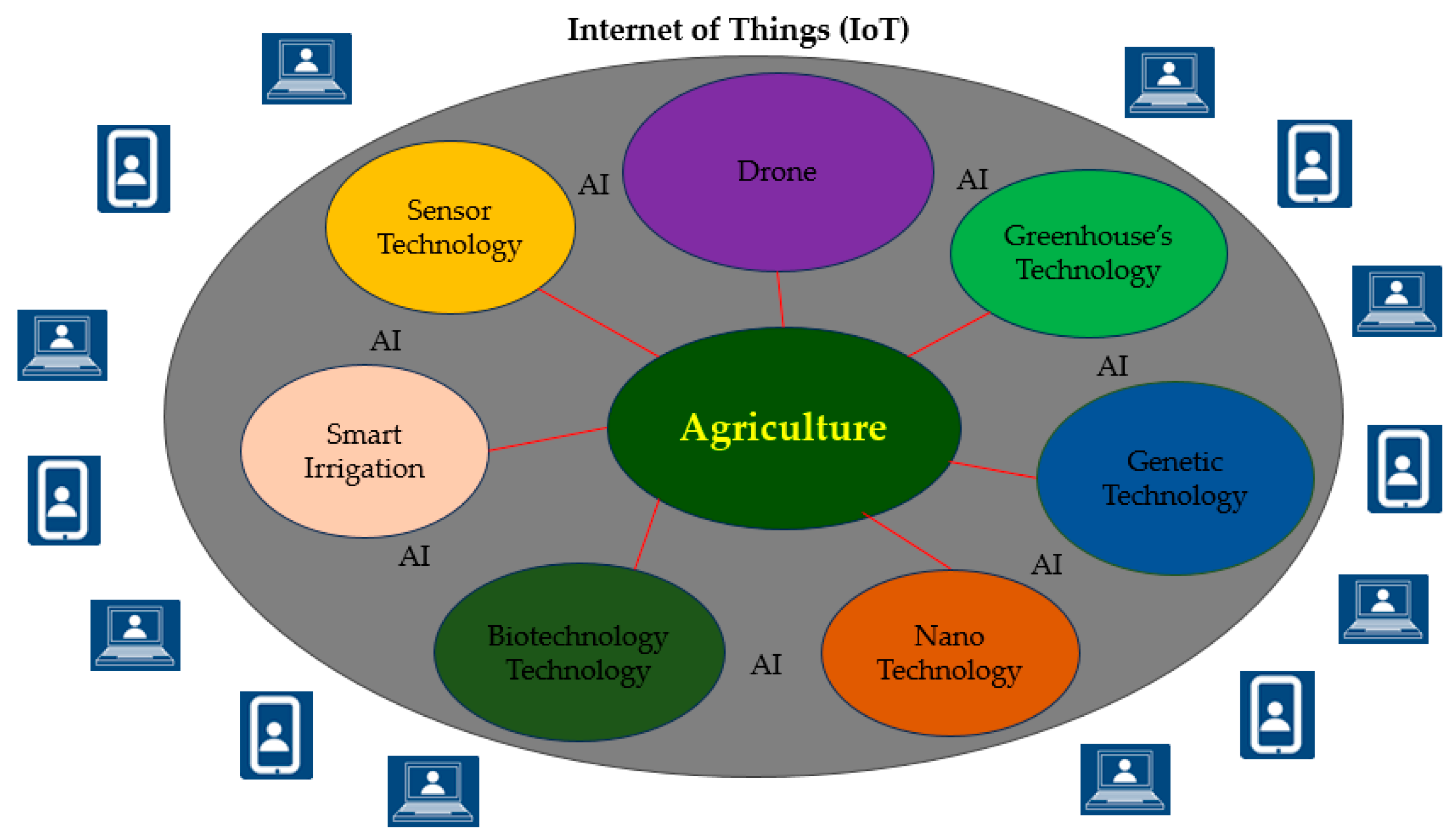
Disclaimer/Publisher’s Note: The statements, opinions and data contained in all publications are solely those of the individual author(s) and contributor(s) and not of MDPI and/or the editor(s). MDPI and/or the editor(s) disclaim responsibility for any injury to people or property resulting from any ideas, methods, instructions or products referred to in the content. |
© 2025 by the authors. Licensee MDPI, Basel, Switzerland. This article is an open access article distributed under the terms and conditions of the Creative Commons Attribution (CC BY) license (http://creativecommons.org/licenses/by/4.0/).
Copyright: This open access article is published under a Creative Commons CC BY 4.0 license, which permit the free download, distribution, and reuse, provided that the author and preprint are cited in any reuse.


