

Submitted:
28 March 2025
Posted:
31 March 2025
You are already at the latest version
Abstract
A simple and efficient synthesis route was introduced to develop an electrochemically active and promising binary composite that was made up of titanium based MXene (Ti3C2Tx) and rGO to simultaneously detect ions namely Cd2+ and Cu2+ in water. XRD, FTIR, Raman, XPS, FESEM, elemental mapping and EDX analysis affirmed successful formation of Ti3C2Tx-rGO composite. The produced Ti3C2Tx-rGO electrode exhibited an homogeneous rGO sheet coved Ti3C2Tx MXene plates with the all the detailed Ti2p, C1s and O1s XPS peaks. The high performance Ti3C2Tx-rGO composite was successfully tested Cd2+ and Cu2+ ions via differential pulse voltammetry (DPV), altering the pH, concentration and the real water sample quality. The electrochemical performances revealed that the proposed Ti3C2Tx-rGO composite depicted very low detection and quantification limits (LOD and LOQ) respectively, both for Cd2+ (LOD = 0.31 nM, LOQ = 1.02 nM) and Cu2+ (LOD = 0.18 nM, LOQ = 0.62 nM) ions, where the result is highly comparable with the reported literature. The Ti3C2Tx-rGO is proven highly sensitive towards Cd2+ (0.345 μMμA−1) and Cu2+ (0.575 μMμA−1) with great repeatability and reproducibility properties. Ti3C2Tx-rGO electrode was also exhibited excellent stability over four weeks with the retention of 97.86% and 98.01% for Cd2+ and Cu2+, respectively. This simple approach on modifying Ti3C2Tx utilizing rGO can potentially be advantageous in the development of highly sensitive electrochemical sensors for simultaneous detection of heavy metal ions.
Keywords:
Titanum-based MXene
; graphene
; electrochemical analysis
; electrochemical sensor
; heavy metals detection
1. Introduction
"Environmental health hazards" are identified based on the toxicity of the substance and potential exposure to contaminated air, water, soil, and heavy metal ions. It is also classified in the top ten list of the "Agency for Toxic Substances and Disease Registry Priority List of Hazardous Substances" [1]. The most abundant forms of water pollutants that result in negative effects on ecosystems, marine animals, and human health are heavy metals, such as copper (Cu), lead (Pb), cadmium (Cd), chromium (Cr), mercury (Hg), and zinc (Zn). Many detection methods have been invented due to the increasing demand for a better evaluation of the quality of water, specifically in respect to heavy metal contamination. The three distinct types of these heavy metal detection approaches are spectroscopic, electrochemical, and optical detection. In comparison, the electrochemical approach is emphasized for identifying heavy metal as it requires quick analytical time and cheap and easy equipment/operation great sensitivity and possesses excellent selectivity [2, 3].
MXene consists of metal carbide, nitride, or carbonitride nanosheet in a two-dimensional (2D) transition material. Meanwhile Ti3C2Tx is a titanium based MXene, an extensively developed and explored MXene to be employed in the treatment of water [4]. Ti3C2Tx MXene has been developed by researchers for identifying heavy metals, specifically for the detection of Cu2+, Cr7+, Ba2+, and Pb2+ utilizing in-situ reductions and adsorption technique. MXene has strong catalytic activity against a variety of water contaminants in the sensing application, in the presence of -O and -OH functional groups, which provide an abundance of active sites for a direct ion-exchange process. Shahzad et al. [5] proposed a 2D Ti3C2Tx nanosheet that has active interaction with Cu2+ ions, to produce adsorption capacity of 2.7 times bigger than the typically accessible activated carbon. The introduction of Ti3C2Tx MXene nanoribbons drastically enhance the adsorption and reduction properties, where promising and simple electrochemical analysis demonstrate an excellent LOD of 0.94 nM for Cd2+ ion [6]. The alkalinized Ti3C2Tx (Ti3C2(OH/ONa)xF2−x) electrode comprises multiple active Ti-O and Ti-OH sites also demonstrated promising signal towards the Pb2+ purification for environmental remediation [7]. On the other hand, the diverse Ti3C2Tx MXene layer possesses a restricted distance within the multiple sheets inhibits electrode performance. This is due to only a tiny portion of the electroactive sites are attached in the detecting process. Modification of the surface is a viable strategy for improving MXene characteristics for offering potential sensing performance as this can drastically increase MXene layer distance. MXene has been altered using numerous electroactive components such as conductive polymers, transition metal oxide, graphene in order to boost the sensing properties. Xia et al., [8] incorporated carbon black with Ti3C2Tx MXene and the result revealed that the aggregation of Ti3C2Tx Mxene has been successfully prevented and the electron transfer as well as the electrode surface area has been gradually improved via the proposed modification. It is also proven that the simultaneous detection heavy metal ions is promisingly high for nitrogen and phosphorus co-doped Ti3C2Tx Mxene electrode as the dopants significantly boost the accessible electroactive region of the electrode in simultaneously detecting Cu2+ and Hg2+ [9].
Among numerous candidates, the electrochemically conductive and mechanically stable reduced graphene oxide (rGO) is an ideal candidate for heavy metal sensing in water. A thermally produced rGO thin film was presented by Maity et al. [10] for rapid Pb2+ ion detection in various water sources. An excellent Pb2+ detection in a 1 M HCl solution and common water samples were revealed employing an electrochemically developed rGO of graphite enforced carbon material. [11]. The lowest LOD (Pb2+ = 0.1 g/L and Cd2+ = 1.0 g/L) were observed for simultaneous heavy metal ions, utilizing the micro-patterned rGO, which was effectively fabricated utilizing lithography approach [12]. Researchers discovered that the restored sp2 carbon network in the rGO structure leads to enhanced electro-conductivity [13]. The rGO structure bound with amino groups has improved the electrode of the electrically active area. Hence, rGO can be incorporated with the Ti3C2Tx to significantly boost the electrochemical performance of the electroactive material for identifying the presence of heavy metals in water. This is because the surface area of Ti3C2Tx MXene is significantly accessible during the process of detection, where rGO potentially serves as the spacer as well as anti-pile layer, eventually offering greater electroactive sites.
In the present work, a promising binary composite that consists of titanium based MXene (Ti3C2Tx) and rGO was homogeneously prepared via sonication approach for instantaneous identification of Cu2+ and Cd2+ in water. The properties of the as-prepared Ti3C2Tx-rGO composite morphological structure was characterized using XRD, FTIR, Raman, FESEM, EDX and XPS. The developed Ti3C2Tx-rGO was optimized by varying the ratio of Ti3C2Tx and rGO. The optimized electroactive material was utilized for a simultaneous detection of Cd2+ and Cu2+ ions in water. Ti3C2Tx-rGO is expected to exhibit a promising limit of detection of heavy metals and an excellent limit of quantification of them, with great electrode sensitivity. Ti3C2Tx-rGO is also illustrates a still high peak current retention after a long period of usage, signifying an outstanding electrode stability.
2. Materials and Methods
2.1. Materials
Potassium chloride (KCl, 99%) as well as sulphuric acid (H2SO4, 96%) were acquired from Fisher scientific. Meanwhile, dikalium hydrogen phosphate (K2HPO4, 98%), kalium dihydrogen phosphate (KH2PO4, 98%) and nitric acid (HNO3, 65%) were obtained from Merck KGaA. Sigma Aldrich supplied graphene oxide (GO, 4 mg/mL) and polyvinylidene fluoride (PVDF), Titanium aluminum carbide (Ti3AlC2, 90%), lithium fluoride (LiF, 97%), hydrochloric acid (HCl, 37%), ethanol (95%), cadmium (II) chloride (CdCl2, 99.9%), and copper (II) chloride (CuCl2, 99.9%). Milli-Q deionized (DI) water was obtained from Millipore (18.5 MΩ.cm, 25°C).
2.2. Preparation of Ti3C2Tx-rGO Nanocomposite
The layered Ti3C2Tx MXene was produced from the etching approach of the aluminium phase of MAX Ti3AlC2. Firstly, the etching solution was obtained by mixing LiF (1.0 g) in 9 mol/L HCl (20 mL) solution, utilizing magnetic stirring (30 min) approach. Then, 1.0 g of Ti3AlC2 was slowly added into the prepared mixture and allowed to stir continuously (24 h) at 35°C to attain an impure Ti3C2Tx MXene solvent. The collected impure Ti3C2Tx MXene was washed with the DI water and followed by centrifuge (3500 rpm) for 10 min until it reached pH > 6.0. The pure Ti3C2Tx MXene nanosheet dispersion was then allowed to dry utilizing a freeze dryer.
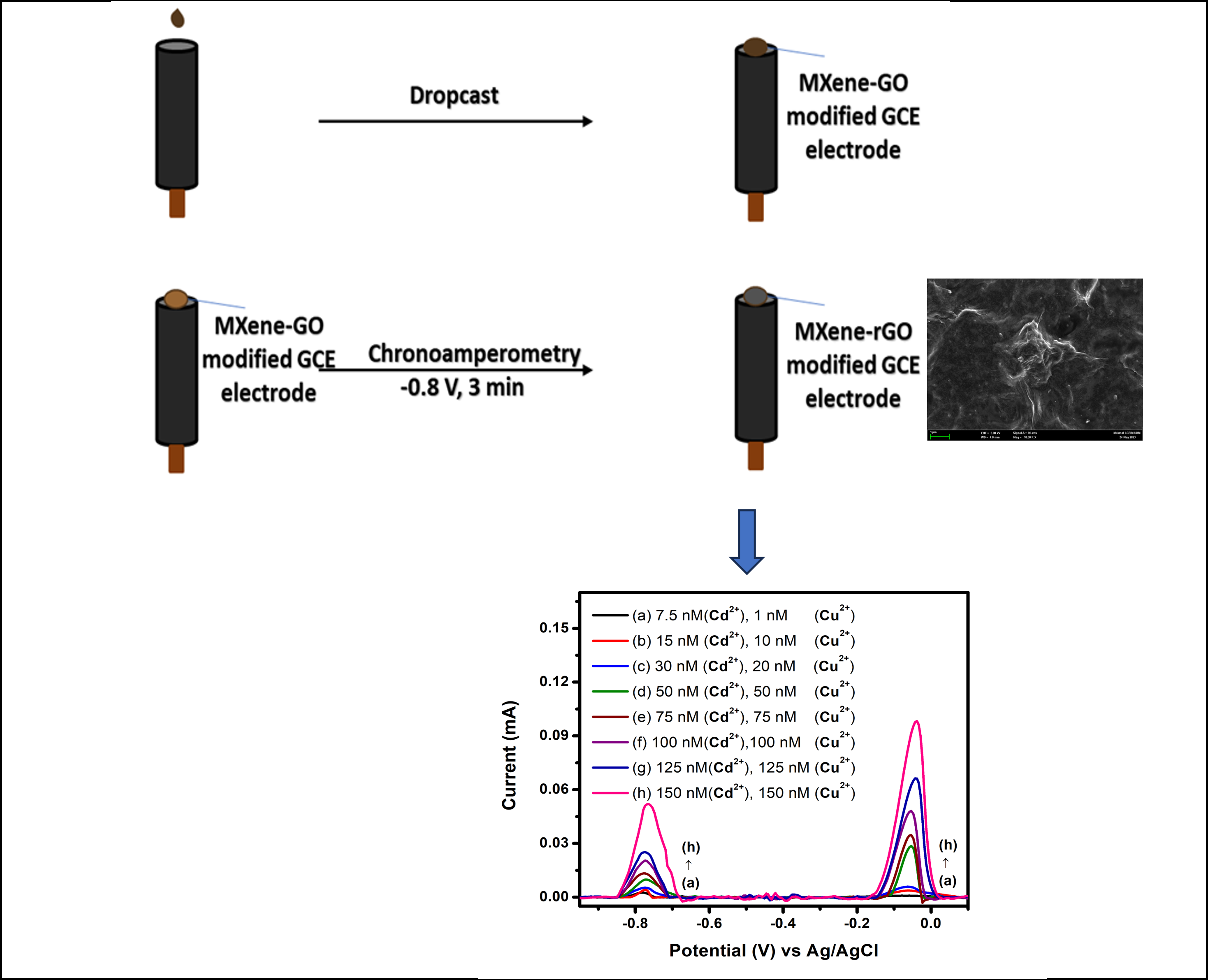
The Ti3C2Tx-rGO nanocomposite was fabricated via sonication and followed by electrochemical reduction (Figure 1(a)). First, the Ti3C2Tx dispersion (3 mg/mL) was prepared by magnetically stirring Ti3C2Tx powder (15 mg) with DI water (5 mL) for 30 min. The 3 mg/mL GO solution that sonicated for 1 h was then mixed with the 5 mL Ti3C2Tx dispersion and proceed with ultrasonic treatment for 1 h. The prepared dispersion (5μL) was drop casted on a clean glassy carbon electrode (GCE) surface and allowed to dry at room temperature. GCE was polished on the polishing cloth, employing 0.5 μm of alumina slurry. The GCE was later sonicated for 10 minutes with HNO3 and deionized water to obtain a clean electrode surface. The dried Ti3C2Tx-GO modified GCE was electrochemically treated in the PBS solution (pH 7), and performed a chronoamperometry method (-0.8 V) for 3 min [14, 15]. The produced Ti3C2Tx-rGO nanocomposite was labelled as the working electrode in this application. The digital pictures in Figure 1(b) clearly differentiates the surface of GCE via electrode modification.
2.3. Ti3C2Tx-rGO Nanocomposite Characterization
X-ray diffraction analysis was conducted to examine the phase composition of the synthesized samples using Bruker X-ray diffractometer D8 advance. The vibration modes and functional groups signals of the materials were retrieved from Raman spectroscopy (Thermo Scientfific Raman spectrometer, 488 nm) and Fourier Transform Infrared Spectrometer (FTIR, Perkin-Elmer Spectrum100), respectively. The field emission scanning microscopy (FESEM, ZEISS MERLIN) and X-ray photoelectron spectroscopy (XPS, XSAMHS Kratos Analytical) were performed to determine the morphology and the chemical composition of the composite surfaces, respectively.
2.4. Electrochemical Detection of Heavy Metals
The prepared binary Ti3C2Tx-rGO was investigated for simultaneous heavy metal detection namely, Cd2+, and Cu2+ ions. Various analysis was conducted to investigate the performance of Ti3C2Tx-rGO on the detection of analytes. All electrochemical analyses were performed via potentiostat (Autolab PGSTAT204) utilizing electroactive material coated GCE (working electrode), platinum (Pt) wire (counter electrode) and silver/silver chloride (Ag/AgCl, reference electrode); in a three-electrode configuration). Differential pulse voltammetry (DPV) assessments were conducted for the proposed Ti3C2Tx-rGO electrode at the potential ranging from -0.95 to -0.05 V for all the analysis (pH study, concentration study, real sample study, interference study, reproducibility test, repeatability test, stability test) in the sensor application. In this work, the detection of copper (Cu²⁺) and cadmium (Cd²⁺) ions using a MXene/rGO composite electrode via Differential Pulse Voltammetry (DPV) is typically carried out under careful optimized experimental conditions to achieve high sensitivity and selectivity towards the heavy metal detection. The actual experimental conditions of this work were properly developed following strict and standard procedures that are commonly conducted. The effect of supporting electrolyte pH on the voltammetric response of the mixture of Cd2+, and Cu2+ on the prepared electrode was evaluated in the phosphate buffer solution (PBS) in pH 4-6.5 (Figure 1(c)). DPV was performed to record the pH effect for the detection.
The concentration study was carried out by increasing the concentration of both analyte (Cd2+, and Cu2+) in the optimized condition. A calibration curve was obtained from the relation between same analyte concentration against the produced oxidation peak current and the error bars (relative standard deviation) were generated for each concentration of analyte. This analysis was conducted via DPV method at 50 mV pulse amplitude, 50 ms pulse width and 20 mV/s scan rate. The reproducibility of electrochemical sensor was examined by measuring the analytes using five different electrodes and the relative standard deviation (RSD) was calculated. Repeatability of the sensor was evaluated by recording ten successive measurements using same electrode. Stability of the electrochemical sensor was studied by preparing different electrodes and store it at the room temperature for a period. The current response of the stored electrodes was recorded after 1 week, 2 weeks, 3 weeks and 4 weeks via DPV analysis. The percentage of signal change was calculated and compared for all 4 weeks.
3. Result and Discussion
3.1. Characterization
Figure 2 demonstrates XRD diffraction peaks of various samples. This analysis was conducted to determine the sample phase compositions. The Ti3AlC2 illustrates XRD diffraction peaks at 9.5° (002), 18.9° (004), 34.0° (101), 38.9° (104), 41.8° (105), 48.4° (107), 56.5° (109) and 60.7° (110), which matches well with the JCPDS pattern 052-0875 of Ti3AlC2 (hexagonal lattice) [16]. The Ti3C2Tx MXene produced through etching process demonstrates (002), (004), (101), (104), (105), (107), (109) and (110) planes at 8.3°, 19.1°, 34.0°, 38.7°, 41.8°, 48.4°, 56.4° and 60.5°. The diminished (104) plane of T3C2Tx and the (002) plane of Ti3C2Tx MXene is noticeably lower in intensity and broader peak at 8.3°, signifying the successful Al-etching of Ti3AlC2 [17, 18]. GO illustrates a diffraction peak at 10.2°, indicating the lattice plane (001) [19,20,21]. The effective electrochemical reduction procedure results in a wide rGO diffraction peak of 2θ = 25.3 (002), implying the presence of graphite-like sheets [14, 22, 23]. The Ti3C2Tx-rGO illustrates all XRD signals of Ti3C2Tx and rGO, validating a successful formation of the sample.
The vibration modes within the as-prepared materials were investigated via Raman spectroscopy (Figure 3(a). Strong D band (sp3- hybridized carbon) and G band (sp2-hybridized carbon) are observed for GO (D band= 1355 cm-1 and G band= 1594 cm-1) and rGO (D band= 1354 cm-1 and G band= 1594 cm-1) samples. The band intensity ratio of D over G (ID/IG) can be adopted to estimate the degree of disorder in the graphite structure. The ratio value of ID/IG larger than 1 signifies that the sample comprises more sp3-hybridized carbon atoms than sp2-hybridized carbons [24,25,26]. The measured ID/IG ratio of GO is 0.94, whereas the ID/IG ratio of rGO (1.24) and Ti3C2Tx-rGO (1.32) confirm that the proposed electrochemical reduction process diminished oxygenated functional groups initially presence at the GO layer [27]. Ti3C2Tx MXene depicts Raman peaks at 147.8, 279.4, 391.5, 591.0 cm-1 correspond to the low levels of anatase TiO2 on the outermost surface of Ti3C2Tx MXene [28]. The Raman signal at 721.8 shows the A1g symmetrical out-of-plane vibration of Ti and C atoms [29]. The D band and G band of Ti3C2Tx MXene are observed at 1325.2 and 1559.8 cm-1, where the D band represents disorder induction within the structure. The synthesized Ti3C2Tx-rGO illustrates all the characteristic peaks of Ti3C2Tx and rGO.
Figure 3(b) represents the FTIR spectra of GO, rGO, Ti3C2Tx MXene, and Ti3C2Tx-rGO electrodes. GO demonstrates C-O-C, C=C, C=O and O-H functional groups at 1057, 1387, 1621 and 3301 cm-1. After reduction reaction, rGO illustrates peaks at 1047 cm-1 (C-OH), 1363 cm-1 (C=C), 1597 cm-1 (C=O) and 3307 cm-1 (O-H). The intensity of O-H (3307 cm-1) stretching mode of the carboxyl group of rGO is noticeably smaller than the GO (3301 cm-1), validating successful electrochemical reduction process. The deformation vibration of Ti-O bond and C=O of Ti3C2Tx MXene is detected at the respective peaks of 667 and 1640 cm-1. The existence of hydroxyl groups is verified by the absorption signals at 3301 and 1640 cm-1, which are ascribed to the absorbed external water and highly hydrogen-bonded OH or exceptionally strong coordinated H2O in the Ti3C2Tx MXene. The detected FTIR signal of Ti3C2Tx-rGO further affirms the formation of the composite.
Identification of the surface morphology of the as-prepared samples was performed using FESEM analysis and presented in Figure 4. Both GO (Figure 4a(i)) and rGO (Figure 4a(ii)) illustrate wrinkle-like morphology. The inset of Figure 4a(i-ii) denotes that the rGO has a more pronounce wrinkle-like morphology compared to the GO, which is the result of the electrochemical reduction process [19, 30, 31]. This statement is in good agreement with the XRD, FTIR and Raman results. Ti3C2Tx (Figure 4a(iii)) depicts a multi layered MXene flakes morphology after a successful chemical etching. Whereas, the Ti3C2Tx-rGO composite which prepared through simple sonication method shows that the rGO sheet uniformly covers the multi layered MXene flakes.
Ti3C2Tx-rGO composite was further evaluated through elemental mapping as depicted in Figure 5(a). Titanium (Ti), Carbon (C), Oxygen (O) and Aluminum (Al) are noticed from the analysis, and it can be clearly spotted that the all the elements are distributed evenly on the composite, confirming homogeneous formation of the composite. The Al signal still can be observed in the Ti3C2Tx-rGO composite even after the Al-etching, which indicate that there is incomplete etching process at the inner layers of Ti3AlC2 [32]. From the EDX analysis (Figure 5(b)) of Ti3C2Tx-rGO composite, Ti, C, O, and Al are successfully recorded with the respective weight percentage of 88.1, 10.3, 1.5 and 0.1%. EDX result revealed that only minimal amount of Al (0.1%) present within the composite, confirming a successful etching of Al and there is still few unetched Al within the inner structure of Ti3C2Tx MXene.
The chemical composition of the as-prepared Ti3C2Tx-rGO composite was investigated via XPS analysis (Figure 6). Ti2p, C1s and O1s signals are obtained at the binding energy of 458, 285 and 529 eV, respectively (Figure 6(a)). Ti2p signal originated from Ti3C2Tx MXene, while C1s and O1s are produced by both Ti3C2Tx and rGO. The Ti2p1/2 and Ti2p3/2 characteristics are observed from Figure 6(b). The deconvolution of Ti2p spectrum depicts seven different peaks, which appear at the binding energy of 454.7 (Ti-C 2p3/2), 455.2 (Ti(II)), 456.5 (Ti-O 2p3/2), 459.2 (TiO2), 461.1 (Ti-C 2p1/2), 461.9 (Ti(III)), 463.3 eV (Ti-O 2p1/2) [33,34,35,36]. The C1s spectrum presented in Figure 6(c) illustrates four deconvoluted XPS peaks, which indicate the C=C/C–C, C–O (epoxy and hydroxy), C=O and O–C=O interactions happened at specific binding energies of 281.4, 282.1, 284.6 and 286.2 eV, respectively. From the result, it can be clearly seen that the intensity of C-C/C=C signal is relatively higher than the C-O (hydroxy and epoxy), revealing a successful reduction of GO and it also proves that the rGO within the composite still consist of several oxygen-containing functional groups [37]. The O1s spectrum (Figure 6(d)) is deconvoluted into four peaks that are clearly noticed at the binding energy of 529.7 eV (O-Ti), 530.6 eV (C-Ti-Ox), 531.4 eV (C-Ti-OHx) and 532.7 eV (H2O-Ti) [33]. XPS result affirms that the Ti3C2Tx MXene is successfully obtained via the chemical synthesis route. The electrochemical reduction effectively reduced GO to rGO without disturbing the structure of Ti3C2Tx MXene. The XPS signal is also in full alignment with the XRD, FTIR, Raman, FESEM, EDX and elemental mapping results presented earlier.
3.2. Electrochemical Detection
Figure 7(a) depicts the DPV curve of bare GCE, rGO, Ti3C2Tx MXene, and Ti3C2Tx-rGO electrodes for the detection of 1 mM Cd2+ and Cu2+ in PBS solution (pH=5.0). An obvious and low intensity Cd2+ signal and a broad and weak Cu2+ peak is obtained for bare GCE at the respective values of -0.74 and -0.16 V. Comparatively, the Cd2+ ion peak current is noticibly higher than the Cu2+ ion, indicating the difference in sensitivity of electrode for both heavy metal ions. The introduction of Ti3C2Tx or rGO on a bare GCE illustrates an evident spike in peak currents and increase in the electrochemical signal through instantaneous ions detection, caused by the higher electrocatalytic activity and electrochemical surface area. On the other hands, the pristine GCE, Ti3C2Tx MXene demonstrates prominent absorbtion peaks at the respective -0.75 and -0.17 V that indicate the peak of Cd2+ and Cu2+. Meanwhile, the Cu2+ signal is found weak for rGO. Therefore the integration of Ti3C2Tx and rGO to form Ti3C2Tx-rGO has resulted in greater peak currents as the rGO increased the interlayer spacing of Ti3C2Tx, created a greater surface area for the better interaction of Cd2+ and Cu2+, with Ti3C2Tx-rGO composite [38]. Ti3C2Tx-rGO displays high intensity peak current than the Ti3C2Tx , rGO and bare GCE. Interestingly, Ti3C2Tx-rGO shows completely separated and intense peak currents that improves the detection of Cu2+ and Cd2+ ions electrochemically. The synergistic effect within the Ti3C2Tx-rGO electrode lead to outstanding oxidation signals towards Cd2+ and Cu2+ ions.
Figure 7(b) demonstrates the DPV of Ti3C2Tx-rGO composite immersed in the PBS solution consisting of 1mM Cd2+ - Cu2+ within the pH range of 4.0 to 6.5. The peak potentials of Cd2+ - Cu2+ have shown slightly deviations to the negative potential as the pH of the PBS rises, which validated the redox reactions under the proton influence [39, 40]. This is because the presence of proton in the PBS solution reduces as the pH of the solvent rises. Cd2+ and Cu2+ ions rapidly form anion in the high pH PBS solution. The produced anion develops an electrostatic repulsion within Cd2+, Cu2+ as well as Ti3C2Tx-rGO, causing difficulty for electrochemical reaction to occur at high pH with low peak currents. Figure 7(c) illustrates the peak current versus pH of Cd2+ and Cu2+. The peak currents for Cd2+ and Cu2+ intensified when the pH elevated from 4 to 5, potentially due to the competition between the targeted heavy metal ions and protons for the binding sites on the electrode surface [41]. This phenomenon is due to the increase of pH of the PBS, which have resulted in the amount of proton present in the analyte solution to decrease. This later caused the Cd2+ and Cu2+ ions to be easily oxidized and form anion easily at higher pH. The presence of these anions will cause an electrostatic repulsion between the heavy metal ions and the Ti3C2Tx-rGO composite, resulting low peak current [40]. The Cd2+ and Cu2+ signals from pH 5.5 to 6.5 are observed with low peak currents, which is due to the hydrolysis of heavy metal ions [42, 43]. The ideal pH used for this task is pH 5 as it illustrates highest peak current of 51.4 and 3.47 μA for Cd2+ and Cu2+, respectively. The relationship of the peak potential (Ep) of Cd2+ and Cu2+ versus pH is demonstrated in Figure 7(d-e). The Ep of both Cd2+ and Cu2+are noticibly proportional to the PBS pH in accordance with the regression equation of Ep (V) = −0.046 pH - 0.637 (R2=0.989) for Cd2+ and Ep (V) =−0.042 pH + 0.018 (R2=0.967) for Cu2+, respectively.
The simultaneous detection of Cd2+ and Cu2+ was performed via DPV analysis (Figure 8(a)) utilizing Ti3C2Tx-rGO. Figure 8(a) depicts the Cd2+ and Cu2+ ions detection in PBS solution (pH 5), varying the concentration of Cd2+ (7.5-150 nM) and Cu2+ (1-150 nM). Figure 8 (b) and (d) displays differential pulse voltammograms that focus on Ti3C2Tx-rGO composite in various Cd2+ and Cu2+ concentrations ranging from 7.5 to 150 nM and 1 to 150 nM, respectively. Result implies that the peak current of Cd2+ and Cu2+ increases with increasing concentration [44]. The plot of peak current against concentration of Cd2+ and Cu2+ is exhibited in Figure 8 (c) and (e), respectively. The Cd2+ peak currents rise gradually with the concentration of Cd2+ and the correlation between peak current with Cd2+ concentration shall be potentially represented in the form of Ipa (μM)=0.345 Cd2+ (μM) + 0.010 with R2=0.999. The sensitivity of Ti3C2Tx-rGO against Cd2+ is 0.345 μMμA−1, which is attained from the slope of the equation. Similarly, the peak currents of Cu2+ constantly increases as the concentration of Cu2+ is rises. Cu2+ also shows a straight line curve of peak current and Cu2+ concentration, that is presented as Ipa (μM)=0.575 Cu2+ (μM) + 0.158 where R2=0.993. The achieved sensitivity of Ti3C2Tx-rGO towards the detection of Cu2+ is 0.575 μMμA−1. It can be concluded that the modified Ti3C2Tx-rGO electrode is capable to demonstrate a complete-separation of oxidation peak and the electrochemical detection of Cd2+ and Cu2+ that does not interfere each other. Limit of detection (LOD) and limit of quantification (LOQ) is measured via Eq. (1) and (2), where σ and s are standard deviation and slope of the calibration curve, respectively. The LOD of Ti3C2Tx-rGO modified electrode for Cd2+ and Cu2+ are 0.31 and 0.18 nM, respectively. Whereas, the LOQ discovered for Cd2+ and Cu2+ are 1.02 and 0.62 nM, respectively. The performance of the suggested composite and the other modified electrodes in detecting Cd2+ and Cu2+ is tabulated in Table 1. The Ti3C2Tx-rGO composite result is comparable with the reported literature. The proposed electroactive material in this work also demonstrated an outstanding LOD for simultanuous heavy metals detection, which is significantly lower than the other reported MXene based composites.
The reproducibility of Ti3C2Tx-rGO was determined by testing 0.5 mM Cd2+ and Cu2+ using five distinct electrodes and the calculated relative standard deviation (RSD) of 2.42% and 2.36% are attained for Cd2+ and Cu2+, respectively. The repeatability of Ti3C2Tx-rGO, is evaluated for 10 DPV signal of an electrode and analysed in the 0.5 mM solution of Cd2+ and Cu2+. The calculated RSD are 1.93% and 3.58% for Cd2+ and Cu2+, respectively, signifying outstanding repeatability of the proposed material. The Ti3C2Tx-rGO sensor constancy was determined upon testing 0.1 mM Cd2+ and 0.1mM Cu2+ in the pH 5 PBS solution. Although the approximate concentration of dissolved oxygen in water at room temperature and 1 atm pressure is around 0.25 mM, even nanomolar concentrations of metal ions can significantly suppress the oxygen signal observed in Differential Pulse Voltammetry (DPV). This seemingly disproportionate effect arises from several electrochemical and chemical interactions. Certain metal ions, such as Cu²⁺, Fe²⁺, or Mn²⁺, can catalyze the oxygen reduction reaction (ORR), altering the kinetics and mechanisms of oxygen's electrochemical behaviors. These ions can form transient complexes with oxygen or its reduction intermediates, thereby modifying the redox potential and diminishing the distinct oxygen peak in DPV. Additionally, metal ions can adsorb onto the electrode surface and alter its electrochemical properties, including electron transfer rates and surface reactivity. This surface modification can hinder the reduction of oxygen or shift its peak, leading to apparent suppression. Despite their low concentration, these ions can exert a catalytic or surface-blocking effect that disrupts the sensitivity and resolution of DPV, which is a highly sensitive technique designed to detect subtle changes in current. Thus, the suppression of oxygen signals by trace metal ions highlights the importance of understanding both direct and indirect interactions in electrochemical analyses.
Next, the prepared sensor was stored for 30 days at atmospheric temperature and the detailed peak current retention (%) of Ti3C2Tx-rGO is tabulated in Table 2. Result shows that Ti3C2Tx-rGO electrode retained 97.86% (Cd2+) and 98.01% (Cu2+) of its initial peak current responses, implying excellent stability of Ti3C2Tx-rGO towards simultaneous detection Cd2+ and Cu2+.
The impact of various interference ions in the PBS containing 1 mM Cd2+ and Cu2+ were investigated using Ti3C2Tx-rGO. The 100- fold and 1000-fold concentration of the interference ions (Na+, K+, Ca2+, Mg2+, Cl−, SO42−) were tested and the result shows that the injected ions do not interfere the simultaneous detection of Cd2+ and Cu2+ ions in PBS (pH = 5) where the signal change is less than 5% [40]. The excellent interference resistance disclosed that Ti3C2Tx-rGO is reliable even under ambient conditions. The practical effectiveness of Ti3C2Tx-rGO for simultaneous Cd2+ and Cu2+ detection has been explored employing lake water and tap water. A predetermined quantity of Cd2+ and Cu2+ was injected into the solution for the purpose of the recovery experiment, which was carried out using DPV analysis. The quantity of Cd2+ and Cu2+ found in lake and supplied drinking water was identified using the traditional addition technique, and the recovery of Cd2+ and Cu2+ in percentage were ranged between 96% and 99.5% (Table 3 and Table 4). The results show that the Ti3C2Tx-rGO composite is capable of detecting Cd2+ and Cu2+ simultaneously using actual water samples.
4. Conclusions
A promising Ti3C2Tx-rGO sensor for Cd2+ and Cu2+ deterction was successfully developed employing chemically synthesized Ti3C2Tx and electrochemically produced rGO by demonstrating obvious and intense Cd2+ and Cu2+ oxidation peaks via DPV analysis. Ti3C2Tx-rGO composite revealed a significant electro-chemical-catalytic activity with respect to the Cd2+ and Cu2+ oxidation. It is also found that improved electron transfer characteristics in comparison to the bare GCE, Ti3C2Tx and rGO. Ti3C2Tx-rGO sensor were obtained. The results demonstrated a significantly low LOD and LOQ for concurrent detection of Cd2+ (LOD = 0.31 nM, LOQ = 1.02 nM) and Cu2+ (LOD = 0.18 nM, LOQ = 0.62 nM) ions in water. The promising Ti3C2Tx-rGO electrode illustrated excellent sensitivity of 0.345 and 0.575 μMμA−1 for Cd2+ and Cu2+ions, respectively. Ti3C2Tx-rGO composite also disclose promising duplicability, repeatability, and consistency of Cd2+ and Cu2+ detection. Thus, Ti3C2Tx-rGO is proven as an outstanding electrochemical sensor for identifying Cd2+ and Cu2+ successfully.
Acknowledgments
This work was supported and funded by the Deanship of Scientific Research at Imam Mohammad Ibn Saud Islamic University (IMSIU) (grant number IMSIU-DDRSP2502).
References
- M.B. Gumpu, S. Sethuraman, U.M. Krishnan, J.B.B. Rayappan, A review on detection of heavy metal ions in water–an electrochemical approach, Sensors and actuators B: chemical 213 (2015) 515-533. [CrossRef]
- H. Yin, Q. Zhang, Y. Zhou, Q. Ma, L. Zhu, S. Ai, Electrochemical behavior of catechol, resorcinol and hydroquinone at graphene-chitosan composite film modified glassy carbon electrode and their simultaneous determination in water samples, Electrochim. Acta 56 (2011) 2748-2753.
- A.J.S. Ahammad, M.M. Rahman, G.-R. Xu, S. Kim, J.-J. Lee, Highly sensitive and simultaneous determination of hydroquinone and catechol at poly (thionine) modified glassy carbon electrode, Electrochimica Acta 56 (2011) 5266-5271. [CrossRef]
- Y. Yi, Y. Zhao, Z. Zhang, Y. Wu, G. Zhu, Recent developments in electrochemical detection of cadmium, Trends in Environmental Analytical Chemistry 33 (2022) e00152.
- A. Shahzad, K. Rasool, W. Miran, M. Nawaz, J. Jang, K.A. Mahmoud, D.S. Lee, Two-dimensional Ti3C2Tx MXene nanosheets for efficient copper removal from water, ACS Sustainable Chemistry & Engineering 5 (2017) 11481-11488.
- Y. Yi, Y. Ma, F. Ai, Y. Xia, H. Lin, G. Zhu, Novel methodology for anodic stripping voltammetric sensing of heavy-metal ions using Ti 3 C 2 T x nanoribbons, Chemical Communications 57 (2021) 7790-7793.
- Q. Peng, J. Guo, Q. Zhang, J. Xiang, B. Liu, A. Zhou, R. Liu, Y. Tian, Unique lead adsorption behavior of activated hydroxyl group in two-dimensional titanium carbide, J. Am. Chem. Soc. 136 (2014) 4113-4116. [CrossRef]
- Y. Xia, Y. Ma, Y. Wu, Y. Yi, H. Lin, G. Zhu, Free-electrodeposited anodic stripping voltammetry sensing of Cu (II) based on Ti 3 C 2 T x MXene/carbon black, Microchimica Acta 188 (2021) 1-9. [CrossRef]
- Y. Xia, Y. Zhao, F. Ai, Y. Yi, T. Liu, H. Lin, G. Zhu, N and P co-doped MXenes nanoribbons for electrodeposition-free stripping analysis of Cu (II) and Hg (II), Journal of Hazardous Materials 425 (2022) 127974. [CrossRef]
- A. Maity, X. Sui, C.R. Tarman, H. Pu, J. Chang, G. Zhou, R. Ren, S. Mao, J. Chen, Pulse-driven capacitive lead ion detection with reduced graphene oxide field-effect transistor integrated with an analyzing device for rapid water quality monitoring, ACS sensors 2 (2017) 1653-1661. [CrossRef]
- K. Hamsawahini, P. Sathishkumar, R. Ahamad, A.R.M. Yusoff, A sensitive, selective and rapid determination of lead (II) ions in real-life samples using an electrochemically reduced graphene oxide-graphite reinforced carbon electrode, Talanta 144 (2015) 969-976. [CrossRef]
- X. Xuan, M. Hossain, J.Y. Park, A fully integrated and miniaturized heavy-metal-detection sensor based on micro-patterned reduced graphene oxide, Scientific reports 6 (2016) 1-8. [CrossRef]
- S. Wu, K. Zhang, X. Wang, Y. Jia, B. Sun, T. Luo, F. Meng, Z. Jin, D. Lin, W. Shen, Enhanced adsorption of cadmium ions by 3D sulfonated reduced graphene oxide, Chem. Eng. J. 262 (2015) 1292-1302. [CrossRef]
- D. Mohanadas, N.H.N. Azman, J. Abdullah, N.A. Endot, Y. Sulaiman, Bifunctional ternary manganese oxide/vanadium oxide/reduced graphene oxide as electrochromic asymmetric supercapacitor, Ceram. Int. 47 (2021) 34529-34537. [CrossRef]
- D. Mohanadas, N.H.N. Azman, Y. Sulaiman, A bifunctional asymmetric electrochromic supercapacitor with multicolor property based on nickel oxide/vanadium oxide/reduced graphene oxide, Journal of Energy Storage 48 (2022) 103954. [CrossRef]
- A. Sengupta, B.B. Rao, N. Sharma, S. Parmar, V. Chavan, S.K. Singh, S. Kale, S. Ogale, Comparative evaluation of MAX, MXene, NanoMAX, and NanoMAX-derived-MXene for microwave absorption and Li ion battery anode applications, Nanoscale 12 (2020) 8466-8476. [CrossRef]
- X. Li, Y. Qian, T. Liu, F. Cao, Z. Zang, X. Sun, S. Sun, Q. Niu, J. Wu, Enhanced lithium and electron diffusion of LiFePO4 cathode with two-dimensional Ti3C2 MXene nanosheets, Journal of Materials Science 53 (2018) 11078-11090. [CrossRef]
- H. Fang, Y. Pan, M. Yin, C. Pan, Enhanced visible light photocatalytic activity of CdS with alkalized Ti3C2 nano-sheets as co-catalyst for degradation of rhodamine B, Journal of Materials Science: Materials in Electronics 30 (2019) 14954-14966. [CrossRef]
- D. Mohanadas, M.A.A.M. Abdah, N.H.N. Azman, T.B. Ravoof, Y. Sulaiman, Facile synthesis of PEDOT-rGO/HKUST-1 for high performance symmetrical supercapacitor device, Scientific reports 11 (2021) 1-13. [CrossRef]
- S. Bai, X. Shen, X. Zhong, Y. Liu, G. Zhu, X. Xu, K. Chen, One-pot solvothermal preparation of magnetic reduced graphene oxide-ferrite hybrids for organic dye removal, Carbon 50 (2012) 2337-2346. [CrossRef]
- S.-X. Wang, H. Maimaiti, B. Xu, A. Awati, G.-B. Zhou, Y.-d. Cui, Synthesis and visible-light photocatalytic N2/H2O to ammonia of ZnS nanoparticles supported by petroleum pitch-based graphene oxide, Appl. Surf. Sci. 493 (2019) 514-524.
- Z. Gohari-Bajestani, O. Akhlaghi, Y. Yürüm, A. Yürüm, Synthesis of anatase TiO2 with exposed (001) facets grown on N-doped reduced graphene oxide for enhanced hydrogen storage, Int. J. Hydrogen Energy 42 (2017) 6096-6103. [CrossRef]
- M. Huang, J. Yu, Q. Hu, W. Su, M. Fan, B. Li, L. Dong, Preparation and enhanced photocatalytic activity of carbon nitride/titania (001 vs 101 facets)/reduced graphene oxide (g-C3N4/TiO2/rGO) hybrids under visible light, Appl. Surf. Sci. 389 (2016) 1084-1093. [CrossRef]
- J. Xu, Q. Liang, Z. Li, V.Y. Osipov, Y. Lin, B. Ge, Q. Xu, J. Zhu, H. Bi, Rational Synthesis of Solid-State Ultraviolet B Emitting Carbon Dots via Acetic Acid-Promoted Fractions of sp3 Bonding Strategy, Adv. Mater. 34 (2022) 2200011.
- Y. Chen, S. Yang, J. Zhang, The chemical composition and bonding structure of B–C–N–H thin films deposited by reactive magnetron sputtering, Surface and Interface Analysis: An International Journal devoted to the development and application of techniques for the analysis of surfaces, interfaces and thin films 41 (2009) 865-871.
- D. Mohanadas, M.A.A.M. Abdah, N.H.N. Azman, J. Abdullah, Y. Sulaiman, A promising negative electrode of asymmetric supercapacitor fabricated by incorporating copper-based metal-organic framework and reduced graphene oxide, Int. J. Hydrogen Energy 46 (2021) 35385-35396. [CrossRef]
- S.L. Rebelo, A. Guedes, M.E. Szefczyk, A.M. Pereira, J.P. Araújo, C. Freire, Progress in the raman spectra analysis of covalently functionalized multiwalled carbon nanotubes: unraveling disorder in graphitic materials, PCCP 18 (2016) 12784-12796. [CrossRef]
- L. Lorencova, T. Bertok, E. Dosekova, A. Holazova, D. Paprckova, A. Vikartovska, V. Sasinkova, J. Filip, P. Kasak, M. Jerigova, Electrochemical performance of Ti3C2Tx MXene in aqueous media: towards ultrasensitive H2O2 sensing, Electrochim. Acta 235 (2017) 471-479. [CrossRef]
- Y.-Y. Yang, W.-T. Zhou, W.-L. Song, Q.-Q. Zhu, H.-J. Xiong, Y. Zhang, S. Cheng, P.-F. Luo, Y.-W. Lu, Terminal Groups-Dependent Near-Field Enhancement Effect of Ti3C2Tx Nanosheets, Nanoscale Research Letters 16 (2021) 1-7. [CrossRef]
- S. Khasim, A. Pasha, N. Badi, M. Lakshmi, Y.K. Mishra, High performance flexible supercapacitors based on secondary doped PEDOT–PSS–graphene nanocomposite films for large area solid state devices, RSC Advances 10 (2020) 10526-10539. [CrossRef]
- B. Genorio, K.L. Harrison, J.G. Connell, G. Dražić, K.R. Zavadil, N.M. Markovic, D. Strmcnik, Tuning the selectivity and activity of electrochemical interfaces with defective graphene oxide and reduced graphene oxide, ACS applied materials & interfaces 11 (2019) 34517-34525. [CrossRef]
- M. Gusain, R. Nagpal, MXene for solar cells, Solar Energy Harvesting, Conversion, and Storage, Elsevier2023, pp. 171-200.
- Y. Zhou, Y. Wang, Y. Wang, X. Li, Humidity-enabled ionic conductive trace carbon dioxide sensing of nitrogen-doped Ti3C2Tx MXene/polyethyleneimine composite films decorated with reduced graphene oxide nanosheets, Anal. Chem. 92 (2020) 16033-16042.
- A. Pazniak, P. Bazhin, N. Shplis, E. Kolesnikov, I. Shchetinin, A. Komissarov, J. Polcak, A. Stolin, D. Kuznetsov, Ti3C2Tx MXene characterization produced from SHS-ground Ti3AlC2, Materials & Design 183 (2019) 108143. [CrossRef]
- Q.T.H. Ta, N.M. Tran, J.-S. Noh, Rice crust-like ZnO/Ti3C2Tx MXene hybrid structures for improved photocatalytic activity, Catalysts 10 (2020) 1140.
- L. Yao, X. Tian, X. Cui, R. Zhao, X. Xiao, Y. Wang, Partially oxidized Ti3C2Tx MXene-sensitive material-based ammonia gas sensor with high-sensing performances for room temperature application, Journal of Materials Science: Materials in Electronics 32 (2021) 27837-27848. [CrossRef]
- X. Ding, Y. Huang, S. Li, N. Zhang, J. Wang, FeNi3 nanoalloy decorated on 3D architecture composite of reduced graphene oxide/molybdenum disulfide giving excellent electromagnetic wave absorption properties, J. Alloys Compd. 689 (2016) 208-217. [CrossRef]
- L. Jin, L. Chai, W. Yang, H. Wang, L. Zhang, Two-dimensional titanium carbides (Ti3C2Tx) functionalized by poly (m-phenylenediamine) for efficient adsorption and reduction of hexavalent chromium, International Journal of Environmental Research and Public Health 17 (2020) 167.
- W. Ma, X. Yao, D. Sun, Simultaneous electrochemical determination of dopamine, epinephrine and uric acid at silver doped poly-l-cysteine film electrode, Asian J. Chem 25 (2013) 6625-6634. [CrossRef]
- D. Mohanadas, N. Tukimin, Y. Sulaiman, Simultaneous electrochemical detection of hydroquinone and catechol using poly (3, 4-ethylenedioxythiophene)/reduced graphene oxide/manganese dioxide, Synth. Met. 252 (2019) 76-81.
- Y. El Hamdouni, S. El Hajjaji, T. Szabo, L. Trif, I. Felhősi, K. Abbi, N. Labjar, L. Harmouche, A. Shaban, Biomass valorization of walnut shell into biochar as a resource for electrochemical simultaneous detection of heavy metal ions in water and soil samples: Preparation, characterization, and applications, Arabian Journal of Chemistry 15 (2022) 104252. [CrossRef]
- H. Huang, T. Chen, X. Liu, H. Ma, Ultrasensitive and simultaneous detection of heavy metal ions based on three-dimensional graphene-carbon nanotubes hybrid electrode materials, Anal. Chim. Acta 852 (2014) 45-54. [CrossRef]
- Y.-Z. Tang, K.Y. Gin, M. Aziz, The relationship between pH and heavy metal ion sorption by algal biomass, Adsorption Science & Technology 21 (2003) 525-537. [CrossRef]
- N. Qu, D. Zhu, K.C. Chan, W. Lei, Pulse electrodeposition of nanocrystalline nickel using ultra narrow pulse width and high peak current density, Surf. Coat. Technol. 168 (2003) 123-128. [CrossRef]
- X. Zhu, B. Liu, H. Hou, Z. Huang, K.M. Zeinu, L. Huang, X. Yuan, D. Guo, J. Hu, J. Yang, Alkaline intercalation of Ti3C2 MXene for simultaneous electrochemical detection of Cd (II), Pb (II), Cu (II) and Hg (II), Electrochim. Acta 248 (2017) 46-57.
- X. Lv, F. Pei, S. Feng, Y. Wu, S.-M. Chen, Q. Hao, W. Lei, Facile synthesis of protonated carbon nitride/Ti3C2Tx nanocomposite for simultaneous detection of Pb2+ and Cd2+, J. Electrochem. Soc. 167 (2020) 067509.
- X. Zhang, D. An, Z. Bi, W. Shan, B. Zhu, L. Zhou, L. Yu, H. Zhang, S. Xia, M. Qiu, Ti3C2-MXene@ N-doped carbon heterostructure-based electrochemical sensor for simultaneous detection of heavy metals, J. Electroanal. Chem. 911 (2022) 116239. [CrossRef]
- Y. He, L. Ma, L. Zhou, G. Liu, Y. Jiang, J. Gao, Preparation and application of bismuth/MXene nano-composite as electrochemical sensor for heavy metal ions detection, Nanomaterials 10 (2020) 866. [CrossRef]
Figure 1.
(a) Schematic diagram illustrates the synthesis of Ti3C2Tx-rGO nanocomposite. (b) Digital photographs demonstrate the surface of GCE before (left) and after (right) modification process. (c) The three-electrode system setup of the electrodes for electrochemical analysis (pH study).
Figure 1.
(a) Schematic diagram illustrates the synthesis of Ti3C2Tx-rGO nanocomposite. (b) Digital photographs demonstrate the surface of GCE before (left) and after (right) modification process. (c) The three-electrode system setup of the electrodes for electrochemical analysis (pH study).
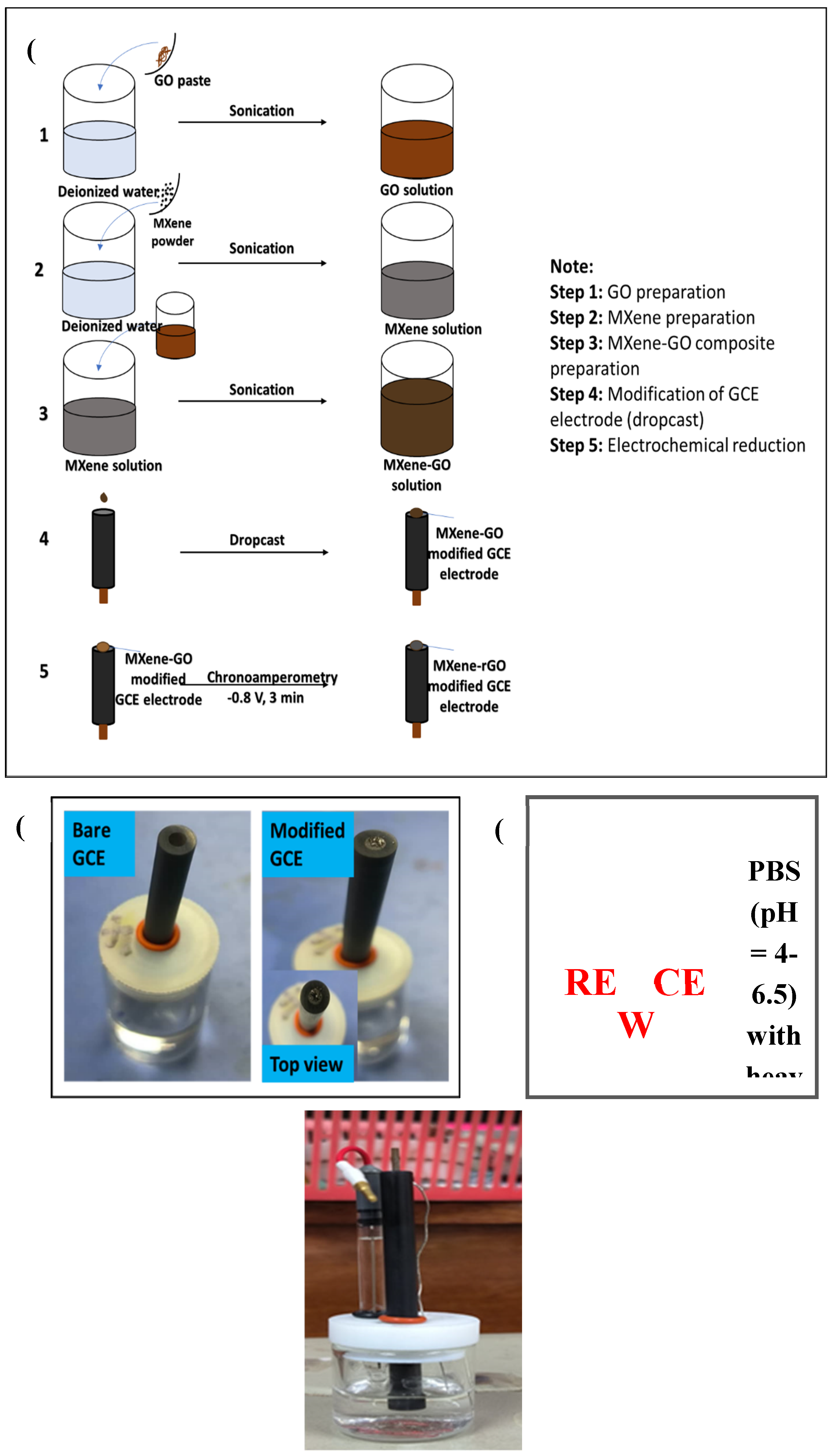
Figure 2.
XRD spectra of Ti3AlC2, Ti3C2Tx MXene, GO, rGO and Ti3C2Tx-rGO.
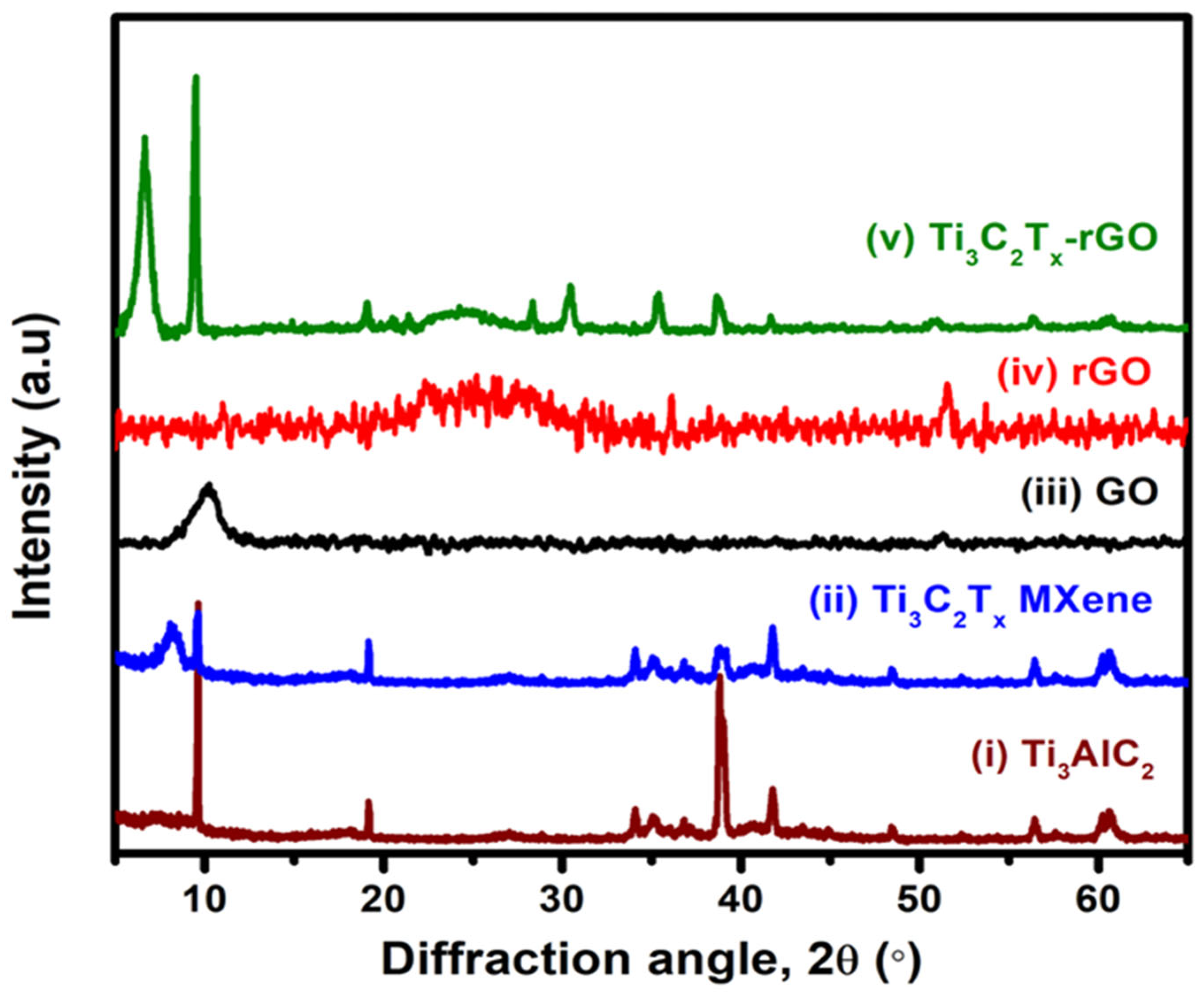
Figure 3.
(a) Raman and (b) FTIR spectra of GO, rGO, Ti3C2Tx MXene, and Ti3C2Tx-rGO.
Figure 4.
FESEM images of (a) GO (inset: GO at higher magnification), (b) rGO (inset: rGO at higher magnification, (c) Ti3C2Tx, and (d) Ti3C2Tx-rGO.
Figure 4.
FESEM images of (a) GO (inset: GO at higher magnification), (b) rGO (inset: rGO at higher magnification, (c) Ti3C2Tx, and (d) Ti3C2Tx-rGO.
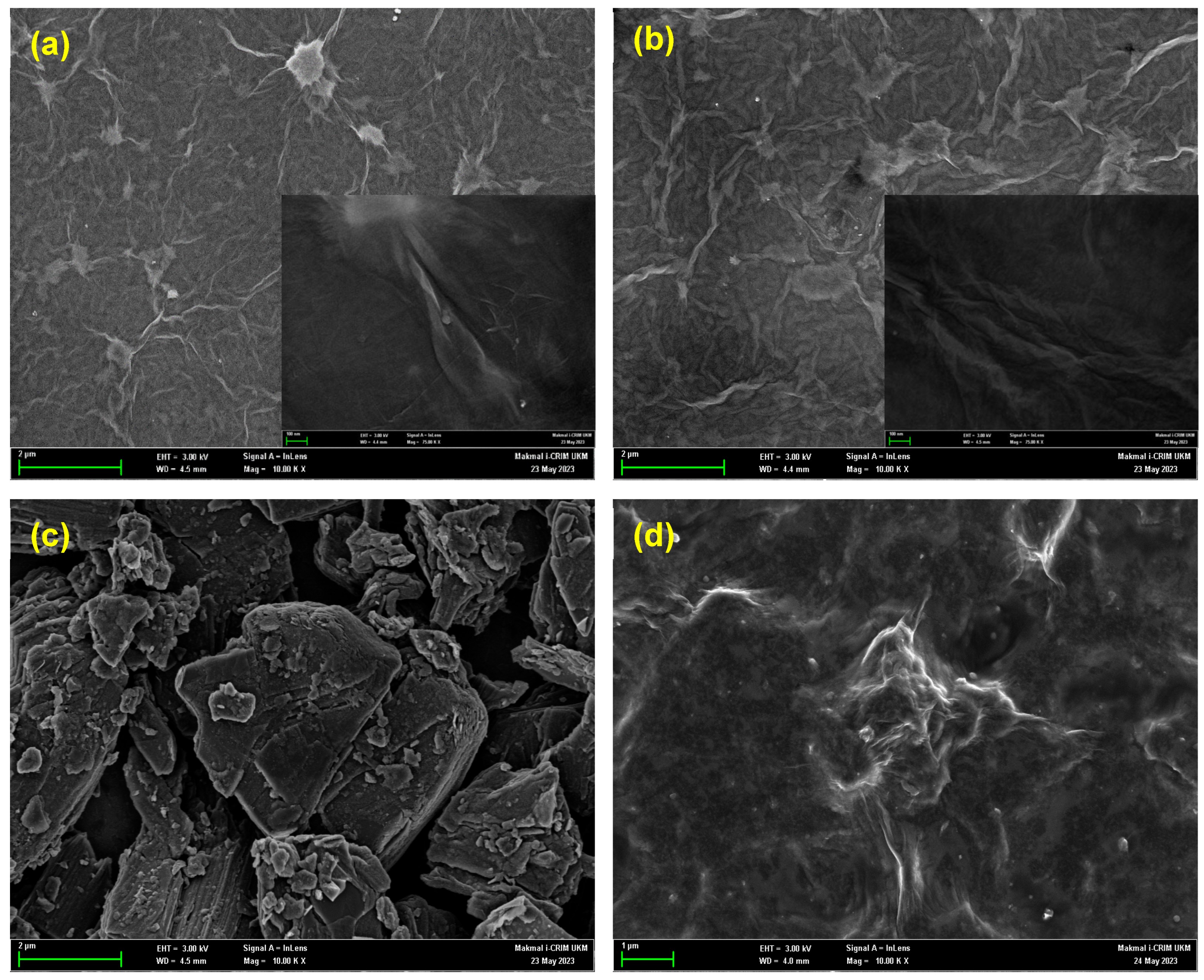
Figure 5.
(a) Elemental mapping (elements: Ti, C, O, Al) of Ti3C2Tx-rGO composite, and (b) EDX of Ti3C2Tx-rGO composite.
Figure 5.
(a) Elemental mapping (elements: Ti, C, O, Al) of Ti3C2Tx-rGO composite, and (b) EDX of Ti3C2Tx-rGO composite.
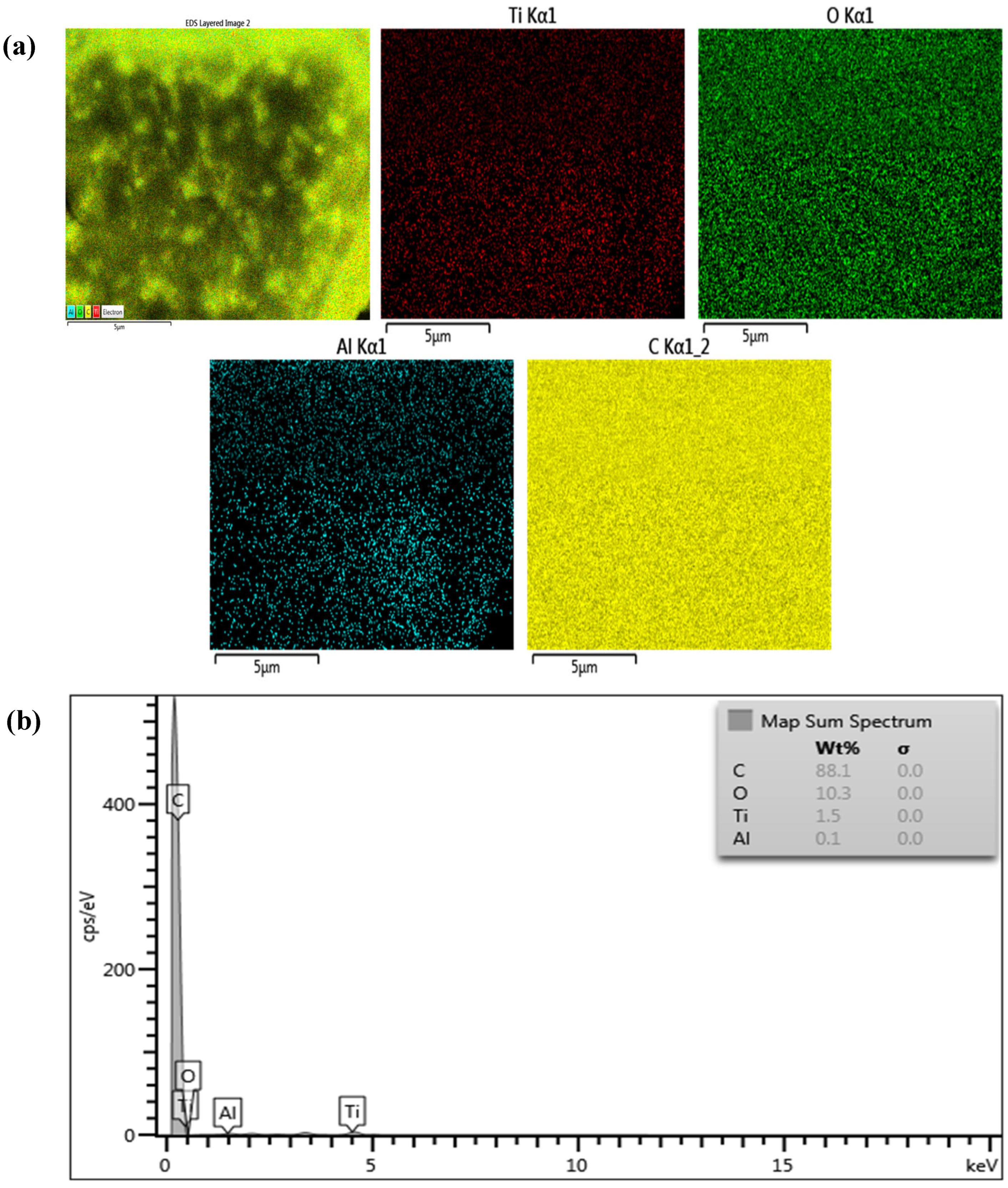
Figure 6.
(a) Wide scan XPS spectra and the high resolution (b) Ti2p, (c) C1s, and (d) O1s, of Ti3C2Tx-rGO composite.
Figure 6.
(a) Wide scan XPS spectra and the high resolution (b) Ti2p, (c) C1s, and (d) O1s, of Ti3C2Tx-rGO composite.
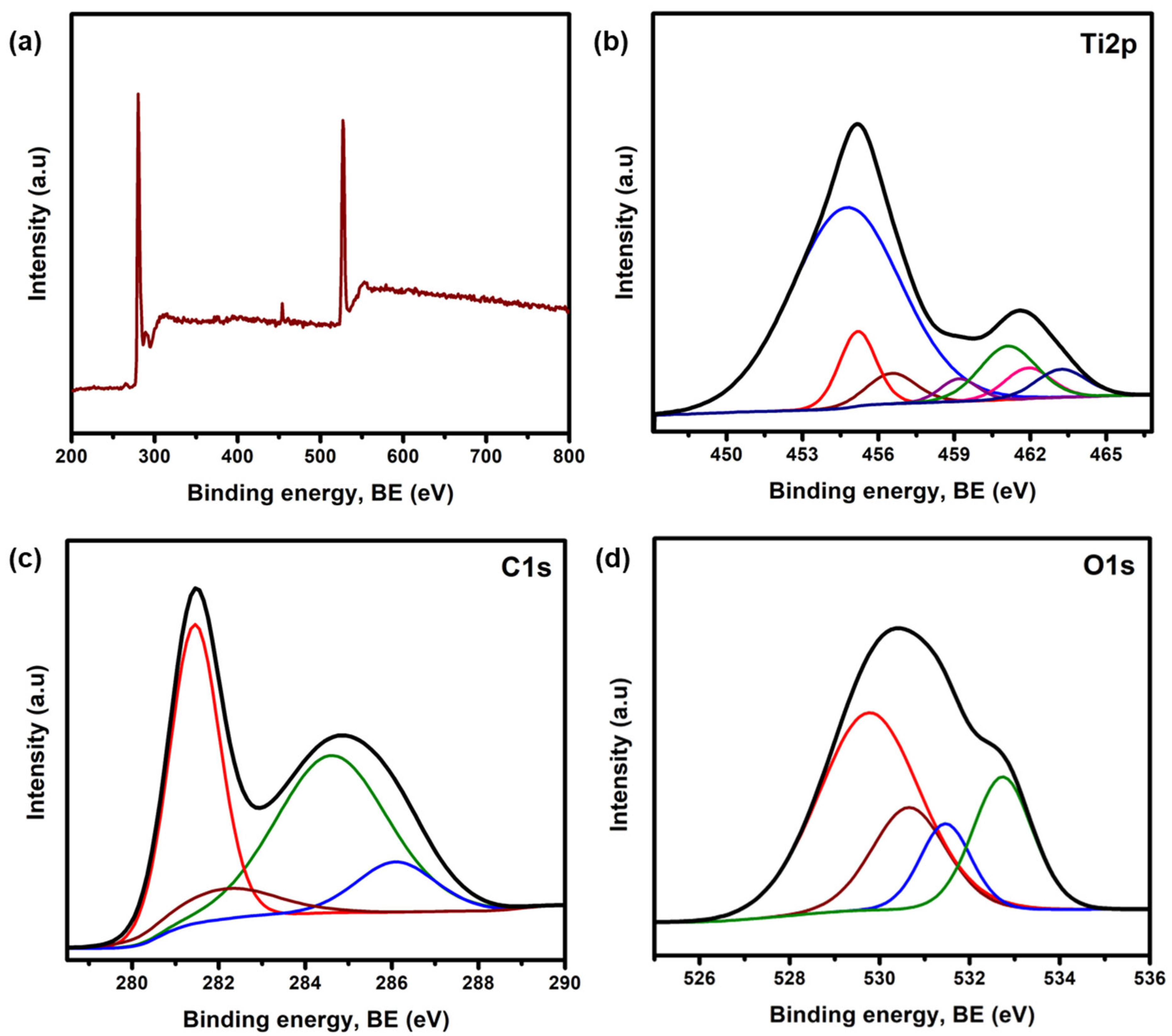
Figure 7.
Differential pulse voltammogram of (a) various electroactive materials at pH 5 and (b) Ti3C2Tx-rGO composite in PBS solution (1mM Cd2+ and 1 mM Cu2+) altering the pH from 4 to 6.5. (c) PBS pH on the peak current of Cd2+ and Cu2+ effect (inset: detailed Cu peak current response against the pH) and impact of PBS pH on the peak potential of (d) Cd2+ and (e) Cu2+.
Figure 7.
Differential pulse voltammogram of (a) various electroactive materials at pH 5 and (b) Ti3C2Tx-rGO composite in PBS solution (1mM Cd2+ and 1 mM Cu2+) altering the pH from 4 to 6.5. (c) PBS pH on the peak current of Cd2+ and Cu2+ effect (inset: detailed Cu peak current response against the pH) and impact of PBS pH on the peak potential of (d) Cd2+ and (e) Cu2+.
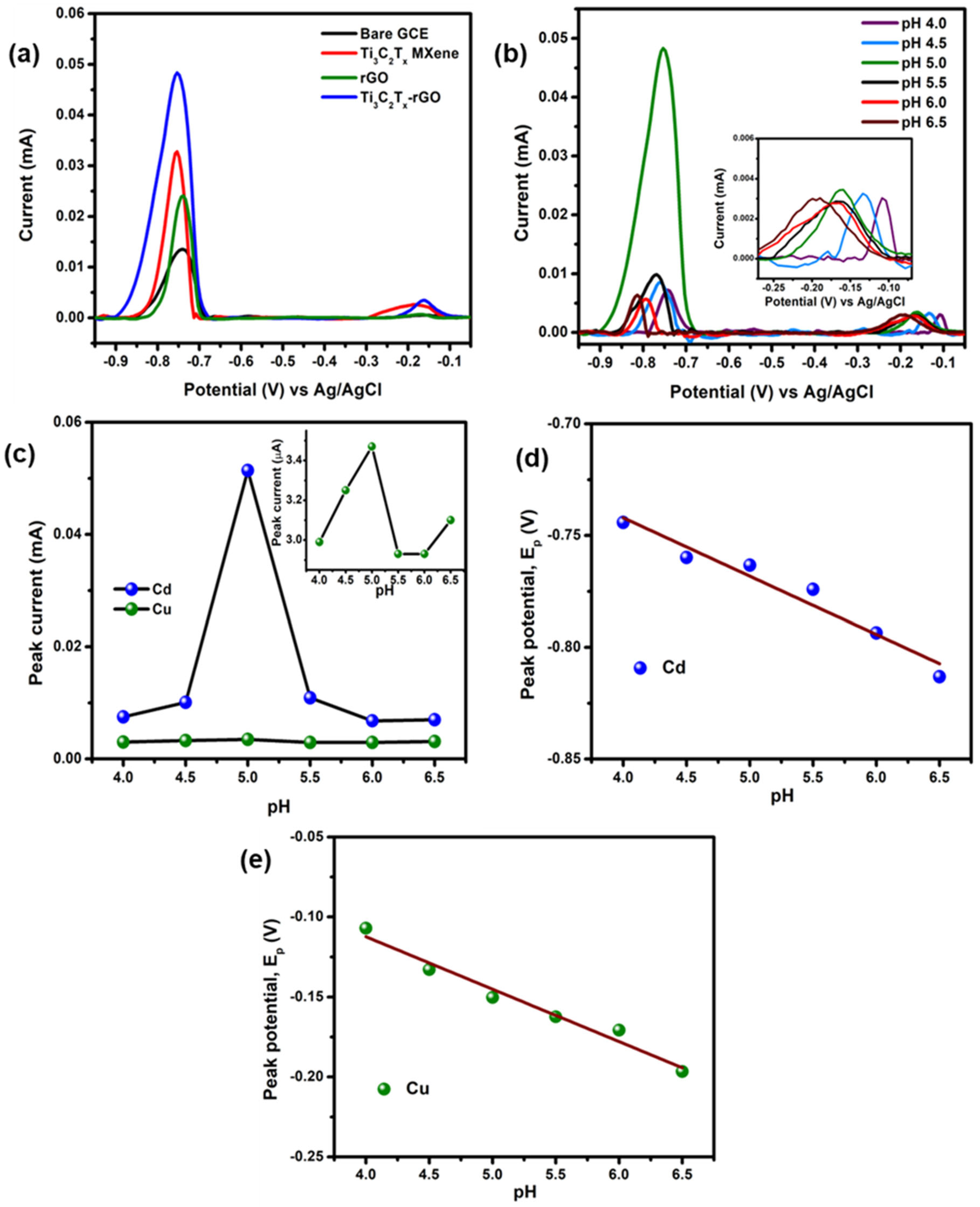
Figure 8.
(a) DPV response of Ti3C2Tx-rGO electrode for the detection of Cd2+ and Cu2+ in the PBS solution (pH 5). DPV plot of Ti3C2Tx-rGO electrode at different concentrations for (b) Cd2+ (7.5-150 nM) and (d) Cu2+ (1-150 nM) detection with the calibration plot for both (c) Cd2+ and (e) Cu2+ with error bar: standard deviation for n=3.
Figure 8.
(a) DPV response of Ti3C2Tx-rGO electrode for the detection of Cd2+ and Cu2+ in the PBS solution (pH 5). DPV plot of Ti3C2Tx-rGO electrode at different concentrations for (b) Cd2+ (7.5-150 nM) and (d) Cu2+ (1-150 nM) detection with the calibration plot for both (c) Cd2+ and (e) Cu2+ with error bar: standard deviation for n=3.
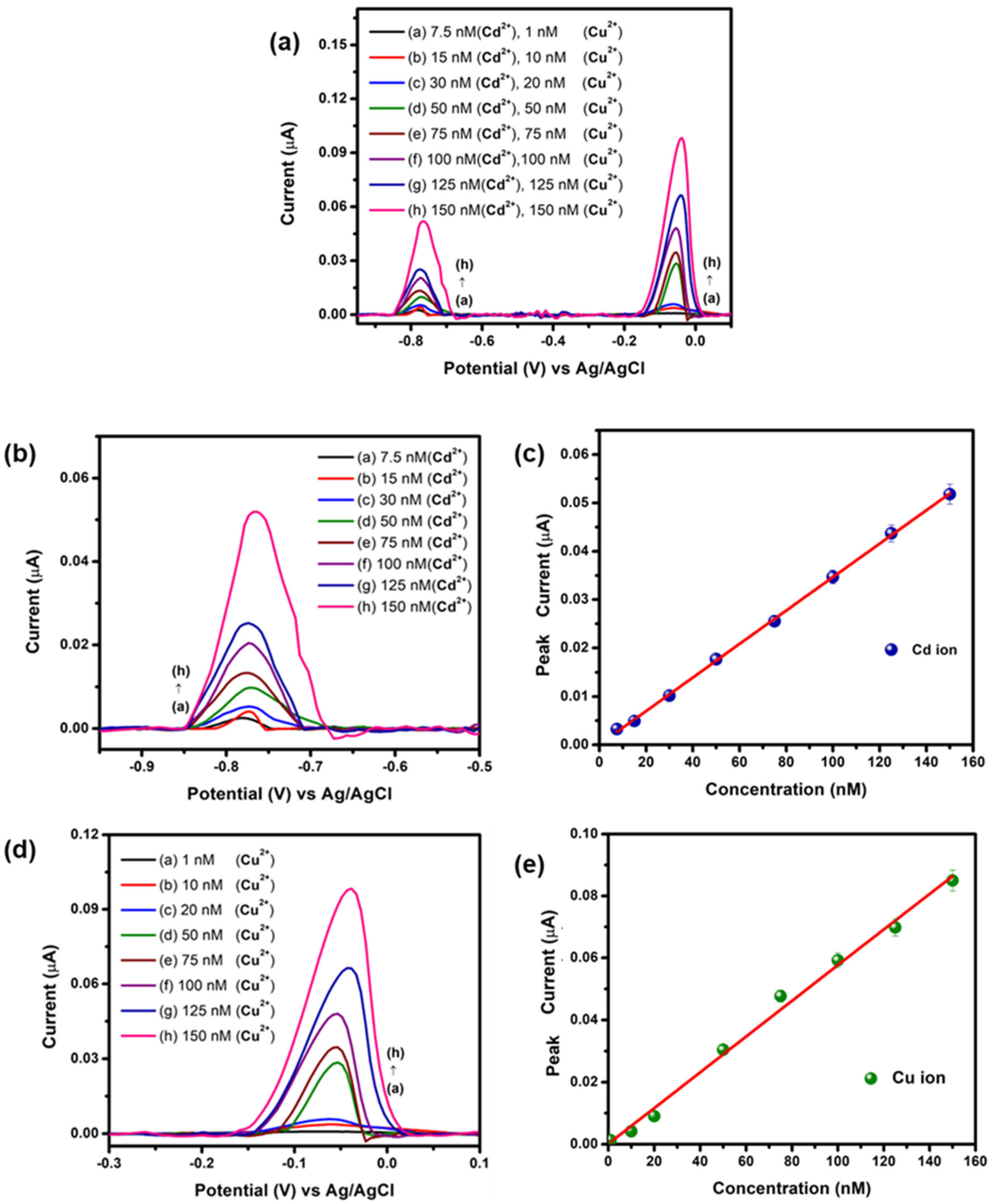

Table 1.
Performance of various MXene-based electrodes for heavy metal detection.
| No. | Material | Heavy metal detected |
LOD (nM) | Linear range of detection (μM) | Reference |
|---|---|---|---|---|---|
| 1 | alk-Ti3C2 | Cu2+ Cd2+ |
39.00 82.00 |
0.1-1.4 μM 0.1-1.4 μM |
[45] |
| 2 | H–C3N4/Ti3C2Tx | Cd2+ Pb2+ |
1.00 0.60 |
0.5-1.5 μM 0.5-1.5 μM |
[46] |
| 3 | Ti3C2@N-C | Cd2+ Pb2+ |
2.25 1.10 |
0.1-4 μM 0.05-2 μM |
[47] |
| 4 | BiNPs/Ti3C2Tx | Cd2+ Pb2+ |
12.4 10.8 |
0.08-0.8 μM 0.06-0.6 μM |
[48] |
| 5 | Ti3C2Tx-rGO |
Cd2+ Cu2+ |
0.31 0.18 |
7.5-150 nM 1-150 nM |
This work |
alk-Ti3C2: alkaline intercalation of Ti3C2, H–C3N4/Ti3C2Tx: protonated carbon nitride/Ti3C2Tx, Ti3C2@N-C: nitrogen-doped carbon-coated Ti3C2-MXene, BiNPs/Ti3C2Tx: bismuth-nanoparticles/Ti3C2Tx .
Table 2.
Stability study of Ti3C2Tx-rGO electrode for the detection of Cd2+ and Cu2+.
| Stability period | Peak current retention (%) | |
|---|---|---|
| Cd2+ | Cu2+ | |
| 1 Week | 98.19% | 99.81% |
| 2 Week | 98.61% | 99.48% |
| 3 Week | 99.89% | 98.49% |
| 4 Week | 97.86% | 98.01% |
Table 3.
Recovery data on concurrent detection of Cd2+ and Cu2+ in lake water (n=3).
| Sample | Added (nM) | Obtained (nM) | Recovery (%) | |||
|---|---|---|---|---|---|---|
| Cd2+ | Cu2+ | Cd2+ | Cu2+ | Cd2+ | Cu2+ | |
| 1 | 60 | 60 | 58.4 | 58.9 | 97.3% | 98.2% |
| 2 | 80 | 80 | 78.1 | 79.3 | 97.6% | 99.1% |
| 3 | 100 | 100 | 98.9 | 99.5 | 98.9% | 99.5% |
Table 4.
Recovery data on concurrent detection of Cd2+ and Cu2+ in tap water (n=3).
| Sample | Added (nM) | Obtained (nM) | Recovery (%) | |||
|---|---|---|---|---|---|---|
| Cd2+ | Cu2+ | Cd2+ | Cu2+ | Cd2+ | Cu2+ | |
| 1 | 60 | 60 | 58.7 | 57.6 | 97.8% | 96.0% |
| 2 | 80 | 80 | 78.2 | 78.3 | 97.8% | 97.9% |
| 3 | 100 | 100 | 99 | 98.8 | 99.0% | 98.8% |
Disclaimer/Publisher’s Note: The statements, opinions and data contained in all publications are solely those of the individual author(s) and contributor(s) and not of MDPI and/or the editor(s). MDPI and/or the editor(s) disclaim responsibility for any injury to people or property resulting from any ideas, methods, instructions or products referred to in the content. |
© 2025 by the authors. Licensee MDPI, Basel, Switzerland. This article is an open access article distributed under the terms and conditions of the Creative Commons Attribution (CC BY) license (http://creativecommons.org/licenses/by/4.0/).
Copyright: This open access article is published under a Creative Commons CC BY 4.0 license, which permit the free download, distribution, and reuse, provided that the author and preprint are cited in any reuse.


