

Submitted:
01 April 2025
Posted:
02 April 2025
Read the latest preprint version here
Abstract
Human psychology has been playing major contributory factors in the calibration of human medicine, as it is cognitive perception that has ultimately shaped the trajectory of medical progress. Such perceptive patterns are dependent upon the integrity of emotional and intellectual levels of intelligence, meaning that good emotional states can significantly contribute to shaping medical and scientific progress. Throughout the paper, the topic of the progressive loss of balance in societal perspectives, attitudes and behaviours will be thoroughly assessed, given that such loss of balance often results in a phenomenon known as “throwing the baby out with the bathwater”, in which good values are rooted out with the bad habits infiltrated into emerged branches. For example, the increasing epidemic of loneliness, isolation and deprivation of affection has resulted in the creation of an inaccurate perception upon the importance of solitude and self-reflection due to a generated excessive emotion of craving for human affection, which has often translated into practices of dependency upon social contexts, attachment to mismatching relationships, promiscuity and unhealthy, unexplained abandonment. Such increasing events have created unprecedented frictions within societies, which resulted in the skyrocketed extent of trust issues and isolation among people and consequently, to a steep decline in the average extent of human mental health and emotional wellbeing. Such societal frictions have significantly manifested even within biological families, which itself represents a direct factor for the recent increase in the number of people registered as “homeless”. It is therefore evident that loneliness and homelessness represent two opposite ends of the same sequence of events, as homelessness is ultimately dependent upon loneliness and isolation. The author will be presenting an extensive set of theoretical and practical solutions against the ongoing and growing problem of the existing frictions within human relationships by encouraging proportional workshops and novel lifestyles aimed at gradually repairing the created damages of human trust, with an emphasis upon existing projects of “mental health first aid”, “cuddle therapy”, “cuddled bed & breakfast” and even similar practices to be incorporated into regular housing, which may be regarded as “cuddled renting” or “housing”, as well as workshops in retreat and camping settings, alongside the creation of theoretical and practical courses to help each participating member apprehend the depth of the details covering consent, boundaries, as well as health and safety.
Keywords:
psychology
; social psychology
; emotional intelligence
; wisdom
; philosophy
; central nervous system
; encephalon
; neuron
; neurotransmitter
; medicine
; informed consent
; redistribution
; recovery
; boundary
; holistic approach
; talk therapy
; mental health
; emotional wellbeing
; nature
; nurture
Introduction
Throughout the recent three decades, first-world
countries have been experiencing steep declines in the rates of both extent and
quality of human relationships, with reports of abuses, break-ups, divorce and
“cheating” having skyrocketed. Consequently, the phenomenon of increasing trust
issues has become a dilemma, severely impacting the average and median quality
of mental and emotional wellbeing due to rising levels of loneliness and
isolation. We have been ghosted and become ghosts ourselves, when we all came from
the same soil and have a real soul aspiring for the “mathematical” limit of
infinite love as described through a paradoxical calculus analogy based on
Gabriel’s Horn (also known as Torricelli’s Trumpet), in which the volume of the
liquid filling the created structure is finite and the surface of the structure
is infinite. Such a paradox is possible because, from the reader’s point of
view, the drawn curves of the Gabriel’s Horn surface are themselves finitely
visible in the viewer’s eyes and they are thereby seen to intersect at a point,
despite the fact that they continue their curved extension until the point of
infinity. Such a paradox is explained by Albert Einstein in his views on the
existence of a Universal Creator, as he once stated “God works behind the
curtains of coincidences”, given that paradoxes technically consist of
coincidences whose “correlation” cannot be found using scientific or
statistical measures of analysis.
Figure 1.
Gabriel’s Horn, also known as Evangelista Torricelli’s Trumpet (Math is Visual, 2024).
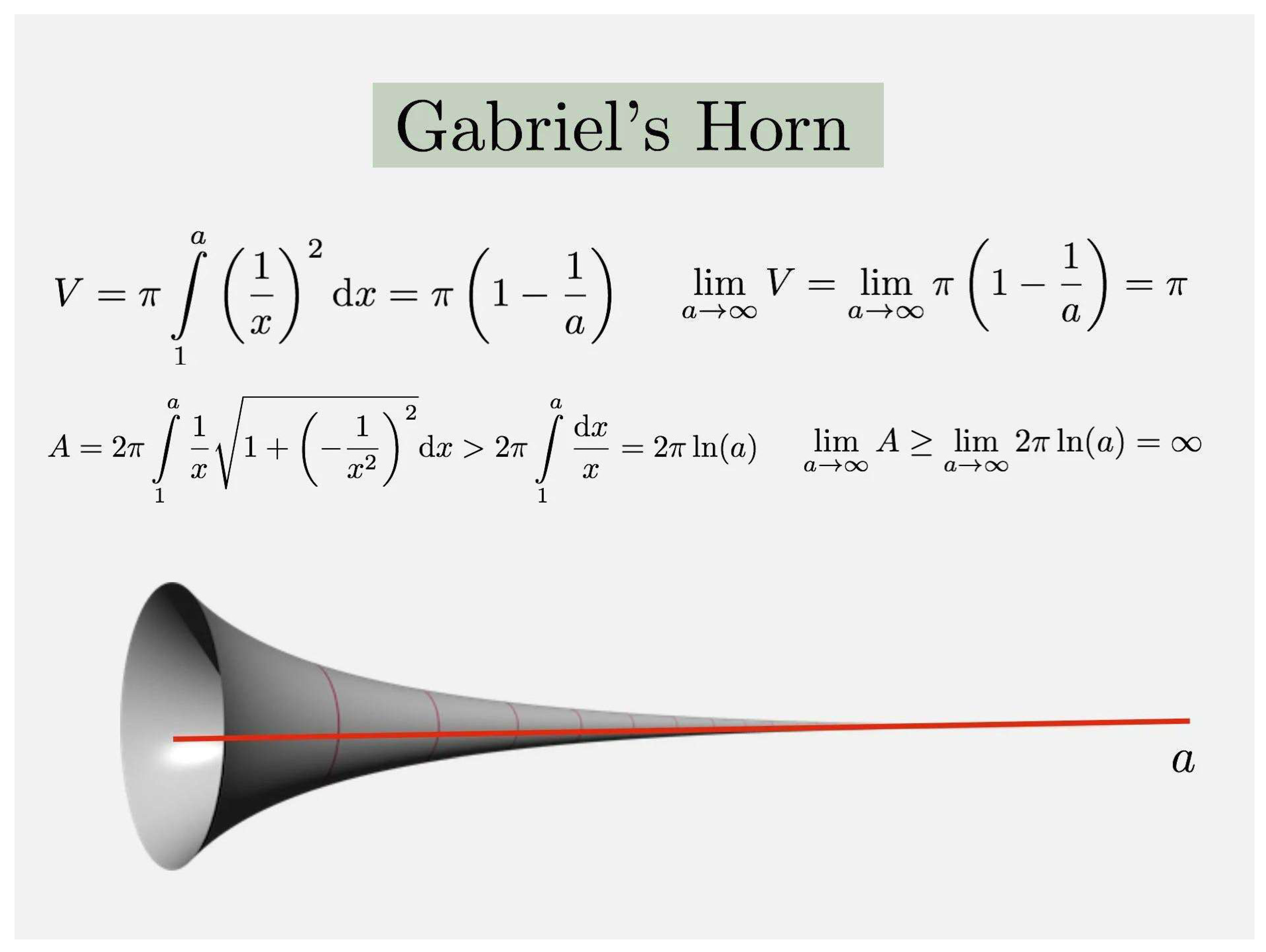
In such a figure, a mathematical principle covering
derivative functions and limits is explained via four formulae, pointing to the
paradoxical co-existence of an infinite structural surface [2 * pi *
ln (a)] and a finite liquid volume [pi * (1 - 1 / a)] filling such a
structure with two lines being infinite in nature. Interestingly enough, the
curvature of Gabriel's Horn is shaped in a similar manner with the curvature of
the human hug, ultimately pointing to the infinite value of human unconditional
love, whence true affection emerges from. Such an analogy may represent an
important example of the manner coincidences operate outside of the system of
scientific and statistical forms of measurements, in spite of their highly
advanced stages.
Younger generations have been continuously warned by their wise parents and elderly that the end of the world will come when the footpaths between households cease to exist, and it is possible that humanity has been approaching such an irreversible state of human destruction. Furthermore, it seems that natural phenomena have started “rebelling” against the worst type of oppression, which represents human indifference. It is indeed worse for someone to be left to die in internally agonising states than for someone to be physically abused, for it is such an occult form of oppression that is the worst, just as the enemy is the most powerful when one lacks knowledge regarding the direction whence his attacks come from. We have become emotionally, mentally and physically blind, and the love for the neighbour is now in a state of coma. How may then God still pour down His love, in the vertical plane of His Cross, when the horizontal plane of His Cross is continuously being cut off? Despite the fact that true love does fight hard until the end, she does not break through the ultimate law of human free will, created by God to “morally” select His people. Will this lead to the final end of the world, or does this mark a prelude of a final metamorphosis of mankind, promised in the Book of Matthew in the Holy Scriptures? Will this mark the absolute end, or is it the darkest moment of a grand, full solar eclipse preventing numerous people from receiving the rays of manifested unconditional love? It is the full expression of the human free will that will determine the true course of events in the future, as humans represent icons of God who can become perfected once again. The rise of mental blockages via the occurrence of various mental health difficulties has led to the isolation of the human soul in the prison of the rationalistic mindset. The escape from such a cell is not horizontally or upward, but actually in a descending manner, toward the heart, just as the righteous people from the Old Testament were peacefully descended into Abraham’s Bosom before Christ finally descended into Hades and conquered death for good. In such a manner, we ought to descend into our hearts and fully overcome negativity from within, rather than using a rationalistic perspective. Likewise, it may now be time for humanity to create a plan of response that will aim to proportionally tackle the modern-day dilemma of isolation, loneliness, trust issues, promiscuity, break-ups and divorce. It may be that it is now time to ease the focus upon an existing widespread objective to avoid physical contact at all times, according to guidances that it would be better not to touch a woman, given the current context that radically differs from the context of the Ancient era, where people would experience fully proportional and balanced extents of platonic intimacy. At the same time, the objective of avoiding immorality should be treated with the same, utmost importance. Apostle Paul once said that he would rather break rules if such an action led to the genuine salvation of people’s souls. The only way to defeat evil is from within, and not from without, meaning that people may need to re-learn the structure of building up a healthy hierarchy of human connection and platonic intimacy through practicing it correctly, rather than through complete abstinence. Certainly, the time for human solitude is sacred and needs to be respected in such a manner. At the same time, there ought to be an existence of a 10-20% time of expressing human connection and intimacy, for it is such moments that may be as sacred as solitude and, whose inexistence may affect one’s perception upon the importance of solitude and/or even its healthy rates of practice. In other words, the theme of the discussion would be an emphasis upon the importance of re-shifting to an overall balanced way of perspective and lifestyle to attenuate the modern-day problems that have become well-known in the disciplines of psychology, medicine and even morality. Mankind lives in such times that love now needs to leave the one sheep to find the lost ninety-nine sheep, compared to the times when love had to leave the ninety-nine sheep to find the one lost sheep. In other words, true love has now reached a minority in society, but hope should not be lost, for even a 0.1% extent of light makes a 99.9% extent of darkness flee by itself. Light does not need force to occupy a room. In the same manner, true love does not need to be expressed by force, but by her gentle and patient, natural course. Likewise, it may now be time to academically support the scientific evidence that healthy boundary-based sessions of platonic intimacy expression among volunteers leads to an effective reversion of the emotional problems seen in modern-day society. The objective of such a broader academic recognition could help such an overall movement evolve into states that would bring healthy and consensual platonic intimacy spread in normative, day-to-day life of a population majority, effectively helping members of society not feel excluded from their needed social encounters any more. For example, the movement of occasional, weekly or monthly “cuddle workshops” could evolve into a movement of regular “cuddled bed & breakfast” and eventually perhaps even “cuddled housing”, in which participating volunteers could eventually begin cohabitating in both short- and long-term manners. The overall scope of such project initiatives covers the key word of “re-creation” via helping human participants return to their natural origins and reach a state of balance again, which constitute the sole methodology of ensuring that humans will continue their journey of evolutionary growth.
Methodology
Scientists, psychologists and talk therapists could devise an extensive and international plan for the gradual creation of bubbles and networks of people offering the levels of emotional support described in the manuscript, all in accordance with the laws of nature, individual and social psychological receptivity, informed consent and healthy boundary, which may be as the extensive set of layers covering an onion, which is regarded as one of the healthiest vegetables. First, surveys could be created and distributed to samples of hundreds of participants in various national and international areas to assess the psychological, religious and cultural backgrounds of people before creating estimations of rates of receptivity to such potential implementations. Then, statistical pools and tests could be created to thoroughly confirm whether a positive difference will be made and then to determine the extent of difference occurring as a direct or less direct result of it. Chi-squared tests and T-tests could be created to determine whether the null hypothesis that there will be no positive difference made can be accepted (p-value ≥ 0.05) or rejected (p value < 0.05) based on the responses of the sample populations and on scientific projections, and whether there is any existing probabilities of significance that any collateral damage would be resulted from such actions. If all the results indicate a significant induction of positive changes which would include the UN’s Agenda for Sustainability, as the need for the natural environment to recover is proportional with the need for the current state of human connection to undergo such recovery, and an inexistence of risks of unwanted effects upon human biology and psychology, as well as the integrity of the environment, volunteers could gather in virtual and physical groups to start physically devising such a strategic plan of gradual and consensual human reconnection in careful steps. For example, it may be wise for project leaders and volunteers to first begin a process of “positive infiltration” into the “AirBnB” project, by clearly mentioning the plan of offering night-time safe spaces for people who have underwent deeply traumatic experiences in the past due to abuse, physical violence, violation of consent and/or perpetual, severe deprivation of physical affection. For the sake of human safety and informed consent, such “AirBbB”-related projects would involve at least three people per room. A potential instance of activity as such would implicate volunteering participants in engaging in gentle stroking and head hugging as a method to foster emotional integrity, with qualitative analysis of observed affectionate interactions, having ensured that a full extent of informed consent was clearly reached beforehand.
Some volunteers and leaders could be assigned as night-time security officers to ensure that all the rules are respected to the letter. Following a night of consensual comforting among participants, the last stage of the session would involve a harmonious breakfast and an optional “cuddle cafe”-centred rest of 30-60 minutes, before the session officially ends. It is important to accurately calculate the value of financial goods, which are regarded as “an important symbol of freedom”. Simultaneously, it would be most critical to place the purpose of the mission in the highest spot, with an immediate second spot being an openness to the unspoken principle of interest, which was regarded by Albert Einstein as “the Eighth Wonder of the world” and may also be regarded as the principle of abundance. Such a principle represents a viable extension of the First Law of Thermodynamics that states energy can neither be created, nor destroyed, from within the physical world, indicating that the Universe consists of a limitless number of energy exchange processes. If the two principles are correctly joined together and applied in the real-world, people become fully capable of easily achieving true prosperity, which is both emotional and material in nature. In the end, if all such projects are positively received within society, the movement of “Cuddled Housing” may be finally implemented, in which like-minded and like-hearted people may have the opportunity to gradually connect and relocate into house sharing types of rented accommodation with the purpose of relocating into a permanent safe space of boundary, consent and voluntary platonic intimacy. Such a process is preliminary estimated to considerably reduce the excessive rates of physical abuse, relationship and family breakups, promiscuity and pornography, thereby having the potential of successfully helping people return to their natural and nature-friendly origins, which know no immorality, deprivation and adultery.
Discussion
The philosophy behind such analyses and ideas is Christianity, with the Cross representing the central symbol. Namely, the human hug has the shape of the Cross, which reminds Christians of the ultimate, sacrificial love of God expressed upon the Cross on the Golgotha Hill through His ultimate, divine hug of love and forgiveness for the entire mankind. The Cross represents a lively and manifesting symbol of death to one’s own ego and resurrection of one’s inner icon of God. The Cross covers the two most important commandments in the Holy Scripture; on the vertical plane, to love God with one’s utmost might, and on the horizontal plane, for people to love their neighbours as themselves. The Cross not only represents God’s divine Hug for mankind, but also the divinely-inspired hug between each person. Such an analogy explains that it is not sufficient for a person to express self-love, whilst depriving their neighbour from love, given the fact that every person expresses the same reflection of the image and likeness of God, essentially meaning that, when a person looks at their neighbour, it is the same as the person looking in the mirror. Given that faith without works is dead, so love without physical expression is dead. Likewise, self-love without the love for the neighbour is dead, for it reflects a false, egotistical “love” that leads to the “mathematical” limit of the infinite agony of hate if a change of mind does not occur. When we truly love our neighbours, we become crucified because we suffer with them. Suffering is allowed for the purpose of endurance and transformation of a “heart of stone” into a soft heart. Many times, such a process involves inner crucifixion, as people themselves undergoing a transfiguration at the level of their soul experience suffering and abandonment from many other people. Such a process may only teach the participating person about the ultimate suffering that Jesus Christ endured on the Cross, and the fact that He, being God, shouted: “My God, My God, why have You forsaken Me?” shows the Universal nature of suffering, how it is inevitable for any living inhabitant of the Earth, and how it is suffering that is the fire that either refines gold or turns fallen branches of an unfruitful tree into ashes. The Cross is regarded as a bridge to eternal joy and involves a journey through depths of sacrifice and suffering, just as there is usually a bridge between sunny weather and snowy weather through the tears of rain, which lead to the forgiveness of God via the transfiguration of rain drops into snowflakes. When people truly seek to be in touch with their origins and Creator, they will experience a similar path of sacrifice and suffering as He did, but they will ultimately acquire a state of absolute joy as a result of such an experience, of suffering with Him, like Him and in Him. The ground is then finally covered in a deep, golden bright layer of snow, as divine forgiveness wholly covers the heart purified via suffering and tear drops. Events as such often occur on Christmas Eve, when mankind prepares to remember the Birth of God on Earth through the Virgin Mary. Through the Path of the Cross, people become born in the next, eternal life with the eternal and infinite God, in a deep, wholly communion with the other inhabitants of Heaven. Homelessness is not only about the lack of a roof above a person’s head, but also about the lack of heat in one’s own heart, as loneliness represents the worst type of homelessness. All mankind is made of soil and has a soul gravitating towards the absolute point of unconditional love. All people are like trees, dancing together under the gentle breeze, and their shadows cover each one’s weaknesses. All people are like trees, but in order to manifest their gifted image as an individual tree filled with life and emanating life, they need to open their arms and practice affectionate embraces, for a tree is not dead, but on the contrary, a living manifestation of love- and life-giving. Large groups of people are like forests, covering, dancing with and finally embracing each other under the slow music of the soft evening breeze. It may be important to reiterate the critical importance forests play in the maintenance of life on Earth, given the fact that the greatest forest in the world is regarded as “the Earth’s Lung”. In the same manner, only a great unity of people will maintain the function of the lung of unconditional love, gathering millions of breaths of life. All people are as uniquely beautiful as the countless stars observable during clear nights. People’s strengths cover each other’s weaknesses. God Himself became an Earthly tree, died for mankind on a wooden cross shaped like a tree, resurrected on the third day, made mankind whole and one again, and made Himself available as the Tree of Life. Mankind shall be as a living Body, a Temple with all building materials united in one. All people shall dance with each other under such gentle breeze, and eat from the Tree of Life, so all people may truly eat and be merry, and live eternally. We are all like uniquely valuable musical instruments, and we need to “play” each other according to our tunes (needs) to maintain the melodic harmony of the Earth. We are all like uniquely valuable paintings, and we need to paint each other’s faces, hair and emotions according to our unique colours (personality), through gentle and fine strokes, as well as platonic caressing, to make the overall paint of mankind powerfully and deeply colourful. In the same way that such paintings often need washing, so we occasionally need a platonic “bath” of embraces and oneness. Afterward, a “long hug” of background colouring, surrounding the face and head of the unique human can occur, creating the overall picture of the Icon of God. Throughout the present life, the cycle ought to be repeated, as it constitutes a form of pregnancy for the next, eternal life with infinitely expressed feelings of love and joy throughout the New Realm. Just as there is no actual summit in the journey of personal development, so there is no summit in the melodic harmony and manual picture of humans and community-related oneness.
The SARS-CoV-2-induced COVID-19 pandemic of March 2020 - May 2023 has substantially aggravated the second, indirectly visible pandemic of human loneliness, whose principal “symptoms” include isolation, trust issues, frequent relationship separation and false, intermittent hope. During the COVID-19 pandemic, it seems that the memory of healthy human bonding has fades in many cases, given that acts of unconditional love and affection seem to have been widely forgotten, as people have isolated themselves in a bubble of individual “work from home”, having placed an excessive emphasis upon technology and artificial intelligence-based work and interaction catalysis, rather than proportionately using such mediums to catalyse healthy processes of human reconnection with each other and with nature. Likewise, in spite of the evident end of the COVID-19 pandemic, it seems that the loneliness pandemic is still ongoing and has become chronic in nature, with a recovery not seen anywhere near in sight. Even though the light at the end of the tunnel has physically been reached, it seems that the other light at the end of the tunnel that covers needs of the human states of emotion and soul has still not been reached, and there may be pessimistic perspectives in which a reach of such an immaterial light is as possible as physically reaching the state of infinity in the Gabriel’s Horn surface. Nevertheless, it may be important to remember the existing rule of the paradox, where infinity is actually reachable, just as there is a finite volume of a liquid that may fill in the interior space of Gabriel’s Horn. The difference that can be made likewise is a successful change of mind and perspective, which is at least as powerful as crossing through metaphysical portals, given Albert Einstein’s emphasis upon its importance in reaching major scientific breakthroughs, which is as major as reaching such a limit of mathematical infinity. It may also be that humanity has still not reached a desired event of a major vaccine discovery that would not only prevent the onset of a future major epidemic, but successfully induce a reversing process in the evolution of pathogenic agents of potential public health concern, as a result of us not having reached a threshold level of occasional change of mind, which may be as important as the performance of occasional updates in computers to preserve their qualitative and safe functioning. In the same manner, mankind needs safe change of mind occasionally to ensure her continuous qualitative functioning on Earth.
The central scope of the movement of creating conscious, boundary-based human connections is to facilitate and ensure a full extent of freedom of choice, consent and expressing positivity within one’s own self, in order to become capable of reflecting such light to other people automatically, in a “mirror reflection” manner. People will not be able to love their neighbour if they are not willing to truly love themselves in a humble manner, just as people will not be able to love themselves truly if they do not love their neighbour as themselves. Behind such a paradox lies the absolute state of societal health and wellbeing. It may be important to first create a few surveys for greater population samples to assess the dilemma of people being deprived from genuine platonic intimacy that involve pure acts of stroking, hair playing, long hugs and embraces, as well as hand holding, to assess the depth of such a dilemma and help trained volunteers prepare to individually and collectively start addressing it to its utmost core, with the important groups of people representing the younger adult generations, as they can be positively influenced into potential emerging role leaders for such a conscious human connection movement to be gradually extended into day-to-day life. It may be that the concept of cuddle therapy and “cuddle cafes” have started losing traction as a result of its failure to reach the need of many people to experience such kind acts of offering platonic intimacy in their daily lives. Another reason why such a concept may have started losing traction lately is because financial hardship has impacted an increasing number of people and may have prevented many of them from affording such services. An effective extension of such human connection-providing acts into daily life may not only reignite public interest in the concept, but even increase it to record levels, as there would be a much wider availability of such emotional resources, leading to an effective decrease in price, as well as to an increase in the availability of new spots for new entrepreneurs and volunteers in teams providing safe spaces as such.
Genuinely listening to each other, practicing honesty, communicating to each other, respecting each other’s needs for boundaries and consent, comforting one another in our tough times, being there for one another until the end, putting each other to sleep, healing each other’s emotional wounds through continuous hugging at night, having breakfast together, and potentially repeat the cycle. This is more than just a project, it is a creation of lasting human connections. It aims for us to return to our origins of practicing regular, deep platonic verbal, non-verbal and physical communication. It may be that such updates in conscious human connection will even start reversing the ongoing process in which clinical cases of various mental health conditions have increased experimentally within the past several years and few decades. Interestingly, deprivation of physical affection during early stages of human life may be associated with higher incidences of the onset of neurodevelopmental delays, which themselves may favour the onset of various mental health conditions, like obsessive-compulsive disorder, attention-deficit hyperactivity disorder, generalised anxiety disorder, depression and bipolar disorder. A recent sharp increase in the number of patients prescribed with selective serotonin reuptake inhibitors may represent an important sign that society may need an easier accessibility to informed consent with regards to availability and provision of human affection. The continuous rise in the number of people experiencing collateral forms of damage as a result of various mental health conditions is indeed concerning for the population, authorities, doctors and scientists, and does represent a considerable factor for the stimulation of creating a proportional plan of resolution that would involve an effective reversing of such devastating effects upon people, whose initial intentions may not have been negative in nature.
Implemented medical plans for the effective combat of the rising of mental health conditions have proven to decrease symptomatology, with patients experiencing loosened states of anxiety and depression, and stronger mental and emotional connection to their surrounding environment. For example, selective serotonin reuptake inhibitors, which are abbreviated as SSRIs, have played a role of “serotonin traffic redistribution” due to an existing problem of excessive reabsorption of the neurotransmitter into the same neuron, which is chemically responsible for the amplification of various mental health disease symptoms, according to the principle of interest described by Albert Einstein, which amplifies any engaging pattern of activities, whether positive or negative. In the case of such medical treatment, the SSRIs have been responsible for a redistribution of proportional amounts of serotonin to more widespread areas of the cerebral neuronal system, which has resulted in improved symptoms of anxiety, obsessive thinking, depressive symptoms, as well as repetitive and even self-harming behaviours. Such an aspect may be described as an effective resolution of traffic jams by various police officers, which may first be perceived as a negative experience due to the rise of further inconveniences, before all people experience their desired freedom of movement on the roads again. In the same manner, the organism may first resist patterns of SSRI agents blocking the reabsorption of serotonin into the same neuron, as it may experience physiological inconvenience due to the need for a chemical effort of inducing a wider and more proportional redistribution of the neurotransmitter throughout the encephalon. Such an aspect points to the high importance of maintaining discipline and humility, which helps people increase their level of tolerance to unexpected and unwanted environmental changes, given the need for their endurance in order to experience their needed breakthrough in the end. In short, suffering is inevitable and, if the right mindset and emotional state are reached, then the suffering will be used as a bridge to indefinite joy, as the participating person will be as gold refined by fire. According to Albert Einstein, a problem cannot be resolved using the mindset a person had when it occurred, meaning that change of mind should be as inevitable as suffering.
Religious hypocrisy has prevented the development of healthy human connections due to an excessive emphasis upon refraining from any kind of physical touch until the point of marriage. The issue with such a perception is that marriage is often seen as a hardly achievable point, in a distant kind of future, when the future bride and the groom, alongside their families, will be able to afford the organisation of a wedding. In fact, marriage is the union of a couple who wishes to become one, and it is easily achievable, by becoming serious in the relationship and by trying to make an acquaintance to the partner’s family, in both cases if possible. Given the current times in which it is financially more difficult to organise a wedding, it may be important to reflect upon the foundational manner in which marriage occurs, which comprises the healthy steps of dating and the family blessing part. From the latter, the couple already lives as if married, particularly in the current times, when religious spaces have sadly become dominated by financially-centred ambitions, rather than a genuine aim of reaching oneness with divinity. Likewise, the conscious offering of human affection should represent the bridge to the formation of meaningful human relationships, whether they are merely friendly in nature or more. Nature shall be allowed to follow her due course. God does not prevent the formation of healthy relationships; only efforts of their perversion, which comes from an invisible adversary. Just as Apostle Paul told one of his disciples to drink a glass of wine every day due to his illness whilst telling Christians to avoid drunkenness, people of the opposite gender could be encouraged to practice healthy and platonic cuddling as a way of avoiding temptation, by covering a potential lack of physical, unconditional love with profound and pure, platonic intimacy, before they would become more prone to seek unconditional love in mismatching forms of environment by mistake. The entire purpose would be to separate the secretion of oxytocin from the secretion of oestrogen, progesterone and testosterone. Such a phenomenon is scientifically and philosophically possible and achievable, since correlation does not imply causation. In other words, the secretion of oestrogen, progesterone and testosterone is not directly dependent upon the secretion of oxytocin. Wrong perceptions of misused human sexuality have become rather dangerous weapons against the integrity of human connection, as people have oftentimes mistaken acts of platonic intimacy with sexual immorality. Such an aspect represents a significant contributory factor to the widespread distribution of loneliness, exclusion and deprivation of genuine human affection, which in turn have contributed to the increased incidences of depression, as well as acts of human self-harm and even suicide, which a Creator of Life would be saddest and most upset about. Sin is missing the mark, which happens almost randomly. The objective would not be to randomly rebuke people based on their unwanted shortcomings, but an active and long-term encouragement to continue their journey of personal and religious development, without undergoing unnecessary legalistic approaches, which have proven to cause more harm than benefactory effects. It would be as a constant rebuke of a young child simply because of repeated tripping and falling upon the floor, despite the fact that he is only a child and he would need emotional support, rather than condemnation. Interestingly enough, it was discovered that human platonic intimacy and forms of connection with the divinity (i.e. via prayer, fasting and religiously-organised mountain climbing) favour the activation of the same neuronal region, which suggests that human platonic intimacy is as important as a relationship with the divinity, which is regarded as the umbilical cord of the pregnancy of the current Earthly life that prepares mankind for the next, eternal life. Interestingly, several people have reported similar effects of harmonic joy emanated when they were climbing a mountain and when they were cared for with affection, which may confirm such data. Likewise, it is not the original form of human connection and healthy, rich hierarchies of boundary and internal consent that are problematic in the eyes of true religion, but a perversion and/or misinterpretation of such critical values. The word “God” in Romanian (“Dumnezeu”) contains the “eu” word, which is translated into English as “me”, which suggests that God always aligns with the true, original version of free will of His human creation. Likewise, a Universal Creator in no way stands in the way to human true happiness, given that humans were created as His living and loving Icons.
Conclusion
The time may have come for a general, scientific-layman set of discussions and plan development to occur, in order to thoroughly address modern-day societal and natural problems to their utmost core, given that much of the erroneous way of human life not only has been impacting the human society, but also her natural surroundings, and it seems that Mother Nature has started scolding humanity, as her phenomena have started actions of “rebellion” against perpetual societal corruption, conflicts from within the family unit and subsequent en-masse exclusions and isolation. It is both trees and humans that emerge from the soil and likewise, it is important for the human soul not to become intoxicated with falsehood and suffer from insufficiencies, but to reconnect with the source of his existence, which is the state of unconditional love. How may we ever eat from the Tree of Life if we become rotten trees, with our branches worthy to be thrown into the fire? For purity and corruption are two states of matter that can never mix or co-exist in the same spot, just as darkness cannot be present where light is present, just as fire and water cannot exist in the same molecular spot, and just as ice and water cannot co-exist in the same molecular spot without the water fleeing from its frozen state. The principle of “conquest from within” represents the secret of true and lasting success, just as life was restored through the direct address of, tackle and defeat of death by the Universal Creator, according to Christian Philosophy. Such a principle may be illustrated via the example of a flight of a military jet aircraft into the eye of a problematic hurricane in order to release a meteorological spray that would favour the gradual dissolution of the hyperstorm network. Such an example is currently hypothetical and only aims at describing the importance of inducing final defeat from within the very core of the adversary team, given that scientists have not yet discovered such methods of extreme weather management. In other words, approaches as such may reflect the Romanian saying “Fă rai din ce ai”, which can be translated as: “Make Heaven from what you are having.” In the mentioned context, the “defeat” against immorality would be represented by the implementation of healthy, widespread practices of bonding and gain of platonic intimacy. Boundary is like the several layers covering the core of an onion, it is absolutely necessary for the maintenance of human wellbeing and healthy borders of human personality. Such numerous layers covering the shells of an onion exist to encourage like-minded and like-hearted people to perform a journey of genuine discovery of someone else’s personality that likely matches theirs. The gradual creation of longer term safe spaces for human boundary, consent and profound, platonic bonding could bring profound effects of societal restoration, through an effective, gradual reconstruction of the emotional household that will itself ultimately start considerably decreasing the incidences of homelessness, deprivation, isolation and mental health conditions at both national and international levels. In short, it may be that the very missing piece of the puzzle that prevents mankind from reaching states of profound joy and unconditional affection for themselves and their neighbour is the lowered concentration upon the need for a perpetual gain of human wisdom, which is like the summit of a mountain. Intelligence represents the forested sections of a beautiful mountain, whilst wisdom represents the unforested summit of such a mountain, which is often covered in snow coloured in golden white as a result of the shining sun in the centre of the clear, blue skies. In other words, intelligence without wisdom, whilst still being significant in nature, is simply incomplete and prevents people from feeling emotionally and even psychologically fulfilled. It is as an airplane lacking a wing, and as a cross lacking a lateral arm, symbolising an incomplete hug that deprives half of the population surrounding it from uplifting affection. True love not only is alive, but fights continuously and consistently for the Universal human, animal and natural wellbeing and happiness. True love fights in a sacrificial manner until all life forms are safe and well. Oh, true love, where are you now, have you forsaken us for our worst sin of indifference?
References
- Miller G. (2011). Social neuroscience. Why loneliness is hazardous to your health. Science (New York, N.Y.), 331(6014), 138–140. [CrossRef]
- Cacioppo, S., Grippo, A. J., London, S., Goossens, L., & Cacioppo, J. T. (2015). Loneliness: clinical import and interventions. Perspectives on psychological science : a journal of the Association for Psychological Science, 10(2), 238–249. [CrossRef]
- von Känel, R., Weilenmann, S., & Spiller, T. R. (2021). Loneliness Is Associated with Depressive Affect, But Not with Most Other Symptoms of Depression in Community-Dwelling Individuals: A Network Analysis. International journal of environmental research and public health, 18(5), 2408. [CrossRef]
- Tillinghast E. (2024). Selected for Solitude: A Case Report of Loneliness. Psychodynamic psychiatry, 52(2), 206–217. [CrossRef]
- Loboprabhu, S., & Molinari, V. (2012). Severe loneliness in community-dwelling aging adults with mental illness. Journal of psychiatric practice, 18(1), 20–28. [CrossRef]
- Krause-Parello C. A. (2012). Pet ownership and older women: the relationships among loneliness, pet attachment support, human social support, and depressed mood. Geriatric nursing (New York, N.Y.), 33(3), 194–203. [CrossRef]
- Krause-Parello C. A. (2008). The mediating effect of pet attachment support between loneliness and general health in older females living in the community. Journal of community health nursing, 25(1), 1–14. [CrossRef]
- Zasloff, R. L., & Kidd, A. H. (1994). Loneliness and pet ownership among single women. Psychological reports, 75(2), 747–752. [CrossRef]
- Calati, R., Ferrari, C., Brittner, M., Oasi, O., Olié, E., Carvalho, A. F., & Courtet, P. (2019). Suicidal thoughts and behaviors and social isolation: A narrative review of the literature. Journal of affective disorders, 245, 653–667. [CrossRef]
- McClelland, H., Evans, J. J., & O'Connor, R. C. (2023). The association of family, social and romantic loneliness in relation to suicidal ideation and self-injurious behaviours. Journal of psychiatric research, 158, 330–340. [CrossRef]
- Bertram, F., Heinrich, F., Fröb, D., Wulff, B., Ondruschka, B., Püschel, K., König, H. H., & Hajek, A. (2021). Loneliness among Homeless Individuals during the First Wave of the COVID-19 Pandemic. International journal of environmental research and public health, 18(6), 3035. [CrossRef]
- Radfar, A., Ferreira, M. M., Sosa, J. P., & Filip, I. (2021). Emergent Crisis of COVID-19 Pandemic: Mental Health Challenges and Opportunities. Frontiers in psychiatry, 12, 631008. [CrossRef]
- Saha, K., Torous, J., Caine, E. D., & De Choudhury, M. (2020). Psychosocial Effects of the COVID-19 Pandemic: Large-scale Quasi-Experimental Study on Social Media. Journal of medical Internet research, 22(11), e22600. [CrossRef]
- Adikari, A., Nawaratne, R., De Silva, D., Ranasinghe, S., Alahakoon, O., & Alahakoon, D. (2021). Emotions of COVID-19: Content Analysis of Self-Reported Information Using Artificial Intelligence. Journal of medical Internet research, 23(4), e27341. [CrossRef]
- Huang, Y., Liu, H., Zhang, L., Li, S., Wang, W., Ren, Z., Zhou, Z., & Ma, X. (2021). The Psychological and Behavioral Patterns of Online Psychological Help-Seekers before and during COVID-19 Pandemic: A Text Mining-Based Longitudinal Ecological Study. International journal of environmental research and public health, 18(21), 11525. [CrossRef]
- Meherali, S., Punjani, N., Louie-Poon, S., Abdul Rahim, K., Das, J. K., Salam, R. A., & Lassi, Z. S. (2021). Mental Health of Children and Adolescents Amidst COVID-19 and Past Pandemics: A Rapid Systematic Review. International journal of environmental research and public health, 18(7), 3432. [CrossRef]
- Yang, X., Yip, B. H. K., Mak, A. D. P., Zhang, D., Lee, E. K. P., & Wong, S. Y. S. (2021). The Differential Effects of Social Media on Depressive Symptoms and Suicidal Ideation Among the Younger and Older Adult Population in Hong Kong During the COVID-19 Pandemic: Population-Based Cross-sectional Survey Study. JMIR public health and surveillance, 7(5), e24623. [CrossRef]
- Hiemke, C., & Härtter, S. (2000). Pharmacokinetics of selective serotonin reuptake inhibitors. Pharmacology & therapeutics, 85(1), 11–28. [CrossRef]
- Casarotto, P. C., Girych, M., Fred, S. M., Kovaleva, V., Moliner, R., Enkavi, G., Biojone, C., Cannarozzo, C., Sahu, M. P., Kaurinkoski, K., Brunello, C. A., Steinzeig, A., Winkel, F., Patil, S., Vestring, S., Serchov, T., Diniz, C. R. A. F., Laukkanen, L., Cardon, I., Antila, H., … Castrén, E. (2021). Antidepressant drugs act by directly binding to TRKB neurotrophin receptors. Cell, 184(5), 1299–1313.e19. [CrossRef]
- Rantamäki T. (2019). TrkB neurotrophin receptor at the core of antidepressant effects, but how?. Cell and tissue research, 377(1), 115–124. [CrossRef]
- Sapolsky R. M. (2005). The influence of social hierarchy on primate health. Science (New York, N.Y.), 308(5722), 648–652. [CrossRef]
- Iyer P. (2018). From rakhi to romance: negotiating 'acceptable' relationships in co-educational secondary schools in New Delhi, India. Culture, health & sexuality, 20(3), 306–320. [CrossRef]
- Twamley K. (2013). Love and desire amongst middle-class Gujarati Indians in the UK and India. Culture, health & sexuality, 15(3), 327–340. [CrossRef]
- Berscheid E. (2010). Love in the fourth dimension. Annual review of psychology, 61, 1–25. [CrossRef]
- Bergner R. M. (2000). Love and barriers to love. An analysis for psychotherapists and others. American journal of psychotherapy, 54(1), 1–17. [CrossRef]
- Lemay, E. P., Jr, & Spongberg, K. (2015). Perceiving and Wanting to Be Valued by Others: Implications for Cognition, Motivation, and Behavior in Romantic Relationships. Journal of personality, 83(4), 464–478. [CrossRef]
- Higginbottom B. (2024). The Nuances of Intimacy: Asexual Perspectives and Experiences with Dating and Relationships. Archives of sexual behavior, 53(5), 1899–1914. [CrossRef]
- Stromberg D. (2018). Good and Bad: Love and Intimacy From Plato to Melanie Klein. American journal of psychoanalysis, 78(2), 159–181. [CrossRef]
- Recht L. (2017). The Wheel and the Ladder: Freudian and Loewaldian Accounts of Individuation. Psychoanalytic review, 104(3), 313–350. [CrossRef]
- GROSSMAN C. M. (1965). TRANSFERENCE, COUNTERTRANSFERENCE, AND BEING IN LOVE. The Psychoanalytic quarterly, 34, 249–256. [CrossRef]
- Bergmann M. S. (1982). Platonic love, transference love, and love in real life. Journal of the American Psychoanalytic Association, 30(1), 87–111. [CrossRef]
- Bergmann M. S. (1985). Transference love and love in real life. International journal of psychoanalytic psychotherapy, 11, 27–51.
- Benayah, C., & Stern, M. (1994). Transference-countertransference: realizing a love by not actualizing it. The Israel journal of psychiatry and related sciences, 31(2), 94–105.
- Cohen Y. (2006). Loving the patient as the basis for treatment. American journal of psychoanalysis, 66(2), 139–155. [CrossRef]
- Nordmo, M., Næss, J. Ø., Husøy, M. F., & Arnestad, M. N. (2020). Friends, Lovers or Nothing: Men and Women Differ in Their Perceptions of Sex Robots and Platonic Love Robots. Frontiers in psychology, 11, 355. [CrossRef]
- Fitzroy, A. F., Kemp, C. L., & Burgess, E. O. (2022). "I'm not terribly lonely": Advancing the understanding of intimacy among older adults. Journal of aging studies, 61, 101005. [CrossRef]
- Marshall W. L. (1989). Intimacy, loneliness and sexual offenders. Behaviour research and therapy, 27(5), 491–503. [CrossRef]
- Lau, W. K., Ngan, L. H., Chan, R. C., Wu, W. K., & Lau, B. W. (2021). Impact of COVID-19 on pornography use: Evidence from big data analyses. PloS one, 16(12), e0260386. [CrossRef]
- Zattoni, F., Gül, M., Soligo, M., Morlacco, A., Motterle, G., Collavino, J., Barneschi, A. C., Moschini, M., & Moro, F. D. (2020). The impact of COVID-19 pandemic on pornography habits: a global analysis of Google Trends. International journal of impotence research, 33(8), 824–831. [CrossRef]
- Gazzard Kerr, L., & Human, L. J. (2024). Like yourself, and others will follow: The role of target self-esteem in the association between being seen accurately and being liked in platonic and romantic first impressions. Journal of personality and social psychology, 127(4), 936–948. [CrossRef]
- Tissera, H., Gazzard Kerr, L., Carlson, E. N., & Human, L. J. (2021). Social anxiety and liking: Towards understanding the role of metaperceptions in first impressions. Journal of personality and social psychology, 121(4), 948–968. [CrossRef]
- Tissera, H., Mignault, M. C., & Human, L. J. (2023). "Zooming" in on positive and accurate metaperceptions in first impressions: Examining the links with social anxiety and liking in online video interactions. Journal of personality and social psychology, 125(4), 852–873. [CrossRef]
- Watson J. (2003). Love and caring. Ethics of face and hand--an invitation to return to the heart and soul of nursing and our deep humanity. Nursing administration quarterly, 27(3), 197–202. [CrossRef]
- Bernick L. (2004). Caring for older adults: practice guided by Watson's caring-healing model. Nursing science quarterly, 17(2), 128–134. [CrossRef]
- Helin, K., & Lindström, U. A. (2003). Sacrifice: an ethical dimension of caring that makes suffering meaningful. Nursing ethics, 10(4), 414–427. [CrossRef]
- Fredriksson, L., & Eriksson, K. (2003). The ethics of the caring conversation. Nursing ethics, 10(2), 138–148. [CrossRef]
- Fealy G. M. (1995). Professional caring: the moral dimension. Journal of advanced nursing, 22(6), 1135–1140. [CrossRef]
- Wiklund Gustin L. (2021). " Being mutually involved in recovery". A hermeneutic exploration of nurses' experiences of patient participation in psychiatric care. International journal of qualitative studies on health and well-being, 16(1), 2001893. [CrossRef]
- Jordan W. (2023). Philosophisch-psychiatrische Reflexionen zur Liebe. Psychiatrische Praxis, 50(S 01), S7–S14. [CrossRef]
- Schäfer M. L. (2005). Die gegenwärtigen Geist-Gehirn-Theorien in der Analytischen Philosophie des Geistes und ihre epistemische Bedeutung für die Psychiatrie [The current mind-brain theories in analytical philosophy of mind and their epistemic significance for psychiatry]. Fortschritte der Neurologie-Psychiatrie, 73(3), 129–142. [CrossRef]
- Estany A. (2013). La filosofia en el marco de las neurociencias [Philosophy within the context of neurosciences]. Revista de neurologia, 56(6), 344–348.
- Van Oudenhove, L., & Cuypers, S. E. (2010). The philosophical "mind-body problem" and its relevance for the relationship between psychiatry and the neurosciences. Perspectives in biology and medicine, 53(4), 545–557. [CrossRef]
- Telles-Correia D. (2018). The mind-brain gap and the neuroscience-psychiatry gap. Journal of evaluation in clinical practice, 24(4), 797–802. [CrossRef]
- Brinkmann S. (2011). Towards an expansive hybrid psychology: integrating theories of the mediated mind. Integrative psychological & behavioral science, 45(1), 1–20. [CrossRef]
- Gaete, A., & Cornejo, C. (2014). The brain is not a tool. Integrative psychological & behavioral science, 48(1), 100–109. [CrossRef]
- Seale, J., Murphy, J., Mantle, A., & Chan, B. (2020). The Beneficence of Cuddle Therapy in Hyperekplexia: A Case Report. Advances in neonatal care : official journal of the National Association of Neonatal Nurses, 20(1), 33–37. [CrossRef]
- Ibrahimagic, A., Patkovic, N., Radic, B., & Hadzic, S. (2021). Communication and Language Skills of Autistic Spectrum Disorders in Children and Their Parents' Emotions. Materia socio-medica, 33(4), 250–256. [CrossRef]
- Cullen, L., & Barlow, J. (2002). 'Kiss, cuddle, squeeze': the experiences and meaning of touch among parents of children with autism attending a Touch Therapy Programme. Journal of child health care : for professionals working with children in the hospital and community, 6(3), 171–181. [CrossRef]
- Cullen, L. A., Barlow, J. H., & Cushway, D. (2005). Positive touch, the implications for parents and their children with autism: an exploratory study. Complementary therapies in clinical practice, 11(3), 182–189. [CrossRef]
- Powell, L., & Stapley, J. (2008). Training parents of children with life-long and life-limiting conditions in the art of massage. Complementary therapies in clinical practice, 14(4), 237–243. [CrossRef]
- Rao, M. R., Brenner, R. A., Schisterman, E. F., Vik, T., & Mills, J. L. (2004). Long term cognitive development in children with prolonged crying. Archives of disease in childhood, 89(11), 989–992. [CrossRef]
- Murphy M. A. (1975). The crying infant. Pediatric nursing, 1(1), 15–17.
- Schmitt B. D. (1985). Colic: excessive crying in newborns. Clinics in perinatology, 12(2), 441–451. [CrossRef]
- Schmitt B. D. (1986). The prevention of sleep problems and colic. Pediatric clinics of North America, 33(4), 763–774. [CrossRef]
- Santos P. (2023). Decoupling touch from sex: gender(ed) representations of physical intimacy in the cuddle industry. Frontiers in sociology, 8, 998037. [CrossRef]
- van Anders, S. M., Edelstein, R. S., Wade, R. M., & Samples-Steele, C. R. (2013). Descriptive experiences and sexual vs. nurturant aspects of cuddling between adult romantic partners. Archives of sexual behavior, 42(4), 553–560. [CrossRef]
- Yamada K. (2016). Masui. The Japanese journal of anesthesiology, 65(3), 255–261.
- Bashor, P. S. (1968). Plato and Aristotle on friendship. J. Value Inquiry, 2, 269. https://heinonline.org/HOL/Page?handle=hein.journals/jrnlvi2&div=30&g_sent=1&casa_token=woVb5B-XjQYAAAAA:nj0sQgHJdyaEEJxwtjDFk1l_zYMop07xE7gFu1BZRMP8jiQ47GhvoQIALmr5XUFtZxaRN-ljG4I&collection=journals.
- Gadamer, H. G. (1986). The idea of the good in Platonic-Aristotelian philosophy. Yale University Press.
- Fistioc, M. C. (2002). The beautiful shape of the good: platonic and pythagorean themes in Kant's critique of the power of judgment. Psychology Press.
- Math is Visual (2024). https://www.facebook.com/photo/?fbid=1422147295368865&set=a.1042809029969362.
Disclaimer/Publisher’s Note: The statements, opinions and data contained in all publications are solely those of the individual author(s) and contributor(s) and not of MDPI and/or the editor(s). MDPI and/or the editor(s) disclaim responsibility for any injury to people or property resulting from any ideas, methods, instructions or products referred to in the content. |
© 2025 by the authors. Licensee MDPI, Basel, Switzerland. This article is an open access article distributed under the terms and conditions of the Creative Commons Attribution (CC BY) license (http://creativecommons.org/licenses/by/4.0/).
Copyright: This open access article is published under a Creative Commons CC BY 4.0 license, which permit the free download, distribution, and reuse, provided that the author and preprint are cited in any reuse.


