

Submitted:
10 April 2025
Posted:
12 April 2025
You are already at the latest version
Abstract
Chemical food safety is a fundamental pillar of public health, regulatory governance and economic stability, with far-reaching implications for human, animal and environmental well-being. In the matter of chemicals in food chain, the European Union (EU) has established one of the most sophisticated and robust regulatory frameworks to ensure food safety and balancing consumer protection with scientific advancements and industry needs. This review provides a holistic analysis of the EU chemical food safety scenario, examining its regulatory framework, key risk assessment methodologies and the roles of critical institutions involved in monitoring, enforcement and policymaking. The new and evolving challenges of chemicals food safety including cumulative risk assessment, emerging contaminants and the need for more sustainable regulatory approaches were discussed. Special attention is given to major classes of chemical substances in food, their regulatory oversight, and the scientific principles guiding their assessment, as well as to the role of key actors, including regulatory agencies, official laboratories, and competent authorities. For the first time in literature, this work harmoniously synthesizes regulatory, scientific, and enforcement perspectives, offering a structured roadmap for strengthening the EU chemical food safety framework. Key areas for improvement, including enhanced data collection, regulatory adaptability and interdisciplinary collaboration, are identified to address evolving risks effectively.
Keywords:
chemical food safety
; European regulatory framework
; chemicals in food
; monitoring plans of chemicals
; emerging contaminants
; food additives and contaminants
; pesticides
; veterinary drugs
; risk assessment
1. Introduction
Chemical food safety is a matter of fundamental importance within the global regulatory framework, a major challenge in food quality, and has direct implications not only for legislation but also for human, animal, and environmental health, as well as for society and global economy [1,2].
The European Union (EU) has developed one of the most sophisticated and comprehensive systems for chemical food safety, ensuring the protection of public health and consumer trust while maintaining the integrity of its food supply chain. In particular, the development of a complex legislative framework—comprising primary and secondary legislation, along with lower-tier regulatory acts, has the primary objective of protecting consumer health. This framework is built upon key principles, such as precautionary, proportionality, the "no data, no market", and the prevention principles. The precaution principle allows for protective measures in cases of scientific uncertainty, the prevention principle emphasizes proactive hazard mitigation and proportionality principle ensures that risk management measures are commensurate with the identified risks. These principles are interrelated with the "farm-to-fork" approach, addressing potential hazards at every stage of the food production process, from primary production to consumption. The EU commitment to chemical food safety is further reflected in its harmonized legal framework, which includes a combination of horizontal rules—general regulatory provisions that apply across all food categories—and vertical rules, which focus on specific substances or product groups. Together, these regulatory layers establish a robust and adaptable system that governs food safety standards across the Member States (MSs) [3,4,5,6].
The EU governance structure for food safety involves a collaborative interplay among its principal institutions. As is well known, the EU has seven principal decision-making bodies. Among these, the European Commission (EC) is responsible for drafting legislative proposals and overseeing implementation; the European Parliament (EP) scrutinizes, amends and ensures transparency and consumer protection in the legislative process. The Council adopts legislation in consultation with MSs.
At the core of this governance framework is the European Food Safety Authority (EFSA), an independent scientific agency tasked with conducting rigorous risk assessment on chemical substances present in food [7]. The EFSA work spans a broad spectrum of substances, including chemical contaminants (e.g., heavy metals, mycotoxins, dioxins), food additives (e.g., preservatives, sweeteners), environmental pollutants (e.g., per- and polyfluoroalkyl substances - PFAS), veterinary medicinal residues, and substances migrating from food contact materials (FCMs). These scientific evaluations form the basis for risk management decisions taken by EU policymakers and ensure that any authorized substances meet stringent safety criteria, prioritizing consumer health. The EFSA collaborates with national food safety agencies and research institutions (the so-called “EFSA focal points”) to provide scientifically sound and independent opinions, ensuring that risk assessment remains at the forefront of policy decisions [8].
The legal instruments available for chemical food safety, that ensure a coherent and enforceable legal framework, include Regulations, which are binding legislative acts that apply directly in all MSs without the need for national implementation, and Directives, which typically set out objectives that MSs must achieve and require transposition into national law through implementing measures by each MS. Additionally, the EU employs a range of lower-tier legislative acts, such as Decisions (legally binding for the entities to whom they are addressed and are often used to establish specific measures, such as those taken under crisis management circumstances), Recommendations (not legally binding, provide guidance on best practices and policy direction), Reports and Opinions (inform policy decisions, providing evidence-based guidance on emerging risks and potential regulatory adjustments), which can play a crucial role in identifying data gaps, guiding research needs, and shaping monitoring requirements in the field of chemical food safety [9]. Table 1 provides an overview of these instruments, their characteristics, and examples relevant to chemical food safety.
This structured use of legislative tools ensures adaptability and responsiveness to the evolving panorama of chemical food safety. This framework is anchored in Regulation (EC) No. 178/2002, the General Food Law, which establishes the foundational principles for food safety and defines the roles and responsibilities of key actors [7,18].
Despite the robustness of the EU chemical food safety framework, challenges persist. Globalization has significantly increased the complexity of supply chains, introducing new risks such as food fraud, cross-border contamination, and the presence of emerging pollutants linked to industrial activities and climate change [19]. For example, persistent organic pollutants (POPs) such as dioxins, polychlorinated biphenyls (PCBs) and PFAS continue to pose long-term health concerns due to their bioaccumulative properties, while newer contaminants, such as microplastics and engineered nanomaterials, present unprecedented challenges that necessitate updated analytical and regulatory strategies, along with enhanced risk assessment methodologies [20,21,22,23,24].
In this complex and continuously evolving scenario, this review aims to provide a comprehensive analysis of chemical food safety within the EU, examining its regulatory framework, risk assessment methodologies, key actors and tools involved in monitoring and enforcement, as well as emerging challenges such as climate change-driven contaminants and globalization-induced risks. It will focus on the major classes of substances providing detailed insights into their regulation and assessment processes. For the first time in the literature, this work harmoniously synthesizes these aspects, offering a roadmap for strengthening the EU chemical food safety framework in an increasingly complex global context. Through this lens, it will contribute to ongoing efforts to ensure that European citizens continue to benefit from some of the highest standards of food safety worldwide while addressing sustainability goals critical for long-term resilience.
2. Regulatory Framework, Chemical Classes & Regulations
2.1. General Food Law
The foundation of EU Chemical food safety is Regulation (EC) No. 178/2002, commonly referred to as the General Food Law (GFL). Its primary aim is to ensure a high level of protection for human health and consumer interests while facilitating the free movement of food within the internal market. The regulation applies to all stages of production, processing, and distribution of food and feed, excluding private domestic activities. It introduces key principles, responsibilities and procedures to support decision-making on food safety matters and establishes the EFSA as the scientific body responsible for risk assessment. In particular, the article 23 details the main twelve tasks of the “Authority”, including to provide scientific and technical support to the EC, to search for, collect, collate, analyze and summarize scientific and technical data and to identify and characterize merging risks. EFSA plays a pivotal role under Regulation No. 178/2002 by providing independent scientific advice on food safety issues. Its assessments guide policymakers in setting standards such as maximum residue levels (MRLs) for intentional added substances (e.g., pesticides, veterinary drugs) or maximum levels (MLs) for contaminants (e.g., mycotoxins) [7,18,25,26,27].
Apart from the general principles described above, the GFL introduced several core principles. In the article 6 the concept of “Risk analysis” was introduced as the process consisting of three interconnected components: risk assessment (scientific evaluation of hazards and its exposure), risk management (selection of control measures based on assessment outcomes) and risk communication (transparent exchange of information among stakeholders) [28]. This latter has a separate section dedicated, since it is essential for ensuring transparency, trust, and understanding among all stakeholders involved in food safety. It is described as the interactive exchange of information and opinions throughout the entire risk analysis process regarding hazards, risks, risk-related factors, and perceptions [29]. This exchange involves risk assessors, risk managers, consumers, food and feed businesses, academics, and other interested parties. The objectives of risk communication include raising awareness and understanding of specific food safety issues, ensuring consistency and clarity in risk management decisions, fostering public confidence in the risk analysis process, and improving its overall effectiveness. Furthermore, it aims to involve all relevant stakeholders appropriately and transparently while providing consumers with information about risk prevention strategies. It also seeks to combat misinformation by ensuring accurate and timely dissemination of information [30].
According to the GFL risk communication must be consistent with the respective roles of risk assessors and managers. It should ensure that accurate, relevant, and timely information is exchanged interactively with all interested parties based on principles of transparency and inclusivity. Transparency has a separate section, and its implementation gave birth to a recent law, the Regulation (EU) No. 2019/1381, known as Transparency Regulation (TR) [31]. It has its roots in the Glyphosate case and the following EU Citizens' Initiative and aims to increase transparency, independence, and communication in the EU food safety risk assessment process [32]. The main elements of the TR include ensuring that all studies submitted by industry, excluding commercially sensitive information, are accessible to the public. EFSA must be notified of all commissioned studies, with the responsibility lying with both the industry and the performing laboratories, to prevent the withholding of unfavorable studies and promote more transparency for the public. In cases of strong discrepancies between outcomes, the EFSA can commission additional studies for verification purposes and will perform fact-finding missions to verify the compliance of laboratories and studies with applicable standards. While acknowledging that the TR is not a panacea for solving all controversies in regulatory risk assessment, it is a significant step forward towards a better common understanding of regulatory work in the food safety area [29].
Additionally, the GFL emphasizes traceability, requiring food business operators to track products through all stages of production and distribution to ensure accountability and facilitate recalls if necessary. Consumer protection is also central, with food law aiming to prevent fraudulent practices, adulteration, and misleading information.
The regulation also establishes procedures for managing food safety incidents, including the Rapid Alert System for Food and Feed (RASFF), which enables swift communication between MSs about risks in the food chain [33].
Since its adoption in 2002, the GFL has been amended multiple times to address emerging challenges. Apart from TR, other amendments have refined traceability requirements and expanded the EFSA role in assessing novel hazards like nanomaterials. With other fundamental horizontal rules, such as Official Controls Regulation (EU) No. 2017/625, chemical food safety risks are managed efficiently across MSs [34].
2.2. Chemicals in Food
On the contrary, vertical regulations target specific chemical classes. An overview of principal classes of harmful chemicals regulated in EU is presented in Figure 1.
Chemicals in food and feed can be classified into two broad categories: intentionally added substances and contaminants. Intentionally added substances include compounds deliberately incorporated into food for technological or functional purposes [35].
These include food additives, such as preservatives, emulsifiers, sweeteners, and colorants, which are regulated under Regulation (EC) No. 1333/2008 to ensure safety before market authorization [11]. These chemicals are strictly monitored, since concerns have emerged regarding excessive exposure to food additives, with studies indicating that daily intakes may exceed acceptable levels in certain populations [8,36]. The EFSA, following on EC mandate, periodically reassesses food additives based on new scientific data, particularly for substances with potential health concerns. As an example, the EFSA re-evaluation of glutamates in 2017 found that the exposure to glutamic acid and glutamates exceeded not only the proposed Acceptable Daily Intake (ADI), but also doses associated with adverse effects in humans for some population groups [37]. Similarly, sulfites, benzoates, and artificial colorants have been linked to potential neurological and metabolic health effects, highlighting the need for continuous monitoring and regulatory adjustments [38,39]. In a recent study on the analysis of EU RASFF notifications from 2000 to 2022 for food additives and flavorings, many of them were marked as a significant source of food safety concerns, with sulfites accounting for 40.6% of all notifications between 2000 and 2022. Among the top five hazards reported, benzoic acid, sunset yellow, tartrazine, and erythrosine were frequently flagged due to excessive concentrations, often in soft drinks, apricots and processed seafood [33,40].
Similarly, pesticide residues result from the application of plant protection products and must comply with MRLs set under Regulation (EC) No. 396/2005 [41]. Moreover, in article 32 of this regulation it is also established that an annual report, which examines pesticide residue levels in the foods on the EU market, is provided by the EFSA. This report is drawn up as part of the EU-coordinated control program (EUCP), food products commonly consumed by EU citizens are randomly sampled to provide a statistically representative overview of pesticide residue levels in these products. The findings from the 2022 EU report on pesticide residues in food provide valuable insights into the effectiveness of EU regulatory measures [42]. The report highlights that 96.3% of the samples analyzed complied with legal limits, with a slight decrease in maximum residue limit (MRL) exceedances compared to previous years. However, non-compliance rates in imported products from third countries were found to be significantly higher than those of domestically produced food, reinforcing the need for stringent import controls and continued monitoring. To ensure this, the EU-Coordinated Control Program (EUCP) systematically monitors pesticide residues in food. The latest Commission Implementing Regulation (EU) No. 2024/989 outlines a three-year monitoring cycle (2025-2027), randomly sampling commonly consumed food products to assess consumer exposure and detect compliance with MRLs [43,44]. MSs conduct sample collection based on population data, ensuring harmonized reporting and scientific reliability. In addition, Regulation (EC) No. 1107/2009 governs the authorization of plant protection products (PPPs), requiring active substances to undergo scientific risk assessment by EFSA before approval. It also includes provisions for banning hazardous substances, setting protection zones, and restricting pesticide use based on risk assessments [45,46].
Veterinary drug residues, arising from the treatment of food-producing animals, are regulated under Regulation (EU) No. 37/2010, which establishes acceptable residue levels in animal-derived food products [47,48].
Additionally, chemicals from FCMs have two dedicated regulations, providing the general principles, establishing Specific Migration Limits (SMLs) for individual substances (i.e., the maximum permitted amount, usually in mg/kg food) that may migrate into food or food simulants), and the authorization procedures. A Union List of authorized substances that may be used in the manufacture of plastics was also provided. SMLs are based on toxicological evaluations conducted by the EFSA, considering reference values and exposure scenarios. Manufacturers must conduct migration testing under worst-case conditions to demonstrate compliance, using standardized food simulants and test conditions that reflect the intended use of the material [49,50]. For Bisphenol A, classified as substance of very high concern (SVHC) due to its endocrine-disrupting properties for humans, in 2024, the EC published Regulation (EU) No. 2024/3190, which prohibited its and other bisphenols and bisphenol derivatives use in all FCMs [51,52,53].
In contrast, contaminants are unintended substances that may enter food through environmental pollution, agricultural activities, or industrial processes. They have the most complex regulations, as a consequence of their multifaceted chemical properties. In fact, this class includes inorganic chemicals (toxic trace elements - TTEs, nitrates, perchlorates) and organic chemicals. These latter comprise all mycotoxins, natural toxins but also POPs, such as dioxins and PCBs. In 2023, the European Union adopted Regulation (EU) No. 2023/915, which replaced the earlier Regulation (EC) No. 1881/2006 [54]. The previous regulation had undergone nearly fifty amendments due to the continuous addition of new contaminants, food categories, and updated scientific findings. The new regulation consolidates this complex and evolving body of legislation, offering a unified framework for setting and managing MLs in food. To guarantee product safety, these levels are established following the “as low as reasonably achievable” (ALARA) principle, relying on good agricultural and manufacturing practices to minimize contamination [55,56]. Particular attention is given to high-risk food categories, which are more susceptible to certain contaminants and therefore require regular testing to ensure that thresholds are not exceeded. Among the most scrutinized contaminants are mycotoxins such as aflatoxins, ochratoxin A, patulin, deoxynivalenol, zearalenone, fumonisins, citrinin, T-2 and HT-2 toxins. These are toxic metabolites produced by fungi, commonly found in cereals, fruits, and derived products, and many are considered carcinogenic or genotoxic by the EFSA [57,58,59,60,61]. Similarly, natural plant alkaloids like tropane, ergot, and pyrrolizidine alkaloids pose significant health concerns, particularly for vulnerable groups such as infants and children [62,63,64,65]. TTEs, such as lead, cadmium, mercury, tin and arsenic, are also tightly regulated due to their persistence and bioaccumulative properties [66,67]. A challenge for TTEs in food safety is that some of them may assume organic forms in some matrices. As an example, arsenic exists in both organic and inorganic forms. Organic arsenic compounds, such as arsenobetaine found in seafood, are considered to have low toxicity. In contrast, inorganic arsenic (as sum of AsIII and ASV) is highly toxic and classified as a Group 1 carcinogen by the IARC. Regulation (EU) No. 2023/915 sets maximum levels specifically for inorganic arsenic, especially in rice and rice-based products, due to its prevalence and risk to human health. Speciation is required in this case, as it is necessary to distinguish toxic inorganic arsenic from the non-toxic organic forms [68,69,70,71].
For some process contaminants ad hoc laws were set. This is the case of acrylamide that forms naturally when foods rich in free asparagine and sugars are subjected to high-temperature cooking methods, such as frying, roasting, and baking. Since its discovery in food in 2002, extensive research has been conducted to develop mitigation strategies. In response, FoodDrinkEurope created the Acrylamide Toolbox to guide the food industry in reducing acrylamide formation. The EC has also issued recommendations for monitoring acrylamide levels in food and assessing industry compliance. The EFSA evaluated the risks of acrylamide in 2015, confirming its carcinogenic potential and raising concerns about dietary exposure. The main sources of acrylamide intake include fried potato products, baked cereals, and coffee [72,73]. However, investigations revealed inconsistent application of mitigation measures across food businesses, ranging from full compliance to no action taken. To aid enforcement, a harmonized guidance document was developed to standardize compliance across the EU. Further measures were introduced under Recommendation (EU) No. 2019/1888, encouraging expanded monitoring of acrylamide in foods not previously covered by regulations but potentially contributing to dietary exposure [74]. Discussions are also ongoing to establish maximum permissible levels of acrylamide in additional food categories, particularly processed cereal-based foods for infants and young children.
Similarly, Alternaria toxins (ATs) have been identified as new high concerning contaminants due to toxicological evidence indicating their potential to damage DNA. Following two EFSA reports, the EC issued the Recommendation (EU) No. 2022/553, establishing indicative levels for major ATs in products such as cereals, tomato-based foods, spices, oilseeds, and baby food [75,76,77]. Nevertheless, despite growing scientific evidence highlighting their risks, global regulations and established MRLs for these toxins remain absent [78].
On the contrary, for chemicals in feed there is a master law, the Directive 2002/32/EC, which sets up undesirable substances in animal feed materials, compound feed, and complete feed [79,80].
To effectively regulate these chemical classes, the EU has adopted various legislative instruments. Table 2 provides an overview of the main regulations governing different categories of chemicals in food and feed.
3. Risk Assessment of Chemicals in Food
Risk assessment (RA) is a rigorous, structured, multidisciplinary, and iterative process that aims to address questions related to exposure to one or more chemical, physical, or biological agents that pose potential risks to human health and the environment. Over time, RA has evolved into a specialized scientific discipline, involving the analysis and review of scientific data to estimate the probability of adverse events resulting from exposure to hazardous substances. The core principle of RA is expressed as Risk = Hazard × Exposure, emphasizing the need to quantify, evaluate, and mitigate risks where necessary [86].
At the heart of RA are regulatory toxicology and toxicological testing, which serve as fundamental tools to guide experts and regulatory bodies in decision-making across various industrial and regulatory sectors, including chemicals, pharmaceuticals, pesticides, cosmetics, veterinary drugs, novel foods, polymers, special mixtures, recycled materials, and biocides [87].
Scientific and technological advancements, alongside a growing awareness among regulatory authorities, researchers, and the food industry, have driven the need for a deeper understanding of the toxicological profile ("fingerprinting") of chemical substances. This applies not only to new substances requiring approval before commercialization but also to known substances already present in the environment.
Given the complexity of chemical exposure scenarios, there is an increasing need to develop, optimize, and validate new tools capable of assessing risk across a broad range of substances, ensuring safety while addressing modern toxicological challenges [88,89,90]. The key objectives of RA research and development are:
- -
- Reducing or replacing animal testing by using in vitro, in silico, and in chemico models.
- -
- Identifying, evaluating, and minimizing uncertainties in exposure assessments.
- -
- Filling knowledge gaps, particularly in mechanistic toxicology and exposure modeling.
- -
- Assessing the effects of exposure to chemical mixtures, including multiple chemicals and other stressors.
RA is conducted in four main stages, preceded by a preliminary phase:
(0) Data collection and information gathering.
(1) Hazard identification (“identification of the kind and nature of opposing impacts that an agent with a characteristic ability to provoke an impact on organism, system or population”).
(2) Hazard characterization (“the qualitative and quantitative description of the intrinsic properties of an agent or condition with a potential to lead to opposing effects”).
(3) Exposure assessment.
(4) Risk characterization, which integrates the previous steps to determine the qualitative and quantitative probability of adverse effects under specific exposure conditions, including associated uncertainties [91].
The conclusions of this process serve as the basis for risk management decisions, leading to the implementation of Risk Mitigation Measures (RMMs), such as use restrictions, maximum exposure limits, and population-specific safety measures [87].
A crucial aspect of RA is the dose-response relationship, which quantifies how an external dose (exposure assessment) translates into an internal biologically active dose (toxicokinetics – TK), ultimately leading to toxic effects (toxicodynamics – TD). The next step is to determine dose descriptors such as NOAEL (No-Observed-Adverse-Effect Level), LOAEL (Lowest-Observed-Adverse-Effect Level), and BMDL (Benchmark Dose Lower Confidence Limit). These values serve as reference points (or points of departure – PoDs) to derive safe exposure levels, also known as health-based guidance values, such as the Acceptable Daily Intake (ADI) for the general population or specific subgroups. Exposure levels are then compared to reference values using risk characterization methods, such as Margin of Safety (MoS), Margin of Exposure (MoE), and Risk Characterization Ratio (RCR), to draw conclusions on potential health risks [92,93].
While these steps are conceptually distinct, they are inherently interconnected and continuously evolving, guided by the principles of transparency, integration, and scientific progress. RA has thus become a dynamic, inductive-deductive scientific process, capable of adapting to new evidence and technological advancements. In Figure 2 a sum-up of these steps is presented.
Historically, hazard identification and characterization relied heavily on animal studies. While OECD test guidelines and Good Laboratory Practices (GLP) have standardized these methods, animal testing remains resource-intensive, costly, and ethically challenging. Consequently, modern toxicology has shifted toward New Approach Methodologies (NAMs), which include in vitro, in silico, and alternative testing strategies aimed at reducing reliance on traditional animal models. NAMs guide the transition toward new human relevant toxicological strategies, representing the tools of Next Generation Risk Assessment (NGRA) [94,95,96].
A key issue in chemical food safety RA is cumulative exposure to multiple substances, particularly those that share toxicological mechanisms (Mode of Action – MoA), such as endocrine disruptors, neurotoxic compounds, and POPs. Traditional RA methodologies have largely focused on single-substance evaluations, but increasing attention is being given to mixture effects, recognizing that combined exposure to multiple chemicals, even at low levels, may result in adverse health outcomes. This has led to the adoption of Cumulative Risk Assessment (CRA) approaches, particularly for pesticide residues and food additives [20,97].
3.1. Cumulative Risk Assessment of Chemicals in Food
Human exposure occurs to a complex mixture of chemicals through various sources, including diet. CRA represents a paradigm shift in this field, moving beyond the single-substance approach to evaluate the combined health risks associated with simultaneous exposure to multiple chemicals. This approach acknowledges that even substances present at levels considered safe individually might pose a risk when combined, as their effects can add up or interact. The need for CRA is increasingly recognized due to the ubiquitous presence of chemical mixtures in the food supply and the environment, necessitating a more comprehensive understanding of potential health impacts. The sheer number of potential combinations of chemicals in food further underscores the complexity and growing importance of assessing their cumulative impact on human health [90,98].
The significance of CRA in EU chemical food safety lies in its potential to provide a more accurate estimation of risks to the population. By considering the combined effects of chemicals with similar toxicological profiles, CRA can identify potential hazards that might be overlooked by single-substance assessments. For instance, pesticides that individually might not exceed safety limits could collectively pose a risk due to their additive effects on a particular organ system [99].
Given the limitations of single-substance RA, the EFSA has been tasked with developing and implementing methodologies for CRA, particularly for pesticides. A key concept of EFSA approach to CRA is the Cumulative Assessment Groups (CAGs). CAGs are formed by grouping substances, primarily pesticides, that exhibit similar toxicological effects on specific organs or systems. The underlying assumption is that pesticides causing the same toxic effects can produce a joint, cumulative toxicity, even if they do not share similar MoA. EFSA has established a procedure for defining these CAGs based on the common toxicological effects of pesticides [100,101].
Although the overall process of CRA follows the standard 4 steps RA paradigm, exposure assessment in the context of CRA involves determining the dietary exposure to the chemical mixtures of concern. This is often achieved by utilizing individual food consumption data collected through national food consumption surveys and occurrence data gathered by MSs under their official monitoring programs. The assessment for chemical mixtures relies on the principle of dose addition for substances that exert similar toxicological effects. Dose addition assumes that the combined effect of multiple chemicals acting through the same MoA or on the same target organ is the sum of their individual effects. While dose addition is a common starting point, EFSA also acknowledges the potential for other types of interactions, such as synergism (where the combined effect is greater than the sum of individual effects) and antagonism (where the combined effect is less than the sum of individual effects). RCR involves integrating exposure and hazard information to estimate the likelihood and severity of adverse health effects.
The primary tools used include the Hazard Index (HI), Relative Potency Factor (RPF), and Toxic Equivalency Factor (TEF) methods, which allow for cumulative risk quantification by normalizing different chemicals to a reference compound. Also, these methodologies enable regulators to estimate total exposure levels from multiple substances and determine whether cumulative exposure exceeds health-based safety thresholds.
The most up-to-date approach for CRA is the tiered approach for calculating exposure to CAGs. The first step in this approach involves identifying a toxicological effect that can plausibly be caused by multiple chemicals. Once such effects are identified, substances causing these effects are included in CAGs and characterized for the specific effects by establishing reference values.
The exposure assessment then follows a two-tiered (or sometimes three) structure. In Tier 1, more generic parameters are used, leading to a conservative assessment. Tier 2 refines the assessment using more realistic, yet still conservative, input parameters. This tiered approach aims to save resources by avoiding further assessment in Tier 2 if Tier 1 indicates no risk. Both tiers utilize probabilistic modeling, a shift from deterministic approaches that rely on single values. Probabilistic assessments use distributions of values, combining consumption data from dietary surveys for all food commodities (converted to Raw Primary Commodities - RPCs) with analyte concentrations retrieved from the EU Multi-Annual Control Programmes over a 3-year monitoring cycle (for pesticides in particular). This generates a distribution of consumer exposures to pesticide residues, representative of all age classes and countries in the Pesticide Residues Intake Model (PRIMo). The EU MACP, although ideally based on random sampling, also includes samples from MSs National Control Programmes to increase sample numbers, potentially introducing some bias due to selective sampling. Enforcement samples, which target known issues, are excluded to ensure a representative market overview. Samples exceeding MRLs are included to provide a realistic market picture.
The risk characterization outcome is communicated using the concept of the combined (Total) Margin Of Exposure (MOET). The MOET represents a safety margin for a group of substances, comparing human exposure to levels causing adverse health effects, using substance-specific toxicological data and relative potencies. Both consumers and non-consumers of an RPC are included in both tiers to provide the best exposure estimate. An indicative target MOET of 100 at the 99.9th percentile of the total population is used as a threshold for regulatory consideration, consistent with the safety margin for establishing toxicological reference values. A MOET above 100 suggests a sufficient safety margin, likely negating the need for regulatory action. A MOET below 100 for a certain population percentage does not automatically indicate risk but suggests that risk managers should consider action.
EFSA has conducted several pilot CRAs, primarily focusing on pesticide residues and their potential effects on specific organ systems. One significant area of work has done on pesticides affecting the nervous system. In April 2020, EFSA delivered initial reports assessing the cumulative risk of pesticide residues with both acute and chronic effects on the nervous system, utilizing EU monitoring data from 2014 to 2016. Prior to these assessments, EFSA had established CAGs for pesticides known to affect the nervous system. These CAGs were defined for five distinct effects on the nervous system, including inhibition of brain and/or erythrocyte acetylcholinesterase, functional alterations of the motor, sensory, and autonomic divisions, and histological neuropathological changes in neural tissue. The overall conclusion of these pilot assessments was that the consumer risk from dietary cumulative exposure to these pesticides was, with varying degrees of certainty, below the threshold that would trigger regulatory action. However, it was also noted that estimating exposure at the extreme (99.9th percentile) levels presented challenges due to data quality and the influence of single pesticide-commodity combinations [101].
Similarly, EFSA has assessed the cumulative risk of pesticide residues with chronic effects on the thyroid system. These assessments, also part of the April 2020 pilot reports, relied on the same monitoring data period. CAGs had been established for pesticides affecting the thyroid, specifically for two effects: hypothyroidism and parafollicular cell (C-cell) hypertrophy, hyperplasia, and neoplasia. The conclusion for the thyroid assessment mirrored that of the nervous system assessment, indicating that cumulative exposure to these pesticides did not exceed the regulatory threshold [100].
More recently, in 2022, the EFSA conducted a dietary CRA in a retrospective manner focusing on the potential impact of pesticide residues on craniofacial alterations in women of childbearing age. This assessment considered two types of craniofacial alterations and was performed for 14 European populations of women in this vulnerable life stage. The findings of this assessment indicated that the total margin of exposure (MOET) resulting from cumulative exposure to pesticide residues was above 100 for both types of craniofacial alterations, suggesting that the risk was below the established regulatory threshold [102].
4. Actors of Chemical Food Safety and Role of Analytical Controls and Monitoring Studies
The enforcement of the regulations described above is supported by a multi-tiered control system, including routine inspections, laboratory testing, and food sampling programs conducted by MSs. This regulatory framework is primarily governed by Regulation (EU) No. 2017/625 (Official Controls Regulation, OCR) and Regulation (EU) No. 2019/627, which provide a harmonized structure for official controls along the entire food chain [34,81].
The OCR establishes a harmonized framework for official controls and other official activities performed to ensure the application of food and feed law, animal health and welfare rules, plant health regulations, and rules concerning plant protection products. This regulation consolidates and simplifies the legislative framework for official controls by repealing and replacing several previous regulations and directives, including Regulations (EC) No. 854/2004 and (EC) No. 882/2004. Competent authorities within each MS implement coordinated strategies for inspection, sampling, and laboratory analysis to detect chemical contaminants, veterinary drug residues, and other hazardous substances in food and feed. The OCR is a horizontal law that applies to diverse areas, including food and feed hygiene, zoonoses, animal by-products, contaminants, food labeling, genetically modified organisms and organic production. Competent authorities within MSs are responsible for conducting official controls, including routine and risk-based inspections, laboratory testing and verification activities, imposing enforcement actions for non-compliance and targeted sampling programs [66,103].
Under this regulation, each MS must designate a single authority to coordinate food safety measures and facilitate communication with other MSs and the EC. To enhance the effectiveness of food safety control, the OCR mandates the development of several multi-annual control plans, ensuring a systematic and structured approach to food safety monitoring.
Regulation (EU) No. 2019/627 provides specific rules for the performance of official controls in food production, particularly in meat and dairy processing establishments. This regulation defines detailed procedures for sampling and laboratory analyses to ensure compliance with microbiological and chemical safety criteria [81].
4.1. Analytical Controls and Monitoring Studies in Chemical Food Safety
In this integrated and holistic system, a critical role is played by analytical studies and monitoring. A robust analytical control system is essential for detecting and quantifying chemical contaminants in food. The presence of harmful substances, often at trace level, necessitates highly sensitive and validated analytical techniques [68,104].
The implementation of analytical controls is guided by several key regulations and decisions, including:
- -
- Regulation (EU) No. 333/2007: Establishes criteria for the detection of heavy metals in foodstuffs [105].
- -
- Regulation (EU) No. 2017/625: Provides a framework for food safety controls [34].
- -
- Regulation (EU) No. 2019/627: Defines procedures for official laboratory testing [81].
- -
- Decision 2002/657/EC: Specifies criteria for the validation of analytical methods for veterinary drug residue detection [13].
- -
- Regulation (EU) No. 2021/808: Updates method performance criteria for residue analysis.
The analytical methodologies employed in food safety monitoring must be robust, precise, and reproducible. The performance of these methods is ensured through adherence to reference standards and validation protocols [106].
Accurate detection of contaminants is based on validated analytical methods. Method validation is a fundamental process in chemical analysis, essential for ensuring the accuracy and reliability of analytical results. The complexity of a method directly influences the extent and depth of validation required, with more intricate techniques demanding a more rigorous and comprehensive validation process. The ISO/IEC 17025, the international standard for testing and calibration laboratories, establishes general requirements for method validation and laboratory competence [107]. A summary of validation parameters is provided in Table 3.
Reference methods used in regulatory food testing must comply with the criteria outlined in Regulation (EU) No. 2021/808, which updates method performance standards for residue analysis [106]. These methods undergo rigorous validation procedures to ensure compliance with EU food safety regulations. All methods must be developed in accordance with Good Laboratory Practices (GLP). GLP principles, outlined in Directive 2004/9/EC and ISO/IEC 17025, mandate quality assurance protocols, documentation standards, and staff training to ensure the reliability and traceability of analytical results [107].
Analysis of chemicals in food and feed along the food chain ensures their correct assessment and management and have a pivotal role in minimizing exposure worldwide [109]. The resulting scenario derived from analytical controls helps support decision-making and control plans. In addition, in this holistic system, analytical controls and monitoring studies are intimately connected with the new developments and research strategies [57]. A summary of chemical food safety integrated approach is provided in Figure 3.
The supervision of this integrated system is mandated by the Directorate-General for Health and Food Safety (DG SANTE), which is responsible for the monitoring and implementation of EU policies and laws also in the matter of chemical food safety. It also develops documents and guidelines for ensuring the correct development of analytical methods, such as the SANTE 11312/2021 for pesticide residues in food and feed [110].
Finally, to ensure uniformity and high analytical standards across the EU, the European Reference Laboratories (EURLs) play a critical role in harmonizing testing methods, providing training, and supporting MS laboratories in implementing best practices. EURLs carry out inter-laboratory comparisons, proficiency testing, and method standardization to ensure consistency in chemical food safety testing.
5. New Challenges in Chemical Food Safety
Despite the comprehensive nature of the EU chemical food safety framework, several challenges persist. The adaptation of regulations to emerging risks—such as nanomaterials, microplastics, and new processing contaminants—is often slow due to the need for extensive scientific evaluation. Additionally, analytical limitations make it difficult to detect and quantify contaminants at very low concentrations, posing challenges in setting enforceable safety limits. The globalization of food trade and new technologies add another layer of complexity representing both a challenge and opportunity in ensuring the safety of foods throughout the supply chain. Moreover, differences in national implementation of EU regulations can lead to discrepancies in enforcement, necessitating greater harmonization efforts. Harmonization of global food safety standards could simplify compliance for producers operating in multiple regions. Continuous improvement is the challenge involving novel preservation research techniques, safety interventions in order to control climate change and minimize the burden of new hazards [111].
5.1. Emerging Contaminants
Emerging contaminants (ECs) are artificial or naturally occurring chemicals increasingly detected in landfill leachate. They might cause serious implications to human health and the environment. The reservoir of ECs is municipal solid waste, with production of around 2 billion tonnes of wastes annually. Landfill leachate constitutes a critical source of ECs from the gradual breakdown of materials, in combination with rainwater and sur-face water seepage [112]. Major threats to both human health and the ecological balance of the environment arise from ECs [113]. People and natural ecosystems are being affected by the release of the following substances into the environment such as PPCPs (pharma-ceutical and personal care products), PFAS, pesticides, industrial chemicals, cyanotoxins, nanomaterials, micro/nano-plastics and other exogenous substances. Developed synthetic substances arise from mixing with other pollutants or release into the global natural environment as breakdown products and these can be dangerous at minute doses [2,114].
5.1.1. PFAS
These are anthropogenic organic chemicals reaching potentially 7 million chemicals [115,116]. Being persistent, bioaccumulative, and toxic (PBT) they are fluor-inated pollutants [117]. The major sources of poly- and perfluorinated alkyl substances (PFAS) are landfills, aqueous film-forming foams (AFFF) in firefighting training, along with industrial and municipal sewage effluents [118]. The presence of PFAS is everywhere in the air, water, and biota globally. Ocean currents and the atmosphere facilitate the long range transport of PFAS and the arrival in remote regions [119]. Their thermal stability, and environmental persistence, cause their transportation to surrounding water bodies, thus leading to increased contamination by PFAS in surface water. PFAS such as PFOA (perfluorooctanoic acid) and PFOS (perfluoro-octane sulfonate) do not biodegrade or hydrolyze. PFAS bioaccumulation in fish liver and muscle and food webs biomagnification is evident [120]. The fish protein rich tissues is the home of PFAS whereas other well-known POPs, like dioxins reside in fatty tissue. The increase in carbon chain length increases the bioaccumulation potential of PFAS as reported by Giesy et al. [121].
Toxicity of PFAS is caused by lowering immune function, increasing thyroid dysfunction, leading to liver- and kidney diseases and creating reproductive dysfunctions, increased cholesterol levels, developmental, neurological, cancer, and immunological disorders [122]. Therefore, regulation of several PFAS nationally and/or internationally through the Stockholm Convention has been carried out and their use has been banned [123].
The quantification and detection of PFAS can be complex by the physical, chemical, and biological transformations of PFAS in marine environments such as photochemical, biodegradation, particulate adsorption and bioaccumulation. The morphometric and oxidative stress biomarkers as biomonitoring tools have been utilized to evaluate the physiological and ecological impacts of PFAS exposure to marine organisms in coastal and freshwater environments [124,125,126,127].
PFAS have been detected in various food matrices, including fish, meat, dairy products, eggs, and drinking water. Among PFAS, compounds such as PFOA and PFOS have been the most extensively studied and are associated with adverse health effects, including immunotoxicity, developmental toxicity and potential carcinogenicity. In response to growing evidence, the EFSA established a tolerable weekly intake (TWI) for a group of four PFAS (PFOA, PFOS, PFNA, and PFHxS) in 2020, set at 4.4 ng/kg body weight/week. Regulatory measures, including the restriction of PFAS use and monitoring programs in food and water, have been introduced at the EU level to reduce exposure and protect public health [128]. As a consequence, EU established MLs for this group of PFAS in certain foods and introduced them in 2022 in contaminant regulation [54].
5.1.2. Microplastics and Nanoplastics
Microplastics (MPs) and nanoplastics (NPs) are primarily originating from the degradation of larger plastic debris. Their detection in seafood, table salt, bottled water, and other food products, raises concerns about potential health risks associated with chronic exposure. MPs are classified into two main types: primary and secondary. They represent small plastic particles measuring less than 5 mm. Small sizes are the characteristic of primary MPs whereas the origin of secondary MPs is the breakdown of larger plastic objects (bottles, bags, and fishing nets) through environmental processes including heat, ultraviolet radiation, and mechanical forces [129]. MPs have an increased surface-area-to-volume ratio, which enhances their chemical reactivity and potential for environmental dispersal and transportation due to their reduced size [130]. Their highly hydrophobic nature, along with their small size, enhances the absorption of these plastic fragments by living organisms and hence their binding with other harmful compounds [129]. Similarly, NPs - plastic particles smaller than 100 nm - also gain attention due to health concerns. These particles exhibit increased reactivity due to their even smaller size [131]. Polyethylene (PE), polypropylene (PP), and polystyrene (PS), along with polyethylene terephthalate (PET), polyvinyl chloride (PVC) and polymethyl methacrylate (PMMA) constitute some of the most commonly identified polymers.
Vectors for harmful pollutants, including organic chemicals, additives, biological agents, and toxic trace elements can be MPs and NPs [132,133]. They are detected in semen, feces, breastmilk, blood, thrombi, colon, atheroma, and liver [134,135,136,137,138].
Recent studies link MPs consumption to several diseases causing multisystemic damage, affecting different systems such as the digestive, cardiovascular, neurological, and reproductive systems. They have been associated with inflammatory bowel disease, colorectal cancer, gut barrier dysfunction, non-alcoholic fatty liver disease and cardiovascular aging [139,140,141,142].
Data show the intake by humans of up to 5 g/week of MPs through multiple exposure routes [143].
The EFSA began assessing the risks of MPs and NPs in 2016. While EFSA acknowledged the presence of MPs in food—especially in marine organisms such as mussels and fish—at that time, it concluded that there was insufficient data to conduct a full risk assessment, particularly due to limited information on absorption, distribution, metabolism, excretion (ADME), and toxicity of plastic particles, especially at the nanoscale. Several analytical, methodological and occurrence data gaps and uncertainties were also underlined. The EFSA also called for more research on MPs and NPs bioavailability and long-term health impacts [144,145]. Although no tolerable intake levels or legal limits have yet been established in the EU, EFSA continues to monitor developments, supporting further research to fill critical data gaps and guide future regulatory action.
5.1.3. Novel Maillard Reaction‒Derived Chemical Contaminants
Maillard reaction‒derived chemical contaminants, such as acrylamide, heterocyclic aromatic amines (HAAs), advanced glycation end products (AGEs), 5-hydroxymethylfurfural (HMF), 4-methylimidazole (4-MI), methylglyoxal (MGO) and α-dicarbonyl compounds (α-DCs) are toxic chemicals produced during the thermal processing of certain foods (Figure 4). Although many of them are well-known toxicants, others are new substances of high concern for which no specific regulatory interventions or monitoring plans have been established yet [146].
Associations between the consumption of thermally processed foods and the incidence of diabetes, hypertension, cardiovascular and cerebrovascular disorders, cancer, and obesity have been reported extensively [147,148,149]. Moreover, chemical contaminants produced by the Maillard reaction‒derived chemical contaminants are genotoxic, mutagenic, and carcinogenic. Acrylamide and 2-amino-3-methyl-3H-imidazo [4,5-f]quinoline (IQ) have been categorized by the International Agency for Research on Cancer (IARC) as class 2A carcinogens and furan, 4-MI, and others as class 2B carcinogens, respectively [150,151,152,153,154,155,156].
Risk assessment is being carried out by EFSA and the combined exposure to various contaminants has been emphasized accordingly. Extensive research on the presence of acrylamide in food since 2015 has been published by EFSA, providing scientific advice to support EU-wide efforts and reduce the exposure of such products to consumers. The health implications of acrylamide and suggested mitigation strategies for the formation of acrylamide in food products in 2005 and 2010 have been reviewed by the Joint FAO/WHO Expert Committee on Food Additives reviewed [72,73,157].
5.2. Artificial Intelligence
Artificial intelligence (AI), as an emerging and important technology, has gradually gained attention. AI may replace some human processes of learning, reasoning, and problem-solving, while also possessing perceptual, understanding, and creative abilities. Food processing, food quality inspection, food safety RA and analysis, and nutritional balance formulation could be affected by AI [161,162]. It is envisaged that in the near future, we can create an advanced, safe, and reliable AI-driven industrial chain that meets the needs of consumers.
Identifying food types and analyzing nutritional components are essential steps for AI in analyzing food properties, designing meal plans, and promoting comprehensive and balanced nutritional intake for all population groups. Kim et al. used two AI methods to authenticate infant food packaging. They first recognized certification marks using object detection to obtain the certification status of the infant food group for the collected front-of-pack (FOP) images. Moreover, they used the optical character recognition, to automatically extract nutrition and health-related texts from the images [163]. Convolutional Neural Networks (CNN) also have the ability to identify food characteristics. They constitute a deep learning model to process grid-structured data, such as images and videos. By extracting and analyzing local features, CNN can recognize different foods. Nfor et al. proposed a food recognition model based on CNN and Vision Transformer [164]. The hybrid model utilizes CNN ability to capture local features, such as edges and textures, incorporating model global dependencies and contextual relationships across the entire image. This helps with food recognition and retrieval of nutritional information.
AI provides intelligent and automated solutions for maintaining food safety. AI can automate quality control, identify and mark foreign objects and contaminants in food, thereby ensuring food safety [165,166,167]. Hyperspectral imaging, often combined with AI, is used to detect toxins in food and is used in food processing for many years now [132]. Amin et al. (Amin, et al., 2024) found that the use of the GNB algorithm could better assess the health risks of nitrites in toddler and children's food, thereby ensuring food safety [168]. AI can monitor and detect food physicochemical properties and analyze potential quality changes. Rivas, et al. constructed a reduced order model (ROM) to monitor conditions such as temperature, oxygen, and water concentration during the refrigeration of fruits, hence automatically controlling changes during storage. They used the proper orthogonal decomposition (POD) method [169]. Similarly, the reduced-order modeling procedure of TwinLab has been described by Kannapinn et al. [170]. Since its inception a decade ago by Grieves and Vickers, substantial efforts have been carried out to shape and standardize the digital twin concept, also establishing it as a dedicated research domain [171,172].
5.3. Multi-Source Data Fusion
Multi-source data fusion (MSDF) has emerged as a promising solution, offering enhanced capabilities for comprehensive food safety analysis through the integration of multiple analytical techniques [173]. MSDF is a robust interdisciplinary approach synergistically integrating data from multiple sources, including different sensors and various data types from the same sensor, to enable comprehensive and accurate food safety evaluation [174,175]. This includes integration of key analytical techniques including spectroscopic methods (near-infrared, mid-infrared, Raman), chromatographic analysis, hyperspectral imaging, electronic noses, and chemical analyses. Fusion architectures and levels, preprocessing requirements, and advanced data analysis techniques, including machine learning and chemometrics are described [176]. By extracting both redundant and complementary information, MSDF enables improved reliability in predicting safety attributes that depend on complex interactions between multiple factors [177,178]. The analytical determination of chemicals enforced with new chemometrics enhanced tools showed their potential for the development of innovative, refined and ecofriendly multi-analyte and multi-class methods (e.g., mycotoxins, masked toxins, multi-element analysis) in complex food matrices [179,180,181].
6. Conclusions and Future Directions
Ensuring chemical food safety within the EU is a continuously evolving challenge, requiring a dynamic and science-based regulatory framework. While current regulations and sector-specific rules have established a robust foundation, future advancements must address emerging policies and sustainability goals. The EU is actively working to enhance food safety through integrated strategies that prioritize public health, environmental protection, and technological innovation. A major step forward is the compliance with the One Health approach, which acknowledges the interconnectedness of human, animal, and environmental health in food safety regulation. In this way new policies that prevent contamination at the source have been set, ensuring that chemical safety is addressed not only at the consumer level but throughout the entire food production and distribution chain. To do this EFSA is actively collaborating with other authorities, including the European Chemicals Agency (ECHA) and the European Medicines Agency (EMA), in several initiatives such as “One substance, one assessment”, which harmonizes chemical evaluations across different regulatory agencies, reducing redundancy and enhancing efficiency. This initiative aims to create a more transparent and science-based regulatory process that ensures consistency in RA. Moreover, several new key policy initiatives will shape the future of chemical food safety in the EU. As an example, the End-of-Waste Directive initiative promotes the safe reuse and recycling of materials in food production. While circular-economy strategies offer sustainability benefits, they also introduce new risks associated with chemical contaminants, requiring the development of advanced analytical techniques for RA. Similarly, the REFIT (Regulatory Fitness and Performance Programme), as part of its broader goal of simplifying and improving EU legislation aims to streamline food safety regulations, ensuring they remain effective without imposing unnecessary administrative burdens. This process involves assessing whether current chemical safety regulations need updates to reflect scientific advancements. These initiatives will enforce the European Green Deal (EGD) and its derivatives, such as the Farm to Fork Strategy, transforming the EU’s food systems to be fair, healthy, and environmentally friendly. In the context of chemical safety, this strategy calls for stricter controls on contaminants, pesticide residues, and veterinary drugs while promoting alternative, sustainable agricultural practices. Another fundamental introduction to the EGD, which has a direct impact on chemical food safety, is the Chemicals Strategy for Sustainability (CSS). This initiative focuses on minimizing hazardous chemical exposure while fostering innovation in safer and more sustainable chemicals.
Finally, the improvement of accuracy and efficiency of chemical safety assessments pass through the technological and methodological innovations. In this regard, the EU is actively incorporating NAMs into its regulatory framework. NAMs, both as stan-alone and integrated strategies, encompass advanced computational modelling, in vitro testing, and high throughput screening techniques, reducing reliance on traditional animal studies while enhancing predictive toxicology capabilities. These methods not only accelerate RA but also improve the detection of emerging contaminants in food products. In addition, research initiatives such as Horizon Europe are supporting the development of cutting-edge analytical tools. Innovations in high-resolution mass spectrometry, machine learning algorithms, and bioinformatics are revolutionizing how contaminants are detected and quantified. These technological advancements will play a crucial role in ensuring that regulatory frameworks remain adaptable to new challenges in food safety.
In summary, the future of chemical food safety in the EU depends on the successful integration of science, policy and sustainability. The collaboration between regulatory authorities, scientific institutions and industry stakeholders will be essential in maintaining high food safety standards while fostering sustainable and resilient food systems.
Author Contributions
Conceptualization, T.D; methodology, T.D.; resources, T.D., S.S., T.V.; data curation, T.D.; writing—original draft preparation, T.D., S.S., T.V.; writing—review and editing, T.D., S.S., T.V. All authors have read and agreed to the published version of the manuscript.
Funding
This research received no external funding.
Conflicts of Interest
The authors declare no conflicts of interest.
References
- Fung, F.; Wang, H.-S.; Menon, S. Food Safety in the 21st Century. Biomedical Journal 2018, 41, 88–95. https://doi.org/10.1016/j.bj.2018.03.003.
- Liu, C.; Wang, D.; Rietjens, I.M.; Zheng, L. Current and Emerging Issues in Chemical Food Safety. Current Opinion in Food Science 2025, 62, 101284. https://doi.org/10.1016/j.cofs.2025.101284.
- Food Safety - EUR-Lex Available online: https://eur-lex.europa.eu/legal-content/EN/TXT/?uri=legissum:food_safety (accessed on 4 April 2025).
- European Commission Farm to Fork Strategy - For a Fair, Healthy and Environmentally-Friendly Food System 2020.
- Food: From Farm to Fork Statistics Available online: https://ec.europa.eu/eurostat/web/products-pocketbooks/-/ks-30-08-339 (accessed on 13 February 2021).
- Smaoui, S.; Agriopoulou, S.; D’Amore, T.; Tavares, L.; Mousavi Khaneghah, A. The Control of Fusarium Growth and Decontamination of Produced Mycotoxins by Lactic Acid Bacteria. Crit Rev Food Sci Nutr 2023, 63, 11125–11152. https://doi.org/10.1080/10408398.2022.2087594.
- European Commission Regulation (EC) No 178/2002 of the European Parliament and of the Council of 28 January 2002 Laying down the General Principles and Requirements of Food Law, Establishing the European Food Safety Authority and Laying down Procedures in Matters of Food Safety; 2002; Vol. 031;
- D’Amore, T.; Taranto, A.D.; Berardi, G.; Vita, V.; Iammarino, M. Nitrate as Food Additives: Reactivity, Occurrence, and Regulation. In Nitrate Handbook; CRC Press, 2022 ISBN 978-0-429-32680-6.
- Types of Legislation | European Union Available online: https://european-union.europa.eu/institutions-law-budget/law/types-legislation_en (accessed on 25 March 2025).
- European Commission January 28 2002,.
- European Commission Regulation (EC) No 1333/2008 of the European Parliament and of the Council of 16 December 2008 on Food Additives; 2008; Vol. 354;.
- European Commission Directive 2009/128/EC of the European Parliament and of the Council of 21 October 2009 Establishing a Framework for Community Action to Achieve the Sustainable Use of Pesticides; 2009;
- European Commission Commission Decision of 14 August 2002 Implementing Council Directive 96/23/EC Concerning the Performance of Analytical Methods and the Interpretation of Results (Notified under Document Number C(2002) 3044) (Text with EEA Relevance) (2002/657/EC)Text with EEA Relevance; 2002;
- European Commission Commission Recommendation (EU) 2017/84 of 16 January 2017 on the Monitoring of Mineral Oil Hydrocarbons in Food and in Materials and Articles Intended to Come into Contact with Food; 2017;
- European Commission Commission Recommendation (EU) 2018/464 of 19 March 2018 on the Monitoring of Metals and Iodine in Seaweed, Halophytes and Products Based on Seaweed; 2018;
- European Economic and Social Committee Opinion of the European Economic and Social Committee on ‘Towards a Fair Food Supply Chain’ (Exploratory Opinion); 2021;
- European Commission REPORT FROM THE COMMISSION TO THE EUROPEAN PARLIAMENT AND THE COUNCIL on Food and Food Ingredients Treated with Ionising Radiation for the Years 2020-2021; 2023;
- Gokani, N. Healthier Food Choices: From Consumer Information to Consumer Empowerment in EU Law. J Consum Policy 2024, 47, 271–296. https://doi.org/10.1007/s10603-024-09563-0.
- Gensch, L.; Jantke, K.; Rasche, L.; Schneider, U.A. Pesticide Risk Assessment in European Agriculture: Distribution Patterns, Ban-Substitution Effects and Regulatory Implications. Environmental Pollution 2024, 348, 123836. https://doi.org/10.1016/j.envpol.2024.123836.
- Boobis, A.R.; Ossendorp, B.C.; Banasiak, U.; Hamey, P.Y.; Sebestyen, I.; Moretto, A. Cumulative Risk Assessment of Pesticide Residues in Food. Toxicol Lett 2008, 180, 137–150. https://doi.org/10.1016/j.toxlet.2008.06.004.
- Carvalho, F.P. Pesticides, Environment, and Food Safety. Food and Energy Security 2017, 6, 48–60. https://doi.org/10.1002/fes3.108.
- Geueke, B.; Groh, K.; Muncke, J. Food Packaging in the Circular Economy: Overview of Chemical Safety Aspects for Commonly Used Materials. Journal of Cleaner Production 2018, 193, 491–505. https://doi.org/10.1016/j.jclepro.2018.05.005.
- Lebelo, K.; Malebo, N.; Mochane, M.J.; Masinde, M. Chemical Contamination Pathways and the Food Safety Implications along the Various Stages of Food Production: A Review. Int J Environ Res Public Health 2021, 18, 5795. https://doi.org/10.3390/ijerph18115795.
- Jin, J.; Besten, H.M.W. den; Rietjens, I.M.C.M.; Widjaja, F. Chemical and Microbiological Hazards Arising from New Plant-Based Foods, Including Precision Fermentation–Produced Food Ingredients. 2025. https://doi.org/10.1146/annurev-food-111523-122059.
- Balkan, T.; Yılmaz, Ö. Method Validation, Residue and Risk Assessment of 260 Pesticides in Some Leafy Vegetables Using Liquid Chromatography Coupled to Tandem Mass Spectrometry. Food Chemistry 2022, 384, 132516. https://doi.org/10.1016/j.foodchem.2022.132516.
- MacLachlan, D.J.; Hamilton, D. Estimation Methods for Maximum Residue Limits for Pesticides. Regulatory Toxicology and Pharmacology 2010, 58, 208–218. https://doi.org/10.1016/j.yrtph.2010.05.012.
- Hyder, K.; Travis ,Kim Z.; Welsh ,Zoe K.; and Pate, I. Maximum Residue Levels: Fact or Fiction? Human and Ecological Risk Assessment: An International Journal 2003, 9, 721–740. https://doi.org/10.1080/713609964.
- Maxim, L.; Mazzocchi, M.; Van den Broucke, S.; Zollo, F.; Robinson, T.; Rogers, C.; Vrbos, D.; Zamariola, G.; Smith, A. Technical Assistance in the Field of Risk Communication. EFSA J 2021, 19, e06574. https://doi.org/10.2903/j.efsa.2021.6574.
- Coja, T.; Steinwider, J. The New European Transparency Regulation: A Panacea for EU Risk Assessment? J Consum Prot Food Saf 2022, 17, 1–3. https://doi.org/10.1007/s00003-022-01364-2.
- Attrey, D.P. Chapter 5 - Role of Risk Analysis and Risk Communication in Food Safety Management. In Food Safety in the 21st Century; Gupta, R.K., Dudeja, Singh Minhas, Eds.; Academic Press: San Diego, 2017; pp. 53–68 ISBN 978-0-12-801773-9.
- European Commission Regulation (EU) 2019/1381 of the European Parliament and of the Council of 20 June 2019 on the Transparency and Sustainability of the EU Risk Assessment in the Food Chain and Amending Regulations (EC) No 178/2002, (EC) No 1829/2003, (EC) No 1831/2003, (EC) No 2065/2003, (EC) No 1935/2004, (EC) No 1331/2008, (EC) No 1107/2009, (EU) 2015/2283 and Directive 2001/18/EC; 2019;
- Morvillo, M. Glyphosate Effect: Has the Glyphosate Controversy Affected the EU’s Regulatory Epistemology? European Journal of Risk Regulation 2020, 11, 422–435. https://doi.org/10.1017/err.2020.11.
- Eissa, F.; Sebaei, A.S.; El Badry Mohamed, M. Food Additives and Flavourings: Analysis of EU RASFF Notifications from 2000 to 2022. Journal of Food Composition and Analysis 2024, 130, 106137. https://doi.org/10.1016/j.jfca.2024.106137.
- European Commission Regulation (EU) 2017/625 of the European Parliament and of the Council of 15 March 2017 on Official Controls and Other Official Activities Performed to Ensure the Application of Food and Feed Law, Rules on Animal Health and Welfare, Plant Health and Plant Protection Products, Amending Regulations (EC) No 999/2001, (EC) No 396/2005, (EC) No 1069/2009, (EC) No 1107/2009, (EU) No 1151/2012, (EU) No 652/2014, (EU) 2016/429 and (EU) 2016/2031 of the European Parliament and of the Council, Council Regulations (EC) No 1/2005 and (EC) No 1099/2009 and Council Directives 98/58/EC, 1999/74/EC, 2007/43/EC, 2008/119/EC and 2008/120/EC, and Repealing Regulations (EC) No 854/2004 and (EC) No 882/2004 of the European Parliament and of the Council, Council Directives 89/608/EEC, 89/662/EEC, 90/425/EEC, 91/496/EEC, 96/23/EC, 96/93/EC and 97/78/EC and Council Decision 92/438/EEC (Official Controls Regulation); 2017;
- WHO, FAO Principles and Methods for the Risk Assessment of Chemicals in Food - International Programme on Chemical Safety (IPCS); Marla Sheffer: Ottawa, Canada; Vol. Environmental health criteria; 240; ISBN 978 92 4 157240 8.
- Gürtler, R. Risk Assessment of Food Additives. In Regulatory Toxicology; Reichl, F.-X., Schwenk, M., Eds.; Springer International Publishing: Cham, 2021; pp. 1323–1337 ISBN 978-3-030-57499-4.
- EFSA Panel on Food Additives and Nutrient Sources added to Food (ANS); Mortensen, A.; Aguilar, F.; Crebelli, R.; Di Domenico, A.; Dusemund, B.; Frutos, M.J.; Galtier, P.; Gott, D.; Gundert-Remy, U.; et al. Re-Evaluation of Glutamic Acid (E 620), Sodium Glutamate (E 621), Potassium Glutamate (E 622), Calcium Glutamate (E 623), Ammonium Glutamate (E 624) and Magnesium Glutamate (E 625) as Food Additives. EFSA Journal 2017, 15, e04910. https://doi.org/10.2903/j.efsa.2017.4910.
- D’Amore, T.; Di Taranto, A.; Berardi, G.; Vita, V.; Marchesani, G.; Chiaravalle, A.E.; Iammarino, M. Sulfites in Meat: Occurrence, Activity, Toxicity, Regulation, and Detection. A Comprehensive Review. Comprehensive Reviews in Food Science and Food Safety 2020, 19, 2701–2720. https://doi.org/10.1111/1541-4337.12607.
- D’Amore, T.; Di Taranto, A.; Berardi, G.; Vita, V.; Iammarino, M. Going Green in Food Analysis: A Rapid and Accurate Method for the Determination of Sorbic Acid and Benzoic Acid in Foods by Capillary Ion Chromatography with Conductivity Detection. LWT 2021, 141, 110841. https://doi.org/10.1016/j.lwt.2020.110841.
- European Commission Regulation (EC) No 1334/2008 of the European Parliament and of the Council of 16 December 2008 on Flavourings and Certain Food Ingredients with Flavouring Properties for Use in and on Foods and Amending Council Regulation (EEC) No 1601/91, Regulations (EC) No 2232/96 and (EC) No 110/2008 and Directive 2000/13/EC (Text with EEA Relevance); 2008; Vol. 354;.
- European Commission Regulation (EC) No 396/2005 of the European Parliament and of the Council of 23 February 2005 on Maximum Residue Levels of Pesticides in or on Food and Feed of Plant and Animal Origin and Amending Council Directive 91/414/EEC; 2005;
- EFSA; Carrasco Cabrera, L.; Di Piazza, G.; Dujardin, B.; Marchese, E.; Medina Pastor, P. The 2022 European Union Report on Pesticide Residues in Food. EFSA Journal 2024, 22, e8753. https://doi.org/10.2903/j.efsa.2024.8753.
- European Commission Commission Implementing Regulation (EU) 2024/989 of 2 April 2024 Concerning a Coordinated Multiannual Control Programme of the Union for 2025, 2026 and 2027 to Ensure Compliance with Maximum Residue Levels of Pesticides and to Assess the Consumer Exposure to Pesticide Residues in and on Food of Plant and Animal Origin and Repealing Implementing Regulation (EU) 2023/731; 2024;
- EU Multi-Annual Control Programmes - European Commission Available online: https://food.ec.europa.eu/plants/pesticides/maximum-residue-levels/enforcement/eu-multi-annual-control-programmes_en (accessed on 25 March 2025).
- European Commission Regulation (EC) No 1107/2009 of the European Parliament and of the Council of 21 October 2009 Concerning the Placing of Plant Protection Products on the Market and Repealing Council Directives 79/117/EEC and 91/414/EEC; 2009;
- Carisio, L.; Simon Delso, N.; Tosi, S. Beyond the Urgency: Pesticide Emergency Authorisations’ Exposure, Toxicity, and Risk for Humans, Bees, and the Environment. Science of The Total Environment 2024, 947, 174217. https://doi.org/10.1016/j.scitotenv.2024.174217.
- European Commission Commission Regulation (EU) No 37/2010 of 22 December 2009 on Pharmacologically Active Substances and Their Classification Regarding Maximum Residue Limits in Foodstuffs of Animal Origin (Text with EEA Relevance)Text with EEA Relevance; 2010;
- European Commission Regulation (EC) No 470/2009 of the European Parliament and of the Council of 6 May 2009 Laying down Community Procedures for the Establishment of Residue Limits of Pharmacologically Active Substances in Foodstuffs of Animal Origin, Repealing Council Regulation (EEC) No 2377/90 and Amending Directive 2001/82/EC of the European Parliament and of the Council and Regulation (EC) No 726/2004 of the European Parliament and of the Council; 2009;
- European Commission Commission Regulation (EU) No 10/2011 of 14 January 2011 on Plastic Materials and Articles Intended to Come into Contact with Food (Text with EEA Relevance); 2011;
- European Commission Regulation (EC) No 1935/2004 of the European Parliament and of the Council of 27 October 2004 on Materials and Articles Intended to Come into Contact with Food and Repealing Directives 80/590/EEC and 89/109/EEC; 2004;
- Neri, I.; Russo, G.; Grumetto, L. Bisphenol A and Its Analogues: From Their Occurrence in Foodstuffs Marketed in Europe to Improved Monitoring Strategies—a Review of Published Literature from 2018 to 2023. Arch Toxicol 2024, 98, 2441–2461. https://doi.org/10.1007/s00204-024-03793-4.
- EFSA Panel on food contact materials, enzymes, flavourings and processing aids (CEF) Scientific Opinion on Bisphenol A: Evaluation of a Study Investigating Its Neurodevelopmental Toxicity, Review of Recent Scientific Literature on Its Toxicity and Advice on the Danish Risk Assessment of Bisphenol A. EFSA Journal 2010, 8, 1829. https://doi.org/10.2903/j.efsa.2010.1829.
- European Commission Commission Regulation (EU) 2024/3190 of 19 December 2024 on the Use of Bisphenol A (BPA) and Other Bisphenols and Bisphenol Derivatives with Harmonised Classification for Specific Hazardous Properties in Certain Materials and Articles Intended to Come into Contact with Food, Amending Regulation (EU) No 10/2011 and Repealing Regulation (EU) 2018/213; 2024;
- European Commission Commission Regulation (EU) 2023/915 of 25 April 2023 on Maximum Levels for Certain Contaminants in Food and Repealing Regulation (EC) No 1881/2006 (Text with EEA Relevance); 2023;
- Crebelli, R. Towards a Harmonized Approach for Risk Assessment of Genotoxic Carcinogens in the European Union. Ann Ist Super Sanita 2006, 42, 127–131.
- EFSA Opinion of the Scientific Committee on a Request from EFSA Related to A Harmonised Approach for Risk Assessment of Substances Which Are Both Genotoxic and Carcinogenic. EFSA Journal 2005, 3, 282. https://doi.org/10.2903/j.efsa.2005.282.
- Smaoui, S.; D’Amore, T.; Agriopoulou, S.; Mousavi Khaneghah, A. Mycotoxins in Seafood: Occurrence, Recent Development of Analytical Techniques and Future Challenges. Separations 2023, 10, 217. https://doi.org/10.3390/separations10030217.
- Smaoui, S.; D’Amore, T.; Tarapoulouzi, M.; Agriopoulou, S.; Varzakas, T. Aflatoxins Contamination in Feed Commodities: From Occurrence and Toxicity to Recent Advances in Analytical Methods and Detoxification. Microorganisms 2023, 11, 2614. https://doi.org/10.3390/microorganisms11102614.
- Cendoya, E.; Chiotta, M.L.; Zachetti, V.; Chulze, S.N.; Ramirez, M.L. Fumonisins and Fumonisin-Producing Fusarium Occurrence in Wheat and Wheat by Products: A Review. Journal of Cereal Science 2018, 80, 158–166. https://doi.org/10.1016/j.jcs.2018.02.010.
- Goessens, T.; Mouchtaris-Michailidis, T.; Tesfamariam, K.; Truong, N.N.; Vertriest, F.; Bader, Y.; De Saeger, S.; Lachat, C.; De Boevre, M. Dietary Mycotoxin Exposure and Human Health Risks: A Protocol for a Systematic Review. Environment International 2024, 184, 108456. https://doi.org/10.1016/j.envint.2024.108456.
- Chandravarnan, P.; Agyei, D.; Ali, A. The Prevalence and Concentration of Mycotoxins in Rice Sourced from Markets: A Global Description. Trends in Food Science & Technology 2024, 146, 104394. https://doi.org/10.1016/j.tifs.2024.104394.
- Authority, E.F.S.; Arcella, D.; Gómez Ruiz, J.Á.; Innocenti, M.L.; Roldán, R. Human and Animal Dietary Exposure to Ergot Alkaloids. EFSA Journal 2017, 15, e04902. https://doi.org/10.2903/j.efsa.2017.4902.
- EFSA; Arcella, D.; Altieri, A.; Horváth, Z. Human Acute Exposure Assessment to Tropane Alkaloids. EFSA Journal 2018, 16, e05160. https://doi.org/10.2903/j.efsa.2018.5160.
- EFSA; Binaglia, M. Assessment of the Conclusions of the Joint FAO/WHO Expert Meeting on Tropane Alkaloids. EFSA Journal 2022, 20, e07229. https://doi.org/10.2903/j.efsa.2022.7229.
- EFSA Panel on Contaminants in the Food Chain (CONTAM); Knutsen, H.K.; Alexander, J.; Barregård, L.; Bignami, M.; Brüschweiler, B.; Ceccatelli, S.; Cottrill, B.; Dinovi, M.; Edler, L.; et al. Risks for Human Health Related to the Presence of Pyrrolizidine Alkaloids in Honey, Tea, Herbal Infusions and Food Supplements. EFSA Journal 2017, 15, e04908. https://doi.org/10.2903/j.efsa.2017.4908.
- Pompa, C.; D’Amore, T.; Miedico, O.; Preite, C.; Chiaravalle, A.E. Evaluation and Dietary Exposure Assessment of Selected Toxic Trace Elements in Durum Wheat (Triticum Durum) Imported into the Italian Market: Six Years of Official Controls. Foods 2021, 10, 775. https://doi.org/10.3390/foods10040775.
- Rehman, K.; Fatima, F.; Waheed, I.; Akash, M.S.H. Prevalence of Exposure of Heavy Metals and Their Impact on Health Consequences. Journal of Cellular Biochemistry 2018, 119, 157–184. https://doi.org/10.1002/jcb.26234.
- D’Amore, T.; Miedico, O.; Pompa, C.; Preite, C.; Iammarino, M.; Nardelli, V. Characterization and Quantification of Arsenic Species in Foodstuffs of Plant Origin by HPLC/ICP-MS. Life 2023, 13, 511. https://doi.org/10.3390/life13020511.
- Arcella, D.; Cascio, C.; Ruiz, J.Á.G. Chronic Dietary Exposure to Inorganic Arsenic. EFSA Journal 2021, 19, e06380. https://doi.org/10.2903/j.efsa.2021.6380.
- Coelho, J.P. Arsenic Speciation in Algae: Case Studies in Europe. In Comprehensive Analytical Chemistry; Duarte, A.C., Reis, V., Eds.; Arsenic Speciation in Algae; Elsevier, 2019; Vol. 85, pp. 179–198.
- Cubadda, F.; Jackson, B.P.; Cottingham, K.L.; Van Horne, Y.O.; Kurzius-Spencer, M. Human Exposure to Dietary Inorganic Arsenic and Other Arsenic Species: State of Knowledge, Gaps and Uncertainties. Science of The Total Environment 2017, 579, 1228–1239. https://doi.org/10.1016/j.scitotenv.2016.11.108.
- EFSA Panel on Contaminants in the Food Chain Scientific Opinion on Acrylamide in Food. EFSA Journal 2015, 13, 4104. https://doi.org/10.2903/j.efsa.2015.4104.
- EFSA Results on Acrylamide Levels in Food from Monitoring Years 2007–2009 and Exposure Assessment. EFSA Journal 2011, 9, 2133. https://doi.org/10.2903/j.efsa.2011.2133.
- European Commission Commission Recommendation (EU) 2019/1888 of 7 November 2019 on the Monitoring of the Presence of Acrylamide in Certain Foods; 2019;
- EFSA Panel on Contaminants in the Food Chain (CONTAM) Scientific Opinion on the Risks for Animal and Public Health Related to the Presence of Alternaria Toxins in Feed and Food. EFSA Journal 2011, 9, 2407. https://doi.org/10.2903/j.efsa.2011.2407.
- EFSA Dietary Exposure Assessment to Alternaria Toxins in the European Population. EFSA Journal 2016, 14, e04654. https://doi.org/10.2903/j.efsa.2016.4654.
- European Commission Commission Recommendation (EU) 2022/553 of 5 April 2022 on Monitoring the Presence of Alternaria Toxins in Food; 2022;
- Pacini, T.; D’Amore, T.; Sdogati, S.; Verdini, E.; Bibi, R.; Caporali, A.; Cristofani, E.; Maresca, C.; Orsini, S.; Pelliccia, A.; et al. Assessment of Alternaria Toxins and Pesticides in Organic and Conventional Tomato Products: Insights into Contamination Patterns and Food Safety Implications. Toxins 2025, 17, 12. https://doi.org/10.3390/toxins17010012.
- European Commission Directive 2002/32/EC of the European Parliament and of the Council of 7 May 2002 on Undesirable Substances in Animal Feed; 2002;
- Verstraete, F. Risk Management of Undesirable Substances in Feed Following Updated Risk Assessments. Toxicol Appl Pharmacol 2013, 270, 230–247. https://doi.org/10.1016/j.taap.2010.09.015.
- European Commission. Commission Implementing Regulation No (EU) 2019/627 - of 15 March 2019 - Laying down Uniform Practical Arrangements for the Performance of Official Controls on Products of Animal Origin Intended for Human Consumption in Accordance with Regulation No (EU) 2017/625 of the European Parliament and of the Council and Amending Commission Regulation No (EC) No 2074/2005 as Regards Official Controls; p. 50;.
- European Commission Commission Regulation (EU) 2017/2158 of 20 November 2017 Establishing Mitigation Measures and Benchmark Levels for the Reduction of the Presence of Acrylamide in Food; 2017;
- European Commission Commission Regulation (EU) No 231/2012 of 9 March 2012 Laying down Specifications for Food Additives Listed in Annexes II and III to Regulation (EC) No 1333/2008 of the European Parliament and of the Council (Text with EEA Relevance); 2012;
- European Commission Commission Regulation (EU) 2019/1871 of 7 November 2019 on Reference Points for Action for Non-Allowed Pharmacologically Active Substances Present in Food of Animal Origin and Repealing Decision 2005/34/EC (Text with EEA Relevance); 2019;
- European Commission Regulation (EU) 2019/6 of the European Parliament and of the Council of 11 December 2018 on Veterinary Medicinal Products and Repealing Directive 2001/82/EC (Text with EEA Relevance)Text with EEA Relevance; 2019;
- Ingenbleek, L.; Lautz, L.S.; Dervilly, G.; Darney, K.; Astuto, M.C.; Tarazona, J.; Liem, A.K.D.; Kass, G.E.N.; Leblanc, J.C.; Verger, P.; et al. Risk Assessment of Chemicals in Food and Feed: Principles, Applications and Future Perspectives. 2020, 1–38. https://doi.org/10.1039/9781839160431-00001.
- Tarazona, J.V. Use of New Scientific Developments in Regulatory Risk Assessments: Challenges and Opportunities. Integrated Environmental Assessment and Management 2013, 9, e85–e91. https://doi.org/10.1002/ieam.1445.
- Terron, A.; Marx-Stoelting, P.; Braeuning, A. The Use of NAMs and Omics Data in Risk Assessment. EFSA Journal 2022, 20, e200908. https://doi.org/10.2903/j.efsa.2022.e200908.
- Moné, M.J.; Pallocca, G.; Escher, S.E.; Exner, T.; Herzler, M.; Bennekou, S.H.; Kamp, H.; Kroese, E.D.; Leist, M.; Steger-Hartmann, T.; et al. Setting the Stage for Next-Generation Risk Assessment with Non-Animal Approaches: The EU-ToxRisk Project Experience. Arch Toxicol 2020, 94, 3581–3592. https://doi.org/10.1007/s00204-020-02866-4.
- EFSA - European Food Safety Authority Guidance on Harmonised Methodologies for Human Health, Animal Health and Ecological Risk Assessment of Combined Exposure to Multiple Chemicals. EFSA Journal 2019, 17, e05634. https://doi.org/10.2903/j.efsa.2019.5634.
- EFSA Guidance on Uncertainty Analysis in Scientific Assessments. EFSA Journal 2018, 16, e05123. https://doi.org/10.2903/j.efsa.2018.5123.
- EFSA Scientific Committee; Hardy, A.; Benford, D.; Halldorsson, T.; Jeger, M.J.; Knutsen, K.H.; More, S.; Mortensen, A.; Naegeli, H.; Noteborn, H.; et al. Update: Use of the Benchmark Dose Approach in Risk Assessment. EFSA Journal 2017, 15, e04658. https://doi.org/10.2903/j.efsa.2017.4658.
- Doménech, E.; Martorell, S. Review of the Terminology, Approaches, and Formulations Used in the Guidelines on Quantitative Risk Assessment of Chemical Hazards in Food. Foods 2024, 13, 714. https://doi.org/10.3390/foods13050714.
- Dent, M.P.; Vaillancourt, E.; Thomas, R.S.; Carmichael, P.L.; Ouedraogo, G.; Kojima, H.; Barroso, J.; Ansell, J.; Barton-Maclaren, T.S.; Bennekou, S.H.; et al. Paving the Way for Application of next Generation Risk Assessment to Safety Decision-Making for Cosmetic Ingredients. Regulatory Toxicology and Pharmacology 2021, 125, 105026. https://doi.org/10.1016/j.yrtph.2021.105026.
- EFSA - European Food Safety Authority Existing Approaches Incorporating Replacement, Reduction and Refinement of Animal Testing: Applicability in Food and Feed Risk Assessment. EFSA Journal 2009, 7, 1052. https://doi.org/10.2903/j.efsa.2009.1052.
- EFSA - European Food Safety Authority Development of a Roadmap for Action on New Approach Methodologies in Risk Assessment. EFS3 2022, 19. https://doi.org/10.2903/sp.efsa.2022.EN-7341.
- EFSA - European Food Safety Authority Guidance Document on Scientific Criteria for Grouping Chemicals into Assessment Groups for Human Risk Assessment of Combined Exposure to Multiple Chemicals. EFS2 2021, 19. https://doi.org/10.2903/j.efsa.2021.7033.
- Grosssteiner, I.; Mienne, A.; Lucas, L.; L-Yvonnet, P.; Trenteseaux, C.; Fontaine, K.; Sarda, X. Cumulative Risk Assessment with Pesticides in the Framework of MRL Setting. EFSA Journal 2023, 21, e211009. https://doi.org/10.2903/j.efsa.2023.e211009.
- Alaoui, A.; Christ, F.; Silva, V.; Vested, A.; Schlünssen, V.; González, N.; Gai, L.; Abrantes, N.; Baldi, I.; Bureau, M.; et al. Identifying Pesticides of High Concern for Ecosystem, Plant, Animal, and Human Health: A Comprehensive Field Study across Europe and Argentina. Science of The Total Environment 2024, 948, 174671. https://doi.org/10.1016/j.scitotenv.2024.174671.
- EFSA Cumulative Dietary Risk Characterisation of Pesticides That Have Chronic Effects on the Thyroid. EFSA Journal 2020, 18, e06088. https://doi.org/10.2903/j.efsa.2020.6088.
- EFSA Cumulative Dietary Risk Characterisation of Pesticides That Have Acute Effects on the Nervous System. EFSA Journal 2020, 18, e06087. https://doi.org/10.2903/j.efsa.2020.6087.
- EFSA; Anagnostopoulos, C.; Anastassiadou, M.; Castoldi, A.F.; Cavelier, A.; Coja, T.; Crivellente, F.; Dujardin, B.; Hart, A.; Hooghe, W.; et al. Retrospective Cumulative Dietary Risk Assessment of Craniofacial Alterations by Residues of Pesticides. EFSA Journal 2022, 20, e07550. https://doi.org/10.2903/j.efsa.2022.7550.
- Rossi, A.; Rossi, G.; Rosamilia, A.; Micheli, M.R. Official Controls on Food Safety: Competent Authority Measures. Italian Journal of Food Safety 2020, 9. https://doi.org/10.4081/ijfs.2020.8607.
- D’Amore, T.; Lo Magro, S.; Vita, V.; Di Taranto, A. Optimization and Validation of a High Throughput UHPLC-MS/MS Method for Determination of the EU Regulated Lipophilic Marine Toxins and Occurrence in Fresh and Processed Shellfish. Marine Drugs 2022, 20, 173. https://doi.org/10.3390/md20030173.
- European Commission Commission Regulation (EC) No 333/2007 of 28 March 2007 Laying down the Methods of Sampling and Analysis for the Official Control of the Levels of Lead, Cadmium, Mercury, Inorganic Tin, 3-MCPD and Benzo(a)Pyrene in Foodstuffs (Text with EEA Relevance ); 2007; Vol. 088;
- European Commission. Commission Implementing Regulation (EU) 2021/808 of 22 March 2021 on the Performance of Analytical Methods for Residues of Pharmacologically Active Substances Used in Food-Producing Animals and on the Interpretation of Results as Well as on the Methods to Be Used for Sampling and Repealing Decisions 2002/657/EC and 98/179/EC; 2021;
- International Organization for Standardization - ISO. ISO/IEC 17025:2017 General Requirements for the Competence of Testing and Calibration Laboratories; 2017;
- H. Cantwell Eurachem Guide: The Fitness for Purpose of Analytical Methods – A Laboratory Guide to Method Validation and Related Topics 2025.
- Bianchi, F.; Giannetto, M.; Careri, M. Analytical Systems and Metrological Traceability of Measurement Data in Food Control Assessment. TrAC Trends in Analytical Chemistry 2018, 107, 142–150. https://doi.org/10.1016/j.trac.2018.07.024.
- 1131; 110. DG-SANTE ANALYTICAL QUALITY CONTROL AND METHOD VALIDATION PROCEDURES FOR PESTICIDE RESIDUES ANALYSIS IN FOOD AND FEED SANTE 11312/2021;
- Hooda, A.; Vikranta, U.; Duary, R.K. Principles of Food Dairy Safety: Challenges and Opportunities. In Engineering Solutions for Sustainable Food and Dairy Production: Innovations and Techniques in Food Processing and Dairy Engineering; Chandra Deka, S., Nickhil, C., Haghi, A.K., Eds.; Springer Nature Switzerland: Cham, 2025; pp. 35–65 ISBN 978-3-031-75834-8.
- Das, R.; Raj, D. Sources, Distribution, and Impacts of Emerging Contaminants – a Critical Review on Contamination of Landfill Leachate. Journal of Hazardous Materials Advances 2025, 17, 100602. https://doi.org/10.1016/j.hazadv.2025.100602.
- Li, X.; Shen, X.; Jiang, W.; Xi, Y.; Li, S. Comprehensive Review of Emerging Contaminants: Detection Technologies, Environmental Impact, and Management Strategies. Ecotoxicology and Environmental Safety 2024, 278, 116420. https://doi.org/10.1016/j.ecoenv.2024.116420.
- Khan, N.A.; López-Maldonado, E.A.; Majumder, A.; Singh, S.; Varshney, R.; López, J.R.; Méndez, P.F.; Ramamurthy, P.C.; Khan, M.A.; Khan, A.H.; et al. A State-of-Art-Review on Emerging Contaminants: Environmental Chemistry, Health Effect, and Modern Treatment Methods. Chemosphere 2023, 344, 140264. https://doi.org/10.1016/j.chemosphere.2023.140264.
- Kirkeli, C.; Valdersnes, S.; Ali, A.M. Target and Non-Target Screening of Poly- and Perfluoroalkyl Substances (PFAS) in Fish Liver Samples from the River Nile in Sudan: A Baseline Assessment. Marine Pollution Bulletin 2025, 211, 117388. https://doi.org/10.1016/j.marpolbul.2024.117388.
- Schymanski, E.L.; Zhang, J.; Thiessen, P.A.; Chirsir, P.; Kondic, T.; Bolton, E.E. Per- and Polyfluoroalkyl Substances (PFAS) in PubChem: 7 Million and Growing. Environ Sci Technol 2023, 57, 16918–16928. https://doi.org/10.1021/acs.est.3c04855.
- Cousins, I.T.; Johansson, J.H.; Salter, M.E.; Sha, B.; Scheringer, M. Outside the Safe Operating Space of a New Planetary Boundary for Per- and Polyfluoroalkyl Substances (PFAS). Environ. Sci. Technol. 2022, 56, 11172–11179. https://doi.org/10.1021/acs.est.2c02765.
- Ali, A.M.; Higgins, C.P.; Alarif, W.M.; Al-Lihaibi, S.S.; Ghandourah, M.; Kallenborn, R. Per- and Polyfluoroalkyl Substances (PFASs) in Contaminated Coastal Marine Waters of the Saudi Arabian Red Sea: A Baseline Study. Environ Sci Pollut Res Int 2021, 28, 2791–2803. https://doi.org/10.1007/s11356-020-09897-5.
- Ahrens, L.; Bundschuh, M. Fate and Effects of Poly- and Perfluoroalkyl Substances in the Aquatic Environment: A Review. Environmental Toxicology and Chemistry 2014, 33, 1921–1929. https://doi.org/10.1002/etc.2663.
- Arinaitwe, K.; Koch, A.; Taabu-Munyaho, A.; Marien, K.; Reemtsma, T.; Berger, U. Spatial Profiles of Perfluoroalkyl Substances and Mercury in Fish from Northern Lake Victoria, East Africa. Chemosphere 2020, 260, 127536. https://doi.org/10.1016/j.chemosphere.2020.127536.
- Giesy, J.P.; Mabury, S.A.; Martin, J.W.; Kannan, K.; Jones, P.D.; Newsted, J.L.; Coady, K. Perfluorinated Compounds in the Great Lakes. In Persistent Organic Pollutants in the Great Lakes; Hites, R.A., Ed.; Springer: Berlin, Heidelberg, 2006; pp. 391–438 ISBN 978-3-540-32990-9.
- Fenton, S.E.; Ducatman, A.; Boobis, A.; DeWitt, J.C.; Lau, C.; Ng, C.; Smith, J.S.; Roberts, S.M. Per- and Polyfluoroalkyl Substance Toxicity and Human Health Review: Current State of Knowledge and Strategies for Informing Future Research. Environ Toxicol Chem 2021, 40, 606–630. https://doi.org/10.1002/etc.4890.
- Rüdel, H.; Radermacher, G.; Fliedner, A.; Lohmann, N.; Koschorreck, J.; Duffek, A. Tissue Concentrations of Per- and Polyfluoroalkyl Substances (PFAS) in German Freshwater Fish: Derivation of Fillet-to-Whole Fish Conversion Factors and Assessment of Potential Risks. Chemosphere 2022, 292, 133483. https://doi.org/10.1016/j.chemosphere.2021.133483.
- Hauser-Davis, R.A.; Bordon, I.C.; Kannan, K.; Moreira, I.; Quinete, N. Perfluoroalkyl Substances Associations with Morphometric Health Indices in Three Fish Species from Differentially Contaminated Water Bodies in Southeastern Brazil. Environmental Technology & Innovation 2021, 21, 101198. https://doi.org/10.1016/j.eti.2020.101198.
- Omoike, O.E.; Pack, R.P.; Mamudu, H.M.; Liu, Y.; Strasser, S.; Zheng, S.; Okoro, J.; Wang, L. Association between per and Polyfluoroalkyl Substances and Markers of Inflammation and Oxidative Stress. Environ Res 2021, 196, 110361. https://doi.org/10.1016/j.envres.2020.110361.
- Lemos, L.; Gantiva, L.; Kaylor, C.; Sanchez, A.; Quinete, N. American Oysters as Bioindicators of Emerging Organic Contaminants in Florida, United States. Science of The Total Environment 2022, 835, 155316. https://doi.org/10.1016/j.scitotenv.2022.155316.
- Ogunbiyi, O.D.; Lemos, L.; Brinn, R.P.; Quinete, N.S. Bioaccumulation Potentials of Per-and Polyfluoroalkyl Substances (PFAS) in Recreational Fisheries: Occurrence, Health Risk Assessment and Oxidative Stress Biomarkers in Coastal Biscayne Bay. Environmental Research 2024, 263, 120128. https://doi.org/10.1016/j.envres.2024.120128.
- Panel), E.P. on C. in the F.C. (EFSA C.; Schrenk, D.; Bignami, M.; Bodin, L.; Chipman, J.K.; del Mazo, J.; Grasl-Kraupp, B.; Hogstrand, C.; Hoogenboom, L. (Ron); Leblanc, J.-C.; et al. Risk to Human Health Related to the Presence of Perfluoroalkyl Substances in Food. EFSA Journal 2020, 18, e06223. https://doi.org/10.2903/j.efsa.2020.6223.
- Kasmuri, N.; Tarmizi, N.A.A.; Mojiri, A. Occurrence, Impact, Toxicity, and Degradation Methods of Microplastics in Environment-a Review. Environ Sci Pollut Res Int 2022, 29, 30820–30836. https://doi.org/10.1007/s11356-021-18268-7.
- Campanale, C.; Massarelli, C.; Savino, I.; Locaputo, V.; Uricchio, V.F. A Detailed Review Study on Potential Effects of Microplastics and Additives of Concern on Human Health. Int J Environ Res Public Health 2020, 17, 1212. https://doi.org/10.3390/ijerph17041212.
- Bocker, R.; Silva, E.K. Microplastics in Our Diet: A Growing Concern for Human Health. Science of The Total Environment 2025, 968, 178882. https://doi.org/10.1016/j.scitotenv.2025.178882.
- Gupta, P.; Mahapatra, A.; Manna, B.; Suman, A.; Ray, S.S.; Singhal, N.; Singh, R.K. Sorption of PFOS onto Polystyrene Microplastics Potentiates Synergistic Toxic Effects during Zebrafish Embryogenesis and Neurodevelopment. Chemosphere 2024, 366, 143462. https://doi.org/10.1016/j.chemosphere.2024.143462.
- Chen, Y.; Jin, H.; Ali, W.; Zhuang, T.; Sun, J.; Wang, T.; Song, J.; Ma, Y.; Yuan, Y.; Bian, J.; et al. Co-Exposure of Polyvinyl Chloride Microplastics with Cadmium Promotes Nonalcoholic Fatty Liver Disease in Female Ducks through Oxidative Stress and Glycolipid Accumulation. Poultry Science 2024, 103, 104152. https://doi.org/10.1016/j.psj.2024.104152.
- Ragusa, A.; Notarstefano, V.; Svelato, A.; Belloni, A.; Gioacchini, G.; Blondeel, C.; Zucchelli, E.; De Luca, C.; D’Avino, S.; Gulotta, A.; et al. Raman Microspectroscopy Detection and Characterisation of Microplastics in Human Breastmilk. Polymers (Basel) 2022, 14, 2700. https://doi.org/10.3390/polym14132700.
- Wu, D.; Feng, Y.; Wang, R.; Jiang, J.; Guan, Q.; Yang, X.; Wei, H.; Xia, Y.; Luo, Y. Pigment Microparticles and Microplastics Found in Human Thrombi Based on Raman Spectral Evidence. Journal of Advanced Research 2023, 49, 141–150. https://doi.org/10.1016/j.jare.2022.09.004.
- Horvatits, T.; Tamminga, M.; Liu, B.; Sebode, M.; Carambia, A.; Fischer, L.; Püschel, K.; Huber, S.; Fischer, E.K. Microplastics Detected in Cirrhotic Liver Tissue. EBioMedicine 2022, 82, 104147. https://doi.org/10.1016/j.ebiom.2022.104147.
- Leslie, H.A.; van Velzen, M.J.M.; Brandsma, S.H.; Vethaak, A.D.; Garcia-Vallejo, J.J.; Lamoree, M.H. Discovery and Quantification of Plastic Particle Pollution in Human Blood. Environ Int 2022, 163, 107199. https://doi.org/10.1016/j.envint.2022.107199.
- Ibrahim, Y.S.; Tuan Anuar, S.; Azmi, A.A.; Wan Mohd Khalik, W.M.A.; Lehata, S.; Hamzah, S.R.; Ismail, D.; Ma, Z.F.; Dzulkarnaen, A.; Zakaria, Z.; et al. Detection of Microplastics in Human Colectomy Specimens. JGH Open 2021, 5, 116–121. https://doi.org/10.1002/jgh3.12457.
- Marfella, R.; Prattichizzo, F.; Sardu, C.; Fulgenzi, G.; Graciotti, L.; Spadoni, T.; D’Onofrio, N.; Scisciola, L.; Grotta, R.L.; Frigé, C.; et al. Microplastics and Nanoplastics in Atheromas and Cardiovascular Events. New England Journal of Medicine 2024. https://doi.org/10.1056/NEJMoa2309822.
- Zhao, J.; Zhang, H.; Shi, L.; Jia, Y.; Sheng, H. Detection and Quantification of Microplastics in Various Types of Human Tumor Tissues. Ecotoxicology and Environmental Safety 2024, 283, 116818. https://doi.org/10.1016/j.ecoenv.2024.116818.
- Kuai, Y.; Chen, Z.; Xie, K.; Chen, J.; He, J.; Gao, J.; Yu, C. Long-Term Exposure to Polystyrene Microplastics Reduces Macrophages and Affects the Microbiota–Gut–Brain Axis in Mice. Toxicology 2024, 509, 153951. https://doi.org/10.1016/j.tox.2024.153951.
- Liang, B.; Deng, Y.; Zhong, Y.; Chen, X.; Huang, Y.; Li, Z.; Huang, X.; Yang, X.; Du, J.; Ye, R.; et al. Gastrointestinal Incomplete Degradation Exacerbates Neurotoxic Effects of PLA Microplastics via Oligomer Nanoplastics Formation. Adv Sci (Weinh) 2024, 11, e2401009. https://doi.org/10.1002/advs.202401009.
- MacLeod, M.; Arp, H.P.H.; Tekman, M.B.; Jahnke, A. The Global Threat from Plastic Pollution. Science 2021, 373, 61–65. https://doi.org/10.1126/science.abg5433.
- Chain (CONTAM), E.P. on C. in the F. Presence of Microplastics and Nanoplastics in Food, with Particular Focus on Seafood. EFSA Journal 2016, 14, e04501. https://doi.org/10.2903/j.efsa.2016.4501.
- EFSA EFSA Scientific Colloquium 25 – A Coordinated Approach to Assess the Human Health Risks of Micro- and Nanoplastics in Food. EFSA Supporting Publications 2021, 18, 6815E. https://doi.org/10.2903/sp.efsa.2021.EN-6815.
- Zhang, F.; Yu, X.; Tian, Y.; Zeng, J.; Zhuang, P.; Jia, W.; Zhang, Y. Joint Control of Multiple Food Processing Contaminants in Maillard Reaction: A Comprehensive Review of Health Risks and Prevention. Comprehensive Reviews in Food Science and Food Safety 2025, 24, e70138. https://doi.org/10.1111/1541-4337.70138.
- Qin, P.; Liu, D.; Wu, X.; Zeng, Y.; Sun, X.; Zhang, Y.; Li, Y.; Wu, Y.; Han, M.; Qie, R.; et al. Fried-Food Consumption and Risk of Overweight/Obesity, Type 2 Diabetes Mellitus, and Hypertension in Adults: A Meta-Analysis of Observational Studies. Crit Rev Food Sci Nutr 2022, 62, 6809–6820. https://doi.org/10.1080/10408398.2021.1906626.
- Wang, Y.; Luo, W.; Han, J.; Khan, Z.A.; Fang, Q.; Jin, Y.; Chen, X.; Zhang, Y.; Wang, M.; Qian, J.; et al. MD2 Activation by Direct AGE Interaction Drives Inflammatory Diabetic Cardiomyopathy. Nat Commun 2020, 11, 2148. https://doi.org/10.1038/s41467-020-15978-3.
- Huang, M.; Zhuang, P.; Jiao, J.; Wang, J.; Zhang, Y. Association of Acrylamide Hemoglobin Biomarkers with Obesity, Abdominal Obesity and Overweight in General US Population: NHANES 2003-2006. Sci Total Environ 2018, 631–632, 589–596. https://doi.org/10.1016/j.scitotenv.2018.02.338.
- Chiang, V.S.-C.; and Quek, S.-Y. The Relationship of Red Meat with Cancer: Effects of Thermal Processing and Related Physiological Mechanisms. Critical Reviews in Food Science and Nutrition 2017, 57, 1153–1173. https://doi.org/10.1080/10408398.2014.967833.
- IARC Monographs on the Evaluation of Carcinogenic Risks to Humans Volume 100C: Arsenic, Metals, Fibres, and Dusts; IARC - International Agency for Research on Cancer., Ed.; World Health Organization WHO-Press: Lyon, France, 2012; Vol. 100 C; ISBN 978-92-832-0135-9.
- IARC Monographs on the Evaluation of Carcinogenic Risks to Humans, Volume 100 C, Arsenic, Metals, Fibres, and Dusts: This Publication Represents the Views and Expert Opinions of an IARC Working Group on the Evaluation of Carcinogenic Risks to Humans, Which Met in Lyon, 17 - 24 March 2009; International Agency for Research on Cancer, Weltgesundheitsorganisation, Eds. ; IARC: Lyon, 2012; 152. IARC Monographs on the Evaluation of Carcinogenic Risks to Humans, Volume 100 C, Arsenic, Metals, Fibres, and Dusts: This Publication Represents the Views and Expert Opinions of an IARC Working Group on the Evaluation of Carcinogenic Risks to Humans, Which Met in Lyon, 17 - 24 March 2009; International Agency for Research on Cancer, Weltgesundheitsorganisation, Eds.; IARC: Lyon, 2012; ISBN 978-92-832-1320-8.
- IARC Coffee, Tea, Mate, Methylxanthines and Methylglyoxal; ISBN 978-92-832-1251-5.
- IARC Some Naturally Occurring Substances: Food Items and Constituents, Heterocyclic Aromatic Amines and Mycotoxins; ISBN 978-92-832-1256-0.
- IARC Some Chemicals Present in Industrial and Consumer Products, Food and Drinking-Water; ISBN 978-92-832-1324-6.
- IARC Some Naturally Occurring and Synthetic Food Components, Furocoumarins and Ultraviolet Radiation; ISBN 978-92-832-1240-9.
- Food, Nutrition and Agriculture - 31/2002 Available online: https://www.fao.org/4/Y4267M/y4267m10.htm (accessed on 7 April 2025).
- EFSA Panel on Food Additives and Flavourings (FAF); Younes, M.; Aquilina, G.; Castle, L.; Engel, K.-H.; Fowler, P.; Frutos Fernandez, M.J.; Fürst, P.; Gundert-Remy, U.; Gürtler, R.; et al. Scientific Opinion on Flavouring Group Evaluation 13 Revision 3 (FGE.13Rev3): Furfuryl and Furan Derivatives with and without Additional Side-Chain Substituents and Heteroatoms from Chemical Group 14. EFSA Journal 2021, 19, e06386. https://doi.org/10.2903/j.efsa.2021.6386.
- Ortu, E.; and Caboni, P. Levels of 5-Hydroxymethylfurfural, Furfural, 2-Furoic Acid in Sapa Syrup, Marsala Wine and Bakery Products. International Journal of Food Properties 2017, 20, S2543–S2551. https://doi.org/10.1080/10942912.2017.1373668.
- Vella, C.; Attard, E. Consumption of Minerals, Toxic Metals and Hydroxymethylfurfural: Analysis of Infant Foods and Formulae. Toxics 2019, 7, 33. https://doi.org/10.3390/toxics7020033.
- Chongwatpol, J. A Technological, Data-Driven Design Journey for Artificial Intelligence (AI) Initiatives. Education and Information Technologies 2024, 29, 15933–15963. https://doi.org/10.1007/s10639-024-12459-8.
- Navigating Ethical Challenges in an AI-Enabled Food Industry. Food Science and Technology 2024, 38, 40–43. https://doi.org/10.1002/fsat.3803_10.x.
- Kim, D.; Kim, S.-Y.; Yoo, R.; Choo, J.; Yang, H. Innovative AI Methods for Monitoring Front-of-Package Information: A Case Study on Infant Foods. PLOS ONE 2024, 19, e0303083. https://doi.org/10.1371/journal.pone.0303083.
- Nfor, K.A.; Theodore Armand, T.P.; Ismaylovna, K.P.; Joo, M.-I.; Kim, H.-C. An Explainable CNN and Vision Transformer-Based Approach for Real-Time Food Recognition. Nutrients 2025, 17, 362. https://doi.org/10.3390/nu17020362.
- Chhetri, K.B. Applications of Artificial Intelligence and Machine Learning in Food Quality Control and Safety Assessment. Food Eng Rev 2024, 16, 1–21. https://doi.org/10.1007/s12393-023-09363-1.
- Kudashkina, K.; Corradini, M.G.; Thirunathan, P.; Yada, R.Y.; Fraser, E.D.G. Artificial Intelligence Technology in Food Safety: A Behavioral Approach. Trends in Food Science & Technology 2022, 123, 376–381. https://doi.org/10.1016/j.tifs.2022.03.021.
- Qian, C.; Murphy, S.I.; Orsi, R.H.; Wiedmann, M. How Can AI Help Improve Food Safety? Annual Review of Food Science and Technology 2023, 14, 517–538. https://doi.org/10.1146/annurev-food-060721-013815.
- Mohammadpour, A.; Samaei, M.R.; Baghapour, M.A.; Alipour, H.; Isazadeh, S.; Azhdarpoor, A.; Mousavi Khaneghah, A. Nitrate Concentrations and Health Risks in Cow Milk from Iran: Insights from Deterministic, Probabilistic, and AI Modeling. Environmental Pollution 2024, 341, 122901. https://doi.org/10.1016/j.envpol.2023.122901.
- Rivas, D.; Vilas, C.; Alonso, A.A.; Varas, F. Derivation of Postharvest Fruit Behavior Reduced Order Models for Online Monitoring and Control of Quality Parameters During Refrigeration. Journal of Food Process Engineering 2013, 36, 480–491. https://doi.org/10.1111/jfpe.12010.
- Kannapinn, M.; Schäfer, M.; Weeger, O. TwinLab: A Framework for Data-Efficient Training of Non-Intrusive Reduced-Order Models for Digital Twins. EC 2024. https://doi.org/10.1108/EC-11-2023-0855.
- Tao, F.; Qi, Q. Make More Digital Twins. Nature 2019, 573, 490–491. https://doi.org/10.1038/d41586-019-02849-1.
- Grieves, M.; Vickers, J. Digital Twin: Mitigating Unpredictable, Undesirable Emergent Behavior in Complex Systems. In Transdisciplinary Perspectives on Complex Systems: New Findings and Approaches; Kahlen, F.-J., Flumerfelt, S., Alves, A., Eds.; Springer International Publishing: Cham, 2017; pp. 85–113 ISBN 978-3-319-38756-7.
- Adade, S.Y.-S.S.; Lin, H.; Johnson, N.A.N.; Nunekpeku, X.; Aheto, J.H.; Ekumah, J.-N.; Kwadzokpui, B.A.; Teye, E.; Ahmad, W.; Chen, Q. Advanced Food Contaminant Detection through Multi-Source Data Fusion: Strategies, Applications, and Future Perspectives. Trends in Food Science & Technology 2025, 156, 104851. https://doi.org/10.1016/j.tifs.2024.104851.
- Jin, Y.; Li, C.; Huang, Z.; Jiang, L. Simultaneous Quantitative Determination of Low-Concentration Preservatives and Heavy Metals in Tricholoma Matsutakes Based on SERS and FLU Spectral Data Fusion. Foods 2023, 12, 4267. https://doi.org/10.3390/foods12234267.
- Gu, S.; Chen, W.; Wang, Z.; Wang, J. Rapid Determination of Potential Aflatoxigenic Fungi Contamination on Peanut Kernels during Storage by Data Fusion of HS-GC-IMS and Fluorescence Spectroscopy. Postharvest Biology and Technology 2021, 171, 111361. https://doi.org/10.1016/j.postharvbio.2020.111361.
- Ríos-Reina, R.; Azcarate, S.M.; Camiña, J.M.; Goicoechea, H.C. Multi-Level Data Fusion Strategies for Modeling Three-Way Electrophoresis Capillary and Fluorescence Arrays Enhancing Geographical and Grape Variety Classification of Wines. Anal Chim Acta 2020, 1126, 52–62. https://doi.org/10.1016/j.aca.2020.06.014.
- Deng, J.; Ni, L.; Bai, X.; Jiang, H.; Xu, L. Simultaneous Analysis of Mildew Degree and Aflatoxin B1 of Wheat by a Multi-Task Deep Learning Strategy Based on Microwave Detection Technology. LWT 2023, 184, 115047. https://doi.org/10.1016/j.lwt.2023.115047.
- Borràs, E.; Ferré, J.; Boqué, R.; Mestres, M.; Aceña, L.; Busto, O. Data Fusion Methodologies for Food and Beverage Authentication and Quality Assessment – A Review. Analytica Chimica Acta 2015, 891, 1–14. https://doi.org/10.1016/j.aca.2015.04.042.
- Agriopoulou, S.; D’Amore, T.; Tarapoulouzi, M.; Varzakas, T.; Smaoui, S. Chemometrics in Mycotoxin Detection by Mass Spectrometry. In Mass Spectrometry in Food Analysis; WORLD SCIENTIFIC, 2024; pp. 277–303 ISBN 9789811296239.
- Miedico, O.; Nardelli, V.; D’Amore, T.; Casale, M.; Oliveri, P.; Malegori, C.; Paglia, G.; Iammarino, M. Identification of Mechanically Separated Meat Using Multivariate Analysis of 43 Trace Elements Detected by Inductively Coupled Mass Spectrometry: A Validated Approach. Food Chemistry 2022, 397, 133842. https://doi.org/10.1016/j.foodchem.2022.133842.
- Berthiller, F.; Crews, C.; Dall’Asta, C.; Saeger, S.D.; Haesaert, G.; Karlovsky, P.; Oswald, I.P.; Seefelder, W.; Speijers, G.; Stroka, J. Masked Mycotoxins: A Review. Molecular Nutrition & Food Research 2013, 57, 165–186. https://doi.org/10.1002/mnfr.201100764.
Figure 1.
EU Regulated chemicals in food.
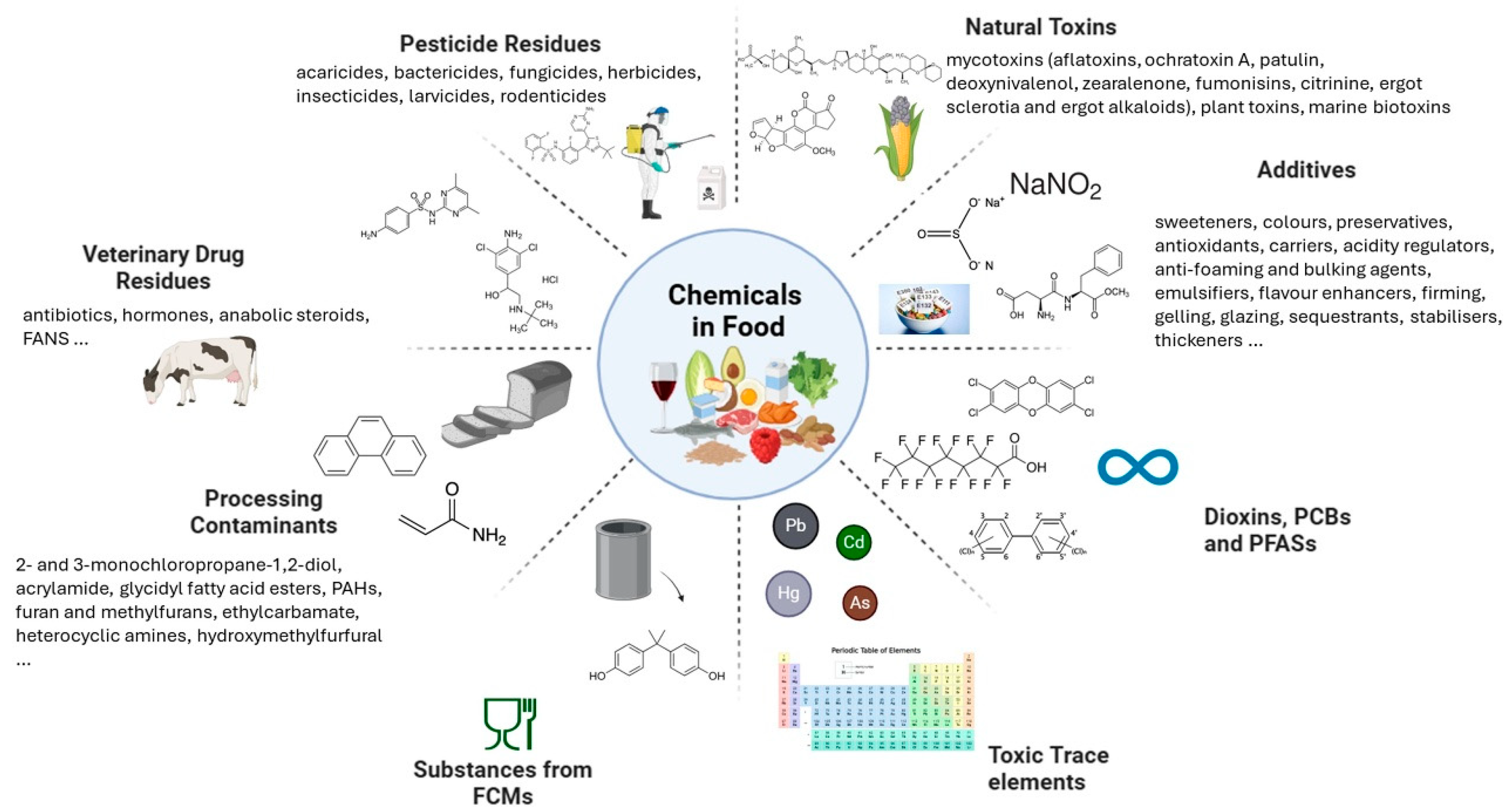
Figure 2.
Risk assessment stages of chemicals in food.
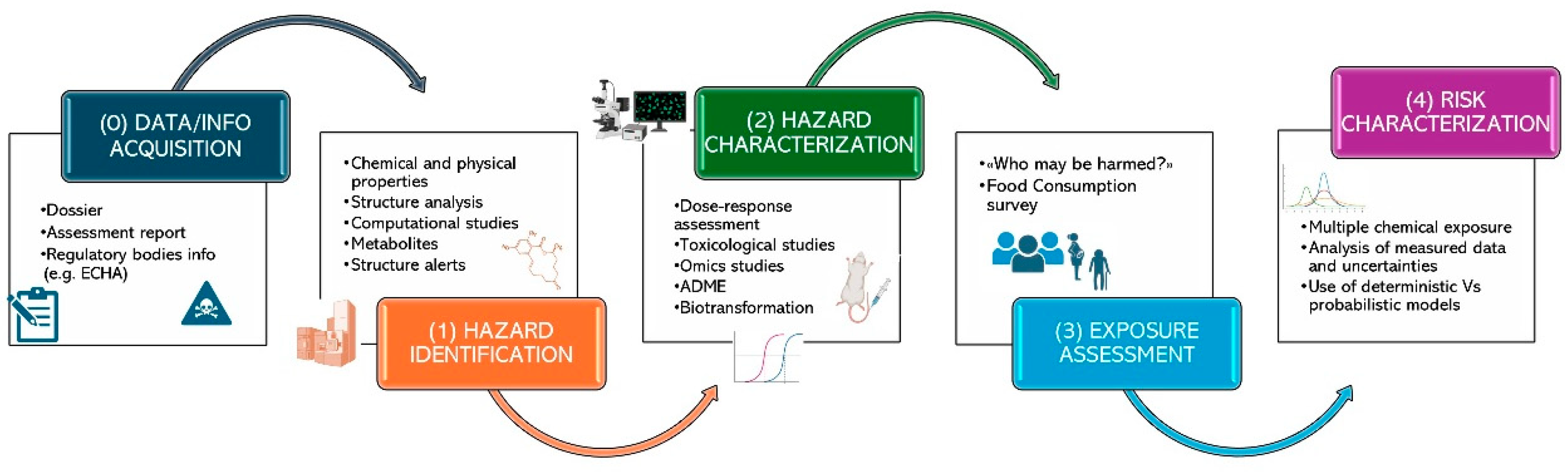
Figure 3.
Chemical food safety integrated approach.
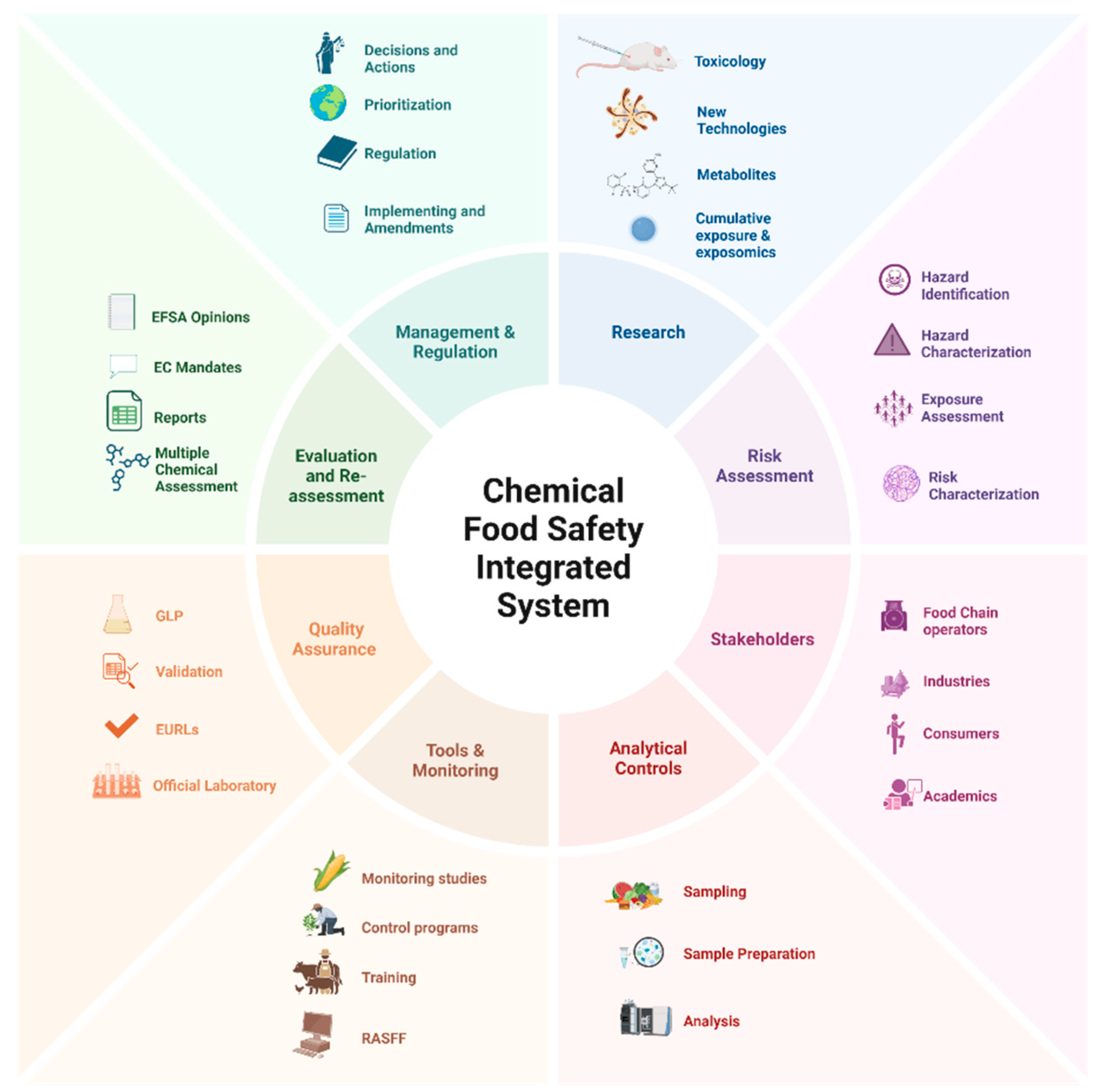
Figure 4.
Maillard reaction‒derived chemical contaminants.
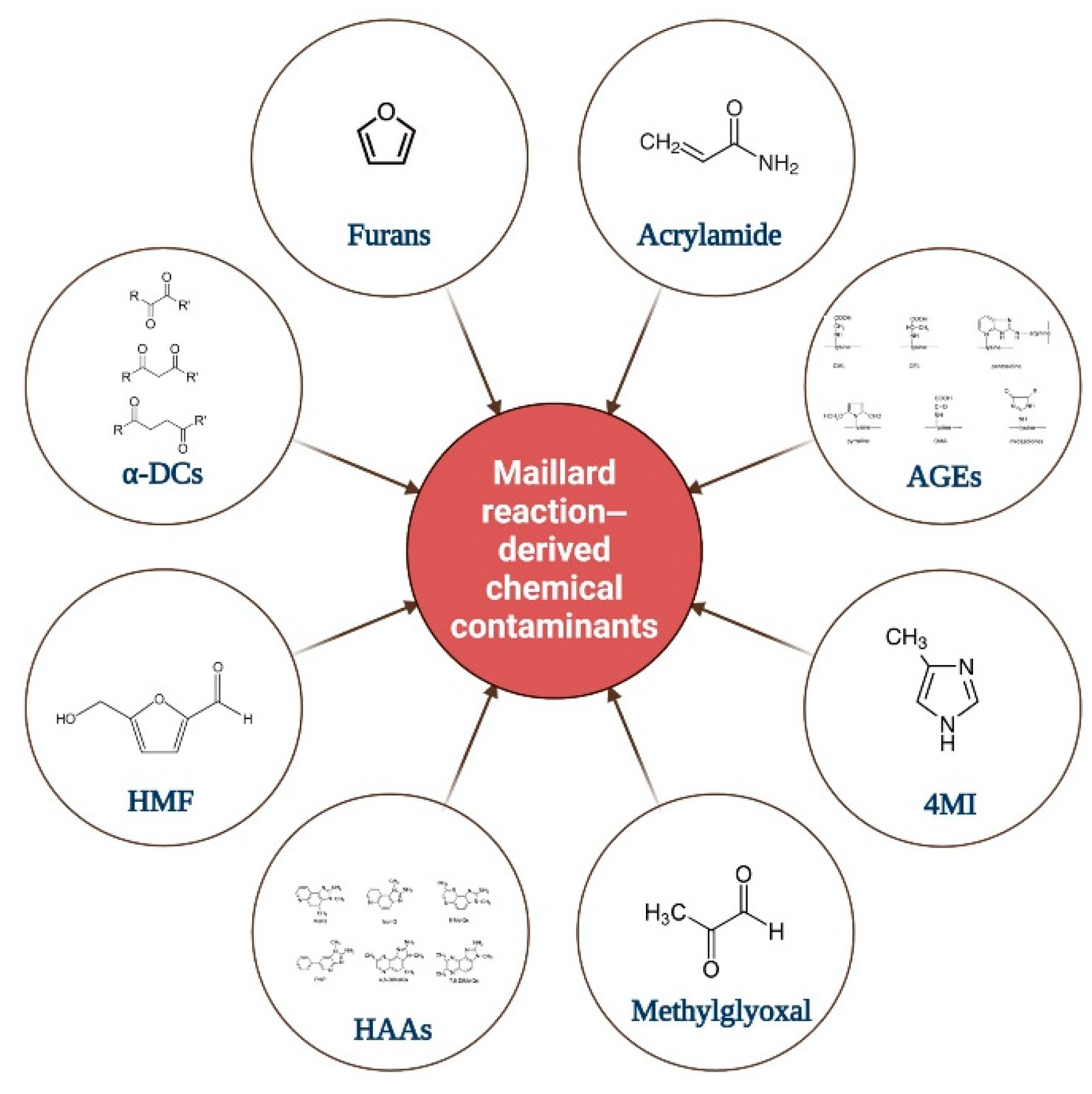

Table 1.
Legal instrument of Chemical food safety in Europe.
| Legal Instrument | Description | Binding Nature | Examples | Ref |
| Regulation | Legislative acts that apply directly in all Member States without national implementation. | Legally binding in all Member States | Regulation (EC) No. 178/2002 (General Food Law) Regulation (EC) No. 1333/2008 (Food Additives) |
[10,11] |
| Directive | Set objectives that Member States must achieve, but each MS chooses how to implement them. | Legally binding, but requires transposition into national law | Directive 2009/128/EC (Pesticide Sustainable Use) | [12] |
| Decision | Legally binding acts applicable to specific MSs, businesses, or individuals. Often used in crisis management. | Legally binding for the addressed parties | Decision 2002/657/EC (Performance of analytical methods and the interpretation of results) | [13] |
| Recommendation | Non-binding guidance to encourage best practices and policy direction. | Not legally binding | Commission Recommendation (EU) 2017/84 (Mineral Oil Hydrocarbons in Food) Commission Recommendation (EU) No 2018/464 (Monitoring of metals and iodine in seaweed, halophytes and products based on seaweed) |
[14,15] |
| Opinion | A formal non-binding instrument used by EU institutions to express views or provide guidance without imposing obligations. | Not legally binding | Opinion of the European Economic and Social Committee on ‘Towards a Fair Food Supply Chain’ (Exploratory opinion) EESC 2021/02472 |
[16] |
| Report | Scientific assessments or policy evaluations that inform decision-making. | Not legally binding | Report From the EC to the EP and the Council on food and food ingredients treated with ionizing radiation for the years 2020-2021 COM/2023/676 |
[17] |
| Others | Minutes, Communication, Staff working document, Proposal for a regulation, Question. | Not legally binding | Several types of acts |
Table 2.
Chemicals in food classified by key laws.
| Chemical Class | Subclasses | Key Regulations | Notes | Ref |
| Chemical Contaminants | Mycotoxins (aflatoxins, ochratoxin A, patulin, deoxynivalenol, zearalenone, fumonisins, citrinine, ergot sclerotia and ergot alkaloids) Plant toxins (erucic acid, tropane alkaloids, hydrocyanic acid, pyrrolizidine alkaloids, opium alkaloids, Δ9-THC) Metals and other elements (lead, cadmium, mercury, arsenic, inorganic tin) PCBs and Dioxins Perfluoroalkyl substances Processing contaminants (polycyclic aromatic hydrocarbons (PAH): benzo(a)pyrene, sum of 4 PAHs; 3-monochloropropane-1,2-diol (3-MCPD), glycidyl fatty acid esters) Others (nitrates, melamine, perchlorate) |
Regulation (EU) No. 2023/915 | Establishes maximum levels for contaminants in food | [54] |
| Marine Biotoxins | paralytic shellfish poison (PSP), amnesic shellfish poison (ASP), okadaic acid and dinophysistoxins, yessotoxins, azaspiracids | Regulation (EC) No. 627/2019 | Establish maximum levels and control plans | [81] |
| Acrylamide | Regulation (EU) No. 2017/2158 | Implementation of acrylamide reduction measures | [82] | |
| Recommendation (EU) No. 2019/1888 | Monitoring the presence of acrylamide in certain foods | [74] | ||
| AlternariaToxins | alternariol, alternariol monomethyl ether and tenuazonic acid | Recommendation (EU) No. 2022/553 | Monitoring the presence of Alternaria toxins in food | [77] |
| Food Additives | 26 functional classes (sweeteners, colours, preservatives, antioxidants, carriers, acids, acidity regulators, anti-caking, anti-foaming and bulking agents, emulsifiers, emulsifying salts, flavour enhancers, firming, gelling, glazing, raising and foaming agents, humectants, modified starches, packaging gases, propellants, sequestrants, stabilisers, thickeners, flour treatment agents) | Regulation (EC) No. 1333/2008; | Defines approved food additives, their conditions of use |
[11] |
| Regulation (EU) No. 231/2012 | purity criteria of food additives | [83] | ||
| Flavourings | flavouring substances, flavouring preparations, thermal process flavourings, smoke flavourings, flavour precursors or other flavourings or mixtures | Regulation (EC) No. 1334/2008 | [40] | |
| Pesticide Residues | acaricides, bactericides, fungicides, herbicides, insecticides, larvicides, rodenticides | Regulation (EC) No. 396/2005; | Sets MRLs for pesticides | [41] |
| Regulation (EC) No. 1107/2009 | placing of plant protection products on the market | [45] | ||
| Directive No. 2009/128/EC | promotes sustainable pesticide use | [12] | ||
| Veterinary Drug Residues | antibiotics, hormones, anabolic steroids, FANS (…) | Regulation (EU) No. 37/2010 | Establishes MRLs for veterinary medicinal products in food-producing animals. | [47] |
| Regulation (EC) No. 470/2009 | Outlines the process for determining MRLs for veterinary medicinal products in food. | [48] | ||
| Regulation (EU) No. 2019/1871 | Establishes reference limits for unauthorized pharmacologically active substances detected in food of animal origin | [84] | ||
| Regulation (EU) No. 2019/6 | Specifies the rules governing the approval and use of veterinary medicinal products | [85] | ||
| Food Contact Materials | monomers, other starting substances, macromolecules obtained from microbial fermentation, additives and polymer production aids contaminants |
Regulation (EC) No. 1935/2004 | Establishes safety requirements and migration limits for materials in contact with food. | [50] |
| Regulation (EU) No. 10/2011 | Criteria and authorization of plastic materials and articles intended to come into contact with food | [49] |
Table 3.
Validation of analytical methods for the determination of chemical in foods: parameters and general requirements [81,105,107,108].
| Parameter | Description | Main Acceptance Criteria |
| Selectivity/ Specificity |
the ability of the method to distinguish analyte from the possible interferences | no interferences near the analyte signal (e.g., ± 5% retention time in a chromatographic methods) |
| Limit of Detection (LOD) | the minimum reliably detectable amount of an analyte | method-specific LOD/LOQ thresholds |
| Limit of Quantification (LOQ) | the lowest concentration that can be reliably quantified | method-specific LOD/LOQ thresholds |
| Linearity | the ability to obtain test results, which are directly proportional to the concentration of the analyte in the sample | R² > 0.98 - 0.99 |
| Accuracy | closeness of an analytical measurement to the true or accepted reference value; it is described in the ISO 5725-1 as sum of precision and trueness | it is described in the ISO 5725-1 as sum of precision and trueness |
| Precision | the closeness of agreement between the measured values obtained by the replicate measurements on the same or similar objects under specified conditions; generally estimated as (relative) standard deviation (RSD) or coefficient of variation (CV) | Intermediate precision (n≥ 6) CV(%) < 5-25 RSD< 15% |
| Trueness | the agreement between a reasonably large number of measurements and true value (reference value); generally estimated as recovery (R) | R(%) = 70-120 |
| Robustness | stability of method performance under varying conditions |
minor changes (e.g., pH, mobile phases) major changes (matrix) |
| Matrix effect | an influence of one or more co-extracted compounds from the sample on the measurement of the analyte concentration or mass. It may be observed as an increased or decreased detector response compared with that produced by solvent solutions of the analyte (ME) | ME(%) ≤ 20 |
| Uncertainty | a range around the reported result within which the true value is expected to fall with a specified level of confidence, typically 95% | U ≤ 50% of MRL for contaminants |
Disclaimer/Publisher’s Note: The statements, opinions and data contained in all publications are solely those of the individual author(s) and contributor(s) and not of MDPI and/or the editor(s). MDPI and/or the editor(s) disclaim responsibility for any injury to people or property resulting from any ideas, methods, instructions or products referred to in the content. |
© 2025 by the authors. Licensee MDPI, Basel, Switzerland. This article is an open access article distributed under the terms and conditions of the Creative Commons Attribution (CC BY) license (http://creativecommons.org/licenses/by/4.0/).
Copyright: This open access article is published under a Creative Commons CC BY 4.0 license, which permit the free download, distribution, and reuse, provided that the author and preprint are cited in any reuse.


