

Submitted:
14 April 2025
Posted:
15 April 2025
You are already at the latest version
Abstract
The Portuguese coast forms a key biogeographic transition zone where co-occurring kelp species show limited vertical overlap. This study aimed to understand whether temperature and light responses help explain the vertical niche differentiation of Laminaria ochroleuca, Saccorhiza polyschides, and Phyllariopsis brevipes. Results revealed that P. brevipes, despite occupying the southernmost range, showed low thermal tolerance: 27°C significantly increased respiration rates, indicating metabolic stress, and exposition at 30°C caused physiological stress. In contrast, L. ochroleuca and S. polyschides exhibited greater thermal resilience but displayed high light requirements, with evident stress at 30°C. These results suggest that light availability plays a key role in shaping vertical zonation, with species adapted to low light occupying deeper subtidal zones. S. polyschides, a high light-requiring species, dominates the shallow subtidal, while L. ochroleuca, also high light-requiring and temperature-tolerant, is abundant in both intertidal pools and shallow subtidal habitats. These findings raise new hypotheses regarding future distribution patterns under climate change: while L. ochroleuca may continue expanding polewards and potentially replace other Laminaria spp. at shallow depths, low-light-adapted, cold-water species may retain a competitive advantage in deeper zones.
Keywords:
geographical distribution
; Laminaria ochroleuca
; Phyllariopsis brevipes
; Saccorhiza polyschides
; temperature
; light exposure
1. Introduction
Kelp species (i.e., brown macroalgae belonging to the order Laminariales) are widespread and present along over one-third of the world’s coastlines [1,2]. Several environmental factors can affect the ability of kelp species to populate a given area: substrate availability is essential; nutrient availability, nitrate shortage, in particular, may cause the individuals to deteriorate; strong water motion may cause individuals to break; sedimentation may cause the burial of the microscopic stages impairing recruitment, and salinity is a limiting factor [3]. Furthermore, temperature and irradiance are the primary drivers, with a particularly important influence on kelp vertical distribution [4]. Species living in the intertidal and high subtidal are exposed to wider oscillations of environmental conditions, and their ability to cope with them is essential not only for survival but also for reproduction, ensuring population persistence [5]. At local scales, irradiance may also limit the maximum depth macroalgae species may inhabit, and in shallower areas, the combined effects of high temperature and irradiance can further restrict available habitat [6,7,8]. Biotic factors, such as grazing and interspecific competition, can also limit species establishment and impact their vertical distribution [9].
Several kelp species inhabit the Atlantic Iberian shore, a contact zone between colder adapted species (e.g., Saccharina latissima), temperate species, such as Saccorhiza polyschides and Laminaria ochroleuca, and warm-temperate species such as Phyllariopsis brevipes. L. ochroleuca, S. polyschides, and P. brevipes can be found as south as the Moroccan coast. However, L. ochroleuca extends northward to the southern coast of the United Kingdom and the west coast of Ireland, where it reaches its leading edge [10]. S. polyschides can be found as far north as the Northern Norwegian Coast, while P. brevipes northern limit is the Southern Bay of Biscay [11,12].
In Atlantic Iberian shores, the three different temperate kelp species occupy different depths, with a similar optimum temperature, close to 15°C, and can grow at up to 25°C [13,14,15,16]. While L. ochroleuca dominates the higher subtidal and intertidal pools, being able to thrive and reproduce in these conditions, S. polyschides dominate the high subtidal and, although the species can recruit up to intertidal pools, individuals remain small and are unable to reach maturity. On the other hand, P. brevipes is restricted to subtidal areas [17]. To investigate whether these vertical distribution patterns are driven by physiological differences, we measured physiological performance under varying temperature conditions and increasing photon fluence rates, simulating the high irradiance and thermal stress characteristic of shallower depths.
Understanding how population structure varies across environmental gradients provides essential baseline data to anticipate climate-driven shifts in species distribution. This is particularly relevant as changes in metabolic costs across temperature gradients may constrain vertical distribution, limiting the capacity of populations to persist or expand, even when substrate is available, and reproduction is successful. As such, this study aimed to determine how light and temperature interaction may affect the ability of different co-occurring kelp species (L. ochroleuca, S. polyschides, and P. brevipes) to inhabit different depths and how these factors may drive shifts in their vertical and horizontal distributions.
2. Materials and Methods
2.1. Biological Material
Juveniles of L. ochroleuca, S. polyschides, and P. brevipes with between 15 and 20 cm of blade length were collected in the northern Portuguese coast, in Amorosa (41° 38’ 28.15” N, 8° 49’ 21.90” W), during summer. After collection, individuals were acclimated for one week at 15°C, the optimum temperature for these species, in a 16h:8h light:dark photoperiod with 100 µmol m-2 s-1 photon fluence rate.
2.2. Photosynthesis and Respiration
In summer, nearshore waters in this region typically range from 14 to 15ºC but can sporadically reach 25°C in shallow stratified waters, and can go as high as 30°C at the blade surface when close to the waterline [18]. The control temperature (15 ºC) was selected to match environmental conditions commonly experienced by the species in their natural habitats. In this experiment, incubations were done at the control (15°C) and two higher temperatures (27°C and 30°C). Along the Northern Portuguese coast, typical intertidal pools occupied by kelp are isolated from the sea for 2-3 hours during spring tide’s low tide (author’s personal observation).
Incubations lasted 2.5 h, mimicking the duration of a rapid heat shock during the stratification of seawater in shallow depths or tide pools. Individuals were exposed to increasing light intensities (30 min under dark conditions and 20 minutes at 15, 45, 70, 90, 110, and 300 µmol photons m-2 s-1) at constant temperatures. The incubation unit was illuminated with 400 W Biolux Halogen Osram® bulbs. Oxygen variation was measured every 30 secs with multi HQ40D (Hach Lange®) oxygen probes (one per beaker). Beakers were filled with filtered seawater (1 µm filter), and water circulation was provided by an aquarium pump. As P. brevipes was more negatively impacted by higher temperatures than expected, an extra incubation was added at 24°C, to narrow down its temperature higher limit.
To assess photosynthesis and respiration, whole juvenile algae were placed in independent 1.5 L chambers to allow independent measurements. Four replicates per temperature per species were used. After the incubation, individuals were dried at 60°C for 48 h. Oxygen concentration variation was corrected for algae dry mass (DM) and water volume so that all functional responses are expressed in mg (O2) g-1 (DM) h-1.
Maximum respiration (Rmax) was measured as oxygen variation in dark conditions. Net primary production (NPP) was assessed by determining the slope of a linear regression of photon fluence rate versus oxygen concentration. Photon fluence rate at which maximum production was reached (Lmax) was also used to compare the response to different temperatures.
The maximum quantum yield of photosystem II (Fv/Fm) was measured for all individuals before and after the incubation to assess how light and temperature affected the efficiency of photosystem II as a rapid indicator of physiological stress. Fv/Fm response to different temperatures was normalized by dividing each measurement by the initial value to facilitate comparisons.
Untransformed data were analysed with 1-way ANOVAs, considering temperature as a factor for each response and each species separately, using SPSS (version 28.0.0.0). Whenever a significant difference between temperatures within a species was found, a Tukey test was performed to verify if differences between each pair of temperatures were significant.
3. Results
3.1. Photosynthesis and Respiration
Respiration in dark conditions of the different species increased significantly with increasing temperature, except for S. polyschides (Table 1, Figure 1). NPP of the different species varied significantly with temperature (Table 2). For L. ochroleuca, NPP was higher at temperatures above the control. For S. polyschides, on the other hand, NPP increased from control temperature to 27°C, while at 30°C it did not differ significantly from the control (Figure 2). For P. brevipes, while smaller increases in temperature (at 24 and 27°C) did not cause significant variations in NPP, exposure to 30°C resulted in a significant reduction (Figure 2).
Light intensities used in this experimental setup were not high enough to cause significant inhibition in oxygen production in any of the kelp species (Figure 3). However, the photon fluence rate needed for photosynthesis to compensate for respiration varied. Both L. ochroleuca and S. polyschides required a higher photon fluence rate with increasing high temperature exposure. When exposed to 30°C, however, photosynthesis did not compensate for oxygen consumption for either species (Figure 3). Likewise, P. brevipes showed low light demand when exposed to lower temperatures (at 15 and 24°C). Its photosynthetic performance when exposed to 27 and 30°C, however, was lower than for the other species, with oxygen consumption largely exceeding its production (Figure 3). Photon fluence rate at which maximum production was attained (Lmax) varied for L. ochroleuca and P. brevipes but not for S. polyschides (Table 3).
For both L. ochroleuca and P. brevipes, Lmax did not vary significantly for temperatures up to 27°C but significantly decreased when exposed to 30°C (Figure 4).
3.2. Chlorophyll Fluorescence
For all species, Fv/Fm varied significantly with temperature (Table 4). Pairwise comparisons for temperatures within each species revealed that for all species, exposure to 27°C did not vary significantly from exposure to control, while exposure to 30°C caused a significant decrease in Fv/Fm (Figure 5). Still, exposure to 30°C caused significant damage to P. brevipes.
4. Discussion
Laminaria ochroleuca has been previously reported to be able to survive only at temperatures below 22°C while under a photon fluence rate of 60-80 µmol photons m-2 s-1 [19]. However, in accordance with previous studies, our results showed that this species was able to cope with a short exposure to 27°C without being significantly affected [20,21]. At this temperature, the light intensities used (between 15 and 300 µmol m-2 s-1) were not stressful enough to cause either photoinhibition or damage to photosystem II, as indicated by the Fv/Fm results. Furthermore, the increase in respiration accompanied by the temperature increase was compensated by photosynthesis for light exposures above 70 µmol photons m-2 s-1. Discrepancies with earlier studies reporting suboptimal growth between 20 and 24 °C may be attributed to several factors [8]. First, as the study goals differed, the short heat-shock duration used in our study was a major difference in experimental design. Although this species appears capable of withstanding short-term temperature increases, recent findings indicate that prior exposure to marine heatwaves can reduce its critical thermal maxima (CTmax), highlighting the cumulative physiological cost of repeated thermal stress [22,23]. Second, different source populations of L. ochroleuca were used in different studies, potentially leading to variations in local adaptations. For instance, populations from Portugal have been previously reported to withstand repeated heat shocks at 30°C, while individuals from northern France did not survive [21]. Consistently, studies suggest that the effects of temperature on development will change with factors including the population of origin [20,24]. Third, light requirements might increase with increasing temperature, potentially leading to reduced survival under low-light conditions. This could occur if temperature increased abruptly, up to 27°C, L. ochroleuca would not be able to occupy deeper areas where light might be limiting. Such increases in temperature are, however, not expected in the subtidal. These results are in accordance with previous findings indicating that below 20 µmol photons m-2 s-1, L. ochroleuca gametophytes are infertile, and sporophytes have low growth rates [25]. However, while previous studies indicate an ability to cope with recurring short exposures to 27°C [21], as the photon fluence rate was not as high as in intertidal pools during summer low tides, it remains unknown how they are affected. The highest temperature exposure (30°C) was stressful enough to cause either photoprotection (i.e., prevention against damaging effects of intense solar radiation) or damage to photosystem II, as indicated by Fv/Fm results, hinting that higher light exposure would not help the individuals cope with stress caused by the temperature increase. Previous studies have also reported photoprotection in L. ochroleuca recruits exposed to 30°C heat shock under a low photon fluence rate [21]. While such physiological constraints may limit its vertical distribution in warmer regions, L. ochroleuca has nonetheless been expanding its range poleward. Earlier studies already hypothesized its northward expansion, potentially replacing other Laminaria species [26,27]. Indeed, an isolated population in northwest Ireland was documented, further supporting evidence of its continued poleward range extension [10]. However, given the species’ light requirements, we hypothesize that this expansion is more likely to occur in the upper subtidal and intertidal zones, while low-light-adapted, cold-water Laminaria species may retain a competitive advantage in deeper subtidal areas.
Saccorhiza polyschides did not seem to be negatively affected by an exposure to 27°C, not showing a significant increase in respiration, which would be otherwise expected, while significantly increasing NPP. Fv/Fm measurements also showed no significant difference from the control temperature, hinting that this species might perform well when exposed to short exposures to increased temperature. These results are consistent with previous studies that showed no significant impact of recurrent exposure to 27°C [20,21]. Although our study does not allow predicting how the species would cope with a longer-term increase in temperatures, past research suggests that its decrease in certain geographical zones might be linked to the inability to reproduce at temperatures above 25°C, ultimately preventing population persistence [28,29]. Chefaoui et al. demonstrated that prolonged heat stress in summer-autumn, driven by high air and seawater temperatures, can hinder or collapse sporophyte growth and reproduction in this species [30]. Therefore, despite similar thermal affinities, S. polyschides doesn’t have the same ability to populate the intertidal as L. ochroleuca, being able to recruit but not to reach maturity [31]. It was thus expected that they would respond negatively to an increase in light and temperature. While respiration did not vary significantly with increasing temperature, NPP increased at 27°C, but no significant difference was observed between 30°C and the control temperature (15°C). However, exposure to 30°C caused stress. While no significant increase in respiration or decrease in NPP could be observed, photosynthetic activity was unable to compensate for respiration, and Fv/Fm indicated that some damage to photosystem II or photoprotection might occur. While the results were not completely unexpected in an opportunistic species, a stronger effect of temperature and light increase was expected. Still, these observations are in accordance with previous reports that S. polyschides does not seem to undergo photosystem protection, with its metabolism apparently staying unaffected by the high-temperature exposure while showing observable damage to the tissue [21].
Phyllariopsis brevipes, being a Mediterranean species, was expected to have considerable heat resilience. However, the negative response to exposure to 30°C was stronger than expected. This motivated the addition of an extra exposure at 24°C to better understand its responses to high temperatures. No significant difference between the response to 24°C and the control temperature was observed for any of the variables studied. At 27°C, however, while Fv/Fm and NPP were not significantly different from either the control or 24°C, the respiration rate was significantly higher, indicating that exposure to 27°C, but not 24°C, significantly increased metabolism. While P. brevipes can live from the Bay of Biscay to the Moroccan coast and in the western Mediterranean [12], its temperature resistance is reduced when compared to the temperate species L. ochroleuca and S. polyschides. This is an annual species whose sporophytes are present in the field only between Spring and the beginning of Autumn, with its populations reduced to microscopic stages for the remainder of the year [13,32]. Geographical areas occupied by P. brevipes are characterized by strong upwelling currents during summer, which may be essential to lower the temperature enough for maintaining the population [33,34].
Results support previous reports that temperature and light exposure play an important role in zonation [4,11]. P. brevipes has considerably low light requirements at the lower temperatures (15 and 24°C); this might provide some competitive advantage to occupy deeper areas while higher light requirements of S. polyschides may limit its depth distribution, while their opportunistic characteristics may give them a competitive advantage in the high subtidal. In intertidal pools, however, these large individuals may be limited by both heat and desiccation, while L. ochroleuca, being more resilient to heat exposure, has in these conditions a competitive advantage that allows it to form dense intertidal pool patches [21].
5. Conclusions
This study highlights the complex interactions between temperature, light exposure, and species-specific physiological responses in Laminaria ochroleuca, Saccorhiza polyschides, and Phyllariopsis brevipes, offering new insights into the mechanisms driving their vertical zonation and distribution along the Portuguese coast. L. ochroleuca demonstrated notable resilience to short-term exposure to elevated temperatures, coping well with 27°C when light was not limiting. This thermal tolerance, together with high light requirements, supports its dominance in shallow subtidal and intertidal zones. However, long-term exposure or repeated heat stress events may reduce its thermal tolerance, potentially limiting its resilience under future climate change scenarios. While L. ochroleuca has demonstrated an ability to expand poleward, its dependence on higher light intensities may restrict its distribution in deeper subtidal zones.
S. polyschides displayed a similar tolerance to short-term temperature increases without significant physiological impairment, showing increased productivity at 27°C. Nonetheless, exposure to 30°C led to a decline in photophysiological performance, despite limited changes in respiration and NPP. While this opportunistic species can recruit under warm conditions, its ability to complete the life cycle may be compromised by prolonged thermal stress, particularly in intertidal zones, potentially influencing its future distribution under warming conditions.
Unexpectedly, P. brevipes, a species with a southern distribution exhibited a lower heat tolerance than expected. No significant differences were observed between the control temperature and 24°C across the studied variables. However, at 27°C, significant metabolic increases were detected, indicating a physiological response to elevated temperatures. Exposure to 30°C caused a marked stress response, further exacerbating metabolic activity and suggesting potential thermal limitations. Given its annual life cycle and dependence on seasonal upwelling, P. brevipes may be particularly vulnerable to rising ocean temperatures, with potential implications for its persistence in the lower subtidal zones.
Looking ahead, future climate scenarios predict an increase in both the frequency and intensity of marine heatwaves, which could have profound effects on the distribution and survival of these species [35]. L. ochroleuca’s ability to expand poleward may allow it to replace other Laminaria species in some regions, but its dependence on sufficient light may restrict its success in deeper waters. S. polyschides may persist in the short term but could face long-term challenges due to reproductive limitations under prolonged warming. P. brevipes, already showing signs of vulnerability, may experience significant population declines if upwelling patterns shift or weaken due to climate change.
These findings underscore the importance of continued monitoring and modelling efforts to predict shifts in kelp forest ecosystems under future climate scenarios. Understanding species-specific responses to warming will be essential for conservation strategies, habitat management, and ensuring the resilience of temperate marine ecosystems in a rapidly changing ocean. Future research should focus on long-term experiments that simulate chronic temperature increases and recurring heat stress events to better understand the cumulative effects on these species. Additionally, studies incorporating genetic and physiological plasticity could provide insights into potential adaptation mechanisms. Investigating the combined effects of temperature, light availability, and other environmental stressors such as ocean acidification will be crucial to developing a comprehensive understanding of how kelp forests will respond to future climate change.
Author Contributions
Conceptualization, TRP.; methodology, TRP.; validation, TRP, SC and TFP; formal analysis, TRP.; investigation, TRP, SC, TFP.; resources, ISP; data curation, TRP; writing—original draft preparation, TRP.; writing—review and editing, TFP, SC; visualization, TFP, TRP, SC ; supervision, TRP; project administration, TRP; funding acquisition, ISP. All authors have read and agreed to the published version of the manuscript.
Funding
This research received no external funding.
Institutional Review Board Statement
Not applicable.
Informed Consent Statement
Not applicable.
Data Availability Statement
Data sharing not applicable.
Conflicts of Interest
The authors declare no conflicts of interest.
Abbreviations
The following abbreviations are used in this manuscript:
| DM | Dry Mass |
| Fv/Fm | Maximum quantum yield of photosystem II |
| LMax | Photon fluence rate at which maximum production was attained |
| NPP | Net Primary Production |
| RMax | Maximum respiration rate |
References
- Wernberg, T.; Krumhansl, K.A.; Filbee-Dexter, K.; Pedersen, M. Status and Trends for the World’s Kelp Forests. 2019.
- Jayathilake, D.R.M.; Costello, M.J. A modelled global distribution of the kelp biome. Biological Conservation 2020, 252, 108815. [Google Scholar] [CrossRef]
- Dayton, P. Ecology of Kelp Communities. Annual Review of Ecology, Evolution, and Systematics 1985, 16, 215–245. [Google Scholar] [CrossRef]
- Lenoir, J.; Gégout, J.C.; Marquet, P.A.; de Ruffray, P.; Brisse, H. A significant upward shift in plant species optimum elevation during the 20th century. Science 2008, 320, 1768–1771. [Google Scholar] [CrossRef] [PubMed]
- Bartsch, I.; Vogt, J.; Pehlke, C.; Hanelt, D. Prevailing sea surface temperatures inhibit summer reproduction of the kelp aminaria digitata at Helgoland (North Sea). Journal of Phycology 2013, 49, 1061–1073. [Google Scholar] [CrossRef]
- Markager, S.; Sand-Jensen, K. Light requirements and depth zonation of marine macroalgae. Marine Ecology Progress Series 1992, 88, 83–92. [Google Scholar] [CrossRef]
- Dieter, H.; Melchersmann, B.; Wiencke, C.; Nultsch, W. Effects of high light stress on photosynthesis of polar macroalgae in relation to depth distribution. Marine Ecology-progress Series - MAR ECOL-PROGR SER 1997, 149, 255–266. [Google Scholar] [CrossRef]
- Franco, J.N.; Tuya, F.; Bertocci, I.; Rodríguez, L.; Martínez, B.; Sousa-Pinto, I.; Arenas, F. The ‘golden kelp’ Laminaria ochroleuca under global change: Integrating multiple eco-physiological responses with species distribution models. Journal of Ecology 2018, 106, 47–58. [Google Scholar] [CrossRef]
- Franco, J.N.; Wernberg, T.; Bertocci, I.; Duarte, P.; Jacinto, D.; Vasco-Rodrigues, N.; Tuya, F. Herbivory drives kelp recruits into ’hiding’ in a warm ocean climate. Marine Ecology Progress Series 2015, 536, 1–9. [Google Scholar] [CrossRef]
- Schoenrock, K.; O’Callaghan, T.; O’Callaghan, R.; Krueger-Hadfield, S. First record of Laminaria ochroleuca Bachelot de la Pylaie in Ireland in Béal an Mhuirthead, county Mayo. Marine Biodiversity Records 2019, 12. [Google Scholar] [CrossRef]
- Lüning, K.; Yarish, C.; Kirkman, H. Seaweeds: Their Environment, Biogeography, and Ecophysiology. 1990.
- Birkett, D.; Maggs, C.; Dring, M.; Boaden, P. An Overview of Dynamic and Sensitivity Characteristics for Conservation Management of Marine SACs. Scott. Assoc. Mar. Sci. (SAMS) 1998, 5. [Google Scholar]
- Henry, E. The life history of Phyllariopsis brevipes (= Phyllaria reniformis) (Phyllariaceae, Laminariales, Phaeophyceae), a kelp with dioecious but sexually monomorphic gametophytes. Phycologia 1987, 26, 17–22. [Google Scholar] [CrossRef]
- Dieck, I. Temperature tolerance and survival in darkness of kelp gametophytes (Laminariales, Phaeophyta) - Ecological and biogeographical implications. Marine Ecology Progress Series 1993, 100, 253–253. [Google Scholar] [CrossRef]
- Pereira, T.R.; Engelen, A.H.; Pearson, G.A.; Serrão, E.A.; Destombe, C.; Valero, M. Temperature effects on the microscopic haploid stage development of Laminaria ochroleuca and Sacchoriza polyschides, kelps with contrasting life histories. Cahiers De Biologie Marine 2011, 52, 395–403. [Google Scholar]
- García-Sánchez, M.; Delgado Huertas, A.; Fernández, J.; Flores-Moya, A. Photosynthetic use of inorganic carbon in deep-water kelps from the Strait of Gibraltar. Photosynthesis Research 2016, 2016, 295–305. [Google Scholar] [CrossRef] [PubMed]
- Tempera, F.; Milla-Figueras, D.; Sinde-Mano, A.L.; Atchoi, E.; Afonso, P. Range Extension of Mesophotic Kelps (Ochrophyta: Laminariales and Tilopteridales) in the Central North Atlantic: Opportunities for Marine Forest Research and Conservation. Journal of Phycology 2021, 57, 1140–1150. [Google Scholar] [CrossRef]
- Pearson, G.; Lago-Leston, A.; Mota, C. Frayed at the edges: Selective pressure and adaptive response to abiotic stressors are mismatched in low diversity edge populations. Journal of Ecology 2009, 97, 450–462. [Google Scholar] [CrossRef]
- Dieck, I.t. North Pacific and North Atlantic digitate Laminaria species (Phaeophyta): hybridization experiments and temperature responses. Phycologia 1992, 31, 147–163. [Google Scholar] [CrossRef]
- Biškup, S.; Bertocci, I.; Arenas, F.; Tuya, F. Functional responses of juvenile kelps, Laminaria ochroleuca and Saccorhiza polyschides, to increasing temperatures. Aquatic Botany 2014, 113, 117–122. [Google Scholar] [CrossRef]
- Pereira, T.; Engelen, A.; Pearson, G.; Valero, M.; Serrao, E. Response of kelps from different latitudes to consecutive heat shock. Journal of Experimental Marine Biology and Ecology 2015, 463, 57–62. [Google Scholar] [CrossRef]
- King, N.; Leathers, T.; Smith, K.; Smale, D. The influence of pre-exposure to marine heatwaves on the critical thermal maxima (CTmax) of marine foundation species. Functional Ecology 2024. [Google Scholar] [CrossRef]
- Leathers, T.; King, N.G.; Foggo, A.; Smale, D.A. Marine heatwave duration and intensity interact to reduce physiological tipping points of kelp species with contrasting thermal affinities. Ann Bot 2024, 133, 51–60. [Google Scholar] [CrossRef]
- Strasser, F.-E.; Barreto, L.M.; Kaidi, S.; Sabour, B.; Serrão, E.A.; Pearson, G.A.; Martins, N. Population level variation in reproductive development and output in the golden kelp Laminaria ochroleuca under marine heat wave scenarios. In Proceedings of the Frontiers in Marine Science; 2022. [Google Scholar]
- Izquierdo, J.; Pérez-ruzafa, I.; Gallardo, T. Effect of temperature and photon fluence rate on gametophytes and young sporophytes of Laminaria ochroleuca Pylaie. Helgoland Marine Research 2001, 55, 285–292. [Google Scholar] [CrossRef]
- Smale, D.; Wernberg, T.; Yunnie, A.L.E.; Vance, T. The rise of Laminaria ochroleuca in the Western English Channel (UK) and comparisons with its competitor and assemblage dominant Laminaria hyperborea. Marine Ecology 2015, 36, 1033–1044. [Google Scholar] [CrossRef]
- Smale, D.A.; Moore, P.J. Variability in kelp forest structure along a latitudinal gradient in ocean temperature. Journal of Experimental Marine Biology and Ecology 2017, 486, 255–264. [Google Scholar] [CrossRef]
- Norton, T.A. Experiments on the Factors Influencing the Geographical Distributions of Saccorhiza polyschides and Saccorhiza dermatodea. The New Phytologist 1977, 78, 625–635. [Google Scholar] [CrossRef]
- Fernández, C. The retreat of large brown seaweeds on the north coast of Spain: The case of Saccorhiza polyschides. Eur. J. Phycol. 2011, 46, 352–360. [Google Scholar] [CrossRef]
- Chefaoui, R.M.; Duarte, C.M.; Serrão, E.A. Dramatic loss of seagrass habitat under projected climate change in the Mediterranean Sea. Global Change Biology 2018, 24, 4919–4928. [Google Scholar] [CrossRef]
- Pereira, T.R.; Engelen, A.H.; Pearson, G.A.; Valero, M.; Serrão, E.A. Population dynamics of temperate kelp forests near their low-latitude limit. Aquatic Botany 2017, 139, 8–18. [Google Scholar] [CrossRef]
- Flores-Moya, A.; A., F.J.; Niell, F.X. Reproductive phenology, growth and primary production of Phyllariopsis purpurascens (Phyllariaceae, Phaeophyta) from the Straits of Gibraltar. European Journal of Phycology 1993, 28, 223–230. [Google Scholar] [CrossRef]
- Lemos, R.; Pires, H. The upwelling regime off the West Portuguese Coast, 1941–2000. International Journal of Climatology 2004, 24, 511–524. [Google Scholar] [CrossRef]
- Gómez-Gesteira, M.; de Castro, M.; Alvarez, I.; Lorenzo, M.N.; Gesteira, J.L.; Crespo, A.J. Spatio-temporal upwelling trends along the Canary Upwelling System (1967-2006). Ann N Y Acad Sci 2008, 1146, 320–337. [Google Scholar] [CrossRef] [PubMed]
- Oliver, E.C.J.; Donat, M.G.; Burrows, M.T.; Moore, P.J.; Smale, D.A.; Alexander, L.V.; Benthuysen, J.A.; Feng, M.; Sen Gupta, A.; Hobday, A.J.; et al. Longer and more frequent marine heatwaves over the past century. Nat Commun 2018, 9, 1324. [Google Scholar] [CrossRef] [PubMed]
Figure 1.
Respiration, as dissolved oxygen variation (higher respiration rate corresponds to lower oxygen recorded), of A) Laminaria ochroleuca, B) Saccorhiza polyschides, and C) Phyllariopsis brevipes under dark conditions, in response to different temperatures. Error bars are SD. Different letters were attributed to significantly different values, per species, based on Tukey test results.
Figure 1.
Respiration, as dissolved oxygen variation (higher respiration rate corresponds to lower oxygen recorded), of A) Laminaria ochroleuca, B) Saccorhiza polyschides, and C) Phyllariopsis brevipes under dark conditions, in response to different temperatures. Error bars are SD. Different letters were attributed to significantly different values, per species, based on Tukey test results.
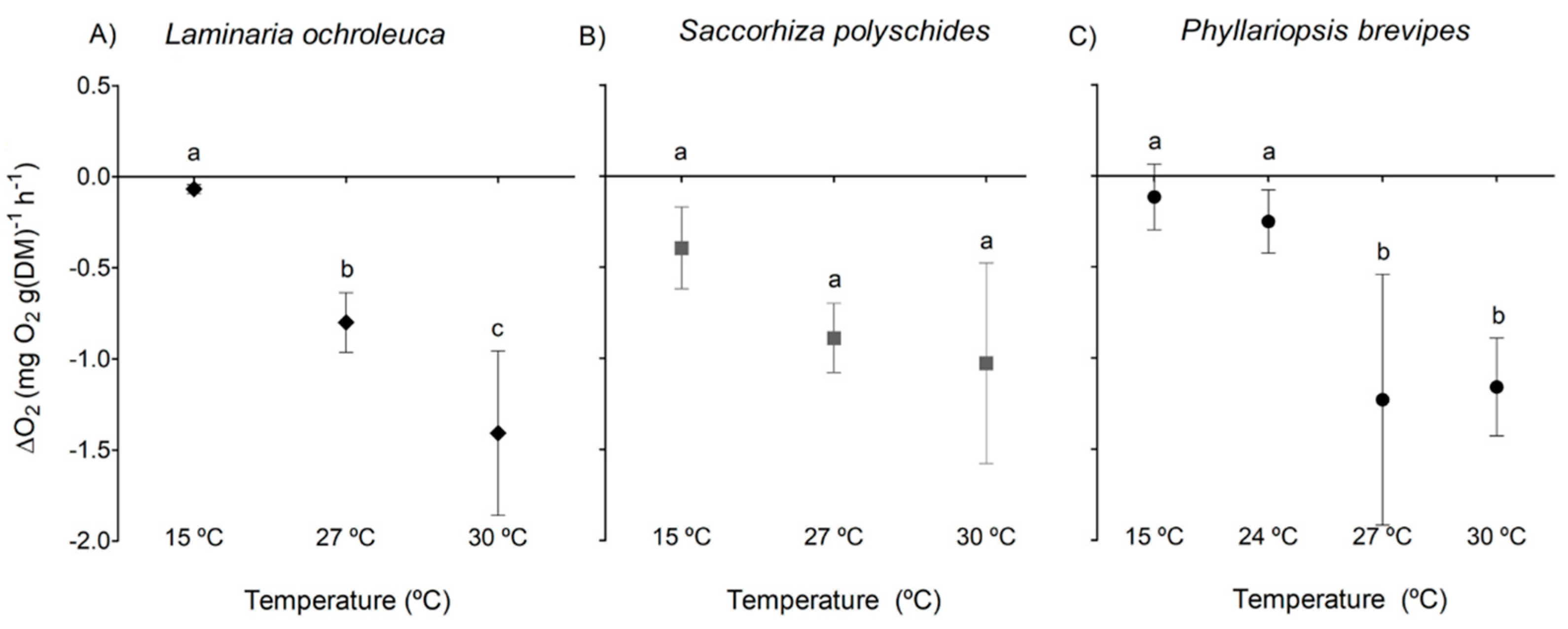
Figure 2.
Net Primary Production (NPP), assessed by determining the slope of linear regression of photon fluence rate versus oxygen concentration, of A) Laminaria ochroleuca, B) Saccorhiza polyschides and C) Phyllariopsis brevipes under increasing photon fluence rate when exposed to 15°C (control), 27°C and 30°C. Error bars are SD. Different letters indicate significant differences in response between temperature for each species, based on Tukey test results. Pairwise comparisons were performed within each species.
Figure 2.
Net Primary Production (NPP), assessed by determining the slope of linear regression of photon fluence rate versus oxygen concentration, of A) Laminaria ochroleuca, B) Saccorhiza polyschides and C) Phyllariopsis brevipes under increasing photon fluence rate when exposed to 15°C (control), 27°C and 30°C. Error bars are SD. Different letters indicate significant differences in response between temperature for each species, based on Tukey test results. Pairwise comparisons were performed within each species.
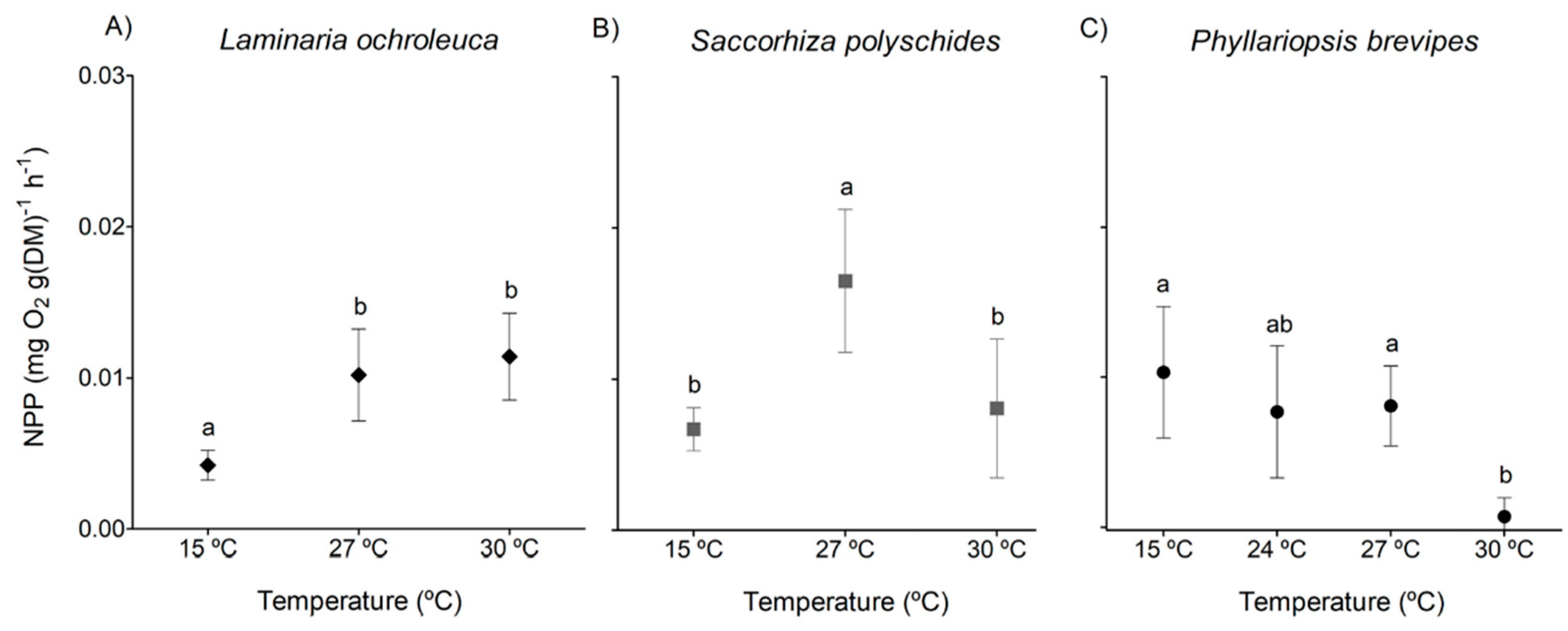
Figure 3.
Oxygen variation, as result of respiration and photosynthesis, with increasing photon fluence rate for individuals of A) Laminaria ochroleuca, B) Saccorhiza polyschides and C) Phyllariopsis brevipes when exposed to 15°C (control), 27°C and 30°C. Error bars are SD.
Figure 3.
Oxygen variation, as result of respiration and photosynthesis, with increasing photon fluence rate for individuals of A) Laminaria ochroleuca, B) Saccorhiza polyschides and C) Phyllariopsis brevipes when exposed to 15°C (control), 27°C and 30°C. Error bars are SD.
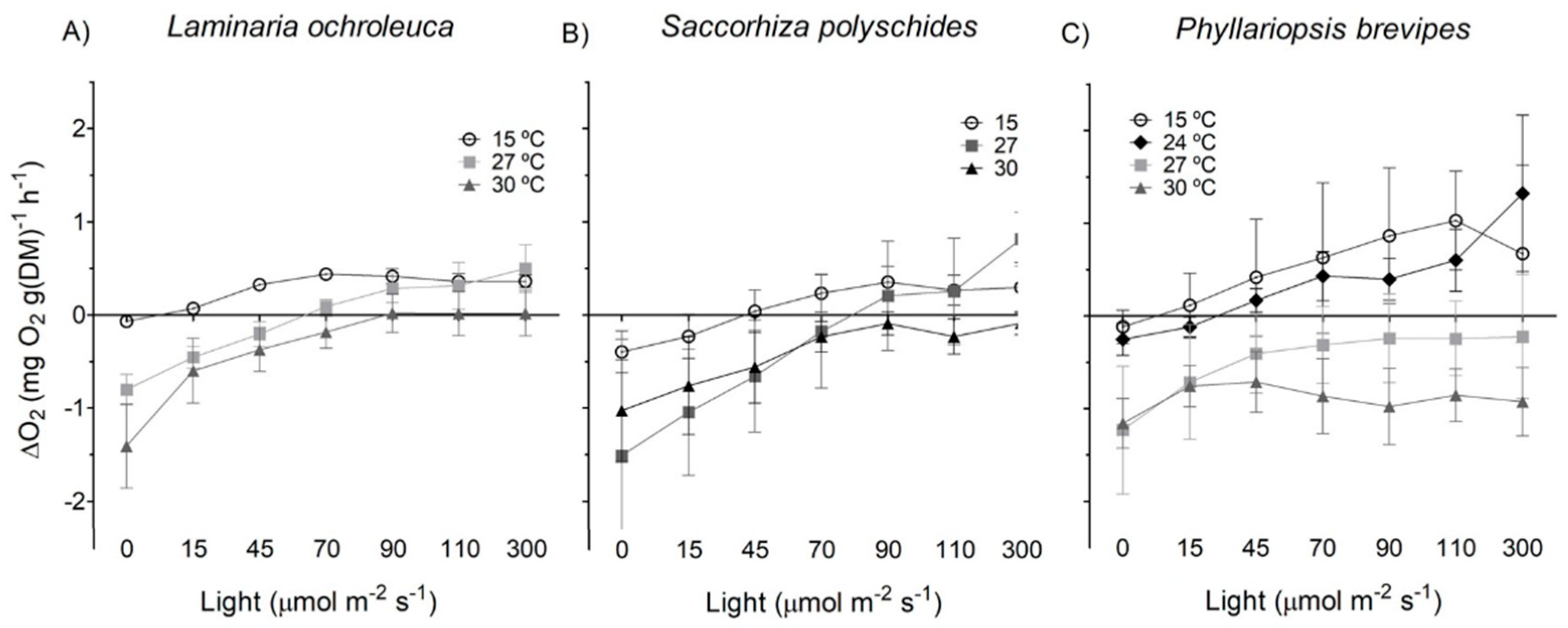
Figure 4.
Photon fluence rate at which A) Laminaria ochroleuca, B) Saccorhiza polyschides and C) Phyllariopsis brevipes achieved maximum oxygen production (Lmax) for the three temperature exposures: 15°C (control), 27°C and 30°C. Error bars are SD. Different letters indicate significant differences between points for each species, based on Tukey test results.
Figure 4.
Photon fluence rate at which A) Laminaria ochroleuca, B) Saccorhiza polyschides and C) Phyllariopsis brevipes achieved maximum oxygen production (Lmax) for the three temperature exposures: 15°C (control), 27°C and 30°C. Error bars are SD. Different letters indicate significant differences between points for each species, based on Tukey test results.
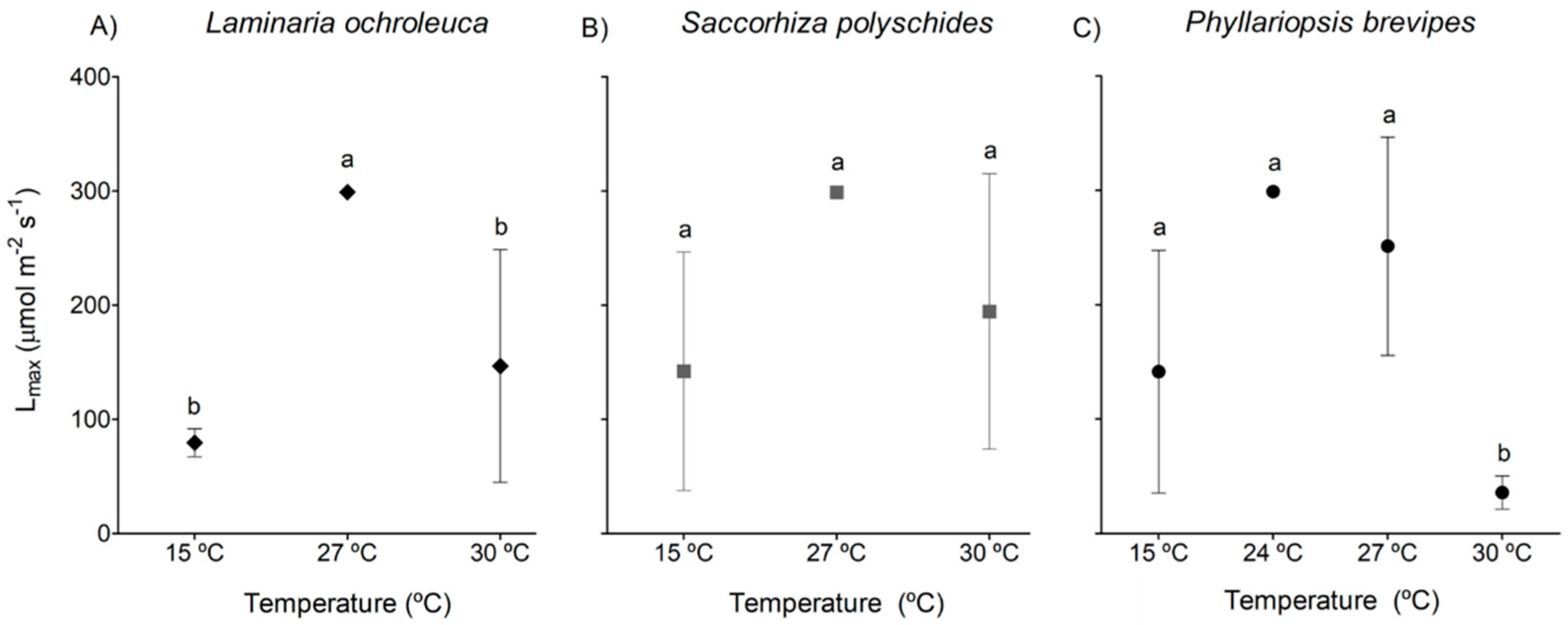
Figure 5.
Fv/Fm response, normalized with the initial value, of A) Laminaria ochroleuca, B) Saccorhiza polyschides and C) Phyllariopsis brevipes to 2.5 hours’ exposure increasing irradiance every 20 min at three temperature levels: 15°C (control), 27°C and 30°C. Different letters indicate significant differences in response to different temperatures within each species, based on Tukey test results. Error bars are SD.
Figure 5.
Fv/Fm response, normalized with the initial value, of A) Laminaria ochroleuca, B) Saccorhiza polyschides and C) Phyllariopsis brevipes to 2.5 hours’ exposure increasing irradiance every 20 min at three temperature levels: 15°C (control), 27°C and 30°C. Different letters indicate significant differences in response to different temperatures within each species, based on Tukey test results. Error bars are SD.
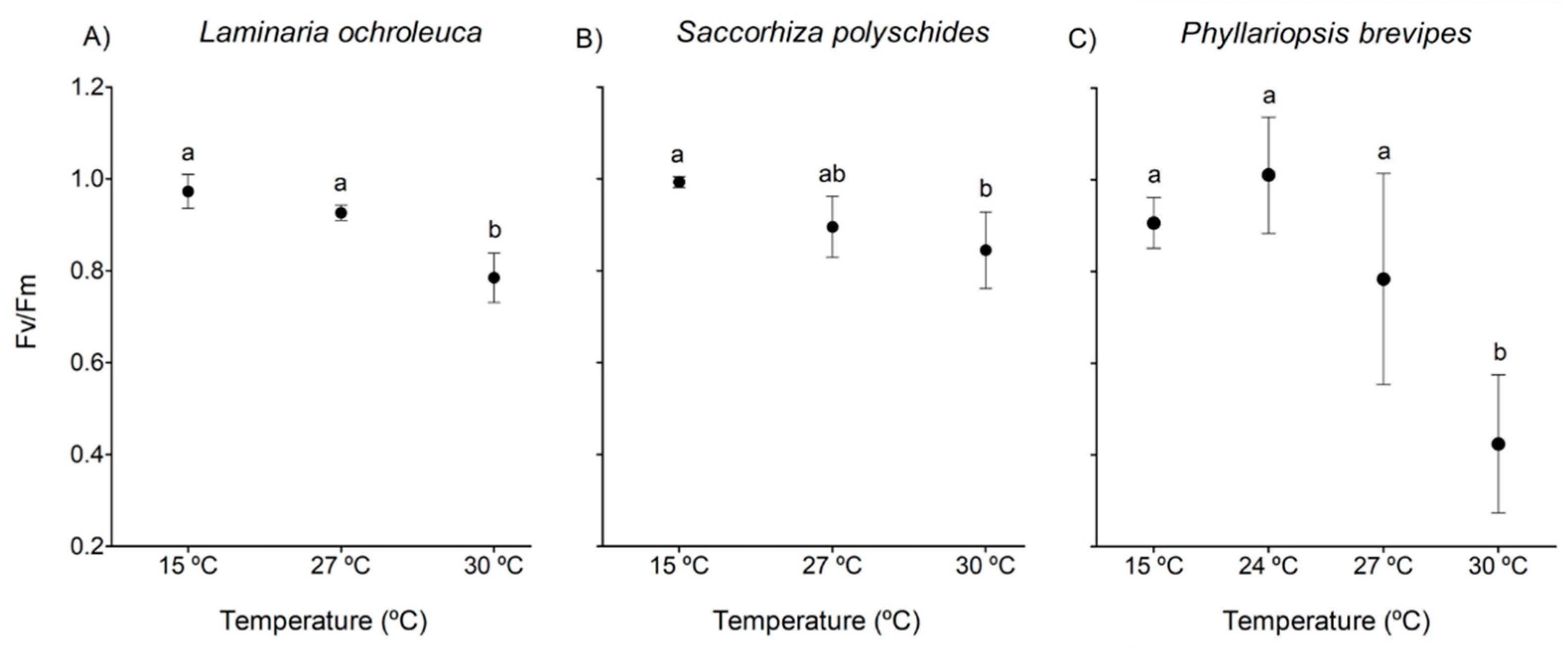

Table 1.
ANOVA results on respiration in dark conditions for the different species. Significant values at p < 0.05 are shown in bold.
Table 1.
ANOVA results on respiration in dark conditions for the different species. Significant values at p < 0.05 are shown in bold.
| Species | p-value | F | df |
|---|---|---|---|
| Laminaria ochroleuca | 0.0001 | 23.419 | 2 |
| Saccorhiza polyschides | 0.197 | 1.956 | 2 |
| Phyllariopsis brevipes | 0.002 | 9.051 | 3 |
Table 2.
ANOVA results for Net Primary Production (NPP) of the different species. Significant values at p < 0.05 are shown in bold.
Table 2.
ANOVA results for Net Primary Production (NPP) of the different species. Significant values at p < 0.05 are shown in bold.
| Species | p-value | F | df |
|---|---|---|---|
| Laminaria ochroleuca | 0.006 | 9.622 | 2 |
| Saccorhiza polyschides | 0.012 | 7.427 | 2 |
| Phyllariopsis brevipes | 0.011 | 5.861 | 3 |
Table 3.
ANOVA results for photon fluence rate at which the different species attained maximum production (LMax). Significant values at p < 0.05 are shown in bold.
Table 3.
ANOVA results for photon fluence rate at which the different species attained maximum production (LMax). Significant values at p < 0.05 are shown in bold.
| Species | p-value | F | df |
|---|---|---|---|
| Laminaria ochroleuca | 0.002 | 14.425 | 2 |
| Saccorhiza polyschides | 0.1 | 3.000 | 2 |
| Phyllariopsis brevipes | 0.001 | 10.743 | 3 |
Table 4.
ANOVA results for Fv/Fm measured at different temperatures for each species. Significant values at p < 0.05 are shown in bold.
Table 4.
ANOVA results for Fv/Fm measured at different temperatures for each species. Significant values at p < 0.05 are shown in bold.
| Species | p-value | F | df |
|---|---|---|---|
| Laminaria ochroleuca | <0.001 | 25.621 | 2 |
| Saccorhiza polyschides | 0.023 | 5.922 | 2 |
| Phyllariopsis brevipes | 0.001 | 11.010 | 3 |
Disclaimer/Publisher’s Note: The statements, opinions and data contained in all publications are solely those of the individual author(s) and contributor(s) and not of MDPI and/or the editor(s). MDPI and/or the editor(s) disclaim responsibility for any injury to people or property resulting from any ideas, methods, instructions or products referred to in the content. |
© 2025 by the authors. Licensee MDPI, Basel, Switzerland. This article is an open access article distributed under the terms and conditions of the Creative Commons Attribution (CC BY) license (http://creativecommons.org/licenses/by/4.0/).
Copyright: This open access article is published under a Creative Commons CC BY 4.0 license, which permit the free download, distribution, and reuse, provided that the author and preprint are cited in any reuse.


