

Submitted:
16 April 2025
Posted:
18 April 2025
You are already at the latest version
Abstract
Because of the global increasing demand for energy, combustible fuels are widely used by both home and industry. Today hydrocarbon dependency has led to huge environmental and health risks from the emissions that they cause. As a result, hydrogen (H2) and ammonia (NH3) have been proposed as promising renewable and carbon-neutral energy carriers to mitigate CO2 emissions in transport. For long-range applications like marine diesel engines, typical alternatives, such as battery-electric, hybrid or fuel cell solutions, are simply too expensive and provide insufficient torque output. The low auto-ignition propensity of ammonia necessitates the utilization of highly reactive fuels to facilitate its combustion process, such as hydrogen. Ammonia as a marine fuel offers several benefits, including the elimination of emissions of sulfur oxides (SOx) and particulate matter (PM). However, newly published research suggests that significant combustion difficulties are faced while burning hydrogen-ammonia blends, primarily due to the various ignition delays of hydrogen and ammonia, which results in incomplete combustion and increased generation of nitrogen oxides (NOx) products like NO, NO2, and N2O. This review thoroughly examines the properties of ammonia and hydrogen as potential fuels for internal combustion engines (ICEs), discussing their physicochemical properties, blending methods, and fuel injection techniques, while also identifying critical knowledge gaps that need to be overcome to stimulate the evolution of H2-NH3 fuels.
Keywords:
ammonia-hydrogen fuel mixtures
; internal combustion engine (ICE)
; sustainable energy
; combustion challenges of ammonia
; emission reduction
; fuel injection techniques
1. Introduction
There is no doubt that fossil fuels negatively affect human health and the environment in the transport sector. These fuels emit massive amounts of carbon dioxide which cause a number of environmental problems, such as the greenhouse effect, rising sea levels, and glacial melting [1,2]. To address these challenges, the International Maritime Organization (IMO) aims to cut greenhouse gas emissions from the maritime sector by at least 50% by 2050 [3]. The role of alternative fuels at carbon-free transition, therefore, will serve to improve environmental quality and ensure a sustainable energy. Though light-duty vehicle electrification presents an immediate answer for decreasing CO2 and other greenhouse gasses, this technology falls short in heavy-duty applications due to restrictions such as low energy density and long battery charge times [4]. Thus, it is vital to move to cleaner fuels such as ammonia and hydrogen to enhance environmental conditions and increase access to energy sources. Both these fuels are eco-friendly alternative as they are either free from carbon and sulphur and thus produce zero carbon emissions when burned [5].
Hydrogen-based fuel is increasingly being regarded as a good alternative fuel to consider for end-use due to its wide flammability limits and high heat value per mass. However, significant barriers to incorporating hydrogen into fuel supply chains remain due to its low density and storage and transportation challenges [6,7]. Hydrogen carriers such as ammonia, which are energetically more dense and thus have a greater specific energy content than H2 gas or pressurized liquid, can be used to tackle these challenges [8,9]. Furthermore, ammonia can be easily and safely stored [10,11] and transported. Nevertheless, ammonia fuel still faces challenges; it possesses corrosive characteristics and has unfavored combustion properties, that includes low laminar burning velocity (LBV), high auto-ignition temperature, and narrow flammability limits (see Table 1) [5]. Even with those sticking points, ammonia is thought to be safer than hydrocarbons or hydrogen, as leaks do not pose the risk of an accidental fire or explosion.
Few studies were conducted over the years to examine the use of ammonia (NH3) as a fuel for internal combustion engines considering important aspects like fuel supply methods, ignition and power modes [15,16,17,18,19,20,21,22]. These investigations indicate that ammonia requires a high ignition energy to have the capability of being an independent fuel due to its low flammability limits [23,24]. Ammonia is currently used in engine applications primarily in two forms: as a blend with hydrogen or combined with another high energy fuel (e.g., diesel, gasoline, dimethyl ether, or natural gas [25‒28]). It improves the combustion properties of ammonia. However, it is still necessary to achieve some performance results, develop fuel injection strategies, and reduce the pollutants emissions to present different technical solutions addressing the operational constraints and favouring the future development of sustainable energy [21,29].
2. Ammonia and Hydrogen Characteristics in ICEs
2.1. Ammonia as a Fuel
Globally, ammonia production accounts for nearly 50% of hydrogen production [30]. Over 85% of NH3 is consumed in agriculture and transported and stored globally. Compared to liquid hydrogen, ammonia has a greater volumetric hydrogen density in its liquid form [31], making it an attractive candidate as a hydrogen carrier. Due to the existing infrastructure for transport and storage, ammonia has great potential as a sustainable energy carrier. It is produced from green hydrogen using renewable energy — we are talking about wind, hydro and solar power plants. Ammonia does not contain any carbon elements, which means burning ammonia does not produce carbon dioxide or carbon monoxide. Moreover, NH3 shows better combustion properties and generate higher torque output, which is beneficial for reducing some undesirable processes such as knocking due to NH3's low energy density and high auto-ignition temperature, attributed to its relatively high-octane number and high latent heat of vaporization [32,33]. In addition, ammonia has more independence than hydrogen [34].
Ammonia exhibits a friendlier safety profile than other potential transportation fuels, like hydrogen, gasoline and propane, though there are some precautions to take. Ammonia vapor, while highly toxic, corrosive and deadly to animals in high concentrations, is easily recognized with low threshold of detection due to its pungent odor [35] and is lighter than air with a low boiling point. In addition, the low reactivity of ammonia makes it less dangerous than other fuels when it comes to accidental fire or explosion. This low reactivity feature also makes it difficult to burn pure ammonia [23,36]. The overall reaction of the combustion of ammonia involves the following for the complete combustion case [37]:
(1)
Ammonia combustion is problematic owing to its low combustion rate, especially at low load and high-speed operations, complicating the operation of the engine. Ammonia has a low energy density, so combustion is easy; therefore, with compression ignition (CI) engines, ammonia is much more difficult. Hence this process requires high compression ratios, up to 35:1 and 100:1. Ammonia exhibits a low cetane number, around 0, which is critically limiting its ignition quality in such systems. Whereas, ammonia is capable of being used by spark ignition (SI) engines, where the ignition process is initiated by a spark plug. High octane number makes ammonia an antiknock agent that can be adapted to these engines. The combustion and reactivity characteristics of ammonia under these conditions are quite variable and, therefore, often require using a combustion promoter fuel in currently used spark-ignition (SI) engines to ensure stable operation [36]. The positive aspects of ammonia as a prospective combustion engine fuel are demonstrated in Figure 1.
As stated before Ammonia had been a great used industrial chemical. Its low flame spread velocity is ideal for marine applications in which the engine rotates at lower speeds allowing for long combustion times [39]. However, in recent years a number of steps have taken place in the maritime sector, including a feasibility study on ammonia as a marine fuel, conducted by Dutch ship design company C-Job Naval Architects [40].
As an energy carrier, hydrogen has numerous benefits that make it ideal for use in ICEs. Such a wide flammability range (4–75% v/v in air) is one of its major advantages. Such wide range makes it possible to run engines in a very lean mixture and reach power output similar to that of conventional fuels with lower fuel consumption and lower emissions of pollutants.
One of the most important features of hydrogen is its very high flame speed of 2.7 m/s [41,42]. Being one of the fastest flame speeds, which means it propagates quickly! It improves combustion and ensures a complete one in each cycle of the engine chamber. This big advantage, though, turns into a disadvantage too. It has a significantly lower quenching distance of 0.6 mm, less than that of gasoline at 2.0 mm, due in part to hydrogen's rapid flame speed. The quenching distance represents the distance where the combustion flame extinguishes from the internal cylinder wall. That very small quenching distance means that extinguishing a hydrogen flame is inherently more difficult than quenching the flames of most other fuels. Thus, the flame of a hydrogen-air mixture is more easily able to propagate through almost closed inlet valves, which increases the risk of backfiring relative to hydrocarbon-air flames [43].
Hydrogen also poses challenges in the area of energy density. Hydrogen takes up a lot more volume than gasoline so it needs to be compacted, usually custome storage solutions such as tankes at high pressures. In addition, the compression of hydrogen requires a further input of energy, around 10-15% of the hydrogen's own energy content.
Many aspects of ICE with hydrogen have been thoroughly studied in the literature, as a promising alternative fuel. Hydrogen combustion properties have been studied extensively, focusing on parameter like flame velocity, shortest quenching distance, and backfire risk [42,43]. In addition, new methods have been explored for the challenges that stem from its energy density, such as storage technologies and materials developmental advancements.
Hydrogen has special characteristics that make it applicable as fuel in both CI (compression ignition) and SI (spark ignition) internal combustion engines. Chemical energy converts into mechanical energy in the combustion of the fuel-air mixture in these engines. In SI engines, an ignition source is utilized, and in CI engines, the fuel–air mixture is compressed to its auto-ignition temperature [44].
The use of ammonia (NH3) as an internal combustion (IC) engine fuel was first researched in 1942 immediately after the Second World War, due to problems associated with the availability of hydrocarbons [45]. The key research advances are provided in Table 2. Belgium also used ammonia to fuel public transport buses during this period, in response to shortages of diesel fuel [45]. In the 1960s, additional work was conducted to assess the potential of ammonia as a fuel for SI [46], as well as CI [47] engines, focusing on aspects such as raw materials, corrosive properties, engine materials, and combustion behavior. Due to an acute shortage of fossil fuels, some vehicles started to run on ammonia, attracting more interest and studies from the US army, to become fuel independent [48].
Study on ammonia as a fuel for internal combustion engines have been carried out in various stages, each with different goals Its initial stage, from the 1960s to the 1970s, was guided by the oil crisis and post-World War II logistical challenges. In comparison, contemporary ammonia fuel research focuses mainly on carbon-zeal strategies that support greenhouse gas emission reduction.
Ammonia has a much higher-octane rating than gasoline, so it is very satisfactory for SI engines. The presence of an ignition source favours sulphur, breaking through its high auto-ignition temperature. This is in part due to ammonia's extremely low flame rate but can be decreased by the addition of other compounds or more ammonia [32,49]. The use of NH3 as fuel in CI engine is more challenging as higher compression ratio is required to reach the high autoignition temperature of the fuel [32]. Even though running a conventional internal combustion engine (ICE) on NH3 can be accomplished with only minor modifications, the less than ideal combustion performance of a pure ammonia fuel is a challenge. When ammonia is mixed with other fuels, significant combustion improvement is achieved, which is why researchers from different fields are focused on the study of ammonia blended engines [50].
2. Ammonia Blended Technologies
2.1. Ammonia Blends with Hydrocarbon Fuels
In the mid-20th century, NH3 emerged as an interesting potential vehicle fuel, due to shortages from the war. Today, NH3 is championed as a potential player in a sustainable, decarbonized future for the transportation sector. There is considerable literature examining the use of ammonia as an alternative fuel, making it a promising option for the future propulsion of Internal Combustion Engines (ICEs) [15,46,47].
On the other hand, while evaluating ammonia's engine combustion, several intrinsic factors ought to be considered. These include its high ignition temperature, high latent heat, low heating value, fuel-bound nitrogen, and low boiling point. High ignition temperature (651 °C) and narrow ignition limits (16–25% by volume in air) [51,52,53] characterize ammonia that pure combustion in compression-ignition engines requires a very high compression ratio.
Nevertheless, the use of pure NH3 as a dedicated fuel in ICEs offers challenges, largely due to its poor combustion characteristics, such as high auto-ignition temperature, narrow flammability range (16–25 % vol. (in the air), low flame rate and high heat of vaporization [53,54,55,56]. In addition, the performance of spark-ignition engines using ammonia as fuel is reduced by 20% compared to gasoline [51]. To overcome these limitations, one attractive strategy is to mix ammonia (NH3) with conventional hydrocarbon fuels to improve the ignitability of the blend while simultaneously reducing carbon emissions. Extensive studies were dedicated towards analyzing different types of fuels mixing practiced with ammonia and their various blend ratios; which include gasoline, diesel, ethanol, methanol, dimethyl ether (DME), diethyl ether (DEE), kerosene, and other fuels. To overcome the combustion issues depicted in Table 3, these studies have provided novel methods.
Gross and Kong [51] employed various ammonia (NH3) and dimethyl ether (DME) fuels in internal combustion engines (ICEs) and tested them in 2013. Their analysis showed how much the addition of ammonia to the fuel mixture of the engine could make a difference at high loads relative to what a pure diesel engine would do. For instance, their research indicates that ammonia's lower flame speed and higher auto-ignition temperature will lead to longer ignition delays and limit the envelopes of the engine. Increasing the injection pressure to 180 bar from a typical 150 bar for DME improved the combustion of the fuel mixture.
In another study, Niki et al. [53] investigated the doping of diesel fuel with ammonia. The results demonstrated the decreased ignition time, cylinder compression and peak pressure while ammonia was injected inside a diesel engine. Despite these discoveries, the authors finished that ammonia could function as a viable clear gasoline answer and an emissions management device.
Furthermore, several studies have demonstrated that the introduction of methanol and ethanol into gasoline fuels can increase ammonia solubility [56]. Also replacing kerosene with diesel fuel has been shown to improve combustion efficiency, thereby reducing carbon emissions and enhancing ammonia combustion [57]. However, at steady-state operation, a common observation related to the introduction of hydrocarbons-enriched fuels is the surge in engine torque and output power. Nevertheless, this benefit is usually offset by increased emissions of nitrogen oxides (NOx) [13,26,54].
2.2. Ammonia Blends with Hydrogen
Dual-fuel combustion using ammonia (NH3) as an energy carrier has been demonstrated to improve combustion reactivity with the addition of hydrogen (H2) [58,59,60,61], and only a small volume of H2 is required to realize these improvements. In this method, the amount of CO in the exhaust is reduced, as CO can partly replace gasoline combustion with ammonia, resulting in further CO oxidation to CO2 [19]. Moreover, molecular hydrogen can be produced on-demand using ammonia dissociation—this hardly requires a container to be kept somewhere else. This characteristic provides hydrogen-enriched ammonia a higher combustion-promoting capacity than other fuel alternatives [36,49]. In 2015, Comotti et al. beet cultivation) [61] and in-situ hydrogen production using a catalytic cracking reactor [62] had shown promising results with improvement in engine cycle and stability with addition of hydrogen and significant reduction in nitrogen oxide (NOx) emission. Apart from this information in literature, several direct ammonia-hydrogen mixtures strategies have also been evaluated, including partially dissociating ammonia prior to its injection, which has been shown to improve the performance and reduce emissions of an ammonia engine, such relevant advancement work is summarized in Table 4.
A new design of heavy-duty ammonia-hydrogen dual-fuel combustion engine had been built and presented by Alberto Boretti [64], which aims to achieve combustion efficiency comparable with diesel engine. Incorporating an in-cylinder pre-jet ignition chamber with a glow plug, a secondary hydrogen injector, and primary injectors for ammonia and hydrogen, this design enables ignition without the operational need for a pre-ignition hydrogen flow. Simulations were performed using GT-POWER, but the results were limited by the lack of engine models with two combustion pre-ignition chambers and a lack of experimental data that directly impacted the simulation results.
Pochet et al. [65] studied the addition of ammonia to hydrogen Homogeneous Charge Compression Ignition (HCCI) engines to evaluate the accessible energy rate versus efficiency and emission characteristics. They also suggested that the intake temperature required for full combustion of hydrogen was around 427K, beyond which auto-ignition resistance had a negligible effect on up to 60% ammonia content. Merch et al. conducted experiments on an engine modified to study the combustion efficiency and power of an ammonia-fueled hydrogen engine with different blending ratios. As shown in Figure 2, their experiments indicated that the optimal combustion efficiency of the mixed fuel gas was obtained when the hydrogen volume fraction was 10%, resulting in maximum power output of the engine. Moreover, because hydrogen and ammonia have higher octane numbers than fossil fuels, they have the potential to improve engine compression ratios, resulting in improved heat cycles and generation [12,55].
Overviews of other ammonia-hydrogen fuel blends on different engine types with varying blending ratios can be found in Table 5 (CI engines) and Table 6 (SI engine). Fuel composition and engine configurations play critical roles in combustion performance, efficiency, and emissions, and these studies offer valuable insights.
3. Fuel Injection Strategies for the Combustion Process
3.1. Ammonia Injection Strategies for ICEs Engine
Due to ammonia’s distinct thermodynamic characteristics, which alter the combustion process, fuel injection strategies are critical in ammonia. [77]. A recent study by Niki et al. [78], investigated several injection strategies in an ammonia CI engine, such as pilot and post-injection. The results showed that improving the pilot injection timing from 30–70 CA bTDC led to the reduction of NH3 slip (2000 ppm). However, this change in timing of pilot injection also brought higher nitrogen-based emissions. Pilot injection timing adjusted to 50° CA bTDC decreased maximum cylinder pressure since heat loss was initiated by the combustion started at the beginning of compression. This was further supported by the small peak of premixed combustion which suggested that part of the fuel was ignited and burned before primary injection. For post-injection, the pressure in the internal cylinder was constant for post-injection timing at 50°CA aTDC, and the HRR map confirmed that the injected fuel burns and raises the temperature towards the expansion stroke. Leading research progress indicates that the post-injection timing delayed from 10 to 40° CA aTDC could reduce both unburned ammonia and NOx emissions, but when it was advanced to 50° CA aTDC the effect ceased;Detailed information is shown in Table 7.
A new combustion strategy for internal combustion engines applied with neat ammonia fuel was proposed by Lee and Song [22]. In contrast to the study presented in this document, the authors suggested using ammonia as an energy medium, where a small quantity of ammonia is introduced during combustion. This was done by injecting premixed ammonia-air (the fuel) at the end of the compression stroke (Mollner et al., 2012), which also produced high temperature and pressure within the cylinder enough to ignite the main NH3 spray injection. The authors validated this concept with engine modeling and a parametric study. Nonetheless, they found that fully combusting NH3 without the addition of carbon based materials to improve the combustion 98 has not yet been accomplished.
Lamas and Rodriguez [79] conducted a different study to analyze the effect of different fuel injection configurations (parabolic, triangular. rectangular, etc.) Results indicated that the parabolic NOx profile has been shown to decrease high levels of NOx by ~75%. However, the study also showed that an increased injection time was less effective at reducing NOx emissions.
The recent numerical study by Lamas et al. [80] showed that ammonia can act as a NOx-reducing agent when injected in the expansion stroke. A multi-cylinder CI engine work with ammonia/marine diesel oil was found to exhibit an 80% reduction in NOx emissions when NH3 was injected at a 4% ammonia-to-fuel ratio with separate injectors and an injection timing of 58.4° CA aTDC. By injecting ammonia at 3-5% ammonia-to-fuel ratio and at an injection timing of 43.2° CA aTDC, NOx emissions were reduced by almost 60% when a CI engine fueled NH3/H2/Diesel mixture was tested [81]. Delaying injection times did, however, lead to higher emissions of unburned ammonia. Thus, ammonia plays the role of fuel during injection close to the TDC of compression and a NOx-reductant agent during injection in the expansion stroke [82].
3.2. Hydrogen Injection Strategies for ICES Engine
Port Fuel Injection (PFI), the standard SI fuel injection model is limited by the use of throttle valve for load and timing of fuel delivery control. However, an innovative solution, hydrogen Direct Injection (DI) systems for the increase of the power density and near-zero emissions of hydrogen internal combustion engines, has been sinthethized [83]. As the injection happens when inlet valves completely close, it effectively overcomes backfire phenomena observed with PFI setups. Moreover, for fuels such as hydrogen, the DI approach may compensate for the reduced volumetric efficiency that occurs when fuel displaces air in the gas phase in the intake manifold. Thus, it can provide a power density similar to or greater than that of a conventional gasoline engine [84,85]; pertinent advanced investigations are presented in Table 8.
Multiple analyses and tests have highlighted the potential of hydrogen DI systems. An example of this is a DI system with injection pressures up to 300 bar that has been successfully implemented by BMW and its partners into a Spark-Ignition (SI) engine. Remarkably, this system attained a high 42% efficiency, which was comparable to diesel engines [86]. RE: Mazda Continues Development of Hydrogen Rotary Engine That Combines Port Fuel Injection and DI They've been tested with a sports car, where the range reaches almost 649 km [87] with this engine.
4. Conclusion
Ammonia as a fuel or energy carrier could significantly assist in the decarbonization of the energy sector and the integration of hydrogen into the marketplace. Ammonia (NH3) shows great promise as an energy carrier owing to its high energy density, as well as the existing infrastructure for transportation and production, offering an attractive and sustainable alternative. Nevertheless, burning ammonia has its own hurdles to overcome: slow flame propagation, narrow combustion range, and the potential for the release of nitrogen oxides (NOx).
Focusing on intermixing reaction of ammonia with hydrogen and performance and emissions characteristics. The main conclusions we could draw from the literature are as follows:
- The mechanical approaches for ammonia combustion have mitigated the common challenges in a few studies. As an example, with the addition of a new ignition system or the introduction of a second fuel, minimum ignition energy can be decreased. Only the addition of a combustion promoter can markedly improve flame speed.
- Mixing ammonia with hydrogen has relatively fewer adverse effects than other fuel blend combinations at the same time promotes combustion characteristics of ammonia. Both ammonia and hydrogen have very high octane rating which allows burning them on higher compression ratio engines that improves thermal efficiency and engine performance.
- An ammonia doping ratio of about 10% has been reported to provide inhibitive combustion and operating efficiency of the ammonia-doped hydrogen engines. However, it may not make the most efficient use of space and energy and raises additional safety concerns. Hydrogen production can help save resources wastage, mitigate safety issues, and ensure the efficient working of hydrogen-ammonia engines.
- Ammonia decomposition for hydrogen production has been revealed to be a feasible method for supplying hydrogen, as it allows the elimination of hydrogen storage, which lowers the costs and the required amount of equipment. However, this approach is still limited by several factors including the decrease in hydrogen production when ammonia flow and consumption rise because the residence time of ammonia in the catalyst is short.
However, we are still in the early stages of research and development of ammonia-based hydrogen engines, and already we have optical and readily produced agents that are one step closer to making ammonia a cleaner, renewable, and easily attainable, long-lasting fuel source. In the long run, this shift can massively reduce carbon emissions and enable sustainable energy solutions across industries.
Author Contributions
R.M.: formal analysis, investigation, writing—original draft, writing—reviewing and editing. X.L: investigation, writing—reviewing. H.R: draft preparation, investigation, writing—original draft. Z.P.: investigation, reviewing. All authors have read and agreed to the published version of the manuscript.
Informed Consent Statement
Not applicable.
Data Availability Statement
Not applicable.
Conflicts of Interest
The authors declare no conflicts of interest.”
Abbreviations
The following abbreviations are used in this manuscript:
| aTDC | After Top Dead Center |
| bTDC | Before Top Dead Center |
| CA | Crank Angle |
| CI | Compression Ignition (engine) |
| CO | Carbon Monoxide |
| CO₂ | Carbon Dioxide |
| DEE | Diethyl Ether |
| DME | Dimethyl Ether |
| DI | Direct Injection |
| EEOI | Energy Efficiency Operational Index (used in maritime emissions) |
| GHG | Greenhouse Gas |
| H₂ | Hydrogen |
| HCCI | Homogeneous Charge Compression Ignition |
| HRR | Heat Release Rate |
| ICE | Internal Combustion Engine |
| IMO | International Maritime Organization |
| LBV | Laminar Burning Velocity |
| MJ/kg | Megajoules per kilogram (energy density) |
| NH₃ | Ammonia |
| NO | Nitric Oxide |
| NO₂ | Nitrogen Dioxide |
| NOₓ | Nitrogen Oxides (collective term for NO, NO₂, N₂O) |
| N₂O | Nitrous Oxide |
| PFI | Port Fuel Injection |
| PM | Particulate Matter |
| SI | Spark Ignition (engine) |
| SOₓ | Sulfur Oxides |
| TDC | Top Dead Center |
| Vol.% | Volume Percentage |
References
- Yapicioglu, Arda; Dincer, Ibrahim. A review on clean ammonia as a potential fuel for power generators. Renewable and Sustainable Energy Reviews. 2019, 103, 96–108. [Google Scholar] [CrossRef]
- Chehade, G. , & Dincer, I. Progress in green ammonia production as potential carbon-free fuel. Fuel, 2021, 299, 120845. [Google Scholar]
- Park, Goryong; Cho, Kwonhae. A study on the change of EEOI before and after modifying bulbous at the large container ship adopting low speed operation. Journal of the Korean Society of Marine Engineering. 2017, 41, 15–20. [Google Scholar] [CrossRef]
- Senecal, Peter & Leach, Felix. (2019). Diversity in transportation: Why a mix of propulsion technologies is the way forward for the future fleet. Results in Engineering. 4. 100060. [CrossRef]
- Vidal, Carlos & Lamas, María & Rodriguez, Juan de Dios & Abbas, Amr. (2022). Possibilities of Ammonia as Both Fuel and NOx Reductant in Marine Engines: A Numerical Study. Journal of Marine Science and Engineering. 10. 43. [CrossRef]
- Seediek, Ibrahim & Elgohary, Mohamed & Ammar, Nader. (2015). The hydrogen-fuelled internal combustion engines for marine applications with a case study. Brodogradnja. 66. 23-38.
- Jensen, Jens Oluf & Vestbø, A.P. & Li, Q. & Bjerrum, N.J.. (2007). The energy efficiency of onboard hydrogen storage. Journal of Alloys and Compounds. 446. 723-728. [CrossRef]
- Zhou, Mei & Wang, Yuegu & Chu, Yuchun & Tang, Youning & Tian, Koukou & Zheng, Songsheng & Chen, Jin & Wang, Zhaolin. (2019). Ammonia as an environmentally benign energy carrier for the fast growth of China. Energy Procedia. 158. 4986-4991. [CrossRef]
- Wan, Zhijian & Tao, Youkun & Shao, Jing & Zhang, Yinghui & You, Hengzhi. (2021). Ammonia as an effective hydrogen carrier and a clean fuel for solid oxide fuel cells. Energy Conversion and Management. 228. 113729. [CrossRef]
- Al-Aboosi, Fadhil & El-Halwagi, Mahmoud & Moore, Margaux & Nielsen, Rasmus. (2021). Renewable ammonia as an alternative fuel for the shipping industry. Current Opinion in Chemical Engineering. 31. 100670. [CrossRef]
- Al-Hamed, Khaled H.M. & Dincer, Ibrahim, 2021. A novel ammonia solid oxide fuel cell-based powering system with on-board hydrogen production for clean locomotives, Energy, Elsevier, vol. 220(C). [CrossRef]
- Mørch, C. S. , Bjerre, A., Gøttrup, M. P., Sorenson, S. C., & Schramm, J. (2011). Ammonia/Hydrogen Mixtures in an SI-Engine: Engine performance and analysis of a proposed fuel system. Fuel. 2011;90:854-864. [CrossRef]
- Valera-Medina, A., Xiao, H., Owen-Jones, M., David, W.I.F., Bowen, P.J.. 2018. Ammonia for power”, Prog. Energy Combust. Sci. 69 : 63–102, 2018. [CrossRef]
- Lhuillier, Charles & Brequigny, Pierre & Contino, Francesco & Mounaïm-Rousselle, Christine. (2019). Combustion Characteristics of Ammonia in a Modern Spark-Ignition Engine. [CrossRef]
- Starkman, E.S. , Newhall, H.K., Sutton, R.D., Maguire, T., & Farbar, L. (1966). Ammonia as a spark ignition engine fuel: theory and application. SAE paper 660155, 1966.
- Liu, Rui & Ting, David & Checkel, M.. (2003). Ammonia as a Fuel for SI Engine. SAE Technical Papers. [CrossRef]
- Li, Jun & Huang, Hongyu & Kobayashi, Noriyuki & He, Zhaohong & Nagai, Yoshihiro. (2014). Study on using hydrogen and ammonia as fuels: Combustion characteristics and NOx formation. International Journal of Energy Research. 38. 1214-1223. [CrossRef]
- Ezzat, M. F & Dincer, I., (2018). Development and assessment of a new hybrid vehicle with ammonia and hydrogen, Applied Energy, Elsevier, vol. 219(C), pages 226-239. [CrossRef]
- Ryu, Kyunghyun & Zacharakis-Jutz, George & Kong, Song-Charng. (2014). Effects of gaseous ammonia direct injection on performance characteristics of a spark-ignition engine. Applied Energy. 116. 206–215. [CrossRef]
- Niki, Yoichi & Nitta, Yoshifuru & Sekiguchi, Hidenori & Hirata, Koichi. (2019). Diesel Fuel Multiple Injection Effects on Emission Characteristics of Diesel Engine Mixed Ammonia Gas Into Intake Air. Journal of Engineering for Gas Turbines and Power. 141. [CrossRef]
- Lhuillier, Charles & Brequigny, Pierre & Contino, Francesco & Mounaïm-Rousselle, Christine. (2019). Performance and Emissions of an Ammonia-Fueled SI Engine with Hydrogen Enrichment. [CrossRef]
- Lee, D., & Song, H.H. (2018). Development of combustion strategy for the internal combustion engine fueled by ammonia and its operating characteristics. Journal of Mechanical Science and Technology, 32, 1905-1925.
- Nozari, Hadi & Karabeyoglu, Arif. (2015). Numerical study of combustion characteristics of ammonia as a renewable fuel and establishment of reduced reaction mechanisms. Fuel. 159. 223-233. [CrossRef]
- Lhuillier, Charles & Brequigny, Pierre & Contino, Francesco & Mounaïm-Rousselle, Christine. (2020). Experimental investigation on ammonia combustion behavior in a spark-ignition engine by means of laminar and turbulent expanding flames. Proceedings of the Combustion Institute. 38. 5859-5868. [CrossRef]
- Chen, D., Li, J., Huang, H., Chen, Y., He, Z., & Deng, L. (2020). Progress in ammonia combustion and reaction mechanism. Chemistry, 83(6), 508-515.
- Dimitriou, Pavlos & Javaid, Rahat. (2020). A review of ammonia as a compression ignition engine fuel. International Journal of Hydrogen Energy. 45. [CrossRef]
- Feng, Yuan & Zhu, Jizhen & Mao, Yebing & Raza, Mohsin & Qian, Yong & Yu, Liang & Lu, Xingcai. (2020). Low-temperature auto-ignition characteristics of NH3/diesel binary fuel: Ignition delay time measurement and kinetic analysis. Fuel. 281. 118761. [CrossRef]
- Yapicioglu, Arda & Dincer, Ibrahim. (2018). Performance assesment of hydrogen and ammonia combustion with various fuels for power generators. International Journal of Hydrogen Energy. 43. [CrossRef]
- Mounaïm-Rousselle, Christine & Brequigny, Pierre. (2020). Ammonia as Fuel for Low-Carbon Spark-Ignition Engines of Tomorrow's Passenger Cars. Frontiers in Mechanical Engineering. 6. 70. [CrossRef]
- Lan, Rong & Irvine, John & Tao, Shanwen. (2012). Ammonia and related chemicals as potential indirect hydrogen storage materials. Fuel and Energy Abstracts. 37. [CrossRef]
- Lamb, Krystina & Dolan, Michael & Kennedy, Danielle. (2019). Ammonia for hydrogen storage; A review of catalytic ammonia decomposition and hydrogen separation and purification. International Journal of Hydrogen Energy. 44. [CrossRef]
- Koike, Makoto & Miyagawa, H. & Suzuoki, T. & Ogasawara, K.. (2012). Ammonia as a hydrogen energy carrier and its application to internal combustion engines. [CrossRef]
- Splitter, Derek & Szybist, James. (2014). Intermediate Alcohol-Gasoline Blends, Fuels for Enabling Increased Engine Efficiency and Powertrain Possibilities. SAE Int. J. Fuels Lubr.. 7. 10-4271. [CrossRef]
- Ayvalı, T. , Edman Tsang, S. C., & Van Vrijaldenhoven, T. (2021). The Position of Ammonia in Decarbonising Maritime Industry: An Overview and Perspectives: Part I: Technological advantages and the momentum towards ammonia-propelled shipping. Johnson Matthey technology review, 65(2), 275-290.
- Abedin, Ahmed & Radenahmad, Nikdalila & Cheok, Quentin & Shams, Shahriar & Kim, Jung & Azad, Abul. (2016). Ammonia-fed fuel cells: A comprehensive review. Renewable and Sustainable Energy Reviews. 60. 822-835. [CrossRef]
- Langella, Giuseppe & de Joannon, Mara & Sabia, Pino & Iodice, Paolo & Amoresano, Amedeo. (2022). Ammonia as a fuel for internal combustion engines: latest advances and future challenges. Journal of Physics: Conference Series. 2385. 012036. [CrossRef]
- Kobayashi, Hideaki & Hayakawa, Akihiro & Somarathne, Kapuruge Don Kunkuma & Okafor, Ekenechukwu. (2018). Science and technology of ammonia combustion. Proceedings of the Combustion Institute. 37. [CrossRef]
- Kurien, Caneon & Mittal, Mayank. (2022). Review on the production and utilization of green ammonia as an alternate fuel in dual-fuel compression ignition engines. Energy Conversion and Management. 251. 114990. [CrossRef]
- Long Liu, Yue Wu, Yang Wang. (2022). Numerical investigation on the combustion and emission characteristics of ammonia in a low-speed two-stroke marine engine, Fuel, Volume 314, 2022, 122727, ISSN 0016-2361.
- Looijenga, J. Y. (2020). The feasibility of zero-emission ferries in the Wadden Sea (Doctoral dissertation, PhD thesis. Delft: TU Delft).
- Mestemaker, B. T. W. , Castro, M. G., Van Der Blom, E. C., Cornege, H. J., & Visser, K. (2019, July). Zero emission vessels from a shipbuilders perspective. In 2nd International Conference on Smart & Green Technology for the Future of Marine Industries (SMATECH 2019)–Conference Proceedings (pp. 11-12).
- Rachele Lamioni, Cristiana Bronzoni, Marco Folli, Leonardo Tognotti, Chiara Galletti. (2023). Impact of H2-enriched natural gas on pollutant emissions from domestic condensing boilers: numerical simulations of the combustion chamber, International Journal of Hydrogen Energy, Volume 48, Issue 51, 2023, Pages 19686-19699, ISSN 0360-3199.
- Ciniviz, M. and Kose, H. (2012). Hydrogen Use in Internal Combustion Engine: A Review. International Journal of Automotive Engineering and Technologies, 2012, Vol. 1, Issue 1, pp. 1-15.
- Heywood, J. (2018). Internal combustion engine fundamentals.
- Koch, E. J. J. I. P. (1945). Ammonia–a fuel for motor buses. J. Inst. Pet, 31(213), 498.
- Cornelius, W. , Huellmantel, L. W., & Mitchell, H. R. (1966). Ammonia as an engine fuel. SAE Transactions, 300-326.
- Gray Jr, James T., Edward Dimitroff, Nelson T. Meckel, and R. D. Quillian Jr. "Ammonia fuel—engine compatibility and combustion." SAE Transactions (1967): 785-807.
- Pearsall, T. J., & Garabedian, C. G. (1968). Combustion of anhydrous ammonia in diesel engines. SAE Transactions, 3213-3221.
- Lhuillier, Charles & Brequigny, Pierre & Contino, Francesco & Mounaïm-Rousselle, Christine. (2020). Experimental study on ammonia/hydrogen/air combustion in spark ignition engine conditions. Fuel. 269. 117448. 10.1016/j.fuel.2020.117448.
- Duynslaegher, C., Jeanmart, H., & Vandooren, J. (2010, September). Ammonia Combustion in spark ignition engine conditions. In Proceedings of the 7th Annual NH3 Fuel Conference, Romulus, MI, USA (pp. 26-28).
- Gross, Christopher & Kong, Song-Charng. (2013). Performance characteristics of a compression-ignition engine using direct-injection ammonia–DME mixtures. Fuel. 103. 1069-1079. [CrossRef]
- Cavaliere da Rocha, Rodolfo & Ramos, Carlos & Costa, Mário & Bai, Xue-Song. (2019). Combustion of NH3/CH4/Air and NH3/H2/Air Mixtures in a Porous Burner: Experiments and Kinetic Modeling. Energy & Fuels. XXXX. [CrossRef]
- Niki, Yoichi & Yoo, Dong-Hoon & Hirata, Koichi & Sekiguchi, Hidenori. (2016). Effects of Ammonia Gas Mixed Into Intake Air on Combustion and Emissions Characteristics in Diesel Engine. V001T03A004. [CrossRef]
- Reiter, Aaron & Kong, Song-Charng. (2011). Combustion and emissions characteristics of compression-ignition engine using dual ammonia-diesel fuel. Fuel. 90. 87-97. [CrossRef]
- Xiaowei Xu & Enlong Liu & Neng Zhu & Fanfu Liu & Feng Qian, 2022. Review of the Current Status of Ammonia-Blended Hydrogen Fuel Engine Development, Energies, MDPI, vol. 15(3), pages 1-19, January.
- Haputhanthri, Shehan. (2014). Ammonia Gasoline Fuel Blends: Feasibility Study of Commercially Available Emulsifiers and Effects on Stability and Engine Performance. SAE Technical Papers. 2014. [CrossRef]
- Tay, Kun & Yang, W.M. & Chou, S.K. & Zhou, Dezhi & Li, Jing & Wenbin, Yu & Zhao, Feiyang & Mohan, Balaji. (2017). Effects of Injection Timing and Pilot Fuel on the Combustion of a Kerosene-diesel/Ammonia Dual Fuel Engine: A Numerical Study. Energy Procedia. 105. 4621-4626. [CrossRef]
- Frigo, Stefano & Gentili, Roberto. (2013). Analysis of the behaviour of a 4-stroke Si engine fuelled with ammonia and hydrogen. International Journal of Hydrogen Energy. 38. 1607–1615. [CrossRef]
- Otomo, Junichiro & Koshi, Mitsuo & Mitsumori, Teruo & Iwasaki, Hiroshi & Yamada, Koichi. 2018. Chemical kinetic modeling of ammonia oxidation with improved reaction mechanism for ammonia/air and ammonia/hydrogen/air combustion. International Journal of Hydrogen Energy. 43. [CrossRef]
- Frigo, Stefano & Gentili, Roberto & Angelis, Franco. (2014). Further Insight into the Possibility to Fuel a SI Engine with Ammonia plus Hydrogen. SAE Technical Papers. 2014. [CrossRef]
- Pozzana, Giuseppe & Bonfanti, Neri & Frigo, Stefano & Doveri, Nicolò & Dario, Paolo & Mattoli, Virgilio & Ragnoli, Marina. (2012). A Hybrid Vehicle Powered by Hydrogen and Ammonia. SAE Technical Papers. 4. [CrossRef]
- Comotti, Massimiliano & Frigo, Stefano. (2015). Hydrogen generation system for ammonia-hydrogen fuelled internal combustion engines. International Journal of Hydrogen Energy. 40. 10673-10686. [CrossRef]
- Ryu, Kyunghyun & Zacharakis-Jutz, George & Kong, Song-Charng. (2014). Performance enhancement of ammonia-fueled engine by using dissociation catalyst for hydrogen generation. International Journal of Hydrogen Energy. 39. 2390-2398. [CrossRef]
- Boretti, Albert. (2012). Novel heavy duty engine concept for operation dual fuel H2–NH3. International Journal of Hydrogen Energy. 37. 7869–7876. [CrossRef]
- Pochet, Maxime & Truedsson, Ida & Foucher, F. & Jeanmart, Hervé & Contino, Francesco. (2017). Ammonia-Hydrogen Blends in Homogeneous-Charge Compression-Ignition Engine. SAE Technical Papers. 2017-24-0087. [CrossRef]
- Issayev, Gani & Giri, Binod & Elbaz, A. & Shrestha, Krishna Prasad & Mauss, Fabian & Roberts, William & Farooq, Aamir. (2020). Combustion behavior of ammonia blended with diethyl ether. Proceedings of the Combustion Institute. [CrossRef]
- Grannell, Shawn & Assanis, Dennis & Bohac, Stanislav & Gillespie, Donald. (2008). The Fuel Mix Limits and Efficiency of a Stoichiometric, Ammonia, and Gasoline Dual Fueled Spark Ignition Engine. Journal of Engineering for Gas Turbines and Power-transactions of The Asme - J ENG GAS TURB POWER-T ASME. 130. [CrossRef]
- Reiter, Aaron & Kong, Song-Charng. (2010). Diesel Engine Operation Using Ammonia as a Carbon-Free Fuel. American Society of Mechanical Engineers, Internal Combustion Engine Division (Publication) ICE. [CrossRef]
- Ryu, Kyunghyun & Zacharakis-Jutz, George & Kong, Song-Charng. (2014). Performance characteristics of compression-ignition engine using high concentration of ammonia mixed with dimethyl ether. Applied Energy. 113. 488-499. [CrossRef]
- Haputhanthri, Shehan & Maxwell, Timothy & Fleming, John & Austin, Chad. (2015). Ammonia and Gasoline Fuel Blends for Spark Ignited Internal Combustion Engines. Journal of Energy Resources Technology. 137. [CrossRef]
- Nash, D. & Aklil, D. & Johnson, E. & Gazey, R. & Ortisi, V. (2012). Hydrogen Storage. [CrossRef]
- Ezzat, M.F. & Dincer, Ibrahim. (2018). Comparative assessments of two integrated systems with/without fuel cells utilizing liquefied ammonia as a fuel for vehicular applications. International Journal of Hydrogen Energy. 43. 4597-4608. [CrossRef]
- Lee, J.H. & Kim, J.H. & Park, J.H. & Kwon, O.C. (2010). Study on properties of laminar premixed hydrogen-added ammonia/air flames for hydrogen production. International Journal of Hydrogen Energy. 35. 1054-1064. [CrossRef]
- Koike, Makoto & Suzuoki, Tetsunori. (2019). In-line adsorption system for reducing cold-start ammonia emissions from engines fueled with ammonia and hydrogen. International Journal of Hydrogen Energy. 44. [CrossRef]
- Du, Wang & Ji, Changwei & Wang, Shuofeng & Yang, Jinxin & Wang, Zhe. (2020). Numerical study of the premixed ammonia-hydrogen combustion under engine-relevant conditions. International Journal of Hydrogen Energy. 46. [CrossRef]
- Bro, K. and Pedersen, P. 1977. Alternative Diesel Engine Fuels: An Experimental Investigation of Methanol, Ethanol, Methane and Ammonia in a D.I. Diesel Engine with Pilot Injection, SAE Technical Paper 770794, 1977.
- Chiong, Meng-Choung & Chong, Cheng Tung & Ng, Jo-Han & Mashruk, Syed & Chong, William & Samiran, N. & Mong, Guo & Valera-Medina, Agustin. (2021). Advancements of combustion technologies in the ammonia-fuelled engines. Energy Conversion and Management. 244. 114460. [CrossRef]
- Niki, Yoichi & Nitta, Yoshifuru & Sekiguchi, Hidenori & Hirata, Koichi. (2019). Diesel Fuel Multiple Injection Effects on Emission Characteristics of Diesel Engine Mixed Ammonia Gas Into Intake Air. Journal of Engineering for Gas Turbines and Power. 141. [CrossRef]
- Lamas, M.I. & Vidal, Carlos. (2019). NOx Reduction in Diesel-Hydrogen Engines Using Different Strategies of Ammonia Injection. Energies. 12. 1255. [CrossRef]
- Galdo, Lamas & Castro-Santos, Laura & Vidal, Carlos. (2020). Numerical Analysis of NOx Reduction Using Ammonia Injection and Comparison with Water Injection. Journal of Marine Science and Engineering. 8. 109. [CrossRef]
- Lamas MI, Rodriguez CG.. (2017). Numerical model to analyze NOx reduction byammonia injection in diesel-hydrogen engines. Int. J. Hydrogen Energy 2017;42(41):26132–41.
- Lesmana, Herry & Zhang, Zhezi & Li, Xianming & Zhu, Mingming & Xu, Wenqiang & Zhang, Dongke. (2019). NH3 as a Transport Fuel in Internal Combustion Engines: A Technical Review. Journal of Energy Resources Technology. 141. [CrossRef]
- Mohammadi, Ali & Shioji, M. & Nakai, Yasuyuki & Ishikura, Wataru & Tabo, Eizo. (2007). Performance and combustion characteristics of a direct injection SI hydrogen engine. International Journal of Hydrogen Energy. 32. 296-304. [CrossRef]
- Verhelst, Sebastian & Demuynck, Joachim & Sierens, Roger & Scarcelli, Riccardo & Matthias, Nicholas & Wallner, Thomas. (2013). Update on the Progress of Hydrogen-Fueled Internal Combustion Engines. [CrossRef]
- Yip HL, Srna A, Yuen ACY, Kook S, Taylor RA, Yeoh GH, Medwell PR, Chan QN. (2019). A Review of Hydrogen Direct Injection for Internal Combustion Engines: Towards Carbon-Free Combustion. Applied Sciences, 2019; 9(22):4842-1-4842-30.
- Ozcanli, Mustafa & Baş, Oğuz & Akar, Mustafa & Yıldızhan, Şafak & Serin, Hasan. (2018). Recent studies on hydrogen usage in Wankel SI engine.
Figure 1.
Characteristics of NH3 as fuel for IC engines [38].
Figure 1.
Characteristics of NH3 as fuel for IC engines [38].
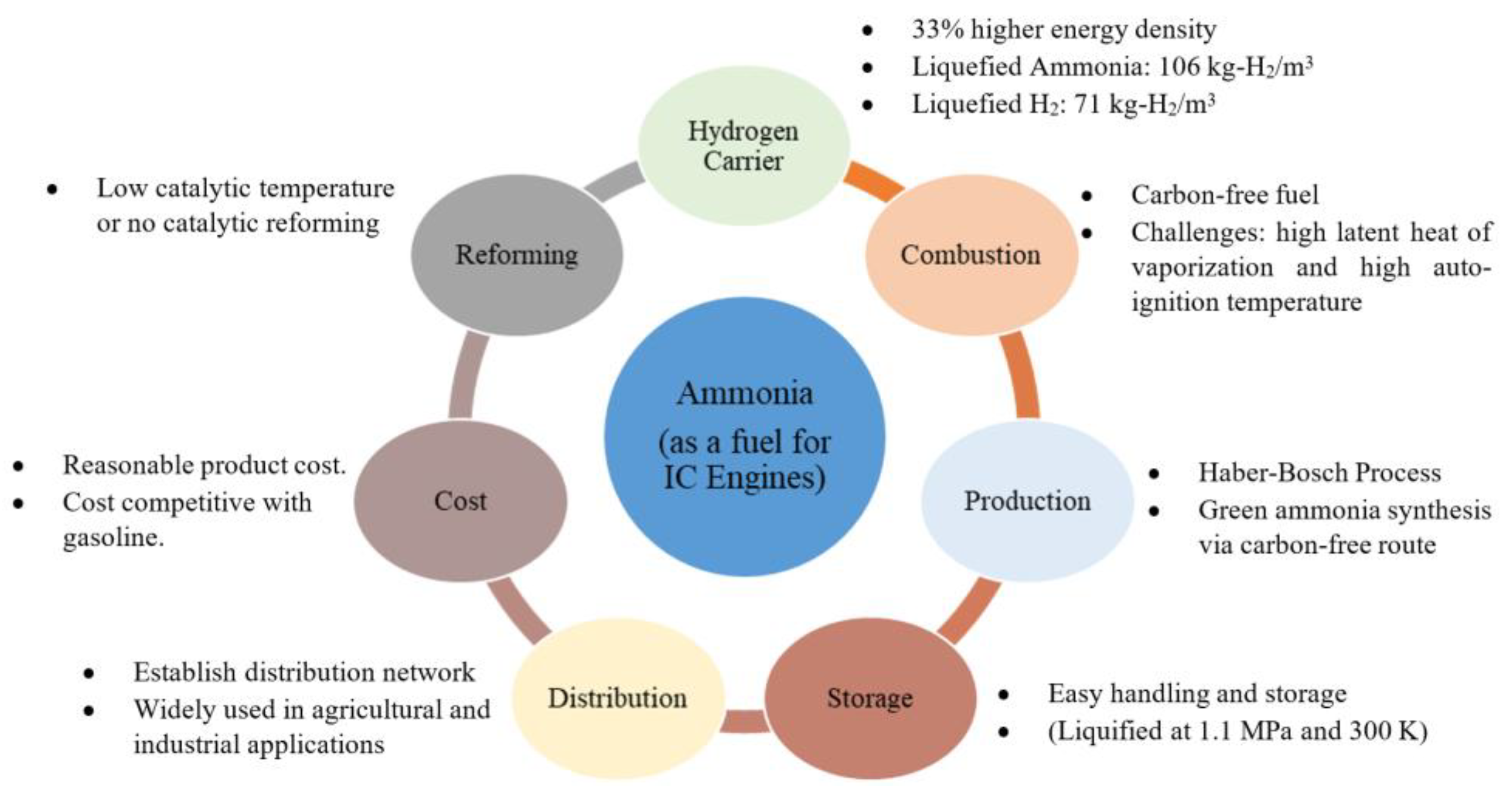
Figure 2.
Engine operating characteristics at different compression ratios and hydrogen doping ratios. (a) on indicated mean effective pressure; (b) on indicated efficiency [12,55].
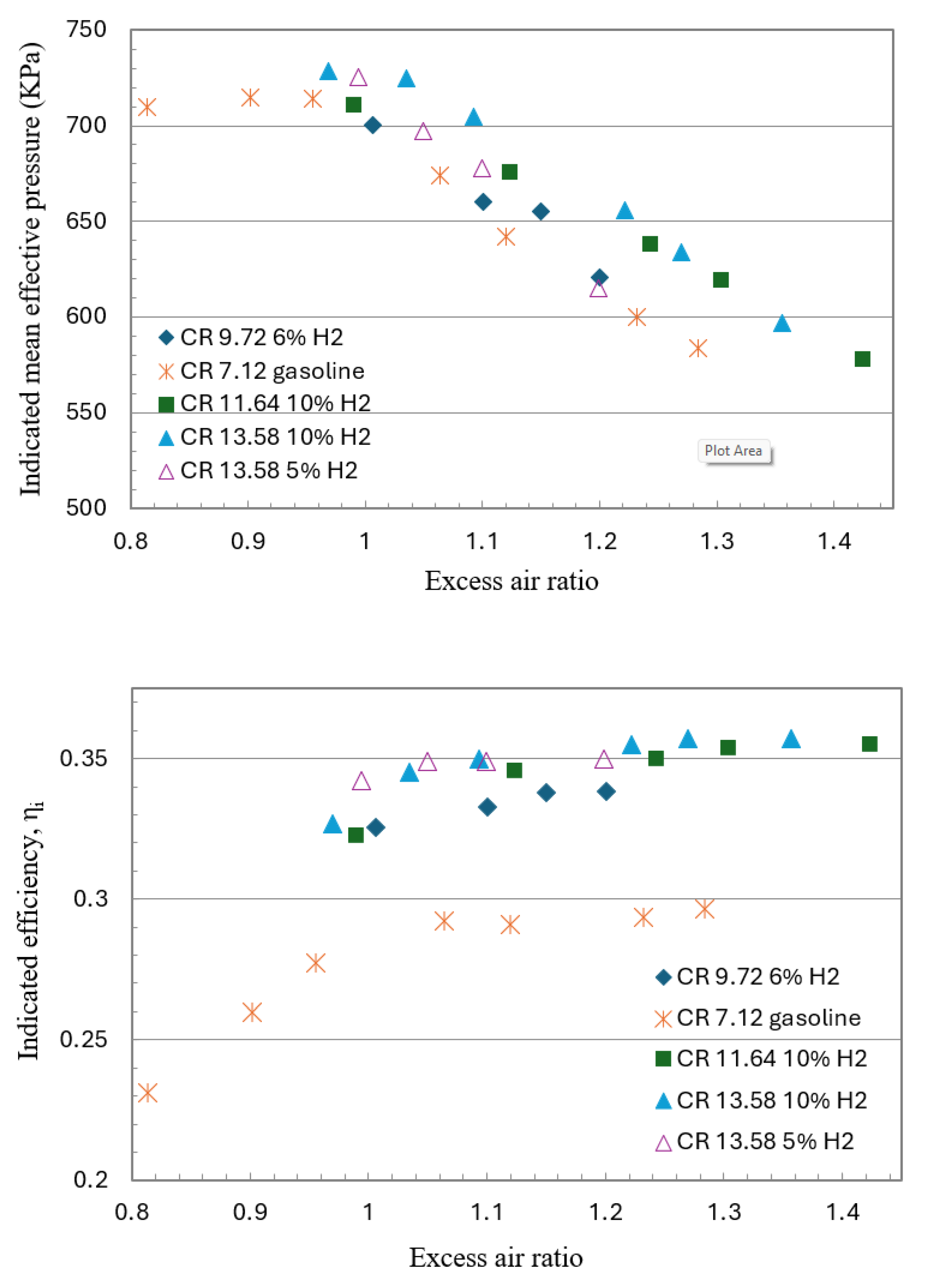

Table 1.
Some fuel proprieties of ammonia, hydrogen, and gasoline.
| Species | Units | Ammonia | Hydrogen | Gasoline |
|---|---|---|---|---|
| Storage | - | Liquid | Compressed | Liquid |
| Lower heating value | MJ/Kg | 18.8 | 120.0 | 44.5 |
| Laminar flame velocity | m/s | 0.015 | 3.51 | 0.58 |
| Flammability limits, gas in air | Vol.% | 15-28 | 4.7-75 | 0.6-8 |
| Autoignition temperature | °C | 651 | 500-577 | 230 |
| Absolute min. ignition energy | mg | 8.0 | 0.018 | 0.14 |
| Octane number Minimum Ignition Energy, Explosion limit (volume ratio) |
- mj % |
>130 680 16~28 |
>100 0.02 4.5~75 |
90-98 0.20 1.4~7.6 |
Table 2.
Summary of research advancements on ammonia as a fuel post-World War II.
| Main Authors | Year | Engine (SI/CI) | Focuses and Progress |
|---|---|---|---|
| Emerio Kroch [45] | 1942 | Diesel oil | The first utilization of liquid anhydrous ammonia for motor buses in Belgium. |
| Cornelius W et al. [46] | 1960s | SI/CI | Examining factors such as material requirements, corrosive properties, and combustion characteristics for Ammonia. |
| Gray Jr JT et al.[47] | |||
| Pearsall TJ and Garabedian CG [48] | Conducting multiple studies by the US Army to increase fuel independence. |
Table 3.
Summary of research advances of Ammonia as a fuel blended with hydrocarbon.
| Main Authors | Year | Type | Focuses and Progress |
|---|---|---|---|
| Reiter A. J. et al. [54] | 2011 | Experiment | Demonstrated dual-fuel CI operation with ammonia-diesel; reduced CO₂ emissions but faced ignition delay and efficiency trade-offs. |
| Gross CW, Kong SC [51] | 2013 | Experiment | Studied CI engine using direct-injection ammonia–DME blends; improved ignition and combustion performance with higher DME content. |
| Haputhanthri SO [56] | 2014 | Experiment | Evaluated ammonia-gasoline blends with emulsifiers; showed improved fuel stability and potential for engine performance enhancement. |
| Niki Y. et al. [53] | 2016 | Experiment | Investigated ammonia mixed into intake air in diesel engines; found improved combustion and reduced emissions, with challenges in ammonia control. |
| Tay, K.L. et al. [57] | 2017 | Simulation | Numerically studied injection timing and pilot fuel effects in a kerosene-diesel/ammonia dual-fuel engine; found improved combustion and efficiency with optimized injection strategies. |
| Valera-Medina, A et al [13] | 2018 | Review | Reviewed the use of ammonia as a fuel for power generation, focusing on its potential to reduce CO₂ emissions. |
| Niki Y. et al. [20] | 2019 | Experiment | Investigated the effects of multiple diesel fuel injections in a diesel engine with ammonia mixed into intake air; found reduced emissions and improved combustion performance with optimized injection strategies. |
| Dimitriou P, Javaid R. [26] | 2020 | Review | Reviewed ammonia as a CI engine fuel; highlighted challenges in combustion control and emissions, while emphasizing its potential for reducing CO₂. |
Table 4.
Summary of research advances of Ammonia as a fuel blended with hydrogen.
| Main Authors | Year | Type | Focuses and Progress |
|---|---|---|---|
| Mørch CS [12] | 2011 | Experiment | Examined ammonia/hydrogen mixtures in an SI engine, improving combustion efficiency and emissions control, and proposing a modified fuel system for optimized dual-fuel use. |
| Boretti AA [64] | 2012 | Experiment | Proposed a novel heavy-duty engine concept using a dual-fuel H2–NH3 system. The study highlighted the potential for improved fuel efficiency and reduced emissions, while addressing the technical challenges of ammonia and hydrogen combustion in heavy-duty engines. |
| Pozzana G et al. [61] | 2012 | Experiment | Explored a hybrid vehicle powered by hydrogen and ammonia, focusing on the integration of these fuels for improved vehicle efficiency and reduced environmental impact. The study assessed the potential benefits and challenges of using hydrogen-ammonia combinations in hybrid vehicle applications. |
| Frigo S Gentili R [58] | 2012 | Experiment | Analyzed the performance of a 4-stroke SI engine fueled with ammonia and hydrogen. The study highlighted improved combustion characteristics and emission reductions, while discussing the challenges related to ammonia’s ignition properties and the need for optimized fuel management. |
| Frigo, S et al. [60] | 2014 | Experiment | Further explored the feasibility of fueling an SI engine with ammonia and hydrogen. Highlighting improvements in engine efficiency and emission reductions, while addressing challenges such as ignition delay and fuel mixture control. |
| Ryu K et al. [19] | 2014 | Experiment | Studying the combustion and emissions of an SI engine with direct ammonia injection and port-injected gasoline showed enhanced power performance, making it comparable to a gasoline engine. |
| Ryu K et al. [63] | 2014 | Experiment | Studied direct ammonia injection in a spark-ignition engine; found improved combustion efficiency and reduced CO₂ emissions, but challenges with ignition control and lower energy content. |
| Comotti M [62] | 2015 | Description | Developed a hydrogen generation system for ammonia-hydrogen fueled engines, improving fuel efficiency and emissions while addressing integration challenges. |
| Otomo, J et al. [59] | 2018 | Description | Developed a chemical kinetic model for ammonia oxidation with an improved reaction mechanism for ammonia/air and ammonia/hydrogen/air combustion, enhancing the understanding of combustion characteristics and efficiency. |
| Langella G et al [36] | 2022 | Description | Reviewed the latest advances and future challenges of using ammonia as a fuel for internal combustion engines, highlighting its potential for reducing emissions and the technical barriers such as combustion efficiency and NOx control. |
Table 5.
Various studies on the feasibility of using ammonia fuel blends in ICEs (CI engines).
| Authors | Year | Mixture composition of fuel | Engine type | Main findings |
|---|---|---|---|---|
| Issayev et al. [66] | 2020 | 95-80% NH3/5-20% DEE | CI | Studied ammonia blended with diethyl ether, showing improved combustion efficiency and emissions for alternative fuel applications. |
| Reiter and Kong [68] | 2010 | 95% NH3/5% diesel | CI | Investigated diesel engine operation using ammonia as a carbon-free fuel, demonstrating potential for reduced emissions and highlighting operational challenges. |
| Reiter and Kong [54] | 2011 | 60% NH3/40% diesel; 40% NH3/60% diesel | CI | Examined the combustion and emissions of a compression-ignition engine using dual ammonia-diesel fuel, finding improved combustion efficiency and reduced emissions, with some challenges in ignition control. |
| Gross and Kong [51] | 2013 | 20% NH3/80% DME; 40% NH3/60% DME | CI | Studied a compression-ignition engine using direct-injection ammonia-DME mixtures, finding improved performance and reduced emissions, with challenges in optimizing the fuel mixture. |
| Ryu et al. [69] | 2014 | 60% NH3/40% DME; 40% NH3/60% DME | CI | Investigated a compression-ignition engine using high ammonia concentrations mixed with dimethyl ether, finding enhanced performance and reduced emissions, with challenges in controlling combustion stability. |
| Pochet et al. [65] | 2017 | 70 vol% NH3 + H2 | CI | Explored ammonia-hydrogen blends in a homogeneous-charge compression-ignition engine, showing improved combustion efficiency and reduced emissions, with a focus on optimizing fuel mixture and engine operation. |
| Bro and Pedersen [76] | 1977 | Methanol (84%), Ethanol (80%), Methane (62%), Ammonia (87%)and Diesel | CI | Studied ammonia as an alternative fuel in a diesel engine, noting lower emissions but challenges with ignition and efficiency. |
Table 6.
Various studies on the feasibility of using ammonia fuel blends in ICEs (SI engines).
| Authors | Year | Mixture composition of fuel | Engine type | Main findings |
|---|---|---|---|---|
| Grannell et al. [67] | 2008 | 70% NH3/30% gasoline | SI | Explored the fuel mix limits and efficiency of a stoichiometric ammonia and gasoline dual-fueled spark ignition engine, highlighting challenges in maintaining efficiency while using ammonia as a fuel. |
| Haputhanthri et al. [70] | 2015 | Gasoline + 30 vol% ethanol or methanol + 17.35 vol% NH3 | SI | Studied ammonia-gasoline blends in spark-ignited engines, showing potential for better fuel efficiency and lower emissions. |
| Ezzat and Dincer [72] | 2018 | 80% NH3/20% H2 | - | Compared two systems using liquefied ammonia for vehicular applications, with and without fuel cells. The study assessed performance, efficiency, and environmental impact, demonstrating the viability of ammonia as a sustainable vehicle fuel. |
| Lee and al. [73] | 2010 | Fuel equivalence ratio of 0.60-1.67 mole fraction of H2 | - | Studied laminar premixed hydrogen-ammonia/air flames for hydrogen production. The research revealed the combustion properties of ammonia-hydrogen blends, contributing to hydrogen generation for sustainable energy systems. |
| Koike and Suzuoki [74] | 2019 | 40% NH3/60% H2 | SI | Developed an in-line adsorption system to reduce cold-start ammonia emissions in ammonia-hydrogen fueled engines, improving environmental performance and emission control. |
| Du et al. [75] | 2021 | NH3/40-60% H2 | SI | Conducted a numerical study on premixed ammonia-hydrogen combustion under engine-relevant conditions, optimizing combustion efficiency and emissions in ammonia-hydrogen powered engines. |
| Lhuillier et al. [49] | 2020 | NH3/0-60% H2 | SI | Studied ammonia/hydrogen/air combustion in a spark ignition engine, showing improved combustion efficiency but challenges with emissions control. |
Table 7.
Summary of research advances of Ammonia injection strategies.
| Main Authors | Year | Engine | Type | Focuses and Progress |
|---|---|---|---|---|
| Lamas & Rodriguez [81] | 2017 | CI | Simulation | Developed a numerical model to analyze NOx reduction through ammonia injection in diesel-hydrogen engines, demonstrating potential for emissions control. |
| Lee & Song [22] | 2018 | - | Experiment | Developed a combustion strategy for ammonia-fueled internal combustion engines, examining its operating characteristics and potential for enhanced performance. |
| Niki et al. [78] | 2019 | CI | Experiment | Studied the effects of multiple diesel fuel injections on emission characteristics in a diesel engine with ammonia gas mixed into the intake air, finding improvements in emission control. |
| Lesmana H et al. [82] | 2019 | CI | Review | A technical review assessing the existing understanding of using ammonia as a fuel in internal combustion engines, either in its pure form or combined with other fuels |
| Lamas MI, Rodriguez CG [79] | 2019 | CI | Simulation | Investigating different fuel injection configurations, such as parabolic, triangular, and rectangular shapes to reduce NOx emissions in internal combustion engines. |
| Lamas et al. [80] | 2020 | CI | Simulation | explored the reduction of NOx emissions by nearly 80% in a marine diesel engine using direct ammonia injection into the cylinder, comparing this approach with water injection. |
| Chiong M C et al. [77] | 2021 | SI/CI engine & gas turbine | Experiment | Advancements in ammonia combustion to make it a viable option for sustainable energy in engines and turbines. |
Table 8.
Summary of research advances of Hydrogen injection strategies.
| Main Authors | Year | Engine | Type | Focuses and Progress |
|---|---|---|---|---|
| Mohammadi A et al. [83] | 2007 | SI | Experiment | Studied the performance and combustion of a direct injection SI hydrogen engine, showing efficiency gains but highlighting combustion control challenges. |
| Verhelst S et al. [84] | 2013 | SI/CI | Description | The progress of hydrogen-fueled internal combustion engines was reviewed, highlighting advancements in combustion efficiency, emissions reduction, and the challenges of hydrogen storage and engine design. |
| Ozcanli, M et al. [86] | 2018 | SI | Description | The study reviews recent research on hydrogen usage in Wankel spark-ignition (SI) engines, focusing on performance improvements, combustion characteristics, and emission reductions associated with hydrogen as a fuel. |
| Yip HL et al [85] | 2019 | SI/CI | Description | The review explores hydrogen direct injection in engines, focusing on its potential for carbon-free combustion, performance, and emission reduction challenges. |
Disclaimer/Publisher’s Note: The statements, opinions and data contained in all publications are solely those of the individual author(s) and contributor(s) and not of MDPI and/or the editor(s). MDPI and/or the editor(s) disclaim responsibility for any injury to people or property resulting from any ideas, methods, instructions or products referred to in the content. |
© 2025 by the authors. Licensee MDPI, Basel, Switzerland. This article is an open access article distributed under the terms and conditions of the Creative Commons Attribution (CC BY) license (http://creativecommons.org/licenses/by/4.0/).
Copyright: This open access article is published under a Creative Commons CC BY 4.0 license, which permit the free download, distribution, and reuse, provided that the author and preprint are cited in any reuse.


