
Submitted:
18 April 2025
Posted:
21 April 2025
You are already at the latest version
Abstract
Studies of subradiance in a chain N two-level atoms in the single excitation regime focused mainly on the complex spectrum of the effective Hamiltonian, identifying subradiant eigenvalues. This can be achieved by finding the eigenvalues N of the Hamiltonian or by evaluating the expectation value of the Hamiltonian on a generalized Dicke state, depending on a continuous variable k. This has the advantage that the sum above N can be calculated exactly, such that N becomes a simple parameter of the system and no more the size of the Hilbert space. However, the question remains how subradiance emerges from atoms initially excited or driven by a laser. Here we study the dynamics of the system, solving the coupled-dipole equations for N atoms and evaluating the probability to be in a generalized Dicke state at a given time. Once the subradiant regions has been identified, it is simple to see if subradiance is being generated. We discuss different initial excitation conditions that lead to subradiance and the case of atoms excited by switching on and off a weak laser. This may be relevant for future experiments aimed at detecting subradiance in ordered systems.
Keywords:
subradiance
; Cooperative emission
1. Introduction
Since the seminal paper by Dicke [1], collective spontaneous emission by an ensemble of two-level atoms has been studied by many authors [2,3,4]. In particular subradiance, i.e. inhibited emission due to destructive interference between the emitters, has recently received great attention, both in disordered systems as in a cloud [5,6,7,8], and in ordered systems, as in atomic chains or 2D and 3D lattices [9,10,11,12,13,14]. The theoretical studies on subradiance has been focused mostly in the study to the eigenvalues of the system [15,16] and in particular on the collective decay rate, which for subradiance is less than the single-atom decay . Few attention has been devoted to the generation of subradiance, from the preparation of the excited atoms or when the atoms are driven by a laser.
In disordered system, subradiance has been investigated numerically and experimentally by switching off a continuous detuned laser driving a thermal cloud and calculating the decay rate of the fluorescence light intensity by reporting it in a semilog plot [5,6]. After the initial fast decay, subradiance manifests itself in a slowly decaying fluorescence intensity with a rate below the single atom decay rate. At first, the subradiant decay is not purely exponential, since several modes decay simultaneously. For longer times, it then ends up with a pure exponential decay (referred as subradiant decay) when only one long-lived mode dominates. A similar approach can be adopted for ordered system, as atoms in a linear chain. Such linear chains have been investigated theoretically by different authors [17,18,19,20,21,22,23,24]. In the single-excitation approximation, subradiance has been studied in the previous literature by calculating the eigenvalues of the system, determined numerically by diagonalizing the finite matrix associated with the Green operator describing the coupling between the emitters.
Recently, we proposed a different method to study subradiance in a finite linear chain, based on the evaluation of the expectation value of the effective Hamiltonian on a generalized Dicke state, depending on a continuous variable k[14]. This has several advantages: 1) it allows to calculate the collective decay rate as a function of a continuous parameter, mimic the exact Fourier spectrum; 2) The sum over N can be calculated exactly, making N a mere parameter of the system and no more the dimension of the matrix whose eigenvalues are to be evaluated; 3) the study of allows us to identify the subradiant regions of the spectrum. The last point is important, because it can be used to detect how subradiance may be dynamically generated. By solving the coupled-dipole equations for N atoms with given initial conditions or in presence of a driving laser, it is possible to project the solution at a given time on the generalized Dicke state. The result gives the probability distribution of the state as a function of the continuous variable k. Then, by identifying the subradiant regions of the spectrum, it is possible to see if subradiance has been generated. In particular, we find which is the initial state maximally generating subradiance: this is useful in order to understand the symmetry properties of the subradiant state.
The paper is organized as follow. In the first part we review the main results of Ref.[14], defining the generalized Dicke state and adding the calculation of the collective frequency shift, both in the scalar and vectorial models. The second part is devoted to the generation of subradiance by suitable initial atomic excitations or when atoms are excited by a weak laser field. The dynamics of the system is investigated by solving the N coupled-dipole equations and projecting the single-particle state a the time t over the generalized Dicke state. We will see that it is possible to build a maximally subradiant state, which in the limit of an infinite chain gives a vanishing spontaneous decay rate. Finally, we interpret the results in terms of the fluorescence intensity spatial distribution.
2. Modelling Emission from a Chain of Atom with a Single Excitation
Here we define the collective frequency shift and decay rate as the real and imaginary part of the expectation value of the effective Hamiltonian over the generalized Dicke state. Preliminary results have been previously reported in Ref. [14]. The calculations are carried on first for the scalar model and then for the vectorial model.
2.1. Scalar Model
We consider N two-level atoms with the same atomic transition frequency , linewidth and dipole . The atoms are prepared in a single-excitation state; and are the ground and excited states, respectively, of the j-th atom, , which is placed at position . We consider here the single-excitation effective Hamiltonian in the scalar approximation, while the vectorial model will be considered in the next section. If we assume that only one photon is present, when tracing over the radiation degrees of freedom the dynamics of the atomic system can be described by the following non-Hermitian Hamiltonian [25 ]
where and are the lowering and raising operators, is the scalar Green function,
and
where . contains both real and imaginary parts, which takes into account that the excitation is not conserved since it can leave the system by emission. The real part can be obtained as the angular average of the radiation field propagating between the two atomic positions and with wave-vector ,
where the angular average is defined as
Equation (4) provides a simple interpretation of as the coupling between the jth atom and the mth atom, mediated by the photon shared between the two atoms and averaged over all the vacuum modes. Equation (4) allows to factorize in the product of two terms, before averaging them over the total solid angle. If we consider N atoms placed along a linear chain with lattice constant d i.e. with positions , with , we can write
2.2. Generalized Dicke State.
We define the generalized Dicke states [14]
where and . It includes for the Dicke state [1] and for the Timed-Dicke state introduced by Scully [26,27]. It satisfy the completeness relation
As expected, the states are not orthogonal for a finite chain, since
but they become so for an infinite chain, for . So the states form an over-completed basis the the single-excitation manifold.
2.3. Collective Frequency Shift and Decay Rate.
Taking the expectation value of the effective Hamiltonian (1) over the generalized Dicke state (6) yields
were
is the collective frequency shift and
is the collective decay rate. By using Equation (5) in Equation (11) we can write
where
and
where we changed the integration variable from to . For large N, we can approximate in the integral of Equation (14),
where , so that
where and , with . Hence, we have transformed the double sum in Equation (11) into an integral, where N plays the role of a simple parameter of the system. The collective frequency shift takes the form
2.4. Infinite Chain
If the chain is infinite, , the solution for the collective decay rate is
where is the rectangular function, equal to 1 for and 0 elsewhere. In the first Brillouin zone, , for and for . Atomic modes in the region enclosed within the light line are generally unguided and radiate into free space. Outside the light line (), the modes are guided and subradiant, as the electromagnetic field is evanescent in the directions transverse to the chain. For an infinite chain, depends only on the index ,
Using the expansion
we write
The frequency shift has a logarithmic divergence for and three extremes at , with and , respectively.
2.5. Finite Chain
3. Vectorial Model
We now extend the previous expressions to the vectorial model, taking into account the polarization of the electromagnetic field. The non-Hermitian Hamiltonian is now
where . Here , and , where is the lowering operator between the ground state and the three excited states of the jth atom with quantum numbers and . The vectorial Green function in Equation (22) is
with and being the components of the unit vector . We consider the linear chain with lattice constant d, i.e. , with , and all the dipoles aligned with an angle with respect to the chain’s axis, so that and
where . The decay rate for the vectorial model is given by the real part of ,
where and are the spherical Bessel functions of order and . The frequency shift is given by the negative of the imaginary part of ,
It is possible to demonstrate that the collective decay rate is [14]
while the collective frequency shift of the dipoles oriented with the angle is
If the chain is infinite, ,
and
where is the PolyLog function. Figure 1 and Figure 2 show and vs x for , for an infinite chain (dashed lines) and for a finite chain with (continuous lines). Black lines are for the scalar model, red and blue lines are for the vectorial model, with and , respectively. For an infinite chain the collective decay rate is zero for (i.e. for ), both for the scalar and the vectorial model. Notice that for the phase shift is not diverging at .
4. Dynamics
Having characterized the properties of the collective decay rate and frequency shift, identifying the subradiant zone where the collective decay rate is less than the single-atom decay rate , we are interested now to study how subradiance can be generated by properly exciting the atoms. First we define the probability distribution of the system to be in a given generalized Dicke state , expressed in term of the single-particle basis. Then we will study the time evolution of this distribution, leading to subradiance. The behavior in the vectorial model is not much different from that of the scalar model, so we will limit our discussion to the scalar model only.
4.1. The Probability Density
Let us assume that the state of the system is , where
describes the state in the single-excitation manifold. By projecting on the generalized Dicke basis (6),
where
Hence, the probability density to be in a state is
with
Equation (34) expresses the probability density in terms of the dipole amplitudes of the single atoms, whose time evolution is described in the following section.
4.2. Dynamics of the probability density
Let consider the time evolution of the atomic system in the presence of an external driving field in the scalar model. In the linear regime, the probability amplitudes evolve with the following coupled-dipole equations,
where is defined in Equation (2), , and are the Rabi frequency and the laser-atom detuning of the driving laser field. From Equation (36), it is possible to obtain the equation for the temporal evolution of the probability amplitude defined in Equation (33) (where ) (see Appendix A):
For an infinite chain,
and
where and are defined in Equations (18) and (20). The solution of Equation (38) is
5. Generation of Subradiance
Based on the previous expressions, we now discuss how subradiance can be generated studying the temporal evolution from some initial conditions of the probability amplitudes . The case of the excitation by an incident laser field will be discussed in the next section.
5.1. Single Excited Atom
As a first example, we consider a chain of atoms with , no driving laser, and , and a single initial atom excited in the middle of the chain, with and all the others equal to zero. From Equation (34), the initial probability to be in the state is (where ) i.e. it is uniform. Figure 3 shows vs x at different times, from until : after few time units, the probability becomes zero for and different from zero in the subradiant interval .
For an infinite chain, where, for , for and for . Then,
In the limit , for and for . Figure 4 shows at and (blue continuous line), obtained for a finite chain with , together the value obtained for infinite chain (dashed line).
Hence, a single excited atom generates a subradiance state with a probability which for an infinite chain is uniform in the subradiance spectral region . It is interesting to see the distribution of the dipole amplitudes for the case of Figure 4: Figure 5 shows vs j at , where the inset shows the average excitation probability vs time. The initial excitation for the atoms with spread among the adjacent atoms, to a final distribution generating subradiance. Also if not visible in the Figure 5, it is expected that the destructive interference among the atoms inhibit the spontaneous decay of the excitation, as it will be discussed in the next section.
5.2. The Most Subradiant State
Since an initial uniform probability generates asymptotically a subradiant distribution which is uniform for an infinite chain, as observed in the previous case, we are now interested to obtain the values of which are generating such subradiant distribution. We assume
which describes a subradiant state, with zero probability distribution in the superradiant region and uniform distribution in the subradiant region . Calculating the single atom probability amplitude we obtain
In Figure 6 we plot vs j for and , at the initial time (blue circles) and at (red squares), obtained solving numerically Equation (36) with the initial condition (42). The inset shows the average excitation probability vs time, which remains approximately constant. The as defined in Equation (42) reproduce the distribution amplitude (41) only in the limit (see Appendix B), since the states are not hortogonal. The distribution shown in Figure 6 has the same features as that shown in Figure 5 obtained from a single initially excited atom. To better appreciate the similarities with the case of Section 5.1, Figure 7 shows the probability density distribution at (black-dashed line) and at (blue continuous line): for an infinite chain, for and zero for , as obtained from Equation (41) (red line in Figure 7). Notice the similarities between Figure 5 for the single initially excited atom and Figure 7 for the initial state (42). We conclude that the state described by Equation (42) represents the ’most subradiant’ state for a finite chain of N atoms, with a purely subradiant spectrum in the limit of an infinite chain.
5.3. Atoms Driven by a Laser.
We now study the subradiance generation when the atoms are excited by an external laser field and then switched off. As an example, we consider a chain of atoms with , weakly driven by a detuned laser, with and . The atoms, initially unexcited (i.e. for ) are driven by the laser up to , after which the laser is switched off. Figure 8 shows vs x and at different times t after the laser is switched off.
The distributions at the laser switch-off time (blue continuous line) and at (red line), are shown in Figure 9: we see that the driving laser on brings the atoms close to a Timed-Dicke state, [26] (dashed line in Figure 9), with a width inversely proportional to the chain’s length . The inset of Figure 9 shows that, after the initial fast decay, subradiance manifests itself in a slowly decaying. At first, the subradiant decay is not purely exponential, since several modes decay simultaneously. For longer times, it then ends up with a pure exponential decay when only one long-lived mode dominates. However, the precise evaluation of the decay rate can be problematic due to the general non-exponential decay. In our approach, we determine the precise distribution of the subradiant modes: as it can be observed from the red line of Figure 9), at later times after the laser switch-off the distribution is mostly in the subradiant region, . The distribution is broad, so there is not a single subradiant mode dominating. As a consequence, the decay is not purely exponential.
In the case of infinite chain, Equation (39) gives
where we used the relation
Hence, for a driven infinite chain the asymptotic spectrum is and no subradiance occurs. To observe subradiance, we need a finite chain, as seen in Figure 8 and Figure 9: in the detuned case, the finite width, proportional to , of the driving term (second term in r.h.s. of Equation (37) and blue line in Figure 9) is responsible for the subradiant components of the spectrum until the laser is on, which subsequently evolve without reaching a steady-state value. From the above analysis, the possibility to have access to the full spectral distribution of the subradiant modes is clearly more advantageous than observing the time decaying excitation to obtain the subradiant decay rate, as done for instance in Ref.[5,6].
We now consider again the same chain of atoms with , but driven by a resonant laser, with and . The result is rather surprising: Figure 10 shows the average excitation, vs , where the drive field is switched off at (vertical dashed line). The average excitation grows almost linearly when the laser is turned on, typical for a diffusive regime [28,29]. After the laser is off, the excitation decays very slowly, showing that the excitation remains trapped in the atomic chain. We can understand this peculiar behavior by observing the probability density in Figure 11 at the laser switch-off time, (red line) and at (blue line). Contrarily to the detuned case, at resonance the subradiant region of the spectrum is already populated when the laser is on (red line of Figure 11). After the laser has been switched off, at , is remained almost the same, with only the radiating components, for , decayed (blue line of Figure 11). Since now the spectrum is completely in the subradiant region , the decay rate is almost zero and the atoms remain excited for a sufficiently long time.
6. Radiated Intensity
The following important question arises: may the probability be determined measuring the scattered intensity at a certain angle with respect to the chain’s axis? We know that the scattered field appears as a sum of spherical waves radiated by the atomic dipoles,
In the far-field limit, one has , where and , so the field of Equation (44) radiated in a direction reads
and the scattered intensity is
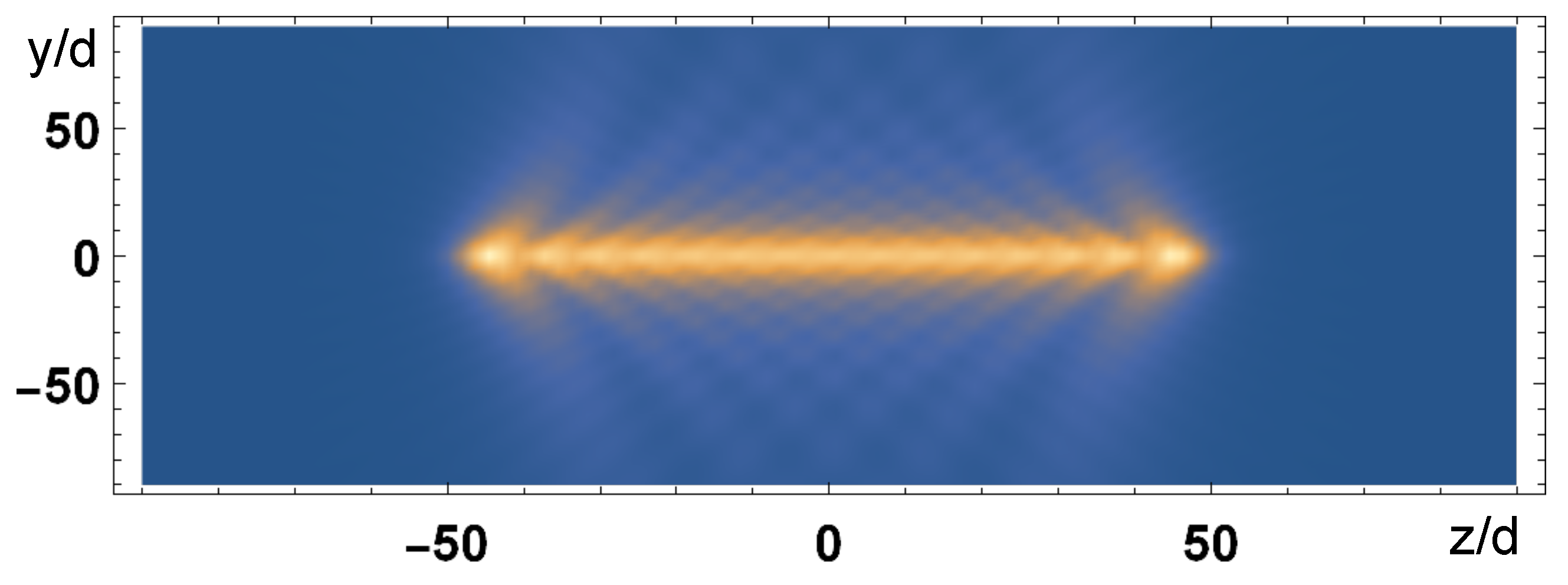
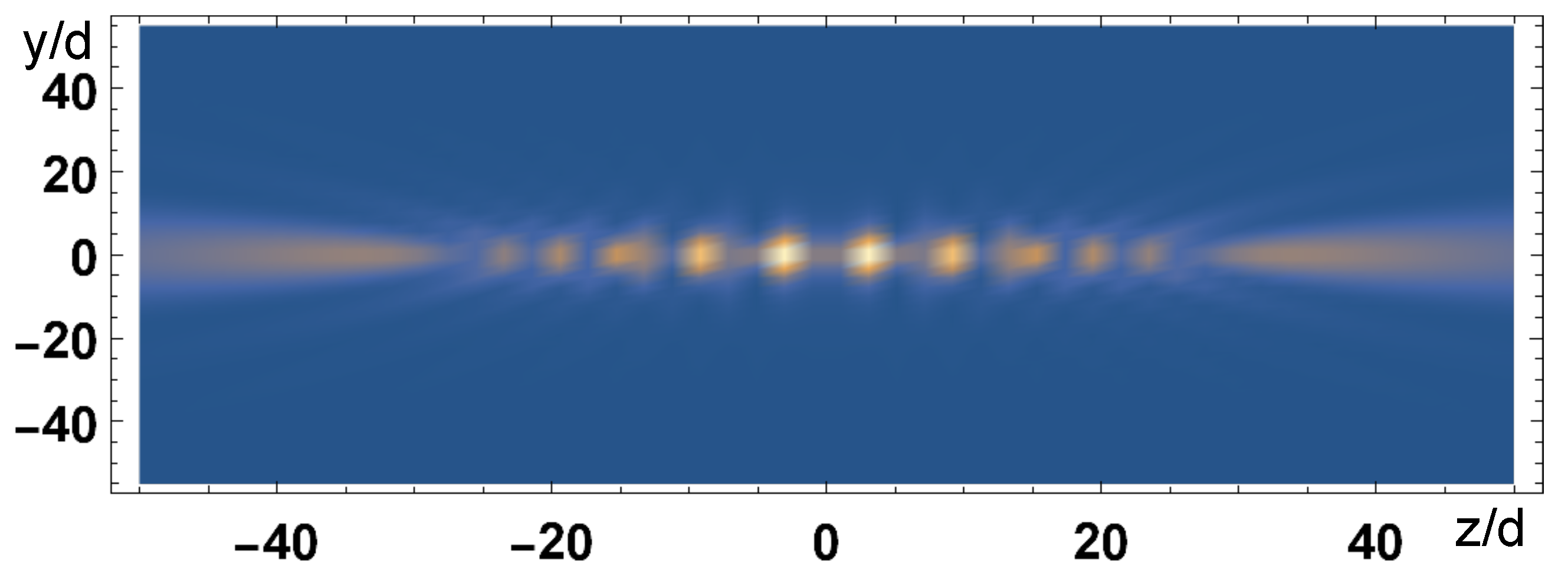
where . Hence, the atoms radiate out of the chain’s axis for . The subradiant region is not accessible by the scattered field, since it would be and the electromagnetic field is evanescent in the directions transverse to the chain, since . Very few photons are emitted outside the chain’s axis direction (anyone in the case of an infinite chain). However, from the radiated intensity it is possible to see if the atomic state is subradiant or not, observing if the atoms are emitting in a direction out of the axis’ chain. This can be seen in Figure 12 and Figure 13, where we plot the field intensity (where is determined by Equation (44)) in the plane , emitted by a chain of atoms with , centered at , for two different atomic distributions. Figure 12 shows a case of uniform excitation, with such that and the probability distribution is peaked around : in this case the atoms emit out of the chain’s axis. Figure 13 shows the emission from the most subradiant state, with given by Equation (42), such that for : the field is evanescent and does not propagate out of the chain, remaining confined along the chain; since the chain is finite, most of the energy is radiated out at the ends of the chain [11].
7. Conclusions
In conclusion, we have discussed analytically and numerically how subradiance can emerge from the evolution of the dynamics of N two-level atoms in the single-excitation configuration along a linear chain. In the first part, we have characterized the spectrum of the decay rates and frequency shifts of the system, identifying the regions of the spectrum where spontaneous emission is enhanced or inhibited, up to a complete suppression in the case of an infinite chain. Although these results are already known in literature [11,13,14], few attentions have been dedicated to the study of the subradiance generation. We proceeded first by obtaining a relation between the spectrum of emission and the single-particle amplitudes, whose evolution can be determined by solving the coupled-dipole equations. Then we have studied how different initial excitations evolve toward a subradiant state. A single-excited atom leads to an almost uniform population of subradiant modes. This has suggested the idea that the atomic configuration leading to this uniform population can be calculated directly, obtaining what we named the ’most subradiant state’. Then, we investigated how subradiance may be induced by a driving laser, which excite the atoms and successively is switched off, such that the long-lived subradiant modes survive for long times. Finally, we found the relation between spontaneous emitted intensity and subradiance. Subradiance is characterized by a suppression of the emission in the direction transverse to the chain axis. This analysis may be useful to envisage strategies to detect subradiance in ordered systems by measuring the radiation out of the lattice. The results obtained here for a linear chain can be extended to 2D a 3D lattices.
Conflicts of Interest
The author declare no conflict of interest.
Appendix A. Equation for AN (x,t)
Appendix B. Probability Amplitude for the Subradiant State
Assuming the subradiant state with
we can calculate the probability amplitude as
In the limit , apart for the phase global phase factor
where
Since for , then for and for . Finally
Hence, we obtain the ’full subradiant state’ (41) only in the limit of an infinite chain.
References
- Dicke R., H. , Coherence in spontaneous radiation processes. Phys. Rev. 1954, 93, 99. [Google Scholar] [CrossRef]
- Lehmberg R., H. , Radiation from an N-Atom system, I. General formalism. Phys. Rev. A 1970, 2, 883. [Google Scholar] [CrossRef]
- Bonifacio, R.; Schwendimann, P.; Haake, F. Quantum Statistical Theory of Superradiance I. Phys. Rev. A 1971, 4, 302. [Google Scholar] [CrossRef]
- Gross, M.; Haroche, S. Superradiance: An Essay on the Theory of Collective Spontaneous Emission. Phys. Rep. 1982, 93, 301. [Google Scholar] [CrossRef]
- Bienaimé, T.; Piovella, N.; Kaiser, R. Controlled Dicke subradiance from a large cloud of two-level systems, Phys. Rev. Lett. 2012, 108, 123602. [Google Scholar] [CrossRef]
- Guerin, W.; Araùjo, M.O.; Kaiser, R. Subradiance in a large cloud of cold atoms. Phys. Rev. Lett. 2016, 116, 083601. [Google Scholar] [CrossRef]
- Das, D.; Lemberger, B.; Yavuz, D.D. Subradiance and Superradiance-to-Subradiance Transition in Dilute Atomic Clouds, Phys. Rev. A 2020, 102, 043708. [Google Scholar] [CrossRef]
- Ferioli, G.; Glicenstein, A.; Henriet, L.; Ferrier-Barbut, I.; Browaeys, A. Storage and release of subradiant excitations in a dense atomic cloud, Phys. Rev. X 2021, 11, 021031. [Google Scholar]
- Bettles, R.J.; Gardiner, S.A.; Adams, C.S. Cooperative eigenmodes and scattering in one-dimensional atomic arrays. Phys. Rev. A 2016, 94, 043844. [Google Scholar] [CrossRef]
- Facchinetti, G.; Jenkins, S.D.; Ruostekoski, J. Storing light with subradiant correlations in arrays of atoms. Phys.Rev. Lett. 2016, 117, 243601. [Google Scholar] [CrossRef]
- Asenjo-Garcia, A.; Moreno-Cardoner, M.; Albrecht, A. Kimble H. J.; Chang D. E. Exponential improvement in photon storage fidelities using subradiance and “selective radiance” in atomic arrays. Phys. Rev. X 2017, 7, 031024. [Google Scholar]
- Rui, J.; Wei, D.; Rubio-Abadal, A.; Hollerith, S.; Zeiher, J.; Stamper-Kurn D., M.; Gross, C.; Bloch, I. A Subradiant Optical Mirror Formed by a Single Structured Atomic Layer. Nature 2020, 583, 369. [Google Scholar] [CrossRef]
- Cech, M.; Lesanovsky, I.; Olmos, B. Dispersionless subradiant photon storage in one-dimensional emitter chains. Phys. Rev. A 2023, 108, L051702. [Google Scholar] [CrossRef]
- Piovella, N. Cooperative Decay of an Ensemble of Atoms in a One-Dimensional Chain with a Single Excitation. Atoms 2024, 12, 43. [Google Scholar] [CrossRef]
- Bellando, L.; Gero, A.; Akkermans, E.; Kaiser, R. Cooperative effects and disorder: A scaling analysis of the spectrum of the effective atomic Hamiltonian. Phys. Rev. A 2014, 90, 063822. [Google Scholar] [CrossRef]
- Cottier, F.; Kaiser, R.; Bachelard, R. Role of disorder in super- and subradiance of cold atomic clouds. Phys. Rev. A 2018, 98, 013622. [Google Scholar] [CrossRef]
- Nienhuis, G.; Schuller, F. Spontaneous emission and light scattering by atomic lattice models. J. Phys. B: Atom. Mol. Phys. 1987, 20, 23. [Google Scholar] [CrossRef]
- Zoubi, H.; Ritsch, H. Metastability and Directional Emission Characteristics of Excitons in 1D Optical Lattices. Europhys. Lett., 2010, 90, 23001. [Google Scholar] [CrossRef]
- Jenkins, S.D.; Ruostekoski, J. Controlled manipulation of light by cooperative response of atoms in an optical lattice. Phys. Rev. A 2012, 86, 031602. [Google Scholar] [CrossRef]
- Bettles R., J.; Gardiner S., A.; Adams, C.S. Cooperative Ordering in Lattices of Interacting Two-Level Dipoles. Phys. Rev. A 2015, 92, 063822. [Google Scholar] [CrossRef]
- Needham, J.A.; Lesanovsky, I.; Olmos, B. Subradiance-protected excitation transport. New J. Phys. 2019, 21, 073061. [Google Scholar] [CrossRef]
- Masson, S.J.; Ferrier-Barbut, I.; Orozco, L.A.; Browaeys, A.; Asenjo-Garcia, A. Many-Body Signature of Collective Decay in Atomic Chains. Phys. Rev. Lett. 2020, 125, 263601. [Google Scholar] [CrossRef] [PubMed]
- Masson, S.J.; Asenjo-Garcia, A. Universality od Dicke superradiance in arrays of quantum emitters. Nature Comm. 2022, 13, 2285. [Google Scholar] [CrossRef]
- Ruostekoski, J. Cooperative quantum-optical planar arrays of atoms. Phys. Rev. A 2023, 108, 030101. [Google Scholar] [CrossRef]
- Bienaimé, T.; Bachelard, R.; Piovella, N.; Kaiser, R. Cooperativity in light scattering by cold atoms. Fortschritte der Physik 2013, 61, 377. [Google Scholar] [CrossRef]
- Scully, M.O.; Fry, E.; Ooi, C.H.R.; Wodkiewicz, K. Directed Spontaneous Emission from an Extended Ensemble of N Atoms: Timing Is Everything. Phys. Rev. Lett. 2006, 96, 010501. [Google Scholar] [CrossRef]
- Scully, M.O. Single photon subradiance: quantum control of spontaneous emission and ultrafast readout. Phys. Rev. Lett. 2015, 115, 243602. [Google Scholar] [CrossRef] [PubMed]
- Holstein, T. Imprisonment of Resonance Radiation in Gases. Phys. Rev. 1947, 72, 1212. [Google Scholar] [CrossRef]
- Labeyrie, G.; Vaujour, E.; Müller, C.; Delande, C.; Miniatura, C.; Wilkowski, D.; Kaiser, R. Slow diffusion of light in a cold atomic cloud, Phys. Rev. Lett. 2003, 91, 223904. [Google Scholar] [CrossRef]
Figure 1.
vs x for . Dashed lines are for an infinite chain, continuous lines for a finite chain with . Black lines are for the scalar model, red and blue lines for the vectorial model with and , respectively.
Figure 1.
vs x for . Dashed lines are for an infinite chain, continuous lines for a finite chain with . Black lines are for the scalar model, red and blue lines for the vectorial model with and , respectively.
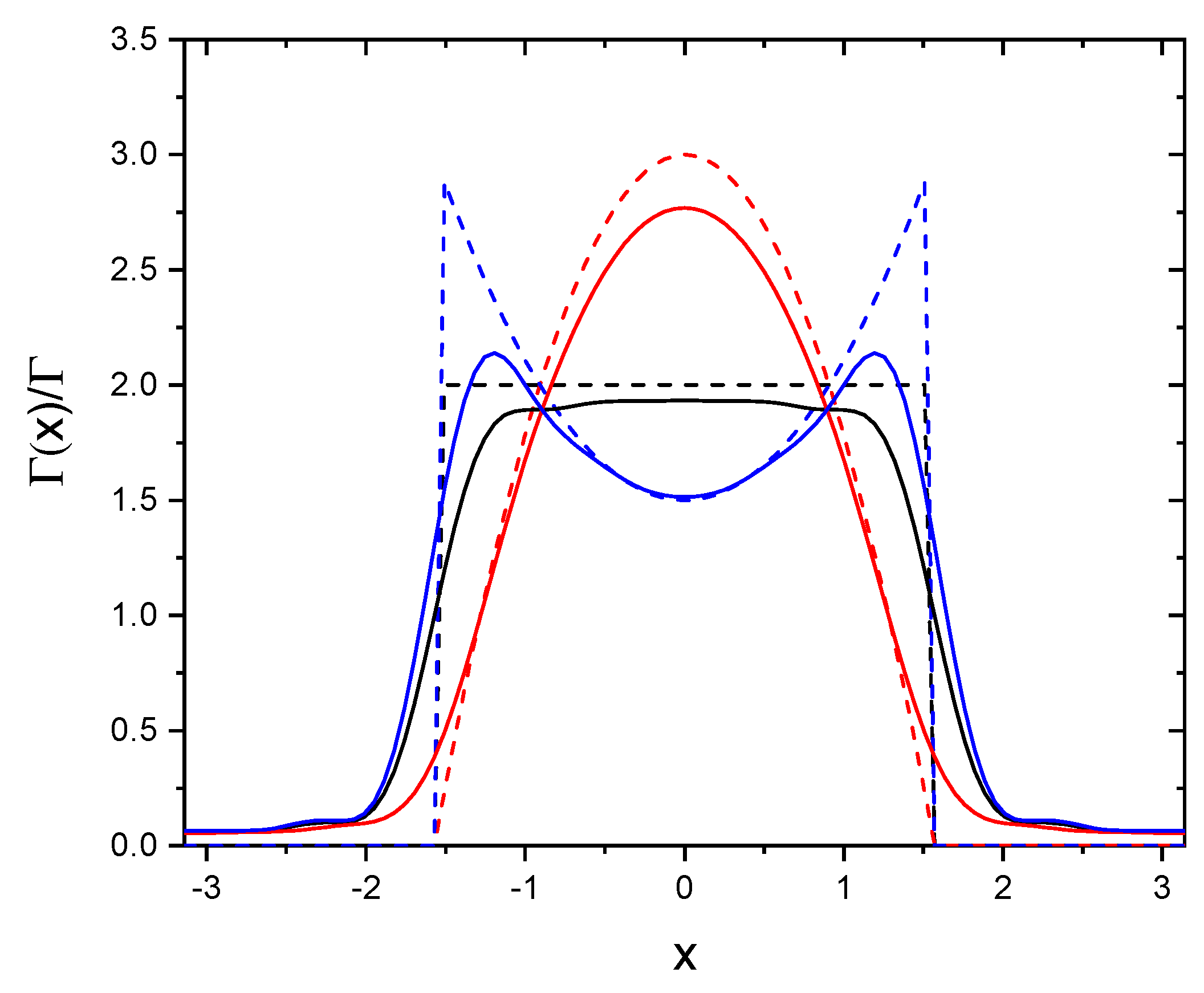
Figure 2.
vs x for . Dashed lines are for an infinite chain, continuous lines for a finite chain with . Black lines are for the scalar model, red and blue lines for the vectorial model with and , respectively.
Figure 2.
vs x for . Dashed lines are for an infinite chain, continuous lines for a finite chain with . Black lines are for the scalar model, red and blue lines for the vectorial model with and , respectively.
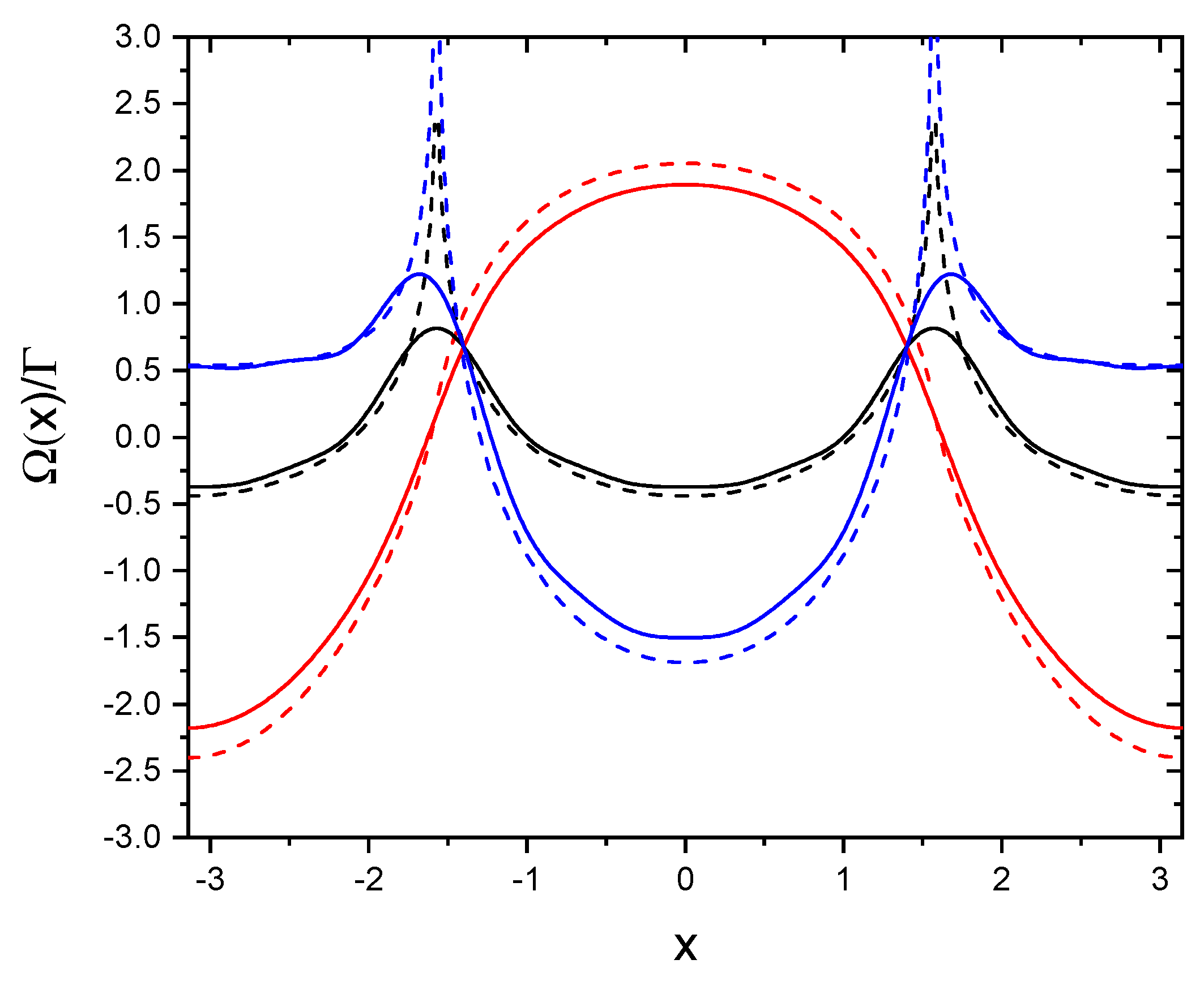
Figure 3.
vs x for , and , with initially a single atom excited in the middle of the chain.
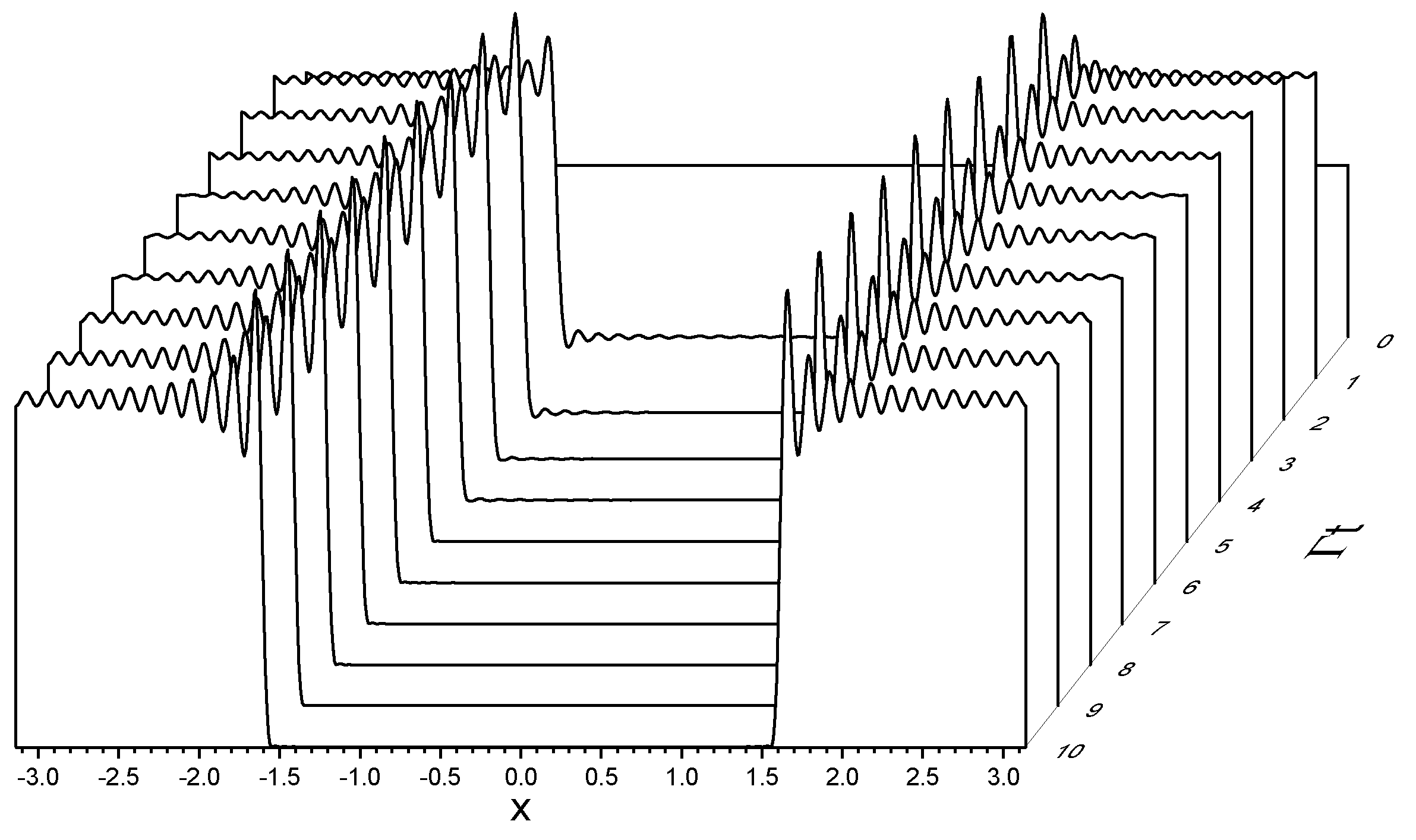
Figure 4.
vs x (blue line) for , and , with initially a single atom excited in the middle of the chain. The dashed line is the analytical result for an infinite chain, while the red line is the initial value .
Figure 4.
vs x (blue line) for , and , with initially a single atom excited in the middle of the chain. The dashed line is the analytical result for an infinite chain, while the red line is the initial value .

Figure 5.
vs j for and , at , for the case of Figure 4. The inset shows the average excitation probability vs time.
Figure 5.
vs j for and , at , for the case of Figure 4. The inset shows the average excitation probability vs time.
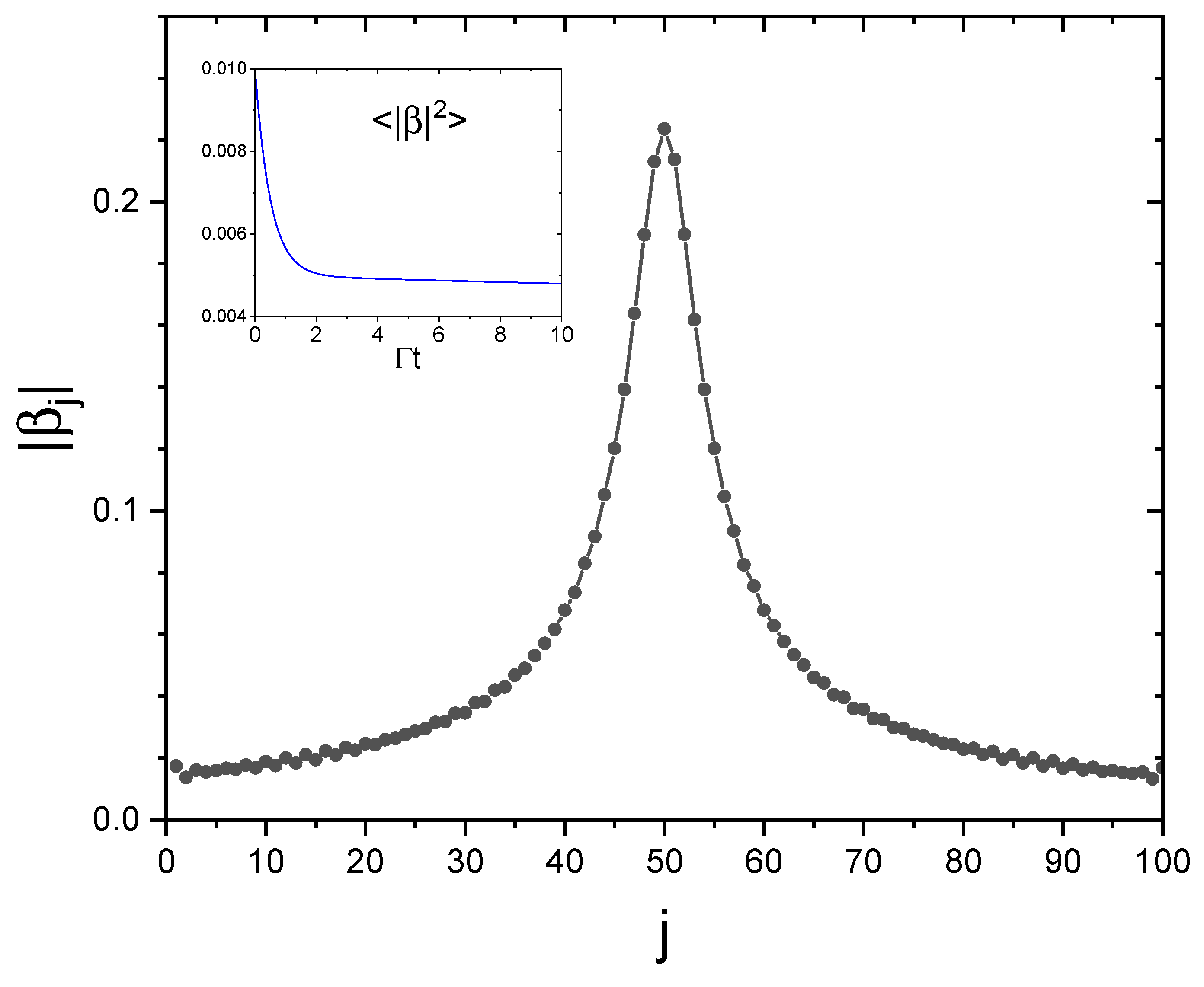
Figure 6.
vs j for and , at the initial time (blue circles) and at (red squares), obtained solving numerically Equation (36) with the initial condition (42). The inset shows that the average excitation probability is almost constant.
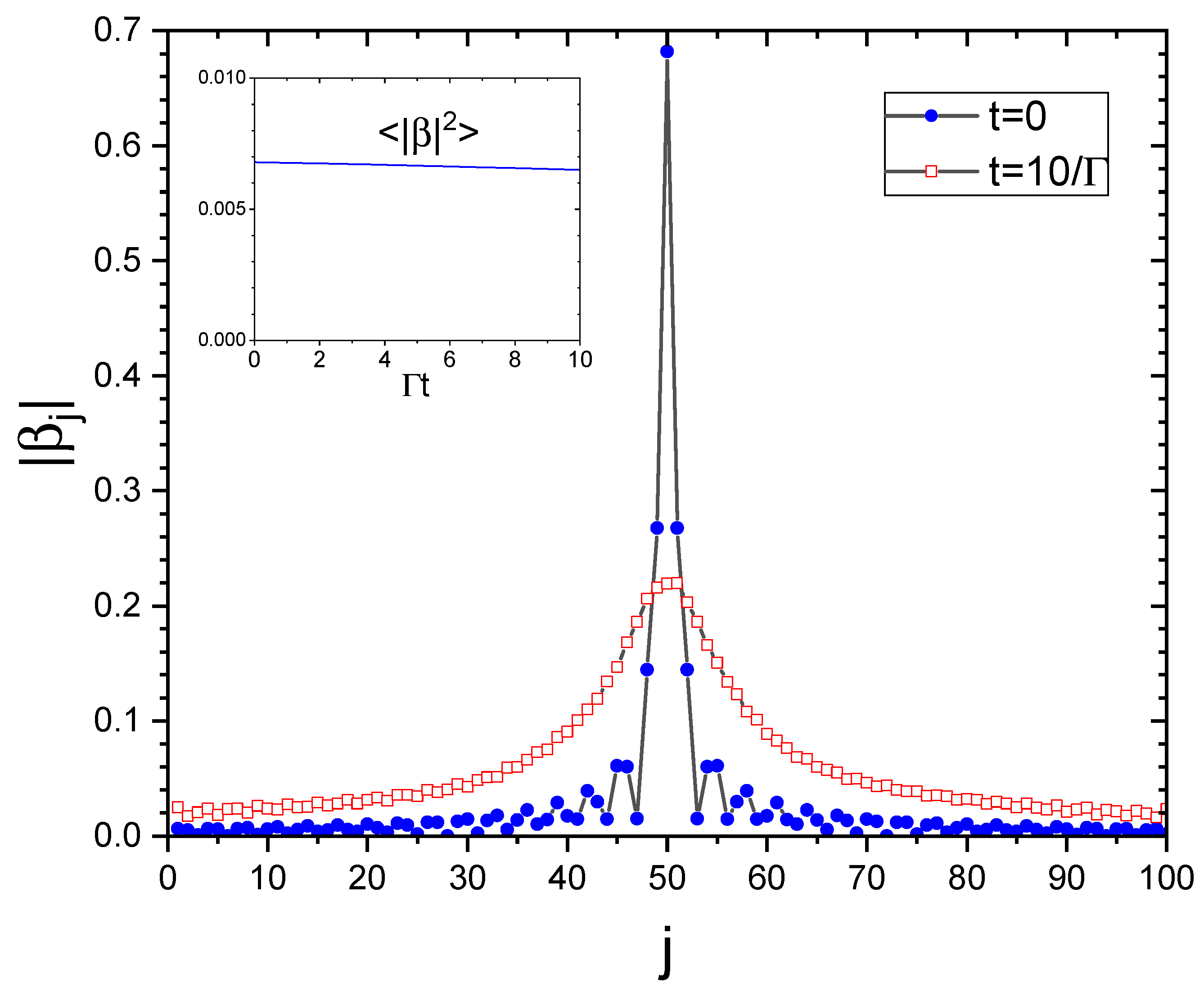
Figure 7.
Probability density distribution at (black-dashed line) and at (blue line), for the parameters of Figure 6. The red line is the case of an infinite chain.
Figure 7.
Probability density distribution at (black-dashed line) and at (blue line), for the parameters of Figure 6. The red line is the case of an infinite chain.
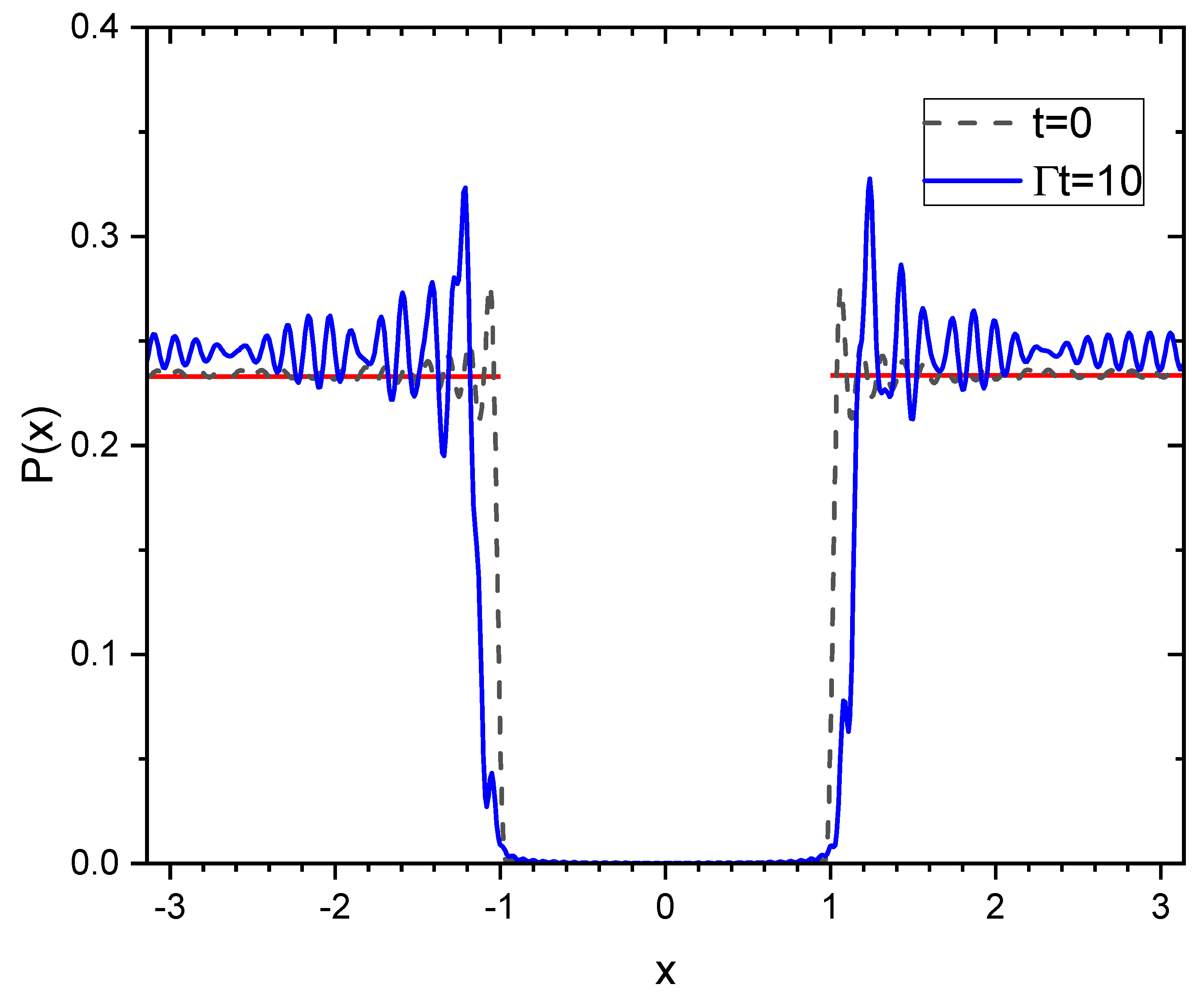
Figure 8.
vs x at different times after the laser has been switched off, for a chain of and driven by detuned laser with and . The dashed line is the value . The laser is switched off at .
Figure 8.
vs x at different times after the laser has been switched off, for a chain of and driven by detuned laser with and . The dashed line is the value . The laser is switched off at .
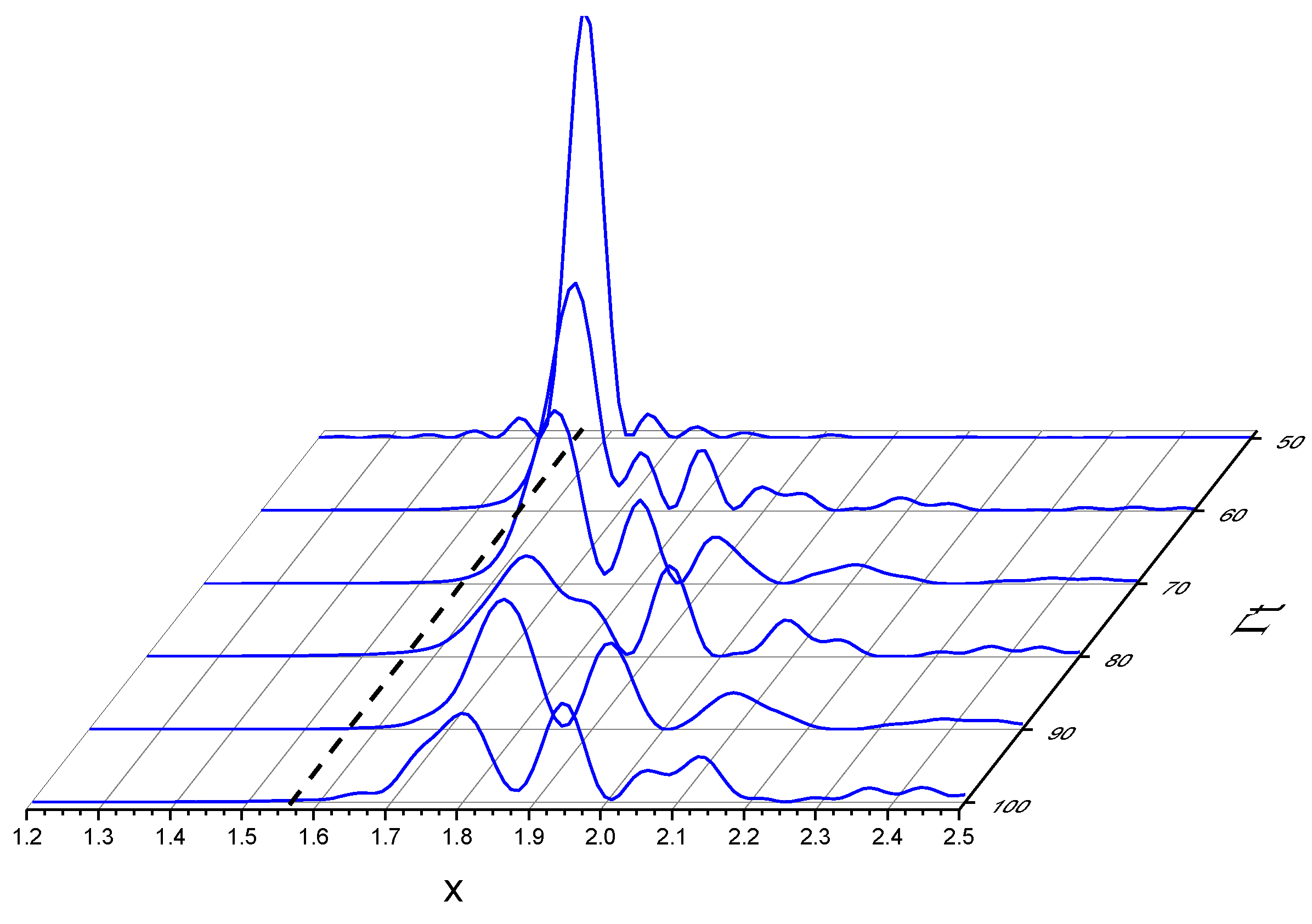
Figure 9.
vs x at the switch-off time (blue line) and at (red line), for the same parameters as in Figure 8. The vertical dashed line indicate the value . . The black dashed line is at . The inset shows the average excitation probability vs time.
Figure 9.
vs x at the switch-off time (blue line) and at (red line), for the same parameters as in Figure 8. The vertical dashed line indicate the value . . The black dashed line is at . The inset shows the average excitation probability vs time.
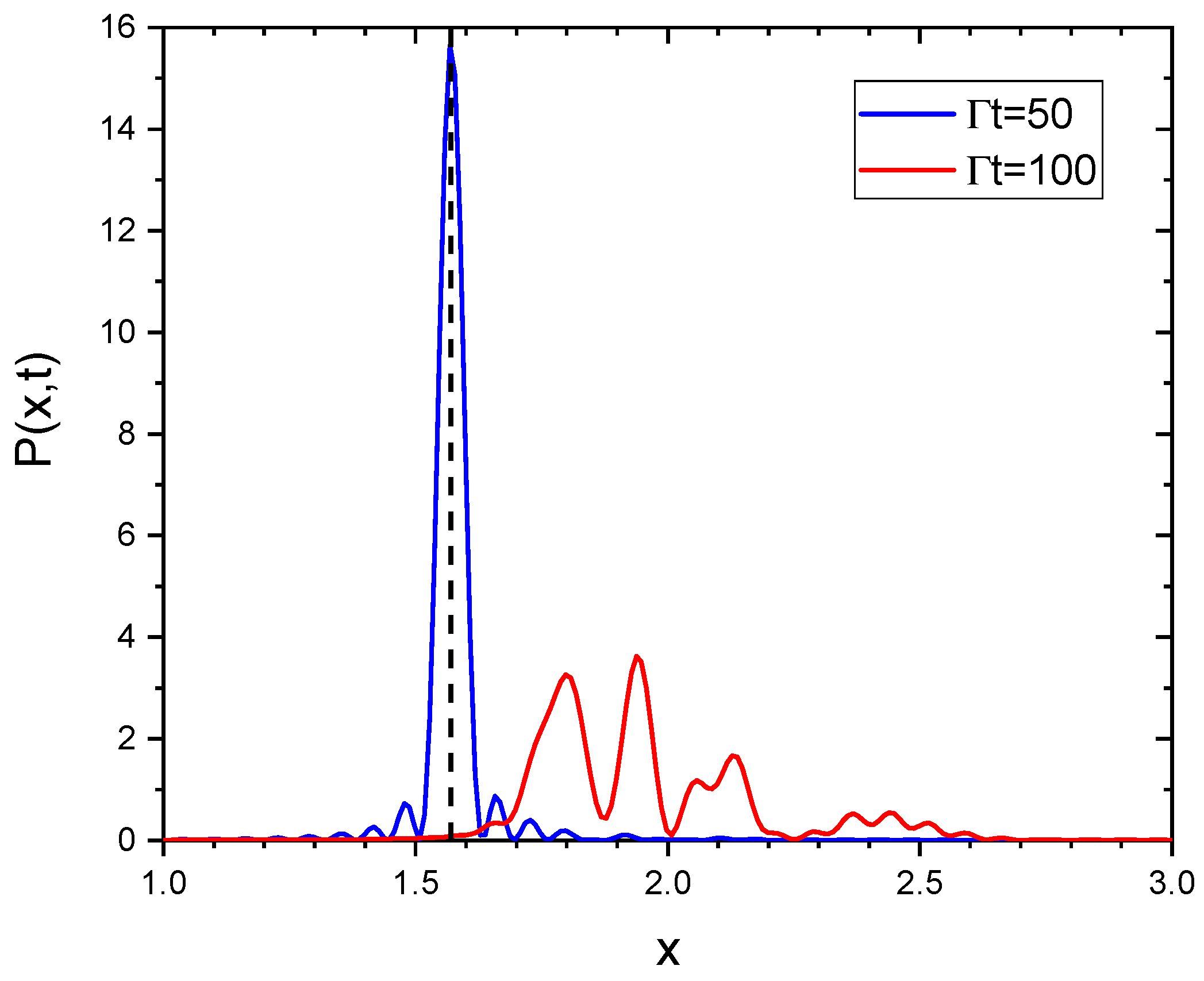
Figure 10.
Average excitation, , vs of a chain of with , driven by a continuous resonant laser field, with and , switched off at (vertical dashed line).
Figure 10.
Average excitation, , vs of a chain of with , driven by a continuous resonant laser field, with and , switched off at (vertical dashed line).
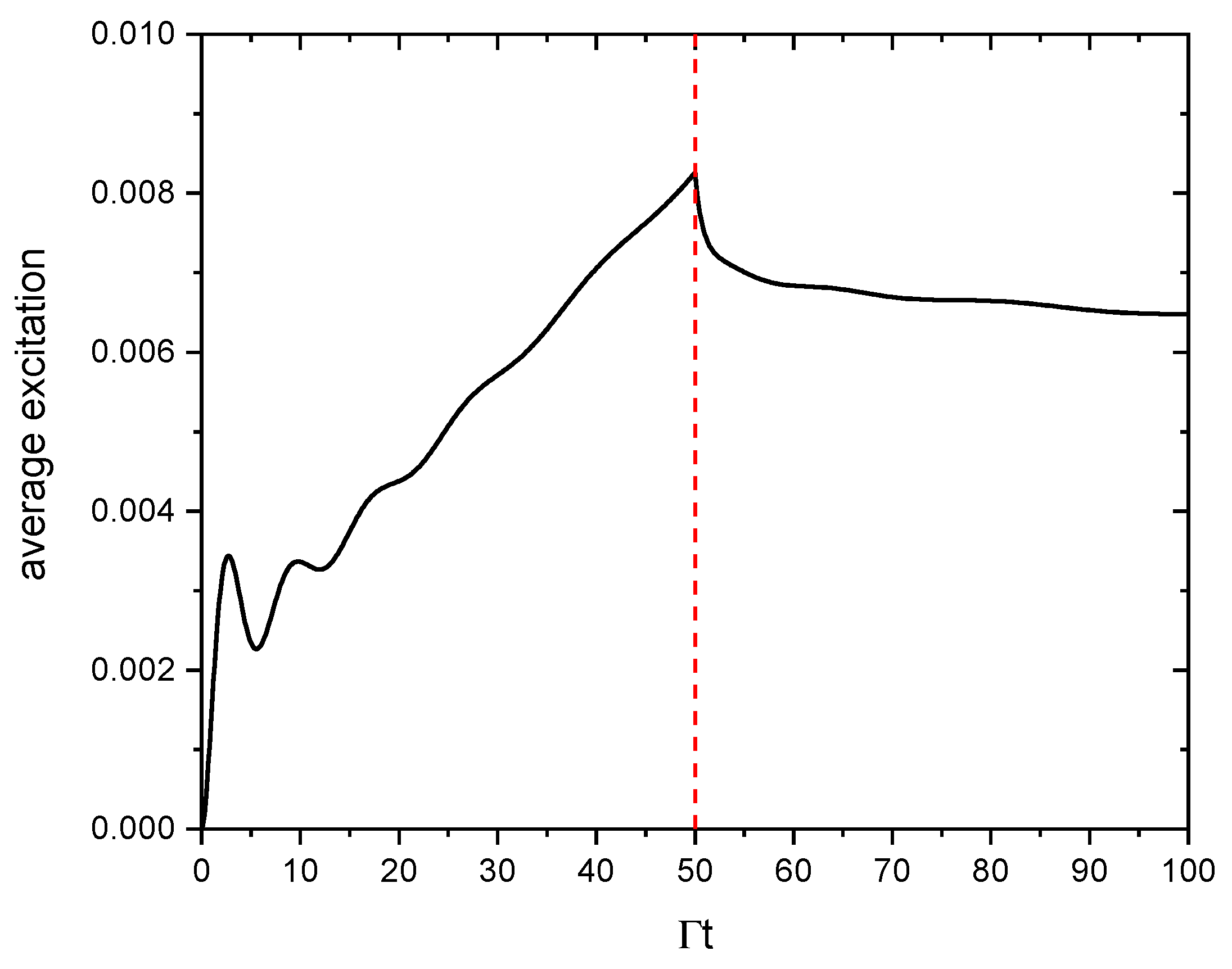
Figure 11.
vs x at the laser switch-off time, (red line) and at (blue line), for , , and . The dashed line is the value .
Figure 11.
vs x at the laser switch-off time, (red line) and at (blue line), for , , and . The dashed line is the value .
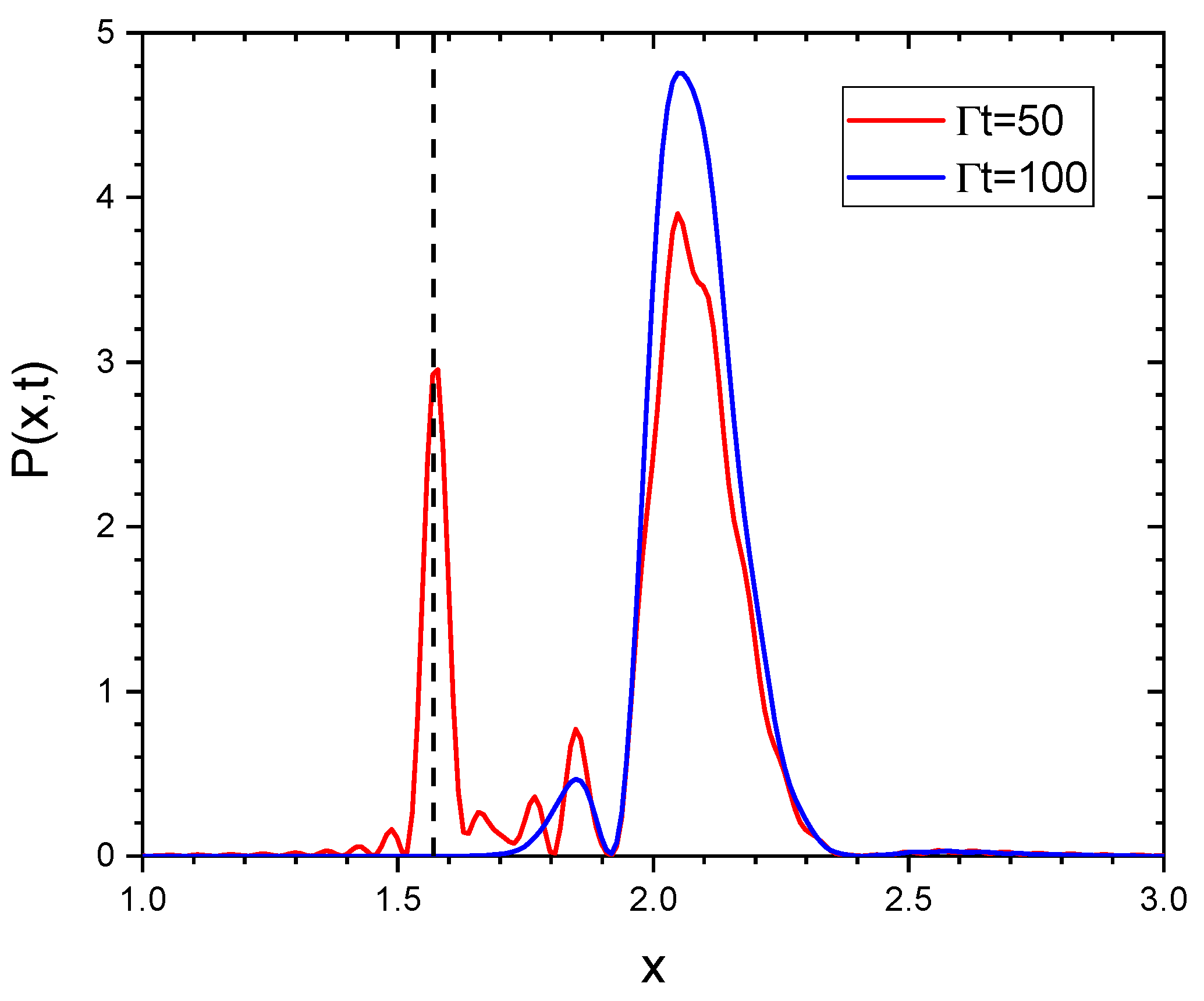
Figure 12.
Field intensity (arb. units) in the plane at emitted by a chain of atoms, with , along the z-axis, centered at and uniformly excited, . We observe that the field is radiated transversely to the chain.
Figure 12.
Field intensity (arb. units) in the plane at emitted by a chain of atoms, with , along the z-axis, centered at and uniformly excited, . We observe that the field is radiated transversely to the chain.
Disclaimer/Publisher’s Note: The statements, opinions and data contained in all publications are solely those of the individual author(s) and contributor(s) and not of MDPI and/or the editor(s). MDPI and/or the editor(s) disclaim responsibility for any injury to people or property resulting from any ideas, methods, instructions or products referred to in the content. |
© 2025 by the author. Licensee MDPI, Basel, Switzerland. This article is an open access article distributed under the terms and conditions of the Creative Commons Attribution (CC BY) license (http://creativecommons.org/licenses/by/4.0/).
Copyright: This open access article is published under a Creative Commons CC BY 4.0 license, which permit the free download, distribution, and reuse, provided that the author and preprint are cited in any reuse.


