

Submitted:
19 April 2025
Posted:
21 April 2025
You are already at the latest version
Abstract
This article is focused on performance appraisal systems in higher education institutions. It explains the importance of such systems, highlighting how they provide feedback to faculty and staff, hold them accountable for their performance, set goals, and recognize and reward good performance. The text further explains that these systems are crucial in aligning individual goals with those of the institution, which leads to better performance and outcomes. In addition, the article also highlights the various ways to analyze organizational performance. These include financial analysis, balanced scorecard, key performance indicators, benchmarking, SWOT analysis, and employee feedback. Each approach is explained in detail, highlighting its benefits and how it contributes to analyzing the overall performance of an organization. The article emphasizes the importance of performance appraisal systems in higher education institutions and how they can benefit the faculty, staff, and the institution.
Keywords:
Performance Appraisal
; Faculty
; Teaching & Learning
; Research
; Administration
; Leadership
; Accreditation and Ranking
1. Introduction
The growth of an organization can contribute to the growth of the country's economy in various ways. Here are some ways in which an organization's growth can support the country's economy. As an organization grows, it creates more job opportunities for people. This means that more people can earn a living, pay taxes, and contribute to the economy. As an organization grows, it can produce more goods and services. This means that it can meet the increasing demand for its products or services, which can, in turn, contribute to the overall growth of the country's economy. Organizations that grow are often at the forefront of innovation. They invest in research and development, which leads to the creation of new products and services. This innovation can drive economic growth by creating new markets, increasing productivity, and improving the quality of life. As an organization grows, it generates more revenue, which translates to higher tax revenue for the government. The government can use this revenue to fund infrastructure development, education, healthcare, and other initiatives that can contribute to the country's overall economic growth. Organizations that grow become more competitive, which can have a positive impact on the country's economy. As these organizations become more competitive, they drive innovation, increase productivity, and create a more dynamic business environment.
The growth of an organization can has a significant impact on the country's economy by creating jobs, increasing production, driving innovation, generating tax revenue, and enhancing competitiveness [1]. There are various ways to analyze the performance of an organization, and the methods used may vary depending on the type of organization, its goals, and its stakeholders. However, some common approaches to analyze organizational performance includes the following. This approach involves analyzing the financial statements of an organization, such as its balance sheet, income statement, and cash flow statement, to determine its financial performance. Financial analysis helps to identify key financial ratios, such as profitability, liquidity, solvency, and efficiency ratios. The balanced scorecard is a management tool that measures an organization's performance from four different perspectives: financial, customer, internal business processes, and learning and growth. This approach enables an organization to assess its overall performance based on a variety of factors, rather than just financial metrics. KPIs are metrics that are used to track progress towards specific goals or objectives. An organization can identify and track KPIs for various areas such as sales, marketing, customer service, production, and more. Benchmarking involves comparing an organization's performance against that of other similar organizations in the industry. This approach enables an organization to identify areas where it may be underperforming compared to its peers and make changes to improve its performance. A SWOT analysis assesses an organization's strengths, weaknesses, opportunities, and threats. This approach enables an organization to identify its areas of competitive advantage and areas where it needs to improve. Employee feedback is an essential tool for measuring organizational performance. It can be obtained through surveys, interviews, and focus groups. Employee feedback can provide insights into areas where the organization is doing well and areas that need improvement.
Analyzing organizational performance requires a holistic approach that considers a variety of factors, including financial metrics, customer satisfaction, internal processes, and employee feedback [2,3].
There are several types of organizations in a country. For-profit organizations aim to make a profit for their owners or shareholders, and they include businesses such as corporations, partnerships, and sole proprietorships. Non-profit organizations do not aim to make a profit, and their mission is often to serve the public or a particular cause. They include charities, foundations, and social welfare organizations. These organizations are run by the government and provide services to the public, such as police departments, public schools, and public hospitals. These organizations are specifically focused on education and can include schools, universities, and other training programs.
An educational institution is different from other organizations in several ways. The primary mission of an educational institution is to provide education and training to students, whereas other organizations may have different missions, such as making a profit or serving a particular cause. Educational institutions may be funded differently than other organizations. For example, they may receive government funding or rely on tuition fees to operate. Educational institutions are often governed by a board of trustees, whereas other organizations may have a different governance structure. The stakeholders of educational institutions are primarily students, parents, and faculty, whereas other organizations may have a different set of stakeholders. Educational institutions are subject to specific regulations related to education and accreditation, which may differ from regulations that apply to other organizations. Educational institutions are unique in their mission, funding, governance, stakeholders, and regulatory environment, which sets them apart from other types of organizations [4,5].
Performance appraisal systems are important in higher educational institutions for several reasons. A performance appraisal system provides feedback to faculty and staff about their job performance. This feedback can help them identify their strengths and weaknesses and develop plans for professional development. A performance appraisal system can hold faculty and staff accountable for their job performance. This can help ensure that they are meeting the expectations of the institution and performing their job duties effectively. A performance appraisal system can be used to set goals for faculty and staff. This can help align their individual goals with the goals of the institution, leading to improved performance and outcomes. A performance appraisal system can be used to recognize and reward faculty and staff who perform well. This can help boost morale, increase job satisfaction, and motivate employees to continue performing at a high level. A performance appraisal system can provide information that can be used for decision-making related to promotions, salary increases, and other employment-related decisions.
A performance appraisal system can help higher educational institutions improve the quality of their faculty and staff, align individual goals with institutional goals, and improve decision-making related to employment-related matters [6,7].
There are over 10,000 engineering colleges in India. Due to a lack of awareness in managing educational institutions, 90% of engineering colleges do not meet the necessary standards of NBA, NAAC, and other statutory bodies. One major reason for this is a lack of awareness in creating or maintaining a performance appraisal system. The best performance appraisal system can uphold the institution's status for consecutive years. This article clearly discusses the faculty appraisal system in engineering institutions for faculty members under the teaching and research category and for leadership positions such as Director, Associate Director, Head of the Department, and Vice-Chancellor. Several metrics are discussed below in detail with respect to current policies expected by NIRF, THE World University Rankings, QS Rankings, ABET, NAAC, NBA, and other bodies.
2. Evaluation Metrics
The evaluation metrics are categorized into three major divisions: Teaching & Learning, Research, and Administration. The role of leadership in any educational institution is critical in ensuring that the institution runs efficiently and effectively, achieving its goals and providing students with a high-quality education. Figure 1 highlights the weightage of responsibilities for each leadership position in three key areas: Teaching & Learning, Research, and Administration.
Teaching & Learning is an essential area where educational institutions must focus to provide their students with the best possible education. The Vice-Chancellor has a weightage of 5%, which indicates the importance of his role in ensuring that the institution's teaching and learning outcomes are achieved. The Director also has a weightage of 5%, reflecting his responsibility in implementing and managing the institution's teaching and learning strategies. The Head of the Department (HoD) has a weightage of 10%, indicating his critical role in overseeing the academic programs of the department and ensuring that they align with the institution's teaching and learning goals. The Associate Director has the highest weightage of 15%, emphasizing his role in the development and implementation of innovative and effective teaching and learning practices.
Research is another crucial area in educational institutions, as it allows institutions to discover new knowledge and innovate in various fields. The Vice-Chancellor and Director have a weightage of 5% and 10%, respectively, highlighting their critical roles in promoting and supporting research activities within the institution. The HoD and Associate Director also have a weightage of 10% and 15%, respectively, showing their responsibility in facilitating and leading research activities in their respective departments.
Administration is the area where all leadership positions must work together to ensure that the institution runs smoothly. The Vice-Chancellor has the highest weightage of 90%, reflecting his overall responsibility for overseeing the institution's administrative functions. The Director has a weightage of 85%, highlighting his role in managing the administrative functions of their respective departments. The HoD has a weightage of 80%, indicating his responsibility in overseeing the administrative functions of their departments. The Associate Director has a weightage of 70%, emphasizing his role in supporting and coordinating administrative functions within their respective departments.
The weightage of responsibilities for each leadership position in Teaching & Learning, Research, and Administration areas is crucial in achieving an educational institution's goals. By understanding their respective responsibilities, leaders can work collaboratively to ensure that the institution runs efficiently and provides the best possible education for its students while promoting research and innovation and ensuring smooth administrative functions.
For teaching faculty, the weightages are divided as 40% for teaching and learning, 40% for research, and 20% for administration. This is illustrated in Figure 2.
For a research faculty member, the weightages are divided based on the total number of credit points the research faculty member scored in research category. For greater than 250 credit points in the research category, the weightages are divided as 5% for teaching and learning, 90% for research and 5% for administration. For less than 150 credit points in research category, the weightages are divides as 20% for teaching and learning, 75% for research and 5% for administration. For the credit points between 150 to 250 points in research category, the weightages are divided as 10% for teaching and learning, 85% for research and 5% for administration. This is illustrated in Figure 3.
3. Research
Table 1 outlines the maximum points awarded for research achievements based on the publication of articles in various categories of journals indexed in the SCI (Science Citation Index).
The maximum points awarded for each category are as follows:
- Journal Publication - Regular Issue - (Without APC): This category awards a maximum of 50 points for the publication of an article in a regular issue of a journal without any Article Processing Charge (APC).
- Indexed in SCI - Q1 (All authors belong to the same affiliation): This category awards a maximum of 10 points per paper. The first author will get 5 points, and the remaining points will be shared among the other authors, provided all authors belong to the same affiliation. A maximum of 50 points can be awarded under this category.
- Indexed in SCI - Q1 (Two Affiliations for an article): This category awards a maximum of 5 points per paper. The first author will get 2.5 points, and the remaining points will be shared among the other authors. A maximum of 25 points can be awarded under this category.
- Indexed in SCI - Q2 (All authors belong to the same affiliation): This category awards a maximum of 9 points per paper. The first author will get 4.5 points, and the remaining points will be shared among the other authors, provided all authors belong to the same affiliation. A maximum of 45 points can be awarded under this category.
- Indexed in SCI - Q2 (Two Affiliations for an article): This category awards a maximum of 4.5 points per paper. The first author will get 2.25 points, and the remaining points will be shared among the other authors. A maximum of 22.5 points can be awarded under this category.
- Indexed in SCI - Q3 (All authors belong to the same affiliation): This category awards a maximum of 8 points per paper. The first author will get 4 points, and the remaining points will be shared among the other authors, provided all authors belong to the same affiliation. A maximum of 40 points can be awarded under this category.
- Indexed in SCI - Q3 (Two Affiliations for an article): This category awards a maximum of 4 points per paper. The first author will get 2 points, and the remaining points will be shared among the other authors. A maximum of 20 points can be awarded under this category.
These points serve as a measure of research productivity and can contribute to academic recognition and career advancement. It is essential to note that the criteria and weightage assigned to research achievements may differ across institutions and countries. Nonetheless, the maximum points awarded for the various categories of journal publications can provide researchers with a benchmark for assessing their research output and aligning their goals with the institutional expectations. If an article has 'N' affiliations then, the maximum points for the article are divided by 'N' for the first author.
Table 2 shows the maximum points that can be earned for a research based on various criteria. For journal publications that are part of a special issue or require APC, the maximum points that can be earned is 35. For articles indexed in SCI-Q1, the maximum points that can be earned are 7 points per paper if all authors belong to the same affiliation. The first author will receive 3.5 points, while the remaining points will be divided among the other authors. For articles with two affiliations, the first author will receive 1.75 points, and the remaining points will be divided among the other authors. The same pattern is followed for articles indexed in SCI-Q2 and SCI-Q3 with different point values per paper.
Table 3 outlines the maximum points awarded for research publications in different categories. The first category is Journal Publication in Scopus/Web of Science without any Article Processing Charges (APC), with a maximum of 20 points. The next two categories pertain to Scopus-indexed publications, where the maximum points awarded for an article are 4 and 2 points, respectively, based on whether all authors belong to the same affiliation or two affiliations.
The following two categories are publications through Conferences that are indexed in Scopus/Web of Science. For articles where all authors belong to the same affiliation, 1.5 points are awarded, whereas for articles with two affiliations, 1 point is awarded. In all cases, the first author receives a higher share of the points, with the remaining authors sharing the rest of the points. These categories and their corresponding maximum points serve as a guideline for researchers to aim for when publishing their work, and can help universities and research institutions to evaluate the research productivity of their faculty and staff.
Table 4 outlines the points that can be earned for research publications based on their citation performance. The first category, "Citation - Regular Issue - (Without APC)," offers a maximum of 50 points for publications that do not require an APC. The next categories are based on citation performance in the SCI (Science Citation Index) with Q1, Q2, and Q3 representing the top 25%, top 50%, and top 75% of journals in each respective field.
For publications with all authors belonging to the same affiliation, 10 points are awarded for every 10 citations in Q1 journals. The first author will receive 5 points, and the remaining points will be shared among the other authors. For publications with authors from two different affiliations, 5 points will be awarded for every 10 citations, and the first author will receive 2.5 points. Similar point allocations apply for Q2 and Q3 journals.
In the category "Citation - (Special Issue/APC)," a maximum of 35 points can be earned for publications with an APC. The point allocation for citations in Q1, Q2, and Q3 journals is similar to the first category, but with fewer points awarded for each citation. The last category, "Citation - Scopus/Web of Science - (Without APC)," offers a maximum of 20 points for publications indexed in Scopus or Web of Science without an APC. For publications with authors from the same affiliation, 4 points will be awarded for every 10 citations, while publications with authors from two different affiliations will receive 2 points for every 10 citations.
Finally, for publications that are presented at conferences and indexed in Scopus or Web of Science, 1.5 points are awarded for every 10 citations if all authors belong to the same affiliation, while 1 point is awarded if authors come from two different affiliations. The first author will receive 0.75 and 0.5 points, respectively, and the remaining points will be shared among the other authors.
Table 4 provides a useful guideline for researchers to understand how their publication citation performance translates into points for various types of publications.
Table 5 outlines the credit points for various types of Intellectual Property (IP) based on their status of being granted or published, and the number of affiliations of the authors. The maximum credit points that can be earned through research are 20. Patent granted and published in Scopus with all authors belonging to the same affiliation receive 10 and 4 credit points, respectively, with the inventor receiving 5 and 2 points, respectively. If the patent is granted or published with two affiliations, the credit points are reduced to 5 and 2 for patent granted and published, respectively, with the inventor receiving 2.5 and 1 points, respectively. For patents published but not indexed in Scopus, the credit points are further reduced to 1 and 0.5 for patents published with all authors from the same affiliation and two affiliations, respectively, with the inventor receiving 0.5 and 0.25 points, respectively.
It is important to note that design, trademarks, or copyrights patent are not considered in Table 5. The credit points allocated for each type of IP reflect the effort, novelty, and impact of the research and are meant to incentivize researchers to create new knowledge and contribute to the advancement of their field.
The credit points for sponsored research projects depend on the external funding received by the research project. For External Sponsored Research Projects from Govt. (DST/SERB/DRDO/), the credit points range from 5 to 30, based on the funding amount and the affiliation of the authors. For projects with a funding amount greater than 1 crore and with all authors belonging to the same affiliation, 30 credit points are awarded, out of which the Principal Investigator will receive 24 points, and the remaining points will be shared by the rest of the applicants. For projects with two affiliations, the credit points are 15, and the Principal Investigator (PI) will receive 12 points. For projects with funding amount between 50 Lakhs in INR (60000 USD) to less than 1 crore in INR (130000 USD), the credit points are 15 and 10 for same affiliation and two affiliations respectively, and for projects with funding amount less than 50 Lakhs in INR, the credit points are 20 and 10 for same affiliation and two affiliations, respectively.
Table 7 outlines the credit points that can be earned by individuals or teams engaged in consultancy projects. The maximum credit points available are 50. For consultancy projects that are valued at over 10 lakhs in INR, 10 credit points can be earned for every additional 10 lakhs (in INR) of project value. The maximum credit points for such projects are 50. For projects valued between 5 to 10 lakhs, 6 credit points can be earned, with a maximum of 30 credit points. For projects valued less than 5 lakhs (in INR), 4 credit points can be earned with a maximum of 20 credit points. These credit points can be earned by individuals or teams engaged in consultancy projects and can be used for professional development and career advancement. The credit point system provides an incentive for individuals and teams to take up consultancy projects, and encourages them to take on larger and more complex projects to earn more credit points. Overall, this system promotes excellence in consultancy and rewards those who excel in their field.
4. Teaching & Learning
Table 8 outlines the credit points that can be earned through various teaching and learning activities. The maximum credit points available are 18 for theory, 4 for lab, 2 for undergraduate projects, 4 for postgraduate projects, and 32 for Ph.D. students. For theory, 1 credit point can be earned for every hour of teaching, with a maximum of 7 credit points per semester. For lab sessions, 0.5 credit points can be earned for every hour of teaching, with a maximum of 2 credit points per semester for a class size of 12+12 students with 4 contact hours. For undergraduate projects, 0.5 credit points can be earned per project, with a maximum of 2 credit points per semester. For postgraduate projects, 1 credit point can be earned per project, with a maximum of 4 credit points per semester. For Ph.D. students, 8 credit points can be earned per student, with the first supervisor receiving 4 credit points if there are two supervisors. These credit points can be used for professional development and career advancement, and provide an incentive for educators to engage in teaching and learning activities. The credit point system encourages educators to improve their teaching skills and contribute to the development of their students. Overall, this system promotes excellence in education and rewards those who excel in their field.
Table 9 outlines the credit points awarded for various performance indicators in teaching and learning. The performance indicators include theory and lab results pass percentage and student feedback. The maximum credit points that can be awarded are 4, 3, and 8 for theory, lab results, and student feedback, respectively. For theory results, the highest credit points are awarded for pass percentages greater than 90%, while the lowest credit points are awarded for pass percentages below 50%. For lab results, the credit points decrease as the pass percentage decreases. The highest credit points are awarded for pass percentages greater than 90%, while the lowest credit points are awarded for pass percentages below 50%.
For student feedback, the highest credit points are awarded for feedback greater than 90%, while the lowest credit points are awarded for feedback below 50%. The credit points decrease as the feedback percentage decreases. In summary, the credit points awarded are based on the performance of students in their theory and lab exams, as well as their feedback on the teaching and learning process. The higher the performance and feedback, the more credit points are awarded.
Table 10 outlines the credit points awarded for various professional development activities and achievements related to teaching and learning. The maximum credit points that can be awarded are 4, 6, 10, and 30 for attending FDP/workshops/STC, online course certification, membership in professional organizations, and publishing books and book chapters, respectively. Industrial guest lectures on handling the subject will earn 0.50 credit point per subject with a maximum of 4 points. For attending FDPs, workshops, or STCs for at least 5 days, 2 credit points are awarded per course with a maximum of 6 points. Completing an online course with evaluation for a minimum duration of 12 weeks earns 4 credit points per course with a maximum of 4 points. Membership in professional organizations like IEEE, FNAE, FNA, and FNASc earns the maximum credit points of 10 per membership. Publishing a textbook on related subjects from standard international publishers earns 10 credit points per book, with a maximum of 30 points. Writing a book chapter on related subjects from standard international publishers earns 2 credit points per unit, with a maximum of 30 points. Similarly, writing a textbook on related subjects from standard national publishers earns 6 credit points per book, with a maximum of 18 points.
Finally, service periods over and above the required teaching experience since the last promotion earns 0.5 credit point per semester, with a maximum of 20 points. In summary, the credit points awarded are based on professional development activities and achievements related to teaching and learning. The more activities and achievements completed, the more credit points are awarded, with a maximum of 30 points for publishing books and book chapters.
5. Administration
Table 11 outlines the credit point system for various administrative responsibilities and achievements for faculty members. The system aims to recognize and reward faculty members for their contributions to the academic and administrative aspects of the institution. The following are the credit points and maximum points allotted for each category: Faculty members can receive credit points for being incharge of several verticals at the department or institution level. A maximum of 3 credit points can be awarded for this responsibility. For the department level, 0.50 credit points per vertical are awarded, while for the institution level, 1 credit point per vertical is awarded.
NBA/NAAC Criteria Incharges can receive credit points for the department or institution level for one semester. For each criteria, 1 credit point and 2 credit points are awarded at the department and institution level, respectively. Creating new labs is a significant achievement, and 4 credit points are awarded for this accomplishment. Faculty members who coordinate FDP/Workshop/STC for a minimum of 5 days duration can receive 2 credit points per course, with a maximum of 4 credit points. Chairpersons for organizing international conferences can receive 4 credit points. Course coordinators for national programs related to academic for a minimum period of 2 weeks can receive 2 credit points per course, with a maximum of 4 credit points. Chairpersons/Conveners of different standing committee levels for one semester can receive 1 credit point per committee, with a maximum of 4 credit points. Coordinators for institution outreach activities can receive 1 credit point per activity, with a maximum of 8 credit points. Warden/Asst. Warden can receive 0.5 credit points per semester, with a maximum of 1 credit point.
The credit point system encourages faculty members to take additional responsibilities and contribute to the growth and development of the institution. It also recognizes their achievements in the administrative aspects of the institution.
6. Teaching, Learning and Research (TLR) and Administration
Table 12 outlines the credit points allocated for various research, TRL and administration activities carried out by faculty members. This table includes eight research activities, each with a maximum credit point value. These activities include publishing journal articles, receiving citations, obtaining Intellectual Property Rights (IPRs), and engaging in sponsored research and consultancy projects.
The credit point value for each activity varies depending on the type of journal publication, whether it is a regular issue or special issue, and whether it requires an APC. Citations are also evaluated based on whether they were received in a regular issue, special issue, or through Scopus/Web of Science without APC.
To determine the overall credit points for research activities, three categories are defined based on the total credit points achieved by adding up the credit points for each activity. These categories are RA, RB, and RC, with different calculation methods for each category. RA is for those achieving greater than 250 points, RB is for those achieving 150 to 250 points, and RC is for those achieving less than 150 points. Table 12 is designed to incentivize and reward faculty members for conducting high-quality research that contributes to the academic community. It promotes research activity and encourages faculty members to produce quality research that can be published in prestigious journals, receive citations, and lead to intellectual property rights.
Teaching & Learning (TL) category includes Theory, Lab & Students Guided (60 points), Pass percentage and Students feedback (56.7 points), and Professional Development (122 points), with a total maximum score of 238.7 points. On the other hand, the Administration category has 11 criteria with a maximum score of 51 points. The overall score for TL and Administration categories can be calculated by averaging the total scores and multiplying them by 100.
7. Leadership Role
7.1. Director of Academics
The Director of Academics is responsible for a wide range of tasks related to academic administration. The performance of the Director can be evaluated based on several categories, including Admission and Enrollment, Academic Schedule, Assessments, Curriculum Development, Feedback and Follow-up, Academic Audit, Results and Data Management, and Accreditation. The Director is responsible for ensuring the publication and distribution of syllabi (5 points), course registration, and Management Information Systems (MIS) (20 points). The Director also coordinates the academic schedule/calendar and assessments (50 points) and maintains academic records and archives (100 points). The Director also oversees the development of the curriculum and the Board of Studies (100 points) and manages feedback and follow-up procedures (20 points). The Director is also responsible for coordinating accreditation (200 points) and peer reviews (50 points) as well as managing data for Convocation/Institute Day (20 points) and library operations (50 points). The Director oversees compliance with anti-ragging policies (10 points), rules and regulations (30 points), and fee details (10 points). The Director also ensures the implementation of the National Education Policy (NEP) with a score ranging from 20 to 100 points depending on the level of compliance achieved. The Director's overall performance is evaluated based on the sum of the points achieved in all categories. The Director's performance can be improved by ensuring compliance with all policies and procedures, efficient management of academic resources, and effective communication with all stakeholders [14]. This is summarized in Table 13.
7.2. Director of Research and Consultancy
The Director of Research and Consultancy is responsible for overseeing and managing research-related activities in the institution. Table 14 provides a list of key performance indicators and their respective weightage in evaluating the director's performance. The highest weightage is assigned to industry collaboration, interaction, and business ventures with a maximum score of 200. The director's role in fostering partnerships with research and development organizations and industries, as well as establishing institute-wide research centers and facilities, is also critical and carries a weightage of 200 points each. Other responsibilities include creating opportunities for Ph.D. and postgraduate research, managing corporate social responsibility projects, and administering research funding, consultancy, and contract research management. The Director must also establish Memories of Understanding (MoUs) with institutions in India and abroad and provide research opportunities for undergraduate students.
The Sophisticated Instrumentation Facility (SIF) is also a significant responsibility, with weightage assigned to facilities, brochures, payment procedures, booking slots, acknowledgement templates, testimonials, and feedback forms. Finally, the Director must oversee industry-institute partnerships, establish scholarship and internship opportunities for students, and promote intellectual property rights. Funding, projects, MoUs, partners, and sponsors also carry weightage of 200 points. The Director must also establish start-ups and incubatees, organize events, workshops, and programmes, and provide regular updates on funding opportunities. The Director's performance is evaluated based on the total score obtained out of the maximum possible score of 1050.
7.3. Director of Planning and Development
The Director of Planning and Development is responsible for ensuring the growth and expansion of the institution through the development of various proposals and plans. The Director must prepare and submit all developmental proposals, including estimates for civil works, sanitation, and other necessary data. The Director is also responsible for maintaining all necessary statistical data regarding the plans and compiling reports periodically. Furthermore, the Director of Planning and Development must provide necessary data for budgeting purposes, prepare new estimates and plans for the Building and Works Committee, and monitor the physical targets and utilization of funds. The Director must also organize meetings for procurement of equipment. The director's role is crucial in ensuring the institution's growth and development, including expansion and diversification of institutional activities. The Director must work closely with other stakeholders to ensure that all plans are executed efficiently and effectively. By doing so, the institution can achieve its long-term goals and maintain its position as a leader in education and research. This is illustrated in Table 15.
7.4. Director of Institutional Development and Alumni Relations
As Director of Institutional Development and Alumni Relations, the primary responsibility is to engage with alumni and international experts to promote collaboration and maintain a strong relationship between the institute and its alumni. This includes arranging reunions, maintaining a Hall of Fame, and coordinating the Alumni Day celebrations. Director also facilitate collaborations between the institute and alumni in research organizations, reputed universities, and industry.
In addition to alumni affairs, this Director will work as the convener for the Office of International Relations and assist officials in bringing overseas students and faculty to the institute. Director will also work with students and faculty members to develop plans for semester exchange and internships. Further, Director will interact with alumni in research organizations, reputed universities, and industry to formalize potential collaborations in research and development activities. To further strengthen our relationship with alumni, Director will work towards establishing alumni chapters in metropolitan centers across India and internationally. Director will also coordinate the development of facilities and infrastructure with alumni participation, and assist students in securing scholarships, travel grants, and loans. In terms of international relations, Director will provide inputs to the National Institutional Ranking Framework (NIRF) and strategy teams regarding international outreach. Director will also work closely with other offices to establish new MoUs and maintain existing ones. Overall, Director aim is to foster a strong and fruitful relationship between the institute, its alumni, and the international community, refer to Table 16.
7.5. Director of Student Welfare
The Director of Student Welfare is responsible for managing a range of services and programs designed to promote the well-being and success of students at the institute. Among the key responsibilities of this role are overseeing all student clubs, sports centers, and cultural events, as well as ensuring that the institute's rules and regulations are upheld. This Director is also responsible for managing the Student Aid Fund, student medical insurance reimbursement claims, and allocating funds for department associations. In addition to these core responsibilities, the Director of Student Welfare is responsible for providing counseling and guidance to students. This includes managing the counseling and guidance cell, conducting mental health and motivational lectures, and providing career advice and guidance. The Director is also responsible for mentoring the student council and helping to develop the skills and abilities of individual students through one-on-one counseling sessions.
Another important aspect of this role is ensuring that girls' students are supported and have access to the resources they need to succeed. This includes overseeing the discipline of girls at the institute, providing mentoring, and ensuring that the girls' hostels are clean and well-maintained. Overall, the Director of Student Welfare plays a critical role in promoting the well-being and success of students at the institute. Through their work, this Director help to create a supportive and inclusive environment that enables all students to reach their full potential, refer to Table 17.
7.6. Director of Faculty Welfare
The Director of Faculty Welfare is responsible for ensuring the well-being and professional development of the faculty members. This involves overseeing various activities such as recruitment, evaluation, promotion, training, and development programs. The Director is also responsible for handling establishment activities, leave matters, and performance appraisals. The Director must ensure that faculty members have access to appropriate training programs and professional development opportunities to improve their skills and knowledge. This will also help in the evaluation and promotion process, which is a critical aspect of faculty welfare. Additionally, this Director should address grievances related to faculty and handle RTI-related matters.
Moreover, the Director must ensure compliance with NIRF and IOE standards to maintain the institute's reputation. The Director should also work towards establishing a supportive environment that fosters the growth and well-being of the faculty members. This involves addressing grievances, ensuring fair evaluations and promotions, and providing necessary support for their professional development. Overall, the Director of Faculty Welfare plays a vital role in ensuring the institute's academic excellence and the overall well-being of the faculty members. This is summarized in Table 18.
7.7. Director of Career Development
The Director of Career Development is responsible for creating a robust campus recruitment process and achieving successful career outcomes for graduating students. They must achieve individual targets for annual recruitment processes, summer internships, and live projects while supporting team members. The Director must engage with corporates through structured market outreach, plan and manage strategic activities such as guest lectures, workshops, and competitions. The Director should also manage student career services, including counselling and grooming for interviews, and work with stakeholders to achieve both career services and institutional objectives. The Director must be well-networked in the corporate HR community and experienced in working with senior professionals in HR and functional leaders. They must also achieve placement and internship targets, create new placement partners and manage existing partners. The Director should conduct student counselling sessions in-house and organize corporate engagement activities like guest lectures, student training, and conclaves. This is illustrated in Table 19.
7.8. Head of the Department
As the Head of the Department, it is important to ensure that the department is accredited and recognized for its quality education. The National Board of Accreditation (NBA) requires certain criteria to be met for Tier-II (UG Engineering) First Time Accreditation. The maximum points that can be awarded for each criterion are listed in Table 20. As the Head of the Department, it is crucial to ensure that all criteria are met to achieve the maximum points possible for each criterion. This requires a detailed evaluation of the department's strengths and areas for improvement, followed by strategic planning and implementation of improvement measures. It is important to work closely with faculty and staff to achieve the best possible outcomes for the department and its students [13].
8. Vice-Chancellor
As Vice-Chancellor, he would be responsible for overseeing various aspects of the university, including accreditation, rankings, and implementation of the National Education Policy (NEP). The maximum points for each area of responsibility are indicated in Table 21. For NAAC accreditation, the Vice-Chancellor would need to ensure that the university meets the criteria set out by the National Assessment and Accreditation Council. The criteria include curricular aspects, teaching and learning processes, research and innovation, infrastructure and learning resources, student support and progression, governance, leadership and management, and institutional values and best practices. For NIRF rankings, the Vice-Chancellor would be evaluated on various metrics such as teaching, learning, and resources, research and professional practice, graduation outcomes, outreach and inclusivity, and peer perception. The metrics cover a wide range of factors such as student strength, faculty-student ratio, quality of publications, placement and higher studies, diversity, and academic reputation [10].
In addition, the Vice-Chancellor would need to implement the NEP and ensure that the university meets the prescribed targets. The individual would be evaluated based on the percentage of NEP implementation achieved, with higher scores awarded for greater levels of implementation [15]. Overall, the Vice-Chancellor would play a critical role in ensuring that the university achieves its objectives across various areas of responsibility, including accreditation, rankings, and policy implementation. The Vice-Chancellor would need to work closely with faculty, staff, and other stakeholders to drive improvements in areas such as teaching and learning, research, infrastructure, and student support [11].
Table 22 summarizes the different categories of positions and the maximum marks for each category. The marks for each category are based on the summation of the scores obtained in different areas of responsibility. For instance, the Director of Academics is evaluated based on their performance in different areas of responsibility, and the total marks are calculated as the percentage of the sum of the scores obtained divided by the maximum possible score. Similarly, the Director of Research and Consultancy, Director of Planning and Development, Director of Institutional Development & Alumni Relations, Director of Student Welfare, Director of Faculty Welfare, Head of the Department, and Vice-Chancellor are also evaluated based on their performance in different areas of responsibility. The maximum marks for each category vary, and the scores are calculated accordingly. The evaluation criteria include aspects such as academic curricula, teaching-learning processes, research, infrastructure, student and faculty support, governance, leadership, and management, institutional values, best practices, and implementation of the NEP. The scores obtained by the individuals in each category provide an overall assessment of their performance in their respective roles.
The marks have now been normalized for T&L, Research, Administration, and Leadership roles from Table 12 and Table 22. This normalized score can be adopted to evaluate the Faculty and Leadership roles with respect to Figure 1, Figure 2 and Figure 3. It gives us a clear performance appraisal of faculty for an engineering institution, satisfying various accreditation and ranking parameters.
9. Conclusions
This paper focuses equally on the research, teaching & learning and administration category. The Directors of Academics, Research and Consultancy, Planning and Development, Institutional Development & Alumni Relations, Student Welfare, and Faculty Welfare, as well as the Head of the Department and Vice-Chancellor, are evaluated based on specific criteria within their respective categories. The scores for each criterion are added up, and the resulting sum is multiplied by 100 and divided by the maximum possible score for that category. In conclusion, this article provides a clear framework for evaluating the performance of academic and administrative staff. The focus on research and teaching and learning highlights the importance of these areas for academic institutions. However, it is also essential to note that the criteria used for evaluation may vary across different institutions and may need to be adjusted based on the specific needs and goals of each institution.
Author Contributions
The authors have read and agreed to the published version of the manuscript.
Data Availability Statement
There is no data prepared for this article.
Acknowledgments
The metrics used to evaluate are referred from NIT, NIRF, NBA, NAAC and THE world university ranking which is listed in the references section of the article.
Conflicts of Interest
The authors declare that they have no known competing financial interests or personal relationships that could have appeared to influence the work reported in this paper.
References
- Stoermer, Sebastian, Samuel Davies, and Fabian Jintae Froese. "The influence of expatriate cultural intelligence on organizational embeddedness and knowledge sharing: The moderating effects of host country context." Journal of International Business Studies 52, no. 3 (2021): 432-453. [CrossRef]
- Miotto, Giorgia, Cristina Del-Castillo-Feito, and Alicia Blanco-González. "Reputation and legitimacy: Key factors for Higher Education Institutions’ sustained competitive advantage." Journal of Business Research 112 (2020): 342-353. [CrossRef]
- Bayo-Moriones, Alberto, Jose E. Galdon-Sanchez, and Sara Martinez-de-Morentin. "Performance appraisal: dimensions and determinants." The International Journal of Human Resource Management 31, no. 15 (2020): 1984-2015.
- Linder, Stefan, Jacob Lyngsie, Nicolai J. Foss, and Shaker A. Zahra. "Wise choices: how thoroughness of opportunity appraisal, incentives, and performance evaluation fit together." IEEE Transactions on Engineering Management 62, no. 4 (2015): 484-494. [CrossRef]
- Kolosz, Ben W., and Susan M. Grant-Muller. "Appraisal and evaluation of interurban ITS: A European survey." IEEE Transactions on Intelligent Transportation Systems 16, no. 3 (2014): 1070-1087. [CrossRef]
- Rubin, Ellen V., and Amani Edwards. "The performance of performance appraisal systems: understanding the linkage between appraisal structure and appraisal discrimination complaints." The International Journal of Human Resource Management 31, no. 15 (2020): 1938-1957. [CrossRef]
- Alsuwaidi, Maryam, Muhammad Alshurideh, Barween Al Kurdi, and Said A. Salloum. "Performance appraisal on employees’ motivation: A comprehensive analysis." In Proceedings of the International Conference on Advanced Intelligent Systems and Informatics 2020, pp. 681-693. Springer International Publishing, 2021. [CrossRef]
- Baneres, David, M. Elena Rodríguez-Gonzalez, and Montse Serra. "An early feedback prediction system for learners at-risk within a first-year higher education course." IEEE Transactions on Learning Technologies 12, no. 2 (2019): 249-263. [CrossRef]
- Ashaari, Mohamed Azlan, Karpal Singh Dara Singh, Ghazanfar Ali Abbasi, Azlan Amran, and Francisco J. Liebana-Cabanillas. "Big data analytics capability for improved performance of higher education institutions in the Era of IR 4.0: A multi-analytical SEM & ANN perspective." Technological Forecasting and Social Change 173 (2021): 121119.
- https://www.nirfindia.org/Parameter.
- http://naac.gov.in/index.php/en/assessment-accreditation.
- https://www.nbaind.org/files/evaluation-guidelines-tier-ii-v0.pdf.
- https://www.timeshighereducation.com/world-university-rankings/world-university-rankings-2023-methodology.
- https://www.nitt.edu/home/administration/.
- https://www.education.gov.in/sites/upload_files/mhrd/files/NEP_Final_English_0.pdf.
Figure 1.
Weightages for Leadership role in the institution.
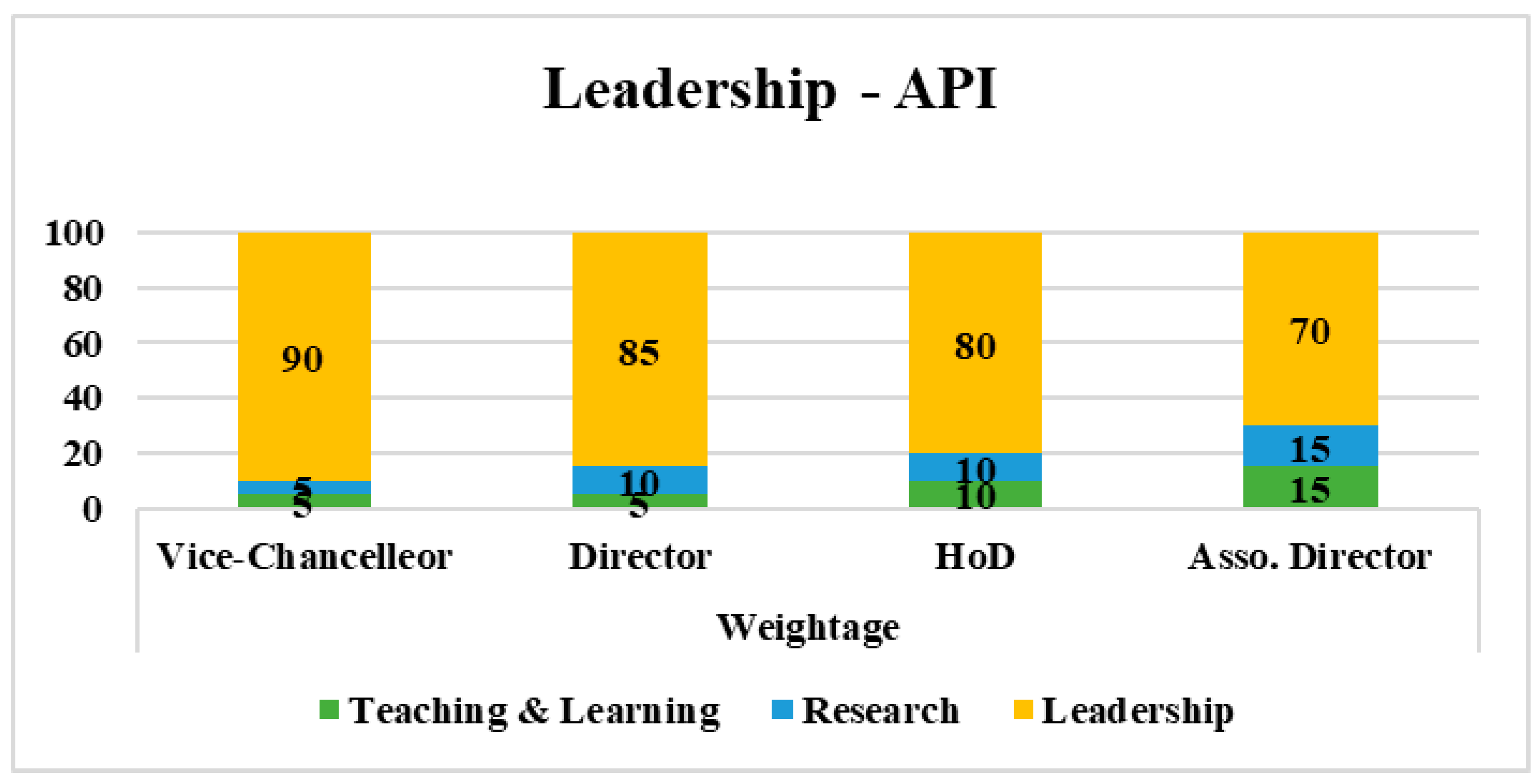
Figure 2.
Weightages for a Teaching faculty.
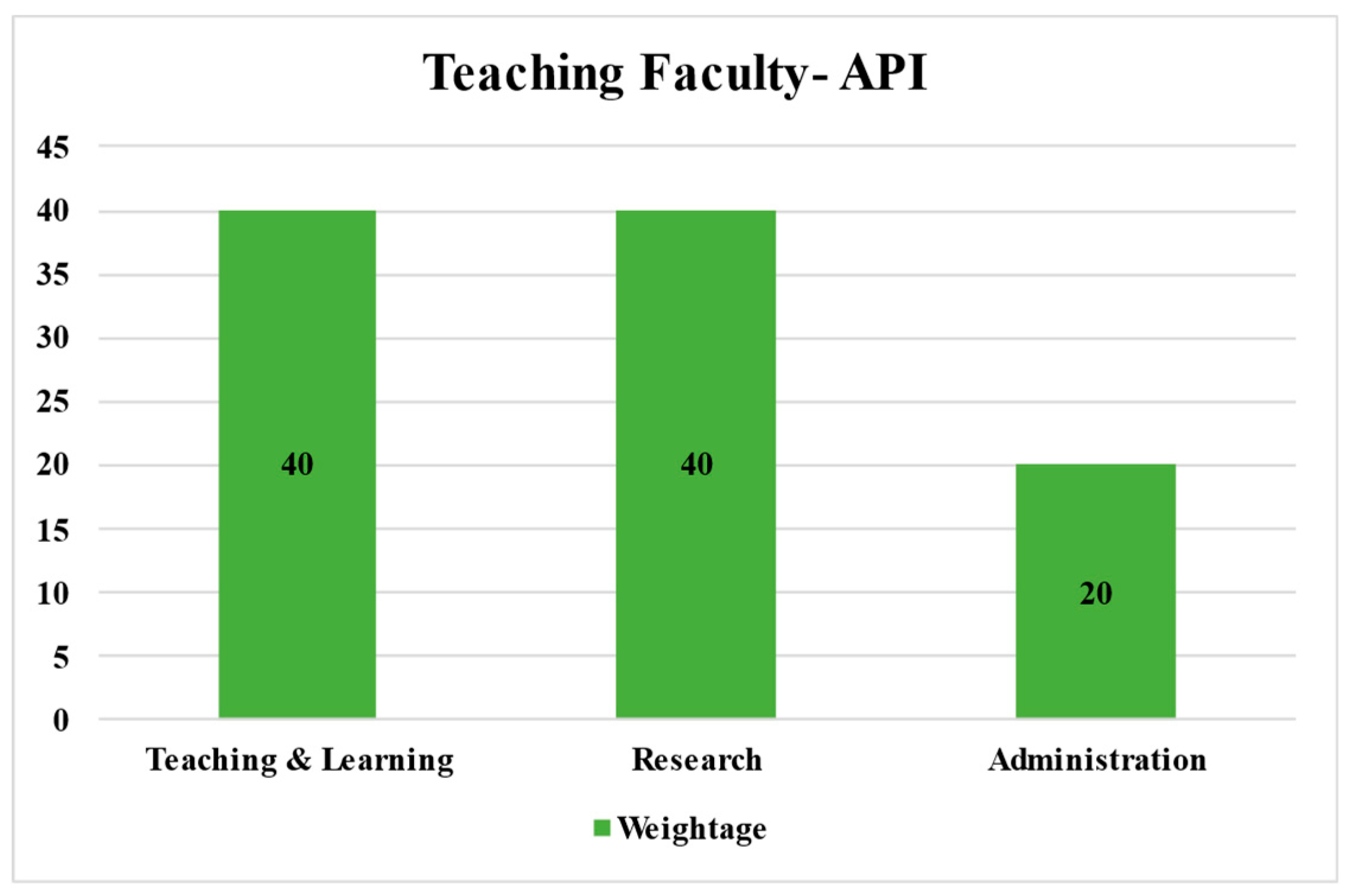
Figure 3.
Weightages for a Research faculty.
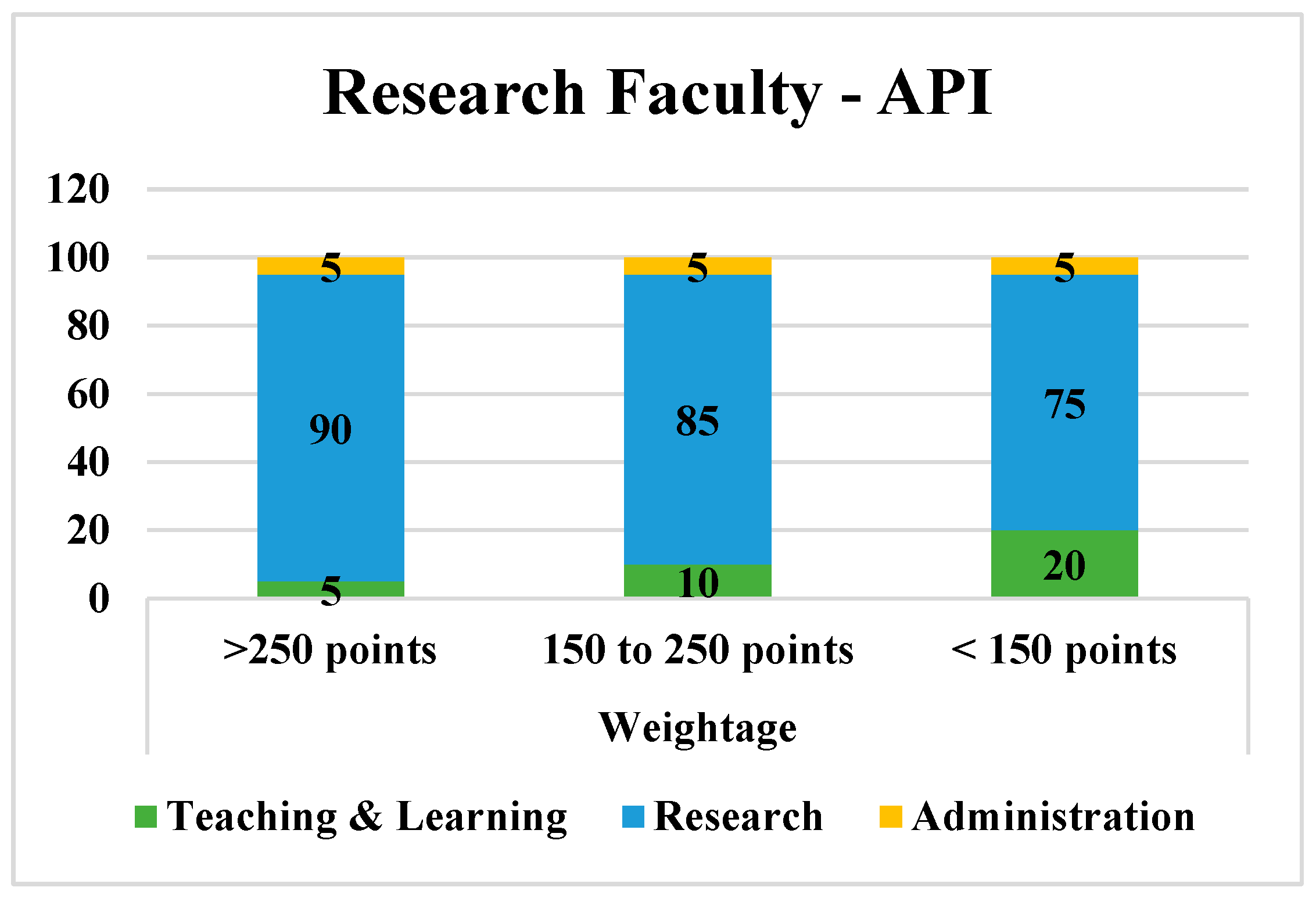

Table 1.
Credit points for journal publication in a regular issue without APC.
| Research | Credit Points | Max Points |
|---|---|---|
| Journal Publication - Regular Issue - (Without APC) | 50 | |
| Indexed in SCI - Q1 (All authors belong to same affiliation) | 10 points per paper. First author will get 5 points, and the rest of the authors will share the remaining points provided all author belongs to same affiliation. | 50 |
| Indexed in SCI - Q1 (Two Affiliation for an article) | 5 points per paper. First author will get 2.5 point, and the rest of the authors will share the remaining points. | 25 |
| Indexed in SCI - Q2 (All authors belong to same affiliation) | 9 points per paper. First author will get 4.5 points, and the rest of the authors will share the remaining points provided all author belongs to same affiliation. | 45 |
| Indexed in SCI - Q2 (Two Affiliation for an article) | 4.5 points per paper. First author will get 2.25 points, and the rest of the authors will share the remaining points. | 22.5 |
| Indexed in SCI - Q3 (All authors belong to same affiliation) | 8 points per paper. First author will get 4 points, and the rest of the authors will share the remaining points provided all authors belong to the same affiliation. | 40 |
| Indexed in SCI - Q3 (Two Affiliations for an article) | 4 points per paper. First author will get 2 points, and the rest of the authors will share the remaining points. | 20 |
Table 2.
Credit points for a journal publication in a special issue/with APC.
| Research | Max Points | |
|---|---|---|
| Journal Publication - (Special Issue / APC) | Credit Points | 35 |
| Indexed in SCI - Q1 (All authors belong to same affiliation) | 7 points per paper. First author will get 3.5 points, and the rest of the authors will share the remaining points provided all author belongs to same affiliation. | 35 |
| Indexed in SCI - Q1 (Two Affiliations for an article) | 3.5 points per paper. First author will get 1.75 points, and the rest of the authors will share the remaining points. | 17.5 |
| Indexed in SCI - Q2 (All authors belong to same affiliation) | 6 points per paper. First author will get 3 points, and the rest of the authors will share the remaining points provided all author belongs to same affiliation. | 30 |
| Indexed in SCI - Q2 (Two Affiliations for an article) | 3 points per paper. First author will get 1.5 points, and the rest of the authors will share the remaining points. | 15 |
| Indexed in SCI - Q3 (All authors belong to same affiliation) | 5 points per paper. First author will get 2.5 points, and the rest of the authors will share the remaining points provided all author belongs to same affiliation. | 25 |
| Indexed in SCI - Q3 (Two Affiliations for an article) | 2.5 points per paper. First author will get 1.25 points, and the rest of the authors will share the remaining points. | 12.5 |
Table 3.
Credit points for Publication in Scopus indexed/WoS journal without APC and in conference.
| Research | Credit Points | Max Points |
|---|---|---|
| Journal Publication - Scopus/ Web of Science - (Without APC) | 20 | |
| Indexed in Scopus (All author belongs to same affiliation) | 4 points per paper. First author will get 2 points, and the rest of the authors will share the remaining points provided all author belongs to same affiliation. | 20 |
| Indexed in Scopus (Two Affiliation for an article) | 2 points per paper. First author will get 1 point, and the rest of the authors will share the remaining points. | 10 |
| Publication through Conference - Indexed in Scopus/Web of Science (All authors belong to the same affiliation) | 1.5 points per paper. First author will get 0.75 point, and the rest of the authors will share the remaining points provided all author belongs to same affiliation. | 7.5 |
| Publication through Conference - Indexed in Scopus/ Web of Science (Two Affiliations for an article) | 1 point per paper. First author will get 0.5 point, and the rest of the authors will share the remaining points. | 5 |
Table 4.
Credit points for citation for an article excluding self-citation by the same affiliation institution.
Table 4.
Credit points for citation for an article excluding self-citation by the same affiliation institution.
| Research | ||
|---|---|---|
| Citations | Credit Points | Max Points |
| Citation - Regular Issue - (Without APC) | 50 | |
| Cited by SCI - Q1 (All authors belong to same affiliation) | 10 points per 10 citations. First author will get 5 points, and the rest of the authors will share the remaining points provided that all authors belong to same affiliation. | 50 |
| Cited by SCI - Q1 (Two Affiliations for an article) | 5 points per 10 citations. First author will get 2.5 point, and the rest of the authors will share the remaining points. | 25 |
| Cited by SCI - Q2 (All authors belong to the same affiliation) | 9 points per 10 citations. First author will get 4.5 points, and the rest of the authors will share the remaining points provided that all authors belong to the same affiliation. | 45 |
| Cited by SCI - Q2 (Two Affiliations for an article) | 4.5 points per 10 citations. First author will get 2.25 points, and the rest of the authors will share the remaining points. | 22.5 |
| Cited by SCI - Q3 (All authors belong to the same affiliation) | 8 points per 10 citations. First author will get 4 points, and the rest of the authors will share the remaining points provided that all authors belong to the same affiliation. | 40 |
| Cited by SCI - Q3 (Two Affiliation for an article) | 4 points per 10 citations. First author will get 2 points, and the rest of the authors will share the remaining points. | 20 |
| Citation - (Special Issue / APC) | 35 | |
| Cited by SCI - Q1 (All authors belong to the same affiliation) | 7 points per 10 citations. First author will get 3.5 points, and the rest of the authors will share the remaining points provided that all authors belong to the same affiliation. | 35 |
| Cited by SCI - Q1 (Two Affiliations for an article) | 3.5 points per 10 citations. First author will get 1.75 points, and the rest of the authors will share the remaining points. | 17.5 |
| Cited by SCI - Q2 (All authors belong to the same affiliation) | 6 points per 10 citations. First author will get 3 points, and the rest of the authors will share the remaining points provided that all authors belong to the same affiliation. | 30 |
| Cited by SCI - Q2 (Two Affiliations for an article) | 3 points per 10 citations. First author will get 1.5 points, and the rest of the authors will share the remaining points. | 15 |
| Cited by SCI - Q3 (All authors belong to the same affiliation) | 5 points per 10 citations. First author will get 2.5 points, and the rest of the authors will share the remaining points provided that all authors belong to the same affiliation. | 25 |
| Cited by SCI - Q3 (Two Affiliations for an article) | 2.5 points per 10 citations. First author will get 1.25 points, and the rest of the authors will share the remaining points. | 12.5 |
| Citation - Scopus/ Web of Science - (Without APC) | 20 | |
| Cited by Scopus (All authors belong to the same affiliation) | 4 points per 10 citations. First author will get 2 points, and the rest of the authors will share the remaining points provided that all authors belong to the same affiliation. | 20 |
| Cited by Scopus (Two Affiliations for an article) | 2 points per 10 citations. First author will get 1 point, and the rest of the authors will share the remaining points. | 10 |
| Cited through Conference Article - Indexed in Scopus/Web of Science (All authors belong to the same affiliation) | 1.5 points per 10 citations. First author will get 0.75 point, and the rest of the authors will share the remaining points provided all author belongs to same affiliation. | 7.5 |
| Cited through Conference Article - Indexed in Scopus/Web of Science (Two Affiliations for an article) | 1 point per 10 citations. First author will get 0.5 point, and the rest of the authors will share the remaining points. | 5 |
Table 5.
Credit points for IPR (Published and Grant).
| Research | Credit Points | Max. Points |
|---|---|---|
| IPR | 20 | |
| Patent Granted (All authors belong to the same affiliation) | 10 credit points per patent granted. Inventor will receive 5 points and rest of the applicants will share the remaining points provided all authors belong to the same affiliation. (Design, Trademarks, or Copyrights Patent are Not Considered) | 50 |
| Patent Granted (Two affiliations for a patent) | 5 credit points per patent granted. Inventor will receive 2.5 points and rest of the applicants will share the remaining points. (Design, Trademarks, or Copyrights Patent are Not Considered) | 25 |
| Patent Published - Indexed in Scopus (All authors belong to the same affiliation) | 4 credit points per patent published. Inventor will receive 2 points and rest of the applicants will share the remaining points provided that all authors belong to the same affiliation. (Design, Trademarks, or Copyrights Patent are Not Considered) | 20 |
| Patent Published - Indexed in Scopus (Two affiliation for a patent) | 2 credit points per patent published. Inventor will receive 1 points and rest of the applicants will share the remaining points. (Design, Trademarks, or Copyrights Patent are Not Considered) | 10 |
| Patent Published - Not Indexed in Scopus (All author belongs to same affiliation) | 1 credit point per patent published. Inventor will receive 0.5 point and rest of the applicants will share the remaining points provided all authors belong to the same affiliation. (Design, Trademarks, or Copyrights Patent are Not Considered) | 5 |
| Patent Published - Not Indexed in Scopus (Two Affiliations for a patent) | 0.5 credit point per patent published. Inventor will receive 0.25 point and rest of the applicants will share the remaining points. (Design, Trademarks, or Copyrights Patent are Not Considered) | 2.5 |
Table 6.
Credit points for Sponsored Research Projects.
| Research | Credit Points | Max. Points |
|---|---|---|
| Sponsored Research Projects | 30 | |
| External Sponsored Research Projects from Govt. (DST/ SERB/ DRDO/) (All authors belong to the same affiliation) for >1 Crore | 30 credit points per project. PI will receive 24 points and rest of the applicants will share the remaining points provided all authors belong to the same affiliation. | 30 |
| External Sponsored Research Projects from Govt. (DST/ SERB/ DRDO/) (Two affiliations for a project) for >1 Crore | 15 credit points per project. PI will receive 12 points and rest of the applicants will share the remaining points. | 15 |
| External Sponsored Research Projects from Govt. (DST/ SERB/ DRDO/) (All authors belong to the same affiliation) for 50L to <1 Crore | 15 credit points per project. PI will receive 12 points and rest of the applicants will share the remaining points provided all authors belong to the same affiliation. | 15 |
| External Sponsored Research Projects from Govt. (DST/ SERB/ DRDO/) (Two affiliations for a project) for 50L to <1 Crore | 10 credit points per project. PI will receive 8 points and rest of the applicants will share the remaining points. | 10 |
| External Sponsored Research Projects from Govt. (DST/ SERB/ DRDO/) (All authors belong to the same affiliation) for <50L | 10 credit points per project. PI will receive 8 points and rest of the applicants will share the remaining points provided all authors belong to the same affiliation. | 20 |
| External Sponsored Research Projects from Govt. (DST/ SERB/ DRDO/) (Two affiliations for a project) for <50L | 5 credit points per project. PI will receive 4 points and rest of the applicants will share the remaining points. | 10 |
Table 7.
Credit points for Consultancy projects.
| Research | Credit Points | Max. Points |
|---|---|---|
| Consultancy Projects | 50 | |
| Consultancy Projects >10 L | 10 credit points per 10 L | 50 |
| Consultancy Projects 5 to 10 L | 6 credit points | 30 |
| Consultancy Projects <5L | 4 credit points | 20 |
Table 8.
Credit points for theory, lab and students guided.
| Teaching & Learning | Credit Points | Max. Points |
|---|---|---|
| Theory (Max. of 7 credit points) per semester | 1 credit point for 1 hour | 18 |
| Lab (Max. of 2 credit points for (12+12) students of 4 contact hours) per semester | 0.5 credit point for 1 hour | 4 |
| Undergraduate Projects Dissertation Guided (Max. of 0.5 credit points) per semester | 0.5 credit point per project | 2 |
| Postgraduate Projects Dissertation Guided (Max. of 1 credit points) per semester | 1 credit point per project | 4 |
| No. of Students Completed Ph.D. | 8 credit points per student. First supervisor will get 4 credit points if there are two supervisors. | 32 |
Table 9.
Credit points for pass percentage and students feedback.
| Teaching & Learning | Credit Points | Max. Points |
|---|---|---|
| Theory Results Pass Percentage > 90% | 1 credit point per subject | 4 |
| Theory Results Pass Percentage 80 to 90% | 0.85 credit point per subject | 3.4 |
| Theory Results Pass Percentage 70 to 80% | 0.80 credit point per subject | 3.2 |
| Theory Results Pass Percentage 50 to 70% | 0.60 credit point per subject | 2.4 |
| Theory Results Pass Percentage < 50% | 0.50 credit point per subject | 2 |
| Lab Results Pass Percentage > 90% | 0.5 credit point per subject | 3 |
| Lab Results Pass Percentage 80 to 90% | 0.45 credit point per subject | 2.7 |
| Lab Results Pass Percentage 70 to 80% | 0.40 credit point per subject | 2.4 |
| Lab Results Pass Percentage 50 to 70% | 0.35 credit point per subject | 2.1 |
| Lab Results Pass Percentage < 50% | 0.25 credit point per subject | 1.5 |
| Students Feedback > 90% | 1 credit point per subject | 8 |
| Students Feedback 80 to 90% | 0.85 credit point per subject | 6.8 |
| Students Feedback 70 to 80% | 0.80 credit point per subject | 6.4 |
| Students Feedback 50 to 70% | 0.60 credit point per subject | 4.8 |
| Students Feedback < 50% | 0.50 credit point per subject | 4 |
Table 10.
Credit point system for professional development in Teaching and Learning.
| Teaching & Learning | Credit Points | Max. Points |
|---|---|---|
| Industrial Guest Lecture for handling subject | 0.50 credit point per subject | 4 |
| FDP/ Workshop/ STC attended for a minimum of 5 days | 2 credit point per course | 6 |
| Online Course Certification with evaluation for a minimum duration of 12 weeks course | 4 credit point per course | 4 |
| Membership - IEEE, FNAE, FNA, FNASc | 10 credit points per membership | 10 |
| Text book(s) on related subject from standard International publishers | 10 credit points per book | 30 |
| Book chapter(s) on related subject from standard international publishers | 2 credit points per unit | 30 |
| Text book(s) on related subject from standard national publishers | 6 credit points per book | 18 |
| Service period over and above the relevant teaching experience required for the cadre since the last promotion | 0.5 credit point per semester | 20 |
Table 11.
Credit points for administrative tasks.
| Administration | Credit Points | Max. Points |
|---|---|---|
| Faculty incharge of several verticals (Max. of 3 credit points) department level for one semester | 0.50 credit point per vertical | 6 |
| Faculty incharge of several verticals (Max. of 3 credit points) institution level for one semester | 1 credit point per vertical | 6 |
| NBA/ NAAC Criteria incharges for the department level for one semester | 1 credit point per criteria | 2 |
| NBA/ NAAC Criteria incharges for the institution level for one semester | 2 credit points per criteria | 4 |
| Creation of New lab(s) | 4 credit points | 8 |
| Co-ordinator for FDP/ Workshop/ STC for minimum of 5 days duration | 2 credit points per course | 4 |
| Chairman for International Conference Organized | 4 credit points | 4 |
| Course Coordinator for National Programs related to Academic for a minimum period of 2 weeks | 2 credit points per course | 4 |
| Chairman/ Convener of different standing committee level for one semester | 1 credit point per committee | 4 |
| Coordinator - Institution Outreach Activities | 1 credit point per activity | 8 |
| Warden/ Asst. Warden | 0.5 credit points per semester | 1 |
Table 12.
Normalization of T&L, Research and Administration.
| Category | Max. Points/ Scores |
|---|---|
| Research | |
| R1. Journal Publication - Regular Issue - (Without APC) | 50 |
| R2. Journal Publication - (Special Issue / APC) | 35 |
| R3. Journal Publication - Scopus/ Web of Science - (Without APC) | 20 |
| R4. Citations - Regular Issue - (Without APC) | 50 |
| R5. Citations - (Special Issue / APC) | 35 |
| R5. Citations - Scopus/ Web of Science - (Without APC) | 20 |
| R6. IPR | 20 |
| R7. Sponsored Research Projects | 30 |
| R8. Consultancy Projects | 50 |
| #RA. For greater than 250 points | =(SUM(R1:R8)/250)×100 |
| RB. For 150 to 250 points | =(SUM(R1:R8)/150) ×100 |
| RC. For Less than 150 points | =(SUM(R1:R8)/149) ×100 |
| Teaching & Learning | |
| TL1. Theory, Lab & Students Guided | 60 |
| TL2. Pass percentage and Students feedback | 56.7 |
| TL3. Professional Development | 122 |
| =(SUM(TL1:TL3)/238.7) ×100 | |
| Administration | |
| A1:A11 | =(SUM(A1:A11)/51) ×100 |
# - if the sum (R1:R8) exceeds denominator, then fix the sum value to the denominator value.
Table 13.
Credit points for the role of Director-Academics.
| Director – Academics | Max. Points |
|---|---|
| Admission, Enrollment | 50 |
| Academic Schedule / Calendar, Assessments | 50 |
| Publication and distribution of the syllabi | 5 |
| Course Registration, MIS, Course plans | 20 |
| Full time to Part time conversion, Temporary Break of Study, Admission Cancellation | 20 |
| Scholarships, No Objection Certificate | 30 |
| Industrial Visits | 10 |
| Curriculum Development, Board of Studies | 100 |
| Feedback and follow-up | 20 |
| Academic Audit, Data Management | 100 |
| Data for Convocation / Institute Day | 20 |
| Maintenance of Academic Records, Archiving of Academic Records | 100 |
| Results, Reassessment, Redo, Formative Assessment | 100 |
| Management Information System (Academic module) | 100 |
| Co-coordinating the finalization of session’s evaluations and ensuring the timely declaration of results | 50 |
| Performance Analysis Committee | 5 |
| Updating of Regulations and incorporation in the MIS | 20 |
| Co-ordination for the conduct of Convocation & Institute Day | 10 |
| Information for RTI / MHRD queries, NAD | 10 |
| Accreditation - NBA, NAAC, ABET | 200 |
| Peer Review | 50 |
| Senate matters | 20 |
| NIRF, Academic Reforms | 100 |
| THE World University Rankings, THE Impact Rankings | 100 |
| ARIIA | 50 |
| QS World Univeristy Rankings | 50 |
| NAD, Academic Audit | 40 |
| Academic Programmes | 20 |
| Admission Procedure | 10 |
| Academic Departments | 10 |
| Rules and Regulations | 30 |
| MOU | 20 |
| Time Table | 20 |
| Academic Documents (Procedure) | 10 |
| Library | 50 |
| Anti ragging | 10 |
| Fee Details | 10 |
| Digital Initiatives (MHRD) | 10 |
| Class Room Allotment | 5 |
| Stipend & Leave Rules for Ph.D. Scholars | 5 |
| Implementation of NEP | |
| >70% | 100 |
| 50 to 70% | 50 |
| 30 to 50% | 30 |
| 20 to 30% | 20 |
Table 14.
Credit points for the role of Director of Research & Development.
| Director - Research and Consultancy | Max. Points |
|---|---|
| Industry collaboration, interaction and business ventures | 200 |
| MoU with R&D organizations and Industries | 200 |
| Institute wide Research Centers and Facilities | 200 |
| PhD and Postgraduate research schemes and opportunities | 20 |
| Corporate Social Responsibility (CSR) projects | 20 |
| Faculty research services (Responsible for administration of research funding, consultancy and contract research management) | 20 |
| MoU with Institutions in India (Home Country) and abroad | 100 |
| Undergraduate research schemes and opportunities | 20 |
| Research Magazine | 20 |
| Industry Interaction and Outreach | 100 |
| Sophisticated Instrumentation Facility (SIF) | |
| Facilities | 100 |
| Brochures | 5 |
| How to use the facility | 5 |
| Payment procedure | 5 |
| Book Your slot | 5 |
| Acknowledgment Template | 5 |
| Testimonials | 5 |
| Feedback Form | 5 |
| Research Activities | |
| Research & Consultancy - Faculty profiles | 5 |
| Scholarly Output from institution | 5 |
| Sponsored & Consultancy Projects in Numbers | 5 |
| Research Facilities | 5 |
| Requisition Form | 2 |
| Research Highlights | 2 |
| Consultancy Projects | 2 |
| Departmental activities | 2 |
| Industry-Institute Partnership | |
| List of Active MOUs | 5 |
| For Students | |
| Scholarship for Stduents | 10 |
| Internship at the institution | 10 |
| IPR | 20 |
| Centre for Entrepreneurship Development and Incubation | |
| Administration | 5 |
| Policies & Guidelines | 5 |
| Services & Facilities | 5 |
| Funding / Projects / MoU / Partners / Sponsors | 200 |
| Start-ups and Incubatees | 200 |
| Events / Workshops / Programmes | 50 |
| Announcements / Updates / Funding Opportunities | 10 |
| MSME Design Scheme | 50 |
| ISRO-STIC cell | 10 |
| Institute Innovation Council | 10 |
Table 15.
Credit points for the role of Director of Planning & Development.
| Director of Planning and Development | Max. Points |
|---|---|
| Planning and expansion and diversification of institutional activities. | 200 |
| Preparation of all developmental proposals. | 100 |
| Submission of plan & estimates related to civil works, sanitary etc. | 200 |
| Maintenance of all necessary statistical data regarding plan. | 100 |
| Projects required for compilation of various reports periodically. | 200 |
| Providing necessary data for the budget. | 300 |
| New estimates & plan to the Building & Works Committee. | 100 |
| Monitoring the physical targets and utilization of funds | 200 |
| Organization of the meeting for procurement of equipment | 50 |
Table 16.
Credit points for the role of Director of Institutional Development & Alumni Relations.
| Director of Institutional Development & Alumni Relations | Max. Points |
|---|---|
| Alumni Affairs | |
| 10 | |
| To invite alumni to the institute to interact with faculty members and students. | 10 |
| To make arrangements for Alumni Silver and other reunions. | 20 |
| To create and maintain a Hall of Fame. | 20 |
| To Co-ordinate DAA and YAA processes and arrange for the Alumni Day celebrations. | 20 |
| To interact with alumni in industry, research organizations and reputed universities to formalize the possible collaborations in research and development activities. | 50 |
| To coordinate the development of facilities and infrastructure with alumni participation. | 20 |
| Interaction with Alumni for Prizes, Scholarships, Travel grants and Loan to Students. | 50 |
| Starting Alumni chapters in metropolitan centres in India and at international locations. | 50 |
| International Relations | |
| Convener for the Office of International Relations / International Student Office. | 10 |
| Managing student teams, to develop generic options and specific plans for semester exchange and internships. | 200 |
| Assisting officials in bringing overseas students and faculty to the Institute. | 200 |
| Assisting students and faculty in their efforts to visit foreign Universities. | 200 |
| Interaction with alumni in industry, research organizations and reputed universities to formalize the possible collaborations in research and development activities. | 200 |
| Assisting NIRF / strategy teams, with inputs on international outreach. | 100 |
| Working with other offices regarding MoUs. | 100 |
Table 17.
Credit points for the role of Director of Student Welfare.
| Director of Student Welfare | Max. Points |
|---|---|
| All Fests: Festember, Pragyan, NITTFEST & Other Cultural events. | 10 |
| All Student Clubs (Approval, fund allocation & monitoring). | 50 |
| Sports, all sports centres, Swimming pool & Gym. | 100 |
| Discipline (Institute). | 10 |
| Student Council (Election and mentoring). | 10 |
| Students Rules and Regulations. | 10 |
| Student Aid fund, Student Insurance & Scholarships. | 50 |
| Allocation of Department Association Fund. | 25 |
| Effective management of counselling and guidance cell. | 20 |
| Monitor/ Review the counseling activities by the counsellor and documenting the same on a monthly basis. | 10 |
| Organize mental health/ motivational lectures by external experts to the students on a monthly basis. | 10 |
| Conduct group counselling sessions to help students to develop their inter-personal and academic skills and provide career advice and guidance. | 20 |
| Renewal of offline/ online counselling services and other administrative activities related to the counselling and guidance cell. | 10 |
| Girls students mentoring. | 10 |
| Counselling centre. | 10 |
| Girl students welfare. | 10 |
| Discipline (Girls). | 5 |
| Swach bharath (ladies Hostel). | 5 |
| RTI related to Director SW office. | 5 |
| Research Scholars Forum. | 10 |
| Students Grievance and Redressal. | 5 |
| Handling one to one counselling sessions for students. | 10 |
| Helping the students understand their skill sets and provide them ways to utilize it. | 10 |
| Guiding the students regarding their career decisions and helping them understand their potential and provide help to pursue their goals. | 10 |
| Recognizing the behavioural issues and provide solutions to handle them. | 10 |
| Counselling students who are having Neurotic and Psychotic issues. | 10 |
| Conducting training programs for students in campus. | 10 |
| Counsel individuals, groups, or families to help them understand problems, deal with crisis situations, define goals, and develop realistic action plans. | 10 |
| Counsel clients on mental health or personal achievement. | 5 |
| Document patient information including session notes, progress notes, recommendations, and treatment plans. | 10 |
| Develop therapeutic and treatment plans based on clients' interests, abilities, and needs. | 5 |
| Counsel clients on mental health or personal achievement. | 5 |
| Analyze data such as interview notes, test results, and reference manuals to identify symptoms and to diagnose the nature of clients' problems. | 10 |
| Diagnose neural or psychological disorders. | 5 |
| Refer clients to specialists or to institution for Psychiatrist for treatment of problems. | 5 |
| Advise on others on healthcare matters. | 5 |
| Design psychological or educational treatment procedures or programmes. | 5 |
| Monitoring your Dost online counselling activities. | 5 |
| Students Medical Insurance Reimbursement Claims | 50 |
| Student Aid Fund (SAF) | 5 |
| Students Election | 10 |
| All Clubs Activities | 10 |
| Hall Booking | 5 |
| Bonafide Certificate | 5 |
Table 18.
Credit points for the role of Director - Faculty Welfare.
| Director - Faculty Welfare | Max. Points |
|---|---|
| Recruitment of Regular, Adjunct, Visiting and Ad-hoc faculty members. | 200 |
| Evaluation & Promotion. | 200 |
| Training needs and deputation of faculty members. | 100 |
| Faculty Development Programs. | 50 |
| Establishment activities. | 50 |
| Leave matters & Cumulative Professional Development Allowance (CPDA). | 50 |
| Performance Appraisal and Documentations. | 100 |
| RTI related matters. | 50 |
| NIRF and IOE. | 50 |
| Grievance related to Faculty. | 20 |
Table 19.
Credit points for the role of Director of Career Development.
| Director - Career Development | Max. Points |
|---|---|
| Strategize and achieve successful career outcomes for the graduating class through a robust campus recruitment process. | 20 |
| Achieve individual targets assigned for the annual recruitment process, summer internships and live projects. Support other team members wherever required. | 50 |
| Convert new accounts through structured market outreach. | 20 |
| Plan and engage with corporates for strategic activities including guest lectures, panel discussions, conclaves, workshops, competitions, etc. | 50 |
| Manage and support student career services, including career counselling, grooming and helping in the preparation of students for facing interviews. | 100 |
| Work with key stakeholders including Alumni, Faculty, and Administration, Marketing & Admissions teams to achieve both career services and larger institutional objectives. | 50 |
| Well networked in the corporate HR community. Experience in working with senior professionals in HR and functional leaders, having a track record of closing the deals. | 100 |
| Achieving Placement and Internship targets. | 100 |
| Create new placement partner’s basis placement load across schools and managing existing placement partners for repurchase of placements, internships. | 100 |
| Student counselling sessions in house for graduation outcomes. | 50 |
| Corporate Engagement activities like Guest Lectures, Student Trainings, Conclaves, Workshops etc. | 50 |
Table 20.
Credit points for the role of the Head of the Department.
| Head of the Department | Max. Points |
|---|---|
| Evaluation Guidelines - NBA - SAR Tier – II (UG Engineering) - First Time Accreditation. | |
| Criteria 1 - Vision, Mission and Program Educational Objectives. | 60 |
| Criteria 2 - Program Curriculum and Teaching–Learning Processes. | 120 |
| Criteria 3 - Course Outcomes and Program Outcomes. | 120 |
| Criteria 4 - Students’ Performance. | 150 |
| Criteria 5 - Faculty Information and Contributions. | 200 |
| Criteria 6 - Facilities and Technical Support. | 80 |
| Criteria 7 - Continuous Improvement. | 50 |
| Criteria 8 - First Year Academics. | 50 |
| Criteria 9 - Student Support Systems. | 50 |
| Criteria 10 - Governance, Institutional Support and Financial Resources. | 120 |
Table 21.
Credit points for the role of Vice-Chancellor.
| Vice-Chancellor | Max. Points |
|---|---|
| NAAC | |
| Curricular Aspects | 150 |
| Teaching-learning & Evaluation | 200 |
| Research, Innovations & Extension | 250 |
| Infrastructure & Learning Resources | 100 |
| Student Support & Progression | 100 |
| Governance, Leadership & Management | 100 |
| Institutional Values & Best Practices | 100 |
| NIRF | |
| Teaching, Learning & Resources (TLR) | |
| Student Strength including Doctoral Students (SS) | 20 |
| Faculty-student ratio with emphasis on permanent faculty (FSR) | 30 |
| Combined metric for Faculty with PhD (or equivalent) and Experience (FQE) | 20 |
| Financial Resources and their Utilisation (FRU) | 30 |
| Research and Professional Practice (RP) | |
| Combined metric for Publications (PU) | 35 |
| Combined metric for Quality of Publications (QP) | 40 |
| IPR and Patents: Published and Granted (IPR) | 15 |
| Footprint of Projects and Professional Practice (FPPP) | 10 |
| Graduation Outcomes (GO) | |
| Combined metric for Placement and Higher Studies (GPH) | 40 |
| Metric for University Examinations (GUE) | 15 |
| Median Salary (GMS) | 25 |
| Metric for Number of Ph.D. Students Graduated (GPHD) | 20 |
| Outreach and Inclusivity (OI) | |
| Percentage of Students from Other States/Countries (Region Diversity RD) | 30 |
| Percentage of Women (Women Diversity WD) | 30 |
| Economically and Socially Challenged Students (ESCS) | 20 |
| Facilities for Physically Challenged Students (PCS) | 20 |
| Peer Perception | |
| Academic Peers and Employers (PR) | 100 |
| THE World University Ranking | |
| Teaching (the learning environment) | |
| Reputation survey | 150 |
| Staff-to-student ratio | 45 |
| Doctorate-to-bachelor’s ratio | 22.5 |
| Doctorates-awarded-to-academic-staff ratio | 60 |
| Institutional income | 22.5 |
| Research (volume, income and reputation) | |
| Reputation survey | 180 |
| Research income | 60 |
| Research productivity | 60 |
| Citations (research influence) | 300 |
| International outlook (staff, students, research) | |
| Proportion of international students | 25 |
| Proportion of international staff | 25 |
| International collaboration | 25 |
| Industry income (knowledge transfer) | 25 |
| Implementation of NEP | |
| >60% | 100 |
| 50 to 60% | 60 |
| 40 to 50% | 50 |
| 35 to 40% | 40 |
Table 22.
Normalization of scores obtained by the different leadership role.
| Category | Marks |
|---|---|
| Director of Academics | =(SUM(DA1:DAN)/1740)x100 |
| Associate Director of Academics | =(SUM(DA1:DAN)/870)x100 |
| Director of Research and Consultancy | =(SUM(DR1:DRN)/1653)x100 |
| Associate Director of Research and Consultancy | =(SUM(DR1:DRN)/827)x100 |
| Director of Planning and Development | =(SUM(DP1:DPN)/1450)x100 |
| Associate Director of Planning and Development | =(SUM(DP1:DPN)/725)x100 |
| Director of Institutional Development & Alumni Relations | =(SUM(DI1:DIN)/1260)x100 |
| Associate Director of Institutional Development & Alumni Relations | =(SUM(DI1:DIN)/630)x100 |
| Director of Student Welfare | =(SUM(DS1:DSN)/610)x100 |
| Associate Director of Student Welfare | =(SUM(DS1:DSN)/305)x100 |
| Director of Faculty Welfare | =(SUM(DF1:DFN)/870)x100 |
| Associate Director of Faculty Welfare | =(SUM(DF1:DFN)/435)x100 |
| Head of the Department | =(SUM(DH1:DHN)/690)x100 |
| Vice-Chancellor | =(SUM(DV1:DVN)/2750)x100 |
Disclaimer/Publisher’s Note: The statements, opinions and data contained in all publications are solely those of the individual author(s) and contributor(s) and not of MDPI and/or the editor(s). MDPI and/or the editor(s) disclaim responsibility for any injury to people or property resulting from any ideas, methods, instructions or products referred to in the content. |
© 2025 by the authors. Licensee MDPI, Basel, Switzerland. This article is an open access article distributed under the terms and conditions of the Creative Commons Attribution (CC BY) license (http://creativecommons.org/licenses/by/4.0/).
Copyright: This open access article is published under a Creative Commons CC BY 4.0 license, which permit the free download, distribution, and reuse, provided that the author and preprint are cited in any reuse.


