
Submitted:
24 April 2025
Posted:
25 April 2025
You are already at the latest version
Abstract
The conservation and maintenance of real estate in Spain are essential to ensure the safety, health, and appearance of such real estate, as well as to preserve its patrimonial value. Current regulations impose the obligation to carry out interventions on the property not only when defects are detected but also preventively, at which point the Facility Manager is a key player. This duty that falls on the property also means that when the real estate causes damage to a third party, tort civil liability is largely attributed to the property. The objective of this article is to find a way to reduce the reputational damage that weighs on the property when there is damage to third parties. From a conceptual approach between architecture and law, this article analyzes the current regulations and studies on the various non-contractual liabilities that may fall on the property. In addition, it examines the usual contractual relationships between owners and Facility Managers, considering the impacts of different contractual modalities on the distribution of responsibilities. It is evidenced that, through appropriate contracts, reputational damage can be minimized. The article concludes that it is possible to transfer responsibility to Facility Managers, which leads to minimizing reputational damage with respect to the property.
Keywords:
tort liability
; reputational damage
; owner
; facility manager
; real estate
; conservation
; maintenance
1. Introduction
The ownership of real estate has a constant implication in all temporal stages of the real estate process. This commitment is manifested from the construction phase, especially in relation to strategic decision making [1], which not only implies compliance with legal obligations but also close co-responsible collaborations with multidisciplinary teams to ensure that the result is technically correct and suitable for the needs and objectives of the property.
The operational stage of assets, as well as the conservation and maintenance of these assets, is an essential duty of the owner, representing an opportunity to protect real estate investments. This allows for the maintenance of high standards of quality and comfort at the lowest possible cost. However, at this stage of the real estate process, the property largely assumes responsibility for any damages that may be caused to third parties, which has a negative impact on its reputation.
In response to this conservation obligation, the Facility Manager plays a fundamental role. Their functions include operating services or optimizing spaces, as well as managing and implementing actions and measures to ensure proper maintenance and conservation both during the construction and installation phases.
This article analyzes tort liabilities that may arise during the operation of real estate assets. From the perspective of legal architecture, which is a discipline between architecture and law, it examines how Facility Managers (FMs) are not only useful for ensuring the conservation or maintenance of real estate, but can also primarily assume non-contractual civil liability through an appropriate contractual framework. In other words, compliance with property obligations ensures investment; however, expanding an FM’s functions might reduce reputational damage on the property.
This article explores these topics in order to propose an efficient real estate management model that is aligned with the current legal framework in Spain. To do this, once the needs have been identified, we examine the regulations to reformulate the functions of FMs in such a way that they will be able to provide more accurate responses to property owners [2].
1.1. Methodology
Given the innovative nature of this article, specific documentary sources on the subject are scarce. Therefore, making conceptual analysis a priority, an examination of the legal framework, including sectoral special Acts and the Spanish Civil Code (CC) [4], is emphasized. Additionally, regulations and technical standards in the field of construction are examined. This is complemented by the academic literature, by studying statutory contracts that are common in the real estate sector, with the aim of evaluating their impact on the distribution of responsibilities.
In the introductory section, a preliminary set of rules and damages that occur throughout the real estate process is outlined in order to focus the analysis on the temporal moment that concerns us; that is, the operation of real estate assets. Subsequently, the substantive content of the duty to conserve and maintain real estate is defined and exposed.
The objective of this analysis is to determine the sources of non-contractual civil liability, depending on the cause of damage during the life of the asset. To this end, 16 different regulations in rank and matter have been examined, excluding the Consumer and Users Act and special rules of the Spanish Public Administrations.
Subsequently, the content of these responsibilities due to omission, defective compliance, or non-compliance with the duty of the constructive conservation and maintenance of installations is examined in Section 2.1 and Section 2.2. Next, the different types of statutory contracts that are common between owners and FMs are analyzed in Section 2.3.
After this analytical tour of the regulations, the main and novel object is addressed—the possibility of transferring potential liabilities for damage that fall on the owner to the Facility Manager—in relation to ensuring compliance with the duty of conservation and maintenance. To do this, based on the details of the various responsible parties, according to the applicable tort liability scheme depending on the cause of damage, Section 3.2 explores the most appropriate contractual relationships between the owner and the FM in order to fulfill the purpose of the article.
1.2. About the Real Estate Process
The real estate process includes preparatory work for the construction of an asset up until the end of the construction (via demolition), either at the end of its life or based on the owner’s decision. Thus, the process can be divided into the following three temporal blocks: (1) preparatory work; (2) the execution of the work until its completion; and (3) service life.
Preparatory work includes demolitions, earthworks, and land studies. Although they are part of the construction process, according to the decision of the Spanish legislator, they are outside the regulatory framework of Building Regulation Act (LOE) [5]; instead, their non-contractual liability framework is determined by article 1902 CC, as indicated in Figure 1.
Civil liability during the execution of a property’s construction up until its completion has a fragmented regulation that uses three differentiated schemes. Thus, we utilize the one that affects third-party buyers for damages in buildings, a subgroup of real estate, whose regulation is found in the LOE. Compatible with this liability, as shown in Figure 1, we determine the contractual liability that is predicable for the buyer, regulated in article 1591 CC, which will also affect any real estate that is not included in the LOE. Additionally, we also determine the non-contractual liability of outsiders to the work, regulated in article 1902 CC, which is compatible with LOE.
In this regulatory set, the special LOE stands out; although we might think it is a sectoral and integral Act relating to this sector of the economy, according to matter and temporal scope, it is not. Thus, its application is restricted to a set of works or real estate operations, which concretely means that subjection to this law (articles 2.1 and 2.2 in the LOE) is only relevant for buildings, but not for the entirety of real estate in the purely civil meaning that is collected in article 334 CC. With a purely explanatory intention, the above can be concretely indicated in article 6.1.2 a) [3], which defines real estate as follows: “The parcel or portion of land enclosed by a polygonal line that delimits, for these purposes, the spatial scope of the property right of one owner or several pro indiviso and, where appropriate, all constructions located within said scope, regardless of who owns them, and regardless of other rights that fall on the property… as well as different private elements that are susceptible to independent use, as well as the set constituted by different private elements.”
The third block of responsibilities is formed by the set of rules that regulate the service life of real estate.
In this block of responsibility, we use the term service life, according to article 5.2.3.2 of Techinical Building Code (CTE) [6], to contrast against concepts such as useful life, according to article 5.1.1 CTE or Section 3.2.10 [7]. The reason for this is that service life refers to the duration of the use of real estate from the completion of the work or its commissioning up until its ruin or demolition. On the contrary, the second term—useful life—is purely linked to the duration of materials or constructive elements; in our opinion, “useful life” is not a suitable term for the set of elements and materials that form real estate.
Statutory provisions on tort liability in relation to service life for damage arising from defective compliance, non-compliance, or the omission of the duty to conserve or maintain uses the Civil Code—articles 1902, 1907, and 1909 CC—as its framework.
From the set of blocks and their responsibilities that are discussed in this article, we exclusively deal with tort liability during the service life of real estate, which embed the duty to conserve and maintain real estate. However, there are references to contractual claims in relation to return action and statutory contracts since both topics are important for the purpose of the article.
1.3. On the Duty to Conserve and Maintain
The right to private property is recognized in article 33 of the Spanish Constitution of 1978 [8], which developed from the consideration of continuity with our historical civil law through the so-called social function of property. Thus, the right to property always combines individual rights with social and collective dimensions. The materialization of this limitation is concretized through sectoral and special Acts such as articles 11 to 17 [9] or article 10 [10]. This document exists without prejudicing the supplementary application of the Civil Code.
With this regulatory framework, the variable content of statutory property rights is regulated by an array of duties and obligations that reflect the normative and regulatory concurrence of the institutional tripod emanating from the Spanish Constitution [11]. Among these duties of property ownership, the duty to conserve and maintain stands out.
The objective scope of responsibilities for constructive conservation includes real estate including buildings (included within the LOE) and other constructions (excluded from the LOE). This is regardless of their entity, urban situation, compliance with planning regulations, whether their use is legal, or whether they are finished. However, this article excludes plots and land that do not have any constructions on them.
The combine reading of article 16 of the LOE; articles 15.1 b) for buildings, 17.3, and 17.5 a), for properties on urbanized land [9]; and article 8.2.2 of the CTE for properties allows for the identification of the following three obligations of owners and users, as stated in articles 21 and 30 [12]: (1) To conserve in a state of safety, health, universal accessibility, and appearance, paying attention to whether the destination remains within the technical–legal conditions of uses that are compatible with urban and territorial planning (article 8.2.1 of the CTE) or, conversely, there are changes that pose risks or that are not authorized. (2) To safeguard the work documentation delivered by the construction agents, including the Building Book, including the mandatory technical–legal inspections during the service life, reform, or rehabilitation works, as well as maintaining insurance and guarantees (article 8.2.2 c) of the CTE). (3) To inform the maintenance companies contracted, according to the applicable sectoral regulations, about any anomaly in the operation of the installations.
These obligations are not limited to carrying out conservation works and maintenance tasks, but can also include interventions to improve the quality and sustainability of the property, according to article 15.1.c [9]. These improvements may involve carrying out additional works “to improve quality and sustainability… which may consist of partial or complete adaptation… to basic requirements established in the Technical Builidng Code” [13], or carrying out complementary works for tourist or cultural reasons or heritage protection. Therefore, not only must existing installations be maintained, but changes or updates required by current regulations must also be incorporated.
However, the obligation to conserve buildings and other constructions has two limits—one material and the other temporal. On the material level, article 15.3 [9] establishes that the duty to conserve reaches half of the current construction value, at which point the declaration of legal ruin can be requested. On the other hand, Spanish jurisprudence has determined that the duty to conserve cannot go beyond restoring “to the normal state of safety, health, and appearance,” unless general regulation establishes singular charges [14].
Regarding the temporal limit, it requires the administrative declaration of the state of ruin, a situation that does not occur in plots or land. For this declaration to be valid, it must be based on objective facts and “not a personal fear but supported by an objectively ruinous state of things” [15].
In this article, constructive conservation and maintenance will be analyzed separately from the maintenance and conservation of installations. The terms “conservation” and “maintenance” are close and interdependent; thus, the dictionary of the Royal Spanish Academy defines them complementarily. This separation in the analysis is justified for the following five reasons: (1) although the duty to conserve and maintain has a common matrix in the Civil Code and land law (see Figure 1), the applicable regulations are different in matter; (2) the type of liability may differ depending on the cause; (3) the causes of torts vary in matter; (4) the responsible subjects may change; and (5) it facilitates the exposition of the article.
Regarding the responsible parties, it is noteworthy that depending on the type of intervention, liability may fall on the owner, the holder of the installation, or even those who hold a right of use; these are figures that may or may not be the same person. Thus, the owner is the owner of the real estate or construction work, which usually has installations in operation. The holder of the installation is understood by regulations to be “the one who serves” by virtue of a legal title of conventional appointment. On the other hand, the user is someone who, without being an owner, has a real or personal right of use (lease, assignment of use, etc.) over the real estate.
2. Conceptual Background
2.1. Responsibilities for the Duty of Constructive Conservation and Maintenance During Service Life
An accident that causes damage to a third party, which could have derived from omission, defective compliance, or non-compliance with the duty of conservation, triggers a possible quasi-objective liability (see Table 1). This is based on objective evidence of the poor condition of the building, which constitutes a sufficient presumption so that it is not necessary to prove the negligence or fault of the owner.
Therefore, in accidents that are exclusively linked to the duties of conservation and constructive maintenance, the civil defendants that are responsible for the damage are the owner (or their representative) and the user—see Section 1.3 “On the Duty to Conserve and Maintain.”
However, tort liability by the user, who may be different from the owner, can be extended both contractually and as indicated for real estate on urbanized land, as stated in article 17.5 [9]. In this case, “the obligations of users extend to the proportion agreed in the corresponding contract. In the absence of this or when no clause is contained regarding the mentioned proportion, it corresponds to one or another in a regime of fair distribution of burdens and benefits” [16].
2.2. Responsibilities for the Duty to Maintain and Conserve Installations During Service Life
The responsibilities for the duty to maintain and conserve installations are based on the set of obligations that are established in specific technical regulations and are developed through regulatory means and complemented by various sectoral norms. This implies not only compliance with legal maintenance, but also the performance of work or operations in accordance with applicable legal provisions. In this section, we will first analyze the installations of real estate from the connection to the internal distribution. Subsequently, reference will be made to the responsibilities of those territorial installations whose regulations have the character of industrial safety regulations. In both cases, liability for damage to third parties is based on Article 1902 CC.
Installations of real estate, from the connection to the internal distribution, have subjective liability as a common denominator.
To determine the liability scheme for real estate installations from the connection to individual distribution, it is necessary to analyze seven regulations and three sectoral Acts, as seen in Table 2. The installations considered are as follows: (1) elevators; (2) low-voltage electrical installation; (3) the prevention and control of legionellosis and indoor air quality; (4) fire detection and extinction; (5) plumbing; (6) the sewerage system; (7) air conditioning and ventilation; and (8) gas thermal installations.
Once the applicable regulations have been analyzed, the obligations of the different responsible parties can be identified; namely, the maintenance company, the owner, the holder, or the user. The lack of unity (see Table 3) in the obligations of the responsible parties is justified by the different weighting of the potential risk that each one implies, as well as the impact that each risk may have on the health of the third parties (such as in the regulations for plumbing and the prevention and control of legionellosis and indoor air quality).
Among all installations, it is worth highlighting that the responsibility schemes of plumbing installations and those intended for the prevention and control of legionellosis and indoor air quality affect the presence of circulating hot water. These installations have a different framework from the rest. Up to three sectoral Acts operate in relation to them, as an accident of this type can affect the health of third-party users. In this context, the responsible party for adequate maintenance is the installation holder, which does not preclude the maintenance company from being subject to compliance with frequencies and inspections. With the new regulation on legionellosis [21], the possibility of joint liability between the holder and the maintenance company is introduced. This matter is crucial and represents a change from the previous regulation [22], in which the holder was responsible and could aspire to joint liability only at the discretion of the judge.
In all these installations, liability is subjective (see Table 4), although there is a quasi-objective application. In this type of liability, the civil claimant must present an expert report that has been prepared by a competent technician, demonstrating that the damage is due to omission, defective compliance, or non-compliance with the duty to maintain.
Therefore, the possible responsible parties and, consequently, the civil defendants for damages that are derived from installations from connection to individual distribution are one of the following two options: (1) the owner, user, or holder; (2) the maintenance company.
Regarding territorial installations, we will focus on two that have regulations that discuss the character of safety in article 12.5 [18]. These are high- and medium-voltage electrical networks and the territorial distribution and storage of gas. The liability framework for these installations is determined, as summarized in Table 5, by two special Acts, two sectoral Acts, and, for liability enforcement, article 1902 CC.
These territorial installations extend their scope to the connection of the real estate; however, from that point on, the regulation and liability framework change. Thus, regarding territorial installations, liability is presumed to be objective (see Table 6), in contrast to the subjective framework governing the connection and internal distribution. In both installations, maintenance is the responsibility of the installation holder, without prejudice to return action against the maintenance company. Additionally, compliance with the maintenance prescriptions of the territorial installation generates a presumption of legality regarding safety requirements and the consequent determination of liability in the case of an accident.
Consequently, the analysis of sectoral norms allows for an identification of five ways to impute liability to the owner, holder, or user, as well as the different contents of the diligence required of them. These are as follows: (1) liability of the owner or user in the case of elevators; (2) liability of the property in the case of fire protection; (3) liability of the installation holder in the cases of the prevention and control of legionellosis and indoor air quality, plumbing and hot water, the sewerage system, high- and medium-voltage electrical networks, and territorial gas storage; (4) liability of the installation holder or user in the case of air conditioning and ventilation installations and gas thermal installations; and (5) liability of the user in all installations according to the contract with the property and adhering to the use of the installation, without prejudice to its express citation in some installations.
Regarding maintenance companies, which are referred to as “conservators” in some regulations, they have at least the responsibility to execute maintenance under the terms and conditions established in the corresponding sectoral regulations.
2.3. Statutory Contracts: Property and the Facility Manager
In this section of the article, we will briefly analyze the various statutory contracts that are commonly used in the real estate sector to determine the obligations that each entails. Although atypical, complex, and mixed contracts are also used in this sector, the conclusions of the section are transferable, given that these other contracts rely on general contracting norms, as well as what is regulated for other contracts of a similar nature [33].
The three statutory contracts we will address are service contracts, which imply a mere assignment of means; work contracts, which involve a determined and predefined result; and the mandate contract, through which one person enables another to represent them or carry out specific tasks. We will limit ourselves to those subject matters that link the property with technical services, such as those that a Facility Manager can offer.
Work and service contracts are regulated in articles 1542, 1544, and 1546 CC, in Chapter III of Title VI of Book I of the Civil Code [4], and relate to obligations and contracts. This general regulation must incorporate the provisions of various special Acts such as insurance contracts [34]; urban leases [12]; and the LOE [5].
The contract for the provision of services—a service contract—regulates the obligation to provide a service or to diligently develop an activity, but without commitment to obtaining a specific result, so that absence is not non-compliance [35]. This contract is of a principal nature “whose existence does not depend on any other contract, fulfilling its own contractual purpose” [36].
Among the obligations of the contracting party, it stands out that the service is provided as a personal obligation in attention to the qualification or possible professional authorization, which does not exclude delegation to assistants under the supervision of the contract [36]. One of the most relevant obligations of the contractor is to ensure that the service is performed according to the standards and protocols of their profession, observing the applicable conduct guidelines and ethical codes.
The parameter that allows for an evaluation of the diligence of the contracting party is included in article 1104 II CC, which is limited “to compliance with the rules of art and profession” [38]. However, some authors, making a complete and joint reading of the article, consider that such compliance must combine the nature of the obligation and the circumstances of persons, time, and place; i.e., “the parameters mentioned in article 1104 I CC” [39]. In this sense, diligence will not only comprise the effort of the contracting party, but also the ability to foresee potential rational risks and the measures adopted against them, which, as a corollary, leads us to the behavior of the reasonable person standard in article 1104 I CC.
On the other hand, the work contract, which is not a construction contract, has as its fundamental and differential note that it obliges to a specific result and not to mere activity.
Its object can be construction, planning, the provision of services, or intellectual [40]. Thus, the drafting of a project or preparing an expert report will usually be a work contract [41] while other professional assignments, such as cost monitoring in the execution of work, can be configured as a service contract [38].
Contractor obligations include the execution of the activity according to the contract, within the agreed term (article 1128 CC) and following the rules of their profession (article 1258 CC). The lack of professional expertise is “synonymous with guilt” [42] in the sense of article 1104 CC, and, therefore, in attention to their personal, temporal, or local circumstances. Additionally, the contractor is responsible for the people that provide their service.
The third statutory contract we analyze is the mandate contract, which is regulated in article 1907 CC and obliges a person to provide a service or perform a task on behalf of another.
Among the obligations of the mandatary contract, we highlight [43] the following: (1) to respond to the damages and losses caused, whether by non-execution or non-compliance and whether by intent or fault. (2) To execute the mandate according to the instructions of the principal or, failing that, according to the sector’s uses. In any case, they will act in good faith and in the interest of the principal. (3) To render accounts and inform someone of their operations, unless otherwise agreed.
The mandate can be simple or representative. In the simple mandate, the obligations and possible actions are between the third party and the mandatary (article 1717 CC), unless it concerns the principal’s own matters (article 1717 II CC). In the representative mandate, the linkage of claims is between the principal and the third party [44].
In the real estate sector, the mandate contract is usually accompanied by voluntary representation. Representation is the means or instrument for fulfilling the assignment, enabling the representative to act before third parties. The mandate can be tacit or express. The key difference between the mandate and representation is that the mandate is exhausted in the internal relations between the parties, while representation “attributes to the third party the power to issue a declaration of will before third parties in the name of the principal” [45].
Representation can be direct, that is, in the name of another, contemplatio domini, which implies that the action directly affects the represented party. Thus, the third party has direct action against the represented party, who must assume the obligations incurred by the mandatary within the limits of the mandate. In this case, the representative must clearly identify whom they represent, and the third party must accept this representation.
However, representation can also be in the name of another (i.e., indirect or mediate representation), in which case the name of the represented party is not disclosed and the third party has action against the representative, without prejudice to the repetition that may exist for the obligations incurred by the representative.
Therefore, the contractual relationships between the property and the Facility Manager help delimit the respective obligations and non-contractual liabilities, as well as the scope, for the parties.
3. Responsibility to Conserve and Maintain: Duty of the Property
As this article began, and as highlighted in the Conceptual Background section, during the service life of real estate, the property may face various responsibilities that are derived from the obligations of the duties to conserve and maintain real estate. The efficient management of these obligations not only guarantees the conservation and maintenance of assets but also guarantees the maintenance of investment. To minimize reputational damage derived from third-party damages, this article proposes transferring his responsibility to the FM, which requires a proper contractual articulation between the parties.
3.1. Responsible Parties and Liability Schemes for the Duty to Conserve and Maintain
As discussed in the previous section, there is no single liability scheme for tort liability due to omission, defective compliance, or non-compliance with conservation and maintenance duties. However, all exposed schemes involve the weighting of potential risk to third parties, as well as the determination of who benefits the most from the use of real estate to attribute liability.
The schemes analyzed in the Conceptual Background section can be grouped, starting from the entry into force of the current Prevention and Control of Legionellosis and Indoor Air Quality Act [21], into four blocks of imputability according to the cause of damage. These groups are as follows: (1) quasi-objective imputability of the owner and possible user liability; (2) liability of the maintenance company and diligence of the owner; (3) imputability of the maintenance company with liability of the installation holder or user; and (4) full imputability of the installation holder.
Of these blocks, the first is applicable to constructive conservation, while the remaining ones affect the maintenance and conservation of installations. In the first block of liability for constructive conservation, there is a quasi-objective liability in the subjective scope of the owner. In the second block, which is related to the maintenance of installations, liability falls directly onto the maintenance company and applies to sanitation installations. In the third block, maintenance companies are responsible for executing maintenance, but the installation holder must verify its proper functioning and comply with obligations derived from detected risk or defect, which, in turn, translates into authorizations that must be issued by the owner or holder. This third block operates in installations such as elevators, low-voltage electrical networks, legionellosis, fire protection, air conditioning and ventilation, gas thermal installations in buildings, plumbing installations, and hot water.
The fourth block of liability deserves special attention as it involves objective risk liability. This type of liability falls onto those who obtain economic benefit from the existence of risk unless they prove that the damage did not arise from the source of the risk. It applies to territorial distributions and the storage and connection of gas and electricity to real estate. This liability model applies to “social and economic activities…of a professional nature whose risk is likely to yield benefits for the holder,” as stated by Professor Reglero [46], and was directed at business and manufacturing activity in the 19th century based on the idea that “those who create risk must respond to consequences…” [47].
After analyzing Section 2.1 and Section 2.2, as well as what is discussed in this section, it is concluded that owners, installation holders, or users can be responsible in the case of tort caused by omission, non-compliance, or defective compliance with conservation or maintenance duties for real estate or its installations. This liability operates regardless of the urban situation of the land, compliance with planning parameters of the real estate, the legality of use, or the completion state of the property.
Additionally, when the property, owner, or user of the real estate are not the same person, and thus are established by the regulatory norm of that installation, the property must prove compliance with certain diligence parameters. These serve to determine whether the behavior has been appropriate or not. Table 7 summarizes the liability schemes from the exclusive perspective of the owner, holder, and user, differentiating whether it affects responsibility or diligence.
Therefore, the property assumes a responsibility that, depending on the cause of the damage, can concretely be a personal responsibility or, at least, will oblige compliance with certain diligence parameters.
3.2. The Facility Manager and Their Contractual Relationships with the Property
The functions of the FM are very broad, as they aim to achieve the objectives of the property, with consequent value generation. This involves not only ensuring the operation of real estate but also addressing other issues such as occupant well-being, spatial optimization, or sustainability implementation. In fact, the functions of the FM are subject to expansive interpretation such as the extension for its development on an urban scale.
Among the multiple classic functions associated with the FM is supervising and contracting necessary resources to ensure compliance with conservation and maintenance duties for both constructive elements and installations linked to real estate (see Section 2.1 and Section 2.2). These functions are carried out on behalf of the property or its representative and are usually articulated through a statutory service contract.
This type of contractual relationship entails two relevant consequences for the property in case of an accident—(1) property responsibility coupled with proving diligence, implying compliance with lex artis ad hoc and the suitability of the contracted company for work execution; and (2) potential reputational damage for property owners.
To examine these issues, it has been necessary to explore other contractual modalities within statutory contracts discussed in Section 2.3 that would be suitable for transferring responsibility from the property to the FM, thus minimizing reputational damage risk.
A possible solution lies in employing a statutory work contract rather than a service contract. Thus, within its scope will be compliance with all duties linked to conserving and maintaining real estate. This shifts from a means assignment contract focused on task performance to a result-based contract. With this change, return action will require contractual liability from the FM.
However, this alone does not complete this article’s objective since its effectiveness focuses on return action and not on third-party tort liability. At this point, a mandate and representation become crucial.
As explained in Section 2.3, the effective transfer of responsibility from the owner to the FM can only be achieved through a representative mandate so that tort actions are present between the FM and the third party. Likewise, those relationships involving the issuing of a declaration of will (e.g., requesting installation registration in official records) should be carried out by the FM through indirect or mediate representation power. In this way, claims are directed against the FM without compromising the property name.
Given the regulatory dispersion of the matter, it is necessary to more precisely define the content of the contractual relationship between the FM and the property. As analyzed in Section 2.2, the responsibility derived from the maintenance and conservation of real estate may fall on the owner, holder, or user. However, as summarized in Table 7, the owner must always prove a certain standard of diligence.
Thus, to achieve the objective of this article, we must determine who the installation holder is. From a legal perspective, the holder serves the installation. However, this definition is insufficient in the technical scope of installations, as the holder is the one registered in the corresponding administrative records that are responsible for the proper functioning of the installation; they also have decision-making capacity to assume authorizations, prohibitions, or maneuvers. Therefore, the holder’s responsibility is not limited to maintenance but involves due behavior in risk situations.
“Holder” is a broader term than “user”, whose liability is limited to proper use. Thus, the installation holder approaches the fullness of the owner’s faculties without affecting the legal title.
Therefore, to achieve the effective transfer of responsibility, it is necessary to proceed with changing the ownership of installations in favor of the FM. In this way, when the sectoral norm determines the holder’s responsibility, it falls on the FM, and when the property must prove diligence, the FM will prove it. Consequently, possible repercussions for the scope of tort responsibility cease to be present for the property, as the FM assumes them.
Therefore, changing the ownership of the property or holder is not only appropriate but necessary to achieve the effective transfer of tort responsibility in favor of the FM, except for in relation to fire protection installations. In these installations, express mandate formalization is required for the FM to act as the Property Responsible for Operations.
Consequently, a regulatory analysis allows us to offer solutions in relation to new demands [49] and, after studying the installations referred to in this article, it is concluded that the combined use of certain statutory contracts proceeds to change the ownership of installations in favor of the FM.
4. Conclusions
The demand for the value and quality of real estate to be maintained within the highest parameters during the service life at the lowest possible cost is the logical evolution of an advanced society. In this context, real estate owners not only seek to secure their investments, but also to minimize any reputational damage that would result from injuries or harm to third parties. It is in this scenario that the work of the Facility Manager acquires a new dimension, increasing the value they bring to the property, but with the consequent burden of potential civil liabilities for damage to third parties.
This article focused on tort liabilities during the service life [6] of real estate, derived from omission, defective compliance, or non-compliance with the duty of conservation, in accordance [11] with Spanish regulation (see Section 1.3).
The study of potential liabilities required analyzing 16 regulations with a systematic and integrative vision, as evidenced in aspects that might seem accessory, such as using specific and limited terminology that has been extracted from the legal framework itself—real estate [3] versus buildings or service life [6] versus useful life [7]. As a result of this analysis, four blocks of liability attribution were identified, ranging from the quasi-objective liability of the owner to the liability of the maintenance company or the full objective imputability of the installation holder.
From the above, it can be concluded that real estate ownership assumes tort responsibility that, depending on the cause of damage, may concretely be a personal responsibility or, at least, oblige compliance with certain diligence parameters (see Table 1, Table 4 and Table 6).
Among the multiple functions attributable to the FM are supervising and contracting necessary resources to ensure compliance with conservation and maintenance duties for both constructive elements and installations linked to real estate (see Section 2.1 and Section 2.2). Therefore, statutory contractual solutions in Spain were analyzed in the relationship between the property and the FM based on statutory contracts [33].
Achieving the article’s objective—transferring property responsibility to the FM—requires that the contract be appropriate. In this sense, Section 3.2 concludes that contracting should be structured based on a statutory work contract [38,40,41,42]; that is, a result-based contract rather than a means contract. Although this aspect is not central to the article’s objective, it improves the property’s position in recourse.
To this statutory contract should be added a representative mandate with indirect or mediate representation power [44], allowing tort actions to be directed directly against the FM and not against the property, as its name will not appear in legal transactions for conservation and maintenance purposes [44,45]. Likewise, it will be necessary to proceed with changing the ownership of all installations in favor of the FM, with their express designation as Property Responsible for Operations.
Consequently, the FM faces a new perspective in relation to exercising their functions, through which they would increase the value of their professional performance, which is brought to the property by assuming non-contractual liability for damage; in turn, this reduces the property’s reputational damage. For this purpose, it is essential that the contractual relationship materializes in a statutory work contract with a representative mandate and indirect representation power combined with changing the ownership of installations in favor of the FM.
This article adopts a conceptual perspective, analyzing the current Spanish legal framework to provide property owners with effective tools during the service life of buildings in the event of torts to third parties. To this end, it suggests a reinterpretation of the FM’s functions, as also explored in other studies [48].
Future papers could focus on how to articulate due diligence [38,39,42], in cases where the FM lacks technical knowledge, since the Spanish legal system establishes distinctions from architects. Regardless of the direction of future studies, the practical implementation of each contract will continue to offer a broad field for research and continuous improvement in the exercise of the duty of conservation and maintenance by real estate property owners.
Author Contributions
Conceptualization: L.E.B.R.; methodology: A.E.H.M; validation: A.E.H.M.; formal analysis: L.E.B.R.; investigation: L.E.B.R.; resources: L.E.B.R.; data curation: L.E.B.R.; writing—original draft preparation: L.E.B.R.; writing—review and editing: L.E.B.R.; visualization: L.E.B.R.; supervision: A.E.H.M.; project administration: L.E.B.R.; funding acquisition: L.E.B.R. All authors have read and agreed to the published version of the manuscript.
Funding
This research received no external funding.
Data Availability Statement
The data presented in this study are available on request from the corresponding author due to ethical reasons.
Conflicts of Interest
The authors declare no conflicts of interest.
References
- Gil Sebastián, J.J.; Soler Severino, M.J. Real Estate Owners’Early Thoughts on Lean IPD Implementation in Spain. Buildings 2025, 15, 626, 12-20. [CrossRef]
- Carnaby King, J. Explaning Housing Policy Change through Discursive Institutionalism. Soc. Sci. 2024, 13, 468. [CrossRef]
- Real Decreto Legislativo 1/2004, 5 Marzo, por el que se Aprueba el Texto Refundido la Ley Catastro Inmobiliario. Boletín Oficial del Estado, 58. 08 de Marzo de 2004. Available online: https://www.boe.es/buscar/act.php?id=BOE-A-2004-4163 (accessed on 10 March 2025). Royal Legislative Decree 1/2004, of March 5, approving the consolidated text of the Law on the Real Estate Cadastre.
- Real Decreto de 24 de julio de 1889 por el que se publica el Código Civil. Gaceta de Madrid, 206. 16 de agosto de 1889. Available online: https://www.boe.es/buscar/act.php?id=BOE-A-1889-4763 (accessed on 10 March 2025). Royal Decree of 24 July 1889 publishing the Civil Code.
- Ley 38/1999, de 5 de Noviembre, de Ordenación de la Edificación. Boletín Oficial del Estado, 266. 06 de Noviembre de 1999. Available online: https://www.boe.es/buscar/act.php?id=BOE-A-1999-21567 (accessed on 12 March 2025). Law 38/1999, of 5 November, on Building Regulation.
- Real Decreto 314/2006, de 17 de Marzo, por el que se Aprueba el Código Técnico de la Edificación. Boletín Oficial del Estado, 74. 28 de Marzo de 2006. Available online: https://www.boe.es/eli/es/rd/2006/3/17/314 (accessed on 15 January 2025). Royal Decree 314/2006, 17 March, approving the Technical Building Code.
- UNE-EN ISO 19650-1; Organización y Digitalización la Información en Obras Edificación e Ingeniería Civil que Utilizan BIM. Gestión de la Información al Utilizar BIM.; Asociación Española de Normalización: Madrid, Spain, 2020. Organization and Digitization of Information in Building and Civil Engineering Works Using BIM. Information Management Using BIM.
- Constitución Española. Boletín Oficial del Estado, 311. 29 de Diciembre de 1978. Available online: https://www.boe.es/buscar/act.php?id=BOE-A-1978-31229 (accessed on 2 March 2025). Spanish Constitution.
- Real Decreto Legislativo 7/215, 30 Octubre, por el se Aprueba el Texto Refundido la Ley Suelo y Rehabilitación Urbana. Boletín Oficial del Estado, 261. 31 de Enero de 2015. Available online: https://www.boe.es/buscar/act.php?id=BOE-A-215-11723 (accessed on 2 March 2025). Royal Legislative Decree 7/2015, of October 30, approving the consolidated text of the Land and Urban Rehabilitation.
- Real Decreto 2187/1978, 23 Junio, por el que se Aprueba el Reglamento Disciplina Urbanístico para el Desarrollo y Aplicación la Ley sobre Régimen Suelo y Ordenación Urbana. Boletín Oficial l Estado, 223. 18 de septiembre de 1978. Available online: https://www.boe.es/buscar/act.php?id=BOE-A-1978-23852 (accessed on 10 March 2025). Royal Decree 2187/1978, 23 June, approving the Urban Planning Discipline Regulation for the Development and Application of the Law on Land Regime and Urban Planning.
- Melón Muñoz, A.; Martín Nieto, P. Memento Práctico Urbanismo; Lefebvre-El Derecho: Madrid, Spain, 2018, 5587. Urban Planning Practical Memento.
- Ley 29/1994, 24 Noviembre, Arrendamientos Urbanos. Boletín Oficial l Estado, 282. 25 de Noviembre de 1994. Available online: https://www.boe.es/buscar/act.php?id=BOE-A-1994-2603 (accessed on 16 February 2025). Law 29/1994, of 24 November, on Urban Leases.
- Melón Muñoz, A.; Martín Nieto, P. Memento Práctico Urbanismo; Lefebvre-El Derecho: Madrid, Spain, 2018, 1482. Urban Planning Practical Memento.
- Melón Muñoz, A.; Martín Nieto, P. Memento Práctico Urbanismo; Lefebvre-El Derecho: Madrid, Spain, 2018, 5592. Urban Planning Practical Memento.
- Herbosa Martínez, I. La Responsabilidad Extracontractual por Ruina de los Edificios; después la Ley 38/1999, 5 noviembre, sobre Ordenación la Edificación; Cívitas Ediciones: Madrid, Spain, 2002,65. Non-Contractual Liability for Building Collapse; after Law 38/1999, 5 November, on Building Regulation.
- Lefebvre, F. Memento Inmobiliario. 2023, 1559. Available online: https://online.elrecho.com/seleccionProducto.do?producto=UNIVERSAL#%2FpresentarMemento.do%3Fnref%3D7dbdbbb5%26producto%3DUNIVERSAL%26marginal%3D7145%26rnd%3D0.7604059475520835 (accessed on 10 September 2024). Real Estate Memento.
- Real Decreto 355/2024, de 2 de Abril, por el que se Aprueba la Instrucción Técnica Complementaria ITC AEM 1 “Ascensores”, que Regula la Puesta en Servicio, Modificación, Mantenimiento e Inspección de los Ascensores, así Como el Incremento de la Seguridad. Boletín Oficial del Estado, 91. 13 de Abril de 2024. Available online: https://www.boe.es/diario_boe/txt.php?id=BOE-A-2024-7258 (accessed on 25 January 2025). Royal Decree 355/2024, of April 2, approving the Complementary Technical Instruction of Elevators ITC AEM 1, regulating the commissioning, modification, maintenance, and inspection of elevators, as well as the enhancement of safety.
- Ley 21/1992, 16 Julio, Industria. Boletín Oficial l Estado, 176. 23 de Julio de 1992. Available online: https://www.boe.es/buscar/act.php?id=BOE-A-1992-17363 (accessed on 8 January 2025). Law 21/1992, of July 16, on Industry.
- Real Decreto 842/2002,de 2 de Agosto, por el que se Aprueba el Reglamento Electrotécnico para Baja Tensión. Boletín Oficial del Estado, 224. 2002 de Septiembre de 2002. Available online: https://www.boe.es/eli/es/rd/2002/08/02/842 (accessed on 10 January 2025). Royal Decree 842/2002, of August 2, approving the Low Voltage Electrotechnical Regulation.
- Real Decreto 1054/2002, de 11 de Octubre, por el que se Aprueba el Proceso de Evaluación Para el Registro, Autorización y Comercialización de Biocidas. Boletín Oficial del Estado, 247. 15 de octubre de 2002. Available online: https://www.boe.es/buscar/act.php?id=BOE-A-2002-19923 (accessed on 12 January 2025). Royal Decree 1054/2002, 11 October, approving the Evaluation Process for the Registration, Authorization, and Commercialization of Biocides.
- Real Decreto 487/2022, de 21 de Junio, por el que se Establecen los Requisitos Sanitarios para la Prevención y Control de la Legionelosis. Boletín Oficial del Estado, 148. 21 de Junio de 2022. Available online: https://www.boe.es/boe/dias/2022/06/22/pdfs/BOE-A-2022-10297.pdf (accessed on 20 January 2025). Royal Decree 487/2022, of June 21, establishing the sanitary requirements for the prevention and control of Legionellosis.
- Real Decreto 865/2003, de 4 de Julio, por el se Establecen los Criterios Higiénico Sanitarios Para la Prevención y el Control de la Legionelosis. Boletín Oficial del Estado, 171. 18 de Julio de 2003. Available online: https://www.boe.es/buscar/act.php?id=BOE-A-203-14408 (accessed on 15 January 2025). Royal Decree 865/2003, of July 4, establishing the hygienic-sanitary criteria for the prevention and control of Legionellosis.
- Ley 14/1986, 25 abril, General Sanidad. Boletín Oficial l Estado, 102. 29 de Abril de 1986. Available online: https://www.boe.es/buscar/act.php?id=BOE-A-1986-10499 (accessed on 15 December 2024). Law 14/1986, of 25 April, General Health Law.
- Ley 33/2011, de 4 de Octubre, General de Salud Pública. Boletín Oficial del Estado, 240. 5 de 0ctubre de 2011. Available online: https://www.boe.es/buscar/act.php?id=BOE-A-211-15623 (accessed on 15 January 2025). Law 33/2011, of 4 October, General Public Health Law.
- Documento Básico, S.I. Seguridad en caso de Incendio. Ministerio de Vivienda y Agenda Urbana. 2019. Available online: https://www.codigotecnico.org/pdf/Documentos/SI/DBSI.pdf (accessed on 20 February 2025). Basic Document Fire Safety (SI).
- Real Decreto 513/2017, de 22 de Mayo, por el que se Aprueba el Reglamento de Instalaciones de Protección Contra Incendios. Boletín Oficial del Estado, 139. 12 de Junio de 2017. Available online: https://www.boe.es/diario_boe/txt.php?id=BOE-A-217-6606 (accessed on 27 January 2025). Royal Decree 513/2017, of May 22, approving the Regulation on Fire Protection Installations.
- Documento Básico HS Salubridad. Ministerio Vivienda y Agenda Urbana. 2022. Available online: https://www.codigotecnico.org/pdf/Documentos/HS/DBHS.pdf (accessed on 20 February 2025). Basic Document Health and Hygiene (HS). Ministry of Housing and Urban Agenda.
- Real Decreto 1027/2007, 20 Julio, por el que se Aprueba el Reglamento Instalaciones Térmicas en los Edificios. Boletín Oficial l Estado, 207. 29 de Agosto de 2007. Available online: https://www.boe.es/buscar/doc.php?id=BOE-A-2007-15820 (accessed on 15 January 2025). Royal Decree 1027/2007, 20 July, approving the Regulation on Thermal Installations in Buildings.
- Real Decreto 337/2014, de 9 de Mayo, por el que Aprueban el Reglamento Sobre Condiciones Técnicas y Garantías de Seguridad en Instalaciones Eléctricas de Alta Tensión y sus Instrucciones Técnicas Complementarias ITC-RAT 01 a 23. Boletín Oficial del Estado, 139. 09 de junio de 2014. Available online: https://www.boe.es/buscar/act.php?id=BOE-A-2014-6084 (accessed on 10 March 2025). Royal Decree 337/2014, 9 May, approving the Regulation on Technical Conditions and Safety Guarantees in High Voltage Electrical Installations and its Complementary Technical Instructions 01 to 23 (ITC-RAT).
- Ley 24/2013, de 23 de Diciembre, del Sector Eléctrico. Boletín Oficial del Estado, 310. 27 de Diciembre de 2013. Available online: https://www.boe.es/buscar/act.php?id=BOE-A-2013-13645 (accessed on 10 March 2025). Law 24/2013, of 23 December, on the Electricity Sector.
- Real Decreto 919/2006, de 28 de Julio Aprueba el Reglamento Técnico de Distribución y Utilización de Combustibles Gaseosos y sus Instrucciones Técnicas Complementarias ICG 01 a 11. Boletín Oficial del Estado, 211. 04 de Septiembre de 2006. Available online: https://www.boe.es/buscar/doc.php?id=BOE-A-2006-15345 (accessed on 10 March 2025). Royal Decree 919/2006, of 28 July, approving the Technical Regulation for the Distribution and Use of Gaseous Fuels and its Complementary Technical Instructions 01 to 11 (ICG).
- Ley 34/1998, de 7 de Octubre, del Sector de Hidrocarburos. Boletín Oficial del Estado, 241. 08 de Octubre de 1998. Available online: https://boe.es/buscar/act.php?id=BOE-A-1998-23284 (accessed on 10 March 2025). Law 34/1998, of 7 October, on the Hydrocarbon Sector.
- Bercovitz Rodríguez-Cano, R. Manual de Derecho Civil; Contratos; Bercal: Madrid, Spain, 2021, 28. Civil Law Manual; Contracts.
- Ley 50/1980, 8 Octubre, Contrato Seguro. Boletín Oficial l Estado, 250. 17 de Octubre de 1980. Available online: https://boe.es/buscar/act.php?id=BOE-A-1980-2251 (accessed on 3 October 2025). Law 50/1980, of 8 October, on Insurance Contracts.
- Lasarte, C. Curso de Derecho Civil Patrimonial. Introducción al Derecho; Editorial Tecnos (Grupo Anaya, S.A.): Madrid, Spain, 2021, 320. Course on Civil Patrimonial Law. Introduction to Law.
- Humero Martín, A. Arquitectura Legal y Valoraciones Inmobiliarias, 7th ed.; Dykinson: Madrid, Spain, 2023, 221. Legal Architecture and Real Estate Evaluation.
- Aranda Rodríguez, R. Guía de Derecho Civil. Teoría y Práctica Tomo III. In Teoría General del Contrato y Contratos en Particular; Aranzadi: Pamplona, Spain, 2013, 384. Guide to Civil Law. Theory and Practice Volume III. In General Theory of Contract and Specific Contracts.
- Díez-Picazo y Antonio Gullón, L. Sistema de Derecho Civil; Tecnos (Grupo Anaya, S.A.): Madrid, Spain, 2018, 147. Civil Law System.
- Bercovitz Rodríguez-Cano, R. Manual de Derecho Civil; Contratos; Bercal: Madrid, Spain, 2021, 255. Civil Law Manual; Contracts.
- Aranda Rodríguez, R. Guía de Derecho Civil. Teoría y Práctica Tomo III. In Teoría General del Contrato y Contratos en Particular; Aranzadi: Pamplona, Spain, 2013, 403. Guide to Civil Law. Theory and Practice Volume III. In General Theory of Contract and Specific Contracts.
- Bercovitz Rodríguez-Cano, R. Manual de Derecho Civil; Contratos; Bercal: Madrid, Spain, 2021, 266. Civil Law Manual; Contracts.
- Díez-Picazo y Antonio Gullón, L. Sistema de Derecho Civil; Tecnos (Grupo Anaya, S.A.): Madrid, Spain, 2018, 127. Civil Law System.
- Díez-Picazo y Antonio Gullón, L. Sistema de Derecho Civil; Tecnos (Grupo Anaya, S.A.): Madrid, Spain, 2018, 176. Civil Law System.
- Lasarte, C. Curso de Derecho Civil Patrimonial. Introducción al Derecho; Editorial Tecnos (Grupo Anaya, S.A.): Madrid, Spain, 2021, 329.
- Díez-Picazo y Antonio Gullón, L. Sistema de Derecho Civil; Tecnos (Grupo Anaya, S.A.): Madrid, Spain, 2018, 174. Civil Law System.
- Llamas Pombo, E. Comentario a la sentencia del Tribunal Supremo de 24 de mayo de 2018(299/2018). Explosión de gas y responsabilidad de la empresa suministradora. In Comentarios a las Sentencias de Unificación de Doctrina (Civil y Mercantil); Yzquierdo Tolsada, M.; Volume 10; 406. Available online:https://www.boe.es/biblioteca_juridica/comentarios_sentencias_unificacion_doctrina_civil_y_mercantil/abrir_pdf.php?id=COM-D-2018-27 (accessed on 1 January 2025). Commentary on Supreme Court Judgment of 24 May 2018 (299/2018). Gas Explosion and Supplier Company Liability. In Comments on Unification of Doctrine Judgments (Civil and Commercial).
- Hoya Coromina, J. Hacia una visión integradora de la responsabilidad civil. In Las Responsabilidad Civil y su Problemática Actual; Moreno Martínez, J.; Dykinson: Madrid, Spain, 2007, 384. Towards an Integrative Vision of Civil Liability. In Civil Liability and Its Current Challenges.
- Prabowo, B.N.; Temeljotov Salaj, A.; Lohne, J. Identifying Urban Heritage Facility Management Support Services Considering World Heritage Sites. Urban Sci. 2023, 7, 52. [CrossRef]
- Villa, V.; Gioberti, L.; Domaneschi, M; C.N. Conceptual Advantages in Infrastructure Maintenance and Management Using Smart Contracts: Reducing Costs and Improving Resilience. Buildings 2025, 15, 680. [CrossRef]
Figure 1.
Temporal blocks of the real estate process. Source: own elaboration based on the doctoral thesis in preparation, entitled “Towards the Unity of Building Civil Liability in Spain”.
Figure 1.
Temporal blocks of the real estate process. Source: own elaboration based on the doctoral thesis in preparation, entitled “Towards the Unity of Building Civil Liability in Spain”.
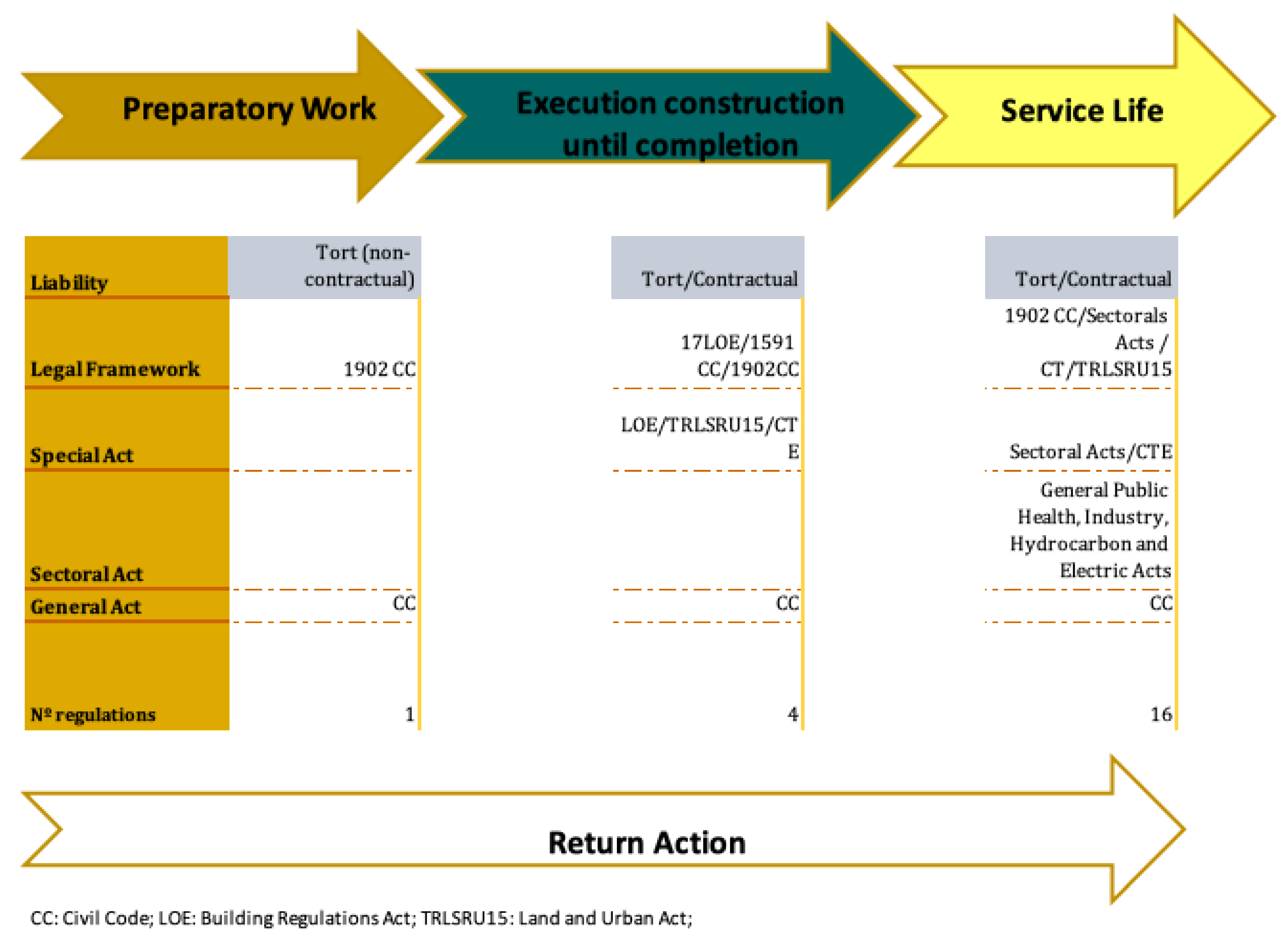

Table 1.
Liability scheme for the duty of constructive conservation.
| Damage | Type of Liability | General Legal Framework | Responsible Parties |
|---|---|---|---|
| Damage to third parties due to conservation duty | Subjective liability (without fault) | Articles 1902, 1907, and 1909 CC | Owner, user |
Source: own elaboration based on the doctoral thesis in preparation, entitled “Towards the Unity of Building Civil Liability in Spain.”.
Table 2.
Special regulation and sectoral law in relation to installation from connection to individual distribution.
Table 2.
Special regulation and sectoral law in relation to installation from connection to individual distribution.
| Installation | Special Regulation | Sectoral Law |
|---|---|---|
| Elevators | Royal Decree 355/2024, of April 2, approving Complementary Technical Instruction of Elevators 1 (ITC AEM 1) regulating the commissioning, modification, maintenance, and inspection of elevators, as well as enhancement safety (2024) [17]. | Law 21/1992, of July 16, on Industry (1992) [18]. |
| Low-voltage installation | Royal Decree 842/2002, of August 2, approving the Low Voltage Electrotechnical Regulation 2002, and the Technical Instruction of Low Voltage (ITC-BT 03) [19]. | Law 21/1992, of July 16, on Industry (1992) [18]. |
| Prevention and control of legionellosis and indoor air quality | Royal Decree 1054/2002, of October 11, approving the evaluation process for the registration, authorization, and commercialization of biocides (2002) [20]; Royal Decree 487/2022, of June 21, establishing sanitary requirements for the prevention and control of legionellosis (2022) [21]; Royal Decree 865/2003, of July 4, establishing hygienic–sanitary criteria for the prevention and control of legionellosis (2003) [22]. Regulation repealed, but its liability framework (up until 2023) is referred to in this article | Law 14/1986, of April 25, General Health Law (1986) [23]; Law 33/2011, of October 4, General Public Health Law (2011) [24]; Law 21/1992, of July 16, on Industry (1992) [18]. |
| Fire detection and extinction | Basic Document of Fire Safety (SI) in case of fire (2019) [25]; Royal Decree 314/2006, of March 17, approving the Technical Building Code (2006) [6]; Royal Decree 513/2017, of May 22, approving the Regulation on Fire Protection Installations (2017)—Tables I and II of Section 1, as well as Table III of Section 2, in annex II [26]. | Law 21/1992, of July 16, on Industry (1992) [18]. |
| Plumbing | Basic Document Health and Hygiene (2022) (HS), HS 4 and HS 5 [27]; Royal Decree 314/2006, of March 17, approving the Technical Building Code (2006) [6]; Royal Decree 1054/2002, of October 11, approving the evaluation process for the registration, authorization, and commercialization of biocides (2002) [20]; which is applicable to plumbing by virtue of Article 7.3 CTE HS 4. |
Law 14/1986, of April 25, General Health Law (1986) [23]; Law 33/2011, of October 4, General Public Health Law (2011) [24]; Law 21/1992, of July 16, on Industry (1992) [18]. |
| Sewerage system | Basic Document Health and Hygiene (2022)—documents HS-4 and HS-5 [27]; Royal Decree 314/2006, of March 17, approving the Technical Building Code (2006) ) [6]. | Law 21/1992, of July 16, on Industry (1992) [18]. |
| Air conditioning and ventilation | Royal decree 1027/2007, of July 20, approving the Regulation on Thermal Installations in Buildings (2007) [28]. | Law 21/1992, of July 16, on Industry (1992) [18]. |
| Gas thermal installations | Royal decree 1027/2007, of July 20, approving the Regulation on Thermal Installations in Buildings (2007) [28]. | Law 21/1992, of July 16, on Industry (1992) [18]. |
Source: own elaboration based on the doctoral thesis in preparation, entitled “Towards the Unity of Building Civil Liability in Spain.”.
Table 3.
Obligations of each responsible party.
| Installation | Owner, Holder, User | Maintenance Company |
|---|---|---|
| Elevators | Subscribe to a maintenance contract; prevent the operation of the installation when safety conditions are not met; communicate defects to the maintenance company; and request periodic inspections in sufficient time. Likewise, they will be responsible, according to the doctrine of culpa in vigilando, for the hiring and work of the “conservator” company. | Establishment of alternative measures to avoid setting up shelters or spaces that are free of buildings. The maintenance company has the duty to respond to the work entrusted to them for maintenance. |
| Low-voltage installation | Responsible for the adequate maintenance of installations, according to article 19 of “Low Voltage Regulation”, as well as breaking seals, according to article 20 of “Low Voltage Regulation” [19]. | Responds to their non-compliance; i.e., the frequencies of performing inspections or informing the installation holder. |
| Prevention and control of legionellosis and indoor air quality | Responsible for the installation.. | Among other things, they are responsible for the work performed. |
| Fire detection and extinction | The regulation differentiates between the property responsible for the installation—“the property responsible for maintenance operations”—and the maintenance responsible; these are figures that may be the same person. Thus, no express attribution of responsibility is established, so the property responsible could adopt the position of guarantor in the most favorable position or the installation holder in its broadest interpretation. | Obligations range from minimum maintenance activities to others such as performing corrective maintenance at the request of the installation holder; informing the installation holder that installations comply with the operation or current regulations; preserving performed maintenance; issuing certificates for periodic maintenance; notifying the review schedule; inspecting extinguishers. |
| Plumbing | Responsible for the installation. | Among other things, they are responsible for the work performed. |
| Sewerage system | Duty of diligence, Law 21/1992 on Industry [18]. | Responsible. |
| Air conditioning and ventilation | General responsibility is established, regarding both maintenance and the adequacy of use, from the moment that “provisional acceptance is performed”. Three obligations of the holder and user are listed, numerus clausus—adequate maintenance, performing inspections, and preserving the corresponding documentation. | Correct execution of maintenance. |
| Gas thermal installations | Responsible for the installation. | Correct execution of maintenance. |
Source: own elaboration based on the doctoral thesis in preparation, entitled “Towards the Unity of Building Civil Liability in Spain.”.
Table 4.
Liability scheme in relation to installations from connection to individual distribution.
| Damage | Type of Liability | General Legal Framework | Responsible Parties |
|---|---|---|---|
| Damage to third parties by real estate due to maintenance duty | Subjective liability with quasi-objective application (without fault) | Articles 1902, 1907, and 1909 CC | Owner, holder, user, maintenance company |
Source: own elaboration based on the doctoral thesis in preparation, entitled “Towards the Unity of Building Civil Liability in Spain.”.
Table 5.
Special regulation and sectoral law by territorial installation.
| Installation | Special Regulation | Sectoral Law |
|---|---|---|
| High- and medium-voltage electrical networks | Royal Decree 337/2014, of May 9, approving the Regulation on Technical Conditions and Safety Guarantees in High-Voltage Electrical Installations and its Complementary Technical Instructions 01 to 23( ITC-RAT) [29]. | Electric Sector Act (Law 24/2013, of December 23, on the Electric Sector) [30]. |
| Territorial distribution and storage of gas | Royal Decree 919/2006, of July 28, approving the technical regulation for the distribution and use of gaseous fuels and its complementary technical instructions 01 to 11(ICG ) [31]. | Hydrocarbon Sector Act (Law 34/1998, of October 7, on the Hydrocarbon Sector) [32]. Law 21/1992, of July 16, on Industry) [18]. |
Source: own elaboration based on the doctoral thesis in preparation, entitled “Towards the Unity of Building Civil Liability in Spain.”.
Table 6.
Liability scheme in territorial installations.
| Damage | Type of Liability | General Legal Framework | Responsible Parties |
|---|---|---|---|
| Damage to third parties by territorial installations due to maintenance duty | Objective liability (without fault) | Article 1902 CC | Installation holder |
Source: own elaboration based on the doctoral thesis in preparation, entitled “Towards the Unity of Building Civil Liability in Spain.”.
Table 7.
Liability or diligence scheme affecting the owner, holder, or user.
| Responsibility | Diligence | Matter |
|---|---|---|
| Owner/User | Constructive conservation | |
| Owner/User | Sewerage system | |
| Installation holder or | User/Owner | Elevators; low-voltage installations; prevention and control of legionellosis and indoor air quality; fire protection; air conditioning and ventilation; gas thermal installations; plumbing and hot water |
| Installation holder | User/Owner | High- and medium-voltage electrical networks; territorial distribution and storage of gas |
Source: own elaboration based on the doctoral thesis in preparation, entitled “Towards the Unity of Building Civil Liability in Spain.”.
Disclaimer/Publisher’s Note: The statements, opinions and data contained in all publications are solely those of the individual author(s) and contributor(s) and not of MDPI and/or the editor(s). MDPI and/or the editor(s) disclaim responsibility for any injury to people or property resulting from any ideas, methods, instructions or products referred to in the content. |
© 2025 by the authors. Licensee MDPI, Basel, Switzerland. This article is an open access article distributed under the terms and conditions of the Creative Commons Attribution (CC BY) license (http://creativecommons.org/licenses/by/4.0/).
Copyright: This open access article is published under a Creative Commons CC BY 4.0 license, which permit the free download, distribution, and reuse, provided that the author and preprint are cited in any reuse.


