

Submitted:
04 February 2026
Posted:
05 February 2026
You are already at the latest version
Abstract
Spectrum sensing is a fundamental capability for Beyond fifth generation (B5G) and emerging sixth generation (6G) systems, enabling autonomous and reliable communications in highly dynamic and mission-critical environments. Applications such as maritime communications, border protection, and civil protection operations require low-complexity and energy-efficient receivers capable of identifying available spectrum and mitigating strong interferers in real time. Conventional spectrum sensing approaches often rely on wideband analog-to-digital converters and heavy digital signal processing, resulting in significant power and hardware overheads. In this paper, a new spectrum sensing method for 5G signals based on a Walsh receiver architecture is proposed. Unlike conventional approaches, the proposed scheme projects the incoming signal onto orthogonal Walsh codes directly in the analog domain, enabling massively parallel sampling and reducing the need for high-speed analog-to-digital converters (ADCs) . This architecture inherently supports per-lane gain control, which strengthens robustness against strong narrowband interferers and channel fading. Performance evaluation, in the context of 5G NR FR1 spectrum sensing and communication with overlapping WLAN signals, indicates that perfect signal reconstruction and satisfactory EVM are achieved under challenging interference conditions. The results demonstrate that Walsh receivers provide an efficient and scalable foundation for spectrum sensing in 5G and beyond.
Keywords:
6G
; Walsh domain
; receiver design
; AI
1. Introduction
Spectrum sensing is a cornerstone technology for Beyond fifth generation (B5G) and emerging sixth generation (6G) systems, especially in dynamic and mission-critical environments where wireless infrastructure must operate autonomously, reliably, and under strict energy and latency constraints. In such contexts, nodes must be capable of identifying spectrum occupancy on-the-fly, adapting their waveform and frequency selection based on channel availability, interference conditions, and regulatory constraints (Kumar, et al., Analysis of hybrid spectrum sensing for 5G and 6G waveforms, 2022). This requirement becomes particularly critical in maritime communications, cross-border monitoring, and civil protection surveillance scenarios—where coverage from fixed infrastructure (e.g., base stations) is limited or absent, and where secure, direct device-to-device (D2D) links must be established over wide frequency bands (Bajracharya, Shrestha, Hassan, Jung, & Shin, 2023).
In these use cases, wideband spectrum sensing plays a pivotal role in enabling distributed nodes— whether they be vessels, unmanned aerial systems (UAS), or ground units—to detect interference, locate available channels, and avoid jamming or congestion (Bartsiokas, Avdikos, & Lyridis, 2025). However, traditional sensing approaches, such as high-rate ADC-based spectrum scanning or cyclostationary feature extraction, often impose substantial power, cost, and complexity burdens, rendering them unsuitable for low-SWaP (Size, Weight, and Power) terminals used in these domains (Zhang, Dai, Li, Liu, & Hanzo, 2018).
To address this challenge, the HERMES H2020 project proposes a novel receiver architecture, designed to perform wideband sensing through analog-domain signal projection using orthogonal Walsh codes and Artificial Intelligence (AI) as depicted in (Dehos, et al., 2022). This approach enables massively parallel sampling and energy-efficient analog processing before digital conversion, making it highly suited for embedded, battery-powered receivers in mobile, maritime, or border protection systems. The proposed architecture's capability to apply per-lane gain control and reconfiguration also allows robust detection even in the presence of strong narrowband interferers, such as legacy WLAN signals operating in overlapping spectrum regions.
This paper focuses on the evaluation of the aforementioned Walsh-based architecture in the context of spectrum sensing of 5G/B5G signals in the presence of strong interferers, a realistic scenario aligned with maritime and border surveillance needs. Using the HERMES H2020 Walsh-based receiver and a MATLAB-based simulation framework, extensive spectrum sensing evaluation is performed identifying the ability of the Walsh-based receivers to operate in such a domain and addressing, also, issues encountered during early-stage integration. The main contributions of this paper are as follows:
- The use of Walsh-based analog projection and massively parallel sampling as a low- complexity spectrum sensing mechanism suitable for B5G/6G systems is investigated.
- The ability of the B5G/6G Walsh receiver architecture in enabling wideband sensing, while maintaining resilience to narrowband interference through per-lane analog gain adaptation is demonstrated.
- The effectiveness of this approach is evaluated in a challenging scenario, where signals of interest are facing strong interference from powerful transceivers. The scenario is focused on 5G NR FR1 channels along with strong WLAN interferers, validating its applicability to infrastructure-less or contested environments, such as maritime/border surveillance ones.
- The projection of incoming signals into the Walsh domain is showcased, proving that the scheme can support future integration with lightweight AI-based detection schemes, offering a promising direction for intelligent sensing at the physical layer.
The remainder of this paper is structured as follows: Section 2 provides an overview of the current state-of-the-art in wideband spectrum sensing, with emphasis on emerging requirements for B5G/6G systems and limitations of conventional techniques. Section 3 introduces the core principles of the Walsh receiver architecture, focusing on its suitability for efficient spectrum sensing and, also, presents the sensing methodology employed and the scenario under investigation. Section 4 outlines the simulation setup and presents preliminary results obtained under Scenario 3 of the HERMES project. Finally, Section 5 concludes the paper and discusses future directions, including the integration of AI- based processing in the Walsh domain and on-chip implementation aspects.
2. Background and Related Work
Spectrum sensing has been a central research area since the emergence of cognitive radio. The simplest and most widely adopted technique is energy detection, which measures received signal power and compares it with a threshold. Its low computational cost makes it attractive, but its performance is severely degraded under noise uncertainty and low SNR (Pucci, Paolini, & Giorgetti, 2022). Figure 1 depicts a categorization of the most known spectrum sensing techniques (Arjoune & Kaabouch, 2019). Spectrum sensing methods are broadly divided into narrowband and wideband sensing. Narrowband sensing techniques are focused on monitoring a single frequency band. In contrast, wideband sensing covers a larger portion of the spectrum and is further divided into Nyquist-based wideband sensing and compressive wideband sensing, which consists of non-blind and blind compressive sensing approaches.
In the B5G/6G era, sensing requirements extended to wide bandwidths, low latency, and minimal SWaP, especially in mobile, maritime, or border surveillance domains. To handle wideband sensing, sub-Nyquist sampling techniques and compressed sensing (CS) have gained traction. Architectures like the Modulated Wideband Converter (MWC) substantially reduce ADC rate requirements by exploiting sparsity in the frequency domain—offering real-time sensing with limited hardware resources (Rao, Aswini, Sharma, & Sharma, 2024). A broad survey of sub-Nyquist and CS methods outlines both their opportunities and practical constraints, such as reconstruction complexity and sparsity assumptions (Ahmad, 2020). More recent studies advocate for compressive covariance sensing, recovering the signal's power spectrum (not the full waveform), which enables real-time, computationally lighter sensing (El-Alfi, Abdel-Atty, & Mohamed, 2019); (Mashhour, Hussein, & Mogahed, 2021). Further architecture-level innovations, such as multi-coset sampling paired with fast FFT-based estimation, help avoid sparse-specific limits while remaining efficient (Wu & Low, 2024), (Kumar, et al., Analysis of hybrid spectrum sensing for 5G and 6G waveforms, 2022).
Unlike conventional spectrum sensing methods that either sacrifice reliability for simplicity (e.g., energy detection) or suffer from prohibitive complexity, projection-based approaches strike a balance between efficiency, scalability, and robustness. By leveraging Walsh-domain analog projections, wideband signals can be decomposed in parallel before digitization, drastically reducing ADC requirements and improving resilience to narrowband interferers through per-lane gain control (Dehos, et al., 2022). This unique property not only lowers complexity but also ensures that spectrum sensing can be executed in real-time and under low-SWaP constraints, making the method particularly relevant for embedded receivers in mobile and infrastructure-less environments.
Building on this foundation, our vision is to enable intelligent spectrum awareness for B5G/6G systems in critical domains such as maritime communications, border monitoring, and civil protection. The Walsh-based receiver architecture serves as a hardware-efficient enabler for wideband spectrum sensing, where projections in the Walsh domain can be directly interfaced with lightweight classifiers for autonomous decision-making. This integration represents a departure from traditional sensing pipelines that require heavy digital preprocessing, opening the door to scalable, low-power, and adaptive sensing platforms capable of supporting the stringent requirements of next-generation mission- critical communications.
3. Walsh Receiver Architecture and Spectrum Sensing Methodology
The Walsh receiver architecture originates from the work presented in (Dehos, et al., 2025), where it was first introduced as an AI-enabled, massively parallelized wideband receiver for efficient aggregation and demodulation of multi-GHz signals. In its original formulation, the design targeted D- band channel aggregation by exploiting analog-domain projection onto orthogonal digital sequences, enabling energy-efficient pre-processing prior to digitization. In this work, this architecture is extended and adapted to the spectrum sensing domain, highlighting its ability to provide wideband occupancy detection in contested B5G/6G environments where conventional ADC-based approaches become infeasible.
3.1. Receiver Design
The wideband receiver, illustrated in Figure 2, is specifically designed to enable real-time spectrum sensing across a wide frequency range. The RF front-end performs down conversion of RF signals used in 5G/B5G systems. This front-end supports flexible configurations, including single IF input, quadrature (IQ) signals, or multiple antennas, allowing adaptation to different spectrum monitoring scenarios. Signals are amplified through a cascade of low-noise amplifiers with tunable gain and input impedance, ensuring high sensitivity and low noise figures suitable for weak signal detection.
After amplification, the analog signal is split into 32 parallel processing lanes. Each lane incorporates a high-speed digital mixer, windowed integrators, and ping-pong SAR ADCs (8-bit each, 156 MHz bandwidth per lane), which together project the incoming signal onto orthogonal digital sequences such as Walsh or Hadamard codes. This projection transforms the analog signals into digital coefficients in the Walsh domain, which can be processed for spectrum occupancy detection using AI algorithms or mapped back to the time domain for conventional baseband operations. The lane structure provides both scalability and redundancy, supporting continuous and high-resolution monitoring of wide frequency bands.
The receiver’s integrators and ADCs operate in a ping-pong manner, where dual 8-bit SAR converters alternate to provide uninterrupted digitization within the 156 MHz bandwidth per lane while performing code projection and integration. Integrator windows are programmable, allowing matched filtering for ultra-wideband (UWB) signals, creation of notch filters to suppress strong interferers, or dynamic range adjustment per lane to prevent ADC saturation. Similarly, the digital multipliers can be configured in various modes, including [+1/-1], [+1/0], or always-on, to optimize sensing performance for specific frequency bands or signal types. This fine-grained control over sequence projection and gain per lane is crucial for accurate spectrum sensing in dynamic and heterogeneous environments.
A single 5 GHz clock generates the reference signal that drives all circuit operations, including switching, integration, and ADC timing. It also drives the sequencer, which produces the Walsh sequences used to control the 32-bit shift registers encoded with the Walsh coefficients. This architecture enables parallel operation for power-efficient monitoring while maintaining high responsiveness to spectrum activity. Fabricated in GF 22FDX technology and packaged in QFN56 format, the compact receiver, with its core sensing cell shown in Figure 2, combines high bandwidth, low power consumption, and reconfigurability, providing a robust platform for adaptive and real-time spectrum sensing applications.
3.2. Spectrum Sensing Scenario
In the context of HERMES H2020 project the Walsh-based receiver architecture is evaluated in a plethora of scenarios. These briefly are the following: Scenario 1: Robot/Unmanned vehicles and access point device-to-device (D2D) communication at the uplink using 50 MHz channel in presence of one strong blocker close to the receiver, Scenario 2: Wideband signal sampling for Single Carrier 802.15.3c signals (2.16GHz channels), and Scenario 3: Wideband spectrum sensing in the sub-6GHz band.
In this work the spectrum-sensing scenario is of interest and shall assess the ability of the receiver to sense the wideband 0.5-5.5GHz in a Software Define Radio perspective. In this context four 5G FR1 signals need to be detected along with other channels and strong WLAN blockers as depicted in Figure 3. In this case, the goal is not to demodulate the useful signal but to be able to detect its presence in a given channel and eventually to “identify” its waveform. More specifically, the goal is to use the Walsh-based receiver, as a spectrum sensing device in the 5G FR1 range below 6 GHz. The channels -depicted in Figure 3- follow the 5G FR1 standard where OFDM modulation is used with a typical channel Bandwidth (BWcℎ ) around 50 MHz. In the targeted band, a total of 100 channels are available and both the transmitter and receiver know a priori the position of the channels to be used (denoted as Kcℎ = 4). The whole setup operated in a high interference environment, where all the other users are seen as interferers with the following characteristics:
- Transmitting power levels up to +26dB above the channels of interest.
The selection of the 5G FR1 signals at 700 MHz, 3.5 GHz, 3.6 GHz, and 5.1 GHz reflects both the diversity and practical importance of bands allocated for 5G/B5G services worldwide. The 700 MHz channel represents low-band 5G and is used to test the low-frequency response of the receiver circuits. The 3.5 and 3.6 GHz channels belong to the mid-band spectrum, which is critical for 5G deployments; their close frequency spacing provides a stringent test of the receiver’s ability to separate and correctly sense signals that are adjacent in frequency. The 5.1 GHz channel pushes the upper end of the receiver’s operational bandwidth, lying close to a strong interferer at 5.0 GHz. This not only evaluates the Walsh- based projection’s robustness in identifying useful signals from interferers but also stresses the analog front-end circuitry, since at higher frequencies both the LNA and integrator typically experience reduced gain. Meanwhile, strong interferers placed at 2.5 GHz and 5.0 GHz reflect realistic co-existence conditions with LTE/WiMAX and Wi-Fi, ensuring the architecture is validated against practical deployment challenges. Altogether, this signal and interferer configuration tests the receiver across its full operating range, from low to high frequency, under both spectral crowding and power imbalance conditions.
4. Experimental Setup and Preliminary Results
The evaluation of the Walsh receiver for spectrum sensing was carried out in the context of the scenario depicted in Section 3, where the architecture was adapted from its original D-band implementation (Dehos, et al., 2022) to operate in the sub-6 GHz 5G NR FR1 band. The central goal was to assess whether the Walsh-domain projection approach, initially designed for aggregation and demodulation, could also provide robust wideband occupancy detection in an environment characterized by strong narrowband interferers.
A MATLAB-based simulation environment was developed to emulate the operation of the 32-lane Walsh receiver. The framework models the entire processing chain, including (Dehos, et al., 2025):
- Spectrum reconstruction in the Walsh domain, providing per-channel occupancy indicators.
- Filtering in the Walsh domain, with programmable gain. It should be mentioned that during this preliminary evaluation round, perfect channel and interferer’s position knowledge is assumed. During our forthcoming evaluation phases, an initial spectrum sensing round assuming equal lane gains, will be performed to compute the gain coefficient and, then, apply them to perform the actual spectrum sensing.
- A/D conversion of Walsh-domain outputs.
- Spectrum reconstruction from digitized Walsh projections, providing per-channel occupancy indicators.
- Digital demodulation of reconstructed signals.
The reconstructed power spectral density (PSD) of wideband signals, after Walsh-domain projection, filtering, and digital reconstruction, is presented in Figure 5. Distinct peaks are observed at approximately 0.7 GHz, 3.5 GHz, 3.6 GHz and 5 GHz, corresponding to the locations of active channels. The remaining spectrum remains suppressed, with the noise floor below –100 dB/Hz, confirming accurate channel occupancy detection and effective suppression of spurious components.
The constellation results, depicted in Figure 6, in the presence of strong interferers confirm the robustness of the Walsh-based receiver across the selected 5G FR1 bands. At 700 MHz (CH1) and 3.5 GHz (CH2), the receiver achieves excellent performance with EVM values of 1.33% and 1.02%, demonstrating clean low- and mid-band operation. It should be noted that, in these evaluation activities, the receiver is assumed ideal, and the performance degradation originate from the overlapping interferers. At 3.6 GHz (CH3), the EVM rises to 6.07%, reflecting the challenge of discriminating between two closely spaced adjacent channels (3.5 and 3.6 GHz), which stresses the selectivity of the architecture. Finally, at 5.1 GHz (CH4), located near a strong WLAN interferer at 5.0 GHz and within the region of reduced analog gain, the receiver still maintains a low EVM of 2.08%, highlighting the effectiveness of the Walsh projections and programmable integrators in mitigating interference and gain roll-off. Overall, these results confirm that the receiver provides reliable spectrum sensing across its full operating range, with only moderate degradation even under strong interference.
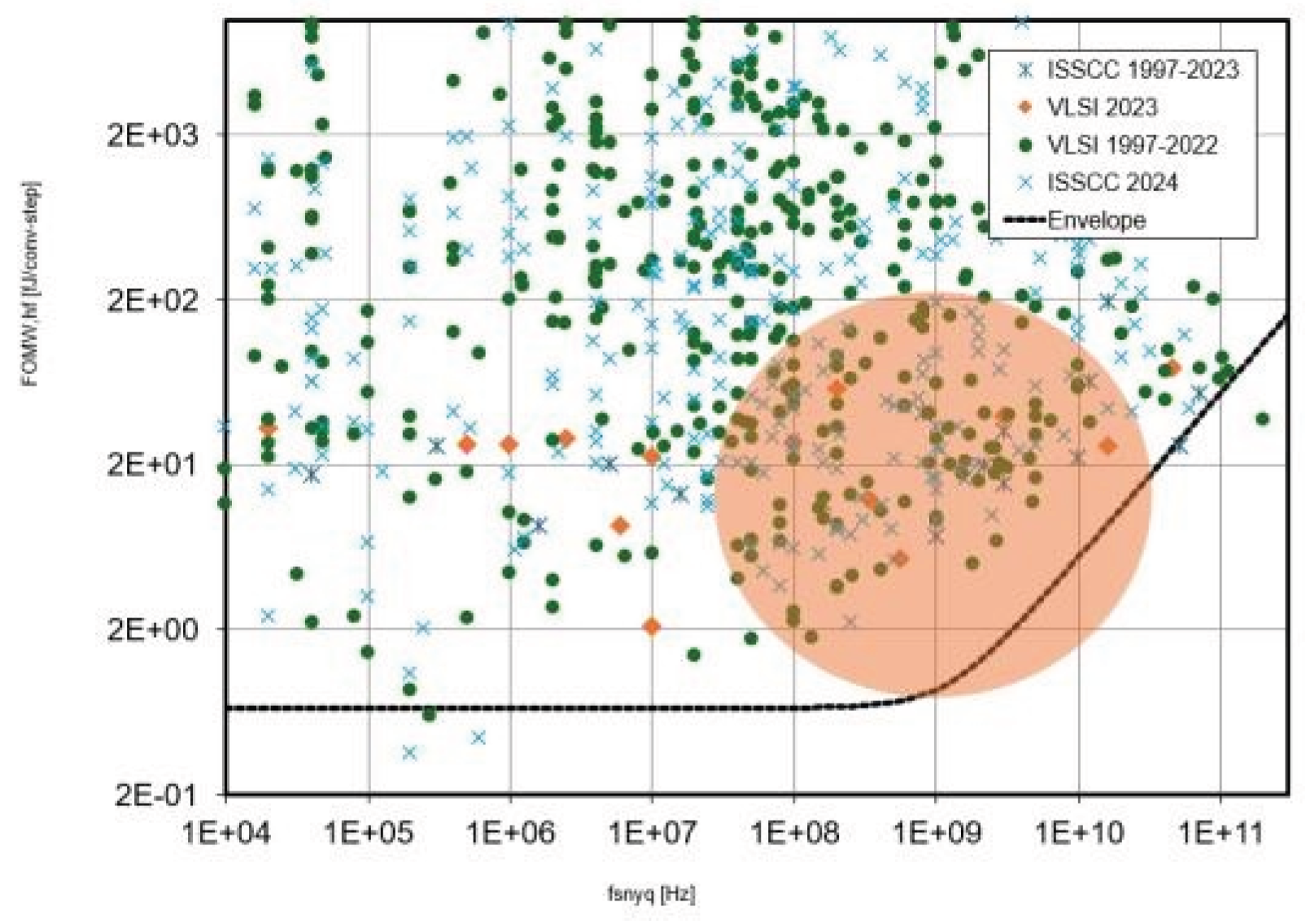
As far as comparison with baseline methods, it is challenging to provide a direct one with the state-of- the-art approaches, since the proposed receiver is the first reported B5G/6G topology based on Walsh sequences. This limitation, however, is not unique to our work, as different ADC architectures inherently differ in topology making one-to-one benchmarking problematic. To position our approach relative to existing converters, we adopt the widely used Walden Figure of Merit (Murmann, 2025), defined as:
For reference, an equivalent Nyquist ADC sampling at 10 GS/s would be required to digitize the same bandwidth at 2× Nyquist rate. As highlighted in Murmann’s ADC Performance Survey (Murmann, 2025), the Walsh receiver achieves comparable bandwidth coverage while operating at a much smaller effective sampling rate, suggesting a substantial advantage in power consumption. The architecture can also be conceptually linked to carrier aggregation techniques, as the massively parallel sampling structure divides the frequency range into multiple sub-channels which are subsequently recombined. In this respect, two converters digitizing half the bandwidth each with channel bonding techniques generally consume less power than a single converter covering the full bandwidth. Additionally, the effective number of bits (ENOB) at multi-GS/s typically drops to ~5–7 bits, which shrinks the SNR/EVM margin and, in practice, constrains support for higher-order constellations The performance of the ADC will be further improved when adaptive gain per lane is implemented.
Figure 7.
Walden’s Figure of Merit with expected Walsh receiver value (Murmann, 2025).
5. Conclusions
In this paper the potential of Walsh-based receivers for spectrum sensing in B5G systems is investigated. Building on prior work from in (Dehos, et al., 2022) and (Dehos, et al., 2025) on massively parallel analog-domain projection, the architecture was adapted and evaluated for wideband occupancy detection in the 5G NR FR1 sub-6 GHz band. By exploiting Walsh-domain projections and per-lane gain control, the receiver provides a low-complexity and energy-efficient solution to the long-standing trade-off between sensing reliability and hardware complexity. The preliminary evaluation within Scenario 3 of the HERMES project demonstrated that the Walsh receiver can accurately identify active 5G channels even in the presence of strong WLAN interferers, validating its resilience to narrowband jamming and its suitability for contested and infrastructure-less environments. These results confirm that projection-based approaches can offer a scalable and power-efficient alternative to conventional Nyquist-sampling receivers, particularly in mission-critical domains such as maritime communications, border surveillance, and civil protection.
Looking forward, the integration of lightweight AI-based classifiers with Walsh-domain outputs and the hardware prototyping of the architecture in GF 22FDX technology represent promising directions for extending this work. Such advances will further strengthen the case for Walsh receivers as an enabling technology for intelligent, adaptive, and low-SWaP spectrum sensing in B5G/6G systems.
Acknowledgement
This work is supported by the European Union’s Horizon 2020 Hermes project under grant agreement N° 964246.
References
- Ahmad, B. I. A survey of wideband spectrum sensing algorithms for cognitive radio networks and sub-Nyquist approaches. arXiv 2020. [Google Scholar] [CrossRef]
- Arjoune, Y.; Kaabouch, N. A Comprehensive Survey on Spectrum Sensing in Cognitive Radio Networks: Recent Advances, New Challenges, and Future Research Directions. Sensors 19(1) 2019, 126. [Google Scholar] [CrossRef] [PubMed]
- Bajracharya, R.; Shrestha, R.; Hassan, S. A.; Jung, H.; Shin, H. 5G and beyond private military communication: Trend, requirements, challenges and enablers. IEEE Access 11 2023, 83996–84012. [Google Scholar] [CrossRef]
- Bartsiokas, I. A.; Avdikos, G. K.; Lyridis, D. V. Deep learning-based beam selection in RIS- aided maritime next-generation networks with application in autonomous vessel mooring. Journal of Marine Science and Engineering 13(4) 2025, 754. [Google Scholar] [CrossRef]
- doi. [CrossRef]
- Dehos, C., Gulfo, J. L., Lachartre, D., Belot, D., Courouve, P., & Pelissier, M. (2022). D-band channel aggregation receiver architecture based on if analog processing using digital wavelet. 29th IEEE International Conference on Electronics, Circuits and Systems (ICECS) (pp. 1-4). Glasgow, United Kingdom: IEEE. [CrossRef]
- Dehos, C., Masson, G., Zarudniev, M., Ouvry, L., Courouve, P., & Chaix, F. (2025). AI-Enabled Massively Parallelized Wideband Receiver Circuit based on Analog Processing using Orthogonal Digital Sequences. submitted in IEEE 26th Topical Meeting on Silicon Monolithic Integrated Circuits in RF Systems (SiRF). Los Angeles, CA, USA: IEEE.
- El-Alfi, N. A.; Abdel-Atty, H. M.; Mohamed, M. A. Sub-Nyquist cyclostationary detection of GFDM for wideband spectrum sensing. IEEE Access 7 2019, 86403–86411. [Google Scholar] [CrossRef]
- Kumar, A.; Venkatesh, J.; Gaur, N.; Alsharif, M. H.; Jahid, A.; Raju, K. Analysis of hybrid spectrum sensing for 5G and 6G waveforms. Electronics 12(1) 2022, 138. [Google Scholar] [CrossRef]
- Kumar, A.; Venkatesh, J.; Gaur, N.; Alsharif, M. H.; Uthansakul, P.; Uthansakul, M. Cyclostationary and energy detection spectrum sensing beyond 5G waveforms. Electronic Research Archive 2023, 34. [Google Scholar] [CrossRef]
- Mashhour, M.; Hussein, A. I.; Mogahed, H. S. Sub-Nyquist wideband spectrum sensing based on analog to information converter for cognitive radio. Procedia Computer Science 182 2021, 132–139. [Google Scholar] [CrossRef]
- Murmann, B. ADC Performance Survey 1997-2025. 2025. Available online: https://github.com/bmurmann/ADC-survey.
- Pucci, L.; Paolini, E.; Giorgetti, A. System-level analysis of joint sensing and communication based on 5G new radio. IEEE Journal on Selected Areas in Communications 40(7) 2022, 2043–2055. [Google Scholar] [CrossRef]
- Rao, T. S.; Aswini, T. N.; Sharma, P. K.; Sharma, D. Sub-Nyquist wideband spectrum sensing for multicarrier wireless applications. Microwave and Optical Technology Letters 66 (9) 2024, e34307. [Google Scholar] [CrossRef]
- Wu, C.; Low, M. Fft-based simultaneous calculations of very long signal multi-resolution spectra for ultra-wideband digital radio frequency receiver and other digital sensor applications. Sensors 24(4) 2024, 1207. [Google Scholar] [CrossRef] [PubMed]
- Zhang, J.; Dai, L.; Li, X.; Liu, Y.; Hanzo, L. On low-resolution ADCs in practical 5G millimeter-wave massive MIMO systems. IEEE Communications Magazine 56(7) 2018, 205–211. [Google Scholar] [CrossRef]
Figure 1.
Spectrum sensing techniques.
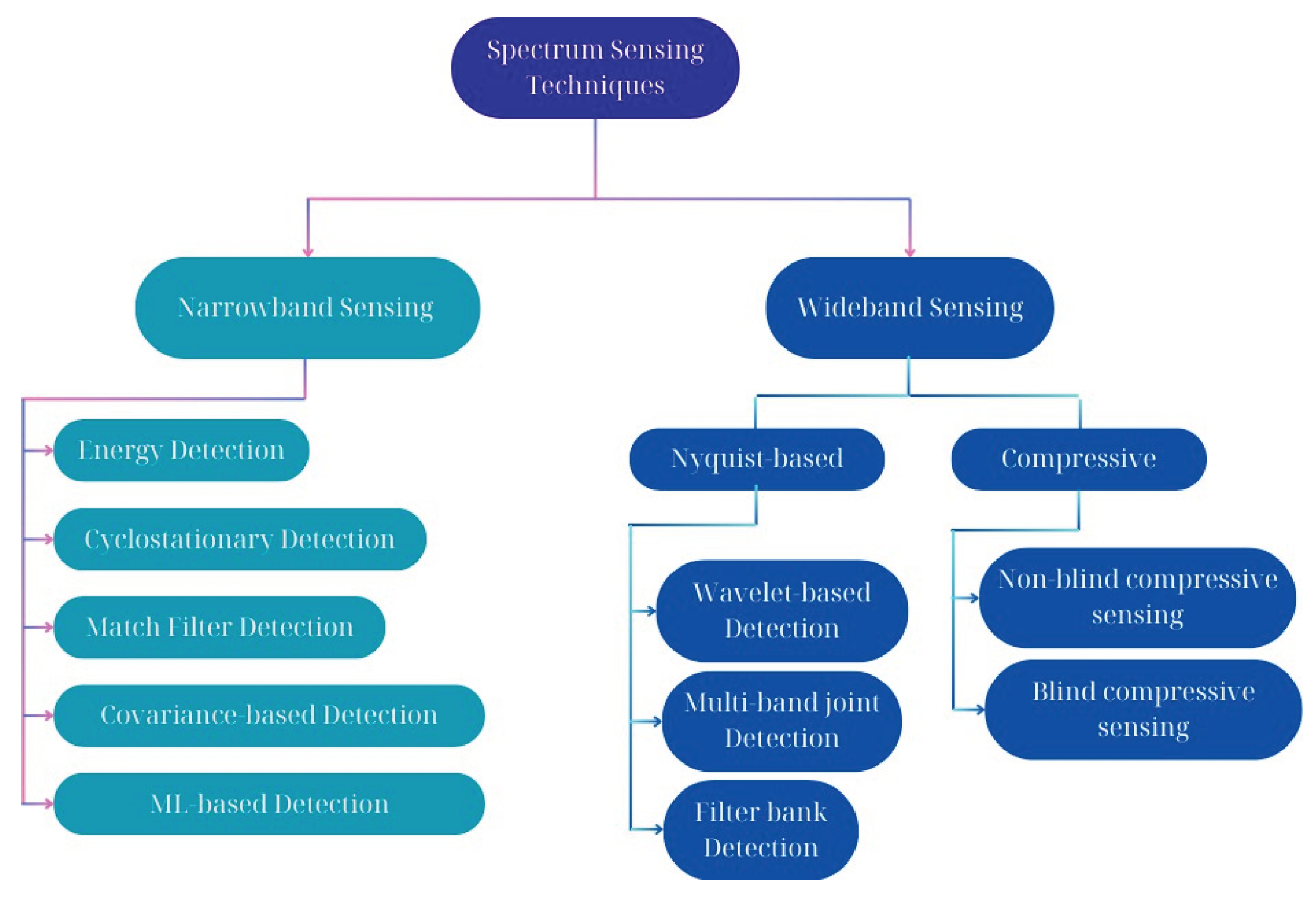
Figure 2.
Receiver Architecture.
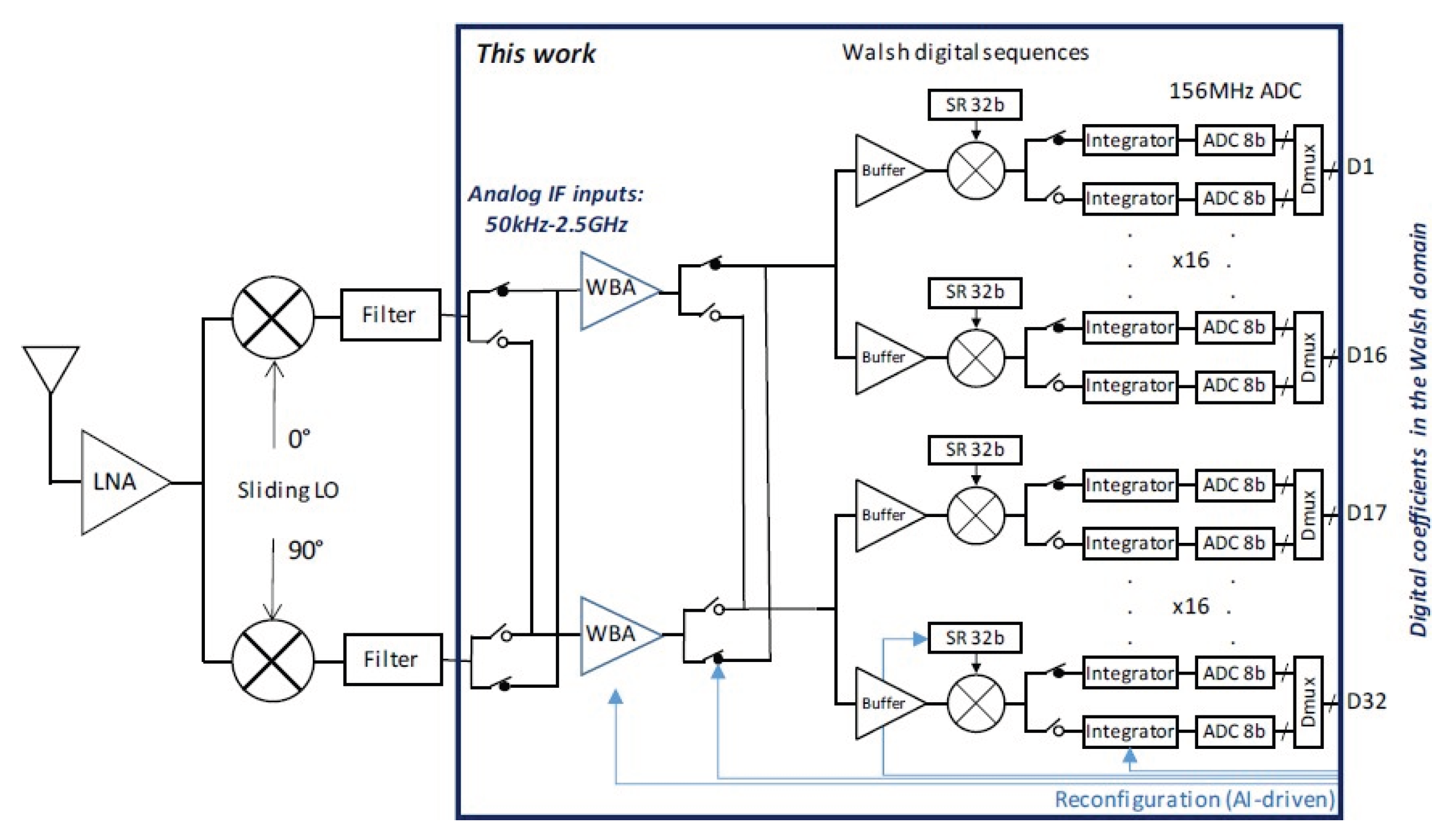
Figure 3.
Sensing scenario waveforms.
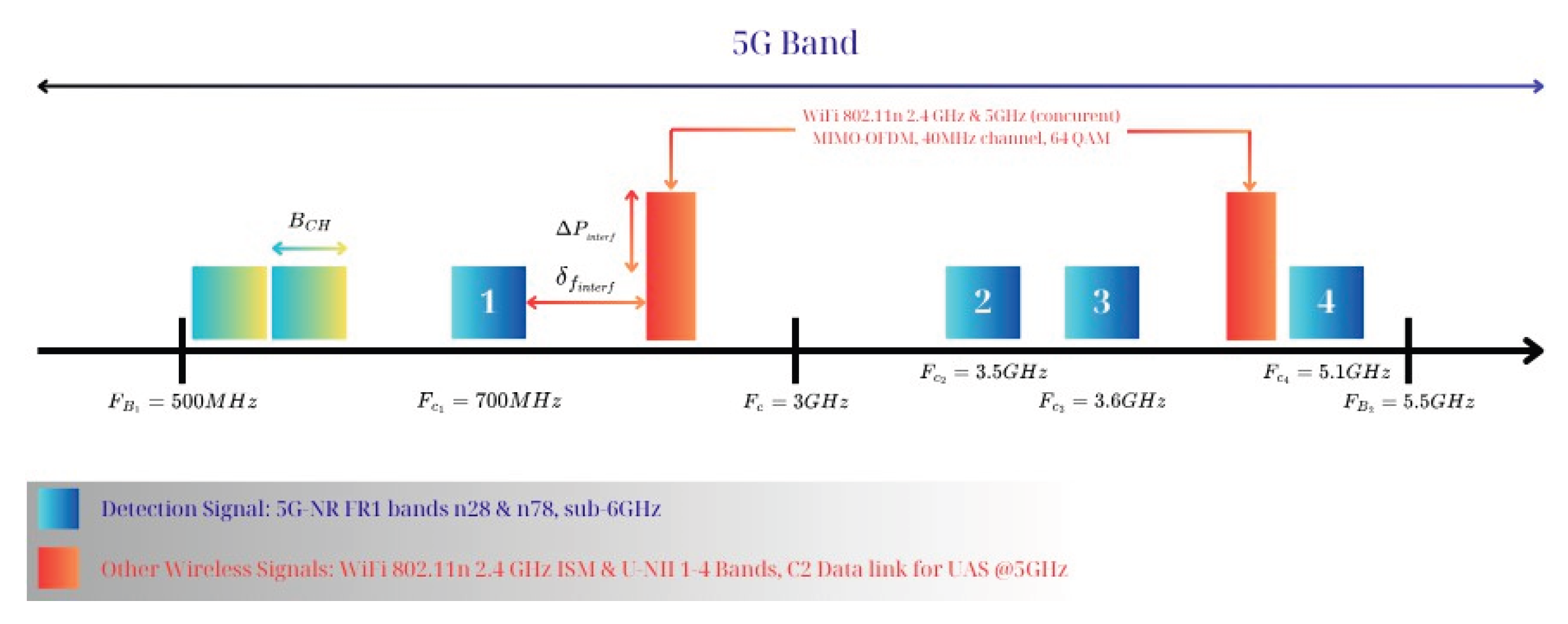
Figure 5.
PSD of reconstructed signals.
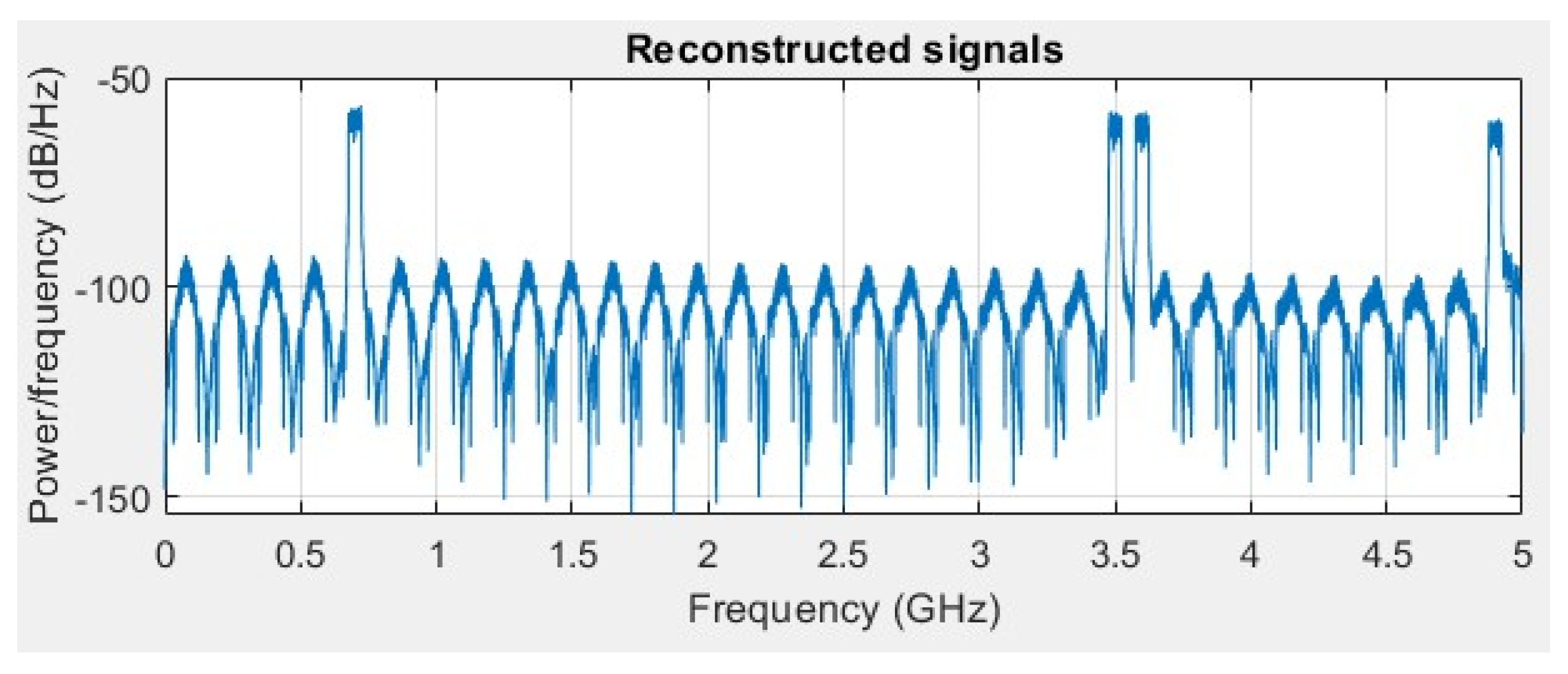
Figure 6.
Constellation and EVM of the receiving channels.
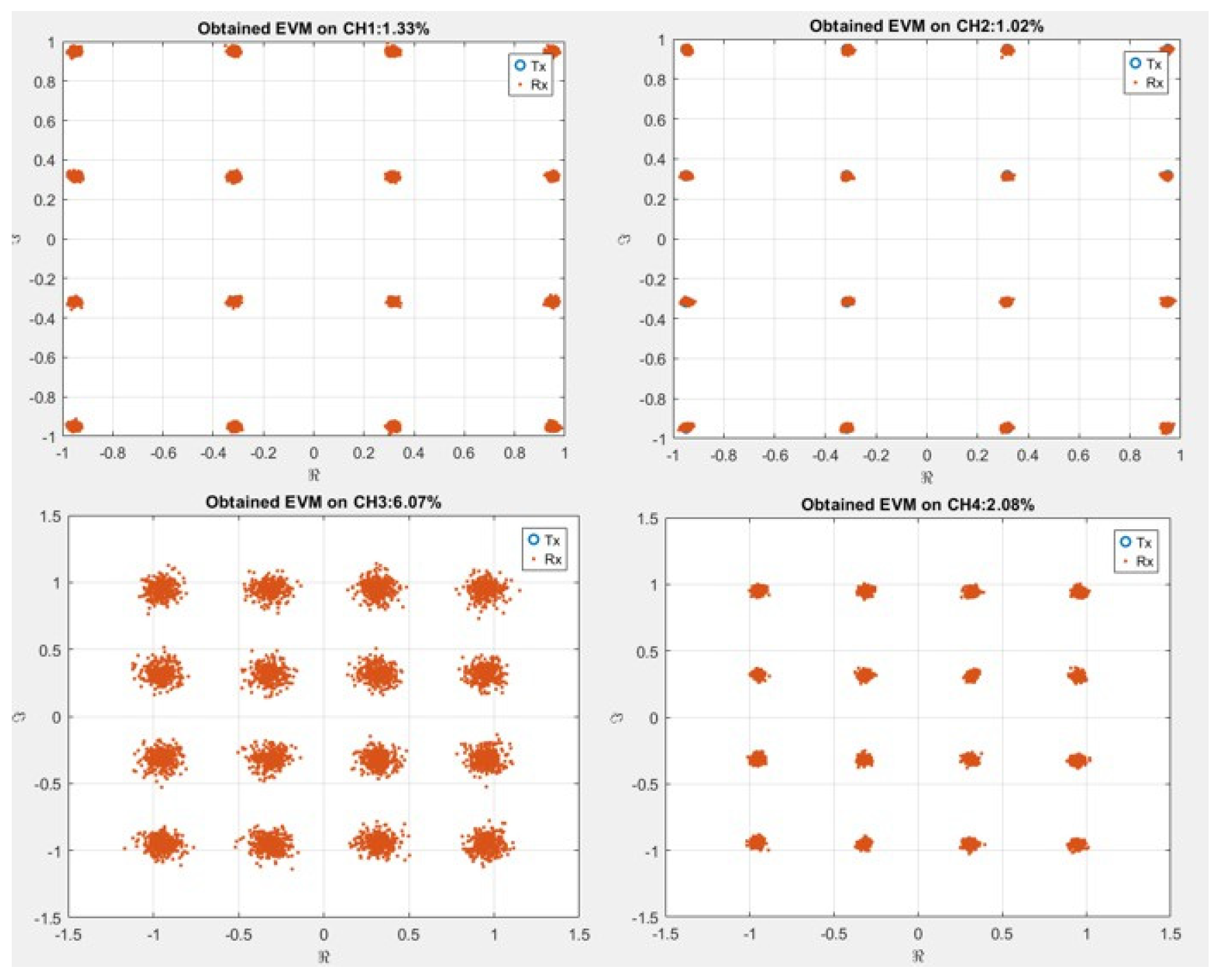

Table 1.
Sensing scenario parameters.
| Parameter | Typical Value |
| Modulation | OFDM |
| Mapping | BPSK/16QAM/64QAM/256QAM |
| Channel Bandwidth (BWCH ) | 50 MHz |
| Used Bandwidth (BWused ) | 47,52 MHz |
| Sampling rate | 156 MHz |
| RF Frame duration | 10 ms |
| Slot duration | 25 μs |
| Symbol duration | 20,83 μs |
Disclaimer/Publisher’s Note: The statements, opinions and data contained in all publications are solely those of the individual author(s) and contributor(s) and not of MDPI and/or the editor(s). MDPI and/or the editor(s) disclaim responsibility for any injury to people or property resulting from any ideas, methods, instructions or products referred to in the content. |
© 2026 by the authors. Licensee MDPI, Basel, Switzerland. This article is an open access article distributed under the terms and conditions of the Creative Commons Attribution (CC BY) license (http://creativecommons.org/licenses/by/4.0/).
Copyright: This open access article is published under a Creative Commons CC BY 4.0 license, which permit the free download, distribution, and reuse, provided that the author and preprint are cited in any reuse.


