

Submitted:
12 February 2026
Posted:
13 February 2026
You are already at the latest version
Abstract
The transition to hydrogen-fueled gas turbines is vital for decarbonising power systems, especially in space- and weight-constrained applications such as offshore FLNG and FPSO. While hydrogen offers zero-carbon emissions at the point of use, its use in gas turbines faces technical challenges due to high flame speed, flammability limits, low energy density, and high flame temperature. These increase the risks of flashback and NOₓ formation, especially when retrofitting existing combustors. Developing hydrogen-ready combustors for both pure hydrogen and blends is an ongoing research area. This study investigates a can-type, annular gas turbine combustor for use with pure hydrogen and blends. Using CFD simulations in ANSYS Fluent, it analyses flow, flame, temperature, and stability across hydrogen ratios from 0% to 100%. The model employs RANS equations, a realizable k–ε turbulence model, non-premixed combustion, and species transport; thermal radiation is modelled with the P-1 method, and NOₓ with the Zeldovich mechanism. Results show hydrogen increases flame reactivity, shortens flame length, and enhances recirculation zones, maintaining stability at ~50% hydrogen. Higher fractions increase flame temperature and velocity, increasing the risk of flashback. Pure hydrogen produces compact, high-temperature flames that require advanced designs for stability. Model predictions match experimental and published data from NASA, Siemens SGT-800, GE LM6000, and Kawasaki, confirming credibility. This CFD assessment offers insights into hydrogen combustor design, supporting the move towards hydrogen-ready turbines and low-carbon offshore power generation.
Keywords:
1. Introduction
2. Materials and Methods
2.1. Hydrogen Marine Fuel Production
2.2. Hydrogen Gas Turbine Validation for FLNG
3. Theory/ Equations
3.1. NOx Formation Mechanism and Relative NOx Index
3.2. Flashback Index and Surge Risk
3.3. Boundary Condition
3.4. Exergy Analysis
3.5. Computational Fluid Dynamics
3.6. Plasma Combustion
- compensates for short residence times in scaled computational domains,
- stabilised the hydrogen flame kernel under ultra-lean conditions,
- enables consistent comparison across hydrogen blending fractions.
3.6.1. Constant Plasma Source Term
3.7. Combustion Reaction Approaches for Two Stage Combustor
4. Hydrogen Gas Turbine Combustion
4.1. Combustion Cycle for Hydrogen Gas Turbine
4.2. Combustion Cycle for Hydrogen Gas Turbine
5. Predicting Flame Stability with Ansys
5.1. Fueling System to Gas Turbine Combustor
5.2. Ansys Simulation Model
5.3. Role of Plasma-Assisted Energy Input
5.4. Pure Hydrogen Combustor Flame Simulation
5.4.1. Non-Premixed Combustion Chamber
5.4.2. Pure Hydrogen Premixed Combustion Chamber, Initial Research
5.4.3. Pure Hydrogen Premixed with Second Stage Combustor
5.5. Blended Hydrogen with Methane-Air Flame
5.5.1. Blended Hydrogen for Premixed Combustion Chamber
5.5.2. Blended Hydrogen for the Premixed Second Stage Chamber
- ✓ Thermal conditioning – raising the gas temperature to levels favourable for hydrogen ignition without external heating.
- ✓ Oxygen buffering – providing a controlled reservoir of oxidiser for secondary hydrogen combustion.
- ✓ Stability anchoring – isolating the stabilisation of the primary flame from the highly reactive hydrogen fuel.
- ✓ Dilution effects from CO₂, H₂O, and N₂ reduce local flame speed and suppress flashback propensity.
- ✓ Elevated background temperature lowers ignition delay, enabling reliable hydrogen combustion at ultra-lean conditions.
- ✓ Residual oxygen control ensures that hydrogen reacts primarily with excess oxygen from the first stage rather than competing directly with methane.

| Stream | Injection zone | No. of inlets | Diameter (mm) | Temperature (°C) | Pressure (bar) | Mass flow (kg/s) | Velocity (m/s) | Notes |
|---|---|---|---|---|---|---|---|---|
| Air | Premixed zone | 3 | 12.5 | 15 | 21.72 | 80.21 | 68.5 | The high-enthalpy air inlet serves as the numerical boundary, |
| Methane (CH₄) | Premixed zone | 2 | 12.5 | 75 | 39 | 3.404 | 58.8 | Velocity prescribed for shear-driven premixing; mass flow derived |
| Hydrogen (H₂) | Second stage zone | 2 | 25 | 75 | 39 | 0.7739 | 7.08 | Staged hydrogen injection for flame-zone enrichment |
5.6. Hybrid Combustor Design Approach for Micro Mixer
5.7. Validation with OEM Burner for Ansys CFD Simulation
5.7.1. Flame Study for OEM’s Principle
5.7.2. Combustion Principle of OEM’s Gas Turbine
| Description | Siemens Energy – SGT-800 (DLE) | GE Vernova – LM6000 (DLN) | Kawasaki Heavy Industries – L30A (Micromix) |
|---|---|---|---|
| Turbine class | ~50 MW industrial | ~50 MW-class aeroderivative | ~30–40 MW industrial |
| Combustion method | Lean / partially premixed DLE | Lean premixed, staged DLN | Distributed micromix (micro-jets) |
| Hydrogen range assessed | 30–70% (100% separate) | 30–70% (within DLN envelope) | 30–70% (within micromix regime) |
| Load control basis | Constant power, constant TIT | Constant power, constant TIT |
Constant power, constant TIT |
| Lean margin (λ) | constant | constant | lean |
| NOₓ control | Lean premix, low peak T | Lean premix with staging | Short flames, spatial dilution |
| Flashback | Lean margin | Lean margin, staging | Geometric micromix control |
5.7.3. OEM-Interpolate Check
|
Gas turbine lab combustor model Parameter |
Interpolated “DLN-class” band |
proposed design |
| Stage-1 air bulk velocity | 30–80 m/s | 60 m/s |
| Stage-1 CH₄ jet velocity | 30–100 m/s | ~50 m/s |
| Transfer to stage 2 velocity. | ||
| Stage-2 H₂ jet velocity | 80–200 m/s | 150 m/s |
| Transfer to combustor velocity | 50–120 m/s | 80 m/s |
| Mach number | <0.3 preferred | 0.09–0.13 |
| Premix residence time (0.25–0.45 m / 60–150 m/s) |
~2–10 ms | ~3–8 ms |
5.8. Studies on NOx Emission in Hydrogen Gas Turbine
| H₂ fraction (%) | AFRₛₜ (mass) | λ | T₃ Air (°C) | T₄ Hot Gas (°C) | p₃ (bar) | p₄ (bar) | Fuel flow (kg/s) | Air flow (kg/s) | Relative NOx index |
|---|---|---|---|---|---|---|---|---|---|
| 0 | 11.21 | 3.38 | 547.5 | 1204.8 | 21.82 | 19.82 | 3.11 | 117.87 | 1.000 |
| 30 | 10.2 | 5.8 | 548 | 1050 | 21.82 | 19.82 | 2.75 | 145 | 0.62 |
| 50 | 9.2 | 9.6 | 549 | 920 | 21.82 | 19.82 | 2.30 | 170 | 0.32 |
| 70 | 8.2 | 16.5 | 549 | 780 | 21.82 | 19.82 | 1.75 | 200 | 0.13 |
| 100 | 7.24 | 28.44 | 550.0 | 616.7 | 21.82 | 19.82 | 1.08 | 222.27 | 0.026 |
5.8.1. NOx Validation with OEMs’ Published Data
5.8.2. NOx Monitoring in Pure Hydrogen Gas Turbine
5.8.3. NOx Monitoring in Blended Hydrogen Gas Turbine
5.9. Outlet Temperature Monitoring in Simulation
5.9. Conclusions and Future Research
5.9.1. Blending Hydrogen Case
5.9.2. Pure Hydrogen 100% Case
5.9.3. Future Hybrid Design Approach for Micro Mixer
5.9.4. Future NOx Reduction Methodology
Author Contributions
Funding
Data Availability Statement
Acknowledgments
Conflicts of Interest
Appendix A
Appendix A.1 Calculation for Premixed-Stage Combustor
| Parameter | Air | Methane | Hydrogen |
|---|---|---|---|
| Temperature | 15 °C (288 K) | 75 °C (348 K) | 75 °C (348 K) |
| Pressure | 27.2 bar | 39 bar | 39 bar |
| Density (ideal gas) | 32.9 kg/m³ | 21.6 kg/m³ | 2.72 kg/m³ |
| Stream | No. of inlets | Diameter (mm) | Total Area (m²) | Mass flow (kg/s) | Velocity (m/s) | Notes |
|---|---|---|---|---|---|---|
| Air | 2 | 12.5 | 2.45×10⁻⁴ | 119.2 | 14 760 (68.5) | Lumped cup sector-scaled, research surrogate velocity is high, and since the rectangular 2D box simulation, velocity is reduced. |
| Methane (CH₄) | 1 | 12.5 | 1.23×10⁻⁴ | 0.156 | 58.8 | Given the derived velocity and mass, the velocity is within a typical premixer range. |
| Stream | No. of inlets | Diameter (mm) | Total Area (m²) | Mass flow (kg/s) | Velocity (m/s) | Notes |
|---|---|---|---|---|---|---|
| Hydrogen (H₂) | 2 | 25 | 9.82×10⁻⁴ | 1.19 | 446 | High-speed premixed H₂ injection, velocity reflects hydrogen’s low density. |
References
- Suntan, “Liquid Hydrogen as A Propulsion Fuel,” 1950-1957. [Online]. Available: https://www.globalsecurity.org/intell/library/reports/other/ch8-9.htm.
- T. report, “The Future of Hydrogen,” June 2019. [Online]. Available: https://www.iea.org/reports/the-future-of-hydrogen.
- We Lin Chan, Ivan CK Tam, Arun Dev, “Clean Energy Hypothesis for Future Marine and Offshore,” in 10th PAAMES/AMEC 2023, Kyoto, Japan, 2023.
- L. McGuire, “Everything you need to know about FLNG,” June 6 2020. [Online]. Available: https://www.nesfircroft.com/resources/blog/everything-you-need-to-know-about-flng/. [Accessed 6 June 2020].
- B. FINANCE, “World’s First Gas Turbine-Powered LNG Carrier Gets Approval in Principle,” 7 July 2015. [Online]. Available: https://www.offshore-energy.biz/worlds-first-gas-turbine-powered-lng-carrier-gets-approval-in-principle/.
- Nurettin Tekin, Mitsugu Ashikaga, Atsushi Horikawa, Harald Funke, “Enhancement of fuel flexibility of industrial gas turbines by development of innovative hydrogen combustion systems,” Gaa for Energy Report Issue 2, Kawasaki Heavy Industries, 2018.
- Control, Marine Engine , “Marine Turbine Engines - How Does a Steam Turbine Work on Ships?,” 14 11 2009. [Online]. Available: https://www.brighthubengineering.com/marine-engines-machinery/55877-steam-turbines-for-marine-propulsion/.
- We Lin Chan, Ivan Ck Tam, Arun Dev, “Theoretical Analysis and Modelling of LNG reforming to Hydrogen Marine Fuel for FLNG Applications,” MDPI Gases Journal, no. 2025, 2025. [CrossRef]
- We Lin Chan, Ivan CK Tam, Arun Dev, “OTC-34732-MS Research Analysis of Reforming Hydrogen Fuel for FLNG Application,” in Offshore Technology Conference Asia 2024, Kuala Lumpur, Malaysia, 27 February -1 March 2024.
- GE, “GE Aeroderivative Gas Turbines LM6000,” [Online]. Available: https://www.gevernova.com/content/dam/gepower-new/global/en_US/downloads/gas-new-site/products/gas-turbines/lm6000-fact-sheet-product-specifications.pdf. [Accessed 11 2022].
- We Lin Chan, Arun Dev, “Evaluation of Hydrogen-Powered Gas Turbines for Offshore FLNG Applications,” MDPI, Vols. Gases, Vol 5, no 4, p. 29, 2025. [CrossRef]
- P. P. Meherwan P.Boyce, Gas Turbine Engineering Handbook, Linacre House, Jordan Hill, Oxford OX2 8DP, UK: GulfProfessional Publishing, 2006.
- Mats Blomstedt, Anders Larsson, “SGT-700 DLE Combustion System Extending The Fuel Flexibility,” in Symposium of The Industrial Application of Gas Turbines Committee, Banff, Alberta, Canada, 2015.
- Y. Zel’dovich, “The Oxidation of Nitrogen in Combustion Explosions,” in Acta Physicochimica, U.S.S.R., 1946, p. 21: 577–628.
- N. E. White Paper, “A literature review of hydrogen and natural gas turbines,” 12 August 2022. [Online].
- H. Council, “Hydrogen Council, Hydrogen decarbonisation pathways; A life-cycle assessment,,” January 2021. [Online]. Available: https://hydrogencouncil.com/wp-content/uploads/2021/04/Hydrogen-Council-Report_Decarbonization-Pathways_Part-1-Lifecycle-Assessment.pdf.
- C. K. L, Combustion Physics, New York: Cambridge University Press, 2006.
- M. A. El-Masri, “On thermodynamics of gas turbine cycles,” 1986.
- D. Toure, “Assess the performance of a hydrogen-powered gas turbine,” [Online]. Available: https://blogs.sw.siemens.com/simcenter/assess-the-performance-of-a-hydrogen-powered-gas-turbine/. [Accessed 19 July 2022].
- H. Pitsch, “Hydrogen: A seemingly simple fuel,” in Application in Energy and Combustion Science, Germany, 2020.
- R. Joel, Basic Engineering Thermodynamics, India: Pearson Education, (1996).
- Tomczak, H.-J., Benelli, G., Carrai, L., & Cecchini, D., Investigation of a gas turbine combustion system fired with mixtures of natural gas and hydrogen., 2002.
- T. P. Talk, “Gas Turbine Combustion Made Simple: DLE,” 08 2025. [Online]. Available: https://thepipingtalk.com/gas-turbine-combustion-made-simple-dle-dry-low-emissions-vs-wle-wet-low-emissions-vs-non-dle-explained/.
- Dae Hoon Lee 1, Kwan-Tae Kim, Hee Seok Kang, Young-Hoon Song, Jae Eon Park, “Plasma-assisted combustion technology for NOx reduction in industrial burners,” 2017. [Online]. Available: https://pubmed.ncbi.nlm.nih.gov/24032692/#:~:text=Abstract,main%20mechanisms%20of%20NOx%20reduction. [Accessed 2025].
- M. Leduc, “The emerging prime mover,” March 2001. [Online]. Available: http://www.dieselduck.info/machine/01%20prime%20movers/gas_turbine/gas_turbine.htm.
- C. o. t. Desert, “Hydrogen Properties,” December 2001. [Online]. Available: https://www1.eere.energy.gov/hydrogenandfuelcells/tech_validation/pdfs/fcm01r0.pdf.
- A. Lefebvre and D. Ballal,, Gas Turbine Combustion, 3rd ed.,, CRC Press, 2010.
- National Energy Technology Laboratory (NETL), “Comparison of Commercial, State-of-the-Art, Fossil-Based Hydrogen Production Technologies.,” 12 August 2022. [Online]. Available: https://netl.doe.gov/projects/files/ComparisonofCommercialStateofArtFossilBasedHydrogenProductionTechnologies_041222.pdf.
- P. S. H. Frankel, “Aeroacoustics of swirl combustors using large eddy simulations (LES),” [Online]. Available: https://engineering.purdue.edu/CFDLAB/projects/combustor.html.
- P. John E. Matsson, An Introduction to Ansys Fluent, SDCpublications, 2024.
- Professor Kyutae Kim, Dr. Kiyoung Jung, “How Simulation Addresses Hydrogen Fuel Challenges,” Ansys part of synopsys, 21 June 2024. [Online]. Available: https://www.ansys.com/blog/how-simulation-addresses-hydrogen-fuel-challenges.
- D. J.-w. Kim, “Overview of FECM Hydrogen,” Fossil Energy and Carbon Management, US, 2023.
- Tech, HYSYS®2004.2; Operations Guide, @aspentech, 2004.
- N. E. a. I. T. D. O. (NEDO), “World’s First Successful Technology Verification of 100% Hydrogen-fueled Gas,” Kawasaki Heavy Industries, Ltd. Obayashi Corporation, 2020.
- R.W. Schefer, T. D. Smith, C. J. Marek , “Evaluation of NASA Lean Premixed Hydrogen Burner,” Sandia National Laboratories , California 94550, 2003.
- E. Global, “Gas Turbine Product SGT-800,” Energy & Turbomachinery Network, 2024. [Online]. Available: https://etn.global/gas-turbine-products/sgt-800/.
- Kawasaki, “Hydrogen gas turbine offers promise of clean electricity by nature research custom media,” [Online]. Available: https://www.nature.com/articles/d42473-022-00211-0. [Accessed 2024].
- R. Sharafoddini, M. Habibi,M. Pirmohammadi, “Numerical Study of Water Vapor Injection in the Combustion Chamber to Reduce Gas Turbine Fuel Consumption,” Journal of Applied Fluid Mechanics, vol. Vol.13, pp. pp.1047-1054, 2020. [CrossRef]
- S. R. Turns, An Introduction to Combustion: Convepts and Applications, UK: McGraw-Hill Education, 2011.
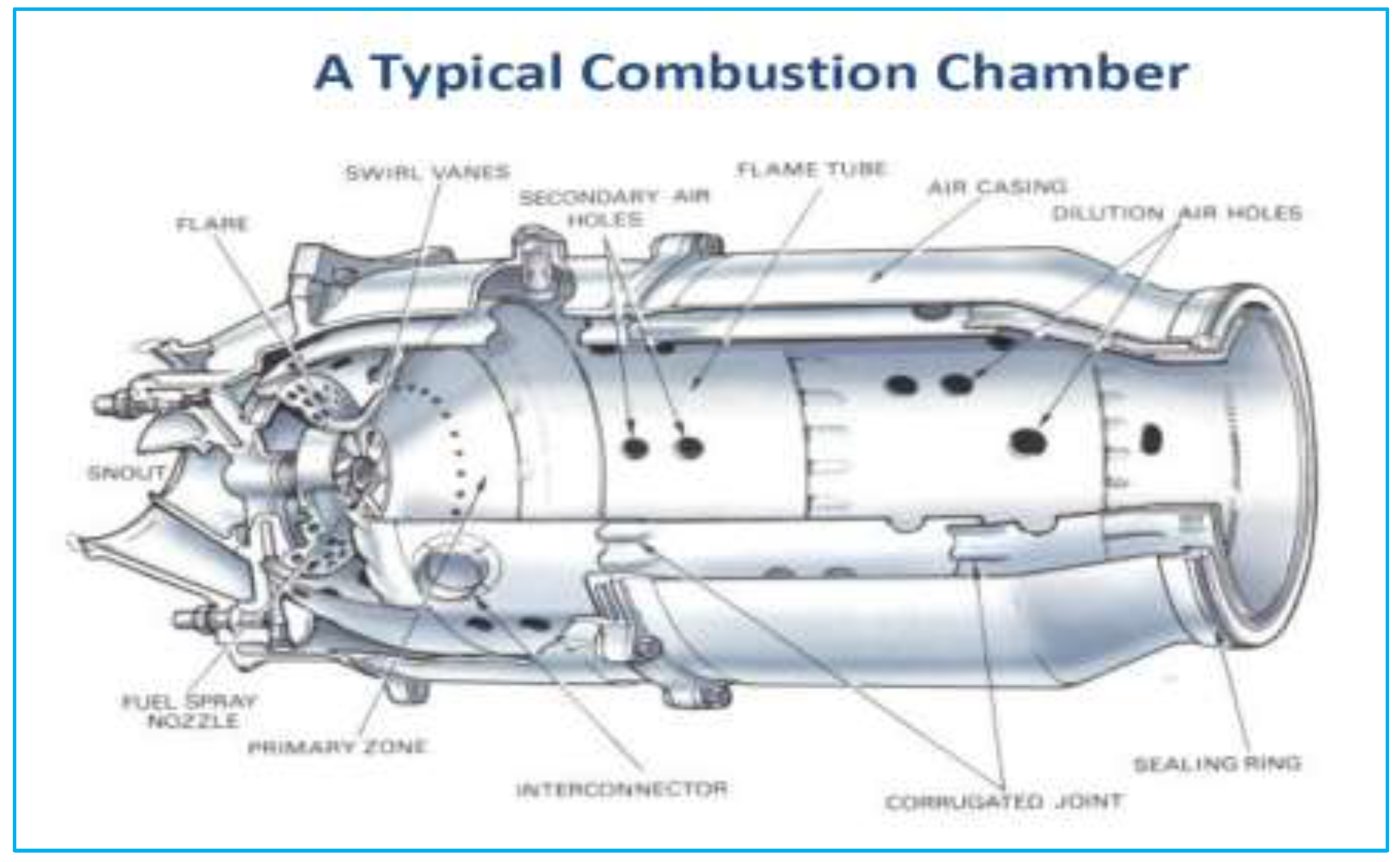
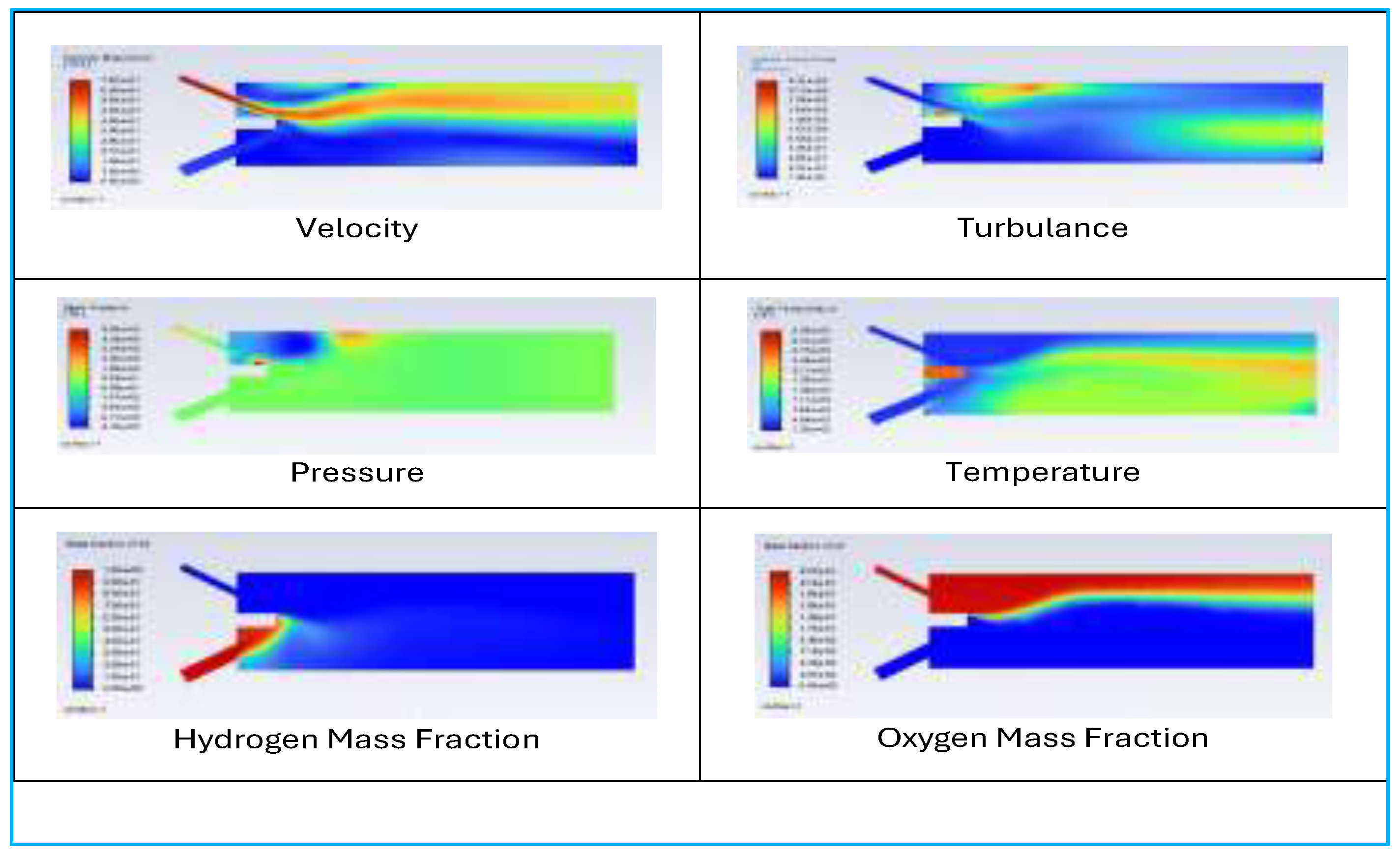
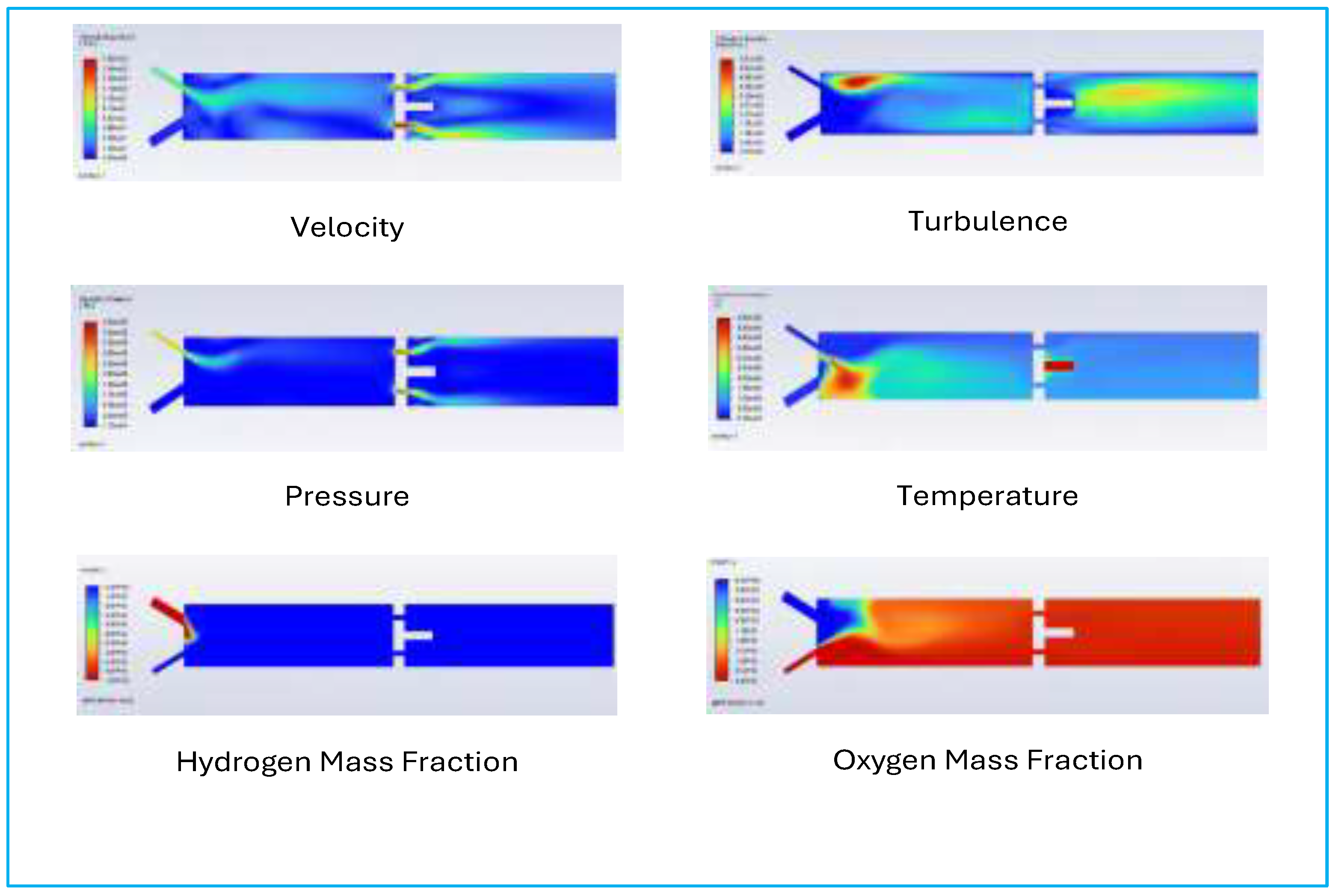
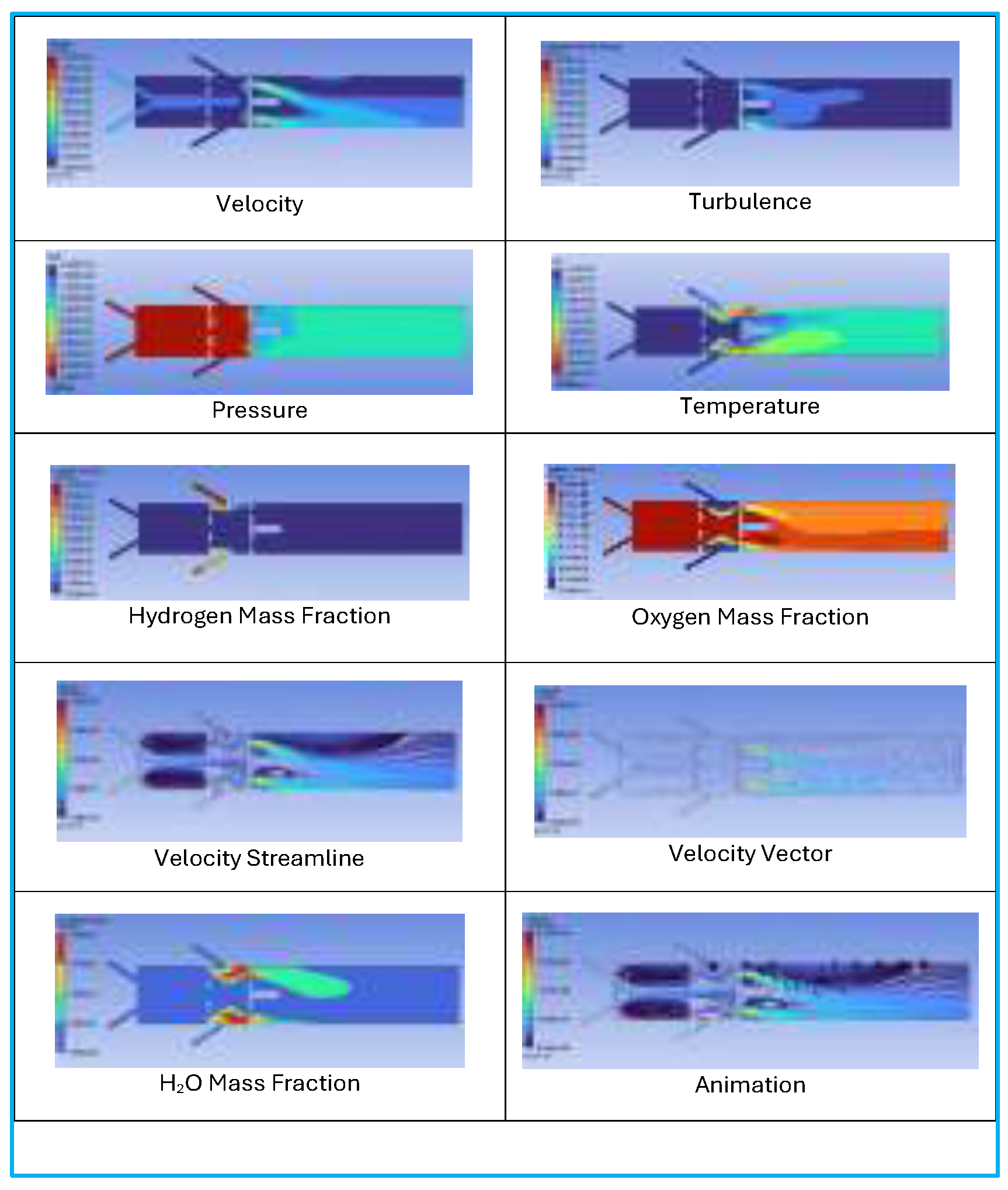
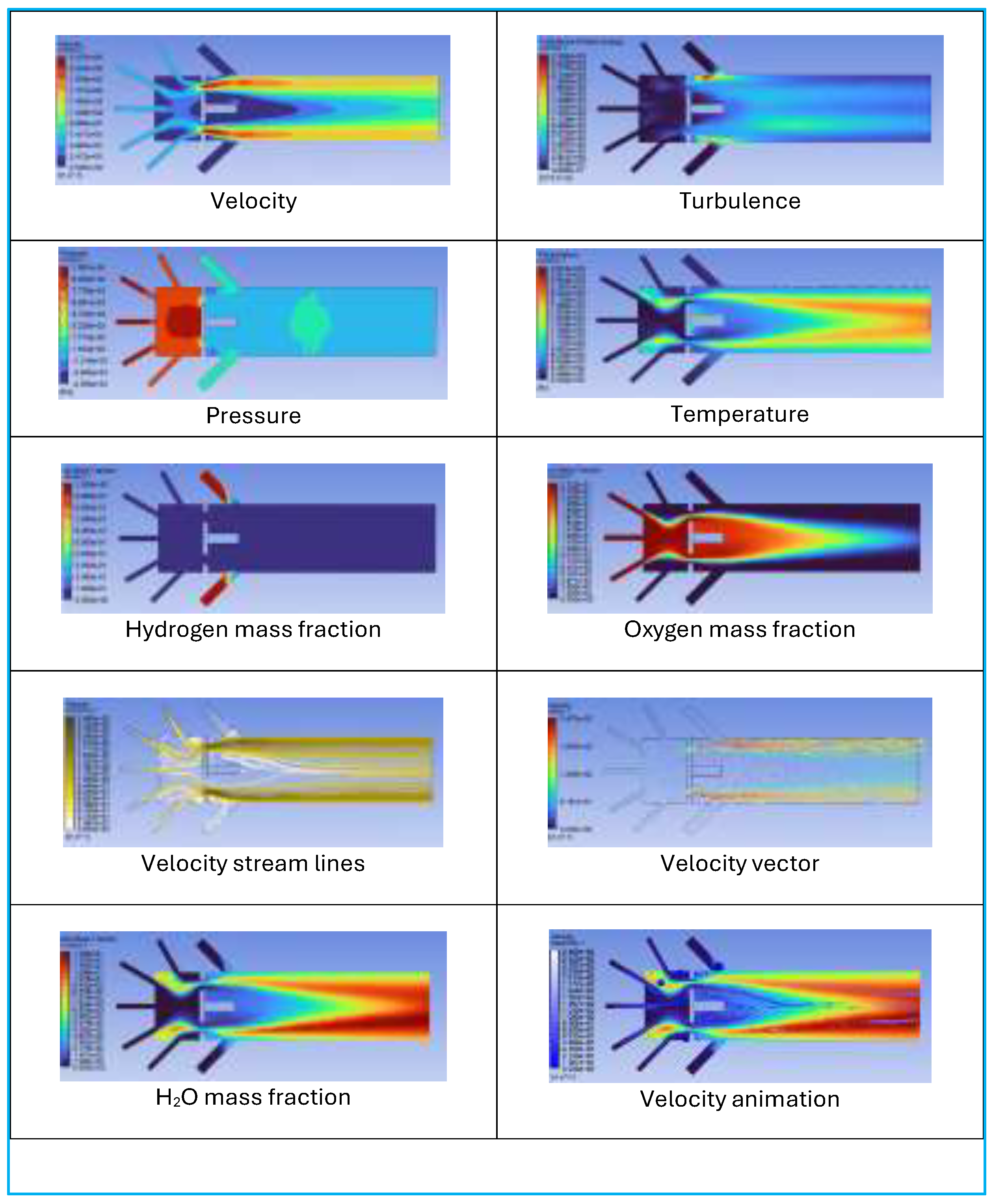
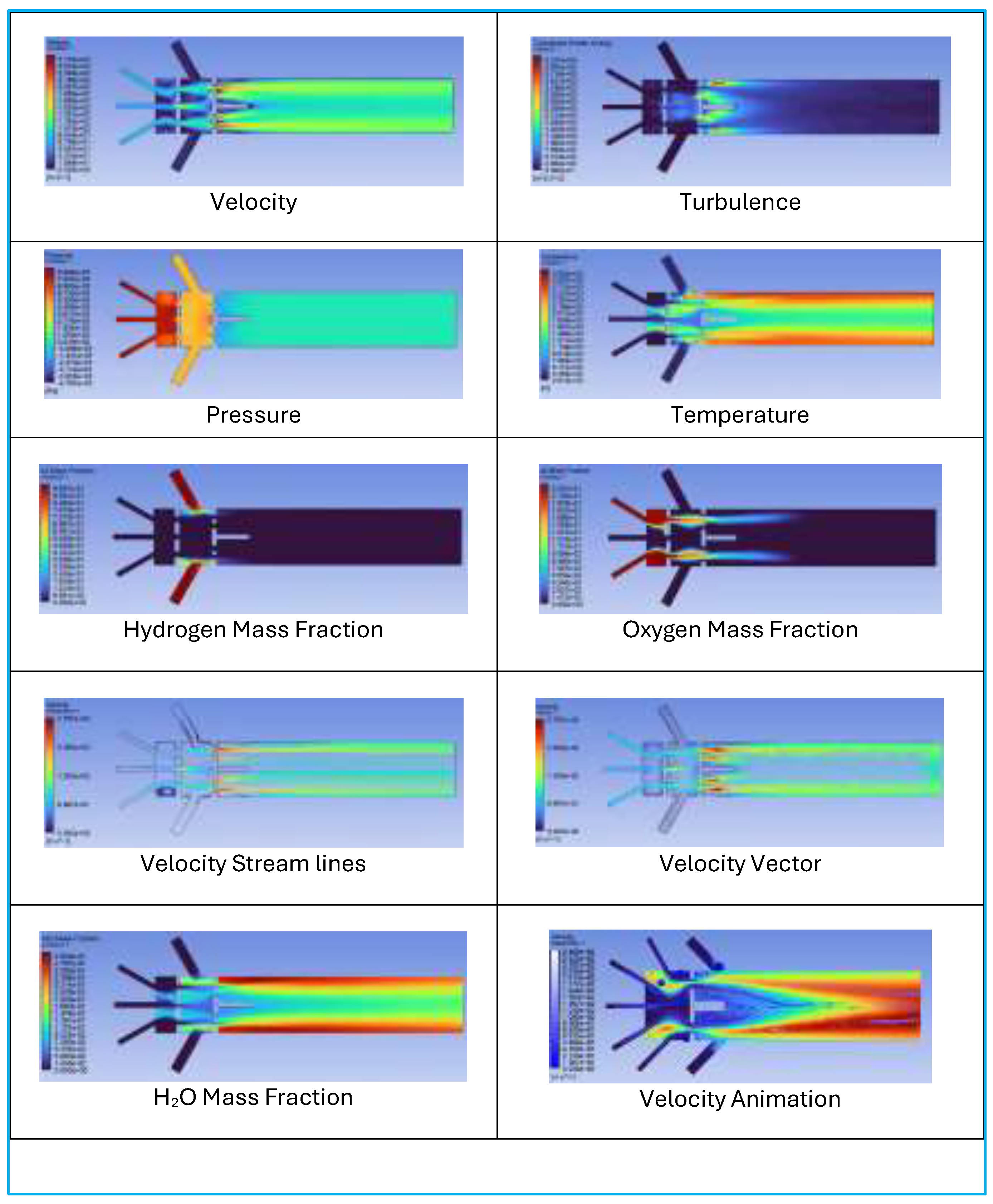
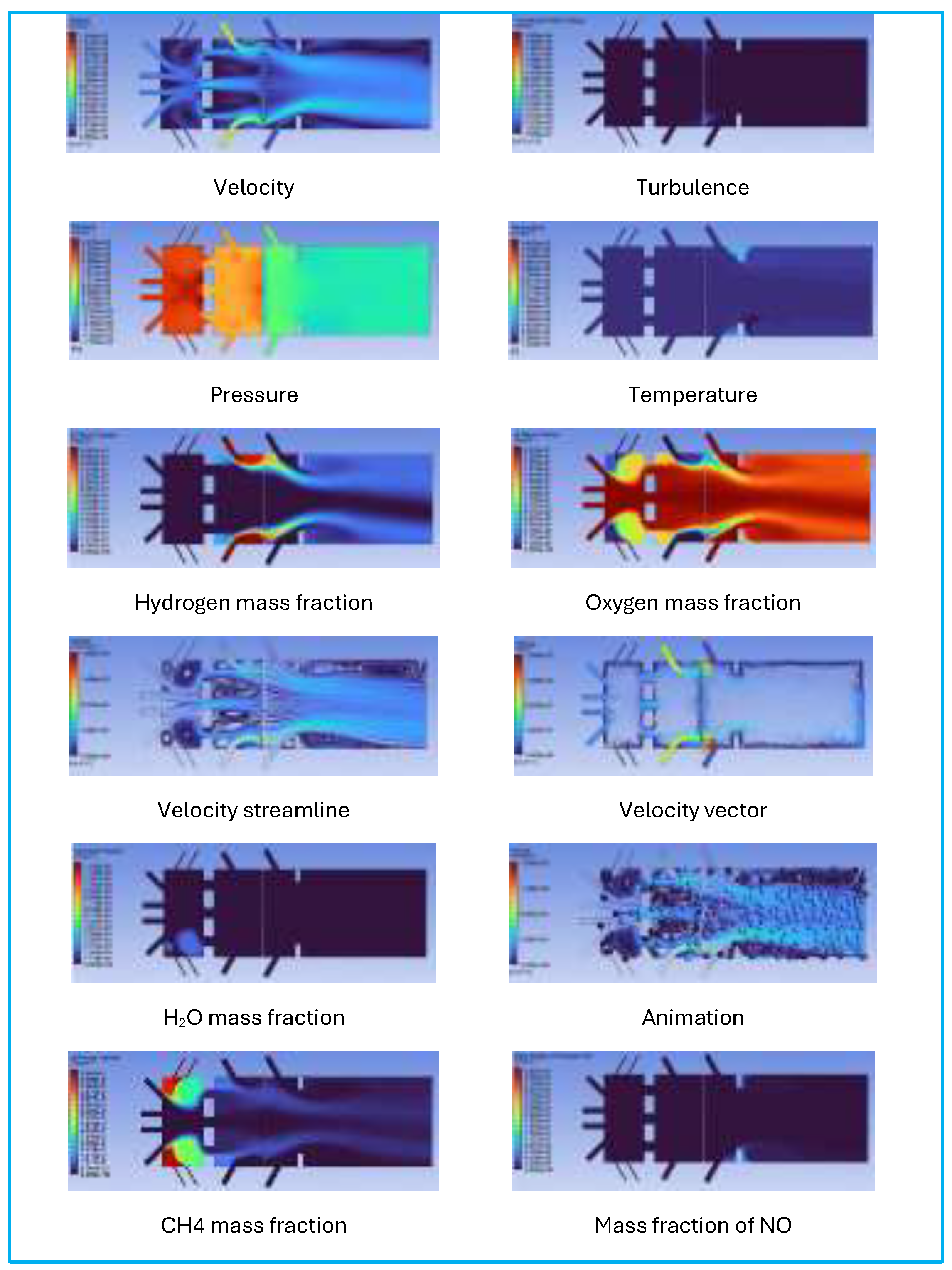
| Stream | Velocity (m/s) | Mass flow (kg/s) | Molar flow (kmol/h) | Nozzle diameter |
|---|---|---|---|---|
| Air | 65.8 | 0.410 | 51.0 | Ø 12.5 mm |
| Hydrogen | 7.08 | 0.00946 | 17.0 | Ø25 mm |
| Stream | Injection zone | No. of inlets | Diameter (mm) | Temperature (°C) | Pressure (bar) | Mass flow (kg/s) | Velocity (m/s) | Remark |
|---|---|---|---|---|---|---|---|---|
| Air | Premixed zone | 3 | 12 | 1028 | 21.72 | 80.21 | 68.5 | The high-enthalpy air inlet serves as the numerical boundary, |
| Methane (CH₄) | Premixed zone | 2 | 12.5 | 75 | 39 | 3.404 | 58.8 | Velocity prescribed for shear-driven premixing; mass flow derived |
| Hydrogen (H₂) | Combustion zone | 2 | 25 | 75 | 39 | 0.7739 | 7.08 | Staged hydrogen injection for flame-zone enrichment |
| Location | Count | Dia (mm) | Mass per inlet (kg/s) | Velocity (m/s) | Function |
|---|---|---|---|---|---|
| Stage-1 inlet air | 4 | 50 | 2.005 | 135 | Primary air supply for premixing |
| Stage-1 inlet methane | 4 | 12.5 | 0.085 | 18.7 | Lean premixed CH₄ pilot fuel. |
| Stage-1to2 transfer ports | 3 | 100 | 2.787 | 47 | Flow redistribution & pressure recovery |
| Stage-2 inlet hydrogen | 2 | 50 | 0.0387 | 6.4 | Secondary H₂ injection (staged) |
| Micro-mix to the combustor | 10 | 12.5 | 0.844* | 910 | Distributed micro-mix H₂ jets |
| Plasma | 2 | 50 × 120 | — | — | Ignition/flame anchoring assist. |
Disclaimer/Publisher’s Note: The statements, opinions and data contained in all publications are solely those of the individual author(s) and contributor(s) and not of MDPI and/or the editor(s). MDPI and/or the editor(s) disclaim responsibility for any injury to people or property resulting from any ideas, methods, instructions or products referred to in the content. |
© 2026 by the authors. Licensee MDPI, Basel, Switzerland. This article is an open access article distributed under the terms and conditions of the Creative Commons Attribution (CC BY) license (http://creativecommons.org/licenses/by/4.0/).


