

Submitted:
25 April 2026
Posted:
27 April 2026
You are already at the latest version
Preprints on COVID-19 and SARS-CoV-2
Abstract
Background: Variation in suspected adverse drug reactions (SARs) linked to different batches of COVID-19 vaccines has been reported in several countries, including the Czech Republic, Denmark, Sweden, and the USA. However, SAR data from spontaneous reporting systems are subject to under-reporting and other biases. To investigate the potential association between vaccine batches and adverse reactions using an unequivocal endpoint, we examined the temporal relationship between all-cause mortality (ACM) and COVID-19 vaccine type and batch up to three months after vaccination.Methods: We analysed nationwide data from the Czech Republic on vaccine type and batch, together with corresponding three-month ACM data. Cluster analysis was used to assess age- and sex-specific differences in ACM within and across vaccine batches and types. We also investigated the relationship between ACM and SAR rates for the same batches.Results: During a 21-month period (December 2020 to September 2022), vaccine batches clustered according to their three-month age- and sex-adjusted ACM rates for the four products administered (Comirnaty, Spikevax, Vaxzevria, and Jcovden). For Comirnaty, Spikevax, and Vaxzevria, a clear temporal pattern was observed, with earlier batches showing significantly higher ACM rates. A strong correlation was found between batches that clustered by ACM and those previously identified as clustering by SARs, across all vaccine products except Jcovden.Conclusions: Data from the Czech Republic show a clear association between administered COVID-19 vaccine batches and 3-month ACM rates for Comirnaty, Spikevax, and Vaxzevria, with earlier batches linked to notably higher ACM. A strong correlation between batch-associated ACM and SAR rates for Comirnaty and Spikevax supports the validity of these batch-related safety signals and warrants further investigation using individual-level patient data.
Keywords:
COVID-19
; vaccine
; batch-associated
; all-cause mortality
; pharmacovigilance
; suspected adverse drug reactions
Introduction
In response to COVID-19, the rapid development and global deployment of vaccines that express the prefusion conformation of the SARS-CoV-2 spike protein in the recipient [1] have been hailed as a pivotal intervention in the pandemic, substantially reducing severe disease and mortality [1,2]. However, these vaccines based on new platforms, such as modified RNA (modRNA) and adenoviral vector delivery, are associated with an unusually broad spectrum of adverse drug reactions affecting multiple organ systems (3-6). Furthermore, a single study has suggested increased all-cause mortality (ACM) in young people in the weeks following vaccination [7], albeit this finding was not replicated in self-controlled case series studies [8,9].
Robust and timely pharmacovigilance is essential for the safety monitoring of any medical product, particularly during a pandemic response. Post-marketing safety surveillance generally relies on data from passive spontaneous adverse event reporting systems and on large-scale epidemiological studies that monitor predefined outcomes [10]. COVID-19 vaccines are unusual in that they are associated with a disproportionately large number of suspected adverse drug reaction (SAR) case safety reports. According to the European Union’s pharmacovigilance database EudraVigilance [11], COVID-19 vaccines accounted for 45% of all reports and 23% of all serious reports concerning one or more important medical events over the three-year period from 2021 to 2023 [12]. Spontaneous reporting systems such as EudraVigilance should facilitate the rapid detection of safety signals and are somewhat open to public scrutiny, but are inherently susceptible to under-reporting and other reporting biases, as well as difficulties in establishing causality [13,14]. By contrast, active surveillance can provide more complete and unbiased safety data. For example, using active surveillance, a recent UK report found that one or more serious adverse events (defined as death, disability, hospitalisation, or congenital defects) occurred in approximately 11% of individuals after the first dose of a COVID-19 vaccine [15].
A relatively underexplored dimension of vaccine safety is the potential for heterogeneity across individual production batches of the same product [16,17]. Under Good Manufacturing Practice, batches must meet stringent quality specifications, as subtle variations in components, potency, or purity can affect reactogenicity or safety profiles [18]. Disturbingly, analyses from several countries, including Denmark [19], Sweden [20], the United States [21], and the Czech Republic [21], have reported non-random, batch-associated patterns in SARs for COVID-19 vaccines, suggesting possible batch-dependent heterogeneity. Whilst raising safety concerns, these findings are constrained by limitations in SAR data from voluntary reporting systems.
To investigate this phenomenon using a more robust and definitive endpoint, we turned to ACM, a hard endpoint that is comprehensively and reliably captured in national registries and less susceptible to the ascertainment biases that affect spontaneous reporting. Therefore, this study aimed to determine whether specific batches of COVID-19 vaccines administered in the Czech Republic were associated with heterogeneous short-term ACM rates. Furthermore, we sought to correlate any observed batch-related ACM pattern with previously reported batch-related adverse event patterns to assess the concordance of signals from these orthogonal data sources.
Materials and Methods
Data Sources
Data on all citizens in the Czech Republic from 1 January 2020 to 13 March 2024 were obtained via a freedom of information request (FOIR) to the Institute of Health Information and Statistics (IHIS). Registry data were provided, including a line listing for each individual with variables for sex, birth year, vaccination date, COVID-19 vaccine product, product manufacturer, batch label code identification (ID), and date of death, if applicable (available only for the period up to and including 31 December 2022). Numbers of SARs per vaccine batch for all COVID-19 vaccine products and numbers of doses per individual batch were obtained for the period up to 13 March 2023 via FOIR to the Czech Republic State Institute for Drug Control (SÚKL). Data for individuals with a missing or incomplete batch ID were excluded. A flow chart of data sources and curation is shown in Figure 1.
Data Curation
Comirnaty (Pfizer-BioNTech)
In total, 68 Comirnaty batches were administered during the study. However, batch FR8477 was administered only twice and was omitted from the analysis. Furthermore, batch PCB0017 (1086 administrations), administered mainly to younger individuals (mean age 29.4 years) and a few elderly individuals, was associated with 1 death in each of the age groups 70-79, 80-89, and 90-99 years, leading to a disproportionately high age-standardised ACM rate. This batch was also excluded from further analysis. A total of 66 batches remained for analysis, with a mean (standard deviation [SD]; range) of 170,937 (178,412; 1,245-823,343) doses per batch (Table 1).
Spikevax (Moderna)
A total of 40 batches of mRNA-1273 (SPIKEVAX) were administered. Batches 000256A, 016G21A, 000162A, 000202A, and 000384A were administered only 42, 111, 144, 67, and 3 times, respectively, and were not associated with any deaths. These batches were therefore excluded due to their extremely limited utilisation. Thus, 35 batches were included for further analysis, with a mean (SD; range) of 39,483 (26,085; 502-82,070) doses per batch (Table 1).
Vaxzevria (Astra Zeneca)
A total of 20 batches of ChAdOx1 nCoV-19 (Vaxzevria) were administered. All batches showed a peak in administration between February and July Batch ABY4055 peaked in October 2021 and was excluded because only 10 doses were administered and no deaths occurred among these individuals, leaving 19 batches for further analysis with a mean (SD; range) of 42,185 (38,840; 4,968-144,504) doses per batch (Table 1).
Jcovden (Jansen)
In total, 15 batches of Ad26.COV2.S (Jcovden) were administered. Batch ACA4541 was administered only once and was therefore excluded, leaving 14 batches for further analysis, with a mean (SD; range) of 26,780 (35,242; 9,371-146,120) doses per batch (Table 1).
Statistical Analyses
The age- and sex-standardised ACM (deaths per 100,000 administered doses) within three months post-vaccination, hereafter termed the 'ACM rate', was calculated using the method specified by the Danish Health Data Authority via direct standardisation [26]. Deaths and administered doses were aggregated by 10-year age groups and sex, with doses calculated per month. Only batches with maximum monthly usage during the vaccination period (27 December 2020 to 31 September 2022) were selected for further analysis to ensure mortality data were available for the subsequent three-month follow-up. Accordingly, ACM was calculated for each batch over a three-month window from the date of the last vaccination, using available mortality data (1 January 2020 to 31 December 2022). To compare ACM across non-homogeneous groups, we standardised ACM for sex and age (22-25).
To assess heterogeneity in the data, we performed hierarchical cluster analysis (HCA) with between-groups linkage and squared Euclidean distance on 3-month ACM rates to determine the optimal number of clusters. This was followed by non-hierarchical cluster analysis (N-HCA) to generate final cluster segments. A generalised linear model (GLM) was then used to test for significant separation between clusters.
The statistical significance of deviations in batch-specific ACM rates from the overall mean was assessed using a Z-test, which assumes normality and is appropriate for rates not approaching zero. For rates near zero, testing was performed using the Poisson distribution.
The correlation between ACM and SAR rates was assessed and quantified using linear regression with recursive outlier removal beyond three SDs. The number of batches removed per vaccine product was as follows: Comirnaty: 3, Spikevax: 4, Vaxzevria: 0, Jcovden: Because SAR data were not adjusted for age and sex, correlation analyses were conducted using crude ACM rates, and the Pearson correlation coefficient (R) between SAR rates and ACM rates was calculated. (R is reported rather than R² because it allows direct comparison of correlation strength across different vaccine products). All analyses were performed in IBM SPSS Statistics (Version 26) [22]. Charts and figures were produced in Microsoft Excel.
Ethical Statement
The study relied solely on anonymised secondary data and was therefore exempt from research ethics board review.
Results
Vaccine Batch ACM rates: Cluster Analyses
Comirnaty
For Comirnaty, ACM rates (deaths per 100,000 administered doses) varied markedly across batches (mean 260.4, SD 236.7, range 0-1124.4; Table 1). Initial HCA identified 3-5 distinct clusters, along with several individual batches that did not cluster. A final N-HCA model with 3 clusters was selected (Figure 2A), as it was the simplest option that achieved significant separation between clusters using GLM (p <0.0001) and effectively captured the sample's heterogeneity. Batches in the blue cluster (n=8) accounted for 4.6% of all doses and were linked to 11.3% of all deaths (R2 0.99, β 0.00898, 95% confidence interval [CI] 0.00799–0.00996). Batches in the green cluster (n=38) comprised the majority (80.3%) of doses and the majority (79.6%) of deaths (R2 0.99, β 0.00353, 95% CI 0.00340–0.00367), while batches in the yellow cluster (n=20) accounted for 15.1% of doses and were associated with 9.1% of deaths (R2 0.98, β 0.00238, 95% CI 0.00222–0.00255).
We previously reported a temporal association between SAR rates and clusters of vaccine batches (20, 23, 24). Accordingly, we plotted individual batch IDs against their respective ACM rates, using the month of peak administration, and observed a temporal pattern in which ACM rates and clustered batches aligned, though without an obvious seasonal trend (Figure 2B). Batches in the blue cluster were administered early in the vaccination campaign, followed by most batches in the green cluster, and later by batches in the yellow cluster, with some overlap between the green and yellow clusters during the later study period. Additionally, all batches except one in the blue cluster showed a significant positive deviation from the overall mean ACM rate of 954.3 (SD 101.1; p ≤0.0364; Table S1). Notably, several batches in the yellow cluster showed a significant negative deviation from the mean mortality rate, including EX8680 (0.0; p <0.001; Table S1), FN4071, FN4072, and FN6988 (0.1462; p <0.001; Table S1).
Spikevax
For Spikevax, the ACM rate also varied considerably (mean 419.9, SD 402.3, range 0-2385.1; Table 1). Initial HCA identified one large cluster (33 batches) and one small cluster (2 batches). Non-N-HCA resulted in four clusters, but two of these contained a single batch each, which were then combined into one cluster (Figure 2C, blue cluster) containing 2 batches for optimal separation. The remaining batches were distributed between two additional clusters with 22 (green cluster) and 11 (yellow cluster) batches, respectively. The separations between the three resulting clusters (Figure 2C) were highly significant when tested using GLM (p ≤0.0001 for all). Batches in the blue cluster (n=2) accounted for 2.0% of all doses and were associated with 7.5% of all deaths in the 3-month period after vaccination (R2 0.97, β 0.01406 (95% CI -0.01361–0.04173)). Batches in the green cluster (n=18) comprised 70.7% of doses and 74.7% of deaths (R2 0.98, β 0.00431, 95% CI 0.00401–0.00462), while batches in the yellow cluster (n=15) represented 27.4% of doses and were linked to 17.8% of deaths (R2 0.99, β 0.00271, 95% CI 0.00256–0.00286).
As observed with Comirnaty, batches of Spikevax that clustered together also showed a temporal pattern, with a clear separation between batches in the blue and green clusters and some overlap between batches in the green and yellow clusters (Figure 2D). A significant positive deviation from the overall mean ACM rate was observed for the two batches in the blue cluster (mean 1971.6, SD 726.3, p ≤0.0099; Table S1), followed by a decline in ACM rates over time in subsequent batches.
Vaxzevria
For Vaxzevria, the ACM rate varied significantly (mean 538.1, SD 161.3, range 324.6-1072.2; Table 1). HCA produced either 2 or 3 clusters, whereas subsequent non-HCA yielded 3 clusters, each with significant separation (GLM; p <0.0001). Similar to Comirnaty and Spikevax, Vaxzevria ACM rates also showed a comparable temporal pattern with vaccine batches, with batches separated in the blue (n=1) and green (n=9) clusters, and overlap between the green and yellow (n=9) clusters (Figure 2E). A significant positive deviation from the mean overall ACM rate was observed for the single batch in the blue cluster (batch ID ABV2856; mean 1072.2, p <0.0023; Table S1).
Batches in the blue cluster (n=1) accounted for 2.3% of all doses and were associated with 4.7% of all deaths (R2 1, β 0.01072, 95% CI not applicable). Batches in the green cluster (n=9) made up 42.5% of doses and were linked to 48.3% of deaths (R2 0.99, β = 0.00575, 95% CI 0.00340–0.00613), while batches in the yellow cluster (n=9) accounted for 55.3% of doses and were linked to 47.0% of deaths (R2 0.99, β 0.00457, 95% CI 0.00420–0.00494).
JCovden
For Jcovden, the ACM rate also varied significantly (mean 496.0, SD 118.0; range 304.4-756.3; Table 1). HCA resulted in 2-3 clusters, whereas non-HCA yielded 2 clusters with significant separation (p ≤0.0001). In contrast to Comirnaty, Spikevax, and Vaxzevria, Jcovden batches within the same cluster did not show a clear temporal relationship with ACM rates (Figure 2F). A single batch from the blue cluster (batch ID 21C17-05) showed a significant positive deviation from the mean ACM rate (mean 765.3, p ≤0.0113).
Batches in the blue cluster (n=8) accounted for 75.0% of all doses and were associated with 81.2% of deaths (R2 0.999, β 0.0055, 95% CI -0.00537–0.00564). Batches in the green cluster (n=6) accounted for 25.0% of doses and 18.8% of related deaths (R2 0.985, β 0.00383, 95% CI 0.003295–0.004373). No temporal relationship was observed between ACM rates and the batch clusters.
Relationship Between ACM and SARs
To examine the relationship between ACM and SAR rates, we used previously published data from the Czech Republic [24] to calculate crude SAR rates (as available data did not allow age and sex adjustment) and compared them with the crude ACM rates for the corresponding batches (Table S1). After removing outliers (EL1484, EJ6796, and EX8680 for Comirnaty and 300493, 300496, and 3001531 for Spikevax; Fig. 3A and B, respectively) that deviated substantially, a strong correlation was observed between ACM and SAR rates for Comirnaty (R 0.82; Figure 3A), Spikevax (R 0.69; Figure 3B), and Vaxzevria (R 0.82; Figure 3C), whereas no notable correlation was observed for Jcovden (R 0.27; Figure 3D). Comparable results were observed in a sensitivity analysis using age- and sex-adjusted ACM rates (not shown).
Discussion
In the current nationwide study of the Czech Republic, we identified COVID-19 vaccine batches with significantly higher or lower age- and sex-adjusted ACM rates than other batches of the same product. This relationship demonstrated a clear temporal trend and, for three of the four products studied (Comirnaty, Spikevax, and Vaxzevria), but not for Jcovden, notably higher ACM rates were associated with batches administered early in the vaccination campaign. Similarly, strong correlations with SAR rates were found for these three products.
Remarkable platform-dependent differences in the safety profiles of COVID-19 vaccines have been reported [25]. Whilst our findings do not establish causality at the individual level between COVID-19 vaccine administration and ACM, they highlight important questions for the safety monitoring of COVID-19 vaccines, especially those using the modRNA platform. Our observation of higher ACM rates in earlier batches is consistent with a recent UK report of higher rates of serious adverse events, including deaths, early in the vaccination campaign [15]. Indeed, the strong correlation observed in our study between batch-associated ACM and SARs, which has not been previously reported for COVID-19 vaccines, supports the view that this finding represents a genuine safety signal rather than residual confounding. SAR reports come from a spontaneous reporting system, which is susceptible to under-reporting and other biases, whereas ACM is a definitive endpoint derived from reliable national mortality records. Accordingly, the convergence of signals from these separate sources greatly strengthens the evidence for a non-random phenomenon.
The results of this study support earlier preliminary reports of batch-dependent SAR patterns in the Czech Republic [24], Denmark [19,20], Sweden [20], and the United States [21]. They differ from subsequent findings of Hviid et al., who reported no meaningful difference in 28-day ACM and hospitalisations for potential adverse events across Danish vaccine batches [26]. However, methodological limitations of that study may have diluted a potential ACM-associated signal, and the uncertain relationship between SARs, short-term hospitalisations, and long-term prognostic consequences preclude definitive conclusions [27]. Moreover, population-based self-controlled case series have suggested that ACM was not significantly increased up to 3 months after COVID-19 vaccination [8,9]. However, these studies did not examine the potential batch-dependency of ACM, and it is possible that, in such summary data, signals from batches with increased ACM rates were significantly diluted by those with lower ACM rates.
As discussed above, our data confirmed not only a temporal decline in batch-associated ACM but also a correlation between ACM and SAR rates within the Czech population. Indeed, the strong correlations observed between ACM and SAR rates, not least for the two modRNA vaccine batches, reinforce the possibility of significant batch-to-batch product differences. Potential contributory causal factors may include variation in modRNA integrity [28,29], dynamics of Spike protein expression [30,31], residual DNA [32] or endotoxin [33], and the reformulation of the buffer component (from PBS to Tris) of the Comirnaty drug product [34].
The main strength of this study is the analysis of a comprehensive population-level ACM dataset that complements accompanying SAR data. Key limitations must be acknowledged. First, although we adjusted for age and sex, population-level data cannot account for all individual-level confounders, such as specific comorbidities, and may not fully capture underlying health vulnerabilities (and temporal shifts herein) in the vaccinated population. Second, we assessed ACM rates only within three months of vaccination, and potential batch-dependent effects on longer-term ACM remain to be determined. Lastly, while ACM exhibits seasonal trends, we did not observe a pattern linking batch-related ACM to seasonality, indicating that seasonality was not a primary factor in our results. It is also important to note that potential COVID-19 vaccine-induced mortality is likely only a small part of total ACM. However, in view of global COVID-19 vaccination implementation, even minor, systematic differences in ACM rates across batches deserve careful examination as possible safety signals.
Conclusion
COVID-19 vaccine batches administered in the Czech Republic were associated with significantly different age- and sex-adjusted 3-month ACM rates. For Comirnaty, Spikevax, and Vaxzevria, earlier batches were linked to higher ACM rates. A correlation was also observed between ACM and SAR rates for these batches, strengthening the evidence for a batch-dependent safety signal. These results warrant further investigation through detailed medical record reviews, analysis of pathological specimens where available, and quality-control re-evaluation of retained COVID-19 batch samples.
Supplementary Materials
The following supporting information can be downloaded at the website of this paper posted on Preprints.org.
Author Contributions
Conceptualization: MS, TF, VM; Methodology: MS, TF; Investigation: All authors; Data curation: MS, TF; Formal analysis: MS, TF, VM, PRH, JDG; Writing original draft: MS, JDG; Review and editing: All authors; Project administration: VM; Funding acquisition: VM. All authors reviewed and agreed upon the final version of the manuscript.
Funding
This study was funded by donation-based crowdfunding (Danish Ministry of Justice, Department of Civil Affairs, 23-700-06725). The funding source did not influence the design or completion of the study, the writing of the manuscript, or the decision to submit it for publication.
Data Availability Statement
The original data used in the study are publicly available at https://github.com/Schmeling-M/C-19-ACM-CZ-data.
Conflicts of interest
None.
References
- Wrapp, D.; Wang, N.; Corbett, K.S.; Goldsmith, J.A.; Hsieh, C.L.; Abiona, O.; et al. Cryo-EM structure of the 2019-nCoV spike in the prefusion conformation. Science 2020, 367, 1260–3. [Google Scholar] [CrossRef] [PubMed]
- Semenzato, L.; Le Vu, S.; Botton, J.; Bertrand, M.; Jabagi, M.J.; Drouin, J.; et al. COVID-19 mRNA Vaccination and 4-Year All-Cause Mortality Among Adults Aged 18 to 59 Years in France. JAMA Netw. Open. 2025, 8(12), e2546822. [Google Scholar] [CrossRef]
- Guo, W.; Deguise, J.; Tian, Y.; Huang, P.C.; Goru, R.; Yang, Q.; et al. Profiling COVID-19 Vaccine Adverse Events by Statistical and Ontological Analysis of VAERS Case Reports. Front Pharmacol. 2022, 13, 870599. [Google Scholar] [CrossRef]
- Szebeni, J. Expanded Spectrum and Increased Incidence of Adverse Events Linked to COVID-19 Genetic Vaccines: New Concepts on Prophylactic Immuno-Gene Therapy, Iatrogenic Orphan Disease, and Platform-Inherent Challenges. Pharmaceutics 2025, 17(4). [Google Scholar] [CrossRef]
- Bartmann, C.; Schmidt, V.; Morz, M.; Schwab, M.; Rehn, M.; Blau-Schneider, B.; et al. Detection of spike protein in term placentas of COVID-19 vaccinated and/or SARS-CoV-2 infected women. PLoS ONE 2026, 21(3), e0344185. [Google Scholar] [CrossRef]
- Kuperwasser, C.; El-Deiry, W.S. COVID vaccination and post-infection cancer signals: Evaluating patterns and potential biological mechanisms. Oncotarget 2026, 17, 1–29. [Google Scholar] [CrossRef]
- Aarstad, J. Deaths among young people in England increased significantly in 10 of 11 weeks after COVID-19 vaccination and doubled in three. EXCLI J. 2024, 23, 908–11. [Google Scholar] [PubMed]
- Nafilyan, V.; Bermingham, C.R.; Ward, I.L.; Morgan, J.; Zaccardi, F.; Khunti, K.; et al. Risk of death following COVID-19 vaccination or positive SARS-CoV-2 test in young people in England. Nat. Commun. 2023, 14(1), 1541. [Google Scholar] [CrossRef]
- Xu, S.; Sy, L.S.; Hong, V.; Farrington, P.; Glenn, S.C.; Ryan, D.S.; et al. Mortality risk after COVID-19 vaccination: A self-controlled case series study. Vaccine 2024, 42(7), 1731–7. [Google Scholar] [CrossRef] [PubMed]
- Imbrici, P.; De Bellis, M.; Liantonio, A.; De Luca, A. Investigating the Benefit-Risk Profile of Drugs: From Spontaneous Reporting Systems to Real-World Data for Pharmacovigilance. Methods Mol. Biol. 2025, 2834, 333–49. [Google Scholar]
- Postigo, R.; Brosch, S.; Slattery, J.; van Haren, A.; Dogne, J.M.; Kurz, X.; et al. EudraVigilance Medicines Safety Database: Publicly Accessible Data for Research and Public Health Protection. Drug. Saf. 2018, 41(7), 665–75. [Google Scholar] [CrossRef]
- Agency, E.M. EudraVigilance - European database of suspected adverse drug reaction reports. [cited 2026 10/03/2026]. Available online: https://www.adrreports.eu/en/.
- Dubrall, D.; Christ, P.; Domgorgen, S.; Schmid, M.; Sachs, B. Factors associated with the completeness of information provided in adverse drug reaction reports of physicians, pharmacists and consumers from Germany. Sci. Rep. 2025, 15(1), 23751. [Google Scholar] [CrossRef]
- Leitzen, S.; Dubrall, D.; Toni, I.; Stingl, J.; Christ, P.; Koberle, U.; et al. Adverse Drug Reactions in Children: Comparison of Reports Collected in a Pharmacovigilance Project Versus Spontaneously Collected ADR Reports. Paediatr. Drugs 2023, 25(2), 203–15. [Google Scholar] [CrossRef]
- Wong, J.; Donegan, K.; Harrison, K.; Jan, T.; Cave, A.; Tregunno, P. Implementation and Results of Active Vaccine Safety Monitoring During the COVID-19 Pandemic in the UK: A Regulatory Perspective. Drug. Saf. 2025, 48(12), 1365–85. [Google Scholar] [CrossRef] [PubMed]
- De Mattia, F.; Chapsal, J.M.; Descamps, J.; Halder, M.; Jarrett, N.; Kross, I.; et al. The consistency approach for quality control of vaccines - a strategy to improve quality control and implement 3Rs. Biologicals 2011, 39(1), 59–65. [Google Scholar] [CrossRef]
- European Medicines Agency. ICH: Q 5 E: Comparability of biotechnological/biological products - Step NOTE FOR GUIDANCE ON BIOTECHNOLOGICAL/BIOLOGICAL PRODUCTS SUBJECT TO CHANGES IN THEIR MANUFACTURING PROCESS (CPMP/ICH/5721/03) 2005.
- Bruce Yu, Y.; Taraban, M.B.; Briggs, K.T. All vials are not the same: Potential role of vaccine quality in vaccine adverse reactions. Vaccine 2021, 39(45), 6565–9. [Google Scholar] [CrossRef]
- Schmeling, M.; Manniche, V.; Hansen, P.R. Batch-dependent safety of the BNT162b2 mRNA COVID-19 vaccine. Eur. J. Clin. Invest. 2023, 53(8), e13998. [Google Scholar] [CrossRef] [PubMed]
- Manniche, V.; Schmeling, M.; Gilthorpe, J.D.; Hansen, P.R. Reports of Batch-Dependent Suspected Adverse Events of the BNT162b2 mRNA COVID-19 Vaccine: Comparison of Results from Denmark and Sweden. Medicina 2024, 60(8). [Google Scholar] [CrossRef]
- Jablonowski, K. H.B. Batch-dependent Safety of the BNT162b2 mRNA COVID-19 Vaccine in the United States. Sci. Public Health Policy Law. 2024, 5, 2019–2024. [Google Scholar]
- Corp. I. IBM SPSS Statistics for Windows. Version 26.0 ed2020.
- Schmeling, M.; Manniche, V.; Hansen, P.R. Batch-dependent safety of the BNT162b2 mRNA COVID-19 vaccine. Eur. J. Clin. Invest. 2023, 53(12), e14102. [Google Scholar] [CrossRef]
- Furst, T.; Sourek, P.; Kratka, Z.; Janosek, J. Batch-dependent safety of COVID-19 vaccines in the Czech Republic and comparison with data from Denmark. Eur. J. Clin. Invest. 2024, 54(10), e14271. [Google Scholar] [CrossRef]
- Choi, M.J.; Na, Y.; Hyun, H.J.; Nham, E.; Yoon, J.G.; Seong, H.; et al. Comparative safety analysis of mRNA and adenoviral vector COVID-19 vaccines: a nationwide cohort study using an emulated target trial approach. Clin. Microbiol. Infect. 2024, 30(5), 646–52. [Google Scholar] [CrossRef]
- Hviid, A.; Svalgaard, I.B. Safety of BNT162b2 mRNA COVID-19 Vaccine Batches: A Nationwide Cohort Study. Pharmacoepidemiol Drug. Saf. 2025, 34(9), e70207. [Google Scholar] [CrossRef]
- Schmeling, M.; Manniche, V.; Hansen, P.R. Safety of BNT162b2 mRNA COVID-19 Vaccine Batches: A Nationwide Cohort Study. Pharmacoepidemiol Drug. Saf. 2025, 34(11), e70270. [Google Scholar] [CrossRef]
- Tinari, S. The EMA covid-19 data leak, and what it tells us about mRNA instability. BMJ. 2021, 372, n627. [Google Scholar] [CrossRef] [PubMed]
- European Medicines Agency. European public assessment report (EPAR). Available online: https://www.ema.europa.eu/en/documents/assessment-report/comirnaty-epar-public-assessment-report_en.pdf.
- Azzarone, B.; Landolina, N.; Mariotti, F.R.; Moretta, L.; Maggi, E. Soluble SARS-CoV-2 Spike glycoprotein: considering some potential pathogenic effects. Front Immunol. 2025, 16, 1616106. [Google Scholar] [CrossRef]
- Brogna, C.; Cristoni, S.; Marino, G.; Montano, L.; Viduto, V.; Fabrowski, M.; et al. Detection of recombinant Spike protein in the blood of individuals vaccinated against SARS-CoV-2: Possible molecular mechanisms. Proteom. Clin. Appl. 2023, 17(6), e2300048. [Google Scholar] [CrossRef] [PubMed]
- Speicher, D.J.; Rose, J.; McKernan, K. Quantification of residual plasmid DNA and SV40 promoter-enhancer sequences in Pfizer/BioNTech and Moderna modRNA COVID-19 vaccines from Ontario, Canada. Autoimmunity 2025, 58(1), 2551517. [Google Scholar] [CrossRef] [PubMed]
- Yamaguchi, T.; Ogawa, T.; Ando, T.; Yoshida, S.; Sakurai, A.; Maki, K.; et al. Points-to-consider: the mRNA vaccine reflection paper. Transl. Regul. Sci. 2024, 6(1), 20–7. [Google Scholar] [CrossRef]
- US Federal Drug Administraion. FDA Briefing Document - Vaccines and Related Biological Products Advisory Committee Meeting. 26 October. Available online: https://www.fda.gov/media/153447/download.
Figure 1.
Data sources and curation. Flow chart showing data sources and the number (n) of persons, doses and vaccine batches included or excluded at each processing step as described in Methods. Rhomboid = IHIS data input. Rectangle = data processing step. Diamond = decision step where data was excluded, or subject to filtering, as indicated. IHIS = Institute of Health Information and Statistics of the Czech Republic, SAR = Suspected adverse reaction.
Figure 1.
Data sources and curation. Flow chart showing data sources and the number (n) of persons, doses and vaccine batches included or excluded at each processing step as described in Methods. Rhomboid = IHIS data input. Rectangle = data processing step. Diamond = decision step where data was excluded, or subject to filtering, as indicated. IHIS = Institute of Health Information and Statistics of the Czech Republic, SAR = Suspected adverse reaction.
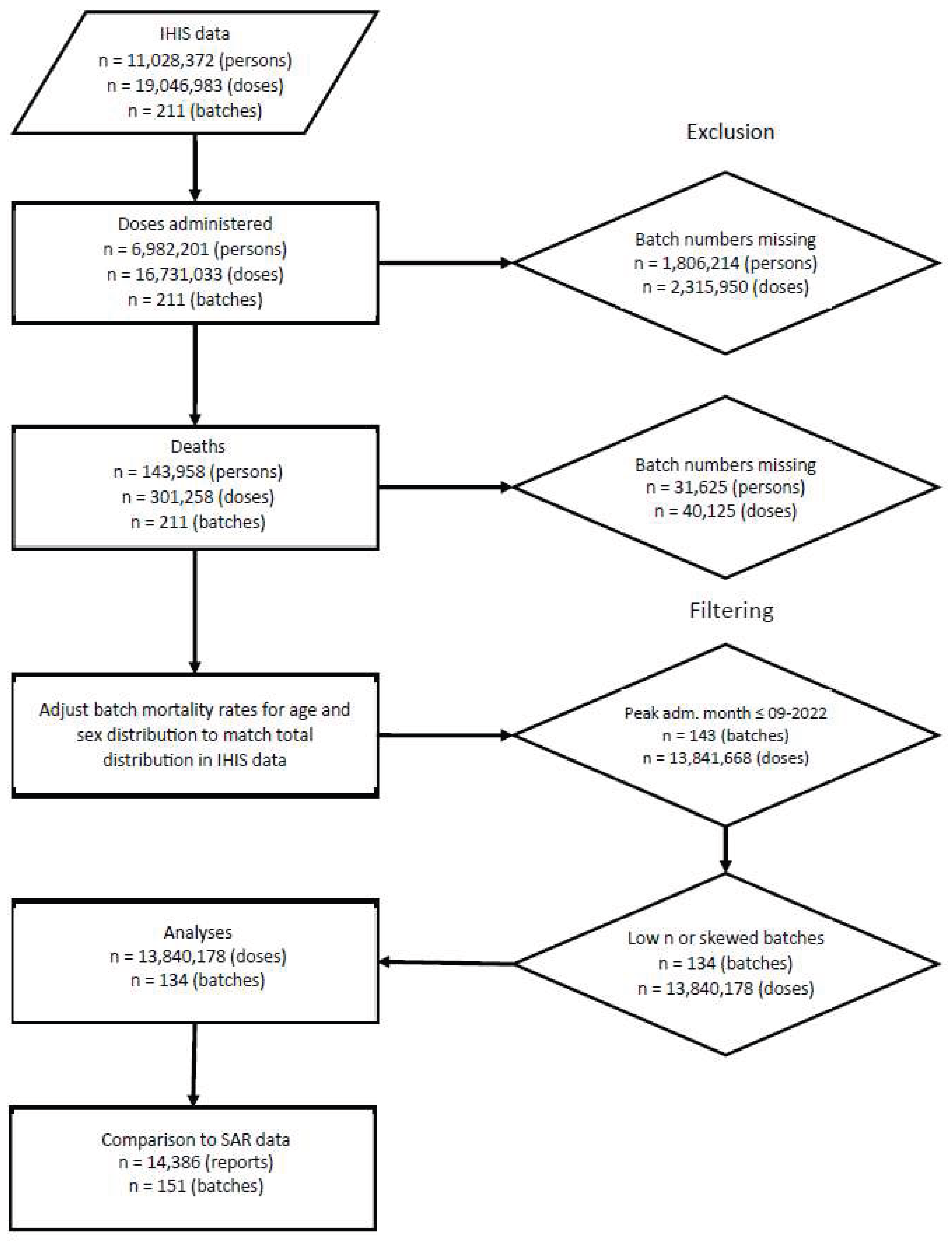
Figure 2.
Cluster analysis of batch-related age- and sex adjusted three-month all-cause mortality. A, C, E, and G: Scatter plots showing vaccine batches plotted against the number of administered doses (x-axis) versus the number of age- and sex-adjusted deaths (y-axis). Each point represents a single vaccine batch. Trendlines are linear regression lines. A (Comirnaty); Blue: R2 0.99, β 0.00898, 95% confidence interval [CI] 0.00799–0.Green: R2 0.99, β 0.00353, 95% CI 0.00340–0.Yellow: R2 0.98, β 0.00238, 95% CI 0.00222–0.C (Spikevax); Blue: R2 0.97, β 0.01406, 95% CI -0.01361–0.Green: R2 0.98, β 0.00431, 95% CI 0.00401–0.Yellow: R2 0.99, β 0.00271, 95% CI 0.00256–0.E (Vaxzevria); Blue: R2 1, β 0.01072 (95% CI not applicable). Green: R2 0.99, β 0.00575, 95% CI 0.00340–0.Yellow: R2 0.99, β 0.00457, 95% CI 0.00420–0.G (Jcovden); Blue: R2 0.999, β 0.0055, 95% CI -0.00537–0.Green: R2 0.985, β 0.00383, 95% CI 0.00330–0.B, D, F, and H: Column charts displaying the sex-standardized all cause mortality rates (deaths per 100,000 administered doses for each vaccine batch by the month of peak administration), matched with the corresponding color coding for clusters in panels A, C, E, and G, respectively.
Figure 2.
Cluster analysis of batch-related age- and sex adjusted three-month all-cause mortality. A, C, E, and G: Scatter plots showing vaccine batches plotted against the number of administered doses (x-axis) versus the number of age- and sex-adjusted deaths (y-axis). Each point represents a single vaccine batch. Trendlines are linear regression lines. A (Comirnaty); Blue: R2 0.99, β 0.00898, 95% confidence interval [CI] 0.00799–0.Green: R2 0.99, β 0.00353, 95% CI 0.00340–0.Yellow: R2 0.98, β 0.00238, 95% CI 0.00222–0.C (Spikevax); Blue: R2 0.97, β 0.01406, 95% CI -0.01361–0.Green: R2 0.98, β 0.00431, 95% CI 0.00401–0.Yellow: R2 0.99, β 0.00271, 95% CI 0.00256–0.E (Vaxzevria); Blue: R2 1, β 0.01072 (95% CI not applicable). Green: R2 0.99, β 0.00575, 95% CI 0.00340–0.Yellow: R2 0.99, β 0.00457, 95% CI 0.00420–0.G (Jcovden); Blue: R2 0.999, β 0.0055, 95% CI -0.00537–0.Green: R2 0.985, β 0.00383, 95% CI 0.00330–0.B, D, F, and H: Column charts displaying the sex-standardized all cause mortality rates (deaths per 100,000 administered doses for each vaccine batch by the month of peak administration), matched with the corresponding color coding for clusters in panels A, C, E, and G, respectively.
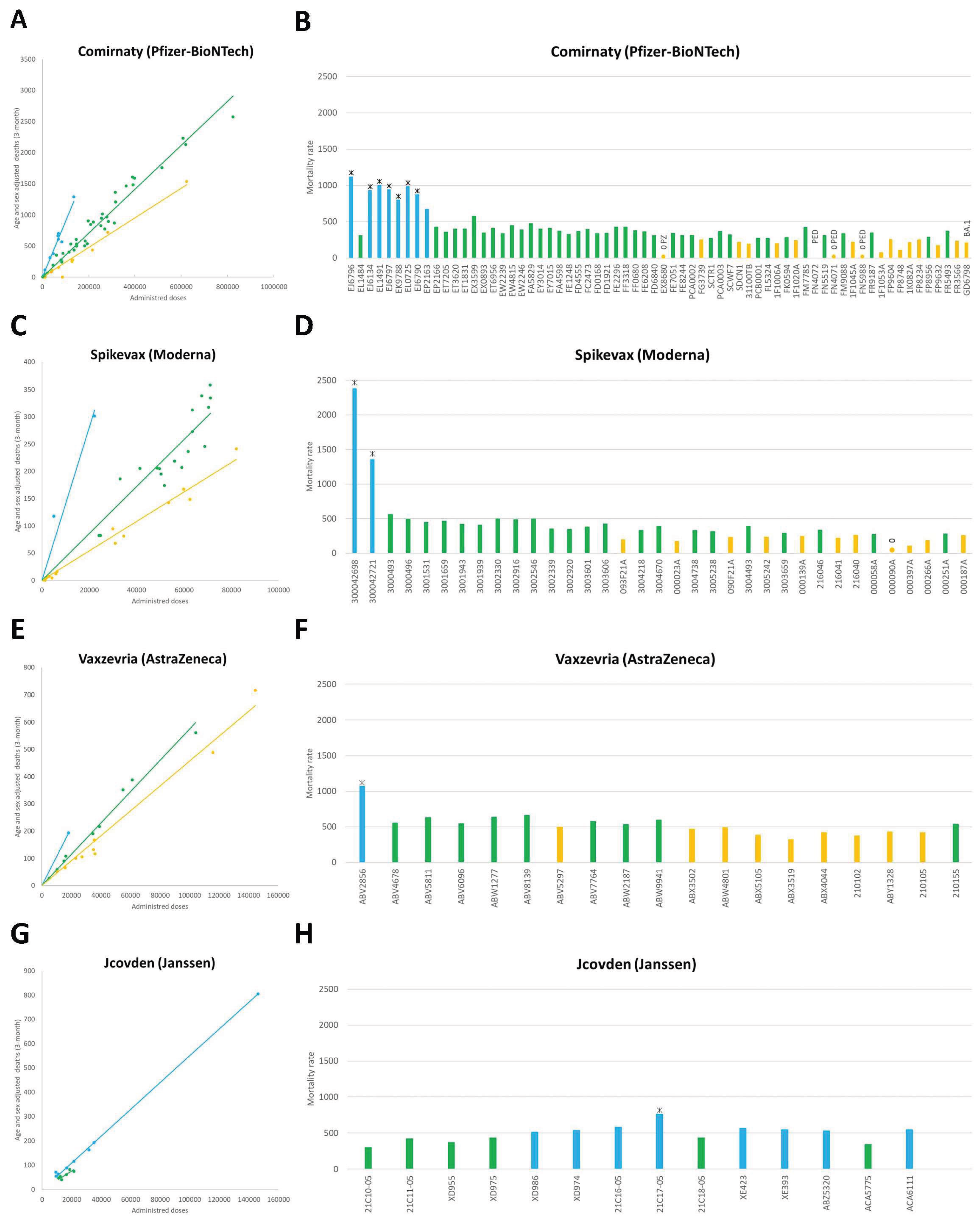
Figure 3.
Correlation between batch-related 3-month all-cause mortality (ACM) and suspected adverse reactions (SARs). Scatter plots showing the relationship between 3-month ACM and SAR report data for (A) Comirnaty, (B) Spikevax, (C) Vaxzevria, and (D) Jcovden. Each point represents a single vaccine batch, colour-coded as in Figure Dashed trendlines are linear regression lines. The coefficient of determination (R2) is shown in the bottom right of each plot.
Figure 3.
Correlation between batch-related 3-month all-cause mortality (ACM) and suspected adverse reactions (SARs). Scatter plots showing the relationship between 3-month ACM and SAR report data for (A) Comirnaty, (B) Spikevax, (C) Vaxzevria, and (D) Jcovden. Each point represents a single vaccine batch, colour-coded as in Figure Dashed trendlines are linear regression lines. The coefficient of determination (R2) is shown in the bottom right of each plot.
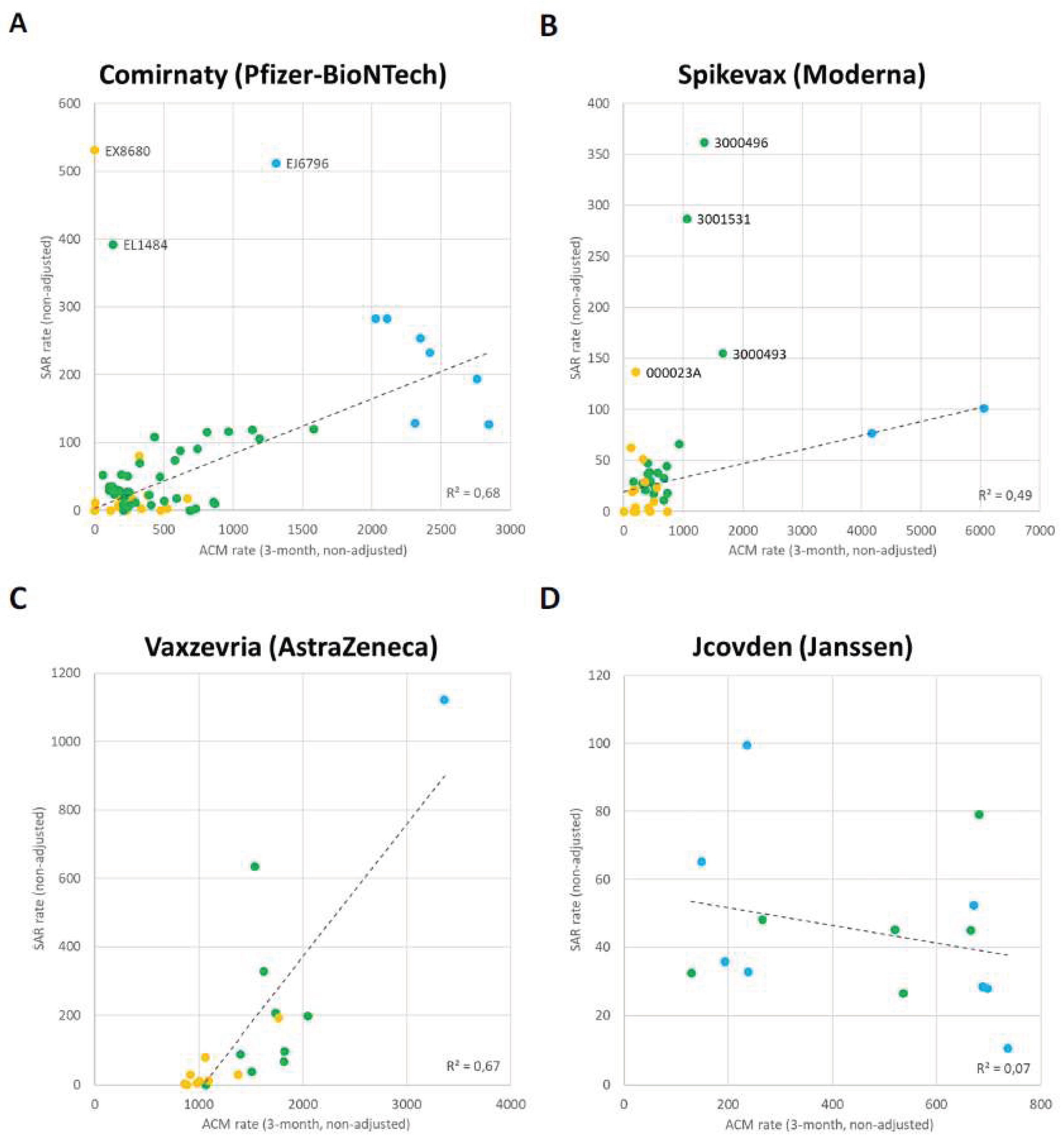

Table 1.
Summary of vaccine batch data.
| Product |
Batches (n) |
Administered doses per batch (mean [SD]) |
Administered doses per batch (range) |
| Comirnaty | 66 | 170,937 (178,412) | 1,245-823,343 |
| Spikevax | 35 | 39,483 (26,085) | 502-82,070 |
| Vaxzevria | 19 | 42,185 (38,840) | 4,968-144,504 |
| Jcovden | 14 | 26,780 (35,242) | 9,371-146,120 |
Disclaimer/Publisher’s Note: The statements, opinions and data contained in all publications are solely those of the individual author(s) and contributor(s) and not of MDPI and/or the editor(s). MDPI and/or the editor(s) disclaim responsibility for any injury to people or property resulting from any ideas, methods, instructions or products referred to in the content. |
© 2026 by the authors. Licensee MDPI, Basel, Switzerland. This article is an open access article distributed under the terms and conditions of the Creative Commons Attribution (CC BY) license (http://creativecommons.org/licenses/by/4.0/).
Copyright: This open access article is published under a Creative Commons CC BY 4.0 license, which permit the free download, distribution, and reuse, provided that the author and preprint are cited in any reuse.


