

Submitted:
11 September 2020
Posted:
12 September 2020
Read the latest preprint version here
Abstract
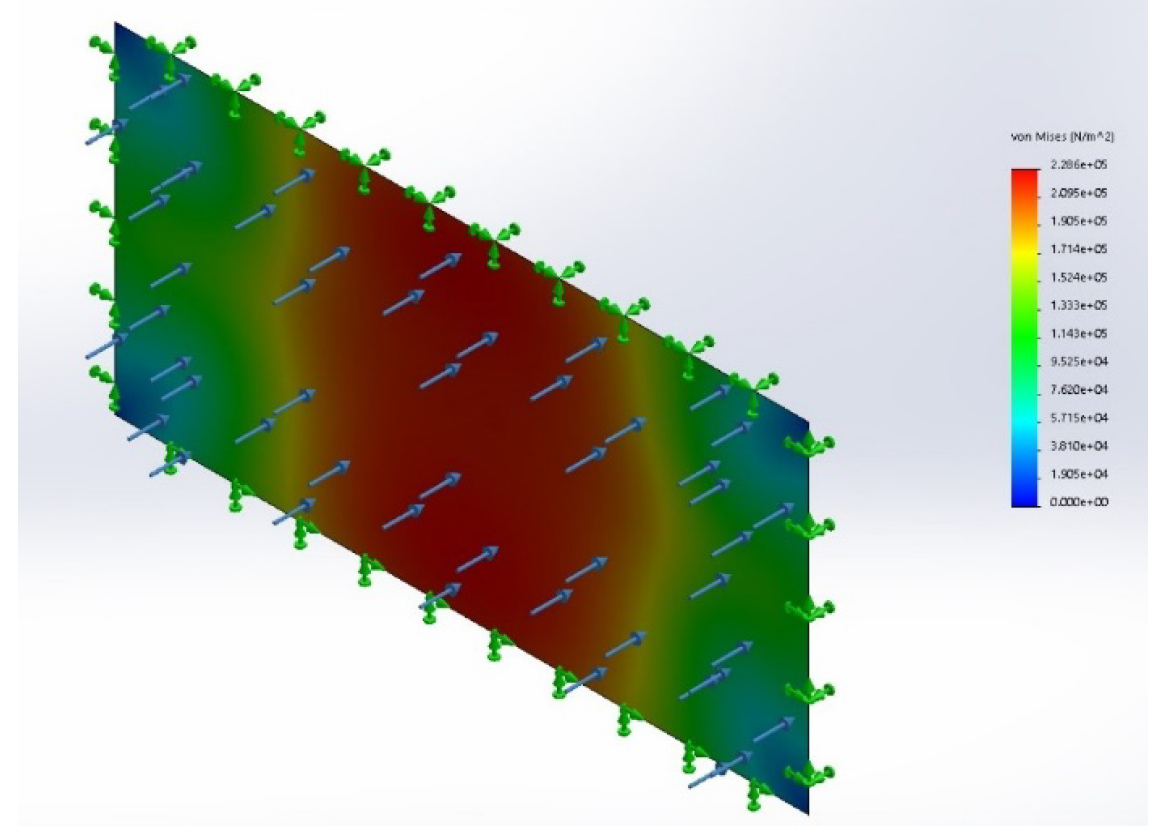
In recent years, usage of membranes is quite common in water and wastewater treatment. Polyacrylonitrile (PAN) is a polymeric material used in membrane production. To investigate the effect of Polyvinylpyrrolidone (PVP) addition and consequently porosity, two different sets of membranes are manufactured, since PVP is a widely used poring agent which has an impact on the mechanical properties of the membrane material. The first set (PAN 1) includes PAN and the necessary solvent while the second set (PAN 2) is made of PAN and PVP. These membranes are put through several characterisation processes including tensile testing. The obtained data are used to model the static behaviour of the membranes with different geometries, but similar loading and boundary conditions that represent their operating conditions. This modelling process is undertaken by using finite element method. The main idea is to investigate how geometry affects the load-carrying capacity of the membranes. Alongside membrane modelling, their materials are modelled with representative elements (RE) to understand the impact of porosity on the mechanical properties.
Keywords:
mechanical characterization
; foams
; ultrafiltration membrane
; finite element method
; non-linear deformations
Copyright: This open access article is published under a Creative Commons CC BY 4.0 license, which permit the free download, distribution, and reuse, provided that the author and preprint are cited in any reuse.


