

Submitted:
20 November 2020
Posted:
23 November 2020
You are already at the latest version
Abstract
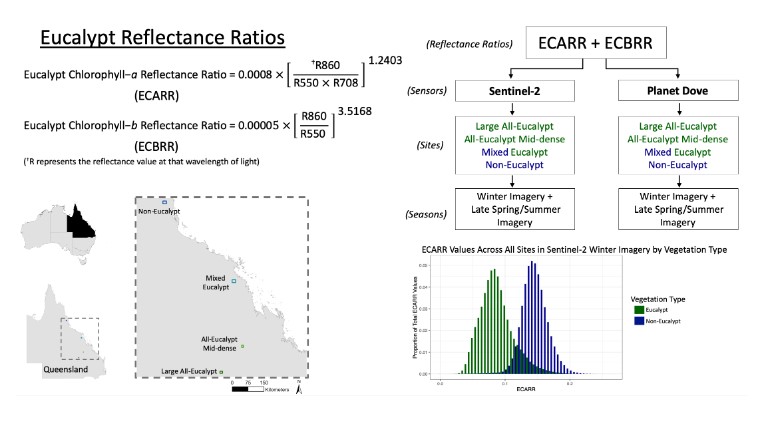
The scale and accessibility of passive global surveillance have rapidly increased over time. This provides an opportunity to calibrate the performance of models, algorithms, and reflectance ratios between remote sensing devices. Here we test the sensitivity and specificity of Eucalypt chlorophyll-a reflectance ratio (ECARR) and Eucalypt chlorophyll-b reflectance ratio (ECBRR) to remotely identify eucalypt vegetation in Queensland, Australia. We compare reflectance ratio values from Sentinel-2 and Planet imagery across four sites of known vegetation composition. All imagery was transformed to reflectance values and Planet imagery was additionally scaled to harmonize across Planet Scenes. ECARR can identify eucalypt vegetation remotely with high sensitivity, but shows low specificity and is impacted by the density of the vegetation. ECBRR reflectance ratios show similar sensitivity and specificity when identifying eucalypt vegetation but with values an order of magnitude smaller than ECARR. We find that ECARR was better at identifying eucalypt vegetation in the Sentinel-2 imagery than Planet imagery. ECARR can serve as a general chlorophyll indicator but is not a specific index to identify Eucalyptus vegetation with certainty.
Keywords:
Eucalypt chlorophyll-a reflectance ratio
; Eucalypt chlorophyll-b reflectance ratio
; vegetation identification
; Sentinel-2
; Planet Dove
Copyright: This open access article is published under a Creative Commons CC BY 4.0 license, which permit the free download, distribution, and reuse, provided that the author and preprint are cited in any reuse.


