

Submitted:
26 January 2024
Posted:
29 January 2024
Read the latest preprint version here
Abstract
We present an analysis of the Dirac equation when the spin symmetry is changed from SU(2) to the quaternion group, $Q_8$, afforded by multiplying one of the $\gamma$-matrices by the imaginary number. The reason for doing this is to introduce a bivector into the spin algebra. This modifies the Dirac equation equation which separates into two distinct and complementary spaces: one describing polarization and the other coherence. The former describes a 2D structured spin and the latter its helicity, generated by a unit quaternion.
Keywords:
foundations of physics
; Dirac equation
; spin
; quantum theory
; non-locality
; helicity
Introduction
Spin, first observed by Stern and Gerlach [1], reveals two states of up and down. Spin is measured to be angular momentum of magnitude, a vector quantity, belonging to the SU(2) group. Spin is a fundamental property of Nature, purely quantum with no classical analogue. The mathematical basis for spin is the Dirac equation [2]. Dirac’s analysis introduces his relativistic equation by linearizing the Klein-Gordon Equation while respecting conservation of mass and energy. He was led to his gamma matrices with four states rather than the two that are measured [3]. He surmised that his equation described two spins rather than one. The two are mirror image twins of each other, which Dirac interpreted as a matter-antimatter pair [2]. From this hole theory, antimatter production, and the sea of electron model followed [4].
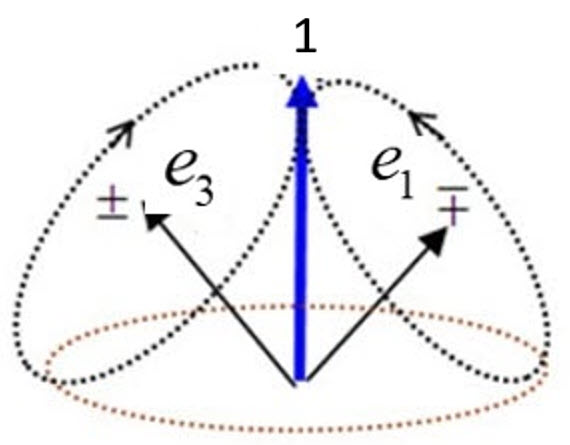
In this paper a small change is made whereby one of the gamma matrices is multiplied by the imaginary number and the effect is to change the symmetry from SU(2) to the quaternion group . The gamma matrices still anticommute, but the modified Dirac equation reveals a single spin has four states, rather than two: spin has structure under ,5,6]. The two point particles that Dirac found are replaced by quaternion spin, or Q-spin, that carries two complementary properties: polarization and coherence. The coherence is generated by a unit quaternion. This spins the axis of linear momentum in free-flight, Figure 1. In addition, two mirror states, [7] emerge from the modified Dirac field which describe two orthogonal polarization axes that are perpendicular to the axis of linear momentum. The figure shows that a Q-spin is geometrically equivalent to a photon. The two magnetic fermionic axes, and each carry a spin , and couple to give a spin 1 boson, . All three axes are orthogonal to which spins due to the helicity, see Figure 1. Structured spin changes the intrinsic angular momentum of Dirac spin, to be extrinsic.
To motivate the discussion here, consider the well know equation for the geometric product of Pauli spin components,
Arising from Geometric Algebra, [8,9] the first term describes a symmetric component that gives rise to polarization and measured Dirac spin. The second term is anti-symmetric and depends upon a bivector, and the Levi Civita third rank anti-symmetric tensor. Since i cannot simultaneously be equal and not-equal to j, the equation is complementary. There is, however, no bivector in the Dirac equation. The only way to include a bivector is to change the spin symmetry to the quaternion group. From this, helicity of a spin is formulated consistent with Eq.(1). It is the purpose of this paper to include this anti-symmetric term as a property of spin.
This paper is the first of several in which the mathematical foundations of Q-spin are presented. A second paper, “Spin with helicity" [10] follows in which the ideas of this paper are used to study the geometry and conservation of correlation. Applied to an EPR pair, [11], The coherence of Q-spin is responsible for the correlation that gives the observed violation of Bell’s inequalities (BI) without non-local connectivity, along with a computer simulation which generates the violation. A general summary, [12] describes some consequences and another, [13], applies Q-spin to beta decay, which shows that parity is conserved in the weak force and neutrinos are not needed.
Formally this four state spin is called Q-spin to distinguish it from the usual Dirac spin. A modified form of the Dirac equation is presented that admits both polarization and helicity, complementary elements of reality. It describes spin as it exists in the absence of interactions including measurement, and therefore in free-flight. Additionally, when measured, the boson spin decouples into a fermion of spin . This is the measured spin Dirac formulated.
Spin spacetime algebra
The gamma matrices, , represent the 4x4 Dirac field. Within this field there are two point particle spins of : each described by the three Pauli spin components and the identity, ( which belong to the SU(2) group; each is the mirror twin of the other, and Dirac identified them as a matter-antimatter pair.
Simply by multiplying one gamma matrices by the imaginary number, here chosen to be , changes the spin components to (), giving two spatial axes of polarization, and the needed bivector, . This set forms a normal subgroup of the quaternion group, . Since Q-spin has structure, it can be oriented randomly. Define a different Cartesian basis set , called the Body Fixed Frame, BFF, relative to the Laboratory Fixed Frame, LFF, of , see Figure 2.
Whereas Minkowski spacetime has coordinates of , spin spacetime has . Under the quaternion group we show the Dirac field is changed to the Q-Dirac field, where the subscript denotes spin spacetime.
We show that the spin spacetime field decomposes into two complementary spaces: polarization, (1,3) and coherence, (2). The two spatial components, are simply a rotation away from Minkowski spacetime. It has the structure of a 2D plane of polarization, see Figure 2. In the bottom right insert Q-spin, N-E, is contrasted with the usual Dirac spin vector, N-S. Note that the two axes of Q-spin couple to form a resonance spin of magnitude 1 which is a pure coherent state and a boson.
The bivector, , connects spin spacetime to the complementary space of the helicity states, generated by quaternions in the hypersphere. This has four spatial dimensions, and cannot be measured. Its only role is to spin the axis of linear momentum, either L or R which are the two helicity states.
The spin polarized structure can be expressed in Minkowski spacetime. The bivector cannot.
Mirror states and parity
The bivector is introduced by choosing to multiply by the imaginary number,
rendering Hermitian. The Pauli components in Eq.(2) become bivectors. The set of gamma matrices in spin spacetime, , anticommute but have a different signature from Minkowski spacetime,
so the term is not a spatial component, but rather time-like and a frequency. This dimension is the origin of quantum coherence that leads to the formulation of helicity.
The commutation relations are changed from the usual three dimensional generator of rotations in Minkowski spacetime,
to ones that generate rotations in only two dimensions in spin spacetime
The former equation describes rotations in the 31 plane about the direction 2; whereas the imaginary term in the latter equation damps all rotation attempts out of the 31 plane.
Two new equations in spin spacetime follow from the gamma algebra which gives a non-Hermitian equation by virtue of ,
and we suppress the subscript s on the derivatives. By treating a spin in free-flight in an isotropic environment, the two axes are indistinguishable. Therefore, permutation with the parity operator, does not change the dependence in Eq.(7), but the bivector, is anti-symmetric to 13 permutation. Therefore the above equations admits two solutions in left and right handed coordinate frames, which are mirror states, [7,14]
see Figure 3. The anti-commutation of the matrices ensures that energy is conserved and the Klein-Gordon equation is recovered.
Adding and subtracting the two equations in Eq.(7) leads to their separation into a Hermitian part and an anti-Hermitian part,
where the two mirror states combine into those with odd and even parity, Eq.(8) with the definition,
We identify the even parity state with 2D structured Q-spin. The odd parity state describes its helicity.
The separation of the Dirac field into reflective states means each axis precesses in the opposite direction. These two polarization axes, each with a magnetic moment , constructively interfere producing the resonance, and purely coherent spin, see Figure 4,(middle upper). Such a resonance structure lowers the energy and stabilizes the 2D structure over that of two point particle spins.
Therefore, spin spacetime separates into two distinct spaces: polarization spacetime, , Eq.(9); and coherent space (not spacetime) , Eq.(10). The Hermitian part, Eq.(9), is the same as the usual Dirac equation, but in two dimensions rather than three. It describes a disk, as visualized in Figure 1 and Figure 2.
The bivector component, , describes a massless Weyl spinor in coherent space, Eq.(10). Within this space, time does not exist beyond the constant frequency of its spinning. Time and rest mass remain in polarization space. Similar to the two complementary inverse spaces of position and momentum, here the two spin spaces carry the two complementary properties of polarization and coherence.
Redefine the spinor mirror states as and .
The Weyl spinor
From Eq.(10) and using reference [3,15] a Weyl spinor transforms under boosts and rotations as
Since time exists only in polarization space, Eq.(9), a boost of polarizations carries along the spinors. There are no boosts in coherent space; the left and right components are equal;
and the state is a unit quaternion which spins the axis of linear momentum in coherence space by angle , thereby generating the helicity as a unit quaternion,
The usual definition [16] identifies helicity as the projection of the spin vector onto the axis of linear momentum in Minkowski spacetime. Here helicity is defined only in quaternion space, the sphere, [17,18,19] where there is no momentum with which to contract. Choosing , then the component, , drives the quaternion in Eq.(15), and spins the symmetry axis like usual helicity. Helicity is a distinct element of reality and complementary to observed polarized spin. All we observe of the helicity in our spacetime is its stereographic projection which is the spinning of the Y axis, giving a spinning disc of angular momentum in Minkowski spacetime, Figure 2.
The 2D spin equation.
Transform from the BFF of the spin, to the LFF using,
giving,
and the following expression is independent of ,
Taking the linear momentum in the direction requires setting ,
The polarization in spin spacetime is projected onto Minkowski spacetime, and is all we can observe of the hyper-sphere. The spinning from helicity is in coherent space and its effect is to spin the polarization in Minkowski spacetime. In free-flight, the spinning disc which is reminiscent of the worldsheet Susskind introduced, [20]. A 2D system is also an anyon, [21], which can be either a fermion or a boson. An important point about the boson in free-flight is the spinning axis averages out the boson polarization, Figure 1, so only the helicity remains. The helicity is odd to parity, leading to the conclusion that free-flight boson electrons, , are also odd to parity.
In contrast, the usual Dirac point particle, 2-state fermion spin is formed when encounters a polarizing field. We denote this by , which is even to parity. A fermion electron has two states of up and down. For boson electrons the two polarized states are suppressed, leaving the two helicity states of L and R. Q-spin has a total of four states.
Define a momentum vector and the equation for 2D polarization becomes
where the even parity state is written as . This leads to the same Klein-Gordon equation in Minkowski and spin spacetime,
with eigenvalues for the latter of,
We interpret the two energy states as the left and right spinning of the two spin axes on the same particle, see Figure 4. As mirror states, they are in phase and couple to give the resonance spin of 1. Precession as shown gives one component of, say, . Reversing these precessions gives the component. The component cannot form since it would violated the reflective symmetry between the mirror states. Note also a photon as no component.
The energies and are from the two axes and express the internal energy of . We interpret the two energies to the opposite and coherent frequencies of the two axes that form the resonance boson, Figure 4. In contrast, Dirac interpreted the negative energy as that of the antimatter twin, which led to his fermionic continuum and sea of electrons. Q-spin resolves the negative energy problem Dirac encountered.
Quaternion spin
In this section we present more specific equations that describe the structure and some properties of Q-spin. Generally the equations are given that lead to the illustrations in Figure 4.
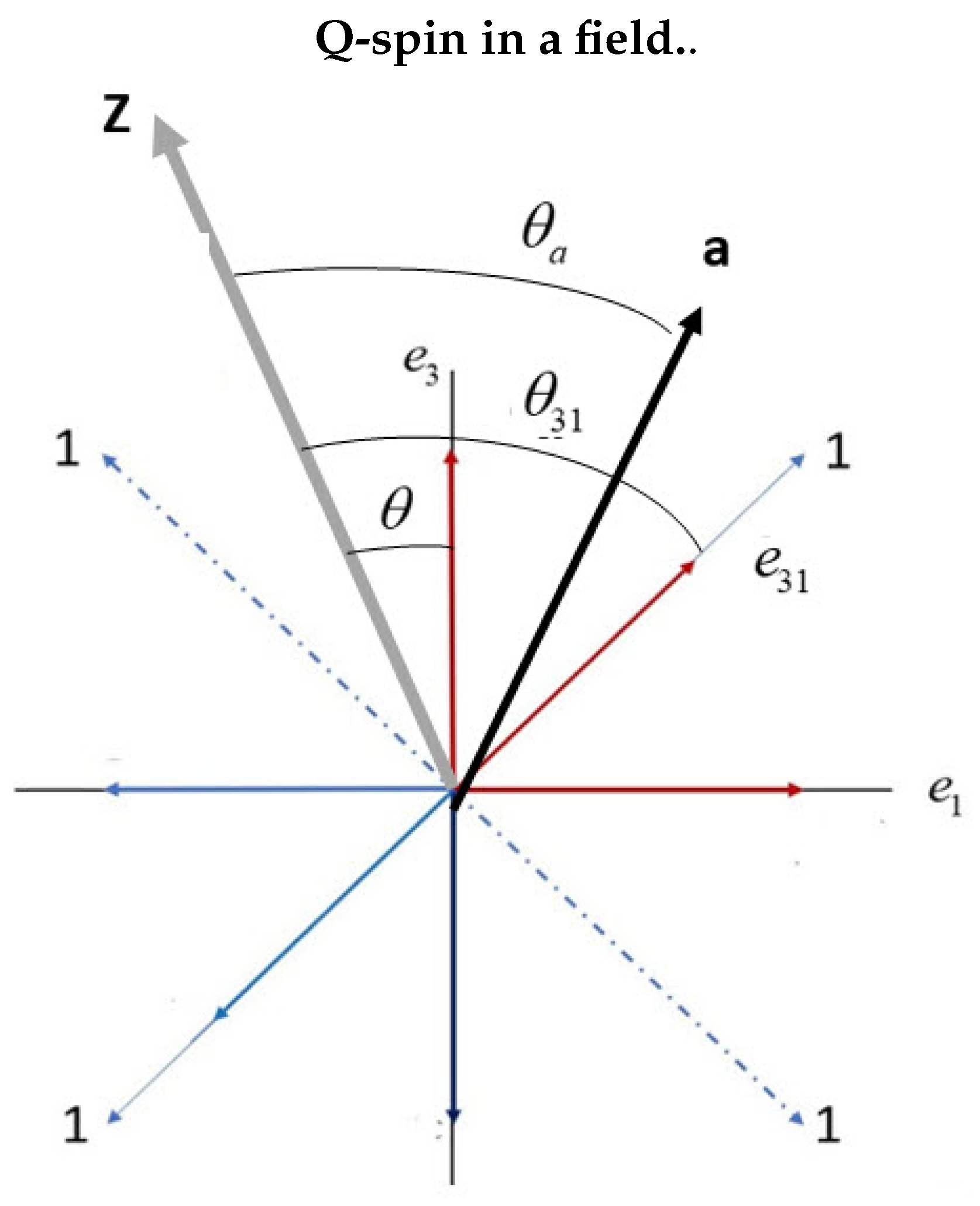
Figure 5 shows the BFF with the Y axis perpendicular to the screen. The four bisectors are shown, and the first quadrant is labeled . Also shown is the long LFF Z axis oriented relative to the BFF by angle . The field axis, , is oriented by angle from Z, and finally, the boson spin, is at angle from the Z axis. The results are the same for any quadrant, so we use the first.
The spinning disc is orthogonal to the direction of motion, and therefore the polarizing filter and the disc are co-planar.
The complementary attributes of spin, polarization and coherence, simultaneously exist. However, only one is manifest at any instant. Just as the geometric product, Eq.(1), is the sum of two complementary contributions, so we express Q-spin, , possessing both these properties,
Motivated by the geometric product, Eq.(2), the geometric helicity operator, , is an anti-symmetric, anti-Hermitian, second rank tensor of odd parity, [10].
The state operator, , expresses the expectation values for Hermitian observables, A, of a system, and is defined by the quantum trace over the operators, [22].
Despite the helicity being an element of reality, it is not an observable. Therefore, we express the pure state operator of Q-spin in terms of the normalized sum of the two orthogonal axes giving,
The vector is identified in the BFF. From this, the expectation values are calculated for the spin axes, using Eq.(26),
with , and the vector products,
Permuting each axis in Eq.(27), shows the two fermionic axes are mirror states, . The first term in Eq.(27) is the usual spin polarization that is observed. The second are the planes orthogonal to the axes: is orthogonal to , and is orthogonal to . These terms form the wedge, or vector product from GA, [8] leading to the formulation of helicity.
In free-flight the angular momentum of the two axes, Eqs.(27), constructively interfere to produce the resonance spin being a boson of magnitude 1,
Substituting Eqs.(27) gives the free-flight boson in the BFF,
This shows each axis multiplied by a unit quaternion that rotates around the Y axis. The axis is rotated by , and axis is rotated by . Hence the two axes coincide and bisect the first quadrant and form the resonant boson spin, see Figure 5. By permuting the signs in Eq.(29), bisectors of all the quadrants are found, corresponding to the boson resonance spins, Figure 5. Of course, for a single Q-spin, only one of the quadrants carries a boson at any instant.
In Figure 5, the axis of linear momentum, Y, is orthogonal to the plane, showing once again the geometric equivalence with a head-on view of a photon with the magnetic and electric components oscillating out-of-phase. In the case here, a Q-spin can randomly be oriented in any quadrant. The results are the same for all, so we use the first.
Q-spin is complex because it is spinning L or R. Since it cannot be measured, its complexity is of no concern. The two parts, and shown in Eq.(27) give quaternions which spin oppositely on their respective axes. These are shown in the middle upper part of Figure 4, and Eq.(29) with Eq.(27) is the basis for this figure.
Equation (30) couples the two fermionic axes which is depicted in the middle figure forming the spin 1. When the boson is influenced by a polarizing field, it decouples into a fermion.
Measured spin
When a boson spin encounters a polarizing field oriented by the vector , the closer axis is influenced more than the further axis. This destroys the mirror property between the axes as one aligns with the field. The helicity stops as the second fermionic axis, orthogonal to the aligning axis, spins about the first, see the left and right panels of Figure 4. In the presence of a field, the expectation value of the boson spin is
where the field is expressed in the LFF and oriented by angle
The expression, Eq.(31) is complex due to the fact the axis spins in one direction or the other. In measurement we assume that both L and R precessions occur and the measured spin, subscript M, is give by,
We evaluate Eq.(31) and not the measured spin since the quaternion structure is then evident.
Consider first Q-spin in its BFF, found by contracting the Eq.(30), giving,
where the projections determine the contributions from each axis in the LFF,
This expression shows the competition between the two axes. Equation (35), gives the projections of and onto the field direction,
Consider some angles which can be seen from Figure 5, and using Eq.(35)shows that if or , then the field is aligned with the or axis respectively. However, polarization along these axes is reduced from unity to . This is because the polarization of the orthogonal axis to the aligned axis is averaged out, and thereby reduces the polarization. To get the full polarization, the angle must be aligned with the resonance boson spin. This occurs by choosing . From Figure 5, this value shows the field co-linear with the bisector, with equal contributions from both the and the axes, so the polarization has magnitude of 1. Choosing shows the field vector co-linear with the axis, orthogonal to with zero value.
However, the boson spin cannot maintain it’s resonance as the field vector becomes removed from the bisector. If the field is co-linear with the boson spin, then it precesses without uncoupling. This is illustrated in the lower middle part of Figure 4, but as the field is oriented further from the bisector, the precession changes to nutation, wobbles and then decompose as the field strength increases and moves further from the resonance spin and closer to one of the axes. From Figure 5 the bisector lies 45o from either or axes. We therefore assume, again motivated by the least action principle, the boson decouples directly, without nutation, when the field axis lies greater than from the bisector. Within the 45o wedge on either side of the bisector, we assume that the boson spin remains intact until the field strength overpowers the spin-spin coupling, and it decouples.
Depending of these orientation effects, Q-spin either persists as a boson, or rapidly decouples to a fermion.
Working in the first quadrant defined by , and, using Eq.(16) with , then the relation between bisector in the the BFF and the LFF is,
Alternately, Eq(34) projects and onto the field direction. First express Q-spin in its BFF, see Eq.(27),
Substitution of Eqs.(36) leads to,
From Eq.(36), and contracting with Z and X, shows the first term is the projection of the bisectors along the LFF Z axis, and the second term is the projection along X. Each axis is multiplied by a unit field quaternion, and the two are orthogonal. Their magnitudes, which depends on , determine how much of each axis contributes,
This can be compared to Eq.(34) which projects the axes and rather than their bisector, Figure 5. Either equation can be used to determine the spin polarization.
Equations (34) or (38) lead to an expression in terms of the angle differences which is independent of ,
In the first quadrant the bisector is normalized to
with the angle given by,
Clearly Eq.(40) shows that Q-spin aligns with the field when the angles are equal. When aligned, as discussed above, and when the field is off-set by a small amount, then the boson spin of 1 does not decouple but aligns with the field and precesses. This is shown in the middle lower panel of Figure 4.
To determine which fermion axis will align, use Eq.(34) or (38)and determine which has the larger magnitude. The two terms represent the two orthogonal axes and the field quaternion. The larger axis aligns, and its sign then determines if the aligned spin is up or down.
A compact expression is found by using Eq.(30) and contracting with the field vector to give the most general equation which expresses the spin in a field,
This shows that the Q-spin is determined by the product of three quaternions: the first is a phase which is discussed above; the second is a geometric factor that orients the spin disc in the BFF; and the last is a field quaternion that sets the field position in the LFF.
These features of Q-spin are crucial, [10], to understand the extra correlation found in coincidence EPR experiments, [23,24,25] and which is more fully discussed in paper three, [10]. That is, the spin orientation relative to the field direction, and the strength of spin coupling relative to the field strength, provide two mechanistic pathways for the boson decoupling. One gives correlation from polarization and the other from coherence, with the correlation from the two appearing to violate Bell’s Inequalities, [26]. In fact, the complementary attributes, polarization and helicity, each being independent, make two contributions to the correlation, with a CHSH, [23] value of 2 from the polarization and a value of 1 for coherence. Neither violate Bell’s Inequalities, but the two together appear to. We find the violation of Bell’s Inequalities is due the the transition from a boson to a fermion.
In summary, complementarity shows a free-flight spin is a boson with spin 1, and when measured, it becomes a fermion of spin .
Discussion
Introducing the bivector into spin algebra significantly changes our view of a spin from a structureless point particle of intrinsic angular momentum in Minkowski spacetime to a four dimensional structured spin with extrinsic angular momentum in spin spacetime. Any structured particle can be expressed in its own coordinate frame and we find that the three spatial components of Minkowski spacetime become a 2D plane of spin polarization which is spun about its axis of linear momentum producing L or R handed helicity. The spinning 2D plane forms only in the isotropy of free-flight.
The bivector component leads to a massless Weyl spinor which in turn is a unit quaternion and generates the helicity. Quaternions do not exist in polarization space, but rather in the dimensional hypersphere of [17] which cannot be completely observed from any spacetime frame. Only the stereographic projection, [27], is visible.
There are four axes in Q-spin. One is the axis of linear momentum spun by the quaternion. Two more are the magnetic axes which couple to give the fourth, being the boson spin.
We use bivectors to describe the two axes, Eq,(27). Each fermionic axis defines a spin. Therefore it also has two attributes, polarization and coherence, and hence a bivector. If we define two additional spin spacetimes, one for each axis, then a BFF must be defined for each. This will again lead to a separation into two complementary attributes, so each spin axis carries a quaternion that spins the axes in Eq.(27) with their own quaternion. In contrast, the coupled boson axis also spins, but the origin is from the resonance-coupling of the two spins, and so the boson axis carries no quaternion.
In short, within Q-spin there are three spacetimes, three quaternions and four possible spinning axes. There are two spatial components from the quaternion group that give the disc, and a total of three times four equals 12 dimensions in distinct hyper-spheres. Quaternion spaces cannot be measured, but their effect is to spin all three axes.
The question arises as to whether the Q-spin exists and is more fundamental than measured spin. That the geometric structure of spin is equivalent to a photon is compelling, Figure 1, and more so since neither the boson nor a photon carry a zero component, . Other quantum observables come in complementary pairs, like position and momentum , in spaces that are the inverse of each other. It is therefore reasonable that spin also has two complementary properties, polarization in it spin spacetime, and coherence on the sphere. One experimental consistency with Q-spin for the existence of Q-spin is given by the observed violation of Bell Inequalities. Additionally there are other features that suggest Q-spin describes Nature better than SU(2) spin. which we briefly summarize.
When applied to beta decay, [16] , the beta electron is in free flight and hence is a boson electron, of odd parity. Q-spin carries internal energy and a spin 1 which conserves them both in beta decay. These properties obviate the need for introducing neutrinos, [13].
In the 1956 parity experiment by Wu, [28], they relied on the fermion property of the beta particle to show that the distribution must be symmetric in order to confirm parity is not violated. Again, using boson spin, parity is not violated for any beta particle distribution.
Measurement has a central premise that the act of observation perturbs the system. Q-spin makes a distinction between measurement (polarized) and free-flight (coherence). They epitomize the particle-wave duality.
EPR believed that QM is incomplete [29] since it does not simultaneously describe two complementary elements of reality. In support of Einstein, both polarization and coherence are found to exist simultaneously on the same particle. On the other hand, supporting Bohr’s complementarity, [30], in free-flight only the coherence is present since the spinning axis averages out the polarization. Upon measurement, the helicity stops and only the polarization is realized. Although both properties exist simultaneously, only one is manifest at any instant.
QM is, therefore, incomplete because it is a theory of measurement restricted to our spacetime. QM does not include elements of reality that are anti-Hermitian on the hypersphere.
Non-locality, parity violation, the infinite fermionic continuum Dirac proposed for the negative energies, matter-antimatter production from the Dirac interpretation, and neutrinos emission, are non-intuitive concepts. Q-spin removes these feature from Nature.
These results emerge from the companion papers, [10,11]. The former describes an EPR pair and shows that the helicity introduces an anti-symmetric component to spin which accounts for the apparent violation of BI, [23,24,25]. The third paper, [11], gives a computer simulation that evaluates the two contributions from spin correlation via the two mechanisms discussed. Neither polarization nor coherence violate Bell’s theorem [31].
These results lead us to suggest the Standard Model, [16], with symmetry SU(3)SU(2)U(1) changes the SU(2) of the weak force to .
Acknowledgments
The author is grateful to Hillary Sanctuary, PhD, EPFL Switzerland, for useful and helpful discussions.
References
- Gerlach, Walther, and Otto Stern. “Das magnetische moment des silberatoms." Zeitschrift für Physik 9.1 (1922): 353-355. [CrossRef]
- Dirac, P. A. M. (1928). The quantum theory of the electron. Proceedings of the Royal Society of London. Series A, Containing Papers of a Mathematical and Physical Character, 117(778), 610-624.
- Peskin, M., Schroeder, D. V. (1995). An Introduction To Quantum Field Theory (Frontiers in Physics), Boulder, CO.
- Dirac, P. A. M. (1930). “A Theory of Electrons and Protons". Proc. R. Soc. Lond. A. 126 (801): 360–365. [CrossRef]
- Sanctuary, B. C. “Structure of a spin ." arXiv preprint arXiv:0908.3219 (2009).
- Sanctuary, B. C. “The two dimensional spin and its resonance fringe." arXiv preprint arXiv:0707.1763 (2007).
- Okun, Lev B. "Mirror particles and mirror matter: 50 years of speculation and searching." Physics-Uspekhi 50.4 (2007): 380. [CrossRef]
- Doran, C., Lasenby, J., (2003). Geometric algebra for physicists. Cambridge University Press.
- Muralidhar, K. "The spin bivector and zeropoint energy in geometric algebra." Adv. Studies Theor. Phys 6 (2012): 675-686.
- Sanctuary, B. Spin with helicity. Preprints 2023, 2023010571. [CrossRef]
- Sanctuary, B. Non-Local EPR Correlations using Quaternion Spin. Preprints 2023, 2023010570.
- Sanctuary, B. Quaternion-Spin and Some Consequences. Preprints 2023, 2023121277. [CrossRef]
- Sanctuary, B. Beta decay with no neutrinos and parity conservation. (submitted).
- Zhou, Ziheng, and Zhenhua Yu. "Interaction effects on the PT-symmetry-breaking transition in atomic gases." Physical Review A 99.4 (2019): 043412. [CrossRef]
- Troha, T., D. Lukman, and N. S. Mankoč Borštnik. "Massless and massive representations in the spinor technique." International Journal of Modern Physics A 29.23 (2014): 1450124. [CrossRef]
- Griffiths, David (2009). Introduction to Elementary Particles. pp. 59–60. ISBN 978-3-527-40601-2.
- Peters, James F., and Arturo Tozzi. "Quantum entanglement on a hypersphere." International Journal of Theoretical Physics 55 (2016): 3689-3696. [CrossRef]
- Christian, Joy. "Bell’s theorem versus local realism in a quaternionic model of physical space." IEEE Access 7 (2019): 133388-133409. [CrossRef]
- Christian, Joy. "Symmetric Derivation of the Singlet Correlations within a Quaternionic 3-sphere." arXiv preprint arXiv:2204.10288 (2022).
- Susskind, Leonard (1970). "Dual-symmetric theory of hadrons, I.". Nuovo Cimento A. 69 (1): 457–496.
- Wilczek, F. (1982). Quantum mechanics of fractional-spin particles. Physical review letters, 49(14), 957. [CrossRef]
- Von Neumann, John. Mathematical foundations of quantum mechanics. Princeton university press, 1955.
- Clauser, J. F., Horne, M. A., Shimony, A., & Holt, R. A. (1969). Proposed experiment to test local hidden-variable theories. Physical review letters, 23(15), 880. [CrossRef]
- Aspect, Alain, Jean Dalibard, and Gérard Roger. “Experimental test of Bell’s inequalities using time-varying analyzers.” Physical review letters 49.25 (1982): 1804. [CrossRef]
- Aspect, Alain (15 October 1976). “Proposed experiment to test the non separability of quantum mechanics”. Physical Review D. 14 (8): 1944–1951. [CrossRef]
- Weihs, G., Jennewein, T., Simon, C., Weinfurter, H., Zeilinger, A. (1998). Violation of Bell’s inequality under strict Einstein locality conditions. Physical Review Letters, 81(23), 5039. [CrossRef]
- Bell, John S. “On the Einstein Podolsky Rosen paradox.” Physics Physique Fizika 1.3 (1964): 195. [CrossRef]
- To visualize quaternions and its steriographic projection see 3 Blue 2 Brown: https://eater.net/quaternions.
- Wu, C. S., Ambler, E., Hayward, R. W., Hoppes, D. D., & Hudson, R. P. (1957). Experimental test of parity conservation in beta decay. Physical review, 105(4), 1413. [CrossRef]
- Einstein, Albert, Boris Podolsky, and Nathan Rosen. “Can quantum-mechanical description of physical reality be considered complete?.” Physical review 47.10 (1935): 777. [CrossRef]
- Bohr, Niels. "Can quantum-mechanical description of physical reality be considered complete?." Physical review 48.8 (1935): 696. [CrossRef]
- Bell, J. S. “Speakable and Unspeakable in Quantum Mechanics” (Cambridge University Press, 1987), 2004. See “Locality in quantum mechanics: reply to critics. Epistemological Letters”, Nov. 1975, pp 2–6.”. [CrossRef]
Figure 1.
Two properties of spin: its polarization, , perpendicular to its helicity. The helicity generated by is in the direction of propagation and spins R or L. The polarization carries a spin of magnitude 1 from the coupling of the two axes and each with a spin of magnitude . These properties show spin is geometrically equivalent to that of a photon.
Figure 1.
Two properties of spin: its polarization, , perpendicular to its helicity. The helicity generated by is in the direction of propagation and spins R or L. The polarization carries a spin of magnitude 1 from the coupling of the two axes and each with a spin of magnitude . These properties show spin is geometrically equivalent to that of a photon.
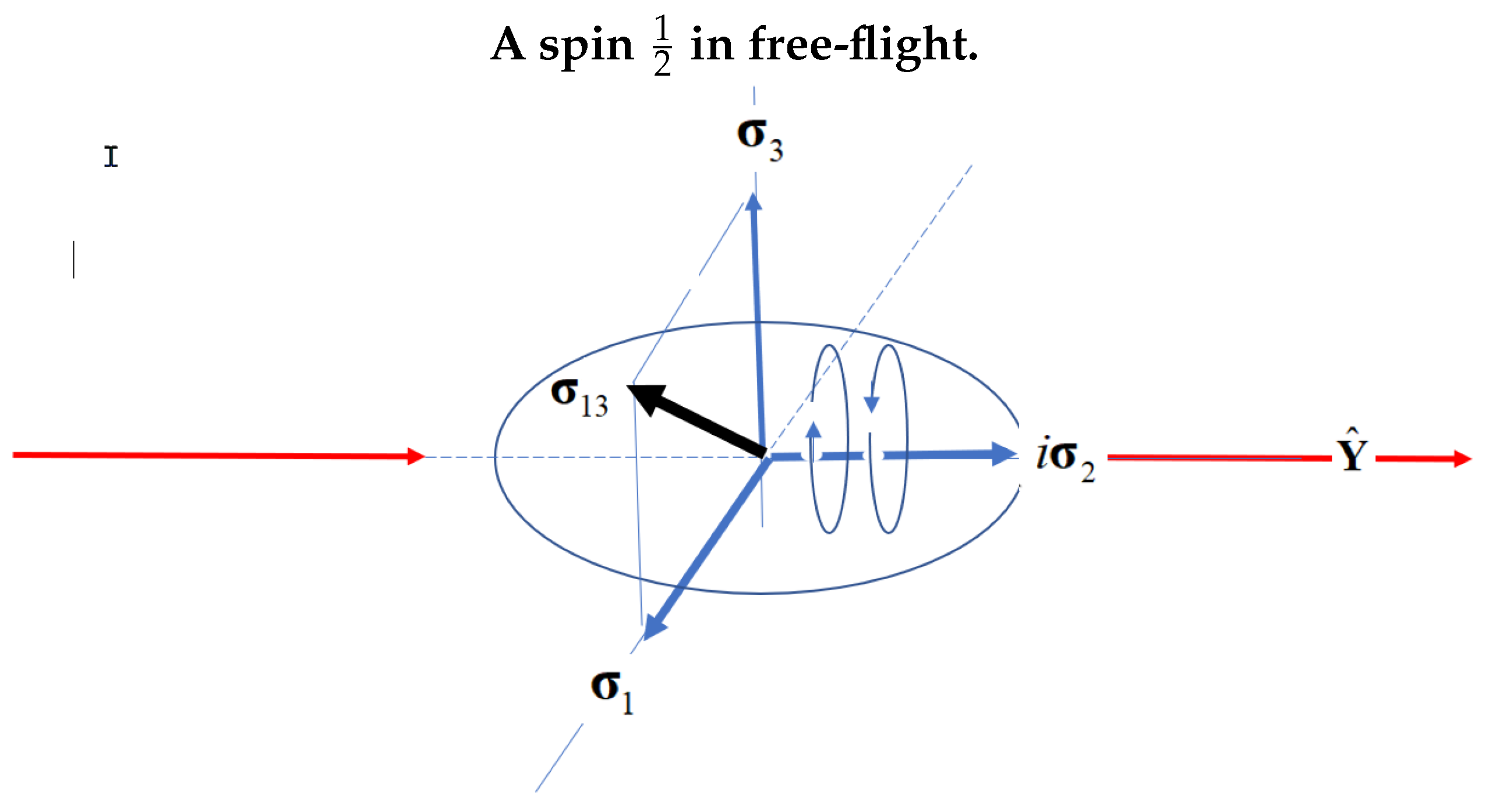
Figure 2.
A spin is oriented in spin spacetime by the BFF basis vectors which spins about the axis so that in Minkowski spacetime, with components , only a smeared out image of the precessing spin is projected. The lower right insert contrasts Dirac spin and Q-spin, which is displayed as the resonance formed from the coupling of the (3,1) axes.
Figure 2.
A spin is oriented in spin spacetime by the BFF basis vectors which spins about the axis so that in Minkowski spacetime, with components , only a smeared out image of the precessing spin is projected. The lower right insert contrasts Dirac spin and Q-spin, which is displayed as the resonance formed from the coupling of the (3,1) axes.
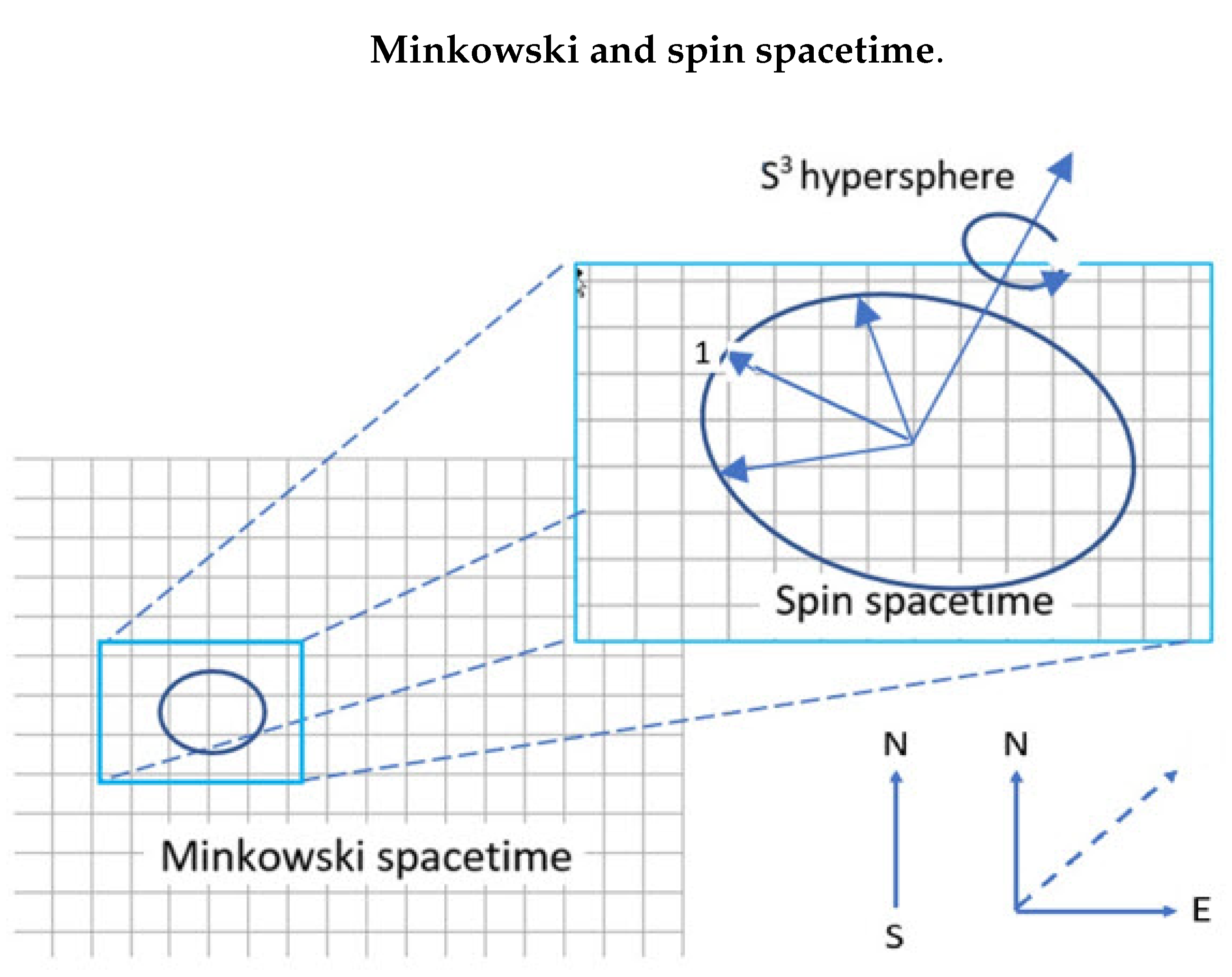
Figure 3.
The mirror states of a Q-spin with on the left and on the right. Note that adding these states is independent of and subtracting them is independent of and .
Figure 3.
The mirror states of a Q-spin with on the left and on the right. Note that adding these states is independent of and subtracting them is independent of and .
Figure 4.
The longer arrow denotes the direction of the polarizing field. The two polarization axes form Q-spin of even parity from the coupling of two mirror states. (middle top), The two mirror states in free flight, and couple to give the boson spin 1.(left and right) The axis closer to the field axis aligns. (middle lower) When the boson spin is close to the field, it precesses as a spin 1 before decoupling into its fermion components. )
Figure 4.
The longer arrow denotes the direction of the polarizing field. The two polarization axes form Q-spin of even parity from the coupling of two mirror states. (middle top), The two mirror states in free flight, and couple to give the boson spin 1.(left and right) The axis closer to the field axis aligns. (middle lower) When the boson spin is close to the field, it precesses as a spin 1 before decoupling into its fermion components. )
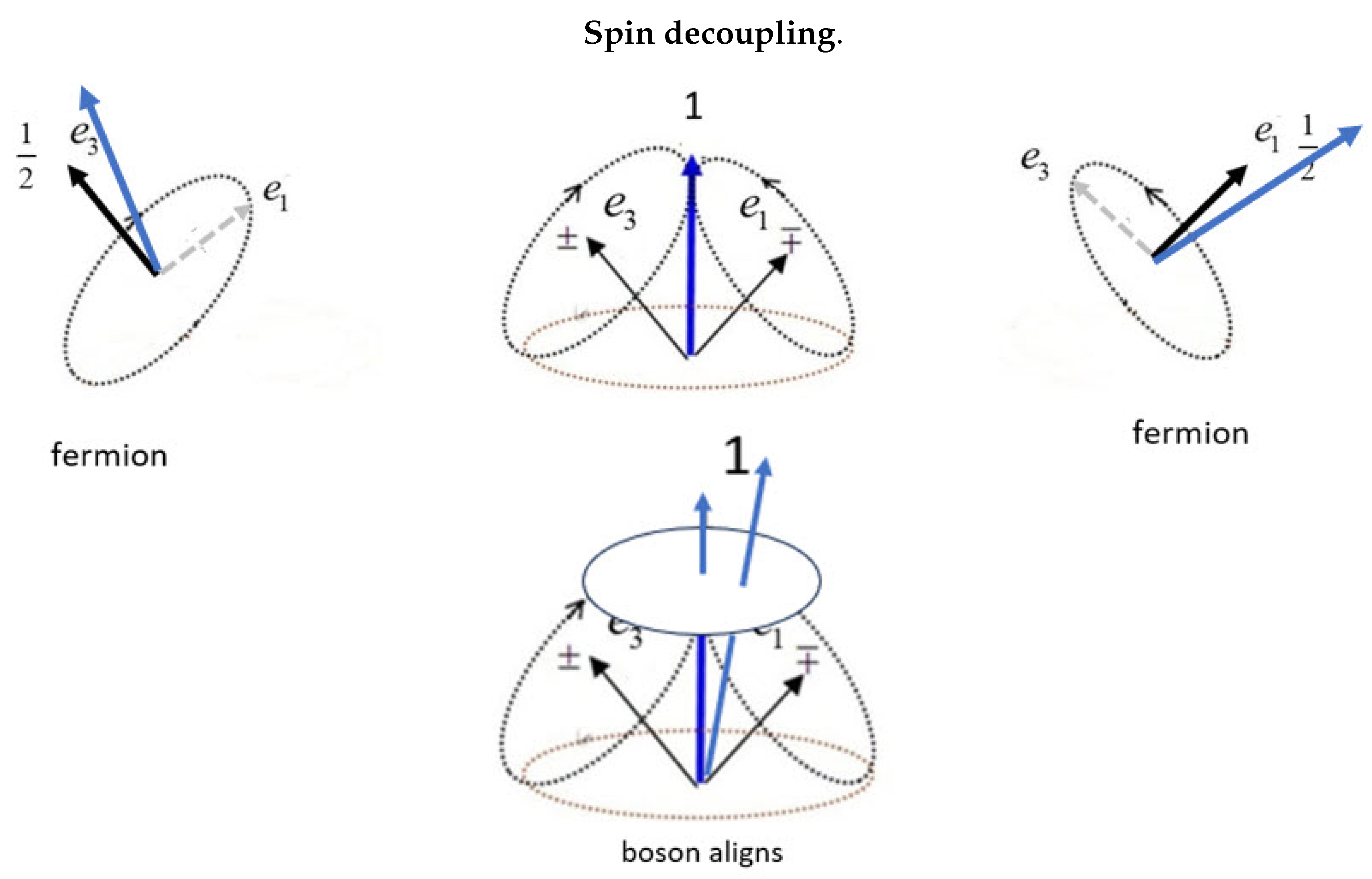
Figure 5.
The BFF showing the plane and the bisectors of the quadrants with boson spins of 1. The boson is labeled. The plane is oriented in the LFF by the Z axis, and the angle is shown. Also orients the field vector in the LFF. The angle is the orientation of a spin vector on the Bloch sphere.
Figure 5.
The BFF showing the plane and the bisectors of the quadrants with boson spins of 1. The boson is labeled. The plane is oriented in the LFF by the Z axis, and the angle is shown. Also orients the field vector in the LFF. The angle is the orientation of a spin vector on the Bloch sphere.
Disclaimer/Publisher’s Note: The statements, opinions and data contained in all publications are solely those of the individual author(s) and contributor(s) and not of MDPI and/or the editor(s). MDPI and/or the editor(s) disclaim responsibility for any injury to people or property resulting from any ideas, methods, instructions or products referred to in the content. |
© 2024 by the authors. Licensee MDPI, Basel, Switzerland. This article is an open access article distributed under the terms and conditions of the Creative Commons Attribution (CC BY) license (http://creativecommons.org/licenses/by/4.0/).
Copyright: This open access article is published under a Creative Commons CC BY 4.0 license, which permit the free download, distribution, and reuse, provided that the author and preprint are cited in any reuse.


