
Submitted:
06 July 2023
Posted:
12 July 2023
Read the latest preprint version here
Abstract
Dark matter in the Milky Way is explained as the F-type of vacuum polarization, which could be considered as dark radiation. A nonsingular solution for dark radiation exists in the presence of eicheon (i.e., an extremely compact object resembling a black hole) in the galaxy’s center. The model presented is spherically symmetric, but an approximate surface density of a baryonic galaxy disk is taken into account by smearing the disk over a sphere.
Keywords:
eicheon
; dark matter
; vacuum polarization
; rotational curve
; galaxy nuclei
1. Introduction
Observation of the stellar orbits around the center of the Milky Way [1,2], detecting the gravitational waves from the black hole/black hole and black hole/neutron star coalescence (for an overview, see, for instance, the catalog [3]), radio-astronomy observation of the “black hole shadows” in the centers of galaxies [4,5] are widely considered as the direct evidence of an extremely compact astrophysical object (ECO) existence with a radius of an order of the Schwarzschild one. The observable properties of such object are well-described by an exact Schwarzschild (or more precisely, Kerr) solution of the general relativity (GR) equations [6,7]. A principal question is whether the Schwarzschild solution interprets reality quite adequately. Indeed, there are a lot of theoretical attempts to describe ECO whose properties approach those of an ordinary GR black hole sufficiently far from the event horizon (so-called horizonless “exotic compact objects” [8]). Some of them are based on the modified theories of gravity (for the comprehensive reviews, see [9,10], and one may add an additional alternative approach based on the relativistic theory of gravity with a massive graviton [11]).
The question about the nature of ECO is also related to the need for dark matter to explain the galactic rotational curves [12,13]. In particular, the first observation of the DM density around the stellar-mass ECO appears [14]. It was conjectured that the primordial black holes could be considered the candidates to DM [15].
Besides, there is a plethora of DM candidates [16]. However, could we advance without extraordinary physics but only by taking a vacuum polarization into account correctly [17]? Conventional answer is “No” in the frame of the renormalization technique of quantum field theory on a curved background [18,19]. Still, this approach demands covariance of the mean value of the energy-momentum tensor over the vacuum state [18]. This demand has no solid foundation because it is known that there is no vacuum state invariant relative to the general transformation of coordinates. On the contrary, an argument was put forward that the preferred conformally-unimodular metric (CUM) could describe a vacuum polarization and resolve the problem of dark matter [17,20]. In this metric, a black hole as an object having a horizon is absent. Its disappearance results from the coordinate transformation relating the Schwarzschild-type metric to CUM, which selects some shell over the horizon and draws it into a node. As a result, a point mass without a horizon arises in a CUM. It is an idealized picture. In reality, one must know the equation of the state of a substance forming such ECO (named “eicheon” [21]).
Here, aiming at understanding the eicheon nature, we will use an approximation of the constant energy density and a trial “equation of state” relating the maximal pressure and the energy density. Recently, ECOs without a horizon have been discussed intensively (e.g., [22,23,24,25]). A zoo of exotic ECO, such as bosonic stars [26], gravastars [27], and other exotic stars [28,29], was proposed and theoretically explored. Also, the approaches based on constructing the nonsingular black-hole metrics in the spacetimes of different dimensions were proposed (e.g., see [30,31]). In our approach, we construct eicheon, and, after determining its properties, describe an eicheon surrounded by “dark radiation” to explain the rotational curves of the Milky Way. “Dark radiation” is one of the two kinds of vacuum polarisation considered in [17], namely polarization of the F-type. Finally, to be closer to observations, we introduce a baryonic matter into the model by smearing the galactic disk of the Milky Way.
2. What is “eicheon”?
Eicheon is a horizon-free object which appears instead of a black hole in CUM. As an idealized structure, eicheon represents a solution of a gravitational field of a point mass in CUM. In the metric of a Schwarzschild type, it looks like a massive shell situated over the Schwarzschild radius. In the real world, where there is no infinite density and pressure, the eicheon could be modeled in the Schwarzschild-type metric by a layer of finite width over the horizon as it is shown in Figure 1. In CUM, it looks like a solid ball [21,32]. A constant density model is convenient for understanding the main features of the eicheon.
CUM for a spherically symmetric space-time is written as
where , , and are the functions of . The matrix with the unit determinant is expressed through . The interval (1) could be also rewritten in the spherical coordinates:
to give
However, let us discuss eicheon properties in the Schwarzschild-type metric, which is more convenient for a reader
In this metric, the Volkov-Tolman-Oppenheimer (TOV) equation for a layer reads as:
where the function
and the reduced Planck mass . We will model a layer of constant density so that is reduced to
It is convenient to measure distances in units of the Schwarzschild radius , and density and pressure in the units . In these units, it follows from (7) and that
The TOV equation (5) is reduced to
and has to be solved with the boundary condition , where the second equality follows from (8). Let us simplify a problem further and assume that in the Schwarzschild radius units. Even in this case, there is no analytical solution of the equation (9), but the most interesting quantity is a maximal pressure , which could be approximated by the expression
as is shown in Figure 2.
If to supplement Eq. (10) by the “equation of state”, which connects the maximal pressure with the density, then it is possible to determine the pressure and density. For instance, the “equation of state” corresponding to a degenerate relativistic fermion gas
gives no solution because of Eqs. (10) and (11) are incompatible.
The equation of state of the nonrelativistic degenerate Fermi gas is written in physical units as
where is a particle mass, and the tilde denotes that the quantity is expressed in the physical units. When is large, one could use only the first term in Eq. (10), and its equating to the pressure from (12) gives the following expression
allowing us to find the physical density
which decreases with an increase of mass m of the eicheon. Dimensionless density is found by dividing (14) by and reads
It grows with the increase of m, so that approximation becomes justified at some mass according to (10). Respectively, the width of the eicheon shell decreases: and becomes very thin at large m. Certainly, we measure the relative width in units of gravitational radius . For instance, if take the eicheon mass equal to the Sun mass and equals the neutron mass, then dimensional density , while the dimensionless equals 7.65017. This eicheon has rather thick skin and, in principle, can be distinguished from a conventional black hole. One more example is the eicheon of a large mass . In this case, the physical density is much lower and we could consider the “equation of state” for a cold hydrogen plasma, where the pressure is created by a degenerate electron gas, and the dimensional density satisfies
so that
The dimensionless density is given by
Numerically, these values are , . The eicheon skin is very thin . Such eicheon is indistinguishable from a conventional black hole. At the same time, it is rather “mellow” by virtue of (17). Certainly, there is no paradox here because is measured in the units of , which is large in the case considered. Finally, we can estimate eicheon in the center of the Milky Way using the formulas (16), (17), (18). For they give , and that is lesser than the white dwarf mean density [33].
3. Vacuum polarization around of eicheon
As was shown any mass eicheons exist because the inner and the outer radii (see Figure 1b ) of this spherical shell exceed the Schwarzschild radius and the Buchdahl’s bound [34] is not reached.
Considering the vacuum polarization for an arbitrary curved space-time background is a highly complex problem. Instead, one could consider scalar perturbations of CUM:
and calculate a spatially nonuniform energy density and pressure arising due to vacuum polarization in the eikonal approximation [17].
As was shown [17], the energy density and pressure of vacuum polarization corresponding to the F-type of metric perturbations (19) have the radiation equation of state. That gives a possibility to use a hypothetical “dark radiation” in some nonlinear models. One could use it in the TOV equation as a heuristic picture. For a radiation substance alone, a singular solution of the TOV equation exists that is devoid of physical meaning [35]. However, the situation changes cardinally in CUM in the presence of the nonsingular eicheon. This gives a possibility to set a boundary condition for a radiation fluid at and obtain a nonsingular solution, including the dark radiation. In the Schwarzschild type metric (4), the boundary condition is set at the radial coordinate of an inner shell , which corresponds to the point in CUM (see Figure 1) .
The system of equations (see Appendix A ) in the metric (4), implies three substances: the eicheon of the constant density , the dark radiation density , and the density of baryonic matter of the galactic disk and bulge:
where the baryonic matter of a disk with is considered as some external matter density. According to (20), there are two equations for the pressure and "dark radiation" density inside the eicheon and a single equation for “dark radiation” density outside the eicheon.
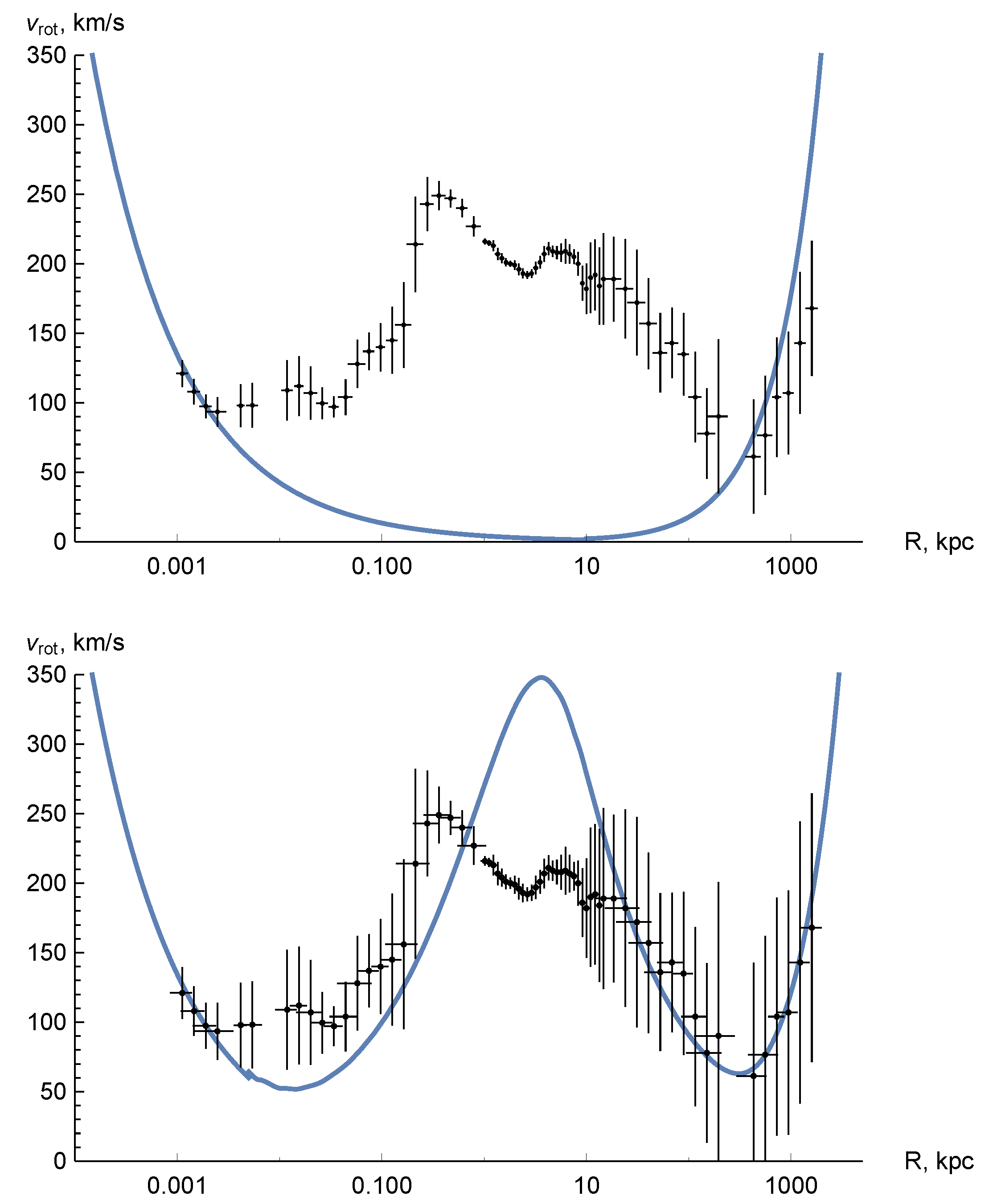
As is shown in the upper panel of Figure 3, the eicheon without galactic disk and bulge contributes at a small distance, and the dark radiation contributes at large distances. The density of dark radiation depends on the eicheon structure, which was considered in the previous section. It is convenient to introduce a universal quantity of a dark radiation density for the Milky Way at the radius of a photon sphere , namely . Moreover, it remains a single parameter, because the eicheon mass in the dimensionless units equals . Thus a dark matter tail is reproduced by virtue of the universal equations
That is a spherically symmetric model where the amount of dark radiation is adjusted to fit the observations. To consider the baryonic matter, one could smear a baryonic galactic disk on a sphere and view the resulting mass density as some external non-dynamical density in the TOV equations for the eicheon and dark radiation. This external density creates an additional gravitational potential.
Let us consider the surface density of matter in a galactic disk:
and write the mass corresponding to the radial distance
According to (23), the smeared 3-dimensional density has the form:
The result of the calculations for the Milky Way rotational curve is shown in the lower panel of Figure 3. As one can see, the simple model with smeared disk describes the baryonic matter roughly, but the observed rotational curve has a more complicated structure.
4. Discussion and conclusion
We have shown that the F-type vacuum polarization in the Milky Way could explain DM, which mimics a sort of “dark radiation.” Namely the presence of ECO, or eicheon, in the center of the galaxy provides a nonsingular solution for dark radiation. The eicheon resembles a black hole for an external observer but has no horizon. Our model proposed is spherically symmetric. However, the appropriate approximation of the distribution of baryonic matter in a galaxy by smearing the disk over a sphere allows for obtaining the qualitative agreement of the rotational curves with the observed ones.
Let us remind the principles of calculation. We have considered the vacuum polarization of F-type in the conformally unimodular metric (19) and find that it has a radiation equation of state. Then, we solve the TOV equation for incompressible fluid and dark radiation and obtain a nonsingular solution. To consider the baryonic matter, we smear a galactic disk and use the resulting density as some external density. Interestingly, the Milky Way’s dark radiation tail can be described by a single parameter: density of dark radiation at the radius of a photon sphere of the eicheon. The numerical value of this density is . The spatially uniform residual energy density of vacuum fluctuations, which remain after compensation of its main part by the constant in the Friedman equation [36], is of the order of critical density . Thus, the relative spatial nonuniformity of dark radiation is estimated as . Indeed, this is a very heuristic analysis because we use the amount of the dark radiation at a photon radius of the eicheon . Still, this amount rapidly decreases at and increases at . In this light, it is interesting to obtain a general picture of matter structure formation in the universe by the solution of the system of the equations for the perturbations of the metric and the matter, including vacuum polarisation of both types [17].
Appendix A. TOV equation for a mixture of ordinary and dark fluids
Each of the fluids obeys the equation of the hydro-static equilibrium [35]:
whereas the equations for gravitational field give [35]
where , and . Solution of the equation (A2) is written formally as
where is given by (6) Expressing from (A1), A, from (A4), (A3) and substituting them into (A2) gives
The analogous equation holds for the second fluid.
The appendix is an optional section that can contain details and data supplemental to the main text. For example, explanations of experimental details that would disrupt the flow of the main text, but nonetheless remain crucial to understanding and reproducing the research shown; figures of replicates for experiments of which representative data is shown in the main text can be added here if brief, or as Supplementary data. Mathematical proofs of results not central to the paper can be added as an appendix.
References
- Gillessen, S.; Eisenhauer, F.; Trippe, S.; et al. Monitoring stellar orbits around the Massive Black Hole in the Galactic Center. Astrophys. J. 2009, 692, 1075–1109. [Google Scholar] [CrossRef]
- Nampalliwar, S.; Kumar, S.; Jusufi, K.; Wu, Q.; Jamil, M.; Salucci, P. Modeling the Sgr A* Black Hole Immersed in a Dark Matter Spike. Astrophys. J. 2021, 916, 116. [Google Scholar] [CrossRef]
- Abbott, R.; Abbott, T.; Acernese, F.; Ackley, K.; Adams, C.; Adhikari, N.; Adhikari, R.; Adya, V.; Affeldt, C.; Agarwal, D.; others. GWTC-3: Compact Binary Coalescences Observed by LIGO and Virgo During the Second Part of the Third Observing Run. arXiv 2021, arXiv:2111.03606.
- Akiyama, K.; Alberdi, A.; Alef, W.; Asada, K.; Azulay, R.; Baczko, A.K.; Ball, D.; Baloković, M.; Barrett, J.; Bintley, D.; others. First M87 event horizon telescope results. VI. The shadow and mass of the central black hole. Astrophys. J. Lett. 2019, 875, L6. [Google Scholar]
- Johnson, M.D.; Narayan, R.; Psaltis, D.; Blackburn, L.; Kovalev, Y.Y.; Gwinn, C.R.; Zhao, G.Y.; Bower, G.C.; Moran, J.M.; Kino, M.; others. The Scattering and Intrinsic Structure of Sagittarius A* at Radio Wavelengths. Astrophys. J. 2018, 865, 104. [Google Scholar] [CrossRef]
- Landau, L.D.; Lifshitz, E. The Classical Theory of Fields; Volume 2; Butterworth-Heinemann: Oxford, UK, 1975. [Google Scholar]
- Chandrasekhar, S. The mathematical theory of black holes; Oxford University Press: New York, NY, USA, 1983. [Google Scholar]
- Cardoso, V.; Pani, P. Testing the nature of dark compact objects: a status report. Liv. Rev. Rel. 2019, 22, 1–104. [Google Scholar] [CrossRef]
- Berti, E.; Barausse, E.; Cardoso, V.; Gualtieri, L.; Pani, P.; Sperhake, U.; Stein, L.C.; Wex, N.; Yagi, K.; Baker, T.; others. Testing general relativity with present and future astrophysical observations. Class. Quant. Grav. 2015, 32, 243001. [Google Scholar] [CrossRef]
- Yagi, K.; Stein, L.C. Black hole based tests of general relativity. Class. Quant. Grav. 2016, 33, 054001. [Google Scholar] [CrossRef]
- Logunov, A.A.; Mestvirishvili, M.A. On the possibility of gravitational collapse in the relativistic theory of gravity. Theor. Math. Phys. 1997, 112, 1056–1067. [Google Scholar] [CrossRef]
- Sofue, Y. Rotation Curve and Mass Distribution in the Galactic Center – From Black Hole to Entire Galaxy. Publ. Astron. Soc. Jpn. 2013, 65, 118. [Google Scholar] [CrossRef]
- Baes, M.; Buyle, P.; Hau, G.K.; Dejonghe, H. Observational evidence for a connection between supermassive black holes and dark matter haloes. MNRAS 2003, 341, L44–L48. [Google Scholar] [CrossRef]
- Chan, M.H.; Lee, C.M. Indirect evidence for dark matter density spikes around stellar-mass black holes. Astrophys. J. Lett. 2023, 943, L11. [Google Scholar] [CrossRef]
- Carr, B.; Kühnel, F. Primordial black holes as dark matter: recent developments. Ann. Rev. Nucl. Part. Sci. 2020, 70, 355–394. [Google Scholar] [CrossRef]
- Bertone, G.; Tait, T.M. A new era in the search for dark matter. Nature 2018, 562, 51–56. [Google Scholar] [CrossRef] [PubMed]
- Cherkas, S.L.; Kalashnikov, V.L. Vacuum Polarization Instead of Dark Matter in a Galaxy. Universe 2022, 8, 456. [Google Scholar] [CrossRef]
- Birrell, N.D.; Davis, P.C.W. Quantum Fields in Curved Space; Cambridge University Press: Cambridge, England, 1982. [Google Scholar]
- Brunetti, R.; Fredenhagen, K. Quantum Field Theory on Curved Backgrounds. In Quantum Field Theory on Curved Spacetimes: Concepts and Mathematical Foundations; Springer Berlin Heidelberg: Berlin, Heidelberg, 2009; Bär, C., Fredenhagen, K., Eds.; Springer: Berlin/Heidelberg, Germany, 2009; pp. 129–155. [Google Scholar] [CrossRef]
- Cherkas, S.L.; Kalashnikov, V.L. Æther as an Inevitable Consequence of Quantum Gravity. Universe 2022, 8, 626. [Google Scholar] [CrossRef]
- Cherkas, S.L.; Kalashnikov, V.L. Eicheons instead of Black holes. Phys. Scr. 2020, 95, 085009. [Google Scholar] [CrossRef]
- Barceló, C.; Liberati, S.; Sonego, S.; Visser, M. Fate of gravitational collapse in semiclassical gravity. Phys. Rev. D 2008, 77, 044032. [Google Scholar] [CrossRef]
- Chapline, G. Emergent Space-Time. In Beyond Peaceful Coexistence: The Emergence of Space, Time and Quantum; Licata, I., Ed.; Imperial College Press: London, the UK, 2016; pp. 419–432. [Google Scholar]
- Carballo-Rubio, R.; Di Filippo, F.; Stefano Liberati, S.; Visser, M. A connection between regular black holes and horizonless ultracompact stars. arXiv 2022, arXiv:2211.05817. [Google Scholar] [CrossRef]
- Carballo-Rubio, R.; Filippo, F.D.; Liberati, S.; Visser, M. Singularity-free gravitational collapse: From regular black holes to horizonless objects. arXiv 2023, arXiv:2302.00028. [Google Scholar]
- Schunck, F.E.; Mielke, E.W. General relativistic boson stars. Class. Quant. Grav. 2003, 20, R301. [Google Scholar] [CrossRef]
- Ray, S.; Sengupta, R.; Nimesh, H. Gravastar: An alternative to black hole. Int. J. Mod. Phys. D 2020, 29, 2030004. [Google Scholar] [CrossRef]
- Urbano, A.; Veermäe, H. On gravitational echoes from ultracompact exotic stars. JCAP 2019, 2019, 011. [Google Scholar] [CrossRef]
- Singh, K.N.; Ali, A.; Rahaman, F.; Nasri, S. Compact stars with exotic matter. Phys. Dark Universe 2020, 29, 100575. [Google Scholar] [CrossRef]
- Hayward, S.A. Formation and evaporation of nonsingular black holes. Phys. Rev. Lett. 2006, 96, 031103. [Google Scholar] [CrossRef]
- Frolov, V.P. Notes on nonsingular models of black holes. Phys. Rev. D 2016, 94, 104056. [Google Scholar] [CrossRef]
- Cherkas, S.L.; Kalashnikov, V.L. Structure of the compact astrophysical objects in the conformally-unimodular metric. J. Belarusian State Univ. Physics 2020, 3, 97–111. [Google Scholar] [CrossRef]
- Weidemann, V. White dwarfs. Ann. Rev. Astron. Astrophys. 1968, 6, 351–372. [Google Scholar] [CrossRef]
- Buchdahl, H.A. General Relativistic Fluid Spheres. Phys. Rev. 1959, 116, 1027–1034. [Google Scholar] [CrossRef]
- Weinberg, S. Gravitation and Cosmology: Principles and Applications of the General Theory of Relativity; John Wiley & Sons: New York, 1972. [Google Scholar]
- Haridasu, B.S.; Cherkas, S.L.; Kalashnikov, V.L. A reference level of the Universe vacuum energy density and the astrophysical data. Fortschr. Phys. 2020, 68, 2000047. [Google Scholar] [CrossRef]
Figure 1.
(a) Nonsingular eicheon surrounded by dark radiation in conformally unimodular metric (3) has nonsingular core. (b) In the Schwarzschild type metric (4), this core looks like a hollow sphere. Vacuum polarization around an eicheon is shown as the gradient of a density.
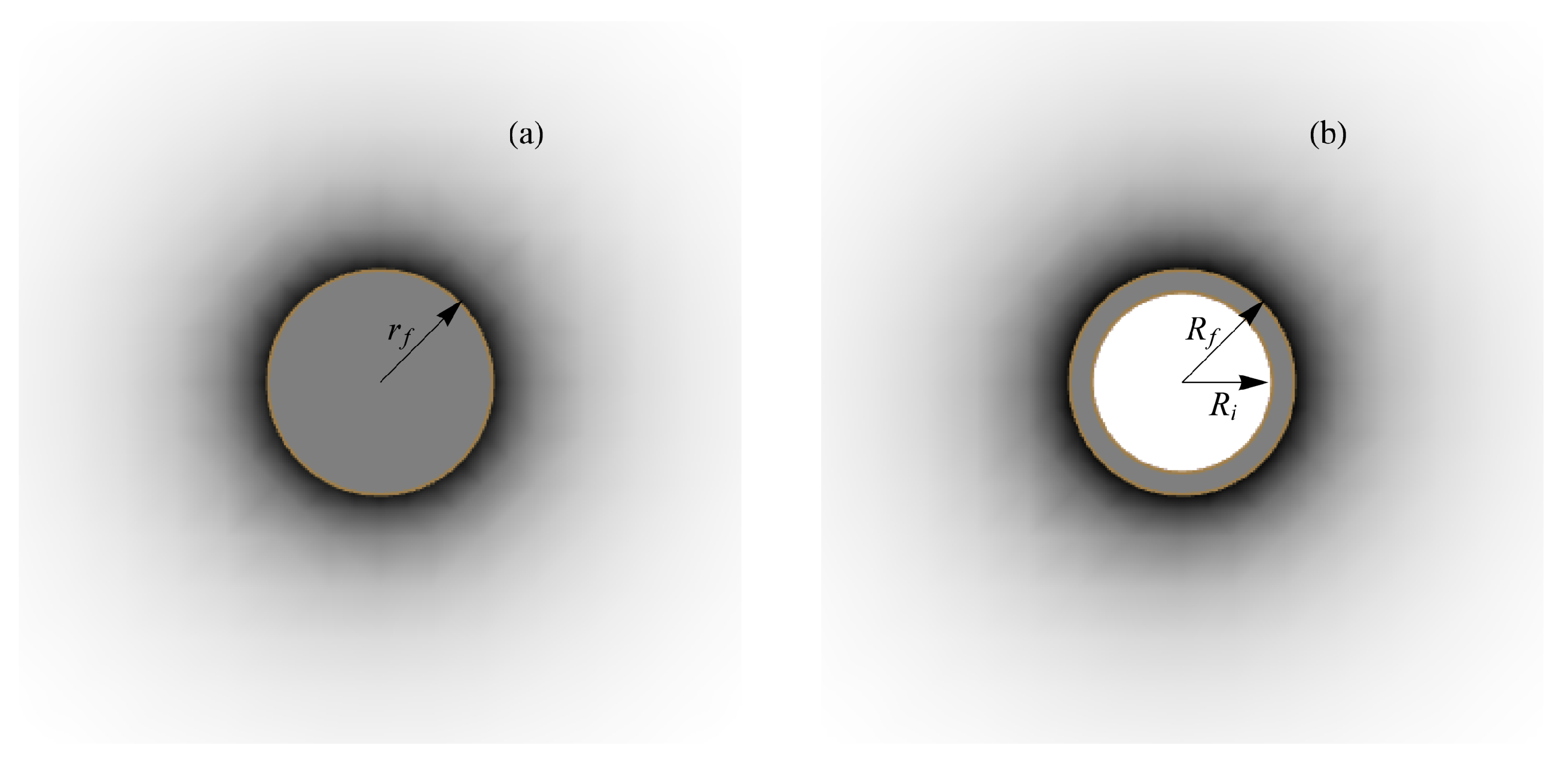
Figure 2.
Pressure in the center of eicheon (see. Figure 1 (a) ) in CUM metric, coinciding with the pressure in metric (4) (see. Figure 1 (b) ). Blue and brown curves correspond to the numerical integration of the equation (9) and approximation (10), respectively.

Disclaimer/Publisher’s Note: The statements, opinions and data contained in all publications are solely those of the individual author(s) and contributor(s) and not of MDPI and/or the editor(s). MDPI and/or the editor(s) disclaim responsibility for any injury to people or property resulting from any ideas, methods, instructions or products referred to in the content. |
© 2023 by the authors. Licensee MDPI, Basel, Switzerland. This article is an open access article distributed under the terms and conditions of the Creative Commons Attribution (CC BY) license (http://creativecommons.org/licenses/by/4.0/).
Copyright: This open access article is published under a Creative Commons CC BY 4.0 license, which permit the free download, distribution, and reuse, provided that the author and preprint are cited in any reuse.


