
Submitted:
13 February 2024
Posted:
14 February 2024
Read the latest preprint version here
Abstract
The aim of this study was to determine the microbial stability, challenge to L. monocytogenes, and some physicochemical properties of turkey breast meat by alginate-based coating enriched with postbiotics (8% concentration, CFS) of Bifidobacterium bifidum DSM 20456 and Bifidobacterium bifidum BB12 strains. For this purpose, firstly, some antimicrobial and total phenolic matter, flavonoid, and DPPH activity values of postbiotics were determined. In addition, FTIR analysis was performed to see the intermolecular interactions of the biological coating agent. As a result of the study, alginate solution with postbiotic showed significant differences in pH, a*, b*, yeast-mold values of turkey meat during storage (7 days), while L* value, total aerobic mesophilic bacteria count (TMAP), psychrotrophic bacteria (PAB), lactic acid bacteria (LAB) and Listeria monocytogenes count were not effective (p>0.05).
Keywords:
turkey meat 1
; edible coating 2
; Bifidobacterium bifidum. 3
; postbiotics 4
; alginate 5
1. Introduction
In the last two decades, poultry meat production has been steadily increasing worldwide. FAO estimates that poultry meat production will reach approximately 151 million tons in 2030 [1]. Turkey meat is a source of low fat and cholesterol content, rich protein, minerals such as calcium, phosphorus, potassium, essential amino acids, and vitamins B1, B2, B6, and B12. It also contains high amounts of unsaturated fatty acids and essential fatty acids [2,3]. However, the high nutritional value of meat products creates an ideal environment for spoilage reactions [4]. Due to the high content of unsaturated fatty acids and free iron in poultry meat products, one of the main spoilage problems is lipid oxidation and cross-contamination that can occur in production facilities during transport and storage [2,5]. Under these conditions, the foodborne disease hazard of raw meat products should be considered. These foods are generally not subjected to post-treatment processes that eliminate or reduce dangerous pathogens before consumption [5,6]. In various ways, foodborne pathogenic microorganisms can adhere to surfaces, form colonies on meat, and endanger human health [6].
Listeria monocytogenes can be transmitted to meat and meat by-products through cross-contamination, especially in poultry processing environments, and can cause listeriosis. The US Centers for Disease Control and Prevention reported that approximately 1600 people are affected by listeriosis annually in the United States; roughly 95% are hospitalized, and more than 15% die [3].
Increasing consumer awareness of high-quality and safe food products has led scientists and the meat industry to increase the trend towards food products packaged with natural, biodegradable, and harmless materials to preserve the quality and extend the shelf life of meat and meat products that are sensitive to spoilage [2,4]. Edible films and coatings produced from natural components such as proteins (zein and whey) and polysaccharides (gum, alginate, and chitosan, e.g.) will be an alternative to non-biodegradable plastic materials in food packaging due to their biodegradable, edible, environmentally friendly and low price [7,8,9,10,11]. Sodium alginate is an anionic polysaccharide that can be gelatinized by adding divalent cations such as Ca2+ and is widely used in meat and meat products as coating and film due to its good film-forming ability, low price, easy availability, and biodegradability [12,13,14]. Sodium alginate improves food flavor and food quality by limiting oxygen interaction and improving water barrier properties. FDA has accepted sodium alginate as a GRAS substance, and the European Food Safety Authority has approved the use of alginate and related salts in defined amounts [14]. Recently, to improve the biological functions (antimicrobial, radical scavenging) of edible coatings, components such as microbial origin (probiotic and postbiotic, bacteriocin, etc.) and their metabolites are included in the coating [15].
Recently, one of the most studied natural antimicrobial agents that are applied to foods and have beneficial effects on health is postbiotics, bioactive soluble substances secreted by probiotic microorganisms. Probiotics (i.e. Lactic acid bacteria (LAB), Bifidobacterium spp., S. cerevisiae, and Bacillus spp.) produce postbiotics in culture medium (or fermentation), in food or in the gastrointestinal tract (GIT) Postbiotics are a mixture of organic acids, exopolysaccharides (EPS), bacteriocins, bioactive peptides, enzymes, and other components, which are applied in household and meat products by direct application, dipping, polymer coating/film, etc. [16].
To the best of our knowledge, there is no article reporting the effect of postbiotics of Bifidobacterium spp. on the preservation of turkey breast meat. In this context, the study aimed to highlight the microbial activity and physicochemical effects of raw turkey breast meat coated by dipping in postbiotic-alginate edible films obtained from Bifidobacterium bifidum DSM 20456 and Bifidobacterium bifidum BB12 strains against L. monocytogenes stored at 4°C for 7 days.
2. Materials and Methods
2.1. Preparation of postbiotics
The postbiotic used in the study was obtained according to Incili et al., (2021) [17] with some modifications. Bifidobacterium bifidum DSM 20456 and Bifidobacterium bi-fidum BB12 strains (Akdeniz University, Food Engineering Department, Turkey) were obtained. The culture was grown on MRS agar (Lactobacillus Agar acc. To De Man, Rogosa and Sharpe, BID, Germany) at 37 °C for 24-48 h to approximately 12Mac Farland densimetre, followed by centrifugation at 9400 × g for 10 min at 4 °C (NF 800 R, Nüve, Turkey). After centrifugation, postbiotics were obtained by filtration using a 0.22 μm syringe filter (Laborgerâte GmbH, Germany). The freshly obtained postbiotics were adjusted to 8% concentration in the immersion solution for use in the study.
2.2. Characterization of Postbiotics
2.2.1. DPPH (radical scavenging) activity, Total phenolic compounds (TPC), Flavonoid compounds and Gas chromatography-mass spectroscopy (GC/MS)
These analyses were carried out by Akdeniz University Food Safety and Agricultural Research Centre and Western Mediterranean Agricultural Research Institute Directorate (Antalya/TURKEY).
2.2.2. Minimum inhibitory concentration (MIC) and Disc Diffusion of Postbiotics
To determine the MIC of Bifidobacterium bifidum DSM 20456 and Bifidobacterium bifidum BB12 posbiotics against L. monocytogenes ATCC 19118, Salmonella enterica ATCC 14028, Staphylococcus aureus ATCC 25923, Escherichia coli ATCC 25922 and Bacillus cereus ATCC 11778, each well of a 96-well plate (Corning) was filled with 0.1 mL of postbiotic (10-100 mg/mL) and with serial dilution using TSB [8] with minor modifications. The most dilute well in which no growth was observed was expressed as the minimum inhibition concentration (MIC) that inhibits the growth of the microorganism.
To determine the antimicrobial activity of the postbiotics (CFSs) of Bifidobacterium spp., the agar-disk diffusion method was used. Lawns of the L. monocytogenes (∼6 log10 CFU/mL) were prepared on Oxford Agar. A Whatman filter paper grade 3 was impregnated in the corresponding CFS solution (10 mg/mL) and placed in the center of the inoculated plate. The plates were then incubated at 37 ± 1 °C for 24 h and the diameter of inhibition zone was measured using a digital caliper in triplicate [16].
2.3. Preparation of L. monocytogenes Pathogenic Bacteria Inoculum
Listeria monocytogenes (ATCC 19118) was used in the study. Listeria monocytogenes (ATCC 19118) maintained at 4-7°C in blood agar (Merck, 110886, Germany) were taken with the help of a sterile core, switched to a special selective medium for each bacterial culture and left to incubate for 24-48 hours under appropriate conditions. At the end of incubation, the colonies were taken from the separated colonies with the help of a sterile core and suspended in tubes containing 9 mL sterile ringer solution (Merck, 115525, Germany) and the density of the inoculum suspension was adjusted according to 0.5 McFarland standard with a densitometer (Biosan, 1B, Turkey).
2.4. Preparation of the Experiments
The fresh turkey breast fillets (without skin) were purchased from Bahar Turkey Meat Industries A.Ş (Antalya/Turkey). Turkey breast meats were immediately trans-ported to the laboratory in the ice back (4±1°C) under hygienic conditions. Then, turkey breast meat is cut into 25 g pieces with a sterile knife. All 25 g turkey breasts were used to determine the microbial loud and chemical analysis. After the preparation of samples, a 100µl inoculum cocktail was spread to the surfaces of 25g turkey breast meats with drigalski spatula. All samples were contaminated, allowed to bacterial attachment, and kept at laboratory temperature. Turkey breast samples randomly distributed in 5 groups are seen in Table 1. The turkey breast meat sample was inoculated with pathogenic bacteria without any treatment (postbiotic and alginate solution) and served as a control. The other coated samples were immersed for 2 min in 200 ml of the coating solutions. The fillets were removed and drained for 1 h at 20°C in a biosafety cabinet. After that, treatments were contaminated with L. monocytogenes pathogen. All samples were stored at 4°C in sterile bags. Each experiment was conducted in triplicate with three replicates.
2.5. Microbial Analysis
Microbiological counts were determined by homogenizing a 25 g sample in 225 ml of 0.1% MRD with a stomacher. Total viable bacterial counts were counted by the spread plate method, using plate count agar (PCA, BID, Germany). The plates were incubated at 37°C for 24-48 hours for the total viable count, and at 7°C for 10 days for the psychotropic count. The lactic acid population of bacteria was counted in MRS agar (BID, Germany) at 37°C for 2 days. For enumerating mold and yeast, DRBC agar (Dichloran Rose Bengal Chloramphenicol, BID, Germany) and incubation at 25°C for 3 days were used [18]. All microorganism counts were reported as log 10 CFU/g. All analyses were performed on day 0, 2, 4, and 7 of storage during storage.
2.6. Physicochemical Analyses of Coated Turkey Meat During Storage
Physicochemical analyses of control and postbiotic enriched alginate-coated turkey meat were performed on days 0, 2, 4, and 7 of cold storage (+4°C). Each analysis was carried out in 3 replicates and 2 parallels.
2.6.1. TBARS analysis
Monitoring of lipid oxidation in postbiotic and alginate-coated turkey breast meat samples was carried out by TBARS analysis with some modifications according to Kilic et al. [19] (2003), and the results were expressed as malonaldehyde (μmol/kg), TBARS value. 2 g sample was homogenized with 2 mL trichloroacetic acid (TCA) solution for 15-20 seconds. The homogenized sample was filtered through Whatman no 1 filter paper, 1 mL of the filtrate was taken, and 1 mL of thiobarbituric acid (TBA) solution was added. For the blind solution, 1 mL of TCA and 1 mL of TBA solution were used. The resulting mixture was kept in a water bath (JSSB-50T, JSR Co. Ltd., Seoul, Korea) at 100°C for 40 min and then cooled to room temperature and centrifuged at 4100 rpm for 10 min (Combi-514R, Hanil Co. Ltd., Seoul, Korea). The absorbance of the supernatant after centrifugation was determined at 532 nm wavelength.
2.6.2. pH
The pH of turkey breast meat was measured with a Hanna HI981036 meat pH meter specially designed for meat and meat products [20].
2.6.3. Color evaluation
The surface of turkey meat covered with edible film was measured at four different locations. L*, a* and b* values were determined with a Spectro colorimeter (LS172, China) with a 22-mm aperture and a 10° observer and adjusted with a white tile. The L* value measures brightness (from 0 to 100), a* and b* values range from -120 to +120, a* measures greenness and redness, and b* measures blueness and yellowness [20].
2.7. Weight Loss
The weight loss (WL) was calculated through weight differences of turkey breast meat samples in accordance with the following equation and expressed as a percentage.
Where w1 is the weight of the turkey meat sample, and W1 is the weight of the sample after 0, 2, 4, and 7 days of chilled storage [20].
2.8. FTIR
The possible molecular interactions between the film ingredients and the postbiotic/probiotic supplements were analyzed using an FTIR spectrophotometer (Bruker Tensor 27, Bremen, Germany). The measurements were carried out in the 4000-400 cm-1 wavelength [21]. The postbiotic was also analyzed for comparison.
2.9. Statistical Analyses
All the analyses were performed in triplicates. Experimental data were reported as mean and standard deviation and subjected to analysis of variance (ANOVA). The significance of differences (p < 0.05) among samples was determined by Tukey with SPSS software version 23.0 for Windows (SPSS, Inc., Chicago, IL, USA).
3. Results
3.1. Antimicrobial Activity (MIC and disc Diffusion) of postbiotics
In the current study, the antimicrobial properties of Bifidobacterium postbiotics were investigated against some pathogenic bacterial species using MIC and disc diffusion antimicrobial tests.
Bifidobacterium postbiotics against indicator pathogen Listeria monocytogenes ATCC 19118 and Salmonella enterica ATCC 14028, Staphylococcus aureus ATCC 25923, Escherichia coli ATCC 25922 and Bacillus cereus ATCC 11778 were evaluated. The results of the disc diffusion test showed that Bifidobacterium postbiotics were more effective against Gr (+) bacteria than Gr (-) bacteria, and the average inhibition was between 11. 5mm-15.00 mm inhibition zone was observed. Gram-negative bacterial species had no inhibition zones. Table 2 shows that Bifidobacterium spp. strains were most effective on Listeria monocytogenes among the tested pathogens. In a study, films supplemented with Lactobacillus sakei postbiotic exhibited inhibition zones of 4.83±0.01 and 4.61±0.02 mm for E. coli and Listeria monocytes, respectively. Bifidobacterium bifidium postiotics used in our study were more effective than L. sakei. The cell walls of Gram-negative bacteria contain lipoproteins and lipopolysaccharides, which cause them to be more resistant to antimicrobial agents [15,26]. The absorbance values of Bifidobacterium bifidum DSM 20456 (B1), Bifidobacterium bifidum BB12 (B2) and Bifidobacterium bifidum DSM 20456+Bifidobacterium bifidum BB12 (BB) postbiotics were determined as 0.100, 0.143 and 0.123, respectively.
3.2. Antioxidant activity, total phenolic, total flavonoid contents of postbiotics
Antioxidant activity of B. bifidum DSM 20456, B. bifidum BB12 and B. bifidum DSM 20456+B. bifidum BB12, 50.28±0.20, 51.05±0.68 and 51.56±1.63 mg TEAC/100mL and total phenolic contents as 87. 13±2.24, 88.24±1.65 and 90.89±1.63 mg GAE/100mL and total flavonoid contents were 24.20±0.25, 18.83±2.21 and 21.34±0.96 respectively.The results of GC-MS (spectrophotometric) content analyses of Bifidobacterium spp. strains postbiotics used in the coating are given in Table 3.
Only a limited number of articles on the chemical composition of probiotics were found. As shown in Table 3, l-monopalmitin (monoglycerides), n-heptadecane (hydrocarbon), n-hexadecane (hydrocarbon) and n-tetradecane (hydrocarbon) were the most frequently identified in the content analysis of postbiotics. 1-Monopalmitin (1-Mono) is one of the major bioactive components of postbiotics. Recently, 1-Mono has attracted attention as a potential cancer therapeutic and chemotherapy adjuvant [23]. Therefore, it is necessary to investigate the cytotoxic effect of 1-monoplamitin from Bifidobacterium spp. on cancer cells. In addition, some studies have reported antimicrobial activities of this compound mainly against Gram-negative pathogens and equally against fungi such as Fusarium spp., Aspergillus spp. and Penicillium spp. [24].
3.3. pH, TBARS and Water Holding Capacity (WHC)
Changes in pH were found in all turkey breast meat samples. The pH values of the samples decreased until the 7th day of storage (p<0.001). After the 7th day, the pH values of the groups reached the levels of the first day (p<0.001). especially the pH value of the bb group showed a significant decrease from the first day (p<0.001).
Fresh meat is one of the main reactions of concern because it is highly sensitive to oxidation. Hydroperoxides are produced through lipid peroxidation and when these compounds are broken down, secondary oxidative products are produced, causing unpleasant odors and flavors in meat [25]. Malondialdehyde is formed during oxidative degradation of lipids [26]. Table 4. shows TBARS changes in edible coating with Bifidobacterium spp. postbiotics turkey breast meats. The TBARS values of samples showed fluctuations during storage (7 days).
No significant difference was found between the groups and sampling days for TBARS (p>0.05). TBARS values of the samples were similar except for the b2 and bb groups (p>0.05). The control group had the highest TBARS value (1.54 μmol/kg) at the end of storage (p>0.05). Kuley et al. [27] (2021) reported that Lactobacilli reuteri supernatant alone had a weak antioxidative effect on sardine burger.
3.4. Color changes of turkey breast fillets
Postbiotic and sodium alginate treatments did not change the L* values between the groups during the storage period. (p>0.05; Table 5.). The L* values of the groups did not change during storage except for the b1 and b2 groups (p>0.05).
While the a* value did not show statistical significance (p>0.05) between the groups during all storage days except a and b2 (p<0.05). The a* value showed a significant difference on the 0. and 2nd day of storage, and the b* value showed a significant difference between the groups on all storage days except the 4th and 7th day (p<0.05). The b* values during storage only show significant changes in the a, b1 and b2 groups (p<0.05). As can be seen from Table 5, the b* color value of the a group had the highest 0th and 2nd. (p<0.05). a* values of the groups did not change during storage except for the a group (p>0.05). Especially on the 4th day, the a* value of the group turned out a green color.
3.5. FTIR Analysis
The molecular interactions occurring in the coating materials obtained by adding Bifidobacterium bifidum DSM 20456 (B1), Bifidobacterium bifidum BB12 (B2), and Bifidobacterium bifidum DSM 20456+Bifidobacterium bifidum BB12 (BB) postbiotics to alginate-based edible coating were investigated by FTIR spectrophotometry (Figure 1). FTIR provided very useful information about the chemical composition of alginate and alginate-postbiotic coating materials.
Alginate, a linear polysaccharide derived from brown seaweed, consists of varying proportions of β-d-mannuronic acid (M block) and α-l-guluronic acid (G block) linked by 1-4 glycosidic bonds. The block copolymer consists of homopolymer regions of M and G blocks separated by regions containing M and G units. The ratio and distribution of these blocks determine the physicochemical properties of the biopolymer. Sodium alginate is a polyelectrolyte with negative charges on its backbone. The polymer dissolves easily in water and forms homogeneous film-forming solutions [28]. In addition, many studies describe the common synergistic effect of alginate and gelatin on the formation of these biopolymers in aqueous mixtures and on the rheological properties of complex hydrogels [29].
Spectra demonstrated a broad band in the range of 3600-3100 cm-1 attributed to -NH and -OH stretching vibrations. The next two peaks 2928-2882 cm-1 are due to the vibration between CH and OH groups. Observed bands at 1603 and 1409 cm-1 attributed to asymmetric and symmetric stretching vibrations of -COO groups. These bonds indicate specific ionic bonding. The band near 1080 cm-1 describes the formation of cross-linking with C-C and C-O stretching. 800-950 cm-1 indicates O-H bonding vibration or strong binding of Ca+2 to guluronic acid [28,29,30].
3.6. Microbiological analysis of turkey breast meat
The microbial effects of alginate-based edible films containing postbiotics on Listeria monocytogenes inoculated on turkey breast meat surfaces are presented in Figure 2.
There was no significant difference between the mean total aerobic bacteria counts and psychotropic bacteria counts (TPB) of the samples on storage days (p>0.05). Control, a, b1, b2, and bb groups showed an increase of 2.65, 2.95, 2.98, 3.05, and 2.99 log10 CFU/mL from day 0 to day 7 of storage, respectively (p>0.05). Except for the control group, the mean total aerobic bacteria count of the other groups showed a statistically significant increase according to the days of storage analyzed (p<0.05). Although the turkey meat was brought from the factory to the laboratory without breaking the cold chain, it reached 7 log10 CFU/mL as of the 2nd day of storage. The control group and other alginate-based postbiotic-coated turkey breast meat were destroyed after the 4th de-storage analysis. As reported in other studies by the International Council of Food Microbial Standards, the maximum allowed microbial load for fresh meat is 7 log10 CFU/mL [29].
The numbers of L. monocytogenes in the treatment groups were found to be higher than the control group on day 0 (p>0.05). The control, a, b1, b2, and bb groups showed an increase of 2.06, 1.54, 1.49, 1.40, and 0.70 log10 CFU/mL, respectively, from day 0 to day 7 of storage (p>0.05). Although the bb group did not show statistical significance, it was effective on L. monocytogenes compared to the other groups.
Except for the b1 and b2 groups, there was no difference between the mean lactic acid bacteria counts during storage (p>0.05). The highest LAB count was found in the b2 group (5.78±0.42) and was 1.2 log10 higher than the control on day 0. At the end of the storage duration, LAB counts in the control, a, b1, b2, and bb were 5.65, 6.81, 7.03, 7.16, and 6.80 log10, respectively. At the end of storage, the mean lactic acid bacteria count of the b2 group was significantly higher than the control group (p<0.05). Yeast and mold counts were statistically different between the yeast and mold counts of the groups on days 0 and 2 except for days 4 and 7 (p<0.05). The bb group was mainly found to be effective on yeast and mold growth on the 4th and 7th day compared to the other groups (p>0.05).
4. Discussion
The number of studies on the characterization of postbiotics produced by LAB is quite limited. In particular, there are no studies on the use of postbiotics for Bifidobacterium spp—probiotic bacteria of fresh meat and poultry in the coating. Since postbiotics contain phenolic components, short-chain fatty acids, exopolysaccharides, etc., have high antioxidant activities, and have many positive effects on health (strengthening the immune system, anti-tumor effect, etc.), many studies have been conducted on their use as both functional food and nutraceuticals [33,34]. It is thought that the biological coating of fresh turkey breast meat also creates a functional food. The postbiotic concentrations used in the coating were obtained from Bifidobacterium bifidum strains with a concentration of approximately 12 Mc Farland.
When postbiotic characterizations are considered, it is seen that postbiotics are composed of very different and complex bioactive metabolites. This situation varies according to the strain type, the environment in which it is grown, etc. Bioactive components resulting from the breakdown of the cell walls of postbiotics obtained from probiotic bacteria can exhibit antimicrobial effects against other microorganisms.
İncili et al. [35], antioxidant activity (DPPH radical scavenging) and TPC (total phenolic content) of the postbiotic used in the study were found to be 439. 439±1.24 mg TEAC/L and 1708.15±93.28 mg GAE/L. In another study using the same bacterial strain, DPPH 1291±1.5 mg/L TEAC and TPC 2336.11±2.36 mg/L GAE were found [36]. The postbiotic DPPH and total phenolic compound values used in the study were higher than those of Bifidobacterium bifidium postbiotics used in our research. In the study in which the antioxidative properties of Bifidobacterium bifidum bacteria were investigated, the DPPH radical-scavenging activity of B. bifidum culture filtrate was increased in a dose-dependent manner, and the radical-scavenging activity was 56.5 ± 0.64, 71 ± 4.7, 94 ± 1.3% for 2.5, 5.0, and 7.5% of bacterial filtrate, respectively [34]. In the study in which postbiotics (cell-free supernatant) were used against Clostridium perfringens infection in poultry meat, it was determined that L. rhamnosus postbiotic had a high antioxidant capacity (172.08 mg/ml) due to its significant level of phenolic components.
Total flavonoid content (TFC) of L. rhamnosus EMCC 1105, L. fermentum, P. acidilactici, and P. acidilactici postbiotics were found to be 17.22, 11.42, 15.79, and 14.6 mg/ml, respectively [37]. The TFC amounts of postbiotics used in our study (18.18 - 24.20 mg/ml) were found to be higher.
As observed in the treatments, pH values were found between 5.48-5.84 on day 0 (p<0.05). While the pH values of group A and b1 were found to be the lowest on day 0 of storage, b2 group had the lowest pH value among the groups on the last day of storage (7.day). This finding suggests that Bifidobacterium bifidum BB12 post-biotic had the desired inhibitory effect on the coating. pH reduction during the storage period may occur because of lactic acid bacteria (p<0.05). on the contrary, Mojarradu et al. [2] reported that pH values of turkey meat coated with Lallemantia iberica seed mucilage enriched with M. Sylestris biological edible film increased during storage.
TBARS value in high-quality products must be lower than 3 mg MDA/kg, while in accepted quality material, it should not exceed 5 mg MDA/kg. TBARS levels ≥5 mg MDA/kg in meat include the threshold for distinguishing off-odors and off-taste for humans, TBARS values of our samples ranged from 0.93-1.54 mol/kg [37,38]. Groups of TBARS value was found to be less than 5 mg MDA/kg. Fluctuations were observed during storage, and they can be explained by the degradation of MDA by spoilage microorganisms and secondary oxidation, resulting in the formation of some metabolites that do not react with the TBA [40]. İncili et al. [18] found that the postbiotic of Pediococcus acidilactici did not affect TBARS values during the storage (p>0.05) as in our study.
The appearance of food is one of the effective factors for the customer to purchase food. In the present study, it was found that although L* (lightness) values increased during storage, they did not show significance between storage days and groups (p>0.05). In our study, it can be thought that the increase in pH values during storage prevents the color of the meat from turning brown (metmyoglobin). A* (redness) values decreased during storage except for the a and bb groups, while b* values decreased during storage except for the control and bb groups (p<0.05). İncili et al. [41] Used Lb. Plantarum postbiotic in meat marination, it was reported that a* and b* values changed and L* value decreased. In another study they conducted they found that postbiotic and chitosan did not affect the color properties (L*, a*, and b*) of chicken breast fillets (p>0.05) [18].
Postbiotic and alginate coating had no effect on total aerobic mesophilic, psychotropics, and lactic acid bacteria (p>0.05). Serter et al. (2023) et al. [39]. it was stated that the impact of L. sakei and L. plantarum postbiotics on L. monocytogenes was observed on the 4th day (p<0.05). They noted that this might be because postbiotics may have shown a bacteriostatic effect instead of a bactericidal effect. In addition, the fact that L. monocytogenes is a pH-resistant bacterium and can grow slowly at low pH is another difficulty in the fight against this pathogen.
The number of 7.0 Log10 CFU/ml TMAB is accepted as the upper limit of raw meats [40]. In this study, both the number of TMAB and psychotroph reached this value quickly (~4th day). This is thought to be due to the factory conditions in which the sample turkey meat was taken and the contamination of the meat with psychotropic bacteria (Pseudomonas spp etc.).
In the current study, there was a difference between the groups regarding yeast and mold counts on the 4th and 7th days (p<0.05). The alginate coating obtained with the mixture of Bifidobacterium bifidium DSM and Bifidobacterium BB12 postbiotics (1:1) provided inhibition on yeast and mold (p<0.05).
5. Conclusion
There are no studies in the literature on the effect of Bifidobacterium spp. postbiotics on the shelf life and physicochemical structures of meat and products. Future research studies on the shelf life of these postbiotics and alginate coating will continue with the addition of biological substances with antimicrobial and antioxidant properties, as well as Bifidobacterium spp. postbiotics. Thus, a product that is rich in content, has an increased shelf life and is beneficial for health will be obtained. It is thought that turkey meat is enriched with Bifidobacterium spp. postbiotics, one of the most important probiotic bacteria for intestinal microbiota, and a step has been taken to form functional food.
Funding
This research received no external funding.
Institutional Review Board Statement
Not applicable.
Informed Consent Statement
Not applicable.
Data Availability Statement
Data are contained within the article.
Acknowledgments
I would like to thank Prof. Dr. Ahmet Yılmaz Çoban, who gave me the opportunity to work in the laboratory, lecturer Dr. Kübra Yıldırım who shared her knowledge with me, and my graduate students, İrem Serra Pekşen, Aleyna Kavalcı and Meryem Ece Mutlu.
Conflicts of Interest
The authors declare no conflict of interest.
References
- Šojić, Branislav, et al. Antibacterial Activity of Selected Essential Oils against Foodborne Pathogens and Their Application in Fresh Turkey Sausages. Antibiotics 2023, 12, 182. [Google Scholar] [CrossRef]
- Mojarradi, Fatemeh, Mandana Bimakr, and Ali Ganjloo. Effect of bio-edible coating based on Lallemantia iberica seed mucilage incorporated with Malva sylvestris leaf bioactive compounds on oxidative stability of turkey meat. J. Food Meas. Charact. 2024, 18, 402–412. [Google Scholar] [CrossRef]
- Keykhosravy, Kobra, et al. Protective effect of chitosan-loaded nanoemulsion containing Zataria multiflora Boiss and Bunium persicum Boiss essential oils as coating on lipid and protein oxidation in chill stored turkey breast fillets. Journal of Food Science 87.1 (2022): 251–265. [CrossRef]
- Mohammed Ali Eesa, Ammar, Behnaz Bazargani-Gilani, and Shaimaa Obaid Hasson. Comparison of green and synthetic silver nanoparticles in zein-based edible films: Shelf-life study of cold-stored turkey breasts. Food Science & Nutrition 11.11 (2023): 7352-7363. [CrossRef]
- Sajadizadeh, Hosna, et al. Antimicrobial activity of Oliveria decumbens vent. Essential oil and Ferula asa-foetida extract on Turkey breast meat: Antimicrobial activity of Oliveria decumbens vent. Essential oil and Ferula asa-foetida extract. Journal of Food Measurement and Characterization (2023): 1-11. ation (2024). [CrossRef]
- Babaoğlu, A.S., Ainiwaer, T., Özkan, H. et al. Grapefruit and pomelo peel extracts as natural antioxidants for improved storage stability of Turkey patties during refrigerated storage. J Food Sci Technol 59, 4067–4074 (2022). [CrossRef]
- Mojaddar Langroodi, A., Nematollahi, A. & Sayadi, M. Chitosan coating incorporated with grape seed extract and Origanum vulgare essential oil: an active packaging for turkey meat preservation. Food Measure 15, 2790–2804 (2021). [CrossRef]
- Milani, Morteza Adeli, et al. Effect of novel bioactive coating enriched with nanoemulsion of mustard essential oil on the quality of turkey meat. Journal of Food and Nutrition Research, 2020; 59, 71–80.
- Elhadef, Khaoula, et al. Gelatin-sodium alginate packaging film with date pits extract: An eco-friendly packaging for extending raw minced beef shelf life. Meat Science 207 (2024): 109371. [CrossRef]
- Safari, Rashid, et al. The effects of double gelatin containing chitosan nanoparticles–calcium alginate coatings on the stability of chicken breast meat. Food Science & Nutrition (2023). [CrossRef]
- Yang, X., Zhao, D., Ge, S., Bian, P., Xue, H., & Lang, Y. (2023). Alginate-based edible coating with oregano essential oil/β-cyclodextrin inclusion complex for chicken breast preservation. International Journal of Biological Macromolecules, 2023; 251, 126126. [CrossRef]
- Chen, X; Li, L; Chen; L; Shao, W; Chen, Y; Fan, X., ... & Feng, X. (Tea polyphenols coated sodium alginate-gelatin 3D edible scaffold for cultured meat. Food Research International 2023, 173, 113267. [CrossRef]
- Tsitsos, A.; Economou, V.; Chouliara, E.; Koutouzidou, G.; Arsenos, G.; Ambrosiadis, I. Effect of Chitosan and Alginate-Based Edible Membranes with Oregano Essential Oil and Olive Oil in the Microbiological, Physicochemical and Organoleptic Characteristics of Mutton. Microorganisms 2023, 11, 507. [Google Scholar] [CrossRef] [PubMed]
- Montone, A.M.I.; Malvano, F.; Taiano, R.; Capparelli, R.; Capuano, F.; Albanese, D. Alginate Coating Charged by Hydroxyapatite Complexes with Lactoferrin and Quercetin Enhances the Pork Meat Shelf Life. Foods 2023, 12, 553. [Google Scholar] [CrossRef] [PubMed]
- Abbasi, A. Abbasi, A., Sabahi, S., Bazzaz, S., Tajani, A. G., Lahouty, M., Aslani, R., & Hosseini, H. An edible coating utilizing Malva sylvestris seed polysaccharide mucilage and postbiotic from Saccharomyces cerevisiae var. boulardii for the preservation of lamb meat. International Journal of Biological Macromolecules 2023, 246, 125660. 125660. [CrossRef]
- Toushik, S. H., Kim, K., Park, S. H., Park, J. H., Ashrafudoulla, M., Ulrich, M. S. I., ... & Ha, S. D. Prophylactic efficacy of Lactobacillus curvatus B67-derived postbiotic and quercetin, separately and combined, against Listeria monocytogenes and Salmonella enterica ser. Typhimurium on processed meat sausage. Meat Science, 197, (2023). 109065. [CrossRef]
- Moradi, M., Kousheh, S. A., Almasi, H., Alizadeh, A., Guimarães, J. T., Yılmaz, N., & Lotfi, A. Postbiotics produced by lactic acid bacteria: The next frontier in food safety. Comprehensive reviews in food science and food safety, 2020, 19.6: 3390-3415. [CrossRef]
- İncili, G. K., Karatepe, P., Akgöl, M., Kaya, B., Kanmaz, H., & Hayaloğlu, A. A. Characterization of Pediococcus acidilactici postbiotic and impact of postbiotic-fortified chitosan coating on the microbial and chemical quality of chicken breast fillets. International Journal of Biological Macromolecules, 2021, 184: 429-437. [CrossRef]
- Kilic, B. & Richards, M.P.. (2003). Lipid Oxidation in Poultry Döner Kebab: Pro-oxidative and Anti-oxidative Factors. Journal of Food Science. 68. 686 - 689. [CrossRef]
- Kaynakci, E., & Kilic, B. (2020). Effect of replacing beef fat with safflower oil on physicochemical, nutritional and oxidative stability characteristics of wieners. Food Science and Technology, 41, 52-59. [CrossRef]
- Akman, P. K., Kutlu, G., & Tornuk, F. (Development and characterization of a novel sodium alginate based active film supplemented with Lactiplantibacillus plantarum postbiotic. International Journal of Biological Macromolecules, 2023, 125240. [CrossRef]
- Ozma, M. A., Abbasi, A., & Sabahi, S Characterization of postbiotics derived from Lactobacillus paracasei ATCC 55544 and its application in Malva sylvestris seed mucilage edible coating to the improvement of the microbiological, and sensory properties of lamb meat during storage. Biointerface Res Appl Chem, 2022, 13. [CrossRef]
- Niu, L., Li, W., Chen, X., Su, X., Dong, J., Liao, Q., ... & Sun, R. 1-Monopalmitin promotes lung cancer cells apoptosis through PI3K/A kt pathway in vitro. Environmental Toxicology, 2023, 38.11: 2621-2631. [CrossRef]
- Benramdane E, Chougui N, Ramos PAB, Makhloufi N, Tamendjari A, Silvestre AJD, Santos SAO. Lipophilic Compounds and Antibacterial Activity of Opuntia ficus-indica Root Extracts from Algeria. International Journal of Molecular Sciences. 2022; 23(19):11161. [CrossRef]
- Gautam, Shweta, et al. Emulsion-Based Coatings for Preservation of Meat and Related Products. Foods 12.4 (2023): 832. [CrossRef]
- Elhadef, Khaoula, et al. Gelatin-sodium alginate packaging film with date pits extract: An eco-friendly packaging for extending raw minced beef shelf life. Meat Science 207 (2024): 109371. [CrossRef]
- Kuley, E., Yazgan, H., Özogul, Y., Ucar, Y., Durmus, M., Özyurt, G., & Ayas, D. Effectiveness of Lactobacilli cell-free supernatant and propolis extract microcapsules on oxidation and microbiological growth in sardine burger. Food Bioscience, 2021, 44: 101417. [CrossRef]
- Xiao, Q., Gu, X., & Tan, S. Drying process of sodium alginate films studied by two-dimensional correlation ATR-FTIR spectroscopy. Food chemistry, 2014, 164: 179-184. [CrossRef]
- Derkach, S. R., Voron’ko, N. G., Sokolan, N. I., Kolotova, D. S., & Kuchina, Y. A Interactions between gelatin and sodium alginate: UV and FTIR studies. Journal of Dispersion Science and Technology, 2019. [CrossRef]
- Badita, C. R., Aranghel, D., Burducea, C., & Mereuta, P. J. R. J. P. Characterization of sodium alginate based films. Rom. J. Phys 2020, 65, 1–8.
- Xiao, Q., Gu, X., & Tan, S. Drying process of sodium alginate films studied by two-dimensional correlation ATR-FTIR spectroscopy. Food chemistry, 2014, 164: 179-184. [CrossRef]
- ICMSF. (1986). International Commission on microbiological specifications for foods. Microorganisms in foods. 2. Sampling for microbiological analysis. Principles and Specific Applications.
- Gurunathan, S., Thangaraj, P., & Kim, J. H Postbiotics: Functional Food Materials and Therapeutic Agents for Cancer, Diabetes, and Inflammatory Diseases. Foods, 2023, 13.1: 89. [CrossRef]
- Ku, Seockmo, Myeong Soo Park, Geun Eog Ji, and Hyun Ju You Review on Bifidobacterium bifidum BGN4: functionality and nutraceutical applications as a probiotic microorganism. International journal of molecular sciences, 2016, 17.9: 1544. [CrossRef]
- İncili, G. K., Karatepe, P., Akgöl, M., Tekin, A., Kanmaz, H., Kaya, B., ... & Hayaloğlu, A. A. Impact of chitosan embedded with postbiotics from Pediococcus acidilactici against emerging foodborne pathogens in vacuum-packaged frankfurters during refrigerated storage. Meat Science, 2022, 188: 108786. [CrossRef]
- Huang, H. C., Huang, W. Y., Chiu, S. H., Ke, H. J., Chiu, S. W., Wu, S. Y., ... & Chang, T. M. Antimelanogenic and antioxidative properties of Bifidobacterium bifidum. Archives of dermatological research, 2011, 303: 527-531. [CrossRef]
- Hamad, G. M., Abdelmotilib, N. M., Darwish, A. M., & Zeitoun, A. M. Commercial probiotic cell-free supernatants for inhibition of Clostridium perfringens poultry meat infection in Egypt. Anaerobe, 2020, 62: 102181. [CrossRef]
- Kilinc, B., Cakli, S., Dincer, T., & Tolasa, S. Microbiological, chemical, sensory, color, and textural changes of rainbow trout fillets treated with sodium acetate, sodium lactate, sodium citrate, and stored at 4 C. Journal of Aquatic Food Product Technology, 2009, 18.1-2: 3-17. [CrossRef]
- Keykhosravy, K., Khanzadi, S., Hashemi, M., & Azizzadeh, M. Chitosan-loaded nanoemulsion containing Zataria Multiflora Boiss and Bunium persicum Boiss essential oils as edible coatings: Its impact on microbial quality of turkey meat and fate of inoculated pathogens. International journal of biological macromolecules, 2020, 150: 904-913. [CrossRef]
- İncili, G. K., Akgöl, M., Karatepe, P., Tekin, A., Kanmaz, H., Kaya, B., & Hayaloğlu, A. A. Whole-Cell Postbiotics: an Innovative Approach for Extending the Shelf Life and Controlling Major Foodborne Pathogens in Chicken Breast Fillets. Food and Bioprocess Technology, 2023, 1-23. [CrossRef]
- Arrioja-Bretón, D., Mani-López, E., Palou, E., & López-Malo, A. Antimicrobial activity and storage stability of cell-free supernatants from lactic acid bacteria and their applications with fresh beef. Food Control, 2020, 115: 107286. [CrossRef]
- Serter, B., Önen, A., & Ilhak, O. I. Antimicrobial efficacy of postbiotics of lactic acid bacteria and their effects on food safety and shelf life of chicken meat. Annals of Animal Science, 2023, 24.1: 277-287. [CrossRef]
- İncili G.K., Akgöl M., Aydemir M.E., Alan S., Mutlu M., İlhak O.İ., Öksüztepe G. Fate of Listeria monocytogenes and Salmonella Typhimurium in homemade marinade and on marinated chicken drumsticks, wings and breast meat. LWT, 2020, 134: 110231. [CrossRef]
Figure 1.
FTIR value. b1, sodium alginate with Bifidobacterium bifidium DSM postbiotic coated group; b2, sodium alginate with Bifidobacterium bifidium BB12 postbiotic coated group; bb, sodium alginate with Bifidobacterium bifidium BB12 postbiotic+ Bifidobacterium bifidium DSM postbiotic coated group (1:1).
Figure 1.
FTIR value. b1, sodium alginate with Bifidobacterium bifidium DSM postbiotic coated group; b2, sodium alginate with Bifidobacterium bifidium BB12 postbiotic coated group; bb, sodium alginate with Bifidobacterium bifidium BB12 postbiotic+ Bifidobacterium bifidium DSM postbiotic coated group (1:1).
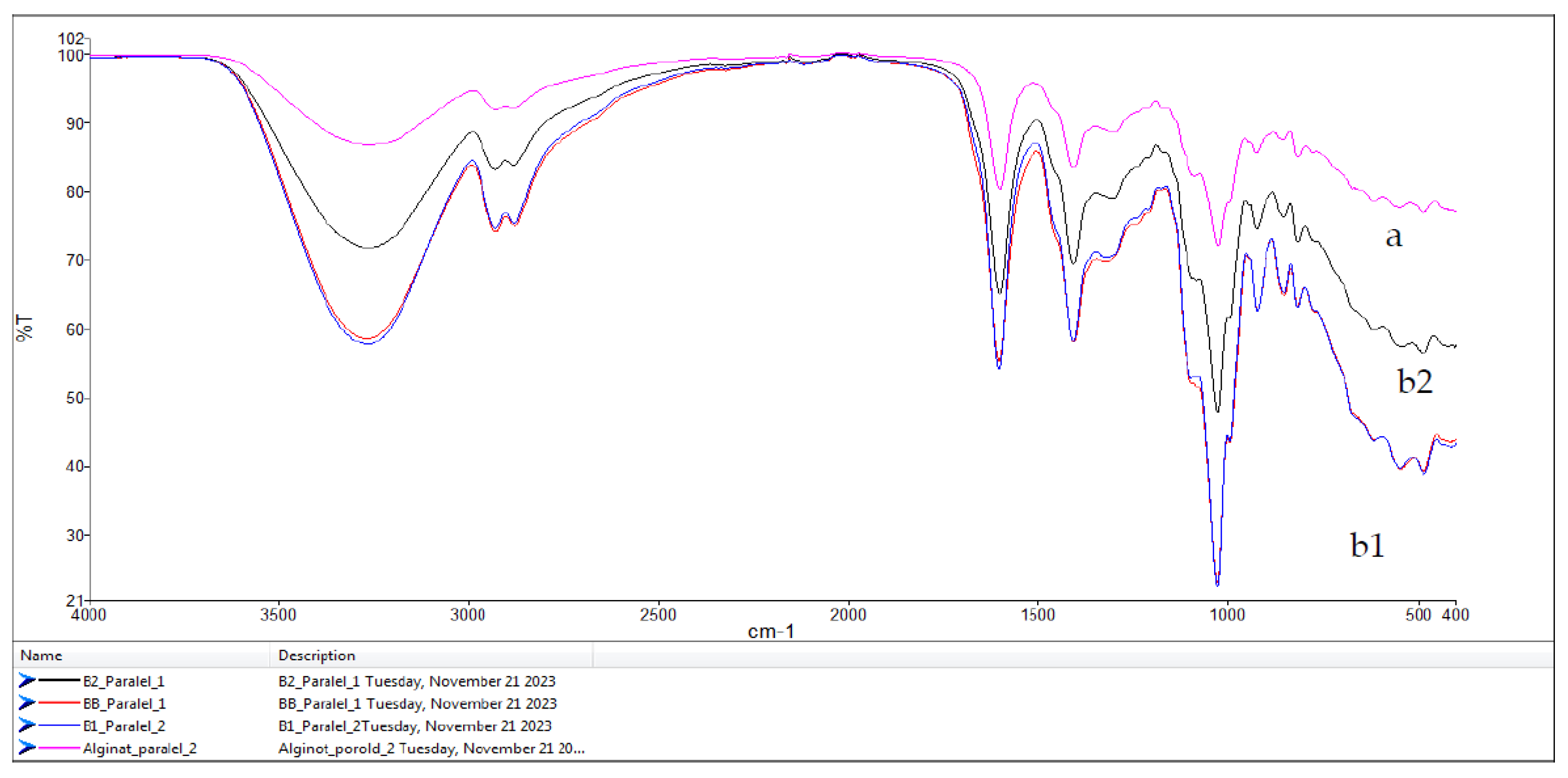
Figure 2.
1; The mean number of psychotropic bacteria (TPB) in turkey breast meat coated with postbiotics (log10 CFU/mL), 2; The mean number of total mesophilic aerobic bacteria (TMAB) in turkey breast meat coated with postbiotics (log10 CFU/mL), 3; The mean number of yeast-mold in turkey breast meat coated with postbiotics (log10 CFU/mL), 4; The mean number of lactic acid bacteria in turkey breast meat coated with postbiotics (log10 CFU/mL). 5; The mean number of Listeria monocytogenes bacteria in turkey breast meat coated with postbiotics (log10 CFU/mL). Control, without edible coating; a, only sodium alginate coated; b1, sodium alginate with Bifidobacterium bifidumu DSM postbiotic coated group; b2, sodium alginate with Bifidobacterium bifidium BB12 postbiotic coated group; bb, sodium alginate with Bifidobacterium bifidium BB12 postbiotic+ Bifidobacterium bifidium DSM postbiotic coated group.
Figure 2.
1; The mean number of psychotropic bacteria (TPB) in turkey breast meat coated with postbiotics (log10 CFU/mL), 2; The mean number of total mesophilic aerobic bacteria (TMAB) in turkey breast meat coated with postbiotics (log10 CFU/mL), 3; The mean number of yeast-mold in turkey breast meat coated with postbiotics (log10 CFU/mL), 4; The mean number of lactic acid bacteria in turkey breast meat coated with postbiotics (log10 CFU/mL). 5; The mean number of Listeria monocytogenes bacteria in turkey breast meat coated with postbiotics (log10 CFU/mL). Control, without edible coating; a, only sodium alginate coated; b1, sodium alginate with Bifidobacterium bifidumu DSM postbiotic coated group; b2, sodium alginate with Bifidobacterium bifidium BB12 postbiotic coated group; bb, sodium alginate with Bifidobacterium bifidium BB12 postbiotic+ Bifidobacterium bifidium DSM postbiotic coated group.
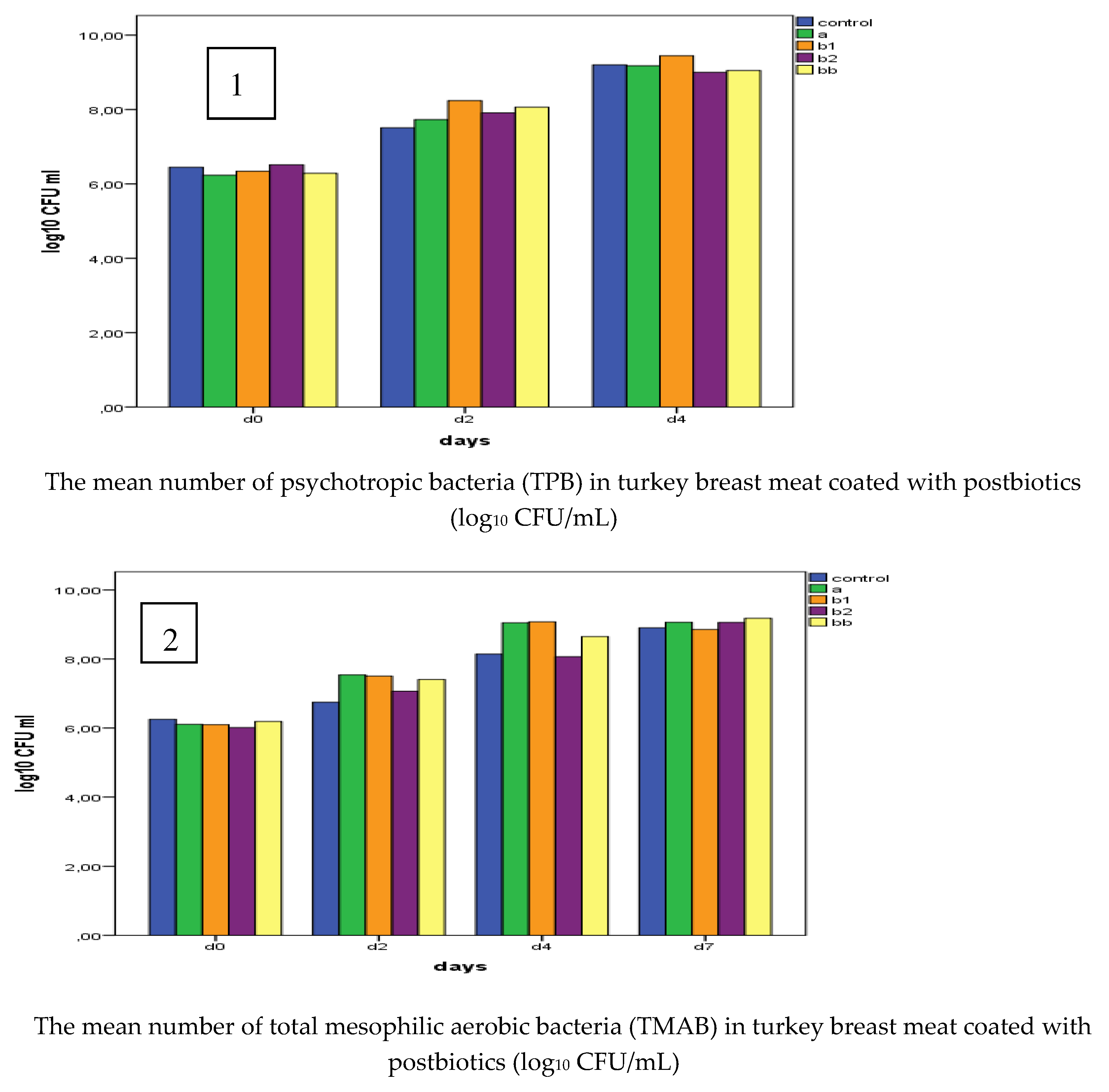
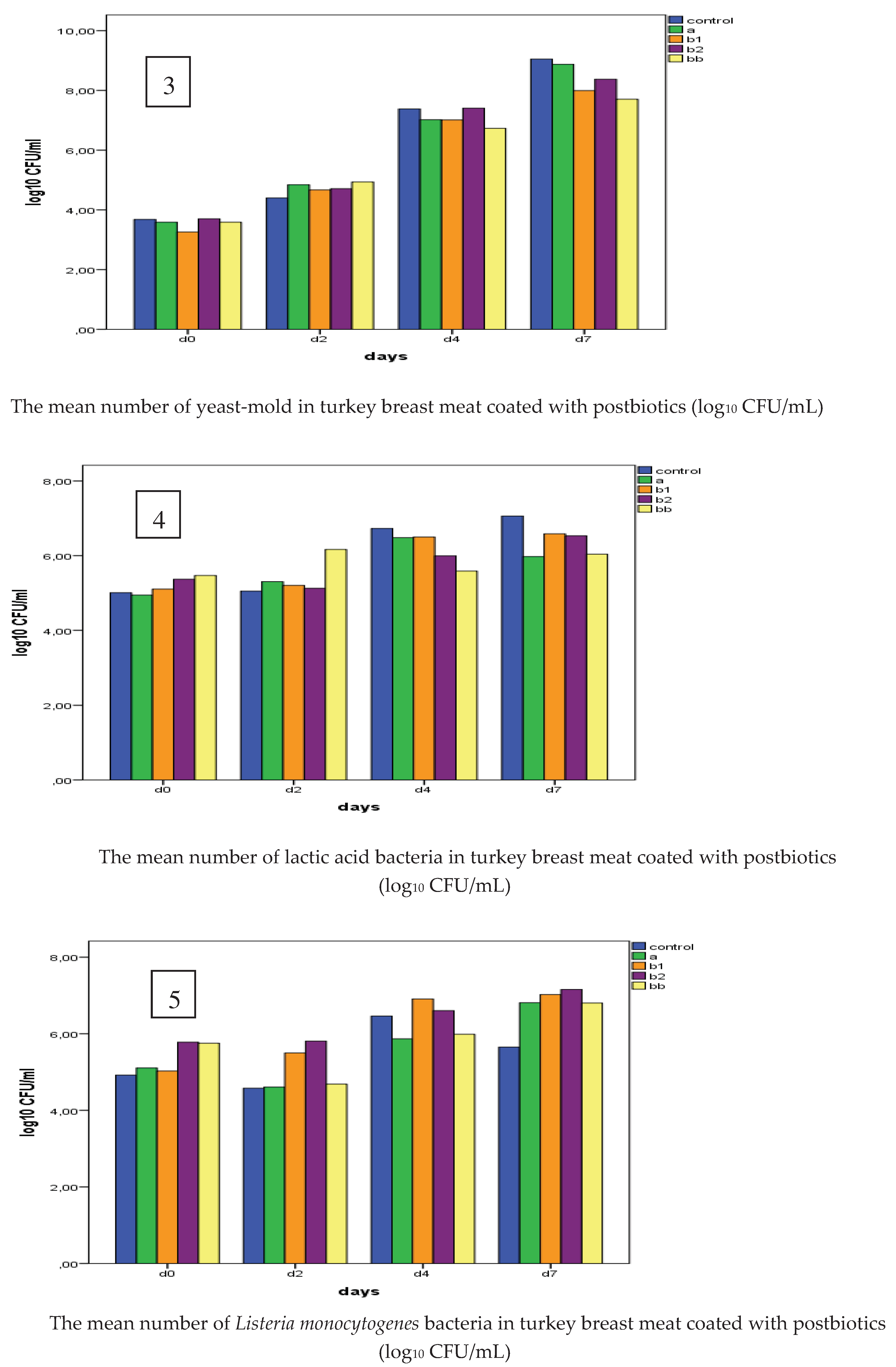

Table 1.
Types and concentrations of the coatings and postbiotics applied for the treatment of turkey breast meat.
Table 1.
Types and concentrations of the coatings and postbiotics applied for the treatment of turkey breast meat.
| Treatments with contaminated L. monocytogenes | Sodium alginate (%2) | Bifidobacterium bifidum DSM 20456 postbiotic (~%8) | Bifidobacterium bifidum BB12 postbiotic (~%8) | Bifidobacterium bifidum BB12 postbiotic (%4)+ Bifidobacterium bifidum DSM 20456 postbiotic(%4) | |
|---|---|---|---|---|---|
| C | - | - | - | - | |
| A | + | - | - | - | |
| B1 | + | + | - | - | |
| B2 | + | - | + | - | |
| BB | + | - | - | + |
C: control (without edible coating), A: edible coated with only alginate, B1: edible coating with Bifidobacterium bifidum DSM 20456 postbiotic, B2: Bifidobacterium bifidum BB12 postbiotic, BB: Bifidobacterium bifidum BB12+Bifidobacterium bifidum DSM 20456 postbiotics cocktail (1:1).
Table 2.
MIC (mg/mL) ve disc diffusion agar (mm) (DDA) values of postbiotics.
| Postbiotic | Listeria monocytogenes ATCC 19118 | Salmonella enterica ATCC 14028 | Staphylococcus aureus ATCC 25923 | Escherichia coli ATCC 25922 | Bacillus cereus ATCC 11778 | |
|---|---|---|---|---|---|---|
| Bifidobacterium bifidum DSM 20456 | MIC | 0.00625±0.00 | 0.0125±0.00 | nd | 0.025±0.00 | nd |
| DDF | 13.1±0.02 | nd | 11.5±2.12 | 14.30±0.20 | nd | |
| Bifidobacterium bifidum BB12 | MIC | 0.0089375±0.00 | 0.017875±0.00 | 0.03575±0.00 | ND | 0.03575±0.00 |
| DDF | 14.00±1.41 | nd | 15.00mm±1.41 | 12.50mm±0.71 | nd |
Disc diffusion (DDF) values are represented as the diameter (mm) of the inhibition zone; Nd: Non dtected.
Table 3.
Chemical composition of postbiotics.
| Compounds (%) | B1 | B2 | bb |
|---|---|---|---|
| α-Thujene | 0.71 | 0.10 | - |
| α-pinene | 0.11 | ||
| camphene | 0.02 | ||
| Trans-2- heptenal | 0.20 | ||
| 1,1-diethoxyisopentane | 0.06 | ||
| 2- α-pinene | 0.03 | ||
| benzaldehyde | 0.02 | 0.09 | |
| 2,2,4,6- pentamethylheptane | 0.11 | 0.14 | 0.12 |
| 2,4-heptadienal | 0.06 | 0.09 | 0.10 |
| 2,6-dimethylnoname | 0.20 | 0.27 | 0.21 |
| 4,6-dimethylundecane | 0.36 | 0.49 | 0.38 |
| 1,8-cineole (eucalyptol) | 0.38 | 0.49 | 0.38 |
| n-dodecane | 1.96 | 2.54 | 2.04 |
| 4,7-dimethyllundecane | 0.49 | 0.66 | 0.51 |
| 1,1- diethoxyhexane | - | - | - |
| 2,7,10-trimethyldodecane | 0.59 | 0.78 | 0.61 |
| n-tetradecane | 12.36 | 6.61 | 19.24 |
| 4-methyltetradecane | 2.00 | 2.33 | 2.04 |
| n-hexadecane | 8.46 | 10.06 | 8.49 |
| n-heptadecane | 12.82 | 14.95 | 12.76 |
| Phytane | 8.59 | 11.71 | 9.95 |
| n-eicosane | 3.90 | 4.44 | 3.69 |
| n-heneicosane | 7.14 | 7.15 | 6.46 |
| 1-monopalmitin(Dihydroxypropyl hexadecanoate) | 34.11 | 30.36 | 26.67 |
| Other compounds | 5,74 | 6,74 | 5,82 |
b1, sodium alginate with Bifidobacterium bifidium DSM postbiotic coated group; b2, sodium alginate with Bifidobacterium bifidium BB12 postbiotic coated group; bb, sodium alginate with Bifidobacterium bifidium BB12 postbiotic+ Bifidobacterium bifidium DSM postbiotic coated group.
Table 4.
Effects of postbiotics derived from Bifidobacterium spp. on pH, TBARS, and WHC.
| groups | d0 | d2 | d4 | d7 | |
|---|---|---|---|---|---|
| pH | Control | 5.71±0.09aAB | 5.68±0.03aA | 5.66±0.03aA | 5.48±0.02bA |
| a | 5.50±0.07bC | 5.60±0.02aB | 5.45±0.04bB | 5.43±0.01bAB | |
| b1 | 5.48±0.07bcC | 5.61±0.03aB | 5.51±0.02bB | 5.43±0.03cAB | |
| b2 | 5.66±0.05aB | 5.60±0.03aB | 5.50±0.04bB | 5.38±0.02cB | |
| bb | 5.84±0.01aA | 5.68±0.02bA | 5.52±0.05cB | 5.48±0.06cA | |
| TBARS (malonaldehyde μmol/kg) | Control | 0.41±0.13 | 0.46±0.03 | 0.86±0.06 | 1.54±0.59 |
| a | 0.45±0.10 | 0.37±0.06 | 0.67±0.50 | 1.08±0.91 | |
| b1 | 0.41±0.02 | 0.33±0.12 | 0.65±0.75 | 0.93±0.70 | |
| b2 | 0.56±0.02 | 0.43±0.04 | 0.86±1.02 | 0.98±0.94 | |
| bb | 0.60±0.07 | 0.37±0.06 | 0.72±1.24 | 1.03±0.85 | |
| WHC | Control | 91.98±1,16a | 85.76±1.06b | 87.44±0.46ab | 89.19±1.17ab |
| a | 92.39±0.04 | 89.90±1.05 | 87.20±1.71 | 89.18±3.14 | |
| b1 | 90.58±0.33ab | 86.12±1.37b | 88.35±1.34ab | 92.06±1.38a | |
| b2 | 95.04±0.76 | 86.13±4.84 | 90.47±1.57 | 89.60±2.90 | |
| bb | 92.63±4.21 | 90.41±1.12 | 91.83±1.35 | 93.04±0.62 |
A-C: The mean values with different columns among the groups, a-c: The mean values with different letters among the sampling days are significantly different (P < 0.05).
Table 5.
Effects of postbiotics derived from Bifidobacterium spp. on color (L*, a*, b*).
| groups | d0 | d2 | d4 | d7 | |
|---|---|---|---|---|---|
| L | Control | 38.76±4.12a | 42.16±3.07a | 37.86±5.43a | 40.23±1.19a |
| a | 40.73±5.41a | 42.74±3.40a | 45.38±5.49a | 49.22±2.05a | |
| b1 | 42.20±3.09ab | 47.00±2.29a | 35.02±4.46b | 35.02±4.46ab | |
| b2 | 36.48±4.11b | 47.17±1.76a | 45.91±5.26ab | 51.02±6.84a | |
| bb | 38.93±2.03a | 44.94±3.72a | 41.14±6.20a | 48.30±10.91a | |
| a* | Control | 1.04±1.28aAB | 1.06±0.91aAB | -0.61±1.44Aa | -0.35±0.96aA |
| a | 2.27±0.50aA | 2.56±0.54aA | -1.41±0.58cA | 0.40±0.48bA | |
| b1 | 0.30±0.73aAB | 1.45±1.17aAB | 0.58±1.18aA | 0.65±1.54aA | |
| b2 | 1.14±1.07aAB | 0.66±0.13abB | -0.56±0.73bA | 0.36±0.54bA | |
| bb | 0.08±0.77aB | 0.38±0.97aB | -0.18±1.12aA | -0.03±0.71aA | |
| b* | Control | 2.70±1.22aB | 4.55±1.16aB | 2.85±2.46Aa | 1.77±0.62aA |
| a | 6.61±1.79aA | 8.47±2.22aB | 1.56±0.53bA | 2.09±1.03bA | |
| b1 | 3.54±0.45abB | 5.56±1.02aAB | 2.91±0.88bA | 3.09±2.00abA | |
| b2 | 3.99±1.54aAB | 4.04±0.33aA | 2.11±0.89abA | 1.38±0.10bA | |
| bb | 3.28±0.47aB | 3.32±1.28aB | 2.86±0.81aA | 2.24±1.02aA |
A-B The mean values with different columns among the groups, a-b The mean values with different letters among the sampling days are significantly different (P < 0.05).
Disclaimer/Publisher’s Note: The statements, opinions and data contained in all publications are solely those of the individual author(s) and contributor(s) and not of MDPI and/or the editor(s). MDPI and/or the editor(s) disclaim responsibility for any injury to people or property resulting from any ideas, methods, instructions or products referred to in the content. |
© 2024 by the authors. Licensee MDPI, Basel, Switzerland. This article is an open access article distributed under the terms and conditions of the Creative Commons Attribution (CC BY) license (http://creativecommons.org/licenses/by/4.0/).
Copyright: This open access article is published under a Creative Commons CC BY 4.0 license, which permit the free download, distribution, and reuse, provided that the author and preprint are cited in any reuse.


