

Submitted:
16 April 2024
Posted:
16 April 2024
Read the latest preprint version here
Abstract
Inflorescence architecture underpins sexual reproduction in wild Musa species and productivity in edible banana cultivars. To establish the functional aspects of inflorescence architecture we identified its three main components and tested their response to environment and internal plant resources in two clone-sets. Five genotypes of edible plantains (Musa AAB) grew for four generations along an elevation gradient (1100 m to 2200 m, 16°C to 24°C) straddling the equator in the humid highlands of East Africa. Measurements of hands per bunch (Hb), fruit per hand (Fh) and peduncle length were made. Peduncle length is determined by the activity of the apical inflorescence meristem and fruit per hand from lateral cushion meristems. However, hands per bunch is determined by a change in flower type. This independence of mechanisms was reflected in their variable responses to site temperature, genet development and genotype. Cooler temperatures reduced the number of fruit-forming flowers in an inflorescence, but not as much as expected, and changed the balance away from female towards male flowers. The genet changed the allocation of resources between Hb and Fh, independently of the effect of site temperature. In banana breeding schemes, manipulating inflorescence components independently raises options for producing genotypes better suited to markets, environments and cultural practices.
Keywords:
Musa
; cincinni
; inflorescence meristem
; cushion meristem
; peduncle
; banana
; plantain
1. Introduction
1.1. Inflorescence Architecture
Inflorescences of Musa (Musaceae), whether of the wild species or edible cultivars, are spectacular. Their characteristic form, large size and variety of colours each contribute to their visual impact. The fruits of edible cultivars contribute to our diet and are important in smallholder agriculture and in commerce.
Morphologically, the inflorescence is a thyrse, with a racemose main axis, the peduncle, with the inflorescence meristem at its apex. The peduncle contains many second order branches or nodes of flowers called ‘hands’ originating from the activity of the inflorescence meristem. Each hand of flowers is itself an inflorescence, a scorpioid cyme or cincinnus [17,25] arising from a lateral ‘cushion’ meristem subtended by a bract. The cincinni are highly modified so that the pedicel of each flower arises directly from the cushion meristem [25]. A succession of axes from one flower to the next, a feature of cincinni [27], is not apparent. A large bract subtends each cincinnus, but not each flower within it, and in this respect the cincinni of the Musaceae differ from those of the other families in the Zingiberales [25].
Functionally, the peduncle has a basal sterile section of a couple of nodes each with a modified leaf or bract and distal to this the reproductive section contains nodes each with a cincinnus [17,25,56]. The basal section of the reproductive peduncle contains fruit-forming flowers that are usually female but may be hermaphrodite (perfect) in some wild species. The distal section has cincinni of non-fruit-forming flowers that are either neuter or male [8,17,45]. The point of change in flower type defines the limit of the fruit-forming flowers.
The ovary of fruit-forming flowers is long-lived, contains ovules and does not abscise even when not pollinated. Each typically grows into a seeded fruit in wild species or, in the edible cultivars, a seedless fruit developed by vegetative parthenocarpy [7,44]. Their growth is affected by availability of resources [13,24]. The female flowers of most edible cultivars have a residual fertility that is compatible with their parthenocarpic behaviour. A section of neuter flowers may precede a section of male flowers in the developmental sequence of the inflorescence. Each possesses a non-fruit-forming ovary which in the case of the neuter flowers do not abscise and may have morphologically well-formed stamens without functional pollen. The ovaries of neuter and male flowers do not contain ovules [17]. Male flowers are short-lived and usually abscise, leaving a ‘clean’ male peduncle where they occur. The inflorescence meristem atop the peduncle terminates when it forms a final cincinnus or flower [1,2,43,61].
Reflecting this morphology, the architecture of the inflorescence has three primary components that can be measured at fruit maturity. The length of the peduncle (Pr), with its female and male sections, is determined by the activity and finally the termination of the inflorescence meristem. The number of flowers in individual nodes of the female peduncle (fruit per hand, Fh) is determined by the size of the cushion meristem within each node [17]. The number of nodes of fruit-bearing flowers on the peduncle (hands per bunch, Hb) is determined by the timing of the change of flower type in the developmental sequence from fruit-forming to non-fruit-forming flowers. The nodes of the female peduncle are collectively known as a ‘bunch’ in the wild species and edible clones. These primary components (Pr, Fh, Hb) indicate the mechanisms that produce the total number of fruit bearing flowers on the inflorescence (Fb) and the proportion of the length of the peduncle allocated to fruit-bearing flowers (Pf). Fb and Pf have ecological and agronomic significance.
1.2. The Change from Fruit-Forming to Non-Fruit-Forming Flowers
The change in flower type from female to neuter/male flowers typically occurs from one cincinnus to the next, or even within a cincinnus, along the peduncle and occurs once in the developmental sequence of the inflorescence. It is likely caused by a change in gene expression in the androecium and gynoecium of developing flowers [15,22].
Flowers of angiosperms contain four whorls: the sepals (W1), the petals (W2), the androecium with the stamens (W3) and the gynoecium with the carpel and stigma (W4). In monocots W1 and W2 usually produce tepals that morphologically are difficult to separate into sepals and petals [22].
A separate class of genes, or an interaction between classes, determines the structure of each whorl in a flower. This ABC model was formulated in the 1990s and has been recently summarised, for example, by Irish [22]. In monocots, class A genes interact with class B genes to produce tepals (W1, W2) [15]. An interaction between class A and class C genes produces W3, and C class genes control carpel development. Since its formulation, the ABC model has been expanded to the ABCDE model where D class genes are involved in ovule formation and E class genes contribute to organ identity in all four whorls.
There has been considerable interest in how the ABC model can be used to interpret evolved differences in flower form across the eight families of the Zingiberales, of which the Musaceae is a basal member [11,40,62]. Emphasis has been on differences in the form of perfect flowers across families but Bartlett and Specht [11], in discussing these differences, drew attention to the different flower types within the inflorescences of the Musaceae.
By inference, the different flower types along the developmental sequence of the inflorescence of Musa could arise from changes in the expression and interactions of gene classes involved in flower formation. The four different flower types in Musa have similar tepals for whorls 1 and 2 but differ in size and function in the androecium and gynoecium. For the androecium (W3), hermaphrodite and male flowers have functional stamens while in female and neuter flowers non-functional staminodes typically replace functional stamens. For the gynoecium (W4), hermaphrodite and female flowers have functional carpels while neuter and male flowers have non-functional carpels. The ovary in Musa flowers is inferior and in male flowers contains no ovules [17]. However, male flowers do retain a non-functional style and stigma. The changes from functional stamens and carpel in the case of hermaphrodite flowers, to staminodes and functional carpel in female flowers, to stamen and non-functional carpel in male flowers could well reflect differences in the expression of genes in the classes involved in the production of the androecium and gynoecium across whorls 3 and 4.
This change in flower type sets the number of hands on the female peduncle that contain either edible fruit, or the potential number of hands of flowers available for pollination in the seeded bananas. The male flowers supply pollen over time depending on the number of flowers per cincinnus, the number of cincinni of male flowers and the rate at which they open [23]. Typically for wild species the architecture ensures out-crossing within an inflorescence except in those species such as the seeded Musa velutina where the flowers of the female peduncle are hermaphrodite, and they self-fertilise [32].
Following the formation of Fh and Hb, the length of the male peduncle at maturity is determined by the number of nodes formed before termination of the inflorescence meristem and the length of the internodes. Termination may occur immediately after the cincinni of female flowers have formed, or at an intermediate stage, or after hundreds of nodes of male flowers have formed [14,61]. In the edible AAB plantains this spread results in male peduncles of various lengths, from non-existent (e.g. cultivars of the Horn clone-set), to intermediate in length (False Horn clone-set), to long (cultivars of the French clone-set). Measurements of male peduncle length made at fruit maturity will capture the full length of the male peduncle but only if the inflorescence meristem has terminated and all internodes are fully extended. A feature of early termination of the inflorescence meristem in wild species and cultivated genotypes is that it occurs after female flowers have formed but before those same flowers have reached anthesis.
Within the female peduncle the total female flowers per bunch, Fb, is the product of Fh and Hb. The number and arrangement of female flowers is important in the wild seeded bananas because these parameters describe the spread of receptive flowers in space and time. In the edible bananas, where the development of fruit is the focus, the number and arrangement of female flowers is important in marketing.
1.3. Genotypes
In a genome-wide-association-study Nyine et al. [33] established links between hands per bunch (Hb) and chromosome 9 and fruit number per bunch (Fb) and two close sites on chromosome 10 in the East African Highland bananas (AAA). However, the number of fruit per hand (Fh) was not included as a separate trait, although it is a component of Fb. For genetic improvement in bananas, Nyine et al. [34] point out the need to understand variation in the expression of traits in different environments as they found that environment influenced the accuracy of models they used in genomic selection. Plantains (Musa AAB) of different clone-sets vary in their inflorescence architecture [14,49,51] and are suitable for examining changes in architecture across environments.
In this study we used cultivars from French and False Horn clone-sets of plantains (Musa AAB) that gave sufficient variation between clone-sets in inflorescence architecture for our purposes. In genotypes of the French clone set the inflorescence meristem at the apex of the male peduncle is still growing at fruit maturity. The genotypes of the False Horn clone set have an earlier termination of the inflorescence meristem, a shorter male peduncle and no viable male ‘bud’ at fruit maturity [49]. Differences in the length of the male peduncle contribute to changes in the sex ratio of the population of flowers in an inflorescence. Differences occur among the wild Musa species [8] as well as among cultivated genotypes [14].
1.4. Development of the Mat (Genet)
The first generation of a banana plant, whether arising as a seedling (wild species), a transplanted lateral bud or sucker, or small plant (field plantings of edible cultivars) has no, or few, resources immediately available from the parent mat or genet [57]. Rather, the genet is formed as lateral buds (suckers) grow from the newly established plant to form the next generation. In a functioning genet, the rhizome of a previous generation provides reserves for subsequent generations. The contribution of the genet to the architecture of the inflorescence can be evaluated by comparing data from the plant crop (C1) with those of ratoon crops (>C1), especially in environments that are stable within and between years. In cultivation it is usually observed that the genet contributes to larger inflorescences of fruit-forming flowers than present in the plant crop [45].
1.5. Inflorescence Architecture and Environment
Several studies of the inflorescence of Musa have described its features and interpreted these mainly in developmental and botanical terms [3,10,17,20,25,36,61]. Other studies have linked bunch formation to environment within a specific location [20,38,47] but to our knowledge, the relationships between the functional components of inflorescence architecture across different environments has not been explored.
Banana studies in controlled environments where plants can grow through to fruit maturity tend to be avoided because of the large size of the plants. So, reliance has been placed on establishing associations between environmental factors and plant responses generated in the field. Despite the limitations of these correlative methods, establishing associations between plant function and environmental factors has proved useful, for example, in supporting investigations into the epidemiology of Banana Bunchy Top virus [4,5,6], to estimate the date of flowering [18,30,37] or time of bunch harvest [52]. In the field, the match between environment and plant development can be managed by using different planting dates or sites, at least in the first crop cycle.
The functional components of inflorescence architecture are the number of hands per bunch, Hb, number of fruit per hand, Fh, number of fruit per bunch, Fb, the total peduncle length, Pr, and the proportion of the peduncle that was female, Pf. The magnitude of Hb, Fh and peduncle lengths is expected to be affected in different ways by environmental and plant factors because of their different origins. Together, they produce inflorescence architectures that are quantitatively different between environments, crop cycles and clone-sets.
Descriptive knowledge of the development of the inflorescence in Musa started with White [61], nearly a century ago. This, and studies since, using microscopy, provide an excellent foundation for identifying the components of inflorescence architecture. Next, we need to discover how these components interact and complement one another to establish the inflorescence under different conditions.
Formal relationships between environment and functional components of inflorescence architecture have not been established. We identified the main functional components of inflorescence architecture in Musa that reflected the underlying developmental processes of the inflorescence [17,25]. Our hypothesis was that the components Hb, Fh and peduncle length will respond differently to environment and genet development in different genotypes. This mechanism of response would allow the plant to produce inflorescences of quantitatively different architecture in different environments.
Our data arise from a field experiment of two clone-sets of plantains (Musa AAB) in plant and ratoon crop cycles and grown along an elevation gradient at the equator [42]. Previous publications in this series examined the yield, agronomic [42] and developmental [55] aspects of the plant crop cycle. Sivirihauma et al. [46] examined the yield and agronomic performance of the ratoon crop cycles while Turner et al. [57] examined vegetative reproduction across all cycles. Here, we test our hypothesis about how environment and genet development functionally change inflorescence architecture.
2. Results
Based on the descriptions and interpretations of a thyrse in the literature on Musa, we chose the number of nodes of fruit-forming flowers, Hb, the number of fruit-forming flowers per hand, Fh, and the termination of the inflorescence meristem as the three main functional components of inflorescence architecture. Using the ‘measured’ data of the ratoon crop cycles (C2 to C4) we examined the effect of cultivar and site on hands per bunch (Hb), fruit per hand (Fh), fruit per bunch (Fb), the peduncle reproductive length (Pr) and proportion of Pr that was female (Pf). We used the ‘modified’ data to establish relationships between site temperature and Hb, Fh, Fb, Pr and Pf for each clone-set as well as differences between the plant (C1) and ratoon crop cycles (C2 -C4).
2.1. Measured Data: Hb, Fh, Fb, Pr and Pf
Generally, bunches grown at lower elevation had more Hb than those at higher elevations. The reduction in Hb was particularly severe for all cultivars at Ndihira (Table 1A). Across the other three sites, with increasing elevation, Hb fell significantly (P=0.05) by about 30% in the two False Horn cultivars but not as much (15%) in two of the three French cultivars. The exception was the French cultivar ‘Nguma’ which had more hands at Butembo (8%) than at the lowest elevation at Mavivi (Table 1A, P=0.05).
The cultivars clearly differed in number of measured fruit per hand, with False Horn cultivars having 11 to 17, while French cultivars had 17 to 24. The measured Fh was severely reduced in all cultivars at Ndihira (P=0.05) but was relatively stable across other sites. An exception was the False Horn cultivar ‘Kotina’ which had about 30% fewer fruit per hand at Mavivi, the lowest site, than at Butembo (Table 1A).
The effect of sites on the number of fruit per bunch in different cultivars reflected changes in Fh and Hb, the components of Fb. Usually there was a decline in Fb from Mavivi up to Butembo but these changes, while significant (P=0.05), differed in magnitude according to cultivar. ‘Vuhembe’ had the greatest reduction of 24% and ‘Nguma’ had more fruit per bunch at Butembo than at Mavivi, an increase of 9%. Opposing changes of Hb and Fh in ‘Kotina’ with elevation meant that Fb was stable from Mavivi up to Butembo. ‘Musilongo’ and ‘Vuhindi’ had about 8% less Fb at Butembo than at Mavivi (Table 1A). At Maboya, Fb in all cultivars was generally less than at Mavivi or Butembo.
At fruit maturity, the reproductive peduncle length across sites and cultivars varied by two-fold from about 80 to 160 cm (Table 1B). The inflorescence meristems of the False Horn cultivars had terminated by fruit harvest, while those of the French cultivars were still growing. Differences in Pr between cultivars were greater at the lower elevations than at high elevations. The Pr of the two False Horn cultivars was 15 to 60 cm less than that of the three French cultivars (P=0.05). The exception was ‘Vuhembe’ which had a much longer reproductive peduncle than expected at Ndihira.
The proportion of the reproductive peduncle that was female in the two False Horn cultivars grown from Mavivi to Butembo was high and ranged from 66 to 74% (Table 1B). The French cultivars had lower Pf values of 52 to 60%. At Ndihira, the Pf of all cultivars in both clone-sets was reduced to 17 to 26%, only one third of the values reached at sites of lower elevation. At Maboya, for each cultivar, Pf was similar to those at Mavivi and Butembo, which differed from the large absolute values across these sites for Hb, Fh, Fb and Pr.
2.2. Changes to the Data Caused by Modification
Modifying the measured data increased the site means for Hb, Fh and Fb, averaged across cultivars, but to different degrees, depending on the magnitude of the PK modification factor (Table 2). At Mavivi and Maboya, modification increased the means of Hb and Fh by about 27%. At Butembo the increase was about half of this at 14%. When the Ndhi ratio was used to calculate the data for Ndihira, Hb was 35% more than the measured value and Fh was almost five-fold larger than the measured value. These increases in Hb and Fh upon modification flowed through to the Fb data where the increase was 61% at Mavivi and eight-fold for calculated Ndihira data (Table 2).
2.3. Coefficients of the Exponential Reciprocal Function, r, C, Tb and A
Generally exponential reciprocal functions where site temperature was fitted to the data for each architectural parameter were significant at P=0.001. An exception was for Fh of the False Horn clone-set which was not significant (Table 3). Depending on the variable and the clone-set r ranged from 0.08 to 0.94 across all functions.
Hb was more strongly associated with site temperature, T, (r>0.70) than Fh (r<0.51). Pf had the strongest association with T (r>0.9) in both clone-sets, compared with the other parameters. Hb and Fb had moderately strong associations with T in both clone-sets as did Pr in the French clone-set (Table 4). Fh had weak associations with T, as did Pr in the False Horn clone set (Table 3).
The curvature coefficient, C, for variables Fb, Hb and Fh was as low as -22.8 but more typically varied between -8.21 and -0.010, where a value of C closer to 0 was indicative of more stable values of the parameters across the three warmest sites, but with a sharp downturn at the lowest temperature (Table 3). Fh in both clone-sets showed stable behaviour across the three warmest sites. The behaviour of Hb differed from Fh, with curves for Hb in both clone-sets showing greater displacement from the asymptote, A, and therefore a stronger association with site temperature. This was particularly so for the False Horn clone set, which had a C of -22.8 and Tb of 5°C compared with -0.81 and 15.1°C for the French clone-set. Fb behaved similarly to Hb in its association with T, having curves well displaced from the asymptote, A, with C values of -1.1 for the French clone-set and -8.2 for the False Horn clone-set. Fb had a stronger association with site temperature than did Fh. The nature of the association between Fb and T is governed by Hb and Fh, the components of Fb (Eqn. 1). Generally, in this data set the curved association between Fb and T in both clone-sets was driven by Hb, rather than Fh. Indeed, Fh was much more stable than Hb over the range of T included here.
Pr was stable in the False Horn clone-set across the temperature range of interest, with C = -0.016. In contrast, the French cultivars had a moderate response to T over the range, with C= -0.581.
Tb varied from 5.0°C to 15.9°C across variables and clone-sets (Table 4). It fell into two groups, an upper one in the range of 15.5°C to 15.9°C and a lower group <15.0°C (Table 3). Those in the upper group were associated with values of C closer to 0, compared with those in the lower group and tended to show greater stability of the variable across the higher temperatures.
2.4. Modified Data: Hb, Fh, Fb, Pr and Pf
In the modified data and where the Ndihira values were calculated, Hb increased more than two-fold from the coolest temperature to the warmest (Figure 1A). At the coolest temperature, the French and False Horn clone sets had similar Hb, while at higher temperatures the French clone-set had more hands per bunch than the False Horn clone-set. The False Horn clone-set showed an almost linear reduction in Hb as temperature fell, but the French clone-set was more stable at the warmer temperatures (Figure 1A).
Across the three warmer sites, Fh of the French clone-set was about 50% more than the False Horn and both clone-sets showed a stable relationship with T (Figure 1B). At the coolest site, the Fh of the False Horn clone-set was little affected but was reduced in the French clone-set.
Fb reflected the changes of its two components, Fh and Hb. As site temperature increased, there was an increase in Fb in the two clone-sets over the range, (Figure 1C) represented by the more negative values for C in the association between Hb and temperature, particularly in the False Horn clone set (C = -22.8) compared with the French (C = -0.82) (Figure 1A). Overall, French and False Horn cultivars had fewer Fb at lower temperatures.
The length of the reproductive peduncle, Pr, differed between clone-sets (Figure 2A), being longer in the cultivars of the French clone-set than in the False Horn clone set. This difference is consistent with the early termination of the inflorescence meristem and the completed extension of the internodes of the male peduncle before fruit maturity in the False Horn clone-set. Pr was relatively stable across the temperature range for False Horn but for French, Pr was shorter at the cooler temperatures. Pr was similar in length for both clone sets at the coolest temperature (Figure 2A).
The proportion of the reproductive peduncle that supported female flowers and fruit (Pf) was least in the French clone set and highest in False Horn (Figure 2B), reflecting in part the differences in total Pr length (Figure 2A). Low temperatures severely reduced the female proportion to a fifth in both clone-sets.
2.5. The Balance between Rate, R, and Time, Ti, in Determining Hb and Fh
The time, Ti(Hb), from initiation of the inflorescence to change in floral gene expression in the False Horn clone-set was least at Mavivi the warmest site, being 9.6 days and greatest at Ndihira, 13.6 days, the coolest site (Table 4). At the cooler sites where Hb was reduced, the rate of inflorescence development was slowed, but this reduction in rate was to some extent compensated for by an increase in Ti(Hb) representing a delay in the switch of gene expression. Butembo is 4.6°C cooler than Mavivi and this almost halved the calculated R(Hb) (51%). However, for the French clone-set Hb was reduced by only 11% and for the False Horn clone-set by 33% both well below the expected 51% if Ti(Hb) hadn’t also changed (Table 4).
There was almost no reduction in Fh from Mavivi to Butembo in either clone-set, values at Butembo being 98% of those at Mavivi. The R(Fh) decreased at Butembo because of lower site temperature, but the Ti(Fh) increased to compensate for the reduced R(Fh), resulting in little change (Table 4).
3.6. Effect of the Genet on Hb, Fh and Fb
The presence of the genet in the ratoons reduced Hb but increased Fh, compared with the plant crop where the genet was absent (Figure 3A,B). Cultivars of the False Horn clone-set showed a greater reduction in Hb than did those of the French clone-set. The reduction in Hb from C1 to ratoon crops occurred at all sites and in a similar manner, especially for the False Horn cultivars.
For False Horn cultivars at Mavivi, the changes in Hb and Fh compensated one another and there, Fb was similar from plant crop to the ratoon crops as the genets developed. However, as elevation increased, the bunches of ratoon crops had fewer fruit per bunch than the plant crops and this was particularly noticeable at Ndihira, the highest and coolest site (Figure 3A).
For the French cultivars, the changes in Hb and Fh were such that at all sites the Fb of ratoon bunches was greater than those of plant crops (Figure 3B). So, even though there was a reduction in Hb, the increase in Fh more than compensated, thus increasing Fb.
The opposing changes in Hb and Fh from plant crop to ratoons occurred at all four sites and so an analysis using the R x Ti equation (Eqns. 2, 3) can be used to explore the role played by Ti, since site temperature, T, and hence R, is expected to be constant across crop cycles. However, this stability may not be the case as ratoon cycles of bananas tend to produce fewer leaves per year than those of the plant crop (38), implying that the plastochron was extended. The longer plastochron in ratoon crop cycles may be due to lower temperatures at the apical meristem at the base of the pseudostem in ratoon crops caused by shading of plant and soil.
3. Discussion
Site temperature and the presence of the genet affected the three independent components of inflorescence architecture in both clone-sets of edible Musa (AAB) in this experiment, broadly supporting the hypothesis. Site temperature is a part of the external environment, and the genet indicates a retention of resources captured by previous generations. This, together with knowledge about the early development of the inflorescence of Musa [17,25,61] pointed towards underlying functional processes in inflorescence development.
We observed that in both clone-sets, Fb decreased at cooler temperatures, but the impact differed between its components, Hb and Fh. Lower temperatures affected Hb more than Fh. Thus, the activity of the lateral cushion meristem in producing fruit-forming flowers within a node is less affected by changes in site temperature than the change in gene expression producing the switch from fruit-forming to non-fruit-forming flowers.
For the genet, across all site temperatures, Hb was lower in the ratoons than in the plant crop, while Fh increased. These effects happened at all sites and so are independent of temperature, indicating a change in allocation of reserves with genet development. This was an unexpected result as usually Hb and Fh benefit from the extra resources available in the genet. There was a difference between clone-sets in the magnitude of the changes in Hb and Fh, but not in their general direction. In the French clone-set the genet boosted Fb because the increase in Fh more than compensated for the reduced Hb. In the False Horn clone-set the increase in Fh was not sufficient to compensate for the reduced Hb. We suggest that the source of the reserves allocated to the lateral cushion meristems to determine Fh, was different from that used to hasten the onset of changes in gene expression in nodes of fruit-forming flowers that determine Hb. The reserves present in the genet may be allocated to increase Fh production in ratoon crop cycles, while those usually allocated to Hb were reduced, possibly because of allocation to developing sib-suckers in this experiment [57].
3.1. Fruit Per Bunch, Fb
Many fruit per bunch can contribute to increased seed production in individual inflorescences of wild Musa spp. and to increased bunch weight in the edible bananas. In the data reported here, Fb was affected by site temperature, clone-set and the genet.
Overall, Fb was greatest at the warmest site and fell increasingly sharply as temperature fell (Figure 1C). There was a clear difference between clone-sets (Figure 1C) in absolute terms, but for both clone sets the reduction in Fb with cool temperatures was of a similar proportion, about 50% across the range (Figure 1C). This would suggest a similar response of each clone-set to temperature, at least in relative terms. We found that the responses of Fh and Hb to site temperature differed, and so while at the level of Fb, the response of the two clone sets was similar, they arrived at that ‘similarity’ by different pathways.
3.2. Fruit Per Hand, Fh
Morphologically, each node on the peduncle consists of a bract subtending the lateral ‘cushion’ meristem from which the flowers arise, and fruit are attached. The number of flowers and subsequently fruit per hand are determined during the early development of the hand, with a single cincinnus taking up to 7 plastochrons to form [17]. The flower initials that arise within the cushion meristem first appear about three nodes distant from the apical inflorescence meristem [17,25,31,36,61]. At this point the peduncle has already begun to expand radially. The cushion meristem, subtended by the bract, is arc-shaped on the expanding peduncle and its final length can physically limit Fh.
In the developing inflorescence, the basal width of the bract provides the outer limit of the cushion meristem as the radial growth of the base of the bract is completed before the growth of the cushion meristem it subtends [17]. The cushion may not develop to the full extent of the bract base [25] and the number of flower initials that form then depends on the length of the cushion and the space occupied by each flower meristem.
Flower meristems appear within the cushion, usually in a sequence best described as a cincinnus [17,25]. If temperature affects the rate at which flower meristems are produced, but not the size of the bract base then, because the latter limits the length of the cushion meristem, it is unlikely that an association between site temperature and Fh will be established. Consistent with this interpretation, the association between site temperature and Fh was weak in the data illustrated in Figure 2B except for lower Fh in the French clone-set at Ndihira, the coolest site.
Fh varies somewhat from hand to hand within an inflorescence [3,14,48] but associated data for the width of the base of the subtending bract are not available. Measurements of peduncle size and bract basal width would be informative in identifying the factor(s) reducing Fh in the cultivars of the French clone-set at Ndihira.
3.3. Hands Per Bunch, Hb
Hb is a function of the rate of lateral node production by the inflorescence meristem and an irreversible change from fruit-forming to non-fruit-forming flower types along the developmental sequence of the peduncle. In Musa there are several flower types: fruit-forming hermaphrodite and female flowers and non-fruit-forming transitional, neuter and male flowers. Not all species or cultivars have all types, but all species and cultivars have the change from fruit-forming to non-fruit-forming flowers. The change in flower type separates the basal section with its fruit-forming hands from the non-fruit-forming distal section of the inflorescence [61].
There has been considerable interest in how the ABC model of flower development can be used to interpret evolved differences in flower form across the eight families of the Zingiberales, of which the Musaceae family is a basal member [11,40,62]. Emphasis has been on differences in the form of perfect flowers across families but Bartlett and Specht [11], in discussing these differences, drew attention to the different flower types within the inflorescences of the Musaceae.
By inference, the different flower types along the developmental sequence of the inflorescence of Musa could be derived from changes in the expression and interactions of gene classes involved in flower formation.
If Hb is determined by a permanent switch in gene expression within the whorls (W3 and W4) of developing flowers, then accumulated reserves may act as an independent factor affecting the timing of this change. This interpretation is consistent with the observation that the number of flowers per hand does not normally change with the change in flower type, from one hand to another, during inflorescence development [3,48].
3.4. Hb, Site Temperature and Resources
Compared with Fh, Hb was quite sensitive to site temperature (Figure 1A). While Hb was greatest at the warmest site and least at the coolest site for both clone-sets, there was a difference between clone-sets in response to temperature. Cultivars of the False Horn clone set showed an almost linear decline in Hb as temperature fell, whereas with the French clone-set the decline in Hb with decreasing temperature was slight at first, then becoming increasingly greater as temperature fell.
The processes that affect Hb are the rate, R(Hb), at which hands of female flowers are produced at the inflorescence meristem (plastochron) and the time, Ti(Hb) from inflorescence initiation to when the switch in gene expression occurs in whorls 3 and 4 of developing flowers. R is strongly affected by temperature with slower rates at cooler temperatures [41]. Then, estimation of R(Hb) gives an expectation of the effects of differences in site temperature that can be compared with actual measurements. When this analysis was applied to Hb, we found time, Ti(Hb), was extended as site temperature was reduced, compensating for the impact of reduced R(Hb) on Hb. We interpret this as a delay in the switch in gene expression that causes the change in flower type from fruit-forming to non-fruit-forming. This trigger is sensitive to the quantity of reserves accumulated before the inflorescence was initiated [56]. Thus, the reserves affect Hb indirectly through their accumulation before the inflorescence formed and their subsequent effect on gene expression in the flowers when they begin to develop.
It was expected that site temperature would reduce Fh, as it arises from the formation of flower initials from the cushion meristem, a smaller cushion meristem providing less room for flowers within a hand. Site temperature did not reduce Fh, and so the Ti(Fh) component of equation 4 increased to compensate for any effect of site temperature in reducing R(Fh). We interpret this as indicating a constant supply of resources to enlarge cushion meristems in the developing inflorescence sufficient to maintain Fh across sites. This is similar in outcome to the formation of a spike of wheat under cooler temperatures where there is a balance between reduced development rate but an extended supply of resources to the developing inflorescence leading, in this case, to a larger wheat inflorescence [19].
3.5. Plant Reserves and Inflorescence Architecture
As the plant moved from the plant (C1) to ratoon crop (C2 to C4) cycles the genet developed with reserves present in the rhizome and stems of earlier generations becoming available for use by the current generation. These reserves complement the photosynthates available from the functional leaves of the current generation with the expectation that the inflorescences of ratoons would be larger (more Hb and Fh) than those of the plant crop. This feature is usually observed [39]. However, the magnitude of the change may differ according to genomic group and whether Fh and/or Hb is affected (Table 5).
From the data of Turner and Hunt [58], Fh increased proportionately much more than Hb as the genet developed. Cultivars of the AAA genomic group (mainly Cavendish genotypes) changed the most, increasing by 60% (Table 5). These data are consistent with the reserves accumulated by previous generations, that now form part of the genet, being used to support development of the inflorescence of the current generation.
The development of the genet in the French and False Horn clone-sets decreased Hb at all four sites (Figure 3) in contrast to what may be expected based on the observations of Turner and Hunt [58] across a range of genotypes (Table 6). On the other hand, Fh increased from plant to ratoon crops at all sites except for the False Horn clone-set at Ndihira, the coolest site.
Turner and Gibbs [56] used the data of Turner and Hunt [59] from a plant crop to argue the case for Hb being affected by carbohydrate reserves accumulated by the plant before the inflorescence was formed. This was based on the observation that removal of all leaves, or half of each leaf, during the mid-vegetative growth phase of the plant crop subsequently reduced Hb by 40% to 50%, whereas defoliation in the floral phase, when Hb is determined, did not change Hb (Figure 4). A lesser proportional effect (20% to 30%) of defoliation was recorded for Fh, but there was a phase shift as well. In contrast to Hb, Fh was reduced when plants were defoliated in their floral phase beginning -13 to -8 leaves before flowering, but not in the mid-vegetative phase (Figure 4). In the presence of the genet, defoliation had a lower proportional impact on Fh and Hb, with reductions of 7% to 8%. However, Hb was reduced only when plants were defoliated in the mid-vegetative phase, not the floral phase, indicating Hb depends only on reserves accumulated before the inflorescence is formed. With the genet present, Fh was reduced by defoliation when plants were defoliated in either the mid-vegetative or floral phases, although the effect was small. It appears that Fh was influenced more by reserves than by current photosynthates when the genet was present, compared with before its development.
If these relationships hold for the two Musa AAB clone-sets grown in North Kivu, then a reduction of Hb in the ratoon crop cycles would imply that reserves accumulated before the inflorescence was present were not sufficient to delay the change in flower type and either maintain or increase Hb. The reserves had either not been accumulated or had already been used for another purpose.
The reduced Hb in the ratoon crop cycles (Figure 3) may have been caused by the allocation of resources to the development of sib-suckers rather than Hb. The reason for the difference in the behaviour of Hb between plant crop and ratoons in this experiment and that of Turner and Hunt [58] may lie in the different agronomic strategies used for desuckering (pruning). Turner and Hunt [58] used the single sucker follower system with surplus suckers removed three times per year, equivalent to 4 to 5 times per life cycle, meaning that suckers were removed when they were small. On the other hand, in the experiment conducted by Sikyolo et al. [42] the suckers remained on the parent plant until flowering, when all were counted and removed except the one retained for the next generation. This delay in de-suckering meant that many suckers were more developed before their removal. Suckers remaining attached to the parent plant benefit considerably in terms of growth [16] and are likely to capture more resources, reducing the capacity of the ratoon sucker to accumulate reserves before it entered the floral phase.
Fh behaved very differently with genet development, compared with Hb. It increased considerably. We attribute this to more reserves being allocated to the expanding tissues behind the inflorescence meristem allowing extended cushion meristems to develop across all site temperatures and in all ratoon crop cycles.
The reserves accumulated before floral initiation that affect Hb, do not affect Fh, and so the reserves that contribute to increased Fh in ratoon crops must have another source. This may be in the genet, which is absent from the plant crop.
Hb and Fh, both of which contribute to inflorescence architecture in Musa are independent components affected differently by environmental and internal plant factors. These different mechanisms would allow changes in Hb and Fh in wild species that may affect success in pollination by visiting birds and animals. In cultivation, they offer the options for managing the balance between Hb and Fh either genetically or by management practices.
3.6. Peduncle Total Length, Pr, and the Proportion that Was Female, Pf
Across all four sites, Pr of the False Horn cultivars was stable. The French clone-set had longer reproductive peduncles than the False Horn across the three warmer sites but at the coolest site, Pr was reduced and was similar for both clone-sets. Pf, on the other hand showed a gradual decrease with increasing elevation across the three warmer sites with a consistent difference between clone-sets. At the coolest site, Pf was severely reduced and was similar for both clone-sets.
The length of the mature reproductive peduncle is a function of the number of hands (nodes) formed by the inflorescence meristem and the internode lengths. The number of nodes will be determined by the rate of node production and the length of time over which that rate applied. Termination of the inflorescence meristem stops node production but not the elongation of the internodes already formed.
The timing of termination of the inflorescence meristem differs between the two clone-sets. The mature male peduncles of cultivars of the False Horn clone set contain about 50 nodes [14], while those of the French clone-set contain about 100. Since the plastochron of node production in the floral phase is about 5 times faster than the phyllochron [54] and about 10 to 11 leaves emerge from a shoot in the floral phase, which ends at flowering, then in the False Horn clone-set all nodes on the male peduncle present at fruit maturity are already present at flowering. In this clone-set, the inflorescence meristem will have terminated and growth of the male peduncle after flowering, will be entirely due to elongation of the internodes.
For the French clone-set, termination of the inflorescence meristem occurs after fruit maturity, which is from 4 to 8 months after flowering, depending on the site [42]. These differences between clone-sets in the onset of inflorescence meristem termination are important for interpreting the different responses of Pr to site temperature (Figure 2A).
A reduction in Pr was expected as site temperature decreased because of the effect of temperature on the rate of node production, but the similarity of Pr across sites in the False Horn clone-set suggests little effect of site temperature in this clone-set on either node number or the internode length. The slightly longer reproductive peduncle at Ndihira, the coolest site (Figure 3A), is consistent with measurements of Sikyolo et al. [42] and with a later termination of the inflorescence meristem. This is more likely than an increase in internode length which for female peduncles of the False Horn clone set was 12 cm at Ndihira, compared with 20 cm at the warmer sites.
In the French clone-set the length of the reproductive peduncle and its reduction as site temperature fell cannot be attributed to the termination of the inflorescence meristem as it is still functional at fruit maturity. Rather, it indicated the effect of site temperature on the elongation of internodes of the male peduncle.
The female proportion of the reproductive peduncle, Pf, was governed by Hb and the internode length within the female peduncle. At Ndihira, internode length was 11-12 cm, and the same for each clone set, compared with 16 cm at the three warmer sites for French and 20 cm for False Horn. Lower Hb and reduced internode length both contributed to a reduced length of female peduncle at Ndihira and a large reduction in Pf, compared with the three warmer sites.
For a single inflorescence of a wild species of Musa, Pf is a proxy for the balance between reproductive effort allocated to seed and pollen production. The data for the two clone-sets examined here suggest a proportional shift from production of female flowers at warm sites towards a high proportion of the peduncle supporting male flowers at cooler sites. While this is the case for members within each clone-set, Pf is strongly influenced by clone-set itself, with the differences in timing of inflorescence meristem termination between the clone-sets influencing Pr and hence Pf. Early termination of the inflorescence meristem in the False Horn cultivars resulted in a higher proportion of the reproductive peduncle containing female flowers even though Hb was less in False Horn than in French at all sites.
In terms of the number of female flowers per generation, the high number of suckers produced by plantains at high elevations [42,46,57] more than compensated for the reduced Pf. The 5-fold increase in sucker numbers from Mavivi to Ndihira more than balancing the reduction in Fb to a third. However, this compensation assumes all suckers develop sufficiently to flower and Fb is not further reduced by the presence of sib-suckers within a generation. Both these are unlikely [50]. Nonetheless, the production of more suckers at high elevations could be seen as a strategy of the plant to increase female flowers for pollination per generation but spread across more individuals within that generation.
4. Materials and Methods
4.1. Data and Its Analysis
The field experiment in North Kivu Province, Democratic Republic of Congo began in 2008. It included five plantain cultivars from two clone-sets grown over four crop cycles (C1 to C4) at four sites of different elevation. Data on inflorescence architecture of the five cultivars were collected in the main experiment and after its completion, in crop cycles C>4 at Mavivi, Butembo and Ndihira.
Here, we establish relationships between the functional components of inflorescence architecture and site characteristics, particularly mean annual temperature which at the equator is seasonally stable within each site. Site temperature varied from one location to another associated with the different elevations. There were also differences in edaphic factors that we accounted to make more reliable estimates of the association between plant variables and site temperature.
The data on inflorescence architecture were analysed firstly using data measured during the experiment (‘measured’) and secondly, using measured data that were modified to account for site differences in soil P and K concentration (‘modified’). The measured data for Fh and Hb at Ndihira, the highest site, posed a special problem and so C>4 data from Butembo and Ndihira were used to arrive at a set of calculated data for the Ndihira site. The edaphic factors, soil P and K, were chosen because differences between sites in soil P concentration in the root zone were considerable [42] and a large amount of K is absorbed by bananas in the field [26,60]. Measured data were analysed by ANOVAs to determine the effect of sites, cultivars, and crop cycles on the variables while the association between site temperature and each modified parameter was determined using regression analysis.
4.2. Sites, Cultivars and Clone-Sets
The sites were located at Mavivi, elevation 1066 m, mean annual temperature 23.5°C; Maboya, (1412 m, 21.4°C); Butembo (1815 m, 18.8°C); and Ndihira (2172 m, 16.1°C), North Kivu, DRC. Mavivi is the most northerly site at Lat. 0.569°N and Ndihira the most southerly site at Lat. -0.250°S (Figure 5) [42].
Details of the soils, environment and cultivars are available in Sikyolo et al. [42], and Sivirihauma et al. [46]. Anecdotally, the site at Maboya was less suited for plantain production than the other sites [42,46]. At Butembo the plots were in the research gardens of the Catholic University of Graben. The five plantain cultivars (Musa AAB Plantain subgroup) were ‘Kotina’, ‘Vuhembe’ ‘Musilongo’, ‘Nguma’ and ‘Vuhindi’ representing two Plantain clone-sets, French and False Horn. Each cultivar grows commonly in North Kivu but not across the range of elevations included here [42]. The morphological features of the inflorescence used to classify clone-sets [49,51] varied across sites and so we reassessed the accepted clonal grouping of the cultivars. Here the five plantain cultivars were grouped as follows: ‘Kotina’ and ‘Vuhembe’ with the False Horn clone set; and ‘Musilongo’, ‘Nguma’ and ‘Vuhindi’ with the French clone set. This differed from the arrangement used by Sikyolo et al. [42]; Sivirihauma et al. [46]; Turner et al. [55,57] who placed ‘Musilongo’ in the False Horn clone-set and ‘Vuhembe’ in the French clone-set.
The clone-sets differ in their inflorescence architecture. Genotypes in the French clone set usually have more fruit/bunch (70 to 130) than those in the False Horn clone-set (23 to 70) but Hb is similar in both (5 to 11). Thus, the number of fruit per hand differs between the two clone-sets with French cultivars having more than False Horn [51]. Early cultivators may have selected the early termination of the inflorescence meristem observed in the False Horn clone-set, but it is also seen in the wild Musa, for example in Musa monticola found at elevations of 1200 to 1700 m in Sabah [9].
4.3. Development of the ‘Modified’ Data Set and the Calculated Data Set for Ndihira
We ‘modified’ Fh, Hb, Fb and Pr as described in Turner et al. [57] and Blomme et al. [12], taking account of the soil concentrations of P and K which differed between sites [42]. Values of the P supply index for the sites were: Mavivi 0.68, Maboya 0.71, Butembo 0.78 and Ndihira 0.93, indicating that less soil P was available at lower elevations. A K supply index was calculated using data from McIntyre et al. [28]. The respective values were: Mavivi 0.91, Maboya 0.90, Butembo 1.00, and Ndihira 0.94, indicating that K supply was close to ‘adequate’ at most sites and less likely to constrain growth than P supply.
As Fb = Fh x Hb (Eqn. 2, section 2.4), the values of Hb and Fh were modified by dividing the measured values by SQRT(P or K) of the respective nutrient supply indices, as appropriate and Fb calculated using these modified values. As the reproductive peduncle length is a component of the volume of the peduncle which has length and diameter dimensions, the length data were also modified using SQRT(P or K).
At Ndihira, the highest and coolest site, each bunch had numerous fruit but in the main experiment (C1 – C4) only those of commercial size were counted. Fruit deformed by the cool conditions were excluded from the count as recorded by Sivirihauma et al. [46]. Consequently, these measured data for Ndihira were not suitable for determining the association between site temperature and parameters Fb, Hb and Fh to quantify inflorescence architecture. Rather, data were needed on the total number of fruit formed per bunch at Ndihira.
To deal with this, counts of total fruit and hands of fruit on bunches were made in ratoon crop cycles (C>4) of all five plantain cultivars at Butembo and Ndihira in November 2014 after completion of the main experiment. From these data the Ndhi ratio was calculated for each parameter and each cultivar to show the relationship between the values at Butembo compared with those at Ndihira.
Where all fruit, deformed or not, had been counted (Table 6).
Ndhi ratio = value at Ndihira/value at Butembo
4.4. Analyses of Measured and ‘Modified’ Data
‘Measured’ data collected in the main experiment at fruit maturity were length of the female and male sections of the peduncle (C2 to C4), and for the female peduncle, the total number of fruit per bunch, Fb, and number of hands per bunch, Hb (C1 to C4). Subsequently fruit/hand, Fh, was calculated as was the length of the reproductive peduncle and the proportion of it that supported fruit.
The number of fruit on an inflorescence of Musa, Fb, is defined as:
Fb = Hb x Fh
To explore how environment and plant factors affect Fb, it is of value to determine the effects of these factors on its components, Hb and Fh [56].
Broadly, Hb and Fh are likely to be affected by environment and the resources allocated to their formation, either directly or indirectly. Fh is a product of the lateral cushion meristem at each node on the peduncle. Hb is the number of nodes of fruit-forming flowers budded off the apical meristem before the transition from fruit-bearing to non-fruit-bearing flowers. Both Fh and Hb develop over time, Ti. Then a rate component, R, for Fh and Hb was used to incorporate the effect of site temperature on resources allocated to Fh and Hb, and time (Ti) represents how long those resources were allocated to the process. These relationships may be expressed for Hb and Fh as:
Where R is the relevant rate and Ti the relevant time for each process. For Hb, R is a measure of the rate of hand production estimated using the plastochron. A cincinnus that forms a hand is not produced all at once, but over time. In ‘Dwarf Cavendish’ (AAA) [17] seven new hands (nodes) arise in the time taken for a cincinnus to develop within a single hand. For Fh the rate was expressed as cincinni/day and is assumed to be the same for each clone set. Ti is time over which the respective rate, R, applies to reach the observed Hb or Fh. Resources may trigger the switch that determines Hb [56]. For Fh, Ti may be affected either by the resources allocated or Fh may be limited ultimately by the size of the cushion meristem formed within each node [17].
Hb or Fh = R x Ti
In both cases, R reflects the activity of apical or lateral meristems which are strongly influenced by temperature [41]. In equation 2, if the rate component drops, for example at lower temperature, then Hb and Fh will drop if time remains the same. Both R and Ti may change in a way where an increase in Ti compensates, partially or wholly, for a drop in R, or even exceeds the effect of the drop in R.
We used the data of Turner [53], Turner and Hunt [58] and Turner et al. [55] to estimate rates for each site, based on the association between rate of appearance of new leaves and site temperature. Since Hb and Fh are known, then Ti can be calculated as:
Ti(Hb) = Hb/R(Hb)
Ti(Fh) = Fh/R(Fh)
In equations 3 and 4, Hb and Fh of the clone-sets at each site were calculated using the relevant exponential reciprocal functions fitted to the ‘modified’ data for Hb and Fh. R(Hb) and R(Fh) were calculated based on site temperature and values of the relevant plastochrons.
The length of the reproductive peduncle (Pr) includes the female and male sections. It was measured in crop cycles 2 to 4 as described by Sivirihauma et al. [46]. The proportion of the reproductive peduncle length that was female (Pf) was calculated.
4.5. The Exponential Reciprocal Function and the Curvature Coefficient
Regression analyses of the modified data of clone-sets (as compared with individual cultivars used in the ANOVAs) were used to establish relationships between site temperature and inflorescence variables Fh, Hb, Fb, Pr and Pf. We chose the exponential reciprocal function because it provided the best fit for the data based on F ratio, probability and r and could be applied to all parameters of the inflorescence. The function has the form:
Where Y is the parameter or variable, T is site temperature, A is a theoretical asymptote or maximum value of Y, and C is a curvature coefficient, which is negative. The function has a discontinuity at the origin, but this is beyond the temperature range of interest here. C described the curvature or shape of the function over the specified temperature range. The asymptote A has little biological meaning in the current context because of the limited range of site temperatures (16.1°C to 23.5°C).
Y = A.exp(-C/T)
We added a basal temperature, Tb, to equation 6. Varying Tb allowed the F ratio of the regression to be maximised. Equation 6 then became:
Y = A exp(-C/(T-Tb))
After the regression was fitted to the natural log transform of the parameter, Tb was varied to maximise the F ratio in the regression ANOVA.
We used the correlation coefficient, r, to assess the strength of the relationship between a variable and site temperature, and C to assess its shape in a quantitative way. The strength of the association between each parameter and site temperature was considered weak when r=0.0 to <0.7, moderate when r ranged from 0.70 to 0.90 and strong when r >0.90. Over the temperature range of interest, an increasingly negative value of C visually indicated a greater displacement of the function from the asymptote, A, and a change in the shape of the relationship between the parameter and site temperature. The values of C were allocated to three categories based on their magnitude. For -0.01 <C< -0.10 the parameter was stable over most of the temperature range, while for -0.10 <C< -1.0 the parameter changed over the temperature range of interest with the change becoming greater as C became increasingly negative (C< -1.0).
4.6. The Effect of the Genet
To examine the effect of the genet on the three parameters of the inflorescence in each clone-set we compared Fh, Hb and Fb for C1 (cycle 1, genet absent) with those of C2 to C4 (genet present). In this case the values for C1 at Ndihira were calculated from the values at Butembo using the Ndhi ratio derived from ratoon crop cycles (Table 6).
4.7. Statistical Analyses
The experiment at each site was a randomised block design [42]. For measured data ANOVAs were calculated using R [35] and treatment means compared using LSD at P=0.05. Regressions were calculated using the LINEST function in Excel® (v 2203). The exponential reciprocal function was fitted to data using a natural log transform:
ln(Y) = ln(A) -C/(T-Tb)
Differences between values of -C for clone-sets were evaluated with t-tests at P=0.05. The effect of modifying the measured data on outputs of subsequent ANOVAs or regressions was evaluated by considering the impact of the modification on increasing or decreasing variation within the data set. For the SQRT(PK) modification parameter values were divided by the soil supply index, which was less than 1.0 and so the variation within the data set increased. Examining the F ratio for sites indicated how the ANOVA had partitioned variation between and within sites [29].
5. Conclusions
The gross morphology of the thyrse of Musa was maintained across sites, crop cycles and genotypes but the magnitude of its components differed. Once an inflorescence is initiated there are three functional features that determine the quantitative aspects of its architecture: Fh, Hb and the termination of the inflorescence meristem. Each of these is under genetic control but environment and the internal allocation of resources previously captured by the genet modifies gene expression.
At cooler sites, Hb was reduced more than Fh and Fb fell reflecting changes in its two components, Hb and Fh. In the data set used here, the presence of the genet reduced Hb but increased Fh considerably. This behaviour was interpreted as a response to a change in allocation of resources between Fh and Hb. It supports the view that the functional components of Fb, Fh and Hb, are affected differently by environment and plant reserves.
Evidence from the literature suggests that availability of reserves contribute significantly to Fh and a different set of reserves, accumulated before the inflorescence is present, are responsible for Hb (Figure 5). Changes in the accumulation or allocation of different sets of reserves, perhaps influenced by the presence of sib-suckers in this experiment, allowed Fh and Hb to change in different directions as the genet developed, whereas a more consistent response may have been expected.
Author Contributions
DT: JG, WO and GB conceived the ideas, designed the methodology and analysed the data. DT and JG wrote the first draft of the paper. All authors contributed to the final draft of the paper and have read and agreed to the published version.
Funding
This work was supported by the Directorate General for Development, Belgium through the Consortium for Improving Agriculture-based Livelihoods in Central Africa (CIALCA). We thank the CGIAR initiative on Transforming Agrifood Systems in West and Central Africa (TAFS-WCA) for covering staff time of the Bioversity authors. We acknowledge the financial contribution of the CGIAR Research Program on Roots, Tubers and Bananas and the CGIAR funding donors. Funding bodies were not involved in any part of the execution of this research. DT and JG did not receive funding from any agencies.
Data Availability Statement
The data that support this study will be shared on request.
Acknowledgments
We thank colleagues Prof W. and Dr J. Armstrong for comments on an earlier draft. We thank Charles Sivirihauma for data collection at the experimental fields and for providing information about nematode and weevil infestations across sites. We thank referees for helpful comments.
Conflicts of Interest
The authors declare no conflicts of interest.
References
- Adheka JG, De Langhe E. Characterisation and classification of the Musa AAB Plantain subgroup in the Congo Basin. Scripta Botanica Belgica 2018, 54, 1-104. [CrossRef]
- Adheka JG, Dhed’a DB, Karamura D, Blomme G, Swennen R, De Langhe E. The morphological diversity of plantain in the Democratic Republic of Congo. Scientia Horticulturae 2018, 234, 126-133. [CrossRef]
- Alexandrowicz L. ‘Etude du developpement de l’inflorescence du bananier Nain’. Annales 9, Institut des Fruits et Agrumes Coloniaux (IFAC), Paris, France. 1955.
- Allen RN. Epidemiological factors influencing the success of roguing for the control of Bunchy Top disease of bananas in New South Wales. Australian Journal of Agricultural Research 1978, 29, 535-544. [CrossRef]
- Allen RN. Spread of Bunchy Top disease in established banana plantations. Australian Journal of Agricultural Research 1978, 29, 1223-1233. [CrossRef]
- Allen RN, Dettmann EB, Johns GG, Turner DW. Estimation of leaf emergence rates of bananas. Australian Journal of Agricultural Research 1988, 39, 53-62. [CrossRef]
- Amah D, Turner DW, Gibbs DJ, Waniale A, Gram G, Swennen R. ‘Overcoming the fertility crisis in bananas (Musa spp.)’. In ‘Achieving sustainable cultivation of bananas. Vol. 2. Germplasm and genetic improvement’. (Eds. G Kema, A Drenth). Burleigh Dodds Science Publishing Limited, Cambridge, UK. 2021, pp. 257-306.
- Argent GCG. The wild bananas of Papua New Guinea. Royal Botanical Gardens Edinburgh, Notes 1976, 35, 77-114.
- Argent GCG. Two interesting wild Musa species (Musaceae) from Sabah, Malaysia. Gardens’ Bulletin Singapore 2000, 52, 203-210.
- Baker JG. A synopsis of the genera and species of Musaceae. Annals of Botany 1893, 7, 189-222.
- Bartlett ME, Specht CD. Evidence for the involvement of GLOBOSA-like gene duplications and expression divergence in the evolution of floral morphology in the Zingiberales. New Phytologist 2010, 187, 521-541. [CrossRef]
- Blomme G, Ocimati W, Sivirihauma C, Vutseme L, Turner DW. The performance of a wide range of plantain cultivars at three contrasting altitude sites in North Kivu, Eastern Democratic Republic of Congo. Fruits 2020, 75, 21-35. [CrossRef]
- Daniells, JW, O’Farrell PJ. Effect of cutting height of the parent pseudostem on yield and time of production of the following sucker in banana. Scientia Horticulturae 1987, 31, 89-94. [CrossRef]
- De Langhe E. La taxonomie du bananier plantain en Afrique Equatoriale. Journal d’agriculture tropicale et de botanique appliquee 1961, 8 (10-11), 417-449.
- Dodsworth S. Petal, sepal, or tepal? B-genes and monocot flowers. Trends in Plant Science 2017, 22 (1), 8-10. [CrossRef]
- Eckstein K, Robinson JC. The influence of the mother plant on sucker growth, development, and photosynthesis in banana (Musa AAA: Dwarf Cavendish). Journal of Horticultural Science and Biotechnology 1999, 74, 347-350. [CrossRef]
- Fahn A. The origin of the banana inflorescence. Kew Bulletin 1953, (3), 299-306. [CrossRef]
- Fortescue JA, Turner DW, Romero R. Evidence that banana (Musa spp.), a tropical monocotyledon, has a facultative long-day response to photoperiod. Functional Plant Biology 2011, 38, 867-878. [CrossRef]
- Friend DJC. Tillering and leaf production in wheat as affected by temperature and light intensity. Canadian Journal of Botany 1965, 43, 1063-1076. [CrossRef]
- Ganry J. Determination ‘in situ’ du stade de transition entre la phase vegetative et la phase florale chez le bananier, utilisant le ‘coefficient de Vitesse de croissance des feuilles’. Essai d’interpretation de quelques processus de developpement durant la periode florale. Fruits 1977, 32, 373-386.
- Ganry J. Le developpement du bananier en relation avec les facteurs du milieu: Action de la temperature et du rayonnement d’origine solaire sur la vitesse de croissance des feuilles. Etude du rythme de developpement de la plante. Fruits 1980, 35, 727-743.
- Irish V. The ABC model of flower development. Current Biology 2017, 27, R853-R909.
- Johns GG. Effects of bunch trimming and double bunch covering on yield of bananas during winter in New South Wales. Australian Journal of Experimental Agriculture 1996, 36, 229-235. [CrossRef]
- Jullien A, Munier-Jolain, N.G., Malezieux, E., Chillet, M., Ney B. Effect of pulp cell number and assimilate availability on dry matter accumulation rate in a banana fruit (Musa sp. AAA group ‘Grande Naine’ (Cavendish sub-group)). Annals of Botany 2001, 88, 321-330. [CrossRef]
- Kirchoff BK. Inflorescence and flower development in Musa velutina H. Wendl. & Drude (Musaceae), with a consideration of developmental variability, restricted phyllotactic direction, and hand initiation. International Journal of Plant Science 2017, 178, 259-272. [CrossRef]
- Lahav E, Turner DW. ‘Fertilising for high yield – Banana’ 2nd edn. IPI Bulletin 7, International Potash Institute, Berne, Switzerland, 1989.
- Mayfield E. ‘Illustrated Plant Glossary’ CSIRO Publishing, Melbourne, Australia, 2021.
- McIntyre BD, Speijer P, Riha SJ, Kizito F. Effects of mulching on biomass, nutrients, and soil water in banana inoculated with nematodes. Agronomy Journal 2000, 92, 1081-1085. [CrossRef]
- Mead R, Curnow RN, Hasted AM. ‘Statistical Methods in Agriculture and Experimental Biology’. 2nd Edn. Chapman & Hall, London, UK, 1993.
- Mekwatanakarn W, Turner DW. A simple model to estimate the rate of leaf production in bananas in the subtropics. Scientia Horticulturae 1989, 40, 53-62. [CrossRef]
- Moncur MW. ‘Floral development of tropical and subtropical fruit and nut species. An atlas of scanning electron micrographs. Division of Water and Land Resources, Natural Resources Series No 8, CSIRO, Australia, 1988.
- Nur N. Studies on pollination in Musaceae. Annals of Botany 1976, 40, 167-177. [CrossRef]
- Nyine M, Uwimana B, Akech V, Brown A, Ortiz R, Dolezel J, Lorenzen J, Swennen R. Association genetics of bunch weight and its component traits in East African highland banana (Musa spp. AAA group). Theoretical and Applied Genetics 2019, 132, 3295-3308. [CrossRef]
- Nyine M, Uwimana B, Swennen R, Batte M, Brown A, Christelova P, Hribova E, Lorenzen J, Dolezel J. Trait variation and genetic diversity in a banana genomic selection training population. PLoS ONE 2017, 12(6), e0178734. [CrossRef]
- R Core Team. ‘R: A language and environment for statistical computing’. R Foundation for Statistical Computing, Vienna, Austria, 2019.
- Ram HYM, Ram M, Steward FC. Growth and development of the banana plant, 3a. The origin of the inflorescence and the development of flowers. 3b. The structure and development of the fruit. Annals of Botany 1962, 26, 657-673. [CrossRef]
- Robinson JC, Human NB. Forecasting of banana harvest (‘Williams’) in the subtropics using seasonal variations in bunch development rate and bunch mass. Scientia Horticulturae 1988, 34, 249-263. [CrossRef]
- Robinson JC, Nel DJ. Comparative morphology, phenology, and production potential of banana cultivars ‘Dwarf Cavendish’ and ‘Williams’ in the Eastern Transvaal Lowveld. Scientia Horticulturae 1985, 25, 149-161. [CrossRef]
- Robinson JC, Nel DJ. Competitive inhibition of yield potential in a ‘Williams’ banana plantation due to excessive sucker growth. Scientia Horticulturae 1990, 43, 225-236. [CrossRef]
- Sass C, Iles WJD, Barrett CF, Smith SY, Specht CD. Revisiting the Zingiberales: using multiplexed exon capture to resolve ancient and recent phylogenetic splits in a characteristic plant lineage. Peer Journal 2016, 4:e1584.
- Savvides A, Dieleman JA, van Ieperen W, Marcelis LFM. A unique approach to demonstrating that apical bud temperature specifically determines leaf initiation rate in the dicot Cucumis sativus. Planta 2016, 243, 1071-1079. [CrossRef]
- Sikyolo I, Sivirihauma C, Ndungo V, De Langhe E, Ocimati W, Blomme G. ‘Growth and yield of plantain cultivars at four sites of differing altitude in North Kivu, Eastern Democratic Republic of Congo’. In ‘Banana Systems in the Humid Highlands of Sub-Saharan Africa – Enhancing Resilience and Productivity’. Eds. G Blomme, P van Asten, B Vanlauwe. CAB International, Wallingford, UK. 2013, pp. 48-57.
- Simmonds NW. Varietal identification in the Cavendish group of bananas. Journal of Horticultural Science 1954, 29, 81-88. [CrossRef]
- Simmonds NW. ‘The evolution of the bananas. Longmans, London, UK. 1962.
- Simmonds NW. ‘Bananas’. 2nd edn. Longman, London, UK. 1966.
- Sivirihauma C, Blomme G, Ocimati W, Vutseme L, Sikyolo I, Valimuzigha K, De Langhe E, Turner DW. Altitude effect on plantain growth and yield during four production cycles in North Kivu, Eastern Democratic Republic of Congo. Acta Horticulturae 2016, 1114, 139-148. [CrossRef]
- Summerville WAT. Studies on nutrition as qualified by development in Musa cavendishii Lamb. The Queensland Journal of Agricultural Science 1944, 1, 1-127.
- Swennen R, Vuylsteke D. ‘Morphological taxonomy of plantain (Musa cultivars AAB) in West Africa’. In ‘Banana and Plantain Breeding Strategies’. Eds. GJ Persley, EA De Langhe pp. 165-171. ACIAR Proceedings No 21, ACIAR Canberra. 1987, pp 165-171.
- Swennen R, Vuylsteke D, Ortiz R. Phenotypic diversity, and patterns of variation in West and Central African plantains (Musa spp., AAB group, Musaceae). Economic Botany 1995, 49, 329-327. [CrossRef]
- Swennen R, Wilson GF, De Langhe E. Preliminary investigation of the effects of gibberellic acid (GA3) on sucker development in plantain (Musa cv AAB) under field conditions. Tropical Agriculture (Trinidad) 1984, 61, 253-256.
- Tezenas du Montcel H, De Langhe E, Swennen R. Essai de classification des bananiers plantains (AAB). Fruits 1983, 38, 461-474.
- Tixier P, Dorel M, Malezieux E. A model-based approach to maximise gross income by selection of banana planting date. Biosystems Engineering 2007, 96, 471-476. [CrossRef]
- Turner DW. Effects of climate on rate of banana leaf production. Tropical Agriculture (Trinidad) 1971, 48, 283-287.
- Turner DW. Crop physiology of bananas – quo vadis? Madras Agricultural Journal 1981, 68, 78-84.
- Turner DW, Fortescue JA, Ocimati W, Blomme G. Plantain cultivars (Musa spp. AAB) grown at different altitudes demonstrate cool temperature and photoperiod responses relevant to genetic improvement. Field Crops Research 2016, 194, 103-111. [CrossRef]
- Turner DW, Gibbs DJ. ‘A functional approach to bunch formation in banana’. In ‘Achieving sustainable cultivation of bananas, Vol 1. Cultivation techniques. Eds. GHJ Kema, A Drenth. Burleigh Dodds Scientific Publishing: Cambridge UK. 2018, pp. 93-116.
- Turner DW, Gibbs DJ, Ocimati W, Blomme G. The suckering behaviour of plantain (Musa, AAB) can be viewed as part of an evolved reproductive strategy. Scientia Horticulturae 2020, 261, 108975. [CrossRef]
- Turner DW, Hunt N. ‘Growth, yield and nutrient composition of 30 banana varieties in subtropical New South Wales’. Technical Bulletin 31, Department of Agriculture NSW, Sydney. 1984.
- Turner DW, Hunt N. Planting date and defoliation influence the time of harvest of bananas. Scientia Horticulturae 1987, 32, 233-248. [CrossRef]
- Twyford IT. Banana nutrition: a review of principles and practice. Journal of the Science of Food and Agriculture 1967, 18, 177-183. [CrossRef]
- White PR. Studies on the banana. An investigation of the floral morphology and cytology of certain types of the genus Musa L. Zeitschrift. Fuer. Zellforschung und Mikroskopische Anatomie Bd. 1928, 7, 673-733. [CrossRef]
- Yockteng R, Almeida AMR, Morioka K, Alvarez-Buylla ER, Specht CD. Molecular evolution and patterns of duplication in the SEP/AGL6-like lineage of the Zingiberales: a proposed mechanism for floral diversification. Molecular Biology and Evolution 2013, 30, 2401-2422. [CrossRef]
Figure 1.
The association between site temperature and A. Hb, B. Fh and C. Fb for False Horn and French clone-sets of plantain. Curves are the exponential reciprocal function fitted to the modified data with the calculated data for Ndihira for cycles C2 to C4 (False Horn n=360, French n=540). Points are site means (False Horn n=90, French n=135). Solid lines indicate the French clone-set and broken lines the False Horn clone-set. The C coefficient appears after the legend for each curve. For each parameter, all values of C are significantly different at P=0.01.
Figure 1.
The association between site temperature and A. Hb, B. Fh and C. Fb for False Horn and French clone-sets of plantain. Curves are the exponential reciprocal function fitted to the modified data with the calculated data for Ndihira for cycles C2 to C4 (False Horn n=360, French n=540). Points are site means (False Horn n=90, French n=135). Solid lines indicate the French clone-set and broken lines the False Horn clone-set. The C coefficient appears after the legend for each curve. For each parameter, all values of C are significantly different at P=0.01.

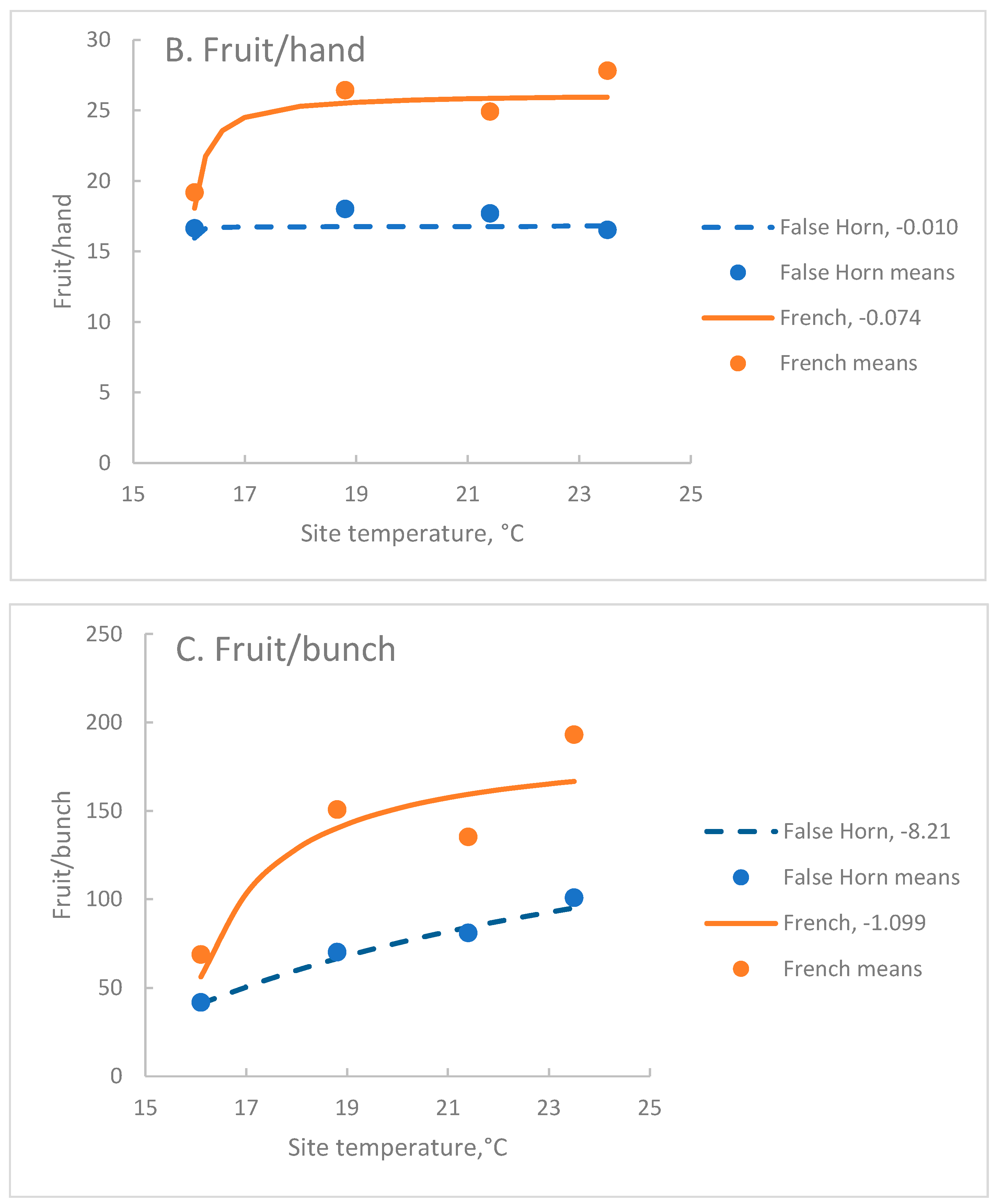
Figure 2.
The association between site temperature and A. Reproductive peduncle length, cm, B. Proportion of female peduncle, %, for False Horn and French clone-sets. Curves are the exponential reciprocal function fitted to bulked data for cycles C2 to C4 (False Horn n=360, French n=540). Points are site means (False Horn n=90, French n=135). Solid lines indicate the French clone-set and broken lines the False Horn clone-set. The C coefficient appears after the legend for each curve. For each parameter, all values of C are significantly different at P=0.01.
Figure 2.
The association between site temperature and A. Reproductive peduncle length, cm, B. Proportion of female peduncle, %, for False Horn and French clone-sets. Curves are the exponential reciprocal function fitted to bulked data for cycles C2 to C4 (False Horn n=360, French n=540). Points are site means (False Horn n=90, French n=135). Solid lines indicate the French clone-set and broken lines the False Horn clone-set. The C coefficient appears after the legend for each curve. For each parameter, all values of C are significantly different at P=0.01.
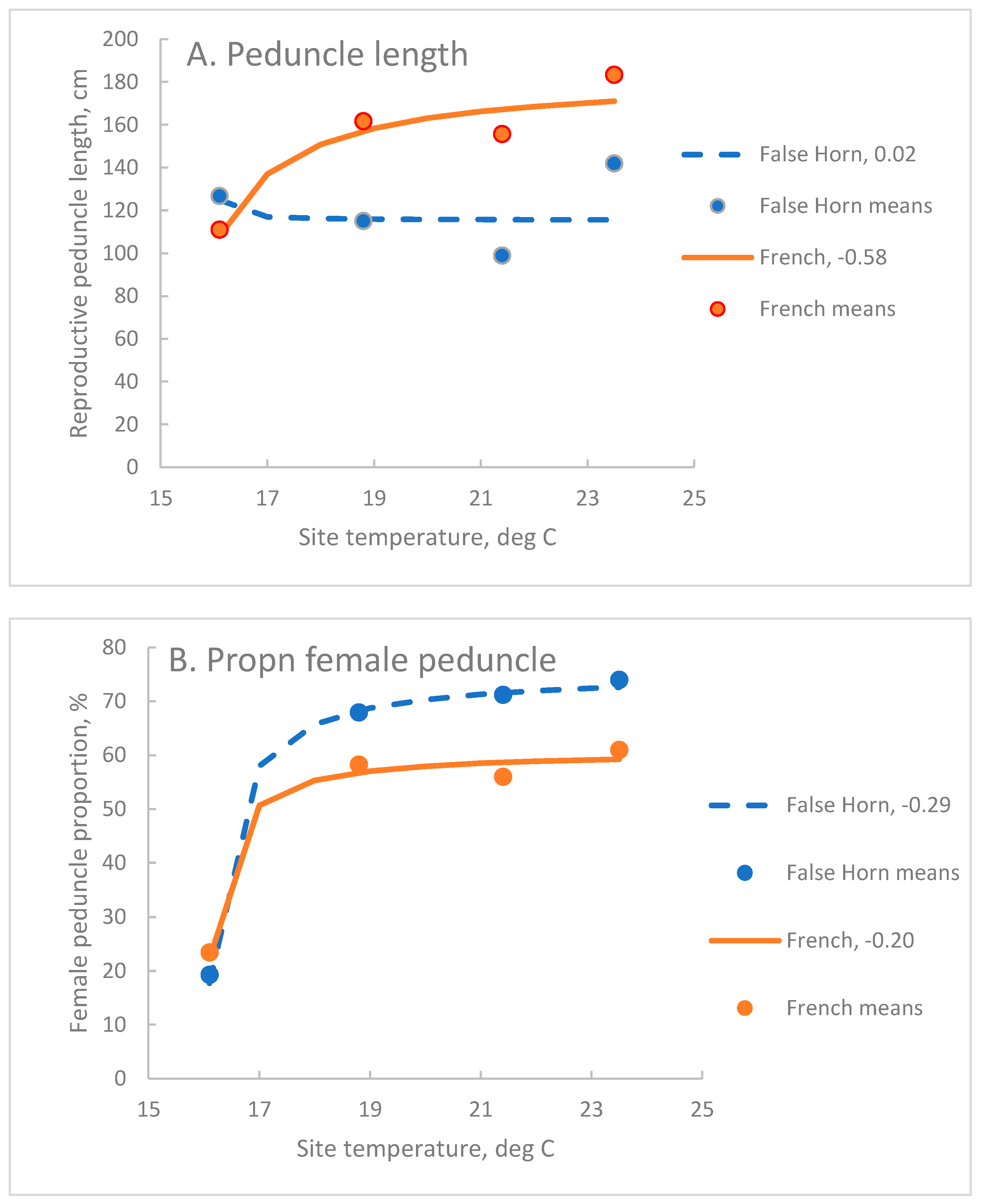
Figure 3.
The changes in Hb, Fh and Fb from plant crop (C1, base of arrows, genet absent) to ratoon crop cycles (C2, C3 and C4, tip of arrows, genet present) for A. False Horn cultivars and B. French cultivars. Data were ‘modified’ and the calculated Ndihira data used for C1. Each symbol type represents a different site (see legend). Open symbols and dotted arrows show changes for Hb and Fb, solid symbols and arrows show changes for Hb and Fh. The arrows show the direction and amount of change from C1 to C2, C3 and C4. Each arrow is the linear trend-line and starts at C1 and ends at C2, C3 and C4. The y axes in A and B have different ranges and in A, for each point, n=30 and for B, n=45.
Figure 3.
The changes in Hb, Fh and Fb from plant crop (C1, base of arrows, genet absent) to ratoon crop cycles (C2, C3 and C4, tip of arrows, genet present) for A. False Horn cultivars and B. French cultivars. Data were ‘modified’ and the calculated Ndihira data used for C1. Each symbol type represents a different site (see legend). Open symbols and dotted arrows show changes for Hb and Fb, solid symbols and arrows show changes for Hb and Fh. The arrows show the direction and amount of change from C1 to C2, C3 and C4. Each arrow is the linear trend-line and starts at C1 and ends at C2, C3 and C4. The y axes in A and B have different ranges and in A, for each point, n=30 and for B, n=45.
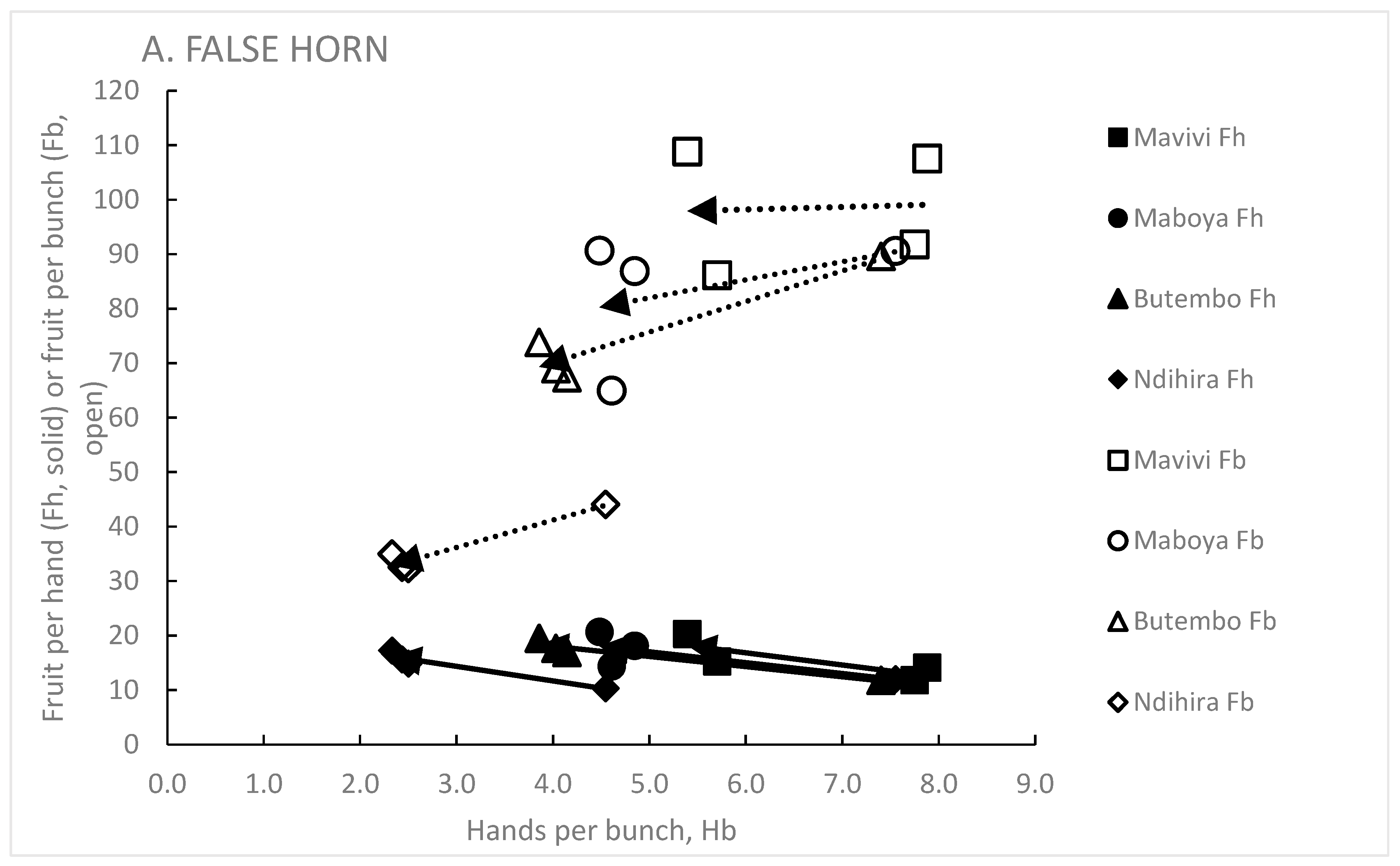
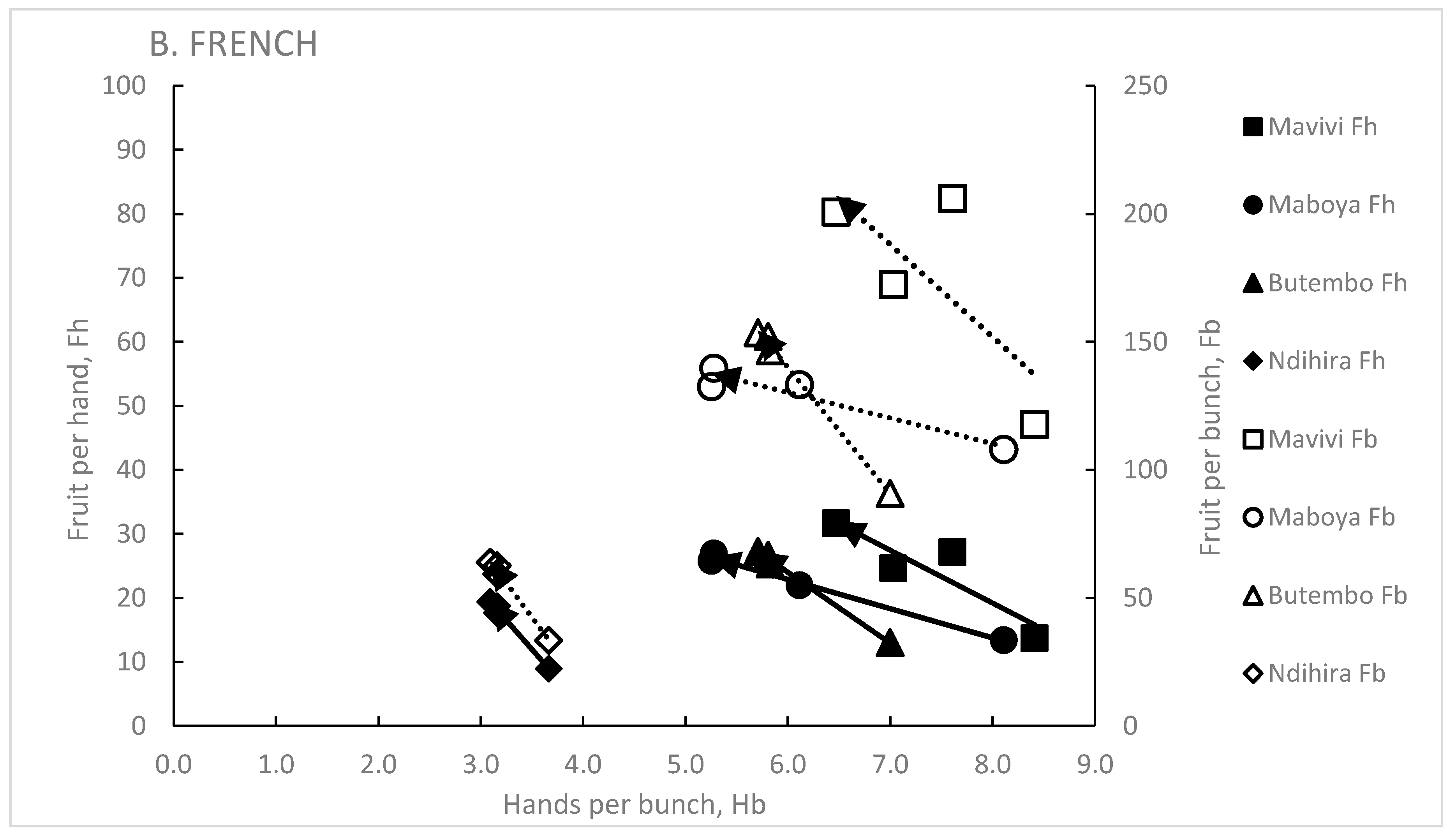
Figure 4.
The effect of defoliation at different stages before flowering of the plant crop (no genet) on the Fh and Hb of inflorescences that subsequently emerged, expressed as a proportion of the control (no defoliation). The inflorescence usually begins to form -11 leaves before flowering (range -8 to -14). Each point is for a single inflorescence. Data from Turner and Hunt [59].
Figure 4.
The effect of defoliation at different stages before flowering of the plant crop (no genet) on the Fh and Hb of inflorescences that subsequently emerged, expressed as a proportion of the control (no defoliation). The inflorescence usually begins to form -11 leaves before flowering (range -8 to -14). Each point is for a single inflorescence. Data from Turner and Hunt [59].
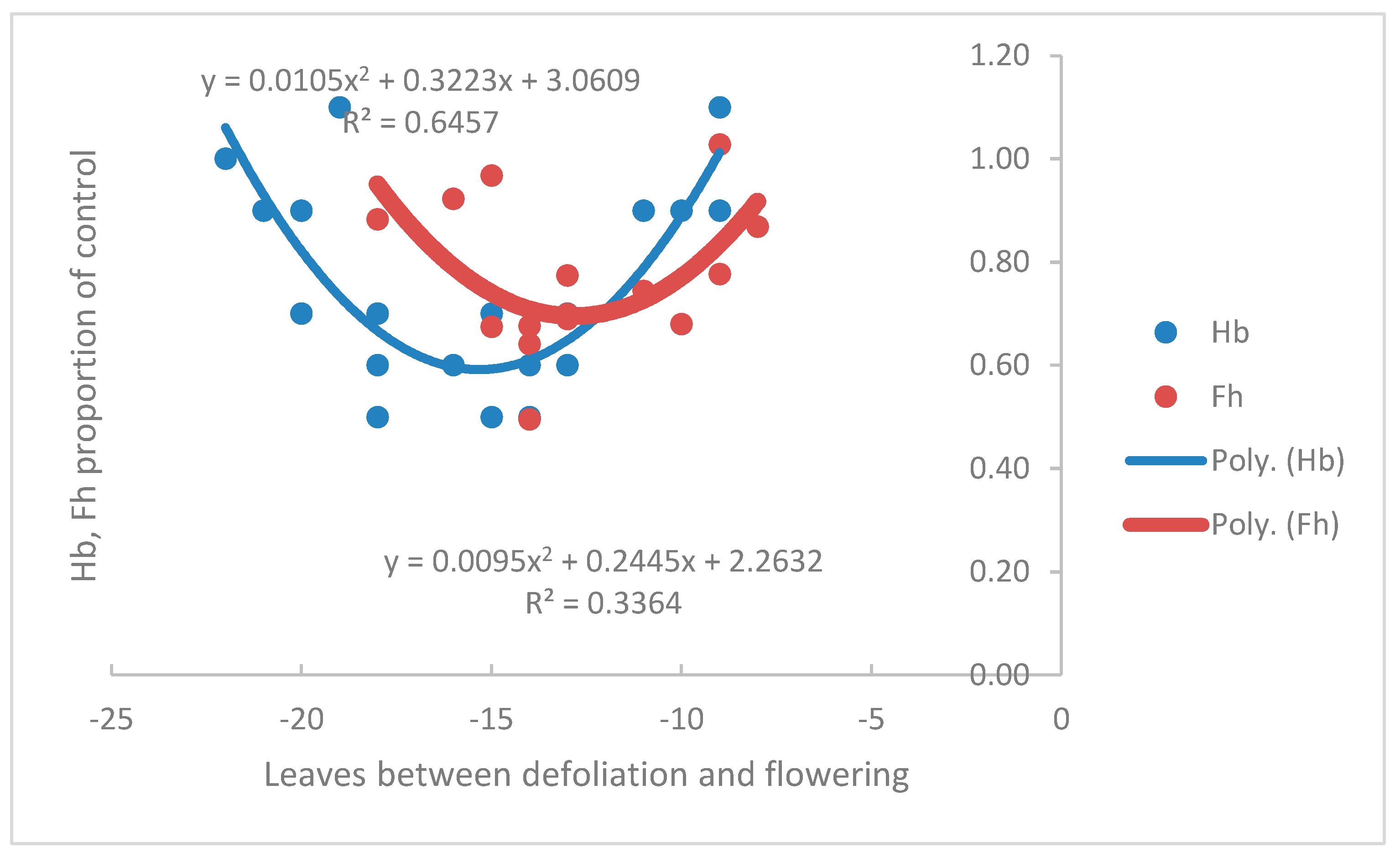
Figure 5.
The location of the four sites in North Kivu, DRC, in relation to latitude and longitude. The respective elevations (m) and annual mean temperature (°C) of the sites are given in the legend. One degree of longitude at the equator (0° latitude, x axis) is equivalent to 111 km.
Figure 5.
The location of the four sites in North Kivu, DRC, in relation to latitude and longitude. The respective elevations (m) and annual mean temperature (°C) of the sites are given in the legend. One degree of longitude at the equator (0° latitude, x axis) is equivalent to 111 km.
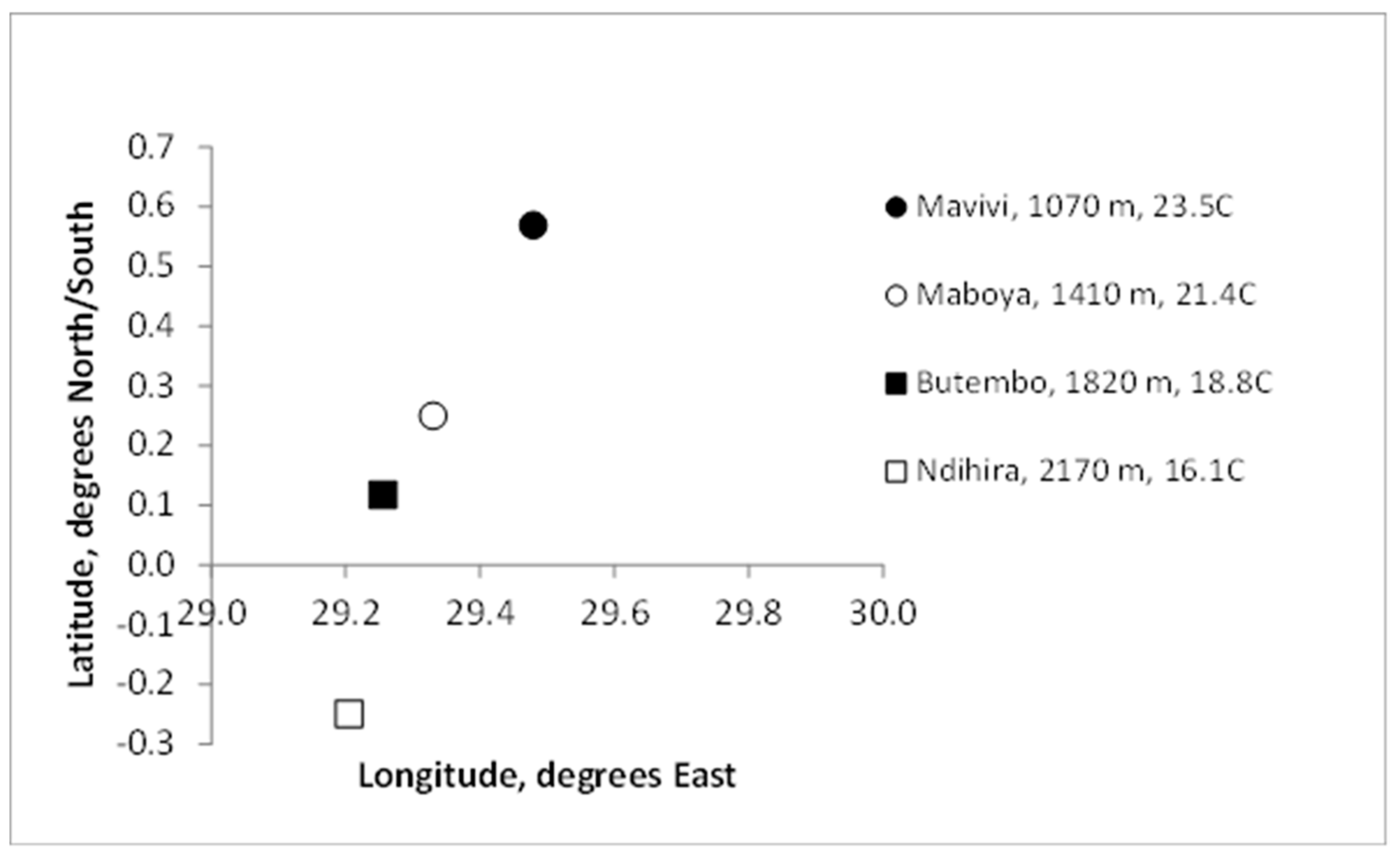

Table 1.
Measured values of A. Hb, Fh, Fb, and B. Pr and Pf of five cultivars of plantains (AAB) from two clone-sets grown over four sites of differing elevations in North Kivu, Democratic Republic of Congo. Data are the means of three ratoon crop cycles (C2 to C4). For each mean, n=45.
Table 1.
Measured values of A. Hb, Fh, Fb, and B. Pr and Pf of five cultivars of plantains (AAB) from two clone-sets grown over four sites of differing elevations in North Kivu, Democratic Republic of Congo. Data are the means of three ratoon crop cycles (C2 to C4). For each mean, n=45.
| Parameters of the female peduncle | |||||
|---|---|---|---|---|---|
| Parameter | Hands/bunch, Hb | ||||
| Clone set | False Horn | French | |||
| Site/Cultivar | ‘Kotina’ | ‘Vuhembe’ | ‘Musilongo’ | ‘Nguma’ | ‘Vuhindi’ |
| Mavivi, 1066 m | 5.29 | 4.67 | 5.57 | 5.42 | 5.63 |
| Maboya, 1412 m | 3.69 | 3.73 | 3.91 | 4.73 | 4.67 |
| Butembo, 1815 m | 3.60 | 3.49 | 4.73 | 5.86 | 4.73 |
| Ndihira, 2172 m | 2.12 | 2.04 | 2.36 | 2.07 | 1.94 |
| LSD, P=0.05 | 0.23 | ||||
| Parameter | Fruit per hand, Fh | ||||
| Mavivi | 11.8 | 14.4 | 20.2 | 24.1 | 21.8 |
| Maboya | 14.6 | 13.9 | 21.9 | 20.9 | 17.2 |
| Butembo | 17.4 | 14.6 | 21.6 | 24.2 | 24.4 |
| Ndihira | 2.6 | 3.3 | 2.4 | 2.9 | 3.5 |
| LSD, P=0.05 | 0.2 | ||||
| Parameter | Fruit per bunch, Fb | ||||
| Mavivi | 58.8 | 65.7 | 110.8 | 127.4 | 120.2 |
| Maboya | 52.9 | 50.4 | 83.1 | 97.1 | 79.0 |
| Butembo | 59.8 | 49.5 | 100.3 | 139.2 | 113.3 |
| Ndihira | 5.0 | 6.0 | 5.0 | 5.5 | 5.9 |
| LSD, P=0.05 | 1.3 | ||||
| Dimensions of the reproductive peduncle | |||||
| Parameter | Length of reproductive peduncle, Pr, cm | ||||
| Cultivar | ‘Kotina’ | ‘Vuhembe’ | ‘Musilongo’ | ‘Nguma’ | ‘Vuhindi’ |
| Mavivi | 128 | 95 | 143 | 148 | 142 |
| Maboya | 78 | 80 | 121 | 141 | 111 |
| Butembo | 109 | 95 | 137 | 159 | 132 |
| Ndihira | 107 | 130 | 105 | 100 | 107 |
| LSD, P=0.05 | 3 | ||||
| Parameter | Female proportion of reproductive peduncle, Pf, % | ||||
| Mavivi | 74 | 74 | 57 | 66 | 60 |
| Maboya | 73 | 69 | 52 | 61 | 56 |
| Butembo | 70 | 66 | 58 | 59 | 57 |
| Ndihira | 22 | 17 | 26 | 26 | 18 |
| LSD, P=0.05 | 1 | ||||
Table 2.
The effect of (i) modifying Hb, Fh and Fb for P and K concentrations in soil, SQRT(PK), and (ii) calculating the Ndihira data using the Ndhi ratio procedure on site means of parameters of inflorescence architecture. Data are for ratoon crops (C2 to C4) and were averaged over all cultivars. ‘Measured’ are the original data. Means within a row, followed by the same letter do not differ at P=0.05.
Table 2.
The effect of (i) modifying Hb, Fh and Fb for P and K concentrations in soil, SQRT(PK), and (ii) calculating the Ndihira data using the Ndhi ratio procedure on site means of parameters of inflorescence architecture. Data are for ratoon crops (C2 to C4) and were averaged over all cultivars. ‘Measured’ are the original data. Means within a row, followed by the same letter do not differ at P=0.05.
| Site | Mavivi | Maboya | Butembo | Ndihira |
|---|---|---|---|---|
| Site Temperature, °C | 23.5 | 21.4 | 18.8 | 16.1 |
| Data/parameter | Hands/bunch, Hb | |||
| Measured | 5.31 a | 4.15 b | 4.48 c | 2.11 d |
| SQRT(PK) | 6.75 a | 5.19 b | 5.07 c | 3.00 d |
| SQRT(PK), Ndhi calc | 6.75 | 5.19 | 5.07 | 2.86 |
| Parameter | Fruit/hand, Fh | |||
| Measured | 18.3 a | 17.6 a | 18.9 b | 2.8 c |
| SQRT(PK) | 23.3 a | 22.0 b | 23.1 a | 3.0 c |
| SQRT(PK), Ndhi calc | 23.3 | 22.0 | 23.1 | 17.6 |
| Parameter | Fruit/bunch, Fb | |||
| Measured | 97 a | 73 b | 92 c | 5.5 d |
| PK | 156 a | 113 b | 118 c | 6.3 d |
| PK, Ndhi calc | 156 | 113 | 118 | 52 |
| Parameter | Total peduncle length, Pr, cm | |||
| Measured French | 144a | 125b | 143a | 104c |
| Measured False Horn | 112d | 79e | 102c | 118f |
| SQRT(PK) French | 183a | 156b | 162c | 111d |
| SQRT(PK) False Horn | 142e | 99f | 115d | 127g |
Table 3.
Coefficients for the exponential reciprocal functions in Figure 1A–C (Eqn 5), fitted to data for five parameters each of False Horn and French clone-sets. Within a parameter, A coefficients followed by the same uppercase letter are not significantly different at P=0.001. Tb is the temperature that maximised the F ratio. Within a parameter, C coefficients followed by the same uppercase letter are not significantly different at P=0.001. *** probability for the regression is <0.001.
Table 3.
Coefficients for the exponential reciprocal functions in Figure 1A–C (Eqn 5), fitted to data for five parameters each of False Horn and French clone-sets. Within a parameter, A coefficients followed by the same uppercase letter are not significantly different at P=0.001. Tb is the temperature that maximised the F ratio. Within a parameter, C coefficients followed by the same uppercase letter are not significantly different at P=0.001. *** probability for the regression is <0.001.
| Clone set | A | Tb, °C | Curvature coeff, C | r | P |
|---|---|---|---|---|---|
| Hands per bunch, Hb | |||||
| French | 6.98 A | 15.1 | -0.81 A | 0.75 | *** |
| False Horn | 20.1 B | 5.0 | -22.78 B | 0.87 | *** |
| Fruit per hand, Fh | |||||
| French | 26.2 A | 15.9 | -0.074 B | 0.51 | *** |
| False Horn | 16.8 B | 15.9 | -0.010 C | 0.08 | 0.097 |
| Fruit per bunch, Fb | |||||
| French | 190 A | 15.2 | -1.09 B | 0.74 | *** |
| False Horn | 179 B | 10.5 | -8.21 C | 0.83 | *** |
| Length of reproductive peduncle, Pr, cm | |||||
| French | 183 B | 15.0 | -0.581 B | 0.73 | *** |
| False Horn | 115 C | 15.9 | -0.016 C | 0.16 | 0.001 |
| Proportion of peduncle with female flowers, Pf | |||||
| French | 60.8 A | 15.9 | -0.201 B | 0.92 | *** |
| False Horn | 75.5 B | 15.9 | -0.290 C | 0.94 | *** |
Table 4.
Observed Hb and Fh, calculated rates of hand and cincinnus production (expressed as R-1), calculated time to produce observed Hb and Fh, and time over which the calculated rate applied to reach the observed values of Hb and flowers/day across sites for French and False Horn clone-sets. Observed values from fitted exponential functions and rates based on site temperature and plastochron.
Table 4.
Observed Hb and Fh, calculated rates of hand and cincinnus production (expressed as R-1), calculated time to produce observed Hb and Fh, and time over which the calculated rate applied to reach the observed values of Hb and flowers/day across sites for French and False Horn clone-sets. Observed values from fitted exponential functions and rates based on site temperature and plastochron.
| Site, Temperature, °C | Hands/bunch, Hb | ||||
|---|---|---|---|---|---|
| Observed | Rate-1 | Days to produce Hb | |||
| French | False Horn | Days/hand | French | False Horn | |
| Mavivi, 23.5 | 6.34 | 5.87 | 1.64 | 10.4 | 9.6 |
| Maboya, 21.4 | 6.14 | 5.01 | 2.13 | 13.1 | 10.7 |
| Butembo, 18.9 | 5.64 | 3.90 | 3.33 | 18.8 | 13.0 |
| Ndihira, 16.1 | 3.11 | 2.58 | 5.26 | 16.4 | 13.6 |
| Flowers/hand, Fh | |||||
| Observed | Rate-1 | Flowers/day | |||
| French | False Horn | Days/cincinnus | French | False Horn | |
| Mavivi, 23.5 | 25.9 | 16.8 | 11.4 | 2.27 | 1.47 |
| Maboya, 21.4 | 25.8 | 16.8 | 14.9 | 1.73 | 1.13 |
| Butembo, 18.9 | 25.6 | 16.7 | 23.2 | 1.10 | 0.72 |
| Ndihira, 16.1 | 18.1 | 16.0 | 35.4 | 0.51 | 0.45 |
Table 5.
The proportional (%) change in Fh and Hb from the plant crop (no genet) to the second ratoon (genet present) for 24 Musa cultivars in the AAA, AAB+ABB, genomic groups grown in the subtropics of North-eastern New South Wales. Data from Turner and Hunt [58].
Table 5.
The proportional (%) change in Fh and Hb from the plant crop (no genet) to the second ratoon (genet present) for 24 Musa cultivars in the AAA, AAB+ABB, genomic groups grown in the subtropics of North-eastern New South Wales. Data from Turner and Hunt [58].
| Genome (n) | Increase in fruit/hand, Fh, % | Increase in hands/bunch, Hb, % |
|---|---|---|
| AAA (17) | 60 | 15 |
| AAB + ABB (7) | 23 | 16 |
Table 6.
The Ndhi ratios of Fh, Hb and Fb for the five cultivars of the main experiment used to calculate the Ndihira data set. Data were collected on all cultivars after the main experiment (Cycle >4) and adjusted for soil P and K concentrations.
Table 6.
The Ndhi ratios of Fh, Hb and Fb for the five cultivars of the main experiment used to calculate the Ndihira data set. Data were collected on all cultivars after the main experiment (Cycle >4) and adjusted for soil P and K concentrations.
| Cultivar | Ndhi ratio | ||
|---|---|---|---|
| Fh | Hb | Fb | |
| ‘Kotina’ | 0.97 | 0.60 | 0.58 |
| ‘Vuhembe’ | 0.87 | 0.71 | 0.62 |
| ‘Musilongo’ | 0.49 | 0.35 | 0.17 |
| ‘Nguma’ | 0.85 | 0.70 | 0.60 |
| ‘Vuhindi’ | 0.81 | 0.66 | 0.53 |
Disclaimer/Publisher’s Note: The statements, opinions and data contained in all publications are solely those of the individual author(s) and contributor(s) and not of MDPI and/or the editor(s). MDPI and/or the editor(s) disclaim responsibility for any injury to people or property resulting from any ideas, methods, instructions or products referred to in the content. |
© 2024 by the authors. Licensee MDPI, Basel, Switzerland. This article is an open access article distributed under the terms and conditions of the Creative Commons Attribution (CC BY) license (http://creativecommons.org/licenses/by/4.0/).
Copyright: This open access article is published under a Creative Commons CC BY 4.0 license, which permit the free download, distribution, and reuse, provided that the author and preprint are cited in any reuse.


