

Submitted:
07 August 2024
Posted:
07 August 2024
You are already at the latest version
Abstract
This study aimed to evaluate the impact of different closures used in second fermentation on the aromatic fraction of sparkling wine. Six types of closures (cork stoppers and screw cap) and 94 months of aging in bottle were investigated. Head-space-solid phase microextraction (HS-SPME) and thermal desorption (TD) procedures coupled to gas chromatography-mass spectrometry (GCMSMS) analysis was applied. The vectors containing the relative abundance of the volatile compounds are compositional vectors. The statistical analysis of compositional data requires specific techniques that differ from standard techniques.101 volatile compounds were identified. HS-SPME extracted highest percentage of ester, ketones and other compounds while TD was a useful tool for the obtention of alcohol, acid, ether and alkanes compounds. Esters was the most abundant family of compounds. Compositional data analysis applied to study the impact of different closures used in bottle-aging after second fermentation on the volatile composition of sparkling wine concluded that there are differences in the relative abundance of certain volatile compounds between cork stoppers and screw cap closures group. Overall, the most abundant part in screw cap closures was Ethyl hexanoate and, Ethyl octanoate in cork stoppers. Also, the proportion amount of Dimethylamine was higher in screw cap closures than cork stoppers group relative to the entire of the sample.
Keywords:
sparkling wine
; second fermentation
; aging
; aroma compounds
; compositional data
; log-ratio
; MANOVA
1. Introduction
A sparkling wine is defined as a product with carbon dioxide produced exclusively by fermentation [1]. Sparkling wine can be produced by traditional method (Champenoise) that involves two fermentative steps. The first fermentation transforms the grape must into a base wine and, the second fermentation is in bottle where a period of aging due to the contact of the product with lees is done.
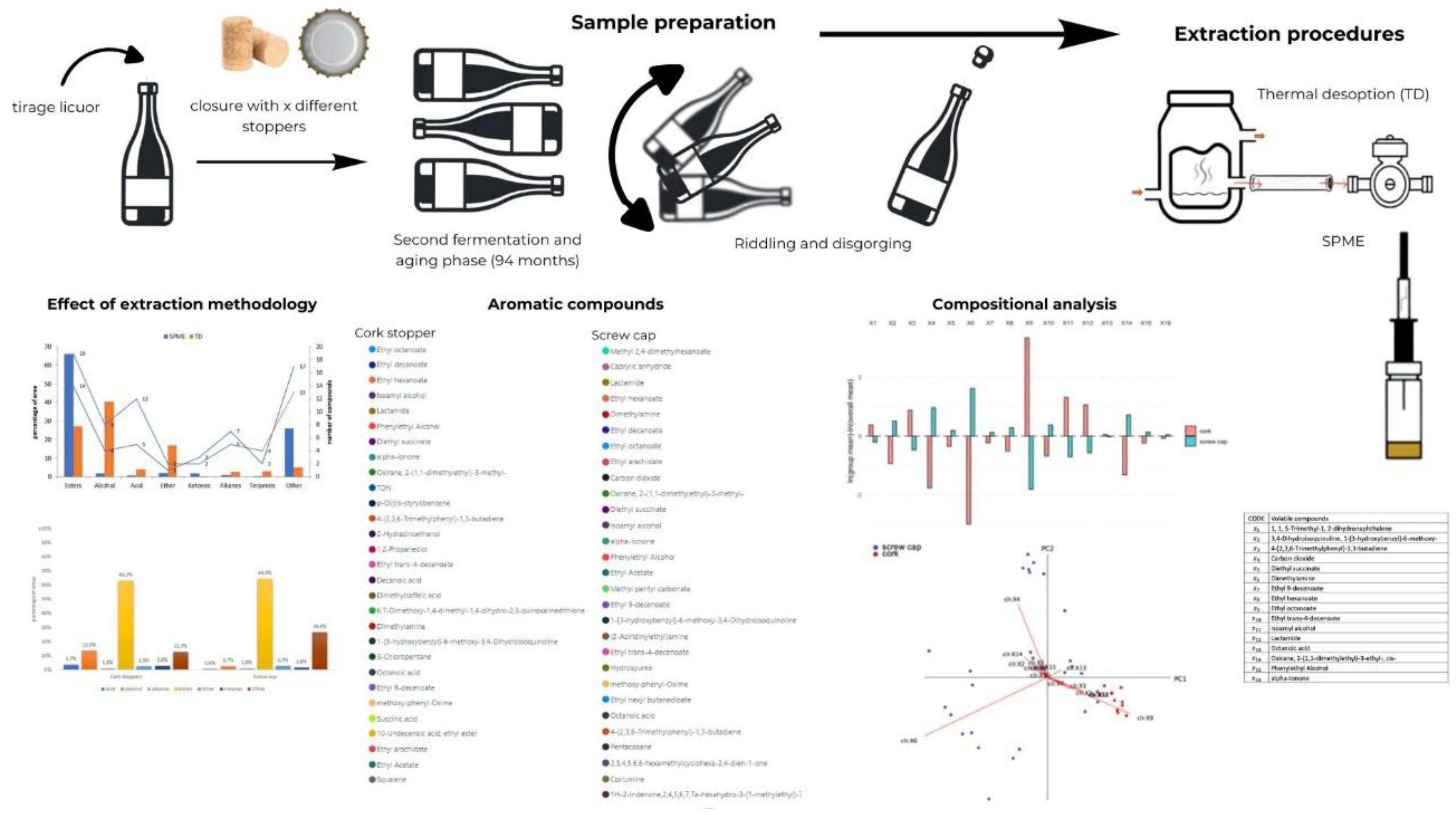
This second fermentation, known as “prise de mousse”, is done after the addition of a “tirage solution” or a mix that includes yeast, sucrose, nutrients and, sometimes bentonite [2-4].Then, the product is closured hermetically, with a screw cap or a cork stopper. The second fermentation takes between two or three months, or when the sugar concentration is less than 1.5 g L-1[1]to subsequently rest in the bottle with lees for at least nine months of aging.
While base wine is in contact with the yeast lees an autolysis process occurs[1]. The lees release nitrogenous and volatile compounds, polysaccharides, and phenolic compounds [5], which provides the complexity characteristic of cava. The result is a significant change in wine composition and foam formation that led a very important role in sparkling wine “bouquet”[6].
The final step of this traditional method to obtain sparkling wine is the riddling with the aim to eliminate the yeast lees from the bottle and disgorging process. This last process is done manually in the case of bottles closured with cork stoppers or mechanically in the case of the use of screw caps. The final product must have a minimum pressure of four atmospheres, measured at 20ºC.
The second fermentation of base wine and aging stage in bottle is carried out in closed bottles. Traditionally agglomerated cork stoppers with two natural disks held in place with a metal staple are used but, nowadays screw cap is the most common closure, because it allows the automation on the bottling and disgorgement line. However, some producers continued using cork stoppers in all production or in premium products due to the favorable outcome of sensory attributes [7].
Screw cap consist of a metal cap that screw onto threads on the neck of the bottle and that usually has an inner part that is generally composed of a polyvinylidene chloride (PVDC) film, a layer of tin foil acting as gas barrier, and a polyethylene (PE) that wad to maintain compression [8]. One of the most common types of screw caps is Saranex that is composed of PE covered on both sides with PVDC[9]. Other screw cap is Daraform or a non- polyvinylidene(PVC) compound based on polyolefinic raw materials. As previously mentioned by [10], these components have different purposes: PVDC is used for its good barrier property to oxygen and PE as a water vapour barrier. Screw cap closures are easy to remove from the wine bottle but, the metal cap, usually aluminum, can lead to the releasing of metal ions into the wine during bottle aging [11, 12].
On the other hand, cork is the outer bark of Quercus suber L. a western Mediterranean evergreen oak tree. Cork is a very suitable material for wine stoppers due to its peculiar properties such as its impermeability to liquid and air, elasticity, resilience combined with compressibility and chemical inertness [12-15]. Although, the production of different types of cork stoppers is by far the most important application of cork, it is followed by its application on construction, design, cosmetics, and clothing, among others [16,17].
The effect of bottle closure on the aroma composition of wines during aging depends on the oxygen ingress through the bottles, desorption of volatile compounds from the closures into wine and the scalping of volatile compounds present in wine by closures [8,18]. Cork has been used for centuries as a closure material for the conservation of both, still and sparkling wines. The beneficial role of cork stoppers in still wine aging is extended studied. In this sense, some volatile and phenolic compounds can be extracted from cork to wine contributing positively to some wine aspects such as flavor, color or astringency development [10, 19].
The selection of the type of closure goes beyond quality of the final product because it has also an effect on sustainability. Cork is a material obtained from the cork oak and, its extraction does not affect the viability of the tree on the contrary, since its use implies ecological and socio-economic roles [13, 20]. On the one hand, cork oak trees prevent soil degradation, desertification, contribute to biodiversity and regulate the hydrological cycle [21,22]. On the other hand, social and economic improvements are also related to cork stoppers production because the cork extraction means an increase in jobs in rural areas and is combined with other jobs such as beekeeping.
In the case of sparkling wine, aromatic profile has been described previously for cava [23-26], for champagne [14,27-28],and for Australian sparkling white wine [29]. Also, is the case of ciders [30,31]or beer[32, 33].
Overall, little is known about the impact of the type of closure in the aroma evolution during second fermentation inside bottle [7, 34]. [7]described that the effect of cork as a closure is evident in the sensory attributes because samples closured with cork stoppers showed less autolytic character, a longer aftertaste, and visually more and smaller bubbles. Also, agglomerate cork stopper helps to preserve the effervescence and aromas[18].
The characterization of aromatic compounds is an arduous task because the volatile fraction is composed of multiple substances with different physicochemical properties. Currently, exists various devices for this purpose such as headspace procedures. Headspace techniques are a solvent -free procedure used in combination with GC-MS to isolation of aromatic compounds of several matrices according to their volatility [1]. This solventless preparation technique allows simultaneous extraction of several compounds.
HS-SPME method is the first headspace sampling technique developed by [35]. This is one of the commonly used methods for the analyzing of volatile and semi-volatile compounds in a wide range of matrices such as wine[36-38]. However, some of HS-SPME technique limitations are the competition for adsorption&absorption sites caused by the fiber’s low surface capacity that could hinder the extraction of some VOCs and its reduced concentration capability [39]. The low concentration of most of the volatile components of wine makes it necessary to extract and concentrate them before they can be analyzed by gas chromatography [40]. In addition, this is a disadvantage if it wants to work in complete scanning mode to detect the greater number of extracted compounds. On the other hand, thermal desorption (TD) method stands out as an alternative to HP-SPME due to its capacity for a large sorbent phase and the use of a cryogenic focusing step to increase the sensitivity of the methodology [41]. This other HS procedure consists in the adsorption on polymers as an extraction method for volatile components present in a wide range of matrices. TD method has been widely studied because of its beneficial properties such as its versatility or its high capacity of concentration of selected compounds (up to 106)[42].
In TD, the first step is the concentration of headspace components onto a desorption tube filled with the selected adsorbent. In the case of wine, Tenax (2,6-diphenyl-p-phenylene oxide) is an excellent adsorbent because of its low water and ethanol adsorbing capacities and its high adsorbing capacity for wine aromatic compounds[40]. Then, the charged tubes are thermally desorbed and intermediately trapped into a cryogenic trap and, immediately injected into a gas chromatograph (GC-MS) after the rapidly heated of filled trap. The detection power of this technique is enhanced with this trapping stage. It must be noted that this analysis is subjected to a compound thermally stable to avoid the decomposition process [41].
No studies have so far directly linked aroma compounds and type of closure used for second fermentation and aging in bottle products. For this reason, a base wine in contact with the yeast lees was closured using six types of closures from cork and screw cap features for 94 months. The effect of the type of closure in the aroma profile of a sparkling wine obtained after second fermentation and aging in bottle was studied. Both techniques previously described (HS-SPME and TD with GC/MS) have been applied in this work to study of the aromatic profile of the product of second fermentation and aging in bottle. Our aim was to develop better comprehension of the effect of the type of closure in the aromatic profile developed during second fermentation and aging in bottle through a compositional data.
2. Materials and Methods
2.1. Closures and Wine Second Fermentation
100 bottles of base wine elaborated by Gramona was supplemented with 21.3 g L−1 of sucrose and P29 (CECT 11770) as yeast (Saccharomyces cerevisiae isolated in the DO Penedés) (or “tirage solution”). After inoculation, the wine was immediately closured with selected stoppers (Table 1) for 93 months. All closures were supplied by their manufactures.
Bottles aging was conducted in a dark acclimatized chamber at 17 ± 1◦C and the yeast was always in contact to wine. Analytical results of wine before and after the addition of a “tirage solution” are shown in Table 2.
To analyze the effect of the type of closure in the aromatic profile obtained after aging into bottle, 6 groups of 6 bottles each of closures were analyzed (n = 6 per type of stopper and n=7 for Cork2). The samples were disgorged and collected after 94 months. After riddling process, samples were a pH of 3 and a total acidity of 5.6 g L-1. All this procedure was done in the Gramona’s facilities. The disgorged bottles were sent to the Catalan Institute of Cork (ICSuro).
2.2. Extraction of Volatile Compounds
For the extractions of volatile compounds at 94 months of sparkling wine aging in bottle were used two methodologies.
HS-SPME. 5 ml of each sample and 1.25 g of NaCl were placed in a 20 ml vial, capped with a PTFE septum (Supelco, Bellefonte, PA, USA) and analyzed by HS-SPME-GCMSMS. The method is an adaptation from the one described in [23]. The extraction was carried out using a divinylbenzene/carboxen/polydimethylsiloxane (DVB/CAR/PDMS) fiber (Supelco Inc., Bellefonte, Pennsylvania, USA) that was inserted into the head space (HS). The extraction conditions were 40ºC during 40 min at 250 rpm. Then, the fiber was desorbed into the injector at 250ºC during 5 min.
Thermal desorption (TD). In TD, desorption process was carried out in two stages.
• First, desorption tube filled with extracted compounds was heated inside the desorption unit at certain temperature and time in order to desorb the analytes adsorbed in tube filling and focus them into a cold trap (or desorption trap). Helium gas is the carrier gas used in splitless mode [43]. Stainless steel thermal desorption tubes (6 mm O.D. × 90 mm long, 5 mm I.D.,Markes International Limited, Pontyclun, UK) were used in this study. Tubes were packed with 200 mg of Tenax® TA supplied by Ingenieria Analitica, S.L (Barcelona, Spain), a porous polymer resin based on2,6-diphenylene oxide with a particle size of 20–35 mesh, which has been designed for trapping volatile and semi-volatile organic compounds from air.
• Then, desorption trap was heated to a chosen temperature at maximum heating rate to introduce the retained analytes into the chromatographic column.
• Desorption tubes filled with extracted compounds was obtained following a developed procedure in this study. The designed system is showed in Figure 1.
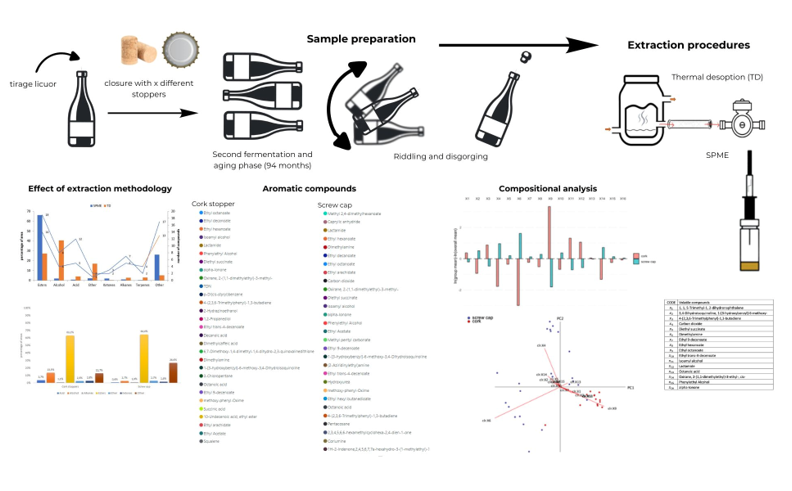
Figure 1 represents a hermetically sealed glass container with an outer coating through which distilled water at 52 °C flows. Inside the container, 30 mL of sample was heated for 6 min to achieve a constant temperature of 35 °C. Then, the first desorption tube was inserted in contact to the head space created and also, it is connected to a suction pump at 140 mL min-1, as shown in Figure 1. The adsorption tube was connected for 5 min and then, it was immediately closed to avoid the loss of retained compounds. Thereafter another desorption tube was inserted at the same way. This procedure was repeated until get 10 tubes per sample in order to increase the volume of analyzed sample and attempt to gain the greater number of extracted compounds.
For the analysis of desorption tubes with extracted compounds retained inside an Ultra A automated sampler and a Unity Thermal Desorption system (Markes International Limited, Llanstrisant, UK) connected to a GC-MSMS was used. Thermal desorption of sampling tube was carried out at 300 °C for eight min and, the extracted compounds were stored in a cold trap at -20 °C. Finally, and to introduce trapped compounds into the gas chromatograph, the cold trap was heated rapidly from −20 ◦C to 305 ◦C [43].
In the case of both extraction procedures, HS-SPME and TD, GCMSMS analysis was performed on a 7,890 A gas chromatograph coupled toa 7000 triple quadrupole mass spectrometer (Agilent Technologies, Santa Clara, CA) system equipped with an Agilent Multimode injector. Data acquisition and processing was performed using Agilent MassHunterQualitative and MassHunter Quantitative Analysis B.08.00 software. Chromatographic separations were carried out using a J&W HP-5MSUI capillary column (30 m × 0.25 mm I.D., df: 0.25 μm) supplied by Agilent Technologies. Helium (purity 99.999%) was employed as a carrier gas at a constant flow of 1.4 mLmin-1. The injector temperature was 290ºC for one min.
The oven temperature started at 40ºC, was held for 10 min, then raised to 200ºC at 2ºCmin-1, was held for one min. Then, the temperature was raised to 250ºC at 2ºC min-1 and was held for 10 min. The temperature of the transfer line was 280ºC, and nitrogen (1.5 mLmin-1) was used as the collision gas. The mass spectrometer was operated in the electron ionization mode at 70 eV in the complete scanning mode (SCAN), in the 20 to 300 u mass range. The extracted compounds were assigned according to the fragmentation profile and concretely, ion abundance between the sample spectrum and NIST library (NIST 14) with a NIST score of 85. The area of each compound was the area of the chromatographic signal produced by the largest mass fragment (base peak). A normalizing approach was used to obtain the percentage of each compound: the area of the base peak/total area.
2.3. Compositional Data Analysis
Compositional data (CoDa) refers to vectors of positive components representing proportions of some whole [44]. All components, also called parts, are assumed positive, and the only relevant information is contained in the ratios between them. A simplified manner to represent CoDa is using the closed form, which is a positive vector where the parts sum up to a positive constant, i.e. with and . Typically, for parts per unit or for percentages. The sample space of CoDa is called the simplex, and it is denoted as . In the context of our study, the volatile compound data obtained using the method described in the previous section and through the normalizing approach align with this definition.
In general, standard statistical methods presuppose an absolute scale for data, which conflicts with the inherent relativity of CoDa. Therefore, we will require statistical methods that acknowledge this relative nature, and this implies working with ratios or, more specifically, with logratios. In the literature we can find different possible logratios introduced as one-to-one transformation from to the real space [44]. For the purpose of the paper, we will consider the so-called centredlogratio transformation (clr), where the composition is expressed as vector of score.
where is the geometric mean of the parts of , that is .When interpreting the components of the clr-vector, it is essential to consider that they represent a part relative to the average of all parts. Moreover, some simple logratios, that is , will also be used. This log-ratio approach is already justified and applied in some works using data obtained from chromatography [45].
In the case of descriptive statistics, we have some alternatives to the standard arithmetic mean and variance called the center, variation matrix and total variance [46]. Let’s consider a CoDa set represented as a matrix with n rows (samples) and D columns (volatile compounds). The center of the data set is where is the geometric mean of the column j and represents the closure operator applied to rescale the resulting vector to the constant sum . Note that here, the geometric mean is considered column-wise. In addition, the dispersion of a CoDa set is usually quantified using the variation matrix, a matrix formed by the usual variance of the simple logratios, . Note here that variances close to zero indicates two redundant parts. A global measure of relative dispersion, called total variance, is defined as the sum of all the variances of the variation matrix divided by. The total variance of equals to the trace of the covariance matrix of the clr-scores data set.
A compositional MANOVA test [47]can be applied to determine whether some significant difference among group means exists. The non-parametric compositional MANOVA test together with a homoscedasticity study are recommended when the multivariant normality on [48] cannot be accepted. When we have two or more groups in our data set, we can use the geometric mean barplot (Figure 4) to graphically compare the centers. For each group, we initially compute the ratio between the overall geometric mean and the group's geometric mean. Subsequently, each part is visualized in a barplot with a logarithmic scale. When the group's center aligns with the overall center, each component's ratio equals to 1, resulting in a zero in log-scale. Conversely, if a group's center differs from the overall center, the ratio deviates from one, yielding a positive or negative logarithm. Therefore, large bars (positive or negative) indicate substantial disparities in means. A boostrap percentile interval plot can complement it adding uncertainty through a resampling process (Figure 5).
Principal component analysis (PCA) is a commonly employed technique for exploring chemical measurements[49-51]. The aim of PCA is to simplify complex data sets by transforming them into a smaller set of uncorrelated variables, known as principal components. These components retain as much of the original variation in the data as possible, making it easier to interpret the underlying patterns and relationships within the data set. The results can be visualised using a biplot (Figure 6). The clr-scores data set is used to perform PCA and to represent a biplot for CoDa set [46]. In a clr-biplot the length of each ray represents the variance of the clr-variable (volatile compound), and the position of the samples can suggest potential clusters. However, a PCA-based plot does not use the information provided by a factor (closure type). When we have more than two groups, the canonical variates plot can also be considered. A canonical variation is a linear combination of particular logratios that highlights the differences between groups defined by a factor.
The mentioned methodology of working with logratios does not accommodate zero values since logratios cannot be calculated with a zero value. Essentially, two types of zeros are encountered: the structural zeros, obtained when a part is zero due to a physical constraint, and the rounded zeros, also called below detection limit zeros, obtained when the small presence of a part cannot be measured given the accuracy of the device used. Due to the different nature of these zeros, distinct treatments are required. Our focus here will be on rounded zeros, as they are the type of zeros observed in our data set. When dealing with rounded zeros, the strategy involves replacing them with a suitable small value, one exceeding a specific threshold [52].
3. Results
This study investigated the effect of cork stoppers and screw cap in the aromatic profile of a sparkling wine with second fermentation and aging in bottle. The yeast lees contact time was 94 months.
3.1. Effect of Extraction Methodology
Two extraction methods (HP-SPME and TD) were used to obtain volatile compounds of sparkling wine with second fermentation and aged for 94 months. The obtained chromatograms of sparkling wine bottle-aging closured with closure A and isolated by TD and HP-SPME were showed in Figure 2. A summary of the data obtained by both extraction methodologies is presented in Table A1 (Appendix B). Briefly, the number of identified compounds extracted from TD (65) was slightly higher than HP-SPME (53).
These results show that both methodologies are suitable for the analysis of volatile compounds in sparkling wine. SPME and TD have been successfully used for the identification of aromatic compounds in wine [25,26,36,40,53-56]and sparkling wine [23,24,57]. Therefore, TD required 30 ml of sample for extraction while HP-SPME needed 10 ml.
Furthermore, TD is a time-consuming process (2h) and requires temperature for volatile compounds extraction. Both were based on the equilibrium partitioning of the volatiles between solution (or sparkling wine) and gas phase. Then, the solutes are extracted from a liquid phase, of an aqueous matrix or wine and migrate into a polymer phase: fit inside the needle of a syringe-like device in the case of HP-SPME or as a filling of a desorption tube in the case of TD. Then, in the case of TD, is done a thermal desorption step process followed by a preconcentration step (TD) using a cryotrap. The most important disadvantage of HP-SPME is the lack of sensitivity [41]. In this study, TD extraction was designed to the aim of benefit from the higher amount of sorbent and the trap focusing for the purpose of increase the sensitivity.
The extracted compounds are classified into families according to its chemical nature as acids, alcohols, alkanes, esters, ethers, ketones and other. Figure 3 shows the percentages of sparkling wine families of volatile compounds extracted by HP-SPME and TD considering all analyzed closures. As can be seen, some differences were observed in terms of percentages of the major families of volatiles. HP-SPME allowed for more effective extraction of esters considering both the percentage of area (66.1%) and the number of compounds (19). Furthermore, HP-SPME showed higher proportion of ketones (1.8%) and other (26.2%). On the contrary, the proportion of alcohols (40.6%), ether (17.0%), alkanes (2.6%), terpenes (3.0%) and acids (4.0%) were higher in TD extracts than HP-SPME (1.9%, 2.0%, 0.9%, 0.1% and 0.8%, respectively).
Ethyl esters of aliphatic acids are an important group of compounds in the volatile profile of sparkling wine [23]. Although HP-SPME allowed the extraction of greater number of esters, TD and HP-SPME were suitable methods for determining commonly esters such as methyl 2,4-dimethylhexanoate, ethyl octanoate, ethyl decanoate, ethyl arachidate or ethyl hexanoate in sparkling wine samples (Table A1, Appendix B). Other esters compounds like extracted using HP-SPME and TD were Ethyl 9-decenoate, Diethyl succinate and Ethyl butyrate. All these compounds have already been identified in sparkling wines [23,25,58-60]. Diethyl succinate is a post fermentation volatile formed during aging of sparkling wines in contact with lees from the second fermentation [23]. For this reason, this compound is a marker of the evolution of sparkling wines during cellar storage [24,25]. Overall, representative esters were detected by both extraction methodologies but, HP-SPME was the fastest and easiest technique to extract them
Alcohols were the second most abundant family with the highest levels of Isoamyl alcohol in the case of TD extraction and Phenylethyl Alcohol in the case of HP-SPME. According to [59], Phenylethyl alcohol has influence on the sweet, rose and honey aroma structure of sparkling wines. Both higher alcohols have already been identified in sparkling wines[59]. Other representative alcohols such as 1-hexanol and 1-butanol, which are mostly produced during the pre-fermentation wine production process, were extracted using TD. 1-hexanol is a representative alcoholcharacterized by “green” and “herbaceous” notes.
Fatty acids probably being connected with the different grape’s origin and/or the winemaking conditions used[60]. The most representative acids identified were different by using TD or HP- HP-SPME. Octanoic and Decanoic acid were obtained by both methods but with the highest percentage of area detected in sparkling wines analyzed by HP-SPME (Table A1, Appendix B). We found that some compounds such as Succinic acid and Dimethyl caffeic acid were only detected by HP-SPME and others like Alkynyl Stearic Acid, 3-Hydroxydodecanoic acid, Acetic acid or Aminomethanesulfonic acid were identified using TD.
In the case of ether compounds, 2-(1,1-dimethylethyl)-3-methyloxirane and 1-Methyl-1-silacyclopentan-1-ol were identified. This last was only detected using TD. Ethers are a type of volatile compound that significantly contribute to the intricate aroma of wine. They are mainly generated during the alcoholic fermentation but additionally, these compounds can also develop during the wine aging process as it undergoes chemical reactions in barrels or bottles[61]. Although ethers are less prevalent than esters, their presence enhances the wine's aromatic complexity, offering scents that span from herbaceous to floral and spicy. Their interaction with other volatile and non-volatile elements in the wine further shapes their sensory perception and overall impact.
Ketones are an important class of volatile compounds that contribute significantly to the aroma profile of wine. Their presence plays an important role in the complexity of wine's sensory attribute although its concentration is lower compared to other volatiles like esters and alcohols. Ketones are primarily formed during the fermentation processes but also in aging step[62].
HP-SPME was the best method to extract alpha-ionone or a C13-norisoprenoid that is known for its contribution to the aroma of fruits. Other ketones such as caprolactone or 2,3,4,5,6,6-hexamethylcyclohexa-2,4-dien-1-one was also detected using HP-SPME. On the contrary, 2,2-dimethyl-5-phenylfuran-3-one was extracted using TD. Lactones were also detected in sparkling wines due to aging process because they are generated by hydrolysis of the precursors
Alkanes are naturally present in the waxy cuticle of grape skins, and it can also form during the fermentation process because yeast metabolism can produce them as secondary metabolites or during the aging of wine due to chemical reactions that can generate or modify alkane compounds. The number and nature of extracted alkanes depends on the extraction methodology. Levels of Pentacosane, Nonacosane, Tetratriacontane, Hexatriacontane, 3-choropentane and Vinyl decanoate was obtained using HP-SPME. On the other hand, n-Hexane, Octathiocane, 5-methyl-Hexadecane, Hexadecane and Octadecane and was extracted by TD method. Alkanes typically have a relatively low impact on the aroma profile of wine due to their low volatility. However, they can contribute to the background complexity and texture of the wine.
Terpene compounds were similar determined by HP-SPME and TD. These family of compounds is a large group of wine aroma compounds characterized by floral aroma. It seems that these groups of compounds are produced during the pressing of grape and settling process. Squalene is a natural triterpene widely distributed in nature and it was extracted using both methodologies. Therefore, TD method allowed the extraction of another triterpene, Friedelin. This last is a compound of the triterpenic fraction of cork, and it is described as a precursor of bioactive components for biomedical applications [63]. D-limonene or a monoterpene was also obtained using TD as in the case of TDN or a C13-norisoprenoid. According to Torrens et al. 2010 [26], TDN originates from carotenoid degradation, and it is influenced by the ageing process linked to acid-catalyzed reactions. TDN together with diethyl succinate and vitispirane, can discriminate sparkling wines aged >20 months according to Francioli et al. 2003 [64]. But, beyond this, due to the relatively low concentrations of these compounds and the complexity of the matrix, their analyses require a previous fractionation and separation of volatile terpenes or non-polar fraction from polar fraction [65].
There are several compounds classified as other. HP-SPME allowed the extraction of most of them such as Lactamide or Dimethylamine. Caprylic anhydride was obtained by both methods. Some of them has not been described previously.
According to our results, HS-SPME may a useful extraction method for esters, ketones and other compounds while for the extraction of alcohol, acid, ether, alkanes and terpenes is better the TD methodology. It was initially expected that the TD extraction is showing more efficient due to the advantages mentioned earlier. Considering those results, a first step with the aim of the optimization of TD methodology would be necessary to gear its strengths. Some desorption parameters such as desorption time, desorption temperature, trap low cryo-temperature or trap high temperature and its associations would affect the response of the volatile compounds [43].
[23] Considered that HP-SPME allow the extraction of the most representative polar compounds of a sparkling wine. In this study, HP-SPME allowed the extraction of some acetate, Ethyl and isoamyl esters of high molecular weight that seem to be typical aromas of sparkling wines of low ageing time. At the same time, HP-SPME is a useful tool for the detection of diethyl succinate, TDN and hexanol or compounds related to autolysis process according to [64]and, at the same time, compounds inherent in the bouquet of long aged sparkling wines.
3.2. Aromatic Compounds Versus Type of Closure
The behavior of the cork stoppers and screw caps used in bottle-aging after second fermentation of sparkling wine samples are shown in Figure 4.
Figure 4.
Percentages of major families of volatile compounds extracted by HP-SPME and TD (combined) in samples of sparkling wine with bottle-aging after second fermentation using cork stoppers and screw cap.
Figure 4.
Percentages of major families of volatile compounds extracted by HP-SPME and TD (combined) in samples of sparkling wine with bottle-aging after second fermentation using cork stoppers and screw cap.
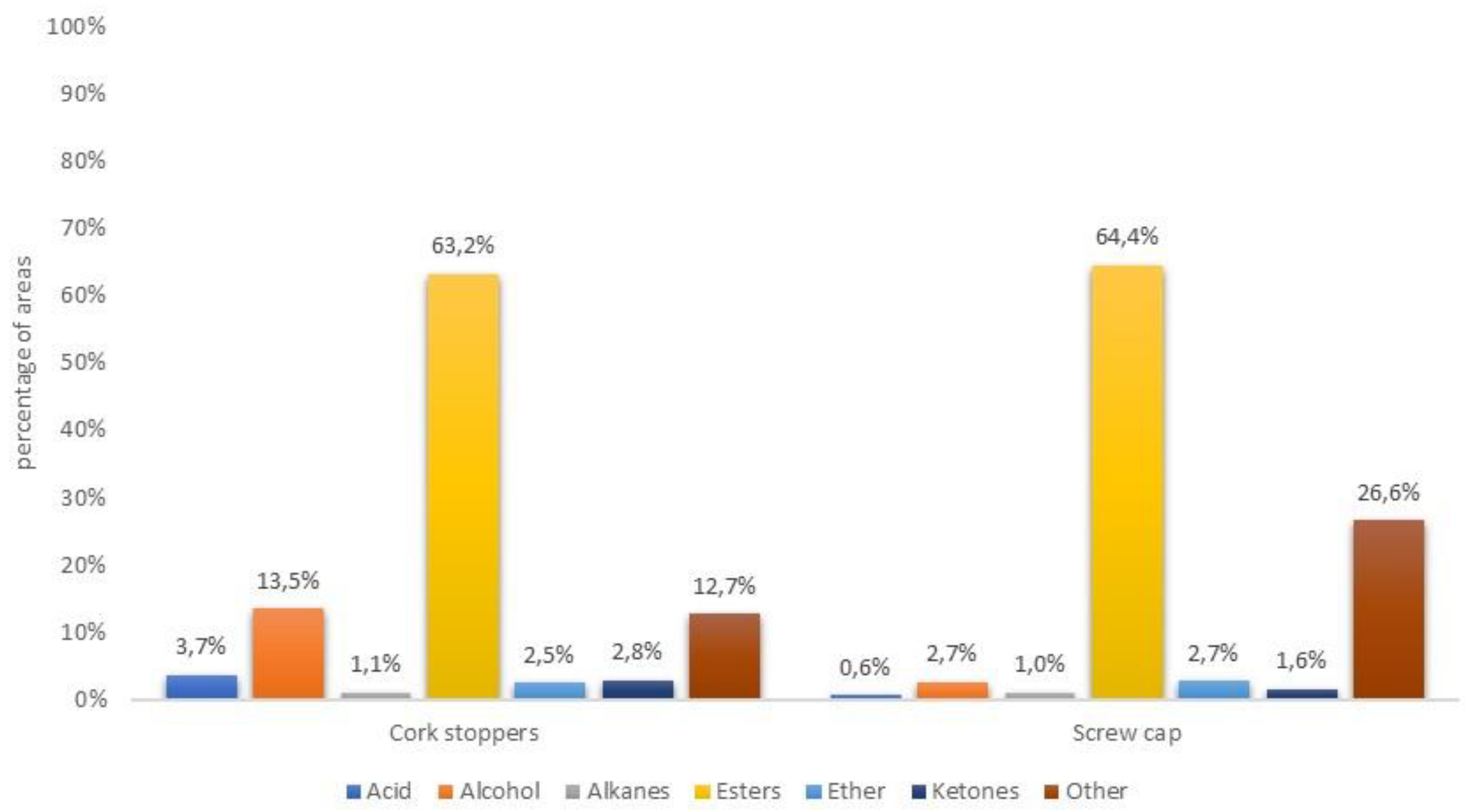
Esters was the most abundant family of compounds in both types of closures. Levels of some families of volatile compounds such alcohols, acids and other are those which have the wide differences between the type of closures.
As previously mentioned, volatile esters are one of the most important family of compounds because had an important role in volatile profile structure [59] and, contribute to the presence of fruity and floral-like notes in the sparkling wine aroma [1,2,18] and it appeared that there is the result of the autolysis of the yeast. Some factors such as the yeast strain or fermentation conditions (temperature, nutrient content, or availability of oxygen) have already been linked to the formation of volatile esters [1,3]. Therefore, the type of closure would be related to the preservation of the levels of ester compounds in sparkling wine improving the shelf life of the product. The percentage of ester area is similar in both closures. Among esters presented in the analyzed sparkling wines, Methyl 2,4-dimethylhexanoate was the most abundant ester and it was only detected in screw cap closures. Methyl esters in wine are related to yeast fermentation [66]. Ethyl acetate and ethyl esters with high molecular weight such as Ethyl octanoate (floral), Ethyl hexanoate (fruity), Ethyl decanote (floral), Ethyl arachidate and Diethyl succinate (overripe), were detected in all samples. According to [66], these compounds can show synergistic effect even at low amounts. In the case of the effect of the type of closure, [18] described the presence of more amounts of several ethyl esters in sparkling wine closured using cork stoppers instead of a microagglomerated stoppers. In the case of diethyl succinate is considering as a marker, mainly connected to the period of cava storage in the cellar. This compound is defined as fruity or floral by tasters and is a marker of the evolution of sparkling wine because it is a post fermentative volatile formed during the aging of sparkling wine in contact with lees from second fermentation [1,23]. Overall, diethyl succinate, TDN and hexanol seem to be compounds inherent in the bouquet of long aged sparkling wines [24,25]. The first two were detected in higher amount in cork stoppers than screw cap closures (Table A1, Appendix B). Finally, sparkling wines acetates like Ethyl acetate decrease along ageing time of sparkling wine in contact with lees [25]. However, a higher amount of this acetate was detected in screw cap closures.
In the case of cork closures, the second most abundant family of compounds was alcohols which are related with yeast metabolism [1]. Sparkling wine alcohols such as Isoamyl alcohol and Phenylethyl Alcohol were detected in both closures. This last has influence on the sweet, rose and honey aroma structure of sparkling wines [26,67-68] and Isoamyl alcohol can influence wine aroma by adding “alcohol” and “nail polish” notes [59]. 1-hexanol was identified in both stoppers but with higher amounts in screw cap closures. In the case of sparkling wines elaborated by traditional method, the alcohols augmented after alcoholic fermentation and remained almost constant after second fermentation and through aging. However, in the case of certain alcohol like 1-hexanol, tended to increase being a suitable ageing marker as mentioned previously. [18] described that the levels of 1-hexanol was also significantly influence by the type of closure in a sparkling wine. In accordance with these authors, the lower levels of 1-hexanol in sparkling wine sealed with cork stoppers may be due to its oxidation to 3-hexenal but this aldehyde was not detected in the volatile composition of our samples under our experimental conditions. 1-butanol was only obtained in screw cap samples. According to [69], 1-hexanol contributing to the aroma of grass just cut and 1-butanol to medicinal aroma of wine.
Concerning the acids, the most common were detected in both groups. However, the most representative like octanoic and decanoic acid, have been detected in higher amounts in sparkling wines closured using screw cap. These acids, depending on the concentration, can have a negative role in the development of wine sensory profile [26,67]. Among ethers compounds, Oxirane, 2-(1,1-dimethylethyl)-3-methyl- was identified in both groups of closures being more abundant in screw cap closures (Table A1 (Appendix B). 1-Methyl-1-silacyclopentan-1-ol was only detected in screw cap closures. Alkanes and Ketones were determined in both closures, with cork stoppers being slightly higher than screw cap.
Aziridinylethylamine and Hydroxyurea were presented only in screw cap closures in higher amounts. This first is related to fishy flavor [70]. Corlumine, N-Methylcalycotomine, Phenol or Emulphor were detected in screw cap closures, while 12-O-Acetylingol 8-tiglate, 2-Myristynoyl pantetheine, 6,7-Dimethoxy-1,4-dimethyl-1,3-quinoxalinedithione or Longifolenaldehyde were identified in cork stoppers. Also, highest amount of Dimethylamine or a volatile amine with secondary amino groups [71] was detected in screw cap closures.
3.3. Effect of the Type of Closure through Compositional Data Analysis
In accordance with the obtained results, the type of closure used during second fermentation can affect the aroma composition of obtained sparkling wine. This effect may be done by the desorption of volatile compounds from closures into wine [8,18] or can be associated with the degree of oxidation. In the case of still wine, [72] described those wines sealed with different types of closures for four years differed significantly in their content of some volatile chemicals such as 1-butanol, 2-phenylethanol, 2-nonanol or Ethyl decanoate. Furthermore, [73] found that eight volatile chemicals (Isoamyl acetate, Ethyl decanoate, Nonanoic acid, n-decanoic acid, Undecanoic acid, 2-furancarboxylic acid, Dodecanoic acid and Phenylacetaldehyde) contributed to the separation of wine closures and were associated with the degree of oxidation of Cabernet Sauvignon wines.
The impact of six different closures used in bottle-aging after second fermentation on the volatile composition of sparkling wine has been evaluated using compositional analysis of a data matrix that included the compounds extracted by HP-SPME. First, two groups were analyzed: cork stoppers (cork 1 and cork 2) and screw cap closures (from CC1 to CC4).
We have a compositional data set with n=37 stoppers (n=13 group cork and n=24 group screw cap) and D=57 volatile compounds. Due to the substantial number of zeros, we first have selected the volatile compounds detected in more than 5 stoppers, that is, with a percentage of zeros below 80%. This has reduced the number of parts of our composition to D=16 whose names are listed in Table 3. Additionally, the corresponding percentage of replaced zeros and the notation used in the Figures to avoid the lengthy names of certain compound are also provided. According to the nature of these zeros the logratio EM imputation algorithm is applied [52].
The values of the whole center and subgroups center (cork and screw cap closures) are presented in Table A2 (Appendix B). Overall, the most abundant part is Ethyl hexanoate , which is also observed in the screw subgroup. However, in the cork subgroup, the most abundant part is Ethyl octanoate . Both are ester compounds, the most abundant family of compounds detected in sparkling wine samples (Figure 2 and Figure 3). For better understand these results, the geometric mean bar plot comparing the compositional center of the entire sample with the compositional center of cork stoppers and screw cap subgroups is shown in Figure 5. The volatile compounds with a larger relative difference compared to the global center were Dimethylamine , and Ethyl octanoate . It is clear from Figure 5 that the proportion amount of Dimethylamine was higher in screw cap closures than cork stoppers group relative to the entire of the sample. Dimethylamine originates mainly from the decarboxylation of amino acids during different vinification stages and once high concentrations of amines become difficult to eliminate, it is important to control their formation. Amines that contain secondary amino groups such as dimethylamine, can form nitrosamines or a hazardous substance [41]. On the contrary ethyl octanoate was higher in the cork stopper group. This ester compound is responsible for fruity and floral-like as commented previously. A similar pattern was observed for other volatile compounds such as isoamyl alcohol , lactamide and 4-(2,3,6-Trimethylphenyl)-1,3-butadiene . On the other hand, the barplot suggests that the values of Octanoic acid and alpha-Ionone parts are very similar in the two subgroups.
Non-parametric MANOVA [74] contrast applied to the clr-scores data set confirms significant differences (p<0.05) between the centers of cork stopper and screw cap closures. In this case, the homogeneity cannot be accepted but the group screw cap has large dispersion and large number of samples, and the test became conservative[75]. For comparing the centers of the two groups, the boostrap 95% percentil interval for each part is provided (Figure 6). Figure 6 shows that only intervals of parts 1, 1, 5-Trimethyl-1, 2-dihydronaphthalene and Octanoic acid have the zero value (horizontal dashed line) which means no differences between the two types of closures. All the other parts do not contain the zero value indicating differences, the larger ones in parts Dimethylamine and ethyl octanoate as were also observed in Figure 5.
The variability of the data is displayed in Table A3 (Appendix B), within the variation matrix, illustrating both the variance and the mean of each pairwise logratio. The highest variances are highlighted using a red-shaded background, while the lowest are indicated with a blue-shaded background. Additionally, the total variance and the variance of each clr component is also showed. Globally, the total variance is 51.13. Screw cap closures exhibit higher total variance (46.46) compared to cork stoppers (13.04) showing heterogeneity between groups. Examining paiwiselogratios it becomes evident that both globally and within each subgroup, the logratios with the highest variance are those containing the Dimethylamine part. However, in screw cap subgroup, logratios containing the Carbon dioxide part also display high variability. Furthermore, in both subgroups and globally, the logratios involving Phenylethyl Alcohol and alpha-Ionone parts exhibit low variability.
Figure 5.
Geometric mean bar plot comparing the compositional mean of the entire sample with the compositional mean of aromatic compounds subgroups for cork stoppers and screw cap closures.
Figure 5.
Geometric mean bar plot comparing the compositional mean of the entire sample with the compositional mean of aromatic compounds subgroups for cork stoppers and screw cap closures.
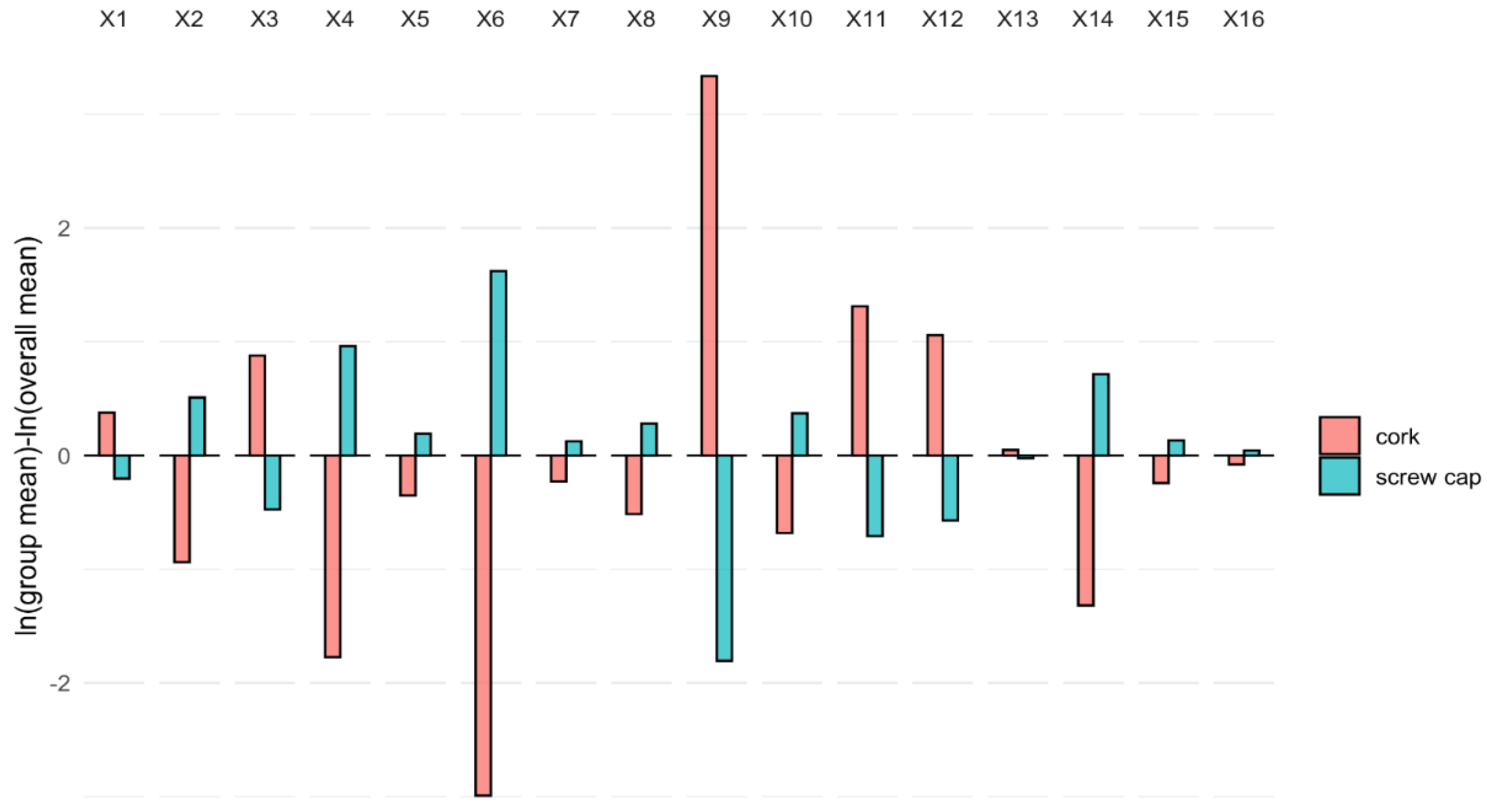
Figure 6.
Bootstrap percentile confidence intervals for log-ratio difference between centers of cork stoppers and screw cap closures groups. Filled circles are the log-ratio difference for the centers. Vertical dashed lines are the bootstrap 95% percentile intervals.
Figure 6.
Bootstrap percentile confidence intervals for log-ratio difference between centers of cork stoppers and screw cap closures groups. Filled circles are the log-ratio difference for the centers. Vertical dashed lines are the bootstrap 95% percentile intervals.
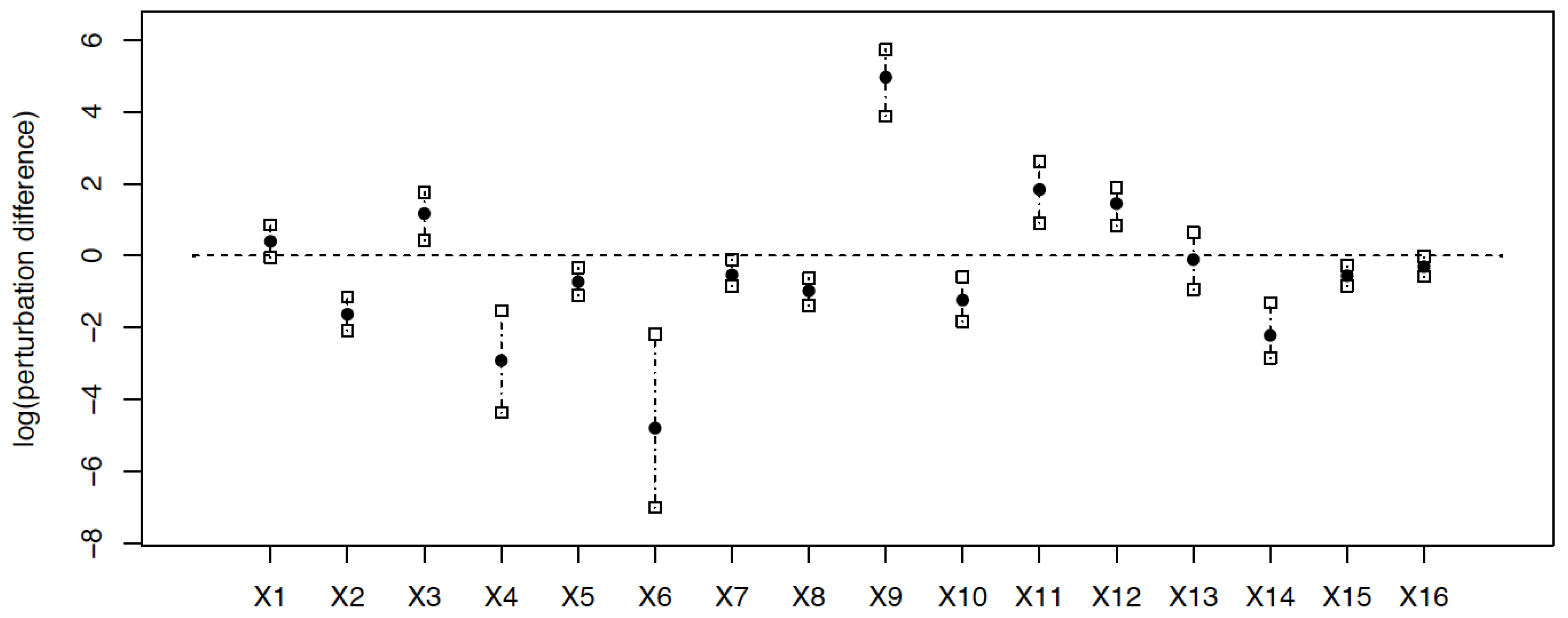
Figure 7 shows the compositional clr-biplot, with cork closures in red and screw closures in blue, simplifying comparison between the subgroups. The biplot retains a relevant portion of the total variability (78.34%) ensuring a high quality of the representation. Using Figure 7, the conclusion mirrors earlier findings, highlighting a clear separation between subgroups and the higher variability of the screw cap closures group (blue). We can see volatile compounds characteristics associated with cork closures such as , and , as well as other compounds characteristics linked to screw cap closures such as and exhibiting opposite directions relative to PC1 axis.
A second compositional data analysis was carried out using all type of stoppers as subgroups (n=6 for Cork1, CC1, CC2, CC3, CC4 and n=7 for Cork2). The centers of each subgroup, displayed in Table A4 (Appendix B), and the geometric mean bar plot in Figure 8 allow us to compare the compositional mean of the entire sample with the compositional mean of each type of closure subgroups.
Broadly speaking, Figure 8 shows a similar pattern than Figure 5. That is, the pattern stated between the two groups of closures in Figure 5 is respectively reproduced into each set of subgroups. Indeed, the non-parametric MANOVA test applied separately to the subgroups does not allow us to confirm significant differences between the two cork stoppers groups (p= 0.148) and the four screw cap groups (p= 0.377). In this case, the robustness of the test is guaranteed because we have balanced designs [75]. A visual inspection of Figure 9, where the first canonical variate retains 84.25% of the variability, allows us to perceive some differences between Agglomerated cork stopper with 31 mm of diameter (cork1) and agglomerated cork stopper with 32 mm of diameter (cork2) groups and between Saranex (CC2) and the other screw caps groups, Polyethylene screw cap (CC1), Daraform (CC3) and Saranex plus araldite (CC4) groups although, a larger dataset is needed to confirm the potential differences.
4. Discussion
Aroma is a complex character, resulting from different process that producing hundreds of volatile compounds. In the case of the volatile composition of sparkling wines, several factors such as grape variety or maturity of the grape, production method or first and second fermentation and aging process can affect it. More specifically, the second fermentation and aging in bottle or the period of contact with lees have been described as having a major influence on the volatile composition in sparkling wines. Hence, the selection of the type of closure in this stage demands our attention.
101 compounds were identified using HS-SPME and TD extraction methods and both allowed the extraction of a wide profile of volatile compounds in samples of sparkling wines. The common volatile compounds already identified were also extracted by both. Briefly, HS-SPME extracted highest percentage of ester, ketones and other compounds while TD was a useful tool for the obtention of alcohol, acid, ether and alkanes compounds. Overall, both were specifically focused on the extraction of ethyl esters or an important group of compounds in the volatile profile of sparkling wine. The most commonly esters identified in sparkling wine such as methyl 2,4-dimethylhexanoate, Ethyl octanoate, Ethyl decanoate, Ethyl arachidate or Ethyl hexanoate were extracted. As more as, both methodologies enable the extraction of representative alcohols and fatty acids in sparkling wine samples. In the case of alcohols, Isoamyl alcohol, Phenylethyl alcohol, 1-hexanol and 1-butanol that are mostly characterized by herbaceous notes. On the contrary, these methodologies showed differences in the extraction of compounds of ethers, ketones, alkanes and other compounds families. Lastly, HS-SPME is a methodology that allowed us to extract several other compounds instead of TD.
In accordance with the obtained results, the type of closure used during second fermentation and aging in bottle can affect the aroma composition of sparkling wine. Ester was the most abundant family of compounds in sparkling wine closured using cork stoppers and screw cap. Methyl 2,4-dimethylhexanoate was the most abundant ester and it was only detected in screw cap closures while common ethyl acetate and ethyl esters were detected in cork stoppers and screw caps. In the case of cork closures, the second most abundant family of compounds was alcohols like Isoamyl alcohol and Phenylethyl Alcohol that were detected in both type of closures. Also were identified 1-hexanol in both and 1-butanol in screw caps. The first of these contributing to the aroma of grass just cut and the other is related to medicinal aroma of wine. The most usual acid compounds were detected in both types of closures as in the case of ether, alkanes and ketones families of compounds. The group of other compounds was different according to the type of closure. Compounds such as Aziridinylethylamine or Hydroxyurea were only identified in screw cap closures while other compounds like 12-O-Acetylingol 8-tiglate, 2-Myristynoyl pantetheine, 6,7-Dimethoxy-1,4-dimethyl-1,3-quinoxalinedithione or Longifolenaldehyde were identified in cork stoppers. Also, higher levels of Dimethylamine or a volatile amine with secondary amino groups was detected in screw cap sparkling wine bottles.
The impact of six different closures used in bottle-aging after second fermentation on the volatile composition of sparkling wine has been evaluated using compositional data analysis. It can be concluded that there are significant differences in the composition of certain volatile compounds between cork stoppers and screw cap closures. Overall, the most abundant part in screw cap closures was Ethyl hexanoate and Ethyl octanoate in cork stoppers. Also, the proportion amount of Dimethylamine was higher in screw cap closures than cork stoppers group relative to the entire of the sample. On the contrary ethyl octanoate or an ester compound responsible for fruity and floral aromas was higher in the cork stopper group. Other compounds such as Octanoic acid and alpha-Ionone parts were very similar in the two subgroups of stoppers. In relation to all type of stoppers evaluated separately, a second compositional data analysis exhibited some differences between agglomerated cork stopper with 31 mm of diameter and agglomerated cork stopper with 32 mm of diameter, and between Saranex and the other screw caps groups, Polyethylene screw cap, Daraform and Saranex plus araldite.
In conclusion, selected aromatic compounds extraction techniques and compositional data analysis applied have allowed the obtention of the sparkling wine volatile profile and the acquisition of an overall vision of the effect of the type of closure used in bottle-aging after second fermentation in the sparkling wine.
Author Contributions
The following statements should be used “Conceptualization, P. Jové, G. Mateu-Figueras and J.A. Martín-Fernández; methodology, P. Jové, G. Mateu-Figueras and J.A. Martín-Fernández; validation, P. Jové, G. Mateu-Figueras and J.A. Martín-Fernández; formal analysis, P. Jové, J. Bustillos, G. Mateu-Figueras and J.A. Martín-Fernández; investigation, P. Jové, G. Mateu-Figueras and J.A. Martín-Fernández; resources, P. Jové, G. Mateu-Figueras and J.A. Martín-Fernández; data curation, P. Jové, G. Mateu-Figueras and J.A. Martín-Fernández; writing—original draft preparation, P. Jové; writing—review and editing, P. Jové, G. Mateu-Figueras and J.A. Martín-Fernández; visualization, P. Jové, G. Mateu-Figueras and J.A. Martín-Fernández; supervision, J.A. Martín-Fernández. All authors have read and agreed to the published version of the manuscript.”.
Funding
This research received no external funding.
Data Availability Statement
The data that support the findings of this study are available from the corresponding author, Patricia Jové upon reasonable request.
Acknowledgments
The authors would like to express their sincere gratitude to Gramona for their generous provision of the bottles and their invaluable support in conducting the experiments. Their contribution has been essential to the success of this research.
Conflicts of Interest
The authors declare no conflicts of interest.
Appendix A
Appendix B

Table A1.
Characterization and mean percentage amounts of volatile compounds of sparkling wine with second fermentation and aged for 94 months extracted by HP-SPMEand TD.
Table A1.
Characterization and mean percentage amounts of volatile compounds of sparkling wine with second fermentation and aged for 94 months extracted by HP-SPMEand TD.
| Extracted compounds | cc1 | cc2 | cc3 | cc4 | cork 1 | cork 2 | ||||||
| SPME | TD | SPME | TD | SPME | TD | SPME | TD | SPME | TD | SPME | TD | |
| Acids | ||||||||||||
| 3-Hydroxydodecanoic acid | 0,58 | 0,7 | 1,07 | 0,56 | 0,95 | 0,97 | ||||||
| 3-Methyl-2-propionyl-benzoic acid | 0,4 | |||||||||||
| Acetic acid | 1,25 | 1,81 | ||||||||||
| Alkynyl Stearic Acid | 1,19 | 1,87 | 1,53 | |||||||||
| Aminomethanesulfonic acid | 1,08 | 1,26 | ||||||||||
| Anticopalic acid | 1,19 | |||||||||||
| Decanoic acid | 0,67 | 0,83 | 0,52 | 1,17 | 1,85 | |||||||
| Dimethylcaffeic acid | 1,6 | 0,61 | ||||||||||
| L-Cysteic acid | 0,46 | 0,7 | ||||||||||
| Octanoic acid | 0,39 | 0,58 | 0,46 | 0,43 | 2,55 | 0,92 | 0,7 | |||||
| Oleic Acid | 0,64 | |||||||||||
| Palmitelaidic acid | 0,34 | |||||||||||
| Paullinic acid | 0,61 | |||||||||||
| Succinic acid | 0,23 | 1,67 | ||||||||||
| Undecanoic acid | 0,36 | |||||||||||
| Alcohol | ||||||||||||
| 2,2,4-Trimethyl-3-(3,8,12,16-tetramethyl-heptadeca-3,7,11,15-tetraenyl)-cyclohexanol | 0,95 | |||||||||||
| 2-Propanediol | ||||||||||||
| 10-Methyl-E-11-tridecen-1-ol propionate | 0,59 | 2,56 | 2,23 | |||||||||
| 1-Butanol | 3,75 | |||||||||||
| 1-Hexanol | 0,99 | 0,77 | 1,26 | 1,37 | 1,09 | |||||||
| 15-tetraenyl)-cyclohexanol | ||||||||||||
| 2-Hydrazinoethanol | 2,34 | |||||||||||
| 1-Tetradecenol | 0,58 | |||||||||||
| Ethanol | 0,65 | |||||||||||
| Isoamyl alcohol | 43,2 | 1,42 | 32,7 | 20,7 | 34,5 | 2,82 | 47,8 | 1,3 | 49,7 | |||
| Phenylethyl Alcohol | 0,84 | 0,66 | 1,15 | 0,65 | 1,15 | 0,32 | 1,29 | 1,12 | 3,73 | 1,58 | 2,59 | 2,57 |
| Alkanes | ||||||||||||
| 5-methyl-1-Hexane | 2,27 | |||||||||||
| 3-Chloropentane | 1,27 | |||||||||||
| Dotriacontane | 0,62 | |||||||||||
| Hexadecane | 0,78 | 0,68 | 0,93 | |||||||||
| Hexatriacontane | 0,43 | |||||||||||
| n-Hexane | 0,43 | 4,83 | ||||||||||
| Nonacosane | 0,82 | |||||||||||
| Octadecane | 0,38 | 1,56 | ||||||||||
| Octathiocane | 0,78 | 2,23 | ||||||||||
| Pentacosane | 0,8 | 0,46 | ||||||||||
| Tetratriacontane | 0,62 | |||||||||||
| Vinyl decanoate | 0,48 | |||||||||||
| Ester | ||||||||||||
| 10-Undecenoic acid ethyl ester | 0,99 | |||||||||||
| Butyl ethyl succinate | 3,37 | 1,56 | ||||||||||
| Decyl oleate | 0,96 | |||||||||||
| Diethyl Phthalate | 0,44 | 0,71 | 1,29 | 1,19 | ||||||||
| Diethyl succinate | 2,08 | 1,62 | 1,6 | 1,81 | 1,34 | 2,2 | 1 | 2,26 | 2,18 | 2,36 | 3,03 | 2,89 |
| Ethyl 9-decenoate | 1,22 | 1,36 | 0,82 | 0,85 | 1,16 | |||||||
| Ethyl 9-oxononanoate | 0,9 | |||||||||||
| Ethyl Acetate | 4,96 | 2,92 | 3,14 | 6,25 | 3,65 | 2,3 | 4,1 | |||||
| Ethyl arachidate | 9,81 | 1,41 | 0,52 | 1,76 | 1,17 | 6,22 | 2,46 | 4,24 | 2,46 | |||
| Ethyl butyrate | 1,04 | 0,7 | 0,59 | 1,53 | 1,13 | 1,05 | ||||||
| Ethyl cholate | 0,69 | |||||||||||
| Ethyl decanoate | 4,99 | 1,17 | 7,28 | 1,96 | 4,61 | 1,48 | 6,05 | 2,7 | 14,5 | 2,17 | 8,12 | 2,29 |
| Ethyl hexanoate | 7,99 | 1,07 | 6,11 | 2,25 | 5,35 | 2,29 | 4,86 | 3,35 | 10,9 | 4,03 | 9,3 | 0,88 |
| Ethyl hexyl butanedioate | 1,22 | |||||||||||
| Ethyl octanoate | 17,4 | 7,81 | 2,99 | 3,75 | 8,43 | 11 | 30,9 | 7,45 | 49,5 | 5,81 | ||
| Ethyl palmitate | 0,5 | |||||||||||
| Ethyl stearate | 2,4 | |||||||||||
| Ethyl trans-4-decenoate | 0,76 | 0,85 | 0,54 | 0,66 | 0,72 | 2 | 0,8 | |||||
| Hexyl chloroformate | 1,33 | |||||||||||
| Isoamyl lactate | 2,79 | |||||||||||
| Isopropyl palmitate | 0,41 | 0,65 | 0,79 | 0,62 | ||||||||
| Methyl 2 4-dimethylhexanoate | 30,9 | 1,88 | 42,1 | 4,05 | 40,7 | 43,6 | 4,07 | |||||
| Methyl pentyl carbonate | 3,59 | |||||||||||
| Nonanoic acid 5-methyl- ethyl ester | 1,05 | 1,21 | 1,55 | 2,34 | 1,51 | |||||||
| Oryctalure | 0,46 | |||||||||||
| Ether | ||||||||||||
| 1-Methyl-1-silacyclopentan-1-ol | 0,28 | |||||||||||
| Oxirane 2-(1 1-dimethylethyl)-3-ethyl | 1,98 | 22,8 | 1,43 | 30,8 | 2 | 33,3 | 2,09 | 4,32 | 1,98 | |||
| ketone | ||||||||||||
| 2,3,4,5,6,6-hexamethylcyclohexa-2,4-dien-1-one | 1,7 | |||||||||||
| 2,2-dimethyl-5-phenylfuran-3-one | 0,61 | 0,61 | ||||||||||
| alpha-Ionone | 1,74 | 0,32 | 1,77 | 0,53 | 0,98 | 0,53 | 1,02 | 0,83 | 4,16 | 2,35 | ||
| Caprolactone | 0,61 | |||||||||||
| Terpenes | ||||||||||||
| D-Limonene | 0,32 | |||||||||||
| Friedelin | 0,62 | 0,95 | 1,96 | |||||||||
| Squalene | 0,99 | 0,73 | 1,3 | 3,36 | 1,19 | 2,96 | 2,02 | |||||
| TDN | 0,59 | 0,18 | 0,48 | 1,94 | 1,27 | 1,07 | 0,69 | |||||
| Other | ||||||||||||
| 2-amino-4,6-dihydro-4,4,6,6-tetramethyl-Thieno[2,3-c]furan-3-carbonitrile | 0,38 | |||||||||||
| (2-Aziridinylethyl)amine | 1,14 | 1,79 | ||||||||||
| 1,1,5-Trimethyl-1,2-dihydronaphthalene | ||||||||||||
| 1-[3-hydroxybenzyl]-6-methoxy-3,4-Dihydroisoquinoline | 1,15 | 1,56 | 0,64 | 0,79 | 2,19 | |||||||
| 12-O-Acetylingol 8-tiglate | 0,74 | |||||||||||
| 1H-2-Indenone,2,4,5,6,7,7a-hexahydro-3-(1-Methylethyl)-7a-methyl | 0,88 | |||||||||||
| 1-Octadecyne | 0,67 | |||||||||||
| 2,3,4-Trimethyllevoglucosan | 4,48 | 3,23 | ||||||||||
| 2,4-dimethyl-1,3-Dioxane | 0,51 | 1,69 | ||||||||||
| 2-Bromooctadecanal | 0,51 | 1,09 | 0,48 | 0,44 | 0,79 | 0,44 | ||||||
| 2-Myristynoyl pantetheine | 0,25 | |||||||||||
| 4-(2,3,6-Trimethylphenyl)-1,3-butadiene | 0,41 | 0,57 | 1,02 | 0,34 | 2,05 | 1,16 | ||||||
| 6,7-Dimethoxy-1,4-dimethyl-1,3-quinoxalinedithione | 1,46 | |||||||||||
| Benzaldehyde | 0,41 | |||||||||||
| Bis(2-ethylhexyl) phthalate | 1,93 | 1,76 | ||||||||||
| Caprylic anhydride | 6,66 | 18,4 | 5,57 | 1,66 | 1,45 | |||||||
| Carbon dioxide | 4,86 | 2,52 | 2,7 | 3,42 | ||||||||
| Corlumine | 0,39 | 0,54 | ||||||||||
| Dimethylamine | 6,31 | 14 | 4,68 | 2,01 | 2,32 | |||||||
| Emulphor | 1,1 | 0,92 | ||||||||||
| Hydroxyurea | 2,52 | |||||||||||
| Isoflavene | 0,76 | |||||||||||
| Lactamide | 2,69 | 4,78 | 14,8 | 3,61 | 6,83 | 4,53 | ||||||
| Laudanosine | 0,56 | |||||||||||
| Longifolenaldehyde | 3 | |||||||||||
| Methoxy-phenyl-Oxime | 0,67 | 1,03 | 0,25 | 0,71 | 1,11 | |||||||
| N-Methylcalycotomine | 0,12 | |||||||||||
| Paromomycin | 0,34 | |||||||||||
| p-Di(cis-styryl)benzene | 2,61 | 0,85 | ||||||||||
| Phenol | 0,68 | |||||||||||
Table A2.
Centers for the global data set and for the two subgroups: cork stopper and screw cap
closures.
Table A2.
Centers for the global data set and for the two subgroups: cork stopper and screw cap
closures.
| Code | Global data | Cork stopper | Screw cap |
| 0.008178 | 0.006604 | 0.005742 | |
| 0.017714 | 0.003840 | 0.025362 | |
| 0.005436 | 0.007253 | 0.002908 | |
| 0.004873 | 0.000458 | 0.010966 | |
| 0.110776 | 0.043172 | 0.115416 | |
| 0.000325 | 0.000009 | 0.001414 | |
| 0.239144 | 0.105512 | 0.232965 | |
| 0.302983 | 0.100229 | 0.344981 | |
| 0.033609 | 0.523776 | 0.004749 | |
| 0.021187 | 0.005937 | 0.026394 | |
| 0.004123 | 0.008483 | 0.001745 | |
| 0.075963 | 0.121259 | 0.036875 | |
| 0.009156 | 0.005323 | 0.007681 | |
| 0.031359 | 0.004647 | 0.055165 | |
| 0.074170 | 0.032247 | 0.072831 | |
| 0.061003 | 0.031251 | 0.054808 |
Table A3.
Variation matrix showing pairwise logratio variances (upper right triangle) with the
corresponding means (lower right triangle), the variance of each clr component and the total
variance (right most column) for the global data set (a) and for the cork stopper (b) and screw cap (c)
subgroups.
Table A3.
Variation matrix showing pairwise logratio variances (upper right triangle) with the
corresponding means (lower right triangle), the variance of each clr component and the total
variance (right most column) for the global data set (a) and for the cork stopper (b) and screw cap (c)
subgroups.
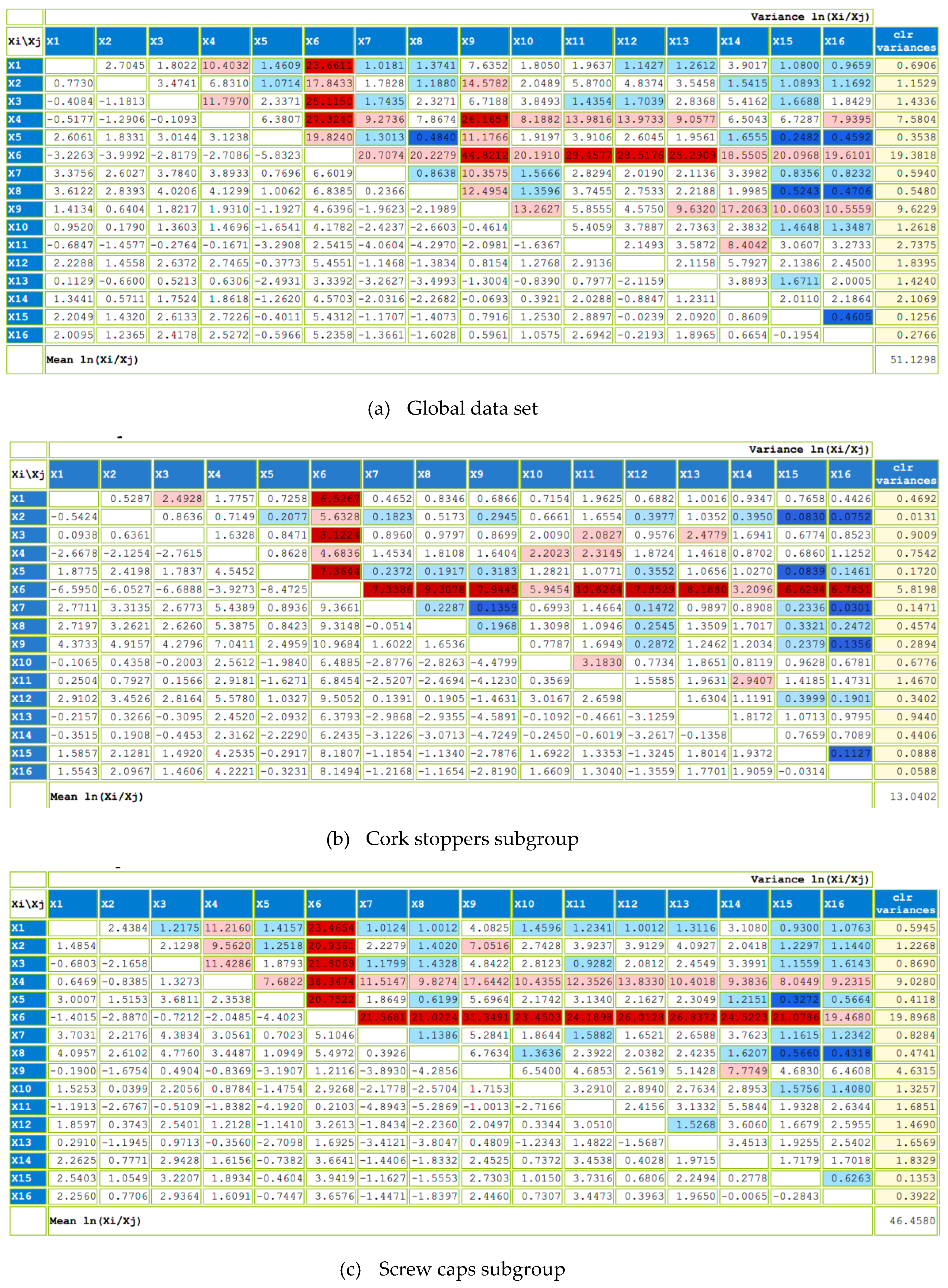
Table A4.
Centers for the whole data set and for the type of closure groups.
| Code | Global center | Cork 1 | Cork 2 | CC1 | CC2 | CC3 | CC4 |
| 0.008178 | 0.009134 | 0.004938 | 0.003287 | 0.015248 | 0.004281 | 0.004441 | |
| 0.017714 | 0.004912 | 0.003069 | 0.030482 | 0.018456 | 0.021904 | 0.029430 | |
| 0.005436 | 0.006814 | 0.007556 | 0.002265 | 0.005396 | 0.001522 | 0.003370 | |
| 0.004873 | 0.000910 | 0.000251 | 0.006031 | 0.003304 | 0.014947 | 0.042555 | |
| 0.110776 | 0.049711 | 0.037772 | 0.139048 | 0.099106 | 0.103049 | 0.109530 | |
| 0.000325 | 0.000033 | 0.000003 | 0.014368 | 0.000258 | 0.000472 | 0.002000 | |
| 0.239144 | 0.119351 | 0.093734 | 0.160628 | 0.261992 | 0.279475 | 0.219533 | |
| 0.302983 | 0.089439 | 0.109111 | 0.392126 | 0.300740 | 0.322618 | 0.326333 | |
| 0.033609 | 0.482210 | 0.555137 | 0.003440 | 0.023763 | 0.001781 | 0.003061 | |
| 0.021187 | 0.007054 | 0.005056 | 0.019705 | 0.023202 | 0.026922 | 0.034560 | |
| 0.004123 | 0.012845 | 0.005869 | 0.000831 | 0.007845 | 0.000881 | 0.001413 | |
| 0.075963 | 0.125506 | 0.116244 | 0.022926 | 0.074176 | 0.030249 | 0.031507 | |
| 0.009156 | 0.010934 | 0.002835 | 0.002196 | 0.012344 | 0.012180 | 0.009241 | |
| 0.031359 | 0.008004 | 0.002879 | 0.070237 | 0.033142 | 0.069526 | 0.050158 | |
| 0.074170 | 0.037497 | 0.027978 | 0.073222 | 0.066240 | 0.061168 | 0.083130 | |
| 0.061003 | 0.035645 | 0.027566 | 0.059207 | 0.054787 | 0.049024 | 0.049738 |
References
- Riu-Aumatell, Montserrat, Jordi Torrens, Susana Buxaderas, y Elvira López-Tamames. 2013. 3. Cava (Spanish Sparkling Wine) Aroma: Composition and Determination Methods. Vol. 3. Diego Muñoz Torrero, Amparo Cortés&Eduardo L. Mariño.
- Alexandre, Hervé, y Michèle Guilloux-Benatier. 2006. «Yeast Autolysis in Sparkling Wine – a Review». Australian Journal of Grape and Wine Research 12(2):119-27. [CrossRef]
- Torrens, Jordi, Pilar Urpí, Montserrat Riu-Aumatell, Stefania Vichi, Elvira López-Tamames, y Susana Buxaderas. 2008. «Different Commercial Yeast Strains Affecting the Volatile and Sensory Profile of Cava Base Wine». International Journal of Food Microbiology 124(1):48-57. [CrossRef]
- Verzeletti, Andrelise, Sergio Echeverrigaray, Alejandro Cardoso, Regina Vanderlinde, y Ana Paula Longaray Delamare. 2016. «Evolution of Aromatic Compounds during the Second Fermentation and Aging of Brazilian Sparkling Wine» editadopor J.-M. Aurand. BIO Web of Conferences 7:02019. [CrossRef]
- Pozo-Bayón, María Ángeles, Adolfo Martínez-Rodríguez, Encarnación Pueyo, y M. Victoria Moreno-Arribas. 2009. «Chemical and biochemical features involved in sparkling wine production: from a traditional to an improved winemaking technology». Trends in Food Science & Technology 20(6):289-99. [CrossRef]
- Gallardo-Chacón, Joan, Stefania Vichi, Elvira López-Tamames, y Susana Buxaderas. 2009. «Analysis of Sparkling Wine Lees Surface Volatiles by Optimized Headspace Solid-Phase Microextraction». Journal of Agricultural and Food Chemistry 57(8):3279-85. [CrossRef]
- Jolly, N., P. Minnaar, M. Booyse, y P. Gerber. 2021. «Bottle Fermented Sparkling Wine: Cork or Crown Closures During the Second Fermentation?» South African Journal of Enology and Viticulture 42(2). [CrossRef]
- Furtado, Isabel, Paulo Lopes, Ana Sofia Oliveira, Filipa Amaro, Maria de Lourdes Bastos, Miguel Cabral, Paula Guedes de Pinho, y Joana Pinto. 2021. «The Impact of Different Closures on the Flavor Composition of Wines during Bottle Aging». Foods 10(9):2070. [CrossRef]
- Vidal, Jean-Claude, Soline Caille, Alain Samson, y Jean-Michel Salmon. 2017. «Impact of eight closures in controlled industrial conditions on the shelf life of two (red and rosé) wines». OENO One 51(4):387-99. [CrossRef]
- Azevedo, J., I. Fernandes, P. Lopes, I. Roseira, M. Cabral, N. Mateus, y V. Freitas. 2014. «Migration of Phenolic Compounds from Different Cork Stoppers to Wine Model Solutions: Antioxidant and Biological Relevance». European Food Research and Technology 239(6):951-60. [CrossRef]
- Hopfer, Helene, Jenny Nelson, Alyson E. Mitchell, Hildegarde Heymann, y Susan E. Ebeler. 2013. «Profiling the trace metal composition of wine as a function of storage temperature and packaging type». Journal of Analytical Atomic Spectrometry 28(8):1288-91.
- Silva, S. P., M. A. Sabino, E. M. Fernandes, V. M. Correlo, L. F. Boesel, y R. L. Reis. 2005. «Cork: Properties, Capabilities and Applications». International Materials Reviews 50(6):345-65. [CrossRef]
- Campos, P., H. Daly-Hassen, y P. Ovando. 2007a. «Cork Oak Forest Management in Spain and Tunisia: Two Case Studies of Conflicts between Sustainability and Private Income». International Forestry Review 9(2):610-26. [CrossRef]
- Liger-Belair, Gérard, y Clara Cilindre. 2021. «Recent Progress in the Analytical Chemistry of Champagne and Sparkling Wines». Annual Review of Analytical Chemistry 14(1):21-46. [CrossRef]
- Pereira, H. 1988. «Chemical Composition and Variability of Cork from Quercus Suber L.» Wood Science and Technology 22(3):211-18. [CrossRef]
- Duarte, Ana Paula, y João Carlos Bordado. 2015. «Cork–a renewable raw material: forecast of industrial potential and development priorities». Frontiers in Materials 2:2.
- Gil, Luís. 2014. «Cork: a strategic material». Frontiers in chemistry 2:16.
- Amaro, Filipa, Joana Almeida, Ana Sofia Oliveira, Isabel Furtado, Maria De Lourdes Bastos, Paula Guedes De Pinho, y Joana Pinto. 2022. «Impact of Cork Closures on the Volatile Profile of Sparkling Wines during Bottle Aging». Foods 11(3):293. [CrossRef]
- Pinto, Joana, Ana Sofia Oliveira, Paulo Lopes, Isabel Roseira, Miguel Cabral, Maria De Lourdes Bastos, y Paula Guedes De Pinho. 2019. «Characterization of Chemical Compounds Susceptible to Be Extracted from Cork by the Wine Using GC-MS and 1H NMR Metabolomic Approaches». Food Chemistry 271:639-49. [CrossRef]
- Oliveira, Graça, y Augusta Costa. 2012. «How resilient is Quercus suber L. to cork harvesting? A review and identification of knowledge gaps». Forest Ecology and Management 270:257-72. [CrossRef]
- Kurz-Besson, Cathy, Dennis Otieno, Raquel Lobo Do Vale, Rolf Siegwolf, Markus Schmidt, Alastair Herd, Carla Nogueira, Teresa Soares David, Jorge Soares David, John Tenhunen, João Santos Pereira, y Manuela Chaves. 2006. «Hydraulic Lift in Cork Oak Trees in a Savannah-Type Mediterranean Ecosystem and Its Contribution to the Local Water Balance». Plant and Soil 282(1-2):361-78. [CrossRef]
- Pinheiro, Antonio Cipriano, Nuno Almeida Ribeiro, Peter Surovy, y Alfredo Goncalves Ferreira. 2008. «Economic Implications of Different Cork Oak Forest Management Systems». International Journal of Sustainable Society 1(2):149. [CrossRef]
- Bosch-Fusté, Joan, M. Riu-Aumatell, J. Guadayol, J. Caixach, E. Lopeztamames, y S. Buxaderas. 2007. «Volatile Profiles of Sparkling Wines Obtained by Three Extraction Methods and Gas Chromatography–Mass Spectrometry (GC–MS) Analysis». Food Chemistry 105(1):428-35. [CrossRef]
- Francioli, Sonia, Maria Guerra, Elvira López-Tamames, Josep M. Guadayoi, y JosepCaixach. 1999. «Aroma of sparkling wines by headspace/solid phase microextraction and gas chromatography/mass spectrometry». American journal of enology and viticulture 50(4):404-8.
- Riu-Aumatell, M., J. Bosch-Fusté, E. López-Tamames, y S. Buxaderas. 2006. «Development of volatile compounds of cava (Spanish sparkling wine) during long ageing time in contact with lees». Food Chemistry 95(2):237-42. [CrossRef]
- Torrens, Jordi, Montserrat Riu-Aumatell, Stefania Vichi, Elvira López-Tamames, y Susana Buxaderas. 2010. «Assessment of Volatile and Sensory Profiles between Base and Sparkling Wines». Journal of Agricultural and Food Chemistry 58(4):2455-61. [CrossRef]
- Coelho, Elisabete, Manuel A. Coimbra, J. M. F. Nogueira, y Sílvia M. Rocha. 2009. «Quantification approach for assessment of sparkling wine volatiles from different soils, ripening stages, and varieties by stir bar sorptive extraction with liquid desorption». Analytica Chimica Acta 635(2):214-21. [CrossRef]
- Herrero, Paula, Pilar Sáenz-Navajas, Laura Culleré, Vicente Ferreira, Amelie Chatin, Vincent Chaperon, François Litoux-Desrues, y Ana Escudero. 2016. «Chemosensory characterization of Chardonnay and Pinot Noir base wines of Champagne. Two very different varieties for a common product». Food Chemistry 207:239-50. [CrossRef]
- Culbert, J. A., R. Ristic, L. A. Ovington, A. J. Saliba, y K. L. Wilkinson. 2017. «Influence of Production Method on the Sensory Profile and Consumer Acceptance of Australian Sparkling White Wine Styles: Sensory Profiles of Australian Sparkling Wines». Australian Journal of Grape and Wine Research 23(2):170-78. [CrossRef]
- Bingman, Matthew T., Claire E. Stellick, Jordanne P. Pelkey, Jared M. Scott, y Callie A. Cole. 2020. «Monitoring cider aroma development throughout the fermentation process by headspace solid phase microextraction (HS-SPME) gas chromatography–mass spectrometry (GC-MS) analysis». Beverages 6(2):40.
- Madrera, Roberto Rodríguez, Ana García Hevia, Noemí Palacios García, y Belén Suárez Valles. 2008. «Evolution of aroma compounds in sparkling ciders». LWT-Food Science and Technology 41(10):2064-69.
- Ocvirk, Miha, Nataša Kočar Mlinarič, y Iztok J. Košir. 2018. «Comparison of Sensory and Chemical Evaluation of Lager Beer Aroma by Gas Chromatography and Gas Chromatography/Mass Spectrometry». Journal of the Science of Food and Agriculture 98(10):3627-35. [CrossRef]
- Riu-Aumatell, M., P. Miró, A. Serra-Cayuela, S. Buxaderas, y E. López-Tamames. 2014. «Assessment of the aroma profiles of low-alcohol beers using HS-SPME–GC-MS». Food Research International 57:196-202. [CrossRef]
- Minnaar, P. P., P. Gerber, y M. Booyse. 2021. «Phenolic Compounds in Cork-Closed Bottle-Fermented Sparkling Wines». South African Journal of Enology and Viticulture 42(1). [CrossRef]
- Zhang, Zhouyao, y Janusz Pawliszyn. 1993. «Headspace solid-phase microextraction». Analytical chemistry 65(14):1843-52.
- Pati, Sandra, Maria Tufariello, Pasquale Crupi, Antonio Coletta, Francesco Grieco, y Ilario Losito. 2021. «Quantification of volatile compounds in wines by HS-SPME-GC/MS: Critical issues and use of multivariate statistics in method optimization». Processes 9(4):662.
- Tufariello, Maria, Sandra Pati, Lorenzo Palombi, Francesco Grieco, y Ilario Losito. 2022. «Use of multivariate statistics in the processing of data on wine volatile compounds obtained by HS-SPME-GC-MS». Foods 11(7):910.
- Zhang, Lin, Qianqian Liu, Yuanyuan Li, Shuzhen Liu, Qian Tu, y Chunlong Yuan. 2023. «Characterization of wine volatile compounds from different regions and varieties by HS-SPME/GC-MS coupled with chemometrics». Current Research in Food Science 6:100418.
- Cheng, Zeng, David T. Mannion, Maurice G. O’Sullivan, Song Miao, Joseph P. Kerry, y Kieran N. Kilcawley. 2021. «Comparison of automated extraction techniques for volatile analysis of whole milk powder». Foods 10(9):2061.
- Salinas, M. Rosario, Gonzalo L. Alonso, y F. Javier Esteban-Infantes. 1994. «Adsorption-Thermal Desorption Gas Chromatography Applied to the Determination of Wine Aromas». Journal of Agricultural and Food Chemistry 42(6):1328-31. [CrossRef]
- Baltussen, E., C. Cramers, y P. Sandra. 2002. «Sorptive Sample Preparation – a Review». Analytical and Bioanalytical Chemistry 373(1-2):3-22. [CrossRef]
- Woolfenden, Elizabeth. 2021. «Thermal desorption gas chromatography». Pp. 267-323 en Gas chromatography. Elsevier.
- Jové, Patricia, Anna Pareras, Raquel De Nadal, y Maria Verdum. 2021. «Development and Optimization of a Quantitative Analysis of Main Odorants Causing off Flavours in Cork Stoppers Using Headspace Solid-phase Microextraction Gas Chromatography Tandem Mass Spectrometry». Journal of Mass Spectrometry 56(5):e4728. [CrossRef]
- Aitchison, J. (1982). The statistical analysis of compositional data. Journal of the Royal Statistical Society: Series B (Methodological), 44(2), 139-160.
- Korhoňová, M., K. Hron, D. Klimčíková, L. Müller, P. Bednář, y P. Barták. 2009. «Coffee aroma—statistical analysis of compositional data». Talanta 80(2):710-15.
- Pawlowsky-Glahn, Vera, Juan José Egozcue, y Raimon Tolosana-Delgado. 2015. Modeling and analysis of compositional data. John Wiley & Sons.
- Martín Fernández, Josep Antoni, Pepus Daunis-i-Estadella, y Glòria Mateu i Figueras. 2015. «On the interpretation of differences between groups for compositional data». SORT: statistics and operations research transactions, 2015, vol. 39, núm. 2, p. 231-252.
- Mateu-Figueras, G., V. Pawlowsky-Glahn, y J. J. Egozcue. 2008. «The normal distribution in some constrained sample spaces.
- Louw, Leanie, Karolien Roux, Andreas Tredoux, Oliver Tomic, Tormod Naes, Hélène H. Nieuwoudt, y Pierre Van Rensburg. 2009. «Characterization of Selected South African Young Cultivar Wines Using FTMIR Spectroscopy, Gas Chromatography, and Multivariate Data Analysis». Journal of Agricultural and Food Chemistry 57(7):2623-32. [CrossRef]
- Makris, Dimitris P., Stamatina Kallithraka, y Andreas Mamalos. 2006. «Differentiation of young red wines based on cultivar and geographical origin with application of chemometrics of principal polyphenolic constituents». Talanta 70(5):1143-52.
- Shimizu, Hideaki, Fumikazu Akamatsu, Aya Kamada, Kazuya Koyama, Kazuhiro Iwashita, y Nami Goto-Yamamoto. 2020. «Variation in the mineral composition of wine produced using different winemaking techniques». Journal of bioscience and bioengineering 130(2):166-72.
- Palarea-Albaladejo, Javier, y Josep Antoni Martín-Fernández. 2015. «zCompositions—R package for multivariate imputation of left-censored data under a compositional approach». Chemometrics and Intelligent Laboratory Systems 143:85-96.
- Dı́az-Regañon, Dolores Huerta, Rosario Salinas, Taisir Masoud, y Gonzalo Alonso. 1998. «Adsorption-thermal desorption-gas chromatography applied to volatile compounds of Madrid region wines». Journal of Food Composition and Analysis 11(1):54-69.
- Panighel, Annarita, y Riccardo Flamini. 2014. «Applications of solid-phase microextraction and gas chromatography/mass spectrometry (SPME-GC/MS) in the study of grape and wine volatile compounds». Molecules 19(12):21291-309.
- Whiton, R. S. , y Bruce W. Zoecklein. 2000. «Optimization of headspace solid-phase microextraction for analysis of wine aroma compounds». American journal of enology and viticulture 51(4):379-82.
- Ziółkowska, Angelika, Erwin Wąsowicz, y Henryk H. Jeleń. 2016. «Differentiation of wines according to grape variety and geographical origin based on volatiles profiling using SPME-MS and SPME-GC/MS methods». Food Chemistry 213:714-20.
- Ubeda, Cristina, Ingeborg Kania-Zelada, Rubén del Barrio-Galán, Marcela Medel-Marabolí, Mariona Gil, y Álvaro Peña-Neira. 2019. «Study of the changes in volatile compounds, aroma and sensory attributes during the production process of sparkling wine by traditional method». Food Research International 119:554-63.
- Benucci, Ilaria, Martina Cerreti, Diamante Maresca, Gianluigi Mauriello, y Marco Esti. 2019. «Yeast cells in double layer calcium alginate–chitosan microcapsules for sparkling wine production». Food chemistry 300:125174.
- JagatićKorenika, Ana-Marija, DarkoPreiner, Ivana Tomaz, y Ana Jeromel. 2020. «Volatile profile characterization of Croatian commercial sparkling wines». Molecules 25(18):4349.
- Voce, Sabrina, DomenŠkrab, UrskaVrhovsek, Franco Battistutta, Piergiorgio Comuzzo, y Paolo Sivilotti. 2019. «Compositional Characterization of Commercial Sparkling Wines from Cv. RibollaGialla Produced in Friuli Venezia Giulia». European Food Research and Technology 245(10):2279-92. [CrossRef]
- Polášková, Pavla, JulianHerszage, y Susan E. Ebeler. 2008. «Wine flavor: chemistry in a glass». Chemical Society Reviews 37(11):2478-89.
- He, Yang, Xinyuan Wang, Penghui Li, YingchiLv, Hailong Nan, Liankui Wen, y Zhitong Wang. 2023. «Research progress of wine aroma components: A critical review». Food Chemistry 402:134491.
- Cichewicz, Robert H., y Samir A. Kouzi. 2004. «Chemistry, Biological Activity, and Chemotherapeutic Potential of Betulinic Acid for the Prevention and Treatment of Cancer and HIV Infection». Medicinal Research Reviews 24(1):90-114. [CrossRef]
- Francioli, Sonia, Jordi Torrens, Montserrat Riu-Aumatell, Elvira López-Tamames, y Susana Buxaderas. 2003. «Volatile compounds by SPME-GC as age markers of sparkling wines». American Journal of Enology and Viticulture 54(3):158-62.
- Dziadas, Mariusz, y Henryk H. Jeleń. 2010. «Analysis of terpenes in white wines using SPE–SPME–GC/MS approach». Analytica chimica acta 677(1):43-49.
- Genovese, Alessandro, Simona A. Lamorte, Angelita Gambuti, y Luigi Moio. 2013. «Aroma of Aglianico and Uva di Troia grapes by aromatic series». Food research international 53(1):15-23.
- Caliari, Vinícius, VívianMariaBurin, Jean Pierre Rosier, y Marilde T. BordignonLuiz. 2014. «Aromatic Profile of Brazilian Sparkling Wines Produced with Classical and Innovative Grape Varieties». Food Research International 62:965-73. [CrossRef]
- Torchio, Fabrizio, Susana RíoSegade, Vincenzo Gerbi, Enzo Cagnasso, Manuela Giordano, Simone Giacosa, y Luca Rolle. 2012. «Changes in varietal volatile composition during shelf-life of two types of aromatic red sweet Brachetto sparkling wines». Food research international 48(2):491-98.
- Ferreira, Vicente, y Ricardo Lopez. 2019. «The actual and potential aroma of winemaking grapes». Biomolecules 9(12):818.
- Xu, Minwei, Zhao Jin, Yang Lan, Jiajia Rao, y Bingcan Chen. 2019. «HS-SPME-GC-MS/olfactometry combined with chemometrics to assess the impact of germination on flavor attributes of chickpea, lentil, and yellow pea flours». Food Chemistry 280:83-95.
- Ancín-Azpilicueta, Carmen, Nerea Jiménez-Moreno, José Antonio Moler, Rodrigo Nieto-Rojo, y Henar Urmeneta. 2016. «Effects of Reduced Levels of Sulfite in Wine Production Using Mixtures with Lysozyme and Dimethyl Dicarbonate on Levels of Volatile and Biogenic Amines». Food Additives & Contaminants: Part A 33(10):1518-26. [CrossRef]
- Liu, N., Y. Y. Song, G. F. Dang, D. Q. Ye, X. Gong, y Y. L. Liu. 2015.«Effect of wine closures on the aroma properties of Chardonnay wines after four years of storage». South African Journal of Enology and Viticulture 36(3):296-303.
- Lee, Dong-Hyun, Bo-Sik Kang, y Hyun-Jin Park. 2011. «Effect of Oxygen on Volatile and Sensory Characteristics of Cabernet Sauvignon during Secondary Shelf Life». Journal of Agricultural and Food Chemistry 59(21):11657-66. [CrossRef]
- Anderson, Marti J. 2001. «A New Method for Non-parametric Multivariate Analysis of Variance». Austral Ecology 26(1):32-46. [CrossRef]
- Anderson, Marti J., y Daniel C. I. Walsh. 2013. «PERMANOVA, ANOSIM, and the Mantel Test in the Face of Heterogeneous Dispersions: What Null Hypothesis Are You Testing?» Ecological Monographs 83(4):557-74. [CrossRef]
Figure 1.
Scheme of the system designed to extract aromatic compounds present in wine sparkling samples onto desorption tubes using a TD method.
Figure 1.
Scheme of the system designed to extract aromatic compounds present in wine sparkling samples onto desorption tubes using a TD method.
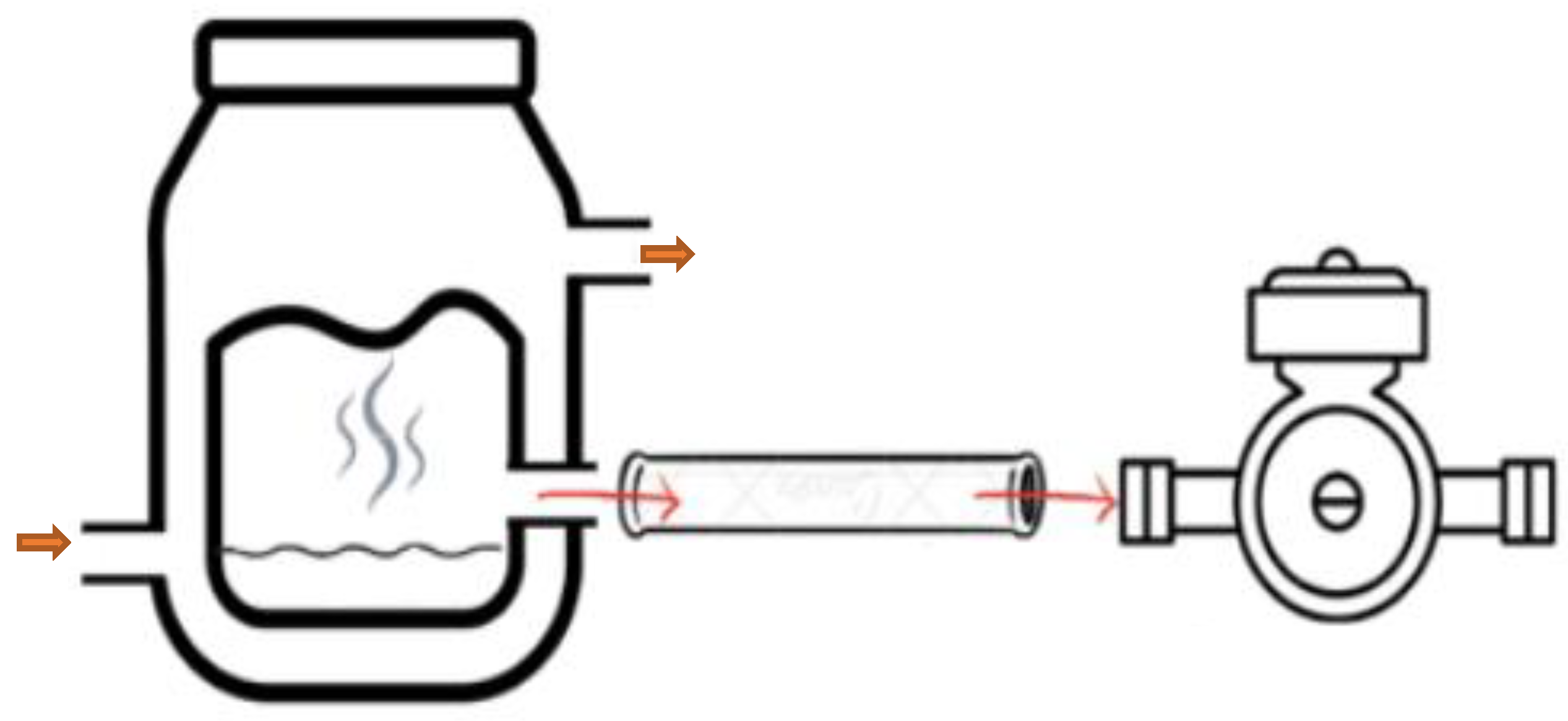
Figure 2.
Chromatograms of sparkling wine bottle-aging closured with cork stoppers (closure A) isolated by TD and HP-SPME.
Figure 2.
Chromatograms of sparkling wine bottle-aging closured with cork stoppers (closure A) isolated by TD and HP-SPME.
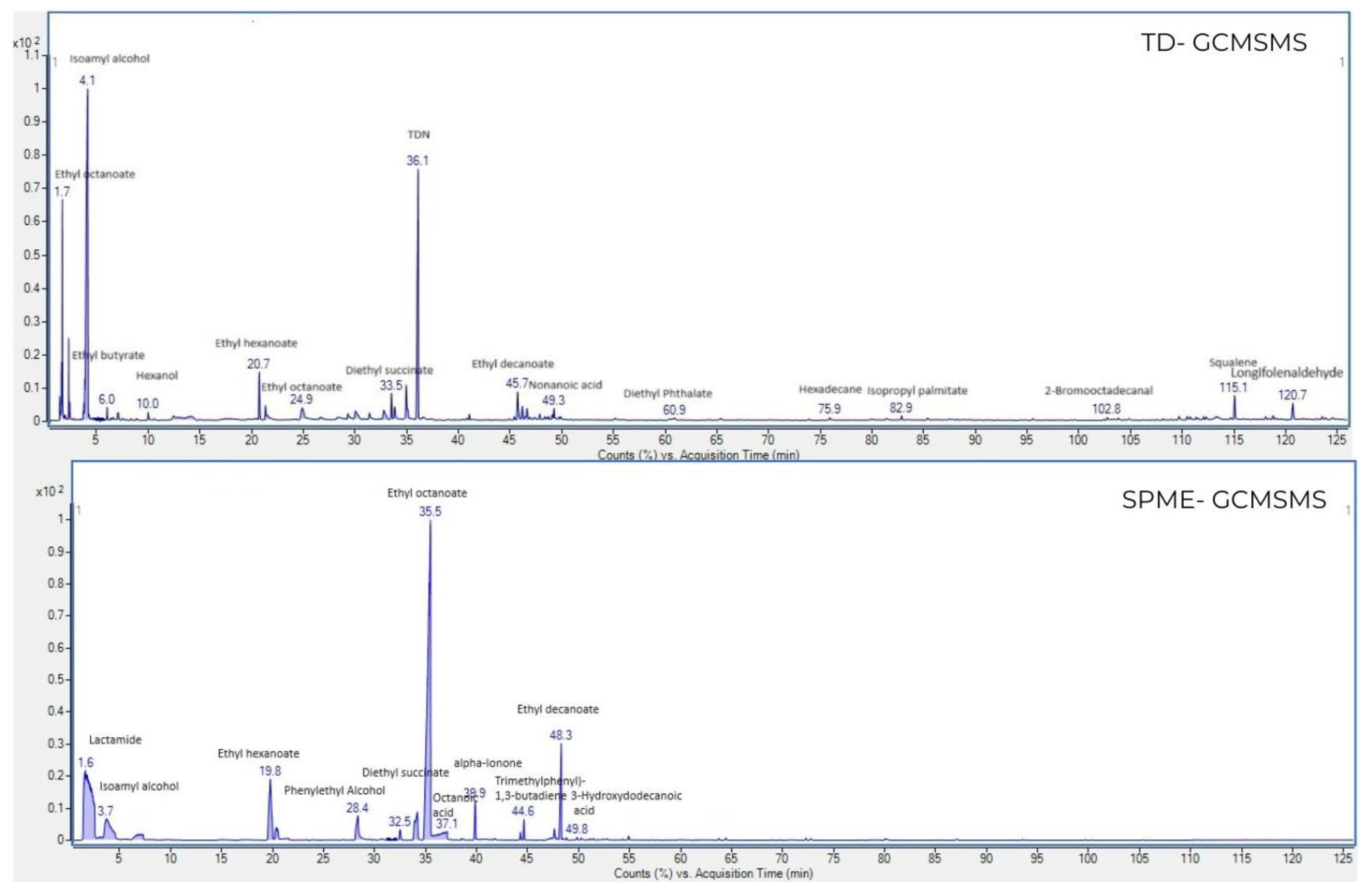
Figure 3.
Percentages of sparkling wine families of volatile compounds and number of compounds extracted by HP-SPME and TD methods. Compounds are aggregated in eight families.
Figure 3.
Percentages of sparkling wine families of volatile compounds and number of compounds extracted by HP-SPME and TD methods. Compounds are aggregated in eight families.
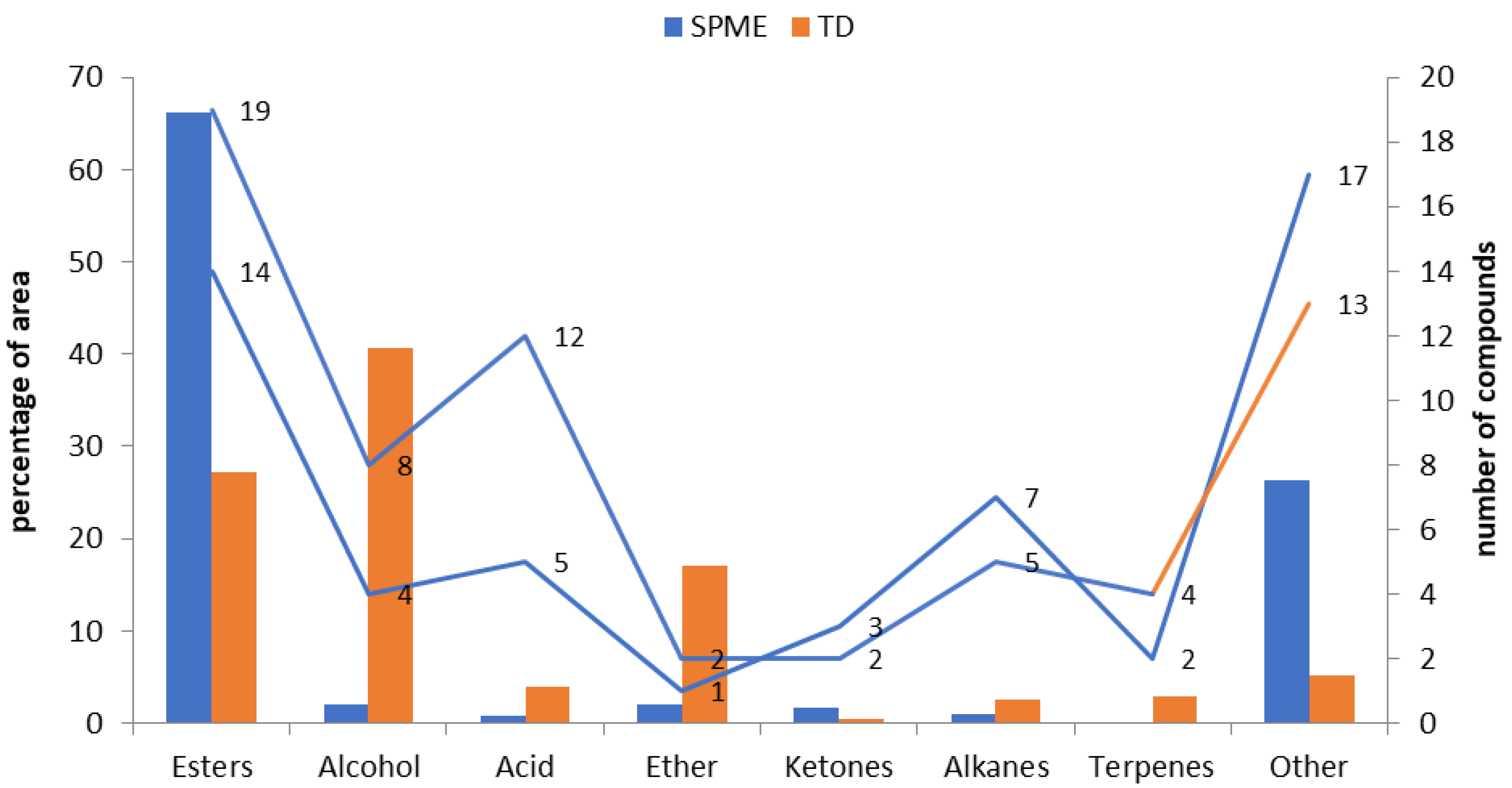
Figure 7.
Compositional clr-biplot (78.3% of the total variance retained) based on the volatile compounds extracted by HP-SPME through second fermentation closured by different closures (cork: red; screw: blue).
Figure 7.
Compositional clr-biplot (78.3% of the total variance retained) based on the volatile compounds extracted by HP-SPME through second fermentation closured by different closures (cork: red; screw: blue).
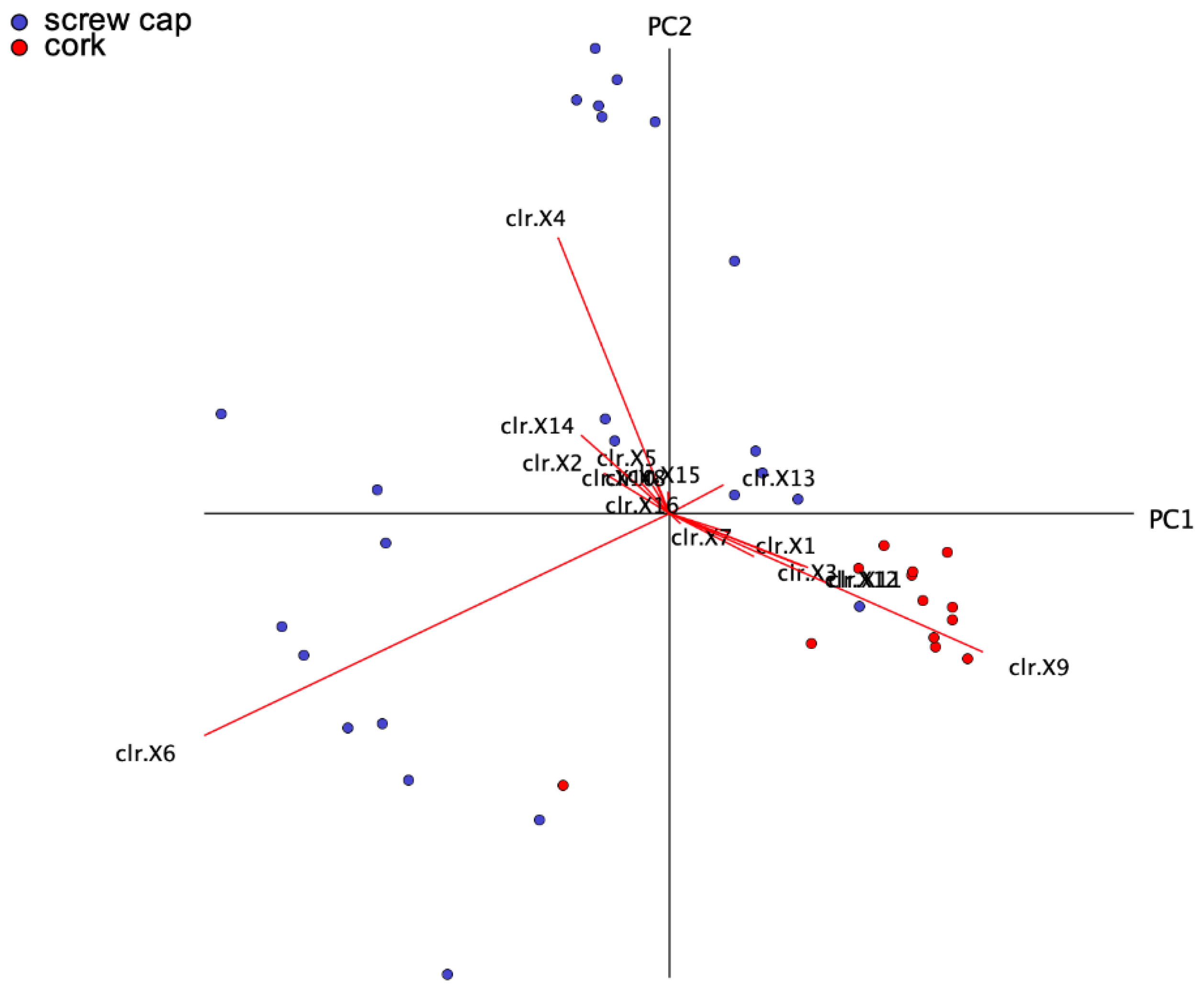
Figure 8.
Geometric mean bar plot comparing the compositional mean of the entire sample with the compositional mean of aromatic compounds subgroups for the six types of closure.
Figure 8.
Geometric mean bar plot comparing the compositional mean of the entire sample with the compositional mean of aromatic compounds subgroups for the six types of closure.
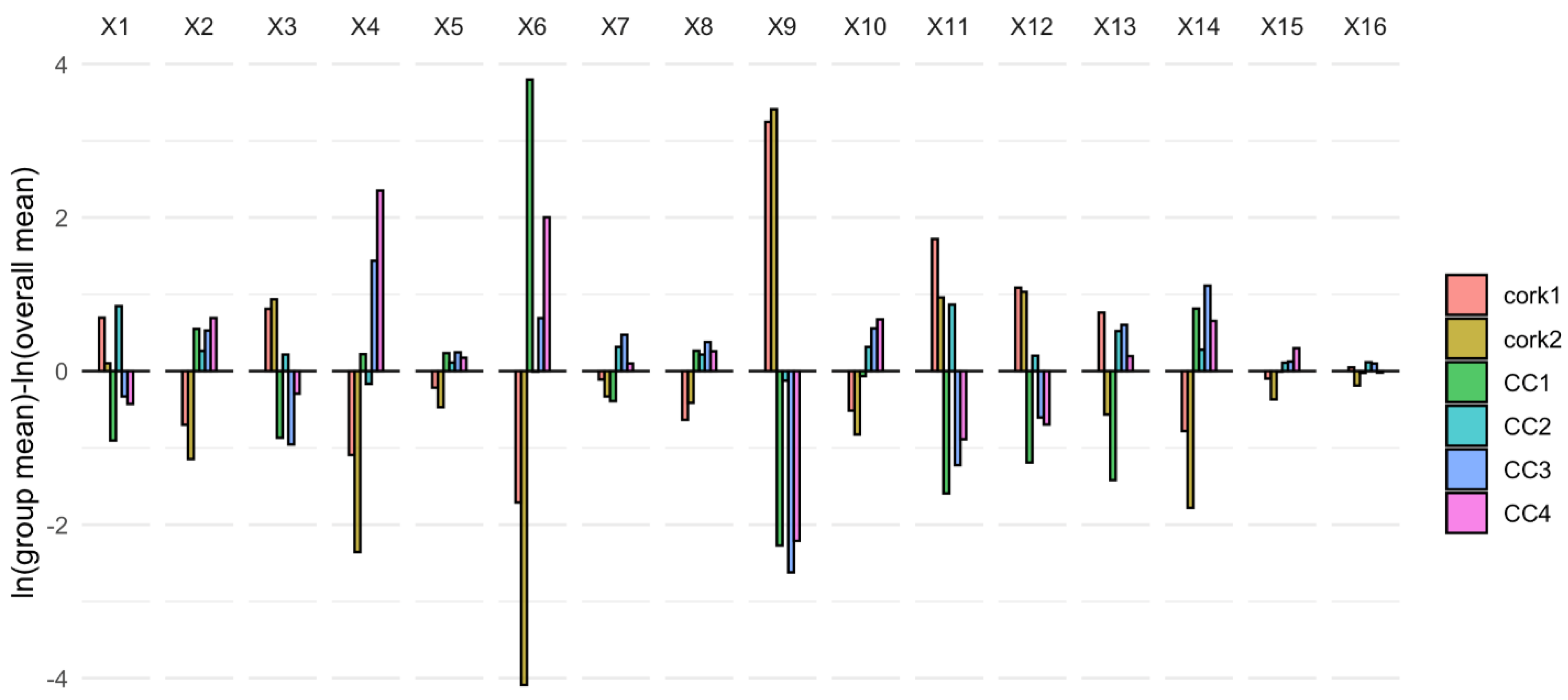
Figure 9.
Canonical variates plot of clr-scores for cork1, cork2, CC1, CC2, CC3 and CC4 groups. The compositional centers of each group are represented by filled circles.
Figure 9.
Canonical variates plot of clr-scores for cork1, cork2, CC1, CC2, CC3 and CC4 groups. The compositional centers of each group are represented by filled circles.
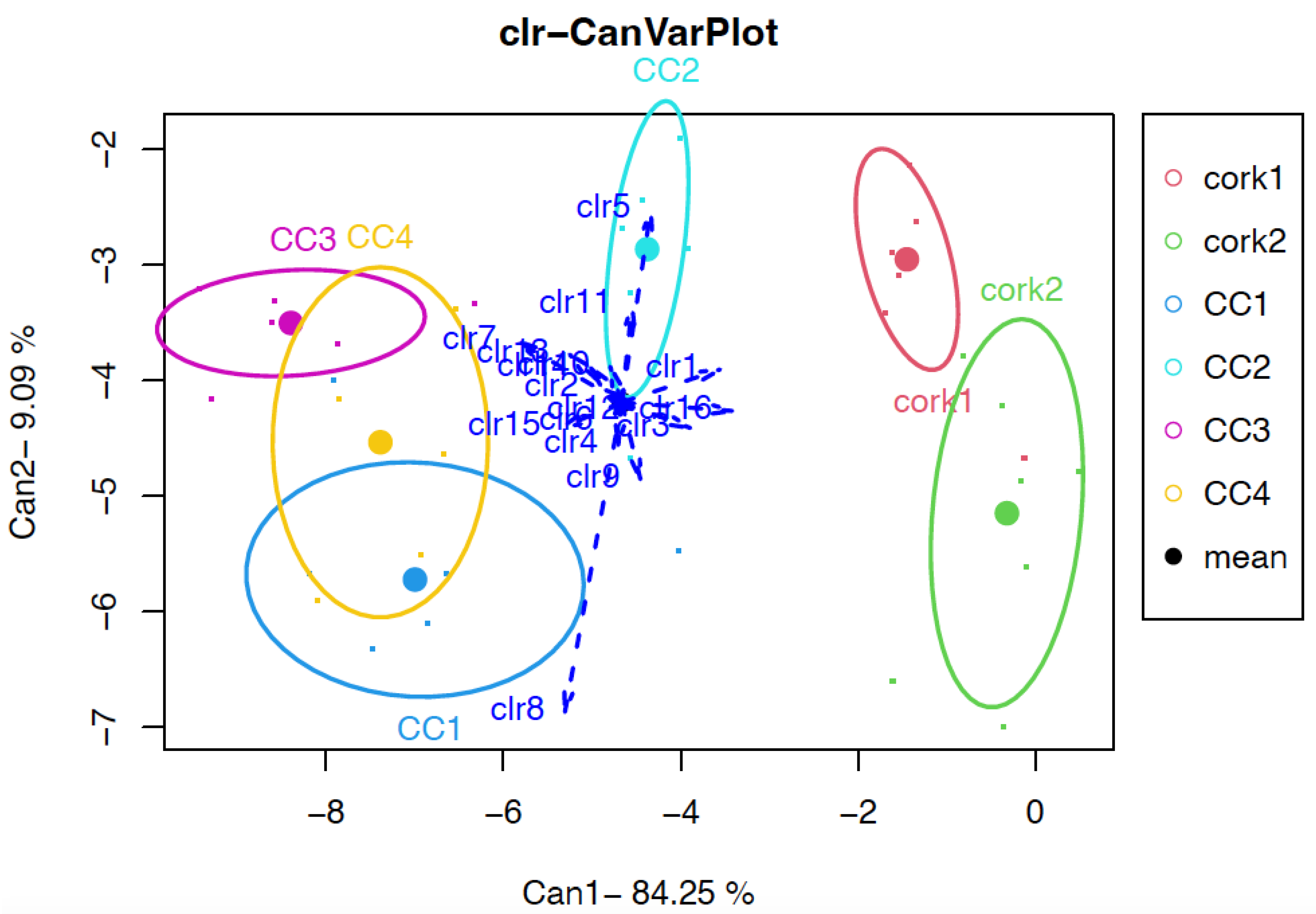
Table 1.
Closures used for second fermentation and aging of sparkling wine: types, codes and description.
Table 1.
Closures used for second fermentation and aging of sparkling wine: types, codes and description.
| Type | Code | Closure description |
|---|---|---|
| Cork stopper | Cork 1 | Agglomerated cork stopper with 31 mm of diameter |
| Cork stopper | Cork 2 | Agglomerated cork stopper with 32 mm of diameter |
| Screw cap | CC1 | Polyethylene screw cap consists of a cell polyethylene foam disc with a very fine structure. |
| Screw cap | CC2 | Saranexis composed of PE covered on both sides with PVDC |
| Screw cap | CC3 | Daraform is a non- polyvinylidene (PVC) compound based on polyolefinic raw materials |
| Screw cap | CC4 | Saranex + araldite is composed of PE covered on both sides with PVDC and with the addition of an additional glue such as Varnishe (Araldite) |
Table 2.
Oenological parameters of base wine before and after the addition of a “tirage solution”.
| Base wine | Base wine after the addition of a “tirage solution” | ||
| Total acidity by sulfuric (g L-1) | 4.05 | Density (g cm3) | 998.9 |
| Sugar (GAP) (g L-1) | 23.1 | Turbidity (NTU) | 35.9 |
| NFA (mg L-1) | 63.0 | Free SO2 (mg L-1) | 7 |
| Free SO2 (mg L-1) | 8.0 | Temperature (ºC) | 17 |
| Sucrose | 21.3 | ||
Table 3.
Oenological parameters of base wine before and after the addition of a “tirage solution”.
| Code | Volatile compounds | % zeros replaced |
| 1, 1, 5-Trimethyl-1, 2-dihydronaphthalene | 75.7% | |
| 3,4-Dihydroisoquinoline, 1-[3-hydroxybenzyl]-6-methoxy- | 62.2% | |
| 4-(2,3,6-Trimethylphenyl)-1,3-butadiene | 70.3% | |
| Carbon dioxide | 70.3% | |
| Diethyl succinate | 0.0% | |
| Dimethylamine | 70.3% | |
| Ethyl 9-decenoate | 13.5% | |
| Ethyl hexanoate | 0.0% | |
| Ethyl octanoate | 56.8% | |
| Ethyl trans-4-decenoate | 32.4% | |
| Isoamyl alcohol | 73.0% | |
| Lactamide | 51.4% | |
| Octanoic acid | 56.8% | |
| Oxirane, 2-(1,1-dimethylethyl)-3-ethyl-, cis- | 46.0% | |
| Phenylethyl Alcohol | 2.7% | |
| alpha-Ionone | 21.6% |
Disclaimer/Publisher’s Note: The statements, opinions and data contained in all publications are solely those of the individual author(s) and contributor(s) and not of MDPI and/or the editor(s). MDPI and/or the editor(s) disclaim responsibility for any injury to people or property resulting from any ideas, methods, instructions or products referred to in the content. |
© 2024 by the authors. Licensee MDPI, Basel, Switzerland. This article is an open access article distributed under the terms and conditions of the Creative Commons Attribution (CC BY) license (http://creativecommons.org/licenses/by/4.0/).
Copyright: This open access article is published under a Creative Commons CC BY 4.0 license, which permit the free download, distribution, and reuse, provided that the author and preprint are cited in any reuse.


