
Submitted:
08 January 2025
Posted:
09 January 2025
Read the latest preprint version here
Abstract
It is a famous old problem: Why the orbit of the Moon around the Earth is stable under the condition that, calculated with F=GMm/R2, the force of the Sun on the orbit is almost 2.2 times that of the Earth? We find, the calculated force of the Sgr A* on the orbit of the Oort cloud around the Sun is larger than that of the Sun; and, the force of the Sgr A* on the orbits on the edge of the ω Centauri is larger than that of the black hole at the center of the ω Centauri. It is known that the old problem about the Moon around the Earth can be understood with the Newtonian theory of orbit perturbation. Here, we find, the problem about the Oort cloud and the ω Centauri also can be understood with the Newtonian theory of orbit perturbation. And, we conclude that the mass of the Sgr A* should be MSgrA*∼1.8×10¹¹MSun ; and, at the center of every stellar cluster there should be a black hole or other massive body which can be easily measured with any one of the orbits in the cluster or with the Hill sphere.
Keywords:
1. Newtonian Theory of Orbit Perturbation and Galactic Dynamics
1.1. Newtonian Theory of Orbit Perturbation Is Needed to Understand the Orbits About a Stellar Cluster in a Galaxy
1.2. The Mass of the Sgr A* and Hill Sphere
2. Discussion
2.1. The Center Mass in a Galaxy
- 1)
- Sgr A* is the center body of the Milky Way.
- 2)
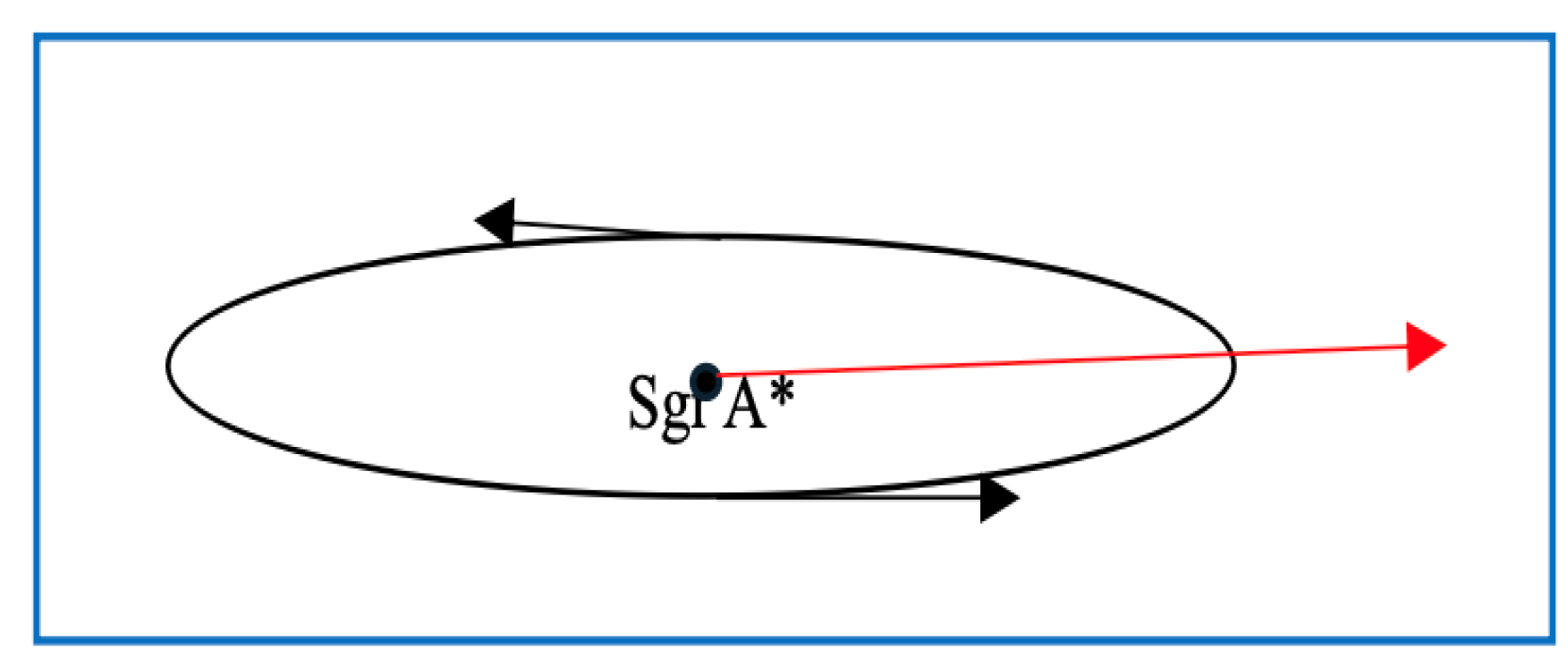
- Because the directions of the orbits of many stars are contrary to that of the motion of the galaxy, it can be concluded that it is the Sgr A* that makes the whole galaxy moved along the red arrow, just as the solar system is moved by the motion of the Sun [12].
- 3)
- It is emphasized that the orbits in the Milky Way are stable and are dominated by the Sgr A*. The galaxy is with a radius about 100,000 light years, if the orbit of every star or stellar cluster was with a little shift, the motion of the galaxy should have become chaotic.
- 4)
- The mass of the Sgr A* need be very large. A small mass cannot make the whole galaxy moved and make the orbits with the radius about 100,000 light years in the galaxy stable.
2.2. Misled Theories of Gravity
2.3. The Mass of Sgr A* and the Galactic Rotation Curve
2.4. The Orbits of the S-Stars and the Mass of Sgr A*
2.5. Newtonian Theory of Orbit and Galactic Dynamics
3. Conclusion
- 1)
- The discovery of the Sgr A* determines two different times in understanding the Milky Way. Before the Sgr A* had been discovered, the center mass for the orbits in the Milky Way cannot be known, the understanding about the orbits need be improved; after the Sgr A* has been discovered, it is known that all other bodies are orbiting or rotating around it; which is the fundamental to the development of galactic dynamics.
- 2)
- We studied the action of the Sgr A* on the orbits in the solar system and in the ω Centauri. We found, the Newtonian theory of orbit perturbation and the Hill sphere are needed to understand the orbit in a galaxy. Therefore, we need to return to the Newtonian theory of gravity by excluding the wrong theories, such as the Poincaré’s equation for Three-body problem and the Poisson equation.
- 3)
- According to Newtonian theory of orbit perturbation, from Eq.(1), it is easy to know that the mass of the Sgr A* should be ; which is highly consistent with that known from the Hill sphere. And, the recent observed circular velocity curve of the Milky Way [2,3,4,5,6,7,8,9,10,11,12,13,14,15,16,17,18,19,20,21,22,23,24,25,26,27] should be an evidence for it. It is imaginable that the mass of the center (Sgr A*) of the Milky Way need be large enough to make the orbits in the radius about light years stable and to make the whole galaxy moved stably.
- 4)
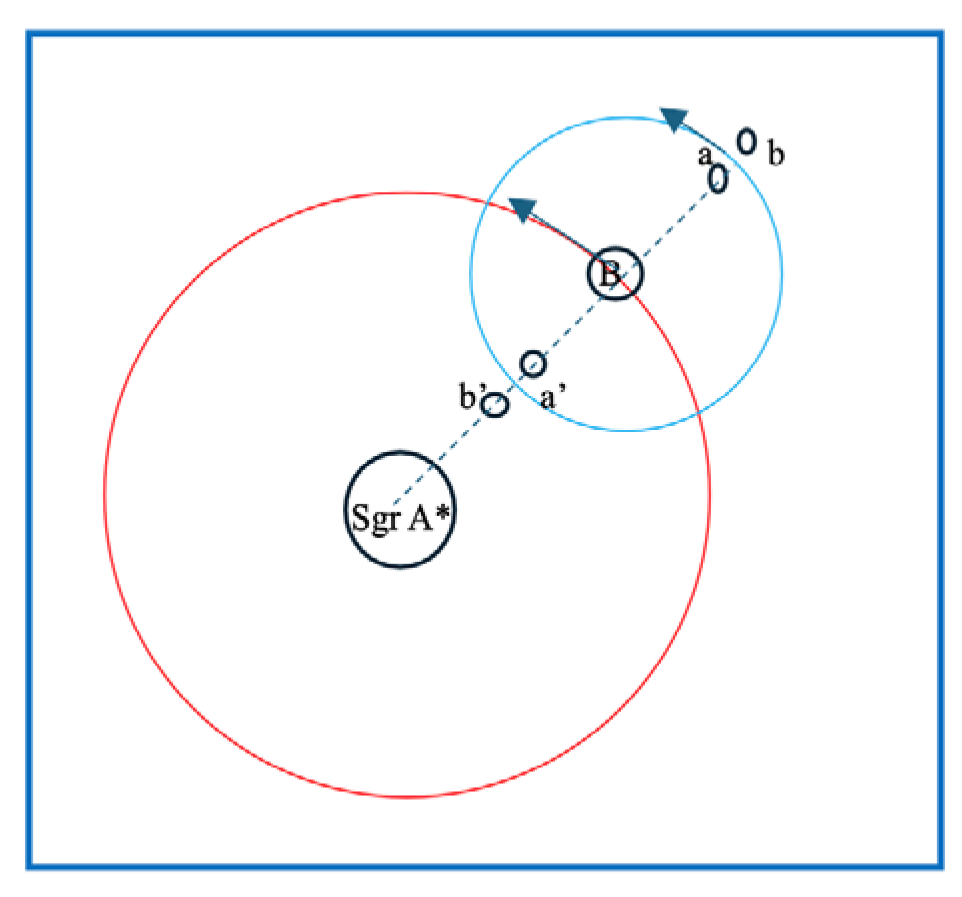
- In every stellar cluster, there should be a center body (black hole or other massive body) at the center of the cluster. The mass of the center body can be measured from two ways: 1) directly calculated from any one of the orbits in the cluster with Eq.(1); 2) calculated from the radius of the cluster and the mass of the Sgr A* with the Hill sphere Eq.(2).
References
- Genzel R., Eisenhauer F. and Gillessen S., 2010, The Galactic Center Massive Black Hole and Nuclear Star Cluster, Reviews of Modern Physics, 82(4), 3121-3195. [CrossRef]
- Ghez A. M., et al., 2005, Stellar orbits around the Galactic Center black hole, Astrophys. J. 620, 744. [CrossRef]
- Zhu Y., 2024, Galactic Rotation Curve Need Be Improved for the Discovery of Sgr A*. [CrossRef]
- Zhu Y., 2024, The Mass of the Center of the Milky Way Revalued from the Fastest Stars, Fast Galaxy Bar and the Circular Velocity Curve of the Milky Way. [CrossRef]
- Peißker F., Eckart A. and Parsa M., 2020, On a 9.9 yr Orbit around SgrA*, ApJ, 889, 61. [CrossRef]
- Peißker F., Eckart A., Zajaček M. and Britzen S., 2022, Observation of S4716- A star with a 4 year orbit around Sgr A*, ApJ, 933, 49. [CrossRef]
- Peißker F., Eckart A., Zajaček M., Britzen S., Ali B. and Parsa M., 2020, S62 and S4711: Indications of a Population of Faint Fast-moving Stars inside the S2 Orbit—S4711 on a 7.6yr Orbit around Sgr A*, ApJ, 899, 50. [CrossRef]
- Peißker F., Eckart A. and Ali B., 2021, Observation of the Apoapsis of S62 in 2019 with NIRC2 and SINFONI, APJ, 918, 25. [CrossRef]
- GRAVITY Collaboration, et al., 2022, Deep images of the Galactic center with GRAVITY, A&A 657, A82. [CrossRef]
- GRAVITY Collaboration, et al., 2022, Mass distribution in the Galactic Center based on interferometric astrometry of multiple stellar orbits, A&A 657, L12. [CrossRef]
- Aleksandar S. Tomi’c, 2013, The Lunar Orbit Paradox, Theoret. Appl. Mech. TEOPM7, 40, 1,135. [CrossRef]
- Zhu Y., 2021, Interaction of Gravitational Field and Orbit in Sun-planet-moon system. [CrossRef]
- Gutzwiller M. C., 1998, Moon-Earth-Sun: The oldest three-body problem. Review of Modern Physics, 70(2), 589. [CrossRef]
- Häberle M., Neumayer, N., Seth A., et al., 2024, Fast-moving stars around an intermediate-mass black hole in ω Centauri, Nature 631, 285. [CrossRef]
- Araujo R. A. N., Winter O. C., Prado, A. F. B. A., & Vieira Martins, R., 2008, Sphere of influence and gravitational capture radius: a dynamical approach, Mon. Not. R. Astron. Soc. 391, 675. [CrossRef]
- Hamilton D.P. & Burns J.A., 1992, Orbital stability zones about asteroids, Icarus 92, 118-131. [CrossRef]
- Hamilton D.P. & Burns J.A., 1992, Orbital stability zones about asteroids. II - The destabilizing effects of eccentric orbits and of solar radiation, Icarus 96, 43. [CrossRef]
- Cuntz M., & Yeager K. E., 2009, On the validity of the Hill radius criterion for the ejection of planets from stellar habitable zones, The Astrophys. J. Lett. 697, L86. [CrossRef]
- Paskowitz M. E. & Scheeres D. J., 2004, Identifying Safe Zones for Planetary Satellite Orbiters, AIAA/AAS Astrodynamics Specialist Conference and Exhibit.
- Scheeres D. J., Guman M. D., & Villac B. F., 2001, Stability Analysis of Planetary Satellite Orbiters: Application to the Europa Orbiter. Journal of Guidance Control and Dynamics, 24(4), 778. [CrossRef]
- Russeil D., Annie Zavagno, P. Mege, Y. Poulin, S. Molinari, et al., 2017,The Milky Way rotation curve revisited, A&A, 601, L5. [CrossRef]
- Eilers A., Hogg D. W., Rixand H., Ness M. K., 2019, The Circular Velocity Curve of the Milky Way from 5 to 25 kpc, ApJ, 871 120. [CrossRef]
- Mróz P., Udalski A., Skowron D. M., Skowron J., et al., 2019, Rotation Curve of the Milky Way from Classical Cepheids, ApJL 870, L10. [CrossRef]
- Wang H., Chrobáková Ž., López-Corredoira M. and Labini F. S., 2023, Mapping the Milky Way Disk with Gaia DR3: 3D Extended Kinematic Maps and Rotation Curve to ≈30 kpc, ApJ, 942, 12. [CrossRef]
- Zhou Y., et al., 2023 The Circular Velocity Curve of the Milky Way from 5–25 kpc Using Luminous Red Giant Branch Stars, ApJ, 946, 73. [CrossRef]
- Jiao Y., Hammer F., Wang H., Wang J., et al., 2023, Detection of the Keplerian decline in the Milky Way rotation curve, A&A678, A208. [CrossRef]
- Ou X., Eilers A., Necib L. and Frebel A., 2024, The dark matter profile of the Milky Way inferred from its circular velocity curve, MNRAS 528, 693–710. [CrossRef]
- Tahmasebzadeh B. et al. 2024, Orbital Support and Evolution of CX/OX Structures in Boxy/Peanut Bars, ApJ 975 120. [CrossRef]

| r (ly) | d (ly) | m (MSun) | MSgrA* (MSun) | |
| Solar system | 3 | 26,000 | 1 | |
| ω Centauri | 100 | 42,000 | 8,200 |
Disclaimer/Publisher’s Note: The statements, opinions and data contained in all publications are solely those of the individual author(s) and contributor(s) and not of MDPI and/or the editor(s). MDPI and/or the editor(s) disclaim responsibility for any injury to people or property resulting from any ideas, methods, instructions or products referred to in the content. |
© 2025 by the authors. Licensee MDPI, Basel, Switzerland. This article is an open access article distributed under the terms and conditions of the Creative Commons Attribution (CC BY) license (http://creativecommons.org/licenses/by/4.0/).


