

Submitted:
16 February 2025
Posted:
17 February 2025
Read the latest preprint version here
Abstract
Entanglement swapping has important applications in various fields such as quantum information processingand the preparation of entangled states. In this paper, we propose a new algorithm for deriving entanglement swapping results. The basic idea of our algorithm is to deduce the entanglement swapping results from all possible observation results, which is simpler than existing algorithms. We demonstrate the algorithm by the entanglement swapping between two bipartite entangled states, and derive the results of entanglement swapping between two 2-level Bell states, which are consistent with those obtained through algebraic calculations.
Keywords:
entanglement swapping
; Bell state
; quantum information processing
1. Introduction
Quantum superposition, or superposition for short, is a peculiar quantum mechanics phenomenon, which indicates that a quantum system can be in multiple different states simultaneously [1]. The most common case is the superposition of two opposing states, and one of the most famous examples is “Schrdinger’s cat”, which can be vividly expressed as “a cat can be both alive and dead at the same time” [2].
Quantum entanglement, abbreviated as entanglement, is a quantum mechanics phenomenon built on superposition. In other words, the primary premise for the existence of entanglement is superposition. An entangled system is a composite of two or more subsystems, and if one of the subsystems is observed, the state of the other subsystems will change immediately without any time delay [1]. In a entangled state, the properties of each particle have been integrated into a whole property, and it is impossible to describe the properties of each particle separately, only the properties of the whole system can be described [1,3].
Entanglement swapping is another quantum mechanics phenomenon, which builds on entanglement. Entanglement swapping has attracted extensive attention in the academic community since its discovery, mainly because it is one of the core resources for preparing quantum repeaters, which makes long-distance quantum communication and and large-scale quantum networks possible [3,4,5]. In addition, entanglement swapping provides a new approach for the preparation of entangled states and is also an important resource for designing quantum cryptography protocols and quantum algorithms [5,6].
The original idea of entanglement swapping was included in the quantum teleportation scheme proposed by Bennett et al. in 1992 [7]. Subsequently, Zeilinger et al. experimentally realised entanglement swapping for the first time in 1993, and formally proposed the concept of entanglement swapping [4]. Bose et al. described the entanglement swapping of 2-level cat states [8]. Hardy and Song considered the entanglement swapping of general pure states [9]. Bouda and Buek generalized the entanglement swapping scheme originally proposed for two pairs of qubits to multi-qudit systems [10]. Karimipour et al. introduced generalized cat states for d-level systems and obtain the formulas for their entanglement swapping with generalized Bell states [11]. Sen et al. investigated various entanglement swapping schemes for Werner states [12]. Roa et al. studied the entanglement swapping of X states [13]. Kirby et al. proposed a general analytical solution for entanglement swapping of arbitrary two-qubit states, which provides a comprehensive method for analyzing entanglement swapping in quantum networks [14]. Recently, Bergou et al. investigated the connection between entanglement swapping and concurrence [15].
In this paper, we propose a novel algorithm for entanglement swapping, demonstrate the algorithm through the entanglement swapping between two entangled states with two particles each. We verify the correctness of the algorithm through the entanglement swapping between two Bell states (also commonly referred to as Einstein-Podolsky-Rosen pairs, abbreviated as EPR pairs), which is achieved by performing Bell measurements on the first particle in each Bell state [16]. In the following text, we will introduce the algebraic algorithm for entanglement swapping between two Bell states in Sec. 2, then present our proposed algorithm in Sec. 3. Finally, we provide a brief summary in Sec. 4.
2. Entanglement Swapping Between Two Bell States
Suppose that there are two or more independent entangled states, and select some particles from each entangled state and then perform joint quantum measurements on them, the measured particles will collapse onto a new entangled state after measurement, while all the particles that are not measured will collapse into another new entangled state, such a phenomenon is called entanglement swapping [5]. The mathematical calculation process of entanglement swapping can be simply described as the expansion of a polynomial composed of vectors, combining like terms, permutation, followed by the re-expansion of the polynomial, and then combining like terms [17].
In what follows, we will introduce the entanglement swapping between two Bell states. Let us first introduce the Bell states, which can be expressed as
The four states form a complete orthogonal basis, i.e. the Bell basis [5].
The entanglement swapping of Bell states is mathematically described in detail in Refs. [5,17], but here we only introduce the results in Ref. [5], which are given by
where the subscripts 1,2 and 3,4 represent two particles in two Bell states, respectively. Note here that the inessential coefficients are ignored (similarly hereinafter).
3. The New Algorithm for Entanglement Swapping
Suppose that there is a quantum system that is always isolated from the outside world, which means that there has never been any energy exchange between the system and the external environment. We can know from the law of conservation of energy that energy cannot be generated or disappeared out of thin air, hence the total energy possessed by such a system must be zero, which means that the energy possessed by the system must be divided into positive energy and negative energy, and these two types of energy are balanced (they are equal in quantity). Here, we might as well use to represent the states of quantum system, and and to represent the state of the positive and negative energy of the system, respectively, where can be assumed to be of any dimension. Due to the balance between the positive energy and negative energy, it is clear that . Interestingly, when the system is observed (i.e. performing quantum measurements on it), only the state can be obtained, attributed to
where represents a measurement operator and the subscript m represents a possible measurement result [1], in which case it is impossible to know whether the observed state is or . Since the probability that is in either the state or the state is 50%, we would like to denote the system as
It should be pointed out that can be a system with only one subsystem (i.e., a single-particle system) or a system with multiple subsystems (i.e., a multi-particle system). Let us give a few familiar examples, if is a single-particle system, one can take as one of and , or as one of and , where and , in which case one can establish a coordinate system as shown in Figure 1.
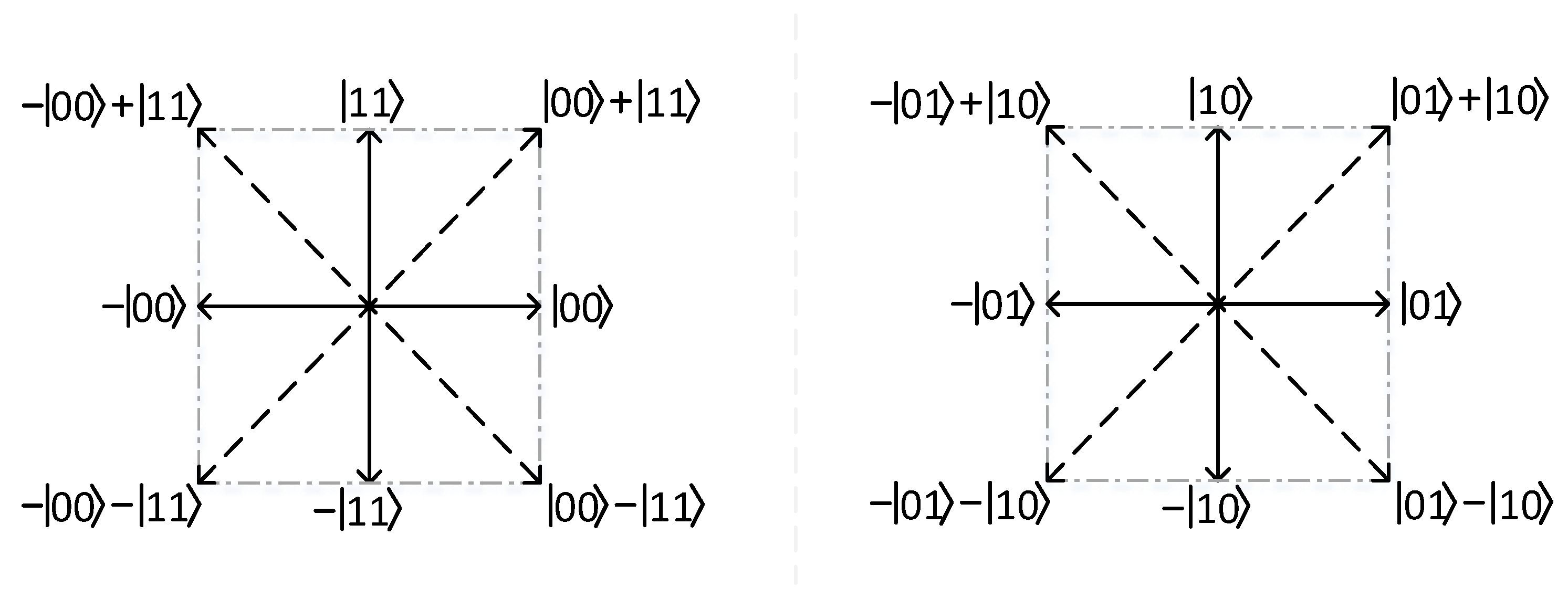
If is a multi-particle system, e.g., can be taken as one of , , and , or as one of the Bell states (see Eq. 1), such that two coordinate systems shown in Figure 2 can be established.
Let us now assume that there is an independent quantum system with two subsystems (i.e., a two-particle quantum state), and assume that is in one of the following two states:
where the subscripts 1,2 represent two subsystems, and are two sets of orthonormal bases, such that and . Table 1 shows all possible combinations of the states of the particles 1 and 2, where the states with global phase, , can not ignored even though they do not have observational effects, and ③, ④ can be considered as the measurement results from .
In what follows, let us introduce the new algorithm for computing entanglement swapping. Without losing generality, let us consider the entanglement swapping between two systems each containing two subsystems. The algorithm is also applicable to multi-particle systems, since it is just the generalization of two-particle systems. Let us assume there are two two-particle systems that are independent of the external environment and each other. For simplicity, we assume that the two systems are in the state shown in Eq. 5 and select only the combinations numbered ① and ② in Table 1. Let us represent the two systems as and , respectively, then we have
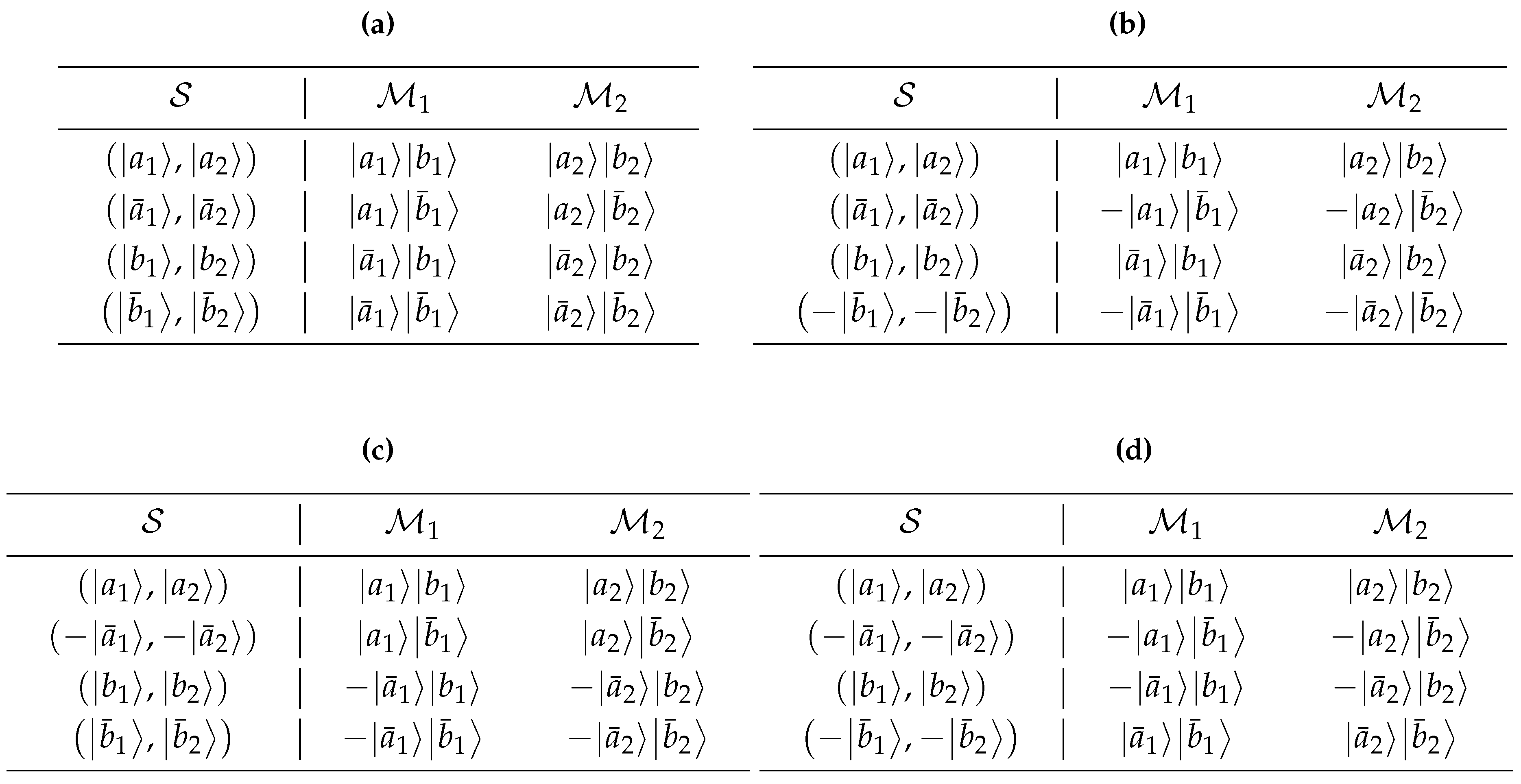
Furthermore, without loss of generality, assuming that the first subsystem in both and is observed simultaneously, and the observation result is denoted as , while the state that the remaining subsystems collapse onto is denoted as . In addition, we use the symbol to represent the combinations of the states of two subsystems. Let us discuss different scenarios in turn, including four combinations: , , , and . For the first case, we list all the possible states of subsystems and the corresponding observation results in the four sub-tables in Table 2 (Note that for the sake of simplicity, unnecessary coefficients are ignored in the table).
From the four sub-tables, we can summarize the following corresponding relationships:
from which we can get the result of the entanglement swapping between and ,
In a similar way, we can further obtain the results for other entangled swapping cases, which are given by
Let us set in Eq. 8, then four cases of the entanglement swapping between two Bell states can be obtained, which are given by
where the change in the positions of the subscripts shows the swapping of particles. In a similar way, we can further obtain the results for other cases of the entangled swapping between two Bell states from Eqs. 9 to 11, as follows,
The cases shown in Eqs. (12a, 12d, 15a, 15d) are included in Eq. 2a. Furthermore, Eqs. (13a, 13d, 14a, 14d) are included in Eq. 2b. Eqs. (12b, 12c, 15b, 15c) are included in Eq. 2c. and Eqs. (13b, 13c, 14b, 14c) are included in Eq. 2d. In short, Eqs. (2a-2d) verify the correctness of the proposed algorithm.
4. Conclusion
We have proposed a new algorithm for obtaining entanglement swapping results and verified its correctness through entanglement swapping of two Bell states. Compared to the existing algebraic calculations, our algorithm is simpler and easier to understand. Further research on the entanglement swapping between multi-particle systems through the proposed algorithm can serve as future research work.
Acknowledgments
This work is supported by the the 13th Five-Year National Cryptographic Development Fund (Grants No. MMJJ201701304).
Conflicts of Interest
The authors declare no conflicts of interest.
References
- Nielsen, M. A.; Chuang, I. L. Quantum Computation and Quantum Information; Cambridge University Press, 2000. [Google Scholar]
- Schrödinger, E. Die gegenwärtige Situation in der Quantenmechanik. Naturwissenschaften 1935, 23, 844–849. [Google Scholar] [CrossRef]
- Horodecki, R.; Horodecki, P.; Horodecki, M.; Horodecki, K. Quantum entanglement. Review of Modern Physics 2007, 81, 865–942. [Google Scholar] [CrossRef]
- Zukowski, M.; Zeilinger, A.; Horne, M. A.; et al. “Event-ready-detectors” Bell experiment via entanglement swapping. Physical Review Letters, 1993, 71, 4287. [Google Scholar] [CrossRef] [PubMed]
- Ji, Z. X.; Fan, P. R.; Zhang, H. G. Entanglement swapping for Bell states and Greenberger–Horne–Zeilinger states in qubit systems. 2022, 585, 126400. [Google Scholar] [CrossRef]
- Zhang, H. G.; Ji, Z. X.; Wang, H. Z.; et al. Survey on quantum information security. China Communications 2019, 16, 1–36. [Google Scholar] [CrossRef]
- Bennett, C. H.; Brassard, G.; Crépeau, C.; et al. Teleporting an unknown quantum state via dual classical and Einstein-Podolsky-Rosen channels. Physical review letters, 1993, 70, 1895. [Google Scholar] [CrossRef] [PubMed]
- Bose, S.; Vedral, V.; Knight, P. L. Multiparticle generalization of entanglement swapping. Physical Review A 1998, 57, 822. [Google Scholar] [CrossRef]
- Hardy, L.; Song, D. D. Entanglement swapping chains for general pure states. Physical Review A 2000, 62, 052315. [Google Scholar] [CrossRef]
- Bouda, J.; Bužek, V. Entanglement swapping between multi-qudit systems. Journal of Physics A: Mathematical and General 2001, 34, 4301–4311. [Google Scholar] [CrossRef]
- Karimipour, V.; Bahraminasab, A.; Bagherinezhad, S. Entanglement swapping of generalized cat states and secret sharing. Physical Review A 2002, 65. [Google Scholar] [CrossRef]
- Sen, A.; Sen, U.; Brukner, Č.; Bužek, V.; Żukowski, M. Entanglement swapping of noisy states: A kind of superadditivity in nonclassicality. Physical Review A 2005, 72, 042310. [Google Scholar]
- Roa, L.; Muñoz, A.; Grũning, G. Entanglement swapping for X states demands threshold values. Physical Review A 2014, 89, 064301. [Google Scholar] [CrossRef]
- Kirby, B. T.; Santra, S.; Malinovsky, V. S.; Brodsky, M. Entanglement swapping of two arbitrarily degraded entangled states. Physical Review A 2016, 94, 012336. [Google Scholar] [CrossRef]
- Bergou, J. A.; Fields, D.; Hillery, M.; Santra, S.; Malinovsky, V. S. Average concurrence and entanglement swapping. Physical Review A 2021, 104, 022425. [Google Scholar] [CrossRef]
- Bell, J. S. On the Einstein Podolsky Rosen paradox. Physics Physique Fizika 1964, 1, 195. [Google Scholar] [CrossRef]
- Ji, Z. X.; Fan, P. R.; Zhang, H. G. Entanglement swapping theory and beyond. arXiv 2020, arXiv:2009.02555. [Google Scholar]
Figure 1.
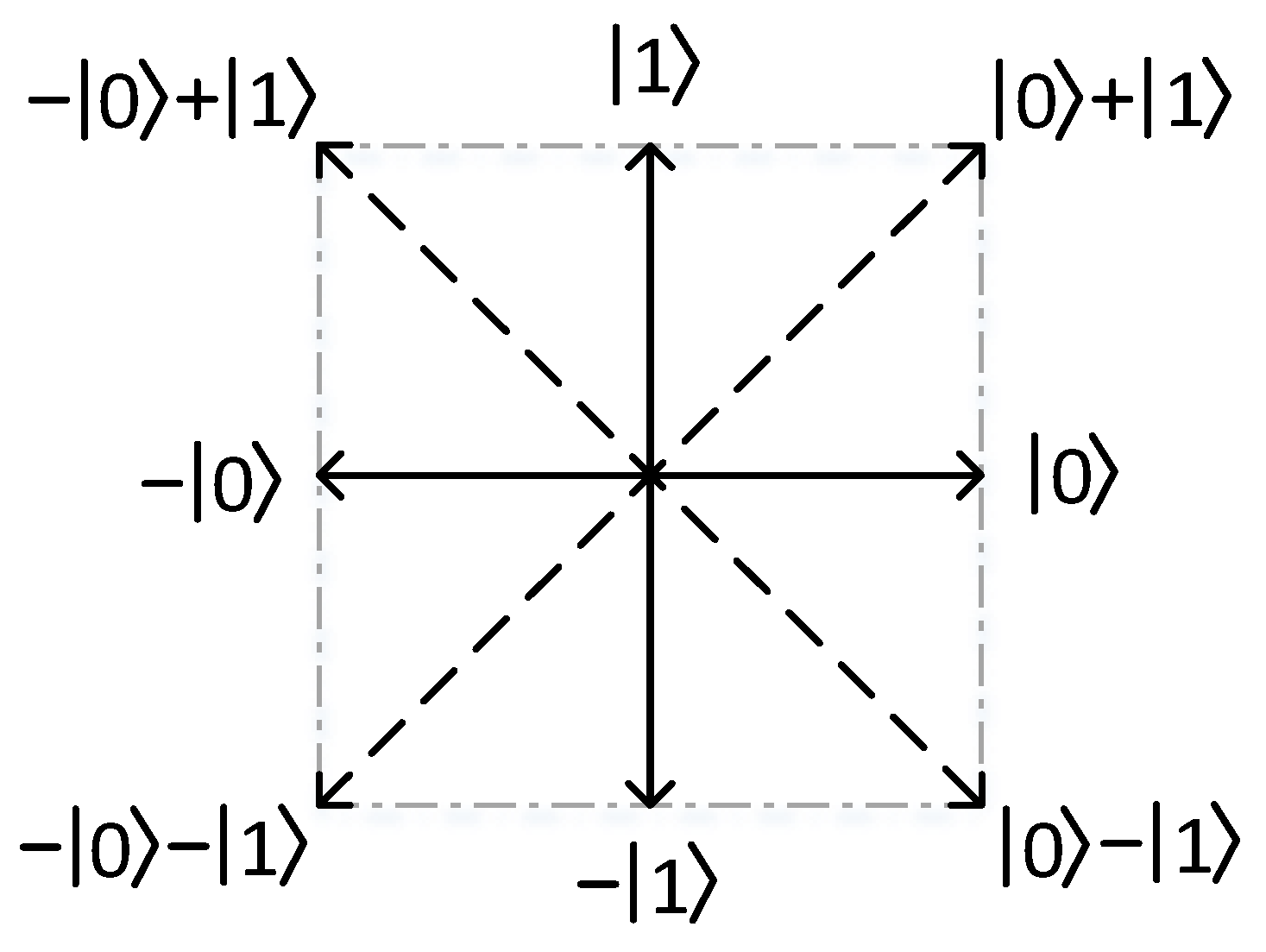
Figure 2.

| Combinations of the states of two subsystems | |
| ① or | |
| ② or | |
| ③ or | |
| ④ or | |
| ① or | |
| ② or | |
| ③ or | |
| ④ or |
Table 2.
Subsystem states and observation results
Disclaimer/Publisher’s Note: The statements, opinions and data contained in all publications are solely those of the individual author(s) and contributor(s) and not of MDPI and/or the editor(s). MDPI and/or the editor(s) disclaim responsibility for any injury to people or property resulting from any ideas, methods, instructions or products referred to in the content. |
© 2025 by the authors. Licensee MDPI, Basel, Switzerland. This article is an open access article distributed under the terms and conditions of the Creative Commons Attribution (CC BY) license (http://creativecommons.org/licenses/by/4.0/).
Copyright: This open access article is published under a Creative Commons CC BY 4.0 license, which permit the free download, distribution, and reuse, provided that the author and preprint are cited in any reuse.


