

Submitted:
24 March 2025
Posted:
25 March 2025
You are already at the latest version
Abstract
The objective was to examine the frequency of various health issues in dairy goats reared under two different farming systems and to assess their effects on daily milk yield (DMY). A total of 286 Skopelos goats from an intensive (NA = 153) and an extensive (NB = 133) farm, all with the same genetic background, were prospectively monitored for two consecutive lactation periods. Each goat was clinically examined for animal-based health indicators every 50 days, while individual DMY was also recorded. Morbidity frequency measures (cumulative incidence, point and period prevalence) were calculated for each one of the studied health issues, and mixed linear regression models were developed to assess the effect of each one of the studied health issues on DMY. The results indicated that overgrown hooves were more common in intensively reared goats, while anaemia and nasal discharge prevailed in extensively reared goats. Udder asymmetry, udder fibrosis, body abscesses, poor hair coat quality, and swollen lymph nodes were common in both farms, albeit more prevalent in extensively reared goats, except for udder asymmetry. Among the studied health issues, lameness (18.5 %, p < 0.05), mouth lesions (14.1 %, p < 0.05), udder asymmetry (6.6 %, p < 0.001), and udder fibrosis (9.5 %, p < 0.001), were significantly associated with reductions in DMY. These findings provide valuable insights for optimizing herd health management practices in dairy goats based on evidence and farming system requirements.
Keywords:
health and welfare
; goats
; milk yield
; farming system
; epidemiology
1. Introduction
Dairy goat farming has grown significantly over the last decades with an estimated global population of one billion goats producing about 20 million tons of milk [1]. This growth is driven by increasing demand for goat milk and dairy products related to cultural, health, and environmental factors [2]. Compared to cow milk, goat milk and its products have higher digestibility and hypoallergenic properties with positive impact on lipid metabolism, making them healthier alternatives that gain popularity in international markets [3,4]. Additionally, the dairy goat sector aligns well with environmentally sustainable and ecological livestock production systems, catering to the eco-consciousness of modern consumers [2].
In Greece, dairy goat farming has a long-standing tradition, especially in less favored, mountainous, rural areas, where land availability for crop production and other agricultural activities is limited. Greece has the largest dairy goat population in Europe and goat milk is primarily used with sheep milk for producing Feta cheese a protected designation of origin (PDO) product [5,6]. The majority of goats in Greece, including Skopelos, are reared under semi-extensive, low-input farming systems. But the increasing demand for goat milk over the last two decades has led to the intensification of farming systems, a trend expected to become dominant in future [7,8,9,10]. Regardless of farming system, health and welfare issues are dominant challenges undermining the sustainability of goat farms [7,11,12,13]. Associations between farming systems, health and welfare status of dairy goats have been studied [14,15,16], and several protocols, including indicators at animal- or herd-level, have been developed [12,14,17,18,19,20].
According to the European Food Safety Authority (EFSA) [21], the assessment of health and welfare status of farm animals should prioritize animal-based indicators over resource- or farm-based ones. The implementation of validated welfare protocols including animal-based indicators related to feeding, health, housing, and behaviour, enables early and non-invasive detection of potential health issues [22]. Regular assessment of these indicators depicts animals’ response to farming systems and facilitates sustainable farming practices by timely interventions that reduce economic losses and improve overall herd management [23]. The notion is that the latter approach benefits animal health and welfare status and supports the economic viability of farms by maintaining high-quality production while minimizing losses due to disease or poor management. However, except for low body condition scores (BCS) [24,25,26], there is scarce evidence in the available literature regarding the impact of other health and welfare issues on milk production in dairy goats particularly when raised under different farming systems [27,28,29,30]. Hence, the objective of the present study was twofold: i) to assess prospectively health and welfare status of Skopelos goats reared under intensive and extensive farming systems, using animal-based indicators, and ii) to estimate the associations between the observed health and welfare issues and milk yield.
2. Materials and Methods
2.1. Farms and Animals Involved
A total of 286 purebred Skopelos goats were randomly selected from an intensive goat farm (Farm A) (NA = 153) and an extensive goat farm (Farm B) (NB = 133) and were monitored prospectively for two consecutive lactation periods between February 2022 and August 2023. Farm A, is in the suburbs of Athens, Greece, 200 meters above sea level, with a mild Mediterranean climate and ambient temperatures ranging from - 4 to 40 °C. Farm B is located on the island of Skopelos, 50 meters above sea level, with a mild Mediterranean climate characterized by dry summers, rainy winters, and ambient temperatures ranging from 5 to 34 °C. All goats were at the same stage of lactation and had the same genetic merit; goats of Farm A were originally purchased from Farm B, three years before the study began. Table 1 presents the structural and management characteristics of each farm.
2.2. Data Recording
Recording sessions (RS) initiated at post-weaning and then every 50 days, resulting in four RS per year: RS1 in February (20 days post-weaning), RS2 in April (70 days post-weaning), RS3 in June (120 days post-weaning), and RS4 in August (170 days post-weaning). These sessions included a detailed recording of individual goat health status and milk yield. The evaluation of goat health status was performed by the same veterinarian using a modified version of AWIN protocol (Animal Welfare Indicators) for dairy goats [31]. Each goat was restrained and subjected to a clinical examination to assess the following: i) head: signs of anaemia, mouth lesions, jaw swellings, nasal and ocular discharges, and swollen parotid and submandibular lymph nodes, ii) limbs: lameness, arthritis, and overgrown hooves, iii) udder and teats: cysts, lesions, abscesses, mastitis, fibrosis, asymmetry, and swollen supra-mammary lymph nodes, and iv) body: BCS, faecal soiling, poor hair coat quality, vaginitis, meteorism, abscesses, and swollen lymph nodes (prefemoral, prescapular); occurrence of cough was also assessed. Prefemoral, prescapular, parotid, and submandibular lymph nodes were not evaluated during the first RS of both years in both farms, while anaemia was not assessed in the first RS of the first year in both farms. Table 2 summarizes the recorded health indicators, while some of the health and welfare issues observed are illustrated in Figure 1. The day after the clinical examination, milk yield was recorded during the morning milking session and daily milk yield (DMY) was estimated according to ICAR (International Committee for Animal Recording) recommendations. The experimental protocol was approved under the authorization number 33/8.06.21, granted by the Ethics Committee of the Agricultural University of Athens.
2.3. Statistical Analysis
Morbidity frequency measures including point prevalence (the proportion of goats with the observed health issue at a specific point in time), period prevalence (the proportion of goats with the observed health issue at any time during the specified period), and cumulative incidence (CI) (the proportion of goats at risk at the start of the observation period that developed the observed health issue during the specified period) were calculated for the studied health and welfare issues. For the estimation of CI, only goats with a full dataset of recordings were considered per recording year. Among the 153 goats enrolled in this study from Farm A, complete datasets from all four RS were available for 100 goats in the first year and 103 goats in the second year. Similarly, in Farm B, CI values were estimated based on data collected from 115 goats in the first year and 81 goats in the second year. Descriptive statistics (mean ± standard deviation) of DMY and BCS were also calculated throughout the study. Finally, 24 mixed linear regression models, one for each of the studied health issues, were built to assess their effects on DMY as described below (Model 1). Data was analysed using SPSS v.26 software (IBM Corp., Armonk, NY, USA) with statistical significance set at the a = 0.05 level, while a statistical significance level of 0.001 was used when necessary:
where, DMYgj = daily milk yield (kg) for the gth sampling occasion of the jth goat, μ = intercept, Fj = fixed effect of the farming system (2 levels; 1 = intensive, 2 = extensive), Ygj = fixed effect of the year of sampling (2 levels; 1 = 1st, 2 = 2nd year), Agj = fixed effect of age (4 levels; 1 = 2, 2 = 3, 3 = 4, and 4 ≥ 5 years old), Sj = fixed effect of the stage of lactation (4 levels; 1 = 20, 2 = 70, 3 = 120, and 4 = 170 days post-weaning), Xgj = fixed effect of the occurrence of the recorded health issues (2 levels; 0 = absence, 1 = presence), β1 = fixed effect of the regression coefficient of BCS (1 to 5 with 0.25 increments), γj = repeated variation of the jth goat, egj = residual error.
DMΥgj = μ + Fj + Ygj + Agj + Sj + Χgj + β1*ΒCS + γj + egj
3. Results
3.1. Morbidity Frequency Measures
Table 3 and Table 4 illustrate the point and period prevalence values for each one of the studied health and welfare issues in Farm A and B during the first and second year of recordings, respectively. The number of new cases and the CI values for studied health and welfare indicators in Farm A and B are presented in Table 5 and Table 6, respectively.
Hoof overgrowth was the most common foot-related issue observed, with point prevalence values ranging from 1.0 to 31.4 % in Farm A and from 0.0 to 3.0 % in Farm B. Arthritis and lameness were less frequent (point and period prevalence < 4.0 %) and primarily observed in the intensively reared goats. Most lameness and overgrown hoof cases were observed during the first and second RSs. Moreover, the total number of goats with overgrown hooves in Farm A increased from 29.2 to 42.1 % in the second year, while the period prevalence values for arthritis and lameness remained at the same levels.
Anaemia was observed throughout lactation in both farms; however, it was more prevalent in Farm B compared to Farm A. Similarly, nasal discharge was more common in Farm B than in Farm A, with the highest point prevalence values observed in RS4. In addition, in Farm B, distinct seasonal patterns were observed for anaemia and nasal discharge; specifically, new cases of anaemia declined as summer approached, while the occurrence of nasal discharge increased. Total cases of anaemia and nasal discharge increased from 48.9 to 71.9 % and 12.8 to 43.9 %, respectively, in Farm B in the second year of the study. Conversely, in Farm A, total cases of anaemia remained stable, while nasal discharge was particularly evident in the RS4 of the second year.
An increase in the number of goats with mouth lesions was observed in Farm A, particularly in the second RS of the first year, ultimately affecting 22.6 % of the goats. Jaw swellings were consistently observed in Farm A but at low point prevalence values (< 6.0 %). Finally, ocular discharge was occasionally found in both Farm A and B.
The clinical examination of the udder indicated that udder asymmetry, udder fibrosis, and swollen supra-mammary lymph nodes were among the most frequent udder health-related issues observed in both farms. In particular, udder fibrosis and swollen supra-mammary lymph nodes were observed at higher CI, point and period prevalence values in Farm B compared to Farm A, while morbidity frequency measures did not differ for udder asymmetry between the two farms. Furthermore, in the second year of recordings, a remarkable increase from 14.2 to 45.5 % and from 24.1 to 51.8 % was observed in Farm A and Farm B, respectively, for swollen supra-mammary lymph nodes. On the contrary, the total number of goats displaying udder asymmetry decreased from 74.5 and 75.2 % to 44.1 and 45.6 %, in Farm A and Farm B, respectively.
Teat and udder cysts, as well as udder abscesses, were primarily found in Farm B, albeit at low point and period prevalence values (< 10.0 %), with no remarkable difference between the two years, while clinical mastitis, teat fibrosis, and udder skin lesions were less frequently observed in both farms (point and period prevalence values ≤ 3.0 %).
Poor hair quality along with swollen body lymph nodes were among the most common health-related issues identified throughout the study, with point prevalence values ranging from 3.9 to 31.0 % and 15.4 to 28.6 %, respectively, in Farm A and from 7.1 to 47.0 % and 29.5 to 54.5 %, respectively, in Farm B. In both farms, poor hair coat quality was mostly observed at the beginning of the lactation period (RS1). The period prevalence of poor hair coat quality decreased in both farms (from 48.1 to 30.3 % in Farm A and from 60.9 to 51.8 % in Farm B), while the period prevalence of swollen body lymph nodes increased in Farm B from 45.9 to 64.9 %, in the second year of the study.
Body abscesses were also common in both farms with point prevalence values ranging from 8.0 to 35.9 % in Farm A and from 14.9 to 27.3 % in Farm B. Faecal soiling, vaginitis, meteorism, and cough were occasionally found in both farms, with the last three observed at point and period prevalence values < 5.0 %.
3.2. Milk Yield and Body Condition Score Variation Throughout Lactation Period
In the first year, the average DMY of goats in Farm A gradually decreased from 2.04 ± 0.770 kg at the start of the milking period to 1.13 ± 0.475 kg in RS4 (Figure 2). In the second year, DMY initiated at 1.79 ± 0.688 kg in the first RS, peaked at 1.96 ± 0.863 kg in the second RS, and then gradually decreased to 1.41 ± 0.750 kg shortly before the end of the lactation period. Average BCS of goats in Farm A ranged from 2.85 ± 0.191 to 3.22 ± 0.327 in the first year of RS and from 2.91 ± 0.432 to 3.02 ± 0.410 in the second year of RS (Figure 2). In Farm B, the average DMY varied between 1.80 ± 0.532 and 0.51 ± 0.244 kg in the first year, and between 1.55 ± 0.483 and 1.04 ± 0.434 kg in the second year. The mean BCS steadily increased from 2.80 ± 0.154 to 3.10 ± 0.293 over the first year, while in the second year, the BCS decreased from 2.91 ± 0.270 to 2.76 ± 0.319 in the second RS before showing a slight increase in the third RS.
3.3. Mixed Linear Regression Models
A total of 24 mixed linear regression models were used to assess the impact of various health issues on DMY (Table 7). Significant reductions in milk yield were observed in goats with the following conditions: lameness (18.5 %, p < 0.05), mouth lesions (14.1 %, p < 0.05), udder fibrosis (9.5 %, p < 0.001), and udder asymmetry (6.6 %, p < 0.001). Additionally, the presence of overgrown hooves showed a tendency towards reduced DMY (p = 0.059). Although the highest decrease in DMY was associated with cough, this effect was not statistically significant (p = 0.127). In all cases, there was a positive association between age and milk yield (p < 0.001), indicating that older goats produced more milk. Conversely, both the stage of lactation and BCS showed a negative correlation with milk yield (p < 0.001). Lastly, intensively reared goats produced approximately 0.5 kg more milk compared to extensively reared ones (p < 0.001).
4. Discussion
Herein we prospectively investigated the most common health and welfare issues in goats reared under different farming systems, assessed their frequency, and examined their impact on milk production over a two-year period. To our knowledge this is the first study to compare the health and welfare status of dairy goats sharing the same genetic background but reared under intensive and extensive farming systems. Additionally, this study adds to existing literature by analyzing the relationship between a total of 24 health and welfare indicators and milk yield, while also providing insights and updating information regarding the health and productivity of Skopelos goats, the only officially recognized purebred Greek goat [13].
In our study, health and welfare issues related to feet were more common in intensively reared goats. This is consistent with other studies, where lameness and hoof overgrowth have been identified as prevalent health issues in goats reared under intensive farming systems, with reported prevalence values ranging from 1.2 to 19.2 % and from 35.5 to 79.8 %, respectively [12,19,20]. Housing conditions and management practices implemented on intensive farm, such as irregular foot trimming, high stocking density, and poor hygiene inside the pen due to excessive accumulation of manure and urine, were likely associated with the higher occurrence of foot-related issues in intensively reared goats, particularly during winter and spring. During winter, excessive moisture within the barn softens the hooves, resulting in disrupted integrity and increased susceptibility to infections [32]. Hoof overgrowth has also been associated with housing on straw bedding, which limits natural hoof wear [12], and with larger herd sizes, where routine hoof trimming is often inadequate due to its labour-intensive nature [33].
Hoof overgrowth has often been correlated with lameness and long-term damage to the bones of the feet [34]. Additionally, various dietary, infectious, and non-infectious factors, including diets with inadequate fibre, highly fermented feeds, low particle forages, bacterial infections (e.g. Dichelobacter nodosus, Fusobacterium necrophorum, Treponema spp.), white line disease, foreign body penetration, laminitis, and injuries [32,35], as well as harsh environmental terrain [36], have been identified as predisposing factors of lameness. As confirmed in extensively reared goats, grazing on rough surfaces facilitates natural hoof wear and promotes the mechanical cleaning of the hoof. Indeed, walking on pasture was associated with improved gait scores [37] and a low occurrence of foot-related issues [38,39].
Lameness has been widely studied in dairy cattle [40]; however, the available literature on the association between lameness and milk production in goats remains limited. Lameness is considered the second costliest health issue in cattle after mastitis [41], leading to reduced milk yield [42], decreased reproductive capacity [43], and high culling rates [44]. The negative effect of lameness on milk yield was confirmed with an 18.0 % decrease in DMY of lame goats in the studied population. The financial impact of these losses is estimated at 0.22 € per goat, based on the price of goat milk in Greece (0.92 € / kg) [45]. Similarly, Jaques et al. [46] observed that severe lameness in seasonal and extended lactating goats led to a reduction of 7.1 % and 8.7 % in milk yield with economic losses estimated at 0.28 €/goat (0.52 NZD) and 0.21 €/goat (0.39 NZD), respectively. In dairy sheep, lameness was associated with a 16.0 % (0.21 kg) reduction in milk yield, equivalent to a 50 kg decrease per lactation, resulting in financial losses of 45 € per case and treatment costs of 15-20 € per case [47].
Among udder health issues in dairy ruminants, mastitis due to intramammary infections (IMI) is the most widely studied due to its significant impact on animal welfare and milk production [48]. In goats, the majority of IMI are subclinical [49]; however, over time, these infections can become chronic, resulting in structural damage within the mammary gland, such as the development of fibrotic tissue, asymmetry, abscesses, and secondary milk cysts [50]. Studies investigating milk yield losses associated with subclinical IMI in dairy goats have led to equivocal results. While some authors have noticed a decrease in milk production [51], others have found no significant difference between infected and uninfected udders [52,53] or even higher milk yield in affected udders [54]. These variations could be attributed to differences in study designs (udder half vs goat level), as well as to the causative pathogens and their prevalence [51,55]. Intramammary infections in Skopelos and indigenous Greek goat breeds reared under low-input farming systems have been primarily attributed to coagulase-negative Staphylococci and associated with a deterioration in both milk quality and quantity [56,57]. Specifically, goats with IMI produced 5.7% (0.05 kg/day) less milk, with losses increasing to 15.0% (0.12 kg/day) when infected with gram negative bacteria [57]. In addition, clinical examination of these populations indicated that udder asymmetry was the most repeatable udder health-related issue, while a negative correlation between milk yield and udder asymmetry was confirmed when including Damascus goats [58]. In our study, the estimated milk yield and monetary losses accounted for by udder asymmetry and udder fibrosis were approximately 0.1 kg and 0.08 € in both cases, respectively, without accounting for the cost of treatment. In Alpine and Saanen goats, severe asymmetry was associated with a 14.1% (100 kg) decrease in milk yield, shortened lactations (< 250 days), higher SCC, and higher culling rates, while mild asymmetry led to 4.9 % (37.8 kg) decrease in milk yield [59].
Udder asymmetry is among the most prevalent udder health-related issues in dairy goats [12], with prevalence ranging from 3.3 to 34.4 % [19,20] in intensively reared goats and from 4.8 to 38.2 % in extensively or semi-extensively reared goats [38,58]. A CI of 43.0 % has been previously reported in goats reared under low-input farming systems [13] which falls within the range observed in our study.
In our study udder asymmetry was possibly linked to chronic, untreated IMI resulting in fibrosis and udder atrophy [60]. Both udder fibrosis and udder asymmetry were prevalent throughout the lactation period and were associated with improper milking practices, high stocking density, and poor hygiene in the intensive farm, as well as hand-milking practices and the lack of an udder health management program in the extensive farm (e.g., post-milking dipping, dry antibiotic therapy). Notably, there was no distinct pattern related to the emergence of new cases. However, the prevalence of udder fibrosis increased during the second year in the extensive farm, likely due to the chronic nature of the disease and the absence of proper treatment during the dry period. Indeed, in low-input farming systems chronic IMI have been associated with the absence of control programs, the low culling rate of infected goats, and the failure to treat IMI during the dry period [57].
Regarding other udder health-related issues, swollen supra-mammary lymph nodes were common in both farms, but were slightly more prevalent in extensively reared goats. Similarly, udder and teat cysts, as well as udder abscesses, though having a low prevalence, were more common in extensively reared goats, likely due to hand-milking practices. Skopelos goats reared under low-input farming systems have been found to be susceptible to udder abscesses, yet without any impact on milk yield [58].
An outbreak of lesions (papules and scabs) on mouth and muzzle was observed during the second recording session of the first year in the intensive farm, resulting in a 14.5 % reduction in DMY of the affected goats. This decrease equates to a loss of 0.2 kg and 0.18 € per goat. Although several etiological agents could have caused mouth lesions and laboratory confirmation was not available, the clinical presentation and epizootiology of lesions was indicative of contagious ecthyma. Lesions typically resolve within 4 to 6 weeks [61], as observed in our study, and goats develop long-lasting immunity [62]. Infected animals may exhibit decreased milk yield (as confirmed herein) and weight loss due to impaired feeding resulting from painful oral lesions [63]. The economic burden of the disease, including production losses and treatment costs, has been estimated at £4.62 per affected goat [64]. Among the other health-related issues examined in this study, none were found to affect milk yield.
Anaemia, nasal discharge, and poor hair coat quality were observed on both farms but were more prevalent in the extensively reared goats. In particular, anaemia, was one of the most common health issues of extensively reared goats, observed throughout the lactation period. This finding aligns with the results of Silva Salas et al. [65] and Kim et al. [66], who noted that anaemia was more prevalent in semi-intensively reared goats and extensively reared cattle, respectively. This difference was likely due to grazing activity and greater exposure to endoparasites (e.g., Haemonchus contortus); exposure to other blood sucking parasites (e.g., lice, fleas) was not confirmed during the clinical examination of the animals. Other factors that could have contributed to the occurrence of anaemia include nutritional deficiencies (copper, iron, cobalt), chronic diseases, or other haemoprotozoan diseases (e.g., Babesiosis, Anaplasmosis, Theileriosis) [67,68].
In our study, the number of new anaemia cases declined as summer approached, while CI was higher in the second year in extensively reared goats. Similarly, poor hair coat quality was more prevalent during winter across both years and farms, whereas CI decreased in the second year. During winter nutritional demands rise due to the onset of lactation and needs for thermoregulation [69], as observed in our case. In extensive farm, the nutritional deficiencies resulting from poor grazing material during winter, coupled with the lack of deworming, may have contributed to the observed patterns of anaemia and poor hair coat quality. In contrast, in intensive farm, the scarcity of high-quality hay during winter along with increased feeding competition due to high stocking density, likely led to nutritional deficiencies and a higher prevalence of poor hair coat quality. In intensively reared goats, poor hair coat quality has been reported, with prevalence rates ranging between 8.3 and 36.4 % [20,70], primarily attributed to mineral deficiencies (calcium, magnesium, iron, and manganese) rather than gastrointestinal parasitic infections [71]. Moreover, high stocking density, mixing horned and hornless animals, and limited access to feedstuff may predispose housed animals to poor hair coat quality [20]. In extensively reared goats, the prevalence of poor hair coat quality has been observed to reach up to 62.8 %. This condition has been associated with seasonal variations in grazing material, prolonged consumption of high-fibre, low-energy content forage, chronic hunger, and increased exposure to parasites [72]. Poor hair coat quality has been identified as an indicator of an animal’s nutritional and health status; specifically, rough and scurfy hair has been associated with a high prevalence of chronic respiratory diseases and low BCS in goats [23].
A seasonal pattern was also evident for nasal discharge in our study, with the highest prevalence observed in summer and increased period prevalence and CI values in the second year. Possible underlying causes include infectious agents (bacterial, viral, parasitic) and non-infectious agents (powdery feeds, ammonia) [73]. Similar studies have reported a nasal discharge prevalence below 10 % [19,39,58], and a CI of 19.9 % in Skopelos, Eghoria, and Damascus goats reared under low-input farming systems [13], with significant repeatability in the last two breeds [58].
Body abscesses and swollen lymph nodes were prevalent throughout lactation in both intensively and extensively reared goats. In our study, abscesses were usually located in the lymph nodes, likely due to infections by Corynebacterium pseudotuberculosis, a gram-positive bacterium that causes caseous lymphadenitis [74]. The transmission of bacteria occurs horizontally, and its introduction into a farm is facilitated by the purchase of infected animals and the sharing of contaminated equipment [13]. In our study, the common origin of the goats explains the high prevalence in both farms. Additionally, factors such as the use of infected needles and a contaminated environment (as seen in the intensive farm), as well as fighting behaviour (as seen in the extensive farm), can predispose animals to infection [13]. Abscesses and swollen lymph nodes have been observed in both intensive (0.4 – 32.2 %) [12,17] and extensive goat farming systems (3.8 – 19.8 %) [39,72]. Notably, Battini et al. [33] found that abscesses were present in 90.0 % of the studied farms, emphasizing their widespread occurrence, while Leitte et al. [75] reported a prevalence of 70.0 % in meat goats. Body abscesses have been linked to lower BCS and decreased feeding time [76]; however, no association has been found with milk production [58]. In sheep, caseous lymphadenitis has been associated with negative impacts on wool, carcass, skin, meat, milk production, and reproductive performance [77].
Lastly, jaw swellings were observed less frequently but consistently reported in intensive farm. This was possibly due to poor feedstuff quality causing gum injuries and infections. Faecal soiling, vaginitis, meteorism, ocular discharge, and cough were occasionally found in both farms. Among these, only ocular discharge and faecal soiling are included in health and welfare assessment protocols. Muri et al. [19] reported a high prevalence of ocular discharge in goats (35.6 %) due to conjunctivitis and environmental factors (e.g., dust or foreign bodies). In contrast, other studies reported either a total absence [38] or low prevalence [20] of ocular discharge and faecal soiling.
Unlike other studies that involved multiple assessors [33,78], the assessment of health and welfare status in this study was conducted by the same experienced veterinarian each time to minimize any problems related to interobserver repeatability in scoring. Clinical assessments were performed at the animal level, involving both inspection and palpation to detect any health issues, which can be time-consuming. In many studies, assessments were either conducted at the group level or focused solely on health issues that were easily detectable through observation. However, assessments conducted from a distance may result in the underdiagnosis of health issues, as certain body parts may be less visible, and some health issues may require palpation to be accurately identified. Future studies should consider incorporating laboratory techniques to conclude the causative agents of the observed health and welfare issues and analyse relevant data on a disease-specific basis.
Although our study involved a limited number of farms, all the goats belonged to the same breed, were at the same stage of lactation, and shared the same genetic background. Additionally, goats were prospectively monitored over two consecutive years at different points during the lactation period. This enabled the analysis of how various health and welfare issues evolve throughout lactation and the identification of periods of increased risk. Previous research on Skopelos, Eghoria, and Damascus goats reared under low-input farming systems has indicated that environmental conditions, feeding and water supply limitations, inappropriate infrastructures, as well as lack of farmers’ expertise and training in heard management and preventive medicine practices, are among the key challenges of these systems [13,58]. These challenges are compatible with those observed in our study, suggesting that certain health and welfare issues (e.g. chronic IMI, nasal discharge, abscesses) in extensive farming systems are particularly diachronic. In any case, including a greater number of farms and diverse breeds in future studies could provide a more comprehensive understanding of the dynamics of health and welfare issues and enhance the validity of our findings.
The findings from this study can be utilized to optimize management practices tailored to specific farming system. According to our results, in intensive farming systems, management strategies should emphasize i) adjusting diets based on goats’ nutritional demands and providing high-quality feedstuff, particularly during winter, ii) maintaining proper hygiene within the pen through regular replacement of bedding material, litter removal, and disinfection, iii) ensuring good housing conditions, such as a space allowance of 2.0 m2 per goat [79] and sufficient airflow, iv) performing regular foot trimming as required, and v) applying proper milking practices, maintaining high hygiene standards in the milking parlour, ensuring the good functioning of milking machines, and performing regular assessments of udder health status. In extensive farming systems, management practices should focus on i) meeting goats’ nutritional demands to prevent deficiencies, ii) applying good milking practices, and iii) adopting health management practices, such as regular assessment of udder health status, treatment during the dry period, and regular deworming.
Our findings underpin the demand for evidence-based and efficient herd health management, tailored to the peculiarities of the existing farming systems. The systematic monitoring and recording of health and welfare traits by a vet may be subjective, labour-intensive and impractical under real-world conditions. To address this challenge, precision livestock farming (PLF) technologies have the potential to support farmers in decision-making, driven by animal-based indicators. These technologies enable the automated, in situ collection of real-time, continuous, and objective data from animals and facilitate further analyses [80], thereby saving time, allowing early intervention and enhancing the capacity for individualized animal care [81]. Currently, image and sound-based technologies (e.g. 2D, 3D, and thermal cameras, microphones) combined with deep learning, along with Radio-Frequency Identification (RFID) and wireless communication technologies, as well as sensors either attached to animal bodies or installed within barns (e.g. collars with gps and accelerometers, reticulum boluses, thermometers) [82] have been used for livestock monitoring and management both in intensive and pasture-based farming systems [83]. These technologies have been particularly used for animal tracking and behaviour analysis [84,85], monitoring nutritional status [86], physiological animal parameters [87], and physical environment [88], as well as identifying health and welfare-related issues (e.g. lameness, cough, mastitis) [89,90]. 5. Conclusions
This study examined various health and welfare issues in Skopelos goats reared under intensive and extensive farming systems throughout the lactation period and assessed their impact on milk production. Most health issues in intensively reared goats were primarily linked to housing conditions, hygiene standards, and dietary practices, whereas extensively reared goats faced health issues related to grazing activity, parasitism, and lack of systematic health monitoring. Many of these health issues have been associated with the deterioration of health and welfare. Chronic mastitis, lameness, and mouth lesions were observed to decrease milk production. Regular assessment of health and welfare status is crucial for implementing evidence-based management practices that enhance animal welfare and mitigate production losses. Regardless of the farming system, adopting good husbandry practices is crucial for maintaining high health and welfare standards. Including a greater number of farms and breeds, along with utilizing laboratory diagnostic techniques could provide further insights into the underlying etiological factors related to the most prevalent health and welfare issues observed herein.
Author Contributions
“Conceptualization, V.K., A.I.K., G.A., and A.I.G.; methodology, V.K., A.I.K., G.A., and A.I.G.; software, V.K.; validation, A.I.G.; formal analysis, V.K. and A.I.G.; investigation, V.K., A.I.K., G.A., and A.I.G.; resources, V.K., A.I.K., G.A., and A.I.G.; data curation, V.K.; writing—original draft preparation, V.K. and A.I.K.; writing—review and editing, A.I.G., and G.A.; visualization, V.K., A.I.K., G.A., and A.I.G.; supervision, A.I.G.; project administration, A.I.G.; funding acquisition, A.I.G. All authors have read and agreed to the published version of the manuscript.”
Funding
This project received funding from the European Union’s Horizon 2020 research and innovation program under grant agreement No. 101000216.
Institutional Review Board Statement
The animal study protocol was approved by the Ethics Committee of the Agricultural University of Athens under number 33/08.06.21.
Informed Consent Statement
Informed consent was acquired from all the farmers involved in this study.
Data Availability Statement
Data available upon request.
Conflicts of Interest
The authors declare no conflicts of interest.
Abbreviations
The following abbreviations are used in this manuscript:
| AWIN | Animal welfare indicators |
| BCS | Body condition score |
| CI | Cumulative incidence |
| DMY | Daily milk yield |
| EFSA | European Food Safety Authority |
| EMM | Estimated marginal means |
| ICAR | Internation committee for animal recordings |
| IMI | Intramammary infection |
| NA | Not applicable |
| PDO | Protected designation of origin |
| RS | Recording session |
| RS1 | Recording session 1 |
| RS2 | Recording session 2 |
| RS3 | Recording session 3 |
| RS4 | Recording session 4 |
| SE | Standard error |
References
- FAOSTAT Crops and Livestock Products Available online: https://www.fao.org/faostat/en/#home (accessed on 25 February 2025).
- Pulina, G.; Milán, M.J.; Lavín, M.P.; Theodoridis, A.; Morin, E.; Capote, J.; Thomas, D.L.; Francesconi, A.H.D.; Caja, G. Invited Review: Current Production Trends, Farm Structures, and Economics of the Dairy Sheep and Goat Sectors. J Dairy Sci 2018, 101, 6715–6729. [CrossRef]
- Zervas, G.; Tsiplakou, E. Goat Milk. In Milk and Dairy Products in Human Nutrition; Park, Y.W., Haenlein, G.F.W., Eds.; Wiley, 2013; pp. 498–518.
- Nayik, G.A.; Jagdale, Y.D.; Gaikwad, S.A.; Devkatte, A.N.; Dar, A.H.; Dezmirean, D.S.; Bobis, O.; Ranjha, M.M.A.N.; Ansari, M.J.; Hemeg, H.A.; et al. Recent Insights Into Processing Approaches and Potential Health Benefits of Goat Milk and Its Products: A Review. Front Nutr 2021, 8. [CrossRef]
- ELSTAT Agricultural – Livestock Census Available online: https://www.statistics.gr/el/agricultural-2021. (accessed on 25 February 2025).
- Eurostat Goats Population - Annual Data Available online: https://ec.europa.eu/eurostat/databrowser/view/apro_mt_lsgoat$defaultview/default/table?lang=en. (accessed on 19 February 2025).
- Escareño, L.; Salinas-Gonzalez, H.; Wurzinger, M.; Iñiguez, L.; Sölkner, J.; Meza-Herrera, C. Dairy Goat Production Systems. Trop Anim Health Prod 2012, 45, 17–34. [CrossRef]
- Gaspar, P.; Escribano, A.J.; Mesías, F.J.; Escribano, M.; Pulido, A.F. Goat Systems of Villuercas-Ibores Area in SW Spain: Problems and Perspectives of Traditional Farming Systems. Small Ruminant Research 2011, 97, 1–11. [CrossRef]
- Usai, M.G.; Casu, S.; Molle, G.; Decandia, M.; Ligios, S.; Carta, A. Using Cluster Analysis to Characterize the Goat Farming System in Sardinia. Livest Sci 2006, 104, 63–76. [CrossRef]
- Gelasakis, A.I.; Rose, G.; Giannakou, R.; Valergakis, G.E.; Theodoridis, A.; Fortomaris, P.; Arsenos, G. Typology and Characteristics of Dairy Goat Production Systems in Greece. Livest Sci 2017, 197, 22–29. [CrossRef]
- Lu, C.D.; Miller, B.A. Current Status, Challenges and Prospects for Dairy Goat Production in the Americas. Asian-Australas J Anim Sci 2019, 32, 1244–1255. [CrossRef]
- Anzuino, K.; Bell, N.J.; Bazeley, K.J.; Nicol, C.J. Assessment of Welfare on 24 Commercial UK Dairy Goat Farms Based on Direct Observations. Veterinary Record 2010, 167, 774–780. [CrossRef]
- Gelasakis, A.I.; Valergakis, G.E.; Arsenos, G. Health and Welfare of Indigenous Goat Breeds from Dairy Farms in Greece. In Sustainable Goat Production in Adverse Environments: Volume I; Simões, J., Gutiérrez, C., Eds.; Springer International Publishing: Cham, 2017; pp. 223–246.
- Anzuino, K.; Knowles, T.G.; Lee, M.R.F.; Grogono-Thomas, R. Survey of Husbandry and Health on UK Commercial Dairy Goat Farms. Veterinary Record 2019, 185, 267–267. [CrossRef]
- Arsoy, D. Herd Management and Welfare Assessment of Dairy Goat Farms in Northern Cyprus by Using Breeding, Health, Reproduction, and Biosecurity Indicators. Trop Anim Health Prod 2020, 52, 71–78. [CrossRef]
- Sevi, A.; Casamassima, D.; Pulina, G.; Pazzona, A. Factors of Welfare Reduction in Dairy Sheep and Goats. Ital J Anim Sci 2009, 8, 81–101. [CrossRef]
- Can, E.; Vieira, A.; Battini, M.; Mattiello, S.; Stilwell, G. On-Farm Welfare Assessment of Dairy Goat Farms Using Animal-Based Indicators: The Example of 30 Commercial Farms in Portugal. Acta Agric Scand A Anim Sci 2016, 66, 43–55. [CrossRef]
- Battini, M.; Stilwell, G.; Vieira, A.; Barbieri, S.; Canali, E.; Mattiello, S. On-FarmWelfare Assessment Protocol for Adult Dairy Goats in Intensive Production Systems. Animals 2015, 5, 934–950. [CrossRef]
- Muri, K.; Stubsjøen, S.M.; Valle, P.S. Development and Testing of an On-Farm Welfare Assessment Protocol for Dairy Goats. Animal Welfare 2013, 22, 385–400. [CrossRef]
- Hempstead, M.N.; Lindquist, T.M.; Shearer, J.K.; Shearer, L.C.; Cave, V.M.; Plummer, P.J. Welfare Assessment of 30 Dairy Goat Farms in the Midwestern United States. Front Vet Sci 2021, 8. [CrossRef]
- EFSA Statement on the Use of Animal-Based Measures to Assess the Welfare of Animals Available online: https://www.efsa.europa.eu/en/efsajournal/pub/2767 (accessed on 26 February 2025).
- Marcone, G.; Carnovale, F.; Arney, D.; De Rosa, G.; Napolitano, F. A Simple Method for On-Farm Evaluation of Sheep Welfare Using Animal-Based Indicators. Small Ruminant Research 2022, 208, 106636. [CrossRef]
- Battini, M.; Vieira, A.; Barbieri, S.; Ajuda, I.; Stilwell, G.; Mattiello, S. Invited Review: Animal-Based Indicators for on-Farm Welfare Assessment for Dairy Goats. J Dairy Sci 2014, 97, 6625–6648. [CrossRef]
- Cabiddu, A.; Branca, A.; Decandia, M.; Pes, A.; Santucci, P.M.; Masoero, F.; Calamari, L. Relationship between Body Condition Score, Metabolic Profile, Milk Yield and Milk Composition in Goats Browsing a Mediterranean Shrubland. Livest Prod Sci 1999, 61, 267–273. [CrossRef]
- Gráff, M.; Mikó, E.; Zádori, B.; Csanádi, J. The Relationship between Body Condition and Milk Composition in Dairy Goats. Advanced Research in Life Sciences 2018, 2, 26–29. [CrossRef]
- Vacca, G.; Carcangiu, V.; Dettori, M.; Bini, P. Relationships between Body Condition Score, Milk Yield and Milk Composition of Sarda Goat. J Anim Feed Sci 2004, 13, 705–708. [CrossRef]
- Da Silva, J.B.; Fagundes, G.M.; Soares, J.P.G.; Fonseca, A.H. Dairy Goat Health Management and Milk Production on Organic and Conventional System in Brazil. Semin Cienc Agrar 2013, 34. [CrossRef]
- Delgado-Pertíñez, M.; Guzmán-Guerrero, J.L.; Mena, Y.; Castel, J.M.; González-Redondo, P.; Caravaca, F.P. Influence of Kid Rearing Systems on Milk Yield, Kid Growth and Cost of Florida Dairy Goats. Small Ruminant Research 2009, 81, 105–111. [CrossRef]
- Sandrucci, A.; Bava, L.; Tamburini, A.; Gislon, G.; Zucali, M. Management Practices and Milk Quality in Dairy Goat Farms in Northern Italy. Ital J Anim Sci 2019, 18, 1–12. [CrossRef]
- Tiezzi, F.; Tomassone, L.; Mancin, G.; Cornale, P.; Tarantola, M. The Assessment of Housing Conditions, Management, Animal-Based Measure of Dairy Goats’ Welfare and Its Association with Productive and Reproductive Traits. Animals 2019, 9, 893. [CrossRef]
- AWIN AWIN Welfare Assessment Protocol for Goats; 2015;.
- Matthews, J. Lameness in Adult Goats. In Diseases of the Goat; Matthews, J., Ed.; Wiley, 2016; pp. 81–104.
- Battini, M.; Barbieri, S.; Vieira, A.; Stilwell, G.; Mattiello, S. Results of Testing the Prototype of the AWIN Welfare Assessment Protocol for Dairy Goats in 30 Intensive Farms in Northern Italy. Ital J Anim Sci 2016, 15, 283–293. [CrossRef]
- Reilly, L.K.; Baird, A.N.; Pugh, D.G. Diseases of the Musculoskeletal System. In Sheep and Goat Medicine; Pugh, D.G., Baird, A.N., Eds.; Elsevier: Maryland Heights, 2012; pp. 291–324.
- Harwood, D. The Locomotor System. In The Veterinary Guide to Goat Health and Welfare; Harwood, D., Ed.; Crowood Press Ltd: Ramsbury, Marlborough, 2019; pp. 317–348.
- Ranjbar, S.; Rabiee, A.R.; Gunn, A.; House, J.K. Identifying Risk Factors Associated with Lameness in Pasture-Based Dairy Herds. J Dairy Sci 2016, 99, 7495–7505. [CrossRef]
- Hernandez-Mendo, O.; von Keyserlingk, M.A.G.; Veira, D.M.; Weary, D.M. Effects of Pasture on Lameness in Dairy Cows. J Dairy Sci 2007, 90, 1209–1214. [CrossRef]
- Battini, M.; Renna, M.; Giammarino, M.; Battaglini, L.; Mattiello, S. Feasibility and Reliability of the AWIN Welfare Assessment Protocol for Dairy Goats in Semi-Extensive Farming Conditions. Front Vet Sci 2021, 8. [CrossRef]
- Larrondo, C.; Leiva, J.; de la Cruz-Cruz, L. Dairy Goat Welfare in Semi-Intensive Production Systems and Drought Conditions. Animal Welfare 2021, 30, 371–379. [CrossRef]
- Huxley, J.N. Impact of Lameness and Claw Lesions in Cows on Health and Production. Livest Sci 2013, 156, 64–70. [CrossRef]
- Cha, E.; Hertl, J.A.; Bar, D.; Gröhn, Y.T. The Cost of Different Types of Lameness in Dairy Cows Calculated by Dynamic Programming. Prev Vet Med 2010, 97, 1–8. [CrossRef]
- Puerto, M.A.; Shepley, E.; Cue, R.I.; Warner, D.; Dubuc, J.; Vasseur, E. The Hidden Cost of Disease: II. Impact of the First Incidence of Lameness on Production and Economic Indicators of Primiparous Dairy Cows. J Dairy Sci 2021, 104, 7944–7955. [CrossRef]
- Alawneh, J.I.; Laven, R.A.; Stevenson, M.A. The Effect of Lameness on the Fertility of Dairy Cattle in a Seasonally Breeding Pasture-Based System. J Dairy Sci 2011, 94, 5487–5493. [CrossRef]
- Bicalho, R.C.; Vokey, F.; Erb, H.N.; Guard, C.L. Visual Locomotion Scoring in the First Seventy Days in Milk: Impact on Pregnancy and Survival. J Dairy Sci 2007, 90, 4586–4591. [CrossRef]
- ELGO Μηνιαία Παραδοθείσα Ποσότητα Και Μέση Τιμή Νωπού ΠΡOΒΕΙOΥ & ΓΙΔΙΝOΥ Γάλακτος Hμερολογιακού Έτους 2024 Available online: https://www.elgo.gr/ (accessed on 27 February 2025).
- Jaques, N.; Turner, S.A.; Vallée, E.; Heuer, C.; Lopez-Villalobos, N. The Effect of Lameness on Milk Production of Dairy Goats. Animals 2023, 13, 1728. [CrossRef]
- Gelasakis, A.I.; Arsenos, G.; Valergakis, G.E.; Banos, G. Association of Lameness with Milk Yield and Lactation Curves in Chios Dairy Ewes. Journal of Dairy Research 2015, 82, 193–199. [CrossRef]
- Ibrahim, N. Review on Mastitis and Its Economic Effect. Canadian Journal of Scientific Research 2017, 6, 13–22.
- Bergonier, D.; de Crémoux, R.; Rupp, R.; Lagriffoul, G.; Berthelot, X. Mastitis of Dairy Small Ruminants. Vet Res 2003, 34, 689–716. [CrossRef]
- Arteche-Villasol, N.; Fernández, M.; Gutiérrez-Expósito, D.; Pérez, V. Pathology of the Mammary Gland in Sheep and Goats. J Comp Pathol 2022, 193, 37–49.
- Leitner, G.; Merin, U.; Silanikove, N. Changes in Milk Composition as Affected by Subclinical Mastitis in Goats. J Dairy Sci 2004, 87, 1719–1726. [CrossRef]
- Min, B.R.; Tomita, G.; Hart, S.P. Effect of Subclinical Intramammary Infection on Somatic Cell Counts and Chemical Composition of Goats’ Milk. Journal of Dairy Research 2007, 74, 204–210. [CrossRef]
- Gosselin, V.B.; Lovstad, J.; Dufour, S.; Adkins, P.R.F.; Middleton, J.R. Use of MALDI-TOF to Characterize Staphylococcal Intramammary Infections in Dairy Goats. J Dairy Sci 2018, 101, 6262–6270. [CrossRef]
- Koop, G.; De Vliegher, S.; De Visscher, A.; Supré, K.; Haesebrouck, F.; Nielen, M.; van Werven, T. Differences between Coagulase-Negative Staphylococcus Species in Persistence and in Effect on Somatic Cell Count and Milk Yield in Dairy Goats. J Dairy Sci 2012, 95, 5075–5084. [CrossRef]
- Koop, G.; van Werven, T.; Schuiling, H.J.; Nielen, M. The Effect of Subclinical Mastitis on Milk Yield in Dairy Goats. J Dairy Sci 2010, 93, 5809–5817. [CrossRef]
- Gelasakis, A.I.; Angelidis, A.; Giannakou, R.; Arsenos, G. Bacterial Subclinical Mastitis and Its Effect on Milk Quality Traits in Low-input Dairy Goat Herds. Veterinary Record 2018, 183, 449–449. [CrossRef]
- Gelasakis, A.I.; Angelidis, A.S.; Giannakou, R.; Filioussis, G.; Kalamaki, M.S.; Arsenos, G. Bacterial Subclinical Mastitis and Its Effect on Milk Yield in Low-Input Dairy Goat Herds. J Dairy Sci 2016, 99, 3698–3708. [CrossRef]
- Vouraki, S.; Gelasakis, A.I.; Fotiadou, V.; Banos, G.; Arsenos, G. Repeatability of Health and Welfare Traits and Correlation with Performance Traits in Dairy Goats Reared under Low-Input Farming Systems. Vet Sci 2022, 9, 289. [CrossRef]
- de Cremoux, R.; Legris, M.; Clément, V.; Bailly-Salins, A.; Minier, M. Study of the Relationship between the Presence of Milky Cysts, Udder Imbalances, Udder Morphological Traits and Somatic Cell Counts. Small Ruminant Research 2024, 231, 107203. [CrossRef]
- Klaas, I.C.; Enevoldsen, C.; Vaarst, M.; Houe, H. Systematic Clinical Examinations for Identification of Latent Udder Health Types in Danish Dairy Herds. J Dairy Sci 2004, 87, 1217–1228. [CrossRef]
- Vikøren, T.; Lillehaug, A.; Åkerstedt, J.; Bretten, T.; Haugum, M.; Tryland, M. A Severe Outbreak of Contagious Ecthyma (Orf) in a Free-Ranging Musk Ox (Ovibos Moschatus) Population in Norway. Vet Microbiol 2008, 127, 10–20. [CrossRef]
- Matthews, J. External Swellings. In Diseases of the Goat; Matthews, J., Ed.; Wiley, 2016; pp. 131–142.
- Lawan, Z.; Bala, J.A.; Bukar, A.M.; Balakrishnan, K.N.; Mangga, H.K.; Abdullah, F.F.J.; Noordin, M.M.; Mohd-Azmi, M.L. Contagious Ecthyma: How Serious Is the Disease Worldwide? Anim Health Res Rev 2021, 22, 40–55. [CrossRef]
- Bennett, R.; IJpelaar, J. Updated Estimates of the Costs Associated with Thirty Four Endemic Livestock Diseases in Great Britain: A Note. J Agric Econ 2005, 56, 135–144. [CrossRef]
- Silva Salas, M.Á.; Mondragón-Ancelmo, J.; Jiménez Badillo, M.D.R.; Rodríguez Licea, G.; Napolitano, F. Assessing Dairy Goat Welfare in Intensive or Semi-Intensive Farming Conditions in Mexico. J Dairy Sci 2021, 104, 6175–6184. [CrossRef]
- Kim, Y.; Ku, J.Y.; Park, K.M.; Baek, J.; Choi, K.S.; Park, J. Comparison of Blood Profiles between Housed and Grazing Korean Indigenous Cattle (Hanwoo). Canadian Journal of Veterinary Research 2024, 88, 33–37.
- Matthews, J. Anaemia. In Diseases of the Goat; Matthews, J., Ed.; Wiley, 2016; pp. 275–283.
- Cebra, C.; Cebra, M. Diseases of the Hematologic, Immunologic, and Lymphatic Systems (Multisystem Diseases). In; Pugh, D.G., Baird, A.N., Eds.; Elsevier Saunders: Maryland Heights, 2012; pp. 466–502.
- Lima, A.R.C.; Silveira, R.M.F.; Castro, M.S.M.; De Vecchi, L.B.; Fernandes, M.H.M.D.R.; de Resende, K.T. Relationship between Thermal Environment, Thermoregulatory Responses and Energy Metabolism in Goats: A Comprehensive Review. J Therm Biol 2022, 109, 103324. [CrossRef]
- Leite, L.O.; Stamm, F.O.; Souza, R.A.; Camarinha Filho, J.A.; Garcia, R.C.M. On-Farm Welfare Assessment in Dairy Goats in the Brazilian Northeast. Arq Bras Med Vet Zootec 2020, 72, 2308–2320. [CrossRef]
- Battini, M.; Peric, T.; Ajuda, I.; Vieira, A.; Grosso, L.; Barbieri, S.; Stilwell, G.; Prandi, A.; Comin, A.; Tubaro, F.; et al. Hair Coat Condition: A Valid and Reliable Indicator for on-Farm Welfare Assessment in Adult Dairy Goats. Small Ruminant Research 2015, 123, 197–203. [CrossRef]
- Nenadović, K.; Ilić, T.; Jovanović, N.; Bugarski, D.; Vučinić, M. Welfare of Native Goat Breeds in Serbia—Emphasis on Parasitological Infections. Front Vet Sci 2021, 8. [CrossRef]
- Smith, M.C.; Sherman, D.M. Respiratory System. In Goat Medicine; Smith, M.C.,, Sherman D.M., Eds.; Wiley - Blackwell: Ames, Iowa, 2009; pp. 339–376.
- Al-Gaabary, M.H.; Osman, S.A.; Oreiby, A.F. Caseous Lymphadenitis in Sheep and Goats: Clinical, Epidemiological and Preventive Studies. Small Ruminant Research 2009, 87, 116–121. [CrossRef]
- Leite, L.O.; Stamm, F.D.O.; Maceno, M.A.C.; Camarinha Filho, J.A.; Garcia, R.D.C.M. On-Farm Welfare Assessment in Meat Goat Does Raised in Semi-Intensive and Extensive Systems in Semiarid Regions of Ceará, Northeast, Brazil. Ciência Rural 2020, 50. [CrossRef]
- Mattiello, S.; Battini, M.; Mantova, E.; Noè, L.; Grosso, L.; Barbieri, S. Evidence of Poor Welfare in Goats with External Abscesses. A Preliminary Study. Large Animal Review 2018, 24, 113–118.
- Ruiz, H.; Ferrer, L.M.; Ramos, J.J.; Baselga, C.; Alzuguren, O.; Tejedor, M.T.; de Miguel, R.; Lacasta, D. The Relevance of Caseous Lymphadenitis as a Cause of Culling in Adult Sheep. Animals 2020, 10, 1962. [CrossRef]
- Vieira, A.; Battini, M.; Can, E.; Mattiello, S.; Stilwell, G. Inter-Observer Reliability of Animal-Based Welfare Indicators Included in the Animal Welfare Indicators Welfare Assessment Protocol for Dairy Goats. Animal 2018, 12, 1942–1949. [CrossRef]
- Caroprese, M.; Casamassima, D.; Rassu, S.P.G.; Napolitano, F.; Sevi, A. Monitoring the On-Farm Welfare of Sheep and Goats. Ital J Anim Sci 2009, 8, 343–354. [CrossRef]
- Berckmans, D. General Introduction to Precision Livestock Farming. Animal Frontiers 2017, 7, 6–11. [CrossRef]
- Morgan-Davies, C.; Tesnière, G.; Gautier, J.M.; Jørgensen, G.H.M.; González-García, E.; Patsios, S.I.; Sossidou, E.N.; Keady, T.W.J.; McClearn, B.; Kenyon, F.; et al. Review: Exploring the Use of Precision Livestock Farming for Small Ruminant Welfare Management. animal 2024, 18, 101233. [CrossRef]
- Schillings, J.; Bennett, R.; Rose, D.C. Exploring the Potential of Precision Livestock Farming Technologies to Help Address Farm Animal Welfare. Frontiers in Animal Science 2021, 2. [CrossRef]
- Aquilani, C.; Confessore, A.; Bozzi, R.; Sirtori, F.; Pugliese, C. Review: Precision Livestock Farming Technologies in Pasture-Based Livestock Systems. Animal 2022, 16, 100429. [CrossRef]
- Vayssade, J.A.; Arquet, R.; Bonneau, M. Automatic Activity Tracking of Goats Using Drone Camera. Comput Electron Agric 2019, 162, 767–772. [CrossRef]
- Giovanetti, V.; Decandia, M.; Molle, G.; Acciaro, M.; Mameli, M.; Cabiddu, A.; Cossu, R.; Serra, M.G.; Manca, C.; Rassu, S.P.G.; et al. Automatic Classification System for Grazing, Ruminating and Resting Behaviour of Dairy Sheep Using a Tri-Axial Accelerometer. Livest Sci 2017, 196, 42–48. [CrossRef]
- Temenos, A.; Voulodimos, A.; Korelidou, V.; Gelasakis, A.I.; Kalogeras, D.; Doulamis, A.; Doulamis, N. Goat-CNN: A Lightweight Convolutional Neural Network for Pose-Independent Body Condition Score Estimation in Goats. J Agric Food Res 2024, 16, 101174. [CrossRef]
- Castro-Costa, A.; Salama, A.A.K.; Moll, X.; Aguiló, J.; Caja, G. Using Wireless Rumen Sensors for Evaluating the Effects of Diet and Ambient Temperature in Nonlactating Dairy Goats. J Dairy Sci 2015, 98, 4646–4658. [CrossRef]
- Bonilla-Manrique, O.; Mánguez-Martín, R.; Moreno-Oyervides, A.; Waclawek, J.P.; Moser, H.; Giraud, E.; Martín-Mateos, P.; Lendl, B. Design of a Mid-Infrared Device Using HPSDS for Multi-Gas Detection inside Barns. In Proceedings of the Optica Sensing Congress 2023 (AIS, FTS, HISE, Sensors, ES); Optica Publishing Group: Washington, D.C., 2023; p. STu2D.6.
- Korelidou, V.; Grbovic, Z.; Pavlovic, D.; Simovic, I.; Panic, M.; Temenos, A.; Gelasakis, A.I. Clinical Assessment of Dairy Goats’ Udder Health Using Infrared Thermography. Animals 2025, 15, 658. [CrossRef]
- Moreau, M.; Siebert, S.; Buerkert, A.; Schlecht, E. Use of a Tri-Axial Accelerometer for Automated Recording and Classification of Goats’ Grazing Behaviour. Appl Anim Behav Sci 2009, 119, 158–170. [CrossRef]
Figure 1.
Health and welfare issues identified during the clinical examination of Skopelos goats, namely: severe udder asymmetry (A), lameness (B), anaemia – pale mucus membrane (C), multiple body abscesses (D), overgrown hooves (E), nasal discharge (F), udder abscess (G), poor hair coat quality (H). (Source: Laboratory of Anatomy and Physiology of Farm Animals, Agricultural University of Athens).
Figure 1.
Health and welfare issues identified during the clinical examination of Skopelos goats, namely: severe udder asymmetry (A), lameness (B), anaemia – pale mucus membrane (C), multiple body abscesses (D), overgrown hooves (E), nasal discharge (F), udder abscess (G), poor hair coat quality (H). (Source: Laboratory of Anatomy and Physiology of Farm Animals, Agricultural University of Athens).
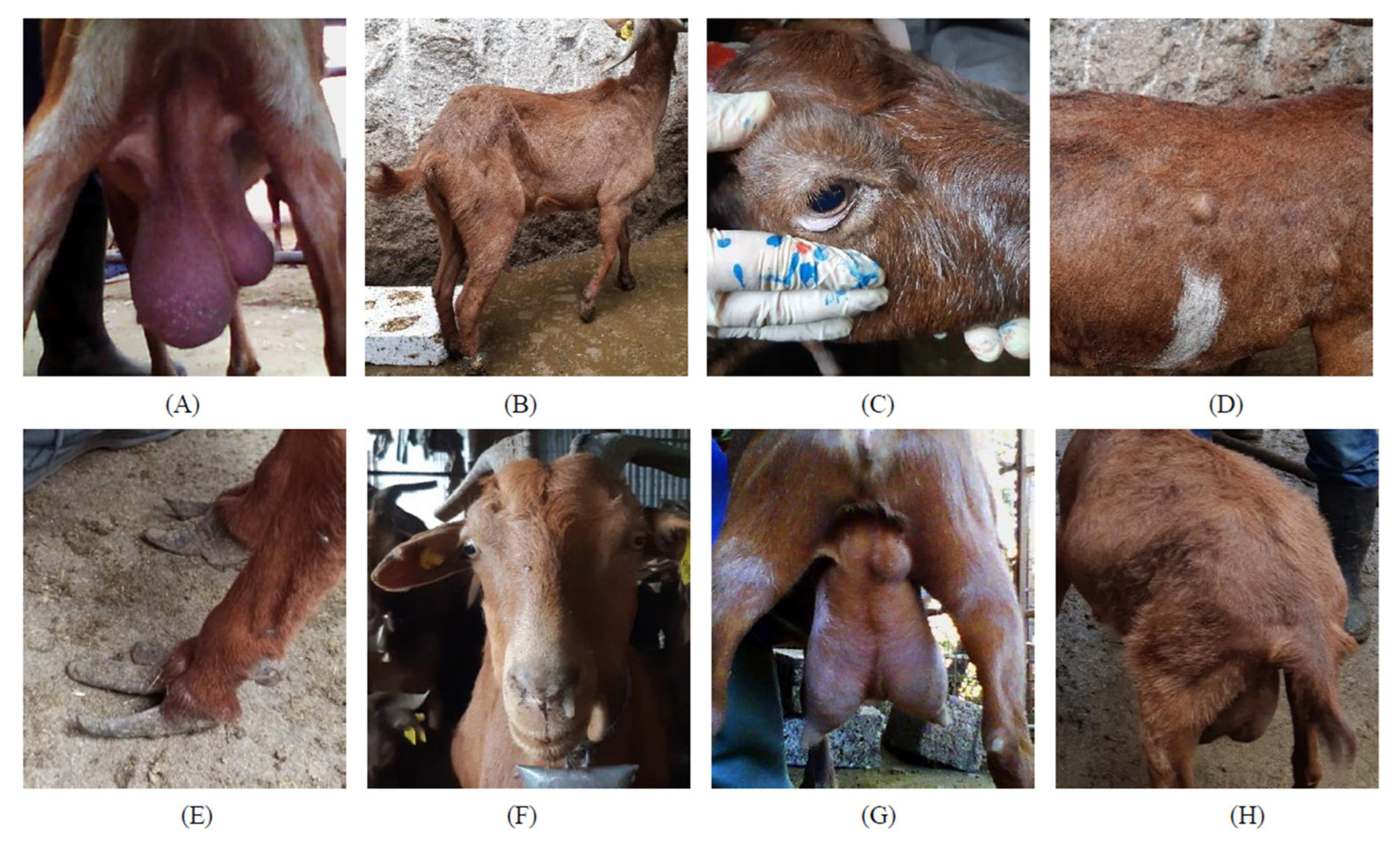
Figure 2.
Average daily milk yield (kg/day) and body condition score (1-5) in Farm A (intensive farm) in the first (A) and the second (B) year of recordings and in Farm B (extensive farm) in the first (C) and the second (D) year of recordings. (RS1: February (20 days post-weaning), RS2: April (70 days post-weaning), RS3: June (120 days post-weaning), RS4: August (170 days post-weaning).
Figure 2.
Average daily milk yield (kg/day) and body condition score (1-5) in Farm A (intensive farm) in the first (A) and the second (B) year of recordings and in Farm B (extensive farm) in the first (C) and the second (D) year of recordings. (RS1: February (20 days post-weaning), RS2: April (70 days post-weaning), RS3: June (120 days post-weaning), RS4: August (170 days post-weaning).
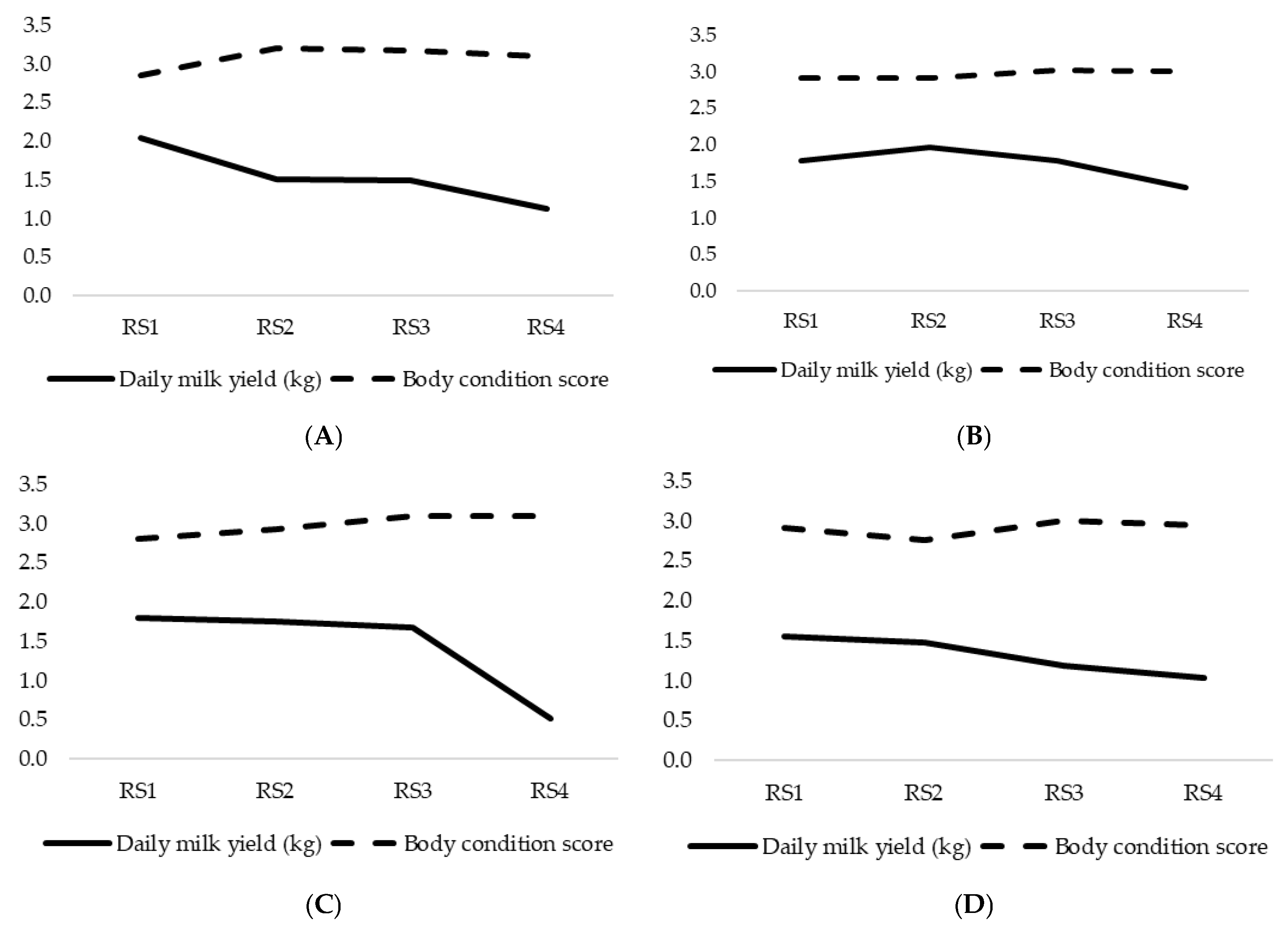

Table 1.
Structural and management characteristics of farms involved in the study.
| Farm A (intensive farm) |
Farm B (extensive farm) |
|
|---|---|---|
| Production | ||
| Milk production/doe/lactation (210 days), kg | 450 | 350 |
| Total annual milk production, tn | 75 | 85 |
| Average milk fat content, % | 4.0 | 4.3 |
| Average milk protein content, % | 3.7 | 3.9 |
| Management | ||
| Duration of milking period, d | 200 | 150 |
| Duration of suckling period, d | 60 | 90 |
| Type of milking | Machine milking | Hand-milking |
| Number of milkings per day | 2 | 2 |
| Milk stripping | Yes | No |
| Post-dipping of teats | Yes | No |
| Feedings per day | 2 | 2 |
| Reproduction | ||
| Fecundity, n | 1.6 | 1.5 |
| Services per conception | ≤ 1.5 | ≤ 1.5 |
| Culling rate due to infertility, % | < 5 | < 5 |
| Average litter size at weaning | 1.4 | 1.3 |
| Artificial suckling | Yes | No |
| Infrastructures and housing | ||
| Type of building | Shed with openings | Shed with openings |
| Type of floor | Earthen | Earthen |
| Type of bedding | Straw | No bedding |
| Ventilation adequacy | Good | Medium |
| Lighting adequacy | Good | Medium |
| Type of waterers | Automatic | Barrels |
| Stocking density, m2/goat | 1.2 | - |
| Feeding and nutrition | ||
| Grazing | No | Yes |
| Duration of grazing, h | Zero-grazing | 8 – 12 |
| Type of grazing land | Not applicable | Natural grasslands, shrublands/woodlands, cultivated pasturelands |
| Concentrates in milking goats (kg/day) | 1.0 – 1.2 | 0.5 – 1.0 |
| Concentrates in dry goats (kg/day) | 0.5 | 0.5 |
| Roughages (hay) in milking goats (kg/day) | 0.8 – 1.9 | 0.0 – 0.5 |
| Roughages (hay) in dry goats (kg/day) | 0.4 | 0.0 – 0.3 |
| Incidence of health and welfare issues | ||
| Clinical acidosis, % | ≤ 2 | ≤ 2 |
| Pregnancy toxemia, % | ≤ 2 | ≤ 2 |
| Metritis, % | ≤ 3 | ≤ 3 |
| Clinical mastitis, % | ≤ 5 | ≤ 5 |
| Subclinical mastitis, % | 10 – 20 | 10 – 20 |
| Retained placenta, % | ≤ 2 | ≤ 2 |
| Abortion, % | ≤ 3 | ≤ 3 |
| Lameness, % | ≤ 5 | ≤ 5 |
Table 2.
Health indicators description and levels of assessment.
| Indicator | Description | Levels | |
|---|---|---|---|
| Head | Anaemia | Pale mucus membrane | 3 |
| Mouth lesions | Papules and scabs around the mouth and lips | 2 | |
| Jaw swelling | Swelling and painful site during palpation at the premoral and molar teeth in the lower or upper jaw | 2 | |
| Ocular discharge | Discharges from the eye | 2 | |
| Nasal discharge | Discharges from the nasal cavity | 2 | |
| Limbs | Lameness | Impaired gait | 5* |
| Arthritis | Swollen or inflamed limb joints | 2 | |
| Overgrown hooves | Excess horn tissue at claws | 3 | |
| Udder and teats | Cysts | Cysts on udder or teats | 2 |
| Skin lesions | Disrupted integrity of the skin | 2 | |
| Abscesses | Swollen, pus-filled cavities | 2 | |
| Clinical mastitis | Painful, hot, hard, and swollen udder | 2 | |
| Fibrosis | Hard and fibrotic udder parenchyma at palpation | 2 | |
| Asymmetry | Uneven udder halves | 3 | |
| Swollen supra-mammary lymph nodes | Enlarged lymph nodes | 5** | |
| Other | Faecal soiling | Manure accumulation below the tail | 2 |
| Poor hair coat quality | Matted, rough, scurfy, uneven, shaggy hair coat | 2 | |
| Vaginitis | Inflammation of vagina | 2 | |
| Meteorism | Bloated rumen | 2 | |
| Body abscesses | Abscess at any part of the body, except for the udder | 2 | |
| Swollen body lymph nodes | Enlarged parotid, prescapular, prefemoral, or/and submandibular lymph nodes | 5** | |
| Body condition score | Nutritional status assessed by the palpation of the lumbar area and the estimation of the fat coverage | 5*** | |
| Cough | Cough | 2 |
2 levels: 0 = absence, 1 = presence; 3 levels: 0 = absence, 1 = mild, 2 = severe (values > 0 were considered as presence of the health issue). * 0 = normal, 1 = mild lameness when walking 2 = lameness when walking and occasionally lifting foot when standing, 3 = severe lameness when walking and lifting foot when standing, 4 = carrying foot all time (values > 0 were considered as presence of lameness). ** based on size: 1 = pea, 2 = almond, 3 = nutmeg, 4 = nut, 5 = mandarin or bigger (values > 2 were considered as presence of swollen lymph nodes). *** 5-point scale with 0.25 increments (< 2.5: emaciated, 2.5 – 3.5: normal, > 3.5: overweight)
Table 3.
Point and period prevalence values of the studied health issues in the first year of recordings in Farm A and Farm B.
Table 3.
Point and period prevalence values of the studied health issues in the first year of recordings in Farm A and Farm B.
| Year 1 | ||||||||||
|---|---|---|---|---|---|---|---|---|---|---|
| Point prevalence (%) | Period Prevalence (%) | |||||||||
| RS1 | RS2 | RS3 | RS4 | |||||||
| Farm A n = 103 |
Farm B n = 132 |
Farm A n = 104 |
Farm B n = 132 |
Farm A n = 106 |
Farm B n = 127 |
Farm A n = 103 |
Farm B n = 121 |
Farm A n = 106 |
Farm B n = 133 |
|
| Lameness | 0.0 | 0.0 | 3.8 | 0.8 | 0.0 | 0.8 | 1.0 | 0.8 | 3.8 | 1.5 |
| Arthritis | 0.0 | 0.0 | 0.0 | 0.0 | 0.9 | 0.8 | 1.0 | 0.0 | 1.9 | 0.8 |
| Overgrown hooves | 3.0 | 0.0 | 21.2 | 2.3 | 14.2 | 1.6 | 1.0 | 0.0 | 29.2 | 3.8 |
| Anemia | NA | NA | 11.5 | 5.3 | 1.9 | 37.0 | 4.9 | 35.5 | 15.1 | 48.9 |
| Mouth scabs, papules | 0.0 | 0.0 | 22.1 | 0.0 | 0.9 | 0.0 | 0.0 | 0.0 | 22.6 | 0.0 |
| Jaw swelling | 1.0 | 0.0 | 2.9 | 0.0 | 5.7 | 0.8 | 4.9 | 1.7 | 9.4 | 2.3 |
| Ocular discharge | 0.0 | 0.0 | 0.0 | 0.0 | 0.0 | 0.0 | 0.0 | 1.7 | 0.0 | 1.5 |
| Cough | 0.0 | 0.0 | 0.0 | 0.0 | 1.9 | 0.0 | 0.0 | 0.8 | 1.9 | 0.8 |
| Nasal discharge | 0.0 | 0.0 | 0.0 | 0.0 | 4.7 | 0.8 | 0.0 | 13.2 | 4.7 | 12.8 |
| Teat cysts | 0.0 | 9.1 | 0.0 | 0.8 | 2.8 | 3.9 | 0.0 | 1.7 | 2.8 | 12.0 |
| Teat fibrosis | 1.0 | 0.8 | 0.0 | 0.0 | 0.0 | 0.0 | 0.0 | 0.0 | 0.9 | 0.8 |
| Clinical mastitis | 1.0 | 0.0 | 0.0 | 0.0 | 0.0 | 0.0 | 0.0 | 0.0 | 0.9 | 0.0 |
| Udder skin lesions | 0.0 | 0.0 | 1.0 | 2.3 | 0.0 | 0.8 | 0.0 | 0.0 | 0.9 | 3.0 |
| Udder abscesses | 2.0 | 6.1 | 1.9 | 4.5 | 0.9 | 1.6 | 1.0 | 1.7 | 4.7 | 10.5 |
| Udder cysts | 0.0 | 0.8 | 1.9 | 3.0 | 0.0 | 4.7 | 0.0 | 0.0 | 1.9 | 8.3 |
| Udder fibrosis | 11.0 | 2.3 | 19.2 | 22.7 | 20.8 | 35.4 | 20.4 | 37.2 | 44.3 | 56.4 |
| Udder asymmetry | 16.0 | 10.6 | 45.2 | 43.2 | 51.9 | 36.2 | 19.4 | 47.9 | 74.5 | 75.2 |
| Swollen supra-mammary lymph nodes | 8.0 | 13.6 | 1.9 | 11.4 | 7.5 | 11.0 | 1.0 | 10.7 | 14.2 | 24.1 |
| Fecal soiling | 1.0 | 0.8 | 1.9 | 3.0 | 0.0 | 3.9 | 1.0 | 2.5 | 3.8 | 8.3 |
| Poor hair coat quality | 31.0 | 47.0 | 8.7 | 34.8 | 17.0 | 31.5 | 24.3 | 16.5 | 48.1 | 60.9 |
| Vaginitis | 0.0 | 0.0 | 0.0 | 0.0 | 0.0 | 0.8 | 0.0 | 0.0 | 0.0 | 0.8 |
| Meteorism | 0.0 | 0.0 | 0.0 | 0.0 | 1.9 | 1.6 | 0.0 | 0.8 | 1.9 | 1.5 |
| Body abscesses | 8.0 | 23.5 | 35.6 | 22.7 | 35.8 | 22.0 | 33.0 | 14.9 | 50.0 | 45.1 |
| Swollen body lymph nodes (at least one) | NA | NA | 15.4 | 29.5 | 23.6 | 33.1 | 18.4 | 33.9 | 36.8 | 45.9 |
RS1: February (20 days post-weaning), RS2: April (70 days post-weaning), RS3: June (120 days post-weaning), RS4: August (170 days post-weaning); Farm A: intensive farm, Farm B: extensive farm; NA: Not Applicable (no recording was performed)
Table 4.
Point and period prevalence values of the studied health issues in the second year of recordings in Farm A and Farm B.
Table 4.
Point and period prevalence values of the studied health issues in the second year of recordings in Farm A and Farm B.
| Year 2 | ||||||||||
|---|---|---|---|---|---|---|---|---|---|---|
| Point prevalence (%) | Period Prevalence (%) | |||||||||
| RS1 | RS2 | RS3 | RS4 | |||||||
| Farm A n = 118 |
Farm B n = 97 |
Farm A n = 126 |
Farm B n = 108 |
Farm A n = 128 |
Farm B n = 99 |
Farm A n = 125 |
Farm B n = 98 |
Farm A n = 145 |
Farm B n = 114 |
|
| Lameness | 2.5 | 0.0 | 2.4 | 0.0 | 0.0 | 0.0 | 0.0 | 0.0 | 2.1 | 0.0 |
| Arthritis | 0.8 | 0.0 | 0.0 | 0.0 | 0.0 | 0.0 | 0.0 | 0.0 | 0.7 | 0.0 |
| Overgrown hooves | 31.4 | 0.0 | 20.6 | 1.9 | 14.1 | 3.0 | 16.8 | 1.0 | 42.1 | 4.4 |
| Anemia | 7.6 | 44.3 | 6.3 | 50.0 | 8.6 | 46.5 | 1.6 | 33.7 | 16.6 | 71.9 |
| Mouth scabs, papules | 0.0 | 0.0 | 0.0 | 0.0 | 0.0 | 0.0 | 0.0 | 0.0 | 0.0 | 0.0 |
| Jaw swelling | 2.5 | 0.0 | 1.6 | 0.9 | 3.1 | 0.0 | 3.2 | 0.0 | 5.5 | 0.9 |
| Ocular discharge | 0.0 | 0.0 | 0.8 | 0.0 | 2.3 | 0.0 | 0.0 | 0.0 | 2.1 | 0.0 |
| Cough | 0.0 | 0.0 | 0.0 | 0.0 | 0.0 | 0.0 | 0.0 | 0.0 | 0.0 | 0.0 |
| Nasal discharge | 0.0 | 26.8 | 0.8 | 9.3 | 5.5 | 5.1 | 24.8 | 29.6 | 25.5 | 43.9 |
| Teat cysts | 0.0 | 6.2 | 0.0 | 4.6 | 0.0 | 2.0 | 0.0 | 0.0 | 0.0 | 7.9 |
| Teat fibrosis | 0.0 | 0.0 | 0.0 | 0.0 | 0.0 | 0.0 | 0.0 | 0.0 | 0.0 | 0.0 |
| Clinical mastitis | 0.8 | 0.0 | 0.0 | 0.0 | 0.0 | 0.0 | 0.0 | 0.0 | 0.7 | 0.0 |
| Udder skin lesions | 0.0 | 1.0 | 0.0 | 0.0 | 0.0 | 0.0 | 0.0 | 0.0 | 0.0 | 0.9 |
| Udder abscesses | 2.5 | 9.3 | 2.4 | 0.0 | 0.8 | 3.0 | 0.8 | 0.0 | 2.8 | 9.6 |
| Udder cysts | 0.0 | 1.0 | 0.0 | 0.0 | 0.8 | 0.0 | 0.0 | 0.0 | 0.7 | 0.9 |
| Udder fibrosis | 31.4 | 13.4 | 22.2 | 43.5 | 16.4 | 39.4 | 24.0 | 35.7 | 48.3 | 68.4 |
| Udder asymmetry | 25.4 | 11.3 | 26.2 | 26.9 | 24.2 | 29.3 | 29.6 | 20.4 | 44.1 | 45.6 |
| Swollen supra-mammary lymph nodes | 33.9 | 27.8 | 27.0 | 38.0 | 22.7 | 24.2 | 9.6 | 17.3 | 45.5 | 51.8 |
| Fecal soiling | 1.7 | 0.0 | 0.8 | 0.0 | 0.0 | 0.0 | 5.6 | 1.0 | 6.9 | 0.9 |
| Poor hair coat quality | 18.6 | 42.3 | 17.5 | 31.5 | 3.9 | 19.2 | 10.4 | 7.1 | 30.3 | 51.8 |
| Vaginitis | 0.0 | 0.0 | 0.0 | 0.0 | 0.0 | 0.0 | 1.6 | 0.0 | 1.4 | 0.0 |
| Meteorism | 2.5 | 0.0 | 2.4 | 0.9 | 0.8 | 0.0 | 1.6 | 1.0 | 4.1 | 1.8 |
| Body abscesses | 28.0 | 16.5 | 23.0 | 19.4 | 32.0 | 27.3 | 28.8 | 25.5 | 44.1 | 38.6 |
| Swollen body lymph nodes (at least one) | NA | NA | 28.6 | 47.2 | 24.2 | 54.5 | 20.0 | 43.9 | 40.0 | 64.9 |
RS1: February (20 days post-weaning), RS2: April (70 days post-weaning), RS3: June (120 days post-weaning), RS4: August (170 days post-weaning); Farm A: intensive farm, Farm B: extensive farm; NA: Not Applicable (no recording was performed).
Table 5.
New cases and cumulative incidence (total number of new cases/goat population at risk at the beginning) of the studied health and welfare issues per recording session during the first and second year of recordings in Farm A.
Table 5.
New cases and cumulative incidence (total number of new cases/goat population at risk at the beginning) of the studied health and welfare issues per recording session during the first and second year of recordings in Farm A.
| Farm A (intensive farm) | ||||||||
|---|---|---|---|---|---|---|---|---|
| New cases (n) | Cumulative incidence (%) | |||||||
| Year 1 | Year 2 | Year 1 | Year 2 | |||||
| RS2 | RS3 | RS4 | RS2 | RS3 | RS4 | |||
| Lameness | 3 | 0 | 1 | 0 | 0 | 0 | 4.0 (4/100) | 0.0 (0/101) |
| Arthritis | 0 | 1 | 1 | 0 | 0 | 0 | 2.0 (2/100) | 0.0 (0/103) |
| Overgrown hooves | 19 | 7 | 0 | 9 | 4 | 9 | 26.8 (26/97) | 31.0 (22/71) |
| Anemia | NA | 1 | 5 | 6 | 10 | 2 | 6.0 (6/100) | 18.9 (18/95) |
| Mouth scabs, papules | 21 | 1 | 0 | 0 | 0 | 0 | 22.0 (22/100) | 0.0 (0/103) |
| Jaw swelling | 3 | 4 | 3 | 1 | 2 | 1 | 10.0 (10/100) | 3.9 (4/102) |
| Ocular discharge | 0 | 0 | 0 | 0 | 2 | 0 | 0.0 (0/100) | 1.9 (2/103) |
| Cough | 0 | 1 | 0 | 0 | 0 | 0 | 1.0 (1/100) | 0.0 (0/103) |
| Nasal discharge | 0 | 5 | 0 | 1 | 4 | 27 | 5.0 (5/100) | 31.1 (32/103) |
| Teat cysts | 0 | 1 | 0 | 0 | 0 | 0 | 1.0 (1/100) | 0.0 (0/103) |
| Teat fibrosis | 0 | 0 | 0 | 0 | 0 | 0 | 0.0 (0/99) | 0.0 (0/103) |
| Clinical mastitis | 0 | 0 | 0 | 0 | 0 | 0 | 0.0 (0/99) | 0.0 (0/102) |
| Udder skin lesions | 1 | 0 | 0 | 0 | 0 | 0 | 1.0 (1/100) | 0.0 (0/103) |
| Udder abscesses | 1 | 1 | 0 | 0 | 0 | 0 | 2.0 (2/98) | 0.0 (0/100) |
| Udder cysts | 2 | 0 | 0 | 0 | 1 | 0 | 2.0 (2/100) | 1.0 (1/103) |
| Udder fibrosis | 13 | 12 | 15 | 13 | 7 | 18 | 44.9 (40/89) | 55.1 (38/69) |
| Udder asymmetry | 34 | 25 | 8 | 12 | 11 | 15 | 79.8 (67/84) | 50.0 (38/76) |
| Swollen supra-mammary lymph nodes | 1 | 8 | 0 | 17 | 10 | 2 | 9.8 (9/92) | 42.0 (29/69) |
| Fecal soiling | 1 | 0 | 1 | 0 | 0 | 6 | 2.0 (2/99) | 5.9 (6/102) |
| Poor hair coat quality | 3 | 13 | 13 | 13 | 3 | 9 | 41.4 (29/70) | 29.4 (25/85) |
| Vaginitis | 0 | 0 | 0 | 0 | 0 | 2 | 0.0 (0/100) | 1.9 (2/103) |
| Meteorism | 0 | 2 | 0 | 1 | 0 | 2 | 2.0 (2/100) | 2.9 (3/103) |
| Body abscesses | 30 | 9 | 8 | 8 | 16 | 11 | 51.1 (47/92) | 48.6 (35/72) |
| Swollen body lymph nodes (at least one) | NA | 13 | 9 | NA | 8 | 10 | 25.9 (22/85) | 24.7 (18/73) |
RS1: February (20 days post-weaning), RS2: April (70 days post-weaning), RS3: June (120 days post-weaning), RS4: August (170 days post-weaning); NA: Not Applicable (no recording was performed). Calculations were based on a complete dataset from 100 goats in year 1 and 103 goats in year 2.
Table 6.
New cases and cumulative incidence (total number of new cases/goat population at risk at the beginning) of the studied health and welfare issues per recording session during the first and second year of recordings in Farm B.
Table 6.
New cases and cumulative incidence (total number of new cases/goat population at risk at the beginning) of the studied health and welfare issues per recording session during the first and second year of recordings in Farm B.
| Farm B (extensive farm) | ||||||||
|---|---|---|---|---|---|---|---|---|
| New cases (n) | Cumulative incidence (%) | |||||||
| Year 1 | Year 2 | Year 1 | Year 2 | |||||
| RS2 | RS3 | RS4 | RS2 | RS3 | RS4 | |||
| Lameness | 1 | 1 | 0 | 0 | 0 | 0 | 1.7 (2/115) | 0.0 (0/81) |
| Arthritis | 0 | 1 | 0 | 0 | 0 | 0 | 0.9 (1/115) | 0.0 (0/81) |
| Overgrown hooves | 3 | 2 | 0 | 2 | 2 | 0 | 4.3 (5/115) | 4.9 (4/81) |
| Anemia | NA | 40 | 15 | 18 | 8 | 5 | 50.5 (55/109) | 67.4 (31/46) |
| Mouth scabs, papules | 0 | 0 | 0 | 0 | 0 | 0 | 0.0 (0/115) | 0.0 (0/81) |
| Jaw swelling | 0 | 1 | 2 | 1 | 0 | 0 | 2.6 (3/115) | 1.2 (1/81) |
| Ocular discharge | 0 | 0 | 2 | 0 | 0 | 0 | 1.7 (2/115) | 0.0 (0/81) |
| Cough | 0 | 0 | 1 | 0 | 0 | 0 | 0.9 (1/115) | 0.0 (0/81) |
| Nasal discharge | 0 | 1 | 16 | 3 | 4 | 20 | 14.8 (17/115) | 47.4 (27/57) |
| Teat cysts | 1 | 4 | 1 | 2 | 1 | 0 | 5.8 (6/104) | 3.9 (3/76) |
| Teat fibrosis | 0 | 0 | 0 | 0 | 0 | 0 | 0.0 (0/114) | 0.0 (0/81) |
| Clinical mastitis | 0 | 0 | 0 | 0 | 0 | 0 | 0.0 (0/115) | 0.0 (0/81) |
| Udder skin lesions | 3 | 1 | 0 | 0 | 0 | 0 | 3.5 (4/115) | 0.0 (0/80) |
| Udder abscesses | 3 | 1 | 2 | 0 | 3 | 0 | 5.6 (6/108) | 4.1 (3/73) |
| Udder cysts | 4 | 6 | 0 | 0 | 0 | 0 | 8.8 (10/114) | 0.0 (0/80) |
| Udder fibrosis | 26 | 28 | 22 | 29 | 13 | 13 | 67.9 (76/112) | 76.4 (55/72) |
| Udder asymmetry | 46 | 17 | 31 | 18 | 12 | 7 | 91.3 (94/103) | 50.7 (37/73) |
| Swollen supra-mammary lymph nodes | 3 | 5 | 6 | 18 | 7 | 9 | 14.3 (14/98) | 54.8 (34/62) |
| Fecal soiling | 4 | 4 | 3 | 0 | 0 | 1 | 9.6 (11/114) | 1.2 (1/81) |
| Poor hair coat quality | 9 | 11 | 6 | 5 | 3 | 1 | 44.1 (26/59) | 18.4 (9/49) |
| Vaginitis | 0 | 1 | 0 | 0 | 0 | 0 | 0.9 (1/115) | 0.0 (0/81) |
| Meteorism | 0 | 2 | 0 | 0 | 0 | 1 | 1.7 (2/115) | 1.2 (1/81) |
| Body abscesses | 17 | 12 | 9 | 6 | 9 | 9 | 43.7 (38/87) | 35.8 (24/67) |
| Swollen body lymph nodes (at least one) | NA | 14 | 11 | NA | 16 | 7 | 32.1 (25/78) | 51.1 (23/45) |
RS1: February (20 days post-weaning), RS2: April (70 days post-weaning), RS3: June (120 days post-weaning), RS4: August (170 days post-weaning); NA: Not Applicable (no recording was performed). Calculations were based on a complete dataset from 115 goats in year 1 and 81 goats in year 2.
Table 7.
Effects of the studied health and welfare issues on daily milk yield.
| 95% Confidence Interval | ||||||
|---|---|---|---|---|---|---|
| EMM | B-coefficient† | SE | Significance | Lower | Upper | |
| Lameness | 1.35 | - 0.25 | 0.123 | 0.040 | - 0.50 | - 0.01 |
| Arthritis | 1.34 | - 0.13 | 0.220 | 0.562 | - 0.56 | 0.30 |
| Overgrown hooves | 1.35 | - 0.09 | 0.046 | 0.059 | - 0.18 | 0.00 |
| Anaemia | 1.33 | - 0.03 | 0.031 | 0.347 | - 0.09 | 0.03 |
| Mouth scabs, papules | 1.35 | - 0.19 | 0.081 | 0.020 | - 0.35 | - 0.03 |
| Jaw swelling | 1.34 | - 0.13 | 0.084 | 0.115 | - 0.03 | 0.30 |
| Ocular discharge | 1.34 | 0.16 | 0.163 | 0.340 | - 0.16 | 0.48 |
| Cough | 1.35 | - 0.35 | 0.228 | 0.127 | - 0.79 | 0.10 |
| Nasal discharge | 1.34 | 0.02 | 0.043 | 0.690 | - 0.07 | 0.10 |
| Teat cysts | 1.35 | 0.05 | 0.084 | 0.573 | - 0.12 | 0.21 |
| Teat fibrosis | 1.35 | 0.18 | 0.465 | 0.696 | - 0.73 | 1.09 |
| Clinical mastitis | 1.35 | - | - | - | - | - |
| Udder lesions | 1.35 | 0.05 | 0.164 | 0.779 | - 0.28 | 0.37 |
| Udder abscesses | 1.34 | 0.09 | 0.074 | 0.230 | - 0.06 | 0.23 |
| Udder cysts | 1.34 | 0.18 | 0.111 | 0.107 | - 0.04 | 0.40 |
| Udder fibrosis | 1.38 | - 0.13 | 0.025 | <0.001 | - 0.18 | - 0.08 |
| Udder asymmetry | 1.38 | - 0.09 | 0.024 | <0.001 | - 0.13 | - 0.04 |
| Swollen supra-mammary lymph nodes | 1.35 | 0.00 | 0.033 | 0.959 | - 0.06 | 0.07 |
| Faecal soiling | 1.35 | 0.00 | 0.086 | 0.999 | - 0.17 | 0.17 |
| Poor hair coat quality | 1.34 | 0.03 | 0.029 | 0.286 | - 0.03 | 0.09 |
| Vaginitis | 1.35 | - 0.03 | 0.304 | 0.918 | - 0.63 | 0.57 |
| Meteorism | 1.35 | - 0.08 | 0.132 | 0.530 | - 0.34 | 0.18 |
| Body abscesses | 1.35 | - 0.04 | 0.028 | 0.145 | - 0.10 | 0.01 |
| Swollen body lymph nodes (at least one) | 1.29 | - 0.04 | 0.032 | 0.247 | - 0.10 | 0.03 |
† Reference category: goats without the health issue, EMM: Estimated Marginal Means of goats without the health issue; SE: standard error.
Disclaimer/Publisher’s Note: The statements, opinions and data contained in all publications are solely those of the individual author(s) and contributor(s) and not of MDPI and/or the editor(s). MDPI and/or the editor(s) disclaim responsibility for any injury to people or property resulting from any ideas, methods, instructions or products referred to in the content. |
© 2025 by the authors. Licensee MDPI, Basel, Switzerland. This article is an open access article distributed under the terms and conditions of the Creative Commons Attribution (CC BY) license (http://creativecommons.org/licenses/by/4.0/).
Copyright: This open access article is published under a Creative Commons CC BY 4.0 license, which permit the free download, distribution, and reuse, provided that the author and preprint are cited in any reuse.


