

Submitted:
31 March 2025
Posted:
01 April 2025
You are already at the latest version
Abstract
The intensifying global demand for food presents significant challenges for sustainable pig production, particularly in the context of escalating input costs, environmental degradation, and resource scarcity. Life Cycle Assessment provides a comprehensive framework for quantifying environmental impacts and identifying production hotspots within pig production systems. Feed production and manure management are consist-ently identified as major contributors, emphasising the need for targeted interventions to improve sustainability. Although soybean meal remains a key protein source, its asso-ciation with deforestation and biodiversity loss has prompting the search for more sus-tainable alternatives. In temperate climates, faba beans offer a promising, locally sourced option, though their wider adoption is limited by amino acid imbalances and an-ti-nutritional factors. Grain preservation is another critical consideration, as post-harvest losses and fungal contamination compromise feed quality and animal health. Organic acid preservation has emerged as a cost-effective, energy-efficient alternative to industrial drying, improving storage stability while reducing fossil fuel dependence. Additional nutritional strategies including crude protein reduction, carbohydrate source modifica-tion, feed additives use, and maternal nutritional interventions can enhance nutrient utilisation, intestinal health, and resilience while mitigating environmental impacts. This review discusses practical, feed-based strategies to support sustainable, resilient, and resource efficient pig production systems and contribute to global food security.
Keywords:
swine
; sustainability
; life cycle assessment
; nutrient utilisation
; faba beans
; grain preservation
; organic acids
; microbiota
; maternal nutrition
1. Introduction
The increasing global demand for food, driven by population growth, longer life expectancy, and improving living standards, presents significant challenges for sustainable agriculture. By 2050, food demand is projected to rise by up to 50% [1,2], necessitating innovative solutions to enhance production efficiency while minimising environmental impacts. Climate change, urbanisation, and land transformation further intensify resource constraints [3,4]. Both crop and livestock production face growing scrutiny due to their competition for natural resources as well as their contribution to air, water, and soil pollution [5,6]. Pig production plays a crucial role in global protein supply, accounting for approximately one-third of total meat consumption [7]. Pork remains a dietary staple, particularly in developing countries, providing high-quality protein and essential micronutrients [8,9]. However, modern pig production faces economic, environmental, and health-related challenges, including high input costs, resource limitations, and environmental emissions [10]. Additionally, concerns over antimicrobial resistance and feed safety emphasise the urgent need for sustainable interventions [11,12].
Achieving sustainable pig production requires balancing consumer demands, environmental responsibility, and economic viability [13]. Life Cycle Assessment (LCA) has emerged as a valuable tool for assessing sustainability in complex systems such as agriculture and food production [14,15,16]. It provides a quantitative framework for evaluating the environmental impacts associated with different stages of production [17]. By identifying key ‘hotspots’ in production, LCA facilitates the development of targeted mitigation strategies to reduce emissions and improve resource efficiency. This holistic approach allows for a comprehensive evaluation of the impacts associated, making it widely applicable in swine production systems [18].
Feed represents the largest economic and environmental cost in pig production, making ingredient selection and formulation critical [18,19,20]. Beyond influencing animal health, welfare, and productivity, feed composition impacts farm profitability, product quality, and environmental sustainability, particularly in terms of greenhouse gas (GHG) emissions, land use, non-renewable energy, and water quality [21,22]. Swine diets primarily rely on cereal grains and soybean meal (SBM) as key energy and protein sources. However, SBM production is directly associated with negative environmental and economic issues including deforestation, biodiversity loss, land degradation, transport-related emissions, and reliance on international trade [23,24]. In response, faba beans have received growing attention in Europe as regionally adapted, sustainable alternatives to imported soybean [24,25]. However, nutritional limitations, inconsistent availability, and preservation challenges hinder their widespread adoption [26].
With more than one-third of global food production lost post-harvest [27,28], improving grain preservation techniques is critical for ensuring feed safety and reducing waste. The high moisture content of feed commodities in temperate climates increases their susceptibility to mould and mycotoxin contamination, a problem expected to worsen with climate change [29,30]. While industrial drying is the most conventional method used, it incurs high financial and environmental costs due to its intensive energy requirements [31,32,33,34]. Organic acid preservation has recently emerged as a cost-effective, energy-efficient alternative, maintaining nutritional quality while reducing reliance on fossil fuel-intensive drying [35,36,37].
Beyond preservation, the inclusion of dietary organic acids plays a role in reducing reliance on in-feed antimicrobials [38]. Organic acids can enhance digestive function, modulate intestinal microbiota, reduce manure-related pollution, and improve growth performance in pigs, making them a valuable tool for sustainable production [39,40]. Other nutritional strategies, such as reducing crude protein (CP) levels, altering carbohydrate sources, and enzyme supplementation can also contribute to lowering manure-related emissions and odourous compounds by improving nutrient digestibility and intestinal microbial balance [41,42]. In addition to direct dietary interventions, maternal nutrition is gaining recognition as a proactive approach to improving offspring health and environmental sustainability. Enhancing sow diets during late gestation and lactation can improve offspring intestinal microbial colonisation and resilience, reducing post-weaning health challenges and reliance on in-feed antimicrobials [43]. Such interventions have the potential to promote lifetime improvements in digestive health, immune function, and overall production efficiency.
Both European Union (EU) and national policies are increasingly shaping the transition towards more sustainable production by encouraging innovations, emission reduction strategies, and improved resource management [44,45]. Adopting science-based interventions can support producers meet regulatory requirements and sustainability targets while maintaining economic viability. This review explores practical, feed-related strategies to enhance sustainability across the pig production chain. Specifically, it focuses on nutritional adjustments that reduce nutrient excretion, minimise odourous emissions, and support gut health; the potential of faba beans as sustainable alternatives for SBM; the dual role of organic acids as both grain preservatives and functional feed additives; and the impact of maternal nutrition on offspring development and performance. Through the lens of LCA, this review illustrates how these strategies can address key production hotspots and contribute to broader sustainability goals, ultimately supporting a more environmentally and economically pig sector, as depicted in Figure 1.
2. Life Cycle Assessment in Pig Production
LCA is a standardised methodology used to systematically and quantitatively evaluate the potential environmental impacts of a product across all stages of its life cycle, from raw material extraction to use and disposal (cradle-to-grave)[46]. In pig production, LCA has been widely used to assess GHG emissions, resource use, and other environmental burdens. It helps identify hotspots for effective interventions, supports comparisons between products and production systems, and informs decision-making to develop more sustainable practices. As such, LCA has become a valuable tool for guiding improvements in the sustainability of pig production [47,48,49,50,51,52,53].
2.1. Methodology
LCA follows internationally recognised standards, including ISO 14040 (1997) and ISO 14044 (2006), and consists of four key phases. The first and arguably more important step is defining the goal and scope, which establishes the study’s objective, the system boundary, the allocation method, and the functional unit (the reference to which all inputs and outputs are scaled). In pig production, 1 kg of live weight at the farm gate is commonly used (Figure 1), although alternative functional units such as carcass weight or protein content have also been reported [54,55,56]. The second phase, life cycle inventory (LCI), involves compiling data on elementary flows such as feed, water, and energy use, as well as emissions, nutrient losses, and waste generation [57]. Where primary farm-level data are unavailable, secondary sources including the literature or databases (Ecoinvent, Agribalyse, and Agri-Footprint) may be used [58,59,60]. However, variability in databases and data assumptions complicate comparability between studies [19]. The third phase, life cycle impact assessment (LCIA), translates or ‘calculates’ inventory data into impact categories, including global warming potential (GWP; also known as climate change), eutrophication potential (EP), acidification potential (AP), land use change (LUC), and non-renewable energy use, among others [61]. This phase can be largely automated using software packages such as OpenLCA, GaBi, and SimaPro [62,63,64]. The interpretation is the final stage, which involves testing model sensitivity, identify key hotspots, and provide recommendations or potential mitigation strategies based on the results obtained [65].
2.2. Limitaions and Opportunities
Despite its advantages, LCA faces several limitations in pig production that affect the comparability, reliability, and practical application of results. A major challenge is the lack of standardisation in system boundaries, allocation methods, and functional unit selection, which leads to significant variability between studies [19]. Differences in whether LCA studies follow cradle-to-farm-gate or cradle-to-slaughterhouse-gate approaches can yield vastly different results, making direct comparison difficult. Allocation methods for multi-functional process such as manure management and by-product utilisation further complicate assessments, as different approaches (e.g., economic, mass, or energy-based) can lead to varied impact estimations. The inclusion of LUC presents another issue. When LUC is considered, particularly in the context of SBM production and deforestation, GHG emissions from feed production increase substantially [66]. However, inconsistent methodologies appear, highlighting the importance of accurate LCA modelling when assessing the impacts of regional specific feed commodities. Additionally, data availability and quality remain key constraints, as primary farm-level data collection is often resource-intensive, accounting for 70-80% of the total time and cost of conducting an LCA [67]. While secondary datasets help address these gaps, they may not fully capture regional or temporal variation in feed production, manure management, and farming practices, potentially compromising the reliability of results.
Emerging tools such as artificial intelligence (AI) and machine learning have the potential to improve data processing, predictive modelling, and scenario analysis [68]. However, their integration into agricultural LCAs remains in its infancy and requiries further validation to ensure accuracy and reproducibility. Similarly, geographic information systems (GIS) are also being explored to analyse spatial variations in nutrient runoff, land use, and air pollution, which could enable more region-specific mitigation strategies [69]. Additionally, social factors such as labour conditions and animal welfare have historically been underrepresented in LCA models, however more recent studies have started integrating these aspects for a more holistic sustainability assessment [70,71]. Although these advancements may improve LCA applications in pig production, the inherent complexity and methodological inconsistencies remain challenges that must be addressed to ensure more robust, transparent, and actionable assessments.
2.3. Production Hotspots
The livestock sector is responsible for approximately 15% of global anthropogenic GHG emissions, with pork production accounting for around 9% of livestock-related emissions [72]. In the EU, agricultural GHG emissions primarily arise from enteric fermentation (45%), soil management (38%), and manure management (15%)[73]. Unlike ruminants, pigs produce relatively low emissions from enteric fermentation [74]. Instead, the most significant contributors to the environmental impacts of swine systems are feed and manure [18]. Therefore, optimising feed formulations and manure management are essential for reducing the sector’s environmental footprint [75,76].
Feed production alone accounts for more 70% of the environmental impacts of the pig supply chain, driven by fertiliser and pesticide application, land use and LUC, energy-intensive processing, and the extensive transportation networks of globally sourced raw materials [18,20]. In particular, the environmental and economic burdens associated with SBM and grain preservation highlight the urgent need for more sustainable alternatives [77,78,79]. It was recently reported that feed-related changes implemented over the past two decades have reduced the GWP of pig production by 20-35% [18], demonstrating the substantial mitigation potential of feed-focused interventions.
Manure management is another major environmental hotspot, contributing to nitrogen and phosphorus losses, eutrophication, acidification, and ammonia volatilisation. Housing systems and manure storage conditions directly influence methane, ammonia, and nitrous oxide emissions, with flooring type, storage methods, and temperature playing key roles in emission rates [80]. While technologies such as slurry additives, anaerobic digestion, and low-emission slurry spreading (LESS) offer promising mitigation options, this review focuses on nutritional strategies as a practical and preventive approach to reducing nutrient excretion, emissions, and manure odour at the source. Optimising feeding practices and diet composition can minimise nutrient excretion, lower emissions, and significantly improve air, water, and soil quality [81,82].
3. Nutritional Strategies for Enhancing Sustainability of Pig Production
3.1. Feed Formulation and Ingredient Sourcing
The composition of pig diets is primarily determined by ingredient availability, nutritional value, and economic feasibility, which vary by region and production system [83,84]. Modern feed mills employ mathematical optimisation techniques to formulate least-cost diets while ensuring nutrient balance for optimal growth and feed conversion efficiency [85]. However, recent volatility in raw material prices, geopolitical unpredictability, and increasing scrutiny of the environmental impact of imported feedstuffs have intensified interest in alternative feed sources [24,25].
Cereal grains, such as maize, wheat, and barley serve as primary energy sources in pig diets. Maize is widely used due to its high starch content and digestibility. However, its production is resource-intensive, requiring substantial irrigation, fertiliser inputs, and land area, contributing to GHG emissions, eutrophication, and soil degradation [86]. The cultivation of maize in temperate climates is limited by the cooler temperatures and shorter growing season. In addition, it often requires the use of plastic film for crop establishment which increases soil temperature and promotes early growth, further adding to its environmental footprint [87]. As a result, wheat and barley serve as viable alternatives. Wheat provides a more balanced amino acid profile than maize, important for the total protein intake of pigs [88]. Barley contains a higher fibre content, which, although beneficial for intestinal health, can inadvertently reduce energy digestibility [89]. Non-starch polysaccharides in wheat and barley, such as arabinoxylans and β-glucans, can lower feed efficiency due to their resistance to enzymatic breakdown [90]. Additionally, phosphorus in cereals is largely bound to phytate, which is poorly digested by pigs, increasing phosphorus excretion and environmental risks. To mitigate these issues, diets are commonly supplemented with exogenous enzymes, which improve digestibility [91], enhance mineral bioavailability and reduce reliance on non-renewable resources [92].
Soybean meal remains the predominant protein source in pig diets due to its high digestibility, well-balanced amino acid profile, and consistent availability [93]. However, its reliance in Europe presents challenges, including price volatility, environmental degradation, and deforestation associated with large-scale cultivation in South America [94]. Given that feed production contributes 30–80% of the total carbon footprint of pig farming [18,20], research into alternative protein sources has gained momentum. More recently, circular economy models has driven interest in novel feed ingredients such as food waste, insect meal, and microalgae [95]. Studies suggest that integrating these ingredients into pig diets could significantly lower land use and emissions associated with feed production while simultaneously addressing food waste management challenges [24]. However, concerns regarding feed safety, regulatory approval, and consumer acceptance remain key barriers to widespread adoption [96,97]. Given these uncertainties, this review focuses on faba beans as regionally available and practical alternatives, providing a sustainable solution to reducing reliance on imported SBM.
Feed formulation also plays a crucial role in optimising nutrient retention and minimising the environmental burden of manure management. The composition of pig diets influences manure characteristics, influencing nutrient excretion, ammonia volatilisation, and odourous emissions [98]. Strategic modifications to dietary protein levels, carbohydrate sources, and the inclusion of feed additives can improve nutrient utilisation, thereby reducing excretion and minimising environmental impacts.
3.2. Nutritional Interventions for Minimising Nutrient Losses, Manure Emissions, and Odour
A key concern in intensive pig production is the inefficient utilisation of dietary nutrients, leading to excessive excretion in manure. This contributes to ammonia and odourous compound emissions, as well as eutrophication of water bodies [99]. To mitigate these challenges, precision feeding and nutritional strategies have been developed to optimise intestinal microbial populations, enhancing nutrient absorption while minimising waste output [100,101,102]. Approaches such as optimising dietary CP levels, altering carbohydrate sources, and integrating feed additives offer practical solutions for reducing emissions and improving sustainability in pig production [103]. These strategies not only decrease nutrient losses but enhance feed efficiency and support animal health, promoting a balance between animal welfare, environmental responsibility, and economic viability.
Swine manure has tremendous value as a natural fertiliser for crop production but must be managed to minimise GHG emissions and nutrient leaching [104]. A significant concern is the low nutrient retention efficiency in pigs. Research indicates that only 33% of ingested nitrogen and 37% of ingested phosphorus is retained, with the remainder contributing to environmental pollution [85,105]. Excess nitrogen and phosphorus are particularly problematic, as nitrogen volatilisation leads to ammonia emissions, while both nutrients lead to eutrophication of water bodies. These environmental concerns necessitate nutritional strategies that enhance both nitrogen retention and phosphorus utilisation, reducing their excretion into the environment.
The ‘ideal protein’ concept, introduced by Cole [106], advocates for lowering dietary CP levels and supplementing with synthetic amino acids to improve nitrogen efficiency. This strategy has been effective in reducing nitrogen excretion without compromising animal performance, although it may increase feed costs due to amino acid supplementation requirements [107]. A reduction of 1% in dietary CP has been associated with a 9% decrease in nitrogen excretion, along with lower AP and EP in LCA models [108]. Similarly, reducing CP from 18.5% to 15.5% in growing pigs improved nitrogen and phosphorus retention, enhanced daily gain, and further reduced AP and EP impacts [109]. Reducing CP from 20% to 12% has also been shown to lower urine production by 25%, leading to a more favourable manure composition with a lower urine-to-faeces ratio [101,103]. Since excess urinary nitrogen is primarily excreted as urea, microbial urease in manure converts it to ammonia, contributing to air pollution [110]. Studies suggest for every 1% reduction in dietary CP, ammonia emissions may be reduced by 8-12%, making CP reduction an effective strategy for mitigating environmental impacts [111,112,113,114,115]. However, care must be taken when formulating low-CP diets, especially for younger pigs, to avoid amino acid deficiencies and ensure growth is not compromised [116,117]. Although reducing nitrogen excretion lowers ammonia emissions, its effect on odourous compounds is inconsistent. Some studies suggest sulphur-containing amino acids contribute to offensive odours [118,119], increasing manure pH and promoting ammonia volatilisation [120,121]. While CP reduction clearly alters manure composition, its impact on gastrointestinal fermentation and odour production remains an area for further investigation.
Dietary carbohydrate composition also influences intestinal microbial populations, which can affect odourous emissions. For example, substituting wheat with barley can reduce proteolytic metabolites and manure odour due to the presence of β-glucans [122,123]. Similarly, oat-based diets promote beneficial gut bacteria such as Lactobacillus and Bifidobacterium, altering volatile fatty acid profiles and reducing manure odour emissions [124]. Incorporating fermentable carbohydrates is an effective strategy for modifying the microbiota and reducing manure emissions [125]. Studies have shown that supplementing finisher pig diets with sugar beet pulp increases faecal output while reducing ammonia emissions by stimulating microbial nitrogen incorporation [101]. This lowers manure pH, thereby reducing ammonia volatilisation and subsequently decreasing air pollution [100]. However, fermentation effects vary based on carbohydrate structure. Rapidly fermentable fibres promote volatile fatty acid production and microbial activity, whereas less fermentable fibres primarily increase faecal bulk [126].
The use of feed additives such as enzymes, organic acids, and probiotics can also reduce nutrient excretion and manure-related emissions. Enzyme supplementation improves nutrient digestibility and efficiency, reducing the need for higher protein and phosphorus levels in feed. Phytase increases phosphorus bioavailability, lowering inorganic phosphorus requirements and excretion [92]. Protease and carbohydrase enzymes also enhance protein digestion efficiency, decreasing nitrogen excretion and subsequently ammonia volatilisation [127,128,129,130]. Organic acids also influence nutrient digestibility and fermentation processes by enhancing enzymatic activity, improving protein digestibility, and promoting beneficial microbial populations [131,132,133,134], which will be further discussed in Section 3.6. This reduces the substrates available for microbial proteolysis, thereby minimising ammonia and odourous metabolite production [121,135,136]. Another alternative is the introduction of dietary lactic acid bacteria through Lactiplantibacillus plantarum supplementation, which has been reported to improve distal gut microbiota composition, reduce protein-derived odourous compounds, and lower manure emissions [137]. This aligns with the broader understanding that saccharolytic fermentation displaces proteolytic fermentation, reducing noxious gas production while improving gut health [138,139]. While challenges remain in balancing nutrient utilisation and cost-effectiveness, ongoing research should apply LCA to evaluate the potential of dietary interventions to enhance environmental sustainability and animal productivity.
3.3. Integrating Faba Beans into Pig Diets: Opportunities and Challeneges
In response to the plant protein shortage in Europe, grain legume cultivation has expanded considerably over the past 15 years [140]. Over the next decade, legume production in the EU is projected to increase by more 80%, reflecting a strong shift towards sustainable protein sources[141]. These trends align with the European Green Deal objectives, which promote regional food autonomy and reduced reliance on imported soybean. Policy incentives supporting legume cultivation provide farmers new income opportunities and encourage diversification in agricultural production [142]. This renewed emphasis, and indeed availability in grain legumes, presents a practical approach to enhancing sustainable protein sourcing in livestock diets [143,144,145,146].
Beyond their role in nutrition, grain legumes or pulses such as faba beans, peas, and lupins possess nitrogen-fixing properties, which enhance soil fertility and reduce dependence on synthetic fertilisers [147,148]. Legumes also help decrease nitrate immobilisation during decomposition, making soil nutrients more readily available compared to cereals [149]. Research has shown that crops sown after grain legumes achieve higher yields with reduced fertiliser inputs [150], benefiting from the disruption of pest, disease, and weed cycles [151]. Unlike SBM, which is predominantly grown in tropical climates, legumes thrive in temperate regions, promoting circular economy principles and reducing transport-related emissions. However, some challenges remain, including variability in protein content, amino acid imbalances, and the presence of anti-nutritional factors (ANFs)[26]. Additionally, the high moisture content of pulses at harvest presents storage challenges, emphasising the need for effective preservation techniques to maintain nutritional integrity.
Faba beans (Vicia faba L.), also known as fava beans, field beans, horse beans, or broad beans, are the third most widely cultivated legume globally, after soybeans and peas [152]. Their increasing use in livestock feed is attributed to their high protein content (250–300 g/kg) and favourable amino acid profile [153,154]. Faba beans provide lysine and threonine levels comparable with SBM; however, they are deficient in sulphur-containing amino acids, such as methionine and cysteine, which may necessitate dietary supplementation depending on inclusion rates and overall feed formulation [155]. Furthermore, the various ANFs present in faba beans can impair digestion, reduce nutrient absorption, and affect pig performance.
Among these, vicine and convicine are two pyrimidine glycosides which can interfere with red blood cell metabolism and negatively affect pig growth and performance. However, low-vicine and convicine varieties are now being developed to mitigate these effects [26]. Faba beans also contain protease inhibitors, condensed tannins, and oligosaccharides. The Bowman-Birk inhibitor, reduces protein digestibility by interfering with trypsin and chymotrypsin, leading to higher endogenous nitrogen losses [156,157]. Although heat-sensitive and largely inactivated through processing, these inhibitors limit the maximum inclusion rates of raw faba beans in pig diets [145]. Condensed tannins, primarily concentrated in the hulls of coloured-flower faba bean varieties, can reduce palatability and protein digestibility by forming complexes with dietary proteins and digestive enzymes [158,159]. Although zero-tannin cultivars exist, they often exhibit poorer agronomic performance, including lower yield stability and reduced frost resistance [160]. Additionally, faba beans also contain high levels of non-digestible oligosaccharides such as raffinose and stachyose, which are highly fermentable in monogastric animal [161]. While moderate fermentation supports intestinal health, excessive intake can cause loose faces or diarrhoea, particularly in younger pigs, thereby limiting their inclusion in early-stage diets [26]. Furthermore, the higher crude fibre content of legumes can lead to increased nutrient excretion, raising concerns related to ammonia emissions and manure management [114].
Beyond genetic and processing challenges, environmental and agronomic factors such as soil quality, crop husbandry practices, and post-harvest processing also influence the nutritional composition and feed value of faba beans. Conventional high temperature drying is often necessary to reduce moisture content and prevent spoilage during storage. However, drying is energy intensive and costly, as discussed in Section 3.4. Additionally, dried beans can present handling and grinding challenges in feed mills, further affecting feed formulation efficiency. Organic acid preservation has emerged as a promising alternative to conventional drying, offering benefits for digestibility, storage stability, and overall nutritional value. Recently, grower-finisher pigs offered organic acid-preserved faba beans exhibited higher feed intake and final body weight compared to those consuming conventional SBM-based diets [36]. Further research is needed to optimise these benefits, particularly by integrating LCA to quantify the environmental implications of substituting SBM with faba beans and replacing conventional drying with organic acid preservation.
While the integration of faba beans presents clear sustainability opportunities, potential trade-offs must be carefully managed. The displacement of conventional crops, variability in nutrient composition, and supply chain inconsistencies pose challenges that require attention. To enhance both performance and sustainability, technologies such as near-infrared spectroscopy (NIR) for real-time nutrient analysis and AI-driven feed formulation tools, are increasingly being utilised [68]. As research advances, faba beans hold strong potential as sustainable alternatives to SBM. However, future research should focus on optimising inclusion levels, improving processing technologies, and integrating LCA to comprehensively evaluate feed sustainability trade-offs. Addressing these challenges will be key to ensuring the successful adoption of faba beans as a viable, regionally produced protein source in pig production.
3.4. Importance of Grain Preservation for Feed Sustainability
While advances in plant genetics and agronomic practices have improved crop yields, corresponding efforts in grain preservation have lagged behind [162]. In fact, more than one-third of food produced worldwide is lost during the post-harvest phase due to inefficiencies in storage and preservation [32,163]. Poor post-harvest management not only compromises feed supply but also quality and contamination risks [164]. Thus, effective preservation strategies are essential for maximising production, reducing waste, and minimising resource inputs.
Preserving grain quality is also crucial for maintaining feed efficiency, nutritional integrity, and feed safety in swine nutrition. Effective preservation safeguards the physical, compositional, and sanitary attributes of grains, all of which influence their nutritional contribution to pig diets [165]. Physical properties such as grain size, hardness, and moisture content affect milling efficiency, storage stability, and digestibility; compositional factors including energy, protein, fibre, and mineral content, determine nutrient availability; while sanitary conditions, particularly fungal contamination, are critical for feed safety [166].
Moisture control plays a key role in preservation, as high moisture levels promote fungal growth, spoilage, and nutrient degradation [167]. In Europe, cereals, legumes, and oilseeds must be stored below 14%, 15% and 9% moisture content, respectively [168,169]. However, grains are often harvested at higher moisture levels, necessitating industrial drying to prevent degradation [166]. Fungal contamination remains a significant challenge, particularly under humid conditions. Field fungi, such as Fusarium spp., infect crops pre-harvest, while storage fungi, including Aspergillus and Penicillium spp., proliferate in improperly stored grains [170]. These fungi not only degrade grain quality but also produce mycotoxins, toxic compounds that impair livestock health and performance [171].
Pigs are particularly susceptible to mycotoxins due to their high cereal-based diets and limited detoxification capacity [172,173]. Aflatoxins (AF), produced from Aspergillus, cause hepatotoxic and immunosuppressive. Trichothecenes such as deoxynivalenol (DON), HT-2, and T-2 toxins, mainly from Fusarium, reduce feed intake, damage the gastrointestinal tract (GIT), and may cause vomiting [174,175]. Zearalenone (ZEN/ZEA), also from Fusarium, disrupts reproductive function due to its oestrogenic effects, while fumonisins impair liver and kidney function [176]. Ochratoxin A (OTA) produced from Aspergillus and Penicillium, is nephrotoxic and immunosuppressive, leading to long-term organ damage [177]. Although regulatory guidelines aim to mitigate mycotoxin risks in animal feed but enforcement and monitoring can vary by region [178]. Additionally, climate change is increasing the prevalence of toxin-producing fungi, thereby elevating contamination risks [30,179].
Biological detoxification methods, including enzymatic degradation and probiotic interventions, offer innovative solutions for mycotoxin mitigation in pig feed. Enzymatic treatments targeting mycotoxin deactivation, such as esterases and oxidoreductases, promote feed safety by neutralising toxic compounds before ingestion [180,181]. Certain microbial strains, such as Lactobacillus, Bacillus, and Saccharomyces, have been shown to degrade mycotoxins or reduce their bioavailability in the GIT [182]. Advancements in mycotoxin-binding agents, including activated clays and yeast-derived products, also contribute to minimising mycotoxin exposure in pig diets [183]. These adsorbents effectively sequester mycotoxins in the GIT, preventing their absorption and subsequent toxic effects. However, their efficacy varies based on mycotoxin structure, diet composition, and intestinal health, emphasising the importance of feed formulation and preservation [184,185].
Industrial grain drying remains the primary method for preventing microbial growth and spoilage in storage, yet industrial dryers are energy-intensive and heavily reliant on fossil fuels [31,32,33,34]. Drying lowers water activity, inhibiting microbial metabolism, but improper drying can lead to rehydration, uneven moisture distribution, and nutritional degradation [186,187]. Alternative drying methods, such as natural air drying, offer lower-cost solutions but depend on suitable climatic conditions, which can slow drying and increase fungal and pest risks [188]. Solar-assisted drying provides a renewable energy alternative, reducing operational costs; however its effectiveness is also limited by weather variability as well as high infrastructure costs [189,190]. Hybrid solar drying systems, which incorporate auxiliary heat sources, may enhance drying efficiency [191] but further research is required to ensure cost-effectiveness and consistent grain quality across varying environmental conditions. In temperate climates, the topical application of organic acids provides an effective alternative for grain preservation, inhibiting microbial growth and mycotoxin accumulation while maintaining nutritional integrity [192].
3.5. The Potential of Organic Acids as Grain Preservatives in Sustainable Pig Production
Organic acids and their salts are commonly used food preservatives due to their antifungal and antibacterial properties. Acids such as propionic, formic, and lactic acids, disrupt microbial cell membranes, preventing spoilage and reducing the need for energy-intensive drying processes [35]. By lowering pH and suppressing fungal activity, these acids effectively inhibit mould growth, extend shelf life, and reduce contamination risks, making them a viable alternative to traditional drying methods [193,194] Unlike drying, organic acid preservation does not rely on fossil fuel combustion, providing a more environmentally sustainable solution [33].
The process of preserving grain with organic acids is both straightforward and efficient. At harvest, the grain is transferred into a mixing auger or conveyor, where the acid is applied at a controlled concentration and mixed thoroughly to ensure uniform coverage before storage. This method not only preserves grain quality but also enables faster transfer into storage, easing pressure on harvest logistics and reducing operational costs. While concerns have been raised regarding equipment corrosion, acid volatility, feed palatability, and antimicrobial resistance, stabilised formulations incorporating multiple organic acids and their salts have successfully addressed these challenges while maintaining preservation efficacy [195,196]
Beyond storage stability, recent studies have demonstrated the significant nutritional and performance benefits of organic acid-preserved grain in pig diets, as summarised in Table 1. Preserved grains exhibit higher digestible and metabolisable energy values, leading to improved feed intake and daily gain in pigs [35,195]. Interestingly, pigs consuming preserved grain outperformed those receiving the same organic acid blend as a direct dietary additive [196], suggesting that the preservation process enhances bioavailability and efficacy. One possible hypothesis is that applying organic acids at harvest interacts with the grain while it is still biologically active, potentially modifying the structure of key components, such as starch and protein, in ways that enhance digestibility. Early acidification may also help retain functional compounds and prevent microbial contamination before storage creating a more favourable nutritional profile. In contrast, when organic acids are added at diet manufacture, they primarily act as acidifiers rather than influencing the grain’s intrinsic properties. These findings suggest that incorporating organic acids at harvest may offer greater nutritional advantages than direct supplementation, ultimately enhancing grain quality and pig performance while reducing the need for energy intensive drying.
Besides nutritional advantages, organic acid-preserved grains positively influence intestinal health at key production stages. Weaned pigs consuming these grains exhibit enhanced nutrient digestibility and higher abundance of beneficial bacteria such as Faecalibacterium, contributing to enhanced gut microbial composition and reduced reliance on in-feed antimicrobials [195,196,197,198]. More recently, a study investigating the lifetime effects of organic acid-preserved grain from creep feed to finisher diets found that pigs offered preserved grain had higher daily gain, improved feed efficiency from two weeks post-weaning, and higher body weight from four weeks post-weaning. These pigs showed increased nutrient digestibility at four weeks post-weaning and again at slaughter [199]. They also had higher carcass weight and increased faecal abundance of Faecalibacterium at slaughter, suggesting that preserved grain may help reduce the days to slaughter and maintain a more beneficial GIT microbiome throughout production. These findings emphasise the dual benefit of organic acid preservation in maintaining feed quality while enhancing lifetime health, resilience, and herd productivity.
Integrating advanced preservation techniques is key to improving grain storage efficiency and minimising environmental impacts. Organic acid preservation provides an opportunity to optimise storage conditions, maintain feed quality, and reduce reliance on fossil-fuel drying methods. Future research should incorporate LCA to quantify the environmental trade-offs between different grain preservation methods. Addressing grain storage challenges is essential for ensuring a sustainable and cost-effective feed supply, reducing contamination risks, and supporting long-term productivity in swine production systems.
3.6. The Potential of Organic Acids as Functional Feed Additives in Sustainable Pig Nutrition
Amid ongoing environmental and economic pressures, maintaining herd health and productivity remains a critical challenge for the pig industry. Recent regulatory restrictions on in-feed antimicrobials and the EU ban of zinc oxide in piglet diets have further intensified these concerns [11,200]. These changes emphasise the urgent need for sustainable alternatives to support herd resilience and performance, particularly as impaired health status has a major impact on both the environmental footprint and economic viability of pig production systems [201]. Beyond preservation, increasing evidence indicates that the inclusion of dietary organic acids may support the transition to antimicrobial-free feeding, as recently reviewed by several authors [202,203,204,205,206,207]. Organic acids offer multifunctional benefits beyond pathogen control, including improved intestinal health, enhanced nutrient digestion, and better growth performance. Their antimicrobial effect stems from their ability to penetrate microbial cell membranes in their non-dissociated form, thereby disrupting cellular function and inhibiting pathogen proliferation [208,209,210]. Unlike inorganic acids, such as hydrochloric and phosphoric acid, which are highly corrosive and less biologically effective, organic acids are considered safer for long-term dietary use [211]. Short-chain fatty acids (SCFA), such as formic, acetic, propionic, and butyric acids, help maintain microbial balance and promote epithelial integrity. Medium-chain fatty acids (MCFA), such as caprylic and capric acids, act as antimicrobial agents and serve as energy sources, while tricarboxylic acids (TCA), such as citric and fumaric acid, contribute to metabolism and pH regulation [40]. Notably, SCFA serve as energy substrates for intestinal epithelial cells and influence immune modulation, inflammation, and digestion [39,196].
3.7. The Role of Organic Acids in Weaner and Grower-Finisher Diets
Organic acids have been extensively studied in swine nutrition for their multifaceted benefits across all stages of production. Their application is particularly prominent during the weaning transition, a critical period characterised by abrupt dietary changes, immature digestive and immune systems, and heightened susceptibility to enteric infections [212]. However, emerging research supports their benefits in grower-finisher pigs, reinforcing their broader utility in promoting gut health, nutrient efficiency, and sustainable production [38].
In weaned piglets, organic acids have been widely adopted as effective alternatives to in-feed antimicrobials due to their ability to lower gastric pH, inhibit pathogen proliferation, stimulate digestive enzymatic activity, and improve nutrient digestibility [213]. These effects help maintain intestinal integrity and microbial balance, reducing the incidence of post-weaning diarrhoea and improving feed efficiency [214,215]. Maintaining a low gastric pH is particularly important in early life [216,217], as piglets rely on microbial fermentation of lactose to maintain gastric acidity due to their underdeveloped endogenous hydrochloric acid secretion [218,219]. Post-weaning dietary changes elevate gastric pH, compromising the antimicrobial efficiency of the stomach [220], a challenge organic acids help counteract [40]. In addition to promoting acidification, organic acids support a healthy gut microbiota by stimulating beneficial bacteria like Lactobacillus and Bifidobacteria [221,222], while suppressing pH-sensitive pathogens like Escherichia coli and Salmonella [223]. Blended organic acid formulations are generally more effective than single-acid supplements, creating a more resilient microbial community [224]. These microbial shifts are often accompanied by reductions in Enterobacteriaceae populations and improved fecal consistency, both of which are indicators of enhanced gut health [225,226,227].
Weaning also disrupts intestinal morphology, typically resulting in villous atrophy and crypt hyperplasia, which impair nutrient absorption [228,229]. Organic acids can alleviate these effects by promoting epithelial cell turnover and supporting enterocyte metabolism [230,231]. Increases in villus height and villus height-to-crypt depth ratio have been observed, indicating enhanced intestinal function [232,233]. Another advantage of organic acids is their effect on feed intake and growth performance. By improving feed palatability, organic acids can encourage consumption [204,225,234], which is critical during the post-weaning period to minimise growth setbacks and support weight gain [235]. However, excessive inclusion rates may negatively affect palatability, underscoring the importance for optimised formulations [236].
While research on organic acids have largely focused on weaned piglets, growing evidence supports their efficacy in grower-finisher pigs. As pigs mature, their GIT becomes more resilient, making them less susceptible to dietary and environmental disruptions. Nevertheless, organic acids continue to enhance digestive efficiency and nutrient absorption during this later production stage [39]. During the grower-finisher stage, key objectives include maximising growth rates, feed efficiency, and carcass quality, while minimising environmental impact and production costs. Notably, GHG emissions during the finisher stage can be up to ten times higher than during the post-weaning period, primarily due to increased feed intake and manure output [51,237].
In older pigs, organic acids have been shown to improve protein and amino acid digestibility, enhance the absorption of key mineral such as calcium, phosphorus, magnesium, and zinc, and reduce nitrogen excretion [203,238,239]. These effects not only contribute to better performance but also reduced nutrient losses and emissions to the environment [134]. Although the gut microbiota in grower-finisher pigs is more stable than in weaned piglets, organic acids can still promote beneficial microbial shifts that support digestive health and feed utilisation. Despite growing interest in the use of organic acids during this stage, relatively few studies have evaluated their effects on carcass characteristics or meat quality parameters [205,240]. However, some evidence suggests that organic acids may reduce microbial shedding [223,241,242], indicating potential food safety benefits. These findings warrant further investigation into their broader impacts, including effects on meat quality attributes such as pH, colour, tenderness, water-holding capacity, and oxidative stability. While responses may vary depending on acid type, inclusion level, diet composition, health status, and age, the current evidence supports the efficacy of organic acids as a multifunctional nutritional strategy to enhance gut health, nutrient utilisation, and sustainability across all stages of swine production. A summary of the comparative effects of dietary organic acid inclusion during the weaning, growing, and finishing stages are provided in Table 2.
3.8. The Role of Organic Acids in Sow Diets
There is growing recognition of the critical role maternal nutrition plays in shaping offspring development, health, and resilience both before and after weaning [255,256]. The sow’s diet can influence foetal growth, colostrum and milk composition, microbial transmission, and immune system development, all of which contribute to neonatal survival and lifetime productivity [43,255]. While immediate growth improvements in offspring may are not always observed, long-term performance benefits have been reported [257]. Despite the logistical challenges of conducting longitudinal studies maternal dietary interventions hold significant potential for improving herd reliance and overall system sustainability. Among the various bioactive compounds explored in sow diets including probiotics, prebiotics, algae, milk products, and yeast derivatives [258,259,260,261,262], this review focuses on the role of dietary organic acids in sow nutrition.
Organic acid supplementation during gestation and lactation has shown beneficial effects on both maternal and neonatal gut health, nutrient digestibility, and immune status. Sows face increased nutritional demands during this period to support foetal growth and milk production. Organic acids have been shown to enhance nutrient digestibility, enhance the composition of colostrum and milk, and reduce pathogenic bacterial populations, making them valuable components for maternal feeding strategies [39]. For instance, citric acid supplementation during late gestation and lactation improved CP, calcium, and phosphorus digestibility, enhancing overall nutrient utilisation [263]. Similarly, organic acid blends increase the digestibility of dry matter, nitrogen, and gross energy during reproductive phases [264,265]. Improved nutrient absorption supports energy balance, prevents excessive tissue mobilisation during lactation, and reduces reproductive cycle delays, ultimately enhancing sow longevity and efficiency [266].
Additionally, organic acids can improve sow metabolic health and lactation performance. Supplementing a blend of formic, propionic, and butyric acids, as well as ammonium salts increased maternal feed intake, reduced the number of weak piglet born, and improved litter weaning weights [267]. It has also been reported that SCFA and MCFA supplementation enhanced maternal energy balance, reduced body weight loss, and supported milk production [268]. Colostrum and milk are critical sources of nutrients, immunoglobulins (Ig), antimicrobial peptides, and prebiotic compounds for piglets, all of which shape early immune responses and microbial colonisation [269,270]. Some studies have shown that organic acid supplementation can increase the Ig concentrations in colostrum and milk [263,264], enhancing plasma Ig concentrations in piglets and reducing pre-weaning mortality [271]. However, these effects may vary based on acid type, inclusion rate, and sow parity, as summarised in Table 3.
Besides digestion, organic acids, particularly those with antimicrobial properties, foster a favourable maternal intestinal environment. Increasing evidence suggest that early microbial establishment in piglets is a key determinant of long-term health trajectories, with some microbial transfer occurring in utero via amniotic fluid [272,273] but mostly through direct contact with maternal skin, mucosal surfaces, milk, and faeces after parturition [274]. Since piglets naturally ingest maternal faecal matter in the farrowing environment, modulating the sow’s microbiota can influence early colonisation, reducing pathogenic bacterial load and promoting a healthier microbial profile [275,276]. Organic acids can promote beneficial bacteria such as Lactobacillus while reducing Escherichia coli populations in sow faeces during farrowing and lactation [264]. These microbial shifts enhance immune function, nutrient absorption, and microbial transfer to piglets, fostering healthier GIT development and resistance to infections during the challenging post-weaning phase [255,277].

Table 3.
The effects of maternal dietary organic acid inclusion on sow and offspring gut health, digestive function and growth performance.
Table 3.
The effects of maternal dietary organic acid inclusion on sow and offspring gut health, digestive function and growth performance.
| Supplementation Period |
Organic Acid and Inclusion Level |
Parity | Lactation Length | Main Effects on Sow | Main Effects on Offspring | Ref. |
|---|---|---|---|---|---|---|
| 48 days (d90 of gestation) |
Citric acid (0.5, 1.0, or 1.5%) |
3.8 | 24 days |
|
|
[263] |
| 41 days (d95 of gestation) |
Fumaric, citric, malic, caprylic, and capric acid blend (0.1 and 0.2%) | 4.0 | 21 days |
|
|
[264] |
| 70 days (d73 of gestation) |
Fumaric, citric, malic, caprylic and capric acid blend (0.1 and 0.2%) | 3.3 | 28 days |
|
|
[265] |
| 51 days (d85 of gestation) |
Formic, propionic, butyric acid and ammonium salt blend (0.25%) | 4.4 | 21 days |
|
|
[267] |
| 29 days (d107 of gestation) |
Formic, acetic, lactic, citric, propionic, sorbic, caprylic, capric and lauric acid blend (0.1 and 0.3%) |
2.6 | 21 days |
|
|
[268] |
| 52 days (d85 of gestation) |
Sodium butyrate (0.1%) | 3.0 | 22 days |
|
|
[271] |
| 35 days (d100 of gestation) |
Butyric (Tributyrin 0.05%) |
N/A | 21 days |
|
|
[278] |
| N/A Entire cycle |
K-diformate and formic acid (0.8 and 1.2%) | 3.4 | 28 days |
|
|
[279] |
| 32 days (d108 of gestation) |
Citric and sorbic acid blend (0.05 or 0.1%) | 1.5 | 25 days |
|
|
[280] |
| N/A Late gestation |
Sodium butyrate (0.05% or 0.1%) |
3.6 | N/A |
|
|
[281] |
| 26 days (d110 of gestation) |
Sorbic, formic, acetic, lactic, propionic and MCFA blend (0.3%) |
4.8 | 21 days |
|
|
[282] |
| 40 days (d100 of gestation) |
Organic acid-preserved grain (65% propionic acid blend) | 3.2 | 26 days |
|
|
[283] |
ADFI, average daily feed intake; ADG, average daily gain; BF, back-fat thickness; BW, body weight; Ca, calcium; CATTD, coefficient of apparent total tract digestibility; CD, crypt depth; CP, crude protein; d, day; DM, dry matter; EE, ether extract; FCR, feed conversion ratio; GE, gross energy; G:F, gain-to-feed ratio; Ig, immunoglobulin; K, potassium; N, nitrogen; NDF, neutral detergent fibre; OA, organic acid; OM, organic matter; PW, post-weaning.
More recently, tributyrin supplementation (butyric acid + glycerol) from day 100 of gestation resulted in shorter parturition duration, enhanced digestibility of dry matter and fat, and increased milk fat and protein content by day 20 of lactation. Notably, piglets born to supplemented sows exhibited lower diarrhoea incidence and increased plasma IL-10, IL-6, and IgA levels, suggesting improved immune function. Faecal microbial analysis revealed greater microbial diversity, with increased Lactobacillaceae, Oscillospiraceae, and Christensenellaceae in sows, and a higher prevalence of Lactobacillaceae in piglets [278]. In a similar context, offering sows organic acid-preserved grain (65% propionic acid blend) from day 100 of gestation has recently been shown to deliver multifaceted benefits. Sows fed preserved grain had increased digestibility of dry matter, nitrogen, neutral detergent fibre, and gross energy. At farrowing, their faecal microbiota showed increased abundance of Oscillospiraceae, and Christensenellaceae, both of which are associated with enhanced fibre fermentation and gut health [284,285]. Piglets born to preserved grain fed sows exhibited lower faecal scores during lactation, greater faecal Lactobacillus at weaning, and superior post-weaning growth and feed efficiency extending through to slaughter, compared to those from sows fed conventionally dried grain diets [283]. These findings suggest that incorporating preserved grain into sow diets offers a promising nutritional strategy for enhancing maternal digestive function, modulating both maternal and neonatal gut microbiota, and improving the health and performance trajectory of offspring. Importantly, this approach is not limited to sows, but can be applied across the entire farm system, from gestation and lactation to creep and finisher diets, offering a cohesive, farm-wide strategy for improving efficiency.
4. Conclusion
The future of sustainable pig production depends on a multifaceted approach that optimises feed efficiency, minimises environmental impact, and maintains economic viability. By leveraging Life Cycle Assessment, producers can identify and implement best practice to improve sustainability metrics while maintaining production efficiency. Concerns around conventional soybean meal and energy-intensive grain preservation methods, such as industrial drying, highlight the need for sustainable alternatives, like faba beans and organic acid preservation. These approaches not only reduce greenhouse gas emissions but also support circular economy principles by promoting locally sourced and energy-efficient feed ingredients. Nutritional interventions are central to reducing the environmental footprint of pig farming. Strategies such as lowering crude protein levels, altering carbohydrate sources, and incorporating feed additives help reduce nitrogen excretion, ammonia, and odourous compound emissions. Organic acids offer dual benefits as both preservatives and functional additives, improving digestive health, growth performance, and herd resilience, making them promising alternatives to in-feed antimicrobials. Additionally, the inclusion of organic acids in maternal dietary strategies have shown promising effects on offspring microbiota, immunity, and growth, reinforcing the importance of holistic nutritional management throughout the production cycle. Although challenges remain in balancing cost-effectiveness, nutrient composition, and large-scale implementation, ongoing research continues to refine sustainable feeding strategies. Future advancements in feed formulation, preservation techniques, and microbiome-targeted nutrition will be key to enhancing sustainability. By aligning scientific innovation with practical application, the industry can move towards a more resilient, environmentally responsible model that ensures long-term food security and economic stability.
Author Contributions
Conceptualisation, S.M., T.S., and J.V.O.; writing—original draft preparation, S.M.; writing—review and editing, S.M., T.S., and J.V.O.; supervision and funding acquisition, J.V.O. All authors have read and agreed to the published version of the manuscript.
Funding
This research was funded by Science Foundation Ireland (BiOrbic Centre, Dublin, Ireland) and Adesco Nutricines (Waterford, Ireland), grant number 16/RC/3889.
Institutional Review Board Statement
Not applicable.
Informed Consent Statement
Not applicable.
Data Availability Statement
Not applicable.
Conflicts of Interest
The authors declare no conflicts of interest.
References
- van Dijk, M.; Morley, T.; Rau, M.L.; Saghai, Y. A Meta-Analysis of Projected Global Food Demand and Population at Risk of Hunger for the Period 2010–2050. Nat. Food 2021, 2, 494–501. [Google Scholar] [CrossRef] [PubMed]
- Falcon, W.P.; Naylor, R.L.; Shankar, N.D. Rethinking Global Food Demand for 2050. Popul. Dev. Rev. 2022, 48, 921–957. [Google Scholar] [CrossRef]
- Praveen, B.; Sharma, P. A Review of Literature on Climate Change and Its Impacts on Agriculture Productivity. J. Public Aff. 2019, 19, e1960. [Google Scholar] [CrossRef]
- Güneralp, B.; Reba, M.; Hales, B.U.; Wentz, E.A.; Seto, K.C. Trends in Urban Land Expansion, Density, and Land Transitions from 1970 to 2010: A Global Synthesis. Environ. Res. Lett. 2020, 15, 044015. [Google Scholar] [CrossRef]
- de Vries, M.; de Boer, I.J.M. Comparing Environmental Impacts for Livestock Products: A Review of Life Cycle Assessments. Livest. Sci. 2010, 128, 1–11. [Google Scholar] [CrossRef]
- Crop Production and Global Environmental Issues; Hakeem, K. R., Ed.; Springer International Publishing: Cham, 2015; ISBN 978-3-319-23161-7. [Google Scholar]
- FAO Meat Market Review: Emerging Trends and Outlook in 2024; Rome, Italy, 2024.
- Pereira, P.M.D.C.C.; Vicente, A.F.D.R.B. Meat Nutritional Composition and Nutritive Role in the Human Diet. Meat Sci. 2013, 93, 586–592. [Google Scholar] [CrossRef]
- Ahmad, R.S.; Imran, A.; Hussain, M.B. Nutritional Composition of Meat. In Meat Science and Nutrition; Arshad, M.S., Ed.; InTech, 2018 ISBN 978-1-78984-233-3.
- Dutt, T. Commercial Pig Farming Scenario, Challenges, and Prospects. In Commercial Pig Farming; Elsevier, 2025; pp. 1–14 ISBN 978-0-443-23769-0.
- Diana, A.; Snijders, S.; Rieple, A.; Boyle, L.A. Why Do Irish Pig Farmers Use Medications? Barriers for Effective Reduction of Antimicrobials in Irish Pig Production. Ir. Vet. J. 2021, 74, 12. [Google Scholar] [CrossRef]
- Bartlett, H.; Balmford, A.; Wood, J.L.N.; Holmes, M.A. Identifying Ways of Producing Pigs More Sustainably: Tradeoffs and Co-Benefits in Land and Antimicrobial Use. Sci. Rep. 2023, 13, 2840. [Google Scholar] [CrossRef]
- Pexas, G.; Kyriazakis, I. Hotspots and Bottlenecks for the Enhancement of the Environmental Sustainability of Pig Systems, with Emphasis on European Pig Systems. Porc. Health Manag. 2023, 9, 53. [Google Scholar] [CrossRef]
- Yan, M.-J.; Humphreys, J.; Holden, N.M. Evaluation of Process and Input–Output-Based Life-Cycle Assessment of Irish Milk Production. J. Agric. Sci. 2013, 151, 701–713. [Google Scholar] [CrossRef]
- Herron, J.; Curran, T.P.; Moloney, A.P.; McGee, M.; O’Riordan, E.G.; O’Brien, D. Life Cycle Assessment of Pasture-Based Suckler Steer Weanling-to-Beef Production Systems: Effect of Breed and Slaughter Age. Animal 2021, 15, 100247. [Google Scholar] [CrossRef] [PubMed]
- O’Brien, D.; Lanigan, G.; Tresise, M.; Wynn, S.; Kealy, J.; Ryan, P.; Spink, J. A Life Cycle Assessment Model of Irish Grain Cropping Systems Focused on Carbon Footprint. Ir. J. Agric. Food Res. 2025, 64. [Google Scholar] [CrossRef]
- Guinee, J.B. Handbook on Life Cycle Assessment Operational Guide to the ISO Standards. Int. J. Life Cycle Assess. 2002, 7, 311, BF02978897. [Google Scholar] [CrossRef]
- Gislason, S.; Birkved, M.; Maresca, A. A Systematic Literature Review of Life Cycle Assessments on Primary Pig Production: Impacts, Comparisons, and Mitigation Areas. Sustain. Prod. Consum. 2023, 42, 44–62. [Google Scholar] [CrossRef]
- McAuliffe, G.A.; Chapman, D.V.; Sage, C.L. A Thematic Review of Life Cycle Assessment (LCA) Applied to Pig Production. Environ. Impact Assess. Rev. 2016, 56, 12–22. [Google Scholar] [CrossRef]
- Andretta, I.; Hickmann, F.M.W.; Remus, A.; Franceschi, C.H.; Mariani, A.B.; Orso, C.; Kipper, M.; Létourneau-Montminy, M.-P.; Pomar, C. Environmental Impacts of Pig and Poultry Production: Insights From a Systematic Review. Front. Vet. Sci. 2021, 8, 750733. [Google Scholar] [CrossRef]
- Makkar, H.P.S.; Ankers, P. Towards Sustainable Animal Diets: A Survey-Based Study. Anim. Feed Sci. Technol. 2014, 198, 309–322. [Google Scholar] [CrossRef]
- de Quelen, F.; Brossard, L.; Wilfart, A.; Dourmad, J.-Y.; Garcia-Launay, F. Eco-Friendly Feed Formulation and On-Farm Feed Production as Ways to Reduce the Environmental Impacts of Pig Production Without Consequences on Animal Performance. Front. Vet. Sci. 2021, 8, 689012. [Google Scholar] [CrossRef]
- Gollnow, F.; Hissa, L.D.B.V.; Rufin, P.; Lakes, T. Property-Level Direct and Indirect Deforestation for Soybean Production in the Amazon Region of Mato Grosso, Brazil. Land Use Policy 2018, 78, 377–385. [Google Scholar] [CrossRef]
- Pexas, G.; Doherty, B.; Kyriazakis, I. The Future of Protein Sources in Livestock Feeds: Implications for Sustainability and Food Safety. Front. Sustain. Food Syst. 2023, 7, 1188467. [Google Scholar] [CrossRef]
- Lestingi, A. Alternative and Sustainable Protein Sources in Pig Diet: A Review. Animals 2024, 14, 310. [Google Scholar] [CrossRef] [PubMed]
- Jezierny, D.; Mosenthin, R.; Bauer, E. The Use of Grain Legumes as a Protein Source in Pig Nutrition: A Review. Anim. Feed Sci. Technol. 2010, 157, 111–128. [Google Scholar] [CrossRef]
- Bradford, K.J.; Dahal, P.; Van Asbrouck, J.; Kunusoth, K.; Bello, P.; Thompson, J.; Wu, F. The Dry Chain: Reducing Postharvest Losses and Improving Food Safety in Humid Climates. In Food Industry Wastes; Elsevier, 2020; pp. 375–389 ISBN 978-0-12-817121-9.
- Wang, X.; Dou, Z.; Feng, S.; Zhang, Y.; Ma, L.; Zou, C.; Bai, Z.; Lakshmanan, P.; Shi, X.; Liu, D.; et al. Global Food Nutrients Analysis Reveals Alarming Gaps and Daunting Challenges. Nat. Food 2023, 4, 1007–1017. [Google Scholar] [CrossRef] [PubMed]
- Kolawole, O.; Siri-Anusornsak, W.; Petchkongkaew, A.; Elliott, C. A Systematic Review of Global Occurrence of Emerging Mycotoxins in Crops and Animal Feeds, and Their Toxicity in Livestock. Emerg. Contam. 2024, 10, 100305. [Google Scholar] [CrossRef]
- Hossain, A.; Farhad, Md.; Aonti, A.J.; Kabir, P.; Hossain, M.; Ahmed, B.; Haq, I.; Azim, J. Cereals Production under Changing Climate. In Challenges and Solutions of Climate Impact on Agriculture; Elsevier, 2025; pp. 63–83 ISBN 978-0-443-23707-2.
- Menon, A.; Stojceska, V.; Tassou, S.A. A Systematic Review on the Recent Advances of the Energy Efficiency Improvements in Non-Conventional Food Drying Technologies. Trends Food Sci. Technol. 2020, 100, 67–76. [Google Scholar] [CrossRef]
- Chojnacka, K.; Mikula, K.; Izydorczyk, G.; Skrzypczak, D.; Witek-Krowiak, A.; Moustakas, K.; Ludwig, W.; Kułażyński, M. Improvements in Drying Technologies - Efficient Solutions for Cleaner Production with Higher Energy Efficiency and Reduced Emission. J. Clean. Prod. 2021, 320, 128706. [Google Scholar] [CrossRef]
- Ibrahim, A.; Amer, A.; Elsebaee, I.; Sabahe, A.; Amer, M.A. Applied Insight: Studying Reducing the Carbon Footprint of the Drying Process and Its Environmental Impact and Financial Return. Front. Bioeng. Biotechnol. 2024, 12, 1355133. [Google Scholar] [CrossRef]
- Mondal, H.T.; Sarker, S.H. Comprehensive Energy Analysis and Environmental Sustainability of Industrial Grain Drying. Renew. Sustain. Energy Rev. 2024, 199, 114442. [Google Scholar] [CrossRef]
- Xu, X.; Wang, H.L.; Li, P.; Zeng, Z.K.; Tian, Q.Y.; Piao, X.S.; Kuang, E.Y.W. A Comparison of the Nutritional Value of Organic-Acid Preserved Corn and Heat-Dried Corn for Pigs. Anim. Feed Sci. Technol. 2016, 214, 95–103. [Google Scholar] [CrossRef]
- Torres-Pitarch, A.; Perez-Vendrell, A.M.; Manzanilla, E.G.; Gardiner, G.E.; Ryan, T.; O Doherty, J.V.; Torrallardona, D.; Lawlor, P.G. Effect of Raw and Extruded Propionic Acid-Treated Field Beans on Energy and Crude Protein Digestibility (In-Vitro and In-Vivo), Growth and Carcass Quality in Grow-Finisher Pigs. Animals 2021, 11, 3080. [Google Scholar] [CrossRef]
- Konieczka, P.; Józefiak, D.; Kinsner, M.; Smulikowska, S. Effects of High-Moisture Corn Preserved with Organic Acids Combined with Rapeseed Meal and Peas on Performance and Gut Microbiota Activity of Broiler Chickens. Anim. Feed Sci. Technol. 2021, 280, 115063. [Google Scholar] [CrossRef]
- Wang, H.; Long, W.; Chadwick, D.; Zhang, X.; Zhang, S.; Piao, X.; Hou, Y. Dietary Acidifiers as an Alternative to Antibiotics for Promoting Pig Growth Performance: A Systematic Review and Meta-Analysis. Anim. Feed Sci. Technol. 2022, 289, 115320. [Google Scholar] [CrossRef]
- Suiryanrayna, M.V.A.N.; Ramana, J.V. A Review of the Effects of Dietary Organic Acids Fed to Swine. J. Anim. Sci. Biotechnol. 2015, 6, 45. [Google Scholar] [CrossRef]
- Tugnoli, B.; Giovagnoni, G.; Piva, A.; Grilli, E. From Acidifiers to Intestinal Health Enhancers: How Organic Acids Can Improve Growth Efficiency of Pigs. Animals 2020, 10, 134. [Google Scholar] [CrossRef]
- Ball, M.E.E.; Smyth, S.; Beattie, V.E.; McCracken, K.J.; McCormack, U.; Muns, R.; Gordon, F.J.; Bradford, R.; Reid, L.A.; Magowan, E. The Environmental Impact of Lowering Dietary Crude Protein in Finishing Pig Diets—The Effect on Ammonia, Odour and Slurry Production. Sustainability 2022, 14, 12016. [Google Scholar] [CrossRef]
- Hossain, M.; Cho, S.B.; Kim, I.H. Strategies for Reducing Noxious Gas Emissions in Pig Production: A Comprehensive Review on the Role of Feed Additives. J. Anim. Sci. Technol. 2024, 66, 237–250. [Google Scholar] [CrossRef]
- Gormley, A.; Jang, K.B.; Garavito-Duarte, Y.; Deng, Z.; Kim, S.W. Impacts of Maternal Nutrition on Sow Performance and Potential Positive Effects on Piglet Performance. Animals 2024, 14, 1858. [Google Scholar] [CrossRef]
- Firoiu, D.; Ionescu, G.H.; Cismaș, C.M.; Costin, M.P.; Cismaș, L.M.; Ciobanu, Ștefan C. F. Sustainable Production and Consumption in EU Member States: Achieving the 2030 Sustainable Development Goals (SDG 12). Sustainability 2025, 17, 1537. [Google Scholar] [CrossRef]
- Kabato, W.; Getnet, G.T.; Sinore, T.; Nemeth, A.; Molnár, Z. Towards Climate-Smart Agriculture: Strategies for Sustainable Agricultural Production, Food Security, and Greenhouse Gas Reduction. Agronomy 2025, 15, 565. [Google Scholar] [CrossRef]
- Guinée, J. Handbook on Life Cycle Assessment — Operational Guide to the ISO Standards. Int. J. Life Cycle Assess. 2001, 6, 255–255. [Google Scholar] [CrossRef]
- Mosnier, E.; Van Der Werf, H.M.G.; Boissy, J.; Dourmad, J.-Y. Evaluation of the Environmental Implications of the Incorporation of Feed-Use Amino Acids in the Manufacturing of Pig and Broiler Feeds Using Life Cycle Assessment. Animal 2011, 5, 1972–1983. [Google Scholar] [CrossRef] [PubMed]
- Reckmann, K.; Traulsen, I.; Krieter, J. Environmental Impact Assessment – Methodology with Special Emphasis on European Pork Production. J. Environ. Manage. 2012, 107, 102–109. [Google Scholar] [CrossRef] [PubMed]
- Dourmad, J.Y.; Ryschawy, J.; Trousson, T.; Bonneau, M.; Gonzàlez, J.; Houwers, H.W.J.; Hviid, M.; Zimmer, C.; Nguyen, T.L.T.; Morgensen, L. Evaluating Environmental Impacts of Contrasting Pig Farming Systems with Life Cycle Assessment. Animal 2014, 8, 2027–2037. [Google Scholar] [CrossRef] [PubMed]
- McAuliffe, G.A.; Takahashi, T.; Mogensen, L.; Hermansen, J.E.; Sage, C.L.; Chapman, D.V.; Lee, M.R.F. Environmental Trade-Offs of Pig Production Systems under Varied Operational Efficiencies. J. Clean. Prod. 2017, 165, 1163–1173. [Google Scholar] [CrossRef]
- Noya, I.; Villanueva-Rey, P.; González-García, S.; Fernandez, M.D.; Rodriguez, M.R.; Moreira, M.T. Life Cycle Assessment of Pig Production: A Case Study in Galicia. J. Clean. Prod. 2017, 142, 4327–4338. [Google Scholar] [CrossRef]
- Van Grinsven, H.J.M.; Van Eerdt, M.M.; Westhoek, H.; Kruitwagen, S. Benchmarking Eco-Efficiency and Footprints of Dutch Agriculture in European Context and Implications for Policies for Climate and Environment. Front. Sustain. Food Syst. 2019, 3, 13. [Google Scholar] [CrossRef]
- Ottosen, M.; Mackenzie, S.G.; Filipe, J.A.N.; Misiura, M.M.; Kyriazakis, I. Changes in the Environmental Impacts of Pig Production Systems in Great Britain over the Last 18 Years. Agric. Syst. 2021, 189, 103063. [Google Scholar] [CrossRef]
- Heller, M.C.; Keoleian, G.A.; Willett, W.C. Toward a Life Cycle-Based, Diet-Level Framework for Food Environmental Impact and Nutritional Quality Assessment: A Critical Review. Environ. Sci. Technol. 2013, 47, 12632–12647. [Google Scholar] [CrossRef]
- Sonesson, U.; Davis, J.; Flysjö, A.; Gustavsson, J.; Witthöft, C. Protein Quality as Functional Unit – A Methodological Framework for Inclusion in Life Cycle Assessment of Food. J. Clean. Prod. 2017, 140, 470–478. [Google Scholar] [CrossRef]
- McAuliffe, G.A.; Takahashi, T.; Lee, M.R.F. Applications of Nutritional Functional Units in Commodity-Level Life Cycle Assessment (LCA) of Agri-Food Systems. Int. J. Life Cycle Assess. 2020, 25, 208–221. [Google Scholar] [CrossRef]
- Finnveden, G.; Hauschild, M.Z.; Ekvall, T.; Guinée, J.; Heijungs, R.; Hellweg, S.; Koehler, A.; Pennington, D.; Suh, S. Recent Developments in Life Cycle Assessment. J. Environ. Manage. 2009, 91, 1–21. [Google Scholar] [CrossRef] [PubMed]
- Colomb, V.; Ait Amar, S.; Mens, C.B.; Gac, A.; Gaillard, G.; Koch, P.; Mousset, J.; Salou, T.; Tailleur, A.; Van Der Werf, H.M.G. AGRIBALYSE ®, the French LCI Database for Agricultural Products: High Quality Data for Producers and Environmental Labelling. OCL 2015, 22, D104. [Google Scholar] [CrossRef]
- Wernet, G.; Bauer, C.; Steubing, B.; Reinhard, J.; Moreno-Ruiz, E.; Weidema, B. The Ecoinvent Database Version 3 (Part I): Overview and Methodology. Int. J. Life Cycle Assess. 2016, 21, 1218–1230. [Google Scholar] [CrossRef]
- Durlinger, B.; Koukouna, E.; Broekema, R.; van Paassen, M.; Scholten, J. Agri-Footprint 3.0; Blonk Consultants: Gouda, Netherlands, 2017. [Google Scholar]
- Poultry and Pig Nutrition: Challenges of the 21st Century; Hendriks, W. H., Verstegen, M.W.A., Babinszky, L., Eds.; Wageningen Academic Publishers: Wageningen, 2019; ISBN 978-90-8686-884-1. [Google Scholar]
- Starostka-Patyk, M. New Products Design Decision Making Support by SimaPro Software on the Base of Defective Products Management. Procedia Comput. Sci. 2015, 65, 1066–1074. [Google Scholar] [CrossRef]
- Abu, R.; Ab Aziz, M.A.; Che Hassan, C.H.; Noor, Z.Z.; Abd Jalil, R. Life Cycle Assessment Analyzing with Gabi Software for Food Waste Management Using Windrow and Hybrid Composting Technologies. J. Teknol. 2021, 83, 95–108. [Google Scholar] [CrossRef]
- Pamu, Y.; Kumar, V.S.S.; Shakir, M.A.; Ubbana, H. Life Cycle Assessment of a Building Using Open-LCA Software. Mater. Today Proc. 2022, 52, 1968–1978. [Google Scholar] [CrossRef]
- Brentrup, F.; Küsters, J.; Kuhlmann, H.; Lammel, J. Environmental Impact Assessment of Agricultural Production Systems Using the Life Cycle Assessment Methodology. Eur. J. Agron. 2004, 20, 247–264. [Google Scholar] [CrossRef]
- Kebreab, E.; Liedke, A.; Caro, D.; Deimling, S.; Binder, M.; Finkbeiner, M. Environmental Impact of Using Specialty Feed Ingredients in Swine and Poultry Production: A Life Cycle Assessment1. J. Anim. Sci. 2016, 94, 2664–2681. [Google Scholar] [CrossRef]
- Miah, J.H.; Griffiths, A.; McNeill, R.; Halvorson, S.; Schenker, U.; Espinoza-Orias, N.; Morse, S.; Yang, A.; Sadhukhan, J. A Framework for Increasing the Availability of Life Cycle Inventory Data Based on the Role of Multinational Companies. Int. J. Life Cycle Assess. 2018, 23, 1744–1760. [Google Scholar] [CrossRef]
- Brossard, L.; Van Milgen, J.; Dourmad, J.-Y.; Gaillard, C. Smart Pig Nutrition in the Digital Era. In Smart Livestock Nutrition; Kyriazakis, I., Ed.; Smart Animal Production; Springer International Publishing: Cham, 2023; Vol. 1, pp. 169–199. ISBN 978-3-031-22583-3.
- Poore, J.; Nemecek, T. Reducing Food’s Environmental Impacts through Producers and Consumers. Science 2018, 360, 987–992. [Google Scholar] [CrossRef]
- Olsen, J.V.; Andersen, H.M.-L.; Kristensen, T.; Schlægelberger, S.V.; Udesen, F.; Christensen, T.; Sandøe, P. Multidimensional Sustainability Assessment of Pig Production Systems at Herd Level – The Case of Denmark. Livest. Sci. 2023, 270, 105208. [Google Scholar] [CrossRef]
- Savian, M.; Da Penha Simon, C.; Holden, N.M. Evaluating Environmental, Economic, and Social Aspects of an Intensive Pig Production Farm in the South of Brazil: A Case Study. Int. J. Life Cycle Assess. 2023, 28, 1544–1560. [Google Scholar] [CrossRef]
- Gerber, P.; Steinfield, H.; Henderson, B.; Mottet, A.; Opio, C.; Dijkman, J.; Falcucci, A.; Tempio, G. Tackling Climate Change through Livestock A Global Assessment of Emissions and Mitigation Opportunities; Food and agriculture organization oF the united nations: Rome, 2013. [Google Scholar]
- Mielcarek-Bocheńska, P.; Rzeźnik, W. Greenhouse Gas Emissions from Agriculture in EU Countries—State and Perspectives. Atmosphere 2021, 12, 1396. [Google Scholar] [CrossRef]
- Zervas, G.; Tsiplakou, E. An Assessment of GHG Emissions from Small Ruminants in Comparison with GHG Emissions from Large Ruminants and Monogastric Livestock. Atmos. Environ. 2012, 49, 13–23. [Google Scholar] [CrossRef]
- Ferket, P.R.; Van Heugten, E.; Van Kempen, T.A.T.G.; Angel, R. Nutritional Strategies to Reduce Environmental Emissions from Nonruminants. J. Anim. Sci. 2002, 80, E168–E182. [Google Scholar] [CrossRef]
- Andretta, I.; Hauschild, L.; Kipper, M.; Pires, P.G.S.; Pomar, C. Environmental Impacts of Precision Feeding Programs Applied in Pig Production. Animal 2018, 12, 1990–1998. [Google Scholar] [CrossRef]
- Nguyen, T.L.T.; Hermansen, J.E.; Mogensen, L. Fossil Energy and GHG Saving Potentials of Pig Farming in the EU. Energy Policy 2010, 38, 2561–2571. [Google Scholar] [CrossRef]
- Castanheira, É.G.; Freire, F. Greenhouse Gas Assessment of Soybean Production: Implications of Land Use Change and Different Cultivation Systems. J. Clean. Prod. 2013, 54, 49–60. [Google Scholar] [CrossRef]
- Chojnacka, K.; Mikula, K.; Izydorczyk, G.; Skrzypczak, D.; Witek-Krowiak, A.; Moustakas, K.; Ludwig, W.; Kułażyński, M. Improvements in Drying Technologies - Efficient Solutions for Cleaner Production with Higher Energy Efficiency and Reduced Emission. J. Clean. Prod. 2021, 320, 128706. [Google Scholar] [CrossRef]
- Pexas, G.; Mackenzie, S.G.; Wallace, M.; Kyriazakis, I. Environmental Impacts of Housing Conditions and Manure Management in European Pig Production Systems through a Life Cycle Perspective: A Case Study in Denmark. J. Clean. Prod. 2020, 253, 120005. [Google Scholar] [CrossRef]
- Cadero, A.; Aubry, A.; Brun, F.; Dourmad, J.Y.; Salaün, Y.; Garcia-Launay, F. Global Sensitivity Analysis of a Pig Fattening Unit Model Simulating Technico-Economic Performance and Environmental Impacts. Agric. Syst. 2018, 165, 221–229. [Google Scholar] [CrossRef]
- Meda, B.; Belloir, P.; Nancy, A.; Wilfart, A. Improving Environmental Sustainability of Poultry Production Using Innovative Feeding Strategies. 22nd Eur. Symp. Poult. Nutr. 2019. [Google Scholar]
- Niemi, J.K.; Sevón-Aimonen, M.-L.; Pietola, K.; Stalder, K.J. The Value of Precision Feeding Technologies for Grow–Finish Swine. Livest. Sci. 2010, 129, 13–23. [Google Scholar] [CrossRef]
- Lindberg, J.E. Review: Nutrient and Energy Supply in Monogastric Food Producing Animals with Reduced Environmental and Climatic Footprint and Improved Gut Health. animal 2023, 100832. [Google Scholar] [CrossRef]
- Lautrou, M.; Cappelaere, L.; Létourneau Montminy, M.-P. Phosphorus and Nitrogen Nutrition in Swine Production. Anim. Front. 2022, 12, 23–29. [Google Scholar] [CrossRef]
- Stein, H.H.; Lagos, L.V.; Casas, G.A. Nutritional Value of Feed Ingredients of Plant Origin Fed to Pigs. Anim. Feed Sci. Technol. 2016, 218, 33–69. [Google Scholar] [CrossRef]
- Igiebor, F.A.; Uwuigiaren, N.J. Influence of Soil Microplastic Contamination on Maize (Zea Mays) Development and Microbial Dynamics. Discov. Environ. 2024, 2, 122. [Google Scholar] [CrossRef]
- Myrie, S.B.; Bertolo, R.F.; Sauer, W.C.; Ball, R.O. Effect of Common Antinutritive Factors and Fibrous Feedstuffs in Pig Diets on Amino Acid Digestibilities with Special Emphasis on Threonine1,2. J. Anim. Sci. 2008, 86, 609–619. [Google Scholar] [CrossRef]
- Bach Knudsen, K.E.; Nørskov, N.P.; Bolvig, A.K.; Hedemann, M.S.; Laerke, H.N. Dietary Fibers and Associated Phytochemicals in Cereals. Mol. Nutr. Food Res. 2017, 61, 1600518. [Google Scholar] [CrossRef]
- Kiarie, E.; Walsh, M.C.; Nyachoti, C.M. Performance, Digestive Function, and Mucosal Responses to Selected Feed Additives for Pigs. J. Anim. Sci. 2016, 94, 169–180. [Google Scholar] [CrossRef]
- Dersjant-Li, Y.; Awati, A.; Schulze, H.; Partridge, G. Phytase in Non-ruminant Animal Nutrition: A Critical Review on Phytase Activities in the Gastrointestinal Tract and Influencing Factors. J. Sci. Food Agric. 2015, 95, 878–896. [Google Scholar] [CrossRef] [PubMed]
- Symeou, V.; Leinonen, I.; Kyriazakis, I. Modelling Phosphorus Intake, Digestion, Retention and Excretion in Growing and Finishing Pigs: Model Description. Animal 2014, 8, 1612–1621. [Google Scholar] [CrossRef] [PubMed]
- Nahashon, S.; Kilonzo-Nthenge, A. Soybean in Monogastric Nutrition: Modifications to Add Value and Disease Prevention Properties. In Soybean - Bio-Active Compounds; El-Shemy, H., Ed.; InTech, 2013 ISBN 978-953-51-0977-8.
- Semper-Pascual, A.; Decarre, J.; Baumann, M.; Busso, J.M.; Camino, M.; Gómez-Valencia, B.; Kuemmerle, T. Biodiversity Loss in Deforestation Frontiers: Linking Occupancy Modelling and Physiological Stress Indicators to Understand Local Extinctions. Biol. Conserv. 2019, 236, 281–288. [Google Scholar] [CrossRef]
- Salomone, R.; Saija, G.; Mondello, G.; Giannetto, A.; Fasulo, S.; Savastano, D. Environmental Impact of Food Waste Bioconversion by Insects: Application of Life Cycle Assessment to Process Using Hermetia Illucens. J. Clean. Prod. 2017, 140, 890–905. [Google Scholar] [CrossRef]
- Malila, Y.; Owolabi, I.O.; Chotanaphuti, T.; Sakdibhornssup, N.; Elliott, C.T.; Visessanguan, W.; Karoonuthaisiri, N.; Petchkongkaew, A. Current Challenges of Alternative Proteins as Future Foods. Npj Sci. Food 2024, 8, 53. [Google Scholar] [CrossRef]
- Traynor, A.; Burns, D.T.; Wu, D.; Karoonuthaisiri, N.; Petchkongkaew, A.; Elliott, C.T. An Analysis of Emerging Food Safety and Fraud Risks of Novel Insect Proteins within Complex Supply Chains. Npj Sci. Food 2024, 8, 7. [Google Scholar] [CrossRef]
- Trabue, S.L.; Kerr, B.J.; Scoggin, K.D.; Andersen, D.; Van Weelden, M. Swine Diets Impact Manure Characteristics and Gas Emissions: Part I Protein Level. Sci. Total Environ. 2021, 755, 142528. [Google Scholar] [CrossRef]
- Vonderohe, C.E.; Brizgys, L.A.; Richert, J.A.; Radcliffe, J.S. Swine Production: How Sustainable Is Sustainability? Anim. Front. 2022, 12, 7–17. [Google Scholar] [CrossRef]
- Aarnink, A.J.A.; Verstegen, M.W.A. Nutrition, Key Factor to Reduce Environmental Load from Pig Production. Livest. Sci. 2007, 109, 194–203. [Google Scholar] [CrossRef]
- Lynch, M.B.; O’Shea, C.J.; Sweeney, T.; Callan, J.J.; O’Doherty, J.V. Effect of Crude Protein Concentration and Sugar-Beet Pulp on Nutrient Digestibility, Nitrogen Excretion, Intestinal Fermentation and Manure Ammonia and Odour Emissions from Finisher Pigs. Animal 2008, 2, 425–434. [Google Scholar] [CrossRef]
- O’Shea, C.J.; Gahan, D.A.; Lynch, M.B.; Callan, J.J.; O’Doherty, J.V. Effect of β-Glucan Source and Exogenous Enzyme Supplementation on Intestinal Fermentation and Manure Odour and Ammonia Emissions from Finisher Boars. Livest. Sci. 2010, 134, 194–197. [Google Scholar] [CrossRef]
- Carpenter, D.; O’Mara, F.P.; O’Doherty, J.V. The Effect of Dietary Crude Protein Concentration on Growth Performance, Carcass Composition and Nitrogen Excretion in Entire Grower-Finisher Pigs. Irish Journal of Agricultural and Food Research 2004, 43, 227–236. [Google Scholar]
- McCutcheon, G.; Quinn, A.J. Pig Manure: A Valuable Fertiliser; Second.; Teagasc: Ireland, 2020. [Google Scholar]
- Dourmad, J.Y.; Guingand, N.; Latimier, P.; Sève, B. Nitrogen and Phosphorus Consumption, Utilisation and Losses in Pig Production: France. Livest. Prod. Sci. 1999, 58, 199–211. [Google Scholar] [CrossRef]
- Cole, D.J.A. Amino Acid Nutrition of the Pig. In Recent advances in animal nutrition; Butterworths: London, 1978; pp. 71–95. [Google Scholar]
- Achieving Sustainable Production of Pig Meat; Wiseman, J., Ed.; 0 ed.; Burleigh Dodds Science Publishing, 2018; Vol. 2; ISBN 978-1-78676-095-1.
- Monteiro, A.N.T.R.; Dourmad, J.-Y.; Pozza, P.C. Life Cycle Assessment as a Tool to Evaluate the Impact of Reducing Crude Protein in Pig Diets. Ciênc. Rural 2017, 47. [Google Scholar] [CrossRef]
- Esteves, L.A.C.; Monteiro, A.N.T.R.; Sitanaka, N.Y.; Oliveira, P.C.; Castilha, L.D.; Paula, V.R.C.; Pozza, P.C. The Reduction of Crude Protein with the Supplementation of Amino Acids in the Diet Reduces the Environmental Impact of Growing Pigs Production Evaluated through Life Cycle Assessment. Sustainability 2021, 13, 4815. [Google Scholar] [CrossRef]
- Mobley, H.L.; Hausinger, R.P. Microbial Ureases: Significance, Regulation, and Molecular Characterization. Microbiol. Rev. 1989, 53, 85–108. [Google Scholar] [CrossRef]
- Canh, T.T.; Aarnink, A.J.A.; Schutte, J.B.; Sutton, A.; Langhout, D.J.; Verstegen, M.W.A. Dietary Protein Affects Nitrogen Excretion and Ammonia Emission from Slurry of Growing–Finishing Pigs. Livest. Prod. Sci. 1998, 56, 181–191. [Google Scholar] [CrossRef]
- Lynch, M.B.; Sweeney, T.; Callan, B. Flynn, J.J.; O’Doherty, J.V. The Effect of High and Low Dietary Crude Protein and Inulin Supplementation on Nutrient Digestibility, Nitrogen Excretion, Intestinal Microflora and Manure Ammonia Emissions from Finisher Pigs. Animal 2007, 1, 1112–1121. [Google Scholar] [CrossRef]
- Monteiro, A.N.T.R.; Bertol, T.M.; De Oliveira, P.A.V.; Dourmad, J.-Y.; Coldebella, A.; Kessler, A.M. The Impact of Feeding Growing-Finishing Pigs with Reduced Dietary Protein Levels on Performance, Carcass Traits, Meat Quality and Environmental Impacts. Livest. Sci. 2017, 198, 162–169. [Google Scholar] [CrossRef]
- Trabue, S.L.; Kerr, B.J.; Scoggin, K.D.; Andersen, D.; Van Weelden, M. Swine Diets Impact Manure Characteristics and Gas Emissions: Part II Protein Source. Sci. Total Environ. 2021, 763, 144207. [Google Scholar] [CrossRef]
- Le Dinh, P.; Van Der Peet-Schwering, C.; Ogink, N.; Aarnink, A. Effect of Diet Composition on Excreta Composition and Ammonia Emissions from Growing-Finishing Pigs. Animals 2022, 12, 229. [Google Scholar] [CrossRef] [PubMed]
- Peng, X.; Hu, L.; Liu, Y.; Yan, C.; Fang, Z.F.; Lin, Y.; Xu, S.Y.; Li, J.; Wu, C.M.; Chen, D.W.; et al. Effects of Low-Protein Diets Supplemented with Indispensable Amino Acids on Growth Performance, Intestinal Morphology and Immunological Parameters in 13 to 35 Kg Pigs. animal 2016, 10, 1812–1820. [Google Scholar] [CrossRef] [PubMed]
- Rattigan, R.; Sweeney, T.; Maher, S.; Ryan, M.T.; Thornton, K.; O’Doherty, J.V. Effects of Reducing Dietary Crude Protein Concentration and Supplementation with Either Laminarin or Zinc Oxide on the Growth Performance and Intestinal Health of Newly Weaned Pigs. Anim. Feed Sci. Technol. 2020, 270, 114693. [Google Scholar] [CrossRef]
- Le, P.D.; Aarnink, A.J.A.; Jongbloed, A.W. Odour and Ammonia Emission from Pig Manure as Affected by Dietary Crude Protein Level. Livest. Sci. 2009, 121, 267–274. [Google Scholar] [CrossRef]
- Poulsen, H.V.; Canibe, N.; Finster, K.; Jensen, B.B. Concentration of Volatile Sulphur-Containing Compounds along the Gastrointestinal Tract of Pigs Fed a High-Sulphur or a Low-Sulphur Diet. Livest. Sci. 2010, 133, 128–131. [Google Scholar] [CrossRef]
- O’Connell, J.M.; Callan, J.J.; O’Doherty, J.V. The Effect of Dietary Crude Protein Level, Cereal Type and Exogenous Enzyme Supplementation on Nutrient Digestibility, Nitrogen Excretion, Faecal Volatile Fatty Acid Concentration and Ammonia Emissions from Pigs. Anim. Feed Sci. Technol. 2006, 127, 73–88. [Google Scholar] [CrossRef]
- Murphy, D.P.; O’Doherty, J.V.; Boland, T.M.; O’Shea, C.J.; Callan, J.J.; Pierce, K.M.; Lynch, M.B. The Effect of Benzoic Acid Concentration on Nitrogen Metabolism, Manure Ammonia and Odour Emissions in Finishing Pigs. Anim. Feed Sci. Technol. 2011, 163, 194–199. [Google Scholar] [CrossRef]
- Garry, B.P.; Fogarty, M.; Curran, T.P.; O’Connell, M.J.; O’Doherty, J.V. The Effect of Cereal Type and Enzyme Addition on Pig Performance, Intestinal Microflora, and Ammonia and Odour Emissions. Animal 2007, 1, 751–757. [Google Scholar] [CrossRef]
- Lynch, M.B.; Sweeney, T.; Callan, J.J.; O’Doherty, J.V. Effects of Increasing the Intake of Dietary β-Glucans by Exchanging Wheat for Barley on Nutrient Digestibility, Nitrogen Excretion, Intestinal Microflora, Volatile Fatty Acid Concentration and Manure Ammonia Emissions in Finishing Pigs. Animal 2007, 1, 812–819. [Google Scholar] [CrossRef]
- O’Shea, C.J.; Sweeney, T.; Lynch, M.B.; Gahan, D.A.; Callan, J.J.; O’Doherty, J.V. Effect of -Glucans Contained in Barley- and Oat-Based Diets and Exogenous Enzyme Supplementation on Gastrointestinal Fermentation of Finisher Pigs and Subsequent Manure Odor and Ammonia Emissions. J. Anim. Sci. 2010, 88, 1411–1420. [Google Scholar] [CrossRef]
- Jha, R.; Leterme, P. Feed Ingredients Differing in Fermentable Fibre and Indigestible Protein Content Affect Fermentation Metabolites and Faecal Nitrogen Excretion in Growing Pigs. Animal 2012, 6, 603–611. [Google Scholar] [CrossRef] [PubMed]
- Wilfart, A.; Montagne, L.; Simmins, P.H.; Van Milgen, J.; Noblet, J. Sites of Nutrient Digestion in Growing Pigs: Effect of Dietary Fiber. J. Anim. Sci. 2007, 85, 976–983. [Google Scholar] [CrossRef] [PubMed]
- Guggenbuhl, P.; Waché, Y.; Wilson, J.W. Effects of Dietary Supplementation with a Protease on the Apparent Ileal Digestibility of the Weaned Piglet. J. Anim. Sci. 2012, 90, 152–154. [Google Scholar] [CrossRef]
- Mc Alpine, P.O.; O’Shea, C.J.; Varley, P.F.; Solan, P.; Curran, T.; O’Doherty, J.V. The Effect of Protease and Nonstarch Polysaccharide Enzymes on Manure Odor and Ammonia Emissions from Finisher Pigs. J. Anim. Sci. 2012, 90, 369–371. [Google Scholar] [CrossRef]
- O’Shea, C.J.; Mc Alpine, P.O.; Solan, P.; Curran, T.; Varley, P.F.; Walsh, A.M.; Doherty, J.V.O. The Effect of Protease and Xylanase Enzymes on Growth Performance, Nutrient Digestibility, and Manure Odour in Grower–Finisher Pigs. Anim. Feed Sci. Technol. 2014, 189, 88–97. [Google Scholar] [CrossRef]
- Torres-Pitarch, A.; Manzanilla, E.G.; Gardiner, G.E.; O’Doherty, J.V.; Lawlor, P.G. Systematic Review and Meta-Analysis of the Effect of Feed Enzymes on Growth and Nutrient Digestibility in Grow-Finisher Pigs: Effect of Enzyme Type and Cereal Source. Anim. Feed Sci. Technol. 2019, 251, 153–165. [Google Scholar] [CrossRef]
- Partanen, K.; Jalava, T.; Valaja, J.; Perttilä, S.; Siljander-Rasi, H.; Lindeberg, H. Effect of Dietary Carbadox or Formic Acid and Fibre Level on Ileal and Faecal Nutrient Digestibility and Microbial Metabolite Concentrations in Ileal Digesta of the Pig. Anim. Feed Sci. Technol. 2001, 93, 137–155. [Google Scholar] [CrossRef]
- Biagi, G.; Piva, A. In Vitro Effects of Some Organic Acids on Swine Cecal Microflora. Ital. J. Anim. Sci. 2007, 6, 361–374. [Google Scholar] [CrossRef]
- Partanen, K.; Jalava, T.; Valaja, J. Effects of a Dietary Organic Acid Mixture and of Dietary Fibre Levels on Ileal and Faecal Nutrient Apparent Digestibility, Bacterial Nitrogen Flow, Microbial Metabolite Concentrations and Rate of Passage in the Digestive Tract of Pigs. Animal 2007, 1, 389–401. [Google Scholar] [CrossRef]
- Hossain, M.M.; Jayaraman, B.; Kim, S.C.; Lee, K.Y.; Kim, I.H.; Nyachoti, C.M. Effects of a Matrix-Coated Organic Acids and Medium-Chain Fatty Acids Blend on Performance, and in Vitro Fecal Noxious Gas Emissions in Growing Pigs Fed in-Feed Antibiotic-Free Diets. Can. J. Anim. Sci. 2018, 98, 433–442. [Google Scholar] [CrossRef]
- Eriksen, J.; Adamsen, A.P.S.; Nørgaard, J.V.; Poulsen, H.D.; Jensen, B.B.; Petersen, S.O. Emissions of Sulfur-Containing Odorants, Ammonia, and Methane from Pig Slurry: Effects of Dietary Methionine and Benzoic Acid. J. Environ. Qual. 2010, 39, 1097–1107. [Google Scholar] [CrossRef] [PubMed]
- Yoo, S.B.; Song, Y.S.; Seo, S.; Kim, S.W.; Kim, B.G. Effects of Benzoic Acid in Pig Diets on Nitrogen Utilization, Urinary pH, Slurry pH, and Odorous Compounds. Anim. Biosci. 2024, 37, 2137–2144. [Google Scholar] [CrossRef] [PubMed]
- O’Shea, C.J.; Sweeney, T.; Bahar, B.; Ryan, M.T.; Thornton, K.; O’Doherty, J.V. Indices of Gastrointestinal Fermentation and Manure Emissions of Growing-Finishing Pigs as Influenced through Singular or Combined Consumption of Lactobacillus Plantarum and Inulin. J. Anim. Sci. 2012, 90, 3848–3857. [Google Scholar] [CrossRef] [PubMed]
- O’Shea, C.J.; Lynch, M.B.; Sweeney, T.; Gahan, D.A.; Callan, J.J.; O’Doherty, J.V. Comparison of a Wheat-Based Diet Supplemented with Purified β-Glucans, with an Oat-Based Diet on Nutrient Digestibility, Nitrogen Utilization, Distal Gastrointestinal Tract Composition, and Manure Odor and Ammonia Emissions from Finishing Pigs1. J. Anim. Sci. 2011, 89, 438–447. [Google Scholar] [CrossRef]
- Gilbert, M.S.; Ijssennagger, N.; Kies, A.K.; Van Mil, S.W.C. Protein Fermentation in the Gut; Implications for Intestinal Dysfunction in Humans, Pigs, and Poultry. Am. J. Physiol.-Gastrointest. Liver Physiol. 2018, 315, G159–G170. [Google Scholar] [CrossRef]
- Parrini, S.; Aquilani, C.; Pugliese, C.; Bozzi, R.; Sirtori, F. Soybean Replacement by Alternative Protein Sources in Pig Nutrition and Its Effect on Meat Quality. Animals 2023, 13, 494. [Google Scholar] [CrossRef]
- OECD; FAO OECD-FAO Agricultural Outlook 2024-2033; OECD-FAO Agricultural Outlook; OECD, 2024; ISBN 978-92-64-72259-0.
- DAFM, D. Protein Aid Scheme; Department of Agriculture, Food and the Marine, 2023.
- Prandini, A.; Sigolo, S.; Morlacchini, M.; Cerioli, C.; Masoero, F. Pea ( Pisum Sativum ) and Faba Bean ( Vicia Faba L. ) Seeds as Protein Sources in Growing-Finishing Heavy Pig Diets: Effect on Growth Performance, Carcass Characteristics and on Fresh and Seasoned Parma Ham Quality. Ital. J. Anim. Sci. 2011, 10, e45. [Google Scholar] [CrossRef]
- Smith, L.A.; Houdijk, J.G.M.; Homer, D.; Kyriazakis, I. Effects of Dietary Inclusion of Pea and Faba Bean as a Replacement for Soybean Meal on Grower and Finisher Pig Performance and Carcass Quality1. J. Anim. Sci. 2013, 91, 3733–3741. [Google Scholar] [CrossRef]
- White, G.A.; Smith, L.A.; Houdijk, J.G.M.; Homer, D.; Kyriazakis, I.; Wiseman, J. Replacement of Soya Bean Meal with Peas and Faba Beans in Growing/Finishing Pig Diets: Effect on Performance, Carcass Composition and Nutrient Excretion. Anim. Feed Sci. Technol. 2015, 209, 202–210. [Google Scholar] [CrossRef]
- Cherif, C.; Hassanat, F.; Claveau, S.; Girard, J.; Gervais, R.; Benchaar, C. Faba Bean (Vicia Faba) Inclusion in Dairy Cow Diets: Effect on Nutrient Digestion, Rumen Fermentation, Nitrogen Utilization, Methane Production, and Milk Performance. J. Dairy Sci. 2018, 101, 8916–8928. [Google Scholar] [CrossRef]
- Zahran, H.H. Rhizobium-Legume Symbiosis and Nitrogen Fixation under Severe Conditions and in an Arid Climate. Microbiol. Mol. Biol. Rev. 1999, 63, 968–989. [Google Scholar] [CrossRef] [PubMed]
- Neugschwandtner, R.; Ziegler, K.; Kriegner, S.; Wagentristl, H.; Kaul, H.-P. Nitrogen Yield and Nitrogen Fixation of Winter Faba Beans. Acta Agric. Scand. Sect. B — Soil Plant Sci. 2015, 65, 658–666. [Google Scholar] [CrossRef]
- Da Silva, J.P.; Teixeira, R.D.S.; Da Silva, I.R.; Soares, E.M.B.; Lima, A.M.N. Decomposition and Nutrient Release from Legume and Non-legume Residues in a Tropical Soil. Eur. J. Soil Sci. 2022, 73. [Google Scholar] [CrossRef]
- Bedoussac, L.; Journet, E.-P.; Hauggaard-Nielsen, H.; Naudin, C.; Corre-Hellou, G.; Jensen, E.S.; Prieur, L.; Justes, E. Ecological Principles Underlying the Increase of Productivity Achieved by Cereal-Grain Legume Intercrops in Organic Farming. A Review. Agron. Sustain. Dev. 2015, 35, 911–935. [Google Scholar] [CrossRef]
- Kocira, A.; Staniak, M.; Tomaszewska, M.; Kornas, R.; Cymerman, J.; Panasiewicz, K.; Lipińska, H. Legume Cover Crops as One of the Elements of Strategic Weed Management and Soil Quality Improvement. A Review. Agriculture 2020, 10, 394. [Google Scholar] [CrossRef]
- Rahate, K.A.; Madhumita, M.; Prabhakar, P.K. Nutritional Composition, Anti-Nutritional Factors, Pretreatments-Cum-Processing Impact and Food Formulation Potential of Faba Bean (Vicia Faba L.): A Comprehensive Review. LWT 2021, 138, 110796. [Google Scholar] [CrossRef]
- Sauvant, D.; Perez, J.; Tran, G. Tables of Composition and Nutritional Value of Feed Materials: Pigs, Poultry, Cattle, Sheep, Goats, Rabbits, Horses and Fish; Wageningen Academic Publishers: Amstelveen, The Netherlands, 2004; ISBN 90-8686-668-9. [Google Scholar]
- Stein, H.H.; Sève, B.; Fuller, M.F.; Moughan, P.J.; De Lange, C.F.M. Invited Review: Amino Acid Bioavailability and Digestibility in Pig Feed Ingredients: Terminology and Application. J. Anim. Sci. 2007, 85, 172–180. [Google Scholar] [CrossRef]
- Carbas, B.; Machado, N.; Pathania, S.; Brites, C.; Rosa, E.A.; Barros, A.I. Potential of Legumes: Nutritional Value, Bioactive Properties, Innovative Food Products, and Application of Eco-Friendly Tools for Their Assessment. Food Rev. Int. 2023, 39, 160–188. [Google Scholar] [CrossRef]
- Pusztai, A.; Bardocz, S. ; M A Martín-Cabrejas The Mode of Action of ANFs on the Gastrointestinal Tract and Its Microflora; Recent Advances of Research in Antinutritional Factors in Legume Seeds and Oilseeds; Wageningen Academic Publishers: Wageningen, 2004; pp. 87–100. [Google Scholar]
- Mayer Labba, I.-C.; Frøkiær, H.; Sandberg, A.-S. Nutritional and Antinutritional Composition of Fava Bean (Vicia Faba L., Var. Minor) Cultivars. Food Res. Int. 2021, 140, 110038. [Google Scholar] [CrossRef]
- Hagerman, A.E.; Butler, L.G. Condensed Tannin Purification and Characterization of Tannin-Associated Proteins. J. Agric. Food Chem. 1980, 28, 947–952. [Google Scholar] [CrossRef]
- Ivarsson, E.; Neil, M. Variations in Nutritional and Antinutritional Contents among Faba Bean Cultivars and Effects on Growth Performance of Weaner Pigs. Livest. Sci. 2018, 212, 14–21. [Google Scholar] [CrossRef]
- Henriquez, B.; Olson, M.A.; Hoy, C.F.; Jackson, M.; Wouda, T. Frost Tolerance of Faba Bean Cultivars (Vicia Faba L.) in Central Alberta. Can. J. Plant Sci. 2017; CJPS-2017-0078. [Google Scholar] [CrossRef]
- Houdijk, J.G.M.; Hartemink, R.; Verstegen, M.W.A.; Bosch, M. Effects of Dietary Non-Digestible Oligosaccharides on Microbial Characteristics of Ileal Chyme and Faeces in Weaner Pigs. Arch. Für Tierernaehrung 2002, 56, 297–307. [Google Scholar] [CrossRef]
- Bala, B.K. Drying and Storage of Cereal Grains; Second.; Wiley, 2016.
- Barrozo, M.A.S.; Mujumdar, A.; Freire, J.T. Air-Drying of Seeds: A Review. Dry. Technol. 2014, 32, 1127–1141. [Google Scholar] [CrossRef]
- Los, A.; Ziuzina, D.; Bourke, P. Current and Future Technologies for Microbiological Decontamination of Cereal Grains: Decontamination Methods of Cereal Grains…. J. Food Sci. 2018, 83, 1484–1493. [Google Scholar] [CrossRef] [PubMed]
- Ziegler, V.; Paraginski, R.T.; Ferreira, C.D. Grain Storage Systems and Effects of Moisture, Temperature and Time on Grain Quality - A Review. J. Stored Prod. Res. 2021, 91, 101770. [Google Scholar] [CrossRef]
- Fleurat-Lessard, F. STORED GRAIN | Physico-Chemical Treatment. In Encyclopedia of Grain Science; Elsevier, 2004; pp. 254–263 ISBN 978-0-12-765490-4.
- Jouany, J.P. Methods for Preventing, Decontaminating and Minimizing the Toxicity of Mycotoxins in Feeds. Anim. Feed Sci. Technol. 2007, 137, 342–362. [Google Scholar] [CrossRef]
- Jimoh, K.A. Recent Advances in the Drying Process of Grains. Food Eng. Rev. 2023. [Google Scholar] [CrossRef]
- Baidhe, E. A Review of the Application of Modeling and Simulation to Drying Systems for Improved Grain and Seed Quality. Comput. Electron. Agric. 2024. [Google Scholar] [CrossRef]
- Maciorowski, K.G.; Herrera, P.; Jones, F.T.; Pillai, S.D.; Ricke, S.C. Effects on Poultry and Livestock of Feed Contamination with Bacteria and Fungi. Anim. Feed Sci. Technol. 2007, 133, 109–136. [Google Scholar] [CrossRef]
- Bryden, W.L. Mycotoxin Contamination of the Feed Supply Chain: Implications for Animal Productivity and Feed Security. Anim. Feed Sci. Technol. 2012, 173, 134–158. [Google Scholar] [CrossRef]
- Yang, C.; Song, G.; Lim, W. Effects of Mycotoxin-Contaminated Feed on Farm Animals. J. Hazard. Mater. 2020, 389, 122087. [Google Scholar] [CrossRef] [PubMed]
- Summers, K.L. Chapter 10 Mycotoxins and Swine Gut Health. In; Wageningen Academic: Leiden, The Netherlands, 2024; pp. 198–212. ISBN 978-90-04-69546-7. [Google Scholar]
- Pierron, A.; Alassane-Kpembi, I.; Oswald, I.P. Impact of Mycotoxin on Immune Response and Consequences for Pig Health. Anim. Nutr. 2016, 2, 63–68. [Google Scholar] [CrossRef] [PubMed]
- Meneely, J.; Greer, B.; Kolawole, O.; Elliott, C. T-2 and HT-2 Toxins: Toxicity, Occurrence and Analysis: A Review. Toxins 2023, 15. [Google Scholar] [CrossRef] [PubMed]
- Minervini, F.; Dell’Aquila, M.E. Zearalenone and Reproductive Function in Farm Animals. Int. J. Mol. Sci. 2008, 9, 2570–2584. [Google Scholar] [CrossRef]
- Denli, M.; Perez, J. Ochratoxins in Feed, a Risk for Animal and Human Health: Control Strategies. Toxins 2010, 2, 1065–1077. [Google Scholar] [CrossRef]
- Gruber-Dorninger, C.; Jenkins, T.; Schatzmayr, G. Global Mycotoxin Occurrence in Feed: A Ten-Year Survey. Toxins 2019, 11, 375. [Google Scholar] [CrossRef]
- Medina, Á.; González-Jartín, J.M.; Sainz, M.J. Impact of Global Warming on Mycotoxins. Curr. Opin. Food Sci. 2017, 18, 76–81. [Google Scholar] [CrossRef]
- Kabak, B.; Dobson, A.D.W. Mycotoxins in Spices and Herbs–An Update. Crit. Rev. Food Sci. Nutr. 2017, 57, 18–34. [Google Scholar] [CrossRef]
- Manubolu, M.; Goodla, L.; Pathakoti, K.; Malmlöf, K. Enzymes as Direct Decontaminating Agents—Mycotoxins. In Enzymes in Human and Animal Nutrition; Elsevier, 2018; pp. 313–330 ISBN 978-0-12-805419-2.
- Ji, C.; Fan, Y.; Zhao, L. Review on Biological Degradation of Mycotoxins. Anim. Nutr. 2016, 2, 127–133. [Google Scholar] [CrossRef]
- Clarke, L.C.; Sweeney, T.; Curley, E.; Duffy, S.K.; Vigors, S.; Rajauria, G.; O’Doherty, J.V. Mycotoxin Binder Increases Growth Performance, Nutrient Digestibility and Digestive Health of Finisher Pigs Offered Wheat Based Diets Grown under Different Agronomical Conditions. Anim. Feed Sci. Technol. 2018, 240, 52–65. [Google Scholar] [CrossRef]
- Kolosova, A.; Stroka, J. Substances for Reduction of the Contamination of Feed by Mycotoxins: A Review. World Mycotoxin J. 2011, 4, 225–256. [Google Scholar] [CrossRef]
- Elliott, C.T.; Connolly, L.; Kolawole, O. Potential Adverse Effects on Animal Health and Performance Caused by the Addition of Mineral Adsorbents to Feeds to Reduce Mycotoxin Exposure. Mycotoxin Res. 2020, 36, 115–126. [Google Scholar] [CrossRef] [PubMed]
- Jokiniemi, H.T.; Ahokas, J.M. Drying Process Optimisation in a Mixed-Flow Batch Grain Dryer. Biosyst. Eng. 2014, 121, 209–220. [Google Scholar] [CrossRef]
- Zhang, F.; Adeola, O. Techniques for Evaluating Digestibility of Energy, Amino Acids, Phosphorus, and Calcium in Feed Ingredients for Pigs. Anim. Nutr. 2017, 3, 344–352. [Google Scholar] [CrossRef]
- Sharma, V.; Chandel, S.S. Performance and Degradation Analysis for Long Term Reliability of Solar Photovoltaic Systems: A Review. Renew. Sustain. Energy Rev. 2013, 27, 753–767. [Google Scholar] [CrossRef]
- EL-Mesery, H.S.; EL-Seesy, A.I.; Hu, Z.; Li, Y. Recent Developments in Solar Drying Technology of Food and Agricultural Products: A Review. Renew. Sustain. Energy Rev. 2022, 157, 112070. [Google Scholar] [CrossRef]
- Olivkar, P.R.; Katekar, V.P.; Deshmukh, S.S.; Palatkar, S.V. Effect of Sensible Heat Storage Materials on the Thermal Performance of Solar Air Heaters: State-of-the-Art Review. Renew. Sustain. Energy Rev. 2022, 157, 112085. [Google Scholar] [CrossRef]
- Panigrahi, S.S.; Luthra, K.; Singh, C.B.; Atungulu, G.; Corscadden, K. On-Farm Grain Drying System Sustainability: Current Energy and Carbon Footprint Assessment with Potential Reform Measures. Sustain. Energy Technol. Assess. 2023, 60, 103430. [Google Scholar] [CrossRef]
- Koyuncu, S.; Andersson, M.G.; Löfström, C.; Skandamis, P.N.; Gounadaki, A.; Zentek, J.; Häggblom, P. Organic Acids for Control of Salmonella in Different Feed Materials. BMC Vet. Res. 2013, 9, 81. [Google Scholar] [CrossRef]
- Dijksterhuis, J.; Meijer, M.; Van Doorn, T.; Houbraken, J.; Bruinenberg, P. The Preservative Propionic Acid Differentially Affects Survival of Conidia and Germ Tubes of Feed Spoilage Fungi. Int. J. Food Microbiol. 2019, 306, 108258. [Google Scholar] [CrossRef]
- Schmidt, M.; Zannini, E.; Lynch, K.M.; Arendt, E.K. Novel Approaches for Chemical and Microbiological Shelf Life Extension of Cereal Crops. Crit. Rev. Food Sci. Nutr. 2019, 59, 3395–3419. [Google Scholar] [CrossRef] [PubMed]
- Maher, S.; Sweeney, T.; Kiernan, D.P.; Ryan, M.T.; Gath, V.; Vigors, S.; Connolly, K.R.; O’Doherty, J.V. Organic Acid Preservation of Cereal Grains Improves Grain Quality, Growth Performance, and Intestinal Health of Post-Weaned Pigs. Anim. Feed Sci. Technol. 2024, 316, 116078. [Google Scholar] [CrossRef]
- Connolly, K.R.; Sweeney, T.; Kiernan, D.P.; Round, A.; Ryan, M.T.; Gath, V.; Maher, S.; Vigors, S.; O’Doherty, J.V. The Role of Propionic Acid as a Feed Additive and Grain Preservative on Weanling Pig Performance and Digestive Health. Anim. Feed Sci. Technol. 2025, 321, 116237. [Google Scholar] [CrossRef]
- Connolly, K.R.; Sweeney, T.; Ryan, M.T.; Vigors, S.; O’Doherty, J.V. Impact of Reduced Dietary Crude Protein and Propionic Acid Preservation on Intestinal Health and Growth Performance in Post-Weaned Pigs. Animals 2025, 15, 702. [Google Scholar] [CrossRef]
- Connolly, K.R.; Sweeney, T.; Ryan, M.T.; Vigors, S.; O’Doherty, J.V. Effects of Butyric Acid Supplementation on the Gut Microbiome and Growth Performance of Weanling Pigs Fed a Low-Crude Protein, Propionic Acid-Preserved Grain Diet. Microorganisms 2025, 13, 689. [Google Scholar] [CrossRef]
- Maher, S.; Sweeney, T.; Vigors, S.; O’Doherty, J.V. Maternal and/or Direct Feeding of Organic Acid-Preserved Cereal Grains Improves Performance and Digestive Health of Pigs from Birth to Slaughter. Anim. Feed Sci. Technol. 2025, 323, 116295. [Google Scholar] [CrossRef]
- Bonetti, A.; Tugnoli, B.; Piva, A.; Grilli, E. Towards Zero Zinc Oxide: Feeding Strategies to Manage Post-Weaning Diarrhea in Piglets. Animals 2021, 11, 642. [Google Scholar] [CrossRef]
- Cadéro, A.; Aubry, A.; Dourmad, J.Y.; Salaün, Y.; Garcia-Launay, F. Effects of Interactions between Feeding Practices, Animal Health and Farm Infrastructure on Technical, Economic and Environmental Performances of a Pig-Fattening Unit. Animal 2020, 14, s348–s359. [Google Scholar] [CrossRef]
- Ferronato, G.; Prandini, A. Dietary Supplementation of Inorganic, Organic, and Fatty Acids in Pig: A Review. Animals 2020, 10, 1740. [Google Scholar] [CrossRef]
- Pearlin, B.V.; Muthuvel, S.; Govidasamy, P.; Villavan, M.; Alagawany, M.; Ragab Farag, M.; Dhama, K.; Gopi, M. Role of Acidifiers in Livestock Nutrition and Health: A Review. J. Anim. Physiol. Anim. Nutr. 2020, 104, 558–569. [Google Scholar] [CrossRef]
- Nowak, P.; Zaworska-Zakrzewska, A.; Frankiewicz, A.; Kasprowicz-Potocka, M. The Effects and Mechanisms of Acids on the Health of Piglets and Weaners – a Review. Ann. Anim. Sci. 2021, 21, 433–455. [Google Scholar] [CrossRef]
- Rathnayake, D.; Mun, H.S.; Dilawar, M.A.; Baek, K.S.; Yang, C.J. Time for a Paradigm Shift in Animal Nutrition Metabolic Pathway: Dietary Inclusion of Organic Acids on the Production Parameters, Nutrient Digestibility, and Meat Quality Traits of Swine and Broilers. Life 2021, 11, 476. [Google Scholar] [CrossRef] [PubMed]
- Rao, Z.-X.; Tokach, M.D.; Woodworth, J.C.; DeRouchey, J.M.; Goodband, R.D.; Gebhardt, J.T. Effects of Various Feed Additives on Finishing Pig Growth Performance and Carcass Characteristics: A Review. Animals 2023, 13, 200. [Google Scholar] [CrossRef]
- Connolly, K.R.; Sweeney, T.; O’Doherty, J.V. Sustainable Nutritional Strategies for Gut Health in Weaned Pigs: The Role of Reduced Dietary Crude Protein, Organic Acids and Butyrate Production. Animals 2024, 15, 66. [Google Scholar] [CrossRef]
- Russell, J.B.; Diez-Gonzalez, F. The Effects of Fermentation Acids on Bacterial Growth. In Advances in Microbial Physiology; Elsevier, 1998; Vol. 39, pp. 205–234 ISBN 978-0-12-027739-1.
- Brul, S.; Coote, P. Preservative Agents in Foods Mode of Action and Microbial Resistance Mechanisms. Int. J. Food Microbiol. 1999, 50, 1–17. [Google Scholar] [CrossRef]
- O’ Meara, F.M.; Gardiner, G.E.; O’ Doherty, J.V.; Lawlor, P.G. Effect of Dietary Inclusion of Benzoic Acid (VevoVitall®) on the Microbial Quality of Liquid Feed and the Growth and Carcass Quality of Grow-Finisher Pigs. Livest. Sci. 2020, 237, 104043. [Google Scholar] [CrossRef]
- Kim, Y.Y.; Kil, D.Y.; Oh, H.K.; Han, I.K. Acidifier as an Alternative Material to Antibiotics in Animal Feed. Asian-Australas. J. Anim. Sci. 2005, 18, 1048–1060. [Google Scholar] [CrossRef]
- Heo, J.M.; Opapeju, F.O.; Pluske, J.R.; Kim, J.C.; Hampson, D.J.; Nyachoti, C.M. Gastrointestinal Health and Function in Weaned Pigs: A Review of Feeding Strategies to Control Post-Weaning Diarrhoea without Using in-Feed Antimicrobial Compounds: Feeding Strategies without Using in-Feed Antibiotics. J. Anim. Physiol. Anim. Nutr. 2013, 97, 207–237. [Google Scholar] [CrossRef]
- Tung, C.M.; Pettigrew, J.E. Critical Review of Acidifiers; National Pork Board: Des Moines, IA, USA, 2006. [Google Scholar]
- Paulicks, B.R.; Roth, F.X.; Kirchgessner, M. Effects of Potassium Diformate (Formi® LHS) in Combination with Different Grains and Energy Densities in the Feed on Growth Performance of Weaned Piglets. J. Anim. Physiol. Anim. Nutr. 2000, 84, 102–111. [Google Scholar] [CrossRef]
- Liu, Y.; Espinosa, C.D.; Abelilla, J.J.; Casas, G.A.; Lagos, L.V.; Lee, S.A.; Kwon, W.B.; Mathai, J.K.; Navarro, D.M.D.L.; Jaworski, N.W.; et al. Non-Antibiotic Feed Additives in Diets for Pigs: A Review. Anim. Nutr. 2018, 4, 113–125. [Google Scholar] [CrossRef]
- Grecco, H.A.T.; Amorim, A.B.; Saleh, M.A.D.; Tse, M.L.P.; Telles, F.G.; Miassi, G.M.; Pimenta, G.M.; Berto, D.A. Evaluation of Growth Performance and Gastro-Intestinal Parameters on the Response of Weaned Piglets to Dietary Organic Acids. An. Acad. Bras. Ciênc. 2018, 90, 401–414. [Google Scholar] [CrossRef] [PubMed]
- Hansen, C.F.; Riis, A.L.; Bresson, S.; Højbjerg, O.; Jensen, B.B. Feeding Organic Acids Enhances the Barrier Function against Pathogenic Bacteria of the Piglet Stomach. Livest. Sci. 2007, 108, 206–209. [Google Scholar] [CrossRef]
- Cranwell, P.D.; Noakes, D.E.; Hill, K.J. Gastric Secretion and Fermentation in the Suckling Pig. Br. J. Nutr. 1976, 36, 71–86. [Google Scholar] [CrossRef] [PubMed]
- Lawlor, P.G.; Lynch, P.B.; Caffrey, P.J.; O’Reilly, J.J.; O’Connell, M.K. Measurements of the Acid-Binding Capacity of Ingredients Used in Pig Diets. Ir. Vet. J. 2005, 58, 447. [Google Scholar] [CrossRef]
- Pieper, R.; Villodre Tudela, C.; Taciak, M.; Bindelle, J.; Pérez, J.F.; Zentek, J. Health Relevance of Intestinal Protein Fermentation in Young Pigs. Anim. Health Res. Rev. 2016, 17, 137–147. [Google Scholar] [CrossRef]
- Kuang, Y.; Wang, Y.; Zhang, Y.; Song, Y.; Zhang, X.; Lin, Y.; Che, L.; Xu, S.; Wu, D.; Xue, B.; et al. Effects of Dietary Combinations of Organic Acids and Medium Chain Fatty Acids as a Replacement of Zinc Oxide on Growth, Digestibility and Immunity of Weaned Pigs. Anim. Feed Sci. Technol. 2015, 208, 145–157. [Google Scholar] [CrossRef]
- Lee, J.; Kim, J.W.; Hall, H.; Nyachoti, C.M. Effect of Dietary Organic Acids Supplementation on Growth Performance, Nutrient Digestibility, and Gut Morphology in Weaned Pigs. Can. J. Anim. Sci. 2022, 102, 255–265. [Google Scholar] [CrossRef]
- Walia, K.; Argüello, H.; Lynch, H.; Leonard, F.C.; Grant, J.; Yearsley, D.; Kelly, S.; Duffy, G.; Gardiner, G.E.; Lawlor, P.G. Effect of Strategic Administration of an Encapsulated Blend of Formic Acid, Citric Acid, and Essential Oils on Salmonella Carriage, Seroprevalence, and Growth of Finishing Pigs. Prev. Vet. Med. 2017, 137, 28–35. [Google Scholar] [CrossRef]
- Nguyen, D.H.; Seok, W.J.; Kim, I.H. Organic Acids Mixture as a Dietary Additive for Pigs—A Review. Animals 2020, 10, 952. [Google Scholar] [CrossRef]
- Tsiloyiannis, V.K.; Kyriakis, S.C.; Vlemmas, J.; Sarris, K. The Effect of Organic Acids on the Control of Porcine Post-Weaning Diarrhoea. Res. Vet. Sci. 2001, 70, 287–293. [Google Scholar] [CrossRef]
- Lei, X.J.; Park, J.W.; Baek, D.H.; Kim, J.K.; Kim, I.H. Feeding the Blend of Organic Acids and Medium Chain Fatty Acids Reduces the Diarrhea in Piglets Orally Challenged with Enterotoxigenic Escherichia Coli K88. Anim. Feed Sci. Technol. 2017, 224, 46–51. [Google Scholar] [CrossRef]
- Pluske, J.R.; Turpin, D.L.; Sahibzada, S.; Pineda, L.; Han, Y.; Collins, A. Impacts of Feeding Organic Acid-Based Feed Additives on Diarrhea, Performance, and Fecal Microbiome Characteristics of Pigs after Weaning Challenged with an Enterotoxigenic Strain of Escherichia Coli. Transl. Anim. Sci. 2021, 5, txab212. [Google Scholar] [CrossRef] [PubMed]
- Pluske, J.R.; Hampson, D.J.; Williams, I.H. Factors Influencing the Structure and Function of the Small Intestine in the Weaned Pig: A Review. Livest. Prod. Sci. 1997, 51, 215–236. [Google Scholar] [CrossRef]
- Lallès, J.-P.; Boudry, G.; Favier, C.; Le Floc’h, N.; Luron, I.; Montagne, L.; Oswald, I.P.; Pié, S.; Piel, C.; Sève, B. Gut Function and Dysfunction in Young Pigs: Physiology. Anim. Res. 2004, 53, 301–316. [Google Scholar] [CrossRef]
- Wen, Z.-S.; J.-J.L.; X.-T.Z. Effects of Sodium Butyrate on the Intestinal Morphology and DNA-Binding Activity of Intestinal Nuclear Factor-κB in Weanling Pigs. J. Anim. Vet. Adv. 2012, 11, 814–821. [CrossRef]
- Diao, H.; Gao, Z.; Yu, B.; Zheng, P.; He, J.; Yu, J.; Huang, Z.; Chen, D.; Mao, X. Effects of Benzoic Acid (VevoVitall®) on the Performance and Jejunal Digestive Physiology in Young Pigs. J. Anim. Sci. Biotechnol. 2016, 7, 32. [Google Scholar] [CrossRef]
- Li, S.; Zheng, J.; Deng, K.; Chen, L.; Zhao, X.L.; Jiang, X.M.; Fang, Z.F.; Che, L.Q.; Xu, S.Y.; Feng, B.; et al. Supplementation with Organic Acids Showing Different Effects on Growth Performance, Gut Morphology and Microbiota of Weaned Pigs Fed with Highly or Less Digestible Diets. J. Anim. Sci. 2018. [Google Scholar] [CrossRef]
- Long, S.F.; Xu, Y.T.; Pan, L.; Wang, Q.Q.; Wang, C.L.; Wu, J.Y.; Wu, Y.Y.; Han, Y.M.; Yun, C.H.; Piao, X.S. Mixed Organic Acids as Antibiotic Substitutes Improve Performance, Serum Immunity, Intestinal Morphology and Microbiota for Weaned Piglets. Anim. Feed Sci. Technol. 2018, 235, 23–32. [Google Scholar] [CrossRef]
- Luise, D.; Motta, V.; Salvarani, C.; Chiappelli, M.; Fusco, L.; Bertocchi, M.; Mazzoni, M.; Maiorano, G.; Costa, L.N.; Van Milgen, J.; et al. Long-Term Administration of Formic Acid to Weaners: Influence on Intestinal Microbiota, Immunity Parameters and Growth Performance. Anim. Feed Sci. Technol. 2017, 232, 160–168. [Google Scholar] [CrossRef]
- Wensley, M.R.; Tokach, M.D.; Woodworth, J.C.; Goodband, R.D.; Gebhardt, J.T.; DeRouchey, J.M.; McKilligan, D. Maintaining Continuity of Nutrient Intake after Weaning. II. Review of Post-Weaning Strategies. Transl. Anim. Sci. 2021, 5, txab022. [Google Scholar] [CrossRef]
- Kholif, A.E.; Gouda, G.A.; Olafadehan, O.A.; Sallam, S.M.; Anele, U.Y. Acidifiers and Organic Acids in Livestock Nutrition and Health. In Organic Feed Additives for Livestock; Elsevier, 2025; pp. 43–56 ISBN 978-0-443-13510-1.
- Ottosen, M.; Mackenzie, S.G.; Wallace, M.; Kyriazakis, I. A Method to Estimate the Environmental Impacts from Genetic Change in Pig Production Systems. Int. J. Life Cycle Assess. 2020, 25, 523–537. [Google Scholar] [CrossRef]
- Mosenthin, R.; Sauer, W.C.; Ahrens, F.; De Lange, C.F.M.; Bornholdt, U. Effect of Dietary Supplements of Propionic Acid, Siliceous Earth or a Combination of These on the Energy, Protein and Amino Acid Digestibilities and Concentrations of Microbial Metabolites in the Digestive Tract of Growing Pigs. Anim. Feed Sci. Technol. 1992, 37, 245–255. [Google Scholar] [CrossRef]
- Mroz, Z.; Jongbloed, A.W.; Partanen, K.H.; Vreman, K.; Kemme, P.A.; Kogut, J. The Effects of Calcium Benzoate in Diets with or without Organic Acids on Dietary Buffering Capacity, Apparent Digestibility, Retention of Nutrients, and Manure Characteristics in Swine. J. Anim. Sci. 2000, 78, 2622. [Google Scholar] [CrossRef]
- Nhara, R.B.; Marume, U.; Nantapo, C.W.T. Potential of Organic Acids, Essential Oils and Their Blends in Pig Diets as Alternatives to Antibiotic Growth Promoters. Animals 2024, 14, 762. [Google Scholar] [CrossRef]
- Nkosi, D.V.; Bekker, J.L.; Hoffman, L.C. The Use of Organic Acids (Lactic and Acetic) as a Microbial Decontaminant during the Slaughter of Meat Animal Species: A Review. Foods 2021, 10, 2293. [Google Scholar] [CrossRef]
- Barcenilla, C.; Ducic, M.; López, M.; Prieto, M.; Álvarez-Ordóñez, A. Application of Lactic Acid Bacteria for the Biopreservation of Meat Products: A Systematic Review. Meat Sci. 2022, 183, 108661. [Google Scholar] [CrossRef]
- Li, Z.; Yi, G.; Yin, J.; Sun, P.; Li, D.; Knight, C. Effects of Organic Acids on Growth Performance, Gastrointestinal pH, Intestinal Microbial Populations and Immune Responses of Weaned Pigs. Asian-Australas. J. Anim. Sci. 2008, 21, 252–261. [Google Scholar] [CrossRef]
- Ahmed, S.T.; Hwang, J.A.; Hoon, J.; Mun, H.S.; Yang, C.J. Comparison of Single and Blend Acidifiers as Alternative to Antibiotics on Growth Performance, Fecal Microflora, and Humoral Immunity in Weaned Piglets. Asian-Australas. J. Anim. Sci. 2014, 27, 93–100. [Google Scholar] [CrossRef]
- Han, Y.S.; Tang, C.H.; Zhao, Q.Y.; Zhan, T.F.; Zhang, K.; Han, Y.M.; Zhang, J.M. Effects of Dietary Supplementation with Combinations of Organic and Medium Chain Fatty Acids as Replacements for Chlortetracycline on Growth Performance, Serum Immunity, and Fecal Microbiota of Weaned Piglets. Livest. Sci. 2018, 216, 210–218. [Google Scholar] [CrossRef]
- Li, S.; Zheng, J.; Deng, K.; Chen, L.; Zhao, X.L.; Jiang, X.M.; Fang, Z.F.; Che, L.Q.; Xu, S.Y.; Feng, B.; et al. Supplementation with Organic Acids Showing Different Effects on Growth Performance, Gut Morphology and Microbiota of Weaned Pigs Fed with Highly or Less Digestible Diets. J. Anim. Sci. 2018. [Google Scholar] [CrossRef]
- de Groot, N.; Fariñas, F.; Cabrera-Gómez, C.G.; Pallares, F.J.; Ramis, G. Blend of Organic Acids Improves Gut Morphology and Affects Inflammation Response in Piglets after Weaning. Front. Anim. Sci. 2024, 5, 1308514. [Google Scholar] [CrossRef]
- Xu, Y.T.; Liu, Li.; Long, S.F.; Pan, L.; Piao, X.S. Effect of Organic Acids and Essential Oils on Performance, Intestinal Health and Digestive Enzyme Activities of Weaned Pigs. Anim. Feed Sci. Technol. 2018, 235, 110–119. [Google Scholar] [CrossRef]
- Yang, Y.; Lee, K.Y.; Kim, I.H. Effects of Dietary Protected Organic Acids on Growth Performance, Nutrient Digestibility, Fecal Microflora, Diarrhea Score, and Fecal Gas Emission in Weanling Pigs. Can. J. Anim. Sci. 2019, 99, 514–520. [Google Scholar] [CrossRef]
- Xiang, X.-D.; Deng, Z.-C.; Wang, Y.-W.; Sun, H.; Wang, L.; Han, Y.-M.; Wu, Y.-Y.; Liu, J.-G.; Sun, L.-H. Organic Acids Improve Growth Performance with Potential Regulation of Redox Homeostasis, Immunity, and Microflora in Intestines of Weaned Piglets. Antioxidants 2021, 10, 1665. [Google Scholar] [CrossRef]
- Upadhaya, S.D.; Lee, K.Y.; Kim, I.H. Influence of Protected Organic Acid Blends and Diets with Different Nutrient Densities on Growth Performance, Nutrient Digestibility and Faecal Noxious Gas Emission in Growing Pigs. Veterinární Medicína 2014, 59, 491–497. [Google Scholar] [CrossRef]
- Upadhaya, S.D.; Lee, K.Y.; Kim, I.H. Effect of Protected Organic Acid Blends on Growth Performance, Nutrient Digestibility and Faecal Micro Flora in Growing Pigs. J. Appl. Anim. Res. 2016, 44, 238–242. [Google Scholar] [CrossRef]
- Upadhaya, S.D.; Lee, K.Y.; Kim, I.H. Protected Organic Acid Blends as an Alternative to Antibiotics in Finishing Pigs. Asian-Australas. J. Anim. Sci. 2014, 27, 1600–1607. [Google Scholar] [CrossRef]
- Gaffield, K.N.; Becker, G.J.; Smallfield, J.L.; DeRouchey, J.M.; Tokach, M.D.; Woodworth, J.C.; Goodband, R.D.; Lohrmann, T.; Lückstädt, C.; Menegat, M.B.; et al. Evaluating Increasing Levels of Sodium Diformate in Diets for Nursery and Finishing Pigs on Growth Performance, Fecal Dry Matter, and Carcass Characteristics. Transl. Anim. Sci. 2024, 8, txae085. [Google Scholar] [CrossRef]
- Blavi, L.; Solà-Oriol, D.; Llonch, P.; López-Vergé, S.; Martín-Orúe, S.M.; Pérez, J.F. Management and Feeding Strategies in Early Life to Increase Piglet Performance and Welfare around Weaning: A Review. Animals 2021, 11, 302. [Google Scholar] [CrossRef]
- Kiernan, Dillon. P.; O’Doherty, J.V.; Ryan, M.T.; Sweeney, T. Effects of Maternal Probiotics and Piglet Dietary Tryptophan Level on Gastric Function Pre- and Post-Weaning. Agriculture 2025, 15, 310. [Google Scholar] [CrossRef]
- Crespo-Piazuelo, D.; Gardiner, G.E.; Ranjitkar, S.; Bouwhuis, M.A.; Ham, R.; Phelan, J.P.; Marsh, A.; Lawlor, P.G. Maternal Supplementation with Bacillus Altitudinis Spores Improves Porcine Offspring Growth Performance and Carcass Weight. Br. J. Nutr. 2022, 127, 403–420. [Google Scholar] [CrossRef] [PubMed]
- Heim, G.; Sweeney, T.; O’Shea, C.J.; Doyle, D.N.; O’Doherty, J.V. Effect of Maternal Supplementation with Seaweed Extracts on Growth Performance and Aspects of Gastrointestinal Health of Newly Weaned Piglets after Challenge with Enterotoxigenic Escherichia Coli K88. Br. J. Nutr. 2014, 112, 1955–1965. [Google Scholar] [CrossRef] [PubMed]
- Dowley, A.; O’Doherty, J.V.; Mukhopadhya, A.; Conway, E.; Vigors, S.; Maher, S.; Ryan, M.T.; Sweeney, T. Maternal Supplementation with a Casein Hydrolysate and Yeast Beta-Glucan from Late Gestation through Lactation Improves Gastrointestinal Health of Piglets at Weaning. Sci. Rep. 2022, 12, 17407. [Google Scholar] [CrossRef] [PubMed]
- Rooney, H.B.; O’Driscoll, K.; O’Doherty, J.V.; Lawlor, P.G. Effect of L-Carnitine Supplementation and Sugar Beet Pulp Inclusion in Gilt Gestation Diets on Gilt Live Weight, Lactation Feed Intake, and Offspring Growth from Birth to Slaughter1. J. Anim. Sci. 2019, 97, 4208–4218. [Google Scholar] [CrossRef]
- Kiernan, D.P.; O’Doherty, J.V.; Sweeney, T. The Effect of Prebiotic Supplements on the Gastrointestinal Microbiota and Associated Health Parameters in Pigs. Animals 2023, 13, 3012. [Google Scholar] [CrossRef]
- Jenkins, A.K.; DeRouchey, J.M.; Gebhardt, J.T.; Tokach, M.D.; Woodworth, J.C.; Goodband, R.D.; Loughmiller, J.A.; Kremer, B.T. Effect of Yeast Probiotics in Lactation and Yeast Cell Wall Prebiotic and Bacillus Subtilis Probiotic in Nursery on Lifetime Growth Performance, Immune Response, and Carcass Characteristics. J. Anim. Sci. 2024, 102, skae320. [Google Scholar] [CrossRef]
- Liu, S.T.; Hou, W.X.; Cheng, S.Y.; Shi, B.M.; Shan, A.S. Effects of Dietary Citric Acid on Performance, Digestibility of Calcium and Phosphorus, Milk Composition and Immunoglobulin in Sows during Late Gestation and Lactation. Anim. Feed Sci. Technol. 2014, 191, 67–75. [Google Scholar] [CrossRef]
- Devi, S.M.; Lee, K.Y.; Kim, I.H. Analysis of the Effect of Dietary Protected Organic Acid Blend on Lactating Sows and Their Piglets. Rev. Bras. Zootec. 2016, 45, 39–47. [Google Scholar] [CrossRef]
- Lan, R.; Kim, I. Effects of Organic Acid and Medium Chain Fatty Acid Blends on the Performance of Sows and Their Piglets. Anim. Sci. J. 2018, 89, 1673–1679. [Google Scholar] [CrossRef]
- Tokach, M.D.; Menegat, M.B.; Gourley, K.M.; Goodband, R.D. Review: Nutrient Requirements of the Modern High-Producing Lactating Sow, with an Emphasis on Amino Acid Requirements. Animal 2019, 13, 2967–2977. [Google Scholar] [CrossRef]
- Chen, J.; Guo, J.; Guan, W.; Song, J.-J.; Deng, Z.-X.; Cheng, L.; Deng, Y.-L.; Chen, F.; Zhang, S.-H.; Zhang, Y.-Z.; et al. Effect of Pad-Fan Cooling and Dietary Organic Acid Supplementation during Late Gestation and Lactation on Reproductive Performance and Antioxidant Status of Multiparous Sows in Hot Weather. Trop. Anim. Health Prod. 2018, 50, 973–982. [Google Scholar] [CrossRef] [PubMed]
- Sampath, V.; Park, J.H.; Pineda, L.; Han, Y.; Kim, I.H. Impact of Synergistic Blend of Organic Acids on the Performance of Late Gestating Sows and Their Offspring. Ital. J. Anim. Sci. 2022, 21, 1334–1342. [Google Scholar] [CrossRef]
- Devillers, N.; Le Dividich, J.; Prunier, A. Influence of Colostrum Intake on Piglet Survival and Immunity. Animal 2011, 5, 1605–1612. [Google Scholar] [CrossRef]
- Liu, H.; Zeng, X.; Zhang, G.; Hou, C.; Li, N.; Yu, H.; Shang, L.; Zhang, X.; Trevisi, P.; Yang, F.; et al. Maternal Milk and Fecal Microbes Guide the Spatiotemporal Development of Mucosa-Associated Microbiota and Barrier Function in the Porcine Neonatal Gut. BMC Biol. 2019, 17, 106. [Google Scholar] [CrossRef]
- Chen, J.; Xu, Q.; Li, Y.; Tang, Z.; Sun, W.; Zhang, X.; Sun, J.; Sun, Z. Comparative Effects of Dietary Supplementations with Sodium Butyrate, Medium-Chain Fatty Acids, and n-3 Polyunsaturated Fatty Acids in Late Pregnancy and Lactation on the Reproductive Performance of Sows and Growth Performance of Suckling Piglets. J. Anim. Sci. 2019, 97, 4256–4267. [Google Scholar] [CrossRef]
- Leblois, J.; Massart, S.; Li, B.; Wavreille, J.; Bindelle, J.; Everaert, N. Modulation of Piglets’ Microbiota: Differential Effects by a High Wheat Bran Maternal Diet during Gestation and Lactation. Sci. Rep. 2017, 7, 7426. [Google Scholar] [CrossRef]
- Kiernan, D.P.; O’Doherty, J.V.; Sweeney, T. The Effect of Maternal Probiotic or Synbiotic Supplementation on Sow and Offspring Gastrointestinal Microbiota, Health, and Performance. Animals 2023, 13, 2996. [Google Scholar] [CrossRef]
- Law, K.; Lozinski, B.; Torres, I.; Davison, S.; Hilbrands, A.; Nelson, E.; Parra-Suescun, J.; Johnston, L.; Gomez, A. Disinfection of Maternal Environments Is Associated with Piglet Microbiome Composition from Birth to Weaning. mSphere 2021, 6, e00663-21. [Google Scholar] [CrossRef]
- Chen, X.; Xu, J.; Ren, E.; Su, Y.; Zhu, W. Co-Occurrence of Early Gut Colonization in Neonatal Piglets with Microbiota in the Maternal and Surrounding Delivery Environments. Anaerobe 2018, 49, 30–40. [Google Scholar] [CrossRef]
- Zhou, H.; Yu, B.; Sun, J.; Chen, H.; Liu, Z.; Ge, L.; Chen, D. Comparison of Maternal and Neonatal Gut Microbial Community and Function in a Porcine Model. Anim. Biotechnol. 2023, 34, 2972–2978. [Google Scholar] [CrossRef]
- Huting, A.M.S.; Middelkoop, A.; Guan, X.; Molist, F. Using Nutritional Strategies to Shape the Gastro-Intestinal Tracts of Suckling and Weaned Piglets. Animals 2021, 11, 402. [Google Scholar] [CrossRef] [PubMed]
- Lin, Y.; Li, D.; Ma, Z.; Che, L.; Feng, B.; Fang, Z.; Xu, S.; Zhuo, Y.; Li, J.; Hua, L.; et al. Maternal Tributyrin Supplementation in Late Pregnancy and Lactation Improves Offspring Immunity, Gut Microbiota, and Diarrhea Rate in a Sow Model. Front. Microbiol. 2023, 14, 1142174. [Google Scholar] [CrossRef] [PubMed]
- Øverland, M.; Bikker, P.; Fledderus, J. Potassium Diformate in the Diet of Reproducing Sows: Effect on Performance of Sows and Litters. Livest. Sci. 2009, 122, 241–247. [Google Scholar] [CrossRef]
- Balasubramanian, B.; Park, J.W.; Kim, I.H. Evaluation of the Effectiveness of Supplementing Micro-Encapsulated Organic Acids and Essential Oils in Diets for Sows and Suckling Piglets. Ital. J. Anim. Sci. 2016, 15, 626–633. [Google Scholar] [CrossRef]
- Jang, Y.D.; Lindemann, M.D.; Monegue, H.J.; Monegue, J.S. The Effect of Coated Sodium Butyrate Supplementation in Sow and Nursery Diets on Lactation Performance and Nursery Pig Growth Performance. Livest. Sci. 2017, 195, 13–20. [Google Scholar] [CrossRef]
- Villagómez-Estrada, S.; Melo-Durán, D.; Van Kuijk, S.; Pérez, J.F.; Solà-Oriol, D. Specialized Feed-Additive Blends of Short- and Medium-Chain Fatty Acids Improve Sow and Pig Performance During Nursery and Post-Weaning Phase. Animals 2024, 14, 3692. [Google Scholar] [CrossRef]
- Maher, S.; Sweeney, T.; Vigors, S.; McDonald, M.; O’Doherty, J.V. Effects of Organic Acid-Preserved Cereal Grains in Sow Diets during Late Gestation and Lactation on the Performance and Faecal Microbiota of Sows and Their Offspring. J. Anim. Sci. Biotechnol. 2025, 16, 43. [Google Scholar] [CrossRef]
- Yang, H.; Huang, X.; Fang, S.; Xin, W.; Huang, L.; Chen, C. Uncovering the Composition of Microbial Community Structure and Metagenomics among Three Gut Locations in Pigs with Distinct Fatness. Sci. Rep. 2016, 6, 27427. [Google Scholar] [CrossRef]
- Kropp, C.; Le Corf, K.; Relizani, K.; Tambosco, K.; Martinez, C.; Chain, F.; Rawadi, G.; Langella, P.; Claus, S.P.; Martin, R. The Keystone Commensal Bacterium Christensenella Minuta DSM 22607 Displays Anti-Inflammatory Properties Both in Vitro and in Vivo. Sci. Rep. 2021, 11, 11494. [Google Scholar] [CrossRef]
Figure 1.
Schematic overview of the pig production chain from crop production to the farm gate, illustrating environmental hotspots and opportunities for intervention. Sustainable strategies include the use of regionally grown faba beans as alternatives to imported soybean, using organic acids for energy-efficient grain preservation, and applying targeted nutritional strategies to enhance gut health, feed efficiency, and nutrient management on farm. These interventions aim to lower greenhouse gas emissions, imported feed dependence, and nutrient losses across the system.
Figure 1.
Schematic overview of the pig production chain from crop production to the farm gate, illustrating environmental hotspots and opportunities for intervention. Sustainable strategies include the use of regionally grown faba beans as alternatives to imported soybean, using organic acids for energy-efficient grain preservation, and applying targeted nutritional strategies to enhance gut health, feed efficiency, and nutrient management on farm. These interventions aim to lower greenhouse gas emissions, imported feed dependence, and nutrient losses across the system.
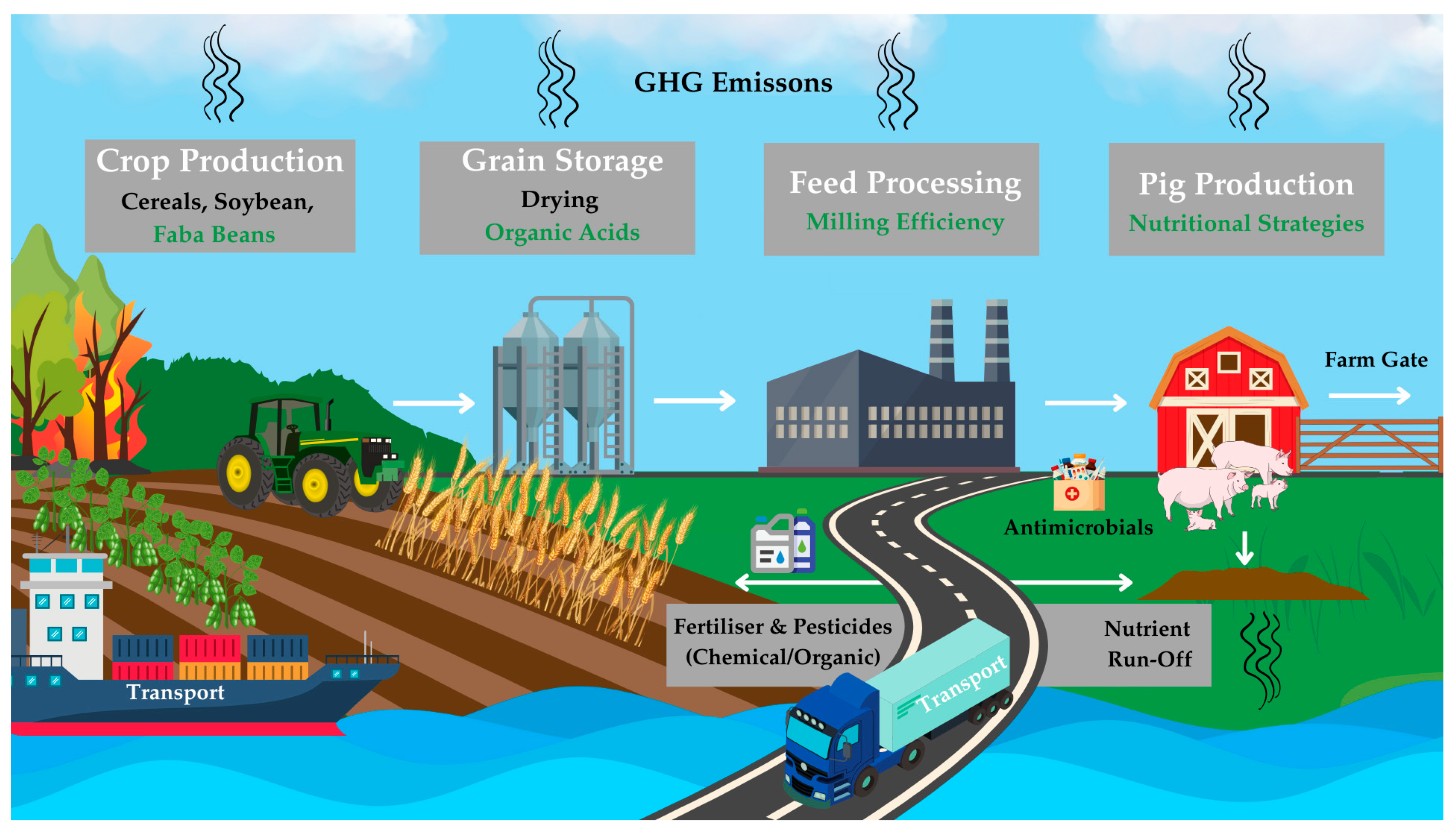
Table 1.
The effects of organic acid-preserved grain on intestinal health, digestive function, and growth performance of pigs.
Table 1.
The effects of organic acid-preserved grain on intestinal health, digestive function, and growth performance of pigs.
| Production Stage | Organic Acid | Effects on Intestinal Health and Digestive Function | Effects on Growth Performance | Ref. |
| Exp. 1 and 2: Growing Exp. 3: Weaning | Organic acid-preserved grain (57% formic acid blend) |
|
|
[35] |
| Weaning (7-22 kg) | Organic acid-preserved grain (65% propionic acid blend) |
|
|
[195] |
| Weaning (7-21 kg) | Organic acid-preserved grain (65% propionic acid blend) |
|
|
[196] |
| Weaning (7-24 kg) | Organic acid-preserved grain (65% propionic acid blend) |
|
|
[197] |
| Weaning (7-23 kg) | Organic acid-preserved grain (65% propionic acid blend) |
|
|
[198] |
| Suckling to Slaughter (3-120 kg) |
Organic acid-preserved grain (65% propionic acid blend) |
|
|
[199] |
ADFI, average daily feed intake; ADG, average daily gain; BCFA, branched-chain fatty acids; BW, body weight; Ca, calcium; CAID, coefficient of apparent ileal digestibility; CATTD, coefficient of apparent total tract digestibility; CP, crude protein; d, day; DM, dry matter; EE, ether extract; FCR, feed conversion ratio; GE, gross energy; G:F, gain-to-feed ratio; N, nitrogen; NDF, neutral detergent fibre; OM, organic matter; P, phosphorus; PW, post-weaning; VH, villus height; VH:CD, villus height-crypt depth ratio.
Table 2.
The effects of dietary organic acid inclusion on intestinal health, digestive function, and growth performance of pigs.
Table 2.
The effects of dietary organic acid inclusion on intestinal health, digestive function, and growth performance of pigs.
| Production Stage | Organic Acid and Inclusion Level | Effects on Intestinal Health and Digestive Function | Effects on Growth Performance | Ref. |
|---|---|---|---|---|
| Weaning (7-26 kg) |
|
|
|
[216] |
| Weaning (9-18 kg) | Ca-formate, Ca-lactate, lauric, myristic, and capric acid and citric acid blend (0.3%) |
|
|
[221] |
| Weaning (8-32 kg) |
|
|
|
[222] |
| Weaning (6-12 kg) | Fumaric, citric, malic, caprylic and capric acids blend (0.2% or 0.4%) |
|
|
[226] |
| Weaning (6-13 kg) | Sodium butyrate (0.05 and 0.1%) |
|
|
[230] |
| Weaning (9-20 kg) |
|
|
|
[233] |
| Weaning (7-28 kg) | Formic acid (0.14 or 0.64%) |
|
|
[234] |
| Weaning (8-18 kg) | Butryic, fumaric and benzoic acid blend (0.5 and 1.0%) |
|
|
[243] |
| Weaning (8-16 kg) |
|
|
|
[244] |
| Weaning (8-13 kg) |
|
|
|
[245] |
| Exp. 1: Weaning(7-24 kg) |
|
|
|
[246] |
| Exp. 2: Weaning(7-24 kg) |
|
|
|
|
| Weaning (6-20 kg) | Sorbic, benzoic, butyric, capric, caprylic, and lauric acid blend (0.2%) |
|
|
[247] |
| Weaning (9-20 kg) | Benzoic acid, Ca-formate, fumaric acid blend (0.15%) |
|
|
[248] |
| Weaning (7-25 kg) | Fumaric, citric, malic, caprylic and capric acids blend (0.1% or 0.2%) |
|
|
[249] |
| Weaning (5-24 kg) |
|
|
|
[250] |
| Growing (19-28 kg) | Benzoic acid (0.5%) |
|
|
[231] |
| Growing (23-50 kg) | Fumaric, citric, malic, caprylic and capric acid blend (0.1% or 0.2%) |
|
|
[251] |
| Growing (23-54 kg) | Fumaric, citric, malic, caprylic and capric acid blend (0.1%, 0.2% or 0.4%) |
|
|
[252] |
| Finishing (48-93 kg) | Fumaric, citric, malic, caprylic and capric acid blend (0.2%) |
|
|
[134] |
| Finishing (50-117 kg) | Fumaric, citric, malic, caprylic and capric acid blend (0.1% or 0.2%) |
|
|
[253] |
| Exp. 1: Weaning (6-22 kg) Exp 2: Grow-Finishing (24-140 kg) |
Sodium diformate Exp 1: (0.4%, 0.6%, 0.8%, 1% or 1.2%) Exp 2: (0.25%, 0.5%, or 0.75%) |
Exp 1:
|
|
[254] |
ADFI, average daily feed intake; ADG, average daily gain; BCFA, branched-chain fatty acids; BW, body weight; Ca, calcium; CAID, coefficient of apparent ileal digestibility; CATTD, coefficient of apparent total tract digestibility; CD, crypt depth; CP, crude protein; d, day; DM, dry matter; EE, ether extract; FCR, feed conversion ratio; GE, gross energy; G:F, gain-to-feed ratio; Ig, immunoglobulin; N, nitrogen; NDF, neutral detergent fibre; OA, organic acid; OM, organic matter; P, phosphorus; PW, post-weaning; VH, villus height; VH:CD, villus height-crypt depth ratio.
Disclaimer/Publisher’s Note: The statements, opinions and data contained in all publications are solely those of the individual author(s) and contributor(s) and not of MDPI and/or the editor(s). MDPI and/or the editor(s) disclaim responsibility for any injury to people or property resulting from any ideas, methods, instructions or products referred to in the content. |
© 2025 by the authors. Licensee MDPI, Basel, Switzerland. This article is an open access article distributed under the terms and conditions of the Creative Commons Attribution (CC BY) license (https://creativecommons.org/licenses/by/4.0/).
Copyright: This open access article is published under a Creative Commons CC BY 4.0 license, which permit the free download, distribution, and reuse, provided that the author and preprint are cited in any reuse.


